EP0023055B1 - Procédé de fabrication d'un absorbeur sélectif de capteur solaire - Google Patents
Procédé de fabrication d'un absorbeur sélectif de capteur solaire Download PDFInfo
- Publication number
- EP0023055B1 EP0023055B1 EP80200639A EP80200639A EP0023055B1 EP 0023055 B1 EP0023055 B1 EP 0023055B1 EP 80200639 A EP80200639 A EP 80200639A EP 80200639 A EP80200639 A EP 80200639A EP 0023055 B1 EP0023055 B1 EP 0023055B1
- Authority
- EP
- European Patent Office
- Prior art keywords
- potential
- process according
- manufacturing process
- collecting surface
- anodic oxidation
- Prior art date
- Legal status (The legal status is an assumption and is not a legal conclusion. Google has not performed a legal analysis and makes no representation as to the accuracy of the status listed.)
- Expired
Links
- 239000006096 absorbing agent Substances 0.000 title claims description 19
- 238000000034 method Methods 0.000 title claims description 19
- 230000008569 process Effects 0.000 title claims description 15
- PXHVJJICTQNCMI-UHFFFAOYSA-N Nickel Chemical compound [Ni] PXHVJJICTQNCMI-UHFFFAOYSA-N 0.000 claims description 27
- VYZAMTAEIAYCRO-UHFFFAOYSA-N Chromium Chemical compound [Cr] VYZAMTAEIAYCRO-UHFFFAOYSA-N 0.000 claims description 20
- 229910052804 chromium Inorganic materials 0.000 claims description 20
- 239000011651 chromium Substances 0.000 claims description 20
- XEEYBQQBJWHFJM-UHFFFAOYSA-N Iron Chemical compound [Fe] XEEYBQQBJWHFJM-UHFFFAOYSA-N 0.000 claims description 18
- 229910045601 alloy Inorganic materials 0.000 claims description 15
- 239000000956 alloy Substances 0.000 claims description 15
- 239000010935 stainless steel Substances 0.000 claims description 15
- 229910001220 stainless steel Inorganic materials 0.000 claims description 15
- 229910052759 nickel Inorganic materials 0.000 claims description 13
- 238000002161 passivation Methods 0.000 claims description 13
- 238000010521 absorption reaction Methods 0.000 claims description 12
- 238000005260 corrosion Methods 0.000 claims description 12
- 230000007797 corrosion Effects 0.000 claims description 12
- 230000003647 oxidation Effects 0.000 claims description 12
- 238000007254 oxidation reaction Methods 0.000 claims description 12
- CWYNVVGOOAEACU-UHFFFAOYSA-N Fe2+ Chemical compound [Fe+2] CWYNVVGOOAEACU-UHFFFAOYSA-N 0.000 claims description 11
- 238000004519 manufacturing process Methods 0.000 claims description 11
- QAOWNCQODCNURD-UHFFFAOYSA-N Sulfuric acid Chemical compound OS(O)(=O)=O QAOWNCQODCNURD-UHFFFAOYSA-N 0.000 claims description 9
- 239000002253 acid Substances 0.000 claims description 9
- 229910052742 iron Inorganic materials 0.000 claims description 9
- NINIDFKCEFEMDL-UHFFFAOYSA-N Sulfur Chemical compound [S] NINIDFKCEFEMDL-UHFFFAOYSA-N 0.000 claims description 8
- 230000005855 radiation Effects 0.000 claims description 8
- 229910052751 metal Inorganic materials 0.000 claims description 7
- 239000002184 metal Substances 0.000 claims description 7
- 229910052752 metalloid Inorganic materials 0.000 claims description 7
- OKTJSMMVPCPJKN-UHFFFAOYSA-N Carbon Chemical compound [C] OKTJSMMVPCPJKN-UHFFFAOYSA-N 0.000 claims description 6
- 229910052799 carbon Inorganic materials 0.000 claims description 6
- 150000002738 metalloids Chemical class 0.000 claims description 6
- RYGMFSIKBFXOCR-UHFFFAOYSA-N Copper Chemical compound [Cu] RYGMFSIKBFXOCR-UHFFFAOYSA-N 0.000 claims description 5
- 229910052802 copper Inorganic materials 0.000 claims description 5
- 239000010949 copper Substances 0.000 claims description 5
- 238000005868 electrolysis reaction Methods 0.000 claims description 5
- 239000010703 silicon Substances 0.000 claims description 5
- 229910052710 silicon Inorganic materials 0.000 claims description 5
- -1 sulphide ions Chemical class 0.000 claims description 5
- ZOKXTWBITQBERF-UHFFFAOYSA-N Molybdenum Chemical compound [Mo] ZOKXTWBITQBERF-UHFFFAOYSA-N 0.000 claims description 4
- 229910052750 molybdenum Inorganic materials 0.000 claims description 4
- 239000011733 molybdenum Substances 0.000 claims description 4
- XUIMIQQOPSSXEZ-UHFFFAOYSA-N Silicon Chemical compound [Si] XUIMIQQOPSSXEZ-UHFFFAOYSA-N 0.000 claims description 2
- RTAQQCXQSZGOHL-UHFFFAOYSA-N Titanium Chemical compound [Ti] RTAQQCXQSZGOHL-UHFFFAOYSA-N 0.000 claims description 2
- 150000002739 metals Chemical class 0.000 claims description 2
- 239000010936 titanium Substances 0.000 claims description 2
- 229910052719 titanium Inorganic materials 0.000 claims description 2
- 239000013543 active substance Substances 0.000 claims 2
- 239000005864 Sulphur Substances 0.000 claims 1
- 230000002378 acidificating effect Effects 0.000 claims 1
- 229910052758 niobium Inorganic materials 0.000 claims 1
- 239000010955 niobium Substances 0.000 claims 1
- GUCVJGMIXFAOAE-UHFFFAOYSA-N niobium atom Chemical compound [Nb] GUCVJGMIXFAOAE-UHFFFAOYSA-N 0.000 claims 1
- 235000011149 sulphuric acid Nutrition 0.000 claims 1
- 239000001117 sulphuric acid Substances 0.000 claims 1
- 150000003568 thioethers Chemical class 0.000 claims 1
- 229910052717 sulfur Inorganic materials 0.000 description 8
- 239000011593 sulfur Substances 0.000 description 8
- 239000000463 material Substances 0.000 description 7
- 239000000126 substance Substances 0.000 description 7
- 229910000831 Steel Inorganic materials 0.000 description 5
- 239000000203 mixture Substances 0.000 description 5
- 239000010959 steel Substances 0.000 description 5
- 238000007792 addition Methods 0.000 description 4
- 238000000576 coating method Methods 0.000 description 4
- 150000001875 compounds Chemical class 0.000 description 4
- UDHXJZHVNHGCEC-UHFFFAOYSA-N Chlorophacinone Chemical compound C1=CC(Cl)=CC=C1C(C=1C=CC=CC=1)C(=O)C1C(=O)C2=CC=CC=C2C1=O UDHXJZHVNHGCEC-UHFFFAOYSA-N 0.000 description 3
- 230000032683 aging Effects 0.000 description 3
- 239000007864 aqueous solution Substances 0.000 description 3
- ZOMNIUBKTOKEHS-UHFFFAOYSA-L dimercury dichloride Chemical compound Cl[Hg][Hg]Cl ZOMNIUBKTOKEHS-UHFFFAOYSA-L 0.000 description 3
- 230000000694 effects Effects 0.000 description 3
- 150000002500 ions Chemical class 0.000 description 3
- 238000004452 microanalysis Methods 0.000 description 3
- 238000013508 migration Methods 0.000 description 3
- 230000005012 migration Effects 0.000 description 3
- 229910052979 sodium sulfide Inorganic materials 0.000 description 3
- GRVFOGOEDUUMBP-UHFFFAOYSA-N sodium sulfide (anhydrous) Chemical compound [Na+].[Na+].[S-2] GRVFOGOEDUUMBP-UHFFFAOYSA-N 0.000 description 3
- 238000012360 testing method Methods 0.000 description 3
- 239000000654 additive Substances 0.000 description 2
- 238000002048 anodisation reaction Methods 0.000 description 2
- QVGXLLKOCUKJST-UHFFFAOYSA-N atomic oxygen Chemical compound [O] QVGXLLKOCUKJST-UHFFFAOYSA-N 0.000 description 2
- 230000008901 benefit Effects 0.000 description 2
- 230000015556 catabolic process Effects 0.000 description 2
- 239000011248 coating agent Substances 0.000 description 2
- 238000006731 degradation reaction Methods 0.000 description 2
- 230000008021 deposition Effects 0.000 description 2
- 239000000945 filler Substances 0.000 description 2
- 239000010410 layer Substances 0.000 description 2
- 230000003287 optical effect Effects 0.000 description 2
- 229910052760 oxygen Inorganic materials 0.000 description 2
- 239000001301 oxygen Substances 0.000 description 2
- 238000007747 plating Methods 0.000 description 2
- 239000000523 sample Substances 0.000 description 2
- 150000004763 sulfides Chemical class 0.000 description 2
- 238000013459 approach Methods 0.000 description 1
- 230000015572 biosynthetic process Effects 0.000 description 1
- 229940075397 calomel Drugs 0.000 description 1
- KRVSOGSZCMJSLX-UHFFFAOYSA-L chromic acid Substances O[Cr](O)(=O)=O KRVSOGSZCMJSLX-UHFFFAOYSA-L 0.000 description 1
- UOUJSJZBMCDAEU-UHFFFAOYSA-N chromium(3+);oxygen(2-) Chemical group [O-2].[O-2].[O-2].[Cr+3].[Cr+3] UOUJSJZBMCDAEU-UHFFFAOYSA-N 0.000 description 1
- DBULDCSVZCUQIR-UHFFFAOYSA-N chromium(3+);trisulfide Chemical class [S-2].[S-2].[S-2].[Cr+3].[Cr+3] DBULDCSVZCUQIR-UHFFFAOYSA-N 0.000 description 1
- 238000004040 coloring Methods 0.000 description 1
- 230000007423 decrease Effects 0.000 description 1
- 230000003247 decreasing effect Effects 0.000 description 1
- 230000000593 degrading effect Effects 0.000 description 1
- 238000009792 diffusion process Methods 0.000 description 1
- 238000007598 dipping method Methods 0.000 description 1
- 238000004090 dissolution Methods 0.000 description 1
- 238000002474 experimental method Methods 0.000 description 1
- 230000002349 favourable effect Effects 0.000 description 1
- AWJWCTOOIBYHON-UHFFFAOYSA-N furo[3,4-b]pyrazine-5,7-dione Chemical compound C1=CN=C2C(=O)OC(=O)C2=N1 AWJWCTOOIBYHON-UHFFFAOYSA-N 0.000 description 1
- 229910052500 inorganic mineral Inorganic materials 0.000 description 1
- 150000002737 metalloid compounds Chemical class 0.000 description 1
- 239000011707 mineral Substances 0.000 description 1
- 238000012986 modification Methods 0.000 description 1
- 230000004048 modification Effects 0.000 description 1
- 239000003973 paint Substances 0.000 description 1
- 230000035515 penetration Effects 0.000 description 1
- 238000012545 processing Methods 0.000 description 1
- 230000009467 reduction Effects 0.000 description 1
- 150000003839 salts Chemical class 0.000 description 1
- WWNBZGLDODTKEM-UHFFFAOYSA-N sulfanylidenenickel Chemical class [Ni]=S WWNBZGLDODTKEM-UHFFFAOYSA-N 0.000 description 1
- XTQHKBHJIVJGKJ-UHFFFAOYSA-N sulfur monoxide Chemical class S=O XTQHKBHJIVJGKJ-UHFFFAOYSA-N 0.000 description 1
- 239000002344 surface layer Substances 0.000 description 1
Images
Classifications
-
- C—CHEMISTRY; METALLURGY
- C25—ELECTROLYTIC OR ELECTROPHORETIC PROCESSES; APPARATUS THEREFOR
- C25D—PROCESSES FOR THE ELECTROLYTIC OR ELECTROPHORETIC PRODUCTION OF COATINGS; ELECTROFORMING; APPARATUS THEREFOR
- C25D11/00—Electrolytic coating by surface reaction, i.e. forming conversion layers
- C25D11/02—Anodisation
- C25D11/34—Anodisation of metals or alloys not provided for in groups C25D11/04 - C25D11/32
-
- C—CHEMISTRY; METALLURGY
- C25—ELECTROLYTIC OR ELECTROPHORETIC PROCESSES; APPARATUS THEREFOR
- C25D—PROCESSES FOR THE ELECTROLYTIC OR ELECTROPHORETIC PRODUCTION OF COATINGS; ELECTROFORMING; APPARATUS THEREFOR
- C25D9/00—Electrolytic coating other than with metals
- C25D9/04—Electrolytic coating other than with metals with inorganic materials
- C25D9/06—Electrolytic coating other than with metals with inorganic materials by anodic processes
-
- F—MECHANICAL ENGINEERING; LIGHTING; HEATING; WEAPONS; BLASTING
- F24—HEATING; RANGES; VENTILATING
- F24S—SOLAR HEAT COLLECTORS; SOLAR HEAT SYSTEMS
- F24S70/00—Details of absorbing elements
- F24S70/10—Details of absorbing elements characterised by the absorbing material
- F24S70/12—Details of absorbing elements characterised by the absorbing material made of metallic material
-
- F—MECHANICAL ENGINEERING; LIGHTING; HEATING; WEAPONS; BLASTING
- F24—HEATING; RANGES; VENTILATING
- F24S—SOLAR HEAT COLLECTORS; SOLAR HEAT SYSTEMS
- F24S70/00—Details of absorbing elements
- F24S70/20—Details of absorbing elements characterised by absorbing coatings; characterised by surface treatment for increasing absorption
- F24S70/225—Details of absorbing elements characterised by absorbing coatings; characterised by surface treatment for increasing absorption for spectrally selective absorption
-
- F—MECHANICAL ENGINEERING; LIGHTING; HEATING; WEAPONS; BLASTING
- F24—HEATING; RANGES; VENTILATING
- F24S—SOLAR HEAT COLLECTORS; SOLAR HEAT SYSTEMS
- F24S70/00—Details of absorbing elements
- F24S70/20—Details of absorbing elements characterised by absorbing coatings; characterised by surface treatment for increasing absorption
- F24S70/25—Coatings made of metallic material
-
- Y—GENERAL TAGGING OF NEW TECHNOLOGICAL DEVELOPMENTS; GENERAL TAGGING OF CROSS-SECTIONAL TECHNOLOGIES SPANNING OVER SEVERAL SECTIONS OF THE IPC; TECHNICAL SUBJECTS COVERED BY FORMER USPC CROSS-REFERENCE ART COLLECTIONS [XRACs] AND DIGESTS
- Y02—TECHNOLOGIES OR APPLICATIONS FOR MITIGATION OR ADAPTATION AGAINST CLIMATE CHANGE
- Y02E—REDUCTION OF GREENHOUSE GAS [GHG] EMISSIONS, RELATED TO ENERGY GENERATION, TRANSMISSION OR DISTRIBUTION
- Y02E10/00—Energy generation through renewable energy sources
- Y02E10/40—Solar thermal energy, e.g. solar towers
Definitions
- the invention relates to a method for manufacturing a selective absorber for a solar collector, making it possible to obtain a surface for collecting solar radiation with a high absorption factor and a low emission factor; it extends to the selective solar collector absorbers obtained.
- Another type of process consists in carrying out a cathodic deposition of chromium oxides, designated by chromium black, on the collection surface.
- the electrolytic bath is based on chromic acid and the deposition is carried out by conventional electrolysis which leads to an addition of material on the surface.
- the disadvantage of this type of process lies in the complexity and the cost of the process of preparing the collection surface which is to receive the coating of chromium black; in fact, it is necessary to carry out beforehand nickel plating of the surface in order to obtain good adhesion of the chromium black layer and satisfactory selectivity. In addition, it is observed for the surfaces thus coated that the absorption factor decreases at medium or high temperature (from 200 ° C.).
- This type of process has the disadvantage of using expensive and polluting baths and of leading to surface layers of oxides whose thickness must be rigorously controlled to obtain a selective effect and whose stability is not guaranteed at temperature. high.
- the present invention proposes to remedy the drawbacks of the known methods, by making it possible to produce collection surfaces benefiting from a low cost and excellent selectivity, and this without risk of degradation of said surfaces.
- Another objective is to produce absorbers having good corrosion resistance.
- Another objective is to provide an absorber capable of working in a high temperature range, without appreciable reduction in selectivity.
- the method of manufacturing a selective solar collector absorber according to the invention making it possible to obtain a collection surface with a high absorption factor and low emission factor, consists in producing said collection surface in a ferrous alloy containing a filler metal constituted by chromium in the alloyed state and subjecting this surface to an anodic oxidation in an acid electrolytic bath containing electroactive substances based on metalloids, the electrolysis voltage between anode constituted by the absorption surface of the absorber and the cathode being adjusted to a value such that the potential of the anode is between the potential for natural corrosion and the potential for primary passivation of the ferrous alloy forming said anode.
- the natural corrosion potentials and the primary passivation potential relate to the ferrous alloy immersed in the electrolytic bath concerned. These potentials are well known to those skilled in the art and are very easy to measure; the natural corrosion potential can be obtained for each alloy immersed in a given medium, using a voltmeter by measuring the voltage which is established naturally between a reference electrode and the alloy, immersed in the bath concerned.
- the primary passivation potential can be obtained by plotting the intensity / potential curve of the ferrous alloy in the electrolytic bath by means of a potentiostat (the role of the potentiostat being to impose on the anode a variable potential with respect to a reference electrode); the primary passivation potential corresponds to the top of the activity plc.
- Electroactive substances based on metalloids in the bath can consist of metalloid ions placed directly in the bath, in particular in the form of a salt or even released during electrolysis from mineral or organic substances contained in the bath.
- Such an anodic oxidation of a ferrous alloy containing chromium in the alloyed state conditions a modification of the chemical composition on the surface of the surface: the latter is enriched in chromium coming from the core of the material and receives metalloid compounds. from the electrolytic bath, which migrate to the surface over a given thickness. It can be seen that the surface acquires a black color and experiments have shown that it benefits from both a high absorption factor and a low emission factor.
- the capture surface obtained has no superadded deposit, but is transformed superficially inside the material itself to a small thickness thereof; no adhesion problem therefore arises, while the stability of the compounds formed eliminates any risk of degradation.
- the process is inexpensive owing to the fact that it consumes little energy (relatively low voltage and intensity of electrolysis), that it can be carried out at room temperature, that it uses inexpensive electrolytic baths, finally that it does not require any prior treatment of the surface with the exception, of course, of the usual operations for preparing an anodic oxidation; in particular, it eliminates the preliminary treatment of nickel plating necessary in known processes with black chromium.
- the acid bath (which may be only very slightly acid) has no annoying polluting character which is essential in practice.
- the collection surface is chosen from stainless steel based on iron and chromed; it is advantageously possible to choose a common type alloy based on iron, chromium and nickel.
- An improved selectivity is thus obtained by virtue of a surface enrichment of nickel originating from a migration towards the surface of nickel atoms of the steel; moreover, the qualities of stainless steel give the absorber good resistance to corrosion.
- the type of stainless steel chosen in each application depends on the operating temperature provided for the absorber and on the desired selectivity ratio; in the case of operation at high temperature, it is possible to choose a stainless steel based on iron, chromium and nickel, containing additions essentially of copper, silicon, titanium, molybdenum or nobium or a mixture of these metals; selectivity and / or stability are notably improved by these additives.
- the anodic oxidation is preferably carried out with controlled electrode potential, by placing a reference electrode in the bath and by adjusting the potential difference between the the anode and the reference electrode have a very approximately constant reference value between the aforementioned corrosion potential and the passivation potential.
- This control makes it possible to adjust in a reproducible manner the penetration depth of the metalloid (s), the nature of the compounds formed and the thickness of material interested in the migration of the additives inside the alloy, parameters from which the optical properties of the surface.
- the above-mentioned reference value is adjusted to a value close to the primary passivation potential.
- the electroactive substances of the bath are substances based on sulfur, in particular sulfides.
- sulfur in particular sulfides.
- the anodic oxidation can be carried out at ambient temperature, in a suitably stirred medium.
- the ferrous alloy of the collection surface can be in the form of sheet metal, tube or other thick element, as well as thin strip intended to be attached to a support.
- the invention extends to a selective solar collector absorber manufactured by the method described above and comprising a surface of black capture, enriched superficially with at least one filler metal other than iron, in particular chromium, and containing superficially one or more metalloids, in particular sulfur and oxygen.
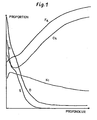
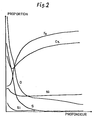
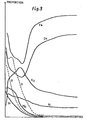
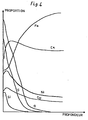
- FIGS. 1, 2, 3 and 4 show curves giving the proportion of the elements on the surface of the material as a function of the depth, respectively in the case of Examples 1, 2, 3 and 4.
- the absorber is made of stainless steel sheet Z03GN 18 ⁇ 10 (AFNOR standard) (composition: 18% chromium, 1096 nickel, carbon content: 0.0396, the remaining percentage being iron) .
- the electrolytic bath is an aqueous solution of sulfuric acid at 38% by weight of acid, supplemented with 0.013 gram of sulfur per liter, in the form of hydrated sodium sulfide, Na2 S, 9H2 0.
- the corrosion potential of the aforementioned steel is -0.45 volts and the passivation potential -0.17 volts by taking a calomel electrode as the reference electrode.
- the cathode is made of stainless steel of the same type as the anode which is formed by the sheet of the absorber; this is conventionally covered with protection on all surfaces other than the collection surface called to be subjected to solar radiation.
- a saturated calomel reference electrode is immersed in the bath.
- the surface superficially contains sulfur and oxygen in increasing concentration when one approaches the surface.
- this enrichment seems to come from a simple migration taking into account the concentration trough observed in an intermediate zone located between the surface zone and the internal zone.
- concentration trough observed in an intermediate zone located between the surface zone and the internal zone.
- the enrichment can probably be explained by a dissolution of a very small thickness of material in the bath followed by diffusion of the nickel at the surface of the material.
- the electrolytic bath is an aqueous solution of sulfuric acid at 38% by weight of acid, with the addition of 0.027 grams of sulfur per liter, in the form of hydrated sodium sulfide.
- the corrosion potential is -0.40 volt and the passivation potential -0.02 volt.
- the corrosion potential is -0.41 volts and the passivation potential -0.18 volts.
- the collection surface is made of strip of a thickness of 2/100 e mm in stainless steel Z 10 CNU 18-10 (composition: 18% chromium, 10% nickel, 1 to 2% copper, trace of silicon, the remaining percentage being iron).
- the electrolytic bath is an aqueous solution of sulfuric acid at 25% by weight of acid, with the addition of 0.02 grams of sulfur per liter, in the form of hydrated sodium sulfide.
- the corrosion potential of this steel is -0.42 volts and the passivation potential -0.10 volts.
- the cathode is made of stainless steel of the same type as the anode and the reference electrode is saturated calomel.
- the emission factor is therefore very low in this case.
Landscapes
- Engineering & Computer Science (AREA)
- Chemical & Material Sciences (AREA)
- Physics & Mathematics (AREA)
- Mechanical Engineering (AREA)
- Sustainable Energy (AREA)
- Thermal Sciences (AREA)
- Sustainable Development (AREA)
- Combustion & Propulsion (AREA)
- Life Sciences & Earth Sciences (AREA)
- General Engineering & Computer Science (AREA)
- Electrochemistry (AREA)
- Chemical Kinetics & Catalysis (AREA)
- Materials Engineering (AREA)
- Metallurgy (AREA)
- Organic Chemistry (AREA)
- Inorganic Chemistry (AREA)
- Spectroscopy & Molecular Physics (AREA)
- Electroplating Methods And Accessories (AREA)
- Chemical Treatment Of Metals (AREA)
Applications Claiming Priority (2)
| Application Number | Priority Date | Filing Date | Title |
|---|---|---|---|
| FR7918414 | 1979-07-11 | ||
| FR7918414A FR2461211A1 (fr) | 1979-07-11 | 1979-07-11 | Procede de fabrication d'un absorbeur selectif de capteur solaire et absorbeur selectif obtenu |
Publications (2)
| Publication Number | Publication Date |
|---|---|
| EP0023055A1 EP0023055A1 (fr) | 1981-01-28 |
| EP0023055B1 true EP0023055B1 (fr) | 1983-11-09 |
Family
ID=9227946
Family Applications (1)
| Application Number | Title | Priority Date | Filing Date |
|---|---|---|---|
| EP80200639A Expired EP0023055B1 (fr) | 1979-07-11 | 1980-07-03 | Procédé de fabrication d'un absorbeur sélectif de capteur solaire |
Country Status (4)
| Country | Link |
|---|---|
| US (1) | US4405414A (cg-RX-API-DMAC10.html) |
| EP (1) | EP0023055B1 (cg-RX-API-DMAC10.html) |
| DE (1) | DE3065516D1 (cg-RX-API-DMAC10.html) |
| FR (1) | FR2461211A1 (cg-RX-API-DMAC10.html) |
Families Citing this family (1)
| Publication number | Priority date | Publication date | Assignee | Title |
|---|---|---|---|---|
| FR2509446A1 (fr) * | 1981-07-08 | 1983-01-14 | Anvar | Procede de fabrication d'un absorbeur selectif de capteur solaire et absorbeur selectif obtenu |
Family Cites Families (5)
| Publication number | Priority date | Publication date | Assignee | Title |
|---|---|---|---|---|
| CH576008A5 (en) * | 1973-04-02 | 1976-05-31 | Franke Ag | Anodic colouring of stainless steels - in hot aq electrolyte contg caustic soda, potassium permanganate and sodium sulphide |
| CA1088404A (en) * | 1975-09-22 | 1980-10-28 | Toshihiro Ishibashi | Absorption surface of solar collector |
| SE396094B (sv) * | 1976-01-05 | 1977-09-05 | Teknoterm Systems Ab | Solenergikollektor |
| FR2338475A1 (fr) * | 1976-01-19 | 1977-08-12 | Centre Nat Etd Spatiales | Absorbeurs solaires a couches d'alliage nickel/chrome et de matiere dielectrique |
| IT1111112B (it) * | 1978-06-02 | 1986-01-13 | Mahdjuri Sabet Faramarz | Strato selettivo per comparti assorbitori di collettori solari |
-
1979
- 1979-07-11 FR FR7918414A patent/FR2461211A1/fr active Granted
-
1980
- 1980-07-03 DE DE8080200639T patent/DE3065516D1/de not_active Expired
- 1980-07-03 EP EP80200639A patent/EP0023055B1/fr not_active Expired
-
1981
- 1981-12-07 US US06/328,135 patent/US4405414A/en not_active Expired - Fee Related
Also Published As
| Publication number | Publication date |
|---|---|
| US4405414A (en) | 1983-09-20 |
| FR2461211A1 (fr) | 1981-01-30 |
| DE3065516D1 (en) | 1983-12-15 |
| EP0023055A1 (fr) | 1981-01-28 |
| FR2461211B1 (cg-RX-API-DMAC10.html) | 1983-03-18 |
Similar Documents
| Publication | Publication Date | Title |
|---|---|---|
| FR2539764A1 (fr) | Article a base d'aluminium anodise, colore et procede pour le preparer | |
| US3382160A (en) | Process for inorganically coloring aluminum | |
| EP3810833B1 (fr) | Procédé de traitement de surface d'une pièce en aluminium ou alliage d'aluminium ou en magnésium ou alliage de magnésium | |
| FR2615206A1 (fr) | Procede de depot electrolytique en continu de chrome metallique et d'oxyde de chrome sur des surfaces metalliques | |
| EP1455000B1 (fr) | Matériau métallique dont la surface est modifiée, son procédé de préparation et utilisation du matériau modifié | |
| Stojek et al. | Silver based mercury film electrode: I. General characteristics and stability of the electrode | |
| EP0070069B1 (fr) | Procédé de fabrication d'un absorbeur sélectif de capteur solaire | |
| CH617460A5 (cg-RX-API-DMAC10.html) | ||
| EP0023055B1 (fr) | Procédé de fabrication d'un absorbeur sélectif de capteur solaire | |
| FR3011853A1 (cg-RX-API-DMAC10.html) | ||
| Wojciechowski et al. | Square-wave anodic stripping voltammetry of lead and cadmium at cylindrical graphite fiber microelectrodes with in situ plated mercury films | |
| EP0709496B1 (fr) | Procédé d'électrodéposition d'un revêtement de chrome comportant des inclusions solides et bain mis en oeuvre dans ce procédé | |
| Maizelis | Contact exchange in tetrafluoroborate-EDTA electrolyte for Cu-Sn alloy deposition | |
| EP0274284A1 (fr) | Procédé de traitement de surface d'un acier en vue de réaliser un revêtement coloré | |
| FR2641548A1 (fr) | Tole d'acier resistant a la corrosion, comportant un placage d'un alliage fe-mn, et son procede de fabrication | |
| FR2863276A1 (fr) | Procede de colmatage exempt de chrome hexavalent applicable apres anodisation sulfurique d'alliages d'aluminium, solution de colmatage utilisee dans ce procede et article traite issu d'un tel procede | |
| Leidheiser Jr et al. | Conjectures on delamination of organic coatings by corrosion | |
| CH620712A5 (cg-RX-API-DMAC10.html) | ||
| Aramaki et al. | Surface‐Enhanced Raman Scattering Spectra of Pyridine Adsorbed on Nickel | |
| FR2509330A1 (fr) | Procede et dispositif pour le traitement par anodisation des surfaces metalliques etamees et surfaces etamees obtenues par ce procede | |
| FR3110606A1 (fr) | Procédé de chromage dur à partir de chrome trivalent | |
| EP0725846B1 (fr) | Procede de fabrication d'un revetement refractaire sur un substrat metallique | |
| FR3087209A1 (fr) | Composition pour le chromage d’un substrat et procede de chromage mettant en œuvre une telle composition | |
| WO2025012116A1 (fr) | Procédé de chromage dur à partir de chrome trivalent | |
| BE844471A (fr) | Methode pour produire un film d'oxyde anodique vert sur des produits en aluminium ou en alliage a base d'aluminium |
Legal Events
| Date | Code | Title | Description |
|---|---|---|---|
| PUAI | Public reference made under article 153(3) epc to a published international application that has entered the european phase |
Free format text: ORIGINAL CODE: 0009012 |
|
| AK | Designated contracting states |
Designated state(s): DE GB |
|
| 17P | Request for examination filed |
Effective date: 19810225 |
|
| GRAA | (expected) grant |
Free format text: ORIGINAL CODE: 0009210 |
|
| AK | Designated contracting states |
Designated state(s): DE GB |
|
| REF | Corresponds to: |
Ref document number: 3065516 Country of ref document: DE Date of ref document: 19831215 |
|
| RAP2 | Party data changed (patent owner data changed or rights of a patent transferred) |
Owner name: ANVAR AGENCE NATIONALE DE VALORISATION DE LA RECHE |
|
| PLBE | No opposition filed within time limit |
Free format text: ORIGINAL CODE: 0009261 |
|
| STAA | Information on the status of an ep patent application or granted ep patent |
Free format text: STATUS: NO OPPOSITION FILED WITHIN TIME LIMIT |
|
| 26N | No opposition filed | ||
| PGFP | Annual fee paid to national office [announced via postgrant information from national office to epo] |
Ref country code: GB Payment date: 19910627 Year of fee payment: 12 |
|
| PGFP | Annual fee paid to national office [announced via postgrant information from national office to epo] |
Ref country code: DE Payment date: 19910806 Year of fee payment: 12 |
|
| PG25 | Lapsed in a contracting state [announced via postgrant information from national office to epo] |
Ref country code: GB Effective date: 19920703 |
|
| GBPC | Gb: european patent ceased through non-payment of renewal fee |
Effective date: 19920703 |
|
| PG25 | Lapsed in a contracting state [announced via postgrant information from national office to epo] |
Ref country code: DE Effective date: 19930401 |