EP0022397B1 - Procédé de frappe de texte avec enregistrement codé conjoint pour exploitation ultérieure, et machine à écrire pour la mise en oeuvre du procédé - Google Patents
Procédé de frappe de texte avec enregistrement codé conjoint pour exploitation ultérieure, et machine à écrire pour la mise en oeuvre du procédé Download PDFInfo
- Publication number
- EP0022397B1 EP0022397B1 EP19800400952 EP80400952A EP0022397B1 EP 0022397 B1 EP0022397 B1 EP 0022397B1 EP 19800400952 EP19800400952 EP 19800400952 EP 80400952 A EP80400952 A EP 80400952A EP 0022397 B1 EP0022397 B1 EP 0022397B1
- Authority
- EP
- European Patent Office
- Prior art keywords
- memory
- reading
- graphic
- line
- printing
- Prior art date
- Legal status (The legal status is an assumption and is not a legal conclusion. Google has not performed a legal analysis and makes no representation as to the accuracy of the status listed.)
- Expired
Links
Images

Classifications
-
- G—PHYSICS
- G06—COMPUTING OR CALCULATING; COUNTING
- G06K—GRAPHICAL DATA READING; PRESENTATION OF DATA; RECORD CARRIERS; HANDLING RECORD CARRIERS
- G06K1/00—Methods or arrangements for marking the record carrier in digital fashion
- G06K1/20—Simultaneous marking of record carrier and printing-out of data, e.g. printing-punch
-
- B—PERFORMING OPERATIONS; TRANSPORTING
- B41—PRINTING; LINING MACHINES; TYPEWRITERS; STAMPS
- B41J—TYPEWRITERS; SELECTIVE PRINTING MECHANISMS, i.e. MECHANISMS PRINTING OTHERWISE THAN FROM A FORME; CORRECTION OF TYPOGRAPHICAL ERRORS
- B41J3/00—Typewriters or selective printing or marking mechanisms characterised by the purpose for which they are constructed
- B41J3/44—Typewriters or selective printing mechanisms having dual functions or combined with, or coupled to, apparatus performing other functions
- B41J3/50—Mechanisms producing characters by printing and also producing a record by other means, e.g. printer combined with RFID writer
Definitions
- the invention relates to a method of typing a text on a support sheet, with a joint coded recording, of the text, so that the text can be the object of a later exploitation, reproduction or extraction and processing of data, by re-reading the coded recording.
- the invention also relates to a typewriter provided for implementing the method.
- Typewriters are known in which the printing of the text in graphic characters is accompanied by the coded recording of the text on a separate support, in particular perforated tape or magnetic tape.
- graphic characters is meant alphanumeric, punctuation, and symbolic characters of general and classical use, and by coded recording, the recording of digital signals in correspondence with graphic characters according to a code, generally standardized, such as the ASC code It for example.
- coded digital signals emitted by the keystrokes of the keyboard during the composition of a line are stored in an intermediate memory with as many locations as a line of text. has character locations, while a display associated with a means of reading the intermediate memory shows the content of the line during its composition.
- the content of the intermediate memory is transferred to a secondary memory, coupled to a printing carriage and to a means of writing on the coded recording medium, and the reading of the secondary memory simultaneously causes graphic printing and coded recording, while intermediate memory is available for typing the next line.
- these support sheets in fact constitute peripheral memory elements usable only in connection with a computer associated with the terminal, on which the printed text only serves to express in clear part of the information carried on the coded track, and which are necessary to identify the content of the coded information.
- the support sheets do not constitute documents susceptible of distribution, and the establishment of documents to be distributed is normally done without coded joint recording, from elements taken from one or more support sheet on track, and suitably processed by the computer. .
- the object of the invention is to carry out a method of typing text on a support sheet with joint coded recording with a view to subsequent use by re-reading where the coded recording is printed on the support sheet of graphic text, and in correlation with 'location.
- Another object of the invention is to provide a method of typing text in which the coded recording of a line of text is printed in a margin opposite the line.
- Another object of the invention is to provide such a method of typing text where the coded recording comprises elements of reading rhythm.
- the invention provides a method of typing text on a support sheet, with joint coded recording allowing automatic re-reading for later use, where a limited series of signals is recorded in a first memory.
- digital each in correspondence with a graphic character according to a basic code, the memory being permanently read and its content displayed in graphic characters, the content of the first is transferred to a second memory in response to an end signal, and the contents of the second memory are printed in graph in response to a first reading of the second memory, a method characterized in that the characters are printed in digitally encoded characters following graphic printing, in response to a second reading of the second memory.
- the coded impression resulting from the second reading will be in position correlation with the printing of the series of graphic characters, resulting from the first reading, on the support sheet.
- the limited series of digital signals will correspond to a line of text, so that an end-of-line signal successively triggers the first reading, the second reading, and the positioning of the support sheet for printing the next line.
- an end-of-line signal successively triggers the first reading, the second reading, and the positioning of the support sheet for printing the next line.
- the corresponding coded print will be placed in the margin.
- the basic code consists, by graphic character, of a separate word with seven binary digits plus a parity digit
- the printing comprises by word an alignment of nine point positions transversely to the general direction of typing, eight places corresponding respectively to the eight binary digits of word and the ninth being occupied alternately in the continuation by 0 and 1 so as to define a base of rhythm of replay.
- the line of ninth position defines a reading synchronization frequency.
- the invention proposes a typewriter, intended for typing texts with coded joint recording allowing automatic re-reading for later exploitation, and comprising a keyboard with keys of graphic characters adapted to each emit by pressing a digital signal. corresponding to the character to which the key is assigned, and function keys including at least one end of line key, a first memory coupled to the keyboard and suitable for recording a series of digital signals in the order of transmission by the keys of characters, a display in graphic characters coupled to the first memory and adapted to display the content of the latter a second memory loaded with the content of the first in response to a signal emitted by the end of line key and coupled to a means of sequential reading, and a carriage with a print head adapted to move by discrete advances along a line across a sheet s upport of text and to carry out a line printing in graphic characters in response to the actuation of said reading means following the loading of the second memory, the end of reading determining the carriage return and the advance of a interlining of the support sheet, machine characterized in that
- the carriage comprises a so-called mosaic print head with rows and columns associated with a coding matrix adapted to apply to each column of the print head a character coded in correspondence with a digital signal.
- mosaic printheads used for fast printers, allow, in addition to printing speed, the composition of a very compact and easily readable coded recording by optical process.
- the graphic characters can be printed, either by a known graphic printing head, such as a ball or crown head, or by the mosaic head coupled, for graphic printing, to a graphic print command signal generator. known, which ensures the correspondence between a coded digital signal representative of a character, and a distribution of the dots printed at the intersection of the rows and columns of the matrix, such that the character is reconstituted.
- a typewriter comprises a conventional keyboard 1, with an associated coder 1 emitting on output 1 b a digital signal corresponding to the character assigned to each key in the ASCII code in response to each key is pressed, and on output 1 a pulse each time a key is pressed.
- the keyboard also has an end of line key 2.
- At keyboard 1 is associated with a first memory 3, comprising as many locations of digital signals as a line can contain characters.
- the memory 3 receives on a recording input the digital signals transmitted on the output 1b, and includes an address counter 3a which receives the pulses transmitted by the output 1 of the keyboard 1, so that the digital signals transmitted on the output 1 b are stored in a memory location corresponding to the rank of the character in the line.
- the memory 3 also includes a reading device 3b coupled to a graphic display 4, and which scans the content of the memory 3 in the intervals between the digital signal recordings, so that the display 4 reproduces the line at all times. its current state of composition.
- the memory 3 is also coupled to a second memory 6, of the same capacity as the memory 3, through a transfer member 5, controlled by the key 2.
- the memory 6 comprises an address counter 6a with a counting input 6b and an overflow outlet 6c, connected to the counting input of a cyclic counter 7, with three outputs, the first connected to a first input of an "AND” gate 8, the second to the input of a first input of an "AND” gate 9, and the third controlling the return to zero of the counter 7.
- first and second outputs of the counter 7, as well as an output 5a of the transfer member 5, attack jointly the inputs of an "OR” gate 12, the output of which attacks an input of an "AND” gate 14 whose second input is connected to a clock 13, while the output of the "AND” gate 14 attacks the counting input 6b of the address counter 6a.
- the "AND" gates 8 and 9 receive jointly on a second input the digital signals which appear on the reading output 6d of the second memory 6, and are connected in output respectively to coding devices 10, 11 capable, in response to a coded signal, to emit a coded output signal exploitable by a print head, respectively in graphic and digital coded.
- the typewriter further comprises a printing device 15 as a whole, on a support sheet 16, comprising a carriage 17 with a graphic printing head 17a, driven by the coding device 10, and a printing head coded 17b, driven by the coding device 11, a stepping motor 18 for advancing the carriage, and a stepping motor 19 for advancing the support sheet 16.
- the devices for advancing the carriage and support sheet are conventional, and will therefore not be described in their constitution or their control means.
- the print head 17b is a so-called "mosaic" head with nine lines and seven columns, designed to print a pattern of dots located at the intersection of the lines and columns of a 9 ⁇ 7 matrix.
- Each point represented by an address which identifies the line and the column whose intersection defines the point, is obtained by applying a transfer-inking ribbon to the support sheet as a result of the projection of a needle placed in the head .
- This has 9 row hands, aligned in the direction of a column, and individually controlled by the corresponding row sub-address.
- the 7 columns are explored in succession, the block of needles advancing by a column width between each exploration. As will be explained in detail later, each column corresponds to the character encoding.
- the print head 17a is a conventional graphic print head, of the type commonly known as "ball", which carries in relief all of the necessary graphic characters.
- the digital control signals have the effect of orienting the head so that the corresponding graphic character is opposite the typing location on the support sheet, and is pressed against it by means of the transfer ink ribbon. .
- the address counter 6a causes a signal to appear on its overflow output 6c which increments the cyclic counter 7. Simultaneously of course the transfer member 5 is inactivated, and the content of memory 3 canceled, to be blank before the next line is dialed.
- the incrementation of the counter 7 results in the appearance on the first output 7a of a signal which makes pass the "AND” gate 8 for the digital signals contained in the memory 6.
- This signal on the output 7a is also addressed to the gate “OR” 12 to pass the "AND” gate 14 for the clock signals 13 in the direction of the address counter 6a, so that the digital signals recorded in the successive locations of the memory 6 reach the coding device 10 to control the print head 17a, and therefore print in successive graphic characters the line previously composed.
- the motor 18 controls the step-by-step advance of the carriage 17, the advance rate reacting on the rhythm of the clock 13.
- the address counter 6a transmits on its overflow output 6c a signal which increments the counter 7, so that a signal appears on its output 7b.
- the "AND” gate 8 becomes blocking and the “AND” gate 9 becomes conducting, while a new reading by successive locations of the memory 6 is triggered by the play of the "OR” gate 12, the “AND” gate 14 and the clock 13.
- the digital signals read successively are applied to the coding device 11, which controls the coded print head 17b, by successive columns. Each time a column has been printed, the motor 18 advances the carriage by 1/7 of a step. Again, of course, the clock rate 13 is controlled by the execution of successive printing maneuvers.
- the coded print will be located in the right margin of the support sheet, at the height of the line in corresponding graphic characters, and will occupy a width reduced by seven times compared to the graphic line, that is to say the width of 12 characters for a line. 84 graphic characters.
- each position comprising 7 columns and 9 rows referenced from 21 to 29.
- each column lines 21 to 27 correspond in order to the seven binary digits of the character in ASCII code, the eighth line being reserved for a part number, so that the sum of the digits 1 in the binary number is even, classic arrangement for eliminate signals corresponding to reading or printing errors.
- a read head with as many photoelectric detectors as the coded printing counts of lines, arranged in a column will be able by scanning from left to right to restore digital signals corresponding exactly to the signals emitted by the keyboard, in so, either to restore the graphic text identically, or even, in conjunction with a computer, to use data from the text, extract significant passages, and all suitable operations.
- Line 29 has no correlated meaning with lines 21 to 28, but alternately consists of 1 and 0 in the order of the columns, in order to constitute an auxiliary time base for reading, such as it will be explained later.
- the coding device 11 (FIG. 1) therefore elaborates the line 29, not in response to the digital signals read from the memory, but in response to the coded printing reading rhythm, through a divider by two.
- the coding device 10 is then a transcoder such that in response to a digital signal representing in ASC code It is a graphic character, the transcoder transmits a series of addresses in the direction of the mosaic head, each address corresponding to a point of a matrix representation of the character. Represented in FIG.
- FIG. 3 is a matrix representation of the character 2, with the addresses 302-33, 302-38, 303-32, 303-37, 303-38, 304-32, 304-36, 304-38, 305-32 , 305-35, 308-32, 306-33, 306-34 and 306-38.
- Such transcoders are conventional, and available on the market in integrated circuits.
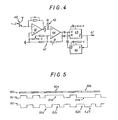
- the device represented in FIG. 4, which is not normally part of the typewriter, is intended for reading the ninth line of the coded print (line 29 of FIG. 2) so as to reconstitute a time base despite printing faults of this ninth line.
- a phototransistor 40 sensitive to the light reflected by the ninth line during of reading, is connected to the input of an amplifier 41, itself coupled to an amplifier 44 mounted as a threshold comparator, via a delay cell 42 with capacitance resistance, and a network of feedback 43, so that to the succession of printed dots separated by intervals of the ninth line correspond a succession of rectangular signals at the output of comparator 44, the edges of these rectangular signals being slightly delayed compared to the black-white transitions of the ninth line, during playback.
- the delay is of the order of a few percent of the time taken to explore a column at reading speed.
- the comparator 44 attacks by the rising edge of its activation input signal of a univibrator 45 adjusted for a pulse duration greater than approximately 10% than the duration of exploration of a column, and by the lower level of the signal a return to zero input of this univibrator 45.
- the negative output of the univibrator 45 attacks on the one hand the time base signal output 47, and on the other by the activation output of a second univibrateur 46, set for a duration approximately 20% longer than the duration of exploration of a column, the negative output of this univibrator attacking by the rear flank rising its signal the activation input of the univibrateur 45.
- line 50 represents the light flux received by phototransistor 40
- line 51 the signal at the output of comparator 44
- line 52 the signal on exit 47.
- the rhythmic succession of the dark and light areas of line 50 is interrupted in 50a by the presence of a dark intermediate range, and in 50b by the presence of a light intermediate range, interpretable respectively by a false point impression, and a misprint.
- rhythm interruptions 50a and 50b at the printing result in the line 51 respectively by an upper level 51 a, and a lower level 51b of duration three times that of the normal levels.
- the signals on the output 47 are the reverse copy of the signals coming from the comparator 44, the univibrator 45 engaged by the rising edge of the signal coming from 44 being blocked by the next lower level of this signal before triggering itself.
- the univibrator activates itself, by delivering the slot 52a, and engaging by the rear flank of this slot the univibrator 46.
- the univibrator 45 is activated by the rear flank of the negative pulse delivered by the univibrator 46.
- the triggering of the univibrator 45 will be produced by the comparator 44 at the end of the anomaly 51a.
- the comparator 44 fails to engage theivibrator 45, due to the replacement at 50b of the normal black range by a clear range.
- the univibrator 46 previously engaged by the rear flank of the slot delivered by the univibrator 45 in normal operation will engage the end of the pulse the univibrator 45, thus giving rise to the slot 52b.
- the device Upon autonomous triggering of theivibrator 45 (slot 52d), the device is repaired for normal operation.
- line 52 clearly shows that the general form of the basic reading time command is preserved despite local coded printing faults, the fluctuation in duration of the reconstituted slots being 20% more or 30% in less compared to the normal duration of slots.
- the application of the method and of the typewriter according to the invention can extend to the composition of commercial documents, accounting documents and checks, for which the subsequent exploitation of the printing of digital amounts, from the The original piece itself has obvious advantages.
Landscapes
- Physics & Mathematics (AREA)
- General Physics & Mathematics (AREA)
- Engineering & Computer Science (AREA)
- Theoretical Computer Science (AREA)
- Record Information Processing For Printing (AREA)
Applications Claiming Priority (2)
| Application Number | Priority Date | Filing Date | Title |
|---|---|---|---|
| FR7916525 | 1979-06-27 | ||
| FR7916525A FR2459725A1 (fr) | 1979-06-27 | 1979-06-27 | Procede de frappe de texte avec enregistrement code conjoint pour exploitation ulterieure, et machine a ecrire pour la mise en oeuvre du procede |
Publications (3)
| Publication Number | Publication Date |
|---|---|
| EP0022397A2 EP0022397A2 (fr) | 1981-01-14 |
| EP0022397A3 EP0022397A3 (en) | 1982-06-02 |
| EP0022397B1 true EP0022397B1 (fr) | 1985-02-13 |
Family
ID=9227156
Family Applications (1)
| Application Number | Title | Priority Date | Filing Date |
|---|---|---|---|
| EP19800400952 Expired EP0022397B1 (fr) | 1979-06-27 | 1980-06-25 | Procédé de frappe de texte avec enregistrement codé conjoint pour exploitation ultérieure, et machine à écrire pour la mise en oeuvre du procédé |
Country Status (3)
| Country | Link |
|---|---|
| EP (1) | EP0022397B1 (enExample) |
| DE (1) | DE3070151D1 (enExample) |
| FR (1) | FR2459725A1 (enExample) |
Families Citing this family (6)
| Publication number | Priority date | Publication date | Assignee | Title |
|---|---|---|---|---|
| FR2525003B1 (fr) * | 1982-04-08 | 1987-12-11 | Gascuel Jean Paul | Procede de lecture d'un texte imprime par une tete aiguille et tete de lecture pour la mise en oeuvre du procede |
| US4715735A (en) * | 1983-10-31 | 1987-12-29 | Brother Kogyo Kabushiki Kaisha | Dual mode printing apparatus with multiple print ribbon cassettes |
| JPS60109868A (ja) * | 1983-11-19 | 1985-06-15 | Brother Ind Ltd | 印字装置 |
| US4682902A (en) * | 1983-11-30 | 1987-07-28 | Brother Kogyo Kabushiki Kaisha | Writing plotting apparatus with keyboard |
| JPS6151363A (ja) * | 1984-08-21 | 1986-03-13 | Brother Ind Ltd | 複合プリンタ |
| US4835713A (en) * | 1985-08-06 | 1989-05-30 | Pitney Bowes Inc. | Postage meter with coded graphic information in the indicia |
Family Cites Families (6)
| Publication number | Priority date | Publication date | Assignee | Title |
|---|---|---|---|---|
| US3656426A (en) * | 1969-05-08 | 1972-04-18 | Potter Instrument Co Inc | Apparatus for printing alphanumeric and binary code markings and comparison means therefor |
| US3765603A (en) * | 1969-07-29 | 1973-10-16 | Ibm | Data recorder and verifier |
| US3642197A (en) * | 1969-07-29 | 1972-02-15 | Ibm | Data recorder and verifier |
| US3915086A (en) * | 1973-11-30 | 1975-10-28 | Bell & Howell Co | Printing apparatus |
| US4016365A (en) * | 1974-07-05 | 1977-04-05 | Staar Development Company, S.A. | Readout for recording typewriter |
| US4247907A (en) * | 1978-11-27 | 1981-01-27 | International Business Machines Corporation | Method and apparatus for typing characters and optically readable binary representations thereof on same page |
-
1979
- 1979-06-27 FR FR7916525A patent/FR2459725A1/fr active Granted
-
1980
- 1980-06-25 DE DE8080400952T patent/DE3070151D1/de not_active Expired
- 1980-06-25 EP EP19800400952 patent/EP0022397B1/fr not_active Expired
Also Published As
| Publication number | Publication date |
|---|---|
| DE3070151D1 (en) | 1985-03-28 |
| FR2459725A1 (fr) | 1981-01-16 |
| FR2459725B1 (enExample) | 1983-02-25 |
| EP0022397A3 (en) | 1982-06-02 |
| EP0022397A2 (fr) | 1981-01-14 |
Similar Documents
| Publication | Publication Date | Title |
|---|---|---|
| US3676856A (en) | Automatic editing system and method | |
| US4475239A (en) | Apparatus for text editing and processing | |
| US6107997A (en) | Touch-sensitive keyboard/mouse and computing device using the same | |
| US6707571B1 (en) | Character printing method and device as well as image forming method and device | |
| FR2571869A1 (fr) | Dispositif pour editer des documents en couleurs. | |
| FR2505737A1 (fr) | Dispositif electronique d'enregistrement et d'extraction de textes a imprimer sur une machine a ecrire | |
| EP0022397B1 (fr) | Procédé de frappe de texte avec enregistrement codé conjoint pour exploitation ultérieure, et machine à écrire pour la mise en oeuvre du procédé | |
| US3965476A (en) | Laser printing method and system | |
| EP0028721B1 (fr) | Imprimante à jet d'encre pour impression de droite à gauche ou de gauche à droite | |
| FR2525790A1 (fr) | Dispositif de securite pour commander et controler l'acces a des emplacements et des biens determines | |
| US20040101134A1 (en) | Alphabet soup cryptography | |
| AU5352799A (en) | A user programmable smart card interface system | |
| EP1272351A1 (en) | Printer | |
| EP0246971A2 (fr) | Dispositif d'entrée de données dans un système informatique | |
| JP3783967B2 (ja) | レーベル面印刷可能な外部記憶メディア用ドライブ、メディア、プログラムおよび端末装置 | |
| EP1721747B1 (en) | Information recording and reproducing apparatus, information printing method, and optical information recording medium | |
| JP2001249613A (ja) | 情報通信用パスワードを記憶する為の図表 | |
| CH632191A5 (fr) | Machine a ecrire. | |
| FR2563158A1 (fr) | Imprimante matricielle capable d'imprimer des caracteres gras | |
| BE711147A (enExample) | ||
| WO2000065822A1 (fr) | Procede et dispositif pour la consultation d'une information a partir d'un support de lecture nomade | |
| FR2611292A1 (fr) | Dispositif d'affichage de signes en relief, notamment de caracteres braille | |
| KR100248104B1 (ko) | 예금통장의 인쇄라인 감지방법 | |
| WO2002025477A1 (fr) | Procede pour afficher un document numerique, dispositif electronique, logiciel, publication numerique, support de donnees et procede de telechargement | |
| CA1064293A (en) | Optical holographic printing and typesetting machinery |
Legal Events
| Date | Code | Title | Description |
|---|---|---|---|
| PUAI | Public reference made under article 153(3) epc to a published international application that has entered the european phase |
Free format text: ORIGINAL CODE: 0009012 |
|
| AK | Designated contracting states |
Designated state(s): BE CH DE GB IT LU NL SE |
|
| PUAL | Search report despatched |
Free format text: ORIGINAL CODE: 0009013 |
|
| AK | Designated contracting states |
Designated state(s): BE CH DE GB IT LU NL SE |
|
| 17P | Request for examination filed |
Effective date: 19820715 |
|
| ITF | It: translation for a ep patent filed | ||
| GRAA | (expected) grant |
Free format text: ORIGINAL CODE: 0009210 |
|
| AK | Designated contracting states |
Designated state(s): BE CH DE GB IT LI LU NL SE |
|
| REF | Corresponds to: |
Ref document number: 3070151 Country of ref document: DE Date of ref document: 19850328 |
|
| PLBE | No opposition filed within time limit |
Free format text: ORIGINAL CODE: 0009261 |
|
| STAA | Information on the status of an ep patent application or granted ep patent |
Free format text: STATUS: NO OPPOSITION FILED WITHIN TIME LIMIT |
|
| 26N | No opposition filed | ||
| PGFP | Annual fee paid to national office [announced via postgrant information from national office to epo] |
Ref country code: SE Payment date: 19920611 Year of fee payment: 13 Ref country code: GB Payment date: 19920611 Year of fee payment: 13 |
|
| PGFP | Annual fee paid to national office [announced via postgrant information from national office to epo] |
Ref country code: LU Payment date: 19920624 Year of fee payment: 13 |
|
| PGFP | Annual fee paid to national office [announced via postgrant information from national office to epo] |
Ref country code: CH Payment date: 19920625 Year of fee payment: 13 |
|
| ITTA | It: last paid annual fee | ||
| PGFP | Annual fee paid to national office [announced via postgrant information from national office to epo] |
Ref country code: NL Payment date: 19920630 Year of fee payment: 13 |
|
| PGFP | Annual fee paid to national office [announced via postgrant information from national office to epo] |
Ref country code: BE Payment date: 19920706 Year of fee payment: 13 |
|
| PGFP | Annual fee paid to national office [announced via postgrant information from national office to epo] |
Ref country code: DE Payment date: 19920831 Year of fee payment: 13 |
|
| EPTA | Lu: last paid annual fee | ||
| PG25 | Lapsed in a contracting state [announced via postgrant information from national office to epo] |
Ref country code: LU Free format text: LAPSE BECAUSE OF NON-PAYMENT OF DUE FEES Effective date: 19930625 Ref country code: GB Effective date: 19930625 |
|
| PG25 | Lapsed in a contracting state [announced via postgrant information from national office to epo] |
Ref country code: SE Effective date: 19930626 |
|
| PG25 | Lapsed in a contracting state [announced via postgrant information from national office to epo] |
Ref country code: LI Effective date: 19930630 Ref country code: CH Effective date: 19930630 Ref country code: BE Effective date: 19930630 |
|
| BERE | Be: lapsed |
Owner name: RIVAILLIER JACQUES Effective date: 19930630 Owner name: GASCUEL JEAN-PAUL Effective date: 19930630 |
|
| PG25 | Lapsed in a contracting state [announced via postgrant information from national office to epo] |
Ref country code: NL Effective date: 19940101 |
|
| NLV4 | Nl: lapsed or anulled due to non-payment of the annual fee | ||
| GBPC | Gb: european patent ceased through non-payment of renewal fee |
Effective date: 19930625 |
|
| REG | Reference to a national code |
Ref country code: CH Ref legal event code: PL |
|
| PG25 | Lapsed in a contracting state [announced via postgrant information from national office to epo] |
Ref country code: DE Effective date: 19940301 |
|
| EUG | Se: european patent has lapsed |
Ref document number: 80400952.0 Effective date: 19940110 |