EP0022028B1 - Procédé de détection et d'analyse de gaz notamment pour la prévention des incendies - Google Patents
Procédé de détection et d'analyse de gaz notamment pour la prévention des incendies Download PDFInfo
- Publication number
- EP0022028B1 EP0022028B1 EP80400965A EP80400965A EP0022028B1 EP 0022028 B1 EP0022028 B1 EP 0022028B1 EP 80400965 A EP80400965 A EP 80400965A EP 80400965 A EP80400965 A EP 80400965A EP 0022028 B1 EP0022028 B1 EP 0022028B1
- Authority
- EP
- European Patent Office
- Prior art keywords
- organic semiconductor
- detection method
- gases
- sensitive unit
- elementary
- Prior art date
- Legal status (The legal status is an assumption and is not a legal conclusion. Google has not performed a legal analysis and makes no representation as to the accuracy of the status listed.)
- Expired
Links
- 239000007789 gas Substances 0.000 title claims abstract description 38
- 238000000034 method Methods 0.000 title claims abstract description 26
- 238000004458 analytical method Methods 0.000 title claims abstract description 6
- 239000004065 semiconductor Substances 0.000 claims abstract description 52
- 238000002485 combustion reaction Methods 0.000 claims abstract description 25
- 238000001514 detection method Methods 0.000 claims abstract description 23
- QJGQUHMNIGDVPM-UHFFFAOYSA-N nitrogen group Chemical group [N] QJGQUHMNIGDVPM-UHFFFAOYSA-N 0.000 claims abstract description 9
- 229920000768 polyamine Polymers 0.000 claims abstract description 8
- 238000007254 oxidation reaction Methods 0.000 claims abstract description 7
- 229920000642 polymer Polymers 0.000 claims abstract description 7
- -1 polypropylenes Polymers 0.000 claims abstract description 7
- 230000003647 oxidation Effects 0.000 claims abstract description 5
- 238000002360 preparation method Methods 0.000 claims abstract description 5
- 230000002265 prevention Effects 0.000 claims abstract description 5
- 125000000664 diazo group Chemical group [N-]=[N+]=[*] 0.000 claims abstract description 4
- JUJWROOIHBZHMG-UHFFFAOYSA-N pyridine Substances C1=CC=NC=C1 JUJWROOIHBZHMG-UHFFFAOYSA-N 0.000 claims abstract description 4
- 239000004743 Polypropylene Substances 0.000 claims abstract 2
- 229920001155 polypropylene Polymers 0.000 claims abstract 2
- 239000000203 mixture Substances 0.000 claims description 9
- 238000010422 painting Methods 0.000 claims description 8
- 238000011282 treatment Methods 0.000 claims description 8
- 230000006835 compression Effects 0.000 claims description 5
- 238000007906 compression Methods 0.000 claims description 5
- 239000012528 membrane Substances 0.000 claims description 5
- 244000045947 parasite Species 0.000 claims description 3
- 238000005245 sintering Methods 0.000 claims description 3
- 238000001228 spectrum Methods 0.000 claims description 3
- 239000000428 dust Substances 0.000 claims description 2
- 230000000295 complement effect Effects 0.000 claims 1
- 238000009792 diffusion process Methods 0.000 claims 1
- 238000009713 electroplating Methods 0.000 claims 1
- 230000008020 evaporation Effects 0.000 claims 1
- 238000001704 evaporation Methods 0.000 claims 1
- 229920002678 cellulose Polymers 0.000 description 21
- 239000001913 cellulose Substances 0.000 description 21
- 230000004044 response Effects 0.000 description 21
- RTZKZFJDLAIYFH-UHFFFAOYSA-N Diethyl ether Chemical compound CCOCC RTZKZFJDLAIYFH-UHFFFAOYSA-N 0.000 description 16
- LFQSCWFLJHTTHZ-UHFFFAOYSA-N Ethanol Chemical compound CCO LFQSCWFLJHTTHZ-UHFFFAOYSA-N 0.000 description 15
- 239000002904 solvent Substances 0.000 description 10
- XLYOFNOQVPJJNP-UHFFFAOYSA-N water Substances O XLYOFNOQVPJJNP-UHFFFAOYSA-N 0.000 description 10
- 229920000767 polyaniline Polymers 0.000 description 8
- 229920000128 polypyrrole Polymers 0.000 description 7
- ATUOYWHBWRKTHZ-UHFFFAOYSA-N Propane Chemical compound CCC ATUOYWHBWRKTHZ-UHFFFAOYSA-N 0.000 description 6
- 150000001408 amides Chemical class 0.000 description 5
- 238000001035 drying Methods 0.000 description 5
- VNWKTOKETHGBQD-UHFFFAOYSA-N methane Chemical compound C VNWKTOKETHGBQD-UHFFFAOYSA-N 0.000 description 5
- AZQWKYJCGOJGHM-UHFFFAOYSA-N 1,4-benzoquinone Chemical compound O=C1C=CC(=O)C=C1 AZQWKYJCGOJGHM-UHFFFAOYSA-N 0.000 description 4
- 108010010803 Gelatin Proteins 0.000 description 4
- HNDVDQJCIGZPNO-YFKPBYRVSA-N L-Histidine Natural products OC(=O)[C@@H](N)CC1=CN=CN1 HNDVDQJCIGZPNO-YFKPBYRVSA-N 0.000 description 4
- 235000001014 amino acid Nutrition 0.000 description 4
- ZVSKZLHKADLHSD-UHFFFAOYSA-N benzanilide Chemical compound C=1C=CC=CC=1C(=O)NC1=CC=CC=C1 ZVSKZLHKADLHSD-UHFFFAOYSA-N 0.000 description 4
- 229920000159 gelatin Polymers 0.000 description 4
- 239000008273 gelatin Substances 0.000 description 4
- 235000019322 gelatine Nutrition 0.000 description 4
- 235000011852 gelatine desserts Nutrition 0.000 description 4
- 230000035945 sensitivity Effects 0.000 description 4
- UHOVQNZJYSORNB-UHFFFAOYSA-N Benzene Chemical compound C1=CC=CC=C1 UHOVQNZJYSORNB-UHFFFAOYSA-N 0.000 description 3
- 239000001273 butane Substances 0.000 description 3
- 239000001257 hydrogen Substances 0.000 description 3
- 229910052739 hydrogen Inorganic materials 0.000 description 3
- IJDNQMDRQITEOD-UHFFFAOYSA-N n-butane Chemical compound CCCC IJDNQMDRQITEOD-UHFFFAOYSA-N 0.000 description 3
- OFBQJSOFQDEBGM-UHFFFAOYSA-N n-pentane Natural products CCCCC OFBQJSOFQDEBGM-UHFFFAOYSA-N 0.000 description 3
- 238000012545 processing Methods 0.000 description 3
- 239000001294 propane Substances 0.000 description 3
- PAYRUJLWNCNPSJ-UHFFFAOYSA-N Aniline Chemical compound NC1=CC=CC=C1 PAYRUJLWNCNPSJ-UHFFFAOYSA-N 0.000 description 2
- 239000004952 Polyamide Substances 0.000 description 2
- KAESVJOAVNADME-UHFFFAOYSA-N Pyrrole Chemical compound C=1C=CNC=1 KAESVJOAVNADME-UHFFFAOYSA-N 0.000 description 2
- 229960001413 acetanilide Drugs 0.000 description 2
- CSCPPACGZOOCGX-UHFFFAOYSA-N acetone Substances CC(C)=O CSCPPACGZOOCGX-UHFFFAOYSA-N 0.000 description 2
- DZBUGLKDJFMEHC-UHFFFAOYSA-N acridine Chemical compound C1=CC=CC2=CC3=CC=CC=C3N=C21 DZBUGLKDJFMEHC-UHFFFAOYSA-N 0.000 description 2
- 229940024606 amino acid Drugs 0.000 description 2
- SIKJAQJRHWYJAI-UHFFFAOYSA-N benzopyrrole Natural products C1=CC=C2NC=CC2=C1 SIKJAQJRHWYJAI-UHFFFAOYSA-N 0.000 description 2
- 239000011230 binding agent Substances 0.000 description 2
- 230000008859 change Effects 0.000 description 2
- 238000000151 deposition Methods 0.000 description 2
- 238000010586 diagram Methods 0.000 description 2
- 238000004880 explosion Methods 0.000 description 2
- HNDVDQJCIGZPNO-UHFFFAOYSA-N histidine Natural products OC(=O)C(N)CC1=CN=CN1 HNDVDQJCIGZPNO-UHFFFAOYSA-N 0.000 description 2
- 150000002431 hydrogen Chemical class 0.000 description 2
- PZOUSPYUWWUPPK-UHFFFAOYSA-N indole Natural products CC1=CC=CC2=C1C=CN2 PZOUSPYUWWUPPK-UHFFFAOYSA-N 0.000 description 2
- RKJUIXBNRJVNHR-UHFFFAOYSA-N indolenine Natural products C1=CC=C2CC=NC2=C1 RKJUIXBNRJVNHR-UHFFFAOYSA-N 0.000 description 2
- 150000002500 ions Chemical class 0.000 description 2
- JEIPFZHSYJVQDO-UHFFFAOYSA-N iron(III) oxide Inorganic materials O=[Fe]O[Fe]=O JEIPFZHSYJVQDO-UHFFFAOYSA-N 0.000 description 2
- 238000004519 manufacturing process Methods 0.000 description 2
- 238000005259 measurement Methods 0.000 description 2
- 125000002524 organometallic group Chemical group 0.000 description 2
- 229920002647 polyamide Polymers 0.000 description 2
- 229920002689 polyvinyl acetate Polymers 0.000 description 2
- 239000011118 polyvinyl acetate Substances 0.000 description 2
- 229920002717 polyvinylpyridine Polymers 0.000 description 2
- 238000011084 recovery Methods 0.000 description 2
- 239000000725 suspension Substances 0.000 description 2
- 229960000943 tartrazine Drugs 0.000 description 2
- 235000012756 tartrazine Nutrition 0.000 description 2
- 239000004149 tartrazine Substances 0.000 description 2
- 238000012546 transfer Methods 0.000 description 2
- 238000007738 vacuum evaporation Methods 0.000 description 2
- YAZXXAOXRDUGDH-UHFFFAOYSA-N 1h-pyrrole;sulfuric acid Chemical compound C=1C=CNC=1.OS(O)(=O)=O YAZXXAOXRDUGDH-UHFFFAOYSA-N 0.000 description 1
- MGWGWNFMUOTEHG-UHFFFAOYSA-N 4-(3,5-dimethylphenyl)-1,3-thiazol-2-amine Chemical compound CC1=CC(C)=CC(C=2N=C(N)SC=2)=C1 MGWGWNFMUOTEHG-UHFFFAOYSA-N 0.000 description 1
- QPQKUYVSJWQSDY-CCEZHUSRSA-N 4-(phenylazo)aniline Chemical compound C1=CC(N)=CC=C1\N=N\C1=CC=CC=C1 QPQKUYVSJWQSDY-CCEZHUSRSA-N 0.000 description 1
- VRZJGENLTNRAIG-UHFFFAOYSA-N 4-[4-(dimethylamino)phenyl]iminonaphthalen-1-one Chemical compound C1=CC(N(C)C)=CC=C1N=C1C2=CC=CC=C2C(=O)C=C1 VRZJGENLTNRAIG-UHFFFAOYSA-N 0.000 description 1
- OKTJSMMVPCPJKN-UHFFFAOYSA-N Carbon Chemical compound [C] OKTJSMMVPCPJKN-UHFFFAOYSA-N 0.000 description 1
- 101100536354 Drosophila melanogaster tant gene Proteins 0.000 description 1
- DHMQDGOQFOQNFH-UHFFFAOYSA-N Glycine Natural products NCC(O)=O DHMQDGOQFOQNFH-UHFFFAOYSA-N 0.000 description 1
- 239000004471 Glycine Substances 0.000 description 1
- UFHFLCQGNIYNRP-UHFFFAOYSA-N Hydrogen Chemical compound [H][H] UFHFLCQGNIYNRP-UHFFFAOYSA-N 0.000 description 1
- WHUUTDBJXJRKMK-VKHMYHEASA-N L-Glutamic acid Natural products OC(=O)[C@@H](N)CCC(O)=O WHUUTDBJXJRKMK-VKHMYHEASA-N 0.000 description 1
- 239000004793 Polystyrene Substances 0.000 description 1
- FAPWRFPIFSIZLT-UHFFFAOYSA-M Sodium chloride Chemical compound [Na+].[Cl-] FAPWRFPIFSIZLT-UHFFFAOYSA-M 0.000 description 1
- 241000219995 Wisteria Species 0.000 description 1
- 239000002253 acid Substances 0.000 description 1
- 125000003275 alpha amino acid group Chemical group 0.000 description 1
- 150000001412 amines Chemical class 0.000 description 1
- 150000001413 amino acids Chemical class 0.000 description 1
- 150000008430 aromatic amides Chemical class 0.000 description 1
- 150000004982 aromatic amines Chemical class 0.000 description 1
- 125000003118 aryl group Chemical group 0.000 description 1
- 238000000429 assembly Methods 0.000 description 1
- 230000000712 assembly Effects 0.000 description 1
- 239000003054 catalyst Substances 0.000 description 1
- 239000011248 coating agent Substances 0.000 description 1
- 238000000576 coating method Methods 0.000 description 1
- 150000001875 compounds Chemical class 0.000 description 1
- 238000009833 condensation Methods 0.000 description 1
- 230000005494 condensation Effects 0.000 description 1
- 229920001577 copolymer Polymers 0.000 description 1
- 230000008878 coupling Effects 0.000 description 1
- 238000010168 coupling process Methods 0.000 description 1
- 238000005859 coupling reaction Methods 0.000 description 1
- 238000013461 design Methods 0.000 description 1
- 125000003963 dichloro group Chemical group Cl* 0.000 description 1
- 239000012153 distilled water Substances 0.000 description 1
- GNBHRKFJIUUOQI-UHFFFAOYSA-N fluorescein Chemical compound O1C(=O)C2=CC=CC=C2C21C1=CC=C(O)C=C1OC1=CC(O)=CC=C21 GNBHRKFJIUUOQI-UHFFFAOYSA-N 0.000 description 1
- 229960002989 glutamic acid Drugs 0.000 description 1
- 229910002804 graphite Inorganic materials 0.000 description 1
- 239000010439 graphite Substances 0.000 description 1
- 125000004435 hydrogen atom Chemical group [H]* 0.000 description 1
- 230000002209 hydrophobic effect Effects 0.000 description 1
- 239000002655 kraft paper Substances 0.000 description 1
- 239000003446 ligand Substances 0.000 description 1
- 239000002184 metal Substances 0.000 description 1
- 229910052751 metal Inorganic materials 0.000 description 1
- 229960000907 methylthioninium chloride Drugs 0.000 description 1
- 238000012986 modification Methods 0.000 description 1
- 230000004048 modification Effects 0.000 description 1
- 238000012544 monitoring process Methods 0.000 description 1
- JCXJVPUVTGWSNB-UHFFFAOYSA-N nitrogen dioxide Inorganic materials O=[N]=O JCXJVPUVTGWSNB-UHFFFAOYSA-N 0.000 description 1
- 239000000123 paper Substances 0.000 description 1
- CSHWQDPOILHKBI-UHFFFAOYSA-N peryrene Natural products C1=CC(C2=CC=CC=3C2=C2C=CC=3)=C3C2=CC=CC3=C1 CSHWQDPOILHKBI-UHFFFAOYSA-N 0.000 description 1
- ISWSIDIOOBJBQZ-UHFFFAOYSA-N phenol group Chemical group C1(=CC=CC=C1)O ISWSIDIOOBJBQZ-UHFFFAOYSA-N 0.000 description 1
- 229920005547 polycyclic aromatic hydrocarbon Polymers 0.000 description 1
- 229920002223 polystyrene Polymers 0.000 description 1
- 229920000915 polyvinyl chloride Polymers 0.000 description 1
- 239000004800 polyvinyl chloride Substances 0.000 description 1
- 125000001749 primary amide group Chemical group 0.000 description 1
- 150000004059 quinone derivatives Chemical class 0.000 description 1
- 230000009467 reduction Effects 0.000 description 1
- OARRHUQTFTUEOS-UHFFFAOYSA-N safranin Chemical compound [Cl-].C=12C=C(N)C(C)=CC2=NC2=CC(C)=C(N)C=C2[N+]=1C1=CC=CC=C1 OARRHUQTFTUEOS-UHFFFAOYSA-N 0.000 description 1
- 125000003156 secondary amide group Chemical group 0.000 description 1
- 239000011780 sodium chloride Substances 0.000 description 1
- 239000007787 solid Substances 0.000 description 1
- 229950003937 tolonium Drugs 0.000 description 1
- 150000004992 toluidines Chemical class 0.000 description 1
Images




Classifications
-
- G—PHYSICS
- G01—MEASURING; TESTING
- G01N—INVESTIGATING OR ANALYSING MATERIALS BY DETERMINING THEIR CHEMICAL OR PHYSICAL PROPERTIES
- G01N27/00—Investigating or analysing materials by the use of electric, electrochemical, or magnetic means
- G01N27/02—Investigating or analysing materials by the use of electric, electrochemical, or magnetic means by investigating impedance
- G01N27/04—Investigating or analysing materials by the use of electric, electrochemical, or magnetic means by investigating impedance by investigating resistance
- G01N27/12—Investigating or analysing materials by the use of electric, electrochemical, or magnetic means by investigating impedance by investigating resistance of a solid body in dependence upon absorption of a fluid; of a solid body in dependence upon reaction with a fluid, for detecting components in the fluid
- G01N27/125—Composition of the body, e.g. the composition of its sensitive layer
- G01N27/126—Composition of the body, e.g. the composition of its sensitive layer comprising organic polymers
-
- F—MECHANICAL ENGINEERING; LIGHTING; HEATING; WEAPONS; BLASTING
- F21—LIGHTING
- F21S—NON-PORTABLE LIGHTING DEVICES; SYSTEMS THEREOF; VEHICLE LIGHTING DEVICES SPECIALLY ADAPTED FOR VEHICLE EXTERIORS
- F21S10/00—Lighting devices or systems producing a varying lighting effect
- F21S10/002—Lighting devices or systems producing a varying lighting effect using liquids, e.g. water
Definitions
- the present invention relates to a gas or vapor analysis method for a safety application and more particularly to a method involving the electrical properties of certain organic semiconductors when they are put in the presence of gas or vapor to control.
- Patent publication FR-A-2 364 449 describes a method and a device for analyzing gas using sensors with a semiconductor film deposited on an insulating support.
- this document mentions in particular quinone organic complexes, organometallic complexes of polymeric ligands, and organic complexes with exchange transfer.
- Canadian patent CA-A-915,458 describes a gas identification method and device using a safranin semiconductor film as a gas detector.
- the present invention therefore proposes to design selective sensor elements but covering well all the risk to be protected and moreover having a good reversibility character.
- the sensitive units consist of an insulating support carrying a set of comb-shaped electrodes, according to variants 1-a, 1-b and 1-c, on which a semiconductor is deposited organic using a painting technique for example.
- an active elementary sensitive unit 1 is mounted in series with a reference sensitive unit 2 in a branch of a Wheatstone bridge.
- the other branch of the bridge is constituted by a fixed resistor 3 in series with a potentiometer 4 and a fixed resistor 5 for example.
- the cursor of potentiometer 4 is connected to an input of a comparator 6, the other input (for example inverted) is connected to the point common to the two sensitive units 1 and 2.
- comparator 6 is connected to the base of a transistor 7 in the collector circuit from which an audible warning device 8 is connected, for example.
- the entire circuit being energized, the adjustment of the potentiometer slider 4 enables a threshold characteristic of a security level to be fixed. If the active sensitive unit is affected by a gas emission, its resistance varies and the comparator detects an imbalance.
- the transistor 7 then becomes conductive and the horn 8 operates.
- This detection circuit makes it possible to signal the crossing of a threshold.
- the circuit of fig. 3 comprises a single elementary sensitive unit 9 which permanently gives a signal proportional to its resistance R.
- This electrical signal is amplified by an amplifier 10, then derivative at 11.
- This derived signal passes through a filter 12.
- the filter makes it possible to eliminate it so as not to trigger an alarm because the disturbances which are too weak or too strong do not correspond to the phenomenon to be monitored.
- the derived signal crosses the filter 12, it triggers a transistor circuit 13 for example for the control of the horn 14.
- a product called polyperylene was obtained by condensation of perylene dianhydride on itself in the presence of a FRIEDEL-KRAFT catalyst, between 200 and 300 °.
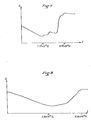
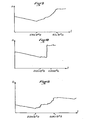
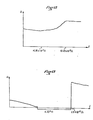
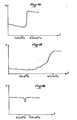
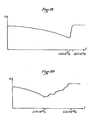
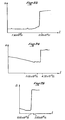
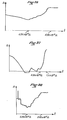
- the curves of Examples 1 to 10 give responses of these sensor elements, for each of the preceding groups, and for alcohol fires or combustions with or without cellulose flame, for some of these products.
- an alcohol fire the combustion of 0.5 cm 3 of alcohol is controlled, placed in a cup with a diameter of 5 cm, the sensitive unit being 20 cm above this cup.
- the sample is placed on a plate at about 220 °.
- the direction of travel of the paper is from left to right, at 1 mm / s.
- the value of the electrical resistance of the elementary sensitive unit is plotted on the ordinate.
- Example 12 Influence of the preparation in p.h. different on the response of the sensor.
- Example 13 Parallel mounting of an elementary sensitive unit based on galléine and an elementary sensitive unit based on dichloro 2'-7'-fluorescein
- the semiconductor product from groups 1 to 10 can be deposited in a thin layer on an insulating support provided with an electrode (fig. 1) according to a painting or coating technique.
- the active product that is to say the product of groups from 1 to 10, optionally after treatment and dissolving or in suspension, is then dissolved or suspended in a support: water, C Cl 4 , ether , alcohol, benzene ...
- This support can simply be a support for the semiconductor product for painting, but can also intervene in terms of its properties (increased selectivity, increased sensitivity ).
- the phenomenon to be controlled leading to a modification of the conductivity, the analysis of this phenomenon will be done by measuring the evolution of the resistance across the electrodes (figs 2 and 3).
- the implementation of the semiconductor product can be carried out using sintering techniques.
- the same solid supports can be used as those used for the painting technique (fig. 1). On this support, 5 to 10 mg are deposited. of product per cm 2 , and the whole is compressed at variable pressures between 1 and 3 t / cm 2 . The phenomenon is checked as before (figs 2 and 3).
- the implementation of the semiconductor product can be carried out using vacuum evaporation techniques.
- the insulating support provided with electrodes used for the deposit and the treatment by measurement of electrical quantities (figs 2 or 3), are identical to those used for the painting technique.
- the implementation of the semiconductor product can be carried out using electrolytic deposition techniques, and this for certain polymers obtained electrochemically.
- a graphite electrode or any unassailable metal
- a potential greater than 800 mV E.N.H. normal hydrogen electrode
- a polypyrrole deposit is formed from the oxidation of the pyrrole. It then suffices to place the electrodes on this deposit to have an elementary sensitive unit whose evolution is checked by the treatments described in FIGS. 2 and 3.
- the implementation of semiconductor products can be carried out by making collodions with polymers or copolymers as a binder and in particular polyvinyl acetate or polyvinyl chloride.
- This binder serves as a support for the semiconductor product but can also intervene in the response of the sensor with regard to its selectivity. It then intervenes by its properties of selective diffusivity with respect to various gases and, for example with respect to water vapor, by its hydrophilic (gelatin), or hydrophobic (polyvinylacetate, polystyrene) properties. .
- This property of selective diffusivity constitutes a well-known result in the study of membranes.
- the implementation is carried out as follows: 1% by weight of gelatin is dissolved in hot (50-60 °) in 20 cc. distilled water. We take 7-8 cc. of the solution, and 1 or 2 g of the semiconductor compound are added thereto. A suspension of 1 to 2 hours is made, which is spread on a support provided with electrodes.
- Example 11 gives us the answer obtained for an alcohol combustion and a flameless combustion of cellulose for a collodion of this type using benzanilide.
- Detection can be done using a Wheatstone bridge type system (Fig. 2).
- Fig. 2 a Wheatstone bridge type system
- one uses an active elementary sensitive unit and one in reference.
- This last element being able to undergo with a certain delay the variations of the atmosphere, this makes it possible to get rid of certain slow variations which would not be created by the risk to be detected.
- it indicates the existence of a disturbance related to this risk for a certain imbalance of the bridge fixed beforehand and characteristic of the risk and the level of security sought.
- Detection can also be done using a single sensor element and by analyzing the relative variations delivered by this sensor (fig. 3). In this case, the presence of the gas or gases to be detected is signaled when the value of these relative variations is within a certain interval characteristic of the risk to be prevented.
- This type of signal processing also makes it possible to overcome disturbing quantities (variations in humidity, lighting).
- This type of treatment has already been developed for previous applications; it is used among others in the ion detector type D.S.I. 40 (trade name designating the SICLI ion detector, model 40) from the SICLI range. It allows in particular in this case to overcome slow variations of the atmosphere (humidity, pressure, temperature ).
- This type of treatment can be adapted to each particular anomaly to be checked.
Landscapes
- Chemical & Material Sciences (AREA)
- Analytical Chemistry (AREA)
- General Physics & Mathematics (AREA)
- Chemical Kinetics & Catalysis (AREA)
- Electrochemistry (AREA)
- Physics & Mathematics (AREA)
- Health & Medical Sciences (AREA)
- General Engineering & Computer Science (AREA)
- Biochemistry (AREA)
- Life Sciences & Earth Sciences (AREA)
- General Health & Medical Sciences (AREA)
- Engineering & Computer Science (AREA)
- Immunology (AREA)
- Pathology (AREA)
- Investigating Or Analyzing Materials By The Use Of Fluid Adsorption Or Reactions (AREA)
- Fire-Detection Mechanisms (AREA)
Priority Applications (1)
| Application Number | Priority Date | Filing Date | Title |
|---|---|---|---|
| AT80400965T ATE7174T1 (de) | 1979-06-29 | 1980-06-27 | Verfahren zum nachweisen und analysieren von gasen, insbesondere um brand zu vermeiden. |
Applications Claiming Priority (2)
| Application Number | Priority Date | Filing Date | Title |
|---|---|---|---|
| FR7916855 | 1979-06-29 | ||
| FR7916855A FR2460480A1 (fr) | 1979-06-29 | 1979-06-29 | Procede de detection et d'analyse de gaz, notamment pour la prevention des incendies |
Publications (2)
| Publication Number | Publication Date |
|---|---|
| EP0022028A1 EP0022028A1 (fr) | 1981-01-07 |
| EP0022028B1 true EP0022028B1 (fr) | 1984-04-18 |
Family
ID=9227284
Family Applications (1)
| Application Number | Title | Priority Date | Filing Date |
|---|---|---|---|
| EP80400965A Expired EP0022028B1 (fr) | 1979-06-29 | 1980-06-27 | Procédé de détection et d'analyse de gaz notamment pour la prévention des incendies |
Country Status (4)
| Country | Link |
|---|---|
| EP (1) | EP0022028B1 (enExample) |
| AT (1) | ATE7174T1 (enExample) |
| DE (1) | DE3067527D1 (enExample) |
| FR (1) | FR2460480A1 (enExample) |
Families Citing this family (10)
| Publication number | Priority date | Publication date | Assignee | Title |
|---|---|---|---|---|
| US4572900A (en) * | 1984-04-25 | 1986-02-25 | The United States Of America As Represented By The Secretary Of The Navy | Organic semiconductor vapor sensing method |
| GB8421188D0 (en) * | 1984-08-21 | 1984-09-26 | Persaud K C | Gas/odorant sensor |
| GB8427004D0 (en) * | 1984-10-25 | 1984-11-28 | Atomic Energy Authority Uk | Sensors |
| GB8515511D0 (en) * | 1985-06-19 | 1985-07-24 | Atomic Energy Authority Uk | Sensor |
| EP0332934A3 (de) * | 1988-03-14 | 1992-05-20 | Siemens Aktiengesellschaft | Anordnung zur Messung des Partialdruckes von Gasen oder Dämpfen |
| GB8818802D0 (en) * | 1988-08-08 | 1988-09-07 | Atomic Energy Authority Uk | Sensor |
| EP0398286A3 (en) * | 1989-05-18 | 1991-09-25 | Nisshinbo Industries, Inc. | Ammonia sensor |
| EP0646791B1 (en) * | 1993-09-30 | 2001-09-05 | Nittan Company, Limited | Sensor device, and electronic equipment each having sensor device incorporated therein |
| GB9425207D0 (en) * | 1994-12-14 | 1995-02-15 | Aromascan Plc | Semi-conducting organic polymers |
| DE19509518C2 (de) * | 1995-03-20 | 1997-08-28 | Inst Chemo Biosensorik | Vorrichtung zur Detektion organischer Komponenten und Lösungsmitteldämpfen in der Luft |
Family Cites Families (6)
| Publication number | Priority date | Publication date | Assignee | Title |
|---|---|---|---|---|
| US3428892A (en) * | 1965-09-20 | 1969-02-18 | James E Meinhard | Electronic olfactory detector having organic semiconductor barrier layer structure |
| CA915458A (en) * | 1970-07-06 | 1972-11-28 | British Columbia Research Council | Method and apparatus for identifying gases |
| US3864628A (en) * | 1973-05-29 | 1975-02-04 | Inst Gas Technology | Selective solid-state gas sensors and method |
| FR2364449A1 (fr) * | 1976-09-10 | 1978-04-07 | Issec Labo Physicochim Appliqu | Nouveaux procedes et dispositifs d'analyse de gaz |
| US4142400A (en) * | 1977-03-07 | 1979-03-06 | Johnson Controls, Inc. | Nitrogen dioxide sensing element and method of sensing the presence of nitrogen dioxide |
| LU76937A1 (enExample) * | 1977-03-11 | 1978-10-18 |
-
1979
- 1979-06-29 FR FR7916855A patent/FR2460480A1/fr active Granted
-
1980
- 1980-06-27 EP EP80400965A patent/EP0022028B1/fr not_active Expired
- 1980-06-27 AT AT80400965T patent/ATE7174T1/de active
- 1980-06-27 DE DE8080400965T patent/DE3067527D1/de not_active Expired
Also Published As
| Publication number | Publication date |
|---|---|
| FR2460480B1 (enExample) | 1983-01-28 |
| EP0022028A1 (fr) | 1981-01-07 |
| DE3067527D1 (en) | 1984-05-24 |
| FR2460480A1 (fr) | 1981-01-23 |
| ATE7174T1 (de) | 1984-05-15 |
Similar Documents
| Publication | Publication Date | Title |
|---|---|---|
| Nicho et al. | Polyaniline composite coatings interrogated by a nulling optical-transmittance bridge for sensing low concentrations of ammonia gas | |
| Albert et al. | Field-deployable sniffer for 2, 4-dinitrotoluene detection | |
| EP0022028A1 (fr) | Procédé de détection et d'analyse de gaz notamment pour la prévention des incendies | |
| US4350660A (en) | Ammonia gas sensors | |
| CH689498A5 (fr) | Procédé de détection d'incendie. | |
| US5756879A (en) | Volatile organic compound sensors | |
| DE69401347T2 (de) | Sensor | |
| EP2643472A1 (fr) | Dispositif de detection d'une contamination fongique | |
| Zehra et al. | Conjugated polymer-based electrical sensor for ultratrace vapor-phase detection of nerve agent mimics | |
| CH630463A5 (fr) | Procede de detection, tete de detection pour la mise en oeuvre du procede et utilisation de cette tete. | |
| EP0226584A1 (en) | Gas sensors, and methods of making and using them | |
| DE102018206917B4 (de) | Vorrichtung und Verfahren zur Detektion von Gasen | |
| CN1099660C (zh) | 探测火焰的方法及实施该方法的火焰报警器 | |
| US20190302078A1 (en) | Sensor for the Direct Detection of Iodine | |
| US5386715A (en) | Gas vapor sensor | |
| Islam et al. | Titaniumdioxide chemical sensor working with AC voltage | |
| CN116893154A (zh) | 一种四通道红外气体传感器抗干扰检测方法 | |
| EP1714140A1 (fr) | Capteur chimique tandem hautement selectif et procede de detection utilisant ce capteur | |
| CN114560878B (zh) | 一类碳硼烷-苯并噻唑衍生物及合成方法和基于其的荧光传感薄膜、制备方法和应用 | |
| LU81912A1 (fr) | Detecteur | |
| EP1373884A2 (fr) | Detecteur d'une signature volatile et procedes associes | |
| EP3901604B1 (fr) | Systeme et procede pour la surveillance de fuites de gaz au moyen d'une mesure optique | |
| EP1104885A2 (de) | Brandmelder mit Gassensoren | |
| FR2560685A1 (fr) | Dispositif de detection electrochimique de gaz toxiques | |
| FR2900408A1 (fr) | Polymere fluorescent pour capteur physico-chimique |
Legal Events
| Date | Code | Title | Description |
|---|---|---|---|
| PUAI | Public reference made under article 153(3) epc to a published international application that has entered the european phase |
Free format text: ORIGINAL CODE: 0009012 |
|
| AK | Designated contracting states |
Designated state(s): AT BE CH DE FR GB IT LU NL SE |
|
| 17P | Request for examination filed |
Effective date: 19810129 |
|
| GRAA | (expected) grant |
Free format text: ORIGINAL CODE: 0009210 |
|
| AK | Designated contracting states |
Designated state(s): AT BE CH DE FR GB IT LI LU NL SE |
|
| PG25 | Lapsed in a contracting state [announced via postgrant information from national office to epo] |
Ref country code: NL Effective date: 19840418 Ref country code: IT Free format text: LAPSE BECAUSE OF FAILURE TO SUBMIT A TRANSLATION OF THE DESCRIPTION OR TO PAY THE FEE WITHIN THE PRESCRIBED TIME-LIMIT;WARNING: LAPSES OF ITALIAN PATENTS WITH EFFECTIVE DATE BEFORE 2007 MAY HAVE OCCURRED AT ANY TIME BEFORE 2007. THE CORRECT EFFECTIVE DATE MAY BE DIFFERENT FROM THE ONE RECORDED. Effective date: 19840418 Ref country code: AT Effective date: 19840418 |
|
| REF | Corresponds to: |
Ref document number: 7174 Country of ref document: AT Date of ref document: 19840515 Kind code of ref document: T |
|
| REF | Corresponds to: |
Ref document number: 3067527 Country of ref document: DE Date of ref document: 19840524 |
|
| PGFP | Annual fee paid to national office [announced via postgrant information from national office to epo] |
Ref country code: FR Payment date: 19840529 Year of fee payment: 5 |
|
| PG25 | Lapsed in a contracting state [announced via postgrant information from national office to epo] |
Ref country code: LU Free format text: LAPSE BECAUSE OF NON-PAYMENT OF DUE FEES Effective date: 19840630 |
|
| PGFP | Annual fee paid to national office [announced via postgrant information from national office to epo] |
Ref country code: SE Payment date: 19840630 Year of fee payment: 5 Ref country code: BE Payment date: 19840630 Year of fee payment: 5 |
|
| PGFP | Annual fee paid to national office [announced via postgrant information from national office to epo] |
Ref country code: DE Payment date: 19840719 Year of fee payment: 5 |
|
| PGFP | Annual fee paid to national office [announced via postgrant information from national office to epo] |
Ref country code: CH Payment date: 19840828 Year of fee payment: 5 |
|
| NLV1 | Nl: lapsed or annulled due to failure to fulfill the requirements of art. 29p and 29m of the patents act | ||
| PLBE | No opposition filed within time limit |
Free format text: ORIGINAL CODE: 0009261 |
|
| STAA | Information on the status of an ep patent application or granted ep patent |
Free format text: STATUS: NO OPPOSITION FILED WITHIN TIME LIMIT |
|
| 26N | No opposition filed | ||
| PG25 | Lapsed in a contracting state [announced via postgrant information from national office to epo] |
Ref country code: SE Effective date: 19860628 |
|
| PG25 | Lapsed in a contracting state [announced via postgrant information from national office to epo] |
Ref country code: LI Effective date: 19860630 Ref country code: CH Effective date: 19860630 Ref country code: BE Effective date: 19860630 |
|
| BERE | Be: lapsed |
Owner name: CIE CENTRALE SICLI (S.A.) Effective date: 19860630 |
|
| PG25 | Lapsed in a contracting state [announced via postgrant information from national office to epo] |
Ref country code: FR Free format text: LAPSE BECAUSE OF NON-PAYMENT OF DUE FEES Effective date: 19870227 |
|
| REG | Reference to a national code |
Ref country code: CH Ref legal event code: PL |
|
| PG25 | Lapsed in a contracting state [announced via postgrant information from national office to epo] |
Ref country code: DE Effective date: 19870303 |
|
| GBPC | Gb: european patent ceased through non-payment of renewal fee | ||
| REG | Reference to a national code |
Ref country code: FR Ref legal event code: ST |
|
| PG25 | Lapsed in a contracting state [announced via postgrant information from national office to epo] |
Ref country code: GB Effective date: 19881118 |
|
| EUG | Se: european patent has lapsed |
Ref document number: 80400965.2 Effective date: 19870505 |