EP0011481B1 - Rupturable containers for fluids such as photographic processing fluids and photographic film units including such containers of processing fluids - Google Patents
Rupturable containers for fluids such as photographic processing fluids and photographic film units including such containers of processing fluids Download PDFInfo
- Publication number
- EP0011481B1 EP0011481B1 EP79302558A EP79302558A EP0011481B1 EP 0011481 B1 EP0011481 B1 EP 0011481B1 EP 79302558 A EP79302558 A EP 79302558A EP 79302558 A EP79302558 A EP 79302558A EP 0011481 B1 EP0011481 B1 EP 0011481B1
- Authority
- EP
- European Patent Office
- Prior art keywords
- container
- copolymer
- containers
- methacrylate
- sealing
- Prior art date
- Legal status (The legal status is an assumption and is not a legal conclusion. Google has not performed a legal analysis and makes no representation as to the accuracy of the status listed.)
- Expired
Links
- 239000012530 fluid Substances 0.000 title claims description 27
- 238000012545 processing Methods 0.000 title claims description 19
- 229920001577 copolymer Polymers 0.000 claims description 38
- 239000000178 monomer Substances 0.000 claims description 20
- 125000000217 alkyl group Chemical group 0.000 claims description 10
- 230000009172 bursting Effects 0.000 claims description 9
- 239000001257 hydrogen Substances 0.000 claims description 9
- 229910052739 hydrogen Inorganic materials 0.000 claims description 9
- LTZJEGMQCRHIKJ-UHFFFAOYSA-N 3-bicyclo[2.2.1]heptanylmethyl 2-methylprop-2-enoate Chemical compound C1CC2C(COC(=O)C(=C)C)CC1C2 LTZJEGMQCRHIKJ-UHFFFAOYSA-N 0.000 claims description 8
- 125000004432 carbon atom Chemical group C* 0.000 claims description 8
- 230000009477 glass transition Effects 0.000 claims description 6
- VVQNEPGJFQJSBK-UHFFFAOYSA-N Methyl methacrylate Chemical compound COC(=O)C(C)=C VVQNEPGJFQJSBK-UHFFFAOYSA-N 0.000 claims description 5
- 125000004435 hydrogen atom Chemical group [H]* 0.000 claims description 5
- SUPCQIBBMFXVTL-UHFFFAOYSA-N ethyl 2-methylprop-2-enoate Chemical compound CCOC(=O)C(C)=C SUPCQIBBMFXVTL-UHFFFAOYSA-N 0.000 claims description 3
- 125000001997 phenyl group Chemical group [H]C1=C([H])C([H])=C(*)C([H])=C1[H] 0.000 claims description 3
- 238000007789 sealing Methods 0.000 description 59
- 239000000203 mixture Substances 0.000 description 44
- 239000000463 material Substances 0.000 description 19
- UHOVQNZJYSORNB-UHFFFAOYSA-N Benzene Chemical compound C1=CC=CC=C1 UHOVQNZJYSORNB-UHFFFAOYSA-N 0.000 description 18
- OKKJLVBELUTLKV-UHFFFAOYSA-N Methanol Chemical compound OC OKKJLVBELUTLKV-UHFFFAOYSA-N 0.000 description 18
- -1 poly(2-norbornylmethyl methacrylate) Polymers 0.000 description 15
- YXFVVABEGXRONW-UHFFFAOYSA-N Toluene Chemical compound CC1=CC=CC=C1 YXFVVABEGXRONW-UHFFFAOYSA-N 0.000 description 12
- 238000000034 method Methods 0.000 description 12
- 238000012360 testing method Methods 0.000 description 11
- 239000000243 solution Substances 0.000 description 10
- 239000002904 solvent Substances 0.000 description 8
- 229920000642 polymer Polymers 0.000 description 7
- 238000002360 preparation method Methods 0.000 description 7
- 230000035939 shock Effects 0.000 description 7
- 238000006116 polymerization reaction Methods 0.000 description 6
- 239000000853 adhesive Substances 0.000 description 5
- 230000001070 adhesive effect Effects 0.000 description 5
- 238000000576 coating method Methods 0.000 description 5
- 239000011888 foil Substances 0.000 description 5
- 238000004519 manufacturing process Methods 0.000 description 5
- 238000003860 storage Methods 0.000 description 5
- SOGAXMICEFXMKE-UHFFFAOYSA-N Butylmethacrylate Chemical compound CCCCOC(=O)C(C)=C SOGAXMICEFXMKE-UHFFFAOYSA-N 0.000 description 4
- WYURNTSHIVDZCO-UHFFFAOYSA-N Tetrahydrofuran Chemical compound C1CCOC1 WYURNTSHIVDZCO-UHFFFAOYSA-N 0.000 description 4
- 239000003054 catalyst Substances 0.000 description 4
- 229920001519 homopolymer Polymers 0.000 description 4
- 229910052751 metal Inorganic materials 0.000 description 4
- 239000002184 metal Substances 0.000 description 4
- SCYULBFZEHDVBN-UHFFFAOYSA-N 1,1-Dichloroethane Chemical compound CC(Cl)Cl SCYULBFZEHDVBN-UHFFFAOYSA-N 0.000 description 3
- OZAIFHULBGXAKX-UHFFFAOYSA-N 2-(2-cyanopropan-2-yldiazenyl)-2-methylpropanenitrile Chemical compound N#CC(C)(C)N=NC(C)(C)C#N OZAIFHULBGXAKX-UHFFFAOYSA-N 0.000 description 3
- YMWUJEATGCHHMB-UHFFFAOYSA-N Dichloromethane Chemical compound ClCCl YMWUJEATGCHHMB-UHFFFAOYSA-N 0.000 description 3
- UFHFLCQGNIYNRP-UHFFFAOYSA-N Hydrogen Chemical compound [H][H] UFHFLCQGNIYNRP-UHFFFAOYSA-N 0.000 description 3
- KFZMGEQAYNKOFK-UHFFFAOYSA-N Isopropanol Chemical compound CC(C)O KFZMGEQAYNKOFK-UHFFFAOYSA-N 0.000 description 3
- ZMXDDKWLCZADIW-UHFFFAOYSA-N N,N-Dimethylformamide Chemical compound CN(C)C=O ZMXDDKWLCZADIW-UHFFFAOYSA-N 0.000 description 3
- 239000003795 chemical substances by application Substances 0.000 description 3
- 239000011248 coating agent Substances 0.000 description 3
- 230000032798 delamination Effects 0.000 description 3
- GMSCBRSQMRDRCD-UHFFFAOYSA-N dodecyl 2-methylprop-2-enoate Chemical compound CCCCCCCCCCCCOC(=O)C(C)=C GMSCBRSQMRDRCD-UHFFFAOYSA-N 0.000 description 3
- 239000000839 emulsion Substances 0.000 description 3
- 125000001495 ethyl group Chemical group [H]C([H])([H])C([H])([H])* 0.000 description 3
- 238000010528 free radical solution polymerization reaction Methods 0.000 description 3
- 239000007788 liquid Substances 0.000 description 3
- 125000002496 methyl group Chemical group [H]C([H])([H])* 0.000 description 3
- 229920000915 polyvinyl chloride Polymers 0.000 description 3
- 239000004800 polyvinyl chloride Substances 0.000 description 3
- 238000009864 tensile test Methods 0.000 description 3
- MFUAZYOZBSRJCF-UHFFFAOYSA-N 2-(4-bicyclo[2.2.1]heptanyl)propyl 2-methylprop-2-enoate Chemical compound C1CC2CCC1(C(COC(=O)C(C)=C)C)C2 MFUAZYOZBSRJCF-UHFFFAOYSA-N 0.000 description 2
- CSCPPACGZOOCGX-UHFFFAOYSA-N Acetone Chemical compound CC(C)=O CSCPPACGZOOCGX-UHFFFAOYSA-N 0.000 description 2
- IJGRMHOSHXDMSA-UHFFFAOYSA-N Atomic nitrogen Chemical compound N#N IJGRMHOSHXDMSA-UHFFFAOYSA-N 0.000 description 2
- LFQSCWFLJHTTHZ-UHFFFAOYSA-N Ethanol Chemical compound CCO LFQSCWFLJHTTHZ-UHFFFAOYSA-N 0.000 description 2
- MHAJPDPJQMAIIY-UHFFFAOYSA-N Hydrogen peroxide Chemical compound OO MHAJPDPJQMAIIY-UHFFFAOYSA-N 0.000 description 2
- LRHPLDYGYMQRHN-UHFFFAOYSA-N N-Butanol Chemical compound CCCCO LRHPLDYGYMQRHN-UHFFFAOYSA-N 0.000 description 2
- PPBRXRYQALVLMV-UHFFFAOYSA-N Styrene Chemical compound C=CC1=CC=CC=C1 PPBRXRYQALVLMV-UHFFFAOYSA-N 0.000 description 2
- 230000032683 aging Effects 0.000 description 2
- 239000012670 alkaline solution Substances 0.000 description 2
- 230000000694 effects Effects 0.000 description 2
- 238000007720 emulsion polymerization reaction Methods 0.000 description 2
- 125000001449 isopropyl group Chemical group [H]C([H])([H])C([H])(*)C([H])([H])[H] 0.000 description 2
- 239000002655 kraft paper Substances 0.000 description 2
- 230000003472 neutralizing effect Effects 0.000 description 2
- 239000003960 organic solvent Substances 0.000 description 2
- YKYONYBAUNKHLG-UHFFFAOYSA-N propyl acetate Chemical compound CCCOC(C)=O YKYONYBAUNKHLG-UHFFFAOYSA-N 0.000 description 2
- 125000001436 propyl group Chemical group [H]C([*])([H])C([H])([H])C([H])([H])[H] 0.000 description 2
- 239000012429 reaction media Substances 0.000 description 2
- 239000000565 sealant Substances 0.000 description 2
- 238000000926 separation method Methods 0.000 description 2
- 125000006850 spacer group Chemical group 0.000 description 2
- 239000000725 suspension Substances 0.000 description 2
- 238000010557 suspension polymerization reaction Methods 0.000 description 2
- YLQBMQCUIZJEEH-UHFFFAOYSA-N tetrahydrofuran Natural products C=1C=COC=1 YLQBMQCUIZJEEH-UHFFFAOYSA-N 0.000 description 2
- XLYOFNOQVPJJNP-UHFFFAOYSA-N water Substances O XLYOFNOQVPJJNP-UHFFFAOYSA-N 0.000 description 2
- GNYGBUNVQVEWRG-UHFFFAOYSA-N (2-methyl-3-bicyclo[2.2.1]heptanyl)methyl 2-methylprop-2-enoate Chemical compound C1CC2C(COC(=O)C(C)=C)C(C)C1C2 GNYGBUNVQVEWRG-UHFFFAOYSA-N 0.000 description 1
- GGGILYDAZVWDMA-UHFFFAOYSA-N (3-phenyl-2-bicyclo[2.2.1]heptanyl)methyl 2-methylprop-2-enoate Chemical compound CC(=C)C(=O)OCC1C(C2)CCC2C1C1=CC=CC=C1 GGGILYDAZVWDMA-UHFFFAOYSA-N 0.000 description 1
- RYHBNJHYFVUHQT-UHFFFAOYSA-N 1,4-Dioxane Chemical compound C1COCCO1 RYHBNJHYFVUHQT-UHFFFAOYSA-N 0.000 description 1
- IBDVWXAVKPRHCU-UHFFFAOYSA-N 2-(2-methylprop-2-enoyloxy)ethyl 3-oxobutanoate Chemical compound CC(=O)CC(=O)OCCOC(=O)C(C)=C IBDVWXAVKPRHCU-UHFFFAOYSA-N 0.000 description 1
- ZINFVRVNXBSHJG-UHFFFAOYSA-N 2-(4-bicyclo[2.2.1]heptanyl)ethyl 2-methylprop-2-enoate Chemical compound C1CC2CCC1(CCOC(=O)C(=C)C)C2 ZINFVRVNXBSHJG-UHFFFAOYSA-N 0.000 description 1
- 125000004493 2-methylbut-1-yl group Chemical group CC(C*)CC 0.000 description 1
- FRIBMENBGGCKPD-UHFFFAOYSA-N 3-(2,3-dimethoxyphenyl)prop-2-enal Chemical compound COC1=CC=CC(C=CC=O)=C1OC FRIBMENBGGCKPD-UHFFFAOYSA-N 0.000 description 1
- SKKHNUKNMQLBTJ-UHFFFAOYSA-N 3-bicyclo[2.2.1]heptanyl 2-methylprop-2-enoate Chemical compound C1CC2C(OC(=O)C(=C)C)CC1C2 SKKHNUKNMQLBTJ-UHFFFAOYSA-N 0.000 description 1
- 239000004342 Benzoyl peroxide Substances 0.000 description 1
- OMPJBNCRMGITSC-UHFFFAOYSA-N Benzoylperoxide Chemical compound C=1C=CC=CC=1C(=O)OOC(=O)C1=CC=CC=C1 OMPJBNCRMGITSC-UHFFFAOYSA-N 0.000 description 1
- IAZDPXIOMUYVGZ-UHFFFAOYSA-N Dimethylsulphoxide Chemical compound CS(C)=O IAZDPXIOMUYVGZ-UHFFFAOYSA-N 0.000 description 1
- IMROMDMJAWUWLK-UHFFFAOYSA-N Ethenol Chemical compound OC=C IMROMDMJAWUWLK-UHFFFAOYSA-N 0.000 description 1
- XTXRWKRVRITETP-UHFFFAOYSA-N Vinyl acetate Chemical compound CC(=O)OC=C XTXRWKRVRITETP-UHFFFAOYSA-N 0.000 description 1
- BZHJMEDXRYGGRV-UHFFFAOYSA-N Vinyl chloride Chemical compound ClC=C BZHJMEDXRYGGRV-UHFFFAOYSA-N 0.000 description 1
- 239000004411 aluminium Substances 0.000 description 1
- 229910052782 aluminium Inorganic materials 0.000 description 1
- XAGFODPZIPBFFR-UHFFFAOYSA-N aluminium Chemical compound [Al] XAGFODPZIPBFFR-UHFFFAOYSA-N 0.000 description 1
- 229940115440 aluminum sodium silicate Drugs 0.000 description 1
- 125000000751 azo group Chemical group [*]N=N[*] 0.000 description 1
- 230000004888 barrier function Effects 0.000 description 1
- 235000019400 benzoyl peroxide Nutrition 0.000 description 1
- 125000000484 butyl group Chemical group [H]C([*])([H])C([H])([H])C([H])([H])C([H])([H])[H] 0.000 description 1
- 238000006243 chemical reaction Methods 0.000 description 1
- 239000008199 coating composition Substances 0.000 description 1
- 238000004737 colorimetric analysis Methods 0.000 description 1
- 238000010276 construction Methods 0.000 description 1
- 238000004132 cross linking Methods 0.000 description 1
- GTBGXKPAKVYEKJ-UHFFFAOYSA-N decyl 2-methylprop-2-enoate Chemical compound CCCCCCCCCCOC(=O)C(C)=C GTBGXKPAKVYEKJ-UHFFFAOYSA-N 0.000 description 1
- 125000002704 decyl group Chemical group [H]C([H])([H])C([H])([H])C([H])([H])C([H])([H])C([H])([H])C([H])([H])C([H])([H])C([H])([H])C([H])([H])C([H])([H])* 0.000 description 1
- 238000013461 design Methods 0.000 description 1
- 230000006866 deterioration Effects 0.000 description 1
- 238000011161 development Methods 0.000 description 1
- 230000018109 developmental process Effects 0.000 description 1
- 229960001760 dimethyl sulfoxide Drugs 0.000 description 1
- 238000009826 distribution Methods 0.000 description 1
- 125000003438 dodecyl group Chemical group [H]C([H])([H])C([H])([H])C([H])([H])C([H])([H])C([H])([H])C([H])([H])C([H])([H])C([H])([H])C([H])([H])C([H])([H])C([H])([H])C([H])([H])* 0.000 description 1
- 238000001035 drying Methods 0.000 description 1
- FKIRSCKRJJUCNI-UHFFFAOYSA-N ethyl 7-bromo-1h-indole-2-carboxylate Chemical compound C1=CC(Br)=C2NC(C(=O)OCC)=CC2=C1 FKIRSCKRJJUCNI-UHFFFAOYSA-N 0.000 description 1
- 238000011156 evaluation Methods 0.000 description 1
- 239000011953 free-radical catalyst Substances 0.000 description 1
- 238000007710 freezing Methods 0.000 description 1
- 230000008014 freezing Effects 0.000 description 1
- LNCPIMCVTKXXOY-UHFFFAOYSA-N hexyl 2-methylprop-2-enoate Chemical compound CCCCCCOC(=O)C(C)=C LNCPIMCVTKXXOY-UHFFFAOYSA-N 0.000 description 1
- 150000002431 hydrogen Chemical group 0.000 description 1
- 239000003999 initiator Substances 0.000 description 1
- 238000005304 joining Methods 0.000 description 1
- 230000014759 maintenance of location Effects 0.000 description 1
- 230000013011 mating Effects 0.000 description 1
- 229910052757 nitrogen Inorganic materials 0.000 description 1
- 125000002347 octyl group Chemical group [H]C([*])([H])C([H])([H])C([H])([H])C([H])([H])C([H])([H])C([H])([H])C([H])([H])C([H])([H])[H] 0.000 description 1
- 238000004806 packaging method and process Methods 0.000 description 1
- 239000000123 paper Substances 0.000 description 1
- 238000007719 peel strength test Methods 0.000 description 1
- 238000001556 precipitation Methods 0.000 description 1
- 230000002028 premature Effects 0.000 description 1
- BDERNNFJNOPAEC-UHFFFAOYSA-N propan-1-ol Chemical compound CCCO BDERNNFJNOPAEC-UHFFFAOYSA-N 0.000 description 1
- BOQSSGDQNWEFSX-UHFFFAOYSA-N propan-2-yl 2-methylprop-2-enoate Chemical compound CC(C)OC(=O)C(C)=C BOQSSGDQNWEFSX-UHFFFAOYSA-N 0.000 description 1
- NHARPDSAXCBDDR-UHFFFAOYSA-N propyl 2-methylprop-2-enoate Chemical compound CCCOC(=O)C(C)=C NHARPDSAXCBDDR-UHFFFAOYSA-N 0.000 description 1
- 239000011541 reaction mixture Substances 0.000 description 1
- 230000010076 replication Effects 0.000 description 1
- 238000011160 research Methods 0.000 description 1
- 229920005989 resin Polymers 0.000 description 1
- 239000011347 resin Substances 0.000 description 1
- 238000005185 salting out Methods 0.000 description 1
- 239000012945 sealing adhesive Substances 0.000 description 1
- 229910052709 silver Inorganic materials 0.000 description 1
- 239000004332 silver Substances 0.000 description 1
- 239000000429 sodium aluminium silicate Substances 0.000 description 1
- 235000012217 sodium aluminium silicate Nutrition 0.000 description 1
- 239000000126 substance Substances 0.000 description 1
- 239000000758 substrate Substances 0.000 description 1
- 125000000999 tert-butyl group Chemical group [H]C([H])([H])C(*)(C([H])([H])[H])C([H])([H])[H] 0.000 description 1
- 238000010998 test method Methods 0.000 description 1
- 238000009827 uniform distribution Methods 0.000 description 1
Images
Classifications
-
- G—PHYSICS
- G03—PHOTOGRAPHY; CINEMATOGRAPHY; ANALOGOUS TECHNIQUES USING WAVES OTHER THAN OPTICAL WAVES; ELECTROGRAPHY; HOLOGRAPHY
- G03C—PHOTOSENSITIVE MATERIALS FOR PHOTOGRAPHIC PURPOSES; PHOTOGRAPHIC PROCESSES, e.g. CINE, X-RAY, COLOUR, STEREO-PHOTOGRAPHIC PROCESSES; AUXILIARY PROCESSES IN PHOTOGRAPHY
- G03C8/00—Diffusion transfer processes or agents therefor; Photosensitive materials for such processes
- G03C8/32—Development processes or agents therefor
- G03C8/34—Containers for the agents
-
- C—CHEMISTRY; METALLURGY
- C09—DYES; PAINTS; POLISHES; NATURAL RESINS; ADHESIVES; COMPOSITIONS NOT OTHERWISE PROVIDED FOR; APPLICATIONS OF MATERIALS NOT OTHERWISE PROVIDED FOR
- C09K—MATERIALS FOR MISCELLANEOUS APPLICATIONS, NOT PROVIDED FOR ELSEWHERE
- C09K3/00—Materials not provided for elsewhere
- C09K3/10—Materials in mouldable or extrudable form for sealing or packing joints or covers
-
- C—CHEMISTRY; METALLURGY
- C09—DYES; PAINTS; POLISHES; NATURAL RESINS; ADHESIVES; COMPOSITIONS NOT OTHERWISE PROVIDED FOR; APPLICATIONS OF MATERIALS NOT OTHERWISE PROVIDED FOR
- C09K—MATERIALS FOR MISCELLANEOUS APPLICATIONS, NOT PROVIDED FOR ELSEWHERE
- C09K3/00—Materials not provided for elsewhere
- C09K3/10—Materials in mouldable or extrudable form for sealing or packing joints or covers
- C09K2003/1084—Laminates
-
- C—CHEMISTRY; METALLURGY
- C09—DYES; PAINTS; POLISHES; NATURAL RESINS; ADHESIVES; COMPOSITIONS NOT OTHERWISE PROVIDED FOR; APPLICATIONS OF MATERIALS NOT OTHERWISE PROVIDED FOR
- C09K—MATERIALS FOR MISCELLANEOUS APPLICATIONS, NOT PROVIDED FOR ELSEWHERE
- C09K2200/00—Chemical nature of materials in mouldable or extrudable form for sealing or packing joints or covers
- C09K2200/06—Macromolecular organic compounds, e.g. prepolymers
- C09K2200/0615—Macromolecular organic compounds, e.g. prepolymers obtained by reactions only involving carbon-to-carbon unsaturated bonds
- C09K2200/0625—Polyacrylic esters or derivatives thereof
-
- C—CHEMISTRY; METALLURGY
- C09—DYES; PAINTS; POLISHES; NATURAL RESINS; ADHESIVES; COMPOSITIONS NOT OTHERWISE PROVIDED FOR; APPLICATIONS OF MATERIALS NOT OTHERWISE PROVIDED FOR
- C09K—MATERIALS FOR MISCELLANEOUS APPLICATIONS, NOT PROVIDED FOR ELSEWHERE
- C09K2200/00—Chemical nature of materials in mouldable or extrudable form for sealing or packing joints or covers
- C09K2200/06—Macromolecular organic compounds, e.g. prepolymers
- C09K2200/0615—Macromolecular organic compounds, e.g. prepolymers obtained by reactions only involving carbon-to-carbon unsaturated bonds
- C09K2200/0635—Halogen-containing polymers, e.g. PVC
-
- Y—GENERAL TAGGING OF NEW TECHNOLOGICAL DEVELOPMENTS; GENERAL TAGGING OF CROSS-SECTIONAL TECHNOLOGIES SPANNING OVER SEVERAL SECTIONS OF THE IPC; TECHNICAL SUBJECTS COVERED BY FORMER USPC CROSS-REFERENCE ART COLLECTIONS [XRACs] AND DIGESTS
- Y10—TECHNICAL SUBJECTS COVERED BY FORMER USPC
- Y10S—TECHNICAL SUBJECTS COVERED BY FORMER USPC CROSS-REFERENCE ART COLLECTIONS [XRACs] AND DIGESTS
- Y10S260/00—Chemistry of carbon compounds
- Y10S260/37—Closure
Definitions
- This invention relates to rupturable containers for fluids.
- this invention relates to containers for holding fluid photographic processing materials for in-camera developing, the containers comprising a polymeric sealing composition along certain of their marginal areas.
- This invention also relates to photographic film units having improved containers for processing fluids.
- a sealing composition for forming preferentially bursting seals in containers for photographic materials are known.
- a sealing composition is located along a marginal area of a container which is intended to burst and release a fluid, such as a photographic processing fluid, when pressure is applied to the container in a camera.
- the sealing composition is coated over an inner layer of the container which is resistant to chemical action by the fluid in the container. In the case of photographic processing fluids, the inner layer of the container is resistant to alkaline conditions.
- burst sealing compositions known in the art are mixtures of polymers. However, such mixtures from heterogeneous layers when coated. The resulting seals from such heterogeneous layers exhibit low adhesive strength over a wide range of sealing temperatures and are susceptible to fluid leakage. As a result, the seals tend to burst prematurely when subjected to mechanical shock during fabrication, shipping and handling.
- Containers for fluids sealed with poly(2-norbornylmethyl methacrylate) sometimes rupture when subjected to mechanical shock during fabrication, handling and shipping. The tendency to rupture appears to increase with age, that is, after storage for 30 days and longer. Further, poly(2-norbornylmethyl methacrylate) lacks desired burst sealing strength over a wide range of sealing temperatures.
- a container for fluids which is resistant to bursting or failure when subjected to mechanical shock. It is also desirable to have sealing compositions for these containers which exhibit desired burst sealing strength over a wide sealing temperature range, such as 125° to 250°C. It is also desirable for such compositions to retain this strength over a long period of time, for example 30 days and longer. Furthermore, these compositions should be non-crosslinkable so as to avoid the problems of premature crosslinking and higher production costs.
- the sealing composition useful in making the containers of this invention comprises a specific class of copolymers having properties which make them particularly suitable for forming preferentially bursting seals in the containers. These copolymers have a glass transition temperature of at least 80°C and are formed from
- Exemplary monomers within the scope of formula (I) are 2-norbornyl methacrylate, 2-norbornylmethyl methacrylate, 2-norbornylethyl methacrylate, 2-norbornylpropyl methacrylate, 3-methyl-2-norbornylmethyl methacrylate, 2-methyl-2-norbornylethyl methacrylate and 3-phenyl-2-norbornylmethyl methacrylate.
- a preferred monomer is 2-norbornylmethyl methacrylate.
- Exemplary copolymerizable monomers within the scope of formula (II) are methyl methacrylate, ethyl methacrylate, n-propyl methacrylate, isopropyl methacrylate, n-butyl methacrylate, sec-butyl methacrylate, hexyl methacrylate, decyl methacrylate and lauryl methacrylate.
- Preferred monomers include methyl methacrylate, n-butyl methacrylate, and lauryl methacrylate.
- the copolymers described herein contain at least 50 percent, by weight, of the monomer of formula (I).
- the use of at least 50 percent, by weight, of such monomer provides a copolymer having a glass transition temperature of at least 80°C.
- the copolymers preferably contain from 60 to 90 percent and most preferably, from 65 to 80 percent, by weight, of the monomer of formula (I).
- Preferred copolymers are those prepared from the previously indicated preferred monomers.
- the copolymers that are used in the sealing compositions have an inherent viscosity in the range of from 0.1 to 1.5, and preferably from 0.3 to 0.9, measured at 25°C in toluene, tetrahydrofuran or benzene at a concentration of 0.25 gram copolymer per deciliter of solution.
- Each copolymer has a glass transition temperature of at least 80°C, preferably in the range of from 80° to 150°C, and more preferably in the range of from 80° to 110°C.
- Glass transition temperature (Tg) can be determined by any suitable method, including differential scanning colorimetry, as disclosed in "Techniques and Methods of Polymer Evaluation," Vol. 2, Marcel Dekker, Inc., N.Y., 1970.
- the copolymers exhibit a peel strength in the range of from 50 to 250 g/cm, preferably in the range of from 95 to 240 g/cm, and more preferably in the range of from 140 to 220 g/cm, at 180 degrees and a peel rate of 2.54 cm/min.
- Peel strength is the force required to separate two adhesively sealed surfaces from 1 to 5 cm wide and from 25 to 35 cm long at a specified separation angle, e.g. 180 degrees, and rate, e.g. 2.54 cm/min.
- the polymerization conditions which can be used for making the copolymers described herein are those commonly employed in polymerization techniques known in the art, including emulsion, suspension and solution polymerization techniques and preferably solution polymerization techniques.
- Polymerization temperature is subject to wide variation as it depends upon several variables, but it is generally in the range of 20° to 120°C.
- the pressure employed in the polymerization is sufficient to maintain the reaction mixture in liquid form.
- the polymerization can be carried out in any suitable reaction medium, for example, in water or mixtures of water with water-miscible solvents, such as methanol, ethanol, propanol, isopropyl alcohol and butyl alcohol for emulsion and suspension polymerization, or in an organic solvent alone or in mixtures of organic solvents such as N,N-dimethyl formamide, dimethyl sulphoxide, dioxane and benzene, for solution polymerization.
- concentration of polymerizable monomer in the polymerization solution, suspension, or emulsion can be varied widely with concentrations up to 50%, by volume, and preferably in the range from 20% to 50%, by volume, being satisfactory.
- Suitable catalysts include free radical catalysts, such as hydrogen peroxide, cumene hydroperoxide, benzoyl peroxide, and azo type initiators. If desired, the copolymer can be isolated from the reaction medium by freezing, salting out, precipitation, or any other procedure suitable for this purpose.
- the sealing compositions that are used can be prepared by dissolving the copolymers described herein in a suitable solvent, such as dichloromethane, toluene,-tetrachloroethane and n-propyl acetate.
- a suitable solvent such as dichloromethane, toluene,-tetrachloroethane and n-propyl acetate.
- concentration of copolymer in the resulting solution is in the range of from 54 to 216 grams per litre of solvent.
- the sealing compositions can be coated by any appropriate method, e.g., they can be coated by hand or by machine using techniques known in the art.
- the coatings employ from 0.8 to 2.6 grams of dry composition per square meter of support.
- the containers of the invention comprise a pair of opposed walls sealed together at their margins to provide an internal cavity for fluid. At least one of the walls is flexible and deformable. Two or more different sealing compositions of substantially different bonding strengths are used to seal the opposed walls. When pressure is applied to the container the weaker seal bursts preferentially.
- the polymeric sealing composition that forms the weaker seal comprises the copolymers prepared from the monomers described by formula (I) and (II).
- the sealed containers are used in photographic film units to hold photographic processing fluids for in-camera processing.
- the containers may comprise a rectangular sheet of material, impervious to liquid and air, folded longitudinally upon itself to form two walls which are sealed to one another along their longitudinal and end margins to form a cavity in which a fluid, e.g., a photographic processing solution, is contained.
- a fluid e.g., a photographic processing solution
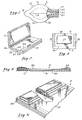
- Figures 1 and 3 show a rectangular container C comprising an upper wall 11 and a lower wall 12, both of which are made of flexible material, and are sealed together along marginal areas 13, 14 and 15 extending around three sides of the container.
- the fourth side 16 is closed as a fold of the laminated sheet from which the container is formed. This side could also comprise two edges sealed together when forming the container from separate sheets.
- the internal areas of the container walls are not sealed together, but are spaced apart to form a storage space for a fluid material. This storage space is in the form of bubble-like protuberances 17 and 18 on each side of the container.
- the two flexible walls 11 and 12 are of laminated construction and include several layers which are adhesively joined to one another. Specifically, strong kraft paper layer 21 is adhered to metal foil layer 23 which is impervious to the passage of liquid and to the passage of air.
- the metal foil can be of lead or aluminium or any other metal suitable for this purpose.
- the innermost layer 25 can be, but need not be, a material which is resistant to deterioration by the action of the fluid material in the container.
- exemplary materials are resins such as poly(vinyl chloride), and copolymers of vinyl chloride with from 2 to 1 5 percent, by weight, of vinyl acetate or vinyl alcohol and heavy papers.
- Layer 25 can be applied to the metal foil by any convenient method, including solvent coating or by means of adhesive compositions.
- a final layer or seal 22 is the burst sealing composition described herein which is coated as a narrow strip along marginal area 14 of the container where a preferentially bursting seal is desired.
- the two halves 11 and 12 of the container can be joined together along marginal areas 13, 14, and 15 by heat or pressure sealing.
- seal 22 along marginal area 14 contacts layer 25 a relatively weaker or preferentially bursting seal results, e.g., a seal having a peel strength in the range of from 50 to 250 g/cm.
- pressure can be applied first at the back edge 16 and moved toward marginal area 14 to break seal 22 and expel the fluid.
- the purposes of this invention are achieved when the seals at marginal areas 13 and 15 are sufficiently stronger than seal 22 to resist bursting when pressure is applied.
- both mating edge areas may be similarly coated so that the final seal 22 along that edge is made by joining one strip to the other.
- side 16 When container C is formed from separate sheets, side 16 need not be sealed for operability, since the pressure rollers force the fluid away from the unsealed edges. However, side 16 should be sealed for storage purposes.
- side 16 When side 16 is formed by sealing two laminates together, the objectives of this invention can be achieved when the seal at marginal area 16 is stronger, weaker, or the same strength as seal 22. Such a seal on the back marginal area can be accomplished with the same coating composition applied on marginal area 14 for ease of manufacture.
- seals 16 and 22 are made with the same sealing composition and are of equal strength, the container can be positioned with either edge forward for ease in assembly of film units or rolls of film.
- photographic film unit P comprises an image-receiving layer 30. On top of that layer are a photosensitive layer 31 and a cover sheet 32. Container C is positioned at one end of film unit P. A trap spacer element 33 is positioned at the other end of film unit P. In Figure 5, film unit P is partially cut-away to show container C in place across one end of the unit.
- a photographic film unit can comprise:
- Such film units can also contain other layers, including, e.g., timing layers, barrier layers, reflective layers, adhesion layers, spacer layers and cover sheets.
- the alkaline processing material is used to begin or to effect development of the photographic film units after exposure. This processing material can be applied from the container of this invention.
- the processing material contains a developing agent, although the material can also be simply an alkaline solution when the developing agent is elsewhere in the film unit. In the latter case, the alkaline solution activates the incorporated developing agent.
- Preparation 1 Poly(2-norbornylmethyl methacrylate-co-methyl methacrylate) (weight ratio 75:25)
- Preparation 2 Poly(2-norbomylmethyl methacrylate-co-ethyl methacrylate) (weight ratio 75:25)
- This copolymer was prepared by the procedure described in Preparation 2 except that the solvent used was toluene and the reaction temperature was 70°C.
- the resulting copolymer had an inherent viscosity of 0.79 (measured in benzene) and a Tg of 101°C.
- the peel equipment consisted of a standard Instron tensile testing machine which has two parallel sets of mechanical jaws. One set of jaws is stationary and the other set is movable and mounted on a shaft. This machine has the capability of measuring and indicating the force required to separate adhered layers.
- a sample (8.6 g) of each polymeric sealing composition was dissolved in dichloroethane (92 g).
- the resulting solution was coated on a poly(vinyl chloride) surface of an 11.5 cm wide strip of laminate comprising kraft paper, lead foil, and poly(vinyl chloride) in that order.
- the coatings were about 12.5 microns thick after drying.
- the coated laminates were then cut into strips 2.54 cm wide and 30.5 cm long.
- Control A sets forth the results where no burst sealing composition is used, i.e., where the laminated substrate is sealed to itself by heat and pressure. Delamination occurred at two sealing temperatures. Undesirably high peel strengths resulted at sealing temperatures above 135°C. Delamination is particularly undesirable in containers used in photographic film units because the integrity of the container is destroyed and corrosive photographic processing material, e.g., alkaline developer fluid, is released within the unit prematurely.
- Control G exhibited erratic peel strength which was either too low or too high at various temperatures.
- Control H exhibited low peel strength over the entire range.
- Example 4 showed desired lower peel strengths over all of the sealing temperature range.
- Controls J and K indicate that styrene-containing polymers are not acceptable for use in the present invention. Their peel strengths are generally too low.
- Control C is compared to Examples 5 and 6. It is clear that the copolymers of Examples 5 and 6 exhibited more desirable strength than the homopolymer of Control C. Some samples of the copolymer in Example 5 failed adhesively at high sealing temperatures.
- the resistance to mechanical shock was determined by a drop test. This test comprises laterally placing a 908 g weight on top of a container and repeatedly dropping a 75 g weight onto the 908 g weight from a height of 3 cm until the container bursts.
- the results of the runs are set forth in the following Table II. Control C and Examples 1, 4, 5 and 8 in this table are the same as in Table I.
- the containers were prepared with the sealing compositions at various sealing temperatures.
- containers of this invention exhibit improved resistance to bursting or failure. due to mechanical shock or impact over the entire sealing temperature range compared to control container C.
- Load test values are in newtons and are determined by laterally placing a container in two parallel sets of mechanical jaws of an Instron Tensile testing machine. One set of jaws is fixed in position while the other set is mounted on an air driven shaft. A force of 0.9 newton per second is applied to the container until it bursts or until 110 newtons is reached. A load test value of at least about 43 newtons over a wide range of sealing temperatures is acceptable. Often the load test value will be in the range of from about 29 to about 98, and preferably in the range of from about 43 to about 57 newtons. Table III sets forth the results of load test runs carried out at 50% relative humidity.
- the sealing compositions used in the containers are those of Control C and Example 1.
Landscapes
- Chemical & Material Sciences (AREA)
- Physics & Mathematics (AREA)
- General Physics & Mathematics (AREA)
- Engineering & Computer Science (AREA)
- Materials Engineering (AREA)
- Organic Chemistry (AREA)
- Addition Polymer Or Copolymer, Post-Treatments, Or Chemical Modifications (AREA)
- Photographic Developing Apparatuses (AREA)
Applications Claiming Priority (2)
| Application Number | Priority Date | Filing Date | Title |
|---|---|---|---|
| US05/959,827 US4188219A (en) | 1978-11-13 | 1978-11-13 | Rupturable fluid container and elements containing same |
| US959827 | 1978-11-13 |
Publications (2)
| Publication Number | Publication Date |
|---|---|
| EP0011481A1 EP0011481A1 (en) | 1980-05-28 |
| EP0011481B1 true EP0011481B1 (en) | 1982-11-03 |
Family
ID=25502463
Family Applications (1)
| Application Number | Title | Priority Date | Filing Date |
|---|---|---|---|
| EP79302558A Expired EP0011481B1 (en) | 1978-11-13 | 1979-11-13 | Rupturable containers for fluids such as photographic processing fluids and photographic film units including such containers of processing fluids |
Country Status (5)
| Country | Link |
|---|---|
| US (1) | US4188219A (enExample) |
| EP (1) | EP0011481B1 (enExample) |
| JP (1) | JPS5570844A (enExample) |
| CA (1) | CA1126559A (enExample) |
| DE (1) | DE2963989D1 (enExample) |
Families Citing this family (12)
| Publication number | Priority date | Publication date | Assignee | Title |
|---|---|---|---|---|
| US4303750A (en) * | 1980-06-16 | 1981-12-01 | Polaroid Corporation | Alkaline fluid photographic processing composition containers |
| JPS61151212A (ja) * | 1984-12-24 | 1986-07-09 | Kuraray Co Ltd | メタクリル系共重合体の製造法 |
| JPS61152708A (ja) * | 1984-12-27 | 1986-07-11 | Hitachi Chem Co Ltd | 光学素子用樹脂の製造方法 |
| JPS6472162A (en) * | 1987-09-11 | 1989-03-17 | Fuji Photo Film Co Ltd | Heatdevelopable transfer method and device therefor |
| US5069773A (en) * | 1991-02-06 | 1991-12-03 | Frangioni John V | Electrophoretic gel forming system |
| KR100382960B1 (ko) | 1998-07-03 | 2003-05-09 | 닛뽕덴끼 가부시끼가이샤 | 락톤 구조를 갖는 (메트)아크릴레이트 유도체, 중합체,포토레지스트 조성물, 및 이것을 사용한 패턴 형성 방법 |
| JP4131062B2 (ja) * | 1998-09-25 | 2008-08-13 | 信越化学工業株式会社 | 新規なラクトン含有化合物、高分子化合物、レジスト材料及びパターン形成方法 |
| CN107660217B (zh) | 2015-05-22 | 2021-06-04 | 阿克苏诺贝尔化学品国际有限公司 | 共聚物及其作为燃料中的流变改性剂的用途 |
| CN115895744A (zh) | 2015-05-22 | 2023-04-04 | 国际壳牌研究有限公司 | 燃料组合物 |
| CN115838608A (zh) | 2015-05-22 | 2023-03-24 | 国际壳牌研究有限公司 | 燃料组合物 |
| EP3298052B1 (en) | 2015-05-22 | 2019-03-27 | Akzo Nobel Chemicals International B.V. | Copolymers of bicyclic (meth)acrylates and alkyl (meth)acrylates and their use as rheology modifiers in fuels. |
| EP3411417B1 (en) | 2016-02-05 | 2019-12-25 | Nouryon Chemicals International B.V. | Copolymers and uses thereof |
Family Cites Families (16)
| Publication number | Priority date | Publication date | Assignee | Title |
|---|---|---|---|---|
| DE1045289B (de) * | 1954-08-06 | 1958-11-27 | Kalle & Co Ag | Verfahren zur Erhoehung der Haftfestigkeit von Schichten aus anderen Stoffen auf Folien aus hochmolekularen Polyalkylenterephthalaten |
| US3243416A (en) * | 1964-01-07 | 1966-03-29 | Eastman Kodak Co | 2-norbornylmethyl sters of acrylic and methacrylic acids and polymers thereof |
| US3619192A (en) * | 1967-03-10 | 1971-11-09 | Polaroid Corp | Photographic film unit |
| US3485775A (en) * | 1968-04-22 | 1969-12-23 | Rohm & Haas | Vinyl chloride resin processing aid imparting improved heat distortion characteristics |
| US3536788A (en) * | 1968-04-22 | 1970-10-27 | Rohm & Haas | Modified vinyl chloride resin compositions |
| BE759428A (fr) * | 1969-11-28 | 1971-04-30 | Eastman Kodak Co | Nouveaux composes acryliques monomeres et polymeres, utilisables en optique, et procede de preparation |
| US3649282A (en) * | 1970-04-15 | 1972-03-14 | Polaroid Corp | Fluid containers having an inner acid reacting layer |
| US3652476A (en) * | 1970-06-05 | 1972-03-28 | Ford Motor Co | Thermoset molding powders employing glycidyl methacrylate and aromatic amines |
| US3784532A (en) * | 1970-09-18 | 1974-01-08 | Rohm & Haas | Bulk polymerization process modified with solvent to reduce residual monomer content |
| US3716524A (en) * | 1971-01-06 | 1973-02-13 | Rohm & Haas | T-butyl alcohol/water cosolvent emulsion copolymerization of a monomeric system comprising methyl methacrylate and bicyclic methacrylate |
| JPS5245628B2 (enExample) * | 1973-06-08 | 1977-11-17 | ||
| US3986640A (en) * | 1973-08-20 | 1976-10-19 | Sanford Redmond | Package for a flowable product and material for making such package |
| US3916051A (en) * | 1974-05-23 | 1975-10-28 | Moore Business Forms Inc | Continuous self-sealing adhesive forms especially for forming booklets |
| US4054232A (en) * | 1976-05-05 | 1977-10-18 | Eastman Kodak Company | Fluid containers |
| US4054233A (en) * | 1976-05-05 | 1977-10-18 | Eastman Kodak Company | Fluid container for photographic processing material |
| CA1110794A (en) * | 1977-06-10 | 1981-10-13 | Eastman Kodak Company | Low temperature adhesives for photographic materials |
-
1978
- 1978-11-13 US US05/959,827 patent/US4188219A/en not_active Expired - Lifetime
-
1979
- 1979-10-16 CA CA337,689A patent/CA1126559A/en not_active Expired
- 1979-11-09 JP JP14533679A patent/JPS5570844A/ja active Granted
- 1979-11-13 EP EP79302558A patent/EP0011481B1/en not_active Expired
- 1979-11-13 DE DE7979302558T patent/DE2963989D1/de not_active Expired
Also Published As
| Publication number | Publication date |
|---|---|
| EP0011481A1 (en) | 1980-05-28 |
| JPS6239426B2 (enExample) | 1987-08-22 |
| CA1126559A (en) | 1982-06-29 |
| JPS5570844A (en) | 1980-05-28 |
| US4188219A (en) | 1980-02-12 |
| DE2963989D1 (en) | 1982-12-09 |
Similar Documents
| Publication | Publication Date | Title |
|---|---|---|
| EP0011481B1 (en) | Rupturable containers for fluids such as photographic processing fluids and photographic film units including such containers of processing fluids | |
| KR100396987B1 (ko) | 점탄성조성물의제조방법 | |
| US5121302A (en) | Solid, thin chemiluminescent device | |
| US4119743A (en) | Method for manufacture of laminates which are useful as packaging materials | |
| US4147291A (en) | Packing bag for light-sensitive material | |
| US4105118A (en) | Laminates useful as packaging materials and container having alkaline fluid means | |
| US3750907A (en) | Fluid containers having both relatively strong and relatively weak seals | |
| US4720011A (en) | Package having tearstrip opener | |
| KR960704709A (ko) | 누설치술용 다층 차단 필름(Multilayer barrier film for ostomy applications) | |
| KR20050110041A (ko) | 접착제 블렌드, 물품 및 방법 | |
| US5314944A (en) | Pressure sensitive adhesive | |
| KR920002981B1 (ko) | 변성에틸렌 아세트산비닐 공중합체를 함유하는 접착제 및 상기 접착제로 접착시킨 성형품 | |
| EP0324989A3 (en) | Laminating adhesives for film/paper microwavable products | |
| JPH0358831A (ja) | 密封用補強シート材料 | |
| US3100760A (en) | Polymeric adhesives and method of preparation | |
| US4996088A (en) | Storage stable adhesive and its laminates | |
| US4197129A (en) | Plastic support having improved adhesivness to material to be bonded thereto | |
| WO2021144414A1 (de) | Einseitig schwach oder nicht klebendes abdichtungsband | |
| EP0137672A2 (en) | Photographic material with a barrier layer comprising a chill-gelable polymer and a method for coating it | |
| US4253901A (en) | Method of heat sealing employing a hot tack adhesive | |
| US4126464A (en) | Low temperature adhesives for photographic materials | |
| US2783166A (en) | Pressure-sensitive adhesive sheet materials prepared from butadiene polymer emulsions | |
| US4054233A (en) | Fluid container for photographic processing material | |
| US4303751A (en) | Rupturable photographic processing alkaline fluid container | |
| EP0042081B1 (en) | Fluid containers |
Legal Events
| Date | Code | Title | Description |
|---|---|---|---|
| PUAI | Public reference made under article 153(3) epc to a published international application that has entered the european phase |
Free format text: ORIGINAL CODE: 0009012 |
|
| AK | Designated contracting states |
Designated state(s): BE DE FR GB NL |
|
| DET | De: translation of patent claims | ||
| 17P | Request for examination filed |
Effective date: 19801031 |
|
| GRAA | (expected) grant |
Free format text: ORIGINAL CODE: 0009210 |
|
| AK | Designated contracting states |
Designated state(s): BE DE FR GB |
|
| PGFP | Annual fee paid to national office [announced via postgrant information from national office to epo] |
Ref country code: FR Payment date: 19821125 Year of fee payment: 4 |
|
| REF | Corresponds to: |
Ref document number: 2963989 Country of ref document: DE Date of ref document: 19821209 |
|
| PGFP | Annual fee paid to national office [announced via postgrant information from national office to epo] |
Ref country code: DE Payment date: 19821231 Year of fee payment: 4 Ref country code: BE Payment date: 19821231 Year of fee payment: 4 |
|
| ET | Fr: translation filed | ||
| PG25 | Lapsed in a contracting state [announced via postgrant information from national office to epo] |
Ref country code: BE Effective date: 19831130 |
|
| GBPC | Gb: european patent ceased through non-payment of renewal fee | ||
| PG25 | Lapsed in a contracting state [announced via postgrant information from national office to epo] |
Ref country code: FR Free format text: LAPSE BECAUSE OF NON-PAYMENT OF DUE FEES Effective date: 19840731 |
|
| PG25 | Lapsed in a contracting state [announced via postgrant information from national office to epo] |
Ref country code: DE Effective date: 19840801 |
|
| REG | Reference to a national code |
Ref country code: FR Ref legal event code: ST |
|
| PG25 | Lapsed in a contracting state [announced via postgrant information from national office to epo] |
Ref country code: GB Effective date: 19881118 |
|
| PLBE | No opposition filed within time limit |
Free format text: ORIGINAL CODE: 0009261 |
|
| STAA | Information on the status of an ep patent application or granted ep patent |
Free format text: STATUS: NO OPPOSITION FILED WITHIN TIME LIMIT |