EP0010221B1 - Faseroptisches Messgerät - Google Patents
Faseroptisches Messgerät Download PDFInfo
- Publication number
- EP0010221B1 EP0010221B1 EP19790103755 EP79103755A EP0010221B1 EP 0010221 B1 EP0010221 B1 EP 0010221B1 EP 19790103755 EP19790103755 EP 19790103755 EP 79103755 A EP79103755 A EP 79103755A EP 0010221 B1 EP0010221 B1 EP 0010221B1
- Authority
- EP
- European Patent Office
- Prior art keywords
- light
- measuring
- transmitter
- measuring device
- fiber
- Prior art date
- Legal status (The legal status is an assumption and is not a legal conclusion. Google has not performed a legal analysis and makes no representation as to the accuracy of the status listed.)
- Expired
Links
- 239000000835 fiber Substances 0.000 title claims description 41
- 230000003287 optical effect Effects 0.000 claims description 8
- 238000006243 chemical reaction Methods 0.000 claims description 7
- 239000004020 conductor Substances 0.000 claims description 5
- 239000000463 material Substances 0.000 claims description 5
- 239000000696 magnetic material Substances 0.000 claims description 3
- 238000010438 heat treatment Methods 0.000 claims description 2
- 230000035945 sensitivity Effects 0.000 claims description 2
- 230000003019 stabilising effect Effects 0.000 claims 3
- 230000004907 flux Effects 0.000 claims 2
- 230000005693 optoelectronics Effects 0.000 claims 1
- 229920005597 polymer membrane Polymers 0.000 claims 1
- 238000005259 measurement Methods 0.000 description 9
- 238000011156 evaluation Methods 0.000 description 5
- XEEYBQQBJWHFJM-UHFFFAOYSA-N Iron Chemical compound [Fe] XEEYBQQBJWHFJM-UHFFFAOYSA-N 0.000 description 4
- 230000000694 effects Effects 0.000 description 3
- 230000010287 polarization Effects 0.000 description 3
- 229920000642 polymer Polymers 0.000 description 3
- 230000005540 biological transmission Effects 0.000 description 2
- 230000015572 biosynthetic process Effects 0.000 description 2
- 239000013078 crystal Substances 0.000 description 2
- 238000006073 displacement reaction Methods 0.000 description 2
- 229910052742 iron Inorganic materials 0.000 description 2
- 230000001629 suppression Effects 0.000 description 2
- 230000032683 aging Effects 0.000 description 1
- 238000005452 bending Methods 0.000 description 1
- 230000007423 decrease Effects 0.000 description 1
- 238000011161 development Methods 0.000 description 1
- 230000018109 developmental process Effects 0.000 description 1
- 230000005684 electric field Effects 0.000 description 1
- 230000007613 environmental effect Effects 0.000 description 1
- 239000013307 optical fiber Substances 0.000 description 1
- 210000000056 organ Anatomy 0.000 description 1
- 229920006254 polymer film Polymers 0.000 description 1
Images


Classifications
-
- G—PHYSICS
- G01—MEASURING; TESTING
- G01D—MEASURING NOT SPECIALLY ADAPTED FOR A SPECIFIC VARIABLE; ARRANGEMENTS FOR MEASURING TWO OR MORE VARIABLES NOT COVERED IN A SINGLE OTHER SUBCLASS; TARIFF METERING APPARATUS; MEASURING OR TESTING NOT OTHERWISE PROVIDED FOR
- G01D5/00—Mechanical means for transferring the output of a sensing member; Means for converting the output of a sensing member to another variable where the form or nature of the sensing member does not constrain the means for converting; Transducers not specially adapted for a specific variable
- G01D5/26—Mechanical means for transferring the output of a sensing member; Means for converting the output of a sensing member to another variable where the form or nature of the sensing member does not constrain the means for converting; Transducers not specially adapted for a specific variable characterised by optical transfer means, i.e. using infrared, visible, or ultraviolet light
- G01D5/268—Mechanical means for transferring the output of a sensing member; Means for converting the output of a sensing member to another variable where the form or nature of the sensing member does not constrain the means for converting; Transducers not specially adapted for a specific variable characterised by optical transfer means, i.e. using infrared, visible, or ultraviolet light using optical fibres
-
- G—PHYSICS
- G01—MEASURING; TESTING
- G01R—MEASURING ELECTRIC VARIABLES; MEASURING MAGNETIC VARIABLES
- G01R15/00—Details of measuring arrangements of the types provided for in groups G01R17/00 - G01R29/00, G01R33/00 - G01R33/26 or G01R35/00
- G01R15/14—Adaptations providing voltage or current isolation, e.g. for high-voltage or high-current networks
- G01R15/24—Adaptations providing voltage or current isolation, e.g. for high-voltage or high-current networks using light-modulating devices
- G01R15/248—Adaptations providing voltage or current isolation, e.g. for high-voltage or high-current networks using light-modulating devices using a constant light source and electro-mechanically driven deflectors
Definitions
- the invention relates to a fiber optic measuring device for current and / or voltage measurement according to the preamble of claim 1.
- a measuring device is known from DE-AS 1 930111.
- the measuring device known from DE-AS 1 930111 is primarily used to measure the movement of parts that move against one another. The movement of one of these parts can also take place as a function of an electrical variable.
- the light coming from the light source is fed at the measuring point to a measuring head on which light exit fibers are arranged on one side and light entry fibers on the other side.
- This measuring head is set up opposite the moving object, on which a mirror of a suitable shape is attached in such a way that, depending on the position of the moving object, more or less light is reflected back into the optical fiber.
- This known arrangement has the disadvantage that the measurement result is falsified by changes in the intensity of the light source that occurs after calibration or the attenuation of the fibers.
- this measuring device is hardly suitable for use under unfavorable environmental conditions.
- the invention has for its object to develop a fiber optic measuring device of the type mentioned, which is free from the above disadvantages of known measuring devices.
- a fiber optic measuring device is proposed according to the preamble of claim 1, which according to the invention has the features mentioned in the characterizing part of claim 1.
- the measuring devices according to the invention are reliable and at the same time cheap. A high degree of accuracy can be achieved in the measurements and the display of instabilities and signs of aging in, for example, light guides, photo and light-emitting diodes can be made independent in a simple manner. You can perform the sensing organ and the encoder with very small dimensions, and the device can u. a. be used for debit and relay protection purposes.
- FIG. 1 shows an arrangement with a fiber optic voltage measuring device, in which the measuring voltage U is supplied to the transmitter 49 and is connected to the electrodes 33 of a piezoelectric element 34.
- An oscillator 20 modulates the light of a light-emitting diode 22 at a frequency f i via a feed element 21.
- Another oscillator 25 modulates the light of another light-emitting diode 27 at a frequency f 2 , which is different from f 1 , via a feed element 26.
- the LEDs 22 and 27 generate light with different wavelengths ( ⁇ 1 and). 2 ), which is brought together via light-conducting fibers 23 and 28 and a fiber branch 24 in a common light-conducting fiber 29.
- a screen 35 is arranged as an optical filter between the fiber end and the mirror 36. This filter passes signals in a certain wavelength range, but is opaque to signals with other wavelengths.
- the filter 35 is fixed to a bimorph, alternatively multimorph, piezoelectric element 34, to which the measuring voltage U is connected via the measuring lines 32 to the electrodes 33. Due to the piezoelectric effect, the resulting electric field causes the element 34 to bend, which causes a displacement. of the screen 35 before the end of the fiber is obtained.
- the fiber is fixed to a piezoelectric element 3i which is made of the same material as the element 34 to which the measuring voltage U is supplied.
- the interference filter has the property of transmitting the light wavelength ⁇ 1 , but not A 2 .
- the light that is reflected by the mirror 36 travels back through the fiber 31, and some of this light travels into a fiber 38 via the fiber junction 30 is reinforced.
- the components contained in the signal with the frequencies f 1 and f 2 are separated and demodulated by bandpass filters 41 and 44 (f i , f 2 ), rectifiers 42 and 45 and low-pass filters 43 and 46, respectively.
- the signal coming from the low-pass filter 43 is not influenced by the position of the screen, since it is designed to transmit light with the wavelength ⁇ 1 and is therefore independent of the measurement signal.
- the output signal on the display device 48 consists of the quotient of the output signals of the low-pass filters 46 and 43.
- the output signal of the low-pass filter 46 depends on the position of the screen 35 and is therefore modulated with the size of the measurement signal U.
- the formation of the quotient which is carried out in a division element 47, has the consequence that the output signal is compensated for parameter variations in the transmission.
- the measuring device can be used for both direct and alternating voltage. The only condition for this is that the frequencies f 1 and f 2 are higher than all the frequencies of interest occurring in the measurement signal. The use of light signals of different frequencies and the formation of the quotient thus compensate for the disadvantages inherent in an uncompensated fiber-optic measuring device.
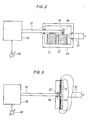
- the arrangement according to FIG. 2 shows a fiber optic voltage measuring device in which the measuring voltage U is connected via the measuring lines 32 to two stacks 51 and 52 of piezoelectric elements connected in parallel.
- the measuring voltage is connected to the stack with the opposite polarity, which means that a positive measuring voltage increases the height of one stack and decreases the height of the other stack and vice versa.
- the two-stack design reduces the influence of temperature while doubling the sensitivity.
- the end of the fiber 31 is fixed on one stack 51, and on the other a mirror 36 is fastened with a screen 35 which acts as an optical filter and which covers part of the fiber end. Due to the voltage U, the screen moves relative to the fiber and modulates the light in the fiber 31.
- the evaluation element 50 and the display device 48 are elements of the same type as in the arrangement according to FIG. 1.
- FIG. 3 shows a fiber-optic voltage measuring device in which the electro-optical conversion takes place with a piezoelectric high polymer.
- the measuring voltage U is connected via the measuring lines 32 with opposite polarity to two pieces of film 53 and 54 made of piezoelectric high polymer. Due to the different polarity, one piece of film is stretched while the other is contracted when a voltage is supplied via the measuring lines 32.
- the polymer film pieces 53 and 54 are connected to one another by a mirror 36, on the surface of which a screen 35 acting as an optical filter is seated. When the films are stretched or contracted, the mirror and the screen are shifted.
- the light in the fiber 31 is modulated by the movements of the screen and thus describes the measurement signal U.
- the evaluation element 50 and the display device 48 are elements of the same type as in the arrangement according to FIG. 1.
- FIG. 4 shows a fiber optic current measuring device, in which the measuring current 1 generates a magnetic field which acts on a piece 63 of magnetic material.
- the measuring current I flows through a coil 62 in which a part of said piece of magnetic material 63, for. B. soft iron, which is attached to springs 56 and carries a mirror 36.
- a screen 35 which acts as an optical filter, is attached between the mirror 36 and the end face of the fiber 31.
- the measuring current I flowing through the coil 62 exerts an attractive force on the material piece 63, which causes the springs 56 to deflect.
- the screen 35 is displaced in front of the end face of the fiber 31, whereby the light is rnodulated with the measuring current I.
- the evaluation element 50 and the display device 48 are elements of the same type as in the arrangement according to FIG. 1.
- FIG. 5 shows a current measuring device with an optical modulator, the effect of which is based on the thermal expansion of a tensioned wire through which current flows.
- the measuring current I flows through a wire 72, one end of which is clamped in place.
- the other end of the wire is fastened to a double spring 56 under pretension, which double spring carries a mirror 36 which is partially covered by a screen 35 which acts as an optical filter and is connected to the mirror.
- the screen 35 partially covers the end of the fiber 31.
- the fiber 31 is suspended in a wire 73 which is made of the same material as the wire 72 through which current flows. This compensates for temperature variations in the environment.
- the measuring current flowing through the wire 72 causes an extension of the wire and thus a displacement of the mirror 36 with the screen 35. This results in a modulation of the incoming light in the fiber 31, which is reflected to the evaluation element 50, in which it is as well the display device 48 is a member of the same type as in the arrangement according to FIG. 1.
- Figure 6 shows a fiber optic current measurement advises with an optical modulator, the effect of which is based on the fact that the current flowing through a wire heats and bends bimetal.
- the measuring current I flows through a wire 77 which is wound around two bimetal strips 75.
- the bimetallic strips 75 are firmly clamped at one end and carry a mirror 36 between their other ends. A part of the mirror surface is covered with a screen 35 which acts as an interference filter and which partially covers the end surface of the fiber 31.
- the measuring current I which flows through the wire 77, causes heating and thus bending of the bimetallic strips 75, the screen 35 moving in front of the end face of the fiber and modulating the light.
- the end of the fiber 31 is fastened between two bimetal strips 76 of the same type as the bimetal strips 75.
- the evaluation element 50 and the display device 48 are elements of the same type as in the arrangement according to FIG. 1.
- the invention can be varied in many ways within the scope of the general inventive idea disclosed. It is not limited to the exemplary embodiments shown.
- a “bimorphic” modulator or piezoelectric element in the sense of this application is understood to mean a piezoelectric crystal with two opposite polarization directions.
- a “multimorphic" piezoelectric element is one that consists, for example, of four crystals, two of which have opposite polarization directions and the other two have opposite polarization directions, which are 180 ° out of phase with the former.
Landscapes
- Physics & Mathematics (AREA)
- General Physics & Mathematics (AREA)
- Optical Transform (AREA)
- Arrangements For Transmission Of Measured Signals (AREA)
- Measuring Instrument Details And Bridges, And Automatic Balancing Devices (AREA)
- Length Measuring Devices By Optical Means (AREA)
Description
- Die Erfindung betrifft ein faseroptisches Meßgerät zur Strom- und/oder Spannungsmessung gemäß dem Oberbegriff des Anspruches 1. Ein solches Meßgerät ist bekannt aus der DE-AS 1 930111.
- Bei der Messung von Strömen und Spannungen werden normalerweise entweder elektromechanische oder ganz oder teilweise elektronische Geräte verwendet, die mit Transformatoren, Shunten oder Spannungsteilern elektrisch verbunden sind. Ein großes Problem bei derartigen Meßsystemen besteht darin, den Einfluß von Störungen zu beseitigen, die beispielsweise auf den Übertragungsleitungen in die Meßsignale gelangen. Diese Störungen müssen unterdrückt werden, damit sie nicht die Anzeige des Meßsignals verfälschen. Ein weiteres Problem ist die Unterdrückung von gleichphasigen Störspannungen (»common-mode«-Unterdrückung). Weitere Probleme treten beim Messen auf hohem Potential auf, wo die Gefahr elektrischer Überschläge besteht oder die Anzeige hochspannungsfrei sein soll, und wenn Meßsysteme eigensicher gemacht werden sollen.
- Das aus der DE-AS 1 930111 bekannte Meßgerät dient in erster Linie der Messung der Bewegung von gegeneinander bewegten Teilen. Dabei kann die Bewegung eines dieser Teile auch in Abhängigkeit einer elektrischen Größe erfolgen. Bei dem bekannten Gerät wird das von der Lichtquelle kommende Licht an der Meßstelle einem Meßkopf zugeführt, auf dem auf der einen Seite Lichtaustritts- und auf der anderen Seite Lichteintrittsfasern angeordnet sind. Dieser Meßkopf wird dem bewegten Objekt gegenüber aufgebaut, auf welchem ein Spiegel von geeigneter Form derart angebracht wird, daß je nach Lage des bewegten Objektes mehr oder weniger Licht in die Lichtfaser zurückreflektiert wird. Diese bekannte Anordnung hat den Nachteil, daß das Meßergebnis durch Veränderungen der nach der Eichung eintretenden Intensität der Lichtquelle oder der Dämpfung der Fasern verfälscht wird. Außerdem ist dieses Meßgerät kaum geeignet, unter ungünstigen Umgebungsbedingungen eingesetzt zu werden.
- Der Erfindung liegt die Aufgabe zugrunde, ein faseroptisches Meßgerät der eingangs genannten Art zu entwickeln, welches von den obengenannten Nachteilen bekannter Meßgeräte frei ist.
- Zur Lösung dieser Aufgabe wird ein faseroptisches Meßgerät nach dem Oberbegriff des Anspruches 1 vorgeschlagen, welches erfindungsgemäß die im kennzeichnenden Teil des Anspruches 1 genannten Merkmale hat.
- Vorteilhafte Weiterbildungen der Erfindung sind in den Unteransprüchen genannt.
- Die Meßgeräte nach der Erfindung sind betriebssicher und gleichzeitig billig. Man kann bei den Messungen eine große Genauigkeit erzielen und auf einfache Weise die Anzeige von Instabilitäten und Alterungserscheinungen in beispielsweise Lichtleitern, Foto- und Leuchtdioden unabhängig machen. Man kann das erfassende Organ und den Geber mit sehr kleinen Abmessungen ausführen, und das Gerät kann u. a. für Debitierungs- und Relaisschutz-Zwecke benutzt werden.
- Anhand der in den Figuren gezeigten Ausführungsbeispiele soll die Erfindung näher erläutert werden. Es zeigt
- Fig. 1 einen temperaturkompensierten bimorphen Modulator, wobei Licht mit zwei verschiedenen Wellenlängen benutzt wird,
- Fig. 2 ein faseroptisches Meßgerät mit zwei piezoelektrischen Stapeln,
- Fig. 3 ein faseroptisches Meßgerät mit piezoelektrischen Polymeren,
- Fig. 4 einen Geber, bei dem die Modulation durch die magnetischen Kräfte zwischen einer stromdurchflossenen Spule und einem Weicheisenstück bewirkt wird,
- Fig. 5 einen Geber, bei dem die Modulation durch die Längendehnung eines stromdurchflossenen Leiters bewirkt wird,
- Fig. 6 einen Geber, bei dem die Modulation durch die Formänderung zweier vom Meßstrom erhitzter Bimetallstücke bewirkt wird.
- Figur 1 zeigt eine Anordnung mit einem faseroptischeri Spannungsmeßgerät, bei dem die Meßspannung U dem Geber 49 zugeführt wird und an die Elektroden 33 eines piezoelektrischen Elements 34 angeschlossen ist. Ein Oszillator 20 moduliert über ein Speiseglied 21 das Licht einer Leuchtdiode 22 mit einer Frequenz fi. Ein anderer Oszillator 25 moduliert über ein Speiseglied 26 das Licht einer anderen Leuchtdiode 27 mit einer Frequenz f2, die von f1 verschieden ist. Die Leuchtdioden 22 und 27 erzeugen Licht mit verschiedenen Wellenlängen (λ1 bzw. ).2), das über lichtleitende Fasern 23 bzw. 28 und eine Faserverzweigung 24 in einer gemeinsamen lichtleitenden Faser 29 zusammengeführt wird. Diese ist über eine Faserverzweigung 30 an eine lichtleitende Faser 31 angeschlossen, die vor einem Spiegel 36 im Geber 49 endet. Zwischen dem Faserende und dem Spiegel 36 ist ein Schirm 35 als optisches Filter angeordnet. Dieses Filter läßt Signale in einem bestimmten Wellenlängenbereich durch, ist jedoch für Signale mit anderen Wellenlängen undurchlässig. Das Filter 35 ist an einem bimorphen, alternativ multimorphen, piezoelektrischen Element 34 fixiert, an das die Meßspannung U über die Meßleitungen 32 an die Elektroden 33 angeschlossen ist. Aufgrund deε piezoelektrischen Effektes verursacht das entstehende elektrische Feld eine Durchbiegung des Elementes 34, wodurch man eine Verschie. bung des Schirms 35 vor dem Faserende erhält Um den Einfluß der Temperatur zu reduzieren, is die Faser an einem piezoelektrischen Element 3i fixiert, das aus demselben Material besteht wie das Element 34, dem die Meßspannung U zugeführt wird. Das Interferenzfilter hat die Eigenschaft, die Lichtwellenlänge λ1, jedoch nicht A2 hindurchzulassen. Das Licht, das vom Spiegel 36 zurückgeworfen wird, läuft durch die Faser 31 zurück, und ein Teil dieses Lichts läuft über die Faserverzweigung 30 in eine Faser 38. Das Licht wird in einer Fotodiode 39 in ein elektrisches Signal umgewandelt, welches in einem Verstärker 40 verstärkt wird. Die im Signal enthaltenen Komponenten mit den Frequenzen f1 und f2 werden durch Bandpaßfilter 41 bzw. 44 (fi, f2), Gleichrichter 42 bzw. 45 und Tiefpaßfilter 43 bzw. 46 voneinander getrennt und demoduliert. Das von dem Tiefpaßfilter 43 kommende Signal wird nicht von der Lage des Schirms beeinflußt, da es so beschaffen ist, daß es Licht mit der Wellenlänge λ1 hindurchläßt und somit vom Meßsignal unabhängig ist. Das Ausgangssignal an dem Anzeigegerät 48 besteht aus dem Quotienten aus den Ausgangssignalen der Tiefpaßfilter 46 und 43. Das Ausgangssignal des Tiefpaßfilters 46 ist von der Lage des Schirms 35 abhängig und ist somit mit der Größe des Meßsignals U moduliert. Die Quotientenbildung, die in einem Divisionsglied 47 vorgenommen wird, hat zur Folge, daß das Ausgangssignal gegenüber Parametervariationen in der Übertragung kompensiert ist. Das Meßgerät kann sowohl für Gleich- als auch Wechselspannung verwendet werden. Die einzige Bedingung hierfür besteht darin, daß die Frequenzen f1 und f2 höher liegen als alle im Meßsignal auftretenden interessierenden Frequenzen. Durch die Verwendung von Lichtsignalen unterschiedlicher Frequenzen und durch die Quotientenbildung werden somit die Nachteile kompensiert, die einem nicht kompensierten faseroptischen Meßgerät anhaften.
- Die Anordnung nach Figur 2 zeigt ein faseroptisches Spannungsmeßgerät, bei dem die Meßspannung U über die Meßleitungen 32 an zwei Stapel 51 und 52 von parallelgeschalteten piezoelektrischen Elementen angeschlossen wird. Die Meßspannung ist mit entgegengesetzter Polarität an die Stapel angeschlossen, was zur Folge hat, daß eine positive Meßspannung die Höhe des einen Stapels vergrößert und die Höhe des anderen Stapels verkleinert und umgekehrt. Durch den Aufbau mit zwei Stapeln wird der Einfluß der Temperatur reduziert, während die Empfindlichkeit gleichzeitig verdoppelt wird. An dem einen Stapel 51 ist das Ende der Faser 31 fixiert, und an dem anderen ist ein Spiegel 36 mit einem als optisches Filter wirkenden Schirm 35 befestigt, der einen Teil des Faserendes abdeckt. Aufgrund der Spannung U bewegt sich der Schirm relativ zur Faser und moduliert das Licht in der Faser 31. Bei dem Auswertungsglied 50 und dem Anzeigegerät 48 handelt es sich um gleichartige Glieder wie in der Anordnung nach Figur 1.
- Figur 3 zeigt ein faseroptisches Spannungsmeßgerät, bei dem die elektrooptische Umwandlung mit einem piezoelektrischen Hochpolymer erfolgt. Die Meßspannung U wird über die Meßleitungen 32 mit entgegengesetzter Polarität an zwei Filmstücke 53 und 54 aus piezoelektrischem Hochpolymer angeschlossen. Aufgrund der unterschiedlichen Polarität wird das eine Filmstück gedehnt, während das andere zusammengezogen wird, wenn über die Meßleitungen 32 eine Spannung zugeführt wird. Die Polymerfilmstücke 53 und 54 sind durch einen Spiegel 36 miteinander verbunden, auf dessen Oberfläche ein als optisches Filter wirkender Schirm 35 sitzt. Bei der Dehnung beziehungsweise bei der Zusammenziehung der Filme werden der Spiegel und der Schirm verschoben. Das Licht in der Faser 31 wird von den Bewegungen des Schirms moduliert und beschreibt somit das Meßsignal U. Bei dem Auswertungsglied 50 und dem Anzeigegerät 48 handelt es sich um gleichartige Glieder wie in der Anordnung nach Figur 1.
- Figur 4 zeigt ein faseroptisches Strommeßgerät, bei welchem der Meßstrom 1 ein Magnetfeld erzeugt, welches auf ein Stück 63 aus magnetischem Material einwirkt. Der Meßstrom I durchfließt eine Spule 62, in der sich ein Teil des genannten Magnetmaterialstückes 63, z. B. Weicheisen, befindet, welches an Federn 56 befestigt ist und einen Spiegel 36 trägt. Zwischen dem Spiegel 36 und der Endfläche der Faser 31 ist ein als optisches Filter wirkender Schirm 35 angebracht. Der die Spule 62 durchfließende Meßstrom I übt auf das Materialstück 63 eine Anziehungskraft aus, die eine Durchbiegung der Federn 56 bewirkt. Hierdurch wird der Schirm 35 vor der Endfläche der Faser 31 verschoben, wodurch das Licht mit dem Meßstrom I rnoduliert wird. Bei dem Auswertungsglied 50 und dem Anzeigegerät 48 handelt es sich um gleichartige Glieder wie in der Anordnung nach Figur 1.
- Figur 5 zeigt ein Strommeßgerät mit einem optischen Modulator, dessen Wirkung auf der Wärmedehnung eines stromduchflossenen gespannten Drahtes beruht. Der Meßstrom I durchfließt einen Draht 72, dessen eines Ende ortsfest eingespannt ist. Das andere Ende des Drahtes ist an einer Doppelfeder 56 unter Vorspannung befestigt, welche Doppelfeder einen Spiegel 36 trägt, der teilweise von einem mit dem Spiegel verbundenen als optisches Filter wirkenden Schirm 35 bedeckt ist. Der Schirm 35 überdeckt teilweise das Ende der Faser 31. Die Faser 31 ist in einem Draht 73 aufgehängt, der aus demselben Material wie der von Strom durchflossene Draht 72 besteht. Hierdurch werden Temperaturvariationen der Umgebung kompensiert. Der durch den Draht 72 fließende Meßstrom bewirkt eine Verlängerung des Drahtes und damit eine Verschiebung des Spiegels 36 mit dem Schirm 35. Hierdurch erhält man eine Modulation des ankommenden Lichtes in der Faser 31, das zum Auswertungsglied 50 reflektiert wird, bei der es sich ebenso wie bei dem Anzeigegerät 48 um ein gleichartiges Glied handelt wie in derAnordnung nach Figur 1.
- Figur 6 zeigt ein faseroptisches Strommeßgerät mit einem optischen Modulator, dessen Wirkung darauf beruht, daß der durch einen Draht fließende Strom Bimetall erhitzt und biegt. Der Meßstrom I durchfließt einen Draht 77, der um zwei Bimetallstreifen 75 gewickelt ist. Die Bimetallstreifen 75 sind an einem Ende fest eingespannt und tragen zwischen ihren anderen Enden einen Spiegel 36. Ein Teil der Spiegelfläche ist mit einem als Interferenzfilter wirkenden Schirm 35 bedeckt, der teilweise die Endfläche der Faser 31 abdeckt. Der Meßstrom I, der durch den Draht 77 fließt, bewirkt eine Erhitzung und damit ein Durchbiegen der Bimetallstreifen 75, wobei sich der Schirm 35 vor der Endfläche der Faser verschiebt und das Licht moduliert. Um die Temperaturvariationen der Umgebung zu kompensieren, ist das Ende der Faser 31 zwischen zwei Bimetallstreifen 76 gleicher Art wie die Bimetallstreifen 75 befestigt. Bei dem Auswertungsglied 50 und dem Anzeigegerät 48 handelt es sich um gleichartige Glieder wie in der Anordnung nach Figur 1.
- Die Erfindung kann im Rahmen des offenbarten allgemeinen Erfindungsgedankens in vielfacher Weise variiert werden. Sie ist nicht auf die gezeigten Ausführungsbeispiele beschränkt.
- Unter einem »bimorphen« Modulator- oder piezoelektrischen Element im Sinne dieser Anmeldung wird ein piezoelektrischer Kristall mit zwei entgegengesetzten Polarisationsrichtungen verstanden. Ein »multimorphes« piezoelektrisches Element ist ein solches, das beispielsweise aus vier Kristallen besteht, von denen zwei entgegengesetzte Polarisationsrichtungen haben und die beiden anderen untereinander entgegengesetzte Polarisationsrichtungen haben, welche um 180° gegenüber den erstgenannten phasenverschoben sind.
Claims (7)
Applications Claiming Priority (2)
| Application Number | Priority Date | Filing Date | Title |
|---|---|---|---|
| SE7810643 | 1978-10-12 | ||
| SE7810643A SE414082B (sv) | 1978-10-12 | 1978-10-12 | Fiberoptiskt metdon |
Publications (2)
| Publication Number | Publication Date |
|---|---|
| EP0010221A1 EP0010221A1 (de) | 1980-04-30 |
| EP0010221B1 true EP0010221B1 (de) | 1983-02-09 |
Family
ID=20336072
Family Applications (1)
| Application Number | Title | Priority Date | Filing Date |
|---|---|---|---|
| EP19790103755 Expired EP0010221B1 (de) | 1978-10-12 | 1979-10-02 | Faseroptisches Messgerät |
Country Status (5)
| Country | Link |
|---|---|
| EP (1) | EP0010221B1 (de) |
| JP (1) | JPS5552955A (de) |
| CA (1) | CA1133066A (de) |
| DE (1) | DE2964734D1 (de) |
| SE (1) | SE414082B (de) |
Cited By (1)
| Publication number | Priority date | Publication date | Assignee | Title |
|---|---|---|---|---|
| DE4114253A1 (de) * | 1991-05-02 | 1992-11-05 | Asea Brown Boveri | Faseroptischer sensor |
Families Citing this family (7)
| Publication number | Priority date | Publication date | Assignee | Title |
|---|---|---|---|---|
| US4379226A (en) * | 1981-02-02 | 1983-04-05 | Siemens Corporation | Method and sensor device for measuring a physical parameter utilizing an oscillatory, light modulation element |
| SE430437B (sv) * | 1982-03-15 | 1983-11-14 | Asea Ab | Fiberoptiskt metdon for metning av elektriska och magnetiska storheter |
| DE3504945A1 (de) * | 1984-05-24 | 1985-11-28 | MITEC Moderne Industrietechnik GmbH, 8012 Ottobrunn | Anordnung zum messen der elektrischen spannungsparameter eines hochspannungsleiters |
| DE3545257C2 (de) * | 1985-12-20 | 1994-01-05 | Deutsche Aerospace | Sensor zur Messung Elektromagnetischer Pulse |
| GB8716372D0 (en) * | 1987-07-10 | 1987-08-19 | Schlumberger Electronics Uk | Optical transducer system |
| US5235180A (en) * | 1992-03-05 | 1993-08-10 | General Scanning, Inc. | Rotary motor having an angular position transducer and galvanometer scanning system employing such motor |
| US7820956B2 (en) | 2006-06-19 | 2010-10-26 | Gsi Group Corporation | Optical position transducer systems and methods employing reflected illumination for limited rotation motor systems |
Family Cites Families (5)
| Publication number | Priority date | Publication date | Assignee | Title |
|---|---|---|---|---|
| SE324463B (de) * | 1968-03-27 | 1970-06-01 | Aga Ab | |
| DE1930111C3 (de) * | 1969-06-13 | 1975-02-20 | Vierling, Oskar, Prof. Dr.Phil.Habil., 8553 Ebermannstadt | Optische Vorrichtung zum Messen der Bewegung von gegeneinander bewegten Teilen |
| US3781092A (en) * | 1971-06-28 | 1973-12-25 | D Sussman | Monitoring system |
| DE2549497A1 (de) * | 1975-11-05 | 1977-05-12 | Franz Ummen | Verfahren zur uebertragung physikalischer messgroessen |
| CH639196A5 (de) * | 1977-11-23 | 1983-10-31 | Asea Ab | Messgeraet zum messen von physikalischen groessen mittels optischer mittel. |
-
1978
- 1978-10-12 SE SE7810643A patent/SE414082B/sv not_active IP Right Cessation
-
1979
- 1979-10-02 EP EP19790103755 patent/EP0010221B1/de not_active Expired
- 1979-10-02 DE DE7979103755T patent/DE2964734D1/de not_active Expired
- 1979-10-09 JP JP12956779A patent/JPS5552955A/ja active Pending
- 1979-10-11 CA CA337,377A patent/CA1133066A/en not_active Expired
Cited By (1)
| Publication number | Priority date | Publication date | Assignee | Title |
|---|---|---|---|---|
| DE4114253A1 (de) * | 1991-05-02 | 1992-11-05 | Asea Brown Boveri | Faseroptischer sensor |
Also Published As
| Publication number | Publication date |
|---|---|
| EP0010221A1 (de) | 1980-04-30 |
| DE2964734D1 (en) | 1983-03-17 |
| JPS5552955A (en) | 1980-04-17 |
| SE7810643L (sv) | 1980-04-13 |
| CA1133066A (en) | 1982-10-05 |
| SE414082B (sv) | 1980-07-07 |
Similar Documents
| Publication | Publication Date | Title |
|---|---|---|
| DE2945019C2 (de) | ||
| EP0445362B1 (de) | Vorrichtung zum Messen einer magnetischen Induktion | |
| EP0011110B1 (de) | Anordnung zur elektrooptischen Spannungsmessung | |
| EP0433824B1 (de) | Faseroptischer Sensor | |
| DE3609507C2 (de) | Faseroptisches Interferometer | |
| DE69328825T2 (de) | Elektrische Strommessung | |
| DE2806777C2 (de) | ||
| WO2009037271A1 (de) | Faseroptischer sensor zur messung von verformungen an windkraftanlagen | |
| US4547729A (en) | Optical fiber measuring devices | |
| WO2016112993A1 (de) | Optoelektrische messvorrichtung und verfahren zum messen eines elektrischen stromes | |
| DE2541072C3 (de) | Magnetooptischer Meßwandler zur Herstellung von Hochspannungsströmen | |
| DE1955403C3 (de) | Digitale Meßeinrichtung für Ströme in Hochspannungsleitern | |
| EP0010221A1 (de) | Faseroptisches Messgerät | |
| DE3504945A1 (de) | Anordnung zum messen der elektrischen spannungsparameter eines hochspannungsleiters | |
| WO2018029136A1 (de) | Lidar-system mit beweglicher lichtfaser | |
| DE69627656T2 (de) | Hochspannungsmessanordnung | |
| DE3726411A1 (de) | Faseroptischer magnetfeldsensor | |
| EP0854354A1 (de) | Verfahren zur Temperaturkompensation von Messsignalen eines faseroptischen Sensors | |
| DE3031961C2 (de) | Interferometrische Einrichtung zur Messung physikalischer Größen | |
| DE3039235A1 (de) | "druckempfindlicher, faseroptischer sensor" | |
| DE2130047C3 (de) | Meßeinrichtung für Ströme | |
| EP1004030A1 (de) | Verfahren zum messen eines magnetfeldes und einrichtung zur durchführung des verfahrens | |
| DE3431769A1 (de) | Faseroptischer stromsensor | |
| DE584850C (de) | Einrichtung zur Ermittlung oder zum Ausgleich des Stellungsunterschiedes zweier raeumlich getrennter Wellen | |
| DE10035835C2 (de) | Interferometrische Messanordnung zum Überlagern von mindestens zwei Lichtwellen |
Legal Events
| Date | Code | Title | Description |
|---|---|---|---|
| PUAI | Public reference made under article 153(3) epc to a published international application that has entered the european phase |
Free format text: ORIGINAL CODE: 0009012 |
|
| AK | Designated contracting states |
Designated state(s): CH DE FR GB IT |
|
| 17P | Request for examination filed | ||
| ITF | It: translation for a ep patent filed | ||
| GRAA | (expected) grant |
Free format text: ORIGINAL CODE: 0009210 |
|
| AK | Designated contracting states |
Designated state(s): CH DE FR GB IT |
|
| REF | Corresponds to: |
Ref document number: 2964734 Country of ref document: DE Date of ref document: 19830317 |
|
| ET | Fr: translation filed | ||
| PLBE | No opposition filed within time limit |
Free format text: ORIGINAL CODE: 0009261 |
|
| STAA | Information on the status of an ep patent application or granted ep patent |
Free format text: STATUS: NO OPPOSITION FILED WITHIN TIME LIMIT |
|
| 26N | No opposition filed | ||
| PGFP | Annual fee paid to national office [announced via postgrant information from national office to epo] |
Ref country code: FR Payment date: 19840823 Year of fee payment: 6 |
|
| PGFP | Annual fee paid to national office [announced via postgrant information from national office to epo] |
Ref country code: CH Payment date: 19841025 Year of fee payment: 6 |
|
| PGFP | Annual fee paid to national office [announced via postgrant information from national office to epo] |
Ref country code: DE Payment date: 19841116 Year of fee payment: 6 |
|
| PG25 | Lapsed in a contracting state [announced via postgrant information from national office to epo] |
Ref country code: CH Effective date: 19871031 |
|
| GBPC | Gb: european patent ceased through non-payment of renewal fee | ||
| PG25 | Lapsed in a contracting state [announced via postgrant information from national office to epo] |
Ref country code: FR Free format text: LAPSE BECAUSE OF NON-PAYMENT OF DUE FEES Effective date: 19880630 |
|
| REG | Reference to a national code |
Ref country code: CH Ref legal event code: PL |
|
| PG25 | Lapsed in a contracting state [announced via postgrant information from national office to epo] |
Ref country code: DE Effective date: 19880701 |
|
| REG | Reference to a national code |
Ref country code: FR Ref legal event code: ST |
|
| PG25 | Lapsed in a contracting state [announced via postgrant information from national office to epo] |
Ref country code: GB Effective date: 19881118 |