EP0007486B1 - Composés oxygénés dérivant du tricyclo(6.2.1.0)undécane, leur utilisation à titre d'ingrédients parfumants respectivement aromatisants, et compositions contenant lesdits composés - Google Patents
Composés oxygénés dérivant du tricyclo(6.2.1.0)undécane, leur utilisation à titre d'ingrédients parfumants respectivement aromatisants, et compositions contenant lesdits composés Download PDFInfo
- Publication number
- EP0007486B1 EP0007486B1 EP19790102278 EP79102278A EP0007486B1 EP 0007486 B1 EP0007486 B1 EP 0007486B1 EP 19790102278 EP19790102278 EP 19790102278 EP 79102278 A EP79102278 A EP 79102278A EP 0007486 B1 EP0007486 B1 EP 0007486B1
- Authority
- EP
- European Patent Office
- Prior art keywords
- tricyclo
- methyl
- undec
- compounds
- ene
- Prior art date
- Legal status (The legal status is an assumption and is not a legal conclusion. Google has not performed a legal analysis and makes no representation as to the accuracy of the status listed.)
- Expired
Links
- 0 CC(*)(CCC1)C2C1C1CC2CC1 Chemical compound CC(*)(CCC1)C2C1C1CC2CC1 0.000 description 1
Classifications
-
- A—HUMAN NECESSITIES
- A24—TOBACCO; CIGARS; CIGARETTES; SIMULATED SMOKING DEVICES; SMOKERS' REQUISITES
- A24B—MANUFACTURE OR PREPARATION OF TOBACCO FOR SMOKING OR CHEWING; TOBACCO; SNUFF
- A24B15/00—Chemical features or treatment of tobacco; Tobacco substitutes, e.g. in liquid form
- A24B15/18—Treatment of tobacco products or tobacco substitutes
- A24B15/28—Treatment of tobacco products or tobacco substitutes by chemical substances
- A24B15/30—Treatment of tobacco products or tobacco substitutes by chemical substances by organic substances
- A24B15/34—Treatment of tobacco products or tobacco substitutes by chemical substances by organic substances containing a carbocyclic ring other than a six-membered aromatic ring
- A24B15/345—Treatment of tobacco products or tobacco substitutes by chemical substances by organic substances containing a carbocyclic ring other than a six-membered aromatic ring containing condensed rings
-
- C—CHEMISTRY; METALLURGY
- C07—ORGANIC CHEMISTRY
- C07C—ACYCLIC OR CARBOCYCLIC COMPOUNDS
- C07C29/00—Preparation of compounds having hydroxy or O-metal groups bound to a carbon atom not belonging to a six-membered aromatic ring
- C07C29/17—Preparation of compounds having hydroxy or O-metal groups bound to a carbon atom not belonging to a six-membered aromatic ring by hydrogenation of carbon-to-carbon double or triple bonds
- C07C29/172—Preparation of compounds having hydroxy or O-metal groups bound to a carbon atom not belonging to a six-membered aromatic ring by hydrogenation of carbon-to-carbon double or triple bonds with the obtention of a fully saturated alcohol
-
- C—CHEMISTRY; METALLURGY
- C07—ORGANIC CHEMISTRY
- C07C—ACYCLIC OR CARBOCYCLIC COMPOUNDS
- C07C29/00—Preparation of compounds having hydroxy or O-metal groups bound to a carbon atom not belonging to a six-membered aromatic ring
- C07C29/36—Preparation of compounds having hydroxy or O-metal groups bound to a carbon atom not belonging to a six-membered aromatic ring increasing the number of carbon atoms by reactions with formation of hydroxy groups, which may occur via intermediates being derivatives of hydroxy, e.g. O-metal
- C07C29/38—Preparation of compounds having hydroxy or O-metal groups bound to a carbon atom not belonging to a six-membered aromatic ring increasing the number of carbon atoms by reactions with formation of hydroxy groups, which may occur via intermediates being derivatives of hydroxy, e.g. O-metal by reaction with aldehydes or ketones
- C07C29/40—Preparation of compounds having hydroxy or O-metal groups bound to a carbon atom not belonging to a six-membered aromatic ring increasing the number of carbon atoms by reactions with formation of hydroxy groups, which may occur via intermediates being derivatives of hydroxy, e.g. O-metal by reaction with aldehydes or ketones with compounds containing carbon-to-metal bonds
-
- C—CHEMISTRY; METALLURGY
- C07—ORGANIC CHEMISTRY
- C07C—ACYCLIC OR CARBOCYCLIC COMPOUNDS
- C07C29/00—Preparation of compounds having hydroxy or O-metal groups bound to a carbon atom not belonging to a six-membered aromatic ring
- C07C29/74—Separation; Purification; Use of additives, e.g. for stabilisation
- C07C29/76—Separation; Purification; Use of additives, e.g. for stabilisation by physical treatment
- C07C29/80—Separation; Purification; Use of additives, e.g. for stabilisation by physical treatment by distillation
-
- C—CHEMISTRY; METALLURGY
- C07—ORGANIC CHEMISTRY
- C07C—ACYCLIC OR CARBOCYCLIC COMPOUNDS
- C07C29/00—Preparation of compounds having hydroxy or O-metal groups bound to a carbon atom not belonging to a six-membered aromatic ring
- C07C29/74—Separation; Purification; Use of additives, e.g. for stabilisation
- C07C29/76—Separation; Purification; Use of additives, e.g. for stabilisation by physical treatment
- C07C29/86—Separation; Purification; Use of additives, e.g. for stabilisation by physical treatment by liquid-liquid treatment
-
- C—CHEMISTRY; METALLURGY
- C07—ORGANIC CHEMISTRY
- C07C—ACYCLIC OR CARBOCYCLIC COMPOUNDS
- C07C35/00—Compounds having at least one hydroxy or O-metal group bound to a carbon atom of a ring other than a six-membered aromatic ring
- C07C35/22—Compounds having at least one hydroxy or O-metal group bound to a carbon atom of a ring other than a six-membered aromatic ring polycyclic, at least one hydroxy group bound to a condensed ring system
- C07C35/37—Compounds having at least one hydroxy or O-metal group bound to a carbon atom of a ring other than a six-membered aromatic ring polycyclic, at least one hydroxy group bound to a condensed ring system with a hydroxy group on a condensed system having three rings
-
- C—CHEMISTRY; METALLURGY
- C07—ORGANIC CHEMISTRY
- C07C—ACYCLIC OR CARBOCYCLIC COMPOUNDS
- C07C69/00—Esters of carboxylic acids; Esters of carbonic or haloformic acids
- C07C69/02—Esters of acyclic saturated monocarboxylic acids having the carboxyl group bound to an acyclic carbon atom or to hydrogen
- C07C69/04—Formic acid esters
- C07C69/06—Formic acid esters of monohydroxylic compounds
- C07C69/07—Formic acid esters of monohydroxylic compounds of unsaturated alcohols
-
- C—CHEMISTRY; METALLURGY
- C07—ORGANIC CHEMISTRY
- C07C—ACYCLIC OR CARBOCYCLIC COMPOUNDS
- C07C69/00—Esters of carboxylic acids; Esters of carbonic or haloformic acids
- C07C69/02—Esters of acyclic saturated monocarboxylic acids having the carboxyl group bound to an acyclic carbon atom or to hydrogen
- C07C69/12—Acetic acid esters
- C07C69/14—Acetic acid esters of monohydroxylic compounds
-
- C—CHEMISTRY; METALLURGY
- C07—ORGANIC CHEMISTRY
- C07C—ACYCLIC OR CARBOCYCLIC COMPOUNDS
- C07C69/00—Esters of carboxylic acids; Esters of carbonic or haloformic acids
- C07C69/02—Esters of acyclic saturated monocarboxylic acids having the carboxyl group bound to an acyclic carbon atom or to hydrogen
- C07C69/12—Acetic acid esters
- C07C69/14—Acetic acid esters of monohydroxylic compounds
- C07C69/145—Acetic acid esters of monohydroxylic compounds of unsaturated alcohols
-
- C—CHEMISTRY; METALLURGY
- C11—ANIMAL OR VEGETABLE OILS, FATS, FATTY SUBSTANCES OR WAXES; FATTY ACIDS THEREFROM; DETERGENTS; CANDLES
- C11B—PRODUCING, e.g. BY PRESSING RAW MATERIALS OR BY EXTRACTION FROM WASTE MATERIALS, REFINING OR PRESERVING FATS, FATTY SUBSTANCES, e.g. LANOLIN, FATTY OILS OR WAXES; ESSENTIAL OILS; PERFUMES
- C11B9/00—Essential oils; Perfumes
- C11B9/0042—Essential oils; Perfumes compounds containing condensed hydrocarbon rings
-
- C—CHEMISTRY; METALLURGY
- C07—ORGANIC CHEMISTRY
- C07C—ACYCLIC OR CARBOCYCLIC COMPOUNDS
- C07C2603/00—Systems containing at least three condensed rings
- C07C2603/56—Ring systems containing bridged rings
- C07C2603/58—Ring systems containing bridged rings containing three rings
- C07C2603/60—Ring systems containing bridged rings containing three rings containing at least one ring with less than six members
- C07C2603/66—Ring systems containing bridged rings containing three rings containing at least one ring with less than six members containing five-membered rings
Definitions
- the invention relates to new oxygenated compounds, derived from tricyclo [6.2.1.027] -undecane useful in the industry of perfumes and aromas, in particular as perfuming or flavoring ingredients. Its subject in particular is compounds of formula having a single or double bond in the position indicated by the dotted lines and in which the symbol R represents a hydrogen atom or an acyl radical derived from a saturated or unsaturated carboxylic acid containing from 1 to 6 carbon atoms.
- the subject of the invention is also a perfuming or flavoring composition containing, as active ingredient, a compound of formula (1) as defined above.
- the invention also relates to the use of said compounds of formula (1) as perfuming and flavoring ingredients respectively for the preparation of perfumes, scented products, artificial flavors or for the flavoring of food. , beverages, pharmaceutical preparations and tobacco.
- Such chemical bodies have the advantage of being able to be prepared in almost unlimited quantities, while presenting a perfectly reproducible olfactory quality whereas that of an essential oil can strongly depend on the conditions of extraction or purification for example.
- the object of the invention is precisely to propose to a person skilled in the art a series of odorous chemical bodies having interesting organoleptic properties and making it possible, in particular, depending on the case, to reproduce satisfactorily some of the olfactory effects of an oil. essential of clary sage or sweet marjoram for example.
- R may in particular represent a formyl, acetyl, propionyl, butyryl, isobutyryl or acrylyl radical for example, or a hydrogen atom.
- R may in particular represent a formyl, acetyl, propionyl, butyryl, isobutyryl or acrylyl radical for example, or a hydrogen atom.
- compounds of formula (1) which are of particular interest, mention may be made of 3-methyl-tricyclo acetate [6.2.1 .O 2.7 ] undec-9-ene-3-yl, l 3-methyl-tricyclo [6.2.1.O 2.7 ] undec-3-yl acetate and 3-methyl-tricyclo [6.2.1.0 2.7 ] undec-9-ene-3-yl formate .
- the compounds of formula (I) can in fact be used both in fine perfumery and for the preparation of perfumed products such as soaps, detergents, cleaning products or cosmetic products for example.
- perfumed products such as soaps, detergents, cleaning products or cosmetic products for example.
- the most advantageous effects are obtained by using said compounds at a rate of approximately 0.5 to 20% by weight of said composition. It is understood, however, that amounts greater than or less than the limits given above can also be envisaged, in particular when preparing hearts or perfuming bases.
- the compounds of formula (I) can be easily prepared from tricyclo [6.2.1.O 2.7 ] undéc-9-ene-3-one, after reaction of the latter with a methyl magnesium chloride, iodide or bromide , under the conditions of a so-called Grignard reaction.
- Tertiary alcohol of formula resulting from said addition is then esterified according to the usual techniques, by treatment with a compound of formula in which the symbol Y represents a halogen atom, chlorine or bromine for example, or an O-acetyl radical and R an acyl radical derived from a saturated or unsaturated carboxylic acid containing from 1 to 6 carbon atoms.
- the abovementioned alcohol (la) is first reduced, for example by hydrogenation in the presence of a catalyst such as palladium on carbon, Raney nickel or oxide of platinum.
- a catalyst such as palladium on carbon, Raney nickel or oxide of platinum.
- Tertiary alcohol resulting from formula is finally esterified as indicated previously.
- Tricyclo [6.2.1.0 2.7 ] undéc-9-ene-3-one used as starting material is a known compound and can in particular be prepared from cyclohex-2-ene-1-one and cyclopentadiene according to a described method in the literature (see on this subject J. Org. Chem. 39, 3063 (1974) and DE-OS no. 2737525).
- a perfumed detergent powder was prepared from the ingredients mentioned below (parts by weight):
- the perfumed shampoo was prepared from the following ingredients (parts by weight):
- a basic perfuming composition for men's eau de toilette was prepared by mixing the following ingredients (parts by weight):
- the base thus prepared develops an odor which can be described as chypre type.
- a new perfuming composition is obtained which develops a richer, more harmonious and more rounded.
Landscapes
- Chemical & Material Sciences (AREA)
- Organic Chemistry (AREA)
- Chemical Kinetics & Catalysis (AREA)
- Engineering & Computer Science (AREA)
- Wood Science & Technology (AREA)
- General Health & Medical Sciences (AREA)
- General Chemical & Material Sciences (AREA)
- Life Sciences & Earth Sciences (AREA)
- Health & Medical Sciences (AREA)
- Oil, Petroleum & Natural Gas (AREA)
- Toxicology (AREA)
- Organic Low-Molecular-Weight Compounds And Preparation Thereof (AREA)
- Fats And Perfumes (AREA)
- Manufacture Of Tobacco Products (AREA)
- Seasonings (AREA)
- Cosmetics (AREA)
- Detergent Compositions (AREA)
Description
- L'invention se rapporte à des composés oxygénés nouveaux, dérivant du tricyclo[6.2.1.027]-undécane utiles à l'industrie des parfums et arômes, notamment à titre d'ingrédients parfumants ou aromatisants. Elle a notamment pour objet des composés de formule

- L'invention a également pour objet une composition parfumante ou aromatisante contenant à titre d'ingrédient actif un composé de formule (1) telle que définie ci-dessus.
- L'invention se rapporte en outre à l'utilisation desdits composés de formule (1) à titre d'ingrédients parfumants, respectivement aromatisants, pour la préparation de parfums, de produits parfumés, d'arômes artificiels ou pour l'aromatisation d'aliments, de boissons, de préparations pharmaceutiques et du tabac.
- Il est de tradition, dans la parfumerie, d'utiliser des produits d'origine naturelle pour l'élaboration de compositions parfumantes. On a notamment recours à l'emploi d'extraits d'origine végétale ou animale tels que les baumes, les absolus, les concrètes ou les huiles essentielles par exemple. Etant donné l'évolution que connaît actuellement l'industrie des parfums, évolution liée entre autres à un emploi toujours plus étendu de produits cosmétiques et au parfumage de produits techniques tous les jours plus nombreux, cette dernière est fort souvent confrontée au problème de la raréfaction, voire de la disparition momentanée de certains produits d'origine naturelle, les huiles essentielles par exemple. Cela se traduit généralement par des ruptures de stock et une augmentation du prix de tels produits, conséquences fort dommageables tant pour l'industrie que pour le consommateur.
- Illustrant ce type de situation, on peut citer par exemple l'huile essentielle de sauge sclarée (Salvia Sclarea) ou l'huile essentielle de marjolaine douce (Origanum Majorana) dont l'emploi est fort recherché dans le domaine de la parfumerie dite masculine. Ces huiles essentielles, dont la production, saisonnière, dépend fortement des conditions climatiques, sont au demeurant fort chères ce qui fait que l'on ne peut envisager leur emploi d'une façon aussi étendue que le permettrait le marché. Il est donc capital de pouvoir recourir à l'emploi de produits de remplacement, c'est-à-dire, de corps chimiques synthétiques odorants permettant de reproduire tout ou partie de l'effet olfactif développé par ces huiles essentielles.
- De tels corps chimiques ont en effet l'avantage de pouvoir être préparés en quantités quasi illimitées, tout en présentant une qualité olfactive parfaitement reproductible alors que celle d'une huile essentielle peut fortement dépendre des conditions d'extraction ou de purification par exemple.
- L'invention a précisément pour objet de proposer à l'homme de l'art une série de corps chimiques odorants possédant d'intéressantes propriétés organoleptiques et permettant notamment, selon les cas, de reproduire de façon satisfaisante certains des effets olfactifs d'une huile essentielle de sauge sclarée ou de marjolaine douce par exemple.
- Ce fait est d'autant plus étonnant que rien dans l'état de la technique antérieure ne permettait de supposer que des composés chimiques possédant la structure ci-dessus présenteraient une note olfactive telle que décrite plus haut. Le composé de formule


- Le composé de formule

- Dans la formule (I) telle que définie plus haut, le symbole R peut notamment représenter un radical formyle, acétyle, propionyle, butyryle, isobutyryle ou acrylyle par exemple, ou un atome d'hydrogène. A titre d'exemples de composés de formule (1) présentant un intérêt tout particulier on peut citer l'acétate de 3-méthyl-tricyclo[6.2.1 .O2,7]undéc-9-ène-3-yle, l'acétate de 3-méthyl-tricyclo-[6.2.1.O2,7]undéc-3-yle et le formiate de 3-méthyl-tricyclo[6.2.1.02,7]undéc-9-ène-3-yle.
- L'acétate de 3-méthyl-tricyclo[6.2.1.02,7]undéc-9-ène-3-yle plus particulièrement, de formule

- Ces qualités olfactives se retrouvent de façon quasi identique au niveau du dérivé saturé correspondant, l'acétate de 3-méthyl-tricyclo[6.2.1.02.7]undéc-3-yle. Le formiate de 3-méthyl-tricyclo-[6.2.1.02.7]undéc-9-ène-3-yle s'enrichit en outre d'une note de type boisé, ambré et aromatique et développe des effets olfactifs se rapprochant de ceux de l'huile essentielle de marjolaine douce.
- Les composés de formule (I) peuvent en fait s'utiliser aussi bien en parfumerie fine que pour la préparation de produits parfumés tels que savons, détergents, produits d'entretien ou produits cosmétiques par exemple. Lors de la préparation de compositions parfumantes, les effets les plus intéressants s'obtiennent en utilisant lesdits composés à raison de 0,5 à 20% environ du poids de ladite composition. Il demeure entendu cependant que des quantités supérieures ou inférieures aux limites données ci-dessus peuvent être également envisagées, notamment lors de la préparation de coeurs ou de bases parfumantes.
- Dans le domaine des arômes, certains des composés de formule (I) développent une note gustatvie tout à la fois verte, boisée et terreuse de type pin, rappelant notamment celle de l'acétate de bornyle, du vétiver ou du cèdre. Ils peuvent être de ce fait utilisés pour la préparation d'arômes artificiels variés et pour l'aromatisation d'aliments, de boissons, de préparations pharmaceutiques et du tabac. Lors de la préparation d'arômes artificiels, lesdits composés peuvent s'utiliser à raison d'environ 0,5 à 5% par rapport au poids de l'arôme considéré.
- Les composés de formule (I) peuvent être aisément préparés à partir de tricyclo[6.2.1.O2.7]undéc-9-ène-3-one, après réaction de celle-ci avec un chlorure, iodure ou bromure de méthyl-magnésium, dans les conditions d'une réaction dite de Grignard. L'alcool tertiaire de formule


- Pour l'obtentiôn des esters saturés, on procède premièrement à la réduction de l'alcool (la) ci-dessus, par exemple par hydrogénation en présence d'un catalyseur tel le palladium sur charbon, le nickel de Raney ou l'oxyde de platine. L'alcool tertiaire résultant de formule

- La tricyclo[6.2.1.02.7]undéc-9-ène-3-one utilisée comme produit de départ est un composé connu et peut notamment se préparer à partir de cyclohex-2-ène-1-one et de cyclopentadiène selon une méthode décrite dans la littérature (voir à ce sujet J.Org.Chem. 39, 3063 (1974) et DE-OS no. 2737525).
- L'invention sera illustrée de façon plus détaillée à l'aide des exemples ci-après (températures en degrés centigrades).
- A une suspension de 4,55 g (0,187 mole) de magnésium dans 10 ml d'éther absolu, on a ajouté goutte à goutte 28 g (0,197 mole) de iodure de méthyle en solution dans 50 ml d'éther absolu. Après dissolution de la totalité du magnésium on a ajouté 26 g (0,160 mole) de tricyclo[6.2.1.02.7]undéc-9- ène-3-one en solution dans 150 ml d'éther. L'addition s'est effectuée à reflux et sous bonne agitation. Après avoir maintenu le chauffage à reflux durant 24 h, le mélange réactionnel refroidi à température ambiante a été décomposé par addition à 200 ml d'une solution aqueuse à 20% de NH4CI, maintenue à 0°. Après séparation de la phase organique, lavage de l'extrait aqueux à l'éther (3 x 50 ml), lavage des extraits organiques réunis au moyen de H2O (3 x 50 ml); séchage sur Na2SO4 et évaporation des parties volatiles, on a recueilli 27 g de résidu.
- Ce dernier a éte purifié comme suit: les 27 g de résidu obtenu ci-dessus ont été premièrement mélangés à 27 g de réactif de Girard P, 27 ml d'acide acétique et 270 ml d'éthanol. puis chauffés sous reflux durant 24 h. Après évaporation à sec du mélange réactionnel, le résidu a été repris dans 50 ml de H2O. On a procédé ensuite à une extraction à l'éther (4 x 50 ml), suivie d'un lavage avec H2O (3 x 50 ml), puis NaHCO3 à 10% dans l'eau (3 x 50 ml) et encore H20. Après séchage sur Na2SO4, filtration et élimination des parties volatiles, la distillation du résidu a fourni 14,7 g du produit désiré (rdt. 51%). Eb. 55-60°/0,4 mbar (0,3 Torr).
- IR: 3448, 2857, 1449, 1366, 1134, 1022, 816 cm-1.
- RMN: 1,2 (3H, s); 1,3-2,0 (8H, m); 2,0-3,0 (5H, m); 6,2 (2H, m) b ppm.
- SM: m/e = 97 (13), 95 (90), 94 (17), 79 (18). 67 (16), 66 (100), 43 (20).
- On a premièrement ajouté 13 g (0,127 mole) d'anhydride acétique à 6 g (0,128 mole) d'acide formique à 98%, sous bonne agitation et en maintenant la température du mélange réactionnel à 0°. ledit mélange étant finalement mis à reposer durant 1 nuit à -5°. On y a ensuite incorporé rapidement 7,4 g (0,042 mole) de 3-méthyl-tricyclo[6.2.1.02.7]undéc-9-ène-3-ol - voir Exemple 1 -, poursuivant l'agitation durant 3 jours à température ambiante, après addition des réactifs. Le mélange de réaction a été finalement décomposé par addition à 100 ml d'une solution aqueuse saturée de Na2CO3. Après extraction à l'éther (3 x 50 ml), lavage avec H2O (3 x 50 ml), séchage sur Na2S04 et filtration, on a isolé env. 8 g de produit brut. Après distillation sous pression réduite 0,027 mbar (0,02 Torr) on a recueilli le produit désiré avec un rendement de 58% env.
- IR: 2910, 1714, 1440, 1236, 1170, 1115, 1020, 910, 895, 782 cm-'.
- RMN: 1.0―3.1 (12H, plusieurs m); 1,6 (3H, s); 6,12 (2H, m); 8,05 (1H, d) δ ppm
- SM: m/e = 160 (11), 134 (9), 117 (8), 95 (100), 94 (71), 79 (53), 66 (86), 53 (7), 39 (13).
- 10 g (0,056 mole) du 3-méthyl-tricyclo[6.2.1.02.7]undéc-9-ène-3-ol obtenu à l'Exemple 1 ont été mélangés à 77 g (0,636 mole) de N,N-diméthyl-aniline, 77 g (0,980 mole) de chlorure d'acétyle et 400 ml de chloroforme. Après addition des réactifs, le mélange a été chauffé durant 4 h à la température de reflux. Après refroidissement à température ambiante, le mélange a été versé sur 300 ml d'eau glacée. La phase organique a été extraite au moyen de CH2Cl2 (3 x 100 ml), lavée avec HCI à 10% dans H20, neutralisée au moyen de NaHCO3 à 10% dans l'eau et finalement H2O (3 x 50 ml). Après séchage sur Na2SO4, filtration et évaporation à sec. on a recueilli 11.7 g de produit brut. Par distillation fractionnée, on a finalement isolé 6,8 g (rdt. env. 55%) du produit désiré, Eb. 55-60° 0,027 mbar (0,02 Torr).
- IR: 2915, 1724, 1570, 1449, 1362, 1239, 1117, 1022, 939, 897, 782 cm-'.
- RMN: 1,0-1.5 (5H, m); 1,5 (4H, s); 2,0 (4H, m); 2,1-3,0 (5H, m); 6,1 (2H, m) δ ppm
- SM: m/e = 160 (17), 95 (100), 94 (88), 91 (17), 79 (64), 66 (82), 43 (46).
- 47 g (0,50 mole) de chlorure de propionate ont été ajoutés, à température ambiante, à un mélange de 5 g (0,028 mole) de 3-méthyl-tricyclo[6.2.1.02.7]undéc-9-ène-3-ol - voir Exemple 1 -, 39 g (0,32 mole) de N,N-diméthylaniline et 200 ml de chloroforme. Après avoir été chauffé durant 18 h à reflux, le mélange réactionnel a été amené à température ambiante et finalement versé sur 200 g de glace. Après extraction au moyen de CH2Cl2 (3x30 ml), lavage de la phase organique avec HCI à 10% dans l'eau (3 x 20 ml), Na2CO3 à 20% dans l'eau (100 ml), HCI à 10% dans l'eau (3 x 20 ml) et finalement H2O (5x30 ml), séchage et évaporation, on a recueilli 6,5 g de résidu brut.
- Après distillation, Eb. 70-75°/0,13 mbar (0,1 Torr) suivie d'une chromatographie sur gel de silice (éluant cyclohexane/éther 7:3), on a finalement isolé 2,24 g (rdt. 34%) du produit désiré.
- Eb. 65-68°/0,1 Torr; F env. 30°
- IR: 2882, 1712, 1449, 1333, 1181, 1114 cm-1.
- RMN: 1,08 (3H, t, J=7Hz), 1,53 (3H, s); 1,1-1,6 et 1,8-3,0 (14H); 6,03 (2H, m) 8 ppm
- SM: m/e = 125 (17), 95 (34), 81 (16), 73 (21), 55 (31), 43 (100).
- 46 g (0,50 mole) de chlorure d'acrylyle ont été ajoutés, à température ambiante, à 5 g (0,028 mole) de 3-méthyl-tricyclo[6.2.1.02.7]undéc-9-ène-3-ol - voir Exemple 1 - et 39 g (0,32 mole) de N,N-diméthyl-aniline en solution dans 200 ml de CHCl3. Après chauffage à reflux durant 18 h, refroidissement et addition sur 200 g de glace, le mélange réactionnel a été traité comme indiqué à l'Exemple 4 pour donner finalement 7 g de résidu brut.
- Après distillation, Eb. 65-75°/0,13 mbar (0,1 Torr) suivie d'une purification par chromatographie sur gel de silice (éluant cyclohexane/éther 7:3), on a finalement isolé 1,9 g (rdt. 29%) du produit désiré.
- Eb. 68―70°/0,13 mbar (0,1 Torr); F 41-42°
- IR: 2899, 1704, 1613, 1443, 1395, 1198 cm-1.
- RMN: 1,1-3,1 (12H), 1,61 (3H, s); 5,56-6,53 (5H) δ ppm
- SM: m/e = 160 (12), 95 (100), 94 (72), 79 (49), 66 (72), 55 (42).
- A 10 g (0,056 mole) de 3-méthyl-tricyclo[6.2.1.02.7]undéc-9-ène-3-ol - voir Exemple 1 - en mélange avec 10 g (0,083 mole) de N,N-diméthyl-aniline et 50 ml de CHCl3, on a rapidement ajouté 7,5 g (0,070 mole) de chlorure d'isobutyryle. Après avoir été chauffé à reflux durant 5 h, le mélange réactionnel a été évaporé à sec, puis repris dans 100 ml de H2SO4 à 10% dans l'eau. Après extraction à l'éther (3 x 100 ml), lavages successifs avec H2SO4 à 10% (5 x 30 ml), NaOH à 10% (4 x 30 ml) et finalement H20 (4 x 30 ml), séchage sur Na2SO4 et distillation, on a recueilli 8,0 g d'un produit ayant Eb. 60-85°/0,27 mbar (0,2 Torr).
- Après purification par chromatographie sur gel de silice (éluant:cyclohexane/acétate d'éthyle 7:3) et évaporation, on a isolé 6,0 g (rdt. 43%) du produit désiré.
- IR: 2899, 1724, 1460, 1339, 1248, 1136, 1062, 913 cm-1
- RMN: 1,0-1,2 (6H, 2s); 1,3-1,5 (6H, m); 1,6 (3H, s); 1,9-3,0 (7H, large m); 6,1 (2H, m) δ ppm
- SM: m/e = 160 (11), 95 (100), 94 (48), 79 (26), 66 (59), 43 (42).
- 25 g (0,140 mole) de 3-méthyl-tricyclo[6.2.1.02.7]undéc-9-ène-3-ol - voir Exemple 1 - en solution dans 150 ml de méthanol ont été hydrogénés à pression et température ambiantes, en présence de 2,5 g de palladium à 10% sur charbon. Après filtration du mélange réactionnel, évaporation et distillation, on a isolé 24 g d'une huile incolore Eb. 60-65°/0,13 mbar (0,1 Torr) contenant env. 90% du produit désiré selon l'analyse par chromatographie en phase gazeuse.
- Un échantillon pour analyse a été purifié par distillation sur colonne à bande tournante.
- IR: 3484, 2857, 1449, 1357, 1121, 926 cm-'
- RMN: 1,06 (1H, large s); 1,22 (3H, s); 1,2-2,5 (16H) 8 ppm
- SM: M+ = 180 (23); m/e = 162 (63), 134 (72), 95 (97), 79 (60), 71 (100), 43 (98).
- 8,7 g de formiate de 3-méthyl-tricyclo[6.2.1.02.7]undéc-9-ène-3-yle - produit brut; voir Exemple 2 - en solution dans 60 ml de méthanol, ont été hydrogénés à pression et température ambiantes en présence de 0,8 g de palladium à 10% sur charbon. Après filtration et évaporation, le résidu obtenu a été repris dans 100 ml d'éther et la phase organique lavée avec NaHC03 à 10% dans l'eau (20 ml), puis H20 (2x20 ml) et finalement séchée et évaporée pour donner 8 g de résidu brut.
- 7 g dudit résidu ont été purifiés par chromatographie sur gel de silice (éluant cyclohexane/éther 7:3) pour donner finalement 2,2 g (rdt. 25%) du produit désiré, Eb. 58-60°/0,067 mbar (0,05 Torr). IR: 2857, 1704, 1449, 1370, 1183, 1111 cm-1
- RMN: 1,1-2,7 (16H); 1,57 (3H, s); 8,1 (1H, large s) 8 ppm
- SM: m/e = 162 (54), 134 (96), 119 (42), 95 (100), 79 (75), 67 (50), 41 (47).
- 22 g (0,122 mole) de 3-méthyl-tricyclo[6.2.1.02.7]undécane-3-ol - voir Exemple 7 - et 220 ml d'acétate d'isopropényle ont été chauffés durant 6 h à reflux, en présence de 0,1 g d'acide p-toluène- sulfonique. Après refroidissement à température ambiante, le mélange réactionnel a été lavé au moyen de NaHC03 à 10% dans l'eau (30 ml), puis H20 (3x30 ml), séché sur Na2SO4 et évaporé pour donner 24 g de résidu brut.
- Après distillation, on a recueilli 21 g d'un produit ayant Eb. 55-70°/0,067 mbar (0,05 Torr), finalement purifié par une nouvelle distillation en présence de K2CO3. On a ainsi isolé 13 g (rdt. 48%) du produit désiré.
- IR: 2899, 1715, 1443, 1361, 1239, 1015 cm-1
- RMN: 1,1-2,8 (16H); 1,52 (3H, s); 1,98 (3H, s) δ ppm
- SM: m/e = 162 (52), 134 (100), 119 (47), 106 (61), 95 (90), 79 (70), 43 (74).
- Les 3 composés ci-après ont été utilisés à titre d'ingrédients parfumants pour la préparation de savons de toilette.
- Composé A: acétate de 3-méthyl-tricyclo[6.2.1.O2.7]undéc-9-ène-3-yle
- Composé B: acétate de 3-méthyl-tricyclo[6.2.1.O2.7]undéc-3-yle
- Composé C: formiate de 3-méthyl-tricyclo[6.2.1.02.7]undéc-9-ène-3-yle
- Lesdits composés ont ensuite été utilisés comme suit (parties en poids):

- La pâte à savon ainsi parfumée a été façonnée en savons de toilette selon les techniques usuelles et ceux-ci finalement soumis à une évaluation olfactive. Les échantillons examinés ont été caractérisés comme indiqué ci-après:
- Echant. A: odeur montante, fraîche et verte; rappelle par certains côtés l'essence de sauge sclarée.
- Echant. B: odeur de type boisé, ambré, vert; rappelle l'essence de sauge sclarée
- Echant. C: odeur de type boisé, ambré, avec note verte et aromatique; rappelle l'essence de marjolaine douce.
- On a préparé une poudre de détergent parfumée à partir des ingrédients mentionnés ci-après (parties en poids):
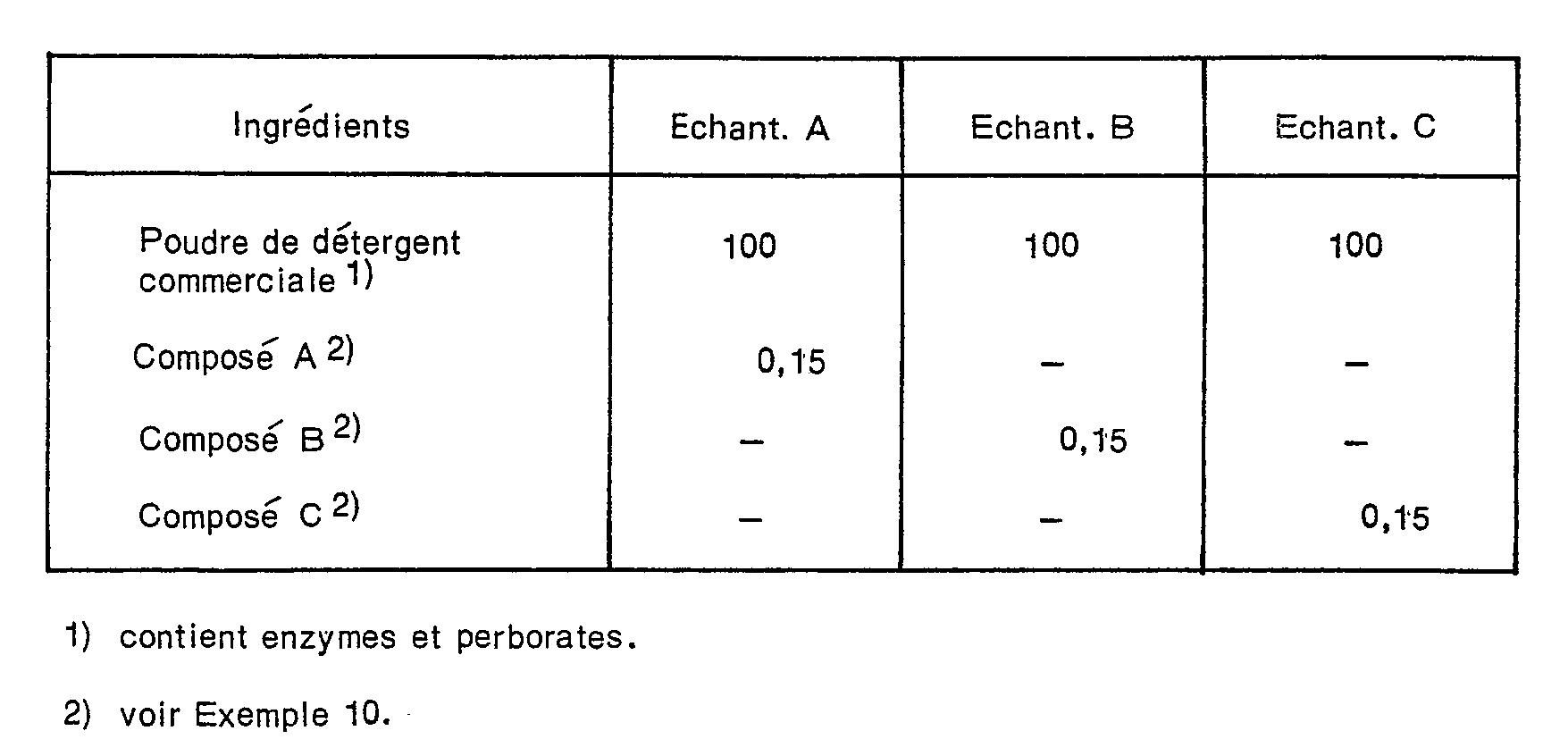
- Après mélange intime des ingrédients, les échantillons de poudre ainsi parfumée ont été soumis à une évaluation olfactive et finalement caractérisés comme suit:
- Echant. A: odeur agréable, tout à la fois fraîche et verte, de type sauge sclarée
- Echant. B: odeur légèrement boisée, de type vert, ambré et aromatique
- Echant. C: odeur boisée et ambrée, avec note verte et aromatique, de type marjolaine douce.
- On a pu constater en outre, dans les 3 cas ci-dessus, que l'effet olfactif perçu demeurait inchangé, après un stockage de plusieurs semaines dans les conditions usuelles d'emploi. Il a été également constaté que le parfum développé par les échantillons ci-dessus adhérait encore fort bien au linge, après lavage.
- On a procédé à la préparation de shampooing parfumé à partir des ingrédients ci-après (parties en poids):

- Les échantillons ainsi parfumés ont ensuite été soumis à une évaluation olfactive et finalement caractérisés comme suit:
- Echant. A: odeur montante, fraîche et verte; type "shampooing aux herbes"
- Echant. B: odeur légèrement boisée, verte et ambrée; type A
- Echant. C: odeur boisée, ambrée, avec note verte et aromatique; type "médicinal".
- On a premièrement préparé un base parfumante pour Eau de Cologne en mélangeant les ingrédients ci-après:

- En diluant la base ci-dessus à 3% dans l'alcool éthylique à 95%, on obtient une Eau de Cologne classique dont l'odeur peut être qualifiée de chaude et de type hespéridé.
- En ajoutant 5 parties d'une solution d'acétate de 3-méthyl-tricyclol6.2.1.O2.7]undéc-9-ène-3-yle à 10% dans l'alcool éthylique à 95%, à 95 parties de la solution préparée ci-dessus, on obtient une Eau de Cologne dont l'odeur est devenue plus montante, acquérant un caractère de type masculin particulièrement plaisant.
- Un effet olfactif identique a été obtenu en remplaçant dans l'exemple ci-dessus l'acétate de 3-méthyl-tricyclo[6.2.1.O2.7]undéc-9-ène-3-yle par l'acétate de 3-méthyl-tricyclo[6.2.1.02.7]undéc-3-yle ou le formiate de 3-méthyl-tricyclo[6.2.1.02.7]undéc-9-ène-3-yle.
- Un composition parfumante de base pour Eau de toilette masculine a été préparée en mélangeant les ingrédients ci-après (parties en poids):

- La base ainsi préparée développe une odeur que l'on peut qualifier de type chypré. En ajoutant à 80 parties de ladite base 20 parties d'acétate de 3-méthyl-tricyclo[6.2.1.02.7]undéc-9-ène-3-yle, on obtient une nouvelle composition parfumante développant une odeur plus riche, plus harmonieuse et plus arrondie.
- En remplaçant dans l'Exemple ci-dessus l'acétate de 3-méthyl-tricyclo[6.2.1.O2.7]undéc-9-ène-3- yle par une quantité identique d'acétate de 3-méthyl-tricyclo[6.2.1.02.7]undéc-3-yle ou de formiate de 3-méthyl-tricyclo[6.2.1.O2.7]undéc-9-ène-3-yle, on a observé un effet similaire, la composition obtenue s'étant enrichie d'une note de type boisé et ambré fort agréable.
Claims (6)

Applications Claiming Priority (2)
| Application Number | Priority Date | Filing Date | Title |
|---|---|---|---|
| CH732078 | 1978-07-05 | ||
| CH7320/78 | 1978-07-05 |
Publications (2)
| Publication Number | Publication Date |
|---|---|
| EP0007486A1 EP0007486A1 (fr) | 1980-02-06 |
| EP0007486B1 true EP0007486B1 (fr) | 1981-08-26 |
Family
ID=4323278
Family Applications (1)
| Application Number | Title | Priority Date | Filing Date |
|---|---|---|---|
| EP19790102278 Expired EP0007486B1 (fr) | 1978-07-05 | 1979-07-04 | Composés oxygénés dérivant du tricyclo(6.2.1.0)undécane, leur utilisation à titre d'ingrédients parfumants respectivement aromatisants, et compositions contenant lesdits composés |
Country Status (5)
| Country | Link |
|---|---|
| US (2) | US4311852A (fr) |
| EP (1) | EP0007486B1 (fr) |
| JP (1) | JPS5851938B2 (fr) |
| DE (1) | DE2960686D1 (fr) |
| GR (1) | GR72719B (fr) |
Families Citing this family (8)
| Publication number | Priority date | Publication date | Assignee | Title |
|---|---|---|---|---|
| US4275251A (en) * | 1980-04-29 | 1981-06-23 | International Flavors & Fragrances Inc. | Substituted tricyclodecane derivatives, processes for producing same and organoleptic uses thereof |
| US4439354A (en) * | 1980-11-13 | 1984-03-27 | International Flavors & Fragrances Inc. | Tricyclic alcohols, ethers and esters, process for preparing same and use thereof in augmenting or enhancing the organoleptic properites of consumable materials |
| US4909854A (en) * | 1980-11-13 | 1990-03-20 | International Flavors & Fragrances Inc. | Process for augmenting or enhancing the aroma or taste of smoking tobacco or smoking tobacco articles using tricyclic alcohols, ethers and/or esters and smoking tobacco compositions and articles so modified |
| JPS6049619B2 (ja) * | 1981-11-05 | 1985-11-02 | 高砂香料工業株式会社 | (+)−または(−)−7−ヒドロキシメチル−2,6,6−トリメチル−トリシクロ〔6,2,1,01,5〕ウンデカン |
| CH689624A5 (fr) * | 1992-07-22 | 1999-07-15 | Firmenich & Cie | Composés polycycliques et leur utilisation en tant qu'ingrédients parfumants. |
| KR19990049068A (ko) * | 1997-12-11 | 1999-07-05 | 우재영 | 신규한 노보넨 알콜 화합물 및 그의 제조방법 |
| US7378383B2 (en) * | 2004-06-08 | 2008-05-27 | Firmenich Sa | Perfuming ingredients of the woody type |
| EP1605035B1 (fr) * | 2004-06-08 | 2007-09-19 | Firmenich Sa | Ingrédients parfumants du type boisé |
Family Cites Families (11)
| Publication number | Priority date | Publication date | Assignee | Title |
|---|---|---|---|---|
| FR1414969A (fr) * | 1963-09-25 | 1965-10-22 | Union Carbide Corp | Procédé d'hydratation d'oléfines cycliques |
| CH492776A (de) * | 1967-10-11 | 1970-06-30 | Givaudan & Cie Sa | Riechstoffkompositionen |
| US3979338A (en) * | 1971-10-11 | 1976-09-07 | Firmenich S.A. | 9-[9,12-Epoxy-ethyl]-4-methyl tricyclo[6.2.1.02.7 ]undec-4-ene and 9-[9,12-epoxy-ethyl]-5-methyl tricyclo[6.2.1.02.7 ]undec-4-ene odor-modifying agents |
| US3968070A (en) * | 1971-10-11 | 1976-07-06 | Firmenich S.A. | Cycloaliphatic compounds as odor- and taste-modifying agents |
| US4003935A (en) * | 1971-10-11 | 1977-01-18 | Firmenich S.A. | 7-Methyl-octahydro-1,4-methano-naphthalen-6-one |
| FR2236828A1 (en) * | 1971-10-11 | 1975-02-07 | Firmenich & Cie | Tricyclic aliphatic cpds |
| US3953534A (en) * | 1971-10-11 | 1976-04-27 | Firmenich S.A. | Cycloaliphatic compounds as odour- and taste-modifying agents |
| GB1436860A (en) * | 1972-12-18 | 1976-05-26 | Syntex Inc | 5,8-dihydro-5,8-methanonaphthalene cardiovascular agents |
| CH616585A5 (fr) * | 1976-08-20 | 1980-04-15 | Firmenich & Cie | |
| DE2835445C2 (de) * | 1978-08-12 | 1986-12-11 | Henkel KGaA, 4000 Düsseldorf | Verwendung von Estern des Gemisches der Tricyclo-[5.2.1.0↑2↑↑.↑↑6↑]decan-3- und Tricyclo [5.2.1.0↑2↑↑.↑↑6↑]decan-4-carbonsäure als Riechstoffe, sowie diese enthaltende Riechstoffkompositionen |
| CH639084A5 (fr) * | 1979-04-27 | 1983-10-31 | Firmenich & Cie | Composes tricycliques oxygenes et leur utilisation a titre d'ingredients parfumants ou aromatisants. |
-
1979
- 1979-07-02 US US06/054,028 patent/US4311852A/en not_active Expired - Lifetime
- 1979-07-03 GR GR59505A patent/GR72719B/el unknown
- 1979-07-04 DE DE7979102278T patent/DE2960686D1/de not_active Expired
- 1979-07-04 EP EP19790102278 patent/EP0007486B1/fr not_active Expired
- 1979-07-05 JP JP54084471A patent/JPS5851938B2/ja not_active Expired
-
1981
- 1981-03-30 US US06/249,118 patent/US4341666A/en not_active Expired - Lifetime
Also Published As
| Publication number | Publication date |
|---|---|
| JPS5851938B2 (ja) | 1983-11-19 |
| GR72719B (fr) | 1983-12-01 |
| US4311852A (en) | 1982-01-19 |
| DE2960686D1 (en) | 1981-11-19 |
| JPS5511590A (en) | 1980-01-26 |
| EP0007486A1 (fr) | 1980-02-06 |
| US4341666A (en) | 1982-07-27 |
Similar Documents
| Publication | Publication Date | Title |
|---|---|---|
| US3879466A (en) | Bicyclo-{8 2.2.2{9 octa-5,7-dien-2-ones and a process for their preparation | |
| EP0039232B1 (fr) | Dérivés substitués du tricyclodécane, procédés pour leur préparation et leur utilisation, et compositions utilisant ces dérivés | |
| EP0034334B1 (fr) | Esters de 1,3-diméthyl-but-3-ène-1-yle, leur utilisation en tant qu'ingrédients parfumants ou aromatisants, composition parfumante ou aromatisante contenant au moins l'un desdits esters | |
| EP0007486A1 (fr) | Composés oxygénés dérivant du tricyclo(6.2.1.0)undécane, leur utilisation à titre d'ingrédients parfumants respectivement aromatisants, et compositions contenant lesdits composés | |
| US4396781A (en) | Unsaturated alicyclic ethers | |
| CH621706A5 (fr) | ||
| US4318934A (en) | Flavoring with branched chain olefinic alcohols | |
| US4041084A (en) | Tricyclic alcohols | |
| EP2203417A2 (fr) | Octane(ène) nitriles substitués, leurs procédés de synthèses et leurs utilisations en parfumerie | |
| EP0033959B1 (fr) | Composé spirannique insaturé, son utilisation dans les parfums et les aromes et procédé pour sa préparation | |
| EP0004968A2 (fr) | Dérivés du norbornène(-ane), procédé pour la préparation de ces derivés et leur utilisation en tant qu'ingrédients parfumants | |
| EP0982295A2 (fr) | Ethers; leur utilisation comme agents parfumants et aromatisants; leur préparation | |
| EP0544110A1 (fr) | Alcools tertiaires cycliques et leur utilisation à titre d'ingrédients parfumants | |
| US4139650A (en) | Flavoring with a tricyclic alcohol | |
| EP0081699B1 (fr) | Nouveaux composés alicycliques, leur utilisation à titre d'ingrédients parfumants ou aromatisants, procédé pour leur préparation | |
| CH627462A5 (en) | Spiran compounds, their use as fragrance and flavouring ingredients and process for preparing them | |
| EP0371347B1 (fr) | Ethers cycliques et leur utilisation à titre d'ingrédients parfumants ou aromatisants | |
| US4399062A (en) | Branched chain olefinic alcohols, thiols, esters and ethers, organoleptic uses thereof, processes for preparing same and intermediates therefor | |
| US4021494A (en) | Process for preparing tricyclic alcohols | |
| EP0052115B1 (fr) | Composes bicycliques et leur utilisation en tant qu'agents parfumants | |
| CH650242A5 (fr) | Ingredients parfumants constitues d'alcools et d'esters aliphatiques. | |
| CH639084A5 (fr) | Composes tricycliques oxygenes et leur utilisation a titre d'ingredients parfumants ou aromatisants. | |
| JPH039960B2 (fr) | ||
| CH626532A5 (fr) | ||
| CH603071A5 (en) | Di:methyl-cyclohexene-alkenone cpds. |
Legal Events
| Date | Code | Title | Description |
|---|---|---|---|
| PUAI | Public reference made under article 153(3) epc to a published international application that has entered the european phase |
Free format text: ORIGINAL CODE: 0009012 |
|
| AK | Designated contracting states |
Designated state(s): CH DE FR GB IT NL SE |
|
| 17P | Request for examination filed | ||
| ITF | It: translation for a ep patent filed | ||
| GRAA | (expected) grant |
Free format text: ORIGINAL CODE: 0009210 |
|
| AK | Designated contracting states |
Designated state(s): CH DE FR GB IT NL SE |
|
| REF | Corresponds to: |
Ref document number: 2960686 Country of ref document: DE Date of ref document: 19811119 |
|
| PGFP | Annual fee paid to national office [announced via postgrant information from national office to epo] |
Ref country code: SE Payment date: 19820930 Year of fee payment: 4 |
|
| PG25 | Lapsed in a contracting state [announced via postgrant information from national office to epo] |
Ref country code: SE Free format text: THE PATENT HAS BEEN ANNULLED BY A DECISION OF A NATIONAL AUTHORITY Effective date: 19830730 |
|
| PGFP | Annual fee paid to national office [announced via postgrant information from national office to epo] |
Ref country code: NL Payment date: 19840731 Year of fee payment: 6 |
|
| PG25 | Lapsed in a contracting state [announced via postgrant information from national office to epo] |
Ref country code: NL Effective date: 19860201 |
|
| NLV4 | Nl: lapsed or anulled due to non-payment of the annual fee | ||
| PGFP | Annual fee paid to national office [announced via postgrant information from national office to epo] |
Ref country code: CH Payment date: 19940725 Year of fee payment: 16 |
|
| EUG | Se: european patent has lapsed |
Ref document number: 79102278.3 Effective date: 19850610 |
|
| PGFP | Annual fee paid to national office [announced via postgrant information from national office to epo] |
Ref country code: DE Payment date: 19950620 Year of fee payment: 17 |
|
| PG25 | Lapsed in a contracting state [announced via postgrant information from national office to epo] |
Ref country code: CH Effective date: 19950731 |
|
| REG | Reference to a national code |
Ref country code: CH Ref legal event code: PL |
|
| PGFP | Annual fee paid to national office [announced via postgrant information from national office to epo] |
Ref country code: FR Payment date: 19960610 Year of fee payment: 18 |
|
| PGFP | Annual fee paid to national office [announced via postgrant information from national office to epo] |
Ref country code: GB Payment date: 19960618 Year of fee payment: 18 |
|
| PG25 | Lapsed in a contracting state [announced via postgrant information from national office to epo] |
Ref country code: DE Effective date: 19970402 |
|
| PG25 | Lapsed in a contracting state [announced via postgrant information from national office to epo] |
Ref country code: GB Free format text: LAPSE BECAUSE OF NON-PAYMENT OF DUE FEES Effective date: 19970704 |
|
| GBPC | Gb: european patent ceased through non-payment of renewal fee |
Effective date: 19970704 |
|
| PG25 | Lapsed in a contracting state [announced via postgrant information from national office to epo] |
Ref country code: FR Free format text: LAPSE BECAUSE OF NON-PAYMENT OF DUE FEES Effective date: 19980331 |
|
| REG | Reference to a national code |
Ref country code: FR Ref legal event code: ST |
|
| PLBE | No opposition filed within time limit |
Free format text: ORIGINAL CODE: 0009261 |
|
| STAA | Information on the status of an ep patent application or granted ep patent |
Free format text: STATUS: NO OPPOSITION FILED WITHIN TIME LIMIT |