EP0004789B2 - Catalyst component for alpha-olefin polymerization and use thereof - Google Patents
Catalyst component for alpha-olefin polymerization and use thereof Download PDFInfo
- Publication number
- EP0004789B2 EP0004789B2 EP79300588A EP79300588A EP0004789B2 EP 0004789 B2 EP0004789 B2 EP 0004789B2 EP 79300588 A EP79300588 A EP 79300588A EP 79300588 A EP79300588 A EP 79300588A EP 0004789 B2 EP0004789 B2 EP 0004789B2
- Authority
- EP
- European Patent Office
- Prior art keywords
- titanium
- catalyst component
- solid product
- containing solid
- olefins
- Prior art date
- Legal status (The legal status is an assumption and is not a legal conclusion. Google has not performed a legal analysis and makes no representation as to the accuracy of the status listed.)
- Expired
Links
- 239000003054 catalyst Substances 0.000 title claims description 81
- 238000006116 polymerization reaction Methods 0.000 title claims description 37
- 239000004711 α-olefin Substances 0.000 title claims description 7
- 239000010936 titanium Substances 0.000 claims description 100
- 229910052719 titanium Inorganic materials 0.000 claims description 94
- RTAQQCXQSZGOHL-UHFFFAOYSA-N Titanium Chemical compound [Ti] RTAQQCXQSZGOHL-UHFFFAOYSA-N 0.000 claims description 80
- -1 magnesium halide Chemical class 0.000 claims description 62
- 238000000034 method Methods 0.000 claims description 36
- 229930195733 hydrocarbon Natural products 0.000 claims description 21
- 239000000203 mixture Substances 0.000 claims description 20
- 150000002430 hydrocarbons Chemical class 0.000 claims description 19
- 229910052782 aluminium Inorganic materials 0.000 claims description 18
- 150000002896 organic halogen compounds Chemical class 0.000 claims description 13
- 229910052749 magnesium Inorganic materials 0.000 claims description 12
- 239000011777 magnesium Substances 0.000 claims description 12
- 239000012265 solid product Substances 0.000 claims description 12
- 239000004215 Carbon black (E152) Substances 0.000 claims description 11
- VHHHONWQHHHLTI-UHFFFAOYSA-N hexachloroethane Chemical compound ClC(Cl)(Cl)C(Cl)(Cl)Cl VHHHONWQHHHLTI-UHFFFAOYSA-N 0.000 claims description 11
- 125000004432 carbon atom Chemical group C* 0.000 claims description 10
- 238000000227 grinding Methods 0.000 claims description 9
- VGGSQFUCUMXWEO-UHFFFAOYSA-N Ethene Chemical compound C=C VGGSQFUCUMXWEO-UHFFFAOYSA-N 0.000 claims description 7
- 239000005977 Ethylene Substances 0.000 claims description 7
- 238000007334 copolymerization reaction Methods 0.000 claims description 6
- 230000003247 decreasing effect Effects 0.000 claims description 5
- 125000005843 halogen group Chemical group 0.000 claims description 5
- 150000004945 aromatic hydrocarbons Chemical class 0.000 claims description 4
- 125000004429 atom Chemical group 0.000 claims description 4
- 229910052736 halogen Inorganic materials 0.000 claims description 4
- 229910052751 metal Inorganic materials 0.000 claims description 4
- 239000002184 metal Substances 0.000 claims description 4
- 238000010521 absorption reaction Methods 0.000 claims description 3
- 150000001338 aliphatic hydrocarbons Chemical class 0.000 claims description 3
- 125000000217 alkyl group Chemical group 0.000 claims description 3
- 125000003118 aryl group Chemical group 0.000 claims description 3
- 239000012298 atmosphere Substances 0.000 claims description 3
- 150000002148 esters Chemical class 0.000 claims description 3
- 238000005406 washing Methods 0.000 claims description 3
- 238000000862 absorption spectrum Methods 0.000 claims description 2
- 125000005907 alkyl ester group Chemical group 0.000 claims description 2
- 229920006395 saturated elastomer Polymers 0.000 claims description 2
- 229930195734 saturated hydrocarbon Natural products 0.000 claims description 2
- 238000001228 spectrum Methods 0.000 claims description 2
- 229930195735 unsaturated hydrocarbon Natural products 0.000 claims description 2
- WPYMKLBDIGXBTP-UHFFFAOYSA-N benzoic acid Chemical compound OC(=O)C1=CC=CC=C1 WPYMKLBDIGXBTP-UHFFFAOYSA-N 0.000 claims 2
- 239000005711 Benzoic acid Substances 0.000 claims 1
- 235000010233 benzoic acid Nutrition 0.000 claims 1
- 239000007787 solid Substances 0.000 description 45
- IMNFDUFMRHMDMM-UHFFFAOYSA-N N-Heptane Chemical compound CCCCCCC IMNFDUFMRHMDMM-UHFFFAOYSA-N 0.000 description 20
- TWRXJAOTZQYOKJ-UHFFFAOYSA-L Magnesium chloride Chemical compound [Mg+2].[Cl-].[Cl-] TWRXJAOTZQYOKJ-UHFFFAOYSA-L 0.000 description 10
- 239000011148 porous material Substances 0.000 description 9
- 230000004913 activation Effects 0.000 description 8
- 229920000642 polymer Polymers 0.000 description 8
- 230000037048 polymerization activity Effects 0.000 description 8
- 150000001875 compounds Chemical class 0.000 description 7
- 239000004743 Polypropylene Substances 0.000 description 6
- 230000000052 comparative effect Effects 0.000 description 6
- 230000000694 effects Effects 0.000 description 6
- 238000010438 heat treatment Methods 0.000 description 6
- VZGDMQKNWNREIO-UHFFFAOYSA-N tetrachloromethane Chemical compound ClC(Cl)(Cl)Cl VZGDMQKNWNREIO-UHFFFAOYSA-N 0.000 description 6
- XJDNKRIXUMDJCW-UHFFFAOYSA-J titanium tetrachloride Chemical compound Cl[Ti](Cl)(Cl)Cl XJDNKRIXUMDJCW-UHFFFAOYSA-J 0.000 description 6
- FYYHWMGAXLPEAU-UHFFFAOYSA-N Magnesium Chemical compound [Mg] FYYHWMGAXLPEAU-UHFFFAOYSA-N 0.000 description 5
- 229910010066 TiC14 Inorganic materials 0.000 description 5
- 229910003074 TiCl4 Inorganic materials 0.000 description 5
- 239000002131 composite material Substances 0.000 description 5
- 238000002360 preparation method Methods 0.000 description 5
- QQONPFPTGQHPMA-UHFFFAOYSA-N propylene Natural products CC=C QQONPFPTGQHPMA-UHFFFAOYSA-N 0.000 description 5
- 125000004805 propylene group Chemical group [H]C([H])([H])C([H])([*:1])C([H])([H])[*:2] 0.000 description 5
- FHUODBDRWMIBQP-UHFFFAOYSA-N Ethyl p-anisate Chemical compound CCOC(=O)C1=CC=C(OC)C=C1 FHUODBDRWMIBQP-UHFFFAOYSA-N 0.000 description 4
- 238000002441 X-ray diffraction Methods 0.000 description 4
- 230000003197 catalytic effect Effects 0.000 description 4
- 238000010586 diagram Methods 0.000 description 4
- 238000009826 distribution Methods 0.000 description 4
- MTZQAGJQAFMTAQ-UHFFFAOYSA-N ethyl benzoate Chemical compound CCOC(=O)C1=CC=CC=C1 MTZQAGJQAFMTAQ-UHFFFAOYSA-N 0.000 description 4
- 239000012299 nitrogen atmosphere Substances 0.000 description 4
- 125000002370 organoaluminium group Chemical group 0.000 description 4
- 239000000047 product Substances 0.000 description 4
- VOITXYVAKOUIBA-UHFFFAOYSA-N triethylaluminium Chemical compound CC[Al](CC)CC VOITXYVAKOUIBA-UHFFFAOYSA-N 0.000 description 4
- UHOVQNZJYSORNB-UHFFFAOYSA-N Benzene Chemical compound C1=CC=CC=C1 UHOVQNZJYSORNB-UHFFFAOYSA-N 0.000 description 3
- YMWUJEATGCHHMB-UHFFFAOYSA-N Dichloromethane Chemical compound ClCCl YMWUJEATGCHHMB-UHFFFAOYSA-N 0.000 description 3
- XEKOWRVHYACXOJ-UHFFFAOYSA-N Ethyl acetate Chemical compound CCOC(C)=O XEKOWRVHYACXOJ-UHFFFAOYSA-N 0.000 description 3
- UFHFLCQGNIYNRP-UHFFFAOYSA-N Hydrogen Chemical compound [H][H] UFHFLCQGNIYNRP-UHFFFAOYSA-N 0.000 description 3
- 125000005234 alkyl aluminium group Chemical group 0.000 description 3
- 239000001257 hydrogen Substances 0.000 description 3
- 229910052739 hydrogen Inorganic materials 0.000 description 3
- 238000004519 manufacturing process Methods 0.000 description 3
- OFBQJSOFQDEBGM-UHFFFAOYSA-N n-pentane Natural products CCCCC OFBQJSOFQDEBGM-UHFFFAOYSA-N 0.000 description 3
- 150000002899 organoaluminium compounds Chemical class 0.000 description 3
- 239000002904 solvent Substances 0.000 description 3
- 229910001220 stainless steel Inorganic materials 0.000 description 3
- 239000010935 stainless steel Substances 0.000 description 3
- CXWXQJXEFPUFDZ-UHFFFAOYSA-N tetralin Chemical compound C1=CC=C2CCCCC2=C1 CXWXQJXEFPUFDZ-UHFFFAOYSA-N 0.000 description 3
- 150000003609 titanium compounds Chemical class 0.000 description 3
- MCULRUJILOGHCJ-UHFFFAOYSA-N triisobutylaluminium Chemical compound CC(C)C[Al](CC(C)C)CC(C)C MCULRUJILOGHCJ-UHFFFAOYSA-N 0.000 description 3
- 239000008096 xylene Substances 0.000 description 3
- QQAHAGNPDBPSJP-UHFFFAOYSA-N 1,1,1,2,2,3,3,3-octachloropropane Chemical compound ClC(Cl)(Cl)C(Cl)(Cl)C(Cl)(Cl)Cl QQAHAGNPDBPSJP-UHFFFAOYSA-N 0.000 description 2
- UBOXGVDOUJQMTN-UHFFFAOYSA-N 1,1,2-trichloroethane Chemical compound ClCC(Cl)Cl UBOXGVDOUJQMTN-UHFFFAOYSA-N 0.000 description 2
- RFFLAFLAYFXFSW-UHFFFAOYSA-N 1,2-dichlorobenzene Chemical compound ClC1=CC=CC=C1Cl RFFLAFLAYFXFSW-UHFFFAOYSA-N 0.000 description 2
- QNLZIZAQLLYXTC-UHFFFAOYSA-N 1,2-dimethylnaphthalene Chemical compound C1=CC=CC2=C(C)C(C)=CC=C21 QNLZIZAQLLYXTC-UHFFFAOYSA-N 0.000 description 2
- OCJBOOLMMGQPQU-UHFFFAOYSA-N 1,4-dichlorobenzene Chemical compound ClC1=CC=C(Cl)C=C1 OCJBOOLMMGQPQU-UHFFFAOYSA-N 0.000 description 2
- LVZPKYYPPLUECL-UHFFFAOYSA-N 1-chloro-4-(trichloromethyl)benzene Chemical compound ClC1=CC=C(C(Cl)(Cl)Cl)C=C1 LVZPKYYPPLUECL-UHFFFAOYSA-N 0.000 description 2
- RXGUIWHIADMCFC-UHFFFAOYSA-N 2-Methylpropyl 2-methylpropionate Chemical compound CC(C)COC(=O)C(C)C RXGUIWHIADMCFC-UHFFFAOYSA-N 0.000 description 2
- CMAOLVNGLTWICC-UHFFFAOYSA-N 2-fluoro-5-methylbenzonitrile Chemical group CC1=CC=C(F)C(C#N)=C1 CMAOLVNGLTWICC-UHFFFAOYSA-N 0.000 description 2
- 208000005156 Dehydration Diseases 0.000 description 2
- YNQLUTRBYVCPMQ-UHFFFAOYSA-N Ethylbenzene Chemical compound CCC1=CC=CC=C1 YNQLUTRBYVCPMQ-UHFFFAOYSA-N 0.000 description 2
- CTQNGGLPUBDAKN-UHFFFAOYSA-N O-Xylene Chemical compound CC1=CC=CC=C1C CTQNGGLPUBDAKN-UHFFFAOYSA-N 0.000 description 2
- URLKBWYHVLBVBO-UHFFFAOYSA-N Para-Xylene Chemical group CC1=CC=C(C)C=C1 URLKBWYHVLBVBO-UHFFFAOYSA-N 0.000 description 2
- 239000004698 Polyethylene Substances 0.000 description 2
- ATUOYWHBWRKTHZ-UHFFFAOYSA-N Propane Chemical compound CCC ATUOYWHBWRKTHZ-UHFFFAOYSA-N 0.000 description 2
- 125000002723 alicyclic group Chemical group 0.000 description 2
- 125000001931 aliphatic group Chemical group 0.000 description 2
- 229920001585 atactic polymer Polymers 0.000 description 2
- 238000009835 boiling Methods 0.000 description 2
- QARVLSVVCXYDNA-UHFFFAOYSA-N bromobenzene Chemical compound BrC1=CC=CC=C1 QARVLSVVCXYDNA-UHFFFAOYSA-N 0.000 description 2
- GZUXJHMPEANEGY-UHFFFAOYSA-N bromomethane Chemical compound BrC GZUXJHMPEANEGY-UHFFFAOYSA-N 0.000 description 2
- NMJJFJNHVMGPGM-UHFFFAOYSA-N butyl formate Chemical compound CCCCOC=O NMJJFJNHVMGPGM-UHFFFAOYSA-N 0.000 description 2
- 238000006243 chemical reaction Methods 0.000 description 2
- 239000000460 chlorine Substances 0.000 description 2
- 229910052801 chlorine Inorganic materials 0.000 description 2
- MVPPADPHJFYWMZ-UHFFFAOYSA-N chlorobenzene Chemical compound ClC1=CC=CC=C1 MVPPADPHJFYWMZ-UHFFFAOYSA-N 0.000 description 2
- 239000011365 complex material Substances 0.000 description 2
- 239000008139 complexing agent Substances 0.000 description 2
- NNBZCPXTIHJBJL-UHFFFAOYSA-N decalin Chemical compound C1CCCC2CCCCC21 NNBZCPXTIHJBJL-UHFFFAOYSA-N 0.000 description 2
- DIOQZVSQGTUSAI-UHFFFAOYSA-N decane Chemical compound CCCCCCCCCC DIOQZVSQGTUSAI-UHFFFAOYSA-N 0.000 description 2
- 230000018044 dehydration Effects 0.000 description 2
- 238000006297 dehydration reaction Methods 0.000 description 2
- DOIRQSBPFJWKBE-UHFFFAOYSA-N dibutyl phthalate Chemical compound CCCCOC(=O)C1=CC=CC=C1C(=O)OCCCC DOIRQSBPFJWKBE-UHFFFAOYSA-N 0.000 description 2
- YNLAOSYQHBDIKW-UHFFFAOYSA-M diethylaluminium chloride Chemical compound CC[Al](Cl)CC YNLAOSYQHBDIKW-UHFFFAOYSA-M 0.000 description 2
- WDAXFOBOLVPGLV-UHFFFAOYSA-N ethyl isobutyrate Chemical compound CCOC(=O)C(C)C WDAXFOBOLVPGLV-UHFFFAOYSA-N 0.000 description 2
- 239000011521 glass Substances 0.000 description 2
- CKAPSXZOOQJIBF-UHFFFAOYSA-N hexachlorobenzene Chemical compound ClC1=C(Cl)C(Cl)=C(Cl)C(Cl)=C1Cl CKAPSXZOOQJIBF-UHFFFAOYSA-N 0.000 description 2
- OKJPEAGHQZHRQV-UHFFFAOYSA-N iodoform Chemical compound IC(I)I OKJPEAGHQZHRQV-UHFFFAOYSA-N 0.000 description 2
- NNPPMTNAJDCUHE-UHFFFAOYSA-N isobutane Chemical compound CC(C)C NNPPMTNAJDCUHE-UHFFFAOYSA-N 0.000 description 2
- 239000007788 liquid Substances 0.000 description 2
- 239000007791 liquid phase Substances 0.000 description 2
- IVSZLXZYQVIEFR-UHFFFAOYSA-N m-xylene Chemical group CC1=CC=CC(C)=C1 IVSZLXZYQVIEFR-UHFFFAOYSA-N 0.000 description 2
- 235000011147 magnesium chloride Nutrition 0.000 description 2
- 238000002156 mixing Methods 0.000 description 2
- VLKZOEOYAKHREP-UHFFFAOYSA-N n-Hexane Chemical compound CCCCCC VLKZOEOYAKHREP-UHFFFAOYSA-N 0.000 description 2
- 150000002894 organic compounds Chemical class 0.000 description 2
- 230000000704 physical effect Effects 0.000 description 2
- 239000002574 poison Substances 0.000 description 2
- 231100000614 poison Toxicity 0.000 description 2
- 229920000573 polyethylene Polymers 0.000 description 2
- 229920001155 polypropylene Polymers 0.000 description 2
- 238000012721 stereospecific polymerization Methods 0.000 description 2
- HJUGFYREWKUQJT-UHFFFAOYSA-N tetrabromomethane Chemical compound BrC(Br)(Br)Br HJUGFYREWKUQJT-UHFFFAOYSA-N 0.000 description 2
- UDWASUCJIKKBLS-NSCUHMNNSA-N (3e)-1,1,2,3,4,5-hexachloropenta-1,3-diene Chemical compound ClC\C(Cl)=C(/Cl)C(Cl)=C(Cl)Cl UDWASUCJIKKBLS-NSCUHMNNSA-N 0.000 description 1
- IGDVFIQVQXDOFA-UHFFFAOYSA-N 1,1,1,2,2,3,3,4,4,4-decabromobutane Chemical compound BrC(Br)(Br)C(Br)(Br)C(Br)(Br)C(Br)(Br)Br IGDVFIQVQXDOFA-UHFFFAOYSA-N 0.000 description 1
- ZDUOUNIIAGIPSD-UHFFFAOYSA-N 1,1,1-tribromoethane Chemical compound CC(Br)(Br)Br ZDUOUNIIAGIPSD-UHFFFAOYSA-N 0.000 description 1
- UOCLXMDMGBRAIB-UHFFFAOYSA-N 1,1,1-trichloroethane Chemical compound CC(Cl)(Cl)Cl UOCLXMDMGBRAIB-UHFFFAOYSA-N 0.000 description 1
- BASDZFQDZBHCAV-UHFFFAOYSA-N 1,1,1-triiodoethane Chemical compound CC(I)(I)I BASDZFQDZBHCAV-UHFFFAOYSA-N 0.000 description 1
- ZFMWDTNZPKDVBU-UHFFFAOYSA-N 1,2,3,4-tetrachlorocyclopentane Chemical compound ClC1CC(Cl)C(Cl)C1Cl ZFMWDTNZPKDVBU-UHFFFAOYSA-N 0.000 description 1
- WSLDOOZREJYCGB-UHFFFAOYSA-N 1,2-Dichloroethane Chemical compound ClCCCl WSLDOOZREJYCGB-UHFFFAOYSA-N 0.000 description 1
- PAAZPARNPHGIKF-UHFFFAOYSA-N 1,2-dibromoethane Chemical compound BrCCBr PAAZPARNPHGIKF-UHFFFAOYSA-N 0.000 description 1
- KNKRKFALVUDBJE-UHFFFAOYSA-N 1,2-dichloropropane Chemical compound CC(Cl)CCl KNKRKFALVUDBJE-UHFFFAOYSA-N 0.000 description 1
- GBBZLMLLFVFKJM-UHFFFAOYSA-N 1,2-diiodoethane Chemical compound ICCI GBBZLMLLFVFKJM-UHFFFAOYSA-N 0.000 description 1
- HNAGHMKIPMKKBB-UHFFFAOYSA-N 1-benzylpyrrolidine-3-carboxamide Chemical compound C1C(C(=O)N)CCN1CC1=CC=CC=C1 HNAGHMKIPMKKBB-UHFFFAOYSA-N 0.000 description 1
- LIKMAJRDDDTEIG-UHFFFAOYSA-N 1-hexene Chemical compound CCCCC=C LIKMAJRDDDTEIG-UHFFFAOYSA-N 0.000 description 1
- WSSSPWUEQFSQQG-UHFFFAOYSA-N 4-methyl-1-pentene Chemical compound CC(C)CC=C WSSSPWUEQFSQQG-UHFFFAOYSA-N 0.000 description 1
- FUUGBGSHEIEQMS-UHFFFAOYSA-N 4a,8a-dimethyl-1,2,3,4,5,6,7,8-octahydronaphthalene Chemical compound C1CCCC2(C)CCCCC21C FUUGBGSHEIEQMS-UHFFFAOYSA-N 0.000 description 1
- 238000004438 BET method Methods 0.000 description 1
- DKPFZGUDAPQIHT-UHFFFAOYSA-N Butyl acetate Natural products CCCCOC(C)=O DKPFZGUDAPQIHT-UHFFFAOYSA-N 0.000 description 1
- 229910016523 CuKa Inorganic materials 0.000 description 1
- XDTMQSROBMDMFD-UHFFFAOYSA-N Cyclohexane Chemical compound C1CCCCC1 XDTMQSROBMDMFD-UHFFFAOYSA-N 0.000 description 1
- IEPRKVQEAMIZSS-UHFFFAOYSA-N Di-Et ester-Fumaric acid Natural products CCOC(=O)C=CC(=O)OCC IEPRKVQEAMIZSS-UHFFFAOYSA-N 0.000 description 1
- IEPRKVQEAMIZSS-WAYWQWQTSA-N Diethyl maleate Chemical compound CCOC(=O)\C=C/C(=O)OCC IEPRKVQEAMIZSS-WAYWQWQTSA-N 0.000 description 1
- JIGUQPWFLRLWPJ-UHFFFAOYSA-N Ethyl acrylate Chemical compound CCOC(=O)C=C JIGUQPWFLRLWPJ-UHFFFAOYSA-N 0.000 description 1
- DOJXGHGHTWFZHK-UHFFFAOYSA-N Hexachloroacetone Chemical compound ClC(Cl)(Cl)C(=O)C(Cl)(Cl)Cl DOJXGHGHTWFZHK-UHFFFAOYSA-N 0.000 description 1
- NHTMVDHEPJAVLT-UHFFFAOYSA-N Isooctane Chemical compound CC(C)CC(C)(C)C NHTMVDHEPJAVLT-UHFFFAOYSA-N 0.000 description 1
- VVQNEPGJFQJSBK-UHFFFAOYSA-N Methyl methacrylate Chemical compound COC(=O)C(C)=C VVQNEPGJFQJSBK-UHFFFAOYSA-N 0.000 description 1
- 229910010062 TiCl3 Inorganic materials 0.000 description 1
- 239000002253 acid Substances 0.000 description 1
- 150000007513 acids Chemical class 0.000 description 1
- 125000004423 acyloxy group Chemical group 0.000 description 1
- 239000000654 additive Substances 0.000 description 1
- 230000000996 additive effect Effects 0.000 description 1
- 150000001336 alkenes Chemical class 0.000 description 1
- 125000003545 alkoxy group Chemical group 0.000 description 1
- 150000001399 aluminium compounds Chemical class 0.000 description 1
- 229920006125 amorphous polymer Polymers 0.000 description 1
- 150000001450 anions Chemical class 0.000 description 1
- 238000004380 ashing Methods 0.000 description 1
- 238000000498 ball milling Methods 0.000 description 1
- HQMRIBYCTLBDAK-UHFFFAOYSA-M bis(2-methylpropyl)alumanylium;chloride Chemical compound CC(C)C[Al](Cl)CC(C)C HQMRIBYCTLBDAK-UHFFFAOYSA-M 0.000 description 1
- 229920001400 block copolymer Polymers 0.000 description 1
- 238000012661 block copolymerization Methods 0.000 description 1
- RDHPKYGYEGBMSE-UHFFFAOYSA-N bromoethane Chemical compound CCBr RDHPKYGYEGBMSE-UHFFFAOYSA-N 0.000 description 1
- QUNICVYRWUASLR-UHFFFAOYSA-N bromoform;chloroform Chemical compound ClC(Cl)Cl.BrC(Br)Br QUNICVYRWUASLR-UHFFFAOYSA-N 0.000 description 1
- 239000001273 butane Substances 0.000 description 1
- OBNCKNCVKJNDBV-UHFFFAOYSA-N butanoic acid ethyl ester Natural products CCCC(=O)OCC OBNCKNCVKJNDBV-UHFFFAOYSA-N 0.000 description 1
- SHOVVTSKTTYFGP-UHFFFAOYSA-L butylaluminum(2+);dichloride Chemical compound CCCC[Al](Cl)Cl SHOVVTSKTTYFGP-UHFFFAOYSA-L 0.000 description 1
- 238000001354 calcination Methods 0.000 description 1
- JOHCVVJGGSABQY-UHFFFAOYSA-N carbon tetraiodide Chemical compound IC(I)(I)I JOHCVVJGGSABQY-UHFFFAOYSA-N 0.000 description 1
- 125000001309 chloro group Chemical group Cl* 0.000 description 1
- NEHMKBQYUWJMIP-NJFSPNSNSA-N chloro(114C)methane Chemical compound [14CH3]Cl NEHMKBQYUWJMIP-NJFSPNSNSA-N 0.000 description 1
- FOCAUTSVDIKZOP-UHFFFAOYSA-N chloroacetic acid Chemical class OC(=O)CCl FOCAUTSVDIKZOP-UHFFFAOYSA-N 0.000 description 1
- VEZNCHDBSQWUHQ-UHFFFAOYSA-N chlorocyclopropane Chemical compound ClC1CC1 VEZNCHDBSQWUHQ-UHFFFAOYSA-N 0.000 description 1
- HRYZWHHZPQKTII-UHFFFAOYSA-N chloroethane Chemical compound CCCl HRYZWHHZPQKTII-UHFFFAOYSA-N 0.000 description 1
- 229920001577 copolymer Polymers 0.000 description 1
- FJBFPHVGVWTDIP-UHFFFAOYSA-N dibromomethane Chemical compound BrCBr FJBFPHVGVWTDIP-UHFFFAOYSA-N 0.000 description 1
- YSAVZVORKRDODB-WDSKDSINSA-N diethyl tartrate Chemical compound CCOC(=O)[C@@H](O)[C@H](O)C(=O)OCC YSAVZVORKRDODB-WDSKDSINSA-N 0.000 description 1
- JJSGABFIILQOEY-UHFFFAOYSA-M diethylalumanylium;bromide Chemical compound CC[Al](Br)CC JJSGABFIILQOEY-UHFFFAOYSA-M 0.000 description 1
- PPQUYYAZSOKTQD-UHFFFAOYSA-M diethylalumanylium;iodide Chemical compound CC[Al](I)CC PPQUYYAZSOKTQD-UHFFFAOYSA-M 0.000 description 1
- NZZFYRREKKOMAT-UHFFFAOYSA-N diiodomethane Chemical compound ICI NZZFYRREKKOMAT-UHFFFAOYSA-N 0.000 description 1
- 239000003085 diluting agent Substances 0.000 description 1
- JVSWJIKNEAIKJW-UHFFFAOYSA-N dimethyl-hexane Natural products CCCCCC(C)C JVSWJIKNEAIKJW-UHFFFAOYSA-N 0.000 description 1
- JGHYBJVUQGTEEB-UHFFFAOYSA-M dimethylalumanylium;chloride Chemical compound C[Al](C)Cl JGHYBJVUQGTEEB-UHFFFAOYSA-M 0.000 description 1
- 229940052296 esters of benzoic acid for local anesthesia Drugs 0.000 description 1
- HQQADJVZYDDRJT-UHFFFAOYSA-N ethene;prop-1-ene Chemical group C=C.CC=C HQQADJVZYDDRJT-UHFFFAOYSA-N 0.000 description 1
- LIQWHXBLFOERRD-UHFFFAOYSA-N ethyl 4-tert-butylbenzoate Chemical compound CCOC(=O)C1=CC=C(C(C)(C)C)C=C1 LIQWHXBLFOERRD-UHFFFAOYSA-N 0.000 description 1
- 229960003750 ethyl chloride Drugs 0.000 description 1
- JJOYCHKVKWDMEA-UHFFFAOYSA-N ethyl cyclohexanecarboxylate Chemical compound CCOC(=O)C1CCCCC1 JJOYCHKVKWDMEA-UHFFFAOYSA-N 0.000 description 1
- XCTLDQQOHIEUCJ-UHFFFAOYSA-N ethyl naphthalene-1-carboxylate Chemical compound C1=CC=C2C(C(=O)OCC)=CC=CC2=C1 XCTLDQQOHIEUCJ-UHFFFAOYSA-N 0.000 description 1
- NARCMUVKZHPJHP-UHFFFAOYSA-L ethyl(diiodo)alumane Chemical compound [I-].[I-].CC[Al+2] NARCMUVKZHPJHP-UHFFFAOYSA-L 0.000 description 1
- JFICPAADTOQAMU-UHFFFAOYSA-L ethylaluminum(2+);dibromide Chemical compound CC[Al](Br)Br JFICPAADTOQAMU-UHFFFAOYSA-L 0.000 description 1
- 229920005674 ethylene-propylene random copolymer Polymers 0.000 description 1
- 230000001747 exhibiting effect Effects 0.000 description 1
- 238000000605 extraction Methods 0.000 description 1
- 238000001914 filtration Methods 0.000 description 1
- 238000010304 firing Methods 0.000 description 1
- 230000009969 flowable effect Effects 0.000 description 1
- JLYXXMFPNIAWKQ-GNIYUCBRSA-N gamma-hexachlorocyclohexane Chemical compound Cl[C@H]1[C@H](Cl)[C@@H](Cl)[C@@H](Cl)[C@H](Cl)[C@H]1Cl JLYXXMFPNIAWKQ-GNIYUCBRSA-N 0.000 description 1
- 239000007789 gas Substances 0.000 description 1
- 239000007792 gaseous phase Substances 0.000 description 1
- 150000002367 halogens Chemical class 0.000 description 1
- VFDYKPARTDCDCU-UHFFFAOYSA-N hexachloropropene Chemical group ClC(Cl)=C(Cl)C(Cl)(Cl)Cl VFDYKPARTDCDCU-UHFFFAOYSA-N 0.000 description 1
- FUZZWVXGSFPDMH-UHFFFAOYSA-N hexanoic acid Chemical compound CCCCCC(O)=O FUZZWVXGSFPDMH-UHFFFAOYSA-N 0.000 description 1
- 229920001519 homopolymer Polymers 0.000 description 1
- 150000002431 hydrogen Chemical class 0.000 description 1
- HVTICUPFWKNHNG-UHFFFAOYSA-N iodoethane Chemical compound CCI HVTICUPFWKNHNG-UHFFFAOYSA-N 0.000 description 1
- INQOMBQAUSQDDS-UHFFFAOYSA-N iodomethane Chemical compound IC INQOMBQAUSQDDS-UHFFFAOYSA-N 0.000 description 1
- 239000001282 iso-butane Substances 0.000 description 1
- 229960002809 lindane Drugs 0.000 description 1
- 229940057995 liquid paraffin Drugs 0.000 description 1
- OTCKOJUMXQWKQG-UHFFFAOYSA-L magnesium bromide Chemical compound [Mg+2].[Br-].[Br-] OTCKOJUMXQWKQG-UHFFFAOYSA-L 0.000 description 1
- 229910001623 magnesium bromide Inorganic materials 0.000 description 1
- 229910001629 magnesium chloride Inorganic materials 0.000 description 1
- 239000000155 melt Substances 0.000 description 1
- QSSJZLPUHJDYKF-UHFFFAOYSA-N methyl 4-methylbenzoate Chemical compound COC(=O)C1=CC=C(C)C=C1 QSSJZLPUHJDYKF-UHFFFAOYSA-N 0.000 description 1
- 229940102396 methyl bromide Drugs 0.000 description 1
- YSTQWZZQKCCBAY-UHFFFAOYSA-L methylaluminum(2+);dichloride Chemical compound C[Al](Cl)Cl YSTQWZZQKCCBAY-UHFFFAOYSA-L 0.000 description 1
- 230000000051 modifying effect Effects 0.000 description 1
- 239000000178 monomer Substances 0.000 description 1
- IJDNQMDRQITEOD-UHFFFAOYSA-N n-butane Chemical compound CCCC IJDNQMDRQITEOD-UHFFFAOYSA-N 0.000 description 1
- SNMVRZFUUCLYTO-UHFFFAOYSA-N n-propyl chloride Chemical compound CCCCl SNMVRZFUUCLYTO-UHFFFAOYSA-N 0.000 description 1
- 125000002347 octyl group Chemical group [H]C([*])([H])C([H])([H])C([H])([H])C([H])([H])C([H])([H])C([H])([H])C([H])([H])C([H])([H])[H] 0.000 description 1
- 150000007524 organic acids Chemical class 0.000 description 1
- PNJWIWWMYCMZRO-UHFFFAOYSA-N pent‐4‐en‐2‐one Natural products CC(=O)CC=C PNJWIWWMYCMZRO-UHFFFAOYSA-N 0.000 description 1
- 229920005862 polyol Polymers 0.000 description 1
- 150000003077 polyols Chemical class 0.000 description 1
- 239000001294 propane Substances 0.000 description 1
- 150000003377 silicon compounds Chemical class 0.000 description 1
- 239000002195 soluble material Substances 0.000 description 1
- 239000007858 starting material Substances 0.000 description 1
- 238000003860 storage Methods 0.000 description 1
- 239000000126 substance Substances 0.000 description 1
- 229920000576 tactic polymer Polymers 0.000 description 1
- 150000003608 titanium Chemical class 0.000 description 1
- UBZYKBZMAMTNKW-UHFFFAOYSA-J titanium tetrabromide Chemical compound Br[Ti](Br)(Br)Br UBZYKBZMAMTNKW-UHFFFAOYSA-J 0.000 description 1
- YONPGGFAJWQGJC-UHFFFAOYSA-K titanium(iii) chloride Chemical compound Cl[Ti](Cl)Cl YONPGGFAJWQGJC-UHFFFAOYSA-K 0.000 description 1
- FHYUCVWDMABHHH-UHFFFAOYSA-N toluene;1,2-xylene Chemical group CC1=CC=CC=C1.CC1=CC=CC=C1C FHYUCVWDMABHHH-UHFFFAOYSA-N 0.000 description 1
- YNJBWRMUSHSURL-UHFFFAOYSA-N trichloroacetic acid Chemical class OC(=O)C(Cl)(Cl)Cl YNJBWRMUSHSURL-UHFFFAOYSA-N 0.000 description 1
- 125000003866 trichloromethyl group Chemical group ClC(Cl)(Cl)* 0.000 description 1
- JLTRXTDYQLMHGR-UHFFFAOYSA-N trimethylaluminium Chemical compound C[Al](C)C JLTRXTDYQLMHGR-UHFFFAOYSA-N 0.000 description 1
- CNWZYDSEVLFSMS-UHFFFAOYSA-N tripropylalumane Chemical compound CCC[Al](CCC)CCC CNWZYDSEVLFSMS-UHFFFAOYSA-N 0.000 description 1
- PXXNTAGJWPJAGM-UHFFFAOYSA-N vertaline Natural products C1C2C=3C=C(OC)C(OC)=CC=3OC(C=C3)=CC=C3CCC(=O)OC1CC1N2CCCC1 PXXNTAGJWPJAGM-UHFFFAOYSA-N 0.000 description 1
- XLYOFNOQVPJJNP-UHFFFAOYSA-N water Substances O XLYOFNOQVPJJNP-UHFFFAOYSA-N 0.000 description 1
- 150000003738 xylenes Chemical class 0.000 description 1
Images

Classifications
-
- C—CHEMISTRY; METALLURGY
- C08—ORGANIC MACROMOLECULAR COMPOUNDS; THEIR PREPARATION OR CHEMICAL WORKING-UP; COMPOSITIONS BASED THEREON
- C08F—MACROMOLECULAR COMPOUNDS OBTAINED BY REACTIONS ONLY INVOLVING CARBON-TO-CARBON UNSATURATED BONDS
- C08F10/00—Homopolymers and copolymers of unsaturated aliphatic hydrocarbons having only one carbon-to-carbon double bond
-
- Y—GENERAL TAGGING OF NEW TECHNOLOGICAL DEVELOPMENTS; GENERAL TAGGING OF CROSS-SECTIONAL TECHNOLOGIES SPANNING OVER SEVERAL SECTIONS OF THE IPC; TECHNICAL SUBJECTS COVERED BY FORMER USPC CROSS-REFERENCE ART COLLECTIONS [XRACs] AND DIGESTS
- Y10—TECHNICAL SUBJECTS COVERED BY FORMER USPC
- Y10S—TECHNICAL SUBJECTS COVERED BY FORMER USPC CROSS-REFERENCE ART COLLECTIONS [XRACs] AND DIGESTS
- Y10S526/00—Synthetic resins or natural rubbers -- part of the class 520 series
- Y10S526/903—Monomer polymerized in presence of transition metal containing catalyst and hydrocarbon additive affecting polymer properties of catalyst activity
-
- Y—GENERAL TAGGING OF NEW TECHNOLOGICAL DEVELOPMENTS; GENERAL TAGGING OF CROSS-SECTIONAL TECHNOLOGIES SPANNING OVER SEVERAL SECTIONS OF THE IPC; TECHNICAL SUBJECTS COVERED BY FORMER USPC CROSS-REFERENCE ART COLLECTIONS [XRACs] AND DIGESTS
- Y10—TECHNICAL SUBJECTS COVERED BY FORMER USPC
- Y10S—TECHNICAL SUBJECTS COVERED BY FORMER USPC CROSS-REFERENCE ART COLLECTIONS [XRACs] AND DIGESTS
- Y10S526/00—Synthetic resins or natural rubbers -- part of the class 520 series
- Y10S526/906—Comminution of transition metal containing catalyst
Definitions
- This invention relates to a catalyst component for use in the polymerization of a-olefins and to a process for the polymerization of a-olefins using the same, and more particularly, it is concerned with a supported titanium catalyst component prepared by an improved process and with a process for producing a stereoregular homopolymer or copolymer of a-olefins using a catalyst system comprising the supported titanium catalyst component and an organo aluminum cocatalyst component.
- catalyst components are preferably used together with an organo aluminum compound and the invention also provides such catalyst mixtures.
- the method (1) is advantageous in that the titanium compound can effectively be utilized and handling thereof is easy, but the method produces bad results in both the polymerization activity and stereoregularity for omitting the steps of deashing and removing amorphous products.
- the surface area of the supported titanium catalyst component thus produced is small, as described in Japanese Patent Public Disclosure Nos. 16986-8/1973.
- FR-A-2200290 discloses a catalyst composition which comprises:
- FR-A-2326429 discloses a supported titanium catalyst component obtained by copulverising:
- the copulverising is carried out at 0-200 0 C (preferably 20 ⁇ 100°C) for a period between 0.5 and 50 hours.
- FR-A-2322158 discloses a catalyst composition which comprises:
- the invention concerns a supported titanium component which may enable polymerisation to be carried out with improved activity and stereo regularity so that catalyst removal (deashing) and atactic polymer removal steps may be minimised.
- the present invention provides a supported titanium catalyst component for use in a stereoregular polymerization of alpha-olefins, which catalyst component is prepared by a process comprising co- grinding an anhydrous magnesium halide, a tetravalent titanium halide and an organic acid ester until a part of the characteristic X-ray absorption spectrum of the anhydrous magnesium halide shows decreased intensity and enlarged width and part of the absorption peaks of the spectrum disappear to obtain a titanium-containing solid product which is optionally washed characterised in that the titanium-containing solid product, prior to washing if affected, is heated in an inert atmosphere at a temperature of from 40°C-200°C solely with an organohalogen compound and/or dehydrated hydrocarbon for a period of from 0. 5 -20 hours.
- the present invention provides a process for the stereoregular polymerization of a-olefins wherein homo-polymerization or copolymerization of a-olefins with high polymerization activity and excellent stereoregularity can favorably be accomplished on a commercial scale even in the presence of a molecular weight regulator such as hydrogen by mixing and combining the above-described supported titanium catalyst component with an organo aluminum catalyst component.
- a molecular weight regulator such as hydrogen
- magnesium dihalide used in the present invention are MgC1 2 , MgBr 2 and Mgl 2 . Above all MgCI 2 is preferable.
- These magnesium dihalides may be those synthesized by any methods and commercially solid compounds can of course, be used. It is desirable that the magnesium dihalides are as anhydrous as possible and priorto their use, they are preferably subjected to a dehydration treatment in conventional manner, for example, by firing (calcining, baking) at a temperature of 100 to 400°C under reduced pressure for 1 to 10 hours. Such treatment results in the presence of water in such an extent that the catalytic performance is not affected.
- Typical examples of the tetravalent titanium halide used in the present invention are TiCl 4 , TiBr 4 and Til4. However, it is not always necessary that all the anions of these titanium halides be halogens; but a part thereof can be substituted by alkoxy, acyloxy or alkyl groups.
- the organic acid esters used in the present invention are preferably esters of aliphatic, alicyclic and aromatic mono- or polycarboxylic acids and aliphatic, alicyclic and araliphatic mono- or polyols.
- these esters are butyl formate, ethyl acetate, butyl acetate, ethyl acrylate, ethyl butyrate, isobutyl isobutyrate, methyl methacrylate, diethyl maleate, diethyl tartrate, ethyl hexahydrobenzoate, ethyl benzoate, ethyl p-methoxybenzoate, methyl-p-methylbenzoate, ethyl p-tert-butylbenzoate, dibutyl phthalate and ethyl a-naphthoate.
- the organic acid esters of the present invention are not intended to be limited to these examples. Above all, al
- the titanium-containing solid of the present invention can be prepared by the following various methods. That is, the copulverizing (cogrinding) of a system consisting of a combination of magnesium dihalide, tetravalent titanium halide and organic acid ester is preferably carried out by mechanical grinding using a vibrating mill, ball mill, etc., with selecting any of combinations of:
- the mechanical grinding efficiency depends on the grinding system, the structure of the apparatus, the quantity of starting materials charged, voids, temperatures, etc. and the grinding time is generally 1 to 200 hours, preferably 10 to 100 hours.
- a method of supporting titanium comprises subjecting (a) and (c) to a cogrinding treatment to obtain a solid which is then cogrinded with a tetravalent titanium halide.
- the quantity of a titanium halide on a support is preferably 0.1 to 10% by weight as titanium metal.
- An organic acid ester is preferably used in a proportion of 0.1 to 10 mols, preferably 0.5 to 5 mols per 1 gram atom of the supported titanium metal.
- the titanium-containing solid obtained in this way normally has a small surface area, i.e., at most about 10 m 2 /g and a micropore volume of less than about 0.05 cc/g only.
- this titanium-containing solid is treated by heating with a hydrocarbon and/or organo halogen compound.
- the hydrocarbon which can be used in the present invention is dehydrated in conventional manner and includes aliphatic hydrocarbons having 3-20 carbon atoms, such as propane, butane, isobutane, pentane, n-hexane, n-heptane, isooctane, decane and liquid paraffin, alicyclic hydrocarbons having 5-12 atoms, such as cyclohexane, decalin, dimethyldecalin, and aromatic hydrocarbons having 6-12 carbon atoms, such as benzene, toluene o-xylene, p-xylene, m-xylene, mixed xylene, ethylbenzene, dimethyl naphthalene and tetralin.
- aromatic hydrocarbons having 6-12 carbon atoms, such as benzene, toluene o-xylene,
- Typical examples of the organic halogen compound used in the present invention are halogen substituted, e.g., mono- and polyhalo-substituted, preferably monochloro- and polychloro-substituted hydrocarbons, and include methyl chloride, methyl bromide, methyl iodide, methylene chloride, methylene bromide, methylene iodide, chloroform bromoform, iodoform, carbon tetrachloride, carbon tetrabromide, carbon tetraiodide, ethyl chloride, ethyl bromide, ethyl iodide, 1,2-dichloroethane, 1,2-dibromoethane, 1,2-diiodoethane, methylchloroform, methylbromoform, methyliodoform, 1,1,2-trichloroethylene, 1,1,2-tribromoethylene, 1,1,2,2-
- those halogen-substituted hydrocarbons containing a number of halogen atoms or containing trichloromethyl groups are preferably used and particularly polychloro-substituted, saturated or unsaturated hydrocarbons having 1-4 carbon atoms. It is most preferable to use completely chlorine substituted aliphatic hydrocarbons, for example, carbon tetrachloride, hexachloroethane, octachloropropane and the like.
- halo substituted hydrocarbons for example, hexachloroacetone, chloroacetic acid esters, trichloroacetic acid esters and the like.
- hydrocarbons and organo halogen compounds can be used individually or in combination and, prior to use, they are preferably subjected to a dehydrating treatment in a conventional manner.
- the activation treatment of the titanium-containing solid with these hydrocarbons and/or organo halogen compounds is carried out under heating condition in an inert atmosphere, ordinarily, a nitrogen atmosphere.
- the quantity of the hydrocarbons and/or organo halogen compounds used for the treatment of the titanium-containing solid can be chosen within a wide range but, in general, the quantity of the former is 5 to 50 times as much as the weight of the titanium-containing solid and the quantity of the latter is 0.5 to 50 times as much as the weight of the titanium-containing solid.
- the temperature at which the treatment is carried is 40 to 200°C, preferably 60 to 120°C.
- the treatment is preferably carried out by the use of an air tight pressure vessel such as an autoclave.
- the treatment is 0.5 to 20 hours, preferably 1 to 5 hours.
- the mixture is subjected to filtration at a temperature somewhat lower than the treatment temperature, for example, at 50 to 80°C, washed several times with a fresh hydrocarbon solvent while keeping the temperature the same and then dried under reduced pressure.
- the titanium halide and a part of the organic acid ester are extracted from the titanium containing solid by the treatment of the present invention, thus changing the composition thereof. Selection of the extraction obtained depends upon the organic compound used.
- the supported titanium catalyst component is subjected to a large change in physical properties by the above-described treatment. That is to say, micropores are newly formed by the treatment to increase largely the surface area and pore volume.
- X-ray analysis 50 KVx45 mA, CuK a , Ni filter
- a part of the characteristic absorption of the starting anhydrous magnesium halide loses its sharpness in the titanium-containing solid obtained by mechanical grinding, so that the intensity is decreased, the width is enlarged and a part of the peaks disappear.
- the supported titanium catalyst component obtained by the treatment according to the present invention there are found various features in that the peak of which sharpness is lost with a decreased strength and an enlarged width recovers again its sharpness to some extent and a part of the peaks disappearing once is recovered, which means that the resulting treated supported titanium catalyst component differs in properties from that before the treatment is performed.
- Such a marked modifying effect cannot be obtained by heating the titanium-containing solid obtained by the mechanical grinding only or by subjecting the solid product to a treatment with the above-described hydrocarbon and/or organo halogen compound at room temperature only.
- the supported titanium catalyst component thus markedly modified in composition and physical properties, in combination with an organo aluminum catalyst component, is capable of exhibiting effectively a performance to give a high activity as well as a high stereoregularity in the homo-polymerization of a-olefins or copolymerization with ethylene or other a-olefins.
- organo aluminum compound for the above-described organo aluminum catalyst component there is used ordinarily an organo aluminum compound represented by the general formula R m AIX 3 _ m wherein R represents an alkyl group or aryl group, X represents a halogen anion and m represents a suitable numeral within a range of 2 ⁇ m'---3, or a mixture or a complex compound thereof.
- R represents an alkyl group or aryl group
- X represents a halogen anion
- m represents a suitable numeral within a range of 2 ⁇ m'---3, or a mixture or a complex compound thereof.
- trialkylaluminums are used.
- alkylaluminum compounds having 1 to 18 carbon atoms, in particular 2 to 6 carbon atoms such as dialkylaluminum monohalides, monoalkylaluminum dihalides and alkylaluminum sesquichlorides, or mixtures or complex compounds thereof.
- dialkylaluminum monohalides such as dialkylaluminum monohalides, monoalkylaluminum dihalides and alkylaluminum sesquichlorides, or mixtures or complex compounds thereof.
- the trialkylaluminum are trimethylaluminum, triethylaluminum, tripropylaluminum, and triisobutylaluminum.
- dialkylaluminum monohalide dimethylaluminum chloride, diethylaluminum chloride, diethylaluminum bromide, diethylaluminum iodide and diisobutylaluminum chloride.
- monoalkylaluminum dihalide examples include methylaluminum dichloride, ethylaluminum dibromide, ethylaluminum diiodide and butylaluminum dichloride.
- An Example of the alkylaluminum sesquihalide is ethylaluminum sesquichloride,
- the above-described organo aluminum compound only is used with the supported titanium catalyst component for the polymerization of a-olefins in the presence of a molecular weight regulator such as hydrogen, however, the yield of a stereoregular polymer is remarkably decreased. This is disadvantageous commercially. Therefore, the above-described organo aluminum compound and an organic acid ester, in combination, are preferably used as the organo aluminum cocatalyst component of the present invention.
- a suitable organic acid may be the same as or different from that used for the preparation of the supported titanium catalyst component and their ratio is chosen within a range of 0.1 to 10, preferably 1 to 5, gram atoms of AI per 1 mol of organic acid ester.
- Preparation of such a composite is carried out by contacting an organo aluminum compound and organic acid ester, for example, by mixing them at room temperature merely or while using a suitable hydrocarbon as set forth above as a diluent.
- the organo aluminum catalyst component is ordinarily prepared before a polymerization reaction, but, in general, it is preferably used within 1 hour after the component is prepared since the stereoregularity is unfavorably affected if it is used after storage of the composite for a long time.
- the catalysf system of the present invention can be used for the polymerization of a-olefins, in particular, for the stereospecific polymerization of a-olefins, in particular, for the stereospecific polymerization of a-olefins having 3 to 6 carbon atoms, for example, propylene, butene-1,4-methyl-pentene-1 and hexene-1 and for the copolymerization of a-olefins with each other and/or with ethylene.
- This copolymerization includes random copolymerization and block copolymerization.
- ethylene in the case of using ethylene as a comonomer, its proportion is generally chosen within a range of up to 30% by weight, in particular, 1 to 15% by weight to a-olefins.
- a polymerization reaction using the catalyst system of the present invention is carried out under ordinary conditions. The reaction is carried out in any of a gaseous phase and liquid phase and for the reaction in liquid phase, any of inert hydrocarbons and liquid monomers can be used.
- a suitable solvent for the polymerization is selected from the foregoing hydrocarbons.
- the polymerization temperature is generally -80°C to 150°C, preferably 40 to 100°C.
- the pressure ranges, for example, 101325 to 405300 Pascals. Control of the molecular weight during polymerization is carried out in conventional manner using hydrogen or other known molecular weight regulator.
- the polymerization can be carried out continuously or batchwise.
- the organo aluminum catalyst component is of course, utilized for the polymerization reaction and further serves to catch various catalyst poisons introduced into the system.
- it is necessary to control the additive quantity of the organo aluminum catalyst component considering the quantities of catalyst poisons contained in a-olefins, solvents or various gases, in particular, when using a high activity catalyst as in the present invention, and, ordinarily, the organo aluminum catalyst component is used so as to satisfy an AI/Ti atomic ratio of 1 to 2000, preferably 50 to 1000 based on titanium in the supported titanium catalyst component.
- the polymerization activity and stereoregularity are largely improved and, consequently, the steps of removing the catalyst (deashing) and removing atactic polymers become unnecessary or the load thereon is markedly reduced.
- the process of the present invention is particularly important for the production of isotactic polypropylene, random copolymers of ethylene and propylene and block copolymers or propylene and ethylene.
- the polymerization activity or catalyst efficiency (which will hereinafter be referred to as "C.E.") is the quantity (g) of a polymer formed per 1 g of titanium in the catalyst.
- the heptane-insoluble component (which will hereinafter be referred to as "H.I.") to show the proportion of a crystalline polymer in the polymers means the residual quantity (% by weight) in the case of extracting the polymer product with boiling n-heptane for 6 hours by means of a Soxhlet extractor of an improved type.
- the melt flow rate (which will hereinafter be referred to as "MFR”) is measured according to ASTM-D 1238.
- the thus obtained titanium-containing solid was yellow and had a composition of 20.5% Mg, 2.9% Ti, 68.4% CI and 8.4% E.B.
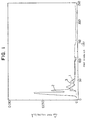
- the specific surface area of the solid measured by the BET method was 10.8 m 2 /g and the pore volume was 0.032 cc/g, the distribution of the micropores being as shown in Fig. 1 (Cf. Fig. 1, Curve 1).
- the results of X-ray diffraction (45 KVx45 mA, CuK,, Filter Ni) of the solid are shown in Fig. 2.
- the so obtained solid had a composition of 22.2%, Mg, 68.4% Cl, 8.2% E.B. and 1.2% Ti.
- the surface area and pore volume of the solid were respectively 133 m 2 /g and 0.12 cc/g, which were respectively 12 times and 3.2 times as much as those of the titanium-containing solid before the activation treatment (b).
- the distribution of pores is shown in Fig. 1 from which it is seen that a great number of pores are newly formed (Fig. 1, Curve 2).
- the x-ray diffraction diagram is as shown in Fig. 2. As can be seen from this diagram, both the peaks of 14.8° and 50.3°, which widths were increased and became dull by cogrinding, recover somewhat the sharpness and a peak with a large width reappears near 34.8° (Fig. 2, (C)).
- Example 1 The treatment procedure (1) of Example 1 was repeated except carbon tetrachloride was used instead of the hexachloroethane.
- the resulting treated solid had a titanium content of 1.3%.
- Example 1 The treatment procedure (1) of Example 1 was repeated except 1,1,2-trichloroethane was used instead of the hexachloroethane.
- the resulting treated solid had a titanium content of 1.1%.
- Example 1 The treatment procedure (1) of Example 1 was repeated except p-chlorobenzotrichloride was used instead of the hexachloroethane, thus obtaining a treated solid with a titanium content of 1.2%.
- Example 1 The treatment procedure (1) of Example 1 was repeated except a solution of hexachloroethane in a mixed xylene was used instead of the solution of hexachloroethane in n-heptane, thus obtaining a treated solid with a titanium content of 1.1%.
- Example 1 The treatment procedure (1) for Example 1 was repeated except that hexachloroethane was not used.
- the resulting treated solid was light yellow and had a titanium content of 1.1 %, a surface area of 120 m/g and a pore volume of 0.11 cc/g.
- Example 1 The treatment procedure (1) of Example 1 was repeated except the same amount of mixed xylenes was used instead of the heptane to obtain a solid with a titanium content of 1.0%.
- Example 1 (a) 5.0 g of the titanium-containing solid obtained in Example 1 (a) was charged in a glass vessel with a volume of 300 ml and subjected to a heating treatment at 90°C for 2 hours in a nitrogen atmosphere. During the same time, decrease of the weight was small and the color of the solid was scarcely changed.
- the thus treated solid had a titanium content of 2.8%, a surface area of 14.5 m 2 /g and a pore volume of 0.038 cc/g which were increased slightly in comparison with those before the treatment. The distribution of pores was scarcely changed as shown in Fig. 1 (Cf. Fig. 1, Curve 3).
- Treatment was carried out in an analogous manner to Example 1 (b), activation treatment (1), except that the treatment was carried out at room temperature instead of the heating at 90°C, thus obtaining a treated solid with a titanium content of 1.6%.
- Example 2 47.9 mg of the supported titanium catalyst component, after the treatment (Activation treatment (1)), obtained in Example 1 and having a titanium content of 1.2% was charged in nitrogen atmosphere into a stainless steel (SUS 32) autoclave with an inner volume of 1000 ml, equipped with a stirrer, to which a mixture of 3.44 ml of a solution of 1 mol/I of triethylaluminum (AIITi atomic ratio: 300) in n-heptane and 0.15 ml of E.B. (AI/E.B. molar ratio: 3.4) was added after 5 minutes from the preparation of the mixture. Further 0.8 I of liquid propylene was added with 0.6 I of hydrogen gas as a molecular weight regulator.
- Activation treatment (1) obtained in Example 1 and having a titanium content of 1.2% was charged in nitrogen atmosphere into a stainless steel (SUS 32) autoclave with an inner volume of 1000 ml, equipped with a stirrer, to which a mixture of 3.44 ml of a
- Example 8 was repeated except ethyl isobutyrate was used in place of E.B.
- Example 8 was repeated except 4.5 g of ethylene was added to the autoclave prior to the commencement of the polymerization reaction.
- the ethylene/propylene compolymer ethylene content was 2.8% and MFR was 2.3.
Landscapes
- Chemical & Material Sciences (AREA)
- Health & Medical Sciences (AREA)
- Chemical Kinetics & Catalysis (AREA)
- Medicinal Chemistry (AREA)
- Polymers & Plastics (AREA)
- Organic Chemistry (AREA)
- Transition And Organic Metals Composition Catalysts For Addition Polymerization (AREA)
Description
- This invention relates to a catalyst component for use in the polymerization of a-olefins and to a process for the polymerization of a-olefins using the same, and more particularly, it is concerned with a supported titanium catalyst component prepared by an improved process and with a process for producing a stereoregular homopolymer or copolymer of a-olefins using a catalyst system comprising the supported titanium catalyst component and an organo aluminum cocatalyst component.
- These catalyst components are preferably used together with an organo aluminum compound and the invention also provides such catalyst mixtures.
- For the stereoregular polymerization of a-olefins, it has hitherto been carried out to use a catalyst system comprising solid TiCl3, obtained by reducing TiCI4 by various methods and an organo aluminum compound as cocatalyst. However, this method has many disadvantages on a commercial scale in that both the polymerization activity and stereoregularity of commercially available catalyst systems are low and steps for polymer de-ashing and for removing amorphous polymers are required. In order to overcome these disadvantages, there have been proposed processes for the polymerization of a-olefins by the use of catalyst systems comprising, by way of example, titanium catalytic components obtained by treating solids obtained by reducing TiC14 with organo aluminum compounds with complexing agents and then with TiCl4 (JP-B-3356/1978); or by treating the solids with complexing agents and hexachlorethane (JP-A-10/294/1977). In these examples, as far as solid TiCI3 is used, however, only a part of the titanium can be utilized as an active catalyst and consequently, there is not obtained such a high catalytic efficiency as to omit the polymer deashing step.
- As a desirable method for raising the polymerization activity per unit titanium, on the other hand, it has been known to disperse and support titanium compounds on other solids. Actually, in the production of polyethylene by a medium or low pressure process, a high catalytic efficiency can be achieved by the use of a catalyst system comprising a titanium catalyst component (titanium compounds on various supports) and an organo aluminium compound. A polymeric product of good quality can be produced on a commercial scale without a polymer deashing step. However, in the polymerization of higher a-olefins, e.g., propylene, a high polymerization activity as well as a high stereoregularity are required, resulting in a more difficult problem than in the case of producing polyethylene by a medium or low pressure process.
- Of late, various improved methods have been proposed as to the stereoregular polymerization of a- . olefins using a catalyst system comprising a supported titanium catalyst component and an organo aluminium cocatalyst component. Typical methods thereof are as follows:
- 1. A method comprising using a catalyst system comprising a solid supported titanium catalyst component obtained by cogrinding anhydrous MgC12 and TiCl4, of a complex of TiC14 and an electron donor, and an organo aluminium cocatalyst component comprising an aluminium compound and electron donor (JP-A-16986-8/1973);
- 2. A method comprising using a catalyst system comprising a supported titanium catalyst component, obtained by ball milling anhydrous MgC12 and an electron donor (and a silicon compound) and contacting with TiC14 with heating, the cocatalyst component comprising an organo aluminium compound and electron donor (JP-A-Nos. 108385/1975 and 151691/1977).
- In addition to these methods, there has also been proposed a method comprising using a catalyst system comprising a supported titanium catalyst component, prepared by treating with a solution of an organic acid ester a titanium-containing solid obtained by heat treating MgCI2.mROH in TiCl4, and an organo aluminium compound component (JP-A-57789/1976), but this method is insufficient in eliminating polymer deashing.
- The inventors have made various studies on the support titanium catalysts used in the above-described prior art methods and, consequently, have found that these methods have various disadvantages. That is to say, the method (1) is advantageous in that the titanium compound can effectively be utilized and handling thereof is easy, but the method produces bad results in both the polymerization activity and stereoregularity for omitting the steps of deashing and removing amorphous products. The surface area of the supported titanium catalyst component thus produced is small, as described in Japanese Patent Public Disclosure Nos. 16986-8/1973.
- In the method (2), a large excess of TiCI4 is used for supporting, so steps for recovering and purifying the same are required. It is difficult to remove completely free TiC14 adhered to the support after being supported. If this removal is not sufficiently effected, the polymerization activity and. stereoregularity are unfavourable affected and in order to prevent this it is necessary to provide a multistage washing step, which is disadvantageous commercially.
- FR-A-2200290 discloses a catalyst composition which comprises:
- (a) an organo aluminium catalyst component, and
- (b) a supported titanium catalyst component obtained by copulverising:
- (A) anhydrous magnesium chloride,
- (B) a solid organic substance, such as hexachlorobenzene and p-dichlorobenzene, which is substantially inert to other components of the catalyst.
- (C) a tetravalent titanium halogenated compound e.g. TiCl4, preferably in the form of a complex with
- (D) an organic acid ester.
- FR-A-2326429 discloses a supported titanium catalyst component obtained by copulverising:
- (A) anhydrous magnesium chloride,
- (B) an organo halogen compound,
- (C) a tetravalent titanium halide.
- In general the copulverising is carried out at 0-2000C (preferably 20―100°C) for a period between 0.5 and 50 hours.
- FR-A-2322158 discloses a catalyst composition which comprises:
- (a) an organo aluminium catalyst component,
- (b) a supported titanium catalyst component obtained by copulverising:
- (A) anhydrous magnesium chloride, with
- (C) TiC14, and
- (D) an organic acid ester or with a complex C and D.
- The invention concerns a supported titanium component which may enable polymerisation to be carried out with improved activity and stereo regularity so that catalyst removal (deashing) and atactic polymer removal steps may be minimised. -
- The present invention provides a supported titanium catalyst component for use in a stereoregular polymerization of alpha-olefins, which catalyst component is prepared by a process comprising co- grinding an anhydrous magnesium halide, a tetravalent titanium halide and an organic acid ester until a part of the characteristic X-ray absorption spectrum of the anhydrous magnesium halide shows decreased intensity and enlarged width and part of the absorption peaks of the spectrum disappear to obtain a titanium-containing solid product which is optionally washed characterised in that the titanium-containing solid product, prior to washing if affected, is heated in an inert atmosphere at a temperature of from 40°C-200°C solely with an organohalogen compound and/or dehydrated hydrocarbon for a period of from 0.5-20 hours.
- In addition, the present invention provides a process for the stereoregular polymerization of a-olefins wherein homo-polymerization or copolymerization of a-olefins with high polymerization activity and excellent stereoregularity can favorably be accomplished on a commercial scale even in the presence of a molecular weight regulator such as hydrogen by mixing and combining the above-described supported titanium catalyst component with an organo aluminum catalyst component.
-
- Fig. 1 is a diagram showing the distribution of pores of supported titanium catalyst components in which Curve 1 shows that of the titanium-containing solid in Example 1, Curve 2 shows that of the supported titanium catalyst component in Example 1 and Curve 3 shows that of Comparative Example 1; and
- Fig. 2 is an x-ray diffraction diagram in which (A) shows that of MgCl2, (B) shows that of the titanium-containing solid of Example 1(A) and (C) shows that of the supported titanium catalyst component of Example (B) (activation treatment (1)).
- Suitable examples of the magnesium dihalide used in the present invention are MgC12, MgBr2 and Mgl2. Above all MgCI2 is preferable. These magnesium dihalides may be those synthesized by any methods and commercially solid compounds can of course, be used. It is desirable that the magnesium dihalides are as anhydrous as possible and priorto their use, they are preferably subjected to a dehydration treatment in conventional manner, for example, by firing (calcining, baking) at a temperature of 100 to 400°C under reduced pressure for 1 to 10 hours. Such treatment results in the presence of water in such an extent that the catalytic performance is not affected.
- Typical examples of the tetravalent titanium halide used in the present invention are TiCl4, TiBr4 and Til4. However, it is not always necessary that all the anions of these titanium halides be halogens; but a part thereof can be substituted by alkoxy, acyloxy or alkyl groups.
- The organic acid esters used in the present invention are preferably esters of aliphatic, alicyclic and aromatic mono- or polycarboxylic acids and aliphatic, alicyclic and araliphatic mono- or polyols. Examples of these esters are butyl formate, ethyl acetate, butyl acetate, ethyl acrylate, ethyl butyrate, isobutyl isobutyrate, methyl methacrylate, diethyl maleate, diethyl tartrate, ethyl hexahydrobenzoate, ethyl benzoate, ethyl p-methoxybenzoate, methyl-p-methylbenzoate, ethyl p-tert-butylbenzoate, dibutyl phthalate and ethyl a-naphthoate. The organic acid esters of the present invention are not intended to be limited to these examples. Above all, alkyl esters of aromatic carboxylic acids, in particular, C, to C8 alkyl esters of benzoic acid or derivatives thereof are preferably used.
- The titanium-containing solid of the present invention can be prepared by the following various methods. That is, the copulverizing (cogrinding) of a system consisting of a combination of magnesium dihalide, tetravalent titanium halide and organic acid ester is preferably carried out by mechanical grinding using a vibrating mill, ball mill, etc., with selecting any of combinations of:
- (i) mixtures of (a) magnesium dihalides, (b) tetravalent titanium halides and (c) organic acid esters,
- (ii) (b) and a composite or complex material (d) formed by contacting previously (a) and (c),
- (iii) (a) and a composite complex material (e) formed by contacting previously (b) and (c), and
- (iv) (d) and (e).
- The mechanical grinding efficiency depends on the grinding system, the structure of the apparatus, the quantity of starting materials charged, voids, temperatures, etc. and the grinding time is generally 1 to 200 hours, preferably 10 to 100 hours. As occasion demands, a method of supporting titanium can be used, which comprises subjecting (a) and (c) to a cogrinding treatment to obtain a solid which is then cogrinded with a tetravalent titanium halide. The quantity of a titanium halide on a support is preferably 0.1 to 10% by weight as titanium metal. An organic acid ester is preferably used in a proportion of 0.1 to 10 mols, preferably 0.5 to 5 mols per 1 gram atom of the supported titanium metal. The titanium-containing solid obtained in this way normally has a small surface area, i.e., at most about 10 m2/g and a micropore volume of less than about 0.05 cc/g only.
- Then, in accordance with the present invention, this titanium-containing solid is treated by heating with a hydrocarbon and/or organo halogen compound. The hydrocarbon which can be used in the present invention is dehydrated in conventional manner and includes aliphatic hydrocarbons having 3-20 carbon atoms, such as propane, butane, isobutane, pentane, n-hexane, n-heptane, isooctane, decane and liquid paraffin, alicyclic hydrocarbons having 5-12 atoms, such as cyclohexane, decalin, dimethyldecalin, and aromatic hydrocarbons having 6-12 carbon atoms, such as benzene, toluene o-xylene, p-xylene, m-xylene, mixed xylene, ethylbenzene, dimethyl naphthalene and tetralin. For the production of a catalyst for the polymerization of a-olefins, aromatic hydrocarbons are removed as far as possible in the prior art, but in the present invention, aromatic hydrocarbons have no bad effect, but rather give useful effects. This is very interesting.
- Typical examples of the organic halogen compound used in the present invention are halogen substituted, e.g., mono- and polyhalo-substituted, preferably monochloro- and polychloro-substituted hydrocarbons, and include methyl chloride, methyl bromide, methyl iodide, methylene chloride, methylene bromide, methylene iodide, chloroform bromoform, iodoform, carbon tetrachloride, carbon tetrabromide, carbon tetraiodide, ethyl chloride, ethyl bromide, ethyl iodide, 1,2-dichloroethane, 1,2-dibromoethane, 1,2-diiodoethane, methylchloroform, methylbromoform, methyliodoform, 1,1,2-trichloroethylene, 1,1,2-tribromoethylene, 1,1,2,2-tetrachloroethylene, pentachloroethane, hexachloroethane, n-propyl chloride, 1,2-dichloropropane, hexachloropropylene, octachloropropane, decabromobutane, chlorinated paraffins, chlorocyclopropane, tetrachlorocyclopentane, hexachloropentadiene, hexachlorocyclohexane, chlorobenzene, bromobenzene, o-dichlorobenzene, p-dichlorobenzene, hexachlorobenzene, benzotrichoride, p-chlorobenzotrichloride, etc.
- Above all, those halogen-substituted hydrocarbons containing a number of halogen atoms or containing trichloromethyl groups are preferably used and particularly polychloro-substituted, saturated or unsaturated hydrocarbons having 1-4 carbon atoms. It is most preferable to use completely chlorine substituted aliphatic hydrocarbons, for example, carbon tetrachloride, hexachloroethane, octachloropropane and the like.
- In addition to these halo substituted hydrocarbons, it is possible to use halo substituted oxygen- containing compounds, for example, hexachloroacetone, chloroacetic acid esters, trichloroacetic acid esters and the like.
- These hydrocarbons and organo halogen compounds can be used individually or in combination and, prior to use, they are preferably subjected to a dehydrating treatment in a conventional manner.
- The activation treatment of the titanium-containing solid with these hydrocarbons and/or organo halogen compounds is carried out under heating condition in an inert atmosphere, ordinarily, a nitrogen atmosphere. The quantity of the hydrocarbons and/or organo halogen compounds used for the treatment of the titanium-containing solid can be chosen within a wide range but, in general, the quantity of the former is 5 to 50 times as much as the weight of the titanium-containing solid and the quantity of the latter is 0.5 to 50 times as much as the weight of the titanium-containing solid.
- The temperature at which the treatment is carried is 40 to 200°C, preferably 60 to 120°C. When the organic compound for the treatment has a low boiling point and a treatment at a high temperature is required, the treatment is preferably carried out by the use of an air tight pressure vessel such as an autoclave. The treatment is 0.5 to 20 hours, preferably 1 to 5 hours.
- After the treatment, the mixture is subjected to filtration at a temperature somewhat lower than the treatment temperature, for example, at 50 to 80°C, washed several times with a fresh hydrocarbon solvent while keeping the temperature the same and then dried under reduced pressure.
- The titanium halide and a part of the organic acid ester are extracted from the titanium containing solid by the treatment of the present invention, thus changing the composition thereof. Selection of the extraction obtained depends upon the organic compound used.
- On the other hand, the supported titanium catalyst component is subjected to a large change in physical properties by the above-described treatment. That is to say, micropores are newly formed by the treatment to increase largely the surface area and pore volume. In the X-ray analysis (50 KVx45 mA, CuKa, Ni filter), a part of the characteristic absorption of the starting anhydrous magnesium halide loses its sharpness in the titanium-containing solid obtained by mechanical grinding, so that the intensity is decreased, the width is enlarged and a part of the peaks disappear. However, in the supported titanium catalyst component obtained by the treatment according to the present invention, there are found various features in that the peak of which sharpness is lost with a decreased strength and an enlarged width recovers again its sharpness to some extent and a part of the peaks disappearing once is recovered, which means that the resulting treated supported titanium catalyst component differs in properties from that before the treatment is performed. Such a marked modifying effect cannot be obtained by heating the titanium-containing solid obtained by the mechanical grinding only or by subjecting the solid product to a treatment with the above-described hydrocarbon and/or organo halogen compound at room temperature only.
- The supported titanium catalyst component thus markedly modified in composition and physical properties, in combination with an organo aluminum catalyst component, is capable of exhibiting effectively a performance to give a high activity as well as a high stereoregularity in the homo-polymerization of a-olefins or copolymerization with ethylene or other a-olefins.
- As an organo aluminum compound for the above-described organo aluminum catalyst component there is used ordinarily an organo aluminum compound represented by the general formula RmAIX3_m wherein R represents an alkyl group or aryl group, X represents a halogen anion and m represents a suitable numeral within a range of 2<m'---3, or a mixture or a complex compound thereof. For example, trialkylaluminums are used. There are preferably used as an organo aluminum compound to be used jointly with the trialkylaluminums, alkylaluminum compounds having 1 to 18 carbon atoms, in particular 2 to 6 carbon atoms, such as dialkylaluminum monohalides, monoalkylaluminum dihalides and alkylaluminum sesquichlorides, or mixtures or complex compounds thereof. Examples of the trialkylaluminum are trimethylaluminum, triethylaluminum, tripropylaluminum, and triisobutylaluminum. Examples of the dialkylaluminum monohalide are dimethylaluminum chloride, diethylaluminum chloride, diethylaluminum bromide, diethylaluminum iodide and diisobutylaluminum chloride. Examples of the monoalkylaluminum dihalide are methylaluminum dichloride, ethylaluminum dibromide, ethylaluminum diiodide and butylaluminum dichloride. An Example of the alkylaluminum sesquihalide is ethylaluminum sesquichloride, In particular, it is preferable to use triethylaluminum, triisobutylaluminum and as one to be used jointly with them, diethylaluminum chloride and ethylaluminum sesquichloride, or mixtures or complex compounds thereof, because these compounds are readily obtainable commercially and exhibit excellent effects.
- When the above-described organo aluminum compound only is used with the supported titanium catalyst component for the polymerization of a-olefins in the presence of a molecular weight regulator such as hydrogen, however, the yield of a stereoregular polymer is remarkably decreased. This is disadvantageous commercially. Therefore, the above-described organo aluminum compound and an organic acid ester, in combination, are preferably used as the organo aluminum cocatalyst component of the present invention. A suitable organic acid may be the same as or different from that used for the preparation of the supported titanium catalyst component and their ratio is chosen within a range of 0.1 to 10, preferably 1 to 5, gram atoms of AI per 1 mol of organic acid ester.
- Preparation of such a composite is carried out by contacting an organo aluminum compound and organic acid ester, for example, by mixing them at room temperature merely or while using a suitable hydrocarbon as set forth above as a diluent. The organo aluminum catalyst component is ordinarily prepared before a polymerization reaction, but, in general, it is preferably used within 1 hour after the component is prepared since the stereoregularity is unfavorably affected if it is used after storage of the composite for a long time.
- The catalysf system of the present invention can be used for the polymerization of a-olefins, in particular, for the stereospecific polymerization of a-olefins, in particular, for the stereospecific polymerization of a-olefins having 3 to 6 carbon atoms, for example, propylene, butene-1,4-methyl-pentene-1 and hexene-1 and for the copolymerization of a-olefins with each other and/or with ethylene. This copolymerization includes random copolymerization and block copolymerization. In the case of using ethylene as a comonomer, its proportion is generally chosen within a range of up to 30% by weight, in particular, 1 to 15% by weight to a-olefins. A polymerization reaction using the catalyst system of the present invention is carried out under ordinary conditions. The reaction is carried out in any of a gaseous phase and liquid phase and for the reaction in liquid phase, any of inert hydrocarbons and liquid monomers can be used. A suitable solvent for the polymerization is selected from the foregoing hydrocarbons. The polymerization temperature is generally -80°C to 150°C, preferably 40 to 100°C. The pressure ranges, for example, 101325 to 405300 Pascals. Control of the molecular weight during polymerization is carried out in conventional manner using hydrogen or other known molecular weight regulator.
- The polymerization can be carried out continuously or batchwise. The organo aluminum catalyst component is of course, utilized for the polymerization reaction and further serves to catch various catalyst poisons introduced into the system. Thus, it is necessary to control the additive quantity of the organo aluminum catalyst component considering the quantities of catalyst poisons contained in a-olefins, solvents or various gases, in particular, when using a high activity catalyst as in the present invention, and, ordinarily, the organo aluminum catalyst component is used so as to satisfy an AI/Ti atomic ratio of 1 to 2000, preferably 50 to 1000 based on titanium in the supported titanium catalyst component.
- When polymerization is carried out according to the process of the present invention, the polymerization activity and stereoregularity are largely improved and, consequently, the steps of removing the catalyst (deashing) and removing atactic polymers become unnecessary or the load thereon is markedly reduced. The process of the present invention is particularly important for the production of isotactic polypropylene, random copolymers of ethylene and propylene and block copolymers or propylene and ethylene.
- The present invention will now be illustrated in detail by the following Examples without limiting the same, in which percents are to be taken as those by weight unless otherwise indicated. The polymerization activity or catalyst efficiency (which will hereinafter be referred to as "C.E.") is the quantity (g) of a polymer formed per 1 g of titanium in the catalyst. The heptane-insoluble component (which will hereinafter be referred to as "H.I.") to show the proportion of a crystalline polymer in the polymers means the residual quantity (% by weight) in the case of extracting the polymer product with boiling n-heptane for 6 hours by means of a Soxhlet extractor of an improved type. The melt flow rate (which will hereinafter be referred to as "MFR") is measured according to ASTM-D 1238.
- 40.3 g of magnesium dichloride (moisture content: 1% by weight) and 11.1 g of an equimolar composite of titanium tetrachloride and ethyl benzoate (which will hereinafter be referred to as "E.B.") (dehydration with CaH2, nitrogen-substituted moisture content: 0.4% by weight) were charged in a stainless steel (SUS 32) mill.pot with an inner volume of 300 ml carrying 100 stainless steel (SUS 32) balls with a diameter of 10 mm in a nitrogen atmosphere, which was then fitted to a shaker, followed by shaking for 20 hours to cogrind them. The thus obtained titanium-containing solid was yellow and had a composition of 20.5% Mg, 2.9% Ti, 68.4% CI and 8.4% E.B. The specific surface area of the solid measured by the BET method was 10.8 m2/g and the pore volume was 0.032 cc/g, the distribution of the micropores being as shown in Fig. 1 (Cf. Fig. 1, Curve 1). The results of X-ray diffraction (45 KVx45 mA, CuK,, Filter Ni) of the solid are shown in Fig. 2. As can be seen therefrom, in the solid, the peaks of 14.8° (strong) and 50.3° (weak) of the characteristic peaks (20) of anhydrous magnesium chloride become dull with increased widths and the peaks of 30.2° (middle), 34.8° (weak) and 63° (weak) disappear (Cf. Fig. 2 (B)).
- 7.7 g of the above-described titanium-containing solid was charged in a glass vessel of 300 ml, to which a solution of 7.5 g of hexachloroethane equimolar to the magnesium dichloride in the coground product in 77 ml of deoxidized dry n-heptane was added, and the mixture was stirred at 90°C for 2 hours by means of a magnetic stirrer. Then, the mixture was filtered at 65°C to separate soluble materials, washed repeatedly 4 times with 70 ml of new n-heptane while keeping the same temperature and dried under reduced pressure, thus obtaining a thin yellow solid with a yield of 92%. The so obtained solid had a composition of 22.2%, Mg, 68.4% Cl, 8.2% E.B. and 1.2% Ti. The surface area and pore volume of the solid were respectively 133 m2/g and 0.12 cc/g, which were respectively 12 times and 3.2 times as much as those of the titanium-containing solid before the activation treatment (b). The distribution of pores is shown in Fig. 1 from which it is seen that a great number of pores are newly formed (Fig. 1, Curve 2). The x-ray diffraction diagram is as shown in Fig. 2. As can be seen from this diagram, both the peaks of 14.8° and 50.3°, which widths were increased and became dull by cogrinding, recover somewhat the sharpness and a peak with a large width reappears near 34.8° (Fig. 2, (C)).
- Activation Treatment (1) was repeated except that the treatment was carried out at 120°C instead of 90°C. The resulting solid was thin yellow and had a Ti content of 1.0%.
- The treatment procedure (1) of Example 1 was repeated except carbon tetrachloride was used instead of the hexachloroethane. The resulting treated solid had a titanium content of 1.3%.
- The treatment procedure (1) of Example 1 was repeated except 1,1,2-trichloroethane was used instead of the hexachloroethane. The resulting treated solid had a titanium content of 1.1%.
- The treatment procedure (1) of Example 1 was repeated except p-chlorobenzotrichloride was used instead of the hexachloroethane, thus obtaining a treated solid with a titanium content of 1.2%.
- The treatment procedure (1) of Example 1 was repeated except a solution of hexachloroethane in a mixed xylene was used instead of the solution of hexachloroethane in n-heptane, thus obtaining a treated solid with a titanium content of 1.1%.
- The treatment procedure (1) for Example 1 was repeated except that hexachloroethane was not used. The resulting treated solid was light yellow and had a titanium content of 1.1 %, a surface area of 120 m/g and a pore volume of 0.11 cc/g.
- The treatment procedure (1) of Example 1 was repeated except the same amount of mixed xylenes was used instead of the heptane to obtain a solid with a titanium content of 1.0%.
- 5.0 g of the titanium-containing solid obtained in Example 1 (a) was charged in a glass vessel with a volume of 300 ml and subjected to a heating treatment at 90°C for 2 hours in a nitrogen atmosphere. During the same time, decrease of the weight was small and the color of the solid was scarcely changed. The thus treated solid had a titanium content of 2.8%, a surface area of 14.5 m2/g and a pore volume of 0.038 cc/g which were increased slightly in comparison with those before the treatment. The distribution of pores was scarcely changed as shown in Fig. 1 (Cf. Fig. 1, Curve 3).
- Treatment was carried out in an analogous manner to Example 1 (b), activation treatment (1), except that the treatment was carried out at room temperature instead of the heating at 90°C, thus obtaining a treated solid with a titanium content of 1.6%.
- 47.9 mg of the supported titanium catalyst component, after the treatment (Activation treatment (1)), obtained in Example 1 and having a titanium content of 1.2% was charged in nitrogen atmosphere into a stainless steel (SUS 32) autoclave with an inner volume of 1000 ml, equipped with a stirrer, to which a mixture of 3.44 ml of a solution of 1 mol/I of triethylaluminum (AIITi atomic ratio: 300) in n-heptane and 0.15 ml of E.B. (AI/E.B. molar ratio: 3.4) was added after 5 minutes from the preparation of the mixture. Further 0.8 I of liquid propylene was added with 0.6 I of hydrogen gas as a molecular weight regulator. The temperature was then raised to 68°C and polymerization was continued for 30 minutes. After the polymerization, the unreacted propylene was purged and 113 g of flowable powdered polypropylene was obtained, which corresponded to C.E. of PP 203,000 g/g-Ti and which had a HI of 90.5% and an MFR of 2.0.
- Polymerizations were carried out in an analogous manner to Example 8, except using the supported titanium catalyst components of Examples 2 to 6, the titanium-containing solid of Example 1 (a) and the supported titanium catalyst components of Comparative Examples 1 and 2, all as set forth in Table la. The polymerization results are set forth in Table I(b).


- Polymerizations were carried out in an analogous manner to Example 8, except using the supported titanium catalyst components of Examples 1, 6 and 7 and the titanium-containing solid Example 1(a) and using triisobutylaluminum in place of the triethylaluminum, all as set forth in Table II(a). The polymerization results are shown in Table II(b).

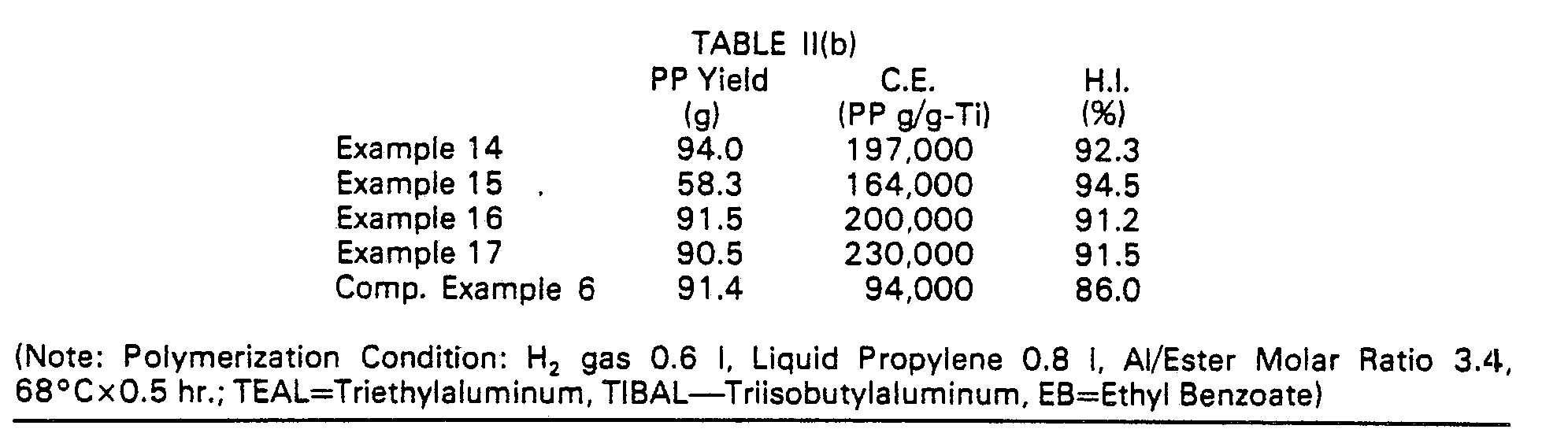
- Example 8 was repeated except ethyl anisate was used in place of EB. Polymerization results were: C.E.=PP 255,000 g PP/g-Ti; HI=91.1%.
- Example 8 was repeated except ethyl isobutyrate was used in place of E.B. The polymerization results were: C.E.=156,000 g PP/g-Ti; HI=90.3%.
- Example 8 was repeated except 4.5 g of ethylene was added to the autoclave prior to the commencement of the polymerization reaction. The ethylene/propylene compolymer ethylene content was 2.8% and MFR was 2.3. Polymerization results were C.E.=354,000 g/g-Ti; HI=85%.
Claims (13)
Applications Claiming Priority (2)
| Application Number | Priority Date | Filing Date | Title |
|---|---|---|---|
| JP42147/78 | 1978-04-12 | ||
| JP53042147A JPS5919564B2 (en) | 1978-04-12 | 1978-04-12 | Method for producing catalyst component for polymerization of α-olefin |
Publications (4)
| Publication Number | Publication Date |
|---|---|
| EP0004789A2 EP0004789A2 (en) | 1979-10-17 |
| EP0004789A3 EP0004789A3 (en) | 1979-10-31 |
| EP0004789B1 EP0004789B1 (en) | 1982-06-30 |
| EP0004789B2 true EP0004789B2 (en) | 1988-08-31 |
Family
ID=12627821
Family Applications (1)
| Application Number | Title | Priority Date | Filing Date |
|---|---|---|---|
| EP79300588A Expired EP0004789B2 (en) | 1978-04-12 | 1979-04-10 | Catalyst component for alpha-olefin polymerization and use thereof |
Country Status (5)
| Country | Link |
|---|---|
| US (2) | US4242230A (en) |
| EP (1) | EP0004789B2 (en) |
| JP (1) | JPS5919564B2 (en) |
| CA (1) | CA1140525A (en) |
| DE (1) | DE2963218D1 (en) |
Families Citing this family (21)
| Publication number | Priority date | Publication date | Assignee | Title |
|---|---|---|---|---|
| JPS5919564B2 (en) * | 1978-04-12 | 1984-05-07 | 東亜燃料工業株式会社 | Method for producing catalyst component for polymerization of α-olefin |
| JPS55135105A (en) * | 1979-04-10 | 1980-10-21 | Mitsui Petrochem Ind Ltd | Titanium catalyst component for olefin polymerization |
| EP0019312B1 (en) * | 1979-04-30 | 1983-08-17 | Shell Internationale Researchmaatschappij B.V. | Olefin polymerization catalyst compositions and a process for the polymerization of olefins employing such compositions |
| CA1141093A (en) * | 1979-05-17 | 1983-02-08 | Brian L. Goodall | Olefin polymerization catalyst compositions and a process for the polymerization of olefins employing such compositions |
| JPS595203B2 (en) * | 1979-07-25 | 1984-02-03 | 東亜燃料工業株式会社 | Method for producing catalyst component for α-olefin polymerization |
| JPS57104A (en) * | 1980-06-04 | 1982-01-05 | Nippon Oil Co Ltd | Production of polyethylene |
| IT1209255B (en) * | 1980-08-13 | 1989-07-16 | Montedison Spa | CATALYSTS FOR THE POLYMERIZATION OF OLEFINE. |
| US6777508B1 (en) | 1980-08-13 | 2004-08-17 | Basell Poliolefine Italia S.P.A. | Catalysts for the polymerization of olefins |
| ES8305007A1 (en) * | 1981-08-07 | 1983-04-16 | Hoechst Ag | Process for the polymerisation of 1-olefins and process for preparing the catalyst used therein. |
| US4431572A (en) * | 1982-05-14 | 1984-02-14 | Standard Oil Company (Indiana) | Retreating comminuted olefin polymerization catalyst with a titanium (IV) compound, a chlorocarbon and an ester |
| US4555496A (en) * | 1982-08-20 | 1985-11-26 | Phillips Petroleum Company | Supported polyolefin catalyst components and methods of making and using the same |
| GB8316325D0 (en) * | 1983-06-15 | 1983-07-20 | Ici Plc | Catalyst component production |
| JPS6225648U (en) * | 1985-07-29 | 1987-02-17 | ||
| US4680351A (en) * | 1985-09-06 | 1987-07-14 | Phillips Petroleum Company | Supported polyolefin catalyst components and methods of making and using same |
| JP2702213B2 (en) * | 1988-07-06 | 1998-01-21 | 三井東圧化学株式会社 | α-Olefin polymerization method |
| FR2680793B1 (en) * | 1991-08-30 | 1994-09-09 | Bp Chemicals Snc | PROCESS FOR THE MANUFACTURE OF AN ETHYLENE POLYMER. |
| RU2153932C2 (en) * | 1995-05-18 | 2000-08-10 | Митсуи Кемикалс, Инк. | Method of preparing solid titanium catalytic component, olefin- polymerization catalyst containing thereof, and olefin polymerization process |
| KR100432536B1 (en) * | 1995-10-11 | 2004-09-16 | 미쓰이 가가쿠 가부시키가이샤 | Method for preparing solid titanium catalyst component for olefin polymerization |
| CN1181105C (en) * | 2000-08-22 | 2004-12-22 | 中国石油化工股份有限公司 | High activity silica gel carrier catalyst component for ethylene polymerisation or copolymerisation and its catalyst and use of said catalyst |
| US20170354980A1 (en) * | 2016-06-14 | 2017-12-14 | Pacific Air Filtration Holdings, LLC | Collecting electrode |
| CN117003915A (en) * | 2022-04-28 | 2023-11-07 | 中国石油化工股份有限公司 | Solid catalyst component and preparation method thereof, olefin polymerization catalyst and application |
Family Cites Families (18)
| Publication number | Priority date | Publication date | Assignee | Title |
|---|---|---|---|---|
| US3094568A (en) * | 1959-12-01 | 1963-06-18 | Gulf Research Development Co | Process for alkylating aromatics in the presence of a heavy metal halide, an organic halide and an organo aluminum halide |
| CH543546A (en) * | 1971-03-23 | 1973-10-31 | Solvay | Alpha-olefin polymerization catalytic system |
| US4187196A (en) * | 1971-06-25 | 1980-02-05 | Montedison S.P.A. | Process for the stereoregular polymerization of alpha-olefins |
| US4107413A (en) * | 1971-06-25 | 1978-08-15 | Montedison S.P.A. | Process for the stereoregular polymerization of alpha olefins |
| US4156063A (en) * | 1971-06-25 | 1979-05-22 | Montecanti Edison, S.p.A. | Process for the stereoregular polymerization of alpha olefins |
| US4226963A (en) * | 1971-06-25 | 1980-10-07 | Montedison S.P.A. | Process for the stereoregular polymerization of alpha-olephins |
| US4107414A (en) * | 1971-06-25 | 1978-08-15 | Montecatini Edison S.P.A. | Process for the stereoregular polymerization of alpha olefins |
| US4107415A (en) * | 1972-09-26 | 1978-08-15 | Montecatini Edison S.P.A. | Process for the stereospecific polymerization of alpha-olefins |
| GB1492618A (en) | 1974-02-01 | 1977-11-23 | Mitsui Petrochemical Ind | Process for preparing highly stereoregular polyolefins and catalyst used therefor |
| GB1548573A (en) * | 1975-06-16 | 1979-07-18 | Ici Ltd | Polymerisation catalyst and process |
| IT1042180B (en) | 1975-08-29 | 1980-01-30 | Montedison Spa | PROPOLENE CRYSTAL POLYMERS AND COPOLYMERS AND PROCEDURE FOR THEIR PREPARATION |
| JPS5242584A (en) | 1975-10-02 | 1977-04-02 | Nippon Oil Co Ltd | Process for producing polyolefine |
| IT1054410B (en) * | 1975-11-21 | 1981-11-10 | Mitsui Petrochemical Ind | CATALYSTS FOR THE POLYMERIZATION OF ALPHA OLEFINS |
| US4182691A (en) * | 1976-03-08 | 1980-01-08 | Toa Nenryo Kogyo Kabushiki Kaisha | Titanium trichloride catalyst and process for the production thereof |
| DE2709857A1 (en) * | 1976-03-08 | 1977-09-15 | Toa Nenryo Kogyo Kk | METHOD OF MANUFACTURING A TITANIUM TRICHLORIDE CATALYST, THE CATALYST OBTAINED THEREOF AND ITS USE FOR THE STEREOLEGULATED POLYMERIZATION OF ALPHA-OLEFINS |
| DE2744559A1 (en) * | 1976-10-07 | 1978-04-13 | Mitsubishi Petrochemical Co | PROCESS FOR MANUFACTURING CATALYST COMPONENTS FOR OLEFIN POLYMERIZATION |
| US4107412A (en) * | 1976-11-24 | 1978-08-15 | Phillips Petroleum Company | Olefin polymerization process and catalyst therefor |
| JPS5919564B2 (en) * | 1978-04-12 | 1984-05-07 | 東亜燃料工業株式会社 | Method for producing catalyst component for polymerization of α-olefin |
-
1978
- 1978-04-12 JP JP53042147A patent/JPS5919564B2/en not_active Expired
-
1979
- 1979-04-10 DE DE7979300588T patent/DE2963218D1/en not_active Expired
- 1979-04-10 EP EP79300588A patent/EP0004789B2/en not_active Expired
- 1979-04-11 CA CA000325352A patent/CA1140525A/en not_active Expired
- 1979-04-11 US US06/029,081 patent/US4242230A/en not_active Expired - Lifetime
-
1980
- 1980-07-28 US US06/172,797 patent/US4314046A/en not_active Expired - Lifetime
Also Published As
| Publication number | Publication date |
|---|---|
| JPS54135689A (en) | 1979-10-22 |
| US4242230A (en) | 1980-12-30 |
| EP0004789B1 (en) | 1982-06-30 |
| CA1140525A (en) | 1983-02-01 |
| US4314046A (en) | 1982-02-02 |
| EP0004789A3 (en) | 1979-10-31 |
| DE2963218D1 (en) | 1982-08-19 |
| JPS5919564B2 (en) | 1984-05-07 |
| EP0004789A2 (en) | 1979-10-17 |
Similar Documents
| Publication | Publication Date | Title |
|---|---|---|
| EP0004789B2 (en) | Catalyst component for alpha-olefin polymerization and use thereof | |
| US4335015A (en) | Catalyst component for polymerization of alpha-olefins and method of using it | |
| US4242231A (en) | Catalyst component for use in the polymerization of α-olefins and a method of using the same | |
| US4253984A (en) | Catalyst component for use in the polymerization of α-olefins and a method of using the same | |
| US4370257A (en) | Catalyst component for polymerization of alpha-olefins and method for using the same | |
| JPH0655780B2 (en) | Olefin polymerization catalyst component | |
| US4175171A (en) | Catalyst for polymerizing α-olefins | |
| JPH0655782B2 (en) | Olefin polymerization catalyst component | |
| US4426314A (en) | Magnesium-containing solid | |
| EP0049436B1 (en) | Process for producing highly stereoregular alpha-olefin polymers | |
| US4246136A (en) | Catalyst component for use in the polymerization of α-olefins and a method of using the same | |
| US4485186A (en) | Catalyst component for polymerization of olefins | |
| US4549001A (en) | Olefin polymerization | |
| EP0050497A1 (en) | Catalyst components for polymerization of alpha-olefins and processes for their preparation and use | |
| US4559317A (en) | Olefin polymerization | |
| KR850000529B1 (en) | Polymerization Method by Catalyst of α-olefin | |
| EP0044635A1 (en) | Catalyst components for polymerization of alpha-olefins and a method for using them | |
| JPS6247881B2 (en) | ||
| JPS6222808A (en) | Production of ultrahigh-mw poly-alpha-olefin | |
| JPH0153885B2 (en) | ||
| EP0050498A1 (en) | Catalyst component, its preparation and use in polymerization of alpha-olefins | |
| ZA200109190B (en) | Methods of making magnesium/transition metal alkoxide complexes and polymerization catalysts made therefrom. | |
| JPS6189210A (en) | Preparation of catalytic component |
Legal Events
| Date | Code | Title | Description |
|---|---|---|---|
| PUAI | Public reference made under article 153(3) epc to a published international application that has entered the european phase |
Free format text: ORIGINAL CODE: 0009012 |
|
| PUAL | Search report despatched |
Free format text: ORIGINAL CODE: 0009013 |
|
| AK | Designated contracting states |
Designated state(s): BE DE FR GB IT NL |
|
| AK | Designated contracting states |
Designated state(s): BE DE FR GB IT NL |
|
| 17P | Request for examination filed | ||
| 18W | Application withdrawn | ||
| D18W | Application withdrawn (deleted) | ||
| ITF | It: translation for a ep patent filed | ||
| GRAA | (expected) grant |
Free format text: ORIGINAL CODE: 0009210 |
|
| AK | Designated contracting states |
Designated state(s): BE DE FR GB IT NL |
|
| REF | Corresponds to: |
Ref document number: 2963218 Country of ref document: DE Date of ref document: 19820819 |
|
| PLBI | Opposition filed |
Free format text: ORIGINAL CODE: 0009260 |
|
| PLBI | Opposition filed |
Free format text: ORIGINAL CODE: 0009260 |
|
| 26 | Opposition filed |
Opponent name: HOECHST AKTIENGESELLSCHAFT, FRANKFURT Effective date: 19830207 |
|
| PLBI | Opposition filed |
Free format text: ORIGINAL CODE: 0009260 |
|
| 26 | Opposition filed |
Opponent name: MONTEDISON S.P.A. Effective date: 19830317 |
|
| 26 | Opposition filed |
Opponent name: NAAMLOZE VENNOOTSCHAP DSM Effective date: 19830321 |
|
| PUAH | Patent maintained in amended form |
Free format text: ORIGINAL CODE: 0009272 |
|
| STAA | Information on the status of an ep patent application or granted ep patent |
Free format text: STATUS: PATENT MAINTAINED AS AMENDED |
|
| 27A | Patent maintained in amended form |
Effective date: 19880831 |
|
| AK | Designated contracting states |
Kind code of ref document: B2 Designated state(s): BE DE FR GB IT NL |
|
| NLR2 | Nl: decision of opposition | ||
| ITF | It: translation for a ep patent filed | ||
| NLR3 | Nl: receipt of modified translations in the netherlands language after an opposition procedure | ||
| ET3 | Fr: translation filed ** decision concerning opposition | ||
| PGFP | Annual fee paid to national office [announced via postgrant information from national office to epo] |
Ref country code: FR Payment date: 19910313 Year of fee payment: 13 |
|
| PGFP | Annual fee paid to national office [announced via postgrant information from national office to epo] |
Ref country code: DE Payment date: 19910315 Year of fee payment: 13 |
|
| PGFP | Annual fee paid to national office [announced via postgrant information from national office to epo] |
Ref country code: BE Payment date: 19910325 Year of fee payment: 13 |
|
| PGFP | Annual fee paid to national office [announced via postgrant information from national office to epo] |
Ref country code: GB Payment date: 19910402 Year of fee payment: 13 |
|
| ITTA | It: last paid annual fee | ||
| PGFP | Annual fee paid to national office [announced via postgrant information from national office to epo] |
Ref country code: NL Payment date: 19910430 Year of fee payment: 13 |
|
| PG25 | Lapsed in a contracting state [announced via postgrant information from national office to epo] |
Ref country code: GB Effective date: 19920410 |
|
| PG25 | Lapsed in a contracting state [announced via postgrant information from national office to epo] |
Ref country code: BE Effective date: 19920430 |
|
| BERE | Be: lapsed |
Owner name: TOA NENRYO KOGYO K.K. Effective date: 19920430 |
|
| PG25 | Lapsed in a contracting state [announced via postgrant information from national office to epo] |
Ref country code: NL Effective date: 19921101 |
|
| GBPC | Gb: european patent ceased through non-payment of renewal fee | ||
| NLV4 | Nl: lapsed or anulled due to non-payment of the annual fee | ||
| PG25 | Lapsed in a contracting state [announced via postgrant information from national office to epo] |
Ref country code: FR Effective date: 19921230 |
|
| PG25 | Lapsed in a contracting state [announced via postgrant information from national office to epo] |
Ref country code: DE Effective date: 19930101 |
|
| REG | Reference to a national code |
Ref country code: FR Ref legal event code: ST |