EP0004397B1 - Process for removing melamine from melamine-containing liquids - Google Patents
Process for removing melamine from melamine-containing liquids Download PDFInfo
- Publication number
- EP0004397B1 EP0004397B1 EP19790200115 EP79200115A EP0004397B1 EP 0004397 B1 EP0004397 B1 EP 0004397B1 EP 19790200115 EP19790200115 EP 19790200115 EP 79200115 A EP79200115 A EP 79200115A EP 0004397 B1 EP0004397 B1 EP 0004397B1
- Authority
- EP
- European Patent Office
- Prior art keywords
- melamine
- microorganisms
- suspension
- ncib
- enzyme preparations
- Prior art date
- Legal status (The legal status is an assumption and is not a legal conclusion. Google has not performed a legal analysis and makes no representation as to the accuracy of the status listed.)
- Expired
Links
- 229920000877 Melamine resin Polymers 0.000 title claims description 67
- JDSHMPZPIAZGSV-UHFFFAOYSA-N melamine Chemical compound NC1=NC(N)=NC(N)=N1 JDSHMPZPIAZGSV-UHFFFAOYSA-N 0.000 title claims description 67
- 238000000034 method Methods 0.000 title claims description 29
- 239000007788 liquid Substances 0.000 title claims description 5
- 244000005700 microbiome Species 0.000 claims description 33
- 239000010802 sludge Substances 0.000 claims description 26
- 239000000725 suspension Substances 0.000 claims description 25
- 229940079919 digestives enzyme preparation Drugs 0.000 claims description 16
- 230000000694 effects Effects 0.000 claims description 12
- OKTJSMMVPCPJKN-UHFFFAOYSA-N Carbon Chemical compound [C] OKTJSMMVPCPJKN-UHFFFAOYSA-N 0.000 claims description 7
- 229910052799 carbon Inorganic materials 0.000 claims description 7
- 239000000243 solution Substances 0.000 claims description 7
- 241000894007 species Species 0.000 claims description 7
- 241000590020 Achromobacter Species 0.000 claims description 6
- 241000186146 Brevibacterium Species 0.000 claims description 6
- 241000192041 Micrococcus Species 0.000 claims description 6
- 229910002651 NO3 Inorganic materials 0.000 claims description 6
- 239000007900 aqueous suspension Substances 0.000 claims description 6
- 238000006065 biodegradation reaction Methods 0.000 claims description 6
- 239000007864 aqueous solution Substances 0.000 claims description 5
- 241000588813 Alcaligenes faecalis Species 0.000 claims description 4
- 244000063299 Bacillus subtilis Species 0.000 claims description 4
- 241000588915 Klebsiella aerogenes Species 0.000 claims description 4
- 241000589517 Pseudomonas aeruginosa Species 0.000 claims description 4
- 241000193395 Sporosarcina pasteurii Species 0.000 claims description 4
- 241000191967 Staphylococcus aureus Species 0.000 claims description 4
- 229940005347 alcaligenes faecalis Drugs 0.000 claims description 4
- 235000014469 Bacillus subtilis Nutrition 0.000 claims description 3
- IOVCWXUNBOPUCH-UHFFFAOYSA-M Nitrite anion Chemical compound [O-]N=O IOVCWXUNBOPUCH-UHFFFAOYSA-M 0.000 claims description 3
- -1 nitrate ions Chemical class 0.000 claims description 3
- 241000588986 Alcaligenes Species 0.000 claims description 2
- 241000193830 Bacillus <bacterium> Species 0.000 claims description 2
- 241000589516 Pseudomonas Species 0.000 claims description 2
- 241000191940 Staphylococcus Species 0.000 claims description 2
- 239000000203 mixture Substances 0.000 description 16
- 238000012360 testing method Methods 0.000 description 15
- 239000002351 wastewater Substances 0.000 description 14
- QTBSBXVTEAMEQO-UHFFFAOYSA-N Acetic acid Chemical compound CC(O)=O QTBSBXVTEAMEQO-UHFFFAOYSA-N 0.000 description 9
- QGZKDVFQNNGYKY-UHFFFAOYSA-N Ammonia Chemical compound N QGZKDVFQNNGYKY-UHFFFAOYSA-N 0.000 description 9
- 241000196324 Embryophyta Species 0.000 description 8
- 230000015556 catabolic process Effects 0.000 description 8
- 238000006731 degradation reaction Methods 0.000 description 8
- 239000011521 glass Substances 0.000 description 8
- 238000000746 purification Methods 0.000 description 8
- QVGXLLKOCUKJST-UHFFFAOYSA-N atomic oxygen Chemical compound [O] QVGXLLKOCUKJST-UHFFFAOYSA-N 0.000 description 7
- 239000001301 oxygen Substances 0.000 description 7
- 229910052760 oxygen Inorganic materials 0.000 description 7
- MYMOFIZGZYHOMD-UHFFFAOYSA-N Dioxygen Chemical compound O=O MYMOFIZGZYHOMD-UHFFFAOYSA-N 0.000 description 6
- OKKJLVBELUTLKV-UHFFFAOYSA-N Methanol Chemical compound OC OKKJLVBELUTLKV-UHFFFAOYSA-N 0.000 description 6
- 229910001882 dioxygen Inorganic materials 0.000 description 6
- 239000002609 medium Substances 0.000 description 6
- IJGRMHOSHXDMSA-UHFFFAOYSA-N Atomic nitrogen Chemical compound N#N IJGRMHOSHXDMSA-UHFFFAOYSA-N 0.000 description 4
- 229910017974 NH40H Inorganic materials 0.000 description 4
- NHNBFGGVMKEFGY-UHFFFAOYSA-N Nitrate Chemical compound [O-][N+]([O-])=O NHNBFGGVMKEFGY-UHFFFAOYSA-N 0.000 description 4
- VMHLLURERBWHNL-UHFFFAOYSA-M Sodium acetate Chemical compound [Na+].CC([O-])=O VMHLLURERBWHNL-UHFFFAOYSA-M 0.000 description 4
- 239000000706 filtrate Substances 0.000 description 4
- 239000000463 material Substances 0.000 description 4
- 239000001632 sodium acetate Substances 0.000 description 4
- 229960004249 sodium acetate Drugs 0.000 description 4
- 235000017281 sodium acetate Nutrition 0.000 description 4
- 102000004190 Enzymes Human genes 0.000 description 3
- 108090000790 Enzymes Proteins 0.000 description 3
- HEMHJVSKTPXQMS-UHFFFAOYSA-M Sodium hydroxide Chemical compound [OH-].[Na+] HEMHJVSKTPXQMS-UHFFFAOYSA-M 0.000 description 3
- 229910021529 ammonia Inorganic materials 0.000 description 3
- 230000000052 comparative effect Effects 0.000 description 3
- 229940088598 enzyme Drugs 0.000 description 3
- 239000001963 growth medium Substances 0.000 description 3
- 235000013379 molasses Nutrition 0.000 description 3
- 229910000069 nitrogen hydride Inorganic materials 0.000 description 3
- 238000002360 preparation method Methods 0.000 description 3
- 235000016068 Berberis vulgaris Nutrition 0.000 description 2
- 241000335053 Beta vulgaris Species 0.000 description 2
- ZRALSGWEFCBTJO-UHFFFAOYSA-N Guanidine Chemical compound NC(N)=N ZRALSGWEFCBTJO-UHFFFAOYSA-N 0.000 description 2
- NBIIXXVUZAFLBC-UHFFFAOYSA-N Phosphoric acid Chemical compound OP(O)(O)=O NBIIXXVUZAFLBC-UHFFFAOYSA-N 0.000 description 2
- VYPSYNLAJGMNEJ-UHFFFAOYSA-N Silicium dioxide Chemical compound O=[Si]=O VYPSYNLAJGMNEJ-UHFFFAOYSA-N 0.000 description 2
- XSQUKJJJFZCRTK-UHFFFAOYSA-N Urea Chemical compound NC(N)=O XSQUKJJJFZCRTK-UHFFFAOYSA-N 0.000 description 2
- 238000010521 absorption reaction Methods 0.000 description 2
- YSKUZVBSHIWEFK-UHFFFAOYSA-N ammelide Chemical compound NC1=NC(O)=NC(O)=N1 YSKUZVBSHIWEFK-UHFFFAOYSA-N 0.000 description 2
- MASBWURJQFFLOO-UHFFFAOYSA-N ammeline Chemical compound NC1=NC(N)=NC(O)=N1 MASBWURJQFFLOO-UHFFFAOYSA-N 0.000 description 2
- 239000004202 carbamide Substances 0.000 description 2
- 239000003153 chemical reaction reagent Substances 0.000 description 2
- 150000001875 compounds Chemical class 0.000 description 2
- 238000004132 cross linking Methods 0.000 description 2
- 238000004821 distillation Methods 0.000 description 2
- 238000002474 experimental method Methods 0.000 description 2
- 239000010842 industrial wastewater Substances 0.000 description 2
- 229910052757 nitrogen Inorganic materials 0.000 description 2
- 238000012545 processing Methods 0.000 description 2
- 239000000047 product Substances 0.000 description 2
- XLYOFNOQVPJJNP-UHFFFAOYSA-N water Substances O XLYOFNOQVPJJNP-UHFFFAOYSA-N 0.000 description 2
- QTBSBXVTEAMEQO-UHFFFAOYSA-M Acetate Chemical compound CC([O-])=O QTBSBXVTEAMEQO-UHFFFAOYSA-M 0.000 description 1
- SXRSQZLOMIGNAQ-UHFFFAOYSA-N Glutaraldehyde Chemical compound O=CCCCC=O SXRSQZLOMIGNAQ-UHFFFAOYSA-N 0.000 description 1
- 102000004157 Hydrolases Human genes 0.000 description 1
- 108090000604 Hydrolases Proteins 0.000 description 1
- CHJJGSNFBQVOTG-UHFFFAOYSA-N N-methyl-guanidine Natural products CNC(N)=N CHJJGSNFBQVOTG-UHFFFAOYSA-N 0.000 description 1
- 229910019142 PO4 Inorganic materials 0.000 description 1
- 229910000147 aluminium phosphate Inorganic materials 0.000 description 1
- 230000015572 biosynthetic process Effects 0.000 description 1
- 235000014633 carbohydrates Nutrition 0.000 description 1
- 150000001720 carbohydrates Chemical class 0.000 description 1
- 150000001735 carboxylic acids Chemical class 0.000 description 1
- 239000012876 carrier material Substances 0.000 description 1
- 230000001112 coagulating effect Effects 0.000 description 1
- 238000012937 correction Methods 0.000 description 1
- 230000001419 dependent effect Effects 0.000 description 1
- SWSQBOPZIKWTGO-UHFFFAOYSA-N dimethylaminoamidine Natural products CN(C)C(N)=N SWSQBOPZIKWTGO-UHFFFAOYSA-N 0.000 description 1
- 239000010840 domestic wastewater Substances 0.000 description 1
- 238000005538 encapsulation Methods 0.000 description 1
- 239000001760 fusel oil Substances 0.000 description 1
- 239000007789 gas Substances 0.000 description 1
- 229960000587 glutaral Drugs 0.000 description 1
- 238000011534 incubation Methods 0.000 description 1
- 230000005764 inhibitory process Effects 0.000 description 1
- 150000002500 ions Chemical class 0.000 description 1
- 229920000126 latex Polymers 0.000 description 1
- 150000007974 melamines Chemical class 0.000 description 1
- 238000010899 nucleation Methods 0.000 description 1
- 235000021317 phosphate Nutrition 0.000 description 1
- 150000003013 phosphoric acid derivatives Chemical class 0.000 description 1
- 229920002401 polyacrylamide Polymers 0.000 description 1
- 239000011148 porous material Substances 0.000 description 1
- 239000000843 powder Substances 0.000 description 1
- 229920005989 resin Polymers 0.000 description 1
- 239000011347 resin Substances 0.000 description 1
- 150000003839 salts Chemical class 0.000 description 1
- 239000004576 sand Substances 0.000 description 1
- 229920006395 saturated elastomer Polymers 0.000 description 1
- 239000011734 sodium Substances 0.000 description 1
- 239000007787 solid Substances 0.000 description 1
- LSNNMFCWUKXFEE-UHFFFAOYSA-L sulfite Chemical compound [O-]S([O-])=O LSNNMFCWUKXFEE-UHFFFAOYSA-L 0.000 description 1
- 229910021653 sulphate ion Inorganic materials 0.000 description 1
- 239000002352 surface water Substances 0.000 description 1
Classifications
-
- C—CHEMISTRY; METALLURGY
- C02—TREATMENT OF WATER, WASTE WATER, SEWAGE, OR SLUDGE
- C02F—TREATMENT OF WATER, WASTE WATER, SEWAGE, OR SLUDGE
- C02F3/00—Biological treatment of water, waste water, or sewage
- C02F3/34—Biological treatment of water, waste water, or sewage characterised by the microorganisms used
-
- C—CHEMISTRY; METALLURGY
- C02—TREATMENT OF WATER, WASTE WATER, SEWAGE, OR SLUDGE
- C02F—TREATMENT OF WATER, WASTE WATER, SEWAGE, OR SLUDGE
- C02F3/00—Biological treatment of water, waste water, or sewage
- C02F3/28—Anaerobic digestion processes
-
- C—CHEMISTRY; METALLURGY
- C02—TREATMENT OF WATER, WASTE WATER, SEWAGE, OR SLUDGE
- C02F—TREATMENT OF WATER, WASTE WATER, SEWAGE, OR SLUDGE
- C02F3/00—Biological treatment of water, waste water, or sewage
- C02F3/34—Biological treatment of water, waste water, or sewage characterised by the microorganisms used
- C02F3/342—Biological treatment of water, waste water, or sewage characterised by the microorganisms used characterised by the enzymes used
-
- Y—GENERAL TAGGING OF NEW TECHNOLOGICAL DEVELOPMENTS; GENERAL TAGGING OF CROSS-SECTIONAL TECHNOLOGIES SPANNING OVER SEVERAL SECTIONS OF THE IPC; TECHNICAL SUBJECTS COVERED BY FORMER USPC CROSS-REFERENCE ART COLLECTIONS [XRACs] AND DIGESTS
- Y10—TECHNICAL SUBJECTS COVERED BY FORMER USPC
- Y10S—TECHNICAL SUBJECTS COVERED BY FORMER USPC CROSS-REFERENCE ART COLLECTIONS [XRACs] AND DIGESTS
- Y10S435/00—Chemistry: molecular biology and microbiology
- Y10S435/8215—Microorganisms
- Y10S435/822—Microorganisms using bacteria or actinomycetales
- Y10S435/824—Achromobacter
-
- Y—GENERAL TAGGING OF NEW TECHNOLOGICAL DEVELOPMENTS; GENERAL TAGGING OF CROSS-SECTIONAL TECHNOLOGIES SPANNING OVER SEVERAL SECTIONS OF THE IPC; TECHNICAL SUBJECTS COVERED BY FORMER USPC CROSS-REFERENCE ART COLLECTIONS [XRACs] AND DIGESTS
- Y10—TECHNICAL SUBJECTS COVERED BY FORMER USPC
- Y10S—TECHNICAL SUBJECTS COVERED BY FORMER USPC CROSS-REFERENCE ART COLLECTIONS [XRACs] AND DIGESTS
- Y10S435/00—Chemistry: molecular biology and microbiology
- Y10S435/8215—Microorganisms
- Y10S435/822—Microorganisms using bacteria or actinomycetales
- Y10S435/828—Aerobacter
-
- Y—GENERAL TAGGING OF NEW TECHNOLOGICAL DEVELOPMENTS; GENERAL TAGGING OF CROSS-SECTIONAL TECHNOLOGIES SPANNING OVER SEVERAL SECTIONS OF THE IPC; TECHNICAL SUBJECTS COVERED BY FORMER USPC CROSS-REFERENCE ART COLLECTIONS [XRACs] AND DIGESTS
- Y10—TECHNICAL SUBJECTS COVERED BY FORMER USPC
- Y10S—TECHNICAL SUBJECTS COVERED BY FORMER USPC CROSS-REFERENCE ART COLLECTIONS [XRACs] AND DIGESTS
- Y10S435/00—Chemistry: molecular biology and microbiology
- Y10S435/8215—Microorganisms
- Y10S435/822—Microorganisms using bacteria or actinomycetales
- Y10S435/829—Alcaligenes
-
- Y—GENERAL TAGGING OF NEW TECHNOLOGICAL DEVELOPMENTS; GENERAL TAGGING OF CROSS-SECTIONAL TECHNOLOGIES SPANNING OVER SEVERAL SECTIONS OF THE IPC; TECHNICAL SUBJECTS COVERED BY FORMER USPC CROSS-REFERENCE ART COLLECTIONS [XRACs] AND DIGESTS
- Y10—TECHNICAL SUBJECTS COVERED BY FORMER USPC
- Y10S—TECHNICAL SUBJECTS COVERED BY FORMER USPC CROSS-REFERENCE ART COLLECTIONS [XRACs] AND DIGESTS
- Y10S435/00—Chemistry: molecular biology and microbiology
- Y10S435/8215—Microorganisms
- Y10S435/822—Microorganisms using bacteria or actinomycetales
- Y10S435/832—Bacillus
- Y10S435/839—Bacillus subtilis
-
- Y—GENERAL TAGGING OF NEW TECHNOLOGICAL DEVELOPMENTS; GENERAL TAGGING OF CROSS-SECTIONAL TECHNOLOGIES SPANNING OVER SEVERAL SECTIONS OF THE IPC; TECHNICAL SUBJECTS COVERED BY FORMER USPC CROSS-REFERENCE ART COLLECTIONS [XRACs] AND DIGESTS
- Y10—TECHNICAL SUBJECTS COVERED BY FORMER USPC
- Y10S—TECHNICAL SUBJECTS COVERED BY FORMER USPC CROSS-REFERENCE ART COLLECTIONS [XRACs] AND DIGESTS
- Y10S435/00—Chemistry: molecular biology and microbiology
- Y10S435/8215—Microorganisms
- Y10S435/822—Microorganisms using bacteria or actinomycetales
- Y10S435/84—Brevibacterium
-
- Y—GENERAL TAGGING OF NEW TECHNOLOGICAL DEVELOPMENTS; GENERAL TAGGING OF CROSS-SECTIONAL TECHNOLOGIES SPANNING OVER SEVERAL SECTIONS OF THE IPC; TECHNICAL SUBJECTS COVERED BY FORMER USPC CROSS-REFERENCE ART COLLECTIONS [XRACs] AND DIGESTS
- Y10—TECHNICAL SUBJECTS COVERED BY FORMER USPC
- Y10S—TECHNICAL SUBJECTS COVERED BY FORMER USPC CROSS-REFERENCE ART COLLECTIONS [XRACs] AND DIGESTS
- Y10S435/00—Chemistry: molecular biology and microbiology
- Y10S435/8215—Microorganisms
- Y10S435/822—Microorganisms using bacteria or actinomycetales
- Y10S435/859—Micrococcus
-
- Y—GENERAL TAGGING OF NEW TECHNOLOGICAL DEVELOPMENTS; GENERAL TAGGING OF CROSS-SECTIONAL TECHNOLOGIES SPANNING OVER SEVERAL SECTIONS OF THE IPC; TECHNICAL SUBJECTS COVERED BY FORMER USPC CROSS-REFERENCE ART COLLECTIONS [XRACs] AND DIGESTS
- Y10—TECHNICAL SUBJECTS COVERED BY FORMER USPC
- Y10S—TECHNICAL SUBJECTS COVERED BY FORMER USPC CROSS-REFERENCE ART COLLECTIONS [XRACs] AND DIGESTS
- Y10S435/00—Chemistry: molecular biology and microbiology
- Y10S435/8215—Microorganisms
- Y10S435/822—Microorganisms using bacteria or actinomycetales
- Y10S435/874—Pseudomonas
- Y10S435/875—Pseudomonas aeruginosa
-
- Y—GENERAL TAGGING OF NEW TECHNOLOGICAL DEVELOPMENTS; GENERAL TAGGING OF CROSS-SECTIONAL TECHNOLOGIES SPANNING OVER SEVERAL SECTIONS OF THE IPC; TECHNICAL SUBJECTS COVERED BY FORMER USPC CROSS-REFERENCE ART COLLECTIONS [XRACs] AND DIGESTS
- Y10—TECHNICAL SUBJECTS COVERED BY FORMER USPC
- Y10S—TECHNICAL SUBJECTS COVERED BY FORMER USPC CROSS-REFERENCE ART COLLECTIONS [XRACs] AND DIGESTS
- Y10S435/00—Chemistry: molecular biology and microbiology
- Y10S435/8215—Microorganisms
- Y10S435/822—Microorganisms using bacteria or actinomycetales
- Y10S435/882—Staphylococcus
- Y10S435/883—Staphylococcus aureus
Definitions
- This invention relates to a process for removing melamine from melamine-containing liquids, and in particular from melamine-containing waste water.
- Waste water originating from a melamine producing plant, or a melamine processing plant may contain large quantities of dissolved or suspended melamine. Since the discharge thereof into surface waters is undesirable and often subject to restrictions and levies, various attempts have been made to find methods for removing this melamine from waste water. These previous attempts however, have failed to achieve such melamine removal by biodegradation. (Chem. Abstr. 75, 254195; 1971 and US Patent Specification 4,013,757.
- the process of the present invention is characterized in that melamine is biodegraded by bringing an aqueous solution or suspension thereof into contact with one or more species of microorganisms or enzyme preparations having melaminase activity, under anaerobic conditions.
- melaminase activity shall be understood to mean any effect of microorganisms or enzyme preparations on melamine that results in the breaking of the melamine ring structure. For instance, this may be effected by hydrolase activity.
- the medium providing the melaminase activity preferably contains microorganisms in the form of a microorganism containing activated sludge.
- activated sludge may, for example, be derived from either domestic or industrial waste water purification facilities.
- the microorganisms may also be provided in the form of a pure culture or a mixed culture.
- the microorganisms utilized in this process will be one or more strains selected from the genera Achromobacter, Aerobacter, Pseudomonas, Micrococcus, Staphylococcus, Bacillus, Brevibacterium and Alcaligenes, and preferably selected from the species Achromobacter lacticum, Aerobacter aerogenes, Pseudomonas aeruginosa, Micrococcus albus, Staphylococcus aureus, Bacillus pasteurii, Bacillus subtilis, Brevibacterium roseum and Alcaligenes faecalis.
- strains of microorganisms selected from the group consisting of Achromobacter lacticum NCIB 8208, Aerobacter aerogenes NCIB 11402, Pseudomonas aeruginosa NCIB 11403, Micrococcus albus NCIB 11404, Staphylococcus aureus ATCC 8532, Bacillus pasteurii NCIB 11360, ATCC 11859 and NCIB 11395, Bacillus subtilis ATCC 15841, Brevibacterium roseum ATCC 13825 and Alcaligenes faecalis NC:B 11396.
- a mixed culture or in the form of a sludge preferably an assimilable carbon source is added, and possibly also phosphates.
- carbohydrates are preferred, particularly saturated carboxylic acids or salts thereof such as sodium-acetate, molasses, or alkanols such as the bottom product of a methanol distillation.
- Enzyme preparations that may be utilized in the process of this invention are preferably obtained from one or more of the above-mentioned species of microorganisms. These enzyme preparations can be utilized and applied in a number of different ways, such as in pure form, as a crude preparation, or as a cell preparation.
- microorganisms can be utilized either in free form or immobilized on a carrier.
- carrier materials such as, for instance, sand, glass, kieselguhr, synthetic or natural sponge, or resins having reactive groups.
- other immobilization techniques may be used including the cross-linking of enzymes, crude enzyme preparations or cell material with polyfunctional reagents such as glutaric dialdehyde, encapsulation in polyacrylamide latices, or by attaching them by cross-linking and/or coagulating reagents to threads or film.
- the pH is, if necessary, maintained at the desired value by adding ammonia.
- care should be taken that the mixture to be treated is almost free from molecular oxygen.
- nitrite, nitrate, sulphite and/or sulphate ions Various species of microorganisms have been found to be inhibited by the presence of a significant quantity of nitrite, nitrate, sulphite and/or sulphate ions. It is therefore preferable that the concentration of these ions, especially of nitrate/nitrite, be at a level below some tens of milligrams per liter, preferably below about 10 ppm.
- the average residence time of the aqueous solution or suspension of melamine that is the time during which the solution or suspension is maintained under anaerobic conditions and in contact with the microorganisms or enzympreparations having melaminase activity, varies between 3 and 24 hours although shorter times are also possible. The optimum time lies between these limits, taking into consideration the economics of the situation.
- the process is carried out at a temperature of between about 15 and 60°C. Beyond these limits many of the microorganisms and/or enzyme preparations will no longer be active, although certain species may still have activity. Most preferably, however, temperatures between 30 and 45°C are applied. Most microorganisms and enzyme preparations show optimum activity within this latter temperature range.
- the pH of the solution or suspension during biodegradation should preferably be maintained at a value between 8 and 11 and most preferably between about 8.5 and 10. At these rather high pH values, especially for microorganisms, the process of the invention appears to proceed well.
- Any apparatus suitable for establishing contact between the various types of microorganisms and/or enzyme preparations with the melamine containing solution or suspension, while excluding molecular oxygen, may be utilized in this invention.
- suitable apparatus are a fermentor and a fixed or fluidized bed of activated material, which material may, but need not, be on a carrier.
- the process can also be performed in a stirred reactor, provided that no appreciable amount of oxygen can enter this liquid.
- an upward-flow reactor When using activated sludge in this process, it is preferred to use an upward-flow reactor.
- Such a reactor has the advantage that the sludge need not be separated from the mixture after biodegradation, and the reactor contents themselves can be kept free from molecular oxygen in a relatively simple manner.
- the melamine removal in such an upward-flow reactor is better than in a conventional stirred reactor.
- the process of the present invention is particularly applicable to the purification of waste water from a melamine plant, but also may be used for the purification of waste water from a melamine processing plant.
- An additional advantage of this process is that urea and other compounds resembling melamine, such as ammeline and ammelide, may also be biodegraded under the same conditions.
- ammonia results in the formation of ammonia, as well as other compounds.
- This ammonia can be recovered in a simple manner by absorption, for instance with the aid of steam.
- melamine and sodium acetate were added in an amount sufficient to form a mixture containing 1.0 grams/liter of melamine and 5 grams/liter of sodium acetate.
- a glass 300 ml flask was filled to the brim with this suspension and closed with a glass stopper so that no oxygen could be absorbed into the suspension.
- the closed flask was placed in a rotating shaking device and maintained at a temperature of 30°C. After three days, 95% of the melamine originally present appeared to have disappeared. At that moment, a further quantity of melamine was added sufficient to raise the melamine content to 2.0 grams/liter. After one additional day almost 99% of the added melamine had been degraded. The results of this test are given in Table 1.
- Example 2 A glass flask was partly filled with a melamine-containing suspension of the same composition as the initial mixture formed in Example 1. The flask was closed with wadding so that oxygen absorption into the mixture from the air could take place. The further procedure was analogous with Example 1. The results were as follows:
- references to anaerobic or melamine-degrading sludge suspension should be understood to mean, unless expressly stated otherwise, a sludge mixture as obtained in the foregoing example after the initial three days.
- Example 2 In a closed flask an anaerobic sludge suspension as in Example 1, with a dry matter content of approximately 1.5 weight %, was stirred at approximately 37°C. As a carbon source, 2 ml of acetic acid (96-98%) were added per liter of suspension.
- the diluted sludge paste and the filtrate thus obtained were put into separate flasks, and to each flask 1.0 grams of melamine and 2.5 grams of sodium acetate were added per liter of flask contents. N 2 gas was led through both flasks until the oxygen concentration was less than 0.05 ppm. Then the flasks were closed and stirred at 30°C. The residual melamine concentration in each flask was periodically measured, and the results are compiled in Table 6. From this experiment it can be concluded that the melamine-degrading activity of the activated sludge is not dependent on an extra-cellular enzyme.
- a melamine-degrading sludge suspension with a dry matter content of approximately 1.5 weight % was stirred under anaerobic conditions at 37°C.
- the pH was increased from 6.8 to 8.5 with NH 4 0H.
- Acetic acid (96-98%) was added in an amount of 2 ml per liter as a carbon source.
- This culture medium was twice sterilized for 15 minutes at 120°C, with one day in between.
- the pH was increased to 9.0-9.2 with 2 N. NaOH. This medium was sterilized at 120°C for 15 minutes.
- This test medium was prepared in the same manner as Test Medium I, except without Na acetate.
- melamine degradation had been initiated (generally within 3-5 days)
- additional melamine in powder form could be added and thereafter degradated. For example, if an additional 1.0 grams/liter of melamine was added, the melamine content would generally drop to less than 0.2 grams/liter after about 24-28 hours.
- a double-walled glass column with a length of 1 meter and an internal diameter of 0.09 meters was filled with 6.4 liters of a suspension of melamine-degrading sludge having a solid matter content of 5 weight %. With the aid of NH 4 0H the pH was brought to 8.5, and the temperature in the column was maintained at between 37 and 45°C during the entire test.
- Waste water from a melamine plant was continuously fed into the bottom of the column at a rate of 0.007 liters/minutes. This waste water had the following composition.
- Example 9 The procedure of Example 9 was continued for a number of months, with varying compositions of waste water from the melamine plant.
- Table 13 the limits of the composition of the waste water actually fed are indicated, as are the limits of the efficiency of the purification.
Landscapes
- Life Sciences & Earth Sciences (AREA)
- Microbiology (AREA)
- Biodiversity & Conservation Biology (AREA)
- Hydrology & Water Resources (AREA)
- Engineering & Computer Science (AREA)
- Environmental & Geological Engineering (AREA)
- Water Supply & Treatment (AREA)
- Chemical & Material Sciences (AREA)
- Organic Chemistry (AREA)
- Purification Treatments By Anaerobic Or Anaerobic And Aerobic Bacteria Or Animals (AREA)
- Preparation Of Compounds By Using Micro-Organisms (AREA)
- Micro-Organisms Or Cultivation Processes Thereof (AREA)
- Enzymes And Modification Thereof (AREA)
Description
- This invention relates to a process for removing melamine from melamine-containing liquids, and in particular from melamine-containing waste water.
- Waste water originating from a melamine producing plant, or a melamine processing plant, may contain large quantities of dissolved or suspended melamine. Since the discharge thereof into surface waters is undesirable and often subject to restrictions and levies, various attempts have been made to find methods for removing this melamine from waste water. These previous attempts however, have failed to achieve such melamine removal by biodegradation. (Chem. Abstr. 75, 254195; 1971 and US Patent Specification 4,013,757.
- It has now surprisingly been found that it is possible to remove melamine from waste water by biological means.
- The process of the present invention is characterized in that melamine is biodegraded by bringing an aqueous solution or suspension thereof into contact with one or more species of microorganisms or enzyme preparations having melaminase activity, under anaerobic conditions.
- As used herein, the term melaminase activity shall be understood to mean any effect of microorganisms or enzyme preparations on melamine that results in the breaking of the melamine ring structure. For instance, this may be effected by hydrolase activity.
- The medium providing the melaminase activity preferably contains microorganisms in the form of a microorganism containing activated sludge. Such activated sludge may, for example, be derived from either domestic or industrial waste water purification facilities. However, the microorganisms may also be provided in the form of a pure culture or a mixed culture.
- Preferably the microorganisms utilized in this process will be one or more strains selected from the genera Achromobacter, Aerobacter, Pseudomonas, Micrococcus, Staphylococcus, Bacillus, Brevibacterium and Alcaligenes, and preferably selected from the species Achromobacter lacticum, Aerobacter aerogenes, Pseudomonas aeruginosa, Micrococcus albus, Staphylococcus aureus, Bacillus pasteurii, Bacillus subtilis, Brevibacterium roseum and Alcaligenes faecalis.
- Particularly suitable for carrying out the process of this invention are strains of microorganisms selected from the group consisting of Achromobacter lacticum NCIB 8208, Aerobacter aerogenes NCIB 11402, Pseudomonas aeruginosa NCIB 11403, Micrococcus albus NCIB 11404, Staphylococcus aureus ATCC 8532, Bacillus pasteurii NCIB 11360, ATCC 11859 and NCIB 11395, Bacillus subtilis ATCC 15841, Brevibacterium roseum ATCC 13825 and Alcaligenes faecalis NC:B 11396.
- When utilizing the living microorganisms as a pure culture, a mixed culture or in the form of a sludge, preferably an assimilable carbon source is added, and possibly also phosphates. As a carbon source, carbohydrates are preferred, particularly saturated carboxylic acids or salts thereof such as sodium-acetate, molasses, or alkanols such as the bottom product of a methanol distillation.
- Enzyme preparations that may be utilized in the process of this invention are preferably obtained from one or more of the above-mentioned species of microorganisms. These enzyme preparations can be utilized and applied in a number of different ways, such as in pure form, as a crude preparation, or as a cell preparation.
- The various species of microorganisms, as well as the enzyme preparations, can be utilized either in free form or immobilized on a carrier. A number of known carrier materials may be utilized such as, for instance, sand, glass, kieselguhr, synthetic or natural sponge, or resins having reactive groups. In addition to attaching the microorganisms and/or enzyme preparations to a carrier, other immobilization techniques may be used including the cross-linking of enzymes, crude enzyme preparations or cell material with polyfunctional reagents such as glutaric dialdehyde, encapsulation in polyacrylamide latices, or by attaching them by cross-linking and/or coagulating reagents to threads or film.
- It has been found that the biodegradation of melamine only takes place under anaerobic conditions, and thus no detectable molecular oxygen should be present in the mixture being biodegraded in order for the process to operate properly. In practice, this means that no more than approximately 0.05 ppm of oxygen may be present in the liquid. When utilizing microorganisms in the form of an aqueous suspension, if the molecular oxygen concentration is not too high, that is less than about 0.1 ppm, the microorganisms themselves first consume the oxygen that may still be present. Only after the molecular oxygen concentration is sufficiently low melamine is degraded. During the period of time that melamine is not yet being degraded, the pH is, if necessary, maintained at the desired value by adding ammonia. On the other hand, if an enzyme preparation is being used, care should be taken that the mixture to be treated is almost free from molecular oxygen.
- Various species of microorganisms have been found to be inhibited by the presence of a significant quantity of nitrite, nitrate, sulphite and/or sulphate ions. It is therefore preferable that the concentration of these ions, especially of nitrate/nitrite, be at a level below some tens of milligrams per liter, preferably below about 10 ppm.
- The average residence time of the aqueous solution or suspension of melamine, that is the time during which the solution or suspension is maintained under anaerobic conditions and in contact with the microorganisms or enzympreparations having melaminase activity, varies between 3 and 24 hours although shorter times are also possible. The optimum time lies between these limits, taking into consideration the economics of the situation.
- Preferably the process is carried out at a temperature of between about 15 and 60°C. Beyond these limits many of the microorganisms and/or enzyme preparations will no longer be active, although certain species may still have activity. Most preferably, however, temperatures between 30 and 45°C are applied. Most microorganisms and enzyme preparations show optimum activity within this latter temperature range.
- The pH of the solution or suspension during biodegradation should preferably be maintained at a value between 8 and 11 and most preferably between about 8.5 and 10. At these rather high pH values, especially for microorganisms, the process of the invention appears to proceed well.
- Any apparatus suitable for establishing contact between the various types of microorganisms and/or enzyme preparations with the melamine containing solution or suspension, while excluding molecular oxygen, may be utilized in this invention. Examples of suitable apparatus are a fermentor and a fixed or fluidized bed of activated material, which material may, but need not, be on a carrier. The process can also be performed in a stirred reactor, provided that no appreciable amount of oxygen can enter this liquid.
- When using activated sludge in this process, it is preferred to use an upward-flow reactor. Such a reactor has the advantage that the sludge need not be separated from the mixture after biodegradation, and the reactor contents themselves can be kept free from molecular oxygen in a relatively simple manner. Moreover, at the same residence time the melamine removal in such an upward-flow reactor is better than in a conventional stirred reactor.
- The process of the present invention is particularly applicable to the purification of waste water from a melamine plant, but also may be used for the purification of waste water from a melamine processing plant. An additional advantage of this process is that urea and other compounds resembling melamine, such as ammeline and ammelide, may also be biodegraded under the same conditions.
- The degradation of melamine results in the formation of ammonia, as well as other compounds. This ammonia can be recovered in a simple manner by absorption, for instance with the aid of steam.
- Certain specific aspects of the invention will be further elucidated by means of the following examples.
- A sludge suspension with a pH of 6.8 and a dry matter content of 1.5 weight %, originating from an industrial waste water purification plant, was raised to a pH of 9.0 with the aid of NH40H. To this sludge suspension melamine and sodium acetate were added in an amount sufficient to form a mixture containing 1.0 grams/liter of melamine and 5 grams/liter of sodium acetate.
- A glass 300 ml flask was filled to the brim with this suspension and closed with a glass stopper so that no oxygen could be absorbed into the suspension. The closed flask was placed in a rotating shaking device and maintained at a temperature of 30°C. After three days, 95% of the melamine originally present appeared to have disappeared. At that moment, a further quantity of melamine was added sufficient to raise the melamine content to 2.0 grams/liter. After one additional day almost 99% of the added melamine had been degraded. The results of this test are given in Table 1.

- From this test it clearly appears that it is possible to biodegrade melamine under anaerobic conditions.
- A glass flask was partly filled with a melamine-containing suspension of the same composition as the initial mixture formed in Example 1. The flask was closed with wadding so that oxygen absorption into the mixture from the air could take place. The further procedure was analogous with Example 1. The results were as follows:

- From this comparative example it follows that degradation of melamine occurs only under anaerobic conditions. Comparing the results of this comparative example with Example 1 makes it clear that the microorganisms having melaminase activity first consume almost all oxygen present before melamine is degraded.
- In the following examples references to anaerobic or melamine-degrading sludge suspension should be understood to mean, unless expressly stated otherwise, a sludge mixture as obtained in the foregoing example after the initial three days.
- In a closed flask an anaerobic sludge suspension as in Example 1, with a dry matter content of approximately 1.5 weight %, was stirred at approximately 37°C. As a carbon source, 2 ml of acetic acid (96-98%) were added per liter of suspension.
- In a series of tests, a number of test samples were made up in which the initial melamine content was varied from 1.0 to 7.5 grams/liter. The pH of the sludge mixture was 6.8. When the melamine degradation had been initiated the pH increased to 8.5 and remained between 8.5 and 10 without further corrections.

- Melamine degradation in the presence of different assimilable carbon sources was tested in this experiment.
- In a series of closed 300 ml flasks anaerobic sludge suspensions with a dry matter content of approximately 1.5 weight % were stirred at approximately 37°C. The pH was raised from 6.9 to 8.5 with NH40H. To these suspensions melamine was added until the melamine concentration was either 1.0 or 2.5 grams/liter as indicated. The following were added as a source of assimilable carbon: beet molasses, acetic acid (96-98%) and the bottom product from a methanol distillation (fusel oil).

- To a melamine-degrading sludge suspension with a dry matter content of 0.5 grams/liter, sufficient melamine was added to raise the melamine concentration to 1000 ppm, after which the pH of the mixture was 9.0. The flask was closed with a glass stopper and its contents were stirred at room temperature. An identical test was carried out with a sludge mixture containing 5.0 grams/liter of dry matter, to which sufficient melamine was added to raise the melamine concentration of the mixture to 2000 ppm. The residual melamine concentration was then measured after 1, 3 and 5 hours.

- Sludge was separated from a melamine-degrading sludge suspension by centrifuging (20 minutes at 10°C, 10,000 rpm). The sludge paste thus obtained was thereafter diluted with filtrate until the dry matter content was approximately 2 grams/liter. The remainder of the filtrate was filtered through a filter having a pore width of 0.45 µ, so as to render the filtrate entirely cell-free.
- The diluted sludge paste and the filtrate thus obtained were put into separate flasks, and to each flask 1.0 grams of melamine and 2.5 grams of sodium acetate were added per liter of flask contents. N2 gas was led through both flasks until the oxygen concentration was less than 0.05 ppm. Then the flasks were closed and stirred at 30°C. The residual melamine concentration in each flask was periodically measured, and the results are compiled in Table 6.

- In four closed 300 ml flasks a melamine-degrading sludge suspension with a dry matter content of approximately 1.5 weight % was stirred under anaerobic conditions at 37°C. The pH was increased from 6.8 to 8.5 with NH40H. Acetic acid (96-98%) was added in an amount of 2 ml per liter as a carbon source.
- To these four sludge suspensions, four components often occurring in waste water from a melamine plant were added, that is, ammeline, ammelide, urea and guanidine. The results are given in Table 7.

- To a melamine-degrading sludge suspension with a dry matter content of approximately 2 weight 96, various amounts of melamine and nitrate were added. The suspension was stirred at room temperature. At different points of time samples were taken and analyzed. The results are compiled in Table 8. The respective concentrations are given on the table in ppm, and "-" indicates that no determination was made.

- From these tests it follows that the presence of nitrate ions inhibits the degradation of melamine.
- From further tests it has appeared that the addition of 10 ppm of nitrate in the form of KN03 to a melamine-degrading sludge suspension resulted in 100% inhibition of the melamine degradation.
- The tests of this example were conducted to determine the melamine degradation effectiveness of various pure cultures of microorganisms.
-

-
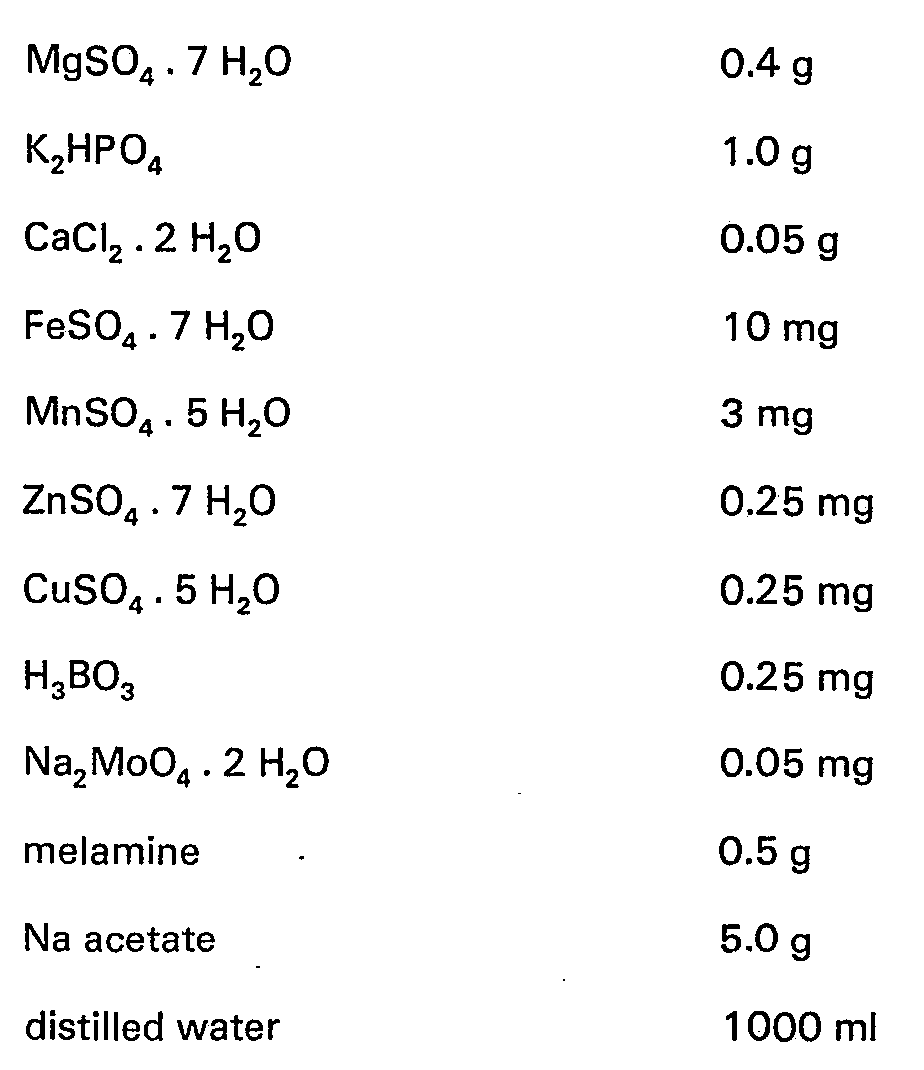
- The pH was increased to 9.0-9.2 with 2 N. NaOH. This medium was sterilized at 120°C for 15 minutes.
- This test medium was prepared in the same manner as Test Medium I, except without Na acetate.
- Various microorganisms were grafted in separate 300 ml flasks filled with 150 ml of culture medium of the above composition. To each flask 1 ml of 12.5% NH3 in water was added, resulting in a pH of 9.0. The microorganisms were then aerobically incubated at 28-30°C in a rotating shaker. After 16 hours of incubation an additional 1 ml of 12.5% NH3 in water was added. The cells were collected 40 hours after seeding by centrifuging (20 minutes at 10°C, and 10,000 revolutions per minute). The wet cell paste obtained by centrifuging was suspended in flasks containing the test media. The flasks were filled to the brim and closed with a glass stopper. The tests were carried out in a rotating shaker at 28-30°C. The results are given in Table 9.


- After the melamine degradation had been initiated (generally within 3-5 days), additional melamine in powder form could be added and thereafter degradated. For example, if an additional 1.0 grams/liter of melamine was added, the melamine content would generally drop to less than 0.2 grams/liter after about 24-28 hours.
- A double-walled glass column with a length of 1 meter and an internal diameter of 0.09 meters was filled with 6.4 liters of a suspension of melamine-degrading sludge having a solid matter content of 5 weight %. With the aid of NH40H the pH was brought to 8.5, and the temperature in the column was maintained at between 37 and 45°C during the entire test.
- Waste water from a melamine plant was continuously fed into the bottom of the column at a rate of 0.007 liters/minutes. This waste water had the following composition.

- For every liter of waste water, 2 grams of beet molasses and 0.1 ml of phosphoric acid (85%) were added.
- The remaining concentrations of the various materials in the waste water, after the biological purification in the upward flow glass column, are listed in Table 11.

- On the basis of these data a nitrogen balance was made of the various components dissolved in the waste water before and after the purification. The result is given in Table 12.

- Taking into account the measuring accuracy involved, the amounts of kjeldahl-N before and after the purification are essentially the same. This indicates that the nitrogen originating from the melamine is not assimilated by the microorganisms. From Table 12 it can also be concluded that the melamine is degraded to NH3 and CO2,
- The procedure of Example 9 was continued for a number of months, with varying compositions of waste water from the melamine plant. In Table 13 the limits of the composition of the waste water actually fed are indicated, as are the limits of the efficiency of the purification.

Claims (12)
Applications Claiming Priority (2)
| Application Number | Priority Date | Filing Date | Title |
|---|---|---|---|
| NL7803073A NL7803073A (en) | 1978-03-22 | 1978-03-22 | METHOD OF REMOVING MELAMINE FROM MELAMINE-CONTAINING LIQUIDS. |
| NL7803073 | 1978-03-22 |
Publications (2)
| Publication Number | Publication Date |
|---|---|
| EP0004397A1 EP0004397A1 (en) | 1979-10-03 |
| EP0004397B1 true EP0004397B1 (en) | 1981-09-23 |
Family
ID=19830536
Family Applications (1)
| Application Number | Title | Priority Date | Filing Date |
|---|---|---|---|
| EP19790200115 Expired EP0004397B1 (en) | 1978-03-22 | 1979-03-07 | Process for removing melamine from melamine-containing liquids |
Country Status (9)
| Country | Link |
|---|---|
| US (1) | US4247645A (en) |
| EP (1) | EP0004397B1 (en) |
| JP (1) | JPS54163892A (en) |
| BR (1) | BR7901771A (en) |
| CA (1) | CA1118378A (en) |
| DE (1) | DE2960865D1 (en) |
| ES (1) | ES478533A1 (en) |
| IN (1) | IN151102B (en) |
| NL (1) | NL7803073A (en) |
Families Citing this family (9)
| Publication number | Priority date | Publication date | Assignee | Title |
|---|---|---|---|---|
| DE3132497A1 (en) * | 1980-08-19 | 1982-05-27 | Shell Internationale Research Maatschappij B.V., 2596 's-Gravenhage | METHOD FOR FORMING A POLYSACCHARID BY MICROORGANISMS |
| US4415658A (en) * | 1980-09-10 | 1983-11-15 | Ciba-Geigy Corporation | Process for decomposing 2,4-dihydroxy-6-amino-s-triazine derivatives |
| US4663387A (en) * | 1985-04-02 | 1987-05-05 | Kuwait Institute For Scientific Research | Utilization of melamine waste effluent |
| DE3879491D1 (en) * | 1988-09-30 | 1993-04-22 | Ecolise | METHOD FOR INCREASING THE VALUE OF PIG DUMP AND DEVICE FOR IMPLEMENTING IT. |
| FR2770227B1 (en) * | 1997-10-29 | 1999-12-17 | Ortec Environnement | BIOLOGICAL COMPOSITION FOR PURIFYING AQUEOUS EFFLUENTS AND SLUDGE AND METHOD FOR IMPLEMENTING AND SEEDING THE SAME |
| KR100366569B1 (en) | 2000-05-26 | 2003-01-09 | 주식회사 엘지씨아이 | A composition of thermoplastic resin |
| WO2005084756A1 (en) | 2004-02-23 | 2005-09-15 | Geomatrix Solutions, Inc. | Process and composition for immobilization wastes in borosilicate glass |
| US7550645B2 (en) | 2004-02-23 | 2009-06-23 | Geomatrix Solutions, Inc. | Process and composition for the immobilization of radioactive and hazardous wastes in borosilicate glass |
| US8115044B2 (en) | 2006-03-20 | 2012-02-14 | Geomatrix Solutions, Inc. | Process and composition for the immobilization of high alkaline radioactive and hazardous wastes in silicate-based glasses |
Family Cites Families (7)
| Publication number | Priority date | Publication date | Assignee | Title |
|---|---|---|---|---|
| FR1094645A (en) * | 1955-05-23 | |||
| JPS4928377B1 (en) * | 1970-12-09 | 1974-07-25 | ||
| US3926795A (en) * | 1974-05-23 | 1975-12-16 | Fmc Corp | Biological treatment of plant waste streams to remove cyanuric acid |
| JPS5130162A (en) * | 1974-09-06 | 1976-03-15 | Sumitomo Shipbuild Machinery | Nitoriru oyobi shianganjuhaisuinoshoriho |
| DE2607114A1 (en) * | 1975-02-27 | 1976-09-09 | Euroc Administration Ab | PROCEDURE FOR REMOVING NITROGEN COMPOUNDS IN WATER |
| US4013757A (en) * | 1975-04-17 | 1977-03-22 | Fmc Corporation | High pressure thermal hydrolysis process to decompose triazines in acid waste streams |
| JPS52148678A (en) * | 1976-06-02 | 1977-12-10 | Agency Of Ind Science & Technol | Microbial decomposition of phthalic acid esters |
-
1978
- 1978-03-22 NL NL7803073A patent/NL7803073A/en not_active Application Discontinuation
-
1979
- 1979-03-07 EP EP19790200115 patent/EP0004397B1/en not_active Expired
- 1979-03-07 DE DE7979200115T patent/DE2960865D1/en not_active Expired
- 1979-03-12 ES ES478533A patent/ES478533A1/en not_active Expired
- 1979-03-15 CA CA000323614A patent/CA1118378A/en not_active Expired
- 1979-03-19 US US06/022,598 patent/US4247645A/en not_active Expired - Lifetime
- 1979-03-22 BR BR7901771A patent/BR7901771A/en unknown
- 1979-03-22 JP JP3379179A patent/JPS54163892A/en active Pending
- 1979-04-09 IN IN233/DEL/79A patent/IN151102B/en unknown
Also Published As
| Publication number | Publication date |
|---|---|
| ES478533A1 (en) | 1979-05-16 |
| DE2960865D1 (en) | 1981-12-10 |
| US4247645A (en) | 1981-01-27 |
| BR7901771A (en) | 1979-11-20 |
| JPS54163892A (en) | 1979-12-26 |
| EP0004397A1 (en) | 1979-10-03 |
| IN151102B (en) | 1983-02-19 |
| NL7803073A (en) | 1979-09-25 |
| CA1118378A (en) | 1982-02-16 |
Similar Documents
| Publication | Publication Date | Title |
|---|---|---|
| US4882059A (en) | Solubilization of organic materials in wastewater treatment | |
| EP0004397B1 (en) | Process for removing melamine from melamine-containing liquids | |
| US4745064A (en) | Process for the degradation of s-triazine derivatives in aqueous solutions | |
| US2447814A (en) | Synthesizing vitamins in stillage | |
| US4384044A (en) | Production of microbial polysaccharides | |
| JPS5811193B2 (en) | Method for producing bacterial cells | |
| CN115109719B (en) | Ceramic-based bacteria with flocculation and low-temperature biological denitrification functions and application thereof | |
| JPS58155085A (en) | A microorganism belonging to the genus Hypomicrobium and a method for decomposing a methyl group-containing compound in an aqueous solution using the microorganism | |
| FR2461753A1 (en) | PROCESS FOR THE PREPARATION OF A CEPHALOSPORINE BY FERMENTATION AND MICROORGANISM FOR CARRYING OUT SAID METHOD | |
| Kataoka et al. | Enrichment culture and isolation of slow-growing bacteria | |
| Vogler | The presence of an endogenous respiration in the autotrophic bacteria | |
| JPS60126083A (en) | Production of phenylalanine ammonialiase | |
| JP2998055B2 (en) | A method and apparatus for decolorizing colored wastewater containing an azo dye. | |
| JP2885643B2 (en) | Decomposition method of phenolic compound | |
| SU671738A3 (en) | Method of obtaining biomass of microorganisms | |
| RU2039714C1 (en) | Method for decontamination of water and soil surfaces from oil | |
| US4371440A (en) | Method of treating a waste water rich in protein | |
| SU1592330A1 (en) | Consortium of strains of microorganisms-destructors pseudomonas putida, bacillus subtilis u bacillus subtilis for treating waste water | |
| JPH0871587A (en) | Treatment of waste water | |
| JP2961178B2 (en) | Method for producing β-1,4-mannanase by microorganism | |
| US3326773A (en) | Method for producing l-glutamic acid from furan compounds | |
| EP0205303A2 (en) | Microbiological method of producing ethylene | |
| EP0189959A2 (en) | Process for the preparation of polysaccharide aqueous solutions | |
| EP0015552A2 (en) | Process for producing sphingomyelinase, sphingomyelinase and the use thereof | |
| JPH07107967A (en) | New microorganism |
Legal Events
| Date | Code | Title | Description |
|---|---|---|---|
| PUAI | Public reference made under article 153(3) epc to a published international application that has entered the european phase |
Free format text: ORIGINAL CODE: 0009012 |
|
| AK | Designated contracting states |
Designated state(s): BE DE FR GB IT NL SE |
|
| 17P | Request for examination filed | ||
| ITF | It: translation for a ep patent filed | ||
| GRAA | (expected) grant |
Free format text: ORIGINAL CODE: 0009210 |
|
| AK | Designated contracting states |
Designated state(s): BE DE FR GB IT NL SE |
|
| REF | Corresponds to: |
Ref document number: 2960865 Country of ref document: DE Date of ref document: 19811210 |
|
| PGFP | Annual fee paid to national office [announced via postgrant information from national office to epo] |
Ref country code: DE Payment date: 19840216 Year of fee payment: 6 |
|
| PGFP | Annual fee paid to national office [announced via postgrant information from national office to epo] |
Ref country code: FR Payment date: 19840229 Year of fee payment: 6 |
|
| PGFP | Annual fee paid to national office [announced via postgrant information from national office to epo] |
Ref country code: SE Payment date: 19840331 Year of fee payment: 6 Ref country code: BE Payment date: 19840331 Year of fee payment: 6 |
|
| PGFP | Annual fee paid to national office [announced via postgrant information from national office to epo] |
Ref country code: NL Payment date: 19870331 Year of fee payment: 9 |
|
| PG25 | Lapsed in a contracting state [announced via postgrant information from national office to epo] |
Ref country code: SE Effective date: 19880308 |
|
| BERE | Be: lapsed |
Owner name: STAMICARBON B.V. Effective date: 19880331 |
|
| PG25 | Lapsed in a contracting state [announced via postgrant information from national office to epo] |
Ref country code: NL Effective date: 19881001 |
|
| NLV4 | Nl: lapsed or anulled due to non-payment of the annual fee | ||
| PG25 | Lapsed in a contracting state [announced via postgrant information from national office to epo] |
Ref country code: GB Free format text: LAPSE BECAUSE OF NON-PAYMENT OF DUE FEES Effective date: 19881117 |
|
| GBPC | Gb: european patent ceased through non-payment of renewal fee | ||
| PG25 | Lapsed in a contracting state [announced via postgrant information from national office to epo] |
Ref country code: FR Free format text: LAPSE BECAUSE OF NON-PAYMENT OF DUE FEES Effective date: 19881130 |
|
| PG25 | Lapsed in a contracting state [announced via postgrant information from national office to epo] |
Ref country code: DE Effective date: 19881201 |
|
| REG | Reference to a national code |
Ref country code: FR Ref legal event code: ST |
|
| PG25 | Lapsed in a contracting state [announced via postgrant information from national office to epo] |
Ref country code: BE Effective date: 19890331 |
|
| EUG | Se: european patent has lapsed |
Ref document number: 79200115.8 Effective date: 19881130 |
|
| PLBE | No opposition filed within time limit |
Free format text: ORIGINAL CODE: 0009261 |
|
| STAA | Information on the status of an ep patent application or granted ep patent |
Free format text: STATUS: NO OPPOSITION FILED WITHIN TIME LIMIT |