EP0000485A1 - Piperidino-propanole, ihre Herstellung und pharmazeutische Präparate die diese enthalten - Google Patents
Piperidino-propanole, ihre Herstellung und pharmazeutische Präparate die diese enthalten Download PDFInfo
- Publication number
- EP0000485A1 EP0000485A1 EP78100308A EP78100308A EP0000485A1 EP 0000485 A1 EP0000485 A1 EP 0000485A1 EP 78100308 A EP78100308 A EP 78100308A EP 78100308 A EP78100308 A EP 78100308A EP 0000485 A1 EP0000485 A1 EP 0000485A1
- Authority
- EP
- European Patent Office
- Prior art keywords
- formula
- lower alkyl
- optionally substituted
- hydroxy
- compound
- Prior art date
- Legal status (The legal status is an assumption and is not a legal conclusion. Google has not performed a legal analysis and makes no representation as to the accuracy of the status listed.)
- Withdrawn
Links
- 150000001875 compounds Chemical class 0.000 title claims abstract description 88
- 238000002360 preparation method Methods 0.000 title claims abstract description 9
- YIJAXVWJZJYWPI-UHFFFAOYSA-N 1-piperidin-1-ylpropan-1-ol Chemical class CCC(O)N1CCCCC1 YIJAXVWJZJYWPI-UHFFFAOYSA-N 0.000 title claims abstract description 4
- 150000003839 salts Chemical class 0.000 claims abstract description 68
- 239000001257 hydrogen Substances 0.000 claims abstract description 27
- 229910052739 hydrogen Inorganic materials 0.000 claims abstract description 27
- 238000000034 method Methods 0.000 claims abstract description 21
- 125000004432 carbon atom Chemical group C* 0.000 claims abstract description 17
- 125000004433 nitrogen atom Chemical group N* 0.000 claims abstract description 17
- 125000002947 alkylene group Chemical group 0.000 claims abstract description 9
- 239000000825 pharmaceutical preparation Substances 0.000 claims abstract description 8
- 239000004215 Carbon black (E152) Substances 0.000 claims abstract description 6
- 229930195733 hydrocarbon Natural products 0.000 claims abstract description 6
- 125000001931 aliphatic group Chemical group 0.000 claims abstract description 5
- KLYCPFXDDDMZNQ-UHFFFAOYSA-N Benzyne Chemical class C1=CC#CC=C1 KLYCPFXDDDMZNQ-UHFFFAOYSA-N 0.000 claims abstract description 4
- 125000004435 hydrogen atom Chemical group [H]* 0.000 claims abstract 2
- -1 heteroaryl radical Chemical class 0.000 claims description 110
- 125000000217 alkyl group Chemical group 0.000 claims description 63
- 239000000203 mixture Substances 0.000 claims description 57
- 125000002887 hydroxy group Chemical group [H]O* 0.000 claims description 41
- 125000003545 alkoxy group Chemical group 0.000 claims description 30
- 229910052736 halogen Inorganic materials 0.000 claims description 24
- 150000002367 halogens Chemical class 0.000 claims description 23
- 150000003254 radicals Chemical class 0.000 claims description 21
- 125000001424 substituent group Chemical group 0.000 claims description 19
- UFHFLCQGNIYNRP-UHFFFAOYSA-N Hydrogen Chemical compound [H][H] UFHFLCQGNIYNRP-UHFFFAOYSA-N 0.000 claims description 15
- 150000002431 hydrogen Chemical class 0.000 claims description 14
- 125000004414 alkyl thio group Chemical group 0.000 claims description 13
- 125000000449 nitro group Chemical group [O-][N+](*)=O 0.000 claims description 10
- 229910052757 nitrogen Inorganic materials 0.000 claims description 10
- JUJWROOIHBZHMG-UHFFFAOYSA-N Pyridine Chemical group C1=CC=NC=C1 JUJWROOIHBZHMG-UHFFFAOYSA-N 0.000 claims description 9
- 125000002252 acyl group Chemical group 0.000 claims description 8
- 229910052799 carbon Inorganic materials 0.000 claims description 8
- 125000000753 cycloalkyl group Chemical group 0.000 claims description 8
- 125000001997 phenyl group Chemical group [H]C1=C([H])C([H])=C(*)C([H])=C1[H] 0.000 claims description 8
- VGGSQFUCUMXWEO-UHFFFAOYSA-N Ethene Chemical compound C=C VGGSQFUCUMXWEO-UHFFFAOYSA-N 0.000 claims description 7
- 239000005977 Ethylene Substances 0.000 claims description 7
- 125000004307 pyrazin-2-yl group Chemical group [H]C1=C([H])N=C(*)C([H])=N1 0.000 claims description 7
- 125000004076 pyridyl group Chemical group 0.000 claims description 7
- 125000004429 atom Chemical group 0.000 claims description 6
- 125000004453 alkoxycarbonyl group Chemical group 0.000 claims description 5
- BVKZGUZCCUSVTD-UHFFFAOYSA-N carbonic acid Chemical compound OC(O)=O BVKZGUZCCUSVTD-UHFFFAOYSA-N 0.000 claims description 5
- 150000001450 anions Chemical class 0.000 claims description 4
- 125000003700 epoxy group Chemical group 0.000 claims description 4
- 238000006798 ring closing metathesis reaction Methods 0.000 claims description 4
- 125000001041 indolyl group Chemical group 0.000 claims description 3
- 125000002950 monocyclic group Chemical group 0.000 claims description 3
- SYSQUGFVNFXIIT-UHFFFAOYSA-N n-[4-(1,3-benzoxazol-2-yl)phenyl]-4-nitrobenzenesulfonamide Chemical class C1=CC([N+](=O)[O-])=CC=C1S(=O)(=O)NC1=CC=C(C=2OC3=CC=CC=C3N=2)C=C1 SYSQUGFVNFXIIT-UHFFFAOYSA-N 0.000 claims description 3
- 125000001841 imino group Chemical group [H]N=* 0.000 claims description 2
- 238000004519 manufacturing process Methods 0.000 claims description 2
- 125000003386 piperidinyl group Chemical group 0.000 claims description 2
- PXQLVRUNWNTZOS-UHFFFAOYSA-N sulfanyl Chemical class [SH] PXQLVRUNWNTZOS-UHFFFAOYSA-N 0.000 claims 2
- SFAWYLKZUVZFHR-UHFFFAOYSA-N 1-[1-[2-hydroxy-3-(3-methoxypyrazin-2-yl)oxypropyl]piperidin-4-yl]imidazolidin-2-one Chemical compound COC1=NC=CN=C1OCC(O)CN1CCC(N2C(NCC2)=O)CC1 SFAWYLKZUVZFHR-UHFFFAOYSA-N 0.000 claims 1
- BYWKOKAJRHXRDW-UHFFFAOYSA-N 1-[1-[2-hydroxy-3-[(2-methyl-1h-indol-4-yl)oxy]propyl]piperidin-4-yl]-3-methylimidazolidin-2-one Chemical compound O=C1N(C)CCN1C1CCN(CC(O)COC=2C=3C=C(C)NC=3C=CC=2)CC1 BYWKOKAJRHXRDW-UHFFFAOYSA-N 0.000 claims 1
- 239000003814 drug Substances 0.000 claims 1
- 229940030600 antihypertensive agent Drugs 0.000 abstract description 2
- 239000002220 antihypertensive agent Substances 0.000 abstract description 2
- 150000003053 piperidines Chemical class 0.000 abstract description 2
- 229940127557 pharmaceutical product Drugs 0.000 abstract 2
- 230000002606 alphasympathicolytic effect Effects 0.000 abstract 1
- XEKOWRVHYACXOJ-UHFFFAOYSA-N Ethyl acetate Chemical compound CCOC(C)=O XEKOWRVHYACXOJ-UHFFFAOYSA-N 0.000 description 69
- YXFVVABEGXRONW-UHFFFAOYSA-N Toluene Chemical compound CC1=CC=CC=C1 YXFVVABEGXRONW-UHFFFAOYSA-N 0.000 description 61
- KFZMGEQAYNKOFK-UHFFFAOYSA-N Isopropanol Chemical compound CC(C)O KFZMGEQAYNKOFK-UHFFFAOYSA-N 0.000 description 51
- RTZKZFJDLAIYFH-UHFFFAOYSA-N Diethyl ether Chemical compound CCOCC RTZKZFJDLAIYFH-UHFFFAOYSA-N 0.000 description 50
- OKKJLVBELUTLKV-UHFFFAOYSA-N Methanol Chemical compound OC OKKJLVBELUTLKV-UHFFFAOYSA-N 0.000 description 47
- HEMHJVSKTPXQMS-UHFFFAOYSA-M sodium hydroxide Inorganic materials [OH-].[Na+] HEMHJVSKTPXQMS-UHFFFAOYSA-M 0.000 description 47
- 239000000243 solution Substances 0.000 description 44
- XLYOFNOQVPJJNP-UHFFFAOYSA-N water Substances O XLYOFNOQVPJJNP-UHFFFAOYSA-N 0.000 description 34
- LFQSCWFLJHTTHZ-UHFFFAOYSA-N Ethanol Chemical compound CCO LFQSCWFLJHTTHZ-UHFFFAOYSA-N 0.000 description 31
- YMWUJEATGCHHMB-UHFFFAOYSA-N Dichloromethane Chemical compound ClCCl YMWUJEATGCHHMB-UHFFFAOYSA-N 0.000 description 30
- 239000007858 starting material Substances 0.000 description 30
- 239000002253 acid Substances 0.000 description 28
- ZMXDDKWLCZADIW-UHFFFAOYSA-N N,N-Dimethylformamide Chemical compound CN(C)C=O ZMXDDKWLCZADIW-UHFFFAOYSA-N 0.000 description 26
- VEXZGXHMUGYJMC-UHFFFAOYSA-N Hydrochloric acid Chemical compound Cl VEXZGXHMUGYJMC-UHFFFAOYSA-N 0.000 description 24
- WEVYAHXRMPXWCK-UHFFFAOYSA-N Acetonitrile Chemical compound CC#N WEVYAHXRMPXWCK-UHFFFAOYSA-N 0.000 description 20
- YMQKNCXIAQYUQU-UHFFFAOYSA-N 1-piperidin-4-ylimidazolidin-2-one Chemical compound O=C1NCCN1C1CCNCC1 YMQKNCXIAQYUQU-UHFFFAOYSA-N 0.000 description 16
- 238000006243 chemical reaction Methods 0.000 description 15
- HEDRZPFGACZZDS-UHFFFAOYSA-N Chloroform Chemical compound ClC(Cl)Cl HEDRZPFGACZZDS-UHFFFAOYSA-N 0.000 description 14
- 235000019441 ethanol Nutrition 0.000 description 14
- CSCPPACGZOOCGX-UHFFFAOYSA-N Acetone Chemical compound CC(C)=O CSCPPACGZOOCGX-UHFFFAOYSA-N 0.000 description 13
- VYPSYNLAJGMNEJ-UHFFFAOYSA-N Silicium dioxide Chemical compound O=[Si]=O VYPSYNLAJGMNEJ-UHFFFAOYSA-N 0.000 description 13
- 239000003054 catalyst Substances 0.000 description 13
- 230000002829 reductive effect Effects 0.000 description 13
- 239000003795 chemical substances by application Substances 0.000 description 12
- 239000003921 oil Substances 0.000 description 12
- 238000010992 reflux Methods 0.000 description 12
- 239000000706 filtrate Substances 0.000 description 11
- 125000002496 methyl group Chemical group [H]C([H])([H])* 0.000 description 11
- ZAMOUSCENKQFHK-UHFFFAOYSA-N Chlorine atom Chemical compound [Cl] ZAMOUSCENKQFHK-UHFFFAOYSA-N 0.000 description 10
- PMZURENOXWZQFD-UHFFFAOYSA-L Sodium Sulfate Chemical compound [Na+].[Na+].[O-]S([O-])(=O)=O PMZURENOXWZQFD-UHFFFAOYSA-L 0.000 description 10
- 239000000460 chlorine Substances 0.000 description 10
- 229910052801 chlorine Inorganic materials 0.000 description 10
- BWHMMNNQKKPAPP-UHFFFAOYSA-L potassium carbonate Chemical compound [K+].[K+].[O-]C([O-])=O BWHMMNNQKKPAPP-UHFFFAOYSA-L 0.000 description 10
- 125000002924 primary amino group Chemical group [H]N([H])* 0.000 description 10
- 239000002904 solvent Substances 0.000 description 10
- JGFZNNIVVJXRND-UHFFFAOYSA-N N,N-Diisopropylethylamine (DIPEA) Chemical compound CCN(C(C)C)C(C)C JGFZNNIVVJXRND-UHFFFAOYSA-N 0.000 description 9
- ZMANZCXQSJIPKH-UHFFFAOYSA-N Triethylamine Chemical compound CCN(CC)CC ZMANZCXQSJIPKH-UHFFFAOYSA-N 0.000 description 9
- 150000001340 alkali metals Chemical class 0.000 description 9
- 238000001816 cooling Methods 0.000 description 9
- 238000001704 evaporation Methods 0.000 description 9
- 239000012071 phase Substances 0.000 description 9
- QAOWNCQODCNURD-UHFFFAOYSA-N sulfuric acid group Chemical class S(O)(O)(=O)=O QAOWNCQODCNURD-UHFFFAOYSA-N 0.000 description 9
- 239000000725 suspension Substances 0.000 description 9
- 125000003396 thiol group Chemical class [H]S* 0.000 description 9
- WKBOTKDWSSQWDR-UHFFFAOYSA-N Bromine atom Chemical compound [Br] WKBOTKDWSSQWDR-UHFFFAOYSA-N 0.000 description 8
- 241001465754 Metazoa Species 0.000 description 8
- 229910052783 alkali metal Inorganic materials 0.000 description 8
- GDTBXPJZTBHREO-UHFFFAOYSA-N bromine Substances BrBr GDTBXPJZTBHREO-UHFFFAOYSA-N 0.000 description 8
- 229910052794 bromium Inorganic materials 0.000 description 8
- 239000013078 crystal Substances 0.000 description 8
- 239000011541 reaction mixture Substances 0.000 description 8
- VZCYOOQTPOCHFL-OWOJBTEDSA-N Fumaric acid Chemical compound OC(=O)\C=C\C(O)=O VZCYOOQTPOCHFL-OWOJBTEDSA-N 0.000 description 7
- KDLHZDBZIXYQEI-UHFFFAOYSA-N Palladium Chemical compound [Pd] KDLHZDBZIXYQEI-UHFFFAOYSA-N 0.000 description 7
- FLMRUBYTEPLEJH-UHFFFAOYSA-N benzyl 4-(2-oxoimidazolidin-1-yl)piperidine-1-carboxylate Chemical compound C1CC(N2C(NCC2)=O)CCN1C(=O)OCC1=CC=CC=C1 FLMRUBYTEPLEJH-UHFFFAOYSA-N 0.000 description 7
- 239000007795 chemical reaction product Substances 0.000 description 7
- 150000002148 esters Chemical class 0.000 description 7
- 238000010438 heat treatment Methods 0.000 description 7
- 239000000155 melt Substances 0.000 description 7
- 239000012074 organic phase Substances 0.000 description 7
- 238000001953 recrystallisation Methods 0.000 description 7
- 229910052938 sodium sulfate Inorganic materials 0.000 description 7
- 235000011152 sodium sulphate Nutrition 0.000 description 7
- DGAQECJNVWCQMB-PUAWFVPOSA-M Ilexoside XXIX Chemical compound C[C@@H]1CC[C@@]2(CC[C@@]3(C(=CC[C@H]4[C@]3(CC[C@@H]5[C@@]4(CC[C@@H](C5(C)C)OS(=O)(=O)[O-])C)C)[C@@H]2[C@]1(C)O)C)C(=O)O[C@H]6[C@@H]([C@H]([C@@H]([C@H](O6)CO)O)O)O.[Na+] DGAQECJNVWCQMB-PUAWFVPOSA-M 0.000 description 6
- 229920002472 Starch Polymers 0.000 description 6
- 239000003085 diluting agent Substances 0.000 description 6
- 238000010828 elution Methods 0.000 description 6
- 230000008020 evaporation Effects 0.000 description 6
- 239000000741 silica gel Substances 0.000 description 6
- 229910002027 silica gel Inorganic materials 0.000 description 6
- DWFGEKHJKFNGNW-UHFFFAOYSA-N 1-methyl-3-piperidin-4-ylimidazolidin-2-one Chemical compound O=C1N(C)CCN1C1CCNCC1 DWFGEKHJKFNGNW-UHFFFAOYSA-N 0.000 description 5
- OKTJSMMVPCPJKN-UHFFFAOYSA-N Carbon Chemical compound [C] OKTJSMMVPCPJKN-UHFFFAOYSA-N 0.000 description 5
- BRLQWZUYTZBJKN-UHFFFAOYSA-N Epichlorohydrin Chemical compound ClCC1CO1 BRLQWZUYTZBJKN-UHFFFAOYSA-N 0.000 description 5
- 239000002585 base Substances 0.000 description 5
- 125000001797 benzyl group Chemical group [H]C1=C([H])C([H])=C(C([H])=C1[H])C([H])([H])* 0.000 description 5
- 239000003610 charcoal Substances 0.000 description 5
- 239000003638 chemical reducing agent Substances 0.000 description 5
- WORJEOGGNQDSOE-UHFFFAOYSA-N chloroform;methanol Chemical compound OC.ClC(Cl)Cl WORJEOGGNQDSOE-UHFFFAOYSA-N 0.000 description 5
- 239000000284 extract Substances 0.000 description 5
- 239000011261 inert gas Substances 0.000 description 5
- 125000000956 methoxy group Chemical group [H]C([H])([H])O* 0.000 description 5
- 231100000252 nontoxic Toxicity 0.000 description 5
- 230000003000 nontoxic effect Effects 0.000 description 5
- VZCYOOQTPOCHFL-UHFFFAOYSA-N trans-butenedioic acid Natural products OC(=O)C=CC(O)=O VZCYOOQTPOCHFL-UHFFFAOYSA-N 0.000 description 5
- FHEDKDIMWQLVPE-UHFFFAOYSA-N 2-methyl-4-(oxiran-2-ylmethyl)-1h-indole Chemical compound C1=CC=C2NC(C)=CC2=C1CC1CO1 FHEDKDIMWQLVPE-UHFFFAOYSA-N 0.000 description 4
- 125000004105 2-pyridyl group Chemical group N1=C([*])C([H])=C([H])C([H])=C1[H] 0.000 description 4
- 125000003349 3-pyridyl group Chemical group N1=C([H])C([*])=C([H])C([H])=C1[H] 0.000 description 4
- KEAYESYHFKHZAL-UHFFFAOYSA-N Sodium Chemical compound [Na] KEAYESYHFKHZAL-UHFFFAOYSA-N 0.000 description 4
- WQDUMFSSJAZKTM-UHFFFAOYSA-N Sodium methoxide Chemical compound [Na+].[O-]C WQDUMFSSJAZKTM-UHFFFAOYSA-N 0.000 description 4
- 230000002378 acidificating effect Effects 0.000 description 4
- 239000013543 active substance Substances 0.000 description 4
- 125000004423 acyloxy group Chemical group 0.000 description 4
- 150000001338 aliphatic hydrocarbons Chemical class 0.000 description 4
- 125000005236 alkanoylamino group Chemical group 0.000 description 4
- 125000003282 alkyl amino group Chemical group 0.000 description 4
- 239000012298 atmosphere Substances 0.000 description 4
- 125000003917 carbamoyl group Chemical group [H]N([H])C(*)=O 0.000 description 4
- 125000001951 carbamoylamino group Chemical group C(N)(=O)N* 0.000 description 4
- 125000001589 carboacyl group Chemical group 0.000 description 4
- 150000001721 carbon Chemical group 0.000 description 4
- 150000004649 carbonic acid derivatives Chemical class 0.000 description 4
- GKIPXFAANLTWBM-UHFFFAOYSA-N epibromohydrin Chemical compound BrCC1CO1 GKIPXFAANLTWBM-UHFFFAOYSA-N 0.000 description 4
- 125000004705 ethylthio group Chemical group C(C)S* 0.000 description 4
- 125000001449 isopropyl group Chemical group [H]C([H])([H])C([H])(*)C([H])([H])[H] 0.000 description 4
- UKVIEHSSVKSQBA-UHFFFAOYSA-N methane;palladium Chemical compound C.[Pd] UKVIEHSSVKSQBA-UHFFFAOYSA-N 0.000 description 4
- 125000002816 methylsulfanyl group Chemical group [H]C([H])([H])S[*] 0.000 description 4
- BASFCYQUMIYNBI-UHFFFAOYSA-N platinum Chemical compound [Pt] BASFCYQUMIYNBI-UHFFFAOYSA-N 0.000 description 4
- 229910000027 potassium carbonate Inorganic materials 0.000 description 4
- 235000011181 potassium carbonates Nutrition 0.000 description 4
- 238000000746 purification Methods 0.000 description 4
- UMJSCPRVCHMLSP-UHFFFAOYSA-N pyridine Natural products COC1=CC=CN=C1 UMJSCPRVCHMLSP-UHFFFAOYSA-N 0.000 description 4
- 229910052708 sodium Inorganic materials 0.000 description 4
- 239000011734 sodium Substances 0.000 description 4
- 239000012312 sodium hydride Substances 0.000 description 4
- 229910000104 sodium hydride Inorganic materials 0.000 description 4
- 235000019698 starch Nutrition 0.000 description 4
- 238000003756 stirring Methods 0.000 description 4
- PCMDJOFTSNILSE-UHFFFAOYSA-N 1-[1-[2-hydroxy-3-(2-phenylmethoxypyridin-3-yl)oxypropyl]piperidin-4-yl]imidazolidin-2-one Chemical compound C1CC(N2C(NCC2)=O)CCN1CC(O)COC1=CC=CN=C1OCC1=CC=CC=C1 PCMDJOFTSNILSE-UHFFFAOYSA-N 0.000 description 3
- WGVLUFYBLKABCB-UHFFFAOYSA-N 1-[1-[2-hydroxy-3-[(2-methyl-1h-indol-4-yl)oxy]propyl]piperidin-4-yl]imidazolidin-2-one Chemical compound C1=CC=C2NC(C)=CC2=C1OCC(O)CN(CC1)CCC1N1CCNC1=O WGVLUFYBLKABCB-UHFFFAOYSA-N 0.000 description 3
- 125000004343 1-phenylethyl group Chemical group [H]C1=C([H])C([H])=C(C([H])=C1[H])C([H])(*)C([H])([H])[H] 0.000 description 3
- ZWEHNKRNPOVVGH-UHFFFAOYSA-N 2-Butanone Chemical compound CCC(C)=O ZWEHNKRNPOVVGH-UHFFFAOYSA-N 0.000 description 3
- QWGDBFAEHKZSGA-UHFFFAOYSA-N 2-phenyl-1h-indol-4-ol Chemical compound C=1C=2C(O)=CC=CC=2NC=1C1=CC=CC=C1 QWGDBFAEHKZSGA-UHFFFAOYSA-N 0.000 description 3
- 125000000094 2-phenylethyl group Chemical group [H]C1=C([H])C([H])=C(C([H])=C1[H])C([H])([H])C([H])([H])* 0.000 description 3
- QOMNQIZYXWKCPO-UHFFFAOYSA-N 3-(3-methoxypyridin-2-yl)oxypropane-1,2-diol Chemical compound COC1=CC=CN=C1OCC(O)CO QOMNQIZYXWKCPO-UHFFFAOYSA-N 0.000 description 3
- BMYNFMYTOJXKLE-UHFFFAOYSA-N 3-azaniumyl-2-hydroxypropanoate Chemical compound NCC(O)C(O)=O BMYNFMYTOJXKLE-UHFFFAOYSA-N 0.000 description 3
- XERSDPPPSWPNPQ-UHFFFAOYSA-N 4-(oxiran-2-ylmethyl)-2-phenyl-1h-indole Chemical compound C=1C=CC=2NC(C=3C=CC=CC=3)=CC=2C=1CC1CO1 XERSDPPPSWPNPQ-UHFFFAOYSA-N 0.000 description 3
- QGZKDVFQNNGYKY-UHFFFAOYSA-N Ammonia Chemical compound N QGZKDVFQNNGYKY-UHFFFAOYSA-N 0.000 description 3
- NLXLAEXVIDQMFP-UHFFFAOYSA-N Ammonium chloride Substances [NH4+].[Cl-] NLXLAEXVIDQMFP-UHFFFAOYSA-N 0.000 description 3
- VHUUQVKOLVNVRT-UHFFFAOYSA-N Ammonium hydroxide Chemical compound [NH4+].[OH-] VHUUQVKOLVNVRT-UHFFFAOYSA-N 0.000 description 3
- IJGRMHOSHXDMSA-UHFFFAOYSA-N Atomic nitrogen Chemical compound N#N IJGRMHOSHXDMSA-UHFFFAOYSA-N 0.000 description 3
- BVKZGUZCCUSVTD-UHFFFAOYSA-M Bicarbonate Chemical compound OC([O-])=O BVKZGUZCCUSVTD-UHFFFAOYSA-M 0.000 description 3
- LSNNMFCWUKXFEE-UHFFFAOYSA-M Bisulfite Chemical compound OS([O-])=O LSNNMFCWUKXFEE-UHFFFAOYSA-M 0.000 description 3
- VEXZGXHMUGYJMC-UHFFFAOYSA-M Chloride anion Chemical compound [Cl-] VEXZGXHMUGYJMC-UHFFFAOYSA-M 0.000 description 3
- YGYAWVDWMABLBF-UHFFFAOYSA-N Phosgene Chemical compound ClC(Cl)=O YGYAWVDWMABLBF-UHFFFAOYSA-N 0.000 description 3
- KWYUFKZDYYNOTN-UHFFFAOYSA-M Potassium hydroxide Chemical compound [OH-].[K+] KWYUFKZDYYNOTN-UHFFFAOYSA-M 0.000 description 3
- 125000003342 alkenyl group Chemical group 0.000 description 3
- 125000003302 alkenyloxy group Chemical group 0.000 description 3
- 125000004466 alkoxycarbonylamino group Chemical group 0.000 description 3
- 125000005133 alkynyloxy group Chemical group 0.000 description 3
- 235000011114 ammonium hydroxide Nutrition 0.000 description 3
- 239000008346 aqueous phase Substances 0.000 description 3
- 125000003118 aryl group Chemical group 0.000 description 3
- 125000000051 benzyloxy group Chemical group [H]C1=C([H])C([H])=C(C([H])=C1[H])C([H])([H])O* 0.000 description 3
- 150000001732 carboxylic acid derivatives Chemical class 0.000 description 3
- 125000000392 cycloalkenyl group Chemical group 0.000 description 3
- 125000001495 ethyl group Chemical group [H]C([H])([H])C([H])([H])* 0.000 description 3
- 238000001914 filtration Methods 0.000 description 3
- 239000005457 ice water Substances 0.000 description 3
- 229910052500 inorganic mineral Inorganic materials 0.000 description 3
- HQKMJHAJHXVSDF-UHFFFAOYSA-L magnesium stearate Substances [Mg+2].CCCCCCCCCCCCCCCCCC([O-])=O.CCCCCCCCCCCCCCCCCC([O-])=O HQKMJHAJHXVSDF-UHFFFAOYSA-L 0.000 description 3
- 235000010755 mineral Nutrition 0.000 description 3
- 239000011707 mineral Substances 0.000 description 3
- 150000007522 mineralic acids Chemical class 0.000 description 3
- 230000007935 neutral effect Effects 0.000 description 3
- 150000007524 organic acids Chemical class 0.000 description 3
- AHWALFGBDFAJAI-UHFFFAOYSA-N phenyl carbonochloridate Chemical compound ClC(=O)OC1=CC=CC=C1 AHWALFGBDFAJAI-UHFFFAOYSA-N 0.000 description 3
- 239000002244 precipitate Substances 0.000 description 3
- 239000003039 volatile agent Substances 0.000 description 3
- UVZSXKGAQYPYRG-UHFFFAOYSA-N 1-(1-benzylpiperidin-4-yl)-3-methylimidazolidin-2-one Chemical compound O=C1N(C)CCN1C1CCN(CC=2C=CC=CC=2)CC1 UVZSXKGAQYPYRG-UHFFFAOYSA-N 0.000 description 2
- AMARHVBYLCMGHE-UHFFFAOYSA-N 1-(2-hydroxyethyl)-3-piperidin-4-ylimidazolidin-2-one Chemical compound O=C1N(CCO)CCN1C1CCNCC1 AMARHVBYLCMGHE-UHFFFAOYSA-N 0.000 description 2
- BQMKUEQCCLCYJL-UHFFFAOYSA-N 1-[1-[3-(3-chloropyrazin-2-yl)oxy-2-hydroxypropyl]piperidin-4-yl]imidazolidin-2-one Chemical compound C1CC(N2C(NCC2)=O)CCN1CC(O)COC1=NC=CN=C1Cl BQMKUEQCCLCYJL-UHFFFAOYSA-N 0.000 description 2
- FWZHNSONNALZMJ-UHFFFAOYSA-N 1-benzyl-3-(1-benzylpiperidin-4-yl)imidazolidin-2-one Chemical compound C1CN(C2CCN(CC=3C=CC=CC=3)CC2)C(=O)N1CC1=CC=CC=C1 FWZHNSONNALZMJ-UHFFFAOYSA-N 0.000 description 2
- BJRBCTOJFSIBEA-UHFFFAOYSA-N 1-benzyl-3-piperidin-4-ylimidazolidin-2-one Chemical compound C1CN(C2CCNCC2)C(=O)N1CC1=CC=CC=C1 BJRBCTOJFSIBEA-UHFFFAOYSA-N 0.000 description 2
- MLEGMEBCXGDFQT-UHFFFAOYSA-N 1-benzylpiperidin-2-one Chemical compound O=C1CCCCN1CC1=CC=CC=C1 MLEGMEBCXGDFQT-UHFFFAOYSA-N 0.000 description 2
- QZBOHWNPLMNZJM-UHFFFAOYSA-N 1-butyl-3-piperidin-4-ylimidazolidin-2-one Chemical compound O=C1N(CCCC)CCN1C1CCNCC1 QZBOHWNPLMNZJM-UHFFFAOYSA-N 0.000 description 2
- OZNCDCJUXSKQAK-UHFFFAOYSA-N 1-chloro-3-(2-chloropyridin-3-yl)oxypropan-2-ol Chemical compound ClCC(O)COC1=CC=CN=C1Cl OZNCDCJUXSKQAK-UHFFFAOYSA-N 0.000 description 2
- RSOPTYAZDFSMTN-UHFFFAOYSA-N 2-chloropyridin-3-ol Chemical compound OC1=CC=CN=C1Cl RSOPTYAZDFSMTN-UHFFFAOYSA-N 0.000 description 2
- RDBZAWZPZSBYDA-UHFFFAOYSA-N 2-methoxypyridin-3-ol Chemical compound COC1=NC=CC=C1O RDBZAWZPZSBYDA-UHFFFAOYSA-N 0.000 description 2
- LSXHCFSGOBFNDX-UHFFFAOYSA-N 3-methoxy-2-nitropyridine Chemical compound COC1=CC=CN=C1[N+]([O-])=O LSXHCFSGOBFNDX-UHFFFAOYSA-N 0.000 description 2
- CXFFQOZYXJHZNJ-UHFFFAOYSA-N 3-phenylpropane-1,2-diamine Chemical compound NCC(N)CC1=CC=CC=C1 CXFFQOZYXJHZNJ-UHFFFAOYSA-N 0.000 description 2
- HVBSAKJJOYLTQU-UHFFFAOYSA-N 4-aminobenzenesulfonic acid Chemical compound NC1=CC=C(S(O)(=O)=O)C=C1 HVBSAKJJOYLTQU-UHFFFAOYSA-N 0.000 description 2
- VRJHQPZVIGNGMX-UHFFFAOYSA-N 4-piperidinone Chemical compound O=C1CCNCC1 VRJHQPZVIGNGMX-UHFFFAOYSA-N 0.000 description 2
- 125000000339 4-pyridyl group Chemical group N1=C([H])C([H])=C([*])C([H])=C1[H] 0.000 description 2
- BVKZGUZCCUSVTD-UHFFFAOYSA-L Carbonate Chemical compound [O-]C([O-])=O BVKZGUZCCUSVTD-UHFFFAOYSA-L 0.000 description 2
- FBPFZTCFMRRESA-KVTDHHQDSA-N D-Mannitol Chemical compound OC[C@@H](O)[C@@H](O)[C@H](O)[C@H](O)CO FBPFZTCFMRRESA-KVTDHHQDSA-N 0.000 description 2
- XTHFKEDIFFGKHM-UHFFFAOYSA-N Dimethoxyethane Chemical compound COCCOC XTHFKEDIFFGKHM-UHFFFAOYSA-N 0.000 description 2
- LYCAIKOWRPUZTN-UHFFFAOYSA-N Ethylene glycol Chemical compound OCCO LYCAIKOWRPUZTN-UHFFFAOYSA-N 0.000 description 2
- DHMQDGOQFOQNFH-UHFFFAOYSA-N Glycine Chemical compound NCC(O)=O DHMQDGOQFOQNFH-UHFFFAOYSA-N 0.000 description 2
- 238000012404 In vitro experiment Methods 0.000 description 2
- GUBGYTABKSRVRQ-QKKXKWKRSA-N Lactose Natural products OC[C@H]1O[C@@H](O[C@H]2[C@H](O)[C@@H](O)C(O)O[C@@H]2CO)[C@H](O)[C@@H](O)[C@H]1O GUBGYTABKSRVRQ-QKKXKWKRSA-N 0.000 description 2
- 229930195725 Mannitol Natural products 0.000 description 2
- LSDPWZHWYPCBBB-UHFFFAOYSA-N Methanethiol Chemical compound SC LSDPWZHWYPCBBB-UHFFFAOYSA-N 0.000 description 2
- LRHPLDYGYMQRHN-UHFFFAOYSA-N N-Butanol Chemical compound CCCCO LRHPLDYGYMQRHN-UHFFFAOYSA-N 0.000 description 2
- ZLMJMSJWJFRBEC-UHFFFAOYSA-N Potassium Chemical compound [K] ZLMJMSJWJFRBEC-UHFFFAOYSA-N 0.000 description 2
- FAPWRFPIFSIZLT-UHFFFAOYSA-M Sodium chloride Chemical compound [Na+].[Cl-] FAPWRFPIFSIZLT-UHFFFAOYSA-M 0.000 description 2
- FEWJPZIEWOKRBE-UHFFFAOYSA-N Tartaric acid Natural products [H+].[H+].[O-]C(=O)C(O)C(O)C([O-])=O FEWJPZIEWOKRBE-UHFFFAOYSA-N 0.000 description 2
- WYURNTSHIVDZCO-UHFFFAOYSA-N Tetrahydrofuran Chemical compound C1CCOC1 WYURNTSHIVDZCO-UHFFFAOYSA-N 0.000 description 2
- DTQVDTLACAAQTR-UHFFFAOYSA-N Trifluoroacetic acid Chemical compound OC(=O)C(F)(F)F DTQVDTLACAAQTR-UHFFFAOYSA-N 0.000 description 2
- XSQUKJJJFZCRTK-UHFFFAOYSA-N Urea Chemical compound NC(N)=O XSQUKJJJFZCRTK-UHFFFAOYSA-N 0.000 description 2
- 238000006993 Weiss annulation reaction Methods 0.000 description 2
- HMBQDVOYIFNHFV-UHFFFAOYSA-N [1-chloro-3-(3-methoxypyridin-2-yl)oxypropan-2-yl] acetate Chemical compound COC1=CC=CN=C1OCC(CCl)OC(C)=O HMBQDVOYIFNHFV-UHFFFAOYSA-N 0.000 description 2
- 125000002777 acetyl group Chemical group [H]C([H])([H])C(*)=O 0.000 description 2
- 150000007513 acids Chemical class 0.000 description 2
- 229910000272 alkali metal oxide Inorganic materials 0.000 description 2
- 229910001860 alkaline earth metal hydroxide Inorganic materials 0.000 description 2
- 125000005910 alkyl carbonate group Chemical group 0.000 description 2
- 125000005237 alkyleneamino group Chemical group 0.000 description 2
- 125000000304 alkynyl group Chemical group 0.000 description 2
- 150000001408 amides Chemical class 0.000 description 2
- 150000008064 anhydrides Chemical class 0.000 description 2
- JGIPTIJYWZPMMM-UHFFFAOYSA-N benzyl 4-(3-butyl-2-oxoimidazolidin-1-yl)piperidine-1-carboxylate Chemical compound O=C1N(CCCC)CCN1C1CCN(C(=O)OCC=2C=CC=CC=2)CC1 JGIPTIJYWZPMMM-UHFFFAOYSA-N 0.000 description 2
- WGQKYBSKWIADBV-UHFFFAOYSA-N benzylamine Chemical compound NCC1=CC=CC=C1 WGQKYBSKWIADBV-UHFFFAOYSA-N 0.000 description 2
- 125000002619 bicyclic group Chemical group 0.000 description 2
- 239000011230 binding agent Substances 0.000 description 2
- 238000009835 boiling Methods 0.000 description 2
- 125000003178 carboxy group Chemical group [H]OC(*)=O 0.000 description 2
- 239000002026 chloroform extract Substances 0.000 description 2
- IJOOHPMOJXWVHK-UHFFFAOYSA-N chlorotrimethylsilane Chemical compound C[Si](C)(C)Cl IJOOHPMOJXWVHK-UHFFFAOYSA-N 0.000 description 2
- 238000002425 crystallisation Methods 0.000 description 2
- 230000008025 crystallization Effects 0.000 description 2
- 125000001511 cyclopentyl group Chemical group [H]C1([H])C([H])([H])C([H])([H])C([H])(*)C1([H])[H] 0.000 description 2
- 150000004985 diamines Chemical class 0.000 description 2
- USIUVYZYUHIAEV-UHFFFAOYSA-N diphenyl ether Chemical compound C=1C=CC=CC=1OC1=CC=CC=C1 USIUVYZYUHIAEV-UHFFFAOYSA-N 0.000 description 2
- 125000003754 ethoxycarbonyl group Chemical group C(=O)(OCC)* 0.000 description 2
- 238000002474 experimental method Methods 0.000 description 2
- 239000001530 fumaric acid Substances 0.000 description 2
- 229910001385 heavy metal Inorganic materials 0.000 description 2
- 150000004678 hydrides Chemical class 0.000 description 2
- 230000007062 hydrolysis Effects 0.000 description 2
- 238000006460 hydrolysis reaction Methods 0.000 description 2
- SHFJWMWCIHQNCP-UHFFFAOYSA-M hydron;tetrabutylazanium;sulfate Chemical compound OS([O-])(=O)=O.CCCC[N+](CCCC)(CCCC)CCCC SHFJWMWCIHQNCP-UHFFFAOYSA-M 0.000 description 2
- 239000013067 intermediate product Substances 0.000 description 2
- PNDPGZBMCMUPRI-UHFFFAOYSA-N iodine Chemical compound II PNDPGZBMCMUPRI-UHFFFAOYSA-N 0.000 description 2
- 239000008101 lactose Substances 0.000 description 2
- 235000019359 magnesium stearate Nutrition 0.000 description 2
- 239000000594 mannitol Substances 0.000 description 2
- 235000010355 mannitol Nutrition 0.000 description 2
- 238000002844 melting Methods 0.000 description 2
- 230000008018 melting Effects 0.000 description 2
- BQPIGGFYSBELGY-UHFFFAOYSA-N mercury(2+) Chemical class [Hg+2] BQPIGGFYSBELGY-UHFFFAOYSA-N 0.000 description 2
- 125000001160 methoxycarbonyl group Chemical group [H]C([H])([H])OC(*)=O 0.000 description 2
- 230000003287 optical effect Effects 0.000 description 2
- 229910052763 palladium Inorganic materials 0.000 description 2
- 239000003208 petroleum Substances 0.000 description 2
- 229910052700 potassium Inorganic materials 0.000 description 2
- 239000011591 potassium Substances 0.000 description 2
- 229960003975 potassium Drugs 0.000 description 2
- 125000001501 propionyl group Chemical group O=C([*])C([H])([H])C([H])([H])[H] 0.000 description 2
- 125000002572 propoxy group Chemical group [*]OC([H])([H])C(C([H])([H])[H])([H])[H] 0.000 description 2
- 125000003373 pyrazinyl group Chemical group 0.000 description 2
- 125000000246 pyrimidin-2-yl group Chemical group [H]C1=NC(*)=NC([H])=C1[H] 0.000 description 2
- 125000004527 pyrimidin-4-yl group Chemical group N1=CN=C(C=C1)* 0.000 description 2
- 125000000714 pyrimidinyl group Chemical group 0.000 description 2
- 238000006722 reduction reaction Methods 0.000 description 2
- 239000011347 resin Substances 0.000 description 2
- 229920005989 resin Polymers 0.000 description 2
- 235000015424 sodium Nutrition 0.000 description 2
- BEOOHQFXGBMRKU-UHFFFAOYSA-N sodium cyanoborohydride Chemical compound [Na+].[B-]C#N BEOOHQFXGBMRKU-UHFFFAOYSA-N 0.000 description 2
- 239000008107 starch Substances 0.000 description 2
- 239000000454 talc Substances 0.000 description 2
- 229910052623 talc Inorganic materials 0.000 description 2
- 239000011975 tartaric acid Substances 0.000 description 2
- 235000002906 tartaric acid Nutrition 0.000 description 2
- 238000005809 transesterification reaction Methods 0.000 description 2
- ILWRPSCZWQJDMK-UHFFFAOYSA-N triethylazanium;chloride Chemical compound Cl.CCN(CC)CC ILWRPSCZWQJDMK-UHFFFAOYSA-N 0.000 description 2
- 125000002023 trifluoromethyl group Chemical group FC(F)(F)* 0.000 description 2
- GETQZCLCWQTVFV-UHFFFAOYSA-N trimethylamine Chemical compound CN(C)C GETQZCLCWQTVFV-UHFFFAOYSA-N 0.000 description 2
- 238000010792 warming Methods 0.000 description 2
- 229940100445 wheat starch Drugs 0.000 description 2
- QBYIENPQHBMVBV-HFEGYEGKSA-N (2R)-2-hydroxy-2-phenylacetic acid Chemical compound O[C@@H](C(O)=O)c1ccccc1.O[C@@H](C(O)=O)c1ccccc1 QBYIENPQHBMVBV-HFEGYEGKSA-N 0.000 description 1
- AAWZDTNXLSGCEK-LNVDRNJUSA-N (3r,5r)-1,3,4,5-tetrahydroxycyclohexane-1-carboxylic acid Chemical compound O[C@@H]1CC(O)(C(O)=O)C[C@@H](O)C1O AAWZDTNXLSGCEK-LNVDRNJUSA-N 0.000 description 1
- MIOPJNTWMNEORI-GMSGAONNSA-N (S)-camphorsulfonic acid Chemical compound C1C[C@@]2(CS(O)(=O)=O)C(=O)C[C@@H]1C2(C)C MIOPJNTWMNEORI-GMSGAONNSA-N 0.000 description 1
- BJEPYKJPYRNKOW-REOHCLBHSA-N (S)-malic acid Chemical compound OC(=O)[C@@H](O)CC(O)=O BJEPYKJPYRNKOW-REOHCLBHSA-N 0.000 description 1
- ODIGIKRIUKFKHP-UHFFFAOYSA-N (n-propan-2-yloxycarbonylanilino) acetate Chemical compound CC(C)OC(=O)N(OC(C)=O)C1=CC=CC=C1 ODIGIKRIUKFKHP-UHFFFAOYSA-N 0.000 description 1
- NDQXKKFRNOPRDW-UHFFFAOYSA-N 1,1,1-triethoxyethane Chemical compound CCOC(C)(OCC)OCC NDQXKKFRNOPRDW-UHFFFAOYSA-N 0.000 description 1
- RYHBNJHYFVUHQT-UHFFFAOYSA-N 1,4-Dioxane Chemical compound C1COCCO1 RYHBNJHYFVUHQT-UHFFFAOYSA-N 0.000 description 1
- HPSCZAKXIMXHAF-UHFFFAOYSA-N 1-[1-[2-hydroxy-3-(2-methoxy-6-methylpyridin-3-yl)oxypropyl]piperidin-4-yl]imidazolidin-2-one Chemical compound COC1=NC(C)=CC=C1OCC(O)CN1CCC(N2C(NCC2)=O)CC1 HPSCZAKXIMXHAF-UHFFFAOYSA-N 0.000 description 1
- YRJHPQZMJHSWTJ-UHFFFAOYSA-N 1-[1-[2-hydroxy-3-(2-methoxypyridin-3-yl)oxypropyl]piperidin-4-yl]imidazolidin-2-one Chemical compound COC1=NC=CC=C1OCC(O)CN1CCC(N2C(NCC2)=O)CC1 YRJHPQZMJHSWTJ-UHFFFAOYSA-N 0.000 description 1
- VKBHOXQSNRZXPP-UHFFFAOYSA-N 1-[1-[2-hydroxy-3-(2-nitropyridin-3-yl)oxypropyl]piperidin-4-yl]imidazolidin-2-one Chemical compound C1CC(N2C(NCC2)=O)CCN1CC(O)COC1=CC=CN=C1[N+]([O-])=O VKBHOXQSNRZXPP-UHFFFAOYSA-N 0.000 description 1
- HWMBEVBGZMRQQC-UHFFFAOYSA-N 1-[1-[2-hydroxy-3-(3-methoxypyridin-2-yl)oxypropyl]piperidin-4-yl]imidazolidin-2-one Chemical compound COC1=CC=CN=C1OCC(O)CN1CCC(N2C(NCC2)=O)CC1 HWMBEVBGZMRQQC-UHFFFAOYSA-N 0.000 description 1
- KSXFODADXNOKQS-UHFFFAOYSA-N 1-[1-[2-hydroxy-3-(3-methylpyrazin-2-yl)oxypropyl]piperidin-4-yl]imidazolidin-2-one Chemical compound CC1=NC=CN=C1OCC(O)CN1CCC(N2C(NCC2)=O)CC1 KSXFODADXNOKQS-UHFFFAOYSA-N 0.000 description 1
- WRSSRGWHBLLSJJ-UHFFFAOYSA-N 1-[1-[2-hydroxy-3-[(2-methyl-1h-indol-4-yl)oxy]propyl]piperidin-4-yl]imidazolidin-2-one;hydrochloride Chemical compound Cl.C1=CC=C2NC(C)=CC2=C1OCC(O)CN(CC1)CCC1N1CCNC1=O WRSSRGWHBLLSJJ-UHFFFAOYSA-N 0.000 description 1
- MIHWYQYVVVIIJT-UHFFFAOYSA-N 1-[1-[2-hydroxy-3-[(2-phenyl-1h-indol-4-yl)oxy]propyl]piperidin-4-yl]imidazolidin-2-one Chemical compound C1CC(N2C(NCC2)=O)CCN1CC(O)COC(C=1C=2)=CC=CC=1NC=2C1=CC=CC=C1 MIHWYQYVVVIIJT-UHFFFAOYSA-N 0.000 description 1
- CPWHACNUPIYJPH-UHFFFAOYSA-N 1-[1-[3-(2-chloro-6-methylpyridin-3-yl)oxy-2-hydroxypropyl]piperidin-4-yl]imidazolidin-2-one Chemical compound ClC1=NC(C)=CC=C1OCC(O)CN1CCC(N2C(NCC2)=O)CC1 CPWHACNUPIYJPH-UHFFFAOYSA-N 0.000 description 1
- NJBXEUHGHGQBPH-UHFFFAOYSA-N 1-[1-[3-(2-chloropyridin-3-yl)oxy-2-hydroxypropyl]piperidin-4-yl]-3-methylimidazolidin-2-one Chemical compound O=C1N(C)CCN1C1CCN(CC(O)COC=2C(=NC=CC=2)Cl)CC1 NJBXEUHGHGQBPH-UHFFFAOYSA-N 0.000 description 1
- SJZKULRDWHPHGG-UHFFFAOYSA-N 1-benzylpiperidin-4-one Chemical compound C1CC(=O)CCN1CC1=CC=CC=C1 SJZKULRDWHPHGG-UHFFFAOYSA-N 0.000 description 1
- PNUJCXSMCVSPEO-UHFFFAOYSA-N 1-bromo-3-[(2-methyl-1h-indol-4-yl)oxy]propan-2-ol Chemical compound C1=CC=C2NC(C)=CC2=C1OCC(O)CBr PNUJCXSMCVSPEO-UHFFFAOYSA-N 0.000 description 1
- IXPNQXFRVYWDDI-UHFFFAOYSA-N 1-methyl-2,4-dioxo-1,3-diazinane-5-carboximidamide Chemical compound CN1CC(C(N)=N)C(=O)NC1=O IXPNQXFRVYWDDI-UHFFFAOYSA-N 0.000 description 1
- 125000005976 1-phenylethyloxy group Chemical group 0.000 description 1
- HKCFTGZESMCKJA-UHFFFAOYSA-N 1-pyridin-4-ylimidazolidin-2-one Chemical compound O=C1NCCN1C1=CC=NC=C1 HKCFTGZESMCKJA-UHFFFAOYSA-N 0.000 description 1
- FZKCAHQKNJXICB-UHFFFAOYSA-N 2,1-benzoxazole Chemical compound C1=CC=CC2=CON=C21 FZKCAHQKNJXICB-UHFFFAOYSA-N 0.000 description 1
- YQTCQNIPQMJNTI-UHFFFAOYSA-N 2,2-dimethylpropan-1-one Chemical group CC(C)(C)[C]=O YQTCQNIPQMJNTI-UHFFFAOYSA-N 0.000 description 1
- FPZWZCWUIYYYBU-UHFFFAOYSA-N 2-(2-ethoxyethoxy)ethyl acetate Chemical group CCOCCOCCOC(C)=O FPZWZCWUIYYYBU-UHFFFAOYSA-N 0.000 description 1
- LBLYYCQCTBFVLH-UHFFFAOYSA-N 2-Methylbenzenesulfonic acid Chemical compound CC1=CC=CC=C1S(O)(=O)=O LBLYYCQCTBFVLH-UHFFFAOYSA-N 0.000 description 1
- WBBLSMNXDKGEOY-UHFFFAOYSA-N 2-[(2-ethoxy-2-methyl-1,3-dioxolan-4-yl)methoxy]-3-methoxypyridine Chemical compound O1C(OCC)(C)OCC1COC1=NC=CC=C1OC WBBLSMNXDKGEOY-UHFFFAOYSA-N 0.000 description 1
- WJAXXWSZNSFVNG-UHFFFAOYSA-N 2-bromoethanamine;hydron;bromide Chemical compound [Br-].[NH3+]CCBr WJAXXWSZNSFVNG-UHFFFAOYSA-N 0.000 description 1
- LCVJZBIGDFXRLU-UHFFFAOYSA-N 2-chloro-6-methylpyridin-3-ol Chemical compound CC1=CC=C(O)C(Cl)=N1 LCVJZBIGDFXRLU-UHFFFAOYSA-N 0.000 description 1
- 125000000954 2-hydroxyethyl group Chemical group [H]C([*])([H])C([H])([H])O[H] 0.000 description 1
- NKEZNAQBVVVMTD-UHFFFAOYSA-N 2-methoxy-6-methylpyridin-3-ol Chemical compound COC1=NC(C)=CC=C1O NKEZNAQBVVVMTD-UHFFFAOYSA-N 0.000 description 1
- 125000004200 2-methoxyethyl group Chemical group [H]C([H])([H])OC([H])([H])C([H])([H])* 0.000 description 1
- YOETUEMZNOLGDB-UHFFFAOYSA-N 2-methylpropyl carbonochloridate Chemical compound CC(C)COC(Cl)=O YOETUEMZNOLGDB-UHFFFAOYSA-N 0.000 description 1
- IOCKGQRVMMIOHM-UHFFFAOYSA-N 2-phenyl-1,5,6,7-tetrahydroindol-4-one Chemical compound C=1C=2C(=O)CCCC=2NC=1C1=CC=CC=C1 IOCKGQRVMMIOHM-UHFFFAOYSA-N 0.000 description 1
- 125000005975 2-phenylethyloxy group Chemical group 0.000 description 1
- 125000003903 2-propenyl group Chemical group [H]C([*])([H])C([H])=C([H])[H] 0.000 description 1
- 125000001494 2-propynyl group Chemical group [H]C#CC([H])([H])* 0.000 description 1
- MLYVWVWUPXHOSL-UHFFFAOYSA-N 3-[1-[2-hydroxy-3-[(2-methyl-1h-indol-4-yl)oxy]propyl]piperidin-4-yl]-1h-benzimidazol-2-one Chemical compound C12=CC=CC=C2NC(=O)N1C(CC1)CCN1CC(O)COC1=C2C=C(C)NC2=CC=C1 MLYVWVWUPXHOSL-UHFFFAOYSA-N 0.000 description 1
- 125000006201 3-phenylpropyl group Chemical group [H]C1=C([H])C([H])=C(C([H])=C1[H])C([H])([H])C([H])([H])C([H])([H])* 0.000 description 1
- BYNBAMHAURJNTR-UHFFFAOYSA-N 3-piperidin-4-yl-1h-benzimidazol-2-one Chemical compound O=C1NC2=CC=CC=C2N1C1CCNCC1 BYNBAMHAURJNTR-UHFFFAOYSA-N 0.000 description 1
- ALYNCZNDIQEVRV-UHFFFAOYSA-M 4-aminobenzoate Chemical compound NC1=CC=C(C([O-])=O)C=C1 ALYNCZNDIQEVRV-UHFFFAOYSA-M 0.000 description 1
- NUKYPUAOHBNCPY-UHFFFAOYSA-N 4-aminopyridine Chemical compound NC1=CC=NC=C1 NUKYPUAOHBNCPY-UHFFFAOYSA-N 0.000 description 1
- QISOBCMNUJQOJU-UHFFFAOYSA-N 4-bromo-1h-pyrazole-5-carboxylic acid Chemical compound OC(=O)C=1NN=CC=1Br QISOBCMNUJQOJU-UHFFFAOYSA-N 0.000 description 1
- PXACTUVBBMDKRW-UHFFFAOYSA-N 4-bromobenzenesulfonic acid Chemical compound OS(=O)(=O)C1=CC=C(Br)C=C1 PXACTUVBBMDKRW-UHFFFAOYSA-N 0.000 description 1
- FJKROLUGYXJWQN-UHFFFAOYSA-N 4-hydroxybenzoic acid Chemical compound OC(=O)C1=CC=C(O)C=C1 FJKROLUGYXJWQN-UHFFFAOYSA-N 0.000 description 1
- 229920001817 Agar Polymers 0.000 description 1
- 241001136792 Alle Species 0.000 description 1
- GUBGYTABKSRVRQ-XLOQQCSPSA-N Alpha-Lactose Chemical compound O[C@@H]1[C@@H](O)[C@@H](O)[C@@H](CO)O[C@H]1O[C@@H]1[C@@H](CO)O[C@H](O)[C@H](O)[C@H]1O GUBGYTABKSRVRQ-XLOQQCSPSA-N 0.000 description 1
- 241000416162 Astragalus gummifer Species 0.000 description 1
- WVDDGKGOMKODPV-UHFFFAOYSA-N Benzyl alcohol Chemical compound OCC1=CC=CC=C1 WVDDGKGOMKODPV-UHFFFAOYSA-N 0.000 description 1
- COVZYZSDYWQREU-UHFFFAOYSA-N Busulfan Chemical compound CS(=O)(=O)OCCCCOS(C)(=O)=O COVZYZSDYWQREU-UHFFFAOYSA-N 0.000 description 1
- FIPWRIJSWJWJAI-UHFFFAOYSA-N Butyl carbitol 6-propylpiperonyl ether Chemical compound C1=C(CCC)C(COCCOCCOCCCC)=CC2=C1OCO2 FIPWRIJSWJWJAI-UHFFFAOYSA-N 0.000 description 1
- KXDHJXZQYSOELW-UHFFFAOYSA-M Carbamate Chemical compound NC([O-])=O KXDHJXZQYSOELW-UHFFFAOYSA-M 0.000 description 1
- 241000700199 Cavia porcellus Species 0.000 description 1
- 235000005979 Citrus limon Nutrition 0.000 description 1
- 244000131522 Citrus pyriformis Species 0.000 description 1
- RYGMFSIKBFXOCR-UHFFFAOYSA-N Copper Chemical compound [Cu] RYGMFSIKBFXOCR-UHFFFAOYSA-N 0.000 description 1
- AAWZDTNXLSGCEK-UHFFFAOYSA-N Cordycepinsaeure Natural products OC1CC(O)(C(O)=O)CC(O)C1O AAWZDTNXLSGCEK-UHFFFAOYSA-N 0.000 description 1
- FBPFZTCFMRRESA-FSIIMWSLSA-N D-Glucitol Natural products OC[C@H](O)[C@H](O)[C@@H](O)[C@H](O)CO FBPFZTCFMRRESA-FSIIMWSLSA-N 0.000 description 1
- FBPFZTCFMRRESA-JGWLITMVSA-N D-glucitol Chemical compound OC[C@H](O)[C@@H](O)[C@H](O)[C@H](O)CO FBPFZTCFMRRESA-JGWLITMVSA-N 0.000 description 1
- FEWJPZIEWOKRBE-JCYAYHJZSA-N Dextrotartaric acid Chemical compound OC(=O)[C@H](O)[C@@H](O)C(O)=O FEWJPZIEWOKRBE-JCYAYHJZSA-N 0.000 description 1
- OIFBSDVPJOWBCH-UHFFFAOYSA-N Diethyl carbonate Chemical compound CCOC(=O)OCC OIFBSDVPJOWBCH-UHFFFAOYSA-N 0.000 description 1
- PIICEJLVQHRZGT-UHFFFAOYSA-N Ethylenediamine Chemical compound NCCN PIICEJLVQHRZGT-UHFFFAOYSA-N 0.000 description 1
- PXGOKWXKJXAPGV-UHFFFAOYSA-N Fluorine Chemical compound FF PXGOKWXKJXAPGV-UHFFFAOYSA-N 0.000 description 1
- 108010010803 Gelatin Proteins 0.000 description 1
- WQZGKKKJIJFFOK-GASJEMHNSA-N Glucose Natural products OC[C@H]1OC(O)[C@H](O)[C@@H](O)[C@@H]1O WQZGKKKJIJFFOK-GASJEMHNSA-N 0.000 description 1
- CTKINSOISVBQLD-UHFFFAOYSA-N Glycidol Chemical compound OCC1CO1 CTKINSOISVBQLD-UHFFFAOYSA-N 0.000 description 1
- 239000004471 Glycine Substances 0.000 description 1
- YZCKVEUIGOORGS-UHFFFAOYSA-N Hydrogen atom Chemical compound [H] YZCKVEUIGOORGS-UHFFFAOYSA-N 0.000 description 1
- FYYHWMGAXLPEAU-UHFFFAOYSA-N Magnesium Chemical compound [Mg] FYYHWMGAXLPEAU-UHFFFAOYSA-N 0.000 description 1
- 235000011430 Malus pumila Nutrition 0.000 description 1
- 235000015103 Malus silvestris Nutrition 0.000 description 1
- 244000151018 Maranta arundinacea Species 0.000 description 1
- 235000010804 Maranta arundinacea Nutrition 0.000 description 1
- FXHOOIRPVKKKFG-UHFFFAOYSA-N N,N-Dimethylacetamide Chemical compound CN(C)C(C)=O FXHOOIRPVKKKFG-UHFFFAOYSA-N 0.000 description 1
- 240000007594 Oryza sativa Species 0.000 description 1
- 235000007164 Oryza sativa Nutrition 0.000 description 1
- 239000002202 Polyethylene glycol Substances 0.000 description 1
- LCTONWCANYUPML-UHFFFAOYSA-N Pyruvic acid Chemical compound CC(=O)C(O)=O LCTONWCANYUPML-UHFFFAOYSA-N 0.000 description 1
- AAWZDTNXLSGCEK-ZHQZDSKASA-N Quinic acid Natural products O[C@H]1CC(O)(C(O)=O)C[C@H](O)C1O AAWZDTNXLSGCEK-ZHQZDSKASA-N 0.000 description 1
- IWYDHOAUDWTVEP-UHFFFAOYSA-N R-2-phenyl-2-hydroxyacetic acid Natural products OC(=O)C(O)C1=CC=CC=C1 IWYDHOAUDWTVEP-UHFFFAOYSA-N 0.000 description 1
- 229910000564 Raney nickel Inorganic materials 0.000 description 1
- NPXOKRUENSOPAO-UHFFFAOYSA-N Raney nickel Chemical compound [Al].[Ni] NPXOKRUENSOPAO-UHFFFAOYSA-N 0.000 description 1
- VMHLLURERBWHNL-UHFFFAOYSA-M Sodium acetate Chemical compound [Na+].CC([O-])=O VMHLLURERBWHNL-UHFFFAOYSA-M 0.000 description 1
- 235000021355 Stearic acid Nutrition 0.000 description 1
- 229930006000 Sucrose Natural products 0.000 description 1
- CZMRCDWAGMRECN-UGDNZRGBSA-N Sucrose Chemical compound O[C@H]1[C@H](O)[C@@H](CO)O[C@@]1(CO)O[C@@H]1[C@H](O)[C@@H](O)[C@H](O)[C@@H](CO)O1 CZMRCDWAGMRECN-UGDNZRGBSA-N 0.000 description 1
- 235000012419 Thalia geniculata Nutrition 0.000 description 1
- 229920001615 Tragacanth Polymers 0.000 description 1
- 241000209140 Triticum Species 0.000 description 1
- 235000021307 Triticum Nutrition 0.000 description 1
- 240000008042 Zea mays Species 0.000 description 1
- 235000005824 Zea mays ssp. parviglumis Nutrition 0.000 description 1
- 235000002017 Zea mays subsp mays Nutrition 0.000 description 1
- DSVGQVZAZSZEEX-UHFFFAOYSA-N [C].[Pt] Chemical compound [C].[Pt] DSVGQVZAZSZEEX-UHFFFAOYSA-N 0.000 description 1
- SZPWXAOBLNYOHY-UHFFFAOYSA-N [C]1=CC=NC2=CC=CC=C12 Chemical group [C]1=CC=NC2=CC=CC=C12 SZPWXAOBLNYOHY-UHFFFAOYSA-N 0.000 description 1
- FMFSVZQZWVMVKB-UHFFFAOYSA-N [C]1=CN=CC=N1 Chemical class [C]1=CN=CC=N1 FMFSVZQZWVMVKB-UHFFFAOYSA-N 0.000 description 1
- 125000000738 acetamido group Chemical group [H]C([H])([H])C(=O)N([H])[*] 0.000 description 1
- DPXJVFZANSGRMM-UHFFFAOYSA-N acetic acid;2,3,4,5,6-pentahydroxyhexanal;sodium Chemical compound [Na].CC(O)=O.OCC(O)C(O)C(O)C(O)C=O DPXJVFZANSGRMM-UHFFFAOYSA-N 0.000 description 1
- 239000004480 active ingredient Substances 0.000 description 1
- 125000004442 acylamino group Chemical group 0.000 description 1
- 230000010933 acylation Effects 0.000 description 1
- 238000005917 acylation reaction Methods 0.000 description 1
- YKIOKAURTKXMSB-UHFFFAOYSA-N adams's catalyst Chemical compound O=[Pt]=O YKIOKAURTKXMSB-UHFFFAOYSA-N 0.000 description 1
- 239000003463 adsorbent Substances 0.000 description 1
- 239000008272 agar Substances 0.000 description 1
- 235000010419 agar Nutrition 0.000 description 1
- 235000010443 alginic acid Nutrition 0.000 description 1
- 239000000783 alginic acid Substances 0.000 description 1
- 229920000615 alginic acid Polymers 0.000 description 1
- 229960001126 alginic acid Drugs 0.000 description 1
- 150000004781 alginic acids Chemical class 0.000 description 1
- 150000004703 alkoxides Chemical class 0.000 description 1
- 125000004848 alkoxyethyl group Chemical group 0.000 description 1
- 125000004849 alkoxymethyl group Chemical group 0.000 description 1
- 150000003973 alkyl amines Chemical class 0.000 description 1
- 125000005115 alkyl carbamoyl group Chemical group 0.000 description 1
- 150000001350 alkyl halides Chemical class 0.000 description 1
- 125000005336 allyloxy group Chemical group 0.000 description 1
- BJEPYKJPYRNKOW-UHFFFAOYSA-N alpha-hydroxysuccinic acid Natural products OC(=O)C(O)CC(O)=O BJEPYKJPYRNKOW-UHFFFAOYSA-N 0.000 description 1
- SNAAJJQQZSMGQD-UHFFFAOYSA-N aluminum magnesium Chemical compound [Mg].[Al] SNAAJJQQZSMGQD-UHFFFAOYSA-N 0.000 description 1
- 150000001412 amines Chemical class 0.000 description 1
- 229910021529 ammonia Inorganic materials 0.000 description 1
- 230000003276 anti-hypertensive effect Effects 0.000 description 1
- 239000000010 aprotic solvent Substances 0.000 description 1
- 239000007864 aqueous solution Substances 0.000 description 1
- 239000007900 aqueous suspension Substances 0.000 description 1
- 150000004945 aromatic hydrocarbons Chemical class 0.000 description 1
- 238000005899 aromatization reaction Methods 0.000 description 1
- 150000007514 bases Chemical class 0.000 description 1
- SRSXLGNVWSONIS-UHFFFAOYSA-N benzenesulfonic acid Chemical compound OS(=O)(=O)C1=CC=CC=C1 SRSXLGNVWSONIS-UHFFFAOYSA-N 0.000 description 1
- 229940092714 benzenesulfonic acid Drugs 0.000 description 1
- WXBLLCUINBKULX-UHFFFAOYSA-N benzoic acid Chemical compound OC(=O)C1=CC=CC=C1.OC(=O)C1=CC=CC=C1 WXBLLCUINBKULX-UHFFFAOYSA-N 0.000 description 1
- WPYMKLBDIGXBTP-UHFFFAOYSA-N benzoic acid Chemical compound OC(=O)C1=CC=CC=C1 WPYMKLBDIGXBTP-UHFFFAOYSA-N 0.000 description 1
- 125000003236 benzoyl group Chemical group [H]C1=C([H])C([H])=C(C([H])=C1[H])C(*)=O 0.000 description 1
- HSDAJNMJOMSNEV-UHFFFAOYSA-N benzyl chloroformate Chemical compound ClC(=O)OCC1=CC=CC=C1 HSDAJNMJOMSNEV-UHFFFAOYSA-N 0.000 description 1
- WQZGKKKJIJFFOK-VFUOTHLCSA-N beta-D-glucose Chemical compound OC[C@H]1O[C@@H](O)[C@H](O)[C@@H](O)[C@@H]1O WQZGKKKJIJFFOK-VFUOTHLCSA-N 0.000 description 1
- 239000000872 buffer Substances 0.000 description 1
- KMGBZBJJOKUPIA-UHFFFAOYSA-N butyl iodide Chemical compound CCCCI KMGBZBJJOKUPIA-UHFFFAOYSA-N 0.000 description 1
- 125000004063 butyryl group Chemical group O=C([*])C([H])([H])C([H])([H])C([H])([H])[H] 0.000 description 1
- CJZGTCYPCWQAJB-UHFFFAOYSA-L calcium stearate Chemical compound [Ca+2].CCCCCCCCCCCCCCCCCC([O-])=O.CCCCCCCCCCCCCCCCCC([O-])=O CJZGTCYPCWQAJB-UHFFFAOYSA-L 0.000 description 1
- 239000008116 calcium stearate Substances 0.000 description 1
- 235000013539 calcium stearate Nutrition 0.000 description 1
- 239000004202 carbamide Substances 0.000 description 1
- 125000002915 carbonyl group Chemical group [*:2]C([*:1])=O 0.000 description 1
- PFKFTWBEEFSNDU-UHFFFAOYSA-N carbonyldiimidazole Chemical compound C1=CN=CN1C(=O)N1C=CN=C1 PFKFTWBEEFSNDU-UHFFFAOYSA-N 0.000 description 1
- 239000001768 carboxy methyl cellulose Substances 0.000 description 1
- 239000012876 carrier material Substances 0.000 description 1
- 230000003197 catalytic effect Effects 0.000 description 1
- 238000009903 catalytic hydrogenation reaction Methods 0.000 description 1
- 238000006555 catalytic reaction Methods 0.000 description 1
- 239000001913 cellulose Substances 0.000 description 1
- 229920002678 cellulose Polymers 0.000 description 1
- FZFAMSAMCHXGEF-UHFFFAOYSA-N chloro formate Chemical compound ClOC=O FZFAMSAMCHXGEF-UHFFFAOYSA-N 0.000 description 1
- 238000004140 cleaning Methods 0.000 description 1
- 239000011248 coating agent Substances 0.000 description 1
- 238000000576 coating method Methods 0.000 description 1
- 239000008119 colloidal silica Substances 0.000 description 1
- 239000003086 colorant Substances 0.000 description 1
- 239000012230 colorless oil Substances 0.000 description 1
- 238000004440 column chromatography Methods 0.000 description 1
- 238000009833 condensation Methods 0.000 description 1
- 230000005494 condensation Effects 0.000 description 1
- 235000005822 corn Nutrition 0.000 description 1
- 239000012043 crude product Substances 0.000 description 1
- ATDGTVJJHBUTRL-UHFFFAOYSA-N cyanogen bromide Chemical compound BrC#N ATDGTVJJHBUTRL-UHFFFAOYSA-N 0.000 description 1
- 125000000582 cycloheptyl group Chemical group [H]C1([H])C([H])([H])C([H])([H])C([H])([H])C([H])(*)C([H])([H])C1([H])[H] 0.000 description 1
- 125000006622 cycloheptylmethyl group Chemical group 0.000 description 1
- 125000000113 cyclohexyl group Chemical group [H]C1([H])C([H])([H])C([H])([H])C([H])(*)C([H])([H])C1([H])[H] 0.000 description 1
- 125000004210 cyclohexylmethyl group Chemical group [H]C([H])(*)C1([H])C([H])([H])C([H])([H])C([H])([H])C([H])([H])C1([H])[H] 0.000 description 1
- 125000000640 cyclooctyl group Chemical group [H]C1([H])C([H])([H])C([H])([H])C([H])([H])C([H])(*)C([H])([H])C([H])([H])C1([H])[H] 0.000 description 1
- 125000004851 cyclopentylmethyl group Chemical group C1(CCCC1)C* 0.000 description 1
- 125000001559 cyclopropyl group Chemical group [H]C1([H])C([H])([H])C1([H])* 0.000 description 1
- 238000000354 decomposition reaction Methods 0.000 description 1
- 239000008121 dextrose Substances 0.000 description 1
- NPOMSUOUAZCMBL-UHFFFAOYSA-N dichloromethane;ethoxyethane Chemical compound ClCCl.CCOCC NPOMSUOUAZCMBL-UHFFFAOYSA-N 0.000 description 1
- 235000005911 diet Nutrition 0.000 description 1
- 230000037213 diet Effects 0.000 description 1
- 125000004177 diethyl group Chemical group [H]C([H])([H])C([H])([H])* 0.000 description 1
- 125000001664 diethylamino group Chemical group [H]C([H])([H])C([H])([H])N(*)C([H])([H])C([H])([H])[H] 0.000 description 1
- UAOMVDZJSHZZME-UHFFFAOYSA-N diisopropylamine Chemical compound CC(C)NC(C)C UAOMVDZJSHZZME-UHFFFAOYSA-N 0.000 description 1
- 239000007884 disintegrant Substances 0.000 description 1
- 239000003995 emulsifying agent Substances 0.000 description 1
- CCIVGXIOQKPBKL-UHFFFAOYSA-M ethanesulfonate Chemical compound CCS([O-])(=O)=O CCIVGXIOQKPBKL-UHFFFAOYSA-M 0.000 description 1
- HHFAWKCIHAUFRX-UHFFFAOYSA-N ethoxide Chemical compound CC[O-] HHFAWKCIHAUFRX-UHFFFAOYSA-N 0.000 description 1
- 125000006627 ethoxycarbonylamino group Chemical group 0.000 description 1
- YKWNUSJLICDQEO-UHFFFAOYSA-N ethoxyethane;propan-2-ol Chemical compound CC(C)O.CCOCC YKWNUSJLICDQEO-UHFFFAOYSA-N 0.000 description 1
- 125000005745 ethoxymethyl group Chemical group [H]C([H])([H])C([H])([H])OC([H])([H])* 0.000 description 1
- 229960004979 fampridine Drugs 0.000 description 1
- 239000000796 flavoring agent Substances 0.000 description 1
- 235000019634 flavors Nutrition 0.000 description 1
- 229910052731 fluorine Inorganic materials 0.000 description 1
- 239000011737 fluorine Substances 0.000 description 1
- 235000003599 food sweetener Nutrition 0.000 description 1
- 238000004508 fractional distillation Methods 0.000 description 1
- 239000008273 gelatin Substances 0.000 description 1
- 229920000159 gelatin Polymers 0.000 description 1
- 239000007903 gelatin capsule Substances 0.000 description 1
- 235000019322 gelatine Nutrition 0.000 description 1
- 235000011852 gelatine desserts Nutrition 0.000 description 1
- JMANVNJQNLATNU-UHFFFAOYSA-N glycolonitrile Natural products N#CC#N JMANVNJQNLATNU-UHFFFAOYSA-N 0.000 description 1
- 239000008187 granular material Substances 0.000 description 1
- 150000004820 halides Chemical class 0.000 description 1
- 125000004997 halocarbonyl group Chemical group 0.000 description 1
- 125000001475 halogen functional group Chemical group 0.000 description 1
- 125000004970 halomethyl group Chemical group 0.000 description 1
- GNOIPBMMFNIUFM-UHFFFAOYSA-N hexamethylphosphoric triamide Chemical compound CN(C)P(=O)(N(C)C)N(C)C GNOIPBMMFNIUFM-UHFFFAOYSA-N 0.000 description 1
- 230000036571 hydration Effects 0.000 description 1
- 238000006703 hydration reaction Methods 0.000 description 1
- XMBWDFGMSWQBCA-UHFFFAOYSA-N hydrogen iodide Chemical compound I XMBWDFGMSWQBCA-UHFFFAOYSA-N 0.000 description 1
- 238000005984 hydrogenation reaction Methods 0.000 description 1
- 229940071870 hydroiodic acid Drugs 0.000 description 1
- 125000004356 hydroxy functional group Chemical group O* 0.000 description 1
- WGCNASOHLSPBMP-UHFFFAOYSA-N hydroxyacetaldehyde Natural products OCC=O WGCNASOHLSPBMP-UHFFFAOYSA-N 0.000 description 1
- YAMHXTCMCPHKLN-UHFFFAOYSA-N imidazolidin-2-one Chemical compound O=C1NCCN1 YAMHXTCMCPHKLN-UHFFFAOYSA-N 0.000 description 1
- 125000002883 imidazolyl group Chemical group 0.000 description 1
- 238000011065 in-situ storage Methods 0.000 description 1
- 239000012442 inert solvent Substances 0.000 description 1
- 239000003978 infusion fluid Substances 0.000 description 1
- 229910052740 iodine Inorganic materials 0.000 description 1
- 150000002500 ions Chemical class 0.000 description 1
- SUMDYPCJJOFFON-UHFFFAOYSA-N isethionic acid Chemical compound OCCS(O)(=O)=O SUMDYPCJJOFFON-UHFFFAOYSA-N 0.000 description 1
- 125000002510 isobutoxy group Chemical group [H]C([H])([H])C([H])(C([H])([H])[H])C([H])([H])O* 0.000 description 1
- 125000000959 isobutyl group Chemical group [H]C([H])([H])C([H])(C([H])([H])[H])C([H])([H])* 0.000 description 1
- 125000002183 isoquinolinyl group Chemical group C1(=NC=CC2=CC=CC=C12)* 0.000 description 1
- 239000011981 lindlar catalyst Substances 0.000 description 1
- 239000007788 liquid Substances 0.000 description 1
- 239000012280 lithium aluminium hydride Substances 0.000 description 1
- 239000000314 lubricant Substances 0.000 description 1
- 229910052749 magnesium Inorganic materials 0.000 description 1
- 239000001630 malic acid Substances 0.000 description 1
- 235000011090 malic acid Nutrition 0.000 description 1
- 229960002510 mandelic acid Drugs 0.000 description 1
- 210000003975 mesenteric artery Anatomy 0.000 description 1
- 229910052751 metal Inorganic materials 0.000 description 1
- 239000002184 metal Substances 0.000 description 1
- 150000002736 metal compounds Chemical class 0.000 description 1
- 125000006626 methoxycarbonylamino group Chemical group 0.000 description 1
- 125000004184 methoxymethyl group Chemical group [H]C([H])([H])OC([H])([H])* 0.000 description 1
- 229920000609 methyl cellulose Polymers 0.000 description 1
- 239000001923 methylcellulose Substances 0.000 description 1
- 235000010981 methylcellulose Nutrition 0.000 description 1
- 125000001570 methylene group Chemical group [H]C([H])([*:1])[*:2] 0.000 description 1
- 244000005700 microbiome Species 0.000 description 1
- 235000013336 milk Nutrition 0.000 description 1
- 239000008267 milk Substances 0.000 description 1
- 210000004080 milk Anatomy 0.000 description 1
- 238000002156 mixing Methods 0.000 description 1
- 230000004048 modification Effects 0.000 description 1
- 238000012986 modification Methods 0.000 description 1
- 125000004573 morpholin-4-yl group Chemical group N1(CCOCC1)* 0.000 description 1
- KFIGICHILYTCJF-UHFFFAOYSA-N n'-methylethane-1,2-diamine Chemical compound CNCCN KFIGICHILYTCJF-UHFFFAOYSA-N 0.000 description 1
- VWUVEZAJPWOWPG-UHFFFAOYSA-N n-benzyl-n'-(1-benzylpiperidin-4-yl)ethane-1,2-diamine Chemical compound C=1C=CC=CC=1CNCCNC(CC1)CCN1CC1=CC=CC=C1 VWUVEZAJPWOWPG-UHFFFAOYSA-N 0.000 description 1
- 125000004108 n-butyl group Chemical group [H]C([H])([H])C([H])([H])C([H])([H])C([H])([H])* 0.000 description 1
- 125000004123 n-propyl group Chemical group [H]C([H])([H])C([H])([H])C([H])([H])* 0.000 description 1
- PSZYNBSKGUBXEH-UHFFFAOYSA-N naphthalene-1-sulfonic acid Chemical compound C1=CC=C2C(S(=O)(=O)O)=CC=CC2=C1 PSZYNBSKGUBXEH-UHFFFAOYSA-N 0.000 description 1
- 150000002825 nitriles Chemical class 0.000 description 1
- 239000012299 nitrogen atmosphere Substances 0.000 description 1
- QJGQUHMNIGDVPM-UHFFFAOYSA-N nitrogen group Chemical group [N] QJGQUHMNIGDVPM-UHFFFAOYSA-N 0.000 description 1
- QIQXTHQIDYTFRH-UHFFFAOYSA-N octadecanoic acid Chemical compound CCCCCCCCCCCCCCCCCC(O)=O QIQXTHQIDYTFRH-UHFFFAOYSA-N 0.000 description 1
- OQCDKBAXFALNLD-UHFFFAOYSA-N octadecanoic acid Natural products CCCCCCCC(C)CCCCCCCCC(O)=O OQCDKBAXFALNLD-UHFFFAOYSA-N 0.000 description 1
- 235000005985 organic acids Nutrition 0.000 description 1
- 150000007530 organic bases Chemical class 0.000 description 1
- 230000003204 osmotic effect Effects 0.000 description 1
- TWNQGVIAIRXVLR-UHFFFAOYSA-N oxo(oxoalumanyloxy)alumane Chemical compound O=[Al]O[Al]=O TWNQGVIAIRXVLR-UHFFFAOYSA-N 0.000 description 1
- WLJNZVDCPSBLRP-UHFFFAOYSA-N pamoic acid Chemical compound C1=CC=C2C(CC=3C4=CC=CC=C4C=C(C=3O)C(=O)O)=C(O)C(C(O)=O)=CC2=C1 WLJNZVDCPSBLRP-UHFFFAOYSA-N 0.000 description 1
- 238000007911 parenteral administration Methods 0.000 description 1
- 239000000546 pharmaceutical excipient Substances 0.000 description 1
- 230000000144 pharmacologic effect Effects 0.000 description 1
- ISWSIDIOOBJBQZ-UHFFFAOYSA-N phenol group Chemical group C1(=CC=CC=C1)O ISWSIDIOOBJBQZ-UHFFFAOYSA-N 0.000 description 1
- WVDDGKGOMKODPV-ZQBYOMGUSA-N phenyl(114C)methanol Chemical compound O[14CH2]C1=CC=CC=C1 WVDDGKGOMKODPV-ZQBYOMGUSA-N 0.000 description 1
- 235000011007 phosphoric acid Nutrition 0.000 description 1
- 150000003016 phosphoric acids Chemical class 0.000 description 1
- OXNIZHLAWKMVMX-UHFFFAOYSA-N picric acid Chemical class OC1=C([N+]([O-])=O)C=C([N+]([O-])=O)C=C1[N+]([O-])=O OXNIZHLAWKMVMX-UHFFFAOYSA-N 0.000 description 1
- 125000000587 piperidin-1-yl group Chemical group [H]C1([H])N(*)C([H])([H])C([H])([H])C([H])([H])C1([H])[H] 0.000 description 1
- 229960005235 piperonyl butoxide Drugs 0.000 description 1
- 239000004033 plastic Substances 0.000 description 1
- 229920003023 plastic Polymers 0.000 description 1
- 229910052697 platinum Inorganic materials 0.000 description 1
- 229920001223 polyethylene glycol Polymers 0.000 description 1
- 239000001267 polyvinylpyrrolidone Substances 0.000 description 1
- 235000013855 polyvinylpyrrolidone Nutrition 0.000 description 1
- 229920000036 polyvinylpyrrolidone Polymers 0.000 description 1
- XAEFZNCEHLXOMS-UHFFFAOYSA-M potassium benzoate Chemical compound [K+].[O-]C(=O)C1=CC=CC=C1 XAEFZNCEHLXOMS-UHFFFAOYSA-M 0.000 description 1
- 235000015497 potassium bicarbonate Nutrition 0.000 description 1
- 229940086066 potassium hydrogencarbonate Drugs 0.000 description 1
- 235000011118 potassium hydroxide Nutrition 0.000 description 1
- BDAWXSQJJCIFIK-UHFFFAOYSA-N potassium methoxide Chemical compound [K+].[O-]C BDAWXSQJJCIFIK-UHFFFAOYSA-N 0.000 description 1
- LPNYRYFBWFDTMA-UHFFFAOYSA-N potassium tert-butoxide Chemical compound [K+].CC(C)(C)[O-] LPNYRYFBWFDTMA-UHFFFAOYSA-N 0.000 description 1
- 239000000843 powder Substances 0.000 description 1
- 239000003755 preservative agent Substances 0.000 description 1
- 239000000047 product Substances 0.000 description 1
- 125000001436 propyl group Chemical group [H]C([*])([H])C([H])([H])C([H])([H])[H] 0.000 description 1
- 125000004526 pyridazin-2-yl group Chemical group N1N(C=CC=C1)* 0.000 description 1
- 125000002098 pyridazinyl group Chemical group 0.000 description 1
- 125000002112 pyrrolidino group Chemical group [*]N1C([H])([H])C([H])([H])C([H])([H])C1([H])[H] 0.000 description 1
- 125000002943 quinolinyl group Chemical group N1=C(C=CC2=CC=CC=C12)* 0.000 description 1
- 238000005932 reductive alkylation reaction Methods 0.000 description 1
- 230000001105 regulatory effect Effects 0.000 description 1
- 235000009566 rice Nutrition 0.000 description 1
- JZWFDVDETGFGFC-UHFFFAOYSA-N salacetamide Chemical group CC(=O)NC(=O)C1=CC=CC=C1O JZWFDVDETGFGFC-UHFFFAOYSA-N 0.000 description 1
- 229920006395 saturated elastomer Polymers 0.000 description 1
- 125000000467 secondary amino group Chemical group [H]N([*:1])[*:2] 0.000 description 1
- 238000000926 separation method Methods 0.000 description 1
- 239000000377 silicon dioxide Substances 0.000 description 1
- 239000001632 sodium acetate Substances 0.000 description 1
- 235000017281 sodium acetate Nutrition 0.000 description 1
- 235000010413 sodium alginate Nutrition 0.000 description 1
- 239000000661 sodium alginate Substances 0.000 description 1
- 229940005550 sodium alginate Drugs 0.000 description 1
- CDBYLPFSWZWCQE-UHFFFAOYSA-L sodium carbonate Substances [Na+].[Na+].[O-]C([O-])=O CDBYLPFSWZWCQE-UHFFFAOYSA-L 0.000 description 1
- 229910000029 sodium carbonate Inorganic materials 0.000 description 1
- 235000019812 sodium carboxymethyl cellulose Nutrition 0.000 description 1
- 229920001027 sodium carboxymethylcellulose Polymers 0.000 description 1
- 239000011780 sodium chloride Substances 0.000 description 1
- 239000007787 solid Substances 0.000 description 1
- 238000003797 solvolysis reaction Methods 0.000 description 1
- 239000000600 sorbitol Substances 0.000 description 1
- 241000894007 species Species 0.000 description 1
- 239000003381 stabilizer Substances 0.000 description 1
- 239000008117 stearic acid Substances 0.000 description 1
- 239000005720 sucrose Substances 0.000 description 1
- 125000000446 sulfanediyl group Chemical group *S* 0.000 description 1
- 229950000244 sulfanilic acid Drugs 0.000 description 1
- 150000003460 sulfonic acids Chemical class 0.000 description 1
- 239000003765 sweetening agent Substances 0.000 description 1
- 125000000999 tert-butyl group Chemical group [H]C([H])([H])C(*)(C([H])([H])[H])C([H])([H])[H] 0.000 description 1
- 150000003512 tertiary amines Chemical class 0.000 description 1
- YLQBMQCUIZJEEH-UHFFFAOYSA-N tetrahydrofuran Natural products C=1C=COC=1 YLQBMQCUIZJEEH-UHFFFAOYSA-N 0.000 description 1
- JOXIMZWYDAKGHI-UHFFFAOYSA-N toluene-4-sulfonic acid Chemical compound CC1=CC=C(S(O)(=O)=O)C=C1 JOXIMZWYDAKGHI-UHFFFAOYSA-N 0.000 description 1
- 235000010487 tragacanth Nutrition 0.000 description 1
- 239000000196 tragacanth Substances 0.000 description 1
- 229940116362 tragacanth Drugs 0.000 description 1
- 238000012546 transfer Methods 0.000 description 1
- VPAYJEUHKVESSD-UHFFFAOYSA-N trifluoroiodomethane Chemical compound FC(F)(F)I VPAYJEUHKVESSD-UHFFFAOYSA-N 0.000 description 1
- 239000005051 trimethylchlorosilane Substances 0.000 description 1
- 239000000052 vinegar Substances 0.000 description 1
- 235000021419 vinegar Nutrition 0.000 description 1
- 125000000391 vinyl group Chemical group [H]C([*])=C([H])[H] 0.000 description 1
- 229920002554 vinyl polymer Polymers 0.000 description 1
- NLVXSWCKKBEXTG-UHFFFAOYSA-N vinylsulfonic acid Chemical compound OS(=O)(=O)C=C NLVXSWCKKBEXTG-UHFFFAOYSA-N 0.000 description 1
- 238000005406 washing Methods 0.000 description 1
- 238000005303 weighing Methods 0.000 description 1
- 239000000080 wetting agent Substances 0.000 description 1
- 235000014101 wine Nutrition 0.000 description 1
Classifications
-
- C—CHEMISTRY; METALLURGY
- C07—ORGANIC CHEMISTRY
- C07D—HETEROCYCLIC COMPOUNDS
- C07D213/00—Heterocyclic compounds containing six-membered rings, not condensed with other rings, with one nitrogen atom as the only ring hetero atom and three or more double bonds between ring members or between ring members and non-ring members
- C07D213/02—Heterocyclic compounds containing six-membered rings, not condensed with other rings, with one nitrogen atom as the only ring hetero atom and three or more double bonds between ring members or between ring members and non-ring members having three double bonds between ring members or between ring members and non-ring members
- C07D213/04—Heterocyclic compounds containing six-membered rings, not condensed with other rings, with one nitrogen atom as the only ring hetero atom and three or more double bonds between ring members or between ring members and non-ring members having three double bonds between ring members or between ring members and non-ring members having no bond between the ring nitrogen atom and a non-ring member or having only hydrogen or carbon atoms directly attached to the ring nitrogen atom
- C07D213/60—Heterocyclic compounds containing six-membered rings, not condensed with other rings, with one nitrogen atom as the only ring hetero atom and three or more double bonds between ring members or between ring members and non-ring members having three double bonds between ring members or between ring members and non-ring members having no bond between the ring nitrogen atom and a non-ring member or having only hydrogen or carbon atoms directly attached to the ring nitrogen atom with hetero atoms or with carbon atoms having three bonds to hetero atoms with at the most one bond to halogen, e.g. ester or nitrile radicals, directly attached to ring carbon atoms
- C07D213/62—Oxygen or sulfur atoms
- C07D213/69—Two or more oxygen atoms
-
- C—CHEMISTRY; METALLURGY
- C07—ORGANIC CHEMISTRY
- C07D—HETEROCYCLIC COMPOUNDS
- C07D209/00—Heterocyclic compounds containing five-membered rings, condensed with other rings, with one nitrogen atom as the only ring hetero atom
- C07D209/02—Heterocyclic compounds containing five-membered rings, condensed with other rings, with one nitrogen atom as the only ring hetero atom condensed with one carbocyclic ring
- C07D209/04—Indoles; Hydrogenated indoles
- C07D209/08—Indoles; Hydrogenated indoles with only hydrogen atoms or radicals containing only hydrogen and carbon atoms, directly attached to carbon atoms of the hetero ring
-
- C—CHEMISTRY; METALLURGY
- C07—ORGANIC CHEMISTRY
- C07D—HETEROCYCLIC COMPOUNDS
- C07D211/00—Heterocyclic compounds containing hydrogenated pyridine rings, not condensed with other rings
- C07D211/04—Heterocyclic compounds containing hydrogenated pyridine rings, not condensed with other rings with only hydrogen or carbon atoms directly attached to the ring nitrogen atom
- C07D211/06—Heterocyclic compounds containing hydrogenated pyridine rings, not condensed with other rings with only hydrogen or carbon atoms directly attached to the ring nitrogen atom having no double bonds between ring members or between ring members and non-ring members
- C07D211/36—Heterocyclic compounds containing hydrogenated pyridine rings, not condensed with other rings with only hydrogen or carbon atoms directly attached to the ring nitrogen atom having no double bonds between ring members or between ring members and non-ring members with hetero atoms or with carbon atoms having three bonds to hetero atoms with at the most one bond to halogen, e.g. ester or nitrile radicals, directly attached to ring carbon atoms
- C07D211/56—Nitrogen atoms
- C07D211/58—Nitrogen atoms attached in position 4
-
- C—CHEMISTRY; METALLURGY
- C07—ORGANIC CHEMISTRY
- C07D—HETEROCYCLIC COMPOUNDS
- C07D213/00—Heterocyclic compounds containing six-membered rings, not condensed with other rings, with one nitrogen atom as the only ring hetero atom and three or more double bonds between ring members or between ring members and non-ring members
- C07D213/02—Heterocyclic compounds containing six-membered rings, not condensed with other rings, with one nitrogen atom as the only ring hetero atom and three or more double bonds between ring members or between ring members and non-ring members having three double bonds between ring members or between ring members and non-ring members
- C07D213/04—Heterocyclic compounds containing six-membered rings, not condensed with other rings, with one nitrogen atom as the only ring hetero atom and three or more double bonds between ring members or between ring members and non-ring members having three double bonds between ring members or between ring members and non-ring members having no bond between the ring nitrogen atom and a non-ring member or having only hydrogen or carbon atoms directly attached to the ring nitrogen atom
- C07D213/60—Heterocyclic compounds containing six-membered rings, not condensed with other rings, with one nitrogen atom as the only ring hetero atom and three or more double bonds between ring members or between ring members and non-ring members having three double bonds between ring members or between ring members and non-ring members having no bond between the ring nitrogen atom and a non-ring member or having only hydrogen or carbon atoms directly attached to the ring nitrogen atom with hetero atoms or with carbon atoms having three bonds to hetero atoms with at the most one bond to halogen, e.g. ester or nitrile radicals, directly attached to ring carbon atoms
- C07D213/62—Oxygen or sulfur atoms
- C07D213/63—One oxygen atom
- C07D213/65—One oxygen atom attached in position 3 or 5
Definitions
- the invention relates to new piperidino-propanols, in particular ⁇ 1- (3-heterocyclyloxy-2-hydroxypropanol) -4- (N-diazacyclyl) piperidines of the formula wherein R 1 represents an optionally substituted heteroaryl radical, R 2 represents hydrogen or an optionally substituted aliphatic, cycloaliphatic, cycloaliphatic-aliphatic or araliphatic hydrocarbon radical or an acyl radical, and alk represents lower alkylene which separates the two nitrogen atoms from one another by 2 or 3 carbon atoms, or stands for an optionally substituted 1,2-phenylene radical, and their salts, and processes for their preparation, furthermore pharmaceutical preparations containing these compounds and their use, preferably in the form of pharmaceutical preparations.
- a heteroaryl radical R 1 is an optionally substituted, preferably monccyclic and bicyclic, heteroaryl radical, Line one if necessary, eg simple, substituted, preferably monocyclic azaaryl radical having 5 to 6 ring members and 1 to 2 ring nitrogen atoms, such as optionally substituted pyridyl, for example 2-, 3- or 4-pyridyl, imidazolyl, for example 2-imidazolyl, pyrimidinyl, for example 2- or 4-pyrimidinyl, pyridazinyl , for example 2-pyridazinyl, or pyrazinyl, for example 2-pyrazinyl; an optionally substituted bicyclic azaaryl radical, in particular benzoazaaryl radical, having 5 to 6 ring members and 1 to 2 ring nitrogen atoms in the azaaryl radical; as optionally substituted indolyl, for example 4-indolyl, quinolinyl, for example 4-quinolinyl, or is
- Optionally substituted aliphatic hydrocarbon radicals R 2 are corresponding lower alkyl, and lower alkenyl or lower alkynyl, substituents, in particular lower alkyl, being primarily etherified or esterified hydroxy or mercapto, acyl or optionally substituted amino.
- Optionally substituted cycloaliphatic and cycloaliphatic-aliphatic hydrocarbon radicals R 2 are cycloalkyl, preferably with 3-8, in particular 5-7 ring carbon atoms, or cycloalkenyl, preferably with 5-8, in particular 6 or 7 ring carbon atoms. also cycloalkyl-lower alkyl, and cycloalkenyl-lower alkyl, in which cycloalkyl or cycloalkenyl have the meanings given above.
- Substituents of cycloaliphatic and cycloaliphatic-aliphatic hydrocarbon radicals are primarily optionally substi tuiert aliphatic hydrocarbon residues, optionally etherified or esterified hydroxy or oxo.
- Araliphatic hydrocarbon radicals R 2 are primarily substituted phenyl-lower alkyl, in which phenyl may contain substituents, for example optionally substituted aliphatic hydrocarbon radicals, optionally etherified hydroxy or mercapto, acyl, nitro or optionally substituted amino.
- Optionally substituted aliphatic or aromatic hydrocarbon radicals as substituents of a heteroaryl radical R 1 or of cycloaliphatic, cycloaliphatic-aliphatic or araliphatic hydrocarbon radicals R 2 contain, inter alia, optionally etherified or esterified hydroxyl groups or optionally substituted amino as substituents.
- Etherified hydroxy is, in particular, lower alkoxy or phenyl-lower alkoxy, furthermore lower alkenyloxy or lower alkynyloxy, and also hydroxy-lower alkoxy, lower alkoxy-lower alkoxy, lower alkylthione-lower alkoxy or lower alkanoyl-lower alkoxy, while esterified hydroxy is especially halogen, furthermore lower alkanoyloxy.
- Etherified mercapto is primarily lower alkylthio, while esterified mercapto is e.g. Niederalkanoylthio is.
- Acyl is preferably the corresponding residue of an organic carboxylic acid and in particular represents lower alkanoyl.
- Acyl also stands for. the corresponding radical of a carbonic acid derivative, such as for lower alkoxycarbonyl or optionally substituted carbamoyl.
- An acyl radical in the broadest sense of the definition is also cyan.
- Optionally substituted amino is acyl amino, in particular lower alkanoylamino or lower alkoxycarbonylamino, furthermore optionally substituted ureido.
- Substituted amino is also lower alkylamino or di-lower alkylamino, as well as lower alkylene amino, lower oxaalkylene amino or lower azaalkylene amino, the latter in which the aza nitrogen is preferably substituted, for example by lower alkyl.
- Niederalky.len alk is preferably unbranched lower alkylene and primarily ethylene, and 1,3-propylene, but can also be branched lower alkylene, such as 1,2-propylene, 1,2- or 2,3-butylene.
- alk represents the 1,2-phenyl.en radical, this can be substituted by lower alkyl, lower alkoxy or halogen.
- radicals and compounds designated "lower" in connection with the present description preferably contain up to 7 and primarily up to 4 carbon atoms.
- Lower alkyl is e.g. Methyl, ethyl, n-propyl, isopropyl, n-butyl, isobutyl or tert-butyl; Substituted lower alkyl is in particular corresponding methyl or 1- or 2-ethyl.
- Lower alkenyl is e.g. Vinyl, allyl, 2- or 3-methallyl or 3,3-dimethylallyl.
- Lower alkynyl is especially propargyl.
- Cycloalkyl is primarily cyclopentyl,. Cyclohexyl or cycloheptyl, also cyclopropyl or cyclooctyl.
- Cycloalkenyl is e.g. 1- or 3-cyclohexenyl or 1-cycloheptenyl.
- Cycloalkyl-lower alkyl is, for example, cyclopentylmethyl, cyclohexylmethyl, 2-cyclohexylethyl or cyclo heptylmethyl.
- Cycloalkenyl-lower alkyl is e.g. for 1-cyclohexenylmethyl, 2- (1-cyclohexenyl) ethyl or 1-cycloheptenylmethyl.
- Phenyl lower alkyl is i.a. Benzyl, 1- or 2-phenylethyl or 3-phenylpropyl.
- Lower alkoxy is e.g. Methoxy, ethoxy, n-propyloxy, isopropyloxy, n-butyloxy or isobutyloxy.
- Phenyl lower alkoxy is e.g. Benzyloxy or 1- or 2-phenylethoxy.
- Hydroxy lower alkoxy is e.g. 2-hydroxyethoxy, also 2- or 3-hydroxypropyloxy.
- Lower alkoxy lower alkoxy includes Lower alkoxymethoxy or 1- and especially 2-lower alkoxy-ethoxy, e.g. Methoxy-methoxy, 2-methoxy-ethoxy or 2-ethoxy-ethoxy.
- Lower alkylthione lower alkoxy is especially lower alkylthiomethoxy or 1- and primarily 2-lower alkylthioethoxy, e.g. 2-methylthio-ethoxy or 2-ethylthio-ethoxy.
- Lower alkanoyl lower alkoxy is especially acetonyloxy.
- Lower alkenyloxy is e.g. Allyloxy, 2- or 3-methallyloxy or 3,3-dimethylallyloxy.
- Lower alkynyloxy is especially propargyloxy.
- Halogen is preferably halogen with an atomic number up to 35, i.e. Fluorine, chlorine or bromine.
- Lower alkanoyloxy is e.g. for acetyloxy, propionyloxy or pivaloyloxy.
- Lower alkylthio is e.g. Methylthio, ethylthio, n-propylthio or isopropylthio.
- Niederalkanoylthio is i.a. Acetylthio or propionylthio.
- Lower alkanoyl is e.g. Acetyl, .propionyl or butyryl.
- Lower alkoxycarbonyl is e.g. Methoxycarbonyl or ethoxycarbonyl.
- Optionally substituted carbamoyl is e.g. Carbamoyl, or N-lower alkyl or N, N-di-lower alkyl carbamoyl, such as N-methyl-carbamoyl, N, N-dimethylcarbamoyl, N-ethylcarbamoyl or N, N-diathylcarbamoyl.
- Niederalkanoylamino is e.g. Acetylamino or propionylamino.
- Lower alkoxycarbonylamino is e.g. Methoxycarbonylamino or ethoxycarbonylamino.
- Optionally substituted ureido is e.g. Ureido or 3-lower alkyl or 3-cycloalkyl-ureido, in which cycloalkyl e.g. Has 5-7 ring links, e.g. 3-methylureido, 3-ethylureido or 3-cyclohexylureido.
- N-lower alkylamino and N, N-di-lower alkylamino are e.g. Methylamino, ethylamino, dimethylamino or diethylamino.
- Lower alkylene amino preferably contains 5-7 ring carbon atoms and is e.g. Pyrrolidino or Piperidino.
- Niederoxaalkylenamino is primarily morpholino, while Niederazaalkylenamino in particular corresponding N-Niederalkyl-Niederazaalkylenamino, e.g. 4-methyl-1-piperazino.
- the substituted lower alkyl groups include, for example, hydroxy lower alkyl, lower alkoxy lower alkyl, halogen lower alkyl, lower alkanoylamino lower alkyl or Lower alkoxymethyl or 1- and primarily 2-lower alkoxyethyl, for example methoxymethyl, ethoxymethyl, 2-methoxyethyl or 2-ethoxyethyl.
- Halogen lower alkyl is preferably halomethyl, e.g. Trifluoromethyl.
- Lower alkanoylamino lower alkyl is especially lower alkanoylaminomethyl or 1- and primarily 2-lower alkanoylamino-ethyl, e.g. Acetylaminomethyl, 2-acetylamino-ethyl or 2-propionylamino-ethyl.
- Lower alkoxycarbonylamino-lower alkyl is especially lower alkoxycarbonylaminomethyl, or 1- and primarily 2-lower alkoxycarbonylamino-ethyl, e.g. Methoxycarbonylaminomethyl, 2-methoxycarbonylamino-ethyl or 2-Aethoxycarbonylamino-ethyl.
- the new compounds can be in the form of their salts, such as their acid addition salts and primarily their pharmaceutically usable, non-toxic acid addition salts.
- Suitable salts are e.g. those with inorganic acids such as hydrohalic acids e.g. Hydrochloric acid or hydrobromic acid, sulfuric acids, e.g. Sulfuric acid, or phosphoric acids, or with organic acids such as aliphatic, cycloaliphatic, aromatic or heterocyclic carboxylic or sulfonic acids, e.g.
- Ant vinegar, propion, amber, glycol, milk, apple, wine, lemon, ascorbic, maleic, hydroxymalein, pyruvic, fumaric, benzoic, 4-aminobenzoic, Anthranil, 4-hydroxybenzoic, salicyl, 4-aminosalicyl, embon, methanesulfonic, ethanesulfonic, 2-hydroxyethanesulfonic, ethylenesulfonic, toluenesulfonic, naphthalenesulfonic or sulfanilic acid.
- the new compounds of the present invention can be in the form of mixtures of isomers, such as racemates, or of pure isomers, for example optically active Antipodes.
- the new compounds have valuable pharmacological properties. So they show an antihypertensive effect, as shown in animal experiments, e.g. when administered intravenously in doses of approximately 0.1 to approximately 30 mg / kg on the anesthetized cat. '
- the new compounds cause antitachycardia, as can also be shown in animal experiments, for example in in vitro experiments at concentrations of about 1 to about 100 y / ml in guinea pig hearts (Langendorff preparation), and an a-sympathicolysis, for example in in vitro experiments at concentrations of about 0.01 to about 10 ⁇ / ml in the rat (isolated perfused mesenteric artery preparation; according to a modification of the method by McGregor, J.
- the new compounds can therefore be used as antihypertensives, antitachycardica and a-sympathicolytica. Furthermore, the new compounds can serve as starting or intermediate products for the production of other, in particular therapeutically active, compounds.
- the invention relates first and foremost to compounds of the formula I in which R, optionally substituted monocyclic heteroaryl or benzoheteroaryl having 5 to 6 ring members and 1 or 2 ring nitrogen atoms in the radical R 1 , where substituents of the heterocyclic aryl radical optionally substituted lower alkyl, for example lower alkyl, lower alkoxy lower alkyl , Lower alkanoylamino lower alkyl or lower alkoxycarbonylamino Is hydrogen or optionally substituted lower alkyl, cycloalkyl, cycloalkyl-lower alkyl or phenyl-lower alkyl, where substituents of these radicals are, for example, optionally substituted lower alkyl, for example lower alkyl, or optionally etherified or esterified hydroxy or mercapto, for example lower alkoxy, lower alkylthio and / or halogen, or further for lower alkanoyl or lower alkoxycarbonyl, and alk has
- R 1 is monocyclic monoazaaryl or diazaaryl with six ring gliders, optionally substituted by lower alkyl, for example methyl, lower alkoxy, for example methoxy, lower alkylthio, for example methylthio or ethylthio, halogen with an atom number of up to 35, for example chlorine or bromine, and / or nitro, such as pyridyl, for example 2-, 3- or 4-pyridyl, pyrimidinyl, for example 2- or 4-pyrimidinyl, pyrazinyl, for example 2-pyrazinyl or indolyl, for example 4-indolyl, R 2 for hydrogen, lower alkyl, for example methyl, ethyl or isopropyl, cycloalkyl, for example cyclopentyl or optionally substituted in the phenyl part by lower alkyl, for example methyl, lower alkoxy, for
- the invention relates in particular to compounds of the formula I in which R 1 is optionally lower alkyl, for example methyl, lower alkoxy, for example methoxy, lower alkylthio, for example methylthio or ethylthio, halogen with atom numbers up to 35, for example chlorine or bromine, and / or nitro, substituted 2-pyrazinyl, and for optionally appropriately substituted pyridyl, for example 2- , or 3-pyridyl, where substituents can have any position, but at least one, preferably the ortho position to the linking ring carbon atom and / or nitrogen atom of the heteroaryl radical, and 4-indolyl, and R 2 is hydrogen, lower alkyl, for example methyl, ethyl or isopropyl, or phenyl-lower alkyl, for example benzyl or 1- or 2-phenylethyl, and alk means lower alkylene with 2-3 carbon atoms, which separates the two nitrogen atoms by
- the invention relates primarily to compounds of the formula I in which R 1 is 2-pyrazinyl, furthermore pyridyl, for example 2- or 3-pyridyl, and 4-indolyl, preferably in the ortho position to the linking carbon atom and / or nitrogen atom is substituted by lower alkyl, for example methyl, lower alkoxy, for example methoxy, lower alkylthio, for example methylthio or ethylthio, halogen with an atom number of up to 35, for example chlorine or bromine, or nitro, and may optionally contain further substituents of this type, R 2 in particular for hydrogen, furthermore represents lower alkyl, for example methyl, or phenyl-lower alkyl, for example benzyl, and alk represents ethylene, and salts, in particular acid addition salts, primarily pharmaceutically usable, non-toxic acid addition salts thereof.
- R 1 is 2-pyrazinyl, furthermore pyridyl, for example 2- or 3-
- the invention relates first and foremost to compounds of the formula I in which R 1 is 4-indolyl, 2-pyrazinyl or pyridyl, which is ortho to the linkage carbon atom and / or nitrogen atom, preferably by lower alkyl, for example methyl, lower alkoxy, for example Methoxy, lower alkylthio, for example methylthio or ethylthio, halogen with an atom number of up to 35, for example chlorine or bromine, or nitro is substituted, R 2 is hydrogen, furthermore lower alkyl, for example methyl, and alk is ethylene, and salts, in particular acid addition salts, in primarily pharmaceutically usable, non-toxic acid addition salts thereof.
- R 1 is 4-indolyl, 2-pyrazinyl or pyridyl, which is ortho to the linkage carbon atom and / or nitrogen atom, preferably by lower alkyl, for example methyl, lower alkoxy, for example Methoxy, lower alkyl
- the invention relates primarily to the compounds described in the examples; in particular those of the formula I which have a preferably substituted 2-pyrazinyl radical as the radical R 1 .
- the new compounds are obtained by methods known per se. For example, you can combine the formula or a salt thereof with a compound of the formula or a salt thereof, in which one of the radicals X 1 and X 2 is hydrogen and the other the rest of the formula corresponds in which X 3 is a free hydroxyl group, and X 4 be a reactive esterified hydroxyl group or where X 3 and X 4 together form an epoxy group and, if desired, convert an available compound into another compound of formula I and / or, if desired, convert an available free compound into a salt, and / or , if desired, convert an available salt into the free compound or another salt, and / or, if desired, separate an available mixture of isomers into the isomers.
- the reactive esterified hydroxyl group X 4 is a strong, inorganic or organic acid, especially a hydrohalic acid, for example hydrochloric acid, hydrobromic acid or hydroiodic acid, furthermore sulfuric acid or hydroxyl group esterified by an organic sulfonic acid, such as an aromatic sulfonic acid, for example benzenesulfonic acid, 4-bromobenzenesulfonic acid or 4-toluenesulfonic acid.
- X 4 stands in particular for chlorine or bromine, also iodine, if it does not form an epoxy group together with X 3 .
- the above implementation is carried out in the usual way. If a reactive ester is used as the starting material of the formula IIa, the reaction is preferably carried out in the presence of a basic condensing agent and / or with an excess of the basic compound of the formula IIIa.
- the compound of formula IIIb is preferably in the form of a salt, such as a metal, especially an alkali metal, e.g. Sodium or potassium salt used, or one works in the presence of an acid-binding agent, in particular a condensing agent, which is able to form a salt with the compound of formula IIIb, such as an alkali metal lower alkoxide.
- a salt such as a metal, especially an alkali metal, e.g. Sodium or potassium salt used, or one works in the presence of an acid-binding agent, in particular a condensing agent, which is able to form a salt with the compound of formula IIIb, such as an alkali metal lower alkoxide.
- the above reaction is carried out in the absence or, preferably, in the presence of a, usually inert, solvent or diluent and, if necessary, with cooling or heating, e.g. in a temperature range from about 0 ° C to about 150 ° C, in a closed vessel and / or in an inert gas, e.g. Nitrogen atmosphere performed.
- a, usually inert, solvent or diluent e.g., a temperature range from about 0 ° C to about 150 ° C
- an inert gas e.g. Nitrogen atmosphere performed.
- the starting materials are known or can be obtained in a manner known per se.
- piperidin-4-one in which the secondary amino group may be in a manner known per se, for example by a benzyl firmly or an easily removable acyl radical can be protected, - react with a diamine of the formula HZ 2 0N-alk-HN-R 2 (V) and at the same time or subsequently with a suitable reducing agent, such as catalytically activated hydrogen or a hydride reducing agent, for example sodium cyanoborohydride, to treat.
- a suitable reducing agent such as catalytically activated hydrogen or a hydride reducing agent, for example sodium cyanoborohydride
- the 2-oxo-1,3-diazacycloalkane radical is formed, for example by treatment with a suitable reactive carbonic acid derivative, such as di-lower alkyl carbonate or phosgene; if necessary, an N-protecting group can be replaced by hydrogen in a manner known per se.
- a starting material of the formula IIIa thus obtainable can be prepared in a manner known per se, for example by treatment with a reactive ester of a 2,3-epoxy-1-propanol, such as a 2,3-epoxy-1-propyl halide, and, if desired, by subsequent reaction with a strong acid, such as a hydrohalic acid, can be converted into a starting material of the formula IIb.
- the new compounds can also be obtained by using a compound of the formula wherein X 5 is a hydroxyl-convertible radical, X 5 is converted to hydroxyl and, if desired, carries out the additional process steps.
- X 5 is in particular an esterified hydroxyl group and primarily acyloxy, in which acyl is the corresponding radical of an organic carboxylic acid, such as a lower alkane carboxylic acid, for example acetyl, propionyl or pivaloyl, or an aromatic carboxylic acid, for example benzoyl.
- acyl is the corresponding radical of an organic carboxylic acid, such as a lower alkane carboxylic acid, for example acetyl, propionyl or pivaloyl, or an aromatic carboxylic acid, for example benzoyl.
- the conversion of X 5 into hydroxy can be carried out by means of solvolysis, in particular by hydrolysis, it being possible to work with water in an alkaline or acidic medium, or by alltolysis (transesterification), for example using a lower alkanol, for example methanol or ethanol, optionally in the presence of a transesterification catalyst, such as an alkali metal lower alkanolate, for example sodium or potassium methoxide, ethanolate or butoxide.
- the reaction is carried out in the absence or presence of solvents or diluents and, if necessary, with cooling or heating, for example in a temperature range from about 0 ° C. to about 120 ° C., in a closed vessel and / or in an inert gas atmosphere .
- the starting materials of the formula VI can be obtained, for example, by converting X 3 into a esterified hydroxyl group which can be converted to hydroxyl, for example by acylation with a compound of the formula IIa in which X 3 is hydroxyl and X 4 is a reactive esterified hydroxyl group reactive derivative, such as an optionally mixed anhydride, an organic carboxylic acid, converted into acyloxy and the intermediate thus obtainable, preferably in excess, reacted with a compound of formula IIIa.
- the new compounds can also be obtained if one is in a compound of the formula wherein X ⁇ represents an anion, reduces the pyridinium ring to the piperidine ring, and, if desired, carries out the additional process steps.
- An anion X ⁇ is in particular that of an acid, preferably a mineral, such as hydrohalic, for example hydrochloric or hydrobromic acid, or a suitable organic carbon or sulfonic acid.
- an acid preferably a mineral, such as hydrohalic, for example hydrochloric or hydrobromic acid, or a suitable organic carbon or sulfonic acid.
- the above reduction can be carried out in a conventional manner, preferably by means of catalytic hydrogenation, such as with hydrogen in the presence of a suitable hydrogenation catalyst, e.g. a heavy metal e.g. Palladium, platinum or Raney nickel catalyst, or by treatment with nascent hydrogen, such as by treatment with an alkali metal, e.g. Sodium or potassium, in the presence of an alcohol, such as lower alkanol, for example ethanol or n-butanol.
- a suitable hydrogenation catalyst e.g. a heavy metal e.g. Palladium, platinum or Raney nickel catalyst
- nascent hydrogen such as by treatment with an alkali metal, e.g. Sodium or potassium
- an alcohol such as lower alkanol, for example ethanol or n-butanol.
- the carbonyl group is reduced to the methylene group, for example by treatment with lithium aluminum hydride, and the 2-oxc-1,3-diazacycloalkane ring is formed, for example by treatment with phosgene.
- the 4- (2-oxo-3-R 2 -1, 3-diazacycloalkyl-1-yl) pyridine compound obtainable in this way is then reacted with a compound of the formula IIa in which X 3 is hydroxyl and X 4 is a reactive esterified hydroxyl group, especially halogen, are implemented.
- Die.new compounds of formula I can also be obtained by in a compound of formula wherein one of X 6 and X 7 is hydrogen and the other is the acyl radical of a carbonic acid half-derivative which forms the 2-oxo-1,3-diazacycloalkane ring by ring closure and, if desired, carries out the additional process steps.
- the acyl residue of a carbonic acid half derivative means the corresponding residue of a carbonic acid half ester such as lower alkoxycarbonyl, e.g. Methoxycarbonyl or ethoxycarbonyl, a carbonic acid halide, i.e. Halocarbonyl, e.g. Chlorocarbonyl or bromocarbonyl, or a carbonic acid halamide, e.g. Carbamoyl.
- a carbonic acid half ester such as lower alkoxycarbonyl, e.g. Methoxycarbonyl or ethoxycarbonyl
- a carbonic acid halide i.e. Halocarbonyl, e.g. Chlorocarbonyl or bromocarbonyl
- a carbonic acid halamide e.g. Carbamoyl.
- the ring closure is carried out in the absence or presence of a solvent or diluent and, if necessary, in the presence of a, preferably basic, condensing agent, such as an alkali metal or alkaline earth metal hydroxide, carbonate, bicarbonate or lower alkanoate, and an organic base, such as a tertiary amine or a base of the pyridine type, with cooling or preferably heating, for example in a temperature range from about + 20 ° C to about 150 ° C, in a closed vessel and / or in an inert gas atmosphere. carried out.
- a, preferably basic, condensing agent such as an alkali metal or alkaline earth metal hydroxide, carbonate, bicarbonate or lower alkanoate
- an organic base such as a tertiary amine or a base of the pyridine type
- the starting material of the formula XII is prepared by methods known per se and preferably in situ by reacting a compound of the formula XII, in which X 6 and X 7 are hydrogen, with a reactive derivative of carbonic acid.
- Reactive derivatives of carbonic acid are corresponding esters, such as di-lower alkyl carbonate, for example diethyl carbonate, or , for example phosgene, furthermore amides, for example urea or carbonyldimidazole, and also halocarbonic acid esters, such as lower alkyl chlorocarbonic acid, for example isobutyl chlorocarbonate, or halo carbamate genides, e.g. chloride.
- the reaction is carried out in a conventional manner, normally in the presence of an inert solvent, preferably an optionally halogenated aliphatic or aromatic hydrocarbon, e.g. Chloroform or toluene, also an amide or nitrile, e.g. Dimethylformamide, dimethylacetamide or acetonitrile, or a cycloaliphatic ether such as dioxane and tetrahydrofuran.
- a condensing agent especially a basic condensing agent such as an alkali metal or alkaline earth metal hydroxide, carbonate or bicarbonate, e.g.
- an alkali metal lower alkanoate e.g. Sodium acetate
- an alkali metal lower alkanolate e.g. Sodium methoxide or potassium tert-butoxide
- organic tertiary nitrogen base such as a tri-lower alkylamine, e.g. Trimethylamine or triethylamine, or pyridine.
- a compound of the formula XII in which X 6 and X 7 are hydrogen can be obtained, for example, by using piperidin-4-one with a compound of the formula IIa in which X 3 is hydroxy and X 4 is a reactive esterified hydroxyl group, in particular halogen, is reacted, and then the intermediate can be reacted with a diamine of the formula V with simultaneous or subsequent treatment with a reducing agent, such as catalytically activated hydrogen or a suitable hydride reducing agent, for example sodium cyanoborohydride.
- a reducing agent such as catalytically activated hydrogen or a suitable hydride reducing agent, for example sodium cyanoborohydride.
- the new compounds of formula I can also be obtained if one in a compound of formula wherein X s represents an imino residue convertible to oxo, X 8 converts to oxo and, if desired, carries out the additional process steps.
- the imino radical X 8 can be substituted, for example by lower alkyl or phenyl.
- a corresponding starting material of the formula XIII can be obtained by hydrolysis, preferably in the presence of an acidic agent, such as. convert a mineral acid, for example hydrochloric acid, into the corresponding compound of formula I.
- the above reaction is carried out in the absence or, preferably, in the presence of a solvent or diluent and, if necessary, with cooling or heating, e.g. in a temperature range from about 0 ° C to about 150 ° C, optionally in a closed vessel and / or in an inert gas atmosphere.
- the starting materials of the formula XIII can be obtained in a manner known per se, for example by treating a compound of the formula XII, in which each of the radicals X 6 and X 7 is hydrogen, with a cyanogen halogen, for example cyanogen bromide, preferably in the presence of a suitable, for example basic condensing agent, with simultaneous or subsequent ring closure to the 2-imino-1,3-diazacycloalkane ring of the starting material of the formula XIII.
- a cyanogen halogen for example cyanogen bromide
- Residual halogen such as bromine or iodine
- a suitable aprotic solvent such as pyridine, dimethylformamide or acetonitrile
- a compound of formula I which contains hydroxy or mercapto in the form of a primary carbinol or a phenolic hydroxyl group as a substituent, this, optionally in salt, for example alkali metal salt form, by treatment with a reactive ester of an alcohol such as a optionally substituted lower alkyl halide, in etherified Convert hydroxy or mercapto, eg lower alkoxy or lower alkylthio.
- hydroxy in a hydroxy-lower alkyl or hydroxy-lower alkoxy substituent usually in the form of a reactive esterified hydroxy group, such as halogen, for example chlorine, with an alcohol, for example lower alkanol, or a mercaptan, for example lower alkyl mercaptan, preferably in the presence of a basic agent, for example can convert an alcohol or a mercaptan into a metal compound, react and thus arrive at compounds of the formula I which have correspondingly etherified hydroxy or mercapto-lower alkyl or lower alkoxy.
- a reactive esterified hydroxy group such as halogen, for example chlorine
- a reactive esterified hydroxyl group such as halogen, for example chlorine
- halogen for example chlorine
- an alcoholate or thiolate compound such as an alkali metal, for example sodium - or potassium lower alkanolate or thio lower alkanolate
- esterified hydroxy or mercapto group for example into lower alkoxy or lower alkylthio.
- a propargyloxy group e.g. by hydration in an acidic medium and in the presence of a mercury II salt, e.g. by treatment with an aqueous mineral acid, e.g. Convert dilute hydrochloric or sulfuric acid into the acetonyloxy group in the presence of mercury-II chloride.
- Substituents esterified carboxyl or Nie contains, this, for example by treatment with ammonia or an amine, preferably with an excess thereof and at elevated temperature, in transfer amidated carboxyl or ureido if necessary.
- a compound of the formula I which contains primary amino as a substituent; you can use amino, e.g. by treating the amino compound with a suitable acid derivative, such as an optionally mixed anhydride, e.g. acylate an appropriate chloride, if necessary in the presence of a basic agent.
- a suitable acid derivative such as an optionally mixed anhydride, e.g. acylate an appropriate chloride, if necessary in the presence of a basic agent.
- the reactions described above can optionally be carried out simultaneously or in succession and in any order and in a conventional manner, e.g. in the presence or absence of solvents or diluents, if necessary, in the presence of condensation and / or catalytic agents, with cooling or heating, in a closed vessel and / or in an inert gas atmosphere.
- the end products are obtained in free form or in the form of their salts, in particular their acid addition salts, which is also encompassed by the invention.
- Salts obtained can be converted into the free compounds in a manner known per se, acid addition salts e.g. by treatment with basic agents, including suitable ion exchangers.
- acid addition salts e.g. by treatment with basic agents, including suitable ion exchangers.
- free compounds obtained e.g. by treatment with organic or inorganic acids, form salts.
- acid addition salts e.g. converted to other salts by treatment with suitable heavy metal salts or anion exchangers.
- the abovementioned salts or other salts of the new compounds of the formula I can also be used to purify the free bases obtained serve by converting the free bases into salts, separating them and again freeing the bases from the salts.
- the free compounds are also to be understood as meaningful and expedient, if appropriate, the corresponding salts.
- the new compounds can be in the form of the racemates or the optical antipodes.
- Racemates obtained can be separated into the optical antipodes by known methods, for example by recrystallization from an optically active solvent, with the aid of microorganisms or by reaction with an optically active acid which forms salts with the racemic compound and separation of the salts obtained in this way, e.g. due to their different solubilities, in the diastereomeric salts, from which the free antipodes can be released by the action of suitable agents.
- Particularly suitable, optically active acids are e.g. the D and L forms of tartaric acid, di-toluic tartaric acid, malic acid, mandelic acid, camphorsulfonic acid or quinic acid.
- the invention also relates to those embodiments of the process according to which one at which one forms a starting material under the reaction conditions of one, starting at any stage of the process as an intermediate compound obtainable and the remaining process steps or the process at any stage terminates, or ' , or in which a reaction component is optionally in the form of a derivative, for example a salt.
- the new compounds can be used, for example, in the form of pharmaceutical preparations which contain a pharmacologically effective amount of the active substance, optionally together with inorganic or organic, solid or liquid, pharmaceutically usable excipients which are suitable for enteral, for example oral or parenteral administration.
- tablets or gelatin capsules which contain the active ingredient together with diluents, for example lactose, dextrose, sucrose, mannitol, sorbitol, cellulose and / or glycine, and / or lubricants, for example silica, talc, stearic acid or salts thereof, such as magnesium or Calcium stearate, and / or polyethylene glycol.
- Tablets can also contain binders, e.g. magnesium aluminum silicate, starches such as corn, wheat, rice or arrowroot starch, gelatin, tragacanth, methyl cellulose, sodium carboxymethyl cellulose and / or polyvinylpyrrolidone, and, if desired, disintegrants, e.g. starches, agar, alginic acid or a salt of which, such as sodium alginate, and / or effervescent mixtures, or have adsorbents, colorants, flavors and sweeteners.
- binders e.g. magnesium aluminum silicate, starches such as corn, wheat, rice or arrowroot starch, gelatin, tragacanth, methyl cellulose, sodium carboxymethyl cellulose and / or polyvinylpyrrolidone
- disintegrants e.g. starches, agar, alginic acid or a salt of which, such as sodium alginate, and / or effervescent mixtures, or have
- Such solutions are preferably isotnic aqueous solutions or suspensions, these being, for example, in the case of lyophilized preparations which contain the active substance alone or together with a carrier material, such as mannitol, can be prepared before use.
- the pharmaceutical preparations can be sterilized and / or contain auxiliaries, for example preservatives, stabilizers, wetting agents and / or emulsifiers, solubilizers, salts for regulating the osmotic pressure and / or buffers.
- the present pharmaceutical preparations which, if desired, can contain further pharmacologically active substances, are produced in a manner known per se, for example by means of conventional mixing, granulating, coating, dissolving or lyophilizing processes, and contain about 0.1% up to 100%, in particular from about 1% to about 50%, lyophilisates up to 100% of the active substance.
- the dosage can depend on various factors, such as the type of application, species, age and / or individual condition.
- the daily doses for oral administration are between approximately 5 mg and approximately 50 mg for warm-blooded animals weighing approximately 70 kg.
- a mixture of 10.66 g of 1- ⁇ 1- [3- (3-chloro-2-pyrazinyloxy) -2-hydroxypropyl] -4-piperidyl ⁇ imidazoline-2-one and 1.78 g of sodium methylate in 150 ml of methanol is refluxed for 10 hours with stirring.
- the reaction mixture is totally evaporated in a water jet vacuum.
- the residue is dissolved in ethyl acetate and washed with water.
- the organic solution is dried over sodium sulfate and evaporated in a water jet vacuum.
- the 1- ⁇ 1- [2-hydroxy-3- (3-methoxy-2-pyrazinyloxy) propyl] -4-piperidyl ⁇ -lmidazolidin-2-one is thus obtained as oil. That with a methanolic hydrochloride produced crystallized Mixture of methanol and diet ether and melts at 222 ° - 223 ° (with decomposition).
- the 1- ⁇ 1- [2- [hydroxy 3- (2-chloro-3-pyridyloxy) propyl] -4-piperidyl is obtained in an analogous manner using 1- (4-piperidyl) imidazolidin-2-one ⁇ -imidazoli- xy) -propyl] -4-piperidyl ⁇ -im din-2-one with mp. 163-166 °.
- the 2-chloro-3- (2,3-epoxypropyloxy) -6-methyl-pyridine used as the starting material is obtained by boiling 2-chloro-6-methyl-3-pyridinol with epichlorohydrin and potassium carbonate for 2 hours. It is used raw.
- a mixture of 7.1 g of 2-methyl-4- (2,3-epoxypropyl) indole and 5.9 g of 1- (4-piperidyl) -2-imidazolidinone is dissolved in 125 ml of isopropyl alcohol and refluxed for 6 hours cooked. The mixture is then cooled in an ice bath and filtered off. The crystals are dissolved in isopropanol and possibly recrystallized with the addition of animal charcoal.
- the 4- ⁇ 3- [4- (2-oxo-3-imidazolidinyl) -1-piperidyl] -2-hydroxy-1-propyloxy ⁇ -2-methyl-1H-indole has an mp of 208-210 °.
- the reaction product is chromatographed on 2 kg of basic aluminum oxide, a mixture of chloroform-methanol (85:15) being used as the elution mixture. In this way, the viscous oil obtained is 3- (2-hydroxyethyl) -1- (4rpiperidyl) imidazolidin-2-one, which is used without additional purification.
- the 4- ⁇ 3- [4- (1-benzyl-2-oxo-3-imidazolidinyl) -1-piperidyl] -2-hydroxy-1-propyloxy ⁇ -2-methyl-JH-indole has an mp of 97 -100 ° C.
- (4-piperidyl) imidazolidin-2-one can be prepared in the following manner.
- a mixture of 42.8 g of benzylamine and 120 ml of methyl ethyl ketone is introduced with stirring and with ice bath cooling.
- 41 g of 2-bromoethylamine hydrobromide are added in portions and the mixture is boiled under reflux for 16 hours.
- the mixture is then cooled in an ice bath and the precipitate formed is filtered off.
- the crystals are dissolved in 150 ml water and washed twice with 50 ml diethyl ether.
- the water phase is set with conc.
- the combined chloroform extracts are dried and evaporated to dryness under reduced pressure.
- a solution of 29.25 g of 1-benzyl-ethylenediamine and 36.85 g of 1-benzyl-4-piperidone in 100 ml of absolute methyl alcohol is with the addition of 2 g of a 5% platinum-carbon catalyst and 0.49 g of conc .
- chemically pure sulfuric acid is hydrogenated at room temperature and normal pressure until 1 mol equivalent of hydrogen is taken up.
- the catalyst is then filtered off and the filtrate is evaporated to dryness.
- the residue is dissolved in 2N hydrochloric acid and extracted three times with 75 ml of diethyl ether each time. with conc. Ammonia solution made alkaline and extracted five times with 75 ml of chloroform.
- the residue is dissolved in 150 ml of ethyl acetate and the solution is extracted four times with 50 ml of 2N sodium hydroxide solution.
- the organic phase is dried and evaporated.
- the remaining oil is mixed with 60 ml of ethyl alcohol and 25 ml conc.
- the aqueous phase is separated off and the organic phase is extracted three times with 30 ml of 2N sodium hydroxide solution each.
- the ethyl acetate phase is then dried and evaporated.
- a mixture of 12 g of 1-benzyl-3- (I-benzyl-4-piperidyl) imidazolidin-2-one, 120 ml of 70% aqueous methyl alcohol solution and 3.39 g of conc. chem. pure hydrochloric acid is hydrogenated with the addition of 2.4 g of a 5% palladium-carbon catalyst until 1 molar equivalent of hydrogen is taken up at room temperature and normal pressure. The catalyst is then filtered off and the filtrate is evaporated under reduced pressure. The residue is set with conc. aqueous ammonia solution alkaline and extracted five times with 50 ml of chloroform. The combined chloroform extracts are dried and evaporated under reduced pressure.
- the 4- ⁇ 3- [4- (2-oxo-3-imidazolidinyl) -1-piperidyl] -2-hydroxy-1-propyloxy ⁇ -2-phenyl-1H-indole has an mp of 166-168 ° C ..
- the 2-phenyl-4-hydroxy-indole was synthesized from the 4-oxo-2-phenyl-4.5.6.7-tetrahydroindole by aromatization with palladium-carbon in diphenyl ether and has a melting point of 120 ° -123 ° C.
- the 4- ⁇ 3- [4- (2-oxo-3-imidazolidinyl) -1-piperidyl] -2-hydroxy-1-propyloxy ⁇ -2-methyl-1H-indole has an mp of 208-210 ° C .
- the quaternary starting material is prepared by heating 3- (2-methyl-4-indolyloxy) -2-hydroxy-1-bromopropane with 1- (4-pyridyl) -2-imidazolidinone in dimethylformamide at 100 °.
- the ethyl acetate phase is then dried and evaporated. The residue is recrystallized from isopropanol with the addition of animal charcoal.
- the 4- ⁇ 3- [4- (2-oxo-3-imidazolidinyl) -1-piperidyl] -2-hydroxy-1-propyloxy ⁇ -2-methyl-1H-indole has an mp of 208-210 °.
- the starting material is prepared by reductive alkylation of 1- ⁇ 3- (2-methyl-4-indolyloxy) -2-hydroxy-1-propyl] -4-piperidone with ethylenediamine with palladium-carbon catalysis in methanol.
- Tablets containing 20 mg of 4- ⁇ 3- [4- (2-oxo-3-imidazolidinyl) -1-piperidyl] -2-hydroxy-1-propyloxy ⁇ -2-methyl-1H-indole hydrochloride can e.g. can be produced as follows:
- composition for 5000 tablets
- the 4- ⁇ 3- [4- (2-oxo-3-imidazolidinyl) -1-piperidyl] -2-hydroxy-1-prepyloxy ⁇ -2-methyl-1H-indole hydrochloride is mixed with the lactose, the colloidal silica and mixed part of the weixen starch and the mixture was passed through a sieve. Another part of the wheat starch is pasted with five times the amount of water on the water bath and the powder mixture is kneaded with this paste until a weak plastic mass is formed. The mass is passed through a sieve, dried and the dry granules are sieved again. Then the remaining wheat starch, the talc and the magnesium stearate are mixed in and the mixture is compressed into tablets (with a break groove) of 0.1 g weight.
Landscapes
- Chemical & Material Sciences (AREA)
- Organic Chemistry (AREA)
- Plural Heterocyclic Compounds (AREA)
- Pharmaceuticals Containing Other Organic And Inorganic Compounds (AREA)
Abstract
Die Erfindung betrifft neue Piperidino-propanole,'insbesondere 1-(3-Heterocyclyloxy -2-hydroxy- propanol)-4-(N-diazacyclyl)- piperidine der Formel

worin R1 einen gegebenenfalls substituierten Heteroarylrest darstellt, R2 Wasserstoff oder einen gegebenenfalls substituierten aliphatischen, cycloaliphatischen, cycloaliphatisch-aliphatischen oder araliphatischen Kohlenwasserstoffrest oder einen Acylrest bedeutet, und alk für Niederalkylen steht, das die beiden Stickstoffatome durch 2 oder 3 Kohlenstoffatome voneinander trennt, oder für einen gegebenenfalls sub- stituierten 1,2-Phenylenreststeht, und deren Salze, sowie Verfahren zu ihrer Herstellung, ferner pharmazeutische Präparate enthaltend diese Verbindungen and ihre Verwendung, vorzugsweise in Form von pharmazeutischen Präparaten als Antihypertensiva, Antitachycardica und a-Sympathicolytica.
Description
- Die Erfindung betrifft neue Piperidino-propanole, insbesondere ·1- (3-Heterocyclyloxy-2-hydroxy-propanol)-4-(N-diazacyclyl)-piperidine der · Formel
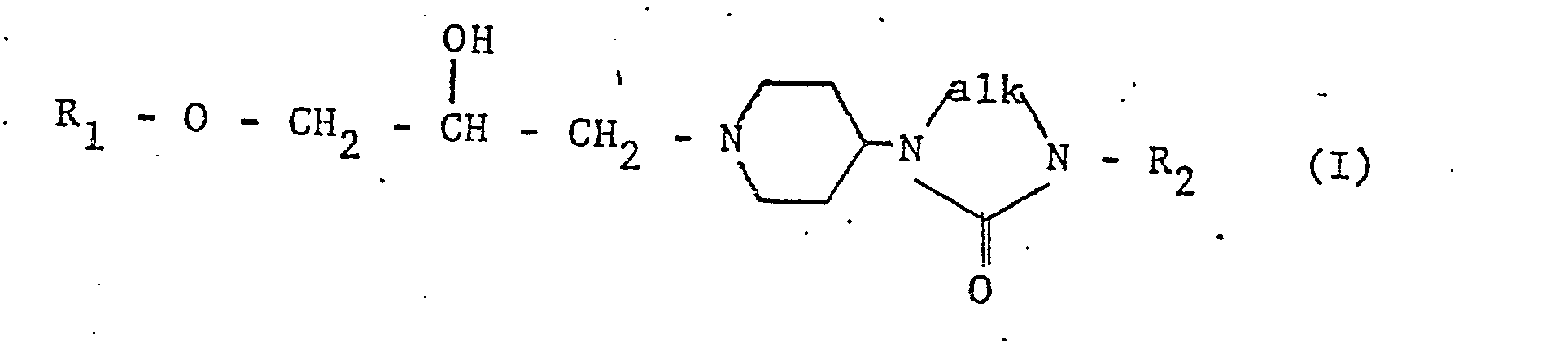
- Ein Heteroarylrest R1 ist ein gegebenenfalls substituierter, vorzugsweise monccyclischer sowie bicyclischer Heteroaryrest,Linie ein gegebenenfalls, z.B. einfach,
 stituierter, vorzugsweise monocyclischer Azaarylrest mit 5 bis 6 Ringgliedern und 1 bis 2 Ringstickstoffatomen, wie gegebenenfalls substituiertes Pyridyl, z.B. 2-, 3-oder 4-Pyridyl, Imidazolyl, z.B. 2-Imidazolyl, Pyrimidinyl, z.B. 2- oder 4-Pyrimidinyl, Pyridazinyl, z.B. 2-Pyridazinyl, oder Pyrazinyl, z.B. 2-Pyrazinyl; ferner ein gegebenenfalls substituierter bicyclischer Azaarylrest, insbesondere Benzoazaarylrest, mit 5 bis 6 Ringgliedern und 1 bis 2 Ringstickstoffatomen im Azaarylrest; wie gegegebenenfalls substituiertes Indolyl, z.B. 4-Indolyl, Chinolinyl, z.B. 4-Chinolinyl, oder Isochinolinyl, z.B. 1-Isochinolinyl. Substituenten eines Heteroarylrestes sind u.a. gegebenenfalls substituierte aliphatische oder aromatische Kohlenwasserstoffreste, gegebenenfalls veräthertes oder'verestertes Hydroxy oder Mercapto, Acyl, Nitro oder gegebenenfalls substituiertes Amino.
- Gegebenenfalls substituierte aliphatische Kohlenwasserstoffreste R2 sind entsprechendes Niederalkyl, sowie Niederalkenyl oder Niederalkinyl, wobei Substituenten, insbesondere von Niederalkyl, in erster Linie gegebenenfalls veräthertes oder verestertes Hydroxy oder Mercapto, Acyl oder gegebenenfalls substituiertes Amino sind.
- Gegebenenfalls substituierte cycloaliphatische und cycloaliphatisch-aliphatische Kohlenwasserstoffreste R2 sind Cycloalkyl, vorzugsweise mit 3-8, insbesondere 5-7 Ringkohlenstoffatomen, oder Cycloalkenyl, vorzugsweise mit 5-8, insbesondere 6 oder 7 Ringkohlenstoffatomen. ferner Cycloalkylniederalkyl, sowie Cycloalkenylniederalkyl, worin Cycloalkyl bzw. Cycloalkenyl die oben gegebenen Bedeutungen haben. Substituenten von cycloaliphatischen und cycloaliphatisch-aliphatischen Kohlenwasserstoffresten sind in erster Linie gegebenenfalls substituierte aliphatische Kohlenwasserstoffreste, gegebenenfalls veräthertes oder verestertes Hydroxy oder Oxo.
- Araliphatische Kohlenwasserstoffreste R2 sind in'erster Linie gegebenenfalls substituiertes Phenylniederalkyl, worin Phenyl als Substituenten z.B. gegebenenfalls substituierte aliphatische Kohlenwasserstoffreste, gegebenenfalls veräthertes Hydroxy oder Mercapto, Acyl, Nitro oder gegebenenfalls substituiertes Amino enthalten kann.
- Gegebenenfalls substituierte aliphatische oder aromatische Kohlenwasserstoffreste als Substituenten eines Heteroarylrestes R1 bzw. von cycloaliphatischen, cycloaliphatisch-aliphatischen oder araliphatischen Koh- lenwasserstoffresten R2 enthalten u.a. gegebenenfalls verätherte oder veresterte Hydroxygruppen oder gegebenenfalls substituiertes Amino als Substituenten.
- Veräthertes Hydroxy ist insbesondere Niederalkoxy oder Phenylniederalkoxy, ferner Niederalkenyloxy oder Niederalkinyloxy, sowie Hydroxyniederalkoxy, Niederalkoxyniederalkoxy, Niederalkylthioniederalkoxy oder Niederalkanoylniederalkoxy, während verestertes Hydroxy insbesondere Halogen, ferner Niederalkanoyloxy darstellt.
- Veräthertes Mercapto ist in erster Linie Niederalkylthio, während veresterte Mercapto z.B. Niederalkanoylthio ist.
- Acyl ist vorzugsweise der entsprechende Rest einer organischen Carbonsäure und steht insbesondere für Niederalkanoyl. Acyl steht ebenfalls für. den entsprechenden Rest eines Kohlensäurehalbderivats, wie für Niederalkoxycarbonyl oder gegebenenfalls substituiertes Carbamoyl. Ein Acylrest im weitesten Sinn der Definition ist auch Cyan.
- Gegebenenfalls substituertes Amino ist Acyl amino, insbesondere Niederalkanoylamino oder Niederalkoxycarbonylamino, ferner gegebenenfalls substituiertes Ureido. Substituiertes Amino ist ebenfalls Niederalkylamino oder Diniederalkylamino, sowie Niederalkylenamino, Niederoxaalkylenamino oder Niederazaalkylenamino, wobei in letzterem der Azastickstoff vorzugsweise, z.B. durch Niederalkyl, substituiert ist.
- Niederalky.len alk ist vorzugsweise unverzweigtes Niederalkylen und in erster Linie Aethylen, sowie 1,3-Propylen, kann aber auch verzweigtes Niederalkylen, wie 1,2-Propylen, 1,2- oder 2,3-Butylen sein.
- Wenn alk für den 1,2-Phenyl.enrest steht, so kann dieser durch Niederalkyl, Niederalkoxy oder Halogen substituiert sein.
- Die im Zusammenhang mit der vorliegende Beschreibung mit "nieder" bezeichneten Reste und Verbindungen enthalten vorzugsweise bis 7 und in erster Linie bis 4 Kohlenstoffatome.
- Niederalkyl ist z.B. Methyl, Aethyl, n-Propyl, Isopropyl, n-Butyl, Isobutyl oder.tert.-Butyl; substituiertes Niederalkyl ist insbesondere entsprechendes Methyl oder 1- oder 2-Aethyl.
- Niederalkenyl ist z.B. Vinyl, Allyl, 2- oder 3-Methallyl oder 3,3-Dimethylallyl.
- Niederalkinyl ist insbesondere Propargyl.
- Cycloalkyl ist in erster Linie Cyclopentyl, . Cyclohexyl oder Cycloheptyl, ferner Cyclopropyl oder Cyclooctyl.
- Cycloalkenyl ist z.B. 1- oder 3-Cyclohexenyl oder 1-Cycloheptenyl.
- Cycloalkylniederalkyl ist z.B. Cyclopentylmethyl, Cyclohexylmethyl, 2-Cyclohexyläthyl oder Cycloheptylmethyl.
- Cycloalkenylniederalkyl steht z.B. für 1-Cyclohexenylmethyl, 2-(1-Cyclohexenyl)-äthyl oder 1-Cycloheptenylmethyl.
- Phenylniederalkyl ist u.a. Benzyl, 1- oder 2-Phenyläthyl oder 3-Phenylpropyl.
- Niederalkoxy ist z.B. Methoxy, Aethoxy, n-Propyloxy, Isopropyloxy, n-Butyloxy oder Isobutyloxy.
- Phenylniederalkoxy ist z.B. Benzyloxy oder 1-oder 2-Phenyläthoxy.
- Hydroxyniederalkoxy ist z.B. 2-Hydroxyäthoxy, ferner 2- oder 3-Hydroxypropyloxy.
- Niederalkoxyniederalkoxy ist u.a. Niederalkoxymethoxy oder 1- und insbesondere 2-Niederalkoxy-äthoxy, z.B. Methoxy-methoxy, 2-Methoxy-äthoxy oder 2-Aethoxy- äthoxy.
- Niederalkylthioniederalkoxy ist insbesondere Niederalkylthiomethoxy oder 1- und in erster Linie 2-Niederalkylthio-äthoxy, z.B. 2-Methylthio-äthoxy oder 2-Aethylthio-äthoxy.
- Niederalkanoylniederalkoxy ist insbesondere Acetonyloxy.
- Niederalkenyloxy ist z.B. Allyloxy, 2- oder 3-Methallyloxy oder 3,3-Dimethylallyloxy.
- Niederalkinyloxy ist insbesondere Propargyloxy.
- Halogen ist vorzugsweise Halogen mit Atomnummer bis zu 35, d.h. Fluor, Chlor oder Brom.
- Niederalkanoyloxy steht z.B. für Acetyloxy, Propionyloxy oder Pivaloyloxy.
- Niederalkylthio ist z.B. Methylthio, Aethylthio, n-Propylthio oder Isopropylthio.
- Niederalkanoylthio ist u.a. Acetylthio oder Propionylthio.
- Niederalkanoyl ist z.B. Acetyl,.Propionyl oder Butyryl.
- Niederalkoxycarbonyl ist z.B. Methoxycarbonyl oder Aethoxycarbonyl.
- Gegebenenfalls substituiertes Carbamoyl ist z.B. Carbamoyl, oder N-Niederalkyl- oder N,N-Diniederalkyl- carbamoyl, wie N-Methyl-carbamoyl, N,N-Dimethylcarbamoyl, N-Aethylcarbamoyl oder N,N-Diathylcarbamoyl.
- Niederalkanoylamino ist z.B. Acetylamino oder Propionylamino.
- Niederalkoxycarbonylamino ist z.B. Methoxycarbonylamino oder Aethoxycarbonylamino.
- Gegebenenfalls substituiertes Ureido ist z.B. Ureido oder 3-Niederalkyl- oder 3-Cycloalkyl-ureido, worin Cycloalkyl z.B. 5-7 Ringglieder hat, z.B. 3-Methylureido, 3-Aethylureido oder 3-Cyclohexylureido.
- N-Niederalkylamino und N, N-Diniederalkylamino sind z.B. Methylamino, Aethylamino, Dimethylamino oder Diäthylamino.
- Niederalkylenamino enthält vorzugsweise 5-7 Ringkohlenstoffatome und ist z.B. Pyrrolidino oder Piperidino.
- Niederoxaalkylenamino ist in erster Linie Morpholino, während Niederazaalkylenamino insbesondere entsprechendes N-Niederalkyl-niederazaalkylenamino, z.B. 4-Methyl-1-piperazino, ist.
- Unter den substituierten Niederalkylgruppen sind z.B. Hydroxyniederalkyl, Niederalkoxyniederalkyl, Halogenniederalkyl, Niederalkanoylaminoniederalkyl oderNiederalkoxymethyl oder 1- und in erster Linie 2-Niederalkoxyäthyl, z.B. Methoxymethyl, Aethoxymethyl, 2-Methoxy-äthyl oder 2-Aethoxy-äthyl.

- Halogenniederalkyl ist vorzugsweise Halogenmethyl, z.B. Trifluormethyl.
- Niederalkanoylaminoniederalkyl ist insbesondere Niederalkanoylaminomethyl oder 1- und in erster Linie 2-Niederalkanoylamino-äthyl, z.B. Acetylaminomethyl, 2-Acetylamino-äthyl oder 2-Propionylamino-äthyl.
- Niederalkoxycarbonylaminoniederalkyl ist insbesondere Niederalkoxycarbonylaminomethyl, oder 1- und in erster Linie 2-Niederalkoxycarbonylamino-äthyl, z.B. Methoxycarbonylaminomethyl, 2-Methoxycarbonylamino- äthyl oder 2-Aethoxycarbonylamino-äthyl.
- Die neuen Verbindungen können in Form ihrer Salze, wie ihrer Säureadditionssalze und in erster Linie ihrer pharmazeutisch verwendbaren, nicht-toxischen Säureadditionssalze vorliegen. Geeignete Salze sind z.B. solche mit anorganischen Saiuren, wie Halogenwasserstoffsäuren, z.B. Chlorwasserstoffsäure oder Bromwasserstoffsäure, Schwefelsäuren, z.B. Schwefelsäure, oder Phosphorsäuren, oder mit organischen Säuren, wie aliphatischen, cycloaliphatischen, aromatischen oder heterocyclischen Carbon-oder Sulfonsäuren, z.B. Ameisen-, Essig-, Propion-, Bernstein-, Glykol-, Milch-, Aepfel-, Wein-, Zitronen-, Ascorbin-, Malein-, Hydroxymalein-, Brenztrauben-, Fumar-, Benzoe-, 4-Aminobenzoe-, Anthranil-, 4-Hydroxybenzoe-, Salicyl-, 4-Aminosalicyl-, Embon-, Methansulfon-, Aethansulfon-, 2-Hydroxyäthansulfon-, Aethylensulfon-, Toluolsulfon-, Naphthalinsulfon- oder Sulfanilsäure.
- Die neuen Verbindungen der vorliegenden Erfindung können in Form von Gemischen von Isomeren, wie Racematen, oder von reinen Isomeren, z.B. optisch aktiven Antipoden, vorliegen.
- Die neuen Verbindungen besitzen wertvolle pharmakologische Eigenschaften. So zeigen sie eine blutdrucksenkende Wirkung, wie sich im Tierversuch, z.B.. bei i.v. Gabe in Dosen von etwa 0,1 bis etwa 30 mg/kg an der narkotisierten Katze zeigen lässt.' Zusätzlich bewirken die neuen Verbindungen eine Antitachycardie, wie sich ebenfalls im Tierversuch zeigen lässt, z.B. in in vitro Versuchen bei Konzentrationen von etwa 1 bis etwa 100 y/ml am Meerschweinchen-Herzen (Langendorff-Präparat), und eine a-Sympathicolyse, z.B. in in vitro Versuchen bei Konzentrationen von etwa 0,01 bis etwa 10 γ/ml an der Ratte (isoliertes perfundiertes Mesenterialarterienpräparat; nach einer Modifiation der Methode von McGregor, J.Physiol., Bd. 177, S. 21 (1965)). Die neuen Verbindungen können daher als Antihypertensiva, Antitachycardica und a-Sympathicolytica verwendet werden. Ferner können die neuen Verbindungen als Ausgangs- oder Zwischenprodukte fUr die Herstellung anderer, insbesondere therapeutisch wirksamer, Verbindungen dienen.
- Die Erfindung betrifft in erster Linie Verbindungen der Formel I, worin R, gegebenenfalls substituiertes, monocyclisches Heteroaryl oder Benzoheteroaryl mit 5 bis 6 Ringgliedern und 1 oder 2 Ringstickstoffatomen im Rest R1 bedeutet, wobei Substituenten des heterocyclischen Arylrests gegebenenfalls substituiertes Niederalkyl, z.B. Niederalkyl, Niederalkoxyniederalkyl, Niederalkanoylaminoniederalkyl oder Niederalkoxycarbonylamino-Wasserstoff oder gegebenenfalls substituiertes Niederalkyl, Cycloalkyl, Cycloalkylniederalkyl oder Phenylniederalkyl steht, wobei Substituenten dieser Reste z.B. gegebenenfalls substituiertes Niederalkyl, z.B. Niederalkyl, oder gegebenenfalls veräthertes oder verestertes Hydroxy oder Mercapto, z.B. Niederalkoxy, Niederalkylthio, und/oder Halogen, sind, oder ferner fUr Niederalkanoyl oder Niederalkoxycarbonyl steht, und alk die oben gegebene Bedeutung hat, und Salze, insbesondere Säureadditionssalze, in erster Linie pharmazeutisch verwendbare, nicht-toxische Säureadditionssalze davon.

- Die Erfindung betrifft insbesondere Verbindungen der Formel. I, worin R1 gegebenenfalls durch Niederalkyl, z.B. Methyl, Niederalkoxy, z.B. Methoxy, Niederalkylthio, z.B. Methylthio oder Aethylthio, Halogen mit Atomnummer bis zu 35, z.B. Chlor oder Brom, und/oder Nitro, substituiertes monocyclisches Monoazaaryl oder Diazaaryl mit sechs Ringgleidern, wie Pyridyl, z.B. 2-, 3- oder 4-Pyridyl, Pyrimidinyl, z.B. 2- oder 4-Pyrimidinyl, Pyrazinyl, z.B. 2-Pyrazinyl oder Indolyl, z.B. 4-Indolyl darstellt, R2 für Wasserstoff, Niederalkyl, z.B. Methyl, Aethyl oder Isopropyl, Cycloalkyl, z.B. Cyclopentyl oder gegebenenfalls im Phenylteil durch Niederalkyl, z.B. Methyl, Niederalkoxy, z.B. Methoxy, und/oder Halogen mit Atomnummer bis zu 35, z.B. Chlor oder Brom, substituiertes Phenylniederalkyl, z.B. Benzyl oder 1- oder 2-Phenyläthyl, steht, und alk Niederalkylen mit 2-3 Kohlenstoffatomen bedeutet, das die beiden Stickstoffatome durch 2-3 Kohlenstoffatome trennt, z.B. Aethylen oder 1,3-Propylen, und Salze, insbesondere Säureadditionssalze, in erster Linie pharmazeutisch verwendbare nicht-toxische Säureadditionssalze davon.
- Die Erfindung betrifft insbesondere Verbindungen der Formel I, worin R1 für gegebenenfalls durch Niederalkyl, z.B. durch Methyl, Niederalkoxy, z.B. Methoxy, Niederalkylthio, z.B. Methylthio oder Aethylthio, Halogen mit Atomnummer bis zu 35, z.B. Chlor oder Brom, und/oder Nitro, substituiertes 2-Pyrazinyl, sowie für gegebenenfalls entsprechend substituiertes Pyridyl, z.B. 2-, oder 3-Pyridyl steht, wobei Substituenten irgendeine Stellung, mindestens einer jedoch vorzugsweise die ortho-Stellung zum VerknUpfungsringkohlenstoffatom und/oder Stickstoffatom des Heteroarylrestes einnehmen können, sowie 4-Indolyl, und R2 Wasserstoff, Niederalkyl, z.B. Methyl, Aethyl oder Isopropyl, oder Phenylniederalkyl, z.B. Benzyl öder 1- oder 2-Phenyläthyl, bedeutet, und alk Niederalkylen mit.2-3 Kohlenstoffatomen bedeutet, das die beiden Stickstoffatome durch 2-3 Kohlenstoffatome trennt, z.B. Aethylen oder 1,3-Propylen, und Salze, insbesondere Säureadditionssalze, in erster Linie pharmazeutisch verwendbare, nicht-toxische Säureadditionssalze davon.
- Die Erfindung betrifft in erster Linie Verbindungen der Formel I, worin R1 für 2-Pyrazinyl, ferner für Pyridyl, z.B. 2- oder 3-Pyridyl, sowie 4-Indolyl steht, das in ortho-Stellung zum Verknüpfungskohlenstoffatom und/oder Stickstoffatom, vorzugsweise durch Niederalkyl, z.B. Methyl, Niederalkoxy, z.B. Methoxy, Niederalkylthio, z.B. Methylthio oder Aethylthio, Halogen mit Atomnummer bis zu 35, z.B. Chlor oder Brom, oder Nitro substituiert ist, und gegebenenfalls weitere Substituenten dieser Art enthalten kann, R2 insbesondere für Wasserstoff, ferner für Niederalkyl, z.B. Methyl, oder Phenylniederalkyl, z.B. Benzyl steht, und alk Aethylen darstellt, und Salze, insbesondere Säureadditionssalze, in erster Linie pharmazeutisch verwendbare, nicht-toxische Säureadditionssalze davon.
- Die Erfindung betrifft in erster.Linie Verbindungen der Formel I, worin R1 für 4-Indolyl, 2-Pyrazinyl oder Pyridyl steht, das in ortho-Stellung zum Verknüpfun-gskohlenstoffatom und/oder Stickstoffatom vorzugsweise durch Niederalkyl, z.B. Methyl, Niederalkoxy, z.B. Methoxy, Niederalkylthio, z.B. Methylthio oder Aethylthio, Halogen mit Atomnummer bis zu 35, z.B. Chlor oder Brom, oder Nitro substituiert ist, R2 Wasserstoff, ferner Niederalkyl, z.B. Methyl, bedeutet, und alk Aethylen darstellt, und Salze, insbesondere Säureadditionssalze, in erster Linie pharmazeutisch verwenbdare, nicht-toxische Säureadditionssalze davon.
- Die Erfindung, betrifft in erster Linie die in den Beispielen beschriebenen Verbindungen; insbesondere diejenigen der Formel I, die als Rest R1 einen vorzugsweise substituierten 2-Pyrazinylrest aufweisen.
- Die neuen Verbindungen werden nach an sich bekannten Methoden erhalten. So kann man z.B. eine Verbinung der Formel


- . So kann man bei der obigen Reaktion z.B. so vorgehen, dass man eine Verbindung der Formel.


- Dine reaktionsfähige veresterte Hydroxylgruppe X4 ist eine, durch eine starke, anorganische oder organische Säure, vor allem eine Halogenwasserstoffsäure, z.B. Chlorwasserstoffsäure, Bromwasserstoffsäure oder Jodwasserstoffsäure, ferner Schwefelsäure oder durch eine organische Sulfonsäure, wie eine aromatische Sulfonsäure, z.B. Benzolsulfonsäure, 4-Brombenzolsulfonsäure oder 4-Toluolsulfonsäure, veresterte Hydroxylgruppe. So steht X4 insbesondere für Chlor oder Brom, ferner Jod, falls es nicht zusammen mit X3 eine Epoxy-Gruppierung bildet.
- Die obige-Umsetzung wird in üblicher Weise durchgeführt. Bei Verwendung eines reaktionsfähigen Esters als Ausgangsmaterial der Formel IIa wird vorzugsweise in Gegenwart eines basischen Kondensationsmittels und/oder mit einem Ueberschuss der basischen Verbindung der Formel IIIa gearbeitet.
- Falls man einen reaktionsfähigen Ester der Formel IIb als Ausgangsmaterial verwendet, wird die Verbindung der Formel IIIb vorzugsweise in Form eines Salzes, wie eines Metall-, insbesondere Alkalimetall-, z.B. Natrium- oder Kaliumsalzes, eingesetzt, oder man arbeitet in Gegenwart eines säurebindenden Mittels, insbesondere eines Kondensationsmittels, welches mit der Verbindung der Formel IIIb ein Salz zu bilden vermag, wie einem Alkalimetall-niederalkoxid.
- Die obige Reaktion wird in Abwesenheit oder vorzugsweise-in Anwesenheit eines, üblicherweise inerten, Lösungs- oder Verdünnungsmittels, und, wenn notwendig, unter Kühlen oder Erwärmen, z.B. in einem Temperaturbereich von etwa 0°C bis etwa 150°C, in einem geschlossenen Gefäss und/oder in einer Inertgas-, z.B. Stickstoffatmosphäre-durchgeführt.
- Die Ausgangsstoffe sind bekannt oder können in an sich bekannter Weise erhalten werden. So kann man z.B. Piperidin-4-on, worin die sekundäre Aminogruppe gegebenenfalls in an sich bekannter Weise, z.B. durch einen Benzylfesst oder einen leicht abspaltbaren Acylrest geschützt sein kann,- mit einem Diamin der Formel HZ20N-alk-HN-R2 (V) umsetzen und gleichzeitig oder nachträglich mit einem geeigneten Reduktionsmittel, wie katalytisch aktiviertem Wasserstoff oder einem Hydridreduktionsmittel, z.B. Natriumcyanborhydrid, behandeln. Im so erhältlichen Zwischenprodukt bildet man den 2-Oxo-1, 3-diazacycloalkanrest, z.B. durch Behandeln mit einem geeigneten reaktionsfähigen Kohlensäurederivat, wie Diniederalkylcarbonat oder Phosgen; falls notwendig, kann eine N-Schutzgruppe in an sich bekannter Weise durch Wasserstoff ersetzt werden. Ein so erhältliches Ausgangsmateriäl der Formel IIIa kann in an sich bekannter Weise, z.B. durch Behandeln mit einem reaktionsfähigen Ester eines 2,3-Epoxy-l-propanols, wie einem 2,3-Epoxy-l-propylhalogenid, und, falls erwünscht, durch nachträgliches Umsetzen mit einer starken Säure, wie einer Halogenwasserstoffsäure, in ein Ausgangsmaterial der Formel IIb umgewandelt werden.
- Die neuen Verbindungen könwen ebenfalls erhalten werden, indem man in einer Verbindung der Formel

- In.einem Ausgangsmaterial der Formel VI ist X5 insbesondere eine veresterte Hydroxygruppe und in erster Linie Acyloxy, worin Acyl den entsprechenden Rest einer organischen Carbonsäure, wie einer Niederalkancarbonsäure, z.B. Acetyl, Propionyl oder Pivaloyl, oder einer aromatischen Carbonsäure, z.B. Benzoyl, darstellt.
- Die Ueberführung von X5 in Hydroxy kann mittels Solvolyse vorgenommen werden, insbesondere durch Hydrolyse, wobei man mit Wasser in einem alkalischen oder sauren Medium arbeiten kann, oder durch Alltoholyse (Umesterung), wobei man.z.B. mit einem Niederalkanol, z.B. Methanol oder Aethanol, gegebenenfalls in Gegenwart eines Umesterungskatalysators, wie einem Alkalimetallniederalkanolat, z.B. Natrium- oder Kaliummethanolat, -äthanolat oder -butanolat, umsetzt. Die Reaktion wird in Ab- oder Anwesenheit von Losungs- oder Verdünnungsmitteln, und, wenn notwendig, unter Kühlen oder Erwärmen, z.B. in einem Temperaturbereich von etwa 0°C bis etwa 120°C, in einem geschlossenen Gefäss und/oder in einer Inertgasatmosphäre durchgeführt.
- Die Ausgangsstoffe der Formel VI können z.B. erhalten werden, indem man in einer Verbindung der Formel IIa, worin X3 für Hydroxy steht und X4 eine reaktionsfähige veresterte Hydroxygruppe bedeutet, X3 in eine, in Hydroxy überführbare veresterte Hydroxygruppe, z.B. durch Acylieren mit einem reaktionsfähigen Derivat, wie einem gegebenenfalls gemischten Anhydrid, einer organischen Carbonsäure, in Acyloxy überführt und das so erhältliche Zwischenprodukt, vorzugsweise im Ueberschuss, mit einer Verbindung der Formel IIIa umsetzt.
- Die neuen Verbindungen können ebenfalls erhalten werden, wenn man in einer Verbindung der Formel

- Ein Anion X⊖ ist insbesondere dasjenige einer Säure, vorzugsweise einer Mineral-, wie Halogenwasserstoff-, z.B. Chlor- oder Bromwasserstoffsäure, oder einer geeigneten organischen Carbon- oder Sulfonsäure.
- Die obige Reduktion kann in üblicher Weise, vorzugsweise mittels katalytischer Hydrierung, wie mit Wasserstoff in Gegenwart eines geeigneten Hydrierungskatalysators, z.B. eines Schwermetall-, z.B. Palladium-, Platin-oder Raney-Nickel-Katalysators, oder durch Behandeln mit nascierendem Wasserstoff, wie durch Behandeln mit einem Alkalimetall, z.B. Natrium oder Kalium, in Gegenwart eines Alkohols, wie Niederalkanol, z B. Aethanol oder n-Butanol, durchgeführt werden.
- .

- Die Ausgangsstoffe können in an sich bekannter Weise hergestellt werden, indem man z.B. 4-Amino-pyridin mit einer Verbindung der Formel Hal1-alko-C(=0)-NH-R2 (VIII) umsetzt, wobei in letzterer alk dem um ein Kettenkohlenstoffatom verkürzten Niederalkylenrest entspricht; man erhält diese z.B. durch Behandeln einer Aminoverbindung der Formel H2N-R2 (IX) mit einem Säurehalogenid der Formel Hal1-alko-C (=0) -Hal2 (X), worin Hall und Hal2 je für Halogen, z.B. Chlor, stehen. Im so gebildeten Zwischenprodukt der Formel

- Die.neuen Verbindungen der Formel I können ebenfalis erhalten werden, indem man in einer Verbindung der Formel

- In einem Ausgangsmaterial der Formel XII bedeutet der Acylrest eines Köhlensäurehalbderivats den entsprechenden Rest eines Kohlensäurehalbesters, wie Niederalkoxycarbonyl, z.B. Methoxycarbonyl oder Aethoxycarbonyl, eines Kohlensäurehalbhalogenids, d.h. Halogencarbonyl, z.B. Chlorcarbonyl oder Bromcarbonyl, oder eines Kohlensäurehalbamids, z.B. Carbamoyl.
- Der Ringschluss wird in Ab- oder Anwesenheit eines Lösungs- oder Verdünnungsmittels, und, wenn notwendig, in Gegenwart eines, vorzugsweise basischen Kondensationsmittels, wie eines Alkalimetall- oder Erdalkalimetall-hydroxids, -carbonats, -hydrogencarbonats oder -niederalkanoats, sowie einer organischen Base, wie eines tert.-Amins oder einer Base vom Pyridintyp, unter Kühlen oder vorzugsweise Erwärmen, z.B. in einem Temperaturbereich von etwa +20°C bis etwa 150°C, in einem ge- schlossenen Gefäss und/oder in einer Inertgasatmosphäre . durchgeführt.
- Das Ausgangsmaterial der Formel XII wird nach an sich bekannten Methoden und vorzugsweise in situ hergestellt, indem man eine Verbindung der Formel XII, worin X6 und X7 für Wasserstoff stehen, mit einem reaktionsfähigen Derivat der Kohlensäure umsetzt. Reaktionsfähige Derivate der Kohlensäure sind entsprechende Ester, wie Diniederalkylcarbonat, z.B. Diäthylcarbonat, oder, z.B. Phosgen, ferner Amide, z.B. Harnstoff oder Carbonyldimidazol, sowie auch Halogenkohlensäureester, wie Chlorkohlensäure-niederalkylester, z.B. Chlorkohlensäureisobutylester, oder Carbaminsäurehalogenide, z.B. -chlorid.

- Die Umsetzung wird in üblicher Weise durchgeführt, normalerweise in Gegenwart eines inerten Lösungsmittels, vorzugsweise eines gegebenenfalls halogenierten aliphatischen oder aromatischen Kohlenwasserstoffs, z.B. Chloroform oder Toluol, ferner eines Amids oder Nitrils, z.B. Dimethylformamid, Dimethylacetamid oder Acetonitril, oder eines cycloaliphatischen Aethers, wie Dioxan und Tetrahydrofuran. Die Reaktion wird vorzugsweise in Gegenwart eines Kondensationsmittels, besonders eines basischen Kondensationsmittels, wie eines Alkalimetall-oder Erdalkalimetallhydroxids, -carbonat oder -hydrogencarbonats, z.B. Natrium- oder Kaliumhydroxid, Natrium-oder Kaliumcarbonat oder -hydrogencarbonat, oder eines Alkalimetallniederalkanoats, z.B. Natriumacetat, oder eines Alkalimetallniederalkanolats, z.B. Natriummethanolat oder Kalium-tert.-butanolat, oder einer organischen tertiären Stickstoffbase, wie eines Triniederalkylamins, z.B. Trimethylamin oder Triäthylamin, oder Pyridin, vorgenommen.
- Eine Verbindung der Formel XII, worin X6 und X7 für Wasserstoff stehen, kann man z.B. erhalten, indem man Piperidin-4-on mit einer Verbindung der Formel IIa, worin X3 Hydroxy bedeutet, und X4 für eine reaktionsfähige veresterte Hydroxygruppe, insbesondere Halogen steht, umsetzt, und anschliessend das Zwischenprodukt mit einem Diamin der Formel V unter gleichzeitiger oder nachträglicher Behandlung mit einem Reduktionsmittel, wie katalytisch aktiviertem Wasserstoff oder einem geeigneten Hydridreduktionsmittel, z.B. Natriumcyanborhydrid, reagieren lässt.
- Die neuen Verbindungen der Formel I können ebenfalls erhalten werden, wenn man in einer Verbindung der Formel

- Der Iminorest X8 kann, z.B. durch.Niederalkyl oder Phenyl, substituiert sein. Ein entsprechendes Ausgangsmaterial der Formel XIII kann man durch Hydrolyse, vorzugsweise in Gegenwart eines sauren Mittels, wie. einer Mineralsäure, z.B. Chlorwasserstoffsäure, in die entsprechende Verbindung der Formel I überführen.
- Die obige Reaktion wird in Ab- oder vorzugsweise in Anwesenheit eines Lösungs- oder Verdünnungsmittels und, wenn notwendig, unter Kühlen oder Erwärmen, z.B. in einem Temperaturbereich von etwa 0°C bis etwa 150°C, gegebenenfalls in einem geschlossenen Gefäss und/oder in einer Inertgasatmosphäre durchgeführt.
- Die Ausgangsstoffe der Formel XIII können in an sich bekannter Weise erhalten werden, z.B. durch Behandeln einer Verbindung der Formel XII, worin jeder der Reste X6 und X7 für Wasserstoff steht, mit einem Halogencyan, z.B. Bromcyan, vorzugsweise in Gegenwart eines geeigneten, z.B. basischen Kondensationsmittels, unter gleichzeitigem oder nachträglichem Ringschluss zum 2-Imino-1,3-diazacycloalkanring des Ausgangsmaterials der Formel XIII.
- In erhaltenen Verbindungen kann man im Rahmen der Endstoffe in an sich bekannter Weise Substituenten abspalten, einführen oder umwandeln.
- So kann man in Verbindungen der Formel I mit ungesättigten Substituenten, z.B. Niederalkenyl, Niederalkenyloxy oder Niederalkinyloxy, diese durch geeignete Reduktionsmethoden zu entsprechenden gesättigten Verbindungen oder, im Fall von Substituenten mit einer Dreifachbindung, zu Verbindung mit einer Doppelbindung reduzieren. Dabei verwendet man als Reduktionsmittel vorzugsweise katalytisch aktivierten Wasserstoff. Als Katalysätor eignet sich insbesonder der Lindlar-Katalysator (Pd-Pb-CaCO3).
- Man kann auch in einer erhaltenen Verbindung der Formel I, die als Substituenten eines aromatischen . Restes Halogen, wie Brom oder Jod, enthält, dieses z.B. durch Behandeln. mit Trifluormethyljodid in Gegenwart von Kupferpulver und eines geeigneten aprotischen Lösungsmittels, wie Pyridin, Dimethylformamid oder Acetonitril, durch Trifluormethyl ersetzen.
- In einer erhaltenen Verbindung der Formel I kann man eine a-Phenylniederalkylgruppe, z.B. in Benzyloxy, durch Behandeln der entsprechenden Verbindung mit katalytisch aktiviertem Wasserstoff abspalten und durch Wasserstoff, z.B. eine Benzyloxygruppe durch Hydroxy, ersetzen.
- Ferner kann man in einer Verbindung der Formel I, die Hydroxy oder Mercapto in der Form einer primären Carbinol- oder einer phenolischen Hydroxylgruppe als Substituenten enthält, dieses, gegebenenfalls in Salz-, z.B. Alkalimetallsalzform, durch Behandeln mit einem reaktionsfähigen Ester eines Alkohols, wie einem gegebenenfalls substituierten Niederalkylhalogenid, in veräthertes Hydroxy oder Mercapto, z.B. Niederalkoxy bzw. Niederalkylthio, umwandeln. Zudem kann man Hydroxy in einem Hydroxyniederalkyl- oder Hydroxyniederalkoxy-Substituenten, üblicherweise in Form einer reaktionsfähigen veresterten Hydroxygruppe, wie Halogen, z.B. Chlor, mit einem Alkohol, z.B. Niederalkanol, oder einem Mercaptan, z.B. Niederalkylmercaptan, vorzugsweise in Gegenwart eines basischen Mittels, das z.B. einen Alkohol oder ein Mercaptan in eine Metallverbindung überzuführen vermag, umsetzen und so zu Verbindungen der Formel I gelangen, die entsprechend veräthertes Hydroxy- oder Mercapto-niederalkyl bzw. -niederalkoxy aufweisen. Ferner kann man in.einer erhaltenen Verbindung eine reaktionsfähige veresterte Hydroxygruppe, wie Halogen, z.B. Chlor, insbesondere in a-Stellung zu einem Ringstickstoffatom in einem Rest R1, z.B. durch Behandeln mit einer Alkoholat-oder Thiolatverbindung, wie einem Alkalimetall-, z.B. Natrium- oder Kalium-niederalkanolat oder -thioniederalkanolat, in eine verätherte oder. veresterte Hydroxy-oder Mercaptogruppe, z.B. in Niederalkoxy oder Niederalkylthio, umwandeln.
- In einer Verbindung der Formel I kann man eine Propargyloxygruppe, z.B. durch Hydratisierung in saurem Medium und in Gegenwart eines Quecksilber-II-salzes, z.B. durch Behandeln mit einer wässerigen Mineralsäure, z.B. verdünnter Salz- oder Schwefelsäure, in Gegenwart von Quecksilber-II-chlorid, in die Acetonyloxygruppe umwandeln.
- Ferner kann man in einer Verbindung der FormelSubstituenten verestertes Carboxyl oder Nie-
 enthält, dieses, z.B. durch Behandeln mit Ammoniak oder einem Amin, vorzugsweise mit einem Ueberschuss davon und bei erhöhter Temperatur, in amidiertes Carboxyl bzw. gegebenenfalls Ureido überführen.
- Man kann auch in einer Verbindung der Formel I, die primäres Amino als Substituenten enthält, dieses substituieren; so kann man Amino, z.B. durch Behandeln der Aminoverbindung mit einem geeigneten Säurederivat, wie einem gegebenenfalls gemischten Anhydrid, z.B. einem entsprechenden Chlorid,.falls notwendig in Gegenwart eines basischen Mittels, acylieren.
- Die oben beschriebenen Reaktionen können gegebenenfalls gleichzeitig oder nacheinander und in beliebiger Reihenfolge und in üblicher Weise, z.B. in An-oder Abwesenheit von Lösungs- oder Verdünnungsmitteln, falls notwendig, in Gegenwart von Kondensations- und/oder katalytischen Mitteln, unter Kühlen oder Erwärmen, in einem geschlossenen Gefäss und/oder in einer Inertgasatmosphäre durchgeführt werden.
- Je nach den Verfahrensbedingungen und Ausgangsstoffen erhält man die Endstoffe in freier Form oder in der ebenfalls von der Erfindung umfassten Form ihrer Salze, insbesondere ihrer Säureadditionssalze. Erhaltene Salze können in an sich bekannter Weise in die freien Verbindungen übergeführt werden, Säureadditionssalze z.B. durch Behandeln mit basischen Mitteln, inkl. geeigneten Ionenaustauschern. Andererseits können erhaltene freie Verbindungen, z.B. durch Behandeln mit organischen oder anorganischen Säuren, Salze bilden. Ferner kann man erhaltene Salze, Säureadditionssalze z.B. durch Behandeln mit geeigneten Schwermetallsalzen oder Anionenaustauschern, in andere Salze überführt.
- Die oben genannten Salze oder andere Salze der neuen Verbindungen der Formel I, wie z.B. die Pikrate, können auch zur Reinigung der erhaltenen, freien Basen dienen, indem man die freien Basen in Salze überführt, diese abtrennt und aus den Salzen wiederum die Basen freimacht. Infolge der engen Beziehungen zwischen den neuen Verbindungen in freier Form und in Form ihrer Salze sind im Vorausgegangenen und nachfolgend unter den freien Verbindungen sinn- und zweckmässig gegebenenfalls auch die.entsprechenden Salze zu verstehen.
- Die neuen Verbindungen können je nach der Wahl der Ausgangsstoffe und Arbeitsweisen in Form der Racemate oder der optischen Antipoden vorliegen.
- Erhaltene Racemate lassen sich nach bekannten Methoden in die optischen Antipoden auftrennen, beispielsweise durch Umkristallisieren aus einem optisch aktiven Lösungsmittel, mit Hilfe von Mikroorganismen oder durch Umsetzen mit einer, mit der racemischen Verbindung Salze bildenden optisch aktiven Säure und Trennen der auf diese Weise erhaltenen Salze, z.B. aufgrund ihrer verschiedenen Löslichkeiten, in die diastereomeren Salze, aus denen die freien Antipoden durch Einwirkung geeigneter Mittel freisetzt werden können. Besonders geeignete, optisch aktive Säuren sind z.B. die D- und L-Formen von Weinsäure, Di-Toluylweinsäure, Aepfelsäure, Mandelsäure, Camphersulfonsäure oder Chinasäure.
- Die Erfindung betrifft auch diejenigen Ausführungsformen des Verfahrens, nach denen man von einer, auf irgendeiner Stufe des Verfahrens als Zwischenprodukt erhältlichen Verbindung ausgeht und die fehlenden Verfahrensschritte durchführt, oder das Verfahren auf irgendeiner Stufe abbricht, oder 'bei denen man einen Ausgangsstoff unter den Reaktionsbedingungen bildet, oder bei denen eine Reaktionskomponente gegebenenfalls in Form eines Derivates, z.B. eines Salzes vorliegt.
- Zweckmässig verwendet man für die Durchführung der erfindungsgemässen Reaktionen solche Ausgangsstoffe, die zu den eingangs besonders erwähnten Gruppen von Endstoffen und besonders zu den speziell beschriebenen oder hervorgehobenen Endstoffen fuhren.
- Die neuen Verbindungen können z.B. in Form pharmazeutischer Präparate.Verwendung finden, welche eine pharmakologisch wirksame Menge der Aktivsubstanz, gegebenenfalls zusammen mit anorganischen oder organischen, festen oder flüssigen, pharmazeutisch verwendbaren Trägerstoffen enthalten, die sich zur enteralen, z.B. oralen, oder parenteralen Verabreichung eignen. So verwendet man Tabletten oder Gelatinekapseln, welche den Wirkstoff zusammen mit VerdUnnungsmitteln, z.B. Laktose, Dextrose, Sukrose, Mannitol, Sorbitol, Cellulose und/oder Glycin, und/oder Schmiermittein, z.B. Kieselerde, Talk, Stearinsäure oder Salze davon, wie Magnesium- oder Calciumstearat, und/oder Polyäthylenglykol, aufweisen. Tabletten können ebenfalls Bindemittel, z.B. Magnesiumaluminiumsilikat, Stärken, wie Mais-, Weizen-, Reis- oder Pfeilwurzstärke, Gelatine, Traganth, Methylcellulose, Natriumcarboxymethylcellulose und/oder Polyvinylpyrrolidon, und, wenn erwünscht, Sprengmittel, z.B. Starken, Agar, Alginsäure oder ein Salz davon, wie Natriumalginat, und/oder Brausemischungen, oder Adsorptionsmittel, Farbstoffe, Geschmackstoffe und Süssmittel aufweisen. Ferner kann man die neuen pharmakologisch wirksamen Verbindungen in Form von parenteral verabreichbaren Präparaten oder von Infusionslösungen verwenden. Solche Losungen sind vorzugsweise isotcnische wässerige Lösungen oder Suspensionen, wobei diese z.B. bei lyophilisierten Präparaten, welche die Wirksubstanz allein oder zusammen mit einem Trägermaterial, z.B. Mannit, enthalten, vor Gebrauch hergestellt werden können. Die pharmazeutischen Präparate können sterilisiert sein und/oder Hilfsstoffe, z.B. Konservier-, Stabilisier-, Netz- und/oder Emulgiermittel, Löslichkeitsvermitteler, Salze zur Regulierung des osmotischen Druckes und/oder Puffer enthalten. Die vorliegenden pharmazeutischen Präparate, die, wenn erwünscht, weitere pharmakologisch wirksame Stoffe enthalten können, werden in an sich bekannter Weise, z.B. mittels konventioneller Misch-, Granulier-, Dragier-, Lösungs- oder Lyophilisierungsverfahren, hergestellt und enthalten von etwa 0,1% bis 100%, insbesondere von etwa 1% bis etwa 50%, Lyophilisate bis zu 100% des Aktivstoffes.
- Die Dosierung kann von verschiedenen Faktoren, wie AppLikationsweise, Spezies, Alter und/oder individuellem Zustand abhängen. Die täglich zu verabreichenden Dosen liegen bei oraler Applikation zwischen etwa 5 mg und etwa 50 mg für Warmblüter mit einem Gewicht von etwa 70 kg.
- Die folgenden Beispiele dienen zur Illustration der Erfindung; Temperaturen werden in Celsiusgraden angegeben.
- Ein Gemisch von 22,5 g rohem 3-(2,3-Epoxy- propyloxy)-2-methoxy-pyridin und 21,0 g 1-(4-Piperidyl)-imidazolidin-2-on in 250 ml Isopropanol wird 14 Stunden unter RUckfluss gekocht. Das Reaktionsgemisch wird eingedampft, der RUckstand in Essigsäureäthylester gelöst und mit 2-n. Salzsäure extrahiert. Der saure Extrakt wird mit einer konzentrierten wässerigen Natriumhydroxidlösung alkalisch gestellt und mit Essigsäureäthylester extrahiert. 'Die organische Lösung wird eingedampft und der Rückstand aus einem Gemisch von Methylenchlorid und Diäthyläther umkristallisiert. Das so erhaltene 1-{1-[2-Hydroxy-3-(2-methoxy-3-pyridyloxy)-propyl]-4-piperidyl}-imidazoli- din-2-on schmilzt bei 132-134°.
- Das Ausgangsmaterial kann wie folgt erhalten werden:
- Ein Gemisch von 15,4 g 3-Hydroxy-2-methoxy- pyridin, 16 g Kaliumcarbonat, 25 ml Epichlorhydrin und 150 ml Acetonitril wird 7 Stunden unter RUckfluss gekocht. Durch Abkühlen, Filtrieren und Eindampfen des Filtrats erhält man das rohe 3-(2,3-Epoxy-propyloxy)-2-methoxy-pyridin,welches ohne weitere Reinigung verwendet wird.
- In analoger Weise kann man durch Umsetzen von 20 g rohem 3-(2,3-Epoxy-propyloxy)-2-methoxy-6-methyl-pyridin und 16,5 g 1-(4-Piperidyl)-imidazolidin-2-on das 1-{1-[2-Hydroxy-3-(2-methoxy-6-methyl-3-pyridyloxy)-propyl]-4-piperidyl}-imidazolidin-2-on erhalten, das nach Umkristallisieren aus einem Gemisch von Methylenchlorid und Diäthyläther bei 144-147° schmilzt. Das Ausgangsmaterial kann analog dem oben beschriebenen Verfahren aus 3-Hydroxy-2-methoxy-6-methyl-pyridin erhalten werden und wird ohne weitere Reinigung umgesetzt.
- Eine Lösung von 25,0 g 2-(2,3-Epoxy-propyloxy)-3-methoxy-pyridin und 23,3 g 1-(4-Piperidyl)-imidazolidin-2-on in 500 ml Isopropanol wird 24 Stunden bei 30° gerührt. Durch Aufarbeiten analog dem im Beispiel 1 beschriebenen Verfahren erhält man nach Versetzen mit Aceton das 1-{-[2-Hydroxy-3-(3-methoxy-2-pyridyloxy)-propyl]-4-piperidyl}-imidazolidin-2-on, F.137-142°. Die Verbindung bildet ein neutrales Fumarat, das nach Umkristallisieren aus einem Gemisch aus Isopropanol und Aceton als Hydrat bei 124-126° schmilzt.
- Das Ausgangsmaterial kann auf folgende Weise hergestellt werden:
- Ein Gemisch von 161 g 3-Methoxy-2-nitro-pyridin und 144 g 2, 2-Dimethyl-5-hydroxymethyl 1-1, 3-dioxolan in 1000 ml Hexamethylphosphorsäuretriamid wird unter RUhren im Verlauf einer Stunde mit 26,5 g Natriumhydrid versetzt; durch KUhlen wird die Temperatur während der Zugabe bei 0-10° gehalten. Das Reaktionsgemisch wird während weiteren 5 Stunden unter Eiskühlung und dann 15 Stunden bei Ramtemperatur gerUhrt. Das Reaktionsgemisch wird auf Eis gegossen und mit Diäthyläther extrahiert. Der organische Extrakt wird mit einer konzentrierten wässerigen Natriumchloridlösung gewaschen, getrocknet'und eingedampft. Der Rückstand wird in 1000 ml Aethanol gelöst, mit 100 ml.2-n. Salzsäure versetzt und 8 Stunden stehen gelassen. Nach dem Abdampfen des Lösungsmittels wird der Rückstand mit einer konzentrierten Lösung von Natriumhydroxid in Wasser alkalisch gestellt und mit Essigsäureäthylester extrahiert. Durch Abdampfen des Lösungsmittels erhält man ein Rohprodukt, aus dem nach Zugabe von Diäthyläther das kristalline 3- (3-Methoxy-2-pyridyloxy)-1,2-propandiol, F. 62-65°, erhalten wird.
- Eine Lösung von 62 g 3-(3-Methoxy-2-pyridyloxy)-1,2-propandiol in 350 ml Orthoessigsäure-triäthylester wird mit 2 Tropfen Trifluoressigsäure versetzt und 3 Stunden bei 20-30° stehen gelassen. Durch Eindampfen erhält man das rohe 2-Aethoxy-5-(3-methoxy-2-pyridyloxy- methyl)-2-methyl-1,3-dioxolan als Oel, das ohne,Reini- verwendet wird.
- Ein Gemisch von 85 g 2.-Aethoxy-5-(3-methoxy-2-pyridyloxymethyl)-2-methyl-1,3-dioxolan in 500 ml Di- .chlormethan wird mit 45 ml Trimethylchlorsilan versetzt und während einer Stunde bei 20-30° gerührt. Durch vollständiges Eindampfen unter vermindertem Druck erhält man das rohe 2-(2-Acetyloxy-3-chlor-propyloxy)-3-methoxy- pyridin als Oel, welches ohne Reinigung verwendet wird.
- Ein Gemisch von 80 g 2-(2-Acetyloxy-3-chlor- propoxy)-3-methoxy-pyridin, 900 ml Methylenchlorid, 500 ml einer 2-n, wässerigen Natriumhydroxidlösung und 9,5 g Tetrabutylammoniumhydrogensulfat wird 16 Stunden bei 20-30° kräftig gerührt. Die organische Phase wird dann abgetrennt und eingedampft. Das verbleibende Oel wird in Diäthyläther gelöst; die Lösung wird filtriert, mit Aktivkohle behandelt und eingedampft. Man erhält so das 2-(2,3-Epoxy-propyloxy)-3-methoxy-pyridin, F. 63-65° .
- Ein Gemisch von 14,9 g 2-Chlor-3-(2,3-epoxy- propyloxy)-pyrazin (siehe z.B. deutsche Offenlegungsschrift 25 20 910) und 10,4 g l-(4-Piperidyl)-imidazoli- din-2-on in 150 ml Isopropanol wird 24 Stunden bei etwa 20° gerührt. Aus dem Reaktionsgemisch beginnt ein kristalliner Niederschlag auszufallen; zur vollständigen Kristallisation werden noch 150 ml Diäthyläther zugegeben. Man erhält so das·1-{1-[3-(3-Chlor-2-pyrazinyloxy)-2-hydroxy-propyl]-4-piperidyl}-imidazolidin-2-on, F. 150 - 151°. Das mit der berechneten Menge Fumarsäure hergestellte neutrale Fumarat kristallisiert aus einem Gemisch von Methanol und Diäthyläther und schmilzt bei 172-173°.
- Ein Gemisch von 10,66 g 1-{1-[3-(3-Chlor-2-pyrazinyloxy)-2-hydroxy-propyl]-4-piperidyl}-imidazoli- din-2-on und 1,78 g Natriummethylät in 150 ml Methanol wird während 10 Stunden unter Rühren am RUckfluss gekocht. Das Reaktionsgemisch wird im Wasserstrahlvakuum total eingedampft. Der Rückstand wird in Essigsäureäthylester gelöst und mit Wasser gewaschen. Die organische Lösung wird über Natriumsulfat getrocknet und im Wasserstrahlvakuum eingedampft. Man erhält so das 1-{1-[2-Hydroxy-3-(3-methoxy-2-pyrazinyloxy)-propyl]-4-piperidyl}-Lmidazolidin-2-on als 0el. Das mit einer methanolischen


- Ein Gemisch von 8,65 g 2-Methyl-3-(2,3-epoxy- propyloxy)-pyrazin (siehe z.B. deutsche Offenlegungsschrift 25 20 910) und 6,75 g 1-(4-Piperidyl)-imidazoli- din-2-on in 100 ml Isopropanol wird 60 Stunden bei etwa 20° gerührt. Das Reaktionsgemisch wird im Wasserstrahlvakuum total eingedampft, der Rückstand in Essigsäureäthylester gelöst und die Lösung mit 2-n. Salzsäure extrahiert. Die vereinigten salzsauren Extrakte werden mit einer konzentrierten wässerigen Natriumhydroxidlösung alkalisch gestellt und mit Methylenchlorid extrahiert. Die vereinigten organischen Extrakte werden mit wenig Wasser gewaschen, über Natriumsulfat getrocknet und im Wasserstrahlvakuum eingedampft. Man erhält so das ölige 1-{1-[2-Hydroxy-3-(3-methyl-2-pyrazinyloxy)-propyl]-4-piperidyl} -imidazolidin-2-on, das durch Behandeln mit der berechneten Menge Fumarsäure in das neutrale Fumarat Übergeführt wird, F. 168°-170° nach Umkristallisieren aus einem Gemisch von Methanol und Aceton.
- Ein Gemisch von 46,0 g 3-(2,3-Epoxy-propyloxy)-2-nitropyridin und 35,0 g 1-(4-Piperidyl)-imidazolidin-2- on in 500 ml Isopropanol wird 2 Stunden unter Rückfluss gekocht. Die Aufarbeitung, analog Beispiel 1 unter Verwendung von Dichlormethan als Extraktionsmittel, ergibt rohes 1-{1-[2-Hydroxy-3-(2-nitro-3-pyridyloxy)-propyl]-4-piperidyl}-imidazolidin-2-on, welches nach Umkristallisation aus Isopropanol bei 154-158° schmilzt.
- Auf analoge Weise erhält man unter Verwendung von 13,0 g 3-(2,3-Epoxy-propyloxy)-2-nitropyridin und 11,0 g 3 Methyl-1- (4-piperidyl)-imidazolidin-2-on das 1-{1-[2-Hydroxy-3-(2-nitro-3-pyridyloxy)-propyl]-4-piperidyl}-3-methyl-imidazolidin-2 -on als gelbes 0el.
- Ein Gemisch von 7,3 g l-Chlor-3-(2-chlor-3-pyridyloxy)-2-propanol und 5,0' g 3-Methyl-1-(4-piperi- dyl)-imidazolidin-2-on wird in 100 ml Isopropanol 2 Stunden unter Rückfluss gekocht. Die Aufarbeitung, analog Beispiel 1, ergibt öliges 1-{1-[2-Hydroxy-3-(2-chlor-3-pyridyloxy)-propyl]-4-piperidyl}-3-methyl-imida- zolidin-2-on.
- Auf analoge Weise erhält man unter Verwendung von 1-(4-Piperidyl)-imidazolidin-2-on das 1-{1-[2-[Hydroxy 3-(2-chlor-3-pyridyloxy)-propyl]-4-piperidyl}-imidazoli- xy)-propyl]-4-piperidyl}-im din-2-on vom Smp. 163-166°.
- Das Ausgangsmaterial wird auf folgende Weise hergestellt:
- Ein Gemisch von 45 g 2-Chlor-3-pyridinol, 45 g Kaliumcarbonat, 150 ml Epichlorhydrin und 300 ml Aceton wird 5 Stünden unter Rückfluss gerührt. Durch Filtrieren, Eindampfen, Lösen in Aethylacetat und Waschen der Lösung mit Wasser erhält man nach dem Abdampfen des Aethylacetats rohes 1-Chlor-3-(2-chlor-3-pyridyloxy)-2-propanol als dunkelbraunes 0e1, das durch Säulenchromatographie an Kieselgel und Elution mit Aether gereinigt wird und dann bei 140 - 143° schmilzt.
- 1,1 g 2-Chlor-3-(2,3-epoxy-propyloxy)-6-methyl-pyridin und 0,76 g 1-(4-Piperidyl)-imidazolidin-2- on werden in 40 ml Isopropanol 1 Stunde unter RUckfluss gekocht. Durch Abdampfen des Lösungsmittels und Umkristallisation aus Isopropanol-Aether erhält man 1-{1-[2-Hydroxy-3-(2-chlor-6-methyl-3-pyridyloxy)-propyl]-4-piperidyl}-imidazolidin-2-on vom Smp. 175 - 180°.
- Das als Ausgangsmaterial verwendete 2-Chlor-3-(2,3-epoxy-propyloxy)-6-methyl-pyridin erhält man durch Kochen von 2-Chlor-6-methyl-3-pyridinol-mit Epichlorhydrin und Kaliumcarbonat während 2 Stunden. Es wird roh weiterverwendet.
- 2,5 g 1-{1-[2-Hydroxy-3-(2-benzyloxy-3-pyridyl- oxy)-propyl]-4-piperidyl}-imidazolidin-2-on wird in 50 ml Methanol unter Zusatz von 0,3 g Pd/C 5% bis zum Stillstand bei Atmosphären druck und 20-30° hydriert. Durch Abfiltrieren des Katalysators und Eindampfen der Lösung erhält man 3-{2-Hydroxy-3-[4-(imidazolidin-2-on-1-y1)- 1-piperidyl]-propyloxy}-2-pyridin vom Smp. 217-222°.
- Das Ausgangsmaterial wird auf folgende Weise erhalten:
- a) 15,7 g 3-(2,3-Epoxy-propyloxy)-2-nitro-pyridin und 9,0 g Benzylalkohol, gelöst in 150 ml 1,2-Dimethoxy- äthan werden unter Rühren und Kühlen bei 0-5° portionenweise mit 3,6 g einer Natriumhydrid-Suspension (55%) versetzt, 3 Stunden bei 0-5° und 2 Stunden bei 20-25° nachgerührt. Das Reaktionsgemisch wird eingedampft, in Aethylacetat gelöst und mit Wasser gewaschen und die Aethylacetat-Lösung eingedampft. Der Rückstand (20 g) wiru an 400 g Kieselgel chromatographiert und mit Toluol (250 ml Fraktionen) eluiert. Aus den Fraktionen 28-36 erhält man das 2-Benzyloxy-3-(2,3-epoxypropyloxy)-pyridin als Oel.
- b) 4,8 g 2-Benzyloxy-3-(2,3-epoxypropyloxy)-pyridin und 3,0 g 1-(4-Piperidyl)-imidazolidin-2-on werden in 50 ml Isopropanol gelöst und 15-18 Stunden bei 20-30° gerührt. Die ausgefallenen Kristalle werden abgenutscht, mit Aether gewaschen und ergeben das 1-{1-[2-Hydroxy-3-(2-benzyloxy-3-pyridyloxy)-propyl]-4-piperidyl}- imidazolidin-2-on vom Smp. 145-147°.
- Ein Gemisch von 7,1 g2-Methyl-4-(2,3-epoxy- propyl)-indol und 5,9 g 1-(4-Piperidyl)-2-imidazolidinon wird in 125 ml Isopropylalkohol gelöst und 6 Stunden unter Rückfluss gekocht. Danach wird das Gemisch im Eisbad abgekühlt und abfiltriert. Das Kristallisat löst man in Isopropanol und kristallisiert evt. unter Zusatz von Tierkohle um. Das 4-{3-[4-(2-oxo-3-imidazolidinyl)-1-piperidyl]-2-hydroxy-1-propyloxy}-2-methyl-1H-indol hat einen Smp. von 208-210°.
- Auf analoge Weis-e wird unter Verwendung von 1-(4-Piperidyl)-3-methyl-2-imidazolidinon das 4- 3-[4-(1-Methyl-2-oxo-3-imidazolidinyl)-1-piperidyl]-2-hydroxy-1-propyloxy}-2-methyl-1H-indol vom Smp. 184-185° hergestellt.
- Auf analoge Weise wird unter Verwendung von 1-(4-Piperidyl)-2-benzimidazolinon das 4-{3- [4-(2-Oxo- benzimidazolidinyl)-piperidyl]-2-hydroxy-1-propyloxy}- 2-methyl-1H-indol vom Smp. 172-174° hergestellt.
- Das Ausgangsmaterial wird wie folgt hergestellt:
- 208 g N-Benzylpiperidon werden mit 8,5 g N-Methyl-aethylendiamin in 2000'ml Methanol mit 15 g Platin auf Kohle hydriert, der Katalysator abfiltriert und das Filtrat zur Trockne eingedampft. Noch anhaftende Feuchtigkeit wird mit Toluol abgetrieben. 173 g des zurückbleibenden N'-(1-Benzyl-4-piperidyl)-N"-methyl- äthylendiamins werden in einem Rührkolben mit 96,5 g N,N-Diisopropyläthylamin in 3000 ml Acetonitril vorgelegt. Dazu werden während 30 Minuten bei 0° - 5° 117,5 g Chlorameisensäure-phenylester zugetropft. Es entsteht eine dicke Suspension zu der 96,5 g N,N-Diiso- propyläthylamin zugegeben werden. Anschliessend wird das Ganze 20 Stunden am RUckfluss erhitzt. Dann wird zur Trockne eingedampft, mit Toluol alles Flüchtige abgetrieben und der Rückstand in 1500 ml-Essigester aufgenommen. Die organische Phase wird 6 mal mit je 500 ml 2N Natronlauge extrahiert, getrocknet und eingedampft. 150 g des zurückbleibenden Oels werden mit 500 ml Alkohol und 150 ml.konz. Natronlauge 14 Stunden am RUckfluss erhitzt. Dann wird der Alkohol abdestilliert und der Rückstand zwischen 1000 ml Essigester und Eiswasser verteilt. Die wässerige Phase wird abgetrennt und die organische Phase 4 mal mit je 250 ml 2N Natronlauge extrahiert, getrocknet und destilliert. Das 1-(1-Benzyl-4-piperidyl)-3-methyl-2-imidazolidinon siedet bei 185°/0.18 mm.
- 127 g des erhaltenen Produktes werden in 1500 ml Methanol mit 39 g Palladium auf Kohle debenzyliert. Der Katalysator wird abfiltriert, das Filtrat eingedampft und der Rückstand destilliert. Das 1-(4-Piperidyl)-3-methyl-2-imidazolidinon siedet bei 121-124°/0,01 mm/Hg und hat einen Smp. von 76 - 79°.
- Ein Gemisch von 3,1 g 2-Methyl-4-(2,3-epoxy- propyl)-indol und 3,4 g 3-n-Butyl-1-(4-piperidyl)-2-imidazolidinon wird in 75 ml Isopropylalkohol durch leichtes Erwärmen gelöst und 18 Stunden bei Raumtemperatur gerührt. Die entstandene Suspension engt man unter vermindertem Druck auf ca. 40 ml ein, und kühlt im Eisbad ab. Das weisse Kristallisat filtriert man ab und erhält nach Umkristallisation aus Isopropylalkohol-Diäthyläther das 4-{3-[4-(1-n-Butyl-2-oxo-3-imidazolidinyl)-1-piperidyl]-2-hydroxy-1-propyloxy}-2-methyl-1H-indol vom Smp. 116-120°C.
- Das als Ausgangsstoff verwendete 3-n-Butyl-l-(4-piperidyl)-2-imidazolidinon kann auf folgende Weise hergestellt werden:
- Zu einer Lösung von 10,1 g 1-(4-Piperidyl)-imidazolidin-2-on und 6,06 g Triäthylamin in 120 ml Methylenchlorid tropft man unter Rühren 20 ml einer 50%-igen Chiorameisensäurebenzylester-Lösung in Toluol. Man rührt noch 2 Stunden weiter bei Raumtemperatur und filtriert dann das ausgefallene Triäthylamin-Hydrochlorid ab. Das Methylenchlorid-Filtrat wäscht man zweimal mit je 50 ml Wasser, trocknet es mit Natriumsulfat und dampft es dann ein. Durch Behandeln mit Toluol wird der Rückstand von noch anhaftender Feuchtigkeit befreit. Nach Anreiben mit Diäthyläther.erhält man als weisses Kristallisat das 1-(1-Carbobenzoxy-4-piperidyl)-imidazolidin-2-on vom Smp. 133-135°C.
- Zu einem auf 80°C erwärmten Gemisch von 2,4 g Natriumhydrid in 100 ml absolutem Dimethylformamid gibt man portionenweise unter Rühren 25 g 1-(1-Carbobenzoxy-4-piperidyl)-imidazolidin-2-on. Man rührt das Gemisch noch 2 Stunden weiter bei 80°C und lässt dann langsam . 18,2 g n-Butyljodid zutropfen (stark exotherme Reaktion). Nach weiteren 2 Stunden Rühren bei 80°C wird das Reaktionsgemisch unter vermindertem Druck eingedampft und der Rückstand durch Behandeln mit Toluol von noch anhaftendem Dimethylformamid befreit. Das Reaktionsprödukt wird in 250 ml Essigsäureäthylester gelöst,' zweimal mit je 50 ml Wasser gewaschen, getrocknet mit Natriumsulfat und zur Trockne eingedampft! Den Rückstand chromatographiert man an 1,5 kg Kieselgel, wobei ein Gemisch von Chloro- form-Methylalkobol (95:5) als Eluiergemisch verwendet wird. Man erhält, auf diese Weise, als farbloses Oel, das 3-n-Butyl-1-(1-Carbobenzoxy-4-piperidyl)-imidazolidin-2-on.
-

- Ein Gemisch von 3,1 g 2-Methyl-4-(2,3-epoxy- propyl)-lH-indol und 3,2 g 3-(2-Hydroxy-äthyl)-1-(4-pi- peridyl)-2-imidazolidin-on wird durch leichtes Erwärmen in 75 ml Isopropylalkohol gelöst und 18 Stunden bei Raumtemperatur gerUhrt. Danach wird dieses Gemisch unter vermindertem Druck zur Trockne eingedampft. Nach Kristallisation des Rückstandes aus Methylenchlorid-Diäthyläther, evt. unter Zusatz von Aktivkohle, erhält man das 4-{3-[4-(1-Hydroxyäthyl-2-oxo-3-imidazolidinyl)-1-pipe- ridyl]-2-hydroxy-1-propyloxy}-2-methyl-1H-indol vom Smp. 158-162°.
- Das als Ausgangsstoff verwendete 3-(2-Hydroxyäthyl)-1-(4-piperidyl)-imidazolidin-2-on kann auf folgende Weise hergestellt werden:
- Zu einer Lösung von 10,1 g 1-(4-Piperidyl)-imidazolidin-2-on und 6,06 g Triäthylamin in 120 ml Methylenchlörid tropft man unter Rühren 20 ml einer 50%-igen Chlorameisensäurebenzylester-Lösung in Toluol. Man rührt noch 2 Stunden weiter bei Raumtemperatur und filtriert dann das ausgefallene Triäthylamin-Hydrochlorid ab. Das Methylenchlorid-Filtrat wäscht man zweimal mit je 50 ml Wasser, trocknet es mit Natriumsulfat und dampft es dann ein. Durch Behandeln mit Toluol wird der Rückstand von noch anhaftender Feuchtigkeit befreit. Nach Anreiben mit Diäthyläther erhält man als weisses Kristallisat das 1-(1-Carbobenzoxy-4-piperidyl)-imidazolidin-2-on vom Smp. 133-135°C.
- Ein Gemisch von 1,35 g Natriumhydrid in 70 ml Dimethylformamid und 14,2 g 1-(1-Carbobenzoxy-4-piperidyl)-imidazolidin-2-on wird während 4 Stunden bei 80°C ge-Danach wird eine Lösung von 11,7 g 2-Exométhyl-2-tetrahydro-pyranyläther in 30 ml absolutem Dimethylformamid innert 15 Minuten zugetropft. Man rührt das Gemisch noch weitere 4 Stunden bei' 80°C und dampft es dann unter vermindertem Druck ein. Der Rückstand wird durch Behandeln mit Toluol von noch anhaftendem Dimethylformamid befreit. Das Reaktionsprodukt löst man in Essigsäureäthylester, wäscht die Lösung zweimal mit je 50 ml Wasser, trocknet die Essigsäureäthylester-Phase mit Natriumsulfat und dampft sie ein. Das zurückbleibende Oel chromatographiert man an 1,5 kg Kieselgel, wobei ein Gemisch von Chloroform-Methylalkohol (95:5) als Eluiergemisch verwendet wird. Man erhält auf diese Weise, als leicht gelbliches Oel, das 1-(L-Carbobenzoxy-4-piperidyl)-3-[2-(2-tetrahydropyranyloxy)-äthyl]-imidazolidin-2-on.
- Eine Lösung von 59,7 g l-(1-Carbobenzoxy-4-piperidyl)-3-[2-(2-tetrahydropyranyloxy)-äthyl]-imida- zolidin-2-on in 1200 ml absolutem Methanol wird unter Zusatz von 1 Moläquivalent Salzsäure und 6 g Palladium-Kohle Katalysator bis zur Aufnahme von 2 Moläquivalent Wasserstoff bei Raumtemperatur und Normaldruck hydriert. Danach wird der Katalysator abfiltriert und das Filtrat unter vermindertem Druck eingedampft. Der Rückstand wird durch.Behandeln mit Toluol von noch anhaftender Feuchtigkeit befreit. Das Reaktionsprodukt chromatographiert man an 2 kg basischem Aluminiumoxyd wobei ein Gemisch von Chloroform-Methanol (85:15) als Eluiergemisch verwendet wird. Man erhält auf diese Weise, als viskoses O el, das 3-(2-Hydroxyäthyl)-1-(4rpiperidyl)-imidazolidin-2-on, das ohne zusätzliche Reinigung weiterverwendet wird.
- Ein. Gemisch von 4,1 g 2-Methyl-4-(2,3-epoxy- propyl)-lH-indol und 5,2 g 3-Benzyl-1-(4-piperidyl)-2-imidazolidinon wird durch leichtes Erwärmen in 100 ml Isopropylalkohol gelöst und 24 Stunden bei Raumtemperatur gerührt. Danach wird das Gemisch im Eisbad abgekühlt und der Niederschlag .abfiltriert. Das Kristallisat löst man in Isopropylalkohol und kristallisiert evt. unter Zusatz von Tierkohle um. Das 4-{3- [4- (1-Benzyl-2-oxo-3-imidazolidinyl)-1-piperidyl]-2-hydroxy-1-propyloxy}-2-methyl-J.H-indol hat einen Smp. von 97-100°C.
- Das als Ausgangsstoff verwendete 1.-Benzyl-3-. (4-piperidyl)-imidazolidin-2-on kann auf folgende Weise hergestellt werden.
- Ein Gemisch von 42,8 g Benzylamin und 120 ml Methyläthylketon wird unter RUhren und bei Eisbadkuhlung vorgelegt. Dazu gibt man portionenweise 41g 2-Brom-äthylamin-hydrobromid und kocht während 16 Stunden am Ruckfluss. Danach wird das Gemisch im Eisbad abgekühlt und der entstandene Niederschlag abfiltriert. Das Kristallisat löst man in 150.ml Wasser und wäscht es zweimal mit je 50 ml Diäthyläther. Die Wasserphase stellt man mit konz. Ammoniaklösung alkalisch und extrahiert sie viermal mit je 100 ml Chloroform. Die vereinigten Chloroformextrakte werden getrocknet und unter vermindertem Druck zur Trockne eingedampft. Durch Behandeln mit Toluol wird der Rückstand von noch anhaftender Feuchtigkeit befreit. Nach fraktionierter Destillation des RUckstandes am Hochvakuum erhält man das 1-Benzyl-äthylendiamin vom Kp. 88-90°C bei 0,02 Torr.
- Eine Lösung von 29,25 g 1-Benzyl-äthylendiamin und 36,85 g 1-Benzyl-4-piperidon in 100 ml absolutem Methylalkohol wird unter Zusatz von 2 g eines 5%-igen Platin-Kohle Katalysators und 0,49 g konz. chemisch reiner Schwefelsäure bis zur Aufnahme von 1 Moläquivalent Wasserstoff bei Raumtemperatur und Normaldruck hydriert. Danach wird der Katalysator abfiltriert und das Filtrat zur Trockne eingedampft. Den Rückstand löst man in 2 N Salzsäure und extrahiert dreimal mit je 75 ml Diäthyl'- äther. Die saure Wasserphase wird. mit konz. Ammoniaklösung alkalisch gestellt und fünfmal mit je 75 ml Chloroform extrahiert. Die vereinigten Chloroformphasen trocknet man mit Natriumsulfat und dampft sie unter vermindertem Druck zur..Trockne ein. Durch Behandeln mit Toluol wird der Rückstand von noch anhaftender Feuchtigkeit befreit, und man erhält auf diese Weise'als öligen Rückstand das l-Benzyl-4-(2-benzylamino-äthylamino)-piperidin, das ohne weitere Reinigung weiterverwendet wird.
- 13,7 g des rohen 1-Benzyl-4-(2-benzylamino- äthylamino)-piperidins werden in einem.Rührkolben mit 5,5 g N,N-Diisopropylamin in 170 ml Acetonitril vorgelegt. Dazu werden während 30 Minuten bei 0-5°C 7,3 g Chlorameisensäure-phenylester zugetropft. Es entsteht eine dicke Suspension zu der 5;5 g N,N-Diisopropyl-äthyl- amin zugegeben-werden. Anschliessend wird das Gemisch 18 Stunden unter dem Rückflusskühler erhitzt. Dann wird das Gemisch unter vermindertem Druck eingedampft und danach mit Toluol alles Flüchtige abgetrieben. Den RUckstand löst man in 150 ml Essigsäureäthylester und extrahiert die Lösung viermal mit je 50 ml 2N Natronlauge. Die organische Phase wird getrocknet und eingedampft. Das zurückbleibende Oel wird mit 60 ml Aethylalkohol und 25 ml konz. Natronlauge 15 Stunden am RUckfluss erhitzt: Dann wird der Alkohol abdestilliert und der Rückstand zwischen 100 ml Essigsäureäthylester und Eiswasser verteilt. Die wässerige.Phase trennt man ab und die organische Phase extrahiert man dreimal mit je 30 ml 2N Natronlauge. Anschliessend wird die Essigsäureäthylester-Phase getrocknet und eingedampft. Den Rückstand chromatographiert man an 500 g Kieselgel, wobei ein Gemisch von Chloroform-Methylalkohol (9:1) als Eluiergemisch verwendet wird. Man erhält so, das 1-Benzyl-3-(1-benzyl-4-piperidyl)-imidazolidin-2-on.
- Ein Gemisch von 12 g 1-Benzyl-3-(I-benzyl-4-piperidyl)-imidazolidin-2-on, 120 ml 70%-iger wässeriger Methylalkohol-Lösung und 3,39 g konz. chem. reiner Salzsäure wird unter Zusatz von 2,4' g eines 5%igen Palladium-Kohle-Katalysators bis zur Aufnahme von l Moläquivalent Wasserstoff bei Raumtemperatur und Normaldruck hydriert. Danach wird der Katalysator abfiltriert und das Filtrat unter vermindertem Druck eingedampft. Den RUckstand stellt man mit konz. wässeriger Ammoniaklösung alkalisch und extrahiert ihn fünfmal mit je 50 ml Chloroform. Die vereinigten Chloroformextrakte trocknet man und dampft sie unter vermindertem Druck ein. Das zurückbleibende Kristallisat wird in einem Gemisch von Diäthyläther-Petrol- äther verteilt, abfiltriert und getrocknet. Man erhält so, das 1-Benzyl-3-(4-piperidyl)-imidazolidin-2-on.vom Smp. 110 - 113°C.
- Ein Gemisch von 2,65 g 2-Phenyl-4-(2,3-epoxy- propyl)-indol und 2,0 g 1-(4-Piperidyl)-2-imidazolidinon wird in l00 ml Isopropanol. 24 Stunden bei Zimmertemperatur gerührt. Dann wird das in geringer Menge ausgefallene Harz abgetrennt, das Filtrat eingedampft und der Rückstand in Methanol mit Tierkohle behandelt. Das Gemisch wird filtriert, das Filtrat eingedampft und der Rückstand aus Isopropyl-alkohol-Essigester 1:4 umkristallisiert. Das 4-{3-[4-(2-Oxo-3-imidazolidinyl)-1-piperi- dyl]-2-hydroxy-1-propyloxy}-2-phenyl-1H-indol hat einen Smp. von 166 - 168°C..
- Das Ausgangsmaterial wird wie folgt hergestellt:
- 23,0 g 2-Phenyl-4-hydroxy-indol werden in eine Lösung von 5,2 g Natronlauge in 250 ml Wasser eingetragen und die Suspension mit 17,2 g Epibromhydrin 24 Stunden bei Raumtemperatur gerührt. Das ausgefallene graue Harz wird abfiltriert, in Chloroform gelöst, die Lösung getrocknet, eingedampft und der Rückstand im Kugelrohr bei 100°/12 mm Hg von noch anhaftendem Epibromhydrin befreit. Das zurückbleibende Oel wird in Chloroform-Methanol 98:2 an Kieselgel chromatographiert. 'Das 2-Phenyl-4-(2,3-epoxy-propyl)-indol wird aus Isopropylalkohol-Petroläther umkristallisiert und hat einen Smp. von 89 - 90°C.
- Das 2-Phenyl-4-hydroxy-indol wurde aus dem 4-Oxo-2-phenyl-4.5.6.7-tetrahydroindol durch Aromatisierung mit Palladium-Kohle in Diphenyläther synthetisiert und zeigt einen Smp. 120 -.123°C.
- 4,5 g 1- 3- [(2-Methyl-4-indolyloxy) -2-hydroxy-1-propyl] -4-(2-oxo-3-imidazolidinyl)-pyridinium-bromid werden in einem Gemisch von 25 ml Wasser und 25 ml Aethanol mit 2,0 g Platindioxyd bei 40° hydriert. Hierauf wird der Katalysator abfiltriert und das Filtrat im Vakuum eingedampft. Zum Ruckstand wird 2N Natronlauge gegeben und die alkalische Phase mit Essigsäureäthylester ausgezogen. Dieses Extrakt wird getrocknet und verdampft. Der Rückstand wird aus Isopropanol unter Zusatz von Tierkohle umkristallisiert. Das 4-{3- [4- (2 -Oxo-3- imidazolidinyl) -1-piperidyl] -2-hydroxy-1-propyloxy} -2-methyl-1H-indol hat einen Smp. von 208 - 210°C.
- Das quaternäre Ausgangsmaterial wird durch Erhitzen von 3-(2-Methyl-4-indolyloxy)-2-hydroxy-1-brompropan mit 1-(4-Pyridyl)-2-imidazolidinon in Dimethylformamid bei 100° hergestellt.
- 34,6 g 1-{3-[(2-Methyl-4-indolyloxy)-2-hydroxy-1-propyl]}4-(2-amino-äthylamino)-piperidin werden in einem Rührkolben mit 13,0 g N,N-Diisopropyläthylamin in 350 ml Acetonitril vorgelegt. Dazu werden während 30 Minuten bei 0-5°C 15,6 g Chlorameisensäure-phenylester zugetropft. Es entsteht eine dicke Suspension zu der 13,0 g N,N-Diisopropyläthylamin zugegeben werden. Anschliessendwird das Gemisch 18 Stunden unter Rückfluss erhitzt, anschliessend im Vakuum eingedampft und dann mit Toluol alles Flüchtige abgetrieben. Den Rückstand löst man in 300 ml Essigsäureäthylester. und dieseman viermal mit je 100 ml 2N Notronlauge. Die organische Phase wird getrocknet und eingedampft. Das zurückbleibende Ocl wird mit 120 ml Aethanol und 50 ml konz. Natronlauge 15 Stunden unter RUckfluss erhitzt. Hierauf wird der Alkohol abdestilliert und der Rückstand zwischen 200 ml Essigsüreäthylester und Eiswasser verteilt. Die wässerige Phase trennt man ab und extrahiert die organische Phase dreimal mit je 60 ml 2N-Natronlauge. Anschliessend wird die Essigsäurc- äthylesterphase getrocknet und eingedampft. Der Rückstand wird aus Isopropanol unter Zusatz von Tierkohle umkristallisiert. Das 4-{3-[4-(2-Oxo-3-imidazolidinyl)-1-piperidyl]-2-hydroxy-1-propyloxy}-2-methyl-1H-indol hat einen Smp. von 208-210°.

- Das Ausgangsmaterial wird durch reduktive Alkylierung von 1-{3- (2 -Methyl- 4- indolyloxy) -2-hydroxy-1-propyl] - 4-piperidon mit Aethylendiamin unter Palladium-Kohle-Katalyse in Methanol hergestellt.
- Tabletten, enthaltend 20 mg 4-{3-[4-(2-oxo-3-imidazolidinyl)-1-piperidyl]-2-hydroxy-1-propyloxy}-2-methyl-1H-indol-hydrochlorid, können z.B . wie folgt hergestellt werden:
-

Claims (13)
1. N-Aryl-diazacyclen der.Formel

worin R1 einen gegebenenfalls substituierten Heteroarylrest darstellt, R2 Wasserstoff oder einen gegebenenfalls substituierten aliphatischen, cycloaliphatischen, cycloaliphatisch-aliphatischen oder araliphatischen Kohlenwasserstoffrest oder einen Acylrest bedeutet, und alk für Niederalkylen steht, das die beiden Stickstoffatome. durch 2 oder 3 Kohlenstoffatome voneinander trennt, oder für einen gegebenenfalls substituierten 1,2-Phenylenrest steht, und deren Salze.
2. Verbindungen der Formel I gemäss Anspruch 1, worin R1 gegebenenfalls substituiertes, monocyclisches Heteroaryl oder Benzoheteroaryl mit 5 bis 6 Ringgliedern und 1 oder 2 Ringstickstoffatomen im Heteroarylrest bedeutet, wobei Substituenten des Restes R1 gegebenenfalls substituiertes Niederalkyl oder gegebenenfalls. substituiertes Phenyl oder gegebenenfalls veräthertes oder.verestertes Hydroxy oder Mercapto, oder Nitro sind, R2 für Wasserstoff oder gegebenenfalls substituiertes Niederalkyl, Cycloalkyl, Cyeloalkylniederalkyl oder Phenylniederalkyl steht, wobei Substituenten dieser Reste gegebenenfalls substituiertes Niederalkyl oder gegebenenfalls veräthertes oder verestertes Hydroxy oder Mercapto sind, oder für Niederalkanoyl oder Niederalkoxycarbonyl steht, und alk die im Anspruch 1 gegebene Bedeutung hat, und deren Salze.
3. Verbindungen der Formel I gemäss Anspruch 1, worin R1 gegebenenfalls durch Niederalkyl, Niederalkoxy, Niederalkylthio, Halogen mit Atomnummer bis zu 35 und/oder-Nitro substituiertes monocyclisches Monoazaaryl oder Diazaaryl mit sechs Ringgliedern darstellt, R2 für Wasserstoff, Niederalkyl-, Cycloalkyl oder gegegebenenfalls im Phenylteil durch Niederalkyl, Niederalkoxy und/oder Halogen mit Atomnummer bis zu 35 substituiertes Phenylniederalkyl steht, und alk Niederalkylen mit 2-3 Kohlenstoffatomen bedeutet, das die beiden Stickstoffatome durch 2-3 Kohlenstoffatome trennt, und deren Salze.
4. Verbindungen .der Formel I gemäss Anspruch 1, worin R1 für gegebenenfalls durch Niederalkyl, Niederalkoxy, Niederalkylthio, Halogen mit Atomnummer bis zu 35, und/oder Nitro substituiertes 2-Pyrazinyl, Pyridyl oder Indolyl steht, R2 Wasserstoff, Niederalkyl bedeutet, und alk Niederalkylen mit 2-3 Kohlenstoffatome bedeutet, das die beiden Stickstoffatome durch 2-3 Kohlenstoffatome trennt, und deren pharmazeutisch annehmbare Salze.
5. Verbindungen der Formel I gemäss Anspruch 1, worin R1 für 4-Indolyl, 2-Pyrazinyl oder Pyridyl steht, das in ortho-Stellung zum Verknüpfungskohlenstoffatom und/oder Stickstoffatom gegebenenfalls durch Niederalkyl, Niederalkoxy, Niederalkylthio, Halogen mit Atomnummer bis zu 35, oder Nitro substituiert sein kann und. gegebenenfalls weitere Substituenten dieser Art enthalten kann, R2 für Wasserstoff, Niederalkyl oder Phenylniederalkyl steht, und alk Aethylen darstellt, und deren pharmazeutisch annehmbaren Salze.
6. Verbindungen der Formel I gemäss Anspruch 1, worin R1 für 2-Pyrazinyl steht, das in 3-Stellung gegebenenfalls durch Niederalkyl, Niederalkoxy, Niederalkylthio, Halogen, mit Atomnummer bis zu 35, oder Nitro sub-. stituiert ist, R2 Wasserstoff oder Niederalkyl bedeutet, und alk Aethylen darstellt, und deren pharmazeutisch annehmbaren Salze.
7. 1-{1- [2-Hydroxy-3- (3-methoxy-2-pyrazinyloxy)-propyl]-4-piperidyl}-imidazolidin-2-on und deren pharmazeutisch annehmbaren Salze.
8. 4-{3-(4-(2-oxo-3-imidazolidinyl)-1-piperidyl]-2-hydroxy-1-propyloxy}-2-methyl-1H-indol und deren pharmazeutisch annehmbaren Salze.
9. 4-{3-[4-(1-Methyl-2-oxo-3-imidazolidinyl)-1-piperidyl]-2-hydroxy-1-propyloxy} -2-methyl-1H-indol und deren pharmazeutisch annehmbaren Salze.
10. Die Verbindungen der Ansprüche 1-9 zur Verwendung als Pharmazeutika.
11. Pharmazeutische.Präparate enthaltend eine der in den Ansprüchen 1-9 beanspruchten Verbindungen..
12. Verwendung der Verbindungen der Ansprüche 1-9 zur Herstellung von pharmazeutischen Präparaten.
13. Verfahren zur Herstellung von Piperidinopropanolen der Formel

worin R1 einen gegebenenfalls substituierten Heteroarylrest darstellt, R Wasserstoff oder einen gegebenenfalls substituierten aliphatischen, cycloaliphatischen, cycloaliphatisch-aliphatischen oder araliphatischen Kohlenwasserstoffrest oder einen Acylrest bedeutet, und alk für Niederalkylen steht, das die beiden Stickstoffatome durch 2 oder 3 Kohlenstoffatome voneinander trennt, oder für einen gegebenenfalls substituierten 1,2-Phenylenrest steht, oder Salzen davon, dadurch gekennzeichnet, dass man
a) eine Verbindung der Formel

oder ein Salz davon mit einer Verbindung der Formel

oder einem Salz davon umsetzt, worin einer der Reste X1 und X2 Wasserstoff bedeutet, und der andere dem Rest der Formel

entspricht, worin X3 für eine freie Hydroxylgruppe steht, und X4 eine reaktionsfähige veresterte Hydroxylgruppe bedeutet, oder worin X3 und X4 zusammen eine Epoxygruppe bilden, oder
b) in einer Verbindung der Formel

worin X5 einen in Hydroxy überführbaren Rest darstellt, X5 in Hydroxy überführt, oder
c) in einer Verbindung der Formel

worin X⊝ ein Anion bedeutet, den Pyridiniumring zum Piperidinring reduziert, oder
d) in einer Verbindung der Formel

worin einer der Reste X6 und X7 für Wasserstoff steht und der andere den Acylrest eines Kohlensäurehalbderivates bedeutet, den 2-Oxo-1,3-diazacycloalkcanring durch Ringschluss bildet, oder
c) in einer Verbindung der Formel

worin X8 einen in Oxo überführbaren Iminorest darstellt, X8 in Oxo überführt, und, wenn erwünscht eine erhältliche Verbindung in eine andere Verbindung der Formel I umwandelt, und/oder, wenn erwünscht, eine erhältliche freie Verbindung in ein Salz überführt, und/oder, wenn erwünscht, ein erhältliches Salz in die freie Verbindung oder in ein anderes Salz überführt, und/oder, wenn erwünscht, ein erhältliches Isomerengemisch in die Isomeren auftrennt.
Applications Claiming Priority (4)
| Application Number | Priority Date | Filing Date | Title |
|---|---|---|---|
| CH848377 | 1977-07-08 | ||
| CH8483/77 | 1977-07-08 | ||
| CH6488/78 | 1978-06-14 | ||
| CH648878 | 1978-06-14 |
Publications (1)
| Publication Number | Publication Date |
|---|---|
| EP0000485A1 true EP0000485A1 (de) | 1979-02-07 |
Family
ID=25699651
Family Applications (1)
| Application Number | Title | Priority Date | Filing Date |
|---|---|---|---|
| EP78100308A Withdrawn EP0000485A1 (de) | 1977-07-08 | 1978-07-05 | Piperidino-propanole, ihre Herstellung und pharmazeutische Präparate die diese enthalten |
Country Status (2)
| Country | Link |
|---|---|
| EP (1) | EP0000485A1 (de) |
| IT (1) | IT7850200A0 (de) |
Cited By (10)
| Publication number | Priority date | Publication date | Assignee | Title |
|---|---|---|---|---|
| FR2433526A1 (fr) * | 1978-07-28 | 1980-03-14 | Chimosa Chimica Organica Spa | Nouveaux composes de la piperidine, procede pour leur preparation et leur utilisation comme stabilisants pour polymeres synthetiques |
| JPS5632455A (en) * | 1979-08-10 | 1981-04-01 | Sandoz Ag | 33aminopropoxyaryl derivative |
| EP0035374A3 (en) * | 1980-03-01 | 1981-11-11 | John Wyeth & Brother Limited | Piperidyl - urea, - thiourea and - guanidine derivatives, and intermediates therefor, processes for preparing them and pharmaceutical compositions containing the derivatives |
| US5576321A (en) * | 1995-01-17 | 1996-11-19 | Eli Lilly And Company | Compounds having effects on serotonin-related systems |
| US5614523A (en) * | 1995-01-17 | 1997-03-25 | Eli Lilly And Company | Compounds having effects on serotonin-related systems |
| US5627196A (en) * | 1995-01-17 | 1997-05-06 | Eli Lilly And Company | Compounds having effects on serotonin-related systems |
| US5741789A (en) * | 1995-01-17 | 1998-04-21 | Eli Lilly And Company | Compounds having effects on serotonin-related systems |
| US5789402A (en) * | 1995-01-17 | 1998-08-04 | Eli Lilly Company | Compounds having effects on serotonin-related systems |
| WO2005121122A1 (en) * | 2004-06-09 | 2005-12-22 | Glaxo Group Limited | Imidazol-2-one compounds useful in the treatment of various disorders |
| EP2208726A1 (de) | 2004-05-21 | 2010-07-21 | Takeda Pharmaceutical Company Limited | Cyclische Amidderivate und deren Herstellung und Verwendung als Antithrombosemittel |
Citations (2)
| Publication number | Priority date | Publication date | Assignee | Title |
|---|---|---|---|---|
| NL7311514A (de) * | 1972-08-24 | 1974-02-26 | ||
| NL7700530A (nl) * | 1976-01-21 | 1977-07-25 | Ciba Geigy | Geoxigeneerde n-acryldiazacyclische ver- bindingen. |
-
1978
- 1978-07-05 EP EP78100308A patent/EP0000485A1/de not_active Withdrawn
- 1978-07-07 IT IT7850200A patent/IT7850200A0/it unknown
Patent Citations (2)
| Publication number | Priority date | Publication date | Assignee | Title |
|---|---|---|---|---|
| NL7311514A (de) * | 1972-08-24 | 1974-02-26 | ||
| NL7700530A (nl) * | 1976-01-21 | 1977-07-25 | Ciba Geigy | Geoxigeneerde n-acryldiazacyclische ver- bindingen. |
Cited By (12)
| Publication number | Priority date | Publication date | Assignee | Title |
|---|---|---|---|---|
| FR2433526A1 (fr) * | 1978-07-28 | 1980-03-14 | Chimosa Chimica Organica Spa | Nouveaux composes de la piperidine, procede pour leur preparation et leur utilisation comme stabilisants pour polymeres synthetiques |
| JPS5632455A (en) * | 1979-08-10 | 1981-04-01 | Sandoz Ag | 33aminopropoxyaryl derivative |
| EP0035374A3 (en) * | 1980-03-01 | 1981-11-11 | John Wyeth & Brother Limited | Piperidyl - urea, - thiourea and - guanidine derivatives, and intermediates therefor, processes for preparing them and pharmaceutical compositions containing the derivatives |
| US5576321A (en) * | 1995-01-17 | 1996-11-19 | Eli Lilly And Company | Compounds having effects on serotonin-related systems |
| US5614523A (en) * | 1995-01-17 | 1997-03-25 | Eli Lilly And Company | Compounds having effects on serotonin-related systems |
| US5627196A (en) * | 1995-01-17 | 1997-05-06 | Eli Lilly And Company | Compounds having effects on serotonin-related systems |
| US5741789A (en) * | 1995-01-17 | 1998-04-21 | Eli Lilly And Company | Compounds having effects on serotonin-related systems |
| US5789402A (en) * | 1995-01-17 | 1998-08-04 | Eli Lilly Company | Compounds having effects on serotonin-related systems |
| US6172073B1 (en) | 1995-01-17 | 2001-01-09 | Eli Lilly And Company | Compounds having effects on serotonin-related systems |
| EP2208726A1 (de) | 2004-05-21 | 2010-07-21 | Takeda Pharmaceutical Company Limited | Cyclische Amidderivate und deren Herstellung und Verwendung als Antithrombosemittel |
| WO2005121122A1 (en) * | 2004-06-09 | 2005-12-22 | Glaxo Group Limited | Imidazol-2-one compounds useful in the treatment of various disorders |
| US7534893B2 (en) | 2004-06-09 | 2009-05-19 | Glaxo Group Limited | Imidazol-2-one compounds useful in the treatment of various disorders |
Also Published As
| Publication number | Publication date |
|---|---|
| IT7850200A0 (it) | 1978-07-07 |
Similar Documents
| Publication | Publication Date | Title |
|---|---|---|
| DE69713402T2 (de) | Liganden des neuropeptids y | |
| DE2017255A1 (de) | 1-substituierte-3-Pheny!pyrrolidine und Verfahren zu deren Herstellung | |
| EP0149088A1 (de) | Neue Pyridin-2-ether beziehungsweise Pyridin-2-thioether mit einem stickstoffhaltigen cycloaliphatischen Ring sowie deren Sulforide, Sulfone und Pyridin-N-oxide | |
| US4144344A (en) | Antihypertensive 1-substituted-4-(2-oxo-1-imidazolidinyl) piperidines | |
| EP0048218A1 (de) | N-Oxide von N-Oxacyclyl-alkyl-piperidinen, Verfahren zu ihrer Herstellung, pharmazeutische Präparate enthaltend diese Verbindungen, sowie ihre therapeutische Verwendung | |
| EP0495750A2 (de) | Heterozyklische Hydroxylamine | |
| EP0297380B1 (de) | Indolylpropanole, Verfahren zu ihrer Herstellung und ihre Verwendung sowie die Verbindungen enthaltende Zubereitungen | |
| EP0233483B1 (de) | Pyrrolo[1,2-a][4,1]benzoxazepine, Verfahren zur ihrer Herstellung, pharmazeutische Präparate enthaltend diese Verbindungen, sowie therapeutische Verwendung | |
| CH638216A5 (de) | Oxadiazolopyrimidin-deriate. | |
| EP0008652A1 (de) | Neue Zwischenprodukte und deren Verwendung zur Herstellung von neuen Oxadiazolopyrimidinderivaten | |
| US4264599A (en) | Piperidino-propanols | |
| EP0389425B1 (de) | Neue Benzothiopyranylamine | |
| EP0009465A1 (de) | N-(1-(4-Amino-2-chinazolinyl)-3- oder -4-piperidyl-lactame, Verfahren zu ihrer Herstellung, sowie pharmazeutische Präparate enthaltend diese Verbindungen | |
| EP0042354B1 (de) | Imidazobenzothiadiazepine, Verfahren zu ihrer Herstellung sowie pharmazeutische Präparate die diese Verbindungen enthalten | |
| EP0114347A2 (de) | Aralkyltriazolverbindungen | |
| DE2507902A1 (de) | Neue amine und verfahren zu ihrer herstellung | |
| EP0124630B1 (de) | Pyrimidin-Thioalkylpyridin-Derivate, Verfahren zu ihrer Herstellung und diese Verbindung enthaltende Arzneimittel | |
| DE2852945A1 (de) | Benzodioxanyl-hydroxyaethylpiperidyl- imidazolidinone, verfahren zu ihrer herstellung und diese enthaltende arzneimittel | |
| EP0248414A2 (de) | Aralkylimidazolderivate | |
| DE68907845T2 (de) | Verbrückte bicyclische 4-(4-(3-Benzisothiazolyl)-1-piperazinyl)-butylimide mit antipsychotischer Wirkung. | |
| EP0187619A2 (de) | 1,3-disubstituierte Tetrahydropyridine | |
| US4217350A (en) | Oxygenated N-aryl-diazacyclic compounds | |
| DE3314196A1 (de) | Heterocyclylaether | |
| EP0096006A2 (de) | 3-(Ureidocyclohexylamino)-propan-1,2-diolderivate, Verfahren zu ihrer Herstellung, pharmazeutische Präparate enthaltend diese Verbindungen, sowie ihre therapeutische Verwendung | |
| EP0558443A1 (de) | O-Piperidyl-(3/4)-Hydroxylamine und O-piperidyl-(3/4)-alkyl-Hydroxylamine und ihre Verwendung als Ornitin-decarboxylase Inhibitoren |
Legal Events
| Date | Code | Title | Description |
|---|---|---|---|
| PUAI | Public reference made under article 153(3) epc to a published international application that has entered the european phase |
Free format text: ORIGINAL CODE: 0009012 |
|
| AK | Designated contracting states |
Designated state(s): BE CH DE FR GB NL SE |
|
| 17P | Request for examination filed | ||
| STAA | Information on the status of an ep patent application or granted ep patent |
Free format text: STATUS: THE APPLICATION HAS BEEN WITHDRAWN |
|
| 18W | Application withdrawn | ||
| RIN1 | Information on inventor provided before grant (corrected) |
Inventor name: SCHROETER, HERBERT, DR. Inventor name: KUEHNIS, HANS, DR. Inventor name: EICHENBERGER, KURT, DR. Inventor name: OSTERMAYER, FRANZ, DR. |