DE69924924T2 - Method for splitting DNS - Google Patents
Method for splitting DNS Download PDFInfo
- Publication number
- DE69924924T2 DE69924924T2 DE69924924T DE69924924T DE69924924T2 DE 69924924 T2 DE69924924 T2 DE 69924924T2 DE 69924924 T DE69924924 T DE 69924924T DE 69924924 T DE69924924 T DE 69924924T DE 69924924 T2 DE69924924 T2 DE 69924924T2
- Authority
- DE
- Germany
- Prior art keywords
- dna
- endonuclease
- gene
- promoter
- kda subunit
- Prior art date
- Legal status (The legal status is an assumption and is not a legal conclusion. Google has not performed a legal analysis and makes no representation as to the accuracy of the status listed.)
- Expired - Fee Related
Links
Classifications
-
- C—CHEMISTRY; METALLURGY
- C12—BIOCHEMISTRY; BEER; SPIRITS; WINE; VINEGAR; MICROBIOLOGY; ENZYMOLOGY; MUTATION OR GENETIC ENGINEERING
- C12N—MICROORGANISMS OR ENZYMES; COMPOSITIONS THEREOF; PROPAGATING, PRESERVING, OR MAINTAINING MICROORGANISMS; MUTATION OR GENETIC ENGINEERING; CULTURE MEDIA
- C12N9/00—Enzymes; Proenzymes; Compositions thereof; Processes for preparing, activating, inhibiting, separating or purifying enzymes
- C12N9/14—Hydrolases (3)
- C12N9/16—Hydrolases (3) acting on ester bonds (3.1)
- C12N9/22—Ribonucleases [RNase]; Deoxyribonucleases [DNase]
Landscapes
- Life Sciences & Earth Sciences (AREA)
- Health & Medical Sciences (AREA)
- Chemical & Material Sciences (AREA)
- Wood Science & Technology (AREA)
- Molecular Biology (AREA)
- Engineering & Computer Science (AREA)
- Bioinformatics & Cheminformatics (AREA)
- Organic Chemistry (AREA)
- Zoology (AREA)
- Genetics & Genomics (AREA)
- Medicinal Chemistry (AREA)
- Microbiology (AREA)
- Biotechnology (AREA)
- Biochemistry (AREA)
- General Engineering & Computer Science (AREA)
- General Health & Medical Sciences (AREA)
- Biomedical Technology (AREA)
- Micro-Organisms Or Cultivation Processes Thereof (AREA)
- Enzymes And Modification Thereof (AREA)
Description
GEBIET DER ERFINDUNGFIELD OF THE INVENTION
Die vorliegende Erfindung betrifft ein Verfahren zum Spalten von DNA, umfassend das Reagieren der DNA mit einer ortsspezifischen Endonuclease, die eine spezifische Nucleotidsequenz erkennt.The The present invention relates to a method for cleaving DNA comprising reacting the DNA with a site-specific endonuclease, which recognizes a specific nucleotide sequence.
HINTERGRUND DER ERFINDUNGBACKGROUND OF THE INVENTION
Die Endonuclease ist eine Nuclease (Nucleinsäure abbauendes Enzym), das die Phosphodiesterbindung einer Polynucleotidkette hydrolysiert. Die Endonuclease erkennt und bindet an eine spezifische Nucleotidsequenz entlang von DNA-Molekülen, wobei die Moleküle innerhalb der Erkennungssequenz gespalten werden.The Endonuclease is a nuclease (nucleic acid degrading enzyme) that hydrolyzes the phosphodiester bond of a polynucleotide chain. The endonuclease recognizes and binds to a specific nucleotide sequence along DNA molecules, being the molecules be cleaved within the recognition sequence.
Die Endonuclease ist ein notwendiges Enzym für die heutigen fortschrittlichen gentechnischen Verfahren zur Clonierung und Analyse von Genen.The Endonuclease is a necessary enzyme for today's advanced genetic engineering for the cloning and analysis of genes.
Von einer ortsspezifischen Endonuclease Endo. SceI (hier nachstehend auch als „Scel" bezeichnet) aus einem eukaryontischen Mikroorganismus (z.B. Hefe) ist bekannt, dass sie ein Heterodimer ist, die Untereinheiten mit 75 kDa und 50 kDa besitzt. Die Untereinheiten von Scel sowie Gene, die die Untereinheiten codieren, wurden cloniert, und deren Nucleotidsequenzen wurden bestimmt (für die 75 kDa-Untereinheit vgl. Morishima, N. et al., J. Biol. Chem. 265, 15189–15197 (1990) und für die 50 kDA-Untereinheit vgl. JP-B-7-77556).From a site-specific endonuclease endo. SceI (here below also called "Scel") a eukaryotic microorganism (e.g., yeast) is known to it is a heterodimer, the 75 kDa and 50 kDa subunits has. The subunits of Scel as well as genes that contain the subunits were cloned and their nucleotide sequences were determined (for the 75 kDa subunit cf. Morishima, N. et al., J. Biol. Chem. 265, 15,189 to 15,197 (1990) and for the 50 kDa subunit cf. JP-B-7-77556).
Um die vorstehend beschriebene Endonuclease zur künstlichen Modifikation eines biochemischen Mittels, eines Gens oder dergleichen in großem Maßstab zu nutzen, muss eine Massenproduktion der Endonuclease mit einem Genexpressionssystem erfolgen. Die Endonuclease funktioniert erst, wenn sie eine spezifische Nucleotidsequenz erkennt, d.h. die Endonuclease muss für die zu erkennende Nucleotidsequenz spezifisch sein.Around the above-described endonuclease for the artificial modification of a biochemical agent, a gene or the like on a large scale Use, mass production of endonuclease must be with a gene expression system respectively. The endonuclease only works if it has a specific nucleotide sequence recognizes, i. the endonuclease must be for the nucleotide sequence to be recognized be specific.
Die 50 kDa-Untereinheit der vorstehend beschriebenen Endonuclease Scel wird von den Mitochondriumgenomen der Hefe (Saccharomyces cerevisiae) codiert. Ein Gen eines Hefe-Mitochondriumgenoms enthält für Mitochondrien einzigartige Codons, die sich von den Aminosäurecodons (Universalcodons) unterscheiden, die in Genexpressionssystemen aus Organismen verwendet werden, die im Allgemeinen zur Proteinexpression (E. coli, Baculovirus, Hefe etc.) im großem Maßstab verwendet werden. Falls dieses Gen des Mitochondriumgenoms direkt verwendet wird, produziert das Proteinexpressionssystem kaum ein Protein einer ursprünglichen Aminosäuresequenz. Während beispielsweise TGA als Universalcodon ein Stoppcodon ist, ist es in Mitochondrien ein unterschiedliches Codon, das eine andere Aminosäure (Trp) codiert. Ein Gen kann in Mitochondrien normal exprimiert werden, aber die Expression desselben Gens kann aufgrund einer vom Stoppcodon verursachten unvollständigen Übersetzung in einem allgemeinen Expressionssystem wie E. coli zu einem unvollständigen Protein führen.The 50 kDa subunit of the endonuclease Scel described above is caused by the mitochondrial genomes of yeast (Saccharomyces cerevisiae) coded. A gene of a yeast mitochondrial genome contains for mitochondria unique codons that differ from the amino acid codons (universal codons) which is used in gene expression systems from organisms generally used for protein expression (E. coli, baculovirus, Yeast etc.) in large size scale be used. If this gene of the mitochondrial genome directly is used, the protein expression system hardly produces one Protein of an original Amino acid sequence. While for example, TGA as a universal codon is a stop codon, it is in Mitochondria a different codon containing another amino acid (Trp) coded. A gene can be normally expressed in mitochondria, but the expression of the same gene may be due to a stop codon caused incomplete translation in a general expression system such as E. coli to an incomplete protein to lead.
ZUSAMMENFASSUNG DER ERFINDUNGSUMMARY OF THE INVENTION
Die vorliegende Erfindung zielt auf die Bereitstellung eines Verfahrens zum Spalten von DNA ab, umfassend das Reagieren der DNA mit einer ortsspezifischen Endonuclease, die eine spezifische Nucleotidsequenz erkennt.The The present invention aims to provide a method for cleaving DNA, comprising reacting the DNA with a Site-specific endonuclease that has a specific nucleotide sequence recognizes.
Die hier genannten Erfinder haben intensive Studien betrieben, um die vorstehend beschriebenen Probleme zu lösen. Sie waren folglich bei der Bereitstellung eines Verfahrens zum Spalten von DNA erfolgreich, das das Reagieren der DNA mit einer ortsspezifischen Endonuclease umfasst, die eine spezifische Nucleotidsequenz erkennt, wobei die vorliegende Erfindung vollendet wurde.The Inventors mentioned here have conducted intensive studies to the solve problems described above. They were therefore at successful in providing a method for cleaving DNA that comprising reacting the DNA with a site-specific endonuclease, which recognizes a specific nucleotide sequence, the present invention Invention was completed.
Demzufolge betrifft die vorliegende Erfindung ein Verfahren zum Spalten von DNA, die die Sequenz aus 26 Nucleotiden: GCCCAGACATATCCCTGAATGATACC umfasst, umfassend das Reagieren der DNA mit:
- (i) einem Endonucleaseprotein, das die in SEQ ID NR: 3 dargestellte Aminosäuresequenz umfasst; oder
- (ii) einem Endonucleaseprotein, das eine von SEQ ID NR: 3 durch Substitution von Gly mit Lys bei Aminosäure 217 und Asn mit Asp bei Aminosäure 346 abgeleitete Aminosäuresequenz umfasst,
- (i) an endonuclease protein comprising the amino acid sequence shown in SEQ ID NO: 3; or
- (ii) an endonuclease protein comprising an amino acid sequence derived from SEQ ID NO: 3 by substitution of Gly with Lys at amino acid 217 and Asn with Asp at amino acid 346,
Ferner wird in der Beschreibung auch ein rekombinantes Protein von entweder (a) oder (b) beschrieben:
- (a) ein Protein, das die in SEQ ID NR: 3 dargestellte Aminosäuresequenz umfasst; oder
- (b) ein Protein mit einer Endonucleaseaktivität zur Erkennung der Nucleotidsequenz: GCCCAGACATATCCCTGAATGATACC, wobei das Protein mindestens eine Deletion, Substitution oder Addition der Aminosäure in der in SEQ ID NR: 3 dargestellten Aminosäuresequenz umfasst.
- (a) a protein comprising the amino acid sequence shown in SEQ ID NO: 3; or
- (b) a protein having an endonuclease activity for recognition of the nucleotide sequence: GCCCAGACATATCCCTGAATGATACC, said protein comprising at least one deletion, substitution or addition of the amino acid in the amino acid sequence shown in SEQ ID NO: 3.
Außerdem wird in der Beschreibung auch ein Gen beschrieben, das das rekombinante Protein von entweder a oder b codiert:
- (a) ein Protein, das die in SEQ ID NR: 3 dargestellte Aminosäuresequenz umfasst; oder
- (b) ein Protein mit einer Endonucleaseaktivität zur Erkennung der Nucleotidsequenz: GCCCAGACATATCCCTGAATGATACC, wobei das Protein mindestens eine Deletion, Substitution oder Addition der Aminosäure in der in SEQ ID NR: 3 dargestellten Aminosäuresequenz umfasst.
- (a) a protein comprising the amino acid sequence shown in SEQ ID NO: 3; or
- (b) a protein having an endonuclease activity for recognition of the nucleotide sequence: GCCCAGACATATCCCTGAATGATACC, said protein comprising at least one deletion, substitution or addition of the amino acid in the amino acid sequence shown in SEQ ID NO: 3.
Zudem wird in der Beschreibung ein Gen beschrieben, das DNA von entweder (c) oder (d) enthält:
- (c) DNA, das eine in SEQ ID NR: 2 dargestellte Nucleotidsequenz umfasst; oder
- (d) DNA, die ein Protein mit einer Endonucleaseaktivität zur Erkennung der Nucleotidsequenz: GCCCAGACATATCCCTGAATGATACC codiert, wobei die DNA unter stringenten Bedingungen mit DNA hybridisieren kann, die die in SEQ ID NR: 2 dargestellte Nucleotidsequenz umfasst.
- (c) DNA comprising a nucleotide sequence shown in SEQ ID NO: 2; or
- (d) DNA encoding a protein having an endonuclease activity to recognize the nucleotide sequence: GCCCAGACATATCCCTGAATGATACC, which DNA can hybridize under stringent conditions to DNA comprising the nucleotide sequence set forth in SEQ ID NO: 2.
Außerdem wird in der Beschreibung ein rekombinanter Vektor beschrieben, der das vorstehend beschriebene Gen umfasst.In addition, will in the description of a recombinant vector containing the comprises the gene described above.
Zusätzlich wird in der Beschreibung eine Transformante beschrieben, die den vorstehend beschriebenen rekombinanten Vektor umfasst.In addition will in the description of a transformant, the above described recombinant vector.
Außerdem wird in der Beschreibung ein Verfahren zur Herstellung der Endonuclease beschrieben, umfassend die Schritte der Züchtung der vorstehend beschriebenen Transformante; und das Gewinnen einer Endonuclease aus einer Kultur, die die Nucleotidsequenz: GCCCAGACATATCCCTGAATGATACC erkennen kann.In addition, will in the description, a method of producing the endonuclease comprising the steps of culturing the above-described Transformant; and obtaining an endonuclease from a culture, which can recognize the nucleotide sequence: GCCCAGACATATCCCTGAATGATACC.
In der Beschreibung wird auch eine Endonuclease beschrieben, die durch das Verfahren hergestellt wird.In The description also describes an endonuclease produced by the process is produced.
Schließlich wird in der Beschreibung ein Kit beschrieben, der die Endonuclease und/oder das rekombinante Protein und/oder das Gen und/oder den rekombinanten Vektor und/oder die vorstehend erwähnte Transformante umfasst.Finally will in the description a kit containing the endonuclease and / or the recombinant protein and / or the gene and / or the recombinant Vector and / or the above-mentioned transformant.
Die Bestandteile des Kits können in Behältern wie Phiolen, fakultativ in Puffern und/oder Lösungen, verpackt werden. Gegebenenfalls können ein oder mehrere Bestandteile in ein und denselben Behälter verpackt werden.The Components of the kit can in containers how to package vials, optionally in buffers and / or solutions. Possibly can one or more ingredients packed in the same container become.
Es sollte angemerkt werden, dass ausschließlich das Verfahren, wie in Patentanspruch 1 definiert, Teil der Erfindung ist.It It should be noted that only the procedure, as in Defended claim 1, part of the invention.
KURZE BESCHREIBUNG DER ZEICHNUNGENSHORT DESCRIPTION THE DRAWINGS
DETAILLIERTE BESCHREIBUNGDETAILED DESCRIPTION
Die DNA des Mitochondriumgenoms, das die kleinere Untereinheit (50 kDa) einer Endonuclease aus Hefe codiert, kann in großem Maßstab exprimiert werden, indem ein Proteinexpressionssytem wie E. coli oder Hefe verwendet wird. Bei der Vollendung dieses Ziels können die für Mitochondrien einzigartigen Codons in Universalcodons in einem Gen, das eine Aminosäuresequenz der kleineren Untereinheit codiert, modifiziert werden. In der Beschreibung wird eine derartige modifizierte, kleinere Untereinheit erwähnt, die 26 Basenpaare der spezifischen Nucleotidsequenz erkennen und spalten kann.The Mitochondrial genome DNA containing the smaller subunit (50 kDa) of a yeast endonuclease can be expressed on a large scale by: a protein expression system such as E. coli or yeast is used. At the completion of this goal, those unique to mitochondria Codons in universal codons in a gene that has an amino acid sequence the smaller subunit encoded, modified. In the description is mentioned such a modified, smaller subunit, the Recognize and cleave 26 base pairs of the specific nucleotide sequence can.
Eine Endonuclease, wie hier beschrieben (d.h. die 50 kDa-Untereinheit einer Endonuclease aus Hefe, hier nachstehend auch als „Endo. SceI-50 kDa" bezeichnet), wird wie folgt hergestellt.A Endonuclease as described herein (i.e., the 50 kDa subunit a yeast endonuclease, hereinafter also referred to as "Endo. SceI-50 kDa "), is made as follows.
(1) Konstruktion der mutierten Aminosäure und Einführung der Mutation(1) construction of the mutant amino acid and introduction the mutation
Die
kleinere Untereinheit der Endonuclease Scel aus Saccharomyces cerevisiae
oder die kleinere Untereinheit der Endonuclease SuvI aus Saccharomyces
uvarum wird als Ziel zur Einführung
einer Mutation verwendet. Die kleineren Untereinheiten sowohl von
Scel als auch von SuvI besitzen ein Molekulargewicht von 50 kDa.
Jedoch unterscheiden sie sich dadurch voneinander, dass sie zwei
unterschiedliche Aminosäuren
besitzen (
Das Gen, das die Untereinheit (50 kDa) von Scel (hier nachstehend als „ENS2" bezeichnet) codiert, wird von einem Mitochondriumgenom codiert und enthält daher genetische Codes, die für Mitochondrien einzigartig sind (Tabelle 1).The Gene encoding the subunit (50 kDa) from Scel (hereinafter referred to as "ENS2") coded by a mitochondrial genome and therefore contains genetic codes, the for Mitochondria are unique (Table 1).
Tabelle
1 Unterschied
zwischen dem Mitochondriumcode und Universalcode 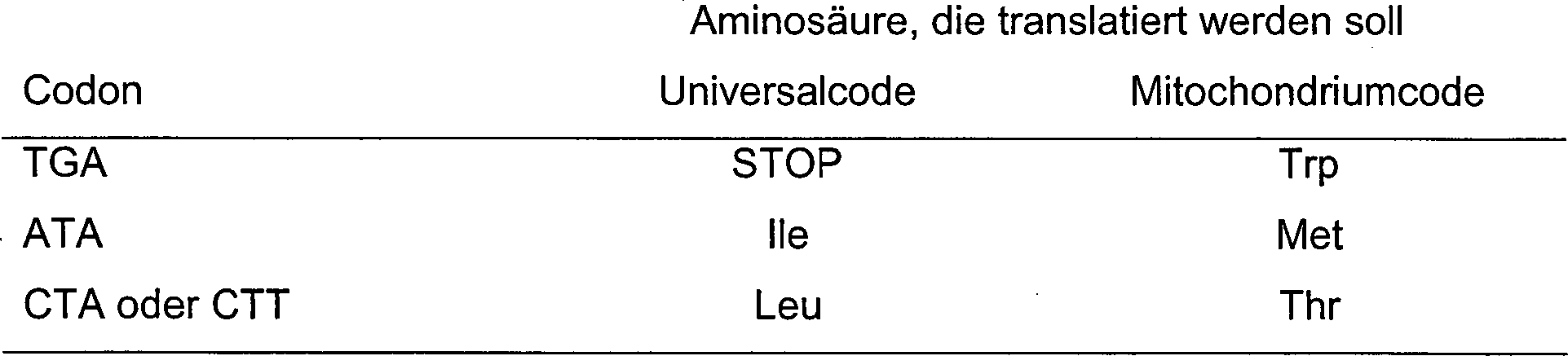
Die Nucleotidsequenz von ENS2 ist bekannt (JP-B-7-77556; Nakagawa, K., Morishima, N. und Shibata, T., J. Biol. Chem. 266, 1977–1984 (1991)). Wenn ENS2 in einem allgemeinen Expressionssystem wie E. coli nach dem Universalcode exprimiert wird, wird die Translation bei TGA unterbrochen, das als Stoppcodon gelesen wird, wie aus Tabelle 1 ersichtlich ist (beispielsweise schließt die in JP-B-7-77556 beschriebene ENS2 ein TGA-Stoppcodon an den Nucleotiden 97–99 ein). Während ATA nach dem Universalcode als Ile gelesen wird, wird es nach dem Mitochondriumcode als Met gelesen.The Nucleotide sequence of ENS2 is known (JP-B-7-77556; Nakagawa, K., Morishima, N. and Shibata, T., J. Biol. Chem. 266, 1977-1984 (1991)). When ENS2 in a general expression system such as E. coli after the universal code is expressed, the translation at TGA interrupted, which is read as a stop codon, as shown in Table 1 is apparent (for example, that described in JP-B-7-77556 includes ENS2 inserts a TGA stop codon at nucleotides 97-99). While ATA after the universal code when Ile is read, it is named after the mitochondrial code as Met read.
Um ein Expressionssystem im normalen Maßstab für ENS2 zu konstruieren, ist es notwendig, den genetischen Code von ENS2 zu modifizieren, so dass die Aminosäuresequenz, die bei der Expression in einem allgemeinen Expressionssystem (z.B. E. coli) erhalten wird, mit einer Aminosäuresequenz identisch ist, wie sie in einem Mitochondrium-Expressionssystem exprimiert wird. Daher wird ein Codon für Trp (TGA) nach dem Mitochondriumcode (Tabelle 1) durch ein Codon (TGG) substituiert, das nach dem Universalcode in Trp translatiert wird. Eine derartige Substitution wird auch bei ATA sowie CTA und CTT angewandt, die nach dem Universalcode in Ile bzw. Leu translatiert werden (Tabelle 1). Es gibt keinen Bedarf, andere degenerierende Codons zu substituieren, die nach dem Universalcode Ile oder Leu codieren.In order to construct a standard scale expression system for ENS2, it is necessary to modify the ENS2 genetic code so that the amino acid sequence obtained upon expression in a general expression system (eg E. coli) is identical to an amino acid sequence as expressed in a mitochondrial expression system. Therefore, a codon for Trp (TGA) after the mitochondrial code (Table 1) is substituted by a codon (TGG) which is translated to Trp after the universal code. Such a substitution is also applied to ATA, as well as CTA and CTT, which are translated to Ile and Leu, respectively, by the universal code (Table 1). There is no need, other degenerating co dons that code for the universal code Ile or Leu.
Grundsätzlich gibt
es innerhalb der Aminosäuresequenz
der kleineren Untereinheit von Scel (476 Aminosäuren) 37 Aminosäuren als
Kandidaten für
Modifikationen. Ihre Positionen sind in
Tabelle
2 
Die Substitution der Aminosäuren erfolgt durch Substitution der Nucleotidsequenz des Gens, das die Aminosäuren codiert, durch eine andere Nucleotidsequenz (ortsgerichtete Mutagenese). Beispiele der Mutagenese schließen ein, sind aber nicht eingeschränkt auf das Verfahren der ortsgerichteten Mutagenese von T. Kunkel (Kunkel, T. A., Proc. Natl. Acad. Sci. USA. 82, 488–492 (1985)) und das Gapped-Duplex-Verfahren. Es gibt auch eine modifizierte Version des Kunkel-Verfahrens, bei dem gleichzeitig maximal 16 Oligonucleotide zur Modifikation verwendet werden (anstatt der Verwendung von 1 oder 2 Oligonucleotiden wie beim herkömmlichen Kunkel-Verfahren), um eine Vielzahl von Positionen effizient zu substituieren. Eine Mutation kann unter Verwendung eines Kits zur Einführung von Mutationen (beispielsweise Mutant-K (Takara Shuzo, Co., Ltd.) oder Mutant-G (Takara Shuzo, Co., Ltd.)), der die ortsgerichtete Mutagenese nutzt, oder unter Verwendung eines in vitro-LA-PCR-Mutagenesereihen-Kits (Takara Shuzo, Co., Ltd.) eingeführt werden.The Substitution of the amino acids is accomplished by substitution of the nucleotide sequence of the gene encoding the amino acids, by another nucleotide sequence (site-directed mutagenesis). Close examples of mutagenesis but are not limited to the site-directed mutagenesis method of T. Kunkel (Kunkel, T.A., Proc. Natl. Acad. Sci. USA. 82, 488-492 (1985)) and the gapped duplex method. There is also a modified version of the Kunkel method, in which simultaneously used a maximum of 16 oligonucleotides for modification (instead of using 1 or 2 oligonucleotides like in the conventional Kunkel method) to efficiently handle a variety of positions substitute. A mutation can be made using a kit for introduction mutations (for example, Mutant-K (Takara Shuzo, Co., Ltd.) or Mutant-G (Takara Shuzo, Co., Ltd.)) for site-directed mutagenesis or using an in vitro LA PCR mutagenesis series kit (Takara Shuzo, Co., Ltd.) become.
Die Oligonucleotide werden unter Verwendung der Nucleotidsequenz von ENS2 als Matrize (1431 Basenpaare: Nakagawa, K. et al., J. Biol. Chem. 266, 1977–1984 (1991); JP-B-7-77556) konstruiert und synthetisiert, so dass mindestens eine Base, die mit der Mutation eingeführt werden soll, von etwa 8 bis 30 Basen flankiert wird (wobei jedes Oligonucleotid insgesamt etwa 18 bis 60 Basen besitzt). Die Oligonucleotide können durch chemische Synthese unter Verwendung eines herkömmlichen Synthesegeräts erhalten werden.The Oligonucleotides are synthesized using the nucleotide sequence of ENS2 as template (1431 base pairs: Nakagawa, K. et al., J. Biol. Chem. 266, 1977-1984 (1991); JP-B-7-77556) are constructed and synthesized such that at least a base to be introduced with the mutation of about 8 flanked to 30 bases (with each oligonucleotide total has about 18 to 60 bases). The oligonucleotides can by obtained chemical synthesis using a conventional synthesizer become.
(2) Herstellung des Endonucleasegens, das mit der Mutation eingeführt wurde(2) production of the endonuclease gene, that introduced with the mutation has been
Jedes der, wie vorstehend in (1) beschrieben, erhaltenen Oligonucleotide ist am 5'-Ende phosphoryliert, wird unter Verwendung von ENS2 als Matrize synthetisiert und Ligierungsreaktionen unterzogen. Diese Reaktionen können unter Verwendung von T4-Polynucleotidkinase (Takara Shuzo, Co., Ltd.), T4 DNA-Polymerase (Takara Shuzo, Co., Ltd.), T4-DNA-Ligase (Takara Shuzo, Co., Ltd.) oder dergleichen erfolgen.each the oligonucleotides obtained as described in (1) above is phosphorylated at the 5 'end, is synthesized using ENS2 as a template and ligation reactions subjected. These reactions can using T4 polynucleotide kinase (Takara Shuzo, Co., Ltd.), T4 DNA polymerase (Takara Shuzo, Co., Ltd.), T4 DNA ligase (Takara Shuzo, Co., Ltd.) or the like.
Die Nucleotidsequenz der so erhaltenen DNA wird bestimmt. Die Bestimmung der Nucleotidsequenz kann nach einem bekannten Verfahren wie dem chemischen Maxam-Gilbert-Modifikationsverfahren oder einem Didesoxykettenabbruchverfahren unter Verwendung des M13-Phagen durchgeführt werden. Im Allgemeinen wird die Sequenz unter Verwendung eines automatischen Nucleotidsequenziergeräts (z.B. ALF (Pharmacia), 373A-DNA-Sequenziergerät (Perkin-Elmer) etc.) bestimmt.The Nucleotide sequence of the DNA thus obtained is determined. The determination The nucleotide sequence can be prepared by a known method such as Maxam-Gilbert chemical modification method or a dideoxy chain termination method be performed using the M13 phage. In general the sequence is purified using an automatic nucleotide sequencer (e.g. ALF (Pharmacia), 373A DNA sequencer (Perkin-Elmer), etc.).
Die SEQ ID NR: 2 und 3 geben die Nucleotidsequenz eines Gens, das eine Endonuclease codiert, und die Aminosäuresequenz einer Endonuclease beispielhaft an, die im Verfahren der vorliegenden Erfindung verwendet werden. Die Endonuclease erlangt die wesentliche Funktion der Endonuclease Scel oder SuvI, d.h. die Funktion, die Consensussequenz „CANRYNNANNCYYGTTW" und eine dazu ähnliche Sequenz zu erkennen, indem sie an die größere Untereinheit der natürlichen Endonuclease bindet. Die Endonuclease übt die Funktion der kleineren Einheit der natürlichen Endonuclease aus und kann die 26 Basen spezifisch erkennen, die durch GCCCAGACATATCCCTGAATGATACC (SEQ ID NR: 1) dargestellt werden.SEQ ID NOS: 2 and 3 exemplify the nucleotide sequence of a gene encoding an endonuclease and the amino acid sequence of an endonuclease used in the method of the present invention. The endonuclease acquires the essential function of the endonuclease Scel or SuvI, ie the Function to recognize the consensus sequence "CANRYNNANNCYYGTTW" and a sequence similar thereto by binding to the larger subunit of the natural endonuclease Endonuclease exerts the function of the smaller unit of the natural endonuclease and can specifically recognize the 26 bases which are expressed by GCCCAGACATATCCCTGAATGATACC ( SEQ ID NO: 1).
Die Endonuclease kann die Mutationen Gly217Lys und Asn346Asp einschließen und immer noch die vorstehenden 26 Basen (SEQ ID NR: 1) erkennen.The Endonuclease may include the mutations Gly217Lys and Asn346Asp and still recognize the above 26 bases (SEQ ID NO: 1).
Der Ausdruck „kann erkennen", wie hier verwendet, bezieht sich auf die Funktion der Endonuclease, an eine Stelle der 26 Basen innerhalb des Gens zu binden und das Gen zu spalten, so dass die 26 Basenpaare in zwei Fragmente mit gestuften Enden getrennt werden.Of the Expression "can recognize, "as here refers to the function of the endonuclease, to a Place the 26 bases within the gene to bind and add the gene split so that the 26 base pairs are graded into two fragments with Ends are separated.
Die DNA, die mit dem vorstehenden Gen (SEQ ID NR: 2) unter stringenten Bedingungen hybridisieren kann, kann auch in das Gen eingeschlossen werden, das die Endonuclease codiert. Die stringenten Bedingungen sind beispielsweise eine Natriumkonzentration von 15 bis 900 mM und eine Temperatur von 37 bis 70°C, vorzugsweise 68°C.The DNA linked to the above gene (SEQ ID NO: 2) under stringent Conditions can also hybridize into the gene which encodes the endonuclease. The stringent conditions For example, a sodium concentration of 15 to 900 mM and a temperature of 37 to 70 ° C, preferably 68 ° C.
(3) Herstellung und Transformation des rekombinanten Vektors(3) production and transformation of the recombinant vector
(i) Herstellung des rekombinanten Vektors(i) Preparation of recombinant vector
Ein rekombinanter Vektor kann erhalten werden, indem das Gen, das die Endonuclease codiert, in einen geeigneten Vektor ligiert (eingebaut) wird. Der Vektor zum Einbau des Gens ist nicht auf einen Spezifischen begrenzt, solange er in einer Wirtszelle replizierbar ist. Beispiele eines derartigen Vektors schließen ein, sind aber nicht auf Plasmid-DNA und Phagen-DNA begrenzt.One Recombinant vector can be obtained by using the gene containing the Endonuclease encoded, ligated into a suitable vector (incorporated) becomes. The vector for incorporation of the gene is not specific limited as long as it is replicable in a host cell. Examples of such a vector but are not limited to plasmid DNA and phage DNA.
Die Plasmid-DNA ist beispielsweise ein Plasmid aus E. coli (z.B. pRSET, pTZ19R, pBR322, pBR325, pUC118, pUC119 etc.), ein Plasmid aus Bacillus (z.B. pUB110, pTP5 etc.) oder ein Plasmid aus Hefe (z.B. YEp13, YEp24, YCp50 etc.). Die Phagen-DNA ist beispielsweise der λ-Phage oder dergleichen. Auf ähnliche Weise kann ebenfalls ein tierischer Virusvektor wie ein Retrovirus- oder Vacciniavirus-Vektor oder ein Insektenvirusvektor wie ein Baculovirusvektor verwendet werden.The For example, plasmid DNA is a plasmid from E. coli (e.g., pRSET, pTZ19R, pBR322, pBR325, pUC118, pUC119, etc.), a plasmid from Bacillus (e.g., pUB110, pTP5, etc.) or a yeast plasmid (e.g., YEp13, YEp24, YCp50 etc.). The phage DNA is for example the λ phage or like. In a similar way may also be an animal virus vector such as a retrovirus or vaccinia virus vector or an insect virus vector such as a baculovirus vector become.
Um das die Endonuclease codierende Gen in den Vektor einzubauen, wird die gereinigte DNA mit einem geeigneten Restriktionsenzym gespalten. Dann wird das gespaltene Fragment in die Restriktionsstelle oder eine Multiclonierungsstelle der geeigneten Vektor-DNA eingebaut.Around the gene encoding the endonuclease is incorporated into the vector cleaved the purified DNA with an appropriate restriction enzyme. Then the cleaved fragment is inserted into the restriction site or incorporated a multicloning site of the appropriate vector DNA.
Das Gen sollte in den Vektor eingebaut werden, so dass das Gen funktionieren kann. Falls gewünscht, kann der Vektor andere Gene als das Gen und den Promotor einschließen, beispielsweise ein cis-Element (z.B. ein Enhancerelement), ein Spleiß-Signal, ein Poly(A)-Schwanz-Signal, einen Selektionsmarker und eine Ribosomen-bindende Sequenz (SD-Sequenz). Beispiele des Selektionsmarkers schließen das Dihydrofolatreduktasegen, das Ampicillin-Resistenzgen und das Neomycin-Resistenzgen ein.The Gene should be incorporated into the vector so that the gene will work can. If desired, can the vector includes genes other than the gene and the promoter, for example a cis-element (e.g., an enhancer element), a splice signal, a poly (A) tail signal, a selection marker, and a ribosome-binding one Sequence (SD sequence). Examples of the selection marker include the Dihydrofolate reductase gene, the ampicillin resistance gene and the neomycin resistance gene one.
(ii) Herstellung der Transformante(ii) Preparation of the transformant
Eine Transformante kann erhalten werden, indem der rekombinante Vektor in eine Wirtszelle so eingeführt wird, dass das Gen von Interesse exprimiert werden kann. Die Wirtszelle ist nicht auf eine Spezifische eingeschränkt, solange sie die Endonuclease codierende DNA exprimieren kann. Als Beispiele sind Bakterien wie die Gattung Escherichia (z.B. Escherichia coli), die Gattung Bacillus (z.B. Bacillus subtilis), die Gattung Pseudomonas (z.B. Pseudomonas putida), die Gattung Rhizobium (z.B. Rhizobium meliloti), Hefe wie Schizosaccharomyces pombe, tierische Zellen (z.B. COS- und CHO-Zellen) und Insektenzellen (z.B. Sf9 und Sf21) angegeben.A Transformant can be obtained by the recombinant vector so introduced into a host cell is that the gene of interest can be expressed. The host cell is not restricted to a specific, as long as it is the endonuclease can express coding DNA. As examples are bacteria like the genus Escherichia (e.g., Escherichia coli), the genus Bacillus (e.g., Bacillus subtilis), the genus Pseudomonas (e.g., Pseudomonas putida), the genus Rhizobium (e.g., Rhizobium meliloti), yeast such as Schizosaccharomyces pombe, animal cells (e.g., COS and CHO cells) and insect cells (e.g., Sf9 and Sf21).
Wenn ein Bakterium wie E. coli als Wirt verwendet wird, wird bevorzugt, dass sich der rekombinante Vektor autonom replizieren kann und einen Promotor, eine ribosomale Bindungsstelle, das Gen und eine Transkriptionsterminationssequenz einschließt. Der rekombinante Vektor kann auch ein Gen zur Kontrolle des Promotors einschließen.If a bacterium such as E. coli is used as a host, it is preferred that the recombinant vector can autonomously replicate and a Promoter, a ribosomal binding site, the gene and a transcription termination sequence includes. The recombinant vector may also contain a gene for controlling the promoter lock in.
Für E. coli sind E. coli K12 und DH1 als Beispiele angegeben und für Bacillus sind Bacillus subtilis MI 114 und 207-21 als Beispiele angegeben.For E. coli E. coli K12 and DH1 are given as examples and for Bacillus Bacillus subtilis MI 114 and 207-21 are given as examples.
Als Promotor kann jeder Promotor verwendet werden, solange er in der Wirtszelle wie E. coli exprimiert werden kann. Beispielsweise kann ein Promotor, der von E. coli oder einem Phagen stammt, z.B. der trp-Promotor, lac-Promotor, pL-Promotor oder pR-Promotor, verwendet werden. Künstlich konstruierte und modifizierte Promotoren wie der tac-Promotor können ebenfalls verwendet werden.As a promoter, any promoter can be used as long as it can be expressed in the host cell such as E. coli. For example, a promoter derived from E. coli or a phage, eg, the trp promoter, lac promoter, p L promoter, or p R promoter can be used. Artificially engineered and modified promoters such as the tac promoter can also be used.
Der rekombinante Vektor kann in das Bakterium nach jedem Verfahren zur Einführung von DNA in ein Bakterium eingeführt werden. Beispielsweise können das Calciumionen-Verfahren (Cohen, S. N. et al., Proc. Natl. Acad. Sci., USA, 69: 2110–2114 (1972)) und ein Elektroporationsverfahren verwendet werden.Of the Recombinant vector can be added to the bacterium after each procedure introduction introduced from DNA into a bacterium become. For example, you can the calcium ion method (Cohen, S.N. et al., Proc. Natl. Acad. Sci., USA, 69: 2110-2114 (1972)) and an electroporation method.
Eine Hefe wie Saccharomyces cerevisiae, Saccharomyces uvarum, Schizosaccharomyces pombe oder Pichia pastoris kann ebenfalls als Wirt verwendet werden. In diesem Fall kann der Promotor jeder Promotor sein, der in der Hefe exprimiert werden kann. Beispiele eines derartigen Promotors schließen ein, sind jedoch nicht begrenzt auf, den gal1-Promotor, gal10-Promotor, Hitzeschockprotein-Promotor, MF 1-Promotor, PHO5-Promotor, PGK-Promotor, GAP-Promotor, ADH-Promotor und AOX1-Promotor.A Yeast such as Saccharomyces cerevisiae, Saccharomyces uvarum, Schizosaccharomyces pombe or Pichia pastoris can also be used as a host. In this case, the promoter may be any promoter that is used in the Yeast can be expressed. Examples of such a promoter shut down but are not limited to the gal1 promoter, gal10 promoter, Heat shock protein promoter, MF 1 promoter, PHO5 promoter, PGK promoter, GAP promoter, ADH promoter and AOX1 promoter.
Der rekombinante Vektor kann in die Hefe durch jedes Verfahren zur Einführung von DNA in eine Hefe eingeführt werden. Beispielsweise können das Elektroporationsverfahren (Becker, D. M. et al., Methods Enzymol., 194, 182–187 (1990)), das Sphäroblastenverfahren (Hinnen, A. et al., Proc. Natl. Acad. Sci., USA, 75, 1929–1933 (1978)) oder das Lithiumacetatverfahren (Itoh, N., J. Bacteriol., 153, 163–168 (1983)) verwendet werden.Of the Recombinant vector can be introduced into the yeast by any method of introduction DNA introduced into a yeast become. For example, you can the electroporation method (Becker, D.M. et al., Methods Enzymol. 194, 182-187 (1990)), the spheroplast method (Hinnen, A. et al., Proc. Natl. Acad Sci., USA, 75, 1929-1933 (1978)) or the lithium acetate method (Itoh, N., J. Bacteriol., 153, 163-168 (1983)) be used.
Eine tierische Zelle wie die Affenzelle COS-7, Vero, die chinesische Hamsterovarienzelle (CHO-Zelle), die Maus-L-Zelle, die Ratten-GH3- oder menschliche FL-Zelle können ebenfalls als Wirt verwendet werden. Als Promotor kann beispielsweise der SR-Promotor, SV40-Promotor, LTR-Promotor oder CMV-Promotor verwendet werden. Andere Promotoren als diese, beispielsweise ein früher Gen-Promotor des menschlichen Cytomegalievirus können ebenfalls verwendet werden.A animal cell like the monkey cell COS-7, Vero, the Chinese Hamster ovary cell (CHO cell), the mouse L cell, the rat GH3 or human FL cell can also be used as a host. As a promoter, for example SR promoter, SV40 promoter, LTR promoter or CMV promoter become. Promoters other than these, for example an early gene promoter of the human cytomegalovirus can also be used.
Der rekombinante Vektor kann in die tierische Zelle beispielsweise durch ein Elektroporationsverfahren, ein Calciumphosphatverfahren oder ein Lipofektionsverfahren eingeführt werden.Of the Recombinant vector can be introduced into the animal cell, for example an electroporation method, a calcium phosphate method or introduced a lipofection procedure become.
Eine Insektenzelle wie die Sf9-Zelle, Sf21-Zelle oder dergleichen kann ebenfalls als Wirt verwendet werden. Der rekombinante Vektor kann in die Insektenzelle beispielsweise durch ein Calciumphosphatverfahren, ein Lipofektionsverfahren oder ein Elektroporationsverfahren eingeführt werden.A Insect cells such as the Sf9 cell, Sf21 cell or the like also be used as a host. The recombinant vector can into the insect cell, for example, by a calcium phosphate method, a lipofection method or an electroporation method.
(5) Herstellung der Endonuclease(5) Preparation of endonuclease
Die Endonuclease kann durch Züchtung der vorstehend beschriebenen Transformante und durch Gewinnen der Endonuclease aus der Kultur davon erhalten werden. Der Begriff „Kultur", wie hier verwendet, bezieht sich auf einen Kulturüberstand, eine gezüchtete Zelle oder mikrobielle Zelle oder eine Zelle oder mikrobielle Zelltrümmer.The Endonuclease can be by breeding the above-described transformant and by winning the Endonuclease can be obtained from the culture thereof. The term "culture" as used here refers to a culture supernatant, a bred Cell or microbial cell or cell or microbial cell debris.
Die Transformante wird nach einem allgemeinen Verfahren gezüchtet, das zur Züchtung des Wirts verwendet wird.The Transformant is grown by a general method that for breeding the host is used.
Ein Medium zur Züchtung der Transformante, die von einem Wirtsmikroorganismus wie E. coli oder Hefe erhalten wird, kann entweder ein natürliches oder ein synthetisches Medium sein, solange es Kohlenstoffquellen, Stickstoffquellen, anorganische Salze und dergleichen enthält, die vom Mikroorganismus assimilierbar sind, und solange damit eine effiziente Züchtung der Transformante erfolgen kann.One Medium for breeding the transformant produced by a host microorganism such as E. coli or yeast can be either natural or synthetic Be medium, as long as there are carbon sources, nitrogen sources, inorganic Contains salts and the like, which are assimilable by the microorganism, and so long as one efficient breeding the transformant can take place.
Als Kohlenstoffquellen können Kohlenwasserstoffe wie Glucose, Fructose, Saccharose, Stärke; organische Säuren wie Essigsäure, Propionsäure; und Alkohole wie Ethanol und Propanol verwendet werden.When Carbon sources can Hydrocarbons such as glucose, fructose, sucrose, starch; organic acids like acetic acid, propionic acid; and alcohols such as ethanol and propanol are used.
Als Stickstoffquellen können Ammoniak, Ammoniumsalze anorganischer oder organischer Säuren wie Ammoniumchlorid, Ammoniumsulfat, Ammoniumacetat, Ammoniumphosphat, andere stickstoffhaltige Verbindungen; Pepton, Fleischextrakt, Maisquellwasser und dergleichen verwendet werden.When Nitrogen sources can Ammonia, ammonium salts of inorganic or organic acids such as ammonium chloride, Ammonium sulfate, ammonium acetate, ammonium phosphate, other nitrogenous Links; Peptone, meat extract, corn steep liquor and the like be used.
Als anorganische Substanzen können Kaliumdihydrogenphosphat, Dikaliumhydrogenphosphat, Magnesiumphosphat, Magnesiumsulfat, Natrium chlorid, Eisen(II)-Sulfat, Mangansulfat, Kupfersulfat, Calciumcarbonat und dergleichen verwendet werden.When inorganic substances can Potassium dihydrogen phosphate, dipotassium hydrogen phosphate, magnesium phosphate, Magnesium sulfate, sodium chloride, ferrous sulfate, manganese sulfate, Copper sulfate, calcium carbonate and the like can be used.
Die Züchtung erfolgt im Allgemeinen 12 bis 18 Stunden bei 37°C unter aeroben Bedingungen wie Schütteln oder Rühren mit Belüftung. Während der Züchtung wird der pH-Wert bei 6,5 bis 7,5, vorzugsweise bei 7,0, gehalten. Der pH-Wert wird mit anorganischer oder organischer Säure, einer alkalischen Lösung oder dergleichen reguliert.The breeding generally takes 12 to 18 hours at 37 ° C under aerobic conditions like shaking or stirring with ventilation. While of breeding the pH is maintained at 6.5 to 7.5, preferably at 7.0. The pH is adjusted with inorganic or organic acid, a alkaline solution or the like.
Während der Züchtung können dem Medium gegebenenfalls Antibiotika wie Ampicillin, Tertacyclin oder dergleichen zugegeben werden.During the breeding can the medium optionally antibiotics such as ampicillin, tertacyclin or may be added.
Bei der Züchtung eines Mikroorganismus, der mit einem Expressionsvektor unter Verwendung eines induzierbaren Promotors transformiert wurde, kann dem Medium bei Bedarf ein Induktor zugesetzt werden. Wenn beispielsweise ein Mikroorganismus, der mit einem Expressionsvektor unter Verwendung des lac-Promotors oder trp-Promotors transformiert wurde, gezüchtet wird, kann dem Medium Isopropyl-1-thio-β-D-galactosid (IPTG) bzw. Indolessigsäure (IES) zugegeben werden.at of breeding of a microorganism using an expression vector an inducible promoter has been transformed, the medium If necessary, an inductor can be added. For example, if a Microorganism using an expression vector of the lac promoter or trp promoter is grown, the medium can be isopropyl-1-thio-β-D-galactoside (IPTG) or indoleacetic acid (IES) are added.
Eine Transformante, die unter Verwendung von tierischen Wirtszellen erhalten wurde, kann in einem allgemein verwendeten Medium wie RPM11640-Medium oder DMEM-Medium oder einem Medium gezüchtet werden, das durch Ergänzen des allgemein verwendeten Mediums mit fötalem Rinderserum und dergleichen erhalten wird.A Transformants obtained using animal host cells may be used in a commonly used medium such as RPM11640 medium or DMEM medium or a medium, that by supplementing of the commonly used medium containing fetal bovine serum and the like becomes.
Die Züchtung erfolgt im Allgemeinen 1 bis 3 Tage bei 37°C unter 5% CO2. Während der Züchtung kann dem Medium ein Antibiotikum wie Kanamycin, Penicillin oder dergleichen zugegeben werden.The cultivation is generally carried out for 1 to 3 days at 37 ° C under 5% CO 2 . During the culture, an antibiotic such as kanamycin, penicillin or the like may be added to the medium.
Nach der Züchtung, bei der eine mikrobielle Zelle oder eine andere Zelle intrazellulär Endonuclease produziert, wird die Endonuclease durch Aufschluss der mikrobiellen Zelle oder der anderen Zelle extrahiert. Wenn eine mikrobielle Zelle oder eine andere Zelle Endonuclease extrazellulär produziert, wird die Kulturlösung direkt verwendet. Alternativ wird die mikrobielle Zelle oder die andere Zelle über Zentrifugation oder dergleichen entfernt, bevor die Endonuclease aus der Kultur über ein allgemeines biochemisches Verfahren zur Proteinisolierung und -reinigung wie Ammoniumsulfatpräzipitation, Gelchromatographie, Ionenaustauschchromatographie, Affinitätschromatographie oder eine Kombination davon isoliert und gereinigt wird.To of breeding, where a microbial cell or other cell produces intracellular endonuclease, the endonuclease is disrupted by digestion of the microbial cell or extracted from the other cell. If a microbial cell or a other cell produces endonuclease extracellularly, the culture solution becomes direct used. Alternatively, the microbial cell or the other Cell over Centrifugation or the like removed before the endonuclease from the culture over a general biochemical method for protein isolation and cleaning, such as ammonium sulphate precipitation, Gel chromatography, ion exchange chromatography, affinity chromatography or a combination thereof is isolated and purified.
BEISPIELEEXAMPLES
Beispiel 1: Herstellung der einzelsträngigen Matrizen-DNA, die die Untereinheit von Scel codiert und Desoxyuracil enthältExample 1: Preparation the single-stranded one Template DNA encoding the subunit of Scel and deoxyuracil contains
Das Gen der Endo. SceI-50 kDa-Untereinheit ENS2 (1431 Basenpaare; Nakagawa, K., Morishima, N. und Shibata, T., J. Biol. Chem. 266, 1977–1984 (1991)) wurde gleichzeitig in zwei Genbereichen modifiziert, d.h. innerhalb der stromaufwärtsliegenden Einheit mit 1,0 Kilobasenpaaren und der stromabwärtsliegenden Einheit mit 0,4 Kilobasenpaaren.The Gene of the endo. SceI-50 kDa subunit ENS2 (1431 base pairs; Nakagawa, K., Morishima, N. and Shibata, T., J. Biol. Chem. 266, 1977-1984 (1991)) was simultaneously modified in two gene regions, i. within the upstream one 1.0 kilobase pair unit and the 0.4 unit downstream unit Kilobase pairs.
Für diesen
Zweck wurden das EcoRI/EcoRI-Fragment (1671 Basenpaare), enthaltend
das Gen der 50 kDa-Untereinheit mit der gesamten Länge (Nakagawa,
K., Morishima, N. und Shibata, T. J., Biol. Chem. 266, 1977–1984 (1991)),
und das PstI/EcoRI-Fragment (534 Basenpaare), enthaltend die stromabwärtsliegende Einheit
des Gens der 50 kDa-Untereinheit, getrennt in das Phagmid pUC118
(Takara Shuzo, Co., Ltd.) cloniert und als Plasmide pEN1.7 bzw.
pEN0.5 bezeichnet (
Beispiel 2: Synthese der Oligonucleotide zur Einführung der ortsgerichteten MutationExample 2: Synthesis of Oligonucleotides for introduction the site-directed mutation
(i) Synthese des Einzelstanges(i) Synthesis of the single-step
Das Gen der 50 kDa-Untereinheit ENS2 wird vom Mitochondriumgenom codiert und schließt daher den genetischen Code ein, der für Mitochondrien einzigartig ist (Tabelle 1). Um ENS2 einem allgemeinen Expressionssystem in großem Maßstab zu unterziehen, müssen diese einzigartigen Codons substituiert werden, damit sie mit dem Universalcode übereinstimmen. Nach Beispiel 2 werden die Basen unter Verwendung eines modifizierten Verfahrens von T. Kunkel (Kunkel, T. A., Proc. Natl. Acad. Sci. USA 82, 488–492 (1985)) substituiert. Während beim allgemeinen Kunkel-Verfahren nur ein oder zwei Oligonucleotide zur Modifikation verwendet werden, werden beim vorliegenden Verfahren maximal 16 Oligonucleotide zur effizienten Substitution an multiplen Positionen verwendet.The Gene of the 50 kDa subunit ENS2 is encoded by the mitochondrial genome and close hence the genetic code that is unique to mitochondria is (Table 1). To ENS2 a general expression system in great scale to undergo These unique codons are substituted to be compatible with the Universal code match. According to Example 2, the bases are prepared using a modified Method of T. Kunkel (Kunkel, T.A., Proc. Natl. Acad. Sci. USA 82, 488-492 (1985)). While in the general Kunkel method only one or two oligonucleotides used for modification are used in the present process a maximum of 16 oligonucleotides for efficient substitution on multiple Positions used.
Es wurden 33 Oligonucleotide konstruiert, die jeweils die zu substituierende Base enthielten, die von etwa 10 bis 15 Basen flankiert wurde (Tabelle 3).It 33 oligonucleotides were constructed, each of which to be substituted Base flanked by about 10 to 15 bases (Table 3).
Tabelle
3 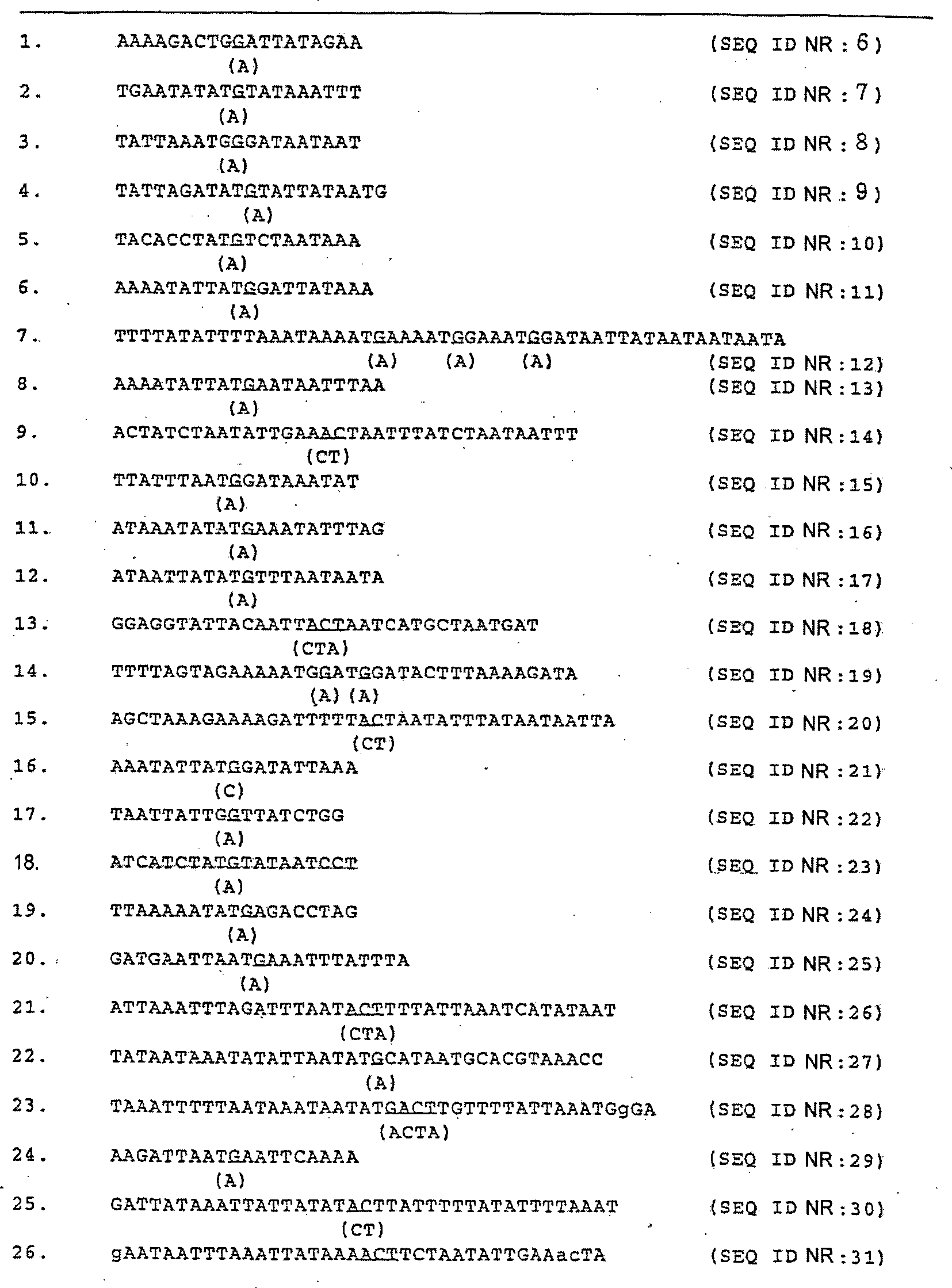

In Tabelle 3 stellt/stellen die Base(n) in Klammern unter jeder Sequenz die ursprüngliche(n) Base(n) dar, die durch die unterstrichene(n) Base(n) substituiert wurde(n). Die in Kleinbuchstaben dargestellten Basen stellen diejenigen dar, bei denen bereits das ursprüngliche Oligonucleotid substituiert wurde.In Table 3 sets the base (s) in parentheses below each sequence the originals) Base (s) substituted by the underlined base (s) was (n). The bases shown in lower case represent those in which already the original Oligonucleotide was substituted.
Die Längen der Oligonucleotide variieren innerhalb des Bereiches von 18 bis 52 Basen, und sie schließen die Mutation von einem bis maximal 4 Resten ein. Diese Oligonucleotide wurden zur Substitution von 50 Basenpaaren des 1431 bp großen Gens der 50 kDa-Untereinheit verwendet, um 37 Codons zu modifizieren. Das 5'-Ende jedes Oligonucleotids wurde phosphoryliert, so dass die später beschriebene DNA-Ligase-Reaktion erfolgen konnte. Die Zusammensetzung des Reaktionsgemisches für die Phosphorylierung ist nachstehend dargestellt:The lengths the oligonucleotides vary within the range of 18 to 52 bases, and they close the mutation from one to a maximum of 4 residues. These oligonucleotides were used to substitute 50 base pairs of the 1431 bp gene of the 50 kDa subunit used to modify 37 codons. The 5 'end of each oligonucleotide was phosphorylated, allowing the DNA ligase reaction described later could be done. The composition of the reaction mixture for the phosphorylation is shown below:
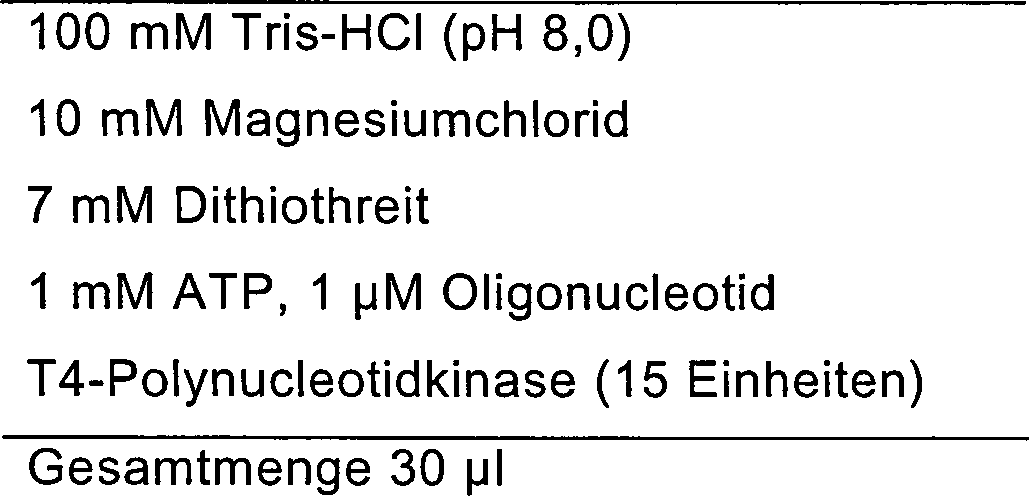
Das Reaktionsgemisch wurde einer 15-minütigen Phosphorylierungsreaktion bei 37°C unterzogen, und dann wurde das Enzym durch eine 10-minütige Behandlung bei 70°C inaktiviert.The Reaction mixture was subjected to a 15-minute phosphorylation reaction at 37 ° C and then the enzyme was treated by a 10-minute treatment at 70 ° C inactivated.
(ii) Synthese des Komplementärstranges(ii) Synthesis of the complementary strand
Die in (i) erhaltenen Oligonucleotide wurden wie folgt behandelt, um Doppelstränge zu erhalten. Die Zusammensetzungen des Anlagerungspuffers und des Verlängerungsreaktionspuffers sind nachstehend dargestellt.The Oligonucleotides obtained in (i) were treated as follows to obtain duplexes to obtain. The compositions of the addition buffer and the Extension reaction buffer are shown below.
Anlagerungspuffer 
Verlängerungsreaktionspuffer 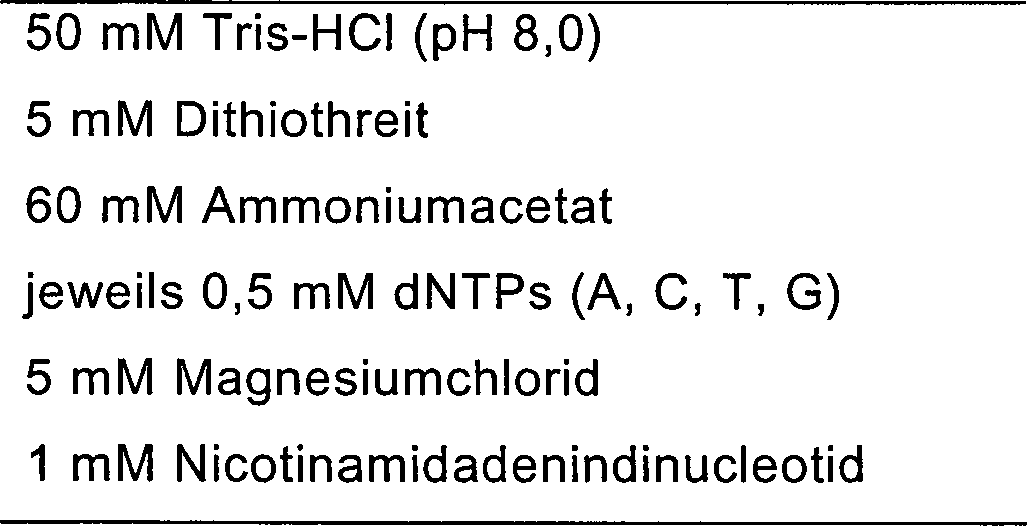
Zu 1 μl Anlagerungspuffer und 0,2 pMol der einzelsträngigen Matrizen-DNA wurde destilliertes Wasser gegeben, was zu einer Gesamtmenge von 10 μl führte. 1 μl der Lösung wurde dispergiert, so dass sie mit 1 μl der phosphorylierten Oligonucleotidlösung gemischt wurde. Das sich ergebende Gemisch wurde 15 min bei 65°C und dann 15 min bei 37°C stehengelassen, wobei sich das Oligonucleotid an die einzelsträngige DNA anlagerte. Der Lösung wurden 25 μl Verlängerungspuffer, 60 Einheiten E. coli-DNA-Ligase und 1 Einheit T4-DNA-Polymerase zugegeben und 2 Stunden bei 25°C stehengelassen, so dass ein Komplementärstrang synthetisiert wurde. 3 μl 0,2 M Ethylendiamintetraessigsäuretetranatriumsalz (pH 8,0) wurden zugegeben, um die Enzymreaktion zu beenden, nach der das Enzym durch 5-minütige Behandlung bei 65°C inaktiviert wurde. Diese Reaktionslösung wurde direkt für die nachstehende Transformation verwendet.To 1 μl of addition buffer and 0.2 pmol of the single-stranded ones Template DNA was distilled water, resulting in a total of 10 μl. 1 μl of the solution became dispersed so that they are mixed with 1 μl of the phosphorylated oligonucleotide solution was mixed. The resulting mixture was stirred at 65 ° C for 15 minutes and then 15 min at 37 ° C allowed to stand, with the oligonucleotide attached to the single-stranded DNA. The solution were 25 μl Extension buffer 60 units of E. coli DNA ligase and 1 unit T4 DNA polymerase added and 2 hours at 25 ° C allowed to stand so that a complementary strand was synthesized. 3 μl 0.2 M Ethylenediaminetetraacetic acid tetrasodium salt (pH 8.0) were added to stop the enzyme reaction after the enzyme by 5-minute Treatment at 65 ° C was inactivated. This reaction solution was used directly for the following Transformation used.
Beispiel 3: TransformationExample 3: Transformation
E. coli BMH71-18-mutS (Takara Shuzo, Co., Ltd.) wurde so verwendet, dass die Nucleotidsequenz des Wildtyp-DNA-Stranges (die einzelsträngige DNA, die mit CJ236 hergestellt wurde) in der doppelsträngigen Plasmid-DNA, die durch Komplementärstrangsynthese erhalten wurde, durch einen Mutantentyp substituiert wurde. In diesem E. coli-Stamm wurde Desoxyuracil, das in der mit CJ236 hergestellten einzelsträngigen DNA enthalten war, durch das Enzym Uracil-DNA-Glycosylase hydrolysiert und dann unter Verwendung des DNA-Stranges erneut synthetisiert, der die substituierte Base als Matrize enthielt (Lindahl, T., Ann. Rev. Biochem. 51, 61–87 (1982)).E. coli BMH71-18-mutS (Takara Shuzo, Co., Ltd.) was used that the nucleotide sequence of the wild-type DNA strand (the single-stranded DNA, made with CJ236) in the double-stranded plasmid DNA, by complementary strand synthesis was substituted by a mutant type. In this E. coli strain was deoxyuracil, which was prepared in CJ236 single DNA was hydrolyzed by the enzyme uracil-DNA glycosylase and then synthesized again using the DNA strand, containing the substituted base as template (Lindahl, T., Ann. Rev. Biochem. 51, 61-87 (1982)).
Das gesamte Reaktionsgemisch mit dem synthetisierten Komplementärstrang wurde der 100 μl-Lösung zugegeben, die die kompetenten Zellen von BMH71-18 mutS enthielt. Kompetente E. coli-Zellen wurden nach dem Verfahren von H. Inoue et al. (Inoue, H., Nojima, H. und Okayama, H., Gene 96, 23–28 (1990)) hergestellt.The entire reaction mixture with the synthesized complementary strand was added to the 100 μl solution, containing the competent cells of BMH71-18 mutS. competent E. coli cells were prepared by the method of H. Inoue et al. (Inoue, H., Nojima, H. and Okayama, H., Gene 96, 23-28 (1990)).
Der Lösung wurde Medium zugegeben und 1 Stunde bei 37°C stehengelassen. Dann wurden 30 μl des Helferphagen (a. a. O.) zugegeben und weitere 30 min bei 37°C stehengelassen, damit die Infektion stattfand. 40 μl der BMH71-18-Kulturlösung, die intrazellulär sowohl den Helferpagen als auch das Plasmid enthielt, wurde fraktioniert und 2 ml des 2 × YT-Mediums, enthaltend Ampicillin (100 μg/ml) und Kanamycin (100 μg/ml), zugegeben. Das sich ergebende Medium wurde 16 bis 20 Stunden bei 37°C einer Schüttelkultur unterzogen, um einen Phagen herzustellen.Of the solution Medium was added and allowed to stand at 37 ° C for 1 hour. Then were 30 μl of the Helper phage (a.o.) were added and allowed to stand at 37 ° C for a further 30 min, so that the infection took place. 40 μl of the BMH71-18 broth, the intracellularly containing both the helper page and the plasmid was fractionated and 2 ml of 2 × YT medium, containing ampicillin (100 μg / ml) and kanamycin (100 μg / ml). The resulting medium was shaken for 16 to 20 hours at 37 ° C subjected to phage production.
Die mikrobielle Zelle wurde durch Zentrifugation (14.000 UpM, 5 min) entfernt. Der Überstand, der den Phagenpartikel enthielt, der die einzelsträngige DNA des Plasmids mit der substituierten Base einbaut, wurde entfernt. Mit 20 μl Überstand wurden 80 μl des Stammes MV1184 (Takara Shuzo, Co., Ltd.) gemischt, der 12 Stunden oder länger gezüchtet worden war, und man ließ ihn 10 min bei 37°C stehen, damit die einzelsträngige DNA des Phagen in die Zelle injiziert wurde.The microbial cell was centrifuged (14,000 rpm, 5 min) away. The supernatant, containing the phage particle containing the single-stranded DNA of the plasmid with the substituted base was removed. With 20 μl supernatant were 80 μl of strain MV1184 (Takara Shuzo, Co., Ltd.) mixed 12 hours or longer cultured had been and they were left 10 min at 37 ° C stand so that the single-stranded DNA phage was injected into the cell.
Der Stamm MV1184, der das sich aus der Replikation der integrierten einzelsträngigen DNA ergebende Plasmid enthielt, wurde zur Selektion auf einem LB-Agarmedium, enthaltend 100 μg/ml Ampicillin, angeimpft (Sambrook, J., Fritsch, E. F. und Maniatis, T., Molecular Cloning: a laboratory Manual, Zweite Ausgabe, Cold Spring Harbor Laboratory Press, Cold Spring Harbor New York (1989)). Die Nucleotidsequenzen der Gene der 50 kDa-Untereinheit wurden bei einigen Clonen mit einem automatischen Sequenziergerät ALF (Pharmacia) analysiert, um den Einbau der vorbestimmten Substitutionen zu bestätigen. Der Fluoreszenzprimer für die Analyse der Nucleotidsequenz wurde von Pharmacia (Uppsala, Schweden) erworben. Die DNA-Sequenzierreaktion basierte auf dem Sanger-Verfahren (Sanger, F. et al., Proc. Natl. Acad. Sci., 74, 5463–5467 (1977)) nach der Vorschrift von Pharmacia.Of the Strain MV1184, which derives from the replication of the integrated single Containing DNA-derived plasmid was selected for selection on an LB agar medium, containing 100 μg / ml Ampicillin, inoculated (Sambrook, J., Fritsch, E.F. and Maniatis, T., Molecular Cloning: a Laboratory Manual, Second Edition, Cold Spring Harbor Laboratory Press, Cold Spring Harbor New York (1989)). The nucleotide sequences of the 50 kDa subunit genes were included some clones with an automatic sequencer ALF (Pharmacia) analyzed to confirm the incorporation of the predetermined substitutions. Of the Fluorescence primer for the analysis of the nucleotide sequence was carried out by Pharmacia (Uppsala, Sweden) acquired. The DNA sequencing reaction was based on the Sanger method (Sanger, F. et al., Proc. Natl. Acad Sci., 74, 5463-5467 (1977)) according to the instructions of Pharmacia.
Für das Ausgangsmaterial, Plasmid pEN1.7, wurden 40 Nucleotidsubstitutionen mittels 9 Zyklen des Mutageneseverfahrens durchgeführt, während 10 Nucleotidsubstitutionen für pEN0.5 mittels 4 Zyklen eines derartigen Verfahrens durchgeführt wurden.For the starting material, Plasmid pEN1.7, 40 nucleotide substitutions were made by 9 cycles of the mutagenesis procedure, while 10 nucleotide substitutions for pEN0.5 were carried out by means of 4 cycles of such a method.
Waren
einmal alle Substitutionen bestätigt,
wurden die stromaufwärtsliegenden
und stromabwärtsliegenden
Einheiten an die PstI-Schnittstelle
gebunden, so dass ein Gen erhalten wurde, das die 50 kDa-Untereinheit
mit vollständigen
Substitutionen codiert (
Beispiel 4: Konstruktion des Expressionsplasmids für die 50 kDa-UntereinheitExample 4: Construction of the expression plasmid for the 50 kDa subunit
Um die Bindung zwischen dem modifizierten Gen der 50 kDa-Untereinheit und dem Vektor zur Induktion ihrer Expression zu ermöglichen, wurden die Restriktionsschnittstellen in die 5'- und 3'-Enden des modifizierten Gens über die Polymerasekettenreaktion (PCR) eingeführt. Die Reaktion erfolgte unter Ver wendung von Taq-DNA-Polymerase (Takara Shuzo, Co., Ltd.) nach der Vorschrift des Herstellers. Die Sequenzen der verwendeten Primer sind nachstehend dargestellt.Around the binding between the modified 50 kDa subunit gene and to allow the vector to induce its expression, For example, restriction sites were inserted into the 5 'and 3' ends of the modified gene via the Polymerase chain reaction (PCR) introduced. The reaction took place using Taq DNA polymerase (Takara Shuzo, Co., Ltd.) according to the instructions of the manufacturer. The sequences used Primers are shown below.

Die unterstrichenen Teile sind die neu eingeführten BamHI- und SalI-Erkennungssequenzen. Die Reaktion erfolgte mit 25 Zyklen: 1 min bei 94°C; 2 min bei 45°C; und 3 min bei 72°C.The underlined parts are the newly introduced BamHI and SalI recognition sequences. The reaction was carried out with 25 cycles: 1 min at 94 ° C; 2 min at 45 ° C; and 3 min at 72 ° C.
Das durch PCR amplifizierte DNA-Fragment (1447 Basenpaare) wurde über (0,8%) Agarose-Gelelektrophorese (Sambrook, J., Fritsch, E. F. und Maniatis, T. Molecular Cloning: a laboratory Manual, Zweite Ausgabe, Cold Spring Harbor Laboratory Press, Cold Spring Harbor, New York (1989)) aufgetrennt und zur Bestätigung mit Ethidiumbromid gefärbt. Das Fragment wurde aus dem Agarosegel unter Verwendung des Geneclean-Kits (BIO101, Kalifornien, USA) gewonnen.The PCR-amplified DNA fragment (1447 base pairs) was transfected (0.8%) Agarose gel electrophoresis (Sambrook, J., Fritsch, E.F. and Maniatis, T. Molecular Cloning: a Laboratory Manual, Second Edition, Cold Spring Harbor Laboratory Press, Cold Spring Harbor, New York (1989)) separated and for confirmation stained with ethidium bromide. The fragment was removed from the agarose gel using the Geneclean kit (BIO101, California, USA).
Das gewonnene DNA-Fragment wurde mit BamHI und SalI behandelt und in pRSET (Invitrogen Corp.) und pTZ19R (Pharmacia) subcloniert, so dass pSC50 bzw. pTZSC50 erhalten wurde. Das Plasmid pSC50 wurde zur Induktion der Expression verwendet. Plasmid pTZSC50 wurde einer DNA-Sequenzierung unter Verwendung des Fluoreszenzprimers (a. a. O.) unterzogen, so dass bestätigt wurde, dass keine zusätzliche Mutation während der PCR eingeführt worden war.The recovered DNA fragment was treated with BamHI and SalI and incubated in pRSET (Invitrogen Corp.) and pTZ19R (Pharmacia), supra that pSC50 or pTZSC50 was obtained. The plasmid pSC50 was used to induce expression. Plasmid pTZSC50 became one DNA sequencing using the fluorescent primer (a. O.), so that confirmed was that no extra Mutation during the PCR was introduced had been.
Beispiel 5: Einführung der Expression der 50 kDa-UntereinheitExample 5: Introduction of the Expression of the 50 kDa subunit
Das Expressionsplasmid pSC50 wurde in kompetente E. coli BL21 (DE3) pLysS-Zellen (Invitrogen Corp.) eingeführt. Die Transformantenzelle wurde über Nacht bei 37°C über eine Schüttelkultur in einem flüssigen LB-Medium, enthaltend Ampicillin (150 μg/ml) und Chloramphenicol (34 μg/ml) vorgezüchtet (Sambrook, J., Fritsch, E. F. und Maniatis, T., Molecular Cloning: a laboratory Manual, Zweite Ausgabe, Cold Spring Harbor Laboratory Press, Cold Spring Harbor, New York (1989)). Die vorgezüchtete Lösung (4 Vol.-% einer sich ergebenden Kultur) wurde zentrifugiert (2.500 × g, 10 min), um die mikrobielle Zelle zu gewinnen. Dieses Präzipitat wurde in einer kleinen Menge frischem Medium suspendiert, das dann einem flüssigen Medium zugegeben wurde. Die Schüttelkultur (37°C) erfolgte, bis der Suspensionsspiegel von etwa 0,5 bei 600 Nanometer (nm) (OD600) erhalten wurde. Anschließend wurde die Schüttelkultur bei 18°C fortgesetzt. Wenn die OD600 etwa 0,8 erreichte, wurde Isopropyl-1-thio-β-D-galactosid (IPTG) bis zur Endkonzentration von 0,4 mM zugegeben, um die Induktion der Expression der 50 kDa-Untereinheit zu initiieren. Nachdem E. coli weiteren 12 Stunden einer Schüttelkultur bei 18°C unterzogen wurde, wurde er durch Zentrifugation rückgewonnen, schnell mit flüssigem Stickstoff eingefroren und bei –80°C gelagert.The Expression plasmid pSC50 was transformed into competent E. coli BL21 (DE3) pLysS cells (Invitrogen Corp.) were introduced. The transformant cell was over Night at 37 ° C over a shake in a liquid LB medium containing ampicillin (150 μg / ml) and chloramphenicol (34 μg / ml) (Sambrook, J., Fritsch, E.F. and Maniatis, T., Molecular Cloning: a laboratory Manual, Second Edition, Cold Spring Harbor Laboratory Press, Cold Spring Harbor, New York (1989)). The precultivated solution (4% by volume of a resulting Culture) was centrifuged (2,500 xg, 10 min) to the microbial Win cell. This precipitate was suspended in a small amount of fresh medium, then one liquid Medium was added. The shaking culture (37 ° C), until the suspension level of about 0.5 at 600 nanometers (nm) (OD600) was obtained. Subsequently became the shaking culture at 18 ° C continued. When the OD600 reached about 0.8, it became isopropyl 1-thio-β-D-galactoside (IPTG) to the final concentration of 0.4 mM added to the induction initiate the expression of the 50 kDa subunit. After E. coli was further shaken at 18 ° C for 12 hours was recovered by centrifugation, fast with liquid nitrogen frozen and stored at -80 ° C.
Beispiel 6: Reinigung der 50 kDa-Unterinheit aus E. coli.Example 6: Cleaning the 50 kDa subunit from E. coli.
Die bei –80°C gelagerte mikrobielle Zelle wurde bei Raumtemperatur aufgetaut. Die anschließenden Behandlungen wurden bei 4°C oder auf Eis durchgeführt. Die mikrobielle Zelle wurde in Puffer A (20 mM Tris-HCl-Puffer (pH 8,0), 500 mM Natriumchlorid, 5 mM Imidazol, 1 mM Phenylmethylsulfonylfluorid (PMSF; Sigma Aldrich Japan K. K., Tokio, Japan), 0,1% NP-40 (Nacalai Tesque, Inc., Kyoto, Japan)) suspendiert. Die sich ergebende Suspension wurde schnell mit flüssigem Stickstoff eingefroren und unter laufendem Wasser aufgetaut, um E, coli aufzuschließen. Die Suspension wurde 5-mal 30 sec mit einem Ultraschallgerät (UR-200P, Tomy Seiko Co., Ltd., Tokio, Japan) bei maximaler Leistung behandelt.The stored at -80 ° C microbial cell was thawed at room temperature. The subsequent treatments were at 4 ° C or done on ice. The microbial cell was dissolved in Buffer A (20 mM Tris-HCl buffer (pH 8.0), 500 mM sodium chloride, 5 mM imidazole, 1 mM phenylmethylsulfonyl fluoride (PMSF, Sigma Aldrich Japan K.K., Tokyo, Japan), 0.1% NP-40 (Nacalai Tesque, Inc., Kyoto, Japan)). The resulting suspension was fast with liquid Nitrogen frozen and thawed under running water to E, coli to catch up. The suspension was 5 times 30 sec with an ultrasonic device (UR-200P, Tomy Seiko Co., Ltd., Tokyo, Japan) at maximum power.
Die behandelte Lösung wurde bei 4°C (39.000 × g, 20 min) zentrifugiert. Der erhaltene Überstand wurde durch einen 0,45 μm-Mylex-Filter (Millipore, Massachusetts, USA) filtriert. Die Probe wurde auf eine Säule (ø10 mm, 2,0 ml) aufgetragen, die mit Probond Nickelchelate Resin (Invitrogen Corp.) beladen war, das mit Puffer A äquilibriert worden war. Dann wurde die Probe mit 20 ml Puffer A (10-faches Volumen des Harzes) gewaschen. Nach einem weiteren Waschschritt mit 12 ml Puffer A, enthaltend 60 mM Imidazol (6-faches Volumen des Harzes), wurde das Ergebnis einer Gradientenelution mit 60–50 mM Imidazol enthaltendem Puffer A (Gesamtmenge 80 ml) unterzogen. Die eluierte Fraktion wurde einer Natriumdodecylsulfat-Polyacrylamidgelelektrophorese (Laemmli, U. K. Nature, 227, 680–685 (1970)) unterzogen und mit Coomasie Brilliantblau gefärbt, um das Vorliegen der 50 kDa-Untereinheit zu bestätigen. Die 50 kDa-Untereinheit enthaltende Fraktion wurde gegen Puffer B (20 mM Tris-HCl-Puffer (pH 7,5), 300 mM Natriumchlorid, 1 mM Ethylendiamintetraessigsäuretetranatriumsalz, 1 mM Dithiothreit) dialysiert. Das gereinigte Protein wurde unter Verwendung eines Mittels zum Proteintest (Bio-Rad, Kalifornien, USA) nach dem Mikrotestverfahren des Herstellers quantifiziert. Als Standardprotein wurde Rinderserumalbuminlösung (Sigma Aldrich Japan K. K.) verwendet. Infolgedessen wurden 300 μg gereinigtes Protein aus 25 g (Nassgewicht) der mikrobiellen Zelle erhalten.The treated solution was at 4 ° C (39,000 × g, 20 min). The supernatant obtained was replaced by a 0.45 μm Mylex filter (Millipore, Massachusetts, USA). The sample was placed on a Column (ø10 mm, 2.0 ml) prepared with Probond Nickel Chelate Resin (Invitrogen Corp.) equilibrated with buffer A. Then The sample was washed with 20 ml of Buffer A (10 times the volume of the resin). After a further washing step with 12 ml of buffer A, containing 60 mM imidazole (6 times the volume of the resin) became the result a gradient elution with 60-50 mM imidazole containing buffer A (total amount 80 ml). The eluted fraction was subjected to sodium dodecylsulfate polyacrylamide gel electrophoresis (Laemmli, U.K. Nature, 227, 680-685 (1970)) and colored with Coomasie Brilliant Blue, to confirm the presence of the 50 kDa subunit. The 50 kDa subunit containing fraction was buffered against B (20 mM Tris-HCl buffer (pH 7.5), 300 mM sodium chloride, 1 mM ethylenediaminetetraacetic acid tetrasodium salt, 1 mM dithiothreitol). The purified protein was added Use of a Protein Test Agent (Bio-Rad, California, USA) according to the microtest procedure of the manufacturer. As a standard protein bovine serum albumin solution (Sigma Aldrich Japan K. K.). As a result, 300 μg of purified protein was removed from 25 g (wet weight) of the microbial cell.
Beispiel 7: Messung der EndonucleaseaktivitätExample 7: Measurement of endonuclease
Ein
Substrat zur Messung einer Endonucleaseaktivität der 50 kDa-Untereinheit wurde
wie folgt hergestellt. Ein EcoRI/EcoRI-Fragment, das den oli2-Bereich
auf Mitochondrium-DNA enthielt, von dem bekannt ist, dass Endo.
SceI darin spaltet (1671 Basenpaare; Nakagawa, K. et al., EMBO J.
11, 2707–2715
(1992)), wurde in das Phagemid pUC119 (Takara Shuzo, Co., Ltd.)
subcloniert, wobei das Ergebnis als pY673L (
Die Zusammensetzung der für die Messung der Endonucleaseaktivität der 50 kDa-Untereinheit verwendeten Reaktionslösung ist nachstehend dargestellt.The Composition of for used the measurement of endonuclease activity of the 50 kDa subunit reaction solution is shown below.
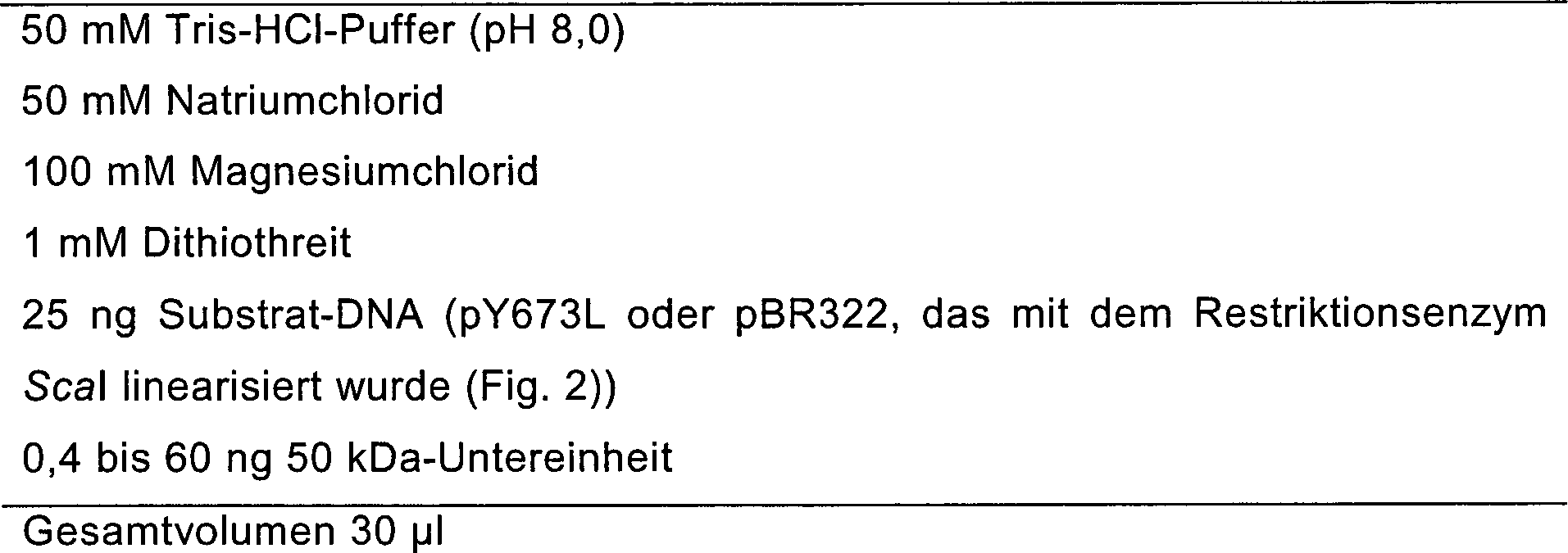
Nach Durchführung der 30-minütigen DNA-Spaltungsreaktion bei 37°C wurden Ethylendiamintetraessigsäuretetranatriumsalz und Natriumdodecylsulfat bis zu Endkonzentrationen von 10 mM bzw. 0,3% zugegeben, um die Reaktion zu beenden. Die gespaltene DNA wurde einer 0,8%-igen Agaroseelektrophorese entweder direkt oder nach der Konzentrierung der DNA durch Phenolextraktion und Ethanolpräzipitation unterzogen.To execution the 30-minute DNA cleavage reaction at 37 ° C were ethylenediaminetetraacetic acid, tetrasodium salt and sodium dodecyl sulfate to final concentrations of 10mM and 0.3% was added to stop the reaction. The split DNA became 0.8% agarose electrophoresis either directly or after Concentration of the DNA by phenol extraction and ethanol precipitation subjected.
Nach der Elektrophorese wurde das Gel mit Ethidiumbromid (Sigma Aldrich Japan K. K.) oder SYBR-Green (Takara Shuzo, Co., Ltd.) gefärbt, um die Spaltung der DNA zu bestätigen. Die DNA wurde unter Verwendung eines FMBIO Imaging-Gerätes (Takara Shuzo, Co., Ltd.) nachgewiesen, um die DNA-Spaltung zu bestimmen.To In electrophoresis, the gel was incubated with ethidium bromide (Sigma Aldrich Japan K.K.) or SYBR-Green (Takara Shuzo, Co., Ltd.) dyed to to confirm the cleavage of the DNA. The DNA was amplified using an FMBIO Imaging Device (Takara Shuzo, Co., Ltd.) to determine DNA cleavage.
Beispiel 8: Nachweis der sequenzspezifischen EndonucleaseExample 8: Detection of sequence-specific endonuclease
Die
dimere Endo. SceI erkennt und spaltet in vivo und in vitro 26 Basenpaare,
die der Consensussequenz innerhalb des oli2-Genbereichs auf der
Mitochondrium DNA ähneln
(Nakagawa, K., Morishima, N. und Shibata, T., EMBO J. 11, 2707–2715 (1992))
(
Die
spezifische Spaltung von oli2 mit der 50 kDa-Untereinheit unter
Verwendung von Plasmid pY673L, das oli2 als Substrat enthält, wurde
bestätigt
(
Die
DNA wurde nicht mit der 50 kDa-Untereinheit unter Verwendung von
Plasmid pBR322 als Substrat gespalten, und es wurde kein Spaltungsfragment
nachgewiesen. Bezugnehmend auf
Beispiel 9: Massenproduktion der 50 kDa-Untereinheit aus Saccharomyces uvarum und Nachweis ihrer AktivitätExample 9: Mass Production the 50 kDa subunit from Saccharomyces uvarum and evidence of their activity
Die
Endo. SuvI-50 kDa-Untereinheit, ein homologes Protein der Endo.
SceI-50 kDa-Untereinheit aus Saccharomyces cerevisiae liegt in Saccharomyces
uvarum vor (Nakagawa, K., Morishima, N. und Shibata, T., J. Bio.
Chem. 266, 1977–1984
(1991)). Beide Untereinheiten besitzen 476 Aminosäurereste,
aber auf der Aminosäureebene
gibt es zwei Unterschiede zwischen ihnen. Die Unterschiede bei den
Aminosäuren
zwischen der Endo. SceI- und der Endo. SuvI-50 kDa-Untereinheit
sind in
Für die Endo.
SuvI-50 kDa-Untereinheit wurde ein Gen zur Expression in großem Maßstab durch
Einführung
zweier zusätzlicher
Modifikationen in das modifizierte Gen für die Endo. SceI-50 kDa-Untereinheit
hergestellt. Die für
die Substitutionen verwendeten Oligonucleotide der Aminosäuren für die Endo.
SuvI-50 kDa-Untereinheit sind in
Die Endo. SuvI-50 kDa-Untereinheit wurde nach dem vorstehend beschriebenen Verfahren exprimiert und gereinigt, das für die Endo. SceI-50 kDa-Untereinheit angewandt wurde. Die gereinigte Endo. SuvI-50 kDa-Untereinheit wurde verwendet, um Plasmid pY673L spezifisch zu spalten.The Endo. SuvI 50 kDa subunit was prepared as described above Process expressed and purified that for the Endo. SceI 50 kDa subunit was applied. The purified endo. SuvI 50 kDa subunit used to specifically cleave plasmid pY673L.
Folglich
war die Endo. SuvI-50 kDa-Untereinheit bei der sequenzspezifischen
Spaltung der Schnittstelle für
die Endo. SceI-50 kDa-Untereinheit auf Plasmid pY673L ähnlich wirksam
(
Dagegen
spaltete die Endo. SuvI-50 kDa-Untereinheit das Plasmid pBR322 überhaupt
nicht (
In
den
Dementsprechend werden eine ortsspezifische Endonuclease, die eine spezifische Nucleotidsequenz erkennen kann, ein die Nucleotidsequenz codierendes Gen, ein rekombinanter, das Gen enthaltender Vektor, eine den Vektor enthaltende Transformante und ein Verfahren zur Herstellung der Endonuclease bereitgestellt. Da die Endonuclease eine spezifische Sequenz aus 26 Basen erkennen kann, ist sie bei der Modifikation und Kartierung von DNA in einem großen Anwendungsbereich, d.h. Plasmid bis Genom, auf dem Gebiet der Gentechnik und Biochemie nützlich.Accordingly become a site-specific endonuclease recognizing a specific nucleotide sequence may be a gene encoding the nucleotide sequence, a recombinant, the gene containing vector, a transformant containing the vector and provided a method of producing the endonuclease. There the endonuclease recognize a specific sequence of 26 bases can, is in the modification and mapping of DNA in one huge Scope, i. Plasmid to genome, in the field of genetic engineering and biochemistry useful.
SEQUENZPROTOKOLL 

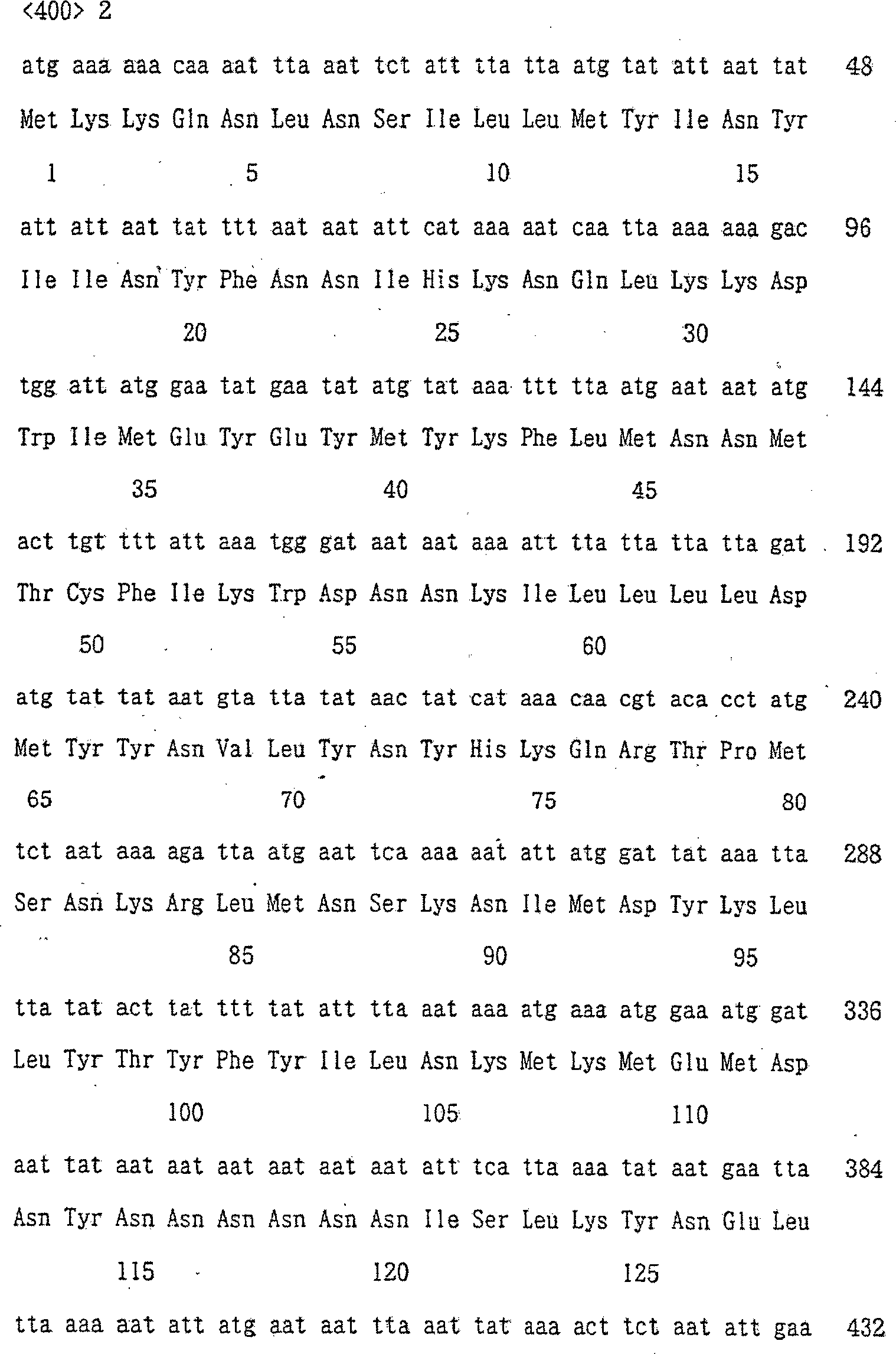
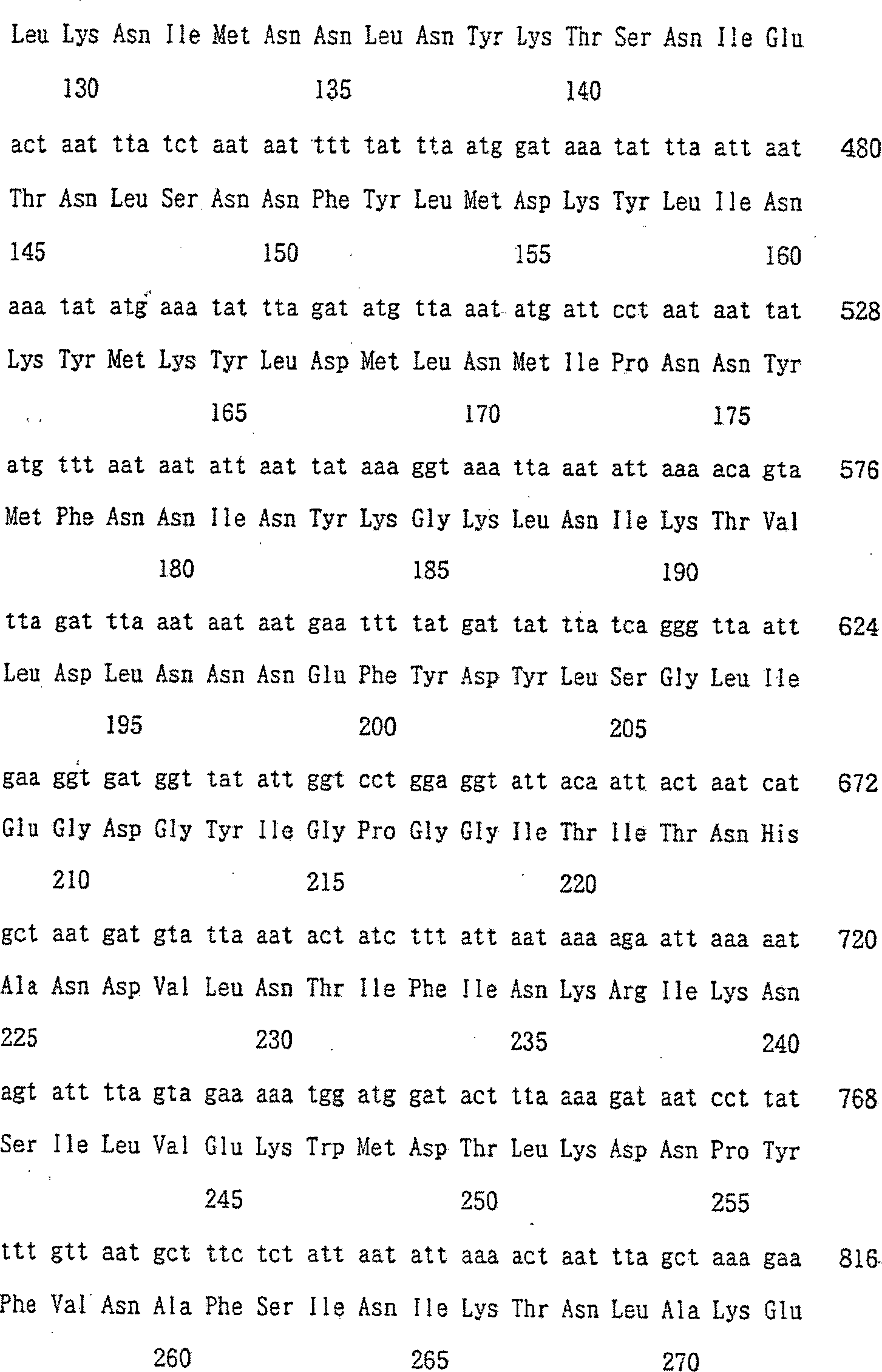
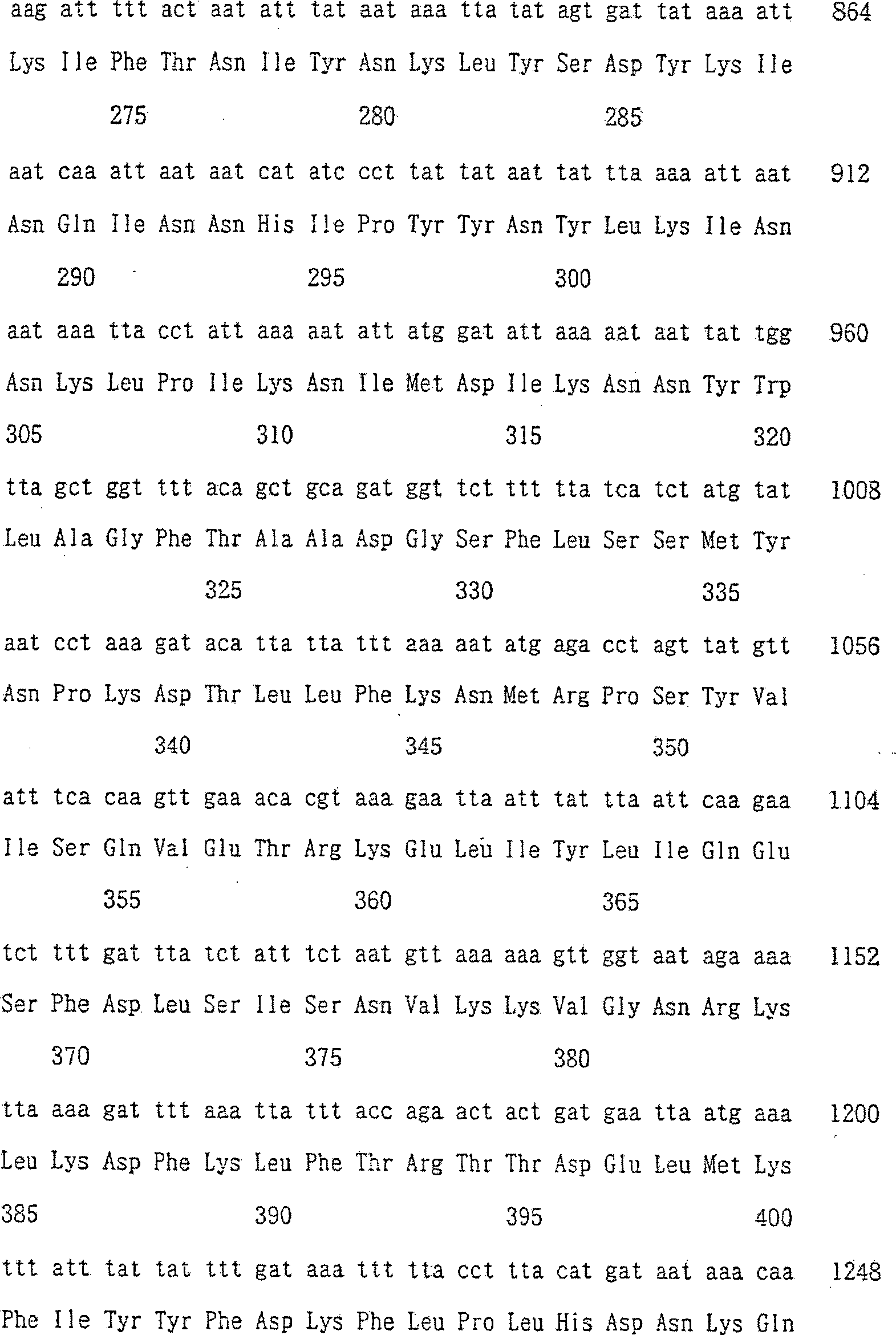
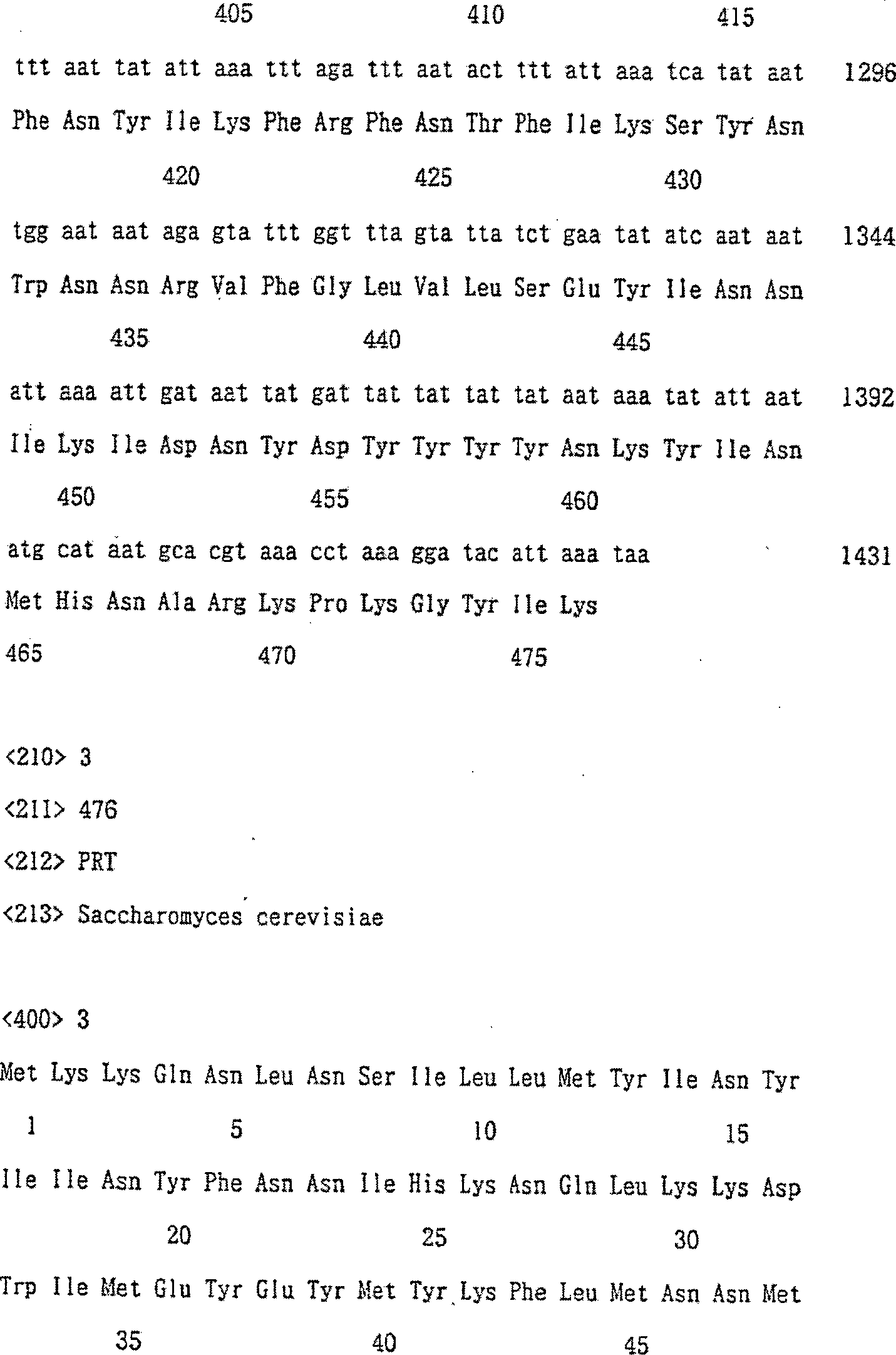


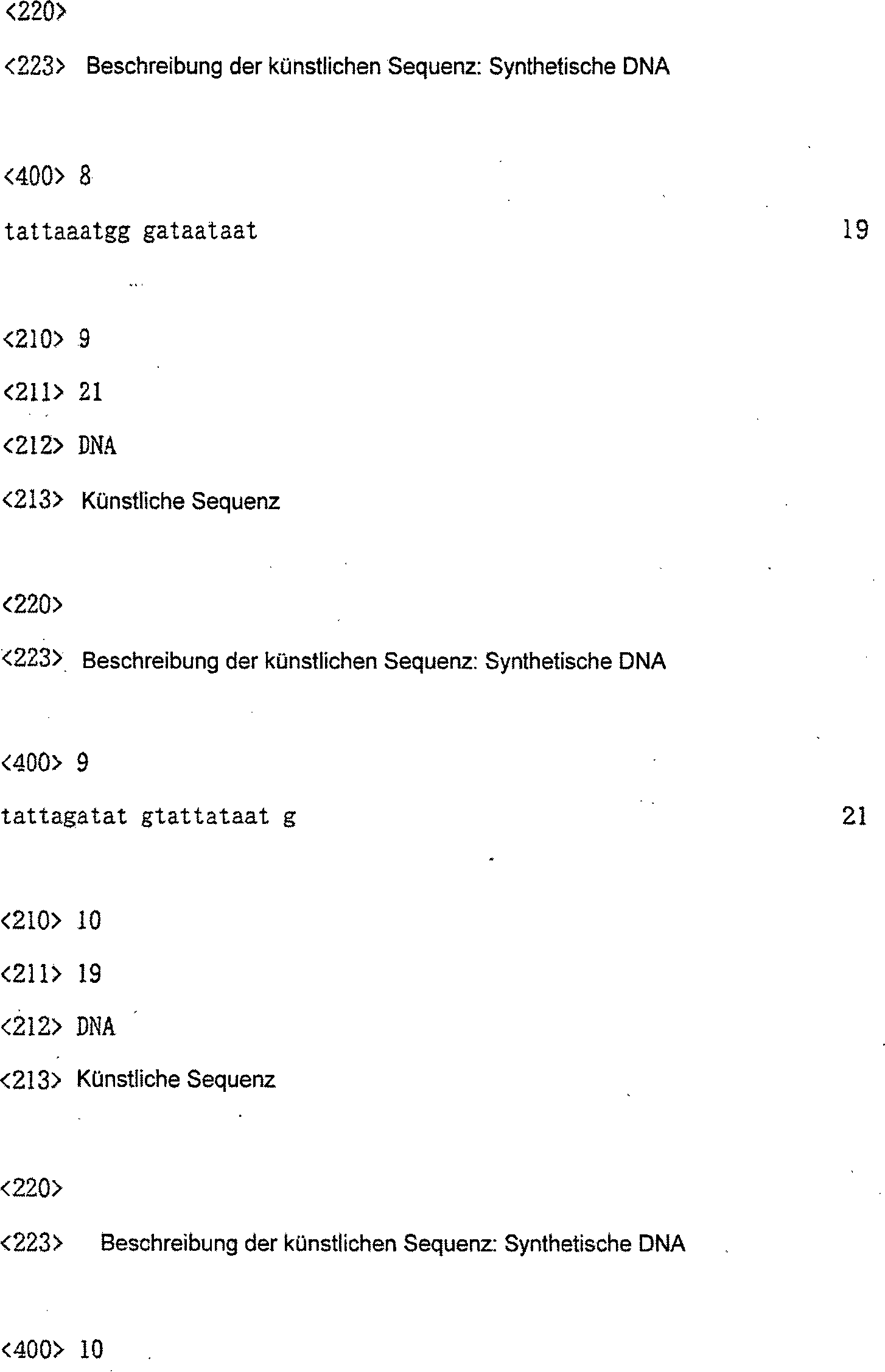
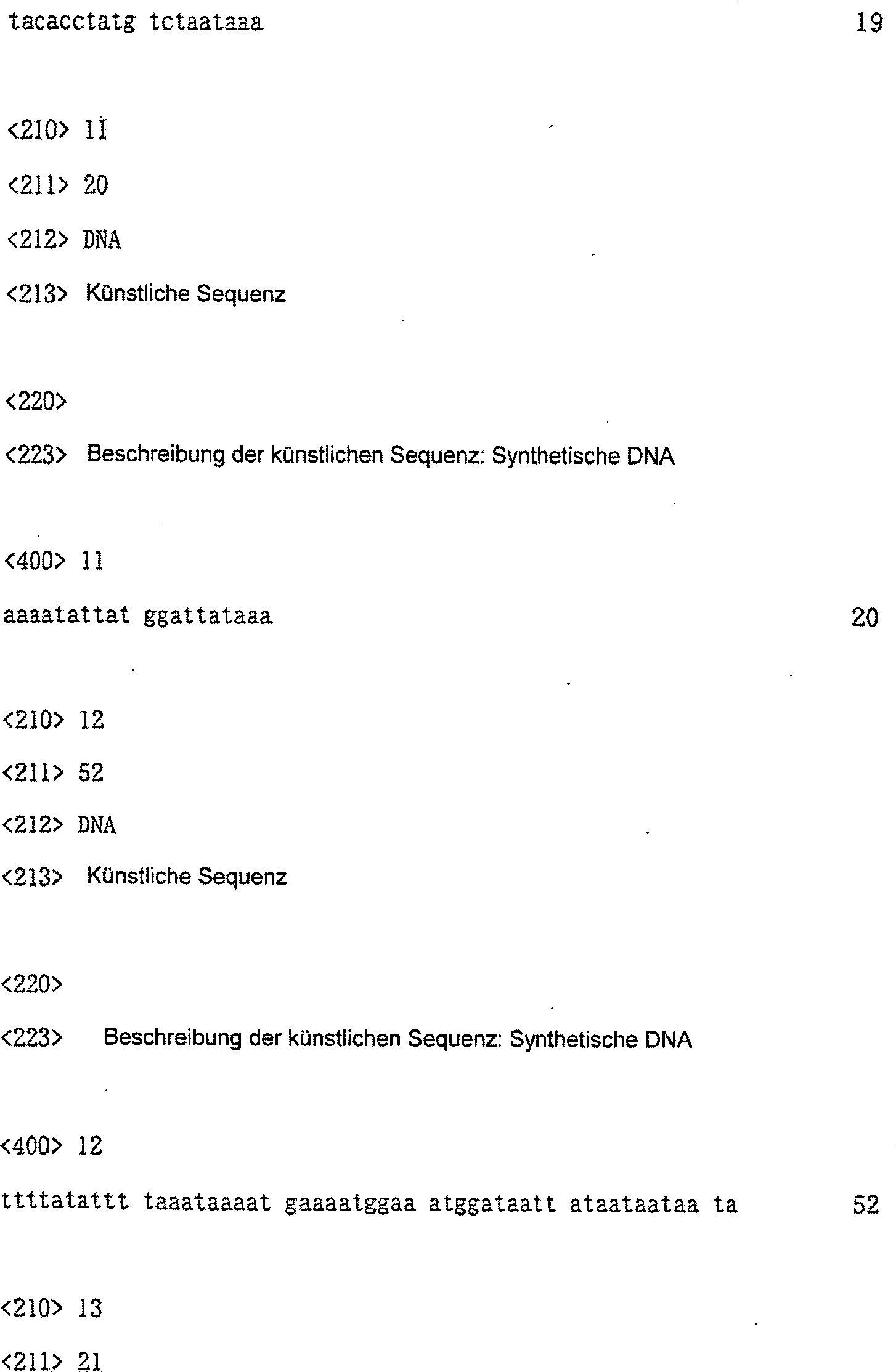
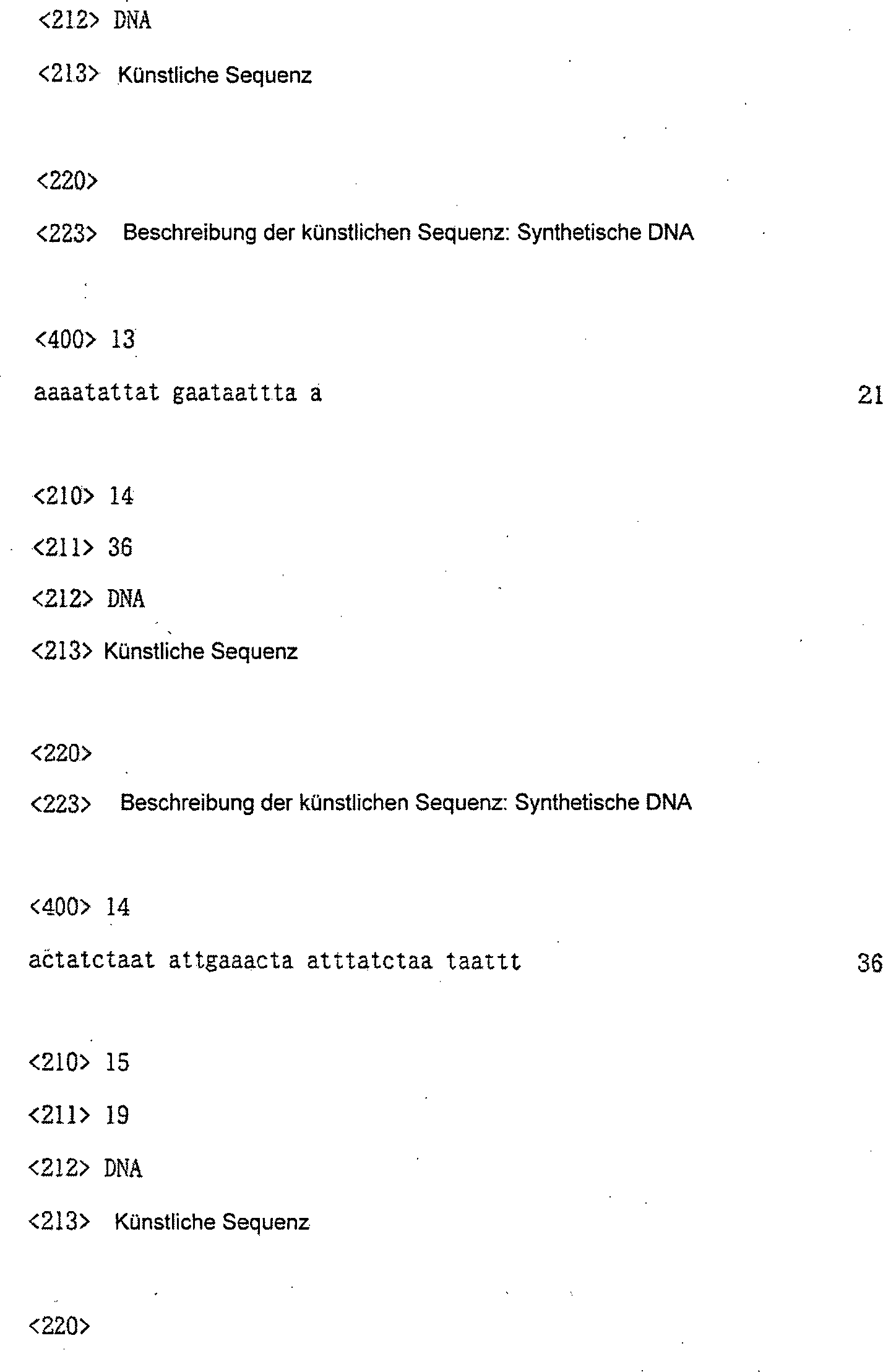
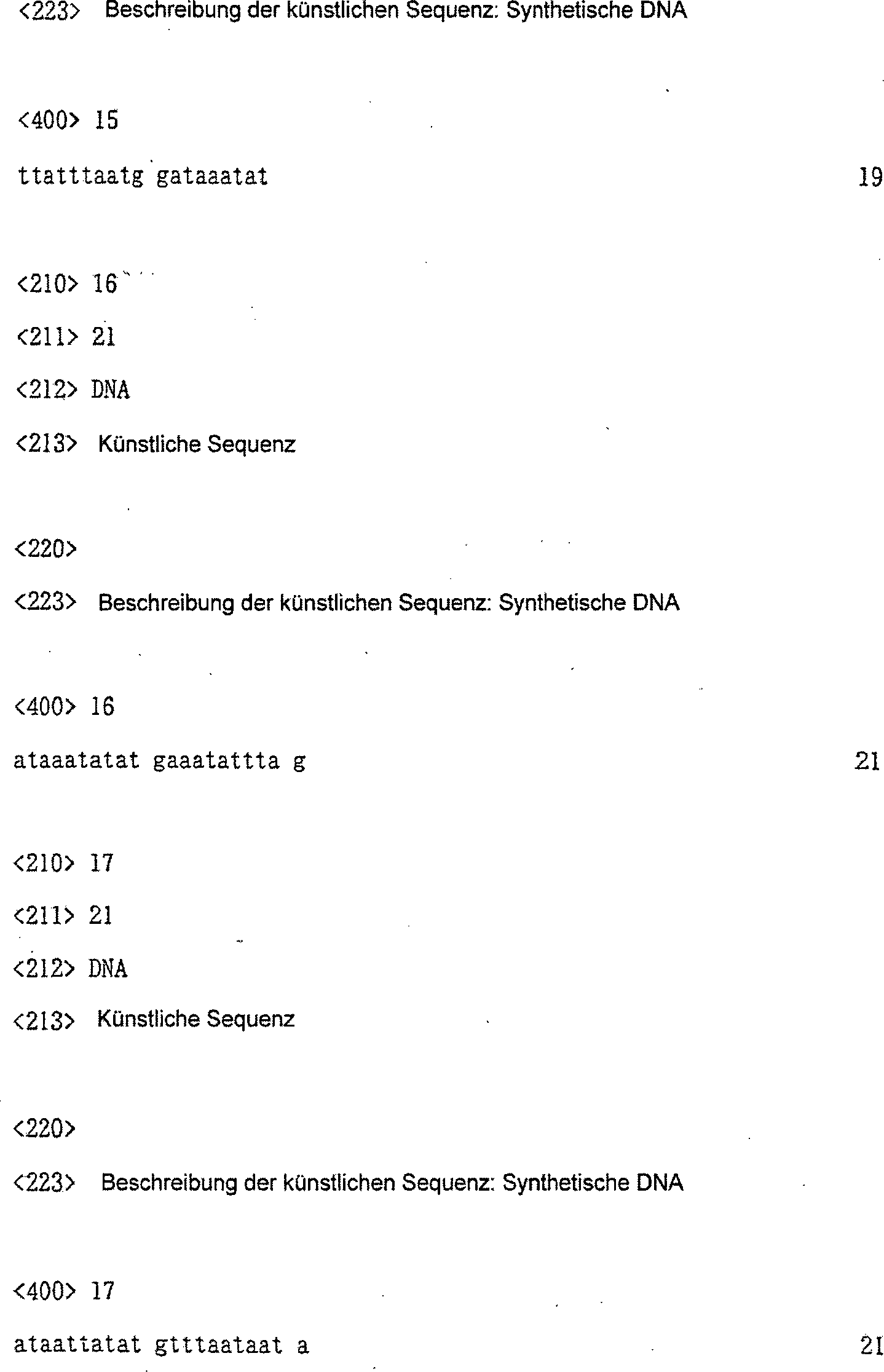
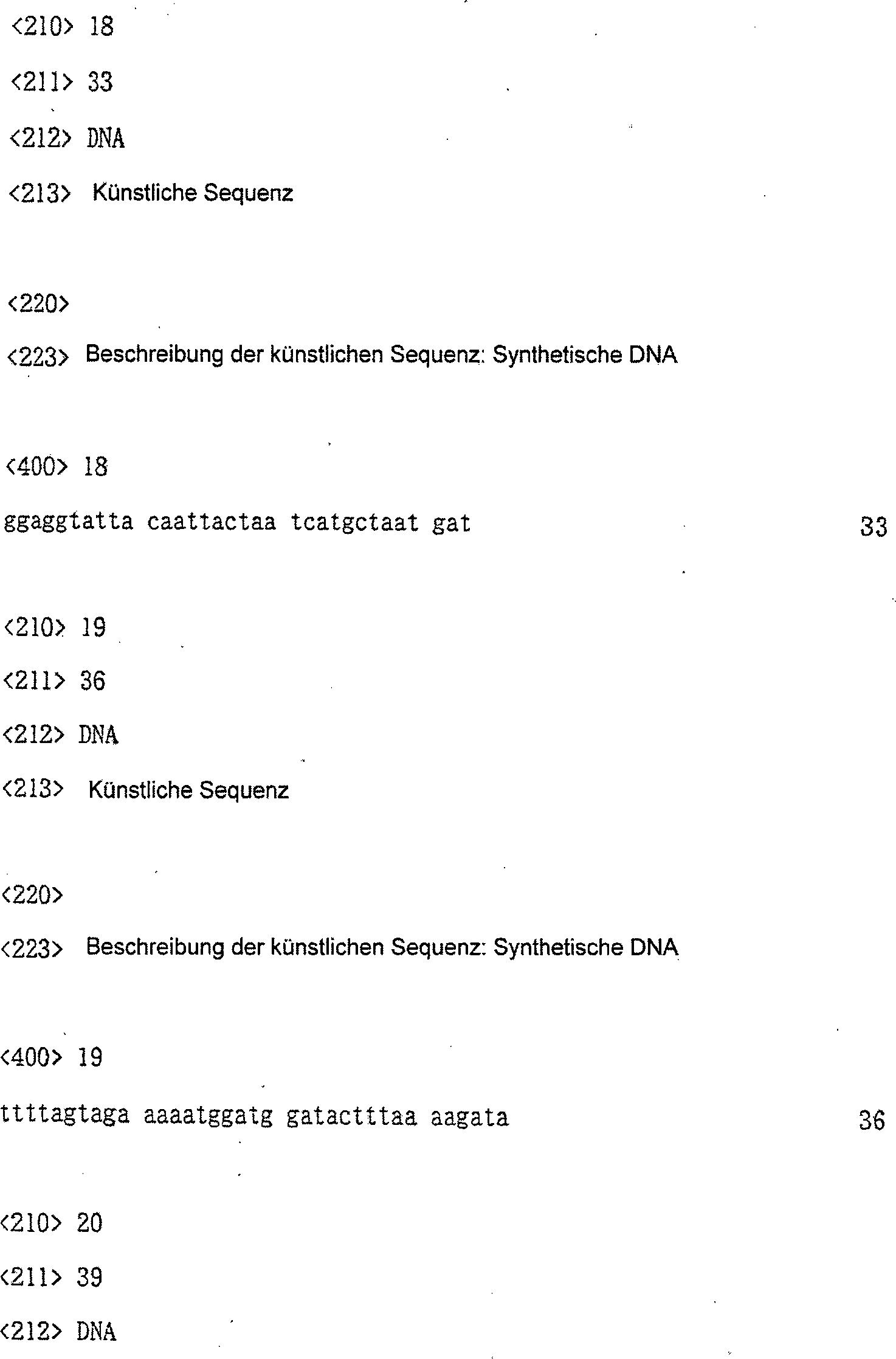

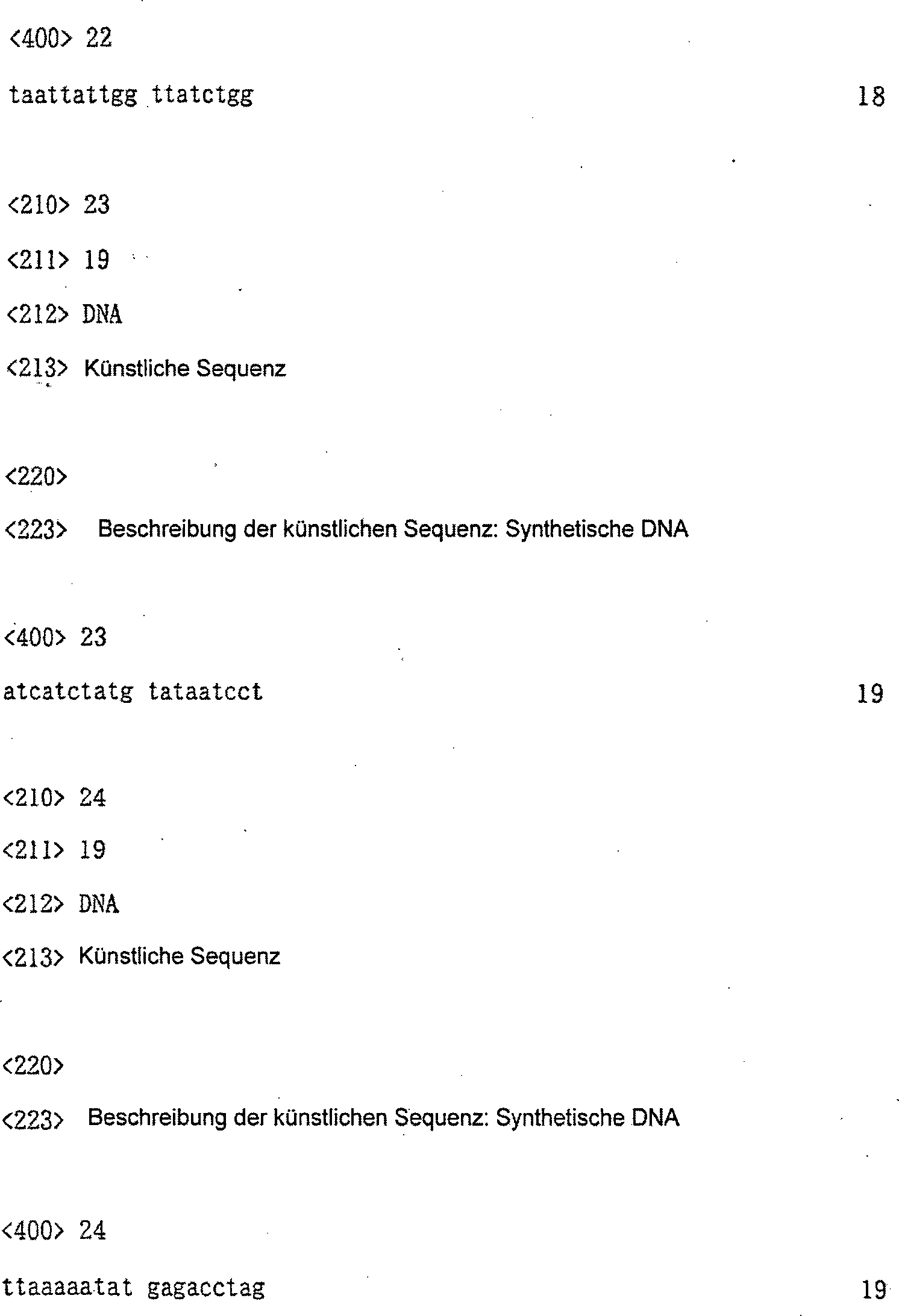
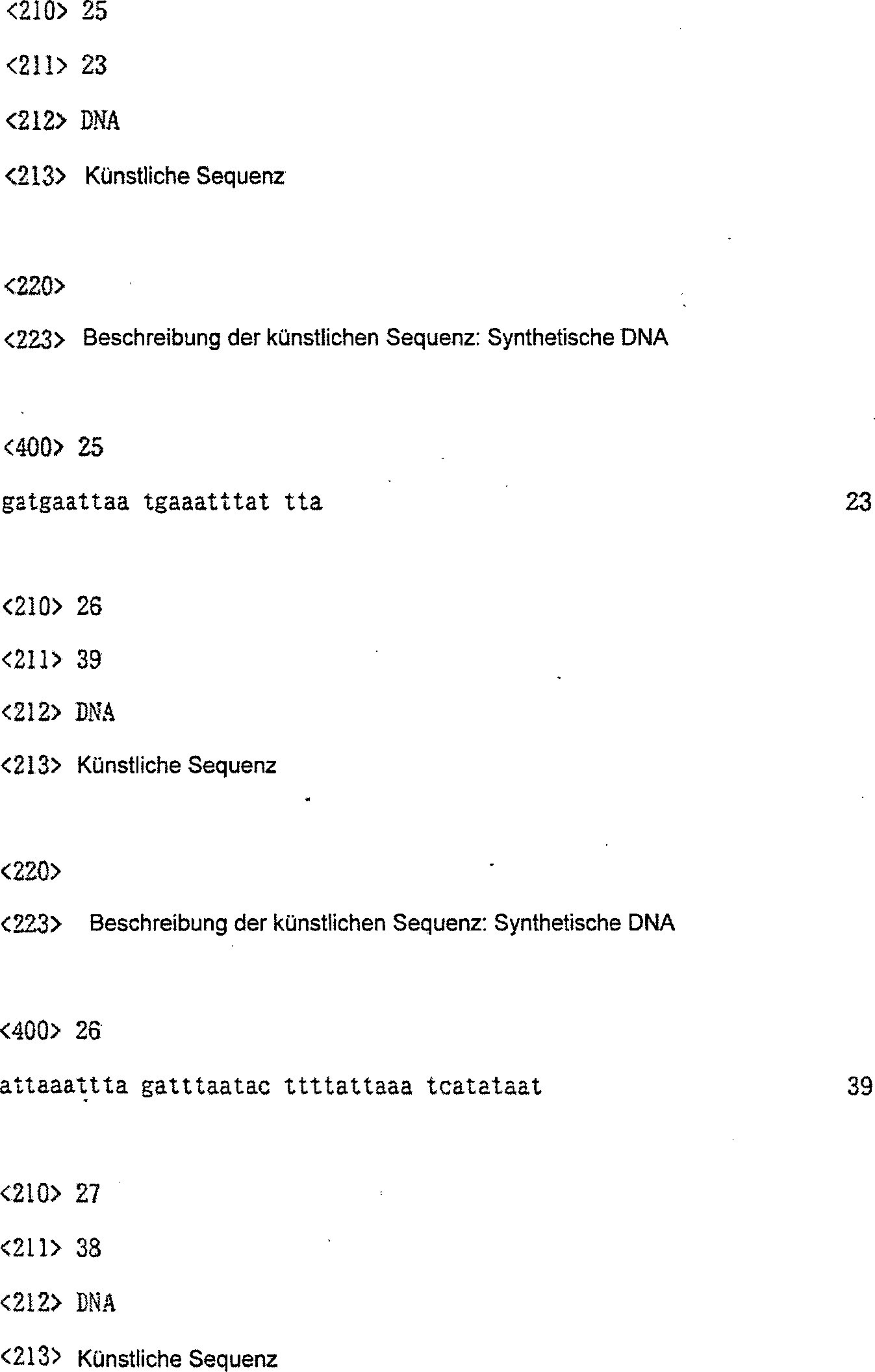
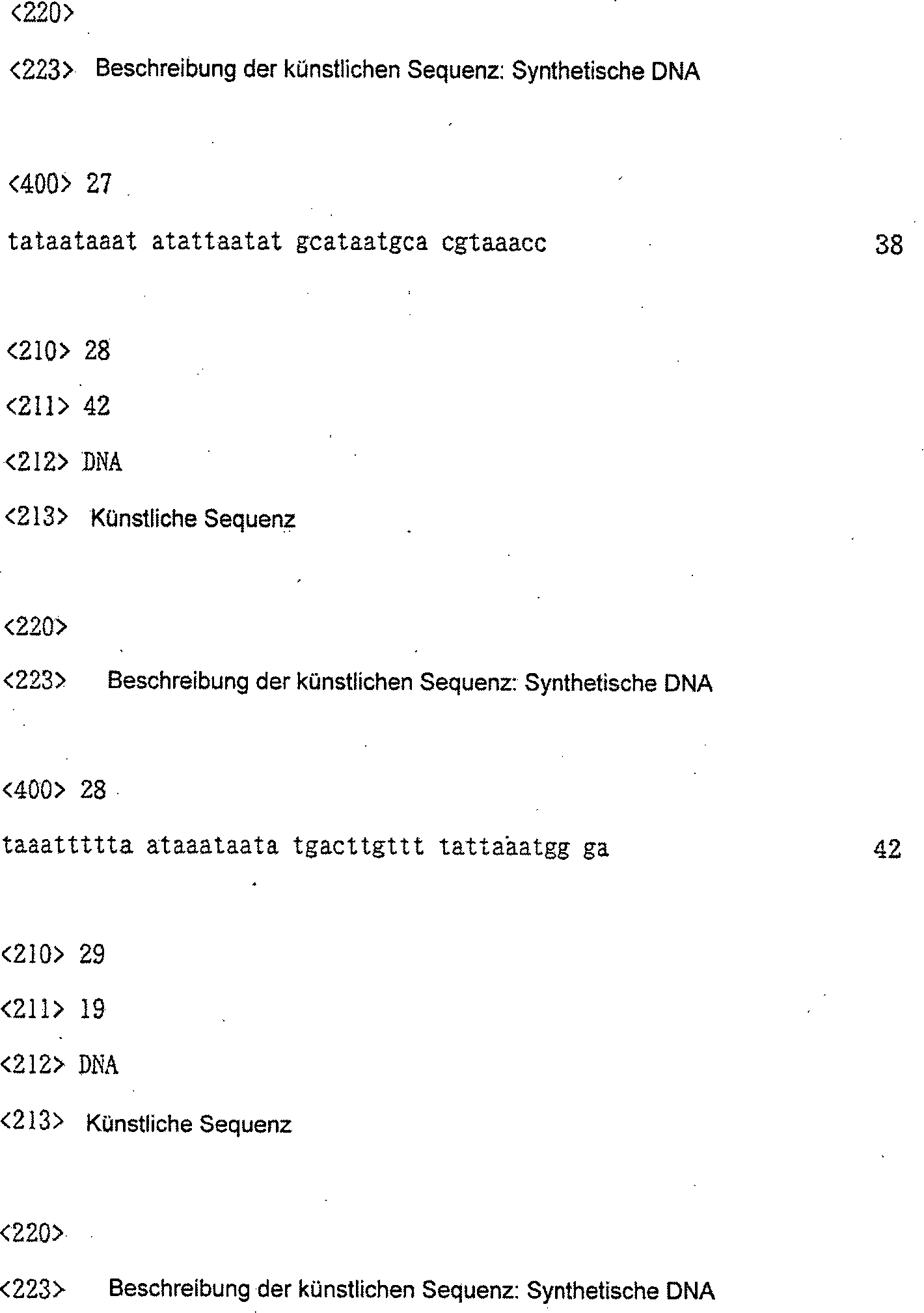
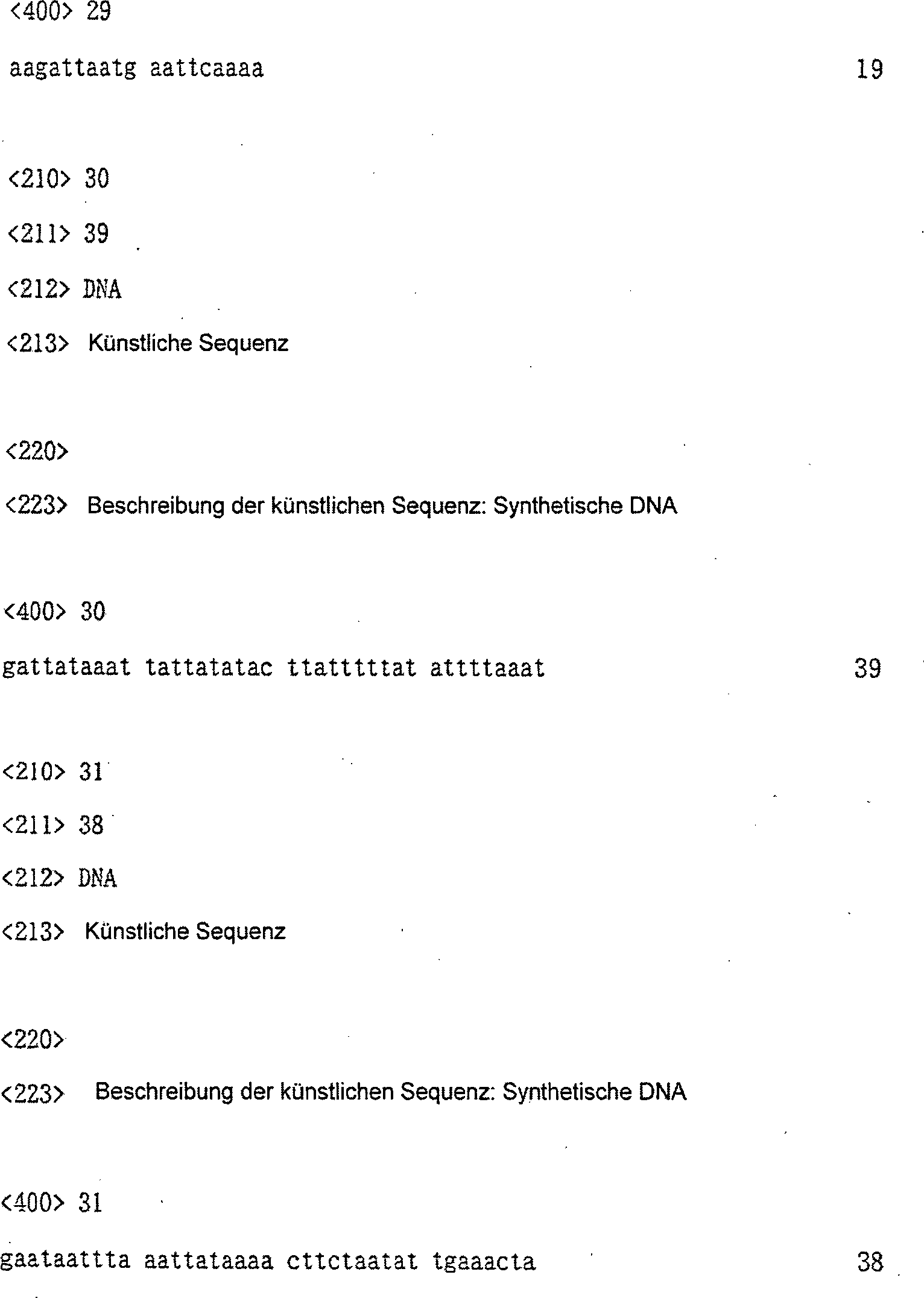

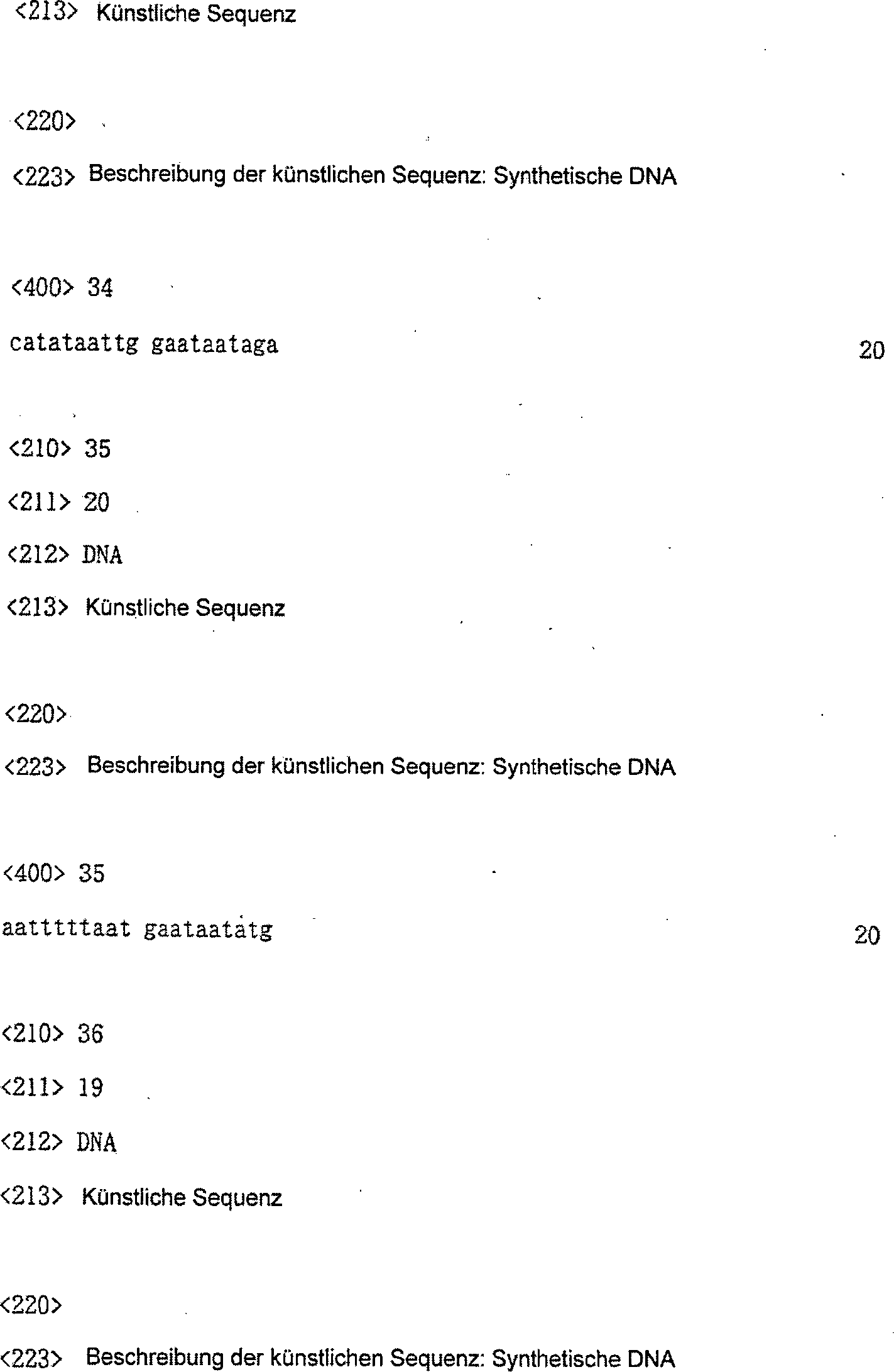

Claims (1)
Applications Claiming Priority (2)
| Application Number | Priority Date | Filing Date | Title |
|---|---|---|---|
| JP14186198 | 1998-05-22 | ||
| JP14186198 | 1998-05-22 |
Publications (2)
| Publication Number | Publication Date |
|---|---|
| DE69924924D1 DE69924924D1 (en) | 2005-06-02 |
| DE69924924T2 true DE69924924T2 (en) | 2006-02-16 |
Family
ID=15301881
Family Applications (1)
| Application Number | Title | Priority Date | Filing Date |
|---|---|---|---|
| DE69924924T Expired - Fee Related DE69924924T2 (en) | 1998-05-22 | 1999-05-21 | Method for splitting DNS |
Country Status (3)
| Country | Link |
|---|---|
| US (2) | US6280942B1 (en) |
| EP (1) | EP0972836B1 (en) |
| DE (1) | DE69924924T2 (en) |
Families Citing this family (2)
| Publication number | Priority date | Publication date | Assignee | Title |
|---|---|---|---|---|
| AU2003292772A1 (en) * | 2002-12-26 | 2004-07-22 | Nippon Shinyaku Co., Ltd. | PROCESS FOR PRODUCING PNPase |
| WO2007049095A1 (en) * | 2005-10-25 | 2007-05-03 | Cellectis | Laglidadg homing endonuclease variants having mutations in two functional subdomains and use thereof |
Family Cites Families (1)
| Publication number | Priority date | Publication date | Assignee | Title |
|---|---|---|---|---|
| JPH0777556B2 (en) | 1990-08-21 | 1995-08-23 | 理化学研究所 | Gene for the small subunit of the site-specific endonuclease SceI |
-
1999
- 1999-05-20 US US09/316,083 patent/US6280942B1/en not_active Expired - Fee Related
- 1999-05-21 EP EP99110008A patent/EP0972836B1/en not_active Expired - Lifetime
- 1999-05-21 DE DE69924924T patent/DE69924924T2/en not_active Expired - Fee Related
-
2001
- 2001-08-20 US US09/933,700 patent/US6528296B1/en not_active Expired - Fee Related
Also Published As
| Publication number | Publication date |
|---|---|
| EP0972836B1 (en) | 2005-04-27 |
| DE69924924D1 (en) | 2005-06-02 |
| EP0972836A3 (en) | 2001-03-14 |
| EP0972836A2 (en) | 2000-01-19 |
| US6528296B1 (en) | 2003-03-04 |
| US6280942B1 (en) | 2001-08-28 |
Similar Documents
| Publication | Publication Date | Title |
|---|---|---|
| DE69730514T2 (en) | amidase | |
| DE69229376T2 (en) | Thermostable firefly luciferase, firefly thermostable luciferase gene, recombinant DNA, and process for making firefly thermostable luciferase | |
| DD212403A5 (en) | PROCESS FOR SYNTHETIZING BOVINE GROWTH HORMONE | |
| DE69734669T2 (en) | ENZYMATIC COFECTOR REGENERATION USING PYRIDINE NUCLEOTIDE TRANSHYDROGENASE | |
| DE69838012T2 (en) | Method for cloning and producing the Spel restriction endonuclease | |
| WO2001025278A1 (en) | C-peptide for the improved production of insulin and insulin analogues | |
| DE69435071T2 (en) | THE TUMORE SUPPRESSIVE PROTEIN PRB2, ASSOCIATED GENE PRODUCTS, AND THE DNA THAT COVERS THEREOF | |
| DE3931716C2 (en) | Recombinant DNA, a transformant containing it and a method for producing heat-stable glucose dehydrogenase and their use | |
| DE69432817T2 (en) | THERMOSTABILE DNA TOPOISOMERASE V | |
| DD201693A5 (en) | PROCESS FOR SYNTHETIZING HUMAN PROINSULIN | |
| DE69201136T2 (en) | Arthrobacter species type II restriction endonuclease and process for its preparation. | |
| DE69133054T2 (en) | METHOD FOR MODIFYING DNA AND DETECTING THE EFFECTS ON THE INTERACTION OF MODIFIED POLYPEPTIDES AND TARGET SUBSTRATES | |
| EP0292763A2 (en) | Gene-technological process for the preparation of angiogenines | |
| DE3485923T2 (en) | DNA GENE, METHOD FOR THE PRODUCTION THEREOF AND PLASMIDE CONTAINING THIS GENE. | |
| DE69630630T2 (en) | Staphylococcus aureus V8 protease mutants | |
| DE69826237T2 (en) | Process for the cloning and preparation of restriction endonuclease PmeI | |
| DE19611234C1 (en) | Tyrosine phosphatase-related protein | |
| DE19536506B4 (en) | New creatine amidinohydrolase gene, new recombinant DNA and methods of making creatine amidinohydrolase | |
| EP1856254A1 (en) | Method for identifying pde11 modulators | |
| DE102004019852B4 (en) | Modified sarcosine oxidases, genes and recombinant DNAs thereof and methods of making the same | |
| DE102004013955B4 (en) | Process for the preparation of recombinant RNase A. | |
| EP1749093A2 (en) | Method for identifying pde5-modulators | |
| DE3803175A1 (en) | STABLE CREATINAMIDINOHYDROLASE MUTANTS | |
| EP0307730B1 (en) | Expression of mutarotase | |
| EP0972836B1 (en) | Method of cleaving DNA |
Legal Events
| Date | Code | Title | Description |
|---|---|---|---|
| 8364 | No opposition during term of opposition | ||
| 8339 | Ceased/non-payment of the annual fee |