DE69918482T2 - Ink, ink set, ink tank, recording unit, image recording method and image recording apparatus - Google Patents
Ink, ink set, ink tank, recording unit, image recording method and image recording apparatus Download PDFInfo
- Publication number
- DE69918482T2 DE69918482T2 DE1999618482 DE69918482T DE69918482T2 DE 69918482 T2 DE69918482 T2 DE 69918482T2 DE 1999618482 DE1999618482 DE 1999618482 DE 69918482 T DE69918482 T DE 69918482T DE 69918482 T2 DE69918482 T2 DE 69918482T2
- Authority
- DE
- Germany
- Prior art keywords
- ink
- recording
- resin
- pigment
- inks
- Prior art date
- Legal status (The legal status is an assumption and is not a legal conclusion. Google has not performed a legal analysis and makes no representation as to the accuracy of the status listed.)
- Expired - Lifetime
Links
- 238000000034 method Methods 0.000 title claims description 58
- 239000000976 ink Substances 0.000 claims description 329
- 239000011347 resin Substances 0.000 claims description 121
- 229920005989 resin Polymers 0.000 claims description 121
- 239000000463 material Substances 0.000 claims description 120
- 239000000049 pigment Substances 0.000 claims description 98
- 238000004040 coloring Methods 0.000 claims description 97
- 239000006229 carbon black Substances 0.000 claims description 67
- 230000003287 optical effect Effects 0.000 claims description 54
- 125000002091 cationic group Chemical group 0.000 claims description 33
- 239000002609 medium Substances 0.000 claims description 26
- 239000000975 dye Substances 0.000 claims description 25
- 239000003094 microcapsule Substances 0.000 claims description 17
- 125000000129 anionic group Chemical group 0.000 claims description 14
- 238000004043 dyeing Methods 0.000 claims description 11
- 239000012736 aqueous medium Substances 0.000 claims description 8
- 150000001875 compounds Chemical class 0.000 claims description 5
- 239000003086 colorant Substances 0.000 claims description 4
- 239000006185 dispersion Substances 0.000 description 69
- XLYOFNOQVPJJNP-UHFFFAOYSA-N water Substances O XLYOFNOQVPJJNP-UHFFFAOYSA-N 0.000 description 69
- 235000019241 carbon black Nutrition 0.000 description 63
- PEDCQBHIVMGVHV-UHFFFAOYSA-N Glycerine Chemical compound OCC(O)CO PEDCQBHIVMGVHV-UHFFFAOYSA-N 0.000 description 58
- 239000002270 dispersing agent Substances 0.000 description 27
- 238000005299 abrasion Methods 0.000 description 25
- KFZMGEQAYNKOFK-UHFFFAOYSA-N Isopropanol Chemical compound CC(C)O KFZMGEQAYNKOFK-UHFFFAOYSA-N 0.000 description 24
- 239000007787 solid Substances 0.000 description 24
- 235000011187 glycerol Nutrition 0.000 description 23
- 239000003550 marker Substances 0.000 description 21
- 239000000203 mixture Substances 0.000 description 21
- ZWEHNKRNPOVVGH-UHFFFAOYSA-N 2-Butanone Chemical compound CCC(C)=O ZWEHNKRNPOVVGH-UHFFFAOYSA-N 0.000 description 18
- MTHSVFCYNBDYFN-UHFFFAOYSA-N diethylene glycol Chemical compound OCCOCCO MTHSVFCYNBDYFN-UHFFFAOYSA-N 0.000 description 18
- 239000002904 solvent Substances 0.000 description 18
- LYCAIKOWRPUZTN-UHFFFAOYSA-N Ethylene glycol Chemical compound OCCO LYCAIKOWRPUZTN-UHFFFAOYSA-N 0.000 description 16
- 208000032843 Hemorrhage Diseases 0.000 description 16
- 230000000740 bleeding effect Effects 0.000 description 16
- 239000002245 particle Substances 0.000 description 16
- 238000002360 preparation method Methods 0.000 description 16
- DNIAPMSPPWPWGF-UHFFFAOYSA-N Propylene glycol Chemical compound CC(O)CO DNIAPMSPPWPWGF-UHFFFAOYSA-N 0.000 description 15
- -1 itaconic Chemical class 0.000 description 14
- 239000003960 organic solvent Substances 0.000 description 14
- 238000011156 evaluation Methods 0.000 description 12
- 229920000642 polymer Polymers 0.000 description 12
- QTBSBXVTEAMEQO-UHFFFAOYSA-N Acetic acid Chemical compound CC(O)=O QTBSBXVTEAMEQO-UHFFFAOYSA-N 0.000 description 11
- 239000012071 phase Substances 0.000 description 11
- 238000007639 printing Methods 0.000 description 11
- 239000000523 sample Substances 0.000 description 11
- 239000000243 solution Substances 0.000 description 11
- 239000004071 soot Substances 0.000 description 10
- OKTJSMMVPCPJKN-UHFFFAOYSA-N Carbon Chemical compound [C] OKTJSMMVPCPJKN-UHFFFAOYSA-N 0.000 description 9
- 239000000178 monomer Substances 0.000 description 9
- 239000000654 additive Substances 0.000 description 8
- 239000000839 emulsion Substances 0.000 description 8
- 150000005846 sugar alcohols Polymers 0.000 description 8
- 239000007864 aqueous solution Substances 0.000 description 7
- 238000010276 construction Methods 0.000 description 7
- QGZKDVFQNNGYKY-UHFFFAOYSA-O Ammonium Chemical compound [NH4+] QGZKDVFQNNGYKY-UHFFFAOYSA-O 0.000 description 6
- 230000008901 benefit Effects 0.000 description 6
- 239000003795 chemical substances by application Substances 0.000 description 6
- 150000003839 salts Chemical class 0.000 description 6
- 239000000758 substrate Substances 0.000 description 6
- VYPSYNLAJGMNEJ-UHFFFAOYSA-N Silicium dioxide Chemical compound O=[Si]=O VYPSYNLAJGMNEJ-UHFFFAOYSA-N 0.000 description 5
- 239000002253 acid Substances 0.000 description 5
- 230000015572 biosynthetic process Effects 0.000 description 5
- 239000002775 capsule Substances 0.000 description 5
- 125000004432 carbon atom Chemical group C* 0.000 description 5
- 229920001577 copolymer Polymers 0.000 description 5
- 238000004519 manufacturing process Methods 0.000 description 5
- 239000012046 mixed solvent Substances 0.000 description 5
- 239000000126 substance Substances 0.000 description 5
- PXHVJJICTQNCMI-UHFFFAOYSA-N Nickel Chemical compound [Ni] PXHVJJICTQNCMI-UHFFFAOYSA-N 0.000 description 4
- 230000000694 effects Effects 0.000 description 4
- 239000003995 emulsifying agent Substances 0.000 description 4
- 239000011521 glass Substances 0.000 description 4
- 238000010438 heat treatment Methods 0.000 description 4
- 125000001165 hydrophobic group Chemical group 0.000 description 4
- 239000004615 ingredient Substances 0.000 description 4
- 238000011835 investigation Methods 0.000 description 4
- 230000014759 maintenance of location Effects 0.000 description 4
- 238000002156 mixing Methods 0.000 description 4
- 239000012074 organic phase Substances 0.000 description 4
- 238000006116 polymerization reaction Methods 0.000 description 4
- 230000008569 process Effects 0.000 description 4
- 238000001454 recorded image Methods 0.000 description 4
- KAKZBPTYRLMSJV-UHFFFAOYSA-N Butadiene Chemical class C=CC=C KAKZBPTYRLMSJV-UHFFFAOYSA-N 0.000 description 3
- LFQSCWFLJHTTHZ-UHFFFAOYSA-N Ethanol Chemical compound CCO LFQSCWFLJHTTHZ-UHFFFAOYSA-N 0.000 description 3
- RRHGJUQNOFWUDK-UHFFFAOYSA-N Isoprene Chemical class CC(=C)C=C RRHGJUQNOFWUDK-UHFFFAOYSA-N 0.000 description 3
- OKKJLVBELUTLKV-UHFFFAOYSA-N Methanol Chemical compound OC OKKJLVBELUTLKV-UHFFFAOYSA-N 0.000 description 3
- ZMXDDKWLCZADIW-UHFFFAOYSA-N N,N-Dimethylformamide Chemical compound CN(C)C=O ZMXDDKWLCZADIW-UHFFFAOYSA-N 0.000 description 3
- LRHPLDYGYMQRHN-UHFFFAOYSA-N N-Butanol Chemical compound CCCCO LRHPLDYGYMQRHN-UHFFFAOYSA-N 0.000 description 3
- WHNWPMSKXPGLAX-UHFFFAOYSA-N N-Vinyl-2-pyrrolidone Chemical compound C=CN1CCCC1=O WHNWPMSKXPGLAX-UHFFFAOYSA-N 0.000 description 3
- SJEYSFABYSGQBG-UHFFFAOYSA-M Patent blue Chemical compound [Na+].C1=CC(N(CC)CC)=CC=C1C(C=1C(=CC(=CC=1)S([O-])(=O)=O)S([O-])(=O)=O)=C1C=CC(=[N+](CC)CC)C=C1 SJEYSFABYSGQBG-UHFFFAOYSA-M 0.000 description 3
- 239000002202 Polyethylene glycol Substances 0.000 description 3
- KWYUFKZDYYNOTN-UHFFFAOYSA-M Potassium hydroxide Chemical compound [OH-].[K+] KWYUFKZDYYNOTN-UHFFFAOYSA-M 0.000 description 3
- HEMHJVSKTPXQMS-UHFFFAOYSA-M Sodium hydroxide Chemical compound [OH-].[Na+] HEMHJVSKTPXQMS-UHFFFAOYSA-M 0.000 description 3
- YCUVUDODLRLVIC-UHFFFAOYSA-N Sudan black B Chemical compound C1=CC(=C23)NC(C)(C)NC2=CC=CC3=C1N=NC(C1=CC=CC=C11)=CC=C1N=NC1=CC=CC=C1 YCUVUDODLRLVIC-UHFFFAOYSA-N 0.000 description 3
- DKGAVHZHDRPRBM-UHFFFAOYSA-N Tert-Butanol Chemical compound CC(C)(C)O DKGAVHZHDRPRBM-UHFFFAOYSA-N 0.000 description 3
- 239000013543 active substance Substances 0.000 description 3
- 229910052783 alkali metal Inorganic materials 0.000 description 3
- 150000001340 alkali metals Chemical class 0.000 description 3
- 150000001732 carboxylic acid derivatives Chemical class 0.000 description 3
- 230000000052 comparative effect Effects 0.000 description 3
- SWXVUIWOUIDPGS-UHFFFAOYSA-N diacetone alcohol Natural products CC(=O)CC(C)(C)O SWXVUIWOUIDPGS-UHFFFAOYSA-N 0.000 description 3
- 238000004945 emulsification Methods 0.000 description 3
- 230000001804 emulsifying effect Effects 0.000 description 3
- 235000019441 ethanol Nutrition 0.000 description 3
- QFXZANXYUCUTQH-UHFFFAOYSA-N ethynol Chemical compound OC#C QFXZANXYUCUTQH-UHFFFAOYSA-N 0.000 description 3
- 125000000524 functional group Chemical group 0.000 description 3
- 230000002209 hydrophobic effect Effects 0.000 description 3
- 230000003472 neutralizing effect Effects 0.000 description 3
- 239000003921 oil Substances 0.000 description 3
- 229920001223 polyethylene glycol Polymers 0.000 description 3
- 230000001681 protective effect Effects 0.000 description 3
- 230000009467 reduction Effects 0.000 description 3
- WZQVBRSAMPJBQE-UHFFFAOYSA-M 1-ethylpyridin-1-ium-3-amine;bromide Chemical compound [Br-].CC[N+]1=CC=CC(N)=C1 WZQVBRSAMPJBQE-UHFFFAOYSA-M 0.000 description 2
- IGGDKDTUCAWDAN-UHFFFAOYSA-N 1-vinylnaphthalene Chemical class C1=CC=C2C(C=C)=CC=CC2=C1 IGGDKDTUCAWDAN-UHFFFAOYSA-N 0.000 description 2
- SVTBMSDMJJWYQN-UHFFFAOYSA-N 2-methylpentane-2,4-diol Chemical compound CC(O)CC(C)(C)O SVTBMSDMJJWYQN-UHFFFAOYSA-N 0.000 description 2
- CSCPPACGZOOCGX-UHFFFAOYSA-N Acetone Chemical compound CC(C)=O CSCPPACGZOOCGX-UHFFFAOYSA-N 0.000 description 2
- HRPVXLWXLXDGHG-UHFFFAOYSA-N Acrylamide Chemical compound NC(=O)C=C HRPVXLWXLXDGHG-UHFFFAOYSA-N 0.000 description 2
- LSNNMFCWUKXFEE-UHFFFAOYSA-M Bisulfite Chemical compound OS([O-])=O LSNNMFCWUKXFEE-UHFFFAOYSA-M 0.000 description 2
- ROSDSFDQCJNGOL-UHFFFAOYSA-N Dimethylamine Chemical compound CNC ROSDSFDQCJNGOL-UHFFFAOYSA-N 0.000 description 2
- VZCYOOQTPOCHFL-OWOJBTEDSA-N Fumaric acid Chemical compound OC(=O)\C=C\C(O)=O VZCYOOQTPOCHFL-OWOJBTEDSA-N 0.000 description 2
- 229920000084 Gum arabic Polymers 0.000 description 2
- VEXZGXHMUGYJMC-UHFFFAOYSA-N Hydrochloric acid Chemical compound Cl VEXZGXHMUGYJMC-UHFFFAOYSA-N 0.000 description 2
- 238000012695 Interfacial polymerization Methods 0.000 description 2
- CERQOIWHTDAKMF-UHFFFAOYSA-N Methacrylic acid Chemical compound CC(=C)C(O)=O CERQOIWHTDAKMF-UHFFFAOYSA-N 0.000 description 2
- SECXISVLQFMRJM-UHFFFAOYSA-N N-Methylpyrrolidone Chemical compound CN1CCCC1=O SECXISVLQFMRJM-UHFFFAOYSA-N 0.000 description 2
- 241000978776 Senegalia senegal Species 0.000 description 2
- PPBRXRYQALVLMV-UHFFFAOYSA-N Styrene Chemical class C=CC1=CC=CC=C1 PPBRXRYQALVLMV-UHFFFAOYSA-N 0.000 description 2
- QAOWNCQODCNURD-UHFFFAOYSA-N Sulfuric acid Chemical compound OS(O)(=O)=O QAOWNCQODCNURD-UHFFFAOYSA-N 0.000 description 2
- WYURNTSHIVDZCO-UHFFFAOYSA-N Tetrahydrofuran Chemical compound C1CCOC1 WYURNTSHIVDZCO-UHFFFAOYSA-N 0.000 description 2
- 238000010521 absorption reaction Methods 0.000 description 2
- 239000000205 acacia gum Substances 0.000 description 2
- 235000010489 acacia gum Nutrition 0.000 description 2
- 239000000980 acid dye Substances 0.000 description 2
- 230000000996 additive effect Effects 0.000 description 2
- 150000005215 alkyl ethers Chemical class 0.000 description 2
- 125000000217 alkyl group Chemical group 0.000 description 2
- 125000002947 alkylene group Chemical group 0.000 description 2
- 229910052782 aluminium Inorganic materials 0.000 description 2
- XAGFODPZIPBFFR-UHFFFAOYSA-N aluminium Chemical compound [Al] XAGFODPZIPBFFR-UHFFFAOYSA-N 0.000 description 2
- 239000003945 anionic surfactant Substances 0.000 description 2
- 239000002216 antistatic agent Substances 0.000 description 2
- 239000011324 bead Substances 0.000 description 2
- BTANRVKWQNVYAZ-UHFFFAOYSA-N butan-2-ol Chemical compound CCC(C)O BTANRVKWQNVYAZ-UHFFFAOYSA-N 0.000 description 2
- 229920006317 cationic polymer Polymers 0.000 description 2
- 230000008859 change Effects 0.000 description 2
- 238000005354 coacervation Methods 0.000 description 2
- 239000011362 coarse particle Substances 0.000 description 2
- 239000000084 colloidal system Substances 0.000 description 2
- 238000001816 cooling Methods 0.000 description 2
- 239000000982 direct dye Substances 0.000 description 2
- 238000000227 grinding Methods 0.000 description 2
- 230000006872 improvement Effects 0.000 description 2
- 238000011065 in-situ storage Methods 0.000 description 2
- 150000002500 ions Chemical class 0.000 description 2
- 229910052751 metal Inorganic materials 0.000 description 2
- 239000002184 metal Substances 0.000 description 2
- 125000004957 naphthylene group Chemical group 0.000 description 2
- 229910052759 nickel Inorganic materials 0.000 description 2
- 239000003973 paint Substances 0.000 description 2
- 125000001997 phenyl group Chemical group [H]C1=C([H])C([H])=C(*)C([H])=C1[H] 0.000 description 2
- 125000000843 phenylene group Chemical group C1(=C(C=CC=C1)*)* 0.000 description 2
- 230000000704 physical effect Effects 0.000 description 2
- 229910052700 potassium Inorganic materials 0.000 description 2
- HJWLCRVIBGQPNF-UHFFFAOYSA-N prop-2-enylbenzene Chemical class C=CCC1=CC=CC=C1 HJWLCRVIBGQPNF-UHFFFAOYSA-N 0.000 description 2
- BDERNNFJNOPAEC-UHFFFAOYSA-N propan-1-ol Chemical compound CCCO BDERNNFJNOPAEC-UHFFFAOYSA-N 0.000 description 2
- 238000011084 recovery Methods 0.000 description 2
- 239000005871 repellent Substances 0.000 description 2
- 239000004576 sand Substances 0.000 description 2
- 239000010703 silicon Substances 0.000 description 2
- 229910052710 silicon Inorganic materials 0.000 description 2
- 229910052708 sodium Inorganic materials 0.000 description 2
- 239000011734 sodium Substances 0.000 description 2
- LPXPTNMVRIOKMN-UHFFFAOYSA-M sodium nitrite Chemical compound [Na+].[O-]N=O LPXPTNMVRIOKMN-UHFFFAOYSA-M 0.000 description 2
- 239000010935 stainless steel Substances 0.000 description 2
- 229910001220 stainless steel Inorganic materials 0.000 description 2
- 238000003756 stirring Methods 0.000 description 2
- VZCYOOQTPOCHFL-UHFFFAOYSA-N trans-butenedioic acid Natural products OC(=O)C=CC(O)=O VZCYOOQTPOCHFL-UHFFFAOYSA-N 0.000 description 2
- PUPZLCDOIYMWBV-UHFFFAOYSA-N (+/-)-1,3-Butanediol Chemical compound CC(O)CCO PUPZLCDOIYMWBV-UHFFFAOYSA-N 0.000 description 1
- 229920002818 (Hydroxyethyl)methacrylate Polymers 0.000 description 1
- ZWVMLYRJXORSEP-UHFFFAOYSA-N 1,2,6-Hexanetriol Chemical compound OCCCCC(O)CO ZWVMLYRJXORSEP-UHFFFAOYSA-N 0.000 description 1
- CYSGHNMQYZDMIA-UHFFFAOYSA-N 1,3-Dimethyl-2-imidazolidinon Chemical compound CN1CCN(C)C1=O CYSGHNMQYZDMIA-UHFFFAOYSA-N 0.000 description 1
- RYHBNJHYFVUHQT-UHFFFAOYSA-N 1,4-Dioxane Chemical compound C1COCCO1 RYHBNJHYFVUHQT-UHFFFAOYSA-N 0.000 description 1
- RHGBRYSELHPAFL-UHFFFAOYSA-N 1,4-bis(pentylamino)anthracene-9,10-dione Chemical compound O=C1C2=CC=CC=C2C(=O)C2=C1C(NCCCCC)=CC=C2NCCCCC RHGBRYSELHPAFL-UHFFFAOYSA-N 0.000 description 1
- RTLULCVBFCRQKI-UHFFFAOYSA-N 1-amino-4-[3-[(4,6-dichloro-1,3,5-triazin-2-yl)amino]-4-sulfoanilino]-9,10-dioxoanthracene-2-sulfonic acid Chemical compound C1=2C(=O)C3=CC=CC=C3C(=O)C=2C(N)=C(S(O)(=O)=O)C=C1NC(C=1)=CC=C(S(O)(=O)=O)C=1NC1=NC(Cl)=NC(Cl)=N1 RTLULCVBFCRQKI-UHFFFAOYSA-N 0.000 description 1
- SMZOUWXMTYCWNB-UHFFFAOYSA-N 2-(2-methoxy-5-methylphenyl)ethanamine Chemical compound COC1=CC=C(C)C=C1CCN SMZOUWXMTYCWNB-UHFFFAOYSA-N 0.000 description 1
- GVNVAWHJIKLAGL-UHFFFAOYSA-N 2-(cyclohexen-1-yl)cyclohexan-1-one Chemical compound O=C1CCCCC1C1=CCCCC1 GVNVAWHJIKLAGL-UHFFFAOYSA-N 0.000 description 1
- JKNCOURZONDCGV-UHFFFAOYSA-N 2-(dimethylamino)ethyl 2-methylprop-2-enoate Chemical compound CN(C)CCOC(=O)C(C)=C JKNCOURZONDCGV-UHFFFAOYSA-N 0.000 description 1
- DPBJAVGHACCNRL-UHFFFAOYSA-N 2-(dimethylamino)ethyl prop-2-enoate Chemical compound CN(C)CCOC(=O)C=C DPBJAVGHACCNRL-UHFFFAOYSA-N 0.000 description 1
- XNWFRZJHXBZDAG-UHFFFAOYSA-N 2-METHOXYETHANOL Chemical compound COCCO XNWFRZJHXBZDAG-UHFFFAOYSA-N 0.000 description 1
- NIXOWILDQLNWCW-UHFFFAOYSA-N 2-Propenoic acid Natural products OC(=O)C=C NIXOWILDQLNWCW-UHFFFAOYSA-N 0.000 description 1
- WFSMVVDJSNMRAR-UHFFFAOYSA-N 2-[2-(2-ethoxyethoxy)ethoxy]ethanol Chemical compound CCOCCOCCOCCO WFSMVVDJSNMRAR-UHFFFAOYSA-N 0.000 description 1
- DJKKWVGWYCKUFC-UHFFFAOYSA-N 2-butoxyethyl 2-methylprop-2-enoate Chemical compound CCCCOCCOC(=O)C(C)=C DJKKWVGWYCKUFC-UHFFFAOYSA-N 0.000 description 1
- ZNQVEEAIQZEUHB-UHFFFAOYSA-N 2-ethoxyethanol Chemical compound CCOCCO ZNQVEEAIQZEUHB-UHFFFAOYSA-N 0.000 description 1
- SFPNZPQIIAJXGL-UHFFFAOYSA-N 2-ethoxyethyl 2-methylprop-2-enoate Chemical compound CCOCCOC(=O)C(C)=C SFPNZPQIIAJXGL-UHFFFAOYSA-N 0.000 description 1
- JNDVNJWCRZQGFQ-UHFFFAOYSA-N 2-methyl-N,N-bis(methylamino)hex-2-enamide Chemical compound CCCC=C(C)C(=O)N(NC)NC JNDVNJWCRZQGFQ-UHFFFAOYSA-N 0.000 description 1
- AGBXYHCHUYARJY-UHFFFAOYSA-N 2-phenylethenesulfonic acid Chemical compound OS(=O)(=O)C=CC1=CC=CC=C1 AGBXYHCHUYARJY-UHFFFAOYSA-N 0.000 description 1
- KGIGUEBEKRSTEW-UHFFFAOYSA-N 2-vinylpyridine Chemical compound C=CC1=CC=CC=N1 KGIGUEBEKRSTEW-UHFFFAOYSA-N 0.000 description 1
- WWJCRUKUIQRCGP-UHFFFAOYSA-N 3-(dimethylamino)propyl 2-methylprop-2-enoate Chemical compound CN(C)CCCOC(=O)C(C)=C WWJCRUKUIQRCGP-UHFFFAOYSA-N 0.000 description 1
- UFQHFMGRRVQFNA-UHFFFAOYSA-N 3-(dimethylamino)propyl prop-2-enoate Chemical compound CN(C)CCCOC(=O)C=C UFQHFMGRRVQFNA-UHFFFAOYSA-N 0.000 description 1
- QPQKUYVSJWQSDY-UHFFFAOYSA-N 4-phenyldiazenylaniline Chemical compound C1=CC(N)=CC=C1N=NC1=CC=CC=C1 QPQKUYVSJWQSDY-UHFFFAOYSA-N 0.000 description 1
- 238000004438 BET method Methods 0.000 description 1
- 101150065749 Churc1 gene Proteins 0.000 description 1
- 241000557626 Corvus corax Species 0.000 description 1
- 229910000881 Cu alloy Inorganic materials 0.000 description 1
- 101100453960 Drosophila melanogaster klar gene Proteins 0.000 description 1
- 239000004908 Emulsion polymer Substances 0.000 description 1
- BRLQWZUYTZBJKN-UHFFFAOYSA-N Epichlorohydrin Chemical compound ClCC1CO1 BRLQWZUYTZBJKN-UHFFFAOYSA-N 0.000 description 1
- IMROMDMJAWUWLK-UHFFFAOYSA-N Ethenol Chemical compound OC=C IMROMDMJAWUWLK-UHFFFAOYSA-N 0.000 description 1
- 206010015719 Exsanguination Diseases 0.000 description 1
- WOBHKFSMXKNTIM-UHFFFAOYSA-N Hydroxyethyl methacrylate Chemical compound CC(=C)C(=O)OCCO WOBHKFSMXKNTIM-UHFFFAOYSA-N 0.000 description 1
- DGAQECJNVWCQMB-PUAWFVPOSA-M Ilexoside XXIX Chemical compound C[C@@H]1CC[C@@]2(CC[C@@]3(C(=CC[C@H]4[C@]3(CC[C@@H]5[C@@]4(CC[C@@H](C5(C)C)OS(=O)(=O)[O-])C)C)[C@@H]2[C@]1(C)O)C)C(=O)O[C@H]6[C@@H]([C@H]([C@@H]([C@H](O6)CO)O)O)O.[Na+] DGAQECJNVWCQMB-PUAWFVPOSA-M 0.000 description 1
- CERQOIWHTDAKMF-UHFFFAOYSA-M Methacrylate Chemical compound CC(=C)C([O-])=O CERQOIWHTDAKMF-UHFFFAOYSA-M 0.000 description 1
- BAVYZALUXZFZLV-UHFFFAOYSA-O Methylammonium ion Chemical compound [NH3+]C BAVYZALUXZFZLV-UHFFFAOYSA-O 0.000 description 1
- FXHOOIRPVKKKFG-UHFFFAOYSA-N N,N-Dimethylacetamide Chemical compound CN(C)C(C)=O FXHOOIRPVKKKFG-UHFFFAOYSA-N 0.000 description 1
- GRYLNZFGIOXLOG-UHFFFAOYSA-N Nitric acid Chemical compound O[N+]([O-])=O GRYLNZFGIOXLOG-UHFFFAOYSA-N 0.000 description 1
- 239000004952 Polyamide Substances 0.000 description 1
- 239000004698 Polyethylene Substances 0.000 description 1
- ZLMJMSJWJFRBEC-UHFFFAOYSA-N Potassium Chemical compound [K] ZLMJMSJWJFRBEC-UHFFFAOYSA-N 0.000 description 1
- OFOBLEOULBTSOW-UHFFFAOYSA-N Propanedioic acid Natural products OC(=O)CC(O)=O OFOBLEOULBTSOW-UHFFFAOYSA-N 0.000 description 1
- 102100038239 Protein Churchill Human genes 0.000 description 1
- 241000872198 Serjania polyphylla Species 0.000 description 1
- 229910052581 Si3N4 Inorganic materials 0.000 description 1
- XUIMIQQOPSSXEZ-UHFFFAOYSA-N Silicon Chemical compound [Si] XUIMIQQOPSSXEZ-UHFFFAOYSA-N 0.000 description 1
- 239000005708 Sodium hypochlorite Substances 0.000 description 1
- QAOWNCQODCNURD-UHFFFAOYSA-L Sulfate Chemical compound [O-]S([O-])(=O)=O QAOWNCQODCNURD-UHFFFAOYSA-L 0.000 description 1
- 229910004490 TaAl Inorganic materials 0.000 description 1
- RTAQQCXQSZGOHL-UHFFFAOYSA-N Titanium Chemical compound [Ti] RTAQQCXQSZGOHL-UHFFFAOYSA-N 0.000 description 1
- 239000002250 absorbent Substances 0.000 description 1
- 230000002745 absorbent Effects 0.000 description 1
- 150000003926 acrylamides Chemical class 0.000 description 1
- 150000001252 acrylic acid derivatives Chemical class 0.000 description 1
- 125000005250 alkyl acrylate group Chemical group 0.000 description 1
- 125000005233 alkylalcohol group Chemical group 0.000 description 1
- HSFWRNGVRCDJHI-UHFFFAOYSA-N alpha-acetylene Natural products C#C HSFWRNGVRCDJHI-UHFFFAOYSA-N 0.000 description 1
- PNEYBMLMFCGWSK-UHFFFAOYSA-N aluminium oxide Inorganic materials [O-2].[O-2].[O-2].[Al+3].[Al+3] PNEYBMLMFCGWSK-UHFFFAOYSA-N 0.000 description 1
- WPPDFTBPZNZZRP-UHFFFAOYSA-N aluminum copper Chemical compound [Al].[Cu] WPPDFTBPZNZZRP-UHFFFAOYSA-N 0.000 description 1
- 150000001408 amides Chemical class 0.000 description 1
- 150000001412 amines Chemical class 0.000 description 1
- 150000001449 anionic compounds Chemical class 0.000 description 1
- 239000008346 aqueous phase Substances 0.000 description 1
- 239000012298 atmosphere Substances 0.000 description 1
- CBHOOMGKXCMKIR-UHFFFAOYSA-N azane;methanol Chemical compound N.OC CBHOOMGKXCMKIR-UHFFFAOYSA-N 0.000 description 1
- JRPBQTZRNDNNOP-UHFFFAOYSA-N barium titanate Chemical compound [Ba+2].[Ba+2].[O-][Ti]([O-])([O-])[O-] JRPBQTZRNDNNOP-UHFFFAOYSA-N 0.000 description 1
- 229910002113 barium titanate Inorganic materials 0.000 description 1
- KCXMKQUNVWSEMD-UHFFFAOYSA-N benzyl chloride Chemical compound ClCC1=CC=CC=C1 KCXMKQUNVWSEMD-UHFFFAOYSA-N 0.000 description 1
- 229940073608 benzyl chloride Drugs 0.000 description 1
- 235000012709 brilliant black BN Nutrition 0.000 description 1
- 229910052792 caesium Inorganic materials 0.000 description 1
- 229910052799 carbon Inorganic materials 0.000 description 1
- 150000001735 carboxylic acids Chemical class 0.000 description 1
- 239000000919 ceramic Substances 0.000 description 1
- OIQPTROHQCGFEF-UHFFFAOYSA-L chembl1371409 Chemical compound [Na+].[Na+].OC1=CC=C2C=C(S([O-])(=O)=O)C=CC2=C1N=NC1=CC=C(S([O-])(=O)=O)C=C1 OIQPTROHQCGFEF-UHFFFAOYSA-L 0.000 description 1
- PZTQVMXMKVTIRC-UHFFFAOYSA-L chembl2028348 Chemical compound [Ca+2].[O-]S(=O)(=O)C1=CC(C)=CC=C1N=NC1=C(O)C(C([O-])=O)=CC2=CC=CC=C12 PZTQVMXMKVTIRC-UHFFFAOYSA-L 0.000 description 1
- BPHHNXJPFPEJOF-UHFFFAOYSA-J chembl296966 Chemical compound [Na+].[Na+].[Na+].[Na+].[O-]S(=O)(=O)C1=CC(S([O-])(=O)=O)=C(N)C2=C(O)C(N=NC3=CC=C(C=C3OC)C=3C=C(C(=CC=3)N=NC=3C(=C4C(N)=C(C=C(C4=CC=3)S([O-])(=O)=O)S([O-])(=O)=O)O)OC)=CC=C21 BPHHNXJPFPEJOF-UHFFFAOYSA-J 0.000 description 1
- 238000006243 chemical reaction Methods 0.000 description 1
- NEHMKBQYUWJMIP-NJFSPNSNSA-N chloro(114C)methane Chemical compound [14CH3]Cl NEHMKBQYUWJMIP-NJFSPNSNSA-N 0.000 description 1
- 238000004891 communication Methods 0.000 description 1
- 239000004020 conductor Substances 0.000 description 1
- 238000007796 conventional method Methods 0.000 description 1
- PMHQVHHXPFUNSP-UHFFFAOYSA-M copper(1+);methylsulfanylmethane;bromide Chemical compound Br[Cu].CSC PMHQVHHXPFUNSP-UHFFFAOYSA-M 0.000 description 1
- 238000011161 development Methods 0.000 description 1
- 239000003989 dielectric material Substances 0.000 description 1
- HPNMFZURTQLUMO-UHFFFAOYSA-O diethylammonium Chemical compound CC[NH2+]CC HPNMFZURTQLUMO-UHFFFAOYSA-O 0.000 description 1
- 238000010790 dilution Methods 0.000 description 1
- 239000012895 dilution Substances 0.000 description 1
- VAYGXNSJCAHWJZ-UHFFFAOYSA-N dimethyl sulfate Chemical compound COS(=O)(=O)OC VAYGXNSJCAHWJZ-UHFFFAOYSA-N 0.000 description 1
- OGQYPPBGSLZBEG-UHFFFAOYSA-N dimethyl(dioctadecyl)azanium Chemical compound CCCCCCCCCCCCCCCCCC[N+](C)(C)CCCCCCCCCCCCCCCCCC OGQYPPBGSLZBEG-UHFFFAOYSA-N 0.000 description 1
- VPWFPZBFBFHIIL-UHFFFAOYSA-L disodium 4-[(4-methyl-2-sulfophenyl)diazenyl]-3-oxidonaphthalene-2-carboxylate Chemical compound [Na+].[Na+].[O-]S(=O)(=O)C1=CC(C)=CC=C1N=NC1=C(O)C(C([O-])=O)=CC2=CC=CC=C12 VPWFPZBFBFHIIL-UHFFFAOYSA-L 0.000 description 1
- AOMZHDJXSYHPKS-UHFFFAOYSA-L disodium 4-amino-5-hydroxy-3-[(4-nitrophenyl)diazenyl]-6-phenyldiazenylnaphthalene-2,7-disulfonate Chemical compound [Na+].[Na+].[O-]S(=O)(=O)C1=CC2=CC(S([O-])(=O)=O)=C(N=NC=3C=CC=CC=3)C(O)=C2C(N)=C1N=NC1=CC=C([N+]([O-])=O)C=C1 AOMZHDJXSYHPKS-UHFFFAOYSA-L 0.000 description 1
- YSVBPNGJESBVRM-UHFFFAOYSA-L disodium;4-[(1-oxido-4-sulfonaphthalen-2-yl)diazenyl]naphthalene-1-sulfonate Chemical compound [Na+].[Na+].C1=CC=C2C(N=NC3=C(C4=CC=CC=C4C(=C3)S([O-])(=O)=O)O)=CC=C(S([O-])(=O)=O)C2=C1 YSVBPNGJESBVRM-UHFFFAOYSA-L 0.000 description 1
- SUXCALIDMIIJCK-UHFFFAOYSA-L disodium;4-amino-3-[[4-[4-[(1-amino-4-sulfonatonaphthalen-2-yl)diazenyl]-3-methylphenyl]-2-methylphenyl]diazenyl]naphthalene-1-sulfonate Chemical compound [Na+].[Na+].C1=CC=CC2=C(N)C(N=NC3=CC=C(C=C3C)C=3C=C(C(=CC=3)N=NC=3C(=C4C=CC=CC4=C(C=3)S([O-])(=O)=O)N)C)=CC(S([O-])(=O)=O)=C21 SUXCALIDMIIJCK-UHFFFAOYSA-L 0.000 description 1
- 239000002612 dispersion medium Substances 0.000 description 1
- 239000000428 dust Substances 0.000 description 1
- 238000002296 dynamic light scattering Methods 0.000 description 1
- 229920001971 elastomer Polymers 0.000 description 1
- 238000005323 electroforming Methods 0.000 description 1
- 238000005538 encapsulation Methods 0.000 description 1
- 150000002170 ethers Chemical class 0.000 description 1
- QUSNBJAOOMFDIB-UHFFFAOYSA-O ethylaminium Chemical compound CC[NH3+] QUSNBJAOOMFDIB-UHFFFAOYSA-O 0.000 description 1
- 239000004744 fabric Substances 0.000 description 1
- 238000009472 formulation Methods 0.000 description 1
- 239000001530 fumaric acid Substances 0.000 description 1
- 150000002237 fumaric acid derivatives Chemical class 0.000 description 1
- PCHJSUWPFVWCPO-UHFFFAOYSA-N gold Chemical compound [Au] PCHJSUWPFVWCPO-UHFFFAOYSA-N 0.000 description 1
- 229910052737 gold Inorganic materials 0.000 description 1
- 239000010931 gold Substances 0.000 description 1
- 229940051250 hexylene glycol Drugs 0.000 description 1
- 239000003906 humectant Substances 0.000 description 1
- 229910052739 hydrogen Inorganic materials 0.000 description 1
- 239000001257 hydrogen Substances 0.000 description 1
- 125000004435 hydrogen atom Chemical class [H]* 0.000 description 1
- 125000002887 hydroxy group Chemical group [H]O* 0.000 description 1
- WGCNASOHLSPBMP-UHFFFAOYSA-N hydroxyacetaldehyde Natural products OCC=O WGCNASOHLSPBMP-UHFFFAOYSA-N 0.000 description 1
- 238000003384 imaging method Methods 0.000 description 1
- 230000000977 initiatory effect Effects 0.000 description 1
- MGFYSGNNHQQTJW-UHFFFAOYSA-N iodonium Chemical compound [IH2+] MGFYSGNNHQQTJW-UHFFFAOYSA-N 0.000 description 1
- LVHBHZANLOWSRM-UHFFFAOYSA-N itaconic acid Chemical class OC(=O)CC(=C)C(O)=O LVHBHZANLOWSRM-UHFFFAOYSA-N 0.000 description 1
- 150000002576 ketones Chemical class 0.000 description 1
- 229910052744 lithium Inorganic materials 0.000 description 1
- VZCYOOQTPOCHFL-UPHRSURJSA-N maleic acid Chemical compound OC(=O)\C=C/C(O)=O VZCYOOQTPOCHFL-UPHRSURJSA-N 0.000 description 1
- 239000011976 maleic acid Substances 0.000 description 1
- 150000002688 maleic acid derivatives Chemical class 0.000 description 1
- 238000005259 measurement Methods 0.000 description 1
- 230000005499 meniscus Effects 0.000 description 1
- 150000002734 metacrylic acid derivatives Chemical class 0.000 description 1
- PCMWAHMJVPFNEV-UHFFFAOYSA-N methyl 2-methylprop-2-enoate;5-phenylpenta-2,4-dienoic acid Chemical compound COC(=O)C(C)=C.OC(=O)C=CC=CC1=CC=CC=C1 PCMWAHMJVPFNEV-UHFFFAOYSA-N 0.000 description 1
- QRWZCJXEAOZAAW-UHFFFAOYSA-N n,n,2-trimethylprop-2-enamide Chemical compound CN(C)C(=O)C(C)=C QRWZCJXEAOZAAW-UHFFFAOYSA-N 0.000 description 1
- DFENKTCEEGOWLB-UHFFFAOYSA-N n,n-bis(methylamino)-2-methylidenepentanamide Chemical compound CCCC(=C)C(=O)N(NC)NC DFENKTCEEGOWLB-UHFFFAOYSA-N 0.000 description 1
- 229940088644 n,n-dimethylacrylamide Drugs 0.000 description 1
- YLGYACDQVQQZSW-UHFFFAOYSA-N n,n-dimethylprop-2-enamide Chemical compound CN(C)C(=O)C=C YLGYACDQVQQZSW-UHFFFAOYSA-N 0.000 description 1
- DCBBWYIVFRLKCD-UHFFFAOYSA-N n-[2-(dimethylamino)ethyl]-2-methylprop-2-enamide Chemical compound CN(C)CCNC(=O)C(C)=C DCBBWYIVFRLKCD-UHFFFAOYSA-N 0.000 description 1
- WDQKICIMIPUDBL-UHFFFAOYSA-N n-[2-(dimethylamino)ethyl]prop-2-enamide Chemical compound CN(C)CCNC(=O)C=C WDQKICIMIPUDBL-UHFFFAOYSA-N 0.000 description 1
- CTIQLGJVGNGFEW-UHFFFAOYSA-L naphthol yellow S Chemical compound [Na+].[Na+].C1=C(S([O-])(=O)=O)C=C2C([O-])=C([N+]([O-])=O)C=C([N+]([O-])=O)C2=C1 CTIQLGJVGNGFEW-UHFFFAOYSA-L 0.000 description 1
- 125000001624 naphthyl group Chemical group 0.000 description 1
- 229910017604 nitric acid Inorganic materials 0.000 description 1
- 239000002736 nonionic surfactant Substances 0.000 description 1
- 150000004010 onium ions Chemical class 0.000 description 1
- 150000002894 organic compounds Chemical class 0.000 description 1
- 230000003647 oxidation Effects 0.000 description 1
- 238000007254 oxidation reaction Methods 0.000 description 1
- 230000002688 persistence Effects 0.000 description 1
- 238000005191 phase separation Methods 0.000 description 1
- 239000004033 plastic Substances 0.000 description 1
- 229920003023 plastic Polymers 0.000 description 1
- 229920001515 polyalkylene glycol Polymers 0.000 description 1
- 229920002647 polyamide Polymers 0.000 description 1
- 229920000728 polyester Polymers 0.000 description 1
- 229920000573 polyethylene Polymers 0.000 description 1
- 229920000098 polyolefin Polymers 0.000 description 1
- 229920001451 polypropylene glycol Polymers 0.000 description 1
- 229920002635 polyurethane Polymers 0.000 description 1
- 239000004814 polyurethane Substances 0.000 description 1
- 239000011591 potassium Substances 0.000 description 1
- 238000003825 pressing Methods 0.000 description 1
- 239000011164 primary particle Substances 0.000 description 1
- 238000004080 punching Methods 0.000 description 1
- HNJBEVLQSNELDL-UHFFFAOYSA-N pyrrolidin-2-one Chemical compound O=C1CCCN1 HNJBEVLQSNELDL-UHFFFAOYSA-N 0.000 description 1
- 125000001453 quaternary ammonium group Chemical group 0.000 description 1
- 238000005956 quaternization reaction Methods 0.000 description 1
- 239000011819 refractory material Substances 0.000 description 1
- 230000002940 repellent Effects 0.000 description 1
- 230000001846 repelling effect Effects 0.000 description 1
- 230000004044 response Effects 0.000 description 1
- 229910052701 rubidium Inorganic materials 0.000 description 1
- HBMJWWWQQXIZIP-UHFFFAOYSA-N silicon carbide Chemical compound [Si+]#[C-] HBMJWWWQQXIZIP-UHFFFAOYSA-N 0.000 description 1
- 229910010271 silicon carbide Inorganic materials 0.000 description 1
- 239000000377 silicon dioxide Substances 0.000 description 1
- HQVNEWCFYHHQES-UHFFFAOYSA-N silicon nitride Chemical compound N12[Si]34N5[Si]62N3[Si]51N64 HQVNEWCFYHHQES-UHFFFAOYSA-N 0.000 description 1
- 229910052814 silicon oxide Inorganic materials 0.000 description 1
- 238000005245 sintering Methods 0.000 description 1
- 239000002002 slurry Substances 0.000 description 1
- VOLOMNBZWKDHEA-UHFFFAOYSA-M sodium 2-[4-[(1-anilino-3-hydroxy-1-oxobut-2-en-2-yl)diazenyl]phenyl]-6-methyl-1,3-benzothiazole-7-sulfonate Chemical compound CC(O)=C(N=NC1=CC=C(C=C1)C1=NC2=CC=C(C)C(=C2S1)S(=O)(=O)O[Na])C(=O)NC1=CC=CC=C1 VOLOMNBZWKDHEA-UHFFFAOYSA-M 0.000 description 1
- SUKJFIGYRHOWBL-UHFFFAOYSA-N sodium hypochlorite Chemical compound [Na+].Cl[O-] SUKJFIGYRHOWBL-UHFFFAOYSA-N 0.000 description 1
- 235000010288 sodium nitrite Nutrition 0.000 description 1
- 238000010186 staining Methods 0.000 description 1
- HISNRBVYBOVKMB-UHFFFAOYSA-N stibonium Chemical compound [SbH4+] HISNRBVYBOVKMB-UHFFFAOYSA-N 0.000 description 1
- 150000003440 styrenes Chemical class 0.000 description 1
- 125000001424 substituent group Chemical group 0.000 description 1
- RWSOTUBLDIXVET-UHFFFAOYSA-O sulfonium Chemical compound [SH3+] RWSOTUBLDIXVET-UHFFFAOYSA-O 0.000 description 1
- 125000000472 sulfonyl group Chemical group *S(*)(=O)=O 0.000 description 1
- 239000004094 surface-active agent Substances 0.000 description 1
- 239000000725 suspension Substances 0.000 description 1
- 239000008399 tap water Substances 0.000 description 1
- 235000020679 tap water Nutrition 0.000 description 1
- 229920001897 terpolymer Polymers 0.000 description 1
- 150000003512 tertiary amines Chemical class 0.000 description 1
- 238000012360 testing method Methods 0.000 description 1
- YLQBMQCUIZJEEH-UHFFFAOYSA-N tetrahydrofuran Natural products C=1C=COC=1 YLQBMQCUIZJEEH-UHFFFAOYSA-N 0.000 description 1
- GMMAPXRGRVJYJY-UHFFFAOYSA-J tetrasodium 4-acetamido-5-hydroxy-6-[[7-sulfonato-4-[(4-sulfonatophenyl)diazenyl]naphthalen-1-yl]diazenyl]naphthalene-1,7-disulfonate Chemical compound [Na+].[Na+].[Na+].[Na+].OC1=C2C(NC(=O)C)=CC=C(S([O-])(=O)=O)C2=CC(S([O-])(=O)=O)=C1N=NC(C1=CC(=CC=C11)S([O-])(=O)=O)=CC=C1N=NC1=CC=C(S([O-])(=O)=O)C=C1 GMMAPXRGRVJYJY-UHFFFAOYSA-J 0.000 description 1
- SMBAGGHBUKLZPQ-UHFFFAOYSA-J tetrasodium 6-amino-4-hydroxy-3-[[7-sulfinato-4-[(4-sulfonatophenyl)diazenyl]naphthalen-1-yl]diazenyl]naphthalene-2,7-disulfonate Chemical compound C1=CC(=CC=C1N=NC2=C3C=CC(=CC3=C(C=C2)N=NC4=C(C5=CC(=C(C=C5C=C4S(=O)(=O)[O-])S(=O)(=O)[O-])N)O)S(=O)[O-])S(=O)(=O)[O-].[Na+].[Na+].[Na+].[Na+] SMBAGGHBUKLZPQ-UHFFFAOYSA-J 0.000 description 1
- YODZTKMDCQEPHD-UHFFFAOYSA-N thiodiglycol Chemical compound OCCSCCO YODZTKMDCQEPHD-UHFFFAOYSA-N 0.000 description 1
- 229950006389 thiodiglycol Drugs 0.000 description 1
- 239000010936 titanium Substances 0.000 description 1
- 229910052719 titanium Inorganic materials 0.000 description 1
- 238000012546 transfer Methods 0.000 description 1
- ZMANZCXQSJIPKH-UHFFFAOYSA-O triethylammonium ion Chemical compound CC[NH+](CC)CC ZMANZCXQSJIPKH-UHFFFAOYSA-O 0.000 description 1
- ZIBGPFATKBEMQZ-UHFFFAOYSA-N triethylene glycol Chemical compound OCCOCCOCCO ZIBGPFATKBEMQZ-UHFFFAOYSA-N 0.000 description 1
- JLGLQAWTXXGVEM-UHFFFAOYSA-N triethylene glycol monomethyl ether Chemical group COCCOCCOCCO JLGLQAWTXXGVEM-UHFFFAOYSA-N 0.000 description 1
- GETQZCLCWQTVFV-UHFFFAOYSA-N trimethylamine Chemical compound CN(C)C GETQZCLCWQTVFV-UHFFFAOYSA-N 0.000 description 1
- WTPOYMNMKZIOGO-UHFFFAOYSA-K trisodium;2,5-dichloro-4-[4-[[5-[[4-chloro-6-(4-sulfonatoanilino)-1,3,5-triazin-2-yl]amino]-2-sulfonatophenyl]diazenyl]-3-methyl-5-oxo-4h-pyrazol-1-yl]benzenesulfonate Chemical compound [Na+].[Na+].[Na+].CC1=NN(C=2C(=CC(=C(Cl)C=2)S([O-])(=O)=O)Cl)C(=O)C1N=NC(C(=CC=1)S([O-])(=O)=O)=CC=1NC(N=1)=NC(Cl)=NC=1NC1=CC=C(S([O-])(=O)=O)C=C1 WTPOYMNMKZIOGO-UHFFFAOYSA-K 0.000 description 1
- 238000001132 ultrasonic dispersion Methods 0.000 description 1
- 238000002604 ultrasonography Methods 0.000 description 1
- NLVXSWCKKBEXTG-UHFFFAOYSA-N vinylsulfonic acid Chemical compound OS(=O)(=O)C=C NLVXSWCKKBEXTG-UHFFFAOYSA-N 0.000 description 1
- 238000010792 warming Methods 0.000 description 1
- 239000002699 waste material Substances 0.000 description 1
- 229920003169 water-soluble polymer Polymers 0.000 description 1
Classifications
-
- C—CHEMISTRY; METALLURGY
- C09—DYES; PAINTS; POLISHES; NATURAL RESINS; ADHESIVES; COMPOSITIONS NOT OTHERWISE PROVIDED FOR; APPLICATIONS OF MATERIALS NOT OTHERWISE PROVIDED FOR
- C09D—COATING COMPOSITIONS, e.g. PAINTS, VARNISHES OR LACQUERS; FILLING PASTES; CHEMICAL PAINT OR INK REMOVERS; INKS; CORRECTING FLUIDS; WOODSTAINS; PASTES OR SOLIDS FOR COLOURING OR PRINTING; USE OF MATERIALS THEREFOR
- C09D11/00—Inks
- C09D11/30—Inkjet printing inks
- C09D11/32—Inkjet printing inks characterised by colouring agents
-
- B—PERFORMING OPERATIONS; TRANSPORTING
- B41—PRINTING; LINING MACHINES; TYPEWRITERS; STAMPS
- B41J—TYPEWRITERS; SELECTIVE PRINTING MECHANISMS, i.e. MECHANISMS PRINTING OTHERWISE THAN FROM A FORME; CORRECTION OF TYPOGRAPHICAL ERRORS
- B41J2/00—Typewriters or selective printing mechanisms characterised by the printing or marking process for which they are designed
- B41J2/005—Typewriters or selective printing mechanisms characterised by the printing or marking process for which they are designed characterised by bringing liquid or particles selectively into contact with a printing material
- B41J2/01—Ink jet
-
- C—CHEMISTRY; METALLURGY
- C09—DYES; PAINTS; POLISHES; NATURAL RESINS; ADHESIVES; COMPOSITIONS NOT OTHERWISE PROVIDED FOR; APPLICATIONS OF MATERIALS NOT OTHERWISE PROVIDED FOR
- C09D—COATING COMPOSITIONS, e.g. PAINTS, VARNISHES OR LACQUERS; FILLING PASTES; CHEMICAL PAINT OR INK REMOVERS; INKS; CORRECTING FLUIDS; WOODSTAINS; PASTES OR SOLIDS FOR COLOURING OR PRINTING; USE OF MATERIALS THEREFOR
- C09D11/00—Inks
- C09D11/30—Inkjet printing inks
- C09D11/40—Ink-sets specially adapted for multi-colour inkjet printing
Landscapes
- Chemical & Material Sciences (AREA)
- Life Sciences & Earth Sciences (AREA)
- Engineering & Computer Science (AREA)
- Materials Engineering (AREA)
- Wood Science & Technology (AREA)
- Organic Chemistry (AREA)
- Inks, Pencil-Leads, Or Crayons (AREA)
- Ink Jet Recording Methods And Recording Media Thereof (AREA)
- Ink Jet (AREA)
- Pigments, Carbon Blacks, Or Wood Stains (AREA)
- Paints Or Removers (AREA)
Description
HINTERGRUND DER ERFINDUNGBACKGROUND OF THE INVENTION
Gebiet der ErfindungField of the invention
Die vorliegende Erfindung bezieht sich auf eine Tinte, welche geeignet ist zur Verwendung im Tintenstrahl-Aufzeichnen, welche ausgezeichnet ist in Beständigkeit und bereitstellen kann ein Bild mit hoher optischer Dichte, sogar auf glattem Papier, und ebenfalls bilden kann ein Bild mit ausgezeichneter Wasserfestigkeit und Beständigkeit gegenüber Linienmarker, und auf einen Tintensatz, eine Tintenkartusche, aufzeichnende Einheit, bildaufzeichnende Vorrichtung und auf ein bildaufzeichnendes Verfahren unter Verwendung einer derartigen Tinte. Die vorliegende Erfindung bezieht sich auch auf eine Tinte, welche geeignet ist zur Verwendung im Tintenstrahl-Aufzeichnen, welche ausgezeichnet ist in Beständigkeit, bereitstellen kann ein Bild mit hoher optischer Dichte sogar auf glattem Papier, bilden kann ein Bild mit ausgezeichneter Wasserfestigkeit und Beständigkeit und des Weiteren äußerst wirkungsvoll ist bei der Verhinderung von Ausbluten an Grenzflächen zwischen verschiedenen Farben eines Mehrfarbenbildes auf einem Aufzeichnungsmedium, wenn das Mehrfarbenbild gebildet wird zusammen mit anderen Farbtinten durch ein Tintenstrahl-Aufzeichnungsverfahren, und auf einen Tintensatz, Tintenkartusche, aufzeichnende Einheit, bildaufzeichnende Vorrichtung und auf ein bildaufzeichnendes Verfahren unter Verwendung einer derartigen Tinte.The The present invention relates to an ink which is suitable is for use in ink-jet recording, which is excellent in permanence and can provide an image with high optical density, even on smooth paper, and also can form a picture with excellent Water resistance and durability across from Line marker, and on an ink set, an ink cartridge, recording Unit, imaging device and on a picture-taking Method using such an ink. The present The invention also relates to an ink which is suitable for use in ink-jet recording, which is excellent is in permanence, can even deploy a picture with high optical density smooth paper, can make a picture with excellent water resistance and durability and furthermore extremely effective is in preventing bleeding at interfaces between different colors of a multicolor image on a recording medium, when the multi-color image is made together with other color inks by an ink jet recording method, and on an ink set, ink cartridge, recording unit, image recording Device and an image recording method using such an ink.
Verwandter Stand der TechnikRelated prior art
Ein Tintenstrahl-Aufzeichnungsverfahren ist ein System, in welchem Aufzeichnen durchgeführt wird durch Ausstoßen einer Tinte, um die Tinte auf ein Aufzeichnungsmedium wie Papier aufzubringen. Gemäß einem Tintenstrahl-Aufzeichnungssystem, offenbart in beispielsweise japanischer Patentveröffentlichung Nr. 61-59911, 61-59912 und 61-59914, in denen ein elektrothermischer Konverter als Ausstoßungs-Energiezufuhr-Einrichtung verwendet wird, um einer Tinte Wärmeenergie zuzuführen, um Blasen zu erzeugen, auf diese Weise die Tinte auszustoßen, kann die Bildung mehrerer Öffnungen in hoher Dichte in einem aufzeichnenden Kopf mit Leichtigkeit realisiert werden, und ein Hochauflösungs- und Hochqualitäts-Bild kann bei hoher Geschwindigkeit aufgezeichnet werden. Daher ist ein derartiges Tintenstrahl-System ein hauptsächliches System für Tintenstrahl-Aufzeichnungsverfahren, das gegenwärtig praktische Verwendung findet.One Ink jet recording method is a system in which recording carried out is by ejecting an ink to transfer the ink to a recording medium such as paper applied. According to one The inkjet recording system, disclosed in, for example, Japanese Patent Publication No. 61-59911, 61-59912 and 61-59914, in which an electrothermal Converter as a discharge power supply device is used to heat energy of an ink supply, to make bubbles, in this way the ink can eject the formation of several openings realized in high density in a recording head with ease and a high resolution and high quality picture can be recorded at high speed. Therefore, one is such inkjet system a major one System for Inkjet recording method, the present practical use finds.
Nebenbei, beispielsweise wird ein wasserlöslicher Farbstoff als färbendes Material in einer Tinte verwendet, welche in einem derartigen Tintenstrahl-Aufzeichnungsverfahren Verwendung findet. Allerdings ist es erforderlich, dass die Bilder, die mit einer derartigen Tinte aufgezeichnet werden, ihre Wasserfestigkeit, und Beständigkeit gegenüber Linienmarkern auf glattem Papier verbessern.By the way, for example, becomes a water-soluble Dye as coloring Material used in an ink, which in such an ink jet recording method Use finds. However, it is necessary that the pictures, which are recorded with such an ink, their water resistance, and durability across from Improve line markers on smooth paper.
Wenn ein Mehrfarbendruck auf glattem Papier durchgeführt wird, besteht ebenfalls ein Bedarf nach weiterer Reduzierung des sogenannten Ausblutens von Farbe, verursacht durch Vermischen der Tinten verschiedener Farbe an Grenzflächen zwischen den Tinten in einem Bild, das mit derartigen Tinten gebildet wurde.If Multicolor printing on smooth paper is also done a need for further reduction of so-called bleeding of paint, caused by mixing the inks of different Color at interfaces between the inks in an image formed with such inks has been.
Bislang wurde eine große Anzahl von Mitteln zur Lösung derartiger Probleme vorgeschlagen, insbesondere im Hinblick auf die Verbesserung der optischen Dichte und Wasserfestigkeit der aufgezeichneten Bilder. Als eine dieser Lösungen wird vorgeschlagen, eine Tinte herzustellen, welche enthält ein Pigment als ein färbendes Material und dispergiert in Wasser. Beispielsweise erlaubt eine Tinte unter Verwendung von Ruß als färbendes Material die Bereitstellung eines Bildes mit hoher optischer Dichte und ausgezeichneter Wasserfestigkeit durch Tintenstrahlaufzeichnen. Allerdings lässt ein derartiges aufgezeichnetes Bild noch Raum zur Verbesserung der Abreib-Beständigkeit und Beständigkeit gegenüber Linienmarker insbesondere auf glattem Papier.So far was a big one Number of means to solve such problems, in particular with regard to the improvement of the optical density and water resistance of the recorded Images. As one of these solutions It is proposed to prepare an ink containing a pigment as a coloring Material and dispersed in water. For example, one allows Ink using carbon black as coloring Material providing a high optical density image and excellent water resistance by ink jet recording. However, lets such a recorded image still has room to improve Broaching resistance and durability across from Line marker especially on smooth paper.
Als eine Technik zur Überwindung jener oben beschriebenen Probleme ist bekannt, die bildfixierende Fähigkeit durch Hinzufügen eines Harzes zur Tinte zu verbessern. Beispielsweise offenbart offengelegte japanische Patentanmeldung Nr. 3-172362 eine Technik, bei der eine kationische Emulsion, in welche Harzpartikel als fixierendes Mittel dispergiert sind, enthalten ist in einer Tinte mit einem Farbstoff oder Pigment als färbendes Material, um die fixierende Fähigkeit der Tinte auf einem Aufzeichnungsmedium zu verbessern. Offengelegte japanische Patentanmeldung Nr. 8-239610 offenbart eine Pigment-Zusammensetzung auf Wasserbasis für Tintenstrahl, mit einem Pigment, einem gefärbten Harz und einem Befeuchtungsmittel als wesentliche Bestandteile. Es ist ebenfalls offenbart, dass ein Druck, ausgezeichnet in sowohl färbender Fähigkeit als auch Wasserfestigkeit, bereitgestellt werden kann durch eine derartige Zusammensetzung.When a technique to overcome those problems described above are known, the image fixing ability by adding of a resin to improve the ink. For example, disclosed Japanese Patent Application No. 3-172362 a technique in which a cationic emulsion in which resin particles as a fixing agent are dispersed in an ink containing a dye or pigment as coloring Material to the fixing ability to improve the ink on a recording medium. Laid-open Japanese Patent Application No. 8-239610 discloses a water based pigment composition for ink jet, with a pigment, a colored Resin and a humectant as essential ingredients. It is also revealed that a print excellent in both coloring ability as well as water resistance, can be provided by a such composition.
EP-A-0 801 119 beschreibt eine wässrige Tintenstrahl-Tinte mit einer Suspension eines Polymers, vorzugsweise einem Polyester oder einem Polyester-Polyamid, welches einen Farbstoff oder ein Pigment adsorbiert hat.EP-A-0 801 119 describes an aqueous Inkjet ink with a suspension of a polymer, preferably a polyester or a polyester-polyamide containing a dye or a Adsorbed pigment.
US-A-5,531,816 beschreibt eine Tintenstrahl-Tintenzusammensetzung auf Pigment-Basis, welche enthält deagglomerierte Pigmentpartikel, eine wasserunlösliche organische Verbindung, ein Amphiphil und Wasser. Des weiteren kann das deagglomerierte Pigment eingekapselt sein in einem Polymer.US-A-5,531,816 describes an ink-jet ink composition pigment-based, which contains deagglomerated pigment particles, a water-insoluble organic compound, an amphiphile and water. Furthermore, the deagglomerated Pigment encapsulated in a polymer.
ZUSAMMENFASSUNG DER ERFINDUNGSUMMARY OF THE INVENTION
Gemäß umfassenden Studien des vorstehend erwähnten Standes der Technik durch den Erfinder, da die Obergrenzen der Mengen eines Pigments und eines Harzes, welche in einer Tinte enthalten sein können, nämlich definiert sind, wenn die Ausstoßungs-Stabilität der Tinte in Betracht gezogen wird, ist es notwendig, die Menge des Pigmentes zu wählen, welche sich auf die optische Dichte eines aufgezeichneten Bildes auswirkt, und die Menge des Harzes, welche sich auf die bildfixierende Fähigkeit der Tinte auswirkt, hinsichtlich des Gleichgewichts zwischen den Abstimmungs-Eigenschaften, das heißt der optischen Dichte und der bildfixierenden Fähigkeit. Deswegen hat der Erfinder gefolgert, dass noch nicht behauptet werden kann unter den Umständen, dass die bisher vorgeschlagenen Pigment-Tinten in bester Weise die Vorteile ausnutzen, welche erhalten werden durch Verwendung eines Pigmentes als färbendes Material.According to comprehensive Studies of the above mentioned Prior art by the inventor, since the upper limits of the quantities a pigment and a resin contained in an ink can be defined, namely defined are when the ejection stability of the ink It is necessary to know the amount of the pigment to choose, which refers to the optical density of a recorded image affects, and the amount of resin, which affects the image-fixing ability the ink affects, in terms of balance between the Voting properties, that is the optical density and the image-fixing ability. Therefore, the inventor concluded that is not yet claimed can under the circumstances, that the previously proposed pigment inks in the best way the Exploit advantages, which are obtained by using a Pigment as coloring Material.
Insbesondere beschreibt die offengelegte japanische Patentanmeldung Nr. 8-239160 in ihrer Beschreibung, dass das gefärbte Harz eine Dispersion eines durch einen Farbstoff gefärbten Harzes ist. Gemäß dem Herstellungs-Verfahren des gefärbten Harzes, beschrieben in deren Beispiel, wird zuerst ein Farbstoff zu einer Emulsion eines Harzes gegeben, und das Gemisch auf etwa 80°C erhitzt und dann gekühlt, um auf diese Weise das gefärbte Harz herzustellen. Allerdings ist auf Seite 4, linke Säule, Linien 38 bis 41 dieser Patent- Beschreibung beschrieben, dass "damit der Farbstoff ausreichend von dem Harz aufgenommen wird, die Menge (des Farbstoffes) bevorzugt 10 Teile oder weniger, insbesondere 8 Teile oder weniger, pro 100 Teilen des Harzes ist". In jedem der Herstellungs-Verfahren, die in den Herstellungsbeispielen 8 bis 13 der Beschreibung beschrieben sind, wird ein Mischungsverhältnis des Farbstoffes zum Feststoff-Harz-Anteil in dem Emulsions-Polymer beschrieben von etwa 1:10 bis 1:12 (Farbstoff:Harz). Gemäß der Untersuchung des gegenwärtigen Erfinders wurde allerdings geschlossen, dass bei Verwendung eines derartigen gefärbten Harzes, wie beschrieben in der offengelegten japanischen Patentanmeldung Nr. 8-239610, ein derartiges Verhältnis des Farbstoffes zum Harz, wie in der Beschreibung beschrieben, in einigen Fällen nicht ausreicht, um eine Verringerung der optischen Dichte auszugleichen, wegen der Verringerung der Menge eines färbenden Materials, welches in einer Tinte enthalten sein kann, begleitet von der Addition des Harzes zur Pigment-Tinte in der Absicht der Verbesserung der fixierenden Fähigkeit der Tinte auf den Aufzeichnungsmedien. Des weiteren wird angedeutet, dass wenn beabsichtigt wird, das gefärbte Harz in einem solchen Ausmaß hinzuzufügen, dass eine befriedigende optische Dichte erreicht wird, das gefärbte Harz in einer solchen Menge hinzugefügt werden muss, die von einem Bereich abweicht, in welchem eine Tintenstrahl-Tinte präzise durch ein Tintenstrahl-Aufzeichnungssystem ausgestoßen wird. Wie obenstehend beschrieben, ausgehend von den Untersuchungen des Standes der Technik, ist der gegenwärtige Erfinder zur Schlussfolgerung gekommen, dass die Entwicklung einer neuen Technik, die gänzlich verschieden ist von den konventionellen Techniken, erforderlich ist für weitere Verbesserungen der optischen Dichte und der bildfixierenden Fähigkeit von Pigment-Tinten.Especially describes Japanese Patent Application Laid-Open No. 8-239160 in their description that the colored resin is a dispersion of a colored by a dye Resin is. According to the manufacturing process of the dyed Resin described in its example first becomes a dye added to an emulsion of a resin, and the mixture to about Heated to 80 ° C. and then cooled, in this way the dyed To produce resin. However, on page 4, left column, lines 38 to 41 of this patent specification described that "so the dye is sufficiently taken up by the resin, the amount (of the Dye) preferably 10 parts or less, in particular 8 parts or less, per 100 parts of the resin. "In each of the manufacturing processes, those described in Preparation Examples 8 to 13 of the specification are, is a mixing ratio of the dye to the solid resin portion in the emulsion polymer described from about 1:10 to 1:12 (dye: resin). According to the investigation of the present The inventor was, however, concluded that when using a such colored Resin as described in Japanese Patent Application Laid-open No. 8-239610, such a ratio of the dye to the resin, as described in the description, in some cases not sufficient to compensate for a reduction in optical density, because of the reduction in the amount of a coloring material which may be contained in an ink, accompanied by the addition of the Resin to the pigment ink with the intention of improving the fixing ability the ink on the recording media. Furthermore, it is indicated that if it is intended, the dyed Add resin to such an extent that a satisfactory optical density is achieved, the colored resin added in such an amount must be, which differs from an area in which an inkjet ink precise is ejected by an ink jet recording system. As described above, based on the investigations of the Prior art, the present inventor is to the conclusion come that development of a new technique that is completely different is required by the conventional techniques, for more Improvements in optical density and image fixing ability of pigment inks.
Deswegen hat der gegenwärtige Erfinder eine weitere Untersuchung durchgeführt. Als Folge wurde eine Technik gefunden, welche die Probleme lösen kann bei Tinten, welche ein Pigment enthalten, unter der besten Ausnutzung der Vorteile, die durch Verwendung des Pigmentes als färbendes Material erhalten werden, um somit zur Vervollständigung der vorliegenden Erfindung zu führen. In ähnlicher Weise, als Folge der Untersuchung der gegenwärtigen Erfinder, wurde gefunden eine Technik, welche lösen kann die Probleme bei Tinten, welche ein Pigment enthalten, unter der besten Ausnutzung der Vorteile, die durch Verwendung des Pigmentes als färbendes Material erhalten werden, und äußerst wirkungsvoll das Ausbluten verhindert, wenn sie angewendet wird beim Mehrfarbendruck, um somit zur Vollendung der vorliegenden Erfindung zu führen.therefore has the current one Inventor carried out another investigation. As a result, became a technique found that solve the problems may be among the best in inks containing a pigment Taking advantage of the benefits of using the pigment as coloring Material are thus obtained to complete the present invention respectively. In similar Manner, as a result of the investigation of the present inventors, was found a technique that solve can under the problems with inks containing a pigment the best use of the benefits by using the pigment as coloring Material can be obtained, and extremely effective prevents bleeding when used in multi-color printing, thus leading to the completion of the present invention.
Es ist die Aufgabe der vorliegenden Erfindung, eine Tinte bereitzustellen, welche bereitstellen kann ein Bild hoher optischer Dichte und ausgezeichneter Abrieb-Beständigkeit, Wasserfestigkeit und Beständigkeit gegenüber Linienmarker, und welche aufweist ausgezeichnete Ausstoßungs-Stabilität aus einem aufzeichnenden Kopf, wenn sie beim Tintenstrahl-Aufzeichnen verwendet wird.It the object of the present invention is to provide an ink which can provide an image of high optical density and excellent Abrasion-resistance, Water resistance and durability across from Line marker, and which has excellent ejection stability of one recording head when used in ink-jet recording.
Ein weiterer Aspekt der vorliegenden Erfindung ist es, bereitzustellen eine Tinte, welche bereitstellen kann ein Bild hoher optischer Dichte und ausgezeichneter Abrieb-Beständigkeit, Wasserfestigkeit und Beständigkeit gegenüber Linienmarker, welche ausgezeichnete Ausstoßungs-Stabilität aus einem aufzeichnenden Kopf bei Verwendung im Tintenstrahl-Aufzeichnen hat, und darüber hinaus äußerst wirkungsvoll Ausbluten reduziert, wenn sie im Mehrfarbendruck verwendet wird.Another aspect of the present invention is to provide an ink which can provide an image of high optical density and excellent abrasion resistance, water resistance and resistance to line markers, which has excellent ejection stability from a recording head when used in ink jet recording, and moreover, extremely effectively reduces bleeding when used in multi-color printing.
Ein weiterer Aspekt der vorliegenden Erfindung ist, ein bildaufzeichnendes Verfahren bereitzustellen, welches bilden kann ein Bild hoher optischer Dichte und ausgezeichneter Abrieb-Beständigkeit, Wasserfestigkeit und Beständigkeit gegenüber Linienmarker.One Another aspect of the present invention is an image-recording To provide a method which can form a high optical image Density and excellent abrasion resistance, water resistance and durability across from Line markers.
Noch ein weiterer Aspekt der vorliegenden Erfindung ist es, ein Mehrfarben-Bildaufzeichnungsverfahren bereitzustellen, welches bilden kann ein Bild hoher optischer Dichte und ausgezeichneter Abrieb-Beständigkeit, Wasserfestigkeit und Beständigkeit gegenüber Linienmarker, und darüber hinaus äußerst wirkungsvoll das Ausbluten auf einem aufzeichnenden Medium reduziert.Yet Another aspect of the present invention is a multi-color image recording method which can form an image of high optical density and excellent abrasion resistance, Water resistance and durability across from Line marker, and above This is extremely effective Bleeding on a recording medium reduced.
Noch ein weiterer Aspekt der vorliegenden Erfindung ist es, eine bildaufzeichnende Vorrichtung bereitzustellen, welche verwendet werden kann bei der dauerhaften Bildung eines Bildes hoher optischer Dichte und ausgezeichneter Abrieb-Beständigkeit, Wasserfestigkeit und Beständigkeit gegenüber Linienmarker, und einen Tintensatz, eine Tintenkartusche und eine aufzeichnende Einheit, welche verwendet werden können in einer derartigen bildaufzeichnenden Vorrichtung.Yet Another aspect of the present invention is an image-recording To provide apparatus which can be used in the permanent formation of an image of high optical density and excellent Abrasion-resistance, Water resistance and durability across from Line marker, and an ink set, an ink cartridge and a recording unit, which can be used in such an image recording Contraption.
Noch ein weiterer Aspekt der vorliegenden Erfindung ist es, bereitzustellen eine bildaufzeichnende Vorrichtung, welche verwendet werden kann bei der dauerhaften Bildung eines Mehrfarben-Bildes hoher optischer Dichte, ausgezeichneter Abrieb-Beständigkeit, Wasserfestigkeit und Beständigkeit gegenüber Linienmarker, und äußerst geringes Auftreten von Ausbluten aufweist, und einen Tintensatz, eine Tintenkartusche und eine aufzeichnende Einheit, welche verwendet werden können in einer derartigen bildaufzeichnenden Vorrichtung.Yet Another aspect of the present invention is to provide an image-recording device that can be used in the permanent formation of a multicolor image of high optical Density, excellent abrasion resistance, water resistance and durability across from Line marker, and extremely low Has occurrence of bleeding, and an ink set, an ink cartridge and a recording unit, which can be used in such an image-recording device.
Die obenstehenden Aufgaben und Aspekte können erreicht werden durch die Tinte, den Tintensatz, die Tintenkartusche, die aufzeichnende Einheit und das Verfahren gemäß den Ansprüchen und den Ausführungsformen der vorliegenden Erfindung, die untenstehend beschrieben sind.The The above tasks and aspects can be achieved by the ink, the ink set, the ink cartridge, the recording Unit and method according to claims and the embodiments of the present invention described below.
In einer Ausführungsform der vorliegenden Erfindung wird somit bereitgestellt eine Tinte mit einem Pigment, wie in Anspruch 1 definiert, und ein Harz, welches ein färbendes Material einkapselt, wie in Anspruch 1 definiert.In an embodiment The present invention thus provides an ink with a pigment as defined in claim 1 and a resin which a coloring Encapsulating material as defined in claim 1.
Eine derartige Tinte kann ein Hochqualitäts-Bild hoher optischer Dichte und ausgezeichneter Abrieb-Beständigkeit, Wasserfestigkeit und Beständigkeit gegenüber Linienmarker durch Tintenstrahl-Aufzeichnen bereitstellen, und ist ausgezeichnet in Beständigkeit (Ausstoßungs-Beständigkeit, Ausstoßungs-Stabilität, Antiverstopfungs-Eigenschaft usw.) beim Tintenstrahl-Aufzeichnen.A Such ink can be a high quality image of high optical density and excellent abrasion resistance, Water resistance and durability across from Provide line markers by inkjet recording, and is excellent in durability (Ejection resistance, Ejection Stability, Anti-Clogging Feature etc.) in ink-jet recording.
In einer weiteren Ausführungsform der vorliegenden Erfindung wird bereitgestellt eine Tintenkartusche mit einem Tintenbehälter, welcher eine Tinte enthält, wie in Ansprüchen 1 bis 10 definiert, welche enthält ein Pigment und ein Harz, welches ein färbendes Material einkapselt.In a further embodiment The present invention provides an ink cartridge with an ink container, which contains an ink, as in claims 1 to 10 which contains a pigment and a resin encapsulating a coloring material.
In einer weiteren Ausführungsform der vorliegenden Erfindung wird bereitgestellt eine aufzeichnende Einheit mit einem Tintenbehälter, der eine Tinte enthält, wie in Ansprüchen 1 bis 10 definiert, welche enthält ein Pigment und ein Harz, welches ein färbendes Material einkapselt, einen aufzeichnenden Kopf und eine Einrichtung für das Zuführen der Tinte aus dem Tintenbehälter zu dem aufzeichnenden Kopf.In a further embodiment The present invention provides a recording unit with an ink tank, which contains an ink, as in claims 1 to 10, which includes a Pigment and a resin encapsulating a coloring material, a recording head and means for feeding the ink from the ink container the recording head.
In einer weiteren Ausführungsform der vorliegenden Erfindung wird bereitgestellt ein Tintensatz mit einer ersten Tinte und einer zweiten Tinte in Kombination, wobei die erste Tinte in Ansprüchen 1 bis 10 definiert ist und ein Pigment und ein Harz, welches ein färbendes Material einkapselt, hat, und jede der ersten und zweiten Tinte eine Farbe hat, gewählt aus der Gruppe bestehend aus Gelb, Magenta, Cyan, Schwarz, Rot, Grün und Blau.In a further embodiment The present invention provides an ink set with a first ink and a second ink in combination, wherein the first ink in claims 1 to 10 and a pigment and a resin which is a coloring Material encapsulates, and has each of the first and second inks a color has chosen from the group consisting of yellow, magenta, cyan, black, red, Green and Blue.
In einer weiteren Ausführungsform der vorliegenden Erfindung wird bereitgestellt ein bildaufzeichnendes Verfahren mit den Schritten des Aufbringens einer Tinte, wie in Ansprüchen 1 bis 10 definiert, welche ein Pigment und ein Harz, welches ein färbendes Material einkapselt, hat, auf ein aufzeichnendes Medium.In a further embodiment The present invention provides an image-recording Method with the steps of applying an ink, as in claims 1 to 10 which defines a pigment and a resin which is a coloring Encapsulating material has on a recording medium.
In einer weiteren Ausführungsform der vorliegenden Erfindung wird bereitgestellt eine bildaufzeichnende Vorrichtung mit einer aufzeichnenden Einheit, welche hat einen Tintenbehälter, welcher eine Tinte, wie in Ansprüchen 1 bis 10 definiert, enthält, welche hat ein Pigment und ein Harz, welches ein färbendes Material einkapselt, einen aufzeichnenden Kopf und eine Einrichtung für das Zuführen der Tinte aus dem Tintenbehälter zu dem aufzeichnenden Kopf, und einer Einrichtung für das Auslösen der aufzeichnenden Einheit, um die Tinte aus dem aufzeichnenden Kopf auszustoßen.In another embodiment of the present invention, there is provided an image recording apparatus having a recording unit, which has an ink container containing an ink, such as an ink tank as defined in claims 1 to 10, which has a pigment and a resin encapsulating a coloring material, a recording head and a means for supplying the ink from the ink container to the recording head, and means for initiating the recording Unit to eject the ink from the recording head.
Die obenstehenden Ausführungsformen werden angewendet, um auf diese Weise eine Wirkung hervorzubringen, dass ein Hochqualitäts-Bild hoher optischer Dichte und ausgezeichneter Abrieb-Beständigkeit, Wasserfestigkeit und Beständigkeit gegenüber Linienmarker bereitgestellt wird durch Tintenstrahl-Aufzeichnen.The above embodiments are used to create an effect in this way that a high quality picture high optical density and excellent abrasion resistance, water resistance and durability across from Line marker is provided by ink jet recording.
In einer Ausführungsform der vorliegenden Erfindung wird bereitgestellt eine Tinte mit entweder einem Pigment mit einer kationischen Gruppe, oder einem Pigment und einem Pigment-Dispergiermittel. mit einer kationischen Gruppe, und ein Harz, welches ein färbendes Material einkapselt.In an embodiment The present invention provides an ink with either a pigment having a cationic group, or a pigment and a pigment dispersant. with a cationic group, and a resin which is a coloring Encapsulating material.
Eine derartige Tinte kann ein Hochqualitäts-Bild hoher optischer Dichte und ausgezeichneter Wasserfestigkeit, Beständigkeit gegenüber Linienmarker und Abrieb-Beständigkeit durch Tintenstrahl-Aufzeichnen bereitstellen.A Such ink can be a high quality image of high optical density and excellent water resistance, resistance to line markers and abrasion resistance provide by inkjet recording.
Wenn ein selbst-dispergierender Ruß, an dessen Oberfläche mindestens eine kationische hydrophile Gruppe direkt oder über eine weitere Gruppe angebunden ist, verwendet wird als das Pigment, kann die Menge eines Pigment-Dispergiermittels oder dergleichen, das zu einer Tinte hinzugefügt wird, verringert werden, oder es bedarf nicht dem Hinzufügen eines derartigen Dispergiermittels. Als Folge wird die Beständigkeit (Ausstoßungs-Beständigkeit, Ausstoßungs-Stabilität, Antiverstopfungs-Eigenschaft usw.) beim Tintenstrahl-Aufzeichnen ebenfalls weiter verbessert zusätzlich zu der oben beschriebenen Wirkung.If a self-dispersing carbon black, on its surface at least one cationic hydrophilic group directly or via a Another group tethered is used as the pigment can the amount of a pigment dispersant or the like; added to an ink will be reduced, or it does not require the addition of one such dispersant. As a result, the consistency becomes (Ejection resistance, Ejection Stability, Anti-Clogging Feature etc.) in inkjet recording is also further improved additionally to the effect described above.
In einer weiteren Ausführungsform der vorliegenden Erfindung wird bereitgestellt eine Tintenkartusche mit einem Tintenbehälter mit einer Tinte, welche hat entweder ein Pigment mit einer kationischen Gruppe, oder ein Pigment und ein Pigment-Dispergiermittel mit einer kationischen Gruppe, und ein Harz, welches einkapselt ein färbendes Material.In a further embodiment The present invention provides an ink cartridge with an ink tank with an ink, which either has a pigment with a cationic one Group, or a pigment and a pigment dispersant with a cationic group, and a resin which encapsulates a coloring Material.
In einer weiteren Ausführungsform der vorliegenden Erfindung wird bereitgestellt eine aufzeichnende Einheit mit einem Tintenbehälter, der eine Tinte enthält, welche hat entweder ein Pigment mit einer kationischen Gruppe, oder ein Pigment und ein Pigment-Dispergiermittel mit einer kationischen Gruppe, und ein Harz, welches ein färbendes Material einkapselt, einen aufzeichnenden Kopf und eine Einrichtung für die Zuführung der Tinte aus dem Tintenbehälter zu dem aufzeichnenden Kopf.In a further embodiment The present invention provides a recording unit with an ink tank, which contains an ink, which either has a pigment with a cationic group, or a pigment and a pigment dispersant with a cationic Group, and a resin encapsulating a coloring material, a recording head and means for supplying the ink from the ink container the recording head.
In einer weiteren Ausführungsform der vorliegenden Erfindung wird bereitgestellt ein Tintensatz mit einer ersten Tinte und einer zweiten Tinte in Kombination, wobei die erste Tinte hat entweder ein Pigment mit einer kationischen Gruppe, oder ein Pigment und ein Pigment-Dispergiermittel mit einer kationischen Gruppe, und ein Harz, welches ein färbendes Material einkapselt, und jede der ersten und zweiten Tinten eine Farbe hat, gewählt aus der Gruppe bestehend aus Gelb, Magenta, Cyan, Schwarz, Rot, Grün und Blau.In a further embodiment The present invention provides an ink set with a first ink and a second ink in combination, wherein the first ink has either a pigment with a cationic one Group, or a pigment and a pigment dispersant with a cationic group, and a resin encapsulating a coloring material and each of the first and second inks has a color selected from the group consisting of yellow, magenta, cyan, black, red, green and blue.
In einer weiteren Ausführungsform der vorliegenden Erfindung wird bereitgestellt ein bildaufzeichnendes Verfahren mit den Schritten des Aufbringens einer Tinte, welche hat entweder ein Pigment mit einer kationischen Gruppe, oder ein Pigment und ein Pigment-Dispergiermittel mit einer kationischen Gruppe, und ein Harz, welches einkapselt ein färbendes Material, auf ein aufzeichnendes Medium.In a further embodiment The present invention provides an image-recording A method comprising the steps of applying an ink which has either a pigment with a cationic group, or a Pigment and a pigment dispersant with a cationic Group, and a resin which encapsulates a coloring material on a recording Medium.
Gemäß einem derartigen bildaufzeichnenden Verfahren wird eine Wirkung hervorgerufen, dass ein Hochqualitäts-Bild hoher optischer Dichte und ausgezeichneter Wasserfestigkeit, Beständigkeit gegenüber Linienmarker und Abrieb-Beständigkeit durch Tintenstrahl-Aufzeichnen bereitgestellt werden kann.According to one such image-recording processes produce an effect that a high quality picture high optical density and excellent water resistance, resistance across from Line marker and abrasion resistance can be provided by inkjet recording.
In einer weiteren Ausführungsform der vorliegenden Erfindung wird bereitgestellt ein bildaufzeichnendes Verfahren mit den Schritten des Aufbringens mindestens zweier Farbtinten auf ein aufzeichnendes Medium unter Verwendung eines Tintenstrahl-aufzeichnenden Verfahrens, um ein Mehrfarben-Bild zu bilden, wobei eine Tinte hat entweder ein Pigment mit einer kationischen Gruppe, oder ein Pigment und ein Pigment-Dispergiermittel mit einer kationischen Gruppe, und ein Harz, welches einkapselt ein färbendes Material, und die andere Tinte eine Verbindung mit einer anionischen Verbindung hat.In a further embodiment The present invention provides an image-recording Method comprising the steps of applying at least two color inks on a recording medium using an ink jet recording Method to form a multicolor image having an ink either a pigment with a cationic group, or a pigment and a pigment dispersant having a cationic group, and a resin which encapsulates a coloring material and the other one Ink has a connection with an anionic compound.
Gemäß einem derartigen bildaufzeichnenden Verfahren kann ein Hochqualitäts-Bild hoher optischer Dichte und ausgezeichneter Wasserfestigkeit, Beständigkeit gegenüber Linienmarker und Abrieb-Beständigkeit durch Tintenstrahl-Aufzeichnen bereitgestellt werden, und ein Hochqualtiäts-, Mehrfarben-Bild, welches verringertes Auftreten von Ausbluten aufweist, kann durch Tintenstrahl-Aufzeichnen gebildet werden.According to such an image recording method, a high quality image of high optical density and water resistance, resistance to line markers and abrasion resistance can be obtained can be provided by ink-jet recording, and a high-quality, multi-color image having reduced occurrence of bleeding can be formed by inkjet recording.
In einer weiteren Ausführungsform der vorliegenden Erfindung wird bereitgestellt eine bildaufzeichnende Vorrichtung mit einer aufzeichnenden Einheit, welche in einem Tintenbehälter eine Tinte hat, welche hat entweder ein Pigment mit einer kationischen Gruppe, oder ein Pigment und ein Pigment-Dispergiermittel mit einer kationischen Gruppe, und ein Harz, welches ein färbendes Material einkapselt, einen aufzeichnenden Kopf und eine Einrichtung für die Zuführung der Tinte aus dem Tintenbehälter zu dem aufzeichnenden Kopf, und eine Einrichtung für das Auslösen der aufzeichnenden Einheit, um die Tinte aus dem aufzeichnenden Kopf auszustoßen.In a further embodiment The present invention provides an image-recording Device with a recording unit, which in an ink tank a Ink has which has either a pigment with a cationic Group, or a pigment and a pigment dispersant with a cationic group, and a resin encapsulating a coloring material a recording head and means for supplying the ink from the ink container the recording head, and means for triggering the recording unit, to eject the ink from the recording head.
In einer weiteren Ausführungsform der vorliegenden Erfindung wird bereitgestellt eine bildaufzeichnende Vorrichtung mit einer aufzeichnenden Einheit, welche Tintenbehälter hat, die jeweils erste und zweite Tinten enthalten, einem aufzeichnenden Kopf und einer Einrichtung für das Zuführen der Tinten aus den Tintenbehältern zu dem aufzeichnenden Kopf, und einer Einrichtung für das Auslösen der aufzeichnenden Einheit, um die jeweiligen Tinten aus dem aufzeichnenden Kopf auszustoßen, wobei die erste Tinte hat entweder ein Pigment mit einer kationischen Gruppe, oder ein Pigment und ein Pigment-Dispergiermittel mit einer kationischen Gruppe, und ein Harz, das einkapselt ein färbendes Material, und die zweite Tinte eine anionische Tinte ist.In a further embodiment The present invention provides an image-recording Device having a recording unit, which has ink tanks, each containing first and second inks, a recording Head and a device for the feeding the inks from the ink tanks to the recording head, and means for triggering the recording unit to record the respective inks from the recording To launch a head where the first ink has either a pigment with a cationic one Group, or a pigment and a pigment dispersant with a cationic group, and a resin that encapsulates a coloring Material, and the second ink is an anionic ink.
Gemäß einer derartigen bildaufzeichnenden Vorrichtung kann durch Tintenstrahl-Aufzeichnen bereitgestellt werden ein Hochqualitäts-Bild hoher optischer Dichte und ausgezeichneter Wasserfestigkeit, Beständigkeit gegenüber Linienmarker und Abrieb-Beständigkeit, und ein Hochqualitäts-, Mehrfarben-Bild, welches reduziert ist im Auftreten von Ausbluten, kann durch Tintenstrahl-Aufzeichnen gebildet werden.According to one Such image-recording apparatus can be formed by ink-jet recording provided a high quality image of high optical density and excellent water resistance, resistance to line markers and abrasion resistance, and a high quality, Multi-color image, which is reduced in the occurrence of bleeding, can by inkjet recording be formed.
KURZBESCHREIBUNG DER ZEICHNUNGENBRIEF DESCRIPTION OF THE DRAWINGS
BESCHREIBUNG DER BEVORZUGTEN AUSFÜHRUNGSFORMENDESCRIPTION OF THE PREFERRED EMBODIMENTS
Die Tinte gemäß der ersten Ausführungsform der vorliegenden Erfindung umfasst ein Pigment, wie in Anspruch 1 definiert, und ein Harz, welches einkapselt ein färbendes Material, wie in Anspruch 1 definiert. Die entsprechenden Anforderungen für die Bestandteile werden nachstehend beschrieben in der folgenden Reihenfolge:
- (1) Ein Harz, welches einkapselt ein färbendes Material;
- (2) ein Pigment;
- (3) ein wässriges Medium, andere Additive usw.; und
- (4) eine aufzeichnende Vorrichtung, ein aufzeichnendes Verfahren, usw.
- (1) A resin which encapsulates a coloring material;
- (2) a pigment;
- (3) an aqueous medium, other additives, etc .; and
- (4) a recording device, a recording method, etc.
(1) Harz, welches einkapselt ein färbendes Material:(1) Resin encapsulating a coloring Material:
Das Harz, welches ein färbendes Material einkapselt, wird nachstehend beschrieben.The Resin, which is a dyeing Encapsulating material will be described below.
Als Beispiele des Harzes, welches ein färbendes Material einkapselt, können erwähnt werden ein Harz mit einem färbenden Material, eingekapselt in einer Mikrokapsel, hergestellt aus dem Harz, und eine Harz-Emulsion mit einem Farbstoff oder Pigment, welche dispergiert wurde in einem öligen Lösungsmittel oder in einem wässrigen Medium. Allerdings ist das mikroverkapselte Harz, welches einkapselt das färbende Material, besonders bevorzugt.When Examples of the Resin Encapsulating a Dyeing Material can mentioned Become a resin with a coloring Material encapsulated in a microcapsule made from the Resin, and a resin emulsion with a dye or pigment, which was dispersed in an oily solvent or in an aqueous one Medium. However, this is the microencapsulated resin which encapsulates the coloring Material, especially preferred.
Insbesondere, im Falle, dass ein hydrophobes färbendes Material, beispielsweise eine Ölfarbe oder ein Pigment, verwendet wird als das färbende Material, wird erwogen, da das färbende Material und die hydrophobe Gruppe des Harzes leicht untereinander interagieren durch die Mikroverkapselung, dass die hydrophobe Gruppe des Harzes schwer in Richtung eines Wassersystems orientiert wird. Als Folge wird erwartet, dass, wenn eine Tintenstrahl-Tinte mit einem derartigen Harz, welches einkapselt das färbende Material, ausgestoßen wird aus einem Tintenstrahl-Drucker, das Harz daran gehindert wird, sich abzuscheiden und sich anzusammeln an der durch die Düse gebildeten Oberfläche eines Tintenstrahl-Kopfes, welcher ausgesetzt wird einer wasserabweisenden Behandlung, und damit trägt ein derartiges Harz zu einer weiteren Verbesserung der Ausstoßungs-Stabilität der Tinte über einen langen Zeitraum hinweg bei.Especially, in the case of a hydrophobic coloring Material, for example an oil paint or a pigment used as the coloring material is considered because the coloring Material and the hydrophobic group of the resin easily among themselves interact through the microencapsulation that the hydrophobic group of the resin is heavily oriented in the direction of a water system. As a result, it is expected that when using an ink-jet ink such a resin which encapsulates the coloring material is ejected from an inkjet printer, the resin is prevented from getting to separate and accumulate at the nozzle formed by the surface an ink jet head which is exposed to a water repellent Treatment, and thus carries such a resin for further improving the ejection stability of the ink over one long period of time.
Das Harz mit dem darin eingekapselten färbenden Material ist eine Harz-Dispersion, die erhalten wird durch Auflösen oder Dispergieren des färbenden Materials in einem öligen Lösungsmittel, Emulgieren und Dispergieren der Lösung oder der auf diese Weise erhaltenen Dispersion in Wasser, und danach Mikroverkapseln der resultierenden Emulsion nach einem altbekannten angemessenen Verfahren.The Resin with the coloring material encapsulated therein is a resin dispersion which is obtained by dissolving or Dispersing the coloring Materials in an oily Solvent, Emulsify and disperse the solution or in this way obtained dispersion in water, and then microencapsulating the resulting emulsion according to a well-known appropriate method.
Als färbendes Material kann vorzugsweise verwendet werden ein wasserunlösliches färbendes Material, beispielsweise ein Pigment oder öllöslicher Farbstoff. Besonders bei dem wasserunlöslichen färbenden Material ist das Harz mit dem darin eingekapselten färbenden Material leicht herzustellen. Insbesondere können verwendet werden Ruß oder dergleichen als ein Pigment für Schwarz (Bk). Als Ruß kann bevorzugt verwendet werden derartiges, welches hergestellt wird nach einem Sinter-Verfahren oder Kanal-Verfahren, und welches derartige Eigenschaften hat, dass der primäre Partikel-Durchmesser von 15 bis 40 nm ist, die Fläche der spezifischen Oberfläche von 50 bis 300 m2/g ist, gemessen durch die BET-Methode, die Öl-Absorption von 40 bis 150 ml/100g ist, bestimmt unter Verwendung von DBP, der flüchtige Anteil von 0,5 bis 10 % ist, und der pH von 2 bis 9 ist. Beispiele für kommerziell erhältlichen Ruß mit derartigen Eigenschaften beinhalten Nr. 2300, Nr. 900, MCF88, Nr. 33, Nr. 40, Nr. 45, Nr. 52, MA7, MA8 und Nr. 2200B (alles Produkte von Mitsubishi Chemical Industries Limited), RAVEN 1255 (Produkt von Columbian Carbon Japan Limited), REGAL 400R, REGAL 330R, REGAL 660R und MOGUL L (alles Produkte von CABOT Co.) und Color Black FW-1, Color Black FW18, Color Black S170, Color Black S150, Printex 35 und Printex U (alles Produkte von Degussa AG).As the coloring material, it is preferable to use a water-insoluble coloring material such as a pigment or oil-soluble dye. Especially with the water-insoluble coloring material, the resin with the coloring material encapsulated therein is easy to produce. In particular, carbon black or the like may be used as a pigment for black (Bk). As the carbon black, it is preferable to use those prepared by a sintering method or channel method and having such properties that the primary particle diameter is from 15 to 40 nm, the area of the specific surface area from 50 to 300 m 2 / g, measured by the BET method, is the oil absorption of 40 to 150 ml / 100g, determined using DBP, which is volatile content of 0.5 to 10%, and the pH of 2 to 9 is. Examples of commercially available carbon black having such properties include No. 2300, No. 900, MCF88, No. 33, No. 40, No. 45, No. 52, MA7, MA8 and No. 2200B (all products of Mitsubishi Chemical Industries Limited ), RAVEN 1255 (product of Columbian Carbon Japan Limited), REGAL 400R, REGAL 330R, REGAL 660R and MOGUL L (all products of CABOT Co.) and Color Black FW-1, Color Black FW18, Color Black S170, Color Black S150 , Printex 35 and Printex U (all products of Degussa AG).
Als
der öllösliche Farbstoff
können
vorzugsweise verwendet werden die folgenden Farbstoffe:
C.I.
Solvent Yellow 1, 2, 3, 13, 19, 22, 29, 36, 37, 38, 39, 40, 43,
44, 45, 47, 62, 63, 71, 76, 81, 85 und 86;
C.I. Solvent Red
8, 27, 35, 36, 37, 38, 39, 40, 58 , 60, 65, 69, 81, 86, 89, 91,
92, 97, 99, 100, 109, 118, 119 und 122;
C.I. Solvent Blue 14,
24, 26, 34, 37, 38, 39, 42, 43, 45, 48, 52, 53, 55, 59 und 67; und
C.I.
Solvent Black 3, 5, 7, 8, 14, 17, 19, 20, 22, 24, 26, 27, 28, 29,
43 und 45.As the oil-soluble dye, the following dyes may preferably be used:
CI Solvent Yellow 1, 2, 3, 13, 19, 22, 29, 36, 37, 38, 39, 40, 43, 44, 45, 47, 62, 63, 71, 76, 81, 85 and 86;
CI Solvent Red 8, 27, 35, 36, 37, 38, 39, 40, 58, 60, 65, 69, 81, 86, 89, 91, 92, 97, 99, 100, 109, 118, 119 and 122 ;
CI Solvent Blue 14, 24, 26, 34, 37, 38, 39, 42, 43, 45, 48, 52, 53, 55, 59 and 67; and
CI Solvent Black 3, 5, 7, 8, 14, 17, 19, 20, 22, 24, 26, 27, 28, 29, 43 and 45.
Verschiedene Arten von konventionell bekannten wasserlöslichen Farbstoffen können ebenfalls verwendet werden, soweit ihre Gegenionen (gewöhnlich Natrium, Kalium oder Ammonium) ersetzt werden durch ein organisches Amin oder dergleichen.Various Types of conventionally known water-soluble dyes may also be used used as far as their counterions (usually sodium, potassium or Ammonium) by an organic amine or the like.
Es ist bevorzugt, dass ein färbendes Material mit dem gleichen Farbton wie das Pigment, welches nachfolgend beschrieben wird, gewählt wird aus den verschiedenen Arten der oben beschriebenen färbenden Materialien, um beispielsweise den Farbton des Pigments einzustellen oder auszugleichen. Die optische Dichte des resultierenden aufgezeichneten Bildes kann dadurch weiter verstärkt werden. Beispielsweise, wenn Ruß verwendet wird als Pigment, wie nachstehend beschrieben wird, wird bevorzugt, dass Ruß ebenfalls verwendet wird als das färbende Material. Zwei oder mehr färbende Materialien können verwendet werden als das färbende Material, das eingekapselt ist in dem Harz.It it is preferred that a coloring Material with the same color as the pigment, which is below is selected is made of the various types of coloring materials described above, for example, to adjust or balance the color of the pigment. The optical density of the resulting recorded image can thereby further strengthened become. For example, when using soot is used as a pigment, as described below, it is preferred that soot too is used as the coloring Material. Two or more coloring Materials can used as the coloring Material encapsulated in the resin.
In diesem Fall können die jeweiligen färbenden Materialien eingekapselt sein in entweder verschiedenen Harzen, oder einem Harz zusammen mit den färbenden Materialien.In this case can the respective coloring Materials encapsulated in either different resins, or a resin together with the coloring materials.
Ein Verfahren für die Herstellung des Harzes mit dem färbenden Material, eingekapselt in einer Mikrokapsel im Harz als das Harz, welches einkapselt das färbende Material, wird nachstehend beschrieben.One Procedure for the preparation of the resin with the coloring material, encapsulated in a microcapsule in the resin as the resin which encapsulates the coloring Material is described below.
Das färbende Material wird als erstes gelöst oder dispergiert in einem öligen Lösungsmittel, und das ölige Lösungsmittel wird dann emulgiert und dispergiert in Wasser. Als Beispiele für ein Verfahren zum Emulgieren und Dispergieren des öligen Lösungsmittels mit dem färbenden Material, gelöst oder dispergiert darin in Wasser, können erwähnt werden ein Dispersions-Verfahren durch Ultraschall und Verfahren unter Verwendung verschiedener Arten von Dispersions-Maschinen oder Rührmaschinen. Zu dieser Zeit können verschiedene Arten von Emulgatoren und/oder Dispergiermitteln, und darüber hinaus Emulsions- oder Dispersions-Hilfen wie Schutz-Kolloid ebenfalls bei Bedarf verwendet werden.The coloring Material will be solved first or dispersed in an oily Solvent, and the oily solvent is then emulsified and dispersed in water. As examples of a procedure for emulsifying and dispersing the oily solvent with the coloring Material, solved or dispersed therein in water, may be mentioned a dispersion method by ultrasound and methods using different types of dispersion machines or mixers. At this time you can various types of emulsifiers and / or dispersants, and about that In addition, emulsion or dispersion aids such as protective colloid also be used if necessary.
Als diese Emulgatoren und Dispersions-Hilfen verwendet werden können polymere Substanzen wie PVA, PVP und Gummi Arabicum, und daneben anionische oberflächenaktive Stoffe, nicht-ionische oberflächenaktive Stoffe und dergleichen. Beispiele für ein Verfahren zur Mikroverkapselung der obigen Emulsion beinhalten ein Verfahren, bei dem das färbende Material und das Harz gelöst werden in einem wasserunlöslichen organischen Lösungsmittel (öliges Lösungsmittel), und die Lösung unterzogen wird einer Phasen-Inversion in ein Wasser-System, um auf diese Weise Phasen-Inversion-Emulgierung durchzuführen, ein Grenzflächen-Polymerisationsverfahren, bei dem eine Polymerisations-Reaktion verursacht wird an einer Grenzfläche zwischen einer organischen Phase und einer wässrigen Phase, um Mikroverkapselung durchzuführen, das sogenannte in situ Polymerisationsverfahren, bei dem ein Material, fähig zum Bilden einer Wand an alleine einer organischen Phase, aufgelöst wird oder koexistiert, um auf diese Weise Mikrokapseln zu bilden, und ein Koazervierungs-Verfahren, in dem der pH, Temperatur, Konzentration und dergleichen einer wässrigen Lösung eines Polymers verändert werden, um auf diese Weise Phasentrennung einer konzentrierten Phase des Polymers zu erzeugen, um Mikrokapseln zu bilden. Nach der Bildung von Mikrokapseln wird ein Schritt des Entfernens des öligen Lösungsmittels hinzugefügt. Der durchschnittliche Partikeldurchmesser des Harzes, welches das färbende Material einkapselt, erhalten auf die oben beschriebene Weise, ist vorzugsweise innerhalb eines Bereiches von 0,01 bis 2,0 μm, weiter bevorzugt von 0,05 bis 1 μm.When These emulsifiers and dispersion aids can be used in polymers Substances such as PVA, PVP and gum arabic, and next to anionic surfactants Substances, non-ionic surface active Fabrics and the like. Examples of a method for microencapsulation The above emulsion includes a method in which the coloring material and the resin dissolved be in a water-insoluble organic solvent (oily Solvent), and the solution undergoes a phase inversion into a water system to perform phase inversion emulsification in this manner Interfacial polymerization, in which a polymerization reaction is caused at an interface between an organic phase and an aqueous phase to microencapsulation perform, the so-called in situ polymerization process, in which a material, capable of Forming a wall on an organic phase alone is resolved or coexists to form microcapsules in this way, and a coacervation process in which the pH, temperature, concentration and the like of an aqueous solution of a polymer changed in order to phase separate a concentrated phase of the polymer to form microcapsules. After the education of microcapsules becomes a step of removing the oily solvent added. The average particle diameter of the resin, which is the coloring Encapsulating material obtained in the manner described above is preferably within a range of 0.01 to 2.0 μm, further preferably from 0.05 to 1 micron.
In dieser Ausführungsform, beinhalten Beispiele des Harzes Polymere eines Monomers als eine hydrophile funktionelle Gruppe und eines Monomer als eine hydrophobe funktionelle Gruppe, und deren Salze. Beispiele für Monomere mit einer anionischen hydrophilen Gruppe beinhalten im Allgemeinen Sulfonsäuretyp-Monomere und Carbonsäuretyp-Monomere. Beispiele für Sulfonsäuretyp-Monomere beinhalten Styrolsulfonsäure und deren Salze, und Vinylsulfonsäure und deren Salze. Beispiele für Carbonsäuretyp-Monomere beinhalten α,β-ethylenisch ungesättigte Carbonsäuren, α,β-ethylenisch ungesättigte Carbonsäure-Derivate, Acrylsäure, Acrylsäure-Derivate, Methacrylsäure, Methacrylsäure-Derivate, Maleinsäure, Maleinsäure-Derivate, Itaconsäure, Itaconsäure-Derivate, Fumarsäure und Fumarsäure-Derivate. Beispiele für das Monomer als der hydrophobe Bestandteil beinhalten Styrol, Styrol-Derivte, Vinyltoluol, Vinyltoluol-Derivate, Vinylnaphthalen, Vinylnaphthalen-Derivate, Butadien, Butadien-Derivate, Isopren, Isopren-Derivate, Ethylen, Ethylen-Derivate, Propylen, Propylen-Derivate, Alkylacrylate und Alkylmethacrylate.In this embodiment, Examples of the resin include polymers of a monomer as one hydrophilic functional group and a monomer as a hydrophobic functional group, and their salts. Examples of monomers containing an anionic hydrophilic group in general Sulfonic acid monomers and carboxylic acid type monomers. Examples for sulfonic acid type monomers include styrenesulfonic acid and their salts, and vinylsulfonic acid and its salts. Examples for carboxylic acid type monomers include α, β-ethylenic unsaturated Carboxylic acids, α, β-ethylenic unsaturated Carboxylic acid derivatives, acrylic acid, acrylic acid derivatives, methacrylic acid, methacrylic acid derivatives, maleic acid, Maleic acid derivatives, itaconic, Itaconic acid derivatives, fumaric acid and Fumaric acid derivatives. examples for the monomer as the hydrophobic ingredient include styrene, styrene derivatives, Vinyltoluene, vinyltoluene derivatives, vinylnaphthalene, vinylnaphthalene derivatives, Butadiene, butadiene derivatives, isoprene, isoprene derivatives, ethylene, Ethylene derivatives, propylene, propylene derivatives, alkyl acrylates and Methacrylates.
Beispiele für die Salze der Polymere beinhalten Onium-Verbindungen mit einem Alkalimetall, Ammoniumion, organischen Ammoniumion, Phosphoniumion, Sulfoniumion, Oxoniumion, Stiboniumion, Stannoniumion oder Iodoniumion. Zu den obenstehenden Polymeren und deren Salzen können in geeigneter Weise hinzugefügt werden eine Polyoxyethylengruppe, Hydroxygruppe, Acrylamid, Acrylamid-Derivat, Dimethylaminoethylmethacrylat, Ethoxyethylmethacrylat, Butoxyethylmethacrylat, Ethoxytriethylenmethacrylat, Methoxypolyethylenglykolmethacrylat, Vinylpyrrolidon, Vinylpyridin, Vinylalkohol, Alkylether und dergleichen.Examples for the Salts of the polymers include onium compounds with an alkali metal, Ammonium ion, organic ammonium ion, phosphonium ion, sulfonium ion, Oxonium ion, stibonium ion, stannonium ion or iodonium ion. To the above Polymers and their salts can added in a suitable way are a polyoxyethylene group, hydroxy group, acrylamide, acrylamide derivative, Dimethylaminoethyl methacrylate, ethoxyethyl methacrylate, butoxyethyl methacrylate, Ethoxytriethylene methacrylate, methoxypolyethylene glycol methacrylate, Vinylpyrrolidone, vinylpyridine, vinyl alcohol, alkyl ethers and the like.
(2) Pigment:(2) pigment:
Als Pigment kann der konventionell bekannte Ruß ohne Problem verwendet werden. In dem Fall, dass eine schwarze Tinte hergestellt wird, wird ein selbst-dispergierender Ruß verwendet, an dessen Oberfläche mindestens eine hydrophile Gruppe direkt oder über eine weitere Atomgruppe gebunden ist. Insbesondere wenn der selbst-dispergierende Ruß verwendet wird, braucht man nicht hinzufügen ein Dispergiermittel für das Dispergieren eines Pigments in einer Tinte, oder dessen hinzugefügte Menge kann in großem Maße reduziert werden. Als Dispergiermittel kann ein konventionell bekanntes wasserlösliches Polymer oder dergleichen verwendet werden. Allerdings kann sich ein derartiges Polymer in einigen Fällen auf der Fläche der Tintenausstoßungs-Öffnung eines Tintenstrahl-aufzeichnenden Kopfes abscheiden, um die Ausstoßungs-Stabilität der Tinte zu senken.When Pigment, the conventionally known carbon black can be used without problem. In the case that a black ink is prepared, a self-dispersing carbon black used, on the surface at least a hydrophilic group directly or via another atomic group is bound. Especially when using the self-dispersing carbon black you do not need to add a dispersant for dispersing a pigment in an ink, or its added amount can in big Dimensions are reduced. As a dispersant, a conventionally known water-soluble Polymer or the like can be used. However, that can change such a polymer in some cases on the surface of Ink ejection opening of a Ink jet recording head to the ejection stability of the ink to lower.
Wenn der oben beschriebene selbst-dispergierende Ruß als Pigment verwendet wird, kann allerdings der Anteil eines derartigen Polymers zu Null gemacht werden oder in großem Maße reduziert werden. Als Folge kann die Ausstoßungs-Stabilität der resultierenden Tinte beim Tintenstrahl-Aufzeichnen weiter verbessert werden.However, if the above-described self-dispersing carbon black is used as a pigment the proportion of such a polymer can be made zero or greatly reduced. As a result, the ejection stability of the resulting ink in ink-jet recording can be further improved.
Der selbst-dispergierende Ruß wird nachstehend ausführlich beschrieben. Der selbst-dispergierende Ruß hat vorzugsweise einen ionischen Charakter, und beispielsweise jene anionisch geladenen können vorzugsweise verwendet werden.Of the self-dispersing carbon black is in detail below described. The self-dispersing carbon black preferably has an ionic one Character, and, for example, those anionically charged ones may be preferable be used.
Beispiele
für den
anionisch geladenen Ruß beinhalten
diejenigen, erhalten durch Anbinden beispielsweise einer der hydrophilen
Gruppen:
-COO(M2), -SO3(M2), -PO3H(M2) und -PO3(M2)2 an die Oberfläche des Rußes.Examples of the anionically charged carbon black include those obtained by attaching, for example, one of the hydrophilic groups:
-COO (M2), -SO 3 (M2), -PO 3 H (M2) and -PO 3 (M2) 2 to the surface of carbon black.
In den obenstehenden Formeln ist M2 Wasserstoff, Alkalimetall, Ammonium oder organisches Ammonium. Darunter wird Ruß, anionisch geladen durch Binden von -COO(M2) oder -SO3(M2) an seine Oberfläche, besonders bevorzugt verwendet in dieser Ausführungsform, weil dessen Dispergierbarkeit in der Tinte gut ist. Unter diesen durch "M2" dargestellten in den oben beschriebenen hydrophilen Gruppen beinhalten spezielle Beispiele des Alkalimetalls Li, Na, K, Rb und Cs, und spezielle Beispiele für das organische Ammonium beinhalten Methylammonium, Dimethylammonium, Trimethylammonium, Ethylammonium, Diethylammonium, Triethylammonium, Methanolammonium, Dimethanolammonium und Trimethanolammonium. Als ein Beispiel für ein Verfahren zur Herstellung von anionisch geladenen selbst-dispergierenden Ruß können erwähnt werden ein Verfahren, bei dem Ruß einer Oxidationsbehandlung mit Natriumhypochlorit unterzogen wird. Gemäß diesem Verfahren kann eine -COONa-Gruppe chemisch an die Oberfläche des Rußes gebunden sein.In the above formulas, M2 is hydrogen, alkali metal, ammonium or organic ammonium. Among them, carbon black anionically charged by bonding -COO (M2) or -SO 3 (M2) on its surface, particularly preferably used in this embodiment, since its dispersibility is good in the ink. Among these represented by "M2" in the hydrophilic groups described above, specific examples of the alkali metal include Li, Na, K, Rb and Cs, and specific examples of the organic ammonium include methyl ammonium, dimethyl ammonium, trimethyl ammonium, ethyl ammonium, diethyl ammonium, triethyl ammonium, methanol ammonium, Dimethanolammonium and trimethanolammonium. As an example of a method for producing anionically charged self-dispersing carbon black, mention may be made of a method in which carbon black is subjected to an oxidation treatment with sodium hypochlorite. According to this method, a -COONa group may be chemically bonded to the surface of the carbon black.
(3) Wässriges Medium, andere Additive usw.:(3) Aqueous medium, other additives etc.:
Das Harz, welches das färbende Material einkapselt, und das Pigment werden durch ein wässriges Medium in einem dispergierten Zustand gehalten, um die Tinte zu bilden. Das wässrige Medium enthält vorzugsweise mindestens Wasser als einen Bestandteil. Es ist bevorzugt, dass ein Wassergehalt in der Tinte beträgt beispielsweise 20 bis 95 Gew.-%, insbesondere 40 bis 95 Gew.-%, weiter bevorzugt 60 bis 95 Gew.-% auf Basis des Totalgewichts der Tinte.The Resin the dyeing Encapsulates material, and the pigment is passed through an aqueous medium held in a dispersed state to form the ink. The watery Contains medium preferably at least water as an ingredient. It is preferable For example, a water content in the ink is 20 to 95 Wt .-%, in particular 40 to 95 wt .-%, more preferably 60 to 95 % By weight based on the total weight of the ink.
Mindestens ein wasserlösliches organisches Lösungsmittel kann im wässrigen Medium enthalten sein. Beispiele für wasserlösliche organische Lösungsmittel, die vorzugsweise verwendet werden, beinhalten Alkylalkohole mit 1 bis 4 Kohlenstoffatomen, wie Methylalkohol, Ethylalkohol, n-Propylalkohol, Isopropylalkohol, n-Butylalkohol, sek-Butylalkohol und tert-Butylalkohol; Ketone und Ketonalkohole, wie Aceton und Diacetonalkohol; Amide, wie Dimethylformamid und Dimethylacetamid; Ether, wie Tetrahydrofuran und Dioxan; Polyalkylenglykole, wie Polyethylenglykol und Polypropylenglykol; Alkylenglykole, deren Alkylengruppe 2 bis 6 Kohlenstoffatome hat, wie Ethylenglykol, Propylenglykol, Butylenglykol, Triethylenglykol, Thiodiglykol, Hexylenglykol und Diethylenglykol; 1,2,6-Hexantriol; Glycerin; Alkylether von mehrwertigen Alkoholen, wie Ethylenglykolmethylether, Ethylenglykolethylether, Triethylenglykolmonomethyl- und Triethylenglykolmonoethylether; N-Methyl-2-pyrrolidon; 2-Pyrrolidon; und 1,3-Dimethyl-2-imidazolidinon. Der Gesamtgehalt der wasserlöslichen organischen Lösungsmittel in der Tinte liegt innerhalb eines Bereiches von 2 bis 6 Gew.-% vorzugsweise von 5 bis 25 Gew.-%, auf Basis des Totalgewichts der Tinte.At least a water-soluble organic solvent can be in the aqueous Be contained medium. Examples of water-soluble organic solvents, which are preferably used include alkyl alcohols with 1 to 4 carbon atoms, such as methyl alcohol, ethyl alcohol, n-propyl alcohol, isopropyl alcohol, n-butyl alcohol, sec-butyl alcohol and tert-butyl alcohol; Ketones and ketone alcohols, such as acetone and diacetone alcohol; Amides, such as dimethylformamide and dimethylacetamide; Ethers, such as tetrahydrofuran and dioxane; Polyalkylene glycols, such as polyethylene glycol and polypropylene glycol; Alkylene glycols whose alkylene group is 2 to Has 6 carbon atoms, such as ethylene glycol, propylene glycol, butylene glycol, Triethylene glycol, thiodiglycol, hexylene glycol and diethylene glycol; 1,2,6-hexanetriol; glycerol; Alkyl ethers of polyhydric alcohols, such as ethylene glycol methyl ether, ethylene glycol ethyl ether, triethylene glycol monomethyl and triethylene glycol monoethyl ether; N-methyl-2-pyrrolidone; 2-pyrrolidone; and 1,3-dimethyl-2-imidazolidinone. The total content of the water-soluble organic solvents in the ink is within a range of 2 to 6 wt% preferably from 5 to 25% by weight, based on the total weight of the Ink.
Ein bevorzugtes wasserlösliches organisches Lösungsmittel ist Glycerin, und dessen hinzugefügte Menge ist bevorzugt 2 bis 30 Gew.-%, weiter bevorzugt 5 bis 15 Gew.-% auf Basis des Totalgewichts der Tinte. Ein weiter bevorzugtes wasserlösliches organisches Lösungsmittel ist ein gemischtes Lösungsmittel mit Glycerin und einem weiteren mehrwertigen Alkohol (z.B. Diethylenglykol, Ethylenglykol oder dergleichen). Das Mischungsverhältnis von Glycerin zu diesem weiteren mehrwertigen Alkohol ist vorzugsweise innerhalb eines Bereiches von 10:5 bis 10:50. Beispiele des mehrwertigen Alkohols außer Glycerin beinhalten Diethylenglykol, Ethylenglykol, Polyethylenglykol und Propylenglykol. Des weiteren können Glycerin und gemischte Lösungsmittel von Glycerin und einem weiteren mehrwertigen Alkohol verwendet werden in Kombination mit anderen wasserlöslichen organischen Lösungsmitteln.One preferred water-soluble organic solvent is glycerol, and its amount added is preferably 2 to 30 wt .-%, more preferably 5 to 15 wt .-% based on the total weight the ink. A further preferred water-soluble organic solvent is a mixed solvent with glycerol and another polyhydric alcohol (e.g., diethylene glycol, Ethylene glycol or the like). The mixing ratio of Glycerol to this other polyhydric alcohol is preferable within a range of 10: 5 to 10:50. Examples of the multi-valued Alcohol except Glycerol include diethylene glycol, ethylene glycol, polyethylene glycol and propylene glycol. Furthermore, glycerol and mixed solvent of glycerin and another polyhydric alcohol in combination with other water-soluble organic solvents.
Die Tinten gemäß dieser Ausführungsform werden geeignet verwendet im Tintenstrahl-aufzeichnenden Verfahren, in welchem eine Tinte ausgestoßen wird aus einem aufzeichnenden Kopf durch thermische Energie oder mechanische Energie, um sie auf ein aufzeichnendes Medium aufzubringen, um somit ein Bild aufzuzeichnen. Wenn die Tinten gemäß dieser Ausführungsform als besonders geeignet zur Verwendung im Tintenstrahl-Aufzeichnen hergestellt werden, werden die Tinten eingestellt, um aufzuweisen als eigene physikalische Eigenschaften, gemessen bei 25°C, eine Oberflächenspannung von 15 bis 60 dyn/cm, vorzugsweise 20 bis 50 dyn/cm, eine Viskosität von 15 cP oder niedriger, insbesondere 10 cP oder niedriger, weiter bevorzugt 5 cP oder niedriger und einen pH innerhalb eines Bereiches von vorzugsweise von 3 bis 11, weiter bevorzugt von 3,5 bis B. Als spezielle Tintenzusammensetzungen, fähig zum Erreichen derartiger Eigenschaften, können erwähnt werden beispielsweise die Zusammensetzungen von verschiedenen Tinten, verwendet in Beispielen, welche nachfolgend beschrieben werden.The inks according to this embodiment are suitably used in the ink-jet recording method in which an ink is ejected from a recording head by thermal energy or mechanical energy to be applied to a recording medium so as to record an image. When the inks according to this embodiment are made particularly suitable for use in ink-jet recording, the inks are adjusted to have as intrinsic physical properties, measured at 25 ° C, a surface tension of 15 to 60 dynes / cm, preferably 20 to 50 dynes / cm, a viscosity of 15 cP or lower, in particular 10 cP or lower, more preferably 5 cP or lower, and a pH within a range of preferably from 3 to 11, more preferably from 3.5 to B. As specific Ink compositions capable of achieving such properties may be mentioned, for example, the compositions of various inks used in Examples which are described below.
Übrigens können zu den Tinten gemäß dieser Ausführungsform hinzugefügt werden verschiedene Arten von Additiven, wie oberflächenaktive Stoffe, pH-Regler und Schimmelfestausrüstungsmittel, zusätzlich zum Harz, welches das färbende Material einkapselt, erhalten auf die oben beschriebene Weise, und dem Pigment.by the way can to the inks according to this embodiment added be different types of additives, such as surface-active Substances, pH regulators and solid as well as anti-static agents, in addition to Resin the dyeing Encapsulating material obtained in the manner described above, and the pigment.
Keine besondere Einschränkung wird auferlegt den Aufzeichnungsmedien, die verwendet werden in einem aufzeichnenden Verfahren unter Verwendung der Tinten gemäß dieser Ausführungsform, und Beispiele davon beinhalten verschiedene Arten von glattem Papier, wie Kopierpapier und geleimtes Papier, beschichtetes Papier, speziell hergestellt für das Tintenstrahl-Aufzeichnen, Glanzpapier und OHP-Folien.None special restriction is imposed on the recording media used in one recording method using the inks according to this embodiment, and examples thereof include various types of plain paper, like copy paper and sized paper, coated paper, special produced for inkjet recording, glossy paper and OHP transparencies.
Die Tinte gemäß der zweiten Ausführungsform der vorliegenden Erfindung hat entweder ein Pigment mit einer kationischen Gruppe, oder ein Pigment und ein Pigment-Dispergiermittel mit einer kationischen Gruppe, wie in Anspruch 1 definiert, und ein Harz, welches ein färbendes Material einkapselt.The Ink according to the second embodiment of the present invention has either a pigment with a cationic Group, or a pigment and a pigment dispersant with a cationic A group as defined in claim 1 and a resin which is a coloring Encapsulating material.
Die entsprechende Anforderung für Bestandteile dieser Ausführungsform wird nachstehend beschrieben in der folgenden Reihenfolge:
- (4) Ein Harz mit einer kationischen Gruppe und ein färbendes Material einkapselnd;
- (5) eine Pigment-Dispersion, in welcher ein Pigment oder ein Pigment-Dispergiermittel eine kationische Gruppe hat; und
- (6) ein wässriges Medium, andere Additive usw.
- (4) encapsulating a resin having a cationic group and a coloring material;
- (5) a pigment dispersion in which a pigment or a pigment dispersant has a cationic group; and
- (6) an aqueous medium, other additives, etc.
(4) Harz mit einer kationischen Gruppe und ein färbendes Material einkapselnd:(4) Resin with a cationic Group and a coloring Encapsulating material:
Das Harz, welches ein färbendes Material einkapselt, wird nachstehend beschrieben.The Resin, which is a dyeing Encapsulating material will be described below.
Beispiele für das Harz, welches ein färbendes Material einkapselt, beinhalten ein Harz mit einem färbenden Material, das eingekapselt ist in einer Mikrokapsel des Harzes, und eine wässrige Dispersion eines Harzes mit einer kationischen Gruppe, wobei das Harz ein färbendes Material einkapselt durch Emulgieren eines Farbstoffes oder Pigmentes, gelöst oder dispergiert in einem öligen Lösungsmittel. Darunter ist das Harz mit dem färbenden Material, eingekapselt in einer Mikrokapsel des Harzes, besonders bevorzugt.Examples for the Resin, which is a dyeing Encapsulating material includes a resin with a coloring Material encapsulated in a microcapsule of the resin, and an aqueous one Dispersion of a resin having a cationic group, wherein the A dyeing resin Encapsulating material by emulsifying a dye or pigment, solved or dispersed in an oily Solvent. Underneath is the resin with the coloring Material, encapsulated in a microcapsule of the resin, especially prefers.
Das Harz mit dem färbenden Material, eingekapselt in einer Mikrokapsel des Harzes, ist eine Harz-Dispersion, erhalten durch Auflösen oder Dispergieren des färbenden Materials in einem öligen Lösungsmittel, Emulgieren und Dispergieren der Lösung oder Dispersion, die somit erhalten wird in Wasser, und anschließend Mikroverkapseln der resultierenden Emulsion durch ein geeignetes Verfahren, das konventionell bekannt ist.The Resin with the coloring Material encapsulated in a microcapsule of the resin is a Resin dispersion obtained by dissolving or dispersing the coloring matter Materials in an oily Solvent, emulsify and dispersing the solution or dispersion thus obtained in water, followed by microencapsulation the resulting emulsion by a suitable method, the conventionally known.
Als das färbende Material können verwendet werden eines jener in der obenstehende Anforderung (1) beschriebenen. Ein Verfahren zur Herstellung des Harzes mit dem färbenden Material, eingekapselt in der Mikrokapsel des Harzes als das Harz, welches einkapselt das färbende Material, wird nachstehend beschrieben.When the coloring Material can to be used one of those described in the above requirement (1). A method for producing the resin with the coloring Material encapsulated in the microcapsule of the resin as the resin, which encapsulates the coloring Material is described below.
Das färbende Material wird zuerst aufgelöst oder dispergiert in einem öligen Lösungsmittel, und das ölige Lösungsmittel wird dann emulgiert und dispergiert in Wasser. Als Beisiele für ein Verfahren des Emulgierens und Dispergierens des öligen Lösungsmittels mit dem färbenden Material, darin aufgelöst oder dispergiert, können erwähnt werden ein Dispersionsverfahren durch Ultraschall, und Verfahren unter Verwendung verschiedener Arten von Dispersions-Maschinen oder Rühr-Maschinen. Zu dieser Zeit können verschiedene Arten von Emulgatoren und/oder Dispergiermitteln, und darüber hinaus Emulgierungs- oder Dispersions-Hilfen wie Schutz-Kolloid ebenfalls bei Bedarf verwendet werden. Als diese Emulgatoren und Dispergierungs-Hilfen können verwendet werden polymere Substanzen wie PVA, PVP und Gummi Arabicum, und daneben anionische oberflächenaktive Stoffe, nicht-ionische oberflächenaktive Stoffe und dergleichen. Beispiele für ein Verfahren zur Mikroverkapselung der obigen Emulsion beinhalten ein Verfahren, bei dem das färbende Material und das Harz gelöst werden in einem wasserunlöslichen organischen Lösungsmittel (öliges Lösungsmittel), und die Lösung unterzogen wird einer Phasen-Inversion in ein Wasser-System, um auf diese Weise Phasen-Inversions-Emulgierung durchzuführen, ein Grenzflächen-Polymerisations-Verfahren, bei dem eine Polymerisationsreaktion erzeugt wird an einer Grenzfläche zwischen einer organischen Phase und einer wässrigen Phase, um Mikroverkapselung durchzuführen, das sogenannte in situ Polymerisationsverfahren, bei dem ein Material, fähig zur Bildung einer Wand an alleine einer organischen Phase, gelöst ist oder koexistiert, um dadurch Mikrokapseln zu bilden, und ein Koazervierungsverfahren, bei dem der pH, Temperatur, Konzentration und dergleichen einer wässrigen Lösung eines Polymers verändert werden, um dadurch Phasentrennung zu erzeugen einer konzentrierten Phase des Polymers, um Mikrokapseln zu bilden. Nach der Bildung von Mikrokapseln wird ein Schritt des Beseitigens des öligen Lösungsmittels hinzugefügt. Der durchschnittliche Partikeldurchmesser des Harzes, welches das färbende Material einkapselt, erhalten auf die oben beschriebene Weise, ist vorzugsweise innerhalb eines Bereiches von 0,01 bis 2,0 μm, weiter bevorzugt von 0,05 bis 1 μm.The coloring material is first dissolved or dispersed in an oily solvent, and the oily solvent is then emulsified and dispersed in water. As examples of a method of emulsifying and dispersing the oily solvent with the coloring material dissolved or dispersed therein, there may be mentioned an ultrasonic dispersion method and methods using various types of dispersion machines or stirring machines. At this time, various types of emulsifiers and / or dispersants, and moreover, emulsification or dispersion aids such as protective colloid may also be used as needed. As these emulsifiers and dispersing aids, there may be used polymeric substances such as PVA, PVP and gum arabic, and besides anionic surfactants, nonionic surfactants and the like. Examples of a method of microencapsulating the above emulsion include a method in which the coloring material and the resin are dissolved in a water-insoluble organic solvent (oily solvent), and the solution is subjected to phase inversion into a water system to conduct this phase inversion emulsification, an interfacial polymerization process in which a polymerization reaction is generated at an interface between an organic phase and an aqueous one Phase to perform microencapsulation, the so-called in situ polymerization process, in which a material capable of forming a wall on an organic phase alone is dissolved or coexists to thereby form microcapsules, and a coacervation process in which the pH, temperature, Concentration and the like of an aqueous solution of a polymer to be changed, thereby phase separation of a concentrated phase of the polymer to form microcapsules. After the formation of microcapsules, a step of removing the oily solvent is added. The average particle diameter of the resin encapsulating the coloring material obtained in the above-described manner is preferably within a range of from 0.01 to 2.0 μm, more preferably from 0.05 to 1 μm.
Beispiele
für die
kationische Gruppe im Harz, welches das färbende Material einkapselt,
beinhalten
N,N-Dimethyl-aminoethylmethacrylat
[CH2=C(CH3)·COO·C2HgN(CH3)2], N,N-Dimethylaminoethylacrylat [CH2=CH·COO·C2H4N(CH3)2],
N,N-Dimethylaminopropylmethacrylat
[CH2=C(CH3)·COO·C3H6N-(CH3)2], N,N-Dimethylaminopropylacrylat
[CH2=CH·COO·C3H6N(CH3)2], N,N-Dimethylacrylamid
[CH2=CH·CON(CH3)2], N,N-Dimethylmethacrylamid
[CH2=C(CH3)·CON(CH3)2], N,N-Dimethylaminoethylacrylamid
[CH2=CH·CONHC2H4N(CH3)2], N,N-Dimethylaminoethylmethacrylamid
[CH2=C(CH3)·CONH-C2H4N(CH3)2], N,N-Dimethylaminopropylacrylamid
[CH2=CH·CONHC3H6N(CH3)2] und N,N-dimethylaminopropylmethacrylamid [CH2=C(CH3)·CONHC3H6N(CH3)2].Examples of the cationic group in the resin encapsulating the coloring material include
N, N-dimethyl-aminoethyl
[CH 2 = C (CH 3 ) .COO .C 2 HgN (CH 3 ) 2 ], N, N-dimethylaminoethyl acrylate [CH 2 CHCH ·COO ·C 2 H 4 N (CH 3 ) 2 ],
N, N-dimethylaminopropyl methacrylate [CH 2 = C (CH 3 ) .COO. C 3 H 6 N- (CH 3 ) 2 ], N, N-dimethylaminopropyl acrylate
[CH 2 = CH ·COO ·C 3 H 6 N (CH 3 ) 2 ], N, N-dimethylacrylamide
[CH 2 = CH.CON (CH 3 ) 2 ], N, N-dimethylmethacrylamide
[CH 2 = C (CH 3 ) .CON (CH 3 ) 2 ], N, N-dimethylaminoethylacrylamide
[CH 2 = CH.CONHC 2 H 4 N (CH 3 ) 2 ], N, N-dimethylaminoethylmethacrylamide
[CH 2 = C (CH 3 ) .CONH-C 2 H 4 N (CH 3 ) 2 ], N, N-dimethylaminopropylacrylamide
[CH 2 = CH.CONHC 3 H 6 N (CH 3 ) 2 ] and N, N-dimethylaminopropylmethacrylamide [CH 2 = C (CH 3 ) .CONHC 3 H 6 N (CH 3 ) 2 ].
Im Falle eines tertiären Amins beinhalten Beispiele für eine Verbindung zur Bildung eines Salzes Salzsäure, Schwefelsäure und Essigsäure. Beispiele für eine Verbindung, die in der Quaternisierung verwendet wird, beinhalten Methylchlorid, Dimethylschwefelsäure, Benzylchlorid und Epichlorhydrin.in the Case of a tertiary Amines include examples of a compound to form a salt of hydrochloric acid, sulfuric acid and Acetic acid. examples for a compound used in quaternization Methyl chloride, dimethylsulphuric acid, Benzyl chloride and epichlorohydrin.
(5) Pigment:(5) pigment:
Als das Pigment gemäß dieser Ausführungsform wird der konventionell bekannte Ruß ohne jegliches Problem verwendet, so lange er ein selbst-dispergierender Ruß ist, an dessen Oberfläche mindestens eine kationische hydrophile Gruppe gebunden ist, direkt oder über eine weitere Atomgruppe.When the pigment according to this embodiment the conventionally known carbon black is used without any problem as long as it is a self-dispersing carbon black, on the surface of which at least a cationic hydrophilic group is attached, directly or via a further atomic group.
Spezielle
Beispiele dafür
werden nachstehend beschrieben. (Kationisch geladener Ruß) Beispiele
für den
kationisch geladenen Ruß beinhalten
solche, erhalten durch Binden mindestens einer, gewählt aus
den folgenden quartären
Ammonium-Gruppen an die Oberfläche
von Ruß. 
In den obenstehenden Formeln ist R eine gerade oder verzweigte Alkylgruppe mit 1 bis 12 Kohlenstoffatomen, eine substituierte oder unsubstituierte Phenylgruppe oder eine substituierte oder unsubstituierte Naphthylgruppe.In In the above formulas, R is a straight or branched alkyl group with 1 to 12 carbon atoms, a substituted or unsubstituted one Phenyl group or a substituted or unsubstituted naphthyl group.
Als
ein Beispiel für
ein Verfahren zur Herstellung des selbst-dispergierenden Rußes, kationisch
geladen durch Binden einer derartigen hydrophilen Gruppe wie obenstehend
beschrieben, ist beschrieben ein Verfahren für das Binden beispielsweise
einer N-Ethylpyridylgruppe der Struktur 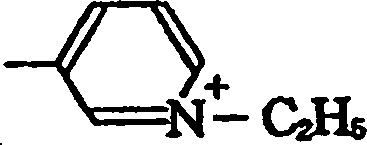
Nämlich ein Verfahren ist erwähnt, bei dem Ruß, behandelt wird mit 3-Amino-N-ethylpyridiniumbromid. Der selbstdispergierende Ruß, kationisch geladen durch Einführung der hydrophilen Gruppe in die Oberfläche des Rußes, hält auf diese Weise einen stabilen dispergierten Zustand aufrecht, auch dann, wenn er enthalten ist in einer Tinte auf Wasserbasis ohne Hinzufügen irgendeines Dispergiermittels oder dergleichen, weil er gute Dispergierbarkeit hat in Wasser aufgrund der Abstoßung von dessen Ion.Namely, a method is mentioned in which carbon black is treated with 3-amino-N-ethylpyridinium bromide. The self-dispersing carbon black, cationically charged by introducing the hydrophilic group into the surface of the carbon black, thus maintains a stable dispersed state even when contained in a water-based ink without adding any dispersant or the like, because it has good dispersibility has in water due to the repulsion of its ion.
Derartige verschiedene oben beschriebene hydrophile Gruppen können direkt an die Oberfläche des Rußes gebunden sein. Alternativ kann eine weitere Atomgruppe dazwischenliegen zwischen der Oberfläche des Rußes und der hydrophilen Gruppe, um die hydrophile Gruppe indirekt an die Oberfläche vom Ruß zu binden. Spezielle Beispiele dieser weiteren Atomgruppe beinhalten lineare oder verzweigte Alkylengruppen mit 1 bis 12 Kohlenstoffatomen, eine substituierte oder unsubstituierte Phenylengruppe und eine substituierte oder unsubstituierte Naphthylengruppe. Beispiele für Substituentengruppen an den Phenylen- und Naphthylengruppen beinhalten lineare oder verzweigte Alkylgruppen mit 1 bis 6 Kohlenstoffatomen. Spezielle Beispiele von Kombinationen dieser weiteren Gruppe und der hydrophilen Gruppe beinhalten -C2H4-COOM, -Ph-SO3M, Ph-COOM und -C5H10-NH3 +, wobei Ph eine Phenylgruppe ist.Such various hydrophilic groups described above may be bonded directly to the surface of the carbon black. Alternatively, another atomic group may intervene between the surface of the carbon black and the hydrophilic group to indirectly bond the hydrophilic group to the surface of the carbon black. Specific examples of this other atomic group include linear or branched alkylene groups having 1 to 12 carbon atoms, a substituted or unsubstituted phenylene group and a substituted or unsubstituted naphthylene group. Examples of substituent groups on the phenylene and naphthylene groups include linear or branched alkyl groups of 1 to 6 carbon atoms. Specific examples of combinations of this further group and the hydrophilic group include -C 2 H 4 -COOM, -Ph-SO 3 M, Ph-COOM and -C 5 H 10 -NH 3 + , wherein Ph is a phenyl group.
In dieser Ausführungsform können zwei oder mehr des oben beschriebenen selbst-dispergierenden Rußes passend ausgewählt und verwendet werden als färbendes Material für die Tinte. Die Menge des selbst-dispergierenden Rußes, die zur Tinte hinzugefügt wird, ist vorzugsweise innerhalb eines Bereiches von 0,1 bis 15 Gew.-%, insbesondere von 1 bis 10 Gew.-%, auf Basis des Totalgewichtes der Tinte. Wenn der selbstdispergierende Ruß in diesem Bereich hinzugefügt wird, kann ein ausreichender Dispersionszustand dessen in der Tinte beibehalten werden.In this embodiment can two or more of the above-described self-dispersing carbon black suitably selected and used as coloring Material for the ink. The amount of self-dispersing carbon black, the added to the ink is preferably within a range of 0.1 to 15 Wt .-%, in particular from 1 to 10 wt .-%, based on the total weight the ink. When the self-dispersing carbon black is added in this area, can maintain a sufficient state of dispersion in the ink become.
Um eine feine partikuläre wässrige Dispersion eines Pigments unter Verwendung eines derartigen Materials wie oben beschrieben zu erhalten, wird beispielsweise Ruß vorher vermischt in einer Lösung des kationischen Dispergiermittels und darauffolgend gemahlen in einer dispergierenden Maschine bei einer hohen Schergeschwindigkeit. Nach Verdünnen wird das Gemisch zentrifugiert, um grobe Partikel aus der verdünnten Mischung zu beseitigen. Danach werden Materialien, die notwendig sind für das Erreichen der erwünschten Tintenformulierung, hinzugefügt, und das resultierende Gemisch, falls erwünscht, gelagert. Danach wird das auf diese Weise behandelte Gemisch schließlich zentrifugiert, um eine Pigment-Dispersion zu erhalten, die den erwünschten durchschnittlichen Partikeldurchmesser aufweist, wobei eine wässrige Dispersion des Rußes erhalten werden kann. Der pH der auf diese Weise hergestellten Tinte wird vorzugsweise eingestellt auf einen Bereich von 3 bis 7.Around a fine particulate aqueous Dispersion of a pigment using such a material For example, as described above, soot becomes previously mixed in a solution of the cationic dispersant and subsequently ground in a dispersing machine at a high shear rate. After dilution The mixture is centrifuged to remove coarse particles from the diluted mixture to eliminate. After that, materials that are necessary for achieving the desired ink formulation, added and storing the resulting mixture, if desired. After that will Finally, the mixture thus treated is centrifuged to obtain a Pigment dispersion to obtain the desired average Having particle diameter, wherein an aqueous dispersion of the carbon black obtained can be. The pH of the ink prepared in this way becomes preferably set to a range of 3 to 7.
(6) Wässriges Medium, andere Additive usw.:(6) Aqueous medium, other additives etc.:
Als
ein wässriges
Medium für
das Tragen des Harzes mit einer kationischen Gruppe, das färbende Material
einkapselnd, wie in Anforderung (
Die Tinten gemäß dieser Ausführungsform werden in geeigneter Weise verwendet im Tintenstrahl-aufzeichnenden Verfahren, in welchem eine Tinte ausgestoßen wird aus einem aufzeichnenden Kopf durch thermische Energie oder mechanische Energie, um sie auf ein aufzeichnendes Medium aufzubringen, auf diese Weise ein Bild aufzuzeichnen. Wenn die Tinten gemäß dieser Ausführungsform als insbesondere geeignet für die Verwendung beim Tintenstrahl-Aufzeichnen hergestellt sind, werden die Tinten eingestellt, um als deren eigene physikalische Eigenschaften, gemessen bei 25°C, aufzuweisen eine Oberflächenspannung von 15 bis 60 dyn/cm, vorzugsweise 20 bis 50 dyn/cm, eine Viskosität von 15 cP oder niedriger, insbesondere 10 cP oder niedriger, weiter bevorzugt 5 cP oder niedriger und einen pH innerhalb eines Bereiches von vorzugsweise von 3 bis 11, weiter bevorzugt von 3,5 bis B.The inks according to this embodiment are suitably used in the ink-jet recording method in which an ink is ejected from a recording head by thermal energy or mechanical energy to be applied to a recording medium, thus recording an image. When the inks according to this embodiment are made particularly suitable for use in ink-jet recording, the inks are adjusted to have, as their own physical properties, measured at 25 ° C, a surface tension of 15 to 60 dynes / cm, preferably 20 to 50 dynes / cm, a viscosity of 15 cP or lower, in particular 10 cP or lower, more preferably 5 cP or lower and a pH within a range of preferably from 3 to 11, more preferably from 3.5 to B.
Als spezielle Tintenzusammensetzungen, fähig zum Erreichen derartiger Eigenschaften, können beispielsweise erwähnt werden die Zusammensetzungen verschiedener Tinten, verwendet in Beispielen, welche nachstehend beschrieben sind.When special ink compositions capable of achieving such Properties, can for example mentioned The compositions of various inks used in Examples which are described below.
Zu den Tinten gemäß dieser Ausführungsform können des Weiteren hinzugefügt werden verschiedene Arten von Additiven wie oberflächenaktive Stoffe, pH-Regler und Schimmelfestausrüstungsmittel, zusätzlich zu dem Harz, welches das färbende Material einkapselt, erhalten auf die oben beschriebene Weise, und dem Pigment.To the inks according to this embodiment can further added are different types of additives such as surface-active Substances, pH regulators and solid as well as anti-static agent, in addition to Resin the dyeing Encapsulating material obtained in the manner described above, and the pigment.
Keine spezielle Einschränkung wird auferlegt den aufzeichnenden Medien, die verwendet werden in einem aufzeichnenden Verfahren unter Verwendung der Tinten gemäß dieser Ausführungsform, und verschiedene Arten von glattem Papier, wie Kopierpapier und geleimtes Papier, beschichtetes Papier, speziell hergestellt für das Tintenstrahl- Aufzeichnen, Glanzpapier und OHP-Folien werden in geeigneter Weise verwendet.None special restriction is imposed on the recording media that are used in one recording method using the inks according to this embodiment, and various types of plain paper, such as copy paper and sized paper, coated paper, specially made for inkjet recording, glossy paper and OHP films are suitably used.
(7) Aufzeichnende Vorrichtung, aufzeichnendes Verfahren usw.:(7) recording device, recording procedure etc .:
Eine bildaufzeichnende Vorrichtung, geeignet zur Verwendung im Aufzeichnen mit den oben beschriebenen Tinten gemäß der ersten oder zweiten Ausführungsform auf einem aufzeichnenden Medium, und ein bildaufzeichnendes Verfahren unter Verwendung derselben werden nachstehend beschrieben. Als ein Beispiel für die bildaufzeichnende Vorrichtung kann erwähnt werden eine Vorrichtung, bei der thermische Energie entsprechend den aufzeichnenden Signalen angewendet wird bei einer Tinte innerhalb eines aufzeichnenden Kopfes, und Tinten-Tröpfchen durch die thermische Energie erzeugt werden. Eine derartige Vorrichtung wird nachstehend beschrieben.A image recording apparatus suitable for use in recording with the above-described inks according to the first or second embodiment on a recording medium, and an image recording method using them will be described below. As a example for the image-recording device can be mentioned a device, at the thermal energy corresponding to the recording signals is applied to an ink within a recording head, and ink droplets be generated by the thermal energy. Such a device will be described below.
Nun,
nach Anwendung von gepulsten elektrischen Signalen an den Elektroden
17-1 und 17-2 des Kopfes
Wenn
der aufzeichnende Kopf
Die
obige Bewegung des aufzeichnenden Kopfes
[Aufzeichnende Einheit][Recording unit]
Die
in der vorliegenden Erfindung verwendete Tintenstrahl-aufzeichnende
Vorrichtung ist nicht beschränkt
auf die Vorrichtung, die obenstehend beschrieben ist, in welcher
der Kopf und die Tintenkartusche separat bereitgestellt sind. Deswegen
kann eine Vorrichtung, bei der diese Elemente in integrierter Weise
gebildet sind, wie in
Diese
aufzeichnende Einheit
Ein
Beispiel für
die Konstruktion eines aufzeichnenden Kopfes, welcher ein Hauptbestandteil
einer derartigen aufzeichnenden Vorrichtung ist, ist in
Der
Kopf ist zusammengesetzt aus einem Tintenfluss-Kanal
In
Der
aufzeichnende Kopf mit der obigen Konstruktion wird auf eine solche
Weise betätigt,
dass gepulste Spannung an dem piezoelektrischen Element
Ein
derartiger aufzeichnender Kopf wird durch Einfügen in eine Tintenstrahl-aufzeichnende
Vorrichtung verwendet, ähnlich
wie in
[Tintensatz][Ink Set]
Die obenstehend beschriebenen Tinten gemäß den verschiedenen Ausführungsformen der vorliegenden Erfindung bilden schwarze Tinten, und können jeweils bereitgestellt sein als ein Tintensatz, geeignet zur Verwendung bei der Bildung von Farbbildern durch Kombinieren mit mindestens einer Farbtinte, gewählt aus der Gruppe bestehend aus Farbtinten mit färbenden Materialien für Gelb, Magenta, Cyan, Rot, Blau und Grün. Insbesondere die schwarzen Tinten gemäß der zweiten Ausführungsform können äusserst wirkungsvoll das Auftreten von Ausbluten reduzieren, wenn sie verwendet werden zusammen mit einer Tinte mit mindestens einem wasserlöslichen Farbstoff mit einer anionischen Gruppe und einer Verbindung, welche enthält mindestens eine anionische Gruppe, weil eine ionische Reaktion stattfindet an einer Grenzfläche zwischen beiden Tinten auf einem aufzeichnenden Medium. Beispiele für den wasserlöslichen Farbstoff mit einer anionischen Gruppe beinhalten die konventionell bekannten direkten Farbstoffe und sauren Farbstoffe. Beispiele für die Verbindung mit mindestens einer anionischen Gruppe beinhalten die konventionell bekannten anionischen oberflächenaktiven Stoffe und hochmolekulare Verbindungen, welche eine anionische Gruppe enthalten. Darin sind auch Pigment-Dispergiermittel und dergleichen enthalten.The above-described inks according to the various embodiments of the present invention form black inks, and may respectively provided as an ink set, suitable for use in the formation of color images by combining with at least a color ink, chosen from the group consisting of color inks with coloring materials for yellow, Magenta, Cyan, Red, Blue and Green. Especially the black inks according to the second embodiment can be extreme Effectively reduce the occurrence of bleeding when used be together with an ink containing at least one water-soluble A dye having an anionic group and a compound which contains at least one anionic group, because an ionic reaction takes place at an interface between both inks on a recording medium. Examples for the water-soluble Dyes having an anionic group include those conventionally known direct dyes and acid dyes. Examples of the connection with at least one anionic group include the conventional known anionic surface active Substances and high molecular compounds which are an anionic group contain. Therein are also pigment dispersants and the like contain.
(Farbtinte)(Color ink)
sAls färbende Materialien für die Farbtinten, verwendbar für den obigen Tintensatz, können verwendet werden allgemein bekannte Farbstoffe und Pigmente. Als Farbstoffe können beispielsweise saure Farbstoffe und direkte Farbstoffe verwendet werden. Als beispielsweise anionische Farbstoffe können die meisten der sowohl bisher bekannten Farbstoffe, als auch neuerdings hergestellte verwendet werden, so lange sie einen angemessenen Farbton und Dichte aufweisen. Einige darunter können auch in Kombination verwendet werden. Als spezielle Beispiele für anionische Farbstoffe können die folgenden Farbstoffe erwähnt werden:The coloring materials for the color inks usable for the above ink set can be used become well-known dyes and pigments. As dyes, for example, acid dyes and direct dyes can be used. As anionic dyes, for example, most of the dyes heretofore known, as well as those recently produced, can be used as long as they have an appropriate hue and density. Some of them can also be used in combination. As specific examples of anionic dyes, the following dyes may be mentioned:
(Färbendes Material für Gelb)(Coloring material for yellow)
- C.I. Direct Yellow 8, 11, 12, 27, 28, 33, 39, 44, 50, 58, 85, 86, 87, 88, 89, 98, 100 und 110;C.I. Direct Yellow 8, 11, 12, 27, 28, 33, 39, 44, 50, 58, 85, 86, 87, 88, 89, 98, 100 and 110;
- C.I. Acid Yellow 1, 3, 7, 11, 17, 23, 25, 29, 36, 38, 40, 42, 44, 76, 98 und 99;C.I. Acid Yellow 1, 3, 7, 11, 17, 23, 25, 29, 36, 38, 40, 42, 44, 76, 98 and 99;
- C.I. Reactive Yellow 2, 3, 17, 25, 37 und 42; undC.I. Reactive Yellow 2, 3, 17, 25, 37 and 42; and
- C.I. Food Yellow 3.C.I. Food Yellow 3.
(Färbendes Material für Rot)(Coloring material for red)
- C.I. Direct Red 2, 4, 9, 11, 20, 23, 24, 31, 41, 39, 46, 62, 75, 79, 80, 83, 89, 95, 197, 201, 218, 220, 224, 225, 226, 227, 228 und 229;C.I. Direct Red 2, 4, 9, 11, 20, 23, 24, 31, 41, 39, 46, 62, 75, 79, 80, 83, 89, 95, 197, 201, 218, 220, 224, 225, 226, 227, 228 and 229;
- C.I. Acid Red 6, 8, 9, 13, 14, 18, 26, 27, 32, 35, 42, 51, 52, 80, 83, 87, 89, 92, 106, 114, 115, 133, 134, 145, 158, 198, 249, 265 und 289;C.I. Acid Red 6, 8, 9, 13, 14, 18, 26, 27, 32, 35, 42, 51, 52, 80, 83, 87, 89, 92, 106, 114, 115, 133, 134, 145, 158, 198, 249, 265 and 289;
- C.I. Reactive Red 7, 12, 13, 15, 17, 20, 23, 24, 31, 42, 45, 46 und 59; undC.I. Reactive Red 7, 12, 13, 15, 17, 20, 23, 24, 31, 42, 45, 46 and 59; and
- C.I. Food Red 87, 92 und 94. (Färbendes Material für Blau)C.I. Food Red 87, 92 and 94. (Coloring material for blue)
- C.I. Direct Blue 1, 15, 22, 25, 41, 76, 77, 80, 86, 90, 98, 106, 108, 120, 158, 163, 168, 199 und 226;C.I. Direct Blue 1, 15, 22, 25, 41, 76, 77, 80, 86, 90, 98, 106, 108, 120, 158, 163, 168, 199 and 226;
- C.I. Acid Blue 1, 7, 9, 15, 22, 23, 25, 29, 40, 43, 59, 62, 74, 78, 80, 90, 100, 102, 104, 117, 127, 138, 158 und 161; undC.I. Acid Blue 1, 7, 9, 15, 22, 23, 25, 29, 40, 43, 59, 62, 74, 78, 80, 90, 100, 102, 104, 117, 127, 138, 158 and 161; and
- C.I. Reactive Blue 4, 5, 7, 13, 14, 15, 18, 19, 21, 26, 27, 29, 32, 38, 40, 44 und 100.C.I. Reactive Blue 4, 5, 7, 13, 14, 15, 18, 19, 21, 26, 27, 29, 32, 38, 40, 44 and 100.
(Färbendes Material für Schwarz)(Coloring material for black)
- C.I. Acid Black 2, 4, 8, 51, 52, 110, 115, 156; undC.I. Acid Black 2, 4, 8, 51, 52, 110, 115, 156; and
- C.I. Food Black 1 and 2.C.I. Food Black 1 and 2.
(Lösungsmittel)(Solvent)
Beispiele für Lösungsmittel oder Dispersionsmedien für Tinten, welche jeweils aufweisen derartige färbende Materialien für Farbtinten, wie obenstehend beschrieben, beinhalten Wasser und gemischte Lösungsmittel von Wasser und einem wasserlöslichen organischen Lösungsmittel. Beispiele für das wasserlösliche organische Lösungsmittel beinhalten die gleichen Lösungsmittel wie jene, die in der ersten Ausführungsform beschrieben sind. Wenn derartige Farbtinten auf ein aufzeichnendes Medium durch ein Tintenstrahl-System (beispielsweise Blasenstrahl-System) aufgebracht werden, ist bevorzugt, dass die Tinten derart eingestellt werden, um erwünschte Viskosität und Oberflächenspannung aufzuweisen, damit die Tinten ausgezeichnete Tintenstrahl-Ausstoßungs-Eigenschaften aufweisen, wie obenstehend beschrieben.Examples for solvents or dispersion media for Inks each having such coloring materials for color inks, As described above, water and mixed solvents of water and a water-soluble organic solvents. Examples for the water-soluble organic solvents contain the same solvents like those in the first embodiment are described. When such color inks on a recording Medium through an ink jet system (for example bubble jet system) are applied, it is preferable that the inks are adjusted so become desirable viscosity and surface tension for the inks to have excellent inkjet ejection properties, as described above.
(Anteil des färbenden Materials)(Proportion of the coloring material)
Der Anteil des färbenden Materials in jeder der Farbtinten kann in geeigneter Weise auf solche Weise gewählt werden, dass eine derartige Tinte ausgezeichnete Tintenstrahl-Ausstoßungs-Eigenschaften und den erwünschten Farbton und Dichte aufweist, wenn sie beispielsweise beim Tintenstrahl-Aufzeichnen verwendet wird. Beispielsweise ist als Standard bevorzugt ein Bereich innerhalb von 3 bis 50 Gew.-%, auf Basis des Gesamtgewichts der Tinte. Die Menge des in der Tinte enthaltenen Wassers ist vorzugsweise innerhalb eines Bereiches von 50 bis 95 Gew.-%, basierend auf dem Gesamtgewicht der Tinte.Of the Proportion of the coloring Material in each of the color inks can be applied to such Chosen way such ink will have excellent ink jet ejection properties and the desired one Hue and density when, for example, in inkjet recording is used. For example, a standard is preferred as the standard within 3 to 50% by weight, based on the total weight of the Ink. The amount of water contained in the ink is preferable within a range of 50 to 95% by weight based on the Total weight of the ink.
[Aufzeichnende Vorrichtung und aufzeichnendes Verfahren unter Verwendung von Tintensätzen][Recording device and recording method using ink sets]
Wenn
jeder der obenstehend beschriebenen Tintensätze verwendet wird um Farbbilder
aufzuzeichnen, kann beispielsweise eine aufzeichnende Vorrichtung
verwendet werden, bei der 4 aufzeichnende Köpfe, wobei jeder von diesen
in
Die vorliegende Erfindung wird nachstehend ausführlicher beschrieben durch die folgenden Beispiele und Vergleichsbeispiele. Allerdings ist die vorliegende Erfindung nicht auf die folgenden Beispiele beschränkt, solange sie nicht deren Gegenstand überschreiten. Alle Bezeichnungen "Teil" oder "Teile" und "%" die in den folgenden Beispielen verwendet werden, bedeuten übrigens Gewichtsteil oder Gewichtsteile, und Gew.-%, es sei denn anders angegeben. In den folgenden Beispielen ist der durchschnittliche Partikeldurchmesser ein Wert, gemessen mittels einer dynamischen Lichtstreuungs-Partikeldurchmesser-Messungsausrüstung (ELS-800, Handelsname, hergestellt von Ohtsuka Denshi K.K.).The The present invention will be described in more detail below the following examples and comparative examples. However, that is the present invention is not limited to the following examples as long as they do not exceed their subject matter. All the terms "part" or "parts" and "%" used in the following examples by the way, mean by the way Part by weight or parts by weight, and% by weight, unless otherwise stated specified. In the following examples is the average Particle diameter a value measured by means of a dynamic Light Scattering Particle Diameter Measurement Equipment (ELS-800, trade name, manufactured by Ohtsuka Denshi K.K.).
Beispiele 1 bis 6:Examples 1 to 6:
Dispersionen C-1 und C-2 wurden bereitgestellt als Ruß-Dispersionen.dispersions C-1 and C-2 were provided as carbon black dispersions.
(Herstellung der Dispersion C-1)(Preparation of the dispersion C-1)
Dispersion C-1 wurde hergestellt auf die folgende Weise.dispersion C-1 was prepared in the following manner.
Ein
Styrol-Methacrylsäure-ethylacrylat-Copolymer
(Säurewert:
350; massegemitteltes Molekulargewicht: 3000; als eine 20% wässrige Lösung; Neutralisierungsmittel:
Kaliumhydroxid)
wurde als ein Dispergiermittel verwendet. Die folgenden Materialien
wurden in eine Batch-förmige
Sandmühle
(hergestellt durch Aimex Company) geladen, und Glaskugeln mit einem
Durchmesser von 1 mm wurden als ein mahlendes Medium geladen, um
3 Stunden lang eine Dispersionsbehandlung durchzuführen, während mit
Wasser gekühlt
wurde.
Potassium hydroxide) was used as a dispersant. The following materials were charged in a batch-shaped sand mill (manufactured by Aimex Company), and glass beads having a diameter of 1 mm were charged as a grinding medium to perform a dispersion treatment for 3 hours while cooling with water.
Die auf diese Weise erhaltene Ruß-Dispersion hatte einen mittleren Partikeldurchmesser von 0,1 μm und einen pH von 10,0.The in this way obtained carbon black dispersion had a mean particle diameter of 0.1 microns and a pH of 10.0.
(Herstellung der Dispersion C-2)(Preparation of the dispersion C-2)
Dispersion C-2 wurde auf die gleiche Weise erhalten wie bei der Herstellung der Dispersion C-1, mit der Ausnahme, dass selbst-dispergierender Ruß CAB-O-JET 200 (Handelsname, Produkt von CABOT Co.; Feststoffgehalt: 20 %; mit einer Sulfonylgruppe als eine funktionelle Gruppe an dessen Oberfläche) verwendet wurde. Die auf diese Weise erhaltene Ruß-Dispersion hatte einen mittleren Partikeldurchmesser von 0,13 μm und einen pH von 7,0. Herstellung der Dispersionen MC-1 und MC-2 von Harzen, ein färbendes Material einkapselnd: Dispersionen MC-1 und MC-2 wurden ebenfalls bereitgestellt als Dispersionen von Harzen, ein färbendes Material einkapselnd.dispersion C-2 was obtained in the same way as in the preparation the dispersion C-1, except that self-dispersing Carbon black CAB-O-JET 200 (trade name, product of CABOT Co., solids content: 20%; with a sulfonyl group as a functional group on its Surface) has been used. The carbon black dispersion obtained in this way had a mean particle diameter of 0.13 μm and a pH of 7.0. Preparation of Dispersions MC-1 and MC-2 of Resins, a coloring Encapsulating material: Dispersions MC-1 and MC-2 were also used provided as dispersions of resins, a coloring Encapsulating material.
(Herstellung der Dispersion MC-1)(Preparation of the dispersion MC-1)
Die
folgenden Materialien wurden in einer Lösung gemischt.
Die resultierende Lösung wurde Phaseninversion-emuligert in Wasser unter Verwendung von Natriumhydroxid als neutralisierendes Mittel, und Methylethylketon wurde beseitigt, um schließlich eine wässrige Dispersion von Mikrokapseln zu erhalten, mit einem durchschnittlichen Partikeldurchmesser von 0,08 μm, Feststoffe enthaltend in einer Konzentration von 20 %.The resulting solution was phase inversion emulsified in water using sodium hydroxide as a neutralizing agent, and methyl ethyl ketone was removed to finally obtain an aqueous dispersion of microcapsules having an average particle diameter of 0.08 μm. Containing solids at a concentration of 20%.
(Herstellung der Dispersion MC-2)(Preparation of the dispersion MC-2)
Eine wässrige Dispersion von Mikrokapseln mit einem durchschnittlichen Partikeldurchmesser von 0,13 μm, Feststoffe enthaltend in einer Konzentration von 20 %, wurde schließlich erhalten auf die gleiche Weise wie bei der Herstellung von Dispersion MC-1, mit der Ausnahme, dass das verwendete Harz in Dispersion MC-1 getauscht wurde gegen ein Styrol-Acrylsäure-Methylmethacrylat-Terpolymer (Säurewert: 250 Molekulargewicht: 25000).A aqueous Dispersion of microcapsules with an average particle diameter of 0.13 μm, Solids containing at a concentration of 20% were finally obtained in the same way as in the preparation of dispersion MC-1, with the exception that the resin used in dispersion MC-1 exchanged was against a styrene-acrylic acid-methyl methacrylate terpolymer (Acid value: 250 molecular weight: 25,000).
Nachdem die jeweiligen Dispersionen, bereitgestellt auf die oben beschriebene Weise, gemischt wurden, um Feststoffgehalte in in Tabelle 1 gezeigten entsprechenden Verhältnissen zu ergeben, wurden Glycerin und Isopropylalkohol mit jedem dieser Gemische auf solche Weise gemischt, dass die Konzentrationen von Glycerin und Isopropylalkohol bis zu jeweils 16 % und 4,0 % waren, um auf diese Weise die entsprechenden Tinten herzustellen, die schließlich Ruß und das Harz, einkapselnd das färbende Material, enthalten in einer Konzentration von 8 % in Bezug auf den Gesamtfestkörpergehalt in jeder Tinte.After this the respective dispersions provided on the above described Were mixed to solids contents shown in Table 1 appropriate conditions Glycerol and isopropyl alcohol were added to each of these Mixtures mixed in such a way that the concentrations of glycerol and isopropyl alcohol up to respectively 16% and 4.0% were up to this way to make the appropriate inks, which are finally soot and that Resin, encapsulating the coloring Material, contained in a concentration of 8% the total solids content in every ink.
"C.B./MC", gezeigt in Tabelle 1, bezeichnet End-Konzentrationen der jeweiligen Feststoffe (d.h. Ruß und das Harz) in jeder hergestellten Tinte. Insbesondere bezeichnet es, dass beispielsweise Tinte A gemäß Beispiel 1 hergestellt wurde auf solche Weise, dass die Feststoffanteile von Ruß und dem Harz, das färbende Material einkapselnd, sich auf jeweils 1,5 % und 6,5 % beliefen. Übrigens bedeutet die Menge von Ruß in Beispielen 1 bis 3 in Tabelle 1 der Gesamtfeststoffgehalt von Ruß und dem Dispergiermittel. Andererseits bedeutet die Menge von Ruß in Beispielen 4 bis 6 eine Menge von Ruß alleine, weil kein Dispergiermittel verwendet wurde für den Ruß."C.B./MC" shown in Table 1, indicates end concentrations the respective solids (i.e., carbon black and the resin) in each produced Ink. In particular, it indicates that, for example, ink A according to Example 1 was prepared in such a way that the solids from soot and the resin, the coloring material encapsulating 1.5% and 6.5%, respectively. by the way means the amount of soot in Examples 1 to 3 in Table 1, the total solids content of carbon black and the Dispersant. On the other hand, the amount of carbon black in Examples means 4 to 6 an amount of carbon black alone, because no dispersant was used for the carbon black.
Die auf diese Weise hergestellten sechs Tinten A, B, C, D, E und F wurden separat geladen in einen Tintenbehälter für Schwarz einer BJ Kartusche BC-21, installiert in einem Farb-BJ-Drucker BJC-420J (Handelsname; hergestellt von Canon Inc.), und die Kartusche wurde installiert in BJC-420, um Drucken durchzuführen auf aufzeichnendes Papier Canon PB Papier (Handelsname, Produkt von Canon Inc.; Papier für allgemeinen Gebrauch in BJ-Elektrophotographie) gemäß 360 × 360 DPI, HQ-Modus für glattes Papier von BJC-420J.The six inks A, B, C, D, E and F prepared in this manner separately charged in a black ink tank of a BJ cartridge BC-21, installed in a color BJ printer BJC-420J (trade name, manufactured by Canon Inc.), and the cartridge was installed in BJC-420 to perform printing Canon PB paper recording paper (trade name, product of Canon Inc .; Paper for general use in BJ electrophotography) according to 360 × 360 DPI, HQ mode for smooth paper from BJC-420J.
Vergleichsbeispiele
Tinten
G und H, die nur ihren entsprechenden in Tabelle 1 gezeigten Ruß enthalten,
und Tinte I, die nur ihr entsprechendes in Tabelle 1 gezeigtes Harz
enthält,
ein färbendes
Material einkapselnd, wurden verwendet, um Drucken durchzuführen auf
genau die gleiche Weise wie in Beispielen 1 bis 6. Tabelle
1 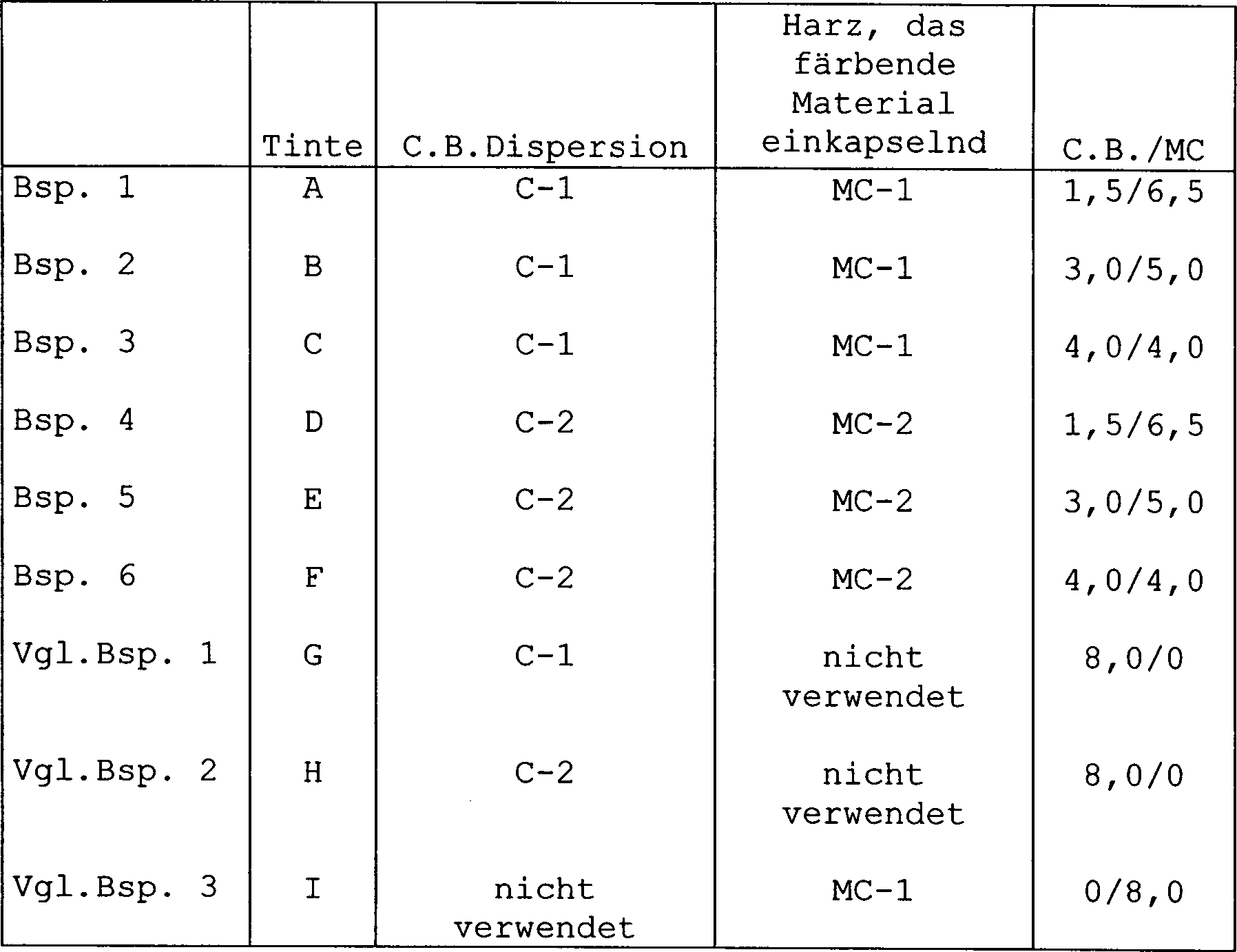
Die somit erhaltenen Drucke wurden auf die folgende Weise bewertet:The thus obtained prints were evaluated in the following manner:
Optische Dichte des Bildes:Optical density of the image:
Nachdem eine feste gedruckte Probe 12 Stunden lang nach dessen Drucken stehen gelassen wurde, wurden dessen optische Dichte gemessen mittels eines Reflexions-Densitometers Macbeth RD-918 (Handelsname, hergestellt von Macbeth Company). Die Auswertungsergebnisse wurden gemäß dem folgenden Standard bewertet:
- A: Optische Dichte war nicht niedriger als 1,35;
- B: Optische Dichte war von 1,2 bis 1,34; und
- C: Optische Dichte war niedriger als 1,2.
- A: optical density was not lower than 1.35;
- B: optical density was from 1.2 to 1.34; and
- C: Optical density was lower than 1.2.
Wasserfestigkeit:Water resistance:
Die
gleiche fest gedruckte Probe, die bei der Bewertung der optischen
Dichte des Bildes verwendet wurde, wurde verwendet und wurde 12
Stunden lang nach dem Drucken stehen gelassen. Die Bild-Probe wurde
dann in Leitungswasser
- A: Prozentuale Beibehaltung der optischen Dichte war nicht weniger als 90;
- B: Prozentuale Beibehaltung der optischen Dichte war nicht weniger als 70 %, aber weniger als 90 %;
- C: Prozentuale Beibehaltung der optischen Dichte war weniger als 70 %.
- A: Percentage retention of optical density was not less than 90;
- B: Percentage retention of optical density was not less than 70% but less than 90%;
- C: Percentage retention of optical density was less than 70%.
Beständigkeit gegenüber Linienmarker:Resistance to line markers:
Nachdem 1 Stunde verstrichen war nach dem Drucken der Zeichen, wurde der Zeichen-Abschnitt der resultierenden Druck-Probe einmal unter gewöhnlichem Schreib-Druck mit einem gelb-fluoreszierenden Stift markiert, Spot-Lighter-Yellow (Handelsname; Produkt von Pilot Pen Co., Ltd.), wobei die Beständigkeit gegenüber dem Linienmarker bewertet wurde gemäß dem folgenden Bewertungsstandard:
- A: Weder Ausbluten noch Verschmutzen auf weißen Abschnitten wurde bei der Druck-Probe beobachtet, und eine Stift-Spitze wurde ebenfalls nicht verschmutzt;
- B: Kein Verschmutzen auf weißen Abschnitten wurde bei der Druck-Probe beobachtet, aber eine Stift-Spitze wurde etwas verschmutzt; und
- C: Verschmutzen auf weißem Abschnitt wurde in der Druck-Probe beobachtet.
- A: No bleeding or staining on white portions was observed in the print sample, and a pin tip was also not stained;
- B: No fouling on white sections was observed in the print sample, but a pin tip was slightly soiled; and
- C: Fouling on white portion was observed in the print sample.
Abrieb-Beständigkeit:Abrasion resistance:
Nachdem vier Stunden nach dem Drucken eines Bildes verstrichen waren, wurde Silbon-Paper auf das bedruckte Papier gelegt, und ein 1-kg-Gewicht mit einer Grundfläche von 5 cm2 wurde dann auf das Silbon-Paper gelegt. Das Silbon-Paper wurde dann weggezogen, um visuell zu beobachten, ob die unbedruckten Abschnitte (weiße Abschnitte) des bedruckten Papiers und des Silbon-Paper durch Reiben zwischen den bedruckten Abschnitten des bedruckten Papiers und des Silbon-Paper verschmutzt wurden. Die Abrieb-Beständigkeit wurde gemäß dem folgenden Bewertungs-Standard bewertet:
- A: Kein Verschmutzen wurde beobachtet, weder auf den weißen Abschnitten, noch auf dem Silbon-Paper;
- B: Verschmutzen wurde nur auf dem Silbon-Paper beobachtet; und
- C: Verschmutzen wurde beobachtet auf sowohl den weißen Abschnitten als auch auf dem Silbon-Paper.
- A: No fouling was observed, neither on the white sections nor on the silbon paper;
- B: Soiling was observed only on the sack paper; and
- C: Soiling was observed on both the white sections and on the silbon paper.
Ausstoßungs-Stabilität:Ejection stability:
Eine 1-Punkt-vertikale Linie wurde gedruckt auf einem aufzeichnenden Papier zu Beginn der Verwendung von Kartusche BC-21. Text-Drucken wurde durchgeführt, bis die Kartusche BC-21 aufgebraucht war. Die Kartusche, kurz bevor sie aufgebraucht war, wurde verwendet, um auszudrucken eine 1-Punkt-vertikale Linie auf einem weiteren aufzeichnenden Papier. Diese Aufzeichnungspapier-Proben wurden visuell beobachtet aus einer 25 cm entfernten Position, um auf diese Weise zu vergleichen das Ergebnis des Drucks mit der Kartusche zu Beginn der Verwendung, mit dem Ergebnis des Drucks mit der Kartusche, kurz bevor sie aufgebraucht war, um die Ausstoßungs-Stabilität zu bewerten gemäß dem folgenden Bewertungsstandard:
- A: Kein Unterschied war zwischen beiden Proben zu beobachten;
- B: Abweichung des Punkt-Aufpralls war zu beobachten in einem Teil der vertikalen Linie, die mit der Kartusche gedruckt wurde, kurz bevor sie aufgebraucht war, aber die Linie war als eine gerade Linie zu erkennen; und
- C: Abweichen des Punkt-Aufpralls war klar zu beobachten bei der vertikalen Linie, gedruckt durch die Kartusche, kurz bevor sie aufgebraucht war, und es war zu erkennen, dass die vertikale Linie abwich.
- A: No difference was observed between the two samples;
- B: Deviation of the point impact was observed in a part of the vertical line printed with the cartridge just before it was used up, but the line was seen as a straight line; and
- C: Deviation of the point impact was clearly seen on the vertical line printed by the cartridge just before it was used up, and it was seen that the vertical line deviated.
Die
Auswertungsergebnisse sind in Tabelle 2 gezeigt. Tabelle
2 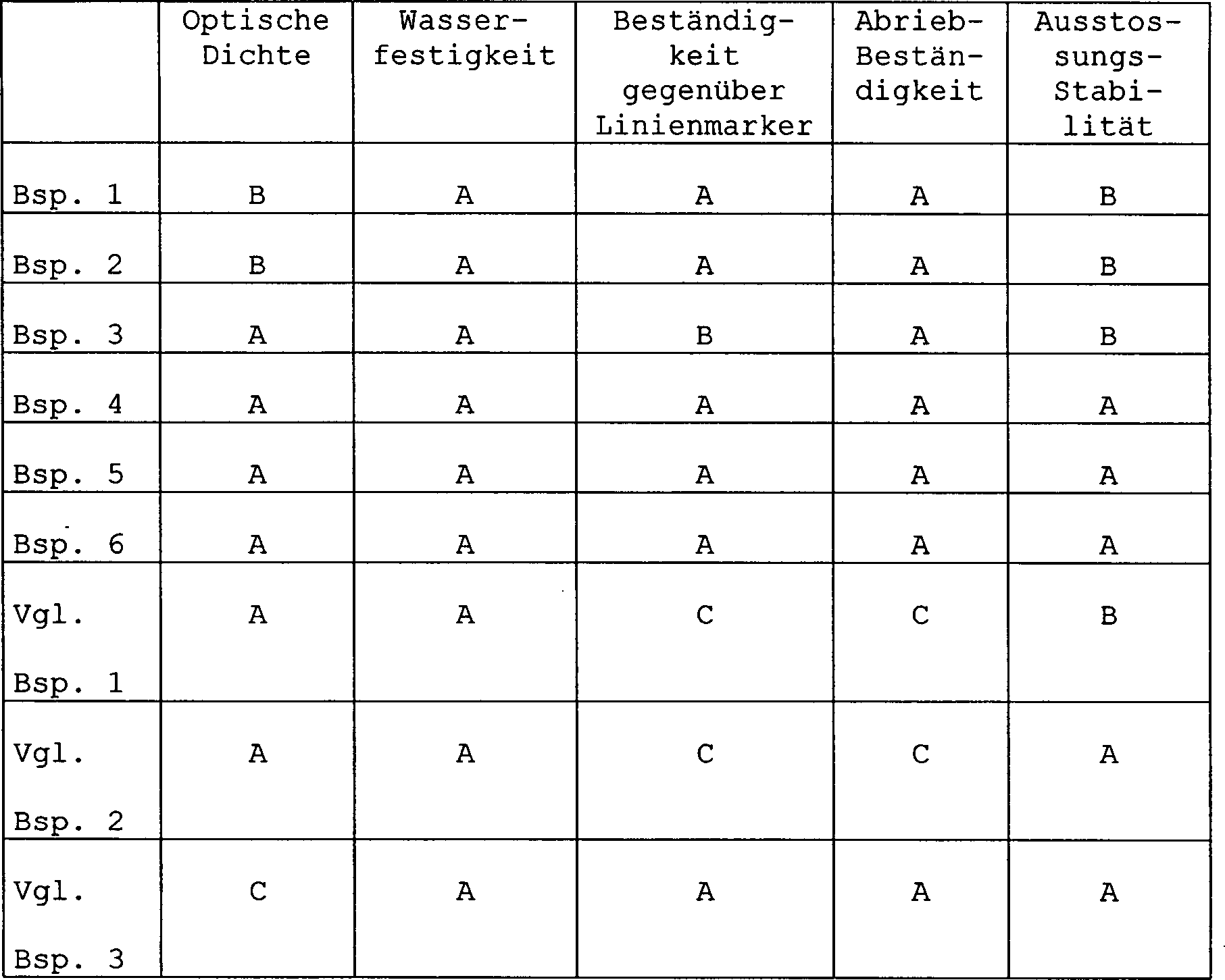
Tabelle 2 gibt zu verstehen, dass die Tinten gemäß der vorliegenden Erfindung Tinten für Tintenstrahl sind, welche bereitstellen können ein Bild mit genügend hoher optischer Dichte auf glattem Papier und ausgezeichneter Wasserfestigkeit, Beständigkeit gegenüber Linienmarker und Abrieb-Beständigkeit, und die ausreichend gut in der Ausstoßungs-Stabilität sind. Die Tinten des alleinigen Systems des Rußes und die Tinte des alleinigen Systems des Harzes, das färbende Material einkapselnd, konnten keine Resultate ergeben, die zur gleichen Zeit die optische Dichte des Bildes, Wasserfestigkeit, Beständigkeit gegenüber Linienmarker, Abrieb-Beständigkeit und Ausstoßungs-Stabilität befriedigten.table 2 indicates that the inks according to the present invention Inks for Are inkjet which can provide an image of sufficiently high optical density on smooth paper and excellent water resistance, resistance across from Line marker and abrasion resistance, and that are sufficiently good in ejection stability. The inks of the sole system of soot and the ink of sole Systems of the resin, the dyeing Encapsulating material could not yield results equal to that Time the optical density of the image, water resistance, resistance across from Line marker, abrasion resistance and ejection stability.
Beispiele 7 bis 12:Examples 7 to 12:
Dispersionen C-3 und C-4 wurden bereitgestellt als Ruß-Dispersionen.dispersions C-3 and C-4 were provided as carbon black dispersions.
(Herstellung von Dispersion C-3)(Preparation of dispersion C-3)
Dispersion C-3 wurde auf die folgende Weise hergestellt.dispersion C-3 was prepared in the following manner.
Kationisches
Polymer P-1 (massegemittelte Molekülmasse: 11000, pH der wässrigen
Lösung:
3,26), Acrylamid und Trimethylaminopropylacrylamid-Sulfat als Monomere
enthaltend in einem Gewichtsverhältnis von
70:30 wurde als Dispergiermittel verwendet, um die folgende Ruß-Dispersion
C-3 herzustellen.
Die obigen Materialien wurden schubweise in eine vertikale Sandmühle (hergestellt von Aimex Company) geladen, und Glaskügelchen mit einem Durchmesser von 1 mm wurden als ein mahlendes Medium geladen, um 3 Stunden lang eine Dispersionsbehandlung durchzuführen, während mit Wasser gekühlt wurde. Nach der Dispersions-Behandlung hatte die Dispersion eine Viskosität von 28 cP und einen pH von 4,05. Die Dispersion wurde zentrifugiert, um grobe Partikel zu beseitigen, um auf diese Weise eine Dispersion C-3 mit einem mittleren Partikeldurchmesser von 0,12 um zu erhalten. Die Dispersion hatte insgesamt einen Feststoffgehalt von 10 %.The above materials were batched into a vertical sand mill (manufactured by Aimex Com pany), and glass beads having a diameter of 1 mm were charged as a grinding medium to perform a dispersion treatment for 3 hours while cooling with water. After the dispersion treatment, the dispersion had a viscosity of 28 cP and a pH of 4.05. The dispersion was centrifuged to remove coarse particles so as to obtain a dispersion C-3 having an average particle diameter of 0.12 μm. The dispersion had a total solids content of 10%.
(Herstellung der Dispersion C-4)(Preparation of the dispersion C-4)
Dispersion C-4 wurde auf die folgende Weise hergestellt.dispersion C-4 was prepared in the following manner.
Nachdem
10 g Ruß mit
einer Oberfläche
von 230 m2/g und einer DBP-Ö1-Absorption
von 70 ml/100g, und 3,06 g 3-Amino-N-ethylpyridiniumbromid gründlich mit
72 g Wasser vermischt wurden, wurden 1,62 g Salpetersäure tropfenweise
zum Gemisch hinzugefügt,
gefolgt von Rühren
bei 70°C.
Nach mehreren Minuten wurde des Weiteren eine Lösung von 1,07 g Natriumnitrit,
gelöst
in 5 g Wasser, zu dem Gemisch hinzugefügt, und das resultierende Gemisch
eine weitere Stunde lang gerührt.
Die resultierende Aufschlämmung
wurde über
einen Papierfilter (Toyo Filterpapier Nr. 2, Handelsname; Produkt
von Advantes Co.) filtriert und die resultierenden Pigmentpartikel
wurden vollständig
mit Wasser gewaschen und in einem bei 110°C geregelten Ofen getrocknet.
Wasser wurde zu dem trockenen Pigment hinzugefügt, um eine wässrige Dispersion
des Pigmentes mit einer Pigment-Konzentration
von 10 % herzustellen. Das oben beschriebene Verfahren wurde befolgt, um
eine Gruppe der chemischen Formel 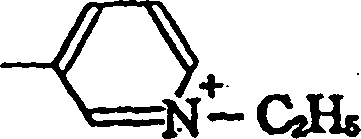
Herstellung
der Dispersionen MC-3 und MC-4 der Harze, welche ein färbendes
Material einkapseln:
Dispersionen MC-3 und MC-4 wurden ebenfalls
bereitgestellt als Dispersionen von Harzen, welche ein färbendes
Material einkapseln.Preparation of Dispersions MC-3 and MC-4 of Resins Encapsulating a Dyeing Material:
Dispersions MC-3 and MC-4 were also provided as dispersions of resins encapsulating a coloring material.
(Herstellung von Dispersion MC-3)(Preparation of dispersion MC-3)
Die
folgenden Materialien wurden in einer Lösung vermischt.
Die resultierende Lösung wurde Phaseninversion-emulgiert unter Verwendung von Essigsäure als neutralisierendes Mittel, und Methylethylketon wurde beseitigt, um schließlich eine wässrige Dispersion von Mikrokapseln zu erhalten mit einem durchschnittlichen Partikeldurchmesser von 0,08 μm, Feststoffe bei einer Konzentration von 20 % enthaltend.The resulting solution was phase inversion emulsified using acetic acid as the neutralizing agent Agent, and methyl ethyl ketone was eliminated to finally a aqueous Dispersion of microcapsules obtained with an average Particle diameter of 0.08 μm, Containing solids at a concentration of 20%.
(Herstellung der Dispersion MC-4)(Preparation of the dispersion MC-4)
Eine wässrige Dispersion von Mikrokapseln mit einem durchschnittlichen Partikeldurchmesser von 0,13 μm, Feststoffe in einer Konzentration von 20 % enthaltend, wurde schließlich erhalten auf die gleiche Weise erhalten wie bei der Herstellung der Dispersion MC-3, mit der Ausnahme, dass das verwendete Harz in Dispersion MC-3 getauscht wurde gegen Styrol-N,N-dimethylaminopropylmethacrylat-Copolymer (Molekulargewicht: 35000).A aqueous Dispersion of microcapsules with an average particle diameter of 0.13 μm, Containing solids at a concentration of 20% was finally obtained obtained in the same way as in the preparation of the dispersion MC-3, except that the resin used in dispersion MC-3 was exchanged for styrene-N, N-dimethylaminopropyl methacrylate copolymer (Molecular weight: 35,000).
Nachdem die auf die oben beschriebene Weise bereitgestellten Dispersionen gemischt wurden, um Feststoff-Anteile in ihren entsprechenden in Tabelle 3 gezeigten Verhältnissen zu ergeben, wurden Glycerin und Isopropylalkohol mit jedem dieser Gemische so gemischt, dass die Konzentrationen von Glycerin und Isopropylalkohol sich auf jeweils 16 % und 4,0 % beliefen, um somit entsprechende Tinten herzustellen, die schließlich Ruß und das Harz, das färbende Material einkapselnd, enthalten in einer Konzentration von 8 % in Bezug auf den Gesamtfeststoffgehalt in jeder Tinte. C.B./MC, in Tabelle 3 gezeigt, bezeichnet End-Konzentrationen der zugehörigen Feststoffe in jeder hergestellten Tinte. Insbesondere bezeichnet es, dass Tinte A gemäß Beispiel 7 auf solche Weise hergestellt wurde, dass der Feststoffgehalt von Ruß und dem Harz, das färbende Material einkapselnd, sich auf jeweils 1,5 % und 6,5 % beliefen. Dasselbe wird nachstehend angewendet. Die Menge des Rußes in Beispielen 7 bis 9 in Tabelle 3 bedeutet Gesamt-Feststoffgehalt von Ruß und dem Dispergiermittel. Andererseits bedeutet die Menge des Rußes in Beispielen 10 bis 12 eine Menge von Ruß alleine, weil kein Dispergiermittel für den Ruß verwendet wurde.After the dispersions provided in the manner described above were mixed to give solids levels in their respective ratios shown in Table 3, glycerol and isopropyl alcohol were mixed with each of these mixtures such that the concentrations of glycerol and isopropyl alcohol were 16% each. and 4.0%, thus producing corresponding inks which would eventually contain carbon black and the resin encapsulating the coloring material at a concentration of 8% with respect to the total solid content in each ink. CB / MC, shown in Table 3, denotes final concentrations of associated solids in each prepared ink. In particular, it indicates that ink A ge according to Example 7, in such a manner that the solid content of carbon black and the resin encapsulating the coloring material was 1.5% and 6.5%, respectively. The same is applied below. The amount of carbon black in Examples 7 to 9 in Table 3 means total solid content of carbon black and the dispersant. On the other hand, the amount of the carbon black in Examples 10 to 12 means an amount of carbon black alone because no dispersant was used for the carbon black.
Die auf diese Weise hergestellten sechs Tinten J, K, L, M, N und O wurden separat geladen in einen Tintenbehälter für Schwarz einer BJ Kartusche BC-21, installiert in einem Farb-BJ-Drucker (BJC-420J, Handelsname; hergestellt von Canon Inc.), und die Kartusche wurde in den BJC-420 eingebracht, um Drucken auf Aufzeichnungspapier durchzuführen, Canon PB-Papier (Handelsname, Produkt von Canon Inc.; Papier für allgemeinen Gebrauch in BJ-Elektrophotographie) gemäß dem 360 × 360 DPI, HQ-Modus für glattes Papier von BJC-420J. Die auf diese Weise hergestellten Drucke wurden bewertet im Hinblick auf optische Dichte des Bildes, Wasserfestigkeit, Beständigkeit gegenüber Linienmarker, Abrieb-Beständigkeit und Ausstoßungs-Stabilität, auf genau die gleiche Weise wie in Beispielen 1 bis 6. Die Auswertungs-Ergebnisse sind in Tabelle 4 gezeigt.The Thus, six inks J, K, L, M, N and O prepared in this manner were used separately charged in a black ink tank of a BJ cartridge BC-21, installed in a color BJ printer (BJC-420J, trade name, manufactured by Canon Inc.), and the cartridge was incorporated into the BJC-420 to print on recording paper perform, Canon PB paper (Trade name, product of Canon Inc., paper for general use in BJ electrophotography) according to the 360 × 360 DPI, HQ mode for smooth paper from BJC-420J. The prints produced in this way were evaluated in terms of optical density of the image, water resistance, resistance across from Line marker, abrasion resistance and ejection stability, at exactly the same way as in Examples 1 to 6. The evaluation results are shown in Table 4.
Vergleichsbeispiele 4 bis 6:Comparative Examples 4 until 6:
Tinten
P und Q, die nur ihren entsprechenden Ruß enthalten, in Tabelle 3 gezeigt,
und Tinte R, die nur deren entsprechendes Harz, das ein färbendes
Material einkapselt, enthält,
in Tabelle 3 gezeigt, wurden auf die gleiche Weise hergestellt wie
die Tinten gemäß Beispielen
7 bis 12, und ausgewertet im Hinblick auf optische Dichte des Bildes, Wasserfestigkeit,
Beständigkeit
gegenüber
Linienmarker, Abrieb-Beständigkeit
und Ausstoßungs-Stabilität, auf genau
die gleiche Weise wie in Beispielen 7 bis 12. Die Auswertungs-Ergebnisse sind
in Tabelle 4 gezeigt. Tabelle
3 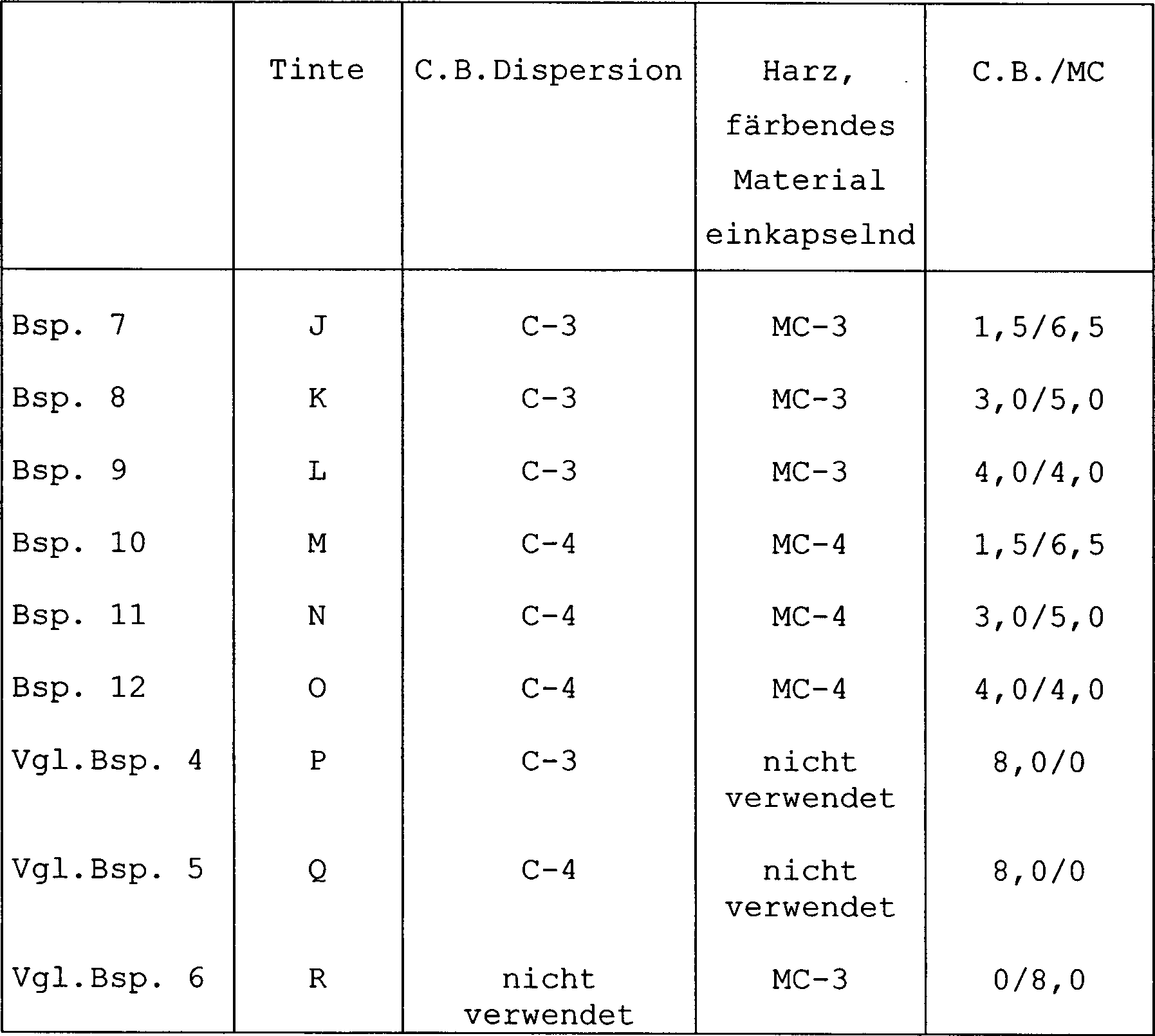
Optische
Dichte, Wasserfestigkeit, Beständigkeit
gegenüber
Linienmarker, Abrieb-Beständigkeit
und Ausstoßungs-Stabilität wurden
auf die gleiche Weise bewertet wie in Beispielen 1 bis 
Aus Tabelle 4 ist zu verstehen, dass die Verwendung der Tinten gemäß den obenstehenden Beispielen Bilder bereitstellen kann mit genügend hoher optischer Dichte auf glattem Papier und ausgezeichneter Wasserfestigkeit, Beständigkeit gegenüber Linienmarker und Abrieb-Beständigkeit. Wie in Tabelle 4 gezeigt, konnten die Tinten des alleinigen Systems des Rußes und die Tinte des alleinigen Systems des Harzes, das färbende Material einkapselnd, keine Resultate erbringen, welche gleichzeitig die optische Dichte des Bildes, Wasserfestigkeit, Beständigkeit gegenüber Linienmarker, Abrieb-Beständigkeit und Ausstoßungs-Stabilität befriedigen.Out Table 4 is to be understood that the use of the inks according to the above Examples can provide images with sufficiently high optical density on smooth paper and excellent water resistance, durability across from Line marker and abrasion resistance. As shown in Table 4, the inks of the sole system of soot and the ink of the sole system of the resin, the coloring material encapsulating, yielding no results which simultaneously the optical density of the image, water resistance, resistance across from Line marker, abrasion resistance and satisfy ejection stability.
Beispiele 13 bis 18:Examples 13 to 18:
Die jeweils in Beispielen 7 bis 12 hergestellten Tinten J bis 0 wurden separat geladen in einen Tintenbehälter für Schwarz eines Farb-BJ-Druckers, BJC-610JW (Handelsname; hergestellt von Canon Inc.), um diese für die Auswertung in Beispielen 13 bis 18 zu verwenden. Die ausschließlich für BJC-610JW hergestellten Farbtinten wurden als Farbtinten verwendet. Schwarze Zeichen wurden gedruckt in einem farbigen fest-gedruckten Hintergrund auf PB-Papier (Produkt von Canon Inc.), um auf diese Weise Tinten J bis 0 zu bewerten im Hinblick auf die Beständigkeit gegenüber Ausbluten von Farbe zwischen einem schwarzen Bild, gebildet mit jeder dieser Tinten, und einem Farbbild. Insbesondere wurde die Beständigkeit des Farb-Ausblutens zwischen Schwarz und Gelb, die Beständigkeit des Farb-Ausblutens zwischen Schwarz und Cyan, und die Beständigkeit des Farb-Ausblutens zwischen Schwarz und Magenta separat bewertet.The in each of Examples 7 to 12, inks J to O prepared separately charged in a black ink tank of a color BJ printer, BJC-610JW (trade name, manufactured by Canon Inc.) for evaluation in Examples 13 to 18. The only for BJC-610JW prepared color inks were used as color inks. black Characters were printed in a colorful hard-printed background on PB paper (product of Canon Inc.) to inks in this manner J to 0 in terms of resistance to bleeding of color between a black image formed with each one of these Inks, and a color picture. In particular, the durability became the color bleeding between black and yellow, the resistance the color bleed between black and cyan, and the persistence of the Color bleed between black and magenta graded separately.
Als Kontroll-Beispiel wurden eine schwarze Tinte und Farbtinten, ausschließlich hergestellt für BJC-610JW, verwendet, um diese zu bewerten im Hinblick auf Beständigkeit gegenüber Farb-Ausbluten, auf die gleiche Weise wie oben beschrieben. Als Folge war das Farb-Ausbluten in jedem der Beispiele 13 bis 18 im Vergleich mit dem Kontroll-Beispiel verringert, kein Ausschwitzen der schwarzen Zeichen in den farbigen Hintergrund ereignete sich, und die Schärfe der schwarzen Zeichen wurde ebenfalls als verbessert erkannt, verglichen mit dem Kontroll-Beispiel.When Control example, a black ink and color inks, were prepared exclusively for BJC-610JW, used to evaluate these in terms of durability across from Color bleed, in the same way as above. When The result was color bleeding in each of Examples 13 to 18 in Comparison with the control example reduced, no exudation the black characters in the colored background occurred and the sharpness the black character was also recognized as improved compared with the control example.
Diesmal wurden die optische Dichte, Wasserfestigkeit, Beständigkeit gegenüber Linienmarker und Abrieb-Beständigkeit der mit den schwarzen Tinten gebildeten Bilder gemäß Beispielen 13 bis 18 bewertet (Drucken wurde durchgeführt gemäß dem BK-Akzent-Modus). Als Folge wurden die gleichen Resultate wie in Beispielen 7 bis 12 erhalten.This time, the optical density, water resistance, line marker resistance, and abrasion resistance of the images formed with the black inks were evaluated according to Examples 13 to 18 (Dru was performed according to the BK accent mode). As a result, the same results as in Examples 7 to 12 were obtained.
Beispiele 19 bis 24:Examples 19 to 24:
Dispersionen MC-5 wurden bereitgestellt als eine Dispersion eines Harzes, Ruß als ein färbendes Material einkapselnd.dispersions MC-5 was provided as a dispersion of a resin, carbon black as a coloring Encapsulating material.
(Herstellung der Dispersion MC-5)(Preparation of the dispersion MC-5)
Die
folgenden Materialien wurden gemischt und dispergiert.
Das resultierende Gemisch wurde Phaseninversion-emulgiert unter Verwendung von Essigsäure als ein neutralisierendes Mittel, und Methylethylketon wurde entfernt, um schließlich eine wässrige Dispersion eines kationischen Harzes zu erhalten, das Ruß mit einem durchschnittlichen Partikeldurchmesser von 0,10 μm einkapselt, Feststoffe in einer Konzentration von 20 % enthaltend.The resulting mixture was phase inversion emulsified using of acetic acid as a neutralizing agent, and methyl ethyl ketone was removed, finally an aqueous one Dispersion of a cationic resin, the carbon black with a average particle diameter of 0.10 microns encapsulates, solids in containing a concentration of 20%.
Nachdem
die wässrige
Dispersion MC-5 des Ruß-enthaltenden
Harzes, bereitgestellt auf die oben beschriebene Weise, und die
Ruß-Dispersion
C-3 und C-4, hergestellt in Beispielen 7 bis 12, gemischt wurden, um
Feststoff-Anteile in ihren jeweiligen in Tabelle 5 gezeigten Verhältnissen
zu ergeben, wurden Glycerin, Propylenglykol und Isopropylalkohol
mit jedem dieser Gemische auf solche Weise gemischt, dass die Konzentrationen
von Glycerin, Propylenglykol und Isopropylalkohol sich auf jeweils
7,0 %, 8,0 % und 4,0 beliefen, um auf diese Weise entsprechende
Tinten herzustellen, die schließlich
enthalten Ruß und
das Harz, den Ruß einkapselnd,
in einer Konzentration von 8 % in Bezug auf den Total-Feststoffgehalt
in jeder Tinte. Tabelle
5 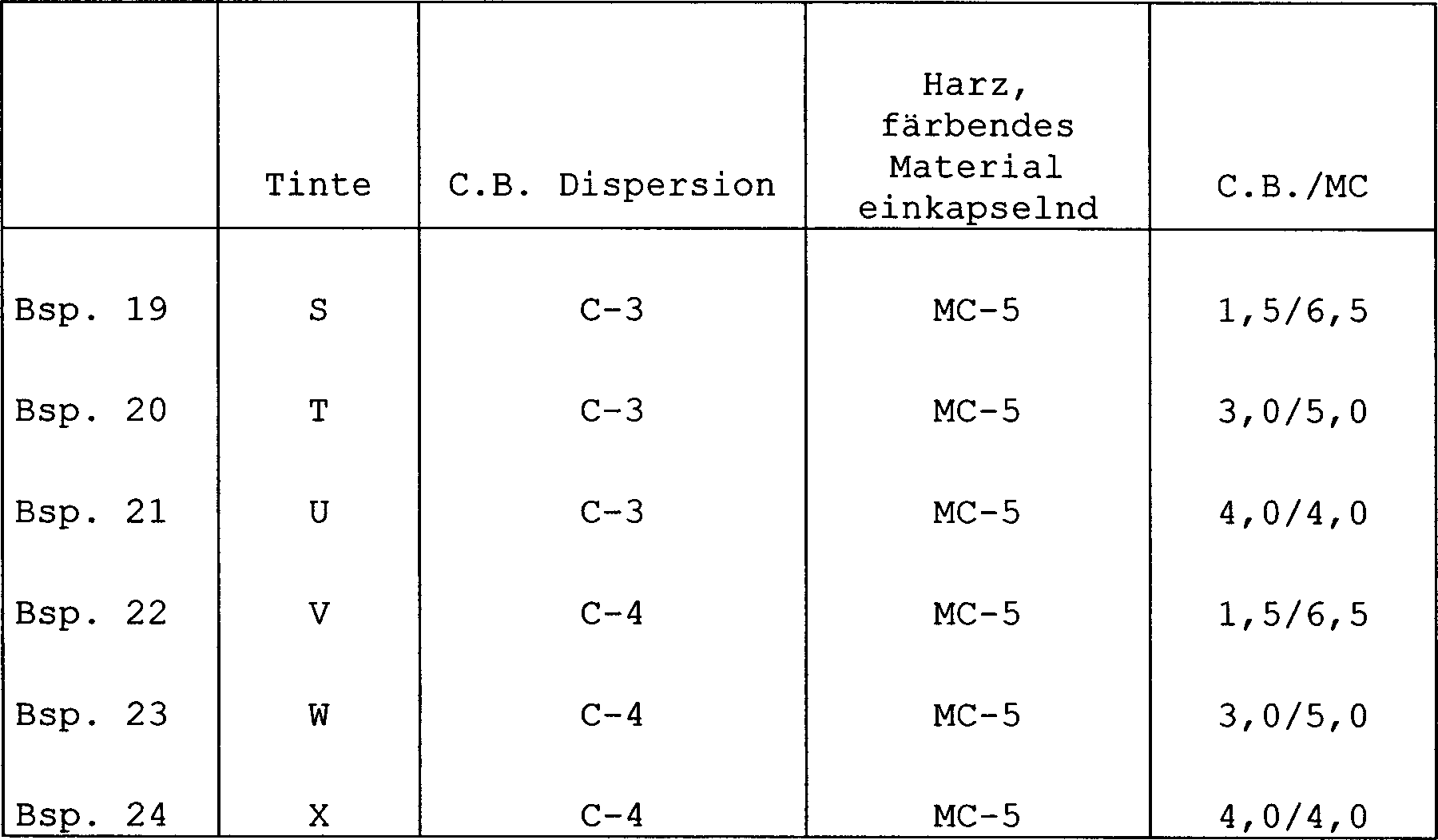
Die somit erhaltenen Tinten wurden bewertet im Hinblick auf optische Dicht des Bildes, Wasserfestigkeit, Beständigkeit gegenüber Linienmarker, Abrieb-Beständigkeit und Ausstoßungs-Stabilität, auf die gleiche Weise wie in Beispielen 7 bis 12. Allerdings wurde die Bewertung der optischen Dichte des Bildes durchgeführt gemäß dem folgenden Standard:
- AA: Optische Dichte war nicht niedriger als 1,4;
- A: Optische Dichte war von 1,35 bis 1,39;
- B: Optische Dichte war von 1,2 bis 1,34; und
- C: Optische Dichte war niedriger als 1,2.
- AA: optical density was not lower than 1.4;
- A: Optical density was from 1.35 to 1.39;
- B: optical density was from 1.2 to 1.34; and
- C: Optical density was lower than 1.2.
Die
Auswertungs-Ergebnisse sind in Tabelle 6 gezeigt. Tabelle
6 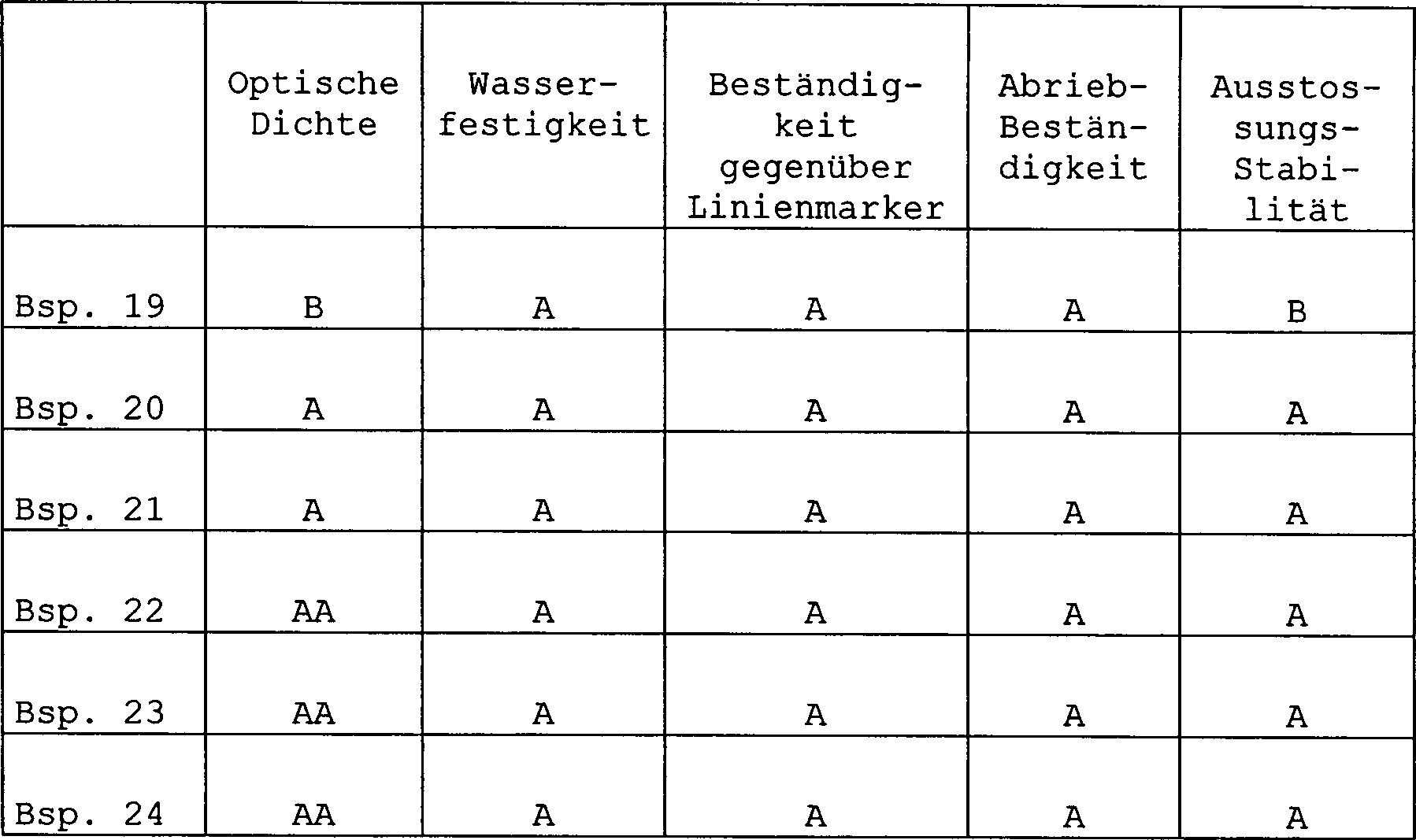
Beispiele 25 bis 30:Examples 25 to 30:
Farbtinten
mit ihren entsprechenden unten gezeigten Zusammensetzungen wurden
hergestellt. Gelbe
Tinte:
Diese Tinten wurden jeweils geladen in Tintenbehälter für Farbtinte eines Farb-BJ-Druckers BJC-610JW (Handelsname; hergestellt von Canon Inc.). Die schwarzen Tinten S bis X, hergestellt in Beispielen 19 bis 24, wurden separat geladen in einen Tintenbehälter für schwarze Tinte des Farb-BJ-Druckers BJC-610JW, um diese zu verwenden zur Auswertung in Beispielen 25 bis 30. Beständigkeit gegenüber Farb-Ausbluten zwischen jeder der schwarzen Tinten S bis X und der oben beschriebenen Farbtinten Gelb, Magenta und Cyan wurden auf genau die gleiche Weise bewertet wie in Beispiel 13 bis 18. Die Ergebnisse waren die gleichen wie in Beispielen 13 bis 18. Kein Ausschwitzen in den farbigen Hintergrund ereignete sich in den schwarzen Bildern, gebildet mit den schwarzen Tinten S bis X, und die Schärfe der schwarzen Zeichen war ebenfalls verbessert, verglichen mit dem Kontroll-Beispiel.These inks were respectively charged in ink tank for color ink of a color BJ printer BJC-610JW (trade name, manufactured by Canon Inc.). The black inks S to X, made in example Lenses 19 to 24 were separately charged in a black ink tank of BJC-610JW color BJ printer to be used for evaluation in Examples 25 to 30. Resistance to color bleeding between each of black inks S to X and The above-described yellow, magenta and cyan color inks were evaluated in exactly the same manner as in Examples 13 to 18. The results were the same as in Examples 13 to 18. No bleeding into the colored background occurred in the black images formed with the black inks S to X, and the sharpness of the black characters was also improved compared to the control example.
Diesmal wurde die optische Dichte, Wasserfestigkeit, Beständigkeit gegenüber Linienmarker und Abrieb-Beständigkeit der alleine mit den schwarzen Tinten gebildeten Bildern bewertet (Drucken wurde durchgeführt gemäß dem Bk-Akzent-Modus). Als Folge wurden genau die gleichen Ergebnisse wie in Beispielen 19 bis 24 erhalten.This time was the optical density, water resistance, resistance across from Line marker and abrasion resistance the pictures formed alone with the black inks (Printing was done according to the Bk accent mode). As a result were exactly the same results as in Examples 19 to 24 receive.
Gemäß der vorliegenden Erfindung können wie obenstehend beschrieben Tinten bereitgestellt werden, welche bereitstellen können Bilder, verbessert im Hinblick auf Beständigkeit gegenüber Linienmarker und Abrieb- Beständigkeit, ohne die Vorteile einer Pigment-Tinte zu schmälern, welche bereitstellen können Bilder ausgezeichneter optischer Dichte und Wasserfestigkeit, und darüber hinaus auch ausgezeichnet sind in Beständigkeit (Ausstoßungs-Beständigkeit, Ausstoßungs-Stabilität, Antiverstopfungs-Eigenschaft usw.) bei Tintenstrahl-Aufzeichnen.According to the present Invention can as described above, inks are provided which can provide Images improved with regard to resistance to line markers and abrasion resistance, without detracting from the advantages of a pigment ink which provide can Images of excellent optical density and water resistance, and about that also excellent in durability (ejection resistance, Ejection Stability, Anti-Clogging Property, etc.) in inkjet recording.
Es ist ebenfalls möglich, Bilder zu bilden mit ausgezeichneter Beständigkeit gegenüber Linienmarker und Abrieb-Beständigkeit, zusätzlich zur hohen optischen Dichte des Bildes und der ausgezeichneten Wasserfestigkeit.It is also possible To form images with excellent resistance to line markers and Abrasion-resistance, additionally to the high optical density of the image and the excellent water resistance.
Durch die Verkapselung in einem Harz wird die hydrophobe Gruppe des Harzes im Wesentlichen innerhalb einer Kapsel angeordnet, wohingegen die hydrophile Gruppe des Harzes außerhalb der Kapsel angeordnet wird. Deswegen haftet das Harz kaum an der Fläche der Ausstoßungs-Öffnung eines aufzeichnenden Kopfes an, wenn die Fläche der Ausstoßungs-Öffnung einer Wasser-abstoßenden Behandlung unterzogen wird, und auf diese Weise kann das Harz wirkungsvoll daran gehindert werden, sich auf der Fläche der Ausstoßungs-Öffnung des Tintenstrahl-Kopfes abzuscheiden. Deswegen kann die Ausstoßungs-Stabilität der Tinte noch weiter verbessert werden.By the encapsulation in a resin becomes the hydrophobic group of the resin essentially disposed within a capsule, whereas the hydrophilic group of the resin outside the capsule is arranged. Therefore, the resin hardly adheres to the area the ejection opening of a recording head when the surface of the ejection opening of a water-repellent treatment is subjected, and in this way, the resin can be effective be prevented from standing on the surface of the ejection opening of the To deposit inkjet head. Therefore, the ejection stability of the ink be further improved.
Gemäß der vorliegenden Erfindung können die Probleme einer Pigment-Tinte ebenfalls ausgeglichen werden, ohne die Vorteile der Pigment-Tinte zu schmälern. Insbesondere können dauerhaft bereitgestellt werden Bilder hoher optischer Dichte und ausgezeichneter Wasserfestigkeit, Beständigkeit gegenüber Linienmarker und Abrieb-Beständigkeit. Wenn eine Harz-Kapsel verwendet wird als Harz, welches ein färbendes Material einkapselt, ist die hydrophobe Gruppe des Harzes im Wesentlichen innerhalb einer Kapsel angeordnet, wohingegen die hydrophile Gruppe des Harzes außerhalb der Kapsel angeordnet ist. Deswegen haftet das Harz kaum an der Fläche der Ausstoßungs-Öffnung eines aufzeichnenden Kopfes an, wenn die Fläche der Ausstoßungs-Öffnung einer Wasser-abstoßenden Behandlung unterzogen wird, und somit kann das Harz daran gehindert werden, sich auf der Fläche der Ausstoßungs-Öffnung des Tintenstrahl-Kopfes abzuscheiden. Daher kann die Ausstoßungs-Stabilität der Tinte noch weiter verbessert werden.According to the present Invention can the problems of a pigment ink are also compensated without belittling the benefits of the pigment ink. In particular, can be permanent provided images of high optical density and excellent Water resistance, resistance across from Line marker and abrasion resistance. When a resin capsule is used as a resin, which is a coloring Encapsulating material, the hydrophobic group of the resin is substantially within a capsule, whereas the hydrophilic group of the resin outside the capsule is arranged. Therefore, the resin hardly adheres to the Area of Ejection opening of a recording head when the surface of the ejection opening of a repelling water Treatment is subjected, and thus the resin can be prevented be on the surface the ejection opening of the To deposit inkjet head. Therefore, the ejection stability of the ink be further improved.
Wenn ein Mehrfarben-Bild mit mindestens zwei Tinten gemäß der vorliegenden Erfindung durch Tintenstrahl-Aufzeichnen gebildet wird, kann Ausbluten auf einem aufzeichnenden Medium wirkungsvoll verringert werden, zusätzlich zu den oben beschriebenen Effekten.If a multicolor image having at least two inks according to the present invention Invention is formed by inkjet recording, bleeding be effectively reduced on a recording medium additionally to the effects described above.
Hiermit wird offenbart eine Tinte mit einem Pigment und einem Harz, welches ein färbendes Material einkapselt. Die Tinte kann bereitstellen ein Bild hoher optischer Dichte und ausgezeichneter Abrieb-Beständigkeit, Wasserfestigkeit und Beständigkeit gegenüber Linienmarker, und hat exzellente Ausstoßungs-Stabilität aus einem aufzeichnenden Kopf bei der Verwendung im Tintenstrahl-Aufzeichnen.Herewith discloses an ink with a pigment and a resin which a coloring Encapsulating material. The ink can provide a high image optical density and excellent abrasion resistance, water resistance and durability across from Line marker, and has excellent ejection stability from one recording head when used in ink-jet recording.
Claims (17)
Applications Claiming Priority (6)
| Application Number | Priority Date | Filing Date | Title |
|---|---|---|---|
| JP8869198 | 1998-04-01 | ||
| JP8869198 | 1998-04-01 | ||
| JP8869098 | 1998-04-01 | ||
| JP8869098 | 1998-04-01 | ||
| JP08359899A JP4250249B2 (en) | 1998-04-01 | 1999-03-26 | Ink jet ink, ink cartridge, recording unit, ink set, image recording method, and image recording apparatus |
| JP8359899 | 1999-03-26 |
Publications (2)
| Publication Number | Publication Date |
|---|---|
| DE69918482D1 DE69918482D1 (en) | 2004-08-12 |
| DE69918482T2 true DE69918482T2 (en) | 2005-07-28 |
Family
ID=27304272
Family Applications (1)
| Application Number | Title | Priority Date | Filing Date |
|---|---|---|---|
| DE1999618482 Expired - Lifetime DE69918482T2 (en) | 1998-04-01 | 1999-04-01 | Ink, ink set, ink tank, recording unit, image recording method and image recording apparatus |
Country Status (8)
| Country | Link |
|---|---|
| US (1) | US6790878B2 (en) |
| EP (1) | EP0947567B1 (en) |
| JP (1) | JP4250249B2 (en) |
| KR (1) | KR100333251B1 (en) |
| CN (1) | CN1213114C (en) |
| AU (1) | AU752078B2 (en) |
| CA (1) | CA2267393C (en) |
| DE (1) | DE69918482T2 (en) |
Families Citing this family (73)
| Publication number | Priority date | Publication date | Assignee | Title |
|---|---|---|---|---|
| US20040082686A1 (en) * | 1999-09-30 | 2004-04-29 | Canon Kabushiki Kaisha | Aqueous ink composition for ink jet, ink cartridge, recording unit, ink jet recording apparatus, and ink jet recording method |
| EP1088860B1 (en) * | 1999-09-30 | 2005-12-07 | Canon Kabushiki Kaisha | Aqueous ink composition for ink jet and ink jet recording method |
| JP3779114B2 (en) * | 1999-12-28 | 2006-05-24 | 花王株式会社 | Ink set |
| JP4475620B2 (en) * | 2000-03-10 | 2010-06-09 | キヤノン株式会社 | Inkjet printing method |
| JP3804791B2 (en) * | 2000-06-07 | 2006-08-02 | セイコーエプソン株式会社 | Ink jet recording ink, recording method, recorded matter, and ink jet recording apparatus |
| JP3644498B2 (en) * | 2000-09-14 | 2005-04-27 | セイコーエプソン株式会社 | Ink jet recording method and ink set for ink jet recording used therefor |
| US6864302B2 (en) | 2000-09-14 | 2005-03-08 | Seiko Epson Corporation | Ink jet recording method and ink set therefor |
| ATE366781T1 (en) * | 2000-09-27 | 2007-08-15 | Seiko Epson Corp | INK JET RECORDING INK SET, INK JET RECORDING METHOD AND RECORDED PRODUCT |
| US7405245B2 (en) | 2000-11-02 | 2008-07-29 | Seiko Epson Corporation | Ink composition for ink jet printer |
| US6730149B2 (en) | 2001-01-22 | 2004-05-04 | Ricoh Company Limited | Ink composition and inkjet recording method and apparatus using the ink composition |
| DE60220038T2 (en) | 2001-02-22 | 2007-08-30 | Seiko Epson Corp. | Aqueous pigment ink composition |
| JP2003034770A (en) * | 2001-05-17 | 2003-02-07 | Fuji Photo Film Co Ltd | Water-based colored fine particle dispersion, method for producing the same, and inkjet recording ink |
| US7029109B2 (en) * | 2001-08-22 | 2006-04-18 | Canon Kabushiki Kaisha | Ink, ink set, ink jet recording method, ink jet recording apparatus, recording unit and ink cartridge |
| JP4277490B2 (en) * | 2001-08-27 | 2009-06-10 | セイコーエプソン株式会社 | Microencapsulated pigment and method for producing the same, aqueous dispersion, and inkjet recording ink |
| JP2003112412A (en) * | 2001-10-05 | 2003-04-15 | Hitachi Koki Co Ltd | Inkjet printer device |
| JP3915472B2 (en) * | 2001-10-25 | 2007-05-16 | コニカミノルタホールディングス株式会社 | Ink jet ink, ink jet cartridge using the same, ink jet image recording method, and ink jet recorded image |
| US7241334B2 (en) * | 2002-05-23 | 2007-07-10 | Columbian Chemicals Company | Sulfonated carbonaceous materials |
| US7390441B2 (en) * | 2002-05-23 | 2008-06-24 | Columbian Chemicals Company | Sulfonated conducting polymer-grafted carbon material for fuel cell applications |
| JP2003335992A (en) * | 2002-05-23 | 2003-11-28 | Sharp Corp | Ink composition for inkjet recording |
| US7195834B2 (en) | 2002-05-23 | 2007-03-27 | Columbian Chemicals Company | Metallized conducting polymer-grafted carbon material and method for making |
| CN100339913C (en) * | 2002-05-23 | 2007-09-26 | 哥伦比亚化学公司 | Sulfonated conducting polymer-grafted carbon material for fuel cell applications |
| US7459103B2 (en) * | 2002-05-23 | 2008-12-02 | Columbian Chemicals Company | Conducting polymer-grafted carbon material for fuel cell applications |
| EP1509929A4 (en) | 2002-05-23 | 2007-03-21 | Columbian Chem | CARBON-CONDUCTIVE MATERIAL GRAFTED ON A POLYMER FOR FUEL CELL APPLICATIONS |
| US6827772B2 (en) | 2002-05-24 | 2004-12-07 | Cabot Corporation | Carbon black and compositions containing same |
| KR100798722B1 (en) | 2002-06-24 | 2008-01-28 | 가부시키가이샤 리코 | Inkjet recording device and inkjet recording method |
| CN1324095C (en) | 2002-09-24 | 2007-07-04 | 精工爱普生株式会社 | Ink composition for inkjet recording, recording method and recorded matter using same |
| JP2004256737A (en) * | 2003-02-27 | 2004-09-16 | Konica Minolta Holdings Inc | Aqueous cyan ink for inkjet, color ink set for inkjet using the same and image forming method using the same |
| EP1454969B1 (en) * | 2003-03-06 | 2006-08-02 | Kao Corporation | Ink set |
| US20050020730A1 (en) * | 2003-05-19 | 2005-01-27 | Valentini Jose E. | Inkjet ink |
| JP4547893B2 (en) * | 2003-10-31 | 2010-09-22 | セイコーエプソン株式会社 | Microencapsulated pigment, method for producing the same, and aqueous dispersion |
| BRPI0507723A (en) * | 2004-03-16 | 2007-07-10 | Canon Kk | inkjet ink, inkjet engraving method, ink cartridge, and inkjet engraving apparatus |
| US6958308B2 (en) | 2004-03-16 | 2005-10-25 | Columbian Chemicals Company | Deposition of dispersed metal particles onto substrates using supercritical fluids |
| JP4856885B2 (en) | 2004-03-16 | 2012-01-18 | キヤノン株式会社 | Liquid composition, liquid composition and ink set, and image recording method |
| CN100564461C (en) * | 2004-03-26 | 2009-12-02 | 佳能株式会社 | Active energy ray-curable aqueous ink composition, inkjet recording method using same, ink cartridge, recording unit, and inkjet recording apparatus |
| WO2005092993A1 (en) | 2004-03-26 | 2005-10-06 | Canon Kabushiki Kaisha | Active energy radiation hardenable water base ink and utilizing the same, method of inkjet recording, ink cartridge, recording unit and inkjet recording apparatus |
| US7332532B2 (en) * | 2004-04-13 | 2008-02-19 | Hewlett-Packard Development, L.P. | Polymeric dispersants for ink-jet applications |
| US7365108B2 (en) * | 2004-07-14 | 2008-04-29 | Hewlett-Packard Development Company, L.P. | Pigmented ink-jet inks with improved print quality and reliability |
| US20060068987A1 (en) * | 2004-09-24 | 2006-03-30 | Srinivas Bollepalli | Carbon supported catalyst having reduced water retention |
| JP2006117801A (en) * | 2004-10-21 | 2006-05-11 | Sony Corp | Ink, ink cartridge, and ink jet recording method |
| US8153706B2 (en) | 2004-10-25 | 2012-04-10 | Hewlett-Packard Development Company, L.P. | Polymeric colorants having pigment and dye components and corresponding ink compositions |
| US20070078200A1 (en) | 2005-09-01 | 2007-04-05 | Kao Corporation | Water-based inks for ink-jet printing |
| US20080277626A1 (en) * | 2006-05-23 | 2008-11-13 | Evident Technologies, Inc. | Quantum dot fluorescent inks |
| JP5192673B2 (en) * | 2006-08-30 | 2013-05-08 | 大日精化工業株式会社 | Aqueous pigment dispersion and article using the same |
| WO2008055244A2 (en) | 2006-10-31 | 2008-05-08 | Sensient Colors Inc. | Modified pigments and methods for making and using the same |
| US7868059B2 (en) * | 2007-07-27 | 2011-01-11 | Hewlett-Packard Development Company, L.P. | Polymerizable dye-monomer conjugates for encapsulating pigment particles |
| EP3483222A3 (en) | 2007-08-23 | 2019-08-07 | Sensient Colors LLC | Self-dispersed pigments and methods for making and using the same |
| WO2009038098A1 (en) | 2007-09-20 | 2009-03-26 | Kao Corporation | Water-based ink for ink-jet recording |
| JP5379433B2 (en) * | 2007-09-20 | 2013-12-25 | 花王株式会社 | Water-based ink for inkjet recording |
| JP5169179B2 (en) * | 2007-11-29 | 2013-03-27 | 株式会社リコー | Ink and ink set, and ink cartridge, ink record, ink jet recording method, and ink jet recording apparatus using the same |
| US8356892B2 (en) * | 2007-12-27 | 2013-01-22 | Eastman Kodak Company | Inkjet inks for printing on both plain and photo-glossy papers |
| US8814337B2 (en) * | 2007-12-27 | 2014-08-26 | Eastman Kodak Company | Inkjet ink sets for high speed printing on plain papers and glossy media |
| JP5315721B2 (en) * | 2008-02-29 | 2013-10-16 | 株式会社リコー | Ink jet recording ink, ink cartridge, ink jet recording method, ink jet recording apparatus, and ink recorded matter |
| JP5247191B2 (en) * | 2008-03-13 | 2013-07-24 | 富士フイルム株式会社 | Ink composition and image recording method |
| JP5279368B2 (en) * | 2008-07-02 | 2013-09-04 | 花王株式会社 | Water-based ink for inkjet recording |
| JP5588102B2 (en) * | 2008-07-07 | 2014-09-10 | 花王株式会社 | Water-based ink for inkjet recording |
| KR20100013161A (en) * | 2008-07-30 | 2010-02-09 | 삼성전자주식회사 | Capsulated colorant, method of the same, and ink composition including the same |
| EP2417202A2 (en) | 2009-04-07 | 2012-02-15 | Sensient Colors LLC | Self-dispersing particles and methods for making and using the same |
| US8282725B2 (en) * | 2009-04-22 | 2012-10-09 | Canon Kabushiki Kaisha | Self-dispersion pigment, production process of self-dispersion pigment, ink set and ink jet recording method |
| JP5879692B2 (en) * | 2010-03-04 | 2016-03-08 | 株式会社リコー | Ink set for ink jet recording, ink jet recording method, and recorded matter |
| JP2011241384A (en) | 2010-04-22 | 2011-12-01 | Canon Inc | Active energy ray curable ink jet recording liquid composition, and ink jet recording method using the same |
| JP2010180419A (en) * | 2010-05-27 | 2010-08-19 | Seiko Epson Corp | Microencapsulated pigment and method for manufacturing the same, aqueous dispersion, and ink for inkjet recording |
| WO2012036330A1 (en) * | 2010-09-17 | 2012-03-22 | 주식회사 씨드 | Method for preparing environmentally-friendly dye-pigment copolymerized plastid and ink composition having high molecular weight polymer and digital textile printing system using same |
| JP5659879B2 (en) * | 2011-03-08 | 2015-01-28 | 株式会社リコー | Ink set, manufacturing method thereof, and ink jet recording apparatus |
| JP5729142B2 (en) * | 2011-06-02 | 2015-06-03 | 株式会社リコー | Ink jet recording ink, ink cartridge, ink jet recording apparatus, ink jet recording method, and ink recorded matter |
| US8939570B2 (en) | 2011-12-02 | 2015-01-27 | Canon Kabushiki Kaisha | Ink jet ink, ink cartridge, ink jet recording method and polymer particle |
| US8845085B2 (en) | 2011-12-02 | 2014-09-30 | Canon Kabushiki Kaisha | Image recording method, and set of ink jet ink and liquid composition |
| JP2013241565A (en) * | 2012-02-01 | 2013-12-05 | Mimaki Engineering Co Ltd | Ink and use thereof |
| JP5966724B2 (en) | 2012-07-25 | 2016-08-10 | 株式会社リコー | Ink jet recording ink, ink cartridge, and ink jet recording apparatus |
| JP2014136716A (en) * | 2013-01-15 | 2014-07-28 | Mimaki Engineering Co Ltd | Ink and inkjet recording method |
| CN105705340B (en) * | 2013-11-19 | 2018-06-26 | 马姆杰特科技有限公司 | The method of printing color base oil ink, for its ink group, ink and printing machine |
| WO2016104505A1 (en) | 2014-12-24 | 2016-06-30 | 花王株式会社 | Process for producing pigment-containing modified polymer particles |
| JP6880937B2 (en) * | 2017-03-31 | 2021-06-02 | ブラザー工業株式会社 | Water-based ink for inkjet recording |
| JP7479133B2 (en) * | 2019-10-28 | 2024-05-08 | 三菱鉛筆株式会社 | Water-based ink composition for writing instruments |
Family Cites Families (26)
| Publication number | Priority date | Publication date | Assignee | Title |
|---|---|---|---|---|
| JPS5527282A (en) | 1978-08-18 | 1980-02-27 | Canon Inc | Liquid injection recording method and its device |
| JPS5459936A (en) | 1977-10-03 | 1979-05-15 | Canon Inc | Recording method and device therefor |
| JPS5459139A (en) | 1977-10-19 | 1979-05-12 | Canon Inc | Recording head |
| JP3089639B2 (en) | 1989-12-01 | 2000-09-18 | セイコーエプソン株式会社 | Image recording ink |
| JP3123195B2 (en) * | 1992-04-15 | 2001-01-09 | ミノルタ株式会社 | Inkjet recording liquid |
| ZA933185B (en) * | 1992-05-08 | 1994-05-23 | Dick Co Ab | Encapsulated magnetic particles pigments and carbon black compositions and methods related thereto |
| JP3172362B2 (en) | 1993-06-21 | 2001-06-04 | 松下電子工業株式会社 | Layout method of semiconductor integrated circuit |
| US5531818A (en) * | 1994-12-01 | 1996-07-02 | Xerox Corporation | Ink jet ink compositions and printing processes |
| JPH08239610A (en) | 1995-03-07 | 1996-09-17 | Mikuni Shikiso Kk | Aqueous pigment ink composition for inkjet |
| US5622548A (en) * | 1995-05-19 | 1997-04-22 | Micap Technology Corp. | Duplicating inks for digital duplicators |
| US5531816A (en) | 1995-09-14 | 1996-07-02 | Hewlett-Packard Company | Bleed-alleviated, waterfast, pigment-based ink-jet ink compositions |
| US6025412A (en) * | 1995-09-29 | 2000-02-15 | Xerox Corporation | Colored particulates for ink jet inks |
| JP3065950B2 (en) | 1995-10-30 | 2000-07-17 | 花王株式会社 | Water-based ink |
| US5886091A (en) | 1996-01-05 | 1999-03-23 | Milliken & Company | Printing ink composition |
| JPH09227816A (en) | 1996-02-20 | 1997-09-02 | Brother Ind Ltd | Inkjet recording ink |
| DE69706298T2 (en) * | 1996-06-14 | 2002-06-13 | Cabot Corp., Boston | MODIFIED COLORED PIGMENTS AND THIS INKERJET INK |
| US5707432A (en) * | 1996-06-14 | 1998-01-13 | Cabot Corporation | Modified carbon products and inks and coatings containing modified carbon products |
| US5879439A (en) * | 1996-08-01 | 1999-03-09 | Ricoh Company, Ltd. | Recording ink composition and recording method using the same |
| JP3516039B2 (en) | 1996-08-01 | 2004-04-05 | 株式会社リコー | Recording ink and recording method using the same |
| US5976233A (en) * | 1996-11-13 | 1999-11-02 | Canon Kabushiki Kaisha | Water-based pigment ink, and ink-jet recording method and instruments using the same |
| JPH10168373A (en) * | 1996-12-12 | 1998-06-23 | Fuji Xerox Co Ltd | Ink for ink jet recording and recording using the same |
| US5851274A (en) * | 1997-01-13 | 1998-12-22 | Xerox Corporation | Ink jet ink compositions and processes for high resolution and high speed printing |
| US6031019A (en) * | 1997-02-07 | 2000-02-29 | Kao Corporation | Aqueous ink for ink-jet printing |
| CA2229747C (en) * | 1997-02-19 | 2006-07-18 | The Pilot Ink Co., Ltd. | Aqueous marking pen ink composition for writing board |
| US5886065A (en) * | 1997-03-24 | 1999-03-23 | Hewlett-Packard Company | Mediation of waterfastness in ink-jet ink compositions by using partial chemically-treated macromolecular chromophores (MMCs) |
| JP6159914B2 (en) | 2013-01-15 | 2017-07-12 | 株式会社リコー | Post-processing apparatus and image forming apparatus |
-
1999
- 1999-03-26 JP JP08359899A patent/JP4250249B2/en not_active Expired - Lifetime
- 1999-03-30 CA CA 2267393 patent/CA2267393C/en not_active Expired - Fee Related
- 1999-03-31 AU AU22566/99A patent/AU752078B2/en not_active Ceased
- 1999-04-01 CN CNB991075323A patent/CN1213114C/en not_active Expired - Fee Related
- 1999-04-01 KR KR1019990011368A patent/KR100333251B1/en not_active Expired - Fee Related
- 1999-04-01 US US09/283,192 patent/US6790878B2/en not_active Expired - Fee Related
- 1999-04-01 EP EP19990106699 patent/EP0947567B1/en not_active Expired - Lifetime
- 1999-04-01 DE DE1999618482 patent/DE69918482T2/en not_active Expired - Lifetime
Also Published As
| Publication number | Publication date |
|---|---|
| US6790878B2 (en) | 2004-09-14 |
| JPH11343439A (en) | 1999-12-14 |
| CN1213114C (en) | 2005-08-03 |
| EP0947567A1 (en) | 1999-10-06 |
| US20020006982A1 (en) | 2002-01-17 |
| AU2256699A (en) | 1999-10-14 |
| KR19990082819A (en) | 1999-11-25 |
| CA2267393C (en) | 2003-08-26 |
| JP4250249B2 (en) | 2009-04-08 |
| KR100333251B1 (en) | 2002-04-24 |
| AU752078B2 (en) | 2002-09-05 |
| CA2267393A1 (en) | 1999-10-01 |
| CN1233633A (en) | 1999-11-03 |
| DE69918482D1 (en) | 2004-08-12 |
| EP0947567B1 (en) | 2004-07-07 |
Similar Documents
| Publication | Publication Date | Title |
|---|---|---|
| DE69918482T2 (en) | Ink, ink set, ink tank, recording unit, image recording method and image recording apparatus | |
| DE60032084T2 (en) | Ink, ink set and image recording method for improving the tightness of inkjet printed images | |
| DE60303072T2 (en) | Reaction solution for ink jet recording, apparatus and ink jet recording method using this solution | |
| DE69322714T2 (en) | Ink jet recording method and apparatus | |
| DE69933322T2 (en) | Ink, inkjet, ink cartridge, recording unit, recorder and recording method | |
| DE60006766T2 (en) | Ink set, ink jet recording method, recording unit, ink cartridge, ink jet recording device and reduction of color mixing with this ink set | |
| DE60018668T2 (en) | Ink set for ink jet recording, ink jet recording method, recording unit, recording apparatus and method for reducing color mixing | |
| DE69427552T2 (en) | Ink, its manufacture, ink jet recording method and apparatus using the same | |
| DE69432276T2 (en) | Aqueous ink, ink jet recording method and apparatus using the same | |
| DE60116820T2 (en) | Ink set, method for reducing color mixing, and method for improving the fixation of black images | |
| DE69527336T2 (en) | Aqueous dispersion ink for bubble jet printing, ink jet recording method and apparatus using the same | |
| DE69920129T2 (en) | Ink set for ink jet printing and ink jet printing process | |
| DE60107326T2 (en) | Ink, ink jet recording method, ink cartridge, recording unit and ink jet recording apparatus | |
| DE69428576T2 (en) | Ink, ink jet recording method and tool using this ink | |
| DE69828579T2 (en) | Ink Composition | |
| DE69323372T2 (en) | Ink set for ink jet recording processes containing surface penetrants and ink jet printers | |
| DE69703273T2 (en) | Ink jet recording method using a liquid composition containing a cationic polymer and an ink | |
| DE69513770T2 (en) | Aqueous ink-jet ink, ink-jet recording methods and instruments using this ink | |
| DE69909008T2 (en) | Inkjet printing system for improved print quality | |
| DE60122428T2 (en) | Ink jet ink, ink jet printing method, ink jet printing device, ink jet printing unit and ink cartridge | |
| DE60303848T2 (en) | Reaction solution for ink jet recording, and ink jet recording methods using this solution | |
| DE60203027T2 (en) | Ink set for ink jet recording, recording method, ink cartridge, recording unit, and ink jet recording apparatus | |
| DE69730594T2 (en) | INK COMPOSITIONS AND METHOD FOR PRODUCING PICTURES USING THEM | |
| DE60014801T2 (en) | Aqueous pigmented ink for ink jet printing and ink jet recording method | |
| DE69825937T2 (en) | An ink set, recording method and recording apparatus using the same |
Legal Events
| Date | Code | Title | Description |
|---|---|---|---|
| 8364 | No opposition during term of opposition |