DE69918461T2 - DUST ARMS, AGGRAVATES ANTIOXIDIZED WITH THEIR COMPRISED HARDNESS AND THEIR MANUFACTURING PROCESS - Google Patents
DUST ARMS, AGGRAVATES ANTIOXIDIZED WITH THEIR COMPRISED HARDNESS AND THEIR MANUFACTURING PROCESS Download PDFInfo
- Publication number
- DE69918461T2 DE69918461T2 DE69918461T DE69918461T DE69918461T2 DE 69918461 T2 DE69918461 T2 DE 69918461T2 DE 69918461 T DE69918461 T DE 69918461T DE 69918461 T DE69918461 T DE 69918461T DE 69918461 T2 DE69918461 T2 DE 69918461T2
- Authority
- DE
- Germany
- Prior art keywords
- butyl
- tert
- antioxidant
- group
- alcohol
- Prior art date
- Legal status (The legal status is an assumption and is not a legal conclusion. Google has not performed a legal analysis and makes no representation as to the accuracy of the status listed.)
- Expired - Fee Related
Links
- 239000000428 dust Substances 0.000 title description 6
- 238000004519 manufacturing process Methods 0.000 title description 6
- 239000003963 antioxidant agent Substances 0.000 claims description 80
- 230000003078 antioxidant effect Effects 0.000 claims description 72
- LFQSCWFLJHTTHZ-UHFFFAOYSA-N Ethanol Chemical compound CCO LFQSCWFLJHTTHZ-UHFFFAOYSA-N 0.000 claims description 64
- 239000006057 Non-nutritive feed additive Substances 0.000 claims description 46
- 239000002530 phenolic antioxidant Substances 0.000 claims description 38
- CSCPPACGZOOCGX-UHFFFAOYSA-N Acetone Chemical compound CC(C)=O CSCPPACGZOOCGX-UHFFFAOYSA-N 0.000 claims description 31
- OKKJLVBELUTLKV-UHFFFAOYSA-N Methanol Chemical compound OC OKKJLVBELUTLKV-UHFFFAOYSA-N 0.000 claims description 30
- ZWEHNKRNPOVVGH-UHFFFAOYSA-N 2-Butanone Chemical compound CCC(C)=O ZWEHNKRNPOVVGH-UHFFFAOYSA-N 0.000 claims description 28
- 238000000034 method Methods 0.000 claims description 27
- OJMIONKXNSYLSR-UHFFFAOYSA-N phosphorous acid Chemical group OP(O)O OJMIONKXNSYLSR-UHFFFAOYSA-N 0.000 claims description 27
- ISWSIDIOOBJBQZ-UHFFFAOYSA-N Phenol Chemical compound OC1=CC=CC=C1 ISWSIDIOOBJBQZ-UHFFFAOYSA-N 0.000 claims description 26
- YXFVVABEGXRONW-UHFFFAOYSA-N Toluene Chemical compound CC1=CC=CC=C1 YXFVVABEGXRONW-UHFFFAOYSA-N 0.000 claims description 26
- 239000000843 powder Substances 0.000 claims description 23
- 239000002904 solvent Substances 0.000 claims description 21
- YMWUJEATGCHHMB-UHFFFAOYSA-N Dichloromethane Chemical compound ClCCl YMWUJEATGCHHMB-UHFFFAOYSA-N 0.000 claims description 17
- 150000002148 esters Chemical class 0.000 claims description 16
- VLKZOEOYAKHREP-UHFFFAOYSA-N n-Hexane Chemical compound CCCCCC VLKZOEOYAKHREP-UHFFFAOYSA-N 0.000 claims description 16
- -1 acylaminophenols Chemical class 0.000 claims description 13
- HEDRZPFGACZZDS-UHFFFAOYSA-N Chloroform Chemical compound ClC(Cl)Cl HEDRZPFGACZZDS-UHFFFAOYSA-N 0.000 claims description 12
- PPBRXRYQALVLMV-UHFFFAOYSA-N Styrene Chemical compound C=CC1=CC=CC=C1 PPBRXRYQALVLMV-UHFFFAOYSA-N 0.000 claims description 11
- UAEPNZWRGJTJPN-UHFFFAOYSA-N methylcyclohexane Chemical compound CC1CCCCC1 UAEPNZWRGJTJPN-UHFFFAOYSA-N 0.000 claims description 11
- 125000000687 hydroquinonyl group Chemical class C1(O)=C(C=C(O)C=C1)* 0.000 claims description 10
- 150000001875 compounds Chemical class 0.000 claims description 8
- WPMYUUITDBHVQZ-UHFFFAOYSA-N 3-(3,5-ditert-butyl-4-hydroxyphenyl)propanoic acid Chemical compound CC(C)(C)C1=CC(CCC(O)=O)=CC(C(C)(C)C)=C1O WPMYUUITDBHVQZ-UHFFFAOYSA-N 0.000 claims description 7
- 125000003158 alcohol group Chemical group 0.000 claims description 7
- 239000000463 material Substances 0.000 claims description 7
- 229910052751 metal Inorganic materials 0.000 claims description 7
- 239000002184 metal Substances 0.000 claims description 7
- VSAWBBYYMBQKIK-UHFFFAOYSA-N 4-[[3,5-bis[(3,5-ditert-butyl-4-hydroxyphenyl)methyl]-2,4,6-trimethylphenyl]methyl]-2,6-ditert-butylphenol Chemical compound CC1=C(CC=2C=C(C(O)=C(C=2)C(C)(C)C)C(C)(C)C)C(C)=C(CC=2C=C(C(O)=C(C=2)C(C)(C)C)C(C)(C)C)C(C)=C1CC1=CC(C(C)(C)C)=C(O)C(C(C)(C)C)=C1 VSAWBBYYMBQKIK-UHFFFAOYSA-N 0.000 claims description 6
- XDTMQSROBMDMFD-UHFFFAOYSA-N Cyclohexane Chemical compound C1CCCCC1 XDTMQSROBMDMFD-UHFFFAOYSA-N 0.000 claims description 6
- KFZMGEQAYNKOFK-UHFFFAOYSA-N Isopropanol Chemical compound CC(C)O KFZMGEQAYNKOFK-UHFFFAOYSA-N 0.000 claims description 6
- CTQNGGLPUBDAKN-UHFFFAOYSA-N O-Xylene Chemical compound CC1=CC=CC=C1C CTQNGGLPUBDAKN-UHFFFAOYSA-N 0.000 claims description 6
- 125000000217 alkyl group Chemical group 0.000 claims description 6
- 125000004432 carbon atom Chemical group C* 0.000 claims description 6
- DBHUTHZPCWZNRW-UHFFFAOYSA-N 3-(3,5-dicyclohexyl-4-hydroxyphenyl)propanoic acid Chemical compound OC=1C(C2CCCCC2)=CC(CCC(=O)O)=CC=1C1CCCCC1 DBHUTHZPCWZNRW-UHFFFAOYSA-N 0.000 claims description 5
- FLZYQMOKBVFXJS-UHFFFAOYSA-N 3-(3-tert-butyl-4-hydroxy-5-methylphenyl)propanoic acid Chemical compound CC1=CC(CCC(O)=O)=CC(C(C)(C)C)=C1O FLZYQMOKBVFXJS-UHFFFAOYSA-N 0.000 claims description 5
- 239000007983 Tris buffer Substances 0.000 claims description 5
- 125000006350 alkyl thio alkyl group Chemical group 0.000 claims description 5
- 150000001408 amides Chemical class 0.000 claims description 5
- 239000003795 chemical substances by application Substances 0.000 claims description 5
- 150000002170 ethers Chemical class 0.000 claims description 5
- 229910052739 hydrogen Inorganic materials 0.000 claims description 5
- 239000001257 hydrogen Substances 0.000 claims description 5
- 125000004435 hydrogen atom Chemical class [H]* 0.000 claims description 5
- 150000002690 malonic acid derivatives Chemical class 0.000 claims description 5
- 125000002496 methyl group Chemical group [H]C([H])([H])* 0.000 claims description 5
- GYNNXHKOJHMOHS-UHFFFAOYSA-N methyl-cycloheptane Natural products CC1CCCCCC1 GYNNXHKOJHMOHS-UHFFFAOYSA-N 0.000 claims description 5
- 125000000547 substituted alkyl group Chemical group 0.000 claims description 5
- 125000000999 tert-butyl group Chemical group [H]C([H])([H])C(*)(C([H])([H])[H])C([H])([H])[H] 0.000 claims description 5
- 150000003918 triazines Chemical class 0.000 claims description 5
- 239000008096 xylene Substances 0.000 claims description 5
- QLMGIWHWWWXXME-UHFFFAOYSA-N 2-(3,5-ditert-butyl-4-hydroxyphenyl)acetic acid Chemical compound CC(C)(C)C1=CC(CC(O)=O)=CC(C(C)(C)C)=C1O QLMGIWHWWWXXME-UHFFFAOYSA-N 0.000 claims description 4
- 239000000159 acid neutralizing agent Substances 0.000 claims description 4
- 150000004649 carbonic acid derivatives Chemical class 0.000 claims description 4
- 229910044991 metal oxide Inorganic materials 0.000 claims description 4
- 150000004706 metal oxides Chemical class 0.000 claims description 4
- 230000008569 process Effects 0.000 claims description 4
- 238000012545 processing Methods 0.000 claims description 4
- LTBRACVJRXLQHC-UHFFFAOYSA-N OP(=O)OCC1=CC=CC=C1 Chemical class OP(=O)OCC1=CC=CC=C1 LTBRACVJRXLQHC-UHFFFAOYSA-N 0.000 claims description 3
- 239000006096 absorbing agent Substances 0.000 claims description 3
- 239000002253 acid Substances 0.000 claims description 3
- 239000002216 antistatic agent Substances 0.000 claims description 3
- 239000003063 flame retardant Substances 0.000 claims description 3
- 239000004611 light stabiliser Substances 0.000 claims description 3
- 239000000049 pigment Substances 0.000 claims description 3
- 150000007970 thio esters Chemical class 0.000 claims description 3
- VNQNXQYZMPJLQX-UHFFFAOYSA-N 1,3,5-tris[(3,5-ditert-butyl-4-hydroxyphenyl)methyl]-1,3,5-triazinane-2,4,6-trione Chemical compound CC(C)(C)C1=C(O)C(C(C)(C)C)=CC(CN2C(N(CC=3C=C(C(O)=C(C=3)C(C)(C)C)C(C)(C)C)C(=O)N(CC=3C=C(C(O)=C(C=3)C(C)(C)C)C(C)(C)C)C2=O)=O)=C1 VNQNXQYZMPJLQX-UHFFFAOYSA-N 0.000 claims description 2
- ROHFBIREHKPELA-UHFFFAOYSA-N 2-[(3,5-ditert-butyl-4-hydroxyphenyl)methyl]prop-2-enoic acid;methane Chemical compound C.CC(C)(C)C1=CC(CC(=C)C(O)=O)=CC(C(C)(C)C)=C1O.CC(C)(C)C1=CC(CC(=C)C(O)=O)=CC(C(C)(C)C)=C1O.CC(C)(C)C1=CC(CC(=C)C(O)=O)=CC(C(C)(C)C)=C1O.CC(C)(C)C1=CC(CC(=C)C(O)=O)=CC(C(C)(C)C)=C1O ROHFBIREHKPELA-UHFFFAOYSA-N 0.000 claims description 2
- BVKZGUZCCUSVTD-UHFFFAOYSA-L Carbonate Chemical compound [O-]C([O-])=O BVKZGUZCCUSVTD-UHFFFAOYSA-L 0.000 claims description 2
- SSDSCDGVMJFTEQ-UHFFFAOYSA-N octadecyl 3-(3,5-ditert-butyl-4-hydroxyphenyl)propanoate Chemical compound CCCCCCCCCCCCCCCCCCOC(=O)CCC1=CC(C(C)(C)C)=C(O)C(C(C)(C)C)=C1 SSDSCDGVMJFTEQ-UHFFFAOYSA-N 0.000 claims description 2
- 229960003742 phenol Drugs 0.000 claims 16
- UHOVQNZJYSORNB-UHFFFAOYSA-N Benzene Chemical compound C1=CC=CC=C1 UHOVQNZJYSORNB-UHFFFAOYSA-N 0.000 claims 3
- OGBVRMYSNSKIEF-UHFFFAOYSA-N Benzylphosphonic acid Chemical class OP(O)(=O)CC1=CC=CC=C1 OGBVRMYSNSKIEF-UHFFFAOYSA-N 0.000 claims 2
- GDVKFRBCXAPAQJ-UHFFFAOYSA-A dialuminum;hexamagnesium;carbonate;hexadecahydroxide Chemical compound [OH-].[OH-].[OH-].[OH-].[OH-].[OH-].[OH-].[OH-].[OH-].[OH-].[OH-].[OH-].[OH-].[OH-].[OH-].[OH-].[Mg+2].[Mg+2].[Mg+2].[Mg+2].[Mg+2].[Mg+2].[Al+3].[Al+3].[O-]C([O-])=O GDVKFRBCXAPAQJ-UHFFFAOYSA-A 0.000 claims 2
- 229960001545 hydrotalcite Drugs 0.000 claims 2
- 229910001701 hydrotalcite Inorganic materials 0.000 claims 2
- OPLCSTZDXXUYDU-UHFFFAOYSA-N 2,4-dimethyl-6-tert-butylphenol Chemical compound CC1=CC(C)=C(O)C(C(C)(C)C)=C1 OPLCSTZDXXUYDU-UHFFFAOYSA-N 0.000 claims 1
- DKCPKDPYUFEZCP-UHFFFAOYSA-N 2,6-di-tert-butylphenol Chemical compound CC(C)(C)C1=CC=CC(C(C)(C)C)=C1O DKCPKDPYUFEZCP-UHFFFAOYSA-N 0.000 claims 1
- XMIIGOLPHOKFCH-UHFFFAOYSA-N 3-phenylpropionic acid Chemical compound OC(=O)CCC1=CC=CC=C1 XMIIGOLPHOKFCH-UHFFFAOYSA-N 0.000 claims 1
- 239000002981 blocking agent Substances 0.000 claims 1
- 239000006184 cosolvent Substances 0.000 claims 1
- 230000003247 decreasing effect Effects 0.000 claims 1
- 239000000314 lubricant Substances 0.000 claims 1
- XQXPVVBIMDBYFF-UHFFFAOYSA-N para-hydroxyphenylacetic acid Natural products OC(=O)CC1=CC=C(O)C=C1 XQXPVVBIMDBYFF-UHFFFAOYSA-N 0.000 claims 1
- 125000001997 phenyl group Chemical group [H]C1=C([H])C([H])=C(*)C([H])=C1[H] 0.000 claims 1
- UIYCHXAGWOYNNA-UHFFFAOYSA-N vinyl sulfide Chemical group C=CSC=C UIYCHXAGWOYNNA-UHFFFAOYSA-N 0.000 claims 1
- 239000000654 additive Substances 0.000 description 24
- 230000000996 additive effect Effects 0.000 description 21
- RIZMRRKBZQXFOY-UHFFFAOYSA-N ethion Chemical compound CCOP(=S)(OCC)SCSP(=S)(OCC)OCC RIZMRRKBZQXFOY-UHFFFAOYSA-N 0.000 description 14
- 239000000203 mixture Substances 0.000 description 14
- 239000002245 particle Substances 0.000 description 14
- 239000007788 liquid Substances 0.000 description 13
- 238000005299 abrasion Methods 0.000 description 11
- 239000004033 plastic Substances 0.000 description 10
- 229920003023 plastic Polymers 0.000 description 10
- 238000005054 agglomeration Methods 0.000 description 8
- 230000002776 aggregation Effects 0.000 description 8
- BGYHLZZASRKEJE-UHFFFAOYSA-N [3-[3-(3,5-ditert-butyl-4-hydroxyphenyl)propanoyloxy]-2,2-bis[3-(3,5-ditert-butyl-4-hydroxyphenyl)propanoyloxymethyl]propyl] 3-(3,5-ditert-butyl-4-hydroxyphenyl)propanoate Chemical compound CC(C)(C)C1=C(O)C(C(C)(C)C)=CC(CCC(=O)OCC(COC(=O)CCC=2C=C(C(O)=C(C=2)C(C)(C)C)C(C)(C)C)(COC(=O)CCC=2C=C(C(O)=C(C=2)C(C)(C)C)C(C)(C)C)COC(=O)CCC=2C=C(C(O)=C(C=2)C(C)(C)C)C(C)(C)C)=C1 BGYHLZZASRKEJE-UHFFFAOYSA-N 0.000 description 5
- 230000015572 biosynthetic process Effects 0.000 description 5
- 239000012798 spherical particle Substances 0.000 description 5
- 239000000126 substance Substances 0.000 description 5
- JKIJEFPNVSHHEI-UHFFFAOYSA-N Phenol, 2,4-bis(1,1-dimethylethyl)-, phosphite (3:1) Chemical compound CC(C)(C)C1=CC(C(C)(C)C)=CC=C1OP(OC=1C(=CC(=CC=1)C(C)(C)C)C(C)(C)C)OC1=CC=C(C(C)(C)C)C=C1C(C)(C)C JKIJEFPNVSHHEI-UHFFFAOYSA-N 0.000 description 4
- 238000001035 drying Methods 0.000 description 4
- 238000002156 mixing Methods 0.000 description 3
- 229920000620 organic polymer Polymers 0.000 description 3
- 239000004698 Polyethylene Substances 0.000 description 2
- 239000004743 Polypropylene Substances 0.000 description 2
- 230000009471 action Effects 0.000 description 2
- 239000011230 binding agent Substances 0.000 description 2
- CJZGTCYPCWQAJB-UHFFFAOYSA-L calcium stearate Chemical compound [Ca+2].CCCCCCCCCCCCCCCCCC([O-])=O.CCCCCCCCCCCCCCCCCC([O-])=O CJZGTCYPCWQAJB-UHFFFAOYSA-L 0.000 description 2
- 239000008116 calcium stearate Substances 0.000 description 2
- 235000013539 calcium stearate Nutrition 0.000 description 2
- 230000000052 comparative effect Effects 0.000 description 2
- 238000013329 compounding Methods 0.000 description 2
- 229940075894 denatured ethanol Drugs 0.000 description 2
- 230000000694 effects Effects 0.000 description 2
- 150000002739 metals Chemical class 0.000 description 2
- 229920000573 polyethylene Polymers 0.000 description 2
- 229920000642 polymer Polymers 0.000 description 2
- 229920000098 polyolefin Polymers 0.000 description 2
- 229920001155 polypropylene Polymers 0.000 description 2
- 238000002360 preparation method Methods 0.000 description 2
- 239000000243 solution Substances 0.000 description 2
- RGASRBUYZODJTG-UHFFFAOYSA-N 1,1-bis(2,4-ditert-butylphenyl)-2,2-bis(hydroxymethyl)propane-1,3-diol dihydroxyphosphanyl dihydrogen phosphite Chemical compound OP(O)OP(O)O.C(C)(C)(C)C1=C(C=CC(=C1)C(C)(C)C)C(O)(C(CO)(CO)CO)C1=C(C=C(C=C1)C(C)(C)C)C(C)(C)C RGASRBUYZODJTG-UHFFFAOYSA-N 0.000 description 1
- XYXJKPCGSGVSBO-UHFFFAOYSA-N 1,3,5-tris[(4-tert-butyl-3-hydroxy-2,6-dimethylphenyl)methyl]-1,3,5-triazinane-2,4,6-trione Chemical compound CC1=CC(C(C)(C)C)=C(O)C(C)=C1CN1C(=O)N(CC=2C(=C(O)C(=CC=2C)C(C)(C)C)C)C(=O)N(CC=2C(=C(O)C(=CC=2C)C(C)(C)C)C)C1=O XYXJKPCGSGVSBO-UHFFFAOYSA-N 0.000 description 1
- MYMKXVFDVQUQLG-UHFFFAOYSA-N 1,3,7,9-tetratert-butyl-11-fluoro-5-methyl-5h-benzo[d][1,3,2]benzodioxaphosphocine Chemical compound CC1C2=CC(C(C)(C)C)=CC(C(C)(C)C)=C2OP(F)OC2=C1C=C(C(C)(C)C)C=C2C(C)(C)C MYMKXVFDVQUQLG-UHFFFAOYSA-N 0.000 description 1
- VFBJXXJYHWLXRM-UHFFFAOYSA-N 2-[2-[3-(3,5-ditert-butyl-4-hydroxyphenyl)propanoyloxy]ethylsulfanyl]ethyl 3-(3,5-ditert-butyl-4-hydroxyphenyl)propanoate Chemical compound CC(C)(C)C1=C(O)C(C(C)(C)C)=CC(CCC(=O)OCCSCCOC(=O)CCC=2C=C(C(O)=C(C=2)C(C)(C)C)C(C)(C)C)=C1 VFBJXXJYHWLXRM-UHFFFAOYSA-N 0.000 description 1
- OYPRJOBELJOOCE-UHFFFAOYSA-N Calcium Chemical compound [Ca] OYPRJOBELJOOCE-UHFFFAOYSA-N 0.000 description 1
- 206010013786 Dry skin Diseases 0.000 description 1
- VGGSQFUCUMXWEO-UHFFFAOYSA-N Ethene Chemical compound C=C VGGSQFUCUMXWEO-UHFFFAOYSA-N 0.000 description 1
- 239000005977 Ethylene Substances 0.000 description 1
- 239000004605 External Lubricant Substances 0.000 description 1
- 239000004610 Internal Lubricant Substances 0.000 description 1
- FYYHWMGAXLPEAU-UHFFFAOYSA-N Magnesium Chemical compound [Mg] FYYHWMGAXLPEAU-UHFFFAOYSA-N 0.000 description 1
- HCHKCACWOHOZIP-UHFFFAOYSA-N Zinc Chemical compound [Zn] HCHKCACWOHOZIP-UHFFFAOYSA-N 0.000 description 1
- 239000002671 adjuvant Substances 0.000 description 1
- 150000001298 alcohols Chemical class 0.000 description 1
- 150000001336 alkenes Chemical class 0.000 description 1
- 238000013459 approach Methods 0.000 description 1
- 229910052791 calcium Inorganic materials 0.000 description 1
- 239000011575 calcium Substances 0.000 description 1
- 239000003054 catalyst Substances 0.000 description 1
- 238000012512 characterization method Methods 0.000 description 1
- 238000000280 densification Methods 0.000 description 1
- 239000006185 dispersion Substances 0.000 description 1
- 238000010410 dusting Methods 0.000 description 1
- 239000012530 fluid Substances 0.000 description 1
- 238000009472 formulation Methods 0.000 description 1
- 239000011521 glass Substances 0.000 description 1
- 239000008187 granular material Substances 0.000 description 1
- 238000011065 in-situ storage Methods 0.000 description 1
- 238000010348 incorporation Methods 0.000 description 1
- 239000004615 ingredient Substances 0.000 description 1
- 230000000266 injurious effect Effects 0.000 description 1
- 230000007774 longterm Effects 0.000 description 1
- 229910052749 magnesium Inorganic materials 0.000 description 1
- 239000011777 magnesium Substances 0.000 description 1
- 239000011812 mixed powder Substances 0.000 description 1
- 238000012986 modification Methods 0.000 description 1
- 230000004048 modification Effects 0.000 description 1
- 239000000178 monomer Substances 0.000 description 1
- 238000006386 neutralization reaction Methods 0.000 description 1
- JRZJOMJEPLMPRA-UHFFFAOYSA-N olefin Natural products CCCCCCCC=C JRZJOMJEPLMPRA-UHFFFAOYSA-N 0.000 description 1
- 239000011368 organic material Substances 0.000 description 1
- NFHFRUOZVGFOOS-UHFFFAOYSA-N palladium;triphenylphosphane Chemical compound [Pd].C1=CC=CC=C1P(C=1C=CC=CC=1)C1=CC=CC=C1.C1=CC=CC=C1P(C=1C=CC=CC=1)C1=CC=CC=C1.C1=CC=CC=C1P(C=1C=CC=CC=1)C1=CC=CC=C1.C1=CC=CC=C1P(C=1C=CC=CC=1)C1=CC=CC=C1 NFHFRUOZVGFOOS-UHFFFAOYSA-N 0.000 description 1
- 239000008188 pellet Substances 0.000 description 1
- AQSJGOWTSHOLKH-UHFFFAOYSA-N phosphite(3-) Chemical class [O-]P([O-])[O-] AQSJGOWTSHOLKH-UHFFFAOYSA-N 0.000 description 1
- XRBCRPZXSCBRTK-UHFFFAOYSA-N phosphonous acid Chemical class OPO XRBCRPZXSCBRTK-UHFFFAOYSA-N 0.000 description 1
- 239000004597 plastic additive Substances 0.000 description 1
- QQONPFPTGQHPMA-UHFFFAOYSA-N propylene Natural products CC=C QQONPFPTGQHPMA-UHFFFAOYSA-N 0.000 description 1
- 125000004805 propylene group Chemical group [H]C([H])([H])C([H])([*:1])C([H])([H])[*:2] 0.000 description 1
- 238000010079 rubber tapping Methods 0.000 description 1
- 239000012047 saturated solution Substances 0.000 description 1
- 238000000926 separation method Methods 0.000 description 1
- 239000002002 slurry Substances 0.000 description 1
- 239000000344 soap Substances 0.000 description 1
- 239000003381 stabilizer Substances 0.000 description 1
- 238000012360 testing method Methods 0.000 description 1
- LENZDBCJOHFCAS-UHFFFAOYSA-N tris Chemical compound OCC(N)(CO)CO LENZDBCJOHFCAS-UHFFFAOYSA-N 0.000 description 1
- XLYOFNOQVPJJNP-UHFFFAOYSA-N water Substances O XLYOFNOQVPJJNP-UHFFFAOYSA-N 0.000 description 1
- 229910052725 zinc Inorganic materials 0.000 description 1
- 239000011701 zinc Substances 0.000 description 1
Classifications
-
- C—CHEMISTRY; METALLURGY
- C08—ORGANIC MACROMOLECULAR COMPOUNDS; THEIR PREPARATION OR CHEMICAL WORKING-UP; COMPOSITIONS BASED THEREON
- C08K—Use of inorganic or non-macromolecular organic substances as compounding ingredients
- C08K5/00—Use of organic ingredients
- C08K5/04—Oxygen-containing compounds
- C08K5/13—Phenols; Phenolates
-
- C—CHEMISTRY; METALLURGY
- C08—ORGANIC MACROMOLECULAR COMPOUNDS; THEIR PREPARATION OR CHEMICAL WORKING-UP; COMPOSITIONS BASED THEREON
- C08K—Use of inorganic or non-macromolecular organic substances as compounding ingredients
- C08K9/00—Use of pretreated ingredients
- C08K9/04—Ingredients treated with organic substances
Landscapes
- Chemical & Material Sciences (AREA)
- Health & Medical Sciences (AREA)
- Chemical Kinetics & Catalysis (AREA)
- Medicinal Chemistry (AREA)
- Polymers & Plastics (AREA)
- Organic Chemistry (AREA)
- Anti-Oxidant Or Stabilizer Compositions (AREA)
- Compositions Of Macromolecular Compounds (AREA)
Description
GEBIET DER ERFINDUNGAREA OF INVENTION
Die vorliegende Erfindung betrifft staubarme Agglomerate von sterisch gehindertem Phenolantioxidans mit ausgeglichener Härte und ein Verfahren zur Herstellung solcher Agglomerate mit ausgeglichener Härte.The The present invention relates to low-dust agglomerates of steric Hindered Phenolantioxidans with balanced hardness and a method for producing such agglomerates with balanced Hardness.
HINTERGRUND DER ERFINDUNGBACKGROUND THE INVENTION
Organische Polymere (Kunststoffe) und insbesondere Polyolefine, wie Polyethylen und Polypropylen, erfordern die Zugabe verschiedener Additivsysteme hierzu, um sowohl verarbeitet zu werden als auch Langzeitstabilität zu behalten, um gewünschte Gebrauchseigenschaften zu behalten. Zusätzlich zu dem schädigenden Einfluss von Licht und Wärme sind auch Rückstände des Katalysatorsystems schädlich, das zur Herstellung dieser Kunststoffe verwendet wird. Zur Überwindung dieser Schwierigkeiten sind in der Technik viele verschiedene Substanzen zur Verwendung als Additive und Stabilisatoren bekannt. In vielen Fällen wird eine Mischung solcher Additive verwendet.organic Polymers (plastics) and in particular polyolefins, such as polyethylene and polypropylene, require the addition of various additive systems in order to be processed as well as to retain long-term stability, to desired performance characteristics to keep. additionally to the injurious Influence of light and heat are also residues of the Catalyst system harmful, which is used for the production of these plastics. To overcome These difficulties are many different substances in the art for use as additives and stabilizers. In many make a mixture of such additives is used.
Ein allgemein verwendetes Additivsystem ist dasjenige, das ein sterisch gehindertes Phenolantioxidans, das entweder allein oder in Kombination mit einem sekundären Phosphitantioxidans und gegebenenfalls einem Säureneutralisierungsmittel verwendet wird. Da diese Antioxidantien in Pulverform vorliegen, ist dies bei der Verwendung derselben in einem Additiv infolge des Problems der Staubbildung sowie der Neigung zur Trennung und dadurch der schwierigen Abmessung nachteilig. Es besteht somit ein Bedarf an einer kommerziellen Form von Antioxidansadditiven, die diese Nachteile nicht haben.One Generally used additive system is the one that is steric hindered phenol antioxidant, either alone or in combination with a secondary Phosphitantioxidans and optionally used an acid neutralizing agent becomes. Since these antioxidants are in powder form, this is when using them in an additive due to the problem Dust formation and the tendency to separation and thus the difficult dimension disadvantageous. There is thus a need for a commercial form of antioxidant additives that have these disadvantages not have.
Obwohl es eine Vielfalt von Ansätzen zum Erreichen der Herstellung eines staubarmen Additivsystems gegeben hat, haben diese Verfahren allgemein Systeme verwendet, die in das Additivpaket eine weitere Komponente wie Calciumstearat, Wasser oder andere Bindemittel einbringen. Ein solches System ist in der US-A-5 597 857 offenbart, wobei mindestens 10 Gew.-% Calciumstearat als Bindemittel zur Bildung von Additivkörnchen verwendet werden.Even though it's a variety of approaches to achieve the production of a low dust additive system These methods have generally used systems in the Additive package another component such as calcium stearate, water or other binders. Such a system is in the US-A-5 597 857, wherein at least 10% by weight of calcium stearate be used as a binder for the formation of additive granules.
Andere Systeme des Standes der Technik, die Mischverfahren oder Verdichtung verwenden, sind bekannt, die resultierenden kommerziellen Formen haben in den meisten Fällen jedoch keine adäquate mechanische Eigenschaften.Other Prior art systems, mixing methods or densification use, are known, the resulting commercial forms have in most cases but not adequate mechanical properties.
Zusätzlich zu einem Additivpaket oder Agglomerat mit adäquater mechanischer Festigkeit oder Härte, um so ausreichende Abriebbeständigkeit zu haben, um Staubbildung auszuschließen, muss ein solches Agglomerat auch eine ausgeglichene Härte haben, damit es leicht in Systemen verarbeitet werden kann, bei denen das Additivpaket in dem heißen Kunststoff dispergiert wird.In addition to an additive package or agglomerate with adequate mechanical strength or Hardness, sufficient abrasion resistance have to exclude dust formation, such an agglomerate must also a balanced hardness so it can be easily processed in systems where the additive package is dispersed in the hot plastic becomes.
Es bleibt somit ein Bedarf an einem Antioxidansadditivsystem mit ausgeglichener Festigkeit, das adäquate mechanische Festigkeit besitzt, um mechanischen Abrieb und Staubbildung zu vermeiden, während es gleichzeitig eine ausgeglichene Härte hat, wodurch es in dem heißen Kunststoff leicht dispergiert werden kann, während gleichzeitig die Einbringung unerwünschter Komponenten vermieden wird.It Thus, there remains a need for a balanced antioxidant additive system Strength, the adequate mechanical strength possesses mechanical abrasion and dusting to avoid while at the same time it has a balanced hardness, which makes it in the be called Plastic can be easily dispersed while simultaneously introducing undesirable Components is avoided.
Es besteht auch ein Bedarf an einem Additivpaket, das weniger Härte zeigt als eine agglomerierte Form besitzt, wodurch es noch bequemer in dem heißen Kunststoff dispergiert werden kann.It There is also a need for an additive package that exhibits less hardness as an agglomerated form, making it even more convenient in mean the hot Plastic can be dispersed.
Es ist somit eine Aufgabe der vorliegenden Erfindung, ein Verfahren zur Herstellung eines neuen Agglomerats eines sterisch gehinderten Phenolantioxidans zu liefern, das die Einbringung unerwünschter Komponenten in das Additivsystem vermeidet.It is thus an object of the present invention, a method for producing a new agglomerate of a sterically hindered Phenolantioxidans to provide, the introduction of unwanted components avoids into the additive system.
Eine weitere Aufgabe dieser Erfindung liegt in der Bereitstellung eines neuen, sterisch gehinderten Phenolantioxidanssystems in einer Agglomeratform, die eine ausgeglichene Härte hat, so dass sie adäquate Abriebbeständigkeit liefert und dennoch leicht in einem heißen Kunststoff dispergiert wird.A Another object of this invention is to provide a new, hindered phenolic antioxidant system in an agglomerate form, the one balanced hardness has, so that they are adequate abrasion resistance delivers and yet easily dispersed in a hot plastic becomes.
Andere Aspekte, Ziele und die verschiedenen Vorteile dieser Erfindung gehen aus der folgenden Beschreibung und den Ansprüchen hervor.Other Aspects, objects and the various advantages of this invention go from the following description and claims.
ZUSAMMENFASSUNG DER ERFINDUNGSUMMARY THE INVENTION
Gemäß einer Ausführungsform der vorliegenden Erfindung habe ich gefunden, dass ein Agglomerat eines sterisch gehinderten Phenolantioxidans mit einer ausgeglichenen Härte, um so adäquate Abriebbeständigkeit zu liefern, während es in heißem Kunststoff leicht dispergierbar ist, nach einem Verfahren hergestellt werden kann, bei dem
- (a) Verarbeitungshilfsmittel gebildet wird, indem ein erster Anteil des sterisch gehinderten Phenolantioxidans in Verarbeitungshilfsmittel gelöst wird, das aus mindestens einem Lösungsmittel der Gruppe bestehend aus Methylenchlorid, Chloroform, Toluol, Aceton, Methylethylketon, Xylol, Cyclohexan, Styrol, Methylcyclohexan und Hexan und Alkohol mit der Formel ROH zusammengesetzt ist, wobei R eine Alkylgruppe mit 1 bis 8 Kohlenstoffatomen ist, der Alkohol in Mengen vorhanden ist, so dass, wenn die Menge des Alkohols erhöht wird, eine Abnahme der ausgeglichenen Härte der Agglomerate des damit gebildeten, sterisch gehinderten Phenolantioxidans erreicht wird, und, wenn die Menge des Alkohols vermindert wird, eine Erhöhung der ausgeglichenen Härte der Agglomerate des damit gebildeten, sterisch gehinderten Phenolantioxidans erreicht wird;
- (b) ein zweiter Anteil des sterisch gehinderten Phenolantioxidans mit einer Menge des Verarbeitungshilfsmittels kontaktiert wird, das im Wesentlichen aus Lösungsmittel, Alkohol und sterisch gehindertem Phenolantioxidans besteht, die ausreichen, um eine Paste daraus zu bilden;
- (c) die resultierende Paste des sterisch gehinderten Phenolantioxidans unter Bildung von Agglomeraten desselben agglomeriert wird, und
- (d) die resultierenden Agglomerate des sterisch gehinderten Phenolantioxidans getrocknet werden, um daraus getrocknete Agglomerate mit einer ausgeglichenen Härte zu bilden, die zu der in dem Verarbeitungsmittel vorhandenen Alkoholmenge umkehrt proportional ist.
- (A) processing aid is formed by dissolving a first portion of the hindered phenol antioxidant in processing aid selected from at least one of methylene chloride, chloroform, toluene, acetone, methyl ethyl ketone, xylene, cyclohexane, styrene, methylcyclohexane and hexane, and alcohol having the formula ROH, wherein R is an alkyl group having 1 to 8 carbon atoms, the alcohol is present in amounts such that when the amount of alcohol is increased, a decrease in the balanced hardness of the agglomerates of the thus formed ste hindered phenolic antioxidant is achieved, and when the amount of alcohol is reduced, an increase in the balanced hardness of the agglomerates of the hindered phenol antioxidant thus formed is achieved;
- (b) contacting a second portion of the hindered phenolic antioxidant with an amount of the processing aid consisting essentially of solvent, alcohol and hindered phenolic antioxidant sufficient to form a paste thereof;
- (c) agglomerating the resulting paste of the hindered phenolic antioxidant to form agglomerates thereof, and
- (d) drying the resulting agglomerates of the hindered phenolic antioxidant to form therefrom dried agglomerates having a balanced hardness that is inversely proportional to the amount of alcohol present in the processing agent.
Gemäß einer bevorzugten Ausführungsform dieser Erfindung habe ich gefunden, dass die Anwesenheit eines sekundären Phosphitantioxidans nützlich ist.According to one preferred embodiment of this Invention, I have found that the presence of a secondary phosphite antioxidant useful is.
Das Herstellungsverfahren umfasst dann
- (b) Kontaktieren einer Mischung eines zweiten Anteils des sterisch gehinderten Phenolantioxidans und eines sekundären Phosphitantioxidans mit einer Menge des Verarbeitungshilfsmittels, das im Wesentlichen aus Lösungsmittel, Alkohol und sterisch gehindertem Phenolantioxidans besteht, die ausreichen, um eine Paste daraus zu bilden;
- (c) Agglomerieren der resultierenden Paste des sterisch gehinderten Phenolantioxidans und des sekundären Phosphitantioxidans, um Agglomerate davon zu bilden, und
- (d) Trocknen der resultierenden Agglomerate des sterisch gehinderten Phenolantioxidans und des sekundären Phosphitantioxidans, um so getrocknete Agglomerate derselben mit einer ausgeglichenen Härte zu bilden, die umgekehrt proportional zu der Menge an Alkohol ist, die in dem Verarbeitungshilfsmittel vorhanden ist.
- (b) contacting a mixture of a second portion of the hindered phenolic antioxidant and a secondary phosphite antioxidant with an amount of the processing aid consisting essentially of solvent, alcohol and hindered phenolic antioxidant sufficient to form a paste thereof;
- (c) agglomerating the resulting paste of the hindered phenolic antioxidant and the secondary phosphite antioxidant to form agglomerates thereof, and
- (d) drying the resulting agglomerates of the hindered phenolic antioxidant and the secondary phosphite antioxidant so as to form dried agglomerates thereof having a balanced hardness that is inversely proportional to the amount of alcohol present in the processing aid.
Gemäß einer weiteren Ausführungsform der vorliegenden Erfindung habe ich gefunden, dass die Ausgeglichenheit der Härteeigenschaften des agglomerierten, sterisch gehinderten Phenolantioxidans oder der agglomerierten Mischung eines sterisch gehinderten Phenolantioxidans und eines sekundären Phosphitantioxidans durch Einstellung der Konzentration des Alkohols in dem Verarbeitungshilfsmittel geeignet modifiziert werden kann, das zur Bildung des Agglomerats verwendet wird.According to one another embodiment In the present invention, I have found that balance the hardness properties the agglomerated, hindered phenolic antioxidant or the agglomerated mixture of a hindered phenolic antioxidant and a secondary phosphite antioxidant by adjusting the concentration of the alcohol in the processing aid can be modified, which is used to form the agglomerate becomes.
Die vorliegende Erfindung liefert somit ein Verfahren zur Herstellung kugelförmiger Agglomerate mit einer kontrollierten ausgeglichenen Härte, indem die Menge an Alkohol in dem Verarbeitungshilfsmittel so variiert wird, dass, wenn die zugefügte Alkoholmenge erhöht wird, eine Abnahme der ausgeglichenen Härte des damit gebildeten Agglomerats erreicht wird, und wenn die Alkoholmenge verringert wird, eine Zunahme der ausgeglichenen Härte des mit dem Verarbeitungshilfsmittel gebildeten Agglomerats erreicht wird.The The present invention thus provides a method of preparation spherical Agglomerates with a controlled balanced hardness by the amount of alcohol in the processing aid varies will that if the added amount of alcohol elevated is a decrease in the balanced hardness of the agglomerate formed therewith is achieved, and when the amount of alcohol is reduced, an increase the balanced hardness of the agglomerate formed with the processing aid becomes.
Obwohl irgendein Lösungsmittel, das das spezielle, sterisch gehinderte, zu agglomerierende Phenolantioxidans lösen kann, zur Herstellung des Verarbeitungshilfsmittels verwendet werden kann, ist das bei der Durchführung der Erfindung bevorzugte Lösungsmittel eines ausgewählt aus der Gruppe bestehend aus Methylenchlorid, Chloroform, Toluol, Aceton, Methylethylketon, Xylol, Cyclohexan, Styrol, Methylcyclohexan und Hexan. Die bevorzugten Lösungsmittel sind Aceton und Methylethylketon.Even though any solvent, that is, the particular hindered, phenolic antioxidant to agglomerate can solve can be used to prepare the processing aid, is that in the implementation preferred solvents of the invention one selected from the group consisting of methylene chloride, chloroform, toluene, acetone, Methyl ethyl ketone, xylene, cyclohexane, styrene, methylcyclohexane and Hexane. The preferred solvents are acetone and methyl ethyl ketone.
Bei der Durchführung des erfindungsgemäßen Verfahrens enthält das Verarbeitungshilfsmittelsystem 20 bis 50 Gew.-% eines Alkohols mit der Formel ROH, in der R eine Alkylgruppe mit 1 bis 8 Kohlenstoffatomen sind. Durch die kontrollierte Konzentration des Alkohols in dem Verarbeitungshilfsmittel, das zur Bildung einer Paste des sterisch gehinderten Phenolantioxidans verwendet wird, wird eine fortlaufende Modifizierung der Härte der resultierenden Agglomerate erreicht, so dass, wenn der prozentuale Gehalt des Alkohols in dem System ansteigt, eine Abnahme des Härtewerts des Agglomerats erreicht wird, wodurch die individuelle Bildung eines Antioxidansagglomerats mit einer festgelegten Härte möglich ist, wodurch es eine Ausgeglichenheit zwischen der Härte, die zum Vermeiden von Abrieb und somit Staub erforderlich ist, und jener Härte gibt, die die leichte Dispersion des agglomerierten Antioxidans in dem Wirtskunststoff für dasselbe zulässt. Die Auswirkung des Alkohols in dem Verarbeitungshilfsmittel ist umgekehrt proportio nal zu der in dem Lösungsmittel/Alkoholsystem vorhandenen Alkoholmenge.at the implementation the method according to the invention contains the processing aid system 20 to 50% by weight of an alcohol with the formula ROH in which R is an alkyl group of 1 to 8 carbon atoms are. Due to the controlled concentration of the alcohol in the Processing aids used to form a paste of the steric hindered phenol antioxidant is used is a continuous Modification of hardness achieved the resulting agglomerates, so that when the percentage content of the alcohol in the system increases, a decrease in the hardness value of the agglomerate is achieved, reducing the individual formation an antioxidant agglomerate with a specified hardness is possible, making it a balance between hardness, which helps to avoid Abrasion and thus dust is required, and gives that hardness, which is the slight dispersion of the agglomerated antioxidant in the Host plastic for allows the same. The effect of the alcohol in the processing aid is reversed proportio nal to that in the solvent / alcohol system existing amount of alcohol.
Bevorzugte Alkohole zur Verwendung bei der Durchführung der vorliegenden Erfindung sind ausgewählt aus der Gruppe bestehend aus Methanol, Ethanol und Isopropanol. Der besonders bevorzugte Alkohol ist Methanol.preferred Alcohols for use in the practice of the present invention are selected from the group consisting of methanol, ethanol and isopropanol. The most preferred alcohol is methanol.
Die
Antioxidantien vom Typ eines sterisch gehinderten Phenols sind für organische
Materialien wohl bekannt und werden oft zur Stabilisierung von Polymeren
wie Polyethylen und Polypropylen verwendet. Solche Verbindungen
enthalten vorzugsweise mindestens eine Gruppe mit der Formel 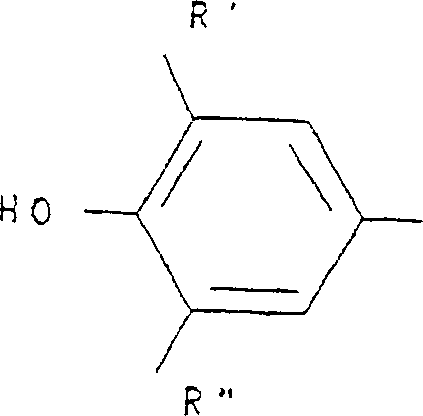
Geeignete Antioxidantien vom Typ eines sterisch gehinderten Phenols, die zur Durchführung der vorliegenden Erfindung brauchbar sind, sind jene, die ausgewählt sind aus der Gruppe bestehend aus alkylierten Monophenolen, Alkylthiomethylphenolen, Hydrochinonen, alkylierten Hydrochinonen, Tocophenolen, hydroxylierten Thiodiphenylethern, Alkylidenbisphenolen, o-, s- und s-Benzylverbindungen, hydroxybenzylierten Malonaten, Hydroxybenzylaromaten, Triazinen, Benzylphosphonaten, Acylaminophenolen, Estern von β-(5-tert.-Butyl-4-hydroxy-3-methylphenyl)propionsäure, Estern von β-(3,5-Dicyclohexyl-4-hydroxyphenyl)propionsäure, Estern von 3,5-Di-tert.-butyl-4-hydroxyphenylessigsäure und Amiden von β-(3,5-Di-tert.-butyl-4-hydroxyphenyl)propionsäure.suitable Hindered phenol type antioxidants useful in the execution of the present invention are those which are selected from the group consisting of alkylated monophenols, alkylthiomethylphenols, Hydroquinones, alkylated hydroquinones, tocophenols, hydroxylated Thiodiphenyl ethers, alkylidenebisphenols, o-, s- and s-benzyl compounds, hydroxybenzylated malonates, hydroxybenzylaromatics, triazines, Benzyl phosphonates, acylaminophenols, esters of β- (5-tert-butyl-4-hydroxy-3-methylphenyl) propionic acid, esters of β- (3,5-dicyclohexyl-4-hydroxyphenyl) propionic acid, esters of 3,5-di-tert-butyl-4-hydroxyphenylacetic acid and amides of β- (3,5-di-tert-butyl-4-hydroxyphenyl) propionic acid.
Bevorzugte
sterisch gehinderte Phenolantioxidantien für die Durchführung der
vorliegenden Erfindung sind ausgewählt aus der Gruppe bestehend aus
Octadecyl-3,5-di-t-butyl-4-hydroxy-hydrocinnamat,
Tetrakis[methylen(3,5-di-tert.-butyl-4-hydroxylhydrocinnamat)]methan,
1,3,5-Trimethyl-2,4,6-tris-(3,5-di-t-butyl-4-hydroxybenzyl)benzol,
1,3,5-Tris-(3,5-di-t-butyl-4-hydroxybenzyl)isocyanurat,
1,3,5-Tris-(4-t-butyl-3-hydroxy-2,6-dimethylbenzyl)-1,3,5-triazin-2,4,6-(1H,3H,5H)trion
und
Thiodiethylenbis(3,5-di-t-butyl-4-hydroxy)hydrocinnamat.Preferred hindered phenolic antioxidants for the practice of the present invention are selected from the group consisting of
Octadecyl 3,5-di-t-butyl-4-hydroxy-hydrocinnamate,
Tetrakis [methylene (3,5-di-tert-butyl-4-hydroxylhydrocinnamat)] methane,
1,3,5-trimethyl-2,4,6-tris (3,5-di-t-butyl-4-hydroxybenzyl) benzene,
1,3,5-tris (3,5-di-t-butyl-4-hydroxybenzyl) isocyanurate,
1,3,5-tris (4-t-butyl-3-hydroxy-2,6-dimethylbenzyl) -1,3,5-triazine-2,4,6- (1H, 3H, 5H) trione and
Thiodiethylene bis (3,5-di-t-butyl-4-hydroxy) hydrocinnamate.
Das zur Durchführung dieser Erfindung am meisten bevorzugte Antioxidans ist 1,3,5-Trimethyl-2,4,6-tris-(3,5-di-tert.-butyl-4-hydroxybenzyl)benzol. Dieses Antioxidans ist ein Produkt von Albemarle Corporation und unter dem Handelsnamen ETHANOX® 330 Antioxidans erhältlich.The most preferred antioxidant for practicing this invention is 1,3,5-trimethyl-2,4,6-tris (3,5-di-tert-butyl-4-hydroxybenzyl) benzene. This antioxidant is available a product of Albemarle Corporation and under the trade name ETHANOX ® 330 antioxidant.
Der Begriff "Kunststoff" soll, so wie er hier verwendet wird, organische Polymere wie Olefinpolymere von Ethylen und Propylen oder Mischungen derselben mit anderen Olefinmonomeren bedeuten.Of the Term "plastic" should, just like him As used herein, organic polymers such as olefin polymers of Ethylene and propylene or mixtures thereof with other olefin monomers mean.
Der Begriff "Agglomerat" soll, so wie er hier verwendet wird, einen kleinen, abgerundeten oder kugelförmigen Körper aus sterisch gehindertem Phenolantioxidans bedeuten, der durch Agglomerierung desselben in einem Agglomerator wie einem Nadelagglomerator hergestellt worden ist. Solche Agglomerate sind in der Regel kugelförmig. Solche Materialien werden leicht durch viele unterschiedliche Agglomeriervorrichtungen gebildet, die in der Technik wohl bekannt sind, und als solches ist der spezielle verwendete Agglomerator bei der Durchführung der vorliegenden Erfindung nicht entscheidend. Ein derartiger geeigneter Agglomerator ist ein Nadelagglomerator, erhältlich von Feeco International (Green Bay, WI, USA).Of the Term "agglomerate" should, as he used here is a small, rounded or spherical body sterically hindered phenolic antioxidant, by agglomerating the same in an agglomerator such as a needle agglomerator is. Such agglomerates are generally spherical. Such materials will be easily formed by many different agglomerators, which are well known in the art, and as such is the particular one used Agglomerator in the implementation not critical to the present invention. Such a suitable one Agglomerator is a needle agglomerator available from Feeco International (Green Bay, WI, USA).
Der Begriff "Verarbeitungshilfsmittel" bedeutet, so wie er in der Beschreibung der vorliegenden Erfindung verwendet wird, die Mischung, die durch Auflösen von mindestens 1 Gramm Antioxidans pro 100 ml Lösungsmittel in dem gewählten Lösungsmittel gebildet wird. Eine solche Lösung weist 20 bis 50 Gew.-% Alkohol mit der Formel ROH auf, in der R eine Alkylgruppe mit 1 bis 8 Kohlenstoffatomen ist.Of the Term "processing aids" means as well as it is used in the description of the present invention, the mixture by dissolving of at least 1 gram of antioxidant per 100 ml of solvent in the chosen solvent is formed. Such a solution has from 20 to 50% by weight of alcohol of the formula ROH in which R is a Alkyl group having 1 to 8 carbon atoms.
Der Begriff "ausgeglichene Härte" soll die Härte eines Agglomerats aus sterisch gehindertem Phenolantioxidans bedeuten, die die Handhabung zulässt, um so Abrieb in konventionellen Abgabe- und Dosiersystemen zu vermeiden, während sich das Agglomerat gleichzeitig in konventionellen Dispergiersystemen, wie einem Compoundierextruder, leicht in heißem Kunststoff dispergieren lässt.Of the Term "balanced Hardness "is said to be the hardness of a Mean hindered phenol antioxidant agglomerate, which allows handling, so as to avoid abrasion in conventional dispensing and dosing systems, while the agglomerate simultaneously in conventional dispersing systems, like a compounding extruder, easily disperse in hot plastic leaves.
Durch die Durchführung der vorliegenden Erfindung wird ein Verfahren zur Herstellung neuer Agglomerate bereitgestellt, die sterisch gehindertes Phenolantioxidans oder eine Mischung aus Antioxidans und sekundärem Phosphit umfassen, die eine kontrollierte Härte zeigen und die Einbringung von Fremdmaterial in die Additivformulierung vermeiden.By the implementation The present invention provides a process for the preparation of new Agglomerates, the hindered phenolic antioxidant or a mixture of antioxidant and secondary phosphite, which a controlled hardness show and the introduction of foreign material in the additive formulation avoid.
Durch die Verwendung kontrollierter Mengen des Alkohols in dem Verarbeitungshilfsmittel wird eine Kontrolle der Zerreibbarkeit oder der Härte des letztendlich produzierten Agglomerats erreicht.By the use of controlled amounts of the alcohol in the processing aid will be a control of friability or hardness of the eventuality reached produced agglomerate.
Gemäß einer bevorzugten Ausführungsform dieser Erfindung wird ein agglomeriertes Produkt aus ETHANOX® 330 Antioxidans geliefert, das eine ausgeglichene Härte hat, um so einen Transport zu ermöglichen, während es sich leicht beim Compoundieren desselben in organischen Polymeren dispergieren lässt. Es ist klar, dass andere Antioxidantien in ähnlicher Weise bei der Durchführung der Erfindung entweder allein oder in Kombination mit anderen gewählten Bestandteilen oder Coadditiven verwendet werden können. Durch das erfindungsgemäße Verfahren können somit individuell maßgeschneiderte Additivsysteme mit einer ausgeglichenen Härte hergestellt werden, die das gewählte sterisch gehinderte phenolische Antioxidans entweder allein oder in Kombination mit Phosphit und gegebenenfalls anderen gewünschten Additiven zur Einbringung in das organische Wirtspolymer verwenden.According to a preferred embodiment of this invention, an agglomerated product of ETHANOX® 330 antioxidant ® is supplied, having a balanced hardness so as to permit a transportation while it can be dispersed in organic polymers easily thereof during compounding. It will be understood that other antioxidants can likewise be used in the practice of the invention either alone or in combination with other selected ingredients or coadditives. By means of the method according to the invention, it is thus possible to produce custom-tailored additive systems with a balanced hardness which hinder the chosen sterically hindered one phenolic antioxidant either alone or in combination with phosphite and optionally other desired additives for incorporation into the organic host polymer.
Die Menge des Antioxidans vom Typ eines sterisch gehinderten Phenols in den erfindungsgemäßen Agglomeraten hängt von der vorgesehenen Verwendung des agglomerierten Additivsystems ab. Die erfindungsgemäßen Agglomerate können somit aus 100 Gew.-% sterisch gehindertem Phenolantioxidans bestehen. Wenn sie gemischt mit anderen Komponenten eines gewünschten Additivsystems gebildet werden, sollten die erfindungsgemäßen Ag glomerate jedoch mindestens etwa 20 Gew.-% des sterisch gehinderten Phenolantioxidans enthalten.The Amount of hindered phenol type antioxidant in the agglomerates according to the invention depends on the intended use of the agglomerated additive system. The Agglomerates according to the invention can thus consist of 100 wt .-% sterically hindered Phenolantioxidans. When mixed with other components of a desired Additive system are formed, the agglomerates according to the invention should glomerate however, at least about 20% by weight of the hindered phenolic antioxidant contain.
Neben
dem sterisch gehinderten Phenolantioxidans können die erfindungsgemäßen Agglomerate
auch sekundäres
Phosphitantioxidans enthalten, wie Phosphite, Phosphonite und Fluorphosphonite. Die
Menge dieses sekundären
Phosphitantioxidans hängt
von der vorgesehenen Verwendung des agglomerierten Additivsystems
ab. Die Agglomerate können
somit 0 bis 80 Gew.-%, vorzugsweise 3 bis 70 Gew.-% dieser sekundären Phosphitantioxidantien enthalten.
Beispiele für
geeignete sekundäre
Phosphitantioxidantien sind:
2,2'-Ethylidenbis(4,6-di-t-butylphenyl)fluorphosphonit,
2,2',2''-Nitro[triethyltris(3,3',5,5'-tetra-t-butyl-1,1'-biphenyl-2,2'-diyl)]phosphit,
Tris(2,4-di-t-butylphenyl)phosphit,
Bis(2,4-di-t-butylphenyl)pentaerythritdiphosphit
und
Tetrakis(2,4-di-t-butylphenyl)-4,4'-biphenylendiphosphonit.In addition to the sterically hindered phenolic antioxidant, the agglomerates of the present invention may also contain secondary phosphite antioxidant, such as phosphites, phosphonites and fluorophosphonites. The amount of this secondary phosphite antioxidant depends on the intended use of the agglomerated additive system. The agglomerates may thus contain 0 to 80 wt .-%, preferably 3 to 70 wt .-% of these secondary phosphite antioxidants. Examples of suitable secondary phosphite antioxidants are:
2,2'-ethylidenebis (4,6-di-t-butylphenyl) fluorphosphonit,
2,2 ', 2''- nitro [triethyl-tris (3,3', 5,5'-tetra-t-butyl-1,1'-biphenyl-2,2'-diyl)] phosphite,
Tris (2,4-di-t-butylphenyl) phosphite,
Bis (2,4-di-t-butylphenyl) pentaerythritol diphosphite and
Tetrakis (2,4-di-t-butylphenyl) -4,4'-biphenylene.
Wenn zusätzlich zu dem sterisch gehinderten Phenolantioxidans sekundäres Phosphitantioxidans verwendet wird, liegt das Gewichtsverhältnis zwischen dem sterisch gehinderten Phenolantioxidans und dem sekundären Phosphitantioxidans im Bereich von 20:1 bis 1:5 und vorzugsweise 2:1 bis 1:4.If additionally to the hindered phenol antioxidant secondary phosphite antioxidant is used, the weight ratio is between the steric hindered phenolic antioxidant and the secondary phosphite antioxidant in the range from 20: 1 to 1: 5 and preferably 2: 1 to 1: 4.
Die erfindungsgemäßen Agglomerate können zudem gegebenenfalls Verbindung aus der Reihe ausgewählt aus Hydrotalkiten, Metallcarbonaten und Metalloxiden enthalten. Solche Verbindungen sind zum Erreichen der Säureneutralisierung in einem Additivsystem wohl bekannt. Wenn sie so in Kombination mit dem sterisch gehinderten Phenolantioxidans verwendet werden, kann diese weitere Komponente in einer Menge im Bereich von 0 bis 80 Gew.-% vorhanden sein.The Agglomerates according to the invention can also optionally selected from the series Hydrotalcites, metal carbonates and metal oxides. Such Compounds are in one to achieve acid neutralization Additive system well known. If they are so in combination with the steric hindered phenol antioxidant may be used, this further component in an amount ranging from 0 to 80% by weight.
Hydrotalkite sind wohl bekannt und von Kyowa Chemical Company, Japan, beispielsweise unter dem Handelsnamen DHT-4V erhältlich.hydrotalcites are well known and from Kyowa Chemical Company, Japan, for example available under the trade name DHT-4V.
Bevorzugte Metalloxide sind die Oxide zweiwertiger Metalle. Solche Verbindungen schließen die Oxide von Zink und Magnesium ein.preferred Metal oxides are the oxides of divalent metals. Such compounds shut down the oxides of zinc and magnesium.
Bevorzugte Metallcarbonate sind die Carbonate zweiwertiger Metalle. Solche Verbindungen schließen das Carbonat von Calcium ein.preferred Metal carbonates are the carbonates of divalent metals. Such Close connections the carbonate of calcium.
Andere Verbindungen, die in das erfindungsgemäße Additivpelletsystem eingeschlossen werden können, schließen jene Kunststoffadditive ausgewählt aus der Gruppe bestehend aus Metallseifen, Antistatikmitteln, Antiblockiermitteln, Flammenhemmstoffen, Thioestern, internen und externen Schmiermitteln, Pigmenten, UV-Absorbentien und Lichtstabilisatoren ein.Other Compounds included in the additive pellet system of the invention can be shut down those plastic additives selected from the group consisting of metal soaps, antistatic agents, antiblocking agents, Flame retardants, thioesters, internal and external lubricants, Pigments, UV absorbers and light stabilizers.
Die anfängliche Auflösung von Antioxidans in dem gewählten Lösungsmittelsystem kann getrennt von der gesamten erfindungsgemäß zu agglomerierenden Antioxidansmasse durchgeführt werden, oder das Verarbeitungshilfsmittel kann dem Antioxidanspulver in einer solchen Menge zugesetzt werden, dass mindestens 1 Gramm Antioxidans pro 100 ml Verarbeitungshilfsmittel in dem Verarbeitungshilfsmittel gelöst wird. Die resultierende Lösung wird in situ in Kontakt mit dem verbleibenden Antioxidanspulver gebracht, um so die Bildung einer Paste des Antioxidans zu bewirken, die für die Agglomerierung geeignet ist. Die Konzentration des Lösungsmittelverarbeitungsmittels (d. h. gewähltes Lösungsmittel plus Alkohol), die zur Bildung der zur Agglomerierung geeigneten Paste erforderlich ist, liegt im Be reich von etwa 3 Gewichtsteilen Lösungsmittelverarbeitungshilfsmittel pro 97 Gewichtsteilen Additivpulver (d. h. phenolisches Antioxidans plus gegebenenfalls sekundäres Phosphitantioxidans und Säureneutralisierungsmittel) bis etwa 20 Gewichtsteilen Lösungsmittelverarbeitungshilfsmittel pro 80 Gewichtsteilen Additivpulver.The initial resolution of antioxidant in the chosen Solvent system can be separated from the total antioxidant mass to be agglomerated according to the invention carried out or the processing aid may be added to the antioxidant powder be added in such an amount that at least 1 gram Antioxidant per 100 ml processing aid in the processing aid solved becomes. The resulting solution becomes brought in contact with the remaining antioxidant powder in situ, so as to cause the formation of a paste of the antioxidant, which is responsible for the agglomeration suitable is. The concentration of the solvent processing agent (ie selected solvent plus alcohol) suitable for forming agglomerations Paste is required, is in the range of about 3 parts by weight Solvent processing aid per 97 parts by weight of additive powder (i.e., phenolic antioxidant plus if necessary secondary Phosphite antioxidant and acid neutralizer) to about 20 parts by weight of solvent processing aid per 80 parts by weight of additive powder.
BEISPIELEEXAMPLES
Die folgenden Beispiele sollen die vorliegende Erfindung veranschaulichen und den Durchschnittsfachmann die Herstellung " und Verwendung der Erfindung lehren. Diese Beispiele sollen die Erfindung in keinerlei Weise einschränken.The The following examples are intended to illustrate the present invention and to teach one skilled in the art to make and use the invention. These examples are not intended to limit the invention in any way.
In den folgenden Beispielen sind alle Anteile von Materialien in Gewichtsteilen angegeben. Wenn nicht anderweitig angegeben, wurde der Agglomerierungsvorgang durchgeführt, indem 1) die angegebenen Anteile der Verarbeitungshilfsmittelflüssigkeit und des Additivpulvers in einen Erlenmeyer-Kolben aus Glas gegeben wurden, 2) die Materialien von Stufe (1) mit einem Spatel vermischt wurden, bis sich eine pastenartige Aufschlämmung bildete, 3) der Kolben mit einem Rotationsverdämpferkopf mit etwa 60 UpM gedreht wurde, während gleichzeitig. der Kolben leicht mit den Fingern geklopft wurde (um die Trommelwirkung einer Trommel- oder Nadelagglomeratorvorrichtung zu simulieren), um die Agglomerierung zu kugelförmigen Teilchen zu bewirken, 4) die agglomerierten Teilchen in eine Petrischale überführt wurden, um in einem Umluftofen bei der angegebenen Temperatur getrocknet zu werden. In den Fällen, bei denen das "Additivpulver" aus Stufe (1) eine Mischung aus zwei oder mehr Pulverkomponenten umfasste, wurde die Pulvermischung vor der Zugabe der Verarbeitungshilfsmittelflüssigkeit trocken gemischt.In the following examples all proportions of materials are given in parts by weight. Unless otherwise stated, the agglomeration procedure was carried out by: 1) adding the indicated proportions of processing aid liquid and additive powder to a glass Erlenmeyer flask; 2) mixing the materials of step (1) with a spatula until a paste-like 3) the flask was rotated with a rotary evaporator head at about 60 rpm while simultaneously. the col tapping lightly with fingers (to simulate the tumbling action of a drum or needle agglomerator device) to effect agglomeration into spherical particles; 4) transferring the agglomerated particles to a petri dish to dry in the circulating air oven at the indicated temperature become. In cases where the "additive powder" of step (1) comprised a mixture of two or more powder components, the powder mixture was dry blended prior to the addition of processing aid liquid.
Zusätzlich wurden die Verarbeitungsfähigkeitsprüfungen oder Agglomerathärtemessungen zur Bestimmung der Verarbeitungsfähigkeitscharakteristika der Agglomerate, d. h. Härte und Abriebbeständigkeit, ermittelt, indem die Agglomerate manueller Manipulation unterzogen wurden, um so die Zerreibbarkeit der Agglomerate zu untersuchen.Additionally were the processability tests or Agglomerathärtemessungen for determining the processability characteristics of Agglomerates, d. H. hardness and abrasion resistance, determined by subjecting the agglomerates to manual manipulation were used to investigate the friability of the agglomerates.
BEISPIEL IEXAMPLE I
Agglomerat von ETHANOX® 330 Antioxidans, hergestellt mit Toluol/EthanolAgglomerate of ETHANOX ® 330 antioxidant, produced with toluene / ethanol
Die Verarbeitungshilfsmittelflüssigkeit (A) wurde hergestellt, indem ETHANOX® 330 Antioxidanspulver (10 Teile), Toluol (47,2 Teile) und denaturiertes Ethanol (42,8 Teile) gemischt wurden. Der Agglomerierungsvorgang wurde mit 1 Teil (A) durchgeführt, der mit 5 Teilen weiterem ETHANOX® 330 Antioxidanspulver gemischt wurde. Die resultierenden agglomerierten Teilchen wurden etwa 20 Minuten lang im Ofen beginnend bei etwa 70°C getrocknet, wobei die Temperatur allmählich auf etwa 115°C erhöht wurde. Das getrocknete Agglomerat bestand aus im Wesentlichen kugelförmigen Teilchen im Bereich von 1 mm bis 4 mm Durchmesser. Die resultierenden getrockneten Agglomeratteilchen wurden manueller Charakterisierung unterzogen und so beurteilt, dass sie eine sehr gute Härte und daher gute Beständigkeit gegenüber Teilchenabrieb während Transportvorgängen hatten.The processing aid liquid (A) was prepared by ETHANOX ® 330 Antioxidant powder (10 parts), toluene (47.2 parts), and denatured ethanol (42.8 parts) were mixed. The agglomeration was carried out with 1 part (A), the further with 5 parts of ETHANOX ® 330 Antioxidant powder was mixed. The resulting agglomerated particles were oven dried for about 20 minutes, starting at about 70 ° C, gradually raising the temperature to about 115 ° C. The dried agglomerate consisted of substantially spherical particles ranging from 1 mm to 4 mm in diameter. The resulting dried agglomerate particles were subjected to manual characterization and evaluated to have very good hardness and therefore good resistance to particle abrasion during transport operations.
Zu Vergleichszwecken wurde das ETHANOX® 330 Antioxidanspulver unter denselben Bedingungen wie oben beschrieben ag glomeriert, jedoch mit zwei unterschiedlichen Verarbeitunghilfsmittelflüssigkeiten (B) und (C). Verarbeitungshilfsmittel (B) war eine gesättigte Lösung von ETHANOX® 330 Antioxidans, gelöst in denaturiertem Ethanol, und Verarbeitungshilfsmittelflüssigkeit (C) bestand aus 10 Teilen ETHANOX® 330 Antioxidans, gelöst in Toluol. Mit (B) zerfielen die feuchten agglomerierten kugelförmigen Teilchen, die sich bildeten, während des Trocknungsvorgangs überwiegend zu feinem Pulver, und die wenigen verbleibenden getrockneten kugelförmigen Teilchen waren extrem weich und zeigten sehr niedrige Abriebbeständigkeit. Bei (C) konnte die Trommelwirkung der Agglomerierungsvorrichtung die gewünschten kugelförmigen Teilchen nicht herstellen, wodurch stattdessen eine im Wesentlichen kontinuierliche Aufschlämmungsmasse zurückblieb. Dieses Vergleichsbeispiel veranschaulicht, dass das Verarbeitungsflüssigkeitshilfsmittel der vorliegenden Erfindung erforderlich ist, um sowohl die gewünschten kugelförmigen agglomerierten Teilchen zu bilden als auch den getrockneten agglomerierten Teilchen die gewünschte Härte zu verleihen.For comparative purposes, the ETHANOX® 330 Antioxidant powder was ® ag glomeriert under the same conditions as above, but with two different processing aid liquids (B) and (C). Processing aid (B) was a saturated solution of ETHANOX ® 330 Antioxidant dissolved in denatured ethanol, and processing aid liquid (C) consisted of 10 parts of ETHANOX® ® 330 Antioxidant dissolved in toluene. With (B), the wet agglomerated spherical particles that formed became predominantly fine powder during the drying process, and the few remaining dried spherical particles were extremely soft and showed very low abrasion resistance. At (C), the tumbling action of the agglomerator failed to produce the desired spherical particles, leaving behind a substantially continuous slurry mass instead. This comparative example illustrates that the processing fluid adjuvant of the present invention is required to form both the desired spherical agglomerated particles and to impart the desired hardness to the dried agglomerated particles.
BEISPIEL IIEXAMPLE II
Agglomerat von ETHANOX® 330 Antioxidansgemisch mit sekundärem PhosphitantioxidansAgglomerate of ETHANOX ® 330 antioxidant mixture with secondary phosphite antioxidant
Das Agglomerierungsverfahren mit Agglomerierungshilfsmittel (A) aus Beispiel I wurde im Wesentlichen wiederholt, wobei die Pulverkomponente jedoch durch ein Gemisch ersetzt wurde, das aus ETHANOX® 330 Antioxidanspulver (1 Teil) und IRGAFOS 168 Phosphitpulver (1 Teil) (Tris(2,4-di-tert.-butylphenyl)phosphit) bestand (einem kommerziellen sekundären Phosphitantioxidansprodukt, erhalten von Ciba Specialty Chemicals). Die so erhaltenen getrockneten Agglomeratteilchen waren von im Wesentlichen kugelförmiger Gestalt, nominell 1 bis 4 mm im Durchmesser, und wenn sie manueller Manipulation unterzogen wurden, wurden sie mit sehr guter Härte und daher guter Beständigkeit gegen Teilchenabrieb während Transportvorgängen bewertet.The agglomeration process with Agglomerierungshilfsmittel (A) of Example I was substantially repeated, but the powder component was replaced by a mixture of ETHANOX ® 330 antioxidant powder (1 part) and IRGAFOS 168 phosphite powder (1 part) (Tris (2,4-tris) di-tert-butylphenyl) phosphite) (a commercial secondary phosphite antioxidant product obtained from Ciba Specialty Chemicals). The dried agglomerate particles thus obtained were of substantially spherical shape, nominally 1 to 4 mm in diameter, and when subjected to manual manipulation, they were evaluated with very good hardness and therefore good resistance to particle abrasion during transport operations.
BEISPIEL IIIEXAMPLE III
Agglomerat von IRGANOX 1010 Gemisch mit sekundärem PhosphitAgglomerate of IRGANOX 1010 mixture with secondary phosphite
Die Verarbeitungshilfsmittelflüssigkeit (D) wurde hergestellt, indem IRGANOX 1010 Antioxidanspulver (Pentaerythritylester von β-(3,5-Di-tert.-butyl-4-hydroxyphenyl)propionsäure) (6 Teile) (kommerzielles gehindertes phenolisches Antioxidans, erhalten von Ciba Specialty Chemicals), Aceton (47 Teile) und Methanol (47 Teile) gemischt wurden. Verarbeitungshilfsmittelflüssigkeit (E) wurde hergestellt, indem IRGANOX 1010 (6 Teile), Aceton (70,5 Teile) und Methanol (23,5 Teile) gemischt wurden. Hergestellt wurde auch ein Pulvergemisch, das aus gleichen Gewichtsteilen IRGANOX 1010 und IRGAFOS 168 (Tris-(2,4-di-tert.-butylphenyl)phosphit) bestand (einem kommerziellen sekundären Phosphitantioxidansprodukt, erhalten von Ciba. Specialty Chemicals). Die Agglomerierung des Pulvergemisches wurde bewirkt, indem 0,55 Teile Agglomerierungshilfsmittelflüssigkeit mit 5 Teilen gemischtem Pulver verwendet wurden und anschließend im Ofen bei 71°C 30 Minuten lang getrocknet wurde. Die so mit Verarbeitungshilfsmittelflüssigkeiten (D) und (E) erhaltenen getrockneten Agglomeratteilchen waren von im Wesentlichen kugelförmiger Gestalt, hatten nominell 1 bis 4 mm Durchmesser und wurden, wenn sie manueller Manipulation unterzogen wurden, mit sehr guter Härte und daher guter Bestän digkeit gegen Teilchenabrieb während Transportvorgängen bewertet. Die mit Verarbeitungshilfsmittel (E) hergestellten Agglomeratteilchen waren zudem deutlich härter als jene mit Verarbeitungshilfsmittel (D), wodurch gezeigt wird, dass die Härte der agglomerierten Teilchen erhöht wird, wenn der Alkoholanteil in der Agglomerierungshilfsmittelflüssigkeit verringert wird.The processing aid liquid (D) was prepared by adding IRGANOX 1010 antioxidant powder (pentaerythrityl ester of β- (3,5-di-tert-butyl-4-hydroxyphenyl) propionic acid) (6 parts) (commercial hindered phenolic antioxidant obtained from Ciba Specialty Chemicals ), Acetone (47 parts) and methanol (47 parts). Processing aid liquid (E) was prepared by mixing IRGANOX 1010 (6 parts), acetone (70.5 parts) and methanol (23.5 parts). Also prepared was a powder mix consisting of equal parts by weight of IRGANOX 1010 and IRGAFOS 168 (tris- (2,4-di-tert-butylphenyl) phosphite) (a commercial secondary phosphite antioxidant product obtained from Ciba Specialty Chemicals). The agglomeration of the powder mixture was effected by using 0.55 parts of agglomerating aid liquid with 5 parts of mixed powder, followed by drying in the oven at 71 ° C for 30 minutes. The dried agglomerate particles thus obtained with processing aid liquids (D) and (E) were of substantially spherical shape, nominally 1 to 4 mm in diameter, and when measured, were obtained subjected to manual manipulation, rated with very good hardness and therefore good resistance to particle abrasion during transport operations. In addition, the agglomerate particles prepared with processing aid (E) were significantly harder than those with processing aid (D), demonstrating that the hardness of the agglomerated particles is increased as the alcohol content in the agglomeration aid liquid is reduced.
BEISPIEL IVEXAMPLE IV
Agglomerat von ETHANOX® 330, hergestellt mit Aceton/Methanol Die Verarbeitungshilfsmittelflüssigkeit (F) wurde in der gleichen Weise wie die Verarbeitungshilfsmittelflüssigkeit (D) von Beispiel III hergestellt, außer dass das IRGANOX 1010 Antioxidanspulver durch ETHANOX® 330 Antioxidanspulver ersetzt wurde. ETHANOX® 330 Antioxidanspulver wurde mit Verarbeitungshilfsmittelflüssigkeit (F) agglomeriert und anschließend getrocknet, indem die in Beispiel III verwendeten Prozeduren wiederholt wurden. Die so erhaltenen getrockneten Agglomeratteilchen aus ETHANOX® 330 Antioxidans von im Wesentlichen kugelförmiger Gestalt, hatten nominell 1 bis 5 mm Durchmesser und wurden, wenn sie manueller Manipulation unterzogen wurden, mit sehr guter Härte und daher guter Beständigkeit gegen Teilchenabrieb während Transportvorgängen bewertet.Agglomerate of ETHANOX ® 330 manufactured with acetone / methanol The processing aid liquid (F) was prepared in the same manner as the processing aid liquid (D) of Example III, except that the IRGANOX 1010 Antioxidant powder by ETHANOX ® 330 Antioxidant powder was substituted. ETHANOX ® 330 Antioxidant powder was agglomerated with processing aid liquid (F), and then dried by the in Example III used procedures were repeated. The resulting dried agglomerate particles of ETHANOX® ® 330 antioxidant of substantially spherical in shape, were nominally 1 to 5 mm in diameter and were when they were subjected to manual manipulation, judged to have very good hardness and therefore good resistance to particle attrition during conveying operations.
Claims (44)


Applications Claiming Priority (3)
| Application Number | Priority Date | Filing Date | Title |
|---|---|---|---|
| US204121 | 1998-12-02 | ||
| US09/204,121 US6126863A (en) | 1998-12-02 | 1998-12-02 | Low dust balanced hardness antioxidant agglomerates and process for the production of same |
| PCT/US1999/028871 WO2000032687A1 (en) | 1998-12-02 | 1999-12-02 | Low dust balanced hardness antioxidant agglomerates and process for the production of same |
Publications (2)
| Publication Number | Publication Date |
|---|---|
| DE69918461D1 DE69918461D1 (en) | 2004-08-05 |
| DE69918461T2 true DE69918461T2 (en) | 2005-07-28 |
Family
ID=22756722
Family Applications (1)
| Application Number | Title | Priority Date | Filing Date |
|---|---|---|---|
| DE69918461T Expired - Fee Related DE69918461T2 (en) | 1998-12-02 | 1999-12-02 | DUST ARMS, AGGRAVATES ANTIOXIDIZED WITH THEIR COMPRISED HARDNESS AND THEIR MANUFACTURING PROCESS |
Country Status (6)
| Country | Link |
|---|---|
| US (1) | US6126863A (en) |
| EP (1) | EP1135437B1 (en) |
| JP (1) | JP2002531620A (en) |
| CA (1) | CA2353438A1 (en) |
| DE (1) | DE69918461T2 (en) |
| WO (1) | WO2000032687A1 (en) |
Families Citing this family (9)
| Publication number | Priority date | Publication date | Assignee | Title |
|---|---|---|---|---|
| US6056898A (en) * | 1998-09-22 | 2000-05-02 | Albemarle Corporation | Low dust balanced hardness antioxidant pellets and process for the production of same |
| US6821456B2 (en) | 1998-09-22 | 2004-11-23 | Albemarle Corporation | Granular polymer additives and their preparation |
| US6596198B1 (en) | 2000-04-28 | 2003-07-22 | Albemarle Corporation | Additive system for polymers in pellet form which provides proportioned stabilization and internal mold release characteristics |
| US6515052B2 (en) | 2001-02-23 | 2003-02-04 | Albemarle Corporation | Granular polymer additives and their preparation |
| US7667066B2 (en) * | 2004-02-27 | 2010-02-23 | Albemarle Corporation | Preparation of sterically hindered hydroxyphenylcarboxylic acid esters |
| SG160319A1 (en) * | 2008-10-06 | 2010-04-29 | Sumitomo Chemical Co | Granular stabilizer for polymer and production process thereof |
| JP2010254959A (en) | 2009-04-03 | 2010-11-11 | Sumitomo Chemical Co Ltd | Method for producing granule composition |
| JP2010254958A (en) | 2009-04-03 | 2010-11-11 | Sumitomo Chemical Co Ltd | Method for producing granule composition |
| US8859235B2 (en) | 2009-08-14 | 2014-10-14 | Basf Se | Methods in cell cultures, and related inventions, employing certain additives |
Family Cites Families (5)
| Publication number | Priority date | Publication date | Assignee | Title |
|---|---|---|---|---|
| EP0278579B1 (en) * | 1987-02-13 | 1992-11-25 | ENICHEM SYNTHESIS S.p.A. | Solid stabilizer composition for organic polymers, and process for preparing it |
| IT1247941B (en) * | 1991-05-17 | 1995-01-05 | Enichem Sintesi | PROCESS FOR OBTAINING GRANULAR FORMS OF ADDITIVES FOR ORGANIC POLYMERS |
| US5597857A (en) * | 1994-12-28 | 1997-01-28 | Ciba-Geigy Corporation | Low-dust granules of plastic additives |
| AR003526A1 (en) * | 1995-09-08 | 1998-08-05 | Mallinckrodt Chemical Inc | STABILIZING SYSTEM TO STABILIZE POLYMER MATERIALS AND METHOD TO PRODUCE A STABILIZED SYSTEM IN THE FORM OF PELLETS. |
| AU7043298A (en) * | 1997-04-15 | 1998-11-11 | Ciba Specialty Chemicals Holding Inc. | Preparation of low-dust stabilisers |
-
1998
- 1998-12-02 US US09/204,121 patent/US6126863A/en not_active Expired - Fee Related
-
1999
- 1999-12-02 EP EP99966016A patent/EP1135437B1/en not_active Expired - Lifetime
- 1999-12-02 DE DE69918461T patent/DE69918461T2/en not_active Expired - Fee Related
- 1999-12-02 CA CA002353438A patent/CA2353438A1/en not_active Abandoned
- 1999-12-02 WO PCT/US1999/028871 patent/WO2000032687A1/en not_active Ceased
- 1999-12-02 JP JP2000585324A patent/JP2002531620A/en active Pending
Also Published As
| Publication number | Publication date |
|---|---|
| EP1135437B1 (en) | 2004-06-30 |
| EP1135437A1 (en) | 2001-09-26 |
| CA2353438A1 (en) | 2000-06-08 |
| JP2002531620A (en) | 2002-09-24 |
| WO2000032687A1 (en) | 2000-06-08 |
| DE69918461D1 (en) | 2004-08-05 |
| US6126863A (en) | 2000-10-03 |
Similar Documents
| Publication | Publication Date | Title |
|---|---|---|
| EP2970633B1 (en) | Stabilized polymer compositions and methods of making same | |
| DE924532C (en) | Process for stabilizing conjugated diene-rubber polymers | |
| DE69920492T2 (en) | DUST ARM ANTIOXIDANE PELLETS OF BALANCED HARDNESS AND PROCESS FOR PRODUCTION OF LESSER | |
| EP0000726B1 (en) | Polyolefine masses containing alkaline-earth metal carbonates, and a process for their production | |
| DE2950489A1 (en) | METHOD FOR INHIBITING THE CORROSION-PROPERTY PROPERTIES AND THE CLEARABILITY OF OLEFIN POLYMERS OR COPOLYMERS | |
| DE69828380T2 (en) | FLAME RESISTANT WITH RESISTANCE TO THERMAL DECOMPOSITION, RESIN COMPOSITION AND FORM BODY | |
| EP0340580A2 (en) | Use of a silicone resin as flameproofing agent | |
| DE3853599T2 (en) | Antiblocking agents and compositions for films made of synthetic resins. | |
| EP1004601B1 (en) | Process for peroxide treatment of olefin polymers | |
| WO2011039301A1 (en) | Functionalized expandable graphite intercalation compounds | |
| DE3001901B2 (en) | Fire retardant resin composition and its uses | |
| DE69003893T2 (en) | Flame retardant and flame retardant resin composition. | |
| DE19727848B4 (en) | Rubber additive granules, a process for its preparation and its use | |
| US6126863A (en) | Low dust balanced hardness antioxidant agglomerates and process for the production of same | |
| US6126862A (en) | Low dust balanced hardness antioxidant agglomerates and process for the production of same | |
| DE2115429C2 (en) | 1,3-butadiene-divinylbenzene copolymer stabilized against oxidative decomposition and post-polymerization crosslinking | |
| EP0330889B1 (en) | Process for the preparation of non-dusting, metal-containing stabiliser granulates for halogen-containing polymers | |
| DE69700677T2 (en) | Thermostabilized compositions of vinylidene fluoride polymers | |
| EP0600368B1 (en) | Process for stabilising polyethylene powder | |
| DE68911207T2 (en) | Process for stabilizing polymers, stabilizer composition and stabilized polymer material. | |
| DE1220601B (en) | Molding compounds based on solid propylene polymers | |
| EP0184788B1 (en) | Self-extinguishible thermoplastic moulding mass | |
| EP0013752B1 (en) | Process for preparing finely divided polyolefine compositions with enhanced properties and their use in producing formed articles | |
| CN116903931A (en) | Low-precipitation calcium-zinc stabilizer and preparation method thereof | |
| DE102008042755A1 (en) | Poly (meth) acrylimides with improved optical and color properties |
Legal Events
| Date | Code | Title | Description |
|---|---|---|---|
| 8364 | No opposition during term of opposition | ||
| 8339 | Ceased/non-payment of the annual fee |