DE69918166T2 - ANTIPROTOZOAL SAPONINE - Google Patents
ANTIPROTOZOAL SAPONINE Download PDFInfo
- Publication number
- DE69918166T2 DE69918166T2 DE69918166T DE69918166T DE69918166T2 DE 69918166 T2 DE69918166 T2 DE 69918166T2 DE 69918166 T DE69918166 T DE 69918166T DE 69918166 T DE69918166 T DE 69918166T DE 69918166 T2 DE69918166 T2 DE 69918166T2
- Authority
- DE
- Germany
- Prior art keywords
- hydrogen
- alkyl
- alkenyl
- compound
- max
- Prior art date
- Legal status (The legal status is an assumption and is not a legal conclusion. Google has not performed a legal analysis and makes no representation as to the accuracy of the status listed.)
- Expired - Fee Related
Links
Classifications
-
- C—CHEMISTRY; METALLURGY
- C07—ORGANIC CHEMISTRY
- C07H—SUGARS; DERIVATIVES THEREOF; NUCLEOSIDES; NUCLEOTIDES; NUCLEIC ACIDS
- C07H15/00—Compounds containing hydrocarbon or substituted hydrocarbon radicals directly attached to hetero atoms of saccharide radicals
- C07H15/26—Acyclic or carbocyclic radicals, substituted by hetero rings
-
- C—CHEMISTRY; METALLURGY
- C07—ORGANIC CHEMISTRY
- C07H—SUGARS; DERIVATIVES THEREOF; NUCLEOSIDES; NUCLEOTIDES; NUCLEIC ACIDS
- C07H17/00—Compounds containing heterocyclic radicals directly attached to hetero atoms of saccharide radicals
- C07H17/04—Heterocyclic radicals containing only oxygen as ring hetero atoms
- C07H17/08—Hetero rings containing eight or more ring members, e.g. erythromycins
-
- A—HUMAN NECESSITIES
- A61—MEDICAL OR VETERINARY SCIENCE; HYGIENE
- A61K—PREPARATIONS FOR MEDICAL, DENTAL OR TOILETRY PURPOSES
- A61K31/00—Medicinal preparations containing organic active ingredients
- A61K31/70—Carbohydrates; Sugars; Derivatives thereof
- A61K31/7042—Compounds having saccharide radicals and heterocyclic rings
- A61K31/7048—Compounds having saccharide radicals and heterocyclic rings having oxygen as a ring hetero atom, e.g. leucoglucosan, hesperidin, erythromycin, nystatin, digitoxin or digoxin
-
- A—HUMAN NECESSITIES
- A61—MEDICAL OR VETERINARY SCIENCE; HYGIENE
- A61K—PREPARATIONS FOR MEDICAL, DENTAL OR TOILETRY PURPOSES
- A61K36/00—Medicinal preparations of undetermined constitution containing material from algae, lichens, fungi or plants, or derivatives thereof, e.g. traditional herbal medicines
- A61K36/18—Magnoliophyta (angiosperms)
- A61K36/185—Magnoliopsida (dicotyledons)
-
- A—HUMAN NECESSITIES
- A61—MEDICAL OR VETERINARY SCIENCE; HYGIENE
- A61P—SPECIFIC THERAPEUTIC ACTIVITY OF CHEMICAL COMPOUNDS OR MEDICINAL PREPARATIONS
- A61P33/00—Antiparasitic agents
- A61P33/02—Antiprotozoals, e.g. for leishmaniasis, trichomoniasis, toxoplasmosis
-
- C—CHEMISTRY; METALLURGY
- C07—ORGANIC CHEMISTRY
- C07H—SUGARS; DERIVATIVES THEREOF; NUCLEOSIDES; NUCLEOTIDES; NUCLEIC ACIDS
- C07H15/00—Compounds containing hydrocarbon or substituted hydrocarbon radicals directly attached to hetero atoms of saccharide radicals
- C07H15/20—Carbocyclic rings
- C07H15/24—Condensed ring systems having three or more rings
- C07H15/256—Polyterpene radicals
-
- Y—GENERAL TAGGING OF NEW TECHNOLOGICAL DEVELOPMENTS; GENERAL TAGGING OF CROSS-SECTIONAL TECHNOLOGIES SPANNING OVER SEVERAL SECTIONS OF THE IPC; TECHNICAL SUBJECTS COVERED BY FORMER USPC CROSS-REFERENCE ART COLLECTIONS [XRACs] AND DIGESTS
- Y02—TECHNOLOGIES OR APPLICATIONS FOR MITIGATION OR ADAPTATION AGAINST CLIMATE CHANGE
- Y02A—TECHNOLOGIES FOR ADAPTATION TO CLIMATE CHANGE
- Y02A50/00—TECHNOLOGIES FOR ADAPTATION TO CLIMATE CHANGE in human health protection, e.g. against extreme weather
- Y02A50/30—Against vector-borne diseases, e.g. mosquito-borne, fly-borne, tick-borne or waterborne diseases whose impact is exacerbated by climate change
Landscapes
- Health & Medical Sciences (AREA)
- Chemical & Material Sciences (AREA)
- Life Sciences & Earth Sciences (AREA)
- Organic Chemistry (AREA)
- General Health & Medical Sciences (AREA)
- Natural Medicines & Medicinal Plants (AREA)
- Biotechnology (AREA)
- Engineering & Computer Science (AREA)
- Molecular Biology (AREA)
- Veterinary Medicine (AREA)
- Genetics & Genomics (AREA)
- Biochemistry (AREA)
- Public Health (AREA)
- Animal Behavior & Ethology (AREA)
- Pharmacology & Pharmacy (AREA)
- Medicinal Chemistry (AREA)
- Epidemiology (AREA)
- Botany (AREA)
- Alternative & Traditional Medicine (AREA)
- Medical Informatics (AREA)
- Microbiology (AREA)
- Mycology (AREA)
- Nuclear Medicine, Radiotherapy & Molecular Imaging (AREA)
- General Chemical & Material Sciences (AREA)
- Chemical Kinetics & Catalysis (AREA)
- Tropical Medicine & Parasitology (AREA)
- Pharmaceuticals Containing Other Organic And Inorganic Compounds (AREA)
- Medicines Containing Plant Substances (AREA)
- Steroid Compounds (AREA)
- Saccharide Compounds (AREA)
Description
Die vorliegende Erfindung betrifft ein Verfahren zur Isolation von antiprotozoalen Saponinen aus Pflanzen, die zur Familie Myrsinaceae gehören, und die Verwendung dieser Saponine zur Herstellung eines Arzneimittels zur Behandlung von sowohl menschlichen als auch tierischen Wirten, die mit Protozoen-Parasiten der Gattung Leishmania infiziert sind, sowie für die Linderung von klinischen Manifestationen von, bzw. Heilung von Krankheiten, die unter der Bezeichnung Leishmaniasen bekannt sind, bei diesen Wirten.The The present invention relates to a process for the isolation of antiprotozoal Saponins from plants belonging to the family Myrsinaceae, and the use of these saponins for the manufacture of a medicament for the treatment of both human and animal hosts, which are infected with protozoan parasites of the genus Leishmania, also for the relief of clinical manifestations of, or healing of Diseases known as leishmaniasis, with these hosts.
Bei den Leishmaniasen existieren verschiedenste Krankheitsanzeichen, die sich in ihrer Schwere und ihrer Auswirkung auf die Gesundheit stark unterscheiden. In erster Linie handelt es sich bei Leishmaniasen um Leiden mit Erschöpfungszuständen, die von verschiedenen Leishmania-Arten verursacht und von unterschiedlichen Phlebotomine-Sandfliegen übertragen werden. Leishmaniasen scheinen wesentlich öfter vorzukommen und von größerer Bedeutung für die Volksgesundheit zu sein, als bis jetzt angenommen wurde. Die Bekämpfung von Leishmania-Infektionen ist deshalb kompliziert, weil viele Sandfliegenarten als Vektoren in Frage kommen, weil viele Tierarten als Zwischenwirte dienen können und weil Diagnoseverfahren (klinische, serologische, parasitologische Verfahren) nicht immer anwendbar sind bzw. diagnostisch nur von beschränktem Wert sind.at The Leishmaniases have a variety of symptoms, in their severity and their impact on health strongly different. First and foremost are Leishmaniases to suffer with states of exhaustion that caused by different Leishmania species and by different ones Phlebotomine sandflies render become. Leishmaniases appear to occur much more often and more significantly for the To be public health, as has been assumed so far. The fight against Leishmania infections is complicated because many sand fly species as vectors come into question, because many species of animals as intermediate hosts can serve and because diagnostic procedures (clinical, serological, parasitological Method) are not always applicable or diagnostic only from limited value are.
Bei den Manifestationen kann es sich um Manifestationen an den Eingeweiden, an Haut und Schleimhaut sowie nur an der Haut handeln; der Stamm des infizierenden Organismus sowie der immunologische Zustand des Wirts können die klinischen Manifestationen und das Endergebnis der parasitischen Erkrankung beeinflussen. Die Behandlung von Leishmaniasen ist kompliziert, und eine längere systemische Behandlung unabdingbar. Die Behandlungsziele bestehen darin, den menschlichen oder tierischen Patienten von einer intrazellulären parasitischen Infektion zu heilen, Rückfälle zu vermeiden, zu vermeiden, daß der Patient nicht ansprechend wird und die Kosten für einen Krankenhausaufenthalt und die Behandlung insgesamt so gering wie möglich zu halten. Um diese Ziele zu erreichen, müssen geeignete Arzneistoffe in entsprechenden Dosierungen und in einer entsprechenden Häufigkeit ausreichend lang verabreicht werden. Trotz intensiver Forschung bei der Suche nach wirksamen, gut verträglichen Leishmanienmittel wurden nur wenige Mittel entdeckt, die für den Patienten verfügbar sind. Zur Zeit werden üblicherweise als Arzneistoffe der ersten Wahl zwei fünfwertige Antimonverbindungen verwendet, die tief in den Muskel injiziert werden müssen, nämlich Meglumin-Antimonat (GlucantimTM, Farmitalia) sowie Natriumstibogluconat (PentostamTM, Wellcome). Arzneistoffe der zweiten Wahl sind Amphothericin-B (insbesondere die Liposomenformulierungen), Pentamidin und Allopurinol. Die zur Zeit verfügbaren Therapien sind nur ungenügend wirksam und führen zu toxischen Nebenwirkungen beim Patienten. Außerdem ist ihr Wirkungsspektrum nicht breit genug. Deshalb besteht nach wie vor ein Bedarf an neuen Arzneistoffen. Die vorliegende Identifikation von neuen Wirkstoffen wird bei der Behandlung von Krankheiten, die von Protozoen-Parasiten der Gattung Leishmania verursacht werden, Verwendung finden.The manifestations may be manifestations of the viscera, skin and mucous membranes, as well as the skin only; the strain of the infecting organism as well as the immunological state of the host can influence the clinical manifestations and the end result of the parasitic disease. The treatment of leishmaniasis is complicated, and prolonged systemic treatment is essential. The treatment objectives are to cure the human or animal patient of an intracellular parasitic infection, to avoid relapses, to avoid the patient becoming unresponsive, and to minimize the costs of hospitalization and treatment as a whole. In order to achieve these goals, appropriate drugs must be administered in appropriate dosages and at a suitable frequency for a sufficient period of time. Despite extensive research in the search for effective, well-tolerated Leishmania, few remedies have been discovered that are available to the patient. At present, two primary antimony compounds that must be deeply injected into the muscle, namely meglumine antimonate (Glucantim ™ , Farmitalia), and sodium stibogluconate (Pentostam ™ , Wellcome), are commonly used as drugs of choice. Drugs of second choice are amphotericin-B (especially the liposome formulations), pentamidine and allopurinol. The currently available therapies are insufficiently effective and lead to toxic side effects in the patient. In addition, their spectrum of activity is not wide enough. Therefore, there is still a need for new drugs. The present identification of new drugs will find use in the treatment of diseases caused by protozoal parasites of the genus Leishmania.
In Phytochemistry, 41 (1), 1996, S. 269-277 und Journal of Pharmaceutical and Biomedical Analysis 18 (4,5), 1998, S. 737-743 werden Triterpenoidsaponine beschrieben, die aus den Blättern von Maesa lanceolata isoliert werden. In Journal of Natural products 61 (5), 1998, S. 585-590 wird die Auswertung von biologischen Wirksamkeiten von Triterpenoidsaponinen aus Maesa lanceolata in Viruzid-Assays, antimykotischen Assays und Molluskizid-Assays beschrieben.In Phytochemistry, 41 (1), 1996, pp. 269-277 and Journal of Pharmaceutical and Biomedical Analysis 18 (4,5), 1998, pp. 737-743 are triterpenoid saponins described from the leaves isolated by Maesa lanceolata. In Journal of Natural products 61 (5), 1998, p. 585-590, the evaluation of biological activities of triterpenoid saponins from Maesa lanceolata in virucidal assays, antifungal assays and molluscicidal assays.
Unerwarteterweise wurden Triterpensaponine mit einer sehr guten prophylaktischen und therapeutischen Wirksamkeit gegen Leishmania aus der Pflanze Maesa balansae, einer Art der Familie Myrsinaceae, Gattung Maesa, isoliert.unexpectedly were triterpene saponins with a very good prophylactic and therapeutic efficacy against Leishmania from the plant Maesa balansae, a species of the family Myrsinaceae, genus Maesa, isolated.
Die Erfindung betrifft auch ein alternatives Verfahren zur Isolation von Triterpensaponinen aus Pflanzen, die zur Familie Myrsinaceae gehören, dadurch gekennzeichnet, daß das Verfahren die folgenden Schritte umfaßt:
- (a) Extrahieren der getrockneten Pflanzenteile mit einem Alkohol und Einengen des Extrakts,
- (b) Entfernen der unpolaren Fraktion aus dem Extrakt mittels Flüssig-Flüssig-Extraktion mit einem unpolaren Lösungsmittel,
- (c) weitere Aufreinigung der Saponine in dem Alkoholextrakt mittels Flüssig-Flüssig-Extraktion, Filtration und Chromatographie.
- (a) extracting the dried plant parts with an alcohol and concentrating the extract,
- (b) removing the non-polar fraction from the extract by liquid-liquid extraction with a nonpolar solvent,
- (c) further purification of the saponins in the alcohol extract by liquid-liquid extraction, filtration and chromatography.
Der Alkohol ist insbesondere Methanol, Ethanol, Isopropanol, Butanol, jeweils gegebenenfalls in Abmischung mit Wasser, vorzugsweise eine 70:30-Mischung aus Ethanol und Wasser; das unpolare Lösungsmittel ist ein Kohlenwasserstoff, z.B. Hexan.Of the Alcohol is especially methanol, ethanol, isopropanol, butanol, each optionally in admixture with water, preferably one 70:30 mixture of ethanol and water; the nonpolar solvent is a hydrocarbon, e.g. Hexane.
Werden
die Saponine aus der Pflanzengattung Maesa isoliert, kann die Chromatographie
eine Umkehrphasen-Flüssigkeitschromatographie
mit einem Gradientenelutionssystem unter Verwendung von
A:
0,5% Ammoniumacetat in Wasser
B: Methanol
C: Acetonitril
wobei
zum Zeitpunkt t = 0 (A:B:C)=(60:20:20)
und zum Zeitpunkt t
= Ende (A:B:C)=(0:50:50), oder eine Direktphasen-Flüssigkeitschromatographie
an Silicagel umfassen.When the saponins are isolated from the plant genus Maesa, the chromatography can be a reverse phase liquid chromatography with a gradient elution system using
A: 0.5% ammonium acetate in water
B: methanol
C: acetonitrile
where at time t = 0 (A: B: C) = (60:20:20)
and at time t = end (A: B: C) = (0:50:50), or include direct phase liquid chromatography on silica gel.
Bei diesen Verfahren fällt ein Gemisch an, das im wesentlichen aus Saponinen besteht. Dieses Saponingemisch wurde in vielen pharmakologischen Versuchen, die im Versuchsteil beschrieben sind, verwendet. Für die Strukturaufklärung wurde dieses Gemisch wie im Versuchsteil beschrieben mittels HPLC in die Einzelbestandteile aufgetrennt.at this method falls a mixture consisting essentially of saponins. This Saponic acid has been used in many pharmacological trials are described in the experimental part used. For the structure explanation was this mixture as described in the experimental part by means of HPLC in the Separate individual components.
Die vorliegende Erfindung betrifft daher auch ein oder mehrere Triterpensaponine, die nach den im vorliegenden Text beschriebenen Verfahren hergestellt werden können, egal, ob als Gemisch oder in Form der aufgereinigten Produkte.The The present invention therefore also relates to one or more triterpene saponins. prepared according to the methods described herein can be whether as a mixture or in the form of purified products.
Insbesondere
betrifft die Erfindung Triterpensaponine, die von der Pflanzengattung
Maesa mittels Chromatographie umfassend eine Umkehrphasen-Flüssigkeitschromatographie
mit einem Gradientenelutionssystem unter Verwendung von
A:
0,5% Ammoniumacetat in Wasser
B: Methanol
C: Acetonitril
wobei
zum Zeitpunkt t = 0 (A:B:C)=(60:20:20)
und zum Zeitpunkt t
= Ende (A:B:C)=(0:50:50) und
wobei das Saponin die folgenden
Kennwerte aufweist:
Verbindung 1: MG = 1532, λmax =
228,6 nm, λmax2 = 273,3 nm; tR =
8,97
Verbindung 2: MG = 1510, λmax =
223,9 nm, λmax2 = 274,5 nm; tR =
9,39
Verbindung 3: MG = 1532, λmax =
279,2 nm, λmax2 = 223,9 nm; tR =
9,68
Verbindung 4: MG = 1510, λmax =
280,4 nm, λmax2 = 222,7 nm; tR =
10,09
Verbindung 5: MG = 1574, λmax =
276,8 nm, λmax2 = 225,0 nm; tR =
10,87 bzw.
Verbindung 6: MG = 1552, λmax =
279,2 nm, λmax2 = 223,9 nm; tR =
11,37;
erhältlich
sind.In particular, the invention relates to triterpene saponins derived from the plant genus Maesa by chromatography comprising reverse phase liquid chromatography with a gradient elution system using
A: 0.5% ammonium acetate in water
B: methanol
C: acetonitrile
where at time t = 0 (A: B: C) = (60:20:20)
and at time t = end (A: B: C) = (0:50:50) and
wherein the saponin has the following characteristics:
Compound 1: MW = 1532, λ max = 228.6 nm, λ max 2 = 273.3 nm; t R = 8.97
Compound 2: MW = 1510, λ max = 223.9 nm, λ max 2 = 274.5 nm; t R = 9.39
Compound 3: MW = 1532, λ max = 279.2 nm, λ max 2 = 223.9 nm; t R = 9.68
Compound 4: MW = 1510, λ max = 280.4 nm, λ max 2 = 222.7 nm; t R = 10.09
Compound 5: MW = 1574, λ max = 276.8 nm, λ max 2 = 225.0 nm; t R = 10.87 or
Compound 6: MW = 1552, λ max = 279.2 nm, λ max 2 = 223.9 nm; t R = 11.37;
are available.
Die relative Retentionszeit tR ist der Mittelwert von 10 Bestimmungen gegen die Retentionszeit von Uracil an einer Hypersil BDS C-18 Säule, 3 μm, 100 × 4 mm.The relative retention time t R is the mean of 10 determinations against the retention time of uracil on a Hypersil BDS C-18 column, 3 μm, 100 x 4 mm.
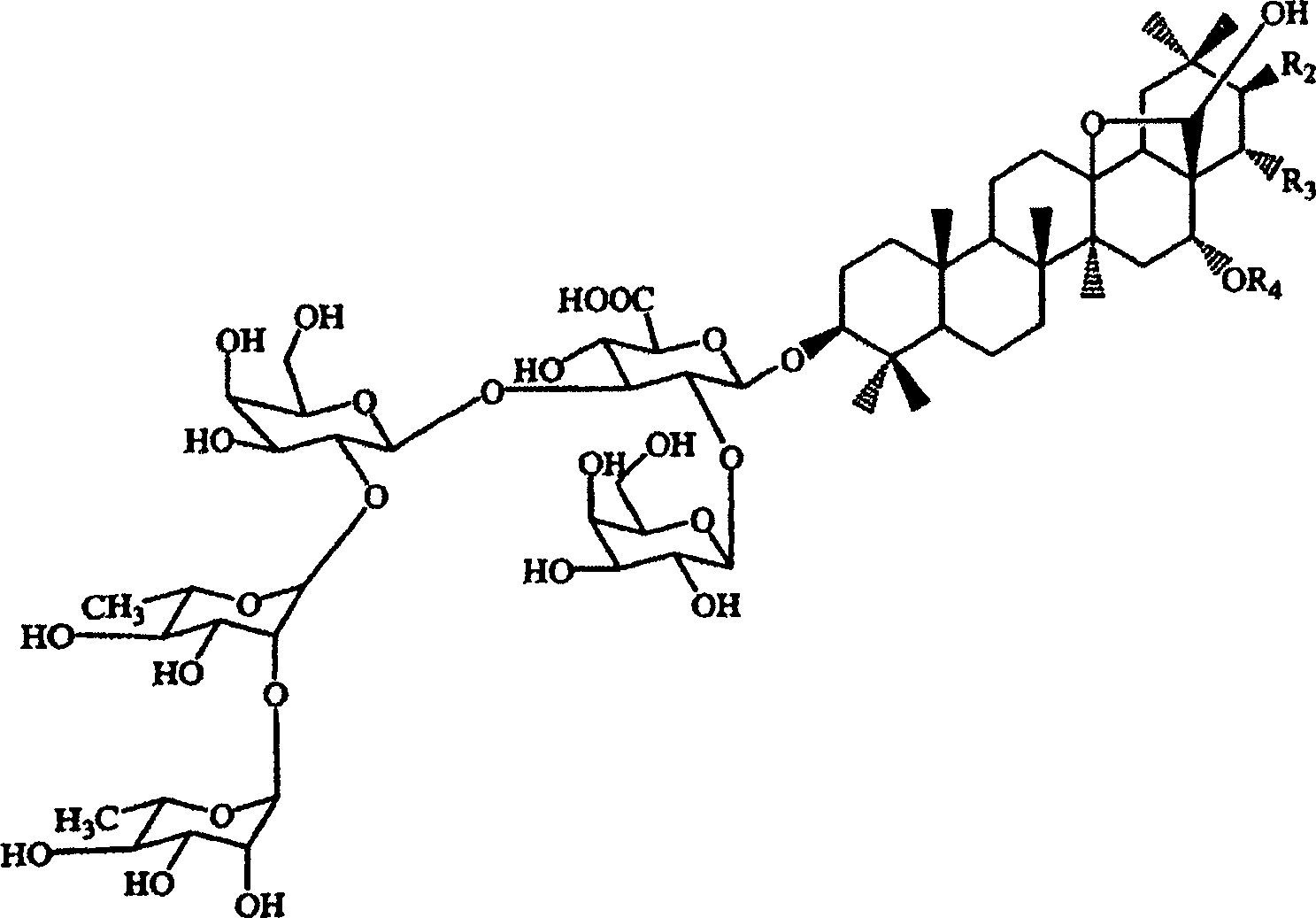
Insbesondere
betrifft die vorliegende Erfindung Triterpensaponine der Formel 
R3 (E)-
oder (Z)-O(C=O)CH=CH-C6H5 bedeutet
und
R4 Wasserstoff oder -(C=O)CH3 bedeutet,
insbesondere diejenigen,
bei denen
in Verbindung 1 R2 -O(C=O)C6H5 bedeutet,
R3
(Z)-O(C=O)CH=CH-C6H5 bedeutet,
R4 Wasserstoff bedeutet;
in Verbindung
2 R2 -O(C=O)C(CH3)=CHCH3 bedeutet,
R3 (Z)-O(C=O)CH=CH-C6H5 bedeutet,
R4 Wasserstoff bedeutet;
in Verbindung
3 R2 -O(C=O)C6H5 bedeutet,
R3 (E)
-O(C=O)CH=CH-C6H5 bedeutet,
R9 Wasserstoff bedeutet;
in Verbindung
4 R2-O(C=O)C(CH3)=CHCH3 bedeutet,
R3 (E)-O(C=O)
CH=CH-C6H5 bedeutet,
R4 Wasserstoff bedeutet;
in Verbindung
5 R2 -O(C=O)C6H5 bedeutet,
R3 (E)
-O(C=O)CH=CH-C6H5 bedeutet,
R4 -(C=O)CH3 bedeutet;
in
Verbindung 6 R2 -O(C=O)C(CH3)=CHCH3 bedeutet,
R3 (E)
-O(C=O)CH=CH-C6H5 bedeutet,
R4 -(C=O)CH3 bedeutet.In particular, the present invention relates to triterpene saponins of the formula
R 3 is (E) - or (Z) -O (C = O) CH = CH-C 6 H 5 and
R 4 is hydrogen or - (C = O) CH 3 ,
especially those where
in compound 1 R 2 is -O (C = O) C 6 H 5 ,
R3 (Z) -O (C = O) CH = CH-C 6 H 5 means,
R 4 is hydrogen;
in compound 2 R 2 is -O (C = O) C (CH 3 ) = CHCH 3 ,
R 3 (Z) -O (C = O) CH = CH-C 6 H 5 ,
R 4 is hydrogen;
in compound 3 R 2 is -O (C = O) C 6 H 5 ,
R 3 (E) -O (C = O) CH = CH-C 6 H 5 ,
R 9 is hydrogen;
in compound 4 R 2 is -O (C = O) C (CH 3 ) = CHCH 3 ,
R 3 (E) -O (C = O) CH = CH-C 6 H 5 ,
R 4 is hydrogen;
in compound 5 R 2 is -O (C = O) C 6 H 5 ,
R 3 (E) -O (C = O) CH = CH-C 6 H 5 ,
R 4 is - (C = O) CH 3 ;
in compound 6 R 2 is -O (C = O) C (CH 3 ) = CHCH 3 ,
R 3 (E) -O (C = O) CH = CH-C 6 H 5 ,
R 4 is - (C = O) CH 3 .
Bevorzugte Verbindungen zur Verwendung in den erfindungsgemäßen pharmazeutischen Zusammensetzungen und Behandlungsverfahren sind die Verbindungen 3 und 4, insbesondere Verbindung 3.preferred Compounds for use in the pharmaceutical compositions of the invention and methods of treatment are compounds 3 and 4, in particular Connection 3.
Insbesondere
betrifft die vorliegende Erfindung die Verwendung von einem oder
mehreren Triterpensaponinen für
die Herstellung einer pharmazeutischen Zusammensetzung zur Behandlung
von Leishmaniasen in Wirten, die mit Leishmania-Arten infiziert
sind, dadurch gekennzeichnet, daß das Saponin die Formel (I) 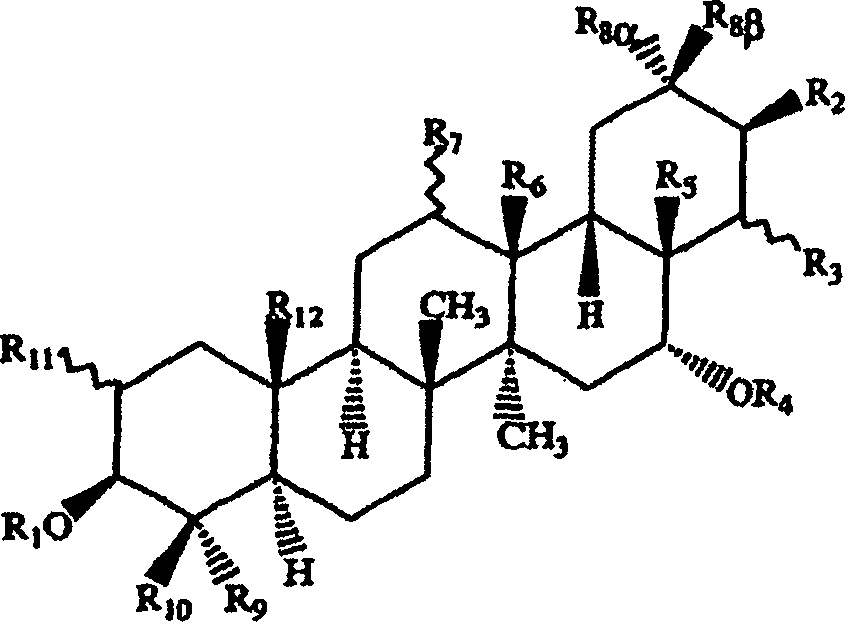
R1 Wasserstoff, -(C=O)C1-5-Alkyl, -(C=O)C2-5-Alkenyl,
phenylsubstituiertes -(C=O)C2-5-Alkenyl,
eine Monosaccharidgruppe oder eine Oligosaccharidgruppe bedeutet;
R2 Wasserstoff, Hydroxy, -O(C=O)C1-5-Alkyl,
-O(C=O)C2-5-Alkenyl, -O(C=O)C6H5 oder phenylsubstituiertes -O(C=O)C2-5-Alkenyl bedeutet;
R3 Wasserstoff,
Hydroxy, -O(C=O)C1-5-Alkyl, -O(C=O)C2-5-Alkenyl, -O(C=O)C6H5 oder phenylsubstituiertes -O(C=O)C2-5-Alkenyl bedeutet;
R4 Wasserstoff,
C1-6-Alkyl, -(C=O) C1-5Alkyl,
-(C=O)C2-5-Alkenyl, -(C=O)C6H5 oder phenylsubstituiertes -(C=O)C2-5-Alkenyl bedeutet;
R5 CH3, CH2OH, CH2OCH3, CH2O-C(=O)CH3, CHO,
COOH bedeutet; oder
R5 und R2 einen zweiwertigen Rest der Formel -C(=O)-O-
bilden;
R6 und R7 Wasserstoff
bedeuten oder gemeinsam eine Bindung bilden; oder
R5 und R6 einen zweiwertigen
Rest der Formel
bilden;
R8α und
R8β jeweils
unabhängig
voneinander CH3, CH2OH,
CH2OCH3, CH2O-C(=O)C1-5-Alkyl,
CHO, CH (OCH3)2,
CH=NOH, COOH bedeuten; oder
R8β und
R3 einen zweiwertigen Rest der Formel -C(=O)-O-
bilden; oder
R8β und R5 einen
zweiwertigen Rest der Formel -CH2O-CHOH-
bilden;
R9 CH3,
CH2OH, CH2OCH3, CH2O-C(=O)C1-5-Alkyl, CHO, COOH bedeutet;
R10 CH3, CH2OH, CH2OCH3, CH2O-C(=O)C1-5-Alkyl, CHO, COOH bedeutet;
R11 Wasserstoff, Hydroxy oder O-C(=O)C1-5-Alkyl bedeutet, oder R10 und
R11 einen zweiwertigen Rest der Formel -CH2O- bilden; und
R12 CH3, CH2OH, CH2OCH3, CH2O-C(=O)CH3, CHO,
CH=NOH oder COOH bedeutet.In particular, the present invention relates to the use of one or more triterpene saponins for the preparation of a pharmaceutical composition for the treatment of leishmaniasis in hosts infected with Leishmania species, characterized in that the saponin has the formula (I)
R 1 is hydrogen, - (C = O) C 1-5 alkyl, - (C = O) C 2-5 alkenyl, phenyl substituted - (C = O) C 2-5 alkenyl, a monosaccharide group or an oligosaccharide group ;
R 2 is hydrogen, hydroxy, -O (C = O) C 1-5 -alkyl, -O (C = O) C 2-5 -alkenyl, -O (C = O) C 6 H 5 or phenyl-substituted -O ( C = O) C 2-5 alkenyl;
R 3 is hydrogen, hydroxy, -O (C = O) C 1-5 -alkyl, -O (C = O) C 2-5 -alkenyl, -O (C = O) C 6 H 5 or phenyl-substituted -O ( C = O) C 2-5 alkenyl;
R 4 is hydrogen, C 1-6 alkyl, - (C = O) C 1-5 alkyl, - (C = O) C 2-5 alkenyl, - (C = O) C 6 H 5 or phenyl-substituted - ( C = O) C 2-5 alkenyl;
R 5 is CH 3 , CH 2 OH, CH 2 OCH 3 , CH 2 OC (= O) CH 3 , CHO, COOH; or
R 5 and R 2 form a bivalent radical of the formula -C (= O) -O-;
R 6 and R 7 are hydrogen or together form a bond; or
R 5 and R 6 is a bivalent radical of the formula
form;
R 8α and R 8β are each independently CH 3 , CH 2 OH, CH 2 OCH 3 , CH 2 OC (= O) C 1-5 alkyl, CHO, CH (OCH 3 ) 2 , CH = NOH, COOH; or
R 8β and R 3 form a bivalent radical of the formula -C (= O) -O-; or
R 8β and R 5 form a bivalent radical of the formula -CH 2 O-CHOH-;
R 9 is CH 3 , CH 2 OH, CH 2 OCH 3 , CH 2 OC (= O) C 1-5 alkyl, CHO, COOH;
R 10 is CH 3 , CH 2 OH, CH 2 OCH 3 , CH 2 OC (= O) C 1-5 alkyl, CHO, COOH;
R 11 is hydrogen, hydroxy or OC (= O) C 1-5 alkyl, or R 10 and R 11 form a bivalent radical of the formula -CH 2 O-; and
R 12 is CH 3 , CH 2 OH, CH 2 OCH 3 , CH 2 OC (= O) CH 3 , CHO, CH = NOH or COOH.
Bevorzugte
Verbindungen der Formel (I) sind diejenigen, in denen
R1 Wasserstoff, -(C=O)C1-5-Alkyl
oder eine Oligosaccharidgruppe bedeutet;
R3 Wasserstoff,
Hydroxy, -O(C=O)C1-5-Alkyl, -O(C=O)C2-5-Alkenyl, phenylsubstituiertes -O(C=O)C2-5-Alkenyl bedeutet;
R4 Wasserstoff,
C1-6-Alkyl, -(C=O)C1-5-Alkyl,
-(C=O)C2-5-Alkenyl bedeutet;
R5 CH2OH, CH2O-C(=O)CH3, CHO
bedeutet; und
R6 und R7 gemeinsam
eine Bindung bilden; oder
R5 und R6 einen zweiwertigen Rest der Formel
bilden;
und
R7 Wasserstoff bedeutet;
R8α CH3 bedeutet;
R8β CH3, CH2OH, CHO, CH
(OCH3)2, CH=NOH,
COOH bedeutet; oder
R8β und R3 einen
zweiwertigen Rest der Formel -C(=O)-O- bilden; oder
R8β und
R5 einen zweiwertigen Rest der Formel -CH2O-CHOH- bilden;
R10 CH3, CH2OH bedeutet;
R11 Wasserstoff, Hydroxy oder O-C(=O)C1-5-Alkyl bedeutet; oder
R10 und
R11 einen zweiwertigen Rest der Formel -CH2O- bilden; und
R12 CH3, CH2OH, CH2O-C(=O)CH3, CHO
oder CH=NOH bedeutet.Preferred compounds of formula (I) are those in which
R 1 is hydrogen, - (C = O) C 1-5 alkyl or an oligosaccharide group;
R 3 is hydrogen, hydroxy, -O (C = O) C 1-5 alkyl, -O (C = O) C 2-5 alkenyl, phenyl substituted -O (C = O) C 2-5 alkenyl;
R 4 is hydrogen, C 1-6 alkyl, - (C = O) C 1-5 alkyl, - (C = O) C 2-5 alkenyl;
R 5 is CH 2 OH, CH 2 OC (= O) CH 3 , CHO; and
R 6 and R 7 together form a bond; or
R 5 and R 6 is a bivalent radical of the formula
form; and
R 7 is hydrogen;
R 8α is CH 3 ;
R 8β is CH 3 , CH 2 OH, CHO, CH (OCH 3 ) 2 , CH = NOH, COOH; or
R 8β and R 3 form a bivalent radical of the formula -C (= O) -O-; or
R 8β and R 5 form a bivalent radical of the formula -CH 2 O-CHOH-;
R 10 is CH 3 , CH 2 OH;
R 11 is hydrogen, hydroxy or OC (= O) C 1-5 alkyl; or
R 10 and R 11 form a bivalent radical of the formula -CH 2 O-; and
R 12 is CH 3 , CH 2 OH, CH 2 OC (= O) CH 3 , CHO or CH = NOH.
Besonders
bevorzugte Verbindungen der Formel (I) sind diejenigen, in denen
R1 Wasserstoff oder eine Oligosaccharidgruppe
bedeutet;
R2 Wasserstoff, Hydroxy,
-O(C=O)C1-5-Alkyl, -O(C=O)C2-5-Alkenyl,
-O(C=O)C6H5 oder
phenylsubstituiertes -O (C=O) C2-5-Alkenyl
bedeutet;
R3 Wasserstoff, Hydroxy,
-O (C=O) C1-5-Alkyl, -O(C=O)C2-5-Alkenyl
oder phenylsubstituiertes -O (C=O) C2-5-Alkenyl
bedeutet;
R9 Wasserstoff, C1-6-Alkyl, -(C=O)C1-5-Alkyl,
-(C=O)C2-5-Alkenyl oder phenylsubstituiertes -(C=O)C2-5-Alkenyl bedeutet;
R5 CH2OH, CH2OCH3, CH2O-C(=O)CH3, CHO, COOH bedeutet; und
R6 und R7 gemeinsam
eine Bindung bilden; oder
R5 und R6 einen zweiwertigen Rest der Formel
R7 Wasserstoff bedeutet;
R8α und
R8β beide
CH3 bedeuten;
R9 CH3 bedeutet;
R10 CH3 bedeutet;
R11 Wasserstoff
bedeutet; und
R12 CH bedeutet.Particularly preferred compounds of formula (I) are those in which
R 1 is hydrogen or an oligosaccharide group;
R 2 is hydrogen, hydroxy, -O (C = O) C 1-5 -alkyl, -O (C = O) C 2-5 -alkenyl, -O (C = O) C 6 H 5 or phenyl-substituted -O ( C = O) C 2-5 alkenyl;
R 3 is hydrogen, hydroxy, -O (C = O) C 1-5 alkyl, -O (C = O) C 2-5 alkenyl or phenyl substituted -O (C = O) C 2-5 alkenyl;
R 9 is hydrogen, C 1-6 alkyl, - (C = O) C 1-5 alkyl, - (C = O) C 2-5 alkenyl or phenyl substituted - (C = O) C 2-5 alkenyl means;
R 5 is CH 2 OH, CH 2 OCH 3 , CH 2 OC (= O) CH 3 , CHO, COOH; and
R 6 and R 7 together form a bond; or
R 5 and R 6 is a bivalent radical of the formula
R 7 is hydrogen;
R 8α and R 8β are both CH 3 ;
R 9 is CH 3 ;
R 10 is CH 3 ;
R 11 is hydrogen; and
R 12 is CH.
Die Verbindungen der Formel (I) können nach fachbekannten Verfahren ineinander überführt werden. Besonders interessante Verfahren sind die Verseifung in basischen Medien, die Umesterung in sauren Medien, sowie der enzymatische Abbau des Oligosaccharidrests zu Aglyconen, d.h. Verbindungen der Formel (I), in denen R1 Wasserstoff bedeutet.The compounds of the formula (I) can be converted into one another by methods known in the art. Particularly interesting processes are the saponification in basic media, the transesterification in acidic media, as well as the enzymatic degradation of the oligosaccharide residue to aglycones, ie compounds of formula (I) in which R 1 is hydrogen.
Für die Behandlung von Leishmaniasen können die Verbindungen der Formel (I) oral, topisch, parenteral, mittels Inhalationsspray oder rektal in Einzeldosisformen, die traditionelle nichttoxische pharmazeutisch annehmbare Träger, Hilfsstoffe und Grundstoffe enthalten, verabreicht werden. Im vorliegenden Zusammenhang beinhaltet der Ausdruck parenteral die subkutane Injektion, die intravenöse, intramuskuläre, intrasternale Injektion, die intraartikuläre Injektion oder Infusionstechniken bei Patienten, die von Infektion mit Leishmanien bedroht sind.For the treatment of Leishmaniases can the compounds of the formula (I) orally, topically, parenterally, by means of Inhalation spray or rectal in unit dosage forms, the traditional non-toxic pharmaceutically acceptable carriers, excipients and excipients contained, administered. In the present context includes the term parenterally subcutaneous injection, intravenous, intramuscular, intrasternal injection, the intraarticular Injection or infusion techniques in patients suffering from infection are threatened with Leishmania.
Die den Wirkstoff enthaltenden pharmazeutischen Zusammensetzungen können in einer Form vorliegen, die sich für die orale Verwendung eignet, z. B. in Form von Tabletten, Trochisci, Pastillen, wäßrigen oder öligen Lösungen oder Suspensionen, dispergierbaren Pulvern oder Granulaten, Emulsionen, Steckkapseln, Weichkapseln, Sirupen oder Elixiren. Zusammensetzungen, die für die orale Verwendung bestimmt sind, können nach einem beliebigen galenischen Verfahren hergestellt werden, und diese Zusammensetzungen können einen oder mehrere Mittel aus der Reihe Süßungsmittel, Geschmacksstoffe, Farbstoffe und Konservierungsmittel enthalten, um zu einem pharmazeutisch eleganten und schmackhaften Präparat zu gelangen. Tabletten enthalten den Wirkstoff in Abmischung mit nichttoxischen pharmazeutisch annehmbaren Grundstoffen, die sich für die Tablettenherstellung eignen, darunter inerte Streckmittel, Granulierhilfsmittel, Sprengmittel und Gleitmittel, was jedoch keine Einschränkung darstellen soll. Die Tabletten können unbeschichtet oder auf bekannte Weise beschichtet sein, um das Zerfallen und die Resorption im Magen-Darm-Trakt zu verzögern, wodurch man zu einer Arzneiform mit hinhaltender Wirkstofffreigabe über einen längeren Zeitraum gelangt, um einen unangenehmen Geschmack bzw. ein unangenehmes Mundgefühl zu maskieren, oder um das Aussehen und die Erkenntlichkeit zu verbessern.The The pharmaceutical compositions containing the active ingredient can be found in a form that is suitable for the oral use is suitable, for. In the form of tablets, Trochisci, Pastilles, aqueous or oily solutions or Suspensions, dispersible powders or granules, emulsions, Capsules, soft capsules, syrups or elixirs. compositions the for The oral use are determined by any galenic process, and these compositions can one or several sweeteners, flavorings, Dyes and preservatives are included to become a pharmaceutical elegant and tasty preparation to get. Tablets contain the active ingredient in admixture with non-toxic pharmaceutically acceptable excipients which for the Tablets, including inert extenders, granulation aids, Disintegrants and lubricants, but this is not limiting should. The tablets can uncoated or coated in a known manner to disintegrate and to delay absorption in the gastrointestinal tract, resulting in one Drug form with sustained drug release over a longer period of time passes to a to mask unpleasant taste or unpleasant mouthfeel, or to improve the look and appreciation.
Wäßrige Suspensionen enthalten die Wirkstoffe in Abmischung mit Grundstoffen, die sich für die Herstellung von wäßrigen Suspensionen eignen. Solche Grundstoffe sind Suspendiermittel, Dispergiermittel oder Netzmittel. Diese wäßrigen Suspensionen können auch ein oder mehrere Konservierungsmittel enthalten, und ölige Suspensionen können dadurch formuliert werden, daß man den Wirkstoff in einem geeigneten pflanzlichen Öl oder in einem Mineralöl, wie Paraffinöl, suspendiert. Die öligen Suspensionen können Verdickungsmittel, Süßmittel und Geschmacksstoffe enthalten, um zu einem schmackhaften Oralpräparat zu gelangen. Diese Zusammensetzungen können durch Zusatz eines annehmbaren Antioxidans konserviert werden.Aqueous suspensions contain the active ingredients in admixture with basic substances that are for the Preparation of aqueous suspensions suitable. Such raw materials are suspending agents, dispersants or wetting agent. These aqueous suspensions can also contain one or more preservatives, and oily suspensions can be formulated by that one the active ingredient suspended in a suitable vegetable oil or in a mineral oil such as paraffin oil. The oily ones Suspensions can Thickener, sweetener and flavors to become a tasty oral preparation reach. These compositions can be made by adding an acceptable Antioxidant be preserved.
Dispergierbare Pulver und Granulate, die sich für die Herstellung von wäßrigen Suspensionen durch Zugabe von Wasser eignen, stellen den Wirkstoff in Abmischung mit einem Dispergiermittel oder Netzmittel, Suspendiermittel und einem oder mehreren Konservierungsmitteln bereit.dispersible Powders and granules that are suitable for the production of aqueous suspensions by adding water, make the active ingredient in admixture with a dispersant or wetting agent, suspending agent and one or more preservatives ready.
Die erfindungsgemäßen pharmazeutischen Zusammensetzungen können auch in Form von Öl-in-Wasser- (o/w) oder Wasser-in-Öl- (w/o) Emulsionen vorliegen. Bei der Ölphase kann es sich um ein pharmazeutisch geeignetes pflanzliches Öl, Erdnußöle, oder ein Mineralöl handeln, das geeignete Emulgatoren und Antioxidantien enthält. Die wäßrige Phase kann Emulgatoren, Verdickungsmittel und Konservierungsmittel enthalten. Die Emulsionen können auch Süßmittel, Farbstoffe und Geschmacksstoffe enthalten.The pharmaceutical according to the invention Compositions can also in the form of oil-in-water (o / w) or water-in-oil (w / o) emulsions are present. The oil phase may be a pharmaceutically acceptable vegetable oil, peanut oils, or a mineral oil, containing suitable emulsifiers and antioxidants. The aqueous phase may contain emulsifiers, thickeners and preservatives. The emulsions can also sweeteners, Dyes and flavorings included.
Sirupe und Elixiere können mit Süßmitteln formuliert werden. Solche Formulierungen können auch ein reizstillendes Mittel, ein Konservierungsmittel sowie Geschmacks- und Farbstoffe enthalten.syrups and elixirs can with sweeteners be formulated. Such formulations can also be an irritant Agent, a preservative, as well as flavorings and colorings contain.
Die pharmazeutischen Zusammensetzungen können in Form eines sterilen Injektionspräparats, z.B. als sterile wäßrige oder ölige Injektionslösung oder -suspension in einem nichttoxischen parenteral annehmbaren Verdünnungsmittel oder Lösungsmittel, vorliegen. Zu den annehmbaren Konstituentien und Lösungsmitteln, die verwendet werden können, zählen Wasser, Ringersche Lösung sowie isotonische Natriumchloridlösungen. Zusätzlich werden sterile fixierte Öle traditionell als Lösungsmittel oder Suspendiermittel verwendet. Für diesen Zweck kann jedes neutrale fixierte Öl verwendet werden, darunter synthetische Mono- oder Diglyceride, Fettsäuren und andere geeignete Zusatzstoffe für Iniectabilia. Suspensionen können gemäß bekannten Techniken unter Verwendung von geeigneten Dispergier- oder Netzmitteln und Suspendiermitteln hergestellt werden.The pharmaceutical compositions may be in the form of a sterile injectable preparation, for example as a sterile aqueous or oily injection solution or suspension in a non-toxic parenterally-acceptable diluent or solvent. Acceptable constituents and solvents that may be used include water, Ringer's solution, and isotonic sodium chloride sols solutions. Additionally, sterile fixed oils are traditionally used as solvents or suspending agents. Any neutral fixed oil may be used for this purpose, including synthetic mono- or diglycerides, fatty acids and other suitable additives for inhalables. Suspensions may be prepared according to known techniques using suitable dispersing or wetting agents and suspending agents.
Die Verbindungen der Formel (I) können auch in Form von Suppositorien oder anderen Formulierungen, wie Lösungen oder Suspensionen für die rektale Verabreichung des Arzneistoffs, verabreicht werden. Suppositorien können dadurch hergestellt werden, daß man den Arzneistoff mit einem geeigneten nichtreizenden Grundstoff, der bei Normaltemperaturen fest, bei der Rektaltemperatur jedoch flüssig ist und so den Arzneistoff abgibt, vermischt.The Compounds of formula (I) can also in the form of suppositories or other formulations, such as solutions or suspensions for the rectal administration of the drug. suppositories can be prepared by that the drug with a suitable non-irritating base, the solid at normal temperatures, but at the rectal temperature liquid is and so gives the drug, mixed.
Die Tagesdosis der Verbindungen der Formel (I) können in einem weiten Bereich schwanken, z.B. von 1,0 bis 2000 mg. Vorzugsweise wird die Verbindung der Formel (I) in Form einer pharmazeutischen Zusammenstellung gemeinsam mit einem Träger für eine geeignete Dosierung für den zu behandelnden Patienten in unterteilten Dosen, die 5, 10, 25, 50, 100, 150, 250 oder 500 mg Wirkstoff enthalten, verabreicht. Eine wirksame Menge des Arzneistoffs wird normalerweise in einem Dosierbereich von ungefähr 0,01 mg bis ungefähr 50 mg/kg Körpergewicht bereitgestellt. Vorzugsweise beträgt der Bereich ungefähr 0,1 mg bis ungefähr 7 mg/kg Körpergewicht.The Daily dose of the compounds of formula (I) can be in a wide range fluctuate, e.g. from 1.0 to 2000 mg. Preferably, the compound becomes of the formula (I) in the form of a pharmaceutical composition in common with a carrier for one suitable dosage for the patients to be treated in divided doses, the 5, 10, 25, 50, 100, 150, 250 or 500 mg of active ingredient administered. An effective amount of the drug will normally be in one Dosing range of approximately 0.01 mg to about 50 mg / kg body weight provided. Preferably, the range is about 0.1 mg until about 7 mg / kg body weight.
Es ist natürlich klar, daß das spezifische Dosisniveau für einen bestimmten Patienten von verschiedenen Faktoren, darunter der Wirksamkeit der jeweiligen verwendeten Verbindung, dem Alter, dem Körpergewicht, dem allgemeinen Gesundheitszustand, dem Geschlecht, der Ernährung, der Verabreichungszeit, dem Verabreichungsweg, der Ausscheidungsgeschwindigkeit, der Arzneistoffkombination sowie der Schwere und den betroffenen Organsystemen, denen die Therapie gelten soll, abhängt.It is natural clear that that specific dose level for a particular patient of various factors, including the effectiveness of the particular compound used, the age, the body weight, general health, sex, diet, diet Time of administration, the route of administration, the rate of excretion, the drug combination as well as the severity and the affected Organ systems to which the therapy is to apply depends.
VERSUCHSTEILEXPERIMENTAL
AUFREINIGUNG VON TRITERPENSAPONINEN AUS MAESA BALANSAEPURIFICATION OF TRITERPENSAPONINES FROM MAESA BALANSAE
Die
luftgetrockneten pulverisierten Blätter (3 kg) von Maesa balansae
wurden zur Entfernung von unpolaren Substanzen mit Chloroform und
anschließend
mit Methanol:Wasser (9:1) extrahiert. Der alkoholische Extrakt wurde
unter verringertem Druck eingedampft und der Rückstand zwischen n-Butanol
(wassergesättigt) und
Wasser verteilt. Die organische Schicht wurde zur Trockne abgedampft
und der Rückstand
wurde mit Aceton gewaschen und filtriert. Der acetonunlösliche Teil,
der die Saponine enthält
(10 g), wurde mittels Umkehrphasen-HPLC (stationäre Phase: RP-18 HS BDS Hyperprep
100 Å,
8 μm; 200
g, Ø der
Säule:
5 cm) mit einem gradientenelutionsmittelsystem unter Verwendung
von:
A: 0,5% Ammoniumacetat in Wasser,
B: Methanol sowie
C:
Acetonitril
bei einer Durchflußgeschwindigkeit von 80 ml/min
und UV-Detektion bei 235 nm gereinigt. Mit dem Gradientenelutionssystem
von A:B:C (60:20:20) zum Zeitpunkt t = 0 min nach A:B:C (0:50:50)
zum Zeitpunkt t = 50 min erhält
man ein reines Saponingemisch (5 g), das sechs Verbindungen umfaßt.The air-dried powdered leaves (3 kg) of Maesa balansae were extracted with chloroform and then with methanol: water (9: 1) to remove non-polar substances. The alcoholic extract was evaporated under reduced pressure and the residue partitioned between n-butanol (water saturated) and water. The organic layer was evaporated to dryness and the residue was washed with acetone and filtered. The acetone insoluble portion containing the saponins (10 g) was analyzed by reverse phase HPLC (stationary phase: RP-18 HS BDS Hyperprep 100 Å, 8 μm, 200 g, column diameter: 5 cm) with a gradient eluent system using :
A: 0.5% ammonium acetate in water,
B: methanol as well
C: acetonitrile
cleaned at a flow rate of 80 ml / min and UV detection at 235 nm. With the gradient elution system of A: B: C (60:20:20) at time t = 0 min after A: B: C (0:50:50) at time t = 50 min, a pure saponin mixture (5 g) is obtained. that includes six compounds.
Jedes
dieser sechs Saponine wurde an der gleichen Säule unter den gleichen Bedingungen
unter Verwendung des oben beschriebenen Lösungsmittelgradientsystems
aufgereinigt. Es eluierten der Reihe nach die folgenden Verbindungen:
Verbindung
1: MG = 1532, λmax = 223,3 nm, wurde weiter mit dem isokratischen
Lösungsmittelsystem
A:B:C (33:64:03) gereinigt; Ausbeute 230 mg.
Verbindung 2:
MG = 1510, λmax = 209,2 nm; Gradientenelutionssystem:
von A:B:C (42:29:29) zum Zeitpunkt t = 0 min bis A:B:C (24:38:38)
zum Zeitpunkt t = Ende; Ausbeute 110 mg.
Verbindung 3: MG =
1532, λmax = 222,1 nm; isokratisches Lösungsmittelsystem
A:B:C (40:30:30); Ausbeute 1000 mg.
Verbindung 4: MG = 1510, λmax =
202,2 nm; isokratisches Lösungsmittelsystem
A:B:C (59:00:41); Ausbeute 1000 mg.
Verbindung 5: MG = 1574, λmax =
203,4 nm; isokratisches Lösungsmittelsystem
A:B:C (32:34:34); Ausbeute 220 mg.
Verbindung 6: MG = 1552, λmax =
216,3 nm; isokratisches Lösungsmittelsystem
A:B:C (32:34:34) unter 4maliger Wiederverwendung; Ausbeute 230 mg.Each of these six saponins was purified on the same column under the same conditions using the solvent gradient system described above. The following compounds eluted in turn:
Compound 1: MW = 1532, λ max = 223.3 nm, was further purified with the isocratic solvent system A: B: C (33:64:03); Yield 230 mg.
Compound 2: MW = 1510, λ max = 209.2 nm; Gradient elution system: from A: B: C (42:29:29) at time t = 0 min to A: B: C (24:38:38) at time t = end; Yield 110 mg.
Compound 3: MW = 1532, λ max = 222.1 nm; isocratic solvent system A: B: C (40:30:30); Yield 1000 mg.
Compound 4: MW = 1510, λ max = 202.2 nm; isocratic solvent system A: B: C (59:00:41); Yield 1000 mg.
Compound 5: MW = 1574, λ max = 203.4 nm; isocratic solvent system A: B: C (32:34:34); Yield 220 mg.
Compound 6: MW = 1552, λ max = 216.3 nm; isocratic solvent system A: B: C (32:34:34) with 4 times reuse; Yield 230 mg.
AUSWERTUNG DER WIRKSAMKEIT GEGEN LEISHMANIENEVALUATION THE EFFICACY AGAINST LEISHMANIA
Der in den folgenden Beispielen verwendete Testarzneistoff PX umfaßt das aus Maesa balansae aufgereinigte Saponingemisch.Of the Test drug PX used in the following examples comprises Maesa balansae purified saponin mixture.
1. Wirksamkeit gegen Leishmanien in vitro1. Effectiveness against Leishmania in vitro
In
der internationalen Literatur finden sich zahlreiche Beschreibungen
von Verfahren für
die in-vitro-Züchtung
von Leishmania-Organismen und die Durchmusterungstechnik. Die Testprotokolle
sind flexibel und können
an die jeweiligen Ziele und Eigenschaften der Prüfverbindungen angepaßt werden.
Kurz gefaßt wurde
die folgende in-vitro-Technik verwendet:
Von Labornagetieren
oder von Makrophagenzelllinien stammende primäre peritoneale Makrophagen
wurden in Multiwell-Gewebekulturgefäße überimpft und ungefähr 24 Stunden
lang anheften gelassen. Amastigoten der Leishmania-Arten (die von
Zielgeweben eines infizierten Donatortiers oder von mit Amastigoten
infizierten Gewebekulturen stammten) oder Promastigoten der Leishmania-Arten
wurden in einem geeigneten Infektionsverhältnis gemeinsam mit unterschiedlich
reihenverdünnten
Konzentrationen des Arzneistoffs bzw. der Prüfverbindung gegeben. Der Prüfarzneistoff
wurde in einem geeigneten Lösungsmittel,
das mit dem in-vitro-Testsystem
verträglich
war (DMSO; Wasser, Alkohole und dergleichen funktionieren auch gut)
vorgelöst
und zu dem Gewebekulturmedium gegeben. Die Kulturen wurden 5-15
Tage bei 37°C
in 5% CO2 inkubiert. Um einen Selektivitätsindex
zu bestimmen, wurde auch eine Behandlung von nichtinfizierten Kontrollkulturen
mitgeführt. Außerdem wurden
mit Referenzarzneistoffen behandelte Kulturen mitgeführt, um
die relative Wirksamkeit des Prüfarzneistoffs
zu bestimmen. Die Wirksamkeit des Arzneistoffs wurde in gefärbten Präparaten
als prozentuale Verringerung der Gesamtparasitenbelastung bzw. Anzahl
infizierter Makrophagen im Vergleich mit den unbehandelten Kontrollkulturen
bestimmt. Die Auswertung wurde mikroskopisch durchgeführt, und
es wurden die EC50-Werte (wirksame Konzentration
für eine
50%ige Hemmung) bestimmt. Die prozentuale Verringerung und der EC50-Wert dienen als Anhaltspunkt für die Wirksamkeit
gegen Leishmaniasen in vitro und dienen als wichtige Hinweise auf
klinisch nützliche
Mittel. Tabelle
I: Wirksamkeit gegen Leishmanien in vitro bei primären Maus-Makrophagen 
Primary peritoneal macrophages derived from laboratory rodents or from macrophage cell lines were inoculated into multiwell tissue culture vessels and allowed to adhere for approximately 24 hours. Amastigotes of the Leishmania species (derived from target tissues of an infected Donatortier or amastigote-infected tissue cultures) or promastigotes of the Leishmania species were given in a suitable infection ratio along with varyingly dilute concentrations of the drug or test compound. The test drug was pre-dissolved in a suitable solvent compatible with the in vitro test system (DMSO, water, alcohols and the like also work well) and added to the tissue culture medium. The cultures were incubated at 37 ° C in 5% CO 2 for 5-15 days. To determine a selectivity index, a treatment of uninfected control cultures was also included. In addition, reference drug-treated cultures were included to determine the relative efficacy of the investigational drug. The efficacy of the drug was determined in stained preparations as a percent reduction in total parasite load or number of infected macrophages compared to the untreated control cultures. The evaluation was carried out microscopically and the EC 50 values (effective concentration for a 50% inhibition) were determined. The percent reduction and EC 50 are indicative of efficacy against leishmaniasis in vitro and serve as important indications of clinically useful agents. Table I: Efficacy against Leishmania in vitro in primary mouse macrophages
2. Wirksamkeit gegen Leishmanien in vivo2. Efficacy against Leishmania in vivo
In
der internationalen Literatur finden sich zahlreiche Beschreibungen
von Verfahren für
die Erhaltung von Leishmania-Organismen in vivo und Tiermodellen.
Die bevorzugte Labortierart für
die Primärisolation,
Erhaltung und Verwendung in künstlichen
Infektionsmodellen sind Balb-C-Mäuse
und Goldhamster. Die Testprotokolle sind flexibel und können an
die jeweiligen Ziele und Eigenschaften der Prüfverbindungen angepaßt werden.
Kurz gefaßt
wurde die folgende in-vivo-Technik verwendet:
Für den Darm
befallende Leishmania-Arten: Balb-C-Mäuse oder junge Hamster wurden
intravenös
mit ungefähr
106-107 Amastigoten,
die von den Zielorganen (im allgemeinen der Milz) eines infizierten
Donatortiers oder von einer in-vitro-Kultur der Parasitenformen
stammten, infiziert. Die Tiere wurden mit unterschiedlichen Dosismengen
der Prüfverbindung
behandelt (Dosisbereich: 0,1 bis 80 mg/kg in 100% DMSO oder einem
beliebigen anderen verträglichen
Konstituens), wobei unterschiedliche Verabreichungswege und Behandlungsschemata
verwendet wurden. Mit der Behandlung wurde entweder zu unterschiedlichen
Zeitpunkten nach der Infektion (kurativ), zugleich mit der Infektion
(prophylaktisch) oder vor der Infektion (Residualwirkung) begonnen. In
der Anlage der prophylaktischen Studie wird die erste Verabreichung
des Prüfarzneistoffs
unmittelbar vor oder zusammen mit der künstlichen Infektion mit der
Leishmania-Art gegeben. In der Anlage der kurativen Studie wird
die erste Verabreichung des Prüfarzneistoffs
mehrere Wochen nach der künstlichen
Infektion mit der Leishmania-Art gegeben (früh-kurativ = wenn die ersten
klinischen Symptome in Erscheinung treten; spät-kurativ = wenn die klinischen
Symptome gut etabliert sind bzw. chronisch werden). Die Wirksamkeit
des Arzneistoffs wurde durch Bestimmung der Gesamtparasitenbelastung
in der Leber oder einem beliebigen anderen relevanten Zielgewebe/Organ
im Vergleich mit der Belastung des Gewebes/Organs bei unbehandelten
Kontrolltieren ausgewertet. Die mittlere Amastigotenzahl wird quantitativ
oder semiquantitativ anhand von gefärbten Abdruck-Ausstrichpräparaten
oder Objektträgern
ausgezählt.
Die prozentuale Verringerung dient als Anhaltspunkt für die Wirksamkeit
gegen Leishmaniasen und gibt wichtige Hinweise auf klinisch nützliche
Mittel. Die minimale Wirkdosis (Lowest Active Dose; LAD) wird als
niedrigste Dosis definiert, bei der die Parasitenbelastung in dem
Primärzielorgan/Gewebe
um mindestens 80% verringert wird. Tabelle
II: Wirksamkeit gegen Leishmanien in vivo bei der Maus und beim
Hamster gegen Leishmania-Arten, die den Darm befallen 
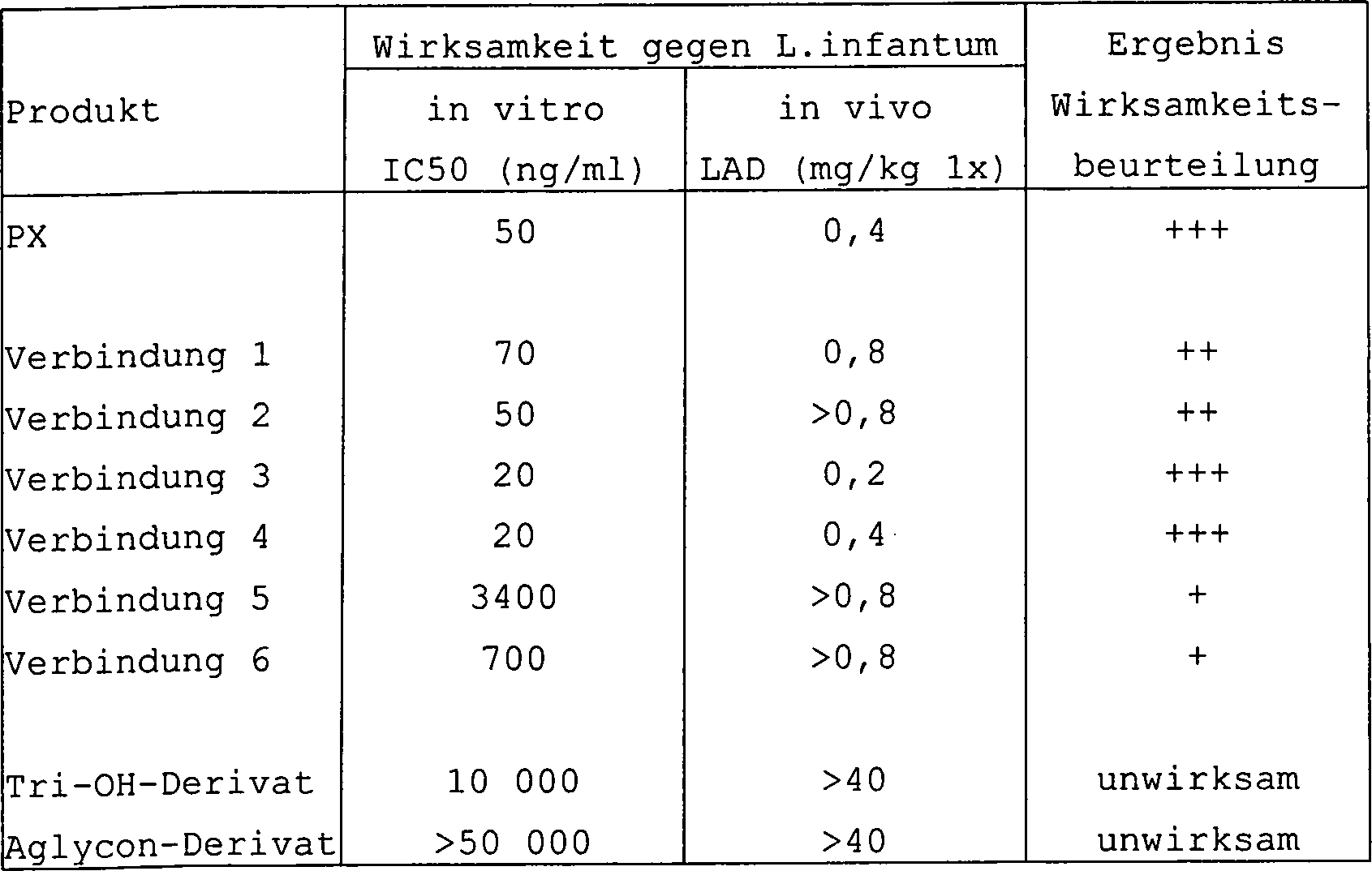
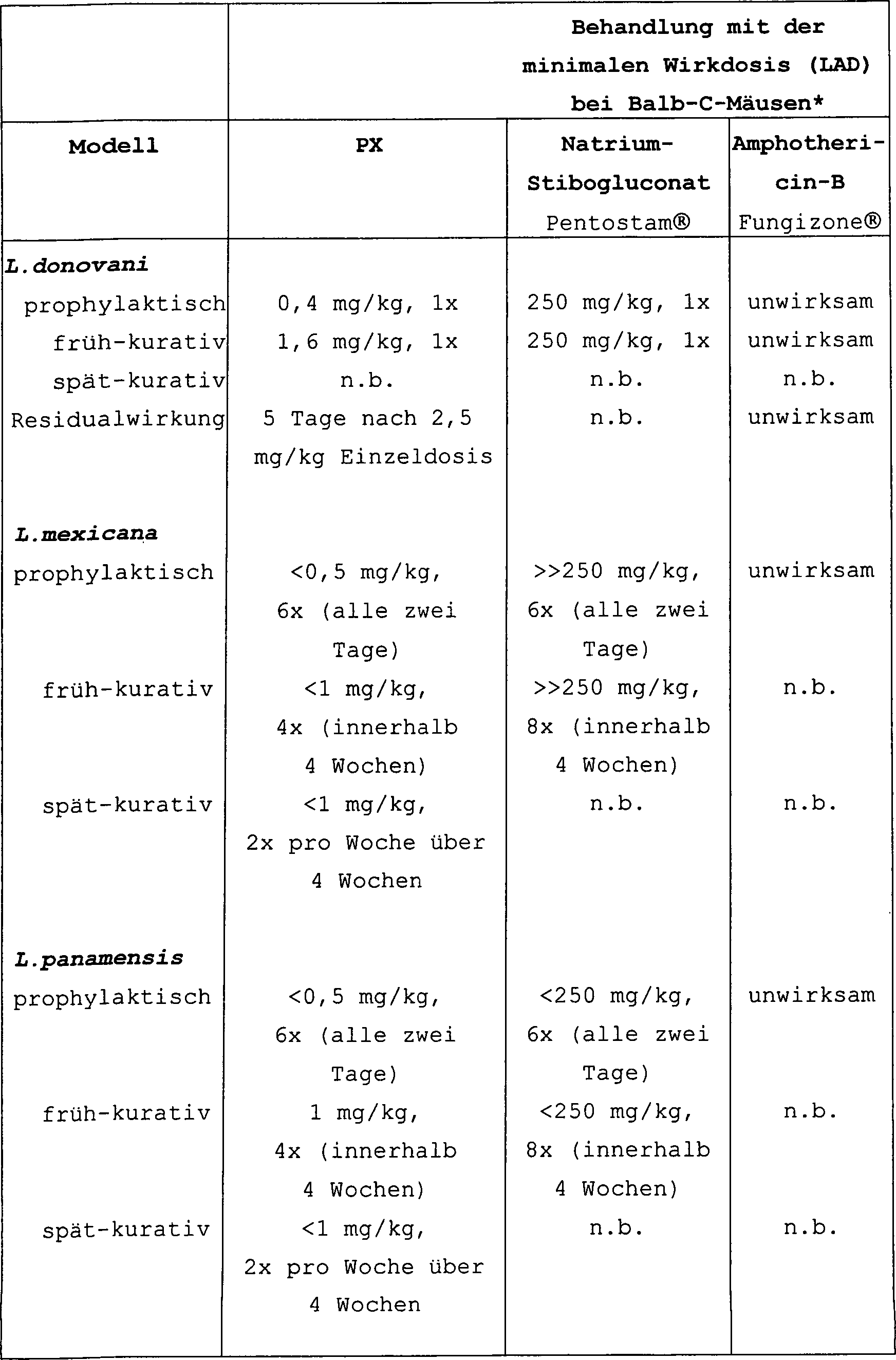
Intestinal Leishmania Species: Balb C mice or juvenile hamsters were given intravenously with approximately 10 6 -10 7 amastigotes derived from the target organs (generally the spleen) of an infected donor animal or from an in vitro culture of the parasite forms came, infected. The animals were with different Do the test compound is treated (dose range: 0.1 to 80 mg / kg in 100% DMSO or any other compatible constituent) using different routes of administration and regimens. The treatment was started either at different times after the infection (curative), at the same time as the infection (prophylactic) or before the infection (residual effect). In the appendix of the prophylactic study, the first administration of the investigational medicinal product is given immediately before or together with the artificial infection with the Leishmania species. At the beginning of the curative study, the first administration of the investigational medicinal product is given several weeks after the artificial infection with the Leishmania species (early-curative = when the first clinical symptoms appear, late-curative = when the clinical symptoms are well established, resp become chronic). The efficacy of the drug was evaluated by determining the total parasite load in the liver or any other relevant target tissue / organ as compared to the load of the tissue / organ in untreated control animals. The mean number of amastigotes is counted quantitatively or semiquantitatively from stained impression smears or slides. The percentage reduction serves as a guide to efficacy against leishmaniasis and provides important evidence for clinically useful agents. The Lowest Active Dose (LAD) is defined as the lowest dose at which the parasite load in the primary target organ / tissue is reduced by at least 80%. Table II: Leishmania in vivo activity in mouse and hamster against Leishmania species affecting the intestine
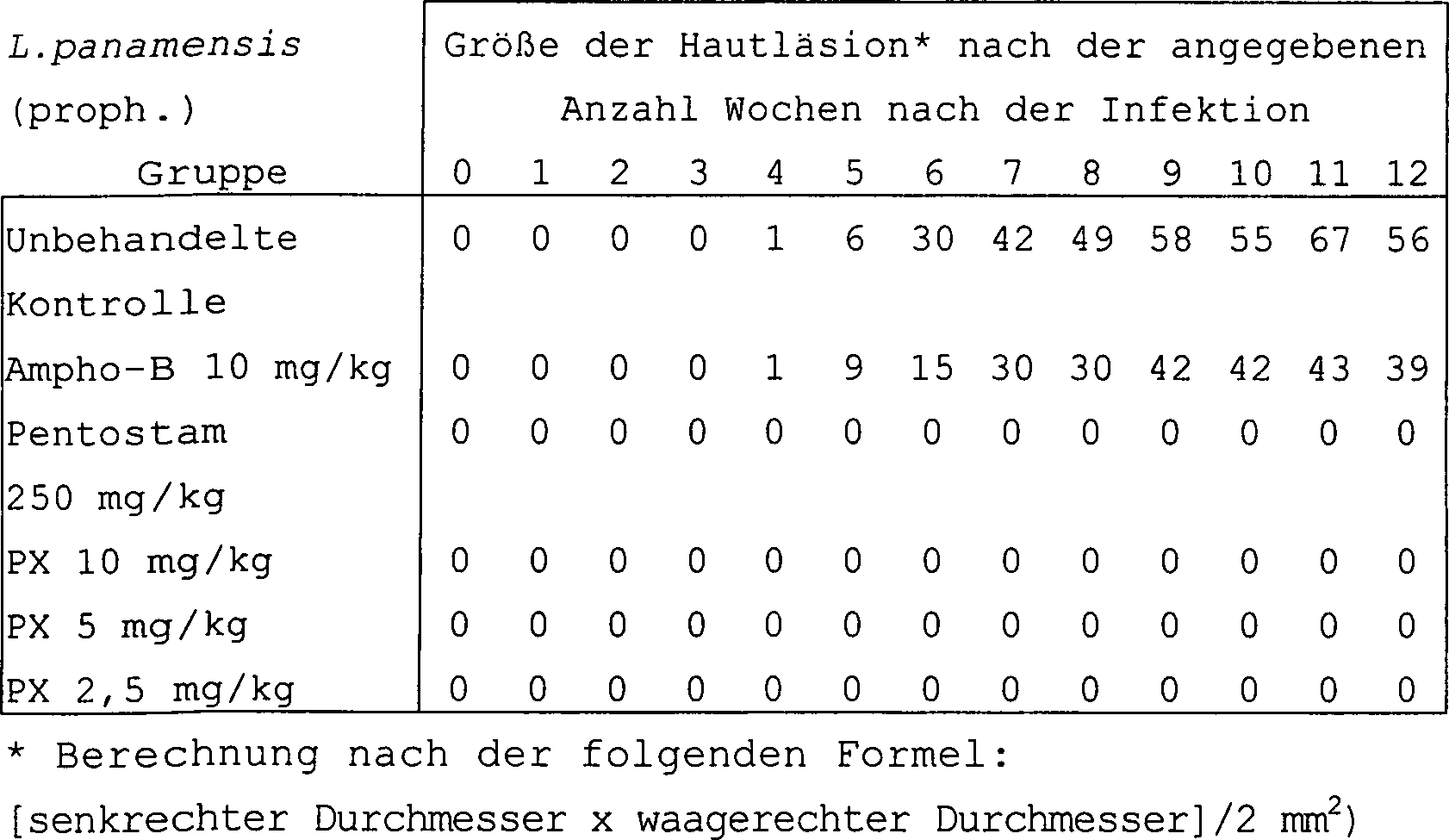
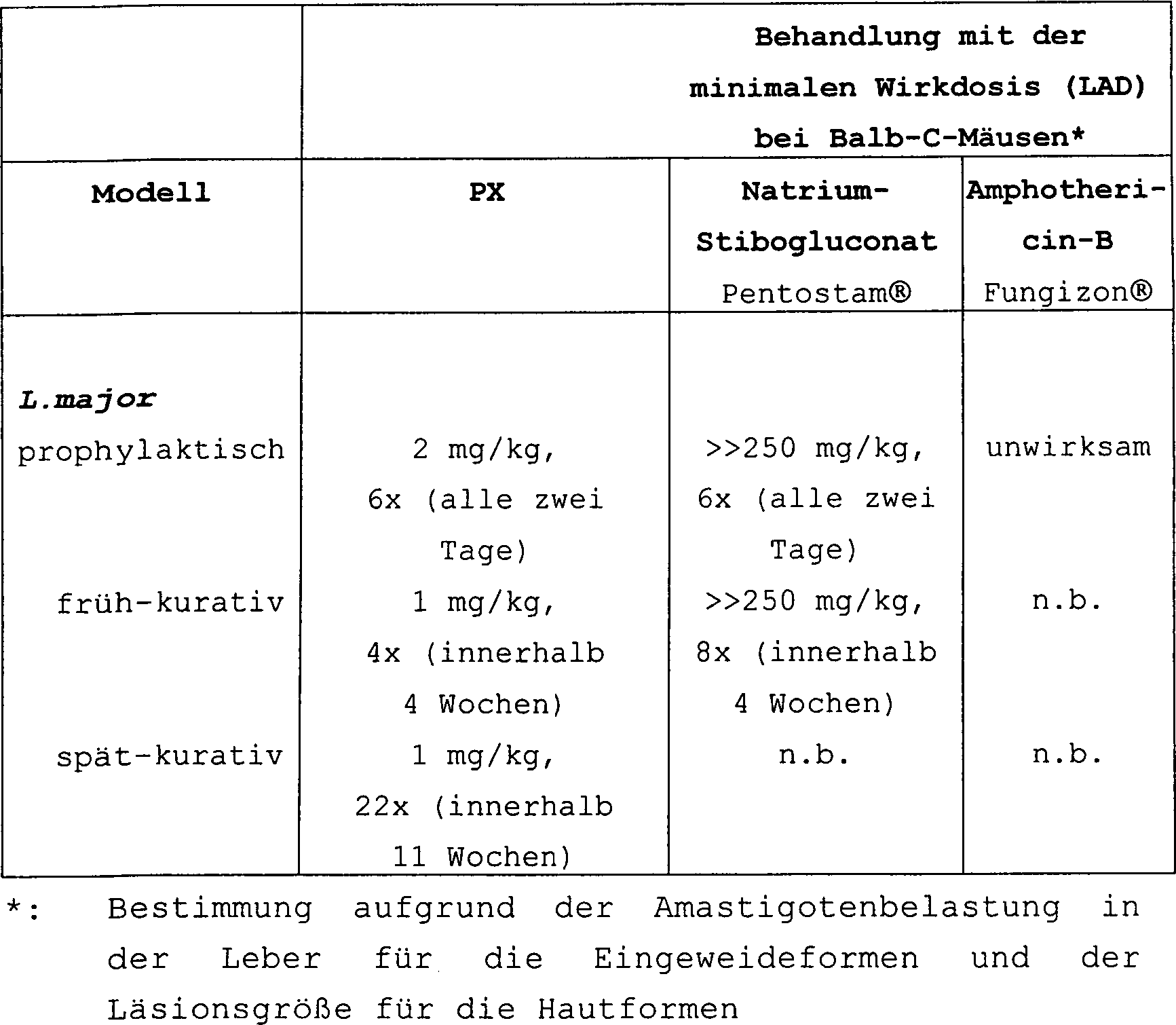
Für die Haut bzw. die Haut/Schleimhaut befallende Leishmania-Arten: Balb-C-Mäuse oder junge Hamster wurden intradermal oder subkutan mit ungefähr 106 bis 107 Amastigoten, die von den Zielorganen (im allgemeinen Hautläsionen) eines infizierten Donatortiers oder von einer in-vitro-Kultur der Parasitenformen stammten, infiziert. Die Tiere wurden mit unterschiedlichen Dosismengen der Prüfverbindung behandelt mg/kg in 100 DMSO oder einem beliebigen anderen verträglichen Konstituens), wobei unterschiedliche Verabreichungswege und Behandlungsschemata verwendet wurden. Mit der Behandlung wurde entweder vor der Infektion (prophylaktisch) oder zu unterschiedlichen Zeiten nach der Infektion (kurativ) begonnen. In der Anlage der prophylaktischen Studie wird die erste Verabreichung des Prüfarzneistoffs unmittelbar vor oder zusammen mit der künstlichen Infektion mit der Leishmania-Art gegeben. In der Anlage der kurativen Studie wird die erste Verabreichung des Prüfarzneistoffs mehrere Wochen nach der künstlichen Infektion mit der Leishmania-Art gegeben (früh-kurativ = wenn die ersten Hautläsionen in Erscheinung treten; spät-kurativ = wenn die Hautläsionen gut etabliert sind bzw. chronisch werden). Die Aktivität des Arzneistoffs wurde entweder durch Bestimmung der Schwere der Läsion in dem entsprechenden Zielgewebe/Organ (primärer Parameter) oder der Parasitenbelastung in dem entsprechenden Zielgewebe/Organ (sekundärer Parameter) im Vergleich zu unbehandelten Kontrolltieren bestimmt. Die Läsionsgröße wurde quantitativ nach dem Verfahren von J. El-On. und A. D. Hamburger [Trans. Roy. Soc. Trop. Med. Hyg., 81, 734-737 (1987)] beurteilt. Die prozentuale Verringerung dient als Anhaltspunkt für die Wirksamkeit gegen Leishmaniasen und gibt wichtige Hinweise auf klinisch nützliche Mittel. Die minimale Wirkdosis (Lowest Active Dose; LAD) wird als niedrigste Dosis definiert, die die Entwicklung von Läsionen verhindert, ein weiteres Fortschreiten der Läsionen aufhält oder eine klinische Heilung der Läsionen in dem primären Zielorgan oder -gewebe induziert.Leishmania species affecting the skin or mucous membrane: Balb C mice or juvenile hamsters were injected intradermally or subcutaneously with approximately 10 6 to 10 7 amastigotes derived from the target organs (generally skin lesions) of an infected donor animal or a infected in vitro culture of the parasite forms. The animals were treated with different dose levels of the test compound mg / kg in 100% DMSO or any other compatible constituent) using different routes of administration and regimens. The treatment was started either before the infection (prophylactically) or at different times after the infection (curative). In the appendix of the prophylactic study, the first administration of the investigational medicinal product is given immediately before or together with the artificial infection with the Leishmania species. At the beginning of the curative study, the first administration of the investigational drug is given several weeks after the artificial infection with the Leishmania species (early-curative = when the first skin lesions appear, late-curative = when the skin lesions are well established or chronic) become). The activity of the drug was determined either by determining the severity of the lesion in the corresponding target tissue / organ (primary parameter) or the parasite load in the corresponding target tissue / organ (secondary parameter) compared to untreated control animals. Lesion size was quantitated by the method of J. El-On. and AD Hamburger [Trans. Roy. Soc. Trop. Med. Hyg., 81, 734-737 (1987)]. The percentage reduction serves as a guide to efficacy against leishmaniasis and provides important evidence for clinically useful agents. The Lowest Active Dose (LAD) is defined as the lowest dose that prevents the development of lesions, prevents further progression of the lesions, or induces clinical healing of the lesions in the primary target organ or tissue.
Tabelle IV: in-vivo-Wirkung gegen Leishmanien bei Mäusen und Hamstern gegen die Haut bzw. die Haut/Schleimhaut befallende Leishmania-ArtenTable IV: in vivo effect against Leishmania in mice and hamsters infesting the skin or the skin / mucosa Leishmania species
A. Prophylaktische BehandlungA. Prophylactic treatment
Bei
der Anlage der prophylaktischen Studie wird die erste Verabreichung
des Prüfarzneistoffs
unmittelbar vor der künstlichen
Infektion mit der Leishmania-Art gegeben 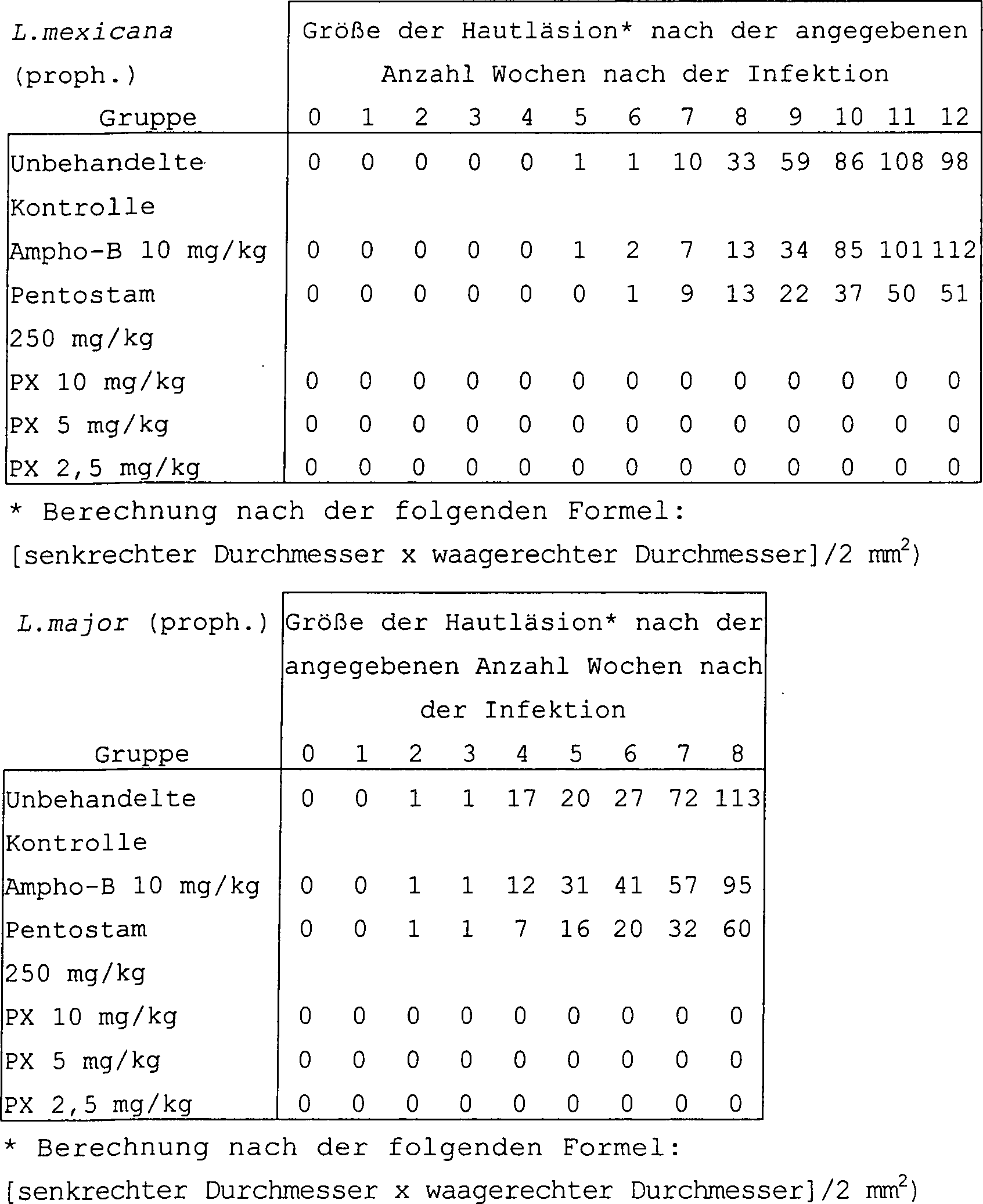
B. Kurative BehandlungB. Curative Treatment
Bei
der Anlage der kurativen Studie wird die erste Verabreichung des
Prüfarzneistoffs
mehrere Wochen nach der künstlichen
Infektion mit der Leishmania-Art gegeben (im allgemeinen dann, wenn
die ersten klinischen Anzeichen auftreten). 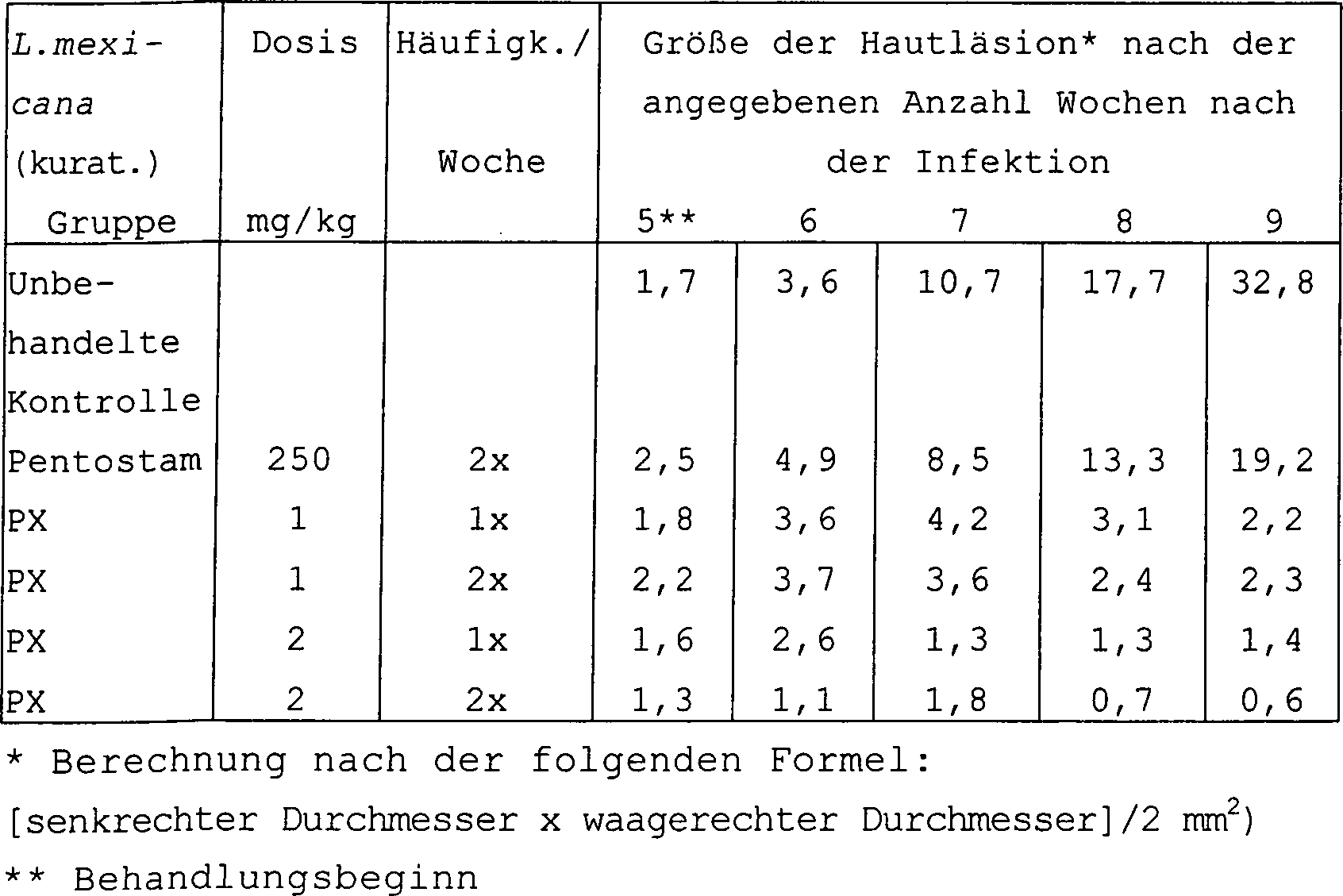

Claims (8)

Applications Claiming Priority (3)
| Application Number | Priority Date | Filing Date | Title |
|---|---|---|---|
| EP98204409 | 1998-12-22 | ||
| EP98204409 | 1998-12-22 | ||
| PCT/EP1999/010177 WO2000038700A1 (en) | 1998-12-22 | 1999-12-15 | Antiprotozoal saponins |
Publications (2)
| Publication Number | Publication Date |
|---|---|
| DE69918166D1 DE69918166D1 (en) | 2004-07-22 |
| DE69918166T2 true DE69918166T2 (en) | 2005-07-07 |
Family
ID=8234537
Family Applications (1)
| Application Number | Title | Priority Date | Filing Date |
|---|---|---|---|
| DE69918166T Expired - Fee Related DE69918166T2 (en) | 1998-12-22 | 1999-12-15 | ANTIPROTOZOAL SAPONINE |
Country Status (22)
| Country | Link |
|---|---|
| US (2) | US6872713B1 (en) |
| EP (1) | EP1140127B1 (en) |
| JP (1) | JP2003521463A (en) |
| KR (1) | KR100613241B1 (en) |
| CN (1) | CN1250235C (en) |
| AP (1) | AP1606A (en) |
| AR (1) | AR029878A1 (en) |
| AT (1) | ATE269097T1 (en) |
| AU (1) | AU768712B2 (en) |
| BR (1) | BR9916422A (en) |
| CO (1) | CO5140124A1 (en) |
| DE (1) | DE69918166T2 (en) |
| DK (1) | DK1140127T3 (en) |
| EG (1) | EG24064A (en) |
| ES (1) | ES2224739T3 (en) |
| IL (2) | IL143831A0 (en) |
| MA (1) | MA25271A1 (en) |
| MY (1) | MY129288A (en) |
| OA (1) | OA11739A (en) |
| TR (1) | TR200101824T2 (en) |
| TW (1) | TWI237028B (en) |
| WO (1) | WO2000038700A1 (en) |
Families Citing this family (23)
| Publication number | Priority date | Publication date | Assignee | Title |
|---|---|---|---|---|
| US7524824B2 (en) * | 2003-09-04 | 2009-04-28 | Pacific Arrow Limited | Composition comprising Xanthoceras sorbifolia extracts, compounds isolated from same, methods for preparing same and uses thereof |
| US7727561B2 (en) * | 2001-08-31 | 2010-06-01 | Pacific Arrow Limited | Composition comprising Xanthoceras sorbifolia extracts, compounds isolated from same, methods for preparing same and uses thereof |
| US8614197B2 (en) | 2003-10-09 | 2013-12-24 | Pacific Arrow Limited | Anti-tumor compounds with angeloyl groups |
| AU2004281707B2 (en) * | 2003-10-09 | 2011-06-09 | Pacific Arrow Limited | Composition comprising xanthoceras sorbifolia extracts, compounds isolated from same, methods for preparing same and uses thereof |
| US7514412B2 (en) * | 2003-10-09 | 2009-04-07 | Pacific Arrow Limited | Anticancer biangeloyl saponins |
| US7488753B2 (en) | 2003-10-09 | 2009-02-10 | Pacific Arrow Limited | Composition comprising triterpene saponins and compounds with angeloyl functional group, methods for preparing same and uses thereof |
| US8735558B2 (en) | 2005-02-14 | 2014-05-27 | Pacific Arrow Limited | Blocking the migration or metastasis of cancer cells by affecting adhesion proteins and the uses of new compounds thereof |
| US10213451B2 (en) * | 2004-09-07 | 2019-02-26 | Pacific Arrow Limited | Methods and compounds for modulating the secretion or expression of adhesion proteins or angiopoietins of cells |
| US9382285B2 (en) | 2004-09-07 | 2016-07-05 | Pacific Arrow Limited | Methods and compounds for modulating the secretion or expression of adhesion proteins or angiopoietins of cells |
| US8586719B2 (en) | 2005-04-27 | 2013-11-19 | Pacific Arrow Limited | Triterpenes for modulating gene expression and cell membrane, and as antiprotozoal agents |
| US7783718B2 (en) | 2006-06-15 | 2010-08-24 | Microsoft Corporation | Locating services using compiled scopes |
| CN101998964B (en) * | 2008-02-15 | 2015-05-06 | 太平洋艾瑞有限公司 | Compounds preventing metastasis of cancer cells and use thereof |
| WO2009153800A1 (en) | 2008-06-17 | 2009-12-23 | Pawan Kumar Goel | A novel process for extraction of furostanolic saponins from fenugreek seeds |
| US9434677B2 (en) | 2009-07-16 | 2016-09-06 | Pacific Arrow Limited | Natural and synthetic compounds for treating cancer and other diseases |
| US9499577B2 (en) | 2009-07-16 | 2016-11-22 | Pacific Arrow Limited | Natural and synthetic compounds for treating cancer and other diseases |
| US20120277308A1 (en) | 2010-07-16 | 2012-11-01 | Pacific Arrow Limited | compounds for treating cancer and other diseases |
| JP5926506B2 (en) * | 2011-06-23 | 2016-05-25 | バイオランド・リミテッド | Method for producing collagen production promoter, method for producing MMP-1 inhibitor, and method for producing external composition for skin |
| US9168268B1 (en) * | 2013-04-09 | 2015-10-27 | Universidad De Antioquia | Saponins and chromans derivatives mixture compositions against leishmaniasis, Trypanosomiasis americana, malaria, Trypanosomiasis africana and Fasciola hepatica |
| GB201404505D0 (en) * | 2013-09-06 | 2014-04-30 | Mars Inc | Oral anti-parasitic composition |
| KR101877845B1 (en) * | 2018-01-29 | 2018-07-12 | 전진바이오팜 주식회사 | Composition for preventing or treating parasitization in fishes comprising jerusalem artichoke and sophora flavescens aiton extract |
| CN113549118B (en) * | 2021-06-23 | 2022-04-22 | 广东菁萃生物科技有限公司 | Extraction method and application of high-purity triterpenoid saponin |
| CN118324844B (en) * | 2024-04-22 | 2025-06-20 | 河南中医药大学 | A method for preparing pentacyclic triterpenoid A of oleanane type compound from Bupleurum chinense and its application |
| CN119192273B (en) * | 2024-10-28 | 2025-11-11 | 河南中医药大学 | New pentacyclic triterpene B extracted from oleanane type compound extracted from radix bupleuri, and extraction method and application thereof |
Family Cites Families (3)
| Publication number | Priority date | Publication date | Assignee | Title |
|---|---|---|---|---|
| US5064823A (en) * | 1988-08-24 | 1991-11-12 | Research Triangle Institute | Pentacyclic triterpenoid compounds as topoisomerase inhibitors or cell differentiation inducers |
| US5922837A (en) * | 1995-09-20 | 1999-07-13 | Merck & Co., Inc. | Antiprotozoal cyclic tetrapeptides |
| US6355249B2 (en) * | 1998-04-17 | 2002-03-12 | Her Majesty The Queen In Right Of Canada, As Represented By The Minister Of Agriculture And Agri-Food Canada | Process for recovery and purification of saponins and sapogenins from quinoa (Chenopodium quinoa) |
-
1999
- 1999-12-15 EP EP99965511A patent/EP1140127B1/en not_active Expired - Lifetime
- 1999-12-15 ES ES99965511T patent/ES2224739T3/en not_active Expired - Lifetime
- 1999-12-15 IL IL14383199A patent/IL143831A0/en active IP Right Grant
- 1999-12-15 AT AT99965511T patent/ATE269097T1/en not_active IP Right Cessation
- 1999-12-15 KR KR1020017006207A patent/KR100613241B1/en not_active Expired - Fee Related
- 1999-12-15 OA OA1200100169A patent/OA11739A/en unknown
- 1999-12-15 WO PCT/EP1999/010177 patent/WO2000038700A1/en not_active Ceased
- 1999-12-15 AP APAP/P/2001/002208A patent/AP1606A/en active
- 1999-12-15 US US09/868,755 patent/US6872713B1/en not_active Expired - Fee Related
- 1999-12-15 AU AU21002/00A patent/AU768712B2/en not_active Ceased
- 1999-12-15 JP JP2000590652A patent/JP2003521463A/en not_active Withdrawn
- 1999-12-15 TR TR2001/01824T patent/TR200101824T2/en unknown
- 1999-12-15 DE DE69918166T patent/DE69918166T2/en not_active Expired - Fee Related
- 1999-12-15 BR BR9916422-1A patent/BR9916422A/en not_active Application Discontinuation
- 1999-12-15 DK DK99965511T patent/DK1140127T3/en active
- 1999-12-15 CN CNB998148768A patent/CN1250235C/en not_active Expired - Fee Related
- 1999-12-21 EG EG163899A patent/EG24064A/en active
- 1999-12-21 MY MYPI99005612A patent/MY129288A/en unknown
- 1999-12-21 CO CO99079865A patent/CO5140124A1/en unknown
- 1999-12-21 AR ARP990106646A patent/AR029878A1/en unknown
- 1999-12-23 TW TW088123067A patent/TWI237028B/en not_active IP Right Cessation
-
2001
- 2001-06-18 IL IL143831A patent/IL143831A/en not_active IP Right Cessation
- 2001-06-20 MA MA26244A patent/MA25271A1/en unknown
-
2004
- 2004-01-06 US US10/752,057 patent/US20040138151A1/en not_active Abandoned
Also Published As
| Publication number | Publication date |
|---|---|
| ES2224739T3 (en) | 2005-03-01 |
| MY129288A (en) | 2007-03-30 |
| CN1250235C (en) | 2006-04-12 |
| AR029878A1 (en) | 2003-07-23 |
| EP1140127B1 (en) | 2004-06-16 |
| KR20010080471A (en) | 2001-08-22 |
| TWI237028B (en) | 2005-08-01 |
| AP1606A (en) | 2006-05-03 |
| AU768712B2 (en) | 2004-01-08 |
| IL143831A0 (en) | 2002-04-21 |
| DK1140127T3 (en) | 2004-10-18 |
| WO2000038700A1 (en) | 2000-07-06 |
| DE69918166D1 (en) | 2004-07-22 |
| KR100613241B1 (en) | 2006-08-18 |
| IL143831A (en) | 2006-12-10 |
| TR200101824T2 (en) | 2001-11-21 |
| AU2100200A (en) | 2000-07-31 |
| AP2001002208A0 (en) | 2001-09-30 |
| US6872713B1 (en) | 2005-03-29 |
| US20040138151A1 (en) | 2004-07-15 |
| OA11739A (en) | 2005-05-13 |
| EG24064A (en) | 2008-05-08 |
| CN1331601A (en) | 2002-01-16 |
| CO5140124A1 (en) | 2002-03-22 |
| JP2003521463A (en) | 2003-07-15 |
| BR9916422A (en) | 2001-10-02 |
| EP1140127A1 (en) | 2001-10-10 |
| ATE269097T1 (en) | 2004-07-15 |
| MA25271A1 (en) | 2001-10-01 |
Similar Documents
| Publication | Publication Date | Title |
|---|---|---|
| EP1140127B1 (en) | Antiprotozoal saponins | |
| DE60015161T2 (en) | PESTICIDE MACROLIDE | |
| DE69636308T2 (en) | TUMOR NECROSE FACTOR ALPHA (TNF-ALPHA) INHIBITORY DRUGS | |
| EP0501205B1 (en) | Antiphlogistic means | |
| DE69930619T2 (en) | USE OF ROSMARIC ACID AND ITS DERIVATIVES AS IMMUNOSUPPRESSOR OR AS INHIBITOR OF SH-2-MEDIATED PROCESSES | |
| EP1299406A1 (en) | Curcumin derivatives with improved water solubility compared to curcumin and medicaments containing the same | |
| EP0241809A1 (en) | Synergistic association of amantadine and selegiline | |
| DE3310556C2 (en) | ||
| DE69805096T2 (en) | USE OF GINKGO BILOBA EXTRACTS FOR PRODUCING A MEDICINAL PRODUCT | |
| DE3688807T2 (en) | Isolation of castanospermine and its use as an anti-diabetic remedy. | |
| EP0501206B1 (en) | Phenone compounds, process for their preparation and their pharmaceutical preparations | |
| DE102013202928A1 (en) | Methods and compositions for treating cancer metastasis | |
| DE10356409B4 (en) | New drug oxacheline and derivatives | |
| DE60115237T2 (en) | PRAZIQUANTEL COMPOSITIONS FOR THE TREATMENT OF DISEASES CAUSED BY COZZIDIA | |
| DE69129334T2 (en) | AVERMECTINE AND MILBEMYCINE FOR TREATING PARACITICAL INFECTIONS IN THE DOG | |
| DD270656A5 (en) | METHOD FOR THE PRODUCTION OF AN EFFECTIVELY APPLICABLE, ANTIVIRAL, PHARMACEUTICAL PREPARATORY AGGRAVATED IN THE SKIN | |
| DE2215499C2 (en) | Estradiol dieters | |
| EP1022024B1 (en) | Anticholestatic activity of luteolin, apigenin and naringenin | |
| EP0950411B1 (en) | Process of manufacturing an extract from the Copalchi stem barks and the use of neoflavonoids for the treatment of diabetes | |
| EP0443198B1 (en) | Diterpenes with immunomodulatory activity | |
| DE3434562A1 (en) | USE OF PYRROTHINE DERIVATIVES | |
| DE1618224C3 (en) | D-homosteroids, processes for their production and pharmaceutical preparations containing them | |
| DE69617918T2 (en) | PREVENTIVE / HEALING AGENT FOR LIVER DISEASES | |
| MXPA01006405A (en) | Antiprotozoal saponins | |
| DE2033629A1 (en) | Means for lowering the serum lipid level in humans |
Legal Events
| Date | Code | Title | Description |
|---|---|---|---|
| 8364 | No opposition during term of opposition | ||
| 8339 | Ceased/non-payment of the annual fee |