DE69918008T2 - Process for the preparation of hydroxyl-substituted hydroxylamines and color developers containing them - Google Patents
Process for the preparation of hydroxyl-substituted hydroxylamines and color developers containing them Download PDFInfo
- Publication number
- DE69918008T2 DE69918008T2 DE69918008T DE69918008T DE69918008T2 DE 69918008 T2 DE69918008 T2 DE 69918008T2 DE 69918008 T DE69918008 T DE 69918008T DE 69918008 T DE69918008 T DE 69918008T DE 69918008 T2 DE69918008 T2 DE 69918008T2
- Authority
- DE
- Germany
- Prior art keywords
- hydroxylamine
- group
- reaction
- carbon atoms
- antioxidant
- Prior art date
- Legal status (The legal status is an assumption and is not a legal conclusion. Google has not performed a legal analysis and makes no representation as to the accuracy of the status listed.)
- Expired - Fee Related
Links
- -1 hydroxyl-substituted hydroxylamines Chemical class 0.000 title claims description 38
- 238000000034 method Methods 0.000 title claims description 19
- 230000008569 process Effects 0.000 title claims description 16
- 238000002360 preparation method Methods 0.000 title claims description 11
- 238000006243 chemical reaction Methods 0.000 claims description 95
- 239000003963 antioxidant agent Substances 0.000 claims description 39
- 239000000243 solution Substances 0.000 claims description 39
- 239000000203 mixture Substances 0.000 claims description 34
- 125000004432 carbon atom Chemical group C* 0.000 claims description 33
- 150000002924 oxiranes Chemical class 0.000 claims description 30
- 230000003078 antioxidant effect Effects 0.000 claims description 29
- AVXURJPOCDRRFD-UHFFFAOYSA-N Hydroxylamine Chemical compound ON AVXURJPOCDRRFD-UHFFFAOYSA-N 0.000 claims description 26
- 125000000217 alkyl group Chemical group 0.000 claims description 24
- CTKINSOISVBQLD-UHFFFAOYSA-N Glycidol Chemical group OCC1CO1 CTKINSOISVBQLD-UHFFFAOYSA-N 0.000 claims description 23
- 239000003795 chemical substances by application Substances 0.000 claims description 19
- 125000002768 hydroxyalkyl group Chemical group 0.000 claims description 13
- 125000003118 aryl group Chemical group 0.000 claims description 12
- 125000000753 cycloalkyl group Chemical group 0.000 claims description 11
- 239000001257 hydrogen Substances 0.000 claims description 10
- 229910052739 hydrogen Inorganic materials 0.000 claims description 10
- 239000007864 aqueous solution Substances 0.000 claims description 8
- 125000004435 hydrogen atom Chemical class [H]* 0.000 claims description 8
- 125000001997 phenyl group Chemical group [H]C1=C([H])C([H])=C(*)C([H])=C1[H] 0.000 claims description 7
- 239000012458 free base Substances 0.000 claims description 6
- 125000001188 haloalkyl group Chemical group 0.000 claims description 6
- 238000004519 manufacturing process Methods 0.000 claims description 5
- IDLCGKHZBNSVKN-UHFFFAOYSA-N 3-[2,3-dihydroxypropyl(hydroxy)amino]propane-1,2-diol Chemical compound OCC(O)CN(O)CC(O)CO IDLCGKHZBNSVKN-UHFFFAOYSA-N 0.000 claims description 4
- 125000000113 cyclohexyl group Chemical group [H]C1([H])C([H])([H])C([H])([H])C([H])(*)C([H])([H])C1([H])[H] 0.000 claims description 4
- 125000003627 8 membered carbocyclic group Chemical group 0.000 claims description 3
- WSNMPAVSZJSIMT-UHFFFAOYSA-N COc1c(C)c2COC(=O)c2c(O)c1CC(O)C1(C)CCC(=O)O1 Chemical compound COc1c(C)c2COC(=O)c2c(O)c1CC(O)C1(C)CCC(=O)O1 WSNMPAVSZJSIMT-UHFFFAOYSA-N 0.000 claims description 3
- GOOHAUXETOMSMM-UHFFFAOYSA-N Propylene oxide Chemical compound CC1CO1 GOOHAUXETOMSMM-UHFFFAOYSA-N 0.000 claims description 3
- 125000001309 chloro group Chemical group Cl* 0.000 claims description 3
- 238000002156 mixing Methods 0.000 claims description 3
- AAVHHYWBSVSPPN-UHFFFAOYSA-N (2-methyloxiran-2-yl)methanol Chemical compound OCC1(C)CO1 AAVHHYWBSVSPPN-UHFFFAOYSA-N 0.000 claims description 2
- XJBQHGGFOBLJDF-UHFFFAOYSA-N (3-benzyloxiran-2-yl)methanol Chemical compound OCC1OC1CC1=CC=CC=C1 XJBQHGGFOBLJDF-UHFFFAOYSA-N 0.000 claims description 2
- LFKLPJRVSHJZPL-UHFFFAOYSA-N 1,2:7,8-diepoxyoctane Chemical compound C1OC1CCCCC1CO1 LFKLPJRVSHJZPL-UHFFFAOYSA-N 0.000 claims description 2
- KRXBXCNTGQFLEN-UHFFFAOYSA-N 2-[(1,3-dihydroxy-4-phenylbutan-2-yl)-hydroxyamino]-4-phenylbutane-1,3-diol Chemical compound C=1C=CC=CC=1CC(O)C(CO)N(O)C(CO)C(O)CC1=CC=CC=C1 KRXBXCNTGQFLEN-UHFFFAOYSA-N 0.000 claims description 2
- SHKUUQIDMUMQQK-UHFFFAOYSA-N 2-[4-(oxiran-2-ylmethoxy)butoxymethyl]oxirane Chemical compound C1OC1COCCCCOCC1CO1 SHKUUQIDMUMQQK-UHFFFAOYSA-N 0.000 claims description 2
- GIJYZWJXXKQHME-UHFFFAOYSA-N 3-[(2,3-dihydroxy-2-methylpropyl)-hydroxyamino]-2-methylpropane-1,2-diol Chemical compound OCC(O)(C)CN(O)CC(C)(O)CO GIJYZWJXXKQHME-UHFFFAOYSA-N 0.000 claims description 2
- BRLQWZUYTZBJKN-UHFFFAOYSA-N Epichlorohydrin Chemical compound ClCC1CO1 BRLQWZUYTZBJKN-UHFFFAOYSA-N 0.000 claims description 2
- IAYPIBMASNFSPL-UHFFFAOYSA-N Ethylene oxide Chemical compound C1CO1 IAYPIBMASNFSPL-UHFFFAOYSA-N 0.000 claims description 2
- VDUIPQNXOQMTBF-UHFFFAOYSA-N n-ethylhydroxylamine Chemical compound CCNO VDUIPQNXOQMTBF-UHFFFAOYSA-N 0.000 claims description 2
- CPQCSJYYDADLCZ-UHFFFAOYSA-N n-methylhydroxylamine Chemical compound CNO CPQCSJYYDADLCZ-UHFFFAOYSA-N 0.000 claims description 2
- ODHYIQOBTIWVRZ-UHFFFAOYSA-N n-propan-2-ylhydroxylamine Chemical compound CC(C)NO ODHYIQOBTIWVRZ-UHFFFAOYSA-N 0.000 claims description 2
- 238000011161 development Methods 0.000 description 24
- 238000007792 addition Methods 0.000 description 23
- 150000002443 hydroxylamines Chemical class 0.000 description 17
- 239000000376 reactant Substances 0.000 description 14
- 239000011541 reaction mixture Substances 0.000 description 11
- 238000011160 research Methods 0.000 description 10
- 150000001875 compounds Chemical class 0.000 description 9
- MTHSVFCYNBDYFN-UHFFFAOYSA-N diethylene glycol Chemical compound OCCOCCO MTHSVFCYNBDYFN-UHFFFAOYSA-N 0.000 description 9
- 238000012545 processing Methods 0.000 description 9
- 239000000047 product Substances 0.000 description 9
- 229910052709 silver Inorganic materials 0.000 description 9
- 239000004332 silver Substances 0.000 description 9
- 239000000126 substance Substances 0.000 description 9
- XLYOFNOQVPJJNP-UHFFFAOYSA-N water Substances O XLYOFNOQVPJJNP-UHFFFAOYSA-N 0.000 description 8
- 239000006227 byproduct Substances 0.000 description 7
- IJGRMHOSHXDMSA-UHFFFAOYSA-N Atomic nitrogen Chemical compound N#N IJGRMHOSHXDMSA-UHFFFAOYSA-N 0.000 description 6
- WVDDGKGOMKODPV-UHFFFAOYSA-N Benzyl alcohol Chemical compound OCC1=CC=CC=C1 WVDDGKGOMKODPV-UHFFFAOYSA-N 0.000 description 6
- LYCAIKOWRPUZTN-UHFFFAOYSA-N Ethylene glycol Chemical compound OCCO LYCAIKOWRPUZTN-UHFFFAOYSA-N 0.000 description 6
- 125000002887 hydroxy group Chemical group [H]O* 0.000 description 6
- 239000003960 organic solvent Substances 0.000 description 6
- 238000004458 analytical method Methods 0.000 description 5
- 229910052799 carbon Inorganic materials 0.000 description 5
- 239000000463 material Substances 0.000 description 5
- 229910052757 nitrogen Inorganic materials 0.000 description 5
- PAYRUJLWNCNPSJ-UHFFFAOYSA-N Aniline Chemical compound NC1=CC=CC=C1 PAYRUJLWNCNPSJ-UHFFFAOYSA-N 0.000 description 4
- LFQSCWFLJHTTHZ-UHFFFAOYSA-N Ethanol Chemical compound CCO LFQSCWFLJHTTHZ-UHFFFAOYSA-N 0.000 description 4
- 239000000839 emulsion Substances 0.000 description 4
- 125000001495 ethyl group Chemical group [H]C([H])([H])C([H])([H])* 0.000 description 4
- 125000002496 methyl group Chemical group [H]C([H])([H])* 0.000 description 4
- 238000010992 reflux Methods 0.000 description 4
- 238000000926 separation method Methods 0.000 description 4
- 125000001424 substituent group Chemical group 0.000 description 4
- UFHFLCQGNIYNRP-UHFFFAOYSA-N Hydrogen Chemical compound [H][H] UFHFLCQGNIYNRP-UHFFFAOYSA-N 0.000 description 3
- BQCADISMDOOEFD-UHFFFAOYSA-N Silver Chemical compound [Ag] BQCADISMDOOEFD-UHFFFAOYSA-N 0.000 description 3
- HEMHJVSKTPXQMS-UHFFFAOYSA-M Sodium hydroxide Chemical compound [OH-].[Na+] HEMHJVSKTPXQMS-UHFFFAOYSA-M 0.000 description 3
- 239000000654 additive Substances 0.000 description 3
- 150000001298 alcohols Chemical class 0.000 description 3
- 239000002585 base Substances 0.000 description 3
- 238000004061 bleaching Methods 0.000 description 3
- 125000002837 carbocyclic group Chemical group 0.000 description 3
- 230000008859 change Effects 0.000 description 3
- 238000004587 chromatography analysis Methods 0.000 description 3
- 239000012141 concentrate Substances 0.000 description 3
- 125000004029 hydroxymethyl group Chemical group [H]OC([H])([H])* 0.000 description 3
- 238000002955 isolation Methods 0.000 description 3
- 125000001624 naphthyl group Chemical group 0.000 description 3
- 150000003839 salts Chemical class 0.000 description 3
- FVAUCKIRQBBSSJ-UHFFFAOYSA-M sodium iodide Chemical compound [Na+].[I-] FVAUCKIRQBBSSJ-UHFFFAOYSA-M 0.000 description 3
- 125000000954 2-hydroxyethyl group Chemical group [H]C([*])([H])C([H])([H])O[H] 0.000 description 2
- 125000004203 4-hydroxyphenyl group Chemical group [H]OC1=C([H])C([H])=C(*)C([H])=C1[H] 0.000 description 2
- 238000005033 Fourier transform infrared spectroscopy Methods 0.000 description 2
- WCUXLLCKKVVCTQ-UHFFFAOYSA-M Potassium chloride Chemical compound [Cl-].[K+] WCUXLLCKKVVCTQ-UHFFFAOYSA-M 0.000 description 2
- 239000002253 acid Substances 0.000 description 2
- QVGXLLKOCUKJST-UHFFFAOYSA-N atomic oxygen Chemical compound [O] QVGXLLKOCUKJST-UHFFFAOYSA-N 0.000 description 2
- 235000019445 benzyl alcohol Nutrition 0.000 description 2
- 125000001797 benzyl group Chemical group [H]C1=C([H])C([H])=C(C([H])=C1[H])C([H])([H])* 0.000 description 2
- 239000007795 chemical reaction product Substances 0.000 description 2
- 239000003153 chemical reaction reagent Substances 0.000 description 2
- 125000001511 cyclopentyl group Chemical group [H]C1([H])C([H])([H])C([H])([H])C([H])(*)C1([H])[H] 0.000 description 2
- 230000000694 effects Effects 0.000 description 2
- 150000002334 glycols Chemical class 0.000 description 2
- 125000000623 heterocyclic group Chemical group 0.000 description 2
- 125000001449 isopropyl group Chemical group [H]C([H])([H])C([H])(*)C([H])([H])[H] 0.000 description 2
- 125000002347 octyl group Chemical group [H]C([*])([H])C([H])([H])C([H])([H])C([H])([H])C([H])([H])C([H])([H])C([H])([H])C([H])([H])[H] 0.000 description 2
- 230000009965 odorless effect Effects 0.000 description 2
- 230000003647 oxidation Effects 0.000 description 2
- 238000007254 oxidation reaction Methods 0.000 description 2
- 239000001301 oxygen Substances 0.000 description 2
- 229910052760 oxygen Inorganic materials 0.000 description 2
- 125000001147 pentyl group Chemical group C(CCCC)* 0.000 description 2
- IOLCXVTUBQKXJR-UHFFFAOYSA-M potassium bromide Chemical compound [K+].[Br-] IOLCXVTUBQKXJR-UHFFFAOYSA-M 0.000 description 2
- 230000035484 reaction time Effects 0.000 description 2
- 239000000523 sample Substances 0.000 description 2
- 229920006395 saturated elastomer Polymers 0.000 description 2
- JHJLBTNAGRQEKS-UHFFFAOYSA-M sodium bromide Chemical compound [Na+].[Br-] JHJLBTNAGRQEKS-UHFFFAOYSA-M 0.000 description 2
- 239000002904 solvent Substances 0.000 description 2
- 239000007858 starting material Substances 0.000 description 2
- 150000003467 sulfuric acid derivatives Chemical class 0.000 description 2
- 238000010301 surface-oxidation reaction Methods 0.000 description 2
- 125000000999 tert-butyl group Chemical group [H]C([H])([H])C(*)(C([H])([H])[H])C([H])([H])[H] 0.000 description 2
- 125000003944 tolyl group Chemical group 0.000 description 2
- ZIBGPFATKBEMQZ-UHFFFAOYSA-N triethylene glycol Chemical compound OCCOCCOCCO ZIBGPFATKBEMQZ-UHFFFAOYSA-N 0.000 description 2
- 125000005023 xylyl group Chemical group 0.000 description 2
- AYLDJQABCMPYEN-UHFFFAOYSA-N (4-azaniumylphenyl)-diethylazanium;sulfate Chemical compound OS(O)(=O)=O.CCN(CC)C1=CC=C(N)C=C1 AYLDJQABCMPYEN-UHFFFAOYSA-N 0.000 description 1
- BHKKSKOHRFHHIN-MRVPVSSYSA-N 1-[[2-[(1R)-1-aminoethyl]-4-chlorophenyl]methyl]-2-sulfanylidene-5H-pyrrolo[3,2-d]pyrimidin-4-one Chemical compound N[C@H](C)C1=C(CN2C(NC(C3=C2C=CN3)=O)=S)C=CC(=C1)Cl BHKKSKOHRFHHIN-MRVPVSSYSA-N 0.000 description 1
- 125000004066 1-hydroxyethyl group Chemical group [H]OC([H])([*])C([H])([H])[H] 0.000 description 1
- GTOOAPLRWMOITA-UHFFFAOYSA-N 2-(4-amino-n-ethyl-3-methylanilino)ethyl hydrogen sulfate Chemical compound OS(=O)(=O)OCCN(CC)C1=CC=C(N)C(C)=C1 GTOOAPLRWMOITA-UHFFFAOYSA-N 0.000 description 1
- 125000001340 2-chloroethyl group Chemical group [H]C([H])(Cl)C([H])([H])* 0.000 description 1
- NEAQRZUHTPSBBM-UHFFFAOYSA-N 2-hydroxy-3,3-dimethyl-7-nitro-4h-isoquinolin-1-one Chemical class C1=C([N+]([O-])=O)C=C2C(=O)N(O)C(C)(C)CC2=C1 NEAQRZUHTPSBBM-UHFFFAOYSA-N 0.000 description 1
- 125000003469 3-methylhexyl group Chemical group [H]C([H])([H])C([H])([H])C([H])([H])C([H])(C([H])([H])[H])C([H])([H])C([H])([H])* 0.000 description 1
- ZNBNBTIDJSKEAM-UHFFFAOYSA-N 4-[7-hydroxy-2-[5-[5-[6-hydroxy-6-(hydroxymethyl)-3,5-dimethyloxan-2-yl]-3-methyloxolan-2-yl]-5-methyloxolan-2-yl]-2,8-dimethyl-1,10-dioxaspiro[4.5]decan-9-yl]-2-methyl-3-propanoyloxypentanoic acid Chemical compound C1C(O)C(C)C(C(C)C(OC(=O)CC)C(C)C(O)=O)OC11OC(C)(C2OC(C)(CC2)C2C(CC(O2)C2C(CC(C)C(O)(CO)O2)C)C)CC1 ZNBNBTIDJSKEAM-UHFFFAOYSA-N 0.000 description 1
- WKBOTKDWSSQWDR-UHFFFAOYSA-N Bromine atom Chemical compound [Br] WKBOTKDWSSQWDR-UHFFFAOYSA-N 0.000 description 1
- VEXZGXHMUGYJMC-UHFFFAOYSA-M Chloride anion Chemical compound [Cl-] VEXZGXHMUGYJMC-UHFFFAOYSA-M 0.000 description 1
- ZAMOUSCENKQFHK-UHFFFAOYSA-N Chlorine atom Chemical compound [Cl] ZAMOUSCENKQFHK-UHFFFAOYSA-N 0.000 description 1
- 239000004593 Epoxy Substances 0.000 description 1
- 229910019142 PO4 Inorganic materials 0.000 description 1
- 229910021607 Silver chloride Inorganic materials 0.000 description 1
- 238000009825 accumulation Methods 0.000 description 1
- 150000007513 acids Chemical class 0.000 description 1
- NIXOWILDQLNWCW-UHFFFAOYSA-N acrylic acid group Chemical group C(C=C)(=O)O NIXOWILDQLNWCW-UHFFFAOYSA-N 0.000 description 1
- 230000000996 additive effect Effects 0.000 description 1
- 125000001931 aliphatic group Chemical group 0.000 description 1
- 229910001508 alkali metal halide Inorganic materials 0.000 description 1
- 150000008045 alkali metal halides Chemical class 0.000 description 1
- 150000001412 amines Chemical class 0.000 description 1
- 239000012736 aqueous medium Substances 0.000 description 1
- 230000001580 bacterial effect Effects 0.000 description 1
- 230000015572 biosynthetic process Effects 0.000 description 1
- 239000007844 bleaching agent Substances 0.000 description 1
- 150000001642 boronic acid derivatives Chemical class 0.000 description 1
- GDTBXPJZTBHREO-UHFFFAOYSA-N bromine Substances BrBr GDTBXPJZTBHREO-UHFFFAOYSA-N 0.000 description 1
- 229910052794 bromium Inorganic materials 0.000 description 1
- 150000001720 carbohydrates Chemical class 0.000 description 1
- 150000004649 carbonic acid derivatives Chemical class 0.000 description 1
- 125000003178 carboxy group Chemical group [H]OC(*)=O 0.000 description 1
- 239000013043 chemical agent Substances 0.000 description 1
- 239000003638 chemical reducing agent Substances 0.000 description 1
- 239000000460 chlorine Substances 0.000 description 1
- 229910052801 chlorine Inorganic materials 0.000 description 1
- 125000004218 chloromethyl group Chemical group [H]C([H])(Cl)* 0.000 description 1
- 238000001816 cooling Methods 0.000 description 1
- 125000004122 cyclic group Chemical group 0.000 description 1
- 125000000640 cyclooctyl group Chemical group [H]C1([H])C([H])([H])C([H])([H])C([H])([H])C([H])(*)C([H])([H])C([H])([H])C1([H])[H] 0.000 description 1
- 125000002704 decyl group Chemical group [H]C([H])([H])C([H])([H])C([H])([H])C([H])([H])C([H])([H])C([H])([H])C([H])([H])C([H])([H])C([H])([H])C([H])([H])* 0.000 description 1
- 239000008367 deionised water Substances 0.000 description 1
- 229910021641 deionized water Inorganic materials 0.000 description 1
- 230000003111 delayed effect Effects 0.000 description 1
- 230000001419 dependent effect Effects 0.000 description 1
- 238000013461 design Methods 0.000 description 1
- 150000001470 diamides Chemical class 0.000 description 1
- 230000008034 disappearance Effects 0.000 description 1
- 238000009826 distribution Methods 0.000 description 1
- 238000001035 drying Methods 0.000 description 1
- 239000000975 dye Substances 0.000 description 1
- 238000005516 engineering process Methods 0.000 description 1
- 239000003205 fragrance Substances 0.000 description 1
- 238000007429 general method Methods 0.000 description 1
- 125000005843 halogen group Chemical group 0.000 description 1
- 230000020169 heat generation Effects 0.000 description 1
- 125000005842 heteroatom Chemical group 0.000 description 1
- 125000004051 hexyl group Chemical group [H]C([H])([H])C([H])([H])C([H])([H])C([H])([H])C([H])([H])C([H])([H])* 0.000 description 1
- 229940042795 hydrazides for tuberculosis treatment Drugs 0.000 description 1
- 150000002429 hydrazines Chemical class 0.000 description 1
- 150000003840 hydrochlorides Chemical class 0.000 description 1
- 125000004356 hydroxy functional group Chemical group O* 0.000 description 1
- 229910000378 hydroxylammonium sulfate Inorganic materials 0.000 description 1
- 125000004464 hydroxyphenyl group Chemical group 0.000 description 1
- 238000011065 in-situ storage Methods 0.000 description 1
- 230000006698 induction Effects 0.000 description 1
- 238000010907 mechanical stirring Methods 0.000 description 1
- 229910052751 metal Inorganic materials 0.000 description 1
- 239000002184 metal Substances 0.000 description 1
- PHUSZTNVOIISNY-UHFFFAOYSA-N n-[2-(4-amino-3-methylanilino)ethyl]methanesulfonamide;sulfuric acid Chemical compound OS(O)(=O)=O.CC1=CC(NCCNS(C)(=O)=O)=CC=C1N PHUSZTNVOIISNY-UHFFFAOYSA-N 0.000 description 1
- NJHNNLREFCWCRT-UHFFFAOYSA-N n-[2-(4-amino-n-ethyl-3-methylanilino)ethyl]methanesulfonamide;sulfuric acid;hydrate Chemical compound O.OS(O)(=O)=O.OS(O)(=O)=O.OS(O)(=O)=O.CS(=O)(=O)NCCN(CC)C1=CC=C(N)C(C)=C1.CS(=O)(=O)NCCN(CC)C1=CC=C(N)C(C)=C1 NJHNNLREFCWCRT-UHFFFAOYSA-N 0.000 description 1
- 125000004433 nitrogen atom Chemical group N* 0.000 description 1
- 230000003287 optical effect Effects 0.000 description 1
- 150000002923 oximes Chemical class 0.000 description 1
- 125000004430 oxygen atom Chemical group O* 0.000 description 1
- 150000004989 p-phenylenediamines Chemical class 0.000 description 1
- 150000002989 phenols Chemical class 0.000 description 1
- 235000021317 phosphate Nutrition 0.000 description 1
- 150000003013 phosphoric acid derivatives Chemical class 0.000 description 1
- 229920000768 polyamine Polymers 0.000 description 1
- 229920005862 polyol Polymers 0.000 description 1
- 150000003077 polyols Chemical class 0.000 description 1
- 239000001103 potassium chloride Substances 0.000 description 1
- 235000011164 potassium chloride Nutrition 0.000 description 1
- 238000003672 processing method Methods 0.000 description 1
- 125000001436 propyl group Chemical group [H]C([*])([H])C([H])([H])C([H])([H])[H] 0.000 description 1
- 150000003242 quaternary ammonium salts Chemical class 0.000 description 1
- 238000004064 recycling Methods 0.000 description 1
- 230000009467 reduction Effects 0.000 description 1
- 230000004044 response Effects 0.000 description 1
- 238000005070 sampling Methods 0.000 description 1
- 239000003352 sequestering agent Substances 0.000 description 1
- 238000007086 side reaction Methods 0.000 description 1
- HKZLPVFGJNLROG-UHFFFAOYSA-M silver monochloride Chemical compound [Cl-].[Ag+] HKZLPVFGJNLROG-UHFFFAOYSA-M 0.000 description 1
- 235000009518 sodium iodide Nutrition 0.000 description 1
- 239000003381 stabilizer Substances 0.000 description 1
- 230000000087 stabilizing effect Effects 0.000 description 1
- 238000003860 storage Methods 0.000 description 1
- 108700024661 strong silver Proteins 0.000 description 1
- 125000000547 substituted alkyl group Chemical group 0.000 description 1
- 125000000472 sulfonyl group Chemical group *S(*)(=O)=O 0.000 description 1
- 239000004094 surface-active agent Substances 0.000 description 1
- 238000004448 titration Methods 0.000 description 1
- 231100000331 toxic Toxicity 0.000 description 1
- 230000002588 toxic effect Effects 0.000 description 1
- 238000012549 training Methods 0.000 description 1
- 238000005406 washing Methods 0.000 description 1
- 239000000080 wetting agent Substances 0.000 description 1
Classifications
-
- G—PHYSICS
- G03—PHOTOGRAPHY; CINEMATOGRAPHY; ANALOGOUS TECHNIQUES USING WAVES OTHER THAN OPTICAL WAVES; ELECTROGRAPHY; HOLOGRAPHY
- G03C—PHOTOSENSITIVE MATERIALS FOR PHOTOGRAPHIC PURPOSES; PHOTOGRAPHIC PROCESSES, e.g. CINE, X-RAY, COLOUR, STEREO-PHOTOGRAPHIC PROCESSES; AUXILIARY PROCESSES IN PHOTOGRAPHY
- G03C7/00—Multicolour photographic processes or agents therefor; Regeneration of such processing agents; Photosensitive materials for multicolour processes
- G03C7/30—Colour processes using colour-coupling substances; Materials therefor; Preparing or processing such materials
- G03C7/407—Development processes or agents therefor
- G03C7/413—Developers
-
- C—CHEMISTRY; METALLURGY
- C07—ORGANIC CHEMISTRY
- C07C—ACYCLIC OR CARBOCYCLIC COMPOUNDS
- C07C239/00—Compounds containing nitrogen-to-halogen bonds; Hydroxylamino compounds or ethers or esters thereof
- C07C239/08—Hydroxylamino compounds or their ethers or esters
- C07C239/12—Hydroxylamino compounds or their ethers or esters having nitrogen atoms of hydroxylamino groups further bound to carbon atoms of hydrocarbon radicals substituted by singly-bound oxygen atoms
Landscapes
- Chemical & Material Sciences (AREA)
- Organic Chemistry (AREA)
- Physics & Mathematics (AREA)
- General Physics & Mathematics (AREA)
- Silver Salt Photography Or Processing Solution Therefor (AREA)
- Organic Low-Molecular-Weight Compounds And Preparation Thereof (AREA)
- Anti-Oxidant Or Stabilizer Compositions (AREA)
Description
Die vorliegende Erfindung betrifft ein Verfahren zur Herstellung von Hydroxylaminderivaten, die als Antioxidationsmittel in farbfotografischen Entwicklungszusammensetzungen verwendbar sind. Die vorliegende Erfindung betrifft zudem Farbentwicklungszusammensetzungen, die die Antioxidationsmittel enthalten.The The present invention relates to a process for the preparation of Hydroxylamine derivatives used as antioxidants in color photographic Development compositions are used. The present invention also relates to color developing compositions containing the antioxidants contain.
Farbentwicklungslösungen werden verwendet, um farbfotografische Materialien, wie farbfotografische Filme und Papiere zur Erzeugung der gewünschten Farbbilder zu verarbeiten. Derartige Lösungen enthalten im Allgemeinen Farbentwicklungsmittel, beispielsweise 4-Amin-3-Methyl-N-(β-Methansulfonamidoethyl)anilin, als Reduktionsmittel zur Reaktion mit Farberzeugungskupplern in den fotografischen Materialien zwecks Ausbildung der gewünschten Farbstoffe. Derartige Farbentwicklungsmittel unterliegen jedoch einer Oxidation durch gelösten Sauerstoff. Herkömmlicherweise ist in Farbentwicklungslösungen ein Antioxidationsmittel enthalten, um den Oxidationszustand des Farbentwicklungsmittels zu bewahren und dadurch die Entwicklungsaktivität zu erhalten.Become color development solutions used to color photographic materials, such as color photographic films and processing papers to produce the desired color images. Such solutions generally contain color developing agents, for example 4-Amine-3-methyl-N- (β-methanesulfonamidoethyl) aniline, as Reducing agent for reaction with color forming couplers in the photographic materials for the purpose of training the desired Dyes. However, such color developing agents are subject an oxidation by dissolved Oxygen. traditionally, is in color development solutions contain an antioxidant to control the oxidation state of the To preserve color developing agent and thereby maintain the development activity.
Als Farbentwicklungs-Antioxidationsmittel finden zahlreiche Klassen von Verbindungen Verwendung, u.a. Hydroxylamine, Hydroxaminsäuren, Oxime, Nitroxyradikale, Hydrazine, Hydrazide, Phenole, Saccharide, verschiedene einfache Amine, Polyamine, quaternäre Ammoniumsalze, α-Hydroxyketone, Alkohole, Diamide und Disulfonamide. Für die Verwendung in der Praxis müssen Antioxidationsmittel in wässrigem Medium löslich sein, dürfen für lebendige Organismen nicht toxisch sein, müssen kostengünstig und silberhalogenidfreie Entwickler sein. Es ist zudem wünschenswert, dass Antioxidationsmittel langsam mit Sauerstoff und schnell mit oxidiertem Farbentwicklungsmittel reagieren, jedoch nicht so schnell, dass sich die Farbentwicklung verzögert. Das Antioxidationsmittel darf zudem kein bakterielles Wachstum fördern. Vorzugsweise sind derartige Verbindungen zudem geruchlos.When Color development antioxidants find numerous classes of compounds use, i.a. Hydroxylamines, hydroxamic acids, oximes, Nitroxy radicals, hydrazines, hydrazides, phenols, saccharides, various simple amines, polyamines, quaternary ammonium salts, α-hydroxyketones, Alcohols, diamides and disulfonamides. For use in practice have to Antioxidant in aqueous Medium soluble be allowed to for living Organisms must not be toxic economical and silver halide-free developers. It is also desirable that antioxidant is slow with oxygen and fast with oxidized color developing agent, but not so fast that the color development is delayed. The antioxidant In addition, it must not promote bacterial growth. Preferably, such compounds also odorless.
Alle diese Überlegungen begrenzen die Anzahl und Klasse von Verbindungen wesentlich, die in der Praxis als Antioxidationsmittel oder Stabilisatoren in Farbentwicklungszusammensetzungen verwendbar sind. Die auf diese Weise am häufigsten verwendeten Verbindungen sind Hydroxylamin- und Mono- sowie Dialkylhydroxylaminderivate. Diese weisen sehr gute Eigenschaften insofern auf, als dass sie als silberhalogenidfreie Entwickler einer nur langsamen Flächenoxidation unterliegen und relativ kostengünstig herzustellen sind. Es gibt zahlreiche Publikationen, die derartige Verbindungen beschreiben, wie US-A-4,892,804 und US-A-5,354,646.All these considerations significantly limit the number and class of connections that in practice as antioxidants or stabilizers in color developing compositions are usable. The most commonly used compounds in this way are hydroxylamine and mono- and dialkylhydroxylamine derivatives. These have very good properties in that they as a silver halide-free developer of slow surface oxidation subject and relatively inexpensive are to produce. There are numerous publications, such Compounds such as US-A-4,892,804 and US-A-5,354,646.
Leider weisen viele Hydroxylaminderivate bei Raumtemperatur einen erheblichen Dampfdruck und somit einen charakteristischen, unangenehmen Geruch auf. Es sind erhebliche Arbeiten unternommen worden, um verschiedene Merkmale dieser Verbindungen zu verbessern, u.a. in Bezug auf die Wasserlöslichkeit, so dass die Dämpfe minimiert werden. Beispielsweise sind verschiedene Lösungsgruppen, wie u.a. Hydroxyl-, Carboxyl- und Sulfonylgruppen, in diese Verbindungen durch einfache Reaktion eingebracht worden, um das Geruchsproblem zu minimieren.Unfortunately Many hydroxylamine derivatives at room temperature have a significant Vapor pressure and thus a characteristic, unpleasant odor on. Substantial work has been done to different To improve features of these compounds, i.a. in terms of the water solubility, so that the vapors be minimized. For example, different solution groups, like u.a. Hydroxyl, carboxyl and sulfonyl groups, in these compounds introduced by simple reaction to the odor problem to minimize.
Bekannte Verfahren zur Herstellung von Hydroxylaminderivaten mit Lösungsgruppen, wie u.a. Hydroxylgruppen, umfassen typischerweise einen oder mehrere synthetische Reaktionsschritte und die Isolierung des Produkts, das dann den Farbentwicklungslösungen hinzugefügt wird. Ein vereinfachtes Verfahren zur Herstellung geruchsloser Farbentwicklungs-Antioxidationsmittel wird in US-A-5,508,155 sowie in den zugehörigen Patenten beschrieben. Das Verfahren umfasst die Reaktion eines Salzes von Hydroxylamin oder eines monosubstituierten Hydroxylaminderivates mit einem bestimmten Epoxid bei Raumtemperatur für mindestens 8 Stunden (vorzugsweise bis zu 24 Stunden). Das resultierende Produkt ist in einer Farbentwicklungszusammensetzung ohne Isolation verwendbar.Known Process for the preparation of hydroxylamine derivatives with solvent groups, like u.a. Hydroxyl groups typically comprise one or more synthetic reaction steps and the isolation of the product, then the color development solutions added becomes. A simplified process for producing odorless color development antioxidants is described in US-A-5,508,155 and in the associated patents. The process involves the reaction of a salt of hydroxylamine or a monosubstituted hydroxylamine derivative with a particular one Epoxide at room temperature for at least 8 hours (preferably up to 24 hours). The resulting Product is in a color development composition without isolation usable.
Zwar stellt dieses Vorbereitungsverfahren einen wichtigen Fortschritt der Technik dar, aber es erzeugt neben dem gewünschten Produkt eine Anzahl von Nebenprodukten. Zudem erfordert es eine zu lange Reaktionszeit für eine kostengünstige Massenherstellung. Es besteht somit Bedarf nach Mitteln zur kostengünstigeren Herstellung hydroxysubstituierter Hydroxylaminderivate bei reduziertem Anfall von Nebenprodukten.Though This preparatory process represents an important step forward technology, but it generates a number next to the desired product by-products. It also requires too much reaction time for one inexpensive Mass production. There is thus a need for more cost effective means Preparation of hydroxy-substituted hydroxylamine derivatives in reduced Accumulation of by-products.
Die
zuvor genannten Probleme werden mit einem Verfahren zur Herstellung
eines Antioxidationsmittels mit folgender Struktur I gelöst: 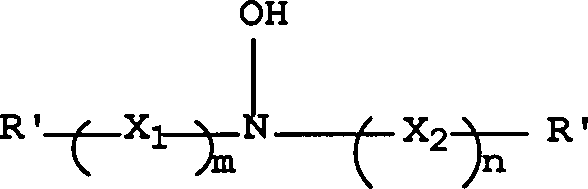
X2 für
-CHR1C(OH)R2-, R1 und R2 jeweils
unabhängig
für Wasserstoff,
eine Alkylgruppe oder eine Hydroxyalkylgruppe stehen oder R1 und R2 zusammen
die Kohlenstoffatome darstellen, die notwendig sind, um einen 5- bis
8-gliedrigen carbozyklischen Ring zu bilden, und worin m und n jeweils
für 1 stehen,The aforementioned problems are solved by a process for the preparation of an antioxidant having the following structure I:
X 2 is -CHR 1 C (OH) R 2 -, R 1 and R 2 are each independently hydrogen, an alkyl group or a hydroxyalkyl group, or R 1 and R 2 together represent the carbon atoms necessary to form a 5- to To form an 8-membered carbocyclic ring, and wherein m and n are each 1,
Hinzufügen eines
Epoxids mit folgender Struktur II: 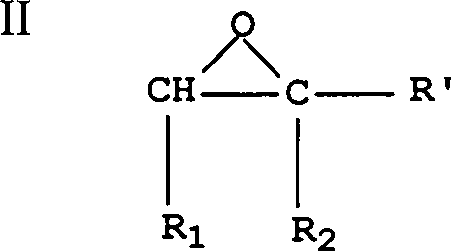
zu einer
wässrigen
Lösung
von Hydroxylamin oder einem monosubstituierten Hydroxylamin in freier
Basenform mit einer Menge derart, dass die Reaktionstemperatur der
Reaktionslösung
bei mindestens 50°C
bleibt und dass das Molverhältnis
der Gesamtmenge des Epoxids, das dem Hydroxylamin oder dem monosubstituierten
Hydroxylamin zugesetzt wird, zwischen 2:1 und 2:1,2 beträgt.Addition of an epoxide with the following structure II:
to an aqueous solution of hydroxylamine or a monosubstituted hydroxylamine in free base form with an amount such that the reaction temperature of the reaction solution remains at least 50 ° C and the molar ratio of the total amount of the epoxide added to the hydroxylamine or monosubstituted hydroxylamine is between 2 : 1 and 2: 1.2.
Die vorliegende Erfindung stellt zudem die aus dem genannten Produktionsverfahren resultierende wässrige Reaktionslösung bereit und eine gebrauchsfertige Farbentwicklungslösung mit einem fotografischen Farbentwicklungsmittel sowie eine Reaktionlösung eines Hydroxylamin-Antioxidationsmittels, das wie zuvor beschrieben herstellbar ist.The The present invention further provides those of said production process resulting aqueous reaction solution ready and ready to use color development solution with a photographic color developing agent and a reaction solution of a Hydroxylamine antioxidant, which can be prepared as described above is.
Die vorliegende Erfindung stellt zudem ein Verfahren zur Herstellung einer fotografischen Farbentwicklungszusammensetzung bereit, das folgende Schritte umfasst:
- A) Herstellen des substituierten Hydroxylamin-Antioxidationsmittels in einer Reaktionslösung, wie zuvor beschrieben, und
- B) Mischen des Hydroxylamin-Antioxidationsmittels mit einem fotografischen Farbentwicklungsmittel, ohne das Hydroxylamin-Antioxidationsmittel von der Reaktionslösung zu trennen.
- A) preparing the substituted hydroxylamine antioxidant in a reaction solution as described above, and
- B) mixing the hydroxylamine antioxidant with a photographic color developing agent without separating the hydroxylamine antioxidant from the reaction solution.
Zudem umfasst das Verfahren zur fotografischen Verarbeitung die Behandlung eines bildweise belichteten, farbfotografischen Silberhalogenidelements mit der zuvor beschriebenen Farbentwicklungszusammensetzung.moreover For example, the photographic processing method comprises the treatment an imagewise exposed color photographic silver halide element with the color developing composition described above.
Die vorliegende Erfindung stellt eine gebrauchsfähige Farbentwicklungszusammensetzung bereit, die aufgrund des Vorhandenseins eines geeigneten, hydroxysubstituierten Hydroxylamins als Antioxidationsmittel gegen Flächenoxidation stabil ist. Zudem ist dieses Antioxidationsmittel sehr gut wasserlöslich, was den unangenehmen Geruch reduziert, der ansonsten auftreten könnte. Die Lösungsgruppen werden dem Hydroxylaminausgangsmaterial in einem schnellen und einfachen synthetischen Verfahren unter Verwendung eines Epoxids als Co-Reaktionsmittel zugesetzt. Die resultierende Reaktionslösung enthält weniger Nebenprodukte und lässt sich mit einem Farbentwicklungsmittel mischen, ohne dass das Antioxidationsmittel aus seiner Reaktionslösung isoliert werden muss. Wegen der geringeren Anzahl von Nebenprodukten kann die Reaktionslösung mit Titrier- und Chromatographieverfahren leichter auf das Produkt analysiert werden.The The present invention provides a useful color developing composition ready due to the presence of a suitable, hydroxy-substituted Hydroxylamine is stable as an antioxidant against surface oxidation. moreover This antioxidant is very soluble in water, which makes the unpleasant Reduces odor that might otherwise occur. The solution groups become the hydroxylamine starting material in a quick and easy synthetic procedure using an epoxide as a co-reactant added. The resulting reaction solution contains fewer by-products and settles mix with a color developing agent without the antioxidant from his reaction solution must be isolated. Because of the smaller number of by-products can the reaction solution with titration and chromatography easier on the product to be analyzed.
Die zuvor beschriebenen Vorteile werden durch Verwendung einer freien Basenform des Hydroxylamins (oder des monosubstituierten Derivats) in der Reaktion statt des üblicheren Hydroxylaminsalzes (wie z.B. ein Hydroxylaminsulfat) erzielt. Das Epoxid wird zudem einer wässrigen Reaktionslösung in einer Menge zugesetzt, die ausreicht, um aufgrund der exo thermen Wärmeentwicklung aus der Reaktion eine höhere Reaktionstemperatur zu wahren. Die Gesamtmenge der Reaktionsmittel wird derart gesteuert, dass die höchste Stabilität bei einer Reduzierung der Nebenprodukte erzielt wird, so dass das Molverhältnis des Epoxids zum Hydroxylaminreaktionsmittel zwischen 2:1 und 2:1,2 beträgt.The Advantages described above are made by using a free one Base Form of Hydroxylamine (or Monosubstituted Derivative) in the reaction instead of the more usual Hydroxylamine salt (such as a hydroxylamine sulfate). The Epoxide also becomes an aqueous reaction solution added in an amount sufficient to thermo due to the exo heat generation from the reaction a higher one Maintain reaction temperature. The total amount of reagents is controlled such that the highest stability at a Reduction of by - products is achieved, so that the molar ratio of the Epoxide to Hydroxylaminreaktionsmittel between 2: 1 and 2: 1.2.
Die Erfindung wird im folgenden anhand in der Zeichnung dargestellter Ausführungsbeispiele näher erläutert.The Invention will be described below with reference to the drawing embodiments explained in more detail.
Es zeigenIt demonstrate
Wie zuvor erwähnt, werden die erfindungsgemäßen Farbentwicklungszusammensetzungen durch Mischen eines fotografischen Farbentwicklungsmittels mit einem hydroxysubstituierten Hydroxylamin-Antioxidationsmittel hergestellt, wie nachfolgend beschrieben wird. Im Allgemeinen wird das Antioxidationsmittel aus den Reaktionsteilnehmern in einer Reaktionslösung hergestellt und in dieser Reaktionslösung ohne Trennung verwendet. Auf diese Weise wurde das Antioxidationsmittel in situ hergestellt, und brauchte in keiner Weise vor der Verwendung von der Reaktionslösung getrennt zu werden. Es ist allerdings nicht notwendig, dass die die Reaktionsteilnehmer enthaltende Reaktionslösung auf Anhieb verwendet wird. Statt dessen kann sie zur späteren Verwendung gelagert oder zunächst mit dem Farbentwicklungsmittel gemischt und zur späteren Verwendung gelagert werden. Unter "Trennung" ist ein physikalisches oder chemisches Mittel zu verstehen, um das Produkt der hydroxysubstituierten Hydroxylaminreaktion vor der Verwendung mit dem Farbentwicklungsmittel aus der Reak tionslösung zu entfernen. Diese kosten- und zeitaufwändigen Trennschritte werden durch die praktische Verwertung der vorliegenden Erfindung vermieden.As previously mentioned, are the color development compositions of the invention by mixing a photographic color developing agent with a hydroxy-substituted hydroxylamine antioxidant, as described below. In general, the antioxidant prepared from the reactants in a reaction solution and in this reaction solution used without separation. In this way became the antioxidant made in situ, and in no way needed before use from the reaction solution to be disconnected. However, it is not necessary that the Reactant-containing reaction solution is used immediately. Instead, it can be for later Use stored or initially mixed with the color developing agent and for later use be stored. Under "separation" is a physical or chemical agent to understand the product of the hydroxy-substituted Hydroxylamine reaction before use with the color developing agent from the reaction solution to remove. These costly and time consuming separation steps become avoided by the practice of the present invention.
Die Farbentwicklungszusammensetzung als eine Mischung aus Antioxidationsmittel und Farbentwicklungsmittel (und anderen geeigneten Komponenten) lässt sich entweder als arbeitsfertiges fotografisches Bad oder als Regenerator verwenden oder in konzentrierter Form formulieren.The Color developing composition as a mixture of antioxidant and color developing agents (and other suitable components) let yourself either as a work-ready photographic bath or as a regenerator use or formulate in concentrated form.
Monosubstituierte Hydroxylamine, die als ein Reaktionsmittel in der praktischen Verwertung der vorliegenden Erfindung verwendbar sind, lassen sich im Allgemeinen als "Hydroxylamine" definieren, die einen monovalenten aliphatischen oder aromatischen Substituenten aufweisen, der mit dem Stickstoffatom verbunden ist. Derartige Substituenten enthalten monovalente Acryl- oder zyklische Kohlenwasserstoffgruppen, aromatische carbozyklische Gruppen sowie monovalente heterozyklische Gruppen. Monosubstituierte Hydroxylamine werden beispielsweise in US-A-5,091,292, US-A-5,094,937 und US-A-5,100, 765 beschrieben.monosubstituted Hydroxylamines, which act as a reagent in practical recycling can be used in the present invention, in general define as "hydroxylamines" which a monovalent aliphatic or aromatic substituent which is linked to the nitrogen atom. Such substituents contain monovalent acrylic or cyclic hydrocarbon groups, aromatic carbocyclic groups as well as monovalent heterocyclic Groups. Monosubstituted hydroxylamines are for example in US-A-5,091,292, US-A-5,094,937 and US-A-5,100,765.
Geeignete Hydroxylamine lassen sich beispielsweise als R''N(OH)H definieren, wobei R" für Wasserstoff, eine substituierte oder unsubstituierte Alkylgruppe aus 1 bis 10 Kohlenstoffatomen (wie Methyl, Ethyl, Propyl, Isopropyl, Hydroxymethyl, 2-Hydroxyethyl, Pentyl, t-Butyl, Benzyl und Octyl), eine substituierte oder unsubstituierte Cycloalkylgruppe aus 5 bis 10 Kohlenstoffatomen (wie Cyclopentyl, Cyclohexyl, 4-Methyl-Cyclohexyl und Cyclooctyl) oder substituierte oder unsubstituierte Arylgruppe aus 6 bis 10 Kohlenstoffatomen (wie Phenyl, Naphthyl, Xylyl, 4-Hydroxyphenyl und Tolyl) steht. Andere substituierte Alkyl-, Cycloalkyl- und Arylgruppen werden Fachleuten selbstverständlich bekannt sein. Vorzugsweise steht R'' für Wasserstoff oder Alkylgruppe mit 1 bis 4 Kohlenstoffatomen. Am besten steht R'' für Wasserstoff.suitable Hydroxylamines can be, for example, as R''N (OH) H define, where R "is hydrogen, a substituted or unsubstituted alkyl group from 1 to 10 Carbon atoms (such as methyl, ethyl, propyl, isopropyl, hydroxymethyl, 2-hydroxyethyl, pentyl, t-butyl, benzyl and octyl), a substituted or unsubstituted cycloalkyl group of 5 to 10 carbon atoms (such as cyclopentyl, cyclohexyl, 4-methyl-cyclohexyl and cyclooctyl) or substituted or unsubstituted aryl group from 6 to 10 Carbon atoms (such as phenyl, naphthyl, xylyl, 4-hydroxyphenyl and tolyl). Other substituted alkyl, cycloalkyl and aryl groups become professionals of course be known. Preferably, R "is hydrogen or alkyl group of 1 to 4 carbon atoms. It is best R '' for hydrogen.
Besonders geeignete, monosubstituierte Hydroxylamine umfassen beispielsweise, aber nicht abschließend, N-Methylhydroxylamin, N-Isopropylhydroxylamin und N-Ethylhydroxylamin.Especially suitable monosubstituted hydroxylamines include, for example, but not conclusive, N-methylhydroxylamine, N-isopropylhydroxylamine and N-ethylhydroxylamine.
Für die Verwendung in der Erfindung müssen Hydroxylamin- oder die monosubstituierten Derivate in freier Basenform vorliegen, was bedeutet, dass sie nicht als saure Salze vorhanden sind, wie beispielsweise Sulfate oder Hydrochloride. Zur Verwendung in der vorliegenden Erfindung sind also keine Hydroxylaminsalze vorgesehen, und es brauchen der Reaktionsmischung keine chemischen Basen zugesetzt zu werden, um die Reaktionssalze zu neutralisieren.For the use in the invention Hydroxylamine or monosubstituted derivatives in free base form which means that they are not present as acid salts, such as sulfates or hydrochlorides. For use in The present invention thus provides no hydroxylamine salts, and no chemical bases need be added to the reaction mixture to neutralize the reaction salts.
Das zuvor beschriebene Hydroxylamine oder die monosubstituierten Hydroxylamine werden also unter geeigneten Bedingungen (siehe unten) mit mono-, di-, tri- oder tetrasubstituiertem Epoxid reagiert, d.h. Epoxide mit einem bis vier Substituenten auf den beiden Kohlenstoffatomen im Epoxidring. Derartige Substituenten beinhalten die zuvor in der Definition der Hydroxylamine beschriebenen.The previously described hydroxylamines or the monosubstituted hydroxylamines Thus, under suitable conditions (see below) with mono-, di-, tri- or tetrasubstituted epoxide reacts, i. epoxides with one to four substituents on the two carbon atoms in the epoxy ring. Such substituents include those previously described in U.S. Pat Definition of hydroxylamines described.
Insbesondere
lassen sich diese Epoxide so definieren, dass sie folgende Struktur
(II) aufweisen: 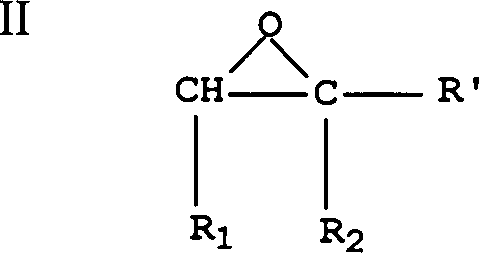
R' kann zudem eine substituierte oder unsubstituierte Haloalkylgruppe aus 1 bis 10 Kohlenstoffatomen sein (wie die zuvor beschriebenen Alkylgruppen, bei denen ein oder mehrere Wasserstoffatome durch ein oder mehrere Haloatome ersetzt sind). Die Haloalkylgruppe kann einen oder mehrere Halosubstituenten aufweisen, die aus Chlor und Brom auswählbar sind. Vorzugsweise weist die Haloalkylgruppe 1 bis 3 Kohlenstoffatome und einen oder zwei Chlorsubstituenten und am besten eine einzelne Chlorgruppe auf. In dieser Kategorie von R' Gruppen ist dies vorzugsweise Chlormethyl oder 2-Chlorethyl.R 'can also have a substituted or unsubstituted haloalkyl group from 1 to 10 Carbon atoms (such as the previously described alkyl groups, in which one or more hydrogen atoms are replaced by one or more Halo atoms are replaced). The haloalkyl group may be one or more Have halo substituents selectable from chlorine and bromine. Preferably, the haloalkyl group has 1 to 3 carbon atoms and one or two chloro substituents, and most preferably a single chloro group on. In this category of R 'groups this is preferably chloromethyl or 2-chloroethyl.
R' kann zudem eine substituierte oder unsubstituierte Hydroxyalkylgruppe von 1 bis 10 Kohlenstoffatomen sein (wie Hydroxymethyl, 2-Hydroxyethyl, 1-Hydroxyethyl, 2-Hydroxypropyl, 2,3-Dihydroxypropyl, 1-Hydroxyoctyl und 1,3-Dihydroxydecyl). Mit "Hydroxyalkylgruppe" ist eine Alkylgruppe gemeint, bei der die genannten Kohlenstoffatome durch eine oder mehrere Hydroxygruppen an einer beliebigen Stelle des Moleküls substituiert sind, an der dies technisch möglich ist, und wahlweise durch einen oder mehrere Substituenten, wie zuvor für die "Alkylgruppe" beschrieben. Vorzugsweise ist in diesem Ausführungsbeispiel R' eine unsubstituierte Hydroxyalkylgruppe aus 1 bis 3 Kohlenstoffatomen mit nur einer Hydroxylgruppe und vorzugsweise ist dies Hydroxymethyl.R 'can also have a substituted or unsubstituted hydroxyalkyl group of 1 to 10 carbon atoms (such as hydroxymethyl, 2-hydroxyethyl, 1-hydroxyethyl, 2-hydroxypropyl, 2,3-dihydroxypropyl, 1-hydroxyoctyl and 1,3-dihydroxydecyl). By "hydroxyalkyl group" is an alkyl group meaning, in which the carbon atoms mentioned by one or substituted multiple hydroxy groups at any point in the molecule are where this is technically possible is, and optionally by one or more substituents, as before for the "alkyl group" described. Preferably is in this embodiment R 'is an unsubstituted one Hydroxyalkyl group of 1 to 3 carbon atoms with only one hydroxyl group and preferably, this is hydroxymethyl.
In der oben genannten Formel II kann R' zudem für eine Arylgruppe mit 6 bis 10 Kohlenstoffatomen in der Ringstruktur stehen (wie Phenyl, Xylyl, Tolyl, Naphthyl und 4-Hydroxyphenyl). Mit "Arylgruppe" ist eine substituierte oder unsubstituierte Naphthylgruppe gemeint oder eine dieser Gruppen, bei denen eine oder mehrere Alkylgruppen (wie zuvor definiert) oder Hydroxygruppen an einer beliebigen Position des Rings stehen, die nicht mit den Reaktionseigenschaften oder der Löslichkeit des Epoxids kollidieren. Die Arylgruppe kann zudem einen Phenylring mit nicht aromatischen ankondensierten carbozyklischen oder heterozyklischen Ringstrukturen umfassen. Wenn R' für eine Arylgruppe steht, ist dies vorzugsweise eine substituierte oder unsubstituierte Phenylgruppe und am besten Phenyl.In of the above-mentioned formula II, R 'may additionally be an aryl group having 6 to 10 carbon atoms in the ring structure (such as phenyl, xylyl, Tolyl, naphthyl and 4-hydroxyphenyl). By "aryl group" is a substituted or unsubstituted one Naphthyl group meant or one of these groups in which a or more alkyl groups (as defined above) or hydroxy groups stand in any position of the ring that does not match the Reaction properties or the solubility of the epoxide collide. The aryl group can also be a phenyl ring with non-aromatic fused carbocyclic or heterocyclic ring structures include. When R 'is an aryl group This is preferably a substituted or unsubstituted phenyl group and preferably phenyl.
R' kann zudem eine Cycloalkylgruppe mit 5 bis 10 Kohlenstoffatomen in der Ringstruktur sein (wie Cyclopentyl, Cyclohexyl, 4-Methylcyclohexyl und 3-Hydroxycyclohexyl). Unter "Cycloalkylgruppe" ist ein unsubstituiertes Cycloalkyl mit den erforderlichen Kohlenstoffatomen zu verstehen, sowie Cycloalkylringe, die mit einem oder mehreren Alkylguppen (wie zuvor definiert) oder Hydroxylgruppen substituiert sind. Als Cycloalkylgruppe steht R' vorzugsweise für Cyclohexyl.R 'can also have a Cycloalkyl group having 5 to 10 carbon atoms in the ring structure (such as cyclopentyl, cyclohexyl, 4-methylcyclohexyl and 3-hydroxycyclohexyl). By "cycloalkyl group" is an unsubstituted To understand cycloalkyl with the required carbon atoms, and cycloalkyl rings containing one or more alkyl groups (such as previously defined) or hydroxyl groups are substituted. As the cycloalkyl group R 'is preferably for cyclohexyl.
R1 und R2 stehen unabhängig voneinander für eine substituierte oder unsubstituierte Alkylgruppe aus 1 bis 2 Kohlenstoffatomen (d.h. eine Methyl- oder Ethylgruppe, die, wie beschrieben, an die Stelle einer "Alkylgruppe" treten kann), oder für eine substituierte oder unsubstituierte Hydroxyalkylgruppe aus 1 bis 2 Kohlenstoffatomen (d.h. Methyl oder Ethyl mit einem oder mehreren Hydroxysubstituenten).R 1 and R 2 independently represent a substituted or unsubstituted alkyl group of 1 to 2 carbon atoms (ie, a methyl or ethyl group which may be substituted for an "alkyl group" as described), or a substituted or unsubstituted hydroxyalkyl group from 1 to 2 carbon atoms (ie, methyl or ethyl with one or more hydroxy substituents).
Alternativ hierzu können R1 und R2 zusammen für die Kohlenstoffatome stehen, die notwendig sind, um eine 5- bis 8-gliedrige gesättigte oder teilgesättigte, carbozyklische Ringstruktur zu bilden (aus einem oder mehreren kondensierten Ringen), die durch eine oder mehrere Alkylgruppen von 1 bis 3 Kohlenstoffatomen (wie zuvor definiert) oder durch einen oder mehrere Hydroxyalkylgruppen aus 1 bis 3 Kohlenstoffatomen (wie zuvor definiert) substituierbar sind. Unter "teilgesättigt" sind Ringstrukturen zu verstehen, die mindestens eine Doppelbindung enthalten, wobei die Ringstruktur aber nicht aromatisch ist.Alternatively, R 1 and R 2 may together represent the carbon atoms necessary to form a 5- to 8-membered saturated or partially saturated carbocyclic ring structure (from one or more fused rings) represented by one or more alkyl groups of 1 to 3 carbon atoms (as defined above) or by one or more hydroxyalkyl groups of 1 to 3 carbon atoms (as defined above) are substitutable. By "partially saturated" are meant ring structures containing at least one double bond, but the ring structure is not aromatic.
Besonders geeignete Epoxide zur praktischen Verwertung der vorliegenden Erfindung sind u.a. folgende Verbindungen: Glycidol, Ethylenoxid, Propylenoxid, 2-Methyl-2,3-Epoxy-1-Propanol, 4-Phenyl-2,3-Epoxy-1-Butanol, 1,4-Butandioldiglycidylether, Epichlorhydrin und 1,2,7,8-Diepoxyoctan. Glycidol wird am meisten bevorzugt.Particularly suitable epoxides for the practical use of the present invention include the following compounds: glycidol, ethylene oxide, propylene oxide, 2-methyl-2,3-epoxy-1-propanol, 4-phenyl-2,3-epoxy-1-butanol, 1, 4-butanediol diglycidyl ether, epichlorohydrin and 1,2,7,8-diepoxyoctane. Glycidol is most of the time preferred.
Die zur praktischen Verwertung der vorliegenden Erfindung geeigneten Hydroxylamin-Antioxidationsmittel werden mithilfe der folgenden allgemeinen Verfahren und Bedingungen hergestellt.The suitable for the practical use of the present invention Hydroxylamine antioxidants are made using the following general methods and conditions.
Eines oder mehrere Hydroxylamine (in freier Basenform), wie zuvor definiert, werden in einer wässrigen Lösung bereitgestellt. Die Konzentration in der Lösung kann variieren, beträgt im Allgemeinen aber bis zu 17 Mol/l und typischerweise von 1 bis 5 Mol/l. Ein oder mehrere Epoxide, wie zuvor definiert, werden dann der Lösung zur Reaktion zugesetzt. Die Reaktionsgeschwindigkeit wird derart gesteuert, dass die Reaktion so schnell wie möglich erfolgt, aber langsam genug ist, um die erwartete exotherme Wärmeentwicklung zu steuern und ein Rücklaufen zu verhindern. Im Allgemeinen werden die Epoxide zur Reaktionslösung mit mindestens 0,1 Mol%/Min und vorzugsweise mit 0,1 bis 4 Mol%/min zugegeben. Die Zugabemenge kann somit erheblich je nach Reaktionsgeschwindigkeit eines bestimmten Satzes von Reaktionsteilnehmern, der gewünschten Reaktionstemperatur und dem gewünschten Ertrag variieren. Die Angabe "Mol%/min" bezieht sich auf die gesamte Stoffmenge von Epoxid zur Verwendung in der Reaktion. Epoxidzugaben können kontinuierlich oder intermittie rend erfolgen, je nach verwendeten Geräten und Reaktionsmitteln und der Fähigkeit des Bedieners, die Reaktionstemperatur zu steuern.One or more hydroxylamines (in free base form), as defined above, be in an aqueous solution provided. The concentration in the solution can vary, is generally but up to 17 mol / l and typically from 1 to 5 mol / l. One or several epoxides, as defined above, are then added to the solution Reaction added. The reaction rate is controlled in such a way that the reaction is as fast as possible, but slowly is enough to control the expected exothermic heat evolution and a return to prevent. In general, the epoxides with the reaction solution at least 0.1 mol% / min, and preferably at 0.1 to 4 mol% / min added. The amount added can thus be considerably depending on the reaction rate a particular set of reactants, the desired Reaction temperature and the desired Yield vary. The indication "mol% / min" refers to the total amount of epoxide for use in the reaction. Epoxide additions can continuous or intermittent, depending on the used devices and reactants and the ability the operator to control the reaction temperature.
Die Reaktion beginnt sofort bei Zugabe von Epoxid und kann sich über dessen Zugabe hinaus fortsetzen. Der Zeitpunkt der Reaktion ist von vielen Faktoren abhängig, u.a. den Reaktionsmitteln, der Reaktionstemperatur, dem gewünschten Ertrag und der Art der Epoxidzugabe. Im Allgemeinen wird die Reaktion in möglichst so kurzer Zeit durchgeführt, wie das unter den gegebenen Umständen sinnvoll ist. Vorzugsweise wird die Reaktion innerhalb von 8 Stunden abgeschlossen (und am besten innerhalb von 4 Stunden). Die Lösung kann jederzeit während der Reaktion in geeigneter Weise umgerührt werden.The Reaction begins immediately upon addition of epoxide and can increase over its Continue addition. The timing of the reaction is many Factors dependent, et al the reactants, the reaction temperature, the desired Yield and the type of epoxide addition. In general, the reaction becomes in as possible carried out so quickly like that under the given circumstances makes sense. Preferably, the reaction is within 8 hours completed (and best within 4 hours). The solution can be anytime while the reaction are stirred in a suitable manner.
Die Reaktion kann bei jeder geeigneten Temperatur durchgeführt werden, wobei niedrigere Reaktionstemperaturen zu einer impraktikabel langsamen Reaktion (ihren. Die Reaktionstemperatur wird daher im Allgemeinen bei mindestens 50°C gehalten und beträgt vorzugsweise zwischen 70 und 95°C. Eine höhere Reaktionstemperatur ermöglicht eine schnellere Reaktion und kann durch die exotherme Wärmeentwicklung der Reaktion oder unter Verwendung einer externen Wärmezufuhr bereitgestellt werden. Die Reaktion kann also bei deutlich niedrigerer Temperatur beginnen, während die exotherme Wärmeentwicklung einen Anstieg der Temperatur der Reaktionsmischung auf den gewünschten Wert bewirkt. Alternativ hierzu kann die Reaktionslösung auf die gewünschte Reaktionstemperatur vor Zugabe des Epoxids oder der Epoxide vorgewärmt werden.The Reaction can be carried out at any suitable temperature lower reaction temperatures being impractically slow Reaction (their reaction temperature is therefore generally at least 50 ° C held and amounts preferably between 70 and 95 ° C. A higher one Reaction temperature allows a faster reaction and can be due to the exothermic evolution of heat the reaction or using an external heat to be provided. The reaction can be at significantly lower Temperature start while the exothermic evolution of heat an increase in the temperature of the reaction mixture to the desired Value causes. Alternatively, the reaction solution may the desired Reaction temperature to be preheated before the addition of the epoxide or epoxides.
Die das Antioxidans-Reaktionsprodukt enthaltende Reaktionslösung ist zur Zubereitung von Farbentwicklungszusammensetzungen ohne Trennung oder Isolierung verwendbar, oder sie kann verdünnt oder zur Lagerung konzentriert und später verwendet werden.The is the reaction solution containing the antioxidant reaction product for the preparation of color development compositions without separation or isolation, or it may be diluted or concentrated for storage and later be used.
Die zur Herstellung des Antioxidans verwendeten Reaktionsmittel können aus einer Anzahl kommerzieller Quellen bezogen werden, beispielsweise, aber nicht abschließend, von Nissin Chemical Company, Dixie Chemical Company, Angus Chemicals, BASF und Aldrich Chemical Company. Alternativ hierzu wäre es für einen Fachmann nicht schwierig, die genannten Epoxide oder monosubstituierten Hydroxylamine anhand bekannter Verfahren und leicht zugänglicher Ausgangsmaterialien herzustellen.The Reactants used to prepare the antioxidant may be a number of commercial sources, for example, but not conclusive, from Nissin Chemical Company, Dixie Chemical Company, Angus Chemicals, BASF and Aldrich Chemical Company. Alternatively, it would be for one It is not difficult for a person skilled in the art to cite the abovementioned epoxides or monosubstituted ones Hydroxylamines by known methods and readily available Produce starting materials.
Die
resultierenden Hydroxylamin-Antioxidantien lassen sich durch folgende
Struktur (I) definieren: 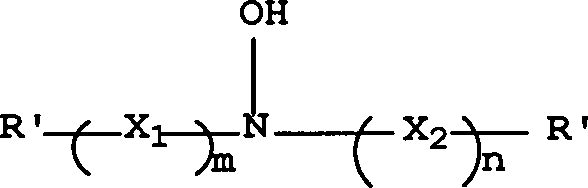
Die in der vorliegenden Erfindung hergestellten und darin verwendbaren disubstituierten Hydroxylamin-Antioxidantien umfassen beispielsweise, aber nicht abschließend: N,N-Bis(2,3-Dihydroxypropyl)-Hydroxylamin, N,N-Bis(2-Methyl-2,3-Dihydroxypropyl)hydroxylamin und N,N-Bis(1-Hydroxymethyl-2-Hydroxy-3-Phenylpropyl)hydroxylamin. Die erste Verbindung ist die bevorzugte.The in the present invention and usable therein Disubstituted hydroxylamine antioxidants include, for example, but not conclusive: N, N-bis (2,3-dihydroxypropyl) hydroxylamine, N, N-bis (2-methyl-2,3-dihydroxypropyl) hydroxylamine and N, N-bis (1-hydroxymethyl-2-hydroxy-3-phenylpropyl) hydroxylamine. The first connection is the preferred one.
Mehr als ein Antioxidans kann gleichzeitig hergestellt und in die erfindungsgemäßen Farbentwicklungszusammensetzungen eingebracht werden, indem die entsprechenden mehrfachen Epoxide und monosubstituierten Hydroxylamine in der Reaktionslösung zur Reaktion gebracht werden. Vorzugsweise wird allerdings nur ein Antioxidans hergestellt und für jede Farbentwicklungszusammensetzung verwendet.More than one antioxidant may be simultaneously produced and incorporated into the color development compositions of the invention by reacting the corresponding multiple epoxides and mono Substituted hydroxylamine be reacted in the reaction solution. Preferably, however, only one antioxidant is prepared and used for each color developing composition.
Die erfindungsgemäßen Farbentwicklungszusammensetzungen umfassen ein oder mehrere Farbentwicklungsmittel, von denen es wiederum hunderte von Möglichkeiten gibt. Verwendbare Klassen dieser Materialien beinhalten beispielsweise, aber nicht abschließend, Ainophenole, p-Phenylendiamine (insbesondere N,N-Dialkyl p-Phenylendiamine) sowie andere in der Technik bekannte Stoffe. Weitere Angaben zu diesen Materialien sind in Research Disclosure, Publikation 38957, Seite 592-639 (September 1996) und den darin genannten Quellen aufgeführt. Research Disclosure ist eine Publikation von Kenneth Mason Publications Ltd., Dudley House, 12 North Street, Emsworth, Hampshire PO10 7DQ, England (auch von Emsworth Design Inc., 121 West 19th Street, New York, N.Y. 10011, USA zu beziehen). Diese Quellen werden im Folgenden als Forschungsveröffentlichung "Research Disclosure" bezeichnet.The Color development compositions according to the invention include one or more color developing agents, of which in turn hundreds of possibilities gives. Usable classes of these materials include, for example, but not conclusive, Ainophenols, p-phenylenediamines (especially N, N-dialkyl-p-phenylenediamines) as well as other substances known in the art. Further information to These materials are described in Research Disclosure, Publication 38957, Pages 592-639 (September 1996) and the sources cited therein. Research Disclosure is a publication by Kenneth Mason Publications Ltd., Dudley House, 12 North Street, Emsworth, Hampshire PO10 7DQ, England (also from Emsworth Design Inc., 121 West 19th Street, New York, N.Y. 10011 USA). These sources are referred to below as the research publication "Research Disclosure".
Besonders geeignete Farbentwicklungsmittel umfassen beispielsweise, aber nicht abschließend, N,N-Diethyl p-Phenylenediaminsulfat (KODAK Farbentwicklungsmittel CD-2), 4-Amino-3-Methyl-N-(2-Methansulfonamidoethyl)anilinsulfat, 4-(N-Ethyl-N-β-Hydroxyethylamin)-2-Methylanilinsulfat (KODAK Farbentwicklungsmittel CD-4), p-Hydroxyethylethylaminoanilinsulfat, 4-(N-Ethyl-N-2-Methansulfonylaminoethyl)-2-Methylphenylenediaminsesquisulfat oder 4-Amin-3-Methyl-N-Ethyl-N-(β-Methansulfonamidoethyl)anilin (KODAK Farbentwicklungsmittel CD-3), 4-(N-Ethyl-N-2-Methansulfonylaminoethyl)-2-Methylphenylenediaminsesquisulfat sowie weitere, wie Technikern bekannt sein wird. Das KODAK Farbentwicklungsmittel CD-3 wird zur praktischen Verwertung der vorliegenden Erfindung bevorzugt.Especially suitable color developing agents include, but are not limited to, for example in conclusion, N, N-diethyl p-phenylenediamine sulfate (KODAK color developing agent CD-2), 4-amino-3-methyl-N- (2-methanesulfonamidoethyl) aniline sulfate, 4- (N-ethyl-N-β-hydroxyethylamine) -2-methylaniline sulfate (KODAK Color Developer CD-4), p-hydroxyethyl ethyl amino aniline sulfate, 4- (N-ethyl N-2-methanesulfonylaminoethyl) -2-Methylphenylenediaminsesquisulfat or 4-amine-3-methyl-N-ethyl-N- (β-methanesulfonamidoethyl) aniline (KODAK color developing agent CD-3), 4- (N-ethyl-N-2-methanesulfonylaminoethyl) -2-methylphenylenediamine sesquisulfate as well as others, as will be known to technicians. The KODAK Color Developer CD-3 will become a practical use of the present invention prefers.
Die Farbentwicklungszusammensetzung lässt sich leicht durch Mischen eines geeigneten Farbentwicklungsmittels (in einer geeigneten Lösung) mit einem Teil der originalen Reaktionslösung (verdünnt oder konzentriert) herstellen, die das zuvor beschriebene Antioxidationsmittel enthält. Der resultierenden Zusammensetzung kann Wasser zugesetzt werden, um die gewünschten Konzentrationen zu erhalten, und der pH-Wert kann mit einer geeigneten chemischen Base (wie Natriumhydroxid) auf den gewünschten Wert eingestellt werden.The Color developing composition is easy to mix a suitable color developing agent (in a suitable solution) with make a part of the original reaction solution (diluted or concentrated), containing the antioxidant described above. Of the Water may be added to the resulting composition the desired To obtain concentrations, and the pH can be adjusted with a suitable chemical base (such as sodium hydroxide) to the desired Value to be set.
Die Mengen des Hydroxylamin-Antioxidationsmittels und des Farbentwicklungsmittels, die in der erfindungsgemäßen Farbentwicklungszusammensetzung im Allgemeinen und vorzugsweise vorhanden sind, werden in der folgenden Tabelle aufgeführt. Diese Bereichsangaben sind ungefähre Angaben. Im Allgemeinen kann das Stoffmengenverhältnis (Molverhältnis) von Antioxidationsmittel zu Farbentwicklungsmittel stark schwanken, liegt aber vorzugsweise im Bereich von 0,1:1 bis 4:1.The Amounts of the hydroxylamine antioxidant and the color developing agent, those in the color development composition of the invention are generally and preferably present, in the following Table listed. These ranges are approximate Information. In general, the molar ratio (molar ratio) of Antioxidants vary widely to color developing agents, but is preferably in the range of 0.1: 1 to 4: 1.

Die erfindungsgemäße Farbentwicklungszusammensetzung kann zudem einen oder mehrere weiterer Zusätze enthalten, die in derartigen Zusammensetzungen üblich sind, wie beispielsweise Alkalimetallhalogenide (wie z.B. Kaliumchlorid, Kaliumbromid, Natriumbromid und Natriumiodid), Metallmaskierungsmittel (wie Aminopolycarboxylsäuren), Puffer zur Einstellung des pH-Werts auf 9 bis 13 (vorzugsweise auf 9 bis 11), wie Carbonate, Phosphate und Borate, Sulfate, Entwicklungsbeschleuniger, Duftstoffe, optische Aufheller, Netzmittel, Surfactants und wasserlösliche oder wasserdispergierbare Kuppler, wie einschlägigen Fachleuten bekannt ist (siehe beispielsweise oben genannte Forschungsveröffentlichung "Research Disclosure"). Die Mengen dieser Additive sind in der Technik bekannt.The Color development composition of the invention may also contain one or more other additives included in such Compositions usual such as alkali metal halides (such as potassium chloride, Potassium bromide, sodium bromide and sodium iodide), metal sequestering agents (such as aminopolycarboxylic acids), Buffer for adjusting the pH to 9 to 13 (preferably to 9 to 11), such as carbonates, phosphates and borates, sulfates, development accelerators, Fragrances, optical brighteners, wetting agents, surfactants and water-soluble or water-dispersible couplers as known to those skilled in the art (See, for example, the above-mentioned research publication "Research Disclosure"). The quantities of these Additives are known in the art.
Eine weitere geeignete Komponente der Farbentwicklungszusammensetzung, insbesondere bei Formulierung in konzentrierter Form, ist ein fotografisch inaktives, wassermischbares oder wasserlösliches, geradkettiges organisches Lösemittel, das Farbentwicklungsmittel in ihrer freien Basenform zu lösen vermag. Derartige organische Lösemittel sind einzeln oder in Kombination verwendbar, wobei jedes vorzugsweise eine Molmasse von mindestens 50 aufweist und vorzugsweise von mindestens 100 und im Allgemeinen von 200 oder weniger und vorzugsweise von 150 oder weniger. Derartige bevorzugte Lösemittel weisen im Allgemeinen 2 bis 10 Kohlenstoffatome auf (vorzugsweise 2 bis 6 Kohlenstoffatome und vorzugsweise 4 bis 6 Kohlenstoffatome) und können zudem mindestens zwei Stickstoff- oder Sauerstoffatome oder mindestens ein jeweiliges Heteroatom enthalten. Die organischen Lösemittel sind durch mindestens eine hydroxyfunktionale Gruppe und vorzugsweise durch mindestens zwei derartiger Gruppen substituiert. Dabei handelt es sich um geradkettige Moleküle, nicht um zyklische Moleküle.Another suitable component of the color developing composition, especially when formulated in concentrated form, is a photographically inactive, water miscible or water soluble, straight chain organic solvent capable of dissolving color developing agent in its free base form. Such organic solvents are useful singly or in combination, each preferably having a molecular weight of at least 50, and preferably of at least 100, and generally of 200 or less, and preferably 150 or less. Such preferred solvents generally have from 2 to 10 carbon atoms (preferably from 2 to 6 carbon atoms and preferably from 4 to 6 carbon atoms) and may also contain at least two nitrogen or oxygen atoms or at least one respective heteroatom. The organic solvents are by at least one hydroxy-functional group Pe and preferably substituted by at least two such groups. These are straight-chain molecules, not cyclic molecules.
Mit "fotografisch inaktiv" ist gemeint, dass die organischen Lösemittel im Wesentlichen keine positive oder negative Wirkung auf die Farbentwicklungsfunktion des Konzentrats ausüben.By "photographically inactive" is meant that the organic solvents essentially no positive or negative effect on the color development function of the concentrate.
Geeignete organische Lösemittel umfassen beispielsweise, aber nicht abschließend, Polyole, wie u.a. Glycole (wie Ethylenglycol, Diethylenglycol und Triethylenglycol), Polyhydroxyamine (inkl. Polyalkoholamine) und Alkohole (wie Ethanol und Benzylalkohol). Bevorzugt werden Glycole, wobei Ethylenglycol, Diethylenglycol und Triethylenglycol besonders bevorzugt werden. Bei den Alkoholen werden Ethanol und Benzylalkohol besonders bevorzugt. Das am meisten bevorzugte organische Lösemittel ist Diethylenglycol.suitable organic solvents For example, but not limited to, include polyols, such as i.a. glycols (such as ethylene glycol, diethylene glycol and triethylene glycol), polyhydroxyamines (including polyalcoholamines) and alcohols (such as ethanol and benzyl alcohol). Preference is given to glycols, ethylene glycol, diethylene glycol and Triethylene glycol are particularly preferred. Be with the alcohols Ethanol and benzyl alcohol are particularly preferred. The most preferred organic solvents is diethylene glycol.
Die erfindungsgemäße Farbentwicklungszusammensetzung kann als gebrauchsfertig konzentrierte Lösung in Verarbeitungstanks, als Regenerat oder in Form von Konzentraten für jede geeignete Verwendung in der fotografischen Verarbeitung angesetzt werden.The Color development composition of the invention can be used as a ready-to-concentrate solution in processing tanks, as regenerate or in the form of concentrates for any suitable use in photographic processing.
Die erfindungsgemäße Farbentwicklungszusammensetzung ist für die Farbentwicklung in einem bildweise belichteten fotografischen Silberhalogenidelement verwendbar, das einen Träger und eine oder mehrere Silberhalogenid-Emulsionsschichten umfasst, die eine bildweise Verteilung entwickelbarer Silberhalogenid-Emulsionskörner enthalten. Eine große Vielzahl von fotografischen Elementen (sowohl Farbfilme und Farbpapiere als auch Laufbild-Farbfilme und Prints), die verschiedene Emulsionsarten enthalten, können unter Verwendung der vorliegenden Erfindung verarbeitet werden, wobei die Arten der jeweiligen Elemente in der Technik bekannt sind (siehe oben genannte Forschungsveröffentlichung "Research Disclosure"). Insbesondere ist die vorliegende Erfindung zur Verarbeitung farbfotografischer Silberhalogenidpapiere oder anderer "Anzeigeelemente" verwendbar, insbesondere Farbpapiere mit stark silberchloridhaltigen (mehr als 90 Mol% Chlorid, bezogen auf den Gesamtsilbergehalt), lichtempfindlichen Emulsionen. Die Farbentwicklungszusammensetzungen sind auch zur Verarbeitung von Farbumkehrfilmen und Papieren verwendbar.The Color development composition of the invention is for the color development in an imagewise exposed photographic Silver halide element comprising a support and one or more silver halide emulsion layers comprising an imagewise distribution of developable silver halide emulsion grains. A big Variety of photographic elements (both color films and color papers as well as motion picture color films and prints) containing various types of emulsion can be made using of the present invention, the types of respective elements are known in the art (see above Research publication "Research Disclosure"). In particular the present invention for processing color photographic silver halide papers or other "display elements" usable, in particular Color papers with a strong silver chloride (more than 90 mol% chloride, based on the total silver content), photosensitive emulsions. The color developing compositions are also for processing of color reversal films and papers.
Die Farbentwicklung ist im Allgemeinen durch Inkontaktbringen des Elements unter geeigneten Zeit- und Temperaturbedingungen sowie in einem geeigneten Entwicklungsgerät zur Erzeugung des gewünschten Farbbildes durchführbar. Weitere Verarbeitungsschritte sind dann durch Verwendung konventioneller Verfahren durchführbar, beispielsweise, aber nicht abschließend, mit Schritten zur Entsilberung des Elements (Bleichen und Fixieren oder Bleichen/Fixieren), Wässern (oder Spülen), Stabilisieren und Trocknen, die in einer gewünschten Reihenfolge durchgeführt werden. Geeignete Verarbeitungsschritte, Bedingungen und Materialien sind in der Technik bekannt (siehe beispielsweise die oben genannte Forschungsveröffentlichung "Research Disclosure").The Color development is generally by contacting the element under suitable time and temperature conditions as well as in one suitable developing device to produce the desired color image feasible. Further processing steps are then by using conventional Process feasible, For example, but not conclusively, with steps for desilvering of the element (bleaching and fixing or bleaching / fixing), watering (or Do the washing up), Stabilizing and drying, which are carried out in a desired order. Suitable processing steps, conditions and materials are known in the art (see, for example, the above-mentioned research publication "Research Disclosure").
Die folgenden Beispiele zeigen die praktische Verwertung der Erfindung und sind in keiner Weise einschränkend zu verstehen. Soweit nicht anders angegeben, beziehen sich die Prozentangaben auf Gew.-%.The The following examples show the practical use of the invention and are in no way limiting to understand. Unless otherwise stated, percentages are by weight on wt .-%.
Beispiel 1: Herstellung von Hydroxylamin-Antioxidationsmittel im LabormaßstabExample 1: Preparation of laboratory scale hydroxylamine antioxidant
Das Beispiel zeigt ein typisches Verfahren zur Herstellung von erfindungsgemäßen Antioxidationsmitteln.The Example shows a typical process for the preparation of antioxidants of the invention.
Ein
2-Liter-Dreihalskolben mit mechanischem Rührwerk, Rücklaufkondensator, Thermometer,
Stickstoffeinlass und zusätzlichem
Trichter wurde mit einer 50% wässrigen
Hydroxylaminlösung
((209,4 ml, 234,53 g, 3,547 Mol) befüllt und mit 5647 ml entsalztem
Wasser aufgefüllt.
Die Lösung
wurde mithilfe eines Ölbads auf
60°C erwärmt. Die
Reaktion wurde mit einer FTIR-Sonde überwacht. Hierzu zirkulierte
die Lösung
durch eine IR-Zelle, wobei in Abständen von jeweils drei Minuten
Messspektren ermittelt wurden. Die Konzentration jedes Stoffes wurde
nach jeder Probennahme aus einem deutlichen Messwert für jeden
Stoff ermittelt und auf einer Zeitachse abgetragen (siehe
Der Lösung wurde Glycidol (96%, 490 ml, 547,33 g, 7,094 Mol) mit 2,1 ml/min zugegeben. Die Temperatur der resultierenden Reaktionsmischung stieg an, und die Mischung begann zurückzulaufen. Die Epoxidzugabe war innerhalb von 1,5 Stunden abgeschlossen, worauf die Reaktion für weitere 30 Minuten fortgesetzt wurde. Nach dem Abkühlen betrug das Reaktionsmischungsvolumen 1143 ml bei einer Masse von 1293,1 g.Of the solution Glycidol (96%, 490 mL, 547.33 g, 7.094 mol) was added at 2.1 mL / min added. The temperature of the resulting reaction mixture increased and the mixture started to run back. The epoxide addition was complete within 1.5 hours, whereupon the reaction for continued for another 30 minutes. After cooling was the reaction mixture volume 1143 ml at a mass of 1293.1 G.
Der theoretische Analyse des gewünschten Produkts N,N-Bis-(2,3-Dihydroxypropyl)hydroxylamin betrug 49,37% (3,1 Mol), die tatsächlich berechnete Analyse ergab 49,1 %, wie durch titrimetrische und chromatografische Verfahren ermittelt. Der Gesamtertrag betrug 99%. Wässrige Lösungen der genannten Verbindung wiesen keinen unangenehmen Geruch auf.Theoretical analysis of the desired product N, N-bis- (2,3-dihydroxypropyl) hydroxylamine be contributed 49.37% (3.1 moles), the actual calculated analysis yielded 49.1%, as determined by titrimetric and chromatographic methods. The total yield was 99%. Aqueous solutions of said compound had no unpleasant odor.
Ähnliche
Reaktionsverfahren wurden bei unterschiedlichen Reaktionstemperaturen
durchgeführt,
wobei nach jedem Reaktionslauf eine FTIR-Sonde in den Kolben eingebracht
wurde, um das Verschwinden von Reaktionsteilnehmern und das Entstehen
des gewünschten
Produkts zu überwachen.
Alle Reaktionen wurden mit demselben Verhältnis von Reaktionsteilnehmern
durchgeführt,
wie im vorausgehenden Beispiel beschrieben. In den
Die
Ergebnisse einer bei einer Reaktionstemperatur von 0-22°C durchgeführten Reaktion
sind in
Die
Auswirkung der Temperatur ist in
Beispiel 2: Massenherstellung von Hydroxylamin-AntioxidationsmittelExample 2: Mass Production of hydroxylamine antioxidant
Ein 12-Liter-Dreihalskolben mit mechanischem Rührwerk, Rücklaufkondensator, Thermometer, Stickstoffeinlass und zusätzlichem Trichter wurde mit einer 50% wässrigen Hydroxylaminlösung (1,675 ml, 1,875 kg, 28,375 Mol) befällt und mit 4375 ml entsalztem Wasser aufgefüllt.One 12-liter three-necked flask with mechanical stirrer, reflux condenser, thermometer, Nitrogen inlet and additional Funnel was filled with a 50% aqueous hydroxylamine (1.675 ml, 1.875 kg, 28.375 mol) and deionized with 4375 ml Water filled up.
Der wässrigen Lösung wurde Glycidol (96%, 3919 ml, 4377,5 g, 56,75 Mol) bei Raumtemperatur zugegeben. Bei fortgesetzter Zugabe begann die Temperatur der resultierenden Reaktionsmischung anzusteigen, und die Epoxidzugabe wurde bei mit einer Menge fortgesetzt, die ausreichte, um die Temperatur zwischen 80 und 95°C zu halten. Die Epoxidzugabe war innerhalb von 3 Stunden abgeschlossen, worauf man die Mischung auf Raumtemperatur abkühlen ließ. Das Reaktionsmischungsvolumen betrug 9,2 Liter mit einer Masse von 10,516 kg.Glycidol (96%, 3919 mL, 4377.5 g, 56.75 mol) was added to the aqueous solution at room temperature. As the addition continued, the temperature of the resulting reaction mixture began to increase and epoxide addition continued at an amount sufficient to maintain the temperature between 80 and 95 ° C to keep. The addition of the epoxide was completed within 3 hours, after which the mixture was allowed to cool to room temperature. The reaction mixture volume was 9.2 liters with a mass of 10.516 kg.
Die theoretische Analyse des gewünschten Produkts N,N-Bis-(2,3-Dihydroxypropyl)hydroxylamin betrug 48,56% (3,08 Mol), die tatsächlich berechnete Analyse ergab 48,5%, wie durch titrimetrische und chromatografische Verfahren ermittelt (im Wesentlichen ein Ertrag von 100%). Wässrige Lösungen der genannten Verbindung wiesen keinen unangenehmen Geruch auf.The theoretical analysis of the desired Product N, N-bis (2,3-dihydroxypropyl) hydroxylamine was 48.56% (3.08 moles), which is actually calculated analysis yielded 48.5% as indicated by titrimetric and chromatographic Method determined (essentially a yield of 100%). Aqueous solutions of mentioned compound had no unpleasant odor.
Beispiel 3: alternative Herstellung der FarbentwicklungszusammensetzungExample 3: alternative Preparation of the color developing composition
Beispiel 1 wurde wiederholt, mit dem Unterschied, dass Propylenoxid anstelle von Glycidol bei gleicher Molmasse relativ zum Hydroxylamin-Reaktionsmittel verwendet wurde. Die Analyse ergab, dass das gewünschte, substituierte Hydroxylaminprodukt erzeugt wurde.example 1 was repeated, with the difference that propylene oxide instead of glycidol at the same molecular weight relative to the hydroxylamine reactant has been used. The analysis revealed that the desired, substituted hydroxylamine product was generated.
Beispiel 4: Herstellung der FarbentwicklungszusammensetzungExample 4: Preparation the color development composition
Das
Beispiel zeigt die Herstellung einer geeigneten fotografischen,
erfindungsgemäßen Farbentwicklungszusammensetzung.
Die Komponenten der Zusammensetzung, wie in der folgenden Tabelle
1 gezeigt, wurden in drei Teilen zugegeben und dann gemischt, um
eine erfindungsgemäße, gebrauchsfertige
Zusammensetzung, ein Regenerat sowie eine konzentrierte Farbentwicklungszusammensetzung
zu erzeugen. Tabelle
I 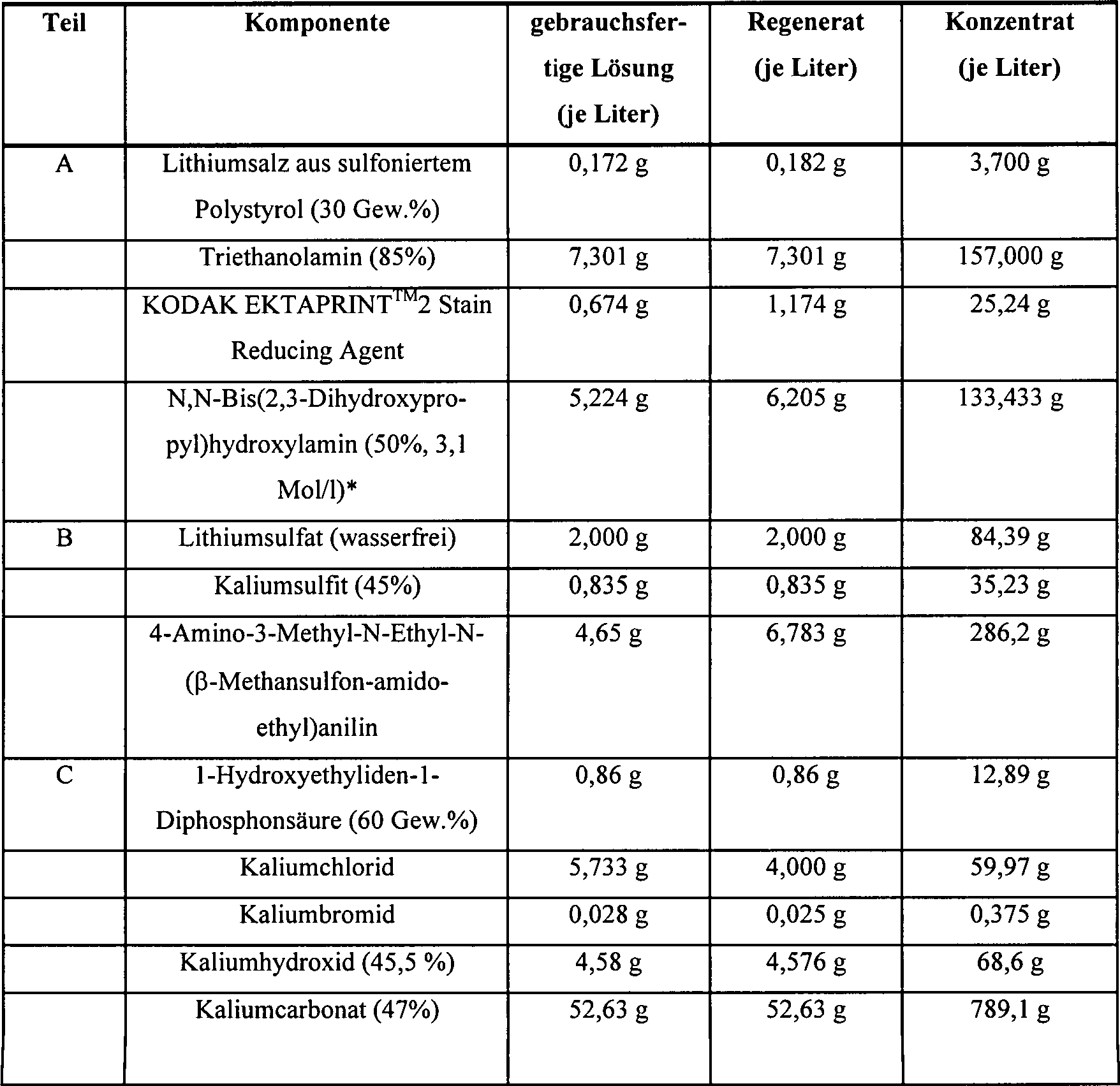

Beispiel 5: Verarbeitung des fotografischen ElementsExample 5: Processing of the photographic element
Die Farbentwicklungszusammensetzung aus Beispiel 3 wurde zur Verarbeitung von Proben eines bildweise belichteten farbfotografischen Silberhalogenidpapiers des Typs KODAK EDGE 7 verwendet. Nach dem Bleichen/Fixieren mithilfe der kommerziell verfügbaren EKTACOLOR Bleich-/Fixierlösung und anschließendem Wässern erhielt man geeignete Farbbilder.The Color development composition of Example 3 was for processing of samples of an imagewise exposed silver halide color photographic paper KODAK EDGE 7 type is used. After bleaching / fixing with help the commercially available EKTACOLOR bleach / fix solution and then Water we got suitable color pictures.
Claims (6)
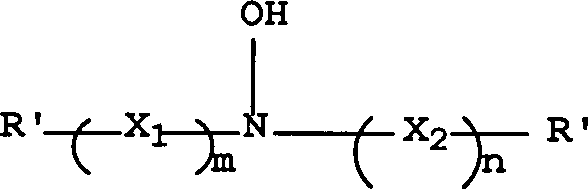


Applications Claiming Priority (2)
| Application Number | Priority Date | Filing Date | Title |
|---|---|---|---|
| US09/153,681 US6028225A (en) | 1998-09-15 | 1998-09-15 | Method of making hydroxy-substituted hydroxylamines and color developers containing same |
| US153681 | 1998-09-15 |
Publications (2)
| Publication Number | Publication Date |
|---|---|
| DE69918008D1 DE69918008D1 (en) | 2004-07-22 |
| DE69918008T2 true DE69918008T2 (en) | 2005-06-30 |
Family
ID=22548271
Family Applications (1)
| Application Number | Title | Priority Date | Filing Date |
|---|---|---|---|
| DE69918008T Expired - Fee Related DE69918008T2 (en) | 1998-09-15 | 1999-09-03 | Process for the preparation of hydroxyl-substituted hydroxylamines and color developers containing them |
Country Status (4)
| Country | Link |
|---|---|
| US (1) | US6028225A (en) |
| EP (1) | EP0987595B1 (en) |
| JP (1) | JP2000086606A (en) |
| DE (1) | DE69918008T2 (en) |
Families Citing this family (5)
| Publication number | Priority date | Publication date | Assignee | Title |
|---|---|---|---|---|
| KR100678340B1 (en) | 2004-12-09 | 2007-02-07 | 한국기초과학지원연구원 | Compounds with selective color development for certain metal ions |
| CN105837465A (en) * | 2016-03-29 | 2016-08-10 | 威海翔宇环保科技股份有限公司 | Synthesis of styrene polymerization inhibitor |
| CN112159333A (en) * | 2020-10-15 | 2021-01-01 | 济宁康德瑞化工科技有限公司 | Preparation method of dihydroxypropylhydroxylamine |
| CN115724762B (en) * | 2021-08-31 | 2024-01-05 | 中国石油化工股份有限公司 | Method and system for preparing diisopropanolamine and obtained product |
| CN116574027A (en) * | 2023-06-08 | 2023-08-11 | 济宁康德瑞化工科技有限公司 | A kind of synthetic method of N-isopropyl-N-hydroxypropyl hydroxylamine |
Family Cites Families (4)
| Publication number | Priority date | Publication date | Assignee | Title |
|---|---|---|---|---|
| US4892804A (en) * | 1986-01-24 | 1990-01-09 | Eastman Kodak Company | Photographic color developing compositions which are especially useful with high chloride photographic elements |
| US5354646A (en) * | 1986-03-26 | 1994-10-11 | Konishiroku Photo Industry Co., Ltd. | Method capable of rapidly processing a silver halide color photographic light-sensitive material |
| US5508155A (en) * | 1994-12-22 | 1996-04-16 | Eastman Kodak Company | Photographic color developers containing odorless antioxidants formed in situ from reaction of hydroxylamine and epoxide and use of same |
| EP0761647A3 (en) * | 1995-08-25 | 1997-05-07 | Eastman Kodak Co | Improved method for preparing hydroxylamines using vinylic compounds without base neutralization and reaction mixture produced thereby |
-
1998
- 1998-09-15 US US09/153,681 patent/US6028225A/en not_active Expired - Fee Related
-
1999
- 1999-09-03 EP EP99202873A patent/EP0987595B1/en not_active Expired - Lifetime
- 1999-09-03 DE DE69918008T patent/DE69918008T2/en not_active Expired - Fee Related
- 1999-09-14 JP JP11260210A patent/JP2000086606A/en active Pending
Also Published As
| Publication number | Publication date |
|---|---|
| EP0987595B1 (en) | 2004-06-16 |
| JP2000086606A (en) | 2000-03-28 |
| DE69918008D1 (en) | 2004-07-22 |
| US6028225A (en) | 2000-02-22 |
| EP0987595A1 (en) | 2000-03-22 |
Similar Documents
| Publication | Publication Date | Title |
|---|---|---|
| DE69903391T2 (en) | Homogeneous, one-piece color development concentrate and process for its production | |
| DE2350209C2 (en) | Silver bleach photographic solution or silver bleach-fixing solution and use of these solutions | |
| DE2901468C2 (en) | Process for producing colored images with a color photographic recording material containing silver halide | |
| DE69320688T2 (en) | Color development processing method for silver halide color photographic material | |
| DE69329814T2 (en) | Photographic processing composition and processing method | |
| DE69031692T2 (en) | Concentrated photographic developer composition and manufacturing method therefor | |
| DE69918008T2 (en) | Process for the preparation of hydroxyl-substituted hydroxylamines and color developers containing them | |
| DE69707769T2 (en) | Stabilized aqueous solutions of unsaturated, quaternary ammonium salts | |
| DE69624308T2 (en) | Succinic acid derivatives as degradable chelating agents, their uses and compositions | |
| US5508155A (en) | Photographic color developers containing odorless antioxidants formed in situ from reaction of hydroxylamine and epoxide and use of same | |
| DE3739025A1 (en) | METHOD FOR TREATMENT OR DEVELOPMENT OF A PHOTOGRAPHIC SILVER HALOGENIDE COLOR REVERSE | |
| CH646534A5 (en) | UNexposed, undeveloped color photographic silver halide emulsion and color developer bath. | |
| DE60014824T2 (en) | To color-stable photographic color developer concentrate and method for producing the same | |
| DE2456076C3 (en) | Color photographic multilayer recording material | |
| DE1797387A1 (en) | Photographic silver halide developer | |
| DE60009638T2 (en) | For color-stable photographic color-developing composition and methods for its use | |
| DE68926357T2 (en) | Process for the production of color photographic images | |
| DE69624307T2 (en) | Concentrated solution for photographic color development | |
| DE68919761T2 (en) | METHOD FOR PROCESSING PHOTOGRAPHIC SILVER HALOGENIDE MATERIALS. | |
| DE69901773T2 (en) | A color developer composition and method of photographic processing free of lithium and magnesium ions | |
| DE69027267T2 (en) | Process for processing a silver halide color photographic material | |
| DE69227297T2 (en) | Improved bleaching compositions and photographic processing methods | |
| DE69017546T2 (en) | Process for processing photosensitive silver halide materials. | |
| DE2264986A1 (en) | DEVELOPER SOLUTION FOR COLOR INVERSION DEVELOPMENT OF PHOTOGRAPHICAL RECORDING MATERIALS CONTAINING AT LEAST ONE HALOGENSILVER EMULSION LAYER | |
| DE69119536T2 (en) | Process for processing color photographic light-sensitive silver halide materials |
Legal Events
| Date | Code | Title | Description |
|---|---|---|---|
| 8364 | No opposition during term of opposition | ||
| 8339 | Ceased/non-payment of the annual fee |