DE69831791T2 - TRANSITION METAL COMPOUNDS OF GROUP 5 - Google Patents
TRANSITION METAL COMPOUNDS OF GROUP 5 Download PDFInfo
- Publication number
- DE69831791T2 DE69831791T2 DE69831791T DE69831791T DE69831791T2 DE 69831791 T2 DE69831791 T2 DE 69831791T2 DE 69831791 T DE69831791 T DE 69831791T DE 69831791 T DE69831791 T DE 69831791T DE 69831791 T2 DE69831791 T2 DE 69831791T2
- Authority
- DE
- Germany
- Prior art keywords
- group
- polymerization
- metal
- catalyst
- monomers
- Prior art date
- Legal status (The legal status is an assumption and is not a legal conclusion. Google has not performed a legal analysis and makes no representation as to the accuracy of the status listed.)
- Expired - Lifetime
Links
- 150000003623 transition metal compounds Chemical class 0.000 title description 3
- 239000003054 catalyst Substances 0.000 claims description 58
- 239000003446 ligand Substances 0.000 claims description 45
- 150000001875 compounds Chemical class 0.000 claims description 39
- 229910052751 metal Inorganic materials 0.000 claims description 32
- -1 cyclic olefins Chemical class 0.000 claims description 29
- 238000006116 polymerization reaction Methods 0.000 claims description 29
- 238000000034 method Methods 0.000 claims description 27
- 239000002184 metal Substances 0.000 claims description 24
- 239000000178 monomer Substances 0.000 claims description 24
- 150000001450 anions Chemical class 0.000 claims description 23
- 239000000203 mixture Substances 0.000 claims description 22
- 230000008569 process Effects 0.000 claims description 16
- 150000001336 alkenes Chemical class 0.000 claims description 15
- JRZJOMJEPLMPRA-UHFFFAOYSA-N olefin Natural products CCCCCCCC=C JRZJOMJEPLMPRA-UHFFFAOYSA-N 0.000 claims description 14
- 239000012190 activator Substances 0.000 claims description 12
- 239000007787 solid Substances 0.000 claims description 12
- 229910052720 vanadium Inorganic materials 0.000 claims description 12
- VGGSQFUCUMXWEO-UHFFFAOYSA-N Ethene Chemical compound C=C VGGSQFUCUMXWEO-UHFFFAOYSA-N 0.000 claims description 11
- 239000005977 Ethylene Substances 0.000 claims description 11
- 239000002243 precursor Substances 0.000 claims description 11
- 238000012718 coordination polymerization Methods 0.000 claims description 10
- 239000002685 polymerization catalyst Substances 0.000 claims description 10
- 239000004711 α-olefin Substances 0.000 claims description 10
- 125000003118 aryl group Chemical group 0.000 claims description 8
- 229930195733 hydrocarbon Natural products 0.000 claims description 6
- 229910052723 transition metal Inorganic materials 0.000 claims description 6
- 239000004215 Carbon black (E152) Substances 0.000 claims description 5
- 150000004678 hydrides Chemical class 0.000 claims description 5
- 125000000058 cyclopentadienyl group Chemical group C1(=CC=CC1)* 0.000 claims description 4
- 150000002430 hydrocarbons Chemical class 0.000 claims description 4
- 150000002736 metal compounds Chemical class 0.000 claims description 4
- 125000001181 organosilyl group Chemical group [SiH3]* 0.000 claims description 4
- 150000003624 transition metals Chemical class 0.000 claims description 4
- 125000005842 heteroatom Chemical group 0.000 claims description 3
- 229910052800 carbon group element Inorganic materials 0.000 claims description 2
- 239000007795 chemical reaction product Substances 0.000 claims description 2
- ZSWFCLXCOIISFI-UHFFFAOYSA-N endo-cyclopentadiene Natural products C1C=CC=C1 ZSWFCLXCOIISFI-UHFFFAOYSA-N 0.000 claims description 2
- GPPXJZIENCGNKB-UHFFFAOYSA-N vanadium Chemical compound [V]#[V] GPPXJZIENCGNKB-UHFFFAOYSA-N 0.000 claims 2
- 229940125904 compound 1 Drugs 0.000 claims 1
- 125000000753 cycloalkyl group Chemical group 0.000 claims 1
- VLKZOEOYAKHREP-UHFFFAOYSA-N n-Hexane Chemical compound CCCCCC VLKZOEOYAKHREP-UHFFFAOYSA-N 0.000 description 27
- 239000000243 solution Substances 0.000 description 18
- YXFVVABEGXRONW-UHFFFAOYSA-N Toluene Chemical compound CC1=CC=CC=C1 YXFVVABEGXRONW-UHFFFAOYSA-N 0.000 description 15
- 238000002360 preparation method Methods 0.000 description 13
- IJGRMHOSHXDMSA-UHFFFAOYSA-N Atomic nitrogen Chemical compound N#N IJGRMHOSHXDMSA-UHFFFAOYSA-N 0.000 description 12
- WYURNTSHIVDZCO-UHFFFAOYSA-N Tetrahydrofuran Chemical compound C1CCOC1 WYURNTSHIVDZCO-UHFFFAOYSA-N 0.000 description 12
- 238000006243 chemical reaction Methods 0.000 description 12
- 239000002904 solvent Substances 0.000 description 11
- 150000001768 cations Chemical class 0.000 description 9
- 230000015572 biosynthetic process Effects 0.000 description 8
- 229920000642 polymer Polymers 0.000 description 8
- 239000002002 slurry Substances 0.000 description 8
- LEONUFNNVUYDNQ-UHFFFAOYSA-N vanadium atom Chemical compound [V] LEONUFNNVUYDNQ-UHFFFAOYSA-N 0.000 description 7
- YMWUJEATGCHHMB-UHFFFAOYSA-N Dichloromethane Chemical compound ClCCl YMWUJEATGCHHMB-UHFFFAOYSA-N 0.000 description 6
- 229920001577 copolymer Polymers 0.000 description 6
- 229910052757 nitrogen Inorganic materials 0.000 description 6
- 230000003647 oxidation Effects 0.000 description 6
- 238000007254 oxidation reaction Methods 0.000 description 6
- 239000012071 phase Substances 0.000 description 6
- 230000002000 scavenging effect Effects 0.000 description 6
- 239000004698 Polyethylene Substances 0.000 description 5
- 229910052783 alkali metal Inorganic materials 0.000 description 5
- 239000007789 gas Substances 0.000 description 5
- 150000002902 organometallic compounds Chemical class 0.000 description 5
- 229920000573 polyethylene Polymers 0.000 description 5
- XLYOFNOQVPJJNP-UHFFFAOYSA-N water Substances O XLYOFNOQVPJJNP-UHFFFAOYSA-N 0.000 description 5
- 229910001868 water Inorganic materials 0.000 description 5
- LIKMAJRDDDTEIG-UHFFFAOYSA-N 1-hexene Chemical compound CCCCC=C LIKMAJRDDDTEIG-UHFFFAOYSA-N 0.000 description 4
- CSCPPACGZOOCGX-UHFFFAOYSA-N Acetone Chemical compound CC(C)=O CSCPPACGZOOCGX-UHFFFAOYSA-N 0.000 description 4
- 239000002841 Lewis acid Substances 0.000 description 4
- 125000000217 alkyl group Chemical group 0.000 description 4
- 239000012535 impurity Substances 0.000 description 4
- 150000007517 lewis acids Chemical class 0.000 description 4
- 239000010687 lubricating oil Substances 0.000 description 4
- 229910052752 metalloid Inorganic materials 0.000 description 4
- 238000001953 recrystallisation Methods 0.000 description 4
- 238000003786 synthesis reaction Methods 0.000 description 4
- RTZKZFJDLAIYFH-UHFFFAOYSA-N Diethyl ether Chemical compound CCOCC RTZKZFJDLAIYFH-UHFFFAOYSA-N 0.000 description 3
- PPBRXRYQALVLMV-UHFFFAOYSA-N Styrene Chemical compound C=CC1=CC=CC=C1 PPBRXRYQALVLMV-UHFFFAOYSA-N 0.000 description 3
- 150000001340 alkali metals Chemical class 0.000 description 3
- 229910052784 alkaline earth metal Inorganic materials 0.000 description 3
- 229910052782 aluminium Inorganic materials 0.000 description 3
- 150000001412 amines Chemical class 0.000 description 3
- 125000002091 cationic group Chemical group 0.000 description 3
- 239000013078 crystal Substances 0.000 description 3
- 150000001993 dienes Chemical class 0.000 description 3
- 239000003085 diluting agent Substances 0.000 description 3
- 230000000694 effects Effects 0.000 description 3
- 238000001914 filtration Methods 0.000 description 3
- 150000008040 ionic compounds Chemical class 0.000 description 3
- 239000007788 liquid Substances 0.000 description 3
- 150000002738 metalloids Chemical class 0.000 description 3
- 150000002739 metals Chemical class 0.000 description 3
- 229910052696 pnictogen Inorganic materials 0.000 description 3
- AQZWEFBJYQSQEH-UHFFFAOYSA-N 2-methyloxaluminane Chemical compound C[Al]1CCCCO1 AQZWEFBJYQSQEH-UHFFFAOYSA-N 0.000 description 2
- ZOXJGFHDIHLPTG-UHFFFAOYSA-N Boron Chemical compound [B] ZOXJGFHDIHLPTG-UHFFFAOYSA-N 0.000 description 2
- 239000007848 Bronsted acid Substances 0.000 description 2
- KAKZBPTYRLMSJV-UHFFFAOYSA-N Butadiene Chemical compound C=CC=C KAKZBPTYRLMSJV-UHFFFAOYSA-N 0.000 description 2
- YNRRZINZEMMGJB-UHFFFAOYSA-N C1(C=CC=C1)[V] Chemical compound C1(C=CC=C1)[V] YNRRZINZEMMGJB-UHFFFAOYSA-N 0.000 description 2
- LFQSCWFLJHTTHZ-UHFFFAOYSA-N Ethanol Chemical compound CCO LFQSCWFLJHTTHZ-UHFFFAOYSA-N 0.000 description 2
- 229920000181 Ethylene propylene rubber Polymers 0.000 description 2
- DGAQECJNVWCQMB-PUAWFVPOSA-M Ilexoside XXIX Chemical compound C[C@@H]1CC[C@@]2(CC[C@@]3(C(=CC[C@H]4[C@]3(CC[C@@H]5[C@@]4(CC[C@@H](C5(C)C)OS(=O)(=O)[O-])C)C)[C@@H]2[C@]1(C)O)C)C(=O)O[C@H]6[C@@H]([C@H]([C@@H]([C@H](O6)CO)O)O)O.[Na+] DGAQECJNVWCQMB-PUAWFVPOSA-M 0.000 description 2
- RRHGJUQNOFWUDK-UHFFFAOYSA-N Isoprene Chemical compound CC(=C)C=C RRHGJUQNOFWUDK-UHFFFAOYSA-N 0.000 description 2
- 239000002879 Lewis base Substances 0.000 description 2
- FYYHWMGAXLPEAU-UHFFFAOYSA-N Magnesium Chemical compound [Mg] FYYHWMGAXLPEAU-UHFFFAOYSA-N 0.000 description 2
- IMNFDUFMRHMDMM-UHFFFAOYSA-N N-Heptane Chemical compound CCCCCCC IMNFDUFMRHMDMM-UHFFFAOYSA-N 0.000 description 2
- AFBPFSWMIHJQDM-UHFFFAOYSA-N N-methylaniline Chemical compound CNC1=CC=CC=C1 AFBPFSWMIHJQDM-UHFFFAOYSA-N 0.000 description 2
- OFBQJSOFQDEBGM-UHFFFAOYSA-N Pentane Chemical compound CCCCC OFBQJSOFQDEBGM-UHFFFAOYSA-N 0.000 description 2
- 230000003213 activating effect Effects 0.000 description 2
- 239000000654 additive Substances 0.000 description 2
- 230000002411 adverse Effects 0.000 description 2
- 150000004703 alkoxides Chemical class 0.000 description 2
- 125000003545 alkoxy group Chemical group 0.000 description 2
- AZDRQVAHHNSJOQ-UHFFFAOYSA-N alumane Chemical class [AlH3] AZDRQVAHHNSJOQ-UHFFFAOYSA-N 0.000 description 2
- 125000003277 amino group Chemical group 0.000 description 2
- 229910052796 boron Inorganic materials 0.000 description 2
- 238000006555 catalytic reaction Methods 0.000 description 2
- 238000010538 cationic polymerization reaction Methods 0.000 description 2
- 229910052798 chalcogen Inorganic materials 0.000 description 2
- 239000011248 coating agent Substances 0.000 description 2
- 238000000576 coating method Methods 0.000 description 2
- 238000007334 copolymerization reaction Methods 0.000 description 2
- BOXSCYUXSBYGRD-UHFFFAOYSA-N cyclopenta-1,3-diene;iron(3+) Chemical compound [Fe+3].C=1C=C[CH-]C=1.C=1C=C[CH-]C=1 BOXSCYUXSBYGRD-UHFFFAOYSA-N 0.000 description 2
- LPIQUOYDBNQMRZ-UHFFFAOYSA-N cyclopentene Chemical compound C1CC=CC1 LPIQUOYDBNQMRZ-UHFFFAOYSA-N 0.000 description 2
- 238000011161 development Methods 0.000 description 2
- 230000018109 developmental process Effects 0.000 description 2
- 125000000118 dimethyl group Chemical group [H]C([H])([H])* 0.000 description 2
- 238000012685 gas phase polymerization Methods 0.000 description 2
- 229910052736 halogen Inorganic materials 0.000 description 2
- 150000002367 halogens Chemical class 0.000 description 2
- 150000007527 lewis bases Chemical class 0.000 description 2
- 229910052744 lithium Inorganic materials 0.000 description 2
- 229910052749 magnesium Inorganic materials 0.000 description 2
- 239000011777 magnesium Substances 0.000 description 2
- 239000003607 modifier Substances 0.000 description 2
- 230000007935 neutral effect Effects 0.000 description 2
- BASFCYQUMIYNBI-UHFFFAOYSA-N platinum Chemical compound [Pt] BASFCYQUMIYNBI-UHFFFAOYSA-N 0.000 description 2
- 229920002959 polymer blend Polymers 0.000 description 2
- 150000003254 radicals Chemical class 0.000 description 2
- 150000003839 salts Chemical class 0.000 description 2
- 238000000926 separation method Methods 0.000 description 2
- 229910052709 silver Inorganic materials 0.000 description 2
- 239000004332 silver Substances 0.000 description 2
- 229910052708 sodium Inorganic materials 0.000 description 2
- 239000011734 sodium Substances 0.000 description 2
- 239000000126 substance Substances 0.000 description 2
- VOITXYVAKOUIBA-UHFFFAOYSA-N triethylaluminium Chemical compound CC[Al](CC)CC VOITXYVAKOUIBA-UHFFFAOYSA-N 0.000 description 2
- MCULRUJILOGHCJ-UHFFFAOYSA-N triisobutylaluminium Chemical compound CC(C)C[Al](CC(C)C)CC(C)C MCULRUJILOGHCJ-UHFFFAOYSA-N 0.000 description 2
- LFXVBWRMVZPLFK-UHFFFAOYSA-N trioctylalumane Chemical compound CCCCCCCC[Al](CCCCCCCC)CCCCCCCC LFXVBWRMVZPLFK-UHFFFAOYSA-N 0.000 description 2
- WCFQIFDACWBNJT-UHFFFAOYSA-N $l^{1}-alumanyloxy(2-methylpropyl)aluminum Chemical compound CC(C)C[Al]O[Al] WCFQIFDACWBNJT-UHFFFAOYSA-N 0.000 description 1
- OJOWICOBYCXEKR-KRXBUXKQSA-N (5e)-5-ethylidenebicyclo[2.2.1]hept-2-ene Chemical class C1C2C(=C/C)/CC1C=C2 OJOWICOBYCXEKR-KRXBUXKQSA-N 0.000 description 1
- APQXWKHOGQFGTB-UHFFFAOYSA-N 1-ethenyl-9h-carbazole Chemical class C12=CC=CC=C2NC2=C1C=CC=C2C=C APQXWKHOGQFGTB-UHFFFAOYSA-N 0.000 description 1
- HECLRDQVFMWTQS-RGOKHQFPSA-N 1755-01-7 Chemical class C1[C@H]2[C@@H]3CC=C[C@@H]3[C@@H]1C=C2 HECLRDQVFMWTQS-RGOKHQFPSA-N 0.000 description 1
- HANWWAAUFXCNBS-UHFFFAOYSA-N 2,6,6-tris(2-methylpropyl)oxaluminane Chemical compound CC(C)C[Al]1CCCC(CC(C)C)(CC(C)C)O1 HANWWAAUFXCNBS-UHFFFAOYSA-N 0.000 description 1
- FEUFNKALUGDEMQ-UHFFFAOYSA-N 2-isocyanato-1,3-di(propan-2-yl)benzene Chemical compound CC(C)C1=CC=CC(C(C)C)=C1N=C=O FEUFNKALUGDEMQ-UHFFFAOYSA-N 0.000 description 1
- VEXZGXHMUGYJMC-UHFFFAOYSA-M Chloride anion Chemical compound [Cl-] VEXZGXHMUGYJMC-UHFFFAOYSA-M 0.000 description 1
- 229920000089 Cyclic olefin copolymer Polymers 0.000 description 1
- UFHFLCQGNIYNRP-UHFFFAOYSA-N Hydrogen Chemical compound [H][H] UFHFLCQGNIYNRP-UHFFFAOYSA-N 0.000 description 1
- VQTUBCCKSQIDNK-UHFFFAOYSA-N Isobutene Chemical group CC(C)=C VQTUBCCKSQIDNK-UHFFFAOYSA-N 0.000 description 1
- OAICVXFJPJFONN-UHFFFAOYSA-N Phosphorus Chemical compound [P] OAICVXFJPJFONN-UHFFFAOYSA-N 0.000 description 1
- 239000004743 Polypropylene Substances 0.000 description 1
- 239000004793 Polystyrene Substances 0.000 description 1
- XUIMIQQOPSSXEZ-UHFFFAOYSA-N Silicon Chemical compound [Si] XUIMIQQOPSSXEZ-UHFFFAOYSA-N 0.000 description 1
- BQCADISMDOOEFD-UHFFFAOYSA-N Silver Chemical compound [Ag] BQCADISMDOOEFD-UHFFFAOYSA-N 0.000 description 1
- QYKIQEUNHZKYBP-UHFFFAOYSA-N Vinyl ether Chemical class C=COC=C QYKIQEUNHZKYBP-UHFFFAOYSA-N 0.000 description 1
- 239000011954 Ziegler–Natta catalyst Substances 0.000 description 1
- XIJNNDJXMGTYGK-UHFFFAOYSA-K [Cl-].[Cl-].[Cl-].[V+5] Chemical compound [Cl-].[Cl-].[Cl-].[V+5] XIJNNDJXMGTYGK-UHFFFAOYSA-K 0.000 description 1
- FUIKCMIFMMNILZ-UHFFFAOYSA-N [Nb].[CH]1C=CC=C1 Chemical compound [Nb].[CH]1C=CC=C1 FUIKCMIFMMNILZ-UHFFFAOYSA-N 0.000 description 1
- 150000004075 acetic anhydrides Chemical class 0.000 description 1
- 239000002253 acid Substances 0.000 description 1
- 230000004913 activation Effects 0.000 description 1
- 230000000996 additive effect Effects 0.000 description 1
- 150000001335 aliphatic alkanes Chemical class 0.000 description 1
- 150000001338 aliphatic hydrocarbons Chemical class 0.000 description 1
- 150000001350 alkyl halides Chemical class 0.000 description 1
- 239000002168 alkylating agent Substances 0.000 description 1
- 229940100198 alkylating agent Drugs 0.000 description 1
- 230000029936 alkylation Effects 0.000 description 1
- 238000005804 alkylation reaction Methods 0.000 description 1
- XAGFODPZIPBFFR-UHFFFAOYSA-N aluminium Chemical compound [Al] XAGFODPZIPBFFR-UHFFFAOYSA-N 0.000 description 1
- 125000003368 amide group Chemical group 0.000 description 1
- 150000001408 amides Chemical class 0.000 description 1
- 150000004945 aromatic hydrocarbons Chemical class 0.000 description 1
- 150000005840 aryl radicals Chemical class 0.000 description 1
- QVGXLLKOCUKJST-UHFFFAOYSA-N atomic oxygen Chemical compound [O] QVGXLLKOCUKJST-UHFFFAOYSA-N 0.000 description 1
- PASDCCFISLVPSO-UHFFFAOYSA-N benzoyl chloride Chemical compound ClC(=O)C1=CC=CC=C1 PASDCCFISLVPSO-UHFFFAOYSA-N 0.000 description 1
- 125000000484 butyl group Chemical group [H]C([*])([H])C([H])([H])C([H])([H])C([H])([H])[H] 0.000 description 1
- 125000004432 carbon atom Chemical group C* 0.000 description 1
- 150000007942 carboxylates Chemical class 0.000 description 1
- 230000003197 catalytic effect Effects 0.000 description 1
- 230000008859 change Effects 0.000 description 1
- 238000007385 chemical modification Methods 0.000 description 1
- 239000003153 chemical reaction reagent Substances 0.000 description 1
- 239000003795 chemical substances by application Substances 0.000 description 1
- 239000000356 contaminant Substances 0.000 description 1
- 238000001816 cooling Methods 0.000 description 1
- 239000012967 coordination catalyst Substances 0.000 description 1
- 150000004696 coordination complex Chemical class 0.000 description 1
- OJOSABWCUVCSTQ-UHFFFAOYSA-N cyclohepta-2,4,6-trienylium Chemical compound C1=CC=C[CH+]=C[CH]1 OJOSABWCUVCSTQ-UHFFFAOYSA-N 0.000 description 1
- 238000001035 drying Methods 0.000 description 1
- 229920001971 elastomer Polymers 0.000 description 1
- 239000000806 elastomer Substances 0.000 description 1
- 230000008030 elimination Effects 0.000 description 1
- 238000003379 elimination reaction Methods 0.000 description 1
- 125000002573 ethenylidene group Chemical group [*]=C=C([H])[H] 0.000 description 1
- SJMLNDPIJZBEKY-UHFFFAOYSA-N ethyl 2,2,2-trichloroacetate Chemical compound CCOC(=O)C(Cl)(Cl)Cl SJMLNDPIJZBEKY-UHFFFAOYSA-N 0.000 description 1
- 125000001495 ethyl group Chemical group [H]C([H])([H])C([H])([H])* 0.000 description 1
- 238000000605 extraction Methods 0.000 description 1
- 238000011049 filling Methods 0.000 description 1
- 239000012530 fluid Substances 0.000 description 1
- 238000010528 free radical solution polymerization reaction Methods 0.000 description 1
- 238000010574 gas phase reaction Methods 0.000 description 1
- PCHJSUWPFVWCPO-UHFFFAOYSA-N gold Chemical compound [Au] PCHJSUWPFVWCPO-UHFFFAOYSA-N 0.000 description 1
- 229910052737 gold Inorganic materials 0.000 description 1
- 239000010931 gold Substances 0.000 description 1
- 150000008282 halocarbons Chemical class 0.000 description 1
- VUNCWTMEJYMOOR-UHFFFAOYSA-N hexachlorocyclopentadiene Chemical compound ClC1=C(Cl)C(Cl)(Cl)C(Cl)=C1Cl VUNCWTMEJYMOOR-UHFFFAOYSA-N 0.000 description 1
- 229920001519 homopolymer Polymers 0.000 description 1
- 125000001183 hydrocarbyl group Chemical group 0.000 description 1
- 229910052739 hydrogen Inorganic materials 0.000 description 1
- 239000001257 hydrogen Substances 0.000 description 1
- 125000004435 hydrogen atom Chemical group [H]* 0.000 description 1
- 230000007062 hydrolysis Effects 0.000 description 1
- 238000006460 hydrolysis reaction Methods 0.000 description 1
- 150000003949 imides Chemical class 0.000 description 1
- 229910052809 inorganic oxide Inorganic materials 0.000 description 1
- 238000003780 insertion Methods 0.000 description 1
- 230000037431 insertion Effects 0.000 description 1
- 230000003993 interaction Effects 0.000 description 1
- 239000012948 isocyanate Substances 0.000 description 1
- 150000002513 isocyanates Chemical class 0.000 description 1
- 238000002955 isolation Methods 0.000 description 1
- 125000001449 isopropyl group Chemical group [H]C([H])([H])C([H])(*)C([H])([H])[H] 0.000 description 1
- 239000007791 liquid phase Substances 0.000 description 1
- 238000004519 manufacturing process Methods 0.000 description 1
- 239000000463 material Substances 0.000 description 1
- 239000012968 metallocene catalyst Substances 0.000 description 1
- 238000005649 metathesis reaction Methods 0.000 description 1
- 125000002496 methyl group Chemical group [H]C([H])([H])* 0.000 description 1
- SJYNFBVQFBRSIB-UHFFFAOYSA-N norbornadiene Chemical class C1=CC2C=CC1C2 SJYNFBVQFBRSIB-UHFFFAOYSA-N 0.000 description 1
- JFNLZVQOOSMTJK-KNVOCYPGSA-N norbornene Chemical compound C1[C@@H]2CC[C@H]1C=C2 JFNLZVQOOSMTJK-KNVOCYPGSA-N 0.000 description 1
- 150000002848 norbornenes Chemical class 0.000 description 1
- TVMXDCGIABBOFY-UHFFFAOYSA-N octane Chemical compound CCCCCCCC TVMXDCGIABBOFY-UHFFFAOYSA-N 0.000 description 1
- 239000003921 oil Substances 0.000 description 1
- 125000000962 organic group Chemical group 0.000 description 1
- 229910052760 oxygen Inorganic materials 0.000 description 1
- 239000001301 oxygen Substances 0.000 description 1
- 239000002245 particle Substances 0.000 description 1
- 125000000538 pentafluorophenyl group Chemical group FC1=C(F)C(F)=C(*)C(F)=C1F 0.000 description 1
- RGSFGYAAUTVSQA-UHFFFAOYSA-N pentamethylene Natural products C1CCCC1 RGSFGYAAUTVSQA-UHFFFAOYSA-N 0.000 description 1
- 125000005062 perfluorophenyl group Chemical group FC1=C(C(=C(C(=C1F)F)F)F)* 0.000 description 1
- 125000001997 phenyl group Chemical group [H]C1=C([H])C([H])=C(*)C([H])=C1[H] 0.000 description 1
- 229910052698 phosphorus Inorganic materials 0.000 description 1
- 239000011574 phosphorus Substances 0.000 description 1
- 229910052697 platinum Inorganic materials 0.000 description 1
- 239000002574 poison Substances 0.000 description 1
- 231100000614 poison Toxicity 0.000 description 1
- 239000002952 polymeric resin Substances 0.000 description 1
- 239000003505 polymerization initiator Substances 0.000 description 1
- 229920000098 polyolefin Polymers 0.000 description 1
- 229920001155 polypropylene Polymers 0.000 description 1
- 229920002223 polystyrene Polymers 0.000 description 1
- 239000002244 precipitate Substances 0.000 description 1
- 238000001556 precipitation Methods 0.000 description 1
- 238000012545 processing Methods 0.000 description 1
- 150000003222 pyridines Chemical class 0.000 description 1
- 239000002516 radical scavenger Substances 0.000 description 1
- 239000011347 resin Substances 0.000 description 1
- 229920005989 resin Polymers 0.000 description 1
- 229910052710 silicon Inorganic materials 0.000 description 1
- 239000010703 silicon Substances 0.000 description 1
- 125000005374 siloxide group Chemical group 0.000 description 1
- 238000007613 slurry method Methods 0.000 description 1
- 230000000087 stabilizing effect Effects 0.000 description 1
- 229910001220 stainless steel Inorganic materials 0.000 description 1
- 239000010935 stainless steel Substances 0.000 description 1
- 150000003440 styrenes Chemical class 0.000 description 1
- 125000001424 substituent group Chemical group 0.000 description 1
- 238000006467 substitution reaction Methods 0.000 description 1
- 239000000725 suspension Substances 0.000 description 1
- 229920003002 synthetic resin Polymers 0.000 description 1
- YLQBMQCUIZJEEH-UHFFFAOYSA-N tetrahydrofuran Natural products C=1C=COC=1 YLQBMQCUIZJEEH-UHFFFAOYSA-N 0.000 description 1
- 239000012815 thermoplastic material Substances 0.000 description 1
- 150000003573 thiols Chemical class 0.000 description 1
- XBEXIHMRFRFRAM-UHFFFAOYSA-N tridodecylalumane Chemical compound CCCCCCCCCCCC[Al](CCCCCCCCCCCC)CCCCCCCCCCCC XBEXIHMRFRFRAM-UHFFFAOYSA-N 0.000 description 1
- LALRXNPLTWZJIJ-UHFFFAOYSA-N triethylborane Chemical compound CCB(CC)CC LALRXNPLTWZJIJ-UHFFFAOYSA-N 0.000 description 1
- CXKQHHJKHZXXPZ-UHFFFAOYSA-N triethylsilanylium Chemical compound CC[Si+](CC)CC CXKQHHJKHZXXPZ-UHFFFAOYSA-N 0.000 description 1
- 150000008648 triflates Chemical class 0.000 description 1
- ORYGRKHDLWYTKX-UHFFFAOYSA-N trihexylalumane Chemical compound CCCCCC[Al](CCCCCC)CCCCCC ORYGRKHDLWYTKX-UHFFFAOYSA-N 0.000 description 1
- OBAJXDYVZBHCGT-UHFFFAOYSA-N tris(pentafluorophenyl)borane Chemical compound FC1=C(F)C(F)=C(F)C(F)=C1B(C=1C(=C(F)C(F)=C(F)C=1F)F)C1=C(F)C(F)=C(F)C(F)=C1F OBAJXDYVZBHCGT-UHFFFAOYSA-N 0.000 description 1
- OLFPYUPGPBITMH-UHFFFAOYSA-N tritylium Chemical compound C1=CC=CC=C1[C+](C=1C=CC=CC=1)C1=CC=CC=C1 OLFPYUPGPBITMH-UHFFFAOYSA-N 0.000 description 1
- 229920000785 ultra high molecular weight polyethylene Polymers 0.000 description 1
- JBIQAPKSNFTACH-UHFFFAOYSA-K vanadium oxytrichloride Chemical compound Cl[V](Cl)(Cl)=O JBIQAPKSNFTACH-UHFFFAOYSA-K 0.000 description 1
- 125000000391 vinyl group Chemical group [H]C([*])=C([H])[H] 0.000 description 1
- 229920002554 vinyl polymer Polymers 0.000 description 1
- 239000004034 viscosity adjusting agent Substances 0.000 description 1
Classifications
-
- C—CHEMISTRY; METALLURGY
- C08—ORGANIC MACROMOLECULAR COMPOUNDS; THEIR PREPARATION OR CHEMICAL WORKING-UP; COMPOSITIONS BASED THEREON
- C08F—MACROMOLECULAR COMPOUNDS OBTAINED BY REACTIONS ONLY INVOLVING CARBON-TO-CARBON UNSATURATED BONDS
- C08F10/00—Homopolymers and copolymers of unsaturated aliphatic hydrocarbons having only one carbon-to-carbon double bond
-
- C—CHEMISTRY; METALLURGY
- C07—ORGANIC CHEMISTRY
- C07F—ACYCLIC, CARBOCYCLIC OR HETEROCYCLIC COMPOUNDS CONTAINING ELEMENTS OTHER THAN CARBON, HYDROGEN, HALOGEN, OXYGEN, NITROGEN, SULFUR, SELENIUM OR TELLURIUM
- C07F9/00—Compounds containing elements of Groups 5 or 15 of the Periodic Table
- C07F9/005—Compounds of elements of Group 5 of the Periodic Table without metal-carbon linkages
-
- C—CHEMISTRY; METALLURGY
- C08—ORGANIC MACROMOLECULAR COMPOUNDS; THEIR PREPARATION OR CHEMICAL WORKING-UP; COMPOSITIONS BASED THEREON
- C08F—MACROMOLECULAR COMPOUNDS OBTAINED BY REACTIONS ONLY INVOLVING CARBON-TO-CARBON UNSATURATED BONDS
- C08F210/00—Copolymers of unsaturated aliphatic hydrocarbons having only one carbon-to-carbon double bond
- C08F210/16—Copolymers of ethene with alpha-alkenes, e.g. EP rubbers
-
- C—CHEMISTRY; METALLURGY
- C08—ORGANIC MACROMOLECULAR COMPOUNDS; THEIR PREPARATION OR CHEMICAL WORKING-UP; COMPOSITIONS BASED THEREON
- C08F—MACROMOLECULAR COMPOUNDS OBTAINED BY REACTIONS ONLY INVOLVING CARBON-TO-CARBON UNSATURATED BONDS
- C08F4/00—Polymerisation catalysts
- C08F4/42—Metals; Metal hydrides; Metallo-organic compounds; Use thereof as catalyst precursors
- C08F4/44—Metals; Metal hydrides; Metallo-organic compounds; Use thereof as catalyst precursors selected from light metals, zinc, cadmium, mercury, copper, silver, gold, boron, gallium, indium, thallium, rare earths or actinides
- C08F4/60—Metals; Metal hydrides; Metallo-organic compounds; Use thereof as catalyst precursors selected from light metals, zinc, cadmium, mercury, copper, silver, gold, boron, gallium, indium, thallium, rare earths or actinides together with refractory metals, iron group metals, platinum group metals, manganese, rhenium technetium or compounds thereof
- C08F4/62—Refractory metals or compounds thereof
- C08F4/639—Component covered by group C08F4/62 containing a transition metal-carbon bond
- C08F4/63908—Component covered by group C08F4/62 containing a transition metal-carbon bond in combination with an ionising compound other than alumoxane, e.g. (C6F5)4B-X+
-
- C—CHEMISTRY; METALLURGY
- C08—ORGANIC MACROMOLECULAR COMPOUNDS; THEIR PREPARATION OR CHEMICAL WORKING-UP; COMPOSITIONS BASED THEREON
- C08F—MACROMOLECULAR COMPOUNDS OBTAINED BY REACTIONS ONLY INVOLVING CARBON-TO-CARBON UNSATURATED BONDS
- C08F4/00—Polymerisation catalysts
- C08F4/42—Metals; Metal hydrides; Metallo-organic compounds; Use thereof as catalyst precursors
- C08F4/44—Metals; Metal hydrides; Metallo-organic compounds; Use thereof as catalyst precursors selected from light metals, zinc, cadmium, mercury, copper, silver, gold, boron, gallium, indium, thallium, rare earths or actinides
- C08F4/60—Metals; Metal hydrides; Metallo-organic compounds; Use thereof as catalyst precursors selected from light metals, zinc, cadmium, mercury, copper, silver, gold, boron, gallium, indium, thallium, rare earths or actinides together with refractory metals, iron group metals, platinum group metals, manganese, rhenium technetium or compounds thereof
- C08F4/62—Refractory metals or compounds thereof
- C08F4/639—Component covered by group C08F4/62 containing a transition metal-carbon bond
- C08F4/63912—Component covered by group C08F4/62 containing a transition metal-carbon bond in combination with an organoaluminium compound
Landscapes
- Chemical & Material Sciences (AREA)
- Organic Chemistry (AREA)
- Health & Medical Sciences (AREA)
- Chemical Kinetics & Catalysis (AREA)
- Medicinal Chemistry (AREA)
- Polymers & Plastics (AREA)
- Transition And Organic Metals Composition Catalysts For Addition Polymerization (AREA)
Description
Technisches Gebiettechnical area
Diese Erfindung betrifft organometallische Verbindungen, die einen polyanionischen Hilfsliganden der Gruppe 15 umfassen, der kovalent an ein Gruppe 5-Metallzentrum gebunden ist, insbesondere jene, die zur Katalyse der Olefinpolymerisation geeignet sind.These The invention relates to organometallic compounds containing a polyanionic Group 15 ancillary ligands covalently attached to a group 5-metal center is bound, especially those used for catalysis the olefin polymerization are suitable.
Hintergrund der Erfindungbackground the invention
Koordinationspolymerisation von olefinisch ungesättigten Monomeren ist wohl bekannt und hat zu großem Aufschwung von thermoplastischen Materialzusammensetzungen aus Olefinen geführt, wie Polyethylen, Polypropylen und Ethylen-Propylen-Kautschuk. Frühe Pioniere verwendeten die frühen Übergangsmetallverbindungen, insbesondere jene der Gruppe 4-Metalle, mit solchen Aktivatoren wie Aluminiumalkylverbindungen. Spätere Entwicklungen erweiterten diese Arbeiten auf raumerfüllenden Hilfsliganden enthaltende (z. B. η5-Cyclopentadienyl)-Übergangsmetallverbindungen ("Metallocene") mit Aktivatoren wie Alkylalumoxanen. Repräsentative Arbeiten, die Effekte von substituierten Mono- und Bis-Metallocenverbindungen auf das Molekulargewicht des Polymers ansprechen, sind in EP-A-0 129 368 und ihrer entsprechenden US-A-5 324 800 beschrieben. Heteroatomhaltige Monocyclopentadienyl-Metallocenverbindungen sind in US-A-5 057 475 beschrieben, und siliciumverbrückte Biscyclopentadienyl-Metallocenkatalysatoren sind in US-A-5 017 714 beschrieben. Neuere Entwicklungen haben die Wirksamkeit ionischer Katalysatoren gezeigt, die aus aktivierten Metallocenkationen zusammengesetzt sind, die durch verträgliche nicht-koordinierende Anionen stabilisiert sind, siehe beispielsweise US-A-5 278 119 und US-A-5 384 299 und WO-A-92/00333.Coordination polymerization of olefinically unsaturated monomers is well known and has led to a great deal of olefin thermoplastic material compositions, such as polyethylene, polypropylene and ethylene-propylene rubber. Early pioneers used the early transition metal compounds, especially those of the Group 4 metals, with such activators as aluminum alkyl compounds. Subsequent developments have extended this work to bulky auxiliary ligands containing (eg, η 5 -cyclopentadienyl) transition metal compounds ("metallocenes") with activators such as alkylalumoxanes. Representative works that address the effects of substituted mono- and bis-metallocene compounds on the molecular weight of the polymer are described in EP-A-0129368 and its corresponding US-A-5,324,800. Heteroatom-containing monocyclopentadienyl metallocene compounds are described in US-A-5,057,475, and silicon-bridged biscyclopentadienyl metallocene catalysts are described in US-A-5,017,714. Recent developments have shown the effectiveness of ionic catalysts composed of activated metallocene cations stabilized by compatible non-coordinating anions, see for example US-A-5,278,119 and US-A-5,384,299 and WO-A-92 / 00,333th
Übergangsmetall-Polymerisationskatalysatorsysteme von Metallen der Gruppe 5 bis 10, bei denen das aktive Übergangsmetallzentrum in einem hohen Oxidationszustand ist und durch polyanionische Hilfsligandensysteme mit niedriger Koordinationszahl stabilisiert sind, sind in US-A-5 502 124 und seinem abgeteilten Patent US-A-5 504 049 beschrieben. Geeignete polyanionische Hilfsliganden mit niedriger Koordinationszahl schließen sowohl raumerfüllende Imide als auch Carbolide ein. Diese werden als allein oder in Kombination mit konventionellen monoanionischen Hilfsliganden geeignet beschrieben, wie Cyclopentadienylderivaten. Beispiele 2 und 8 illustrieren Gruppe 5-Metallkatalysatorverbindungen, die (Cyclopentadienyl)vanadium(p-tolylimido)dichlorid beziehungsweise (Cyclopentadienyl)niob(2,6-diisopropyl-phenylimido)dimethyl umfassen. Olefinpolymerisationskatalysatoren aus Gruppe 5 oder 6-Metallimidokomplexen sind auch in EP-A-0 641 804 beschrieben. Die Gruppe 5-Metallkomplexe schließen einen Imidoliganden und eine monoanionische organische Gruppe ein, die einen Cyclopentadienylkern enthält. Beispiel 1 illustriert die Herstellung von (Cyclopentadienyl)vanadium(p-tolylimido)dichlorid und die Tabellen auf Seiten 7 bis 9 illustrieren Polymerisation unter Verwendung desselben. Auf diese Dokumente wird für die Zwecke der US-Patentpraxis Bezug genommen.Transition metal polymerization catalyst systems of metals of group 5 to 10, in which the active transition metal center is in a high oxidation state and by polyanionic auxiliary ligand systems are stabilized with low coordination number, are described in US-A-5 502,124 and its divisional patent US-A-5 504 049. Suitable polyanionic ancillary ligands with low coordination number shut down both space filling Imide as well as Carbolide. These are considered alone or in combination described as suitable with conventional monoanionic auxiliary ligands, like cyclopentadienyl derivatives. Examples 2 and 8 illustrate group 5-metal catalyst compounds containing (cyclopentadienyl) vanadium (p-tolylimido) dichloride or (cyclopentadienyl) niobium (2,6-diisopropyl-phenylimido) dimethyl include. Olefin polymerization catalysts from group 5 or 6 metal imido complexes are also described in EP-A-0 641 804. The group 5 metal complexes shut down an imido ligand and a monoanionic organic group, which contains a cyclopentadienyl nucleus. Example 1 illustrated the preparation of (cyclopentadienyl) vanadium (p-tolylimido) dichloride and the tables on pages 7 to 9 illustrate polymerization using the same. These documents will be for the purpose US Patent Practice.
Effektive Olefinpolymerisationskatalysatoren auf Basis von Vanadiumalkylkomplexen, bei denen das Metallzentrum in seinem höchsten Oxidationszustand stabilisiert ist, sind schwer zu fassen, da es keine gut etablierten Verfahren zur Synthese derartiger Verbindungen gibt. Schwierigkeiten, die mit der Synthese von Vanadiumalkylen verbunden sind, bei denen das Metallzentrum in seinem höchsten Oxidationszustand stabilisiert ist, sind gut dokumentiert. Siehe beispielsweise J. Buijink, J. Organomet. Chem 1995, 497, 161–170, D. D. Devore, J. Am. Chem. Soc., 1987, 109, 7408–7416 und andere Druckschriften, die Fachleuten wohl bekannt sind.effective Olefin polymerization catalysts based on vanadium alkyl complexes, where the metal center stabilizes in its highest oxidation state is difficult to grasp, as there are no well-established procedures for the synthesis of such compounds. Difficulties that associated with the synthesis of vanadium alkyls in which the Metal center in its highest Oxidation state is stabilized, are well documented. Please refer for example, J. Buijink, J. Organomet. Chem 1995, 497, 161-170, D.D. Devore, J. Am. Chem. Soc., 1987, 109, 7408-7416 and other references, the experts are well known.
EP-A-532 098 offenbaren Imidoarylvanadiumkomplexe, die drei Halogene als einwertige Liganden umfassen (von denen einer durch eine Aminogruppe ersetzt werden kann), in Kombination mit einer organometallischen Verbindung als Olefinpolymerisationskatalysatorzusammensetzung.EP-A-532 098 disclose imidoarylvanadium complexes, the three halogens as monovalent ligands (one of which is substituted by an amino group can be replaced), in combination with an organometallic Compound as olefin polymerization catalyst composition.
WO-A-94/14854 offenbart Imidoarylvanadiumkomplexe, die zwei Halogene und eine Amingruppe als einwertige Liganden umfassen, in Kombination mit einer organometallischen Verbindung als Olefinpolymerisationskatalysatorzusammensetzung.WO 94/14854 discloses imidoarylvanadium complexes containing two halogens and one Amine group as a monovalent ligand, in combination with an organometallic compound as an olefin polymerization catalyst composition.
Es wäre daher erwünscht, Vanadiumalkylkomplexe zu liefern, in denen das Vanadiummetallzentrum in seinem höchsten Oxidationszustand durch (a) einen polyanionischen Liganden mit niedriger Koordinationszahl und (b) geeignete weitere Hilfsliganden stabilisiert ist.It would be therefore he wishes, Vanadiumalkylkomplexe in which the vanadium metal center in his highest Oxidation state by (a) lower polyanionic ligand Coordination number and (b) stabilized suitable additional auxiliary ligands is.
Offenbarung der Erfindungepiphany the invention
Diese Erfindung betrifft eine Olefinpolymerisationskatalysatorzusammensetzung, die das Reaktionsprodukt von 1) einer Gruppe 5-Metallverbindung, die einen polyanionischen Gruppe 15-Element-Hilfsliganden und drei ein- oder mehrzähnige einwertige Liganden umfasst, die Gruppe 14-16-Elemente an das Gruppe 5-Metall gebunden umfassen, jedoch unter Ausschluss von Cyclopentadienylliganden, und 2) Katalysatoraktivatorverbindung umfasst, wobei die Katalysatoraktivatorverbindung eine ionisierende nicht-koordinierende Anionvorläuferverbindung ist, wobei die einwertigen Liganden einen Liganden, der Gruppe 15-16-Element umfasst, und zwei Liganden umfassen, die Gruppe 14-Elemente umfassen, wobei die Elemente an das Gruppe 5-Metall gebunden sind.These The invention relates to an olefin polymerization catalyst composition, the reaction product of 1) a Group 5 metal compound, the one polyanionic group 15-element auxiliary ligands and three mono- or polydentate monovalent ligands, the group 14-16 elements to the group 5 metal but excluding cyclopentadienyl ligands, and 2) catalyst activator compound, wherein the catalyst activator compound is an ionizing non-coordinating anion precursor compound, wherein the monovalent ligands comprises a ligand comprising group 15-16 element, and two ligands comprising group 14 elements, wherein the elements are bound to the group 5 metal.
Die Erfindung schließt ein Polymerisationsverfahren ein, das dadurch gekennzeichnet ist, dass ein oder mehrere Monomere, die durch Koordinations- oder carbokationische Polymerisation polymerisierbar sind, unter geeigneten Polymerisationsbedingungen mit diesen Katalysatorzusammensetzungen kontaktiert werden.The Invention includes a polymerization process characterized in that that one or more monomers by coordination or carbocationic Polymerization are polymerizable, under suitable polymerization conditions contacted with these catalyst compositions.
Bester Modus und Beispiele der ErfindungBest mode and examples of the invention
Die
oben beschriebenen erfindungsgemäßen Gruppe
5-Metallverbindungen können
generisch durch die folgenden Symbole wiedergegeben werden:
Die
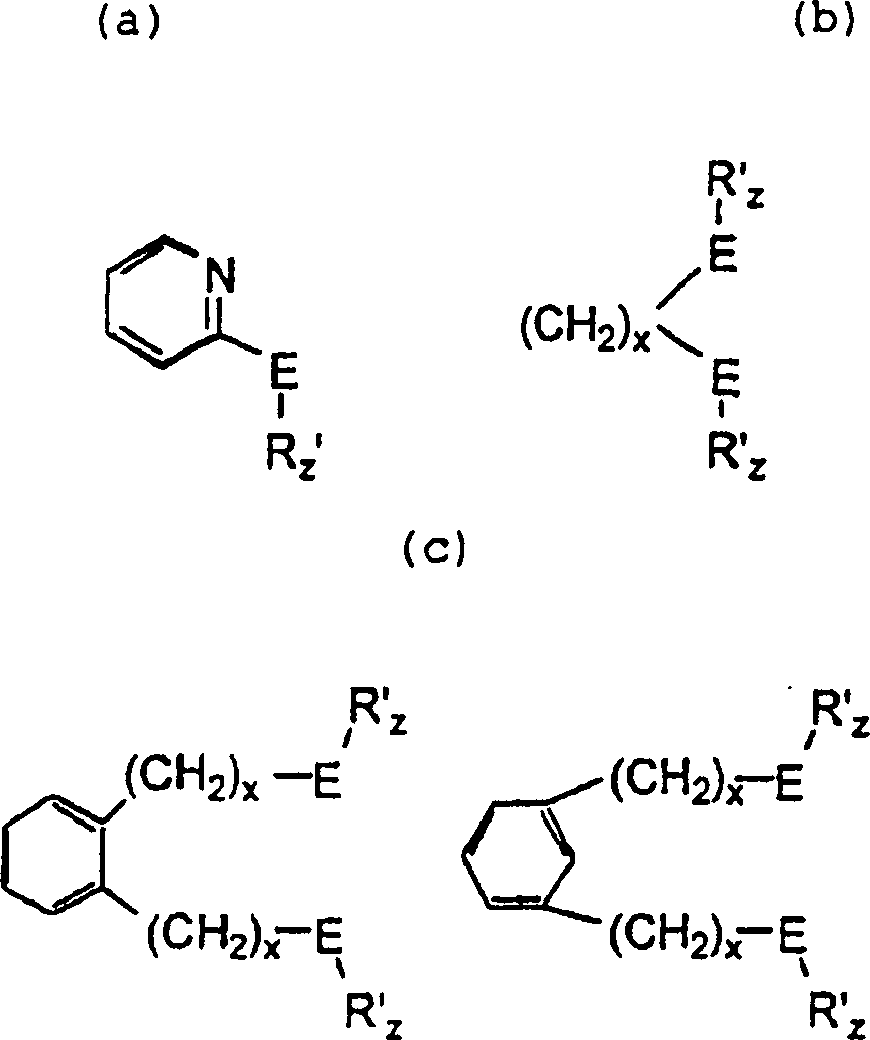
erfindungsgemäßen Gruppe
5-Metallverbindungen mit einem polyanionischen Hilfsliganden und drei
einwertigen ein- oder
mehrzähnigen
Liganden können
durch die folgenden Figuren wiedergegeben werden: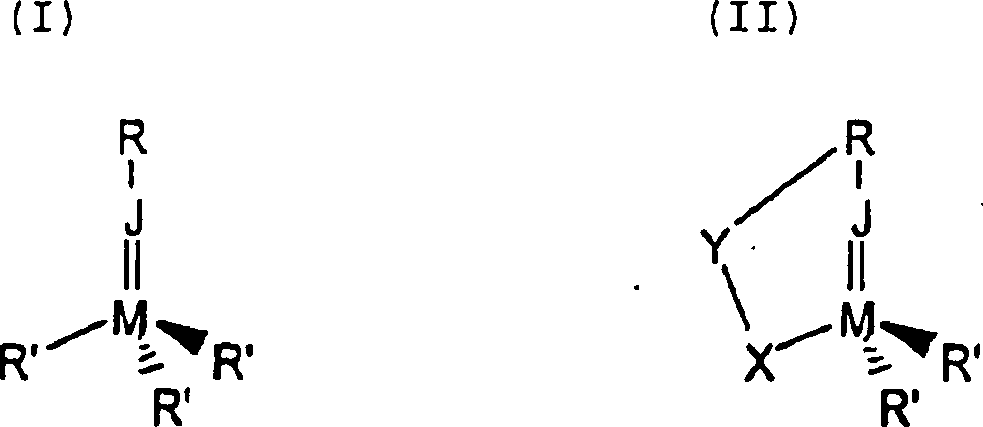
Außerdem können mehrzähnige Liganden
wie in Darstellung (d) gezeigt verwendet werden: 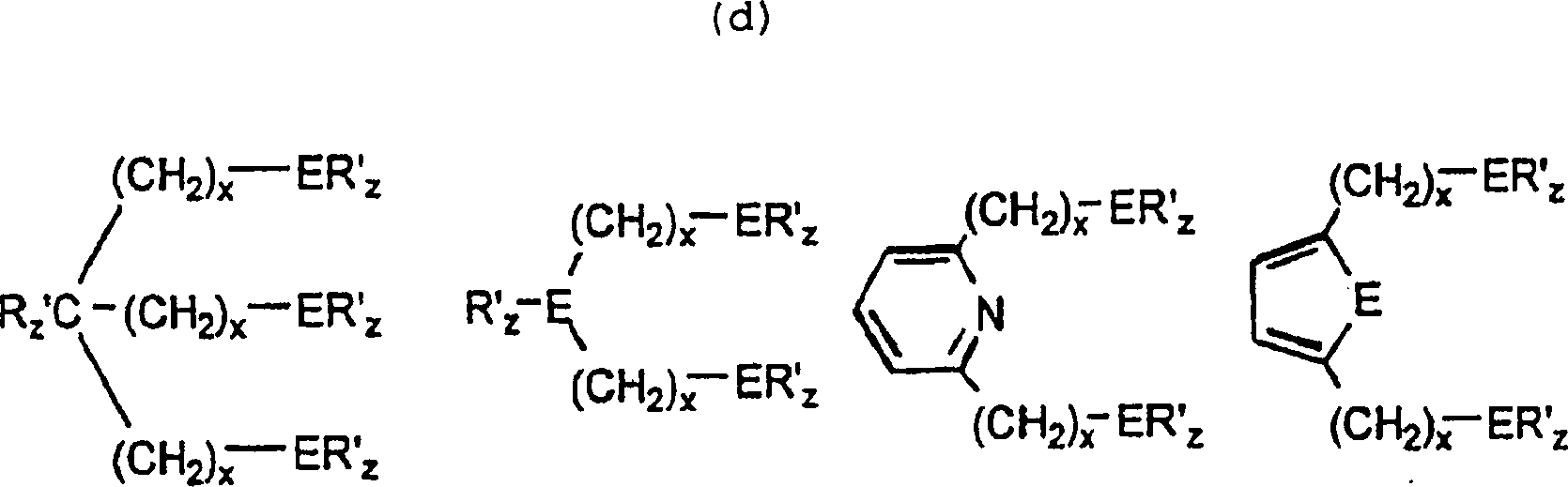
Zu
repräsentativen
(1) Verbindungen gehören
die Folgenden: 
Zu
repräsentativen
(2) Verbindungen gehören
die Folgenden: 
Schema 1Scheme 1
Weitere chemische Modifikationen können durch Ligandenaustauschreaktionen wie Metathese vorgenommen werden. (Siehe Schema 2).Further chemical modifications can by ligand exchange reactions such as metathesis. (See Scheme 2).
Schema
2 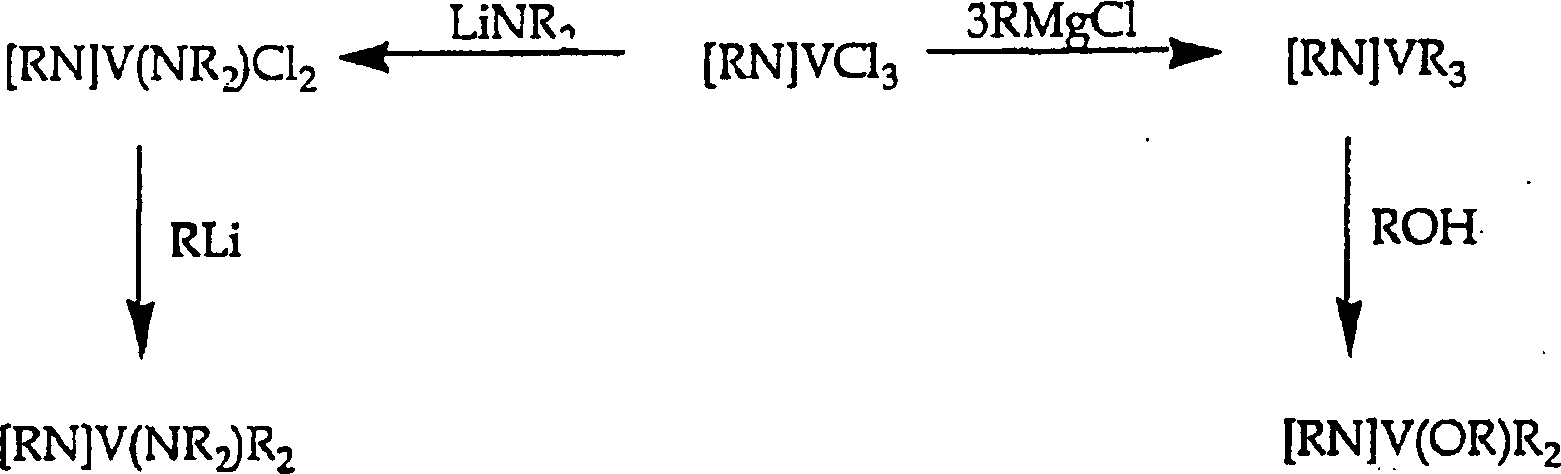
Die Behandlung eines Arylimidogruppe-(V)-Trialkylkomplexes mit einem Äquivalent eines protischen Reagenzes wie eines Amins oder eines Alkohols führt zu Eliminierung eines Äquivalents Alkan zusammen mit Ligandbildung einer Amidogruppe unter Bildung von erfindungsgemäßen Verbindungen. Alternativ können die erfindungsgemäßen Verbindungen durch anfängliche Substitution eines einzelnen Chloridliganden aus einem Arylimidogruppe-(V)-Metalltrichlorid durch Reaktion mit beispielsweise Alkalimetallsalz eines Alkohols hergestellt werden, die zur Bildung einer Arylimidogruppe-(V)-metall(alkoxy)dichlorid führt. Alkylierung des Arylimidogruppe-(V)-(alkoxy)dichlorids führt zur Bildung der erfindungsgemäßen Verbindungen. Ein früherer Versuch zur Herstellung von Verbindungen dieser Typen beinhaltet direkte Zugabe von Alkylierungsmitteln zu (Tolylimido)vanadium(V)trichlorid. Diese Reaktion führt zur Bildung von (Tolylimido)vanadium(V)(bismethyltrimethylsilyl)chlorid, siehe beispielsweise D. D. Devore, J. Am. Chem. Soc., 1987, 109, 7408–7416. Die oben zur Herstellung der erfindungsgemäßen Verbindungen beschriebenen Verfahren bieten größere Vielseitigkeit und Kontrolle sterischer und elektronischer Variationen um das Metallzentrum herum.The Treatment of an aryl-imido-group- (V) -trialkyl complex with one equivalent a protic reagent such as an amine or an alcohol leads to elimination of an equivalent Alkane along with ligand formation of an amido group under formation of compounds of the invention. Alternatively you can the compounds of the invention through initial Substitution of a single chloride ligand from an aryl imido group (V) metal trichloride by reaction with, for example, alkali metal salt of an alcohol prepared to form an aryl-imido-group- (V) -metal (alkoxy) dichloride leads. Alkylation of the aryl-imido-group- (V) - (alkoxy) dichloride leads to Formation of the compounds of the invention. An earlier one Attempt to produce compounds of these types direct addition of alkylating agents to (tolylimido) vanadium (V) trichloride. This reaction leads to form (tolylimido) vanadium (V) (bismethyltrimethylsilyl) chloride, See, for example, D.D. Devore, J. Am. Chem. Soc., 1987, 109, From 7408 to 7416. The ones described above for the preparation of the compounds of the invention Procedures offer greater versatility and control of steric and electronic variations around the metal center around.
Die Verwendung von (a) polyanionischem Liganden mit niedriger Koordinationszahl und (b) einem weiteren Hilfsliganden, der dem Vanadiummetallzentrum einsame n-Elektronenpaare zur Verfügung stellen kann (siehe repräsentative Beispiele für Formel (2)) führt zu erhöhter Stabilität, wodurch die Bildung von Vanadiumalkylomplexen möglich ist, bei denen das Vanadiummetallzentrum in seinem höchsten Oxidationszustand stabilisiert ist. Diese unerwartete Feststellung wird erhärtet durch (1) die geringe Menge an Vanadiumalkylkomplexen, in denen das Vanadiummetallzentrum in seinem höchsten Oxidationszustand stabilisiert ist, und (2) bestätigt die Instabilität von Vanadium(V)alkylkomplexen, die nicht die Hilfsligandanordnungen der erfindungsgemäßen Verbindungen besitzen. Es wird beispielsweise berichtet, dass tert.-Butylimido-cyclopentadienylvanadiumdimethyl thermisch instabil ist und sich bei Raumtemperatur innerhalb von Minuten zersetzt. Siehe F. Preuss, Z. Naturforsch 1990, 45b, 191–198.The Use of (a) low coordination number polyanionic ligand and (b) another ancillary ligand, the vanadium metal center lone n-electron pairs can provide (see representative examples for Formula (2)) leads too high Stability, whereby the formation of Vanadiumalkylomplexen is possible, in which the vanadium metal center in his highest Oxidation state is stabilized. This unexpected finding is confirmed by (1) the small amount of vanadium alkyl complexes in which stabilizes the vanadium metal center in its highest oxidation state is, and (2) confirmed the instability of vanadium (V) alkyl complexes other than the ancillary ligand arrangements the compounds of the invention have. For example, it is reported that tert-butylimido-cyclopentadienylvanadium dimethyl is thermally unstable and at room temperature within Minutes decomposed. See F. Preuss, Z. Naturforsch 1990, 45b, 191-198.
Weitere Details finden sich in Progress in Inorganic Chemistry, Volume 42, 1994, 239–482 und anderen Druckschriften, die dem Fachmann leicht zugänglich sind.Further Details can be found in Progress in Inorganic Chemistry, Volume 42, 1994, 239-482 and other publications which are readily available to those skilled in the art.
Die erfindungsgemäßen Gruppe 5-Metallverbindungen können in beliebiger ausreichender Weise für die Polymerisationskatalyse aktiviert werden, um Koordinations- oder kationische Polymerisation zu ermöglichen. Dies kann für Koordinationspolymerisation erreicht werden, wenn ein Ligand abstrahiert werden kann und ein weiterer entweder Einschub der ungesättigten Monomere erlaubt oder in ähnlicher Weise zum Ersatz durch einen solchen, der Einschub des ungesättigten Monomers erlaubt, z. B. Alkyl, Silyl oder Hydrid, abstrahierbar ist. Die vorliegenden Aktivatoren für die Koordinationspolymerisation sind ionisierende nicht-koordinierende Anionvorläuferverbindungen, die einen Liganden abstrahieren, um so das Gruppe 5-Metall zentrum zu einem Kation zu ionisieren und ein die Ladung ausgleichendes nicht-koordinierendes Anion zu liefern.The inventive group 5-metal compounds can in any sufficient manner for the polymerization catalysis be activated to coordination or cationic polymerization to enable. This can be for Coordination polymerization can be achieved when a ligand abstracts can be and another either inset of the unsaturated Monomers allowed or similar Way to substitute by such, the inset of the unsaturated Monomers allowed, for. As alkyl, silyl or hydride, abstractable is. The present activators for coordination polymerization are ionizing non-coordinating anion precursor compounds containing a Abstract ligands to form the group 5 metal center Ionizing cation and a charge balancing non-coordinating To deliver anion.
Der Begriff "nicht-koordinierendes Anion" ist bekannt und bedeutet ein Anion, das entweder nicht mit dem Metallkation koordiniert oder an dieses nur schwach koordiniert ist, wodurch es ausreichend labil bleibt, um durch eine neutrale Lewisbase verdrängt zu werden, wie ein olefinisch oder acetylenisch ungesättigtes Monomer.The term "non-coordinating anion" is known and means an anion that is either not coordinated with or only weakly coordinated to the metal cation, leaving it sufficiently labile, to be displaced by a neutral Lewis base, such as an olefinically or acetylenically unsaturated monomer.
Beschreibungen von ionischen Katalysatoren, jenen, die ein Übergangsmetallkation und ein nicht-koordinierendes Anion umfassen, die für Koordinationspolymerisation geeignet sind, erscheinen in den frühen Arbeiten in US-A-5 064 802, US-A-5 132 380, US-A-5 198 401, US-A-5 278 119, US-A-5 321 106, US-A-5 347 024, US-A-5 408 017, US-A-5 599 671 und den internationalen Veröffentlichungen WO-A-92/00333 und WO-A-93/14132. Diese lehren ein bevorzugtes Herstellungsverfahren, wobei Metallocene durch nicht-koordinierende Anionenvorläufer protoniert werden, so dass eine Alkyl/Hydridgruppe von einem Übergangsmetall abstrahiert wird, um es sowohl kationisch zu machen als auch in der Ladung durch das nicht-koordinierende Anion auszugleichen. Da die Abstraktions- und Einschubliganden dieser Metallocene auch Liganden der erfindungsgemäßen Gruppe 5-Metallverbindungen sein können, können ähnliche Verfahren zur Herstellung als aktive Polymerisationskatalysatorkomponenten nachgearbeitet werden.descriptions of ionic catalysts, those containing a transition metal cation and a include noncoordinating anion used for coordination polymerization are useful in the early work in US-A-5,064 802, US-A-5,132 380, US-A-5,198,401, US-A-5,278,119, US-A-5,321,106, US-A-5,347,024, US-A-5 408,017, US-A-5 599 671 and the international publications WO-A-92/00333 and WO-A-93/14132. These teach a preferred manufacturing method, wherein metallocenes protonated by non-coordinating anion precursors so that an alkyl / hydride group abstracts from a transition metal is going to make it both cationic and in charge to balance the non-coordinating anion. Since the abstraction and insertion ligands of these metallocenes also ligands of the group of the invention 5-metal compounds can be, can be similar Process for the preparation as active polymerization catalyst components be reworked.
Die Verwendung von ionisierenden ionischen Verbindungen, die kein aktives Proton enthalten, jedoch in der Lage sind, sowohl das aktive Gruppe 5-Metallkation als auch ein nicht-koordinierendes Anion zu produzieren, ist auch brauchbar. Siehe EP-A-0 426 637, EP-A-0 573 403 und US-A-5 387 568 hinsichtlich instruktiver ionischer Verbindungen. Reaktive Kationen der ionisierenden ionischen Verbindungen, die von den Brönstedt- Säuren verschieden sind, schließen Ferrocenium, Silber, Tropylium, Triphenylcarbenium und Triethylsilylium oder Alkalimetall- oder Erdalkalimetallkationen wie Natrium-, Magnesium- oder Lithiumkationen ein. Eine weitere Klasse von erfindungsgemäß geeigneten nicht-koordinierenden Anionvorläufern sind hydratisierte Salze, die die Alkalimetall- oder Erdalkalimetallkationen und nicht-koordinierendes Anion wie oben beschrieben umfassen. Die hydratisierten Salze können durch Reaktion des Metallkation-nicht-koordinierenden Anion-Salzes mit Wasser hergestellt werden, beispielsweise durch Hydrolyse des kommerziell erhältlichen oder leicht synthetisierten LiB(pfp)4, die [Li·xH2O][B(pfp)4] ergibt, wobei (pfp) Pentafluorphenyl oder Perfluorphenyl ist.The use of ionizing ionic compounds which contain no active proton but are capable of producing both the active group 5 metal cation and a non-coordinating anion is also useful. See EP-A-0 426 637, EP-A-0 573 403 and US-A-5 387 568 for instructive ionic compounds. Reactive cations of the ionizing ionic compounds other than the Bronsted acids include ferrocenium, silver, tropylium, triphenylcarbenium and triethylsilylium, or alkali metal or alkaline earth metal cations such as sodium, magnesium or lithium cations. Another class of non-coordinating anion precursors useful in the present invention are hydrated salts comprising the alkali metal or alkaline earth metal cations and non-coordinating anion as described above. The hydrated salts can be prepared by reaction of the metal cation noncoordinating anion salt with water, for example, by hydrolysis of the commercially available or readily synthesized LiB (pfp) 4 , the [Li xxH 2 O] [B (pfp) 4 ] where (pfp) is pentafluorophenyl or perfluorophenyl.
Jedes Metall oder Metalloid, das einen Koordinationskomplex bilden kann, der nicht durch Wasser (oder andere Brönstedt- oder Lewissäuren) abgebaut werden kann, kann in dem nicht-koordinierenden Anion verwendet oder enthalten sein. Zu geeigneten Metallen gehören Aluminium, Gold, Platin und dergleichen, sind jedoch nicht auf diese begrenzt. Zu geeigneten Metalloiden gehören Bor, Phosphor, Silicium und dergleichen, sind jedoch nicht auf diese begrenzt. Die Beschreibung der nicht-koordinierenden Anionen und Vorläufern derselben aus den Druckschriften der vorhergehenden Absätze werden hier zu Zwecken der US-Patentpraxis zitiert zum Zweck der Bezugnahme.each Metal or metalloid, which can form a coordination complex, not degraded by water (or other Bronsted or Lewis acids) can be used in the non-coordinating anion or be included. Suitable metals include aluminum, gold, platinum and the like, but are not limited to these. To suitable Metalloids belong Boron, phosphorus, silicon and the like, but are not on this limited. The description of the non-coordinating anions and precursors same from the documents of the preceding paragraphs cited herein for purposes of US patent practice for purposes of reference.
Ein weiteres Verfahren zur Herstellung der erfindungsgemäßen aktiven Polymerisationskatalysatoren verwendet ionisierende Anionvorläufer, die anfangs neutrale Lewissäuren sind, jedoch nach Ionisierungsreaktion mit den erfindungsgemäßen Verbindungen ein Gruppe 5-Metallkation und das nicht-koordinierende Anion bilden, beispielsweise wirkt Tris(pentafluorphenyl)bor so, dass ein Kohlenwasserstoff-, Hydrid- oder Silylligand abstrahiert wird, um ein Gruppe 5-Metallkation und stabi lisierendes nicht-koordinierendes Anion zu ergeben, siehe EP-A-0 427 697 und EP-A-9 520 732 zur Illustration der Verwendung von Gruppe 4-Metallocenverbindungen. Siehe auch die Verfahren und Verbindungen von EP-A-0 495 375. Die Beschreibung der nicht-koordinierenden Anionen und Vorläufern derselben aus diesen Druckschriften wird in ähnlicher Weise zu Zwecken der US-Patentpraxis zitiert zum Zweck der Bezugnahme.One Another process for the preparation of the active compounds according to the invention Polymerization catalysts use ionizing anion precursors which initially neutral Lewis acids are, but after ionization reaction with the compounds of the invention form a group 5-metal cation and the non-coordinating anion, For example, tris (pentafluorophenyl) boron acts as a hydrocarbon, Hydride or silyl ligand is abstracted to a group 5 metal cation and to give a stabilizing non-coordinating anion, see EP-A-0 427 697 and EP-A-9 520 732 illustrating the use of Group 4 metallocene compounds. See also the methods and compounds of EP-A-0 495 375. The Description of the non-coordinating anions and precursors thereof from these references is similarly used for purposes of US patent practice cited for purposes of reference.
Wenn der Kationanteil eines ionischen nicht-koordiniernden Anionvorläufers eine Brönstedtsäure wie Protonen oder protonierte Lewisbasen (außer Wasser) oder eine reduzierbare Lewissäure wie Ferrocenium oder Silberkationen oder Alkalimetall- oder Erdalkalimetallkationen ist, wie jene von Natrium-, Magnesium- oder Lithiumkationen, kann das Molverhältnis von Übergangsmetall zu Aktivator jedes beliebige Verhältnis sein, vorzugsweise jedoch 10:1 bis 1:10, insbesondere 5:1 bis 1:5, besonders bevorzugt 2:1 bis 1:2 und am meisten bevorzugt 1,2:1 bis 1:1,2, wobei das Verhältnis von 1:1 am meisten bevorzugt ist.If the cation portion of an ionic non-coordinating anion precursor Brönsted acid, such as protons or protonated Lewis bases (except Water) or a reducible Lewis acid such as ferrocenium or silver cations or alkali metal or Alkaline earth metal cations, such as those of sodium, magnesium or Lithium cations, the molar ratio of transition metal to activator be any ratio but preferably 10: 1 to 1:10, especially 5: 1 to 1: 5, especially preferably from 2: 1 to 1: 2, and most preferably from 1.2: 1 to 1: 1.2, the ratio of 1: 1 is most preferred.
Geeignete aktive Katalysatorkomplexe für die Koordinationspolymerisation können somit durch Aktivierung mit den traditionellen Metallocenaktivatoren hergestellt werden, typischerweise den Alkylaluminiumhalogeniden, Alkylalumoxanen und ionisierenden Bor- oder Aluminiumverbindungen, die in der Technik bekannt sind. Die aktiven Katalysatoren sind somit katalytisch aktive Komponenten, die Komplexe umfassen, die von den Gruppe 5-Metallverbindungen, die die erfindungsgemäßen Hilfsliganden enthalten, und Aluminiumalkylen, Alumoxanen und nicht-koordinierenden Anionen abgeleitet sind. Die erfindungsgemäßen carbokationischen Katalysatorkomplexe sind jene, die mit den ionisierenden nicht-koordinierenden Anionvorläuferverbindungen hergestellt sind.suitable active catalyst complexes for the coordination polymerization can thus by activation be prepared with the traditional metallocene activators, typically the alkylaluminum halides, alkylalumoxanes and ionizing boron or aluminum compounds used in the art are known. The active catalysts are thus catalytically active Complexes comprising complexes derived from the group 5 metal compounds, the auxiliary ligands according to the invention contain, and aluminum alkyls, alumoxanes and non-coordinating Anions are derived. The carbocationic catalyst complexes according to the invention are those made with the ionizing non-coordinating anion precursor compounds are.
Die erfindungsgemäßen Katalysatorkomplexe sind zur Polymerisation von ungesättigten Monomeren brauchbar, die bekanntermaßen konventionell unter entweder Koordinationspolymerisationsbedingungen oder kationischen Polymerisationsbedingungen unter Verwendung von Metallocenen polymerisierbar sind. Solche Bedingungen sind wohl bekannt und schließen Lösungspolymerisation, Aufschlämmungspolymerisation und Nieder-, Mittel- und Hochdruck-Gasphasenpolymerisation ein. Der erfindungsgemäße Katalysator kann trägergestützt sein und ist als solcher besonders brauchbar in den bekannten Betriebsmodi unter Verwendung von Festbett-, Bewegtbett-, Wirbelbett- oder Aufschlämmungsverfahren, die in Einzel-, Reihen- oder Parallelreaktoren durchgeführt werden.The Inventive catalyst complexes are useful for the polymerization of unsaturated monomers, the known ones conventionally under either coordination polymerization conditions or cationic polymerization conditions using Metallocenes are polymerizable. Such conditions are well known and closed solution, slurry and low, medium and high pressure gas phase polymerization. The catalyst according to the invention can be supported and as such is particularly useful in the known modes of operation using fixed bed, moving bed, fluidized bed or slurry processes, which are carried out in single, series or parallel reactors.
Bei Verwendung der erfindungsgemäßen Katalysatoren, insbesondere wenn sie auf einem Träger immobilisiert sind, enthält das Gesamtkatalysatorsystem allgemein zusätzlich ein oder mehrere Abfangverbindungen. Der Begriff "Abfangverbindungen" soll in dieser Anmeldung und ihren Ansprüchen jene Verbindungen einschließen, die zur Entfernung polarer Verunreinigungen aus der Reaktionsumgebung wirksam sind. Verunreinigungen können versehentlich mit irgendwelchen Polymerisationsreaktionskomponenten eingebracht werden, insbesondere mit Lösungsmittel, Monomer- und Katalysatoreinsatzmaterial, und können Katalysatoraktivität und Stabilität nachteilig beeinflussen. Es kann zu Abnahme oder sogar Wegfall der katalytischen Aktivität führen, insbesondere wenn ionisierende Anionenvorläufer das Katalysatorsystem aktivieren. Zu den polaren Verunreinigungen oder Katalysatorgiften gehören Wasser, Sauerstoff, Metallverunreinigungen, usw. Vorzugsweise werden vor Einbringung derselben in das Reaktionsgefäß Maßnahmen ergriffen, beispielsweise durch chemische Behandlung oder sorgfältige Trenntechniken nach oder während der Synthese oder Herstellung der verschie denen Komponenten, normalerweise werden jedoch noch geringere Mengen an Abfangverbindung in dem Polymerisationsverfahren selbst verwendet.at Use of the catalysts according to the invention, especially when immobilized on a support contains the total catalyst system generally in addition one or more scavengers. The term "scavenging compounds" is intended in this application and their claims include those compounds to remove polar contaminants from the reaction environment are effective. Impurities can accidentally with any polymerization reaction components be introduced, in particular with solvent, monomer and catalyst feed, and can catalyst activity and stability adversely affect. It can decrease or even eliminate the cause catalytic activity, in particular when ionizing anion precursors activate the catalyst system. To the polar impurities or catalyst poisons Water, oxygen, metal impurities, etc. Preferably before introducing them into the reaction vessel measures taken, for example by chemical treatment or careful separation techniques after or while the synthesis or preparation of the various components, normally however, even lower levels of scavenging compound in the polymerization process self-used.
Diese Abfangverbindungen sind in der Regel organometallische Verbindungen wie die organometallischen Gruppe-13-Verbindungen von US-A-5 153 157, US-A-5 241 025 und WO-A-91/09882, WO-A-94/03506, WO-A-93/14132, und jene von WO-A-95/07941. Zu beispielhaften Verbindungen gehören Triethylaluminium, Triethylboran, Triisobutylaluminium, Methylalumoxan, Isobutylaluminoxan und Tri(n-octyl)aluminium. Jene Abfangverbindungen mit raumerfüllenden oder linearen C6-C20-Kohlenwasserstoffsubstituenten, die kovalent an das Metall- oder Metalloidzentrum gebunden sind, sind bevorzugt, um nachteilige Wechselwirkung mit dem aktiven Katalysator zu minimieren. Zu Beispielen gehören Triethylaluminium, insbesondere jedoch raumerfüllende Verbindungen wie Triisobutylaluminium, Triisoprenylaluminium und langkettige lineare alkylsubstituierte Aluminiumverbindungen, wie Tri-n-hexylaluminium, Tri-n-octylaluminium oder Tri-n-dodecylaluminium. Wenn Alumoxan als Aktivator verwendet wird, wirkt jeglicher Überschuss gegenüber der Menge, die erforderlich ist, um die vorhandenen Katalysatoren zu aktivieren, als Abfangverbindungen, und möglicherweise sind keine weiteren Abfangverbindungen erforderlich. Alumoxane können auch in Abfangmengen mit anderen Aktivierungsmitteln verwendet werden, z. B. Methylalumoxan und Triisobutylaluminoxan. Die mit den erfindungsgemäßen Gruppe 5-Katalysatorverbindungen zu verwendende Menge an Abfangmittel wird während Polymerisationsreaktionen auf jene Menge minimiert, die wirksam ist, um Aktivität zu erhöhen, und ganz weggelassen, wenn die Einsatzmaterialien ausreichend frei von zufällig anwesenden Verunreinigungen sein können.These scavenging compounds are typically organometallic compounds such as the Group 13 organometallic compounds of US-A-5,153,157, US-A-5,241,025 and WO-A-91/09882, WO-A-94/03506, WO -A-93/14132, and those of WO-A-95/07941. Illustrative compounds include triethylaluminum, triethylborane, triisobutylaluminum, methylalumoxane, isobutylaluminoxane, and tri (n-octyl) aluminum. Those scavengers with bulky or linear C 6 -C 20 hydrocarbyl substituents covalently bonded to the metal or metalloid center are preferred to minimize adverse interaction with the active catalyst. Examples include triethylaluminum, but especially bulky compounds such as triisobutylaluminum, triisoprenylaluminum and long chain linear alkyl substituted aluminum compounds such as tri-n-hexylaluminum, tri-n-octylaluminum or tri-n-dodecylaluminum. When alumoxane is used as the activator, any excess over the amount required to activate the catalysts present acts as scavenging compounds, and possibly no other scavenging compounds are required. Alumoxanes can also be used in scavenging with other activating agents, e.g. Methylalumoxane and triisobutylaluminoxane. The amount of scavenger to be used with the Group 5 catalyst compounds of the present invention is minimized during polymerization reactions to that amount effective to increase activity, and omitted altogether if the feeds can be sufficiently free of adventitious impurities.
Der erfindungsgemäße Katalysator kann zur Verwendung in Gasphasen-, Massen-, Aufschlämmungspolymerisationsverfahren oder ansonsten nach Bedarf trägergestützt sein. In der Technik sind zahlreiche Trägerverfahren für Copolymerisationsverfahren für Olefine bekannt, insbesondere für Katalysatoren, die mit Alumoxanen aktiviert werden, hiervon ist jedes für das erfindungsgemäße Verfahren in seinem allgemeinsten Umfang geeignet. Siehe beispielsweise US-A-5 057 475 und US-A-5 227 440. Ein Beispiel für trägergestützte ionische Katalysatoren findet sich in WO-A-94/03056. Ein besonders effektives Verfahren ist dasjenige, das in der gleichzeitig anhängigen US-Patentanmeldung 08/474 948, eingereicht am 7. Juni 1995, und WO-A-96/04319 beschrieben ist. Ein Massen- oder Aufschlämmungsverfahren, das trägergestützte erfindungsgemäße Gruppe 5-Metallverbindungen verwendet, die mit Alumoxan-Cokatalysatoren aktiviert werden, kann wie für Ethylen-Propylen-Kautschuk in US-A-5 001 205 und US-A-5 229 478 beschrieben verwendet werden, diese Verfahren sind auch mit den Katalysatorsystemen von dieser Anmeldung geeignet. Gemäß der Kenntnisse auf dem Sektor können sowohl anorganische Oxid- als auch polymere Träger verwendet werden. Siehe US-A-5 422 325, US-A-5 427 991, US-A-5 498 582, US-A-5 466 649, die gleichzeitig anhängigen US-Patentanmeldungen Nr. 08/265,532 und 08/265,533, beide eingereicht am 24. Juni 1995, und die internationalen Veröffentlichungen WO-A-93/11172 und WO-A-94/07928.Of the catalyst according to the invention For use in gas phase, bulk, slurry polymerization processes or otherwise supported as needed. There are numerous carrier processes for copolymerization processes in the art for olefins known, especially for Catalysts activated with alumoxanes, of which is each one for the inventive method suitable in its most general scope. See, for example, US-A-5 057,475 and US-A-5,227,440. An example of supported ionic catalysts is found in WO-A-94/03056. A particularly effective procedure is the one disclosed in co-pending U.S. Patent Application 08/474 948, filed June 7, 1995, and WO-A-96/04319. A mass or slurry method, the supported group of the invention 5-metal compounds used with alumoxane cocatalysts can be activated, as for Ethylene-propylene rubber is described in US-A-5,001,205 and US-A-5,229,478 These processes are also used with the catalyst systems suitable from this application. According to the knowledge in the sector can both inorganic oxide and polymeric supports can be used. Please refer US-A-5,422,325, US-A-5,427,991, US-A-5,498,582, US-A-5,466,649, which are commonly assigned pending US patent applications Nos. 08 / 265,532 and 08 / 265,533, both filed June 24, 1995, and the international publications WO-A-93/11172 and WO-A-94/07928.
In bevorzugten Ausführungsformen des erfindungsgemäßen Verfahrens wird das Katalysatorsystem in der Flüssigphase (Lösung, Aufschlämmung, Suspension, Massenphase oder Kombinationen davon), in Hochdruck-Flüssig- oder überkritischer Fluidphase oder in der Gasphase verwendet. Jedes dieser Verfahren kann in Einzel-, Parallel- oder Reihenreaktoren verwendet werden. Die Flüssigverfahren beinhalten das Kontaktieren von Ole finmonomeren mit dem oben beschriebenen Katalysatorsystem in geeignetem Verdünnungsmittel oder Lösungsmittel und Reagierenlassen der Monomere für eine ausreichende Zeit, um die erfindungsgemäßen Copolymere zu produzieren. Geeignet sind sowohl aliphatische als auch aromatische Kohlenwasserstofflösungsmittel, Hexan und Toluol sind bevorzugt. Halogenkohlenwasserstofflösungsmittel, z. B. Methylenchlorid, sind auch geeignet. Massen- und Aufschlämmungsverfahren werden in der Regel durchgeführt, indem die Katalysatoren mit einer Aufschlämmung von flüssigem Monomer kontaktiert werden, wobei das Katalysatorsystem trägergestützt ist. Gasphasenverfahren verwenden typischerweise einen trägergestützten Katalysator und werden in jeder Weise durchgeführt, die bekanntermaßen für Ethylenhomopolymere oder -copolymere geeignet ist, die durch Koordinationspolymerisation hergestellt werden. Illustrierende Beispiele finden sich in den US-Patenten 4 543 399, 4 588 790, 5 028 670, 5 382 638, 5 352 749, 5 436 304, 5 453 471 und 5 463 999, sowie WO-A-95/07942.In preferred embodiments of the process of the invention, the catalyst system is used in the liquid phase (solution, slurry, suspension, bulk phase or combinations thereof), in high pressure liquid or supercritical fluid phase or in the gas phase. Each of these methods can be used in single, parallel or series reactors. The liquid processes include the Kon timing olefin monomers with the catalyst system described above in suitable diluent or solvent and reacting the monomers for a time sufficient to produce the copolymers of the invention. Suitable are both aliphatic and aromatic hydrocarbon solvents, hexane and toluene are preferred. Halogenated hydrocarbon solvents, e.g. As methylene chloride, are also suitable. Bulk and slurry processes are typically conducted by contacting the catalysts with a slurry of liquid monomer, the catalyst system being supported. Gas phase processes typically use a supported catalyst and are carried out in any manner known to be suitable for ethylene homopolymers or copolymers prepared by coordination polymerization. Illustrative examples can be found in US Patent Nos. 4,543,399, 4,588,790, 5,028,670, 5,382,638, 5,352,749, 5,436,304, 5,453,471 and 5,463,999, and WO-A-95/07942.
Die Verwendung von Alkylhalogenidpromotoren, wie Hexachlorcyclopentadien, Ethyltrichloracetat oder Benzoylchlorid mit Ziegler-Vanadiumkatalysatoren zur Leistungssteigerung (d. h. Erhöhung der Polyethylenausbeuten) ist wohl bekannt und kann mit den erfindungsgemäßen Katalysatoren verwendet werden. Siehe beispielsweise US-A-4 232 140, US-A-4 508 842 und EP-0 44 119 und EP-0 196 830.The Use of alkyl halide promoters, such as hexachlorocyclopentadiene, Ethyl trichloroacetate or benzoyl chloride with Ziegler vanadium catalysts to improve performance (i.e., increase polyethylene yields) is well known and can be used with the catalysts of the invention become. See, for example, US-A-4,232,140, US-A-4,508,842 and EP-0 44 119 and EP-0 196 830.
Die Polymerisationsreaktionstemperatur kann allgemein gesagt von –50°C bis 250°C variieren. Die Reaktionstemperaturbedingungen sind vorzugsweise –20°C bis 220°, insbesondere unter 200°C. Der Druck kann von etwa 1 × 10⁵ Pa (1 mm) Hg bis 2,5 × 10⁵ Pa (2500 bar), vorzugsweise 0,1 bar bis 1600 bar, am meisten bevorzugt 1,0 bis 500 bar variieren. Wenn Copolymere mit niedrigerem Molekulargewicht, z. B. Mn < 10.000, angestrebt werden, ist es geeignet, die Reaktionsverfahren bei Temperaturen über etwa 0°C und Drücken unter 5 × 10⁷ Pa (500 bar) durchzuführen. Die Multiboraktivatoren von US-A-5 278 119 können zusätzlich verwendet werden, um die Herstellung der erfindungsgemäßen Copolymere mit niedrigem Molekulargewicht zu erleichtern.The polymerization reaction temperature may generally vary from -50 ° C to 250 ° C. The reaction temperature conditions are preferably -20 ° C to 220 ° C, especially below 200 ° C. The pressure may vary from about 1 x 10 5 Pa (1 mm) Hg to 2.5 x 10 5 Pa (2500 bar), preferably 0.1 bar to 1600 bar, most preferably 1.0 to 500 bar. When lower molecular weight copolymers, e.g. B. M n <10,000, it is suitable to carry out the reaction processes at temperatures above about 0 ° C and pressures below 5 × 10 7 Pa (500 bar). The multiboron activators of US-A-5,278,119 may additionally be used to facilitate the preparation of the low molecular weight copolymers of the present invention.
Lineares Polyethylen einschließlich Polyethylenen mit hohem und ultrahohem Molekulargewicht einschließlich sowohl Homo- als auch Copolymeren mit anderen α-Olefinmonomeren, α-olefinischen und/oder nicht-konjugierten Diolefinen, beispielsweise C3-C20-Olefinen, Diolefinen oder cyclischen Olefinen, werden durch Zugabe von Ethylen und gegebenenfalls einem oder mehreren der anderen Monomere in ein Reaktionsgefäß unter niedrigem Druck (typischerweise 5 × 10⁶ Pa (50 bar)) bei einer typischen Temperatur von 20–250°C mit dem erfindungsgemäßen Katalysator hergestellt, der mit Lösungsmittel wie Heptan oder Toluol aufgeschlämmt worden ist. Die Polymerisationswärme wird in der Regel durch Kühlen abgeleitet. Gasphasenpolymerisation kann beispielsweise in einem kontinuierlichen Wirbelbett-Gasphasenreaktor, der mit 2000 bis 3000 kPa und bei 60–160°C betrieben wird, unter Verwendung von Wasserstoff als Reaktionsmodifizierungsmittel (100–200 ppm), C4-C8-Comonomereinsatzmaterialstrom (0,5–1,2 Mol.%) und C2-Einsatzmaterialstrom (25–35 Mol) durchgeführt werden. Siehe US-A-4 543 399, US-A-4 588 790, US-A-5 028 670 und US-A-5 405 922 und US-A-5 462 999, auf die hier für die Zwecke der US-Patentpraxis Bezug genommen wird.Linear polyethylene including high and ultra high molecular weight polyethylenes, including both homo- and copolymers with other alpha-olefin monomers, alpha-olefinic and / or non-conjugated diolefins, for example C 3 -C 20 olefins, diolefins or cyclic olefins, are added by addition of ethylene and optionally one or more of the other monomers in a reaction vessel under low pressure (typically 5 × 10 6 Pa (50 bar)) at a typical temperature of 20-250 ° C with the catalyst according to the invention prepared with solvent such as heptane or Toluene has been slurried. The heat of polymerization is usually derived by cooling. Gas phase polymerization may be carried out, for example, in a continuous fluidized bed gas phase reactor operating at 2000 to 3000 kPa and at 60-160 ° C using hydrogen as reaction modifier (100-200 ppm), C 4 -C 8 comonomer feed stream (0.5 -1.2 mole%) and C 2 feedstream (25-35 mole). See US-A-4 543 399, US-A-4 588 790, US-A-5 028 670 and US-A-5 405 922 and US-A-5 462 999, incorporated herein by reference for the purposes of the U.S. Pat. Patent Practice is referenced.
Ethylen-α-Olefin- (einschließlich Ethylen-cyclisches Olefin- und Ethylen-α-Olefin-Diolefin)-Elastomere mit hohem Molekulargewicht und niedriger Kristallinität können unter Verwendung der erfindungsgemäßen Katalysatoren unter Verwendung von traditionellen Lösungspolymerisationsverfahren oder durch Einbringen von Ethylengas in eine Aufschlämmung hergestellt wer den, die das α-Olefin oder cyclische Olefin oder Mischung davon mit anderen polymerisierbaren oder nicht-polymerisierbaren Monomeren als Polymerisationsverdünnungsmittel einsetzt, in dem der erfindungsgemäße Katalysator suspendiert wird. Typische Ethylendrücke liegen zwischen 10 und 1000 psig (69 bis 6895 kPa), und die Polymerisationsverdünnungsmitteltemperatur liegt typischerweise zwischen –10 und 160°C. Das Verfahren kann in einem oder mehreren gerührten Tankreaktor durchgeführt werden, die in Reihe oder parallel betrieben werden. Hinsichtlich der allgemeinen Verfahrensbedingungen siehe die allgemeine Offenbarung von US-A-5 001 205. Siehe auch die gleichzeitig anhängigen US-Patentanmeldungen mit den Aktenzeichen 08/426 363, eingereicht am 21. April 1995, und 08/545 973, eingereicht am 20. Oktober 1995.Ethylene-α-olefin (including Ethylene-cyclic olefin and ethylene-α-olefin diolefin) elastomers with high molecular weight and low crystallinity can under Use of the catalysts of the invention using traditional solution polymerization techniques or by introducing ethylene gas into a slurry who the one who the α-olefin or cyclic olefin or mixture thereof with other polymerizable or non-polymerizable monomers as a polymerization diluent begins, suspended in the catalyst of the invention becomes. Typical ethylene pressures are between 10 and 1000 psig (69 to 6895 kPa) and the polymerization diluent temperature is typically between -10 and 160 ° C. The process can be carried out in one or more stirred tank reactor, which are operated in series or in parallel. Regarding the general For process conditions, see the general disclosure of US-A-5 001 205. See also the co-pending US patent applications with reference 08/426 363, filed on 21 April 1995, and 08 / 545,973, filed October 20, 1995.
Präpolymerisation des erfindungsgemäßen trägergestützten Katalysators kann auch zur weiteren Steuerung der Polymerteilchenmorphologie in typischen Aufschlämmungs- oder Gasphasenreaktionsverfahren gemäß konventionellen Lehren verwendet werden. Dies kann beispielsweise durch Präpolymerisieren von C2-C6-α-Olefin für eine begrenzte Zeit bewirkt werden, beispielsweise wird Ethylen mit dem trägergestützten Katalysator bei einer Temperatur von –15 bis 30°C und Ethylendruck bis zu etwa 1724 kPa (250 psig) für 75 Minuten kontaktiert, um eine Polymerbeschichtung aus Polyethylen mit einem Molekulargewicht von 30 000 bis 150 000 auf dem Träger zu erhalten. Der präpolymerisierte Katalysator steht dann zur Verwendung in den oben genannten Polymerisationsverfahren zur Verfügung. Die Verwendung polymerer Harze als Trägerbeschichtung kann zusätzlich verwendet werden, typischerweise durch Suspendieren eines festen Trägers in gelöstem Harz von solchem Material wie Polystyrol mit anschließendem Abtrennen und Trocknen. Hinsichtlich der Beschreibung von Metallocenverbindungen, ionischen Aktivatoren und brauchbaren Abfangverbindungen wird hier auf alle Dokumente Bezug genommen.Prepolymerization of the supported catalyst of the present invention can also be used to further control polymer particle morphology in typical slurry or gas phase reaction processes according to conventional teachings. This can be accomplished, for example, by prepolymerizing C 2 -C 6 α-olefin for a limited time, for example, ethylene with the supported catalyst at a temperature of -15 to 30 ° C and ethylene pressure up to about 1724 kPa (250 psig). for 75 minutes to obtain a polymer coating of polyethylene having a molecular weight of 30,000 to 150,000 on the support. The prepolymerized catalyst is then available for use in the above-mentioned polymerization processes. The use of polymeric resins as Trägerbe Coating may additionally be used, typically by suspending a solid support in dissolved resin from such material as polystyrene followed by separation and drying. For the description of metallocene compounds, ionic activators and useful scavengers, reference is hereby made to all documents.
Unter Verwendung der erfindungsgemäßen Katalysatoren können durch entweder Koordinations- oder carbokationische Polymerisation andere olefinisch ungesättigte Monomere neben den oben speziell beschriebenen polymerisiert werden, beispielsweise Styrol, alkylsubstituiertes Styrol, Ethylidennorbornen, Norbornadien, Dicyclopentadien und andere olefinisch ungesättigte Monomere einschließlich anderer cyclischer Olefine, wie Cyclopenten, Norbornen, alkylsubstituierter Norbornene, und einschließlich Isobutylen, Isopren, Butadien, Vinylethern, Vinylcarbazolen, usw. Es können zudem auch α-olefinische Makromonomere mit bis zu 100 Monomer-Einheiten oder mehr durch Copolymerisation eingebaut werden.Under Use of the catalysts of the invention can by either coordination or carbocationic polymerization other olefinically unsaturated Monomers are polymerized in addition to those specifically described above, for example styrene, alkyl-substituted styrene, ethylidenenorbornene, Norbornadiene, dicyclopentadiene and other olefinically unsaturated monomers including other cyclic olefins, such as cyclopentene, norbornene, alkyl substituted Norbornene, and inclusive Isobutylene, isoprene, butadiene, vinyl ethers, vinyl carbazoles, etc. It can also α-olefinic Macromonomers with up to 100 monomer units or more by copolymerization to be built in.
Schmieröladditivzusammensetzungen können vorteilhaft hergestellt werden, wenn α-Olefin-Copolymere mit niedrigem Molekulargewicht mit endständiger Vinyl- oder Vinylidenungesättigtheit mit den erfindungsgemäßen Katalysatoren hergestellt werden. Siehe die Offenbarungen von US-A-5 498 809 und den internationalen Patentanmeldungen WO-A-93/24359, WO-A-94/19436 und WO-A-94/13715 und die dort für weitere Informationen, wie hinsichtlich α-Olefinpolymeren mit niedrigem Molekulargewicht, aufgeführten Dokumente.Lubricating oil additive compositions can are advantageously prepared when low-α-olefin copolymers Molecular weight with terminal Vinyl or vinylidene unsaturation with the catalysts of the invention getting produced. See the disclosures of U.S. Patent Nos. 5,498,809 and International Patent Applications WO-A-93/24359, WO-A-94/19436 and WO-A-94/13715 and there for for further information, such as regarding low-α-olefin polymers Molecular weight, listed Documents.
In ähnlicher Weise, jedoch unter Verwendung von α-Olefin/Diolefin-Copolymer mit höherem Molekulargewicht (10 000 < Mn < 300 000) mit einer ausreichend niedrigen Kristallinität, um Öllöslichkeit zu ermöglichen (z. B. Kristallinität < 40 %) können wie in den gleichzeitig anhängigen US-Patentanmeldungen 08/426 363, eingereicht am 21. April 1995, und 08/545 973, eingereicht am 20. Oktober 1995, beschrieben multifunktionale Viskositätsmodifizierungs-Schmieröladditive produziert werden. Siehe die Beschreibungen der Schmierölmodifizierungsmittel und Schmierölzusammensetzungen in US-A-4 749 505, US-A-4 772 406 und WO-A-93/12148.Likewise, however, using higher molecular weight α-olefin / diolefin copolymer (10,000 <M n <300,000) having sufficiently low crystallinity to allow oil solubility (eg, crystallinity <40%) can be used in copending U.S. Patent Application Serial Nos. 08 / 426,363, filed April 21, 1995, and 08 / 545,973, filed October 20, 1995, multifunctional viscosity modifier lubricating oil additives are described. See the descriptions of the lubricating oil modifiers and lubricating oil compositions in US-A-4,749,505, US-A-4,772,406 and WO-A-93/12148.
Carbokationische Polymerisation kann durch Verwendung der erfindungsgemäßen Katalysatoren bewirkt werden, wenn sie durch asktivierende Ionisierung in aktive kationische Spezies überführt werden. Solche Polymerisationstechniken sind in der Technik wohl bekannt, siehe J. P. Kennedy, Carbocationic Polymerization of Olefins : A Critical Inventory (John Wiley & Sons, 1975). Siehe auch Michael C. Baird et al., η5-C5Me5TiMe3B(C6F5)3: A Carbocationic Olefin Polymerization Initiator Masquerading as a Ziegler-Natta Catalyst, J. Am. Chem. Soc. 1994, 116, 6435–6436, hinsichtlich Bedingungen, unter denen das Metall Ti der ersten Reihe in stabiler kationischer Metallocenform zur carbokationischen Polymerisation verwendet wurde. Auf jedes wird hier zu Zwecken der US-Patentpraxis Bezug genommen.Carbocationic polymerization can be effected by using the catalysts of this invention when converted to active cationic species by activating ionization. Such polymerization techniques are well known in the art, see JP Kennedy, Carbocationic Polymerization of Olefins: A Critical Inventory (John Wiley & Sons, 1975). See also Michael C. Baird et al., Η 5 -C 5 Me 5 TiMe 3 B (C 6 F 5 ) 3 : A Carbocationic Olefin Polymerization Initiator Masquerading as a Ziegler-Natta Catalyst, J. Am. Chem. Soc. 1994, 116, 6435-6436, regarding conditions under which the first-row metal Ti in stable cationic metallocene form was used for carbocationic polymerization. Each is referred to herein for US patent practice purposes.
Die erfindungsgemäßen Katalysatorzusammensetzungen können wie oben beschrieben individuell zur Koordinations- oder carbokationischen Polymerisation verwendet werden oder können zur Herstellung von Polymergemischen mit anderen bekannten Olefinpolymerisationskatalysatorverbindungen gemischt werden. Durch Auswahl von Monomeren, Gemischen von Koordinationskatalysatorverbindungen oder Gemischen von carbokationischen Katalysatorverbindungen oder beliebigen davon zusammen können Polymergemische unter Polymerisationsbedingungen hergestellt werden, die zu jenen unter Verwendung von individuellen Katalysatorzusammensetzungen analog sind. Polymere mit erhöhter MWD zur verbesserten Verarbeitung und anderen traditionellen Vorteilen, die aus mit gemischten Katalysatorsystemen hergestellten Polymeren erhältlich sind, können so erreicht werden.The catalyst compositions of the invention can individually as described above for coordination or carbocationic Polymerization can be used or can for the preparation of polymer mixtures with other known olefin polymerization catalyst compounds be mixed. By selection of monomers, mixtures of coordination catalyst compounds or mixtures of carbocationic catalyst compounds or any of them together Polymer mixtures are prepared under polymerization conditions, those to those using individual catalyst compositions are analog. Polymers with elevated MWD for improved processing and other traditional benefits, those made from mixed catalyst systems are available, can to be achieved.
Die folgenden Beispiele werden zur Veranschaulichung der vorhergehenden Erörterung gegeben. Alle Teile, Proportionen und Prozentsätze beziehen sich auf das Gewicht, wenn nicht anders angegeben. Für die Polymerisationsbeispiele wurden, wenn nicht anders angegeben, Umgebungstemperaturen verwendet. Obwohl die Beispiele auf bestimmte Ausführungsformen der vorliegenden Erfindung abzielen, sollen sie nicht als die Erfindung in irgendeiner speziellen Weise einschränkend angesehen werden. In diesen Beispielen werden bestimmte Abkürzungen verwendet, um die Beschreibung zu erleichtern. Hierzu gehören chemische Standardabkürzungen für die Elemente und bestimmte, allgemein anerkannte Abkürzungen, wie: Me = Methyl, Et = Ethyl, Pr1 = Isopropyl, Bu = Butyl, Ph = Phenyl, und THF = Tetrahydrofuran.The following examples are given to illustrate the foregoing discussion. All parts, proportions and percentages are by weight unless otherwise stated. Ambient temperatures were used for the polymerization examples unless otherwise specified. Although the examples are directed to particular embodiments of the present invention, they should not be construed as limiting the invention in any particular way. In these examples, certain abbreviations are used to facilitate the description. These include standard chemical abbreviations for the elements and certain commonly accepted abbreviations such as: Me = methyl, Et = ethyl, Pr 1 = isopropyl, Bu = butyl, Ph = phenyl, and THF = tetrahydrofuran.
Beispiel 1 – Herstellung von KatalysatorExample 1 - Preparation of catalyst
(a) Herstellung von (2,6-Pr1 2C6H3N)VCl3·THF(a) Preparation of (2,6-Pr 1 2 C 6 H 3 N) VCl 3 .THF
Eine Lösung von 25 g VOCl3 (0,14 Mol) und 25 g 2,6-Diisopropylphenylisocyanat (0,12 Mol) in 100 ml Oktan wurde zusammen 24 Stunden unter Rückfluss gehalten. Anschließende Lösungsmittelentfernung unter vermindertem Druck ergab einen dunkelgrünen öligen Feststoff. Dieser Feststoff wurde mit 50 ml Pentan extrahiert, filtriert und mit ungefähr 20 ml THF behandelt, um einen sandfarbenen Niederschlag zu produzieren. Das Auffangen durch Filtration ergab 33,6 g (2,6-Pr1 2C6H3N)VCl3·THF. Weitere 6, 0 g wurden durch eine zweite Extraktion des verbleibenden grünen öligen Feststoffs, anschließende Behandlung mit THF und Isolierung durch Filtration erhalten. Gesamtausbeute 39,6 g (0,10 Mol), 69 % bezogen auf Vanadium.A solution of 25 g of VOCl 3 (0.14 mol) and 25 g of 2,6-diisopropylphenyl isocyanate (0.12 mol) in 100 ml Octane was refluxed together for 24 hours. Subsequent solvent removal under reduced pressure gave a dark green oily solid. This solid was extracted with 50 ml of pentane, filtered and treated with approximately 20 ml of THF to produce a sand-colored precipitate. Filtration by filtration gave 33.6 g (2,6-Pr 1 2 C 6 H 3 N) VCl 3 .THF. Another 6.0 g were obtained by a second extraction of the remaining green oily solid, followed by treatment with THF and isolation by filtration. Total yield 39.6 g (0.10 mol), 69% based on vanadium.
(b) Herstellung von (2,6-Pr1 2C6H3N)V(CH2C6H5)3 (b) Preparation of (2,6-Pr 1 2 C 6 H 3 N) V (CH 2 C 6 H 5 ) 3
Eine Lösung von (2,6-Pr1 2C6H3N)VCl3·THF (20 g, 0,049 mol) in 50 ml Hexan wurde auf –30°C abgekühlt. Eine Lösung von C6H5CH2MgCl (148 ml, 1 M Lösung in Diethylether, 0,148 Mol) wurde tropfenweise über einen Zeitraum von 15 Minuten zugegeben, was zu einer Änderung der Farbe der Lösung von grün nach rot führte. Die resultierende rote Lösung wurde auf Raumtemperatur erwärmen gelassen, woraufhin sie filtriert wurde und das Lösungsmittel unter einem Stickstoffstrom entfernt wurde. Umkristallisation des resultierenden rohen öligen Feststoffs aus Hexan ergab (2,6-Pr1 2C6H3N)V(CH2C6H5)3 als dunkelroten kristallinen Feststoff (16 g, 0,032 Mol, 65 %).A solution of (2,6-Pr 1 2 C 6 H 3 N) VCl 3 .THF (20 g, 0.049 mol) in 50 mL of hexane was cooled to -30 ° C. A solution of C 6 H 5 CH 2 MgCl (148 mL, 1 M solution in diethyl ether, 0.148 mol) was added dropwise over a period of 15 minutes, resulting in a change in the color of the solution from green to red. The resulting red solution was allowed to warm to room temperature whereupon it was filtered and the solvent removed under a stream of nitrogen. Recrystallization of the resulting crude oily solid from hexane gave (2,6-Pr 1 2 C 6 H 3 N) V (CH 2 C 6 H 5 ) 3 as a dark red crystalline solid (16 g, 0.032 mol, 65%).
(c) Herstellung von (2,6-Pr1 2C6H3N)V(OC(CF3)3)(CH2C6H5)2 (c) Preparation of (2,6-Pr 1 2 C 6 H 3 N) V (OC (CF 3 ) 3 ) (CH 2 C 6 H 5 ) 2
Eine Lösung von (2,6-Pr1 2C6H3N)V(CH2C6H5)3 (0,53 g, 1,0 mmol) in 20 ml Hexan wurde mit (CF3)3COH (138 μl, 1,0 mmol) behandelt und über Nacht gerührt. Lösungsmittelentfernung unter einem Stickstoffstrom hinterließ einen öligen braunen Feststoff. Umkristallisation aus einer Hexanlösung bei –30°C ergab große dunkelbraune Kristalle aus (2,6-Pr1 2C6H3N)V(OC(CF3)3)(CH2C6H5)2 in 60 % Ausbeute (0,40 g, 0,6 mmol).A solution of (2,6-Pr 1 2 C 6 H 3 N) V (CH 2 C 6 H 5 ) 3 (0.53 g, 1.0 mmol) in 20 mL of hexane was treated with (CF 3 ) 3 COH (138 μl, 1.0 mmol) and stirred overnight. Solvent removal under a stream of nitrogen left an oily brown solid. Recrystallization from a hexane solution at -30 ° C gave large dark brown crystals of (2,6-Pr 1 2 C 6 H 3 N) V (OC (CF 3 ) 3 ) (CH 2 C 6 H 5 ) 2 in 60% yield (0.40 g, 0.6 mmol).
(d) Herstellung von (2,6-Pr1 2C6H3N)V(NPhMe)(CH2C6H5)2 (d) Preparation of (2,6-Pr 1 2 C 6 H 3 N) V (NPhMe) (CH 2 C 6 H 5 ) 2
Eine Lösung von (2,6-Pr1 2C6H3N)V(CH2C6H5)3 (0,3 g, 0,6 mmol ) in 20 ml Hexan wurde mit N-Methylanilin (65 μl, 0,6 mmol) behandelt und 48 Stunden gerührt. Lösungsmittelentfernung unter einem Stickstoffstrom hinterließ einen öligen braunen Feststoff. Umkristallisation aus einer Hexanlösung bei –30°C ergab rote Kristalle aus (2,6-Pr1 2C6H3N)V(NPhMe)(CH2C6H5)2 in 55 % Ausbeute (0,17 g, 0,33 mmol).A solution of (2,6-Pr 1 2 C 6 H 3 N) V (CH 2 C 6 H 5 ) 3 (0.3 g, 0.6 mmol) in 20 mL of hexane was treated with N-methylaniline (65 μL , 0.6 mmol) and stirred for 48 hours. Solvent removal under a stream of nitrogen left an oily brown solid. Recrystallization from a hexane solution at -30 ° C gave red crystals of (2,6-Pr 1 2 C 6 H 3 N) V (NPhMe) (CH 2 C 6 H 5 ) 2 in 55% yield (0.17 g, 0.33 mmol).
(e) Herstellung von (2,6-Pr1 2C6H3N)V(OC6H3-2,6-Pr1 2)(CH2C6H5)2 (e) Preparation of (2,6-Pr 1 2 C 6 H 3 N) V (OC 6 H 3 -2,6-Pr 1 2 ) (CH 2 C 6 H 5 ) 2
Eine Lösung von (2,6-Pr1 2C6H3N)V(CH2C6H5)3 (1,2 g, 2,4 mmol) in 20 ml Dichlormethan wurde mit 2,6-Pr1 2C6H3OH (450 μl, 2,4 mmol) behandelt und 48 Stunden gerührt. Lösungsmittelentfernung unter einem Stickstoffstrom hinterließ einen öligen rot braunen Feststoff. Umkristallisation aus einer Hexanlösung bei –30°C ergab dunkelrote Kristalle aus (2,6-Pr1 2C6H3N)V(OC6H3-2,6-Pr1 2)(CH2C6H5)2 in 75 % Ausbeute (1,05 g, 1,8 mmol).A solution of (2,6-Pr 1 2 C 6 H 3 N) V (CH 2 C 6 H 5 ) 3 (1.2 g, 2.4 mmol) in 20 mL dichloromethane was treated with 2,6-Pr 1 2 C 6 H 3 OH (450 μl, 2.4 mmol) and stirred for 48 hours. Solvent removal under a stream of nitrogen left an oily red-brown solid. Recrystallization from a hexane solution at -30 ° C gave dark red crystals of (2,6-Pr 1 2 C 6 H 3 N) V (OC 6 H 3 -2,6-Pr 1 2 ) (CH 2 C 6 H 5 ) 2 in 75% yield (1.05 g, 1.8 mmol).
Beispiel 2 – PolymerisationsbeispieleExample 2 - Polymerization Examples
- (a) Eine Katalysatorlösung, die 50 mg 2,6-Pr1 2C6H3N)V(NPhMe)(CH2C6H5)2 und 80 mg [PhNHMe2][B(C6F5)4] enthält, wurde in 5 ml Toluol in einer serumverschlossenen Flasche hergestellt. 10 Minuten wurde Ethylen durch die Lösung geblasen, was zur Ausfällung des Polymers führte. Die Flasche wurde geöffnet und der Inhalt mit Wasser verdünnt. Das feste Polymer wurde mit Aceton gewaschen und getrocknet. Die Ausbeute an Polyethylen betrug 1 g.(a) A catalyst solution containing 50 mg of 2,6-Pr 1 2 C 6 H 3 N) V (NPhMe) (CH 2 C 6 H 5 ) 2 and 80 mg of [PhNHMe 2 ] [B (C 6 F 5 ) 4 ] was prepared in 5 ml of toluene in a serum-capped bottle. Ethylene was bubbled through the solution for 10 minutes, resulting in the precipitation of the polymer. The bottle was opened and the contents diluted with water. The solid polymer was washed with acetone and dried. The yield of polyethylene was 1 g.
- (b) Eine Katalysatorlösung, die 50 mg 2,6-Pr1 2C6H3N)V(OC6H3-2,6-Pr1 2)(CH2C6H5)2 und 78 mg [Ph3C][B(C6F5)4] enthielt, wurde in 5 ml Toluol hergestellt. Die Katalysatorlösung wurde zusammen mit 400 ml Hexan und 45 ml 1-Hexen in einen 1 L Autoklaven aus rostfreiem Stahl gegeben, der zuvor mit Stickstoff gespült worden war. Der Autoklav wurde mit Ethylen auf 150 psi unter Druck gesetzt und die Mischung bei 30°C eine Stunde gerührt, woraufhin der Autoklav entlüftet wurde. Aus diesem Verfahren wurde 1 g Polymer produziert.(b) A catalyst solution containing 50 mg 2,6-Pr 1 2 C 6 H 3 N) V (OC 6 H 3 -2,6-Pr 1 2 ) (CH 2 C 6 H 5 ) 2 and 78 mg [ Ph 3 C] [B (C 6 F 5 ) 4 ] was prepared in 5 ml of toluene. The catalyst solution was added along with 400 ml of hexane and 45 ml of 1-hexene to a 1 L stainless steel autoclave previously purged with nitrogen. The autoclave was pressurized with ethylene to 150 psi and the mixture was stirred at 30 ° C for one hour after which the autoclave was vented. From this process, 1 g of polymer was produced.
- (c) In diesem Beispiel wurde eine Mischung aus 20 mg (2,6-Me2-C6H3N)V(CH2C6H5)3 und 25 mg [PhNHMe2][B(C6F5)4] in 5 ml Toluol hergestellt. Der resultierenden Mischung wurden 10 ml 1-Hexen zugefügt. Nach einer Stunde wurde das Lösungsmittel unter einem Stickstoffstrom entfernt, und das feste Polymer wurde mit Aceton gewaschen und getrocknet. Die Ausbeute an Polyhexen betrug 1 g.(c) In this example, a mixture of 20 mg (2,6-Me 2 -C 6 H 3 N) V (CH 2 C 6 H 5 ) 3 and 25 mg [PhNHMe 2 ] [B (C 6 F 5 ) 4 ] in 5 ml of toluene. To the resulting mixture was added 10 ml of 1-hexene. After 1 hour, the solvent was removed under a stream of nitrogen, and the solid polymer was washed with acetone and dried. The yield of polyhexene was 1 g.
Claims (11)
Applications Claiming Priority (3)
| Application Number | Priority Date | Filing Date | Title |
|---|---|---|---|
| US798412 | 1997-02-07 | ||
| US08/798,412 US5851945A (en) | 1997-02-07 | 1997-02-07 | Olefin polymerization catalyst compositions comprising group 5 transition metal compounds stabilized in their highest metal oxidation state |
| PCT/US1998/002246 WO1998034964A1 (en) | 1997-02-07 | 1998-02-05 | Group 5 transition metal compounds |
Publications (2)
| Publication Number | Publication Date |
|---|---|
| DE69831791D1 DE69831791D1 (en) | 2006-02-16 |
| DE69831791T2 true DE69831791T2 (en) | 2006-06-22 |
Family
ID=25173338
Family Applications (1)
| Application Number | Title | Priority Date | Filing Date |
|---|---|---|---|
| DE69831791T Expired - Lifetime DE69831791T2 (en) | 1997-02-07 | 1998-02-05 | TRANSITION METAL COMPOUNDS OF GROUP 5 |
Country Status (7)
| Country | Link |
|---|---|
| US (2) | US5851945A (en) |
| EP (1) | EP0960142B1 (en) |
| JP (1) | JP2001511208A (en) |
| CA (1) | CA2278130C (en) |
| DE (1) | DE69831791T2 (en) |
| ES (1) | ES2246527T3 (en) |
| WO (1) | WO1998034964A1 (en) |
Families Citing this family (38)
| Publication number | Priority date | Publication date | Assignee | Title |
|---|---|---|---|---|
| US6143686A (en) * | 1994-08-03 | 2000-11-07 | Exxon Chemical Patents, Inc. | Supported ionic catalyst compositions |
| EP1093493B1 (en) * | 1998-06-09 | 2005-08-17 | Cabot Corporation | Process and apparatus for producing carbon blacks |
| US6114270A (en) * | 1998-08-07 | 2000-09-05 | Equistar Chemicals, L.P. | Polymerization-stable anionic ancillary ligand containing alkylimido catalysts and method of using the same |
| US6271325B1 (en) | 1999-05-17 | 2001-08-07 | Univation Technologies, Llc | Method of polymerization |
| US6444302B1 (en) | 1999-09-01 | 2002-09-03 | Exxonmobil Chemical Patents Inc. | Breathable films and method for making |
| US6475946B1 (en) | 1999-10-22 | 2002-11-05 | Exxonmobil Chemical Patents Inc. | Olefin polymerization catalysis with aryl substituted carbenium cationic complexes |
| US6380328B1 (en) | 1999-12-10 | 2002-04-30 | Univation Technologies, Llc | Catalyst systems and their use in a polymerization process |
| US6300439B1 (en) | 1999-11-08 | 2001-10-09 | Univation Technologies, Llc | Group 15 containing transition metal catalyst compounds, catalyst systems and their use in a polymerization process |
| US6417304B1 (en) | 1999-11-18 | 2002-07-09 | Univation Technologies, Llc | Method of polymerization and polymer produced therefrom |
| US6300438B1 (en) | 1999-10-22 | 2001-10-09 | Univation Technolgies, Llc | Hafnium transition metal catalyst compounds, catalyst systems and their use in a polymerization process |
| US6624107B2 (en) | 1999-10-22 | 2003-09-23 | Univation Technologies, Llc | Transition metal catalyst compounds having deuterium substituted ligand and catalyst systems thereof |
| US6274684B1 (en) | 1999-10-22 | 2001-08-14 | Univation Technologies, Llc | Catalyst composition, method of polymerization, and polymer therefrom |
| US6476164B1 (en) | 1999-10-22 | 2002-11-05 | Exxonmobil Chemical Patents Inc. | Carbenium cationic complexes suitable for polymerization catalysts |
| US6271323B1 (en) | 1999-10-28 | 2001-08-07 | Univation Technologies, Llc | Mixed catalyst compounds, catalyst systems and their use in a polymerization process |
| US6265505B1 (en) | 1999-11-18 | 2001-07-24 | Univation Technologies, Llc | Catalyst system and its use in a polymerization process |
| US6281155B1 (en) * | 1999-11-19 | 2001-08-28 | Equistar Chemicals, L.P. | Supported olefin polymerization catalysts |
| US6489480B2 (en) | 1999-12-09 | 2002-12-03 | Exxonmobil Chemical Patents Inc. | Group-15 cationic compounds for olefin polymerization catalysts |
| US6822057B2 (en) * | 1999-12-09 | 2004-11-23 | Exxon Mobil Chemical Patents Inc. | Olefin polymerization catalysts derived from Group-15 cationic compounds and processes using them |
| DE60038900D1 (en) * | 1999-12-20 | 2008-06-26 | Exxonmobil Chem Patents Inc | PROCESS FOR PREPARING POLYOLEFINS BY THE CONTRACTOR OF IONIC CATALYSTS |
| US6809209B2 (en) | 2000-04-07 | 2004-10-26 | Exxonmobil Chemical Patents Inc. | Nitrogen-containing group-13 anionic compounds for olefin polymerization |
| MXPA03003389A (en) * | 2000-10-19 | 2004-01-26 | Exxonmobil Chem Patents Inc | Cationic group-3 catalyst system. |
| WO2003000740A2 (en) | 2001-06-20 | 2003-01-03 | Exxonmobil Chemical Patents Inc. | Polyolefins made by catalyst comprising a noncoordinating anion and articles comprising them |
| DE10140135A1 (en) * | 2001-08-16 | 2003-02-27 | Bayer Ag | Vanadium-imidoaryl complexes for olefin polymerization |
| US7943700B2 (en) * | 2002-10-01 | 2011-05-17 | Exxonmobil Chemical Patents Inc. | Enhanced ESCR of HDPE resins |
| BR0315341B1 (en) | 2002-10-15 | 2014-02-18 | Adhesives comprising polyolefin. | |
| US6953764B2 (en) | 2003-05-02 | 2005-10-11 | Dow Global Technologies Inc. | High activity olefin polymerization catalyst and process |
| US7985811B2 (en) * | 2004-01-02 | 2011-07-26 | Univation Technologies, Llc | Method for controlling sheeting in gas phase reactors |
| US20050148742A1 (en) * | 2004-01-02 | 2005-07-07 | Hagerty Robert O. | Method for controlling sheeting in gas phase reactors |
| US20070073012A1 (en) | 2005-09-28 | 2007-03-29 | Pannell Richard B | Method for seed bed treatment before a polymerization reaction |
| CA2473378A1 (en) * | 2004-07-08 | 2006-01-08 | Nova Chemicals Corporation | Novel borate activator |
| EP1803747A1 (en) | 2005-12-30 | 2007-07-04 | Borealis Technology Oy | Surface-modified polymerization catalysts for the preparation of low-gel polyolefin films |
| US8198373B2 (en) * | 2006-10-02 | 2012-06-12 | Exxonmobil Chemical Patents Inc. | Plastic toughened plastics |
| CN101274968B (en) * | 2007-03-28 | 2012-11-21 | 中国石油化工股份有限公司 | Composite catalytic for producing polyethylene having wide molecular weight distribution |
| CA2688217C (en) * | 2009-12-11 | 2016-07-12 | Nova Chemicals Corporation | Multi reactor process |
| CA2864573C (en) | 2014-09-22 | 2021-07-06 | Nova Chemicals Corporation | Shrink film from single site catalyzed polyethylene |
| CA2874895C (en) | 2014-12-16 | 2022-02-15 | Nova Chemicals Corporation | High modulus single-site lldpe |
| WO2018022263A1 (en) | 2016-07-29 | 2018-02-01 | Exxonmobil Chemical Patents Inc. | Polymerization processes using high molecular weight polyhydric quenching agents |
| US20240209124A1 (en) | 2021-04-30 | 2024-06-27 | Exxonmobil Chemical Patents Inc. | Processes for transitioning between different polymerization catalysts in a polymerization reactor |
Family Cites Families (30)
| Publication number | Priority date | Publication date | Assignee | Title |
|---|---|---|---|---|
| US3052660A (en) * | 1960-04-27 | 1962-09-04 | Hercules Powder Co Ltd | Polymerization of olefins with catalysts of metal alkyls and cyclopentadienyl vanadium oxydihalides |
| FR1317869A (en) * | 1961-03-20 | 1963-05-08 | ||
| US3700710A (en) * | 1966-04-04 | 1972-10-24 | Monsanto Co | Methylene bis(aluminum dihalides) useful as polymerization catalyst components |
| US3655583A (en) * | 1968-07-30 | 1972-04-11 | Sumitomo Chemical Co | Vanadye compound having cyclic hydrocarbon substituent and polymerization catalyst containing said compound |
| JPS5242095B2 (en) * | 1972-06-16 | 1977-10-22 | ||
| DE2256695A1 (en) * | 1972-11-18 | 1974-05-22 | Veba Chemie Ag | Catalysts for ziegler polymn of mono-olefins - of increased activity, contg. finely-divided metal powders as carriers |
| DE2847986A1 (en) * | 1978-11-04 | 1980-05-22 | Huels Chemische Werke Ag | METHOD FOR PRODUCING POWDER-SHAPED, THERMOPLASTIC COPOLYMERS FROM AETHYLENE AND BUTEN- (1) |
| US4508842A (en) * | 1983-03-29 | 1985-04-02 | Union Carbide Corporation | Ethylene polymerization using supported vanadium catalyst |
| US5324800A (en) * | 1983-06-06 | 1994-06-28 | Exxon Chemical Patents Inc. | Process and catalyst for polyolefin density and molecular weight control |
| ZA844157B (en) * | 1983-06-06 | 1986-01-29 | Exxon Research Engineering Co | Process and catalyst for polyolefin density and molecular weight control |
| PL276385A1 (en) * | 1987-01-30 | 1989-07-24 | Exxon Chemical Patents Inc | Method for polymerization of olefines,diolefins and acetylene unsaturated compounds |
| US5384299A (en) * | 1987-01-30 | 1995-01-24 | Exxon Chemical Patents Inc. | Ionic metallocene catalyst compositions |
| US5017714A (en) * | 1988-03-21 | 1991-05-21 | Exxon Chemical Patents Inc. | Silicon-bridged transition metal compounds |
| US5057475A (en) * | 1989-09-13 | 1991-10-15 | Exxon Chemical Patents Inc. | Mono-Cp heteroatom containing group IVB transition metal complexes with MAO: supported catalyst for olefin polymerization |
| US5036034A (en) * | 1989-10-10 | 1991-07-30 | Fina Technology, Inc. | Catalyst for producing hemiisotactic polypropylene |
| JPH0570516A (en) * | 1990-03-29 | 1993-03-23 | Sumitomo Chem Co Ltd | Olefin hydrocarbon polymerization catalyst and method for producing olefin hydrocarbon polymer |
| EP0551277B2 (en) * | 1990-06-22 | 2005-03-09 | ExxonMobil Chemical Patents Inc. | Aluminum-free monocyclopentadienyl metallocene catalysts for olefin polymerization |
| ES2085000T3 (en) * | 1990-12-27 | 1996-05-16 | Exxon Chemical Patents Inc | A TRANSITIONAL AMIDO-METAL COMPOUND AND A CATALYTIC SYSTEM FOR THE PRODUCTION OF ISOTACTIC POLYPROPYLENE. |
| US5086023A (en) * | 1991-06-13 | 1992-02-04 | Akzo N.V. | Catalyst for EPDM polymerization |
| NL9101536A (en) * | 1991-09-11 | 1993-04-01 | Dsm Nv | Catalyst and process for the preparation of an amorphous copolymer of ethylene. |
| US5198399A (en) * | 1992-01-17 | 1993-03-30 | Quantum Chemical Corporation | Polymerization catalyst and method |
| US5434116A (en) * | 1992-06-05 | 1995-07-18 | Tosoh Corporation | Organic transition metal compound having π-bonding heterocyclic ligand and method of polymerizing olefin by using the same |
| WO1994001471A1 (en) * | 1992-07-01 | 1994-01-20 | Exxon Chemical Patents Inc. | Transition metal olefin polymerization catalysts |
| BE1006453A3 (en) * | 1992-12-21 | 1994-08-30 | Dsm Nv | CATALYST AND PROCESS FOR A ZIEGLER polymerization. |
| US5416053A (en) * | 1993-06-28 | 1995-05-16 | Union Carbide Chemicals & Plastics Technology Corporation | Homogenous polyethylenes and ethylene/propylene copolymers rubbers |
| US5405924A (en) * | 1993-07-22 | 1995-04-11 | Shell Oil Company | Imido transition metal complex metathesis catalysts |
| EP0641804A3 (en) * | 1993-08-25 | 1995-06-14 | Bp Chem Int Ltd | Olefin polymerisation catalysts. |
| US5707913A (en) * | 1994-06-15 | 1998-01-13 | Basf Aktiengesellschaft | Amidinato catalyst systems for the polymerization of olefins |
| DE59504518D1 (en) * | 1994-11-17 | 1999-01-21 | Ciba Geigy Ag | METHOD FOR THE POLYMERIZATION OF CYCLIC OLEFINS AND PHOTOPOLYMERIZABLE COMPOSITION |
| US5670439A (en) * | 1995-03-29 | 1997-09-23 | Quantum Chemical Corporation | Vanadium-containing catalyst system |
-
1997
- 1997-02-07 US US08/798,412 patent/US5851945A/en not_active Expired - Lifetime
-
1998
- 1998-02-05 CA CA002278130A patent/CA2278130C/en not_active Expired - Fee Related
- 1998-02-05 DE DE69831791T patent/DE69831791T2/en not_active Expired - Lifetime
- 1998-02-05 JP JP53489898A patent/JP2001511208A/en active Pending
- 1998-02-05 WO PCT/US1998/002246 patent/WO1998034964A1/en not_active Ceased
- 1998-02-05 ES ES98906167T patent/ES2246527T3/en not_active Expired - Lifetime
- 1998-02-05 EP EP98906167A patent/EP0960142B1/en not_active Expired - Lifetime
- 1998-10-23 US US09/177,722 patent/US6232416B1/en not_active Expired - Fee Related
Also Published As
| Publication number | Publication date |
|---|---|
| JP2001511208A (en) | 2001-08-07 |
| US5851945A (en) | 1998-12-22 |
| CA2278130C (en) | 2008-04-22 |
| EP0960142B1 (en) | 2005-10-05 |
| WO1998034964A1 (en) | 1998-08-13 |
| DE69831791D1 (en) | 2006-02-16 |
| CA2278130A1 (en) | 1998-08-13 |
| EP0960142A1 (en) | 1999-12-01 |
| ES2246527T3 (en) | 2006-02-16 |
| US6232416B1 (en) | 2001-05-15 |
Similar Documents
| Publication | Publication Date | Title |
|---|---|---|
| US5851945A (en) | Olefin polymerization catalyst compositions comprising group 5 transition metal compounds stabilized in their highest metal oxidation state | |
| DE69904469T2 (en) | THREE-VALUE LIGAND-CONTAINING METAL COMPLEX CATALYSTS FOR OLEFIN POLYMERIZATION | |
| DE69916834T2 (en) | METHOD FOR POLYMERIZING OLEFINES USING ACTIVATED LEWIS ACID BASE COMPLEXES | |
| DE69910611T2 (en) | NITROGEN-CONTAINING GROUP 13 ANIONIC COMPLEXES FOR OLEFIN POLYMERIZATION | |
| DE69817357T2 (en) | CATALYST FOR THE PRODUCTION OF OLEFIN POLYMERS | |
| DE69922548T2 (en) | BROKEN METAL OENCENE FOR OLEFIN COPOLYMERIZATION | |
| DE69900794T2 (en) | PRODUCTION OF SEMI-SANDWICH SUBSTITUTED CATALYST PRECURSORS | |
| DE69326463T2 (en) | OLEFIN POLYMERIZATION CATALYSTS BASED ON TRANSITIONAL METALS | |
| DE60025204T2 (en) | Polymerization | |
| DE69704614T2 (en) | OLEFIN POLYMERIZATION CATALYST SYSTEMS OF MIXED TRANSITION METALS | |
| DE69701909T2 (en) | Olefin polymerization catalyst based on organometallic complexes and process for the production of polyolefins using this catalyst | |
| DE3788096T2 (en) | Polymerized supported catalyst. | |
| DE69635719T2 (en) | Polymerization of α-olefins in the presence of transition metal catalysts based on bidentate ligands containing pyridine or quinoline | |
| DE69613798T2 (en) | Catalyst composition with improved comonomer reactivity | |
| DE60201340T2 (en) | CATALYST CONTAINER FOR OLEFIN POLYMERIZATION AND CATALYST SYSTEM AND POLYMERIZATION METHOD USING SUCH A CATALYST SYSTEM | |
| DE602004010642T2 (en) | METHOD FOR POLYMERIZING OLEFINMONOMERS WITH COMPOUND CATALYST SYSTEMS | |
| DE69220676T2 (en) | MODIFIED MONOCYCLOPENTADIENYL TRANSITION METAL / ALUMINOXANE CATALYST SYSTEM FOR OLEFIN POLYMERIZATION | |
| DE60012878T2 (en) | diimine | |
| DE69835373T2 (en) | OLEFIN POLYMERIZATION CATALYST COMPOSITION CONTAINING TRANSITION METAL COMPOUNDS IN LOW OXIDATION STAGE | |
| DE60028242T2 (en) | CARBONIUM-CATIONIC COMPLEXES SUITABLE FOR POLYMERIZATION CATALYSTS | |
| EP0111902B1 (en) | Catalyst and process using same for producing olefin polymer | |
| US6872683B2 (en) | Method for preparing chelated catalyst for olefin polymerization | |
| DE60204455T2 (en) | A POLYMERIZATION OF OLEFINES CONTAINING PYRROLIBISIMINLIGANDS | |
| DE60021210T2 (en) | IRON CONTAINING OLEFIN COPOLYMERIZATION CATALYST | |
| DE60103747T2 (en) | Nitrogen-containing anionic group 13 compounds for olefin polymerization |
Legal Events
| Date | Code | Title | Description |
|---|---|---|---|
| 8364 | No opposition during term of opposition |