DE60217536T2 - METHOD FOR MODIFYING POLYMERIC CARBOHYDRATE MATERIALS - Google Patents
METHOD FOR MODIFYING POLYMERIC CARBOHYDRATE MATERIALS Download PDFInfo
- Publication number
- DE60217536T2 DE60217536T2 DE60217536T DE60217536T DE60217536T2 DE 60217536 T2 DE60217536 T2 DE 60217536T2 DE 60217536 T DE60217536 T DE 60217536T DE 60217536 T DE60217536 T DE 60217536T DE 60217536 T2 DE60217536 T2 DE 60217536T2
- Authority
- DE
- Germany
- Prior art keywords
- group
- chemical
- paper
- pcm
- cellulose
- Prior art date
- Legal status (The legal status is an assumption and is not a legal conclusion. Google has not performed a legal analysis and makes no representation as to the accuracy of the status listed.)
- Expired - Lifetime
Links
- 239000000463 material Substances 0.000 title claims description 81
- 238000000034 method Methods 0.000 title claims description 62
- 150000001720 carbohydrates Chemical class 0.000 title claims description 31
- 239000000123 paper Substances 0.000 claims description 121
- 229920002000 Xyloglucan Polymers 0.000 claims description 73
- 125000003636 chemical group Chemical group 0.000 claims description 62
- 241000196324 Embryophyta Species 0.000 claims description 54
- 239000000835 fiber Substances 0.000 claims description 52
- 229920002678 cellulose Polymers 0.000 claims description 48
- 239000001913 cellulose Substances 0.000 claims description 48
- 239000000203 mixture Substances 0.000 claims description 42
- 239000000126 substance Substances 0.000 claims description 32
- 108090000623 proteins and genes Proteins 0.000 claims description 26
- 229920000642 polymer Polymers 0.000 claims description 25
- 125000003277 amino group Chemical group 0.000 claims description 23
- 229920001282 polysaccharide Polymers 0.000 claims description 21
- 230000027455 binding Effects 0.000 claims description 17
- 102000004169 proteins and genes Human genes 0.000 claims description 17
- -1 tissue Substances 0.000 claims description 16
- 239000002131 composite material Substances 0.000 claims description 15
- 238000004519 manufacturing process Methods 0.000 claims description 15
- 108010038196 saccharide-binding proteins Proteins 0.000 claims description 12
- 241000219146 Gossypium Species 0.000 claims description 11
- 230000008569 process Effects 0.000 claims description 11
- YBJHBAHKTGYVGT-ZKWXMUAHSA-N (+)-Biotin Chemical compound N1C(=O)N[C@@H]2[C@H](CCCCC(=O)O)SC[C@@H]21 YBJHBAHKTGYVGT-ZKWXMUAHSA-N 0.000 claims description 10
- 230000002285 radioactive effect Effects 0.000 claims description 10
- 229920002488 Hemicellulose Polymers 0.000 claims description 9
- 241000894006 Bacteria Species 0.000 claims description 8
- 239000003999 initiator Substances 0.000 claims description 8
- 210000001724 microfibril Anatomy 0.000 claims description 8
- 238000006116 polymerization reaction Methods 0.000 claims description 7
- 239000004753 textile Substances 0.000 claims description 7
- 238000003556 assay Methods 0.000 claims description 6
- 239000002023 wood Substances 0.000 claims description 6
- 229960002685 biotin Drugs 0.000 claims description 5
- 235000020958 biotin Nutrition 0.000 claims description 5
- 239000011616 biotin Substances 0.000 claims description 5
- 239000011111 cardboard Substances 0.000 claims description 5
- 239000000945 filler Substances 0.000 claims description 5
- 239000000178 monomer Substances 0.000 claims description 5
- 239000002243 precursor Substances 0.000 claims description 5
- 235000013311 vegetables Nutrition 0.000 claims description 5
- 238000010526 radical polymerization reaction Methods 0.000 claims description 4
- 239000000956 alloy Substances 0.000 claims description 3
- 229910045601 alloy Inorganic materials 0.000 claims description 3
- 230000002209 hydrophobic effect Effects 0.000 claims description 3
- 125000003010 ionic group Chemical group 0.000 claims description 3
- 239000012038 nucleophile Substances 0.000 claims description 3
- 239000011087 paperboard Substances 0.000 claims description 3
- 210000001519 tissue Anatomy 0.000 claims description 3
- 235000009438 Gossypium Nutrition 0.000 claims description 2
- 241000209504 Poaceae Species 0.000 claims description 2
- 239000011230 binding agent Substances 0.000 claims description 2
- 125000000524 functional group Chemical group 0.000 claims description 2
- 239000011121 hardwood Substances 0.000 claims description 2
- 239000005871 repellent Substances 0.000 claims description 2
- 239000011122 softwood Substances 0.000 claims description 2
- 239000002861 polymer material Substances 0.000 claims 2
- 239000002671 adjuvant Substances 0.000 claims 1
- 239000005003 food packaging material Substances 0.000 claims 1
- 239000011344 liquid material Substances 0.000 claims 1
- 102000004190 Enzymes Human genes 0.000 description 82
- 108090000790 Enzymes Proteins 0.000 description 82
- 229940088598 enzyme Drugs 0.000 description 82
- 239000000243 solution Substances 0.000 description 67
- 108010069678 xyloglucan endotransglycosylase Proteins 0.000 description 51
- 238000006243 chemical reaction Methods 0.000 description 44
- OKKJLVBELUTLKV-UHFFFAOYSA-N Methanol Chemical compound OC OKKJLVBELUTLKV-UHFFFAOYSA-N 0.000 description 42
- XLYOFNOQVPJJNP-UHFFFAOYSA-N water Substances O XLYOFNOQVPJJNP-UHFFFAOYSA-N 0.000 description 38
- 230000000694 effects Effects 0.000 description 34
- 229920001542 oligosaccharide Polymers 0.000 description 31
- 150000002482 oligosaccharides Chemical class 0.000 description 30
- HEMHJVSKTPXQMS-UHFFFAOYSA-M Sodium hydroxide Chemical compound [OH-].[Na+] HEMHJVSKTPXQMS-UHFFFAOYSA-M 0.000 description 24
- IAZDPXIOMUYVGZ-UHFFFAOYSA-N Dimethylsulphoxide Chemical compound CS(C)=O IAZDPXIOMUYVGZ-UHFFFAOYSA-N 0.000 description 23
- 235000014633 carbohydrates Nutrition 0.000 description 23
- MHMNJMPURVTYEJ-UHFFFAOYSA-N fluorescein-5-isothiocyanate Chemical compound O1C(=O)C2=CC(N=C=S)=CC=C2C21C1=CC=C(O)C=C1OC1=CC(O)=CC=C21 MHMNJMPURVTYEJ-UHFFFAOYSA-N 0.000 description 23
- 210000004027 cell Anatomy 0.000 description 22
- 239000011521 glass Substances 0.000 description 22
- 239000000047 product Substances 0.000 description 21
- WEVYAHXRMPXWCK-UHFFFAOYSA-N Acetonitrile Chemical compound CC#N WEVYAHXRMPXWCK-UHFFFAOYSA-N 0.000 description 18
- 230000004048 modification Effects 0.000 description 18
- 238000012986 modification Methods 0.000 description 18
- 239000000758 substrate Substances 0.000 description 18
- USFZMSVCRYTOJT-UHFFFAOYSA-N Ammonium acetate Chemical compound N.CC(O)=O USFZMSVCRYTOJT-UHFFFAOYSA-N 0.000 description 17
- 239000005695 Ammonium acetate Substances 0.000 description 17
- 229940043376 ammonium acetate Drugs 0.000 description 17
- 235000019257 ammonium acetate Nutrition 0.000 description 17
- QTBSBXVTEAMEQO-UHFFFAOYSA-N Acetic acid Chemical compound CC(O)=O QTBSBXVTEAMEQO-UHFFFAOYSA-N 0.000 description 16
- 238000007792 addition Methods 0.000 description 15
- 230000002094 transglycosylational effect Effects 0.000 description 15
- 229910021642 ultra pure water Inorganic materials 0.000 description 15
- 239000012498 ultrapure water Substances 0.000 description 15
- 239000000872 buffer Substances 0.000 description 14
- 239000012528 membrane Substances 0.000 description 14
- 238000001179 sorption measurement Methods 0.000 description 14
- UIIMBOGNXHQVGW-UHFFFAOYSA-M Sodium bicarbonate Chemical compound [Na+].OC([O-])=O UIIMBOGNXHQVGW-UHFFFAOYSA-M 0.000 description 12
- 238000011534 incubation Methods 0.000 description 12
- 238000011282 treatment Methods 0.000 description 12
- 229920000742 Cotton Polymers 0.000 description 11
- 150000004676 glycans Chemical class 0.000 description 11
- 238000005918 transglycosylation reaction Methods 0.000 description 11
- LFQSCWFLJHTTHZ-UHFFFAOYSA-N Ethanol Chemical compound CCO LFQSCWFLJHTTHZ-UHFFFAOYSA-N 0.000 description 10
- FAPWRFPIFSIZLT-UHFFFAOYSA-M Sodium chloride Chemical compound [Na+].[Cl-] FAPWRFPIFSIZLT-UHFFFAOYSA-M 0.000 description 10
- 238000004458 analytical method Methods 0.000 description 10
- 239000000706 filtrate Substances 0.000 description 10
- 230000006098 transglycosylation Effects 0.000 description 10
- 108010031061 xyloglucan - xyloglucosyltransferase Proteins 0.000 description 10
- 229920003043 Cellulose fiber Polymers 0.000 description 9
- 239000007979 citrate buffer Substances 0.000 description 9
- 239000012634 fragment Substances 0.000 description 9
- 239000005017 polysaccharide Substances 0.000 description 9
- 125000002924 primary amino group Chemical group [H]N([H])* 0.000 description 9
- 238000003756 stirring Methods 0.000 description 9
- 238000003786 synthesis reaction Methods 0.000 description 9
- DZJCGEWZGVLAEE-UHFFFAOYSA-N 2-[3-(diethylamino)-6-diethylazaniumylidenexanthen-9-yl]-5-(2-methylsulfonylsulfanylethylsulfamoyl)benzenesulfonate Chemical compound C=12C=CC(=[N+](CC)CC)C=C2OC2=CC(N(CC)CC)=CC=C2C=1C1=CC=C(S(=O)(=O)NCCSS(C)(=O)=O)C=C1S([O-])(=O)=O DZJCGEWZGVLAEE-UHFFFAOYSA-N 0.000 description 8
- 235000011299 Brassica oleracea var botrytis Nutrition 0.000 description 8
- 240000003259 Brassica oleracea var. botrytis Species 0.000 description 8
- 210000002421 cell wall Anatomy 0.000 description 8
- 238000004737 colorimetric analysis Methods 0.000 description 8
- 239000002299 complementary DNA Substances 0.000 description 8
- 239000000499 gel Substances 0.000 description 8
- 230000003287 optical effect Effects 0.000 description 8
- 150000003254 radicals Chemical class 0.000 description 8
- 239000011541 reaction mixture Substances 0.000 description 8
- 235000000346 sugar Nutrition 0.000 description 8
- 238000005406 washing Methods 0.000 description 8
- PZUPAGRIHCRVKN-UHFFFAOYSA-N 5-[5-[3,4-dihydroxy-6-[(3,4,5-trihydroxyoxan-2-yl)oxymethyl]-5-[3,4,5-trihydroxy-6-[(3,4,5-trihydroxyoxan-2-yl)oxymethyl]oxan-2-yl]oxyoxan-2-yl]oxy-3,4-dihydroxy-6-[(3,4,5-trihydroxyoxan-2-yl)oxymethyl]oxan-2-yl]oxy-6-(hydroxymethyl)oxane-2,3,4-triol Chemical compound OCC1OC(O)C(O)C(O)C1OC1C(O)C(O)C(OC2C(C(O)C(OC3C(C(O)C(O)C(COC4C(C(O)C(O)CO4)O)O3)O)C(COC3C(C(O)C(O)CO3)O)O2)O)C(COC2C(C(O)C(O)CO2)O)O1 PZUPAGRIHCRVKN-UHFFFAOYSA-N 0.000 description 7
- 239000007864 aqueous solution Substances 0.000 description 7
- 230000015572 biosynthetic process Effects 0.000 description 7
- 230000003247 decreasing effect Effects 0.000 description 7
- GNBHRKFJIUUOQI-UHFFFAOYSA-N fluorescein Chemical compound O1C(=O)C2=CC=CC=C2C21C1=CC=C(O)C=C1OC1=CC(O)=CC=C21 GNBHRKFJIUUOQI-UHFFFAOYSA-N 0.000 description 7
- 238000010348 incorporation Methods 0.000 description 7
- 150000002772 monosaccharides Chemical class 0.000 description 7
- 230000009257 reactivity Effects 0.000 description 7
- 239000004627 regenerated cellulose Substances 0.000 description 7
- PYWVYCXTNDRMGF-UHFFFAOYSA-N rhodamine B Chemical compound [Cl-].C=12C=CC(=[N+](CC)CC)C=C2OC2=CC(N(CC)CC)=CC=C2C=1C1=CC=CC=C1C(O)=O PYWVYCXTNDRMGF-UHFFFAOYSA-N 0.000 description 7
- 238000012546 transfer Methods 0.000 description 7
- WFDIJRYMOXRFFG-UHFFFAOYSA-N Acetic anhydride Chemical compound CC(=O)OC(C)=O WFDIJRYMOXRFFG-UHFFFAOYSA-N 0.000 description 6
- XKRFYHLGVUSROY-UHFFFAOYSA-N Argon Chemical compound [Ar] XKRFYHLGVUSROY-UHFFFAOYSA-N 0.000 description 6
- KFZMGEQAYNKOFK-UHFFFAOYSA-N Isopropanol Chemical compound CC(C)O KFZMGEQAYNKOFK-UHFFFAOYSA-N 0.000 description 6
- 108091028043 Nucleic acid sequence Proteins 0.000 description 6
- VYPSYNLAJGMNEJ-UHFFFAOYSA-N Silicium dioxide Chemical compound O=[Si]=O VYPSYNLAJGMNEJ-UHFFFAOYSA-N 0.000 description 6
- 229960000583 acetic acid Drugs 0.000 description 6
- 229910052799 carbon Inorganic materials 0.000 description 6
- 230000008859 change Effects 0.000 description 6
- 238000001816 cooling Methods 0.000 description 6
- VHJLVAABSRFDPM-QWWZWVQMSA-N dithiothreitol Chemical compound SC[C@@H](O)[C@H](O)CS VHJLVAABSRFDPM-QWWZWVQMSA-N 0.000 description 6
- 125000003147 glycosyl group Chemical group 0.000 description 6
- 238000002360 preparation method Methods 0.000 description 6
- 239000008213 purified water Substances 0.000 description 6
- 229910000030 sodium bicarbonate Inorganic materials 0.000 description 6
- 235000017557 sodium bicarbonate Nutrition 0.000 description 6
- 239000007787 solid Substances 0.000 description 6
- 102000004157 Hydrolases Human genes 0.000 description 5
- 108090000604 Hydrolases Proteins 0.000 description 5
- ZMXDDKWLCZADIW-UHFFFAOYSA-N N,N-Dimethylformamide Chemical compound CN(C)C=O ZMXDDKWLCZADIW-UHFFFAOYSA-N 0.000 description 5
- 241000183024 Populus tremula Species 0.000 description 5
- 240000004584 Tamarindus indica Species 0.000 description 5
- 239000002253 acid Substances 0.000 description 5
- 239000013068 control sample Substances 0.000 description 5
- 230000007423 decrease Effects 0.000 description 5
- 238000000605 extraction Methods 0.000 description 5
- 238000010438 heat treatment Methods 0.000 description 5
- 230000007062 hydrolysis Effects 0.000 description 5
- 238000006460 hydrolysis reaction Methods 0.000 description 5
- 239000007788 liquid Substances 0.000 description 5
- 230000014759 maintenance of location Effects 0.000 description 5
- FEMOMIGRRWSMCU-UHFFFAOYSA-N ninhydrin Chemical compound C1=CC=C2C(=O)C(O)(O)C(=O)C2=C1 FEMOMIGRRWSMCU-UHFFFAOYSA-N 0.000 description 5
- 229910052757 nitrogen Inorganic materials 0.000 description 5
- 239000003960 organic solvent Substances 0.000 description 5
- 238000004806 packaging method and process Methods 0.000 description 5
- 229920001223 polyethylene glycol Polymers 0.000 description 5
- 239000011780 sodium chloride Substances 0.000 description 5
- 238000004809 thin layer chromatography Methods 0.000 description 5
- 150000003573 thiols Chemical class 0.000 description 5
- OKTJSMMVPCPJKN-UHFFFAOYSA-N Carbon Chemical compound [C] OKTJSMMVPCPJKN-UHFFFAOYSA-N 0.000 description 4
- 108010059892 Cellulase Proteins 0.000 description 4
- 108010084185 Cellulases Proteins 0.000 description 4
- 102000005575 Cellulases Human genes 0.000 description 4
- HEDRZPFGACZZDS-UHFFFAOYSA-N Chloroform Chemical compound ClC(Cl)Cl HEDRZPFGACZZDS-UHFFFAOYSA-N 0.000 description 4
- WQZGKKKJIJFFOK-GASJEMHNSA-N Glucose Natural products OC[C@H]1OC(O)[C@H](O)[C@@H](O)[C@@H]1O WQZGKKKJIJFFOK-GASJEMHNSA-N 0.000 description 4
- 241000235058 Komagataella pastoris Species 0.000 description 4
- 241000219000 Populus Species 0.000 description 4
- 240000004808 Saccharomyces cerevisiae Species 0.000 description 4
- 235000014680 Saccharomyces cerevisiae Nutrition 0.000 description 4
- 235000004298 Tamarindus indica Nutrition 0.000 description 4
- 102000004357 Transferases Human genes 0.000 description 4
- 108090000992 Transferases Proteins 0.000 description 4
- 239000007983 Tris buffer Substances 0.000 description 4
- XSQUKJJJFZCRTK-UHFFFAOYSA-N Urea Chemical compound NC(N)=O XSQUKJJJFZCRTK-UHFFFAOYSA-N 0.000 description 4
- 230000004913 activation Effects 0.000 description 4
- 125000002091 cationic group Chemical group 0.000 description 4
- 238000007385 chemical modification Methods 0.000 description 4
- 239000003795 chemical substances by application Substances 0.000 description 4
- 238000001218 confocal laser scanning microscopy Methods 0.000 description 4
- 230000001419 dependent effect Effects 0.000 description 4
- 239000003480 eluent Substances 0.000 description 4
- 238000005516 engineering process Methods 0.000 description 4
- 239000004744 fabric Substances 0.000 description 4
- 238000001914 filtration Methods 0.000 description 4
- 239000008103 glucose Substances 0.000 description 4
- 239000001257 hydrogen Substances 0.000 description 4
- 229910052739 hydrogen Inorganic materials 0.000 description 4
- 238000009434 installation Methods 0.000 description 4
- 238000003752 polymerase chain reaction Methods 0.000 description 4
- 150000003839 salts Chemical class 0.000 description 4
- 150000005846 sugar alcohols Chemical group 0.000 description 4
- LENZDBCJOHFCAS-UHFFFAOYSA-N tris Chemical compound OCC(N)(CO)CO LENZDBCJOHFCAS-UHFFFAOYSA-N 0.000 description 4
- IJGRMHOSHXDMSA-UHFFFAOYSA-N Atomic nitrogen Chemical compound N#N IJGRMHOSHXDMSA-UHFFFAOYSA-N 0.000 description 3
- 108700023372 Glycosyltransferases Proteins 0.000 description 3
- 102000051366 Glycosyltransferases Human genes 0.000 description 3
- 244000061176 Nicotiana tabacum Species 0.000 description 3
- 235000002637 Nicotiana tabacum Nutrition 0.000 description 3
- 229920000297 Rayon Polymers 0.000 description 3
- 229920002472 Starch Polymers 0.000 description 3
- 241000499912 Trichoderma reesei Species 0.000 description 3
- ZMANZCXQSJIPKH-UHFFFAOYSA-N Triethylamine Chemical compound CCN(CC)CC ZMANZCXQSJIPKH-UHFFFAOYSA-N 0.000 description 3
- PBCJIPOGFJYBJE-UHFFFAOYSA-N acetonitrile;hydrate Chemical compound O.CC#N PBCJIPOGFJYBJE-UHFFFAOYSA-N 0.000 description 3
- 150000008065 acid anhydrides Chemical class 0.000 description 3
- 125000000129 anionic group Chemical group 0.000 description 3
- 229910052786 argon Inorganic materials 0.000 description 3
- 230000015556 catabolic process Effects 0.000 description 3
- 150000001768 cations Chemical class 0.000 description 3
- 238000003776 cleavage reaction Methods 0.000 description 3
- 239000012043 crude product Substances 0.000 description 3
- 230000000593 degrading effect Effects 0.000 description 3
- 239000003365 glass fiber Substances 0.000 description 3
- 230000003301 hydrolyzing effect Effects 0.000 description 3
- RAXXELZNTBOGNW-UHFFFAOYSA-N imidazole Natural products C1=CNC=N1 RAXXELZNTBOGNW-UHFFFAOYSA-N 0.000 description 3
- 229920005610 lignin Polymers 0.000 description 3
- 230000001404 mediated effect Effects 0.000 description 3
- 150000007523 nucleic acids Chemical group 0.000 description 3
- 239000002773 nucleotide Substances 0.000 description 3
- 238000002135 phase contrast microscopy Methods 0.000 description 3
- 239000000843 powder Substances 0.000 description 3
- 210000001938 protoplast Anatomy 0.000 description 3
- 239000012429 reaction media Substances 0.000 description 3
- 239000000523 sample Substances 0.000 description 3
- 230000007017 scission Effects 0.000 description 3
- 238000002415 sodium dodecyl sulfate polyacrylamide gel electrophoresis Methods 0.000 description 3
- 235000019698 starch Nutrition 0.000 description 3
- 229940014800 succinic anhydride Drugs 0.000 description 3
- 238000004114 suspension culture Methods 0.000 description 3
- 230000009466 transformation Effects 0.000 description 3
- 239000000080 wetting agent Substances 0.000 description 3
- 210000002268 wool Anatomy 0.000 description 3
- LMDZBCPBFSXMTL-UHFFFAOYSA-N 1-ethyl-3-(3-dimethylaminopropyl)carbodiimide Chemical compound CCN=C=NCCCN(C)C LMDZBCPBFSXMTL-UHFFFAOYSA-N 0.000 description 2
- XVGXMXZUJNAGFZ-UHFFFAOYSA-N 1-imidazol-1-yl-3-phenylprop-2-en-1-one Chemical compound C1=CN=CN1C(=O)C=CC1=CC=CC=C1 XVGXMXZUJNAGFZ-UHFFFAOYSA-N 0.000 description 2
- IBWUHTUNHYPFCL-QIBUCQJQSA-N 5-[(3as,4s,6ar)-2-oxo-1,3,3a,4,6,6a-hexahydrothieno[3,4-d]imidazol-4-yl]-2-(2,5-dioxopyrrolidin-1-yl)pentanoic acid Chemical compound C([C@H]1[C@H]2NC(=O)N[C@H]2CS1)CCC(C(=O)O)N1C(=O)CCC1=O IBWUHTUNHYPFCL-QIBUCQJQSA-N 0.000 description 2
- QTBSBXVTEAMEQO-UHFFFAOYSA-M Acetate Chemical compound CC([O-])=O QTBSBXVTEAMEQO-UHFFFAOYSA-M 0.000 description 2
- 244000235858 Acetobacter xylinum Species 0.000 description 2
- 235000002837 Acetobacter xylinum Nutrition 0.000 description 2
- HRPVXLWXLXDGHG-UHFFFAOYSA-N Acrylamide Chemical compound NC(=O)C=C HRPVXLWXLXDGHG-UHFFFAOYSA-N 0.000 description 2
- ATRRKUHOCOJYRX-UHFFFAOYSA-N Ammonium bicarbonate Chemical class [NH4+].OC([O-])=O ATRRKUHOCOJYRX-UHFFFAOYSA-N 0.000 description 2
- 208000002109 Argyria Diseases 0.000 description 2
- 241000228212 Aspergillus Species 0.000 description 2
- 240000006439 Aspergillus oryzae Species 0.000 description 2
- 235000002247 Aspergillus oryzae Nutrition 0.000 description 2
- KMSNYNIWEORQDJ-UHFFFAOYSA-N Dihydro-2(3H)-thiophenone Chemical compound O=C1CCCS1 KMSNYNIWEORQDJ-UHFFFAOYSA-N 0.000 description 2
- 101710121765 Endo-1,4-beta-xylanase Proteins 0.000 description 2
- 229920000433 Lyocell Polymers 0.000 description 2
- 239000004698 Polyethylene Substances 0.000 description 2
- 229920001131 Pulp (paper) Polymers 0.000 description 2
- PPBRXRYQALVLMV-UHFFFAOYSA-N Styrene Chemical compound C=CC1=CC=CC=C1 PPBRXRYQALVLMV-UHFFFAOYSA-N 0.000 description 2
- QAOWNCQODCNURD-UHFFFAOYSA-N Sulfuric acid Chemical compound OS(O)(=O)=O QAOWNCQODCNURD-UHFFFAOYSA-N 0.000 description 2
- 241000223259 Trichoderma Species 0.000 description 2
- 238000005411 Van der Waals force Methods 0.000 description 2
- 150000007513 acids Chemical class 0.000 description 2
- 125000000217 alkyl group Chemical group 0.000 description 2
- 125000003275 alpha amino acid group Chemical group 0.000 description 2
- 150000001408 amides Chemical class 0.000 description 2
- 150000001413 amino acids Chemical class 0.000 description 2
- QGZKDVFQNNGYKY-UHFFFAOYSA-O ammonium group Chemical group [NH4+] QGZKDVFQNNGYKY-UHFFFAOYSA-O 0.000 description 2
- BFNBIHQBYMNNAN-UHFFFAOYSA-N ammonium sulfate Chemical compound N.N.OS(O)(=O)=O BFNBIHQBYMNNAN-UHFFFAOYSA-N 0.000 description 2
- 229910052921 ammonium sulfate Inorganic materials 0.000 description 2
- 235000011130 ammonium sulphate Nutrition 0.000 description 2
- 101150010487 are gene Proteins 0.000 description 2
- 125000003118 aryl group Chemical group 0.000 description 2
- 230000001580 bacterial effect Effects 0.000 description 2
- 230000004888 barrier function Effects 0.000 description 2
- 239000002585 base Substances 0.000 description 2
- 239000004202 carbamide Substances 0.000 description 2
- 239000003054 catalyst Substances 0.000 description 2
- 230000003197 catalytic effect Effects 0.000 description 2
- 238000005277 cation exchange chromatography Methods 0.000 description 2
- 229940106157 cellulase Drugs 0.000 description 2
- 235000013339 cereals Nutrition 0.000 description 2
- 239000010949 copper Substances 0.000 description 2
- 238000006731 degradation reaction Methods 0.000 description 2
- 239000000975 dye Substances 0.000 description 2
- 238000000132 electrospray ionisation Methods 0.000 description 2
- 238000002330 electrospray ionisation mass spectrometry Methods 0.000 description 2
- 238000010828 elution Methods 0.000 description 2
- 238000006911 enzymatic reaction Methods 0.000 description 2
- 230000002538 fungal effect Effects 0.000 description 2
- 230000002068 genetic effect Effects 0.000 description 2
- 239000012362 glacial acetic acid Substances 0.000 description 2
- 125000002791 glucosyl group Chemical group C1([C@H](O)[C@@H](O)[C@H](O)[C@H](O1)CO)* 0.000 description 2
- 108700014210 glycosyltransferase activity proteins Proteins 0.000 description 2
- 239000001963 growth medium Substances 0.000 description 2
- 229920001519 homopolymer Polymers 0.000 description 2
- 229930195733 hydrocarbon Natural products 0.000 description 2
- 238000010191 image analysis Methods 0.000 description 2
- 238000003119 immunoblot Methods 0.000 description 2
- 238000009413 insulation Methods 0.000 description 2
- 230000003993 interaction Effects 0.000 description 2
- 238000004949 mass spectrometry Methods 0.000 description 2
- 230000007246 mechanism Effects 0.000 description 2
- BDAGIHXWWSANSR-UHFFFAOYSA-N methanoic acid Natural products OC=O BDAGIHXWWSANSR-UHFFFAOYSA-N 0.000 description 2
- 244000005700 microbiome Species 0.000 description 2
- 238000002156 mixing Methods 0.000 description 2
- 239000004745 nonwoven fabric Substances 0.000 description 2
- 239000001814 pectin Substances 0.000 description 2
- 229920001277 pectin Polymers 0.000 description 2
- 235000010987 pectin Nutrition 0.000 description 2
- 239000012782 phase change material Substances 0.000 description 2
- DGTNSSLYPYDJGL-UHFFFAOYSA-N phenyl isocyanate Chemical compound O=C=NC1=CC=CC=C1 DGTNSSLYPYDJGL-UHFFFAOYSA-N 0.000 description 2
- 239000000049 pigment Substances 0.000 description 2
- 229920000728 polyester Polymers 0.000 description 2
- 229920000573 polyethylene Polymers 0.000 description 2
- 150000004804 polysaccharides Polymers 0.000 description 2
- BWHMMNNQKKPAPP-UHFFFAOYSA-L potassium carbonate Chemical compound [K+].[K+].[O-]C([O-])=O BWHMMNNQKKPAPP-UHFFFAOYSA-L 0.000 description 2
- 239000002244 precipitate Substances 0.000 description 2
- BBEAQIROQSPTKN-UHFFFAOYSA-N pyrene Chemical compound C1=CC=C2C=CC3=CC=CC4=CC=C1C2=C43 BBEAQIROQSPTKN-UHFFFAOYSA-N 0.000 description 2
- 230000035484 reaction time Effects 0.000 description 2
- 239000012070 reactive reagent Substances 0.000 description 2
- 102000005962 receptors Human genes 0.000 description 2
- 108020003175 receptors Proteins 0.000 description 2
- 238000006722 reduction reaction Methods 0.000 description 2
- 230000008929 regeneration Effects 0.000 description 2
- 238000011069 regeneration method Methods 0.000 description 2
- 230000002441 reversible effect Effects 0.000 description 2
- 238000011894 semi-preparative HPLC Methods 0.000 description 2
- 238000012163 sequencing technique Methods 0.000 description 2
- 239000000741 silica gel Substances 0.000 description 2
- 229910002027 silica gel Inorganic materials 0.000 description 2
- 238000004513 sizing Methods 0.000 description 2
- 229910052708 sodium Inorganic materials 0.000 description 2
- 239000011734 sodium Substances 0.000 description 2
- 239000002904 solvent Substances 0.000 description 2
- 239000003381 stabilizer Substances 0.000 description 2
- 239000008107 starch Substances 0.000 description 2
- 239000011550 stock solution Substances 0.000 description 2
- 229920002994 synthetic fiber Polymers 0.000 description 2
- 229920001169 thermoplastic Polymers 0.000 description 2
- 239000004416 thermosoftening plastic Substances 0.000 description 2
- 210000005253 yeast cell Anatomy 0.000 description 2
- 229910052727 yttrium Inorganic materials 0.000 description 2
- QRXMUCSWCMTJGU-UHFFFAOYSA-L (5-bromo-4-chloro-1h-indol-3-yl) phosphate Chemical compound C1=C(Br)C(Cl)=C2C(OP([O-])(=O)[O-])=CNC2=C1 QRXMUCSWCMTJGU-UHFFFAOYSA-L 0.000 description 1
- FALRKNHUBBKYCC-UHFFFAOYSA-N 2-(chloromethyl)pyridine-3-carbonitrile Chemical compound ClCC1=NC=CC=C1C#N FALRKNHUBBKYCC-UHFFFAOYSA-N 0.000 description 1
- HZAXFHJVJLSVMW-UHFFFAOYSA-N 2-Aminoethan-1-ol Chemical compound NCCO HZAXFHJVJLSVMW-UHFFFAOYSA-N 0.000 description 1
- YAQLSKVCTLCIIE-UHFFFAOYSA-M 2-bromobutanoate Chemical compound CCC(Br)C([O-])=O YAQLSKVCTLCIIE-UHFFFAOYSA-M 0.000 description 1
- GHCZTIFQWKKGSB-UHFFFAOYSA-N 2-hydroxypropane-1,2,3-tricarboxylic acid;phosphoric acid Chemical compound OP(O)(O)=O.OC(=O)CC(O)(C(O)=O)CC(O)=O GHCZTIFQWKKGSB-UHFFFAOYSA-N 0.000 description 1
- OSWFIVFLDKOXQC-UHFFFAOYSA-N 4-(3-methoxyphenyl)aniline Chemical compound COC1=CC=CC(C=2C=CC(N)=CC=2)=C1 OSWFIVFLDKOXQC-UHFFFAOYSA-N 0.000 description 1
- FWMNVWWHGCHHJJ-SKKKGAJSSA-N 4-amino-1-[(2r)-6-amino-2-[[(2r)-2-[[(2r)-2-[[(2r)-2-amino-3-phenylpropanoyl]amino]-3-phenylpropanoyl]amino]-4-methylpentanoyl]amino]hexanoyl]piperidine-4-carboxylic acid Chemical compound C([C@H](C(=O)N[C@H](CC(C)C)C(=O)N[C@H](CCCCN)C(=O)N1CCC(N)(CC1)C(O)=O)NC(=O)[C@H](N)CC=1C=CC=CC=1)C1=CC=CC=C1 FWMNVWWHGCHHJJ-SKKKGAJSSA-N 0.000 description 1
- QRXMUCSWCMTJGU-UHFFFAOYSA-N 5-bromo-4-chloro-3-indolyl phosphate Chemical compound C1=C(Br)C(Cl)=C2C(OP(O)(=O)O)=CNC2=C1 QRXMUCSWCMTJGU-UHFFFAOYSA-N 0.000 description 1
- YERWMQJEYUIJBO-UHFFFAOYSA-N 5-chlorosulfonyl-2-[3-(diethylamino)-6-diethylazaniumylidenexanthen-9-yl]benzenesulfonate Chemical compound C=12C=CC(=[N+](CC)CC)C=C2OC2=CC(N(CC)CC)=CC=C2C=1C1=CC=C(S(Cl)(=O)=O)C=C1S([O-])(=O)=O YERWMQJEYUIJBO-UHFFFAOYSA-N 0.000 description 1
- 235000001674 Agaricus brunnescens Nutrition 0.000 description 1
- 244000307697 Agrimonia eupatoria Species 0.000 description 1
- 235000016626 Agrimonia eupatoria Nutrition 0.000 description 1
- 241000589158 Agrobacterium Species 0.000 description 1
- 229910000013 Ammonium bicarbonate Inorganic materials 0.000 description 1
- 108010033764 Amylosucrase Proteins 0.000 description 1
- 241000228245 Aspergillus niger Species 0.000 description 1
- 108090001008 Avidin Proteins 0.000 description 1
- 244000063299 Bacillus subtilis Species 0.000 description 1
- 102100032487 Beta-mannosidase Human genes 0.000 description 1
- 235000018185 Betula X alpestris Nutrition 0.000 description 1
- 235000018212 Betula X uliginosa Nutrition 0.000 description 1
- BTBUEUYNUDRHOZ-UHFFFAOYSA-N Borate Chemical compound [O-]B([O-])[O-] BTBUEUYNUDRHOZ-UHFFFAOYSA-N 0.000 description 1
- 238000009010 Bradford assay Methods 0.000 description 1
- 241000219198 Brassica Species 0.000 description 1
- 235000011331 Brassica Nutrition 0.000 description 1
- 240000002791 Brassica napus Species 0.000 description 1
- 101100541057 Brassica oleracea var. botrytis XET16A gene Proteins 0.000 description 1
- 235000004977 Brassica sinapistrum Nutrition 0.000 description 1
- CRVKCNAFXSGUOU-UHFFFAOYSA-N C(C(C)C)(=O)O.[Br] Chemical compound C(C(C)C)(=O)O.[Br] CRVKCNAFXSGUOU-UHFFFAOYSA-N 0.000 description 1
- 101100232929 Caenorhabditis elegans pat-4 gene Proteins 0.000 description 1
- 244000025254 Cannabis sativa Species 0.000 description 1
- 235000012766 Cannabis sativa ssp. sativa var. sativa Nutrition 0.000 description 1
- 235000012765 Cannabis sativa ssp. sativa var. spontanea Nutrition 0.000 description 1
- BVKZGUZCCUSVTD-UHFFFAOYSA-L Carbonate Chemical compound [O-]C([O-])=O BVKZGUZCCUSVTD-UHFFFAOYSA-L 0.000 description 1
- 229920002134 Carboxymethyl cellulose Polymers 0.000 description 1
- 229920002101 Chitin Polymers 0.000 description 1
- 102000012286 Chitinases Human genes 0.000 description 1
- 108010022172 Chitinases Proteins 0.000 description 1
- KRKNYBCHXYNGOX-UHFFFAOYSA-K Citrate Chemical compound [O-]C(=O)CC(O)(CC([O-])=O)C([O-])=O KRKNYBCHXYNGOX-UHFFFAOYSA-K 0.000 description 1
- 108091026890 Coding region Proteins 0.000 description 1
- RYGMFSIKBFXOCR-UHFFFAOYSA-N Copper Chemical compound [Cu] RYGMFSIKBFXOCR-UHFFFAOYSA-N 0.000 description 1
- 108010025880 Cyclomaltodextrin glucanotransferase Proteins 0.000 description 1
- SHZGCJCMOBCMKK-UHFFFAOYSA-N D-mannomethylose Natural products CC1OC(O)C(O)C(O)C1O SHZGCJCMOBCMKK-UHFFFAOYSA-N 0.000 description 1
- 108020004414 DNA Proteins 0.000 description 1
- 101000874334 Dalbergia nigrescens Isoflavonoid 7-O-beta-apiosyl-glucoside beta-glycosidase Proteins 0.000 description 1
- 101000757733 Enterococcus faecalis (strain ATCC 700802 / V583) Autolysin Proteins 0.000 description 1
- 241000588724 Escherichia coli Species 0.000 description 1
- OTMSDBZUPAUEDD-UHFFFAOYSA-N Ethane Chemical compound CC OTMSDBZUPAUEDD-UHFFFAOYSA-N 0.000 description 1
- PIICEJLVQHRZGT-UHFFFAOYSA-N Ethylenediamine Chemical compound NCCN PIICEJLVQHRZGT-UHFFFAOYSA-N 0.000 description 1
- 244000004281 Eucalyptus maculata Species 0.000 description 1
- 108091060211 Expressed sequence tag Proteins 0.000 description 1
- PNNNRSAQSRJVSB-SLPGGIOYSA-N Fucose Natural products C[C@H](O)[C@@H](O)[C@H](O)[C@H](O)C=O PNNNRSAQSRJVSB-SLPGGIOYSA-N 0.000 description 1
- 241000233866 Fungi Species 0.000 description 1
- 229920001503 Glucan Polymers 0.000 description 1
- 244000068988 Glycine max Species 0.000 description 1
- 235000010469 Glycine max Nutrition 0.000 description 1
- 108010031186 Glycoside Hydrolases Proteins 0.000 description 1
- 102000005744 Glycoside Hydrolases Human genes 0.000 description 1
- 244000020551 Helianthus annuus Species 0.000 description 1
- 235000003222 Helianthus annuus Nutrition 0.000 description 1
- DGAQECJNVWCQMB-PUAWFVPOSA-M Ilexoside XXIX Chemical compound C[C@@H]1CC[C@@]2(CC[C@@]3(C(=CC[C@H]4[C@]3(CC[C@@H]5[C@@]4(CC[C@@H](C5(C)C)OS(=O)(=O)[O-])C)C)[C@@H]2[C@]1(C)O)C)C(=O)O[C@H]6[C@@H]([C@H]([C@@H]([C@H](O6)CO)O)O)O.[Na+] DGAQECJNVWCQMB-PUAWFVPOSA-M 0.000 description 1
- 102100034343 Integrase Human genes 0.000 description 1
- 108010044467 Isoenzymes Proteins 0.000 description 1
- 241000170280 Kluyveromyces sp. Species 0.000 description 1
- SHZGCJCMOBCMKK-DHVFOXMCSA-N L-fucopyranose Chemical compound C[C@@H]1OC(O)[C@@H](O)[C@H](O)[C@@H]1O SHZGCJCMOBCMKK-DHVFOXMCSA-N 0.000 description 1
- GUBGYTABKSRVRQ-QKKXKWKRSA-N Lactose Natural products OC[C@H]1O[C@@H](O[C@H]2[C@H](O)[C@@H](O)C(O)O[C@@H]2CO)[C@H](O)[C@@H](O)[C@H]1O GUBGYTABKSRVRQ-QKKXKWKRSA-N 0.000 description 1
- 241000218652 Larix Species 0.000 description 1
- 235000005590 Larix decidua Nutrition 0.000 description 1
- 241000234280 Liliaceae Species 0.000 description 1
- 241000209510 Liliopsida Species 0.000 description 1
- 240000006240 Linum usitatissimum Species 0.000 description 1
- 235000004431 Linum usitatissimum Nutrition 0.000 description 1
- 235000007688 Lycopersicon esculentum Nutrition 0.000 description 1
- 229920000057 Mannan Polymers 0.000 description 1
- 101000757734 Mycolicibacterium phlei 38 kDa autolysin Proteins 0.000 description 1
- 108010062010 N-Acetylmuramoyl-L-alanine Amidase Proteins 0.000 description 1
- 239000007832 Na2SO4 Substances 0.000 description 1
- 240000007594 Oryza sativa Species 0.000 description 1
- 235000007164 Oryza sativa Nutrition 0.000 description 1
- 229910019142 PO4 Inorganic materials 0.000 description 1
- 102000004160 Phosphoric Monoester Hydrolases Human genes 0.000 description 1
- 108090000608 Phosphoric Monoester Hydrolases Proteins 0.000 description 1
- ABLZXFCXXLZCGV-UHFFFAOYSA-N Phosphorous acid Chemical class OP(O)=O ABLZXFCXXLZCGV-UHFFFAOYSA-N 0.000 description 1
- 235000014676 Phragmites communis Nutrition 0.000 description 1
- 241000218657 Picea Species 0.000 description 1
- 241000235061 Pichia sp. Species 0.000 description 1
- 235000008331 Pinus X rigitaeda Nutrition 0.000 description 1
- 241000018646 Pinus brutia Species 0.000 description 1
- 235000011613 Pinus brutia Nutrition 0.000 description 1
- 239000002202 Polyethylene glycol Substances 0.000 description 1
- 239000004793 Polystyrene Substances 0.000 description 1
- 241000217825 Populus tremula x Populus tremuloides Species 0.000 description 1
- 101100429153 Populus tremula x Populus tremuloides XTH16-34 gene Proteins 0.000 description 1
- 108010092799 RNA-directed DNA polymerase Proteins 0.000 description 1
- 241000235070 Saccharomyces Species 0.000 description 1
- 240000000111 Saccharum officinarum Species 0.000 description 1
- 235000007201 Saccharum officinarum Nutrition 0.000 description 1
- 241000124033 Salix Species 0.000 description 1
- 239000012506 Sephacryl® Substances 0.000 description 1
- 229920005654 Sephadex Polymers 0.000 description 1
- 239000012507 Sephadex™ Substances 0.000 description 1
- PMZURENOXWZQFD-UHFFFAOYSA-L Sodium Sulfate Chemical compound [Na+].[Na+].[O-]S([O-])(=O)=O PMZURENOXWZQFD-UHFFFAOYSA-L 0.000 description 1
- 240000003768 Solanum lycopersicum Species 0.000 description 1
- 244000061456 Solanum tuberosum Species 0.000 description 1
- 235000002595 Solanum tuberosum Nutrition 0.000 description 1
- 229920002334 Spandex Polymers 0.000 description 1
- 108010090804 Streptavidin Proteins 0.000 description 1
- NINIDFKCEFEMDL-UHFFFAOYSA-N Sulfur Chemical compound [S] NINIDFKCEFEMDL-UHFFFAOYSA-N 0.000 description 1
- 241000223260 Trichoderma harzianum Species 0.000 description 1
- GSEJCLTVZPLZKY-UHFFFAOYSA-N Triethanolamine Chemical compound OCCN(CCO)CCO GSEJCLTVZPLZKY-UHFFFAOYSA-N 0.000 description 1
- 235000021307 Triticum Nutrition 0.000 description 1
- 244000098338 Triticum aestivum Species 0.000 description 1
- YZCKVEUIGOORGS-NJFSPNSNSA-N Tritium Chemical compound [3H] YZCKVEUIGOORGS-NJFSPNSNSA-N 0.000 description 1
- FZNCGRZWXLXZSZ-CIQUZCHMSA-N Voglibose Chemical compound OCC(CO)N[C@H]1C[C@](O)(CO)[C@@H](O)[C@H](O)[C@H]1O FZNCGRZWXLXZSZ-CIQUZCHMSA-N 0.000 description 1
- 240000008042 Zea mays Species 0.000 description 1
- 235000005824 Zea mays ssp. parviglumis Nutrition 0.000 description 1
- 235000002017 Zea mays subsp mays Nutrition 0.000 description 1
- 238000002835 absorbance Methods 0.000 description 1
- 229920006221 acetate fiber Polymers 0.000 description 1
- 150000001242 acetic acid derivatives Chemical class 0.000 description 1
- 230000009471 action Effects 0.000 description 1
- 239000004480 active ingredient Substances 0.000 description 1
- 239000000654 additive Substances 0.000 description 1
- 239000000853 adhesive Substances 0.000 description 1
- 230000001070 adhesive effect Effects 0.000 description 1
- WNLRTRBMVRJNCN-UHFFFAOYSA-L adipate(2-) Chemical compound [O-]C(=O)CCCCC([O-])=O WNLRTRBMVRJNCN-UHFFFAOYSA-L 0.000 description 1
- 238000005054 agglomeration Methods 0.000 description 1
- 230000002776 aggregation Effects 0.000 description 1
- 229910052783 alkali metal Inorganic materials 0.000 description 1
- 150000001340 alkali metals Chemical class 0.000 description 1
- 229910052784 alkaline earth metal Inorganic materials 0.000 description 1
- 150000001342 alkaline earth metals Chemical class 0.000 description 1
- 150000001350 alkyl halides Chemical class 0.000 description 1
- 235000012538 ammonium bicarbonate Nutrition 0.000 description 1
- 239000001099 ammonium carbonate Substances 0.000 description 1
- APUPEJJSWDHEBO-UHFFFAOYSA-P ammonium molybdate Chemical compound [NH4+].[NH4+].[O-][Mo]([O-])(=O)=O APUPEJJSWDHEBO-UHFFFAOYSA-P 0.000 description 1
- 239000011609 ammonium molybdate Substances 0.000 description 1
- 235000018660 ammonium molybdate Nutrition 0.000 description 1
- 229940010552 ammonium molybdate Drugs 0.000 description 1
- 230000003321 amplification Effects 0.000 description 1
- 238000005571 anion exchange chromatography Methods 0.000 description 1
- 229920006321 anionic cellulose Polymers 0.000 description 1
- 239000012736 aqueous medium Substances 0.000 description 1
- 239000003125 aqueous solvent Substances 0.000 description 1
- PYMYPHUHKUWMLA-WDCZJNDASA-N arabinose Chemical compound OC[C@@H](O)[C@@H](O)[C@H](O)C=O PYMYPHUHKUWMLA-WDCZJNDASA-N 0.000 description 1
- PYMYPHUHKUWMLA-UHFFFAOYSA-N arabinose Natural products OCC(O)C(O)C(O)C=O PYMYPHUHKUWMLA-UHFFFAOYSA-N 0.000 description 1
- QVGXLLKOCUKJST-UHFFFAOYSA-N atomic oxygen Chemical compound [O] QVGXLLKOCUKJST-UHFFFAOYSA-N 0.000 description 1
- 239000011324 bead Substances 0.000 description 1
- 230000008901 benefit Effects 0.000 description 1
- SRBFZHDQGSBBOR-UHFFFAOYSA-N beta-D-Pyranose-Lyxose Natural products OC1COC(O)C(O)C1O SRBFZHDQGSBBOR-UHFFFAOYSA-N 0.000 description 1
- 102000005936 beta-Galactosidase Human genes 0.000 description 1
- 108010005774 beta-Galactosidase Proteins 0.000 description 1
- 108010055059 beta-Mannosidase Proteins 0.000 description 1
- 230000002051 biphasic effect Effects 0.000 description 1
- 230000000903 blocking effect Effects 0.000 description 1
- 238000009835 boiling Methods 0.000 description 1
- 229910021538 borax Inorganic materials 0.000 description 1
- 125000005621 boronate group Chemical class 0.000 description 1
- 239000007853 buffer solution Substances 0.000 description 1
- 230000002520 cambial effect Effects 0.000 description 1
- 235000009120 camo Nutrition 0.000 description 1
- 150000001728 carbonyl compounds Chemical class 0.000 description 1
- 125000003178 carboxy group Chemical group [H]OC(*)=O 0.000 description 1
- 239000001768 carboxy methyl cellulose Substances 0.000 description 1
- 235000010948 carboxy methyl cellulose Nutrition 0.000 description 1
- 150000007942 carboxylates Chemical class 0.000 description 1
- 239000008112 carboxymethyl-cellulose Substances 0.000 description 1
- 238000004113 cell culture Methods 0.000 description 1
- 210000000170 cell membrane Anatomy 0.000 description 1
- 230000001413 cellular effect Effects 0.000 description 1
- 238000005119 centrifugation Methods 0.000 description 1
- 235000005607 chanvre indien Nutrition 0.000 description 1
- 238000012512 characterization method Methods 0.000 description 1
- 239000003153 chemical reaction reagent Substances 0.000 description 1
- 239000003638 chemical reducing agent Substances 0.000 description 1
- 238000004587 chromatography analysis Methods 0.000 description 1
- 238000004140 cleaning Methods 0.000 description 1
- 238000004040 coloring Methods 0.000 description 1
- 230000000295 complement effect Effects 0.000 description 1
- 150000001875 compounds Chemical class 0.000 description 1
- 238000009833 condensation Methods 0.000 description 1
- 230000005494 condensation Effects 0.000 description 1
- 238000004624 confocal microscopy Methods 0.000 description 1
- 229920001577 copolymer Polymers 0.000 description 1
- 229910052802 copper Inorganic materials 0.000 description 1
- 235000005822 corn Nutrition 0.000 description 1
- 238000012937 correction Methods 0.000 description 1
- 238000004132 cross linking Methods 0.000 description 1
- 239000013078 crystal Substances 0.000 description 1
- 230000003413 degradative effect Effects 0.000 description 1
- 238000012217 deletion Methods 0.000 description 1
- 230000037430 deletion Effects 0.000 description 1
- 238000001212 derivatisation Methods 0.000 description 1
- 238000001514 detection method Methods 0.000 description 1
- 239000003599 detergent Substances 0.000 description 1
- 150000004985 diamines Chemical class 0.000 description 1
- ZBCBWPMODOFKDW-UHFFFAOYSA-N diethanolamine Chemical compound OCCNCCO ZBCBWPMODOFKDW-UHFFFAOYSA-N 0.000 description 1
- 230000029087 digestion Effects 0.000 description 1
- UQGFMSUEHSUPRD-UHFFFAOYSA-N disodium;3,7-dioxido-2,4,6,8,9-pentaoxa-1,3,5,7-tetraborabicyclo[3.3.1]nonane Chemical compound [Na+].[Na+].O1B([O-])OB2OB([O-])OB1O2 UQGFMSUEHSUPRD-UHFFFAOYSA-N 0.000 description 1
- 238000009826 distribution Methods 0.000 description 1
- 125000002228 disulfide group Chemical group 0.000 description 1
- 229940079593 drug Drugs 0.000 description 1
- 239000003814 drug Substances 0.000 description 1
- 230000002255 enzymatic effect Effects 0.000 description 1
- 238000001952 enzyme assay Methods 0.000 description 1
- 150000002148 esters Chemical class 0.000 description 1
- 210000003527 eukaryotic cell Anatomy 0.000 description 1
- 238000001704 evaporation Methods 0.000 description 1
- 230000008020 evaporation Effects 0.000 description 1
- 230000005284 excitation Effects 0.000 description 1
- 238000000695 excitation spectrum Methods 0.000 description 1
- 230000007717 exclusion Effects 0.000 description 1
- 238000002474 experimental method Methods 0.000 description 1
- 150000002190 fatty acyls Chemical group 0.000 description 1
- 239000003733 fiber-reinforced composite Substances 0.000 description 1
- 239000002657 fibrous material Substances 0.000 description 1
- 238000003818 flash chromatography Methods 0.000 description 1
- 239000012530 fluid Substances 0.000 description 1
- GVEPBJHOBDJJJI-UHFFFAOYSA-N fluoranthrene Natural products C1=CC(C2=CC=CC=C22)=C3C2=CC=CC3=C1 GVEPBJHOBDJJJI-UHFFFAOYSA-N 0.000 description 1
- 235000013305 food Nutrition 0.000 description 1
- 235000019253 formic acid Nutrition 0.000 description 1
- 125000002446 fucosyl group Chemical group C1([C@@H](O)[C@H](O)[C@H](O)[C@@H](O1)C)* 0.000 description 1
- 239000007789 gas Substances 0.000 description 1
- 238000001641 gel filtration chromatography Methods 0.000 description 1
- 238000010353 genetic engineering Methods 0.000 description 1
- 229920000578 graft copolymer Polymers 0.000 description 1
- 210000004209 hair Anatomy 0.000 description 1
- 230000009931 harmful effect Effects 0.000 description 1
- 239000011487 hemp Substances 0.000 description 1
- 125000000623 heterocyclic group Chemical group 0.000 description 1
- 229940088597 hormone Drugs 0.000 description 1
- 239000005556 hormone Substances 0.000 description 1
- 125000001165 hydrophobic group Chemical group 0.000 description 1
- 238000001727 in vivo Methods 0.000 description 1
- 238000011065 in-situ storage Methods 0.000 description 1
- 230000006698 induction Effects 0.000 description 1
- 239000004615 ingredient Substances 0.000 description 1
- 239000002198 insoluble material Substances 0.000 description 1
- 238000005342 ion exchange Methods 0.000 description 1
- 150000008040 ionic compounds Chemical class 0.000 description 1
- 239000012948 isocyanate Substances 0.000 description 1
- 150000002513 isocyanates Chemical class 0.000 description 1
- 238000002955 isolation Methods 0.000 description 1
- 150000002540 isothiocyanates Chemical class 0.000 description 1
- 239000008101 lactose Substances 0.000 description 1
- 239000003446 ligand Substances 0.000 description 1
- 108010062085 ligninase Proteins 0.000 description 1
- 230000002934 lysing effect Effects 0.000 description 1
- 239000011159 matrix material Substances 0.000 description 1
- 238000005259 measurement Methods 0.000 description 1
- 239000002609 medium Substances 0.000 description 1
- 229910052751 metal Chemical group 0.000 description 1
- 239000002184 metal Chemical group 0.000 description 1
- GDOPTJXRTPNYNR-UHFFFAOYSA-N methyl-cyclopentane Natural products CC1CCCC1 GDOPTJXRTPNYNR-UHFFFAOYSA-N 0.000 description 1
- 239000006225 natural substrate Substances 0.000 description 1
- 238000007857 nested PCR Methods 0.000 description 1
- 125000000449 nitro group Chemical group [O-][N+](*)=O 0.000 description 1
- 230000009871 nonspecific binding Effects 0.000 description 1
- 238000000655 nuclear magnetic resonance spectrum Methods 0.000 description 1
- 238000003199 nucleic acid amplification method Methods 0.000 description 1
- 230000000269 nucleophilic effect Effects 0.000 description 1
- 125000003729 nucleotide group Chemical group 0.000 description 1
- 230000008520 organization Effects 0.000 description 1
- WOQPIIAJLDWJCH-UHFFFAOYSA-N oxolane-2-thione Chemical compound S=C1CCCO1 WOQPIIAJLDWJCH-UHFFFAOYSA-N 0.000 description 1
- 239000001301 oxygen Substances 0.000 description 1
- 229910052760 oxygen Inorganic materials 0.000 description 1
- 239000005022 packaging material Substances 0.000 description 1
- 239000002245 particle Substances 0.000 description 1
- 101150101567 pat-2 gene Proteins 0.000 description 1
- 230000035515 penetration Effects 0.000 description 1
- NBIIXXVUZAFLBC-UHFFFAOYSA-K phosphate Chemical compound [O-]P([O-])([O-])=O NBIIXXVUZAFLBC-UHFFFAOYSA-K 0.000 description 1
- 239000010452 phosphate Substances 0.000 description 1
- 239000008363 phosphate buffer Substances 0.000 description 1
- 239000004033 plastic Substances 0.000 description 1
- 229920003023 plastic Polymers 0.000 description 1
- 125000005575 polycyclic aromatic hydrocarbon group Polymers 0.000 description 1
- 229920000570 polyether Polymers 0.000 description 1
- 238000010094 polymer processing Methods 0.000 description 1
- 230000000379 polymerizing effect Effects 0.000 description 1
- 229920002223 polystyrene Polymers 0.000 description 1
- 229910000027 potassium carbonate Inorganic materials 0.000 description 1
- 239000008262 pumice Substances 0.000 description 1
- 238000011002 quantification Methods 0.000 description 1
- 239000002964 rayon Substances 0.000 description 1
- 238000010188 recombinant method Methods 0.000 description 1
- 230000009467 reduction Effects 0.000 description 1
- 230000001105 regulatory effect Effects 0.000 description 1
- 230000002787 reinforcement Effects 0.000 description 1
- 238000011160 research Methods 0.000 description 1
- 239000011347 resin Substances 0.000 description 1
- 229920005989 resin Polymers 0.000 description 1
- 238000004366 reverse phase liquid chromatography Methods 0.000 description 1
- 238000003757 reverse transcription PCR Methods 0.000 description 1
- 235000009566 rice Nutrition 0.000 description 1
- 238000000926 separation method Methods 0.000 description 1
- 239000000377 silicon dioxide Substances 0.000 description 1
- CDBYLPFSWZWCQE-UHFFFAOYSA-L sodium carbonate Substances [Na+].[Na+].[O-]C([O-])=O CDBYLPFSWZWCQE-UHFFFAOYSA-L 0.000 description 1
- 229910000029 sodium carbonate Inorganic materials 0.000 description 1
- BEOOHQFXGBMRKU-UHFFFAOYSA-N sodium cyanoborohydride Chemical compound [Na+].[B-]C#N BEOOHQFXGBMRKU-UHFFFAOYSA-N 0.000 description 1
- 229910052938 sodium sulfate Inorganic materials 0.000 description 1
- 239000004328 sodium tetraborate Substances 0.000 description 1
- 235000010339 sodium tetraborate Nutrition 0.000 description 1
- 238000007711 solidification Methods 0.000 description 1
- 230000008023 solidification Effects 0.000 description 1
- 230000007928 solubilization Effects 0.000 description 1
- 238000005063 solubilization Methods 0.000 description 1
- 239000004759 spandex Substances 0.000 description 1
- 241000894007 species Species 0.000 description 1
- 230000000087 stabilizing effect Effects 0.000 description 1
- 238000003860 storage Methods 0.000 description 1
- 238000006467 substitution reaction Methods 0.000 description 1
- 150000008163 sugars Chemical class 0.000 description 1
- 150000003871 sulfonates Chemical class 0.000 description 1
- RWSOTUBLDIXVET-UHFFFAOYSA-O sulfonium group Chemical group [SH3+] RWSOTUBLDIXVET-UHFFFAOYSA-O 0.000 description 1
- 239000011593 sulfur Substances 0.000 description 1
- 229910052717 sulfur Inorganic materials 0.000 description 1
- YBBRCQOCSYXUOC-UHFFFAOYSA-N sulfuryl dichloride Chemical class ClS(Cl)(=O)=O YBBRCQOCSYXUOC-UHFFFAOYSA-N 0.000 description 1
- 239000006228 supernatant Substances 0.000 description 1
- 239000010414 supernatant solution Substances 0.000 description 1
- 238000004381 surface treatment Methods 0.000 description 1
- 239000000725 suspension Substances 0.000 description 1
- 239000012209 synthetic fiber Substances 0.000 description 1
- 229920001059 synthetic polymer Polymers 0.000 description 1
- 238000012360 testing method Methods 0.000 description 1
- 230000001225 therapeutic effect Effects 0.000 description 1
- 230000000930 thermomechanical effect Effects 0.000 description 1
- 230000008719 thickening Effects 0.000 description 1
- 150000007970 thio esters Chemical class 0.000 description 1
- 125000003396 thiol group Chemical group [H]S* 0.000 description 1
- 150000007944 thiolates Chemical class 0.000 description 1
- 108091085754 transglycosylase family Proteins 0.000 description 1
- 230000007704 transition Effects 0.000 description 1
- 229920006304 triacetate fiber Polymers 0.000 description 1
- 229910052722 tritium Inorganic materials 0.000 description 1
- 238000000108 ultra-filtration Methods 0.000 description 1
- 125000000391 vinyl group Chemical group [H]C([*])=C([H])[H] 0.000 description 1
- 229920002554 vinyl polymer Polymers 0.000 description 1
- 239000011782 vitamin Substances 0.000 description 1
- 229940088594 vitamin Drugs 0.000 description 1
- 229930003231 vitamin Natural products 0.000 description 1
- 235000013343 vitamin Nutrition 0.000 description 1
- 239000002759 woven fabric Substances 0.000 description 1
Classifications
-
- C—CHEMISTRY; METALLURGY
- C08—ORGANIC MACROMOLECULAR COMPOUNDS; THEIR PREPARATION OR CHEMICAL WORKING-UP; COMPOSITIONS BASED THEREON
- C08B—POLYSACCHARIDES; DERIVATIVES THEREOF
- C08B15/00—Preparation of other cellulose derivatives or modified cellulose, e.g. complexes
- C08B15/05—Derivatives containing elements other than carbon, hydrogen, oxygen, halogens or sulfur
- C08B15/06—Derivatives containing elements other than carbon, hydrogen, oxygen, halogens or sulfur containing nitrogen, e.g. carbamates
-
- C—CHEMISTRY; METALLURGY
- C08—ORGANIC MACROMOLECULAR COMPOUNDS; THEIR PREPARATION OR CHEMICAL WORKING-UP; COMPOSITIONS BASED THEREON
- C08B—POLYSACCHARIDES; DERIVATIVES THEREOF
- C08B37/00—Preparation of polysaccharides not provided for in groups C08B1/00 - C08B35/00; Derivatives thereof
- C08B37/006—Heteroglycans, i.e. polysaccharides having more than one sugar residue in the main chain in either alternating or less regular sequence; Gellans; Succinoglycans; Arabinogalactans; Tragacanth or gum tragacanth or traganth from Astragalus; Gum Karaya from Sterculia urens; Gum Ghatti from Anogeissus latifolia; Derivatives thereof
-
- D—TEXTILES; PAPER
- D06—TREATMENT OF TEXTILES OR THE LIKE; LAUNDERING; FLEXIBLE MATERIALS NOT OTHERWISE PROVIDED FOR
- D06M—TREATMENT, NOT PROVIDED FOR ELSEWHERE IN CLASS D06, OF FIBRES, THREADS, YARNS, FABRICS, FEATHERS OR FIBROUS GOODS MADE FROM SUCH MATERIALS
- D06M15/00—Treating fibres, threads, yarns, fabrics, or fibrous goods made from such materials, with macromolecular compounds; Such treatment combined with mechanical treatment
- D06M15/01—Treating fibres, threads, yarns, fabrics, or fibrous goods made from such materials, with macromolecular compounds; Such treatment combined with mechanical treatment with natural macromolecular compounds or derivatives thereof
- D06M15/03—Polysaccharides or derivatives thereof
-
- D—TEXTILES; PAPER
- D06—TREATMENT OF TEXTILES OR THE LIKE; LAUNDERING; FLEXIBLE MATERIALS NOT OTHERWISE PROVIDED FOR
- D06M—TREATMENT, NOT PROVIDED FOR ELSEWHERE IN CLASS D06, OF FIBRES, THREADS, YARNS, FABRICS, FEATHERS OR FIBROUS GOODS MADE FROM SUCH MATERIALS
- D06M16/00—Biochemical treatment of fibres, threads, yarns, fabrics, or fibrous goods made from such materials, e.g. enzymatic
- D06M16/003—Biochemical treatment of fibres, threads, yarns, fabrics, or fibrous goods made from such materials, e.g. enzymatic with enzymes or microorganisms
-
- D—TEXTILES; PAPER
- D21—PAPER-MAKING; PRODUCTION OF CELLULOSE
- D21H—PULP COMPOSITIONS; PREPARATION THEREOF NOT COVERED BY SUBCLASSES D21C OR D21D; IMPREGNATING OR COATING OF PAPER; TREATMENT OF FINISHED PAPER NOT COVERED BY CLASS B31 OR SUBCLASS D21G; PAPER NOT OTHERWISE PROVIDED FOR
- D21H11/00—Pulp or paper, comprising cellulose or lignocellulose fibres of natural origin only
- D21H11/16—Pulp or paper, comprising cellulose or lignocellulose fibres of natural origin only modified by a particular after-treatment
- D21H11/20—Chemically or biochemically modified fibres
-
- D—TEXTILES; PAPER
- D21—PAPER-MAKING; PRODUCTION OF CELLULOSE
- D21H—PULP COMPOSITIONS; PREPARATION THEREOF NOT COVERED BY SUBCLASSES D21C OR D21D; IMPREGNATING OR COATING OF PAPER; TREATMENT OF FINISHED PAPER NOT COVERED BY CLASS B31 OR SUBCLASS D21G; PAPER NOT OTHERWISE PROVIDED FOR
- D21H25/00—After-treatment of paper not provided for in groups D21H17/00 - D21H23/00
- D21H25/02—Chemical or biochemical treatment
Landscapes
- Chemical & Material Sciences (AREA)
- Life Sciences & Earth Sciences (AREA)
- Biochemistry (AREA)
- Engineering & Computer Science (AREA)
- Chemical Kinetics & Catalysis (AREA)
- Health & Medical Sciences (AREA)
- Polymers & Plastics (AREA)
- Textile Engineering (AREA)
- Microbiology (AREA)
- General Chemical & Material Sciences (AREA)
- Organic Chemistry (AREA)
- Materials Engineering (AREA)
- Medicinal Chemistry (AREA)
- General Health & Medical Sciences (AREA)
- Molecular Biology (AREA)
- Preparation Of Compounds By Using Micro-Organisms (AREA)
- Polysaccharides And Polysaccharide Derivatives (AREA)
- Treatments For Attaching Organic Compounds To Fibrous Goods (AREA)
- Chemical Or Physical Treatment Of Fibers (AREA)
Description
FACHGEBIET DER ERFINDUNGAREA OF EXPERTISE THE INVENTION
Die Erfindung betrifft ein chemisch-enzymatisches Verfahren zur Modifizierung von polymeren Kohlenhydratmaterialien, insbesondere zur Verwendung einer aktivierten Polymergrenzfläche, um spezifische chemische Gruppen auf die Oberfläche eines polymeren Kohlenhydratmaterials anzuhängen, um die physikalisch-chemischen Eigenschaften des Materials zu verändern, sowie Materialien, die durch dieses Verfahren hergestellt werden, und Produkte, die diese Materialien umfassen.The The invention relates to a chemical-enzymatic method for modification polymeric carbohydrate materials, especially for use an activated polymer interface, specific chemical groups on the surface of a polymeric carbohydrate material attach, to change the physico-chemical properties of the material, as well Materials produced by this method, and Products that include these materials.
TECHNISCHER HINTERGRUND UND STAND DER TECHNIKTECHNICAL BACKGROUND AND PRIOR ART
Fast alle Zellulosematerialien, die in den Papier-, Karton- und Textilindustrien verwendet werden, werden entweder vor (z.B. Holzstoff, Baumwollfasern, etc.) oder nach der Erzeugung des Produkts in seiner endgültigen dreidimensionalen Form (z.B. Papierblätter, gewölbter Karton, Gewebe, etc.) chemisch behandelt, um die Oberflächeneigenschaften dieser Materialien zu verändern. Die Behandlung der Zellulosematerialien mit chemischen Zusatzstoffen an verschiedenen Zeitpunkten des Herstellungsprozesses führt zu dramatischen Veränderungen in den Eigenschaften der Faseroberfläche. Zum Beispiel wird Carboxymethylzellulose, ein anionisches Zellulosederivat, zu Holzstoff zugegeben, um die Retention von allgemein verwendeten kationischen Füllstoffen und Leimungsmitteln zu erhöhen.Nearly all cellulosic materials used in the paper, board and textile industries are used either before (e.g., wood pulp, cotton fibers, etc.) or after the production of the product in its final three-dimensional Shape (e.g., paper sheets, corrugated Cardboard, fabric, etc.) chemically treated to the surface properties to change these materials. The treatment of cellulosic materials with chemical additives at different stages of the manufacturing process leads to dramatic changes in the properties of the fiber surface. For example, carboxymethylcellulose, an anionic cellulose derivative added to wood pulp to form the Retention of commonly used cationic fillers and sizing agents.
Auf die gleiche Weise werden organische Leimungsmittel wie z.B. Alkylketendimer und Alkylbernsteinsäureanhydrid während der Erzeugung von Papierblättern zugegeben, um die Hydrophobizität und die Wirkung der Blattbedruckbarkeit zu erhöhen. Bei der Verwendung von Zellulosematerialien als Verpackungsmittel für Flüssigkeiten und Lebensmittel werden Papier und Karton häufig mit einem Thermoplastik wie z.B. Polyethylen laminiert, um eine undurchdringbare Grenzschicht für die wässrigen Lösungen zur Verfügung zu stellen. Sowohl Textilwaren als auch Papierblätter werden routinemäßig gefärbt oder bedruckt, was ein weiteres Beispiel einer Modifikation der Oberfläche ist. Viele der derzeitigen Technologien bei Wertpapieren und Verpackungen (Banknoten, verfolgbare Dokumente und Verpackungen) sind auf die Oberflächenbehandlungen mit spezifischen Chemikalien angewiesen, die später analysiert werden können, um die Authentizität zu bestimmen. Des weiteren besitzen zellulosehaltige Materialien ein großes Potential in der Polymerindustrie für einen weiten Anwendungsbereich wie z.B. als Füllstoffe, Laminate und Panelprodukte, holzpolymere Verbundstoffe, polymere Verbundstoffe, Legierungen und Mischungen und Zellulosederivate (zellulosehaltige Stoffe).On in the same way, organic sizing agents, e.g. alkylketenedimer and alkyl succinic anhydride while the production of paper sheets added to the hydrophobicity and to increase the effect of the sheet printability. When using Cellulosic materials as packaging for liquids and foodstuffs Paper and cardboard become common with a thermoplastic such as e.g. Polyethylene laminated to a impenetrable barrier layer for the watery solutions to disposal to deliver. Both textiles and paper sheets are routinely dyed or printed, which is another example of a modification of the surface. Many of the current technologies in securities and packaging (Banknotes, traceable documents and packaging) are on the surface treatments instructed with specific chemicals that can be analyzed later the authenticity to determine. Furthermore, possess cellulosic materials a big Potential in the polymer industry for a wide range of applications such as. as fillers, Laminates and panel products, wood polymer composites, polymers Composites, alloys and mixtures and cellulose derivatives (cellulosic substances).
Aufgrund einiger Engpässe bei ihrer, Herstellung oder Leistung ist die Verwendung von solchen Verbundstoffen jedoch immer noch begrenzt. In den vergangenen Jahren stieg der Bedarf für oberflächenmodifizierte Füllstoffe, welche die Eigenschaften des ursprünglichen Polymers verbessern und die Kosten oder das Gewicht des fertigen Produkts vermindern. Die Optimierung der Bindung zwischen den beiden Flächen der Faser und der Polymergrundsubstanz ist ein wichtiger Aspekt in Bezug auf die optimale mechanische Leistung und Beständigkeit der faserverstärkten Verbundstoffe. Die Qualität der Faser-Grundsubstanz-Grenzfläche ist für die Anwendbarkeit von natürlichen Fasern als Verstärkung für Kunststoffe von Bedeutung. Weil die Fasern und die Grundsubstanzen chemisch unterschiedlich sind, wird eine starke Haftung an ihren Grenzflächen für einen wirksamen Transfer von Belastungs- und Bindungsverteilung überall an der Grenzfläche benötigt. Neue Verfahren zur Derivatisierung von Zellulose werden daher benötigt, um die Adhäsion der Faser-Grundsubstanz für die Polymerverarbeitung, für Klebestoffe und für neue Verbundmaterialien zu verbessern.by virtue of some bottlenecks their use, manufacture or performance is the use of such Composites are still limited. In the past years the need for surface-modified fillers, which improve the properties of the original polymer and reduce the cost or weight of the finished product. Optimizing the bond between the two surfaces of the Fiber and the polymer matrix is an important aspect in relation on the optimum mechanical performance and durability of fiber reinforced composites. The quality the fiber-ground substance interface is for the applicability of natural Fibers as reinforcement for plastics significant. Because the fibers and the basic substances are chemical are different, will be a strong adhesion at their interfaces for a effective transfer of burden and bond distribution everywhere the interface needed. New methods for the derivatization of cellulose are therefore needed to the adhesion the fiber ground substance for the polymer processing, for Adhesives and for to improve new composite materials.
Der derzeitig erhältlichen Technologie zur Modifikation der Oberfläche einer Zellulosefaser durch physikalische oder chemische Behandlungen fehlt ein hohes Maß an Kontrolle in der Art, durch welche die Wirkstoffe auf die Faseroberfläche eingearbeitet werden. Eine besonders ernste Schwäche der direkten chemischen Modifizierung von Zellulose ist, dass die meisten chemischen Substanzen in die Faserstruktur eindringen und dass die chemischen Modifizierungen innerhalb der Faser stattfinden, was zu dem Verlust der Struktur und der Eigenschaften der Faser führt. Als Katalysatoren sind Enzyme hochspezifisch in ihrer Wirkungsweise und bieten daher eine attraktive Alternative zu den herkömmlichen Verfahren. Zusätzlich bedeutet die proteinöse Natur dieser Katalysatoren, dass sie leicht biologisch abbaubar und umweltfreundlich sind. Des weiteren sind Enzyme naturgemäß oberflächenaktiv und überwinden daher das Problem des Eindringens in die Faserstruktur.Of the currently available Technology for modifying the surface of a cellulose fiber Physical or chemical treatments lack a high degree of control in the way through which the active ingredients are incorporated on the fiber surface become. A particularly serious weakness of direct chemical Modification of cellulose is that most chemical substances penetrate into the fiber structure and that the chemical modifications take place within the fiber, resulting in the loss of structure and the properties of the fiber leads. As catalysts, enzymes are highly specific in their mode of action and therefore offer an attractive alternative to the conventional ones Method. additionally means the proteinaceous Nature of these catalysts that they are readily biodegradable and are environmentally friendly. Furthermore, enzymes are naturally surface-active and overcome hence the problem of penetration into the fiber structure.
Abbauenden Enzymen, die den Zusammenbruch ihrer Substrate durch die Spaltung von chemischen Bindungen katalysieren, wurde über die letzten 15 Jahre für die Behandlung von Zellulosematerialien eine erhöhte Aufmerksamkeit geschenkt, insbesondere in der Faserstoff- und Papierindustrie. Ligninasen werden zum Beispiel verwendet, um die Bleichfähigkeit und den Weißgehalt von Faserstoffen durch das Entfernen von Lignin zu verbessern, während eine Behandlung mit Xylanase das Entfernen von erneut gefälltem Lignin während des Siedeverfahrens erleichtert. Gleichermaßen werden Cellulasen in der Textilindustrie im großen Maße verwendet, um die Fertigstellung von Bekleidung zu bewirken. Die Behandlung von Jeansstoff mit Cellulose ersetzte zum Beispiel weitgehend das mechanische Rotieren mit Bimssteinen, um so genannte „Stone-washed"-Effekte zu verursachen. Cellulasen sind ebenfalls ein wichtiger Bestandteil bei einer Anzahl von Waschdetergenzien, in denen sie als Mittel zur Verhinderung der Fusselbildung durch das enzymatische Abschneiden von ausgefransten Baumwollfasern wirken.Degrading enzymes, which catalyze the breakdown of their substrates by the cleavage of chemical bonds, have received increased attention over the past 15 years for the treatment of cellulosic materials, particularly in the pulp and paper industries. Become ligninases For example, to improve the bleachability and whiteness of pulps by removing lignin, treatment with xylanase facilitates the removal of reprecipitated lignin during the boiling process. Similarly, cellulases are widely used in the textile industry to effect the completion of clothing. For example, the treatment of denim with cellulose has largely replaced mechanical rotation with pumice stones to cause so-called "stone-washed" effects Cellulases are also an important ingredient in a number of laundry detergents in which they act as a lint-preventing agent by the enzymatic cleavage of frayed cotton fibers.
Trotz der weltverbreiteten Verwendung von abbauenden Enzymen bei der Modifikation von Zellulosefasern, ist die Verwendung von Enzymen, die in die entgegengesetzte Richtung wirken, das heißt in Richtung der Synthese, wenig entwickelt. Dies liegt hauptsächlich daran, dass nur wenig über die Enzyme bekannt ist, die für die Synthese von Polysacchariden wie z.B. Zellulose und Hemizellulose verantwortlich sind. Die Mehrzahl dieser Enzyme, die als Nucleotid-Zucker-abhängige Transferasen bekannt sind, sind zellmembrangebunden, wodurch ihre Isolation und Charakterisierung schwierig ist. Des weiteren ist die Herstellung der aktivierten Zuckermoleküle teuer. Die Verwendung von Nucleotid-Zucker-abhängigen Transferasen bei der Modifikation von Zellulosefasern ist des weiteren durch die Tatsachen begrenzt, dass die chemische Modifikation des Zuckerrings der natürlichen Substrate, die letztendlich in die wachsende Polysaccharidkette eingebaut werden, nicht toleriert wird. Neben Transferasen können Glycosylhydrolasen wie z.B. bestimmte β-Glycosidasen oder Cellulasen ebenfalls zur Synthese von Kohlenhydrat verwendet werden, wobei ein beibehaltender Reaktionsmechanismus verwendet wird, wenn Wasser von dem Reaktionsgemisch ausgeschlossen wird. Wenn die Reaktion in organischen Lösungsmitteln durchgeführt wird, katalysieren diese Enzyme Transglycosylierungsreaktionen, die zu einer Erzeugung anstelle eines Abbaus von glykosidischen Bindungen führt.In spite of the world-wide use of degrading enzymes in the modification of cellulose fibers, is the use of enzymes in the act in the opposite direction, that is in the direction of synthesis, little developed. This is mainly due to the fact that little is said about the Enzymes are known for the synthesis of polysaccharides, e.g. Cellulose and hemicellulose are responsible. The majority of these enzymes act as nucleotide-sugar-dependent transferases are known to be cell membrane bound, causing their isolation and Characterization is difficult. Furthermore, the production is the activated sugar molecules expensive. The use of nucleotide-sugar-dependent transferases in the Modification of cellulose fibers is further by the facts limited that the chemical modification of the sugar ring of the natural Substrates that ultimately enter the growing polysaccharide chain be installed, not tolerated. In addition to transferases, glycosylhydrolases such as. certain β-glycosidases or cellulases are also used for the synthesis of carbohydrate using a retaining reaction mechanism when water is excluded from the reaction mixture. When the reaction is carried out in organic solvents, These enzymes catalyze transglycosylation reactions that occur a generation instead of a degradation of glycosidic bonds leads.
Die Notwendigkeit, organische Lösungsmittel zu verwenden, ist jedoch ein deutlicher Nachteil dieses Verfahrens. Des weiteren können beibehaltende Glycosydasen gentechnisch hergestellt werden, um ihre katalytischen Nucleophile zu entfernen. Ein solches Enzym kann kein kovalentes Enzym-Substrat-Zwischenprodukt erzeugen, das für die Hydrolyse benötigt wird, aber es kann stattdessen die Kondensierung von geeigneten Empfänger- und Spenderzuckern katalysieren, wenn der Spenderzucker fluoriert ist, um den Übergangsstatus der Reaktion nachzuahmen. Wie mit den Nucleotid abhängigen Glycosyltransferasen ist der Nachteil die Notwendigkeit von aktivierten Substraten, welche die Verwendung dieser Technologie in Anwendungen mit einem großen Maßstab begrenzen.The Necessity, organic solvents However, to use is a significant disadvantage of this method. Furthermore, you can retaining glycosydases are genetically engineered to their to remove catalytic nucleophiles. Such an enzyme can not covalent enzyme-substrate intermediate generate that for the hydrolysis is needed but it may instead be the condensation of suitable Receiver- and donor sugars catalyze when donor sugar fluorinates is to the transition status to imitate the reaction. As with the nucleotide-dependent glycosyltransferases the disadvantage is the need for activated substrates which limit the use of this technology in large scale applications.
Daher besteht ein Bedarf, Verfahren für das Einbringen einer großen Auswahl von chemischen Gruppen mit verschiedenen Funktionalitäten auf polymere Kohlenhydratmaterialen zu entwickeln und insbesondere auf Zellulosefasern, ohne die Unversehrtheit der Faserstruktur zu gefährden. Idealerweise sollte das Verfahren ein oder mehrere Enzyme umfassen, die ohne eine hydrolytische oder eine andere abbauende Aktivität sind, da diese gegen die Versuche wirken würde, chemische Gruppen auf den Fasern anzuhängen.Therefore there is a need to process for the introduction of a large Selection of chemical groups with different functionalities to develop polymeric carbohydrate materials and in particular Cellulose fibers, without endangering the integrity of the fiber structure. Ideally For example, the method should include one or more enzymes without a hydrolytic or other degrading activity, since this would work against the experiments on chemical groups to attach to the fibers.
U.S. 5,968,813 (eine Weiterführung von PCT/DK96/00538, veröffentlicht als WO 97/23683) offenbart ein Verfahren zur Verbesserung der Stärkeeigenschaften von Zellulosematerialien, gemäß der ein Zellulosematerial mit einer Xyloglucan-Endotransglycosylase (XET) in einem wässrigen Medium in Kontakt gebracht wird. Die Behandlung mit XET soll die Vernetzung zwischen den Zellulosefasern erhöhen, wodurch die Stärke und/oder Beibehaltung der Form des Zellulosematerials verbessert wird.U.S. 5,968,813 (a continuation from PCT / DK96 / 00538 as WO 97/23683) discloses a process for improving the strength properties of cellulosic materials, according to the Cellulosic material with a xyloglucan endotransglycosylase (XET) in one aqueous Medium is brought into contact. The treatment with XET should be the Increase cross-linking between the cellulose fibers, causing the starch and / or Maintaining the shape of the cellulosic material is improved.
ZUSAMMENFASSUNG DER ERFINDUNGSUMMARY THE INVENTION
Die vorliegende Erfindung betrifft ein Verfahren zur Modifizierung eines polymeren Kohlenhydratmaterials (PCM), wobei das Verfahren einen Bindungsschritt umfasst, in dem eine chemische Gruppe mit einer gewünschten Funktionalität an das Kohlenhydratmaterial mit Hilfe eines Kohlenhydrat-Bindemoleküls gebunden wird, welches die chemische Gruppe trägt und ein lösliches Kohlenhydratpolymer (SCP) umfasst, das eine Hemizellulose umfasst, wobei das Bindemolekül an das PCM binden kann.The present invention relates to a method of modifying a polymeric carbohydrate material (PCM), the method comprising a binding step of attaching a chemical group having a desired functionality to the carbohydrate material by means of a carbohydrate binding molecule bearing and containing the chemical moiety soluble carbohydrate polymer (SCP) comprising a He micellulose, whereby the binding molecule can bind to the PCM.
In einer Ausführungsform umfasst das Verfahren die Schritte, ein Kohlenhydratpolymerfragment (CPF) zur Verfügung zu stellen, das eine chemische Gruppe mit einer gewünschten Funktionalität umfasst, die typischerweise hydrophob, geladen, reaktiv sein kann. Das CPF wird mit einem löslichen Kohlenhydratpolymer (SCP) unter Bedingungen in Kontakt gebracht, die zu der Erzeugung eines Komplexes zwischen dem CPF und mindestens einem Teil des SCP führt. Das PCM wird schließlich modifiziert, indem man das SCP an das PCM binden lässt.In an embodiment For example, the method comprises the steps of a carbohydrate polymer fragment (CPF) available to make that a chemical group with a desired functionality which may typically be hydrophobic, charged, reactive. The CPF comes with a soluble Carbohydrate polymer (SCP) contacted under conditions leading to the generation of a complex between the CPF and at least a part of the SCP leads. The PCM finally becomes modified by letting the SCP bind to the PCM.
Die vorliegende Erfindung betrifft des weiteren Materialien und Zusammensetzungen, die durch das Verfahren hergestellt werden, und Materialien und Zusammensetzungen, die den Komplex aus dem PCM und einem SCP umfassen, das eine chemische Gruppe mit einer gewünschten Funktionalität umfasst.The The present invention further relates to materials and compositions, which are produced by the process, and materials and Compositions comprising the PCM-SCP complex, which comprises a chemical group having a desired functionality.
AUSFÜHRLICHE BESCHREIBUNG DER ERFINDUNGDETAILED DESCRIPTION OF THE INVENTION
Die vorliegende Erfindung betrifft ein Verfahren zur Modifizierung eines polymeren Kohlenhydratmaterials (PCM), wobei das Verfahren einen Bindungsschritt umfasst, in dem eine chemische Gruppe mit einer gewünschten Funktionalität an das Kohlenhydratmaterial mit Hilfe eines Kohlenhydrat-Bindemoleküls gebunden wird, welches die chemische Gruppe trägt und ein lösliches Kohlenhydratpolymer (SCP) umfasst, das eine Hemizellulose umfasst, wobei das Kohlenhydrat-Bindemolekül an das PCM binden kann.The The present invention relates to a method for modifying a polymeric carbohydrate material (PCM), the method having a Binding step in which a chemical group with a desired functionality is bound to the carbohydrate material by means of a carbohydrate binding molecule, which carries the chemical group and a soluble one Carbohydrate polymer (SCP) comprising a hemicellulose, wherein the carbohydrate binding molecule can bind to the PCM.
Eine
Ausführungsform
dieses Verfahrens wird in
In einer anderen Ausführungsform der Erfindung umfasst das Verfahren die Schritte:
- (i) Bereitstellen eines Kohlenhydratpolymerfragments (CPF), das eine chemische Gruppe mit einer gewünschten Funktionalität umfasst,
- (ii) Inkontaktbringen des CPF, das die chemische Gruppe umfasst, mit einem löslichen polymeren Kohlenhydrat (SCP) unter Bedingungen, die zu der Erzeugung eines Komplexes führen, der aus dem CPF, das die chemische Gruppe umfasst, und dem SCP besteht, wobei CPF und SCP zusammen das Kohlenhydrat-Bindemolekül (CLM) erzeugen, und
- (iii) Inkontaktbringen des CLM mit dem PCM, um unter Bedingungen modifiziert zu werden, in denen das CLM an das PCM bindet, um das modifizierte polymere Kohlenhydratmaterial zu erhalten.
- (i) providing a carbohydrate polymer fragment (CPF) comprising a chemical group having a desired functionality,
- (ii) contacting the CPF comprising the chemical group with a soluble polymeric carbohydrate (SCP) under conditions which result in the production of a complex consisting of the CPF comprising the chemical group and the SCP, wherein CPF and SCP together produce the carbohydrate binding molecule (CLM), and
- (iii) contacting the CLM with the PCM to be modified under conditions in which the CLM binds to the PCM to obtain the modified polymeric carbohydrate material.
Der Ausdruck "polymere Kohlenhydratmaterialien", der mit "PCM" abgekürzt wird, betrifft ein Material, das ein wasserunlösliches, polymeres Kohlenhydratmaterial und/oder ein wasserlösliches polymeres Kohlenhydratmaterial umfasst. Das PCM kann jedes Material sein, das vollständig oder teilweise aus sich wiederholenden Einheiten von einem oder von mehreren Monosacchariden aufgebaut ist. Solche PCMs sind häufig Verbundstoffe mit zwei oder mit mehreren unterschiedlichen Arten von polymeren Kohlenhydraten oder ein Kohlenhydratpolymer und ein anderes Polymer wie z.B. ein Protein. Das PCM kann ein Chitin umfassen, das ein Polymer von N-Acetylglycosamin ist, welches häufig Komplexe mit Proteinen oder anderen Polysacchariden wie z.B. Mannan erzeugt.Of the Expression "polymers Carbohydrate materials " which is abbreviated "PCM", relates to a material that is a water-insoluble, polymeric carbohydrate material and / or a water-soluble polymeric carbohydrate material. The PCM can handle any material be that completely or partially repeating units of one or more composed of several monosaccharides. Such PCMs are often composites with two or more different types of polymers Carbohydrates or a carbohydrate polymer and another polymer such as. a protein. The PCM may comprise a chitin which is a polymer of N-acetylglycosamine which often complexes with proteins or other polysaccharides, e.g. Mannan produced.
Das PCM kann ebenfalls Zellulose umfassen. Zellulose kann ein Homopolymer aus β-1,4-gebundenen Glucoseeinheiten sein. Die langen Homopolymere der Glucose (z.B. 8–15000 Glucoseeinheiten) sind aufeinander durch Wasserstoffbindungen aufgestapelt, wodurch sie ein unlösliches Material bilden. Solche Zellulosematerialien können vollständig kristallin sein oder sie können in einer ungeordneten, amorphen Form vorliegen oder sie können ein Gemisch aus den beiden Formen sein. Sie können ebenfalls durch ein erstes Löslichmachen des unlöslichen Zellulosematerials und der anschließenden Regeneration hergestellt werden, um ein unlösliches Zellulosematerial mit einer unterschiedlichen Kettenorganisation (Zellulose II) zu erzeugen.The PCM may also comprise cellulose. Cellulose can be a homopolymer from β-1,4-linked glucose units be. The long homopolymers of glucose (e.g., 8-15,000 glucose units) are stacked on each other by hydrogen bonds, which she is an insoluble one Form material. Such cellulosic materials may or may not be completely crystalline can in a disordered, amorphous form or they may be Be mixture of the two forms. You can also go through a first solubilization of the insoluble Cellulose material and the subsequent regeneration produced become an insoluble one Cellulosic material with a different chain organization (Cellulose II) to produce.
In den Zellwänden von Pflanzen erzeugt die Zellulose Komplexe mit anderen löslichen Polysacchariden der Zellwand wie z.B. mit der Hemizellulose und dem Pektin. Beispiele von PCMs, die Zellulose- und/oder Zellulose/Hemizellulose-Verbundstoffe umfassen, sind Zellulosefasern, Zellulosemikrofibrillen (Pflanzenhaare), Papier- und Zellstoffprodukte und zellulosehaltige Textilwaren.In the cell walls From plants, the cellulose produces complexes with other soluble ones Polysaccharides of the cell wall such as e.g. with the hemicellulose and the pectin. Examples of PCMs Comprising Cellulose and / or Cellulose / Hemicellulose Composites are cellulose fibers, cellulose microfibrils (plant hair), paper and pulp products and cellulosic textile products.
Wie aus der Beschreibung und den Beispielen ersichtlich sein wird, betrifft der Ausdruck PCM alle Strukturen in kleinen Polymeren (z.B. in Dimensionen, die kleiner als ein nm sind), großen Polymeren (z.B. in Dimensionen von 0,1-1000 nm), Aggregaten von Polymeren (z.B. in Dimensionen von 1-10.000 nm), Fasern (z.B. in Dimensionen von 0,1-100.000 μm), Aggregaten von Fasern (z.B. in Dimensionen von 0,00001-1000 m).As will be apparent from the description and examples PCM refers to all structures in small polymers (e.g., in dimensions, smaller than one nm), large polymers (e.g., in dimensions from 0.1-1000 nm), aggregates of polymers (e.g., in dimensions from 1-10,000 nm), fibers (e.g., in dimensions of 0.1-100,000 μm), aggregates of fibers (e.g., in dimensions of 0.00001-1000 m).
Der Ausdruck "Zellulosefaser" betrifft eine Pflanzenzelle, die aus einer äußeren primären Zellwand besteht, die in einer dickeren und komplexeren sekundären Zellwand eingekapselt ist. Die wesentliche Faserkomponente ist Zellulose, welche die tragende Komponente der Zellwände der Pflanze ist. In Abhängigkeit von verschiedenen Aufschlusssequenzen können die Zellstofffasern das Material der primären Zellwand enthalten oder nicht. Der Ausdruck "Zellulosemikrofibrillen" betrifft die elementaren Einheiten des Zellulosekristalls, die durch Pflanzen oder durch andere Organismen hergestellt werden. Zellulosemikrofibrillen können aus zellulosehaltigen Pflanzenfasern hergestellt werden oder einfacher aus Kulturen von Bakterien, die Zellulose synthetisieren, wie. z.B. Acetobacter xylinum spp.Of the Term "cellulose fiber" refers to a plant cell, from an outer primary cell wall that exists in a thicker and more complex secondary cell wall encapsulated. The essential fiber component is cellulose, which is the main component of the cell walls of the plant. Dependent on From various digestion sequences, the pulp fibers can Material of the primary Cell wall included or not. The term "cellulose microfibrils" refers to the elemental ones Units of the cellulose crystal, which are through or through plants other organisms are produced. Cellulosic microfibrils can be made cellulose-containing plant fibers are produced or easier from cultures of bacteria that synthesize cellulose, such as. e.g. Acetobacter xylinum spp.
Im Zusammenhang mit der vorliegenden Erfindung können die Zellulosefasern aus einer einjährigen Pflanze wie zum Beispiel Flachs, Hanf oder Getreide oder aus einer mehrjährigen Pflanze wie z.B. Baumwolle, Pappel, Birke, Weide, Eukalyptus, Lärche, Kiefer oder Fichte extrahiert werden. Zellulosemikrofibrillen können von Bakterienkulturen wie z.B. Acetobacter xylinum spp. erhalten werden. Ein Papier- oder Zellstoffprodukt kann aus jedem zellulosehaltigen Material, das auf dem Fachgebiet bekannt ist, bestehen. Dieses schließt Materialien wie z.B. Holz- oder Faserstofffasern, verschiedene chemische Faserstoffe, mechanische oder thermomechanische Faserstoffe, Flusenfaserstoffe, Filterpapiere, Feinpapiere, Zeitungspapier, regenerierte Zellulosematerialien, Deckenkartons, Taschentücher und andere Hygieneprodukte, Sack- und Packpapiere, andere Verpackungsmaterialien, Presspan und Hartpappe sowie die Oberflächen von festen Holzprodukten oder Holz- und Faserverbundstoffe ein, ist aber nicht darauf beschränkt.in the In connection with the present invention, the cellulose fibers can be made a one-year plant such as flax, hemp or grain or from a perennial plant such as. Cotton, poplar, birch, willow, eucalyptus, larch, pine or spruce. Cellulosic microfibrils can be made from bacterial cultures such as. Acetobacter xylinum spp. to be obtained. A paper or pulp product can from any cellulosic material known in the art is exist. This concludes Materials such as e.g. Wood or fiber fibers, various chemical Fibrous materials, mechanical or thermomechanical fibers, fluff pulps, Filter papers, fine papers, newsprint, regenerated cellulosic materials, Ceiling boxes, handkerchiefs and other hygiene products, sack and packaging papers, other packaging materials, Presspan and hardboard as well as the surfaces of solid wood products or wood and fiber composites, but is not limited thereto.
Weitere Beispiele von PCM umfassen polymere Kohlenhydratmaterialien, die in medizinischen Anwendungen verwendet werden, wie z.B. als Membrane, Gele, Kügelchen, die in der Diagnostik oder in der Separationstechnologie verwendet werden, und Membrane, die in elektronischen Anwendungen verwendet werden. Das Faserprodukt kann im Zusammenhang mit der vorliegenden Erfindung auch eine neue Art von Verbundstoff mit anderen natürlichen oder synthetischen Polymeren oder Materialien sowie elektronischen Verbindungen sein.Further Examples of PCM include polymeric carbohydrate materials which used in medical applications, e.g. as a membrane, Gels, beads, used in diagnostics or in separation technology be, and membrane used in electronic applications become. The fiber product may be used in conjunction with the present Invention also a new kind of composite with other natural ones or synthetic polymers or materials as well as electronic Be connections.
Im Zusammenhang mit der vorliegenden Erfindung ist ein Zellulosestoff jeder zellulosehaltige Stoff, der auf dem Fachgebiet bekannt ist, wie z.B. Baumwolle, Viskose, Kupfer-, Acetat- und Triacetatfasern, Modal, Kunstseide, Leinen, Tencel®, etc., oder Gemische davon oder Gemische von jedem dieser Fasern oder Gemische von jedem dieser Fasern zusammen mit synthetischen Fasern oder Wolle wie z.B. als Gemische von Baumwolle und Elasthan (Strechtjeansstoff), Tencel® und Wolle, Viskose und Polyester, Baumwolle und Polyester und Baumwolle und Wolle.In connection with the present invention a cellulose fabric is any cellulose-containing material is well-known in the art, such as cotton, viscose, copper, acetate and triacetate fibers, modal, rayon, linen, Tencel ® etc., or mixtures thereof, or mixtures of any of these fibers, or mixtures of any of these fibers together with synthetic fibers or wool such as as mixtures of cotton and spandex (Strechtjeansstoff), Tencel ® and wool, viscose and polyester, cotton and polyester, and cotton and wool.
Der Ausdruck "lösliche Kohlenhydratpolymere", der mit (SCP) abgekürzt wird, betrifft Polymere, die ein oder mehrere verschiedene Monosaccharide oder deren Derivate betreffen, die in wässrigen oder organischen Lösungsmittel gelöst werden können. Beispiele schließen Polysaccharide ein, die als Hemizellulose klassifiziert werden (solche Kohlenhydratpolymere, die nicht nur aus β(1-4)-gebundenen Glucoseeinheiten zusammengesetzt sind, das heißt Zellulose), Pektine (Polyuronsäuren und -ester) und Stärken (α(1-4)-gebundene Polyglucose mit oder ohne α(1-6)-Seitenkettenverzweigung). Xyloglucan, das ein Polysaccharid ist, das aus einem β(1-4)-gebundenen Polyglucose-Grundgerüst zusammengesetzt ist, das mit α(1-6)-Xyloseresten dekoriert ist, die selber weiter mit anderen Sacchariden wie z.B. Fucose und Arabinose substituiert sein können, ist ein Beispiel für ein solches SCP, insbesondere einer Hemizellulose. In einer bevorzugten Ausführungsform ist das SCP in der Lage, an das PCM zu binden, z.B. über eine oder über mehrere Wasserstoffbindungen, eine ionische Interaktion, eine oder mehrere kovalente Bindungen, van-der-Waals-Kräfte oder über jede Kombination von diesen. In einer anderen Ausführungsform der vorliegenden Erfindung kann das SCP ein CPF gemäß der nachfolgenden Beschreibung sein.Of the Term "soluble carbohydrate polymers" abbreviated to (SCP), relates to polymers containing one or more different monosaccharides or their derivatives, which are in aqueous or organic solvents solved can be. Close examples Polysaccharides classified as hemicellulose (such Carbohydrate polymers derived not only from β (1-4) -bound glucose units are composed, that is Cellulose), pectins (polyuronic acids and esters) and starches (α (1-4) -bound polyglucose with or without α (1-6) side branching). Xyloglucan, which is a polysaccharide consisting of a β (1-4) -bound Polyglucose backbone is composed of α (1-6) -xy less is decorated, which itself further with other saccharides such. Fucose and arabinose can be substituted is an example of such SCP, in particular a hemicellulose. In a preferred embodiment the SCP is able to bind to the PCM, e.g. over a or over multiple hydrogen bonds, one ionic interaction, one or multiple covalent bonds, van der Waals forces, or any combination of these. In another embodiment According to the present invention, the SCP may comprise a CPF according to the following Be description.
Der
Ausdruck "Kohlenhydratpolymerfragmente", der mit "CPF" abgekürzt wird,
betrifft Moleküle,
die enzymatisch oder chemisch hergestellte Fragmente der SCPs sein
können.
Beispiele von solchen Fragmenten umfassen jede Anzahl der sich wiederholenden
Einheiten der SCPs. Geeignete Fragmente können daher von 2 bis zu etwa
5000 Monosaccharideinheiten in dem Polymer-Grundgerüst wie z.B.
etwa 2- 10, 4-10,
3-100, 11-15, 20-25, 26-40, 41-60, 61-100, 101-200, 201-300, 301-400,
401-500, 501-1000, 1001-2000, 2001-3000, 3001-4000 oder 4001-5000 Monosaccharideinheiten
enthalten. Das CPF kann des weiteren Seitenketten von unterschiedlicher
Länge und
Zusammensetzung umfassen. Spezifische Beispiele schließen Xylogluco-Oligosaccharide
(XGO) ein, wie z.B. solche, die eine Struktur besitzen, wie sie
in
XGOs
sind im Allgemeinen gemäß des Nomenklatursystems,
das in Fry et al. (1993), Physiologia Plantarum 89, 1-3 zusammengefasst
wird, benannt, wobei unter anderem G einen nicht substituierten
beta-Glycopyranolsylrest darstellt, X eine Xylopyranosyl-alpha(1-6)-glucopyranosyleinheit
darstellt, L eine Galactopyranosylbeta(1-2)xylopyranosyl-alpha(1-6)glycosyleinheit
darstellt, F eine Fucopyranosylalpha(1-2)-galactopyranosyl-beta(1-2)-xylopyranosyl-alpha(1-6)-glycosyleinheit
darstellt. Diese verschiedenen Einheiten können über eine beta(1-4)-Bindung zwischen
den Glycopyranosyleinheiten verbunden sein, um ein beta(1-4)-Glucan-Polysaccharid-Grundgerüst zu erzeugen.
Unter Verwendung dieser Nomenklatur sind die XGOs, die im Allgemeinen
nach der Spaltung von Xyloglucan der Tamarinde mit Endoglucanase
isoliert werden, XXXG, XLXG, XXLG und XLLG (vergl.
Im Zusammenhang mit der vorliegenden Erfindung betrifft der Ausdruck "chemische Gruppe" jede chemische radikale Gruppe (R-) mit einem möglichen Interesse für die Aktivierung oder Modifikation der unlöslichen polymeren Kohlenhydratoberflächen. Die Aktivierung der unlöslichen polymeren Kohlenhydratoberflächen wird als eine Modifikation definiert, die es ermöglicht, weitere chemische oder enzymatische Reaktionen durchzuführen, während die Modifikation der Oberflächen als eine Behandlung definiert wird, die als solche ausreichend ist, um die funktionellen Eigenschaften zu verändern.in the In the context of the present invention, the term "chemical group" refers to any chemical radical Group (R) with a possible interest in the activation or modification of the insoluble polymeric carbohydrate surfaces. The Activation of the insoluble polymeric carbohydrate surfaces is defined as a modification that makes it possible to further chemical or to carry out enzymatic reactions, while the modification of the surfaces is defined as a treatment that is sufficient as such, to change the functional properties.
Beispiele von chemischen Gruppen, die für eine solche Aktivierung oder Modifikation geeignet sind, können ionische Gruppen (kationische, wie z.B. quaternäre Aminogruppen, Ammoniumgruppen, Carbokationen, Sulfoniumgruppen oder Metallkationen, etc.; anionische, wie z.B. Alcoxide, Thiolate, Phosphonate, Carbanionen, Carboxylate, Boronate, Sulfonate, Bunte-Salze, etc., oder zwitterionische, wie z.B. Aminosäuren, Ylide oder andere Kombinationen von anionischen und kationischen Gruppen auf dem gleichen Molekül) oder deren nicht ionisierten Konjugatsäuren oder -basen (wie es geeignet ist), hydrophobe Gruppen (Alkyl-Kohlenwasserstoffe, wie z.B. fetthaltige Acyl- oder Alkylgruppen und ungesättigte Derivate oder Perfluor-Alkane oder Aryl-Kohlenwasserstoffe, wie z.B. aromatische oder polyzyklische aromatische Kohlenwasserstoffe oder Heterozyklen), ungeladene hydrophile Gruppen (z.B. Polyether, wie z.B. Polyethylenglykol), potentielle reaktive Gruppen wie z.B. solche, die elektrophile Atome enthalten (wie z.B. Carbonylverbindungen, Carbokationen, Alkylhalide, Acetate, etc.), Nucelophile (z.B. Stickstoff, Schwefel, Sauerstoff, Carbanione, etc.) oder Monomere für Polymerisationsreaktionen (freie Radikale, wie z.B. Acrylamid, Brombutyrat, Vinyl, Styrol, etc. oder ansonsten z.B. nucleophile oder elektrophile Reagenzien), chromophore oder fluorophore Gruppen (Pigmente, Farbstoffe oder optische Aufheller, wie z.B. C.1-Farbstoffe, Fluorescein, Sulfo-Rhodamin, Pyren), Biotin, radioaktive Isotope, Vorläufer freier Radikale und stabile freier Radikal-Gruppen (z.B. TEMPO), Nucleinsäuresequenzen, Aminosäuresequenzen, Proteine oder proteinbindende Mittel (z.B. Affinitätsliganden, Biotin, Avidin, Streptavidin, Kohlenhydrate, Antikörper oder Enzymsubstrate oder deren Analoge), Rezeptoren, Hormone, Vitamine und Arzneistoffe einschließen.Examples of chemical groups responsible for Such activation or modification may be ionic Groups (cationic, such as quaternary amino groups, ammonium groups, Carbocations, sulfonium groups or metal cations, etc .; anionic, such as. Alcoxides, thiolates, phosphonates, carbanions, carboxylates, Boronates, sulfonates, Bunte salts, etc., or zwitterionic, such as e.g. Amino acids, ylides or other combinations of anionic and cationic groups on the same molecule) or their non-ionized conjugate acids or bases (as appropriate hydrophobic groups (alkyl hydrocarbons such as fatty Acyl or alkyl groups and unsaturated derivatives or perfluoroalkanes or aryl hydrocarbons, e.g. aromatic or polycyclic aromatic hydrocarbons or heterocycles), uncharged hydrophilic Groups (e.g., polyethers such as polyethylene glycol), potential reactive groups such as e.g. those containing electrophilic atoms (such as carbonyl compounds, carbocations, alkyl halides, acetates, etc.), nucelophils (e.g., nitrogen, sulfur, oxygen, carbanions, etc.) or monomers for Polymerization reactions (free radicals such as acrylamide, bromobutyrate, Vinyl, styrene, etc. or otherwise e.g. nucleophilic or electrophilic Reagents), chromophoric or fluorophore groups (pigments, dyes or optical brighteners, e.g. C.1 dyes, fluorescein, sulfo-rhodamine, Pyrene), biotin, radioactive isotopes, free radical precursors and stable free radical groups (e.g., TEMPO), nucleic acid sequences, amino acid sequences, Proteins or protein binding agents (e.g., affinity ligands, Biotin, avidin, streptavidin, carbohydrates, antibodies or Enzyme substrates or their analogs), receptors, hormones, vitamins and drugs.
Der Ausdruck "Kohlenhydrat-Bindemoleküle", der mit "CLM" abgekürzt wird, betrifft ein Molekül oder Komplex, das/der mindestens einen Teil eines SCP gemäß der vorstehenden Beschreibung und eine chemische Gruppe enthält. In einer bevorzugten Ausführungsform ist das CLM in der Lage, an das PCM zu binden, z.B. über eine oder mehrere Wasserstoffbindungen, eine ionische Interaktion, eine oder mehrere kovalente Bindungen, van-der-Waals-Kräfte oder über jede Kombination von diesen.Of the Term "carbohydrate binding molecules" abbreviated "CLM" concerns a molecule or complex, the / at least a portion of a SCP according to the above Description and a chemical group contains. In a preferred embodiment For example, the CLM is able to bind to the PCM, e.g. over a or more hydrogen bonds, an ionic interaction, a or multiple covalent bonds, van der Waals forces, or any of them Combination of these.
Beispiele 9, 13, 15, 16, 18a und 30 zeigen die Anwendung einer chemischen Gruppe, Sulfo-Rhodamin, die ein Chromophor, Fluorophor oder ein Zwitterion ist, zur Modifikation von Zellulosematerialien. Chromophore Gruppen sind im Allgemeinen als Pigmente bekannt, Fluorophore werden als optische Aufheller in Textilien und bei anderen Applikationen verwendet und ionische Verbindungen wirken als Retentionshilfen bei der Herstellung von Papier. Beispiele 10, 14, 17, 18b und 21 zeigen Modifikationen von zellulosehaltigen Fasern mit Fluorescein, das ebenfalls chromophor, fluorophor und anionisch über einen weiten pH-Bereich ist und daher Anwendungen haben wird, bei denen diese Gruppen erwünscht sind. Beispiele 8, 19 und 20 stellen Verfahren zum Einbringen einer Aminogruppe auf der Faseroberfläche dar, die über einen weiten pH-Bereich kationisch ist und daher als ein Ionenaustauschmittel geeignet ist und die ebenfalls die Retention bei der Herstellung von Papier erhöhen kann.Examples 9, 13, 15, 16, 18a and 30 show the application of a chemical Group, sulfo-rhodamine, which is a chromophore, fluorophore or a Zwitterion is for modifying cellulosic materials. chromophores Groups are generally known as pigments, becoming fluorophores as optical brighteners in textiles and other applications used and ionic compounds act as retention aids in the production of paper. Examples 10, 14, 17, 18b and 21 show modifications of cellulosic fibers with fluorescein, which is also chromophore, fluorophore and anionic via a is wide pH range and therefore will have applications where these groups are desired are. Examples 8, 19 and 20 provide methods for introducing a Amino group on the fiber surface that's over is a wide pH range cationic and therefore as an ion exchange agent is suitable and also the retention in the production increase from paper can.
Des weiteren ist die Aminogruppe an sich reaktiver als die chemischen Gruppen, die schon in den zellulosehaltigen Fasern vorhanden sind, und kann daher für die Bindung von einer großen Auswahl von anderen chemischen Stoffen auf die Faseroberfläche verwendet werden. Der Einbau von Radioaktivität wird in dem Beispiel 11 und in dem XET-Enzymtest dargestellt, der im Teil "a" unter dieser Überschrift beschrieben wird. Die Radioaktivität kann für Suchanwendungen und Studien der Fasermorphologie verwendet werden. Reaktionen zum Einbau von Alkylketten werden in den Beispielen 22, 24 und 25 beschrieben. Insbesondere zeigen die Beispiele 24 und 25, wie Alkenylbernsteinsäureanhydrid, ein typisches Mittel zur Hydrophobisierung von Papier, spezifisch an die Faseroberfläche gebunden werden kann, wobei die Retention dieser Gruppe möglicherweise erhöht wird.Of Further, the amino group is more reactive than the chemical itself Groups already present in the cellulosic fibers, and therefore can for the bond of a big one Selection of other chemical substances used on the fiber surface become. Incorporation of radioactivity is demonstrated in Examples 11 and in the XET enzyme assay shown in part "a" under this headline is described. Radioactivity can be used for search applications and studies the fiber morphology can be used. Reactions to the installation of Alkyl chains are described in Examples 22, 24 and 25. In particular, Examples 24 and 25, such as alkenyl succinic anhydride, a typical means of hydrophobizing paper, specifically to the fiber surface The retention of this group may be elevated becomes.
Die Beispiele 23 und 26 zeigen, dass die nicht fluorophoren, aromatischen Gruppen an die Faser gebunden werden können; wobei das zweite Beispiel eine Cinnamoyl-Gruppe einbringt, die Polymerisierungsreaktionen eingehen kann, wie z.B. solche, die Polystyrol und Lignin herstellen. Die Bromisobutyryl-Gruppe, die gebunden wird, wie im Beispiel 27 beschrieben wird, ist ebenfalls ein anderer Initiator für Polymerisierungsreaktionen durch freie Radikale. Wie in Beispiel 31 beschrieben wird, können solche Gruppen verwendet werden, um auf Zellulose basierende Pfropf-Kopolymere herzustellen, die hochqualitative Faser-Grundsubstanz-Grenzflächen mit einer sehr starken, beidseitigen Adhäsion, aber nur eine geringe oder keine schädigende Wirkung auf die Faser/Zellulosestruktur besitzen. Das Einbringen von Biotin in Beispiel 28 ermöglicht die direkte Bindung von Avidin-Protein-Konjugaten auf die Faseroberfläche, was weitverbreitet ist und verwendet werden kann, um eine Enzym- und Protein-Bindungsaktivität auf der Faser einzuführen.The Examples 23 and 26 show that the non-fluorophoric, aromatic Groups can be attached to the fiber; the second example introduces a cinnamoyl group, the polymerization reactions can enter, such. those that produce polystyrene and lignin. The bromoisobutyryl group that becomes attached as in Example 27 is also another initiator for polymerization reactions by free radicals. As described in Example 31, such Groups can be used to cellulose-based graft copolymers to produce the high quality fiber-ground substance interfaces a very strong, two-sided adhesion, but only a small one or no harmful Have an effect on the fiber / cellulose structure. The introduction of biotin in Example 28 allows the direct binding of avidin-protein conjugates on the fiber surface, which is widespread and can be used to produce an enzyme and protein binding activity to introduce on the fiber.
Die Zugabe einer Thiol- (oder Sulfhydryl-) Gruppe ermöglicht eine hohe Spezifität und, was besonders wichtig ist, die reversible Bindung von anderen Thiolen über die Erzeugung von Disulfidbindungen, wie in den Beispielen 29 und 30 beschrieben wird. Eine große Anzahl von chemischen Gruppen kann spezifisch durch dieses Verfahren eingeführt und anschließend entfernt werden, wenn diese nicht länger erwünscht sind. Schließlich zeigen alle Beispiele, die vorstehend erwähnt werden, dass eine große Vielfalt von Amin-reaktiven chemischen Gruppen verwendet werden können, um andere Funktionalitäten einzuführen, was Sulfonylchloride, Isothiocyanate, Isocyanate, Säureanhydride, aktivierte Carboxyl-Verbindungen (sogar solche, die in situ hergestellt werden) und Thioester einschließt, aber nicht darauf begrenzt ist. Viele dieser chemischen Stoffe können verwendet werden, um unsere Reaktionen durchzuführen, die zum Beispiel die Faser-Faser-Bindung oder die Reaktivität der Zellulose mit anderen Materialien verstärken.The Addition of a thiol (or sulfhydryl) group allows for high specificity and, most importantly, the reversible binding of others Thiols over the generation of disulfide bonds, as in Examples 29 and 30 will be described. A big Number of chemical groups can be specific by this method introduced and subsequently removed if they are no longer wanted. Finally show All the examples mentioned above have a great variety of amine-reactive chemical groups can be used to other functionalities introduce, which sulfonyl chlorides, isothiocyanates, isocyanates, acid anhydrides, activated carboxyl compounds (even those prepared in situ including) and thioester, but not limited to it. Many of these chemicals can be used to carry out our reactions, for example the Fiber-to-fiber bonding or the reactivity of cellulose with others Strengthen materials.
Das
CLM kann durch eine organische oder chemische Synthese und/oder
durch die Verwendung der katalytischen Aktivität bestimmter Enzyme hergestellt
werden. Eine Ausführungsform
der Herstellung eines CLM unter Verwendung eines Enzyms und eines
CPF wird in
In einer Ausführungsform der vorliegenden Erfindung kann das CLM unter Verwendung eines Enzyms hergestellt werden, das in der Lage ist, native oder chemisch modifizierte Mono- oder Oligosaccharide an die Enden von Oligo- oder Polysacchariden zu transferieren. Solche Enzyme schließen Enzyme, die eine hohe Transglykosylierungsaktivität, aber eine niedrige hydrolytische Aktivität besitzen, Glycosylhydrolasen mit einer hohen innewohnenden Transglykosylierungsaktivität, Enzyme, die biotechnologisch hergestellt wurden, um deren Transglykosylierungsaktivität zu erhöhen, und Glycosyltransferasen, die Nucleotidzucker als Substrate verwenden, ein, sind aber nicht darauf beschränkt.In an embodiment In the present invention, the CLM can be prepared using an enzyme which is capable of producing native or chemically modified mono- or oligosaccharides to the ends of oligo- or polysaccharides to transfer. Such enzymes include enzymes that have high transglycosylation activity, but have low hydrolytic activity, glycosyl hydrolases with a high intrinsic transglycosylation activity, enzymes, which have been biotechnologically engineered to increase their transglycosylation activity, and Glycosyltransferases using nucleotide sugars as substrates but are not limited to this.
In einer Ausführungsform der vorliegenden Erfindung kann das Enzym als jedes Enzym definiert werden, das, wenn es mit einem geeigneten Glycosyl-Spendersubstrat (z.B. Xyloglucan) in der Gegenwart oder beim Fehlen von einem Mono-, Oligo- oder Polysaccharid-Akzeptorsubstrat (z.B. XGO) unter geeigneten Bedingungen zur Erhaltung der Enzymaktivität untersucht wird, eine Rate des Einbringens des Akzeptorsubstrats in das Spendersubstrat zeigt, die mindestens 10% der Hydrolyserate beträgt, wie z.B. mindestens 15%, 20%, 25%, 30%, 40%, 50%, 75%, 100%, 200%, 300%, 400%, 500%, 600%, 700%, 800%, 900%, wie z.B. mindestens 1000% der Hydrolyserate. Die Analyse, die zur Bestimmung der Raten des Einbringens des Akzeptorsubstrats in das Spendersubstrat verwendet wird, kann die radiometrische Analyse und/oder die kolorimetrische Analyse zur Bestimmung der Enzymaktivität sein, die hierin beschrieben werden.In an embodiment In the present invention, the enzyme can be defined as any enzyme which, when mixed with a suitable glycosyl donating substrate (e.g. Xyloglucan) in the presence or absence of a mono, oligo- or polysaccharide acceptor substrate (e.g., XGO) under suitable conditions Conditions for maintaining enzyme activity is examined, a rate the introduction of the acceptor substrate into the donor substrate, which is at least 10% of the hydrolysis rate, e.g. at least 15%, 20%, 25%, 30%, 40%, 50%, 75%, 100%, 200%, 300%, 400%, 500%, 600%, 700%, 800%, 900%, e.g. at least 1000% of the hydrolysis rate. The Analysis used to determine the rates of incorporation of the acceptor substrate is used in the donor substrate, the radiometric analysis and / or the colorimetric analysis to determine the enzyme activity, which are described herein.
Repräsentative Beispiele von Enzymen mit einer natürlich hohen Transglycosylierungsaktivität schließen Amylosucrasen (Skov et al., 2001, J Biol Chem 276:25273-8) und die Cyclodextrin-Glycosyltransferase (Ven der Veen et al., 2000, Biochim Biophys Acta 1543:336-360) ein, sind aber nicht darauf beschränkt. Viele Glycosylhydrolasen, die über einen Retentionsmechanismus wirken, besitzen eine Transglycosylierungsaktivität, die durch die Verwendung von organischen Lösungsmitteln verstärkt werden kann. Beispiele von solchen Hydrolasen schließen einige Cellulasen und Mannasen (Kwon et al., 2002, Biosci Biotechnol Biochem 66:110-6; Harjunpaa et al., 1999, FEBS Lett 443:149-53), Xylanasen (Christakopoulos et al., 1996, Carbohydr Res 289:91-104) und Chitinasen (Sasaki et al., 2002, J Biochem (Tokyo) 131:557-64) ein. Beispiele von Enzymen, die gentechnisch zur Erhöhung der Transglycosylierungsaktivität hergestellt werden, sind so genannte auf zurückhaltende Glycosylhydrolasen basierende Glycosynthasen (Meyer et al., 2001, Chem Biol 8:437-43; Fairweather et al., 2002, Chembiochem 3:866-73). Beispiele für diese Arten von Enzymen werden zur Synthese von Designer-Oligosacchariden für akademische, industrielle und potentiell therapeutische Zwecke verwendet.Representative examples of enzymes having naturally high transglycosylation activity include amylosucrases (Skov et al., 2001, J Biol Chem 276: 25273-8) and cyclodextrin glycosyltransferase (Ven of Veen et al., 2000, Biochim Biophys Acta 1543: 336- 360), but are not limited thereto. Lots Glycosyl hydrolases, which act via a retention mechanism, have a transglycosylation activity that can be enhanced by the use of organic solvents. Examples of such hydrolases include some cellulases and mannases (Kwon et al., 2002, Biosci Biotechnol Biochem 66: 110-6, Harjunpaa et al., 1999, FEBS Lett 443: 149-53), xylanases (Christakopoulos et al., 1996 , Carbohydr Res 289: 91-104) and chitinases (Sasaki et al., 2002, J Biochem (Tokyo) 131: 557-64). Examples of enzymes genetically engineered to increase transglycosylation activity are so-called glycosylated glycosidase-based glycosylators (Meyer et al., 2001, Chem Biol 8: 437-43, Fairweather et al., 2002, Chembiochem 3: 866-73 ). Examples of these types of enzymes are used to synthesize designer oligosaccharides for academic, industrial and potential therapeutic purposes.
Vorzugsweise wird ein Enzym ausgewählt, das eine hohe Transglycosylierungsaktivität besitzt, und am stärksten bevorzugt, auch für alle praktischen Zwecke, wird ein Enzym, das eine niedrige oder nicht detektierbare hydrolytische oder eine andere abbauende Aktivität besitzt. Vorzugsweise werden keine Nucleotidzucker oder organische Lösungsmittel benötigt, um die Transglycosylierungsaktivität zu fördern. Ein Beispiel für solche transglycosylierenden Enzyme ist die Xyloglucanendotransglycosylase, ein Enzym, das von Pflanzen bekannt ist.Preferably if an enzyme is selected which has a high transglycosylation activity, and most preferably also for all practical purposes, will be an enzyme that has a low or has undetectable hydrolytic or other degradative activity. Preferably, no nucleotide sugars or organic solvents are used needed to promote transglycosylation activity. An example of such transglycosylating Enzyme is the xyloglucan endotransglycosylase, an enzyme that is derived from Plants is known.
Stephen C. Frey et al. weisen in Biochem J 15 (1992) 282, S. 821-828 zum Beispiel darauf hin, dass XET für das Spalten und die Wiedervereinigung von intermikrofibrillären Xyloglucanketten verantwortlich ist und dass XET daher das Lockern der Wände hervorruft, das für die Ausdehnung der Pflanzenzelle benötigt wird. Man nimmt an, dass XET in allen Pflanzen vorhanden ist, insbesondere in allen Landpflanzen. XET wurde aus dikotylen Pflanzen, monokotylen Pflanzen extrahiert, insbesondere aus monokotylen grasartigen Pflanzen und aus monokotylen Liliengewächsen und ebenfalls aus einem Moos und einem Lebermoos. XET kann ebenfalls von einer Pflanze erhalten werden, wie in Beispiel 1 (Blumenkohl) und in Beispiel 5 (Suspensionskultur von hybriden Espenzellen) beschrieben wird, oder es kann erhalten werden, wie in Fry et al. (vorstehend) beschrieben wird.Stephen C. Frey et al. in Biochem J 15 (1992) 282, pp. 821-828 Example indicates that XET is for the splitting and reunification of intermicrofibrillar xyloglucan chains is responsible and that therefore XET causes the walls to loosen, that for the expansion of the plant cell is needed. It is believed that XET is present in all plants, especially in all land plants. XET was extracted from dicotyledonous plants, monocotyledonous plants, in particular monocotyledonous grassy plants and monocotyledons lily family and also from a moss and liverwort. XET can too from a plant, as in example 1 (cauliflower) and in Example 5 (suspension culture of hybrid espalence cells) or can be obtained, as described in Fry et al. (Supra) is described.
In einer anderen Ausführungsform wird das transglycosylierende Enzym durch die aerobe Kultivierung von einem Wirtsorganismus hergestellt, der mit der genetischen Information transformiert wurde, die das transglycosylierende Enzym codiert. Der Wirtsorganismus kann eine Pflanze sein, insbesondere Tabak, Mais oder eine hybride Espe, Pilze, insbesondere Hefen wie z.B. Pichia pastoris oder Saccharomyces cerevisiae, filamentöse Pilze wie z.B. Trichoderma reesei oder Aspergilli, welche die geeigneten genetischen Informationen besitzen, die für die Expression des heterologen Proteins in dem in Frage kommenden Wirt benötigt wird. Solche Transformanten können durch Verfahren, die auf dem Fachgebiet bekannt sind, hergestellt und kultiviert werden.In another embodiment is the transglycosylating enzyme by the aerobic cultivation of a host organism produced with the genetic information which encoded the transglycosylating enzyme. The host organism may be a plant, especially tobacco, Corn or a hybrid aspen, mushrooms, especially yeasts such as e.g. Pichia pastoris or Saccharomyces cerevisiae, filamentous fungi such as. Trichoderma reesei or Aspergilli, which are the appropriate possess genetic information necessary for the expression of the heterologous Protein is needed in the host in question. Such transformants can prepared by methods known in the art and to be cultivated.
Gene:
Das Gen, welches das transglycosylierende Enzym codiert, kann aus
der Natur von einem Organismus, der ein geeignetes transglycosylierendes
Enzym exprimiert, z.B. eine Pflanze oder ein Mikroorganismus, erhalten
werden. Das Gen kann ebenfalls mittels Gentechnik basierend auf
dem zur Verfügung
stehenden Wissen über
natürlich
vorkommende Enzyme hergestellt werden und es kann durch Deletion,
Substitution oder Addition von Sequenzinformationen wie z.B. codierenden
Regionen und Promotoren modifiziert werden. Das XET-Gen kann zum
Beispiel von Blumenkohl (Beispiel 3), von hybrider Espe (Beispiel
4) oder wie in
Wirtszellen: Die Wirtszellen, die das so erhaltene DNA-Konstrukt umfassen, können unter Verwendung von Verfahren erhalten werden, die dem Fachmann bekannt sind.Host Cells: The host cells comprising the DNA construct thus obtained may be prepared under Use of methods that are known to those skilled in the art are.
Die Wirtszelle ist vorzugsweise eine eukaryontische Zelle, insbesondere eine Pflanzenzelle wie z.B. eine Suspension von Pappel- oder Tabakzellen oder eine Gewebekultur oder die Blätter oder die Samen dieser Pflanzen und ähnlicher Pflanzen. Die Pflanzenzellen können durch Agrobacterium vermitteltem Gentransfer oder durch die Verwendung einer Particle-Gun in einer Weise, die an sich bekannt ist, transformiert werden. Die Wirtszelle kann ebenfalls Hefe oder eine filamentöse Pilzzelle oder eine Bakterienzelle sein. Insbesondere kann die Zelle einer Art von Trichoderma angehören, vorzugsweise Trichoderma harzianum oder Trichoderma reesei, oder einer Art von Aspergillus, am stärksten bevorzugt Aspergillus oryzae oder Aspergillus niger. Pilzzellen können durch ein Verfahren transformiert werden, das die Erzeugung eines Protoplasten und die Transformation des Protoplasten gefolgt durch die Regeneration der Zellwand in einer Weise, die an sich bekannt ist, beinhaltet.The The host cell is preferably a eukaryotic cell, in particular a plant cell such as e.g. a suspension of poplar or tobacco cells or a tissue culture or the leaves or seeds of these plants and more Plants. The plant cells can by Agrobacterium mediated gene transfer or by use a particle gun in a manner known per se become. The host cell may also be yeast or a filamentous fungal cell or a bacterial cell. In particular, the cell may be a Kind of Trichoderma belong, preferably Trichoderma harzianum or Trichoderma reesei, or a species of Aspergillus, the strongest preferably Aspergillus oryzae or Aspergillus niger. Fungal cells can be transformed by a method that allows the generation of a Protoplasts and the transformation of protoplasts followed by the regeneration of the cell wall in a manner known per se includes.
Die
Verwendung von Aspergillus als ein Wirtsmikroorganismus wurde unter
anderem in
Gemäß der Erfindung kann ein transglycosylierendes Enzym von einer dikotylen Pflanze oder einer monokotylen Pflanze erhalten werden, insbesondere einer dikotylen Pflanze, die aus der Gruppe bestehend aus den nachfolgenden Pflanzenfamilien Blumenkohl, Sojabohne, Tomate, Kartoffel, Raps, Sonnenblume, Baumwolle, Tabak und Pappel ausgewählt ist, oder einer monokotylen Pflanze, die aus der Gruppe bestehend aus Weizen, Reis, Korn, Schilfrohr und Zuckerrohr ausgewählt ist. Ein Beispiel von solchen Enzymen ist jedes Enzym, das durch eine der Sequenzen SEQ ID Nr.: 1, 2, 3 oder durch ein funktionelles Homolog davon codiert wird. Mit einem funktionellen Homolog ist hierin eine Sequenz gemeint, die eine Homologie mit einem Enzym zeigt, das durch eine der Sequenzen SEQ ID Nr.: 1, 2, 3 codiert wird, wobei die Homologie mindestens 50% wie z.B. mindestens 60%, 70%, 80%, 90%, 95%, 99% oder 100% beträgt.According to the invention may be a transglycosylating enzyme from a dicotyledonous plant or a monocotyledonous plant, especially one dicotyledonous plant, which consists of the group consisting of the following Cauliflower, soybean, tomato, potato, rapeseed, Sunflower, cotton, tobacco and poplar is selected, or a monocot Plant, which consists of the group consisting of wheat, rice, grain, reed and sugarcane selected is. An example of such enzymes is any enzyme that passes through one of the sequences SEQ ID NO: 1, 2, 3 or by a functional Homologue of it is coded. With a functional homolog herein is meant a sequence showing homology with an enzyme, which is encoded by one of the sequences SEQ ID NO: 1, 2, 3, wherein the homology is at least 50%, e.g. at least 60%, 70%, 80%, 90%, 95%, 99% or 100%.
Das funktionelle Homolog kann in einer anderen Ausführungsform ein Enzym sein, das durch eine Nucleinsäuresequenz codiert wird, wobei die Nucleinsäuresequenz eine Homologie mit mindestens einer der Sequenzen in SEQ ID Nr.: 1, 2, 3 von mindestens 50% wie z.B. mindestens 60%, 70%, 80%, 90%, 95%, 99% oder 100% besitzt.The functional homolog may be an enzyme in another embodiment, that by a nucleic acid sequence is encoded, wherein the nucleic acid sequence homology with at least one of the sequences in SEQ ID NO: 1, 2, 3 of at least 50%, e.g. at least 60%, 70%, 80%, 90%, 95%, 99% or 100%.
In
dem vorliegenden Kontext bedeutet der Ausdruck "Homologie" ein quantitatives Maß des Grades der
Homologie zwischen zwei Aminosäuresequenzen
von gleicher Länge
oder zwischen zwei Nucleotidsequenzen von gleicher Länge. Wenn
die zwei Sequenzen, die verglichen werden sollen, nicht von gleicher
Länge sind,
müssen
sie in der best möglichen
Passform angeordnet werden. Die Sequenzidentität kann als 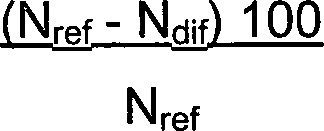
In einer anderen Ausführungsform kann das Enzym ein Enzym sein, das eine niedrigere Sequenzhomologie mit den Sequenzen besitzt, das aber so aufgebaut wurde, dass es eine transglycosylierende Aktivität besitzt.In another embodiment For example, the enzyme may be an enzyme that has a lower sequence homology owns with the sequences, but which was constructed so that it has a transglycosylating activity.
Die hier genannten Erfinder haben die Erfindung unter anderem auf die Tatsachen begründet, dass Xyloglucan, das in den primären Zellwänden von Pflanzenfasern auf natürliche Weise vorkommt, in der Lage ist, starke Wasserstoffbindungen mit Zellulose zu erzeugen, und dass die endogene XET-Aktivität von Pflanzen zum Einbringen von radioaktiven und fluorszierenden XGOs an die Xyloglucan-Komponente von Suspensionskulturen von Pflanzenzellen führt (vrgl. Biochem J. 279, 1991, S. 529-535 und Plant Cell Physiol 40, 1999, S. 1172-1176).The The present inventors have the invention, inter alia, on the Facts justified, that xyloglucan, that in the primary cell walls from plant fibers to natural Way, is capable of having strong hydrogen bonds with To produce cellulose, and that the endogenous XET activity of plants for introduction of radioactive and fluorescent XGOs to the xyloglucan component of suspension cultures of plant cells (see Biochem J. 279, 1991, pp. 529-535 and Plant Cell Physiol 40, 1999, pp. 1172-1176).
Die Erfinder haben anschließend nachgewiesen, dass isolierte Xyloglucanpolymere chemisch und/oder enzymatisch modifiziert werden können, um eine große Anzahl von verschiedenen chemischen Gruppen zu enthalten, und dass solche chemisch modifizierten Xyloglucanpolymere als eine Grenzfläche für das Einbringen von neuen chemischen Gruppen auf die zellulosehaltigen Faseroberflächen verwendet werden können. Ein deutlicher Vorteil des Verfahrens ist, dass die Verwendung von solchen Grenzflächen-Polymeren den nachfolgenden Verlust der Faserstruktur vermeidet, ein Ergebnis, auf das ansonsten im Allgemeinen mit der direkten chemischen Modifikation von Zellulose gestoßen wird. Die Erfinder haben nachgewiesen, dass ein transglycosylierendes Enzym wie z.B. XET als Empfängerzucker Oligosaccharide, die verschiedene Arten von chemischen Gruppen enthalten, verwenden kann.The inventors have subsequently demonstrated that isolated xyloglucan polymers can be chemically and / or enzymatically modified to contain a large number of different chemical groups, and that such chemically modified xyloglucan polymers be used as an interface for the introduction of new chemical groups onto the cellulosic fiber surfaces can be. A distinct advantage of the process is that the use of such interfacial polymers avoiding the subsequent loss of fiber structure, a result that is otherwise generally encountered by the direct chemical modification of cellulose. The inventors have demonstrated that a transglycosylating enzyme such as XET as a recipient sugar can use oligosaccharides containing various types of chemical groups.
Da Wasser für solche Enzyme nicht in Konkurrenz als ein Empfänger der Transglycosylierung steht, können sie in wässrigen Lösungen verwendet werden, um effizient die chemischen Gruppen auf die Grenzflächenpolymere wie z.B. Xyloglucan einzuführen, die entweder in Lösung oder gebunden an ein anderes polymeres Material wie z.B. Zellulose vorliegen. Des weiteren haben die Erfinder nachgewiesen, dass Xyloglucan, sogar wenn es chemisch modifiziert ist, fest an die Oberfläche von Zellulose bindet und dass die eingeführten chemischen Gruppen, auch wenn sie an den porösen Oberflächen von zellulosehaltigem Material über XG gebunden sind, trotzdem weiter für chemische Reaktionen zugänglich sind. Die Erfinder haben anschließend nachgewiesen, dass es überraschenderweise möglich war, durch die Zugabe eines transglycosylierenden Enzyms und von chemisch modifizierten CPFs zu den SCPs viele verschiedene neue chemische Gruppen mit einer erwünschten Funktionalität auf die Oberflächen des PCM mit einer hohen Ausbeute zu binden.There Water for such enzymes do not compete with one another as a recipient of transglycosylation stands, can she in watery solutions used to efficiently transfer the chemical groups to the interfacial polymers such as. Introduce xyloglucan, either in solution or attached to another polymeric material such as e.g. cellulose available. Furthermore, the inventors have proved that xyloglucan, even if it is chemically modified, firmly attached to the surface of Cellulose binds and that the introduced chemical groups, too if they are attached to the porous surfaces of cellulosic material XG are bound to still be accessible to chemical reactions. The inventors have subsequently demonstrated that, surprisingly possible was by the addition of a transglycosylating enzyme and chemically modified CPFs to the SCPs many different new chemical groups with a desired functionality on the surfaces to bind the PCM with a high yield.
Das PCM, das modifiziert werden soll, kann von einer Pflanze abgeleitet werden, die aus der Gruppe ausgewählt ist bestehend aus einer monokotylen Pflanze wie z.B. eine Pflanze der Familie Gramineae und einer dikotylen Pflanze wie z.B. einer Pflanze, die aus der Gruppe bestehend aus angiospermen Pflanzen (Hartholz), zapfentragenden Pflanzen (Weichholz) und Pflanzen, die der Familie Gossypium angehören, ausgewählt ist.The PCM to be modified can be derived from a plant which is selected from the group consisting of one monocotyledonous plant such as e.g. a plant of the family Gramineae and a dicotyledonous plant such as e.g. a plant that is from the Group consisting of angiospermous plants (hardwood), coniferous Plants (softwood) and plants belonging to the family Gossypium.
Das PCM kann in der Form von zellulosehaltigen Pflanzenfasern oder in der Form von zellulosehaltigen Mikrofibrillen, die von zellulosehaltigen Pflanzenfasern oder von einem Bakterium stammen, vorliegen.The PCM may be in the form of cellulosic vegetable fibers or in the form of cellulosic microfibrils derived from cellulosic Vegetable fibers or derived from a bacterium.
Das
SCP kann einen Teil des PCM, das modifiziert werden soll, erzeugen,
weswegen der Schritt des Einbringens des CPF, das eine chemische
Gruppe mit einer gewünschten
Funktionalität
umfasst, in das SCP, z.B. unter Verwendung eines Enzyms, direkt
auf dem PCM-SCP-Komplex erfolgen kann. Das Prinzip wird in
In einer anderen Ausführungsform muss das SCP nicht an dem PCM gebunden sein, um modifiziert zu werden. In dem Fall kann das SCP modifiziert sein, um die chemische Gruppe zu umfassen, und das Produkt der SCP-Modifikation, CLM, wird anschließend mit dem PCM in Kontakt gebracht. In einer anderen Ausführungsform wird das SCP zuerst mit dem SCP ohne PCM in Kontakt gebracht. Wenn der SCP-PCM-Komplex erzeugt wurde, kann der Schritt des Einbringens des CPF, das eine chemische Gruppe mit einer gewünschten Funktionalität umfasst, in das SCP, z.B. unter Verwendung eines Enzyms, direkt auf dem PCM-SCP-Komplex erfolgen.In another embodiment the SCP need not be bound to the PCM to be modified. In that case the SCP may be modified to the chemical group and the product of the SCP modification, CLM, is subsequently incorporated with brought into contact with the PCM. In another embodiment the SCP is first brought into contact with the SCP without PCM. If the SCP-PCM complex is generated, the step of introducing the CPF, the one chemical group with a desired functionality comprises, in the SCP, e.g. using an enzyme, directly on the PCM-SCP complex.
Es ist möglich, das PCM mit einem Gemisch von chemischen Gruppen zu modifizieren, z.B. durch das Durchführen der hierin beschriebenen Verfahren in der Sequenz und/oder durch die Verwendung eines Gemisches von CLMs, die verschiedene chemische Gruppen umfassen, und durch die Bindung des Gemisches von CLMs, die verschiedene chemische Gruppen umfassen, an das PCM in einem Verfahrensschritt.It is possible, to modify the PCM with a mixture of chemical groups, e.g. by performing the method described herein in the sequence and / or by the use of a mixture of CLMs that are different chemical Groups, and by binding the mixture of CLMs, which include various chemical groups, to the PCM in one Process step.
Sowohl das SCP als auch das CPF können chemische Gruppen enthalten.Either the SCP as well as the CPF can contain chemical groups.
Das CPF kann von Xyloglucan abgeleitet sein und es kann von 3 bis etwa 100, einschließlich von 4 bis 10 Monosaccharideinheiten des Polymergrundgerüsts enthalten.The CPF can be derived from xyloglucan and it can be from 3 to about 100, including from 4 to 10 monosaccharide units of the polymer backbone.
In einer Ausführungsform wird das CPF, das die chemische Gruppe umfasst, mit dem löslichen polymeren Kohlenhydrat (SCP) in der Gegenwart eines Enzyms, das in der Lage ist, die Erzeugung des Komplexes, der aus dem CPF besteht, das die chemische Gruppe umfasst, in Kontakt gebracht und ist mindestens ein Teil des SCP. Das Enzym kann in der Lage sein, native oder chemisch modifizierte Mono- oder Oligosaccharide auf Oligo- und/oder Polysaccharide zu transferieren. In einer Ausführungsform kann das Enzym eine transglycosylierende Aktivität besitzen.In an embodiment the CPF comprising the chemical group becomes soluble polymeric carbohydrate (SCP) in the presence of an enzyme that is in capable of generating the complex consisting of the CPF, which comprises the chemical group, is contacted and is at least one Part of the SCP. The enzyme may be able to be native or chemical modified mono- or To transfer oligosaccharides to oligo- and / or polysaccharides. In one embodiment For example, the enzyme may have a transglycosylating activity.
In einer anderen Ausführungsform zeigt das Enzym eine Rate des Einbringens des Empfängersubstrats in das Spendersubstrat, die mindestens 10% der Hydrolyserate beträgt, wie z.B. mindestens 15%, 20%, 25%, 30%, 40%, 50% oder 75%, wie z.B. mindestens 100% beträgt, wenn die Untersuchung mit einem geeigneten Glycosyl-Spendersubstrat in Gegenwart und beim Fehlen eines Mono-, Oligo- oder Polysaccharid-Empfängersubstrats unter geeigneten Bedingungen zur Erhaltung der Enzymaktivität durchgeführt wird.In another embodiment For example, the enzyme shows a rate of introduction of the receptor substrate in the donor substrate, which is at least 10% of the hydrolysis rate, such as e.g. at least 15%, 20%, 25%, 30%, 40%, 50% or 75%, e.g. is at least 100%, when examining with a suitable glycosyl donating substrate in the presence and absence of a mono-, oligo- or polysaccharide-receiver substrate under suitable conditions to maintain enzyme activity.
Die Analyse zur Evaluierung der Rate des Einbringens des Empfängersubstrats in das Spendersubstrat kann eine Analyse sein, die aus den nachfolgenden Schritten besteht:
- i) Inkubieren von 0,1 mg Xyloglucan, 0,1 mg Xyloglucan-Oligosaccharide (Gemisch von XXXG, XLXG, XXLG und XLLG; 15:7:32:46 Gewichtsverhältnis) in 200 μl 40 mM Citratpuffer, pH-Wert 5,5 für 30 Minuten bei 30°C.
- ii) Beenden der Reaktion mit 100 μl 1 M HCl.
- iii) Einstellen der Ionenstärke durch Zugabe von 800 μl 20% Na2SO4 und 200 μl einer I2 (0,5% I2, 1% KI, w/w)-Lösung.
- iv) Messen der optischen Dichte bei 620 nm.
- v) Durchführen der Schritte i)-iv) ohne Zugabe der Xyloglucan-Oligosaccharide (XGO) aus Schritt i)
- vi) Berechnen der Zunahme der optischen Dichte in Prozent zwischen der Inkubation mit XGO und der Inkubation ohne XGO.
- i) Incubating 0.1 mg of xyloglucan, 0.1 mg of xyloglucan oligosaccharides (mixture of XXXG, XLXG, XXLG and XLLG; 15: 7: 32: 46 by weight) in 200 μl of 40 mM citrate buffer, pH 5.5 for 30 minutes at 30 ° C.
- ii) Terminate the reaction with 100 μl of 1 M HCl.
- iii) Adjust the ionic strength by adding 800 μl of 20% Na 2 SO 4 and 200 μl of an I 2 (0.5% I 2 , 1% KI, w / w) solution.
- iv) measuring the optical density at 620 nm.
- v) carrying out steps i) -iv) without addition of the xyloglucan oligosaccharides (XGO) from step i)
- vi) Calculate the percentage increase in optical density between incubation with XGO and incubation without XGO.
Das Enzym kann von der Gruppe bestehend aus einer Transglycosylase, einer Glycosylhydrolase, einer Glycosyltransferase ausgewählt sein. Das Enzym kann ein Wildtyp-Enzym oder ein funktional und/oder strukturell modifiziertes Enzym sein, das von einem solchen Wildtyp-Enzym abgeleitet ist. In einer Ausführungsform ist das Enzym eine Xyloglucan-Endotransglycosylase (XET, EC 2.4.1.207).The Enzyme can be selected from the group consisting of a transglycosylase, a glycosyl hydrolase, a glycosyltransferase. The enzyme can be a wild type enzyme or a functional and / or structural modified enzyme derived from such a wild-type enzyme is. In one embodiment the enzyme is a xyloglucan endotransglycosylase (XET, EC 2.4.1.207).
Das Enzym, das eine Transglycosylierungsaktivität besitzt, kann von einer Pflanze abgeleitet sein, einschließlich einer Pflanze, die zu der Familie Brassica gehört, oder einer Pflanze einer Populus-Art, oder es kann mittels einer rekombinanten Technik hergestellt werden.The Enzyme that possesses transglycosylation activity may be derived from a plant be derived, including a plant belonging to the family Brassica or a plant of one Populus-type, or it can be produced by a recombinant technique become.
In einer Ausführungsform kann die chemische Gruppe, die eine gewünschte Funktionalität besitzt, ausgewählt sein aus einer Gruppe bestehend aus einer ionischen Gruppe, einer hydrophoben Gruppe, einer ungeladenen hydrophilen Gruppe, einer reaktiven Gruppe, einem Nucleophil, einem polymerisierbaren Monomer, einer chromophoren Gruppe, einer fluorophoren Gruppe, Biotin, einem radioaktiven Isotop, einem Vorläufer freier Radikale, einer stabilen freien Radikal-Gruppe, einem Protein und einem proteinbindenden Mittel.In an embodiment For example, the chemical group having a desired functionality may be selected from a group consisting of an ionic group, a hydrophobic one Group, an uncharged hydrophilic group, a reactive group, a nucleophile, a polymerizable monomer, a chromophore Group, a fluorophore group, biotin, a radioactive isotope, a precursor free radicals, a stable free radical group, a protein and a protein binding Medium.
Eine Ausführungsform der vorliegenden Erfindung betrifft ein Verfahren, in dem das erhaltene modifizierte PCM relativ zu dem nicht modifizierten PCM veränderte Oberflächeneigenschaften wie z.B. veränderte Stärkeeigenschaften, eine veränderte Oberflächenspannung, veränderte wasserabstoßende Eigenschaften, eine veränderte Reaktivität, veränderte optische Eigenschaften oder Kombinationen von diesen besitzt.A embodiment The present invention relates to a process in which the obtained modified PCM changed surface properties relative to the unmodified PCM such as. altered starch properties, a changed one Surface tension, changed water-repellent Properties, an altered Reactivity, changed has optical properties or combinations of these.
Ein anderer Aspekt der Erfindung ist ein modifiziertes polymeres Kohlenhydratmaterial (mPCM), das durch das Verfahren von jedem hierin beschriebenen Verfahren erhältlich ist, wobei chemische Gruppen mit einer gewünschten Funktionalität an das Material gebunden sind, indem die Bindung durch ein Kohlenhydrat-Bindemolekül vermittelt wird, das eine chemische Gruppe und ein SCP, das eine Hemizellulose ist, umfasst, wobei das Kohlenhydrat-Bindemolekül an das PCM binden kann. Das mPCM kann in der Form von zellulosehaltigen Pflanzenfasern oder von zellulosehaltigen Mikrofibrillen, die von einer zellulosehaltigen Pflanzenfaser oder von einem Bakterium abstammen, vorliegen.One Another aspect of the invention is a modified polymeric carbohydrate material (mPCM), by the method of each method described herein available is where chemical groups with a desired functionality to the Material are bound by the binding mediated by a carbohydrate-binding molecule that's a chemical group and a SCP that's a hemicellulose wherein the carbohydrate binding molecule can bind to the PCM. The mPCM can be in the form of cellulosic vegetable fibers or of cellulosic microfibrils derived from a cellulosic Vegetable fiber or derived from a bacterium.
Die chemischen Gruppen des mPCM können reaktive Gruppen sein, die andere funktionale Gruppen binden können, und das mPCM kann daran zwei oder mehrere verschiedene Arten von chemischen Gruppen gebunden haben.The chemical groups of the mPCM can be reactive groups that can bind other functional groups, and The mPCM can do two or more different types of chemical Have tied groups.
Ein Aspekt der Erfindung ist ein Verbundmaterial, das die Materialien umfasst, die hierin beschrieben werden.One Aspect of the invention is a composite material containing the materials which are described herein.
Ein anderer Aspekt der Erfindung betrifft die Verwendung des mPCM oder der Verbundmaterialien bei der Herstellung von Papierblättern, Wellpappe, Webware, Hilfsmitteln in einem diagnostischen oder chemischen Assay oder Verfahren, Verpackungsmittel für Flüssigkeiten und Lebensmittel, Papier und Karton, die häufig mit einem Thermoplastik wie z.B. Polyethylen laminiert sind, um eine undurchdringbare Grenzschicht für die wässrigen Lösungen zur Verfügung zu stellen, Textilien, Wertpapieren, Banknoten, verfolgbaren Dokumenten, Füllstoffen, Laminaten und Panelprodukten, holzpolymeren Verbundstoffen, polymeren Verbundstoffen, Legierungen und Mischungen oder Zellulosederivaten (zellulosehaltigen Stoffen).Another aspect of the invention relates to the use of the mPCM or composites in the manufacture of paper sheets, corrugated board, woven fabric, aids in a diagnostic or chemical assay or process, packaging media for liquids and food, paper and board, often with a thermoplastic such as Polyethylene are laminated to provide an impermeable barrier layer for the aqueous solutions, textiles, securities, banknotes, traceable documents, fillers, laminates and panel products, wood polymer composites, polymeric composites fen, alloys and mixtures or cellulose derivatives (cellulosic substances).
Gemäß der vorliegenden Erfindung können neue chemische Gruppen dem PCM, das ein innewohnendes geeignetes SCP enthält, durch die Verwendung des transglycosylierenden Enzyms zugefügt werden, um die chemisch modifizierten CPFs an das SCP, das in den zellulosehaltigen Materialien enthalten ist, zu binden. In dem vorliegenden Zusammenhang bedeutet der Ausdruck "innewohnend", dass das PCM ein SCP vor der Modifikation umfasst. Gemäß der vorliegenden Erfindung können neue chemische Gruppen ebenfalls dem PCM, das kein innewohnendes SCP enthält, zugegeben werden, indem zuerst ein transglycosylierendes Enzym verwendet wird, um die chemisch modifizierten CPFs an das SCP in Lösung zu binden, gefolgt durch die Sorption des modifizierten SCP an das PCM.According to the present Invention can new chemical groups to the PCM, which is an inherent suitable Contains SCP, be added by the use of the transglycosylating enzyme, to the chemically modified CPFs to the SCP, which in the cellulosic Materials contained is to bind. In the present context The term "inherent" means that the PCM is a SCP before modification includes. According to the present invention can new chemical groups also belong to the PCM, which is not an intrinsic Contains SCP, be added by first using a transglycosylating enzyme to add the chemically modified CPFs to the SCP in solution followed by sorption of the modified SCP to the PCM.
Gemäß einer spezifischen Ausführungsform der vorliegenden Erfindung können neue chemische Gruppen an Zellulosematerialien, die kein innewohnendes Xyloglucan enthalten, gebunden werden, indem zuerst das XET-Enzym verwendet wird, um die chemisch modifizierten XGOs an Xyloglycan (XG) in Lösung zu binden, gefolgt durch die Sorption des modifizierten XG an die Zellulosematerialien.According to one specific embodiment of the present invention new chemical groups of cellulosic materials that are not intrinsic Xyloglucan can be bound by first adding the XET enzyme is used to chemically modify XGOs on xyloglycan (XG) in solution followed by sorption of the modified XG to the Cellulose materials.
Gemäß der vorliegenden Erfindung erhält ein PCM eine veränderte Oberflächenchemie und/oder eine verbesserte chemische Reaktivität nach der Behandlung mit chemisch modifizierten CPFs, die an ein SCP unter Verwendung des transglycosylierenden Enzyms gebunden werden. Die SCPs, welche die chemisch reaktiven Gruppen tragen, werden fest an die Oberflächen des PCM binden, wodurch die chemische Reaktivität der Oberflächen erhalten wird. Die chemische Reaktivität an sich oder wenn sie durch weitere chemische und/oder polymerisierende Reaktionen modifiziert wurde, beeinflusst die Oberflächeneigenschaften des PCM. Des weiteren wird die Dichte der chemisch reaktiven Gruppen durch die Veränderung der Konzentrationen des transglycosylierenden Enzyms und/oder der CPFs und/oder der Reaktionszeit kontrolliert, wie in den Beispielen 14a und 14b gezeigt wird. Die Oberflächeneigenschaften können durch jedes Verfahren, das auf dem Fachgebiet bekannt ist, gemessen werden, wie in den beigefügten Beispielen, z.B. Beispiel 16b, gezeigt wird.According to the present Invention receives a PCM a modified one surface Chemistry and / or improved chemical reactivity after treatment with chemical modified CPFs attached to a SCP using the transglycosylating Enzymes are bound. The SCPs which are the chemically reactive Wear groups will bind firmly to the surfaces of the PCM, causing the chemical reactivity of the surfaces is obtained. The chemical reactivity per se or when passing through modified further chemical and / or polymerizing reactions was, influences the surface properties of the PCM. Furthermore, the density of the chemically reactive groups through the change the concentrations of the transglycosylating enzyme and / or the CPFs and / or the reaction time controls, as in the examples 14a and 14b is shown. The surface properties can by any method known in the art is measured, as in the attached Examples, e.g. Example 16b.
In der Natur arbeiten transglycosylierende Enzyme wie z.B. das XET-Enzym in vivo in der lebenden Pflanze, so dass das Enzym offensichtlich in einer wässrigen Umgebung arbeiten kann. Das Verfahren gemäß der Erfindung kann daher in einer wässrigen Lösung durchgeführt werden oder es kann in Wasser in der Gegenwart von bestimmten Komponenten wie z.B. einem Puffer und/oder einem Netzmittel und/oder einem Stabilisator und/oder einem Polymer und/oder einer organischen Komponente, welche die Aktivität des Wassers vermindert, wie z.B. DMSO, durchgeführt werden.In In nature, transglycosylating enzymes such as e.g. the XET enzyme in vivo in the living plant, making the enzyme obvious in an aqueous Environment can work. The method according to the invention can therefore in an aqueous solution carried out or it can be in water in the presence of certain components such as. a buffer and / or a wetting agent and / or a stabilizer and / or a polymer and / or an organic component which the activity of the water, e.g. DMSO, to be performed.
Der Puffer kann geeigneterweise ein Phosphat, Borat, Citrat, Acetat, Adipat, Triethanolamin, Monoethanolamin, Diethanolamin, Carbonat (insbesondere Alkalimetall, Erdalkalimetall, insbesondere Natrium- oder Kaliumcarbonat oder Ammonium- und HCL-Salze), Diamin, insbesondere Diaminoethan, Imidazol, Tris oder Aminosäurepuffer sein.Of the Buffer may suitably be a phosphate, borate, citrate, acetate, Adipate, triethanolamine, monoethanolamine, diethanolamine, carbonate (in particular alkali metal, alkaline earth metal, in particular sodium or potassium carbonate or ammonium and HCL salts), diamine, in particular Diaminoethane, imidazole, Tris or amino acid buffer.
Das Netzmittel dient der Verbesserung der Benetzbarkeit des PCM. Das Netzmittel ist vorzugsweise von einer nichtionischen Art der Grenzflächenaktivierung. Der Stabilisator kann ein Mittel zur Stabilisierung des Enzyms sein.The Wetting agent serves to improve the wettability of the PCM. The Wetting agent is preferably of a nonionic type of interfacial activation. The stabilizer may be a means of stabilizing the enzyme.
Es wird im Allgemeinen geeignet sein, das Reaktionsmedium, das z.B. das PCM, das CLM und gegebenenfalls eine oder mehrere Komponenten umfasst, die von der Gruppe bestehend aus einem SCP, das eine chemische Gruppe umfassen kann oder nicht, einem CPF, das chemische Gruppen und ein Enzym umfasst, ausgewählt sind, für einen Zeitraum von mindestens einigen Minuten in Abhängigkeit von den Reaktionsbedingungen zu inkubieren. Eine Inkubationszeit von etwa einer Minute bis zu 20 Stunden wie z.B. etwa 2-5 Minuten, 5-7 Minuten, 7-10 Minuten, 10-15 Minuten, 15-20 Minuten, 20-30 Minuten, 30-40 Minuten, 40-60 Minuten, 1-2 Stunden, 2-4 Stunden, 4-6 Stunden, 6-8 Stunden, 8-10 Stunden, 10-12 Stunden, 12-14 Stunden, 14-16 Stunden, 16-18 Stunden oder 18-20 Stunden wird im Allgemeinen geeignet sein. Insbesondere eine Inkubationszeit von 30 Minuten bis zu 10 Stunden wird häufig bevorzugt werden. Die Inkubationszeit wird vorzugsweise mit einem Zeitabstand begrenzter als +/– 5 Stunden kontrolliert, wie z.B. begrenzter als +/- 2 Stunden, +/– 1 Stunde, +/– 45 Minuten, +/– 30 Minuten, +/– 15 Minuten, +/– 10 Minuten, +/– 5 Minuten, +/– 2 Minuten, +/– 1 Minute, +/– 30 Sekunden, +/– 10 Sekunden, +/– 1 Sekunden, +/– 0,1 Sekunden, +/– 0,01 Sekunden.It will generally be suitable to use the reaction medium, e.g. the PCM, the CLM and optionally one or more components which consists of the group consisting of a SCP, which is a chemical Group may or may not include a CPF containing chemical groups and an enzyme selected are for a period of at least a few minutes depending on from the reaction conditions to incubate. An incubation period from about one minute to 20 hours, e.g. about 2-5 minutes, 5-7 minutes, 7-10 minutes, 10-15 minutes, 15-20 minutes, 20-30 minutes, 30-40 minutes, 40-60 minutes, 1-2 hours, 2-4 hours, 4-6 hours, 6-8 hours, 8-10 hours, 10-12 hours, 12-14 hours, 14-16 hours, 16-18 hours or 18-20 hours will generally be suitable. In particular, an incubation period of 30 minutes to 10 hours becomes common to be favoured. The incubation period is preferably with a Time interval more limited than +/- 5 Hours controlled, such. more than +/- 2 hours, +/- 1 hour, +/- 45 Minutes, +/- 30 Minutes, +/- 15 Minutes, +/- 10 Minutes, +/- 5 Minutes, +/- 2 Minutes, +/- 1 Minute, +/- 30 Seconds, +/- 10 Seconds, +/- 1 Seconds, +/- 0.1 Seconds, +/- 0.01 Seconds.
Die Temperatur des Reaktionsmediums in dem Verfahren der Erfindung kann geeigneterweise in dem Bereich von –5-100°C liegen, wie z.B. 0-5, 5-10, 10-15, 15-20, 20-25, 25-30, 30-33, 33-36, 36-38, 38-40, 40-50, 50-60, 60-70, 70-80, 80-90 oder 90-100°C. In Ausführungsformen, in denen das Reaktionsgemisch ein Enzym umfasst, sollte die Temperatur des Reaktionsgemisches während der Inkubation vorzugsweise in der Nähe der Temperatur liegen, die einen optimalen Umsatz während der Inkubation erzeugt. Die bevorzugte Temperatur sollte weniger als 10°C von der Temperatur entfernt sein, die einen optimalen Umsatz während der Inkubation erzeugt, wie z.B. weniger als 10°C, 8°C, 6°C, 4°C, 2°C, 1°C, 0,5°C oder 0,1°C.The temperature of the reaction medium in the process of the invention may suitably be in the range of -5-100 ° C, such as 0-5, 5-10, 10-15, 15-20, 20-25, 25-30, 30 -33, 33-36, 36-38, 38-40, 40-50, 50-60, 60-70, 70-80, 80-90 or 90-100 ° C. In embodiments in which the reaction mixture comprises an enzyme, the temperature of the reaction mixture should preferably be close to that during incubation Temperature, which produces optimal conversion during incubation. The preferred temperature should be less than 10 ° C from the temperature which produces optimum conversion during incubation, such as less than 10 ° C, 8 ° C, 6 ° C, 4 ° C, 2 ° C, 1 ° C, 0.5 ° C or 0.1 ° C.
Für die Bindung des modifizierten oder nicht modifizierten SCP an das PCM wird es im Allgemeinen geeignet sein, das Gemisch für einen Zeitraum von mindestens einigen Minuten in Abhängigkeit von den Reaktionsbedingungen zu inkubieren. Eine Inkubationszeit von etwa einer Minute bis zu 48 Stunden wird im Allgemeinen geeignet sein, insbesondere eine Inkubationszeit von 30 Minuten bis zu 10 Stunden wird häufig bevorzugt. Die Inkubationslösung kann geeigneter Weise in einem pH-Bereich von 2-11 gepuffert sein, vorzugsweise bei einem pH-Wert von 5-8, mit einer Pufferkonzentration zwischen 0 und 5 M, vorzugsweise 0,0-0,1 M. Die Temperatur des Reaktionsmediums in diesem Verfahren kann geeigneterweise in dem Bereich von 10-100°C in Abhängigkeit der Stabilität der individuellen Komponenten in dem Gemisch sein.For the bond It will be the modified or unmodified SCP to the PCM in general, be suitable for a period of at least depending on a few minutes from the reaction conditions to incubate. An incubation period from about one minute to 48 hours is generally suitable be, in particular an incubation period of 30 minutes to 10 Hours become frequent prefers. The incubation solution may suitably be buffered in a pH range of 2-11, preferably at a pH of 5-8, with a buffer concentration between 0 and 5 M, preferably 0.0-0.1 M. The temperature of the reaction medium in this method may suitably be in the range of 10-100 ° C depending stability of the individual components in the mixture.
Die Erfindung wird nun ausführlicher mit Bezug auf die begleitenden Zeichnungen beschrieben, wobei:The Invention will now be more detailed with reference to the accompanying drawings, wherein:
BEISPIELEEXAMPLES
MATERIAL UND VERFAHRENMATERIAL AND METHOD
Bestimmung der Enzymaktivität und insbesondere der XET-Aktivitätdetermination the enzyme activity and in particular the XET activity
a. Radiometrische Analysea. Radiometric analysis
Die hier genannten Erfinder haben ein modifiziertes Analyseverfahren entwickelt, das dem von Steele, N et al. (Phytochemistry, 2000, 54, 667-680) ähnlich ist und das verwendet wurde, wie nachfolgend beschrieben wird. [1-3H]-XLLGol (300 μl, 0,36 μmol in H2O) wurde zu dem nicht radioaktiven xgo-9-Alditol (700 μl, 8,6 μmol) in 50 mM Citratphosphatpuffer, pH-Wert 5,5, zugegeben. Wenn diese Stammlösung in der Analyse verwendet wurde, wurde sie in Puffer auf eine Konzentration von 2,24 μmol/ml (3,1 mg/ml) verdünnt. Die radioaktive XLLGol-Stammlösung (10 μl, 2,24 μmol/ml) wurde zu dem Xyloglucan (10 μl, 3,0 mg/ml in Puffer) zugegeben. Die verdünnte Enzymlösung (10 μl) wurde zugegeben und das Reaktionsgemisch wurde bei 25°C für 30 min inkubiert. Die Reaktion wurde anschließend mit einer 50% Lösung Ameisensäure in Wasser (20 μl) beendet. Das Reaktionsgemisch (40 μl) wurde auf rundem Whatman-3MM-Chromatographiepapier (20 mm Durchmesser) getrocknet. Die runden Papiere wurden für 4 Stunden unter fließendem Wasser gewaschen, in einem 65°C warmen Ofen getrocknet und der radioaktive Einschluss wurde in Szintillationsgefäßen, die den Ready-safe-Szintillationscocktail (6 ml, Beckman Coulter AB, Bromma, Schweden) enthielten, mit einem Packard Tricarb 1500 Szintillationsmessgerät untersucht. Es erfolgte keine Elution der Radioaktivität aus dem Papier in die Szintillationsflüssigkeit. Leerwerte wurden durch die Zugabe von Säure zu der Reaktion vor der Zugabe des Enzyms gemessen, die Kontrolle der insgesamt zugegebenen Radioaktivität wurde dadurch gemessen, dass die runden Papiere der Kontrolle nicht gewaschen wurden. Ein Maß dafür, wie das Filterpapier die Analyse beeinflusst, wurde durch den Vergleich der Kontrollen mit der Szintillationsmessung von dem Kontrollgemisch ohne dem Filterpapier erhalten.The present inventors have developed a modified analysis method similar to that of Steele, N et al. (Phytochemistry, 2000, 54, 667-680) and which was used as described below. [1- 3 H] -XLLGol (300 μl, 0.36 μmol in H 2 O) was added to the non-radioactive xgo-9 alditol (700 μl, 8.6 μmol) in 50 mM citrate phosphate buffer, pH 5, 5, added. When this stock solution was used in the analysis, it was diluted in buffer to a concentration of 2.24 μmol / ml (3.1 mg / ml). The radioactive XLLGol stock solution (10 μl, 2.24 μmol / ml) was added to the xyloglucan (10 μl, 3.0 mg / ml in buffer). The diluted enzyme solution (10 μl) was added and the reaction mixture was incubated at 25 ° C for 30 min. The reaction was then terminated with a 50% solution of formic acid in water (20 μl). The reaction mixture (40 μl) was dried on Whatman 3MM (20 mm diameter) chromatography paper. The round papers were washed under running water for 4 hours, in one The radioactive confinement was assayed in scintillation vials containing the ready-safe scintillation cocktail (6 ml, Beckman Coulter AB, Bromma, Sweden) with a Packard Tricarb 1500 scintillation counter. There was no elution of the radioactivity from the paper into the scintillation fluid. Blank values were measured by the addition of acid to the reaction prior to the addition of the enzyme, the control of the total added radioactivity was measured by not washing the round papers of the control. A measure of how the filter paper affects the analysis was obtained by comparing controls with scintillation measurement from the control mix without the filter paper.
b. Kolorimetrische Analyseb. Colorimetric analysis
Die Enzymaktivität wurde gemäß einem modifiziertem Protokoll, das auf das Protokoll von Slulová et al. (1995), Anal Biochem 229, 80-85 basierte, gemessen. XET wurde mit 0,1 mg Xyloglucan, 0,1 mg Xyloglucan-Oligosaccharide (Gemisch von XXXG, XLXG, XXLGund XLLG; 15:7:32:46) in 200 μl 40 mM Citratpuffer, pH-Wert 5,5 für 30 Minuten bei 30°C inkubiert. Die Analyse wurde mit der Zugabe von 100 μl 1 M HCl beendet, die Ionenstärke wurde durch Zugabe von 800 μl 20% Na2SO4 und 200 μl einer I2 (0,5% I2, 1% KI, w/w)-Lösung eingestellt. Die optische Dichte wurde bei 620 nm gemessen. Für die Zwecke dieses Dokuments wird eine Einheit der Enzymaktivität als 0,1 Einheiten der Veränderung der optischen Dichte (nach der Korrektur der Hintergrundshydrolyse) über einen Zeitraum von 30 Minuten definiert.The enzyme activity was determined according to a modified protocol based on the protocol of Slulová et al. (1995), Anal Biochem 229, 80-85. XET was incubated with 0.1 mg xyloglucan, 0.1 mg xyloglucan oligosaccharides (mixture of XXXG, XLXG, XXLG and XLLG; 15: 7: 32: 46) in 200 μl of 40 mM citrate buffer, pH 5.5 for 30 minutes incubated at 30 ° C. The analysis was terminated with the addition of 100 μl of 1 M HCl, the ionic strength was determined by addition of 800 μl of 20% Na 2 SO 4 and 200 μl of an I 2 (0.5% I 2 , 1% CI, w / w). Solution set. The optical density was measured at 620 nm. For the purposes of this document, one unit of enzyme activity is defined as 0.1 units of optical density change (after correction of background hydrolysis) over a period of 30 minutes.
BEISPIEL 1EXAMPLE 1
EXTRAKTION VON XET AUS BLUMENKOHLEXTRACTION FROM XET OFF CAULIFLOWER
Die Extraktion aus Blumenkohl wurde durch die Homogenisierung der Blumenkohlröschen im eiskalten Citratpuffer (0,35 M, pH-Wert 5,5, 10 mM CaCl2 enthalten) und durch das Filtern des Gemisches durch Miracloth durchgeführt. Das Filtrat wurde mit ultrareinem Wasser (18 MΩ.cm) verdünnt, bis die Leitfähigkeit der Lösung die gleiche war, wie die von 0,1 M Ammoniumacetatpuffer, pH-Wert 5,5. Die Lösung wurde anschließend mit dem SP-Fast-Flow-Kationenaustauscher (Amersham Biosciences, Schweden) vorsichtig für 1 Stunde bei 4°C gerührt. Das SP-FF-Gel wurde auf einem Glasfrittenfilter gesammelt und mit 0,1 M Ammoniumacetat, pH-Wert 5,5, gewaschen, bis das Filtrat klar war. Das Gel wurde in eine Säule gegeben und die gebundenen Proteine wurden mit einem linearen Gradienten von 0 bis 1,0 M NaCl in 0,1 M Ammoniumacetat, pH-Wert 5,5 über 10 Säulenvolumen eluiert. Fraktionen, welche die XET-Aktivität enthielten, wurden vereinigt und mit Ammoniumsulfat (1 M) gemischt. Die Probe wurde auf eine Resource-ISO-Säule (1 ml, Amersham Biosciences, Schweden) gegeben und anschließend mit einem linearen Gradienten von 1,0 M bis 0 Ammoniumsulfat in Ammoniumacetat, pH-Wert 5,5, über 20 Säulenvolumen eluiert. Die Fraktionen, welche die XET-Aktivität enthielten, wurden vereinigt und mittels SDS-PAGE und Silberfärbung auf ihre Reinheit untersucht. Das Gel zeigte nur eine einzelne Bande, von der durch Immunoblotting nachgewiesen wurde, dass es sich um XET handelt.Cauliflower extraction was performed by homogenizing the cauliflower florets in ice-cold citrate buffer (0.35M, pH 5.5, 10mM CaCl 2 ) and filtering the mixture through Miracloth. The filtrate was diluted with ultrapure water (18 MΩ.cm) until the conductivity of the solution was the same as that of 0.1 M ammonium acetate buffer, pH 5.5. The solution was then stirred gently with the SP Fast Flow cation exchanger (Amersham Biosciences, Sweden) for 1 hour at 4 ° C. The SP-FF gel was collected on a glass frit filter and washed with 0.1 M ammonium acetate, pH 5.5, until the filtrate was clear. The gel was placed in a column and the bound proteins were eluted with a linear gradient of 0 to 1.0 M NaCl in 0.1 M ammonium acetate, pH 5.5 over 10 column volumes. Fractions containing XET activity were pooled and mixed with ammonium sulfate (1 M). The sample was loaded onto a Resource ISO column (1 ml, Amersham Biosciences, Sweden) and then eluted with a linear gradient of 1.0 M to 0 ammonium sulfate in ammonium acetate, pH 5.5, over 20 column volumes. The fractions containing the XET activity were pooled and examined for purity by SDS-PAGE and silver staining. The gel showed only a single band, which was shown by immunoblotting to be XET.
BEISPIEL 2EXAMPLE 2
EXTRAKTION VON XET AUS EINER ZELLSUSPENSIONSKULTUR EINER HYBRIDEN ESPE, Populus tremula x tremuloides Mich.EXTRACTION FROM XET OFF A cell suspension culture of a hybrid ESPE, Populus tremula x tremuloides me.
Espen-XET wurde durch die Homogenisierung des Materials einer granulösen Zellkultur in eiskaltem Citratpuffer (0,35 M, pH-Wert 5,5, 10 mM CaCl2 enthalten), durch das Rühren des Gemisches für 2 Stunden bei 4°C und durch das Filtern durch Miracloth extrahiert. Das Filtrat wurde mit ultrareinem Wasser (18 MΩ.cm) verdünnt, bis die Leitfähigkeit der Lösung die gleiche war, wie die von 0,1 M Ammoniumacetatpuffer, pH-Wert 5,5. Die Lösung wurde anschließend mit dem SP-Fast-Flow-Kationenaustauscher (Amersham Biosciences, Schweden) vorsichtig für 1 Stunde bei 4°C gerührt. Das SP-Trisacryl-Gel wurde gesammelt und mit 0,1 M Ammoniumacetat, pH-Wert 5,5, durch einem Glasfrittenfilter gewaschen, bis das Filtrat klar war. Das Gel wurde in eine Säule gegeben und die gebundenen Proteine wurden mit einem linearen Gradienten von 0,0 bis 1,0 M NaCl in 0,1 M Ammoniumacetat, pH-Wert 5,5 über 10 Säulenvolumen eluiert. Fraktionen, welche die XET-Aktivität enthielten, wurden vereinigt, der Puffer wurde durch 0,1 M Ammoniumacetat pH-Wert 5,5 in einer Sephadex G-25 Größenausschlusssäule ausgetauscht und auf eine Resource-S-Austauschsäule (1 ml, Pharmacia) geladen. Die gebundenen Proteine wurden mit einem linearen Gradienten von 0,0 bis 1,0 M NaCl in 0,1 M Ammoniumacetat, pH-Wert 5,5, über 10 Säulenvolumen eluiert. Die Fraktionen, welche die XET-Aktivität enthielten, wurden vereint, auf eine Sephacryl S200-Säule (120 ml, Amersham Biosciences, Schweden) gegeben und mit 2 Säulenvolumen 0,1 M Ammoniumacetat, pH-Wert 5,5, eluiert. Fraktionen, die der letzten Spitze entsprachen, welche die größte Menge der XET-Aktivität enthielten, wurden vereint und auf eine Resource-S-Säule (1 ml, Amersham Biosciences, Schweden) gegeben. Die Fraktionen wurden anschließend mit einem linearen Gradienten von 0,0 bis 0,5 M NaCl in 0,1 M Ammoniumacetat, pH-Wert 5,5, in einem Volumen, das mehr als 10 Säulenvolumen entsprach, eluiert. Fraktionen, welche die XET-Aktivität enthielten, wurden vereinigt und es wurde mittels SDS-PAGE gezeigt, dass sie homogen waren.Aspen-XET was prepared by homogenizing the material of a granular cell culture in ice-cold citrate buffer (0.35M, pH 5.5, 10mM CaCl 2 ), stirring the mixture for 2 hours at 4 ° C, and stirring Filtering extracted by Miracloth. The filtrate was diluted with ultrapure water (18 MΩ.cm) until the conductivity of the solution was the same as that of 0.1 M ammonium acetate buffer, pH 5.5. The solution was then stirred gently with the SP Fast Flow cation exchanger (Amersham Biosciences, Sweden) for 1 hour at 4 ° C. The SP Trisacryl gel was collected and washed with 0.1 M ammonium acetate, pH 5.5, through a glass frit filter until the filtrate was clear. The gel was placed in a column and the bound proteins were eluted with a linear gradient of 0.0 to 1.0 M NaCl in 0.1 M ammonium acetate, pH 5.5 over 10 column volumes. Fractions containing XET activity were pooled, the buffer was exchanged with 0.1 M ammonium acetate pH 5.5 in a Sephadex G-25 size exclusion column and loaded onto a Resource S exchange column (1 ml, Pharmacia) , The bound proteins were eluted with a linear gradient of 0.0 to 1.0 M NaCl in 0.1 M ammonium acetate, pH 5.5, over 10 column volumes. The fractions containing XET activity were pooled, placed on a Sephacryl S200 column (120 ml, Amersham Biosciences, Sweden) and eluted with 2 column volumes of 0.1 M ammonium acetate, pH 5.5. Fractions ent languages containing the highest level of XET activity were pooled and placed on a Resource S column (1 ml, Amersham Biosciences, Sweden). The fractions were then eluted with a linear gradient of 0.0-0.5 M NaCl in 0.1 M ammonium acetate, pH 5.5, in a volume greater than 10 column volumes. Fractions containing XET activity were pooled and shown to be homogeneous by SDS-PAGE.
BEISPIEL 3EXAMPLE 3
REINIGUNG DES REKOMBINANTEN XET AUS DER KULTIVIERUNG VON Pichia pastorisCLEANING OF THE RECOMBINANT XET FROM THE CULTIVATION OF Pichia pastoris
Zellen von Pichia pastoris-Kulturen, die mit dem genetischen Material transformiert wurden, das XET (vergl. Beispiele 4 und 5) codierte, zeigten im Allgemeinen die höchste XET-Aktivität im Kulturmedium 3 Tage nach einer Induktion mit Methanol. Diese Hefezellen wurden durch Zentrifugation geerntet und die Kulturmedien wurde des weiteren durch einen 0,45 μm-Filter filtriert und anschließend konzentriert und durch Ultrafiltration entsalzt. Das XET wurde durch eine zweiphasige Kationenaustausch-Chromatographie gereinigt. Das konzentrierte Kulturfiltrat (in einem Puffer von 0,1 M Ammoniumacetat, pH-Wert 5,5) wurde zuerst auf eine SP-Trisacryl-Säule aufgetragen und anschließend durch einen linearen Gradienten von 0 bis 1 M NaCl in 0,1 M Ammoniumacetat, pH-Wert 5,5, eluiert. Die Fraktionen, welche die XET-Aktivität enthielten, wurden vereint, in 0,1 M Ammoniumacetat, pH-Wert 5,5, entsalzt und auf eine Resource-S-Säule aufgetragen, anschließend durch denselben linearen Salzgradienten, der in der ersten Phase der Kationenaustausch-Chromatographie verwendet wurde, eluiert. Die Homogenität des Proteins wurde durch SDS-PAGE und Silberfärbung untersucht. Es wurde nur eine einzelne Bande mit einem Molekulargewicht von etwa 32 kDa detektiert und von dieser wurde durch Immunoblotting bestätigt, das es sich um XET handelt. Es wurde gezeigt, dass das Protokoll für die Expression von allen Sequenzen SEQ ID Nr.: 1, 2, 3, welche die verschiedenen Isoenzyme von XET codieren, erfolgreich war.cell from Pichia pastoris cultures that are transformed with the genetic material which encoded XET (see Examples 4 and 5) Generally the highest XET activity in the culture medium 3 days after induction with methanol. These Yeast cells were harvested by centrifugation and the culture media was further filtered through a 0.45 μm filter and then concentrated and desalted by ultrafiltration. The XET was through a two-phase Cation exchange chromatography purified. The concentrated culture filtrate (in a buffer of 0.1 M ammonium acetate, pH 5.5) was first on a SP Trisacryl column applied and then by a linear gradient of 0 to 1 M NaCl in 0.1 M ammonium acetate, pH 5.5, eluted. The fractions containing the XET activity were combined, in 0.1 M ammonium acetate, pH 5.5, desalted and on a Resource S column applied, then through same linear salt gradient used in the first phase of cation exchange chromatography was eluted. The homogeneity of the protein was examined by SDS-PAGE and silver staining. It was only a single band with a molecular weight of about 32 kDa and this was confirmed by immunoblotting, the it is XET. It was shown that the protocol for expression of all sequences SEQ ID NO: 1, 2, 3, which are the various Encoding isoenzymes of XET was successful.
BEISPIEL 4EXAMPLE 4
ISOLIERUNG DES GENS, WELCHES DAS XET VON BLUMENKOHL CODIERTINSULATION OF THE GENE, WHICH THE XET OF FLOWER CAKE CODES
Die
cDNA, die dem XET-Gen entsprach, wurde durch die Extraktion der
RNA durch das Zerreiben von frischem Blumenkohlgewebe unter flüssigem Stickstoff
(N2) und der Lyse der Zellen unter denaturierenden
Bedingungen isoliert. Die lysierte Zellprobe wurde anschließend durch
eine QIA-Shredder-Säule
zentrifugiert, um das unlösliche
Material zu entfernen. Die RNA wurde anschließend selektiv an eine RNAeasy-Membran
gebunden, mit Puffer gewaschen und schließlich in Wasser eluiert. Die
XET cDNA wurde unter Verwendung einer zweiphasigen Polymerasen-Kettenreaktion (PCR)
gemäß dem Protokoll,
das auf dem Fachgebiet bekannt ist, hergestellt. Der erste Strang
der cDNA wurde bei 55°C
für eine
Stunde synthetisiert, wobei 1 μg
RNA und ein Oligo-dT(18)-Primer mit der
reversen Transkriptase verwendet wurden. Die Matrizen für die degenerierten
Primer für
die spezifische PCR-Reaktion wurden durch die N-terminale Sequenzierung
des Blumenkohl-XET-Proteins
erhalten, welche eine nachfolgende Sequenz anzeigte: 
Die
Primersequenzen aller Primer, die verwendet wurden, werden in Tabelle
1 gezeigt. Der reverse Primer CFXETR1 und die Nested-Primer CFXET
F1 wurden für
eine zweiphasige Nested-PCR verwendet, was zu einem PCR-Produkt
mit dem korrekten Molekulargewicht und der Sequenz, die dem XET
in der Glycosylhydrolase-/Transglycosylase Familie 16 entsprach,
führte.
Die cDNA mit vollständiger
Länge wurde
anschließend
amplifiziert, wobei eine Serie von degenerierten Nested-Primern
(Tabelle 1) verwendet wurden, gefolgt von der Sequenzbestimmung
der cDNA mit vollständiger
Länge (SEQ
ID Nr.: 1). Tabelle
1. In den Beispielen verwendeten Primer 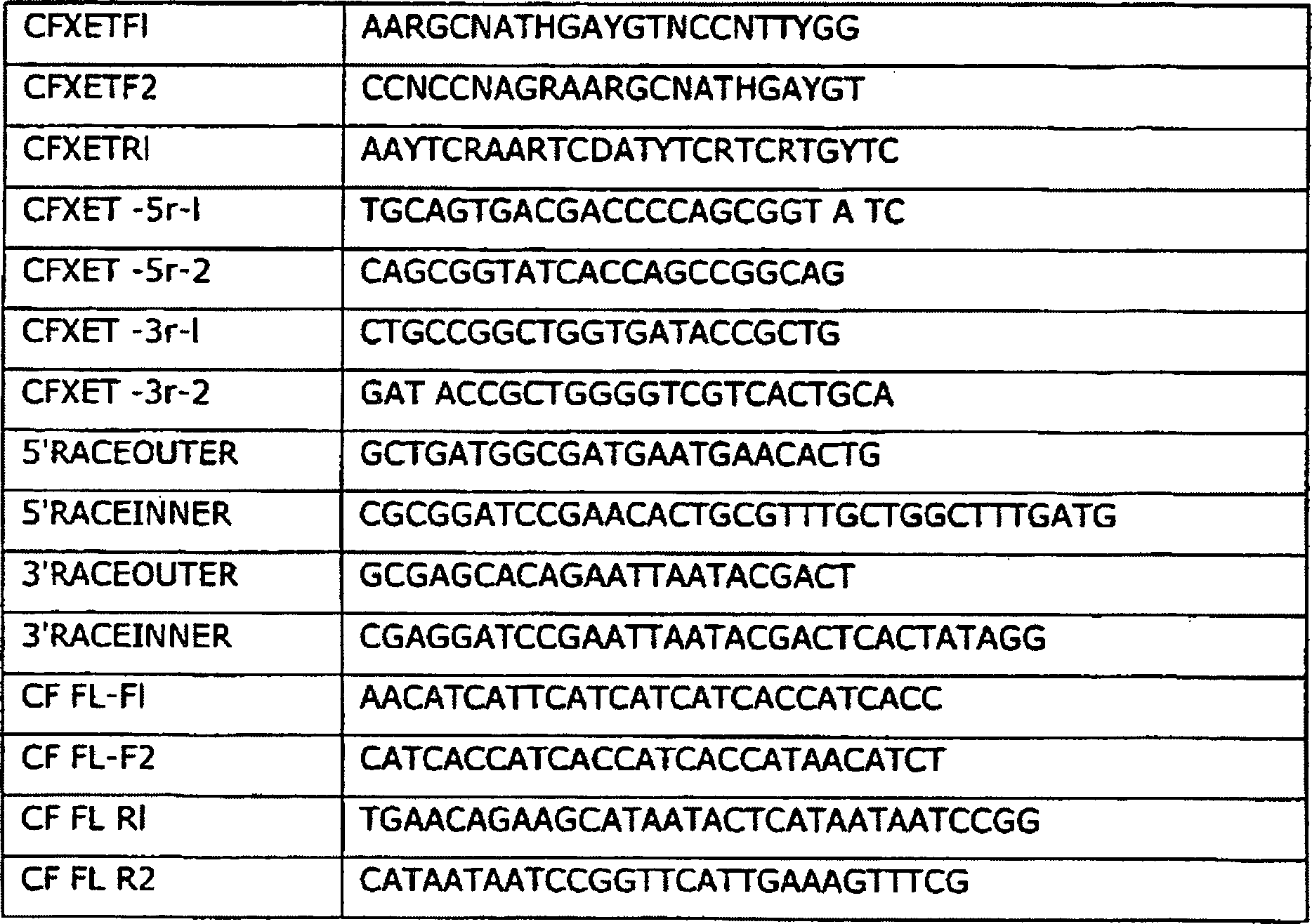
- IBU-Code für gemischte Basen: M = A + C, R = A + G, W = A + T, S = G + C, Y = C + T, V = A + G + C, N = A + C + T, B = G + T + C, N = A + G + C + T, K = G + T.
- Mixed base IBU code: M = A + C, R = A + G, W = A + T, S = G + C, Y = C + T, V = A + G + C, N = A + C + T, B = G + T + C, N = A + G + C + T, K = G + T.
Die Primer CFXETFI, CFXETF2 und CFXETRI sind genspezifische, degenerierte Primer für die RT-PCR. CFXET-5r-I, CFXET-5r-2, CFXET-3r-I und CFXET-3r-2 sind genspezifische, interne Primer, während 5'RACE GUTER, 5'RACE INNER, 3'RACE GUTER und 3'RACE INNER komplementäre Primer zu den Adaptoren der RLM-RACE sind. CF-FL-FI, CF-FL-F2, CF-FL-RI sind CF-FL-R2 genspezifische Primer für die Amplifikation der cDNA mit vollständiger Länge.The Primers CFXETFI, CFXETF2 and CFXETRI are gene-specific, degenerate Primer for the RT-PCR. CFXET-5r-I, CFXET-5r-2, CFXET-3r-I and CFXET-3r-2 are gene specific, internal primers, while 5'RACE GOOD, 5'RACE INNER, 3'RACE GOOD and 3'RACE INNER complementary primers to the adapters of the RLM-RACE are. CF-FL-FI, CF-FL-F2, CF-FL-RI are CF-FL-R2 gene specific Primer for the amplification of the full-length cDNA.
Beispiel 5Example 5
ISOLIERUNG DES GENS, WELCHES DAS XET VON HYBRIDER ESPE CODIERTINSULATION OF THE GENE, WHICH THE XET OF HYBRIDER ESPE CODES
Die cDNA, die das Pappel-XET codiert, wurde zum Beispiel aus einer kambialen EST-Bibliothek einer hybriden Espe isoliert, die aufgebaut war, wie in Hertzberg et al., 1998, beschrieben wurde. Die Anmerkungen der Bibliothek offenbarten drei Sequenzen, die den XET-ähnlichen Enzymen entsprachen. Die Sequenzierung der vollständigen Länge von einem der Klone zeigte, dass er eine cDNA-Kopie des XET-Enzyms in vollständiger Länge enthielt, das als XET16A (SEQ ID Nr.: 3) bezeichnet wurde, während ein anderer Klon einem zweiten XET-Enzym in vollständiger Länge entsprach, das als XET16C (SEQ ID Nr.: 2) bezeichnet wurde.The cDNA encoding the poplar XET, for example, was obtained from a cambial EST library isolated from a hybrid aspen that was built as described in Hertzberg et al., 1998. The notes of the The library revealed three sequences that are XET-like Enzyme corresponded. Sequencing the full length of one of the clones showed that it contained a full-length cDNA copy of the XET enzyme, which was designated as XET16A (SEQ ID NO: 3) while a another clone corresponded to a second full-length XET enzyme known as XET16C (SEQ ID NO: 2).
BEISPIEL 6EXAMPLE 6
EXTRAKTION VON XYLOGLUCAN AUS DEM SAMENKERNPULVER DER TAMARINDEEXTRACTION OF XYLOGLUCAN FROM THE SEED POWDER OF THE TAMARINDE
Das Verfahren von Edwards et al. (Planta 1985, 163, 133-140) wurde modifiziert, wie nachfolgend beschrieben wird. NaBH4 (0,75 g) wurde in 2,0 M NaOH (1,5 L) gelöst. Das entölte Samenkernpulver der Tamarinde (30 g) wurde langsam zu der Lösung unter kräftigem Rühren (Schaufelrührer) zugegeben, um ein Verklumpen zu verhindern. Das Gemisch wurde anschließend auf 90°C erhitzt und bei dieser Temperatur für 1 Stunde unter kontinuierlichem Rühren gehalten. Nach einer unvollständigen Abkühlung wurden die Feststoffe über Glasfasern abgefiltert und verworfen. Nach einer weiteren Abkühlung wurde das Filtrat durch die langsame Zugabe von Eisessig (300 ml) angesäuert, gefolgt von der langsamen Zugabe von EtOH (3,0 I), um das Xyloglucan als eine farblose, gelatineartige Masse zu präzipitieren. Die Feststoffe wurden durch die Filterung über ein Baumwolltuch gesammelt und das Filtrat wurde anschließend verworfen. Das Xyloglucan wurde anschließend in reinem Wasser (1,5 L, 18 MΩ.cm) unter leichtem Erhitzen gelöst und durch die langsame Zugabe von EtOH (3,0 L) erneut präzipitiert. Die feste Masse wurde erneut durch Filtration durch ein Baumwolltuch gesammelt, das per Hand ausgewrungen wurde, um das überschüssige Filtrat freizusetzen. Die Feststoffe wurden anschließend unter vermindertem Druck (Ölpumpe) getrocknet und in einer Haushaltskaffeemühle (Braun) gemahlen, um ein feines Pulver (17 g) zu erhalten.The method of Edwards et al. (Planta 1985, 163, 133-140) was modified as described below. NaBH 4 (0.75 g) was dissolved in 2.0 M NaOH (1.5 L). The de-oiled tamarind seed powder (30 g) was slowly added to the solution with vigorous stirring (paddle) to prevent agglomeration. The mixture was then heated to 90 ° C and held at this temperature for 1 hour with continuous stirring. After incomplete cooling, the solids were filtered off via glass fibers and discarded. After further cooling, the filtrate was acidified by the slow addition of glacial acetic acid (300 mL), followed by the slow addition of EtOH (3.0 L) to afford the Xyloglucan as a colorless, gelatinous mass to precipitate. The solids were collected by filtration through a cotton cloth and the filtrate was subsequently discarded. The xyloglucan was then dissolved in pure water (1.5 L, 18 MΩ.cm) with gentle heating and reprecipitated by the slow addition of EtOH (3.0 L). The solid was collected again by filtration through a cotton cloth which was wrung out by hand to release the excess filtrate. The solids were then dried under reduced pressure (oil pump) and ground in a household coffee grinder (Braun) to obtain a fine powder (17 g).
BEISPIEL 7EXAMPLE 7
ENDOGLUCANASE VERMITTELTE HERSTELLUNG VON XYLOGLUCAN-OLIGOSACCHARIDENENDOGLUCANASE MEDIATED Preparation of xyloglucan oligosaccharides
Xyloglucan (3 g) wurde in 200 ml aufbereitetem Wasser (18 MΩ.cm) bei 50°C unter starkem Rühren gelöst. Nach dem Abkühlen auf 30°C wurde Cellulase (30 mg, 4 E/mg, von T. reesei, Fluka) zugegeben und die Lösung wurde bei dieser Temperatur übernacht gehalten. Aktivierter Kohlenstoff (3 g) wurde anschließend zugegeben und das Gemisch wurde für 15 Minuten gerührt. Nach der Zugabe von Acetonitril (200 ml) wurde das Gemisch durch einen Celite-Filter auf einem Glasfaserfilterpapier (Whatman GF/A) gefiltert. Das Filtrat wurde anschließend unter Vakuum (Wasserentlüfter) konzentriert und das restliche Lösungsmittel wurde mit einer starken Vakuum(Öl)-pumpe entfernt. Das Gemisch von Xyloglucan-Oligosacchariden (XXXG, XLXG, XXLG und XLLG im molaren Verhältnis von 15:7:32:46, wie durch eine Hochleistungs-Anionenaustausch-Chromatographie mit Wechselstromnachweis, HPAEC-PAD bestimmt wurde) wurde durch eine semipräparative HPLC auf einer Amid-80-Säule (TosoHaas, 21,5 mm × 300 mm, Eluent 55:45 Acetonitril-Wasser) fraktioniert, wenn dies benötigt wurde. XLXG und XXLG waren unter diesen Bedingungen nicht lösbar. Massenspektrometrie durch Elektrospray-Ionisation (Micromass Q-TOF2) wurde verwendet, um die Identität der Oligosaccharide zu bestätigen.xyloglucan (3 g) was dissolved in 200 ml of treated water (18 MΩ.cm) at 50 ° C with vigorous stirring. To cooling at 30 ° C Cellulase (30 mg, 4 U / mg, from T. reesei, Fluka) was added and the solution was staying at this temperature held. Activated carbon (3 g) was then added and the mixture was for Stirred for 15 minutes. After the addition of acetonitrile (200 ml), the mixture was passed through a celite filter on a glass fiber filter paper (Whatman GF / A) filtered. The filtrate was then concentrated under vacuum (water vent) and the remaining solvent was with a strong vacuum (oil) pump away. The mixture of xyloglucan oligosaccharides (XXXG, XLXG, XXLG and XLLG in molar ratio of 15: 7: 32: 46, as by a high performance anion exchange chromatography with AC detection, HPAEC-PAD was determined) a semi-preparative HPLC on an amide 80 column (TosoHaas, 21.5 mm × 300 mm, eluent 55:45 acetonitrile-water), if needed. XLXG and XXLG were not solvable under these conditions. Mass spectrometry by electrospray ionization (Micromass Q-TOF2) was used about the identity to confirm the oligosaccharides.
Xyloglucan (3 g) wurde in 200 ml reinem Wasser (18 MΩ.cm) bei 50°C unter starkem Rühren gelöst. Nach dem Abkühlen auf 30°C wurde Cellulase (30 mg, 4 E/mg, von Trichderma reesei, Fluka) zugegeben und die Lösung wurde bei dieser Temperatur übernacht gehalten. Beta-Galactosidase (150 mg, 9 E/mg gegen Lactose, von Aspergillus oryzae, Sigma G-5160) wurde anschließend zugegeben und die Lösung wurde für 1 Stunde bei Raumtemperatur gerührt. Die Lösung wurde für 3 min gekocht, gefolgt durch die schnelle Abkühlung vor der Zugabe von aktiviertem Kohlenstoff (3 g). Das Gemisch wurde anschließend für 15 min bei Raumtemperatur gerührt. Nach der Zugabe von Acetonitril (200 ml) wurde das Gemisch durch einen Celite-Filter auf einem Glasfaserfilterpapier (Whatman GF/A) gefiltert. Das Filtrat wurde anschließend unter Vakuum (Wasserentlüfter) konzentriert und das restliche Lösungsmittel wurde mit einer starken Vakuum(Öl)-pumpe entfernt. Das Gemisch von Xyloglucan-Oligosacchariden wurde anschließend durch eine semipräparative HPLC auf einer Amid-80-Säule (TosoHaas, 21,5 mm × 300 mm, Eluent 55:45 Acetonitril-Wasser) fraktioniert. Massenspektrometrie durch Elektrospray-Ionisation (Micromass Q-TOF2) wurde verwendet, um die Identität der Oligosaccharide zu bestätigen.xyloglucan (3 g) was dissolved in 200 ml of pure water (18 MΩ.cm) at 50 ° C with vigorous stirring. To cooling at 30 ° C Cellulase (30 mg, 4 U / mg, from Trichderma reesei, Fluka) was added and the solution was staying at this temperature held. Beta galactosidase (150 mg, 9 U / mg vs lactose, from Aspergillus oryzae, Sigma G-5160) was then added and the solution became for 1 hour stirred at room temperature. The solution was for Cooked for 3 minutes, followed by rapid cooling before the addition of activated Carbon (3 g). The mixture was then left at room temperature for 15 min touched. After the addition of acetonitrile (200 ml), the mixture was passed through a celite filter on a glass fiber filter paper (Whatman GF / A) filtered. The filtrate was then concentrated under vacuum (water vent) and the remaining solvent was with a strong vacuum (oil) pump away. The mixture of xyloglucan oligosaccharides was then passed through a semi-preparative HPLC on an amide 80 column (TosoHaas, 21.5 mm × 300 mm, eluent 55:45 acetonitrile-water). Mass spectrometry by electrospray ionization (Micromass Q-TOF2) was used about the identity to confirm the oligosaccharides.
BEISPIEL 8EXAMPLE 8
HERSTELLUNG VON AMINOALDITOL-DERIVATEN VON XYLOGLUCO-OLIGOSACCHARIDEN (XGO-NH2)PREPARATION OF AMINOALDITOL DERIVATIVES OF XYLOGLUCO OLIGOSACCHARIDES (XGO-NH 2 )
Xyloglucan-Oligosaccharide (2,4 g, 1,9 mmol, Gemisch von XXXG, XLXG, XXLG und XLLG) wurden in einer gesättigten Ammoniumhydrogencarbonatlösung (50 ml) gelöst. Natriumcyanoborohydrid (2,4 g, 39 mmol) wurde anschließend zugegeben und die Reaktion wurde bei Raumtemperatur in der Dunkelheit gerührt. Nach sieben Tagen wurde die Reaktion gefiltert und Essigsäure wurde zugegeben, bis die Lösung einen pH-Wert von 2 erreichte. Nach der Konzentration unter Vakuum wurde das unbearbeitete Produkt erneut in 75 ml Wasser gelöst und in 10 Portionen auf eine P2-Säule (BioRad, Bio-Gel P2, 5 cm × 22 cm) aufgetragen. Die Fraktionen von jedem Säulendurchlauf, die das XGO-NH2 enthielten und die eine niedrige Leitfähigkeit aufwiesen, wurde vereint und bis zur Trockenheit konzentriert (Ausbeute 1,31 g, 51%). Die Massenspektrometrie durch Elektrospray-Ionisation (Micromass Q-TOF2) wurde verwendet, um die Identität der modifizierten Oligosaccharide zu bestätigen.Xyloglucan oligosaccharides (2.4 g, 1.9 mmol, mixture of XXXG, XLXG, XXLG and XLLG) were dissolved in a saturated ammonium bicarbonate solution (50 ml). Sodium cyanoborohydride (2.4 g, 39 mmol) was then added and the reaction was stirred at room temperature in the dark. After seven days, the reaction was filtered and acetic acid was added until the solution reached pH = 2. After concentration under vacuum, the crude product was redissolved in 75 ml of water and applied in 10 portions to a P2 column (BioRad, Bio-Gel P2, 5 cm x 22 cm). The fractions from each column run containing the XGO-NH 2 and having low conductivity were combined and concentrated to dryness (yield 1.31 g, 51%). Electrospray ionization mass spectrometry (Micromass Q-TOF2) was used to confirm the identity of the modified oligosaccharides.
BEISPIEL
HERSTELLUNG VON SULFO-RHODAMIN-DERIVATEN VON XYLOGLUCO-OLIGOSACCHARIDEN (XGO-SR)PREPARATION OF SULFOODHODAMINE DERIVATIVES OF XYLOGLUCO OLIGOSACCHARIDES (XGO-SR)
XGO-Aminoalditole (XGO-NH2, 0,5 g, 0,4 mM, Gemisch von XXXG-NH2, XLXG-NH2, XXLG-NH2 und XLLG-NH2 wurden in 3% wässriges Natriumtetraborat (30 ml) gelöst. Sulfo-Rhodamin B-Säurechlorid (192 mg, 0,3 mM, Fluka 86186) wurde in Dimethylformamid (DMF, 1 ml) gelöst und tropfenweise in die gerührte Flüssigkeit zugegeben. Die Reaktion wurde durch TLC (5:4:1 Chloroform: Methanol: Wasser) überwacht und nach sieben Tagen bis zur Trockenheit konzentriert. Das unbearbeitete Produkt wurde durch eine Flash-Chromatographie auf Kieselsäuregel gereinigt (schrittweise Elution mit 55:45:5 und 5:4:1 Chloroform: Methanol: Wasser). Um kleinste Mengen von Kieselsäure aus dem Produkt zu entfernen, wurde das Material auf eine Säule (Supelclean ENVI-18 SPE-Gefäß, 6 ml, Supelco, Bellefonte, PA, USA) für eine Umkehrphasen-Chromatographie geladen und durch einen abgestuften Gradienten aus voll entsalztem Wasser, 10% wässrigem Acetonitril und 20% wässrigem Acetonitril eluiert (Ausbeute: 20 mg, 2,7%).XGO-amino alditols (XGO-NH 2 , 0.5 g, 0.4 mM, mixture of XXXG-NH 2 , XLXG-NH 2 , XXLG-NH 2 and XLLG-NH 2 were dissolved in 3% aqueous sodium tetraborate (30 ml). Sulfo-Rhodamine B acid chloride (192mg, 0.3mM, Fluka 86186) was dissolved in dimethylformamide (DMF, 1mL) and added dropwise to the stirred liquid The reaction was monitored by TLC (5: 4: 1 chloroform The crude product was purified by flash chromatography on silica gel (stepwise elution with 55: 45: 5 and 5: 4: 1 chloroform: methanol: water) To remove minute amounts of silica from the product, the material was loaded onto a column (Supelclean ENVI-18 SPE, 6 ml, Supelco, Bellefonte, PA, USA) for reversed phase chromatography and through a graded deionized gradient Water, 10% aqueous acetonitrile and 20% aqueous acetonitrile (yield: 20 mg, 2.7%).
BEISPIEL 10EXAMPLE 10
HERSTELLUNG VON FLUORESCEIN-DERIVATEN VON XYLOGLUCO-OLIGOSACCHARIDEN (XGO-FITC)PREPARATION OF FLUORESCEINE DERIVATIVES OF XYLOGLUCO OLIGOSACCHARIDES (XGO-FITC)
Fluorescein-Isothiocyanat-Isomer I (FITC, 12 mg, 0,03 mmol, Fluka 46952) wurde zu einer Lösung von XGO-Oligoalditolen (XGO-NH2, 45 mg, 0,036 mmol, Gemisch von XXXG-NH2, XLXG-NH2, XXLG-NH2 und XLLG-NH2) in Natriumbicarbonatpuffer (100 mM, pH-Wert 9,0, 20 ml) gegeben. Die Reaktion wurde durch TLC (70:30:1 Acetonitril: Wasser: Essigsäure) überwacht und wurde nach dem Rühren für 24 Stunden unter Vakuum bis zur Trockenheit konzentriert. Das unbearbeitete Produkt wurde in 1,5 ml ultrareinem Wasser erneut gelöst, auf eine P2-Säule (BioRad, Bio-Gel P2, 1,6 cm × 50 cm) gegeben und mit 10 mM wässrigem Ammoniumbicarbonat mit einer Flussrate von 0,2 ml/min eluiert. Alle Fraktionen wurden durch TLC (70:30:1 Acetonitril: Wasser: Essigsäure) überwacht, welches zeigte, dass das nicht umgesetzte FITC und XGO-NH2 erfolgreich von dem erwünschten Produkt getrennt wurde. Fraktionen, die XGO-FITC enthielten (nachgewiesen durch einen angeschlossenen UV-Detektor und TLC) und die eine niedrige Leitfähigkeit zeigten, wurden vereint und unter Vakuum konzentriert, um einen orangefarbenen Feststoff zu erhalten (Ausbeute: 34 mg, 60%). Die Massenspektrometrie durch Elektrospray-Ionisation (Micromass Q-TOF2) wurde verwendet, um die Identität der modifizierten Oligosaccharide zu bestätigen.Fluorescein isothiocyanate isomer I (FITC, 12 mg, 0.03 mmol, Fluka 46952) was added to a solution of XGO oligoalditols (XGO-NH 2 , 45 mg, 0.036 mmol, mixture of XXXG-NH 2 , XLXG-NH 2 , XXLG-NH 2 and XLLG-NH 2 ) in sodium bicarbonate buffer (100mM, pH 9.0, 20mL). The reaction was monitored by TLC (70: 30: 1 acetonitrile: water: acetic acid) and, after stirring, was concentrated to dryness under vacuum for 24 hours. The crude product was redissolved in 1.5 ml of ultrapure water, added to a P2 column (BioRad, Bio-Gel P2, 1.6 cm x 50 cm) and 10 mM aqueous ammonium bicarbonate at a flow rate of 0.2 ml / min eluted. All fractions were monitored by TLC (70: 30: 1 acetonitrile: water: acetic acid), which showed that the unreacted FITC and XGO-NH 2 were successfully separated from the desired product. Fractions containing XGO-FITC (detected by a connected UV detector and TLC) and showing low conductivity were combined and concentrated under vacuum to give an orange solid (Yield: 34 mg, 60%). Electrospray ionization mass spectrometry (Micromass Q-TOF2) was used to confirm the identity of the modified oligosaccharides.
BEISPIEL 11EXAMPLE 11
SYNTHESE VON RADIOAKTIVEN UND NICHT RADIOAKTIVEN ALDITOL-DERIVATEN VON XLLG-XYLOGLUCO-OLIGOSACCHARID ([1-3H]-XLLGol UND [1-1H]-XLLGol)SYNTHESIS OF RADIOACTIVE AND NON-RADIOACTIVE ALDITOL DERIVATIVES OF XLLG-XYLOGLUCO-OLIGOSACCHARIDE ([1- 3 H] -XLLGol AND [1- 1 H] -XLLGol)
Das Xylogluco-Oligosaccharid XLLG (8,6 μmol) wurde in aufbereitetem Wasser (250 μl, 18 MΩ.cm) gelöst, das auf einen pH-Wert von 11,5 mit NAOH eingestellt wurde. NaB3H4 (8,2 μmol, 3,76 GBq) wurde anschließend zugegeben und man ließ die Reaktion übernacht bei Raumtemperatur stehen. Die Reaktion wurde durch die vorsichtige Zugabe von Eisessig gestoppt, bis der pH-Wert der Lösung etwa 4 betrug. Man ließ die Lösung anschließend für einen Zeitraum von 30 min stehen, um zu ermöglichen, dass das Tritiumgas durch den Abzug entlüftet wurde. Salze wurden aus dem Produkt durch eine Gelfiltrations-Chromatographie auf Bio-Gel P-2-Harz (BioRad, Lagervolumen 20 ml) mit gereinigtem Wasser (18 MΩ.cm) als Eluent entfernt. Fraktionen mit etwa 1 ml Volumen wurden gesammelt. Die Fraktionen wurden durch eine Flüssigkeitsszintillationsmessung und Dünnschichtchromatographie (Kieselsäuregel, 7:3 Acetonitril-Wasser als Eluent, Ammoniummolybdat/Schwefelsäure-Färbung) analysiert. Die Fraktionen, die sowohl radioaktiv waren als auch ein Produkt mit einem Rf enthielten, der identisch zu XLLG war, wurden vereinigt. Ein qualitativer Tollens-Test für die Reduzierung von Zucker auf diesem Produkt war negativ, was darauf hinweist, dass die Reduktionsreaktion vollständig abgelaufen war. Das Produkt besaß eine Radioaktivität von 115270 Bq/μl.The xylogluco-oligosaccharide XLLG (8.6 μmol) was dissolved in treated water (250 μl, 18 MΩ.cm) which was adjusted to pH 11.5 with NaOH. NaB 3 H 4 (8.2 μmol, 3.76 GBq) was then added and the reaction allowed to stand at room temperature overnight. The reaction was stopped by the cautious addition of glacial acetic acid until the pH of the solution was about 4. The solution was then allowed to stand for a period of 30 minutes to allow the tritium gas to vent through the hood. Salts were removed from the product by gel filtration chromatography on Bio-Gel P-2 resin (BioRad, storage volume 20 ml) with purified water (18 MΩ.cm) as eluent. Fractions of about 1 ml in volume were collected. The fractions were analyzed by liquid scintillation and thin layer chromatography (silica gel, 7: 3 acetonitrile-water as eluent, ammonium molybdate / sulfuric acid stain). The fractions, which were both radioactive and contained a product with an Rf identical to XLLG, were pooled. A qualitative Tollens test for the reduction of sugar on this product was negative, indicating that the reduction reaction had gone to completion. The product had a radioactivity of 115270 Bq / μl.
Die Synthese von nicht radioaktivem XLLGol wurde in einer Weise durchgeführt, die identisch zu der war, die vorstehend beschrieben wurde, mit der Ausnahme, dass NaB3H4 durch NaBH4 als Reduktionsmittel ausgetauscht wurde. Das Verdampfen der Chromatographielösung ergab das Produkt als ein weißes Pulver, das ein Proton im NMR-Spektrum ergab, das identisch zu dem war, von dem zuvor berichteten wurde (York W. et al., Carbohydrate Research, 1990, 200, 9-31). Die durchschnittliche Ausbeute der drei Reaktionen (50 (+/–) 3%) wurde verwendet, um die Ausbeute der radioaktiven Synthese zu schätzen, die eine Konzentration von 1,21 × 10⁻⁹ mol/L und eine spezifische Aktivität von 95 MBq/μl anzeigte.The synthesis of nonradioactive XLLGol was carried out in a manner identical to that described above, except that NaB 3 H 4 was replaced by NaBH 4 as the reducing agent. Evaporation of the chromatographic solution gave the product as a white powder which gave a proton in the NMR spectrum identical to that previously reported (York W. et al., Carbohydrate Research, 1990, 200, 9-31 ). The average yield of the three reactions (50 (+/-) 3%) was used to estimate the yield of the radioactive synthesis, which has a concentration of 1.21 x 10 -9 mol / L and a specific activity of 95 MBq / μl.
BEISPIEL 12EXAMPLE 12
HERSTELLUNG VON REGENERIERTEN ZELLULOSEMEMBRANENMANUFACTURE OF REGENERATED CELLULOSE MEMBRANES
a. Herstellung von regenerierten Zellulosemembranen aus Kupferammonium-Lösunga. Production of regenerated Cellulose membranes of cuprammonium solution
Gemäß des Verfahrens von Okajima [Okajima K (1995), Polymer Journal 27(11), 1113-1122] wurden 10 g Zellulose (Whatman Nr. 1 Filterpapier, UK) in einem Gemisch von 65 g NH4OH (20%) gelöst, 12 g frisch hergestelltes Cu(OH)2, 8 g 10% (w/v) NaOH und 30 g Wasser gelöst, um eine klare blaue, visköse Lösung bei 4°C zu ergeben. Die Lösung wurde auf eine Glasplatte gegossen, um eine Stärke von 0,3 mm zu erhalten, und anschließend in Eindickungsbäder gegeben, die bei 4°C in 10% wässrigem NaOH gehalten wurden, gefolgt von 4% wässriges H2SO4 für jeweils 5 Minuten. Die so erhaltenen Regenerat-Zellulosefilme wurden unter fließendem Wasser gewaschen und auf einer Glasplatte bei Raumtemperatur getrocknet.According to the method of Okajima [Okajima K (1995), Polymer Journal 27 (11), 1113-1122], 10 g of cellulose (Whatman No. 1 filter paper, UK) was dissolved in a mixture of 65 g NH 4 OH (20%) , 12 g of freshly prepared Cu (OH) 2 , 8 g of 10% (w / v) NaOH and 30 g of water are dissolved to give a clear blue, viscous solution at 4 ° C. The solution was poured onto a glass plate to give a thickness of 0.3 mm and then placed in thickening baths kept at 4 ° C in 10% aqueous NaOH, followed by 4% aqueous H 2 SO 4 for every 5 minutes. The thus obtained regenerated cellulose films were washed under running water and dried on a glass plate at room temperature.
b. Herstellung von regenerierter Zellulosemembran aus wässriger NaOH/Harnstoff-Lösungb. Production of regenerated Cellulose membrane from aqueous NaOH / urea solution
Bemliese® Vliesstoff, der aus Baumwoll-Linterstoffen in Kupferammonium-Lösung (DP = 650, Asahi Chemical Industry Co. Lid, Japan) hergestellt wurde, wurde als Quelle der Zellulose verwendet. 10 g Bemliese® Vliesstoff wurde in 200 ml 6 Gew.-% NaOH/4 Gew.-% wässrige Harnstofflösung gelöst, um eine klare Zelluloselösung bei 4°C zu erhalten. Die Lösung wurde auf eine Glasplatte gegossen, um eine Stärke von 0,5 mm zu erhalten, anschließend sofort in eine 5 Gew.-% wässrige H2SO4-Lösung getaucht, um das Festwerden für 5 min bei 4°C zu ermöglichen. Die so erhaltenen Membrane wurden mit fließendem Wasser gewaschen und an der Luft auf einer Glasplatte bei Raumtemperatur getrocknet. ® Bemliese non-woven fabric made of cotton linters substances in cuprammonium solution (DP = 650, Asahi Chemical Industry Co. Lid, Japan) was prepared, was used as the source of cellulose. 10 g ® Bemliese non-woven fabric was dissolved urea aqueous solution in 200 ml 6 wt .-% NaOH / 4 wt .-%, in order to obtain a clear cellulose solution at 4 ° C. The solution was cast on a glass plate to give a thickness of 0.5 mm, then immediately immersed in a 5% by weight aqueous H 2 SO 4 solution to allow solidification for 5 minutes at 4 ° C. The membranes thus obtained were washed with running water and dried in air on a glass plate at room temperature.
BEISPIEL 13EXAMPLE 13
XET VERMITTELTER EINBAU VON SULFO-RHODAMIN MODIFIZIERTEN XYLOGLUCAN-OLIGOSACCHARIDEN (XGO-SR) IN XYLOGLUCAN IN LÖSUNGXET IMMEDIATE INSTALLATION OF SULFO-RHODAMINE-MODIFIED XYLOGLUCAN OLIGOSACCHARIDES (XGO-SR) IN XYLOGLUCAN IN SOLUTION
Das Fluorophor Sulfo-Rhodamin wurde chemisch in das reduzierende Ende von Xyloglucan-Oligosacchariden eingebaut, um XGO-Rhodamin herzustellen, wie in dem Beispiel 8. A beschrieben wurde. Ein Gemisch (4 ml) von Xyloglucan (XG, 0,5 mg/ml), XGO-Rhodamin (0,5 mg/ml) und XET (0,025 mg/ml) in Ammoniumacetatpuffer (50 mM, pH-Wert 5,5) wurde bei Raumtemperatur (22°C) für 10 min inkubiert. Die Reaktion wurde durch das Eluieren des Reaktionsgemisches durch eine HiTrap SP FF-Säule (Amersham Bioscience, Schweden) zur Entfernung des XET-Enzyms beendet. Etwa 25% des zugegebenen Enzyms wurde mit XGO-Rhodamin modifiziert, wie durch die kolorimetrische Analyse von Kooiman [Kooiman P (1960), Recl Trav Chim Pay-Bas, 79, 675-678] bestimmt wurde.The Fluorophore sulfo-rhodamine became chemically in the reducing end of xyloglucan oligosaccharides to produce XGO rhodamine, as described in Example 8.A. A mixture (4 ml) of Xyloglucan (XG, 0.5 mg / ml), XGO rhodamine (0.5 mg / ml) and XET (0.025 mg / ml) in ammonium acetate buffer (50mM, pH 5.5) at room temperature (22 ° C) for 10 min incubated. The reaction was carried out by eluting the reaction mixture through a HiTrap SP FF column (Amersham Bioscience, Sweden) to remove the XET enzyme. About 25% of the added enzyme was modified with XGO rhodamine, such as by the Colorimetric analysis of Kooiman [Kooiman P (1960), Recl Trav Chim Pay-Bas, 79, 675-678].
BEISPIEL 14EXAMPLE 14
XET VERMITTELTER EINBAU VON FLUORESCEIN MODIFIZIERTEN XYLOGLUCAN-OLIGOSACCHARIDEN (XGO-FITC) IN XYLOGLUCAN IN LÖSUNGXET IMMEDIATE INSTALLATION FLUORESCEIN-MODIFIED XYLOGLUCAN OLIGOSACCHARIDEN (XGO-FITC) IN XYLOGLUCAN IN SOLUTION
Fluorescein-Isothiocyanat Isomer I wurde chemisch in das reduzierende Ende von Xyloglucan-Oligosacchariden eingebaut, um XGO-FITC herzustellen, wie in dem Beispiel 10 beschrieben wurde. Die Wirkungen der Konzentration des XET-Enzyms und der Reaktionszeit auf den Einbau von XGO-FITC in Xyloglucan in Lösung wurde analysiert, wie nachfolgend beschrieben wird.Fluorescein isothiocyanate Isomer I was chemically added to the reducing end of xyloglucan oligosaccharides to prepare XGO-FITC as described in Example 10 has been. The effects of the concentration of the XET enzyme and the reaction time on the incorporation of XGO-FITC into xyloglucan in solution was analyzed as will be described below.
a. Zeitabhängigkeita. time dependency
Proben,
die ein Gemisch (200 μl
Gesamtvolumen) von Xyloglucan (XG, 1 mg/ml), XGO-FITC (0,5 mg/ml)
und XET (8 Einheiten) in Citratpuffer (20 mM, pH-Wert 5,5) enthielten, wurden bei 30°C für 5, 10,
20, 40, 60, 120, 180, 300 und 360 min inkubiert. Zum gegebenen Zeitpunkt
wurde jede Reaktion durch das Erhitzen auf 75°C für 5 min beendet. Nach dem Abkühlen auf
Raumtemperatur wurden 400 μl
Ethanol zugegeben und das Gemisch wurde bei 12000 g für 5 min
bei 4°C
zentrifugiert, um das modifizierte und nicht modifizierte XG zu
präzipitieren,
während
das XGO-FITC in Lösung
blieb. Sowohl das Präzipitat
als auch der Überstand wurden
unter Vakuum getrocknet und erneut getrennt in je 200 μl Wasser
gelöst.
0,019; 0,025; 0,031; 0,035; 0,038; 0,041; 0,042; 0,043; 0,044 mg
XGO-FITC wurden jeweils in das reduzierende Ende von Xyloglucan
in den 5, 10, 20, 40, 60, 120, 180, 300 und 360 min-Proben eingebaut,
wie durch die UV-Absorption bei 495 nm der erneut gelösten Präzipitatlösung bestimmt
wurde, wobei eine Standardkurve verwendet wurde, die von XGO-FITC-Lösungen mit
einer steigenden Konzentration abgeleitet wurde. Die Ergebnisse
werden in
b. Enzymabhängigkeitb. enzyme dependence
Ein
Gemisch (200 μl
Gesamtvolumen) von Xyloglucan (XG, 1 mg/ml), XGO-FITC (0,5 mg/ml)
in Citratpuffer (20 mM, pH-Wert 5,5) wurde mit abnehmenden Mengen
von XET (32,0; 16,0; 14,4; 12,8; 9,6; 6,4; 4,8; 3,2; 1,6 und 0,8
Einheiten) bei 30°C
für 40
min inkubiert. Zu diesem Zeitpunkt wurden die Reaktionsgemische genauso
behandelt, wie in Beispiel 13b beischrieben wurde. Unter Verwendung
dieses Verfahrens wurde gezeigt, dass 0,042; 0,038; 0,038; 0,037;
0,034; 0,031; 0,027; 0,022; 0,015 und 0,009 mg XGO-FITC in das reduzierende
Ende von Xyloglucan in den Proben, die jeweils 32,0; 16,0; 14,4;
12,8; 9,6; 6,4; 4,8; 3,2; 1,6 und 0,8 Einheiten des XET-Enzyms enthielten,
eingebaut wurden. Die Ergebnisse werden in
BEISPIEL 15EXAMPLE 15
ADSORPTION VON SULFO-RHODAMIN MODIFIZIERTEN XYLOGLUCANEN AUF ZELLULOSEMATERIALIENADSORPTION OF SULFO-RHODAMINE MODIFIED XYLOGLUCANES ON CELLULOSE MATERIALS
Zellulosehaltige Materialien (0,1 g Munktell-Filterpapierstreifen) wurden in die Lösung getaucht, die das Rhodamin modifizierte XG enthielt (4 ml, hergestellt gemäß dem Verfahren in Beispiel 10), und wurden übernacht (ca. 15 Stunden) in einem End-Over-End-Mixer bei Raumtemperatur geschüttelt. Das Binden von XG an die zellulosehaltigen Fasern (11,4 mg XG/g Zellulose) wurde durch den Rückgang von XG aus der Lösung analysiert, wie durch das kolorimetrische Verfahren von Kooiman bestimmt wurde. Das zellulosehaltige Material wurde anschließend aus der ursprünglichen Lösung entfernt und wiederholt mit ultrareinem Wasser in einem End-Over-End-Mixer gewaschen, um überschüssiges XGO-Rhodamin zu entfernen. Nach dem intensiven Waschen wurde die Adsorption von Rhodamin-XG auf der Zellulose ebenfalls als eine intensive rosa Färbung unter Umgebungslicht und als eine starke Fluoreszenz unter UV-Licht beobachtet. Kontrollproben, die unter identischen Bedingungen behandelt wurden, die aber nur unmodifiziertes Xyloglucan und XGO-SR enthielten, waren nach dem Waschen farblos.cellulosic Materials (0.1g Munktell filter paper strips) were added to the solution dipped containing the rhodamine-modified XG (4 ml, prepared according to the method in Example 10), and stayed overnight (about 15 hours) in an end-over-end mixer at room temperature shaken. The binding of XG to the cellulosic fibers (11.4 mg XG / g Cellulose) was due to the decline from XG out of the solution analyzed as by the colorimetric method of Kooiman was determined. The cellulosic material was subsequently precipitated the original one solution washed and washed repeatedly with ultrapure water in an end-over-end mixer, excess XGO rhodamine to remove. After intensive washing, the adsorption of Rhodamine XG on the cellulose also called an intense pink coloring under ambient light and as a strong fluorescence under UV light observed. Control samples treated under identical conditions but containing only unmodified xyloglucan and XGO-SR colorless after washing.
BEISPIEL 16EXAMPLE 16
XET VERMITTELTER EINBAU VON CHEMISCH MODIFIZIERTEN XYLOGLUCAN-OLIGOSACCHARIDEN IN XYLOGLUCAN. DAS ZUVOR AN ZELLULOSEFASERN ANGELAGERT WURDEXET IMMEDIATE INSTALLATION CHEMICALLY MODIFIED XYLOGLUCAN OLIGOSACCHARIDES IN XYLOGLUCAN. That was previously stored on cellulosic fibers
XG (0,5 mg/ml) wurde mit zellulosehaltigen Fasern übernacht (15 h, leichtes Mischen im End-Over-End-Mixer) inkubiert, um zunächst das XG an die Zellulose anzulagern. Die XG-Zellulose wurde anschließend mit einem Gemisch von XGO-Rhodamin (0,1 mg/ml) und XET (0,025 mg/ml) in einem 50 mM Ammoniumacetatpuffer, pH-Wert 5,5 behandelt. Nach dem Mischen in einem End-Over-End-Mixer bei Raumtemperatur für 4 Stunden wurde die Probe intensiv mit ultrareinem Wasser gewaschen. Der kovalente Einbau der fluoreszierenden Oligosaccharide wurde durch eine starke rosa Färbung auf den Zellulosefasern nachgewiesen, die ebenfalls eine starke Fluoreszenz unter UV-Licht zeigten.XG (0.5 mg / ml) was overnight with cellulosic fibers (15 h, gentle mixing in the end-over-end mixer) to first attach the XG to the cellulose. The XG cellulose was subsequently with a mixture of XGO rhodamine (0.1 mg / ml) and XET (0.025 mg / ml) in a 50 mM ammonium acetate buffer, pH 5.5 treated. After mixing in an end-over-end mixer Room temperature for For 4 hours, the sample was washed extensively with ultrapure water. The covalent incorporation of the fluorescent oligosaccharides was by a strong pink color detected on the cellulose fibers, which is also a strong Showed fluorescence under UV light.
BEISPIEL 17EXAMPLE 17
ADSORPTION VON FLUORESCEIN MODIFIZIERTEM XYLOGLUCAN (XG-FITC) AUF ZELLULOSEHALTIGEM PAPIERADSORPTION OF FLUORESCINE MODIFIED XYLOGLUCAN (XG-FITC) ON CELLULOSE-BASED PAPER
- a. Ein Gemisch (4 ml Gesamtvolumen) von Xyloglucan (XG, 0,5 mg/ml), XGO-FITC (0,5 mg/ml) und XET (0,025 mg/ml) in Ammoniumacetatpuffer (25 mM, pH-Wert 5,5) wurde bei Raumtemperatur (22°C) für 10 min inkubiert. Die Reaktion wurde durch das Eluieren des Reaktionsgemisches durch eine HiTrap SP FF-Säule (Amersham Bioscience, Schweden) zur Entfernung des XET-Enzyms beendet. Zellulosehaltiges Material (0,1 g Whatman Nr. 1 Filterpapierstreifen) wurden anschließend in die Lösung eingetaucht und in einem End-Over-End-Mixer für 15 Stunden bei Raumtemperatur geschüttelt. Die Bindung von XG an die zellulosehaltigen Fasern (12,6 mg XG/g Zellulose) wurde durch den Rückgang von XG aus der Lösung analysiert, wie durch das kolorimetrische Verfahren von Kooiman bestimmt wurde. Das zellulosehaltige Material wurde anschließend aus der ursprünglichen Lösung entfernt und wiederholt mit ultrareinem Wasser in einem End-Over-End-Mixer gewaschen, um überschüssiges XGO-FITC zu entfernen. Die Adsorption von XG-FITC auf der Zellulose wurde als eine intensive rosa Färbung unter Umgebungslicht und als eine starke Fluoreszenz unter UV-Licht beobachtet. Kontrollproben, zu denen kein XET-Enzym zu der XG/XGO-FITC-Lösung zugegeben wurden, waren nach dem Waschen farblos und zeigten keine Fluoreszenz.a. A mixture (4 ml total volume) of xyloglucan (XG, 0.5 mg / ml), XGO-FITC (0.5 mg / ml) and XET (0.025 mg / ml) in ammonium acetate buffer (25 mM, pH 5, 5) was incubated at room temperature (22 ° C) for 10 min. The reaction was terminated by eluting the reaction mixture through a HiTrap SP FF column (Amersham Bioscience, Sweden) to remove the XET enzyme. Cellulosic material (0.1 g Whatman No. 1 filter paper strip) was then dipped into the solution and shaken in an end-over-end mixer for 15 hours at room temperature. The binding of XG to the cellulosic fibers (12.6 mg XG / g cellulose) was analyzed by the decrease of XG from the solution as determined by the colorimetric method of Kooiman. The cellulosic material was then removed from the original solution and washed repeatedly with ultrapure water in an end-over-end mixer to remove excess XGO-FITC. The adsorption of XG-FITC on the cellulose was observed as an intense pink coloration under ambient light and as a strong fluorescence under UV light. Control samples to which no XET enzyme was added to the XG / XGO-FITC solution were colorless after washing and showed no fluorescence.
- b. Ein Gemisch (200 μl) von Xyloglucan (XG, 1 mg/ml), XGO-FITC (0,5 mg/ml) und XET (8 Einheiten) in Citratpuffer (20 mM, pH-Wert 5,5) wurde bei 30°C für 60 min inkubiert. Die Reaktion wurde durch die Erhitzung auf 75°C für 5 min beendet. 100 μl dieser Lösung wurden in ultrareinem Wasser auf 500 μl verdünnt und zellulosehaltiges Material (Whatman Nr. 1 Filterpapierscheiben, 1,5 cm Durchmesser, 15,4 mg) wurde in die Lösung eingetaucht, gefolgt durch das Schütteln in einem End-Over-End-Mixer für 15 Stunden bei Raumtemperatur. Das Filterpapier wurde anschließend entfernt und mit ultrareinem Wasser (2 × 1 ml) gewaschen. Die Menge des XGO-FITC, die in XG eingebaut wurde und anschließend an das Filterpapier gebunden wurde (0,0232 mg), wurde durch den Rückgang von XGO-FITC aus der Lösung (einschließlich der Waschlösung) analysiert, wie durch die Adsorption bei 495 nm in 0,1 M Natriumbicarbonat gegen eine Standardkurve von XGO-FITC bestimmt wurde. Um die Menge des FITC modifizierten Xyloglucans (XG-FITC) auf der Papieroberfläche direkt zu quantifizieren, wurde das Papier sowohl mit einer CCD-Kamera während einer Fluoreszenzanregung (Fujifilm Imager) und mit einem Desktop-Scanner abgebildet. Man konnte zeigen, dass die Intensität des blauen Kanals eine lineare Korrelation mit der Menge des auf dem Papier adsorbierten XG-FITC zeigte, wenn es in einem Fullcolor RGB Modus gescannt wurde. Des weiteren konnte gebundenes XG-FITC von dem Papier mit 2 M wässriger NaOH extrahiert und anschließend durch eine UV-Adsorption bei 495 nm in 0,1 M Natriumbicarbonat quantifiziert werden. Man konnte zeigen, dass die Behandlung von XG-FITC mit 2 M NaOH keine Wirkung auf die UV-Adsorption oder der Fluoreszenzemission und dem Spektrum der Anregung der Verbindung hatte. Die Bilder der konfokalen Mikroskopie zeigten, dass das Fluorophor spezifisch auf der Faseroberfläche lokalisiert war, und wiesen nach, dass das Signal trotz der Porosität des Materials deutlich detektierbar war.b. A mixture (200 μl) Xyloglucan (XG, 1 mg / ml), XGO-FITC (0.5 mg / ml) and XET (8 units) in citrate buffer (20 mM, pH 5.5) was incubated at 30 ° C for 60 min incubated. The reaction was stopped by heating to 75 ° C for 5 min completed. 100 μl this solution were diluted to 500 μl in ultrapure water and cellulosic material (Whatman # 1 filter paper discs, 1.5 cm diameter, 15.4 mg) was in the solution immersed, followed by shaking in an end-over-end mixer for 15 Hours at room temperature. The filter paper was then removed and with ultrapure water (2 x 1 ml). The amount of XGO-FITC installed in XG and subsequently was bound to the filter paper (0.0232 mg), was by the decline from XGO-FITC out of the solution (including the washing solution) analyzed as by adsorption at 495 nm in 0.1 M sodium bicarbonate against a standard curve of XGO-FITC. To the crowd of FITC-modified xyloglucan (XG-FITC) directly on the paper surface To quantify, the paper was used both with a CCD camera during one Fluorescence excitation (Fujifilm Imager) and with a desktop scanner displayed. It could be shown that the intensity of the blue channel is a linear one Correlation with the amount of XG-FITC adsorbed on the paper showed when it was scanned in a full color RGB mode. Of Further, bound XG-FITC from the paper was allowed to react with 2M aqueous NaOH extracted and then by a UV adsorption quantitated at 495 nm in 0.1 M sodium bicarbonate. you was able to show that the treatment of XG-FITC with 2 M NaOH no Effect on UV adsorption or the fluorescence emission and the excitation spectrum of the compound would have. The images of confocal microscopy showed that the fluorophore specifically on the fiber surface was localized, and proved that the signal despite the porosity of the material was clearly detectable.
Ein
Bild einer konfokalen Fluoreszenzmikroskopie eines XG-FITC behandelten
Papiers wird in
BEISPIEL 18EXAMPLE 18
ADSORPTION VON SULFO-RHODAMIN MODIFIZIERTEM (XG-SR) UND FLUORESCEIN MODIFIZIERTEM (XG-FITC) XYLOGLUCAN AUF ZELLULOSEMEMBRANENADSORPTION OF SULFO-RHODAMINE MODIFIED (XG-SR) AND FLUORESCEIN MODIFIED (XG-FITC) XYLOGLUCAN ON CELLULAR MEMBRANES
- a. Regenerierte Zellulosemembranen (0,05 g) wurden in eine Lösung getaucht, die das Sulfo-Rhodamin modifizierte XG (XG-SR, 4 ml, hergestellt gemäß dem Verfahren in Beispiel 13) enthielt, und wurde für 15 Stunden in einem End-Over-End-Mixer bei Raumtemperatur geschüttelt. Das Binden von XG-SR an die regenerierte Zellulosemembran wurde durch den Rückgang von XG-SR aus der Lösung auf 0,3 mg/g bestimmt, wobei das kolorimetrische Verfahren von Kooiman verwendet wurde. Das zellulosehaltige Material wurde anschließend aus der ursprünglichen Lösung entfernt und wiederholt mit ultrareinem Wasser in einem End-Over-End-Mixer gewaschen, um das überschüssige XGO-Rhodamin zu entfernen. Die Adsorption von XG-Rhodamin auf der Zellulose wurde als eine intensive rosa Färbung unter Umgebungslicht und als eine starke Fluoreszenz unter UV-Licht beobachtet. Die konfokale Fluoreszenzmikroskopie zeigte, dass XG-SR auf den Membranoberflächen lokalisiert war.a. Regenerated cellulose membranes (0.05 g) were in a solution dipped the sulfo-rhodamine modified XG (XG-SR, 4 ml, prepared according to the method in Example 13) and was left in an end-over-end mixer at room temperature for 15 hours shaken. The binding of XG-SR to the regenerated cellulose membrane was through the decline from XG-SR out of the solution to 0.3 mg / g, using the colorimetric method of Kooiman has been used. The cellulosic material was subsequently precipitated the original one solution washed and washed repeatedly with ultrapure water in an end-over-end mixer, around the excess XGO rhodamine to remove. The adsorption of XG-rhodamine on the cellulose was as an intense pink color under ambient light and as a strong fluorescence under UV light observed. Confocal fluorescence microscopy showed that XG-SR on the membrane surfaces was localized.
- b. Ein Gemisch (200 μl) von Xyloglucan (XG, 1 mg/ml), XGO-FITC (0,5 mg/ml) und XET (2 μg) in Citratpuffer (20 mM, pH-Wert 5,5) wurde bei 30°C für 40 min inkubiert. Die Reaktion wurde durch das Erhitzen auf 75°C für 5 min beendet. Die regenerierten Zellulosemembrane (0,05 g) wurden in die Lösung getaucht. Die Menge des XGO-FITC, die in XG eingebaut wurde und anschließend an die Membran gebunden wurde, wurde durch den Rückgang von XGO-FITC aus den Lösungen (einschließlich der Waschlösungen) analysiert, wie durch die UV-Adsorption bei 495 nm in 0,1 M Natriumbicarbonat gegen eine Standardkurve von XGO-FITC bestimmt wurde. Konfokale Fluoreszenzmikroskopie zeigte, dass XG-FITC ausschließlich auf den Membranoberflächen gebunden war.b. A mixture (200 μl) of xyloglucan (XG, 1 mg / ml), XGO-FITC (0.5 mg / ml) and XET (2 μg) in citrate buffer (20 mM, pH 5.5) was at 30 ° C for 40 incubated min. The reaction was carried out by heating at 75 ° C for 5 min completed. The regenerated cellulose membranes (0.05 g) were incubated in the solution dipped. The amount of XGO-FITC that was built into XG and subsequently was bound to the membrane, was due to the decline of XGO-FITC from the solutions (including the washing solutions) analyzed, as by the UV adsorption at 495 nm in 0.1 M sodium bicarbonate against a standard curve of XGO-FITC was determined. Confocal fluorescence microscopy showed that XG-FITC exclusively on the membrane surfaces was bound.
BEISPIEL 19EXAMPLE 19
HERSTELLUNG VON AMINO-MODIFIZIERTEM XYLOGLUCAN (XG-NH2)PREPARATION OF AMINO-MODIFIED XYLOGLUCAN (XG-NH 2 )
Eine typische Reaktion bestehend aus 10 mg Xyloglucan der Tamarindus indica, 3,75 mg Amino-modifizierte Xyloglucan-Oligosaccharide (Gemisch von XXXG-NH2, XLXG-NH2, XXLG-NH2, XLLG-NH2, hergestellt gemäß Beispiel 8) und 182 Einheiten XET (49 μg Protein, Bradford-Assay) wurden in 20 mM Citratpuffer, pH-Wert 5,5, für 30 Minuten bei 30°C inkubiert. Das Enzym wurde durch das Erhitzen auf 75°C für zehn Minuten deaktiviert. Die kolorimetrische Analyse von Sulová et al. (1995), Anal Biochem 229, 80-85, zeigte typischerweise eine Veränderung von 0,4 Einheiten der optischen Dichte bei 620 nm nach der Inkubation, was vergleichbar mit dem war, wenn XGO-FITC als ein Substrat unter ähnlichen Bedingungen verwendet wurde.A typical reaction consisting of 10 mg of tamarindus indica xyloglucan, 3.75 mg of amino-modified xyloglucan oligosaccharides (mixture of XXXG-NH 2 , XLXG-NH 2 , XXLG-NH 2 , XLLG-NH 2 prepared according to Example 8) and 182 units of XET (49 μg protein, Bradford assay) were dissolved in 20 mM citrate buffer, pH 5.5, incubated for 30 minutes at 30 ° C. The enzyme was deactivated by heating to 75 ° C for ten minutes. The colorimetric analysis of Sulová et al. (1995), Anal Biochem 229, 80-85, typically showed a change of 0.4 units of optical density at 620 nm after incubation, which was comparable to when XGO-FITC was used as a substrate under similar conditions.
BEISPIEL 20EXAMPLE 20
ADSORPTION DES AMINO-MODIFIZIERTEN XYLOGLUCANS (XG-NH2)AUF ZELLULOSEHALTIGEM PAPIERADSORPTION OF AMINO-MODIFIED XYLOGLUCAN (XG-NH 2 ) ON CELLULOSE-BASED PAPER
Amino-modifiziertes Xyloglucan (XG-NH2, hergestellt, wie in Beispiel 19 beschrieben wurde) wurde 1:1 mit Wasser verdünnt und mit einem Blatt Filterpapier (Whatman Nr. 1, 1,5 cm Durchmesser, 15 mg) in einem Glassgefäß übernacht bei Raumtemperatur unter kreisförmigen Schütteln inkubiert. Das Papier wurde intensiv mit ultrareinem Wasser gewaschen. Typischerweise wurden 70 bis 80% des Aminomodifizierten Xyloglucans an das Papier adsorbiert, wie durch das kolorimetrische Verfahren von Kooimann bestimmt wurde. Der Gehalt der Aminogruppen auf dem Papier wurde mit Ninhydrin quantifiziert, wie von Sarin et al. (1981), Anal Biochem 17, 147-157, beschrieben wurde, was typischerweise 70-80 nmol der nachgewiesenen Aminogruppen pro Blatt des Papiers ergab.Amino-modified xyloglucan (XG-NH 2 , prepared as described in Example 19) was diluted 1: 1 with water and bedded with a sheet of filter paper (Whatman # 1, 1.5 cm diameter, 15 mg) in a glass jar incubated at room temperature with circular shaking. The paper was washed extensively with ultrapure water. Typically, 70 to 80% of the amino-modified xyloglucan was adsorbed to the paper as determined by Kooimann's colorimetric method. The content of the amino groups on the paper was quantified with ninhydrin as described by Sarin et al. (1981), Anal Biochem 17, 147-157, which typically gave 70-80 nmol of the detected amino groups per sheet of the paper.
BEISPIEL 21EXAMPLE 21
REAKTION VON AMINO-MODIFIZIERTEM XYLOGLUCAN (XG-NH2), DAS ANREACTION OF AMINO-MODIFIED XYLOGLUCAN (XG-NH 2 ), THE ON
DER OBERFLÄCHE VON ZELLULOSEHALTIGEM PAPIER ADSORBIERT WAR, MIT FLUORESCEIN-ISOTHIOCYANATTHE SURFACE OF CELLULOSE-BASED PAPER ADSORBED WAS, WITH FLUORESCEIN-ISOTHIOCYANATE
Zellulosehaltiges Papier (Whatman Nr. 1, 1,5 cm Durchmesser, 15 mg), das hergestellt wurde, wie in Beispiel 20 beschrieben wurde, wurde mit Fluorescein-Isothiocyanat, Isomer I (0,6 mg) in 500 μl 0,1 M NaHCO3 übernacht bei Raumtemperatur in Glasgefäßen unter kreisförmigen Schütteln inkubiert. Das Papier wurde intensiv mit 0,1 M NaHCO3 und ultrareinem Wasser gewaschen. Papier, das in dieser Weise behandelt wurde, erschien intensiv gelb unter Umgebungslicht und zeigte eine starke Fluoreszenz. Der Grad der Modifikation wurde quantifiziert, wie in Beispiel 17 b dargestellt wurde. Kontrollproben des Papiers, die in der gleichen Weise behandelt wurden, denen aber kein XG-NH2 zugegeben wurde, waren farblos und zeigten keine Fluoreszenz.Cellulose-containing paper (Whatman # 1, 1.5 cm diameter, 15 mg) prepared as described in Example 20 was washed with fluorescein isothiocyanate, isomer I (0.6 mg) in 500 μl 0.1 M NaHCO 3 overnight incubated at room temperature in glass jars under circular shaking. The paper was extensively washed with 0.1 M NaHCO 3 and ultrapure water. Paper treated in this way appeared intense yellow under ambient light and showed strong fluorescence. The degree of modification was quantified as shown in Example 17b. Control samples of the paper treated in the same manner but with no XG-NH 2 added were colorless and showed no fluorescence.
Ein
Foto von dem Ergebnis des Einbaus von Fluorescein in das Papier,
das mit XG-NH2 behandelt und mit FITC umgesetzt
wurde, wird in
BEISPIEL 22EXAMPLE 22
REAKTION VON AMINO-MODIFIZIERTEM XYLOGLUCAN (XG-NH2), DAS AN DER OBERFLÄCHE VON ZELLULOSEHALTIGEM PAPIER ADSORBIERT WAR, MIT ESSIGSÄUREREACTION OF AMINO-MODIFIED XYLOGLUCAN (XG-NH 2 ) ADSORBED TO THE SURFACE OF CELLULOSE-BASED PAPER, WITH ACETIC ACID
Zellulosehaltiges Papier (Whatman Nr. 1, 1,5 cm Durchmesser, 15 mg), das hergestellt wurde, wie in Beispiel 20 beschrieben wurde, wurde mit 3,75 mM Essigsäureanhydrid und 11 mM Triethylamin in 2 ml wasserfreies Methanol übernacht bei Raumtemperatur in Glasgefäßen unter kreisförmigen Schütteln inkubiert. Das Papier wurde anschließend mit Methanol gewaschen, gefolgt von einem Überschuss an Wasser. Die Menge der Aminogruppen, die durch den quantitativen Ninhydrin-Assay [Sarin et al. (1981), Anal Biochem 117, 147-157] nachgewiesen wurde, nahm um 84% im Vergleich zu einer Kontrollprobe ab. Acetyliertes Papier, das auf dieser Weise hergestellt wurde, wurde ebenfalls mit Fluorescein-Isothiocyanat in eine Weise umgesetzt, die in Beispiel 20 dargestellt wurde, und wurde gemäß Beispiel 17 b quantifiziert, wodurch gezeigt wurde, dass 100% der Aminogruppen im Vergleich zu einer Kontrolle aus nicht modifiziertem Amino-Papier umgesetzt wurden.cellulosic Paper (Whatman No. 1, 1.5 cm diameter, 15 mg) that was prepared was prepared as described in Example 20 with 3.75 mM acetic anhydride and 11 mM triethylamine in 2 ml of anhydrous methanol overnight at room temperature in glass containers below circular Shaking incubated. The Paper was subsequently washed with methanol, followed by an excess of water. The amount of the amino groups obtained by the quantitative ninhydrin assay [Sarin et al. (1981), Anal Biochem 117, 147-157] by 84% compared to a control sample. Acetylated paper, which was prepared in this way was also with fluorescein isothiocyanate reacted in a manner as shown in Example 20, and became according to example 17b, which showed that 100% of the amino groups compared to a control of unmodified amino paper have been implemented.
BEISPIEL 23EXAMPLE 23
REAKTION VON AMINO-MODIFIZIERTEM XYLOGLUCAN (XG-NH2), DAS AN DER OBERFLÄCHE VON ZELLULOSEHALTIGEM PAPIER ADSORBIERT WAR, MIT PHENYLISOCYANATREACTION OF AMINO-MODIFIED XYLOGLUCAN (XG-NH 2 ) ADSORBED ON THE SURFACE OF CELLULOSIC PAPER, WITH PHENYL ISOCYANATE
Zellulosehaltiges Papier (Whatman Nr. 1, 1,5 cm Durchmesser, 15 mg), das hergestellt wurde, wie in Beispiel 20 beschrieben wurde, wurde mit einer 1 M Phenylisocyanat-Lösung in Methanol (2 ml) übernacht bei Raumtemperatur in Glasgefäßen unter kreisförmigen Schütteln inkubiert. Das Papier wurde anschließend mit Methanol (3 × 5 ml, in Gefäßen) gewaschen, gefolgt von einem Überschuss (1 L, auf einer Glasfritte) von Wasser. Die Menge der Aminogruppen, die durch den quantitativen Ninhydrin-Assay [Sarin et al. (1981), Anal Biochem 117, 147-157] nachgewiesen wurde, nahm um 70% im Vergleich zu einer Kontrollprobe, ab. Papier, das auf dieser Weise hergestellt wurde, wurde ebenfalls mit Fluorescein-Isothiocyanat in eine Weise umgesetzt, die in Beispiel 20 dargestellt wurde, und wurde gemäß Beispiel 17 b quantifiziert, wodurch gezeigt wurde, dass 64% der Aminogruppen im Vergleich zu einer Kontrolle aus nicht modifiziertem Amino-Papier umgesetzt wurden.cellulosic Paper (Whatman No. 1, 1.5 cm diameter, 15 mg) that was prepared was as described in Example 20, was with a 1 M Phenyl isocyanate solution in methanol (2 ml) overnight at room temperature in glass containers below circular shake incubated. The paper was then washed with methanol (3 x 5 ml, in containers), followed by a surplus (1 L, on a glass frit) of water. The amount of amino groups, as determined by the quantitative ninhydrin assay [Sarin et al. (1981) Anal Biochem 117, 147-157] was detected, decreased by 70% compared to a control sample, from. Paper made in this way also became with fluorescein isothiocyanate reacted in a manner as shown in Example 20, and became according to example 17b quantified, showing that 64% of the amino groups compared to a control of unmodified amino paper have been implemented.
BEISPIEL 24EXAMPLE 24
REAKTION VON AMINO-MODIFIZIERTEM XYLOGLUCAN (XG-NH2), DAS AN DER OBERFLÄCHE VON ZELLULOSEHALTIGEM PAPIER ADSORBIERT WAR, MIT ALKENYLBERNSTEINSÄUREANHYDRID (ASA) IN DIMETHYLSULFOXID DMSOREACTION OF AMINO-MODIFIED XYLOGLUCAN (XG-NH 2 ) ADSORBED ON THE SURFACE OF CELLULOSIC PAPER WITH ALKENYLBERIC ACID ANHYDRIDE (ASA) IN DIMETHYL SULFUSID DMSO
Zellulosehaltiges Papier (Whatman Nr. 1, 1,5 cm Durchmesser, 15 mg), das hergestellt wurde, wie in Beispiel 20 beschrieben wurde, wurde mit einer 4 mM ASA-Lösung in DMSO (2 ml) übernacht bei Raumtemperatur in Glasgefäßen unter kreisförmigen Schütteln inkubiert. Das Papier wurde zweimal mit 10 ml 2-Propanol, zweimal mit 10 ml Methanol und zweimal mit 10 ml Wasser in dem Gefäß und anschließend mit 1 L gereinigtem Wasser auf einer Glasfritte gewaschen. Die Menge der nachgewiesenen Aminogruppen nahm um 63% im Vergleich zu einer unbehandelten Kontrollprobe ab. Papier, das auf dieser Weise hergestellt wurde, wurde ebenfalls mit Fluorescein-Isothiocyanat in eine Weise umgesetzt, die in Beispiel 21 dargestellt wurde, und wurde gemäß Beispiel 17 b quantifiziert, wodurch gezeigt wurde, dass 63% der Aminogruppen im Vergleich zu einer Kontrolle aus nicht modifiziertem Amino-Papier umgesetzt wurden.cellulosic Paper (Whatman No. 1, 1.5 cm diameter, 15 mg) that was prepared was as described in Example 20, with a 4 mM ASA solution in DMSO (2 ml) overnight at room temperature in glass containers below circular shake incubated. The paper was washed twice with 10 ml of 2-propanol, twice with 10 ml of methanol and twice with 10 ml of water in the vessel and then with 1 L of purified water washed on a glass frit. The amount of the detected amino groups decreased by 63% compared to a untreated control. Paper made in this way was also treated with fluorescein isothiocyanate in a manner reacted, which was shown in Example 21, and was according to Example 17b, indicating that 63% of the amino groups compared to a control of unmodified amino paper have been implemented.
BEISPIEL 25EXAMPLE 25
REAKTION VON AMINO-MODIFIZIERTEM XYlOGLUCAN (XG-NH2)DAS AN DER OBERFLÄCHE VON ZELLULOSEHALTIGEM PAPIER ADSORBIERT WAR, MIT BERNSTEINSÄUREANHYDRID IN METHANOL (MeOH)REACTION OF AMINO-MODIFIED XYLOGLUCAN (XG-NH 2 ) ADSORBED ON THE SURFACE OF CELLULOSE-CONTAINING PAPER, WITH AMMOUNIC ACID ANHYDRIDE IN METHANOL (MeOH)
Zellulosehaltiges Papier (Whatman Nr. 1, 1,5 cm Durchmesser, 15 mg), das hergestellt wurde, wie in Beispiel 20 beschrieben wurde, wurde mit einer 1,5 M Bernsteinsäureanhydrid-Lösung in wasserfreiem Methanol (2 ml) übernacht bei Raumtemperatur in Glasgefäßen unter kreisförmigen Schütteln inkubiert. Das Papier wurde zweimal mit 10 ml Methanol, zweimal mit 10 ml gereinigtem Wasser in dem Gefäß und anschließend mit 1 L gereinigtem Wasser auf einer Glasfritte gewaschen. Die Menge der nachgewiesenen Aminogruppen nahm um 48% im Vergleich zu einer unbehandelten Kontrollprobe ab. Papier, das auf dieser Weise hergestellt wurde, wurde ebenfalls mit Fluorescein-Isothiocyanat in eine Weise umgesetzt, die in Beispiel 21 dargestellt wurde, und wurde gemäß Beispiel 17 b quantifiziert, wodurch gezeigt wurde, dass 38% der Aminogruppen im Vergleich zu einer Kontrolle aus nicht modifiziertem Amino-Papier umgesetzt wurden.cellulosic Paper (Whatman No. 1, 1.5 cm diameter, 15 mg) that was prepared was as described in Example 20, with a 1.5 M succinic anhydride solution in Anhydrous methanol (2 ml) overnight at room temperature in glass containers below circular shake incubated. The paper was washed twice with 10 ml of methanol, twice with 10 ml of purified water in the vessel and then with 1 L of purified water washed on a glass frit. The amount of the detected amino groups decreased by 48% compared to a untreated control. Paper that was made in this way became also reacted with fluorescein isothiocyanate in a manner which was shown in Example 21, and was according to Example 17b quantified, showing that 38% of the amino groups compared to a control of unmodified amino paper have been implemented.
BEISPIEL 26EXAMPLE 26
REAKTION VON AMINO-MODIFIZIERTEM XYLOGLUCAN (XG-NH2), DAS AN DER OBERFLÄCHE VON ZELLULOSEHALTIGEM PAPIER ADSORBIERT WAR, MIT N-CINNAMOYL-IMIDAZOLREACTION OF AMINO-MODIFIED XYLOGLUCAN (XG-NH 2 ) ADSORBED TO THE SURFACE OF CELLULOSIC PAPER WITH N-CINNAMOYL-IMIDAZOLE
Zellulosehaltiges Papier (Whatman Nr. 1, 1,5 cm Durchmesser, 15 mg), das hergestellt wurde, wie in Beispiel 20 beschrieben wurde, wurde mit 1 M N-Cinnamoyl-Imidazol in Dimethylsulfoxid (2 ml) übernacht bei Raumtemperatur in Glasgefäßen unter kreisförmigen Schütteln inkubiert. Das Papier wurde anschließend mit 2-Propanol (2 × 5 ml), Methanol (2 × 5 ml) und einem Überschuss von Wasser (1 L) gewaschen. Die Menge der Aminogruppen, die durch den quantitativen Ninhydrin-Assay [Sarin et al. (1981), Anal Biochem 117, 147-157] nachgewiesen wurde, nahm um 65% im Vergleich zu einer Kontrollprobe ab. Papier, das auf dieser Weise hergestellt wurde, wurde ebenfalls mit Fluorescein-Isothiocyanat in eine Weise umgesetzt, die in Beispiel 21 dargestellt wurde, und wurde gemäß Beispiel 17 b quantifiziert, wodurch gezeigt wurde, dass 84% der Aminogruppen im Vergleich zu einer Kontrolle aus nicht modifiziertem Amino-Papier umgesetzt wurden.Cellulosic paper (Whatman No. 1, 1.5 cm diameter, 15 mg) prepared as described in Example 20 was housed in glass jars with 1 M N-cinnamoyl-imidazole in dimethylsulfoxide (2 mL) overnight at room temperature incubated in a circular shaking. The paper was then washed with 2-propanol (2 x 5 mL), methanol (2 x 5 mL) and excess water (1 L). The amount of amino groups determined by the quantitative ninhydrin assay [Sarin et al. (1981), Anal Biochem 117, 147-157] decreased by 65% compared to a control. Paper made in this manner was also reacted with fluorescein isothiocyanate in a manner described in Bei Game 21 and was quantitated according to Example 17b, demonstrating that 84% of the amino groups were reacted as compared to an unmodified amino paper control.
BEISPIEL 27EXAMPLE 27
REAKTION VON AMINO-MODIFIZIERTEM XYLOGLUCAN (XG-NH2), DAS AN DER OBERFLÄCHE VON ZELLULOSEHALTIGEM PAPIER ADSORBIERT WAR, MIT BROM-ISOBUTTERSÄUREREACTION OF AMINO-MODIFIED XYLOGLUCAN (XG-NH 2 ) ADSORBED ON THE SURFACE OF CELLULOSIC PAPER WITH BROM-ISOBUTTERIC ACID
Zellulosehaltiges Papier (Whatman Nr. 1, 1,5 cm Durchmesser, 15 mg), das hergestellt wurde, wie in Beispiel 20 beschrieben wurde, wurde mit einer Lösung, die 1 M Brom-Isobuttersäure und 1 M 1-Ethyl-3-(3-dimethylaminopropyl)carbodiimid enthielt, in MeOH (2 ml) übernacht bei Raumtemperatur in Glasgefäßen unter kreisförmigen Schütteln inkubiert. Das Papier wurde mit Methanol (2 × 10 ml) und ultrareinem Wasser (2 × 10 ml) in dem Gefäß und anschließend mit 1 L ultrareinem Wasser auf einer Glasfritte gewaschen. Die Menge der nachgewiesenen Aminogruppen nahm um 50% im Vergleich zu einer unbehandelten Kontrollprobe ab. Papier, das auf dieser Weise hergestellt wurde, wurde ebenfalls mit Fluorescein-Isothiocyanat in eine Weise umgesetzt, die in Beispiel 21 dargestellt wurde, und wurde gemäß Beispiel 17 b quantifiziert, wodurch gezeigt wurde, dass 79% der Aminogruppen im Vergleich zu einer Kontrolle aus nicht modifiziertem Amino-Papier umgesetzt wurden.cellulosic Paper (Whatman No. 1, 1.5 cm diameter, 15 mg) that was prepared was as described in Example 20, with a solution that was 1 M bromine isobutyric acid and 1 M 1-ethyl-3- (3-dimethylaminopropyl) carbodiimide, in MeOH (2 ml) overnight incubated at room temperature in glass jars under circular shaking. The paper was washed with methanol (2 x 10 mL) and ultrapure water (2 x 10 ml) in the vessel and then with 1 L of ultrapure water washed on a glass frit. The amount of the detected amino groups decreased by 50% compared to a untreated control. Paper made in this way was also reacted with fluorescein isothiocyanate in a manner which was shown in Example 21, and was according to Example 17 b, which showed that 79% of the amino groups compared to a control of unmodified amino paper have been implemented.
BEISPIEL 28EXAMPLE 28
REAKTION VON AMINO-MODIFIZIERTEM XYLOGLUCAN (XG-NH2), DAS AN DER OBERFLÄCHE VON ZELLULOSEHALTIGEM PAPIER ADSORBIERT WAR MIT BIOTIN-3-SULFO-N-HYDROXYCUCCINIMIDESTER (SUCCINIMIDYL-BIOTIN)REACTION OF AMINO-MODIFIED XYLOGLUCAN (XG-NH 2 ) ADSORBED TO THE SURFACE OF CELLULOSIC PAPER WAS CONTAINING BIOTIN-3-SULFO-N-HYDROXYCUCCINIMIDESTER (SUCCINIMIDYL BIOTIN)
Zellulosehaltiges Papier (Whatman Nr. 1, 1,5 cm Durchmesser, 15 mg), das hergestellt wurde, wie in Beispiel 20 beschrieben wurde, wurde mit einer Lösung, die 180 μM Succinimidyl-Biotin-Lösung in 10 mM NaHCO3 (2 ml) enthielt, übernacht bei Raumtemperatur in Glasgefäßen unter kreisförmigen Schütteln inkubiert. Das Papier wurde viermal mit 10 ml gereinigtem Wasser in dem Gefäß und anschließend mit 1 L gereinigtem Wasser auf einer Glasfritte gewaschen. Die Menge der nachgewiesenen Aminogruppen nahm um 71% im Vergleich zu einer unbehandelten Kontrollprobe ab. Papier, das auf dieser Weise hergestellt wurde, wurde ebenfalls mit Fluorescein-Isothiocyanat in eine Weise umgesetzt, die in Beispiel 21 dargestellt wurde, und wurde gemäß Beispiel 17 b quantifiziert, wodurch gezeigt wurde, dass 57% der Aminogruppen im Vergleich zu einer Kontrolle aus nicht modifiziertem Amino-Papier umgesetzt wurden.Cellulose-containing paper (Whatman No. 1, 1.5 cm diameter, 15 mg) prepared as described in Example 20 was washed with a solution containing 180 μM succinimidyl-biotin solution in 10 mM NaHCO 3 (2 mL ), incubated overnight at room temperature in glass jars under circular shaking. The paper was washed four times with 10 ml of purified water in the vessel and then with 1 L of purified water on a glass frit. The amount of amino groups detected decreased by 71% compared to an untreated control sample. Paper prepared in this manner was also reacted with fluorescein isothiocyanate in a manner set forth in Example 21 and was quantitated according to Example 17b, demonstrating that 57% of the amino groups were compared to a control unmodified amino paper were reacted.
Das biotinylierte Papier und eine Kontrollprobe wurde übernacht mit 500 μl einer 0,1% BSA-Lösung mit einem End-Over-End-Mixer inkubiert, um eine unspezifische Bindung von Proteinen an das Papier zu blockieren. Das Papier wurde zweimal mit 1 ml Wasser gewaschen und mit 10 μg Streptavidin-alkalische Phosphatase-Konjugat in 100 mM Tris, pH-Wert 9,5 für 15 min bei Raumtemperatur inkubiert. Das Papier wurde viermal mit 1 ml des gleichen Tris-Puffers gewaschen. Das Papier wurde anschließend mit 18 μg 5 Brom-4-Chlor-3-Indolylphosphat/Nitro blue (BCIP/NBT) in 320 μl Tris-Puffer, pH-Wert 9,5 für 5 min inkubiert. Das Papier wurde anschließend zweimal mit 20 μl gereinigtem Wasser gewaschen und getrocknet. Das Papier wurde für eine Bildanalyse nach dem Scannen auf einem Desktop-Bild-Scanner verwendet. Das sichtbare blaue Papier war 40% stärker gefärbt als die Kontrolle, das nicht biotinylierte Amino-Papier.The biotinylated paper and a control sample were overnight with 500 μl a 0.1% BSA solution with an end-over-end mixer incubated to a non-specific binding from blocking proteins to the paper. The paper was twice washed with 1 ml of water and with 10 μg streptavidin-alkaline phosphatase conjugate in 100 mM Tris, pH 9.5 for Incubated for 15 min at room temperature. The paper was four times with Washed 1 ml of the same Tris buffer. The paper was subsequently used with 18 μg of 5-bromo-4-chloro-3-indolyl phosphate / nitro blue (BCIP / NBT) in 320 μl Tris buffer, pH 9.5 for Incubated for 5 min. The paper was then washed twice with 20 μl of purified Washed water and dried. The paper was for an image analysis used after scanning on a desktop image scanner. The visible blue Paper was 40% stronger colored as the control, the non-biotinylated amino paper.
BEISPIEL 29EXAMPLE 29
REAKTION VON AMINO-MODIFIZIERTEM XYLOGLUCAN (XG-NH2), DAS AN DER OBERFLÄCHE VON ZELLULOSEHALTIGEM PAPIER ADSORBIERT WAR, MIT γ-THIOBUTYROLACTONREACTION OF AMINO-MODIFIED XYLOGLUCAN (XG-NH 2 ) ADSORBED ON THE SURFACE OF CELLULOSE-CONTAINING PAPER, WITH γ-THIOBUTYROLACTONE
Zellulosehaltiges Papier (Whatman Nr. 1, 1,5 cm Durchmesser, 15 mg), das hergestellt wurde, wie in Beispiel 20 beschrieben wurde, wurde mit γ-Thiobutyrolacton (87 μl, 1 mol) in einem Gemisch von Ethanol (98%, 500 μl) und einer wässrigen Lösung von Natriumbicarbonat (0,1 M, 500 μl) übernacht bei Raumtemperatur in Glasgefäßen unter kreisförmigen Schütteln inkubiert. Das Papier wurde zweimal mit 5 ml einer wässrigen Lösung von 0,1 M Natriumbicarbonat und schließlich mit etwa 1 L reinem Wasser gewaschen. Die Menge der nachgewiesenen Aminogruppen nahm um 52% im Vergleich zu einer unbehandelten Kontrollprobe ab.cellulosic Paper (Whatman No. 1, 1.5 cm diameter, 15 mg) that was prepared was as described in Example 20, with γ-thiobutyrolactone (87 μl, 1 mol) in a mixture of ethanol (98%, 500 ul) and an aqueous solution of sodium bicarbonate (0.1 M, 500 μl) overnight at room temperature in glass jars under circular shake incubated. The paper was washed twice with 5 ml of an aqueous solution of 0.1 M sodium bicarbonate and finally with about 1 L of pure water washed. The amount of amino groups detected increased by 52% compared to an untreated control sample.
BEISPIEL 30EXAMPLE 30
REAKTION VON SULFO-RHODAMIN-METHANTHIOSULFONAT MIT DEN THIOL-GRUPPEN, DIE AUF DER OBERFLÄCHE VON ZELLULOSEHALTIGEM PAPIER EINGEBRACHT WURDENREACTION OF SULFO-RHODAMINE-METHANTHIOSULFONATE WITH THE THIOL GROUPS THAT ON THE SURFACE OF CELLULOSE-BASED PAPER BEING EMPLOYED
Die Hälfte des trockenen zellulosehaltigem Papier (7,7 mg), das hergestellt wurde, wie in Beispiel 29 beschrieben wurde, wurde mit 2 ml 10 mM Dithiothreitol (DTT) in einer wässrigen Lösung von 0,1 M NaHCO3 unter Argon in einem Glasgefäß für 2 Stunden unter gelegentlichem Schütteln behandelt. Nachdem das Papier dreimal mit 2 ml entgastem, ultrareinem Wasser unter Argon gewaschen wurde, wurde 1 ml 1 mM Sulfo-Rhodamin-Methanthiosulfonat in einer Lösung von DMSO/H2O (1:9) zugegeben und man ließ die Reaktion für 2 Stunden unter gelegentlichen Rühren ablaufen. Das Papier wurde mit DMSO gewaschen, um das nicht umgesetzte Sulfo-Rhodamin-Methanthiosulfonat zu entfernen, mit ultrareinem Wasser gewaschen und getrocknet.Half of the dry cellulosic paper (7.7 mg) prepared as described in Example 29 was mixed with 2 ml of 10 mM dithiothreitol (DTT) in an aqueous solution of 0.1 M NaHCO 3 under argon in a glass jar treated for 2 hours with occasional shaking. After the paper was washed three times with 2 ml of degassed ultrapure water under argon, 1 ml of 1 mM sulfo-rhodamine methanethiosulfonate in a solution of DMSO / H 2 O (1: 9) was added and the reaction was allowed to sit for 2 hours Occur occasional stirring. The paper was washed with DMSO to remove the unreacted sulfo-rhodamine methanethiosulfonate, washed with ultrapure water and dried.
Das Papier zeigte eine intensive rosa Färbung unter Umgebungslicht und eine starke Fluoreszenz unter UV-Licht, während das leere Papier, das in der gleichen Weise behandelt wurde, farblos war. Die Hälfte des rosafarbenen Papiers (ca. 3 mg) wurde mit 500 μl 10 mM Dithiothreitol (DTT) in einer wässrigen Lösung von 0,1 M NaHCO3 erneut behandelt, um das Disulfid gebundene Sulfo-Rhodamin-Methanthiosulfonat von der Papieroberfläche zu entfernen. Die Lösung des Überstands wurde mittels UV-Adsorption bei 565 nm quantifiziert. Das Papier wurde 3 mal mit 1 ml entgastem Wasser unter Argon gewaschen und man ließ es erneut mit 1 ml 1 mM Sulfo-Rhodamin-Methanthiosulfonat in einer Lösung eines DMSO/H2O (1:9)-Gemisches für 2 Stunden unter gelegentlichen Rühren reagieren. Nach dem Waschen mit DMSO und Wasser zeigte das Papier erneut eine intensive rosa Färbung unter Umgebungslicht und eine starke Fluoreszenz unter UV-Licht, während das leere Papier, das in der gleichen Weise behandelt wurde, farblos war.The paper showed an intense pink color under ambient light and strong fluorescence under UV light, while the blank paper treated in the same way was colorless. Half of the pink paper (about 3 mg) was re-treated with 500 μl of 10 mM dithiothreitol (DTT) in an aqueous solution of 0.1 M NaHCO 3 to remove the disulfide bonded sulfo-rhodamine methanethiosulfonate from the paper surface. The supernatant solution was quantitated by UV adsorption at 565 nm. The paper was washed 3 times with 1 ml of degassed water under argon and again left with 1 ml of 1 mM sulfo-rhodamine methanethiosulfonate in a solution of a DMSO / H 2 O (1: 9) mixture for 2 hours with occasional stirring react. After washing with DMSO and water, the paper again showed an intense pink color under ambient light and strong fluorescence under UV light, while the blank paper treated in the same way was colorless.
BEISPIEL 31EXAMPLE 31
RADIKALE POLYMERISIERUNG DURCH ATOMTRANSFER UNTER VERWENDUNG EINES GEBUNDENEN INITIATORS MIT XG AUF DER OBERFLÄCHE VON ZELLULOSEHALTIGEM MATERIALRADICAL POLYMERIZATION BY ATOM TRANSFER USING A BONDED INITIATOR WITH XG ON THE SURFACE OF CELLULOSIC MATERIAL
Die radikale Polymerisierung durch Atomtransfer von Zellulosepapieroberflächen bei Umgebungstemperatur wurde beschrieben [Carlmark und Malström, 1002, J Am Chem Soc 124: 900-901], wenn jedoch große Ladungsmengen des Initiators verwendet werden, ist die Integrität des Papiers stark gefährdet. Wir haben die gleiche Polymerisierungsreaktion mit einem Initiator durchgeführt, der auf der Zelluloseoberfläche über Xyloglucan immobilisiert war, wie in Beispiel 27 beschrieben wurde, ein Verfahren, das große Mengen des Initiators auf der Papieroberfläche ohne die Degradation der Papierstruktur ergab. Das aufgepfropfte Kopolymer, das so hergestellt wurde, zeigte eine dramatisch verstärkte Faser-Polymer-Bindung im Vergleich zu den Kontrollproben, bei dem der Initiator nicht auf der Faseroberfläche gebunden war.The radical polymerization by atom transfer of cellulose paper surfaces Ambient temperature has been described [Carlmark and Malström, 1002, J Chem. Chem. 124: 900-901], but with large amounts of initiator charge used, the integrity of the paper is highly endangered. We have carried out the same polymerization reaction with an initiator which on the cellulose surface over xyloglucan immobilized as described in Example 27, a method the great Quantities of the initiator on the paper surface without the degradation of Paper texture revealed. The grafted copolymer made that way showed a dramatically increased fiber-polymer bond compared to the Control samples in which the initiator is not bound to the fiber surface was.
Obwohl
die Erfindung mit Bezug auf ihre bevorzugten Ausführungsformen
beschrieben wurde, welche die besten Verfahren darstellen, die den
Erfindern zur Zeit bekannt sind, sollte es selbstverständlich sein,
dass verschiedene Veränderungen
und Modifikationen gemacht werden können, die dem Fachmann offensichtlich sein
werden, ohne den Umfang der Erfindung, wie er in den hierin beigefügten Ansprüchen dargelegt
wurde, zu verlassen. SEQUENZPROTOKOLL 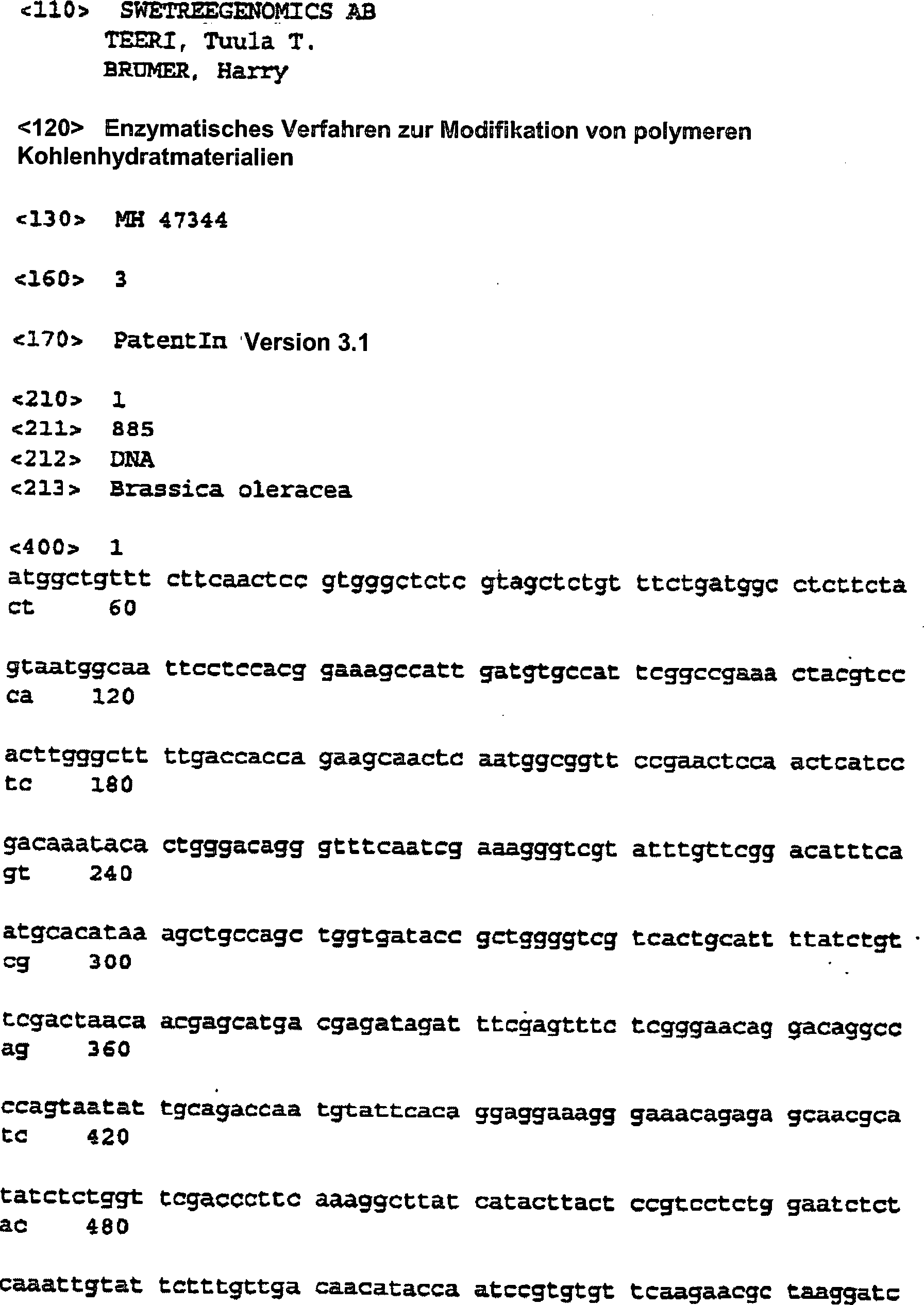
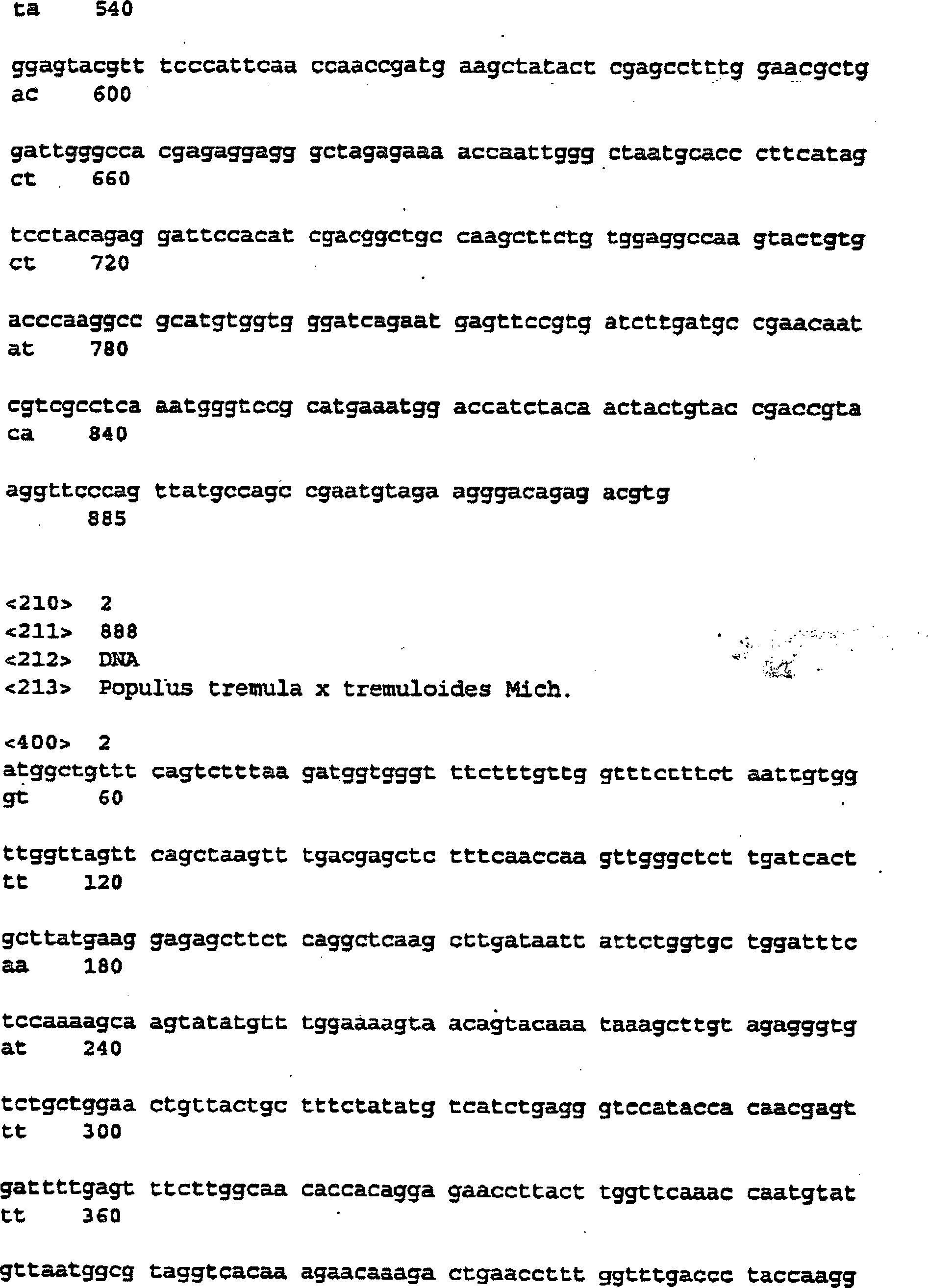
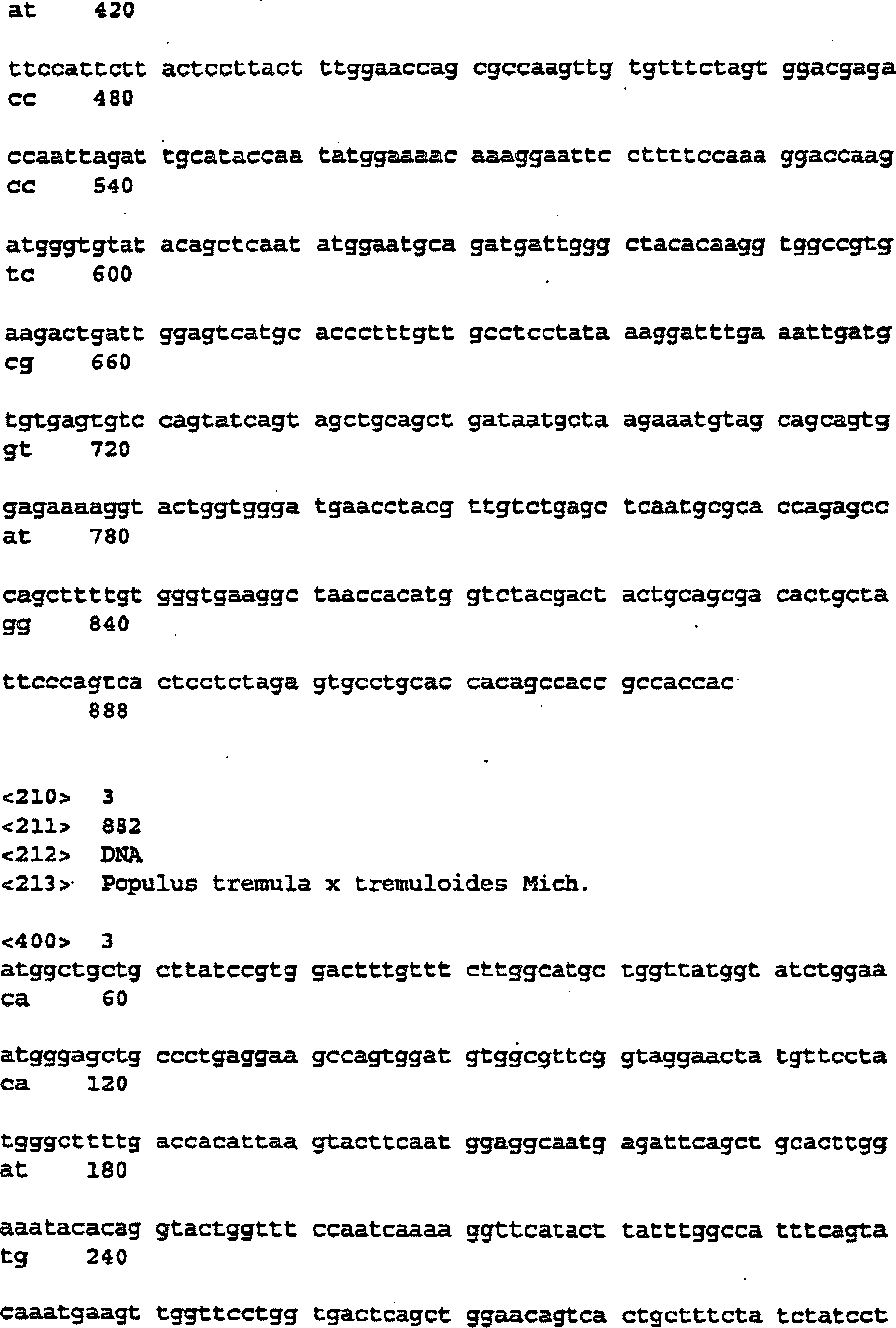
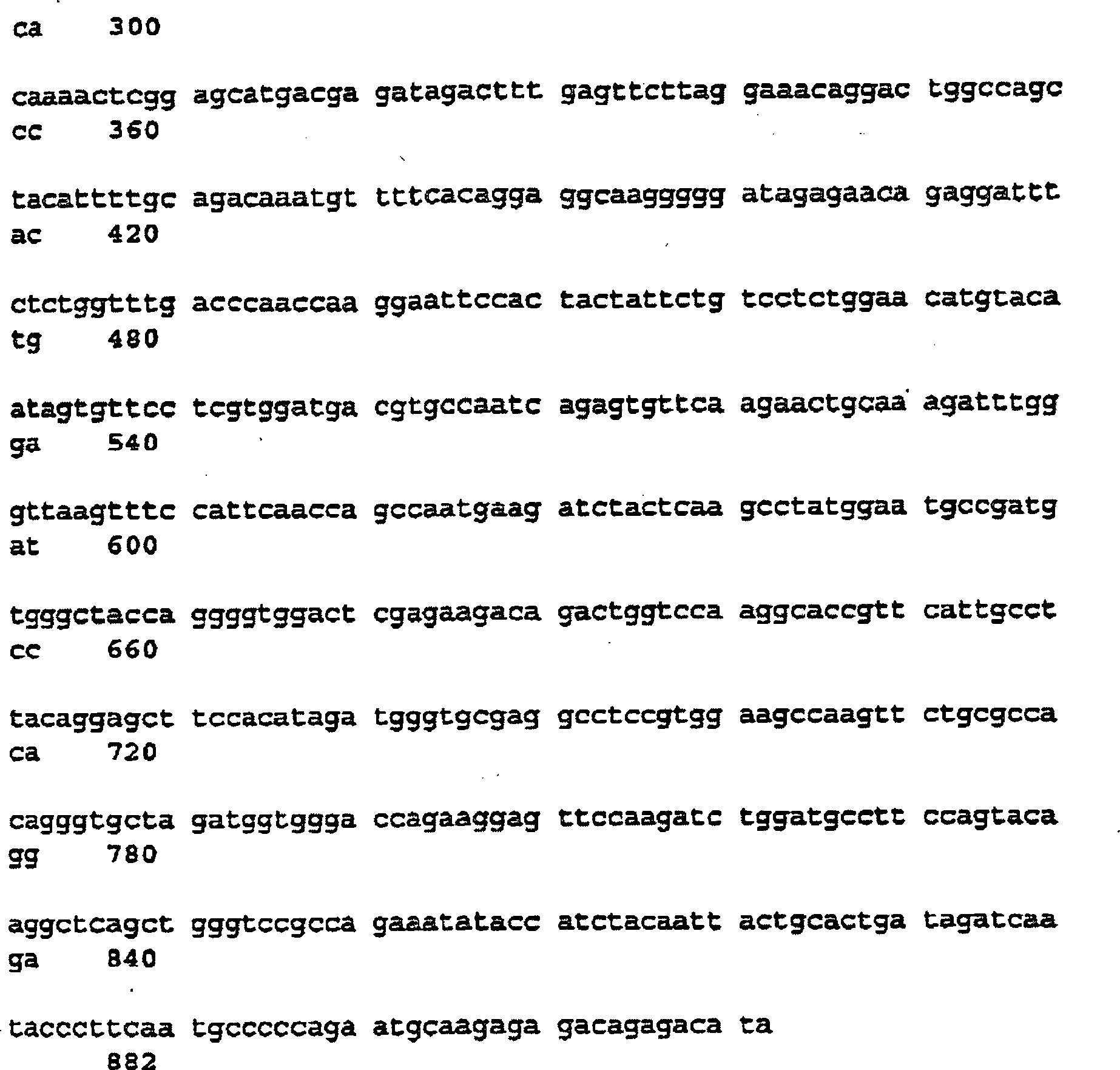
Claims (26)
Applications Claiming Priority (7)
| Application Number | Priority Date | Filing Date | Title |
|---|---|---|---|
| SE0103446 | 2001-10-16 | ||
| SE0103446A SE0103446D0 (en) | 2001-10-16 | 2001-10-16 | Method for enzymatic modification of cellulose fibers |
| SE0103447 | 2001-10-16 | ||
| SE0103447A SE0103447D0 (en) | 2001-10-16 | 2001-10-16 | Enzymatic method |
| SE0202310A SE0202310D0 (en) | 2002-07-23 | 2002-07-23 | Enzymatic method for the modification of polymeric carbohydrate materials |
| SE0202310 | 2002-07-23 | ||
| PCT/IB2002/004567 WO2003033813A1 (en) | 2001-10-16 | 2002-10-16 | Method for the modification of polymeric carbohydrate materials |
Publications (2)
| Publication Number | Publication Date |
|---|---|
| DE60217536D1 DE60217536D1 (en) | 2007-02-22 |
| DE60217536T2 true DE60217536T2 (en) | 2007-10-25 |
Family
ID=27354760
Family Applications (1)
| Application Number | Title | Priority Date | Filing Date |
|---|---|---|---|
| DE60217536T Expired - Lifetime DE60217536T2 (en) | 2001-10-16 | 2002-10-16 | METHOD FOR MODIFYING POLYMERIC CARBOHYDRATE MATERIALS |
Country Status (7)
| Country | Link |
|---|---|
| US (1) | US20040091977A1 (en) |
| EP (2) | EP1860121A3 (en) |
| JP (1) | JP4058412B2 (en) |
| CA (1) | CA2463312C (en) |
| DE (1) | DE60217536T2 (en) |
| ES (1) | ES2280588T3 (en) |
| WO (1) | WO2003033813A1 (en) |
Cited By (1)
| Publication number | Priority date | Publication date | Assignee | Title |
|---|---|---|---|---|
| DE102017211562A1 (en) * | 2017-07-06 | 2019-01-10 | Fraunhofer-Gesellschaft zur Förderung der angewandten Forschung e.V. | Coated cellulose fiber, fiber reinforced composite material and method of making the same |
Families Citing this family (25)
| Publication number | Priority date | Publication date | Assignee | Title |
|---|---|---|---|---|
| EP1627070A4 (en) * | 2003-04-21 | 2008-05-07 | Univ Georgia Res Found | XYLOGLUCAN CONJUGATES FOR MODIFYING CELLULOSIC TEXTILES |
| GB0425102D0 (en) * | 2004-11-15 | 2004-12-15 | Ciba Spec Chem Water Treat Ltd | Polymeric compositions and methods of employing them in papermaking processes |
| EP1848855A1 (en) * | 2005-01-25 | 2007-10-31 | Swetree Technologies Ab | Cross-linking involving a polymeric carbohydrate material |
| FI20065350L (en) * | 2006-05-24 | 2007-11-25 | Scitech Service Oy Ltd | Antimicrobial polymeric material and its use |
| WO2007147428A1 (en) * | 2006-06-23 | 2007-12-27 | Swetree Technologies Ab | Copolymer, modified polymer carbohydrate material, modified bulk polymer, composite material, and methods of preparation |
| US8021436B2 (en) | 2007-09-27 | 2011-09-20 | The Procter & Gamble Company | Cleaning and/or treatment compositions comprising a xyloglucan conjugate |
| EP2108676B1 (en) | 2008-04-03 | 2017-12-27 | OrganoClick AB | Crosslinked paper based material |
| US20100065236A1 (en) * | 2008-09-17 | 2010-03-18 | Marielle Henriksson | Method of producing and the use of microfibrillated paper |
| US10099192B2 (en) | 2009-02-09 | 2018-10-16 | Cellutech Ab | Polymer shells |
| DE102009048403A1 (en) * | 2009-10-06 | 2011-05-05 | Heraeus Noblelight Gmbh | Measuring device and measuring method for the spectrally selective determination of radiation exposure in the VUV range |
| RU2509086C1 (en) * | 2012-07-27 | 2014-03-10 | Инновационно-технический центр Общество с ограниченной ответственностью "СИТИС" | Modified polysaccharide |
| CN106062271A (en) * | 2014-03-05 | 2016-10-26 | 诺维信公司 | Compositions and methods for improving properties of cellulosic textile materials with xyloglucan endotransglycosylase |
| EP3114276B1 (en) | 2014-03-05 | 2019-01-16 | Novozymes A/S | Compositions and methods for functionalizing and linking materials |
| EP3113609B1 (en) | 2014-03-05 | 2019-07-31 | Novozymes A/S | Methods for improving post-harvest properties of agricultural crops |
| CN106062270A (en) * | 2014-03-05 | 2016-10-26 | 诺维信公司 | Compositions and methods for improving the properties of non-cellulosic textile materials using endo-xyloglucan glycosyltransferases |
| EP3113611A1 (en) | 2014-03-05 | 2017-01-11 | Novozymes A/S | Formulations comprising polymeric xyloglucan as a carrier for agriculturally beneficial agents |
| WO2015134388A1 (en) * | 2014-03-05 | 2015-09-11 | Novozymes A/S | Compositions and processes for improving properties of fillers |
| MX2016014770A (en) | 2014-05-12 | 2017-05-25 | Summit Mining Int Inc | SALMUERA LEADING PROCESS FOR THE RECOVERY OF VALUABLE METALS OF OXIDE MATERIALS. |
| KR20170016386A (en) | 2014-06-02 | 2017-02-13 | 테티스, 아이엔씨. | Modified biopolymers and methods of producing and using the same |
| US20170267980A1 (en) | 2014-08-20 | 2017-09-21 | Novozymes A/S | Xyloglucan Endotransglycosylase variants and Polynucleotides Encoding Same |
| US10689566B2 (en) | 2015-11-23 | 2020-06-23 | Anavo Technologies, Llc | Coated particles and methods of making and using the same |
| US20180044084A1 (en) * | 2016-08-14 | 2018-02-15 | Anthony J. Orler | Cellulose-based beverage cartridge |
| WO2026090021A1 (en) | 2024-10-21 | 2026-04-30 | Buckman Laboratories International, Inc. | Improving strength, sizing, and wet strength through enzymatic covalent attachment to a fiber |
| WO2026090023A1 (en) | 2024-10-21 | 2026-04-30 | Buckman Laboratories International, Inc. | Stitching enzymes for modifying fibers of an aqueous pulp |
| CN119510755B (en) * | 2024-11-18 | 2025-10-03 | 华南理工大学 | A rhodamine B-doped silica/xylan carbon dot composite material and its preparation method and application |
Family Cites Families (6)
| Publication number | Priority date | Publication date | Assignee | Title |
|---|---|---|---|---|
| US3297604A (en) * | 1963-10-28 | 1967-01-10 | American Mach & Foundry | Oxidized galactose containing reaction products |
| GB9516766D0 (en) * | 1995-08-16 | 1995-10-18 | Hercules Inc | Method and chemical compounds for modifying polymers |
| CN1105211C (en) * | 1995-12-21 | 2003-04-09 | 诺沃奇梅兹有限公司 | Use of xyloglucan endotransglycosylase (XET) |
| US5961783A (en) * | 1997-06-06 | 1999-10-05 | Vinings Industries, Inc. | Process for enhancing the strength and sizing properties of cellulosic fiber using a self-emulsifiable isocyanate and a coupling agent |
| BR9813358A (en) * | 1998-01-16 | 2000-10-03 | Unilever Nv | Polysaccharide conjugate, product, and binding process of marking an entity to cellulose |
| WO2001007556A1 (en) * | 1999-07-27 | 2001-02-01 | The Procter & Gamble Company | Compositions comprising xet and a polysaccharide and/or oligosaccharide |
-
2002
- 2002-10-16 CA CA2463312A patent/CA2463312C/en not_active Expired - Fee Related
- 2002-10-16 DE DE60217536T patent/DE60217536T2/en not_active Expired - Lifetime
- 2002-10-16 EP EP06026740A patent/EP1860121A3/en not_active Withdrawn
- 2002-10-16 JP JP2003536528A patent/JP4058412B2/en not_active Expired - Fee Related
- 2002-10-16 ES ES02777717T patent/ES2280588T3/en not_active Expired - Lifetime
- 2002-10-16 EP EP02777717A patent/EP1448840B1/en not_active Expired - Lifetime
- 2002-10-16 WO PCT/IB2002/004567 patent/WO2003033813A1/en not_active Ceased
- 2002-10-16 US US10/380,907 patent/US20040091977A1/en not_active Abandoned
Cited By (2)
| Publication number | Priority date | Publication date | Assignee | Title |
|---|---|---|---|---|
| DE102017211562A1 (en) * | 2017-07-06 | 2019-01-10 | Fraunhofer-Gesellschaft zur Förderung der angewandten Forschung e.V. | Coated cellulose fiber, fiber reinforced composite material and method of making the same |
| DE102017211562B4 (en) | 2017-07-06 | 2021-12-02 | Fraunhofer-Gesellschaft zur Förderung der angewandten Forschung e.V. | Coated cellulose fiber, process for its production, fiber-reinforced composite material, process for its production and its use |
Also Published As
| Publication number | Publication date |
|---|---|
| CA2463312A1 (en) | 2003-04-24 |
| EP1860121A3 (en) | 2008-12-03 |
| DE60217536D1 (en) | 2007-02-22 |
| JP2005505707A (en) | 2005-02-24 |
| CA2463312C (en) | 2011-09-27 |
| EP1448840A1 (en) | 2004-08-25 |
| WO2003033813A1 (en) | 2003-04-24 |
| EP1860121A2 (en) | 2007-11-28 |
| JP4058412B2 (en) | 2008-03-12 |
| ES2280588T3 (en) | 2007-09-16 |
| US20040091977A1 (en) | 2004-05-13 |
| EP1448840B1 (en) | 2007-01-10 |
Similar Documents
| Publication | Publication Date | Title |
|---|---|---|
| CA2463312C (en) | Method for the modification of polymeric carbohydrate materials | |
| DE69815396T3 (en) | FOR BINDING CELLULOSE-CAPABLE POLYSACCHARIDE CONJUGATE | |
| Zhou et al. | Xyloglucan in cellulose modification | |
| Hayashi et al. | Pea xyloglucan and cellulose: I. Macromolecular organization | |
| DE69618248T2 (en) | REPLACEMENT MATERIAL FOR MODIFIED STARCH IN PAPER PRODUCTION | |
| Crowe et al. | Xylan is critical for proper bundling and alignment of cellulose microfibrils in plant secondary cell walls | |
| EP2396470B1 (en) | A method for producing modified cellulose | |
| Okuda et al. | β-Glucan synthesis in the cotton fiber (I. Identification of β-1, 4-and β-1, 3-glucans synthesized in vitro) | |
| Rebouillat et al. | State of the art manufacturing and engineering of nanocellulose: a review of available data and industrial applications | |
| de Morais Teixeira et al. | Cellulose nanofibers from white and naturally colored cotton fibers | |
| Brumer et al. | Activation of crystalline cellulose surfaces through the chemoenzymatic modification of xyloglucan | |
| DE60026206T2 (en) | From paper made with aldehyde-modified pulp pulp | |
| US20100065236A1 (en) | Method of producing and the use of microfibrillated paper | |
| de Lima et al. | Interaction between cellulose and storage xyloglucans: the influence of the degree of galactosylation | |
| Karnaouri et al. | Lytic polysaccharide monooxygenase-assisted preparation of oxidized-cellulose nanocrystals with a high carboxyl content from the tunic of marine invertebrate Ciona intestinalis | |
| Herburger et al. | Enzymically attaching oligosaccharide-linked ‘cargoes’ to cellulose and other commercial polysaccharides via stable covalent bonds | |
| EP3390458B1 (en) | Bimodal cellulose composition | |
| Buruaga-Ramiro et al. | Lytic polysaccharide monooxygenases and cellulases on the production of bacterial cellulose nanocrystals | |
| Al-Shemy et al. | Facile in-situ synthesis of nanocrystalline celluloses-silver bio-nanocomposite for chitosan based active packaging | |
| Cook | Amine functionalization of bacterial cellulose for targeted delivery applications | |
| DE60016951T2 (en) | CELLULOSE FILMS FOR PERFORMING SCREENING PROCEDURES | |
| US20060242770A1 (en) | Xyloglucan conjugates useful for modifying cellulosic textiles | |
| Luo et al. | Distribution of xylan linked glucuronic acid labelled by molecularly imprinted polymers on pulp fiber surface | |
| CN115491927A (en) | High-strength copy paper and production method thereof | |
| Brumer | Enzymatic functionalization of cellulosic fibres for textile and other applications: Xyloglucan as a molecular anchor |
Legal Events
| Date | Code | Title | Description |
|---|---|---|---|
| 8364 | No opposition during term of opposition |