DE202008009820U1 - Adjustment device for an adjustment part of a motor vehicle - Google Patents

Adjustment device for an adjustment part of a motor vehicle Download PDF

Info

Publication number
DE202008009820U1
DE202008009820U1 DE200820009820 DE202008009820U DE202008009820U1 DE 202008009820 U1 DE202008009820 U1 DE 202008009820U1 DE 200820009820 DE200820009820 DE 200820009820 DE 202008009820 U DE202008009820 U DE 202008009820U DE 202008009820 U1 DE202008009820 U1 DE 202008009820U1
Authority
DE
Germany
Prior art keywords
driver
guide rail
end position
adjustment
spring
Prior art date
Legal status (The legal status is an assumption and is not a legal conclusion. Google has not performed a legal analysis and makes no representation as to the accuracy of the status listed.)
Expired - Lifetime
Application number
DE200820009820
Other languages
German (de)
Current Assignee (The listed assignees may be inaccurate. Google has not performed a legal analysis and makes no representation or warranty as to the accuracy of the list.)
Brose Fahrzeugteile SE and Co KG
Original Assignee
Brose Fahrzeugteile SE and Co KG
Priority date (The priority date is an assumption and is not a legal conclusion. Google has not performed a legal analysis and makes no representation as to the accuracy of the date listed.)
Filing date
Publication date
Application filed by Brose Fahrzeugteile SE and Co KG filed Critical Brose Fahrzeugteile SE and Co KG
Priority to DE200820009820 priority Critical patent/DE202008009820U1/en
Publication of DE202008009820U1 publication Critical patent/DE202008009820U1/en
Anticipated expiration legal-status Critical
Expired - Lifetime legal-status Critical Current

Links

Classifications

    • EFIXED CONSTRUCTIONS
    • E05LOCKS; KEYS; WINDOW OR DOOR FITTINGS; SAFES
    • E05FDEVICES FOR MOVING WINGS INTO OPEN OR CLOSED POSITION; CHECKS FOR WINGS; WING FITTINGS NOT OTHERWISE PROVIDED FOR, CONCERNED WITH THE FUNCTIONING OF THE WING
    • E05F11/00Man-operated mechanisms for operating wings, including those which also operate the fastening
    • E05F11/38Man-operated mechanisms for operating wings, including those which also operate the fastening for sliding windows, e.g. vehicle windows, to be opened or closed by vertical movement
    • E05F11/48Man-operated mechanisms for operating wings, including those which also operate the fastening for sliding windows, e.g. vehicle windows, to be opened or closed by vertical movement operated by cords or chains or other flexible elongated pulling elements, e.g. tapes
    • E05F11/481Man-operated mechanisms for operating wings, including those which also operate the fastening for sliding windows, e.g. vehicle windows, to be opened or closed by vertical movement operated by cords or chains or other flexible elongated pulling elements, e.g. tapes for vehicle windows
    • E05F11/483Man-operated mechanisms for operating wings, including those which also operate the fastening for sliding windows, e.g. vehicle windows, to be opened or closed by vertical movement operated by cords or chains or other flexible elongated pulling elements, e.g. tapes for vehicle windows by cables
    • E05F11/488Man-operated mechanisms for operating wings, including those which also operate the fastening for sliding windows, e.g. vehicle windows, to be opened or closed by vertical movement operated by cords or chains or other flexible elongated pulling elements, e.g. tapes for vehicle windows by cables with two cable connections to the window glass
    • EFIXED CONSTRUCTIONS
    • E05LOCKS; KEYS; WINDOW OR DOOR FITTINGS; SAFES
    • E05FDEVICES FOR MOVING WINGS INTO OPEN OR CLOSED POSITION; CHECKS FOR WINGS; WING FITTINGS NOT OTHERWISE PROVIDED FOR, CONCERNED WITH THE FUNCTIONING OF THE WING
    • E05F11/00Man-operated mechanisms for operating wings, including those which also operate the fastening
    • E05F11/38Man-operated mechanisms for operating wings, including those which also operate the fastening for sliding windows, e.g. vehicle windows, to be opened or closed by vertical movement
    • E05F11/48Man-operated mechanisms for operating wings, including those which also operate the fastening for sliding windows, e.g. vehicle windows, to be opened or closed by vertical movement operated by cords or chains or other flexible elongated pulling elements, e.g. tapes
    • E05F11/481Man-operated mechanisms for operating wings, including those which also operate the fastening for sliding windows, e.g. vehicle windows, to be opened or closed by vertical movement operated by cords or chains or other flexible elongated pulling elements, e.g. tapes for vehicle windows
    • E05F11/483Man-operated mechanisms for operating wings, including those which also operate the fastening for sliding windows, e.g. vehicle windows, to be opened or closed by vertical movement operated by cords or chains or other flexible elongated pulling elements, e.g. tapes for vehicle windows by cables
    • E05F11/485Man-operated mechanisms for operating wings, including those which also operate the fastening for sliding windows, e.g. vehicle windows, to be opened or closed by vertical movement operated by cords or chains or other flexible elongated pulling elements, e.g. tapes for vehicle windows by cables with cable tensioners
    • EFIXED CONSTRUCTIONS
    • E05LOCKS; KEYS; WINDOW OR DOOR FITTINGS; SAFES
    • E05YINDEXING SCHEME ASSOCIATED WITH SUBCLASSES E05D AND E05F, RELATING TO CONSTRUCTION ELEMENTS, ELECTRIC CONTROL, POWER SUPPLY, POWER SIGNAL OR TRANSMISSION, USER INTERFACES, MOUNTING OR COUPLING, DETAILS, ACCESSORIES, AUXILIARY OPERATIONS NOT OTHERWISE PROVIDED FOR, APPLICATION THEREOF
    • E05Y2201/00Constructional elements; Accessories therefor
    • E05Y2201/40Motors; Magnets; Springs; Weights; Accessories therefor
    • E05Y2201/404Function thereof
    • E05Y2201/422Function thereof for opening
    • E05Y2201/424Function thereof for opening for the final opening movement
    • EFIXED CONSTRUCTIONS
    • E05LOCKS; KEYS; WINDOW OR DOOR FITTINGS; SAFES
    • E05YINDEXING SCHEME ASSOCIATED WITH SUBCLASSES E05D AND E05F, RELATING TO CONSTRUCTION ELEMENTS, ELECTRIC CONTROL, POWER SUPPLY, POWER SIGNAL OR TRANSMISSION, USER INTERFACES, MOUNTING OR COUPLING, DETAILS, ACCESSORIES, AUXILIARY OPERATIONS NOT OTHERWISE PROVIDED FOR, APPLICATION THEREOF
    • E05Y2400/00Electronic control; Electrical power; Power supply; Power or signal transmission; User interfaces
    • E05Y2400/10Electronic control
    • E05Y2400/32Position control, detection or monitoring
    • E05Y2400/35Position control, detection or monitoring related to specific positions
    • E05Y2400/356Intermediate positions
    • E05Y2400/358Intermediate positions in the proximity of end positions
    • EFIXED CONSTRUCTIONS
    • E05LOCKS; KEYS; WINDOW OR DOOR FITTINGS; SAFES
    • E05YINDEXING SCHEME ASSOCIATED WITH SUBCLASSES E05D AND E05F, RELATING TO CONSTRUCTION ELEMENTS, ELECTRIC CONTROL, POWER SUPPLY, POWER SIGNAL OR TRANSMISSION, USER INTERFACES, MOUNTING OR COUPLING, DETAILS, ACCESSORIES, AUXILIARY OPERATIONS NOT OTHERWISE PROVIDED FOR, APPLICATION THEREOF
    • E05Y2900/00Application of doors, windows, wings or fittings thereof
    • E05Y2900/50Application of doors, windows, wings or fittings thereof for vehicles
    • E05Y2900/508Application of doors, windows, wings or fittings thereof for vehicles for convertibles
    • EFIXED CONSTRUCTIONS
    • E05LOCKS; KEYS; WINDOW OR DOOR FITTINGS; SAFES
    • E05YINDEXING SCHEME ASSOCIATED WITH SUBCLASSES E05D AND E05F, RELATING TO CONSTRUCTION ELEMENTS, ELECTRIC CONTROL, POWER SUPPLY, POWER SIGNAL OR TRANSMISSION, USER INTERFACES, MOUNTING OR COUPLING, DETAILS, ACCESSORIES, AUXILIARY OPERATIONS NOT OTHERWISE PROVIDED FOR, APPLICATION THEREOF
    • E05Y2900/00Application of doors, windows, wings or fittings thereof
    • E05Y2900/50Application of doors, windows, wings or fittings thereof for vehicles
    • E05Y2900/53Type of wing
    • E05Y2900/55Windows

Landscapes

  • Window Of Vehicle (AREA)

Abstract

Verstellvorrichtung für ein Verstellteil eines Kraftfahrzeugs, mit
– einer Führungsschiene,
– einer Antriebseinrichtung und
– einem entlang der Führungsschiene geführten Mitnehmer, der über ein Zugmittel mit der Antriebseinrichtung gekoppelt und zum Verstellen des Verstellteils aus einer Endposition an der Führungsschiene in eine Abwärtsrichtung entlang der Führungsschiene verschiebbar ist,
dadurch gekennzeichnet,
dass der mindestens eine Mitnehmer (14) in der Endposition an der Führungsschiene (11) über eine Vorspanneinrichtung (3) in die Abwärtsrichtung (RAB) vorgespannt ist.
Adjustment device for an adjustment of a motor vehicle, with
A guide rail,
- A drive device and
A driver guided along the guide rail, which is coupled to the drive device by means of a traction mechanism and is displaceable in a downward direction along the guide rail for adjusting the adjustment part from an end position on the guide rail,
characterized,
that the at least one driver (14) in the end position on the guide rail (11) via a biasing means (3) in the downward direction (R AB ) is biased.
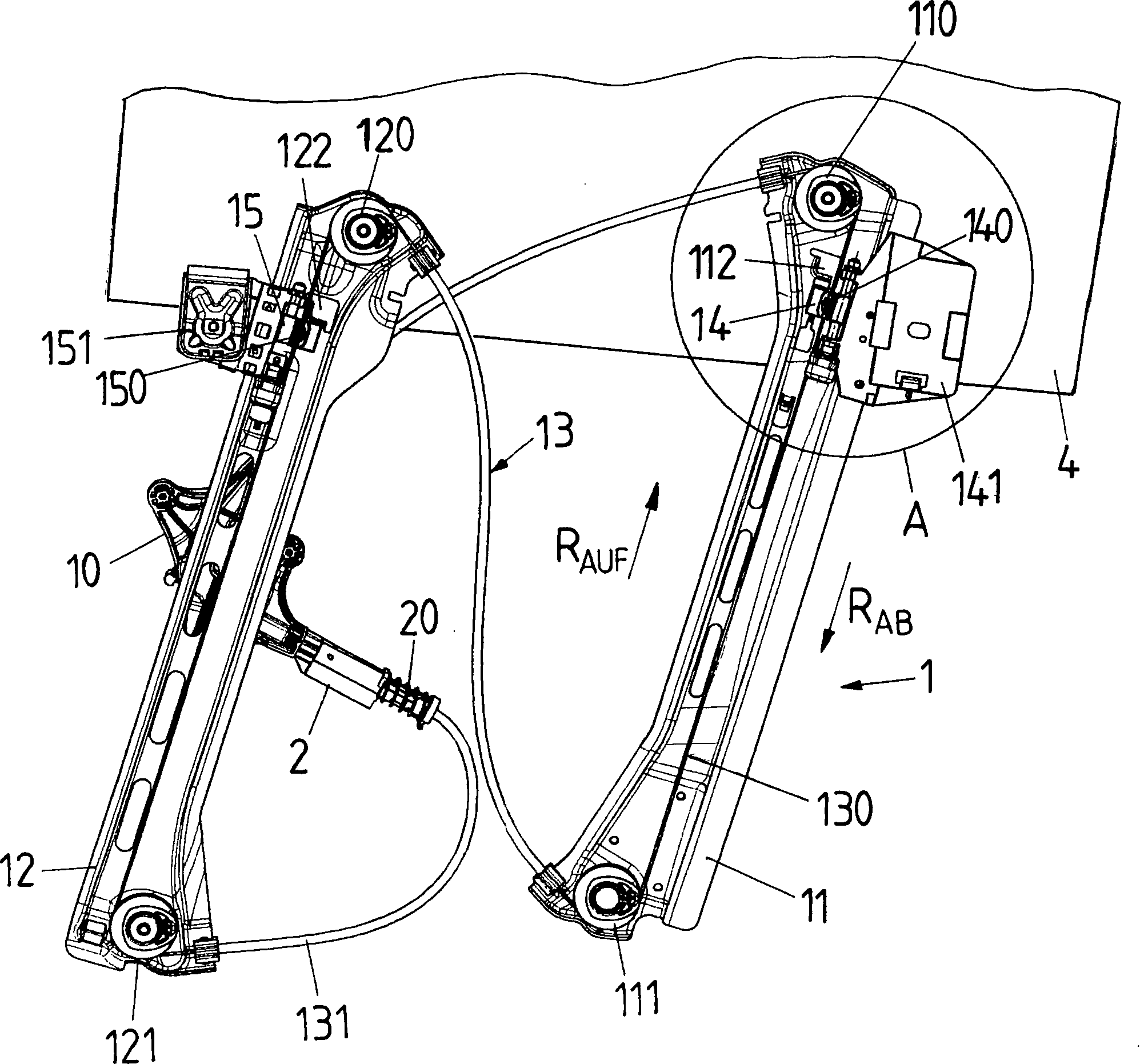
Figure 00000001
Figure 00000001

Description

Die Erfindung betrifft eine Verstellvorrichtung für ein Verstellteil eines Kraftfahrzeugs nach dem Oberbegriff des Anspruchs 1.The The invention relates to an adjusting device for an adjustment of a motor vehicle according to the preamble of claim 1.

Eine derartige Verstellvorrichtung weist eine Führungsschiene, eine Antriebseinheit und ein entlang der Führungsschiene geführten Mitnehmer auf, der über ein Zugmittel mit der Antriebseinrichtung gekoppelt und zum Verstellen des Verstellteils aus einer Endposition an der Führungsschiene in eine Abwärtsrichtung entlang der Führungsschiene verschiebbar ist.A Such adjustment device has a guide rail, a drive unit and a along the guide rail guided driver, who has a traction device coupled with the drive device and for adjusting the adjustment from an end position on the guide rail in a downward direction along the guide rail is displaceable.

Beispielsweise weist eine aus der DE 20 2005 019 562 U1 bekannte Verstellvorrichtung in Form eines Seilfensterhebers ein von einem Antrieb angetriebenes Zugmittel in Form eines Seils auf, das mit zwei entlang von Führungsschienen geführten Mitnehmern gekoppelt ist und diese zur Verstellung eines Verstellteils in Form einer Fensterscheibe einer Fahrzeugtür antreibt. Der Antrieb weist hierzu eine Seiltrommel auf, auf die im Betrieb der Verstellvorrichtung das Seil so gewickelt wird, dass die Mitnehmer und damit gleichzeitig die Fensterscheibe entlang der Führungsschienen verstellt werden. Das Zugmittel ist zumindest abschnittsweise in einem Bowdenrohr geführt, das gegenüber der Antriebseinheit der Verstellvorrichtung mit einem elastischen Element abgestützt ist. Das elastische Element dient einem Seillängenausgleich und bewirkt, dass das Zugmittel stets unter Spannung an der Seiltrommel anliegt, um auf diese Weise ein Verspulen des Zugmittels an der Seiltrommel zu verhindern. Mittels des durch das elastische Element zur Verfügung gestellten Seillängenausgleichs können Toleranzen und Seillosen während der Lebensdauer der Verstellvorrichtung ausgeglichen werden.For example, one of the DE 20 2005 019 562 U1 Known adjustment in the form of a cable window lifter driven by a drive traction means in the form of a rope which is coupled with two guided along guide rails and drivers drives them to adjust an adjustment in the form of a window of a vehicle door. For this purpose, the drive has a cable drum onto which the cable is wound during operation of the adjusting device in such a way that the drivers and thus simultaneously the window pane are adjusted along the guide rails. The traction means is guided at least in sections in a Bowden tube, which is supported relative to the drive unit of the adjusting device with an elastic element. The elastic element serves a rope length compensation and causes the traction means is always applied under tension to the cable drum to prevent in this way a spooling of the traction means on the cable drum. By means of the elastic element provided by the rope length compensation tolerances and rope loose can be compensated during the life of the adjusting device.

Seilfensterheber einer rahmenlosen Fahrzeugtür besitzen herkömmlich eine Kurzhubfunktion, die ausgelegt ist, die zu verstellende Fensterscheibe der rahmenlosen Fahrzeugtür beim Öffnen der Fahrzeugtür automatisch aus der Dichtung der Fahrzeugtür zu fahren und so das Öffnen der Fahrzeugtür zu erleichtern und eine Beschädigung der Dichtung, der Fensterscheibe oder der Fahrzeugtür zu verhindern. Hierbei ist wesentlich, dass die Fensterscheibe beim Öffnen der Fahrzeugtür innerhalb kürzester Zeit aus der Dichtung herausbewegt wird, damit auch bei einem schnellen Öffnen der Fahrzeugtür die Fensterscheibe sicher und rechtzeitig aus der Dichtung gelangt. Dieser erforderlichen schnellen Verstellbewegung der Fensterscheibe steht jedoch die Elastizität des Seilfensterhebersystems, bedingt insbesondere durch die zum Zwecke des Seillängenausgleichs vorgesehene elastische Abstützung der Bowdenrohre mittels der elastischen Elemente, entgegen. Bei Einleitung des Verstellvorgangs muss diese Elastizität zunächst ausgeglichen werden. Erst anschließend können die Verstellkräfte auf das Verstellteil übertragen werden, so dass es zu einer Verstellung der Fensterscheibe kommt.Cable window lifter a frameless vehicle door have conventional a Kurzhubfunktion, which is designed to be adjusted the window pane of frameless vehicle door when opening the vehicle door automatically drive out of the seal of the vehicle door and thus to facilitate the opening of the vehicle door and damage to the gasket, the windowpane or to prevent the vehicle door. It is essential that the windowpane when opening the vehicle door moved out of the seal within a very short time becomes, even with a quick opening the vehicle door the window pane gets out of the seal safely and in time. This required rapid adjustment of the window pane However, the elasticity of the cable window lifter system, conditioned in particular by the purpose of the rope length compensation provided elastic support of the Bowden tubes by means the elastic elements, contrary. At initiation of the adjustment process This elasticity must first be compensated. Only then can the adjusting forces be transferred to the adjustment, so that it to a Adjustment of the window pane comes.

Der vorliegenden Erfindung liegt die Aufgabe zugrunde, eine Verstellvorrichtung für ein Verstellteil eines Kraftfahrzeugs zur Verfügung zu stellen, die trotz einer Elastizität im Kraftübertragungsstrang der Verstellvorrichtung ein schnelles Einleiten des Verstellvorgangs des Verstellteils aus einer Endposition, insbesondere zur Bereitstellung einer Kurzhubfunktion einer Fensterscheibe einer rahmenlosen Fahrzeugtür, ermöglicht.Of the present invention is based on the object, an adjustment for an adjustment of a motor vehicle available to put that despite an elasticity in the power train the adjustment a quick initiation of the adjustment the adjustment of an end position, in particular for the provision a short-stroke function of a window pane of a frameless vehicle door, allows.

Diese Aufgabe wird durch einen Gegenstand mit den Merkmalen des Anspruchs 1 gelöst.These The object is achieved by an object having the features of the claim 1 solved.

Erfindungsgemäß ist bei einer Verstellvorrichtung der eingangs genannten Art vorgesehen, dass der mindestens eine Mitnehmer in der Endposition an der Führungsschiene über eine Vorspanneinrichtung in die Abwärtsrichtung vorgespannt ist.According to the invention provided in an adjusting device of the type mentioned that the at least one driver in the end position on the guide rail over biasing a biasing device in the downward direction is.

Grundgedanke der Erfindung ist, mittels einer zur Antriebseinheit externen, zusätzlichen Vorspanneinrichtung bereits zu Beginn eines Verstellvorgangs, bei dem der Mitnehmer aus einer Endposition an der Führungsschiene beispielsweise im Rahmen einer Kurzhubfunktion einer rahmenlosen Fahrzeugtür herausbewegt werden soll, eine Verstellkraft in die Abwärtsrichtung auf den Mitnehmer auszuüben. Diese Verstellkraft wirkt auf den Mitnehmer unabhängig davon, ob zu Beginn des Verstellvorgangs zunächst die Elastizität im Kraftübertragungsstrang oder eine Seillose ausgeglichen werden muss. Die Verstellkraft wird über eine Vorspanneinrichtung zur Verfügung gestellt, die den Mitnehmer in die Abwärtsrichtung vorspannt, also eine Vorspannkraft in die Abwärtsrichtung auf den Mitnehmer ausübt.basic idea The invention is, by means of an external to the drive unit, additional Biasing device already at the beginning of an adjustment, at the driver from an end position on the guide rail for example, in the context of a short-stroke function of a frameless Vehicle door to be moved out, an adjustment in the downward direction on the driver exercise. This adjusting force acts on the driver regardless of whether at the beginning of the adjustment initially the elasticity balanced in the power transmission line or a ropeless must become. The adjusting force is via a biasing device provided, which biases the driver in the downward direction, So a biasing force in the downward direction on the Driver.

Die Vorspanneinrichtung kann beispielsweise eine elastische Feder aufweisen, die an der Führungsschiene oder dem Mitnehmer angeordnet ist. Diese elastische Feder kann als Zugfeder ausgebildet sein, die an der Führungsschiene oder dem Mitnehmer angeordnet und in der Endposition auf Zug belastet ist. Diese Zugfeder wird bei Einfahren des Mitnehmers in die Endposition gedehnt und damit auf Zug belastet und in diesem Zustand in der Endposition gehalten. Bei Einleiten des Verstellvorgangs übt die Zugfeder eine Zugkraft auf den Mitnehmer aus und spannt den Mitnehmer somit in die Abwärtsrichtung vor.The Biasing means may for example comprise an elastic spring, which is arranged on the guide rail or the driver is. This elastic spring may be formed as a tension spring, which is arranged on the guide rail or the driver and is loaded in the end position to train. This tension spring is stretched when retracting the driver in the end position and thus loaded on train and held in this state in the final position. When initiating the adjustment, the tension spring exerts a Traction on the driver and thus clamps the driver in the down direction.

Alternativ kann die Feder auch als Druckfeder ausgebildet sein, die an der Führungsschiene oder dem Mitnehmer angeordnet und in der Endposition auf Druck belastet ist. Bei Einfahren des Mitnehmers in die Endposition wird die Druckfeder komprimiert, in diesem Zustand in der Endposition gehalten und übt bei Einleiten des Verstellvorgangs aus der Endposition eine Druckkraft auf den Mitnehmer aus.Alternatively, the spring may also be formed as a compression spring which is arranged on the guide rail or the driver and loaded in the end position to pressure. When retracting the driver in the end position, the compression spring kompri miert, held in this state in the end position and exerts a pressure force on the driver at the initiation of the adjustment process from the end position.

In einer weiteren Ausgestaltung kann die elastische Feder auch als Schenkelfeder ausgebildet sein, die an der Führungsschiene oder dem Mitnehmer angeordnet und in der Endposition auf Torsion belastet ist. Die Schenkelfeder weist hierzu zwei Schenkel auf, von denen der eine mit dem Mitnehmer und der andere mit der Führungsschiene zusammenwirkt, so dass bei Einfahren des Mitnehmers in die Endposition die Schenkelfeder auf Torsion belastet wird, der Mitnehmer in diesem Zustand der Schenkelfeder in der Endposition gehalten wird und die Schenkelfeder bei Einleiten des Verstellvorgangs durch die Torsionskraft den Mitnehmer aus der Endposition drückt.In In another embodiment, the elastic spring as well Leg spring be formed on the guide rail or the driver arranged and loaded in the final position to torsion is. The leg spring has for this purpose two legs, of which one with the driver and the other with the guide rail cooperates, so that when retracting the driver in the end position the torsion spring is loaded on torsion, the driver in this State of the leg spring is held in the end position and the Leg spring when initiating the adjustment process by the torsional force press the driver out of the final position.

In einer weiteren Ausgestaltung ist die Feder als Blattfeder ausgebildet, die an der Führungsschiene oder dem Mitnehmer angeordnet und in der Endposition auf Druck belastet ist. Die Blattfeder wird bei Einfahren des Mitnehmers in die Endposition zusammengedrückt, in diesem Zustand gehalten und übt bei Einleiten des Verstellvorgangs aus der Endposition eine Verstellkraft in die Abwärtsrichtung auf den Mitnehmer aus.In a further embodiment, the spring is designed as a leaf spring, which is arranged on the guide rail or the driver and is loaded in the end position to pressure. The leaf spring is compressed when retracting the driver in the end position, held in this state and exercises when initiating the adjustment process from the end position an adjusting force in the downward direction on the driver.

In einer anderen Ausgestaltung kann die Vorspanneinrichtung zwei Magnete aufweisen, von denen der eine Magnet an dem Mitnehmer und der andere Magnet an der Führungsschiene angeordnet ist. Die Magnete sind so zueinander gepolt, dass sie in der Endposition des Mitnehmers an der Führungsschiene eine Kraft auf den Mitnehmer in die Abwärtsrichtung ausüben. Der Gedanke hierbei ist, anstelle einer Feder zwei Magnete zu verwenden, die umgekehrt zueinander gepolt sind und sich somit abstoßen. Ist ein Magnet an der Führungsschiene und der andere Magnet an dem Mitnehmer angeordnet und werden die Magnete beim Verfahren des Mitnehmers in die Endposition einander angenähert, so wird durch die abstoßende Kraft der Magnete eine Verstellkraft auf den Mitnehmer ausgeübt, die den Mitnehmer aus der Endposition zu verstellen versucht.In In another embodiment, the biasing means two magnets of which one magnet on the driver and the other Magnet is arranged on the guide rail. The magnets are poled to each other so that they are in the final position of the driver on the guide rail a force on the driver in exercise the downward direction. The thought here is to use two magnets instead of a spring, the reverse are poled to each other and thus repel. Is a Magnet on the guide rail and the other magnet on arranged the driver and the magnets in the process of Driver in the final position approached each other, so is through the repulsive force of the magnets on an adjusting the driver exercised the driver from the final position tried to adjust.

In einer wiederum anderen Ausgestaltung kann die Vorspanneinrichtung eine Gasfeder aufweisen, die an der Führungsschiene angeordnet ist. In der Endposition wirkt die Gasfeder über einen Hebel mit dem Mitnehmer zusammen, wobei bei Einfahren des Mitnehmers in die Endposition die Gasfeder über den Hebel auf Druck belastet wird, in diesem Zustand gehalten wird und bei Einleiten des Verstellvorgangs aus der Endposition eine Verstellkraft in die Abwärtsrichtung auf den Mitnehmer ausübt.In In yet another embodiment, the biasing device have a gas spring disposed on the guide rail is. In the end position, the gas spring acts via a lever the driver together, wherein when retracting the driver in the End position of the gas spring over the lever loaded on pressure is kept in this state and when initiating the adjustment from the end position an adjusting force in the downward direction on the driver.

Den vorangehend genannten Ausführungsformen ist gemein, dass ein vorspannendes Element zwischen dem Mitnehmer und der Führungsschiene angeordnet ist, das in der Endposition eine Vorspannkraft auf den Mitnehmer ausübt, so dass dieser in die Abwärtsrichtung vorgespannt ist. Das vorspannende Element kann jeweils entweder an der Führungsschiene oder an dem Mitnehmer angeordnet sein. Wesentlich ist, dass das vorspannende Element in der Endposition zwischen der Führungsschiene und dem Mitnehmer wirkt und eine Verstellkraft in die Abwärtsrichtung auf den Mitnehmer ausübt. Wird der Verstellvorgang eingeleitet, so wird infolge der durch die Vorspanneinrichtung ausgeübten, zusätzlichen Verstellkraft der Mitnehmer bereits zu Beginn des Verstellvorgangs in die Abwärtsrichtung verstellt, auch wenn zunächst eine Seillose der Verstellvorrichtung ausgeglichen werden muss und somit noch keine Verstellkraft von der Antriebseinrichtung auf den Mitnehmer übertragen werden kann.The The foregoing embodiments have in common that arranged a biasing element between the driver and the guide rail is, in the final position, a biasing force on the driver exercises, so this in the downward direction is biased. The biasing element can either be either be arranged on the guide rail or on the driver. It is essential that the biasing element in the final position between the guide rail and the driver acts and an adjusting force in the downward direction on the driver exercises. If the adjustment process is initiated, as a result the force exerted by the biasing device, additional adjustment the driver already at the beginning of the adjustment process in the downward direction adjusted, even if initially a rope lot of the adjustment must be compensated and thus no adjustment of the drive means are transmitted to the driver can.

Der der Erfindung zugrunde liegende Gedanke soll nachfolgend anhand der in den Figuren dargestellten Ausführungsbeispiele näher erläutert werden. Es zeigen:Of the The idea underlying the invention is based on the following the embodiments shown in the figures closer be explained. Show it:

1 eine Übersichtsdarstellung einer Verstellvorrichtung in Form eines Seilfensterhebers; 1 an overview of an adjustment in the form of a cable window lifter;

2A2C vergrößerte Ansichten, entsprechend dem Ausschnitt A gemäß 1, einer ersten Ausführungsform einer Verstellvorrichtung mit einer Vorspanneinrichtung, die eine Zugfeder aufweist; 2A - 2C enlarged views, corresponding to the detail A according to 1 a first embodiment of an adjusting device with a biasing device having a tension spring;

3A, 3B vergrößerte Ansichten, entsprechend dem Ausschnitt A gemäß 1, einer zweiten Ausführungsform einer Verstellvorrichtung mit einer Vorspanneinrichtung, die eine Druckfeder aufweist; 3A . 3B enlarged views, corresponding to the detail A according to 1 a second embodiment of an adjusting device with a biasing device having a compression spring;

4A, 4B vergrößerte Ansichten, entsprechend dem Ausschnitt A gemäß 1, einer dritten Ausführungsform einer Verstellvorrichtung mit einer Vorspanneinrichtung, die eine Schenkelfeder aufweist; 4A . 4B enlarged views, corresponding to the detail A according to 1 a third embodiment of an adjusting device with a biasing device having a leg spring;

5A, 5B vergrößerte Ansichten, entsprechend dem Ausschnitt A gemäß 1, einer weiteren Ausführungsform einer Verstellvorrichtung mit einer Vorspanneinrichtung, die eine Schenkelfeder aufweist; 5A . 5B enlarged views, corresponding to the detail A according to 1 a further embodiment of an adjusting device with a biasing device having a leg spring;

6A, 6B vergrößerte Ansichten, entsprechend dem Ausschnitt A gemäß 1, einer Ausführungsform einer Verstellvorrichtung mit einer Vorspanneinrichtung, die zwei gegensätzlich gepolte Magnete aufweist; 6A . 6B enlarged views, corresponding to the detail A according to 1 an embodiment of an adjusting device with a biasing device having two oppositely poled magnets;

7A, 7B vergrößerte Ansichten, entsprechend dem Ausschnitt A gemäß 1, einer Ausführungsform einer Verstellvorrichtung mit einer Vorspanneinrichtung, die eine Gasfeder aufweist, und 7A . 7B enlarged views, corresponding to the detail A according to 1 , An embodiment of an adjusting device with a Biasing device, which has a gas spring, and

8 eine schematische Ansicht einer Ausführungsform einer Verstellvorrichtung mit einer Vorspanneinrichtung, die eine Blattfeder aufweist. 8th a schematic view of an embodiment of an adjusting device with a biasing device having a leaf spring.

1 zeigt eine Übersichtsdarstellung einer Verstellvorrichtung 1 in Form eines Seilfensterhebers zur Verstellung eines Verstellteils in Form einer Fensterscheibe 4. Die Verstellvorrichtung 1 kann insbesondere für eine rahmenlose Fahrzeugtür ausgebildet sein, bei der die Fensterscheibe 4 im geschlossenen Zustand in eine Dichtung beispielsweise an der A-Säule und am Fahrzeugdach des Fahrzeugs eingefahren ist. 1 shows an overview of an adjustment 1 in the form of a cable window lifter for adjusting an adjustment in the form of a window pane 4 , The adjusting device 1 can be designed in particular for a frameless vehicle door, in which the window pane 4 is retracted in the closed state in a seal, for example, on the A-pillar and the vehicle roof of the vehicle.

Die Verstellvorrichtung 1 ist als Seilfensterheber mit einem Zugmittel 130 in Form eines Seils ausgebildet. Das Zugmittel 130 erstreckt sich von einer Antriebseinheit 10 zu einem oberen Umlenkelement 110 an einer ersten Führungsschiene 11, wird entlang der ersten Führungsschiene 11 zu einem unteren Umlenkelement 111 geführt, erstreckt sich zu einem oberen Umlenkelement 120 einer zweiten Führungsschiene 12, wird entlang der zweiten Führungsschiene 12 zu einem unteren Umlenkelement 121 geführt und erstreckt sich von diesem unteren Umlenkelement 121 zurück zur Antriebseinheit 10. Das Zugmittel 130 bildet auf diese Weise eine geschlossene, sich kreuzende Seilschlaufe aus und ist dabei abschnittsweise von einem Bowdensystem 13 mit einem das Zugmittel 130 umgebenden Bowdenrohr 131 geführt, so dass das Zugmittel 130 auf den sich nicht parallel zu den Führungsschienen 11, 12 erstreckenden Abschnitten nicht gespannt gehalten werden muss, sondern die Spannung im Zugmittel 130 auf diesen Abschnitten durch die Abstützung des Bowdenrohres 131 zur Verfügung gestellt wird.The adjusting device 1 is as a cable window lifter with a traction device 130 formed in the form of a rope. The traction device 130 extends from a drive unit 10 to an upper deflecting element 110 on a first guide rail 11 , will be along the first guide rail 11 to a lower deflecting element 111 guided, extends to an upper deflecting element 120 a second guide rail 12 , is along the second guide rail 12 to a lower deflecting element 121 guided and extends from this lower deflecting element 121 back to the drive unit 10 , The traction device 130 forms in this way a closed, intersecting rope loop and is partially sections of a Bowden system 13 with one the traction means 130 surrounding Bowden tube 131 guided, so that the traction means 130 on the not parallel to the guide rails 11 . 12 extending sections does not have to be kept taut, but the tension in the traction means 130 on these sections by the support of the Bowden tube 131 is made available.

Die Verstellvorrichtung 1 weist eine ausschließlich der Seillängung dienende, rastend wirkende Seillängenausgleichsvorrichtung 2 beispielsweise nach Art der DE 20 2005 018 565 U1 sowie elastische Elemente 20 in Form von Schraubenfedern für einen elastischen Seillängenausgleich auf. Die elastischen Elemente 20 sind im Kraftübertragungsstrang beidseitig der Antriebseinheit 10 angeordnet und stützen jeweils das Bowdenrohr 131 gegenüber einem Seiltrommelgehäuse der Antriebseinheit 10 ab.The adjusting device 1 has a rope length exclusively serving, locking acting rope length compensation device 2 for example, by type DE 20 2005 018 565 U1 as well as elastic elements 20 in the form of coil springs for elastic rope length compensation. The elastic elements 20 are in the power train on both sides of the drive unit 10 arranged and support each of the Bowden tube 131 opposite a cable drum housing of the drive unit 10 from.

Das Zugmittel 130 ist in an sich bekannter Weise auf eine um eine Drehachse drehbar gelagerte Seiltrommel der Antriebseinheit 10 derart aufgewickelt, dass bei einer Drehbewegung der Seiltrommel das eine Ende des Zugmittels 130 auf die Seiltrommel aufgewickelt, dabei das andere Ende des Zugmittels 130 von der Seiltrommel abgewickelt wird, so dass die Seilschlaufe insgesamt eine konstante Länge aufweist.The traction device 130 is in a conventional manner to a rotatably mounted about an axis of rotation cable drum of the drive unit 10 wound in such a way that upon rotation of the cable drum, the one end of the traction means 130 wound on the cable drum, while the other end of the traction device 130 is unwound from the cable drum, so that the cable loop has a total of a constant length.

Das Zugmittel 130 ist über Seilnippel 140, 150 mit entlang der Führungsschienen 11, 12 gleitend gelagerten Mitnehmern 14, 15 verbunden und überträgt eine von der Antriebseinheit 10 erzeugte Verstellkraft auf die Mitnehmer 14, 15 und damit auf die über Halteelemente 141, 151 mit den Mitnehmern 14, 15 verbundene Fensterscheibe 4. Die Mitnehmer 14, 15 sind über jeweils einen Bolzen 142 (siehe 2A) mit den Halteelementen 141, 151 verbunden.The traction device 130 is via rope nipples 140 . 150 along with the guide rails 11 . 12 slidably mounted drivers 14 . 15 connected and transmits one of the drive unit 10 generated adjusting force on the driver 14 . 15 and thus on the over holding elements 141 . 151 with the carriers 14 . 15 connected window pane 4 , The drivers 14 . 15 are each about a bolt 142 (please refer 2A ) with the holding elements 141 . 151 connected.

Im Betrieb der Antriebseinheit 10 versetzt ein Elektromotor die Seiltrommel in eine Drehbewegung, so dass das eine Ende des Zugmittels 130 auf die Seiltrommel aufgewickelt, das andere Ende des Zugmittels 130 jedoch abgewickelt wird, sich dadurch das Zugmittel 130 verschiebt, die Mitnehmer 14, 15 synchron entlang der Führungsschienen 11, 12 verschoben werden und die mit den Mitnehmern 14, 15 gekoppelte Fensterscheibe 4, abhängig von der Verstellrichtung, angehoben oder abgesenkt wird.During operation of the drive unit 10 an electric motor sets the cable drum in a rotary motion, so that the one end of the traction means 130 wound on the cable drum, the other end of the traction device 130 However, is handled, thereby the traction means 130 shifts, the carriers 14 . 15 synchronously along the guide rails 11 . 12 be moved and with the drivers 14 . 15 coupled windowpane 4 , depending on the adjustment, is raised or lowered.

In 1 ist die Verstellvorrichtung 1 in einer Position dargestellt, in der die Mitnehmer 14, 15 jeweils in eine Endposition am oberen Ende der Führungsschienen 11, 12 gefahren sind. In diesem Zustand liegen die Mitnehmer 14, 15 jeweils an einem Anschlag 112, 122 an, so dass die Mitnehmer 14, 15 nicht weiter nach oben in die Aufwärtsrichtung RAUF verfahren werden können. In diesem Zustand befindet sich die über Halteelemente 141, 151 mit den Mitnehmern 14, 15 verbundene Fensterscheibe 4 in einer gehobenen Position, in der sie eine Fensteröffnung einer Fahrzeugtür, insbesondere einer rahmenlosen Fahrzeugtür verschließt und in eine Dichtung beispielsweise am Fahrzeugdach oder an der A-Säule des Fahrzeugs eingefahren ist.In 1 is the adjustment device 1 presented in a position in which the drivers 14 . 15 each in an end position at the upper end of the guide rails 11 . 12 are driven. In this state are the drivers 14 . 15 each at a stop 112 . 122 on, so the takers 14 . 15 can not be moved further up in the upward direction R AUF . In this state is the over holding elements 141 . 151 with the carriers 14 . 15 connected window pane 4 in a raised position, in which it closes a window opening of a vehicle door, in particular a frameless vehicle door and is retracted into a seal, for example on the vehicle roof or on the A-pillar of the vehicle.

Soll die Fensterscheibe 4 aus der in 1 dargestellten Endposition der Mitnehmer 14, 15 in die Abwärtsrichtung RAB verfahren werden, so muss zunächst die Elastizität im Kraftübertragungsstrang der Verstellvorrichtung 1, bedingt insbesondere durch die Seillängenausgieichsvorrichtung 2 und die elastischen Elemente 20 beidseits der Antriebseinheit 10, ausgeglichen werden. Zu Beginn eines Verstellvorgangs werden somit noch keine Verstellkräfte von der Antriebseinheit 10 auf die Mitnehmer 14, 15 und somit auf die Fensterscheibe 4 übertragen.Should the windowpane 4 from the in 1 shown end position of the driver 14 . 15 be moved in the downward direction R AB , so must first the elasticity in the power transmission line of the adjustment 1 , especially due to the rope length equalizing device 2 and the elastic elements 20 on both sides of the drive unit 10 to be compensated. At the beginning of an adjustment so no adjustment forces from the drive unit 10 on the carriers 14 . 15 and thus on the windowpane 4 transfer.

Um insbesondere bei einer rahmenlosen Fahrzeugtür eine Kurzhubfunktion zur Verfügung zu stellen, ist es jedoch erforderlich, dass die Fensterscheibe 4 innerhalb kürzester Zeit, nämlich bevor die Fahrzeugtür geöffnet werden kann, aus einer Dichtung, in der sie im geschlossenen Zustand gehalten wird, verfahren wird, damit das Öffnen der Fahrzeugtür problemlos erfolgen kann und Beschädigungen der Fensterscheibe 4, der Dichtung oder der Fahrzeugtür vermieden werden. Für eine solche Kurzhubfunktion ist erforderlich, dass bereits zu Beginn eines Verstellvorgangs zum Verfahren der Mitnehmer 14, 15 aus der in 1 dargestellten Endposition eine Verstellkraft auf die Mitnehmer 14, 15 ausgeübt wird, um die Mitnehmer 14, 15 zumindest soweit in die Abwärtsrichtung RAB zu verfahren, dass die Fensterscheibe 4 aus der Dichtung, in der sie in geschlossener Position gehalten wird, gefahren wird.However, in order to provide a short-stroke function in particular in the case of a frameless vehicle door, it is necessary that the window pane 4 within a very short time, namely, before the vehicle door can be opened, is moved from a seal in which it is kept in the closed state, so that the opening of the vehicle door can be done easily and damage the windowpane 4 , the gasket or the vehicle door are avoided. For such a short-stroke function is required that already at the beginning of an adjustment process for moving the driver 14 . 15 from the in 1 End position shown an adjusting force on the driver 14 . 15 is exercised to the takers 14 . 15 at least as far as in the downward direction R AB to proceed, that the window pane 4 from the seal, in which it is held in a closed position is driven.

Hier greift die vorliegende Erfindung ein. Der Erfindung zugrunde liegender Gedanke ist, zu Beginn des Verstellvorgangs zum Verfahren der Mitnehmer 14, 15 aus der in 1 dargestellten Endposition das Verstellen der Mitnehmer 14, 15 in die Abwärtsrichtung RAB durch eine Vorspanneinrichtung zu unterstützen und somit zu Beginn des Verstellvorgangs eine zusätzliche Verstellkraft unabhängig von der Antriebseinheit 10 auf die Mitnehmer 14, 15 auszuüben.This is where the present invention intervenes. The invention is based on the idea, at the beginning of the adjustment process for moving the driver 14 . 15 from the in 1 End position shown adjusting the driver 14 . 15 to assist in the downward direction R AB by a biasing device and thus at the beginning of the adjustment process an additional adjustment independent of the drive unit 10 on the carriers 14 . 15 exercise.

Varianten der Vorspanneinrichtung sind in 2 bis 8 dargestellt und sollen nachfolgend erläutert werden, wobei Bauteile gleicher Funktion, soweit zweckdienlich, mit gleichen Bezugszeichen versehen sind.Variants of the pretensioner are in 2 to 8th are shown and will be explained below, wherein components of the same function, as far as appropriate, are provided with the same reference numerals.

2A bis 2C zeigen zunächst eine erste Ausführungsform, wobei 2A eine perspektivische Ansicht, 2B eine Vorderansicht und 2C eine Rückansicht der Verstellvorrichtung 1 in einem Ausschnitt entsprechend dem Ausschnitt A gemäß 1 darstellen. Die Vorspanneinrichtung 3 weist eine Zugfeder 310 auf, die zwischen einem feststehenden Halteelement 311 an der Führungsschiene 11 und einem zur Führungsschiene 11 verschieblichen Anschlagelement 312 gespannt ist. Das Anschlagelement 312 wirkt in der Endposition mit dem Mitnehmer 14 zusammen und übt eine Vorspannkraft auf den Mitnehmer 14 in die Abwärtsrichtung RAB auf den Mitnehmer 14 aus. Bei Einfahren des Mitnehmers 14 in die Endposition kommt der Mitnehmer 14 mit dem Anschlagelement 312 in Anlage und verschiebt dieses entgegen der Abwärtsrichtung RAB nach oben. Dadurch wird die Zugfeder 310 gedehnt und auf Zug belastet, bis das Anschlagelement 312 an dem Anschlag 112 an der Führungsschiene 11 anschlägt. Dieses definiert die Endposition, in der der Mitnehmer 14 gehalten wird, wobei die über die Antriebseinheit 10 auf den Mitnehmer 14 wirkenden Haltekräfte größer als die Zugkraft der Zugfeder 310 sind. Soll der Mitnehmer 14 aus der Endposition in die Abwärtsrichtung RAB verfahren werden, so wird zunächst eine Elastizität bzw. Seillose im Kraftübertragungsstrang der Verstellvorrichtung 1 ausgeglichen. Dadurch reduzieren sich die auf den Mitnehmer 14 wirkenden Haltekräfte. Sind die Haltekräfte kleiner als die durch die Zugfeder 310 auf den Mitnehmer 14 ausgeübte Zugkraft und ist die Differenz zwischen Zugkraft und Haltekräften ausreichend für ein Verstellen der Fensterscheibe 4, so verstellt sich der Mitnehmer 14 infolge der Zugkraft der Zugfeder 310 in die Abwärtsrichtung RAB, obwohl über das Zugmittel 130 noch keine Verstellkraft von der Antriebseinheit 10 auf den Mitnehmer 14 ausgeübt wird. Die durch die Zugfeder 310 zur Verfügung gestellte Zugkraft wirkt somit zusätzlich und bereits frühzeitig zu Beginn des Verstellvorgangs auf den Mitnehmer 14 und ermöglicht ein frühzeitiges Verfahren des Mitnehmers 14 aus der Endposition. 2A to 2C show first a first embodiment, wherein 2A a perspective view, 2 B a front view and 2C a rear view of the adjustment 1 in a section corresponding to the detail A according to 1 represent. The pretensioner 3 has a tension spring 310 on that between a fixed holding element 311 on the guide rail 11 and one to the guide rail 11 sliding stop element 312 is curious. The stop element 312 acts in the end position with the driver 14 together and exerts a biasing force on the driver 14 in the downward direction R AB on the driver 14 out. When retracting the driver 14 in the final position comes the driver 14 with the stop element 312 in plant and moves it against the downward direction R AB upwards. This will cause the tension spring 310 stretched and loaded on train until the stop element 312 at the stop 112 on the guide rail 11 strikes. This defines the end position in which the driver 14 is held, which via the drive unit 10 on the driver 14 acting holding forces greater than the tensile force of the tension spring 310 are. Should the driver 14 be moved from the end position in the downward direction R AB , so initially an elasticity or ropeless in the power transmission line of the adjustment 1 balanced. This reduces the on the driver 14 acting holding forces. Are the holding forces smaller than those by the tension spring 310 on the driver 14 applied traction and is the difference between tensile and holding forces sufficient for adjusting the window 4 , so adjusted the driver 14 due to the tensile force of the tension spring 310 in the downward direction R AB , although over the traction means 130 no adjustment force from the drive unit 10 on the driver 14 is exercised. The by the tension spring 310 provided traction thus acts additionally and early on at the beginning of the adjustment process on the driver 14 and allows an early process of the driver 14 from the final position.

Für eine Kurzhubfunktion einer rahmenlosen Fahrzeugtür ist die Vorspanneinrichtung 3 bevorzugt so dimensioniert, dass die Abwärtsverstellung des Mitnehmers 14 in die Abwärtsrichtung RAB infolge der durch die Vorspanneinrichtung 3 ausgeübten Verstellkraft ausreicht, um die Fensterscheibe 4 aus der die Fensterscheibe 4 haltenden Dichtung zu verfahren.For a Kurzhubfunktion a frameless vehicle door is the biasing device 3 preferably dimensioned so that the downward adjustment of the driver 14 in the downward direction R AB as a result of the biasing means 3 applied adjusting force is sufficient to the window pane 4 out of the windowpane 4 to hold the holding seal.

Eine alternative Ausgestaltung ist in 3A (perspektivische Ansicht) und 3B (Vorderansicht) dargestellt. Hierbei weist die Vorspanneinrichtung 3 eine Druckfeder 320 auf, die in einem Zylinder 322 an der Führungsschiene 11 angeordnet ist. In der in 3A und 3B dargestellten Endposition des Mitnehmers 14 wirkt die Druckfeder 320 über einen Anschlagbolzen 321 auf den Mitnehmer 14 ein, wobei die Druckfeder 320 auf Druck belastet ist und eine Druckkraft in die Abwärtsrichtung RAB auf den Mitnehmer 14 ausübt. Beim Einfahren in die Endposition kommt der Mitnehmer 14 mit dem Anschlagbolzen 321 in Anlage und komprimiert die Druckfeder 320 und wird in dieser Endposition von der Antriebseinheit 10 gehalten. Bei Einleiten des Verstellvorganges lassen die von der Antriebseinheit 10 auf den Mitnehmer 14 über das Zugmittel 130 ausgeübten Haltekräfte jedoch nach, so dass der Mitnehmer 14 infolge der Druckkraft der Druckfeder 320 in die Abwärtsrichtung RAB bewegt wird.An alternative embodiment is in 3A (perspective view) and 3B (Front view). In this case, the biasing device 3 a compression spring 320 on that in a cylinder 322 on the guide rail 11 is arranged. In the in 3A and 3B shown end position of the driver 14 the compression spring acts 320 over a stop bolt 321 on the driver 14 a, wherein the compression spring 320 is loaded on pressure and a compressive force in the downward direction R AB on the driver 14 exercises. When entering the final position comes the driver 14 with the stopper bolt 321 in abutment and compresses the compression spring 320 and will be in this final position by the drive unit 10 held. When initiating the adjustment let the drive unit 10 on the driver 14 over the traction means 130 However, applied holding forces after, so the driver 14 due to the pressure force of the compression spring 320 is moved in the downward direction R AB .

Bei der weiteren Ausgestaltung gemäß 4A (perspektivische Ansicht) und 4B (Explosionsdarstellung) ist eine Vorspanneinrichtung 3 vorgesehen, die eine Schenkelfeder 330 mit Schenkeln 330a, 330b aufweist. Die Schenkelfeder 330 wird über ein Halteelement 331 an der Führungsschiene 11 gehalten, wobei der Schenkel 330b über ein Hakenelement 332 relativ zur Führungsschiene 11 fixiert ist und der andere Schenkel 330a der Schenkelfeder 330 in der in 4A dargestellten Endposition an dem Mitnehmer 14 anliegt und dabei über einen Haken 143 an dem Mitnehmer 14 gehalten wird. Bei Einfahren in die Endposition kommt der Mitnehmer 14 mit dem Schenkel 330a in Anlage, wodurch die Schenkelfeder 330 auf Torsion belastet wird. In diesem Zustand wird der Mitnehmer 14 in der Endposition gemäß 4A durch die von der Antriebseinheit 10 ausgeübten Haltekräfte gehalten, wobei die Haltekräfte die Torsionskraft der Schenkelfeder 330 übersteigen. Bei Einleiten eines Verstellvorganges aus der in 4A dargestellten Endposition lassen bei Ausgleich der Seillose im System die Haltekräfte zunächst nach, wodurch die Torsionskraft der Schenkelfeder 330 die Haltekräfte übersteigt und den Mitnehmer 14 in die Abwärtsrichtung RAB aus der Endposition drückt.In the further embodiment according to 4A (perspective view) and 4B (Exploded view) is a biasing device 3 provided, which is a leg spring 330 with thighs 330a . 330b having. The thigh feather 330 is via a retaining element 331 on the guide rail 11 held, with the thigh 330b via a hook element 332 relative to the guide rail 11 is fixed and the other leg 330a the thigh feather 330 in the in 4A shown end position on the driver 14 is present while having a hook 143 at the driver 14 is held. When entering the final position comes the driver 14 with the thigh 330a in plant, causing the leg spring 330 is loaded on torsion. In this state, the driver 14 in the final position according to 4A through that of the drive unit 10 held holding forces, wherein the holding forces the torsional force of the leg spring 330 exceed. When initiating an adjustment process from the in 4A shown end position allow for compensation of the ropeless in the system, the holding forces first, whereby the torsional force of the leg spring 330 the holding forces exceeds and the driver 14 presses in the downward direction R AB from the end position.

Eine Variante der Ausführungsform gemäß 4A und 4B ist in 5A (perspektivische Ansicht) und 5B (Vorderansicht) dargestellt. Die Ausführungsformen unterscheiden sich lediglich durch die Ausbildung des Halteelements 331 bzw. 331'. Bei der Ausführungsform gemäß 5A und 5B ist die Schenkelfeder 330 auf eine Halterung 334 in Form eines Schafts gewickelt und wird über die Halterung 334 an dem Haltelement 331' gehalten. In ihrer Funktionsweise sind die Ausführungsformen gemäß 4A und 4B und 5A und 5B gleichwirkend.A variant of the embodiment according to 4A and 4B is in 5A (perspective view) and 5B (Front view). The embodiments differ only by the formation of the retaining element 331 respectively. 331 ' , In the embodiment according to 5A and 5B is the leg spring 330 on a bracket 334 wrapped in the form of a shaft and is placed over the bracket 334 on the holding element 331 ' held. In their operation, the embodiments according to 4A and 4B and 5A and 5B the same effect.

Bei der Ausgestaltung gemäß 6A (perspektivische Ansicht) und 6B (Vorderansicht) wird eine Vorspanneinrichtung 3 verwendet, die zwei gegensätzlich zueinander gepolte Magnete 340, 341 aufweist, die sich bei Annäherung aneinander gegenseitig abstoßen. Der Magnet 340 ist fest mit dem Anschlag 112 an der Führungsschiene 11 verbunden, während der Magnet 341 an dem Mitnehmer 14 angeordnet ist. Bei Einfahren des Mitnehmers 14 in die Endposition nähert sich der Magnet 341 an dem Mitnehmer 14 dem Magneten 340 an der Führungsschiene 11 an. In der in 6A und 6B dargestellten Endposition wird somit durch die Magnete 340, 341 eine Kraft auf den Mitnehmer 14 in die Abwärtsrichtung RAB ausgeübt. Diese Kraft ist in dem Zustand, in dem der Mitnehmer 14 in der Endposition über die Antriebseinheit 10 gehalten wird, kleiner als die Haltekräfte. Bei Einleiten des Verstellvorgangs und Nachlassen der Haltekräfte übersteigt die durch die Magnete 340, 341 ausgeübte Kraft jedoch diese Haltekräfte, so dass eine zusätzliche Verstellkraft auf den Mitnehmer 14 bereits bei Einleitung des Verstellvorganges noch während des Ausgleichs der Seillose im System ausgeübt wird.In the embodiment according to 6A (perspective view) and 6B (Front view) becomes a pretensioner 3 used, the two oppositely poled magnets 340 . 341 has, which repel each other when approaching each other. The magnet 340 is stuck with the stop 112 on the guide rail 11 connected while the magnet 341 at the driver 14 is arranged. When retracting the driver 14 in the final position, the magnet approaches 341 at the driver 14 the magnet 340 on the guide rail 11 at. In the in 6A and 6B shown end position is thus by the magnets 340 . 341 a force on the driver 14 exerted in the downward direction R AB . This force is in the state in which the driver 14 in the final position via the drive unit 10 is kept smaller than the holding forces. When initiating the adjustment process and decreasing the holding forces exceeds that through the magnets 340 . 341 However, applied force, these holding forces, so that an additional adjusting force on the driver 14 is already exercised at the initiation of the adjustment process during the compensation of the rope loose in the system.

Bei der Ausführungsform gemäß 7A (perspektivische Ansicht) und 76 (Vorderansicht) wird eine Gasfeder 350 für die Vorspanneinrichtung 3 verwendet, die über einen Hebel 351 mit dem Mitnehmer 14 zusammenwirkt. Der Hebel 351 ist über eine Drehachse 352 gelenkig gelagert und kommt bei Einfahren des Mitnehmers 14 in die Endposition mit dem Mitnehmer 14 in Anlage. Ein Haken 143 am Mitnehmer sichert dabei die Anlage des Hebels 351 an dem Mitnehmer 14. Bei Einfahren des Mitnehmers 14 wird die Gasfeder 350 über den Hebel 351 auf Druck belastet, indem das Fluid in der Gasfeder 350 komprimiert wird. In diesem Zustand wird der Mitnehmer 14 in der Endposition gehalten. Bei Einleiten des Verstellvorgangs übt die Gasfeder 350 dann eine Kraft in die Abwärtsrichtung RAB auf den Mitnehmer 14 aus, so dass der Mitnehmer 14 in die Abwärtsrichtung RAB verstellt wird.In the embodiment according to 7A (perspective view) and 76 (Front view) becomes a gas spring 350 for the pretensioner 3 used that over a lever 351 with the driver 14 interacts. The lever 351 is about a rotation axis 352 hinged and comes when retracting the driver 14 in the final position with the driver 14 in Appendix. A catch 143 at the driver thereby secures the system of the lever 351 at the driver 14 , When retracting the driver 14 becomes the gas spring 350 over the lever 351 strained on pressure by the fluid in the gas spring 350 is compressed. In this state, the driver 14 held in the final position. When initiating the adjustment exercises the gas spring 350 then a force in the downward direction R AB on the driver 14 out, leaving the driver 14 is displaced in the downward direction R AB.

Bei den vorangehend geschilderten Ausführungsbeispielen ist ein vorspannendes Element 310, 320, 330, 340, 350 jeweils an der Führungsschiene 11 angeordnet. Ebenso gut kann – in einer kinematischen Umkehr – das vorspannende Element 310, 320, 330, 340, 350 jedoch auch an dem Mitnehmer 14 angeordnet sein. Entscheidend ist, dass in der Endposition das vorspannende Element 310, 320, 330, 340, 350 zwischen der Führungsschiene 11 und dem Mitnehmer 14 wirkt.In the embodiments described above is a biasing element 310 . 320 . 330 . 340 . 350 each on the guide rail 11 arranged. Just as well - in a kinematic reversal - the biasing element 310 . 320 . 330 . 340 . 350 but also on the driver 14 be arranged. It is crucial that in the final position the biasing element 310 . 320 . 330 . 340 . 350 between the guide rail 11 and the driver 14 acts.

Eine letzte Ausführungsform ist in der schematischen Ansicht gemäß 8 dargestellt. Die Vorspanneinrichtung 3 weist eine Blattfeder 360 auf, die in einer Aufnahme 364 im Mitnehmer 14 angeordnet ist und über einen Anschlagbolzen 361 mit dem Anschlag 112 an der Führungsschiene 11 zusammenwirkt. Für eine definierte Anlage des Mitnehmers 14 an dem Anschlag 112 sind an der Oberseite des Mitnehmers 14 Dämpfungselemente 362 vorgesehen, die in der Endposition in Anlage am Anschlag 112 sind. Bei Einfahren des Mitnehmers 14 in die Endposition kommt der in einer Aufnahme 365 verschieblich am Mitnehmer 14 gelagerte Anschlagbolzen 361 mit dem Anschlag 112 in Anlage, wodurch die Blattfeder 360 komprimiert wird. Bei Einleiten des Verstellvorgangs in die Abwärtsrichtung RAB übt die Blattfeder 360 eine rückstellende Verstellkraft auf den Mitnehmer 14 aus, durch die der Mitnehmer 14 aus der Endposition herausgedrückt und somit bereits bei Einleiten des Verstellvorganges verschoben wird.A final embodiment is in the schematic view according to 8th shown. The pretensioner 3 has a leaf spring 360 on that in a recording 364 in the driver 14 is arranged and over a stop pin 361 with the stop 112 on the guide rail 11 interacts. For a defined system of the driver 14 at the stop 112 are at the top of the driver 14 damping elements 362 provided in the final position in abutment against the stop 112 are. When retracting the driver 14 in the final position comes in a recording 365 displaceable on the driver 14 mounted stop bolts 361 with the stop 112 in plant, causing the leaf spring 360 is compressed. When initiating the adjustment in the downward direction R AB exerts the leaf spring 360 a restoring adjusting force on the driver 14 out, through which the driver 14 pushed out of the final position and thus already shifted when initiating the adjustment.

Die vorangehend geschilderten Ausführungsformen zeigen eine Vorspanneinrichtung 3 jeweils nur an der Führungsschiene 11. Eine vergleichbare Vorspanneinrichtung 3 kann jedoch auch an der zweiten Führungsschiene 12 angeordnet sein.The above-described embodiments show a biasing device 3 only on the guide rail 11 , A comparable pretensioner 3 but also on the second guide rail 12 be arranged.

Die Erfindung ist nicht auf die vorangehend geschilderten Ausführungsbeispiele beschränkt, sondern lässt sich auch in gänzlich anderer Form verwirklichen. Wesentlich hierbei ist, dass zwischen einem Mitnehmer und einer Führungsschiene in einer Endposition eine Vorspanneinrichtung wirkt, die derart vorspannend auf den Mitnehmer einwirkt, dass bei Einleiten eines Verstellvorganges aus der Endposition eine zusätzliche Verstellkraft auf den Mitnehmer ausgeübt wird.The Invention is not on the above-described embodiments limited, but can also be in total realize another form. Essential here is that between a driver and a guide rail in an end position a pretensioning device acts, which acts on the driver in a pretensioning manner, that when initiating an adjustment from the end position a additional adjusting force exerted on the driver becomes.

11
Verstellvorrichtungadjustment
1010
Antriebseinheitdrive unit
11, 1211 12
Führungsschieneguide rail
110, 120110 120
Umlenkelementdeflecting
111, 121111, 121
Umlenkelementdeflecting
112, 122112 122
Anschlagattack
1313
BowdensystemBowden system
130130
Seilrope
131131
BowdenrohrBowden
14, 1514 15
Mitnehmertakeaway
140, 150140 150
Seilnippelcable nipple
141, 151141 151
Halteelementretaining element
142142
Bolzenbolt
143143
Hakenhook
22
SeillängenausgleichsvorrichtungCable length compensating device
2020
Elastisches Elementelastic element
33
Vorspanneinrichtungbiasing means
310310
Zugfedermainspring
311311
Halteelementretaining element
312312
Anschlagelementstop element
320320
Druckfedercompression spring
321321
Anschlagbolzenstop pin
322322
Zylindercylinder
330330
SchenkelfederLeg spring
330a, 330b330a, 330b
Schenkelleg
331, 331'331 331 '
Halteelementretaining element
332332
Hakenelementhook element
333333
Befestigungattachment
334334
Halterungbracket
340, 341340 341
Magnetmagnet
350350
Gasfedergas spring
351351
Hebellever
352352
Drehachseaxis of rotation
360360
Blattfederleaf spring
361361
Anschlagbolzenstop pin
362362
Dämpfungselementdamping element
364, 365364, 365
Aufnahmeadmission
44
Fensterscheibewindowpane
AA
Ausschnittneckline
RAB R AB
Abwärtsrichtungdownward direction
RAUF R ON
Aufwärtsrichtunguplink

ZITATE ENTHALTEN IN DER BESCHREIBUNGQUOTES INCLUDE IN THE DESCRIPTION

Diese Liste der vom Anmelder aufgeführten Dokumente wurde automatisiert erzeugt und ist ausschließlich zur besseren Information des Lesers aufgenommen. Die Liste ist nicht Bestandteil der deutschen Patent- bzw. Gebrauchsmusteranmeldung. Das DPMA übernimmt keinerlei Haftung für etwaige Fehler oder Auslassungen.This list The documents listed by the applicant have been automated generated and is solely for better information recorded by the reader. The list is not part of the German Patent or utility model application. The DPMA takes over no liability for any errors or omissions.

Zitierte PatentliteraturCited patent literature

  • - DE 202005019562 U1 [0003] - DE 202005019562 U1 [0003]
  • - DE 202005018565 U1 [0027] - DE 202005018565 U1 [0027]

Claims (9)

Verstellvorrichtung für ein Verstellteil eines Kraftfahrzeugs, mit – einer Führungsschiene, – einer Antriebseinrichtung und – einem entlang der Führungsschiene geführten Mitnehmer, der über ein Zugmittel mit der Antriebseinrichtung gekoppelt und zum Verstellen des Verstellteils aus einer Endposition an der Führungsschiene in eine Abwärtsrichtung entlang der Führungsschiene verschiebbar ist, dadurch gekennzeichnet, dass der mindestens eine Mitnehmer (14) in der Endposition an der Führungsschiene (11) über eine Vorspanneinrichtung (3) in die Abwärtsrichtung (RAB) vorgespannt ist.Adjusting device for an adjustment part of a motor vehicle, comprising - a guide rail, - a drive device and - a guided along the guide rail driver, coupled via a traction means with the drive means and displaceable for adjusting the adjustment from an end position on the guide rail in a downward direction along the guide rail is, characterized in that the at least one driver ( 14 ) in the end position on the guide rail ( 11 ) via a pretensioning device ( 3 ) is biased in the downward direction (R AB ). Verstellvorrichtung nach Anspruch 1, dadurch gekennzeichnet, dass die Vorspanneinrichtung (3) eine elastische Feder (310; 320; 330; 360) aufweist, die an der Führungsschiene (11) oder dem Mitnehmer (14) angeordnet ist.Adjusting device according to claim 1, characterized in that the pretensioning device ( 3 ) an elastic spring ( 310 ; 320 ; 330 ; 360 ), which on the guide rail ( 11 ) or the driver ( 14 ) is arranged. Verstellvorrichtung nach Anspruch 2, dadurch gekennzeichnet, dass die elastische Feder als an der Führungsschiene (11) oder dem Mitnehmer (14) angeordnete Zugfeder (310) ausgebildet ist, die beim Einfahren des Mitnehmers (14) in die Endposition gedehnt wird, in diesem auf Zug belasteten Zustand durch die von der Antriebseinheit (10) ausgeübten Haltekräfte gehalten wird und den Mitnehmer (14) in Abwärtsrichtung vorspannt und beim Einleiten des Verstellvorgangs aus der Endposition eine Zugkraft auf den Mitnehmer (14) ausübt.Adjusting device according to claim 2, characterized in that the elastic spring as on the guide rail ( 11 ) or the driver ( 14 ) arranged tension spring ( 310 ) is formed, which during retraction of the driver ( 14 ) is stretched in the end position, in this train loaded state by that of the drive unit ( 10 ) holding forces and the driver ( 14 ) biased in the downward direction and upon initiation of the adjustment process from the end position, a tensile force on the driver ( 14 ) exercises. Verstellvorrichtung nach Anspruch 2, dadurch gekennzeichnet, dass die elastische Feder aus einer an der Führungsschiene (11) oder am Mitnehmer (14) angeordneten Druckfeder (320) besteht, die beim Einfahren des Mitnehmers (14) in die Endposition komprimiert wird, in diesem auf Druck belasteten Zustand durch die von der Antriebseinheit (10) ausgeübten Haltekräfte gehalten wird und den Mitnehmer (14) in Abwärtsrichtung vorspannt und beim Einleiten des Verstellvorgangs aus der Endposition eine Druckkraft auf den Mitnehmer (14) ausübt.Adjusting device according to claim 2, characterized in that the elastic spring from a on the guide rail ( 11 ) or on the driver ( 14 ) arranged compression spring ( 320 ), which when entering the driver ( 14 ) is compressed in the end position, in this pressure-loaded state by the drive unit ( 10 ) holding forces and the driver ( 14 ) biased in the downward direction and upon initiation of the adjustment process from the end position a compressive force on the driver ( 14 ) exercises. Verstellvorrichtung nach Anspruch 2, dadurch gekennzeichnet, dass die elastische Feder aus einer an der Führungsschiene (11) oder dem Mitnehmer (14) angeordneten Schenkelfeder (330) besteht, die beim Einfahren des Mitnehmers (14) in die Endposition auf Torsion belastet wird, in diesem Zustand durch die von der Antriebseinheit (10) ausgeübten Haltekräfte gehalten wird und beim Einleiten des Verstellvorgangs durch die Torsionskraft den Mitnehmer (14) aus der Endposition drückt.Adjusting device according to claim 2, characterized in that the elastic spring from a on the guide rail ( 11 ) or the driver ( 14 ) arranged leg spring ( 330 ), which when entering the driver ( 14 ) is loaded in the end position to torsion, in this state by that of the drive unit ( 10 ) holding forces is maintained and when initiating the adjustment by the torsional force the driver ( 14 ) presses out of the end position. Verstellvorrichtung nach Anspruch 5, dadurch gekennzeichnet, dass die Schenkelfeder (330) zwei Schenkel aufweist, von denen der eine Schenkel (330a) in der Endposition des Mitnehmers (14) über einen Haken (143) am Mitnehmer (14) gehalten wird und der andere Schenkel (330b) über ein Hakenelement (332) relativ zur Führungsschiene (11) fixiert ist.Adjusting device according to claim 5, characterized in that the leg spring ( 330 ) has two legs, of which the one leg ( 330a ) in the end position of the driver ( 14 ) via a hook ( 143 ) at the driver ( 14 ) and the other leg ( 330b ) via a hook element ( 332 ) relative to the guide rail ( 11 ) is fixed. Verstellvorrichtung nach Anspruch 2, dadurch gekennzeichnet, dass die elastische Feder aus einer an der Führungsschiene (11) oder dem Mitnehmer (14) angeordneten Blattfeder (360) besteht, die beim Einfahren des Mitnehmers (14) in die Endposition zusammengedrückt, in diesem auf Druck belasteten Zustand durch die von der Antriebseinheit (10) ausgeübten Haltekräfte gehalten wird und beim Einleiten des Verstellvorgangs aus der Endposition eine Verstellkraft in Abwärtsrichtung auf den Mitnehmer (14) ausübt.Adjusting device according to claim 2, characterized in that the elastic spring from a on the guide rail ( 11 ) or the driver ( 14 ) arranged leaf spring ( 360 ), which when entering the driver ( 14 ) compressed in the end position, in this pressure-loaded state by the drive unit ( 10 ) holding forces is maintained and when initiating the adjustment process from the end position an adjusting force in the downward direction of the driver ( 14 ) exercises. Verstellvorrichtung nach Anspruch 1, dadurch gekennzeichnet, dass die Vorspanneinrichtung (3) zwei Magnete (340, 341) aufweist, von denen der eine Magnet (341) an dem Mitnehmer (14) und der andere Magnet (340) an der Führungsschiene (11) angeordnet ist, wobei die Magnete (340, 341) so zueinander gepolt sind, dass sie in der Endposition des Mitnehmers (14) an der Führungsschiene (11) eine aus der abstoßenden Kraft der Magnete (340, 341) resultierende Vorspannkraft auf den Mitnehmer (14) in die Abwärtsrichtung (RAB) ausüben.Adjusting device according to claim 1, characterized in that the pretensioning device ( 3 ) two magnets ( 340 . 341 ), of which one magnet ( 341 ) on the driver ( 14 ) and the other magnet ( 340 ) on the guide rail ( 11 ), wherein the magnets ( 340 . 341 ) are poled to each other so that they in the end position of the driver ( 14 ) on the guide rail ( 11 ) one from the repulsive force of the magnets ( 340 . 341 ) resulting biasing force on the driver ( 14 ) in the downward direction (R AB ). Verstellvorrichtung nach Anspruch 1, dadurch gekennzeichnet, dass die Vorspanneinrichtung (3) eine an der Führungsschiene (11) angeordnete Gasfeder (350) aufweist, die an dem einen Schenkel eines gelenkig gelagerten Hebels (351) anliegt, dessen anderer Schenkel sich beim Einfahren des Mitnehmers (14) in die Endposition an den Mitnehmer (14) anlegt, so dass die Gasfeder (350) über den Hebel (351) komprimiert wird, in diesem auf Druck belasteten Zustand durch die von der Antriebseinheit (10) ausgeübten Haltekräfte in der Endposition des Mitnehmers (14) gehalten und beim Einleiten des Verstellvorgangs eine Kraft in die Abwärtsrichtung RAB auf den Mitnehmer (14) ausübt.Adjusting device according to claim 1, characterized in that the pretensioning device ( 3 ) one on the guide rail ( 11 ) arranged gas spring ( 350 ), which on the one leg of a hinged lever ( 351 ) is applied, the other leg when retracting the driver ( 14 ) in the end position to the driver ( 14 ), so that the gas spring ( 350 ) over the lever ( 351 ) is compressed in this pressure-loaded state by the drive unit ( 10 ) holding forces in the end position of the driver ( 14 ) and upon initiation of the adjustment process a force in the downward direction R AB on the driver ( 14 ) exercises.
DE200820009820 2008-07-18 2008-07-18 Adjustment device for an adjustment part of a motor vehicle Expired - Lifetime DE202008009820U1 (en)

Priority Applications (1)

Application Number Priority Date Filing Date Title
DE200820009820 DE202008009820U1 (en) 2008-07-18 2008-07-18 Adjustment device for an adjustment part of a motor vehicle

Applications Claiming Priority (1)

Application Number Priority Date Filing Date Title
DE200820009820 DE202008009820U1 (en) 2008-07-18 2008-07-18 Adjustment device for an adjustment part of a motor vehicle

Publications (1)

Publication Number Publication Date
DE202008009820U1 true DE202008009820U1 (en) 2009-12-03

Family

ID=41397019

Family Applications (1)

Application Number Title Priority Date Filing Date
DE200820009820 Expired - Lifetime DE202008009820U1 (en) 2008-07-18 2008-07-18 Adjustment device for an adjustment part of a motor vehicle

Country Status (1)

Country Link
DE (1) DE202008009820U1 (en)

Cited By (3)

* Cited by examiner, † Cited by third party
Publication number Priority date Publication date Assignee Title
DE102010040047B4 (en) 2010-08-31 2019-12-05 Audi Ag Carrier for a cable window lifter for motor vehicles
DE102010064673B3 (en) 2010-08-31 2023-06-01 Audi Ag Driver for a cable window lifter for motor vehicles
DE102023203455A1 (en) * 2023-04-17 2024-04-25 Brose Fahrzeugteile Se & Co. Kommanditgesellschaft, Bamberg Window lifter assembly and door module of a motor vehicle

Citations (2)

* Cited by examiner, † Cited by third party
Publication number Priority date Publication date Assignee Title
DE202005018565U1 (en) 2005-11-25 2007-04-05 Brose Fahrzeugteile Gmbh & Co. Kommanditgesellschaft, Coburg Device for rope length compensation of a Bowden cable system
DE202005019562U1 (en) 2005-12-09 2007-04-19 Brose Fahrzeugteile Gmbh & Co. Kommanditgesellschaft, Coburg Door for motor vehicle has window drive with motor actuating cable drum and with Bowden casing for guiding cable

Patent Citations (2)

* Cited by examiner, † Cited by third party
Publication number Priority date Publication date Assignee Title
DE202005018565U1 (en) 2005-11-25 2007-04-05 Brose Fahrzeugteile Gmbh & Co. Kommanditgesellschaft, Coburg Device for rope length compensation of a Bowden cable system
DE202005019562U1 (en) 2005-12-09 2007-04-19 Brose Fahrzeugteile Gmbh & Co. Kommanditgesellschaft, Coburg Door for motor vehicle has window drive with motor actuating cable drum and with Bowden casing for guiding cable

Cited By (3)

* Cited by examiner, † Cited by third party
Publication number Priority date Publication date Assignee Title
DE102010040047B4 (en) 2010-08-31 2019-12-05 Audi Ag Carrier for a cable window lifter for motor vehicles
DE102010064673B3 (en) 2010-08-31 2023-06-01 Audi Ag Driver for a cable window lifter for motor vehicles
DE102023203455A1 (en) * 2023-04-17 2024-04-25 Brose Fahrzeugteile Se & Co. Kommanditgesellschaft, Bamberg Window lifter assembly and door module of a motor vehicle

Similar Documents

Publication Publication Date Title
WO2016142520A1 (en) Adjustment device with a closure flap adjustable in the manner actuated by an external force
WO2010063628A1 (en) Window lifter assembly
DE102020113726A1 (en) Door opener with push chain
DE202008017983U1 (en) Covering device for the vehicle interior
EP1641993B1 (en) Deflection device for a motor vehicle window lift
DE102025103059A1 (en) Tensioning device for a window regulator
DE102012015650A1 (en) Drive arrangement for the adjustment of a flap of a motor vehicle
DE102008026707A1 (en) Rotary shaft arrangement for a gate, in particular for a roller door, and such a gate
DE202008009820U1 (en) Adjustment device for an adjustment part of a motor vehicle
DE102008031467A1 (en) Adjusting device i.e. cable-controlled window lifter, for adjusting window pane of frame less vehicle door in motor vehicle, has drive unit reducing length of rope loop of mechanism in phase of adjusting process of adjustment part
WO2007107390A1 (en) Fitting for a window or door
EP1913221B1 (en) Force transmission element, window lifter and motor vehicle door with a window lifter
DE102008011369A1 (en) Fixing mechanism for e.g. hydraulically damped traction unit tensioning device, of motor vehicle, has fixing point for fixing traction-unit-tensioning devices, and another fixing point for fixing lever units
DE102004062167B4 (en) Window system
DE202007003538U1 (en) Furniture
DE10145180B4 (en) Adjustable driver for connecting a window pane to a motor vehicle window lifter
DE102020113727A1 (en) Door stand with detachable bracket
DE102008012434A1 (en) Module assembly for installation in a motor vehicle
DE102013215716A1 (en) Flap mechanism of a building
DE102008031466B4 (en) Adjustment device for an adjustment part of a motor vehicle
DE202006018071U1 (en) Motor vehicle window lifter for adjusting a window pane of a motor vehicle
DE102016112966A1 (en) Closure device with locking hook and movable carriage
DE10339506B4 (en) lifting door
EP3725992A1 (en) Drive
EP3656958A1 (en) Auxiliary drive comprising a damping device for a motor-driven gate leaf, and a gate, the rotor blade of which is equipped with an auxiliary drive that contains a damping device

Legal Events

Date Code Title Description
R207 Utility model specification

Effective date: 20100107

R150 Term of protection extended to 6 years

Effective date: 20111130

R151 Term of protection extended to 8 years

Effective date: 20140807

R081 Change of applicant/patentee

Owner name: BROSE FAHRZEUGTEILE GMBH & CO. KOMMANDITGESELL, DE

Free format text: FORMER OWNER: BROSE FAHRZEUGTEILE GMBH & CO. KOMMANDITGESELLSCHAFT, HALLSTADT, 96103 HALLSTADT, DE

R082 Change of representative

Representative=s name: MAIKOWSKI & NINNEMANN PATENTANWAELTE PARTNERSC, DE

R079 Amendment of ipc main class

Free format text: PREVIOUS MAIN CLASS: E05F0015160000

Ipc: E05F0015686000

R158 Lapse of ip right after 8 years