DE102023109552B4 - Process for removing foreign substances and decomposition products from liquid salt melts - Google Patents
Process for removing foreign substances and decomposition products from liquid salt melts Download PDFInfo
- Publication number
- DE102023109552B4 DE102023109552B4 DE102023109552.8A DE102023109552A DE102023109552B4 DE 102023109552 B4 DE102023109552 B4 DE 102023109552B4 DE 102023109552 A DE102023109552 A DE 102023109552A DE 102023109552 B4 DE102023109552 B4 DE 102023109552B4
- Authority
- DE
- Germany
- Prior art keywords
- salts
- salt
- foreign substances
- precipitation
- salt melt
- Prior art date
- Legal status (The legal status is an assumption and is not a legal conclusion. Google has not performed a legal analysis and makes no representation as to the accuracy of the status listed.)
- Active
Links
Images
Classifications
-
- C—CHEMISTRY; METALLURGY
- C01—INORGANIC CHEMISTRY
- C01D—COMPOUNDS OF ALKALI METALS, i.e. LITHIUM, SODIUM, POTASSIUM, RUBIDIUM, CAESIUM, OR FRANCIUM
- C01D9/00—Nitrates of sodium, potassium or alkali metals in general
- C01D9/16—Purification
-
- C—CHEMISTRY; METALLURGY
- C09—DYES; PAINTS; POLISHES; NATURAL RESINS; ADHESIVES; COMPOSITIONS NOT OTHERWISE PROVIDED FOR; APPLICATIONS OF MATERIALS NOT OTHERWISE PROVIDED FOR
- C09K—MATERIALS FOR MISCELLANEOUS APPLICATIONS, NOT PROVIDED FOR ELSEWHERE
- C09K5/00—Heat-transfer, heat-exchange or heat-storage materials, e.g. refrigerants; Materials for the production of heat or cold by chemical reactions other than by combustion
- C09K5/08—Materials not undergoing a change of physical state when used
- C09K5/10—Liquid materials
- C09K5/12—Molten materials, i.e. materials solid at room temperature, e.g. metals or salts
Landscapes
- Chemical & Material Sciences (AREA)
- Engineering & Computer Science (AREA)
- Organic Chemistry (AREA)
- Materials Engineering (AREA)
- Chemical Kinetics & Catalysis (AREA)
- Thermal Sciences (AREA)
- Combustion & Propulsion (AREA)
- Physics & Mathematics (AREA)
- Life Sciences & Earth Sciences (AREA)
- Agronomy & Crop Science (AREA)
- Inorganic Chemistry (AREA)
- Inorganic Compounds Of Heavy Metals (AREA)
- Organic Low-Molecular-Weight Compounds And Preparation Thereof (AREA)
Abstract
Verfahren zur Aufreinigung eines Wärmeträgers in Form einer Salzschmelze in thermischen Kraftanlagen, dadurch gekennzeichnet, dass Fremdstoffe aus der Salzschmelze mit Hilfe von Fällungssalzen entfernt werden, wobeia) die Fällungssalze die allgemeinen Summenformel MV(NO3)Waufweisen, wobei:i) M aus Metallen der Erdalkali- und/oder Lanthanoidgruppe, bevorzugt Erdalkaligruppe, meist bevorzugt, Calcium, Barium und Strontium ausgewählt wird;ii) V= 1 ist; undiii) mindestens W=2, bevorzugt aber 2, 3 oder 4 ist und die Fällungssalze selbst in der Salzschmelze löslich sind,b) die Kationen der Fällungssalze die Fremdstoffe, wobei die Fremdstoffe ein Anion in der Form eines Oxyanions der allgemeinen Summenformel AxOyzaufweisen, als in der Salzschmelze unlösliche Salze ausfällen, wobei:iv) A aus den Stoffen Chrom, Nickel, Molybdän, Eisen, Kohlenstoff, Zirkonium, Aluminium, Yttrium, Wasserstoff oder Silizium ausgewählt wird; undv) X=1 oder X=2 ist; undv) Y, je nach Oxidationsstufe des Stoffes A, ausgewählt wird, sodass sich für Z ein Wert von -2 oder -1 ergibt.Process for purifying a heat transfer medium in the form of a salt melt in thermal power plants, characterized in that foreign substances are removed from the salt melt with the aid of precipitation salts, whereina) the precipitation salts have the general molecular formula MV(NO3)W, wherein:i) M is selected from metals of the alkaline earth and/or lanthanide group, preferably alkaline earth group, most preferably calcium, barium and strontium;ii) V= 1; andiii) at least W=2, but preferably 2, 3 or 4, and the precipitation salts themselves are soluble in the salt melt,b) the cations of the precipitation salts precipitate the foreign substances, the foreign substances having an anion in the form of an oxyanion of the general empirical formula AxOyz, as salts which are insoluble in the salt melt, where:iv) A is selected from the substances chromium, nickel, molybdenum, iron, carbon, zirconium, aluminium, yttrium, hydrogen or silicon; andv) X=1 or X=2; andv) Y is selected depending on the oxidation state of the substance A, so that a value of -2 or -1 results for Z.
Description
Die vorliegende Erfindung betrifft ein Verfahren zum Regenieren bzw. die Reduzierung der Bildung von Zersetzungsprodukten in Nitratsalzschmelzen mit Hilfe eines Regenerationsgases sowie ein Verfahren zur Entfernung von Fremdstoffen in Nitratsalzschmelzen mit Hilfe von Fällungsreaktionen.The present invention relates to a process for regenerating or reducing the formation of decomposition products in nitrate salt melts with the aid of a regeneration gas and to a process for removing foreign substances in nitrate salt melts with the aid of precipitation reactions.
Bei thermischen Wärmekraftanlagen, insbesondere bei Solarwärmekraftanlagen, kommen als Wärmespeicher- und Wärmeübertragermedium unter anderem Salzschmelzen zum Einsatz. Nitratsalze (Alkalimetallnitrate, Erdalkalimetallnitrate oder auch Mischungen dieser) werden bereits in solchen Anlagen entweder zur Wärmeübertagung und/oder zur Wärmespeicherung genutzt. Dabei wird das Salz durch Bündelung der Sonnenstrahlung auf eine Temperatur oberhalb der Schmelztemperatur gebracht um diese als Schmelze bzw. Fluid zu nutzen. Die Wärmeenergie kann dann durch das Fluid an andere Stellen des Systems transportiert und sofort genutzt und/oder gespeichert werden. Dabei sind Betriebstemperaturen bei Nitratsalzen von 280 - 560 °C für solche Kraftanlagen üblich. Da diese Salzschmelzen hoch korrosiv sind, werden üblicherweise Anlagen aus austenitischen Werkstoffen (0-35% Chrom, 0-35% Nickel, 0-10% Molybdän, Rest Eisen), oder Ni-Basis Legierungen (0-35% Eisen, 0-35% Chrom, 0-15% Molybdän, Rest Nickel), sowie keramische Materialien (Carbide, sowie Oxide Zirkonium, Aluminium, Yttrium, Silizium, oder Mischungen der Metalle) eingesetzt. Allerdings sind selbst bei diesen Materialien Korrosions- und Zersetzungsprozesse nicht vollständig auszuschließen, insbesondere nicht bei Langzeitbetrieb (ca. 20 Jahre). Diese Korrosionsprozesse führen unter anderem zur Bildung und Akkumulation von, im flüssigen Salz gelösten hochgiftigen Verbindungen. Dementsprechend ist die permanente Aufreinigung dieser Fluide im laufenden Betrieb notwendig um die Langzeitbeständigkeit des Nitratsalzes, der Reaktoren und verwendeten Speichermaterialien sicherzustellen, sowie im Falle von Undichtigkeiten oder geplanter Entsorgung der Salze die potenziellen Mengen an hochgiftigem Material zu reduzieren. Hierbei sind insbesondere Chromate als Verunreinigung zu nennen, da diese stark giftig, umweltgefährdend und karzinogen sind. Ein weiteres Problem ist die thermische Zersetzung der Nitrat-Anionen, da ein hoher Nitritgehalt im flüssigen Salz durch eine gesteigerte Oxidbildung für eine verstärkten Korrosion der verwendeten Strukturmaterialien sorgt.In thermal power plants, particularly in solar power plants, molten salts are used as heat storage and heat transfer media. Nitrate salts (alkali metal nitrates, alkaline earth metal nitrates or mixtures of these) are already used in such plants either for heat transfer and/or heat storage. The salt is brought to a temperature above the melting point by bundling the solar radiation in order to use it as a melt or fluid. The thermal energy can then be transported through the fluid to other parts of the system and used and/or stored immediately. Operating temperatures of 280 - 560 °C for nitrate salts are common for such power plants. Since these molten salts are highly corrosive, systems made of austenitic materials (0-35% chromium, 0-35% nickel, 0-10% molybdenum, balance iron), or Ni-based alloys (0-35% iron, 0-35% chromium, 0-15% molybdenum, balance nickel), as well as ceramic materials (carbide, as well as oxides of zirconium, aluminum, yttrium, silicon, or mixtures of metals) are usually used. However, even with these materials, corrosion and decomposition processes cannot be completely ruled out, especially not during long-term operation (approx. 20 years). These corrosion processes lead, among other things, to the formation and accumulation of highly toxic compounds dissolved in the liquid salt. Accordingly, the permanent purification of these fluids during operation is necessary to ensure the long-term stability of the nitrate salt, the reactors and the storage materials used, and to reduce the potential quantities of highly toxic material in the event of leaks or planned disposal of the salts. Chromates are particularly important as a contaminant, as they are highly toxic, harmful to the environment and carcinogenic. Another problem is the thermal decomposition of the nitrate anions, as a high nitrite content in the liquid salt leads to increased corrosion of the structural materials used due to increased oxide formation.
Da es zurzeit keine Möglichkeit im Stand der Technik zum Entfernen dieser oder anderer Fremdstoffe und/oder Zersetzungsprodukte während des laufenden Betriebs gibt, bleibt lediglich die umständliche, sehr teure und gefährliche Entsorgung des Salzes als Sondermüll. Die Akkumulation der Fremdstoffe und/oder Zersetzungsprodukte, insbesondere der Chromate, im Laufe der Lebenszeit eines Salzspeicher in den verwendeten Nitratsalzschmelzen stellt somit im Falle von Undichtigkeiten, sowie bei der Entsorgung große Sicherheitsrisiken für Mensch und Umwelt dar und birgt deutliche Mehrkosten durch erhöhte Sicherheitsmaßnahmen und Entsorgungskosten.Since there is currently no way in the state of the art to remove these or other foreign substances and/or decomposition products during ongoing operation, the only option is the laborious, very expensive and dangerous disposal of the salt as hazardous waste. The accumulation of foreign substances and/or decomposition products, particularly chromates, over the life of a salt storage facility in the nitrate salt melts used therefore represents a major safety risk for people and the environment in the event of leaks and during disposal, and entails significant additional costs due to increased safety measures and disposal costs.
Es besteht somit Bedarf an einem Verfahren zur Aufreinigung eines Wärmeträgers, bevorzugt von Nitratsalzschmelzen, in thermischen Kraftanlagen, sodass die Bildung von Zersetzungsprodukten reduziert und/oder regeneriert und/oder Fremdstoffe entfernt werden können.There is therefore a need for a process for purifying a heat transfer medium, preferably nitrate salt melts, in thermal power plants so that the formation of decomposition products can be reduced and/or regenerated and/or foreign substances can be removed.
Überraschenderweise hat sich gezeigt, dass Fremdstoffe mit Hilfe von Fällungssalzen entfernt werden können.. Das Entfernen von Fremdstoffen, insbesondere Chromaten, senkt Betriebs- und Entsorgungskosten, da diese kontinuierlich entfernt werden können und somit eine Akkumulation verhindert werden kann. Dadurch wird die Menge an umweltschädlichen Sondermüll und somit auch Entsorgungskosten erheblich reduziert. In einer ersten Ausführungsform wird die der vorliegenden Erfindung zu Grunde liegende Aufgabe gelöst durch ein Verfahren zur Aufreinigung eines Wärmeträgers in Form einer Salzschmelze in thermischen Kraftanlagen, gekennzeichnet dadurch, dass
Fremdstoffe aus der Salzschmelze mit Hilfe von Fällungssalzen entfernt werden, wobei
- a) die Fällungssalze die allgemeinen Summenformel MV(NO3)W aufweisen, wobei:
- i) M aus Metallen der Erdalkali- und/oder Lanthanoidgruppe, bevorzugt Erdalkaligruppe, meist bevorzugt, Calcium, Barium und Strontium ausgewählt wird;
- ii) V= 1 ist; und
- iii) mindestens W=2, bevorzugt aber 2, 3 oder 4 ist und die Fällungssalze selbst in der Salzschmelze löslich sind,
- b) die Kationen der Fällungssalze die Fremdstoffe, wobei die Fremdstoffe ein Anion in der Form eines Oxyanions der allgemeinen Summenformel AxOy z aufweisen, als in der Salzschmelze unlösliche Salze ausfällen, wobei:
- iv) A aus den Stoffen Chrom, Nickel, Molybdän, Eisen, Kohlenstoff, Zirkonium, Aluminium, Yttrium, Wasserstoff oder Silizium ausgewählt wird; und
- v) X=1 oder X=2 ist; und
- v) Y, je nach Oxidationsstufe des Stoffes A, ausgewählt wird, sodass sich für Z ein Wert von -2 oder -1 ergibt.
Foreign substances are removed from the molten salt using precipitation salts, whereby
- a) the precipitation salts have the general molecular formula M V (NO 3 ) W , where:
- i) M is selected from metals of the alkaline earth and/or lanthanide group, preferably alkaline earth group, most preferably calcium, barium and strontium;
- ii) V= 1; and
- iii) at least W=2, but preferably 2, 3 or 4 and the precipitation salts themselves are soluble in the salt melt,
- b) the cations of the precipitation salts precipitate the foreign substances, whereby the foreign substances have an anion in the form of an oxyanion of the general formula A x O y z , as salts insoluble in the salt melt, whereby:
- (iv) A is selected from the following materials: chromium, nickel, molybdenum, iron, carbon, zirconium, aluminium, yttrium, hydrogen or silicon; and
- v) X=1 or X=2; and
- v) Y is selected depending on the oxidation state of substance A, so that Z has a value of -2 or -1.
Die Wärmeträger in Form der Salzschmelze, bevorzugt Nitratsalzschmelzen, werden erfindungsgemäß in thermischen Kraftanlagen, insbesondere in Solarkraftanlagen, als Aufnahme-, Transport- und/oder Speichermedium für die Wärmeenergie genutzt. Die Wärmeenergie wird von der Sonne indirekt oder direkt auf die Schmelze übertragen. Dabei kann es zu Zersetzung der Nitrat-Anionen kommen, die dadurch in einer Gleichgewichtsreaktion zu Nitrit und Sauerstoff zerfallen (I):
Als Folgereaktion ist der weitere Zerfall bzw. die Reduktion von Nitrit-Anionen zu Stickstoffmonooxid, Stickstoffdioxid und Oxidionen möglich (II):
Sowohl der entstandene Sauerstoff als auch die entstandenen Oxide führen zu verstärkten Korrosionsvorgängen innerhalb der Anlage. Diese Vorgänge sind unter anderem dadurch gekennzeichnet, dass sie Materialien, wie beispielsweise Metalle aus der Legierung, der Anlage angreifen und es dadurch zur Akkumulation an Verunreinigungen in der Salzschmelze sowie zur Korrosion in den Kraftanlagen kommt.Both the oxygen and the oxides produced lead to increased corrosion processes within the plant. One of the characteristics of these processes is that they attack materials such as metals from the alloy in the plant, leading to the accumulation of impurities in the molten salt and corrosion in the power plants.
Um die Korrosionsvorgänge so gut es geht zu minimieren, wird im Stand der Technik bei thermischen Kraftanlagen, die Salzschmelzen als Arbeitsmedium nutzen, auf austenitisches Material zurückgegriffen. Üblicherweise bestehen diese aus Legierungen auf Eisenbasis mit Beimischungen aus γ-Mischkristallen, umfassend 0-35% Chrom, 0-35% Nickel und 0-10% Molybdän oder auf Nickelbasis mit Beimischungen aus γ-Mischkristallen, umfassend 0-35% Eisen, 0-35% Chrom und 0-15% Molybdän. Zusätzlich können bei Bedarf keramische Materialien in das austenitische Material eingebettet oder separat genutzt werden, die meist auf Basis von Carbiden sowie Oxiden von Zirkonium, Aluminium, Yttrium, Silizium oder Mischungen der Metalle basieren.In order to minimize corrosion processes as much as possible, austenitic material is used in the state of the art in thermal power plants that use molten salt as a working medium. These usually consist of iron-based alloys with admixtures of γ-solid solutions, comprising 0-35% chromium, 0-35% nickel and 0-10% molybdenum, or nickel-based alloys with admixtures of γ-solid solutions, comprising 0-35% iron, 0-35% chromium and 0-15% molybdenum. In addition, ceramic materials can be embedded in the austenitic material or used separately if required. These are usually based on carbides and oxides of zirconium, aluminum, yttrium, silicon or mixtures of the metals.
Dennoch kommt es zu Korrosion des eingesetzten Materials und Fremdstoffe akkumulieren sich in der Salzschmelze während der Laufzeit der thermischen Wärmekraftanlage. Mögliche Fremdstoffe sind alle Oxide der eingesetzten Metalllegierung oder auch Carbonate, sowie Hydroxide. Diese Fremdstoffe, insbesondere Chromate, stellen aus den bereits genannten Gründen ein wesentliches Problem für Mensch und Umwelt dar, da es im Stand der Technik keine Möglichkeit gibt diese im laufenden Betrieb zu entfernen.Nevertheless, corrosion of the material used occurs and foreign substances accumulate in the molten salt during the operation of the thermal power plant. Possible foreign substances are all oxides of the metal alloy used or carbonates, as well as hydroxides. These foreign substances, especially chromates, represent a significant problem for people and the environment for the reasons already mentioned, since there is no way of removing them during operation in the current state of technology.
Somit gibt es einen Bedarf zur Regenerierung bzw. der Reduzierung der Bildung der Zersetzungsprodukte und zur kontinuierlichen Entfernung von Fremdstoffen aus Salzschmelzen.
Überraschenderweise hat sich gezeigt, dass sich in thermischen Kraftanlagen, insbesondere bei Solarkraftanlagen, die Salzschmelzen als Arbeitsmedium nutzen, Fremdstoffe mit Hilfe von Fällungssalzen entfernt werden können.Therefore, there is a need for regeneration or reduction of the formation of decomposition products and for continuous removal of foreign substances from molten salts.
Surprisingly, it has been shown that in thermal power plants, especially in solar power plants that use molten salts as a working medium, foreign substances can be removed with the help of precipitation salts.
Nachfolgend werden bevorzugte Ausführungsformen des Verfahrens sowie einer Vorrichtung weiter beschrieben, wobei alle Merkmale in beliebiger Art und Weise miteinander kombiniert werden können und das Verfahren der vorliegenden Erfindung nicht einschränken.Preferred embodiments of the method and of a device are described in more detail below, wherein all features can be combined with one another in any desired manner and do not limit the method of the present invention.
Das erfindungsgemäße Verfahren sieht vor, dass zur Aufreinigung eines Wärmeträgers in Form einer Salzschmelze Fremdstoffe mit Hilfe von Fällungssalzen entfernt werden.The method according to the invention provides that, in order to purify a heat transfer medium in the form of a molten salt, foreign substances are removed by means of precipitation salts.
Im Sinne der vorliegenden Erfindung sind die Begriffe Wärmeträger und Arbeitsmedium gleichbedeutend und sind somit Synonyme bzw. austauschbar. Weiterhin sind in einer bevorzugten Ausführungsform die eingesetzten Salzschmelze als Wärmeträger mindestens ein Nitratsalz oder Mischungen von mehreren Nitratsalzen, welche mindestens eines oder mehrerer Alkalimetall-Nitrate umfassen. Es kann sich dabei um eine Mischung aus 2, 3, 4 oder mehr AlkalimetallNitraten handeln. In einer weiteren bevorzugten Ausführungsform kann es sich bei der Salzschmelze um eine Schmelze von Natrium- und/ oder Kaliumnitrat handeln. Dementsprechend ist erfindungsgemäß auch eine beliebige Mischung von Natrium- und Kaliumnitrat oder mehr Alkalimetallnitraten als Salzschmelze möglich. Ein Beispiel für eine bevorzugte und kommerziell weit verbreitete Salzschmelze ist Solarsalz, einer Mischung aus 60 Gew.-% Natriumnitrat und 40 Gew.-% Kaliumnitrat.For the purposes of the present invention, the terms heat transfer medium and working medium are synonymous and are therefore synonymous or interchangeable. Furthermore, in a preferred embodiment, the salt melt used as heat transfer medium is at least one nitrate salt or mixtures of several nitrate salts, which comprise at least one or more alkali metal nitrates. This can be a mixture of 2, 3, 4 or more alkali metal nitrates. In a further preferred embodiment, the salt melt can be a melt of sodium and/or potassium nitrate. Accordingly, according to the invention, any mixture of sodium and potassium nitrate or more alkali metal nitrates is also possible as a salt melt. An example of a preferred and commercially widespread salt melt is solar salt, a mixture of 60 wt.% sodium nitrate and 40 wt.% potassium nitrate.
Je nach Zusammensetzung der Salzschmelze, die bevorzugt aus Nitratsalzen besteht, weist diese eine bestimmte Schmelztemperatur auf, ab der sie als Arbeitsmedium in einer Solarkraftanlage als Fluid eingesetzt werden kann. Dementsprechend beschreibt die vorliegende Erfindung ein Verfahren, das zwischen 200-1000 °C, bevorzugt zwischen 250-800 °C und meist bevorzugt 280-560 °C durchgeführt wird. Bei geringeren Temperaturen läge keine vollständige Salzschmelze vor und ein Betrieb der thermischen Kraftanlage wäre nicht möglich. Höhere Temperaturen würden zu hohen Korrosionsreaktionsraten und/oder Zersetzung der Salzschmelze führen.Depending on the composition of the molten salt, which preferably consists of nitrate salts, it has a certain melting temperature at which it can be used as a working medium in a solar power plant as a fluid. Accordingly, the present invention describes a process that is carried out between 200-1000 °C, preferably between 250-800 °C and most preferably 280-560 °C. At lower temperatures, the salt melt would not be complete and operation of the thermal power plant would not be possible. Higher temperatures would lead to high corrosion reaction rates and/or decomposition of the molten salt.
In einer bevorzugten Ausführungsform ist das Verfahren dadurch gekennzeichnet, dass zusätzlich Zersetzungsprodukte der Salzschmelze durch Einleitung, direkt vor oder nach Wärmeaufnahme des Wärmeträgers, eines Regenerationsgases zum Ausgangssalz zurück reagieren und/oder deren Bildung gemildert wird, wobei das Regenerationsgas
- a) nitrose Gase, Sauerstoff und gegebenenfalls Stickstoff umfasst und
- b) einen Gehalt an nitrosen Gasen von mindestens 0.0001 Vol.-%, bevorzugt, 0.02 - 0.05 Vol.-%, bezogen auf das Gesamtvolumen des Regenerationsgases, aufweist.
- (a) nitrous gases, oxygen and, where appropriate, nitrogen, and
- b) has a content of nitrous gases of at least 0.0001 vol.%, preferably 0.02 - 0.05 vol.%, based on the total volume of the regeneration gas.
Regenerationsgas im Sinne der bevorzugten Ausführungsform ist eine Mischung aus nitrosen Gasen, Sauerstoff und gegebenenfalls Stickstoff. Dabei machen die nitrosen Gase einen Anteil von weniger als 0.1 Vol.-%, vorzugsweise weniger als und/oder gleich 0.05 Vol.-% bezogen auf das Gesamtvolumen der Regenerationsgasmischung aus. Höhere Anteile an nitrosen Gasen wären möglich, aber teuer, so dass bevorzugt der Anteil an 0.05 Vol.-% nicht überschritten wird. Hierdurch wird auch die Toxizität der nitrosen Gase berücksichtigt. Durch den Anteil von mindestens 0.0001 Vol.%, bevorzugt zwischen 0.02 Vol.-% und 0.05 Vol.-%, der nitrosen Gase bezogen auf das Gesamtvolumen des Regenerationsgases, wird die Toxizität, bei gleichzeitig ausreichender Regenerationswirkung, geringgehalten. Der restliche Anteil des Regenerationsgases besteht aus einer beliebigen Mischung aus Sauerstoff (> 20 Vol.-%) und Stickstoff oder nur aus Sauerstoff. Nitrose Gase im Sinne der vorliegenden Erfindung sind NO, NO2 und N2O und/oder beliebige Mischungen dieser. Weiterhin wird in dieser Ausführungsform das Regenerationsgas direkt vor oder nach der Wärmeaufnahme des Wärmeträgers eingeleitet.Regeneration gas in the sense of the preferred embodiment is a mixture of nitrous gases, oxygen and optionally nitrogen. The nitrous gases make up a proportion of less than 0.1 vol. %, preferably less than and/or equal to 0.05 vol. %, based on the total volume of the regeneration gas mixture. Higher proportions of nitrous gases would be possible, but expensive, so that the proportion of 0.05 vol. % is preferably not exceeded. This also takes the toxicity of the nitrous gases into account. The proportion of at least 0.0001 vol. %, preferably between 0.02 vol. % and 0.05 vol. %, of nitrous gases based on the total volume of the regeneration gas keeps the toxicity low while at the same time ensuring sufficient regeneration effect. The remaining proportion of the regeneration gas consists of any mixture of oxygen (> 20 vol. %) and nitrogen or just oxygen. Nitrous gases in the sense of the present invention are NO, NO 2 and N 2 O and/or any mixtures thereof. Furthermore, in this embodiment, the regeneration gas is introduced directly before or after the heat absorption of the heat transfer medium.
Überaschenderweise hat sich gezeigt, dass bei dieser bevorzugten Ausführungsform durch die Einleitung des Gases, direkt vor oder nach der Wärmeaufnahme durch den Wärmeträger, die in Reaktion (I) und (II) dargestellten Zersetzungsprodukte fast vollständig zum gewünschten Nitrat-Anion zurückgewandelt werden und/oder die Bildung der Zersetzungsprodukte verhindert werden kann. Die durch diese spezifische Einleitung, direkt vor oder nach der Wärmeaufnahme des Wärmeträgers in Form der Salzschmelze, gewonnene Übersättigung durch das Regenerationsgas verhindert die in Reaktion (I) und (II) dargestellten Zersetzungsprozesse. Dies reduziert weitere Korrosionsvorgänge in der Anlage und ermöglicht somit einen effektiveren und längeren Betrieb der thermischen Kraftanlage. Somit umfassen in einer bevorzugten Ausführungsform erfindungsgemäß die Zersetzungsprodukte, insbesondere Substanzen, die aus Nitrat-Anionen entstehen können und/oder Nitrite, Sauerstoff, freie Oxide und/oder Stickoxide sei können.Surprisingly, it has been shown that in this preferred embodiment, by introducing the gas directly before or after the heat is absorbed by the heat transfer medium, the decomposition products shown in reactions (I) and (II) are almost completely converted back to the desired nitrate anion and/or the formation of the decomposition products can be prevented. The supersaturation achieved by the regeneration gas through this specific introduction, directly before or after the heat is absorbed by the heat transfer medium in the form of the molten salt, prevents the decomposition processes shown in reactions (I) and (II). This reduces further corrosion processes in the plant and thus enables more effective and longer operation of the thermal power plant. Thus, in a preferred embodiment according to the invention, the decomposition products include, in particular, substances that can arise from nitrate anions and/or can be nitrites, oxygen, free oxides and/or nitrogen oxides.
In einer weiteren Ausführungsform der vorliegenden Erfindung sind Fremdstoffe alle Produkte, die aus Korrosionsreaktionen der Salzschmelze mit dem eingesetzten Material der thermischen Kraftanlage entstehen und in Lösung in der Salzschmelze auftreten können. Insbesondere sind dies erfindungsgemäß Stoffe aus γ-Mischkristallen des Eisens, die als Legierungen in austenitischen Materialien eingesetzt werden und Stoffe aus keramischen Materialien. Somit umfassen Fremdstoffe erfindungsgemäß insbesondere die Oxyanionen CrO4 2-, Cr2O7 2-, MoO4 2-, ZrO3 2-, SiO3 2-, SiO4 4-, CO3 2- und OH-, bevorzugt CrO4 2-, Cr2O7 2-, CO3 2-und OH-. Diese akkumulieren sich während des Betriebes in der Salzschmelze und beeinflussen damit die Leistung und führen zu kürzeren Laufzeiten der thermischen Kraftanlage.In a further embodiment of the present invention, foreign substances are all products that arise from corrosion reactions of the molten salt with the material used in the thermal power plant and that can occur in solution in the molten salt. In particular, according to the invention, these are substances made of γ-solid solutions of iron, which are used as alloys in austenitic materials, and substances made of ceramic materials. Thus, according to the invention, foreign substances include in particular the oxyanions CrO 4 2- , Cr 2 O 7 2- , MoO 4 2- , ZrO 3 2- , SiO 3 2- , SiO 4 4- , CO 3 2- and OH - , preferably CrO 4 2- , Cr 2 O 7 2- , CO 3 2- and OH - . These accumulate in the molten salt during operation and thus affect the performance and lead to shorter running times of the thermal power plant.
Überaschenderweise hat sich gezeigt, dass diese Fremdstoffe mit Hilfe von Fällungssalzen entfernt werden können. Insbesondere die Entfernung von Chromaten ist hier von besonderer Bedeutung, da thermische Kraftanlagen oftmals kostspielige sicherheitstechnische Vorkehrungen im Falle von Undichtigkeiten vortreffen müssen und am Ende der Laufzeit die komplette Salzschmelze als Sondermüll entsorgt werden muss. Durch das Entfernen der Verunreinigungen, insbesondere im laufenden Betrieb der thermischen Kraftanlagen, wird die Laufzeit und Effizienz von thermischen Kraftanlagen erhöht und der entstehende Sondermüll wesentlich reduziert.Surprisingly, it has been shown that these foreign substances can be removed using precipitation salts. The removal of chromates is particularly important here, as thermal power plants often have to take expensive safety precautions in the event of leaks and at the end of their service life the entire molten salt must be disposed of as hazardous waste. By removing the contaminants, especially during ongoing operation of the thermal power plants, the service life and efficiency of thermal power plants is increased and the hazardous waste generated is significantly reduced.
In dem erfindungsgemäßen Verfahren reagiert somit ein Fällungssalz, das die allgemeine Summenformel MV(NO3)W aufweist mit dem Fremdstoff, der ein Anion in der Form eines Oxyanions der allgemeinen Summenformel AxOy z aufweist, wodurch das unlösliche Salz gebildet wird.In the process according to the invention, a precipitation salt having the general molecular formula M V (NO 3 ) W reacts with the foreign substance having an anion in the form of an oxyanion of the general molecular formula A x O y z , whereby the insoluble salt is formed.
Erfindungsgemäß umfasst M Metalle der Erdalkali- und/oder Lanthanoidgruppe, bevorzugt Erdalkaligruppe, meist bevorzugt, Calcium, Barium und Strontium, wobei V=1 und W der Oxidationsstufe des Metalls entspricht und mindestens W=2, bevorzugt aber 2, 3 oder 4 ist. Somit wird insbesondere besagte Oxidationsstufe des Metalls M ausgewählt aus +II, +III und +IV.According to the invention, M comprises metals of the alkaline earth and/or lanthanide group, preferably alkaline earth group, most preferably calcium, barium and strontium, where V=1 and W corresponds to the oxidation state of the metal and is at least W=2, but preferably 2, 3 or 4. Thus, in particular said oxidation state of the metal M is selected from +II, +III and +IV.
Weiterhin umfasst im Sinne der vorliegenden Erfindung das Oxyanion AxOy z, A ein Element aus dem eingesetzten austenitischen und/oder keramischen Material, das aufgrund von Korrosionsprozessen in die Salzschmelze gelangen kann. A umfasst somit Stoffe ausgewählt aus Chrom, Nickel, Molybdän, Eisen, Carbide, Zirkonium, Aluminium, Yttrium oder Silizium, wobei X=1 oder X=2 ist. Darüber hinaus ist es erfindungsgemäß möglich Hydride und/oder Oxide der Stoffe A im austenitischen und/oder keramischen Material zu nutzen, sodass A auch Wasserstoff umfasst und somit eines der Oxyanionen AxOy z OH-, also Hydroxid ist. Im Sinne der vorliegenden Erfindung wird Y je nach Koordinationssphäre des Stoffes A bzw. nach Valenzelektronenregel, die dem Fachmann geläufig ist, ausgewählt und umfasst somit Werte zwischen 1 und 10, bevorzugt Werte zwischen 1 und 7. Je nach Oxidationsstufe des Stoffes A wird Y so ausgewählt, sodass sich für Z ein Wert von -2 oder -1 ergibt, somit umfasst das Oxyanion AxOy z bevorzugt die Anionen ausgewählt aus CrO4 2-, Cr2O72-, MoO42-, ZrO32-, SiO44-, SiO32- und CO32-, meist bevorzugt CrO42-, Cr2O72-, CO32- und OH-.Furthermore, in the sense of the present invention, the oxyanion A x O y z , A comprises an element from the austenitic and/or ceramic material used, which can enter the molten salt due to corrosion processes. A thus comprises substances selected from chromium, nickel, molybdenum, iron, carbides, zirconium, aluminum, yttrium or silicon, where X=1 or X=2. In addition, it is possible according to the invention to use hydrides and/or oxides of the substances A in the austenitic and/or ceramic material, so that A also comprises hydrogen and is thus one of the oxyanions A x O y z OH - , i.e. hydroxide. In the sense of the present invention, Y is determined depending on the coordination sphere of substance A or according to the valence electron rule, which is familiar to the person skilled in the art, and thus comprises values between 1 and 10, preferably values between 1 and 7. Depending on the oxidation state of substance A, Y is selected so that Z has a value of -2 or -1, thus the oxyanion A x O y z preferably comprises the anions selected from CrO 4 2- , Cr2O7 2- , MoO4 2 -, ZrO3 2- , SiO4 4- , SiO3 2- and CO3 2- , most preferably CrO4 2- , Cr2O7 2- , CO3 2- and OH - .
Die allgemeine Fällungsreaktion, um Fremdstoffe nach dem erfindungsgemäßen Verfahren zu fällen, wobei das unlösliche Salz der allgemeinen Formel MV(AxOy)u↓ entsteht, kann somit wie folgt beschrieben werden:
Wobei U die Äquivalente an gefälltem Oxyanion ist.Where U is the equivalent of precipitated oxyanion.
Somit sind erfindungsgemäß Fällungsreaktionen bevorzugt, bei denen das Fällungssalz MV(AxOy)u↓ aus Mv(OH)U, MV(CrO4)U, MV(Cr2O7)U, MV(MoO4)U, MV(ZrO3)U, MV(SiO4)U, MV(SiO3)U und/oder MV(CO3)U besteht. Dabei umfasst M Metalle der Erdalkali- und/oder Lanthanoidgruppe, bevorzugt Erdalkaligruppe, meist bevorzugt Calcium, Barium und/oder Strontium.Thus, according to the invention, precipitation reactions are preferred in which the precipitation salt M V (A x O y ) u ↓ consists of M v (OH) U , M V (CrO 4 ) U , M V (Cr 2 O 7 ) U , M V (MoO 4 ) U , M V (ZrO 3 ) U , M V (SiO 4 ) U , M V (SiO 3 ) U and/or M V (CO 3 ) U. M comprises metals of the alkaline earth and/or lanthanide group, preferably the alkaline earth group, most preferably calcium, barium and/or strontium.
Insbesondere sind erfindungsgemäß Fällungsreaktionen, bei denen MV(OH)U, MV(CrO4)U, MV(Cr2O7)U, und/oder MV(CO3)U, wobei M aus Calcium, Barium und/oder Strontium ausgewählt wird, bevorzugt. Folglich ist ein bevorzugter Gegenstand der vorliegenden Erfindung ein Verfahren, das dadurch gekennzeichnet ist, dass die Fällungssalze anorganische Nitratsalze, insbesondere Erdalkalimetallnitrate und/oder Lanthanoidnitrate, meist bevorzugt Ca(NO3)2, Sr(NO3)2 und/oder Ba(NO3)2 umfassen.In particular, according to the invention, precipitation reactions in which M V (OH) U , M V (CrO 4 ) U , M V (Cr 2 O 7 ) U , and/or M V (CO 3 ) U , where M is selected from calcium, barium and/or strontium, are preferred. Consequently, a preferred subject of the present invention is a process which is characterized in that the precipitation salts comprise inorganic nitrate salts, in particular alkaline earth metal nitrates and/or lanthanide nitrates, most preferably Ca(NO 3 ) 2 , Sr(NO 3 ) 2 and/or Ba(NO 3 ) 2 .
Somit sind erfindungsgemäß Fällungssalze anorganische Nitratsalze, welche nicht Teil der Salzschmelze als Wärmemedium sind, bevorzugt Erdalkalimetallnitrate und/oder Übergangsmetallnitrate. Insbesondere sind hier erfindungsgemäß, Lanthanoidnitrate, Ca(NO3)2, Sr(NO3)2 und/oder Ba(NO3)2 oder Mischungen dieser zu nennen. In einer besonders bevorzugten Ausführungsform kann Sr(NO3)2 als Fällungssalz genutzt werden. Andere Strontium-Salze wären denkbar, würden aber aufgrund der Anionen entweder die Korrosionsreaktionen in der Anlage fördern (beispielsweise SrCl2) oder haben eine schlechte Löslichkeit (beispielsweise SrO).Thus, according to the invention, precipitation salts are inorganic nitrate salts which are not part of the salt melt as a heat medium, preferably alkaline earth metal nitrates and/or transition metal nitrates. In particular, according to the invention, lanthanide nitrates, Ca(NO 3 ) 2 , Sr(NO 3 ) 2 and/or Ba(NO 3 ) 2 or mixtures thereof are to be mentioned here. In a particularly preferred embodiment, Sr(NO 3 ) 2 can be used as precipitation salt. Other strontium salts would be conceivable, but due to the anions they would either promote the corrosion reactions in the system (for example SrCl 2 ) or have poor solubility (for example SrO).
Durch die kontinuierliche Entfernung der Verunreinigungen, bspw. des Chromats, im laufenden Betrieb mit Sr(NO3)2 durch das Ausfällen als unlösliches Strontiumchromat, insbesondere, SrCrO4, sind keine zeitaufwändigen Aufreinigungen oder teure Entsorgung des gesamten Tankinhaltes als gefährlicher/giftiger Sondermüll am Ende der Anlagenlaufzeit mehr nötig. Bei anderen Fremdstoffen erfolgt die Fällung und Abtrennung entsprechend.The continuous removal of impurities, e.g. chromate, during operation with Sr(NO 3 ) 2 through precipitation as insoluble strontium chromate, in particular SrCrO 4 , means that time-consuming purification or expensive disposal of the entire tank contents as hazardous/toxic special waste at the end of the plant's service life is no longer necessary. For other foreign substances, precipitation and separation takes place accordingly.
Je nach, aus der beschriebenen Fällungsreaktion (III) entstandenem, unlöslichen Salz, MV(AxOy)U↓, kann dieses weiterverwendet werden. Erfindungsgemäß wird besonders bevorzugt Sr(CrO4)2 gebildet, welches als Korrosionsschutz in Legierungen wiedereingesetzt werden kann. Andere unlösliche Salze der Form MV(AxOy)U↓, wie Lanthanoidsalze und Erdalkalimetallsalze, insbesondere Ba(CrO4)2 oder Ca(CrO4)2 können ebenfalls wie im Stand der Technik beschrieben weiterverwendet werden. Insbesondere kann Ba(CrO4)2 als Pigment, Oxidationsmittel oder als Grünfärbemittel in der Pyrotechnik weiterverwendet werden. Weiterhin kann insbesondere Ca(CrO4)2 als Pigment, Korrosionsschutzmittel oder als Depolarisator in Batterien verwendet werden. Andere Verwendungen sind dem Fachmann aus dem Stand der Technik bekannt und sind ebenfalls möglich.Depending on the insoluble salt M V (A x O y ) U ↓ formed from the described precipitation reaction (III), this can be used further. According to the invention, Sr(CrO 4 ) 2 is particularly preferably formed, which can be reused as corrosion protection in alloys. Other insoluble salts of the form M V (A x O y ) U ↓, such as lanthanide salts and alkaline earth metal salts, in particular Ba(CrO 4 ) 2 or Ca(CrO 4 ) 2, can also be used further as described in the prior art. In particular, Ba(CrO 4 ) 2 can be used further as a pigment, oxidizing agent or as a green colorant in pyrotechnics. Furthermore, Ca(CrO 4 ) 2 in particular can be used as a pigment, corrosion protection agent or as a depolarizer in batteries. Other uses are known to the person skilled in the art from the prior art and are also possible.
In einer weiteren bevorzugten Ausführungsform beträgt erfindungsgemäß das Stoffmengenverhältnis von Fremdstoffen zu Fällungssalz von 1:1 zu 1:10. Ein geringeres Stoffmengenverhältnis würde nicht zur vollständigen Entfernung der Fremdstoffe führen. Die Auswahl des Verhältnisses hängt von der gewünschten Reaktionszeit ab. Während des Betriebes der vorliegenden Erfindung können insbesondere Verhältnisse von 1: 1 zu 1: 2 genutzt werden, da hier auf eine kostengünstige, sowie ressourcenschonende Art Fremdstoffe entfernt werden und die Fällungs- bzw. Reaktionsgeschwindigkeit von geringer Bedeutung ist. Ferner kann in einer zusätzlichen Ausführungsform insbesondere ein Verhältnis von 1:5 zu 1: 10 bei der Endentsorgung der Salzschmelze genutzt werden. Dadurch werden schnellere Fällungszeiten erreicht, da hier eine zu lange Fällungszeit unwirtschaftlich wäre. Größere Mengen als der 10-fache Überschuss an Fällungssalz beeinflussen die Reaktionsgeschwindigkeit nicht mehr und sind somit obsolet.In a further preferred embodiment, the molar ratio of foreign substances to precipitated salt is 1:1 to 1:10. A lower molar ratio would not lead to complete removal of the foreign substances. The selection of the ratio depends on the desired reaction time. During operation of the present invention, ratios of 1:1 to 1:2 can be used in particular, since foreign substances are removed in a cost-effective and resource-saving manner and the precipitation or reaction speed is of little importance. Furthermore, in an additional embodiment, a ratio of 1:5 to 1:10 can be used in particular for the final disposal of the molten salt. This results in faster precipitation times, since a precipitation time that is too long would be uneconomical. Larger amounts than 10 times the excess of precipitated salt no longer influence the reaction speed and are therefore obsolete.
In einer weiteren Ausführungsform wird erfindungsgemäß die Konzentration der Fremdstoffe und/oder Zersetzungsprodukte über elektrochemische und/oder optische bzw. spektroskopische Sensoren sowohl vor und/oder nach dem Reaktor überprüft. Dadurch kann die genaue Menge an benötigtem Fällungssalz und/oder zu einleitendem Regenerationsgas bestimmt und der Salzschmelze hinzugefügt werden. Dadurch kann auf ressourcenschonende Art und Weise die effiziente Langzeitnutzung der thermischen Kraftanlage sichergestellt werden.In a further embodiment, the concentration of the foreign substances and/or decomposition products is checked using electrochemical and/or optical or spectroscopic sensors both before and/or after the reactor. This allows the exact amount of precipitation salt required and/or regeneration gas to be introduced to be determined and added to the molten salt. This enables efficient long-term use to be ensured in a resource-saving manner. operation of the thermal power plant must be ensured.
- 1 Salzleitung mit Ventil V1 zum Abtrennen des Fällungsreaktors vom thermischen Kraftanlagensystem
- 2 Sensor (Temperatur) zur Überwachung der Salztemperatur
- 3 Sensor (elektrochemisch oder optisch) zur Überwachung der Salz-/Gaszusammensetzung
- 4 Wärmequelle/Heizung, gesteuert über die Salztemperatur zur Temperaturführung
- 5 Ablassleitung mit Ventil V4 zum Entfernen ausgefällter Feststoffe
- 6 Behälter mit Keramik-Inlay
- 7 Propellerrührer zur Erhöhung der Verweilzeit des eingeleiteten Gases und zugegebenen Fällungsmittels, sowie besserer Durchmischung der einzelnen Komponenten im Fällungsreaktor
- 8 Anorganisches Salz
- 9 Wärmespeichermedium
- 10 Wärmetransfermedium
- 11 Feed für Fällungsmittel
- 12 Sensor (Druck) zur Überwachung auf Überdruck im Behälter
- 13 Keramikfilter zum Zurückhalten von Feststoff
- 14 Rückführungsleitung in den Salzkreislauf mit Ventil V3 zum Abtrennen des Reaktors vom thermischen Kraftanlagensystem
- 15 Salzleitung mit Ventil V5 zum Abtrennen der Füllkörperkolonne vom System
- 16 Kolonnenkörper mit Keramik-Inlay
- 17 Keramische Füllkörperschüttung
- 18 Zuleitung für Regenerationsgase
- 19 Regenerationsgase (NOx, O2)
- 20 Rückführungsleitung in den Salzkreislauf mit Ventil V6 zum Abtrennen der Kolonne vom System
- 21 Gasausgang
- 1 salt line with valve V1 for separating the precipitation reactor from the thermal power plant system
- 2 Sensor (temperature) to monitor the salt temperature
- 3 Sensor (electrochemical or optical) to monitor the salt/gas composition
- 4 Heat source/heater, controlled by the salt temperature for temperature control
- 5 Drain line with valve V4 for removing precipitated solids
- 6 containers with ceramic inlay
- 7 propeller stirrers to increase the residence time of the introduced gas and added precipitant, as well as better mixing of the individual components in the precipitation reactor
- 8 Inorganic Salt
- 9 heat storage medium
- 10 heat transfer medium
- 11 Feed for precipitants
- 12 Sensor (pressure) for monitoring overpressure in the container
- 13 ceramic filters to retain solids
- 14 Return line to the salt circuit with valve V3 to separate the reactor from the thermal power plant system
- 15 Salt line with valve V5 to separate the packed column from the system
- 16 column bodies with ceramic inlay
- 17 Ceramic packing
- 18 Supply line for regeneration gases
- 19 regeneration gases (NO x , O 2 )
- 20 Return line to the salt circuit with valve V6 to separate the column from the system
- 21 gas outlet
Für das erfindungsgemäße Verfahren zur Aufreinigung der Salzschmelze kann in einer Ausführungsform eine Aufreinigungsstrecke aus einer Kombination aus einem Batch-Fällungsreaktors mit einem kontinuierlich laufenden Füllkörperkolonne aufgebaut sein. Andere Reaktoren bzw. Reaktorkombinationen, die für das Verfahren geeignet wären, sind für den Fachmann bekannt und können ebenfalls für das erfindungsgemäße Verfahren genutzt werden. Der Fällungsreaktor kann aus einem beheizbaren (Stahl)Behälter 6 mit chemisch inertem Keramik-Inlay besehen. Die Reaktoren 6 und 13 können aus allen keramischen und/oder austenitischen Materialien bestehen, die im Stand der Technik für solch eine thermische Kraftanlage bekannt sind. Insbesondere sind hier Materialien, die Chrom als Mischmetall in der Legierung nutzen, zu nennen. Andere Legierungen, die γ-Mischmetalle des Eisens beinhalten und deren Oxyanionen schwerlösliche Salze mit den genannten Fällungssalzen bilden, sind ebenfalls möglich.For the method according to the invention for purifying the molten salt, in one embodiment a purification section can be constructed from a combination of a batch precipitation reactor with a continuously running packed column. Other reactors or reactor combinations that would be suitable for the method are known to the person skilled in the art and can also be used for the method according to the invention. The precipitation reactor can consist of a heatable (steel) container 6 with a chemically inert ceramic inlay. The reactors 6 and 13 can consist of all ceramic and/or austenitic materials that are known in the art for such a thermal power plant. In particular, materials that use chromium as a mixed metal in the alloy should be mentioned here. Other alloys that contain γ-mixed metals of iron and whose oxyanions form poorly soluble salts with the aforementioned precipitation salts are also possible.
Weiterhin ist es erfindungsgemäß möglich, dass eine Heizung 4 mit Temperatursensoren 2 in der Anlage vorhanden ist. Die Sensoren können prinzipiell überall verbaut sein, bevorzugt befinden sich diese an den Ein- und/oder Ausgängen des Reaktors. Die Heizung 4 mit Sensoren 2 sorgt sowohl für eine Temperaturkonstanz in der Salzschmelze als auch eine geregelte Temperaturführung für ein optimiertes Ausfällen der Verunreinigungen als unlösliche Salze. Die Temperatur für den Betrieb einer solcher Anlagen, somit auch für das erfindungsgemäße Verfahren, liegt zwischen 200 °C und 1000 °C, bevorzugt zwischen 250 °C und 800 °C, meist bevorzugt zwischen 280 °C und 560 °C. Bei geringeren Temperaturen läge keine vollständige Salzschmelze vor und ein Betrieb der thermischen Kraftanlage wäre nicht möglich. Höhere Temperaturen würden zu hohen Korrosionsreaktionsraten und/oder Zersetzung der Salzschmelze führen.Furthermore, it is possible according to the invention for a heater 4 with temperature sensors 2 to be present in the system. The sensors can in principle be installed anywhere, but they are preferably located at the inlets and/or outlets of the reactor. The heater 4 with sensors 2 ensures both a constant temperature in the molten salt and a regulated temperature control for optimized precipitation of the impurities as insoluble salts. The temperature for operating such a system, and thus also for the method according to the invention, is between 200 °C and 1000 °C, preferably between 250 °C and 800 °C, most preferably between 280 °C and 560 °C. At lower temperatures, there would be no complete molten salt and operation of the thermal power plant would not be possible. Higher temperatures would lead to high corrosion reaction rates and/or decomposition of the molten salt.
Erfindungsgemäß wird bevorzugt über elektrochemische und/oder optische Sensoren 3 die Konzentration der Fremdstoffe und/oder Zersetzungsprodukte detektiert bzw. überprüft, sodass die Menge an Fällungssalz und/oder Regenerationsgas bestimmt werden kann. Dies kann insbesondere vor und/oder nach dem Reaktor, also an den Zu- bzw. Ablaufventilen V1/V5 und/oder V2/V6, geschehen, schließt aber erfindungsgemäß einen anderen Detektionsort, an dem die Salzschmelze vorbeifließt, nicht aus. Bei Bedarf einer Aufreinigung kann der Batch-Reaktor über die Ventile V1 und/oder V2 am Zu- und Ablauf zugeschaltet und über einen Feed 11 das notwendige Fällungsreagenz, beispielsweise Sr(NO3)2, zum Salz zugegeben werden. Ein Rührer, beispielhaft hier ein Propellerrührer 7, ermöglicht eine deutliche Erniedrigung der Verweilzeit, sowie eine bessere Durchmischung der einzelnen Komponenten im Reaktor. Ein Drucksensor 12 kann zur Überwachung des Drucks im Reaktor genutzt werden, um einen Überdruck zu vermeiden.According to the invention, the concentration of the foreign substances and/or decomposition products is preferably detected or checked using electrochemical and/or optical sensors 3, so that the amount of precipitation salt and/or regeneration gas can be determined. This can take place in particular before and/or after the reactor, i.e. at the inlet and outlet valves V1/V5 and/or V2/V6, but according to the invention does not exclude another detection location where the molten salt flows past. If purification is required, the batch reactor can be switched on via the valves V1 and/or V2 at the inlet and outlet and the necessary precipitation reagent, for example Sr(NO 3 ) 2 , can be added to the salt via a feed 11. A stirrer, for example a propeller stirrer 7, enables a significant reduction in the residence time and better mixing of the individual components in the reactor. A pressure sensor 12 can be used to monitor the pressure in the reactor in order to avoid overpressure.
In der hier beschriebenen Ausführungsform verhindern die Keramikgitter 13 ein Verschleppen des gebildeten Niederschlags und/oder des ungelösten Fällungsmittels in das weitere Salzsystem. Je nach Bedarf kann der gebildete Feststoff am Boden des Reaktors mit Hilfe des Ablaufs 5 über das Ventil V4 kontrolliert abgelassen werden. Je nach entstandenem unlöslichem Salz kann dieses weiterverwendet werden.In the embodiment described here, the ceramic grids 13 prevent the precipitate formed and/or the undissolved precipitant from being carried over into the rest of the salt system. If required, the solid formed at the bottom of the reactor can be drained in a controlled manner using the outlet 5 via the valve V4. Depending on the insoluble salt formed, this can be reused.
In der beschriebenen Ausführungsform kann die kontinuierlich laufende Füllkörperkolonne aus einem beheizbaren (Stahl)Behälter 16 mit chemisch inertem Keramik-Inlay bestehen. Weiterhin ist es erfindungsgemäß auch hier möglich, dass eine Heizung 4 mit Temperatursensoren 2 in der Anlage vorhanden ist. Die Sensoren können prinzipiell überall verbaut sein, bevorzugt befinden sich diese an den Ein- und/oder Ausgängen des Reaktors. Zwischen zwei keramischen Gittern 13 innerhalb der Kolonne ist eine keramische Füllkörperschüttung 17, welche für eine Vergrößerung der reaktiven Oberfläche des Salzes und somit Verkürzung der Reaktionszeit während der Regeneration der Zersetzungsprodukte sorgt. Bei Bedarf einer Regenerierung kann die Kolonne über die Ventile V5 und/oder V6 am Zu- und Ablauf zugeschaltet und über einen Gaseingang 18 das notwendige Regenerationsgas, beispielsweise eine Mischung aus nitrosem Gas(en) und Sauerstoff, zum Salz entgegen der Flussrichtung von unten nach oben durch die Kolonne geströmt werden.In the described embodiment, the continuously running packed column can consist of a heatable (steel) container 16 with a chemically inert ceramic inlay. Furthermore, it is also possible here according to the invention for a heater 4 with temperature sensors 2 to be present in the system. The sensors can in principle be installed anywhere, but they are preferably located at the inlets and/or outlets of the reactor. Between two ceramic grids 13 within the column there is a ceramic packing bed 17, which increases the reactive surface of the salt and thus shortens the reaction time during the regeneration of the decomposition products. If regeneration is required, the column can be switched on via the valves V5 and/or V6 at the inlet and outlet and the necessary regeneration gas, for example a mixture of nitrous gas(es) and oxygen, can be flowed to the salt via a gas inlet 18, from bottom to top through the column, against the direction of flow.
Am Ausgang ermitteln elektrochemische und/oder optische Sensoren 3 die Gaskonzentration sowie Zusammensetzung. Eine Detektion kann nach dem erfindungsgemäßen Verfahren auch wo anders in der Anlage stattfinden, ist am Ein- oder Ausgang aber insbesondere sinnvoll, da man den Effekt des Regenerationsgases direkt kontrollieren kann. Laut der vorliegenden Erfindung wird anhand der Messergebnisse die für die Regeneration des Salzes benötigte Gaszusammensetzung am Gaseingang geregelt. Im Falle einer Wartung der Kolonne kann diese vom Salzsystem weggeschaltet werden.At the outlet, electrochemical and/or optical sensors 3 determine the gas concentration and composition. According to the method according to the invention, detection can also take place elsewhere in the system, but is particularly useful at the inlet or outlet, since the effect of the regeneration gas can be directly monitored. According to the present invention, the gas composition required for the regeneration of the salt is regulated at the gas inlet based on the measurement results. In the event of maintenance of the column, it can be switched off from the salt system.
Das Konzept der vorliegenden Erfindung wird mit den nachfolgenden Ausführungsbeispielen näher erläutert und schränken den Gegenstand der Erfindung nicht auf diese ein.The concept of the present invention is explained in more detail with the following embodiments and does not limit the subject matter of the invention to these.
Beispiel 1:Example 1:
25 g Solarsalz (60 Gew-% NaNO3, 40 Gew-% KNO3) wurden zusammen mit K2CrO4 (0.05 mol-%) vermischt und in einem 25 cm langen Quarzglasröhrchen bei 280 °C aufgeschmolzen. Anschließend wurde ungefähr der 10-fache Überschuss (0.5 mol-%) des Fällungsreagenz Sr(NO3)2 zugegeben und gut vermischt. Direkt bei Salzkontakt fiel ein dunkelgelber Feststoff aus der Salzschmelze aus. Nach einer Wartezeit von 10 Minuten wurde das Salzgemisch durch einen Glasfaserfilter gefiltert und das Filtrat sowie der Filterkuchen mittels Ionenchromatografie (IC) auf Chromatrückstände untersucht. Das Filtrat hatte sich durch die Reaktion größtenteils entfärbt und zeigte keine nachweisbaren Mengen Chromat in der IC.
Der Filterkuchen bestand größtenteils aus dem dunkelgelben SrCrO4.25 g of solar salt (60 wt.% NaNO 3 , 40 wt.% KNO 3 ) were mixed with K 2 CrO 4 (0.05 mol-%) and melted in a 25 cm long quartz glass tube at 280 °C. Then approximately 10 times the excess (0.5 mol-%) of the precipitation reagent Sr(NO 3 ) 2 was added and mixed well. A dark yellow solid precipitated from the salt melt immediately upon contact with the salt. After a waiting time of 10 minutes, the salt mixture was filtered through a glass fiber filter and the filtrate and the filter cake were examined for chromate residues using ion chromatography (IC). The filtrate had largely decolorized as a result of the reaction and showed no detectable amounts of chromate in the IC.
The filter cake consisted mainly of dark yellow SrCrO 4 .
Beispiel 2:Example 2:
Das Beispiel 1 wurde wiederholt, allerdings mit einem Verhältnis Chromat zu Sr(NO3)2 von 1:1. Die ionenchromatografischen Messungen ergaben lediglich eine leichte Verringerung des Chromatgehalts im Filtrat.Example 1 was repeated, but with a chromate to Sr(NO 3 ) 2 ratio of 1:1. Ion chromatographic measurements showed only a slight reduction in the chromate content in the filtrate.
Auch in diesem Fall bestand der Filterkuchen größtenteils aus dem dunkelgelben SrCrO4. Es zeigte sich also, dass eine stöchiometrische Umsetzung bei einer Wartezeit von 10 Minuten nicht ausreicht, sondern ein Überschuss an Fällungsreagenz zu Gunsten einer kürzeren Reaktionsdauer benötigt wird.In this case too, the filter cake consisted mainly of the dark yellow SrCrO 4 . It was therefore shown that a stoichiometric conversion with a waiting time of 10 minutes is not sufficient, but an excess of precipitation reagent is required in favor of a shorter reaction time.
Beispiel 3:Example 3:
Beispiel Regeneration mit NOx/O2:
- Um die Alterung von Salzen experimentell zu simulieren, wurden einer Salzschmelze aus Solarsalz (60 Gew-% NaNO3, 40 Gew-% KNO3) die Zerfallsprodukte hinzugegeben, also Nitrit (als Natriumnitrit) und Oxidspezies (als Natriumperoxid). Diese Salzschmelze wurde auf die zu untersuchende Temperatur erhitzt und ein Regenerationsgas (Sauerstoffreich und NOx-reich) über die Schmelze geleitet.
- In order to experimentally simulate the aging of salts, the decomposition products, i.e. nitrite (as sodium nitrite) and oxide species (as sodium peroxide), were added to a salt melt made of solar salt (60 wt.% NaNO 3 , 40 wt.% KNO 3 ). This salt melt was heated to the temperature to be investigated and a regeneration gas (rich in oxygen and NO x ) was passed over the melt.
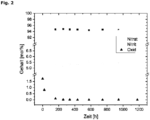
Es wurde eine Solarsalzmischung aus 89% Nitrat, 10% Nitrit und 1% Oxid hergestellt. Der Oxidgehalt entsprach dem einer sehr stark gealterten Salzschmelze. Ein Gasgemisch aus 80% O2, 200 ppm NO und Rest N2 wurde bei 600 °C über das Salz geleitet.
Claims (11)
Priority Applications (5)
| Application Number | Priority Date | Filing Date | Title |
|---|---|---|---|
| DE102023109552.8A DE102023109552B4 (en) | 2023-04-17 | 2023-04-17 | Process for removing foreign substances and decomposition products from liquid salt melts |
| EP24720459.7A EP4698494A1 (en) | 2023-04-17 | 2024-04-17 | Process for removing extraneous substances and decomposition products from liquid salt melts |
| PCT/EP2024/060355 WO2024218115A1 (en) | 2023-04-17 | 2024-04-17 | Process for removing extraneous substances and decomposition products from liquid salt melts |
| CN202480025950.1A CN121039063A (en) | 2023-04-17 | 2024-04-17 | Methods for removing foreign substances and decomposition products from liquid salt melts |
| CL2025003090A CL2025003090A1 (en) | 2023-04-17 | 2025-10-10 | Process for removing foreign substances and decomposition products from molten liquid salts |
Applications Claiming Priority (1)
| Application Number | Priority Date | Filing Date | Title |
|---|---|---|---|
| DE102023109552.8A DE102023109552B4 (en) | 2023-04-17 | 2023-04-17 | Process for removing foreign substances and decomposition products from liquid salt melts |
Publications (2)
| Publication Number | Publication Date |
|---|---|
| DE102023109552A1 DE102023109552A1 (en) | 2024-10-17 |
| DE102023109552B4 true DE102023109552B4 (en) | 2025-01-02 |
Family
ID=90825699
Family Applications (1)
| Application Number | Title | Priority Date | Filing Date |
|---|---|---|---|
| DE102023109552.8A Active DE102023109552B4 (en) | 2023-04-17 | 2023-04-17 | Process for removing foreign substances and decomposition products from liquid salt melts |
Country Status (5)
| Country | Link |
|---|---|
| EP (1) | EP4698494A1 (en) |
| CN (1) | CN121039063A (en) |
| CL (1) | CL2025003090A1 (en) |
| DE (1) | DE102023109552B4 (en) |
| WO (1) | WO2024218115A1 (en) |
Citations (4)
| Publication number | Priority date | Publication date | Assignee | Title |
|---|---|---|---|---|
| DE102011008091A1 (en) * | 2011-01-07 | 2012-07-12 | Siemens Aktiengesellschaft | Heat transfer medium for solar thermal systems |
| WO2014026892A1 (en) * | 2012-08-17 | 2014-02-20 | Basf Se | Method for improving nitrite salt compositions used as heat transfer medium or heat storage medium |
| DE102018222602A1 (en) * | 2018-12-20 | 2020-06-25 | Deutsches Zentrum für Luft- und Raumfahrt e.V. | Method for storing an inorganic salt and storage device |
| DE102021127566A1 (en) * | 2021-10-22 | 2023-04-27 | Deutsches Zentrum für Luft- und Raumfahrt e.V. | Stabilization of salts in high temperature nitrate salt systems |
Family Cites Families (3)
| Publication number | Priority date | Publication date | Assignee | Title |
|---|---|---|---|---|
| US4421662A (en) * | 1982-09-13 | 1983-12-20 | Olin Corporation | Nonaqueous purification of mixed nitrate heat transfer media |
| CN102432036A (en) * | 2011-09-16 | 2012-05-02 | 江苏太阳宝新能源有限公司 | Treatment method of waste molten nitrate salt for solar thermal power generation and heat storage |
| KR102104877B1 (en) * | 2012-04-10 | 2020-04-27 | 바스프 에스이 | Alkali-metal-carbonate-containing nitrate salt compositions and use thereof as heat transfer medium or heat storage medium |
-
2023
- 2023-04-17 DE DE102023109552.8A patent/DE102023109552B4/en active Active
-
2024
- 2024-04-17 CN CN202480025950.1A patent/CN121039063A/en active Pending
- 2024-04-17 WO PCT/EP2024/060355 patent/WO2024218115A1/en not_active Ceased
- 2024-04-17 EP EP24720459.7A patent/EP4698494A1/en active Pending
-
2025
- 2025-10-10 CL CL2025003090A patent/CL2025003090A1/en unknown
Patent Citations (4)
| Publication number | Priority date | Publication date | Assignee | Title |
|---|---|---|---|---|
| DE102011008091A1 (en) * | 2011-01-07 | 2012-07-12 | Siemens Aktiengesellschaft | Heat transfer medium for solar thermal systems |
| WO2014026892A1 (en) * | 2012-08-17 | 2014-02-20 | Basf Se | Method for improving nitrite salt compositions used as heat transfer medium or heat storage medium |
| DE102018222602A1 (en) * | 2018-12-20 | 2020-06-25 | Deutsches Zentrum für Luft- und Raumfahrt e.V. | Method for storing an inorganic salt and storage device |
| DE102021127566A1 (en) * | 2021-10-22 | 2023-04-27 | Deutsches Zentrum für Luft- und Raumfahrt e.V. | Stabilization of salts in high temperature nitrate salt systems |
Non-Patent Citations (3)
| Title |
|---|
| "Defined purge gas composition stabilizes molten nitrate salt - Experimental prove and thermodynamic calculations", V. A. Sötz et al., Solar Energy 211 (2020) 453–462. * |
| "Influence of Different Atmospheres on Molten Salt Chemistry and its Effect on Steel Corrosion", A. Bonk et al., SolarPACES 2017AIP Conf. Proc. 2033, 090003-1-090003-9; https://doi.Org/10.1063/l.5067097 Published by AIP Publishing. 978-0-7354-1 757-1/530.00 * |
| "Investigation of Regeneration Mechanisms of Aged Solar Salt", J. Steinbrecher et al., Materials 2021, 14, 5664. https://doi.org/10.3390/ma14195664 * |
Also Published As
| Publication number | Publication date |
|---|---|
| WO2024218115A1 (en) | 2024-10-24 |
| CL2025003090A1 (en) | 2026-02-06 |
| EP4698494A1 (en) | 2026-02-25 |
| CN121039063A (en) | 2025-11-28 |
| DE102023109552A1 (en) | 2024-10-17 |
Similar Documents
| Publication | Publication Date | Title |
|---|---|---|
| DE69430118T2 (en) | METHOD FOR PROCESSING WASTEWATER USING A CATALYST | |
| EP0389661B1 (en) | Process for removing arsenic from waste waters | |
| DE102004040297B4 (en) | Treatment device and treatment method for organic waste | |
| DE69816450T2 (en) | NITRATE REDUCTION | |
| DE2350498A1 (en) | PROCESS FOR REMOVING SULFUR OXYDES AND NITROGEN OXYDES FROM COMBUSTION GASES | |
| DD273386A5 (en) | METHOD FOR WASHING THE HOT EXHAUST FLOW FROM A STEAM GENERATOR SYSTEM OR A CEMENT OVEN | |
| WO1993022249A1 (en) | Process and device for destroying free and complex cyanides, aox, mineral oil, complexing agents, csb, nitrite, chromate, and for separating metals from waste waters | |
| EP2885368A1 (en) | Method for improving nitrite salt compositions used as heat transfer medium or heat storage medium | |
| EP0514729B1 (en) | Process for removal of ammonia contained in gases | |
| DE2630175B2 (en) | Process for cleaning industrial exhaust gases containing nitrogen oxides and sulfur oxides | |
| DE102023109552A1 (en) | Process for removing foreign substances and decomposition products from liquid salt melts | |
| DE1173074B (en) | Process for working up the hydrolysis acids obtained during the production of titanium dioxide using the sulfuric acid digestion process | |
| DE3048002A1 (en) | METHOD FOR REMOVING AMMONIUM NITRATE FROM AQUEOUS SOLUTIONS | |
| DE602004003464T2 (en) | Process for the treatment of spent ion exchangers | |
| EP2313348B1 (en) | Method for conditioning a precipitating solution that arises during the wet-chemical cleaning of conventional or nuclear plants, said solution containing organic substances and metals in ionic form | |
| DE2108059A1 (en) | Process for removing nitrogen oxides and other impurities from gas mixtures | |
| EP0112500B1 (en) | Process for producing crystals containing plutonium dioxide | |
| DE2447221C3 (en) | Process for the destruction of hydrogen cyanide gas | |
| DE2448906C2 (en) | Process for removing hydrogen sulfide or hydrogen sulfide and sulfur oxides from a gas | |
| DE2907600C2 (en) | ||
| DE3017547C2 (en) | ||
| EP3899403A1 (en) | Method for storing an inorganic salt, and storage device | |
| DE102021131250A1 (en) | Continuous cleaning system for halogen salts | |
| DE3708751C2 (en) | Process for the wet dissolution of uranium-plutonium mixed oxide nuclear fuels | |
| DE1177624B (en) | Process for purifying helium |
Legal Events
| Date | Code | Title | Description |
|---|---|---|---|
| R012 | Request for examination validly filed | ||
| R016 | Response to examination communication | ||
| R016 | Response to examination communication | ||
| R018 | Grant decision by examination section/examining division | ||
| R020 | Patent grant now final |