DE102018009800A1 - Device and method for determining the volume and porosity of objects and bulk materials - Google Patents
Device and method for determining the volume and porosity of objects and bulk materials Download PDFInfo
- Publication number
- DE102018009800A1 DE102018009800A1 DE102018009800.2A DE102018009800A DE102018009800A1 DE 102018009800 A1 DE102018009800 A1 DE 102018009800A1 DE 102018009800 A DE102018009800 A DE 102018009800A DE 102018009800 A1 DE102018009800 A1 DE 102018009800A1
- Authority
- DE
- Germany
- Prior art keywords
- measuring chamber
- transducer
- volume
- membrane
- measuring
- Prior art date
- Legal status (The legal status is an assumption and is not a legal conclusion. Google has not performed a legal analysis and makes no representation as to the accuracy of the status listed.)
- Withdrawn
Links
Images
Classifications
-
- G—PHYSICS
- G01—MEASURING; TESTING
- G01N—INVESTIGATING OR ANALYSING MATERIALS BY DETERMINING THEIR CHEMICAL OR PHYSICAL PROPERTIES
- G01N29/00—Investigating or analysing materials by the use of ultrasonic, sonic or infrasonic waves; Visualisation of the interior of objects by transmitting ultrasonic or sonic waves through the object
- G01N29/22—Details, e.g. general constructional or apparatus details
- G01N29/24—Probes
- G01N29/2418—Probes using optoacoustic interaction with the material, e.g. laser radiation, photoacoustics
-
- G—PHYSICS
- G01—MEASURING; TESTING
- G01F—MEASURING VOLUME, VOLUME FLOW, MASS FLOW OR LIQUID LEVEL; METERING BY VOLUME
- G01F17/00—Methods or apparatus for determining the capacity of containers or cavities, or the volume of solid bodies
-
- G—PHYSICS
- G01—MEASURING; TESTING
- G01N—INVESTIGATING OR ANALYSING MATERIALS BY DETERMINING THEIR CHEMICAL OR PHYSICAL PROPERTIES
- G01N29/00—Investigating or analysing materials by the use of ultrasonic, sonic or infrasonic waves; Visualisation of the interior of objects by transmitting ultrasonic or sonic waves through the object
- G01N29/22—Details, e.g. general constructional or apparatus details
- G01N29/222—Constructional or flow details for analysing fluids
Landscapes
- Physics & Mathematics (AREA)
- General Physics & Mathematics (AREA)
- Biochemistry (AREA)
- Life Sciences & Earth Sciences (AREA)
- Chemical & Material Sciences (AREA)
- Analytical Chemistry (AREA)
- Health & Medical Sciences (AREA)
- General Health & Medical Sciences (AREA)
- Immunology (AREA)
- Pathology (AREA)
- Optics & Photonics (AREA)
- Fluid Mechanics (AREA)
- Acoustics & Sound (AREA)
- Measuring Fluid Pressure (AREA)
Abstract
Die Erfindung betrifft ein Verfahren zur Bestimmung des Gesamtvolumens und/oder des wahren Volumens sowie der Porosität von Objekten, bei dem ein Gasraum einer geschlossenen Messkammer komprimiert oder expandiert wird, diese Volumenänderung ΔV in der Messkammer eine Bewegungsänderung einer Membran eines Wandlers verursacht, wobei die Bewegung dieser Membran des Wandlers linear mit der Volumenänderung ΔV in der Messkammer korreliert, wobei die mechanische Bewegung dieser Membran des Wandlers als Funktion des Volumens eines Objekts in einer Messkammer durch wenigstens eine Frequenz ausgelöst wird und die Bewegungsänderung der Membran durch einen Sensorkopf gemessen wird sowie eine für das Verfahren geeignete Vorrichtung.
Description
Die Erfindung betrifft eine Vorrichtung und ein Verfahren zur Bestimmung des Volumens und der Porosität von Objekten und Schüttgütern.The invention relates to a device and a method for determining the volume and the porosity of objects and bulk materials.
In vielen technischen Bereichen besteht der Bedarf, das Volumen und die Porosität von Objekten und Schüttgütern zu messen.In many technical areas there is a need to measure the volume and porosity of objects and bulk materials.
Die Bestimmung des Volumens eines Objekts ist häufig schwierig, insbesondere wenn das Objekt eine unregelmäßige Form und/oder Rauigkeiten oder Poren auf seiner Oberfläche hat. Existierende Techniken zum Messen von Volumen solcher Körper sind beispielsweise Computertomographie (CT-Scans, d.h. bildgebende 3D-Vermessung zum Beispiel mit Röntgenstrahlen), Gasvolumeter oder akustische Volumeter. Außerdem sind optische Methoden verfügbar, die auf der Erfassung von Objektprojektionen aus verschiedenen Winkeln und anschließender 3D-Rekonstruktion des Objekts basieren. Mit den Verfahren nach dem Stand der Technik sind daher einige Nachteile verbunden.
CT-Verfahren sind aufwändig und kostspielig, erzeugen sehr große Datenmengen und beanspruchen hohe Rechenleistungen. Außerdem ist die Zeitdauer der Messungen in der Regel recht hoch. Hinzu kommt, dass eine eventuelle Beeinflussung durch Röntgenstrahlung z.B. bei biologischen Objekten berücksichtigt werden muss.
Bei Gasvolumetern ist die Verwendung externer Gase erforderlich. Die Zeit der Messungen im Vergleich zur Genauigkeit ist recht hoch. Eine Messung der Porosität von unregelmäßig geformten festen Objekten ist nicht möglich. Hinzu kommt, dass das gemessene Objekt teilweise erhöhten Drücken standhalten muss, außerdem ist der Messablauf in der Regel recht komplex.
Bei akustischen Volumetern (
Bei optischen Methoden können die Messdauer, die erreichbare Genauigkeit, große Datenmengen und hohe Rechenleistungen problematisch sein. Eine präzise Volumenbestimmung von zum Beispiel konkav geformten, porösen oder sehr komplexen Objekten ist damit kaum oder nicht möglich.
Bei der Flüssigkeitsverdrängung (Archimedes) sind die Messdauer, erzielbare Genauigkeit, Auswirkungen der Flüssigkeit auf das Objekt sowie anhaftende Flüssigkeiten von Nachteil.Determining the volume of an object is often difficult, especially if the object has an irregular shape and / or roughness or pores on its surface. Existing techniques for measuring the volume of such bodies are, for example, computer tomography (CT scans, ie 3D imaging, for example using X-rays), gas volumeters or acoustic volumeters. Optical methods are also available which are based on the acquisition of object projections from different angles and subsequent 3D reconstruction of the object. The prior art methods therefore have some disadvantages.
CT procedures are complex and costly, generate very large amounts of data and require high computing power. In addition, the duration of the measurements is usually quite long. In addition, any influence by X-rays, for example in biological objects, must be taken into account.
The use of external gases is required for gas volumes. The time of the measurements compared to the accuracy is quite high. It is not possible to measure the porosity of irregularly shaped solid objects. In addition, the measured object has to withstand high pressures, and the measurement process is usually quite complex.
With acoustic volumes (
With optical methods, the measurement duration, the achievable accuracy, large amounts of data and high computing power can be problematic. A precise volume determination of, for example, concave, porous or very complex objects is hardly possible or not possible.
In the case of liquid displacement (Archimedes), the measurement duration, achievable accuracy, effects of the liquid on the object and adhering liquids are disadvantageous.
Daher ist es die Aufgabe der Erfindung die genannten Nachteile zu überwinden. Ausgehend vom Oberbegriff des Anspruchs 1 und des nebengeordneten Anspruchs wird die Aufgabe erfindungsgemäß gelöst mit den im kennzeichnenden Teil der Ansprüche angegebenen Merkmalen.It is therefore the object of the invention to overcome the disadvantages mentioned. Starting from the preamble of
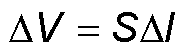
Die Erfindung betrifft ein Verfahren zur Bestimmung des Gesamtvolumens und/oder des wahren Volumens von Objekten, bei dem ein Gasraum einer geschlossenen Messkammer durch alternierende Kompression und Expansion des Gases in dem Gasraum der Messkammer, verursacht durch einen Wandler, komprimiert oder expandiert wird, diese Volumenänderung ΔV in der Messkammer eine Bewegungsänderung einer Membran eines Wandlers verursacht, wobei die Bewegung dieser Membran des Wandlers linear mit der Volumenänderung ΔV in der Messkammer korreliert, wobei die mechanische Bewegung dieser Membran des Wandlers als Funktion des Volumens eines Objekts in einer Messkammer durch wenigstens eine Frequenz ausgelöst wird und die Bewegungsänderung der Membran durch einen Sensorkopf gemessen wird und wobei für die Volumenänderung ΔV in der Messkammer die Korrelation beschrieben werden kann mit
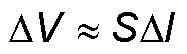
- ΔV =
- Volumenänderung,
- ΔL =
- Auslenkung der Membran des Wandlers und
- S =
- Fläche der Membran des Wandlers,
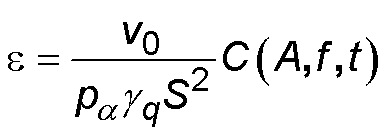
wobei ein Signal ε im Messraum ohne Objekt erzeugt wird und wobei für dieses Signal
ε ohne Objekt in der Messkammer folgende Gleichung gilt:
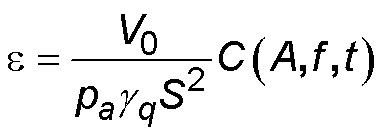
- A= Amplitude,
- f= Frequenz,
- t= Zeit,
- V0 = Innenvolumen der Messkammer,
- pa = Umgebungsdruck und
- yq = quasi-adiabatischer Index der Luft/des Gases im Gasraum der Messkammer, mit

und
C(A,f,t) = C0(func(A,f,t)-Floss) für optische Messmethoden des Sensorkopfes,
wobei
- C0 = Korrelationskoeffizient und
- Floss = Kraftverlust, der durch die Biegekraft der Membran des Wandlers und Trägheitskraft zustande kommt,

- C0 = Korrelationskoeffizient und
- Floss= Kraftverlust, der durch die Biegekraft der Membran des Wandlers und Trägheitskraft zustande kommt,
- ΔV =
- Volume change,
- ΔL =
- Deflection of the diaphragm of the transducer and
- S =
- Area of the diaphragm of the transducer,
whereby a signal ε is generated in the measuring room without an object and for this signal
ε the following equation applies without an object in the measuring chamber:
- A = amplitude,
- f = frequency,
- t = time,
- V 0 = internal volume of the measuring chamber,
- p a = ambient pressure and
- y q = quasi-adiabatic index of the air / gas in the gas space of the measuring chamber, with
and
C (A, f, t) = C 0 (func (A, f, t) -F loss ) for optical measurement methods of the sensor head,
in which
- C 0 = correlation coefficient and
- F loss = loss of force caused by the bending force of the diaphragm of the transducer and inertial force,
- C 0 = correlation coefficient and
- F loss = loss of force caused by the bending force of the diaphragm of the transducer and inertial force,
Die Erfindung betrifft weiterhin eine Vorrichtung zur Durchführung des zuvor dargestellten Verfahrens umfassend einen Messboden, eine verschließbare Messkammer, Mittel zur Erzeugung und Erfassung von Druckveränderungen in der Messkammer, umfassend wenigstens einen Wandlerkopf und wenigstens einen Sensorkopf, wobei der Wandlerkopf einen Wandler mit einer Membran aufweist.The invention further relates to a device for carrying out the method described above, comprising a measuring base, a closable measuring chamber, means for generating and detecting pressure changes in the measuring chamber, comprising at least one transducer head and at least one sensor head, the transducer head having a transducer with a membrane.
Mit dem erfindungsgemäßen Verfahren und der Vorrichtung ist es nunmehr möglich, eine gegenüber dem Stand der Technik technisch einfach aufgebaute Vorrichtung und ein Verfahren bereitzustellen, mit der/dem eine präzise und schnelle Messung des Gesamtvolumens oder des wahren Volumens von regelmäßig und unregelmäßig geformten Objekten möglich ist. So ist es weiterhin möglich auch das Gesamtvolumen oder wahre Volumen einer Gruppe von Objekten, zum Beispiel Schüttgut, zu bestimmen, sowie auch das Gesamtvolumen dieser Objekte zusammen mit dem in den Poren befindlichen Volumen zu bestimmen. Mit dem erfindungsgemäßen Verfahren und der Vorrichtung ist es weiterhin auch möglich, die Porosität von Objekten zu bestimmen.With the method and the device according to the invention, it is now possible to provide a device which is technically simple compared to the prior art and a method with which a precise and rapid measurement of the total volume or the true volume of regularly and irregularly shaped objects is possible . It is thus also possible to determine the total volume or true volume of a group of objects, for example bulk material, and also to determine the total volume of these objects together with the volume in the pores. With the method and the device according to the invention, it is also possible to determine the porosity of objects.
Unter der Bezeichnung „Gesamtvolumen“ ist im Rahmen der Erfindung das Volumen zu verstehen, das das Volumen des Festkörpers des Objekts umfasst, zusammen mit dem Volumen möglicher Hohlräume, die das Objekt beinhaltet oder die das Objekt umgeben, wie zum Beispiel die Zwischenräume von Objekten, die im Schüttgut angeordnet sind, oder Poren, die das Objekt aufweist oder auch einen Hohlraum, der von einer Hülle des Objekts umgeben wird.
Unter der Bezeichnung „wahres Volumen“ ist demgegenüber das Volumen eines Objekts zu verstehen, welches das reine Volumen des Objekts ohne das Volumen möglicher Hohlräume (zum Beispiel von Poren oder Zwischenräumen) umfasst.
Hohlräume können nur gemessen werden, wenn sie von außen zugänglich sind. In das Objekt komplett eingeschlossene Hohlräume können daher nicht erfasst werden.In the context of the invention, the term “total volume” is to be understood as the volume which comprises the volume of the solid body of the object, together with the volume of possible cavities which contain the object or which surround the object, such as, for example, the spaces between objects, which are arranged in the bulk material, or pores which the object has, or also a cavity which is surrounded by a shell of the object.
In contrast, the term “true volume” is to be understood as the volume of an object which comprises the pure volume of the object without the volume of possible cavities (for example pores or gaps).
Cavities can only be measured if they are accessible from the outside. Cavities completely enclosed in the object can therefore not be detected.
Vorteilhafte Weiterbildungen der Erfindung sind in den Unteransprüchen angegeben.Advantageous developments of the invention are specified in the subclaims.
Die Erfindung wird nachfolgend anhand der Figuren erläutert. Die Figuren zeigen beispielhaft Ausführungsformen der Erfindung, ohne dass dies einschränkend auszulegen ist.The invention is explained below with reference to the figures. The figures show exemplary embodiments of the invention, without this having to be interpreted restrictively.
Es zeigt:
-
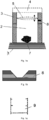
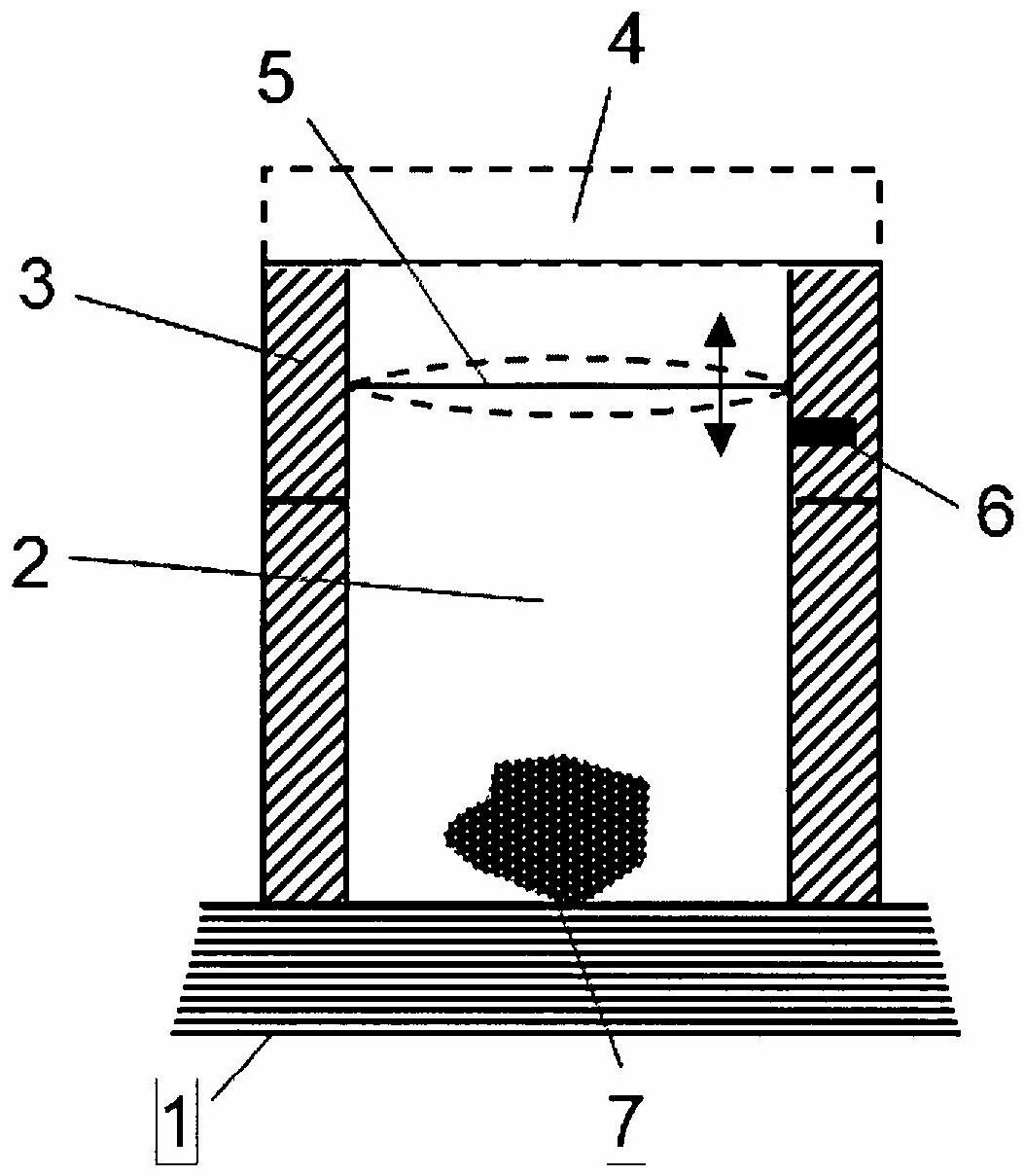
1a : Schematischer allgemeiner Aufbau der erfindungsgemäßen Vorrichtung -
1b : Schalenförmiger Einsatz zur Aufnahme von Objekten -
1c : Netzförmiger Korbeinsatz zur Aufnahme von Objekten -
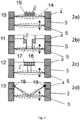
2 : Schematische Ansichten von unterschiedlich möglichen Messansätzen -
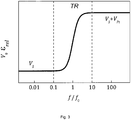
3 : Schematische Darstellung des gemessenen Relativsignals multipliziert mit dem Innenvolumen der Kammer in Abhängigkeit von der normalisierten Betriebsfrequenz
-
1a : Schematic general structure of the device according to the invention -
1b : Cup-shaped insert for holding objects -
1c : Net-shaped basket insert for objects -
2nd : Schematic views of different possible measurement approaches -
3rd : Schematic representation of the measured relative signal multiplied by the internal volume of the chamber as a function of the normalized operating frequency
In
In
Dieser schalenförmige Einsatz
Ausführung
execution
Die folgende Beschreibung der bevorzugten Ausführungsformen ist rein beispielhafter Natur und ist nicht dazu gedacht, die Erfindung, ihre Anwendung oder ihren Gebrauch zu beschränken.The following description of the preferred embodiments is merely exemplary in nature and is not intended to limit the invention, its application, or uses.
Eine vorteilhafte Ausführung der erfindungsgemäßen Vorrichtung gemäß
Durch den Aufbau der Vorrichtung mit nur einer Messkammer
In dem Wandlerkopf
Der Drucksensor
Dieser nahezu gleiche Druck wird dadurch erreicht, dass die Amplitude oder der Strom des Lautsprechers des elektromechanischen Wandlers
Der Drucksensor
Dieser Drucksensor
Eine austauschbare Messkammer
Der Wandler
Ein schalenförmiger Einsatz
Der Wandler
Durch den Einsatz eines Drucksensors
Der Sensorkopf
Der Sensorkopf
Bei dem induktiven Messansatz
Bei den genannten kapazitiven Messansätzen
Beim optischen Messansatz
In
Hier korrelieren die Frequenz f mit der Geschwindigkeit der Bewegungen der Membran des Wandlers
Bei Frequenzen, die höher als die Übergangsfrequenz
Das erfindungsgemäße Verfahren wird im Folgenden beispielhaft beschrieben:
- Im Betrieb wird der Membran des
Wandlers 5 ein periodisches Signal, abhängig von - der Amplitude
A , - der Frequenz f und
- der Zeit
t , - aufgeprägt, wodurch diese Membran die Kraft
F an die Luft bzw. das Gas inder Messkammer 2 überträgt. Diese Kraft F ist dabei eine Funktion des angelegten Signals, so dass folgende Gleichung 1 gilt:
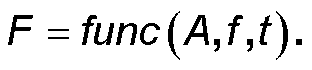
- In operation, the membrane of the converter
5 a periodic signal depending on - the amplitude
A , - the frequency f and
- currently
t , - imprinted, which makes this membrane the force
F to the air or gas in the measuring chamber2nd transmits. This force F is a function of the applied signal, so that thefollowing equation 1 applies:
Die Kraft F ist auf zwei Teile verteilt: die Verlustkraft, Floss, die durch die Biegekraft der Membran und Trägheitskräfte zustande kommt, und die Wirkungskraft Fact, welche die Luft in der Messkammer 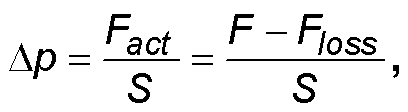
Die Messkammer
Im Gegensatz dazu gibt es bei unendlich hohen Frequenzen, f → ∞, adiabatische Kompression und Expansion; hierbei folgt die Luft der Temperatur der Wände nicht. Dieses sind allerdings nur ideale Extremfälle.In contrast, at infinitely high frequencies, f → ∞, there is adiabatic compression and expansion; the air does not follow the temperature of the walls. However, these are only ideal extreme cases.
In der Praxis ist es dagegen erforderlich, das quasi-adiabatische Regime des Betriebs der erfindungsgemäßen Vorrichtung mit dem quasi-adiabatischen Index yq zu betrachten, wobei der Wert von 1 (bei f → 0) bis zu ≈ 1,4 (bei f → ∞; d.h. adiabatischer Index für Luft) variiert.In practice, on the other hand, it is necessary to consider the quasi-adiabatic mode of operation of the device according to the invention with the quasi-adiabatic index y q , the value from 1 (at f → 0) to ≈ 1.4 (at f → ∞; ie adiabatic index for air) varies.
Das quasi-adiabatische Regime kann beschrieben werden als

- pa. = Umgebungsdruck (Atmosphärendruck oder absoluter Druck), bei dem der Sensor arbeitet,
- Vo = Innenvolumen der Messkammer
2 und - ΔV = Volumenänderung, die durch die Bewegung der Membran des
Wandlers 5 verursacht wird.
- p a . = Ambient pressure (atmospheric pressure or absolute pressure) at which the sensor works,
- V o = internal volume of the measuring chamber
2nd and - ΔV = volume change caused by the movement of the diaphragm of the
transducer 5 is caused.
Wenn die Druckänderungen Δp im Vergleich zum Umgebungsdruck pa. sehr klein sind, kann die Volumenänderung ΔV wie folgt berechnet werden
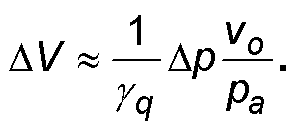
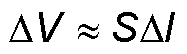
Die Erfindung bezieht sich auf Messungen der Volumenänderungen ΔV durch verschiedene Techniken, die in einer beispielhaften Ausgestaltung in
Diese Korrelation kann wie folgt geschrieben werden:
Die induktiven
In Kombination mit den Gleichungen (1), (2), (4) und (5) kann das Signal ε wie folgt geschrieben werden:
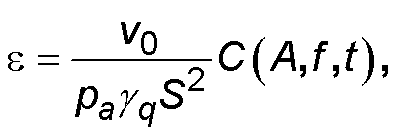

C0 ist hierbei der Korrelationskoeffizient.In combination with equations (1), (2), (4) and (5) the signal ε can be written as follows:
C 0 is the correlation coefficient.
Gleichung 6 beschreibt das Signal ε in der Messkammer
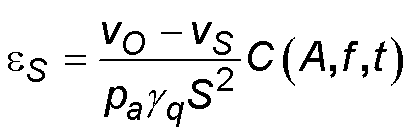
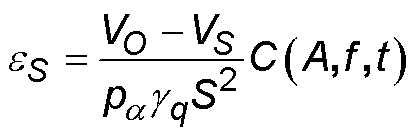
Zur Messung mit einem Objekt 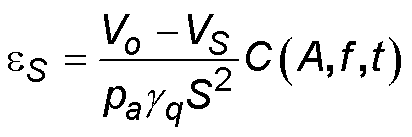
Gleichung 7 beschreibt das Signal εS in der Messkammer
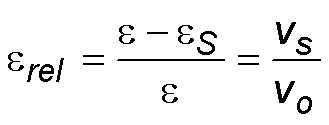
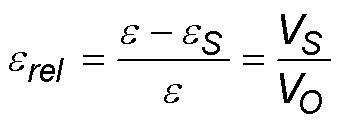
Die Erfindung misst die relativen Änderungen 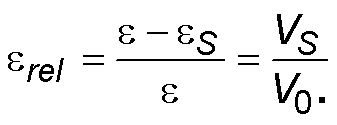
Die Messkammer
Die Erfindung schließt in einer besonders vorteilhaften Ausführung der Vorrichtung und des Verfahrens die Messung der Porosität eines Objektes mit ein.In a particularly advantageous embodiment of the device and the method, the invention includes the measurement of the porosity of an object.
Bei einer von Null verschiedenen Viskosität der Luft oder des Gases, welche bzw. welches die Poren oder Hohlräume des Objekts
Bei kleinen Frequenzen ist die Geschwindigkeit der Bewegungen der Membran des Wandlers
At low frequencies, the speed of movement of the diaphragm is the
Wenn die Frequenz der Membranbewegungen dagegen so hoch ist, dass die Luft oder das Gas innerhalb der Poren auf die Druckänderungen aufgrund der Reibung mit der Oberfläche des Objekts
Bei langen, ideal zylindrisch geformten Poren mit dem Radius rp und der axialen Länge Lp und im Fall einer laminaren Strömung in den Poren kann die Übergangsfrequenz 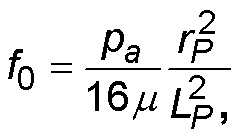
Die zuvor genannte Gleichung kann bei einem anderen Porensystem abweichen und muss jeweils an das zu untersuchende Porensystem durch experimentelle Untersuchungen angepasst werden.The equation mentioned above can differ for another pore system and must be adapted to the pore system to be examined by experimental investigations.
Die Differenz zwischen den gemessenen Volumina bei hohen und niedrigen Frequenzen ergibt das Gesamtvolumen der Poren VPt= Vges - VS The difference between the measured volumes at high and low frequencies gives the total volume of the pores V Pt = V tot - V S
Der Quotient ϕ = VPt / (VS + VPt) beschreibt dann die „Porosität“ ϕ des gemessenen Objekts
Der Arbeitsfrequenzbereich des erfindungsgemäßen Verfahrens ist durch die Dichtheit der Messkammer
Die höchsten Frequenzen sind durch den größten Abstand zwischen zwei Punkten in der Messkammer
Die Arbeit bei verschiedenen Frequenzen, beispielsweise ≥ 2 Frequenzen, erfordert einen Drucksensor
Um ein Signal auf den Wandler
- • ein Multifunktions-Eingang/Ausgang-Gerät,
- • eine externe Soundkarte, beispielsweise mit USB-Anschluss,
- • integrierte Soundkarten von Laptops und PCs.
- A multifunctional input / output device,
- An external sound card, for example with a USB connection,
- • Integrated sound cards from laptops and PCs.
Die erfindungsgemäße Vorrichtung und das Verfahren bieten gegenüber den nach dem Stand der Technik bekannten Vorrichtungen und Verfahren die folgenden Vorteile:
- • Die Vorrichtung kann ohne großen Aufwand und kostengünstig produziert werden, indem z.B. handelsübliche Komponenten verwendet werden.
- • Technisch einfacher Aufbau der Vorrichtung. Für die einfachste Situation mit einem Betriebsmodus bei nur einer festgelegten Frequenz wird nur eine solide Röhre als Messkammer benötigt und zwei Lautsprecher. Für Mehrfrequenzbetrieb ist zusätzlich noch ein Mikrofon erforderlich. Dies ist beispielsweise ein großer Vorteil gegenüber bekannten akustischen Volumetern.
- • Für eine Messung wird nicht notwendigerweise ein Kalibrationsvolumen benötigt. Die Verwendung eines Kalibrationsvolumens kann jedoch vorteilhaft die Präzision einer Messung erhöhen.
- • Sie erlaubt schnelle Messungen mit z.B.
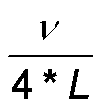
weniger als 2 Sekunden im Einzelfrequenz-Betriebsmodus, oder wenigerals 15 Sekunden, wenn zum Beispiel in einem Frequenzbereich von 20 Hz bis 6000 Hz in 30 Frequenzschritten gemessen wird. - • Sie erlaubt Messungen in einem großen Betriebsfrequenzbereich, z.B. in einer bevorzugten Ausführung im Bereich von 20 Hz bis 6000 Hz, was bevorzugt zur Messung der Porosität eines Objektes genutzt werden kann. Theoretisch kann man
im Bereich von 0 Hz bis 75 x (L[m])-1 Hz messen, wobei L den größten Abstand zwischen zwei Punkten in einer Messkammer beschreibt. - • Sie umfasst einen großen Messbereich, z.B. in einer getesteten Ausgestaltung zur Vermessung von Saatgut
im Volumenbereich von 1 Mikroliter bis zu einigen, beispielsweise 1000, Millilitern. - • Der absolute Messfehler ist klein und konstant. In einer getesteten Ausführung des Volumeters ist der Fehler von ca. 0,5 Mikroliter etwa 3600-mal kleiner (ca. 0.03%) als das interne Volumen der Messkammer (1,8 Milliliter).
- • Sie bietet eine einfache Möglichkeit zur Bestimmung der Porosität eines festen Objektes.
- • Die Erfindung ist geeignet, um in vollautomatisierte Anlagen zur Volumenbestimmung von Objekten integriert zu werden.
- • The device can be produced easily and inexpensively, for example by using commercially available components.
- • Technically simple construction of the device. For the simplest situation with an operating mode at only one fixed frequency, only a solid tube as measuring chamber and two loudspeakers are required. A microphone is also required for multi-frequency operation. This is a great advantage over known acoustic volumes, for example.
- • A calibration volume is not necessarily required for a measurement. However, the use of a calibration volume can advantageously increase the precision of a measurement.
- • It allows fast measurements with, for example, less than 2 seconds in single-frequency operating mode, or less than 15 seconds if, for example, measurements are carried out in a frequency range from 20 Hz to 6000 Hz in 30 frequency steps.
- • It allows measurements in a wide operating frequency range, for example in a preferred embodiment in the range from 20 Hz to 6000 Hz, which can preferably be used to measure the porosity of an object. Theoretically you can measure in the range from 0 Hz to 75 x (L [m]) -1 Hz, where L describes the greatest distance between two points in a measuring chamber.
- • It covers a large measuring range, for example in a tested configuration for measuring seeds in the volume range from 1 microliter to a few, for example 1000, milliliters.
- • The absolute measurement error is small and constant. In a tested version of the volumeter, the error of approximately 0.5 microliter is approximately 3600 times smaller (approximately 0.03%) than the internal volume of the measuring chamber (1.8 milliliter).
- • It offers an easy way to determine the porosity of a solid object.
- • The invention is suitable for being integrated into fully automated systems for determining the volume of objects.
Bei den zu untersuchenden Objekten kann es sich um unterschiedlichste Materialien handeln, die so beschaffen sind, dass sie vorzugsweise fest oder flüssig sind. Geeignete Objekte sind beispielsweise Samenkörner, Blätter, Steine sowie feste oder flüssige Körper jeglicher Geometrie.The objects to be examined can be a wide variety of materials that are designed such that they are preferably solid or liquid. Suitable objects are, for example, seeds, leaves, stones and solid or liquid bodies of any geometry.
Weiterhin kann das zu vermessende Objekt aus einer Zusammensetzung von verschiedenen Objekten oder einer Gruppe von regelmäßig und/oder unregelmäßig geformten Objekten bestehen wie z.B. Sand oder anderem Schüttgut.Furthermore, the object to be measured can consist of a composition of different objects or a group of regularly and / or irregularly shaped objects, e.g. Sand or other bulk material.
Aufgrund der Möglichkeit eine technisch einfach aufgebaute und tragbare Vorrichtung bereitzustellen, die aus mechanischen Standardkomponenten und relativ einfachen Elektronikteilen aufgebaut ist, sind das erfindungsgemäße Verfahren und die Vorrichtung beispielhaft auch für folgende Anwendungsgebiete und Volumenbestimmungen unterschiedlicher Objekte einsetzbar:
- • Volumenbestimmung von regelmäßig geformten Objekten;
- • Dichtheitsmessung von Hohlkörpern
- • Volumenbestimmung von Samen und Messung ihrer Porosität;
- • Bestimmung des Gesamtvolumens von vielen Samen und ihrem Füllvolumen;
- • Bestimmung des Gesamtvolumens von beliebigem Schüttgut und seinem Füllvolumen;
- • in Kombination mit einer Waage, Dichtebestimmung von Objekten und Materialien, beispielsweise im Falle der Dichte von Samen zur Schätzung ihrer Feuchtigkeit oder ihres Ölgehaltes;
- • Messungen von kleinen Röhrchen zur Überprüfung der Rauigkeit ihrer Innenflächen;
- • in Kombination mit einer Waage, Dichtebestimmung von Eiern, um ihr Alter zu überprüfen, da das Eigewicht und damit die Dichte mit zunehmendem Alter abnimmt;
- • Füllzustand von Getreideähren während der Samenreife;
- • Messungen an Pflanzenblättern bei geschlossenen oder geöffneten Spaltöffnungen (Stomata), um ihre inneren Hohlräume (Aerenchyme) zu bestimmen, die wichtig für die CO2-Assimilation (Photosynthese) sind;
- • Messungen von ganzen Pflanzen, um ihr Volumen als Näherung (Proxy) für ihre Biomasse zu schätzen.
- • Volume determination of regularly shaped objects;
- • Leakage measurement of hollow bodies
- • Volume determination of seeds and measurement of their porosity;
- • Determination of the total volume of many seeds and their filling volume;
- • Determination of the total volume of any bulk material and its filling volume;
- • in combination with a balance, density determination of objects and materials, for example in the case of the density of seeds to estimate their moisture or their oil content;
- • Measurements of small tubes to check the roughness of their inner surfaces;
- • in combination with a scale, density determination of eggs to check their age, since the egg weight and thus the density decreases with age;
- • Filling status of cereal ears during seed ripening;
- • Measurements on plant leaves with closed or opened stomata (stomata) to determine their internal cavities (aerenchymes), which are important for CO 2 assimilation (photosynthesis);
- • Measurements of whole plants to estimate their volume as an approximation (proxy) for their biomass.
BezugszeichenlisteReference symbol list
- 1 =1 =
- MessbodenMeasuring base
- 2 =2 =
- MesskammerMeasuring chamber
- 3 =3 =
- WandlerkopfConverter head
- 4 =4 =
- SensorkopfSensor head
- 5 =5 =
- WandlerConverter
- 6 =6 =
- DrucksensorPressure sensor
- 7 =7 =
- Objektobject
- 8 =8 =
- schalenförmiger Einsatzbowl-shaped insert
- 9 =9 =
- netzförmiger Korbeinsatznet-shaped basket insert
- 10 =10 =
- induktiver Messansatzinductive measurement approach
- 11 =11 =
- kapazitiver Messansatzcapacitive measurement approach
- 12 =12 =
- kapazitiver Messansatzcapacitive measurement approach
- 13 =13 =
- optischer Messansatzoptical measurement approach
- 14 =14 =
- Membranmembrane
- 15 =15 =
- SpuleKitchen sink
- 16 =16 =
- 1. Platte für variable Kapazität1. Variable capacity plate
- 17 =17 =
- 2. Platte für variable Kapazität2. Variable capacity plate
- 18 =18 =
- LichtquelleLight source
- 19 =19 =
- FotosensorPhoto sensor
ZITATE ENTHALTEN IN DER BESCHREIBUNG QUOTES INCLUDE IN THE DESCRIPTION
Diese Liste der vom Anmelder aufgeführten Dokumente wurde automatisiert erzeugt und ist ausschließlich zur besseren Information des Lesers aufgenommen. Die Liste ist nicht Bestandteil der deutschen Patent- bzw. Gebrauchsmusteranmeldung. Das DPMA übernimmt keinerlei Haftung für etwaige Fehler oder Auslassungen.This list of documents listed by the applicant has been generated automatically and is only included for the better information of the reader. The list is not part of the German patent or utility model application. The DPMA assumes no liability for any errors or omissions.
Zitierte PatentliteraturPatent literature cited
- US 4072046 A [0003]US 4072046 A [0003]
- US 5824892 A [0003]US 5824892 A [0003]
Claims (24)


Priority Applications (5)
| Application Number | Priority Date | Filing Date | Title |
|---|---|---|---|
| DE102018009800.2A DE102018009800A1 (en) | 2018-12-18 | 2018-12-18 | Device and method for determining the volume and porosity of objects and bulk materials |
| PCT/DE2019/000298 WO2020125828A1 (en) | 2018-12-18 | 2019-11-14 | Device and method for determining the volume and porosity of objects and bulk materials |
| ES19812665T ES2978567T3 (en) | 2018-12-18 | 2019-11-14 | Device and procedure for determining the volume and porosity of objects and bulk materials |
| US17/296,557 US12259360B2 (en) | 2018-12-18 | 2019-11-14 | Device and method for determining the volume and porosity of objects and bulk materials |
| EP19812665.8A EP3899524B8 (en) | 2018-12-18 | 2019-11-14 | Device and method for determining the volume and porosity of objects and bulk materials |
Applications Claiming Priority (1)
| Application Number | Priority Date | Filing Date | Title |
|---|---|---|---|
| DE102018009800.2A DE102018009800A1 (en) | 2018-12-18 | 2018-12-18 | Device and method for determining the volume and porosity of objects and bulk materials |
Publications (1)
| Publication Number | Publication Date |
|---|---|
| DE102018009800A1 true DE102018009800A1 (en) | 2020-06-18 |
Family
ID=68731638
Family Applications (1)
| Application Number | Title | Priority Date | Filing Date |
|---|---|---|---|
| DE102018009800.2A Withdrawn DE102018009800A1 (en) | 2018-12-18 | 2018-12-18 | Device and method for determining the volume and porosity of objects and bulk materials |
Country Status (5)
| Country | Link |
|---|---|
| US (1) | US12259360B2 (en) |
| EP (1) | EP3899524B8 (en) |
| DE (1) | DE102018009800A1 (en) |
| ES (1) | ES2978567T3 (en) |
| WO (1) | WO2020125828A1 (en) |
Cited By (2)
| Publication number | Priority date | Publication date | Assignee | Title |
|---|---|---|---|---|
| CN113358175A (en) * | 2021-05-27 | 2021-09-07 | 苏州西热节能环保技术有限公司 | Normal-pressure variable-volume coal pile volume measuring device and method for large irregular coal pile |
| DE102022116546A1 (en) * | 2022-07-01 | 2024-01-04 | Anton Paar Gmbh | Porosity measurement using a gallium-based intrusion agent |
Families Citing this family (5)
| Publication number | Priority date | Publication date | Assignee | Title |
|---|---|---|---|---|
| US20240263984A1 (en) * | 2021-06-10 | 2024-08-08 | Arizona Board Of Regents On Behalf Of The University Of Arizona | Devices and methods for collecting volumetric measurements of objects with complex shapes |
| CN113834755B (en) * | 2021-06-30 | 2023-06-06 | 北京航天控制仪器研究所 | Fluorine gas volume detection device and method |
| CN115639131B (en) * | 2022-11-11 | 2023-11-24 | 河南工业大学 | Bulk grain pile pore characterization method under different pressures |
| CN117969342A (en) * | 2024-01-16 | 2024-05-03 | 常州硅源新能材料有限公司 | A test device and test method for measuring gas volume using a suspension rod |
| CN120369574B (en) * | 2025-06-27 | 2025-08-15 | 山东森荣新材料股份有限公司 | Proton exchange membrane hydrogen permeability measurement device and measurement method based on isobaric method |
Citations (4)
| Publication number | Priority date | Publication date | Assignee | Title |
|---|---|---|---|---|
| US4072046A (en) | 1976-09-03 | 1978-02-07 | The Dow Chemical Company | Acoustic pycnometer |
| DD236591A1 (en) * | 1985-04-29 | 1986-06-11 | Halbleiterwerk Veb | DEVICE FOR ELECTRONIC DETERMINATION OF PRESSURE OR VOLUME |
| US5824892A (en) | 1996-07-23 | 1998-10-20 | Ishii; Yasushi | Acoustic device for measuring volume difference |
| US20160120443A1 (en) * | 2014-11-03 | 2016-05-05 | Near Margalit | Single Chamber Volume Measurement Apparatus and Methods of Making and Using the Same |
Family Cites Families (9)
| Publication number | Priority date | Publication date | Assignee | Title |
|---|---|---|---|---|
| DE236591C (en) | ||||
| US4474061A (en) * | 1981-11-27 | 1984-10-02 | Motorola, Inc. | Sonic pressure volume measuring device |
| GB8317888D0 (en) * | 1983-07-01 | 1983-08-03 | Pond J B | System for measuring volumes |
| SE450295B (en) * | 1984-12-21 | 1987-06-15 | Enpece Ab | SET AND DEVICE FOR SEATING THE VOLUME OF A GAS IN A CONTAINER |
| US4991433A (en) * | 1989-09-21 | 1991-02-12 | Applied Acoustic Research | Phase track system for monitoring fluid material within a container |
| JP2000258325A (en) * | 1999-03-08 | 2000-09-22 | Yasushi Ishii | Density-judging apparatus by acoustic volumeter |
| JP2001119785A (en) * | 1999-10-15 | 2001-04-27 | Phone Or Ltd | Sound collection device |
| JP3884444B2 (en) * | 2004-03-26 | 2007-02-21 | 株式会社東芝 | Acoustoelectric conversion system |
| JP4911460B2 (en) * | 2004-03-24 | 2012-04-04 | 国立大学法人京都大学 | Volume measuring apparatus and method |
-
2018
- 2018-12-18 DE DE102018009800.2A patent/DE102018009800A1/en not_active Withdrawn
-
2019
- 2019-11-14 EP EP19812665.8A patent/EP3899524B8/en active Active
- 2019-11-14 WO PCT/DE2019/000298 patent/WO2020125828A1/en not_active Ceased
- 2019-11-14 US US17/296,557 patent/US12259360B2/en active Active
- 2019-11-14 ES ES19812665T patent/ES2978567T3/en active Active
Patent Citations (4)
| Publication number | Priority date | Publication date | Assignee | Title |
|---|---|---|---|---|
| US4072046A (en) | 1976-09-03 | 1978-02-07 | The Dow Chemical Company | Acoustic pycnometer |
| DD236591A1 (en) * | 1985-04-29 | 1986-06-11 | Halbleiterwerk Veb | DEVICE FOR ELECTRONIC DETERMINATION OF PRESSURE OR VOLUME |
| US5824892A (en) | 1996-07-23 | 1998-10-20 | Ishii; Yasushi | Acoustic device for measuring volume difference |
| US20160120443A1 (en) * | 2014-11-03 | 2016-05-05 | Near Margalit | Single Chamber Volume Measurement Apparatus and Methods of Making and Using the Same |
Non-Patent Citations (2)
| Title |
|---|
| KOBATA, T. [u. a.]: Measurement of the volume of weights using an acoustic volumeter and the reliability of such measurement. In: Metrologia, 41, 2004, p. 75-83. * |
| TORIGOE, I.; ISHII, Y.: Acoustic Bridge Volumeter. In: Trans. of the Society of Instrument and Control Engineers, Vol E-1, 2001, No. 1, p. 164-170. * |
Cited By (2)
| Publication number | Priority date | Publication date | Assignee | Title |
|---|---|---|---|---|
| CN113358175A (en) * | 2021-05-27 | 2021-09-07 | 苏州西热节能环保技术有限公司 | Normal-pressure variable-volume coal pile volume measuring device and method for large irregular coal pile |
| DE102022116546A1 (en) * | 2022-07-01 | 2024-01-04 | Anton Paar Gmbh | Porosity measurement using a gallium-based intrusion agent |
Also Published As
| Publication number | Publication date |
|---|---|
| WO2020125828A1 (en) | 2020-06-25 |
| EP3899524B1 (en) | 2024-04-03 |
| EP3899524A1 (en) | 2021-10-27 |
| ES2978567T3 (en) | 2024-09-16 |
| EP3899524B8 (en) | 2024-06-19 |
| US20220011272A1 (en) | 2022-01-13 |
| US12259360B2 (en) | 2025-03-25 |
Similar Documents
| Publication | Publication Date | Title |
|---|---|---|
| EP3899524B1 (en) | Device and method for determining the volume and porosity of objects and bulk materials | |
| AT515219B1 (en) | Method for determination of measured data of samples and rheometers | |
| JP6319851B2 (en) | Viscosity coefficient calculation device, indentation test device, tensile test device, viscosity coefficient calculation method and program | |
| DE102014103299A1 (en) | Vibration generator with load compensation | |
| EP3103393A1 (en) | Cross-sensitivity compensated biosensor | |
| Gailani et al. | Experimental determination of the permeability in the lacunar-canalicular porosity of bone | |
| EP2106622B1 (en) | Device and method for emulating an actuator | |
| DE102004046685B3 (en) | Measuring cell and method for liquid analysis | |
| EP2952874A1 (en) | Method for determining a density value | |
| DE102008056634A1 (en) | Device for the simultaneous measurement of vertical and radial liquid permeability | |
| AT522030B1 (en) | Measuring drive with ultrasonic bearing shaft, rheometer, method and use | |
| AT507287B1 (en) | SENSOR WITH INTERNAL CALIBRATION STRUCTURE | |
| Araghi et al. | Improved evaluation of dynamic mechanical properties of soft materials with applications to minimally invasive surgery | |
| DE102019126725B4 (en) | Resonance column device | |
| Gupta | Finite strain analysis for deep cone penetration | |
| EP4521076A1 (en) | Calibration method for a liquid system | |
| DE102015201817B4 (en) | Mass flow curve CNG valve | |
| CN108362456A (en) | A kind of small-sized high frequency soil dynamic load experimental provision | |
| DE102004053447A1 (en) | Bar viscometer, for measuring fluid rheological property, has bar whose maximum amplitude is present at flat sensor blade, where bar length is m-times of lambda divided by four, where lambda is wavelength of longitudinal oscillation of bar | |
| DE3030374C2 (en) | Mercury porosimeter | |
| DE19838306A1 (en) | Weighing machine | |
| DE102006058269B4 (en) | Method for calibrating at least one pressure sensor and corresponding pressure sensor | |
| EP4047327B1 (en) | Measuring device, sensor unit and method for determining at least one parameter of a medium | |
| Huber et al. | Vibro-viscosity and granular temperature of cylindrical grain skeletons-experiments | |
| Tisato et al. | Low frequency measurements of seismic wave attenuation in Berea sandstone |
Legal Events
| Date | Code | Title | Description |
|---|---|---|---|
| R012 | Request for examination validly filed | ||
| R120 | Application withdrawn or ip right abandoned |