DE102007020552B4 - Method of protecting dynamically exposed surfaces and coating therefor - Google Patents
Method of protecting dynamically exposed surfaces and coating therefor Download PDFInfo
- Publication number
- DE102007020552B4 DE102007020552B4 DE102007020552A DE102007020552A DE102007020552B4 DE 102007020552 B4 DE102007020552 B4 DE 102007020552B4 DE 102007020552 A DE102007020552 A DE 102007020552A DE 102007020552 A DE102007020552 A DE 102007020552A DE 102007020552 B4 DE102007020552 B4 DE 102007020552B4
- Authority
- DE
- Germany
- Prior art keywords
- weight
- layer
- mixture
- additives
- component
- Prior art date
- Legal status (The legal status is an assumption and is not a legal conclusion. Google has not performed a legal analysis and makes no representation as to the accuracy of the status listed.)
- Expired - Fee Related
Links
Classifications
-
- B—PERFORMING OPERATIONS; TRANSPORTING
- B05—SPRAYING OR ATOMISING IN GENERAL; APPLYING FLUENT MATERIALS TO SURFACES, IN GENERAL
- B05D—PROCESSES FOR APPLYING FLUENT MATERIALS TO SURFACES, IN GENERAL
- B05D7/00—Processes, other than flocking, specially adapted for applying liquids or other fluent materials to particular surfaces or for applying particular liquids or other fluent materials
- B05D7/14—Processes, other than flocking, specially adapted for applying liquids or other fluent materials to particular surfaces or for applying particular liquids or other fluent materials to metal, e.g. car bodies
- B05D7/16—Processes, other than flocking, specially adapted for applying liquids or other fluent materials to particular surfaces or for applying particular liquids or other fluent materials to metal, e.g. car bodies using synthetic lacquers or varnishes
-
- C—CHEMISTRY; METALLURGY
- C08—ORGANIC MACROMOLECULAR COMPOUNDS; THEIR PREPARATION OR CHEMICAL WORKING-UP; COMPOSITIONS BASED THEREON
- C08G—MACROMOLECULAR COMPOUNDS OBTAINED OTHERWISE THAN BY REACTIONS ONLY INVOLVING UNSATURATED CARBON-TO-CARBON BONDS
- C08G59/00—Polycondensates containing more than one epoxy group per molecule; Macromolecules obtained by polymerising compounds containing more than one epoxy group per molecule using curing agents or catalysts which react with the epoxy groups
- C08G59/18—Macromolecules obtained by polymerising compounds containing more than one epoxy group per molecule using curing agents or catalysts which react with the epoxy groups ; e.g. general methods of curing
- C08G59/20—Macromolecules obtained by polymerising compounds containing more than one epoxy group per molecule using curing agents or catalysts which react with the epoxy groups ; e.g. general methods of curing characterised by the epoxy compounds used
- C08G59/22—Di-epoxy compounds
- C08G59/226—Mixtures of di-epoxy compounds
-
- C—CHEMISTRY; METALLURGY
- C08—ORGANIC MACROMOLECULAR COMPOUNDS; THEIR PREPARATION OR CHEMICAL WORKING-UP; COMPOSITIONS BASED THEREON
- C08G—MACROMOLECULAR COMPOUNDS OBTAINED OTHERWISE THAN BY REACTIONS ONLY INVOLVING UNSATURATED CARBON-TO-CARBON BONDS
- C08G59/00—Polycondensates containing more than one epoxy group per molecule; Macromolecules obtained by polymerising compounds containing more than one epoxy group per molecule using curing agents or catalysts which react with the epoxy groups
- C08G59/18—Macromolecules obtained by polymerising compounds containing more than one epoxy group per molecule using curing agents or catalysts which react with the epoxy groups ; e.g. general methods of curing
- C08G59/40—Macromolecules obtained by polymerising compounds containing more than one epoxy group per molecule using curing agents or catalysts which react with the epoxy groups ; e.g. general methods of curing characterised by the curing agents used
- C08G59/50—Amines
-
- B—PERFORMING OPERATIONS; TRANSPORTING
- B05—SPRAYING OR ATOMISING IN GENERAL; APPLYING FLUENT MATERIALS TO SURFACES, IN GENERAL
- B05D—PROCESSES FOR APPLYING FLUENT MATERIALS TO SURFACES, IN GENERAL
- B05D2504/00—Epoxy polymers
Landscapes
- Chemical & Material Sciences (AREA)
- Health & Medical Sciences (AREA)
- Chemical Kinetics & Catalysis (AREA)
- Medicinal Chemistry (AREA)
- Polymers & Plastics (AREA)
- Organic Chemistry (AREA)
- Life Sciences & Earth Sciences (AREA)
- Engineering & Computer Science (AREA)
- Wood Science & Technology (AREA)
- Paints Or Removers (AREA)
- Laminated Bodies (AREA)
Abstract
Verfahren
zum Schutz von mit abrasiven Feststoffen, aggressiven Dämpfen und
Kondensaten dynamisch beaufschlagten Oberflächen aus Stahl-, Aluminium-
oder Kupferblech oder Blech aus deren Legierungen, Kunststoff o.
dgl., beispielsweise Abluftkanäle,
bei dem auf die Oberfläche
ein lösemittelfreies
Gemisch aus Epoxidharz auf Bisphenol A und/oder Bisphenol F-Basis,
Glycidether als Reaktivverdünner,
einem Härtungsmittel
auf Basis eines Aminadduktes aus einem Polyamin und/oder aus Basisaminen
mit primären,
sekundären
und tertiären
Aminogruppen, Füllstoffen
und Additiven durch Spachteln, Streichen, Rollen oder Spritzen aufgebracht
und bei mindestens 15°C
zur Reaktion gebracht wird, gekennzeichnet durch folgende Schritte:
a)
Auftragen einer einzigen Lage des Gemisches in Dicken zwischen 250
bis 600 μm
auf eine mit einem Ölfilm
versehene unvorbereitete Oberfläche,
b)
Aufnehmen der Bestandteile des Öls
durch das Gemisch,
c) Reaktion des Gemisches mit den Ölbestandteilen
zu einem einlagigen dynamisch beanspruchbaren, abriebfesten, chemisch-widerstandsfähigen und
elektrisch durchschlagsicheren Schutzsystem mit einer Haftfestigkeit
von mindestens 7,0 bis 11,0 N/mm2 auf...Process for the protection of abrasive surfaces, aggressive vapors and condensates dynamically acted surfaces of steel, aluminum or copper sheet or sheet of their alloys, plastic o. The like., For example, exhaust ducts, in which on the surface a solvent-free mixture of epoxy resin on bisphenol A and / or bisphenol F base, glycidyl ether as a reactive diluent, a curing agent based on an amine adduct of a polyamine and / or base amines having primary, secondary and tertiary amino groups, fillers and additives applied by trowelling, brushing, rolling or spraying and at least 15 ° C is reacted, characterized by the following steps:
a) applying a single layer of the mixture in thicknesses between 250 and 600 μm onto an unprepared surface provided with an oil film,
b) picking up the components of the oil through the mixture,
c) Reaction of the mixture with the oil components to form a single-layer dynamically stressable, abrasion-resistant, chemically resistant and electrically impact-resistant protective system with an adhesive strength of at least 7.0 to 11.0 N / mm 2 on at least 7.0 to 11.0 N / mm 2 .
Description
Die Erfindung betrifft ein Verfahren zum Schutz von mit abrasiven Feststoffen, aggressiven Dämpfen und Kondensaten dynamisch beaufschlagten Oberflächen aus Stahl-, Aluminium- oder Kupferblech oder Blech aus deren Legierungen, Kunststoff o. dgl., beispielsweise Abluftkanäle, bei dem auf die Oberfläche ein lösemittelfreies Gemisch aus Epoxidharz auf Bisphenol A und/oder Bisphenol F-Basis, Glycidether als Reaktivverdünner, einem Härtungsmittel auf Basis eines Aminadduktes aus einem Polyamin und/oder aus Basisaminen mit primären, sekundären und tertiären Aminogruppen, Füllstoffen und Additiven durch Spachteln, Streichen, Rollen oder Spritzen aufgebracht und bei mindestens 15°C zur Reaktion gebracht wird.The The invention relates to a process for the protection of abrasive solids, aggressive vapors and condensates dynamically impacted steel, aluminum and or copper sheet or sheet of their alloys, plastic o. Like., For example, exhaust ducts, on the surface a solvent-free Mixture of epoxy resin on bisphenol A and / or bisphenol F base, glycidyl ether as a reactive diluent, a curing agent based on an amine adduct of a polyamine and / or base amines with primary, secondary and tertiary Amino groups, fillers and Additives applied by puttying, brushing, rolling or spraying and at least 15 ° C to Reaction is brought.
Die Erfindung betrifft weiterhin Beschichtungen für von mit abrasiven Feststoffen, aggressiven Dämpfen und Kondensaten dynamisch beaufschlagten Oberflächen aus Stahl-, Aluminium- oder Kupferblech oder Blech aus deren Legierungen, Kunststoff o. dgl., beispielsweise Abluftkanäle, mit einem durch Spachteln, Streichen, Rollen oder Spritzen auf eine mit einem Ölfilm versehene, unvorbereitete Metalloberfläche aufgebrachten Gemisch aus Epoxidharz auf Bisphenol A und/oder Bisphenol F-Basis, Glycidether als Reaktivverdünner, einem Härtungsmittel auf Basis eines Aminadduktes aus einem Polyamin und/oder aus Basisaminen mit primären, sekundären und tertiären Aminogruppen, Füllstoffen und Additiven,The Invention further relates to coatings for abrasive solids, aggressive vapors and condensates dynamically impacted steel, aluminum and or copper sheet or sheet of their alloys, plastic o. Like., For example, exhaust ducts, with a by trowelling, brushing, rolling or spraying on a with an oil film provided, prepared unprepared metal surface mixture Epoxy resin based on bisphenol A and / or bisphenol F, glycidyl ether as a reactive diluent, a curing agent Base of an amine adduct of a polyamine and / or base amines with primary, secondary and tertiary Amino groups, fillers and additives,
Stand der TechnikState of the art
Beim Lackieren von Karosserieteilen werden bekanntlich überschüssig im Sprühnebel befindliche Partikel des Lackier- und Beschichtungsstoffes mittels Wasser ausgewaschen und die Spitzkabinenabluft durch Ventilatoren in aus Kanalabschnitten zusammengesetzte Abluftkanäle aus verzinktem Stahl- oder Edelstahlblech mit einer Dicke von 2 bis 3 mm abgeführt. Die Abluftkanäle setzen sich aus 2 bis 3 m langen Kanalsegmenten zusammen, die an ihren Stoßstellen mittels Flanschverbindungen verbunden und entsprechend abgedichtet sind.At the Painting of body parts is known to be excessive in the spray located particles of the paint and coating material means Water washed out and the cabins exhaust air through fans in exhaust ducts made of duct sections made of galvanized Steel or stainless steel sheet with a thickness of 2 to 3 mm dissipated. The exhaust ducts are composed of 2 to 3 m long channel segments, the at their joints connected by means of flange connections and sealed accordingly are.
Die feuchte Abluft strömt vor ihrem Eintritt in die Abluftkanäle zunächst an Kaskadenblechen entlang und durchströmt dann einen Keramikfilter, um den Feuchtigkeitsgehalt in der Abluft zu senken und nicht vom Wasser aufgenommene Partikel herauszufiltern. Trotz dieser Sicherheitsmaßnahmen enthält die Abluft immer noch einen erheblichen Feuchtegehalt und ist nicht frei von chemisch aggressiven Lösungsmitteln, Beizrückständen und abrasiven Feststoffen. Der pH-Wert des in der Abluft enthaltenen Kondensats pendelt zudem zwischen dem basischen und sauren Bereich, so dass die Abluftkanäle ständig unterschiedlichen chemischen und mechanischen Beanspruchungen unterworfen werden. Dies führt nach kurzer Zeit zur Zerstörung der Abluftkanäle, insbesondere werden die Flanschverbindungen und deren Dichtungen zersetzt, wodurch Undichtigkeiten an den Abluftkanälen entstehen, die einen unkontrollierten Austritt von Kondensat zur Folge haben. Die Abluftkanäle müssen daher ständig gewartet und instand gesetzt oder sogar erneuert werden.The moist exhaust air flows before entering the exhaust ducts, first along cascade sheets and flows through then a ceramic filter to determine the moisture content in the exhaust air to lower and filter out not absorbed by the water particles. Despite these security measures contains the Exhaust still has a significant moisture content and is not free of chemically aggressive solvents, Pickling residues and abrasive solids. The pH of the condensate contained in the exhaust air also shuttles between the alkaline and acidic areas, so that the exhaust ducts constantly different chemical and subjected to mechanical stresses. This leads to a short time to destruction the exhaust ducts, In particular, the flange connections and their seals decomposed, causing leaks at the exhaust ducts, which result in an uncontrolled discharge of condensate. The exhaust ducts have to therefore constantly be serviced and repaired or even renewed.
Aus
der
Diese bekannte Vorbehandlung ist für dünnwandige Abluftkanäle, die beispielsweise Bestandteil einer Lackieranlage sind, nicht einsetzbar, weil einerseits das Wasserstrahlen infolge enorm hohen Wasserdruckes zur Zerstörung der Kanäle führt und andererseits Wasser in die Lackieranlage gelangen kann, was Störungen in der Lackieranlage nach sich zieht.These known pretreatment is for thin Exhaust ducts, which are, for example, part of a paint shop, can not be used, because on the one hand the water jets due to enormously high water pressure to destruction of the channels leads and On the other hand, water can get into the paint shop, causing disturbances in the paint shop entails.
Des weiteren unterliegen die dünnwandigen Metallwände des Abluftkanals einer ständigen dynamischen Beanspruchung durch den anstehenden Unter- und Überdruck der mit Feststoffen und aggressiven Medien beladenen Abluft, was zum Flattern der Wände führt. Die Beschichtung wird dadurch permanent einer Wechselbeanspruchung durch Biegung ausgesetzt. Zugleich treffen die in der Abluft enthaltenen Partikel auf die Beschichtung der Innenwände des Kanals auf, wodurch ein abrasiver Abtrag des Beschichtungsmaterials entsteht, der insbesondere im Bereich der Flanschverbindungen zur Zerstörung der Flanschdichtung führt. Durch den abrasiven Angriff und die ständige dynamische Beanspruchung ist diese bekannte Beschichtung innerhalb kürzester Zeit abgetragen oder sie löst sich infolge unzureichender Haftfähigkeit vom Untergrund. Deshalb ist diese bekannte wässrige Epoxidharzbeschichtung nicht für den Schutz von Abluftkanälen geeignet.Furthermore, the thin-walled metal walls of the exhaust duct are subject to constant dynamic stress due to the impending negative pressure and overpressure of the exhaust air laden with solids and aggressive media, which causes the walls to flutter. As a result, the coating is permanently exposed to alternating stress due to bending. At the same time, the particles contained in the exhaust air impinge on the coating of the inner walls of the channel, whereby an abrasive removal of the coating material is formed, which leads to the destruction of the flange seal, in particular in the region of the flange connections. Due to the abrasive attack and the constant dynamic stress, this known coating is within removed in the shortest possible time or it dissolves due to insufficient adhesion from the substrate. Therefore, this known aqueous epoxy resin coating is not suitable for the protection of exhaust air ducts.
Aus
der
Dieses bekannte Beschichtungssystem kommt für Industrieböden, Lager- und Verkehrsflächen zum Einsatz und erreicht Schichtdicken von bis zu 50 mm. Bereits die als vorteilhaft herausgestellten Dicken von 2000 bis 4000 μm dieses bekannten Beschichtungsmittels erreichen Flächengewichte, die für einen Einsatz an dünnwandigen Metallblechen zu einer unverhältnismäßig hohen Flächenlast des Abluftkanals führen und daher ebenso nicht für Abluftkanäle in Betracht kommen. Außerdem erfordert auch diese bekannte Beschichtung eine auf die Natur und die Art des Untergrundes entsprechend angepasste Vorbehandlung.This known coating system comes for industrial floors, storage and traffic areas used and achieves layer thicknesses of up to 50 mm. Already the proven to be advantageous thicknesses of 2000 to 4000 microns this known coating agent reach basis weights that for a Use on thin-walled Metal sheets to a disproportionately high distributed load lead the exhaust duct and therefore not for exhaust ducts be considered. Furthermore also requires this known coating on nature and the Type of substrate accordingly adapted pretreatment.
Ferner
sind Beschichtungssysteme auf der Basis von Epoxidharzen bekannt,
die härtbare
Zusammensetzungen von Epoxidharzen und 3(4)-(Aminomethyl)-cyclohexan-propanamin
und 1,4(5)-Cyclooctandimethanamin (
Aufgabenstellungtask
Bei diesem Stand der Technik liegt der Erfindung die Aufgabe zugrunde, ein Verfahren und eine Beschichtung zum Schutz von dünnwandigen Oberflächen zur Verfügung zustellen, die weitgehend ohne Vorbehandlung der metallischen Oberflächen auskommen und ein geringes Flächengewicht für die Beschichtung bei hoher dynamischer, chemischer und abrasiver Beanspruchung trotz weitgehender Lösemittel- und Wasserfreiheit kostengünstig erreichen.at In this prior art, the object of the invention is to provide a method and a coating for the protection of thin-walled surfaces to disposal which largely do without pretreatment of the metallic surfaces and a low basis weight for the coating despite high dynamic, chemical and abrasive stress largely solvent-based and freedom from water cost to reach.
Diese Aufgabe wird durch ein Verfahren der eingangs genannten Gattung mit den kennzeichnenden Merkmalen der Ansprüche 1 und 8 und durch eine Beschichtung mit den Merkmalen der Ansprüche 17 und 18 gelöst.These Task is by a method of the type mentioned with the characterizing features of claims 1 and 8 and by a Coating having the features of claims 17 and 18 solved.
Vorteilhafte Ausgestaltungen der erfindungsgemäßen Verfahren und der Beschichtung sind den Unteransprüchen entnehmbar.advantageous Embodiments of the inventive method and the coating are the dependent claims removable.
Die erfindungsgemäße Lösung zeichnet sich durch ein Verfahren aus, dessen Beschichtungsmittel mit dem verarbeitungsbedingten Ölfilm auf der Metalloberfläche ein gemeinsames Schutzsystem mit einem geringen Flächengewicht bildet, das eine außerordentlich hohe Haftfestigkeit am Untergrund trotz permanenter dynamischer Beanspruchung mit hohem Verschleißwiderstand und chemischer Beständigkeit kombiniert, wodurch dünnwandige Metallteile eine exzellente Resistenz gegen mit abrasiven Feststoffen, aggressiven Dämpfe und Kondensaten beladene Abluft erreichen.The inventive solution draws itself by a method whose coating agent with the Processing-related oil film on the metal surface a common protection system with a low basis weight that makes one extraordinary high adhesion to the substrate despite permanent dynamic Stress with high wear resistance and chemical resistance combined, creating thin-walled Metal parts have excellent resistance to abrasive solids, aggressive vapors and condensate laden exhaust air reach.
Das Schutzsystem besitzt eine exzellente Haftfähigkeit auch bei verarbeitungsbedingt veröltem Untergrund von bis zu 11,0 N/mm2. Selbst durch Hochdruckstrahlen mit Kaltwasser bei Drücken von bis zu 1600 bar gelingt es nicht, das Schutzsystem abzutragen oder zu unterwandern.The protective system has an excellent adhesion, even in the case of processing-related oiled surfaces of up to 11.0 N / mm 2 . Even with high-pressure blasting with cold water at pressures of up to 1600 bar, it is not possible to remove or infiltrate the protection system.
Von besonderem Vorteil ist, dass mit dem erfindungsgemäßen Verfahren ein abriebfestes, chemisch beständiges, hoch haftfähiges und zugleich bis zu 25 kV elektrisch durchschlagsicheres System erzeugbar ist, welches den besonderen komplexen Einsatzbedingungen in dynamisch beanspruchten Metallflächen, beispielsweise Abluftkanäle von Lackieranlagen, vollumfänglich gerecht wird.From It is particularly advantageous that with the method according to the invention an abrasion-resistant, chemically resistant, highly adhesive and at the same time up to 25 kV electrical breakdown-proof system can be generated, which the special complex conditions of use in dynamically stressed metal surfaces, for example exhaust air ducts of paint shops, full does justice.
Die überragenden mechanischen, chemischen und elektrischen Eigenschaften des 350 bis 600 μm dicken Einstoffsystems resultieren aus der überraschenden Kombination eines auf der Metalloberfläche nicht entfernten Ölfilms mit einem lösemittelfreien Gemisches aus Epoxidharzgemischen, Additiv- und Füllstoffgemischen, wobei in der Rezeptur gegenüber den Stand der Technik auf eine Lösemittelzugabe und Zugaben auf wasserbasierenden und damit diffusionsoffenen, nicht volumenkonstanten Inhaltsstoffen verzichtet wird.The towering mechanical, chemical and electrical properties of the 350th up to 600 μm thick one-component system result from the surprising combination of a on the metal surface not removed oil film with a solvent-free Mixture of epoxy resin mixtures, additive and filler mixtures, being opposite in the recipe the prior art to a solvent addition and additions to water-based and thus permeable, not volumenkonstanten ingredients is omitted.
Die hohe elektrische Durchschlagsicherheit des Schutzsystems ermöglicht es, die Lebensdauer von Tauchbecken für die kathodische Tauchlackierung erheblich zu verlängern. Auch bei dynamischer Beanspruchung des Ein- oder Zweischichtsystems bleiben die hervorragenden mechanischen, chemischen und elektrischen Eigenschaften erhalten.The high electrical breakdown safety of the protection system makes it possible the life of dip tanks for cathodic dip painting to extend considerably. Even with dynamic stress of the one or two-layer system stay the excellent mechanical, chemical and electrical Get properties.
Weitere Vorteile und Einzelheiten ergeben sich aus der nachfolgenden Beschreibung.Further advantages and details result from the description below.
Ausführungsbeispielembodiment
Die Erfindung soll nachstehend an zwei Ausführungsbeispielen näher erläutert werden.The Invention will be explained in more detail below with reference to two embodiments.
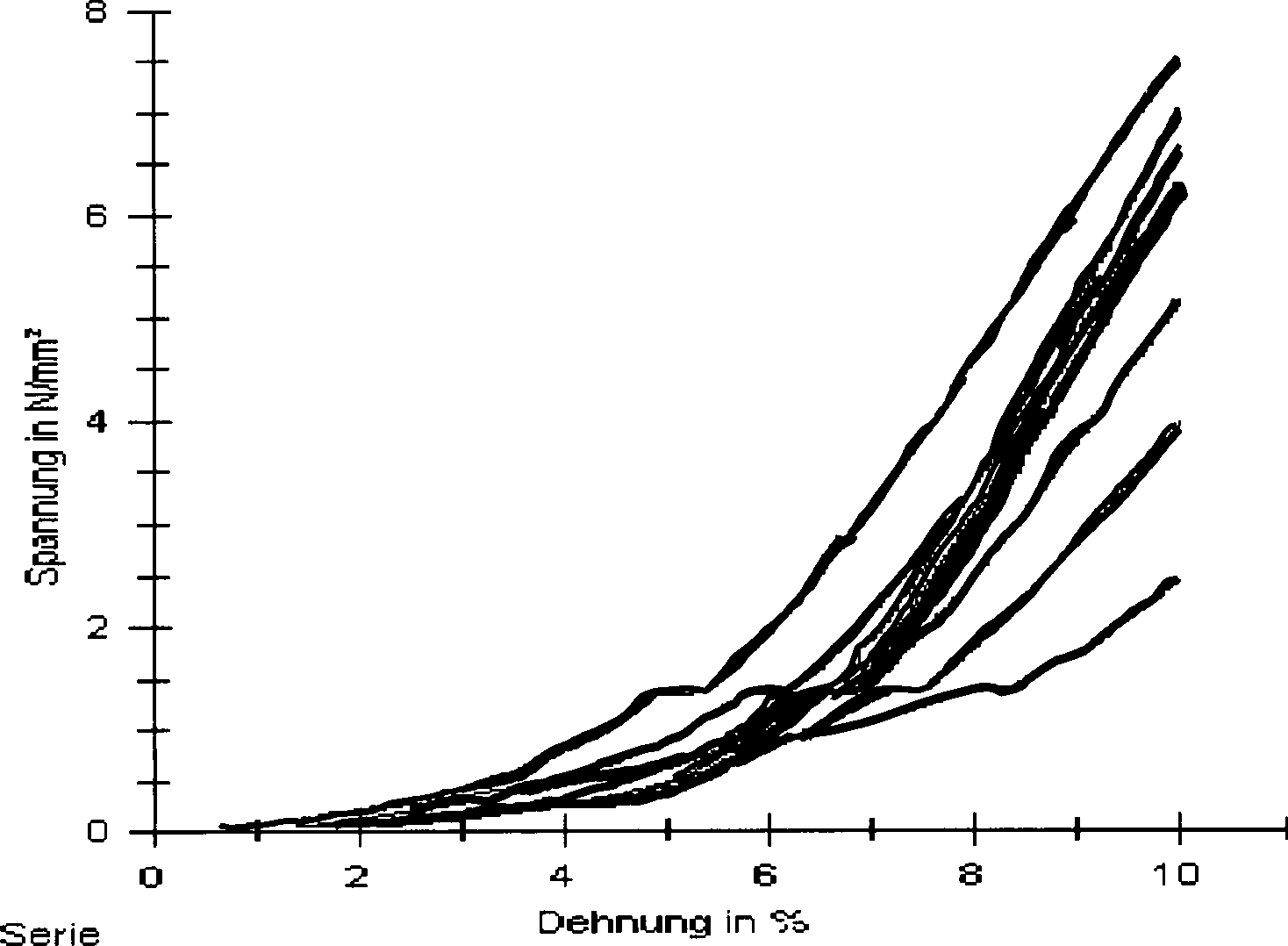
Die
Beispiel 1:Example 1:
Mit dem erfindungsgemäßen Verfahren soll auf die innere Oberfläche eines aus 2 mm dicken verzinktem Stahlblech bestehenden Abluftkanals mittels einer Zweikomponenten-Spritzanlage ein Schutzsystem aus einem einlagigen Schutzsystem mit einer Schichtdicke von 400 μm ohne irgendeine Vorbereitung der Oberfläche aufgebracht werden. Die Oberfläche des Stahlblechs ist verarbeitungsbedingt beidseitig mit einem dünnen Film aus anhaftenden Öl von geringer Dicke beschichtet. Der aufgebrachte Ölfilm besteht regelmäßig aus leichtem Mineralöl mit Kohlenwasserstoff-Ketten unterschiedlicher Länge. Die Beschichtungsmenge beträgt ca. 0,7 g/m2 bei leichter Verölunng und 1,2 g/m2 bei üblicher Verölung. Dies entspricht etwa einer Ölschichtdicke von ungefähr 0,09 bis 0,15 μm. Der mittlere Rauwert Ra der zu beschichtenden Oberfläche erreicht Werte von 0,6 bis 1,9 μm.With the method according to the invention, a protective system consisting of a single-layer protection system with a layer thickness of 400 μm should be applied to the inner surface of a 2 mm thick galvanized steel sheet by means of a two-component spray system without any preparation of the surface. The surface of the steel sheet is due to processing coated on both sides with a thin film of adhering oil of small thickness. The applied oil film is usually made of light mineral oil with hydrocarbon chains of different lengths. The coating amount is about 0.7 g / m 2 with slight Verölunng and 1.2 g / m 2 in conventional oiling. This corresponds approximately to an oil layer thickness of about 0.09 to 0.15 microns. The average roughness Ra of the surface to be coated reaches values of 0.6 to 1.9 μm.
Bei der Ausführung des erfindungsgemäßen Verfahrens kommt eine Formulierung zur Anwendung, die sich aus den nachfolgend näher beschriebenen Komponenten A und B zusammensetzt.at the execution the method according to the invention A formulation is used which is made up of the following described in more detail Components A and B composed.
Die Komponente A enthält 31,0 Gew.-% Bisphenol A-(epichlorhydrin) mit einem mittleren Molekulargewicht von ≤ 700, 11,0 Gew.-% Bisphenol F-(epichlorhydrin) mit einem mittleren Molekulargewicht ≤ 700, 3,0 Gew.-% Epoxidharz (A/F)addukt mit Phenolharz, 14,0 Gew.-% 6-hexanedioldiglycidether, 3,0 Gew.-% p-tert-Butylphenylglycidylether, 1,0 Gew.-% Polypropylenglykoldiglycidether, 18,0 Gew.-% Quarzmehl, 3,0 Gew.-% Chlorit- Quarz-Glimmer, 5,0 Gew.-% Magnesiumsilikat, 2,0 Gew.-% Magnesiumaluminiumsilikat, 4,0 Gew.-% amorphes Magnesiumsilikathydrat, 2,4 Gew.-% Titandioxid, 0,3 Gew.-% hochdisperse Kieselsäure, 0,7 Gew.-% unbehandelte pyrogene Kieselsäure, 0,1 Gew.-% quaternäre Ammoniumverbindung, 0,5 Gew.-% silikonfreie schaumzerstörende Polymere, 0,2 Gew.-% polyethermodifiziertes Copolymer, 0,1 Gew.-% Dispergieradditiv und 0,7 Gew.-% Benetzungsadditiv.The Component A contains 31.0% by weight of bisphenol A- (epichlorohydrin) having an average molecular weight of ≦ 700, 11.0% by weight bisphenol F- (epichlorohydrin) with an average molecular weight ≤ 700, 3.0 wt .-% epoxy resin (A / F) adduct with phenolic resin, 14.0% by weight of 6-hexanedioldiglycidether, 3.0% by weight p-tert-butylphenyl glycidyl ether, 1.0% by weight of polypropylene glycol diglycidyl ether, 18.0% by weight of quartz powder, 3.0% by weight of chlorite-quartz mica, 5.0% by weight of magnesium silicate, 2.0% by weight of magnesium aluminum silicate, 4.0% by weight of amorphous magnesium silicate hydrate, 2.4% by weight of titanium dioxide, 0.3% by weight of highly disperse silica, 0.7% by weight of untreated fumed silica, 0.1% by weight of quaternary ammonium compound, 0.5% by weight of silicone-free foam-destroying polymers, 0.2% by weight polyether-modified copolymer, 0.1 wt .-% dispersing additive and 0.7 wt% wetting additive.
Die Komponente B beinhaltet als Härter 2,4 Gew.-% eines Adduktes aus Aminen mit Phenolharzen, 8,5 Gew.-% Benzylalkohol, 9,6 Gew.-% Isophorondiamin, 0,8 Gew.-% 3,6-diazaoctanethylendiamin, 0,2 Gew.-% N,N- Dimethyl-1,3-diaminoropan, 0,3 Gew.-% 4,4'-Isopropylidenediphenol, 0,1 Gew.-% 2-piperazin-1-ylethylamin, 2,4 Gew.-% Polyaminoamid, 0,9 Gew.-% p-tert-Butylphenol, 0,4 Gew.-% Trimethylhexamethylendiamin, als Füllstoffe 45,6 Gew.-% Quarzmehl, 15 Gew.-% Magnesiumsilikat, 8 Gew.-% Chlorit-Quarz-Glimmer und 1 Gew.-% Magnesiumaluminiumsilikat und als Additive 0,3 Gew.-% hochdisperse Kieselsäure, 0,5 Gew.-% silikonfreie, schaumzerstörende Polymere, 1,1 Gew.-% unbehandelte pyrogene Kieselsäure, 0,5 Gew.-% Dispergieradditiv und 2,4 Gew.-% Benetzungsadditiv.The Component B contains as a hardener 2.4% by weight of an adduct of amines with phenolic resins, 8.5% by weight Benzyl alcohol, 9.6% by weight isophoronediamine, 0.8% by weight 3,6-diazaoctanethylenediamine, 0.2 % By weight of N, N-dimethyl-1,3-diaminoropane, 0.3% by weight of 4,4'-isopropylidenediphenol, 0.1% by weight of 2-piperazin-1-ylethylamine, 2.4% by weight of polyaminoamide, 0.9% by weight of p-tert-butylphenol, 0.4% by weight of trimethylhexamethylenediamine, as fillers 45.6% by weight of quartz powder, 15% by weight of magnesium silicate, 8% by weight of chlorite-quartz mica, and 1 wt .-% magnesium aluminum silicate and as additives 0.3 wt .-% highly disperse silica, 0.5% by weight of silicone-free, foam-destroying polymers, 1.1% by weight untreated fumed silica, 0.5% by weight of dispersing additive and 2.4% by weight of wetting additive.
Das Mischungsverhältnis von Komponente A zu B für das aufzubringende Gemisch beträgt 1:1 Volumenteile. Das so formulierte Gemisch wird auf die leicht verölte innere Metallfläche des Abluftkanals gleichmäßig bis zu einer Dicke von 400 μm aufgespritzt und dort zur Reaktion gebracht. Es bildet mit dem auf der Metallfläche abgeschiedenen Ölfilm eine innige gemeinsame Schicht, bei der völlig überraschend die Bestandteile des Öls während der Reaktionsphase in die Polymermatrix eingebaut und gebunden werden. Dadurch kann das Öl auf der Oberfläche nicht mehr trennend wirken, sondern es entsteht ein unmittelbarer Haftkontakt zur Metalloberfläche. Die Harz-Härter-Kombination bewirkt darüber hinaus mit ihrem Polyamino-Bestandteilen eine Kontakthaftung auch zu nichtporigen Oberflächen. Die zugegebenen Additive erzielen eine Herabsetzung der Oberflächenspannung, so dass eine effektive Wechselwirkung zwischen dem Schutzsystem und der Metalloberfläche stattfinden kann. Nicht in die Polymermatrix eingebundene Gruppen wie Aminogruppen aus der Härterformulierung oder Oxirangruppen aus dem Epoxidharz bzw. den Reaktivverdünnern bewirken ebenso eine Wechselwirkung zur Metalloberfläche. Diese verschiedenen Effekte wirken synergistisch zusammen und führen zu der völlig überraschenden Eigenschaft einer nicht für möglich gehaltenen Haftfestigkeit auf verölten Metalloberflächen. Es können die aufwändigen Entfettungsarbeiten und eine weitere Oberflächenvorbereitungen entfallen.The mixing ratio from component A to B for the mixture to be applied is 1: 1 parts by volume. The thus formulated mixture is easy on the oily inner metal surface the exhaust duct evenly until to a thickness of 400 microns sprayed on and reacted there. It trains with that the metal surface separated oil film an intimate common layer, in which the ingredients are completely surprising of the oil while the reaction phase are incorporated and bound in the polymer matrix. This can make the oil on the surface no longer divide, but it creates an immediate Adhesive contact to the metal surface. The resin-hardener combination causes beyond that with their polyamino constituents a contact adhesion also to non-porous Surfaces. The added additives achieve a lowering of the surface tension, allowing an effective interaction between the protection system and the metal surface can take place. Non-polymer-incorporated groups such as amino groups from the hardener formulation or oxirane groups from the epoxy resin or the reactive diluents as well as an interaction with the metal surface. These different effects work together synergistically and lead to the completely surprising Property of not for possible held adhesion on oily metal surfaces. It can the elaborate ones Degreasing and a further surface preparations omitted.
Durch die Kombination von Öl mit dem formulierten Gemisch entsteht ein einlagiges Schutzsystem, das trotz seiner geringen Auftragsdicke von nur 400 μm bei ursprünglich beibehaltener Rauheit der Metalloberfläche eine äußerst hohe Haftfestigkeit zwischen 7,0 und 11,0 N/mm2 unter dynamischer Beanspruchung, hohe Chemiekalienbeständigkeit und Abriebfestigkeit erreicht.The combination of oil with the formulated mixture results in a single-layer protection system which, despite its low application thickness of only 400 μm with originally maintained roughness of the metal surface, has an extremely high adhesive strength between 7.0 and 11.0 N / mm 2 under dynamic load, high Chemical resistance and abrasion resistance achieved.
Die
Hochdruckstrahlversuche mit Kaltwasser bei Druck zwischen 150 und 1600 bar ergaben selbst bei rotierendem Wasserstrahl kein Hinterwandern des aufgetragenen einlagigen Schutzsystems.High-pressure blasting experiments with cold water at Pressure between 150 and 1600 bar, even with a rotating jet of water, did not result in any rearward migration of the applied single-layer protection system.
Das einlagige Schutzsystem ist gegenüber Säuren, beispielsweise Salzsäure, Schwefelsäure Phosphorsäure, Essigsäure, Laugen wie Natronlauge, Lösungsmittel beispielsweise Benzin, Butylacetat, Butyldiglykolacetat, i-Propanol, Toluol sicher beständig.The single-layer protection system is against acids, for example Hydrochloric acid, Sulfuric acid phosphoric acid, acetic acid, alkalis such as caustic soda, solvent for example, gasoline, butyl acetate, butyl diglycol acetate, i-propanol, toluene safe resistant.
Hochspannungsisolationsprüfungen am erfindungsgemäßen Schutzsystem haben über den gesamten geprüften Oberflächenbereich eine Durchschlagsicherheit bis mindestens 25 kV auch bei Einwirkung von elektrolytischen Flüssigkeiten ergeben.High voltage insulation tests on Protection system according to the invention have over the whole tested surface area a breakdown safety up to at least 25 kV even under the influence of electrolytic liquids result.
Beispiel 2Example 2
Auf die leicht verölte, innere Oberfläche eines Abluftkanals aus verzinktem Stahlblech soll mit dem erfindungsgemäßen Verfahren ein zweilagiges Schutzsystem nacheinander durch Rollen aufgebracht werden. Das zweilagige Schutzsystem umfasst als erste Lage eine elastische Haftschicht, die auf die Oberfläche des unbehandelten, leicht verölten verzinkten Stahlblechs aufgetragen wird. Die Dicke der ersten Lage soll mindestens 300 μm betragen. Die Formulierung für die erste Lage besteht aus zwei Komponenten, C1 und D1, die nachfolgend näher erläutert werden.On the slightly oily, inner surface an exhaust duct made of galvanized sheet steel to the process of the invention a two-layer protection system applied successively by rolling become. The two-layer protection system comprises a first layer elastic adhesive layer on the surface of the untreated, light oily galvanized steel sheet is applied. The thickness of the first layer should be at least 300 μm be. The wording for the first layer consists of two components, C1 and D1, below be explained in more detail.
Die Ausgangsmaterialien für die Komponente C1 sind: ein Epoxidharzgemisch aus 23,0 Gew.-% eines aus Bisphenol-A-(epichlorhydrin) und 9,0 Gew.-% Bisphenol-F-(epichlrohydrin) jeweils mit einem mittleren Molekulargewicht ≤ 700, 0,8 Gew.-% Propylencarbonat, ein Verdünnergemisch aus 8,0 Gew.-% 1,6-hexane-dioldiglycidether, 3,0 Gew.-% Glycidylether, ein Füllstoffgemisch aus 25,1 Gew.-% Quarzmehl, 3,0 Gew.-% Chlorit-Quarz-Glimmer, 10,0 Gew.-% Magnesiumsilikate, 3,0 Gew.-% Magnesiumaluminiumsilikat und 10,0 Gew.-% Titandioxid und ein Additivgemisch aus 0,5 Gew.-% hochdisperse Kieselsäure, 2,0 Gew.-% unbehandelte pyrogene Kieselsäure, 1,5 Gew.-% quaternäre Ammoniumverbindung, 0,2 Gew.-% silikonfreie Lösung schaumzerstörender Polymere, 0,4 Gew.-% polyethermodifiziertes Copolymer, 0,2 Gew.-% Dispergieradditiv und 0,3 Gew.-% Benetzungsadditiv.The Starting materials for the component C1 is: an epoxy resin mixture of 23.0 wt .-% of a from bisphenol-A- (epichlorohydrin) and 9.0% by weight bisphenol F- (epichlorohydrin), each with a middle one Molecular weight ≤ 700, 0.8% by weight of propylene carbonate, a thinner mixture of 8.0% by weight 1,6-hexane-dioldiglycidether, 3.0% by weight glycidyl ether, a filler mixture of 25.1% by weight of quartz powder, 3.0% by weight of chlorite-quartz mica, 10.0% by weight Magnesium silicates, 3.0% by weight magnesium aluminum silicate and 10.0 Wt .-% titanium dioxide and an additive mixture of 0.5 wt .-% highly dispersed silica, 2.0% by weight of untreated fumed silica, 1.5% by weight of quaternary ammonium compound, 0.2% by weight silicone-free solution foam destroying Polymers, 0.4% by weight of polyether-modified copolymer, 0.2% by weight Dispersing additive and 0.3 wt .-% wetting additive.
Die Komponente D1 umfasst eine Formulierung aus 2,4,6-Tri-(dimethylaminomethylphenol), 9,5 Gew.-% Benzylalkohol, 9,5 Gew.-% Isophorondiamin, 3,6-diazaoctanethylenediamin, 2,4 Gew.-% N,N-Dimethyl-1,3-diaminoropan, 25,0 Gew.-% 2-piperazin-1-ylethylamine, 10,0 Gew.-% Polyetheramin, 2,3 Gew.-% m-Xylilendiamin, 25,0 Gew.-% Polyaminoamid, 2,1 Gew.-% p-tert-Butylphenol, 2,0 Gew.-% Trimethylhexamethylendiamin, 0,5 Gew.-% silikonfreie schaumzerstörende Polymere, 0,2 Gew.-% Benetzungsadditiv und 6,7 Gew.-% eines Adduktes aus Aminen mit Phenolharzen.The Component D1 comprises a formulation of 2,4,6-tris (dimethylaminomethylphenol), 9.5% by weight of benzyl alcohol, 9.5% by weight of isophoronediamine, 3,6-diazaoctanethylenediamine, 2.4% by weight of N, N-dimethyl-1,3-diaminoropane, 25.0% by weight of 2-piperazin-1-ylethylamine, 10.0% by weight of polyetheramine, 2.3 % By weight of m-xylenediamine, 25.0% by weight of polyaminoamide, 2.1% by weight of p-tert-butylphenol, 2.0% by weight of trimethylhexamethylenediamine, 0.5% by weight of silicone-free foam killing Polymers, 0.2 wt .-% wetting additive and 6.7 wt .-% of an adduct from amines with phenolic resins.
Das Mischungsverhältnis der Komponenten C1 zu D1 beträgt 5:1 Gewichtsteile. Das so vorbereitete Gemisch wird bei Temperaturen von 20°C mittels Rollen auf die leicht verölte Metalloberfläche aufgetragen und zur Reaktion gebracht. Die Kohlenstoffverbindungen der Ölschicht werden vom Gemisch aufgenommen und gebunden, so dass eine gemeinsame Haftbrücke zur Metalloberfläche erhalten wird, die insbesondere bei flatternden bzw. ein- oder ausbeulenden Wänden der Abluftkanäle eine ausgezeichnete Haftfestigkeit erreicht. Die erzielte Haftfestigkeit betrug durchschnittlich 7,63 N/mm2.The mixing ratio of components C1 to D1 is 5: 1 parts by weight. The thus prepared mixture is applied at temperatures of 20 ° C by means of rollers on the slightly oiled metal surface and reacted. The carbon compounds of the oil layer are absorbed and bound by the mixture, so that a common bonding bridge to the metal surface is obtained, which achieves excellent adhesive strength, in particular when the walls of the exhaust air ducts flutter or buckle. The adhesion achieved averaged 7.63 N / mm 2 .
Nach Aushärtung der ersten Lage bzw. Haftbrücke wird die zweite Lage als Versiegelungsschicht in einer Dicke von 150 μm auf die erste Lage ebenfalls durch Rollen aufgetragen.To curing the first layer or bonding layer the second layer is used as a sealing layer in a thickness of 150 μm up the first layer also applied by rollers.
Die Formulierung der chemisch beständigen und abrasiv Widerstandsfähigen Siegelschicht besteht ebenso wie die Haftschicht aus zwei Komponenten, C2 und D2. Die Komponente C2 enthält ein Epoxidharzgemisch aus 55,0 Gew.-% eines aus Bisphenol-A-(epichlorhydrin) und 24,0 Gew.-% Bisphenol-F-(epichlrohydrin) jeweils mit einem mittleren Molekulargewicht ≤ 700, ein Verdünnergemisch aus 4,9 Gew.-% Glycidether, 12,0 Gew.-% p-tert-Butylphenylglycidether, 3,0 Gew.-% Polypropylenglykoldiglycidether und ein Additivgemisch aus 0,2 Gew.-% silikonfreie schaumzerstörende Polymere, 0,6 Gew.-% polyethermodifiziertes Copolymer, 0,3 Gew.-% Benetzungsadditiv.The Formulation of chemically resistant and abrasive resistant Sealing layer, like the adhesive layer, consists of two components, C2 and D2. Component C2 contains an epoxy resin mixture 55.0% by weight of bisphenol A (epichlorohydrin) and 24.0% by weight Bisphenol F- (epichlorohydrin) each having an average molecular weight ≤ 700, a Verdünnergemisch of 4.9% by weight of glycidyl ether, 12.0% by weight of p-tert-butylphenyl glycidyl ether, 3.0% by weight of polypropylene glycol diglycidyl ether and an additive mixture of 0.2% by weight of silicone-free foam-destroying polymers, 0.6% by weight of polyether-modified copolymer, 0.3% by weight of wetting additive.
Die Komponente D2 beinhaltet 14,0 Gew.-% Benzylalkohol, 20,0 Gew.-% Isophorondiamin, 8,0 Gew.-% 3,6-diazaoctanethylenediamin, 23,4 Gew.-% m-Xylilendiamin, 9,0 Gew.-% Polyetheramin, 8,0 Gew.-% 4,4'-Isopropylidenediphenol, 2,4 Gew.-% p-tert-Butylphenol, 2,0 Gew.-% Salicylsäure, 9,0 Gew.-% Trimethylhexamethylendiamin, 4,0 Gew.-% adduktierter epoxidgruppenhaltiger Ester und 0,2 Gew.-% Benetzungsadditiv.The Component D2 contains 14.0% by weight of benzyl alcohol, 20.0% by weight Isophoronediamine, 8.0% by weight of 3,6-diazaoctanethylenediamine, 23.4% by weight of m-xylenediamine, 9.0% by weight of polyetheramine, 8.0% by weight 4,4'-isopropylidenediphenol, 2.4% by weight of p-tert-butylphenol, 2.0% by weight of salicylic acid, 9.0% by weight Trimethylhexamethylenediamine, 4.0 wt .-% adducted epoxide group-containing Ester and 0.2 wt.% Wetting additive.
Das Mischungsverhältnis der Komponenten C zu D beträgt 2:1 Volumenteile.The mixing ratio of components C is D. 2: 1 parts by volume.
Die Siegelschicht zeigt selbst nach zweimonatigem Rühren mit Quarzsand mit einer Körnung von 0,1 bis 0,3 mm in Phosphatierlösung bei 60 bis 70°C keinen nennenswerten Abrieb, wobei sogar der Glanz der Schicht erhalten bleibt.The Siegelschicht shows even after two months of stirring with quartz sand with a Grain of 0.1 to 0.3 mm in phosphating solution at 60 to 70 ° C no significant abrasion, even the gloss of the layer remains.
Die mechanischen, chemischen und elektrischen Eigenschaften entsprachen denen des Beispiels 1.The mechanical, chemical and electrical properties those of Example 1.
Das mit erfindungsgemäßen Verfahren aufgebrachte Schutzsystem erfordert einen geringen Wartungsaufwand, lässt sich nutzerfreundlich reinigen und ist gegenüber bekannten Werkstoffen stärker belastbar. Es besitzt eine lange Lebensdauer, ohne dass sich die Eigenschaften wesentlich ändern.The with methods according to the invention applied protection system requires low maintenance, let yourself User-friendly cleaning and is stronger than known materials. It has a long life, without affecting the properties change significantly.
Das Schutzsystem ist einfach verarbeitbar und lässt sich problemlos je nach den Erfordernissen durch Spachteln, Streichen, Rollen oder Spritzen auf die zu schützenden Oberflächen aufbringen. Der Untergrund sollte frei von losen oder trennend wirkenden Substanzen wie Rost oder sonstige Anlaufschichten sein. Die optimalen Verarbeitungstemperaturen liegen bei 20°C.The Protection system is easy to process and can be easily adjusted depending on the requirements by filling, painting, rolling or spraying to be protected surfaces muster. The substrate should be free from loose or separating Substances such as rust or other tarnish layers. The optimal Processing temperatures are 20 ° C.
Mit dem erfindungsgemäßen Schutzsystem ist es möglich, hochwertige Edelstahlbleche wie V2A bzw. V4A, Aluminium- oder Kupferbleche oder Bleche aus deren Legierungen durch verzinkten oder feueraluminierten unlegierten Stahl zu ersetzen. Anwendungen findet das erfindungsgemäße Schutzsystem vor allem im Anlagenbau, beispielsweise in Lüftungskanälen für Lackieranlagen, die nach dem Sprühverfahren arbeiten.With the protection system according to the invention it is possible high-quality stainless steel sheets such as V2A or V4A, aluminum or copper sheets or sheets of their alloys by galvanized or fire-aluminised to replace unalloyed steel. Applications find the protection system according to the invention especially in plant engineering, for example, in ventilation ducts for paint shops, according to the spray process work.
Weitere Einsatzgebiete des erfindungsgemäßen Schichtsystems sind der Schutz von dynamisch beanspruchten Metallteilen vor chemisch aggressiven und/oder abrasiven Medien in bestehenden Anlagen, deren Sanierung und Abdichtung.Further Fields of application of the layer system according to the invention are the protection of dynamically stressed metal parts from chemical aggressive and / or abrasive media in existing facilities whose Renovation and sealing.
Die exzellenten elektrischen Eigenschaften des erfindungsgemäßen Schutzsystems ermöglichen des Weiteren den Einsatz als Beschichtungsmasse zum Schutz von metallischen Behältern, beispielsweise Tauchbecken für die kathodische Tauchlackierung, oder den Einsatz als Metallklebstoff.The excellent electrical properties of the protection system according to the invention enable Furthermore, the use as a coating material for the protection of metallic containers For example, plunge pool for the cathodic dip coating, or use as a metal adhesive.
Claims (18)
Priority Applications (1)
| Application Number | Priority Date | Filing Date | Title |
|---|---|---|---|
| DE102007020552A DE102007020552B4 (en) | 2006-05-05 | 2007-04-25 | Method of protecting dynamically exposed surfaces and coating therefor |
Applications Claiming Priority (3)
| Application Number | Priority Date | Filing Date | Title |
|---|---|---|---|
| DE102006022043.9 | 2006-05-05 | ||
| DE102006022043 | 2006-05-05 | ||
| DE102007020552A DE102007020552B4 (en) | 2006-05-05 | 2007-04-25 | Method of protecting dynamically exposed surfaces and coating therefor |
Publications (2)
| Publication Number | Publication Date |
|---|---|
| DE102007020552A1 DE102007020552A1 (en) | 2008-01-17 |
| DE102007020552B4 true DE102007020552B4 (en) | 2009-04-02 |
Family
ID=38825419
Family Applications (1)
| Application Number | Title | Priority Date | Filing Date |
|---|---|---|---|
| DE102007020552A Expired - Fee Related DE102007020552B4 (en) | 2006-05-05 | 2007-04-25 | Method of protecting dynamically exposed surfaces and coating therefor |
Country Status (1)
| Country | Link |
|---|---|
| DE (1) | DE102007020552B4 (en) |
Families Citing this family (4)
| Publication number | Priority date | Publication date | Assignee | Title |
|---|---|---|---|---|
| ES2647563T3 (en) * | 2008-07-04 | 2017-12-22 | Tata Steel Uk Limited | Method for coating a steel substrate and coated steel substrate |
| DE202012104510U1 (en) | 2012-11-21 | 2013-01-17 | Eurotec Vertriebsgesellschaft M.B.H. | Entfettungsmischung |
| CN112538309B (en) * | 2020-11-12 | 2022-03-11 | 浙江机电职业技术学院 | Wear-resistant anti-seismic coating and preparation method thereof |
| CN114437506B (en) * | 2022-02-17 | 2023-06-27 | 深圳市普颂电子有限公司 | Manufacturing method of magnetic sensor-free detection component |
Citations (4)
| Publication number | Priority date | Publication date | Assignee | Title |
|---|---|---|---|---|
| DE4410786A1 (en) * | 1994-03-28 | 1995-10-05 | Hoechst Ag | Elastic epoxy resin hardener system |
| DE10300459A1 (en) * | 2003-01-07 | 2004-07-22 | Sgl Acotec Gmbh | Electrically conductive floor coatings |
| US20050143496A1 (en) * | 2003-12-09 | 2005-06-30 | Mathias Mueller | Adhesives for car body assembly |
| DE102004024439A1 (en) * | 2004-05-14 | 2005-12-08 | Degussa Ag | Curable compositions based on epoxy resins and 3 (4) - (aminomethyl) -cyclohexanepropanamine and 1,4 (5) -cyclooctanedimethanamine |
-
2007
- 2007-04-25 DE DE102007020552A patent/DE102007020552B4/en not_active Expired - Fee Related
Patent Citations (4)
| Publication number | Priority date | Publication date | Assignee | Title |
|---|---|---|---|---|
| DE4410786A1 (en) * | 1994-03-28 | 1995-10-05 | Hoechst Ag | Elastic epoxy resin hardener system |
| DE10300459A1 (en) * | 2003-01-07 | 2004-07-22 | Sgl Acotec Gmbh | Electrically conductive floor coatings |
| US20050143496A1 (en) * | 2003-12-09 | 2005-06-30 | Mathias Mueller | Adhesives for car body assembly |
| DE102004024439A1 (en) * | 2004-05-14 | 2005-12-08 | Degussa Ag | Curable compositions based on epoxy resins and 3 (4) - (aminomethyl) -cyclohexanepropanamine and 1,4 (5) -cyclooctanedimethanamine |
Also Published As
| Publication number | Publication date |
|---|---|
| DE102007020552A1 (en) | 2008-01-17 |
Similar Documents
| Publication | Publication Date | Title |
|---|---|---|
| EP1280865B1 (en) | Conductive organic coatings | |
| KR100910983B1 (en) | Eco-friendly anticorrosive coating method for steel and steel structures | |
| JP6916350B1 (en) | Paint composition and coating | |
| DE4314359A1 (en) | Corrosion-resistant aqueous primer for adhesive bonds | |
| EP1852479B1 (en) | Method for protecting dynamically loaded surfaces and coating therefor | |
| KR19990044090A (en) | One-component epoxy resin composition, one-component anticorrosive coating composition and coating method using them | |
| DE2353701C3 (en) | Zinc dust primer system for malleable sheet steel | |
| JP2018053028A (en) | Two-component reaction-curable aqueous coating composition for undercoat coating, multilayer film forming method using the same, and coated body | |
| CN108359348A (en) | A kind of diethanol amine modified epoxy resin emulsion, preparation method and applications | |
| DE102006062500A1 (en) | Anticorrosion composition for coating metal surfaces comprises a crosslinkable polyester resin binder and aluminum flakes | |
| EP2198982B1 (en) | Anti-corrosion system for coating metal surfaces and method for its production | |
| KR102383644B1 (en) | Steel Surface Paint Coating Method Using Water-Soluble Epoxy And Urethane Paint Composition | |
| DE69919340T2 (en) | COATING COMPOSITIONS AND METHODS | |
| DE102007020552A1 (en) | Protection of air canal surface made of e.g. steel, comprises applying a solvent-free mixture from epoxy resin in bisphenol A and/or bisphenol F-base, glycidyl ether, curing agent, filler and additive on the surface; and heating | |
| KR102298842B1 (en) | Coating method using water-based coating material with excellent compatability with solvelt-based coating film and eco-friendly heavy duty coating film manufactured therefrom | |
| DE102007020822A1 (en) | Double-layered solvent-poor organic anticorrosion system for metal surfaces for the application in towers for stainless steel wind energy tower for industrial plant, comprises base coating having two component epoxy resin coating material | |
| DE69922020T2 (en) | Environmentally friendly solvent composition for cleaning and cleaning process | |
| DE2726269C3 (en) | New epoxy resin emulsion and its use for corrosion protection | |
| DE202016004386U1 (en) | Coating system for rehabilitating cracks and dynamically and mechanically exposed to chemically aggressive liquids | |
| JP2000144046A (en) | Modified epoxy resin-based coating composition | |
| DE4137590A1 (en) | BASE COATING AGENT FOR STEEL SURFACES | |
| JP6494389B2 (en) | Polyurethane resin heavy-duty anti-corrosion coated steel with room temperature painted epoxy primer | |
| DE2848720C2 (en) | ||
| DE102017217070B3 (en) | Paint composition for a spray paint, its use and workpiece | |
| EP3272725B1 (en) | Coating system and method for bridging cracks induced by dynamic and/or mechanical stress |
Legal Events
| Date | Code | Title | Description |
|---|---|---|---|
| OP8 | Request for examination as to paragraph 44 patent law | ||
| 8364 | No opposition during term of opposition | ||
| R082 | Change of representative | ||
| R119 | Application deemed withdrawn, or ip right lapsed, due to non-payment of renewal fee |