SUMMERY OF THE UTILITY MODEL
In view of this, the utility model aims at providing an automatic equipment of rolling up of cloth.
In order to solve the technical problem, the technical scheme of the utility model is that:
an automatic cloth rolling device comprises a cloth guide frame and a rolling table arranged on the front side of the cloth guide frame and used for rolling cloth, wherein two vertically arranged linear motion modules are fixedly connected to two sides of the side wall of the rolling table far away from one side of the cloth guide frame; a slide rail driven by the two linear motion modules to move up and down is arranged between the two linear motion modules; and two supporting arms for supporting the winding roller are arranged on the sliding rail, wherein the two supporting arms are slidably arranged on the sliding rail.
Further, the linear motion module comprises an upright post vertically and fixedly mounted on the side wall of the rolling table, a sliding block slidably mounted on the upright post, and a driving assembly for driving the sliding block to move along the height direction of the upright post; the end part of the sliding rail is fixedly arranged on the sliding block.
Furthermore, a sliding groove extending along the height direction of the upright column is formed in the side wall of the upright column; the sliding block is slidably mounted in the sliding groove.
Further, the drive assembly comprises a lead screw rotatably connected in the chute, and a motor fixedly mounted at the top end of the upright post for driving the lead screw to rotate.
Furthermore, the upper part of the supporting arm is downwards sunken to form a groove for placing the winding roller, wherein the side wall of the groove close to one side of the rolling table is of an inclined surface structure inclined towards one side of the rolling table.
Furthermore, a fixing piece is also arranged on the supporting arm; the fixing piece comprises a fastening bolt which is in threaded connection with the lower part of the front side of the supporting arm, wherein the inner end of the fastening bolt penetrates through the supporting arm and is abutted to the sliding rail; the outer end of the fastening bolt is fixedly connected with a rotating handle.
Compare prior art, the utility model has the advantages that:
the utility model discloses a set up the trailing arm to can roll the wind-up roll to the trailing arm after the cloth is rolled up through the wind-up roll, recycle linear motion module and fall the wind-up roll, so that remove the wind-up roll from rolling up the bench.
And the utility model provides a trailing arm is slidable mounting on the slide rail, consequently can adjust the distance between two trailing arms according to the length of wind-up roll, makes it and the length phase-match of wind-up roll.
Detailed Description
The following detailed description of the embodiments of the present invention is made with reference to the accompanying drawings, so that the technical solution of the present invention can be more easily understood and grasped.
Example (b):
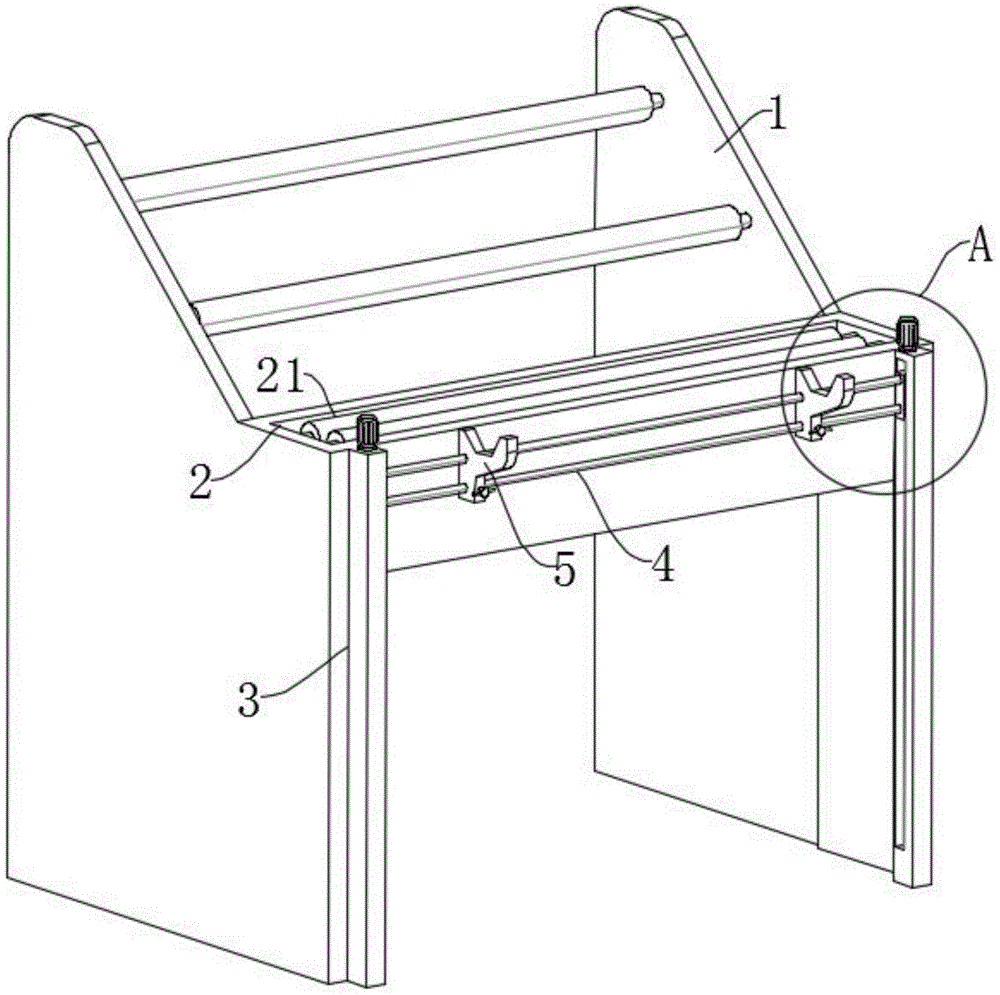
referring to fig. 1, the embodiment provides an automatic cloth rolling device, which includes a cloth guide frame 1 and a rolling table 2 arranged at the front side of the cloth guide frame 1 and used for rolling cloth; the cloth guide frame 1 is mainly used for conveying and guiding cloth; the winding table 2 is mainly used for winding cloth, wherein the winding table 2 mainly comprises two winding rollers 21 arranged side by side, the two winding rollers 21 are driven by a winding motor (not shown in the figure) to rotate in the same direction, when the cloth is wound, the winding rollers (not shown in the figure) for winding the cloth are placed on the two winding rollers 21, and the winding rollers 21 are driven by two hands to rotate to wind the cloth.
Two vertically arranged linear motion modules 3 are fixedly connected to two sides of the side wall of the rolling table 2 far away from one side of the cloth guide frame 1; a slide rail 4 driven by the two linear motion modules 3 to move up/down is arranged between the two linear motion modules 3; the winding roller is characterized in that two supporting arms 5 used for supporting and carrying the winding roller are arranged on the sliding rail 4, wherein the two supporting arms 5 are slidably arranged on the sliding rail 4, and the sliding direction is along the length direction of the sliding rail.
Through the arrangement, after the cloth is wound, the winding roller for winding the cloth can roll to the supporting arm 5, and the linear motion module 3 is reused to lower the winding roller, so that the winding roller on the supporting arm 5 can be detached at the lowered position. Compared with the method of directly conveying the wind-up roll from the rolling platform 2, the scheme of the embodiment is obviously easier.
Moreover, because different winding rollers may have different lengths, the two support arms 5 are slidably mounted on the slide rail 4 in order to adapt to winding rollers with different lengths, so that the distance between the two support arms 5 can be freely adjusted to adapt to the length of the winding rollers.
In this embodiment, referring to fig. 2, the linear motion module 3 includes an upright column 31 vertically and fixedly mounted on the side wall of the rolling table 2, a sliding block 32 slidably mounted on the upright column 31, and a driving assembly 33 for driving the sliding block 32 to move along the height direction of the upright column 31; the end of the slide rail 4 is fixedly mounted on the slide block 32. In this embodiment, the number of the slide rails 4 is two, the two slide rails 4 are horizontally arranged, and two ends of the slide roller 4 are respectively and fixedly connected to the two slide blocks 32.
The side wall of the upright post 31 is provided with a sliding chute 311 extending along the height direction of the upright post 31; the sliding block 32 is slidably mounted in the sliding groove 311, and the sliding groove 311 is mainly used for guiding the sliding block 32 to slide.
The driving assembly 33 includes a screw 332 rotatably connected in the sliding slot 311, and a motor 331 fixedly mounted on the top end of the upright column 31 for driving the screw 332 to rotate, wherein a main shaft of the motor 331 is fixedly connected to an end of the screw 332.
Through the arrangement, when the cloth is rolled to the supporting arm 5, the motor 331 can drive the screw 332 to rotate, so as to drive the sliding block 32 to move downwards, and further drive the sliding rail 4 to move downwards, so that the supporting arm 5 on the sliding rail 4 can lift the rolling roller to move downwards, and the rolling roller can be conveyed to a lower position, so that the rolling roller can be conveniently moved away subsequently.
In this embodiment, the upper portion of the bracket 5 is recessed downward to form a groove 51 for placing the wind-up roll, wherein a side wall of the groove 51 close to one side of the rolling table 2 is in an inclined surface structure inclined toward one side of the rolling table 2. The groove 51 is arranged to prevent the wind-up roll from rolling off the bracket 5, and the groove 51 is provided with an inclined surface structure to facilitate the wind-up roll to roll into the groove 51 from the rolling table 2 along the inclined surface.
In this embodiment, in order to fix the bracket arm 5, a fixing member 6 is further disposed on the bracket arm 5; as shown in fig. 3, the fixing element 6 includes a fastening bolt 61 screwed to the lower portion of the front side of the bracket arm 5, wherein the inner end of the fastening bolt 61 penetrates through the bracket arm 5 and abuts against the slide rail 4; the outer end of the fastening bolt 61 is fixedly connected with a rotating handle 62. The purpose of the stem 62 is to provide a point of application to facilitate rotation of the fastening bolt 61. When the position of the bracket arm 5 needs to be fixed, the fastening bolt 61 can be rotated, so that the inner end of the fastening bolt firmly abuts against the outer wall of the guide rail; when the position of the bracket arm 5 needs to be moved and adjusted, the fastening bolt 61 is loosened firstly, and the bracket arm 5 can be freely slid without the abutting of the fastening bolt 61.
The implementation principle is as follows:
after the cloth is wound by the winding roller, the support arms 5 can be lifted to the flush position of the winding table 2 by the linear motion module 3, then the winding roller is rolled to roll the winding roller onto the two support arms 5, then the linear motion module 3 is controlled to drive the sliding rail 4 to move downwards, so that the support arms 5 on the sliding rail 4 can support the winding roller to move downwards to a lower position together, and the winding roller is convenient to move away.
Above only the typical example of the utility model discloses, in addition, the utility model discloses can also have other multiple concrete implementation manners, all adopt the technical scheme that equivalent replacement or equivalent transform formed, all fall in the utility model discloses the scope of claiming.