CN1218373C - Corrosion Inhibition of Titanium - Google Patents
Corrosion Inhibition of Titanium Download PDFInfo
- Publication number
- CN1218373C CN1218373C CN018080197A CN01808019A CN1218373C CN 1218373 C CN1218373 C CN 1218373C CN 018080197 A CN018080197 A CN 018080197A CN 01808019 A CN01808019 A CN 01808019A CN 1218373 C CN1218373 C CN 1218373C
- Authority
- CN
- China
- Prior art keywords
- composition
- base material
- alkyl
- titanium
- general formula
- Prior art date
- Legal status (The legal status is an assumption and is not a legal conclusion. Google has not performed a legal analysis and makes no representation as to the accuracy of the status listed.)
- Expired - Fee Related
Links
Images

Classifications
-
- H—ELECTRICITY
- H01—ELECTRIC ELEMENTS
- H01L—SEMICONDUCTOR DEVICES NOT COVERED BY CLASS H10
- H01L21/00—Processes or apparatus adapted for the manufacture or treatment of semiconductor or solid state devices or of parts thereof
- H01L21/02—Manufacture or treatment of semiconductor devices or of parts thereof
- H01L21/02041—Cleaning
- H01L21/02057—Cleaning during device manufacture
- H01L21/02068—Cleaning during device manufacture during, before or after processing of conductive layers, e.g. polysilicon or amorphous silicon layers
- H01L21/02071—Cleaning during device manufacture during, before or after processing of conductive layers, e.g. polysilicon or amorphous silicon layers the processing being a delineation, e.g. RIE, of conductive layers
-
- G—PHYSICS
- G03—PHOTOGRAPHY; CINEMATOGRAPHY; ANALOGOUS TECHNIQUES USING WAVES OTHER THAN OPTICAL WAVES; ELECTROGRAPHY; HOLOGRAPHY
- G03F—PHOTOMECHANICAL PRODUCTION OF TEXTURED OR PATTERNED SURFACES, e.g. FOR PRINTING, FOR PROCESSING OF SEMICONDUCTOR DEVICES; MATERIALS THEREFOR; ORIGINALS THEREFOR; APPARATUS SPECIALLY ADAPTED THEREFOR
- G03F7/00—Photomechanical, e.g. photolithographic, production of textured or patterned surfaces, e.g. printing surfaces; Materials therefor, e.g. comprising photoresists; Apparatus specially adapted therefor
- G03F7/26—Processing photosensitive materials; Apparatus therefor
- G03F7/42—Stripping or agents therefor
-
- C—CHEMISTRY; METALLURGY
- C09—DYES; PAINTS; POLISHES; NATURAL RESINS; ADHESIVES; COMPOSITIONS NOT OTHERWISE PROVIDED FOR; APPLICATIONS OF MATERIALS NOT OTHERWISE PROVIDED FOR
- C09D—COATING COMPOSITIONS, e.g. PAINTS, VARNISHES OR LACQUERS; FILLING PASTES; CHEMICAL PAINT OR INK REMOVERS; INKS; CORRECTING FLUIDS; WOODSTAINS; PASTES OR SOLIDS FOR COLOURING OR PRINTING; USE OF MATERIALS THEREFOR
- C09D9/00—Chemical paint or ink removers
-
- G—PHYSICS
- G03—PHOTOGRAPHY; CINEMATOGRAPHY; ANALOGOUS TECHNIQUES USING WAVES OTHER THAN OPTICAL WAVES; ELECTROGRAPHY; HOLOGRAPHY
- G03F—PHOTOMECHANICAL PRODUCTION OF TEXTURED OR PATTERNED SURFACES, e.g. FOR PRINTING, FOR PROCESSING OF SEMICONDUCTOR DEVICES; MATERIALS THEREFOR; ORIGINALS THEREFOR; APPARATUS SPECIALLY ADAPTED THEREFOR
- G03F7/00—Photomechanical, e.g. photolithographic, production of textured or patterned surfaces, e.g. printing surfaces; Materials therefor, e.g. comprising photoresists; Apparatus specially adapted therefor
- G03F7/26—Processing photosensitive materials; Apparatus therefor
- G03F7/42—Stripping or agents therefor
- G03F7/422—Stripping or agents therefor using liquids only
- G03F7/425—Stripping or agents therefor using liquids only containing mineral alkaline compounds; containing organic basic compounds, e.g. quaternary ammonium compounds; containing heterocyclic basic compounds containing nitrogen
-
- H—ELECTRICITY
- H01—ELECTRIC ELEMENTS
- H01L—SEMICONDUCTOR DEVICES NOT COVERED BY CLASS H10
- H01L21/00—Processes or apparatus adapted for the manufacture or treatment of semiconductor or solid state devices or of parts thereof
- H01L21/02—Manufacture or treatment of semiconductor devices or of parts thereof
- H01L21/02041—Cleaning
- H01L21/02057—Cleaning during device manufacture
- H01L21/0206—Cleaning during device manufacture during, before or after processing of insulating layers
- H01L21/02063—Cleaning during device manufacture during, before or after processing of insulating layers the processing being the formation of vias or contact holes
-
- H—ELECTRICITY
- H01—ELECTRIC ELEMENTS
- H01L—SEMICONDUCTOR DEVICES NOT COVERED BY CLASS H10
- H01L21/00—Processes or apparatus adapted for the manufacture or treatment of semiconductor or solid state devices or of parts thereof
- H01L21/02—Manufacture or treatment of semiconductor devices or of parts thereof
- H01L21/04—Manufacture or treatment of semiconductor devices or of parts thereof the devices having potential barriers, e.g. a PN junction, depletion layer or carrier concentration layer
- H01L21/18—Manufacture or treatment of semiconductor devices or of parts thereof the devices having potential barriers, e.g. a PN junction, depletion layer or carrier concentration layer the devices having semiconductor bodies comprising elements of Group IV of the Periodic Table or AIIIBV compounds with or without impurities, e.g. doping materials
- H01L21/30—Treatment of semiconductor bodies using processes or apparatus not provided for in groups H01L21/20 - H01L21/26
- H01L21/31—Treatment of semiconductor bodies using processes or apparatus not provided for in groups H01L21/20 - H01L21/26 to form insulating layers thereon, e.g. for masking or by using photolithographic techniques; After treatment of these layers; Selection of materials for these layers
- H01L21/3105—After-treatment
- H01L21/311—Etching the insulating layers by chemical or physical means
- H01L21/31127—Etching organic layers
- H01L21/31133—Etching organic layers by chemical means
- H01L21/31138—Etching organic layers by chemical means by dry-etching
Landscapes
- Engineering & Computer Science (AREA)
- General Physics & Mathematics (AREA)
- Physics & Mathematics (AREA)
- Chemical & Material Sciences (AREA)
- Manufacturing & Machinery (AREA)
- Power Engineering (AREA)
- Microelectronics & Electronic Packaging (AREA)
- Computer Hardware Design (AREA)
- Condensed Matter Physics & Semiconductors (AREA)
- Chemical Kinetics & Catalysis (AREA)
- General Chemical & Material Sciences (AREA)
- Life Sciences & Earth Sciences (AREA)
- Organic Chemistry (AREA)
- Wood Science & Technology (AREA)
- Materials Engineering (AREA)
- Exposure Of Semiconductors, Excluding Electron Or Ion Beam Exposure (AREA)
- Cleaning Or Drying Semiconductors (AREA)
- Detergent Compositions (AREA)
- Photosensitive Polymer And Photoresist Processing (AREA)
- Preventing Corrosion Or Incrustation Of Metals (AREA)
- ing And Chemical Polishing (AREA)
Abstract
Description
技术领域technical field
本发明涉及钛的缓蚀,具体来说,本发明涉及用于钛的缓蚀的化合物、组合物和方法。The present invention relates to corrosion inhibition of titanium, and in particular, the present invention relates to compounds, compositions and methods for corrosion inhibition of titanium.
背景技术Background technique
钛用于半导体结构的金属镀层中。纯钛和钛合金都可以用作防止特定原子电迁移的屏蔽层,和/或作为其它金属表面的抗反射层。由于半导体制造中互连尺寸的减小,从而可以用钛代替铝作为半导体材料的金属镀层,而腐蚀和电解侵蚀是损害互连的主要因素。Titanium is used in the metallization of semiconductor structures. Both pure titanium and titanium alloys can be used as shields against electromigration of specific atoms, and/or as anti-reflection layers on other metal surfaces. Due to the reduction in the size of interconnections in semiconductor manufacturing, titanium can be used instead of aluminum as the metal plating of semiconductor materials, and corrosion and electrolytic erosion are the main factors that damage interconnections.
钛形成表面氧化物薄层,而缓蚀作用与该表面层的保持状况有关。钛是两性金属,其在低的pH值和高的pH值下均易溶解(腐蚀)。发生在中性pH值溶液中的少量腐蚀可使阴极区的pH值降低,并使阳极区的pH值升高。能够减少这种pH值变化的缓冲化学物质可以抑制腐蚀。能和表面氧化物层络合的有机分子不但能抑制裂缝形成,而且能使金属稳定。Titanium forms a thin surface oxide layer, and the corrosion inhibition is related to the maintenance of this surface layer. Titanium is an amphoteric metal that dissolves (corrodes) readily at both low pH and high pH. A small amount of corrosion that occurs in a neutral pH solution lowers the pH in the cathodic zone and raises the pH in the anodic zone. Buffer chemicals that reduce this pH shift can inhibit corrosion. Organic molecules capable of complexing with the surface oxide layer not only inhibit crack formation but also stabilize the metal.
抑制钛的腐蚀非常重要:在0.25μm的工艺中,40nm的结构只有大约100个钛原子的厚度,仅失去少数原子就能对电路的性能和耐久性产生明显的影响。Inhibiting the corrosion of titanium is very important: in the 0.25μm process, the 40nm structure is only about 100 titanium atoms thick, and the loss of only a few atoms can have a significant impact on the performance and durability of the circuit.
因为集成电路的制造变得越来越复杂,装配在硅或其他半导体晶片上的电路元件的尺寸也越来越小,所以要求不断地改进从这些材料上清除光致抗蚀剂、其它聚合物及其所形成的残余物的技术。在基材内部形成图形的制造过程中,光致抗蚀剂和其它聚合物如聚酰亚胺通常要经过离子植入、等离子体刻蚀、活性离子刻蚀或离子研磨。在半导体制造过程中,继上述操作之后,通常还要采用氧的等离子体氧化来清除所述的光致抗蚀剂和其它聚合物。这些高能过程可导致光致抗蚀剂硬化以及在所制作的结构侧壁上形成有机金属化合物及其他残余物。在晶片加工过程中,为了除去阻抗残余物和等离子体刻蚀沉积物,在后金属化(post-metallisation)阶段可以采用含有羟胺的活性剥离剂(stripper)溶液。本申请人的美国专利5279771和5334332公开了适用于这些过程的活性剥离剂溶液的例子。然而,羟胺也会对钛层产生化学作用,从而使钛层腐蚀。As the fabrication of integrated circuits becomes more complex and the dimensions of circuit elements mounted on silicon or other semiconductor wafers shrink, there is a need for continuous improvement in the removal of photoresists, other polymers from these materials and the technology of the resulting residues. Photoresists and other polymers such as polyimide are typically subjected to ion implantation, plasma etching, reactive ion etching, or ion milling during fabrication for patterning within substrates. In semiconductor manufacturing, following the above operations, the photoresist and other polymers are typically removed by plasma oxidation with oxygen. These high-energy processes can lead to photoresist hardening and the formation of organometallic compounds and other residues on the sidewalls of fabricated structures. To remove resist residues and plasma etch deposits during wafer processing, reactive stripper solutions containing hydroxylamine may be used in the post-metallisation stage. Examples of active stripper solutions suitable for these processes are disclosed in the applicant's US Patents 5,279,771 and 5,334,332. However, hydroxylamine also has a chemical effect on the titanium layer, causing the titanium layer to corrode.
此前,将苯磷二酚加入到某种活性剥离剂中用以稳定羟胺,此时发现添加苯磷二酚对钛的腐蚀有抑制作用。尽管苯磷二酚的作用方式还不清楚,但据推测,苯磷二酚通过和该固体结合或通过影响界面的pH值,或是二者兼有,可以降低表面反应活性。Previously, phosphodiphenol was added to an active stripper to stabilize hydroxylamine, and it was found that the addition of phosphodiphenol inhibited the corrosion of titanium. Although the mode of action of phosphodiol is unclear, it is speculated that phosphodiol reduces surface reactivity by binding to the solid or by affecting the pH of the interface, or both.
发明内容Contents of the invention
虽然,苯磷二酚在一定程度上可抑制钛腐蚀,但提供改进的缓蚀剂将更为有利。而且,由于苯磷二酚有毒性,所以人们希望找到它的替代物。于是,在一个首要的实施例中,本发明提供了一种用来清除基材上的阻抗物、聚合物和/或刻蚀残余物的组合物,所述组合物合有羟胺或其衍生物以及至少一种具有如下通式(I)的化合物:Although phosphodiphenols can inhibit titanium corrosion to some extent, it would be more advantageous to provide improved corrosion inhibitors. Moreover, since phosphodiol is toxic, it is desirable to find a substitute for it. Thus, in a first embodiment, the present invention provides a composition for removing resist, polymer and/or etch residues from a substrate, said composition containing hydroxylamine or a derivative thereof And at least one compound with the following general formula (I):
式(I)Formula (I)

其中:in:
R1和R3各自独立地选自H、OH、CO2H、卤素、C1-C3烷基、C1-C3烷氧基或(CH2)nOH,其中n是1,2或3;R2选自C9-C16烷基或C9-C16烷氧基。R 1 and R 3 are each independently selected from H, OH, CO 2 H, halogen, C 1 -C 3 alkyl, C 1 -C 3 alkoxy or (CH 2 ) n OH, wherein n is 1,2 or 3; R 2 is selected from C 9 -C 16 alkyl or C 9 -C 16 alkoxy.
优选地,R2选自C9、C10、C11或C12烷基,或选自C9、C10、C11或C12烷氧基。Preferably, R 2 is selected from C 9 , C 10 , C 11 or C 12 alkyl, or selected from C 9 , C 10 , C 11 or C 12 alkoxy.
根据本发明,在半导体集成电路的制造中,所述组合物作为清除阻抗物质的剥离组合物特别有用。本发明的组合物能够清除的阻抗物质包括阳性光致抗蚀剂,所述光致抗蚀剂包括例如,邻-萘醌二叠氮磺酸酯或含有线型酚醛清漆粘合剂或树脂的胺化物敏化剂。该组合物还可用于清除硬化和未硬化的阻抗聚合物,这些阻抗聚合物包括例如,聚酰亚胺、在等离子体刻蚀过程中在基材上形成的有机金属聚合物、侧壁上的聚合物和金属氧化残余物。According to the present invention, the composition is particularly useful as a stripping composition for removing resistive substances in the manufacture of semiconductor integrated circuits. Resist materials that can be removed by the compositions of the present invention include positive photoresists including, for example, o-naphthoquinone diazide sulfonate or novolac binders or resins. Amine sensitizers. The composition can also be used to remove hardened and unhardened resistive polymers including, for example, polyimides, organometallic polymers formed on substrates during plasma etching, Polymer and metal oxidation residues.
在半导体集成电路的制造中,本发明的组合物还可作为清洗组合物,用来清除刻蚀残余物。In the manufacture of semiconductor integrated circuits, the composition of the present invention can also be used as a cleaning composition for removing etch residues.
适当的基材的例子包括含钛及其合金的金属基材,例如钛/钨、钛/铝、钛/铜、钛/钨/铝、钛/铜/铝、钛/钨/铜和钛/钨/铜/铝合金。所述基材还可包括例如,表层含钛或钛合金的半导体晶片。适当的基材的例子是半导体工业中所熟知的,包括硅、氧化硅、氮化硅、砷化镓以及塑料如聚碳酸酯,所述塑料的表层至少有一部分含钛或钛合金。Examples of suitable substrates include metal substrates containing titanium and its alloys, such as titanium/tungsten, titanium/aluminum, titanium/copper, titanium/tungsten/aluminum, titanium/copper/aluminum, titanium/tungsten/copper and titanium/tungsten Tungsten/copper/aluminum alloy. The substrate may also include, for example, a semiconductor wafer with a surface layer containing titanium or a titanium alloy. Examples of suitable substrates are well known in the semiconductor industry and include silicon, silicon oxide, silicon nitride, gallium arsenide, and plastics, such as polycarbonate, containing titanium or a titanium alloy in at least a portion of the surface layer.
含有具有通式(I)的化合物的本发明的组合物优选自3,4,5-三羟基壬基苯、3,4,5-三羟基癸基苯、3,4,5-三羟基十一烷基苯、3,4,5-三羟基十二烷基苯和3,4,5-三羟基十三烷基苯中的一种或多种。Compositions according to the invention containing compounds of general formula (I) are preferably selected from 3,4,5-trihydroxynonylbenzene, 3,4,5-trihydroxydecylbenzene, 3,4,5-trihydroxydeca One or more of monoalkylbenzene, 3,4,5-trihydroxydodecylbenzene and 3,4,5-trihydroxytridecylbenzene.
所述组合物进而优选地含有溶剂,例如极性溶剂,优选该溶剂易与羟胺相混合。适当的例子包括选自以下物质中一种或多种的溶剂,这些物质包括链烷醇胺、水、二甲亚砜、乙二醇,乙二醇烷基醚,二甘醇烷基醚(例如,二甘醇丁醚)、三甘醇烷基醚(例如,三甘醇丁醚)、丙二醇、丙二醇烷基醚,缩二丙二醇烷基醚(例如,缩二丙二醇乙基醚)、缩三丙二醇烷基醚、N-取代吡咯烷酮(例如,N-甲基-2-吡咯烷酮)、乙二胺、乙三胺、二亚乙基三胺、二甲基甲酰胺和二甲基乙酰胺。最优选的溶剂是链烷醇胺。溶剂的加入增强了该组合物的效果,特别是将其作为清除基材上的阻抗物的剥离剂时。The composition further preferably contains a solvent, such as a polar solvent, preferably the solvent is miscible with hydroxylamine. Suitable examples include solvents selected from one or more of the group consisting of alkanolamines, water, dimethylsulfoxide, ethylene glycol, ethylene glycol alkyl ethers, diethylene glycol alkyl ethers ( For example, diethylene glycol butyl ether), triethylene glycol alkyl ether (for example, triethylene glycol butyl ether), propylene glycol, propylene glycol alkyl ether, dipropylene glycol alkyl ether (for example, dipropylene glycol ethyl ether), Tripropylene glycol alkyl ether, N-substituted pyrrolidone (for example, N-methyl-2-pyrrolidone), ethylenediamine, ethylenetriamine, diethylenetriamine, dimethylformamide and dimethylacetamide. The most preferred solvents are alkanolamines. The addition of a solvent enhances the effectiveness of the composition, especially as a stripper for removing resist from a substrate.
在一个优选实施方案中,所述组合物含有至少5wt%的羟胺,至少10wt%的一种或多种链烷醇胺和总量为0.5-30wt%(优选2-30wt%)的一种或多种具有通式(I)的化合物,以及余量的一种或多种上述溶剂(最优选水和/或二甲亚砜)。更优选地,该组合物含有10-70wt%的羟胺,10-60wt%的一种或多种链烷醇胺,和总量为5-15wt%的一种或多种具有通式(I)的化合物,以及余量的一种或多种上述溶剂(最优选水和/或二甲亚砜)。In a preferred embodiment, the composition contains at least 5% by weight of hydroxylamine, at least 10% by weight of one or more alkanolamines and a total of 0.5-30% by weight (preferably 2-30% by weight) of one or more A plurality of compounds of general formula (I), and the balance of one or more of the above solvents (most preferably water and/or dimethylsulfoxide). More preferably, the composition contains 10-70 wt% of hydroxylamine, 10-60 wt% of one or more alkanolamines, and a total of 5-15 wt% of one or more alkanolamines having the general formula (I) compound, and the balance of one or more of the above solvents (most preferably water and/or dimethyl sulfoxide).
适用于本发明的羟胺有NH2OH结构。这种羟胺可以由Nissin Chemical的商品水溶液(约50wt%)形式方便地得到。也可以用羟胺的衍生物,如羟胺的盐。Hydroxylamines suitable for use in the present invention have the structure NH2OH . Such hydroxylamines are conveniently available from Nissin Chemical as a commercial aqueous solution (about 50% by weight). Derivatives of hydroxylamine, such as salts of hydroxylamine, may also be used.
适用于本发明的链烷醇胺优选易与羟胺相混合并且是水溶性的。因此,本发明所用的链烷醇胺优选具有相对高的沸点,优选75℃或更高。适当的链烷醇胺有伯胺、仲胺或叔胺,且优选单胺、二胺或三胺,更优选单胺。链烷醇胺的醇基优选具有1-6个碳原子,且以直链、支链或环状醇为基础。The alkanolamines suitable for use in the present invention are preferably miscible with hydroxylamine and water soluble. Accordingly, the alkanolamines used in the present invention preferably have a relatively high boiling point, preferably 75°C or higher. Suitable alkanolamines are primary, secondary or tertiary amines, and preferably monoamines, diamines or triamines, more preferably monoamines. The alcohol groups of the alkanolamines preferably have 1 to 6 carbon atoms and are based on linear, branched or cyclic alcohols.
根据本发明,优选的适用于该组合物的链烷醇胺可用化学式表示为:According to the present invention, the preferred alkanolamines suitable for use in the composition can be represented by the chemical formula:
R1R2-N-CH2CH2-O-R3 R 1 R 2 -N-CH 2 CH 2 -OR 3
其中:R1和R2各自独立地是H、CH3、CH3CH2或CH3CH2OH,R3是CH3CH2OH。Wherein: R 1 and R 2 are each independently H, CH 3 , CH 3 CH 2 or CH 3 CH 2 OH, and R 3 is CH 3 CH 2 OH.
适当的链烷醇胺的例子包括单乙醇胺、二乙醇胺、三乙醇胺、叔丁基二乙醇胺、异丙醇胺、二异丙醇胺、2-氨基-1-丙醇、3-氨基-1-丙醇、异丁醇胺、2-(2-氨基乙氧基)乙醇(二甘醇胺)、2-(2-氨基乙氧基)丙醇和1-羟基-2-氨基苯。Examples of suitable alkanolamines include monoethanolamine, diethanolamine, triethanolamine, t-butyldiethanolamine, isopropanolamine, diisopropanolamine, 2-amino-1-propanol, 3-amino-1- Propanol, isobutanolamine, 2-(2-aminoethoxy)ethanol (diethylene glycolamine), 2-(2-aminoethoxy)propanol, and 1-hydroxy-2-aminobenzene.
用作剥离剂溶液的特别优选的组合物由以下物质组成:大约37wt%的羟胺溶液(羟胺和水的重量比为50∶50)构成的溶剂,大约63wt%的二甘醇胺和一种或多种如本文所述的具有通式(I)的化合物,从而得到所述化合物浓度约为0.2M的溶液。A particularly preferred composition for use as a stripper solution consists of about 37% by weight of a hydroxylamine solution (50:50 weight ratio of hydroxylamine to water) as a solvent, about 63% by weight of diglycolamine and one or A plurality of compounds of general formula (I) as described herein, such that a solution having a concentration of said compound of about 0.2M is obtained.
本发明还提供了清除含有钛或钛合金的基材上的阻抗物、聚合物和/或刻蚀残余物的方法,所述方法包括在一定温度下,使该基材与上文所述的组合物接触足够的时间,以清除基材上的阻抗物、聚合物和/或刻蚀残余物。The present invention also provides a method for removing resists, polymers and/or etch residues on a substrate containing titanium or titanium alloy, said method comprising subjecting the substrate to the above-described The composition is contacted for a sufficient time to remove resist, polymer and/or etch residue from the substrate.
优选温度为20-150℃,更优选60-70℃,而接触时间优选2-60分钟,更优选2-20分钟,更优选2-5分钟。这种方法一般在常压下进行。适当的基材已在上文描述,包括例如表层含钛或钛合金的半导体晶片。The preferred temperature is 20-150°C, more preferably 60-70°C, while the contact time is preferably 2-60 minutes, more preferably 2-20 minutes, more preferably 2-5 minutes. This method is generally carried out under normal pressure. Suitable substrates are described above and include, for example, semiconductor wafers with titanium or titanium alloys on top.
所述方法还包括,在基本上清除了基材上的阻抗物、聚合物和/或刻蚀残余物之后,再用适当的清洗组合物清洗基材的步骤。优选的清洗组合物包括一种极性溶剂或pH值为2-5的水溶液。清洗组合物的适当的例子包括异丙醇、N-甲基-2-吡咯烷酮、二甲亚砜、稀柠檬酸和/或稀醋酸。替代地,基材可以用本申请人的国际专利申请(WO9 8/36045)中所述的清洗组合物。这些组合物包括包括单官能团有机酸、双官能团有机酸或三官能团有机酸和缓冲量的四元胺、氢氧化铵、羟胺、羟胺盐、肼或肼盐。该清洗步骤之后可再用水冲洗,优选用去离子水清洗,最后一步是干燥,例如采用蒸汽IPA干燥。The method also includes the step of cleaning the substrate with a suitable cleaning composition after substantially removing the resist, polymer and/or etch residues on the substrate. Preferred cleaning compositions include a polar solvent or an aqueous solution having a pH of 2-5. Suitable examples of cleaning compositions include isopropanol, N-methyl-2-pyrrolidone, dimethylsulfoxide, dilute citric acid and/or dilute acetic acid. Alternatively, the substrate may be cleaned with a cleaning composition as described in the Applicant's International Patent Application (WO98/36045). These compositions include monofunctional organic acids, difunctional organic acids or trifunctional organic acids and buffering amounts of tetraamines, ammonium hydroxide, hydroxylamine, hydroxylamine salts, hydrazine or hydrazine salts. This rinsing step can be followed by rinsing with water, preferably deionized water, followed by drying, eg with steam IPA.
另一方面,本发明提供了一种含钛或钛合金的基材的缓蚀方法,该方法包括使基材与具有如下的通式(I)的一种或多种化合物相接触:In another aspect, the present invention provides a method for inhibiting corrosion of a substrate containing titanium or a titanium alloy, the method comprising contacting the substrate with one or more compounds having the following general formula (I):
式(I)Formula (I)

其中:in:
R1和R3各自独立地选自H、OH、CO2H、卤素、C1-C3烷基、C1-C3烷氧基或(CH2)nOH,其中n是1,2或3;R2选自C9-C16烷基或C9-C16烷氧基。R 1 and R 3 are each independently selected from H, OH, CO 2 H, halogen, C 1 -C 3 alkyl, C 1 -C 3 alkoxy or (CH 2 ) n OH, wherein n is 1,2 or 3; R 2 is selected from C 9 -C 16 alkyl or C 9 -C 16 alkoxy.
优选地,R2选自C9、C10、C11或C12烷基,或选自C9、C10、C11或C12烷氧基。Preferably, R 2 is selected from C 9 , C 10 , C 11 or C 12 alkyl, or selected from C 9 , C 10 , C 11 or C 12 alkoxy.
所述通式(I)的化合物可存在于含羟胺或其衍生物的组合物,或者含有上述溶剂的组合物中。The compound of general formula (I) may be present in a composition containing hydroxylamine or its derivatives, or in a composition containing the above-mentioned solvents.
根据本发明的方法,具有通式(I)的化合物优选自3,4,5-三羟基壬基苯、3,4,5-三羟基癸基苯、3,4,5-三羟基十一烷基苯、3,4,5-三羟基十二烷基苯和3,4,5-三羟基十三烷基苯中的一种或多种。According to the method of the present invention, the compound with general formula (I) is preferably selected from 3,4,5-trihydroxynonylbenzene, 3,4,5-trihydroxydecylbenzene, 3,4,5-trihydroxyundecylbenzene One or more of alkylbenzene, 3,4,5-trihydroxydodecylbenzene and 3,4,5-trihydroxytridecylbenzene.
优选地,本发明方法中的具有通式(I)的化合物是被用作一些组合物的组分,所述组合物含有羟胺或其衍生物,并优选地至少含有一种上述的链烷醇胺。这些用于剥离和清洗的组合物的例子已在上文中描述。适当的基材在上文中也已描述,包括例如表层含有钛或钛合金的半导体晶片。Preferably, the compound of general formula (I) in the process of the invention is used as a component of compositions containing hydroxylamine or derivatives thereof, and preferably at least one of the aforementioned alkanols amine. Examples of such compositions for stripping and cleaning have been described above. Suitable substrates are also described above and include, for example, semiconductor wafers with titanium or titanium alloys on their skins.
本发明还进一步提供了具有如下通式(I)的化合物在剥离剂和清洗组合物中的应用,所述剥离剂和清洗组合物用于清除基材上的阻抗物、聚合物和/或刻蚀残余物,所述基材含有钛或钛合金:The present invention further provides the application of the compound having the following general formula (I) in the stripping agent and the cleaning composition, and the stripping agent and the cleaning composition are used to remove the resist, the polymer and/or the engraving on the substrate. Corrosion residues where the substrate contains titanium or titanium alloys:
式(I)Formula (I)
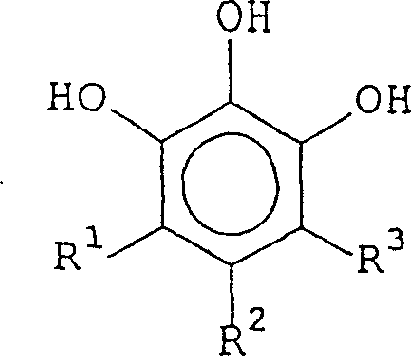
其中:in:
R1和R3各自独立地选自H、OH、CO2H、卤素、C1-C3烷基、C1-C3烷氧基或(CH2)nOH,其中n是1,2或3;R2选自C9-C16烷基或C9-C16烷氧基。R 1 and R 3 are each independently selected from H, OH, CO 2 H, halogen, C 1 -C 3 alkyl, C 1 -C 3 alkoxy or (CH 2 ) n OH, wherein n is 1,2 or 3; R 2 is selected from C 9 -C 16 alkyl or C 9 -C 16 alkoxy.
优选地,R2选自C9、C10、C11或C12烷基,或选自C9、C10、C11或C12烷氧基。Preferably, R 2 is selected from C 9 , C 10 , C 11 or C 12 alkyl, or selected from C 9 , C 10 , C 11 or C 12 alkoxy.
在此应用中,具有通式(I)的化合物最优选3,4,5-三羟基壬基苯、3,4,5-三羟基癸基苯、3,4,5-三羟基十一烷基苯、3,4,5-三羟基十二烷基苯和3,4,5-三羟基十三烷基苯中的一种或多种。In this application, the compound of general formula (I) is most preferably 3,4,5-trihydroxynonylbenzene, 3,4,5-trihydroxydecylbenzene, 3,4,5-trihydroxyundecane One or more of phenylbenzene, 3,4,5-trihydroxydodecylbenzene and 3,4,5-trihydroxytridecylbenzene.
本发明还提供了具有如下通式(I)的化合物在剥离剂和清洗组合物中作为缓蚀剂的应用,所述剥离剂和清洗组合物用于清除基材上的阻抗物、聚合物和/或刻蚀残余物,所述基材含钛或钛合金:The present invention also provides the application of the compound having the following general formula (I) as a corrosion inhibitor in a stripper and a cleaning composition, and the stripper and the cleaning composition are used to remove resists, polymers and and/or etch residues, the substrate containing titanium or titanium alloys:
式(I)Formula (I)

其中:in:
R1和R3各自独立地选自H、OH、CO2H、卤素、C1-C3烷基、C1-C3烷氧基或(CH2)nOH,其中n是1,2或3;R2选自C9-C16烷基或C9-C16烷氧基。R 1 and R 3 are each independently selected from H, OH, CO 2 H, halogen, C 1 -C 3 alkyl, C 1 -C 3 alkoxy or (CH 2 ) n OH, wherein n is 1,2 or 3; R 2 is selected from C 9 -C 16 alkyl or C 9 -C 16 alkoxy.
优选地,R2选自C9、C10、C11或C12烷基,或选自C9、C10、C11或C12烷氧基。Preferably, R 2 is selected from C 9 , C 10 , C 11 or C 12 alkyl, or selected from C 9 , C 10 , C 11 or C 12 alkoxy.
在此应用中,具有通式(I)的化合物优选自3,4,5-三羟基壬基苯、3,4,5-三羟基癸基苯、3,4,5-三羟基十一烷基苯、3,4,5-三羟基十二烷基苯和3,4,5-三羟基十三烷基苯中的一种或多种。In this application, the compound of general formula (I) is preferably selected from 3,4,5-trihydroxynonylbenzene, 3,4,5-trihydroxydecylbenzene, 3,4,5-trihydroxyundecane One or more of phenylbenzene, 3,4,5-trihydroxydodecylbenzene and 3,4,5-trihydroxytridecylbenzene.
用于剥离和清洗的组合物的例子已在上文中描述。适当的基材在上文中也已描述,包括例如表层含钛或钛合金的半导体晶片。Examples of compositions for stripping and cleaning have been described above. Suitable substrates are also described above and include, for example, semiconductor wafers with titanium or titanium alloys on their skins.
附图说明Description of drawings
现在将参照下列实验的测试来描述本发明。这些实验涉及到下列附图:The invention will now be described with reference to the following experimental tests. These experiments refer to the following figures:
图1是在腐蚀性溶液(羟胺/二甘醇胺)以及含有缓蚀剂(苯磷二酚)的同样的腐蚀性溶液中钛膜电导系数随接触时间的变化曲线。Figure 1 is a curve of the conductivity of the titanium film as a function of contact time in a corrosive solution (hydroxylamine/diethylene glycol amine) and the same corrosive solution containing a corrosion inhibitor (phenylphosphodiphenol).
图2是缓蚀时间随n-烷基取代的缓蚀剂分子量的变化曲线。Fig. 2 is the change curve of the corrosion inhibition time with the molecular weight of the n-alkyl substituted corrosion inhibitor.
具体实施方式Detailed ways
实施例Example
材料:Material:
钛包覆的晶片取自International Wafer Service,3,4,5-三羟基-n-烷基苯化合物通过如下常规反应路线合成:Titanium-coated wafers were obtained from the International Wafer Service, and 3,4,5-trihydroxy-n-alkylbenzene compounds were synthesized via the following general reaction route:
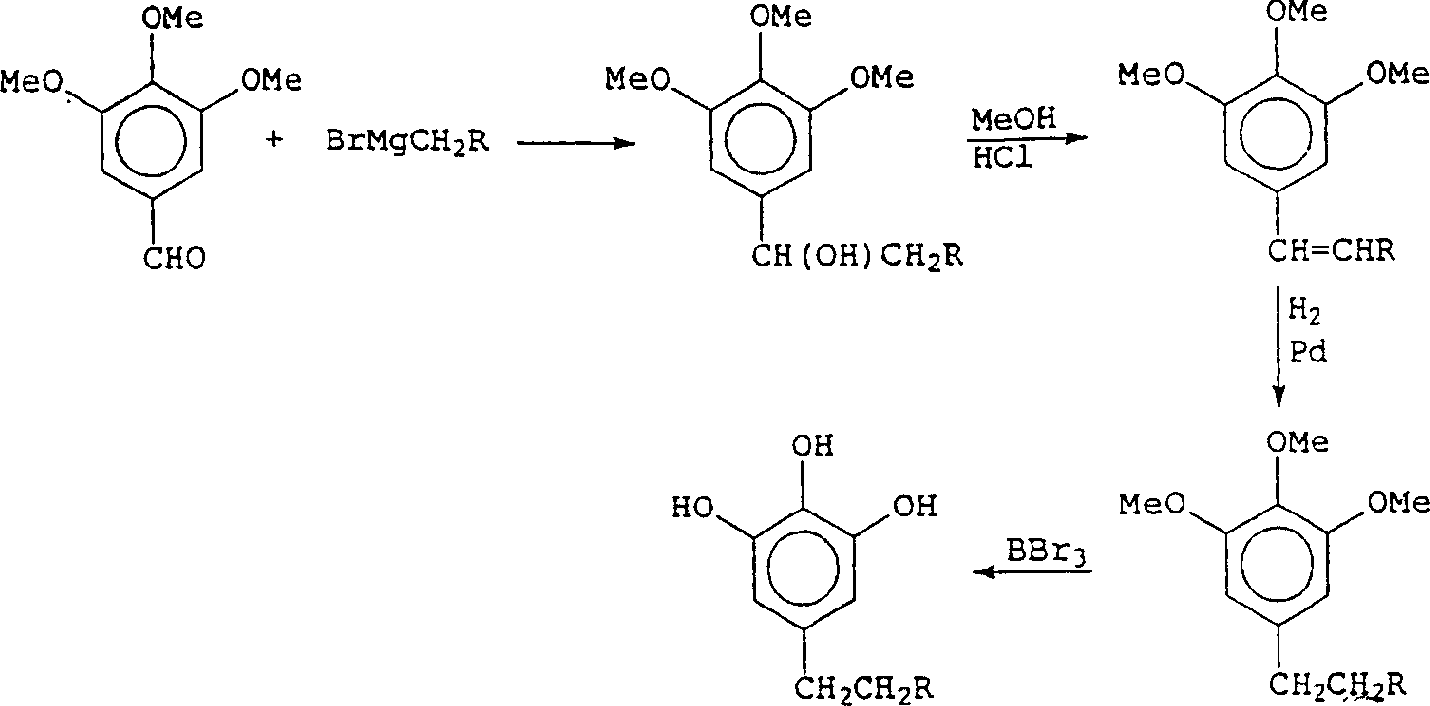
纯化:purification:
所有被检测的缓蚀剂都用原子吸收光谱学中的钙示踪分析。所得钙信号和标准甲醇溶液的钙信号相比较。含钙量过高的缓蚀剂通过离子交换柱(Dowex 50WX8)进行纯化,直到含钙量降至2ppm。All corrosion inhibitors tested were analyzed with calcium tracer in atomic absorption spectroscopy. The obtained calcium signal was compared with that of standard methanol solution. Corrosion inhibitors with excessive calcium content were purified by ion exchange column (Dowex 50WX8) until the calcium content was reduced to 2ppm.
钛膜厚度的测量:Measurement of titanium film thickness:
金属层的厚度和它的传导性有直接关系。所以钛膜的阻抗用4探头探针(Keither2010)测量,且将其传导性作为厚度的一种指标。The thickness of the metal layer is directly related to its conductivity. So the impedance of the titanium film was measured with a 4-probe probe (Keither 2010), and its conductivity was used as an indicator of thickness.
腐蚀研究:Corrosion Studies:
测试中所用的腐蚀溶液由35wt%的羟胺水溶液(羟胺∶水=50∶50)和60wt%的二甘醇胺组成。将作为缓蚀剂的待测化合物以5%w/w的量加入到腐蚀性溶液中。The etching solution used in the test consisted of 35 wt% hydroxylamine aqueous solution (hydroxylamine:water=50:50) and 60 wt% diglycolamine. The compound to be tested as a corrosion inhibitor was added to the corrosive solution in an amount of 5% w/w.
将包覆有200nm钛的多个硅晶片悬放在该腐蚀性溶液中,并且定期取出,以测量钛膜的阻抗。在不含缓蚀剂的腐蚀性溶液中,钛膜的传导性随时间呈直线下降,如图1所示(虚线)。图1还表示出当腐蚀性溶液中加入了5%w/w的苯磷二酚,钛膜传导性的变化作为对照(实线)。可以看出,苯磷二酚延缓了腐蚀的发生。曲线和X-轴的交点坐标表示钛膜被完全腐蚀所用的时间。含有缓蚀剂和不含缓蚀剂的腐蚀性溶液中的钛膜被腐蚀掉所用的时间之差称为缓蚀时间(Δt)。苯磷二酚的缓蚀时间大约是55分钟。该溶液的温度为65℃。用相同的方法测定一系列3,4,5-三羟基-n-烷基苯化合物的缓蚀时间。图2表示了缓蚀时间(分钟)随对于被测试化合物的分子量变化的曲线。A number of silicon wafers coated with 200 nm titanium were suspended in the caustic solution and removed periodically to measure the impedance of the titanium film. In a corrosive solution without corrosion inhibitor, the conductivity of the titanium film decreases linearly with time, as shown in Fig. 1 (dashed line). Figure 1 also shows the change in conductivity of the titanium film when 5% w/w phosphodiol was added to the corrosive solution as a control (solid line). It can be seen that phosphodiphenol delayed the occurrence of corrosion. The coordinates of the intersection of the curve and the X-axis represent the time taken for the titanium film to be completely etched. The difference in the time it takes for the titanium film to be corroded away in corrosive solutions containing and without inhibitors is called the corrosion inhibition time (Δt). The corrosion inhibition time of phosphodiphenol is about 55 minutes. The temperature of the solution was 65°C. The corrosion inhibition time of a series of 3,4,5-trihydroxy-n-alkylbenzene compounds was determined by the same method. Figure 2 shows a graph of corrosion inhibition time (minutes) as a function of molecular weight for the compounds tested.
Claims (26)

Applications Claiming Priority (2)
| Application Number | Priority Date | Filing Date | Title |
|---|---|---|---|
| GB0009112.4 | 2000-04-12 | ||
| GBGB0009112.4A GB0009112D0 (en) | 2000-04-12 | 2000-04-12 | Inhibition of titanium corrosion |
Publications (2)
| Publication Number | Publication Date |
|---|---|
| CN1423835A CN1423835A (en) | 2003-06-11 |
| CN1218373C true CN1218373C (en) | 2005-09-07 |
Family
ID=9889834
Family Applications (1)
| Application Number | Title | Priority Date | Filing Date |
|---|---|---|---|
| CN018080197A Expired - Fee Related CN1218373C (en) | 2000-04-12 | 2001-04-12 | Corrosion Inhibition of Titanium |
Country Status (11)
| Country | Link |
|---|---|
| US (1) | US7012051B2 (en) |
| EP (1) | EP1273033B1 (en) |
| JP (1) | JP2003530482A (en) |
| KR (1) | KR100889094B1 (en) |
| CN (1) | CN1218373C (en) |
| AT (1) | ATE345581T1 (en) |
| AU (1) | AU4855501A (en) |
| DE (1) | DE60124519T2 (en) |
| GB (1) | GB0009112D0 (en) |
| TW (1) | TWI281487B (en) |
| WO (1) | WO2001078129A1 (en) |
Families Citing this family (9)
| Publication number | Priority date | Publication date | Assignee | Title |
|---|---|---|---|---|
| WO2003038529A1 (en) * | 2001-11-02 | 2003-05-08 | Mitsubishi Gas Chemical Company, Inc. | Method for releasing resist |
| MY158776A (en) * | 2009-05-07 | 2016-11-15 | Basf Se | Resist stripping compositions and methods for manufacturing electrical devices |
| JP5159738B2 (en) | 2009-09-24 | 2013-03-13 | 株式会社東芝 | Semiconductor substrate cleaning method and semiconductor substrate cleaning apparatus |
| US8101561B2 (en) | 2009-11-17 | 2012-01-24 | Wai Mun Lee | Composition and method for treating semiconductor substrate surface |
| JP2017197589A (en) * | 2014-09-04 | 2017-11-02 | 横浜油脂工業株式会社 | Peeling agent for ultraviolet-curable paints |
| US10133428B2 (en) | 2015-05-29 | 2018-11-20 | Samsung Display Co., Ltd. | Flexible display device including a flexible substrate having a bending part and a conductive pattern at least partially disposed on the bending part |
| US11175587B2 (en) * | 2017-09-29 | 2021-11-16 | Versum Materials Us, Llc | Stripper solutions and methods of using stripper solutions |
| US11408079B2 (en) | 2019-07-30 | 2022-08-09 | King Fahd University Of Petroleum And Minerals | Corrosion inhibitor composition and methods of inhibiting corrosion during acid pickling |
| CN114930505A (en) * | 2020-01-28 | 2022-08-19 | 富士胶片株式会社 | Treatment liquid and method for treating object to be treated |
Family Cites Families (21)
| Publication number | Priority date | Publication date | Assignee | Title |
|---|---|---|---|---|
| DE3124614A1 (en) * | 1980-06-27 | 1982-05-06 | Amchem Products, Inc., 19002 Ambler, Pa. | CLEANING SOLUTION, METHOD FOR REMOVING IMPURITIES FROM A TIN SURFACE WITH THIS CLEANING SOLUTION, AND CONCENTRATES FOR THIS |
| US5981454A (en) | 1993-06-21 | 1999-11-09 | Ekc Technology, Inc. | Post clean treatment composition comprising an organic acid and hydroxylamine |
| US5279771A (en) | 1990-11-05 | 1994-01-18 | Ekc Technology, Inc. | Stripping compositions comprising hydroxylamine and alkanolamine |
| US6242400B1 (en) | 1990-11-05 | 2001-06-05 | Ekc Technology, Inc. | Method of stripping resists from substrates using hydroxylamine and alkanolamine |
| US6187730B1 (en) | 1990-11-05 | 2001-02-13 | Ekc Technology, Inc. | Hydroxylamine-gallic compound composition and process |
| US7205265B2 (en) | 1990-11-05 | 2007-04-17 | Ekc Technology, Inc. | Cleaning compositions and methods of use thereof |
| US6121217A (en) | 1990-11-05 | 2000-09-19 | Ekc Technology, Inc. | Alkanolamine semiconductor process residue removal composition and process |
| US6000411A (en) | 1990-11-05 | 1999-12-14 | Ekc Technology, Inc. | Cleaning compositions for removing etching residue and method of using |
| US6546939B1 (en) | 1990-11-05 | 2003-04-15 | Ekc Technology, Inc. | Post clean treatment |
| US6492311B2 (en) | 1990-11-05 | 2002-12-10 | Ekc Technology, Inc. | Ethyenediaminetetraacetic acid or its ammonium salt semiconductor process residue removal composition and process |
| US6110881A (en) | 1990-11-05 | 2000-08-29 | Ekc Technology, Inc. | Cleaning solutions including nucleophilic amine compound having reduction and oxidation potentials |
| US20040018949A1 (en) | 1990-11-05 | 2004-01-29 | Wai Mun Lee | Semiconductor process residue removal composition and process |
| JP3048207B2 (en) * | 1992-07-09 | 2000-06-05 | イー.ケー.シー.テクノロジー.インコーポレイテッド | Detergent composition containing nucleophilic amine compound having reduction and oxidation potential and method for cleaning substrate using the same |
| US7144848B2 (en) | 1992-07-09 | 2006-12-05 | Ekc Technology, Inc. | Cleaning compositions containing hydroxylamine derivatives and processes using same for residue removal |
| US20030032567A1 (en) | 1992-07-09 | 2003-02-13 | Ekc Technology, Inc. | Cleaning solutions including nucleophilic amine compound having reduction and oxidation potentials |
| US6825156B2 (en) | 2002-06-06 | 2004-11-30 | Ekc Technology, Inc. | Semiconductor process residue removal composition and process |
| US6326130B1 (en) * | 1993-10-07 | 2001-12-04 | Mallinckrodt Baker, Inc. | Photoresist strippers containing reducing agents to reduce metal corrosion |
| US5654260A (en) * | 1994-01-10 | 1997-08-05 | Phillips Petroleum Company | Corrosion inhibitor for wellbore applications |
| US6323168B1 (en) | 1996-07-03 | 2001-11-27 | Advanced Technology Materials, Inc. | Post plasma ashing wafer cleaning formulation |
| US7534752B2 (en) | 1996-07-03 | 2009-05-19 | Advanced Technology Materials, Inc. | Post plasma ashing wafer cleaning formulation |
| GB2342727A (en) * | 1998-10-12 | 2000-04-19 | Ekc Technology Ltd | Composition to remove resists and tp inhibit titanium corrosion |
-
2000
- 2000-04-12 GB GBGB0009112.4A patent/GB0009112D0/en not_active Ceased
-
2001
- 2001-04-12 CN CN018080197A patent/CN1218373C/en not_active Expired - Fee Related
- 2001-04-12 JP JP2001574886A patent/JP2003530482A/en active Pending
- 2001-04-12 DE DE60124519T patent/DE60124519T2/en not_active Expired - Fee Related
- 2001-04-12 AU AU48555/01A patent/AU4855501A/en not_active Abandoned
- 2001-04-12 US US10/257,469 patent/US7012051B2/en not_active Expired - Fee Related
- 2001-04-12 AT AT01921582T patent/ATE345581T1/en not_active IP Right Cessation
- 2001-04-12 WO PCT/GB2001/001686 patent/WO2001078129A1/en not_active Ceased
- 2001-04-12 KR KR1020027013648A patent/KR100889094B1/en not_active Expired - Fee Related
- 2001-04-12 EP EP01921582A patent/EP1273033B1/en not_active Expired - Lifetime
- 2001-04-16 TW TW090109022A patent/TWI281487B/en not_active IP Right Cessation
Also Published As
| Publication number | Publication date |
|---|---|
| KR20030053470A (en) | 2003-06-28 |
| EP1273033A1 (en) | 2003-01-08 |
| DE60124519T2 (en) | 2007-05-31 |
| ATE345581T1 (en) | 2006-12-15 |
| EP1273033B1 (en) | 2006-11-15 |
| AU4855501A (en) | 2001-10-23 |
| WO2001078129A1 (en) | 2001-10-18 |
| US20040106530A1 (en) | 2004-06-03 |
| CN1423835A (en) | 2003-06-11 |
| TWI281487B (en) | 2007-05-21 |
| GB0009112D0 (en) | 2000-05-31 |
| US7012051B2 (en) | 2006-03-14 |
| KR100889094B1 (en) | 2009-03-17 |
| DE60124519D1 (en) | 2006-12-28 |
| JP2003530482A (en) | 2003-10-14 |
Similar Documents
| Publication | Publication Date | Title |
|---|---|---|
| KR100736061B1 (en) | Noncorrosive cleaning composition for plasma etch residue removal | |
| JP5646882B2 (en) | Cleaning composition, cleaning method, and manufacturing method of semiconductor device | |
| EP2975108B1 (en) | Copper corrosion inhibition system | |
| JP4226216B2 (en) | Stripping composition for semiconductor substrate | |
| US6455479B1 (en) | Stripping composition | |
| EP2098911B1 (en) | Stripper for dry film removal and method using the same | |
| US20030078173A1 (en) | Aqueous cleaning composition containing copper-specific corrosion inhibitor for cleaning inorganic residues on semiconductor substrate | |
| EP1501916B1 (en) | Non-corrosive cleaning compositions for removing etch residues | |
| KR20170137702A (en) | After chemical and mechanical polishing, formulations and methods of use | |
| JP2009102729A (en) | Aqueous stripping and cleaning composition | |
| JP2008066747A (en) | Semiconductor wafer cleaning composition using water ammonium fluoride and amine | |
| CN1916146A (en) | Polymer-stripping composition | |
| KR101831452B1 (en) | Multipurpose acidic, organic solvent based microelectronic cleaning composition | |
| CN1218373C (en) | Corrosion Inhibition of Titanium | |
| CN1784487A (en) | Non-aqueous, non-corrosive microelectronic cleaning compositions | |
| CN101223265A (en) | Stripping agent composition | |
| CN101076760A (en) | Non-aqueous, non-corrosive microelectronic cleaning compositions containing polymeric corrosion inhibitors | |
| CN1924710A (en) | Optical resist clearing agent composition for wiping improved optical resist of semiconductor device | |
| EP1381656A1 (en) | Aqueous cleaning composition containing copper-specific corrosion inhibitor for cleaning inorganic residues on semiconductor substrate | |
| JP2003530482A5 (en) | ||
| TWI296357B (en) | Compositions comprising tannic acid as corrosion inhibitor | |
| JP4028904B2 (en) | Composition of hydroxylamine-gallic compound and method of use | |
| KR20220058069A (en) | Composition for cleaning residue after etching or ashing from semiconductor substrate and cleaning method using same | |
| GB2342727A (en) | Composition to remove resists and tp inhibit titanium corrosion | |
| WO2023140345A1 (en) | Photoresist stripping composition |
Legal Events
| Date | Code | Title | Description |
|---|---|---|---|
| C06 | Publication | ||
| PB01 | Publication | ||
| C10 | Entry into substantive examination | ||
| SE01 | Entry into force of request for substantive examination | ||
| C14 | Grant of patent or utility model | ||
| GR01 | Patent grant | ||
| C17 | Cessation of patent right | ||
| CF01 | Termination of patent right due to non-payment of annual fee |
Granted publication date: 20050907 |