CN1208503C - Platinum Plating Method for Titanium-Based Materials - Google Patents
Platinum Plating Method for Titanium-Based Materials Download PDFInfo
- Publication number
- CN1208503C CN1208503C CN02136737.XA CN02136737A CN1208503C CN 1208503 C CN1208503 C CN 1208503C CN 02136737 A CN02136737 A CN 02136737A CN 1208503 C CN1208503 C CN 1208503C
- Authority
- CN
- China
- Prior art keywords
- titanium
- platinum
- titanium base
- acid
- coating method
- Prior art date
- Legal status (The legal status is an assumption and is not a legal conclusion. Google has not performed a legal analysis and makes no representation as to the accuracy of the status listed.)
- Expired - Lifetime
Links
Landscapes
- Electroplating Methods And Accessories (AREA)
- Electrodes For Compound Or Non-Metal Manufacture (AREA)
Abstract
Description
技术领域technical field
本发明涉及电镀技术领域,特别涉及钛基电镀技术。The invention relates to the field of electroplating technology, in particular to titanium-based electroplating technology.
背景技术Background technique
钛是强氧化元素,只要有空气和水存在,即使在室温下也能迅速形成一层致密的氧化钛。由于氧化钛的存在使钛基工件电镀变得十分困难,在未经特殊处理的钛板上电镀任何金属都很容易剥落。Titanium is a strong oxidizing element, as long as there is air and water, it can quickly form a layer of dense titanium oxide even at room temperature. Due to the presence of titanium oxide, it is very difficult to electroplate titanium-based workpieces, and any metal electroplated on titanium plates without special treatment is easy to peel off.
现有提高镀基与镀铂层结合力的方法如下:The existing methods for improving the bonding force between the base plating and the platinum plating layer are as follows:
(1)喷砂毛化法:在压缩空气的作用下,使砂粒冲撞钛材表面,使钛基粗糙度增加,起到增加钛基和镀层之间的机械结合力的作用。(1) Sand blasting method: Under the action of compressed air, the sand particles collide with the surface of the titanium material, increasing the roughness of the titanium base, and increasing the mechanical bonding force between the titanium base and the coating.
(2)化学毛化:在某种腐蚀液中进行较长时间的反应使钛基表面腐蚀出微小的腐蚀坑,从而起到提高钛基和镀层之间的机械结合力的作用。(2) Chemical texturing: A long-term reaction in a certain corrosive solution causes tiny corrosion pits to be etched on the surface of the titanium base, thereby improving the mechanical bonding force between the titanium base and the coating.
(3)醇(醚)类无水电镀:活化液和电镀液使用不含水的醇或醚类,避免了水和钛直接接触,使钛材表面在电镀前的氧化程度减弱,从而起到提高钛基和镀层之间的结合力的作用。(3) Alcohol (ether) anhydrous electroplating: the activation solution and the electroplating solution use non-aqueous alcohol or ether, which avoids direct contact between water and titanium, and weakens the oxidation degree of the titanium surface before electroplating, thereby improving The role of the bonding force between the titanium base and the coating.
(4)磁控溅射:用贵金属作为靶材,通过溅射方法使钛材表面形成一层铂金属晶核,然后再进行电镀铂,从而起到提高结合力的作用。(4) Magnetron sputtering: Using noble metal as the target material, a layer of platinum metal crystal nucleus is formed on the surface of the titanium material by sputtering method, and then electroplating platinum, so as to improve the binding force.
(5)激光照射:把镀好铂的钛工件在激光的照射下进行重熔处理。从而起到提高结合力的作用。(5) Laser irradiation: The platinum-plated titanium workpiece is remelted under laser irradiation. Thereby playing the role of improving the binding force.
尽管提高钛与镀层之间结合力的方法很多,每种方法在某种程度上也起到一定的作用,但却存在不足。Although there are many ways to improve the binding force between titanium and the coating, each method also plays a certain role to some extent, but there are deficiencies.
1、喷砂毛化法和化学腐蚀毛化法是增加钛基的粗糙度的一种方法,能提高钛基和镀层之间的机械结合力,由于氧化皮仍然存在,钛基表面的性质没有改变,所以未能从根本上解决问题。1. Sandblasting texturing method and chemical corrosion texturing method are a method to increase the roughness of the titanium base, which can improve the mechanical bonding force between the titanium base and the coating. Since the oxide skin still exists, the properties of the titanium base surface are not change, so it failed to fundamentally solve the problem.
2、醇类或醚类无水电镀方法确能减轻钛基表面氧化问题,但醇类和醚类中仍然有一定量的水,氧化的问题无法彻底解决,另外醇和醚都是易燃品,在实际生产中很难实践。2. Alcohol or ether anhydrous electroplating method can indeed reduce the oxidation problem of titanium-based surface, but there is still a certain amount of water in alcohol and ether, and the problem of oxidation cannot be completely solved. In addition, alcohol and ether are flammable products. It is difficult to practice in actual production.
3、磁控溅射是提高钛基与镀层结合力的有效方法,但在磁控溅射中贵金属浪费大,而且很难完成大面积整个面的溅射工作。3. Magnetron sputtering is an effective method to improve the bonding force between titanium base and coating, but in magnetron sputtering, precious metals are wasted a lot, and it is difficult to complete the sputtering work on a large area and the entire surface.
4、激光照射属于镀后处理,能收到明显的效果,但费用很高。4. Laser irradiation belongs to post-plating treatment, which can receive obvious effects, but the cost is very high.
通过以上四点分析可知,尽管提高钛基与镀层之间结合力的研究很多,但未真正解决这一问题,所以要寻找一种既能彻底解决问题,又能降低生产成本的方法。Through the analysis of the above four points, it can be seen that although there are many studies on improving the bonding force between the titanium base and the coating, this problem has not been really solved. Therefore, it is necessary to find a method that can completely solve the problem and reduce production costs.
发明内容Contents of the invention
本发明的目的在于提供一种既能彻底解决上述方法的不足,又能降低生产成本,且钛基工件使用寿命长、铂耗量低的钛基镀铂方法。The object of the present invention is to provide a titanium-based platinum plating method which can completely solve the shortcomings of the above-mentioned methods, reduce production costs, and has a long service life and low platinum consumption for titanium-based workpieces.
为达到上述目的,本发明的技术解决方案是,包括如下步骤:For achieving the above object, technical solution of the present invention is, comprises the steps:
(a)钛的活化处理,以清除氧化钛,但同时会形成一层氢化钛;(a) Activation of titanium to remove titanium oxide but at the same time form a layer of titanium hydride;
(b)氢化钛分解,在晶核沉结液中加入铂液,钛基工件接正电极,使氢化钛分解,氢化钛分解70%~90%;(b) Titanium hydride is decomposed, platinum liquid is added to the crystal nucleus precipitation solution, and the titanium-based workpiece is connected to a positive electrode to decompose titanium hydride, and the titanium hydride is decomposed by 70% to 90%;
(c)晶核沉结,氢化钛分解70%~90%后转换通电方向(钛基镀铂工件接负极,工作阳极接正极),在钛基工件表面形成铂晶核;(c) Crystal nuclei are deposited, titanium hydride is decomposed by 70% to 90%, and then the direction of conduction is switched (the titanium-based platinum-plated workpiece is connected to the negative pole, and the working anode is connected to the positive pole), forming platinum crystal nuclei on the surface of the titanium-based workpiece;
(d)电镀铂,将晶核沉结后的钛基工件进行镀铂。(d) Platinum electroplating, the titanium-based workpiece after crystal nucleus precipitation is subjected to platinum plating.
进一步,步骤(a)中钛活化处理中所使用的酸为5~15%草酸和10~20%硫酸。Further, the acid used in the titanium activation treatment in step (a) is 5-15% oxalic acid and 10-20% sulfuric acid.
所述的步骤(a)~(d)所使用的酸为相同的酸。The acids used in the steps (a) to (d) are the same acids.
其中,步骤(a)中的酸液的加热至沸腾,保持2-3小时;Wherein, the acid solution in step (a) is heated to boiling and kept for 2-3 hours;
步骤(b、c)中晶核沉结液PH值为2-4,含铂量为3-5g/L,温度为60-80℃;In steps (b, c), the pH value of the crystal nucleus precipitation solution is 2-4, the platinum content is 3-5g/L, and the temperature is 60-80°C;
步骤(b)中钛基工件接正极,使氢化钛分解,电流密度为2-4A/dm2,时间1-2分钟;In step (b), the titanium-based workpiece is connected to the positive electrode to decompose the titanium hydride at a current density of 2-4A/dm 2 for 1-2 minutes;
晶核沉结,氢化钛分解70%~90%后转换钛基工件通电方向(反向),电流密度为5-15A/dm2,时间4-8分钟,钛基工件表面形成铂晶核,为下一步电镀铂打下良好的基础。Crystal nuclei settle down, titanium hydride decomposes 70% to 90%, and then the direction of energization of the titanium-based workpiece is changed (reverse), the current density is 5-15A/dm 2 , and the time is 4-8 minutes. Platinum crystal nuclei are formed on the surface of the titanium-based workpiece. Lay a good foundation for the next step of electroplating platinum.
本发明的优点是:The advantages of the present invention are:
1、与普通钛基镀铂相比增加了晶核沉结工艺,晶核沉结必须在一定的温度、一定的酸浓度和一定的电流作用下才能产生,由于铂晶核是直接在钛基体上(而不是氧化钛和氢化钛)生成,所以钛基与镀铂层结合力很高;1. Compared with ordinary titanium-based platinum plating, the crystal nucleus precipitation process is added. The crystal nucleus precipitation must be produced under the action of a certain temperature, a certain acid concentration and a certain current, because the platinum crystal nucleus is directly on the titanium substrate. (instead of titanium oxide and titanium hydride), so the combination of titanium base and platinum coating is very high;
2、现有技术镀铂结合力为10Mpa,最大镀层厚度15μm,本发明电镀的试样结合力达到16Mpa,最大镀层厚度达50μm;2. The bonding force of platinum plating in the prior art is 10Mpa, and the maximum coating thickness is 15 μm. The bonding force of the electroplated sample in the present invention reaches 16Mpa, and the maximum coating thickness reaches 50 μm;
3、用喷砂方法处理的阳极使用寿命为6个月,用化学腐蚀方法处理的阳极使用寿命为8个月,用醇(醚)类无水电镀的阳极使用寿命最多不超过10个月;用磁控溅射和激光照射方法生产的阳极使用寿命长达12个月,但价格要高20%,而用本发明能在基本不增加生产成本的基础上使用寿命长达12-14个月。3. The service life of anodes treated by sandblasting is 6 months, the service life of anodes treated by chemical corrosion is 8 months, and the service life of anodes treated with alcohol (ether) anhydrous electroplating is no more than 10 months; The service life of the anode produced by magnetron sputtering and laser irradiation is as long as 12 months, but the price is 20% higher, and the service life of the present invention can be as long as 12-14 months without increasing the production cost. .
4、由于这种方法的应用,大大降低了铂的耗量,提高了生产效益。4. Due to the application of this method, the consumption of platinum is greatly reduced and the production efficiency is improved.
具体实施方式Detailed ways
本发明所提供的钛基材料镀铂方法,步骤如下:在电镀前钛基工件进行活化处理,使用的酸为5~15%草酸和10~20%硫酸,加热至沸腾,保持2-3小时;后放入晶核沉结电化学槽中,槽中晶核沉结液的PH值为2-4,含铂量为3-5g/L,保温温度为60-80℃;钛基工件接正极(正向),使氢化钛分解,电流密度为2-4A/dm2,时间1-2分钟;氢化钛分解70%~90%,然后转换钛基工件通电方向(反向),提高电流密度到5-15A/dm2,时间4-8分钟;再进行电镀铂。The platinum plating method for titanium-based materials provided by the present invention has the following steps: before electroplating, the titanium-based workpiece is activated, the acid used is 5-15% oxalic acid and 10-20% sulfuric acid, heated to boiling, and kept for 2-3 hours ; Finally, put it into the crystal nucleus precipitation electrochemical tank, the pH value of the crystal nucleus precipitation solution in the tank is 2-4, the platinum content is 3-5g/L, and the heat preservation temperature is 60-80°C; the titanium-based workpiece is connected to Positive pole (forward), decompose titanium hydride, current density is 2-4A/dm 2 , time 1-2 minutes; titanium hydride decomposes 70% to 90%, and then change the direction of energization of titanium-based workpiece (reverse), increase the current The density reaches 5-15A/dm 2 , and the time is 4-8 minutes; then electroplating platinum.
其中,晶核沉结液配制有三大因素:Among them, there are three major factors in the preparation of the crystal nucleus precipitation solution:
①PH值,PH值过低时形成的晶核结合力较差,PH值过高时晶核难形成,所以PH值控制在2-4为宜。①PH value, when the pH value is too low, the crystal nuclei formed have poor binding force, and when the pH value is too high, it is difficult to form crystal nuclei, so the pH value should be controlled at 2-4.
②铂含量,铂含量过低时,晶核难形成;铂含量过高时,形核的晶核是黑铂晶核,所以铂含量在3-5g/L为宜。②Platinum content, when the platinum content is too low, crystal nuclei are difficult to form; when the platinum content is too high, the nucleation nuclei are black platinum nuclei, so the platinum content is preferably 3-5g/L.
③温度,晶核沉结液温度过低时,晶核难形成;过高时,铂化合物易分解,当温度在60-80℃时为宜。③Temperature, when the temperature of the crystal nucleus precipitation solution is too low, the crystal nucleus is difficult to form; when it is too high, the platinum compound is easy to decompose, and the temperature is preferably at 60-80°C.
经大量试验得出:PH值为2-4,铂含量为3-5g/L,温度为60-80℃时,能保证晶核沉结质量,通过镀铂后镀层结合力高。After a large number of tests, it can be concluded that when the pH value is 2-4, the platinum content is 3-5g/L, and the temperature is 60-80°C, the quality of crystal nucleus precipitation can be guaranteed, and the bonding force of the coating after platinum plating is high.
正向电流密度和时间:正向电流密度和时间实际上是根据活化酸处理时氢化钛的厚度来确定的,当氢化钛消除80%时必须立即通反向电流。在本发明规定的酸处理工艺条件下,电流密度为2-4A/dm2,时间1-3分钟为最佳工艺参数。Forward current density and time: The forward current density and time are actually determined according to the thickness of titanium hydride during acid activation. When 80% of titanium hydride is eliminated, reverse current must be passed immediately. Under the acid treatment process conditions specified in the present invention, the current density is 2-4A/dm 2 , and the time is 1-3 minutes as the optimum process parameters.
反向电流密度和时间:反向电流密度和时间实际上是决定晶核的大小和数量,当电流较小时,形成晶核的孕育时间较长,钛工件易氧化,所以需要大电流密度来缩短晶核形成的孕育时间;当然如果电流密度过大时,形成的晶核会烧焦,所以控制在5-15A/dm2。反向通电的时间不宜长,控制在4-8分钟为宜。Reverse current density and time: The reverse current density and time actually determine the size and number of crystal nuclei. When the current is small, the incubation time for forming crystal nuclei is longer, and the titanium workpiece is easy to oxidize, so a large current density is required to shorten The incubation time for the formation of crystal nuclei; of course, if the current density is too high, the formed crystal nuclei will burn, so it is controlled at 5-15A/dm 2 . The time of reverse energization should not be long, and it is advisable to control it within 4-8 minutes.
氢化钛分解70%~90%,然后转换钛基工件通电方向(反向);如完全分解有可能产生氧化钛,影响晶核沉结效果。Titanium hydride is decomposed by 70% to 90%, and then the direction of energization of the titanium-based workpiece is changed (reverse); if it is completely decomposed, titanium oxide may be produced, which will affect the effect of crystal nucleus precipitation.
以下举几个实施例,见表1:Give several embodiments below, see table 1:
表1 Table 1
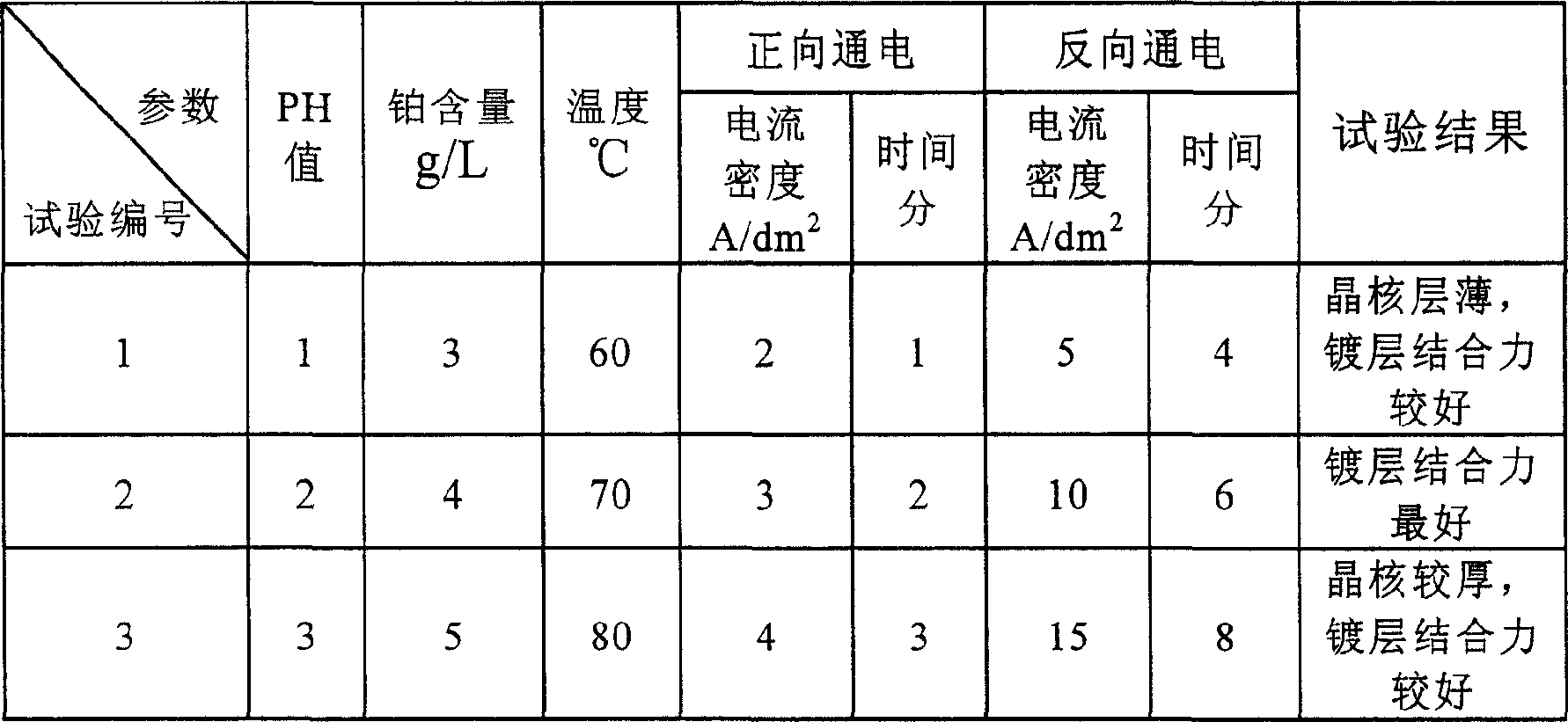
从表1分析可知,本发明通过晶核沉结后镀铂,能大大提高镀铂层的结合力。It can be seen from the analysis in Table 1 that the present invention can greatly improve the binding force of the platinum-coated layer by plating platinum after crystal nucleus precipitation.
Claims (7)
Priority Applications (1)
| Application Number | Priority Date | Filing Date | Title |
|---|---|---|---|
| CN02136737.XA CN1208503C (en) | 2002-08-30 | 2002-08-30 | Platinum Plating Method for Titanium-Based Materials |
Applications Claiming Priority (1)
| Application Number | Priority Date | Filing Date | Title |
|---|---|---|---|
| CN02136737.XA CN1208503C (en) | 2002-08-30 | 2002-08-30 | Platinum Plating Method for Titanium-Based Materials |
Publications (2)
| Publication Number | Publication Date |
|---|---|
| CN1478926A CN1478926A (en) | 2004-03-03 |
| CN1208503C true CN1208503C (en) | 2005-06-29 |
Family
ID=34146637
Family Applications (1)
| Application Number | Title | Priority Date | Filing Date |
|---|---|---|---|
| CN02136737.XA Expired - Lifetime CN1208503C (en) | 2002-08-30 | 2002-08-30 | Platinum Plating Method for Titanium-Based Materials |
Country Status (1)
| Country | Link |
|---|---|
| CN (1) | CN1208503C (en) |
Families Citing this family (2)
| Publication number | Priority date | Publication date | Assignee | Title |
|---|---|---|---|---|
| CN102051647A (en) * | 2010-12-29 | 2011-05-11 | 东莞市泰赛特汽车用品科技有限公司 | Cyanide-free and nickel-free aqueous electroplating process for titanium and titanium alloys |
| CN113897648A (en) * | 2021-11-22 | 2022-01-07 | 东莞中探探针有限公司 | Connector terminal electroplating process |
-
2002
- 2002-08-30 CN CN02136737.XA patent/CN1208503C/en not_active Expired - Lifetime
Also Published As
| Publication number | Publication date |
|---|---|
| CN1478926A (en) | 2004-03-03 |
Similar Documents
| Publication | Publication Date | Title |
|---|---|---|
| CN104973662B (en) | Oxide anode for treatment of ship domestic sewage and preparation method thereof | |
| CN85108093A (en) | The electrode that is used for electrochemical process, the method and the application of electrode in electrolyzer of making this electrode | |
| CN106048690B (en) | A kind of titanium-based titanium dioxide nanotube composite anode and preparation method thereof | |
| CN103700813B (en) | A kind of Ti base β-PbO 2the preparation method of dimensional stable anode | |
| CN113684511B (en) | Electrochemical preparation method of high-temperature self-repairing coating and product thereof | |
| TWI392772B (en) | Method of reactivating electrode for electrolysis | |
| CN104911642A (en) | RE-Ni-Mo/GO nano composite deposition liquid as well as preparation method and application thereof | |
| CN115058727A (en) | Surface modification method for titanium-based bipolar plate of proton exchange membrane electrolytic cell | |
| CN1208503C (en) | Platinum Plating Method for Titanium-Based Materials | |
| CN106809918B (en) | A kind of carbon nanotube modified lead dioxide electrode and preparation method thereof | |
| CN114540824B (en) | A method for regenerating titanium anode plates using waste acid solution | |
| CN104152960A (en) | Preparation method of high catalytic activity electro-catalysis electrode | |
| CN88102785A (en) | Metal electrolytic treatment method | |
| CN112048744B (en) | Process for improving platinum plating uniformity on surface of titanium substrate | |
| CN101694002B (en) | Lead dioxide electrode and preparation process thereof of aluminum alloy surface ceramic-coating | |
| CN1262345A (en) | Plasma intensified electrochemical surface-porcelainizing process and its products | |
| CN115181874B (en) | Method for generating carbonate protective layer on surface of zinc alloy and application thereof | |
| CN85109238A (en) | Rapid anodic oxidation technology of aluminum-coated film at room temperature | |
| CN103806057A (en) | Washing and activation process for titanium and titanium alloy before electroplating | |
| CN104562077B (en) | Artificial zeolite modified titanium-based fluorine-containing lead dioxide electrode and preparation method thereof | |
| CN117107249B (en) | Method for removing insoluble coating on surface of titanium-based lead dioxide anode | |
| CN113215636B (en) | Surface treatment method for pickled plate | |
| CN113846362B (en) | Preparation method of composite coating for inhibiting concrete corrosion | |
| CN87107893A (en) | High-deposition nickel brush-plating solution and brush-plating technique thereof | |
| RU2096529C1 (en) | Anode production method |
Legal Events
| Date | Code | Title | Description |
|---|---|---|---|
| C06 | Publication | ||
| PB01 | Publication | ||
| C10 | Entry into substantive examination | ||
| SE01 | Entry into force of request for substantive examination | ||
| C14 | Grant of patent or utility model | ||
| GR01 | Patent grant | ||
| CX01 | Expiry of patent term | ||
| CX01 | Expiry of patent term |
Granted publication date: 20050629 |