CN115073783A - Preparation method of h-BN/graphene/PVDF composite membrane and h-BN/graphene/PVDF composite membrane - Google Patents

Preparation method of h-BN/graphene/PVDF composite membrane and h-BN/graphene/PVDF composite membrane Download PDF

Info

Publication number
CN115073783A
CN115073783A CN202210794391.3A CN202210794391A CN115073783A CN 115073783 A CN115073783 A CN 115073783A CN 202210794391 A CN202210794391 A CN 202210794391A CN 115073783 A CN115073783 A CN 115073783A
Authority
CN
China
Prior art keywords
graphene
boron nitride
composite membrane
modified
pvdf
Prior art date
Legal status (The legal status is an assumption and is not a legal conclusion. Google has not performed a legal analysis and makes no representation as to the accuracy of the status listed.)
Pending
Application number
CN202210794391.3A
Other languages
Chinese (zh)
Inventor
肖倩
孙金梅
宋亚滨
林宏达
翟虎
Current Assignee (The listed assignees may be inaccurate. Google has not performed a legal analysis and makes no representation or warranty as to the accuracy of the list.)
Beijing Tunghsu Carbon Advanced Materials Technology Co ltd
Beijing Yuanda Xinda Technology Co Ltd
Original Assignee
Beijing Tunghsu Carbon Advanced Materials Technology Co ltd
Beijing Yuanda Xinda Technology Co Ltd
Priority date (The priority date is an assumption and is not a legal conclusion. Google has not performed a legal analysis and makes no representation as to the accuracy of the date listed.)
Filing date
Publication date
Application filed by Beijing Tunghsu Carbon Advanced Materials Technology Co ltd, Beijing Yuanda Xinda Technology Co Ltd filed Critical Beijing Tunghsu Carbon Advanced Materials Technology Co ltd
Priority to CN202210794391.3A priority Critical patent/CN115073783A/en
Publication of CN115073783A publication Critical patent/CN115073783A/en
Pending legal-status Critical Current

Links

Images

Classifications

    • CCHEMISTRY; METALLURGY
    • C08ORGANIC MACROMOLECULAR COMPOUNDS; THEIR PREPARATION OR CHEMICAL WORKING-UP; COMPOSITIONS BASED THEREON
    • C08JWORKING-UP; GENERAL PROCESSES OF COMPOUNDING; AFTER-TREATMENT NOT COVERED BY SUBCLASSES C08B, C08C, C08F, C08G or C08H
    • C08J5/00Manufacture of articles or shaped materials containing macromolecular substances
    • C08J5/18Manufacture of films or sheets
    • HELECTRICITY
    • H01ELECTRIC ELEMENTS
    • H01GCAPACITORS; CAPACITORS, RECTIFIERS, DETECTORS, SWITCHING DEVICES, LIGHT-SENSITIVE OR TEMPERATURE-SENSITIVE DEVICES OF THE ELECTROLYTIC TYPE
    • H01G4/00Fixed capacitors; Processes of their manufacture
    • H01G4/002Details
    • H01G4/018Dielectrics
    • H01G4/06Solid dielectrics
    • H01G4/14Organic dielectrics
    • H01G4/18Organic dielectrics of synthetic material, e.g. derivatives of cellulose
    • H01G4/186Organic dielectrics of synthetic material, e.g. derivatives of cellulose halogenated
    • HELECTRICITY
    • H01ELECTRIC ELEMENTS
    • H01GCAPACITORS; CAPACITORS, RECTIFIERS, DETECTORS, SWITCHING DEVICES, LIGHT-SENSITIVE OR TEMPERATURE-SENSITIVE DEVICES OF THE ELECTROLYTIC TYPE
    • H01G4/00Fixed capacitors; Processes of their manufacture
    • H01G4/33Thin- or thick-film capacitors (thin- or thick-film circuits; capacitors without a potential-jump or surface barrier specially adapted for integrated circuits, details thereof, multistep manufacturing processes therefor)
    • CCHEMISTRY; METALLURGY
    • C08ORGANIC MACROMOLECULAR COMPOUNDS; THEIR PREPARATION OR CHEMICAL WORKING-UP; COMPOSITIONS BASED THEREON
    • C08JWORKING-UP; GENERAL PROCESSES OF COMPOUNDING; AFTER-TREATMENT NOT COVERED BY SUBCLASSES C08B, C08C, C08F, C08G or C08H
    • C08J2327/00Characterised by the use of homopolymers or copolymers of compounds having one or more unsaturated aliphatic radicals, each having only one carbon-to-carbon double bond, and at least one being terminated by a halogen; Derivatives of such polymers
    • C08J2327/02Characterised by the use of homopolymers or copolymers of compounds having one or more unsaturated aliphatic radicals, each having only one carbon-to-carbon double bond, and at least one being terminated by a halogen; Derivatives of such polymers not modified by chemical after-treatment
    • C08J2327/12Characterised by the use of homopolymers or copolymers of compounds having one or more unsaturated aliphatic radicals, each having only one carbon-to-carbon double bond, and at least one being terminated by a halogen; Derivatives of such polymers not modified by chemical after-treatment containing fluorine atoms
    • C08J2327/16Homopolymers or copolymers of vinylidene fluoride
    • CCHEMISTRY; METALLURGY
    • C08ORGANIC MACROMOLECULAR COMPOUNDS; THEIR PREPARATION OR CHEMICAL WORKING-UP; COMPOSITIONS BASED THEREON
    • C08KUse of inorganic or non-macromolecular organic substances as compounding ingredients
    • C08K3/00Use of inorganic substances as compounding ingredients
    • C08K3/38Boron-containing compounds
    • C08K2003/382Boron-containing compounds and nitrogen
    • C08K2003/385Binary compounds of nitrogen with boron
    • CCHEMISTRY; METALLURGY
    • C08ORGANIC MACROMOLECULAR COMPOUNDS; THEIR PREPARATION OR CHEMICAL WORKING-UP; COMPOSITIONS BASED THEREON
    • C08KUse of inorganic or non-macromolecular organic substances as compounding ingredients
    • C08K3/00Use of inorganic substances as compounding ingredients
    • C08K3/02Elements
    • C08K3/04Carbon
    • C08K3/042Graphene or derivatives, e.g. graphene oxides
    • CCHEMISTRY; METALLURGY
    • C08ORGANIC MACROMOLECULAR COMPOUNDS; THEIR PREPARATION OR CHEMICAL WORKING-UP; COMPOSITIONS BASED THEREON
    • C08KUse of inorganic or non-macromolecular organic substances as compounding ingredients
    • C08K9/00Use of pretreated ingredients
    • C08K9/04Ingredients treated with organic substances
    • C08K9/06Ingredients treated with organic substances with silicon-containing compounds
    • YGENERAL TAGGING OF NEW TECHNOLOGICAL DEVELOPMENTS; GENERAL TAGGING OF CROSS-SECTIONAL TECHNOLOGIES SPANNING OVER SEVERAL SECTIONS OF THE IPC; TECHNICAL SUBJECTS COVERED BY FORMER USPC CROSS-REFERENCE ART COLLECTIONS [XRACs] AND DIGESTS
    • Y02TECHNOLOGIES OR APPLICATIONS FOR MITIGATION OR ADAPTATION AGAINST CLIMATE CHANGE
    • Y02EREDUCTION OF GREENHOUSE GAS [GHG] EMISSIONS, RELATED TO ENERGY GENERATION, TRANSMISSION OR DISTRIBUTION
    • Y02E60/00Enabling technologies; Technologies with a potential or indirect contribution to GHG emissions mitigation
    • Y02E60/13Energy storage using capacitors

Landscapes

  • Engineering & Computer Science (AREA)
  • Power Engineering (AREA)
  • Manufacturing & Machinery (AREA)
  • Microelectronics & Electronic Packaging (AREA)
  • Chemical & Material Sciences (AREA)
  • Materials Engineering (AREA)
  • Health & Medical Sciences (AREA)
  • Chemical Kinetics & Catalysis (AREA)
  • Medicinal Chemistry (AREA)
  • Polymers & Plastics (AREA)
  • Organic Chemistry (AREA)
  • Carbon And Carbon Compounds (AREA)

Abstract

本申请提供一种h‑BN/石墨烯/PVDF复合膜制备方法及h‑BN/石墨烯/PVDF复合膜,涉及电容器技术领域。其中,该制备方法包括:对六方氮化硼进行硅烷改性,得到含有有机基团的改性氮化硼;对石墨烯进行硅烷改性,得到含有有机基团的改性石墨烯;将改性氮化硼、改性石墨烯在溶剂1中均匀分散,得到预混液,将PVDF溶于溶剂1中,并倒入预混液中,混合均匀,得到混合液;将混合液在平面流延成膜,并逐步升温去除溶剂得到复合薄膜。本申请技术方案可以解决填料粒子与有机物之间的相容性的技术问题。

Figure 202210794391

The application provides a preparation method of h-BN/graphene/PVDF composite film and h-BN/graphene/PVDF composite film, and relates to the technical field of capacitors. The preparation method includes: silane-modifying hexagonal boron nitride to obtain modified boron nitride containing organic groups; silane-modifying graphene to obtain modified graphene containing organic groups; The boron nitride and modified graphene are uniformly dispersed in solvent 1 to obtain a premixed solution, PVDF is dissolved in solvent 1, poured into the premixed solution, and mixed evenly to obtain a mixed solution; the mixed solution is cast on a plane into a The film was gradually heated up to remove the solvent to obtain a composite film. The technical solution of the present application can solve the technical problem of compatibility between filler particles and organic matter.

Figure 202210794391

Description

Preparation method of h-BN/graphene/PVDF composite membrane and h-BN/graphene/PVDF composite membrane
Technical Field
The application relates to the technical field of capacitors, in particular to a preparation method of an h-BN/graphene/PVDF composite membrane and the h-BN/graphene/PVDF composite membrane.
Background
The high energy storage film capacitor has the characteristics of high energy storage density, high charging and discharging speed, good chemical stability, high temperature resistance and the like, and plays an important role in a power system.
Among capacitor materials, polymers are excellent candidates due to their higher energy density, lower dielectric loss, faster charge speed, and lower cost. However, most of polymers used for capacitors have poor temperature resistance and low breakdown voltage, and need to be compounded with inorganic particles, and how to improve the compatibility between filler particles and organic matters is the key of the performance of composite films, which is also a problem to be solved at present.
Disclosure of Invention
The embodiment of the application aims to provide a preparation method of an h-BN/graphene/PVDF composite membrane and the h-BN/graphene/PVDF composite membrane so as to solve the technical problem of compatibility between filler particles and organic matters.
In order to solve the above technical problem, an embodiment of the present application provides the following technical solutions:
the first aspect of the application provides a preparation method of an h-BN/graphene/PVDF composite membrane, which comprises the following steps:
performing silane modification on hexagonal boron nitride to obtain modified boron nitride containing organic groups;
carrying out silane modification on graphene to obtain modified graphene containing organic groups;
uniformly dispersing modified boron nitride and modified graphene in a solvent 1 to obtain a premixed solution, dissolving PVDF in the solvent 1, pouring the solution into the premixed solution, and uniformly mixing to obtain a mixed solution;
and casting the mixed solution on a plane to form a film, and gradually heating to remove the solvent to obtain the composite film.
In some variations of the first aspect of the present application, the silane modification of hexagonal boron nitride to obtain modified boron nitride containing an organic group is specifically:
obtaining hydroxyl-grafted hexagonal boron nitride by adopting a ball milling method;
adding the hydroxyl-grafted hexagonal boron nitride powder into a mixed solution of a silane coupling agent and a solvent 2, uniformly stirring for 3-5h at the stirring speed of 300-800r.p.m at the temperature of 60-65 ℃ and the pH of 3-4, and filtering, washing, drying and grinding the stirred mixed solution to obtain the modified boron nitride.
In some modified embodiments of the first aspect of the present application, the hydroxyl group-grafted hexagonal boron nitride powder obtained by the ball milling method specifically includes:
adding the hexagonal boron nitride and 2M/L NaOH solution into a ball milling tank, ball milling for 18-28h at the ball milling speed of 300-600r.p.m, pouring the obtained powder into 1M/L HCL solution, washing the solution to be neutral by using deionized water, and drying the solution for 24-36 h at the temperature of 50-80 ℃ to obtain the hydroxyl-grafted hexagonal boron nitride powder.
In some modified embodiments of the first aspect of the present application, the silane modification of graphene to obtain modified graphene containing an organic group is specifically:
adding the graphene powder into a mixed solution of a silane coupling agent and a solvent 2, uniformly stirring for 3-5h at the stirring speed of 800r.p.m at the temperature of 55-60 ℃ and the pH of 3-4, and filtering, washing, drying and grinding the stirred mixed solution to obtain the modified graphene.
In some variations of the first aspect of the present application, the silane coupling agent is at least one of KH-792, KH550, and KH-602;
the solvent 2 is at least one of acetone, ethanol and N-N dimethylformamide.
In some variations of the first aspect of the present application, the mass ratio of the hexagonal boron nitride added to the ball milling jar to the zirconia in the ball milling jar is: 1:60-1:50.
In some variations of the first aspect of the present application, the premix is prepared by:
adding modified boron nitride and modified graphene into a solvent 1, and performing ultrasonic oscillation for 1-1.5h at the temperature of 20-50 ℃ to obtain the uniformly mixed premixed liquid;
the preparation method of the mixed solution comprises the following steps:
under the condition of heating reflux, PVDF is dissolved in a solvent 1, and the premixed solution is poured;
and continuing ultrasonic oscillation for 2-3h to obtain the uniformly mixed solution.
In some modified embodiments of the first aspect of the present application, the mixed solution comprises the following components in percentage by mass:
PVDF: 60-90%, modified graphene: 10-35%, modified boron nitride: 5 to 30 percent.
In certain variations of the first aspect of the present application, the solvent 1 is N-N dimethylformamide.
In a second aspect, the present application provides an h-BN/graphene/PVDF composite membrane, which is prepared by the above preparation method.
Compared with the prior art, the h-BN/graphene/PVDF composite film and the preparation method thereof provided by the application utilize good insulativity of hexagonal boron nitride (h-BN), high dielectric constant of graphene, and polyvinylidene fluoride (PVDF) to prepare the composite energy storage film with high energy storage density, high breakdown strength and high dielectric constant, and can meet application requirements; the modified boron nitride and the modified graphene respectively contain organic groups by respectively chemically modifying the hexagonal boron nitride and the graphene, and according to a similar compatibility principle, the dispersibility of inorganic filler particles in organic matters can be effectively improved so as to solve the problem of interface compatibility.
Drawings
The above and other objects, features and advantages of exemplary embodiments of the present application will become readily apparent from the following detailed description read in conjunction with the accompanying drawings. Several embodiments of the present application are illustrated by way of example and not by way of limitation in the figures of the accompanying drawings and in which like reference numerals refer to similar or corresponding parts and in which:
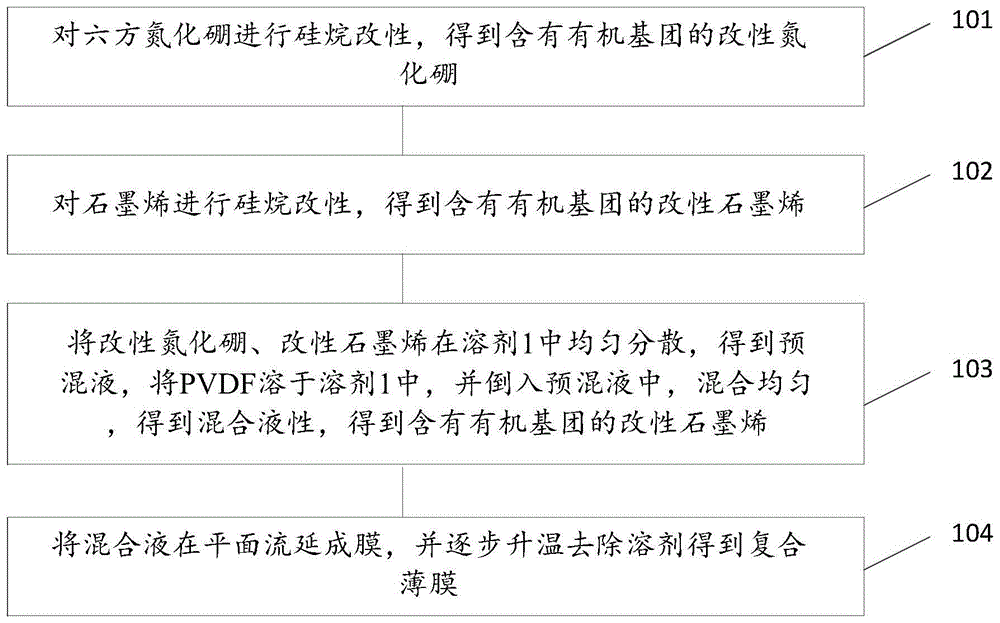
FIG. 1 is a schematic flow chart illustrating a method for preparing an h-BN/graphene/PVDF composite membrane according to an embodiment of the invention;
FIG. 2 schematically shows a flow chart of a preparation method of modified boron nitride in a preparation method of an h-BN/graphene/PVDF composite membrane provided by an embodiment of the invention;
FIG. 3 is a schematic diagram illustrating a preparation process of modified boron nitride in a preparation method of an h-BN/graphene/PVDF composite membrane according to an embodiment of the invention;
FIG. 4 schematically shows a flow chart of a preparation method of modified graphene in a preparation method of an h-BN/graphene/PVDF composite membrane provided by an embodiment of the invention;
fig. 5 schematically illustrates a schematic diagram of a preparation process of modified graphene in a preparation method of an h-BN/graphene/PVDF composite membrane according to an embodiment of the present invention;
Detailed Description
Exemplary embodiments of the present disclosure will be described in more detail below with reference to the accompanying drawings. While exemplary embodiments of the present disclosure are shown in the drawings, it should be understood that the present disclosure may be embodied in various forms and should not be limited by the embodiments set forth herein. Rather, these embodiments are provided so that this disclosure will be thorough and complete, and will fully convey the scope of the disclosure to those skilled in the art.
It is to be noted that, unless otherwise specified, technical or scientific terms used herein shall have the ordinary meaning as understood by those skilled in the art to which this application belongs.
Among capacitor materials, polymers are excellent candidates due to their higher energy density, lower dielectric loss, faster charge speed, and lower cost. However, most of polymers used for capacitors have poor temperature resistance and low breakdown voltage, and need to be compounded with inorganic particles, and the compatibility between filler particles and organic matters is the key of the performance of a composite film, which is also a problem to be solved at present.
Example one
Referring to the attached drawing 1, in order to solve the problem of interfacial compatibility between filler ions and organic matters, an embodiment of the present invention provides a method for preparing an h-BN/graphene/PVDF composite film, which mainly includes the following steps:
101. and performing silane modification on the hexagonal boron nitride to obtain modified boron nitride containing organic groups.
102. And performing silane modification on the graphene to obtain the modified graphene containing organic groups.
Specifically, the hexagonal boron nitride (h-BN) has good insulativity, the insulating property of the composite film can be improved, the graphene has high dielectric constant, and the composite film has high breakdown strength and high energy storage density, so that the composite film is prepared by compounding the hexagonal boron nitride, the graphene and polyvinylidene fluoride (PVDF) in the technical scheme adopted by the invention, and the composite energy storage film with high energy storage density, high breakdown strength and high dielectric constant is obtained. In order to solve the problem of compatibility of hexagonal boron nitride, graphene and polyvinylidene fluoride, a chemical modification method can be adopted to perform silane modification on the hexagonal boron nitride and the graphene respectively, and referring to the attached drawings 3 and 5, the modified boron nitride and the modified graphene respectively contain organic groups, and according to the similar compatibility principle, the dispersibility of inorganic filler particles in organic matters can be effectively improved.
103. Uniformly dispersing modified boron nitride and modified graphene in a solvent 1 to obtain a premixed solution, dissolving PVDF in the solvent 1, pouring the PVDF into the premixed solution, and uniformly mixing to obtain a mixed solution.
Specifically, after the preparation of the modified boron nitride and the modified graphene is completed, uniformly dispersing modified boron nitride powder and modified graphene powder in a solvent 1 to obtain a premixed solution, dissolving polyvinylidene fluoride powder in the solvent 1, pouring the uniformly dissolved polyvinylidene nitride powder into the premixed solution, and mixing the premixed solution once again to obtain a mixed solution, wherein the mixed solution comprises the following components in percentage by mass: polyvinylidene fluoride: 60-90%, modified graphene: 10-35%, modified boron nitride: 5 to 30 percent.
Specifically, the preparation method of the premix specifically comprises the following steps: adding modified boron nitride and modified graphene into a solvent 1, and performing ultrasonic oscillation for 1-1.5h at the temperature of 20-50 ℃ to obtain the uniformly mixed premixed liquid; the preparation method of the mixed solution comprises the following steps: under the condition of heating reflux, dissolving PVDF in a solvent 1, pouring the premixed solution, and continuing to perform ultrasonic oscillation for 2-3 hours to obtain a uniformly mixed solution, wherein the solvent 1 can be: N-N dimethylformamide, the temperature under the above-mentioned heating reflux condition needs to reach the boiling point of N-N dimethylformamide, that is, needs to reach more than 153.
104. And casting the mixed solution on a plane to form a film, and gradually heating to remove the solvent to obtain the composite film.
Specifically, after the mixed solution is prepared, pouring the mixed solution on a clean plane, gradually heating to remove the solvent, and cooling to room temperature to obtain the composite film; the temperature gradual increasing procedure may specifically be: two hours at 80 deg.C, 100 deg.C, 120 deg.C, 140 deg.C and 160 deg.C.
According to the above list, the embodiment of the invention provides a preparation method of an h-BN/graphene/PVDF composite film, which utilizes good insulating property of hexagonal boron nitride (h-BN) and high dielectric constant of graphene to be compounded with polyvinylidene fluoride (PVDF) to prepare a composite energy storage film with high energy storage density, high breakdown strength and high dielectric constant, and can meet application requirements; the modified boron nitride and the modified graphene respectively contain organic groups by respectively chemically modifying the hexagonal boron nitride and the graphene, and according to a similar compatibility principle, the dispersibility of inorganic filler particles in organic matters can be effectively improved so as to solve the problem of interface compatibility.
Further, referring to fig. 2 and fig. 3, in an implementation, the step 101 may specifically include the following steps:
101a, obtaining the hydroxyl-grafted hexagonal boron nitride by adopting a ball milling method.
Specifically, before modifying hexagonal boron nitride, a ball milling mode is needed to connect hydroxyl groups to the surface of the hexagonal boron nitride, and the specific preparation method comprises the following steps: adding hexagonal boron nitride powder and 2MLLNaOH solution into a ball milling tank, wherein the mass ratio of the hexagonal boron nitride added into the ball milling tank to the zirconia in the ball milling tank is as follows: 1:60-1:50, wherein the adding amount of NaOH solution can be less than that of hexagonal boron nitride powder, ball milling is carried out for 18-28h under the condition that the ball milling speed is 00-600r.p.m, the obtained powder is poured into 1M/L HCL solution, then deionized water is used for washing to be neutral, and drying is carried out for 24-36 h under the condition that the temperature is 50-80 ℃ to obtain the hydroxyl-grafted hexagonal boron nitride powder.
101b, adding the hydroxyl-grafted hexagonal boron nitride powder into a mixed solution of a silane coupling agent and a solvent 2, uniformly stirring for 3-5h at the stirring speed of 800r.p.m, the temperature of 60-65 ℃ and the pH of 3-4, and filtering, washing, drying and grinding the stirred mixed solution to obtain the modified boron nitride.
Specifically, after hydroxyl is grafted on the surface of hexagonal boron nitride powder, the hexagonal boron nitride powder is chemically modified by a coupling agent, and the preparation method specifically comprises the following steps: adding the ball-milled hexagonal boron nitride powder grafted with hydroxyl into a mixed solution of a silane coupling agent and a solvent 2, uniformly stirring, wherein the silane coupling agent can be at least one of KH-792, KH550 and KH-602, the solvent 2 can be N-N dimethylformamide, stirring time can be 3-5h, stirring speed is 800r.p.m, temperature is 60-65 ℃, and PH is 3-4, and after uniform mixing, sequentially filtering, washing, drying and grinding the stirred mixed solution to obtain the modified boron nitride powder.
Further, referring to fig. 4 and 5, in an implementation, the step 102 may specifically include the following steps:
102a, adding the graphene powder into a mixed solution of a silane coupling agent and a solvent 2, uniformly stirring for 3-5h at the stirring speed of 300-.
Specifically, since the edge of graphene has a few hydroxyl groups, the graphene can be directly chemically modified by a coupling agent, and the modification treatment method of graphene is similar to that of hexagonal boron nitride, specifically: adding the graphene powder into a mixed solution of a silane coupling agent and a solvent 2, uniformly stirring, wherein the silane coupling agent can be at least one of KH-792, KH550 and KH-602, the solvent 2 can be N-N dimethylformamide, stirring time can be 3-5h, stirring speed is 300-800r.p.m, temperature is 55-60 ℃, PH is 3-4, and after uniform mixing, sequentially filtering, washing, drying and grinding the stirred mixed solution to obtain the modified graphene powder.
The implementation of this solution is illustrated below in a specific embodiment:
firstly, adding 5g of hexagonal boron nitride and 2M/L of NaOH solution into a ball milling tank, wherein the mass ratio of the hexagonal boron nitride added into the ball milling tank to the zirconia in the ball milling tank is as follows: 1:55, ball-milling for 24 hours at the ball-milling speed of 400r.p.m, pouring the obtained powder into 1M/L HCl solution, washing the powder to be neutral by deionized water, and drying the powder for 24 hours at the temperature of 50-80 ℃;
next, preparation of modified boron nitride is carried out: adding 14.4g of KH-792 silane coupling agent and 220g of absolute ethyl alcohol into a 500mL three-necked bottle, and simultaneously starting mechanical stirring at a stirring speed of 400r.p.m until the mixture is uniformly stirred; weighing 4.8g of ball-milled hexagonal boron nitride, slowly adding the hexagonal boron nitride into a three-necked bottle under the condition of ultrasonic water bath, and uniformly stirring the hexagonal boron nitride with the stirring speed of 400r.p.m, the stirring time of 4h and the temperature of 65 ℃; adjusting the pH value of the mixed liquid to 3 by using glacial acetic acid; vacuum filtering the mixed liquid, repeatedly ultrasonically dispersing the filtered filter cake in absolute ethyl alcohol, then carrying out vacuum filtration for 4 times, carrying out vacuum drying on the washed product at 60 ℃ for 24 hours, and finally grinding the dried product for later use, wherein the process is shown in the attached figure 3;
next, preparation of modified graphene is carried out: adding 17.5g of KH-792 silane coupling agent and 275g of absolute ethyl alcohol into a 500mL three-necked bottle, starting mechanical stirring at a stirring speed of 400r.p.m until the mixture is uniformly stirred, then weighing 5g of graphene powder, slowly adding the graphene powder into the three-necked bottle under the condition of ultrasonic water bath, uniformly stirring the graphene powder, wherein the stirring speed is 400rpm, the stirring time is 4h, and the temperature is 60 ℃; adjusting the pH value of the mixed liquid to 3 by using glacial acetic acid; vacuum filtering the mixed liquid, repeatedly performing ultrasonic dispersion on a filter cake obtained by filtering in absolute ethyl alcohol, then performing vacuum filtration for 4 times, performing vacuum drying on the washed product at 60 ℃ for 24 hours, and finally grinding the dried product for later use, wherein the process of the step is shown in the attached figure 5;
next, performing a mixing stage, and performing ultrasonic treatment on 0.1g of modified BN and 0.5g of modified graphene in 25mL of solvent for 1.0-1.5 hours at 25 ℃ to re-disperse uniformly to obtain a premixed solution; under the conditions of heating, refluxing and stirring, dissolving 1.4g of PVDF in 25mL of solvent, pouring the solution into the uniformly dispersed premixed solution of modified BN and modified graphene, and continuing performing ultrasonic treatment on the mixed solution for 2-3 hours to obtain uniform mixed solution;
and finally, pouring the mixture on a clean plane, completely removing the solvent by two-hour temperature programming at 80 ℃, 100 ℃, 120 ℃, 140 ℃ and 160 ℃, and cooling to room temperature to obtain the composite film.
The properties of the composite film obtained through the steps are as follows: the dielectric constant of the composite film is 35, the breakdown voltage is 280kV/mm, and the energy storage density is 12.15J/cm 3 Whereas the properties of films made with PVDF alone are: the dielectric constant is 12, the breakdown voltage is 210kV/mm, and the energy storage density is 2.34J/cm 3 In contrast, the composite film obtained by the preparation method of the embodiment has higher dielectric constant, breakdown strength and energy storage density in performance, and can meet the requirementAnd (4) using the demand.
Example two
The second embodiment of the invention provides an h-BN/graphene/PVDF composite membrane, which is prepared by the preparation method of the h-BN/graphene/PVDF composite membrane, and the composite membrane prepared by the method has higher dielectric constant, breakdown strength and energy storage density in performance.
Specifically, the preparation method solves the problem of interface compatibility by chemically modifying the hexagonal boron nitride (h-BN) and the graphene, and the composite film prepared by compounding the modified boron nitride, the modified graphene and the polyvinylidene fluoride (PVDF) has the performance advantages of high energy storage density, high breakdown strength, high dielectric constant and the like, and can meet the application requirements.
It should be noted that in the description of the present specification, the terms "upper", "lower", and the like indicate orientations or positional relationships based on the orientations or positional relationships shown in the drawings, which are only for convenience of describing the present invention and simplifying the description, but do not indicate or imply that the referred device or element must have a specific orientation, be constructed in a specific orientation, and operate, and thus, should not be construed as limiting the present invention; the terms "connected," "mounted," "secured," and the like are to be construed broadly and include, for example, fixed connections, removable connections, or integral connections; may be directly connected or indirectly connected through an intermediate. The specific meanings of the above terms in the present invention can be understood by those skilled in the art according to specific situations.
In the description herein, the description of the terms "one embodiment," "some embodiments," "specific embodiments," etc., means that a particular feature, structure, material, or characteristic described in connection with the embodiment or example is included in at least one embodiment or example of the invention. In this specification, the schematic representations of the terms used above do not necessarily refer to the same embodiment or example. Furthermore, the particular features, structures, materials, or characteristics described may be combined in any suitable manner in any one or more embodiments or examples.
The above description is only for the specific embodiments of the present invention, but the scope of the present invention is not limited thereto, and any person skilled in the art can easily conceive of the changes or substitutions within the technical scope of the present invention, and all the changes or substitutions should be covered within the scope of the present invention. Therefore, the protection scope of the present invention shall be subject to the protection scope of the appended claims.

Claims (10)

1. A preparation method of an h-BN/graphene/PVDF composite membrane is characterized by comprising the following steps:
performing silane modification on hexagonal boron nitride to obtain modified boron nitride containing organic groups;
carrying out silane modification on graphene to obtain modified graphene containing organic groups;
uniformly dispersing modified boron nitride and modified graphene in a solvent 1 to obtain a premixed solution, dissolving PVDF in the solvent 1, pouring the PVDF into the premixed solution, and uniformly mixing to obtain a mixed solution;
and casting the mixed solution on a plane to form a film, and gradually heating to remove the solvent to obtain the composite film.
2. The method for preparing h-BN/graphene/PVDF composite membrane according to claim 1,
the method for modifying the hexagonal boron nitride by silane to obtain the modified boron nitride containing the organic group comprises the following steps:
obtaining hydroxyl-grafted hexagonal boron nitride by adopting a ball milling method;
adding the hydroxyl-grafted hexagonal boron nitride powder into a mixed solution of a silane coupling agent and a solvent 2, uniformly stirring for 3-5h at the stirring speed of 300-800r.p.m at the temperature of 60-65 ℃ and the pH of 3-4, and filtering, washing, drying and grinding the stirred mixed solution to obtain the modified boron nitride.
3. The method for preparing h-BN/graphene/PVDF composite membrane according to claim 2,
the method for obtaining the hydroxyl-grafted hexagonal boron nitride powder by adopting the ball milling method specifically comprises the following steps:
adding the hexagonal boron nitride and 2M/L NaOH solution into a ball milling tank, ball milling for 18-28h at the ball milling speed of 300-600r.p.m, pouring the obtained powder into 1M/L HCL solution, washing the solution to be neutral by using deionized water, and drying the solution for 24-36 h at the temperature of 50-80 ℃ to obtain the hydroxyl-grafted hexagonal boron nitride powder.
4. The method for preparing h-BN/graphene/PVDF composite membrane according to claim 2,
the method for modifying the graphene by silane to obtain the modified graphene containing the organic group comprises the following steps:
adding the graphene powder into a mixed solution of a silane coupling agent and a solvent 2, uniformly stirring for 3-5h at the stirring speed of 800r.p.m at the temperature of 55-60 ℃ and the pH of 3-4, and filtering, washing, drying and grinding the stirred mixed solution to obtain the modified graphene.
5. The method for preparing h-BN/graphene/PVDF composite membrane according to claim 2 or 4,
the silane coupling agent is at least one of KH-792, KH550 and KH-602;
the solvent 2 is at least one of acetone, ethanol and N-N dimethylformamide.
6. The method for preparing h-BN/graphene/PVDF composite membrane according to claim 3,
the mass ratio of the hexagonal boron nitride added into the ball milling tank to the zirconia in the ball milling tank is as follows: 1:60-1:50.
7. The method for preparing h-BN/graphene/PVDF composite membrane according to claim 1,
the preparation method of the premix comprises the following steps:
adding modified boron nitride and modified graphene into a solvent 1, and performing ultrasonic oscillation for 1-1.5h at the temperature of 20-50 ℃ to obtain the uniformly mixed premixed liquid;
the preparation method of the mixed solution comprises the following steps:
under the condition of heating reflux, PVDF is dissolved in a solvent 1, and the premixed solution is poured;
and continuing ultrasonic oscillation for 2-3h to obtain the uniformly mixed solution.
8. The method for preparing h-BN/graphene/PVDF composite membrane according to claim 1,
the mixed solution comprises the following components in percentage by mass:
PVDF: 60-90%, modified graphene: 10-35%, modified boron nitride: 5 to 30 percent.
9. The method for preparing h-BN/graphene/PVDF composite membrane according to claim 1,
the solvent 1 is N-N dimethylformamide.
10. An h-BN/graphene/PVDF composite membrane, comprising:
the composite membrane is prepared by the preparation method of the h-BN/graphene/PVDF composite membrane as set forth in any one of claims 1 to 9.
CN202210794391.3A 2022-07-07 2022-07-07 Preparation method of h-BN/graphene/PVDF composite membrane and h-BN/graphene/PVDF composite membrane Pending CN115073783A (en)

Priority Applications (1)

Application Number Priority Date Filing Date Title
CN202210794391.3A CN115073783A (en) 2022-07-07 2022-07-07 Preparation method of h-BN/graphene/PVDF composite membrane and h-BN/graphene/PVDF composite membrane

Applications Claiming Priority (1)

Application Number Priority Date Filing Date Title
CN202210794391.3A CN115073783A (en) 2022-07-07 2022-07-07 Preparation method of h-BN/graphene/PVDF composite membrane and h-BN/graphene/PVDF composite membrane

Publications (1)

Publication Number Publication Date
CN115073783A true CN115073783A (en) 2022-09-20

Family

ID=83257096

Family Applications (1)

Application Number Title Priority Date Filing Date
CN202210794391.3A Pending CN115073783A (en) 2022-07-07 2022-07-07 Preparation method of h-BN/graphene/PVDF composite membrane and h-BN/graphene/PVDF composite membrane

Country Status (1)

Country Link
CN (1) CN115073783A (en)

Cited By (2)

* Cited by examiner, † Cited by third party
Publication number Priority date Publication date Assignee Title
CN116790163A (en) * 2023-07-27 2023-09-22 有研工程技术研究院有限公司 APTES-GO modified PVDF organic hydrogen-resistant coating, preparation method and hydrogen-transporting pipeline
CN117264439A (en) * 2023-08-18 2023-12-22 南京航空航天大学 A boron nitride surface modification method and its application in preparing neutron shielding materials

Citations (10)

* Cited by examiner, † Cited by third party
Publication number Priority date Publication date Assignee Title
JP2009091436A (en) * 2007-10-05 2009-04-30 Nitto Denko Corp Polyvinylidene fluoride-boron nitride filler composition and method for producing the same
CN103467894A (en) * 2013-08-23 2013-12-25 中国科学院宁波材料技术与工程研究所 Polyvinylidene fluoride/graphene composite material and preparation method thereof
JP2015196632A (en) * 2014-04-03 2015-11-09 株式会社豊田中央研究所 Boron nitride nanosheet-containing fluid dispersion and production method thereof, and boron nitride nanosheet composite and production method thereof
CN105385106A (en) * 2015-12-02 2016-03-09 安捷利(番禺)电子实业有限公司 Preparation method for high-conductivity insulating composite material
CN105802091A (en) * 2016-04-29 2016-07-27 西南交通大学 Method for preparing polymer-based composite material with high dielectric constant
CN107618243A (en) * 2017-09-01 2018-01-23 广东石油化工学院 A kind of polymer modification graphene/Kynoar high-dielectric composite material and preparation method thereof
CN110615956A (en) * 2019-07-19 2019-12-27 杭州电子科技大学 Preparation method of nano sandwich structure composite material based on high breakdown and high energy storage
CN110760099A (en) * 2019-10-30 2020-02-07 安徽大学 A kind of preparation method of graphene-boron nitride nanotube thermally conductive filler and oriented thermally conductive composite material
WO2021045850A2 (en) * 2019-07-26 2021-03-11 Northwestern University Phase-inversion polymer composite material, fabricating methods and applications of same
CN113105743A (en) * 2021-03-31 2021-07-13 华南理工大学 Heat-conducting ceramic silicon rubber material and preparation method thereof

Patent Citations (10)

* Cited by examiner, † Cited by third party
Publication number Priority date Publication date Assignee Title
JP2009091436A (en) * 2007-10-05 2009-04-30 Nitto Denko Corp Polyvinylidene fluoride-boron nitride filler composition and method for producing the same
CN103467894A (en) * 2013-08-23 2013-12-25 中国科学院宁波材料技术与工程研究所 Polyvinylidene fluoride/graphene composite material and preparation method thereof
JP2015196632A (en) * 2014-04-03 2015-11-09 株式会社豊田中央研究所 Boron nitride nanosheet-containing fluid dispersion and production method thereof, and boron nitride nanosheet composite and production method thereof
CN105385106A (en) * 2015-12-02 2016-03-09 安捷利(番禺)电子实业有限公司 Preparation method for high-conductivity insulating composite material
CN105802091A (en) * 2016-04-29 2016-07-27 西南交通大学 Method for preparing polymer-based composite material with high dielectric constant
CN107618243A (en) * 2017-09-01 2018-01-23 广东石油化工学院 A kind of polymer modification graphene/Kynoar high-dielectric composite material and preparation method thereof
CN110615956A (en) * 2019-07-19 2019-12-27 杭州电子科技大学 Preparation method of nano sandwich structure composite material based on high breakdown and high energy storage
WO2021045850A2 (en) * 2019-07-26 2021-03-11 Northwestern University Phase-inversion polymer composite material, fabricating methods and applications of same
CN110760099A (en) * 2019-10-30 2020-02-07 安徽大学 A kind of preparation method of graphene-boron nitride nanotube thermally conductive filler and oriented thermally conductive composite material
CN113105743A (en) * 2021-03-31 2021-07-13 华南理工大学 Heat-conducting ceramic silicon rubber material and preparation method thereof

Non-Patent Citations (3)

* Cited by examiner, † Cited by third party
Title
XUE LI,等: "Dielectrical properties of graphite nanosheets/PVDF composites regulated by coupling agent", 《MATERIALS TODAY COMMUNICATIONS》 *
纵统,等: "羟基化改性氮化硼纳米材料的研究进展", 《化工新型材料》 *
顾怡: "低维碳材料和氮化硼协同改性聚偏氟乙烯基复合材料的介电性能研究", 《中国优秀硕士学位论文全文数据库 工程科技Ⅰ辑》 *

Cited By (2)

* Cited by examiner, † Cited by third party
Publication number Priority date Publication date Assignee Title
CN116790163A (en) * 2023-07-27 2023-09-22 有研工程技术研究院有限公司 APTES-GO modified PVDF organic hydrogen-resistant coating, preparation method and hydrogen-transporting pipeline
CN117264439A (en) * 2023-08-18 2023-12-22 南京航空航天大学 A boron nitride surface modification method and its application in preparing neutron shielding materials

Similar Documents

Publication Publication Date Title
JP2021097052A5 (en)
CN107033502B (en) A simple high energy storage density neodymium-doped barium titanate/organic matrix composite film and preparation method thereof
CN115073783A (en) Preparation method of h-BN/graphene/PVDF composite membrane and h-BN/graphene/PVDF composite membrane
CN112552681B (en) A functionalized boron nitride nanosheet/MXene/polybenzimidazole composite film with high thermal conductivity and preparation method
WO2010009680A1 (en) Li-la-ti-o composite solid electrolyte material containing silicon and synthesizing method thereof
CN107434897B (en) Barium titanate particles, barium titanate/fluoropolymer composite material and preparation method thereof
WO2023077430A1 (en) High thermal-conductivity phase-change organic silicon rubber, and preparation method therefor and use thereof
Tang et al. High-temperature-resistant barium strontium titanate@ Ag/poly (arylene ether nitrile) composites with enhanced dielectric performance and high mechanical strength
CN107474251A (en) Preparation method of film capacitor composite dielectric film
CN111732871A (en) A kind of light-weight high heat-proof coating and preparation method thereof
CN109972398B (en) A kind of high thermal conductivity flexible epoxy resin insulating material and preparation method and application thereof
Chu et al. Preparation and properties comparison of ZIF-67/PVDF and SiCNWs/PVDF composites for energy storage
CN103633270A (en) Inorganic/organic alternation type composite proton exchange membrane and preparation method thereof
CN118063214A (en) Tantalum carbide slurry, tantalum carbide coating, preparation method thereof and crucible
CN118755121B (en) A highly wear-resistant, scratch-resistant and high-strength heating film insulation composite material
CN102532757A (en) Polymer dielectric substance and preparation method thereof
CN107093526B (en) Preparation method and application of electrode material with graphite oxide as main component
CN105273188A (en) Autocatalysis preparation method of copolymer benzoxazine-resin polymer sphere and autocatalysis preparation method of resin-based carbon sphere
CN108864485A (en) A kind of preparation method of the large volume segment modified graphene oxide of polymolecularity
CN113999461B (en) Preparation method of modified composite film based on poly-tetramethyl-pentene-barium titanate nano particles
CN102800881B (en) A kind of preparation method of fuel cell inorganic proton exchange film
CN115850798B (en) Method for preparing carbon-coated barium titanate particles by sol-gel method and preparation of dielectric nano composite film
CN113912883A (en) A kind of moisture-resistant thermally conductive insulating film and preparation method thereof
CN102185098A (en) Preferred orientation type niobate lead-free piezoelectric thick-film material and preparation method thereof
TWI610885B (en) Manufacturing method of porous carbon material

Legal Events

Date Code Title Description
PB01 Publication
PB01 Publication
SE01 Entry into force of request for substantive examination
RJ01 Rejection of invention patent application after publication

Application publication date: 20220920