Disclosure of Invention
In view of the defects of the prior art, the present invention aims to provide a hydrogel surface modification method and a hydrogel with high water retention, which effectively improve the water retention of the hydrogel by constructing a double-layer hydrophobic coating on the surface of the hydrogel, provide a protective barrier for the hydrogel, effectively reduce the water volatilization inside the hydrogel, and improve the water retention of the hydrogel, and aims to solve the problem that it is difficult to construct a hydrophobic coating with strong interface strength on the surface of the hydrogel in the prior art to improve the water retention of the hydrogel.
The technical scheme adopted by the invention is as follows:
a hydrogel surface modification method, wherein the method comprises constructing a double-layer hydrophobic coating on the surface of the hydrogel, and the double-layer hydrophobic coating comprises a solid hydrophobic coating and a hydrophobic oil layer.
The hydrogel surface modification method, wherein the method comprises the following steps:
a. carrying out plasma/corona treatment on the surface of the hydrogel;
b. b, placing the hydrogel treated in the step a into an aminosilane coupling agent solution for dipping treatment;
c. b, placing the hydrogel treated in the step b into a long-chain alkyl compound solution containing carboxyl for dipping treatment;
d. and c, soaking the hydrogel treated in the step c in oil, and taking out the hydrogel after the soaking is finished.
In the hydrogel surface modification method, in the step a, the plasma/corona treatment time is 5-60 s.
In the hydrogel surface modification method, in the step b-d, the time of the dipping treatment is 10-120 min.
In the step b-c, the solvent in the solution comprises at least one of ethyl acetate, chloroform, diethyl ether, n-butanol, n-hexane, cyclohexane, n-heptane, n-octane, isooctane, cyclohexanone, toluene, xylene, cyclohexanone, methyl isobutyl ketone, carbon tetrachloride and petroleum ether.
The hydrogel surface modification method is characterized in that the concentration of the solution is 0.1-5 mol/L.
The hydrogel surface modification method comprises the step of preparing an amino silane coupling agent, wherein the amino silane coupling agent comprises at least one of aminopropyltriethoxysilane, aminopropyltrimethoxysilane, 3-aminopropylmethyldimethoxysilane, 3-aminopropylmethyldiethoxysilane, N- (beta-aminoethyl) -gamma-aminopropyltrimethoxysilane, N- (beta-aminoethyl) -gamma-aminopropylmethyldimethoxysilane, N-2-aminoethyl-3-aminopropylmethyldiethoxysilane, 3-diethylenetriaminopropylmethyldimethoxysilane and 3-diethylenetriaminopropyltrimethoxysilane.
The hydrogel surface modification method, wherein the long-chain alkyl compound containing carboxyl comprises at least one of lauric acid, myristic acid, pentadecanoic acid, palmitic acid, stearic acid, nonadecanoic acid, perfluorononanoic acid, perfluorooctanoic acid, perfluorododecanoic acid, perfluorotridecanoic acid, perfluorotetradecanoic acid, and perfluorooctadecanoic acid.
The hydrogel surface modification method comprises the step of preparing oil, wherein the oil comprises at least one of methyl silicone oil, perfluorinated silicone oil, phenyl silicone oil, olive oil, palm oil, perfluorinated polyether and fluorocarbon inert liquid FC-70.
A hydrogel with high water retention, wherein the hydrogel is treated by the hydrogel surface modification method.
Has the advantages that: the invention provides a hydrogel surface modification method and hydrogel with high water retention property, which effectively improve the water retention property of the hydrogel by constructing a double-layer hydrophobic coating on the surface of the hydrogel, wherein the double-layer hydrophobic coating comprises a solid hydrophobic coating and a hydrophobic oil layer. The invention provides a method for constructing a double-layer hydrophobic coating on the surface of hydrogel through ingenious molecular structure design so as to effectively reduce the evaporation rate of water in the hydrogel: firstly, carrying out corona/plasma treatment on the surface of hydrogel to form hydroxyl on the surface of the hydrogel; then, quickly immersing the hydrogel subjected to corona/plasma treatment into an aminosilane coupling agent solution, wherein a product obtained after hydrolysis of the silane coupling agent and hydroxyl on the surface of the hydrogel can form a hydrogen bond, so that the aminosilane coupling agent is bonded to the surface of the hydrogel; then, continuously immersing the hydrogel into a long-chain alkyl compound solution containing carboxyl, and carrying out chemical reaction on the carboxyl and amino to graft the long-chain alkyl onto the surface of the hydrogel so as to form a layer of solid hydrophobic coating; finally, the modified hydrogel is immersed in oil, and the oil can penetrate into the hydrophobic coating of the hydrogel due to hydrophobic-hydrophobic interaction, so that a double-layer hydrophobic coating is formed on the surface of the hydrogel. In addition, the solvent in the modification solution used in the present invention is a solvent system that is not soluble in water, and both the modifier and the solvent are difficult to diffuse and permeate into the hydrogel due to poor solubility of the solvent in water. Therefore, the hydrophobic coating only grows on the surface of the hydrogel, and the bulk structure and the physicochemical property of the hydrogel are not influenced. Based on the above, the hydrogel surface modification method provided by the invention has the advantages that the hydrogel is wrapped by the double-layer hydrophobic coating formed on the surface of the hydrogel, so that a double-layer protective barrier is provided for the hydrogel, the volatilization of water in the hydrogel is slowed down, the water retention property and stability of the hydrogel are improved, and the service life of the hydrogel is prolonged; meanwhile, by introducing hydrogen bonds, chemical bonds and hydrophobic-hydrophobic interaction, the hydrophobic coating and the hydrophilic surface of the hydrogel have stronger interface strength, so that the practicability of the hydrogel is ensured; the method for improving the water retention of the hydrogel provided by the invention does not depend on the chemical composition and the geometric shape of the hydrogel, and is suitable for various hydrogels and hydrogels with various shapes, including hydrogels with regular structures and special-shaped structures, so that the method has universality.
Detailed Description
The present invention provides a method for modifying the surface of a hydrogel and a hydrogel having a high water retentivity, and the present invention will be described in further detail below in order to make the object, the technical means, and the effect of the present invention clearer and clearer. It should be understood that the specific embodiments described herein are merely illustrative of the invention and are not intended to limit the invention.
The embodiment of the invention provides a hydrogel surface modification method, which comprises the step of constructing a double-layer hydrophobic coating on the surface of a hydrogel, wherein the double-layer hydrophobic coating comprises a solid hydrophobic coating and a hydrophobic oil layer.
The hydrogel material contains a large amount of water, and under a dry environment, the hydrogel material can be gradually dehydrated to cause the gradual loss of the functions of flexibility, elasticity and the like of the material, so that the practical application of the hydrogel is severely limited. The embodiment of the invention provides a hydrogel surface modification method, which is characterized in that a double-layer hydrophobic coating (a solid hydrophobic coating and a hydrophobic oil layer) is constructed on the surface of hydrogel to wrap the hydrogel, so that a double-layer protective barrier is provided for the hydrogel, the volatilization of water in the hydrogel is slowed down, and the water retention property of the hydrogel is greatly improved, thereby ensuring the stability of the hydrogel, prolonging the service life of the hydrogel and effectively expanding the application range of the hydrogel.
In some embodiments, as shown in fig. 1, the flow chart of the hydrogel surface modification method includes performing a plasma/corona treatment on the hydrogel surface, and then sequentially performing an aminosilane coupling agent solution impregnation treatment, a carboxyl-containing long-chain alkyl compound solution impregnation treatment, and an oil impregnation treatment, and specifically includes the following steps:
s10, carrying out plasma/corona treatment on the surface of the hydrogel;
s20, placing the hydrogel treated in the step S10 in aminosilane coupling agent solution for dipping treatment;
s30, placing the hydrogel treated in the step S20 in a long-chain alkyl compound solution containing carboxyl for immersion treatment;
s40, soaking the hydrogel treated in the step S30 in oil, and taking out the hydrogel after the soaking is finished.
Unmodified hydrogels are extremely water-loss prone, as exemplified by polyacrylamide (PAAm) hydrogels, which have been tested to lose almost all of their water content (about 80 wt%) in less than 1 day, and have a significant volume reduction, gel stiffness, and poor water retention; whereas for the PAAm hydrogel with the silicone oil coated on the surface, the water evaporation rate is slightly lower than that of the unmodified PAAm hydrogel, but most of water (about 70 wt%) is still lost after 1 day, and the gel volume is obviously shrunk and reduced. This also indicates that coating the silicone oil on the surface of the hydrogel has a very limited effect on enhancing the water retention properties of the hydrogel. The PAAm hydrogel modified by the single-layer hydrophobic solid coating has the mass retention rate of 87.3 +/-0.6 wt% after being dried for 1 day at 25 ℃ in a 30 RH% environment, and has the mass retention rate of 52.4 +/-1.1 wt% after being dried for 5 days. In the process, PAAm hydrogel modified by a single-layer hydrophobic solid coating gradually shrinks in volume, particularly shrinks obviously in the middle part and becomes a shape similar to a thin waist after 5 days, but the volume shrinkage is obviously reduced compared with unmodified hydrogel and hydrogel only coated with silicone oil on the surface. According to the hydrogel surface modification method provided by the embodiment of the invention, the hydrogel is coated with the hydrophobic solid coating and the hydrophobic oil layer, the obtained PAAm hydrogel coated with the double-layer hydrophobic coating has the mass retention rate of 92.8 +/-0.6 wt% after being dried for 1 day, the mass retention rate of 71.9 +/-1.8 wt% after 5 days, and the volume of the gel is only slightly reduced. The results show that the water retention of the hydrogel can be obviously improved by coating the hydrophobic coating on the surface of the hydrogel; in addition, a layer of hydrophobic oil layer is poured into the hydrophobic coating, so that the water retention of the hydrogel can be further improved. This is mainly because the water inside the unmodified hydrogel gradually diffuses out of the gel through water evaporation, resulting in a gradual decrease in the water content of the gel, eventually losing all the water; the double-layer hydrophobic coating wraps the outside of the hydrogel, and the compact hydrophobic polymer coating and the continuous hydrophobic oil layer of the double-layer hydrophobic coating establish a double-protection barrier on the surface of the hydrogel, so that the double-protection barrier can protect internal water from evaporating outwards like skin, and the effect of improving the water retention property of the hydrogel is achieved.
In some embodiments, the plasma/corona treatment time is 5 to 60 seconds.
In some embodiments, the hydrogel is placed in the aminosilane coupling agent solution for immersion treatment for 10-120 min.
In some embodiments, the hydrogel is soaked in the solution of the long-chain alkyl compound containing carboxyl for 10-120 min.
In some embodiments, the hydrogel is immersed in the oil for 10-120 min.
The dipping modification time of the hydrogel is prolonged, and the water retention performance of the hydrogel is further improved. This is mainly because as the modification time is prolonged, the thickness of the hydrophobic coating increases, which can form a stronger protective barrier, slowing down the evaporation of water inside the hydrogel, thereby making the hydrogel exhibit more excellent water retention properties.
In some embodiments, the solvent in the solution includes at least one of ethyl acetate, chloroform, diethyl ether, n-butanol, n-hexane, cyclohexane, n-heptane, n-octane, isooctane, cyclohexanone, toluene, xylene, cyclohexanone, methyl isobutyl ketone, carbon tetrachloride, petroleum ether, but is not limited thereto.
The solution system adopted by the embodiment of the invention is not mutually soluble with water, and the solvent in the solution is difficult to diffuse and permeate into the hydrogel. Therefore, the hydrophobic coating only grows on the hydrogel surface, and the structure and mechanical properties of the hydrogel body are not influenced.
In some embodiments, the concentration of the solution is 0.1-5 mol/L.
In some embodiments, the aminosilane coupling agent solution includes at least one of aminopropyltriethoxysilane, aminopropyltrimethoxysilane, 3-aminopropylmethyldimethoxysilane, 3-aminopropylmethyldiethoxysilane, N- (β -aminoethyl) - γ -aminopropyltrimethoxysilane, N- (β -aminoethyl) - γ -aminopropylmethyldimethoxysilane, N-2-aminoethyl-3-aminopropylmethyldiethoxysilane, 3-divinyltriaminopropylmethyldimethoxysilane, 3-divinyltriaminopropyltrimethoxysilane, but is not limited thereto.
In some embodiments, the concentration of the aminosilane coupling agent in the aminosilane coupling agent solution is 0.1 to 5 mol/L.
In some embodiments, in the solution of the long-chain alkyl compound containing carboxyl, the long-chain alkyl compound containing carboxyl has the chemical formula C n H x F y COOH, wherein n is more than or equal to 7, and x + y is 2n + 1.
In some specific embodiments, the long-chain alkyl compound having a carboxyl group includes at least one of lauric acid, myristic acid, pentadecanoic acid, palmitic acid, stearic acid, nonadecanoic acid, perfluorononanoic acid, perfluorooctanoic acid, perfluorododecanoic acid, perfluorotridecanoic acid, perfluorotetradecanoic acid, perfluorooctadecanoic acid, but is not limited thereto.
In some embodiments, the concentration of the long-chain alkyl compound containing carboxyl groups in the solution of the long-chain alkyl compound containing carboxyl groups is 0.1 to 5 mol/L.
In some embodiments, the solvent in the aminosilane coupling agent solution or the long-chain alkyl compound solution containing a carboxyl group includes at least one of ethyl acetate, chloroform, diethyl ether, n-butanol, n-hexane, cyclohexane, n-heptane, n-octane, isooctane, cyclohexanone, toluene, xylene, cyclohexanone, methyl isobutyl ketone, carbon tetrachloride, petroleum ether, but is not limited thereto.
All modification systems in the embodiment of the invention are water-immiscible solution systems, and the modifier and the solvent are difficult to diffuse and permeate into the hydrogel. Therefore, the hydrophobic coating only grows on the surface of the hydrogel, and the structure and the mechanical property of the hydrogel body are not influenced.
In some embodiments, the oil is a low surface energy, non-volatile inert liquid including, but not limited to, at least one of methyl silicone oil, perfluoro silicone oil, phenyl silicone oil, olive oil, palm oil, perfluoropolyether, fluorocarbon inert liquid FC-70.
In some embodiments, in step S40, the hydrogel is removed and the excess oil on the surface is blotted off with filter paper.
According to the hydrogel surface modification method provided by the embodiment of the invention, a double-layer hydrophobic coating (a solid hydrophobic coating and a hydrophobic oil layer) is constructed on the surface of the hydrogel. The solid hydrophobic coating is formed by chemical reaction of an aminosilane coupling agent and a long-chain alkyl compound containing carboxyl, wherein the long-chain alkyl provides hydrophobicity, and a hydrogen bond effect is formed between a hydrolysable group in a molecule of the silane coupling agent and a hydroxyl group on the surface of the hydrogel after corona/plasma treatment; and hydrophobic-hydrophobic interaction exists between the hydrophobic solid coating and oil, and the oil can penetrate into the hydrophobic coating on the surface of the hydrogel, so that a double-layer hydrophobic coating is formed on the surface of the hydrogel.
The interface strength between the conventional hydrophobic coating and the surface of the hydrophilic hydrogel is weak, and the coating is easy to damage and fail in practical application. According to the method for constructing the double-layer hydrophobic coating on the hydrogel surface, provided by the embodiment of the invention, the double-layer hydrophobic coating and the hydrogel material are in bonding connection through chemical bonds, hydrogen bonds and hydrophobic-hydrophobic interaction, and the hydrogen bonds, the chemical bonds and the hydrophobic-hydrophobic interaction are introduced, so that the hydrophobic coating and the hydrophilic surface of the hydrogel have stronger interface strength, and the practicability is ensured. In addition, all the modification systems provided by the embodiment of the invention are solution systems which are not mutually soluble with water, the modifier and the solvent are difficult to diffuse and permeate into the hydrogel, and the method for improving the water retention property of the hydrogel is only hydrogel surface modification, namely, the modified coating only grows on the surface of the hydrogel, the internal structure and performance of the hydrogel are not affected, and the structure of the hydrogel body and the flexibility, mechanical strength and the like of the hydrogel body are maintained to the greatest extent. Furthermore, the method for improving the water retention of the hydrogel provided by the embodiment of the invention does not depend on the chemical composition and the structural form of the hydrogel, is applicable to almost all kinds of hydrogel materials and hydrogel materials in various shapes, including regular-structure hydrogels and irregular-structure hydrogels, and thus has universality.
The embodiment of the invention also provides a hydrogel with high water retention, and the hydrogel is treated by the hydrogel surface modification method.
In some embodiments, the hydrogel includes, but is not limited to, a polyacrylamide (PAAm) hydrogel, a polyacrylamide/graphene oxide (PAAm-GO) composite hydrogel, a polyvinyl alcohol (PVA) hydrogel, a polyacrylamide/polyvinyl alcohol (PAAm/PVA) dual hydrogel, a bacterial cellulose gel (BC) hydrogel, or a sodium alginate/polyvinyl alcohol hydrogel (SA/PVA) hydrogel. The method for preparing the hydrogel with high water-retaining property provided by the embodiment of the invention has universality and can be suitable for various types of hydrogels. The quality retention rate of various hydrogels subjected to surface modification treatment is about 90 wt% after being dried for 1 day at 25 ℃ and 30 RH%, and the quality retention rate can still reach 60-70 wt% after being dried for 5 days, which shows that the method provided by the invention has excellent universality, stability and practicability.
According to the hydrogel with high water-retaining property provided by the embodiment of the invention, through surface modification, a double-layer hydrophobic coating (a layer of solid hydrophobic coating and a layer of hydrophobic oil layer) is constructed on the surface of the hydrogel, and the hydrogel with high water-retaining property prepared by adopting the hydrogel surface modification method can obviously improve the water-retaining property of the hydrogel, improve the stability of the hydrogel and prolong the service life of the hydrogel on the premise of not damaging the structure and the performance of the hydrogel body, and finally promote the practical application of the hydrogel material in the fields of tissue engineering, wound dressing, medicine loading, flexible electronics, intelligent devices and the like.
The following is a further explanation of the hydrogel surface modification method and the high water retention hydrogel of the present invention by way of specific examples:
example 1 surface modification and Performance testing of Polyacrylamide (PAAm) hydrogels
The surface modification of PAAm hydrogel comprises the following steps:
a. carrying out plasma treatment on each surface of PAAm hydrogel for 5 s;
b. b, placing the hydrogel treated in the step a into an aminopropyltriethoxysilane/ethyl acetate solution with the concentration of 0.5mol/L for dipping treatment for 60 min;
c. drying the hydrogel treated in the step b at room temperature for 2min, and then soaking in 0.5mol/L stearic acid/ethyl acetate solution for 60 min;
d. and d, drying the hydrogel treated in the step c at room temperature for 2min, placing the hydrogel in methyl silicone oil for 30min, taking out the hydrogel, and sucking away excessive oil on the surface by using filter paper.
The hydrogel wrapped by the double-layer hydrophobic coating prepared in this example was designated as D-PAAm. As a comparison experiment, the hydrogel PAAm is only processed in the steps a, b and c to prepare the hydrogel S-PAAm of which the surface is only wrapped by a single-layer hydrophobic coating and the hydrogel O-PAAm of which the surface is only wrapped by a single-layer oil layer and is only processed in the step d.
The test results showed that the contact angle of the water drop on the unmodified PAAm hydrogel surface was 28. + -.3 ℃ and the surface was hydrophilic (FIG. 2 a). The static contact angle of the water drop on the surface of the hydrogel S-PAAm is 135 +/-4 degrees (FIG. 2b), which indicates that the hydrogel surface is hydrophobic, because the long-chain alkyl of stearic acid effectively reduces the surface energy of the hydrogel, thereby changing the surface from hydrophilic to hydrophobic. The hydrophobic coating can promote the infusion and adsorption of the methyl silicone oil through hydrophobic-hydrophobic interaction. And the static contact angle of a water drop on the surface of the hydrogel D-PAAm after being infused with the silicone oil is 94 +/-3 degrees, and the hydrogel D-PAAm still has hydrophobicity (figure 2 c). In addition, the water retention of the four hydrogels was compared at 25 ℃, 30 RH% environment, with the results shown in table 1:
TABLE 1 comparison of Water Retention of PAAm hydrogels prepared by different modification methods
As can be seen from table 1, the unmodified hydrogel PAAm lost almost all of the water (about 80 wt%) in less than 1 day, and the volume was significantly reduced, the gel became stiff, and the water retention performance was poor; for the surface-silicone-coated hydrogel O-PAAm, the water evaporation rate was slightly lower than for the unmodified hydrogel PAAm, but most of the water (about 70 wt%) was still lost after 1 day, and significant shrinkage, decrease in gel volume appeared. The above results indicate that the effect of coating silicone oil on the surface of hydrogel to improve the water retention performance of hydrogel is very limited. The hydrogel S-PAAm modified by the hydrophobic solid coating has the mass retention rate of 87.3 +/-0.6 wt% after being dried for 1 day at 25 ℃ in a 30 RH% environment, and has the mass retention rate of 52.4 +/-1.1 wt% after being dried for 5 days. In this process, the hydrogel S-PAAm gradually contracted in volume, particularly in the middle, becoming a "thin waist" like morphology after 5 days, but the volume contraction was significantly reduced compared to unmodified hydrogels and hydrogels coated with silicone oil only on the surface. For the hydrogel D-PAAm coated by the double-layer hydrophobic coating, the mass retention rate is 92.8 +/-0.6 wt% after drying for 1 day, the mass retention rate is 71.9 +/-1.8 wt% after drying for 5 days, and the gel volume is reduced only slightly. The results show that the water retention of the hydrogel can be obviously improved by coating the hydrophobic coating on the surface of the hydrogel. In addition, a layer of hydrophobic oil layer is poured into the hydrophobic coating, so that the water retention of the hydrogel can be further improved. This is mainly because the water inside the unmodified hydrogel gradually diffuses out of the gel through water evaporation, resulting in a gradual decrease in the water content of the gel, eventually losing all the water; and the double-layer hydrophobic coating wraps the outside of the hydrogel, and the compact hydrophobic polymer coating and the continuous hydrophobic oil layer of the double-layer hydrophobic coating establish a double-protection barrier on the surface of the hydrogel, so that the double-protection barrier can protect the internal water from being evaporated outwards like the skin, and the function of improving the water retention property of the hydrogel is achieved.
Example 2 surface modification and Performance testing of Polyacrylamide (PAAm) hydrogels
The surface modification of PAAm hydrogel comprises the following steps:
a. carrying out plasma treatment on each surface of PAAm hydrogel for 5 s;
b. b, placing the hydrogel treated in the step a into an aminopropyltriethoxysilane/ethyl acetate solution with the concentration of 0.5mol/L for dipping treatment for 90 min;
c. drying the hydrogel treated in the step b at room temperature for 2min, and then soaking in 0.5mol/L stearic acid/ethyl acetate solution for 90 min;
d. and d, drying the hydrogel treated in the step c at room temperature for 2min, placing the hydrogel in methyl silicone oil for 30min, taking out the hydrogel, and sucking away excessive oil on the surface by using filter paper.
The PAAm hydrogel prepared in this example has a mass retention of 92.9 + -0.1 wt% after being dried at 25 deg.C in a 30 RH% environment for 1 day, and a mass retention of 77.6 + -0.2 wt% after 5 days. As is clear from comparison with example 1, when the modification time was extended from 60min to 90min, the water retention property of the hydrogel was further improved. This is mainly because as the modification time is prolonged, the thickness of the hydrophobic coating increases, which can form a stronger protective barrier, slowing down the evaporation of water inside the hydrogel, thereby making the hydrogel exhibit more excellent water retention properties.
Example 3 surface modification and Performance testing of Polyacrylamide/graphene oxide (PAAm-GO) composite hydrogels
The surface modification of PAAm-GO hydrogel comprises the following steps:
a. carrying out plasma treatment on each surface of the PAAm-GO composite hydrogel for 10 s;
b. b, placing the hydrogel treated in the step a into an aminopropyltriethoxysilane/ethyl acetate solution with the concentration of 1mol/L for dipping treatment for 60 min;
c. drying the hydrogel treated in the step b at room temperature for 2min, and then soaking in 1mol/L palmitic acid/ethyl acetate solution for 60 min;
d. and d, drying the hydrogel treated in the step c at room temperature for 2min, placing the hydrogel in methyl silicone oil for 30min, taking out the hydrogel, and sucking away excessive oil on the surface by using filter paper.
After the PAAm-GO composite hydrogel prepared in the embodiment is dried for 1 day at 25 ℃ in a 30 RH% environment, the mass retention rate is 92.7 +/-0.2 wt%, and the mass retention rate is 75.9 +/-0.4 wt% after 5 days. The results show that the prepared hydrogel has good water retention, stability and service life.
Example 4 surface modification and Performance testing of polyvinyl alcohol (PVA) hydrogels
The surface modification of PVA hydrogels comprises the following steps:
a. carrying out plasma treatment on each surface of the PVA hydrogel for 5 s;
b. b, placing the hydrogel treated in the step a into an aminopropyltriethoxysilane/ethyl acetate solution with the concentration of 0.5mol/L for dipping treatment for 90 min;
c. drying the hydrogel treated in the step b at room temperature for 2min, and then soaking in 0.5mol/L stearic acid/ethyl acetate solution for 90 min;
d. and d, drying the hydrogel treated in the step c at room temperature for 2min, placing the hydrogel in methyl silicone oil for 30min, taking out the hydrogel, and sucking away excessive oil on the surface by using filter paper.
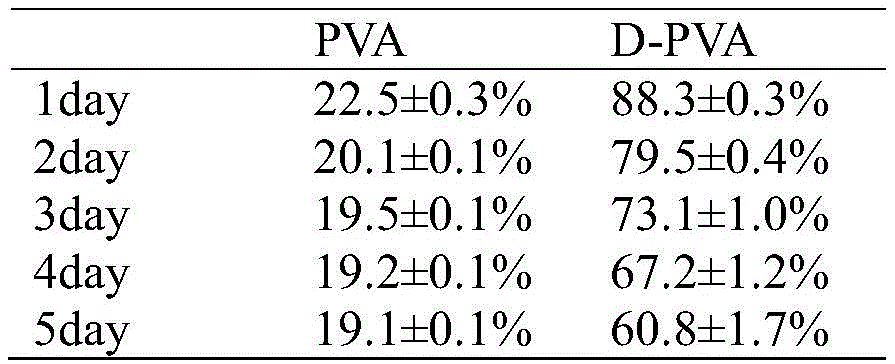
After being dried for 1 day in an environment of 25 ℃ and 30 RH%, the unmodified hydrogel PVA almost loses water completely, and the mass retention rate is only 22.5 +/-0.3 wt%, while the hydrogel D-PVA modified by the double-layer hydrophobic coating has the mass retention rate of 88.3 +/-0.3% after being dried for 1 day, and the mass retention rate of 60.8 +/-1.7% after 5 days (as shown in a table 2).
TABLE 2 comparison of Water Retention before and after modification of PVA hydrogels
The results show that the water retention of the hydrogel can be effectively improved by constructing the double-layer hydrophobic coating on the surface of the PVA hydrogel, and the method for preparing the hydrogel with high water retention has universality and is also suitable for the PVA hydrogel.
Example 5 surface modification and Performance testing of Polyacrylamide/polyvinyl alcohol (PAAm/PVA) Dual hydrogels
The surface modification of PAAm/PVA hydrogels comprises the following steps:
a. performing corona treatment on each surface of the PAAm/PVA hydrogel for 10 s;
b. b, placing the hydrogel treated in the step a into an aminopropyltrimethoxysilane/ethyl acetate solution with the concentration of 1mol/L for dipping treatment for 120 min;
c. drying the hydrogel treated in the step b at room temperature for 2min, and then soaking in 1mol/L perfluorooctanoic acid/ethyl acetate solution for 120 min;
d. and d, drying the hydrogel treated in the step c at room temperature for 2min, placing the hydrogel in phenyl silicone oil for 40min, taking out the hydrogel, and sucking away excessive oil on the surface by using filter paper.
The PAAm/PVA hydrogel prepared in the embodiment has a mass retention rate of 89.2 +/-0.5% after being dried for 1 day at 25 ℃ in a 30 RH% environment, and has a mass retention rate of 63.1 +/-0.8% after being dried for 5 days. The results show that the water retention of the hydrogel can be effectively improved by constructing the double-layer hydrophobic coating on the surface of the PAAm/PVA hydrogel.
Example 6 surface modification and Performance testing of bacterial cellulose gel (BC) hydrogels
The surface modification of BC hydrogels comprises the following steps:
a. carrying out corona treatment on each surface of the BC hydrogel for 5 s;
b. b, placing the hydrogel treated in the step a in a 3-diethylenetriaminopropylmethyldimethoxysilane/petroleum ether solution with the concentration of 0.5mol/L for dipping treatment for 90 min;
c. drying the hydrogel treated in the step b at room temperature for 2min, and then soaking in 0.5mol/L stearic acid/petroleum ether solution for 90 min;
d. and d, drying the hydrogel treated in the step c at room temperature for 2min, placing the hydrogel in FC-70 for 30min, taking out the hydrogel, and sucking away excessive oil on the surface by using filter paper.
After drying the unmodified hydrogel BC in an environment of 25 ℃ and 30 RH% for 1 day, almost completely loses water, and the mass retention rate is only 2.6 +/-0.3 wt%, while the mass retention rate of the hydrogel D-BC modified by the double-layer hydrophobic coating after drying for 1 day is 90.7 +/-0.6%, and the mass retention rate after 5 days is 67.6 +/-1.3% (shown in a table 3).
TABLE 3 comparison of Water Retention before and after modification of BC hydrogels
The results show that the water retention of the hydrogel can be effectively improved by constructing the double-layer hydrophobic coating on the surface of the BC hydrogel, and the method for preparing the hydrogel with high water retention is universal and is also suitable for the BC hydrogel.
Example 7 surface modification and Performance testing of bacterial cellulose gel (BC) hydrogels
The surface modification of BC hydrogels comprises the following steps:
a. carrying out plasma treatment on each surface of the BC hydrogel for 10 s;
b. b, placing the hydrogel treated in the step a into a 2 mol/L3-diethylenetriaminopropyltrimethoxysilane/ethyl acetate solution for soaking treatment for 30 min;
c. drying the hydrogel treated in the step b at room temperature for 2min, and then soaking in 2mol/L perfluorooctanoic acid/ethyl acetate solution for 30 min;
d. and d, drying the hydrogel treated in the step c at room temperature for 2min, then placing the hydrogel in perfluorinated silicone oil for 30min, then taking out the hydrogel, and absorbing excess oil on the surface by using filter paper.
The mass retention rate of the BC hydrogel prepared in the embodiment is 90.1 +/-0.3% after being dried for 1 day in an environment of 25 ℃ and 30 RH%, and the mass retention rate is 64.4 +/-0.6% after being dried for 5 days. The results show that the water retention of the hydrogel can be effectively improved by constructing the double-layer hydrophobic coating on the surface of the BC hydrogel.
Example 8 surface modification and Performance testing of sodium alginate/polyvinyl alcohol hydrogel (SA/PVA) hydrogels
The surface modification of the SA/PVA hydrogel comprises the following steps:
a. carrying out corona treatment on each surface of the SA/PVA hydrogel for 5 s;
b. b, placing the hydrogel treated in the step a into a 1 mol/L3-aminopropyltrimethoxysilane/ethyl acetate solution for dipping treatment for 60 min;
c. drying the hydrogel treated in the step b at room temperature for 2min, and then soaking in 1mol/L stearic acid/ethyl acetate solution for 60 min;
d. and d, drying the hydrogel treated in the step c at room temperature for 2min, placing the hydrogel in perfluorinated silicone oil for 30min, taking out the hydrogel, and sucking away excessive oil on the surface by using filter paper.
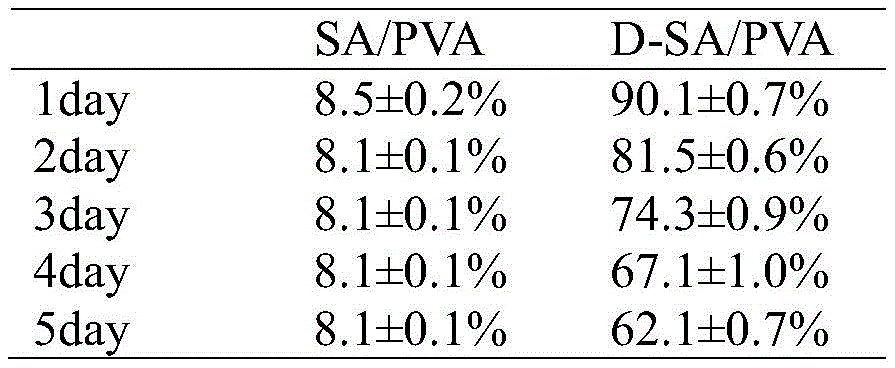
After being dried for 1 day in an environment of 25 ℃ and 30 RH%, the unmodified hydrogel SA/PVA almost loses water completely, and the mass retention rate is only 8.5 +/-0.2 wt%, while the hydrogel D-SA/PVA modified by the double-layer hydrophobic coating has the mass retention rate of 90.1 +/-0.7% after being dried for 1 day, and the mass retention rate of 62.1 +/-0.7% after 5 days (as shown in Table 4).
TABLE 4 comparison of Water Retention before and after modification of SA/PVA hydrogels
The results show that the water retention of the hydrogel can be effectively improved by constructing the double-layer hydrophobic coating on the surface of the SA/PVA hydrogel, and the method for preparing the hydrogel with high water retention has universality and is also suitable for the SA/PVA hydrogel.
Example 9 surface modification and Performance testing of polyacrylic acid-acrylamide hydrogel P (AA-co-AM)
The surface modification of the SA/PVA hydrogel comprises the following steps:
a. carrying out corona treatment on each surface of the P (AA-co-AM) hydrogel for 5 s;
b. b, placing the hydrogel treated in the step a into a 3-aminopropyltriethoxysilane/ethyl acetate solution with the concentration of 0.8mol/L for dipping treatment for 90 min;
c. c, drying the hydrogel treated in the step b at room temperature for 2min, and then soaking in a 0.8mol/L stearic acid/ethyl acetate solution for 90 min;
d. and d, drying the hydrogel treated in the step c at room temperature for 2min, placing the hydrogel in methyl silicone oil for 30min, taking out the hydrogel, and sucking away excessive oil on the surface by using filter paper.
After being dried for 1 day at 25 ℃ and 30 RH% in an unmodified hydrogel P (AA-co-AM), the hydrogel almost completely loses water, and the mass retention rate is only 8.5 +/-0.2 wt%, while the mass retention rate of the hydrogel D-SA/PVA modified by the double-layer hydrophobic coating after being dried for 1 day is 90.1 +/-0.7%, and the mass retention rate after 5 days is 62.1 +/-0.7% (as shown in Table 5).
TABLE 5 comparison of Water Retention before and after modification of P (AA-co-AM) hydrogels
The results show that the water retention of the hydrogel can be effectively improved by constructing the double-layer hydrophobic coating on the surface of the P (AA-co-AM) hydrogel, and the method for preparing the hydrogel with high water retention has universality and is also suitable for the P (AA-co-AM) hydrogel.
In summary, the present invention provides a hydrogel surface modification method and a hydrogel with high water retention, which effectively improves the water retention of the hydrogel by constructing a double-layer hydrophobic coating on the hydrogel surface, wherein the double-layer hydrophobic coating comprises a solid hydrophobic coating and a hydrophobic oil layer. The invention provides a method for constructing a double-layer hydrophobic coating on the surface of hydrogel through ingenious molecular structure design so as to effectively reduce the evaporation rate of water in the hydrogel: firstly, carrying out corona/plasma treatment on the surface of hydrogel to form hydroxyl on the surface of the hydrogel; then, quickly immersing the hydrogel subjected to corona/plasma treatment into an aminosilane coupling agent solution, wherein a product obtained after hydrolysis of the silane coupling agent and hydroxyl on the surface of the hydrogel can form a hydrogen bond, so that the aminosilane coupling agent is bonded to the surface of the hydrogel; then, continuously immersing the hydrogel into a long-chain alkyl compound solution containing carboxyl, and carrying out chemical reaction on the carboxyl and amino to graft the long-chain alkyl onto the surface of the hydrogel so as to form a layer of solid hydrophobic coating; finally, the modified hydrogel is immersed in oil, and the oil can penetrate into the hydrophobic coating of the hydrogel due to hydrophobic-hydrophobic interaction, so that a double-layer hydrophobic coating is formed on the surface of the hydrogel. In addition, the solvent in the modification solution used in the present invention is a solvent system that is not soluble in water, and both the modifier and the solvent are difficult to diffuse and permeate into the hydrogel due to poor solubility of the solvent in water. Therefore, the hydrophobic coating only grows on the surface of the hydrogel, and the bulk structure and the physicochemical property of the hydrogel are not influenced. Based on the above, the hydrogel surface modification method provided by the invention has the advantages that the hydrogel is wrapped by the double-layer hydrophobic coating formed on the surface of the hydrogel, so that a double-layer protective barrier is provided for the hydrogel, the volatilization of water in the hydrogel is slowed down, the water retention property and stability of the hydrogel are improved, and the service life of the hydrogel is prolonged; meanwhile, by introducing hydrogen bonds, chemical bonds and hydrophobic-hydrophobic interaction, the hydrophobic coating and the hydrophilic surface of the hydrogel have stronger interface strength, so that the practicability of the hydrogel is ensured; the method for improving the water retention of the hydrogel provided by the invention does not depend on the chemical composition and the geometric shape of the hydrogel, and is suitable for various hydrogels and hydrogels with various shapes, including hydrogels with regular structures and special-shaped structures, so that the method has universality.
It will be understood that the invention is not limited to the examples described above, but that modifications and variations will occur to those skilled in the art in light of the above teachings, and that all such modifications and variations are considered to be within the scope of the invention as defined by the appended claims.