CN115073747A - Application of polyether modified organic silicon penetrating agent in preparation of organic silicon modified penetration enhancer - Google Patents
Application of polyether modified organic silicon penetrating agent in preparation of organic silicon modified penetration enhancer Download PDFInfo
- Publication number
- CN115073747A CN115073747A CN202110265891.3A CN202110265891A CN115073747A CN 115073747 A CN115073747 A CN 115073747A CN 202110265891 A CN202110265891 A CN 202110265891A CN 115073747 A CN115073747 A CN 115073747A
- Authority
- CN
- China
- Prior art keywords
- modified
- penetrant
- organosilicon
- organic silicon
- polyether
- Prior art date
- Legal status (The legal status is an assumption and is not a legal conclusion. Google has not performed a legal analysis and makes no representation as to the accuracy of the status listed.)
- Granted
Links
- 239000003795 chemical substances by application Substances 0.000 title claims abstract description 170
- 239000003961 penetration enhancing agent Substances 0.000 title claims abstract description 155
- 229910052710 silicon Inorganic materials 0.000 title claims abstract description 82
- 239000010703 silicon Substances 0.000 title claims abstract description 82
- XUIMIQQOPSSXEZ-UHFFFAOYSA-N Silicon Chemical compound [Si] XUIMIQQOPSSXEZ-UHFFFAOYSA-N 0.000 title claims abstract description 81
- 239000004721 Polyphenylene oxide Substances 0.000 title claims abstract description 75
- 229920000570 polyether Polymers 0.000 title claims abstract description 75
- 238000002360 preparation method Methods 0.000 title claims abstract description 44
- 230000000149 penetrating effect Effects 0.000 title claims description 21
- 239000004568 cement Substances 0.000 claims abstract description 115
- 239000004567 concrete Substances 0.000 claims abstract description 104
- 239000003945 anionic surfactant Substances 0.000 claims abstract description 42
- 239000011734 sodium Substances 0.000 claims abstract description 30
- 229910052708 sodium Inorganic materials 0.000 claims abstract description 30
- DGAQECJNVWCQMB-PUAWFVPOSA-M Ilexoside XXIX Chemical compound C[C@@H]1CC[C@@]2(CC[C@@]3(C(=CC[C@H]4[C@]3(CC[C@@H]5[C@@]4(CC[C@@H](C5(C)C)OS(=O)(=O)[O-])C)C)[C@@H]2[C@]1(C)O)C)C(=O)O[C@H]6[C@@H]([C@H]([C@@H]([C@H](O6)CO)O)O)O.[Na+] DGAQECJNVWCQMB-PUAWFVPOSA-M 0.000 claims abstract description 14
- 229920000056 polyoxyethylene ether Polymers 0.000 claims abstract description 7
- 229940051841 polyoxyethylene ether Drugs 0.000 claims abstract description 7
- 238000004078 waterproofing Methods 0.000 claims description 106
- 229920001296 polysiloxane Polymers 0.000 claims description 52
- 238000007789 sealing Methods 0.000 claims description 50
- 230000035515 penetration Effects 0.000 claims description 42
- 239000000463 material Substances 0.000 claims description 34
- -1 polysiloxane Polymers 0.000 claims description 34
- IAYPIBMASNFSPL-UHFFFAOYSA-N Ethylene oxide Chemical compound C1CO1 IAYPIBMASNFSPL-UHFFFAOYSA-N 0.000 claims description 32
- 229920002050 silicone resin Polymers 0.000 claims description 24
- 238000006243 chemical reaction Methods 0.000 claims description 22
- GOOHAUXETOMSMM-UHFFFAOYSA-N Propylene oxide Chemical compound CC1CO1 GOOHAUXETOMSMM-UHFFFAOYSA-N 0.000 claims description 16
- 239000004575 stone Substances 0.000 claims description 16
- 238000000034 method Methods 0.000 claims description 13
- 239000011083 cement mortar Substances 0.000 claims description 11
- 239000004570 mortar (masonry) Substances 0.000 claims description 10
- 125000000391 vinyl group Chemical group [H]C([*])=C([H])[H] 0.000 claims description 9
- UQEAIHBTYFGYIE-UHFFFAOYSA-N hexamethyldisiloxane Chemical compound C[Si](C)(C)O[Si](C)(C)C UQEAIHBTYFGYIE-UHFFFAOYSA-N 0.000 claims description 8
- HMMGMWAXVFQUOA-UHFFFAOYSA-N octamethylcyclotetrasiloxane Chemical compound C[Si]1(C)O[Si](C)(C)O[Si](C)(C)O[Si](C)(C)O1 HMMGMWAXVFQUOA-UHFFFAOYSA-N 0.000 claims description 8
- 238000007259 addition reaction Methods 0.000 claims description 6
- 229920002554 vinyl polymer Polymers 0.000 claims description 6
- VMAWODUEPLAHOE-UHFFFAOYSA-N 2,4,6,8-tetrakis(ethenyl)-2,4,6,8-tetramethyl-1,3,5,7,2,4,6,8-tetraoxatetrasilocane Chemical compound C=C[Si]1(C)O[Si](C)(C=C)O[Si](C)(C=C)O[Si](C)(C=C)O1 VMAWODUEPLAHOE-UHFFFAOYSA-N 0.000 claims description 5
- QAOWNCQODCNURD-UHFFFAOYSA-L Sulfate Chemical compound [O-]S([O-])(=O)=O QAOWNCQODCNURD-UHFFFAOYSA-L 0.000 claims description 5
- 229920005989 resin Polymers 0.000 claims description 5
- 239000011347 resin Substances 0.000 claims description 5
- 125000004106 butoxy group Chemical group [*]OC([H])([H])C([H])([H])C(C([H])([H])[H])([H])[H] 0.000 claims description 2
- 239000003822 epoxy resin Substances 0.000 claims description 2
- 125000001495 ethyl group Chemical group [H]C([H])([H])C([H])([H])* 0.000 claims description 2
- 125000002496 methyl group Chemical group [H]C([H])([H])* 0.000 claims description 2
- 229920000647 polyepoxide Polymers 0.000 claims description 2
- 238000004519 manufacturing process Methods 0.000 claims 1
- 229910052909 inorganic silicate Inorganic materials 0.000 abstract description 53
- 230000003487 anti-permeability effect Effects 0.000 abstract description 45
- NTHWMYGWWRZVTN-UHFFFAOYSA-N sodium silicate Chemical compound [Na+].[Na+].[O-][Si]([O-])=O NTHWMYGWWRZVTN-UHFFFAOYSA-N 0.000 abstract description 43
- 235000019353 potassium silicate Nutrition 0.000 abstract description 22
- 230000003014 reinforcing effect Effects 0.000 abstract description 12
- 230000035699 permeability Effects 0.000 abstract description 10
- BDHFUVZGWQCTTF-UHFFFAOYSA-M sulfonate Chemical compound [O-]S(=O)=O BDHFUVZGWQCTTF-UHFFFAOYSA-M 0.000 abstract description 9
- PMZURENOXWZQFD-UHFFFAOYSA-L Sodium Sulfate Chemical compound [Na+].[Na+].[O-]S([O-])(=O)=O PMZURENOXWZQFD-UHFFFAOYSA-L 0.000 abstract description 3
- 229910052938 sodium sulfate Inorganic materials 0.000 abstract description 3
- 235000011152 sodium sulphate Nutrition 0.000 abstract description 3
- 230000002195 synergetic effect Effects 0.000 abstract description 2
- 230000002194 synthesizing effect Effects 0.000 abstract 1
- XLYOFNOQVPJJNP-UHFFFAOYSA-N water Substances O XLYOFNOQVPJJNP-UHFFFAOYSA-N 0.000 description 90
- 238000012360 testing method Methods 0.000 description 82
- 230000000694 effects Effects 0.000 description 49
- 239000000243 solution Substances 0.000 description 49
- 239000000126 substance Substances 0.000 description 30
- 230000007797 corrosion Effects 0.000 description 26
- 238000005260 corrosion Methods 0.000 description 26
- BPQQTUXANYXVAA-UHFFFAOYSA-N Orthosilicate Chemical compound [O-][Si]([O-])([O-])[O-] BPQQTUXANYXVAA-UHFFFAOYSA-N 0.000 description 25
- HEMHJVSKTPXQMS-UHFFFAOYSA-M Sodium hydroxide Chemical compound [OH-].[Na+] HEMHJVSKTPXQMS-UHFFFAOYSA-M 0.000 description 24
- 238000002156 mixing Methods 0.000 description 24
- 238000001514 detection method Methods 0.000 description 23
- 230000002708 enhancing effect Effects 0.000 description 23
- 239000011248 coating agent Substances 0.000 description 22
- 238000000576 coating method Methods 0.000 description 22
- 239000004115 Sodium Silicate Substances 0.000 description 21
- 229910052911 sodium silicate Inorganic materials 0.000 description 21
- 239000000203 mixture Substances 0.000 description 18
- AXCZMVOFGPJBDE-UHFFFAOYSA-L calcium dihydroxide Chemical compound [OH-].[OH-].[Ca+2] AXCZMVOFGPJBDE-UHFFFAOYSA-L 0.000 description 17
- 238000009472 formulation Methods 0.000 description 17
- RMAQACBXLXPBSY-UHFFFAOYSA-N silicic acid Chemical compound O[Si](O)(O)O RMAQACBXLXPBSY-UHFFFAOYSA-N 0.000 description 17
- VEXZGXHMUGYJMC-UHFFFAOYSA-N Hydrochloric acid Chemical compound Cl VEXZGXHMUGYJMC-UHFFFAOYSA-N 0.000 description 16
- NBIIXXVUZAFLBC-UHFFFAOYSA-N Phosphoric acid Chemical compound OP(O)(O)=O NBIIXXVUZAFLBC-UHFFFAOYSA-N 0.000 description 16
- QAOWNCQODCNURD-UHFFFAOYSA-N Sulfuric acid Chemical compound OS(O)(=O)=O QAOWNCQODCNURD-UHFFFAOYSA-N 0.000 description 16
- 239000000920 calcium hydroxide Substances 0.000 description 16
- 229910001861 calcium hydroxide Inorganic materials 0.000 description 16
- 238000011068 loading method Methods 0.000 description 16
- 238000002386 leaching Methods 0.000 description 14
- 239000000047 product Substances 0.000 description 14
- 239000005871 repellent Substances 0.000 description 13
- 230000002940 repellent Effects 0.000 description 12
- 239000002585 base Substances 0.000 description 11
- 239000003153 chemical reaction reagent Substances 0.000 description 11
- 238000001879 gelation Methods 0.000 description 11
- 239000010410 layer Substances 0.000 description 10
- 239000007788 liquid Substances 0.000 description 9
- 239000011148 porous material Substances 0.000 description 9
- VYPSYNLAJGMNEJ-UHFFFAOYSA-N Silicium dioxide Chemical compound O=[Si]=O VYPSYNLAJGMNEJ-UHFFFAOYSA-N 0.000 description 8
- 229910000147 aluminium phosphate Inorganic materials 0.000 description 8
- 238000000465 moulding Methods 0.000 description 8
- 239000004576 sand Substances 0.000 description 8
- 238000002791 soaking Methods 0.000 description 8
- 238000010276 construction Methods 0.000 description 7
- 239000003623 enhancer Substances 0.000 description 7
- 239000000499 gel Substances 0.000 description 7
- 230000002265 prevention Effects 0.000 description 7
- 125000005372 silanol group Chemical group 0.000 description 7
- LFQSCWFLJHTTHZ-UHFFFAOYSA-N Ethanol Chemical compound CCO LFQSCWFLJHTTHZ-UHFFFAOYSA-N 0.000 description 6
- 239000009147 Kangxin Substances 0.000 description 6
- 230000007935 neutral effect Effects 0.000 description 6
- 239000012466 permeate Substances 0.000 description 6
- BASFCYQUMIYNBI-UHFFFAOYSA-N platinum Chemical compound [Pt] BASFCYQUMIYNBI-UHFFFAOYSA-N 0.000 description 6
- 230000008569 process Effects 0.000 description 6
- 238000011160 research Methods 0.000 description 6
- 229910002027 silica gel Inorganic materials 0.000 description 6
- 230000002787 reinforcement Effects 0.000 description 5
- 239000000654 additive Substances 0.000 description 4
- 239000003513 alkali Substances 0.000 description 4
- 230000015572 biosynthetic process Effects 0.000 description 4
- 239000003054 catalyst Substances 0.000 description 4
- 238000003786 synthesis reaction Methods 0.000 description 4
- 125000003545 alkoxy group Chemical group 0.000 description 3
- 238000006482 condensation reaction Methods 0.000 description 3
- 230000007062 hydrolysis Effects 0.000 description 3
- 238000006460 hydrolysis reaction Methods 0.000 description 3
- 230000001965 increasing effect Effects 0.000 description 3
- 230000008595 infiltration Effects 0.000 description 3
- 238000001764 infiltration Methods 0.000 description 3
- FPYJFEHAWHCUMM-UHFFFAOYSA-N maleic anhydride Chemical compound O=C1OC(=O)C=C1 FPYJFEHAWHCUMM-UHFFFAOYSA-N 0.000 description 3
- 238000006386 neutralization reaction Methods 0.000 description 3
- 239000011241 protective layer Substances 0.000 description 3
- 230000008439 repair process Effects 0.000 description 3
- 150000003839 salts Chemical class 0.000 description 3
- 239000000565 sealant Substances 0.000 description 3
- 239000002344 surface layer Substances 0.000 description 3
- RTZKZFJDLAIYFH-UHFFFAOYSA-N Diethyl ether Chemical compound CCOCC RTZKZFJDLAIYFH-UHFFFAOYSA-N 0.000 description 2
- BLRPTPMANUNPDV-UHFFFAOYSA-N Silane Chemical compound [SiH4] BLRPTPMANUNPDV-UHFFFAOYSA-N 0.000 description 2
- WQDUMFSSJAZKTM-UHFFFAOYSA-N Sodium methoxide Chemical compound [Na+].[O-]C WQDUMFSSJAZKTM-UHFFFAOYSA-N 0.000 description 2
- 238000009825 accumulation Methods 0.000 description 2
- 230000009471 action Effects 0.000 description 2
- 230000000996 additive effect Effects 0.000 description 2
- 230000004888 barrier function Effects 0.000 description 2
- 230000001680 brushing effect Effects 0.000 description 2
- 239000011575 calcium Substances 0.000 description 2
- 239000000378 calcium silicate Substances 0.000 description 2
- 229910052918 calcium silicate Inorganic materials 0.000 description 2
- OYACROKNLOSFPA-UHFFFAOYSA-N calcium;dioxido(oxo)silane Chemical compound [Ca+2].[O-][Si]([O-])=O OYACROKNLOSFPA-UHFFFAOYSA-N 0.000 description 2
- 238000009833 condensation Methods 0.000 description 2
- 230000005494 condensation Effects 0.000 description 2
- 238000007334 copolymerization reaction Methods 0.000 description 2
- 238000011161 development Methods 0.000 description 2
- 230000018109 developmental process Effects 0.000 description 2
- 238000001035 drying Methods 0.000 description 2
- 238000004043 dyeing Methods 0.000 description 2
- 229910052739 hydrogen Inorganic materials 0.000 description 2
- 239000001257 hydrogen Substances 0.000 description 2
- 230000002209 hydrophobic effect Effects 0.000 description 2
- 125000002887 hydroxy group Chemical group [H]O* 0.000 description 2
- 238000005470 impregnation Methods 0.000 description 2
- 150000007529 inorganic bases Chemical class 0.000 description 2
- 230000002045 lasting effect Effects 0.000 description 2
- 235000013379 molasses Nutrition 0.000 description 2
- 238000005457 optimization Methods 0.000 description 2
- 150000004762 orthosilicates Chemical class 0.000 description 2
- 238000010422 painting Methods 0.000 description 2
- 229910052697 platinum Inorganic materials 0.000 description 2
- 125000002924 primary amino group Chemical group [H]N([H])* 0.000 description 2
- 230000001737 promoting effect Effects 0.000 description 2
- 229910000077 silane Inorganic materials 0.000 description 2
- 239000002210 silicon-based material Substances 0.000 description 2
- 229920005552 sodium lignosulfonate Polymers 0.000 description 2
- 238000007711 solidification Methods 0.000 description 2
- 230000008023 solidification Effects 0.000 description 2
- 238000004381 surface treatment Methods 0.000 description 2
- 229910018557 Si O Inorganic materials 0.000 description 1
- 239000002253 acid Substances 0.000 description 1
- 230000032683 aging Effects 0.000 description 1
- 229910052910 alkali metal silicate Inorganic materials 0.000 description 1
- 150000001408 amides Chemical class 0.000 description 1
- 239000002518 antifoaming agent Substances 0.000 description 1
- 239000007864 aqueous solution Substances 0.000 description 1
- 230000009286 beneficial effect Effects 0.000 description 1
- 239000011230 binding agent Substances 0.000 description 1
- 230000000903 blocking effect Effects 0.000 description 1
- 239000004566 building material Substances 0.000 description 1
- 125000003178 carboxy group Chemical group [H]OC(*)=O 0.000 description 1
- 238000006555 catalytic reaction Methods 0.000 description 1
- 239000003638 chemical reducing agent Substances 0.000 description 1
- 230000000052 comparative effect Effects 0.000 description 1
- 150000001875 compounds Chemical class 0.000 description 1
- 239000007822 coupling agent Substances 0.000 description 1
- 230000006866 deterioration Effects 0.000 description 1
- 230000002542 deteriorative effect Effects 0.000 description 1
- KPUWHANPEXNPJT-UHFFFAOYSA-N disiloxane Chemical class [SiH3]O[SiH3] KPUWHANPEXNPJT-UHFFFAOYSA-N 0.000 description 1
- 229920001971 elastomer Polymers 0.000 description 1
- 238000001704 evaporation Methods 0.000 description 1
- 230000008020 evaporation Effects 0.000 description 1
- 239000004744 fabric Substances 0.000 description 1
- 238000000855 fermentation Methods 0.000 description 1
- 230000004151 fermentation Effects 0.000 description 1
- 239000006260 foam Substances 0.000 description 1
- 125000001165 hydrophobic group Chemical group 0.000 description 1
- 230000006872 improvement Effects 0.000 description 1
- 238000011835 investigation Methods 0.000 description 1
- 230000007774 longterm Effects 0.000 description 1
- 238000012423 maintenance Methods 0.000 description 1
- 238000012986 modification Methods 0.000 description 1
- 230000004048 modification Effects 0.000 description 1
- 229910052605 nesosilicate Inorganic materials 0.000 description 1
- 230000010494 opalescence Effects 0.000 description 1
- 229920000620 organic polymer Polymers 0.000 description 1
- 229920001558 organosilicon polymer Polymers 0.000 description 1
- 238000011056 performance test Methods 0.000 description 1
- 239000004848 polyfunctional curative Substances 0.000 description 1
- 239000002861 polymer material Substances 0.000 description 1
- 238000007639 printing Methods 0.000 description 1
- 230000002035 prolonged effect Effects 0.000 description 1
- 239000005060 rubber Substances 0.000 description 1
- SCPYDCQAZCOKTP-UHFFFAOYSA-N silanol Chemical compound [SiH3]O SCPYDCQAZCOKTP-UHFFFAOYSA-N 0.000 description 1
- LIVNPJMFVYWSIS-UHFFFAOYSA-N silicon monoxide Inorganic materials [Si-]#[O+] LIVNPJMFVYWSIS-UHFFFAOYSA-N 0.000 description 1
- 125000005373 siloxane group Chemical group [SiH2](O*)* 0.000 description 1
- GBPOWOIWSYUZMH-UHFFFAOYSA-N sodium;trihydroxy(methyl)silane Chemical compound [Na+].C[Si](O)(O)O GBPOWOIWSYUZMH-UHFFFAOYSA-N 0.000 description 1
- 239000007787 solid Substances 0.000 description 1
- 239000002904 solvent Substances 0.000 description 1
- 238000001179 sorption measurement Methods 0.000 description 1
- 238000005507 spraying Methods 0.000 description 1
- 239000003381 stabilizer Substances 0.000 description 1
- 238000003756 stirring Methods 0.000 description 1
- 239000000758 substrate Substances 0.000 description 1
- 229910021653 sulphate ion Inorganic materials 0.000 description 1
- 230000001502 supplementing effect Effects 0.000 description 1
- 238000010998 test method Methods 0.000 description 1
Classifications
-
- C—CHEMISTRY; METALLURGY
- C08—ORGANIC MACROMOLECULAR COMPOUNDS; THEIR PREPARATION OR CHEMICAL WORKING-UP; COMPOSITIONS BASED THEREON
- C08G—MACROMOLECULAR COMPOUNDS OBTAINED OTHERWISE THAN BY REACTIONS ONLY INVOLVING UNSATURATED CARBON-TO-CARBON BONDS
- C08G77/00—Macromolecular compounds obtained by reactions forming a linkage containing silicon with or without sulfur, nitrogen, oxygen or carbon in the main chain of the macromolecule
- C08G77/42—Block-or graft-polymers containing polysiloxane sequences
- C08G77/46—Block-or graft-polymers containing polysiloxane sequences containing polyether sequences
-
- C—CHEMISTRY; METALLURGY
- C04—CEMENTS; CONCRETE; ARTIFICIAL STONE; CERAMICS; REFRACTORIES
- C04B—LIME, MAGNESIA; SLAG; CEMENTS; COMPOSITIONS THEREOF, e.g. MORTARS, CONCRETE OR LIKE BUILDING MATERIALS; ARTIFICIAL STONE; CERAMICS; REFRACTORIES; TREATMENT OF NATURAL STONE
- C04B24/00—Use of organic materials as active ingredients for mortars, concrete or artificial stone, e.g. plasticisers
- C04B24/40—Compounds containing silicon, titanium or zirconium or other organo-metallic compounds; Organo-clays; Organo-inorganic complexes
- C04B24/42—Organo-silicon compounds
-
- C—CHEMISTRY; METALLURGY
- C04—CEMENTS; CONCRETE; ARTIFICIAL STONE; CERAMICS; REFRACTORIES
- C04B—LIME, MAGNESIA; SLAG; CEMENTS; COMPOSITIONS THEREOF, e.g. MORTARS, CONCRETE OR LIKE BUILDING MATERIALS; ARTIFICIAL STONE; CERAMICS; REFRACTORIES; TREATMENT OF NATURAL STONE
- C04B40/00—Processes, in general, for influencing or modifying the properties of mortars, concrete or artificial stone compositions, e.g. their setting or hardening ability
- C04B40/0028—Aspects relating to the mixing step of the mortar preparation
- C04B40/0039—Premixtures of ingredients
-
- C—CHEMISTRY; METALLURGY
- C04—CEMENTS; CONCRETE; ARTIFICIAL STONE; CERAMICS; REFRACTORIES
- C04B—LIME, MAGNESIA; SLAG; CEMENTS; COMPOSITIONS THEREOF, e.g. MORTARS, CONCRETE OR LIKE BUILDING MATERIALS; ARTIFICIAL STONE; CERAMICS; REFRACTORIES; TREATMENT OF NATURAL STONE
- C04B41/00—After-treatment of mortars, concrete, artificial stone or ceramics; Treatment of natural stone
- C04B41/45—Coating or impregnating, e.g. injection in masonry, partial coating of green or fired ceramics, organic coating compositions for adhering together two concrete elements
- C04B41/46—Coating or impregnating, e.g. injection in masonry, partial coating of green or fired ceramics, organic coating compositions for adhering together two concrete elements with organic materials
- C04B41/49—Compounds having one or more carbon-to-metal or carbon-to-silicon linkages ; Organo-clay compounds; Organo-silicates, i.e. ortho- or polysilicic acid esters ; Organo-phosphorus compounds; Organo-inorganic complexes
- C04B41/4905—Compounds having one or more carbon-to-metal or carbon-to-silicon linkages ; Organo-clay compounds; Organo-silicates, i.e. ortho- or polysilicic acid esters ; Organo-phosphorus compounds; Organo-inorganic complexes containing silicon
- C04B41/495—Compounds having one or more carbon-to-metal or carbon-to-silicon linkages ; Organo-clay compounds; Organo-silicates, i.e. ortho- or polysilicic acid esters ; Organo-phosphorus compounds; Organo-inorganic complexes containing silicon applied to the substrate as oligomers or polymers
- C04B41/4961—Polyorganosiloxanes, i.e. polymers with a Si-O-Si-O-chain; "silicones"
-
- C—CHEMISTRY; METALLURGY
- C04—CEMENTS; CONCRETE; ARTIFICIAL STONE; CERAMICS; REFRACTORIES
- C04B—LIME, MAGNESIA; SLAG; CEMENTS; COMPOSITIONS THEREOF, e.g. MORTARS, CONCRETE OR LIKE BUILDING MATERIALS; ARTIFICIAL STONE; CERAMICS; REFRACTORIES; TREATMENT OF NATURAL STONE
- C04B41/00—After-treatment of mortars, concrete, artificial stone or ceramics; Treatment of natural stone
- C04B41/60—After-treatment of mortars, concrete, artificial stone or ceramics; Treatment of natural stone of only artificial stone
- C04B41/61—Coating or impregnation
- C04B41/62—Coating or impregnation with organic materials
- C04B41/64—Compounds having one or more carbon-to-metal of carbon-to-silicon linkages
-
- C—CHEMISTRY; METALLURGY
- C04—CEMENTS; CONCRETE; ARTIFICIAL STONE; CERAMICS; REFRACTORIES
- C04B—LIME, MAGNESIA; SLAG; CEMENTS; COMPOSITIONS THEREOF, e.g. MORTARS, CONCRETE OR LIKE BUILDING MATERIALS; ARTIFICIAL STONE; CERAMICS; REFRACTORIES; TREATMENT OF NATURAL STONE
- C04B2103/00—Function or property of ingredients for mortars, concrete or artificial stone
- C04B2103/60—Agents for protection against chemical, physical or biological attack
-
- C—CHEMISTRY; METALLURGY
- C04—CEMENTS; CONCRETE; ARTIFICIAL STONE; CERAMICS; REFRACTORIES
- C04B—LIME, MAGNESIA; SLAG; CEMENTS; COMPOSITIONS THEREOF, e.g. MORTARS, CONCRETE OR LIKE BUILDING MATERIALS; ARTIFICIAL STONE; CERAMICS; REFRACTORIES; TREATMENT OF NATURAL STONE
- C04B2103/00—Function or property of ingredients for mortars, concrete or artificial stone
- C04B2103/60—Agents for protection against chemical, physical or biological attack
- C04B2103/601—Agents for increasing frost resistance
-
- C—CHEMISTRY; METALLURGY
- C04—CEMENTS; CONCRETE; ARTIFICIAL STONE; CERAMICS; REFRACTORIES
- C04B—LIME, MAGNESIA; SLAG; CEMENTS; COMPOSITIONS THEREOF, e.g. MORTARS, CONCRETE OR LIKE BUILDING MATERIALS; ARTIFICIAL STONE; CERAMICS; REFRACTORIES; TREATMENT OF NATURAL STONE
- C04B2103/00—Function or property of ingredients for mortars, concrete or artificial stone
- C04B2103/60—Agents for protection against chemical, physical or biological attack
- C04B2103/65—Water proofers or repellants
Landscapes
- Chemical & Material Sciences (AREA)
- Engineering & Computer Science (AREA)
- Ceramic Engineering (AREA)
- Organic Chemistry (AREA)
- Structural Engineering (AREA)
- Materials Engineering (AREA)
- Medicinal Chemistry (AREA)
- Inorganic Chemistry (AREA)
- Polymers & Plastics (AREA)
- Health & Medical Sciences (AREA)
- Chemical Kinetics & Catalysis (AREA)
- Sealing Material Composition (AREA)
- Compositions Of Macromolecular Compounds (AREA)
Abstract
The invention provides a polyether modified organosilicon penetrant and preparation and application thereof, wherein the penetrant is prepared by synthesizing a novel polyether modified organosilicon penetrant, and performing synergistic compatibility with a silicon-containing anionic surfactant and anionic surfactants such as fatty alcohol-polyoxyethylene ether sodium sulfate or sodium sulfonate, and the prepared organosilicon modified penetration enhancer can promote components such as inorganic silicate, water glass and the like to penetrate into a cement concrete structure, so that the cement concrete realizes high strength and high compactness, has a very good permanent waterproof and anti-permeability effect, and can be used for reinforcing low-grade concrete structures or repairing and reinforcing concrete with formed fine crack damages. A large number of practices prove that the waterproof permeability-resistant agent is obviously superior to the existing waterproof permeability-resistant agent and has great market competitiveness.
Description
Technical Field
The invention relates to the field of building materials, in particular to application of a polyether modified organic silicon penetrating agent in preparation of an organic silicon modified penetration enhancer.
Background
Cement concrete materials are today the largest group of construction engineering materials. Particularly, along with the vigorous development of domestic construction industry in recent years, the requirements on the impermeability, the water resistance and the durability of cement concrete materials used in the construction process are continuously improved. However, the impermeability and water resistance and durability of the current cement concrete materials are far from meeting the requirements of social development, and further research and improvement are needed.
The cement concrete material needs a certain amount of water in the processes of stirring and pouring and forming, and the water consumed by cement is very little. The residual water forms capillary pores after evaporation and pores left in the drying shrinkage process, the pore diameter is generally larger and the pores are communicated and opened, so the pores are the main reasons for water leakage of concrete.
In order to improve the impermeability of the cement concrete, the penetrating pores can be inhibited and reduced by additives (such as air entraining agent, water reducing agent and sealant), so as to improve the impermeability; organic polymer materials (such as asphalts, rubbers, and resins) are also used as a surface treatment material for the substrate to seal it against leakage. But the former only reduces and inhibits capillary pores, and cannot really play a role in sealing and waterproofing; the latter is subject to long-term action of sunlight, ultraviolet rays, temperature and water, and is easy to age and peel off, thereby losing the function of leakage prevention. Therefore, a method for realizing permanent sealing and water proofing is urgently needed to be found.
At present, extensive research is carried out at home and abroad on how to improve the impermeability and the waterproofness of cement concrete materials, wherein the impermeability and the waterproofing of the cement concrete materials by adopting organic silicon materials are effective measures in concrete waterproofing engineering. The organosilicon material is a waterproof material which is composed of Si-O bonds as a main chain and has good weather resistance, aging resistance and hydrophobic property, and the material can effectively play a role in resisting seepage and water.
In spite of research progress in related fields at home and abroad, the organic silicon material is mainly used for surface treatment of cement-based materials, namely, the purpose of impermeability and waterproofness is achieved by means of external coating or impregnation. And the outer coating or the impregnation is only limited in the surface layer of the cement-based material and a plurality of mm in the surface layer to form a protective layer, and meanwhile, in order to ensure better waterproof effect, the dosage of the organic silicon is larger, and the construction cost is greatly improved. And because the protective layer is formed only in a plurality of mm of the surface layer, the waterproof and impervious effects are easy to be damaged by the external severe environment, so that the impervious and waterproof effects are ineffective and the durability is poor.
CN105272014A discloses an organosilicon polymer mortar, but it belongs to an internal mixing type mortar mixed with cement mortar in advance, and can not penetrate into the solidified cement concrete material, and the strength and compactness of the waterproof mortar sample obtained by pouring are still lower, and the organosilicon hydrophobic group is formed in the concrete too early, which affects the strength of the concrete, so that the waterproof concrete mortar is more suitable for use in small-sized structures such as bathrooms, and has a greater risk for large-sized pouring. CN107805040A discloses a water-based high-friction coefficient concrete penetration hardener, which is formed by forming a reticular chemical adsorption film by adopting organic silicon such as sodium methylsiliconate and the like, but the penetration effect is poor, a protective layer can be formed only on the surface, and the penetration into the concrete is difficult to realize permanent waterproof anti-penetration and reinforcing effects.
The polyether modified organosilicon penetrant is obtained by introducing carboxyl, sulfonic group, amino and the like into polyether organosilicon molecules to ionize the polyether organosilicon molecules, has the advantages of organosilicon and the characteristics of polyether, becomes a hotspot of research in recent years, is generally applied to coating auxiliaries, fabric high-temperature dyeing, industrial antifoaming agents, foam homogenizing agents, fermentation processes, personal care product additives and the like, but no relevant report that the polyether modified organosilicon penetrant is used as a penetration enhancer in the building industry exists at present.
Disclosure of Invention
In order to solve the problem of poor waterproof and anti-permeability effects of the existing cement concrete materials, the invention provides a novel polyether modified organic silicon penetrating agent and application thereof in preparing an organic silicon modified penetrating agent. A large number of practices prove that the waterproof permeability-resistant agent is obviously superior to the existing waterproof permeability-resistant agent and has great market competitiveness.
In one aspect, the invention provides a polyether modified organic silicon penetrant, wherein the structural formula of the polyether modified organic silicon penetrant is shown as a formula I or II:

wherein n is 1-20; r ' is a terminal capping group, R ' is a side chain group, and R ' are any one of EO (ethylene oxide) or EO (ethylene oxide)/PO (propylene oxide) polyether modified MQ silicone resin, MT silicone resin or MTQ silicone resin.
In another aspect, the present invention provides a method for preparing the polyether modified silicone penetrant as described above, wherein:
the preparation steps of the formula I are as follows: hexamethyldisiloxane, vinyl double end sockets and octamethylcyclotetrasiloxane are subjected to equilibrium telomerization to obtain monovinyl-end-capped polysiloxane, and the monovinyl-end-capped polysiloxane is subjected to addition reaction with unsaturated polyether and MQH resin with the H content of 0.8% to obtain the epoxy resin;
the preparation steps of the formula II are as follows: hexamethyldisiloxane, octamethylcyclotetrasiloxane and tetramethyltetravinylcyclotetrasiloxane are subjected to equilibrium telomerization to obtain polysiloxane with a side chain containing vinyl, and the polysiloxane is subjected to addition reaction with unsaturated polyether and MQH resin with the H content of 0.8%.
Further, the chemical reaction formula of the preparation process of the polyether modified organic silicon penetrant is as follows:
the chemical reaction formula of the preparation process of the formula I is as follows:
①MM+ViVi+D 4 →A
② A + MQH + unsaturated polyether → product
(ii) a The chemical reaction formula of the preparation process of the formula II is as follows:
①MM+D 4 +D 4 Vi→A’
② A' + MQH + unsaturated polyether → product
Wherein MM is hexamethyldisiloxane, ViViViVi is vinyl double-end socket, D 4 Is octamethylcyclotetrasiloxane, D 4 Vi is tetramethyltetravinylcyclotetrasiloxane.
In another aspect, the invention provides a polyether modified organic silicon penetrating agent for preparing organic silicon modified penetration enhancer, the structural formula of the polyether modified organic silicon penetrating agent is shown as formula I or II:

wherein n is 1-20; r ' is a terminal capping group, R ' is a side chain group, and R ' are any one of EO (ethylene oxide) or EO (ethylene oxide)/PO (propylene oxide) polyether modified MQ silicone resin, MT silicone resin or MTQ silicone resin.
Further, the silicone-modified penetration enhancer includes a: a silicon-containing anionic surfactant; b: polyether modified organosilicon penetrant; c: an anionic surfactant.
Further, the structural formula of A is shown as formula III:
R’ n Si(OR) 4-n-m X m
formula III
Wherein n is more than or equal to 1, and m is 0-3; r' is methyl or ethyl; OR is any one of methoxy, ethoxy OR butoxy; x is-OH.
Further, the preparation method of the A (silicon-containing anionic surfactant) mainly comprises the following steps: the amino-reactive alkoxysilane is obtained by reacting amino-reactive alkoxysilane with maleic anhydride and then with sodium alkoxide in an alcohol solvent.
Further, the chemical reaction formula of the preparation process of the silicon-containing anionic surfactant is as follows:

further, the C is fatty alcohol-polyoxyethylene ether sodium sulfate or sodium sulfonate.
Through a great deal of research, research groups surprisingly find that by adopting the silicon-containing anionic surfactant and the polyether modified organosilicon penetrant provided by the invention, the reagent obtained by combining the sodium alcohol ether sulphate or sodium sulfonate and other anionic surfactants can promote the components such as inorganic silicate to permeate into the concrete structure, the penetration depth can reach more than 7 days and 3cm, thereby obviously improving the sealing impermeability of the cement concrete, simultaneously having a reinforcing effect on the concrete structure, obtaining the concrete structure as if the concrete structure is stone-like after infiltration, being very hard and compact and presenting a compact cement stone shape, the waterproof sealant can be used for sealing and waterproofing cement concrete to form an impervious waterproof layer with a more complete structure and better sealing property, and can also be used for reinforcing low-grade concrete structures or repairing and reinforcing concrete damaged by formed fine cracks.
The components such as inorganic silicate solution are usually strong alkali components, so the penetration promoter which can promote the penetration of the inorganic silicate solution and the like has the characteristic of being very stable in a strong alkali environment (the pH value is 12-14), and simultaneously, the surface tension of the components such as the inorganic silicate and the like can be obviously reduced, the affinity of the inorganic silicate and a cement concrete structure can be improved, the curing time after coating is prolonged, and the components are completely penetrated into the concrete structure and then cured.
The organosilicon modified penetration enhancer provided by the invention adopts a silicon-containing anionic surfactant matched with a polyether modified organosilicon penetrating agent, reduces the surface tension of inorganic silicon by using organosilicon, and is matched with a sodium sulfonate anionic surfactant, so that the system of the penetration enhancer is more stable, when all components are in balance with the copolymerization of inorganic strong-base silicate, a new modified product can be formed, after the penetration into cement concrete, gel is formed through silanol group condensation reaction, capillary pores of the cement concrete are sealed, the modified silicate structure contains alkoxy (-OR) which is not completely reserved by hydrolysis, the alkoxy (-OR) can react with water attached to the surface of inorganic base materials such as cement concrete and the like to generate silanol groups, the silanol groups and the hydroxylated cement concrete surface form strong hydrogen bonds, and the silanol groups can further react with the cement surface hydroxyl groups, so that a high-strength impervious body is formed, forming a permanently dense set of cement.
The reactive silane synthesis comprises several chemical reaction steps of organic functional silane synthesis, silanol catalysis, partial hydrolysis and the like. In the course of the test, the determination of the R' radical and the selection of the hydroalcoholic process parameters were carried out.
The negative organosilicon-containing anionic surfactant and the inorganic silicate can form an equilibrium product under certain conditions. The condensation reaction and gelation properties of the modified product have certain similarities with the condensation reaction and gelation of the inorganic silicate alone. Because organosilicates are multifunctional, they crosslink by condensation of silanol groups.
The organic siloxane group is used for surface hydrophobic treatment, and has synergistic effect. The chemical stability of siloxane effectively changes the comprehensive performance of the building, so that the building has comprehensive effects of water resistance, permeability resistance, corrosion resistance, pollution resistance and the like.
Meanwhile, because the organic silicon is modified, the inorganic silicate is used as a main body, the organic silicon modified silicate can be used as a stabilizing agent of the silicate, and gel can be generated after the silicate permeates capillary pores to block capillary channels, so that the sealing effect is achieved. Organosilicon is a compound between inorganic and organic, and has chemical affinity with silicate materials. The material can improve the impermeability of concrete, and form compact cement with permanence.
The organosilicon modified penetration enhancer provided by the invention has very good stability, can be stored at room temperature for a long time, and has a shelf life of more than 6 months.
Further, the mass ratio of the A, B, C is 20-40%, 1-15% and 45-75%.
Further, the mass ratio of the A, B, C is 20-40%, 1-15% and 45-75%.
The proportion of A, B, C in the penetration enhancer is adjusted according to the components of the base material (such as inorganic silicate or water glass) to be penetrated. The proportion of the components is adjusted according to the requirements of the treated material, the components can be selected through a gelation test, and the proper gelation time can be selected according to the requirements, so that the penetration depth of the waterproof agent and the water pressure resistance of the waterproof layer can reach ideal states (the gelation time is too short, the solidification can be started before the penetration is too late, and the gelation time is too long, the accumulation amount in a cement concrete capillary can be insufficient, and the water pressure resistance is poor).
The gel test procedure is exemplified:
title Ca (OH) 2 (used for simulating reactive alkaline substances in cement) 0.5g is placed in 15ml of water, stirred for 2 minutes, 20ml of the blended anti-permeability waterproofing agent prepared by the penetration enhancer is slowly added, stirred for 15 minutes, and the initial setting time and the final setting time are recorded. When the waterproof layer is used, under the condition of changed pH or in the presence of a catalyst, a product is subjected to comprehensive reaction or gelation to form the impervious waterproof layer with a more complete structure and better sealing property.
The preparation method of the organosilicon modified penetration enhancer provided by the invention comprises the following steps: mixing A, B, C three components according to the mass ratio of 20-40 percent, 1-15 percent and 45-75 percent.
In some embodiments, A, B, C is first diluted with water to make a: 35%, B: 35%, C: 30% aqueous solution. And A, B, C mixing proportionally.
In another aspect, the invention provides a use of a polyether modified organic silicon penetrant for preparing a sealing impervious waterproofing agent, wherein the structural formula of the polyether modified organic silicon penetrant is shown as a formula I or II:

wherein n is 1-20; r ' is a terminal capping group, R ' is a side chain group, and R ' are any one of EO (ethylene oxide) or EO (ethylene oxide)/PO (propylene oxide) polyether modified MQ silicone resin, MT silicone resin or MTQ silicone resin.
The sealing impervious waterproofing agent consists of an organic silicon modified penetration enhancer and a penetration base material; the silicone-modified penetration enhancer includes a: a silicon-containing anionic surfactant; b: polyether modified organosilicon penetrant; c: an anionic surfactant.
Further, the penetrating base material is one or more of inorganic silicate, water glass, silica sol, orthosilicate ester, calcium hydroxide solution, cement leaching liquid and the like.
The organosilicon modified sealing impervious waterproofing agent can permeate into a building base material to form a compact waterproof layer to resist water pressure permeation. The organosilicon sealing impervious waterproofing agent has stronger permeability, and can form gel to block gaps in silicate materials after penetrating into the interior of (such as concrete and mortar) so as to seal capillary channels. Forming an ideal durable waterproof layer. The product is suitable for concrete culvert pipe leakage repair, airport pavement concrete reinforcement, high-rise building basement water and leakage prevention, large-area terrace prevention of industrial factory buildings from getting damp and the like, can also be used for treating a concrete base layer of an anticorrosion engineering, can inhibit neutralization and salt damage, protects chemical force from deteriorating, and has a lasting protection effect.
Further, the penetrating binder is an inorganic silicate.
When the permeation base material is inorganic silicate, the prepared sealing impervious waterproofing agent contains special organic silicon modified inorganic silicate, and can be blended in cement concrete mixture to form compact cement stone; and the coating can be coated on the surface of a concrete structure, permeates into the interior of a base material, reacts with a silicate material to generate a new calcium silicate component, and blocks internal gaps and capillary channels, so that the sealing and anti-permeability effects are achieved. The test results show that the anti-seepage waterproofing agent coated with the organic silicon seal can permeate into the damaged concrete cracks to generate new calcium silicate components, so that the cracks are blocked, capillary holes are sealed, the compactness of the concrete test piece is improved, and a reinforcing effect is generated.
Further, the mass ratio of the penetration enhancer to the inorganic silicate is 1.2-1.5: 100.
The proportion relation between the penetration enhancer and the inorganic silicate is adjusted according to the requirements of the material to be treated, and the proportion relation after final optimization is determined by a gelation test. The optimization aims to select a proper gelation speed, so that the infiltration depth of the sealing impervious waterproofing agent and the water pressure resistance of the waterproofing layer reach ideal states (the gelation time is too short, the solidification can be started before infiltration, and the gelation time is too long, the accumulation in a cement concrete capillary can be insufficient, and the water pressure resistance is poor).
Further, the mass ratio of A, B, C in the penetration enhancer is 30: 10: 50.
In another aspect, the invention provides a polyether modified organic silicon penetrant for preparing compact cement mortar, wherein the structural formula of the polyether modified organic silicon penetrant is shown as formula I or II:

wherein n is 1-20; r ' is a terminal capping group, R ' is a side chain group, and R ' are any one of EO (ethylene oxide) or EO (ethylene oxide)/PO (propylene oxide) polyether modified MQ silicone resin, MT silicone resin or MTQ silicone resin.
The compact cement stone mortar consists of an organic silicon modified penetration enhancer, a penetration base material and cement concrete; the silicone-modified penetration enhancer includes a: a silicon-containing anionic surfactant; b: polyether modified organosilicon penetrant; c: an anionic surfactant.
The sealing impervious waterproof agent can be used as a spraying agent. Can also be prepared under certain conditions, such as: the sodium lignosulfonate or molasses is added into water glass by half, and 0.2% of sodium lignosulfonate or molasses is added into the water glass to serve as an admixture, so that the water glass is suitable for construction operation with different sealing, anti-permeability and waterproof requirements. When used as an admixture, the sealing impervious waterproofing agent can be mixed with cement concrete to prepare cement stone mortar, and the cement stone mortar has excellent performances of reinforcement, corrosion resistance, water resistance, frost crack resistance and the like due to the addition of the organic silicon additive.
Further, the mass ratio of the sealing impervious waterproofing agent to the cement concrete is 1: 10-1: 50.
The mass ratio of the sealing impervious waterproofing agent to the cement concrete is mainly determined according to the size of a crack of the original concrete to be coated, the freshness and the old of a concrete member and the neutralization degree of the cement. If the concrete is old concrete construction, when the sealing impervious waterproofing agent is mixed with cement concrete, the dosage of the sealing impervious waterproofing agent can be properly increased, and proper Ca (OH) can be added 2 The additive is used for supplementing reactive alkaline substances in old cement concrete; if the concrete structure is a concrete structure with leakage and water burst points, when the impervious waterproof agent is sealed and mixed with cement concrete, the leakage points are chiseled in advance, and quick-drying cement is used for blocking water burst. Or when the leak-stopping waterproof mortar is prepared, the proportion of the sealing, anti-permeability and waterproof agent is properly increased, and the sealing, anti-permeability and waterproof agent is used for plastering and repairing. And coating the cured product with a conventional sealing impervious waterproofing agent, constructing and curing. If the concrete is a new concrete structure, the proportion of the sealing impervious waterproofing agent to the cement can be properly reduced, but the proportion of the sealing impervious waterproofing agent to the cement can not be lower than 1: 50.
in conclusion, the invention provides a novel polyether modified organic silicon penetrating agent and application thereof in preparing organic silicon modified penetration enhancer, and the novel polyether modified organic silicon penetrating agent mainly has the following beneficial effects:
1. provides a new polyether modified organic silicon penetrant and a preparation method thereof;
2. the novel polyether modified organic silicon penetrating agent is used for preparing an organic silicon modified penetrating agent, and the organic silicon modified penetrating agent can promote components such as inorganic silicate, water glass and the like to penetrate into a cement concrete structure, so that the cement concrete realizes high strength and high compactness, has a very good permanent waterproof and anti-permeability effect, and can be used for reinforcing a low-grade concrete structure or repairing and reinforcing concrete with formed fine crack damage. A large number of practices prove that the waterproof permeability-resistant agent is obviously superior to the existing waterproof permeability-resistant agent and has great market competitiveness.
3. The novel polyether modified organic silicon penetrant is used for preparing a sealing impervious waterproof agent, and a penetration enhancer prepared from a silicon-containing anionic surfactant is mixed with inorganic silicate, water glass and other components to prepare the sealing impervious waterproof agent, so that the sealing impervious waterproof agent can permeate into a building base material to form a compact waterproof layer, resists water pressure penetration, improves the compactness of a concrete test piece, and has a reinforcing effect. The method is suitable for leakage repair of concrete culvert pipes, concrete reinforcement of airport pavements, water and leakage prevention of old buildings, water and leakage prevention of basements of high-rise buildings, water and leakage prevention of walls eroded by wind and rain for a long time, prevention of moisture regain of large-area terraces of industrial plants, repair of concrete damage leakage corrosion caused by acid, alkali, salt and the like, can be used for treatment of concrete base layers of anticorrosion engineering, can inhibit neutralization and salt damage, protects chemical deterioration, and has a lasting protection effect.
4. The new polyether modified organosilicon penetrant is used in preparing compact cement mortar, and the sealing impervious waterproof agent may be mixed with cement concrete to form cement mortar.
Detailed Description
The present invention is described in further detail below with reference to examples, which are intended to facilitate the understanding of the present invention without limiting it in any way. The reagents used in this example were all known products and were obtained by purchasing commercially available products.
EXAMPLE 1 preparation of anionic surfactant containing silicon
Dissolving 472g of maleic anhydride (maleic anhydride) in 1040g of ethanol (95% concentration), dripping 960g of a coupling agent KH-550 (amino-activated alkoxysilane) at 40-50 ℃, keeping for 1 hour after dripping, adding a pre-dissolved solution of 1096g of ethanol and 432g of sodium methoxide, measuring the pH while adding, and observing the transparency until no turbidity or opalescence appears clear, thereby obtaining the required qualified product.
EXAMPLE 2 preparation of polyether modified Silicone penetrant (formula I)
81g of hexamethyldisiloxane (MM), 93g of vinyl-bis-end-cap (ViViViViViViVi) and octamethylcyclotetrasiloxane (D) 4 )740g of monovinyl-terminated polysiloxane A was obtained by equilibrium telomerization. And (3) taking 366g of prepared polysiloxane A, 200g of unsaturated polyether (AA 600) and 100g of MQH with the H content of 0.8%, and carrying out addition reaction under the action of a platinum (Pt) containing catalyst to obtain the polyether modified organosilicon penetrant (formula I).
EXAMPLE 3 preparation of polyether modified Silicone penetrant (formula II)
Hexamethyldisiloxane (MM)162g was mixed with octamethylcyclotetrasiloxane (D) 4 )110g of vinyl ring body (tetramethyltetravinylcyclotetrasiloxane) and 86g of vinyl ring body were subjected to equilibrium telomerization to obtain polysiloxane A' having vinyl groups in the side chains. And taking 540g of prepared polysiloxane A', 200g of unsaturated polyether (AA 600) and 100g of MQH with the H content of 0.8%, and carrying out addition reaction under the action of a platinum (Pt) containing catalyst to obtain the polyether modified organosilicon penetrant (formula II).
Example 4 preparation of a Silicone modified permeation enhancer (A: B: C ═ 30: 10: 50)
An organosilicon-modified penetration enhancer was prepared by mixing, in terms of mass fractions, 30 parts of the component a (silicon-containing anionic surfactant) provided in example 1, 10 parts of the component B (polyether-modified organosilicon penetrant) provided in example 2, and 50 parts of the component C (sodium sulfonate salt).
EXAMPLE 5 preparation of Silicone modified permeation enhancer (A: B: C ═ 20: 10: 50)
20 parts of the component A (silicon-containing anionic surfactant) provided in example 1, 10 parts of the component B (polyether modified silicone penetrant) provided in example 2 and 50 parts of the component C (sodium sulfonate) are mixed according to mass fraction to prepare the silicone modified penetration enhancer.
EXAMPLE 6 preparation of Silicone modified permeation enhancer (A: B: C ═ 10: 50)
An organosilicon-modified penetration enhancer was prepared by mixing, in terms of mass fractions, 10 parts of the component a (silicon-containing anionic surfactant) provided in example 1, 10 parts of the component B (polyether-modified organosilicon penetrant) provided in example 2, and 50 parts of the component C (sodium sulfonate salt).
EXAMPLE 7 preparation of Silicone modified permeation enhancer (A: B: C ═ 40: 10: 50)
An organosilicon-modified penetration enhancer was prepared by mixing, in terms of mass fractions, 40 parts of the component a (silicon-containing anionic surfactant) provided in example 1, 10 parts of the component B (polyether-modified organosilicon penetrant) provided in example 2, and 50 parts of the component C (sodium sulfonate salt).
EXAMPLE 8 preparation of Silicone modified permeation enhancer (A: B: C80: 10: 50)
An organosilicon modified penetration enhancer was prepared by mixing, in terms of mass fractions, 80 parts of the component a (silicon-containing anionic surfactant) provided in example 1, 10 parts of the component B (polyether modified organosilicon penetrant) provided in example 2, and 50 parts of the component C (sodium sulfonate salt).
Example 9 preparation of a Silicone modified permeation enhancer (A: B: C ═ 30: 1: 50)
An organosilicon-modified penetration enhancer was prepared by mixing, in terms of mass fractions, 30 parts of the component a (silicon-containing anionic surfactant) provided in example 1, 1 part of the component B (polyether-modified organosilicon penetrant) provided in example 2, and 50 parts of the component C (sodium sulfonate salt).
Example 10 preparation of a Silicone modified permeation enhancer (A: B: C ═ 30: 0.5: 50)
An organosilicon modified penetration enhancer was prepared by mixing, in terms of mass fractions, 30 parts of the component a (silicon-containing anionic surfactant) provided in example 1, 0.5 part of the component B (polyether modified organosilicon penetrant) provided in example 2, and 50 parts of the component C (sodium sulfonate salt).
EXAMPLE 11 preparation of Silicone modified permeation enhancer (A: B: C ═ 30: 15: 50)
An organosilicon-modified penetration enhancer was prepared by mixing, in terms of mass fractions, 30 parts of the component a (silicon-containing anionic surfactant) provided in example 1, 15 parts of the component B (polyether-modified organosilicon penetrant) provided in example 2, and 50 parts of the component C (sodium sulfonate salt).
EXAMPLE 12 preparation of Silicone modified permeation enhancer (A: B: C ═ 30: 20: 50)
An organosilicon-modified penetration enhancer was prepared by mixing, in terms of mass fractions, 30 parts of the component a (silicon-containing anionic surfactant) provided in example 1, 20 parts of the component B (polyether-modified organosilicon penetrant) provided in example 2, and 50 parts of the component C (sodium sulfonate salt).
EXAMPLE 13 preparation of Silicone modified permeation enhancer (A: B: C ═ 30: 10: 45)
An organosilicon-modified penetration enhancer was prepared by mixing, in terms of mass fractions, 30 parts of the component a (silicon-containing anionic surfactant) provided in example 1, 10 parts of the component B (polyether-modified organosilicon penetrant) provided in example 2, and 45 parts of the component C (sodium sulfonate salt).
EXAMPLE 14 preparation of Silicone modified permeation enhancer (A: B: C ═ 30: 10: 35)
An organosilicon-modified penetration enhancer was prepared by mixing, in terms of mass fractions, 30 parts of the component a (silicon-containing anionic surfactant) provided in example 1, 10 parts of the component B (polyether-modified organosilicon penetrant) provided in example 2, and 35 parts of the component C (sodium sulfonate salt).
EXAMPLE 15 preparation of Silicone modified permeation enhancer (A: B: C: 30: 10: 75)
An organosilicon-modified penetration enhancer was prepared by mixing, in terms of mass fractions, 30 parts of the component a (silicon-containing anionic surfactant) provided in example 1, 10 parts of the component B (polyether-modified organosilicon penetrant) provided in example 2, and 75 parts of the component C (sodium sulfonate salt).
EXAMPLE 16 preparation of Silicone modified permeation enhancer (A: B: C ═ 30: 10: 85)
An organosilicon-modified penetration enhancer was prepared by mixing, in terms of mass fractions, 30 parts of the component a (silicon-containing anionic surfactant) provided in example 1, 10 parts of the component B (polyether-modified organosilicon penetrant) provided in example 2, and 85 parts of the component C (sodium sulfonate salt).
EXAMPLE 17 preparation of Silicone modified permeation enhancer (A: B: C ═ 30: 10: 50)
The component A (silicon-containing anionic surfactant) 30 parts, the component B (polyether modified organic silicon penetrating agent) 10 parts and the component C (fatty alcohol-polyoxyethylene ether sodium sulfate) 50 parts, which are provided in example 1, are mixed according to mass fractions to prepare the organic silicon modified penetration enhancer.
EXAMPLE 18 preparation of Silicone modified permeation enhancer (A: B: C ═ 30: 10: 50)
An organosilicon modified penetration enhancer was prepared by mixing, in terms of mass fractions, 30 parts of the component a (silicon-containing anionic surfactant) provided in example 1, 10 parts of the component B (polyether modified organosilicon penetrant) (formula ii) provided in example 3, and 50 parts of the component C (sodium sulfonate salt).
EXAMPLE 19 preparation of Silicone modified permeation enhancer (A: B: C ═ 30: 10: 50)
The organic silicon modified penetration enhancer was prepared by mixing 30 parts of sodium 4- (trisiloxane-2-propylamino) -4-oxobutyrate prepared by the method disclosed in synthesis of an amide-containing organic silicon anionic surfactant (master's academic paper, university of ziqi haar, king) for component a, 10 parts of component B (polyether modified organic silicon penetrating agent) provided in example 2, and 50 parts of component C (sodium sulfonate) in parts by mass.
EXAMPLE 20 preparation of Silicone modified permeation enhancer (A: B: C ═ 30: 10: 50)
30 parts of the component A (silicon-containing anionic surfactant) provided in example 1, 10 parts of the polyether modified organosilicon penetrant prepared by the method disclosed in the synthesis of polyether modified organosilicon anionic surfactant (Lejiao et al, printing and dyeing assistant, 35 vol. 10), and 50 parts of the component C (sodium sulfonate) are mixed according to mass fraction to prepare the organosilicon modified penetration enhancer.
Example 21 comparative test of impermeability enhancing effect of sealed impermeable waterproofing agent
In this example, the reagents provided in examples 1-20, or the C component alone, were mixed with an inorganic silicate (obtained from Qingdao sodium silicate factory, product name: liquid sodium silicate) at a mass ratio of 1.5: 100 to prepare a water-repellent agent, and the effect of enhancing the water-repellency of the test piece was examined. The mixing ratio of the test pieces is as follows: cement, water, sand and stone are 1: 0.85: 2.50: 4.20, and the size of a test piece is as follows: 10cm × 10cm × 10 cm. The curing conditions are as follows: and demolding after 24h of molding, taking out after standard curing for 28 days, carrying out a compressive strength test, unloading immediately after loading to the limit, coating the anti-permeability waterproof agent for 3 times on the reagent, carrying out the loading test again after curing for 7 days in an outdoor natural environment, watering frequently during the curing period, recording the strength before and after the anti-permeability test, and detecting the penetration depth, the water pressure resistance and the chemical corrosion resistance after coating. The detection method of the penetration depth comprises the following steps: breaking the test piece, and measuring the transverse depth formed by the hard shell; the detection method of the water resistance pressure refers to GB50108-2001 (standard); the detection method of the chemical corrosion resistance comprises the following steps: respectively soaking the test piece in 40% industrial sulfuric acid solution, 20% industrial phosphoric acid solution, 10% industrial hydrochloric acid solution and 10% sodium hydroxide solution at room temperature for 28 days, and taking out; the results are shown in Table 1.
TABLE 1 comparison of the impermeability enhancing effect of the impermeable and waterproofing agent


As can be seen from table 1, when a single component is used in combination with the inorganic silicate, the permeability is poor, and it may be difficult to reduce the surface tension of the inorganic silicate, thereby making it difficult to achieve the effect of promoting the permeability. When the three components are cooperatively matched, the effect of promoting penetration is remarkably enhanced, which shows that when A, B, C three components are cooperatively used, the surface tension of the inorganic silicate can be remarkably reduced, the inorganic silicate can be stably kept in strong alkali, the inorganic silicate is promoted to gradually penetrate into the test piece and slowly solidify to form gel, the strength is greatly improved, and the permanent set cement is formed.
Meanwhile, when the anti-permeability waterproof agent is prepared by using inorganic silicate, the proportion relation of A, B, C components also has great influence on the prepared penetration enhancer, and the final waterproof and anti-permeability effect and the strength of a cement structure are influenced by the content of A or B which is too high or too low. Therefore, when the mass ratio of the A, B, C three components is 20-40%, 1-15% and 45-75%, the waterproof and impervious effects are better, and the optimal ratio is 30: 10: 50 (example 4).
As can be seen from the comparison between example 4 and example 17, the component C adopts sodium sulfonate or sodium fatty alcohol-polyoxyethylene ether sulfate, so that the impermeability enhancement performance of the cement structure is not greatly different, wherein when the component C adopts sodium sulfonate, the effect is slightly better than that of sodium fatty alcohol-polyoxyethylene ether sulfate.
As can be seen from the comparison between example 4 and example 18, the impermeability enhancing properties of the component B using the formula II or III are not much different, wherein the effect of the component B using the formula II is slightly better than that of the sodium fatty alcohol polyoxyethylene ether sulfate.
Comparing example 4 with examples 19 and 20, it can be seen that if other silicon-containing anionic surfactants or polyether modified organosilicon penetrants are adopted, a stable system can not be formed with inorganic silicate and the penetration of the inorganic silicate into cement concrete can not be promoted, and the effect is remarkably different.
EXAMPLE 22 permeation enhancer modified with Silicone and inorganic silicate formulation as a permeation resistant waterproofing agent
1 part of the organosilicon modified penetration enhancer provided in example 4 and 100 parts of inorganic silicate (purchased from Qingdao sodium silicate factory, brand name: liquid sodium silicate) are mixed according to mass fraction to prepare the impervious waterproof agent.
EXAMPLE 23 permeation-resistant waterproofing Agents formulated with organosilicon modified permeation enhancers and inorganic silicates
1.2 parts of the organosilicon modified penetration enhancer provided in example 4 and 100 parts of inorganic silicate (purchased from Qingdao sodium silicate factory, brand name: liquid sodium silicate) are mixed according to mass fraction to prepare the anti-seepage waterproof agent.
EXAMPLE 24 permeation enhancer modified with Silicone and inorganic silicate formulation as a permeation resistant waterproofing agent
1.3 parts of the organosilicon modified penetration enhancer provided in example 4 and 100 parts of inorganic silicate (purchased from Qingdao sodium silicate factory, brand name: liquid sodium silicate) are mixed according to mass fraction to prepare the anti-seepage waterproof agent.
EXAMPLE 25 permeation-resistant waterproofing Agents formulated with organosilicon modified permeation enhancers and inorganic silicates
1.5 parts of the organosilicon-modified penetration enhancer provided in example 4 and 100 parts of inorganic silicate (purchased from Qingdao sodium silicate factory, brand name: liquid sodium silicate) are mixed according to mass fraction to prepare the impervious waterproofing agent.
EXAMPLE 26 permeation-resistant waterproofing Agents formulated with organosilicon modified permeation enhancers and inorganic silicates
1.7 parts of the organosilicon-modified penetration enhancer provided in example 4 and 100 parts of inorganic silicate (purchased from Qingdao sodium silicate factory, brand name: liquid sodium silicate) are mixed according to mass fraction to prepare the impervious waterproofing agent.
EXAMPLE 27 permeation-resistant waterproofing Agents formulated with organosilicon modified permeation enhancers and inorganic silicates
1.9 parts of the organosilicon-modified penetration enhancer provided in example 4 and 100 parts of inorganic silicate (purchased from Qingdao sodium silicate factory, brand name: liquid sodium silicate) are mixed according to mass fraction to prepare the impervious waterproof agent.
Example 28 Effect of the relationship between the proportion of Silicone-modified permeation enhancer to inorganic silicate
This example was conducted to examine the effect of enhancing the impermeability of the impermeable waterproofing agent provided in examples 22 to 27, respectively, and thereby to show the effect of enhancing the impermeability of the impermeable waterproofing agent in a proportional relationship between the permeation accelerator and the inorganic silicate. The mixing ratio of the test pieces is as follows: cement, water, sand and stone are 1: 0.85: 2.50: 4.20, and the size of a test piece is as follows: 10cm × 10cm × 10 cm. The curing conditions are as follows: and demolding after 24h of molding, taking out after standard curing for 28 days, carrying out a compressive strength test, unloading immediately after loading to the limit, coating the anti-permeability waterproof agent for 3 times on the reagent, carrying out the loading test again after curing for 7 days in an outdoor natural environment, watering frequently during the curing period, recording the strength before and after the anti-permeability test, and detecting the penetration depth, the water pressure resistance and the chemical corrosion resistance after coating. The detection method of the penetration depth comprises the following steps: breaking the test piece, and measuring the transverse depth formed by the hard shell; the detection method of the water resistance pressure refers to GB50108-2001 (standard); the detection method of the chemical corrosion resistance comprises the following steps: respectively soaking the test piece in 40% industrial sulfuric acid solution, 20% industrial phosphoric acid solution, 10% industrial hydrochloric acid solution and 10% sodium hydroxide solution at room temperature for 28 days, and taking out; the results are shown in Table 2.
TABLE 2 comparison of the impermeability enhancing effect of the impermeable and waterproofing agent

As can be seen from Table 2, when the mass ratio of the penetration enhancer to the inorganic silicate is 1.2: 100 to 1.5: 100, the prepared sealing and anti-seepage waterproofing agent has good anti-seepage enhancement effect, deeper seepage depth and higher water pressure resistance; when the optimal mass ratio of the penetration enhancer to the inorganic silicate is 1.3: 100, the prepared sealing and anti-seepage waterproofing agent has the optimal anti-seepage enhancement effect and ideal seepage depth, water pressure resistance and chemical corrosion resistance.
Example 29 permeation-resistant waterproofing agent prepared by organosilicon-modified permeation enhancer and water glass
1 part of the organosilicon modified penetration enhancer provided in example 4 and 100 parts of water glass (purchased from Qingdao sodium silicate factory) are mixed according to mass fraction to prepare the anti-seepage waterproof agent.
EXAMPLE 30 permeation-resistant Water repellent formulated with Silicone-modified permeation enhancer and Water glass
1.3 parts of the organosilicon modified penetration enhancer provided in example 4 and 100 parts of water glass (purchased from Qingdao sodium silicate factory) are mixed according to mass fraction to prepare the anti-seepage waterproof agent.
Example 31 permeation-resistant Water repellent formulation with Silicone-modified permeation enhancer and Water glass
1.5 parts of the organosilicon modified penetration enhancer provided in example 4 and 100 parts of water glass (purchased from Qingdao sodium silicate factory) are mixed according to mass fraction to prepare the anti-seepage waterproof agent.
Example 32 permeation resistant Water repellent formulation of Silicone modified permeation enhancer with Water glass
1.7 parts of the organosilicon modified penetration enhancer provided in example 4 and 100 parts of water glass (purchased from Qingdao sodium silicate factory) are mixed according to mass fraction to prepare the anti-seepage waterproof agent.
EXAMPLE 33 permeation enhancer modified with Silicone and Water glass formulation of a permeation resistant waterproofing agent
1.9 parts of the organosilicon modified penetration enhancer provided in example 4 and 100 parts of water glass (purchased from Qingdao sodium silicate factory) are mixed according to mass fraction to prepare the anti-seepage waterproof agent.
Example 34 Effect of the relationship between the ratio of Silicone-modified permeation enhancer to Water glass
This example was conducted to examine the effect of enhancing the impermeability of the impermeable waterproofing agent provided in examples 29 to 33, respectively, thereby showing the effect of enhancing the impermeability of the impermeable waterproofing agent in a proportional relationship between a permeation accelerator and water glass in the impermeable waterproofing agent. The mixing ratio of the test pieces is as follows: cement, water, sand and stone are 1: 0.85: 2.50: 4.20, and the size of a test piece is as follows: 10cm × 10cm × 10 cm. The curing conditions are as follows: and demolding after 24h of molding, taking out after standard curing for 28 days, carrying out a compressive strength test, unloading immediately after loading to the limit, coating the anti-permeability waterproof agent for 3 times on the reagent, carrying out the loading test again after curing for 7 days in an outdoor natural environment, watering frequently during the curing period, recording the strength before and after the anti-permeability test, and detecting the penetration depth, the water pressure resistance and the chemical corrosion resistance after coating. The detection method of the penetration depth comprises the following steps: breaking the test piece, and measuring the transverse depth formed by the hard shell; the detection method of the water resistance pressure refers to GB50108-2001 (standard); the detection method of the chemical corrosion resistance comprises the following steps: respectively soaking the test piece in 40% industrial sulfuric acid solution, 20% industrial phosphoric acid solution, 10% industrial hydrochloric acid solution and 10% sodium hydroxide solution at room temperature for 28 days, and taking out; the results are shown in Table 3.
TABLE 3 comparison of the impermeability enhancing effect of the impermeable and waterproofing agent
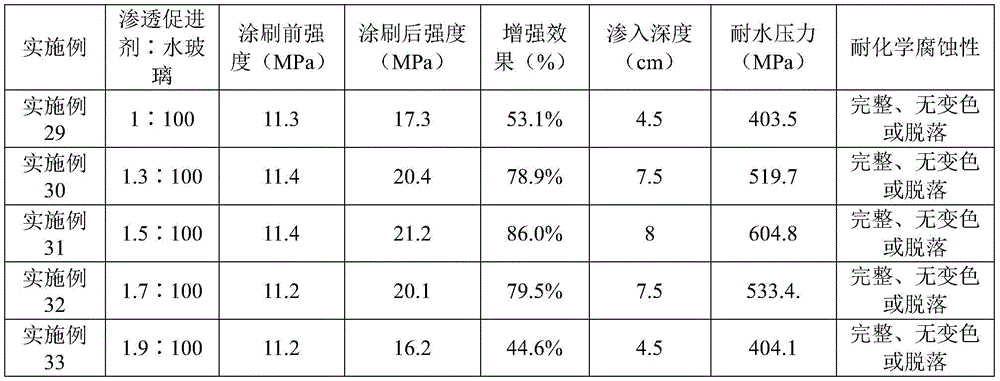
As can be seen from Table 3, when the mass ratio of the penetration enhancer to the water glass is 1.3: 100-1.7: 100, the prepared sealing and anti-seepage waterproofing agent has good anti-seepage enhancement effect, deeper seepage depth and higher water pressure resistance; when the optimal mass ratio of the penetration enhancer to the water glass is 1.5: 100, the prepared sealing and anti-seepage waterproofing agent has the optimal anti-seepage enhancement effect, and the penetration depth, the water pressure resistance and the chemical corrosion resistance are ideal.
Example 35 preparation of an anti-bleed, Water repellent agent with an organosilicon-modified permeation enhancer and silica Sol
1 part of the organosilicon-modified penetration enhancer provided in example 4 and 100 parts of silica sol (purchased from pharmaceutical silica gel Co., Ltd., Kangxin, Qingdao) were mixed by mass fraction to prepare an anti-permeability waterproofing agent.
EXAMPLE 36 permeation-resistant waterproofing agent prepared with Silicone modified permeation enhancer and silica Sol
1.5 parts of the organosilicon-modified penetration enhancer provided in example 4 and 100 parts of silica sol (purchased from pharmaceutical silica gel Co., Ltd., Kangxin, Qingdao) were mixed in mass fraction to prepare an anti-permeation waterproofing agent.
EXAMPLE 37 permeation enhancer modified with Silicone and silica Sol formulation as a permeation resistant waterproofing agent
2.0 parts of the organosilicon-modified penetration enhancer provided in example 4 and 100 parts of silica sol (purchased from Kangxin pharmaceutical silica gel Co., Ltd., Qingdao) were mixed in parts by mass, respectively, to prepare an impervious waterproofing agent.
EXAMPLE 38 permeation enhancer modified with organosilicon and silica Sol formulation of a Water repellant and Water repellent
2.5 parts of the organosilicon-modified penetration enhancer provided in example 4 and 100 parts of silica sol (purchased from Kangxin pharmaceutical silica gel Co., Ltd., Qingdao) were mixed in parts by mass, respectively, to prepare an impervious waterproofing agent.
Example 39 permeation-resistant waterproofing agent prepared by Using Silicone modified permeation enhancer and silica Sol
3.0 parts of the organosilicon-modified penetration enhancer provided in example 4 and 100 parts of silica sol (purchased from Kangxin pharmaceutical silica gel Co., Ltd., Qingdao) were mixed in parts by mass, respectively, to prepare an impervious waterproofing agent.
EXAMPLE 40 permeation-resistant waterproofing agent prepared from Silicone-modified permeation enhancer and silica Sol
3.5 parts of the organosilicon-modified penetration enhancer provided in example 4 and 100 parts of silica sol (purchased from Kangxin pharmaceutical silica gel Co., Ltd., Qingdao) were mixed in parts by mass, respectively, to prepare an impervious waterproofing agent.
Example 41 Effect of the proportional relationship of Silicone modified permeation enhancer to silica Sol
This example was conducted to examine the effect of enhancing the impermeability of the impermeable waterproofing agent provided in examples 35 to 40, respectively, and thereby to show the effect of enhancing the impermeability of the impermeable waterproofing agent in a proportional relationship between the permeation accelerator and the silica sol in the impermeable waterproofing agent. The mixing ratio of the test pieces is as follows: cement, water, sand and stone are 1: 0.85: 2.50: 4.20, and the size of a test piece is as follows: 10cm × 10cm × 10 cm. The curing conditions are as follows: and demolding after 24h of molding, taking out after standard curing for 28 days, carrying out a compressive strength test, unloading immediately after loading to the limit, coating the anti-permeability waterproof agent for 3 times on the reagent, carrying out the loading test again after curing for 7 days in an outdoor natural environment, watering frequently during the curing period, recording the strength before and after the anti-permeability test, and detecting the penetration depth, the water pressure resistance and the chemical corrosion resistance after coating. The detection method of the penetration depth comprises the following steps: breaking the test piece, and measuring the transverse depth formed by the hard shell; the detection method of the water resistance pressure refers to GB50108-2001 (standard); the detection method of the chemical corrosion resistance comprises the following steps: respectively soaking the test piece in 40% industrial sulfuric acid solution, 20% industrial phosphoric acid solution, 10% industrial hydrochloric acid solution and 10% sodium hydroxide solution at room temperature for 28 days, and taking out; the results are shown in Table 4.
TABLE 4 comparison of the impermeability enhancing effect of the impermeable and waterproofing agent

As can be seen from Table 4, when the mass ratio of the penetration enhancer to the silica sol is 1.5: 100 to 3.0: 100, the prepared sealing and anti-seepage waterproofing agent has good anti-seepage enhancement effect, deeper seepage depth and higher water pressure resistance; when the optimal mass ratio of the penetration enhancer to the silica sol is 2.0: 100, the prepared sealing and anti-seepage waterproofing agent has the optimal anti-seepage enhancement effect, and the penetration depth, the water pressure resistance and the chemical corrosion resistance are ideal.
EXAMPLE 42 permeation enhancer modified with Silicone and ortho-silicate ester to formulate permeation and Water repellent
1 part of the organosilicon modified penetration enhancer provided in example 4 and 100 parts of orthosilicate (purchased from zhongjie new materials ltd, guangzhou) are mixed according to mass fraction to prepare the anti-seepage waterproof agent.
EXAMPLE 43 permeation and Water repellent formulation with Silicone modified permeation enhancer and orthosilicate
1.3 parts of the organosilicon modified penetration enhancer provided in example 4 and 100 parts of orthosilicate (purchased from Zhongjie New Material Co., Ltd., Guangzhou) are mixed according to mass fraction to prepare the anti-permeability waterproof agent.
EXAMPLE 44 permeation enhancers modified with Silicone and ortho-silicates to formulate Barrier and waterproofing Agents
1.5 parts of the organosilicon modified penetration enhancer provided in example 4 and 100 parts of orthosilicate (purchased from Zhongjie New Material Co., Ltd., Guangzhou) are mixed according to mass fraction to prepare the anti-permeability waterproof agent.
EXAMPLE 45 permeation enhancer modified with organosilicon and ortho-silicate formulation of permeation resistant waterproofing agent
1.7 parts of the organosilicon modified penetration enhancer provided in example 4 and 100 parts of orthosilicate (purchased from Zhongjie New Material Co., Ltd., Guangzhou) are mixed according to mass fraction to prepare the anti-permeability waterproof agent.
EXAMPLE 46 permeation enhancer modified with Silicone and ortho-silicate formulations for permeation and waterproofing
1.9 parts of the organosilicon modified penetration enhancer provided in example 4 and 100 parts of orthosilicate (purchased from Zhongjie New Material Co., Ltd., Guangzhou) are mixed according to mass fraction to prepare the anti-permeability waterproof agent.
EXAMPLE 47 permeation enhancer modified with organosilicon and orthosilicate esters for Barrier Water repellent formulation
2.1 parts of the organosilicon modified penetration enhancer provided in example 4 and 100 parts of orthosilicate (purchased from Zhongjie New materials Co., Ltd., Guangzhou) are mixed according to mass fraction to prepare the anti-permeability waterproof agent.
Example 48 Effect of the ratio of Silicone modified permeation enhancer to orthosilicate
This example was conducted to examine the effect of the permeation-resistant water repellent provided in examples 42 to 47, respectively, to thereby embody the permeation-resistant water repellent effect of the permeation-resistant water repellent in the proportional relationship between the permeation-accelerating agent and the orthosilicate. The mixing ratio of the test pieces is as follows: cement, water, sand and stone are 1: 0.85: 2.50: 4.20, and the size of a test piece is as follows: 10cm × 10cm × 10 cm. The curing conditions are as follows: and demolding after 24h of molding, taking out after standard curing for 28 days, carrying out a compressive strength test, unloading immediately after loading to the limit, coating the anti-permeability waterproof agent for 3 times on the reagent, carrying out the loading test again after curing for 7 days in an outdoor natural environment, watering frequently during the curing period, recording the strength before and after the anti-permeability test, and detecting the penetration depth, the water pressure resistance and the chemical corrosion resistance after coating. The detection method of the penetration depth comprises the following steps: breaking the test piece, and measuring the transverse depth formed by the hard shell; the detection method of the water resistance pressure refers to GB50108-2001 (standard); the detection method of the chemical corrosion resistance comprises the following steps: respectively soaking the test piece in 40% industrial sulfuric acid solution, 20% industrial phosphoric acid solution, 10% industrial hydrochloric acid solution and 10% sodium hydroxide solution at room temperature for 28 days, and taking out; the results are shown in Table 5.
TABLE 5 comparison of the impermeability enhancing effect of the impermeable and waterproofing agent


As can be seen from Table 5, when the mass ratio of the penetration enhancer to the orthosilicate is 1.3: 100-1.9: 100, the prepared sealing and anti-seepage waterproofing agent has good anti-seepage enhancement effect, deeper seepage depth and higher water pressure resistance; wherein when the optimal mass ratio of the penetration enhancer to the orthosilicate is 1.7: 100, the prepared sealing impervious waterproofing agent has the optimal impervious enhancement effect, and the penetration depth, the water pressure resistance and the chemical corrosion resistance are ideal.
EXAMPLE 49 permeation enhancer modified with Silicone and calcium hydroxide to formulate an anti-Permeability waterproofing agent
1 part of the organosilicon modified penetration enhancer provided in example 4 and 100 parts of calcium hydroxide (purchased from Shangfrui industries, Ltd.) were mixed in parts by mass to prepare an anti-permeation waterproofing agent.
EXAMPLE 50 permeation enhancer modified with organosilicon and calcium hydroxide to formulate permeation-resistant waterproofing agent
1.3 parts of the organosilicon-modified penetration enhancer provided in example 4 and 100 parts of calcium hydroxide (purchased from Shangfrui industries, Ltd.) were mixed in parts by mass to prepare an anti-permeation waterproofing agent.
EXAMPLE 51 permeation-resistant waterproofing agent prepared from organosilicon-modified permeation enhancer and calcium hydroxide
1.5 parts of the organosilicon-modified penetration enhancer provided in example 4 and 100 parts of calcium hydroxide (purchased from Shangfrui industries, Ltd.) were mixed in parts by mass to prepare an anti-permeation waterproofing agent.
EXAMPLE 52 permeation-resistant waterproofing agent prepared from organosilicon-modified permeation enhancer and calcium hydroxide
1.7 parts of the organosilicon-modified penetration enhancer provided in example 4 and 100 parts of calcium hydroxide (purchased from Shangfrui industries, Ltd.) were mixed in parts by mass to prepare an anti-permeation waterproofing agent.
EXAMPLE 53 permeation enhancer modified with Silicone and calcium hydroxide to prepare an anti-bleeding waterproofing agent
1.9 parts of the organosilicon-modified penetration enhancer provided in example 4 and 100 parts of calcium hydroxide (purchased from Shangfrui industries, Ltd.) were mixed in parts by mass to prepare an anti-permeation waterproofing agent.
EXAMPLE 54 permeation-resistant waterproofing agent formulated with organosilicon-modified permeation enhancer and calcium hydroxide
2.1 parts of the organosilicon-modified penetration enhancer provided in example 4 and 100 parts of calcium hydroxide (purchased from Shangfrui industries, Ltd.) were mixed in parts by mass to prepare an impermeable waterproof agent.
Example 55 Effect of the proportional relationship of Silicone modified permeation enhancer to calcium hydroxide
This example was conducted to examine the effect of enhancing the impermeability of the impermeable waterproofing agent provided in examples 49 to 54, respectively, thereby showing the effect of enhancing the impermeability of the impermeable waterproofing agent in a proportional relationship between the permeation enhancer and calcium hydroxide in the impermeable waterproofing agent. The mixing ratio of the test pieces is as follows: cement, water, sand and stone are 1: 0.85: 2.50: 4.20, and the size of a test piece is as follows: 10cm × 10cm × 10 cm. The curing conditions are as follows: and demolding after 24h of molding, taking out after standard curing for 28 days, carrying out a compressive strength test, unloading immediately after loading to the limit, coating the anti-permeability waterproof agent for 3 times on the reagent, carrying out the loading test again after curing for 7 days in an outdoor natural environment, watering frequently during the curing period, recording the strength before and after the anti-permeability test, and detecting the penetration depth, the water pressure resistance and the chemical corrosion resistance after coating. The detection method of the penetration depth comprises the following steps: breaking the test piece, and measuring the transverse depth formed by the hard shell; the detection method of the water resistance pressure refers to GB50108-2001 (standard); the detection method of the chemical corrosion resistance comprises the following steps: respectively soaking the test piece in 40% industrial sulfuric acid solution, 20% industrial phosphoric acid solution, 10% industrial hydrochloric acid solution and 10% sodium hydroxide solution at room temperature for 28 days, and taking out; the results are shown in Table 6.
TABLE 6 comparison of the impermeability enhancing effect of the impermeable waterproofing agent

As can be seen from Table 6, when the mass ratio of the penetration enhancer to the calcium hydroxide is 1.5: 100 to 3.0: 100, the prepared sealing and anti-seepage waterproofing agent has good anti-seepage enhancement effect, deeper seepage depth and higher water pressure resistance; when the optimal mass ratio of the penetration enhancer to the calcium hydroxide is 2.0: 100, the prepared sealing and anti-permeability waterproofing agent has the optimal anti-permeability enhancement effect, and the penetration depth, the water pressure resistance and the chemical corrosion resistance are ideal.
EXAMPLE 56 permeation enhancer modified with organosilicon and Cement leachate formulation impervious waterproofing agent
1 part of the organosilicon modified penetration enhancer provided in example 4 is mixed with 100 parts of the cement leachate according to the mass fraction to prepare the anti-permeability waterproof agent. The preparation method of the cement leachate comprises the following steps: and (3) maintaining the cement concrete sample block, immersing the cement concrete sample block in pure water with a neutral pH value, wherein the mass ratio of the cement concrete sample block to the pure water is 1:1, detecting the pH value of the reaction system at intervals of a period of time, and taking out the cement concrete sample block after the pH value is stabilized to obtain the leaching solution.
EXAMPLE 57 permeation enhancer modified with organosilicon and Cement leachate formulation impervious waterproofing agent
1.2 parts of the organosilicon modified penetration enhancer provided in example 4 and 100 parts of the cement leachate are mixed according to mass fraction to prepare the anti-seepage waterproof agent. The preparation method of the cement leaching solution comprises the following steps: and (3) maintaining the cement concrete sample block, immersing the cement concrete sample block in pure water with a neutral pH value, wherein the mass ratio of the cement concrete sample block to the pure water is 1:1, detecting the pH value of the reaction system at intervals of a period of time, and taking out the cement concrete sample block after the pH value is stabilized to obtain the leaching solution.
EXAMPLE 58 permeation enhancer modified with organosilicon and Cement leachate formulation impervious waterproofing agent
1.5 parts of the organosilicon modified penetration enhancer provided in example 4 and 100 parts of the cement leachate are mixed according to mass fraction to prepare the anti-seepage waterproof agent. The preparation method of the cement leaching solution comprises the following steps: and (3) maintaining the cement concrete sample block, immersing the cement concrete sample block in pure water with a neutral pH value, wherein the mass ratio of the cement concrete sample block to the pure water is 1:1, detecting the pH value of the reaction system at intervals of a period of time, and taking out the cement concrete sample block after the pH value is stabilized to obtain the leaching solution.
EXAMPLE 59 permeation enhancer modified with organosilicon and Cement leachate formulation impervious waterproofing agent
1.7 parts of the organosilicon modified penetration enhancer provided in example 4 and 100 parts of the cement leachate are mixed according to mass fraction to prepare the anti-seepage waterproof agent. The preparation method of the cement leaching solution comprises the following steps: and (3) maintaining the cement concrete sample block, immersing the cement concrete sample block in pure water with a neutral pH value, wherein the mass ratio of the cement concrete sample block to the pure water is 1:1, detecting the pH value of the reaction system at intervals of a period of time, and taking out the cement concrete sample block after the pH value is stabilized to obtain the leaching solution.
EXAMPLE 60 permeation enhancer modified with organosilicon and Cement leachate formulation permeation and waterproofing Agents
1.9 parts of the organosilicon modified penetration enhancer provided in example 4 and 100 parts of the cement leachate are mixed according to mass fraction to prepare the anti-permeability waterproof agent. The preparation method of the cement leaching solution comprises the following steps: and (3) maintaining the cement concrete sample block, immersing the cement concrete sample block in pure water with a neutral pH value, wherein the mass ratio of the cement concrete sample block to the pure water is 1:1, detecting the pH value of the reaction system at intervals of a period of time, and taking out the cement concrete sample block after the pH value is stabilized to obtain the leaching solution.
EXAMPLE 61 permeation enhancer modified with organosilicon and Cement leachate formulation impervious waterproofing agent
2.1 parts of the organosilicon modified penetration enhancer provided in example 4 and 100 parts of the cement leachate are mixed according to mass fraction to prepare the anti-permeability waterproof agent. The preparation method of the cement leaching solution comprises the following steps: and (3) maintaining the cement concrete sample block, immersing the cement concrete sample block in pure water with a neutral pH value, wherein the mass ratio of the cement concrete sample block to the pure water is 1:1, detecting the pH value of the reaction system at intervals of a period of time, and taking out the cement concrete sample block after the pH value is stabilized to obtain the leaching solution.
EXAMPLE 62 Effect of the proportional relationship of organosilicon-modified penetration enhancer to Cement leachate
This example examines the impermeability enhancing effects of the impermeable waterproofing agents provided in examples 56 to 61, respectively, to show the impermeability enhancing effect of the impermeable waterproofing agent in the proportional relationship between the penetration enhancer and the cement leachate in the impermeable waterproofing agent. The mixing ratio of the test pieces is as follows: cement, water, sand and stone in a ratio of 1: 0.85: 2.50: 4.20, and the size of a test piece is as follows: 10cm × 10cm × 10 cm. The curing conditions are as follows: and demolding after 24h of molding, taking out after standard curing for 28 days, carrying out a compressive strength test, unloading immediately after loading to the limit, coating the anti-permeability waterproof agent for 3 times on the reagent, carrying out the loading test again after curing for 7 days in an outdoor natural environment, watering frequently during the curing period, recording the strength before and after the anti-permeability test, and detecting the penetration depth, the water pressure resistance and the chemical corrosion resistance after coating. The detection method of the penetration depth comprises the following steps: breaking the test piece, and measuring the transverse depth formed by the hard shell; the detection method of the water resistance pressure refers to GB50108-2001 (standard); the detection method of the chemical corrosion resistance comprises the following steps: respectively soaking the test piece in 40% industrial sulfuric acid solution, 20% industrial phosphoric acid solution, 10% industrial hydrochloric acid solution and 10% sodium hydroxide solution at room temperature for 28 days, and taking out; the results are shown in Table 7.
TABLE 7 comparison of the impermeability enhancing effect of the impermeable waterproofing agent

As can be seen from Table 7, when the mass ratio of the penetration enhancer to the cement leaching solution is 1.5: 100-2.1: 100, the prepared sealing and anti-seepage waterproofing agent has good anti-seepage enhancement effect, deep seepage depth and high water pressure resistance; when the optimal mass ratio of the penetration enhancer to the cement leaching solution is 1.9: 100, the prepared sealing impervious waterproofing agent has the optimal impervious enhancement effect, and the penetration depth, the water pressure resistance and the chemical corrosion resistance are ideal.
EXAMPLE 63 Effect of the relationship between the sealing, anti-bleeding and Water-proofing agent and the Cement mortar
In this embodiment, the sealing impervious waterproofing agent provided in embodiment 24 is adopted, wherein the mass ratio of the penetration enhancer to the inorganic silicate is 1.3: 100, and the sealing impervious waterproofing agent and the cement mortar are prepared into a cement mortar impervious test piece according to different mass ratios, wherein the cement mortar ratio is: cement, water, sand and stone are 1: 0.85: 2.50: 4.20, and the curing conditions are as follows: and demolding after 24h of molding, taking out after standard curing for 28 days, carrying out a compressive strength test, unloading immediately after loading to the limit, coating the anti-permeability waterproof agent for 3 times on the reagent, carrying out the loading test again after curing for 7 days in an outdoor natural environment, watering frequently during curing, recording the strength before and after the anti-permeability test, and detecting the water pressure resistance and the chemical corrosion resistance after coating. Wherein, the detection method of the water resistance pressure refers to GB50108-2001 (standard); the detection method of the chemical corrosion resistance comprises the following steps: respectively soaking the test piece in 40% industrial sulfuric acid solution, 20% industrial phosphoric acid solution, 10% industrial hydrochloric acid solution and 10% sodium hydroxide solution at room temperature for 28 days, and taking out; the results are shown in Table 8.
TABLE 8 comparison of the impermeability enhancement effect of the cement impermeable test piece

As can be seen from Table 8, when the mass ratio of the sealing impervious waterproofing agent to the cement mortar is 1: 10 to 1: 50, the prepared cement stone has good impervious reinforcing effect, deep penetration depth and high water pressure resistance; wherein when the optimal mass ratio of the sealing impervious waterproofing agent to the cement mortar is 1: 30, the obtained cement stone has the optimal impervious reinforcing effect and ideal water pressure resistance and chemical corrosion resistance.
EXAMPLE 64 stability Studies of equilibrium reaction test of permeation enhancers with inorganic silicates
The inorganic silicate used in this example was obtained from (from Qingdao sodium silicate factory, brand name: liquid sodium silicate).
In this example, the stability of equilibrium reaction test of A, B, C three components in the penetration enhancer with inorganic silicate respectively is examined, A or B or C respectively is mixed with inorganic silicate uniformly according to the mass ratio of 1.3: 100, and the result is shown in Table 9; the system stability in the equilibrium reaction test of the permeation enhancer and the inorganic silicate was examined, and the permeation enhancer provided in example 4 was mixed with the inorganic silicate in a mass ratio of 1.3: 100 to conduct the equilibrium reaction test, and the results are shown in Table 10.
TABLE 9 stability examination of equilibrium reaction test of A, B, C three components of penetration enhancer with inorganic silicate

TABLE 10 stability investigation of equilibrium reaction test of permeation enhancer and inorganic silicate

R' Si (OR) in penetration enhancers 4–n-m x m Can be regarded as an organosilicate that is soluble to some degree of hydrolysis. When the copolymerization of the organic silicate and the inorganic alkali silicate is in equilibrium, a new modified product can be formed, and the reaction formula is shown as formula IV:

in the growing polymeric silicate structure, the silicate solution is quite stable due to the effect of the stable ionic surface charge.
When the pH is changed or in the presence of a catalyst, the polymeric silicate forms a gel by condensation of silanol groups, which eventually becomes an insoluble solid. R' Si (OR) 4–n-m x m The modified silicate structure contains alkoxy groups (-OR) which are not completely hydrolyzed and remain, and reacts with moisture adhering to the surface of an inorganic base material such as cement concrete to form silanol groups. The group forms strong hydrogen bond with the surface of hydroxylated cement concrete, and can further react with the hydroxyl on the surface of the cement, thereby forming new gel and increasing the compactness and impermeability.
Example 62 examination of Effect of enhancing impermeability of a Water repellent having impermeability
In this example, the organosilicon modified penetration enhancer provided in example 3 and the inorganic silicate are mixed uniformly according to a mass ratio of 1.3: 100 to prepare an anti-permeability waterproof agent, and an anti-permeability enhancement effect is examined, wherein a concrete anti-permeability test piece method in a test process refers to a GBJ82-85 common concrete performance test, and the concrete process is as follows: placing a well-maintained impervious test piece into a impervious instrument for impervious test until the top surface of the impervious test piece is infiltrated, recording the impervious grade of the impervious test piece, placing the test piece outdoors for naturally airing for 3 days, brushing 2 times of the organosilicon-sealed impervious waterproofing agent according to the construction method of the organosilicon-sealed impervious waterproofing agent, and brushing a cover surface waterproofing agent after 2 days of maintenance: BD-SII (i.e., HS-SII) track 1. After 3 days, the test pieces were placed again in the impermeability tester to perform impermeability tests, and the impermeability test results were recorded, the tests were performed by a central laboratory of the first building engineering company, zhejiang, and the results are shown in table 11.
TABLE 11 comparison of the impermeability enhancing effect of the impermeable and waterproof sealant
| Test piece number | Impervious label before painting | Impervious label after painting | Enhancing Effect (%) |
| 1 | S 12 | S 23 ooze | 91.6 |
| 2 | S 12 | ≥S 25 | ≥108 |
| 3 | S 8 | ≥S 25 | ≥212.5 |
| 4 | S 6 | ≥S 20 | ≥300 |
| 5 | S 5 | ≥S 20 | ≥300 |
| 6 | S 5 | ≥S 20 | ≥300 |
| 7 | S 13 | ≥S 14 penetration | ≥7.7 |
| 8 | S 13 | ≥S 14 penetration | ≥7.7 |
| 9 | S 9 | ≥S 14 penetration | 55.5 |
| 10 | S 15 | ≥S 26 | ≥73.3 |
| 11 | S 9 | ≥S 14 penetration | 55.5 |
| 12 | S 13 | ≥S 14 penetration | 7.7 |
As shown in Table 11, after the sealing and anti-permeability waterproofing agent provided by the invention is coated, the waterproof and anti-permeability performance of concrete can be obviously improved, a low-grade concrete structure can be obviously reinforced, the reinforcement rate can reach more than 200%, the grade of cement can be improved, and the anti-permeability reinforcement effect is far higher than the standard anti-permeability force of common-grade concrete.
Although the present invention is disclosed above, the present invention is not limited thereto. Various changes and modifications may be effected therein by one skilled in the art without departing from the spirit and scope of the invention as defined in the appended claims.
Claims (10)
1. The polyether modified organic silicon penetrant is characterized in that the structural formula of the polyether modified organic silicon penetrant is shown as a formula I or II:

wherein n is 1-20; r ' is a terminal capping group, R ' is a side chain group, and R ' are any one of EO (ethylene oxide) or EO (ethylene oxide)/PO (propylene oxide) polyether modified MQ silicone resin, MT silicone resin or MTQ silicone resin.
2. A process for preparing a polyether-modified silicone penetrant according to claim 1 wherein,
the preparation steps of the formula I are as follows: hexamethyldisiloxane, vinyl double end sockets and octamethylcyclotetrasiloxane are subjected to equilibrium telomerization to obtain monovinyl-end-capped polysiloxane, and the monovinyl-end-capped polysiloxane is subjected to addition reaction with unsaturated polyether and MQH resin with the H content of 0.8% to obtain the epoxy resin;
the preparation steps of the formula II are as follows: hexamethyldisiloxane, octamethylcyclotetrasiloxane and tetramethyltetravinylcyclotetrasiloxane are subjected to equilibrium telomerization to obtain polysiloxane with a side chain containing vinyl, and the polysiloxane is subjected to addition reaction with unsaturated polyether and MQH resin with the H content of 0.8%.
3. The method of claim 2, wherein the polyether modified silicone penetrant is prepared according to the chemical reaction formula:
the chemical reaction formula of the preparation process of the formula I is as follows:
①MM+ViVi+D 4 →A
a + MQH + unsaturated polyether → product;
the chemical reaction formula of the preparation process of the formula II is as follows:
①MM+D 4 +D 4 Vi→A’
② A' + MQH + unsaturated polyether → product
Wherein MM is hexamethyldisiloxane, ViViViVi is vinyl double-end socket, D 4 Is octamethylcyclotetrasiloxane, D 4 Vi is tetramethyltetravinylcyclotetrasiloxane.
4. The application of the polyether modified organic silicon penetrating agent in preparing the organic silicon modified penetration enhancer is characterized in that the structural formula of the polyether modified organic silicon penetrating agent is shown as the formula I or II:

wherein n is 1-20; r ' is a terminal capping group, R ' is a side chain group, and R ' are any one of EO (ethylene oxide) or EO (ethylene oxide)/PO (propylene oxide) polyether modified MQ silicone resin, MT silicone resin or MTQ silicone resin.
5. The use of claim 4, wherein the silicone-modified penetration enhancer comprises A: a silicon-containing anionic surfactant; b: polyether modified organosilicon penetrant; c: an anionic surfactant.
6. The use of claim 5, wherein A has the formula III:
R’ n Si(OR) 4-n-m X m
formula III
Wherein n is more than or equal to 1, and m is 0-3; r' is methyl or ethyl; OR is any one of methoxy, ethoxy OR butoxy; x is-OH.
7. The use according to claim 6, wherein C is sodium fatty alcohol-polyoxyethylene ether sulfate or sodium sulfonate salt.
8. The use as claimed in claim 7, wherein the mass ratio of A, B, C is 20-40%: 1-15%: 45-75%.
9. The application of the polyether modified organic silicon penetrant in preparing the sealing impervious waterproof agent is characterized in that the structural formula of the polyether modified organic silicon penetrant is shown as a formula I or II:


wherein n is 1-20; r 'is a terminal capping group, R' is a side chain group, R 'and R' are any one of EO (ethylene oxide) or EO (ethylene oxide)/PO (propylene oxide) polyether modified MQ silicone resin, MT silicone resin or MTQ silicone resin;
the sealing impervious waterproofing agent consists of an organic silicon modified penetration enhancer and a penetration base material; the silicone-modified penetration enhancer includes a: a silicon-containing anionic surfactant; b: polyether modified organosilicon penetrant; c: an anionic surfactant.
10. The application of the polyether modified organic silicon penetrant in preparing compact cement mortar is characterized in that the structural formula of the polyether modified organic silicon penetrant is shown as a formula I or II:
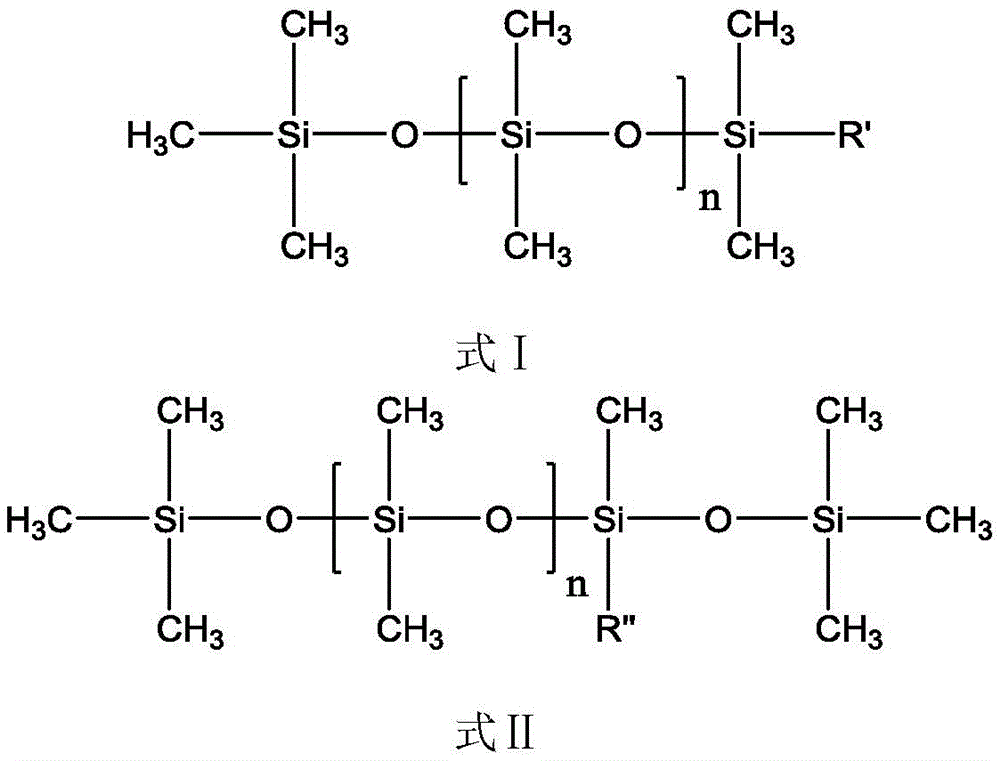
wherein n is 1-20; r 'is a terminal capping group, R' is a side chain group, R 'and R' are any one of EO (ethylene oxide) or EO (ethylene oxide)/PO (propylene oxide) polyether modified MQ silicone resin, MT silicone resin or MTQ silicone resin;
the compact cement stone mortar consists of an organic silicon modified penetration enhancer, a penetration base material and cement concrete; the silicone-modified penetration enhancer includes a: a silicon-containing anionic surfactant; b: polyether modified organosilicon penetrant; c: an anionic surfactant.
Priority Applications (1)
| Application Number | Priority Date | Filing Date | Title |
|---|---|---|---|
| CN202110265891.3A CN115073747B (en) | 2021-03-11 | 2021-03-11 | Application of polyether modified organosilicon penetrant in preparation of organosilicon modified penetration enhancer |
Applications Claiming Priority (1)
| Application Number | Priority Date | Filing Date | Title |
|---|---|---|---|
| CN202110265891.3A CN115073747B (en) | 2021-03-11 | 2021-03-11 | Application of polyether modified organosilicon penetrant in preparation of organosilicon modified penetration enhancer |
Publications (2)
| Publication Number | Publication Date |
|---|---|
| CN115073747A true CN115073747A (en) | 2022-09-20 |
| CN115073747B CN115073747B (en) | 2023-09-26 |
Family
ID=83240554
Family Applications (1)
| Application Number | Title | Priority Date | Filing Date |
|---|---|---|---|
| CN202110265891.3A Active CN115073747B (en) | 2021-03-11 | 2021-03-11 | Application of polyether modified organosilicon penetrant in preparation of organosilicon modified penetration enhancer |
Country Status (1)
| Country | Link |
|---|---|
| CN (1) | CN115073747B (en) |
Cited By (1)
| Publication number | Priority date | Publication date | Assignee | Title |
|---|---|---|---|---|
| CN119490753A (en) * | 2024-11-11 | 2025-02-21 | 蚌埠壹石通聚合物复合材料有限公司 | A high temperature resistant flexible plugging material and preparation method thereof |
Citations (6)
| Publication number | Priority date | Publication date | Assignee | Title |
|---|---|---|---|---|
| JPH0616684A (en) * | 1992-07-03 | 1994-01-25 | Shin Etsu Chem Co Ltd | Phosphorus ester group-containing organopolysiloxane, method for producing the same, and anionic surfactant |
| CN103102688A (en) * | 2011-11-14 | 2013-05-15 | 吴江朗科化纤有限公司 | Preparation method of vinyl silicone oil for LED (light-emitting diode) package |
| CN106565278A (en) * | 2016-11-04 | 2017-04-19 | 浙江省建筑科学设计研究院有限公司 | High-permeability concrete sealed waterproofing agent and preparation method thereof |
| CN107954624A (en) * | 2017-12-15 | 2018-04-24 | 苏州金润新材料科技有限公司 | A kind of concrete silicon crystal curing agent |
| CN109824838A (en) * | 2018-12-29 | 2019-05-31 | 上海特栎材料科技有限公司 | A kind of organic silicon surfactant and preparation method thereof based on MQ resin |
| EP3613720A1 (en) * | 2017-04-20 | 2020-02-26 | Dow Toray Co., Ltd. | Water absorption preventing material for inorganic porous material, method for modifying concrete, and concrete |
-
2021
- 2021-03-11 CN CN202110265891.3A patent/CN115073747B/en active Active
Patent Citations (6)
| Publication number | Priority date | Publication date | Assignee | Title |
|---|---|---|---|---|
| JPH0616684A (en) * | 1992-07-03 | 1994-01-25 | Shin Etsu Chem Co Ltd | Phosphorus ester group-containing organopolysiloxane, method for producing the same, and anionic surfactant |
| CN103102688A (en) * | 2011-11-14 | 2013-05-15 | 吴江朗科化纤有限公司 | Preparation method of vinyl silicone oil for LED (light-emitting diode) package |
| CN106565278A (en) * | 2016-11-04 | 2017-04-19 | 浙江省建筑科学设计研究院有限公司 | High-permeability concrete sealed waterproofing agent and preparation method thereof |
| EP3613720A1 (en) * | 2017-04-20 | 2020-02-26 | Dow Toray Co., Ltd. | Water absorption preventing material for inorganic porous material, method for modifying concrete, and concrete |
| CN107954624A (en) * | 2017-12-15 | 2018-04-24 | 苏州金润新材料科技有限公司 | A kind of concrete silicon crystal curing agent |
| CN109824838A (en) * | 2018-12-29 | 2019-05-31 | 上海特栎材料科技有限公司 | A kind of organic silicon surfactant and preparation method thereof based on MQ resin |
Non-Patent Citations (1)
| Title |
|---|
| 王超: ""含酰胺基有机硅阴离子表面活性剂的合成"" * |
Cited By (1)
| Publication number | Priority date | Publication date | Assignee | Title |
|---|---|---|---|---|
| CN119490753A (en) * | 2024-11-11 | 2025-02-21 | 蚌埠壹石通聚合物复合材料有限公司 | A high temperature resistant flexible plugging material and preparation method thereof |
Also Published As
| Publication number | Publication date |
|---|---|
| CN115073747B (en) | 2023-09-26 |
Similar Documents
| Publication | Publication Date | Title |
|---|---|---|
| KR101577463B1 (en) | Mixtures containing organosilicon compounds and uses thereof | |
| CN101580355B (en) | Water-based organic silicon waterproof agent | |
| Thissen et al. | Surface treatments on concrete: An overview on organic, inorganic and nano-based coatings and an outlook about surface modification by rare-earth oxides | |
| KR101062734B1 (en) | Penetrating protective coating agent having waterproof function of concrete structure and construction method | |
| CN113174153A (en) | Multifunctional waterproof reinforced coating and preparation method and construction method thereof | |
| CN103694830A (en) | Polymer cement waterproof coating | |
| CN101580356B (en) | Water-emulsion organic silicon waterproof agent | |
| CN108455900A (en) | Pervious concrete and its preparation process, paving process | |
| CN106565278A (en) | High-permeability concrete sealed waterproofing agent and preparation method thereof | |
| KR100954450B1 (en) | Coating composition of ultra-polymer smart ceramic and method of surface treatment for concrete structure or steel structure | |
| CN115073210B (en) | Organosilicon modified penetration enhancer and preparation and application thereof | |
| CN103333559B (en) | Water-based transparent concrete water-proof carbonization-preventing coating and preparation method thereof | |
| US20090218545A1 (en) | Use and Method for Reduction of Corrosion | |
| CN103833415A (en) | Impervious reinforcing agent for constructional inorganic coating material and preparation method thereof | |
| KR100809809B1 (en) | Manufacturing method of surface penetration reinforcement for preventing concrete deterioration | |
| KR100661210B1 (en) | Silicone resin emulsion coating material having permeability and water repellency and waterproofing method | |
| CN115490536A (en) | Water-based permeable inorganic waterproof agent and preparation method and application thereof | |
| CN115073747B (en) | Application of polyether modified organosilicon penetrant in preparation of organosilicon modified penetration enhancer | |
| CN117700149A (en) | Multifunctional concrete curing agent in low-temperature environment and preparation method thereof | |
| CN115124564B (en) | Silicon-containing anionic surfactant and preparation and application thereof | |
| KR100500151B1 (en) | Method of preparing waterproof admixture for waterproofing and anticorrosive treatment of concrete, and waterproof admixture prepared thereby | |
| CN1699290B (en) | A concrete protection curing agent | |
| CN115124275B (en) | Lithium silicate-based organic-inorganic composite concrete penetration protective agent | |
| KR102356129B1 (en) | mortar composition for repairing and reinforcing concrete structure exposed under highly wet environment and method of repairing and reinforcing concrete structure using the same | |
| EP2380860A1 (en) | Polysiloxane-coated iron oxide pigments |
Legal Events
| Date | Code | Title | Description |
|---|---|---|---|
| PB01 | Publication | ||
| PB01 | Publication | ||
| SE01 | Entry into force of request for substantive examination | ||
| SE01 | Entry into force of request for substantive examination | ||
| GR01 | Patent grant | ||
| GR01 | Patent grant |