Disclosure of Invention
The invention aims to solve the problems that: the capacity of a capacitor structure in a semiconductor structure is increased without increasing the area of the device.
To solve the above problem, an embodiment of the present invention provides a semiconductor structure, including: a substrate comprising a first region; the capacitor structure comprises more than two capacitor structures, wherein the more than two capacitor structures are connected in parallel and are sequentially stacked on a first area of the substrate along a direction vertical to the substrate;
the protective layer is arranged on the edge area of the top of at least one capacitor structure and used for covering the edge area of the capacitor structure and reducing the current of the upper metal layer from flowing to the edge area of the capacitor structure.
Optionally, the two or more capacitive structures include: the capacitor comprises a first capacitor structure, a second capacitor structure and a first connecting layer, wherein the first capacitor structure is positioned on a first region of a substrate; wherein: the first capacitive structure, comprising: the first bottom metal layer, the first dielectric layer and the first top metal layer are sequentially stacked; the second capacitive structure, comprising: the first top metal layer, the second dielectric layer and the second top metal layer are sequentially stacked; the first connecting layer is connected with the first bottom metal layer and the second top metal layer.
Optionally, the two or more capacitive structures include: the capacitor comprises a first capacitor structure, a second capacitor structure and a first connecting layer, wherein the first capacitor structure is positioned on a first region of a substrate; wherein: the first capacitive structure, comprising: the first bottom metal layer, the first dielectric layer and the first top metal layer are sequentially stacked; the second capacitive structure, comprising: the second bottom metal layer, the second dielectric layer and the second top metal layer are sequentially stacked; the first connecting layer is connected with the first bottom metal layer and the second top metal layer.
Optionally, the first dielectric layer has a first through hole exposing the surface of the first bottom metal layer, and the first connection layer connects the first bottom metal layer and the second top metal layer through the first through hole, so as to implement parallel connection between the first capacitor structure and the second capacitor structure.
Optionally, the two or more capacitor structures further include: a third capacitor structure located above the second capacitor structure, and a second connection layer; wherein: the third capacitive structure includes: the third bottom metal layer, the third dielectric layer and the third top metal layer are sequentially stacked; the second connecting layer is connected with the first top metal layer and the third top metal layer.
Optionally, the second dielectric layer has a second through hole exposing the surface of the first top metal layer, and the second connection layer is connected to the third top metal layer and the first top metal layer through the second through hole.
Optionally, the protective layer comprises: the first protective layer covers the edge area of the second top metal layer; the first protective layer covers the edge area of the second top metal layer and exposes the second through hole.
Optionally, the protective layer comprises: a second protective layer; the second protective layer covers the edge area of the third top metal layer and exposes the second through hole; the second protective layer is provided with a third through hole exposing the surface of the third top metal layer, and the second connecting layer is connected with the third top metal layer and the first top metal layer through the second through hole and the third through hole.
Optionally, the emitter structure, the base structure, and the collector structure each include at least two metal layers of the two or more capacitor structures.
The embodiment of the invention also provides a method for forming the semiconductor structure, which comprises the following steps: providing a substrate, the substrate comprising a first region; forming more than two capacitor structures on the first area of the substrate, wherein the more than two capacitor structures are connected in parallel and are sequentially stacked on the first area of the substrate along the direction vertical to the substrate; and a protective layer is formed on the edge area of the top of at least one capacitor structure and is used for covering the edge area of the capacitor structure and reducing the current of the upper metal layer from flowing to the edge area of the capacitor structure.
Optionally, the forming more than two capacitor structures on the first region of the substrate includes: sequentially forming a first bottom metal layer, a first dielectric layer and a first top metal layer which are arranged in a stacked manner on a first area of the substrate, wherein the first bottom metal layer, the first dielectric layer and the first top metal layer form a first capacitor structure; a second bottom metal layer, a second dielectric layer and a second top metal layer which are arranged in a stacked mode are sequentially formed on the first top metal layer, and the second bottom metal layer, the second dielectric layer and the second top metal layer form a second capacitor structure; and forming a first connecting layer so that the first capacitor structure and the second capacitor structure are connected in parallel.
Optionally, the forming more than two capacitor structures on the first region of the substrate includes: sequentially forming a first bottom metal layer, a first dielectric layer and a first top metal layer which are arranged in a stacked manner on a first area of the substrate, wherein the first bottom metal layer, the first dielectric layer and the first top metal layer form a first capacitor structure; sequentially forming a second dielectric layer and a second top metal layer which are arranged in a stacked mode on the first top metal layer; the first top metal layer, the second dielectric layer and the second top metal layer form the second capacitor structure; and forming a first connecting layer so that the first capacitor structure and the second capacitor structure are connected in parallel.
Optionally, the step of forming the first dielectric layer includes: forming a first initial dielectric layer; forming a first through hole on the first initial dielectric layer, wherein the first through hole exposes the surface of the first bottom metal layer; the step of forming the first connection layer includes: and forming the first connecting layer at the position of the first through hole so that the first bottom metal layer is connected with the second top metal layer.
Optionally, the forming more than two capacitor structures on the first region of the substrate further includes: sequentially forming a third bottom metal layer, a third dielectric layer and a third top metal layer which are stacked on the second top metal layer, wherein the third bottom metal layer, the third dielectric layer and the third top metal layer form a third capacitor structure; and forming a second connecting layer which is connected with the first top metal layer and the third top metal layer.
Optionally, the step of forming the second dielectric layer includes: forming a second initial dielectric layer; forming a second through hole on the second initial dielectric layer, wherein the second through hole exposes out of the surface of the first top metal layer; the step of forming the second connection layer includes: and forming the second connecting layer at the position of the second through hole so that the first top metal layer is connected with the third top metal layer.
Optionally, forming a first protection layer before forming the third bottom metal layer; the first protective layer covers the edge area of the second top metal layer and exposes the second through hole.
Optionally, after the third top metal layer is formed and before the second connection layer is formed, a second protection layer is formed; the second protective layer covers the edge area of the third top metal layer and exposes the second through hole; the second protective layer is provided with a third through hole exposing the surface of the third top-layer metal layer; the step of forming the second connection layer includes: and forming the second connecting layer at the positions of the second through hole and the third through hole, wherein the second connecting layer is connected with the third top metal layer and the first top metal layer.
Optionally, the substrate further comprises a second region; the method further comprises the following steps: a transistor structure is formed on a second region of the substrate.
Optionally, the transistor structure is a heterojunction bipolar transistor structure; the forming a transistor structure on a second region of the substrate includes: an emitter structure, a base structure, and a collector structure are formed on a second region of the substrate.
Optionally, at least one of the first top metal layer, the third top metal layer, the first connection layer and the second connection layer is formed on the transistor structure and the capacitor structure at the same time.
Optionally, at least one of the first and second protection layers is formed on the transistor structure and the capacitor structure simultaneously.
Compared with the prior art, the technical scheme of the embodiment of the invention has the following advantages:
by applying the scheme of the invention, the semiconductor structure is provided with more than two capacitor structures, and the more than two capacitor structures are connected in parallel, so that the capacity of the capacitor in the semiconductor structure can be increased. In addition, the two or more capacitor structures are sequentially stacked in a direction perpendicular to the substrate in the first region of the substrate, so that the capacitance of the capacitor in the semiconductor structure can be increased without increasing the area occupied by the capacitor structures.
In addition, in the scheme of the invention, the protective layer is arranged at the edge area of the top of at least one capacitor structure and is used for covering the edge area of the capacitor structure, and when a metal layer is formed on the protective layer subsequently, the contact area between the metal layer formed above the protective layer and the metal layer covered by the protective layer can be further reduced, so that the current of the metal layer above the protective layer can be further weakened to flow to the edge area of the metal layer covered by the protective layer to cause a discharge phenomenon, and the reliability of the capacitor structure is further improved.
Detailed Description
Currently, transistors and capacitors are typically integrated in the same wafer. Taking the Transistor as a Heterojunction Bipolar Transistor (HBT) as an example, when the HBT and the capacitor are integrated in the same wafer, the process is as follows:
referring to fig. 1, an epitaxial structure of a wafer is formed, and the epitaxial structure of the wafer sequentially includes a substrate 10, a collector layer 111, a base initiation layer 121, and an emitter initiation layer 131 from bottom to top.
Wherein the collector layer 111 can be doped with a concentration of 10 16 Per cm 3 Of N-type gallium arsenide (GaAs), the base initiation layer 121 may be doped with a doping concentration of 10 19 Per cm 3 Of P-type GaAs, the emitter initiation layer 131 may be doped to a concentration of 10 17 Per cm 3 P-type GaAs of (1).
Referring to fig. 2, an emitter ohmic contact electrode layer 132 is formed on the emitter initiation layer 131.
Specifically, a layer of photoresist may be coated on the emitter initiation layer 131, and after baking, exposing and developing, the emitter ohmic contact electrode layer 132 may be formed on the emitter initiation layer 131 by evaporation. Emitter ohmic contact electrode layer 132 may have a multilayer metal layer of a titanium (Ti) film, a platinum (Pt) film, a Ti film, a Pt film, and a Ti film, which are sequentially stacked.
Referring to fig. 3, emitter initiation layer 131 is etched to form emitter layer 133. Then, a base ohmic contact electrode layer 122 is formed on the base initiation layer 121.
For example, emitter initiation layer 131 may be etched using a photolithography process. The base ohmic contact electrode layer 122 may have a plurality of metal layers in which a Pt film, a Ti film, a Pt film, and a copper (Au) film are sequentially stacked.
Referring to fig. 4, the base initiation layer 121 is etched to form a base layer 123. Then, referring to fig. 5, a collector ohmic contact electrode layer 112 and a first underlying metal layer 211 are formed on the collector initial layer 111. The collector ohmic contact electrode layer 112 and the first underlying metal layer 211 may be formed by a single process, or may be formed by different processes in sequence.
For example, the base initiation layer 121 may be etched by a photolithography process, and then the collector ohmic contact electrode layer 112 and the first underlying metal layer 211 may be formed by evaporation. The material of the collector ohmic contact electrode layer 112 and the first underlying metal layer 211 may be Au.
Collector layer 111 and collector ohmic contact electrode layer 112 constitute a collector structure of the HBT. The base layer 123 and the base ohmic contact electrode layer 122 constitute a base structure of the HBT. The emitter layer 133 and the emitter ohmic contact electrode layer 132 constitute an emitter structure of the HBT. The first bottom metal layer 211 serves as a lower plate of the capacitor.
Referring to fig. 5, a first dielectric layer 221 is formed, where the first dielectric layer 221 simultaneously covers the base structure, the emitter structure, and the collector structure of the HBT, and serves as a passivation layer of the HBT to prevent sidewalls of the base structure, the emitter structure, and the collector structure of the HBT from being oxidized.
Wherein the first dielectric layer 221 may be deposited by chemical vapor deposition. The first dielectric layer 221 should be opened in the area where conduction is desired.
Referring to fig. 6, a first top metal layer 231 is formed, and the first top metal layer 231 covers the base structure, the emitter structure and the collector structure of the HBT at the same time, and serves as a passivation layer of the HBT to prevent sidewalls of the base structure, the emitter structure and the collector structure of the HBT from being oxidized. On the first area, the first top metal layer 231 also serves as the upper plate of the capacitor structure at the same time.
The first top metal layer 231 may be formed by exposure, evaporation, metal stripping, and photoresist stripping processes. The first top metal layer 231 is located on the first bottom metal layer 211, and is separated from the first bottom metal layer 211 by a first dielectric layer 221.
In the above semiconductor structure, the capacitor structure generally includes: first top metal layer 231, first bottom metal layer 211, and first dielectric layer 221 between first top metal layer 231 and first bottom metal layer 211.
In practical applications, the capacitance of the capacitor structure can be increased in three ways: 1) changing the dielectric constant of the first dielectric layer 221; 2) changing the thickness of the first dielectric layer 221; 3) the areas of the upper and lower plates in the capacitor structure are increased, that is, the areas of the first top metal layer 231 and the first bottom metal layer 211 are increased.
The dielectric constant of the first dielectric layer 221 is generally constant, and is generally about 6.2, so that it is difficult to change the dielectric constant of the dielectric layer to increase the capacitance of the capacitor structure. The thickness of the first dielectric layer 221, which is now between 50 nm and 60 nm, decreases further, risking leakage.
Therefore, the capacitance of the capacitor structure is increased by increasing the areas of the upper and lower plates of the capacitor structure, that is, the areas of the first top metal layer 231 and the first bottom metal layer 211. However, this method results in an increase in the area of the entire device, which is disadvantageous for miniaturization of the device.
In view of the foregoing problems, embodiments of the present invention provide a semiconductor structure, in which two or more capacitor structures are provided, and the two or more capacitor structures are connected in parallel and sequentially stacked in a direction perpendicular to a substrate on a first region of the substrate. Because more than two capacitor structures are sequentially stacked along the direction vertical to the substrate, the substrate area occupied by the capacitor structures is not additionally increased, and the more than two capacitor structures are connected in parallel, so that the capacitance of the semiconductor structure is increased, and the capacity of the capacitor structures in the semiconductor structure is increased under the condition that the device area is not increased. In addition, in the embodiment of the invention, the top edge area of at least one capacitor structure is provided with the protective layer, and the protective layer is used for covering the edge area of the capacitor structure, so that the reliability of the capacitor structure is improved.
In order to make the aforementioned objects, features and advantages of the present invention comprehensible, embodiments accompanied with figures are described in detail below.
Referring to fig. 7, an embodiment of the present invention provides a method for forming a semiconductor structure, which may include the following steps:
step 71, providing a substrate, the substrate comprising a first region.
And 72, forming more than two capacitor structures on the first area of the substrate, wherein the more than two capacitor structures are connected in parallel and are sequentially stacked on the first area of the substrate along the direction vertical to the substrate.
And a protective layer is formed on the edge area of the top of at least one capacitor structure and is used for covering the edge area of the capacitor structure and reducing the current of the upper metal layer from flowing to the edge area of the capacitor structure.
Since the plurality of capacitors are connected in parallel, the capacitance of the capacitor in the semiconductor structure can be increased. In addition, since the plurality of capacitor structures are sequentially stacked in the direction perpendicular to the substrate, the plurality of capacitor structures occupy the same substrate area as that shown in fig. 6, and thus the area of the semiconductor structure does not increase, which is more advantageous for miniaturization of the device.
In a specific implementation, the substrate may further include a second region, and the method may further include: a transistor structure is formed on a second region of the substrate. The transistor structure may be an HBT or a Complementary Metal Oxide Semiconductor (CMOS) transistor, and is not limited thereto.
In a specific implementation, other device structures may also be formed on the second region of the substrate, as long as the device structures can be integrated with the capacitive structure on the same substrate.
Taking the example that the transistor structure is formed on the second region of the substrate, and the transistor structure is an HBT, forming the transistor structure on the second region of the substrate may include: an emitter structure, a base structure, and a collector structure are formed on a second region of the substrate.
In particular, the process of forming the HBT on the substrate can be performed as described above with reference to fig. 1 to 6, and will not be described herein again.
In a specific implementation, only two capacitor structures connected in parallel may be formed on the first region of the substrate, or three or more capacitor structures connected in parallel may be formed, and the number of the specific capacitor structures is not limited.
In an embodiment, two capacitor structures connected in parallel, namely a first capacitor structure and a second capacitor structure, may be formed only on the first region of the substrate. The first capacitor structure and the second capacitor structure may share the same metal layer, or may not share the same metal layer, i.e., they have respective metal layers.
In an embodiment of the invention, when the thickness of the first top metal layer is greater than 150 nm (usually 1000nm), it indicates that the first top metal layer is thicker and can bear larger current, so the first capacitor structure and the second capacitor structure can be configured to share the first top metal layer. Accordingly, the step of forming more than two capacitive structures on the first region of the substrate may include:
sequentially forming a first bottom metal layer, a first dielectric layer and a first top metal layer which are arranged in a stacked manner on a first area of the substrate, wherein the first bottom metal layer, the first dielectric layer and the first top metal layer form a first capacitor structure;
sequentially forming a second dielectric layer and a second top metal layer which are arranged in a stacked mode on the first top metal layer; the first top metal layer, the second dielectric layer and the second top metal layer form the capacitor structure;
and forming a first connecting layer so that the first capacitor structure and the second capacitor structure are connected in parallel.
Taking the HBT formation on the second region of the substrate as an example, the capacitor structure formed on the first region of the substrate in fig. 6 is used as the first capacitor structure, and referring to fig. 6, when the first capacitor structure is formed, a first bottom metal layer 211, a first dielectric layer 221, and a first top metal layer 231 are sequentially formed on the first region of the substrate in a stacked manner. The first dielectric layer 221 covers the upper surface of the first bottom metal layer 211, and the first top metal layer 231 is located above the first bottom metal layer 211 and covers a portion of the surface of the first dielectric layer 221.
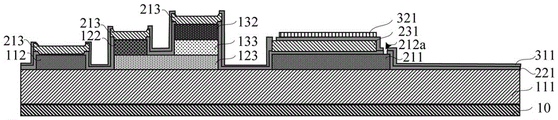
In forming the second capacitor structure, referring to fig. 8, a second dielectric layer 311 may be formed on the first top metal layer 231. Referring to fig. 9, after forming the second dielectric layer 311, a second top metal layer 321 covering a portion of the surface of the second dielectric layer 311 may be formed over the first top metal layer 231. The first top metal layer 231, the second dielectric layer 311 and the second top metal layer 321 form the second capacitor structure.
The first capacitor structure and the second capacitor structure can share the same metal layer, so that the reliability of the capacitor structure can be ensured, and the process is simplified.
In the embodiments shown in fig. 8 and 9, the thickness of the first underlying metal layer 211 ranges from 150 nm to 2000 nm.
In another embodiment of the present invention, when the thickness of the first top metal layer is less than or equal to 150 nm, it indicates that the first top metal layer is thinner and can bear limited current, so that the first capacitor structure and the second capacitor structure may not share the first top metal layer. The step of forming two or more capacitive structures on the first region of the substrate may comprise:
sequentially forming a first bottom metal layer, a first dielectric layer and a first top metal layer which are arranged in a stacked manner on a first area of the substrate, wherein the first bottom metal layer, the first dielectric layer and the first top metal layer form a first capacitor structure;
a second bottom metal layer, a second dielectric layer and a second top metal layer which are arranged in a stacked mode are sequentially formed on the first top metal layer, and the second bottom metal layer, the second dielectric layer and the second top metal layer form a second capacitor structure;
and forming a first connecting layer so that the first capacitor structure and the second capacitor structure are connected in parallel.
The first capacitor structure and the second capacitor structure can not share the same metal layer, namely the first capacitor structure and the second capacitor structure respectively have independent metal layers, so that the reliability of the capacitor structures can be ensured.
In a specific implementation, the second dielectric layer may be formed by a chemical vapor deposition method. The material of the second dielectric layer can also be silicon nitride. Referring to fig. 8, when forming the second dielectric layer 311, the second dielectric layer 311 may cover sidewalls of the HBT emitter structure, the collector structure, and the base structure, thereby serving as a passivation layer of the HBT and preventing each structure in the HBT from being oxidized.
In a specific implementation, a photoresist layer is formed on the second dielectric layer, a layer of metal is evaporated by an evaporation method, and then the evaporated metal glass is subjected to evaporation, metal stripping, photoresist stripping and other process steps, so as to form a second top metal layer on the second dielectric layer. The material of the second top metal layer may be the same as the material of the first bottom metal layer and the first top metal layer.
In a specific implementation, referring to fig. 9, when the second top metal layer 321 is formed, the second top metal layer 321 may also cover the HBT emitter structure, the collector structure, and the base structure, so that the thicknesses of metal layers on the emitter structure, the collector structure, and the base structure of the HBT may be increased, and the reliability of the transistor may be improved.
In some embodiments, a second dielectric layer and a second top metal layer may also be formed on the first region of the substrate.
In a specific implementation, the first connection layer may be connected in a plurality of ways, and the first capacitor structure and the second capacitor structure are connected in parallel, which is not limited herein.
In an embodiment of the invention, referring to fig. 9, a first via hole 212a may be formed on the first dielectric layer 221, and then the first connection layer may be formed at the position of the first via hole 212a, so that the first bottom metal layer 211 is connected to the second top metal layer 321. The step of forming the first via hole 212a on the first dielectric layer 221 may include: forming a first initial dielectric layer; a first via hole 212a is formed on the first initial dielectric layer, and the first via hole exposes the surface of the first underlying metal layer 211. At this time, one end of the first connection layer may be connected to the sidewall of the second top metal layer 321, and the other end is connected to the surface of the first bottom metal layer 211. At this time, the sidewall of the second top metal layer 321 is covered by the first connection layer.
In one embodiment, the current flows from the second top metal layer 321 down to the first top metal layer 231 and the first bottom metal layer 211 in sequence. In order to avoid the current flowing through the edge of the metal layer, in an embodiment, the effective area of each metal layer in the first capacitor structure and the second capacitor structure may be gradually reduced along the direction perpendicular to the substrate. The effective area of a metal layer refers to an area of a current metal layer that can transmit current to a next metal layer, that is, an area of the current metal layer overlapping with the next metal layer.
Specifically, referring to fig. 8, the effective area of the first bottom metal layer 211 is larger than that of the first top metal layer 231, and the effective area of the first top metal layer 231 is larger than that of the second top metal layer 321, so that the discharge phenomenon caused by the current flowing through the edge of the metal layer can be reduced as much as possible, and the reliability of the capacitor structure can be further improved.
In another embodiment of the present invention, three capacitor structures connected in parallel may be formed on the first region of the substrate, that is, a third capacitor structure is formed on the second capacitor structure after the first capacitor structure and the second capacitor structure are formed. Specifically, the method may further include:
sequentially forming a third bottom metal layer, a third dielectric layer and a third top metal layer which are stacked on the second top metal layer, wherein the third bottom metal layer, the third dielectric layer and the third top metal layer form a third capacitor structure;
and forming a second connecting layer which is connected with the first top metal layer and the third top metal layer.
It should be noted that, in the implementation, the third capacitor structure may be formed by the above steps regardless of whether the first capacitor structure and the second capacitor structure share the same metal layer. Similar to the first capacitor structure and the second capacitor structure, the effective area of each metal layer in the third capacitor structure is gradually reduced from bottom to top along the direction vertical to the substrate.
In the embodiment of the invention, the top edge area of at least one capacitor structure is provided with the protective layer, and the protective layer is used for covering the edge area of the capacitor structure, so that the current of the upper metal layer is reduced to flow to the edge area of the capacitor structure, the discharge phenomenon at the periphery of the capacitor structure is prevented, and the reliability of the capacitor structure is improved.
In one embodiment of the present invention, the second top metal layer is usually thinner, and has a thickness ranging from 100 nm to 500 nm, so that it can withstand a smaller current. Therefore, in order to further reduce the discharge phenomenon caused by the current flowing through the edge of the second top metal layer and improve the reliability of the capacitor structure, the first protection layer may be formed before the third bottom metal layer is formed. The first protective layer covers the edge area of the second top metal layer and exposes the second through hole.
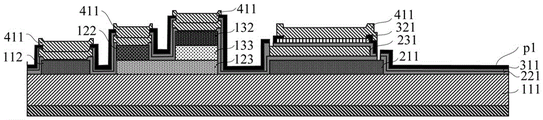
Specifically, taking the third capacitor structure formed on the basis of fig. 9 as an example, referring to fig. 10, after the second top metal layer 321 is formed, the first protection layer p1 may be formed first, and the first protection layer p1 may cover the edge region of the second top metal layer 321 and the periphery of the second capacitor structure, so that when the third bottom metal layer 411 is formed on the first protection layer p1 subsequently, the contact area between the third bottom metal layer 411 and the second top metal layer 321 may be further reduced, thereby further preventing the current of the third bottom metal layer 411 from flowing to the edge region of the second top metal layer 321, and further improving the reliability of the capacitor structure.
In some embodiments, the first protective layer may also be formed only on the first region of the substrate, and not on the HBT.
In a specific implementation, the material of the first protection layer p1 may be a polymer, such as Polyimide (Polyimide). The first protection layer p1 has the characteristics of insulation, high temperature resistance, water resistance and oxidation resistance, so that the current of the third bottom metal layer 411 can be prevented from flowing to the edge area of the second top metal layer 321. The thickness of the first protection layer p1 can be set according to factors such as practical application of devices, height difference of devices, reliability requirements and the like, and the specific thickness range can be 500 nm to 5000 nm.
In a specific implementation, the first protection layer p1 may also cover the second dielectric layer 311, and the edge regions of the emitter structure, the collector structure, and the base structure in the HBT, thereby protecting the corresponding devices.
In a specific implementation, the first protection layer p1 can be formed by a planarization coating method, and of course, other processes can be used to form the first protection layer p1, which is not limited herein.
Referring to fig. 11, after forming the first protective layer p1, a third bottom metal layer 411 may be formed on the first protective layer p1 and the second top metal layer 321.
Referring to fig. 12, after forming the third bottom metal layer 411, a third dielectric layer 421 is formed on the third bottom metal layer 411.
Referring to fig. 13, a third dielectric layer 421 is formed, and a third top metal layer 431 is formed on the third dielectric layer 421.
In a specific implementation, the third bottom metal layer 411 may be formed on the first protection layer p1 and the third top metal layer 431 may be formed on the third dielectric layer 421 through the process steps of evaporation, metal stripping, and photoresist stripping. The material of the third bottom metal layer 411 and the third top metal layer 431 may be the same as the material of the metal layers in the second capacitor structure and the first capacitor structure.
In a specific implementation, the thickness of the third bottom metal layer 411 ranges from 1000nm to 8000 nm, and the thickness of the third top metal layer 431 ranges from 100 nm to 500 nm.
In an embodiment, when the third bottom metal layer 411 is formed on the second top metal layer 321, the third bottom metal layer 411 may be formed to cover the emitter structure, the collector structure and the base structure of the HBT at the same time, so as to further increase the thickness of the metal layer on the emitter structure, the collector structure and the base structure of the HBT, and improve the reliability of the transistor.
In some embodiments, a third underlying metal layer may also be formed on the first region of the substrate.
In a specific implementation, referring to fig. 13, the third dielectric layer 421 may be formed by a chemical vapor deposition method. The thickness ranges of the first dielectric layer 221, the second dielectric layer 321, and the third dielectric layer 421 may be set according to the device requirement, the process capability, the device reliability requirement, and other factors. In the embodiment of the invention, the thickness ranges of the first dielectric layer 221, the second dielectric layer 321, and the third dielectric layer 421 may be the same, such as 60 nm or 160 nm, and both may be in the range of 40 nm to 500 nm.
In a specific implementation, the first dielectric layer 221, the second dielectric layer 321, and the third dielectric layer 421 may be made of the same material, and may be made of silicon nitride, or may be made of other materials.
In an embodiment of the invention, the first connection layer and the second connection layer may be formed after the third top metal layer is formed. The first connecting layer is used for connecting the first capacitor structure and the second capacitor structure, and the second connecting layer is used for connecting the first capacitor structure and the third capacitor structure.
In a specific implementation, the first connection layer may connect the first capacitor structure and the second capacitor structure by directly connecting the first bottom metal layer and the second top metal layer. When the first protective layer is arranged on the second top metal layer, because the first protective layer covers the second top metal layer and the second dielectric layer, at this time, the first connecting layer can also indirectly connect the first bottom metal layer with the second top metal layer in a manner of connecting the third bottom metal layer with the first bottom metal layer or in a manner of directly connecting the first top metal layer with the third bottom metal layer, and can also connect the first capacitor structure and the second capacitor structure.
For example, referring to fig. 15, one end of the first connection layer L1 is connected to the first bottom metal layer 211 through the first via hole 212a (shown in fig. 9) on the first dielectric layer 221, and the other end is connected to the second top metal layer 321 through the third bottom metal layer 411.
In a specific implementation, when the first connection layer connects the first bottom metal layer and the second top metal layer, or when the first connection layer connects the third bottom metal layer and the first bottom metal layer, the second connection layer may connect the first capacitor structure and the third capacitor structure by directly connecting the first top metal layer and the third top metal layer. When the first connecting layer connects the first top metal layer and the third bottom metal layer, the second connecting layer can connect the first capacitor structure and the third capacitor structure by connecting the first bottom metal layer and the third top metal layer.
For example, referring to fig. 14, the step of forming the second dielectric layer 311 may include: a second initial dielectric layer is formed first, and then a second through hole 311a is formed on the second initial dielectric layer, wherein the second through hole 311a exposes the surface of the first top metal layer 231. Referring to fig. 15, the step of forming the second connection layer includes: the second connection layer L2 is formed at the position of the second via hole 311a (shown in fig. 14) so that the first top-level metal layer 231 is connected to the third top-level metal layer 431.
In this embodiment, referring to fig. 15, when the first via hole is formed in the first dielectric layer 221, the layers on the first dielectric layer 221 except the first connection layer L1 are formed to expose the first via hole. Similarly, when a second via hole is formed in the second dielectric layer 311, the layers of the second dielectric layer 311 except for the second connection layer L2 are formed to expose the second via hole.
In a specific implementation, referring to fig. 15, the first connection layer L1 and the second connection layer L2 may be formed simultaneously. For example, the first connection layer L1 and the second connection layer L2 may be formed simultaneously through processes such as evaporation, metal stripping, and photoresist stripping. The material of the first connection layer L1 and the second connection layer L2 may be Au.
In a specific implementation, referring to fig. 15, the first connection layer L1 and the second connection layer L2 may be formed, and the second connection layer L2 (or the first connection layer L1) may be formed on the emitter structure, the collector structure, and the base structure of the HBT, so as to further increase the thickness of the metal layer on the emitter structure, the collector structure, and the base structure of the HBT and improve the reliability of the transistor.
In some embodiments, the first connection layer and the second connection layer may also be formed only on the first region of the substrate, and not on the HBT.
In an embodiment of the invention, referring to fig. 14 and 15, after the third top metal layer 431 is formed and before the second connection layer L2 is formed, a second protection layer p2 is formed; the second protective layer p2 may cover an edge region of the third top-level metal layer 431 and expose the second via 311 a; the second protective layer p2 has a third via hole p21 exposing a surface of the third top metal layer 431.
At this time, the second protection layer p2 may cover the edge region of the third top metal layer 431, so as to cover the periphery of the third capacitor structure, thereby preventing the subsequent current flowing into the third top metal layer 431 from flowing to the edge region of the third top metal layer 431, which may cause the discharging phenomenon of the third top metal layer 431, and further improving the reliability of the capacitor. The second protection layer p2 can also cover the edge regions of the emitter structure, the collector structure and the base structure of the HBT, so that the HBT is prevented from generating electric leakage, and the reliability of the HBT is improved. In addition, the second protection layer p2 may cover most of the third top metal layer 431, and may also cover sidewalls of the emitter structure, the collector structure, and the base structure of the HBT, and serve as a passivation layer to prevent the third top metal layer 431 from being oxidized.
In some embodiments, the second protective layer may also be formed only on the first region of the substrate, and not on the HBT.
In a specific implementation, the material of the second protection layer p2 and the material of the first protection layer p1 may be the same, and both may be Polyimide (Polyimide). The thickness range of the second protective layer p2 is 500 nm to 5000 nm, and the thickness range can be adjusted according to factors such as practical application, height difference of devices, reliability requirements and the like.
Referring to fig. 14 and 15, after forming the second protective layer p2, the step of forming the second connection layer L2 may include: the second connection layer L2 is formed at the positions of the second via 311a and the third via p21, and the second connection layer L2 connects the third top-level metal layer 431 and the first top-level metal layer 231.
Note that the device formed over the substrate second region is not limited to the HBT, and may be another device, and the HBT is just one example of a device formed over the substrate second region.
As can be seen from the above, in the method for forming a semiconductor structure in an embodiment of the present invention, two or more capacitor structures connected in parallel are formed at the same position of the substrate, so that the capacitance of the capacitor in the semiconductor structure can be increased, and the occupied substrate area is not additionally increased, thereby achieving the purpose of increasing the capacitance of the capacitor structure in the semiconductor structure without increasing the device area.
In addition, in the embodiment of the invention, due to the arrangement of the first protective layer, the periphery of the second capacitor structure can be covered, the contact area between the third bottom metal layer and the second top metal layer is reduced, the current of the third bottom metal layer is prevented from flowing to the edge area of the second top metal layer, and the reliability of the capacitor is improved.
In addition, in the embodiment of the invention, due to the arrangement of the second protective layer, the periphery of the third capacitor structure can be covered, so that external current is prevented from flowing to the edge area of the third top metal layer, and the reliability of the capacitor is further improved.
In order to make the present invention more comprehensible and practical for those skilled in the art, a semiconductor structure corresponding to the above method is described in detail below.
An embodiment of the present invention provides a semiconductor structure, which may include:
a substrate comprising a first region;
the capacitor structure comprises more than two capacitor structures, wherein the more than two capacitor structures are connected in parallel and are sequentially stacked on a first area of the substrate along a direction vertical to the substrate.
In an embodiment of the invention, the substrate may further include a second region on which a transistor structure may be formed.
In an embodiment of the present invention, referring to fig. 15, the transistor structure may be an HBT, and the HBT includes: an emitter structure, a base structure and a collector structure located on the substrate second region.
In a specific implementation, only two capacitor structures connected in parallel may be formed on the first region of the substrate, or three or more capacitor structures connected in parallel may be formed, and the number of the specific capacitor structures is not limited.
In an embodiment of the invention, referring to fig. 15, three capacitor structures connected in parallel, namely a first capacitor structure, a second capacitor structure and a third capacitor structure, may be formed on the first region of the substrate. Wherein:
the first capacitance structure may include: a first bottom metal layer 211, a first dielectric layer 221 and a first top metal layer 231, which are sequentially stacked;
the second capacitance structure may include: a first top metal layer 231, a second dielectric layer 311 and a second top metal layer 321 which are sequentially stacked;
the first connection layer L1 connects the first top metal layer 231 and the second top metal layer 321.
In another embodiment of the present invention, only two capacitor structures connected in parallel may be formed on the first region of the substrate, and the capacitor structures are respectively a first capacitor structure and a second capacitor structure, where the first capacitor structure is located on the first region of the substrate, and the second capacitor structure is located above the first capacitor structure. The first capacitor structure and the second capacitor structure are connected in parallel through the first connecting layer.
In one embodiment, the first capacitor structure and the second capacitor structure may share the same metal layer.
Referring to fig. 15, specifically, a first bottom metal layer 211, a first dielectric layer 221, and a first top metal layer 231, which are sequentially stacked, form the first capacitor structure;
the first top metal layer 231, the second dielectric layer 311 and the second top metal layer 321 are sequentially stacked to form a second capacitor structure;
the first connection layer L1 connects the first top metal layer 231 and the second top metal layer 321.
At this time, the first capacitor structure and the second capacitor structure share the second top metal layer 321, that is, the second top metal layer 321 is used as both the upper plate of the first capacitor structure and the lower plate of the second capacitor structure, so that the reliability of the capacitor structure can be ensured and the process can be simplified.
In other embodiments, the first capacitor structure and the second capacitor structure may not share the same metal layer.
Referring to fig. 15, specifically, a first bottom metal layer 211, a first dielectric layer 221, and a first top metal layer 231, which are sequentially stacked, form the first capacitor structure;
a second bottom metal layer (not shown), a second dielectric layer 311 and a second top metal layer 321, which are sequentially stacked to form the second capacitor structure;
the first connection layer L1 connects the first top metal layer 231 and the second top metal layer 321.
In a specific implementation, in order to connect the first top metal layer and the second top metal layer 321, the first dielectric layer 221 may have a first via hole 212a (see fig. 9) exposing a surface of the first bottom metal layer 211, and the first connection layer L1 is connected to the first bottom metal layer 211 through the first via hole 212 a. The other end of the first connection layer L1 may be directly connected to the second top metal layer 321, or indirectly connected to the second top metal layer 321 through the third bottom metal layer 421.
In a specific implementation, in order to connect the first top metal layer 231 and the third top metal layer 431, the second dielectric layer 311 may have a second via 311a (as shown in fig. 14) exposing a surface of the first top metal layer 231, and the second connection layer L2 is connected to the third top metal layer 431 through the second via 311 a. The second connection layer L2 may be directly connected to the third top metal layer 431.
In an embodiment of the present invention, referring to fig. 15, the two or more capacitor structures may further include: a first protective layer p1 covering an edge region of the second top metal layer 321; the first protection layer p1 covers the edge area of the second top metal layer 321 and exposes the second via 311a (as shown in fig. 14).
By providing the first protection layer p1, the periphery of the second capacitor structure can be covered, and the current flowing from the third bottom metal layer 411 to the edge area of the second top metal layer 321 is reduced, which results in leakage of the second capacitor structure.
In another embodiment of the present invention, the two or more capacitor structures may further include: a second protective layer p 2; the second protection layer p2 covers the edge area of the third top-level metal layer 411 and exposes the second via 311a (as shown in fig. 14); the second protective layer p2 has a third via hole exposing the surface of the third top-metal layer 411, and the second connection layer L2 connects the third top-metal layer 411 and the first top-metal layer 231 through the second via hole 311a and the third via hole.
By providing the second protection layer p2, the periphery of the third capacitor structure can be covered, and external current flowing to the edge region of the third top metal layer 431 is reduced, which results in leakage of the third capacitor structure.
In specific implementation, when the first top metal layer, the second top metal layer, the first connection layer and the second connection layer are formed on the first region of the substrate, corresponding metal layers can be formed on an emitter structure, a collector structure and a base structure of the HBT at the same time, or only a part of metal layers can be formed on the HBT, so that the emitter structure, the base structure and the collector structure of the HBT all comprise at least two metal layers in the more than two capacitor structures, the thickness of the metal layers in the HBT is increased, and the reliability of the HBT is improved.
In a specific implementation, when the first protective layer p1 and the second protective layer p2 are formed, they may be formed simultaneously on the emitter structure, the collector structure, and the base structure of the HBT, so that the first protective layer p1 and the second protective layer p2 cover the sidewalls and the edge regions of the emitter structure, the collector structure, and the base structure, thereby protecting the HBT and improving the reliability of the HBT.
As can be seen from the above, in the semiconductor structure in the embodiment of the present invention, the HBT and two or more capacitor structures are integrated on the same substrate, and the capacitor structures are connected in parallel, so that the capacitance of the capacitor in the semiconductor structure can be increased, and the substrate area is not additionally occupied, thereby achieving the purpose of increasing the capacitance of the capacitor structure in the semiconductor structure without increasing the device area.
Although the present invention is disclosed above, the present invention is not limited thereto. Various changes and modifications may be effected therein by one skilled in the art without departing from the spirit and scope of the invention as defined in the appended claims.