Disclosure of Invention
The embodiment of the specification provides a solving method of an optimization model, electronic equipment, an application program and a storage medium, and the solving efficiency of business problems can be improved.
According to a first aspect of embodiments of the present specification, there is provided a method for solving an optimization model, the optimization model including decision variables, optimization objectives, and constraint conditions; the method comprises the following steps:
obtaining program instructions describing the optimization model; the program instructions include: program instructions for describing the decision variables, program instructions for describing the optimization objectives, and program instructions for describing the constraints; the program instruction carries a parameter;
executing the program instruction to solve the value of the decision variable;
wherein the step of obtaining the program instructions comprises:
acquiring input information of a user, wherein the input information comprises: information describing the decision variables, information describing the optimization objectives, and information describing the constraints; the input information carries storage position information of the parameters;
reading the parameter based on the storage position information;
and converting the input information into a program instruction describing the optimization model according to a program instruction conversion mode recorded by a preset template and the read parameters.
In some examples, the parameter is stored in a data source, and the input information carries information of a storage location of the parameter; the method comprises the following steps:
the input information carries a data source identifier and the storage position information; the data source identification is used for determining the representation parameters from the data source.
In some examples, the information describing the optimization objective includes an optimization objective expression; the optimization target expression comprises a predefined optimization target character string;
the information for describing the constraint condition comprises a constraint condition expression; the constraint expression includes a predefined constraint string.
In some examples, the information describing the decision variables includes:
a decision variable expression; the decision variable expression comprises a predefined decision variable string; and/or
And assigning storage position information of the parameters of the decision variables.
In some examples, where the information describing the decision variable includes storage location information of a parameter assigning the decision variable, the executing the program instructions to solve for the value of the decision variable includes:
reading the parameters of the assigned decision variables based on the storage positions of the parameters of the assigned decision variables when the program instructions are executed;
and solving the value of the decision variable based on the read parameters.
In some examples, the input information carries an operator; the preset template further records a conversion relation between the operation symbol and the operation formula, and converts the input information into a program instruction describing the optimization model according to a program instruction conversion mode recorded by the preset template and the read parameters, including:
and converting the operation symbols into corresponding operation formulas based on the conversion relation.
In some examples, the obtaining input information of the user includes:
acquiring input information input by a user in a user interface; the user interface includes a data source input component and an information input component.
In some examples, the parameters of the data source are stored based on a tabular data structure; the storage location information includes location information of the parameter in a table.
According to a second aspect of embodiments herein, there is provided an electronic apparatus, comprising:
a processor;
a memory for storing processor-executable instructions;
and when the processor calls the executable instruction, the operation of any one of the methods of the first aspect is realized.
According to a third aspect of embodiments herein, there is provided a computer program product comprising a computer program which, when executed by a processor, performs the steps of the method of any one of the first aspect above.
According to a fourth aspect of embodiments herein, there is provided a computer-readable storage medium having stored thereon computer instructions which, when executed, perform the method of any one of the first aspect above.
The technical scheme provided by the embodiment of the specification can have the following beneficial effects:
the embodiment of the specification provides a solving method of an optimization model, electronic equipment, an application program and a storage medium, wherein the solving process of the optimization model comprises the step of obtaining a program instruction describing the optimization model, and the program instruction carries parameters. The program instructions are then executed to solve for the values of decision variables in the optimization model. In the process of retrieving program instructions, the user may enter some input information, including information describing decision variables, information describing optimization objectives, and information describing constraints. Wherein the input information carries storage location information of the parameter. In this way, the parameters read into the program instructions based on the storage location information can be converted into the program instructions describing the optimization model according to the program instruction conversion mode recorded by the preset template and the read parameters. Because the user only needs to input the information for describing the decision variables, the optimization targets and the constraint conditions, and does not need to use a modeling language to write the optimization model into a computer program, the user can not master the modeling language, and the model building threshold is reduced. Meanwhile, the time for writing the computer program by the user is saved, so that the service problem solving efficiency is improved.
It is to be understood that both the foregoing general description and the following detailed description are exemplary and explanatory only and are not restrictive of embodiments of the invention.
Detailed Description
Reference will now be made in detail to the exemplary embodiments, examples of which are illustrated in the accompanying drawings. The following description refers to the accompanying drawings in which the same numbers in different drawings represent the same or similar elements unless otherwise indicated. The implementations described in the following exemplary examples do not represent all implementations consistent with the examples of this specification. Rather, they are merely examples of apparatus and methods consistent with certain aspects of the embodiments of the specification, as detailed in the appended claims.
The terminology used in the embodiments of the present specification is for the purpose of describing particular embodiments only and is not intended to be limiting of the embodiments of the present specification. As used in the specification examples and the appended claims, the singular forms "a", "an", and "the" are intended to include the plural forms as well, unless the context clearly indicates otherwise. It should also be understood that the term "and/or" as used herein refers to and encompasses any and all possible combinations of one or more of the associated listed items.
It should be understood that although the terms first, second, third, etc. may be used in the embodiments herein to describe various information, the information should not be limited to these terms. These terms are only used to distinguish one type of information from another. For example, first information may also be referred to as second information, and similarly, second information may also be referred to as first information, without departing from the scope of embodiments herein. The word "if," as used herein, may be interpreted as "at … …" or "when … …" or "in response to a determination," depending on the context.
An optimization model (OptimizationModel) is a model representing an optimal solution determined using linear programming, nonlinear programming, dynamic programming, integer programming, and system science methods. The optimization model can reflect the problem of conditional extrema, namely how to utilize various resources most effectively under a given target, or how to obtain the best effect under the condition of limited resources. The optimization model method can be used for solving the actual business problems such as the optimal resource distribution problem, the optimal department structure problem, the reasonable productivity layout problem, the optimal accumulation rate problem, the reasonable material allocation and transportation problem, the lowest cost problem and the like.
The optimization model generally includes decision variables, optimization objectives, and constraints. The decision variables refer to variables to be solved related to constraint conditions and optimization objectives in the actual business problem. The optimization target refers to a function related to the decision variable and needing to solve the extreme value of the decision variable, and is used for guiding the solving process of the decision variable. Constraints are the limits that the decision variables must satisfy when seeking the extrema of the optimization objective.
As an example, in a resource allocation problem, a public keyThe sauce can produce a product A and a product B, wherein the selling price of the product A is P 1 The raw material cost is C 1 N required production man-hours 1 The required finishing time is m 1 (ii) a The selling price of the product B is P 2 The cost of the raw materials is C 2 N production man-hours required 2 The required finishing time is m 2 . The available production man-hour is N, the available finishing man-hour is M, and the production quantity of the product A does not exceed Q. Asking how to set the production quantities of product a and product B maximizes the revenue for the company.
To solve the resource allocation problem described above, an optimization model may be established. Wherein the decision variables may include the production quantity X of product A 1 With the production quantity X of product B 2 . The optimization objective includes maximizing the company's revenue Z, i.e., maxZ = (P) 1 - C 1 )* X 1 +(P 2 - C 2 )* X 2 . The constraint conditions include: n is 1 * X 1 +n 2 * X 2 ≤N;m 1 * X 1 +m 2 * X 2 ≤M;X 1 Q is less than or equal to Q. The value of the decision variable is obtained by solving the optimization model, so that the resource allocation problem can be solved.
As shown in fig. 1, when solving an actual business problem by using an optimization model method, a technician first reads data required for building an optimization model, such as parameters in decision variables, optimization objectives, and constraints, from a data source. As in the above example, it is necessary to read the parameter P in the optimization target in the data source 1 、P 2 、C 1 、C 2 And a parameter n in a constraint 1 、n 2 、N、m 1 、m 2 M, Q. After the optimization model is derived, the optimization model is written into a computer program by using a modeling language (such as the PulP language, the Pyomo language and the like). And finally, calling a solver by the computer to read the calculation program and solve the decision variable to obtain the solution of the optimization model. Obviously, the establishment of the optimization model requires technicians to master modeling languages, and the threshold for establishing the model is high. While the technician needs to read the query data himself,the computer program corresponding to the optimization model is manually written, so that a long time is needed, and the service problem solving efficiency is reduced.
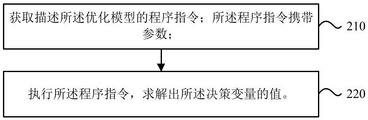
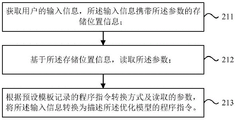
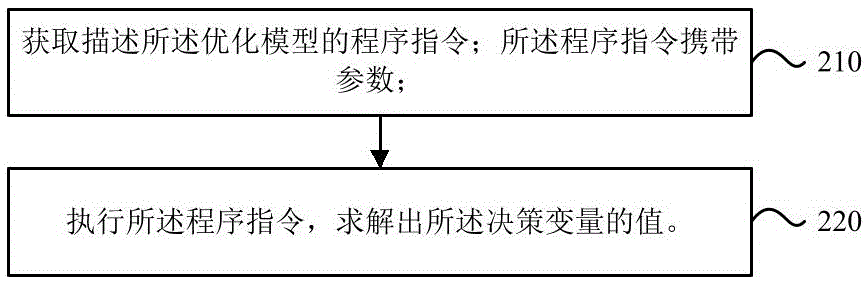
To this end, the embodiments of the present specification provide a solution method for an optimization model, which is used for building and solving the optimization model, where the optimization model includes decision variables, optimization objectives, and constraint conditions. The above method comprises the steps as shown in fig. 2-3:
step 210: obtaining program instructions describing the optimization model; the program instruction carries a parameter;
wherein the program instructions comprise: program instructions for describing the decision variables, program instructions for describing the optimization objectives, and program instructions for describing the constraints.
Specifically, the step of acquiring the program instruction includes:
step 211: acquiring input information of a user, wherein the input information carries storage position information of the parameters;
wherein the input information includes: information describing the decision variables, information describing the optimization objectives, and information describing the constraints;
step 212: reading the parameter based on the storage position information;
step 213: and converting the input information into a program instruction describing the optimization model according to a program instruction conversion mode recorded by a preset template and the read parameters.
After obtaining program instructions describing the optimization model, performing the following steps:
step 220: and executing the program instruction to solve the value of the decision variable.
The user may be any person who performs optimization model establishment and solution, such as the above-mentioned technician.
As described above, the optimization model includes three elements, namely, decision variables, optimization objectives and constraints. In the process of solving the optimization model, the three elements need to be described by using program instructions, so that the computer solves the value of the decision variable by executing the program instructions.
The constraint condition may include a plurality of constraint conditions, and for each constraint condition, there may be a corresponding program instruction. As in the resource allocation problem described above, the optimization model is built to include 3 constraints, and there may be 3 program instructions describing the constraints of the optimization model.
The program instructions carry parameters, for example, both the program instructions for describing the optimization objectives and the program instructions for describing the constraints carry parameters. As in the above example, the optimization target max Z = (P) 1 - C 1 )* X 1 +(P 2 - C 2 )* X 2 Includes a parameter P 1 、C 1 And P 2 、C 2 Thus, the program instructions describing the optimization objectives also carry the parameter P 1 、C 1 And P 2 、C 2 . Constraint n 1 * X 1 +n 2 * X 2 N is less than or equal to N and includes a parameter N 1 And n 2 (ii) a Constraint m 1 * X 1 +m 2 * X 2 M is less than or equal to M and comprises a parameter M 1 And m 2 . Thus, the program instructions describing the constraints also carry the corresponding parameters.
The program instruction can be obtained by converting input information of a user, wherein the input information carries storage location information of the parameters. In some embodiments, the parameters may be stored in a data source, for example, may be stored in a remotely stored data source. The remotely stored data sources may include, but are not limited to, an ODPS (open data processing service) database, a MySQL (relational database management system) database, and the like. As such, the storage location information of the parameter may include storage location information of the parameter in the data source. In some embodiments, the parameters may be stored in a data source in a data format, such as an array, table, or the like. As an example, the parameters may be stored in the data source based on a tabular data structure. Then, the storage location information of the parameter may include storage location information of the table where the parameter is located in the data source, and location information of the parameter in the table.
The preset template records a conversion manner of the program instruction, for example, the preset template may record a manner of converting information for describing the decision variable into a program instruction for describing the decision variable, a manner of converting information for describing the optimization objective into a program instruction for describing the optimization objective, and a manner of converting information for describing the constraint condition into a program instruction for describing the constraint condition. Since the input information of the user carries the storage location information of the parameters, the parameters carried by the program instructions can be read based on the storage location information. Meanwhile, the preset template also records the conversion modes of the three program instructions, so that the input information can be converted into the program instructions through the conversion modes and the read parameters.
Compared with the process of manually writing program instructions by a user in the related art, the method provided by the embodiment of the specification only needs the user to input the input information describing the three elements. The computer can automatically read the parameters carried by the program instructions from the input information and convert the input information into corresponding program instructions. Therefore, the user does not need to master the modeling language, and the model building threshold is reduced. Meanwhile, the time for manually writing the computer program is saved, so that the service problem solving efficiency is improved.
As mentioned above, the parameter may be stored in the data source, and the input information may carry storage location information of the parameter, so in order to enable the computer to identify the storage location information in the input information, in some embodiments, the input information may carry a data source identifier and the storage location information. The data source identification is used for indicating that the parameter is determined from the data source, and the storage position information is used for inquiring the parameter in the data source. The data source identifier may be a predefined identifier, and when the computer recognizes the data source identifier, the data source identifier represents storage location information in which a character string following the data source identifier is a parameter. In some embodiments, the data source identification may include a start identification and a parameter input identification. The start flag is used to define decision variables and/or parameters and is a predetermined symbol flag. The parameter input identifier is used to represent an input operation of a parameter. As an example, the start identifier may include, but is not limited to, a combination of one or more of the symbol "@", the symbol "#", the symbol "%". The parameter input identification may include, but is not limited to, "input". Of course, the starting identifier and the parameter identifier are not limited to the above examples, and may also be a formal identifier, and the application is not limited herein.
For example, the input information may include storage location information of the table where the parameter is located in the data source, and "@ input.type", where "@ input" is a data source identification composed of a start identification "@" and a parameter input identification "input". Then, the character string "type" following the data source identification "@ input" is the location information of the parameter in the table. In this way, the parameter can be obtained based on the storage location information of the table where the parameter is located in the data source and the location information of the parameter in the table.
The input information may include information describing decision variables, information describing optimization objectives, and information describing constraints. Wherein the information for describing the optimization objective may include an optimization objective expression. The expression is a combination of numbers, operators, numbers grouped together (e.g., brackets), free variables, and constraint variables in a meaningful arrangement that allows numerical values to be obtained. Wherein, the constraint variable is assigned with a value in the expression, and the free variable is not assigned with a value. The optimization target expression is an expression for describing an optimization target. Wherein, in order for the computer to recognize that the optimization target expression input by the user is used for describing the optimization target, the optimization target expression may comprise a predefined optimization target character string. When the computer identifies the optimization target string, it can be determined that the expression in which the string is located is used to describe the optimization target. As an example, the predefined optimization target string may be the string "obj". Of course, the predefined optimization target character string is not limited to the above example, and may be other character strings, and the application is not limited herein.
As such, is used for the descriptionThe information of the constraint may include a constraint expression. The constraint condition expression is an expression for describing a constraint condition. As described above, the constraint may include a plurality of conditions, and for each constraint, the user may input a corresponding expression. Wherein, in order for the computer to recognize that the constraint expression input by the user is used for describing the constraint, the constraint expression may comprise a predefined constraint character string. When the computer identifies a constraint string, it can be determined that the expression in which the string is located is for describing the constraint. As an example, the predefined constraint string may be the string "c n ", where n may be a positive integer. Of course, the predefined constraint character string is not limited to the above example, and may also be other character strings, and the application is not limited herein.
The information used to describe the decision variables may include decision variable expressions. That is, the user may directly input expressions to describe the decision variables. In order for the computer to recognize that the decision variable expression input by the user is used for describing the decision variable, the decision variable expression may include a predefined decision variable character string. When the computer identifies a decision variable string, it can be determined that the expression in which the string is located is for describing the decision variable. In some embodiments, the decision variable string may include a start identification and a decision variable identification. As an example, the start identifier may be a combination including, but not limited to, one or more of the symbol "@", the symbol "#", the symbol "%". The decision variable identification may be X. Of course, the decision variable identification may not be limited to the above examples, and the application is not limited thereto. The decision variable string may be the string "@ X".
In the above embodiment, the information input by the user is expressions for describing the decision variables, the optimization objectives, and the constraint conditions, respectively. Compared with the program instruction, the expression has stronger readability from the perspective of a user and is more convenient for the user to write. From the perspective of the computer, however, when the computer reads multiple expressions input by the user, the content described by each expression cannot be distinguished. In this regard, the present embodiment proposes that different strings may be predefined, including decision variable strings, optimization target strings, and constraint strings. When the computer reads the predefined character strings, the content described by the expression of the predefined character strings can be identified.
Furthermore, the information describing the decision variables may also be storage location information of parameters assigned to the decision variables. As an example, the parameter may be stored in a table format in the data source, and then the input information may include information of a storage location of the table in which the parameter is stored in the data source, and the information for describing the decision variable may include information of a location of the parameter in the table. For example, the character string "type" is position information of the parameter assigned to the decision variable in the table, and then the information for describing the decision variable may include the character string "type".
In some embodiments, when the information describing the decision variables includes a storage location of parameters assigned to the decision variables, then the process of solving the decision variables in step 220 may include: when a program instruction is executed, reading a parameter of an assignment decision variable based on a storage position of the parameter; and solving the value of the decision variable based on the read parameters. As in the above example, the information for describing the decision variables includes the character string "type", indicating that a parameter whose field is type in the table is used to assign a value to the decision variable. In this way, in the process of solving the decision variables, the parameter with the type field can be read from the table as the decision variable, and the solution can be performed.
In some embodiments, the input information entered by the user may carry an operator. The operation symbols may include, for example and without limitation, SUM symbols SUM, AVERAGE symbols AVERAGE, and the like. The preset template also records the conversion relation between the operation symbol and the operation formula. In this way, the operation sign can be converted into the corresponding operation formula based on the conversion relation.
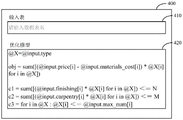
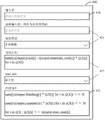
In some embodiments, the user may enter the input information in a user interface. Fig. 4A-4B show schematic diagrams of two user interfaces. As shown in fig. 4A, user interface 400 can include a data source input component 410 and an information input component 420. These two input components can be pull-down menus (e.g., decision variable component 421 in fig. 4B) or input boxes (e.g., information input component 420 in fig. 4A). The user can select the input information in a pull-down menu, or can directly input the input information in an input box. Taking the modeling of the resource allocation problem described above as an example, the parameters may be stored in the data source in a tabular format as shown in table 1. The data source input component 410 can be used to select the table 1 in which the parameter is located from the data source, for example, according to the storage location of the table 1 in the data source, or according to the name of the table 1. By way of example, a user may look up the storage location of table 1 in the data source in the drop down menu of the data source input component 410 to select table 1; the name, unique identifier, etc. of table 1 can also be entered directly into the input box of the data source input component 410, which can uniquely characterize table 1.
TABLE 1
As shown in fig. 4A, the information input component 420 can be used to input decision variable expressions, optimization target expressions, and constraint conditional expressions of the optimization model. As in the resource allocation problem described above, the decision variable expression may include @ X = @ input. Wherein, the @ is the starting identification, the X is the decision variable identification, and the @ X is the decision variable character string. When the computer recognizes the decision variable string @ X, it can be determined that the expression is for describing the decision variable. input is parameter input identification, @ input is data source identification, and type is position information of parameters of assignment decision variables in the table. Wherein the location information comprises fields in a table. As can be seen from table 1, the decision variable expression represents that the parameter (product a and product B) with type field in table 1 is used as the decision variable of the optimization model. When the computer recognizes the data source identification @ input, the parameters assigned to the decision variables can be determined in table 1 according to the field type.
In the above resource allocation problem, the optimization target expression may include obj = sum ([ (@ input.price [ i ] - @ input.materials _ cost [ i ]) X [ i ] for i in @ X ]). Where obj is the optimization target string, when the computer identifies the optimization target string obj, it can be determined that the expression is used for describing the optimization target. sum is an operation symbol representing summation, and the operation symbol can be converted into a corresponding operation formula according to the conversion relation between the operation symbol recorded by the preset template and the operation formula. The optimization objective expression represents the sum of profits for each product. The profit for a certain product is (selling price-cost) the amount produced. When the computer recognizes the data source identifier @ input, the value of the corresponding parameter can be determined from table 1 according to the field price and the materials _ cost.
In the above resource allocation problem, the constraint conditional expressions may include 3, the first constraint conditional expression may include c1 = sum ([ (@ input.finish [ i ] @ X [ i ] for i in @ X ]) < ═ n.the second constraint conditional expression may include c2 = sum ([ (@ input.carrent [ i ] @ [ i ] for i in @ X ]) < ═ m.the third constraint conditional expression may include c3 = for i in @ X: [ X [ i ] < ═ input.max _ num [ i ]. where c1, c2, and c3 are constraint conditional character strings, and when the computer recognizes the constraint character strings, the expressions may be determined to be constraint expressions for describing constraint conditions The conditional expression indicates that the production quantity of each product is not more than the corresponding maximum value. When the computer recognizes the data source identifier @ input, the value of the corresponding parameter can be determined from table 1 according to the fields finishing, carentry, and max _ num.
In some embodiments, as shown in fig. 4B, information input component 420 may include a decision variable input component 421, an optimization goal input component 422, and a constraint input component 423. The decision variable input component 421 may be used to input storage location information for parameters assigned to the decision variables and to define the types of decision variables. The types of decision variables may include, but are not limited to: integer (Integers), Positive integer (Positive Integers), Non-Positive integer (Non-Positive Integers), Negative integer (Negative Integers), Non-Negative integer (Non-Negative Integers), real number (reads), Positive real number (Positive reads), Non-Positive real number (Non-Positive reads), Negative real number (Negative reads), Non-Negative real number (Non-Negative reads), and the like. As in the resource allocation problem described above, the field "type" may be entered in the decision variable input component 421 and the type of decision variable selected under the drop-down menu is a non-negative integer.
Optimization goal input component 422 can be used to input information describing an optimization goal. As in the resource allocation problem described above, the user can directly input sum ([ (@ input.print [ i ] - @ input.materials _ cost [ i ]) @ X [ i ] for i in @ X ]) in the optimization target input component. Because the computer can directly recognize that the information entered in the optimization goal input component 422 is for describing the optimization goal, the user may not need to enter an expression carrying the optimization goal string.
Constraint input component 423 can be used to input information describing constraints. As in the above resource allocation problem, the user can directly input "sum ([ (@ input.finish [ i ] @ X [ i ] for i in @ X ]) < ═ N", "sum ([ (@ input.carpenty [ i ] @ X [ i ] for i in @ X ]) < ═ M", and "for i in @ X [ i ] < @ input.max _ num [ i ]" in the optimization target input component.
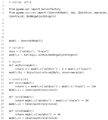
After the input information input by the user is acquired, the parameters in the program instructions can be read by the method described in any of the above embodiments. In addition, the preset template also records a conversion mode of the program instruction, and can convert the input information into the program instruction. As in the resource allocation problem described above, the input information may be converted into program instructions as shown in fig. 5 by a preset template.
The embodiment of the specification provides a solving method of an optimization model, wherein the solving process of the optimization model comprises the step of obtaining a program instruction describing the optimization model, wherein the program instruction carries parameters. The program instructions are then executed to solve for the values of the decision variables in the optimization model. In the process of obtaining program instructions, the user may enter some input information, including information describing decision variables, information describing optimization objectives, and information describing constraints. Wherein the input information carries storage location information of the parameter. In this way, the parameters read into the program instructions based on the storage location information can be converted into the program instructions describing the optimization model according to the program instruction conversion mode recorded by the preset template and the read parameters. Because the user only needs to input the information for describing the decision variables, the optimization targets and the constraint conditions, and does not need to use a modeling language to write the optimization model into a computer program, the user can not master the modeling language, and the model building threshold is reduced. Meanwhile, the time for writing the computer program by the user is saved, so that the service problem solving efficiency is improved.
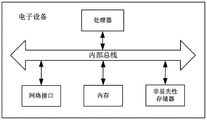
Based on the solution method of the optimization model described in any of the above embodiments, an embodiment of the present specification further provides a schematic structural diagram of an electronic device shown in fig. 6. As shown in fig. 6, at the hardware level, the electronic device includes a processor, an internal bus, a network interface, a memory, and a non-volatile memory, but may also include hardware required for other services. The processor reads the corresponding computer program from the nonvolatile memory into the memory and then runs the computer program to implement the solution method of the optimization model according to any of the embodiments described above.
Based on the solution method of the optimization model according to any of the above embodiments, an embodiment of the present specification further provides a computer program product, which includes a computer program, and when the computer program is executed by a processor, the computer program is configured to perform the solution method of the optimization model according to any of the above embodiments.
Based on the solution method of the optimization model described in any of the above embodiments, an embodiment of the present disclosure further provides a computer storage medium, where a computer program is stored, and when being executed by a processor, the computer program may be used to execute the solution method of the optimization model described in any of the above embodiments.
The foregoing description has described certain embodiments of this disclosure. Other embodiments are within the scope of the following claims. In some cases, the actions or steps recited in the claims may be performed in a different order than in the embodiments and still achieve desirable results. In addition, the processes depicted in the accompanying figures do not necessarily require the particular order shown, or sequential order, to achieve desirable results. In some embodiments, multitasking and parallel processing may also be possible or may be advantageous.
Other embodiments of the present disclosure will be apparent to those skilled in the art from consideration of the specification and practice of the invention disclosed herein. The embodiments of the specification are intended to cover any variations, uses, or adaptations of the embodiments of the specification following, in general, the principles of the embodiments of the specification and including such departures from the present disclosure as come within known or customary practice within the art to which the embodiments of the specification are not applied. It is intended that the specification and examples be considered as exemplary only, with a true scope and spirit of the embodiments being indicated by the following claims.