Disclosure of Invention
The invention overcomes the defects of the prior art and provides a stray light eliminating and shading system, so that the internal stray light eliminating structure is further improved on the basis of the conventional Cassegrain optical system, and the stray light inhibiting capability is higher.
The invention provides a stray light eliminating and shading system, which comprises a primary shading cover and a secondary shading cover which are sequentially arranged on the same optical axis; wherein,
the primary light shield comprises a primary light blocking ring group which is perpendicular to the optical axis, the primary light blocking ring group comprises M primary light blocking rings, and the M primary light blocking rings are sequentially arranged in a lens barrel of the primary light shield;
the secondary light shield comprises a secondary light blocking ring group which is obliquely arranged with the optical axis, the secondary light blocking ring group comprises N secondary light blocking rings, and the N secondary light blocking rings are sequentially arranged in a lens cone of the secondary light shield; wherein M is more than or equal to 6, and N is more than or equal to 7;
the light beam is incident to the optical system after being eliminated by the first-stage light shield and the second-stage light shield in sequence.
Furthermore, the included angle between the secondary light blocking ring and the lens cone of the secondary light shield is larger than the included angle between the incident light beam and the optical axis.
Furthermore, the included angle between the secondary light blocking ring and the lens cone of the secondary light shield is 76-90 degrees.
Furthermore, the cutting edge taper angle of the secondary light blocking ring is 0-45 degrees.
Furthermore, the cutting edge direction of the secondary light-blocking ring closest to the optical system is opposite to the optical system, and the cutting edges of other secondary light-blocking rings face the optical system; the cutting edge directions of all the first-stage light blocking rings face the optical system.
Further, the lengths of the primary and secondary light shields satisfy formulas (1) and (2), respectively:
where ω denotes a half field angle of the stray light eliminating and shading system, θ denotes an off-axis angle of the sun, and DoDenotes the entrance pupil diameter, L, of the stray light eliminating shading system1Indicating the length of the primary shade, L2Indicating the length of the secondary shade, D1Indicating the incident light aperture of the primary lens hood, D2The light entrance aperture of the secondary lens hood is shown.
Furthermore, the primary light-blocking ring and the secondary light-blocking ring are arranged in the primary light-shielding cover and the secondary light-shielding cover in unequal intervals according to the angle of the incident light beam.
Further, the optical system further comprises an inner light shield in a cone cylinder shape, and the inner light shield is arranged at the front end of the central hole of the main mirror in the optical system.
Further, the inner surfaces of the primary light shield, the secondary light shield and the inner light shield are sprayed with the flatting paint with the absorption rate of more than 95%.
Further, the optical system also comprises an optical filter arranged between the primary mirror and the detector in the optical system.
Compared with the prior art, the invention has the beneficial effects that:
1. the stray light eliminating and shading system provided by the invention has the advantages that through the combination of the technical schemes of the primary shading cover, the secondary shading cover, the vertically arranged primary shading ring, the obliquely arranged secondary shading ring and the inner shading cover, the incident stray radiation is restrained to 0.05 percent of the earth radiation detected by the system when the sun off-axis angle is 45 degrees in a limited space, the stray light eliminating and shading system has a high stray light suppression ratio, the earth radiation observation time is prolonged, and the emission cost is saved;
2. compared with the extinction system with partial absorption and partial reflection in the prior art, the stray radiation eliminating and shading system has better stray radiation inhibiting capability by spraying the extinction paint on the primary light shield, the secondary light shield, the vertically arranged primary light blocking ring, the obliquely arranged secondary light blocking ring and the inner light shield.
Detailed Description
The embodiments of the present invention will be described in further detail with reference to the drawings and examples. It should be noted that the embodiments and features of the embodiments may be combined with each other without conflict. All other embodiments, which can be derived by a person skilled in the art from the embodiments given herein without making any creative effort, shall fall within the protection scope of the present invention.
Example 1: the cone angle of the cutting edge of the secondary light blocking ring is 30 DEG
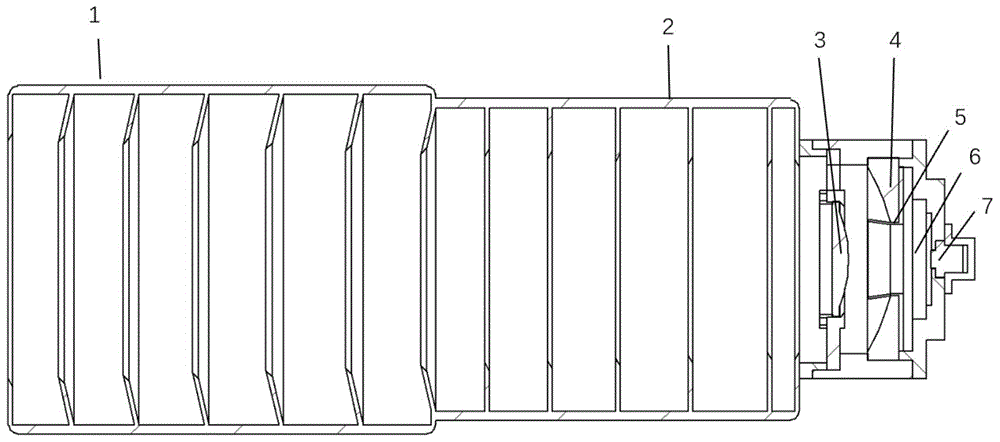
Fig. 1 is a schematic structural diagram showing a stray light reducing and shading system in embodiment 1 of the present invention.
As shown in fig. 1, the stray light eliminating and shielding system in embodiment 1 of the present invention includes a primary light shielding cover and a secondary light shielding cover sequentially disposed on the same optical axis. The one-level light shield comprises a one-level light blocking ring group perpendicular to the optical axis, the one-level light blocking ring group comprises 6 one-level light blocking rings, and the 6 one-level light blocking rings are sequentially arranged in a lens cone of the one-level light shield. The light beam is incident to a primary mirror 4 and a secondary mirror 3 of the optical system after passing through a primary lens hood and a secondary lens hood in sequence to eliminate stray light, and is reflected to the secondary mirror 3 through the primary mirror 4 to detect the light beam reflected by the secondary mirror 3. In embodiment 1 of the present invention, the detector 7 is used for detection, that is, the light beam reflected by the secondary mirror 3 is incident on the detector 7. The second grade lens hood includes the second grade ring group that is in the light of setting up with the optical axis slope, and the second grade is in the light of the ring group and is included 7 second grade light rings, and 7 second grade light rings set gradually in the lens cone of second grade lens hood. The included angle between the secondary light blocking ring and the lens cone of the secondary light shield is larger than the included angle between the incident light beam and the optical axis. And light blocking rings are arranged in the first-stage light shield and the second-stage light shield to form light traps and enhance the extinction capability of the light blocking rings. The included angle between the secondary light blocking ring and the lens cone of the secondary light shield is larger than the included angle between the incident light beam and the optical axis, and the scattered light beam can be prevented from directly entering the stray light eliminating and shading system.
The embodiment 1 of the invention provides a preferable scheme, in order to facilitate the processing and manufacturing, the included angles of 7 secondary light blocking rings and the lens cone of the secondary light shield are 77 degrees; the cutting edge angles of the 7 secondary light blocking rings are all 30 degrees. The 6 first-level light blocking rings are arranged perpendicular to the optical axis. The design scheme can improve the extinction capability of the stray light eliminating shading system, further inhibit scattered light beams, prevent the scattered light beams from directly entering the optical system and incline the light blocking ring in the secondary light shading cover by a certain angle.
The embodiment 1 of the present invention provides a preferable scheme, in which the half field angle of the parasitic light eliminating and shading system is 2 °, the solar off-axis angle is 45 °, and the entrance pupil diameter of the parasitic light eliminating and shading system is 40 mm.
Fig. 2(a) and 2(b) are schematic diagrams illustrating the design principle of the light blocking ring in the primary and secondary light-shielding masks in embodiment 1 of the present invention.
As shown in fig. 2(a) and 2(b), the length of the primary light shield and the light entrance aperture of the primary light shield satisfy the formulas (1) and (2), respectively:
D1=Do+2L1 tanω (2)
the length L of the secondary lens hood can be calculated according to the incident light aperture of the primary lens hood by the formula (3) and the formula (4)2And the incident light aperture D2The formula (3) and the formula (4) are as follows:
D2=D1+2L2 tanω (4)
where ω denotes a half field angle of the stray light eliminating and shading system, θ denotes an off-axis angle of the sun, and DoDenotes the entrance pupil diameter, L, of the stray light eliminating shading system1Indicating the length of the primary shade, L2Indicating the length of the secondary shade, D1Indicating the incident light aperture of the primary lens hood, D2The light entrance aperture of the secondary lens hood is shown.
As shown in fig. 2(b), the stray radiation capability of the secondary light shield is higher than that of the primary light shield, so that the reflection times of light rays in the stray light eliminating and shielding system are increased, the maximum angle of the stray radiation source directly entering the stray light eliminating and shielding system is 15 degrees, namely, the stray radiation eliminating and shielding system can play a role in inhibiting stray radiation with an off-axis angle larger than 15 degrees.
The embodiment 1 of the invention provides a preferable scheme, and the total length of the primary light shield and the secondary light shield is 172mm, namely L1+L2=172mm。
Embodiment 1 of the present invention provides a preferred scheme, which includes a primary light-blocking ring 101, a primary light-blocking ring 102, a primary light-blocking ring 103, a primary light-blocking ring 104, a primary light-blocking ring 105, a primary light-blocking ring 106, and a primary light-blocking ring 107. The secondary light-blocking ring 201, the secondary light-blocking ring 202, the secondary light-blocking ring 203, the secondary light-blocking ring 204, the secondary light-blocking ring 205 and the secondary light-blocking ring 206 are arranged in the primary light-shielding cover and the secondary light-shielding cover in a non-equidistant mode according to the angle of an incident light beam.
Fig. 2(a) and 2(b) are schematic diagrams illustrating the design principle of the light blocking ring in the primary and secondary light-shielding masks in embodiment 1 of the present invention. Fig. 3 is a schematic structural diagram of the light blocking ring in the primary extinction cover and the secondary extinction cover in embodiment 1 of the invention.
As shown in fig. 2(a) and 2(b), since the light-blocking rings are determined one by one according to the maximum field of view of the marginal beams and the optical paths, the light-blocking rings in the light shield are in the form of unequal gradient height distribution, so that stray radiation is better suppressed. Drawing shows that the minimum number of 6 vertical light-blocking rings are arranged in the primary light-shielding cover, and the minimum number of 7 inclined light-blocking rings are arranged in the secondary light-shielding cover. According to the improvement of the extinction ratio requirement, different numbers of light blocking rings can be properly added between two adjacent light blocking rings, the density of the light blocking rings is increased, the extinction capability of the system is further increased, and the scheme with the minimum number of light blocking rings is designed at present.
And a total of 13 light blocking rings are arranged in the first-stage light elimination cover and the second-stage light elimination cover to form light traps, so that the light extinction capability of the light blocking rings is enhanced. According to the design principle of the light blocking ring, the light beam incident at the inlet of the light shield is reflected to the outlet of the light shield at least once, and does not block the view field. For example, as shown in fig. 3, the light-blocking ring is designed by using a drawing method, and the top end position of the light-blocking ring is determined according to the lengths of the primary light-shielding cover and the secondary light-shielding cover, the light-entering aperture and the light-exiting aperture, AD and CD are determined by the field of view, the included angle between the extension lines is the system field angle, AC is the light-entering port of the secondary light-shielding cover, EF is the light-exiting port of the secondary light-shielding cover, which is also the light-entering port of the primary light-shielding cover, and BD is the light-exiting port of the primary light-shielding cover. And performing height extension outside AE, EB, CF and FD as the height of the light-blocking ring, and setting the exterior of the extinction cylinder into a circular shape in order to reduce the processing difficulty, wherein CC 'and AA' are the height of the light-blocking ring at the light inlet of the secondary light-shielding cover, EE 'and FF' are the height of the light-blocking ring at the light outlet of the secondary light-shielding cover, and BB 'and DD' are the height of the light-blocking ring at the light outlet of the primary light-shielding cover. According to the drawing method, light beams at the light inlet of the secondary light shield enter the light blocking ring CC ', are reflected to the bottom end of the light blocking ring EE ' at the light outlet of the secondary light shield, are intersected with the CD at a point M, pass through the point M and form a perpendicular line to be intersected with the inner wall of the light shield at the point M ', the position of the light blocking ring behind the light outlet of the secondary light shield is determined, and by analogy, all the positions of the light blocking rings in the primary light shield and the secondary light shield can be obtained through the drawing method. Because the light blocking rings are determined one by one according to the drawing of the marginal light beams and the light path of the maximum field of view, the light blocking rings in the light shield are in an unequal-distance gradient height distribution mode, and stray radiation is better inhibited. Drawing shows that the minimum number of 6 vertical light-blocking rings are arranged in the primary light-shielding cover, and the minimum number of 7 inclined light-blocking rings are arranged in the secondary light-shielding cover. According to the improvement of the extinction ratio requirement, different numbers of light blocking rings can be properly added between two adjacent light blocking rings, the density of the light blocking rings is increased, the extinction capability of the system is further increased, and the scheme with the minimum number of light blocking rings is designed at present.
As shown in fig. 3, the aperture of the primary light-blocking ring 101 is 52mm, the height is 10mm, and the distance from the primary light-blocking ring 102 is 12.3 mm; the light-passing aperture of the primary light-blocking ring 102 is 51.2mm, the height is 10.4mm, and the distance between the primary light-blocking ring and the primary light-blocking ring 103 is 13.2 mm; the light-passing aperture of the primary light-blocking ring 103 is 50.4mm, the height is 10.8mm, and the distance between the primary light-blocking ring and the primary light-blocking ring 104 is 14.2 mm; the light-passing aperture of the primary light-blocking ring 104 is 49.4mm, the height is 11.3mm, and the distance between the primary light-blocking ring 105 and the primary light-blocking ring is 15.1 mm; the light-passing aperture of the primary light-blocking ring 105 is 48.4mm, the height is 11.8mm, and the distance between the primary light-blocking ring and the primary light-blocking ring 106 is 16.3 mm; the light-passing aperture of the primary light-blocking ring 106 is 47.2mm, the height is 12.4mm, and the distance between the primary light-blocking ring and the primary light-blocking ring 107 is 14.8 mm; the light-passing aperture of the first-stage light-blocking ring 107 is 46.2mm, the height is 9.9mm, and the distance between the first-stage light-blocking ring and the second-stage light-blocking ring 201 is 10.7 mm; the light-transmitting aperture of the secondary light-blocking ring 201 is 45.2mm, the height is 12.7mm, and the distance between the secondary light-blocking ring 202 and the secondary light-blocking ring is 12.6 mm; the light-transmitting aperture of the secondary light-blocking ring 202 is 44mm, the height is 12.7mm, and the distance between the secondary light-blocking ring and the secondary light-blocking ring 203 is 13.7 mm; the light-transmitting aperture of the secondary light-blocking ring 203 is 43mm, the ring height is 12.7mm, and the distance between the secondary light-blocking ring and the secondary light-blocking ring 204 is 14.9 mm; the light-passing aperture of the secondary light-blocking ring 204 is 41.8mm, the height is 12.7mm, and the distance between the secondary light-blocking ring and the secondary light-blocking ring 205 is 16.2 mm; the light-passing aperture of the secondary light-blocking ring 205 is 40.6mm, the height is 12.7mm, and the distance between the secondary light-blocking ring and the secondary light-blocking ring 206 is 5 mm; the aperture of the secondary light blocking ring 206 is 40mm, and the height is 13 mm. The cutting edge of the secondary light-blocking ring 206 faces back to the Cassegrain optical system, and the cutting edges of the secondary light-blocking rings 201-205 and the cutting edges of the primary light-blocking rings 101-107 face towards the interior of the stray light eliminating shading system to block scattered light beams from directly entering the stray light eliminating shading system. The method for determining the position and the method for determining the height of the light-blocking ring in the embodiment 1 of the present invention are both determined by using a geometric drawing method in the prior art, and the method is not limited in the embodiment 1 of the present invention and can be selected according to actual situations.
Fig. 4 shows a schematic design principle of the inner light shield in embodiment 1 of the present invention.
Embodiment 1 of the present invention provides a preferable solution, as shown in fig. 4, the stray light eliminating and shading system further includes an inner shading cover 5 in a conical cylinder shape, and the inner shading cover 5 is installed at a central opening of the primary mirror 4. The aperture size of the inner light shield 5 is determined by a beam tracking method or a mapping method in the prior art, which is not limited in embodiment 1 of the present invention and can be selected according to actual conditions. In embodiment 1 of the present invention, the inner shade is designed according to the drawing method. The supporting mechanical structure of the secondary mirror 3 of the optical system increases the blocking ratio, the light ray M ' N ' determined by the blocking aperture determines the rear aperture of the inner light shield 5, the inner aperture light ray Q ' S ' reflected by the primary mirror 4 intersects with the edge light ray SZ after reflection at a point V, and the front aperture (VP is a half aperture) of the inner light shield 5 is determined, in the embodiment 1 of the invention, the view field of the detector 7 is further limited by the inner light shield 5, and the stray radiation of the optical system received by the detector 7 is reduced, so that the rear aperture of the inner light shield 5 is reduced to be the same as the diameter (QP ' is a half aperture) of the opening of the primary mirror 4.
The front aperture size of the inner light shield 5 depends on the size of the on-axis aperture edge light beam and the obscuration ratio after being reflected by the primary mirror 4 and the secondary mirror 3, and the rear aperture size depends on the size of the central aperture of the primary mirror 4 and the view field edge light beam. The light shield in embodiment 1 of the invention has a front aperture of 16.4mm, a rear aperture of 15mm, a length of 7.7mm and a thickness of 1 mm. The field of view of the detector 7 is further limited by arranging the inner light shield 5, and stray radiation of the stray light eliminating and light shielding system received by the detector 7 is reduced.
Embodiment 1 of the present invention provides a preferable scheme, including a primary light shield, a secondary light shield, an inner light shield 5, a primary light-blocking ring 101, a primary light-blocking ring 102, a primary light-blocking ring 103, a primary light-blocking ring 104, a primary light-blocking ring 105, a primary light-blocking ring 106, and a primary light-blocking ring 107. The surfaces of the secondary light-blocking ring 201, the secondary light-blocking ring 202, the secondary light-blocking ring 203, the secondary light-blocking ring 204, the secondary light-blocking ring 205 and the secondary light-blocking ring 206 are sprayed with the flatting paint with the absorptivity of more than 95%. The matting paint in example 1 of the invention was a black paint. Compared with a partial absorption and partial reflection type extinction system in the prior art, the scheme of coating the black extinction paint has better stray radiation inhibition capability.
In the preferred embodiment 1 of the present invention, the stray light eliminating and shielding system further includes an optical filter 6 disposed behind the inner light shielding cover 5, and the optical filter 6 is selected according to the detected wavelength. For example, the observed wavelength is 0.2 μm and 5 μm, and the 0.2-5 μm low-pass filter 6 is selected to filter out stray light not meeting the wavelength, so that the stray radiation suppression capability can be further improved, and a better detection effect can be obtained.
Fig. 5(a) and 5(b) are schematic diagrams showing the incident light flux after the suppression of the stray light by the stray light eliminating light shielding system in embodiment 1 of the present invention.
As shown in fig. 5(a), the power of stray light at the entrance pupil can be reflected, the left vertical bar represents irradiance, the different depths represent different illumination intensities, the ordinate represents the interval of the beam illumination intensity, and the abscissa is the interval of the power received by the detector, which indicates the position distribution of the stray light at the detector 7; as shown in fig. 5(b), the intensity of stray light received by the detector 7 can be reflected, the ordinate represents irradiance, the different depths represent different illuminance, and the abscissa is the power of the illuminance interval of the light beam. The stray light eliminating and shading system in the embodiment 1 of the invention is a thermal radiation detection system, so that the extinction ratio is used as an index for judging the extinction capability of the system. The extinction ratio is defined as the ratio of the stray radiation received by the detector 7 to the incident stray radiation of the stray light reducing shading system. Performing simulation in software, setting a circular grid light source, setting the surface absorptivity of an extinction system to be 0.95, and performing simulation to obtain the solar off-axis angle of 45 degrees, as shown in fig. 5(a) and 5(b)The irradiance plot at the pupil shows 0.99586W total power of the incident rays at the system entrance pupil, and the irradiance plot at the detector shows 1.7969 × 10 stray radiation power received by the detector-11W, the extinction ratio of the stray light eliminating shading system is about 1.8044 multiplied by 10-11As can be seen from simulation data, the stray radiation suppression capability of the invention is better.
Example 2: the cone angle of the cutting edge of the secondary light blocking ring is 15 DEG
Fig. 6 is a schematic structural diagram showing a stray light eliminating and shading system in embodiment 2 of the present invention.
Example 2 the same principle as in example 1, but the angle of the taper angle of the cutting edge of the secondary light barrier ring is different. As shown in fig. 6, the stray light eliminating and shielding system in embodiment 2 of the present invention includes a primary light shielding cover and a secondary light shielding cover sequentially disposed on the same optical axis. The one-level light shield comprises a one-level light blocking ring group perpendicular to the optical axis, the one-level light blocking ring group comprises 6 one-level light blocking rings, and the 6 one-level light blocking rings are sequentially arranged in a lens cone of the one-level light shield. The light beam is incident to a primary mirror 4 and a secondary mirror 3 of the optical system after passing through a primary lens hood and a secondary lens hood in sequence to eliminate stray light, and is reflected to the secondary mirror 3 through the primary mirror 4 to detect the light beam reflected by the secondary mirror 3. In embodiment 2 of the present invention, the detector 7 is used for detection, that is, the light beam reflected by the secondary mirror 3 is incident on the detector 7. The second grade lens hood includes the second grade ring group that is in the light of setting up with the optical axis slope, and the second grade is in the light of the ring group and is included 7 second grade light rings, and 7 second grade light rings set gradually in the lens cone of second grade lens hood. The included angle between the secondary light blocking ring and the lens cone of the secondary light shield is larger than the included angle between the incident light beam and the optical axis. And light blocking rings are arranged in the first-stage light shield and the second-stage light shield to form light traps and enhance the extinction capability of the light blocking rings. The included angle between the secondary light blocking ring and the lens cone of the secondary light shield is larger than the included angle between the incident light beam and the optical axis, and the scattered light beam can be prevented from directly entering the stray light eliminating and shading system.
The embodiment 2 of the invention provides a preferable scheme, in order to facilitate the processing and manufacturing, the included angles of 7 secondary light blocking rings and the lens cone of the secondary light shield are 77 degrees; the cutting edge angles of the 7 secondary light blocking rings are all 15 degrees. The 6 first-level light blocking rings are arranged perpendicular to the optical axis. The design scheme can improve the extinction capability of the stray light eliminating shading system, further inhibit scattered light beams, prevent the scattered light beams from directly entering the optical system and incline the light blocking ring in the secondary light shading cover by a certain angle.
Fig. 7(a) and 7(b) are schematic diagrams showing the incident light flux after the suppression of the stray light by the stray light eliminating light shielding system in embodiment 2 of the present invention. As shown in fig. 7(a), the power of stray light at the entrance pupil can be reflected, the left vertical bar represents irradiance, the different depths represent different illumination intensities, the ordinate represents the interval of the beam illumination intensity, and the abscissa is the interval of the power received by the detector, which indicates the position distribution of the stray light at the detector 7; as shown in fig. 7(b), the intensity of stray light received by the detector 7 can be reflected, the ordinate represents irradiance, the different depths represent different illuminance, and the abscissa is the power of the illuminance interval of the light beam. The stray light eliminating and shading system in the embodiment 2 of the invention is a thermal radiation detection system, so that the extinction ratio is used as an index for judging the extinction capability of the system. The extinction ratio is defined as the ratio of the stray radiation received by the detector 7 to the incident stray radiation of the stray light reducing shading system. Simulation is carried out in software, a circular grid light source is arranged, the surface absorptivity of an extinction system is set to be 0.95, when the solar off-axis angle is 45 degrees, as shown in fig. 7(a) and 7(b), an irradiance graph at an entrance pupil shows that the total power of incident rays at the entrance pupil of the system is 0.99586W, and an irradiance graph at a detector shows that the stray radiation power received by the detector is 1.1042 multiplied by 10-11W, the extinction ratio of the stray light eliminating shading system is about 1.1088 multiplied by 10-11As can be seen from simulation data, the stray radiation suppression capability of the invention is better. The extinction ratio of the stray light eliminating shading system is about 2.0451 multiplied by 10-10As can be seen from simulation data, the stray radiation suppression capability of the invention is better.
Example 3: the cone angle of the cutting edge of the secondary light blocking ring is 40 DEG
Fig. 8 is a schematic structural diagram showing a stray light eliminating and shading system in embodiment 3 of the present invention.
Example 3 the same principle as in example 1, but the angle of the taper angle of the cutting edge of the secondary light barrier ring is different. As shown in fig. 8, the stray light eliminating and shielding system in embodiment 3 of the present invention includes a primary light shielding cover and a secondary light shielding cover sequentially disposed on the same optical axis. The one-level light shield comprises a one-level light blocking ring group perpendicular to the optical axis, the one-level light blocking ring group comprises 6 one-level light blocking rings, and the 6 one-level light blocking rings are sequentially arranged in a lens cone of the one-level light shield. The light beam is incident to a primary mirror 4 and a secondary mirror 3 of the optical system after passing through a primary lens hood and a secondary lens hood in sequence to eliminate stray light, and is reflected to the secondary mirror 3 through the primary mirror 4 to detect the light beam reflected by the secondary mirror 3. In embodiment 3 of the present invention, the detector 7 is used for detection, that is, the light beam reflected by the secondary mirror 3 is incident on the detector 7. The second grade lens hood includes the second grade ring group that is in the light of setting up with the optical axis slope, and the second grade is in the light of the ring group and is included 7 second grade light rings, and 7 second grade light rings set gradually in the lens cone of second grade lens hood. The included angle between the secondary light blocking ring and the lens cone of the secondary light shield is larger than the included angle between the incident light beam and the optical axis. And light blocking rings are arranged in the first-stage light shield and the second-stage light shield to form light traps and enhance the extinction capability of the light blocking rings. The included angle between the secondary light blocking ring and the lens cone of the secondary light shield is larger than the included angle between the incident light beam and the optical axis, and the scattered light beam can be prevented from directly entering the stray light eliminating and shading system.
The embodiment 3 of the invention provides a preferable scheme, in order to facilitate the processing and manufacturing, the included angles of 7 secondary light blocking rings and the lens cone of the secondary light shield are 77 degrees; the cutting edge angles of the 7 secondary light blocking rings are all 40 degrees. The 6 first-level light blocking rings are arranged perpendicular to the optical axis. The design scheme can improve the extinction capability of the stray light eliminating shading system, further inhibit scattered light beams, prevent the scattered light beams from directly entering the optical system and incline the light blocking ring in the secondary light shading cover by a certain angle.
Fig. 9(a) and 9(b) are schematic diagrams showing the incident light flux after the suppression of the stray light by the stray light eliminating light shielding system in embodiment 3 of the present invention. As shown in fig. 9(a), the power of stray light at the entrance pupil can be reflected, the left vertical bar represents irradiance, the different depths represent different illumination intensities, the ordinate represents the interval of the beam illumination intensity, and the abscissa is the interval of the power received by the detector, which indicates the position distribution of the stray light at the detector 7; as shown in FIG. 9(b), this is too reflectedThe intensity of stray light received by the detector 7, the ordinate represents irradiance, different depths represent different illumination intensities, and the abscissa is the power of the illumination interval of the light beam. The stray light eliminating and shading system in the embodiment 3 of the invention is a thermal radiation detection system, so that the extinction ratio is used as an index for judging the extinction capability of the system. The extinction ratio is defined as the ratio of the stray radiation received by the detector 7 to the incident stray radiation of the stray light reducing shading system. Simulation is carried out in software, a circular grid light source is arranged, the surface absorptivity of an extinction system is set to be 0.95, when the solar off-axis angle is 45 degrees, as shown in fig. 9(a) and 9(b), an irradiance graph at an entrance pupil shows that the total power of incident rays at the entrance pupil of the system is 0.99586W, and an irradiance graph at a detector shows that the stray radiation power received by the detector is 4.7577 multiplied by 10-11W, the extinction ratio of the stray light eliminating shading system is about 1.1088 multiplied by 10-11As can be seen from simulation data, the stray radiation suppression capability of the invention is better. The extinction ratio of the stray light eliminating shading system is about 4.7775 multiplied by 10-11As can be seen from simulation data, the stray radiation suppression capability of the invention is better.
Example 4: the included angle between the secondary light blocking ring and the lens barrel of the secondary lens hood is 80 DEG
Fig. 10 is a schematic structural diagram showing a stray light eliminating and shading system in embodiment 4 of the present invention.
Example 4 the same principle as in example 1, but the angle of the taper angle of the cutting edge of the secondary light barrier ring is different. As shown in fig. 10, the stray light eliminating and shielding system in embodiment 4 of the present invention includes a primary light shielding cover and a secondary light shielding cover sequentially disposed on the same optical axis. The one-level light shield comprises a one-level light blocking ring group perpendicular to the optical axis, the one-level light blocking ring group comprises 6 one-level light blocking rings, and the 6 one-level light blocking rings are sequentially arranged in a lens cone of the one-level light shield. The light beam is incident to a primary mirror 4 and a secondary mirror 3 of the optical system after passing through a primary lens hood and a secondary lens hood in sequence to eliminate stray light, and is reflected to the secondary mirror 3 through the primary mirror 4 to detect the light beam reflected by the secondary mirror 3. In embodiment 4 of the present invention, the detector 7 is used for detection, that is, the light beam reflected by the secondary mirror 3 is incident on the detector 7. The second grade lens hood includes the second grade ring group that is in the light of setting up with the optical axis slope, and the second grade is in the light of the ring group and is included 7 second grade light rings, and 7 second grade light rings set gradually in the lens cone of second grade lens hood. The included angle between the secondary light blocking ring and the lens cone of the secondary light shield is larger than the included angle between the incident light beam and the optical axis. And light blocking rings are arranged in the first-stage light shield and the second-stage light shield to form light traps and enhance the extinction capability of the light blocking rings. The included angle between the secondary light blocking ring and the lens cone of the secondary light shield is larger than the included angle between the incident light beam and the optical axis, and the scattered light beam can be prevented from directly entering the stray light eliminating and shading system.
Embodiment 4 of the present invention provides a preferred scheme, in order to facilitate processing and manufacturing, the included angles between the 7 secondary light-blocking rings and the lens cone of the secondary light-shielding cover are all 80 degrees; the cutting edge angles of the 7 secondary light blocking rings are all 30 degrees. The 6 first-level light blocking rings are arranged perpendicular to the optical axis. The design scheme can improve the extinction capability of the stray light eliminating shading system, further inhibit scattered light beams, prevent the scattered light beams from directly entering the optical system and incline the light blocking ring in the secondary light shading cover by a certain angle.
Fig. 11(a) and 11(b) are schematic diagrams showing the incident light flux after the suppression of the stray light by the stray light eliminating light shielding system in embodiment 4 of the present invention. As shown in fig. 11(a), the power of stray light at the entrance pupil can be reflected, the left vertical bar represents irradiance, the different depths represent different illumination intensities, the ordinate represents the interval of the beam illumination intensity, and the abscissa is the interval of the power received by the detector, which indicates the position distribution of the stray light at the detector 7; as shown in fig. 11(b), the intensity of stray light received by the detector 7 can be reflected, the ordinate represents irradiance, the different depths represent different illuminance, and the abscissa represents the power of the illuminance interval of the light beam. The stray light eliminating and shading system in the embodiment 4 of the invention is a thermal radiation detection system, so that the extinction ratio is adopted as an index for judging the extinction capability of the system. The extinction ratio is defined as the ratio of the stray radiation received by the detector 7 to the incident stray radiation of the stray light reducing shading system. Simulation is carried out in software, a circular grid light source is arranged, the surface absorptivity of the extinction system is set to be 0.95, when the solar off-axis angle is 45 degrees, as shown in figures 11(a) and 11(b), irradiance graphs at the entrance pupils show the total incident ray sum at the entrance pupils of the systemThe power is 0.99586W, and the irradiance at the detector shows that the stray radiation power received by the detector is 4.7577 multiplied by 10-11W, the extinction ratio of the stray light eliminating shading system is about 1.1088 multiplied by 10-11As can be seen from simulation data, the stray radiation suppression capability of the invention is better. The extinction ratio of the stray light eliminating shading system is about 4.7775 multiplied by 10-11As can be seen from simulation data, the stray radiation suppression capability of the invention is better.
Example 5: the included angle between the second-stage light-blocking ring and the lens barrel of the second-stage light-shielding cover is 89 DEG
Fig. 12 is a schematic structural view showing a stray light reducing and shading system in embodiment 5 of the present invention.
Example 5 the same principle as in example 1, but the angle of the taper angle of the cutting edge of the secondary light barrier ring is different. As shown in fig. 12, the stray light eliminating and shielding system in embodiment 4 of the present invention includes a primary light shielding cover and a secondary light shielding cover sequentially disposed on the same optical axis. The one-level light shield comprises a one-level light blocking ring group perpendicular to the optical axis, the one-level light blocking ring group comprises 6 one-level light blocking rings, and the 6 one-level light blocking rings are sequentially arranged in a lens cone of the one-level light shield. The light beam is incident to a primary mirror 4 and a secondary mirror 3 of the optical system after passing through a primary lens hood and a secondary lens hood in sequence to eliminate stray light, and is reflected to the secondary mirror 3 through the primary mirror 4 to detect the light beam reflected by the secondary mirror 3. In embodiment 4 of the present invention, the detector 7 is used for detection, that is, the light beam reflected by the secondary mirror 3 is incident on the detector 7. The second grade lens hood includes the second grade ring group that is in the light of setting up with the optical axis slope, and the second grade is in the light of the ring group and is included 7 second grade light rings, and 7 second grade light rings set gradually in the lens cone of second grade lens hood. The included angle between the secondary light blocking ring and the lens cone of the secondary light shield is larger than the included angle between the incident light beam and the optical axis. And light blocking rings are arranged in the first-stage light shield and the second-stage light shield to form light traps and enhance the extinction capability of the light blocking rings. The included angle between the secondary light blocking ring and the lens cone of the secondary light shield is larger than the included angle between the incident light beam and the optical axis, and the scattered light beam can be prevented from directly entering the stray light eliminating and shading system.
The embodiment 4 of the invention provides a preferable scheme, in order to facilitate the processing and manufacturing, the included angles between 7 secondary light blocking rings and the lens cone of the secondary light shield are all 89 degrees; the cutting edge angles of the 7 secondary light blocking rings are all 30 degrees. The 6 first-level light blocking rings are arranged perpendicular to the optical axis. The design scheme can improve the extinction capability of the stray light eliminating shading system, further inhibit scattered light beams, prevent the scattered light beams from directly entering the optical system and incline the light blocking ring in the secondary light shading cover by a certain angle.
Fig. 13(a) and 13(b) are schematic diagrams showing the incident light flux after the suppression of the stray light by the stray light eliminating light shielding system in embodiment 4 of the present invention. As shown in fig. 13(a), the power of stray light at the entrance pupil can be reflected, the left vertical bar represents irradiance, the different depths represent different illumination intensities, the ordinate represents the interval of the beam illumination intensity, and the abscissa is the interval of the power received by the detector, which indicates the position distribution of the stray light at the detector 7; as shown in fig. 13(b), the intensity of stray light received by the detector 7 can be reflected, the ordinate represents irradiance, the different depths represent different illuminance, and the abscissa is an interval of power received by the detector, which indicates the position distribution of stray light at the detector 7. The stray light eliminating and shading system in the embodiment 4 of the invention is a thermal radiation detection system, so that the extinction ratio is adopted as an index for judging the extinction capability of the system. The extinction ratio is defined as the ratio of the stray radiation received by the detector 7 to the incident stray radiation of the stray light reducing shading system. Simulation is carried out in software, a circular grid light source is arranged, the surface absorptivity of an extinction system is set to be 0.95, when the solar off-axis angle is 45 degrees, as shown in fig. 13(a) and 13(b), an irradiance graph at an entrance pupil shows that the total power of incident rays at the entrance pupil of the system is 0.99586W, and an irradiance graph at a detector shows that the stray radiation power received by the detector is 3.1043 multiplied by 10-11W, the extinction ratio of the stray light eliminating shading system is about 1.1088 multiplied by 10-11As can be seen from simulation data, the stray radiation suppression capability of the invention is better. The extinction ratio of the stray light eliminating shading system is about 3.1172 multiplied by 10-11As can be seen from simulation data, the stray radiation suppression capability of the invention is better.
In the description herein, references to the description of the term "one embodiment," "some embodiments," "an example," "a specific example," or "some examples," etc., mean that a particular feature, structure, material, or characteristic described in connection with the embodiment or example is included in at least one embodiment or example of the invention. In this specification, the schematic representations of the terms used above are not necessarily intended to refer to the same embodiment or example. Furthermore, the particular features, structures, materials, or characteristics described may be combined in any suitable manner in any one or more embodiments or examples. Furthermore, various embodiments or examples and features of different embodiments or examples described in this specification can be combined and combined by one skilled in the art without contradiction.
While embodiments of the present invention have been shown and described above, it should be understood that the above embodiments are exemplary and should not be taken as limiting the invention. Variations, modifications, substitutions and alterations of the above-described embodiments may be made by those of ordinary skill in the art without departing from the scope of the present invention.
The above embodiments of the present invention should not be construed as limiting the scope of the present invention. Any other corresponding changes and modifications made according to the technical idea of the present invention should be included in the protection scope of the claims of the present invention.