On-line detection method for filler dispersity
The technical field is as follows:
the invention belongs to the technical field of filler dispersity detection, and particularly relates to an online detection method for filler dispersity, which is suitable for online detection of filler dispersity in continuous rubber mixing.
The background art comprises the following steps:
the degree to which a substance is dispersed is called the degree of dispersion, and the system formed by dispersing a substance or substances in another substance is called the dispersion system, wherein the dispersed substance is called the dispersoid (dispersed phase), the medium in which the dispersoid is located is called the dispersant (or dispersion medium), the greater the degree of dispersion of the substance, the greater the surface area and specific surface, and the greater the corresponding surface gibbs free energy. From a thermodynamic point of view, highly dispersed systems are less stable and inevitably cause changes in physicochemical properties such as vapor pressure, boiling point, melting point and solubility, and further various surface phenomena such as supercooling, overheating, supersaturation and changes in chemical activity occur. The degree of dispersion not only affects the physical properties of the material, but also significantly affects the chemical activity of the material, and generally speaking, an increase in the degree of dispersion of the reactant increases the chemical activity and facilitates the forward reaction, whereas an increase in the degree of dispersion of the product does not facilitate the forward reaction and facilitates the reverse reaction. Therefore, the filler dispersion degree in rubber mixing is important to detect.
The carbon black dispersion degree detection in the prior art has the problems of small sampling area and incomplete evaluation. For example: the on-line prediction method for the dispersion degree of the mixed rubber of the rubber open mill disclosed in the Chinese patent 201410450926.0 predicts the dispersion degree of the mixed rubber in the mixing process by using various process parameters (including roller transverse pressure, rubber discharge temperature, rubber discharge power, unit energy consumption and the like) detected in the rubber mixing process of the open mill and an established mathematical model of the dispersion degree and the process parameters; the method is characterized in that each process parameter detected in the rubber mixing process of the open mill comprises roller transverse pressure F, rubber discharge temperature T, rubber discharge power P and unit energy consumption N, the established mathematical model of the dispersity and the process parameters is an online prediction mathematical model established by a stepwise regression method and is completed in two steps, and the method comprises the following specific steps: firstly, establishing a mathematical model: preparing at least 25 groups of formula rubber materials to be verified, wherein each group is mixed by adopting different process parameters, and the rubber mixing process parameters comprise: roll spacing, speed and speed ratio, roll temperature and rubber mixing time are respectively detected and recorded, and respective roll transverse pressure F, rubber discharging temperature T, rubber discharging power P and unit energy consumption N process parameters in the open mixing process are respectively detected and recorded, and respective dispersion degree of each vehicle of final rubber mixing is one by one; collecting data samples of process parameters in the rubber compound mixing process of the formula and a dispersion degree sample corresponding to each group of final mixed rubber to establish a database, wherein the data samples comprise independent variables F (F1, F2 and F3 … … Fm), T (T1, T2 and T3 … … Tm), P (P1, P2 and P3 … Pm), N (N1, N2 and N3 … Nm), and dispersion value Y (Y1, Y2 and Y3 … Ym); respectively taking the transverse pressure F of the roller, the glue discharging temperature T, the glue discharging power P and the unit energy consumption N as abscissa and the dispersity as ordinate to make a scatter diagram, and calling SPSS statistical analysis software to analyze the linear correlation of the four parameters F, T and PN with the dispersity; using F, T, P and N as independent variables, using SPSS statistical analysis software with Y as a dependent variable, establishing an online prediction mathematical model by adopting a stepwise regression method, determining the numerical value of a parameter to be estimated through regression analysis, establishing a regression equation, and carrying out significance (F) test, correlation coefficient (R) test and residual error test, wherein if the numerical value is significant and the correlation degree is high, the residual error is normally distributed, the established regression equation is applicable, and if R2 is low, the regression is not ideal, the mathematical model is required to be modified again, and some parameters are increased or reduced, so that the results of the significance (F) test and the correlation coefficient (R) test are ideal, the regression equation is established, and the mathematical model of the rubber compound of the formula is obtained; secondly, a dispersion degree online prediction process: introducing the roller transverse pressure, the rubber discharge temperature, the rubber discharge power and the unit energy consumption parameters detected by rubber materials with corresponding formulas in the mixing process of an open mill into a mathematical model, and predicting the dispersion value of the final rubber material of each car; building different online prediction mathematical models for rubber materials with different formulas according to the steps, substituting detected process parameters into the mathematical models in the rubber mixing process, and predicting the dispersion degree of final rubber mixing; however, in practice, each process parameter is not only influenced by the dispersion degree, but also influenced by other factors such as the type and amount of the matched filler, the mooney viscosity of the raw rubber and the like, so that the evaluation result is not accurate enough; chinese patent 201610459453.X discloses a tire rubber carbon black dispersion degree evaluation method based on neural network image processing, which comprises the following steps: s1, obtaining a sizing material image in the sample set, preprocessing the sizing material image, and extracting the characteristic data of the preprocessed sizing material image; s2, training: acquiring characteristic data of a part of rubber material images in a sample set as training data, training the training data according to a BP network model and an RBF network model respectively, obtaining an optimal mixing coefficient through a self-adaptive genetic algorithm, and connecting the two network models in parallel according to the optimal mixing coefficient to obtain a BP-RBF mixed neural network evaluation model; s3, evaluation stage: acquiring characteristic data of the other part of the sizing material image in the sample set as evaluation data, substituting the evaluation data into the trained BP-RBF mixed neural network evaluation model, and outputting to obtain the degree of dispersion of carbon black in the sizing material; it does not allow continuous on-line detection of carbon black dispersion.
Therefore, an online detection method for filler dispersion degree is researched and designed, real-time online detection is carried out on the filler dispersion degree, and the online detection method has high social and economic values and wide application prospects.
The invention content is as follows:
the invention aims to overcome the defects in the prior art, and develops and designs an on-line detection method for filler dispersion degree, so as to detect the dispersion degree of the filler on line in real time.
In order to achieve the aim, the online detection method for the dispersity of the filler is realized based on a dispersity online detector, and the specific technological process is as follows: connecting the dispersion degree on-line detector with the continuous final mixer, allowing most of the final rubber to enter a main runner, and extruding rubber strips with different specifications through a mouth of the main runner for subsequent processing procedures; a small part of final rubber enters a runner, a sample suitable for filler dispersity detection is extruded through a mouth of the runner, the sample is sent to an online detection mechanism at a set speed through a conveyor, in the conveying process, a positioning pin prevents rubber strips from turning and dislocating in real time, after the sample reaches the online detection mechanism, a linear light source directly irradiates the sample, a linear scanning camera acquires images of the sample and transmits image data to a computer, the computer performs online detection on the filler dispersity according to a set program, and a detection structure is put on a display control terminal, when the filler dispersity is detected to be not in line with a set requirement, the computer controls an acousto-optic alarm lamp to send out an alarm signal to prompt a worker to remove unqualified rubber and adjust the mixing parameters.
Compared with the prior art, most of the final rubber enters the main runner for the subsequent processing procedure, and a small amount of rubber enters the sub-runner for the subsequent on-line detection of the dispersion degree, during the detection, a line scanning camera collects clear images of the mixed rubber extruded by the sub-runner in real time and transmits the images to a computer, the computer identifies and counts carbon black aggregates in the images, then a chart dynamically drawn according to detection data is output to a display control terminal and is stored in a database at the same time, and when a detection result exceeds a threshold value preset by a user, an acousto-optic alarm lamp gives an alarm to remind a worker to adjust the mixing process parameters in time and reject unqualified rubber so as to reduce the generation of waste products; the principle is scientific and reliable, and the method is suitable for detecting the filler dispersity of the rubber material on a medium or small scale.
Description of the drawings:
fig. 1 is a schematic diagram of a main structure principle of the dispersion degree on-line detector according to the present invention.
Fig. 2 is a connection diagram of the usage status of the online dispersity detector according to the present invention.
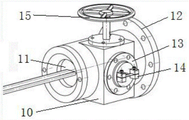
Fig. 3 is a schematic structural diagram of a flow dividing extrusion mechanism according to the present invention.
Fig. 4 is a schematic structural diagram of a sprue gate according to the present invention.
Fig. 5 is a schematic view of the detection principle of the online detection mechanism according to the present invention.
FIG. 6 is a block diagram of the process flow of example 1 of the present invention.
Fig. 7 is a schematic interface diagram of the display control terminal according to step (2) in embodiment 1 of the present invention.
Fig. 8 is a schematic interface diagram of a display control terminal according to step (4) in embodiment 1 of the present invention.
The specific implementation mode is as follows:
the invention is further described by way of example with reference to the accompanying drawings.
Example 1:
the online detection method for the filler dispersity, which is related by the embodiment, is realized based on an online detection machine for the dispersity, and the specific technological process comprises the following steps:
(1) preparing a sizing material: putting the blocky rubber and the auxiliary agent into a primary mixing internal mixer to produce primary mixed rubber; putting the initial mixed rubber into a continuous mixing roll to produce master batch; putting the master batch into a continuous final mixer, and adding a vulcanizing agent to produce a final batch;
(2) setting parameters: meanwhile, the start computer 39 presets the minimum defect, the maximum defect, the detection length, the initial length, the reference sample and the sample information data of the detection in the "detection sample" module displayed by the display control terminal 35 as shown in fig. seven;
(3) extrusion of the sample: the opening of the sub-runners 13 is controlled by the flow valve 15, the diameter of the sub-runners 13 is smaller than that of the main runner 11, most of the final mixed rubber enters the main runner 11, and adhesive tapes 100 of different specifications are extruded through the mouth shape of the main runner 11 for subsequent processing procedures; a small part of the final mixed rubber enters the sub-runner 13, a sample suitable for detecting the dispersity of the filler is extruded through the mouth of the sub-runner 13, micron-sized metal wires or blades can be clamped on the mouth of the sub-runner 13, the final mixed rubber is directly cut into an upper layer and a lower layer when extruded from the mouth, the compactness of the sample is improved based on the high temperature of the final mixed rubber during extrusion and the pressure of the machine head 10, no obvious pore exists during cutting, and the sample is conveyed into the online detection mechanism 3 through the conveyor 2 at a set speed;
(4) real-time detection: clicking "start detection", directly irradiating the sample by an LED high-brightness line light source 33, capturing a sample image by a line series LA-GM-04K08A line scanning camera 34 produced by TELEDYE Dalsa, Canada, equipped with a Makro series MSR 5.6/80 lens and related close-up photographic ring produced by Schneider, displaying the sample image under the main interface of a display control terminal 35 in real time, transmitting the sample image to a computer 39 by the line scanning camera 34 through a GigE gigabit network, processing the image by the computer 39 integrated with a Visual Studio 2017 integrated development environment in combination with a C # programming language, a HALCON machine vision algorithm library and an SQL Server database according to an image processing algorithm, and presenting the number of each detected particle size carbon black aggregate in a graph displayed by the display control terminal 35 as shown in figure eight;
(5) and (4) terminating detection: when the preset detection length is detected, the computer 39 controls the line scanning camera 34 to stop acquiring images, and the detection is terminated.
Example 2:
the process steps of the online detection method for the dispersity of the filler related to the embodiment are the same as those of the embodiment 1, and the main body structure of the online detection machine for the dispersity comprises a shunting extrusion mechanism 1, a conveyor 2, an online detection mechanism 3 and a base 4; the shunting extrusion mechanism 1 is connected with a conveyor 2, the conveyor 2 is connected with an online detection mechanism 3, and the conveyor 2 and the online detection mechanism 3 are respectively arranged on a base 4 of a cabinet structure which can slide; the main structure of the shunting extrusion mechanism 1 comprises a machine head 10, a main flow channel 11, a flange plate 12, a shunting channel 13, a clamping block 14 and a flow valve 15; a main flow channel 11 is arranged on the machine head 10, a flange plate 12 is arranged at one end of the main flow channel 11, a sub-flow channel 13 is arranged in the direction of the machine head 10 perpendicular to the main flow channel 11, a clamping block 14 is arranged in the sub-flow channel 13, and a flow valve 15 is arranged at the top of the machine head 10; the conveyor 2 is provided with a plurality of positioning pins 20; the main structure of the online detection mechanism 3 comprises a support 30, a conveyor 31, a support plate 32, a linear light source 33, a linear scanning camera 34, a display control terminal 35, an acousto-optic alarm lamp 36, a light source controller 37, an encoder 38 and a computer 39; a conveyor 31 is arranged in a support 30, the support 30 is connected with a support plate 32, a linear light source 33 and a linear scanning camera 34 are arranged on the side portion of the support plate 32, a display control terminal 35 and a sound-light alarm lamp 36 are arranged on the top portion of the support plate 32, a light source controller 37 arranged in a base 4 is connected with the linear light source 33, an encoder 38 arranged in the base 4 is connected with the linear scanning camera 34, and a computer 39 arranged in the base 4 is electrically connected with the linear scanning camera 34, the display control terminal 35, the sound-light alarm lamp 36 and the light source controller 37 respectively.