Detailed Description
The present invention is described in further detail below with reference to specific embodiments, which are given for the purpose of illustration only and are not intended to limit the scope of the invention. The examples provided below serve as a guide for further modifications by a person skilled in the art and do not constitute a limitation of the invention in any way.
The invention provides a synthesis method of a nonapeptide-1 derivative, which comprises the steps of carrying out condensation reaction on nonapeptide-1 and asiatic acid serving as raw materials and HOBt/DCC or DMAP/DCC serving as a condensing agent to prepare the nonapeptide-1 derivative; or, the nonapeptide-1 and madecassic acid are used as raw materials, HOBt/DCC or DMAP/DCC is used as a condensing agent, and condensation reaction is carried out to prepare the nonapeptide-1 derivative.
According to one embodiment of the invention, asiatic acid and/or madecassic acid are used for deriving nonapeptide-1, and the prepared nonapeptide-1 derivative can inhibit tyrosinase activity and melanin synthesis, and has skin whitening and speckle lightening effects; the nonapeptide-1 derivative prepared by the synthesis method of one embodiment of the invention can effectively remove DPPH free radicals, thereby exerting antioxidant activity and preventing skin aging, and the nonapeptide-1 derivative also has the effect of resisting photoaging; the nonapeptide-1 derivative prepared by the synthesis method of one embodiment of the invention can inhibit the activity of hyaluronidase, thereby playing a role in anti-allergy; the nonapeptide-1 derivative prepared by the synthesis method of one embodiment of the invention also has better transdermal permeability and is easy to be absorbed and utilized by skin.
In one embodiment, the nonapeptide-1 derivative is synthesized by: adding nonapeptide-1, asiatic acid or madecassic acid, and condensing agent into CH2Cl2And stirring and reacting at room temperature for 12-36 h, after the reaction is finished, distilling under reduced pressure to remove the solvent, adding distilled water and ethyl acetate for extraction, washing an organic layer with distilled water, a hydrochloric acid solution, a saturated sodium bicarbonate solution and a saturated sodium chloride solution in sequence, drying with anhydrous sodium sulfate, concentrating under reduced pressure, and finally recrystallizing with chloroform-methanol to obtain the nonapeptide-1 derivative.
In one embodiment, the molar ratio of nonapeptide-1 to asiatic acid is 1: 2.0-4.0, or alternatively, the molar ratio of nonapeptide-1 to madecassic acid is 1: 2.0-4.0.
In one embodiment, the molar ratio of asiatic acid, HOBt and DCC is 1: 1 to 1.2, or the molar ratio of asiatic acid, DMAP and DCC is 1: 0.18 to 0.25: 1 to 1.2, the molar ratio of madecassic acid, HOBt and DCC is 1: 1 to 1.2, or the molar ratio of madecassic acid, DMAP and DCC is 1: 0.18 to 0.25: 1 to 1.2.
In one embodiment, nonapeptide-1 and CH2Cl2The dosage ratio of the components is 1 g: 3-10 mL.
In one embodiment, the volume ratio of distilled water to ethyl acetate is 1: 0.8-1.6, and the dosage ratio of nonapeptide-1 to ethyl acetate is 1 g: 30-50 mL during the extraction.
In one embodiment, the concentration of the hydrochloric acid solution is 0.5-1.5M.
In one embodiment, during the washing process, the dosage ratio of the nonapeptide-1 to the distilled water is 1 g: 10-20 mL, the dosage ratio of the nonapeptide-1 to the hydrochloric acid solution is 1 g: 10-20 mL, the dosage ratio of the nonapeptide-1 to the saturated sodium bicarbonate solution is 1 g: 10-20 mL, and the dosage ratio of the nonapeptide-1 to the saturated sodium chloride solution is 1 g: 10-20 mL.
In one embodiment, the volume ratio of chloroform to methanol is 1: 0.8-1.3 during the recrystallization of chloroform-methanol.
In one embodiment, the nonapeptide-1-Aa derivative is synthesized by: nonapeptide-1, Asiatic acid (Asiatic acid) and condensing agent were added to CH2Cl2And stirring and reacting at room temperature for 12-36 h, after the reaction is finished, distilling under reduced pressure to remove the solvent, adding distilled water and ethyl acetate for extraction, washing an organic layer with distilled water, a hydrochloric acid solution, a saturated sodium bicarbonate solution and a saturated sodium chloride solution in sequence, drying with anhydrous sodium sulfate, concentrating under reduced pressure, and recrystallizing with chloroform-methanol to obtain the nonapeptide-1-Aa derivative.
In one embodiment, the nonapeptide-1-Ma derivative is synthesized by: adding nonapeptide-1, Madecassic acid and a condensing agent to CH2Cl2And stirring and reacting at room temperature for 12-36 h, after the reaction is finished, distilling under reduced pressure to remove the solvent, adding distilled water and ethyl acetate for extraction, washing an organic layer with distilled water, a hydrochloric acid solution, a saturated sodium bicarbonate solution and a saturated sodium chloride solution in sequence, drying with anhydrous sodium sulfate, concentrating under reduced pressure, and recrystallizing with chloroform-methanol to obtain the nonapeptide-1-Ma derivative.
The nonapeptide-1 derivative according to one embodiment of the present invention is produced by the above-described synthesis method.
The nonapeptide-1 derivative disclosed by one embodiment of the invention can inhibit tyrosinase activity and melanin synthesis, and has whitening and spot-lightening effects on skin, so that the nonapeptide-1 derivative can be used as a skin depigmenting agent, a whitening agent or a spot-lightening agent; the nonapeptide-1 derivative disclosed by one embodiment of the invention can effectively remove DPPH free radicals, thereby exerting antioxidant activity and preventing skin aging, and has an anti-photoaging effect, and has a certain protection effect on photoaging Human Skin Fibroblasts (HSF) and human immortalized epidermal cells (HaCaT), so that the nonapeptide-1 derivative can be used as an anti-aging agent; the nonapeptide-1 derivative disclosed by one embodiment of the invention can inhibit the activity of hyaluronidase so as to exert an anti-allergy effect, so that the nonapeptide-1 derivative can be used as an anti-allergy agent; the nonapeptide-1 derivative disclosed by the embodiment of the invention also has better transdermal permeability and is easy to be absorbed and utilized by skin.
In one embodiment, the nonapeptide-1 derivative has a half inhibitory concentration IC on tyrosinase50≤275 μg/mL。
In one embodiment, the nonapeptide-1 derivative has a half maximal inhibitory concentration IC for DPPH radical scavenging50≤5.5 μg/mL。
One embodiment of the invention provides an application of a nonapeptide-1 derivative in preparing a skin depigmenting agent, a whitening agent, a spot-lightening agent, an anti-aging agent or an anti-allergy agent.
One embodiment of the invention provides application of a nonapeptide-1-Aa derivative and a nonapeptide-1-Ma derivative in preparing skin depigmenting agents, whitening agents, spot lightening agents, anti-aging agents or anti-allergy agents. The nonapeptide-1-Aa derivative and the nonapeptide-1-Ma derivative are used together, so that the tyrosinase activity can be further inhibited, the DPPH free radical scavenging activity is improved, and better whitening and antioxidant effects are achieved. In one embodiment, the weight ratio of the nonapeptide-1-Aa derivative to the nonapeptide-1-Ma derivative is 1: 0.1-0.3. The nonapeptide-1-Aa derivative and the nonapeptide-1-Ma derivative are used together in the proportion range, so that the respective effects are optimal.
An embodiment of the present invention provides a whitening agent comprising the nonapeptide-1 derivative or a cosmetically acceptable salt or excipient or adjuvant thereof as described above.
In one embodiment, the whitening agent comprises a compound of a nonapeptide-1-Aa derivative and a nonapeptide-1-Ma derivative in a weight ratio of 1: 0.1-0.3.
The beauty polypeptide has the technical problem of poor stability, is easy to be enzymolyzed by protease in a human body to lose reaction activity, and reduces or even completely loses the activity of the beauty polypeptide. In order to solve the above technical problems, in one embodiment, the whitening agent includes rosmarinic acid derivatives represented by formula I. The rosmarinic acid derivative shown in the formula I can effectively inhibit the enzymatic degradation of the nonapeptide-1 derivative and improve the stability of the nonapeptide-1 derivative; the rosmarinic acid derivative shown in formula I can improve the transdermal absorption of the nonapeptide-1 derivative and increase the content of the nonapeptide-1 derivative in the dermis; in addition, the rosmarinic acid derivative shown in the formula I can improve the anti-allergy and anti-photoaging effects of the nonapeptide-1 derivative. In one embodiment, the weight ratio of the nonapeptide-1 derivative to the rosmarinic acid derivative is 1: 1-3.
In one embodiment, the method for preparing rosmarinic acid derivatives of formula I comprises adding rosmarinic acid, tranexamic acid, and a condensing agent to CH2Cl2And stirring at room temperature for reaction for 12-36 h, distilling under reduced pressure to remove the solvent after the reaction is finished, carrying out column chromatography on the crude product, wherein the eluent is n-hexane and ethyl acetate with the volume ratio of 5-10: 1, and obtaining the rosmarinic acid derivative shown in the formula I.
An embodiment of the present invention provides a cosmetic comprising the above whitening agent and at least one cosmetically acceptable excipient, adjuvant and/or ingredient.
The experimental procedures in the following examples are conventional unless otherwise specified. Materials, reagents and the like used in the following examples are commercially available unless otherwise specified.
Example 1:
synthesis method of nonapeptide-1-Aa derivative
Adding nonapeptide-1, asiatic acid, HOBt and DCC to CH2Cl2And stirring and reacting at room temperature for 24 hours, after the reaction is finished, distilling under reduced pressure to remove the solvent, adding distilled water and ethyl acetate for extraction, washing an organic layer with distilled water, a hydrochloric acid solution, a saturated sodium bicarbonate solution and a saturated sodium chloride solution in sequence, drying with anhydrous sodium sulfate, concentrating under reduced pressure, and recrystallizing with chloroform-methanol to obtain the nonapeptide-1-Aa derivative, wherein the yield is 81.15%.
Wherein the molar ratio of nonapeptide-1 to asiatic acid is 1: 3.0, the molar ratio of asiatic acid, HOBt and DCC is 1: 1.05, nonapeptide-1 and CH2Cl2The dosage ratio of the components is 1 g to 6 mL; in the extraction process, the volume ratio of distilled water to ethyl acetate is 1: 1, and the dosage ratio of the nonapeptide-1 to the ethyl acetate is 1 g: 35 mL; in the washing process, nonapeptide-1 and distilled waterThe dosage ratio of the nonapeptide to the hydrochloric acid solution is 1 g to 16 mL, the dosage ratio of the nonapeptide-1 to the hydrochloric acid solution is 1 g to 16 mL, the concentration of the hydrochloric acid solution is 1M, the dosage ratio of the nonapeptide-1 to the saturated sodium bicarbonate solution is 1 g to 16 mL, and the dosage ratio of the nonapeptide-1 to the saturated sodium chloride solution is 1 g to 16 mL; in the recrystallization process of chloroform-methanol, the volume ratio of chloroform to methanol is 1: 1.
Example 2:
synthesis method of nonapeptide-1-Aa derivative
The raw materials and synthesis method used in this example are basically the same as those in example 1, except that: the condensing agent HOBt/DCC used was replaced by DMAP/DCC, and the molar ratio of asiatic acid, DMAP and DCC was 1: 0.2: 1.05. The yield of the nonapeptide-1-Aa derivative was 83.42%.
Example 3:
synthesis method of nonapeptide-1-Ma derivative
The raw materials and synthesis method used in this example are basically the same as those in example 1, except that: the asiatic acid used is replaced by madecassic acid. The yield of the nonapeptide-1-Ma derivative was 80.02%.
Example 4:
synthesis method of nonapeptide-1-Ma derivative
The raw materials and synthesis method used in this example are basically the same as those in example 2, except that: the asiatic acid used is replaced by madecassic acid. The yield of the nonapeptide-1-Ma derivative was 81.76%.
Example 5:
whitening agent comprises nonapeptide-1-Aa derivative.
Example 6:
a whitening agent comprises nonapeptide-1-Ma derivative.
Example 7:
a whitening agent comprises nonapeptide-1-Aa derivative and nonapeptide-1-Ma derivative at weight ratio of 1: 0.05.
Example 8:
a whitening agent comprises nonapeptide-1-Aa derivative and nonapeptide-1-Ma derivative at weight ratio of 1: 0.1.
Example 9:
a whitening agent comprises nonapeptide-1-Aa derivative and nonapeptide-1-Ma derivative at weight ratio of 1: 0.15.
Example 10:
a whitening agent comprises nonapeptide-1-Aa derivative and nonapeptide-1-Ma derivative at weight ratio of 1: 0.2.
Example 11:
a whitening agent comprises nonapeptide-1-Aa derivative and nonapeptide-1-Ma derivative at weight ratio of 1: 0.3.
Example 12:
a whitening agent comprises nonapeptide-1-Aa derivative and nonapeptide-1-Ma derivative at weight ratio of 1: 0.35.
Example 13:
preparation method of rosmarinic acid derivative
Adding rosmarinic acid, tranexamic acid, HOBt and DCC into CH2Cl2And stirring at room temperature for reaction for 12-36 h, distilling under reduced pressure to remove solvent after the reaction is finished, and performing column chromatography on the crude product, wherein eluent is n-hexane and ethyl acetate with the volume ratio of 8: 1 to obtain the rosmarinic acid derivative shown in the formula I, and the yield is 84.65%. The molar ratio of rosmarinic acid to tranexamic acid is 1: 1.1, the molar ratio of rosmarinic acid, HOBt and DCC is 1: 1.05, nonapeptide-1 and CH2Cl2The dosage ratio of the components is 1 g to 6 mL.
The structure of the rosmarinic acid derivative shown in formula I is shown in formula I, and the molecular formula is C26H29NO9,1H-NMR (DMSO-d6,400 MHz) δ (ppm) : 11.33 (s, 1H, -COOH), 7.84 (m, 1H, Ph-CH=CH), 6.74-7.35 (d, 6H, Ph-H), 6.32 (m, 1H, Ph-CH=CH), 5.93 (m, 1H, -CONH), 5.39 (s, 4H, Ph-OH), 5.16 (t, 1H, -CH-CONH), 3.34 (m, 2H, -CH 2-CONH), 2.97-3.18 (t, 2H, -CH 2), 2.45 (m, 1H, COOH-CH), 2.12 (m, 1H, -CH-CH2-CONH), 1.31-1.56 (m, 8H, -CH 2)。
A whitening agent comprises nonapeptide-1-Aa derivative and rosmarinic acid derivative shown in formula I at weight ratio of 1: 2.
Example 14:
a whitening agent comprises nonapeptide-1-Ma derivative and rosmarinic acid derivative shown in formula I at weight ratio of 1: 2.
Example 15:
1. synthesis method of nonapeptide-1-Aa derivative
Adding nonapeptide-1, asiatic acid, HOBt and DCC to CH2Cl2And stirring and reacting at room temperature for 24 hours, after the reaction is finished, distilling under reduced pressure to remove the solvent, adding distilled water and ethyl acetate for extraction, washing an organic layer with distilled water, a hydrochloric acid solution, a saturated sodium bicarbonate solution and a saturated sodium chloride solution in sequence, drying with anhydrous sodium sulfate, concentrating under reduced pressure, and recrystallizing with chloroform-methanol to obtain the nonapeptide-1-Aa derivative, wherein the yield is 81.15%.
Wherein the molar ratio of nonapeptide-1 to asiatic acid is 1: 3.0, the molar ratio of asiatic acid, HOBt and DCC is 1: 1.05, nonapeptide-1 and CH2Cl2The dosage ratio of the components is 1 g to 6 mL; in the extraction process, the volume ratio of distilled water to ethyl acetate is 1: 1, and the dosage ratio of the nonapeptide-1 to the ethyl acetate is 1 g: 35 mL; in the washing process, the dosage ratio of the nonapeptide-1 to the distilled water is 1 g: 16 mL, the dosage ratio of the nonapeptide-1 to the hydrochloric acid solution is 1 g: 16 mL, the concentration of the hydrochloric acid solution is 1M, the dosage ratio of the nonapeptide-1 to the saturated sodium bicarbonate solution is 1 g: 16 mL, and the dosage ratio of the nonapeptide-1 to the saturated sodium chloride solution is 1 g: 16 mL; in the recrystallization process of chloroform-methanol, the volume ratio of chloroform to methanol is 1: 1.
2. Synthesis method of nonapeptide-1-Ma derivative
Adding nonapeptide-1, madecassic acid, HOBt and DCC to CH2Cl2Stirring at room temperature for reaction for 24 hr, distilling under reduced pressure to remove solvent, adding distilled water and ethyl acetate for extraction, sequentially washing organic layer with distilled water, hydrochloric acid solution, saturated sodium bicarbonate solution and saturated sodium chloride solution, drying with anhydrous sodium sulfate, concentrating under reduced pressure, and finally re-concentrating with chloroform-methanolCrystallization gave the nonapeptide-1-Ma derivative in 81.15% yield.
Wherein, the molar ratio of nonapeptide-1 and madecassic acid is 1: 3.0, the molar ratio of madecassic acid, HOBt and DCC is 1: 1.05, and nonapeptide-1 and CH2Cl2The dosage ratio of the components is 1 g to 6 mL; in the extraction process, the volume ratio of distilled water to ethyl acetate is 1: 1, and the dosage ratio of the nonapeptide-1 to the ethyl acetate is 1 g: 35 mL; in the washing process, the dosage ratio of the nonapeptide-1 to the distilled water is 1 g: 16 mL, the dosage ratio of the nonapeptide-1 to the hydrochloric acid solution is 1 g: 16 mL, the concentration of the hydrochloric acid solution is 1M, the dosage ratio of the nonapeptide-1 to the saturated sodium bicarbonate solution is 1 g: 16 mL, and the dosage ratio of the nonapeptide-1 to the saturated sodium chloride solution is 1 g: 16 mL; in the recrystallization process of chloroform-methanol, the volume ratio of chloroform to methanol is 1: 1.
The nonapeptide-1 derivatives (nonapeptide-1-Aa derivatives and nonapeptide-1-Ma derivatives) prepared by the synthesis method of the embodiment can inhibit the activity of tyrosinase and the synthesis of melanin, and have the effects of whitening skin and lightening spots; the nonapeptide-1 derivative prepared by the synthesis method can effectively remove DPPH free radicals, so that the antioxidant activity is exerted, skin aging is prevented, and the nonapeptide-1 derivative also has the effect of resisting photoaging; the nonapeptide-1 derivative prepared by the synthesis method can inhibit the activity of hyaluronidase, thereby playing a role in anti-allergy; the nonapeptide-1 derivative prepared by the synthesis method of the embodiment also has good transdermal permeability and is easy to be absorbed and utilized by skin.
3. Preparation method of rosmarinic acid derivative
Adding rosmarinic acid, tranexamic acid, HOBt and DCC into CH2Cl2And stirring at room temperature for reaction for 12-36 h, distilling under reduced pressure to remove solvent after the reaction is finished, and performing column chromatography on the crude product, wherein eluent is n-hexane and ethyl acetate with the volume ratio of 8: 1 to obtain the rosmarinic acid derivative shown in the formula I, and the yield is 84.65%. The molar ratio of rosmarinic acid to tranexamic acid is 1: 1.1, the molar ratio of rosmarinic acid, HOBt and DCC is 1: 1.05, nonapeptide-1 and CH2Cl2The dosage ratio of the components is 1 g to 6 mL.
The rosmarinic acid derivative shown in the formula I can effectively inhibit the enzymatic degradation of the nonapeptide-1 derivative and improve the stability of the nonapeptide-1 derivative; the rosmarinic acid derivative shown in formula I can improve the transdermal absorption of the nonapeptide-1 derivative and increase the content of the nonapeptide-1 derivative in the dermis; in addition, the rosmarinic acid derivative shown in the formula I can improve the anti-allergy and anti-photoaging effects of the nonapeptide-1 derivative.
4. A whitening agent comprises nonapeptide-1-Aa derivative, nonapeptide-1-Ma derivative and rosmarinic acid derivative shown in formula I at weight ratio of 1: 0.15: 3. The nonapeptide-1-Aa derivative and the nonapeptide-1-Ma derivative are used together, so that the tyrosinase activity can be further inhibited, the DPPH free radical scavenging activity is improved, and better whitening and antioxidant effects are achieved. The nonapeptide-1-Aa derivative and the nonapeptide-1-Ma derivative are used together in the proportion range, so that each technical effect is optimal. Meanwhile, the rosmarinic acid derivative shown in the formula I can be added to further improve the whitening use performance, such as improving the stability of the nonapeptide-1 derivative, improving the transdermal absorption of the nonapeptide-1 derivative and improving the anti-allergy and anti-photoaging effects of the nonapeptide-1 derivative.
Comparative example 1:
a whitening agent comprises nonapeptide-1 and asiatic acid at a molar ratio of 1: 3.0.
Comparative example 2:
a whitening agent comprises nonapeptide-1 and madecassic acid at a molar ratio of 1: 3.0.
Comparative example 3:
a whitening agent comprises a whitening agent of a comparative example 1 and a whitening agent of a comparative example 2 in a weight ratio of 1: 0.15.
Experimental example 1:
1. infrared Spectrum of nonapeptide-1 derivatives
Adopting KBr tablet, using Fourier transform infrared spectrometer to measure infrared spectrum of nonapeptide-1 derivative, scanning range is 400-4000 cm-1。
The infrared spectrum of the nonapeptide-1 derivative is shown in figure 1, wherein a in figure 1 is the infrared spectrum of the nonapeptide-1-Aa derivative, and b is the infrared spectrum of the nonapeptide-1-Ma derivative. As can be seen from FIG. 1, at 1630 cm-1With C = C appearing in the vicinityStretching the shock absorption peaks, which indicates the successful acquisition of nonapeptide-1-Aa derivatives and nonapeptide-1-Ma derivatives.
2. Tyrosinase inhibitory activity of whitening agent
The whitening agent sample solutions of examples 5 to 12 and comparative examples 1 to 3 were prepared with anhydrous ethanol at a concentration of 1 mg/mL and then diluted to obtain sample solutions of 0.50, 0.40, 0.30, 0.20, 0.10, 0.05 mg/mL. The reagents shown in Table 1 were added to a 96-well plate in this order, incubated at 37 ℃ for 20 min, and then absorbance at 475 nm was measured as VCCalculating tyrosinase inhibition rate as positive control group according to the following formula, drawing a whitening agent tyrosinase inhibition activity curve, and calculating to obtain semi-inhibition concentration IC of the whitening agent for inhibiting tyrosinase activity50。
Tyrosinase inhibition = [ (A-B) - (C-D) ]/(A-B). times.100%
Wherein A is the light absorption value of a sample without the sample but with enzyme; b is the light absorption value of the sample without the sample and the enzyme; c is the light absorption value of the sample added with the enzyme; d is the absorbance of the sample with the sample but without the enzyme.
TABLE 1 reaction System for inhibition of tyrosinase Activity
3. Antioxidant activity of whitening agent
The whitening agent sample solutions of examples 5 to 12 and comparative examples 1 to 3 were prepared with anhydrous ethanol at a concentration of 1 mg/mL and then diluted to obtain sample solutions of 0.50, 0.20, 0.10, 0.02, 0.01, 0.005, 0.002, 0.001 mg/mL. Sequentially adding the reagents shown in Table 2 into a test tube, reacting in dark at room temperature in dark for 30 min in dark place, centrifuging at 5000 r/min for 10 min, collecting supernatant, measuring absorbance A at 517 nm, and measuring absorbance VCCalculating tyrosinase inhibition rate as a positive control group according to the following formula, drawing a curve of the whitening agent on DPPH free radical scavenging activity, and calculating to obtain half inhibition concentration IC of the whitening agent on DPPH free radical scavenging50。
Clearance = [1- (a)517 Experimental group-A517 Normal group)/A517 control group]×100%
TABLE 2 reaction systems for DPPH radical scavenging activity
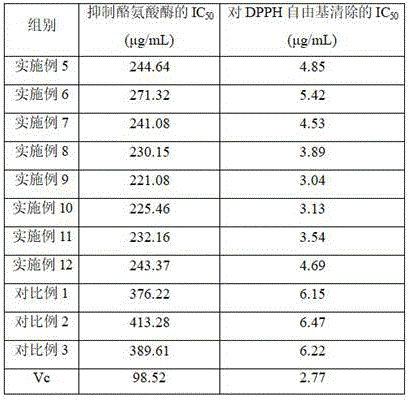
The semi-inhibitory concentrations of the whitening agents for inhibiting tyrosinase activity are shown in Table 3, and it can be seen that examples 5-12 of the present invention, the whitening agents (i.e., nonapeptide-1 derivatives), inhibit the semi-inhibitory concentration IC of tyrosinase activity50Not more than 275 mu g/mL, and has stronger tyrosinase inhibition capability; wherein, the semi-inhibitory concentration of the whitening agent for inhibiting the tyrosinase activity is lower than that of the whitening agent in the comparative example 1 in the example 5, the semi-inhibitory concentration of the whitening agent for inhibiting the tyrosinase activity is lower than that of the whitening agent in the comparative example 2 in the example 6, and the semi-inhibitory concentration of the whitening agent for inhibiting the tyrosinase activity is lower than that of the whitening agent in the comparative example 3 in the example 9, which shows that the nonapeptide-1 derivative prepared by using asiatic acid and/or madecassic acid to perform derivatization on nonapeptide-1 can inhibit the tyrosinase activity, so that the synthesis of melanin is inhibited, and the whitening and spot-lightening effects are achieved on the skin; in addition, the half inhibitory concentration of the whitening agent for inhibiting tyrosinase activity in examples 7-12 was lower than that in examples 5-6, and the half inhibitory concentration of the whitening agent for inhibiting tyrosinase activity in examples 8-11 was lower than that in examples 7 and 12, which indicates that the use of the nonapeptide-1-Aa derivative and the nonapeptide-1-Ma derivative together enables further inhibition of tyrosinase activity, and that the effect of the whitening agent for inhibiting tyrosinase activity is most excellent when the weight ratio of the nonapeptide-1-Aa derivative to the nonapeptide-1-Ma derivative is 1: 0.1-0.3.
The half inhibitory concentrations of the whitening agents on DPPH radical scavenging are shown in Table 3, and it can be seen that the whitening agents of examples 5 to 12 of the present invention (i.e., the nonapeptide-1 derivative) have half inhibitory concentrations IC on DPPH radical scavenging50Less than or equal to 5.5 mu g/mL, and has stronger ability of eliminating DPPH free radicals; wherein, the half inhibitory concentration of the whitening agent to DPPH free radical scavenging of example 5 is lower than that of comparative example 1, the half inhibitory concentration of the whitening agent to DPPH free radical scavenging of example 6 is lower than that of comparative example 2, and the half inhibitory concentration of the whitening agent to DPPH free radical scavenging of example 9Compared with comparative example 3, this shows that the derivative of nonapeptide-1, which is derived from asiatic acid and/or madecassic acid, can effectively scavenge DPPH free radicals, thus exerting antioxidant activity and preventing skin aging; in addition, the half inhibitory concentration of the whitening agents of examples 7 to 12 to DPPH radical scavenging is lower than that of examples 5 to 6, and the half inhibitory concentration of the whitening agents of examples 8 to 11 to DPPH radical scavenging is lower than that of examples 7 and 12, which shows that the use of the nonapeptide-1-Aa derivative and the nonapeptide-1-Ma derivative together can improve the DPPH radical scavenging activity, and that the antioxidant effect of the whitening agents is optimal when the weight ratio of the nonapeptide-1-Aa derivative to the nonapeptide-1-Ma derivative is 1: 0.1-0.3.
TABLE 3 IC of whitening agents on tyrosinase activity50And IC for DPPH radical scavenging50
4. Whitening agent hyaluronidase inhibitory activity
The whitening agent samples of examples 5-15 and comparative examples 1-3 were prepared into a 1 mg/mL whitening agent sample solution with an acetic acid buffer solution of pH 5.6 for use. Preparing hyaluronidase solution with concentration of 1250U/mL with acetic acid buffer solution with pH of 5.6, and using. And preparing the sodium hyaluronate solution with the concentration of 0.5 mg/mL by using acetic acid buffer solution with the pH value of 5.6 for later use. 0.1 mL of 0.25M CaCl was taken2The solution and 0.5 mL hyaluronidase solution are cultured for 20 min at 37 ℃ in a water bath at constant temperature; adding 0.5 mL of sample solution, and keeping the temperature for 20 min; adding 0.5 mL sodium hyaluronate solution, culturing in water bath at 37 deg.C for 30 min, taking out, and standing at room temperature for 5 min; then adding 0.1 mL of 0.4M NaOH solution and 0.5 mL of acetylacetone solution, heating in a boiling water bath for 15 min, and immediately transferring to an ice water bath for cooling for 5 min; dropping 1.0 mL of Ellisib reagent, diluting with 3.0 mL of absolute ethanol, standing at room temperature for 20 min for color development, and scanning the control solution in the range of 450-700 nm by using a spectrophotometer to determine the maximum absorption wavelength. Measuring the absorption maximum wavelength by using spectrophotometerAn absorbance value. The hyaluronidase inhibition was calculated as follows.
Hyaluronidase inhibition = [ (A-B) - (C-D) ]/(A-B) × 100%
Wherein A is the absorbance value of the control solution (the sample solution is replaced by acetic acid buffer solution); b is the absorbance value of the control blank solution (the sample solution and the enzyme solution are replaced by acetic acid buffer solution); c is the absorbance value of the sample solution; d is the absorbance value of the sample blank solution (the enzyme solution is replaced by acetic acid buffer solution).
The inhibition rate of the whitening agent on hyaluronidase is shown in fig. 2, wherein S5 represents example 5, S6 represents example 6, S7 represents example 7, S8 represents example 8, S9 represents example 9, S10 represents example 10, S11 represents example 11, S12 represents example 12, S13 represents example 13, S14 represents example 14, S15 represents example 15, D1 represents comparative example 1, D2 represents comparative example 2, and D3 represents comparative example 3 in fig. 2. It can be seen that the whitening agents of examples 5 to 15 of the invention have an inhibition rate of more than 75% on hyaluronidase and have an extremely obvious inhibition rate on hyaluronidase; the fact that the whitening agent in example 5 has a higher inhibition rate on hyaluronidase than that in comparative example 1, the whitening agent in example 6 has a higher inhibition rate on hyaluronidase than that in comparative example 2, and the whitening agent in example 9 has a higher inhibition rate on hyaluronidase than that in comparative example 3 indicates that the nonapeptide-1 derivative prepared by deriving the nonapeptide-1 by utilizing asiatic acid and/or madecassic acid can inhibit the activity of hyaluronidase, so that the anti-allergy effect is exerted; in addition, the whitening agents of examples 7 to 12 have a higher hyaluronidase inhibition rate than those of examples 5 to 6, and the whitening agents of examples 8 to 11 have a higher hyaluronidase inhibition rate than those of examples 7 and 12, which indicates that the combined use of the nonapeptide-1-Aa derivative and the nonapeptide-1-Ma derivative can improve the hyaluronidase inhibition activity, and that the anti-sensitivity effect of the whitening agents is optimal when the weight ratio of the nonapeptide-1-Aa derivative to the nonapeptide-1-Ma derivative is 1: 0.1-0.3; finally, the whitening agent of example 13 has a greater inhibition of hyaluronidase than that of example 5, the whitening agent of example 14 has a greater inhibition of hyaluronidase than that of example 6, and the whitening agent of example 15 has a greater inhibition of hyaluronidase than that of example 9, which indicates that the rosmarinic acid derivative of formula I is also able to improve the anti-allergy effect of the nonapeptide-1 derivative.
5. Anti-photoaging activity of whitening agents
Human Skin Fibroblasts (HSF) and human immortalized keratinocytes (HaCaT) were purchased from Bai Biotech Ltd, Nanjing, DMEM basal medium from Beijing Boaosen Biotech Ltd, fetal bovine serum from Capricorn, and penicillin-streptomycin mixture (double antibody) from Solarbio. Hydroxyproline test kit was purchased from Nanjing Biotechnology Ltd.
5.1 protective Effect of whitening Agents on photoaging HSF cells
The whitening agent samples of examples 5 to 15 and comparative examples 1 to 3 were prepared with a PBS buffer solution to a concentration of 1. mu.g/mL and were used. DMEM, fetal calf serum and double antibodies are prepared into a complete culture medium according to the volume ratio of 90: 10: 1 for later use. After the HSF cells were recovered, the cells were incubated at 37 ℃ in 5% CO in complete medium2Culturing under the condition until cell fusion reaches 90%, digesting with trypsin, centrifuging at 1000 r/min for 5 min, collecting cells, and preparing the cells into the cell concentration of 1 × 10 with complete culture medium8Cell suspension at 1X 10/L per well4The individual cells were seeded in 96-well plates at 37 ℃ in 5% CO2After 24 h incubation under the conditions, the cells were grouped (blank group: no UVB + irradiation and no whitening agent administration; model group: UVB + irradiation and no whitening agent administration; experimental group: UVB + irradiation and whitening agent administration), 6 wells in each group were repeated, the culture solution was discarded, washed 2 times with PBS, 200. mu.L of PBS was added to each well, the blank group was covered with aluminum foil paper, and the model group and the experimental group were irradiated with UVB irradiation at an irradiation dose of 30 mJ/cm2And the time is 20 s, after the irradiation is finished, PBS is discarded, 200 mu L of whitening agent sample solution is added into each hole of the experimental group, 200 mu L of complete culture medium is added into each hole of the blank group and the model group, after 24 h, 20 mu L of MTT is added into each hole, the incubation is carried out for 4 h, the culture solution is discarded, 150 mu L of DMSO is added into each hole, the vibration is carried out for 10 min under the conditions of 37 ℃ and 170 r/min, the absorbance value A is measured at 490 nm, and then the relative survival rate of the cells is calculated according to the following formula.
Relative cell survival = aExperimental group/ABlank group×100%
After culturing the grouped cells for 24 h, collecting the culture medium supernatant of each hole in a centrifuge tube, centrifuging, and taking the supernatant to store at-20 ℃. Hydroxyproline levels in cell culture media supernatants were detected according to kit instructions.
5.2 protective Effect of whitening Agents on photoaging HaCaT cells
The method is the same as 5.1 the protective effect of whitening agent on photoaging HSF cells.
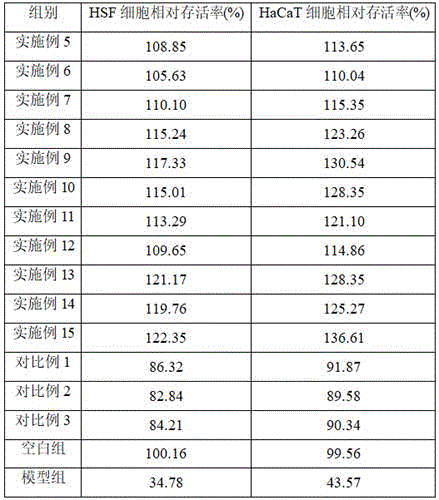
Table 4 shows the effect of the whitening agent on the relative survival rates of UVB aged HSF cells and HaCaT cells, and it can be seen that, compared with the model group, the whitening agents of examples 5 to 15 of the present invention can improve the relative survival rate of UVB aged HSF cells, and have anti-photoaging effect; example 5 the relative survival rates of the whitening agent on UVB aged HSF cells and HaCaT cells are higher than that of comparative example 1, the relative survival rates of the whitening agent on UVB aged HSF cells and HaCaT cells are higher than that of comparative example 2, and the relative survival rates of the whitening agent on UVB aged HSF cells and HaCaT cells are higher than that of comparative example 3, which shows that the derivatization of nonapeptide-1 with asiatic acid and/or madecassic acid can lead the nonapeptide-1 derivative to have the effect of resisting the photoaging of human skin and to have certain protection effect on photoaged fibroblasts (HSF) and human immortalized epidermal cells (Hacat); in addition, the relative survival rates of the whitening agents of examples 7 to 12 on UVB aged HSF cells and HaCaT cells are greater than those of examples 5 to 6, and the relative survival rates of the whitening agents of examples 8 to 11 on UVB aged HSF cells and HaCaT cells are greater than those of examples 7 and 12, which shows that the anti-photoaging effect of the whitening agents can be improved by using the nonapeptide-1-Aa derivative and the nonapeptide-1-Ma derivative together, and the anti-photoaging effect of the whitening agents is optimal when the weight ratio of the nonapeptide-1-Aa derivative to the nonapeptide-1-Ma derivative is 1: 0.1-0.3; finally, example 13 shows that the relative survival rates of the whitening agent on UVB aged HSF cells and HaCaT cells are higher than those of example 5, example 14 shows that the relative survival rates of the whitening agent on UVB aged HSF cells and HaCaT cells are higher than those of example 6, and example 15 shows that the whitening agent on UVB aged HSF cells and HaCaT cells are higher than those of example 9, which indicates that the rosmarinic acid derivative represented by formula I can also improve the anti-photoaging effect of the nonapeptide-1 derivative.
Table 4 shows the effect of the whitening agent on the relative survival of UVB aged HSF cells and HaCaT cells
6. In vitro transdermal penetration test of nonapeptide-1 derivatives
Taking pig ear back skin, removing hair and fat, cutting into 3 × 3 cm skin disc, and storing in-20 deg.C refrigerator for use. The test is carried out by adopting RJY-6B type drug transdermal diffusion tester, when in use, the preserved skin round piece is taken out, naturally thawed, soaked in normal saline for 0.5 h, wiped by absorbent cotton, and fixed in a vertical permeation test diffusion cell. Adding a proper amount of normal saline of a sodium chloride solution with the mass concentration of 0.9% into a receiving pool as receiving liquid, adding 2 g of a whitening agent sample into a supply pool, sealing the supply pool by using a sealing film after adding, starting magnetic stirring at the speed of 300 r/min, slowly extracting all the receiving liquid by using an injector for 2 h, 4 h, 6 h, 8 h and 12 h respectively, measuring the concentration of the nonapeptide-1 derivative by using HPLC (high performance liquid chromatography), extracting 6 g of heat-preserved normal saline by using a needle tube after each liquid extraction, supplementing the heat-preserved normal saline back to the receiving pool, and taking out the receiving liquid after 12 h without supplementing the normal saline. The temperature was set at 32. + -. 5 ℃ by the instrument and then the transdermal concentration of the nonapeptide-1 derivative was calculated according to the following formula.
Transdermal concentration = (CnVn + ∑ CkVk) × 1000/S
In the formula: cn is the concentration of the nonapeptide-1 derivative measured at the nth sampling point, mg/mL; ck is the concentration of the nonapeptide-1 derivative measured correspondingly at all sampling points before the nth sampling point, mg/mL; vn is the receiving fluid volume, mL; vk is the sampling volume corresponding to all sampling points before the nth sampling point, mL; s is the area of the skin disk in cm2。
The transdermal concentration of nonapeptide-1 derivative at 12 h is shown in FIG. 3, S5 represents example 5, S6 represents example 6, S7 represents example 7, S8 represents example 8, S9 represents example 9, S10 represents example 10, S11 represents example 11, S12 represents example 12, S13 represents example 13, S14 represents example 14, S15 represents example 15, D1 represents comparative example 1, D2 represents comparative example 2, and D3 represents comparative example 3. It can be seen that the transdermal concentration of the whitening agent in example 5 in 12 h is greater than that in comparative example 1, the transdermal concentration of the whitening agent in example 6 in 12 h is greater than that in comparative example 2, and the transdermal concentration of the whitening agent in example 9 in 12 h is greater than that in comparative example 3, which shows that the derivation of nonapeptide-1 by asiatic acid and/or madecassic acid leads the nonapeptide-1 derivative to have better transdermal permeability and be easily absorbed and utilized by the skin; in addition, the transdermal concentration of the whitening agent in 12 h of examples 7-12 is greater than that in examples 5-6, and the transdermal concentration of the whitening agent in 12 h of examples 8-11 is greater than that in examples 7 and 12, which shows that the use of the nonapeptide-1-Aa derivative and the nonapeptide-1-Ma derivative together can improve the transdermal permeability of the whitening agent, and the transdermal permeability of the whitening agent is optimal when the weight ratio of the nonapeptide-1-Aa derivative to the nonapeptide-1-Ma derivative is 1: 0.1-0.3; finally, the transdermal concentration of the whitening agent in 12 h is greater than that in example 5 in example 13, the transdermal concentration of the whitening agent in 12 h is greater than that in example 6 in example 14, and the transdermal concentration of the whitening agent in 12 h is greater than that in example 9 in example 15, which shows that the rosmarinic acid derivative shown in formula I can also improve the transdermal permeability of the nonapeptide-1 derivative.
7. Enzymatic degradation test of whitening agents
Preparing a cosmetic stock solution according to the following mixture ratio: 0.01% of whitening agent, 22% of glycerol, 2.5% of 1,2 hexanediol, 0.1% of ethylhexyl glycerol and the balance of water, and the initial nonapeptide-1 derivative content is detected after configuration; adding aminopeptidase 2.0 wt% of cosmetic stock solution, stirring for dissolving, packaging, adding thrombin 2.0 wt% of cosmetic stock solution, stirring, standing for 120 min, and detecting peptide content change by HPLC.
The concentration of nonapeptide-1 derivative is shown in FIG. 4, S5 represents example 5, S6 represents example 6, S9 represents example 9, S13 represents example 13, S14 represents example 14, and S15 represents example 15. Example 13 the concentration of the nonapeptide-1 derivative in the whitening agent is greater than that of example 5, example 14 the concentration of the nonapeptide-1 derivative in the whitening agent is greater than that of example 6, and example 15 the concentration of the nonapeptide-1 derivative in the whitening agent is greater than that of example 9, which shows that the rosmarinic acid derivative represented by formula I can also improve the stability of the nonapeptide-1 derivative.
Conventional operations in the operation steps of the present invention are well known to those skilled in the art and will not be described herein.
The embodiments described above are intended to illustrate the technical solutions of the present invention in detail, and it should be understood that the above-mentioned embodiments are only specific embodiments of the present invention, and are not intended to limit the present invention, and any modification, supplement or similar substitution made within the scope of the principles of the present invention should be included in the protection scope of the present invention.