CN113166364A - Method for producing composite materials from polyethylene fibres having an ultrahigh molecular weight and crosslinked polyisocyanates - Google Patents
Method for producing composite materials from polyethylene fibres having an ultrahigh molecular weight and crosslinked polyisocyanates Download PDFInfo
- Publication number
- CN113166364A CN113166364A CN201980033031.8A CN201980033031A CN113166364A CN 113166364 A CN113166364 A CN 113166364A CN 201980033031 A CN201980033031 A CN 201980033031A CN 113166364 A CN113166364 A CN 113166364A
- Authority
- CN
- China
- Prior art keywords
- polyisocyanate
- crosslinking
- fibers
- polyisocyanate composition
- alkyl
- Prior art date
- Legal status (The legal status is an assumption and is not a legal conclusion. Google has not performed a legal analysis and makes no representation as to the accuracy of the status listed.)
- Pending
Links
Classifications
-
- C—CHEMISTRY; METALLURGY
- C08—ORGANIC MACROMOLECULAR COMPOUNDS; THEIR PREPARATION OR CHEMICAL WORKING-UP; COMPOSITIONS BASED THEREON
- C08G—MACROMOLECULAR COMPOUNDS OBTAINED OTHERWISE THAN BY REACTIONS ONLY INVOLVING UNSATURATED CARBON-TO-CARBON BONDS
- C08G18/00—Polymeric products of isocyanates or isothiocyanates
- C08G18/06—Polymeric products of isocyanates or isothiocyanates with compounds having active hydrogen
- C08G18/08—Processes
- C08G18/09—Processes comprising oligomerisation of isocyanates or isothiocyanates involving reaction of a part of the isocyanate or isothiocyanate groups with each other in the reaction mixture
- C08G18/092—Processes comprising oligomerisation of isocyanates or isothiocyanates involving reaction of a part of the isocyanate or isothiocyanate groups with each other in the reaction mixture oligomerisation to isocyanurate groups
-
- B—PERFORMING OPERATIONS; TRANSPORTING
- B33—ADDITIVE MANUFACTURING TECHNOLOGY
- B33Y—ADDITIVE MANUFACTURING, i.e. MANUFACTURING OF THREE-DIMENSIONAL [3D] OBJECTS BY ADDITIVE DEPOSITION, ADDITIVE AGGLOMERATION OR ADDITIVE LAYERING, e.g. BY 3D PRINTING, STEREOLITHOGRAPHY OR SELECTIVE LASER SINTERING
- B33Y70/00—Materials specially adapted for additive manufacturing
- B33Y70/10—Composites of different types of material, e.g. mixtures of ceramics and polymers or mixtures of metals and biomaterials
-
- C—CHEMISTRY; METALLURGY
- C08—ORGANIC MACROMOLECULAR COMPOUNDS; THEIR PREPARATION OR CHEMICAL WORKING-UP; COMPOSITIONS BASED THEREON
- C08G—MACROMOLECULAR COMPOUNDS OBTAINED OTHERWISE THAN BY REACTIONS ONLY INVOLVING UNSATURATED CARBON-TO-CARBON BONDS
- C08G18/00—Polymeric products of isocyanates or isothiocyanates
- C08G18/06—Polymeric products of isocyanates or isothiocyanates with compounds having active hydrogen
- C08G18/08—Processes
- C08G18/09—Processes comprising oligomerisation of isocyanates or isothiocyanates involving reaction of a part of the isocyanate or isothiocyanate groups with each other in the reaction mixture
-
- C—CHEMISTRY; METALLURGY
- C08—ORGANIC MACROMOLECULAR COMPOUNDS; THEIR PREPARATION OR CHEMICAL WORKING-UP; COMPOSITIONS BASED THEREON
- C08G—MACROMOLECULAR COMPOUNDS OBTAINED OTHERWISE THAN BY REACTIONS ONLY INVOLVING UNSATURATED CARBON-TO-CARBON BONDS
- C08G18/00—Polymeric products of isocyanates or isothiocyanates
- C08G18/06—Polymeric products of isocyanates or isothiocyanates with compounds having active hydrogen
- C08G18/08—Processes
- C08G18/16—Catalysts
- C08G18/166—Catalysts not provided for in the groups C08G18/18 - C08G18/26
- C08G18/168—Organic compounds
-
- C—CHEMISTRY; METALLURGY
- C08—ORGANIC MACROMOLECULAR COMPOUNDS; THEIR PREPARATION OR CHEMICAL WORKING-UP; COMPOSITIONS BASED THEREON
- C08G—MACROMOLECULAR COMPOUNDS OBTAINED OTHERWISE THAN BY REACTIONS ONLY INVOLVING UNSATURATED CARBON-TO-CARBON BONDS
- C08G18/00—Polymeric products of isocyanates or isothiocyanates
- C08G18/06—Polymeric products of isocyanates or isothiocyanates with compounds having active hydrogen
- C08G18/08—Processes
- C08G18/16—Catalysts
- C08G18/22—Catalysts containing metal compounds
- C08G18/225—Catalysts containing metal compounds of alkali or alkaline earth metals
-
- C—CHEMISTRY; METALLURGY
- C08—ORGANIC MACROMOLECULAR COMPOUNDS; THEIR PREPARATION OR CHEMICAL WORKING-UP; COMPOSITIONS BASED THEREON
- C08G—MACROMOLECULAR COMPOUNDS OBTAINED OTHERWISE THAN BY REACTIONS ONLY INVOLVING UNSATURATED CARBON-TO-CARBON BONDS
- C08G18/00—Polymeric products of isocyanates or isothiocyanates
- C08G18/06—Polymeric products of isocyanates or isothiocyanates with compounds having active hydrogen
- C08G18/08—Processes
- C08G18/16—Catalysts
- C08G18/22—Catalysts containing metal compounds
- C08G18/24—Catalysts containing metal compounds of tin
- C08G18/244—Catalysts containing metal compounds of tin tin salts of carboxylic acids
- C08G18/246—Catalysts containing metal compounds of tin tin salts of carboxylic acids containing also tin-carbon bonds
-
- C—CHEMISTRY; METALLURGY
- C08—ORGANIC MACROMOLECULAR COMPOUNDS; THEIR PREPARATION OR CHEMICAL WORKING-UP; COMPOSITIONS BASED THEREON
- C08G—MACROMOLECULAR COMPOUNDS OBTAINED OTHERWISE THAN BY REACTIONS ONLY INVOLVING UNSATURATED CARBON-TO-CARBON BONDS
- C08G18/00—Polymeric products of isocyanates or isothiocyanates
- C08G18/06—Polymeric products of isocyanates or isothiocyanates with compounds having active hydrogen
- C08G18/70—Polymeric products of isocyanates or isothiocyanates with compounds having active hydrogen characterised by the isocyanates or isothiocyanates used
- C08G18/72—Polyisocyanates or polyisothiocyanates
- C08G18/73—Polyisocyanates or polyisothiocyanates acyclic
-
- C—CHEMISTRY; METALLURGY
- C08—ORGANIC MACROMOLECULAR COMPOUNDS; THEIR PREPARATION OR CHEMICAL WORKING-UP; COMPOSITIONS BASED THEREON
- C08G—MACROMOLECULAR COMPOUNDS OBTAINED OTHERWISE THAN BY REACTIONS ONLY INVOLVING UNSATURATED CARBON-TO-CARBON BONDS
- C08G18/00—Polymeric products of isocyanates or isothiocyanates
- C08G18/06—Polymeric products of isocyanates or isothiocyanates with compounds having active hydrogen
- C08G18/70—Polymeric products of isocyanates or isothiocyanates with compounds having active hydrogen characterised by the isocyanates or isothiocyanates used
- C08G18/72—Polyisocyanates or polyisothiocyanates
- C08G18/77—Polyisocyanates or polyisothiocyanates having heteroatoms in addition to the isocyanate or isothiocyanate nitrogen and oxygen or sulfur
- C08G18/78—Nitrogen
- C08G18/79—Nitrogen characterised by the polyisocyanates used, these having groups formed by oligomerisation of isocyanates or isothiocyanates
- C08G18/791—Nitrogen characterised by the polyisocyanates used, these having groups formed by oligomerisation of isocyanates or isothiocyanates containing isocyanurate groups
- C08G18/792—Nitrogen characterised by the polyisocyanates used, these having groups formed by oligomerisation of isocyanates or isothiocyanates containing isocyanurate groups formed by oligomerisation of aliphatic and/or cycloaliphatic isocyanates or isothiocyanates
Landscapes
- Chemical & Material Sciences (AREA)
- Health & Medical Sciences (AREA)
- Chemical Kinetics & Catalysis (AREA)
- Medicinal Chemistry (AREA)
- Polymers & Plastics (AREA)
- Organic Chemistry (AREA)
- Engineering & Computer Science (AREA)
- Ceramic Engineering (AREA)
- Civil Engineering (AREA)
- Composite Materials (AREA)
- Structural Engineering (AREA)
- Manufacturing & Machinery (AREA)
- Materials Engineering (AREA)
- Polyurethanes Or Polyureas (AREA)
Abstract
本发明涉及由具有超高分子量的聚乙烯纤维和交联多异氰酸酯生产复合材料的方法,涉及可由此获得的复合材料并涉及这样的复合材料用于生产组件的用途,以及涉及由根据本发明的复合材料组成或含有根据本发明的复合材料的组件。The present invention relates to a method for producing composite materials from polyethylene fibers with ultra-high molecular weight and cross-linked polyisocyanates, to composite materials obtainable therefrom and to the use of such composite materials for the production of components, and to The composite material consists of or contains a component of the composite material according to the invention.
Description
The invention relates to a method for producing a composite material from polyethylene fibres having an ultrahigh molecular weight and a crosslinked polyisocyanate, to a composite material obtainable thereby and to the use of such a composite material for producing a component, and to a component consisting of or containing a composite material according to the invention.
Synthetic fibers based on polymers (polyamides, polyethylenes, etc.) are widely used in the chemical industry. Representative of this class of fibers of particular interest are fibers based on Polyethylene (PE), such as the so-called high performance polyethylene fibers (HPPE). These usually consist of linear polyethylenes having very high molecular weights (> 500 kg/mol). They are therefore also referred to as ultra-high molecular weight PE fibers (UHMWPE). WO 2015/059268 describes a process for the production of UHMWPE. EP 0504954 also describes the excellent material properties of PE having a molecular weight above 500 kg/mol. Particular emphasis is given here to properties such as abrasion resistance or chemical resistance.
Fibers made from UHMWPE are usually obtained by the so-called gel spinning process. EP 2287371 and WO 2012/139934 describe the production of UHMWPE fibers by this method. The fibers obtainable thereby are characterized themselves by a high degree of crystallinity and excellent material properties, such as very high tensile strength and modulus of elasticity, and very low weight. In fact, the fibers have the highest strength to weight ratio known to date (P.K. Mallick; Fiber-Reinforced Composites-Materials Manufacturing and Design; 2008; CRC Press-Taylor & Francis Group; Boca Raton). Such fibers are available under the trade names Dyneema or Spectra. These fibers are used primarily for ropes, cords and slings.
In principle it is desirable to utilize the mentioned material properties of UHMWPE fibers also in the composite material, for example by embedding the fibers in a plastic resin. However, this has hitherto only been possible to a very limited extent (P.K. Mallick; Fiber-Reinforced Composites-Materials Manufacturing and Design; 2008; CRC Press-Taylor & Francis Group; Boca Raton). Despite attempts in this regard in the literature, efficient production of UHMWPE fibre composites has not been successful due to the very poor wettability of the fibres and thus the relatively poor adhesion of the plastic resin to the fibres.
Another problem that has not been adequately solved to date is that good wetting of the fibers at higher temperatures, for example by suitable apolar matrix materials, either fails, because especially at elevated temperatures compatible matrix materials cause destruction of the crystal structure by dissolution (e.g. apolar compounds based on styrene and/or butadiene), thus compromising strength, or the temperature stability of the fibers, at which the necessary temperature of the solidification process of the matrix exceeds about 150 ℃, and destroys the significant long-range order of the fiber material responsible for the strength of the UHMWPE fibers due to uncontrolled melting and recrystallization processes.
It has surprisingly been found that a plastic based on an isocyanate formulation having an isocyanate group/isocyanate reactive group ratio of at least 200 is suitable as embedding resin for UHMWPE fibers when contacted with UHMWPE fibers in liquid form and at an isocyanate concentration of >10 wt% (defined herein as the weight proportion of isocyanate groups in the reactive resin component) and reacted in the presence of UHMWPE fibers at a reaction temperature of <150 ℃, wherein >50% of the isocyanate used reacts by trimerization to provide symmetrical or asymmetrical polyisocyanurate.
In a first embodiment, the present invention relates to a process for producing a composite material from polymer fibers and a crosslinked polyisocyanate, comprising the steps of:
a) providing a polyisocyanate composition A containing a polyisocyanate, and
b) polyisocyanate composition a is catalytically crosslinked in the presence of at least one polymer fiber B and at least one crosslinking catalyst C to provide a composite made of polymer fibers and crosslinked polyisocyanate.
The composite material in the sense of the present application is characterized in that the polymer fibers B are embedded in a polymer matrix formed by catalytic crosslinking of the polyisocyanates comprised in the polyisocyanate composition. The composite material can have any of various shapes that can be achieved with the production method used.
In a preferred embodiment, the process according to the invention is characterized in that no pretreatment of the polymer fibers B is required to render them compatible with the polyisocyanate composition a. In particular, the composite material according to the invention can be produced according to the above-described method without subjecting the polymer fibers B to a gas plasma treatment, irradiation with ultraviolet rays having a wavelength of < 400 nm or an oxidative treatment, in particular with peroxides, oxidizing acids or ozone, before carrying out method step B).
The cleaning of the polymer fibers with organic solvents, inorganic solvents or by mechanical treatment is not to be understood as compatibilization in this application.
Polyisocyanate composition A
The term "polyisocyanate" as used herein is a collective term for compounds containing two or more isocyanate groups in the molecule (this is understood by those skilled in the art to mean the free isocyanate groups of the general structure-N = C = O). The simplest and most important representatives of these polyisocyanates are diisocyanates. These have the general structure O = C = N-R-N = C = O, wherein R generally represents an aliphatic, cycloaliphatic and/or aromatic group.
Due to the multiple functionality (at least two isocyanate groups), a wide variety of polymers (e.g., polyurethanes, polyureas, and polyisocyanurates) and low molecular weight compounds (e.g., those having uretdione, isocyanurate, allophanate, biuret, iminooxadiazinedione, and/or oxadiazinetrione structures) can be produced from polyisocyanates.
When reference is made herein to "polyisocyanate" in general terms, this refers equally to monomeric and/or oligomeric polyisocyanates. However, to understand many aspects of the present invention, it is important to distinguish between monomeric diisocyanates and oligomeric polyisocyanates. When referring herein to an "oligomeric polyisocyanate", this refers to a polyisocyanate formed from at least two monomeric diisocyanate molecules, i.e. a compound that constitutes or contains the reaction product formed from at least two monomeric diisocyanate molecules.
The production of oligomeric polyisocyanates from monomeric diisocyanates is also referred to herein as modification of monomeric diisocyanates. As used herein, such "modification" refers herein to the reaction of monomeric diisocyanates to produce oligomeric polyisocyanates having uretdione, isocyanurate, allophanate, biuret, iminooxadiazinedione and/or oxadiazinetrione structures.
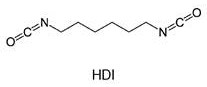
For example, Hexamethylene Diisocyanate (HDI) is a "monomeric diisocyanate" in that it contains two isocyanate groups and is not the reaction product of at least two polyisocyanate molecules:
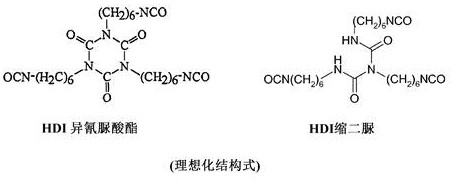
in contrast, the reaction product of at least two HDI molecules which still have at least two isocyanate groups is an "oligomeric polyisocyanate" in the sense of the present invention. Starting from monomeric HDI, such "oligomeric polyisocyanates" are represented, for example, by HDI isocyanurates and HDI biurets, each of which is formed from three monomeric HDI units:
"polyisocyanate composition A" means in the sense of the present invention the isocyanate component of the initial reaction mixture. In other words, this is the sum of all compounds having isocyanate groups in the initial reaction mixture. The polyisocyanate composition a is thus used as a reactant in the process of the present invention. When referring herein to "polyisocyanate composition a", especially "providing polyisocyanate composition a", this means that polyisocyanate composition a is present and acts as a reactant.
In principle, both monomeric and oligomeric polyisocyanates are equally suitable for the polyisocyanate composition A according to the invention. Thus, the polyisocyanate composition a may consist essentially of monomeric polyisocyanate or essentially of oligomeric polyisocyanate. Alternatively, it may contain oligomeric and monomeric polyisocyanates in any mixing ratio.
In a preferred embodiment of the present invention, the polyisocyanate composition A used as reactant in the crosslinking has a low monomer content (i.e.a low monomeric diisocyanate content) and already contains oligomeric polyisocyanates. The terms "having a low monomer content" and "having a low monomer diisocyanate content" are used synonymously herein with respect to the polyisocyanate composition a.
Since more heat is generated when using monomeric polyisocyanates than when using corresponding masses of oligomeric polyisocyanates, the use of polyisocyanate compositions a with a very high proportion of monomeric polyisocyanates risks the temperature in the composite parts formed exceeding the melting point of the PE fibers used during the catalytic crosslinking. The proportion of monomeric polyisocyanate in the polyisocyanate composition is therefore preferably adjusted so that the temperature during catalytic crosslinking does not exceed 150 ℃, preferably 140 ℃ and particularly preferably 130 ℃. The proportion of monomeric polyisocyanate which leads to exceeding the abovementioned temperature limit depends on further parameters, in particular on the shape of the workpiece to be produced, i.e. the surface area/volume ratio, on the proportion of fibrous filler in the total weight of the workpiece and on the reaction rate and the possibility of outputting the heat of reaction. The latter in turn depends essentially on the type and concentration of the catalyst used. In individual cases, however, the maximum possible proportion of monomeric polyisocyanate can be determined in a simple manner by measuring the temperature at various points on the component during the catalytic crosslinking using temperature sensors. The critical limit can therefore be determined experimentally by the person skilled in the art using routine methods.
Particularly practical results are established when the polyisocyanate composition a has a proportion of monomeric diisocyanates in the polyisocyanate composition a of at most 80% by weight, in particular at most 50% by weight or at most 20% by weight, in each case based on the weight of the polyisocyanate composition a. Preferably, the polyisocyanate composition a has a monomeric diisocyanate content of at most 5% by weight, in particular at most 2.0% by weight, more preferably at most 1.0% by weight, in each case based on the weight of the polyisocyanate composition a. Particularly good results are established when the polymer composition a is substantially free of monomeric diisocyanates. By "substantially free" is meant herein that the monomeric diisocyanate is present in an amount of up to 0.5% by weight, based on the weight of the polyisocyanate composition a.
In a particularly preferred embodiment of the present invention, the polyisocyanate composition a consists entirely or to an extent of at least 80, 85, 90, 95, 98, 99 or 99.5% by weight of oligomeric polyisocyanate, in each case based on the weight of monomeric and oligomeric polyisocyanate contained in the polyisocyanate composition a. Preference is given here to an oligomeric polyisocyanate content of at least 99% by weight. This content of oligomeric polyisocyanate is based on the polyisocyanate composition a as supplied. In other words, the oligomeric polyisocyanate is not formed as an intermediate during the process of the present invention, but is already present in the polyisocyanate composition a used as reactant at the start of the reaction.
Polyisocyanate compositions having a low monomer content or being substantially free of monomeric isocyanates can be obtained by carrying out at least one further process step for separating off the unconverted excess monomeric diisocyanate in each case after the actual modification reaction. This monomer separation can be achieved in a particularly practical manner by methods known per se, preferably by thin-film distillation under high vacuum or by extraction with suitable solvents which are inert towards isocyanate groups, for example aliphatic or cycloaliphatic hydrocarbons, such as pentane, hexane, heptane, cyclopentane or cyclohexane.
In a preferred embodiment of the present invention, the polyisocyanate composition A according to the invention is obtained by modification of monomeric diisocyanates and subsequent separation of the unconverted monomers.
However, in a particular embodiment of the present invention, the polyisocyanate composition A having a low monomer content contains an external monomeric diisocyanate. In this context, "external monomeric diisocyanate" means a monomeric diisocyanate which is different from the oligomeric polyisocyanate which has been used to produce the polyisocyanate composition a.
The addition of external monomeric diisocyanates may be advantageous for achieving special technical effects, such as a particular hardness. Particularly practical results are established when the polyisocyanate composition a has a proportion of external monomeric diisocyanate in the polyisocyanate composition a of at most 50% by weight, preferably at most 35% by weight, more preferably at most 20% by weight, most preferably at most 10% by weight, in each case based on the weight of the polyisocyanate composition a. Preferably, the polyisocyanate composition a has an external monomeric diisocyanate content of at most 5% by weight, preferably at most 2.0% by weight, more preferably at most 1.0% by weight, in each case based on the weight of the polyisocyanate composition a.
In another particular embodiment of the process according to the invention, the polyisocyanate composition a contains monomeric monoisocyanates or monomeric isocyanates having an isocyanate functionality of greater than 2, i.e. having more than two isocyanate groups per molecule. It has been found that the addition of monomeric monoisocyanates or monomeric isocyanates having an isocyanate functionality of greater than 2 is advantageous to affect the network density of the material. Particularly practical results are established when the polyisocyanate composition a has a proportion of monomeric monoisocyanates or monomeric isocyanates having an isocyanate functionality of greater than 2 in the polyisocyanate composition a of at most 20% by weight, in particular at most 15% by weight or at most 10% by weight, in each case based on the weight of the polyisocyanate composition a. Preferably, the polyisocyanate composition a has a content of monomeric monoisocyanates or monomeric isocyanates having an isocyanate functionality of more than 2 of at most 5% by weight, in particular at most 2.0% by weight, more preferably at most 1.0% by weight, in each case based on the weight of the polyisocyanate composition a. Preferably, monomeric monoisocyanates or monomeric isocyanates having an isocyanate functionality of more than 2 are not used together in the crosslinking reaction according to the invention.
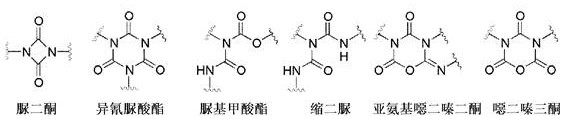
According to the invention, the oligomeric polyisocyanates can have uretdione, isocyanurate, allophanate, biuret, iminooxadiazinedione and/or oxadiazinetrione structures in particular. In one embodiment of the present invention, the oligomeric polyisocyanate has at least one of the following oligomeric structural types or mixtures thereof:
in a preferred embodiment of the present invention, a polymer composition a is used in which the proportion of isocyanurate structures is at least 50 mol%, preferably at least 60 mol%, more preferably at least 70 mol%, even more preferably at least 80 mol%, even more preferably at least 90 mol%, especially preferably at least 95 mol%, based on the sum of oligomeric structures selected from the group consisting of uretdione, isocyanurate, allophanate, biuret, iminooxadiazinedione and oxadiazinetrione structures present in the polyisocyanate composition a.
In a further preferred embodiment of the present invention, in the process according to the invention, polyisocyanate compositions a are used which, in addition to the isocyanurate structures, contain at least one additional oligomeric polyisocyanate having uretdione, biuret, allophanate, iminooxadiazinedione and oxadiazinetrione structures and mixtures thereof.
The proportion of uretdione, isocyanurate, allophanate, biuret, iminooxadiazinedione and/or oxadiazinetrione structures in the polyisocyanates A can be determined, for example, by NMR spectroscopy. Can be preferably used herein13C NMR spectroscopy, preferably in the proton decoupled form, because the oligomeric structure mentioned produces a characteristic signal.
Irrespective of the base oligomeric structure (uretdione, isocyanurate, allophanate, biuret, iminooxadiazinedione and/or oxadiazinetrione structure), the oligomeric polyisocyanate compositions a used in the process of the present invention and/or the oligomeric polyisocyanates contained therein preferably have an (average) NCO functionality of from 2.0 to 5.0, preferably from 2.3 to 4.5.
Particularly practical results are established when the polyisocyanate compositions a used according to the invention have an isocyanate group content of from 8.0% to 28.0% by weight, preferably from 14.0% to 25.0% by weight, based in each case on the weight of the polyisocyanate composition a. The isocyanate groups may be blocked or in free form. The isocyanate contents mentioned above are then based on the theoretical proportion of isocyanate groups after removal of the blocking agent.
The process for the production of oligomeric polyisocyanates having uretdione, isocyanurate, allophanate, biuret, iminooxadiazinedione and/or oxadiazinetrione structures for the polyisocyanate compositions A according to the invention is described, for example, in J.Prakt. chem. 336 (1994) 185-200, DE-A1670666, DE-A1954093, DE-A2414413, DE-A2452532, DE-A2641380, DE-A3700209, DE-A3900053 and DE-A3928503 or EP-A0336205, EP-A0339396 and EP-A0798299.
In an additional or alternative embodiment of the invention, the polyisocyanate composition a according to the invention is defined as containing an oligomeric polyisocyanate which has been obtained from monomeric diisocyanates, whatever the nature of the modification reaction used, following a degree of oligomerization of from 5% to 45%, preferably from 10% to 40%, more preferably from 15% to 30%. "degree of oligomerization" is understood here to mean the percentage of isocyanate groups originally present in the starting mixture which are consumed during the production process for the formation of uretdione, isocyanurate, allophanate, biuret, iminooxadiazinedione and/or oxadiazinetrione structures.
Suitable polyisocyanates for producing the polyisocyanate compositions a used in the process of the present invention and the monomeric and/or oligomeric polyisocyanates contained therein are any polyisocyanates which are obtainable in various ways, for example by phosgenation in the liquid or gas phase or by phosgene-free route, for example by thermal urethane cleavage. Particularly good results are established when the polyisocyanate is a monomeric diisocyanate. Preferred monomeric diisocyanates are those having a molecular weight of 140 to 400 g/mol which have aliphatically, cycloaliphatically, araliphatically and/or aromatically bonded isocyanate groups, such as, for example, 1, 4-Butane Diisocyanate (BDI), 1, 5-Pentane Diisocyanate (PDI), 1, 6-Hexane Diisocyanate (HDI), 2-methyl-1, 5-pentane diisocyanate, 1, 5-diisocyanato-2, 2-dimethylpentane, 2, 4-or 2,4, 4-trimethyl-1, 6-hexane diisocyanate, 1, 10-decane diisocyanate, 1, 3-and 1, 4-cyclohexane diisocyanate, 1, 4-diisocyanato-3, 3, 5-trimethylcyclohexane, 1, 3-diisocyanato-2-methylcyclohexane, 1, 3-diisocyanato-4-methylcyclohexane, 1-isocyanato-3, 3, 5-trimethyl-5-isocyanatomethylcyclohexane (isophorone diisocyanate; IPDI), 1-isocyanato-1-methyl-4 (3) -isocyanatomethylcyclohexane, 2,4' -and 4,4' -dicyclohexylmethane diisocyanate (H12 MDI), 1, 3-and 1, 4-bis (isocyanatomethyl) cyclohexane, bis (isocyanatomethyl) Norbornane (NBDI), 4' -diisocyanato-3, 3' -dimethyldicyclohexylmethane, 4' -diisocyanato-3, 3',5,5' -tetramethyldicyclohexylmethane, 4' -diisocyanato-1, 1' -bis (cyclohexyl), 4' -diisocyanato-3, 3' -dimethyl-1, 1' -bis (cyclohexyl), 4' -diisocyanato-2, 2',5,5' -tetramethyl-1, 1' -bis (cyclohexyl), 1, 8-diisocyanato-p-menthane, 1, 3-adamantane diisocyanate, 1, 3-dimethyl-5, 7-adamantane diisocyanate, 1, 3-and 1, 4-bis (isocyanatomethyl) benzene (xylylene diisocyanate; XDI), 1, 3-and 1, 4-bis (1-isocyanato-1-methylethyl) benzene (TMXDI) and bis (4-, (4-) (1-isocyanato-1-methylethyl) benzene (TMXDI) 1-isocyanato-1-methylethyl) phenyl) carbonate, 2, 4-and 2, 6-Toluene Diisocyanate (TDI), 2,4 '-and 4,4' -diphenylmethane diisocyanate (MDI), 1, 5-naphthalene diisocyanate and any mixtures of these diisocyanates. Other diisocyanates which are likewise suitable are additionally found, for example, in Justus Liebigs Annalen der Chemie, Vol.562 (1949), pages 75 to 136.
Suitable monomeric monoisocyanates which may optionally be used in the polyisocyanate composition A are, for example, n-butyl isocyanate, n-pentyl isocyanate, n-hexyl isocyanate, n-heptyl isocyanate, n-octyl isocyanate, undecyl isocyanate, dodecyl isocyanate, tetradecyl isocyanate, cetyl isocyanate, stearyl isocyanate, cyclopentyl isocyanate, cyclohexyl isocyanate, 3-or 4-methylcyclohexyl isocyanate or any mixtures of these monoisocyanates. An example of a monomeric isocyanate having an isocyanate functionality of more than 2 which may optionally be added to the polyisocyanate composition A is 4-isocyanatomethyloctane 1, 8-diisocyanate (nonane triisocyanate; TIN).
In one embodiment of the present invention, the polyisocyanate composition a contains at most 30% by weight, in particular at most 20% by weight, at most 15% by weight, at most 10% by weight, at most 5% by weight or at most 1% by weight, of aromatic polyisocyanate, in each case based on the weight of the polyisocyanate composition a. As used herein, "aromatic polyisocyanate" refers to a polyisocyanate having at least one aromatically bonded isocyanate group.
An aromatically bonded isocyanate group is understood to mean an isocyanate group bonded to an aromatic hydrocarbon group.
In a preferred embodiment of the process of the present invention, polyisocyanate compositions A having exclusively aliphatically and/or cycloaliphatically bonded isocyanate groups are used.
Aliphatic and cycloaliphatic bonded isocyanate groups are understood to mean isocyanate groups bonded to aliphatic and cycloaliphatic hydrocarbon groups, respectively. In a further preferred embodiment of the process of the present invention, a polyisocyanate composition a is used which consists of or comprises one or more oligomeric polyisocyanates, wherein the one or more oligomeric polyisocyanates have exclusively aliphatically and/or cycloaliphatically bonded isocyanate groups.
In a further embodiment of the present invention, the polyisocyanate composition a consists to an extent of at least 50, 70, 85, 90, 95, 98 or 99% by weight of polyisocyanates having exclusively aliphatically and/or cycloaliphatically bonded isocyanate groups, in each case based on the weight of the polyisocyanate composition a. Practical experiments have shown that particularly good results can be achieved with polyisocyanate compositions a in which the oligomeric polyisocyanates contained therein have exclusively aliphatically and/or cycloaliphatically bonded isocyanate groups.
In a particularly preferred embodiment of the process of the present invention, a polyisocyanate composition a is used which consists of or comprises one or more oligomeric polyisocyanates, wherein the one or more oligomeric polyisocyanates are formed on the basis of 1, 4-Butane Diisocyanate (BDI), 1, 5-Pentane Diisocyanate (PDI), 1, 6-Hexane Diisocyanate (HDI), isophorone diisocyanate (IPDI) or 4,4' -dicyclohexylmethane diisocyanate (H12 MDI) or mixtures thereof. Polyisocyanate compositions A containing oligomeric HDI are preferred here.
In a particularly preferred embodiment of the present invention, the polyisocyanate composition A is further characterized in that it has a surface tension of at most 45 mN/m, preferably at most 40 mN/m, very particularly preferably at most 35 mN/m before catalytic crosslinking and a surface energy of at most 50 mN/m, preferably at most 45 mN/m, very particularly preferably at most 40 mN/m after crosslinking.
In a preferred embodiment, the energy Δ between the surface tensions of the polyisocyanate composition A and the polymer obtainable therefrom after crosslinking of the polyisocyanate composition A according to the invention is at least 2 mN/m and at most 20 mN/m, preferably at least 4 mN/m and at most 15 mN/m, particularly preferably at least 6 mN/m and at most 12 mN/m.
In a particularly preferred embodiment, the surface tension (energy) of the polyisocyanate composition A is at most 5 mN/m and at most 10 mN/m greater than the surface energy of the polymer fibers used according to the invention, and the surface energy of the crosslinked polymer of the polymer composition A obtainable according to the invention is at least 1 mN/m and at most 20 mN/m greater than the surface energy of the polymer fibers used according to the invention.
It was found that the listed ratios of surface tension and surface energy of the polyisocyanate composition a according to the invention to the crosslinked polymers obtainable therefrom according to the invention are particularly advantageous for achieving good wetting of the surface of the polymer fibers according to the invention.
It has also been found, surprisingly, that the relatively low surface tension (energy) of the polyisocyanate compositions a used according to the invention, in combination with the relatively small change in surface energy after conversion to crosslinked polymers obtainable according to the invention, enables particularly good results to be achieved in the incipient wetness of polymer fibers having in particular a low surface energy. It has further been found that the adhesion of the resulting polymer of the crosslinked polyisocyanate composition A according to the invention is particularly good when the surface energy of the formed polymer phase varies only within the scope of the invention.
The surface tensions and surface energies listed are in each case determined by methods customary to the person skilled in the art at 23 ℃. The surface tension is preferably measured by a dynamic method, such as bubble pressure.
The surface energy of the polymer surface of the crosslinked polyisocyanate composition A and the surface energy of the polymer fibers are preferably measured here by the contact angle method using test ink or the Wilhelmy method (single fiber method for fibers).
In a further preferred embodiment, the shrinkage of the polyisocyanate composition a used during crosslinking during formation of the polymer fibre composite is <1/1.5 in the fibre direction perpendicular to the fibre direction.
In a further preferred embodiment, the shrinkage of the polyisocyanate composition a used during crosslinking during formation of the polymer fiber composite is < 10%, preferably < 6%, particularly preferably < 5%, very particularly preferably < 4%.
Polymer fiber B
Various synthetic fibers are suitable in principle as polymer fibers B). The polymer fibers B) are preferably selected from the group consisting of cellulose fibers, regenerated protein fibers, polylactide fibers, chitin fibers, polyester fibers, polyamide fibers, polyimide fibers, polyacrylic fibers, polyacrylonitrile fibers, polytetrafluoroethylene fibers, polyvinylchloride fibers, polyurethane fibers, polypropylene fibers and polyethylene fibers.
The polymer fibers are more preferably non-polar. Particularly preferred non-polar polymeric fibers are polyethylene and polypropylene fibers. Very particularly preferably, the polymer fibers B) are polyethylene fibers. Especially preferred are ultra high molecular weight polyethylene fibers (UHMWPE) as defined below.
The term "polymer fiber B" also refers to a combination of at least two of the above types of polymer fibers. However, it is preferred to use polymer fibers B which consist of only one of the above-mentioned types of fibers.
The term "ultra high molecular weight polyethylene fibers" relates to fibers made of Polyethylene (PE). The PE has a number average molar mass of at least 360 kg/mol, more preferably at least 500 kg/mol, even more preferably at least 1000 kg/mol, most preferably at least 1600 kg/mol. The upper limit of 11400 kg/mol is preferably not exceeded here. The number-average molar mass is particularly preferably in the range from 500 kg/mol to 8400 kg/mol, very particularly preferably from 1600 kg/mol to 8400 kg/mol.
The polydispersity (ratio of weight average molar mass to number average molar mass) of the PE fibers useful according to the invention, while complying with the above-mentioned number average molecular weight, is at most 4.0; preferably at most 3.5; more preferably at most 3.0 and most preferably at most 2.8. Here, the lower limit of the polydispersity is at least 1.1.
Preferably the fibres have a tensile strength of greater than 2500N/mm2. The parallel orientation of the polyethylene chains is preferably at least 80%, more preferably at least 90%, particularly preferably at least 95%.
Particularly suitable fibers are available under the "Dyneema" trademark from Koninklijke DSM n.v. and under the "Spectra" trademark from Honeywell International inc.
Suitable fibers according to the invention can be obtained by the processes described in EP 2287371, WO 2012/139934 and WO 2014/187948.
The fibers may be arranged unidirectionally, i.e. parallel to each other. However, woven and knitted fabrics may also be used according to the present invention. These may be arranged in one or more layers. Combinations of unidirectionally oriented fibres with woven and/or knitted fabrics are also possible according to the invention.
In a preferred embodiment of the invention, the fiber content in the polyisocyanurate composite is more than 3 wt. -%, preferably more than 10 wt. -%, more preferably more than 15 wt. -%, preferably more than 20 wt. -%, still more preferably more than 30 wt. -%, in particular 50 wt. -%, 60 wt. -%, 70 wt. -%, based on the polyisocyanurate composite.
In principle, polyethylene fibers show poor bonding to the polymer matrix and need to be compatibilized by suitable pre-treatments. This can be done, for example, by silylation and/or corona treatment as described in Bahraman et al, 2015, "Ultra-high-molecular-weight polyethylene fiber re-expressed compositions: Effect of fiber surface properties on mechanical properties of the compositions" fractional Materials, Vol.31, 1022 to 1029. However, in the studies on which the present patent application is based it was surprisingly found that no pretreatment of the PE fibers is required when the isocyanurate plastics according to the invention are used as substrates. Washing in a suitable solvent, preferably acetone, is sufficient to ensure adequate attachment of the PE fibers to the matrix material.
Crosslinking catalyst C
Catalysts C which can be used for the crosslinking reaction include essentially all catalysts which catalyze the crosslinking of isocyanate groups at reaction temperatures of up to 150 ℃, preferably up to 130 ℃, particularly preferably up to 100 ℃ to provide at least one structure selected from isocyanurate, uretdione, biuret, urea, iminooxadiazinedione, oxadiazinetrione and allophanate groups.
Particularly preferred crosslinking catalysts C are compounds which accelerate the trimerization of isocyanate groups to isocyanurate or uretdione structures. Since, depending on the catalyst used, the formation of structures is often accompanied by side reactions, for example trimerization to form iminooxadiazinediones (so-called asymmetric trimers) and by allophanatization reactions when urethane groups are present in the starting polyisocyanate, the term "trimerization" is to be understood in the context of the present invention as also synonymously denoting these additionally occurring reactions.
In a particular embodiment, the catalyst according to the invention can catalyze the trimerization preferably by an intermediate step of uretdione formation.
Suitable catalysts C for the process of the invention are, for example, simple tertiary amines, such as triethylamine, tributylamine, N-dimethylaniline, N-ethylpiperidine or N, N' -dimethylpiperazine. Suitable catalysts also include the tertiary hydroxyalkylamines described in GB 2221465, such as triethanolamine, N-methyldiethanolamine, dimethylethanolamine, N-isopropyldiethanolamine and 1- (2-hydroxyethyl) pyrrolidine, or the catalyst systems known from GB 2222161, which consist of a mixture of tertiary bicyclic amines, such as DBU, with simple aliphatic alcohols of low molecular weight.
Further trimerization catalysts C suitable for the process of the invention are, for example, the quaternary ammonium hydroxides known from DE-A1667309, EP-A0013880 and EP-A0047452, such as tetraethylammonium hydroxide, trimethylbenzylammonium hydroxide, N-dimethyl-N-dodecyl-N- (2-hydroxyethyl) ammonium hydroxide, N- (2-hydroxyethyl) -N, N-dimethyl-N- (2,2' -dimethylolbutyl) ammonium hydroxide and 1- (2-hydroxyethyl) -1, 4-diazabicyclo [2.2.2] octane hydroxide (monoadducts of ethylene oxide and water on 1, 4-diazabicyclo [2.2.2] octane), the quaternary hydroxyalkylammonium hydroxides known from EP-A3765 or EP-A10589, such as N, N, N-trimethyl-N- (2-hydroxyethyl) ammonium hydroxide, trialkyl hydroxyalkylammonium carboxylates known from DE-A2631733, EP-A0671426, EP-A1599526 and US 4,789,705, such as N, N, N-trimethyl-N-2-hydroxypropylammonium p-tert-butylbenzoate and N, N, N-trimethyl-N-2-hydroxypropylammonium 2-ethylhexanoate, quaternary benzylammonium carboxylates known from EP-A1229016, such as N-benzyl-N, N-dimethyl-N-ethylammonium pivalate, N-benzyl-N, N-dimethyl-N-ethylammonium 2-ethylhexanoate, n, N-tributylammonium, N, N-dimethyl-N-ethyl-N- (4-methoxybenzyl) ammonium 2-ethylhexanoate or N, N, N-tributyl-N- (4-methoxybenzyl) ammonium pivalate, tetrasubstituted ammonium alpha-hydroxycarboxylic salts known from WO 2005/087828, such as tetramethylammonium lactate, quaternary ammonium or phosphonium fluorides known from EP-A0339396, EP-A0379914 and EP-A0443167, such as N-methyl-N, N, N-trialkylammonium fluoride, N, N, N-tetra-N-butylammonium fluoride, N, N-trimethyl-N-benzylammonium fluoride, tetramethylphosphonium fluoride, tetraethylphosphonium fluoride or tetra-N-butylphosphonium fluoride with C8-C10-alkyl, quaternary and phosphonium polyfluorides known from EP-A0798299, EP-A0896009 and EP-A0962455, for example benzyltrimethylammonium hydrogen polyfluoride, tetraalkylammonium alkylcarbonates known from EP-A0668271 and obtainable by reaction of tertiary amines with dialkyl carbonates, or betaine-structured quaternary ammonium alkylcarbonates, quaternary ammonium hydrogen carbonates known from WO 1999/023128, for example choline hydrogen carbonate, quaternary ammonium salts known from EP 0102482 and obtainable from tertiary amines with phosphoric acid-containing alkylated esters, for example reaction products of triethylamine, DABCO or N-methylmorpholine with dimethyl methylphosphonate, or tetra-substituted ammonium salts of lactams known from WO 2013/167404, for example trioctylammonium caprolactam salt or dodecyltrimethylammonium caprolactam salt.
Suitable are the known sodium and potassium salts of straight-chain or branched alkanecarboxylic acids having up to 14 carbon atoms, such as butyric acid, valeric acid, caproic acid, 2-ethylhexanoic acid, heptanoic acid, caprylic acid, pelargonic acid and higher homologs.
Trimerization catalysts C which are likewise suitable as catalysts for the process of the present invention are a variety of different metal compounds. Suitable examples are the octoates and naphthenates of manganese, iron, cobalt, nickel, copper, zinc, zirconium, cerium or lead described as catalysts in DE-A3240613 or their mixtures with lithium, sodium, potassium, calcium or barium acetates, the linear or branched alkanecarboxylic acids having up to 10 carbon atoms disclosed in DE-A3219608, such as the sodium and potassium salts of propionic acid, butyric acid, valeric acid, caproic acid, heptanoic acid, caprylic acid, nonanoic acid, capric acid and undecanoic acid, the alkali metal or alkaline earth metal salts of aliphatic, cycloaliphatic or aromatic monocarboxylic and polycarboxylic acids having from 2 to 20 carbon atoms disclosed in EP-A0100129, such as sodium or potassium benzoate, the alkali metal phenolates disclosed in GB-PS 1391066 and GB-PS 1386399, such as sodium or potassium phenolate, the alkali metal and alkaline earth metal oxides, hydroxides, carbonates, alkoxides and phenolates disclosed in GB 809809, alkali metal salts of enolizable compounds and metal salts of weakly aliphatic or cycloaliphatic carboxylic acids, such as sodium methoxide, sodium acetate, potassium acetate, sodium acetoacetate, lead 2-ethylhexanoate and lead naphthenate, basic alkali metal compounds disclosed in EP-A0056158 and EP-A0056159 complexed with crown ethers or polyether alcohols, such as sodium or potassium carboxylates complexed therewith, and/or the potassium salts of pyrrolidones disclosed in EP-A0033581, mono-or polynuclear complexes of titanium, zirconium and/or hafnium disclosed in application EP 13196508.9, such as zirconium tetra-n-butoxide, zirconium tetra-2-ethylhexanoate and zirconium tetra-2-ethylhexanoate, and tin compounds of the type described in European Polymer Journal, Vol.16, 147-148 (1979), such as dibutyltin dichloride, diphenyltin dichloride, triphenylstannol, tributyltin acetate, Tin octoate, dibutyl (dimethoxy) stannane and imidazole tributyltin.
Further crosslinking catalysts suitable for the process of the invention can be found, for example, in J.H. Saunders and K.C. Frisch, Polyurethanes Chemistry and Technology, page 94 and thereafter (1962) and the documents cited therein.
The catalysts C can be used in the process according to the invention on their own or in any mixture with one another.
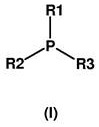
Particularly suitable for the process according to the invention are organophosphine catalysts of the general formula (I), or mixtures of these tertiary organophosphine catalysts of the general formula (I)
Wherein
R1, R2 and R3 are identical or different radicals and are each alkyl or cycloalkyl having up to 10 carbon atoms, preferably alkyl having 2 to 8 carbon atoms or cycloalkyl having 3 to 8 carbon atoms, aralkyl having 7 to 10, preferably 7 carbon atoms or aryl having 6 to 10, preferably 6 carbon atoms and optionally substituted by alkyl having up to 10, preferably 1 to 6 carbon atoms, with the proviso that at most one of these radicals is aryl and at least one of these radicals is alkyl or cycloalkyl, or wherein
R1 and R2 are aliphatic in nature and are linked to each other together with the phosphorus atom to form a heterocyclic ring having 4 to 6 ring members, wherein R3 is an alkyl group having up to 4 carbon atoms.
Suitable tertiary organophosphine catalysts are, for example, tertiary phosphines having straight-chain aliphatic substituents, such as trimethylphosphine, triethylphosphine, tri-n-propylphosphine, tripropylphosphine, dibutylethylphosphine, tri-n-butylphosphine, triisobutylphosphine, tri-tert-butylphosphine, pentyldimethylphosphine, pentyldiethylphosphine, pentyldipropylphosphine, pentyldibutylphosphine, pentyldihexylphosphine, diamylethylphosphine, diamylpropylphosphine, diamylbutylphosphine, diamylhexylphosphine, dipentyoctylphosphine, tripentylphosphine, hexyldimethylphosphine, hexyldiethylphosphine, hexyldipropylphosphine, hexyldibutylphosphine, dihexylmethylphosphine, dihexylethylphosphine, dihexylpropylphosphine, dihexylbutylphosphine, trihexylphosphine, trioctylphosphine, tribenzyldimethylphosphine, dimethylphenylphosphine or butylphospholane.
Further tertiary organophosphine catalysts suitable for the process according to the invention are tertiary phosphines having at least one cycloaliphatic group bonded directly to the phosphorus, such as cyclopentyldimethylphosphine, cyclopentyldiethylphosphine, cyclopentyldin-propylphosphine, cyclopentyldiisopropylphosphine, cyclopentyldibutylphosphine having any isomeric butyl group, cyclopentyldihexylphosphine having any isomeric hexyl group, cyclopentyldioctylphosphine having any isomeric octyl group, dicyclopentylmethylphosphine, dicyclopentylethylphosphine, dicyclopentyl-n-propylphosphine, dicyclopentylisopropylphosphine, dicyclopentylbutylphosphine having any isomeric butyl group, dicyclopentylphosphine having any isomeric hexyl group, dicyclopentyloctylphosphine, tricyclopentylphosphine, cyclohexyldimethylphosphine, cyclohexyldiethylphosphine, cyclohexyldi-n-propylphosphine, which are known, for example, from EP 1422223A 1, Cyclohexyldiisopropylphosphine, cyclohexyldibutylphosphine with any isomeric butyl group, cyclohexyldihexylphosphine with any isomeric hexyl group, cyclohexyldioctylphosphine with any isomeric octyl group, dicyclohexylmethylphosphine, dicyclohexylethylphosphine, dicyclohexyl-n-propylphosphine, dicyclohexylisopropylphosphine, dicyclohexylbutylphosphine with any isomeric butyl group, dicyclohexylhexylphosphine with any isomeric hexyl group, dicyclohexyloctylphosphine with any isomeric octyl group and tricyclohexylphosphine.
Further suitable tertiary organophosphine catalysts for the process according to the invention are tertiary phosphines known, for example, from EP 1982979A 1 and having one or two tertiary alkyl groups directly bonded to the phosphorus, such as tert-butyldimethylphosphine, tert-butyldiethylphosphine, tert-butyldi-n-propylphosphine, tert-butyldiisopropylphosphine, tert-butyldibutylphosphine having any isomeric butyl group as the non-tertiary butyl group, tert-butyldihexylphosphine having any isomeric hexyl group but up to one hexyl group having a tertiary carbon atom directly bonded to the phosphorus, tert-butyldioctylphosphine having any isomeric octyl group but up to one octyl group having a tertiary carbon atom directly bonded to the phosphorus, di-tert-butylmethylphosphine, di-tert-butylethylphosphine, di-tert-butyl-n-propylphosphine, di-tert-butylisopropylphosphine, di-tert-butylphosphine wherein the non-tertiary butyl group may be n-butyl, isobutyl, 2-butyl or cyclobutyl, Di-tert-butylhexylphosphine having any isomeric hexyl group which does not have a tertiary carbon atom directly bonded to the phosphorus, di-tert-butyloctylphosphine having any isomeric octyl group which does not have a tertiary carbon atom directly bonded to the phosphorus, tert-pentyldimethylphosphine, tert-pentyldiethylphosphine, tert-pentyldi-n-propylphosphine, tert-pentyldiisopropylphosphine, tert-pentyldibutylphosphine having any isomeric butyl group but in which at most one butyl group is tert-butyl, tert-pentyldihexylphosphine having any isomeric hexyl group but in which at most one hexyl group has a tertiary carbon atom directly bonded to the phosphorus, tert-pentyldioctylphosphine having any isomeric octyl group but in which at most one octyl group has a tertiary carbon atom directly bonded to the phosphorus, di-tert-pentylethylphosphine, di-tert-pentyln-propylphosphine, di-tert-pentylisopropylphosphine, in which the butyl group may be n-butyl, Di-tert-pentylbutylphosphine of isobutyl, 2-butyl or cyclobutyl, di-tert-pentylhexylphosphine having any isomeric hexyl radical which is not directly bonded to the tertiary carbon atom on the phosphorus, di-tert-pentyloctylphosphine having any isomeric octyl radical which is not directly bonded to the tertiary carbon atom on the phosphorus, adamantyl-dimethylphosphine, adamantyl-diethylphosphine, adamantyl-di-n-propylphosphine, adamantyl-diisopropylphosphine, adamantyl-dibutylphosphine having any isomeric butyl radical in which at most one butyl radical has a tertiary carbon atom directly bonded to the phosphorus, adamantyl-dihexylphosphine having any isomeric hexyl radical in which at most one hexyl radical has a tertiary carbon atom directly bonded to the phosphorus, adamantyl-dioctylphosphine having any isomeric octyl radical in which at most one octyl radical has a tertiary carbon atom directly bonded to the phosphorus, diamantalkylmethylphosphine, Diamantalkylethylphosphine, diamantalkyln-propylphosphine, diamantalkylisopropylphosphine, diamantalkylbutylphosphine in which the butyl group may be n-butyl, isobutyl, 2-butyl or cyclobutyl, diamantalkylhexylphosphine having any isomeric hexyl group (which is not directly bonded to a tertiary carbon atom on the phosphorus) and diamantalkyloctylphosphine having any isomeric hexyl group (which is not directly bonded to a tertiary carbon atom on the phosphorus).
In the process according to the invention, the tertiary organophosphine catalyst is preferably selected from the mentioned tertiary phosphines having linear aliphatic substituents.
Very particularly preferred tertiary organophosphine catalysts are tri-n-butylphosphine and/or trioctylphosphine.
In the process according to the invention, the tertiary organophosphine catalyst is generally used in a concentration of from 0.0005 to 10.0 wt. -%, preferably from 0.01 to 5.0 wt. -%, more preferably from 0.1 to 3.0 wt. -%, most preferably from 0.5 to 2.0 wt. -%, based on the weight of the polyisocyanate composition a used. The tertiary organophosphine catalyst used in the process according to the invention generally has sufficient solubility in the polyisocyanate composition a at the amount required to initiate the oligomerisation reaction. In this embodiment, the catalyst C is therefore preferably added to the polyisocyanate composition A in pure form.
Optionally, however, tertiary organophosphine catalysts may also be used dissolved in suitable organic solvents to improve their incorporability. The dilution of the catalyst solution can be selected freely within a very wide range. Such catalyst solutions are generally catalytically active above a concentration of about 0.01 wt.%.
In a preferred embodiment, the phosphorus-containing catalysts used are sensitive to oxidation and are converted by oxidation after a few hours to a few weeks into compounds which are no longer catalytically active and are preferably colorless and preferably flame-retardant. Such catalysts are, for example, phosphines having (cyclo) aliphatic groups.
Also particularly suitable are alkali metal or alkaline earth metal salts of aliphatic, cycloaliphatic or aromatic monocarboxylic and polycarboxylic acids having from 2 to 20 carbon atoms. The potassium salt of one of the above carboxylic acids is still more preferred. Potassium acetate is particularly preferred.
However, all catalysts mentioned in WO 2016/170057, WO 2016/170059 or WO 2016/170061 are also suitable in principle, provided that they catalyze the crosslinking reaction in the temperature range mentioned above.
Particularly suitable as catalyst C are catalysts of the formula (II) and their adducts. When a combination of catalysts C1 and C2 is used, the above compound is preferably used as catalyst C2.
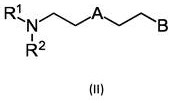
Wherein R is1And R2Independently of one another, from the group consisting of hydrogen, methyl, ethyl, propyl, isopropyl, butyl, isobutyl, branched C5-alkyl, unbranched C5-alkyl, branched C6-alkyl, unbranched C6-alkyl, branched C7-alkyl and unbranched C7-alkyl;
a is selected from O, S and NR3Wherein R is3Selected from the group consisting of hydrogen, methyl, ethyl, propyl, isopropyl, butyl, and isobutyl; and is
B, independently of A, is selected from OH, SH, NHR4And NH2Wherein R is4Selected from methyl, ethyl and propyl.
In a preferred embodiment, A is NR3Wherein R is3Selected from the group consisting of hydrogen, methyl, ethyl, propyl, isopropyl, butyl and isobutyl. R3Preferably methyl or ethyl. R3Methyl is particularly preferred.
In a first variation of this embodiment, B is OH and R1And R2Independently of one another, from the group consisting of hydrogen, methyl, ethyl, propyl, isopropyl, butyl, isobutyl, branched C5-alkyl, unbranched C5-alkyl, branched C6-alkyl, unbranched C6-alkyl, branched C7-alkyl and unbranched C7-alkyl. Preferably, R is1And R2Independently of one another, methyl or ethyl. R1And R2Methyl is particularly preferred.
In a second variation of this embodiment, B is SH and R1And R2Independently of one another, from hydrogen, methyl, ethyl, propyl, isopropyl, butyl, isobutyl, branched C5-alkyl, non-substitutedBranched C5-alkyl, branched C6-alkyl, unbranched C6-alkyl, branched C7-alkyl and unbranched C7-alkyl. Preferably, R is1And R2Independently of one another, methyl or ethyl. R1And R2Methyl is particularly preferred.
In a third variation of this embodiment, B is NHR4And R is1And R2Independently of one another, from the group consisting of hydrogen, methyl, ethyl, propyl, isopropyl, butyl, isobutyl, branched C5-alkyl, unbranched C5-alkyl, branched C6-alkyl, unbranched C6-alkyl, branched C7-alkyl and unbranched C7-alkyl. Preferably, R is1And R2Independently of one another, methyl or ethyl. R1And R2Methyl is particularly preferred. In this variant, R4 is selected from methyl, ethyl and propyl. Preferably, R is4Is methyl or ethyl. R4Methyl is particularly preferred.
In a fourth variation of this embodiment, B is NH2And R is1And R2Independently of one another, from the group consisting of hydrogen, methyl, ethyl, propyl, isopropyl, butyl, isobutyl, branched C5-alkyl, unbranched C5-alkyl, branched C6-alkyl, unbranched C6-alkyl, branched C7-alkyl and unbranched C7-alkyl. Preferably, R is1And R2Independently of one another, methyl or ethyl. R1And R2Methyl is particularly preferred.
In another preferred embodiment, a is oxygen.
In a first variation of this embodiment, B is OH and R1And R2Independently of one another, from the group consisting of hydrogen, methyl, ethyl, propyl, isopropyl, butyl, isobutyl, branched C5-alkyl, unbranched C5-alkyl, branched C6-alkyl, unbranched C6-alkyl, branched C7-alkyl and unbranched C7-alkyl. Preferably, R is1And R2Independently of one another, methyl or ethyl. R1And R2Methyl is particularly preferred.
In a second variation of this embodiment, B is SH and R1And R2Independently of one another, from hydrogen, methyl, ethyl, propyl, isopropyl, butyl, isobutyl, branchedC5-alkyl, unbranched C5-alkyl, branched C6-alkyl, unbranched C6-alkyl, branched C7-alkyl and unbranched C7-alkyl. Preferably, R is1And R2Independently of one another, methyl or ethyl. R1And R2Methyl is particularly preferred.
In a third variation of this embodiment, B is NHR4And R is1And R2Independently of one another, from the group consisting of hydrogen, methyl, ethyl, propyl, isopropyl, butyl, isobutyl, branched C5-alkyl, unbranched C5-alkyl, branched C6-alkyl, unbranched C6-alkyl, branched C7-alkyl and unbranched C7-alkyl. Preferably, R is1And R2Independently of one another, methyl or ethyl. R1And R2Methyl is particularly preferred. In this variant, R4Selected from methyl, ethyl and propyl. Preferably, R is4Is methyl or ethyl. R4Methyl is particularly preferred.
In a fourth variation of this embodiment, B is NH2And R is1And R2Independently of one another, from the group consisting of hydrogen, methyl, ethyl, propyl, isopropyl, butyl, isobutyl, branched C5-alkyl, unbranched C5-alkyl, branched C6-alkyl, unbranched C6-alkyl, branched C7-alkyl and unbranched C7-alkyl. Preferably, R is1And R2Independently of one another, methyl or ethyl. R1And R2Methyl is particularly preferred.
In yet another preferred embodiment, a is sulfur.
In a first variation of this embodiment, B is OH and R1And R2Independently of one another, from the group consisting of hydrogen, methyl, ethyl, propyl, isopropyl, butyl, isobutyl, branched C5-alkyl, unbranched C5-alkyl, branched C6-alkyl, unbranched C6-alkyl, branched C7-alkyl and unbranched C7-alkyl. Preferably, R is1And R2Independently of one another, methyl or ethyl. R1And R2Methyl is particularly preferred.
In a second variation of this embodiment, B is SH and R1And R2Independently of one another, from hydrogen, methyl, ethyl, propyl, isopropylButyl, isobutyl, branched C5-alkyl, unbranched C5-alkyl, branched C6-alkyl, unbranched C6-alkyl, branched C7-alkyl and unbranched C7-alkyl. Preferably, R is1And R2Independently of one another, methyl or ethyl. R1And R2Methyl is particularly preferred.
In a third variation of this embodiment, B is NHR4And R is1And R2Independently of one another, from the group consisting of hydrogen, methyl, ethyl, propyl, isopropyl, butyl, isobutyl, branched C5-alkyl, unbranched C5-alkyl, branched C6-alkyl, unbranched C6-alkyl, branched C7-alkyl and unbranched C7-alkyl. Preferably, R is1And R2Independently of one another, methyl or ethyl. R1And R2Methyl is particularly preferred. In this variant, R4Selected from methyl, ethyl and propyl. Preferably, R is4Is methyl or ethyl. R4Methyl is particularly preferred.
In a fourth variation of this embodiment, B is NH2And R is1And R2Independently of one another, from the group consisting of hydrogen, methyl, ethyl, propyl, isopropyl, butyl, isobutyl, branched C5-alkyl, unbranched C5-alkyl, branched C6-alkyl, unbranched C6-alkyl, branched C7-alkyl and unbranched C7-alkyl. Preferably, R is1And R2Independently of one another, methyl or ethyl. R1And R2Methyl is particularly preferred.
Adducts of compounds of the formula (II) and compounds having at least one isocyanate group are also suitable.
The generic term "adduct" is understood to mean urethane, thiocarbamate and urea adducts of the compounds of the formula (II) with compounds having at least one isocyanate group. Urethane adducts are particularly preferred. The adduct of the present invention is formed by reacting an isocyanate with the functional group B of the compound defined in formula (II). When B is hydroxy, a carbamate adduct is formed. When B is a thiol group, a thiocarbamate adduct is formed. When B is NH2Or NHR4When this occurs, a urea adduct is formed.
Suitable catalyst solvents are, for example, solvents which are inert to isocyanate groups, such as hexane, toluene, xylene, chlorobenzene, ethyl acetate, butyl acetate, diethylene glycol dimethyl ether, dipropylene glycol dimethyl ether, ethylene glycol monomethyl or monoethyl ether acetate, diethylene glycol ethyl and butyl ether acetate, propylene glycol monomethyl ether acetate, 1-methoxy-2-propyl acetate, 3-methoxy-n-butyl acetate, propylene glycol diacetate, acetone, methyl ethyl ketone, methyl isobutyl ketone, cyclohexanone, lactones such as beta-propiolactone, gamma-butyrolactone, epsilon-caprolactone and epsilon-methyl caprolactone, and solvents such as N-methylpyrrolidone and N-methylcaprolactam, 1, 2-propylene carbonate, methylene chloride, dimethyl sulfoxide, triethyl phosphate or any mixtures of these solvents.
If a catalyst solvent is used in the process according to the invention, it is preferred to use a catalyst solvent which bears isocyanate-reactive groups and can be incorporated into the polyisocyanurate resin. Examples of such solvents are mono-or polyhydric simple alcohols, such as methanol, ethanol, n-propanol, isopropanol, n-butanol, n-hexanol, 2-ethyl-1-hexanol, ethylene glycol, propylene glycol, the isomeric butanediols, 2-ethylhexane-1, 3-diol or glycerol; ether alcohols, such as 1-methoxy-2-propanol, 3-ethyl-3-hydroxymethyloxetane, tetrahydrofurfuryl alcohol, ethylene glycol monomethyl ether, ethylene glycol monoethyl ether, ethylene glycol monobutyl ether, diethylene glycol monomethyl ether, diethylene glycol monoethyl ether, diethylene glycol monobutyl ether, diethylene glycol, dipropylene glycol or liquid higher molecular weight polyethylene glycols, polypropylene glycols, mixed polyethylene/polypropylene glycols and monoalkyl ethers thereof; ester alcohols, such as ethylene glycol monoacetate, propylene glycol monolaurate, glycerol monoacetate and diacetate, glycerol monobutyrate or 2,2, 4-trimethylpentane-1, 3-diol monoisobutyrate; unsaturated alcohols, such as allyl alcohol, 1-dimethylallyl alcohol or oleyl alcohol; araliphatic alcohols, such as benzyl alcohol; n-monosubstituted amides, such as N-methylformamide, N-methylacetamide, cyanoacetamide or 2-pyrrolidone, or any mixtures of these solvents.
In a particular embodiment, at least one crosslinking catalyst C1 and at least one crosslinking catalyst C2 are used.
The first catalyst C1 catalyzes the crosslinking of isocyanate groups at reaction temperatures below 100 ℃, preferably below 80 ℃, more preferably below 60 ℃, even more preferably below 50 ℃ to provide at least one structure selected from isocyanurate, uretdione, biuret, urea, iminooxadiazinedione, oxadiazinetrione and allophanate groups.
The second catalyst C2 catalyzes at least one of the above-described crosslinking reactions at a reaction temperature of at least 50 ℃, more preferably at least 60 ℃, even more preferably at least 80 ℃, and most preferably at least 100 ℃. It is preferred here that this catalyst C2 has only a low activity at temperatures below 100 ℃, preferably below 80 ℃, more preferably below 60 ℃ and even more preferably below 50 ℃.
The catalyst has the desired activity at the indicated temperature when it catalyzes the crosslinking of at least 15 mol% of the isocyanate groups present in the polyisocyanate composition a in a period of at most 1 hour, preferably at most 3 hours, more preferably at most 24 hours.
The term "low reactivity" means that at most 10 mole% of the isocyanate groups present in the polyisocyanate composition a are crosslinked over a period of at least 1 hour, more preferably at least 3 hours, even more preferably at least 24 hours.
The first crosslinking catalyst C1 is preferably an organophosphine catalyst of formula (I) as described above. The second catalyst C2 may be any catalyst. Preference is given to using one of the catalysts mentioned in WO 2016/170057, WO 2016/170059 or WO/2016/170061. More preferably, the second catalyst C2 is an alkali metal or alkaline earth metal salt of aliphatic, cycloaliphatic or aromatic monocarboxylic and polycarboxylic acids having from 2 to 20 carbon atoms. Even more preferably, the second catalyst C2 is a potassium salt of one of the above carboxylic acids. The second catalyst is particularly preferably potassium acetate.
Catalytic crosslinking
The term "catalytic crosslinking of the isocyanate composition a" refers to a process in which the isocyanate groups contained in the polyisocyanate composition a react with each other and thus crosslink the monomeric and/or oligomeric isocyanates contained in the polyisocyanate composition a with each other. Since this reaction is promoted by the crosslinking catalyst C, it is also referred to as "catalytic crosslinking". The crosslinking is preferably carried out by forming at least one structure selected from the group consisting of isocyanurate, uretdione, biuret, urea, iminooxadiazinedione, oxadiazinetrione and allophanate groups. Crosslinking is effected in particular by the formation of isocyanurate groups and at least one other of the abovementioned structures.
In a preferred embodiment of the present invention, the catalytic crosslinking is carried out to an extent of at least 30 mol%, more preferably at least 40 mol%, even more preferably at least 50 mol%, even more preferably at least 60 mol%, particularly preferably at least 70 mol%, very particularly preferably at least 80 mol%, by the formation of isocyanurate groups. The above values are determined by counting the number of isocyanurate groups in the cured material based on the total number of isocyanurate, uretdione, biuret, urea, iminooxadiazinedione, oxadiazinetrione and allophanate groups.
It is particularly preferred that the molar ratio of isocyanate groups to isocyanate-reactive groups, expressed as isocyanate index, at the beginning of process step b) is at least 100, preferably at least 150, even more preferably at least 200. In this context "isocyanate-reactive group" is to be understood as meaning amino groups, thiol groups and hydroxyl groups, with hydroxyl groups being particularly preferred. It is not important here how these abovementioned groups are introduced into the mixture present at the beginning of process step b). This can be achieved by impurities in the fibers B, by adding, for example, a catalyst solvent to the crosslinking catalyst C, or by direct addition. The above-mentioned ratios have to be followed in each case at the beginning of method step b).
As shown in example 2, the presence of high concentrations of polyol or the formation of significant urethane groups results in polymer fibers that are not stably embedded in the matrix. It is therefore advantageous to limit the concentration of groups reactive toward isocyanate groups in the reaction mixture.
During method step b) according to the invention, the temperature range defined below is followed in all parts of the formed composite material. This temperature is also referred to as the "reaction temperature". The temperature should be distinguished from the temperature outside the formed composite, i.e. "ambient temperature".
The catalytic crosslinking is preferably carried out at a reaction temperature of from-20 ℃ to 150 ℃. Curing is particularly preferably carried out at temperatures in the range from 0 ℃ to 130 ℃ and very particularly preferably in the range from 20 ℃ to 120 ℃.
When particularly high glass transition temperatures are required, catalytic crosslinking is preferably carried out at reaction temperatures of from 100 ℃ to 140 ℃.
Since the catalytic crosslinking of the isocyanate groups is an exothermic process, the reaction temperature during the catalytic crosslinking process is not only dependent on the ambient temperature. It is also influenced in particular by the following parameters: the proportion of isocyanate per unit weight of the composite formed, the size and shape of the workpiece (i.e. the ratio of exotherm to heat output through the surface), the active cooling of the workpiece (or active heating if necessary) and the choice of catalyst (faster reaction leading to stronger heating at the same heat output rate).
Those skilled in the art will appreciate that they can utilize these parameters to control the reaction temperature present during catalytic crosslinking in the composite. The high weight proportion of isocyanate groups based on the total weight of the resulting composite material can thus be compensated, for example, by reducing the reaction rate by selecting a suitable catalyst in an appropriate concentration.
The temperature profile of the reaction can be monitored with a temperature sensor, making it possible to adjust the above parameters in simple preliminary experiments to follow the desired temperature range.
In a particular embodiment, process simulations of the components are used to optimize the temperature profile and catalyst selection for catalytic crosslinking of the substrate to provide at least 50 mole% isocyanurate structures. In this case, different catalyst concentrations or catalyst compositions and different temperature profiles are used for the desired components/semifinished products, for example pultruded profiles, prepregs, infusion molds, SMC molds, at different ambient temperatures or mold temperatures, the matrix temperature optionally being measured during the reaction by means of thermocouples or temperature sensors. From this set of parameters, ideal processing strategies with respect to temperature and catalyst were developed.
The catalytic trimerization in the temperature range defined above is preferably carried out using the above-mentioned phosphines as at least one catalyst component. However, various other catalysts which effect crosslinking of the isocyanate groups in these temperature ranges are also suitable.
The catalytic crosslinking of the isocyanate groups in the polyisocyanate composition a preferably takes place at the end of the reaction such that at least 70%, preferably at least 80%, more preferably at least 90%, very particularly preferably at least 95%, of the free isocyanate groups initially present in the polyisocyanate composition a have reacted. In other words, preferably only at most 30%, at most 20%, particularly preferably at most 10%, very particularly preferably at most 5% of the isocyanate groups originally contained in the polyisocyanate composition a are present in the matrix of the composite obtained by the process according to the invention.
The progress of the crosslinking reaction can be determined initially by titration of the NCO content, but as the reaction proceeds, gelation and curing of the reaction mixture begins rapidly, thus making wet-chemical analysis impossible. And then can be used at about 2270 cm by spectroscopy alone, for example by infrared spectroscopy-1Further conversion of isocyanate groups or increase in matrix Tg by DSC/DMA.
In a particularly preferred embodiment of the present invention, the catalytic crosslinking in process step b) is carried out in two stages.
The lower temperature limit of the polyisocyanate composition A during process step b1) is preferably at least-20 ℃, more preferably 0 ℃, even more preferably 20 ℃ and most preferably 30 ℃. For process step b1), the temperature range is particularly preferably at least 20 ℃ and at most 120 ℃.
Method step b1) is preferably carried out for at least 30 minutes.
The temperature of the polyisocyanate composition a is subsequently increased by at least 20 ℃ in process step b2) compared with process step b 1). The temperature of the polyisocyanate composition A reaches in this case at least 50 ℃ but, among these, temperatures of not more than 150 ℃ are preferred. The crosslinking is continued at this temperature. This makes it possible to obtain composites whose matrix has an increased glass transition temperature, since a higher crosslinking temperature leads to a higher glass transition temperature of the cured polyisocyanate composition a.
Method step b2) is preferably carried out for at least 5 minutes.
In this embodiment preferably a combination of at least one crosslinking catalyst C1 and at least one crosslinking catalyst C2 as defined herein above is used.
The expression "catalytic crosslinking of the polyisocyanate composition A in the presence of at least one polymer fiber B" does not exclude the presence of other organic or inorganic fillers than the polymer fibers B used according to the invention. Especially according to the invention are mixtures of polymer fibers B as defined in the present application with other fibers.
It is preferred, however, that the proportion by volume of the polymer fibers B is at least 20% by volume, more preferably at least 40% by volume, more preferably at least 50% by volume, even more preferably at least 70% by volume, very particularly preferably at least 90% by volume, based on the total amount of all organic and inorganic fibrous and non-fibrous fillers.
In a particularly preferred embodiment of the invention, the proportion by volume of the polymer fibers B defined above is at least 95% by volume.
The invention further relates to a composite material, characterized in that the composite material has a density of at most 1.2 kg/l, preferably at most 1.15, particularly preferably at most 1.1, very particularly preferably at most 1.05, determined according to DIN EN ISO 1183-1. The modulus of elasticity here is at least 3 GPa, preferably at least 5 GPa, more preferably at least 10 GPa and very particularly preferably at least 15 GPa. The modulus of elasticity is preferably determined in a three-point bending test according to DIN EN ISO 14125: 2011-05. The composite material is further characterized in that it contains polymer fibers, preferably polyethylene fibers, particularly preferably ultrahigh molecular weight polyethylene fibers B which have not been compatibilized. The matrix of the composite material is preferably formed from a catalytically crosslinked polyisocyanate composition a having an isocyanate index of at least 100, more preferably at least 150, particularly preferably at least 200.
In the materials defined above, the proportion of polyisocyanurate groups in the polymer matrix is at least 20 mol%, preferably at least 25 mol%, particularly preferably at least 30 mol%, very particularly preferably at least 35 mol%, based on the total number of isocyanurate, uretdione, biuret, urea, iminooxadiazinedione, oxadiazinetrione and allophanate groups.
The proportion of polyisocyanurate groups in the polymer matrix is at least 30 mol%, based on the total number of isocyanurate, uretdione, biuret, urea, iminooxadiazinedione, oxadiazinetrione and allophanate groups.
Products and uses
In another embodiment, the invention relates to a composite material obtainable by the process of the invention.
In a further embodiment, the invention relates to the use of the composite material obtainable by the process of the invention for producing a semi-finished product or component. The component produced by the process of the invention is preferably a profile, a pipe, a sheet or any other shaped article. These are used in various industries, such as automotive and shipbuilding, aerospace, house and equipment construction, personal protection, electronics, furniture manufacture, oil production, medical technology or sporting goods. Reference should be made here specifically to construction, ballistic and/or collision related components in aircraft, trains, cars, ships, etc.
Preferred embodiments are any three-dimensional shaped article from the "sheet moulding compound process" (SMC), such as skins, doors, roof modules, bumpers, shaped articles from the pultrusion process, such as profiles, pipes and rods, and any shaped article or reinforcing element formed from the use of prepregs, such as pipes, wings, and any shaped article formed by the infusion process, such as wind blades, bridges and structural elements in buildings, and any element that is rotationally symmetric, such as by filament winding, such as masts, pressure vessels, pipes, and any shaped article formed, such as by reactive injection molding.
In yet another embodiment, the present invention relates to the above-mentioned assembly comprising or consisting of a composite material obtainable by the process of the present invention.
In another embodiment, the invention relates to the use of the composite material according to the invention for producing shaped articles and shaped articles consisting of or containing the composite material according to the invention.
"shaped article" as used herein is in particular an object having a thickness in its smallest dimension of at least 0.5 mm, preferably at least 1 mm, particularly preferably at least 2 mm. The "shaped article" as used herein is not particularly a film or a membrane.
The following examples are intended to be illustrative of the invention only. They are not intended to limit the scope of the claims in any way.
Examples
General information:
all percentage data are weight percent (wt%), unless otherwise indicated.
The ambient temperature of 23 ℃ present at the time of the experiment was referred to as RT (room temperature).
The measuring method comprises the following steps:
the methods for determining the appropriate parameters detailed below are used to carry out and evaluate the examples and are also methods generally used to determine the relevant parameters according to the invention.
Determination of the phase Change by DSC
The phase change was determined by means of DSC (differential scanning calorimetry) according to DIN EN 61006 using Mettler DSC 12E (Mettler Toledo GmbH, Giessen, Germany). Calibration was performed by the melting onset temperature of indium and lead. Weigh 10 mg of material into a standard capsule. The measurement was carried out by three heats from-50 ℃ to +200 ℃ at a heating rate of 20K/min and subsequent cooling at a cooling rate of 320K/min. Cooling was carried out with the aid of liquid nitrogen. The purge gas used was nitrogen. The values shown are each based on an evaluation of the first heating curve, since in the reaction system studied, sample changes may occur during measurement at high temperatures due to thermal stress in the DSC. The melting temperature T is obtained from the temperature at the maximum of the heat flow curvem. The glass transition temperature T is obtained from the temperature at half height of the glass transition stepg。
Determination of the Infrared Spectroscopy
The infrared spectra were measured on a Bruker FT-IR spectrometer equipped with an ATR unit.
Scanning electron microscopy
Scanning electron micrographs were captured on a scanning electron microscope (with tungsten cathode) of the FEI company ESEM Quanta 400 model. The acceleration voltage was 10.0 kV. To enhance image contrast, detection is achieved using secondary electron/backscatter detection. The detector voltage is + 100V. A sample distance of 10 mm and a sample angle of 25 ° were used.
Starting compounds
Polyisocyanate A1 HDI trimer (NCO functionality > 3) with an NCO content of 23.0% by weight, from Covestro AG. The viscosity at 23 ℃ is approximately 1200 mPas (DIN EN ISO 3219/A.3).
Catalyst K1 trioctylphosphine was obtained in 97% by weight purity from Sigma-Aldrich.
Catalyst K2 dibutyltin dilaurate was obtained in 95% by weight purity from Sigma-Aldrich.
Polyethylene glycol (PEG) 400 was obtained from ACROS corporation at > 99 wt% purity.
Potassium acetate was obtained from ACROS corporation in a purity of > 99 wt%.
Glycerol was obtained from ACROS corporation with a purity of > 99 wt%.
All raw materials except the catalyst were degassed under vacuum before use; the polyethylene glycol and glycerol were additionally dried.
The PE fibers were gel spun UHMWPE fibers from DSM company under the Dyneema trademark.
The PE fabric is a woven material (0 °/90 °) made of gel-spun UHMWPE fibers from DSM company under the trade mark Dyneema.
Thermal properties of the PE fibers used:
the thermal properties of the PE fibers were determined by DSC. The melting temperature T of 151.5 ℃ is obtained from the first heating curvemIn which the heat of fusion Δ Hm269.4J/g, and a melting temperature T of 137.7 ℃ is obtained from the second heating curvemIn which the heat of fusion Δ HmIt was 147.1J/g. This behavior can be attributed to gel spinningThe high crystallinity of the fibers allows for higher temperatures during crosslinking of the polymer resin compared to PE fibers made by other means.
Production of catalyst K3:
potassium acetate (5.0 g) was stirred in PEG 400 (95.0 g) at room temperature until it was completely dissolved. This yielded a 5 wt% solution of potassium acetate in PEG 400, which was used as catalyst without further treatment.
Production of catalyst K4:
potassium acetate (10.0 g) was stirred in PEG 400 (90.0 g) at room temperature until it was completely dissolved. This yielded a 10 wt% solution of potassium acetate in PEG 400, which was used as catalyst without further treatment.
Production of the reaction mixture
Unless otherwise indicated, by mixing at 23 ℃ for 2750 min in a high speed mixer DAC 150.1 FVZ from Hauschild corporation-1Polyisocyanate A1 was mixed with the corresponding amount of catalyst K (K1-4) and optionally the corresponding amount of glycerol to produce a reaction mixture. It is then poured without further treatment into suitable moulds for crosslinking or added to the corresponding PE fibers or PE fabrics for further processing.
Cleaning of fibres
To remove possible compatibilizers and their residues from PE fibers and PE fabrics, the fibers were cleaned before use by placing in acetone for 30 minutes and subsequently rinsing and drying at room temperature.
Of polyisocyanurate compositesProduction of
Polyisocyanurate composites are obtained by mixing PE fibers with the corresponding reaction mixture or pouring the reaction mixture onto a PE fabric and subsequently curing the reaction mixture.
By vacuum infusionProduction ofPolyisocyanurate composites
The production of polyisocyanurate composites by vacuum infusion was carried out with PE fabric only. The apparatus known in the standard literature (e.g. Hammami, A. and Gebart, B.R. (2000), Analysis of the vacuum infusion molding process. Polymer Comps, 21: 28-40) was used.
Example 1(present invention)
As described above, a mixture of polyisocyanate A1 (84.0 g) and catalyst K4 (1.68 g) was mixed in a high speed mixer at 2750 rpm for 6 minutes. The reaction mixture was then added to PE fibers (4 g) initially contained in an aluminum cup and stirred. The mixture thus obtained was pre-cured in a circulating air oven at 100 ℃ for 2 hours, followed by curing at 140 ℃ for 10 minutes. The material thus obtained is solid, clear and free of bubbles. Fracture planes were created on the samples by fracturing, and the adhesion of the resin to the fibers was examined in a scanning electron microscope. The fiber-resin adhesion was found to be particularly good because the fibers broke apart upon fracturing rather than pulling out of the resin. Furthermore, there is no discernible gas cladding around the fiber.
Example 2(comparison)
As described above, a mixture of polyisocyanate a1 (83.35 grams), glycerol (14.02 grams) and catalyst K2 (0.013 grams) was mixed in a high speed mixer at 2750 rpm for 6 minutes. The reaction mixture was then added to PE fibers (4 g) initially contained in an aluminum cup and stirred. The mixture thus obtained was pre-cured in a circulating air oven at 100 ℃ for 30 minutes. During the pre-curing process, the fibers precipitated/deposited on the resin surface due to lack of compatibility with the resulting polyurethane matrix, thus stopping the experiment. Determination of fiber-resin adhesion by scanning electron microscopy could not be performed.
Example 3(comparison)
As described above, a mixture of polyisocyanate A1 (84.0 g) and catalyst K4 (1.68 g) was mixed in a high speed mixer at 2750 rpm for 6 minutes. The reaction mixture was then added to PE fibers (4 g) initially contained in an aluminum cup and stirred. The mixture thus obtained was cured in a circulating air oven at 140 ℃ for 10 minutes. Due to the exothermicity of the crosslinking reaction, the temperature of the composite material exceeds the melting temperature of the PE fibers. Although the material thus obtained was solid, it showed brown discoloration and significant foaming. Determination of the fiber-resin adhesion by scanning electron microscopy cannot be performed because the fiber has melted during the solidification process due to the reaction enthalpy of the matrix.
Example 4(present invention)
As described above, a mixture of polyisocyanate a1 (100.0 grams), catalyst K1 (0.5 grams) and catalyst K3 (3.14 grams) was mixed in a high speed mixer at 2750 rpm for 6 minutes. The reaction mixture was then poured onto a PE fabric (5X 5 cm)2) The above. The samples thus obtained were cured at room temperature for 5 days. The material thus obtained is solid, clear and free of bubbles. The structure of the PE fabric is also clearly discernible. Fracture surfaces were produced by fracturing on specimens obtained by the same procedure, and the adhesion of the resin therein to the fabric was examined in a scanning electron microscope. The results show good compatibility and adhesion between the fabric and the resin.
Example 5(present invention)
As described above, a mixture of polyisocyanate A1 (98.0 g) and catalyst K1 (2.0 g) was mixed in a high speed mixer at 2750 rpm for 6 minutes. The reaction mixture was then applied to the PE fabric in a vacuum infusion device. The laminate was kept under vacuum at room temperature for 5 days. The material thus obtained is solid and free of bubbles. The IR spectrum showed a residual isocyanate content of less than 50% (at 2270 cm)-1Band of (d).
Example 6(present invention)
As described above, a mixture of polyisocyanate A1 (98.0 g) and catalyst K1 (2.0 g) was mixed in a high speed mixer at 2750 rpm for 6 minutes. The reaction mixture was then applied to the PE fabric in a vacuum infusion device. The laminate was kept under vacuum at room temperature for 5 days. The samples were then heat treated in a circulating air oven at 120 ℃ for 2 hours. The material thus obtained is solid and free of bubbles. The IR spectrum showed a residual isocyanate content of less than 50% (at 2270 cm)-1Band of (d).
Practice ofExample 7(present invention)
As described above, a mixture of polyisocyanate a1 (98.0 grams), catalyst K1 (1.0 gram) and catalyst K3 (6.28 grams) was mixed in a high speed mixer at 2750 rpm for 6 minutes. The reaction mixture was then applied to the PE fabric in a vacuum infusion device. The laminate was kept under vacuum at room temperature for 5 days. The material thus obtained is solid and free of bubbles. The IR spectrum showed a residual isocyanate content of less than 50% (at 2270 cm)-1Band of (d).
Example 8(present invention)
As described above, a mixture of polyisocyanate a1 (98.0 grams), catalyst K1 (1.0 gram) and catalyst K3 (6.28 grams) was mixed in a high speed mixer at 2750 rpm for 6 minutes. The reaction mixture was then applied to the PE fabric in a vacuum infusion device. The laminate was kept under vacuum at room temperature for 5 days. The samples were then heat treated in a circulating air oven at 120 ℃ for 2 hours. The material thus obtained is solid and free of bubbles. The IR spectrum showed a residual isocyanate content of less than 20% (at 2270 cm)-1Band of (d).
Example 9(present invention)
As described above, a mixture of polyisocyanate a1 (98.0 grams), catalyst K1 (1.0 gram) and catalyst K3 (6.28 grams) was mixed in a high speed mixer at 2750 rpm for 6 minutes. The reaction mixture was then applied to the PE fabric in a vacuum infusion device. The laminate was kept under vacuum at room temperature for 1 day. The material thus obtained is solid and free of bubbles. The IR spectrum showed a residual isocyanate content of less than 50% (at 2270 cm)-1Band of (d).
Example 10(present invention)
As described above, a mixture of polyisocyanate a1 (98.0 grams), catalyst K1 (1.0 gram) and catalyst K3 (6.28 grams) was mixed in a high speed mixer at 2750 rpm for 6 minutes. The reaction mixture was then applied to the PE fabric in a vacuum infusion device. The laminate was kept under vacuum at room temperature for 1 day. The test specimens were then placed in a circulating air ovenThe heat treatment was continued at 120 ℃ for 24 hours. The material thus obtained is solid and free of bubbles. The IR spectrum showed no residual isocyanate content (at 2270 cm)-1Band of (d).
Discussion of the invention
The examples show that a polyethylene fiber based filler is fully wetted only by using a polyisocyanate as reactive component and catalytically converting it in the presence of one or more trimerization catalysts to provide a crosslinked polyisocyanurate and thus a polymer fiber based composite can be produced (example 1). Comparative example 2 shows that the simultaneous use of polyisocyanate and polyol and its catalytic conversion into a cross-linked polyurethane leads to compatibility problems between the filler and the matrix. This results in filler separation and thus no composite material is produced. Polyurethane-based composites cannot be obtained without prior compatibilization.
Furthermore, the examples clearly show that temperature control is necessary during the formation of the composite material in order to keep the reaction temperature always below the melting point of the filler. While in example 1 the heat released exothermically by the individual process steps in the pre-crosslinking at 100 ℃ and subsequently in the further crosslinking at 140 ℃ is not sufficient to exceed the melting temperature of the PE fibers, comparative example 3 shows that, despite an ambient temperature of 140 ℃ below the melting point of the PE fibers, the heat released exothermically by the individual process steps leads to a exceeding of the melting point of the PE fibers, because the heat of reaction cannot be output fast enough.
In addition to the compatibility between the filler and the matrix and the maintenance of the initial properties of the filler, it is desirable for industrial applications to achieve as high a conversion of the reactive groups in the matrix as possible in as short a time as possible. This high conversion can be achieved by a combination of pre-crosslinking by wetting the PE fabric in a vacuum infusion device and subsequently using a catalyst active in this temperature range at low temperature (RT) and continued crosslinking at high temperature (120 ℃) using another catalyst which in turn shows increased activity in this temperature range but not so at low temperature (example 10).
Claims (16)
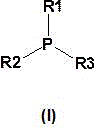
Applications Claiming Priority (3)
| Application Number | Priority Date | Filing Date | Title |
|---|---|---|---|
| EP18172971 | 2018-05-17 | ||
| EP18172971.6 | 2018-05-17 | ||
| PCT/EP2019/062218 WO2019219614A1 (en) | 2018-05-17 | 2019-05-13 | Method for preparing composite materials made of polyethylene fibers having an ultra-high molecular weight and cross-linked polyisocyanates |
Publications (1)
| Publication Number | Publication Date |
|---|---|
| CN113166364A true CN113166364A (en) | 2021-07-23 |
Family
ID=62200297
Family Applications (1)
| Application Number | Title | Priority Date | Filing Date |
|---|---|---|---|
| CN201980033031.8A Pending CN113166364A (en) | 2018-05-17 | 2019-05-13 | Method for producing composite materials from polyethylene fibres having an ultrahigh molecular weight and crosslinked polyisocyanates |
Country Status (4)
| Country | Link |
|---|---|
| US (1) | US20210214487A1 (en) |
| EP (1) | EP3794050A1 (en) |
| CN (1) | CN113166364A (en) |
| WO (1) | WO2019219614A1 (en) |
Cited By (1)
| Publication number | Priority date | Publication date | Assignee | Title |
|---|---|---|---|---|
| CN118290783A (en) * | 2024-06-06 | 2024-07-05 | 长春三友智造科技发展有限公司 | A fiber-reinforced polyurethane composite material and preparation method thereof |
Families Citing this family (1)
| Publication number | Priority date | Publication date | Assignee | Title |
|---|---|---|---|---|
| WO2023001848A1 (en) * | 2021-07-23 | 2023-01-26 | Sika Technology Ag | Polyisocyanurate plastics with high transparency |
Citations (3)
| Publication number | Priority date | Publication date | Assignee | Title |
|---|---|---|---|---|
| US4816325A (en) * | 1987-04-08 | 1989-03-28 | Mobay Corporation | Thermally flexible polyurethane coatings for substrates containing aramid fibers |
| CN106147164A (en) * | 2015-04-23 | 2016-11-23 | 上海微创医疗器械(集团)有限公司 | A kind of medical composite material and preparation method thereof |
| WO2018054776A1 (en) * | 2016-09-20 | 2018-03-29 | Covestro Deutschland Ag | Anisotropic composite materials based on polyisocyanates |
Family Cites Families (58)
| Publication number | Priority date | Publication date | Assignee | Title |
|---|---|---|---|---|
| GB809809A (en) | 1956-11-16 | 1959-03-04 | Ici Ltd | Polymeric isocyanates and their manufacture |
| DE1667309C3 (en) | 1967-01-19 | 1978-10-26 | Takeda Chemical Industries, Ltd., Osaka (Japan) | Process for the production of isocyanate trimers !! |
| DE1954093C3 (en) | 1968-11-15 | 1978-12-21 | Mobay Chemical Corp., Pittsburgh, Pa. (V.St.A.) | Process for the preparation of polymeric organic isocyanates |
| GB1391066A (en) | 1971-07-16 | 1975-04-16 | Ici Ltd | Urethane oils |
| GB1386399A (en) | 1971-07-16 | 1975-03-05 | Ici Ltd | Isocyanurate polymers |
| DE2414413C3 (en) | 1974-03-26 | 1978-08-24 | Bayer Ag, 5090 Leverkusen | Use of solutions of polyisocyanates with an isocyanurate structure in two-component polyurethane paints |
| DE2452532C3 (en) | 1974-11-06 | 1978-08-24 | Bayer Ag, 5090 Leverkusen | Process for the preparation of polyisocyanates with an isocyanurate structure |
| US4040992A (en) | 1975-07-29 | 1977-08-09 | Air Products And Chemicals, Inc. | Catalysis of organic isocyanate reactions |
| JPS5936574B2 (en) * | 1975-09-22 | 1984-09-04 | 三菱化学株式会社 | Method for continuously manufacturing fiber reinforced plastic foam |
| DE2641380C2 (en) | 1976-09-15 | 1989-11-23 | Bayer Ag, 5090 Leverkusen | Process for the preparation of polyisocyanates with an isocyanurate structure |
| DE2806731A1 (en) | 1978-02-17 | 1979-08-23 | Bayer Ag | PROCESS FOR THE PREPARATION OF POLYISOCYANATES HAVING ISOCYANURATE GROUPS |
| US4232133A (en) * | 1978-07-27 | 1980-11-04 | Ici Americas Inc. | Polyisocyanurate containing molding compositions |
| CA1112243A (en) | 1978-09-08 | 1981-11-10 | Manfred Bock | Process for the preparation of polyisocyanates containing isocyanurate groups and the use thereof |
| DE2901479A1 (en) | 1979-01-16 | 1980-07-24 | Bayer Ag | NEW ISOCYANATO ISOCYANURATE, A METHOD FOR THE PRODUCTION THEREOF AND THEIR USE AS ISOCYANATE COMPONENT IN POLYURETHANE LACQUER |
| CA1127644A (en) | 1980-01-28 | 1982-07-13 | Anupama Mishra | Isocyanurate products and polyurethanes therefrom |
| DE3033860A1 (en) | 1980-09-09 | 1982-04-15 | Bayer Ag, 5090 Leverkusen | NEW ISOCYANATO-ISOCYANURATE, A METHOD FOR THE PRODUCTION THEREOF AND THEIR USE AS ISOCYANATE COMPONENT IN POLYURETHANE PAINTS |
| DE3100263A1 (en) | 1981-01-08 | 1982-08-12 | Bayer Ag, 5090 Leverkusen | METHOD FOR PRODUCING POLYISOCYANATES CONTAINING ISOCYANURATE GROUPS AND THE USE THEREOF IN THE PRODUCTION OF POLYURETHANES |
| DE3100262A1 (en) | 1981-01-08 | 1982-08-05 | Bayer Ag, 5090 Leverkusen | METHOD FOR THE PRODUCTION OF POLYISOCYANATES CONTAINING ISOCYANURATE GROUPS, SOLUTIONS SUITABLE AS CATALYST COMPONENTS FOR THIS METHOD, AND THE USE OF THE PROCESS PRODUCTS AS THE ISOCYANATE COMPONENT PRODUCT |
| JPS58162581A (en) | 1982-03-19 | 1983-09-27 | Nippon Polyurethan Kogyo Kk | Composition for polyurethane paints |
| DE3227489A1 (en) | 1982-07-23 | 1984-01-26 | Bayer Ag, 5090 Leverkusen | METHOD FOR PRODUCING POLYISOCYANATES CONTAINING ISOCYANURATE GROUPS AND THE USE THEREOF AS ISOCYANATE COMPONENTS FOR PRODUCING POLYURETHANES |
| PT77070B (en) | 1982-07-29 | 1986-01-27 | Dsm Resins Bv | Oligomerisation of polyisocyanates |
| AT375652B (en) | 1982-10-29 | 1984-08-27 | Valentina Alexandro Postnikova | METHOD FOR PRODUCING ARYLALIPHATIC POLYISOZYANURATES |
| JPH0678418B2 (en) | 1986-03-10 | 1994-10-05 | 大日本インキ化学工業株式会社 | Resin composition |
| DE3700209A1 (en) | 1987-01-07 | 1988-07-21 | Bayer Ag | METHOD FOR PRODUCING POLYISOCYANATES WITH BIURET STRUCTURE |
| DE3811350A1 (en) | 1988-04-02 | 1989-10-19 | Bayer Ag | METHOD FOR THE PRODUCTION OF ISOCYANURATE POLYISOCYANATES, THE COMPOUNDS OBTAINED BY THIS PROCESS AND THEIR USE |
| DE3814167A1 (en) | 1988-04-27 | 1989-11-09 | Bayer Ag | METHOD FOR PRODUCING POLYISOCYANATES CONTAINING ISOCYANURATE GROUPS AND THE USE THEREOF |
| CA1334848C (en) | 1988-08-05 | 1995-03-21 | William E. Slack | Process for the production of polyisocyanates which contain isocyanurate groups |
| CA1334849C (en) | 1988-08-24 | 1995-03-21 | Bayer Corporation | Process for the production of polyisocyanates which contain isocyanurate groups |
| DE3900053A1 (en) | 1989-01-03 | 1990-07-12 | Bayer Ag | PROCESS FOR THE PREPARATION OF POLYISOCYANATES USING URETDION AND ISOCYANATE GROUPS, THE POLYISOCYANATES AVAILABLE FOR THIS PROCESS, AND THEIR USE IN TWO-COMPONENT POLYURETHANE VARNISHES |
| DE3902078A1 (en) | 1989-01-25 | 1990-07-26 | Bayer Ag | METHOD FOR PRODUCING MODIFIED POLYISOCYANATES HAVING ISOCYANURATE GROUPS AND THE USE THEREOF |
| DE3928503A1 (en) | 1989-08-29 | 1991-03-07 | Bayer Ag | METHOD FOR PRODUCING SOLUTIONS OF POLYISOCYANATES CONTAINING ISOCYANURATE GROUPS IN LACQUER SOLVENTS AND THE USE THEREOF |
| DE4005762A1 (en) | 1990-02-23 | 1991-08-29 | Bayer Ag | TRIMERIZATION CATALYSTS, A METHOD FOR THE PRODUCTION THEREOF AND THEIR USE IN THE PRODUCTION OF POLYISOCYANATES CONTAINING ISOCYANURATE GROUPS |
| US5073576A (en) * | 1990-06-28 | 1991-12-17 | Basf Corporation | Polyurethane-polyisocyanurate structural rim systems with enhanced processing |
| NL9100279A (en) | 1991-02-18 | 1992-09-16 | Stamicarbon | MICROPOROUS FOIL FROM POLYETHENE AND METHOD FOR MANUFACTURING IT. |
| DE4405055A1 (en) | 1994-02-17 | 1995-08-24 | Basf Ag | Process for the preparation of polyisocyanates containing isocyanurate groups and their use |
| DE4405054A1 (en) | 1994-02-17 | 1995-08-24 | Basf Ag | Modified (cyclo) aliphatic polyisocyanate mixtures, process for their preparation and their use |
| DE19611849A1 (en) | 1996-03-26 | 1997-10-02 | Bayer Ag | New isocyanate trimer and isocyanate trimer mixtures, their production and use |
| DE19734048A1 (en) | 1997-08-06 | 1999-02-11 | Bayer Ag | Process for the preparation of polyisocyanates, polyisocyanates produced therewith and their use |
| ZA9810038B (en) | 1997-11-04 | 2000-05-03 | Rhodia Chimie Sa | A catalyst and a method for the trimerization of isocyanates. |
| ES2187097T3 (en) | 1998-06-02 | 2003-05-16 | Bayer Ag | PROCEDURE FOR THE PREPARATION OF POLYISOCIANATES CONTAINING IMINOOXADIAZINDIONA GROUPS. |
| US20060160979A1 (en) * | 2000-05-25 | 2006-07-20 | Benecke Herman P | Method for forming a crosslinked polymer by temperature control |
| DE10065176A1 (en) | 2000-12-23 | 2002-06-27 | Degussa | Trimerization catalyst for preparation of low viscosity and less colored polyisocyanates containing isocyanurate groups, is a quaternized benzylammonium carboxylate |
| DE10254878A1 (en) | 2002-11-25 | 2004-06-03 | Bayer Ag | Production of polyisocyanates containing uretdione groups |
| WO2004078820A1 (en) | 2003-02-28 | 2004-09-16 | Dow Global Technologies Inc. | Preparation of isocyanurate group containing polyisocyanate mixtures |
| US7811673B2 (en) | 2003-12-12 | 2010-10-12 | Toyo Boseki Kabushiki Kaisha | High strength polyethylene fiber |
| DE102004012571A1 (en) | 2004-03-12 | 2005-09-29 | Basf Ag | Process for the preparation of polyisocyanates containing isocyanurate groups and their use |
| US20060173128A1 (en) * | 2004-11-15 | 2006-08-03 | Huntsman International Llc | Pultrusion systems and process |
| RU2433912C2 (en) * | 2006-06-14 | 2011-11-20 | Хантсмэн Интернэшнл Ллс | Composite panel |
| DE102007018015A1 (en) | 2007-04-17 | 2008-10-23 | Bayer Materialscience Ag | Preparation of uretdione group-containing polyisocyanates |
| US9534066B2 (en) | 2011-04-13 | 2017-01-03 | Dsm Ip Assets B.V. | Creep-optimized UHMWPE fiber |
| CN104271628B (en) | 2012-05-08 | 2016-08-24 | 巴斯夫欧洲公司 | Preparation of polyisocyanates containing isocyanurate group and application thereof |
| LT2999810T (en) | 2013-05-23 | 2018-12-27 | Dsm Ip Assets B.V. | Uhmwpe fiber |
| ES2769886T3 (en) | 2013-10-25 | 2020-06-29 | Dsm Ip Assets Bv | Preparation of ultra high molecular weight polyethylene |
| TW201704220A (en) | 2015-04-21 | 2017-02-01 | 科思創德意志股份有限公司 | Polyisocyanurate polymers and process for the production of polyisocyanurate polymers |
| CN107531876B (en) | 2015-04-21 | 2021-02-09 | 科思创德国股份有限公司 | Polyisocyanurate plastics having high thermal stability |
| EP3286240A1 (en) | 2015-04-21 | 2018-02-28 | Covestro Deutschland AG | Solids based on polyisocvanurate polymers produced under adiabatic conditions |
| EP3423516B1 (en) * | 2016-03-04 | 2021-06-02 | Covestro Intellectual Property GmbH & Co. KG | Method for manufacturing composite fibrous components |
| EP3421516A1 (en) * | 2017-06-28 | 2019-01-02 | Covestro Deutschland AG | Coloured plastics based on crosslinked polyisocyanates |
-
2019
- 2019-05-13 EP EP19722646.7A patent/EP3794050A1/en not_active Withdrawn
- 2019-05-13 CN CN201980033031.8A patent/CN113166364A/en active Pending
- 2019-05-13 US US17/056,418 patent/US20210214487A1/en not_active Abandoned
- 2019-05-13 WO PCT/EP2019/062218 patent/WO2019219614A1/en not_active Ceased
Patent Citations (3)
| Publication number | Priority date | Publication date | Assignee | Title |
|---|---|---|---|---|
| US4816325A (en) * | 1987-04-08 | 1989-03-28 | Mobay Corporation | Thermally flexible polyurethane coatings for substrates containing aramid fibers |
| CN106147164A (en) * | 2015-04-23 | 2016-11-23 | 上海微创医疗器械(集团)有限公司 | A kind of medical composite material and preparation method thereof |
| WO2018054776A1 (en) * | 2016-09-20 | 2018-03-29 | Covestro Deutschland Ag | Anisotropic composite materials based on polyisocyanates |
Cited By (2)
| Publication number | Priority date | Publication date | Assignee | Title |
|---|---|---|---|---|
| CN118290783A (en) * | 2024-06-06 | 2024-07-05 | 长春三友智造科技发展有限公司 | A fiber-reinforced polyurethane composite material and preparation method thereof |
| CN118290783B (en) * | 2024-06-06 | 2024-09-03 | 长春三友智造科技发展有限公司 | A fiber-reinforced polyurethane composite material and preparation method thereof |
Also Published As
| Publication number | Publication date |
|---|---|
| WO2019219614A1 (en) | 2019-11-21 |
| US20210214487A1 (en) | 2021-07-15 |
| EP3794050A1 (en) | 2021-03-24 |
Similar Documents
| Publication | Publication Date | Title |
|---|---|---|
| US11236191B2 (en) | Method for producing a polyisocyanurate composite material | |
| CN107438635B (en) | Process for making polyisocyanurate plastics | |
| CN107531874B (en) | Polyisocyanurate polymers and methods of making polyisocyanurate polymers | |
| US11286332B2 (en) | Hydrophobically modified polyisocyanurate plastic and method for production thereof | |
| KR102480612B1 (en) | Methods of Making Composite Polyisocyanurate Materials | |
| CN107531876B (en) | Polyisocyanurate plastics having high thermal stability | |
| CA3035201A1 (en) | Anisotropic composite materials based on polyisocyanates | |
| EP3507321B1 (en) | Process for producing polyisocyanurate plastics by means of phosphine catalysis | |
| CN112204065B (en) | Process for preparing polyisocyanate polymers and polyisocyanurate plastics | |
| US20210214487A1 (en) | Method for preparing composite materials made of polyethylene fibers having an ultra-high molecular weight and cross-linked polyisocyanates | |
| US12157790B2 (en) | Composite materials based on dual-cure urethane polymers and dual-cure isocyanurate polymers | |
| CN111479840A (en) | Polyurethane composites based on thermal latent catalysts | |
| JP2019536849A (en) | Production of plastics by catalytic crosslinking of blocked polyisocyanates |
Legal Events
| Date | Code | Title | Description |
|---|---|---|---|
| PB01 | Publication | ||
| PB01 | Publication | ||
| SE01 | Entry into force of request for substantive examination | ||
| SE01 | Entry into force of request for substantive examination | ||
| WD01 | Invention patent application deemed withdrawn after publication | ||
| WD01 | Invention patent application deemed withdrawn after publication |
Application publication date: 20210723 |