CN111718552B - Bearing seal member and method for manufacturing same - Google Patents
Bearing seal member and method for manufacturing same Download PDFInfo
- Publication number
- CN111718552B CN111718552B CN202010194932.XA CN202010194932A CN111718552B CN 111718552 B CN111718552 B CN 111718552B CN 202010194932 A CN202010194932 A CN 202010194932A CN 111718552 B CN111718552 B CN 111718552B
- Authority
- CN
- China
- Prior art keywords
- rubber
- mass
- parts
- carbon black
- carbon
- Prior art date
- Legal status (The legal status is an assumption and is not a legal conclusion. Google has not performed a legal analysis and makes no representation as to the accuracy of the status listed.)
- Active
Links
- 238000004519 manufacturing process Methods 0.000 title claims abstract description 15
- 238000000034 method Methods 0.000 title claims description 16
- 229920001971 elastomer Polymers 0.000 claims abstract description 92
- 239000005060 rubber Substances 0.000 claims abstract description 92
- 239000006229 carbon black Substances 0.000 claims abstract description 45
- 229910052751 metal Inorganic materials 0.000 claims abstract description 39
- 239000002184 metal Substances 0.000 claims abstract description 39
- 239000000203 mixture Substances 0.000 claims abstract description 37
- 239000003575 carbonaceous material Substances 0.000 claims abstract description 34
- 238000010521 absorption reaction Methods 0.000 claims abstract description 26
- 238000004073 vulcanization Methods 0.000 claims abstract description 24
- OKTJSMMVPCPJKN-UHFFFAOYSA-N Carbon Chemical compound [C] OKTJSMMVPCPJKN-UHFFFAOYSA-N 0.000 claims abstract description 23
- 239000011162 core material Substances 0.000 claims abstract description 22
- -1 acrylic ester Chemical class 0.000 claims abstract description 11
- 238000000465 moulding Methods 0.000 claims abstract description 11
- 239000002041 carbon nanotube Substances 0.000 claims abstract description 9
- 229910021393 carbon nanotube Inorganic materials 0.000 claims abstract description 8
- 239000000945 filler Substances 0.000 claims description 18
- 238000004898 kneading Methods 0.000 claims description 18
- 239000006057 Non-nutritive feed additive Substances 0.000 claims description 15
- 238000010068 moulding (rubber) Methods 0.000 claims description 3
- 238000007789 sealing Methods 0.000 abstract description 23
- DOIRQSBPFJWKBE-UHFFFAOYSA-N dibutyl phthalate Chemical compound CCCCOC(=O)C1=CC=CC=C1C(=O)OCCCC DOIRQSBPFJWKBE-UHFFFAOYSA-N 0.000 description 48
- 239000003921 oil Substances 0.000 description 23
- 229920000800 acrylic rubber Polymers 0.000 description 15
- 229920000058 polyacrylate Polymers 0.000 description 15
- 229920000459 Nitrile rubber Polymers 0.000 description 10
- 239000000178 monomer Substances 0.000 description 10
- NIXOWILDQLNWCW-UHFFFAOYSA-M Acrylate Chemical compound [O-]C(=O)C=C NIXOWILDQLNWCW-UHFFFAOYSA-M 0.000 description 9
- VTYYLEPIZMXCLO-UHFFFAOYSA-L Calcium carbonate Chemical compound [Ca+2].[O-]C([O-])=O VTYYLEPIZMXCLO-UHFFFAOYSA-L 0.000 description 9
- VYPSYNLAJGMNEJ-UHFFFAOYSA-N Silicium dioxide Chemical compound O=[Si]=O VYPSYNLAJGMNEJ-UHFFFAOYSA-N 0.000 description 9
- 239000003795 chemical substances by application Substances 0.000 description 6
- 238000010438 heat treatment Methods 0.000 description 6
- 239000000126 substance Substances 0.000 description 6
- 239000000853 adhesive Substances 0.000 description 5
- 230000001070 adhesive effect Effects 0.000 description 5
- 238000011156 evaluation Methods 0.000 description 5
- 239000004636 vulcanized rubber Substances 0.000 description 5
- 229910000019 calcium carbonate Inorganic materials 0.000 description 4
- 230000000694 effects Effects 0.000 description 4
- 125000003700 epoxy group Chemical group 0.000 description 4
- 238000005096 rolling process Methods 0.000 description 4
- NLHHRLWOUZZQLW-UHFFFAOYSA-N Acrylonitrile Chemical compound C=CC#N NLHHRLWOUZZQLW-UHFFFAOYSA-N 0.000 description 3
- 241000282320 Panthera leo Species 0.000 description 3
- 229910052799 carbon Inorganic materials 0.000 description 3
- 125000003178 carboxy group Chemical group [H]OC(*)=O 0.000 description 3
- 239000004927 clay Substances 0.000 description 3
- 238000005259 measurement Methods 0.000 description 3
- VNWKTOKETHGBQD-UHFFFAOYSA-N methane Chemical compound C VNWKTOKETHGBQD-UHFFFAOYSA-N 0.000 description 3
- 239000000843 powder Substances 0.000 description 3
- 239000000377 silicon dioxide Substances 0.000 description 3
- VGGSQFUCUMXWEO-UHFFFAOYSA-N Ethene Chemical compound C=C VGGSQFUCUMXWEO-UHFFFAOYSA-N 0.000 description 2
- 239000005977 Ethylene Substances 0.000 description 2
- XEEYBQQBJWHFJM-UHFFFAOYSA-N Iron Chemical compound [Fe] XEEYBQQBJWHFJM-UHFFFAOYSA-N 0.000 description 2
- 239000005909 Kieselgur Substances 0.000 description 2
- BAPJBEWLBFYGME-UHFFFAOYSA-N Methyl acrylate Chemical compound COC(=O)C=C BAPJBEWLBFYGME-UHFFFAOYSA-N 0.000 description 2
- NINIDFKCEFEMDL-UHFFFAOYSA-N Sulfur Chemical compound [S] NINIDFKCEFEMDL-UHFFFAOYSA-N 0.000 description 2
- 239000006230 acetylene black Substances 0.000 description 2
- TZCXTZWJZNENPQ-UHFFFAOYSA-L barium sulfate Chemical compound [Ba+2].[O-]S([O-])(=O)=O TZCXTZWJZNENPQ-UHFFFAOYSA-L 0.000 description 2
- 229910052570 clay Inorganic materials 0.000 description 2
- 238000000748 compression moulding Methods 0.000 description 2
- 239000004020 conductor Substances 0.000 description 2
- 238000004132 cross linking Methods 0.000 description 2
- 229920006229 ethylene acrylic elastomer Polymers 0.000 description 2
- 239000010439 graphite Substances 0.000 description 2
- 229910002804 graphite Inorganic materials 0.000 description 2
- 238000001746 injection moulding Methods 0.000 description 2
- 239000011256 inorganic filler Substances 0.000 description 2
- 229910003475 inorganic filler Inorganic materials 0.000 description 2
- 239000003273 ketjen black Substances 0.000 description 2
- 239000010410 layer Substances 0.000 description 2
- 238000002156 mixing Methods 0.000 description 2
- 239000002048 multi walled nanotube Substances 0.000 description 2
- 238000010060 peroxide vulcanization Methods 0.000 description 2
- 239000002356 single layer Substances 0.000 description 2
- 239000002109 single walled nanotube Substances 0.000 description 2
- 239000011593 sulfur Substances 0.000 description 2
- 229910052717 sulfur Inorganic materials 0.000 description 2
- 238000010059 sulfur vulcanization Methods 0.000 description 2
- 239000001993 wax Substances 0.000 description 2
- JYEUMXHLPRZUAT-UHFFFAOYSA-N 1,2,3-triazine Chemical compound C1=CN=NN=C1 JYEUMXHLPRZUAT-UHFFFAOYSA-N 0.000 description 1
- HFCUBKYHMMPGBY-UHFFFAOYSA-N 2-methoxyethyl prop-2-enoate Chemical compound COCCOC(=O)C=C HFCUBKYHMMPGBY-UHFFFAOYSA-N 0.000 description 1
- HDIHOAXFFROQHR-UHFFFAOYSA-N 6-aminohexylcarbamic acid Chemical compound NCCCCCCNC(O)=O HDIHOAXFFROQHR-UHFFFAOYSA-N 0.000 description 1
- JIGUQPWFLRLWPJ-UHFFFAOYSA-N Ethyl acrylate Chemical compound CCOC(=O)C=C JIGUQPWFLRLWPJ-UHFFFAOYSA-N 0.000 description 1
- UFHFLCQGNIYNRP-UHFFFAOYSA-N Hydrogen Chemical compound [H][H] UFHFLCQGNIYNRP-UHFFFAOYSA-N 0.000 description 1
- 239000006237 Intermediate SAF Substances 0.000 description 1
- 239000006087 Silane Coupling Agent Substances 0.000 description 1
- GWEVSGVZZGPLCZ-UHFFFAOYSA-N Titan oxide Chemical compound O=[Ti]=O GWEVSGVZZGPLCZ-UHFFFAOYSA-N 0.000 description 1
- 239000000370 acceptor Substances 0.000 description 1
- 239000002253 acid Substances 0.000 description 1
- 125000005396 acrylic acid ester group Chemical group 0.000 description 1
- 239000000654 additive Substances 0.000 description 1
- 239000000956 alloy Substances 0.000 description 1
- 229910045601 alloy Inorganic materials 0.000 description 1
- 229910052782 aluminium Inorganic materials 0.000 description 1
- XAGFODPZIPBFFR-UHFFFAOYSA-N aluminium Chemical compound [Al] XAGFODPZIPBFFR-UHFFFAOYSA-N 0.000 description 1
- 150000001412 amines Chemical class 0.000 description 1
- 239000003963 antioxidant agent Substances 0.000 description 1
- CQEYYJKEWSMYFG-UHFFFAOYSA-N butyl acrylate Chemical compound CCCCOC(=O)C=C CQEYYJKEWSMYFG-UHFFFAOYSA-N 0.000 description 1
- 239000011203 carbon fibre reinforced carbon Substances 0.000 description 1
- 125000001309 chloro group Chemical group Cl* 0.000 description 1
- 239000010960 cold rolled steel Substances 0.000 description 1
- 239000003086 colorant Substances 0.000 description 1
- 230000000052 comparative effect Effects 0.000 description 1
- 150000001875 compounds Chemical class 0.000 description 1
- 239000011231 conductive filler Substances 0.000 description 1
- 238000005260 corrosion Methods 0.000 description 1
- 230000007797 corrosion Effects 0.000 description 1
- 239000007822 coupling agent Substances 0.000 description 1
- 239000003431 cross linking reagent Substances 0.000 description 1
- 235000014113 dietary fatty acids Nutrition 0.000 description 1
- 229920006332 epoxy adhesive Polymers 0.000 description 1
- 150000002148 esters Chemical class 0.000 description 1
- 238000001125 extrusion Methods 0.000 description 1
- 239000000194 fatty acid Substances 0.000 description 1
- 229930195729 fatty acid Natural products 0.000 description 1
- 150000004665 fatty acids Chemical class 0.000 description 1
- 239000004519 grease Substances 0.000 description 1
- 239000003112 inhibitor Substances 0.000 description 1
- 230000005764 inhibitory process Effects 0.000 description 1
- 229910052742 iron Inorganic materials 0.000 description 1
- 239000000463 material Substances 0.000 description 1
- 239000012766 organic filler Substances 0.000 description 1
- 150000001451 organic peroxides Chemical class 0.000 description 1
- 239000002245 particle Substances 0.000 description 1
- PNJWIWWMYCMZRO-UHFFFAOYSA-N pent‐4‐en‐2‐one Natural products CC(=O)CC=C PNJWIWWMYCMZRO-UHFFFAOYSA-N 0.000 description 1
- ISWSIDIOOBJBQZ-UHFFFAOYSA-N phenol group Chemical group C1(=CC=CC=C1)O ISWSIDIOOBJBQZ-UHFFFAOYSA-N 0.000 description 1
- 230000000704 physical effect Effects 0.000 description 1
- 239000004014 plasticizer Substances 0.000 description 1
- 238000007747 plating Methods 0.000 description 1
- 238000002360 preparation method Methods 0.000 description 1
- 238000003825 pressing Methods 0.000 description 1
- 239000011164 primary particle Substances 0.000 description 1
- 235000012239 silicon dioxide Nutrition 0.000 description 1
- NTHWMYGWWRZVTN-UHFFFAOYSA-N sodium silicate Chemical compound [Na+].[Na+].[O-][Si]([O-])=O NTHWMYGWWRZVTN-UHFFFAOYSA-N 0.000 description 1
- 239000010935 stainless steel Substances 0.000 description 1
- 229910001220 stainless steel Inorganic materials 0.000 description 1
- 238000004381 surface treatment Methods 0.000 description 1
- 238000012360 testing method Methods 0.000 description 1
- OGIDPMRJRNCKJF-UHFFFAOYSA-N titanium oxide Inorganic materials [Ti]=O OGIDPMRJRNCKJF-UHFFFAOYSA-N 0.000 description 1
- XLYOFNOQVPJJNP-UHFFFAOYSA-N water Substances O XLYOFNOQVPJJNP-UHFFFAOYSA-N 0.000 description 1
- 239000010456 wollastonite Substances 0.000 description 1
- 229910052882 wollastonite Inorganic materials 0.000 description 1
Classifications
-
- F—MECHANICAL ENGINEERING; LIGHTING; HEATING; WEAPONS; BLASTING
- F16—ENGINEERING ELEMENTS AND UNITS; GENERAL MEASURES FOR PRODUCING AND MAINTAINING EFFECTIVE FUNCTIONING OF MACHINES OR INSTALLATIONS; THERMAL INSULATION IN GENERAL
- F16J—PISTONS; CYLINDERS; SEALINGS
- F16J15/00—Sealings
- F16J15/16—Sealings between relatively-moving surfaces
- F16J15/32—Sealings between relatively-moving surfaces with elastic sealings, e.g. O-rings
- F16J15/3284—Sealings between relatively-moving surfaces with elastic sealings, e.g. O-rings characterised by their structure; Selection of materials
-
- F—MECHANICAL ENGINEERING; LIGHTING; HEATING; WEAPONS; BLASTING
- F16—ENGINEERING ELEMENTS AND UNITS; GENERAL MEASURES FOR PRODUCING AND MAINTAINING EFFECTIVE FUNCTIONING OF MACHINES OR INSTALLATIONS; THERMAL INSULATION IN GENERAL
- F16J—PISTONS; CYLINDERS; SEALINGS
- F16J15/00—Sealings
- F16J15/16—Sealings between relatively-moving surfaces
- F16J15/26—Sealings between relatively-moving surfaces with stuffing-boxes for rigid sealing rings
- F16J15/30—Sealings between relatively-moving surfaces with stuffing-boxes for rigid sealing rings with sealing rings made of carbon
-
- C—CHEMISTRY; METALLURGY
- C08—ORGANIC MACROMOLECULAR COMPOUNDS; THEIR PREPARATION OR CHEMICAL WORKING-UP; COMPOSITIONS BASED THEREON
- C08K—Use of inorganic or non-macromolecular organic substances as compounding ingredients
- C08K3/00—Use of inorganic substances as compounding ingredients
- C08K3/02—Elements
- C08K3/04—Carbon
-
- B—PERFORMING OPERATIONS; TRANSPORTING
- B29—WORKING OF PLASTICS; WORKING OF SUBSTANCES IN A PLASTIC STATE IN GENERAL
- B29C—SHAPING OR JOINING OF PLASTICS; SHAPING OF MATERIAL IN A PLASTIC STATE, NOT OTHERWISE PROVIDED FOR; AFTER-TREATMENT OF THE SHAPED PRODUCTS, e.g. REPAIRING
- B29C37/00—Component parts, details, accessories or auxiliary operations, not covered by group B29C33/00 or B29C35/00
- B29C37/0003—Discharging moulded articles from the mould
- B29C37/0007—Discharging moulded articles from the mould using means operable from outside the mould for moving between mould parts, e.g. robots
-
- C—CHEMISTRY; METALLURGY
- C08—ORGANIC MACROMOLECULAR COMPOUNDS; THEIR PREPARATION OR CHEMICAL WORKING-UP; COMPOSITIONS BASED THEREON
- C08K—Use of inorganic or non-macromolecular organic substances as compounding ingredients
- C08K13/00—Use of mixtures of ingredients not covered by one single of the preceding main groups, each of these compounds being essential
- C08K13/02—Organic and inorganic ingredients
-
- C—CHEMISTRY; METALLURGY
- C08—ORGANIC MACROMOLECULAR COMPOUNDS; THEIR PREPARATION OR CHEMICAL WORKING-UP; COMPOSITIONS BASED THEREON
- C08K—Use of inorganic or non-macromolecular organic substances as compounding ingredients
- C08K3/00—Use of inorganic substances as compounding ingredients
- C08K3/34—Silicon-containing compounds
- C08K3/36—Silica
-
- C—CHEMISTRY; METALLURGY
- C08—ORGANIC MACROMOLECULAR COMPOUNDS; THEIR PREPARATION OR CHEMICAL WORKING-UP; COMPOSITIONS BASED THEREON
- C08K—Use of inorganic or non-macromolecular organic substances as compounding ingredients
- C08K5/00—Use of organic ingredients
- C08K5/04—Oxygen-containing compounds
- C08K5/10—Esters; Ether-esters
-
- F—MECHANICAL ENGINEERING; LIGHTING; HEATING; WEAPONS; BLASTING
- F16—ENGINEERING ELEMENTS AND UNITS; GENERAL MEASURES FOR PRODUCING AND MAINTAINING EFFECTIVE FUNCTIONING OF MACHINES OR INSTALLATIONS; THERMAL INSULATION IN GENERAL
- F16C—SHAFTS; FLEXIBLE SHAFTS; ELEMENTS OR CRANKSHAFT MECHANISMS; ROTARY BODIES OTHER THAN GEARING ELEMENTS; BEARINGS
- F16C33/00—Parts of bearings; Special methods for making bearings or parts thereof
- F16C33/72—Sealings
- F16C33/76—Sealings of ball or roller bearings
- F16C33/78—Sealings of ball or roller bearings with a diaphragm, disc, or ring, with or without resilient members
- F16C33/7816—Details of the sealing or parts thereof, e.g. geometry, material
- F16C33/7833—Special methods of manufacture
-
- F—MECHANICAL ENGINEERING; LIGHTING; HEATING; WEAPONS; BLASTING
- F16—ENGINEERING ELEMENTS AND UNITS; GENERAL MEASURES FOR PRODUCING AND MAINTAINING EFFECTIVE FUNCTIONING OF MACHINES OR INSTALLATIONS; THERMAL INSULATION IN GENERAL
- F16J—PISTONS; CYLINDERS; SEALINGS
- F16J15/00—Sealings
- F16J15/16—Sealings between relatively-moving surfaces
- F16J15/26—Sealings between relatively-moving surfaces with stuffing-boxes for rigid sealing rings
- F16J15/28—Sealings between relatively-moving surfaces with stuffing-boxes for rigid sealing rings with sealing rings made of metal
-
- F—MECHANICAL ENGINEERING; LIGHTING; HEATING; WEAPONS; BLASTING
- F16—ENGINEERING ELEMENTS AND UNITS; GENERAL MEASURES FOR PRODUCING AND MAINTAINING EFFECTIVE FUNCTIONING OF MACHINES OR INSTALLATIONS; THERMAL INSULATION IN GENERAL
- F16J—PISTONS; CYLINDERS; SEALINGS
- F16J15/00—Sealings
- F16J15/16—Sealings between relatively-moving surfaces
- F16J15/32—Sealings between relatively-moving surfaces with elastic sealings, e.g. O-rings
- F16J15/328—Manufacturing methods specially adapted for elastic sealings
-
- B—PERFORMING OPERATIONS; TRANSPORTING
- B29—WORKING OF PLASTICS; WORKING OF SUBSTANCES IN A PLASTIC STATE IN GENERAL
- B29C—SHAPING OR JOINING OF PLASTICS; SHAPING OF MATERIAL IN A PLASTIC STATE, NOT OTHERWISE PROVIDED FOR; AFTER-TREATMENT OF THE SHAPED PRODUCTS, e.g. REPAIRING
- B29C37/00—Component parts, details, accessories or auxiliary operations, not covered by group B29C33/00 or B29C35/00
- B29C37/0067—Using separating agents during or after moulding; Applying separating agents on preforms or articles, e.g. to prevent sticking to each other
-
- C—CHEMISTRY; METALLURGY
- C08—ORGANIC MACROMOLECULAR COMPOUNDS; THEIR PREPARATION OR CHEMICAL WORKING-UP; COMPOSITIONS BASED THEREON
- C08K—Use of inorganic or non-macromolecular organic substances as compounding ingredients
- C08K2201/00—Specific properties of additives
- C08K2201/001—Conductive additives
-
- F—MECHANICAL ENGINEERING; LIGHTING; HEATING; WEAPONS; BLASTING
- F16—ENGINEERING ELEMENTS AND UNITS; GENERAL MEASURES FOR PRODUCING AND MAINTAINING EFFECTIVE FUNCTIONING OF MACHINES OR INSTALLATIONS; THERMAL INSULATION IN GENERAL
- F16C—SHAFTS; FLEXIBLE SHAFTS; ELEMENTS OR CRANKSHAFT MECHANISMS; ROTARY BODIES OTHER THAN GEARING ELEMENTS; BEARINGS
- F16C2326/00—Articles relating to transporting
- F16C2326/01—Parts of vehicles in general
Landscapes
- Engineering & Computer Science (AREA)
- General Engineering & Computer Science (AREA)
- Chemical & Material Sciences (AREA)
- Mechanical Engineering (AREA)
- Health & Medical Sciences (AREA)
- Medicinal Chemistry (AREA)
- Polymers & Plastics (AREA)
- Organic Chemistry (AREA)
- Chemical Kinetics & Catalysis (AREA)
- Manufacturing & Machinery (AREA)
- Robotics (AREA)
- Compositions Of Macromolecular Compounds (AREA)
- Sealing Material Composition (AREA)
- Gasket Seals (AREA)
- Sealing Of Bearings (AREA)
Abstract
A seal member for a bearing having a rubber molded article and a metal core material, characterized in that the rubber molded article is obtained by vulcanization molding a rubber composition containing 100 parts by mass of a rubber (A) containing an acrylic ester as a main component, 1 to 30 parts by mass of a carbon material (B) and 10 to 100 parts by mass of a carbon black (C) having a DBP oil absorption of 20ml/100g or more and less than 150ml/100g, the carbon material (B) is a carbon nanotube (B1) or a carbon black (B2) having a DBP oil absorption of 150ml/100g or more and 1000ml/100g or less, and the rubber molded article has a volume resistance of 1 x 10⁶Omega cm or less. The sealing member has excellent conductivity and good releasability from a metal mold during production.
Description
Technical Field
The present invention relates to a seal member for a bearing, which has a rubber molded product and a metal core material. The invention also relates to a method for manufacturing the sealing member.
Background
An axle of an automobile is supported by a rolling bearing, and the bearing includes a component called a seal member to prevent leakage of grease and intrusion of muddy water. The surface of the annular metal core of the sealing member is covered with a rubber molded article, and the sealing member uses a conductive rubber molded article as a countermeasure against electromagnetic noise. As the conductive rubber composition used for the sealing member, for example, a nitrile rubber composition described in patent document 1 or 2 can be cited.
Patent document 1 describes that a molded article obtained by vulcanizing an acrylonitrile-butadiene rubber composition containing 5 to 50 parts by weight of carbon black, 5 to 60 parts by weight of graphite having an average particle diameter of 5 μm or less, and 5 to 50 parts by weight of conductive carbon other than these with respect to 100 parts by weight of acrylonitrile-butadiene rubber is used for an oil seal for a rolling bearing, and the total amount of the carbon black, the graphite, and the conductive carbon other than these is 10 to 100 parts by weight with respect to 100 parts by weight of the acrylonitrile-butadiene rubber.
Patent document 2 describes an axle bearing rolling bearing member provided with a seal ring formed by vulcanizing a conductive rubber material composition obtained by blending acrylonitrile butadiene rubber with conductive carbon black and a needle-like conductive filler having a diameter of 0.2 to 1.0 μm.
However, since automobiles are often used in severe environments, rubber molded articles used for sealing parts are required to have physical properties durable even in high-temperature environments. Since acrylic rubber is superior in heat resistance to nitrile rubber, application to a bearing seal member has been studied.
Here, the sealing member is generally obtained by filling a metal core material and a rubber composition to which a conductive material is added into a metal mold and heating and pressurizing the metal mold. However, the acrylic rubber composition containing a conductive material has a problem that the acrylic rubber composition is inferior in mold release from a metal mold to the nitrile rubber composition. If the releasability from a metal mold is poor, not only the productivity is lowered, but also the rubber molded article coated on the surface of the metal core material may be damaged.
Documents of the prior art
Patent literature
Patent document 1: japanese patent laid-open publication No. 2012-97213
Patent document 2: japanese laid-open patent publication No. 2004-353709
Disclosure of Invention
Problems to be solved by the invention
The present invention has been made to solve the above problems, and an object thereof is to provide a sealing member having excellent conductivity and good releasability from a metal mold during production.
Means for solving the problems
The above object is achieved by providing a rubber molded article and a metal coreThe sealing member for bearings is obtained by vulcanizing a rubber composition containing 100 parts by mass of a rubber (A) containing an acrylic ester as a main component, 1 to 30 parts by mass of a carbon material (B) and 10 to 100 parts by mass of a carbon black (C) having a DBP oil absorption of 20ml/100g or more and less than 150ml/100g, wherein the carbon material (B) is a carbon nanotube (B1) or a carbon black (B2) having a DBP oil absorption of 150ml/100g or more and 1000ml/100g or less, and the rubber molded product has a volume resistance of 1 x 10⁶Omega cm or less.
In this case, the rubber composition preferably further contains 5 to 100 parts by mass of a white filler (D). The rubber composition preferably further contains 1 to 10 parts by mass of a processing aid (E).
The above object can also be achieved by providing a method for manufacturing the sealing member, comprising: a kneading step of kneading a rubber (A), a carbon material (B) and carbon black (C) to obtain a rubber composition; and a vulcanization step of vulcanizing and molding the rubber composition on a metal core member.
In this case, it is preferable that the white filler (D) is further kneaded in the kneading step. In the kneading step, it is also preferable to further knead the processing aid (E).
Effects of the invention
The rubber molded article used for the sealing member of the present invention has excellent conductivity, and therefore, a bearing using the sealing member can effectively suppress electromagnetic noise. Further, the sealing member of the present invention has excellent productivity because of its good releasability from a metal mold during its production.
Detailed Description
The rubber molded article contained in the sealing member of the present invention is obtained by vulcanization molding of a rubber composition containing a rubber (a) containing an acrylic ester as a main component, a carbon material (B), and carbon black (C).
The rubber (a) used in the present invention is a rubber containing an acrylic ester as a main component. The acrylic ester as the main component means that the content of the unit derived from acrylic ester in the rubber (a) is 50% by mass or more. The content of the unit derived from the acrylate is preferably 60% by mass or more.
As the acrylic ester, methyl acrylate, ethyl acrylate, butyl acrylate, methoxyethyl acrylate, and the like are suitably used. As the monomer copolymerizable with the acrylate ester, acrylonitrile, ethylene and the like are exemplified. Specifically, acrylic rubber (ACM) obtained by copolymerizing an acrylate with a crosslinkable monomer, acrylic rubber (AEM) obtained by copolymerizing an acrylate with ethylene and a crosslinkable monomer, acrylic rubber (ANM) obtained by copolymerizing an acrylate with acrylonitrile and a crosslinkable monomer, and the like are used in accordance with the respective applications. Examples of the crosslinkable monomer include: an epoxy group-containing crosslinkable monomer, a carboxyl group-containing crosslinkable monomer, an active chlorine group-containing crosslinkable monomer, a crosslinkable monomer containing a plurality of carbon-carbon double bonds, and the like.
The carbon material (B) used in the present invention is a carbon nanotube (B1) or a carbon black (B2) having a DBP oil absorption of 150ml/100g to 1000ml/100 g. The carbon material (B) is blended to impart conductivity to the rubber molded article, and by using the carbon material, a rubber molded article having a low volume resistance value can be obtained.
The carbon material (B) used in the present invention is a carbon nanotube (B1). Examples of the carbon nanotube (B1) (hereinafter, the carbon nanotube may be abbreviated as CNT) include a single-walled carbon nanotube and a multi-walled carbon nanotube. In the case where conductivity is important, it is preferable to use a single-layer CNT, and in the case where cost is important, it is preferable to use a multi-layer CNT. The average diameter of the CNTs (B1) is not particularly limited, but is preferably 1nm or more. On the other hand, the average diameter is preferably 100nm or less, more preferably 50nm or less, and further preferably 20nm or less. The aspect ratio (average length/average diameter) is not particularly limited, but is preferably 100 to 100000. Examples of the single-layer CNT include "ZEONANO SG101" manufactured by Zeon corporation, and "tubal" manufactured by CSiAl corporation, and examples of the multi-layer CNT include "FloTube 7000", "FloTube9000", and "NC7000" manufactured by Nanobell corporation.
The carbon material (B) used in the present invention is carbon black (B2) having a DBP oil absorption of 150ml/100g to 1000ml/100 g. The DBP oil absorption indicates the amount (mL) of dibutyl phthalate (DBP) absorbable by 100g of carbon black (in accordance with JIS K6217-4). The DBP oil absorption becomes larger as the structure of aggregates or aggregates in the carbon black (B2) develops. Further, carbon materials excellent in conductivity generally have a large DBP oil absorption.
When the DBP oil absorption of the carbon black (B2) is less than 150ml/100g, the conductivity of the rubber molded article becomes insufficient. In order to obtain more excellent conductivity, the DBP oil absorption of the carbon black (B2) is preferably 300mL/100g or more, more preferably 400mL/100g or more. On the other hand, when the DBP oil absorption exceeds 1000mL/100g, the fluidity of the rubber composition may deteriorate. The DBP oil absorption is preferably 800mL/100g or less.
The type of the carbon black (B2) is not particularly limited as long as the DBP oil absorption is in the above range and the volume resistance of the obtained rubber molded article is a constant value or less. Specifically, there may be mentioned: "Ketjen black EC300J", "Ketjen black EC600JD", manufactured by Lion Specialty Chemicals, inc. "acetylene black", manufactured by Cabot corporation "conductive carbon black XC-72", manufactured by Colombian International, inc. "Conductex 7055Ultra", manufactured by Evonik Degussa, inc. "Printex XE2B", and the like. Carbon black has a highly developed structure with aggregates or aggregates, and primary particles have a hollow structure, and conductivity can be imparted by adding a small amount of carbon black.
The content of the carbon material (B) is 1 to 30 parts by mass per 100 parts by mass of the rubber (A). When the content of the carbon material (B) is less than 1 part by mass, the rubber molded article has insufficient conductivity. In order to obtain more excellent conductivity, the content of the carbon material (B) is preferably 3 parts by mass or more, more preferably 5 parts by mass or more, and further preferably 8 parts by mass or more. On the other hand, when the content of the carbon material (B) exceeds 30 parts by mass, the releasability from a metal mold deteriorates. The content of the carbon material (B) is preferably 25 parts by mass or less.
In the case where importance is attached to the conductivity of the rubber molded article, the carbon material (B) is preferably CNT (B1), and in the case where importance is attached to the cost, the carbon material (B) is preferably carbon black (B2).
The carbon black (C) used in the present invention has a DBP oil absorption of 20ml/100g or more and less than 150ml/100g. The carbon black (C) is a developed carbon black having an aggregate or aggregate structure inferior to that of the carbon material (B). Most of carbon black blended in a general rubber composition is contained in this case.
When the DBP oil absorption of the carbon black (C) is 150ml/100g or more, moldability of the rubber composition may be deteriorated. The DBP oil absorption of the carbon black (C) is preferably 100mL/100g or less, more preferably 50mL/100g or less. On the other hand, the DBP oil absorption of the carbon black (C) is preferably 22mL/100g or more, more preferably 25mL/100g or more.
The kind of the carbon black (C) is not particularly limited as long as the DBP oil absorption is in the above range. Specifically, MT, FT, SRF, GPF, FEF, MAF, HAF, ISAF, SAF, and the like can be used, and MT, FT, SRF, GPF are preferable from the viewpoint of balance between performance and cost. As the carbon black (C), 2 or more kinds may be used in combination.
The content of the carbon black (C) is 10 to 100 parts by mass per 100 parts by mass of the rubber (A). When the content of the carbon black (C) is less than 10 parts by mass, the releasability from a metal mold is deteriorated. The content of the carbon black (C) is preferably 15 parts by mass or more. When the carbon material (B) is carbon black (B2), the content of carbon black (C) is more preferably 30 parts by mass or more, and still more preferably 50 parts by mass or more. On the other hand, when the content of the carbon black (C) exceeds 100 parts by mass, moldability of the rubber composition is deteriorated. The content of the carbon black (C) is preferably 95 parts by mass or less, and more preferably 80 parts by mass or less.
In the sealing member of the present invention, from the viewpoint of improving the adhesion between the rubber molded article and the metal core material, the rubber composition preferably contains 5 to 100 parts by mass of the white filler (D) per 100 parts by mass of the rubber (a). When the content of the white filler (D) is less than 5 parts by mass, the effect of improving the adhesiveness may not be obtained. The content of the white filler (D) is more preferably 8 parts by mass or more. On the other hand, when the content of the white filler (D) exceeds 100 parts by mass, the conductivity of the rubber molded article may be lowered. The content of the white filler (D) is more preferably 70 parts by mass or less, and still more preferably 30 parts by mass or less.
The type of the white filler (D) is not particularly limited, and examples thereof include fillers generally used in rubber compositions. Examples of such fillers include: inorganic fillers such as silica, clay, calcium carbonate, diatomaceous earth, wollastonite, barium sulfate, and titanium oxide, and organic fillers such as cellulose powder, reclaimed rubber, and powdered rubber. Among them, inorganic fillers are preferably used, and silica, clay, calcium carbonate, and diatomaceous earth are more preferably used from the viewpoint of improving adhesiveness. As the white filler (D), 2 or more fillers may be used in combination.
In the present invention, the rubber composition preferably contains 1 to 10 parts by mass of the processing aid (E) per 100 parts by mass of the rubber (a). The rubber composition containing the processing aid (E) further improves the releasability from a metal mold. When the content of the processing aid (E) is less than 1 part by mass, the effect of improving the mold releasability may not be obtained. The content of the processing aid (E) is more preferably 2 parts by mass or more. On the other hand, when the content of the processing aid (E) exceeds 10 parts by mass, there is a possibility that adhesion inhibition or appearance failure occurs. The content of the processing aid (E) is more preferably 8 parts by mass or less. The type of the processing aid (E) is not particularly limited, and various waxes and fatty acids can be mentioned.
The rubber composition may contain other components than the rubber (a), the carbon material (B) and the carbon black (C) within a range not to impair the effects of the present invention. Examples of the other components include, in addition to the white filler (D) and the processing aid (E): vulcanizing agents, vulcanization aids, co-crosslinking agents, vulcanization accelerators, vulcanization retarders, adhesives, acid acceptors, colorants, fillers, plasticizers, antioxidants, coupling agents, corrosion inhibitors, tackifiers, and the like, and various additives.
In the sealing member of the present invention, the volume resistance value of the rubber molded article is 1 × 10⁶Omega cm or less. The volume resistance value of the rubber molding exceeds 1 x 10⁶In the case of Ω · cm, electromagnetic noise cannot be effectively suppressed. The volume resistance value is preferably 8X 10⁵Omega cm or less, more preferably 1X 10³Omega. Cm or less, and more preferably 1X 10²The range of Ω · cm or less is particularly preferably 10 Ω · cm or less. The volume resistance value referred to herein is a value obtained by measurement according to JIS K6271-2, method 3.
The a hardness of the rubber molded article contained in the sealing member of the present invention is preferably 50 to 90. The a hardness is more preferably 60 or more, and still more preferably 65 or more. On the other hand, the a hardness is more preferably 80 or less, and still more preferably 75 or less.
The method for producing the sealing member of the present invention is not particularly limited, and a preferred production method is a method comprising a kneading step of kneading a rubber (a), a carbon material (B) and carbon black (C) to obtain a rubber composition, and a vulcanization step of vulcanizing and molding the rubber composition on a metal core material.
In the kneading step, the rubber (a), the carbon material (B), and the carbon black (C) are preferably used. In addition, the content thereof is also preferably set to the above amount. In the above-mentioned kneading step, it is more preferable to further knead the white filler (D). In the kneading step, it is also preferable to further knead the processing aid (E). The white filler (D) and the processing aid (E) are preferably used. In addition, the content thereof is also preferably set to the above amount.
In the kneading step, the method of mixing the components is not particularly limited, and kneading may be performed using an open roll, a kneader, a banbury mixer, a kneader, an extruder, or the like. Among them, it is preferable to use an open roll or a kneader for kneading. The temperature during kneading is preferably 20 to 160 ℃.
In the next vulcanization step, the rubber composition obtained in the kneading step is vulcanization-molded onto a metal core material to obtain a sealing member of the present invention having a rubber molded article and a metal core material. Examples of the metal core material used in this case include metal plates made of iron, aluminum, stainless steel, or the like, or alloy plates thereof. These metal core materials may be subjected to surface treatment such as plating. Examples of the metal core material include: SECC shown in JIS G3313, SUS301 shown in JIS G4305, SPCC shown in JIS G3141, and the like. From the viewpoint of improving the adhesion between the rubber molded product and the metal core material, the metal core material may be coated with an adhesive. Examples of the adhesive include: phenolic adhesives, epoxy adhesives, silane coupling agents, and the like.
The shape of the metal core material is not particularly limited, and is generally annular. The thickness of the metal core member and the thickness of the rubber molded article are not particularly limited, and can be appropriately set according to the size of the rolling bearing and the like.
Examples of the method for molding the rubber composition include: injection molding, extrusion molding, compression molding, roll forming, and the like. Among them, injection molding and compression molding are preferable. In this case, the vulcanization may be carried out after the preliminary molding or simultaneously with the molding. Alternatively, the vulcanization may be carried out simultaneously with the molding and then the secondary vulcanization may be further carried out. The vulcanization temperature is preferably generally from 150 to 230 ℃. The vulcanization time is usually from 0.1 to 60 minutes. As a heating method for vulcanization, a common method used for vulcanization of rubber such as heater heating, steam heating, oven heating, hot air heating, or the like is used.
Further, since the rubber molded product may not be sufficiently vulcanized even if the surface is vulcanized depending on the shape, size, and the like of the rubber molded product, the rubber molded product may be further heated and secondarily vulcanized.
The method of vulcanization (crosslinking) is not particularly limited, and examples thereof include sulfur vulcanization, peroxide vulcanization, amine vulcanization, triazine vulcanization, and crosslinking of an epoxy group. Sulfur or a sulfur-containing compound is used as a vulcanizing agent in sulfur vulcanization. In addition, as a vulcanizing agent in the case of peroxide vulcanization, an organic peroxide is used. The amount of the vulcanizing agent used in this case is usually 0.1 to 10 parts by mass per 100 parts by mass of the rubber (A). The amount of the vulcanization accelerator is usually 0.1 to 10 parts by mass per 100 parts by mass of the rubber (A).
Examples
Acrylic rubber (ACM (A1))
Epoxy group-containing acrylic rubber "Nipol AR31" manufactured by Zeon corporation of Japan "
Content of acrylate unit: 90% by mass or more
Acrylic rubber (ACM (A2))
Acrylic rubber "Nipol AR14" containing carboxyl group manufactured by Zeon corporation of Japan "
Content of acrylate unit: 90 mass% or more
Acrylic rubber (ACM (A3))
Acrylic rubber "Nipol AR12" containing carboxyl group manufactured by Zeon corporation of Japan "
Content of acrylate unit: 90 mass% or more
Ethylene acrylic rubber (AEM (A4))
Ethylene acrylic rubber "VAMAC ULTRA LS" manufactured by DuPont corporation "
Content of acrylate unit: 60% by mass or more
Acrylic rubber (ANM (A5))
Acrylic rubber (acrylic rubber obtained by copolymerizing acrylic acid ester, acrylonitrile, and an epoxy group-containing crosslinkable monomer)
Content of acrylate unit: 80% by mass or more
Carbon Material (b 1)
"Keqin Black EC300J" manufactured by Lion Specialty Chemicals, inc "
Carbon black having a DBP oil absorption of 365mL/100 g.
Carbon Material (b 2)
"Keqin Black EC600JD" manufactured by Lion Specialty Chemicals K.K.) "
Carbon black having a DBP oil absorption of 495mL/100 g.
Carbon Material (b 3)
Conductive carbon Black XC-72 manufactured by Cabot corporation "
Carbon black having a DBP oil absorption of 175mL/100 g.
Carbon Material (b 4)
"acetylene Black" manufactured by Denka corporation "
A DBP oil absorption of 212mL/100g of carbon black.
Carbon Material (b 5)
Powder of single-walled carbon nanotubes "Zeonano SG101" manufactured by Zeon corporation of Japan "
Average diameter: 3-5 nm, length: several 100 μm
Carbon Material (b 6)
Powder of multilayered carbon nanotube "FloTube 7000" manufactured by CNano Co., ltd "
Average diameter: 8-15 nm, length: 5 to 20 mu m
Carbon Material (b 7)
Powder of multi-walled carbon nanotube "FloTube9000" manufactured by CNano K.K "
Average diameter: 10-15 nm, length: less than 10 μm
Carbon black (C)
FT carbon manufactured by Asahi Thermal "
DBP oil absorption: 28mL/100g
Silicon dioxide (D1)
Nipsil VN3 manufactured by Tosoh silica K.K.) "
Clay (D2)
DIXIE CLAY manufactured by R.T. Vanderbilt Company, inc
Calcium carbonate (D3)
Light calcium carbonate "Hongyu" manufactured by Sunshen chemical industries Co., ltd "
Processing aid (E)
Ester wax "GRECHUE G-8205" manufactured by NI Chem corporation "
Vulcanizing agent (F1)
"Diak-1" manufactured by DuPont corporation "
Vulcanizing agent (F2)
NOCCELER PZ manufactured by Dai-Innovation chemical industries Co., ltd "
Vulcanization accelerator (G1)
NOCCELER TTFE manufactured by NOCCELER GmbH "
Vulcanization accelerator (G2)
NOCCELER DT, manufactured by DAI-NEW CHEMICAL INDUSTRIAL CO "
Example 1
(preparation of vulcanized rubber sheet)
A mixture having the composition shown in Table 1 or an article partially masterbatched was kneaded at a temperature of 40 to 70 ℃ for 15 to 30 minutes using an open roll to prepare an unvulcanized rubber sheet having a thickness of 2.0 to 3.0 mm. Then, the obtained unvulcanized rubber sheet was press-vulcanized at 180 ℃ for 15 minutes to obtain a vulcanized rubber sheet having a length of 150mm × a width of 150mm × a thickness of 2mm, and was vulcanized in an oven at 180 ℃ for 2 times for 4 hours (hereinafter, sometimes abbreviated as a rubber sheet).
[ evaluation ]
(measurement of hardness)
3 sheets of rubber were stacked, measured at 23 ℃ using a type A durometer, and the peak value was read. As a result, the a hardness was 73. The results are shown in table 1.
(measurement of volume resistance value)
The volume resistance of the obtained rubber sheet was measured by a method in accordance with JIS K6271-2, method 3. The results are shown in table 1.
(releasability from a Metal mold)
An unvulcanized rubber sheet was obtained in the same manner as in the above "production of a vulcanized rubber sheet" using an open roll. Then, a metal core (cold-rolled steel sheet) was put into a mold, and an unvulcanized rubber sheet was placed on the metal core at 180 ℃ for 15 minutes at 60kgf/cm2Pressing and vulcanizing and forming. After vulcanization molding, the releasability between the metal mold and the sealing member was evaluated by the following criteria. The results are shown in table 1.
A: the metal mold and the sealing member can be easily released.
B: the sealing member is attached to the metal mold, but may be released.
C: the metal mold cannot be demolded from the sealing member.
(adhesion to Metal core Material)
The same procedure as in the above "production of vulcanized rubber sheet" was carried out to obtain an unvulcanized rubber sheet. Then, evaluation was performed according to JIS K6256 90 degree peel test. In the evaluation method, an unvulcanized rubber sheet was placed on a rigid plate coated with an adhesive, press-molded at 180 ℃ for 15 minutes, vulcanization-molded, and the bonded rubber molded article was peeled off in the 90-degree direction to determine the ratio (%) of the area of the rubber molded article remaining on the rigid plate to the area of the rubber molded article before peeling. Evaluation criteria are shown below, and the results are shown in table 1.
A: over 80 percent
B: more than 50 percent and less than 80 percent
Examples 2 to 17, comparative examples 1 to 3
The procedure of example 1 was repeated except that the kinds and amounts of the components in the "production of a vulcanized rubber sheet" were changed as shown in tables 1 to 3, to obtain rubber compositions. Then, the same evaluation as in example 1 was carried out using the obtained rubber composition. The results are shown in tables 1 to 3.
[ TABLE 1 ]
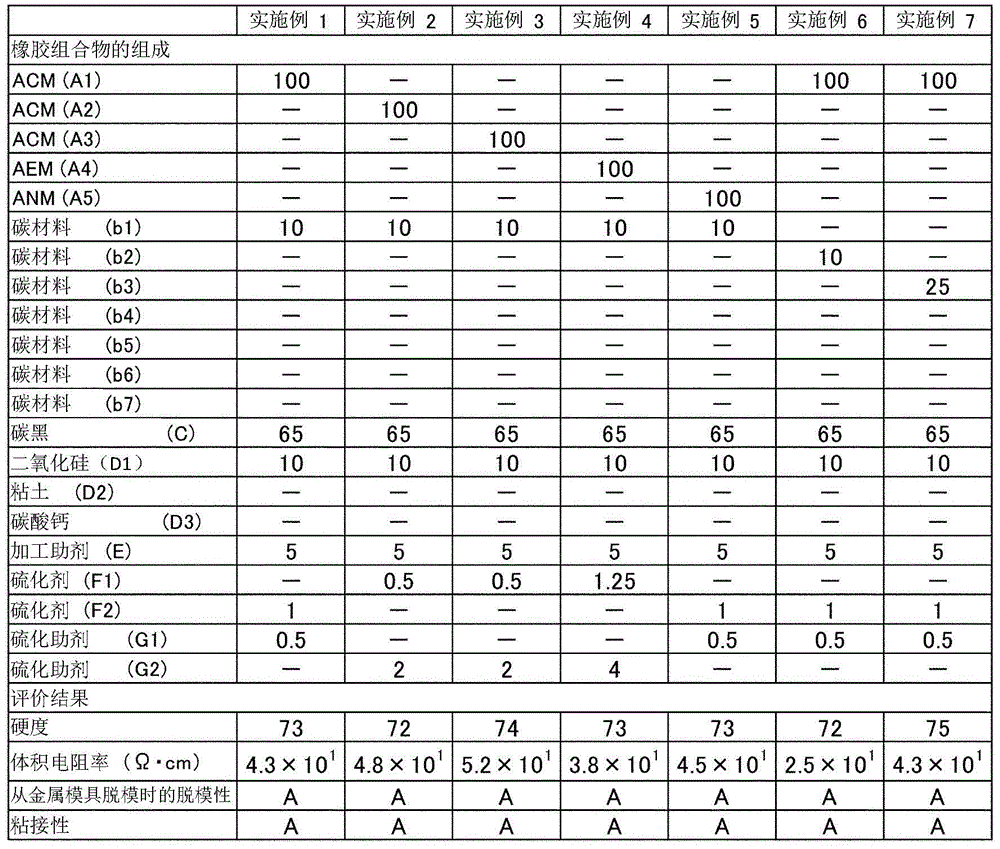
[ TABLE 2 ]

[ TABLE 3 ]

Claims (6)
1. A seal member for a bearing, characterized in that,
comprises a rubber molding and a metal core material,
the rubber molded article is obtained by vulcanization molding of a rubber composition containing 100 parts by mass of a rubber (A) mainly composed of an acrylic ester, 1 to 30 parts by mass of a carbon material (B), and 10 to 100 parts by mass of a carbon black (C) having a DBP oil absorption of 20ml/100g or more and less than 150ml/100g,
the carbon material (B) is a carbon nanotube (B1) or carbon black (B2) having a DBP oil absorption of 150ml/100g to 1000ml/100g,
and the volume resistance value of the rubber molding is 1 multiplied by 106Omega cm or less.
2. The seal member of claim 1,
the rubber composition further contains 5 to 100 parts by mass of a white filler (D).
3. The seal of claim 1 or 2,
the rubber composition further contains 1 to 10 parts by mass of a processing aid (E).
4. A method of manufacturing the seal member of claim 1,
the method comprises the following steps:
a kneading step of kneading the rubber (A), the carbon material (B) and the carbon black (C) to obtain a rubber composition; and
and a vulcanization step of vulcanizing and molding the rubber composition on a metal core member.
5. The manufacturing method according to claim 4,
in the kneading step, the white filler (D) is further kneaded.
6. The manufacturing method according to claim 4 or 5,
in the kneading step, the processing aid (E) is further kneaded.
Applications Claiming Priority (2)
| Application Number | Priority Date | Filing Date | Title |
|---|---|---|---|
| JP2019-051861 | 2019-03-19 | ||
| JP2019051861A JP7253781B2 (en) | 2019-03-19 | 2019-03-19 | Bearing sealing member and manufacturing method thereof |
Publications (2)
| Publication Number | Publication Date |
|---|---|
| CN111718552A CN111718552A (en) | 2020-09-29 |
| CN111718552B true CN111718552B (en) | 2022-11-01 |
Family
ID=72333849
Family Applications (1)
| Application Number | Title | Priority Date | Filing Date |
|---|---|---|---|
| CN202010194932.XA Active CN111718552B (en) | 2019-03-19 | 2020-03-19 | Bearing seal member and method for manufacturing same |
Country Status (5)
| Country | Link |
|---|---|
| US (1) | US11371611B2 (en) |
| JP (1) | JP7253781B2 (en) |
| CN (1) | CN111718552B (en) |
| DE (1) | DE102020001604A1 (en) |
| FR (1) | FR3093949B1 (en) |
Families Citing this family (4)
| Publication number | Priority date | Publication date | Assignee | Title |
|---|---|---|---|---|
| JP7678418B2 (en) * | 2021-09-22 | 2025-05-16 | 中西金属工業株式会社 | Rubber composition for sealing members of rolling bearings |
| JP2024034650A (en) * | 2022-09-01 | 2024-03-13 | 内山工業株式会社 | Conductive rubber composition, rubber molded article, and method for producing conductive rubber composition |
| DE102022131855A1 (en) * | 2022-12-01 | 2024-06-06 | Schaeffler Technologies AG & Co. KG | Seal arrangement |
| CN119931199A (en) * | 2025-04-03 | 2025-05-06 | 歌尔股份有限公司 | Diaphragm for sound-generating device, sound-generating device and electronic device |
Citations (6)
| Publication number | Priority date | Publication date | Assignee | Title |
|---|---|---|---|---|
| JP2001002768A (en) * | 1999-04-23 | 2001-01-09 | Du Pont Toray Co Ltd | Polyester elastomer resin and resin composition |
| JP2003222147A (en) * | 2002-01-29 | 2003-08-08 | Nsk Ltd | Rolling bearing for wheels |
| JP2009040931A (en) * | 2007-08-10 | 2009-02-26 | Two-One:Kk | Vulcanizable rubber compositions and molded articles. Detailed Description of the Invention |
| CN103228755A (en) * | 2010-11-26 | 2013-07-31 | 内山工业株式会社 | Seal member having excellent wear resistance, and seal structure using same |
| JP2014005886A (en) * | 2012-06-25 | 2014-01-16 | Daikin Ind Ltd | Transmission oil seal for automobile |
| WO2017033986A1 (en) * | 2015-08-24 | 2017-03-02 | 内山工業株式会社 | Rubber composition, molded rubber article, and method for producing same |
Family Cites Families (6)
| Publication number | Priority date | Publication date | Assignee | Title |
|---|---|---|---|---|
| JP2004353709A (en) | 2003-05-27 | 2004-12-16 | Nsk Ltd | Rolling bearing unit for wheel support |
| JP2005090549A (en) | 2003-09-12 | 2005-04-07 | Nsk Ltd | Rolling bearing |
| JP2011037935A (en) | 2009-08-07 | 2011-02-24 | Nakanishi Metal Works Co Ltd | Rubber composition and sealant |
| JP2011231785A (en) | 2010-04-23 | 2011-11-17 | Nsk Ltd | Rolling bearing for electric equipment and engine accessory of automobile |
| JP5655511B2 (en) | 2010-11-04 | 2015-01-21 | Nok株式会社 | Nitrile rubber composition |
| JP2015030819A (en) | 2013-08-05 | 2015-02-16 | 株式会社ジェイテクト | Acrylic rubber composition and sealing device provided with the same |
-
2019
- 2019-03-19 JP JP2019051861A patent/JP7253781B2/en active Active
-
2020
- 2020-03-09 US US16/813,015 patent/US11371611B2/en active Active
- 2020-03-11 DE DE102020001604.9A patent/DE102020001604A1/en active Pending
- 2020-03-11 FR FR2002420A patent/FR3093949B1/en active Active
- 2020-03-19 CN CN202010194932.XA patent/CN111718552B/en active Active
Patent Citations (6)
| Publication number | Priority date | Publication date | Assignee | Title |
|---|---|---|---|---|
| JP2001002768A (en) * | 1999-04-23 | 2001-01-09 | Du Pont Toray Co Ltd | Polyester elastomer resin and resin composition |
| JP2003222147A (en) * | 2002-01-29 | 2003-08-08 | Nsk Ltd | Rolling bearing for wheels |
| JP2009040931A (en) * | 2007-08-10 | 2009-02-26 | Two-One:Kk | Vulcanizable rubber compositions and molded articles. Detailed Description of the Invention |
| CN103228755A (en) * | 2010-11-26 | 2013-07-31 | 内山工业株式会社 | Seal member having excellent wear resistance, and seal structure using same |
| JP2014005886A (en) * | 2012-06-25 | 2014-01-16 | Daikin Ind Ltd | Transmission oil seal for automobile |
| WO2017033986A1 (en) * | 2015-08-24 | 2017-03-02 | 内山工業株式会社 | Rubber composition, molded rubber article, and method for producing same |
Non-Patent Citations (2)
| Title |
|---|
| "Design of Release Interface for UV-NIL Materia";Kazuyuki Usuki等;《Journal of Photopolymer Science and Technology》;20161231;第29卷(第2期);第169-177页 * |
| "聚烯烃脱模机和抗静电剂";比央纳•尼尔森等;《化工新型材料》;20011231(第04期);第34-36页 * |
Also Published As
| Publication number | Publication date |
|---|---|
| JP2020152796A (en) | 2020-09-24 |
| DE102020001604A1 (en) | 2020-09-24 |
| FR3093949B1 (en) | 2023-08-11 |
| US20200300363A1 (en) | 2020-09-24 |
| JP7253781B2 (en) | 2023-04-07 |
| FR3093949A1 (en) | 2020-09-25 |
| CN111718552A (en) | 2020-09-29 |
| US11371611B2 (en) | 2022-06-28 |
Similar Documents
| Publication | Publication Date | Title |
|---|---|---|
| US11371611B2 (en) | Seal member for bearing and production method therefor | |
| US7758937B2 (en) | Rubber composition and vulcanized rubber product using the same | |
| JP5655511B2 (en) | Nitrile rubber composition | |
| CN103228755B (en) | Seal member having excellent wear resistance, and seal structure using same | |
| EP2053088B1 (en) | Acrylic rubber composition | |
| WO2001041162A1 (en) | Magnetic rubber composition for encoder | |
| JP6745534B2 (en) | Rubber composition, rubber molded article and method for producing the same | |
| JP5761470B2 (en) | Nitrile rubber composition | |
| JP2014152311A (en) | Rubber composition for hose and hose | |
| WO2012132779A1 (en) | Nbr composition and rubber-metal laminate | |
| CN110546197B (en) | Ethylene acrylate rubber composition and molded articles thereof | |
| CN105555857B (en) | Acrylonitrile rubber composite | |
| CN106104128B (en) | Automotive Air Hose | |
| US20150259577A1 (en) | Fluorine-contained rubber composition and seal member | |
| US20200354548A1 (en) | Nbr composition for rubber laminated metal | |
| WO2018110396A1 (en) | Rubber composition, cover rubber for conveyer belt, and conveyer belt | |
| JP2009007422A (en) | Rubber composition and tire | |
| JP7627581B2 (en) | Nitrile rubber composition, crosslinked nitrile rubber member, and sealing member | |
| JP6713678B2 (en) | Rubber composition, rubber molded article and method for producing rubber molded article | |
| JP2013181085A (en) | Seal for rolling bearing and rubber composition | |
| JP2002020541A (en) | NBR composition | |
| JP2002265681A (en) | Nbr composition | |
| JP2023012719A (en) | Adhesive for tennis ball | |
| JP2011079886A (en) | Rubber composition | |
| JP2013177950A (en) | Rubber material composition and seal member for rolling device |
Legal Events
| Date | Code | Title | Description |
|---|---|---|---|
| PB01 | Publication | ||
| PB01 | Publication | ||
| SE01 | Entry into force of request for substantive examination | ||
| SE01 | Entry into force of request for substantive examination | ||
| GR01 | Patent grant | ||
| GR01 | Patent grant |