CN108068552B - Pneumatic tire with double-layer tread - Google Patents
Pneumatic tire with double-layer tread Download PDFInfo
- Publication number
- CN108068552B CN108068552B CN201711136151.XA CN201711136151A CN108068552B CN 108068552 B CN108068552 B CN 108068552B CN 201711136151 A CN201711136151 A CN 201711136151A CN 108068552 B CN108068552 B CN 108068552B
- Authority
- CN
- China
- Prior art keywords
- tread
- pneumatic tire
- rubber
- styrene
- compound
- Prior art date
- Legal status (The legal status is an assumption and is not a legal conclusion. Google has not performed a legal analysis and makes no representation as to the accuracy of the status listed.)
- Active
Links
- 150000001875 compounds Chemical class 0.000 claims abstract description 66
- 229920001971 elastomer Polymers 0.000 claims description 127
- PPBRXRYQALVLMV-UHFFFAOYSA-N Styrene Chemical compound C=CC1=CC=CC=C1 PPBRXRYQALVLMV-UHFFFAOYSA-N 0.000 claims description 120
- 239000005060 rubber Substances 0.000 claims description 93
- VYPSYNLAJGMNEJ-UHFFFAOYSA-N Silicium dioxide Chemical compound O=[Si]=O VYPSYNLAJGMNEJ-UHFFFAOYSA-N 0.000 claims description 46
- 239000011347 resin Substances 0.000 claims description 46
- 229920005989 resin Polymers 0.000 claims description 45
- 125000000325 methylidene group Chemical group [H]C([H])=* 0.000 claims description 41
- 239000000203 mixture Substances 0.000 claims description 37
- 229920000642 polymer Polymers 0.000 claims description 32
- 230000003014 reinforcing effect Effects 0.000 claims description 29
- 239000006229 carbon black Substances 0.000 claims description 28
- 150000001993 dienes Chemical class 0.000 claims description 28
- 239000000806 elastomer Substances 0.000 claims description 27
- 229920003048 styrene butadiene rubber Polymers 0.000 claims description 26
- XYLMUPLGERFSHI-UHFFFAOYSA-N alpha-Methylstyrene Chemical compound CC(=C)C1=CC=CC=C1 XYLMUPLGERFSHI-UHFFFAOYSA-N 0.000 claims description 24
- WSFSSNUMVMOOMR-UHFFFAOYSA-N Formaldehyde Chemical compound O=C WSFSSNUMVMOOMR-UHFFFAOYSA-N 0.000 claims description 22
- 239000000377 silicon dioxide Substances 0.000 claims description 22
- 239000000945 filler Substances 0.000 claims description 21
- 239000007788 liquid Substances 0.000 claims description 19
- 150000002989 phenols Chemical class 0.000 claims description 19
- -1 N-substituted oxymethylmelamines Chemical class 0.000 claims description 18
- VKYKSIONXSXAKP-UHFFFAOYSA-N hexamethylenetetramine Chemical group C1N(C2)CN3CN1CN2C3 VKYKSIONXSXAKP-UHFFFAOYSA-N 0.000 claims description 18
- 229920001568 phenolic resin Polymers 0.000 claims description 17
- 229920002803 thermoplastic polyurethane Polymers 0.000 claims description 17
- 125000004432 carbon atom Chemical group C* 0.000 claims description 16
- 230000009477 glass transition Effects 0.000 claims description 16
- 239000005011 phenolic resin Substances 0.000 claims description 16
- 229930000044 secondary metabolite Natural products 0.000 claims description 15
- 229920003986 novolac Polymers 0.000 claims description 14
- GHMLBKRAJCXXBS-UHFFFAOYSA-N resorcinyl group Chemical group C1(O)=CC(O)=CC=C1 GHMLBKRAJCXXBS-UHFFFAOYSA-N 0.000 claims description 14
- 239000000654 additive Substances 0.000 claims description 12
- KXGFMDJXCMQABM-UHFFFAOYSA-N 2-methoxy-6-methylphenol Chemical group [CH]OC1=CC=CC([CH])=C1O KXGFMDJXCMQABM-UHFFFAOYSA-N 0.000 claims description 11
- 244000043261 Hevea brasiliensis Species 0.000 claims description 11
- 229920003052 natural elastomer Polymers 0.000 claims description 11
- 229920001194 natural rubber Polymers 0.000 claims description 11
- ZCYVEMRRCGMTRW-UHFFFAOYSA-N 7553-56-2 Chemical compound [I] ZCYVEMRRCGMTRW-UHFFFAOYSA-N 0.000 claims description 10
- 238000010521 absorption reaction Methods 0.000 claims description 10
- 229910052740 iodine Inorganic materials 0.000 claims description 10
- 239000011630 iodine Substances 0.000 claims description 10
- 229920001195 polyisoprene Polymers 0.000 claims description 10
- 230000000996 additive effect Effects 0.000 claims description 9
- 229920006272 aromatic hydrocarbon resin Polymers 0.000 claims description 9
- 239000004312 hexamethylene tetramine Substances 0.000 claims description 9
- 235000010299 hexamethylene tetramine Nutrition 0.000 claims description 9
- 229920006026 co-polymeric resin Polymers 0.000 claims description 8
- BNCADMBVWNPPIZ-UHFFFAOYSA-N 2-n,2-n,4-n,4-n,6-n,6-n-hexakis(methoxymethyl)-1,3,5-triazine-2,4,6-triamine Chemical compound COCN(COC)C1=NC(N(COC)COC)=NC(N(COC)COC)=N1 BNCADMBVWNPPIZ-UHFFFAOYSA-N 0.000 claims description 7
- LVTJOONKWUXEFR-FZRMHRINSA-N protoneodioscin Natural products O(C[C@@H](CC[C@]1(O)[C@H](C)[C@@H]2[C@]3(C)[C@H]([C@H]4[C@@H]([C@]5(C)C(=CC4)C[C@@H](O[C@@H]4[C@H](O[C@H]6[C@@H](O)[C@@H](O)[C@@H](O)[C@H](C)O6)[C@@H](O)[C@H](O[C@H]6[C@@H](O)[C@@H](O)[C@@H](O)[C@H](C)O6)[C@H](CO)O4)CC5)CC3)C[C@@H]2O1)C)[C@H]1[C@H](O)[C@H](O)[C@H](O)[C@@H](CO)O1 LVTJOONKWUXEFR-FZRMHRINSA-N 0.000 claims description 7
- 125000000217 alkyl group Chemical group 0.000 claims description 6
- 239000000839 emulsion Substances 0.000 claims description 6
- 239000001257 hydrogen Substances 0.000 claims description 6
- 229910052739 hydrogen Inorganic materials 0.000 claims description 6
- 125000004435 hydrogen atom Chemical group [H]* 0.000 claims description 6
- JOYRKODLDBILNP-UHFFFAOYSA-N Ethyl urethane Chemical group CCOC(N)=O JOYRKODLDBILNP-UHFFFAOYSA-N 0.000 claims description 5
- 229920003051 synthetic elastomer Polymers 0.000 claims description 5
- KXDHJXZQYSOELW-UHFFFAOYSA-M Carbamate Chemical compound NC([O-])=O KXDHJXZQYSOELW-UHFFFAOYSA-M 0.000 claims description 4
- 150000005207 1,3-dihydroxybenzenes Chemical class 0.000 claims description 3
- IXVLQYYLJLOXNV-UHFFFAOYSA-M 1-(dodecoxymethyl)pyridin-1-ium;chloride Chemical compound [Cl-].CCCCCCCCCCCCOC[N+]1=CC=CC=C1 IXVLQYYLJLOXNV-UHFFFAOYSA-M 0.000 claims description 3
- PEDLLJRDEYHUTM-UHFFFAOYSA-M 1-(ethoxymethyl)pyridin-1-ium trioxane chloride Chemical compound O1OOCCC1.[Cl-].C(C)OC[N+]1=CC=CC=C1 PEDLLJRDEYHUTM-UHFFFAOYSA-M 0.000 claims description 3
- CZLMJPDPOJDKPV-UHFFFAOYSA-N 6-diazenyl-2-N-(2-methylpropoxymethyl)-1,3,5-triazine-2,4-diamine Chemical compound N=NC1=NC(=NC(=N1)N)NCOCC(C)C CZLMJPDPOJDKPV-UHFFFAOYSA-N 0.000 claims description 3
- WBVDVNONLVYXKT-UHFFFAOYSA-N 6-diazenyl-2-n-(methoxymethyl)-1,3,5-triazine-2,4-diamine Chemical compound COCNC1=NC(N)=NC(N=N)=N1 WBVDVNONLVYXKT-UHFFFAOYSA-N 0.000 claims description 3
- 239000005063 High cis polybutadiene Substances 0.000 claims description 3
- 125000001931 aliphatic group Chemical group 0.000 claims description 3
- 125000003710 aryl alkyl group Chemical group 0.000 claims description 3
- 239000007859 condensation product Substances 0.000 claims description 3
- 125000004122 cyclic group Chemical group 0.000 claims description 3
- MIHINWMALJZIBX-UHFFFAOYSA-N cyclohexa-2,4-dien-1-ol Chemical class OC1CC=CC=C1 MIHINWMALJZIBX-UHFFFAOYSA-N 0.000 claims description 3
- ZZHGIUCYKGFIPV-UHFFFAOYSA-M n-butylcarbamate Chemical compound CCCCNC([O-])=O ZZHGIUCYKGFIPV-UHFFFAOYSA-M 0.000 claims description 3
- 150000002894 organic compounds Chemical class 0.000 claims description 3
- 125000000962 organic group Chemical group 0.000 claims description 3
- 125000003172 aldehyde group Chemical group 0.000 claims 1
- 125000002485 formyl group Chemical class [H]C(*)=O 0.000 claims 1
- 239000010410 layer Substances 0.000 description 53
- KAKZBPTYRLMSJV-UHFFFAOYSA-N Butadiene Chemical compound C=CC=C KAKZBPTYRLMSJV-UHFFFAOYSA-N 0.000 description 28
- 235000019241 carbon black Nutrition 0.000 description 27
- NINIDFKCEFEMDL-UHFFFAOYSA-N Sulfur Chemical compound [S] NINIDFKCEFEMDL-UHFFFAOYSA-N 0.000 description 21
- 229910052717 sulfur Inorganic materials 0.000 description 20
- 239000011593 sulfur Substances 0.000 description 20
- 238000000034 method Methods 0.000 description 19
- 239000005062 Polybutadiene Substances 0.000 description 18
- XLOMVQKBTHCTTD-UHFFFAOYSA-N Zinc monoxide Chemical compound [Zn]=O XLOMVQKBTHCTTD-UHFFFAOYSA-N 0.000 description 18
- 239000000370 acceptor Substances 0.000 description 18
- 229920002857 polybutadiene Polymers 0.000 description 18
- 239000000178 monomer Substances 0.000 description 16
- 241001441571 Hiodontidae Species 0.000 description 12
- 239000002174 Styrene-butadiene Substances 0.000 description 12
- 239000003921 oil Substances 0.000 description 12
- 235000019198 oils Nutrition 0.000 description 12
- 230000002787 reinforcement Effects 0.000 description 12
- 238000002156 mixing Methods 0.000 description 11
- 238000004073 vulcanization Methods 0.000 description 10
- BLRPTPMANUNPDV-UHFFFAOYSA-N Silane Chemical compound [SiH4] BLRPTPMANUNPDV-UHFFFAOYSA-N 0.000 description 9
- 235000014113 dietary fatty acids Nutrition 0.000 description 9
- 239000000194 fatty acid Substances 0.000 description 9
- 229930195729 fatty acid Natural products 0.000 description 9
- 229910000077 silane Inorganic materials 0.000 description 9
- 239000001993 wax Substances 0.000 description 9
- 239000011787 zinc oxide Substances 0.000 description 9
- 150000001299 aldehydes Chemical class 0.000 description 8
- 229960004011 methenamine Drugs 0.000 description 8
- 150000003961 organosilicon compounds Chemical class 0.000 description 8
- 125000003011 styrenyl group Chemical group [H]\C(*)=C(/[H])C1=C([H])C([H])=C([H])C([H])=C1[H] 0.000 description 8
- BWGNESOTFCXPMA-UHFFFAOYSA-N Dihydrogen disulfide Chemical compound SS BWGNESOTFCXPMA-UHFFFAOYSA-N 0.000 description 7
- 235000021355 Stearic acid Nutrition 0.000 description 7
- MTAZNLWOLGHBHU-UHFFFAOYSA-N butadiene-styrene rubber Chemical compound C=CC=C.C=CC1=CC=CC=C1 MTAZNLWOLGHBHU-UHFFFAOYSA-N 0.000 description 7
- 238000005227 gel permeation chromatography Methods 0.000 description 7
- QIQXTHQIDYTFRH-UHFFFAOYSA-N octadecanoic acid Chemical compound CCCCCCCCCCCCCCCCCC(O)=O QIQXTHQIDYTFRH-UHFFFAOYSA-N 0.000 description 7
- OQCDKBAXFALNLD-UHFFFAOYSA-N octadecanoic acid Natural products CCCCCCCC(C)CCCCCCCCC(O)=O OQCDKBAXFALNLD-UHFFFAOYSA-N 0.000 description 7
- 239000008117 stearic acid Substances 0.000 description 7
- QAZLUNIWYYOJPC-UHFFFAOYSA-M sulfenamide Chemical group [Cl-].COC1=C(C)C=[N+]2C3=NC4=CC=C(OC)C=C4N3SCC2=C1C QAZLUNIWYYOJPC-UHFFFAOYSA-M 0.000 description 7
- 229920001577 copolymer Polymers 0.000 description 6
- DOIRQSBPFJWKBE-UHFFFAOYSA-N dibutyl phthalate Chemical compound CCCCOC(=O)C1=CC=CC=C1C(=O)OCCCC DOIRQSBPFJWKBE-UHFFFAOYSA-N 0.000 description 6
- 238000007720 emulsion polymerization reaction Methods 0.000 description 6
- 150000004665 fatty acids Chemical class 0.000 description 6
- 239000010734 process oil Substances 0.000 description 6
- 239000000126 substance Substances 0.000 description 6
- NLHHRLWOUZZQLW-UHFFFAOYSA-N Acrylonitrile Chemical compound C=CC#N NLHHRLWOUZZQLW-UHFFFAOYSA-N 0.000 description 5
- 238000010528 free radical solution polymerization reaction Methods 0.000 description 5
- 239000003112 inhibitor Substances 0.000 description 5
- 239000000463 material Substances 0.000 description 5
- KXDHJXZQYSOELW-UHFFFAOYSA-N Carbamic acid Chemical compound NC(O)=O KXDHJXZQYSOELW-UHFFFAOYSA-N 0.000 description 4
- RRHGJUQNOFWUDK-UHFFFAOYSA-N Isoprene Chemical compound CC(=C)C=C RRHGJUQNOFWUDK-UHFFFAOYSA-N 0.000 description 4
- 239000003963 antioxidant agent Substances 0.000 description 4
- 239000003795 chemical substances by application Substances 0.000 description 4
- 229920003211 cis-1,4-polyisoprene Polymers 0.000 description 4
- 238000009826 distribution Methods 0.000 description 4
- 239000000049 pigment Substances 0.000 description 4
- 239000000243 solution Substances 0.000 description 4
- 229920001897 terpolymer Polymers 0.000 description 4
- 230000000930 thermomechanical effect Effects 0.000 description 4
- 125000000391 vinyl group Chemical group [H]C([*])=C([H])[H] 0.000 description 4
- 229920002554 vinyl polymer Polymers 0.000 description 4
- 244000226021 Anacardium occidentale Species 0.000 description 3
- MUBZPKHOEPUJKR-UHFFFAOYSA-N Oxalic acid Chemical compound OC(=O)C(O)=O MUBZPKHOEPUJKR-UHFFFAOYSA-N 0.000 description 3
- 229920005683 SIBR Polymers 0.000 description 3
- YXFVVABEGXRONW-UHFFFAOYSA-N Toluene Chemical compound CC1=CC=CC=C1 YXFVVABEGXRONW-UHFFFAOYSA-N 0.000 description 3
- 230000015572 biosynthetic process Effects 0.000 description 3
- ZTQSAGDEMFDKMZ-UHFFFAOYSA-N butyric aldehyde Natural products CCCC=O ZTQSAGDEMFDKMZ-UHFFFAOYSA-N 0.000 description 3
- 235000020226 cashew nut Nutrition 0.000 description 3
- 229920003193 cis-1,4-polybutadiene polymer Polymers 0.000 description 3
- 229960002380 dibutyl phthalate Drugs 0.000 description 3
- 239000013536 elastomeric material Substances 0.000 description 3
- HQQADJVZYDDRJT-UHFFFAOYSA-N ethene;prop-1-ene Chemical group C=C.CC=C HQQADJVZYDDRJT-UHFFFAOYSA-N 0.000 description 3
- 238000004817 gas chromatography Methods 0.000 description 3
- 229910052757 nitrogen Inorganic materials 0.000 description 3
- 238000005096 rolling process Methods 0.000 description 3
- 238000010058 rubber compounding Methods 0.000 description 3
- 238000010074 rubber mixing Methods 0.000 description 3
- 235000012239 silicon dioxide Nutrition 0.000 description 3
- 239000000344 soap Substances 0.000 description 3
- 239000011115 styrene butadiene Substances 0.000 description 3
- 238000012360 testing method Methods 0.000 description 3
- HGBOYTHUEUWSSQ-UHFFFAOYSA-N valeric aldehyde Natural products CCCCC=O HGBOYTHUEUWSSQ-UHFFFAOYSA-N 0.000 description 3
- KPAPHODVWOVUJL-UHFFFAOYSA-N 1-benzofuran;1h-indene Chemical compound C1=CC=C2CC=CC2=C1.C1=CC=C2OC=CC2=C1 KPAPHODVWOVUJL-UHFFFAOYSA-N 0.000 description 2
- ROGIWVXWXZRRMZ-UHFFFAOYSA-N 2-methylbuta-1,3-diene;styrene Chemical compound CC(=C)C=C.C=CC1=CC=CC=C1 ROGIWVXWXZRRMZ-UHFFFAOYSA-N 0.000 description 2
- QTWJRLJHJPIABL-UHFFFAOYSA-N 2-methylphenol;3-methylphenol;4-methylphenol Chemical compound CC1=CC=C(O)C=C1.CC1=CC=CC(O)=C1.CC1=CC=CC=C1O QTWJRLJHJPIABL-UHFFFAOYSA-N 0.000 description 2
- ZGHFDIIVVIFNPS-UHFFFAOYSA-N 3-Methyl-3-buten-2-one Chemical compound CC(=C)C(C)=O ZGHFDIIVVIFNPS-UHFFFAOYSA-N 0.000 description 2
- HGINCPLSRVDWNT-UHFFFAOYSA-N Acrolein Chemical compound C=CC=O HGINCPLSRVDWNT-UHFFFAOYSA-N 0.000 description 2
- IJGRMHOSHXDMSA-UHFFFAOYSA-N Atomic nitrogen Chemical compound N#N IJGRMHOSHXDMSA-UHFFFAOYSA-N 0.000 description 2
- OKTJSMMVPCPJKN-UHFFFAOYSA-N Carbon Chemical compound [C] OKTJSMMVPCPJKN-UHFFFAOYSA-N 0.000 description 2
- 239000004606 Fillers/Extenders Substances 0.000 description 2
- ZRALSGWEFCBTJO-UHFFFAOYSA-N Guanidine Chemical compound NC(N)=N ZRALSGWEFCBTJO-UHFFFAOYSA-N 0.000 description 2
- 239000013032 Hydrocarbon resin Substances 0.000 description 2
- VEXZGXHMUGYJMC-UHFFFAOYSA-N Hydrochloric acid Chemical compound Cl VEXZGXHMUGYJMC-UHFFFAOYSA-N 0.000 description 2
- OKKJLVBELUTLKV-UHFFFAOYSA-N Methanol Chemical class OC OKKJLVBELUTLKV-UHFFFAOYSA-N 0.000 description 2
- 239000006057 Non-nutritive feed additive Substances 0.000 description 2
- CBENFWSGALASAD-UHFFFAOYSA-N Ozone Chemical compound [O-][O+]=O CBENFWSGALASAD-UHFFFAOYSA-N 0.000 description 2
- ISWSIDIOOBJBQZ-UHFFFAOYSA-N Phenol Chemical compound OC1=CC=CC=C1 ISWSIDIOOBJBQZ-UHFFFAOYSA-N 0.000 description 2
- 239000004793 Polystyrene Substances 0.000 description 2
- NBBJYMSMWIIQGU-UHFFFAOYSA-N Propionic aldehyde Chemical compound CCC=O NBBJYMSMWIIQGU-UHFFFAOYSA-N 0.000 description 2
- QAOWNCQODCNURD-UHFFFAOYSA-N Sulfuric acid Chemical compound OS(O)(=O)=O QAOWNCQODCNURD-UHFFFAOYSA-N 0.000 description 2
- 239000003377 acid catalyst Substances 0.000 description 2
- 150000001412 amines Chemical class 0.000 description 2
- 238000004458 analytical method Methods 0.000 description 2
- HUMNYLRZRPPJDN-UHFFFAOYSA-N benzaldehyde Chemical compound O=CC1=CC=CC=C1 HUMNYLRZRPPJDN-UHFFFAOYSA-N 0.000 description 2
- VLLYOYVKQDKAHN-UHFFFAOYSA-N buta-1,3-diene;2-methylbuta-1,3-diene Chemical compound C=CC=C.CC(=C)C=C VLLYOYVKQDKAHN-UHFFFAOYSA-N 0.000 description 2
- RTACIUYXLGWTAE-UHFFFAOYSA-N buta-1,3-diene;2-methylbuta-1,3-diene;styrene Chemical compound C=CC=C.CC(=C)C=C.C=CC1=CC=CC=C1 RTACIUYXLGWTAE-UHFFFAOYSA-N 0.000 description 2
- 229920005549 butyl rubber Polymers 0.000 description 2
- 238000006555 catalytic reaction Methods 0.000 description 2
- 238000012512 characterization method Methods 0.000 description 2
- 238000006243 chemical reaction Methods 0.000 description 2
- 230000000052 comparative effect Effects 0.000 description 2
- 229930003836 cresol Natural products 0.000 description 2
- 239000012990 dithiocarbamate Substances 0.000 description 2
- FJKIXWOMBXYWOQ-UHFFFAOYSA-N ethenoxyethane Chemical compound CCOC=C FJKIXWOMBXYWOQ-UHFFFAOYSA-N 0.000 description 2
- 125000002534 ethynyl group Chemical class [H]C#C* 0.000 description 2
- LEQAOMBKQFMDFZ-UHFFFAOYSA-N glyoxal Chemical compound O=CC=O LEQAOMBKQFMDFZ-UHFFFAOYSA-N 0.000 description 2
- 238000010438 heat treatment Methods 0.000 description 2
- JARKCYVAAOWBJS-UHFFFAOYSA-N hexanal Chemical compound CCCCCC=O JARKCYVAAOWBJS-UHFFFAOYSA-N 0.000 description 2
- 229920006270 hydrocarbon resin Polymers 0.000 description 2
- 238000011065 in-situ storage Methods 0.000 description 2
- 239000004615 ingredient Substances 0.000 description 2
- 229920003049 isoprene rubber Polymers 0.000 description 2
- 239000011159 matrix material Substances 0.000 description 2
- WSFSSNUMVMOOMR-NJFSPNSNSA-N methanone Chemical compound O=[14CH2] WSFSSNUMVMOOMR-NJFSPNSNSA-N 0.000 description 2
- 239000010680 novolac-type phenolic resin Substances 0.000 description 2
- IXQGCWUGDFDQMF-UHFFFAOYSA-N o-Hydroxyethylbenzene Natural products CCC1=CC=CC=C1O IXQGCWUGDFDQMF-UHFFFAOYSA-N 0.000 description 2
- 238000005949 ozonolysis reaction Methods 0.000 description 2
- 239000004014 plasticizer Substances 0.000 description 2
- 229920001084 poly(chloroprene) Polymers 0.000 description 2
- 229920002223 polystyrene Polymers 0.000 description 2
- 239000005077 polysulfide Substances 0.000 description 2
- 229920001021 polysulfide Polymers 0.000 description 2
- 150000008117 polysulfides Polymers 0.000 description 2
- 238000012545 processing Methods 0.000 description 2
- 239000000047 product Substances 0.000 description 2
- ZAKVZVDDGSFVRG-UHFFFAOYSA-N prop-1-en-2-ylbenzene;styrene Chemical compound C=CC1=CC=CC=C1.CC(=C)C1=CC=CC=C1 ZAKVZVDDGSFVRG-UHFFFAOYSA-N 0.000 description 2
- 239000000376 reactant Substances 0.000 description 2
- 238000003860 storage Methods 0.000 description 2
- 238000006467 substitution reaction Methods 0.000 description 2
- 239000005061 synthetic rubber Substances 0.000 description 2
- KJAMZCVTJDTESW-UHFFFAOYSA-N tiracizine Chemical compound C1CC2=CC=CC=C2N(C(=O)CN(C)C)C2=CC(NC(=O)OCC)=CC=C21 KJAMZCVTJDTESW-UHFFFAOYSA-N 0.000 description 2
- JOXIMZWYDAKGHI-UHFFFAOYSA-N toluene-4-sulfonic acid Chemical compound CC1=CC=C(S(O)(=O)=O)C=C1 JOXIMZWYDAKGHI-UHFFFAOYSA-N 0.000 description 2
- 230000007704 transition Effects 0.000 description 2
- VTHOKNTVYKTUPI-UHFFFAOYSA-N triethoxy-[3-(3-triethoxysilylpropyltetrasulfanyl)propyl]silane Chemical compound CCO[Si](OCC)(OCC)CCCSSSSCCC[Si](OCC)(OCC)OCC VTHOKNTVYKTUPI-UHFFFAOYSA-N 0.000 description 2
- PMJHHCWVYXUKFD-SNAWJCMRSA-N (E)-1,3-pentadiene Chemical compound C\C=C\C=C PMJHHCWVYXUKFD-SNAWJCMRSA-N 0.000 description 1
- OWRCNXZUPFZXOS-UHFFFAOYSA-N 1,3-diphenylguanidine Chemical compound C=1C=CC=CC=1NC(=N)NC1=CC=CC=C1 OWRCNXZUPFZXOS-UHFFFAOYSA-N 0.000 description 1
- CBXRMKZFYQISIV-UHFFFAOYSA-N 1-n,1-n,1-n',1-n',2-n,2-n,2-n',2-n'-octamethylethene-1,1,2,2-tetramine Chemical compound CN(C)C(N(C)C)=C(N(C)C)N(C)C CBXRMKZFYQISIV-UHFFFAOYSA-N 0.000 description 1
- HECLRDQVFMWTQS-RGOKHQFPSA-N 1755-01-7 Chemical compound C1[C@H]2[C@@H]3CC=C[C@@H]3[C@@H]1C=C2 HECLRDQVFMWTQS-RGOKHQFPSA-N 0.000 description 1
- LLMLGZUZTFMXSA-UHFFFAOYSA-N 2,3,4,5,6-pentachlorobenzenethiol Chemical compound SC1=C(Cl)C(Cl)=C(Cl)C(Cl)=C1Cl LLMLGZUZTFMXSA-UHFFFAOYSA-N 0.000 description 1
- SDJHPPZKZZWAKF-UHFFFAOYSA-N 2,3-dimethylbuta-1,3-diene Chemical compound CC(=C)C(C)=C SDJHPPZKZZWAKF-UHFFFAOYSA-N 0.000 description 1
- OVSKIKFHRZPJSS-UHFFFAOYSA-N 2,4-D Chemical compound OC(=O)COC1=CC=C(Cl)C=C1Cl OVSKIKFHRZPJSS-UHFFFAOYSA-N 0.000 description 1
- SMZOUWXMTYCWNB-UHFFFAOYSA-N 2-(2-methoxy-5-methylphenyl)ethanamine Chemical compound COC1=CC=C(C)C=C1CCN SMZOUWXMTYCWNB-UHFFFAOYSA-N 0.000 description 1
- NIXOWILDQLNWCW-UHFFFAOYSA-N 2-Propenoic acid Natural products OC(=O)C=C NIXOWILDQLNWCW-UHFFFAOYSA-N 0.000 description 1
- RAHLPNKQQZLFFI-UHFFFAOYSA-N 2-[2-(2-carbamoyloxypropan-2-yl)phenyl]propan-2-yl carbamate Chemical compound C(N)(OC(C=1C(=CC=CC1)C(C)(C)OC(N)=O)(C)C)=O RAHLPNKQQZLFFI-UHFFFAOYSA-N 0.000 description 1
- FONCADNOZFBHIB-UHFFFAOYSA-N 2-carbamoyloxyethyl carbamate Chemical compound NC(=O)OCCOC(N)=O FONCADNOZFBHIB-UHFFFAOYSA-N 0.000 description 1
- JPXZMWMLOYASFU-UHFFFAOYSA-N 2-carbamoyloxypropyl carbamate Chemical compound NC(=O)OC(C)COC(N)=O JPXZMWMLOYASFU-UHFFFAOYSA-N 0.000 description 1
- OZDFMZUKOBBNHM-UHFFFAOYSA-N 2-ethylhexyl carbamate Chemical compound CCCCC(CC)COC(N)=O OZDFMZUKOBBNHM-UHFFFAOYSA-N 0.000 description 1
- CRBJBYGJVIBWIY-UHFFFAOYSA-N 2-isopropylphenol Chemical compound CC(C)C1=CC=CC=C1O CRBJBYGJVIBWIY-UHFFFAOYSA-N 0.000 description 1
- KFVIYKFKUYBKTP-UHFFFAOYSA-N 2-n-(methoxymethyl)-1,3,5-triazine-2,4,6-triamine Chemical compound COCNC1=NC(N)=NC(N)=N1 KFVIYKFKUYBKTP-UHFFFAOYSA-N 0.000 description 1
- WJQOZHYUIDYNHM-UHFFFAOYSA-N 2-tert-Butylphenol Chemical compound CC(C)(C)C1=CC=CC=C1O WJQOZHYUIDYNHM-UHFFFAOYSA-N 0.000 description 1
- OFHQHVCVSKOCCH-UHFFFAOYSA-N 3-carbamoyloxypropyl carbamate Chemical compound NC(=O)OCCCOC(N)=O OFHQHVCVSKOCCH-UHFFFAOYSA-N 0.000 description 1
- ONWSHWFYPNZPAA-UHFFFAOYSA-N 4-carbamoyloxybutyl carbamate Chemical compound NC(=O)OCCCCOC(N)=O ONWSHWFYPNZPAA-UHFFFAOYSA-N 0.000 description 1
- ZEUAKOUTLQUQDN-UHFFFAOYSA-N 6-(dibenzylcarbamothioyldisulfanyl)hexylsulfanyl n,n-dibenzylcarbamodithioate Chemical compound C=1C=CC=CC=1CN(CC=1C=CC=CC=1)C(=S)SSCCCCCCSSC(=S)N(CC=1C=CC=CC=1)CC1=CC=CC=C1 ZEUAKOUTLQUQDN-UHFFFAOYSA-N 0.000 description 1
- 238000004438 BET method Methods 0.000 description 1
- 239000004215 Carbon black (E152) Substances 0.000 description 1
- 235000019492 Cashew oil Nutrition 0.000 description 1
- SXRSQZLOMIGNAQ-UHFFFAOYSA-N Glutaraldehyde Chemical compound O=CCCCC=O SXRSQZLOMIGNAQ-UHFFFAOYSA-N 0.000 description 1
- VQTUBCCKSQIDNK-UHFFFAOYSA-N Isobutene Chemical group CC(C)=C VQTUBCCKSQIDNK-UHFFFAOYSA-N 0.000 description 1
- WSMYVTOQOOLQHP-UHFFFAOYSA-N Malondialdehyde Chemical compound O=CCC=O WSMYVTOQOOLQHP-UHFFFAOYSA-N 0.000 description 1
- 229920000877 Melamine resin Polymers 0.000 description 1
- CERQOIWHTDAKMF-UHFFFAOYSA-N Methacrylic acid Chemical compound CC(=C)C(O)=O CERQOIWHTDAKMF-UHFFFAOYSA-N 0.000 description 1
- VVQNEPGJFQJSBK-UHFFFAOYSA-N Methyl methacrylate Chemical compound COC(=O)C(C)=C VVQNEPGJFQJSBK-UHFFFAOYSA-N 0.000 description 1
- UTGQNNCQYDRXCH-UHFFFAOYSA-N N,N'-diphenyl-1,4-phenylenediamine Chemical compound C=1C=C(NC=2C=CC=CC=2)C=CC=1NC1=CC=CC=C1 UTGQNNCQYDRXCH-UHFFFAOYSA-N 0.000 description 1
- CHJJGSNFBQVOTG-UHFFFAOYSA-N N-methyl-guanidine Natural products CNC(N)=N CHJJGSNFBQVOTG-UHFFFAOYSA-N 0.000 description 1
- BPQQTUXANYXVAA-UHFFFAOYSA-N Orthosilicate Chemical compound [O-][Si]([O-])([O-])[O-] BPQQTUXANYXVAA-UHFFFAOYSA-N 0.000 description 1
- 229930040373 Paraformaldehyde Natural products 0.000 description 1
- 229920006978 SSBR Polymers 0.000 description 1
- 229920000026 Si 363 Polymers 0.000 description 1
- XUIMIQQOPSSXEZ-UHFFFAOYSA-N Silicon Chemical compound [Si] XUIMIQQOPSSXEZ-UHFFFAOYSA-N 0.000 description 1
- 239000004115 Sodium Silicate Substances 0.000 description 1
- 229920002472 Starch Polymers 0.000 description 1
- PCSMJKASWLYICJ-UHFFFAOYSA-N Succinic aldehyde Chemical compound O=CCCC=O PCSMJKASWLYICJ-UHFFFAOYSA-N 0.000 description 1
- ATJFFYVFTNAWJD-UHFFFAOYSA-N Tin Chemical compound [Sn] ATJFFYVFTNAWJD-UHFFFAOYSA-N 0.000 description 1
- 239000007983 Tris buffer Substances 0.000 description 1
- 229920010741 Ultra High Molecular Weight Polyethylene (UHMWPE) Polymers 0.000 description 1
- MBHRHUJRKGNOKX-UHFFFAOYSA-N [(4,6-diamino-1,3,5-triazin-2-yl)amino]methanol Chemical compound NC1=NC(N)=NC(NCO)=N1 MBHRHUJRKGNOKX-UHFFFAOYSA-N 0.000 description 1
- YGCOKJWKWLYHTG-UHFFFAOYSA-N [[4,6-bis[bis(hydroxymethyl)amino]-1,3,5-triazin-2-yl]-(hydroxymethyl)amino]methanol Chemical compound OCN(CO)C1=NC(N(CO)CO)=NC(N(CO)CO)=N1 YGCOKJWKWLYHTG-UHFFFAOYSA-N 0.000 description 1
- WCBKUQQCKNNACH-UHFFFAOYSA-N [[4,6-bis[butyl(hydroxymethyl)amino]-1,3,5-triazin-2-yl]-butylamino]methanol Chemical compound CCCCN(CO)C1=NC(N(CO)CCCC)=NC(N(CO)CCCC)=N1 WCBKUQQCKNNACH-UHFFFAOYSA-N 0.000 description 1
- SUPOBRXPULIDDX-UHFFFAOYSA-N [[4-amino-6-(hydroxymethylamino)-1,3,5-triazin-2-yl]amino]methanol Chemical compound NC1=NC(NCO)=NC(NCO)=N1 SUPOBRXPULIDDX-UHFFFAOYSA-N 0.000 description 1
- IKHGUXGNUITLKF-XPULMUKRSA-N acetaldehyde Chemical compound [14CH]([14CH3])=O IKHGUXGNUITLKF-XPULMUKRSA-N 0.000 description 1
- 239000012190 activator Substances 0.000 description 1
- 230000002411 adverse Effects 0.000 description 1
- 150000001336 alkenes Chemical class 0.000 description 1
- 125000005370 alkoxysilyl group Chemical group 0.000 description 1
- HSFWRNGVRCDJHI-UHFFFAOYSA-N alpha-acetylene Natural products C#C HSFWRNGVRCDJHI-UHFFFAOYSA-N 0.000 description 1
- 230000003078 antioxidant effect Effects 0.000 description 1
- 229940111121 antirheumatic drug quinolines Drugs 0.000 description 1
- 125000003118 aryl group Chemical group 0.000 description 1
- 239000012298 atmosphere Substances 0.000 description 1
- 230000009286 beneficial effect Effects 0.000 description 1
- PUJDIJCNWFYVJX-UHFFFAOYSA-N benzyl carbamate Chemical compound NC(=O)OCC1=CC=CC=C1 PUJDIJCNWFYVJX-UHFFFAOYSA-N 0.000 description 1
- 229920005557 bromobutyl Polymers 0.000 description 1
- WFYPICNXBKQZGB-UHFFFAOYSA-N butenyne Chemical group C=CC#C WFYPICNXBKQZGB-UHFFFAOYSA-N 0.000 description 1
- SKKTUOZKZKCGTB-UHFFFAOYSA-N butyl carbamate Chemical compound CCCCOC(N)=O SKKTUOZKZKCGTB-UHFFFAOYSA-N 0.000 description 1
- DKVNPHBNOWQYFE-UHFFFAOYSA-N carbamodithioic acid Chemical compound NC(S)=S DKVNPHBNOWQYFE-UHFFFAOYSA-N 0.000 description 1
- 229940059459 cashew oil Drugs 0.000 description 1
- 239000010467 cashew oil Substances 0.000 description 1
- 239000004568 cement Substances 0.000 description 1
- 238000002144 chemical decomposition reaction Methods 0.000 description 1
- 229920005556 chlorobutyl Polymers 0.000 description 1
- 238000004440 column chromatography Methods 0.000 description 1
- 239000002131 composite material Substances 0.000 description 1
- 238000013329 compounding Methods 0.000 description 1
- 238000006482 condensation reaction Methods 0.000 description 1
- 239000000470 constituent Substances 0.000 description 1
- 238000010924 continuous production Methods 0.000 description 1
- 239000002178 crystalline material Substances 0.000 description 1
- UEZWYKZHXASYJN-UHFFFAOYSA-N cyclohexylthiophthalimide Chemical compound O=C1C2=CC=CC=C2C(=O)N1SC1CCCCC1 UEZWYKZHXASYJN-UHFFFAOYSA-N 0.000 description 1
- 230000003111 delayed effect Effects 0.000 description 1
- 238000013461 design Methods 0.000 description 1
- 230000001627 detrimental effect Effects 0.000 description 1
- 238000011161 development Methods 0.000 description 1
- 238000000113 differential scanning calorimetry Methods 0.000 description 1
- CJSBUWDGPXGFGA-UHFFFAOYSA-N dimethyl-butadiene Natural products CC(C)=CC=C CJSBUWDGPXGFGA-UHFFFAOYSA-N 0.000 description 1
- SWSQBOPZIKWTGO-UHFFFAOYSA-N dimethylaminoamidine Natural products CN(C)C(N)=N SWSQBOPZIKWTGO-UHFFFAOYSA-N 0.000 description 1
- 150000002019 disulfides Chemical class 0.000 description 1
- 150000004659 dithiocarbamates Chemical class 0.000 description 1
- 230000009977 dual effect Effects 0.000 description 1
- 238000001493 electron microscopy Methods 0.000 description 1
- 150000002170 ethers Chemical class 0.000 description 1
- 239000000835 fiber Substances 0.000 description 1
- MCPSMQGVSYDFLC-UHFFFAOYSA-N formaldehyde;2-octylphenol Chemical compound O=C.CCCCCCCCC1=CC=CC=C1O MCPSMQGVSYDFLC-UHFFFAOYSA-N 0.000 description 1
- 238000009472 formulation Methods 0.000 description 1
- 239000000499 gel Substances 0.000 description 1
- 229940015043 glyoxal Drugs 0.000 description 1
- 150000002357 guanidines Chemical class 0.000 description 1
- 229920005555 halobutyl Polymers 0.000 description 1
- 125000004968 halobutyl group Chemical group 0.000 description 1
- ROASJEHPZNKHOF-UHFFFAOYSA-N hexyl carbamate Chemical compound CCCCCCOC(N)=O ROASJEHPZNKHOF-UHFFFAOYSA-N 0.000 description 1
- 229930195733 hydrocarbon Natural products 0.000 description 1
- 150000002430 hydrocarbons Chemical class 0.000 description 1
- 125000004029 hydroxymethyl group Chemical group [H]OC([H])([H])* 0.000 description 1
- 150000002576 ketones Chemical class 0.000 description 1
- 229940118019 malondialdehyde Drugs 0.000 description 1
- 238000002844 melting Methods 0.000 description 1
- 230000008018 melting Effects 0.000 description 1
- 239000004200 microcrystalline wax Substances 0.000 description 1
- 235000019808 microcrystalline wax Nutrition 0.000 description 1
- 238000001000 micrograph Methods 0.000 description 1
- 238000012986 modification Methods 0.000 description 1
- 230000004048 modification Effects 0.000 description 1
- JRZJOMJEPLMPRA-UHFFFAOYSA-N olefin Natural products CCCCCCCC=C JRZJOMJEPLMPRA-UHFFFAOYSA-N 0.000 description 1
- 125000001979 organolithium group Chemical group 0.000 description 1
- 150000001282 organosilanes Chemical class 0.000 description 1
- 235000006408 oxalic acid Nutrition 0.000 description 1
- 230000020477 pH reduction Effects 0.000 description 1
- QNGNSVIICDLXHT-UHFFFAOYSA-N para-ethylbenzaldehyde Natural products CCC1=CC=C(C=O)C=C1 QNGNSVIICDLXHT-UHFFFAOYSA-N 0.000 description 1
- 229920002866 paraformaldehyde Polymers 0.000 description 1
- 239000002245 particle Substances 0.000 description 1
- PMJHHCWVYXUKFD-UHFFFAOYSA-N penta-1,3-diene Chemical compound CC=CC=C PMJHHCWVYXUKFD-UHFFFAOYSA-N 0.000 description 1
- 239000003208 petroleum Substances 0.000 description 1
- 230000000704 physical effect Effects 0.000 description 1
- 229920002959 polymer blend Polymers 0.000 description 1
- 238000006116 polymerization reaction Methods 0.000 description 1
- 230000001698 pyrogenic effect Effects 0.000 description 1
- 150000003248 quinolines Chemical class 0.000 description 1
- JPPLPDOXWBVPCW-UHFFFAOYSA-N s-(3-triethoxysilylpropyl) octanethioate Chemical compound CCCCCCCC(=O)SCCC[Si](OCC)(OCC)OCC JPPLPDOXWBVPCW-UHFFFAOYSA-N 0.000 description 1
- 229910052710 silicon Inorganic materials 0.000 description 1
- 239000010703 silicon Substances 0.000 description 1
- 239000002356 single layer Substances 0.000 description 1
- NTHWMYGWWRZVTN-UHFFFAOYSA-N sodium silicate Chemical compound [Na+].[Na+].[O-][Si]([O-])=O NTHWMYGWWRZVTN-UHFFFAOYSA-N 0.000 description 1
- 229910052911 sodium silicate Inorganic materials 0.000 description 1
- 239000002904 solvent Substances 0.000 description 1
- 238000010561 standard procedure Methods 0.000 description 1
- 239000008107 starch Substances 0.000 description 1
- 235000019698 starch Nutrition 0.000 description 1
- 230000002195 synergetic effect Effects 0.000 description 1
- 229920001059 synthetic polymer Polymers 0.000 description 1
- 150000003557 thiazoles Chemical class 0.000 description 1
- 150000003585 thioureas Chemical class 0.000 description 1
- 229960002447 thiram Drugs 0.000 description 1
- 235000013311 vegetables Nutrition 0.000 description 1
- 229920001567 vinyl ester resin Polymers 0.000 description 1
- 239000004636 vulcanized rubber Substances 0.000 description 1
- 239000000080 wetting agent Substances 0.000 description 1
- 239000012991 xanthate Substances 0.000 description 1
- 125000006839 xylylene group Chemical group 0.000 description 1
Images





Classifications
-
- B—PERFORMING OPERATIONS; TRANSPORTING
- B60—VEHICLES IN GENERAL
- B60C—VEHICLE TYRES; TYRE INFLATION; TYRE CHANGING; CONNECTING VALVES TO INFLATABLE ELASTIC BODIES IN GENERAL; DEVICES OR ARRANGEMENTS RELATED TO TYRES
- B60C11/00—Tyre tread bands; Tread patterns; Anti-skid inserts
-
- B—PERFORMING OPERATIONS; TRANSPORTING
- B60—VEHICLES IN GENERAL
- B60C—VEHICLE TYRES; TYRE INFLATION; TYRE CHANGING; CONNECTING VALVES TO INFLATABLE ELASTIC BODIES IN GENERAL; DEVICES OR ARRANGEMENTS RELATED TO TYRES
- B60C11/00—Tyre tread bands; Tread patterns; Anti-skid inserts
- B60C11/0041—Tyre tread bands; Tread patterns; Anti-skid inserts comprising different tread rubber layers
-
- B—PERFORMING OPERATIONS; TRANSPORTING
- B60—VEHICLES IN GENERAL
- B60C—VEHICLE TYRES; TYRE INFLATION; TYRE CHANGING; CONNECTING VALVES TO INFLATABLE ELASTIC BODIES IN GENERAL; DEVICES OR ARRANGEMENTS RELATED TO TYRES
- B60C1/00—Tyres characterised by the chemical composition or the physical arrangement or mixture of the composition
- B60C1/0016—Compositions of the tread
-
- B—PERFORMING OPERATIONS; TRANSPORTING
- B60—VEHICLES IN GENERAL
- B60C—VEHICLE TYRES; TYRE INFLATION; TYRE CHANGING; CONNECTING VALVES TO INFLATABLE ELASTIC BODIES IN GENERAL; DEVICES OR ARRANGEMENTS RELATED TO TYRES
- B60C11/00—Tyre tread bands; Tread patterns; Anti-skid inserts
- B60C11/0041—Tyre tread bands; Tread patterns; Anti-skid inserts comprising different tread rubber layers
- B60C11/005—Tyre tread bands; Tread patterns; Anti-skid inserts comprising different tread rubber layers with cap and base layers
- B60C11/0058—Tyre tread bands; Tread patterns; Anti-skid inserts comprising different tread rubber layers with cap and base layers with different cap rubber layers in the axial direction
-
- B—PERFORMING OPERATIONS; TRANSPORTING
- B60—VEHICLES IN GENERAL
- B60C—VEHICLE TYRES; TYRE INFLATION; TYRE CHANGING; CONNECTING VALVES TO INFLATABLE ELASTIC BODIES IN GENERAL; DEVICES OR ARRANGEMENTS RELATED TO TYRES
- B60C11/00—Tyre tread bands; Tread patterns; Anti-skid inserts
- B60C11/0041—Tyre tread bands; Tread patterns; Anti-skid inserts comprising different tread rubber layers
- B60C11/005—Tyre tread bands; Tread patterns; Anti-skid inserts comprising different tread rubber layers with cap and base layers
- B60C11/0075—Tyre tread bands; Tread patterns; Anti-skid inserts comprising different tread rubber layers with cap and base layers with different base rubber layers in the axial direction
-
- B—PERFORMING OPERATIONS; TRANSPORTING
- B60—VEHICLES IN GENERAL
- B60C—VEHICLE TYRES; TYRE INFLATION; TYRE CHANGING; CONNECTING VALVES TO INFLATABLE ELASTIC BODIES IN GENERAL; DEVICES OR ARRANGEMENTS RELATED TO TYRES
- B60C11/00—Tyre tread bands; Tread patterns; Anti-skid inserts
- B60C11/03—Tread patterns
-
- C—CHEMISTRY; METALLURGY
- C08—ORGANIC MACROMOLECULAR COMPOUNDS; THEIR PREPARATION OR CHEMICAL WORKING-UP; COMPOSITIONS BASED THEREON
- C08K—Use of inorganic or non-macromolecular organic substances as compounding ingredients
- C08K3/00—Use of inorganic substances as compounding ingredients
- C08K3/02—Elements
- C08K3/04—Carbon
-
- C—CHEMISTRY; METALLURGY
- C08—ORGANIC MACROMOLECULAR COMPOUNDS; THEIR PREPARATION OR CHEMICAL WORKING-UP; COMPOSITIONS BASED THEREON
- C08K—Use of inorganic or non-macromolecular organic substances as compounding ingredients
- C08K3/00—Use of inorganic substances as compounding ingredients
- C08K3/34—Silicon-containing compounds
- C08K3/36—Silica
-
- C—CHEMISTRY; METALLURGY
- C08—ORGANIC MACROMOLECULAR COMPOUNDS; THEIR PREPARATION OR CHEMICAL WORKING-UP; COMPOSITIONS BASED THEREON
- C08L—COMPOSITIONS OF MACROMOLECULAR COMPOUNDS
- C08L61/00—Compositions of condensation polymers of aldehydes or ketones; Compositions of derivatives of such polymers
- C08L61/04—Condensation polymers of aldehydes or ketones with phenols only
- C08L61/06—Condensation polymers of aldehydes or ketones with phenols only of aldehydes with phenols
- C08L61/12—Condensation polymers of aldehydes or ketones with phenols only of aldehydes with phenols with polyhydric phenols
-
- C—CHEMISTRY; METALLURGY
- C08—ORGANIC MACROMOLECULAR COMPOUNDS; THEIR PREPARATION OR CHEMICAL WORKING-UP; COMPOSITIONS BASED THEREON
- C08L—COMPOSITIONS OF MACROMOLECULAR COMPOUNDS
- C08L7/00—Compositions of natural rubber
-
- C—CHEMISTRY; METALLURGY
- C08—ORGANIC MACROMOLECULAR COMPOUNDS; THEIR PREPARATION OR CHEMICAL WORKING-UP; COMPOSITIONS BASED THEREON
- C08L—COMPOSITIONS OF MACROMOLECULAR COMPOUNDS
- C08L9/00—Compositions of homopolymers or copolymers of conjugated diene hydrocarbons
-
- C—CHEMISTRY; METALLURGY
- C08—ORGANIC MACROMOLECULAR COMPOUNDS; THEIR PREPARATION OR CHEMICAL WORKING-UP; COMPOSITIONS BASED THEREON
- C08L—COMPOSITIONS OF MACROMOLECULAR COMPOUNDS
- C08L9/00—Compositions of homopolymers or copolymers of conjugated diene hydrocarbons
- C08L9/06—Copolymers with styrene
-
- B—PERFORMING OPERATIONS; TRANSPORTING
- B60—VEHICLES IN GENERAL
- B60C—VEHICLE TYRES; TYRE INFLATION; TYRE CHANGING; CONNECTING VALVES TO INFLATABLE ELASTIC BODIES IN GENERAL; DEVICES OR ARRANGEMENTS RELATED TO TYRES
- B60C11/00—Tyre tread bands; Tread patterns; Anti-skid inserts
- B60C11/01—Shape of the shoulders between tread and sidewall, e.g. rounded, stepped or cantilevered
- B60C2011/016—Shape of the shoulders between tread and sidewall, e.g. rounded, stepped or cantilevered different rubber for tread wings
-
- B—PERFORMING OPERATIONS; TRANSPORTING
- B60—VEHICLES IN GENERAL
- B60C—VEHICLE TYRES; TYRE INFLATION; TYRE CHANGING; CONNECTING VALVES TO INFLATABLE ELASTIC BODIES IN GENERAL; DEVICES OR ARRANGEMENTS RELATED TO TYRES
- B60C11/00—Tyre tread bands; Tread patterns; Anti-skid inserts
- B60C11/03—Tread patterns
- B60C2011/0337—Tread patterns characterised by particular design features of the pattern
- B60C2011/0339—Grooves
- B60C2011/0341—Circumferential grooves
-
- C—CHEMISTRY; METALLURGY
- C08—ORGANIC MACROMOLECULAR COMPOUNDS; THEIR PREPARATION OR CHEMICAL WORKING-UP; COMPOSITIONS BASED THEREON
- C08L—COMPOSITIONS OF MACROMOLECULAR COMPOUNDS
- C08L2205/00—Polymer mixtures characterised by other features
- C08L2205/03—Polymer mixtures characterised by other features containing three or more polymers in a blend
- C08L2205/035—Polymer mixtures characterised by other features containing three or more polymers in a blend containing four or more polymers in a blend
-
- Y—GENERAL TAGGING OF NEW TECHNOLOGICAL DEVELOPMENTS; GENERAL TAGGING OF CROSS-SECTIONAL TECHNOLOGIES SPANNING OVER SEVERAL SECTIONS OF THE IPC; TECHNICAL SUBJECTS COVERED BY FORMER USPC CROSS-REFERENCE ART COLLECTIONS [XRACs] AND DIGESTS
- Y02—TECHNOLOGIES OR APPLICATIONS FOR MITIGATION OR ADAPTATION AGAINST CLIMATE CHANGE
- Y02T—CLIMATE CHANGE MITIGATION TECHNOLOGIES RELATED TO TRANSPORTATION
- Y02T10/00—Road transport of goods or passengers
- Y02T10/80—Technologies aiming to reduce greenhouse gasses emissions common to all road transportation technologies
- Y02T10/86—Optimisation of rolling resistance, e.g. weight reduction
Landscapes
- Chemical & Material Sciences (AREA)
- Engineering & Computer Science (AREA)
- Mechanical Engineering (AREA)
- Health & Medical Sciences (AREA)
- Chemical Kinetics & Catalysis (AREA)
- Medicinal Chemistry (AREA)
- Polymers & Plastics (AREA)
- Organic Chemistry (AREA)
- Compositions Of Macromolecular Compounds (AREA)
- Tires In General (AREA)
- Oil, Petroleum & Natural Gas (AREA)
Abstract
The present invention relates to a pneumatic tire comprising a carcass and a tread, the tread being located radially outward of the carcass and extending between tire sidewalls; the tread providing a radially outermost tread running surface; the tread comprises a first tread layer comprising a first compound and a second tread layer comprising a second compound; wherein the second tread layer is positioned radially adjacent to the first tread layer; wherein the first compound is compositionally different from the second compound; wherein the second tread layer comprises one or more integrally formed extensions of the second tread layer extending radially outward of the tread cap; wherein each integrally formed extension of the second tread layer comprises a circumferentially continuous groove and a reinforced region disposed on a side of the groove.
Description
Technical Field
The present invention relates to a pneumatic tire comprising a carcass and a tread, the tread being located radially outward of the carcass and extending between tire sidewalls; the tread providing a radially outermost tread running surface; the tread comprises a primary tread layer comprising a primary compound and a secondary tread layer comprising a secondary compound.
Background
Pneumatic tires typically include a tread that contributes significantly to the rolling resistance of the tire. Tread groove deformation can lead to subsequent heat build-up in the tread compound during tire operation, and vice versa, thereby increasing rolling resistance. Further, groove deformation may also have a detrimental effect on tire performance. In particular, groove deformation may result in unsatisfactory tire stiffness, and in adverse tire contact with the road.
U.S. patent application publication 2010/0154948A 1 discloses a tire tread having groove reinforcement. In particular, the tire has at least one circumferential groove separating the circumferential ribs, wherein each circumferential groove has two sides and a base therebetween. A reinforcing structure comprising a cement layer having reinforcing short fibers oriented between-20 ° and +20 ° to the circumferential direction of the tread is secured to the sides of each circumferential groove.
Us patent 6,213,181B 1 discloses a tire having a tread comprising circumferential grooves. The groove has a groove wall lining to reduce the formation of anomalies that cause subjective dissatisfaction of the user. The inner lining extends over the entire height of the grooves and is made of a different compound than the compound of the remaining tread. In particular, the compounds used for this groove lining are softer than the tread compounds used in the remaining tread.
Us patent 8,104,523 discloses a pneumatic tire having a carcass structure having at least one carcass ply and at least one annular reinforcing structure associated with the carcass ply, a tread band of elastomeric material at a radially outer position with respect to the carcass structure, a belt structure interposed between the carcass structure and the tread band, and a pair of axially opposite sidewalls on the carcass structure, wherein the tread band has i) at least one radially extending first sector of substantially first elastomeric material; ii) a plurality of radially extending second sectors located at axially opposite sides of at least one of the first sectors and being substantially of a second elastomeric material; iii) at least one longitudinal groove formed in the at least one first sector and extending for substantially the entire circumferential development of the tread band.
U.S. patent publication 2014/0069561 discloses a tire tread comprising a plurality of circumferential grooves separating circumferential ribs (each groove comprising a bottom and two sidewalls), and a plurality of laterally spaced reinforcements, wherein one reinforcement is disposed adjacent each circumferential groove, and wherein each reinforcement extends in a radial direction from a radially inner surface of the tread to at least the bottom of an adjacent circumferential groove to form the bottom of that groove.
U.S. patent publication 2014/0069560 discloses a rubber composition comprising at least one rubber component, about 50 phr to about 120 phr of a filler, wherein at least 20phr of the filler is a high surface area carbon black, and 10phr to 30 phr of a phenolic resin; and a tire tread or tire comprising such a composition.
U.S. patent publication 2016/0167440 discloses a tire comprising a tread comprising a plurality of circumferential grooves separating circumferential ribs, each groove comprising a bottom and two sidewalls; one or more groove reinforcements, each groove reinforcement being laterally spaced from any other of the one or more groove reinforcements; wherein each groove reinforcement is disposed adjacent one of the circumferential grooves; wherein at least one circumferential groove has no groove reinforcement adjacent thereto; and wherein each groove reinforcement extends from the radially inner surface of the tread in a radially outward direction at least to the bottom of an adjacent circumferential groove to form at least a portion of the bottom of that groove.
Disclosure of Invention
The present invention relates to a pneumatic tire comprising a carcass and a tread, the tread being located radially outward of the carcass and extending between tire sidewalls; the tread providing a radially outermost tread running surface; the tread comprises a first tread layer comprising a first compound and a second tread layer comprising a second compound; wherein the second tread layer is positioned radially adjacent to the first tread layer; wherein the first compound is compositionally different from the second compound; wherein the second tread layer comprises one or more integrally formed extensions of the second tread layer extending radially outward of the tread cap; wherein each integrally formed extension of the second tread layer comprises a circumferentially continuous groove and a reinforced region disposed on a side of the groove;
wherein the primary compound comprises 100 parts by weight of at least one diene-based elastomer, and 1 to 150 phr of silica; and
the second compound comprises a diene-based elastomer, 50 to 120 phr of a filler, wherein at least 20phr of the filler is a high surface area carbon black having an iodine absorption value of at least 100 g/kg, 1 to 45 phr of a methylene acceptor, 1 to 25phr of a methylene donor, and 1 to 30 phr of at least one additive selected from the group consisting of a urethane resin (carbomic resin), a liquid diene-based polymer having a number average molecular weight of 1000 to 25000, and an aromatic hydrocarbon resin.
Accordingly, the present invention discloses the following embodiments.
Embodiment 1. a pneumatic tire comprising a carcass and a tread, the tread being radially outward of the carcass and extending between tire sidewalls; the tread providing a radially outermost tread running surface; the tread comprises a first tread layer comprising a first compound and a second tread layer comprising a second compound; wherein the second tread layer is positioned radially adjacent to the first tread layer; wherein the first compound is compositionally different from the second compound; wherein the second tread layer comprises one or more integrally formed extensions of the second tread layer extending radially outward of the tread cap; wherein each integrally formed extension of the second tread layer comprises a circumferentially continuous groove and a reinforced region disposed on a side of the groove;
wherein the primary compound comprises 100 parts by weight of at least one diene-based elastomer, and 1 to 150 phr of silica; and
the second compound comprises a diene-based elastomer, 50 to 120 phr of a filler, wherein at least 20phr of the filler is a high surface area carbon black having an iodine absorption value of at least 100 g/kg, 1 to 45 phr of a methylene acceptor, 1 to 25phr of a methylene donor, and 1 to 30 phr of at least one additive selected from a urethane resin, a liquid diene-based polymer having a number average molecular weight of 1000 to 25000, and an aromatic hydrocarbon resin.
Embodiment 2. the pneumatic tire according to embodiment 1, wherein the reinforcement regions comprise first and second reinforcement regions disposed on axially opposite sides of the groove.
Embodiment 3. the pneumatic tire of embodiment 1, wherein at least one reinforced region extends radially from a radially innermost surface of the groove to the tread cap.
Embodiment 4. the pneumatic tire of embodiment 1, wherein at least one reinforcing region extends radially from a radially innermost surface of the groove and extends radially toward the tread cap.
Embodiment 5 the pneumatic tire of embodiment 1, wherein the methylene acceptor is selected from the group consisting of resorcinol, resorcinol derivatives, monohydric phenols and derivatives thereof, dihydric phenols and derivatives thereof, polyhydric phenols and derivatives thereof, unmodified phenol novolac resins, modified phenol novolac resins, phenolic resins, resorcinol novolac resins, and mixtures thereof.
Embodiment 6 the pneumatic tire of embodiment 1, wherein the methylene acceptor is a phenolic resin.
Embodiment 7. the pneumatic tire according to embodiment 1, wherein the methylene donor is selected from the group consisting of hexamethylenetetramine, hexamethoxymethylmelamine, hexaethoxymethylmelamine, imino-methoxymethylmelamine, imino-isobutoxymethylmelamine, lauryloxymethylpyridinium chloride, ethoxymethylpyridinium chloride trioxane and hexamethoxymethylmelamine, and N-substituted oxymethylmelamines of the following general formula:

wherein X is hydrogen or an alkyl group having 1 to 8 carbon atoms, R1、R2、R3、R4And R5Independently selected from hydrogen, alkyl groups having from 1 to 8 carbon atoms, the group-CH 2OX or condensation products thereof.
Embodiment 8. the pneumatic tire according to embodiment 1, wherein the amount of methylene acceptor is from 2 to 30 phr.
Embodiment 9. the pneumatic tire according to embodiment 1, wherein the amount of methylene donor is from 2 to 20 phr.
Embodiment 11 the pneumatic tire according to embodiment 1, wherein the copolymer resin of styrene and α -methylstyrene has a softening point according to ASTM number E-28 of 80 ℃ to 145 ℃.
Embodiment 13 the pneumatic tire according to embodiment 1, wherein the second rubber composition further comprises a urethane resin.
Embodiment 14. the pneumatic tire according to embodiment 1, wherein the second rubber composition further comprises a rubber derived from a monofunctional or multifunctional aldehyde A and having at least one urethane group-O-CO-NH2A carbamate resin of an organic compound C with an organic group, wherein the group may be a monovalent group R selected from linear, branched or cyclic aliphatic groups having 1 to 30 carbon atoms and aralkyl groups, or a divalent organic group-R' -, selected from linear, branched or cyclic aliphatic divalent groups having 2 to 30 carbon atoms and dialkylaryl groups having 8 to 30 carbon atoms.
Embodiment 15 the pneumatic tire according to embodiment 1, wherein the second rubber composition further comprises a urethane-based resin derived from n-butyl carbamate and formaldehyde.
Embodiment 17 the pneumatic tire of embodiment 1, wherein the second rubber composition comprises a liquid diene-based polymer having a number average molecular weight of 1000 to 25000.
Embodiment 18. the pneumatic tire according to embodiment 1, wherein the primary compound comprises less than 50 phr filler, a primary rubber having a glass transition temperature greater than-25 ℃, and a secondary rubber having a glass transition temperature less than-40 ℃.
Embodiment 19. the pneumatic tire of embodiment 18, wherein the first rubber is 3, 4-polyisoprene or a styrene-butadiene rubber having a bound styrene content greater than 45 weight percent and the second rubber is selected from the group consisting of natural rubber, high cis synthetic polyisoprene, and high cis polybutadiene having a cis-1, 4 content greater than 95 percent and a Tg of-80 to-110 ℃.
Embodiment 20. the pneumatic tire of embodiment 18, wherein the first rubber is an emulsion polymerized styrene-butadiene rubber comprising greater than 45 weight percent bound styrene, greater than 98 percent styrene-derived repeat units in a block comprising less than five repeat units, and a Tg greater than-25 ℃.
Drawings
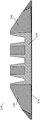
FIG. 1 shows a cross-sectional view of a tire tread according to one embodiment of the present invention.
FIG. 2 shows a cross-sectional view of a tire tread according to another embodiment.
FIG. 3 shows a cross-sectional view of a tire tread according to another embodiment.
FIG. 4 shows a cross-sectional view of a tire tread according to another embodiment.
FIG. 5 shows a cross-sectional view of a tire tread according to another embodiment.
FIG. 6 shows a cross-sectional view of a tire tread according to another embodiment.
Detailed Description
A pneumatic tire is disclosed comprising a carcass and a tread located radially outward of the carcass and extending between tire sidewalls; the tread providing a radially outermost tread running surface; the tread comprises a first tread layer comprising a first compound and a second tread layer comprising a second compound; wherein the second tread layer is positioned radially adjacent to the first tread layer; wherein the first compound is compositionally different from the second compound; wherein the second tread layer comprises one or more integrally formed extensions of the second tread layer extending radially outward of the tread cap; wherein each integrally formed extension of the second tread layer comprises a circumferentially continuous groove and a reinforced region disposed on a side of the groove;
wherein the primary compound comprises 100 parts by weight of at least one diene-based elastomer, and 1 to 150 phr of silica; and
the second compound comprises a diene-based elastomer, 50 to 120 phr of a filler, wherein at least 20phr of the filler is a high surface area carbon black having an iodine absorption value of at least 100 g/kg, 1 to 45 phr of a methylene acceptor, 1 to 25phr of a methylene donor, and 1 to 30 phr of at least one additive selected from a urethane resin, a liquid diene-based polymer having a number average molecular weight of 1000 to 25000, and an aromatic hydrocarbon resin.
Various embodiments of the tire tread are shown in fig. 1-6.
Fig. 1 shows one embodiment of a tire tread having a radially reinforcing extension of this second tread layer extending completely to the running surface and an axially extending second tread layer extending substantially completely across the tread. Referring to FIG. 1, a tire tread 10 shown in cross section includes a two-layer ground contacting tread including an outer tread 14 as a first tread layer positioned radially outward of an inner tread 16 as a second tread layer, with a base tread 34 positioned radially inward of the inner tread 16. The tread base 34 optionally includes axially outermost wings (wing) 32.
The tread 14 includes shoulder regions 30 located in the shoulder regions 31 and rib regions 28 located in the ribs 25. The inner tread 16 includes one or more grooves 20 extending circumferentially and continuously around the tire. Each groove 20 has a depth d measured radially from the ground contacting tread 12 to an innermost surface 22 of the groove. Each groove 20 is joined axially on each side by two reinforcing regions, the reinforcing region 24 being adjacent to the shoulder region 30 and the reinforcing region 26 being adjacent to the rib region 28. Each groove 20 and the two adjacent reinforced areas together comprise an integrally molded extension of the inner tread 16. By integrally molded, it is meant that the reinforced areas 24, 26 are an integral part of the inner tread 16 and are made of a unitary secondary rubber compound.
Each rib 25 comprises a rib region 28, the two reinforcing regions 26 being arranged on axially opposite sides of the rib region 28. The rib area 28 extends radially inward from the running surface 12 to a distance substantially equal to the distance d.
The tread 14 is made of a primary rubber compound. In the embodiment shown in fig. 1, the rib regions 28 and shoulder regions 30 are made from the same primary compound. In other embodiments, the rib regions 28 and shoulder regions 30 may be made from two or more different compounds.
Fig. 2 shows an embodiment of the tire tread, some of the radial reinforcing extensions of the second tread layer extending completely to the running surface, and some of the radial reinforcing extensions of the second tread layer extending partially toward the running surface, and the second tread layer extending axially substantially completely across the tread. Other such embodiments are contemplated, but are not shown for the sake of brevity. Referring now to FIG. 2, an alternative embodiment of a tire tread 210 is shown in which reinforced regions 224 and 226 are disposed on opposite sides of a groove 220, with two of the reinforced regions 226 disposed on axially opposite sides of a rib region 228 in a rib 225. The reinforced area 226 extends from the second tread layer 216 radially outward toward the tread cap 212 portion. The reinforced area 224 extends completely to the tread cap 212.
Fig. 3 shows an embodiment of the tire tread, the radial reinforcing extension of the second tread layer extending completely to the running surface, and the second tread layer portion extending axially across the tread, the shoulder regions extending from the tread base. Other such embodiments are contemplated, but are not shown for the sake of brevity. Fig. 3 shows another embodiment of a tire tread 310. The tread 310 includes shoulder regions 330 disposed on axially opposite sides of the second tread layer 316 and extending radially outward from a tread base 334, unlike the tread 10 of fig. 1 in which the shoulder regions 30 extend radially outward from the second tread layer 16.
Fig. 4 shows an embodiment of the tire tread with the radial reinforcing extensions of the second tread layer extending completely to the tread surface and the second tread layer portion extending axially across the tread and divided into axially distinct portions with shoulder regions extending from the tread base. Other such embodiments are contemplated, but are not shown for the sake of brevity. Fig. 4 shows another embodiment of the tire tread 410, where the second tread layer 416 is divided into axially distinct reinforcing portions 416a, 416b, each extending completely radially outward from the tread base 434 to the running surface 412. Accordingly, the rib region 428 of the first tread layer 414 also extends radially outward from the tread base 434 to the running surface 412.
Fig. 5 shows an embodiment of the tire tread, some of the radial reinforcing extensions of the second tread layer extending completely to the running surface and some of the radial reinforcing extensions of the second tread layer extending partially toward the running surface, and the second tread layer portion extending axially across the tread and divided into axially distinct portions, the shoulder regions extending from the tread base. Other such embodiments are contemplated, but are not shown for the sake of brevity. Fig. 5 shows another embodiment of this tire tread 510, where, unlike the tire tread 410, the axially distinct reinforced portion 516a includes reinforced areas 524, 526a that extend partially radially outward from the reinforced portion 516a toward the tread cap 512. Reinforcing portion 516b includes a partially extended reinforced area 526b and a fully extended reinforced area 526 c. In contrast, the reinforced regions 424, 426 of the reinforcing portions 416a, 416b extend completely to the running surface 412.
FIG. 6 shows an embodiment of the tire tread with some of the radial reinforcing extensions of the second tread layer extending fully to the running surface and some of the radial reinforcing extensions of the second tread layer extending partially toward the running surface and the second tread layer portion extending axially across the tread and dividing into axially distinct portions each disposed on a single side of a groove with shoulder regions extending from the tread base. Other such embodiments are contemplated, but are not shown for the sake of brevity. Fig. 6 shows an embodiment of the tire tread 610 in which the second tread layer 616 has reinforcing portions 616a, 616b comprising a single reinforced area. Reinforcing portion 616a includes a fully radially extending reinforced region 624 and reinforcing portion 616b includes a partially radially extending reinforced region 626. In this embodiment, the shoulder regions 630b are axially adjacent to the rib regions 628b in the first tread layer 614. Shoulder regions 630a and rib regions 628a are axially different in the first tread layer 614.
The primary compound used in the rib and shoulder regions of the tread is a relatively soft compound designed to have good rolling resistance and wet grip properties. The secondary compound used in the inner tread, including the reinforced areas, is a relatively hard compound designed to reinforce the ribs and grooves.
In one embodiment, the second compound comprises a diene-based elastomer, 50 to 120 phr of a filler, wherein at least 20phr of the filler is a high surface area carbon black having an iodine absorption value of at least 100 g/kg, 1 to 45 phr of a methylene acceptor, 1 to 25phr of a methylene donor, and 10 to 30 phr of at least one additive selected from a urethane resin, a liquid diene-based polymer having a number average molecular weight of 1000 to 25000, and an aromatic hydrocarbon resin.
The term "methylene acceptor" is known to those skilled in the art and is used to describe the reactant with which the methylene donor reacts to form what is believed to be a hydroxymethyl monomer. The methylol monomers produce the resin by a condensation reaction that forms methylene bridges. The initial reaction of the moiety that contributes to the subsequent formation of the methylene bridge is the methylene donor, where the other reactant is the methylene acceptor. Representative compounds that may be used as methylene acceptors include, but are not limited to, resorcinol derivatives, monohydric phenols and derivatives thereof, dihydric phenols and derivatives thereof, polyhydric phenols and derivatives thereof, unmodified phenol novolac resins, modified phenol novolac resins, phenolic resins, resorcinol novolac resins, and mixtures thereof. Examples of methylene acceptors include, but are not limited to, u.s. 6,605,670; U.S. 6,541,551; U.S. 6,472,457; U.S. 5,945,500; U.S. 5,936,056; U.S. 5,688,871; U.S. 5,665,799; U.S. 5,504,127; U.S. 5,405,897; U.S. 5,244,725; U.S. 5,206,289; U.S. 5,194,513; U.S. 5,030,692; U.S.4,889,481; U.S.4,605,696; those disclosed in U.S.4,436,853 and U.S.4,092,455. Examples of modified phenol novolac resins include, but are not limited to, cashew oil-modified phenol novolac resins, tall oil-modified phenol novolac resins, and alkyl-modified phenol novolac resins. In one embodiment, the methylene acceptor is a reactive phenolic resin. Suitable reactive phenolic resins include SMD 30207 from Schenectedy Chemicals.
Other examples of methylene acceptors include activated phenols obtained by ring substitution and cashew oil-modified novolac-type phenolic resins. Representative examples of activated phenols obtained by ring substitution include resorcinol, cresol, tert-butyl phenol, isopropyl phenol, ethyl phenol, and mixtures thereof. Cashew oil-modified novolac-type phenolic resins are commercially available under the name SP6700 from Schenectady Chemicals inc. The modification ratio of the oil based on the total novolac type phenol resin may be 10 to 50%. To produce a novolak-type phenolic resin modified with cashew oil, various methods can be employed. For example, phenols such as phenol, cresol and resorcinol can be reacted with aldehydes such as formaldehyde, paraformaldehyde and benzaldehyde using an acid catalyst. Examples of the acid catalyst include oxalic acid, hydrochloric acid, sulfuric acid, and p-toluenesulfonic acid. After the catalytic reaction, the resin is modified with the oil.
The amount of methylene acceptor in the secondary size may vary. In one embodiment, the amount of methylene acceptor is from 1 to 45 phr. In another embodiment, the amount of methylene acceptor is from 2 to 30 phr.
In situ resin formation in the secondary compound is involved in the reaction of the methylene acceptor with the methylene donor. The term "methylene donor" is intended to mean a compound capable of reacting with a methylene acceptor and generating the resin in situ. Examples of methylene donors suitable for use in the present invention include hexamethylenetetramine, hexamethoxymethylmelamine, hexaethoxymethylmelamine, imino-methoxymethylmelamine, imino-isobutoxymethylmelamine, lauryloxymethylpyridinium chloride, ethoxymethylpyridinium chloride trioxane and hexamethoxymethylmelamine. Furthermore, the methylene donor may be an N-substituted oxymethyl melamine of the formula:

wherein X is hydrogen or an alkyl group having 1 to 8 carbon atoms, R1、R2、R3、R4And R5Independently selected from hydrogen, alkyl groups having from 1 to 8 carbon atoms, the group-CH 2OX or condensation products thereof. Specific methylene donors include hexa- (methoxymethyl) melamine, N ', N "-trimethyl/N, N ', N" -trimethylol melamine, hexamethylol melamine, N ', N "-dimethylol melamine, N-methylol melamine, N ' -dimethylol melamine, N ', N" -tris (methoxymethyl) melamine, and N, N ', N "-tributyl-N, N ', N" -trimethylol-melamine. The N-methylol derivatives of melamine are prepared by known methods.
The amount of methylene donor that may be present in the secondary size may vary. In one embodiment, the amount of methylene donor present will be from about 1 phr to 25 phr. In one embodiment, the amount of methylene donor is about 2phr to 20 phr.
The second compound also comprises 10 to 30 phr of at least one additive selected from the group consisting of a urethane resin, a liquid diene-based polymer having a number average molecular weight of 1000 to 25000, and an aromatic hydrocarbon resin.
Suitable aromatic hydrocarbon resins include styrene/α -methylstyrene resins, coumarone-indene resins, and the like.
In one embodiment, the aromatic hydrocarbon resin is a copolymer resin of styrene and α -methylstyrene the suitable styrene/α -methylstyrene resin is derived from styrene and α -methylstyrene it is believed that in one aspect, its glass transition temperature (Tg) characteristics in combination with its molecular weight (Mn) and molecular weight distribution (Mw/Mn) provide the proper compatibility of the resin in the rubber composition, with the degree of compatibility being directly related to the properties of the rubber composition.
The presence of styrene/α -methylstyrene resin in the secondary compound is considered herein to be beneficial because of the observed viscoelastic properties of the tread rubber composition, such as complex and storage moduli, loss moduli, tan δ, and loss compliance at different temperatures/frequencies/strains (as generally described hereinafter).
The properties of complex and storage moduli, loss moduli, tan delta and loss compliance are understood to be generally known to those skilled in the art. They are generally described below.
The molecular weight distribution of the resin may be expressed as a ratio of the weight average molecular weight (Mw) to the number average molecular weight (Mn) value of the resin, and is considered herein to be in the range of about 1.5/1 to about 2.5/1, which is considered to be a relatively narrow range. This is believed to be advantageous because of the selective compatibility with the polymer matrix, and because the tire is expected to be used under wet and dry conditions over a wide temperature range.
The glass transition temperature Tg of the copolymer resin is considered herein to be in the range of about 20 ℃ to about 100 ℃, or about 30 ℃ to about 80 ℃, depending to some extent on the intended use of the tire being made and the nature of the polymer blend used in the tire tread. A suitable method for measuring TG of a resin is DSC according to ASTM D6604 or equivalent.
The styrene/α -methylstyrene resin is considered herein to be a relatively short chain copolymer of styrene and α -methylstyrene, the styrene/α -methylstyrene molar ratio being from about 0.40 to about 1.50.
Thus, contemplated styrene/α -methylstyrene resins can be characterized, for example, by their chemical structure (i.e.their styrene and α -methylstyrene contents) and softening point and, if desired, by their glass transition temperature, molecular weight and molecular weight distribution.
In one embodiment, the styrene/α -methylstyrene resin is comprised of from about 40 to about 70 percent of units derived from styrene and correspondingly from about 60 to about 30 percent of units derived from α -methylstyrene in one embodiment, the styrene/α -methylstyrene resin has a softening point according to ASTM number E-28 of from about 80 ℃ to about 145 ℃.
In one embodiment, the amount of styrene/α -methylstyrene resin in the secondary compound is from 5 to 25phr in one embodiment, the amount of styrene/α -methylstyrene resin in the secondary compound is from 10 to 20 phr.
Suitable styrene/α -methylstyrene resins are commercially available from Eastman as Resin 2336 or Arizona Chemical as Sylvares SA 85.
In one embodiment, the secondary size comprises a mixture derived from a monofunctional or multifunctional aldehyde A and having at least one urethane group-O-CO-NH2A carbamate resin of an organic compound C with an organic group, wherein the group may be a monovalent group R selected from linear, branched or cyclic aliphatic groups having 1 to 30 carbon atoms and aralkyl groups, or a divalent organic group-R' -, selected from linear, branched or cyclic aliphatic divalent groups having 2 to 30 carbon atoms and dialkylaryl groups having 8 to 30 carbon atoms.
In one embodiment, R has 2 to 8 carbon atoms.
In one embodiment, aliphatic urethanes are used as compound C, which are selected from the group consisting of ethyl carbamate, butyl carbamate, hexyl carbamate, and 2-ethylhexyl carbamate.
In one embodiment, an araliphatic carbamate is used as compound C, which is selected from benzyl carbamate and α -dimethylbenzyl carbamate.
In one embodiment, a diurethane is used as compound C, which is selected from ethylene dicarbamate, 1, 2-propylene dicarbamate, 1, 3-propylene dicarbamate, and 1, 4-butylene dicarbamate.
In one embodiment, a dicarbamate is used as compound C, which is selected from the group consisting of xylylene dicarbamate and tetramethylxylylene dicarbamate.
In one embodiment, a monofunctional aldehyde is used as aldehyde a, which is selected from the group consisting of formaldehyde, acetaldehyde, propionaldehyde, butyraldehyde, n-valeraldehyde, and n-hexanal.
In one embodiment, a multifunctional aldehyde is used as aldehyde a, which is selected from the group consisting of glyoxal, malondialdehyde, succindialdehyde, and glutaraldehyde.
In one embodiment, the urethane resin is derived from n-butyl carbamate and formaldehyde.
In one embodiment, the amount of urethane resin (if any) in the secondary size is from 1 to 15 phr. In one embodiment, the amount of urethane resin (if any) in the secondary size is from 2 to 10 phr.
Suitable urethane resins are commercially available from Allnex as Alnovol UF410 and the like.
In one embodiment, the second rubber composition comprises a liquid polymer.
Suitable liquid polymers should have double bonds that can react with sulfur and the polymer matrix to form crosslinks. These crosslinks will prevent the plasticizer from migrating to the surrounding gum, thereby maintaining the tensile properties and durability of the reinforcing component.
Suitable liquid polymers are derived from conjugated diene (or diene) monomers. Such liquid polymers may also contain repeat units derived from other monomers capable of copolymerizing with the conjugated diene monomer. For example, the liquid polymer may also contain repeat units derived from a vinyl aromatic monomer such as styrene. Polybutadiene rubber, polyisoprene rubber, styrene-butadiene rubber, isoprene-butadiene rubber, styrene-isoprene rubber and styrene-isoprene-butadiene rubber are some representative examples of polymers that may be used as the liquid polymer.
The liquid polymer is a low molecular weight rubbery polymer of conjugated diene monomer. These low molecular weight rubbery polymers also typically consist of repeating units derived from one or more conjugated diene monomers. Such low molecular weight rubbers may of course also contain repeat units derived from other monomers capable of copolymerizing with the conjugated diene monomer. For example, the low molecular weight rubbery polymer may contain repeat units derived from vinyl aromatic monomers such as styrene. Low molecular weight polybutadiene rubber, low molecular weight polyisoprene rubber, low molecular weight styrene-butadiene rubber, low molecular weight isoprene-butadiene rubber, low molecular weight styrene-isoprene rubber and low molecular weight styrene-isoprene-butadiene rubber are some representative examples of low molecular weight rubbery polymers that can be modified to make the wetting agent of the present invention. The low molecular weight rubbery polymer will generally have a number average molecular weight of from about 1000 to about 25,000. More typically, the low molecular weight rubbery polymer will have a number average molecular weight of from about 2000 to about 15,000.
The number average molecular weight can be measured by Gel Permeation Chromatography (GPC) using polystyrene calibration standards, as done according to ASTM 3536. GPC is a well-known method in which polymers are separated according to molecular size, with the largest molecule eluting first. The chromatograph was calibrated with commercially available polystyrene molecular weight standards. The detector used is preferably an ultraviolet detector. The fraction of strands present as single strands was determined as the ratio of the area under the GPC curve, i.e., (single strand peak area)/(total area).
Suitable liquid polymers are commercially available, for example, as Ricon @, from Cray Valley/Total.
An additive selected from the group consisting of a urethane resin, a liquid diene-based polymer having a number average molecular weight of 1000 to 25000, and an aromatic hydrocarbon resin is present in the second compound in an amount of 1 to 30 phr. In one embodiment, the additive is present in the secondary compound in an amount of 10 to 20 phr.
The first and second compounds independently comprise one or more rubbers or elastomers containing ethylenically unsaturated groups. The phrase "rubber or elastomer containing ethylenically unsaturated groups" or "diene-based elastomer" is intended to include natural rubber as well as various virgin and recycled forms thereof as well as various synthetic rubbers. In the description of the present invention, the terms "rubber" and "elastomer" may be used interchangeably, unless otherwise specified. The terms "rubber composition," "rubber compound," and "compound" are used interchangeably to refer to rubber that has been blended or mixed with various ingredients and materials, such terms being well known to those skilled in the art of rubber mixing or rubber compounding. Representative synthetic polymers are the homopolymerization products of butadiene and its homologues and derivatives (e.g., methylbutadiene, dimethylbutadiene and pentadiene), as well as copolymers such as those formed from butadiene or its homologues or derivatives with other unsaturated monomers. The latter are in particular acetylenes, such as vinylacetylene; olefins, such as isobutylene, which copolymerizes with isoprene to form butyl rubber; vinyl compounds such as acrylic acid, acrylonitrile (which polymerize with butadiene to form NBR), methacrylic acid, and styrene (the latter compound polymerizes with butadiene to form SBR), as well as vinyl esters and various unsaturated aldehydes, ketones, and ethers such as acrolein, methyl isopropenyl ketone, and vinyl ethyl ether. Specific examples of synthetic rubbers include neoprene (polychloroprene), polybutadiene (including cis-1, 4-polybutadiene), polyisoprene (including cis-1, 4-polyisoprene), butyl rubber, halobutyl rubber (e.g., chlorobutyl rubber or bromobutyl rubber), styrene/isoprene/butadiene rubber, copolymers of 1, 3-butadiene or isoprene with monomers such as styrene, acrylonitrile, and methyl methacrylate, as well as ethylene/propylene terpolymers, also known as ethylene/propylene/diene monomer (EPDM), and, in particular, ethylene/propylene/dicyclopentadiene terpolymers. Other examples of rubbers that may be used include alkoxy-silyl end-functionalized solution polymerized polymers (SBR, PBR, IBR, and SIBR), silicon-coupled, and tin-coupled star-branched polymers. Preferred rubbers or elastomers are polyisoprene (natural or synthetic), polybutadiene and SBR.
In one aspect, the at least one additional rubber is preferably at least two diene-based rubbers. For example, combinations of two or more rubbers are preferred, such as cis-1, 4-polyisoprene rubber (natural or synthetic, although natural is preferred), 3, 4-polyisoprene rubber, styrene/isoprene/butadiene rubber, emulsion and solution polymerization derived styrene/butadiene rubber, cis-1, 4-polybutadiene rubber and emulsion polymerization prepared butadiene/acrylonitrile copolymers.
In one aspect of the invention, an emulsion polymerization derived styrene/butadiene (E-SBR) may be used that has a relatively conventional styrene content of about 20% to about 28% bound styrene, or for some applications, an E-SBR having a medium to relatively high bound styrene content, i.e., a bound styrene content of about 30% to about 45%.
Emulsion polymerization prepared E-SBR means that styrene and 1, 3-butadiene are copolymerized in the form of an aqueous emulsion. As is well known to those skilled in the art. The bound styrene content may vary, for example, from about 5 to about 50%. In one aspect, the E-SBR can also contain acrylonitrile to form a terpolymer rubber, such as E-SBAR, for example, in an amount of about 2 to about 30 weight percent bound acrylonitrile in the terpolymer.
Emulsion polymerization prepared styrene/butadiene/acrylonitrile copolymer rubbers containing from about 2 to about 40 weight percent bound acrylonitrile in the copolymer are also contemplated as diene-based rubbers for use in the present invention.
Solution polymerization prepared SBR (S-SBR) typically has a bound styrene content of about 5 to about 50%, preferably about 9 to about 36%. The S-SBR may be conveniently prepared, for example, by organolithium catalysis in the presence of an organic hydrocarbon solvent.
In one embodiment, cis-1, 4-polybutadiene rubber (BR) may be used. Such BR can be prepared, for example, by organic solution polymerization of 1, 3-butadiene. The BR can be conveniently characterized by having a cis-1, 4 content of at least 90%.
Such cis-1, 4-polyisoprene and cis-1, 4-polyisoprene natural rubber are well known to those skilled in the rubber art.
The term "phr" as used herein and in accordance with conventional practice means "parts by weight of a respective material per 100 parts by weight of rubber or elastomer".
The primary and secondary compounds may also independently contain up to 70 phr of process oil. Process oil may be included in the rubber composition as an extender oil commonly used to extend elastomers. Process oil may also be included in the rubber composition by adding the oil directly during rubber compounding. The process oil used may include extender oil present in the elastomer and process oil added during compounding. Suitable process oils include various oils known in the art, including aromatic, paraffinic, naphthenic, vegetable and low PCA oils, such as MES, TDAE, SRAE and heavy naphthenic oils. Suitable low PCA oils include those having a polycyclic aromatic content of less than 3 weight percent as determined by the IP346 method. Procedures for the IP346 method can be found in Standard methods for Analysis & Testing of Petroleum and Related Products and British Standard 2000 Parts, 2003, 62 nd edition (published by Institute of Petroleum, United Kingdom).
The first and second compounds may independently comprise silica, carbon black, or a combination of silica and carbon black.
The first and second compounds may independently comprise from about 1 to about 150 phr silica. In another embodiment, from 10 to 100 phr of silica may be used.
Commonly used siliceous pigments that can be used in the size include conventional pyrogenic and precipitated siliceous pigments (silica). In one embodiment, precipitated silica is used. Conventional siliceous pigments used in the present invention are precipitated silicas such as those obtained by the acidification of a soluble silicate, e.g., sodium silicate.
Such conventional silicas can be characterized, for example, by having a BET surface area measured using nitrogen. In one embodiment, the BET surface area is from about 40 to about 600 square meters per gram. In another embodiment, the BET surface area is from about 80 to about 300 square meters per gram. The BET method for measuring surface area is described in the Journal of the American chemical Society, volume 60, page 304 (1930).
Conventional silicas may also be characterized by having a Dibutylphthalate (DBP) absorption value of about 100 to about 400, or about 150 to about 300.
Conventional silicas can be expected to have an average final particle size, as determined by electron microscopy, of, for example, 0.01 to 0.05 microns, although the size of the silica particles can be even smaller, or possibly larger.
Various commercially available silicas may be used, such as, for example only and without limitation, silicas commercially available from PPG Industries under the Hi-Sil trademark under the names 210, 243, etc.; silicas available from Rhodia under the names Z1165MP and Z165GR, for example; and silicas available from Degussa AG under the names VN2 and VN3, for example, and the like. Silica pretreated or pre-reacted with organosilanes, such as Agilon 400 from PPG, and the like, may also be used.
Carbon blacks which are generally used may be used as conventional fillers in amounts of from 1 to 150 phr in combination with silica. In another embodiment, from 10 to 100 phr of carbon black may be used. Although carbon black may be used with silica, in one embodiment, carbon black is substantially not used except in the amount required to impart black color to the tire (which is from 1 to 10 phr). Representative examples of such carbon blacks include N110, N121, N134, N220, N231, N234, N242, N293, N299, N315, N326, N330, M332, N339, N343, N347, N351, N358, N375, N539, N550, N582, N630, N642, N650, N683, N754, N762, N765, N774, N787, N907, N908, N990 and N991. These carbon blacks have iodine absorption values of 9 to 145 g/kg and DBP numbers of 34 to 150 cc/100 g.
In one embodiment, the secondary compound includes up to 20phr of the high surface area carbon black. Such high surface area carbon blacks may be characterized by their iodine absorption values (as measured by ASTM D-1510 or equivalent methods). In one embodiment, the high surface area carbon black has an iodine absorption value of at least 100 mg/g. In one embodiment, the high surface area carbon black has an iodine absorption value of at least 180 mg/g. Suitable high surface area carbon blacks may be obtained from Cabot as Vulcan CRX 1391.
A combination of silica and carbon black may be used in the composition. In one embodiment, the weight ratio of silica to carbon black is greater than or equal to 1.
Other fillers may be used in the first and second compounds, independently including, but not limited to, particulate fillers including Ultra High Molecular Weight Polyethylene (UHMWPE), crosslinked particulate polymer gels including, but not limited to, U.S. Pat. nos. 6,242,534; 6,207,757; 6,133,364; 6,372,857, respectively; 5,395,891 or 6,127,488, and plasticized starch composite fillers including, but not limited to, those disclosed in U.S. patent No. 5,672,639. Such other fillers may be used in amounts of 1 to 30 phr.
In one embodiment, the first and second compounds may independently contain conventional sulfur containing organosilicon compounds. In one embodiment, the sulfur containing organosilicon compound is a 3,3' -bis (trimethoxy or triethoxysilylpropyl) polysulfide. In one embodiment, the sulfur containing organosilicon compound is 3,3 '-bis (triethoxysilylpropyl) disulfide and/or 3,3' -bis (triethoxysilylpropyl) tetrasulfide.
In another embodiment, suitable sulfur containing organosilicon compounds include those disclosed in U.S. Pat. No. 6,608,125. In one embodiment, the sulfur containing organosilicon compound comprises 3- (octanoylthio) -1-propyltriethoxysilane, CH3(CH2)6C(=O)-S-CH2CH2CH2Si(OCH2CH3)3It is commercially available as NXT from MomentivePerformance Materials.
In another embodiment, suitable sulfur containing organosilicon compounds include those disclosed in U.S. patent publication No. 2003/0130535. In one embodiment, the sulfur containing organosilicon compound is Si-363 from Degussa.
The amount of sulfur containing organosilicon compound in the first and second compounds will vary independently depending on the level of other additives used. In general, the amount of the compound will be from 0.5 to 20 phr. In one embodiment, the amount will be from 1 to 10 phr.
It will be readily understood by those skilled in the art that the first and second compounds are independently compounded by methods generally known in the rubber compounding art, such as mixing the various sulfur-vulcanizable constituent rubbers with various commonly used additive materials such as sulfur donors, curing aids (such as activators and retarders) and processing additives (such as oils), resins including tackifying resins and plasticizers, fillers, pigments, fatty acids, zinc oxide, waxes, antioxidants and antiozonants, and peptizing agents. As known to those skilled in the art, depending on the intended use of the sulfur-vulcanizable and sulfur-vulcanized material (rubber), the additives mentioned above are selected and generally used in conventional amounts. Representative examples of sulfur donors include elemental sulfur (free sulfur), amine disulfides, polymeric polysulfides, and sulfur olefin adducts. In one embodiment, the sulfur-vulcanizing agent is elemental sulfur. The sulfur-vulcanizing agent may be used in an amount of 0.5 to 8 phr, or 1.5 to 6 phr. Typical amounts of tackifying resins, if used, comprise about 0.5 to about 10phr, usually about 1 to about 5 phr. Typical amounts of processing aids include about 1 to about 50 phr. Typical amounts of antioxidants comprise about 1 to about 5 phr. Representative antioxidants may be, for example, diphenyl-p-phenylenediamine and The like, such as those disclosed in The Vanderbilt rubber handbook (1978), pages 344 to 346. Typical amounts of antiozonants include about 1 to 5 phr. Typical amounts of fatty acids (which may include stearic acid), if used, include about 0.5 to about 3 phr. Typical amounts of zinc oxide include about 2 to about 5 phr. Typical amounts of wax include about 1 to about 5 phr. Microcrystalline waxes are typically used. Typical amounts of peptizers include about 0.1 to about 1 phr. Typical peptizers may be, for example, pentachlorothiophenol and dibenzamidodiphenyl disulfide.
Accelerators are used to control the time and/or temperature required for vulcanization and to improve the properties of the vulcanizate. In one embodiment, a single accelerator system, i.e., a primary accelerator, may be used. The primary accelerator(s) may be used in amounts of about 0.5 to about 4 phr, or about 0.8 to about 1.5 phr. In another embodiment, a combination of primary and secondary accelerators may be used, with the secondary accelerators being used in smaller amounts (e.g., about 0.05 to about 3 phr) to activate and improve the properties of the vulcanized rubber. Combinations of these accelerators are expected to produce synergistic effects on the final properties and are slightly better than those produced by either accelerator alone. In addition, delayed action accelerators may be used which are not affected by normal processing temperatures but give satisfactory cures at ordinary curing temperatures. Vulcanization retarders may also be used. Suitable types of accelerators that can be used in the present invention are amines, disulfides, guanidines, thioureas, thiazoles, thiurams, sulfenamides, dithiocarbamates and xanthates. In one embodiment, the primary accelerator is a sulfenamide. If a secondary accelerator is used, the secondary accelerator may be a guanidine, dithiocarbamate or thiuram compound.
In one embodiment, the primary size comprises a combination of: less than 50 phr of a viscoelastic immiscible blend of a filler and a polymer consisting of a first rubber having a glass transition temperature higher than-25 ℃ and a second rubber having a glass transition temperature lower than-40 ℃. The low Tg second rubber should form a continuous or co-continuous phase and the higher Tg first rubber forms a dispersed or co-continuous phase. When referred to herein, reference to the glass transition temperature or Tg of an elastomer or elastomer composition represents the glass transition temperature of the corresponding elastomer or elastomer composition in its uncured state or, in the case of an elastomer composition, may be in the cured state. The Tg can be suitably determined by Differential Scanning Calorimeter (DSC) as the peak midpoint at a temperature ramp rate of 10 ℃/minute.
Examples of first rubbers are 3, 4-polyisoprene or styrene-butadiene rubbers having a bound styrene content of more than 45% by weight. Suitable 3, 4-polyisoprene is available as Isogrip (Tg = -10 ℃) from Karbochem. Suitable styrene-butadiene rubbers may be prepared via solution or emulsion polymerization as is known in the art.
In one embodiment, the first rubber is an emulsion polymerized styrene-butadiene rubber comprising greater than 45 weight percent bound styrene, greater than 98 percent styrene-derived repeat units in a block comprising less than five repeat units, and a Tg greater than-25 ℃.
The emulsion styrene-butadiene rubber (ESBR) is composed of repeat units derived from 1, 3-butadiene and styrene. These styrene-butadiene rubbers will contain at least 45% by weight of units derived from styrene and less than 55% by weight of units derived from 1, 3-butadiene. "units derived from … …" refers to the monomer residues present in the polymer after polymerization of styrene and 1, 3-butadiene monomers.
In the ESBR, the distribution of repeating units derived from styrene and butadiene is substantially random. The term "random" as used herein means that less than 5% of the total amount of repeat units derived from styrene are in blocks containing five or more styrene repeat units. In other words, more than 95% of the repeat units derived from styrene are in blocks containing less than five repeat units. A significant number of repeat units derived from styrene will be in blocks containing only one styrene repeat unit. Such a block containing one styrene repeating unit is bonded on both sides by repeating units derived from 1, 3-butadiene.
In the ESBR, less than 2% of the total amount of repeating units derived from styrene is in a block containing five or more styrene repeating units. In other words, more than 98% of the repeat units derived from styrene are in blocks containing less than five repeat units. In one embodiment, less than 1% of the total amount of repeat units derived from styrene are in a block containing five or more styrene repeat units. In one embodiment, less than 0.5% of the total amount of repeat units derived from styrene are in blocks containing five or more styrene repeat units.
Characterization of styrene repeat units (also referred to as "styrene block length" or "styrene sequence") in styrene-butadiene Rubber can be carried out using ozonolysis methods according to the procedure of Tanaka et al, Rubber chem, technol. 1986, volume 59, page 16, as follows. Chemical degradation was used to obtain a heterogeneous characterization of styrene-butadiene polymers. This is achieved by the following method: ozonolysis of the dried polymer followed by GC (gas chromatography) and GPC (gel permeation chromatography) analysis. In this procedure, a 0.5 grain rubber sample was dissolved in toluene and cooled to 10 ℃ and subjected to an ozone atmosphere generated by an ozone generator apparatus. The resulting solution was collected and subjected to GC column chromatography, where the individual peaks were separated and characterized by GPC. The molecular weight of each peak was used to determine the number of styrene repeat units.
Styrene-butadiene rubbers suitable as first rubber may be prepared, for example, in a continuous process in a plurality of CSTRs according to the procedure disclosed in US 6,458,884.
The ESBR as the first rubber has a glass transition temperature of greater than-25 ℃. When referred to herein, reference to the glass transition temperature or Tg of an elastomer or elastomer composition represents the glass transition temperature of the corresponding elastomer or elastomer composition in its uncured state or, in the case of an elastomer composition, may be in the cured state. The Tg may suitably be determined by Differential Scanning Calorimetry (DSC) as the mid-point of the peak at a temperature rise rate of 10 ℃/minute, for example according to ASTM D7426 or equivalent.
An example of a secondary rubber is natural rubber, high cis synthetic polyisoprene, or high cis polybutadiene. In one embodiment, the second rubber is a polybutadiene having a cis-1, 4 content of greater than 95% and a Tg of-80 to-110 ℃. Suitable polybutadiene rubbers may be prepared, for example, by organic solution polymerization of 1, 3-butadiene. The BR can be conveniently characterized, for example, by having a cis-1, 4 content of at least 90% and a glass transition temperature Tg of about-95 ℃ to about-105 ℃. Suitable polybutadiene rubbers are commercially available as Budene ® 1229, commercially available from Goodyear, having a Tg of-108 ℃ and a cis-1, 4 content of 96%.
In this embodiment, the first compound optionally comprises a tackifying resin, such as an alkylphenol-formaldehyde resin or an alkylphenol-acetylene resin.
In such embodiments of the primary rubber compound, a rubber composition having at least two polymer phases may be obtained using a suitable primary rubber and a suitable secondary rubber having a particular composition.
In this manner, it is believed herein that the relatively low Tg second rubber is relatively incompatible or immiscible with the relatively high Tg first rubber as evidenced by their respective Tan δ vs. Tan δ peaks on a graphical representation or plot of the cure temperature of the rubber composition over a temperature range encompassing the full transition temperatures of the two polymers, which is typically about-110 ℃ to about +150 ℃. The term "transition temperature" is meant to include the glass transition temperature Tg and the melting temperature Tm (in the case of crystalline or partially crystalline materials).
Thus, the polymer of the rubber composition may be present in at least two phases, including a first rubber phase and a second rubber phase.
In particular, the plot of the Tan δ vs. temperature curve of the first rubber composition over a wide range of-110 ℃ to 150 ℃ in this embodiment can obtain two peaks in the curve, one peak having a peak in a relatively low temperature range corresponding to the second rubber, the peak of the second peak being in a higher temperature range corresponding to the first rubber.
Thus, one indication of polymer incompatibility is the presence of dual Tan δ peaks for the cured elastomeric composition. The Tan delta values (including the peaks in their curves) can be determined by dynamic mechanical testing of the cured compound by procedures well known to those skilled in the art.
Alternatively, the immiscibility of the first rubber with the second rubber can be seen by the naked eye, such as using an atomic force microscope or the like. Micrographs of the rubber composition can show distinct polymeric phases of the first rubber and the second rubber, typically as dispersed phase domains of the first rubber in a continuous phase of the second rubber.
The mixing of the first and second compounds may be achieved independently by methods known to those skilled in the art of rubber mixing. For example, the ingredients are typically mixed in at least two stages, at least one non-productive stage and a subsequent productive mixing stage. The final curatives, including the sulfur-curatives, are typically mixed in a final stage, conventionally referred to as a "productive" mixing stage, where mixing typically occurs at a temperature, or final temperature, that is lower than the mixing temperature(s) of the previous non-productive mixing stage(s). The terms "non-productive" and "productive" mixing stages are well known to those skilled in the art of rubber mixing. The rubber composition may be subjected to a thermomechanical mixing step. The thermomechanical mixing step typically includes mechanical operation in a mixer or extruder for a suitable period of time to produce a rubber temperature of 140 ℃ to 190 ℃. The appropriate duration of the thermomechanical working varies with the operating conditions, the volume and the nature of the components. For example, the thermomechanical working may be from 1 to 20 minutes.
The pneumatic tire of the present invention may be a racing tire, a passenger tire, an airplane tire, an agricultural tire, a bulldozer tire, an off-the-road tire, a truck tire, or the like. In one embodiment, the tire is a passenger or truck tire. The tire may also be a radial or bias tire.
The vulcanization of the pneumatic tire of the present invention is generally carried out at a conventional temperature of about 100 ℃ to 200 ℃. In one embodiment, the vulcanization is carried out at a temperature of about 110 ℃ to 180 ℃. Any conventional vulcanization method may be used, such as heating in a press or mold, heating with superheated steam or hot air. Such tires may be manufactured, shaped, molded and cured by various methods known and well-defined to those skilled in the art.
The invention is illustrated by the following examples which are merely illustrative and not to be construed as limiting the scope or manner in which the invention may be practiced. Parts and percentages are by weight unless otherwise explicitly stated.
Examples
In examples 1-5 below, combinations of various resins in rubber compositions that can be used as secondary compounds are illustrated. A series of sizes were mixed in a multi-step mixing procedure according to the formulations given in tables 1,3, 5,7, 9 and 11. The compounds were tested for various physical properties and the results are given in tables 2,4, 6,8, 10 and 12. As seen in the table, the use of the claimed resin shows advantageous properties as indicated by 300% modulus, elongation, tensile strength and hardness.
Example 1
TABLE 1
Sample number 1234
Polybutadiene 10101010
Styrene-butadiene copolymer (oil extended) 97.597.597.597.5
Carbon black150 50 50 50
Silicon dioxide 20202020
Silane 2222
Phenolic resin220 20 20 20
Hexamethylene tetramine 3333
Styrene- α -methylstyrene resin38 12 16 8
Amino-formic acid resin40 0 0 4
Wax 1.51.51.51.5
Antioxidant 3333
Stearic acid 3333
Processing aid 2222
Zinc oxide 2.52.52.52.5
Sulfur 1.61.61.61.6
N-tetrabutyl-2-benzothiazolesulfenamide 1.631.631.631.63
N-Cyclohexylthiophthalimide 0.30.30.30.3
1Vulcan CRX 1391 from Cabot having an iodine value of 202 mg/g
2SMD 30207 from Schenectedy Chemicals
3Resin 2336 from Eastman
4Alnovol UF410 from Allnex.
TABLE 2
Sample number 1234
300% modulus (MPa) 11.510.610.510.9
Elongation at break (%) 329359390426
Tensile Strength (MPa) 11.811.612.814.1
Shore A 83.3 81.8 83 85.6
Minimum viscosity (Mooney unit) 53.550.946.949.2
Torque at 4 minutes (mooney unit) 53.65147.149.3.
Example 2
TABLE 3
Sample number 56789
Polybutadiene 2020202020
Natural rubber 8080808080
Carbon black 5050505050
Wax 1.51.51.51.51.5
Antidegradants 2.52.52.52.52.5
Ricon 18450 15 0 35 0
Ricon 10060 0 15 0 35
Oil 150000
Stearic acid 33333
Silicon dioxide 2020202020
Silane disulfide 22222
Phenolic resin 2020202020
Fatty acid soap 22222
Hexamethylene tetramine 33333
Antidegradants 0.50.50.50.50.5
Sulfenamide accelerator 2.362.362.362.362.36
Zinc oxide 2.52.52.52.52.5
Sulfur 1.61.61.61.61.6
Vulcanization inhibitor 0.30.30.30.30.3
5Liquid styrene-butadiene, Mn =8600
6Liquid styrene-butadiene, Mn = 4000.
TABLE 4
Sample number 56789
300% modulus MPa 10.110.110.17.97.1
Elongation at break% 508518508481502
Tensile strength MPa 17.617.817.712.712
Shore A hardness 8685.486.689.390.6
Minimum viscosity Mooney unit 37.14041.239.341.7
Torque mooney unit at 4 minutes 37.340.241.440.641.9.
Example 3
TABLE 5
Sample number 10111213
Polybutadiene 20202020
Natural rubber 80808080
Carbon black 50505050
Alkyl phenol-formaldehyde resin70 0 0 20
Exxon PR-383820 0 0 0
Exxon PR-39590 20 0 0
Benzofuran-indene resins100 0 20 0
Styrene- α -methylstyrene resin 00010
Carbamic acid resin 3333
Wax 1.51.51.51.5
Antidegradants 2.52.52.52.5
Ricon® 184 10 10 1 0
Stearic acid 3333
Solvay Premium SW silica 30303030
Silane disulfide 3.93.93.93.9
Phenolic resin 20202020
Fatty acid salt 2222
Hexamethylene tetramine 3333
Antidegradants 0.50.50.50.5
Sulfenamide accelerator 2.362.362.362.36
Zinc oxide 2.52.52.52.5
Sulfur 1.61.61.61.6
Vulcanization inhibitor 0.30.30.30.3
7Octyl phenol Formaldehyde resin as SP-1068 from the SI Group
8Aromatic hydrocarbon resin, Oppera PR 383 from Exxon
9Aromatic hydrocarbon resin from Exxon Oppera Pr 395 in size
10Cumar R-13 from Neville.
TABLE 6
Sample number 10111213
300% modulus MPa 76.95.67.1
Elongation at break% 513521520441
Tensile strength MPa 11.8129.49.9
Shore A hardness 8886.693.293.6
Minimum viscosity Mooney unit 3737.340.134.8
Torque mooney unit at 4 minutes 3737.440.134.9.
Example 3
TABLE 7
Sample No. 1415
Polybutadiene 2020
Natural rubber 8080
Carbon black 4040
Alkylphenol formaldehyde resin 2020
Wax 1.51.5
Antidegradants 2.52.5
Stearic acid 33
Solvay Premium SW silica 3030
Silane disulfide 3.93.9
Phenolic resin 2020
Hexamethylene tetramine 36
Antidegradants 0.50.5
Sulfenamide accelerator 2.362.36
Zinc oxide 2.52.5
Sulfur 1.61.6
A vulcanization inhibitor 0.30.3.
TABLE 8
Sample No. 1415
300% modulus MPa 9.510.3
Elongation at break% 510499
Tensile strength MPa 15.716.2
Minimum viscosity Mooney unit 38.339.5
Torque mooney unit at 4 minutes 38.539.5
Shore A hardness 90.591.9.
Example 4
TABLE 9
Sample No. 1617
Polybutadiene 2020
Natural rubber 8080
Carbon black 5050
Alkylphenol formaldehyde resin 300
Alkylphenol acetylene resin110 30
Urethane resin 33
Wax 1.51.5
Antidegradants 2.52.5
Stearic acid 33
Solvay Premium SW silica 3030
Silane disulfide 3.93.9
Phenolic resin 2020
Hexamethylenetetramine 33
Antidegradants 0.50.5
Sulfenamide accelerator 2.362.36
Zinc oxide 2.52.5
Sulfur 1.61.6
Vulcanization inhibitor 0.30.3
11SMD 31144 from SI Group.
Sample No. 1617
300% modulus MPa 87.7
Elongation at break% 460454
Tensile strength MPa 11.711.1
Shore A hardness 95.294.3
Minimum viscosity Mooney unit 30.736.3
Torque mooney unit at 4 minutes 30.836.3.
Example 5
TABLE 11
Sample number 18
Polybutadiene 20
Natural rubber 80
Carbon Black 50
Alkylphenol formaldehyde resin 20
Carbamic acid resin 3
Wax 1.5
Antidegradants 2.5
Ricon 184 10
Stearic acid 3
Solvay Premium SW 30
Silane disulfide 3.9
Phenolic resin 20
Fatty acid salt 2
Hexamethylenetetramine 3
Antidegradants 0.5
Sulfenamide accelerator 2.36
Zinc oxide 2.5
Sulfur 1.6
0.3 parts of vulcanization inhibitor.
TABLE 12
Sample number 18
300% modulus MPa 6.5
Elongation at break% 507
Tensile strength MPa 10.8
Shore A 94.2
Minimum viscosity Mooney Unit 31.3
Torque mooney at 4 minutes 31.4.
Example 6
In this example, tires T2 and T3 having treads comprised of first and second tread layers were compared with a control tire T1 having a tread of single-layer structure. All tires contained the same primary rubber compound. Tire T2 was constructed using a tread design as shown in fig. 1. According to the teachings of U.S. patent No. 8919404, comparative tire T2 included a secondary compound as a reinforcing secondary layer. The tire T3 of the present invention contained the secondary compound given in example 5. The results of the tire tests are given in table 13. As can be seen in table 13, the tire T3 exhibited superior cornering stiffness compared to the control tire T1 and the comparative tire T2.
Watch 13
Example 7
In this example, combinations of the first and second rubbers useful in the first rubber composition are illustrated.
TABLE 14
Sample number 192021222324
SSBR10 0 20 40 0 0
3, 4-polyisoprene220 40 0 0 0 0
Natural rubber 806080608060
ESBR30 0 0 0 20 40
Tackifying resins46 6 6 6 6 6
Wax 22221.51.5
Fatty acid soap 222222
Zinc oxide 333333
Fatty acid 333333
Silica, silane pretreated540 40 40 40 0 0
Silicon dioxide60 0 0 0 30 30
Silane70 0 0 0 3 3
Silane80 0 0 0 2 2
Antidegradants, amines and quinolines 44443.53.5
Sulfur 1.41.41.41.41.21.2
Sulfenamide 2.22.22.22.233
Vulcuren®90.25 0.25 0.25 0.25 0.25 0.25
Diphenylguanidine 00001.51.5
1Solution polymerized SBR, 21% styrene, 62% vinyl 1,2, Tg-25 ℃ as Springan 4602 from Trinseo
2Isogrip from Karbochem-
3ESBR, 50.8% (by weight) styrene, 8.2% vinyl 1, 2; 4.2% cis 1, 4; 36.8% trans 1, 4; tg (inflection point) = -13 ℃; 1% styrene sequence is more than or equal to 5; from Goodyear Tires&Rubber Co.
4Non-reactive alkylphenol/formaldehyde resins from the SI Group as SP 1068
5Agilon 400 from PPG @
6Zeosil Premium 200MP from Solvay
7Bis (triethoxysilyl)Propyl) disulfide
8Bis (triethoxysilylpropyl) tetrasulfide, 50% on carbon black
91, 6-bis (N, N' -dibenzylthiocarbamoyldithio) hexane, commercially available as Vulcure @ from Lanxess.
Watch 15
Sample number 192021222324
G' (1% strain) MPa 0.70.660.770.780.930.94
Tan delta (10% strain) 0.0720.0750.0490.0440.0370.044
G' (50% strain) MPa 0.490.470.560.590.730.74
300% modulus MPa 4.84.55.35.498
Elongation at break% 660673647624512497
Tensile strength MPa 1815.819.517.219.315.9
Shore A 52.2 51.7 52.5 52.9 58.2 59.9
Rebound resilience 100 ℃% 75.972.778.978.179.776.6.
Claims (20)
1. A pneumatic tire comprising a carcass and a tread, the tread being radially outward of the carcass and extending between tire sidewalls; the tread providing a radially outermost tread running surface; the tread comprises a first tread layer comprising a first compound and a second tread layer comprising a second compound; wherein the second tread layer is positioned radially adjacent to the first tread layer; wherein the first compound is compositionally different from the second compound; wherein the second tread layer comprises one or more integrally formed extensions of the second tread layer extending radially outward of the tread cap; wherein each integrally formed extension of the second tread layer comprises a circumferentially continuous groove and a reinforced region disposed on a side of the groove;
wherein the primary compound comprises 100 parts by weight of at least one diene-based elastomer, and 1 to 150 phr of silica; and
the secondary compound comprises a diene-based elastomer, 50 to 120 phr of a filler, wherein at least 20phr of the filler is a high surface area carbon black having an iodine absorption value of at least 100 g/kg, 1 to 45 phr of a methylene acceptor, 1 to 25phr of a methylene donor, and 1 to 30 phr of at least one additive selected from a urethane resin, a liquid diene-based polymer having a number average molecular weight of 1000 to 25000, and an aromatic hydrocarbon resin having a Tg of 20 ℃ to 100 ℃.
2. The pneumatic tire of claim 1, wherein said reinforcing regions comprise first and second reinforcing regions disposed on axially opposite sides of said groove.
3. The pneumatic tire of claim 1, wherein at least one reinforcing region extends radially from a radially innermost surface of said groove to said tread cap.
4. The pneumatic tire of claim 1, wherein at least one reinforcing region extends radially from a radially innermost surface of said groove and extends radially toward a portion of said tread cap.
5. The pneumatic tire of claim 1, wherein the methylene acceptor is selected from the group consisting of resorcinol, resorcinol derivatives, monohydric phenols and derivatives thereof, dihydric phenols and derivatives thereof, polyhydric phenols and derivatives thereof, unmodified phenol novolac resins, modified phenol novolac resins, phenolic resins, resorcinol novolac resins, and mixtures thereof.
6. The pneumatic tire of claim 1 wherein the methylene acceptor is a phenolic resin.
7. The pneumatic tire of claim 1 wherein the methylene donor is selected from the group consisting of hexamethylenetetramine, hexamethoxymethylmelamine, hexaethoxymethylmelamine, imino-methoxymethylmelamine, imino-isobutoxymethylmelamine, lauryloxymethylpyridinium chloride, ethoxymethylpyridinium chloride trioxane, and hexamethoxymethylmelamine, and N-substituted oxymethylmelamines of the general formula:

wherein X is hydrogen or an alkyl group having 1 to 8 carbon atoms, R1、R2、R3、R4And R5Independently selected from hydrogen, alkyl groups having from 1 to 8 carbon atoms, the group-CH 2OX or condensation products thereof.
8. The pneumatic tire of claim 1 wherein the amount of methylene acceptor is from 2 to 30 phr.
9. The pneumatic tire of claim 1 wherein the amount of methylene donor is from 2 to 20 phr.
10. The pneumatic tire of claim 1, wherein the copolymer resin of styrene and α -methylstyrene comprises from 40 to 70 weight percent of units derived from styrene and from 60 to 30 weight percent of units derived from α -methylstyrene.
11. The pneumatic tire of claim 1 wherein the copolymer resin of styrene and α -methylstyrene has a softening point according to ASTM number E-28 from 80 ℃ to 145 ℃.
12. The pneumatic tire of claim 1, wherein the amount of copolymer resin of styrene and α -methylstyrene is from 5 to 25 phr.
13. The pneumatic tire of claim 1 wherein the secondary compound further comprises a urethane resin.
14. The pneumatic tire of claim 1 wherein the secondary rubber compound further comprises a primary rubber derived from a monofunctional or multifunctional aldehyde a and having an aldehyde group of at least one ofWith one less urethane group-O-CO-NH2A carbamate resin of an organic compound C with an organic group, wherein the group may be a monovalent group R selected from linear, branched or cyclic aliphatic groups having 1 to 30 carbon atoms and aralkyl groups, or a divalent organic group-R' -, selected from linear, branched or cyclic aliphatic divalent groups having 2 to 30 carbon atoms and dialkylaryl groups having 8 to 30 carbon atoms.
15. The pneumatic tire of claim 1 wherein the secondary compound further comprises a urethane resin derived from n-butyl carbamate and formaldehyde.
16. The pneumatic tire of claim 13, wherein the amount of the urethane resin is 1 to 15 phr.
17. The pneumatic tire of claim 1 wherein the second compound comprises a liquid diene-based polymer having a number average molecular weight of 1000 to 25000.
18. The pneumatic tire of claim 1 wherein the primary compound comprises less than 50 phr filler, a primary rubber having a glass transition temperature greater than-25 ℃, and a secondary rubber having a glass transition temperature less than-40 ℃.
19. The pneumatic tire of claim 18 wherein the first rubber is 3, 4-polyisoprene or a styrene-butadiene rubber having a bound styrene content greater than 45 weight percent and the second rubber is selected from the group consisting of natural rubber, high cis synthetic polyisoprene and high cis polybutadiene having a cis-1, 4 content greater than 95 percent and a Tg of-80 to-110 ℃.
20. The pneumatic tire of claim 18 wherein the first rubber is an emulsion polymerized styrene-butadiene rubber comprising greater than 45 weight percent bound styrene, greater than 98 percent repeat units derived from styrene in a block containing less than five repeat units, and a Tg greater than-25 ℃.
Applications Claiming Priority (2)
| Application Number | Priority Date | Filing Date | Title |
|---|---|---|---|
| US15/353,048 US10427463B2 (en) | 2016-11-16 | 2016-11-16 | Pneumatic tire having a dual layer tread |
| US15/353048 | 2016-11-16 |
Publications (2)
| Publication Number | Publication Date |
|---|---|
| CN108068552A CN108068552A (en) | 2018-05-25 |
| CN108068552B true CN108068552B (en) | 2020-02-07 |
Family
ID=60301954
Family Applications (1)
| Application Number | Title | Priority Date | Filing Date |
|---|---|---|---|
| CN201711136151.XA Active CN108068552B (en) | 2016-11-16 | 2017-11-16 | Pneumatic tire with double-layer tread |
Country Status (5)
| Country | Link |
|---|---|
| US (1) | US10427463B2 (en) |
| EP (1) | EP3323633B1 (en) |
| JP (1) | JP7025900B2 (en) |
| KR (1) | KR102001312B1 (en) |
| CN (1) | CN108068552B (en) |
Families Citing this family (24)
| Publication number | Priority date | Publication date | Assignee | Title |
|---|---|---|---|---|
| US10449813B2 (en) * | 2016-01-29 | 2019-10-22 | The Goodyear Tire & Rubber Company | Air maintenance tire |
| EP3645236B1 (en) * | 2017-06-30 | 2021-04-07 | Compagnie Générale des Etablissements Michelin | Extrusion head with channels for producing inserts in a profiled band for manufacturing a pneumatic tyre and corresponding extrusion method |
| US20200070579A1 (en) * | 2018-09-04 | 2020-03-05 | The Goodyear Tire & Rubber Company | Pneumatic tire |
| KR102156604B1 (en) | 2018-10-31 | 2020-09-16 | 금호타이어 주식회사 | Pneumatic tire |
| US11541691B2 (en) | 2018-12-19 | 2023-01-03 | The Goodyear Tire & Rubber Company | Composite tread with targeted stiffness gradient and method of making |
| US11993110B2 (en) | 2018-12-19 | 2024-05-28 | The Goodyear Tire & Rubber Company | Reinforced tread and method of forming |
| US11441021B2 (en) | 2019-07-29 | 2022-09-13 | The Goodyear Tire & Rubber Company | Pneumatic tire |
| US11214667B2 (en) | 2019-07-29 | 2022-01-04 | The Goodyear Tire & Rubber Company | Pneumatic tire |
| EP3778263B1 (en) * | 2019-08-15 | 2022-06-22 | The Goodyear Tire & Rubber Company | A tire tread and a tire comprising a tread |
| EP3778262B1 (en) * | 2019-08-15 | 2022-09-28 | The Goodyear Tire & Rubber Company | A tire tread and a tire comprising a tread |
| EP3778264B1 (en) * | 2019-08-15 | 2023-09-13 | The Goodyear Tire & Rubber Company | A tire tread and a tire comprising a tread |
| JP7392356B2 (en) * | 2019-09-27 | 2023-12-06 | 住友ゴム工業株式会社 | tire |
| JP7792745B2 (en) * | 2019-12-02 | 2025-12-26 | 住友ゴム工業株式会社 | Tire composition and tire |
| JP7338391B2 (en) * | 2019-10-15 | 2023-09-05 | 住友ゴム工業株式会社 | Base tread composition and tire |
| EP3838617B1 (en) * | 2019-12-20 | 2022-12-21 | The Goodyear Tire & Rubber Company | Tire |
| US11440350B2 (en) * | 2020-05-13 | 2022-09-13 | The Goodyear Tire & Rubber Company | Pneumatic tire |
| JP7540203B2 (en) * | 2020-06-04 | 2024-08-27 | 住友ゴム工業株式会社 | Pneumatic tires |
| US20220185018A1 (en) * | 2020-12-14 | 2022-06-16 | The Goodyear Tire & Rubber Company | Truck tire |
| EP4271739A4 (en) * | 2020-12-31 | 2025-03-05 | Bridgestone Americas Tire Operations, LLC | MODULE RECOVERY IN SILICA-CONTAINING TIRE TREADS |
| US12263705B2 (en) * | 2022-09-09 | 2025-04-01 | The Goodyear Tire & Rubber Company | Tire |
| CN115895055B (en) * | 2022-11-07 | 2024-07-19 | 中策橡胶集团股份有限公司 | Highly wear-resistant new energy electric bus tire tread rubber, preparation method, application and tire |
| CN116376129B (en) * | 2023-01-13 | 2024-04-19 | 赛轮集团股份有限公司 | Ultra-high performance tire tread rubber and preparation method thereof |
| DE102023212675A1 (en) * | 2023-12-14 | 2025-06-18 | Continental Reifen Deutschland Gmbh | Tread and method for forming a tread for producing a tire for a motor vehicle |
| WO2025132984A1 (en) * | 2023-12-21 | 2025-06-26 | Compagnie Generale Des Etablissements Michelin | Tyre with optimized roadholding |
Family Cites Families (69)
| Publication number | Priority date | Publication date | Assignee | Title |
|---|---|---|---|---|
| US4092455A (en) | 1976-03-08 | 1978-05-30 | American Cyanamid Company | Use of methylenebis- and thiobisnaphthols as promoters in tire cord adhesion to rubber |
| JPS56131640A (en) * | 1980-03-18 | 1981-10-15 | Bridgestone Corp | Tire tread rubber composition |
| US4436853A (en) | 1982-08-20 | 1984-03-13 | The Goodyear Tire & Rubber Company | Phenol-melamine resins for improving rubber to metal adhesion |
| US4478266A (en) | 1982-09-17 | 1984-10-23 | The Goodyear Tire & Rubber Company | Composite tread having good traction and reduced rolling resistance upon wear |
| US4605696A (en) | 1985-09-27 | 1986-08-12 | The Goodyear Tire & Rubber Company | Enhanced adhesion of rubber to reinforcing materials through the use of phenolic esters |
| US5030692A (en) | 1988-08-10 | 1991-07-09 | Indspec Chemical Corporation | Rubber compounding resorcinolic resins and process for making the same |
| US4889481A (en) | 1988-08-16 | 1989-12-26 | Hi-Tech Ceramics, Inc. | Dual structure infrared surface combustion burner |
| JPH02246808A (en) | 1989-03-17 | 1990-10-02 | Bridgestone Corp | Pneumatic tire |
| US5194513A (en) | 1990-08-28 | 1993-03-16 | The Goodyear Tire & Rubber Company | Rubber compositions containing a hydroxy aryl substituted maleamic acid |
| US5206289A (en) | 1992-01-27 | 1993-04-27 | The Goodyear Tire & Rubber Company | Rubber stock containing a polyhydric phenoxy resin |
| US5244725A (en) | 1992-02-24 | 1993-09-14 | Indspec Chemical Corporation | Hydroxyalkyl aryl ethers of di- and polyhydric phenols |
| DE4220563A1 (en) | 1992-06-24 | 1994-01-13 | Bayer Ag | Rubber mixtures containing polybutadiene gel |
| US5405897A (en) | 1993-02-09 | 1995-04-11 | The Goodyear Tire & Rubber Company | Rubber stock containing phenoxyacetic acid |
| US5444109A (en) | 1993-06-07 | 1995-08-22 | The Goodyear Tire & Rubber Company | Monoesters of rosin acid |
| TW279878B (en) | 1994-03-18 | 1996-07-01 | Sumitomo Chemical Co | |
| GB9409453D0 (en) | 1994-05-12 | 1994-06-29 | Sumitomo Rubber Ind | tyre tread and tyres incorporating them |
| EP0700959A1 (en) | 1994-09-07 | 1996-03-13 | Sumitomo Chemical Company, Limited | A rubber composition and a vulcanizing adhesion method using the same |
| US5504140A (en) * | 1994-09-30 | 1996-04-02 | The Goodyear Tire & Rubber Company | Tire with tread of elastomer composition |
| DE4447823B4 (en) | 1994-12-21 | 2007-07-26 | Dunlop Gmbh | Vehicle tires and process for its manufacture |
| US5672639A (en) | 1996-03-12 | 1997-09-30 | The Goodyear Tire & Rubber Company | Starch composite reinforced rubber composition and tire with at least one component thereof |
| DE19636204A1 (en) | 1996-09-06 | 1998-03-12 | Hoechst Ag | Urethane-modified novolaks to increase the steel cord adhesion and rigidity of vulcanized rubber compounds |
| DE19701488A1 (en) | 1997-01-17 | 1998-07-23 | Bayer Ag | Rubber mixtures containing SBR rubber gels |
| US5936056A (en) | 1997-03-07 | 1999-08-10 | Indspec Chemical Corporation | Non-volatile resorcinolic resins and methods of making and using the same |
| US6336486B1 (en) | 1997-04-04 | 2002-01-08 | Bridgestone Corporation | Pneumatic radical tire having cap base tread |
| ATE239737T1 (en) | 1997-08-21 | 2003-05-15 | Crompton Corp | BLOCKED MERCAPTOSILANES AS COUPLING AGENT FOR FILLED RUBBER COMPOSITIONS |
| AU2240799A (en) | 1998-01-26 | 1999-08-09 | Michelin Recherche Et Technique S.A. | Tire having a groove wall lining for reducing formation of anomalies causing subjective user dissatisfaction |
| AU1862899A (en) | 1998-03-11 | 1999-09-23 | Goodyear Tire And Rubber Company, The | Emulsion styrene-butadiene rubber |
| DE19812934C2 (en) | 1998-03-24 | 2002-12-12 | Pirelli Reifenwerk Gmbh & Co K | Vehicle tire with a tread that has a cap area and a base area |
| DE19834803A1 (en) | 1998-08-01 | 2000-02-03 | Continental Ag | Rubber compound |
| DE19834802A1 (en) | 1998-08-01 | 2000-02-03 | Continental Ag | Rubber compound |
| DE19834804A1 (en) | 1998-08-01 | 2000-02-03 | Continental Ag | Rubber compound |
| JP2000247109A (en) | 1999-02-25 | 2000-09-12 | Continental Ag | Pneumatic tires for vehicles |
| US6242523B1 (en) | 1999-03-08 | 2001-06-05 | The Goodyear Tire & Rubber Company | Rubber composition with liquid high Tg polymer and tire with tread thereof |
| US7153381B2 (en) | 1999-07-30 | 2006-12-26 | The Goodyear Tire & Rubber Company | Cured applique or label with protective film on arcuate sidewall or tread of pneumatic tire |
| DE19942620A1 (en) | 1999-09-07 | 2001-03-08 | Bayer Ag | Rubber mixtures containing microgels with capped bifunctional mercaptans and vulcanizates made from them |
| US6472457B1 (en) | 2000-12-21 | 2002-10-29 | Indspec Chemical Corporation | Nonformaldehyde, nonfuming resorcinolic resins and methods of making and using the same |
| US6541551B1 (en) | 2000-12-21 | 2003-04-01 | Indspec Chemical Corporation | Resorcinolic derivative for rubber compounds |
| ES2282373T3 (en) | 2001-03-12 | 2007-10-16 | Bridgestone Corporation | TIRE. |
| ES2252606T3 (en) | 2001-08-06 | 2006-05-16 | Degussa Ag | ORGANOSILICIO COMPOUNDS. |
| US6605670B1 (en) | 2001-11-06 | 2003-08-12 | Indspec Chemical Corporation | Resorcinolic derivatives and methods of making and using the same |
| JP2005515284A (en) | 2002-01-17 | 2005-05-26 | ハネウエル・インターナシヨナル・インコーポレーテツド | TIRE FIBER COMPOSITION AND METHOD FOR PRODUCING THE SAME |
| WO2004022644A1 (en) | 2002-09-04 | 2004-03-18 | Societe De Technologie Michelin | Rubber composition for tyre treads |
| US6959743B2 (en) | 2002-09-13 | 2005-11-01 | The Goodyear Tire & Rubber Company | Tire with silica-rich tread cap layer and carbon black-rich supporting transition zone of intermediate and base layers |
| ES2304556T3 (en) | 2003-12-30 | 2008-10-16 | Pirelli Tyre S.P.A. | TIRE AND PROCEDURE FOR MANUFACTURING. |
| US7249621B2 (en) * | 2004-07-29 | 2007-07-31 | The Goodyear Tire & Rubber Company | Rubber composition and tire with component of diene-based elastomer composition with corncob granule dispersion |
| US20070017617A1 (en) | 2005-07-22 | 2007-01-25 | Lafrique Michel M | Tire with tread of cap/semibase construction |
| PL1913075T3 (en) | 2005-08-09 | 2015-06-30 | Arizona Chem | Rubber compositions containing improved tackifiers |
| JP5038637B2 (en) | 2006-02-23 | 2012-10-03 | 東洋ゴム工業株式会社 | Pneumatic tire |
| US8800620B2 (en) | 2006-03-27 | 2014-08-12 | The Goodyear Tire & Rubber Company | Tire with rubber tread composed of a primary and at least one lateral tread portion containing a dispersion of short carbon fibers |
| JP2008120940A (en) | 2006-11-14 | 2008-05-29 | Toyo Tire & Rubber Co Ltd | Pneumatic tire |
| DE102007019943A1 (en) | 2007-04-27 | 2008-11-06 | Continental Aktiengesellschaft | Vehicle tire with two-layer tread |
| US20100154948A1 (en) | 2008-12-22 | 2010-06-24 | Goodyear Tire & Rubber Company | Tire tread with groove reinforcement |
| FR2943680B1 (en) | 2009-03-31 | 2012-12-28 | Michelin Soc Tech | RUBBER AND PNEUMATIC COMPOSITION USING THE SAME. |
| US7671128B1 (en) * | 2009-04-10 | 2010-03-02 | The Goodyear Tire & Rubber Company | Tire with a component made of a rubber composition comprised of rubbers having pendant hydroxyl groups |
| FR2945814B1 (en) * | 2009-05-19 | 2011-07-01 | Michelin Soc Tech | PNEUMATIC RUBBER COMPOSITION COMPRISING AN ACETYLACETONATE COMPOUND |
| EP2253649A1 (en) | 2009-05-21 | 2010-11-24 | Cytec Surface Specialties Germany GmbH & Co. KG | Adhesion-promoting system for rubber goods |
| JP2011195804A (en) | 2010-02-26 | 2011-10-06 | Sumitomo Rubber Ind Ltd | Rubber composition for tire and pneumatic tire |
| FR2960879B1 (en) | 2010-06-02 | 2012-07-13 | Michelin Soc Tech | PROCESS FOR OBTAINING A RUBBER COMPOSITION COMPRISING A THERMOPLASTIC LOAD |
| US8413697B2 (en) | 2011-08-31 | 2013-04-09 | The Goodyear Tire & Rubber Company | Pneumatic tire having a dual layer tread |
| KR20140044920A (en) | 2011-08-31 | 2014-04-15 | 미쉐린 러쉐르슈 에 떼크니크 에스.에이. | Tire tread with improved snow/dry traction |
| US8695662B2 (en) | 2011-12-20 | 2014-04-15 | The Goodyear Tire & Rubber Company | Truck tire with rubber tread |
| EP2657281A1 (en) | 2012-04-27 | 2013-10-30 | Cytec Surface Specialties Germany GmbH | Rubber Compositions |
| US9050860B2 (en) | 2012-08-07 | 2015-06-09 | The Goodyear Tire & Rubber Company | Tread made from multi cap compounds |
| US9050859B2 (en) | 2012-08-07 | 2015-06-09 | The Goodyear Tire & Rubber Company | Tread made from multi cap compounds |
| US8919404B2 (en) | 2012-09-12 | 2014-12-30 | The Goodyear Tire & Rubber Company | Rubber composition for tread groove reinforcement |
| US9027615B2 (en) * | 2012-09-12 | 2015-05-12 | The Goodyear Tire & Rubber Company | Tire tread with groove reinforcement |
| US9623707B2 (en) | 2014-12-10 | 2017-04-18 | The Goodyear Tire & Rubber Company | Tire with groove reinforcement |
| US20180117972A1 (en) * | 2015-04-28 | 2018-05-03 | Compagnie Generale Des Etablissements Michelin | Tire with a tread comprising reinforcing elements |
| FR3059601A3 (en) | 2016-12-02 | 2018-06-08 | Michelin & Cie | PNEUMATIC WITH A TREAD WITH CIRCUMFERENTIAL REINFORCING ELEMENTS IN THE UNDERCOAT |
-
2016
- 2016-11-16 US US15/353,048 patent/US10427463B2/en active Active
-
2017
- 2017-11-13 EP EP17201232.0A patent/EP3323633B1/en active Active
- 2017-11-14 JP JP2017218913A patent/JP7025900B2/en not_active Expired - Fee Related
- 2017-11-15 KR KR1020170152323A patent/KR102001312B1/en not_active Expired - Fee Related
- 2017-11-16 CN CN201711136151.XA patent/CN108068552B/en active Active
Also Published As
| Publication number | Publication date |
|---|---|
| EP3323633A1 (en) | 2018-05-23 |
| CN108068552A (en) | 2018-05-25 |
| KR102001312B1 (en) | 2019-07-17 |
| EP3323633B1 (en) | 2019-10-23 |
| US20180134086A1 (en) | 2018-05-17 |
| KR20180055732A (en) | 2018-05-25 |
| JP2018095243A (en) | 2018-06-21 |
| US10427463B2 (en) | 2019-10-01 |
| JP7025900B2 (en) | 2022-02-25 |
Similar Documents
| Publication | Publication Date | Title |
|---|---|---|
| EP3323633B1 (en) | Pneumatic tire having a dual layer tread | |
| US20210024739A1 (en) | Rubber composition and a tire comprising a tread | |
| EP2353887A2 (en) | Pneumatic tire | |
| EP3778264B1 (en) | A tire tread and a tire comprising a tread | |
| EP3825146B1 (en) | A rubber composition for tires comprising a polyoctenamer | |
| EP3778262B1 (en) | A tire tread and a tire comprising a tread | |
| US11912067B2 (en) | Rubber composition and a tire | |
| CN113493576A (en) | Rubber composition and rubber product | |
| EP1930184A1 (en) | Tire with apex containing in-situ resin and rubber with pendant hydroxyl groups | |
| EP3040212B1 (en) | Pneumatic tire | |
| US11802195B2 (en) | Rubber composition and a tire | |
| US12006436B2 (en) | Rubber composition and a tire | |
| EP4438328A1 (en) | Tire comprising a tread | |
| EP4183595B1 (en) | A tire having an improved shoulder design | |
| US11427032B2 (en) | Tire tread and a tire comprising a tread | |
| US12263705B2 (en) | Tire | |
| US12503532B2 (en) | Rubber composition and truck tire |
Legal Events
| Date | Code | Title | Description |
|---|---|---|---|
| PB01 | Publication | ||
| PB01 | Publication | ||
| SE01 | Entry into force of request for substantive examination | ||
| SE01 | Entry into force of request for substantive examination | ||
| GR01 | Patent grant | ||
| GR01 | Patent grant |