CN107249552B - Aerosol Cosmetics - Google Patents
Aerosol Cosmetics Download PDFInfo
- Publication number
- CN107249552B CN107249552B CN201580066942.2A CN201580066942A CN107249552B CN 107249552 B CN107249552 B CN 107249552B CN 201580066942 A CN201580066942 A CN 201580066942A CN 107249552 B CN107249552 B CN 107249552B
- Authority
- CN
- China
- Prior art keywords
- ultraviolet absorber
- organic ultraviolet
- solid
- aerosol
- ester
- Prior art date
- Legal status (The legal status is an assumption and is not a legal conclusion. Google has not performed a legal analysis and makes no representation as to the accuracy of the status listed.)
- Active
Links
Classifications
-
- A—HUMAN NECESSITIES
- A61—MEDICAL OR VETERINARY SCIENCE; HYGIENE
- A61K—PREPARATIONS FOR MEDICAL, DENTAL OR TOILETRY PURPOSES
- A61K8/00—Cosmetics or similar toiletry preparations
- A61K8/02—Cosmetics or similar toiletry preparations characterised by special physical form
- A61K8/04—Dispersions; Emulsions
- A61K8/046—Aerosols; Foams
-
- A—HUMAN NECESSITIES
- A61—MEDICAL OR VETERINARY SCIENCE; HYGIENE
- A61K—PREPARATIONS FOR MEDICAL, DENTAL OR TOILETRY PURPOSES
- A61K8/00—Cosmetics or similar toiletry preparations
- A61K8/02—Cosmetics or similar toiletry preparations characterised by special physical form
-
- A—HUMAN NECESSITIES
- A61—MEDICAL OR VETERINARY SCIENCE; HYGIENE
- A61K—PREPARATIONS FOR MEDICAL, DENTAL OR TOILETRY PURPOSES
- A61K8/00—Cosmetics or similar toiletry preparations
- A61K8/18—Cosmetics or similar toiletry preparations characterised by the composition
- A61K8/19—Cosmetics or similar toiletry preparations characterised by the composition containing inorganic ingredients
-
- A—HUMAN NECESSITIES
- A61—MEDICAL OR VETERINARY SCIENCE; HYGIENE
- A61K—PREPARATIONS FOR MEDICAL, DENTAL OR TOILETRY PURPOSES
- A61K8/00—Cosmetics or similar toiletry preparations
- A61K8/18—Cosmetics or similar toiletry preparations characterised by the composition
- A61K8/19—Cosmetics or similar toiletry preparations characterised by the composition containing inorganic ingredients
- A61K8/25—Silicon; Compounds thereof
-
- A—HUMAN NECESSITIES
- A61—MEDICAL OR VETERINARY SCIENCE; HYGIENE
- A61K—PREPARATIONS FOR MEDICAL, DENTAL OR TOILETRY PURPOSES
- A61K8/00—Cosmetics or similar toiletry preparations
- A61K8/18—Cosmetics or similar toiletry preparations characterised by the composition
- A61K8/30—Cosmetics or similar toiletry preparations characterised by the composition containing organic compounds
- A61K8/33—Cosmetics or similar toiletry preparations characterised by the composition containing organic compounds containing oxygen
- A61K8/34—Alcohols
-
- A—HUMAN NECESSITIES
- A61—MEDICAL OR VETERINARY SCIENCE; HYGIENE
- A61K—PREPARATIONS FOR MEDICAL, DENTAL OR TOILETRY PURPOSES
- A61K8/00—Cosmetics or similar toiletry preparations
- A61K8/18—Cosmetics or similar toiletry preparations characterised by the composition
- A61K8/30—Cosmetics or similar toiletry preparations characterised by the composition containing organic compounds
- A61K8/33—Cosmetics or similar toiletry preparations characterised by the composition containing organic compounds containing oxygen
- A61K8/37—Esters of carboxylic acids
- A61K8/375—Esters of carboxylic acids the alcohol moiety containing more than one hydroxy group
-
- A—HUMAN NECESSITIES
- A61—MEDICAL OR VETERINARY SCIENCE; HYGIENE
- A61K—PREPARATIONS FOR MEDICAL, DENTAL OR TOILETRY PURPOSES
- A61K8/00—Cosmetics or similar toiletry preparations
- A61K8/18—Cosmetics or similar toiletry preparations characterised by the composition
- A61K8/30—Cosmetics or similar toiletry preparations characterised by the composition containing organic compounds
- A61K8/40—Cosmetics or similar toiletry preparations characterised by the composition containing organic compounds containing nitrogen
- A61K8/41—Amines
-
- A—HUMAN NECESSITIES
- A61—MEDICAL OR VETERINARY SCIENCE; HYGIENE
- A61K—PREPARATIONS FOR MEDICAL, DENTAL OR TOILETRY PURPOSES
- A61K8/00—Cosmetics or similar toiletry preparations
- A61K8/18—Cosmetics or similar toiletry preparations characterised by the composition
- A61K8/30—Cosmetics or similar toiletry preparations characterised by the composition containing organic compounds
- A61K8/40—Cosmetics or similar toiletry preparations characterised by the composition containing organic compounds containing nitrogen
- A61K8/41—Amines
- A61K8/415—Aminophenols
-
- A—HUMAN NECESSITIES
- A61—MEDICAL OR VETERINARY SCIENCE; HYGIENE
- A61K—PREPARATIONS FOR MEDICAL, DENTAL OR TOILETRY PURPOSES
- A61K8/00—Cosmetics or similar toiletry preparations
- A61K8/18—Cosmetics or similar toiletry preparations characterised by the composition
- A61K8/30—Cosmetics or similar toiletry preparations characterised by the composition containing organic compounds
- A61K8/40—Cosmetics or similar toiletry preparations characterised by the composition containing organic compounds containing nitrogen
- A61K8/44—Aminocarboxylic acids or derivatives thereof, e.g. aminocarboxylic acids containing sulfur; Salts; Esters or N-acylated derivatives thereof
-
- A—HUMAN NECESSITIES
- A61—MEDICAL OR VETERINARY SCIENCE; HYGIENE
- A61K—PREPARATIONS FOR MEDICAL, DENTAL OR TOILETRY PURPOSES
- A61K8/00—Cosmetics or similar toiletry preparations
- A61K8/18—Cosmetics or similar toiletry preparations characterised by the composition
- A61K8/30—Cosmetics or similar toiletry preparations characterised by the composition containing organic compounds
- A61K8/49—Cosmetics or similar toiletry preparations characterised by the composition containing organic compounds containing heterocyclic compounds
-
- A—HUMAN NECESSITIES
- A61—MEDICAL OR VETERINARY SCIENCE; HYGIENE
- A61K—PREPARATIONS FOR MEDICAL, DENTAL OR TOILETRY PURPOSES
- A61K8/00—Cosmetics or similar toiletry preparations
- A61K8/18—Cosmetics or similar toiletry preparations characterised by the composition
- A61K8/30—Cosmetics or similar toiletry preparations characterised by the composition containing organic compounds
- A61K8/49—Cosmetics or similar toiletry preparations characterised by the composition containing organic compounds containing heterocyclic compounds
- A61K8/494—Cosmetics or similar toiletry preparations characterised by the composition containing organic compounds containing heterocyclic compounds with more than one nitrogen as the only hetero atom
- A61K8/4966—Triazines or their condensed derivatives
-
- A—HUMAN NECESSITIES
- A61—MEDICAL OR VETERINARY SCIENCE; HYGIENE
- A61Q—SPECIFIC USE OF COSMETICS OR SIMILAR TOILETRY PREPARATIONS
- A61Q17/00—Barrier preparations; Preparations brought into direct contact with the skin for affording protection against external influences, e.g. sunlight, X-rays or other harmful rays, corrosive materials, bacteria or insect stings
- A61Q17/04—Topical preparations for affording protection against sunlight or other radiation; Topical sun tanning preparations
-
- A—HUMAN NECESSITIES
- A61—MEDICAL OR VETERINARY SCIENCE; HYGIENE
- A61Q—SPECIFIC USE OF COSMETICS OR SIMILAR TOILETRY PREPARATIONS
- A61Q5/00—Preparations for care of the hair
- A61Q5/06—Preparations for styling the hair, e.g. by temporary shaping or colouring
Landscapes
- Health & Medical Sciences (AREA)
- Life Sciences & Earth Sciences (AREA)
- Veterinary Medicine (AREA)
- Animal Behavior & Ethology (AREA)
- General Health & Medical Sciences (AREA)
- Public Health (AREA)
- Birds (AREA)
- Epidemiology (AREA)
- Chemical & Material Sciences (AREA)
- Emergency Medicine (AREA)
- Dispersion Chemistry (AREA)
- Inorganic Chemistry (AREA)
- Dermatology (AREA)
- Cosmetics (AREA)
Abstract
[ problem ] the problem to be solved by the present invention is: provided is an aerosol cosmetic having high ultraviolet-shielding properties and improved feeling in use. [ solution ] an aerosol cosmetic characterized by comprising: the aerosol cosmetic composition comprises a base component and a propellant, wherein the base component comprises ethanol as a main dispersion medium and an organic ultraviolet absorber mixed therewith, and the organic ultraviolet absorber comprises an organic ultraviolet absorber which is solid at room temperature and an ester oil component in which the solid organic ultraviolet absorber is dissolved.
Description
RELATED APPLICATIONS
The present application claims priority of the japanese patent application 2014-248558, which was filed on 9/12/2014, and is incorporated herein.
Technical Field
The present invention relates to an improvement in aerosol cosmetics, and more particularly to an improvement in aerosol cosmetics which can suppress precipitation of a solid ultraviolet absorber when mixed therein.
Background
In recent years, the influence of ultraviolet rays on hair and scalp has become clear, and it is expected to mix ultraviolet screening agents not only for face cosmetics, body cosmetics, but also for continuous hair cosmetics.
On the other hand, hair cosmetics are also required to have hair setting properties, a non-sticky feeling in use, and hair-washing properties, and the mixing of the ultraviolet screening agent causes deterioration in the feeling in use and hair-washing properties. That is, as the ultraviolet shielding agent, there are an ultraviolet scattering agent containing inorganic powder or the like and an organic ultraviolet absorber, the former adversely affects the hair-washing property, and the latter adversely affects the feeling upon use. In particular, although ultraviolet scattering agents can block ultraviolet rays in a wide wavelength range, on the other hand, since they are fine powders, their dispersibility directly affects the ultraviolet scattering effect, and the formation of aggregates causes a decrease in the ultraviolet scattering effect. In general, since a volatile hydrocarbon such as LPG is used as a propellant for aerosol cosmetics, in order to improve dispersibility in the propellant, it is necessary to inevitably subject an ultraviolet scattering agent to oleophilic treatment, and thus deterioration of hair-washing properties cannot be avoided.
In order to absorb ultraviolet light in a wide wavelength range by an organic ultraviolet light absorber, it is necessary to use a plurality of ultraviolet light absorbers, and it is considered that clogging occurs at the time of spraying when these ultraviolet light absorbers are precipitated in an aerosol container.
Documents of the prior art
Patent document
Patent document 1: japanese patent laid-open No. 2014-201541;
patent document 2: japanese patent No. 4707221;
patent document 3: japanese patent laid-open No. 2003-238350.
Disclosure of Invention
Problems to be solved by the invention
The present invention has been made in view of the above-mentioned conventional techniques, and has an object to solve the problems: provided is an aerosol cosmetic having high ultraviolet-shielding properties and improved feeling in use.
Means for solving the problems
In order to solve the above problems, an aerosol cosmetic according to the present invention is characterized in that:
an aerosol cosmetic in which a bulk component (bulk) containing ethanol as a main dispersion medium and an organic ultraviolet absorber mixed therein is sealed in a pressure-resistant container together with a propellant;
the organic ultraviolet absorbent comprises an organic ultraviolet absorbent which is solid at normal temperature;
further comprises an ester oil component in which the solid organic ultraviolet absorber is dissolved.
In the above aerosol cosmetic, the solid organic ultraviolet absorber suitably comprises bisethylhexyloxyphenol methoxyphenyl triazine and/or diethylamino hydroxybenzoyl hexyl benzoate.
In the aerosol cosmetic, the ester oil is preferably 4.5 to 15 times by mass of the solid organic ultraviolet absorber.
Further, in the above aerosol cosmetic, a non-oleophilic hair setting powder is suitably contained.
In addition, in the above aerosol cosmetic, the non-oleophilic hair setting powder suitably contains calcined sericite and/or silicic anhydride.
In the aerosol cosmetic, when the non-oleophilic hair setting powder is used, it is preferable to use a linear polyether silicone-based active agent as the active agent, and it is further preferable to use 1 to 10 mass% of a polyglycerol-alkyl co-modified silicone-based active agent in the main component.
In the aerosol cosmetic composition according to the present invention, the preferable ester oil (including the ester-based liquid ultraviolet absorber)/solid ultraviolet absorber is not less than 4.5 (mass ratio) and the ethanol/ester oil (including the ester-based liquid ultraviolet absorber) is not less than 1.5 (mass ratio).
In addition, in the above aerosol cosmetic, the polyglycerol-alkyl co-modified silicone-based active agent is suitably selected from the group consisting of dibutyldipolysiloxane polyglycerol-3, carboxydecyltrisiloxane and/or PEG-10/dimethicone.
The structure of the present invention will be explained below.
In the present invention, examples of the organic ultraviolet absorber include: 2-ethylhexyl p-methoxycinnamate, octocrylene, polysiloxane-15, bis-ethylhexyloxyphenol methoxyphenyl triazine, diethylamino hydroxybenzoyl hexyl benzoate, and the like. Among them, in the present invention, from the viewpoint of the absorbable wavelength range and the compounding ratio balance, the organic ultraviolet absorber is essentially bisethylhexyloxyphenol methoxyphenyl triazine and/or diethylamino hydroxybenzoyl hexyl benzoate which are solid at ordinary temperature.
The amount of these solid ultraviolet absorbers to be mixed in the main component is preferably 2 to 5% by mass.
These solid ultraviolet absorbers have excellent ultraviolet absorption characteristics, but have a problem of solubility in a matrix, and are usually dissolved or added using an ester-based oil component.
However, when a large amount of ester-based oil is used in an aerosol cosmetic, the aerosol cosmetic gives a sticky feeling to hair or skin to which the aerosol cosmetic is applied.
Therefore, in the present invention, the ester oil is contained in an amount of 2 to 30% by mass in the main component.
Ester-based oil components suitably used in the present invention are polar oils having an ester bond, and examples thereof include: pentaerythritol tetra-2-ethylhexanoate, glycerol tri-2-ethylhexanoate, diisopropyl sebacate, ethylhexyl methoxycinnamate, octocrylene, polysiloxane-15, and the like, which are also sometimes used as ultraviolet absorbers, are suitably used.
When the ester-based oil content exceeds 30 mass% in the main component, there is a fear of deterioration in the feeling of use, and when the ester-based oil content is less than 2 mass%, the above-mentioned solid organic ultraviolet absorber may be precipitated in the aerosol container.
However, when the ester-based liquid ultraviolet absorber is used, if the ratio is 15% by mass or more per the bulk component, the sticky feeling becomes strong and the feeling of use tends to deteriorate.
In the present invention, it is preferable that the amount of the ester oil is 4.5 times or more the amount of the solid ultraviolet absorber and the amount of the ethanol is 1.5 times or more the amount of the ester oil.
When it is this region, the product stability is extremely good.
In the present invention, when dibutyldimethylpolysiloxane polyglycerol-3, carboxydecyltrisiloxane and/or PEG-10/dimethylpolysiloxane is selected as the polyglycerol-alkyl co-modified silicone-based active agent, redispersibility in the bulk state is good.
In addition, non-oleophilic hair styling powders are used in the present invention. The hair styling powder adheres to hair, and can improve hair styling performance by increasing friction between hairs, and can inhibit deterioration of feeling in use such as stickiness, unlike hair styling oil and resin.
In the present invention, talc, calcined sericite, silicic anhydride, and the like can be used as the non-oleophilic hair setting powder.
In the present invention, in order to improve the feeling of use, silicone powder (a cross-linked silicone-network silicone block copolymer, a cross-linked methyl polysiloxane, or the like), cross-linked polymethyl methacrylate, or the like can be used. These powders have a large particle diameter, unlike the above-mentioned ultraviolet scattering agents, and exhibit a remarkable effect in improving the feel in use, but the presence thereof does not adversely affect the hair-washing properties.
In the present invention, an active agent is preferably added to improve the stability of the organic ultraviolet absorber or ester oil.
In the present invention, polyether-based, preferably polyglycerol-alkyl-modified silicone-based active agents are cited as effective active agents, and specific examples thereof which are particularly preferred include: dibutyl dimethicone polyglycerol-3, carboxyl decyl trisiloxane, PEG-10/dimethicone.
In the present invention, oil components other than ester oil such as isostearic acid and light paraffin, perfume, or L-arginine, an extract of formononetin, an extract of perilla, an extract of scutellaria, menthol, an extract of ginkgo biloba leaves, marine collagen, N-methyltaurine, adenosine, an extract of hop, an extract of zanthoxylum piperitum, and the like may be appropriately mixed.
In the present invention, the propellant includes: aliphatic hydrocarbons having 3 to 5 carbon atoms such as LPG, propane, butane, pentane and a mixture thereof, hydrofluoroolefins such as trans-1, 3,3, 3-tetrafluoropropan-1-ene, hydrofluoroalkanes such as 1, 1-difluoroethane and a mixed gas thereof, and the like, and the main components thereof are as follows: the propellant is preferably 1: 9-6: 4.
effects of the invention
As described above, according to the aerosol cosmetic composition of the present invention, in the aerosol cosmetic composition containing ethanol as a main dispersion medium, an appropriate amount of the solid organic ultraviolet absorber can be mixed while suppressing the amount of the ester oil.
When the aerosol cosmetic is required to have hair setting properties, a non-oleophilic powder such as calcined sericite or silicic anhydride is mixed, whereby high hair setting properties can be imparted while suppressing stickiness.
Detailed Description
The production method and each evaluation method of the test examples are explained below.
The present invention will be described in further detail with reference to specific examples, but the present invention is not limited to the following examples. Unless otherwise specified, the amount to be mixed in the following examples and the like is mass%.
Production example of test example:
the active agent and the ultraviolet absorber are added to the oil component, followed by addition of the alcohol, and the mixture is dispersed with a homogenizing mixer after the use powder is added, thereby preparing a bulk component (stock solution). Then, the body component (stock solution) and the propellant are mixed in predetermined proportions in an aerosol can, and the mixture is produced.
Evaluation method of hair setting property:
[ Hair styling ability ] sensory evaluation was carried out by 10 professionals. That is, 3g of the sample solution was applied to hair, and the hair setting force was determined according to the following criteria.
(evaluation)
S: more than 9 professionals with high hair styling ability are judged;
a: 7-8 professionals with high hair styling capacity are judged;
b: 5-6 professionals with high hair styling ability are judged;
c: the number of professionals judged to have high hair setting ability is 4 or less.
Evaluation method of stickiness at hair setting:
[ tackiness ] after the sample solution was applied to the hair, the feeling was evaluated by 10 professionals, and the evaluation was made according to the following criteria.
(evaluation)
S: there were more than 9 professionals judged to be tack free;
a: 7-8 professionals judged to be non-tacky;
b: 5-6 professionals judged to be tack-free;
c: the number of professionals judged not to be sticky was 4 or less.
Fluffy modeling effect (plumpness)
After the sample solution was applied to the hair, the feeling was evaluated by 10 professionals and judged according to the following criteria.
(evaluation)
S: more than 9 professionals with fluffy and full sense are judged;
a: 7-8 professionals with fluffy and full sense are judged;
b: 5-6 professionals with fluffy and full feeling are judged;
c: the number of professionals judged to be fluffy and full is below 4.
Redispersibility of powders in the bulk state
A: carrying out 1-5 times of oscillation and then carrying out redispersion;
b: carrying out oscillation for 6-20 times and then redispersing;
c: and carrying out vibration for 21-50 times and then carrying out redispersion.
Redispersibility of powders in the form of aerosols
A: carrying out 1-5 times of oscillation and then carrying out redispersion;
b: carrying out oscillation for 6-20 times and then redispersing;
c: and carrying out vibration for 21-50 times and then carrying out redispersion.
Evaluation method of stability of bulk ingredients:
after emulsification, precipitation of a hardly soluble solid ultraviolet absorber was confirmed in a container at room temperature for 2 weeks.
A: the indissolvable solid absorbent is not separated out;
b: the insoluble solid absorbent precipitates.
The stability evaluation method of the product comprises the following steps:
the aerosol product was allowed to stand at room temperature, 0 ℃ and-5 ℃ to confirm precipitation of the insoluble solid ultraviolet absorber after 2 weeks, 2 months and 1 year.
A: the indissolvable solid absorbent is not separated out;
b: the insoluble solid absorbent precipitates.
Hereinafter, embodiments of the present invention will be described.
First, the present inventors have attempted to impart ultraviolet-shielding properties to hair styling aerosol cosmetics by the above-described method. That is, although aerosol cosmetics have advantages such as easy use by a user, uniform application to skin and hair, and inhibition of oxidation of contents, they are clogged and unusable if content components are precipitated. Therefore, in order to prepare an aerosol cosmetic, it is common to first dissolve and disperse a cosmetic component in a dispersion medium such as water to form a "bulk component" (stock solution). The composition is prepared by using the bulk component, and is added to an injection agent such as LPG to inhibit the deposition of the component in a container.
In particular, although the solid ultraviolet absorber is likely to precipitate during storage of the product, the precipitation of the solid ultraviolet absorber in a container can be suppressed by preparing an emulsified bulk component by dissolving the solid ultraviolet absorber in ester oil and dispersing the emulsified bulk component in a propellant.
[ Table 1]
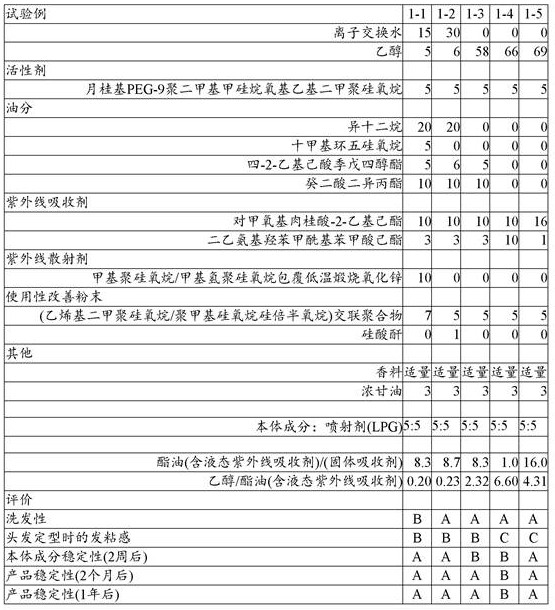
However, as shown in table 1, the hair styling aerosol cosmetic composition using the emulsion-based body component had no problem in terms of product stability, but was not satisfactory in terms of hair-washing property and sticky feeling (test example 1-1). Here, the ultraviolet scattering agent was removed to improve the hair-washing property (test example 1-2). This is due to: the ultraviolet scattering agent is composed of fine particle powder, and when the fine particle powder is aggregated in a container, the ultraviolet scattering effect is remarkably reduced, so that it is necessary to subject the surface thereof to a hydrophobic treatment. Thus, when the hydrophobized powder adheres to hair or the like, it is difficult to immediately wash and remove the powder with a common shampoo. However, it is difficult to improve the sticky feeling of hair when an emulsion-based body component is used for hair setting.
On the other hand, when ethanol was used as a dispersion medium and the solid ultraviolet absorber was dissolved in the ester oil and added, the bulk component formed a homogeneous system and no emulsified system was formed (test examples 1 to 3). Further, it was confirmed that the sticky feeling in hair styling was also improved.
However, the bulk ingredients that have formed a homogeneous system, when stored for 2 weeks, 2 months, or 1 year, are considered to precipitate as ultraviolet absorbers, suggesting that they are not suitable for use as products.
This is believed to be due to: in the emulsification systems of test examples 1-1 and 1-2, the ester oil dissolved the ultraviolet absorber in a thick state was dispersed in water, but in test example 1-3, the ester oil was dissolved in ethanol and diluted, and therefore the dissolved state of the solid ultraviolet absorber could not be maintained in a thin ester oil/ethanol dispersion medium.
On the other hand, the present inventors have surprisingly found that aerosol cosmetics used in tests for hair setting property and hair washing property are: even after leaving for 2 months, no precipitation of the ultraviolet absorber was observed.
The inventors of the present invention have studied this point and found that: as described below, the ester oil dissolves the solid uv absorber and mixes with the ester oil 1.5 times more ethanol, thereby exhibiting good stability in a product system in which at least the propellant is still present.
When the ester-based ultraviolet absorber is contained in the main component in an amount of 15% by mass or more, a sticky feeling is produced (test examples 1 to 5).
Therefore, the present inventors have also studied the following powders: the amount of ester oil in the powder was set to 17 mass% (27 mass% including ester-based ultraviolet absorber), the ester oil/solid ultraviolet absorber was set to 9, and the ethanol/ester oil was set to 1.5 or more, and especially, the hair setting property was imparted to the hair while mixing the bis-ethylhexyloxyphenol methoxyphenyl triazine and diethylamino hydroxybenzoyl hexyl benzoate, which are solid organic ultraviolet absorbers at room temperature that have a problem of precipitation in an ethanol dispersion medium.
The results are shown in Table 2.
[ Table 2]
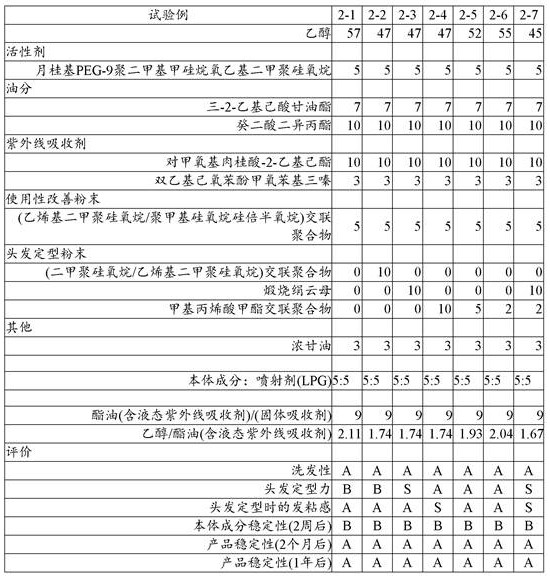
As can be seen from table 2 above: in the test examples in which the solid organic ultraviolet absorber was mixed, precipitation occurred in the bulk composition stored for 2 weeks. However, no precipitation occurred in the LPG/ethanol system.
Further, as shown in the results in Table 2, the system using calcined sericite as the hair setting powder (test example 2-3) showed excellent hair setting properties, and the system using the crosslinked polymethyl methacrylate powder (test examples 2-4 to 2-6) showed significantly improved sticky feeling in hair setting.
In addition, in test examples 2 to 7 in which both were mixed, both the hair setting force and the sticky feeling at the time of hair setting were satisfactory.
On the other hand, although not shown in table 2, in the aerosol cosmetic, when the surface is subjected to oleophilic treatment for improving the dispersibility of the hair setting powder, the hair setting force is remarkably reduced. This is believed to be due to: the hair setting powder is relatively flat and has a rough surface, thereby exerting hair setting power and smoothing the surface by oleophilic treatment.
Further, like calcined sericite, hydrophilic powder has low affinity for LPG, and tends to precipitate or aggregate at the bottom of a container, and even if it is redispersed by shaking again, the precipitation tends to be accelerated.
Therefore, the present inventors have studied various dispersants in order to improve aggregation resistance and redispersibility of the hydrophilic powder.
The results are shown in Table 3.
[ Table 3]
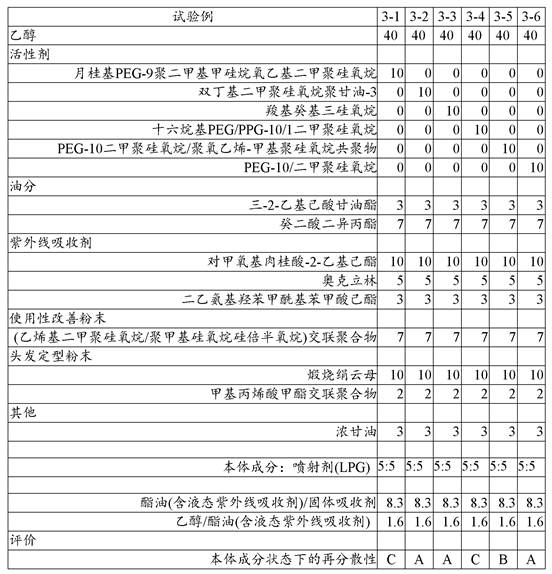
From the results of table 3, it can be seen that: dibutyldimethicone polyglycerol-3 (test example 3-2), carboxydecyltrisiloxane (test example 3-3), and PEG-10/dimethicone (test example 3-6) each had an excellent redispersibility improving effect.
This is understood to mean: in the present invention, as the activator, a polyether-based activator, particularly a polyglycerol-alkyl modified siloxane-based activator is suitably used.
With respect to the powder, studies have been made in consideration of redispersibility thereof. The results are shown in Table 4.
[ Table 4]
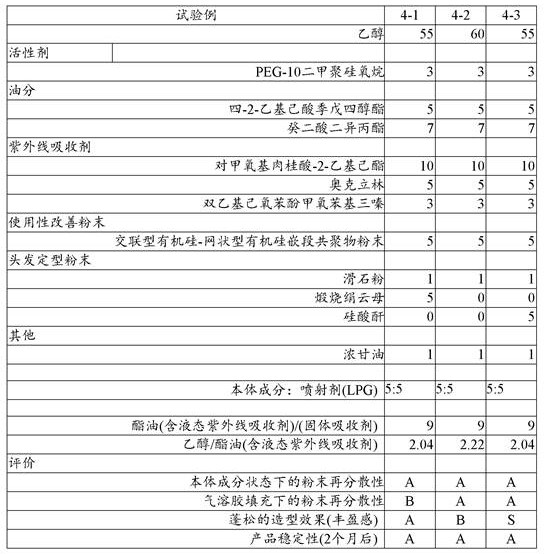
From the results shown in table 4 above, it is clear that: silicic anhydride can also be suitably used as the hair setting powder.
Further, the present inventors have studied the behavior of the ultraviolet absorber in the aerosol cosmetic. The results are shown in Table 5.
[ Table 5]
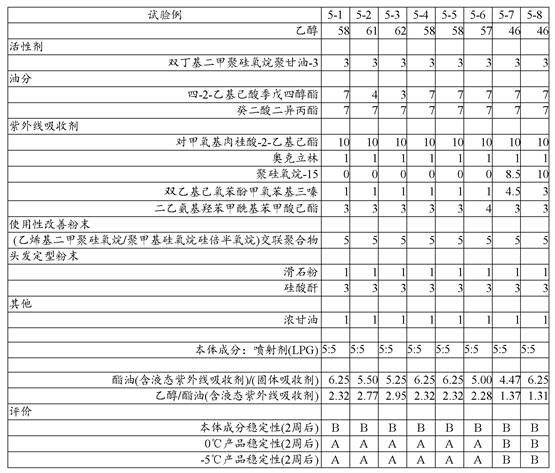
As can be seen from table 5 above: in the case of ethanol as the main dispersion medium of the main component, when the amount of ester oil dissolving the solid ultraviolet absorber is 15 times or less the amount of the solid ultraviolet absorber, precipitation occurred in the main component, but no precipitation occurred in the aerosol up to about 4.5 times the amount (the practical problem was not observed in test examples 6 to 7, but stability was observed in test examples 5 to 8).
Therefore, the ester oil is preferably 30 mass% or less in the main component (15 mass% or less in the main component of the ester-based ultraviolet absorber) from the viewpoint of not causing sticky feeling, and is preferably 4.5 to 15 times as much as the solid ultraviolet absorber from the viewpoint of not causing precipitation of the solid ultraviolet absorber in the aerosol.
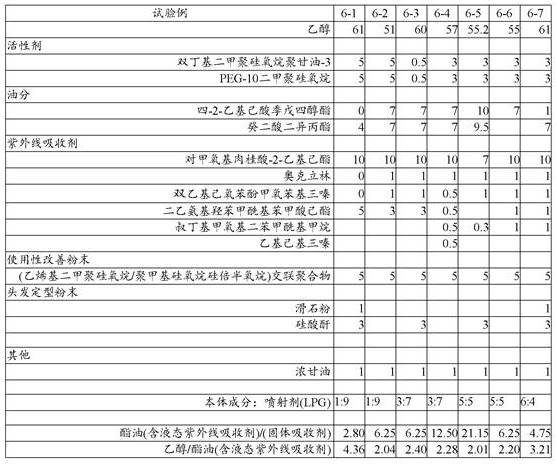
Table 6 shows other mixing examples of the present invention. These mixed examples were excellent in feeling of use and high in stability.
[ Table 6]
Claims (3)
Applications Claiming Priority (3)
| Application Number | Priority Date | Filing Date | Title |
|---|---|---|---|
| JP2014248558 | 2014-12-09 | ||
| JP2014-248558 | 2014-12-09 | ||
| PCT/JP2015/084414 WO2016093236A1 (en) | 2014-12-09 | 2015-12-08 | Aerosol cosmetic |
Publications (2)
| Publication Number | Publication Date |
|---|---|
| CN107249552A CN107249552A (en) | 2017-10-13 |
| CN107249552B true CN107249552B (en) | 2021-05-18 |
Family
ID=56107414
Family Applications (1)
| Application Number | Title | Priority Date | Filing Date |
|---|---|---|---|
| CN201580066942.2A Active CN107249552B (en) | 2014-12-09 | 2015-12-08 | Aerosol Cosmetics |
Country Status (7)
| Country | Link |
|---|---|
| US (1) | US20170368374A1 (en) |
| EP (1) | EP3231416A4 (en) |
| JP (1) | JP6751671B2 (en) |
| KR (1) | KR20170094193A (en) |
| CN (1) | CN107249552B (en) |
| TW (1) | TW201628587A (en) |
| WO (1) | WO2016093236A1 (en) |
Families Citing this family (5)
| Publication number | Priority date | Publication date | Assignee | Title |
|---|---|---|---|---|
| WO2018216242A1 (en) * | 2017-05-23 | 2018-11-29 | 東洋エアゾール工業株式会社 | Aerosol composition for hair and aerosol product for hair |
| CN113573691A (en) | 2019-03-15 | 2021-10-29 | 巴斯夫欧洲公司 | Effective sunscreen composition with diethylaminohydroxybenzoylhexylbenzoate and butylmethoxydibenzoylmethane |
| CN115297956A (en) * | 2020-01-15 | 2022-11-04 | 三妆化研株式会社 | Cosmetics containing nanobubbles |
| KR20240046886A (en) * | 2021-08-11 | 2024-04-11 | 에비테 리미티드 | Method for producing zingerone, composition comprising zingerone, and uses thereof |
| WO2024116842A1 (en) * | 2022-11-29 | 2024-06-06 | 株式会社 資生堂 | Single-phase uv care cosmetic material |
Family Cites Families (20)
| Publication number | Priority date | Publication date | Assignee | Title |
|---|---|---|---|---|
| JP3083543B2 (en) * | 1990-09-12 | 2000-09-04 | サンスター株式会社 | Hairdressing composition |
| JPH05238922A (en) * | 1991-04-11 | 1993-09-17 | Lion Corp | Hair composition for hair |
| JPH11343224A (en) * | 1998-05-29 | 1999-12-14 | Pola Chem Ind Inc | Composition for sun care cosmetic |
| FR2783711B1 (en) * | 1998-09-25 | 2000-11-10 | Oreal | PHOTOPROTECTIVE COSMETIC COMPOSITIONS AND USES |
| AU5617700A (en) * | 1999-06-18 | 2001-01-09 | Schering-Plough Healthcare Products, Inc. | Anhydrous ultraviolet light screening composition containing octocrylene |
| WO2009142020A1 (en) * | 2008-05-21 | 2009-11-26 | 花王株式会社 | Hair styling method |
| RU2500382C2 (en) * | 2009-09-29 | 2013-12-10 | Шисейдо Компани Лтд. | Oil-in-water emulsion composition |
| AU2010303703B2 (en) * | 2009-10-09 | 2014-10-02 | Isp Investments Inc. | Sun-care compositions |
| JP5830293B2 (en) * | 2010-07-30 | 2015-12-09 | 東レ・ダウコーニング株式会社 | Hair cosmetic containing co-modified organopolysiloxane |
| JP5291729B2 (en) * | 2011-02-07 | 2013-09-18 | 株式会社 資生堂 | Sunscreen cosmetics |
| US9192552B2 (en) * | 2011-07-07 | 2015-11-24 | The Procter & Gamble Company | Personal care compositions with improved solubility of a solid UV active |
| JP5965619B2 (en) * | 2011-11-18 | 2016-08-10 | 株式会社ミルボン | spray |
| JP6369887B2 (en) * | 2011-12-27 | 2018-08-08 | 東レ・ダウコーニング株式会社 | Novel co-modified organopolysiloxane, treatment agent containing the same, and external preparation |
| JP6321943B2 (en) * | 2012-11-14 | 2018-05-09 | 花王株式会社 | Oil-in-water emulsion composition |
| JP6072545B2 (en) * | 2013-01-18 | 2017-02-01 | 株式会社ミルボン | Non-aqueous hair cosmetic |
| JP2014201541A (en) * | 2013-04-03 | 2014-10-27 | 株式会社ダイゾー | Anti-suntan cosmetic |
| JP2014224076A (en) * | 2013-05-17 | 2014-12-04 | ポーラ化成工業株式会社 | Aerosol cosmetic |
| JP6157972B2 (en) * | 2013-07-30 | 2017-07-05 | 株式会社ダイゾー | Aerosol sunscreen |
| JP6445762B2 (en) * | 2013-12-09 | 2018-12-26 | 株式会社ミルボン | Cosmetics |
| JP5872720B2 (en) * | 2014-05-30 | 2016-03-01 | 花王株式会社 | Skin cosmetics |
-
2015
- 2015-12-08 CN CN201580066942.2A patent/CN107249552B/en active Active
- 2015-12-08 WO PCT/JP2015/084414 patent/WO2016093236A1/en not_active Ceased
- 2015-12-08 US US15/533,569 patent/US20170368374A1/en not_active Abandoned
- 2015-12-08 JP JP2016563687A patent/JP6751671B2/en active Active
- 2015-12-08 KR KR1020177015693A patent/KR20170094193A/en not_active Withdrawn
- 2015-12-08 EP EP15866582.8A patent/EP3231416A4/en not_active Withdrawn
- 2015-12-09 TW TW104141267A patent/TW201628587A/en unknown
Also Published As
| Publication number | Publication date |
|---|---|
| EP3231416A1 (en) | 2017-10-18 |
| WO2016093236A1 (en) | 2016-06-16 |
| JPWO2016093236A1 (en) | 2017-09-28 |
| CN107249552A (en) | 2017-10-13 |
| KR20170094193A (en) | 2017-08-17 |
| US20170368374A1 (en) | 2017-12-28 |
| EP3231416A4 (en) | 2018-07-04 |
| JP6751671B2 (en) | 2020-09-09 |
| TW201628587A (en) | 2016-08-16 |
Similar Documents
| Publication | Publication Date | Title |
|---|---|---|
| CN104666221B (en) | Hairsetting compositions | |
| CN102665655B (en) | W/O Emulsion Cosmetic | |
| CN102740825B (en) | Oil-in-water emulsion sunscreen cosmetic composition | |
| CN102470090B (en) | Oily dispersion and cosmetic material incorporating this oily dispersion | |
| CN103402488B (en) | sunscreen cosmetics | |
| EP3418320B1 (en) | Silica-coated silicone rubber particles and cosmetic | |
| CN106232084A (en) | Aqueous cosmetic | |
| JP6751671B2 (en) | Aerosol cosmetics | |
| JP7387405B2 (en) | sunscreen aerosol cosmetics | |
| JP6919650B2 (en) | Liquid dispersion and its uses | |
| KR20110048899A (en) | Moisture release type high water-in-oil foundation composition and method for producing same | |
| KR102260054B1 (en) | Emulsified cosmetic composition comprising amphiphilic clay mineral | |
| JP7005308B2 (en) | Aerosol foam sunscreen cosmetics | |
| JP2007513934A (en) | Metal oxide dispersion | |
| KR100970123B1 (en) | Thickening agent and cosmetics which mix | blended it, the manufacturing method | |
| JP2014201541A (en) | Anti-suntan cosmetic | |
| CN116710061A (en) | Oil-in-water cosmetic composition containing oil gel and preparation method thereof | |
| JP5566016B2 (en) | Aerosol type sunscreen cosmetics | |
| JP2017218433A (en) | Liquid dispersion and use thereof | |
| JP4987461B2 (en) | Ultraviolet shielding inorganic particle-containing dispersion | |
| JP2022164505A5 (en) | ||
| HK1245629A1 (en) | Aerosol cosmetic | |
| JP6661972B2 (en) | Solid composition containing fine inorganic powder with hydrophobic organic surface treatment | |
| WO2012132951A1 (en) | Cosmetic material for sunscreen | |
| CN105705203B (en) | combination |
Legal Events
| Date | Code | Title | Description |
|---|---|---|---|
| PB01 | Publication | ||
| PB01 | Publication | ||
| SE01 | Entry into force of request for substantive examination | ||
| SE01 | Entry into force of request for substantive examination | ||
| REG | Reference to a national code |
Ref country code: HK Ref legal event code: DE Ref document number: 1245629 Country of ref document: HK |
|
| GR01 | Patent grant | ||
| GR01 | Patent grant | ||
| REG | Reference to a national code |
Ref country code: HK Ref legal event code: WD Ref document number: 1245629 Country of ref document: HK |