CN106045552B - A kind of preparation method of three-dimensional graphene macroscopic body - Google Patents

A kind of preparation method of three-dimensional graphene macroscopic body Download PDF

Info

Publication number
CN106045552B
CN106045552B CN201610353877.8A CN201610353877A CN106045552B CN 106045552 B CN106045552 B CN 106045552B CN 201610353877 A CN201610353877 A CN 201610353877A CN 106045552 B CN106045552 B CN 106045552B
Authority
CN
China
Prior art keywords
graphene
preparation
macroscopic body
dimensional
nickel
Prior art date
Legal status (The legal status is an assumption and is not a legal conclusion. Google has not performed a legal analysis and makes no representation as to the accuracy of the status listed.)
Active
Application number
CN201610353877.8A
Other languages
Chinese (zh)
Other versions
CN106045552A (en
Inventor
徐丽
刘双宇
陈新
韩钰
盛鹏
刘海镇
赵广耀
王博
Current Assignee (The listed assignees may be inaccurate. Google has not performed a legal analysis and makes no representation or warranty as to the accuracy of the list.)
Global Energy Interconnection Research Institute Co Ltd
State Grid Hubei Electric Power Co Ltd
State Grid Corp of China SGCC
Original Assignee
Global Energy Interconnection Research Institute Co Ltd
State Grid Hubei Electric Power Co Ltd
State Grid Corp of China SGCC
Priority date (The priority date is an assumption and is not a legal conclusion. Google has not performed a legal analysis and makes no representation as to the accuracy of the date listed.)
Filing date
Publication date
Application filed by Global Energy Interconnection Research Institute Co Ltd, State Grid Hubei Electric Power Co Ltd, State Grid Corp of China SGCC filed Critical Global Energy Interconnection Research Institute Co Ltd
Priority to CN201610353877.8A priority Critical patent/CN106045552B/en
Publication of CN106045552A publication Critical patent/CN106045552A/en
Application granted granted Critical
Publication of CN106045552B publication Critical patent/CN106045552B/en
Active legal-status Critical Current
Anticipated expiration legal-status Critical

Links

Images

Classifications

    • CCHEMISTRY; METALLURGY
    • C04CEMENTS; CONCRETE; ARTIFICIAL STONE; CERAMICS; REFRACTORIES
    • C04BLIME, MAGNESIA; SLAG; CEMENTS; COMPOSITIONS THEREOF, e.g. MORTARS, CONCRETE OR LIKE BUILDING MATERIALS; ARTIFICIAL STONE; CERAMICS; REFRACTORIES; TREATMENT OF NATURAL STONE
    • C04B38/00Porous mortars, concrete, artificial stone or ceramic ware; Preparation thereof
    • CCHEMISTRY; METALLURGY
    • C04CEMENTS; CONCRETE; ARTIFICIAL STONE; CERAMICS; REFRACTORIES
    • C04BLIME, MAGNESIA; SLAG; CEMENTS; COMPOSITIONS THEREOF, e.g. MORTARS, CONCRETE OR LIKE BUILDING MATERIALS; ARTIFICIAL STONE; CERAMICS; REFRACTORIES; TREATMENT OF NATURAL STONE
    • C04B35/00Shaped ceramic products characterised by their composition; Ceramics compositions; Processing powders of inorganic compounds preparatory to the manufacturing of ceramic products
    • C04B35/515Shaped ceramic products characterised by their composition; Ceramics compositions; Processing powders of inorganic compounds preparatory to the manufacturing of ceramic products based on non-oxide ceramics
    • C04B35/52Shaped ceramic products characterised by their composition; Ceramics compositions; Processing powders of inorganic compounds preparatory to the manufacturing of ceramic products based on non-oxide ceramics based on carbon, e.g. graphite
    • CCHEMISTRY; METALLURGY
    • C04CEMENTS; CONCRETE; ARTIFICIAL STONE; CERAMICS; REFRACTORIES
    • C04BLIME, MAGNESIA; SLAG; CEMENTS; COMPOSITIONS THEREOF, e.g. MORTARS, CONCRETE OR LIKE BUILDING MATERIALS; ARTIFICIAL STONE; CERAMICS; REFRACTORIES; TREATMENT OF NATURAL STONE
    • C04B35/00Shaped ceramic products characterised by their composition; Ceramics compositions; Processing powders of inorganic compounds preparatory to the manufacturing of ceramic products
    • C04B35/622Forming processes; Processing powders of inorganic compounds preparatory to the manufacturing of ceramic products
    • C04B35/624Sol-gel processing
    • HELECTRICITY
    • H01ELECTRIC ELEMENTS
    • H01GCAPACITORS; CAPACITORS, RECTIFIERS, DETECTORS, SWITCHING DEVICES, LIGHT-SENSITIVE OR TEMPERATURE-SENSITIVE DEVICES OF THE ELECTROLYTIC TYPE
    • H01G11/00Hybrid capacitors, i.e. capacitors having different positive and negative electrodes; Electric double-layer [EDL] capacitors; Processes for the manufacture thereof or of parts thereof
    • H01G11/22Electrodes
    • H01G11/26Electrodes characterised by their structure, e.g. multi-layered, porosity or surface features
    • HELECTRICITY
    • H01ELECTRIC ELEMENTS
    • H01GCAPACITORS; CAPACITORS, RECTIFIERS, DETECTORS, SWITCHING DEVICES, LIGHT-SENSITIVE OR TEMPERATURE-SENSITIVE DEVICES OF THE ELECTROLYTIC TYPE
    • H01G11/00Hybrid capacitors, i.e. capacitors having different positive and negative electrodes; Electric double-layer [EDL] capacitors; Processes for the manufacture thereof or of parts thereof
    • H01G11/22Electrodes
    • H01G11/30Electrodes characterised by their material
    • H01G11/32Carbon-based
    • CCHEMISTRY; METALLURGY
    • C04CEMENTS; CONCRETE; ARTIFICIAL STONE; CERAMICS; REFRACTORIES
    • C04BLIME, MAGNESIA; SLAG; CEMENTS; COMPOSITIONS THEREOF, e.g. MORTARS, CONCRETE OR LIKE BUILDING MATERIALS; ARTIFICIAL STONE; CERAMICS; REFRACTORIES; TREATMENT OF NATURAL STONE
    • C04B2235/00Aspects relating to ceramic starting mixtures or sintered ceramic products
    • C04B2235/02Composition of constituents of the starting material or of secondary phases of the final product
    • C04B2235/30Constituents and secondary phases not being of a fibrous nature
    • C04B2235/42Non metallic elements added as constituents or additives, e.g. sulfur, phosphor, selenium or tellurium
    • C04B2235/422Carbon
    • CCHEMISTRY; METALLURGY
    • C04CEMENTS; CONCRETE; ARTIFICIAL STONE; CERAMICS; REFRACTORIES
    • C04BLIME, MAGNESIA; SLAG; CEMENTS; COMPOSITIONS THEREOF, e.g. MORTARS, CONCRETE OR LIKE BUILDING MATERIALS; ARTIFICIAL STONE; CERAMICS; REFRACTORIES; TREATMENT OF NATURAL STONE
    • C04B2235/00Aspects relating to ceramic starting mixtures or sintered ceramic products
    • C04B2235/02Composition of constituents of the starting material or of secondary phases of the final product
    • C04B2235/30Constituents and secondary phases not being of a fibrous nature
    • C04B2235/42Non metallic elements added as constituents or additives, e.g. sulfur, phosphor, selenium or tellurium
    • C04B2235/422Carbon
    • C04B2235/425Graphite
    • CCHEMISTRY; METALLURGY
    • C04CEMENTS; CONCRETE; ARTIFICIAL STONE; CERAMICS; REFRACTORIES
    • C04BLIME, MAGNESIA; SLAG; CEMENTS; COMPOSITIONS THEREOF, e.g. MORTARS, CONCRETE OR LIKE BUILDING MATERIALS; ARTIFICIAL STONE; CERAMICS; REFRACTORIES; TREATMENT OF NATURAL STONE
    • C04B2235/00Aspects relating to ceramic starting mixtures or sintered ceramic products
    • C04B2235/70Aspects relating to sintered or melt-casted ceramic products
    • C04B2235/96Properties of ceramic products, e.g. mechanical properties such as strength, toughness, wear resistance
    • YGENERAL TAGGING OF NEW TECHNOLOGICAL DEVELOPMENTS; GENERAL TAGGING OF CROSS-SECTIONAL TECHNOLOGIES SPANNING OVER SEVERAL SECTIONS OF THE IPC; TECHNICAL SUBJECTS COVERED BY FORMER USPC CROSS-REFERENCE ART COLLECTIONS [XRACs] AND DIGESTS
    • Y02TECHNOLOGIES OR APPLICATIONS FOR MITIGATION OR ADAPTATION AGAINST CLIMATE CHANGE
    • Y02EREDUCTION OF GREENHOUSE GAS [GHG] EMISSIONS, RELATED TO ENERGY GENERATION, TRANSMISSION OR DISTRIBUTION
    • Y02E60/00Enabling technologies; Technologies with a potential or indirect contribution to GHG emissions mitigation
    • Y02E60/13Energy storage using capacitors

Landscapes

  • Engineering & Computer Science (AREA)
  • Chemical & Material Sciences (AREA)
  • Ceramic Engineering (AREA)
  • Power Engineering (AREA)
  • Materials Engineering (AREA)
  • Manufacturing & Machinery (AREA)
  • Structural Engineering (AREA)
  • Organic Chemistry (AREA)
  • Microelectronics & Electronic Packaging (AREA)
  • Dispersion Chemistry (AREA)
  • Inorganic Chemistry (AREA)
  • Carbon And Carbon Compounds (AREA)

Abstract

本发明提供了一种三维石墨烯宏观体制备方法。本发明利用水热自组装构建三维宏观体,同时在石墨烯宏观体的层状结构之间原位合成MOFs。本申请制备的多级孔结构三维宏观体不仅具有高比表面积、还利于电解液离子的扩散与传输,且石墨烯和碳纳米管构建内交联结构作为导电网络利于电子的传输,有效降低了界面电阻,同时提高了超级电容器的比容量、倍率和循环性能。本发明制得的石墨烯基宏观体结构稳定,具有高比表面积、高导电性,可应用于超级电容器中。本发明的制备方法工艺简单,反应过程容易控制,设备投资少,不需要在真空高压条件下进行,可实现大规模生产。The invention provides a method for preparing a three-dimensional graphene macro-body. The present invention utilizes hydrothermal self-assembly to construct a three-dimensional macro body, and at the same time, in-situ synthesizes MOFs between the layered structures of the graphene macro body. The three-dimensional macrostructure of the hierarchical porous structure prepared in the present application not only has a high specific surface area, but also is conducive to the diffusion and transport of electrolyte ions, and the graphene and carbon nanotubes build an internal cross-linked structure as a conductive network, which is conducive to the transport of electrons, effectively reducing the interfacial resistance, while improving the specific capacity, rate and cycle performance of supercapacitors. The graphene-based macroscopic body prepared by the invention has stable structure, high specific surface area and high conductivity, and can be applied to super capacitors. The preparation method of the invention has the advantages of simple process, easy control of the reaction process, low equipment investment, no need to carry out under vacuum and high pressure conditions, and can realize large-scale production.

Description

Preparation method of three-dimensional graphene macrostructure
Technical Field
The invention relates to graphene for a super capacitor, in particular to a preparation method of a porous graphene and carbon nanotube composite three-dimensional macroscopic body for a capacitor.
Background
The super capacitor has the characteristics of high power density, rapid charge and discharge, million secondary long cycle life, safety, reliability and the like, and has wide application prospect in the fields of rail transit, national defense, aerospace and the like. However, the rapid development of the super capacitor is restricted by the defect of low energy density of the super capacitor, for example, the energy density of the commercial activated carbon super capacitor is only 5-7 Wh kg-1. Therefore, in order to meet the increasing demand of the super capacitor, it is one of the development trends in the new energy field to develop a light super capacitor having high energy density, power density and good cycle stability.
Graphene is a graphite-exfoliated two-dimensional crystal composed of a layer of carbon atoms, has a two-dimensional periodic honeycomb lattice structure composed of carbon six-membered rings, and is a basic unit for constructing other-dimensional carbonaceous materials (such as zero-dimensional fullerene, one-dimensional carbon nanotubes and three-dimensional graphite). Due to the unique two-dimensional structure and the perfect crystal structure of graphene, graphene has high electrical conductivity, high mechanical strength, high thermal conductivity and peculiar optical properties, and is widely applied to information devices such as transistors. In the fields of nano composite materials, batteries, super capacitors and the like, the assembly form between two-dimensional planar graphene layers is particularly important. At present, the three-dimensional porous graphene not only has the excellent properties of graphene, but also has the characteristics of high specific surface area, excellent conductivity, rich pore structure and the like, and becomes an ideal electrode material of a supercapacitor.
At present, due to pi-pi action, van der waals force and hydrophobicity, the three-dimensional graphene prepared by the conventional redox method is easy to agglomerate and stack, so that the infiltration and ion diffusion of electrolyte are inhibited, and the specific surface area of the material is obviously reduced.
Therefore, there is a need to provide an improved solution to the above-mentioned deficiencies of the prior art.
Disclosure of Invention
The invention aims to solve the problems and provides a preparation method of a graphene and carbon nanotube composite three-dimensional macroscopic body with a porous structure for a capacitor. According to the invention, a graphene macroscopic body is constructed by self-assembly through a hydrothermal method, and a metal catalyst is introduced to grow a carbon nanotube on graphene, so that a porous graphene and carbon nanotube composite electrode is obtained. The three-dimensional macroscopic body with the hierarchical pore structure has a high specific surface area, is beneficial to diffusion and transmission of electrolyte ions, and the graphene and the carbon nano tube construct an internal cross-linked structure as a conductive network, so that the transmission of electrons is facilitated, the interface resistance is effectively reduced, and the specific capacity, the multiplying power and the cycle performance of the super capacitor are improved.
In order to achieve the purpose, the invention adopts the following technical scheme:
a graphene and carbon nanotube composite macroscopic body has a porous structure.
A method of making graphene-based macroscopic bodies, the method comprising the steps of:
1) preparing a mixed solution: mixing graphene oxide solution, nickel salt and Zn (NO)3)2·6H2Mixing the O in proportion, and then carrying out ultrasonic treatment for 0.5-2 h; adding 2-methylimidazole, and stirring to obtain a mixed solution;
2) preparing a graphene hydrogel: heating the mixed solution obtained in the step 1) at 80-120 ℃ for 0.5-5 h to obtain graphene hydrogel;
3) preparing a three-dimensional graphene macroscopic body: freeze-drying the hydrogel in the step 2); then reacting for 1-5 h at 650-1000 ℃ in an inert atmosphere; 0.01 to 0.1mol of L is used in combination-1Acid of (2)And after dipping for 1-10 h, repeatedly washing with deionized water, and drying to obtain the graphene and carbon nanotube composite macroscopic body.
Further, the concentration of the graphene oxide in the step 1) is 0.1-5 mg mL-1
Furthermore, the graphene oxide is prepared from crystalline flake graphite by a Hummers method.
Further, the nickel salt in the step 1) is one or more of nickel chloride, nickel acetate, nickel nitrate and nickel sulfate.
Further, the mass ratio of the graphene oxide to the nickel salt in the step 1) is 1: 10-1: 50.
Further, the graphene oxide and Zn (NO) in the step 1)3)2·6H2The mass ratio of O to 2-methylimidazole is 1 (10-50) to (20-100).
Further, the stirring time in the step 1) is 5-20 min.
Further, the acid in the step 3) is hydrochloric acid or nitric acid.
Further, in the step 3), the reaction is carried out for 5 hours at 1000 ℃ under nitrogen.
Further, the graphene-based macroscopic body obtained in the step 3) is a layered and porous three-dimensional macroscopic body, and the three-dimensional macroscopic body is a composite macroscopic body of graphene and carbon nanotubes.
Furthermore, the graphene oxide adopted by the invention is prepared from crystalline flake graphite by a Hummer method.
Furthermore, the graphene-based macroscopic body prepared by the method is mainly constructed by starting from graphene oxide and utilizing hydrothermal self-assembly, and simultaneously MOFs is synthesized in situ between the layered structures of the graphene macroscopic body; due to the adsorption effect of the functional groups on the surface of the graphene oxide and metal ions, a nickel ion catalyst is introduced, the nickel ion catalyst is reduced into nickel atoms with catalytic activity under a high-temperature condition, and the MOFs is catalyzed by the nickel atoms to generate the carbon nano tube under the high-temperature condition.
Further, the prepared graphene-based macroscopic body is applied to a super capacitor.
Compared with the closest prior art, the technical scheme provided by the invention has the following excellent effects:
1. the graphene and carbon nanotube composite macroscopic body prepared by the technical scheme provided by the invention has a structure with multi-stage holes and cross-linking in the graphene and carbon nanotubes, is beneficial to the diffusion and transmission of electrolyte ions, improves the transmission of electrons, obviously reduces the interface resistance, and improves the specific capacity, the multiplying power and the cycle performance of a super capacitor.
2. The preparation method of the three-dimensional porous structure constructed by self-assembly is beneficial to diffusion and transmission of electrolyte ions, and the structure formed by mutual cross-linking of the graphene and the carbon nano tube is used as a conductive network, so that the conductivity of the material is improved, the transmission of electrons is facilitated, and the electrochemical performance of the material is improved.
3. The graphene-based macroscopic body prepared by the method has a stable structure, a high specific surface area and high conductivity, and can be applied to a super capacitor.
4. The preparation method has simple process, easy control of the reaction process, less equipment investment, no need of being carried out under the vacuum high-pressure condition and capability of realizing large-scale production.
Drawings
In order to more clearly illustrate the technical solution of the present invention, the drawings needed to be used in the embodiments will be briefly described below, and it is obvious that the drawings in the following description are only some embodiments of the present invention, and it is obvious for those skilled in the art that other drawings can be obtained according to these drawings without creative efforts.
FIG. 1 is a cyclic voltammetry curve at a sweep rate of 25mV s-1 for a graphene and carbon nanotube composite macroscopic body prepared in example 1;
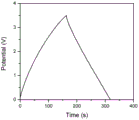
FIG. 2 is a constant current charge and discharge curve of the graphene and carbon nanotube composite macroscopic body prepared in example 1 at a current density of 1 Ag-1.
Detailed Description
The technical solutions in the embodiments of the present invention will be described clearly and completely below, and it is obvious that the described embodiments are only a part of the embodiments of the present invention, and not all embodiments. All other embodiments that can be derived by one of ordinary skill in the art from the embodiments given herein are intended to be within the scope of the present invention.
Example 1
Taking 100mL of 3mg mL-1A graphene oxide aqueous solution; weighing 9g of nickel acetate according to the mass ratio of graphene oxide to nickel salt of 1: 30; according to graphene oxide, Zn (NO)3)2·6H2The mass ratio of O to 2-methylimidazole is 1:30:80, 9g of Zn (NO) is weighed3)2·6H2O and 24g 2-methylimidazole; mixing graphene oxide solution, nickel salt and Zn (NO)3)2·6H2Preparing O according to a certain proportion, carrying out ultrasonic treatment for 2h, adding 2-methylimidazole, and stirring for 15min to obtain a mixed solution; then heating for 5 hours at the temperature of 100 ℃ to obtain graphene hydrogel; freeze-drying the prepared graphene hydrogel to obtain a graphene three-dimensional macroscopic body, then reacting for 5 hours at 1000 ℃ in a nitrogen environment, and then using 0.1mol L of reaction product-1And soaking the graphene/carbon nano tube composite macroscopic body in nitric acid for 1-10 h, then repeatedly washing with deionized water, and drying to obtain the graphene/carbon nano tube composite macroscopic body.
The cyclic voltammetry curve of the graphene and carbon nanotube composite macroscopic body prepared in the embodiment at a sweep rate of 25mV/s is shown in fig. 1, and it can be known from fig. 1 that the material shows better electric double layer capacitance characteristics; and then, performing a constant current charge and discharge test on the prepared graphene and carbon nanotube composite macroscopic body, as shown in fig. 2, it can be known that the graphene and carbon nanotube composite macroscopic body has a specific capacity of 182F/g under a current density of 1A/g.
Example 2
100mL of 5mg mL-1A graphene oxide aqueous solution; weighing 5g of nickel acetate according to the mass ratio of graphene oxide to nickel salt of 1: 10; according to graphene oxide, Zn (NO)3)2·6H2The mass ratio of O to 2-methylimidazole is 1:50:100, and 25g of Zn (NO) is weighed3)2·6H2O and 50g of 2-methylimidazole; mixing graphene oxide solution, nickel salt and Zn (NO)3)2·6H2Preparing O according to a certain proportion, ultrasonic treating for 2h, adding 2-methylimidazoleAzole, stirring for 20min to obtain a mixed solution; heating for 0.5h at 80 ℃ to obtain graphene hydrogel; freeze-drying the prepared graphene hydrogel to obtain a graphene three-dimensional macroscopic body, then reacting for 1h at 800 ℃ in a nitrogen environment, and then using 0.1mol L of reaction product-1And soaking the graphene/carbon nano tube composite macroscopic body in nitric acid for 8 hours, then repeatedly washing with deionized water, and drying to obtain the graphene/carbon nano tube composite macroscopic body.
Example 3
Taking 100mL of solution with the concentration of 0.1mg mL-1A graphene oxide aqueous solution; weighing 0.5g of nickel acetate according to the mass ratio of the graphene oxide to the nickel salt of 1: 50; according to graphene oxide, Zn (NO)3)2·6H2The mass ratio of O to 2-methylimidazole is 1:10:20, 0.1g of Zn (NO) is weighed3)2·6H2O and 0.2g of 2-methylimidazole; mixing graphene oxide solution, nickel salt and Zn (NO)3)2·6H2Preparing O according to a proportion, performing ultrasonic treatment for 1h, adding 2-methylimidazole, and stirring for 15min to obtain a mixed solution; heating for 1h at 120 ℃ to obtain graphene hydrogel; freeze-drying the prepared graphene hydrogel to obtain a graphene three-dimensional macroscopic body, then reacting for 5 hours at 650 ℃ in a nitrogen environment, and then using 0.1mol L of reaction product-1And soaking for 7h by hydrochloric acid, then repeatedly washing by deionized water, and drying to obtain the graphene and carbon nano tube composite macroscopic body.
Example 4
Taking 100mL of 2mg mL-1A graphene oxide aqueous solution; weighing 8g of nickel chloride according to the mass ratio of the graphene oxide to the nickel salt of 1: 40; according to graphene oxide, Zn (NO)3)2·6H2The mass ratio of O to 2-methylimidazole is 1:20:50, and 4g of Zn (NO) is weighed3)2·6H2O and 10g of 2-methylimidazole; mixing graphene oxide solution, nickel salt and Zn (NO)3)2·6H2Preparing O according to a proportion, carrying out ultrasonic treatment for 0.5h, adding 2-methylimidazole, and stirring for 5min to obtain a mixed solution; heating for 3h at 90 ℃ to obtain graphene hydrogel; freeze-drying the prepared graphene hydrogel to obtain a graphene three-dimensional macroscopic body, then reacting for 2 hours at 750 ℃ in a nitrogen environment, and then using 0.05mol L of reaction product-1And soaking for 6 hours by hydrochloric acid, then repeatedly washing by deionized water, and drying to obtain the graphene and carbon nano tube composite macroscopic body.
Example 5
Taking 100mL of the solution with the concentration of 1mg mL-1A graphene oxide aqueous solution; weighing 5g of nickel acetate according to the mass ratio of graphene oxide to nickel salt of 1: 50; according to graphene oxide, Zn (NO)3)2·6H2The mass ratio of O to 2-methylimidazole is 1:30:40, and 3g of Zn (NO) is weighed3)2·6H2O and 4g 2-methylimidazole; mixing graphene oxide solution, nickel salt and Zn (NO)3)2·6H2Preparing O according to a certain proportion, carrying out ultrasonic treatment for 2h, adding 2-methylimidazole, and stirring for 10min to obtain a mixed solution; heating for 2h at 110 ℃ to obtain graphene hydrogel; freeze-drying the prepared graphene hydrogel to obtain a graphene three-dimensional macroscopic body, then reacting for 1h at 800 ℃ in a nitrogen environment, and then using 0.08mol L of reaction product-1And soaking the graphene/carbon nano tube composite macroscopic body in nitric acid for 9 hours, then repeatedly washing with deionized water, and drying to obtain the graphene/carbon nano tube composite macroscopic body.
Example 6
Taking 100mL of solution with the concentration of 4mg mL-1A graphene oxide aqueous solution; weighing 4g of nickel sulfate according to the mass ratio of the graphene oxide to the nickel salt of 1: 10; according to graphene oxide, Zn (NO)3)2·6H2The mass ratio of O to 2-methylimidazole is 1:20:60, and 8g of Zn (NO) is weighed3)2·6H2O and 24g 2-methylimidazole; mixing graphene oxide solution, nickel salt and Zn (NO)3)2·6H2Preparing O according to a proportion, carrying out ultrasonic treatment for 0.5h, adding 2-methylimidazole, and stirring for 12min to obtain a mixed solution; heating for 1h at 95 ℃ to obtain graphene hydrogel; freeze-drying the prepared graphene hydrogel to obtain a graphene three-dimensional macroscopic body, then reacting for 3 hours at 950 ℃ in a nitrogen environment, and then using 0.03mol L of reaction product-1And soaking the graphene/carbon nano tube composite macroscopic body in nitric acid for 4 hours, then repeatedly washing with deionized water, and drying to obtain the graphene/carbon nano tube composite macroscopic body.
The above description is only exemplary of the invention and should not be taken as limiting the invention, as any modification, equivalent replacement, or improvement made within the spirit and principle of the invention is intended to be covered by the appended claims.

Claims (7)

1.一种石墨烯基宏观体的制备方法,其特征在于,所述方法包括以下步骤:1. a preparation method of graphene-based macroscopic body, is characterized in that, described method may further comprise the steps: 1)配制混合液:超声处理由氧化石墨烯溶液、镍盐与Zn(NO3)2·6H2O按比例配制的混合物0.5~2h后,加入2-甲基咪唑混合搅拌,配制成混合液;1) Preparation of mixed solution: after ultrasonically treating the mixture prepared by graphene oxide solution, nickel salt and Zn(NO 3 ) 2 ·6H 2 O in proportion for 0.5 to 2 hours, add 2-methylimidazole and mix and stir to prepare a mixed solution ; 2)制备石墨烯水凝胶:于80~120℃下加热步骤1)的混合液0.5~5h;2) Preparation of graphene hydrogel: heating the mixed solution of step 1) at 80-120° C. for 0.5-5 h; 3)制备石墨烯基宏观体:将步骤2)中的水凝胶冷冻干燥后,于惰性气氛中、650~1000℃下反应1~5h;再用0.01~0.1mol /L的酸浸渍1~10h,水洗,烘干;3) Preparation of graphene-based macro-body: after freeze-drying the hydrogel in step 2), react in an inert atmosphere at 650-1000° C. for 1-5 h; and then impregnate it with 0.01-0.1 mol/L acid for 1-5 h. 10h, washed with water and dried; 步骤1)中所述氧化石墨烯与镍盐的质量比为1:10~1:50;The mass ratio of graphene oxide and nickel salt described in step 1) is 1:10~1:50; 步骤1)中所述氧化石墨烯、Zn(NO3)2·6H2O和2-甲基咪唑的质量比为1:(10~50):(20~100); 步骤3)中所得石墨烯基宏观体为层状、多孔的三维宏观体,该三维宏观体为石墨烯和碳纳米管的复合宏观体。The mass ratio of graphene oxide, Zn(NO 3 ) 2 ·6H 2 O and 2-methylimidazole described in step 1) is 1:(10-50):(20-100); the graphite obtained in step 3) The olefin-based macroscopic body is a layered and porous three-dimensional macroscopic body, and the three-dimensional macroscopic body is a composite macroscopic body of graphene and carbon nanotubes. 2.如权利要求1所述的制备方法,其特征在于,步骤1)中所述氧化石墨烯的浓度为0.1~5mg /mL。2. The preparation method according to claim 1, wherein the concentration of graphene oxide described in step 1) is 0.1-5 mg/mL. 3.如权利要求1所述的制备方法,其特征在于,步骤1)中所述镍盐为氯化镍、乙酸镍、硝酸镍和硫酸镍中的一种或多种组合物。3. The preparation method of claim 1, wherein the nickel salt described in step 1) is one or more compositions of nickel chloride, nickel acetate, nickel nitrate and nickel sulfate. 4.如权利要求1所述的制备方法,其特征在于,步骤1)中的搅拌时间为5~20min。4. The preparation method of claim 1, wherein the stirring time in step 1) is 5-20 min. 5.如权利要求1所述的制备方法,其特征在于,步骤3)中的酸为盐酸或硝酸。5. preparation method as claimed in claim 1 is characterized in that, the acid in step 3) is hydrochloric acid or nitric acid. 6.如权利要求1所述的制备方法,其特征在于,步骤3)中于氮气、1000℃下,反应5h。6 . The preparation method of claim 1 , wherein in step 3), the reaction is carried out for 5 h under nitrogen and 1000° C. 7 . 7.一种权利要求1所述的石墨烯基宏观体的制备方法制备的石墨烯基宏观体用于制备超级电容器的应用。7. the application of the graphene-based macroscopic body prepared by the preparation method of the graphene-based macroscopic body according to claim 1 for preparing a supercapacitor.
CN201610353877.8A 2016-05-25 2016-05-25 A kind of preparation method of three-dimensional graphene macroscopic body Active CN106045552B (en)

Priority Applications (1)

Application Number Priority Date Filing Date Title
CN201610353877.8A CN106045552B (en) 2016-05-25 2016-05-25 A kind of preparation method of three-dimensional graphene macroscopic body

Applications Claiming Priority (1)

Application Number Priority Date Filing Date Title
CN201610353877.8A CN106045552B (en) 2016-05-25 2016-05-25 A kind of preparation method of three-dimensional graphene macroscopic body

Publications (2)

Publication Number Publication Date
CN106045552A CN106045552A (en) 2016-10-26
CN106045552B true CN106045552B (en) 2021-08-06

Family

ID=57175119

Family Applications (1)

Application Number Title Priority Date Filing Date
CN201610353877.8A Active CN106045552B (en) 2016-05-25 2016-05-25 A kind of preparation method of three-dimensional graphene macroscopic body

Country Status (1)

Country Link
CN (1) CN106045552B (en)

Families Citing this family (2)

* Cited by examiner, † Cited by third party
Publication number Priority date Publication date Assignee Title
CN107619040B (en) * 2017-11-01 2019-11-19 中国科学院兰州化学物理研究所 Rapid Preparation of Porous Graphene by Local Combustion
CN112054205A (en) * 2020-09-28 2020-12-08 成都玉龙化工有限公司 Conductive additive and preparation method thereof

Citations (3)

* Cited by examiner, † Cited by third party
Publication number Priority date Publication date Assignee Title
WO2010096916A1 (en) * 2009-02-27 2010-09-02 Andre Boulet Parallel passage fluid contactor structure
CN104538200A (en) * 2014-12-12 2015-04-22 上海应用技术学院 Graphene / Fe-MOFs composite material and preparation method thereof
CN105344327A (en) * 2015-11-26 2016-02-24 中国科学院生态环境研究中心 Preparation method of MOFs graphene composite material

Patent Citations (3)

* Cited by examiner, † Cited by third party
Publication number Priority date Publication date Assignee Title
WO2010096916A1 (en) * 2009-02-27 2010-09-02 Andre Boulet Parallel passage fluid contactor structure
CN104538200A (en) * 2014-12-12 2015-04-22 上海应用技术学院 Graphene / Fe-MOFs composite material and preparation method thereof
CN105344327A (en) * 2015-11-26 2016-02-24 中国科学院生态环境研究中心 Preparation method of MOFs graphene composite material

Non-Patent Citations (3)

* Cited by examiner, † Cited by third party
Title
"One-step solid-state thermolysis of metal-organic framework: a simple and facile route to large-scale of multiwalled carbon nanotubes";Linyun Chen等;《Chemical Communications》;20080131;第1581-1583页 *
"基于金属 - 有机骨架前驱体的先进功能材料";张慧等;《化学进展》;20150305;第27卷;第174-191页 *
"石墨烯碳纳米管复合材料制备进展";王强;《化工管理》;20160331;第171页 *

Also Published As

Publication number Publication date
CN106045552A (en) 2016-10-26

Similar Documents

Publication Publication Date Title
CN105932252B (en) A kind of sulphur selenizing molybdenum/carbon nano tube compound material and its preparation and application
CN106219515B (en) Synthetic method with the empty spherical nitrogen-doped carbon material of special crosslinking
CN113135568B (en) Nitrogen-doped porous carbon material and preparation method and application thereof
CN110336032A (en) Preparation method of nano-cobalt-loaded nitrogen-doped three-dimensional porous carbon and application of nano-cobalt-loaded nitrogen-doped three-dimensional porous carbon in lithium-sulfur battery
CN106711457B (en) Nano-core-shell structure carbonaceous carrier, its preparation method and the application of rich nitrogen carbon shell cladding
Tong et al. Honeycomb-like NiCo2O4@ Ni (OH) 2 supported on 3D N− doped graphene/carbon nanotubes sponge as an high performance electrode for Supercapacitor
CN106365142A (en) Preparation method of high-specific-surface-area high-electric-conductivity graphene compound carbon aerogel based on chemical crosslinking
CN106207125B (en) Sulfur doping selenizing molybdenum/graphene-graphene nanobelt aeroge and its preparation
CN104715936B (en) A kind of classifying porous carbon electrode material and preparation method for ultracapacitor
CN109616331B (en) A core-shell type nickel hydroxide nanosheet/manganese cobalt oxide composite electrode material and preparation method thereof
CN106025244A (en) Nickel selenide/graphene/carbon nanotube composite material and preparation method thereof
Yang et al. Cobalt–carbon derived from zeolitic imidazolate framework on Ni foam as high-performance supercapacitor electrode material
CN104370279A (en) Carbon nanotube, and preparation method and application thereof
Wang et al. Nitrogen-doped porous carbon/graphene aerogel with much enhanced capacitive behaviors
Liu et al. N/P codoped carbon materials with an ultrahigh specific surface area and hierarchical porous structure derived from durian peel for high-performance supercapacitors
CN108493002A (en) A kind of method that tannic acid modification graphene oxide prepares hydrogel flexible electrode
CN106683891A (en) High-conductivity flexible graphite/mesoporous graphitized carbon composite membrane electrode preparation method
CN110117009A (en) A kind of preparation method of the nitrogen co-doped magnetic porous graphitization nano carbon aerogels of iron
CN105489397A (en) Preparation method and application of a chemically modified carbon material/graphene/RuO2 ternary composite material
Wang et al. Sulfur-deficient MoS2-carbon hollow nanospheres for synergistic trapping and electrocatalytic conversion of polysulfides
CN105869903B (en) Graphene preparation method
CN106045552B (en) A kind of preparation method of three-dimensional graphene macroscopic body
CN107256803A (en) A kind of preparation method of graphene/carbon aerogel composite
CN111453725A (en) Lamellar graphene-like porous carbon electrode material and preparation method and application thereof
CN103395779B (en) A kind of porous graphene and preparation method thereof

Legal Events

Date Code Title Description
C06 Publication
PB01 Publication
SE01 Entry into force of request for substantive examination
GR01 Patent grant
GR01 Patent grant