CN101466752B - Compositions of ethylene/alpha-olefin multi-block interpolymer suitable for films - Google Patents
Compositions of ethylene/alpha-olefin multi-block interpolymer suitable for films Download PDFInfo
- Publication number
- CN101466752B CN101466752B CN2006800083722A CN200680008372A CN101466752B CN 101466752 B CN101466752 B CN 101466752B CN 2006800083722 A CN2006800083722 A CN 2006800083722A CN 200680008372 A CN200680008372 A CN 200680008372A CN 101466752 B CN101466752 B CN 101466752B
- Authority
- CN
- China
- Prior art keywords
- ethylene
- film
- polymer
- peak
- olefin
- Prior art date
- Legal status (The legal status is an assumption and is not a legal conclusion. Google has not performed a legal analysis and makes no representation as to the accuracy of the status listed.)
- Expired - Lifetime
Links
Images


Classifications
-
- C—CHEMISTRY; METALLURGY
- C08—ORGANIC MACROMOLECULAR COMPOUNDS; THEIR PREPARATION OR CHEMICAL WORKING-UP; COMPOSITIONS BASED THEREON
- C08J—WORKING-UP; GENERAL PROCESSES OF COMPOUNDING; AFTER-TREATMENT NOT COVERED BY SUBCLASSES C08B, C08C, C08F, C08G or C08H
- C08J5/00—Manufacture of articles or shaped materials containing macromolecular substances
- C08J5/18—Manufacture of films or sheets
-
- C—CHEMISTRY; METALLURGY
- C08—ORGANIC MACROMOLECULAR COMPOUNDS; THEIR PREPARATION OR CHEMICAL WORKING-UP; COMPOSITIONS BASED THEREON
- C08F—MACROMOLECULAR COMPOUNDS OBTAINED BY REACTIONS ONLY INVOLVING CARBON-TO-CARBON UNSATURATED BONDS
- C08F10/00—Homopolymers and copolymers of unsaturated aliphatic hydrocarbons having only one carbon-to-carbon double bond
- C08F10/14—Monomers containing five or more carbon atoms
-
- C—CHEMISTRY; METALLURGY
- C08—ORGANIC MACROMOLECULAR COMPOUNDS; THEIR PREPARATION OR CHEMICAL WORKING-UP; COMPOSITIONS BASED THEREON
- C08F—MACROMOLECULAR COMPOUNDS OBTAINED BY REACTIONS ONLY INVOLVING CARBON-TO-CARBON UNSATURATED BONDS
- C08F10/00—Homopolymers and copolymers of unsaturated aliphatic hydrocarbons having only one carbon-to-carbon double bond
-
- C—CHEMISTRY; METALLURGY
- C08—ORGANIC MACROMOLECULAR COMPOUNDS; THEIR PREPARATION OR CHEMICAL WORKING-UP; COMPOSITIONS BASED THEREON
- C08F—MACROMOLECULAR COMPOUNDS OBTAINED BY REACTIONS ONLY INVOLVING CARBON-TO-CARBON UNSATURATED BONDS
- C08F2/00—Processes of polymerisation
- C08F2/38—Polymerisation using regulators, e.g. chain terminating agents, e.g. telomerisation
-
- C—CHEMISTRY; METALLURGY
- C08—ORGANIC MACROMOLECULAR COMPOUNDS; THEIR PREPARATION OR CHEMICAL WORKING-UP; COMPOSITIONS BASED THEREON
- C08F—MACROMOLECULAR COMPOUNDS OBTAINED BY REACTIONS ONLY INVOLVING CARBON-TO-CARBON UNSATURATED BONDS
- C08F210/00—Copolymers of unsaturated aliphatic hydrocarbons having only one carbon-to-carbon double bond
- C08F210/16—Copolymers of ethene with alpha-alkenes, e.g. EP rubbers
-
- C—CHEMISTRY; METALLURGY
- C08—ORGANIC MACROMOLECULAR COMPOUNDS; THEIR PREPARATION OR CHEMICAL WORKING-UP; COMPOSITIONS BASED THEREON
- C08F—MACROMOLECULAR COMPOUNDS OBTAINED BY REACTIONS ONLY INVOLVING CARBON-TO-CARBON UNSATURATED BONDS
- C08F295/00—Macromolecular compounds obtained by polymerisation using successively different catalyst types without deactivating the intermediate polymer
-
- C—CHEMISTRY; METALLURGY
- C08—ORGANIC MACROMOLECULAR COMPOUNDS; THEIR PREPARATION OR CHEMICAL WORKING-UP; COMPOSITIONS BASED THEREON
- C08F—MACROMOLECULAR COMPOUNDS OBTAINED BY REACTIONS ONLY INVOLVING CARBON-TO-CARBON UNSATURATED BONDS
- C08F297/00—Macromolecular compounds obtained by successively polymerising different monomer systems using a catalyst of the ionic or coordination type without deactivating the intermediate polymer
- C08F297/06—Macromolecular compounds obtained by successively polymerising different monomer systems using a catalyst of the ionic or coordination type without deactivating the intermediate polymer using a catalyst of the coordination type
- C08F297/08—Macromolecular compounds obtained by successively polymerising different monomer systems using a catalyst of the ionic or coordination type without deactivating the intermediate polymer using a catalyst of the coordination type polymerising mono-olefins
-
- C—CHEMISTRY; METALLURGY
- C08—ORGANIC MACROMOLECULAR COMPOUNDS; THEIR PREPARATION OR CHEMICAL WORKING-UP; COMPOSITIONS BASED THEREON
- C08F—MACROMOLECULAR COMPOUNDS OBTAINED BY REACTIONS ONLY INVOLVING CARBON-TO-CARBON UNSATURATED BONDS
- C08F297/00—Macromolecular compounds obtained by successively polymerising different monomer systems using a catalyst of the ionic or coordination type without deactivating the intermediate polymer
- C08F297/06—Macromolecular compounds obtained by successively polymerising different monomer systems using a catalyst of the ionic or coordination type without deactivating the intermediate polymer using a catalyst of the coordination type
- C08F297/08—Macromolecular compounds obtained by successively polymerising different monomer systems using a catalyst of the ionic or coordination type without deactivating the intermediate polymer using a catalyst of the coordination type polymerising mono-olefins
- C08F297/083—Macromolecular compounds obtained by successively polymerising different monomer systems using a catalyst of the ionic or coordination type without deactivating the intermediate polymer using a catalyst of the coordination type polymerising mono-olefins the monomers being ethylene or propylene
-
- C—CHEMISTRY; METALLURGY
- C08—ORGANIC MACROMOLECULAR COMPOUNDS; THEIR PREPARATION OR CHEMICAL WORKING-UP; COMPOSITIONS BASED THEREON
- C08F—MACROMOLECULAR COMPOUNDS OBTAINED BY REACTIONS ONLY INVOLVING CARBON-TO-CARBON UNSATURATED BONDS
- C08F297/00—Macromolecular compounds obtained by successively polymerising different monomer systems using a catalyst of the ionic or coordination type without deactivating the intermediate polymer
- C08F297/06—Macromolecular compounds obtained by successively polymerising different monomer systems using a catalyst of the ionic or coordination type without deactivating the intermediate polymer using a catalyst of the coordination type
- C08F297/08—Macromolecular compounds obtained by successively polymerising different monomer systems using a catalyst of the ionic or coordination type without deactivating the intermediate polymer using a catalyst of the coordination type polymerising mono-olefins
- C08F297/083—Macromolecular compounds obtained by successively polymerising different monomer systems using a catalyst of the ionic or coordination type without deactivating the intermediate polymer using a catalyst of the coordination type polymerising mono-olefins the monomers being ethylene or propylene
- C08F297/086—Macromolecular compounds obtained by successively polymerising different monomer systems using a catalyst of the ionic or coordination type without deactivating the intermediate polymer using a catalyst of the coordination type polymerising mono-olefins the monomers being ethylene or propylene the block polymer contains at least three blocks
-
- C—CHEMISTRY; METALLURGY
- C08—ORGANIC MACROMOLECULAR COMPOUNDS; THEIR PREPARATION OR CHEMICAL WORKING-UP; COMPOSITIONS BASED THEREON
- C08L—COMPOSITIONS OF MACROMOLECULAR COMPOUNDS
- C08L23/00—Compositions of homopolymers or copolymers of unsaturated aliphatic hydrocarbons having only one carbon-to-carbon double bond; Compositions of derivatives of such polymers
- C08L23/02—Compositions of homopolymers or copolymers of unsaturated aliphatic hydrocarbons having only one carbon-to-carbon double bond; Compositions of derivatives of such polymers not modified by chemical after-treatment
- C08L23/04—Homopolymers or copolymers of ethene
-
- C—CHEMISTRY; METALLURGY
- C08—ORGANIC MACROMOLECULAR COMPOUNDS; THEIR PREPARATION OR CHEMICAL WORKING-UP; COMPOSITIONS BASED THEREON
- C08L—COMPOSITIONS OF MACROMOLECULAR COMPOUNDS
- C08L23/00—Compositions of homopolymers or copolymers of unsaturated aliphatic hydrocarbons having only one carbon-to-carbon double bond; Compositions of derivatives of such polymers
- C08L23/02—Compositions of homopolymers or copolymers of unsaturated aliphatic hydrocarbons having only one carbon-to-carbon double bond; Compositions of derivatives of such polymers not modified by chemical after-treatment
- C08L23/04—Homopolymers or copolymers of ethene
- C08L23/08—Copolymers of ethene
- C08L23/0807—Copolymers of ethene with unsaturated hydrocarbons only containing four or more carbon atoms
- C08L23/0815—Copolymers of ethene with unsaturated hydrocarbons only containing four or more carbon atoms with aliphatic 1-olefins containing one carbon-to-carbon double bond
-
- C—CHEMISTRY; METALLURGY
- C08—ORGANIC MACROMOLECULAR COMPOUNDS; THEIR PREPARATION OR CHEMICAL WORKING-UP; COMPOSITIONS BASED THEREON
- C08L—COMPOSITIONS OF MACROMOLECULAR COMPOUNDS
- C08L23/00—Compositions of homopolymers or copolymers of unsaturated aliphatic hydrocarbons having only one carbon-to-carbon double bond; Compositions of derivatives of such polymers
- C08L23/02—Compositions of homopolymers or copolymers of unsaturated aliphatic hydrocarbons having only one carbon-to-carbon double bond; Compositions of derivatives of such polymers not modified by chemical after-treatment
- C08L23/10—Homopolymers or copolymers of propene
-
- C—CHEMISTRY; METALLURGY
- C08—ORGANIC MACROMOLECULAR COMPOUNDS; THEIR PREPARATION OR CHEMICAL WORKING-UP; COMPOSITIONS BASED THEREON
- C08L—COMPOSITIONS OF MACROMOLECULAR COMPOUNDS
- C08L53/00—Compositions of block copolymers containing at least one sequence of a polymer obtained by reactions only involving carbon-to-carbon unsaturated bonds; Compositions of derivatives of such polymers
-
- C—CHEMISTRY; METALLURGY
- C08—ORGANIC MACROMOLECULAR COMPOUNDS; THEIR PREPARATION OR CHEMICAL WORKING-UP; COMPOSITIONS BASED THEREON
- C08L—COMPOSITIONS OF MACROMOLECULAR COMPOUNDS
- C08L53/00—Compositions of block copolymers containing at least one sequence of a polymer obtained by reactions only involving carbon-to-carbon unsaturated bonds; Compositions of derivatives of such polymers
- C08L53/005—Modified block copolymers
-
- C—CHEMISTRY; METALLURGY
- C08—ORGANIC MACROMOLECULAR COMPOUNDS; THEIR PREPARATION OR CHEMICAL WORKING-UP; COMPOSITIONS BASED THEREON
- C08F—MACROMOLECULAR COMPOUNDS OBTAINED BY REACTIONS ONLY INVOLVING CARBON-TO-CARBON UNSATURATED BONDS
- C08F110/00—Homopolymers of unsaturated aliphatic hydrocarbons having only one carbon-to-carbon double bond
- C08F110/02—Ethene
-
- C—CHEMISTRY; METALLURGY
- C08—ORGANIC MACROMOLECULAR COMPOUNDS; THEIR PREPARATION OR CHEMICAL WORKING-UP; COMPOSITIONS BASED THEREON
- C08F—MACROMOLECULAR COMPOUNDS OBTAINED BY REACTIONS ONLY INVOLVING CARBON-TO-CARBON UNSATURATED BONDS
- C08F2410/00—Features related to the catalyst preparation, the catalyst use or to the deactivation of the catalyst
- C08F2410/01—Additive used together with the catalyst, excluding compounds containing Al or B
-
- C—CHEMISTRY; METALLURGY
- C08—ORGANIC MACROMOLECULAR COMPOUNDS; THEIR PREPARATION OR CHEMICAL WORKING-UP; COMPOSITIONS BASED THEREON
- C08F—MACROMOLECULAR COMPOUNDS OBTAINED BY REACTIONS ONLY INVOLVING CARBON-TO-CARBON UNSATURATED BONDS
- C08F4/00—Polymerisation catalysts
- C08F4/42—Metals; Metal hydrides; Metallo-organic compounds; Use thereof as catalyst precursors
- C08F4/44—Metals; Metal hydrides; Metallo-organic compounds; Use thereof as catalyst precursors selected from light metals, zinc, cadmium, mercury, copper, silver, gold, boron, gallium, indium, thallium, rare earths or actinides
- C08F4/60—Metals; Metal hydrides; Metallo-organic compounds; Use thereof as catalyst precursors selected from light metals, zinc, cadmium, mercury, copper, silver, gold, boron, gallium, indium, thallium, rare earths or actinides together with refractory metals, iron group metals, platinum group metals, manganese, rhenium technetium or compounds thereof
- C08F4/62—Refractory metals or compounds thereof
- C08F4/64—Titanium, zirconium, hafnium or compounds thereof
- C08F4/659—Component covered by group C08F4/64 containing a transition metal-carbon bond
-
- C—CHEMISTRY; METALLURGY
- C08—ORGANIC MACROMOLECULAR COMPOUNDS; THEIR PREPARATION OR CHEMICAL WORKING-UP; COMPOSITIONS BASED THEREON
- C08F—MACROMOLECULAR COMPOUNDS OBTAINED BY REACTIONS ONLY INVOLVING CARBON-TO-CARBON UNSATURATED BONDS
- C08F4/00—Polymerisation catalysts
- C08F4/42—Metals; Metal hydrides; Metallo-organic compounds; Use thereof as catalyst precursors
- C08F4/44—Metals; Metal hydrides; Metallo-organic compounds; Use thereof as catalyst precursors selected from light metals, zinc, cadmium, mercury, copper, silver, gold, boron, gallium, indium, thallium, rare earths or actinides
- C08F4/60—Metals; Metal hydrides; Metallo-organic compounds; Use thereof as catalyst precursors selected from light metals, zinc, cadmium, mercury, copper, silver, gold, boron, gallium, indium, thallium, rare earths or actinides together with refractory metals, iron group metals, platinum group metals, manganese, rhenium technetium or compounds thereof
- C08F4/62—Refractory metals or compounds thereof
- C08F4/64—Titanium, zirconium, hafnium or compounds thereof
- C08F4/659—Component covered by group C08F4/64 containing a transition metal-carbon bond
- C08F4/65908—Component covered by group C08F4/64 containing a transition metal-carbon bond in combination with an ionising compound other than alumoxane, e.g. (C6F5)4B-X+
-
- C—CHEMISTRY; METALLURGY
- C08—ORGANIC MACROMOLECULAR COMPOUNDS; THEIR PREPARATION OR CHEMICAL WORKING-UP; COMPOSITIONS BASED THEREON
- C08F—MACROMOLECULAR COMPOUNDS OBTAINED BY REACTIONS ONLY INVOLVING CARBON-TO-CARBON UNSATURATED BONDS
- C08F4/00—Polymerisation catalysts
- C08F4/42—Metals; Metal hydrides; Metallo-organic compounds; Use thereof as catalyst precursors
- C08F4/44—Metals; Metal hydrides; Metallo-organic compounds; Use thereof as catalyst precursors selected from light metals, zinc, cadmium, mercury, copper, silver, gold, boron, gallium, indium, thallium, rare earths or actinides
- C08F4/60—Metals; Metal hydrides; Metallo-organic compounds; Use thereof as catalyst precursors selected from light metals, zinc, cadmium, mercury, copper, silver, gold, boron, gallium, indium, thallium, rare earths or actinides together with refractory metals, iron group metals, platinum group metals, manganese, rhenium technetium or compounds thereof
- C08F4/62—Refractory metals or compounds thereof
- C08F4/64—Titanium, zirconium, hafnium or compounds thereof
- C08F4/659—Component covered by group C08F4/64 containing a transition metal-carbon bond
- C08F4/65912—Component covered by group C08F4/64 containing a transition metal-carbon bond in combination with an organoaluminium compound
-
- C—CHEMISTRY; METALLURGY
- C08—ORGANIC MACROMOLECULAR COMPOUNDS; THEIR PREPARATION OR CHEMICAL WORKING-UP; COMPOSITIONS BASED THEREON
- C08J—WORKING-UP; GENERAL PROCESSES OF COMPOUNDING; AFTER-TREATMENT NOT COVERED BY SUBCLASSES C08B, C08C, C08F, C08G or C08H
- C08J2323/00—Characterised by the use of homopolymers or copolymers of unsaturated aliphatic hydrocarbons having only one carbon-to-carbon double bond; Derivatives of such polymers
- C08J2323/02—Characterised by the use of homopolymers or copolymers of unsaturated aliphatic hydrocarbons having only one carbon-to-carbon double bond; Derivatives of such polymers not modified by chemical after treatment
- C08J2323/04—Homopolymers or copolymers of ethene
- C08J2323/08—Copolymers of ethene
Landscapes
- Chemical & Material Sciences (AREA)
- Health & Medical Sciences (AREA)
- Chemical Kinetics & Catalysis (AREA)
- Medicinal Chemistry (AREA)
- Polymers & Plastics (AREA)
- Organic Chemistry (AREA)
- Inorganic Chemistry (AREA)
- Manufacturing & Machinery (AREA)
- Engineering & Computer Science (AREA)
- Materials Engineering (AREA)
- Manufacture Of Macromolecular Shaped Articles (AREA)
- Compositions Of Macromolecular Compounds (AREA)
- Addition Polymer Or Copolymer, Post-Treatments, Or Chemical Modifications (AREA)
- Graft Or Block Polymers (AREA)
- Medicinal Preparation (AREA)
- Fodder In General (AREA)
- Laminated Bodies (AREA)
Abstract
适合膜的组合物包含至少一种乙烯/α-烯烃共聚体,其中乙烯/α-烯烃共聚体可具有例如约1.7至约3.5的Mw/Mn,至少一个熔点,Tm,以℃计,以及密度,d,以克/立方厘米计,其中Tm及d的数值对应下述的关系式:Tm>-2002.9+4538.5(d)-2422.2(d)2。
The composition suitable for the membrane comprises at least one ethylene/α-olefin copolymer, wherein the ethylene/α-olefin copolymer may have, for example, a Mw/Mn ratio of about 1.7 to about 3.5, at least one melting point, Tm, in °C, and a density, d, in g/cm³, wherein the values of Tm and d correspond to the following relationship: Tm>-2002.9+4538.5(d)-2422.2(d)2.
Description
技术领域 technical field
本发明涉及乙烯/α-烯烃多嵌段共聚体组合物及由其制得的膜。This invention relates to ethylene/alpha-olefin multi-block interpolymer compositions and films made therefrom.
背景技术 Background technique
例如家禽、蔬菜、新鲜红肉及干酪等食品,以及非食品的工业及零售物品,通过收缩、表皮、拉伸和/或真空包覆方法来包装。收缩包装方法涉及将对象置在热可收缩膜材料制成的袋中,接着封闭或加热密封此袋,以及接着将此袋暴露在足够的热下,以造成此袋的收缩及此袋与对象之间的紧密接触。热可通过传统的热源提供,例如加热空气、红外线辐射、热水、燃烧火焰或类似方式。食品对象的收缩包覆帮助保持新鲜度,这是吸引人的、符合卫生的,且容许更近距离地检查包装食品的质量。工业及零售物品的收缩包装,在此技术领域及本文中可替换地指工业及零售包捆、保持产品洁净,且也是计数目的的包捆的便利方法。Food products such as poultry, vegetables, fresh red meat and cheese, as well as non-food industrial and retail items, are packaged by shrinking, skinning, stretching and/or vacuum wrapping methods. The shrink wrap method involves placing an object in a bag of heat-shrinkable film material, then closing or heat sealing the bag, and then exposing the bag to sufficient heat to cause shrinkage of the bag and the separation of the bag and the object. close contact between them. Heat can be provided by conventional heat sources such as heated air, infrared radiation, hot water, combustion flames or the like. Shrink wrapping of food objects helps maintain freshness, is attractive, hygienic, and allows closer inspection of the quality of packaged food. Shrink wrapping of industrial and retail items, referred to interchangeably in this technical field and herein as industrial and retail packaging, is a convenient method of keeping products clean and also packaging for counting purposes.
表皮包装方法涉及将待包装的产品置在多孔性或经穿孔的纸板上,该纸板一般涂覆有粘着剂底漆,接着移动有载荷的纸板至表皮包装机的压印板上,表皮包装膜在该压印板处加热直至软化及下垂,第二次松弛及下垂在有载荷的纸板上。接着,真空拉伸膜向下环绕产品,以提供“表皮”紧密包装。表皮包装供应消费者零售及转运市场。在运转市场中,表皮包装在运输及分配期间保护工业产品。在零售市场中,表皮包装保护消费者产品免遭受损及遭窃,以及提供“表观需求(displayappeal)”以使包装产品的销售潜力最大化。虽然大部分(若非全部),非食品表皮包装为单层膜,通过真空包装,尤其是通过真空表皮包装,多层表皮包装膜可用于保护食品。The skin packaging method involves placing the product to be packaged on a porous or perforated cardboard, which is typically coated with an adhesive primer, and then moving the loaded cardboard onto the platen of a skin packaging machine where the skin packaging film Heat is applied at the platen until it softens and sags, and a second time relaxes and sags on the loaded cardboard. Next, a vacuum stretch film wraps down around the product to provide a "skin" tight package. Skin packaging is supplied to consumer retail and transshipment markets. In operational markets, skin packaging protects industrial products during transport and distribution. In the retail market, skin packaging protects consumer products from damage and theft, as well as provides a "display appeal" to maximize the sales potential of the packaged product. While most, if not all, non-food skin packaging is a single-layer film, multi-layer skin packaging films can be used to protect food through vacuum packaging, especially through vacuum skin packaging.
食品也通过拉伸包覆方法包装,其涉及手动地由拉取膜覆盖在充填有食品的纸浆托盘或发泡的聚苯乙烯托盘上(或自动地向上推动托盘以拉伸此膜),以及接着在拉伸膜的边缘处热密封此拉伸膜,一般是在托盘的下方,且由于膜的弹性,容许膜保持拉紧。对于非食品的拉伸包覆而言,拉伸包覆膜是被手动地或自动地拉动且拉伸于产品上和/或环绕产品,以及接着贴附或钉附(并非热密封)至已围绕包覆产品的膜的另一部分或至产品本身,一般是通过施与朝向被包覆的产品或物品的方向上的压力。新鲜食品的拉伸包覆包装特别针对消费者零售市场且其容许新鲜红肉呈现所需的亮红色,以及容许部分蔬菜适当地呼吸。非食品的物品的拉伸包覆对应转运市场,且包括在配送期间的物品的垫衬包覆以及新交通工具的包覆,以保护外部油漆免于因酸雨、道路破损、瓦砾、野蛮行为等而受损。Food products are also packaged by the stretch wrap method, which involves manually pulling a film over a food-filled pulp tray or expanded polystyrene tray (or automatically pushing the tray up to stretch the film), and The stretch film is then heat sealed at its edges, typically under the tray, and due to the film's elasticity, allows the film to remain taut. For stretch-wrapping of non-food products, the stretch-wrap film is manually or automatically pulled and stretched over and/or around the product and then affixed or stapled (not heat-sealed) Around another part of the film wrapping the product or to the product itself, typically by applying pressure in a direction towards the product or item being wrapped. Stretch wrap packaging for fresh food is particularly aimed at the consumer retail market and it allows fresh red meat to take on the desired bright red color and some vegetables to breathe properly. Stretch wrapping of non-food items corresponds to the transshipment market and includes pad wrapping of items during distribution and wrapping of new vehicles to protect exterior paint from acid rain, road damage, debris, brutality, etc. and damaged.
虽然拉伸包覆包装一般未涉及屏障膜层并可用于食品及非食品的物品,真空包装涉及气体或氧气屏障膜层且一般是准备用于红肉、加工肉及干酪,但也可用于包装对气味敏感或产生气味的非食品物品,例如柏木片。真空包装有数种方法或变化,包括真空表皮包装,其在此技术领域中也称为真空形式包装。一种方法涉及例如在真空下,在处理室中,将加热软化的顶及底膜卷材放在一起,将产品装填在这些卷材之间;接下来,在边缘处,将卷材加热密封在一起,以及接着抽真空或气冲包含产品的空间。在真空包装中,一般底部卷材导出被包装的食品的形式。While stretch wrap packaging generally does not involve a barrier film layer and can be used for food and non-food items, vacuum packaging involves a gas or oxygen barrier film layer and is generally intended for red meat, processed meat, and cheese, but can also be used for packaging Odour-sensitive or odor-producing nonfood items, such as cypress chips. There are several methods or variations of vacuum packaging, including vacuum skin packaging, also known in the art as vacuum form packaging. One method involves bringing the heat-softened top and bottom film webs together in a processing chamber, for example under vacuum, and packing the product between these webs; next, at the edges, the webs are heat-sealed together, and then vacuum or blast the space containing the product. In vacuum packaging, generally the bottom web leads to the form of the packaged food product.
收缩包覆方法是以所选择的膜材料的热收缩性质为基础,而拉伸包覆是以膜材料的弹性为基础。相反地,成功的表皮包装是以膜材料对起始板的粘着力及造成膜双下垂所需的时间量(循环时间)为基础。类似于表皮包装,成功的真空包装取决于通过真空拉伸(或通过气压推动)之前,使膜卷材充分软化环绕待包装的产品所需的时间。如同塑料设计及加工(Plastics Design and Processing),1980年11月,第4页所述,具有较高红外线热吸收能带和/或具有较低维卡(Vicat)软化点的膜材料将倾向较快加热及软化,以及由此容许在表皮及真空包装中的循环时间较快。一般而言,极性聚合物,例如乙烯乙酸乙烯酯(EVA)共聚物、乙烯丙烯酸(EAA)共聚物及离聚物,比非极性聚合物,例如本发明的基本线性乙烯聚合物或非均相LLDPE,将具有更多红外线热能带。再者,由于离聚反应本身,离聚物比其个别的基底共聚物显示更多的红外线热能带。Shrink-wrapping methods are based on the heat-shrinking properties of the selected film material, while stretch-wrapping is based on the elasticity of the film material. Instead, successful skin packaging is based on the adhesion of the film material to the starting board and the amount of time required to cause double sagging of the film (cycle time). Similar to skin packaging, successful vacuum packaging depends on the time required for the film web to soften sufficiently to surround the product to be packaged before being stretched by vacuum (or pushed by air pressure). As stated in Plastics Design and Processing, Nov. 1980, p. 4, membrane materials with higher infrared heat absorption bands and/or with lower Vicat softening points will tend to be more Heats up and softens quickly, and thus allows faster cycle times in skin and vacuum packaging. In general, polar polymers, such as ethylene vinyl acetate (EVA) copolymers, ethylene acrylic acid (EAA) copolymers, and ionomers, are more effective than non-polar polymers, such as the substantially linear ethylene polymers of the present invention or non-polar polymers. Homogeneous LLDPE will have more infrared heat bands. Furthermore, due to the ionomerization reaction itself, ionomers exhibit more infrared heat bands than their respective base copolymers.
所有四个方法的成功包装或包覆,依膜材料本身的韧度及抗滥用或内爆性质而定,以致能在配送、处理和/或展示期间维持包装产品整体性。然而,韧度及抗滥用性对于食品收缩包覆及真空包装特别重要,其通常多次涉及肉及及其它食品切割物的包装,此肉及切割物在热收缩或真空成形操作期间,或后续包装操作及配送期间,具有可刺穿膜卷材或制成袋的凹穴及尖锐暴露的骨部及暴露的边缘。为了避免过早刺穿,膜制造商诉诸昂贵的实务来韧化包装,例如使用增厚膜及袋,如Ferguson在美国专利第4,755,403号中所述的在袋的重要接触点以贴补的方式使用额外的膜层,或通过使用交叉层迭或非平行层结构。类似地,对于已知膜材料的“手工地”增进抗刺穿及其它滥用或内爆性特性,食品包装者例行地利用布、模制塑性对象或其它材料包覆或封盖暴露的骨部。Successful packaging or wrapping for all four methods depends on the inherent toughness and resistance to abuse or implosion of the film material so that it maintains the integrity of the packaged product during distribution, handling and/or display. However, toughness and abuse resistance are particularly important for food shrink-wrapping and vacuum packaging, which often involves packaging meat and other food cuts either during the heat-shrinking or vacuum-forming operation, or afterward. During packaging operations and distribution, there are pockets and sharp exposed bones and exposed edges that can pierce the film web or form the bag. To avoid premature punctures, film manufacturers resort to costly practices to toughen the packaging, such as using thickened films and bags, as described by Ferguson in U.S. Patent No. 4,755,403 in a subsidized manner at critical contact points of the bag Using additional film layers, or by using cross-laminated or non-parallel layer structures. Similarly, to "manually" enhance puncture resistance and other abuse or implosion properties of known film materials, food packagers routinely wrap or cover exposed bone with cloth, molded plastic objects, or other materials. department.
一种重要的收缩包捆及表皮包装特性,特别是用于精致对象或易于破碎或弯曲的对象,例如纸制品,为膜对包装对象和/或纸板施与的张力或力。此特性在现有技术领域中已知为收缩张力,以及具有太多收缩张力的膜常常产生具有丑陋扭曲或纸板卷曲的收缩或表皮包装,其在严重的情况中,能使得包装物品无法使用于其所需达到的目的。除了美观上的丑陋之外,扭曲或弯曲物品在展示架上难以均一地堆放。An important shrink wrapping and skin packaging characteristic, especially for delicate items or items that are prone to breaking or bending, such as paper products, is the tension or force that the film exerts on the packaged item and/or cardboard. This characteristic is known in the art as shrink tension, and films with too much shrink tension often produce shrink or skin packages with ugly twists or cardboard curls which, in severe cases, can render the packaged item unusable for use in its desired purpose. In addition to being aesthetically ugly, twisted or bent items are difficult to stack uniformly on display shelves.
膜的光学性质对于零售“购买点”的收缩、表皮、拉伸及真空包覆包装而言是重要的。在一些例子中,接触和/或看穿的清晰度愈高,内膜模浊度愈低,以及膜的光泽或光辉度愈高,包装愈可能吸引潜在购买者近距离鉴赏。再者,一些消费者一般将包装美观(其主要基于包装膜的光学特性)直接与欲购买的对象质量联想在一起。Optical properties of films are important for retail "point of purchase" shrink, skin, stretch and vacuum wrap packaging. In some instances, the higher the clarity to the touch and/or see-through, the lower the haze of the inner film, and the higher the gloss or brilliance of the film, the more likely the package is to be viewed up close by potential buyers. Furthermore, some consumers generally associate the aesthetics of the package (which is mainly based on the optical properties of the packaging film) directly with the quality of the object to be purchased.
另一种重要的零售“购买点”的要求,尤其是对于拉伸包覆,为当变形而未保留由可能的购买者的鉴赏所留下的凹痕及捺印膜的松紧能力。此性质是基于膜材料的弹性回复,以及当弹性回复足够高时,后续有可能的购买者不会因包装外观产生认为物品已使用过或重复退货过的不必要偏见。Another important retail "point of purchase" requirement, especially for stretch wrapping, is the ability to stretch the film when deformed without retaining the indentation and impression left by the potential purchaser. This property is based on the elastic recovery of the film material, and when the elastic recovery is high enough, subsequent potential buyers will not have unnecessary prejudice that the item has been used or repeatedly returned due to the appearance of the package.
另一种重要的膜材料特性,其可影响所有四种包装及包覆方法的整体成功性,为在膜通过已知的起泡、浇铸或压片挤压方法制造期间的膜树脂的挤压加工性。良好的加工性是由相对低的挤压能量消耗、较平滑的膜表面,以及甚至在较高发泡比率、拉伸速率和/或膜厚度下,仍具有稳定的泡沫或卷材来显现。较平滑、较稳定的膜制造操作有许多优点,包括膜宽度及厚度一般较均一,边缘修剪的需要降低(其降低废料)、卷绕及解开操作一般较平滑,膜皱褶较少,且改良最终的包装质量或外观。Another important film material characteristic, which can affect the overall success of all four packaging and cladding methods, is the extrusion of the film resin during film manufacture by known foam, cast, or sheet extrusion methods Processability. Good processability is manifested by relatively low extrusion energy consumption, smoother film surfaces, and stable foams or webs even at higher expansion ratios, stretching rates, and/or film thicknesses. A smoother, more stable film manufacturing operation has many advantages, including generally more uniform film width and thickness, reduced need for edge trimming (which reduces waste), generally smoother winding and unwinding operations, less film wrinkling, and Improve final packaging quality or appearance.
虽然高压聚合的乙烯均聚物及共聚物,例如低密度聚乙烯(LDPE)及乙烯乙酸乙烯酯(EVA)共聚物,在挤压期间因为具有相当高长链分支程度的结果,一般呈现良好的加工性,线性烯烃聚合物,例如线性低密度聚乙烯(LLDPE)及超低密度聚乙烯(ULDPE),其在现有技术领域中可替换地已知为非常低密度聚乙烯(VLDPE),即使当应用相当复杂的挤压螺轴设计,例如防渗螺轴、具有Maddock混合区段的螺轴,以及其它类似变化,以达到更均匀化或稳定化聚合物熔融流及容许较低的能量消耗及较平滑的聚合物表面,显示尚可到边缘(fair-to-marginal)的加工性。再者,尝试最大化已知EVA、ULDPE及LLDPE材料的韧度特性,一般的实务是应用非常高分子量等级,例如熔体指数(I2,根据ASTM D-1238(190℃/2.16kg)测量)为≤0.5克/10分钟,其无法避免地增加加工性的困难度。Although high-pressure polymerized ethylene homopolymers and copolymers, such as low-density polyethylene (LDPE) and ethylene vinyl acetate (EVA) copolymers, generally exhibit good processability during extrusion as a result of a relatively high degree of long-chain branching , linear olefin polymers such as linear low-density polyethylene (LLDPE) and ultra-low-density polyethylene (ULDPE), which are alternatively known in the art as very low-density polyethylene (VLDPE), even when applied Rather complex extrusion screw designs, such as impermeable screws, screws with Maddock mixing sections, and other similar variations to achieve more uniform or stabilized polymer melt flow and to allow for lower energy consumption and higher Smooth polymer surface, showing fair-to-marginal processability. Furthermore, in an attempt to maximize the toughness properties of known EVA, ULDPE and LLDPE materials, it is common practice to apply very high molecular weight grades, such as melt index (I 2 , measured according to ASTM D-1238 (190°C/2.16kg) ) is ≤0.5 g/10 minutes, which inevitably increases the difficulty of processability.
为了符合所有四种包装及包覆方法中所涉及的不同性能要求,已使用各种不同的膜材料作为单一组分且以掺合组合物的形式用于单层及多层包装二者中。举例而言,Smith在美国专利第5,032,463号中公开双轴拉伸的单层及多层膜,包含乙烯/1-丁烯超低密度聚乙烯及乙烯/1-己烯超低密度聚乙烯的掺合物。In order to meet the different performance requirements involved in all four packaging and wrapping methods, a variety of different film materials have been used both as single components and in blended compositions in both monolayer and multilayer packaging. For example, Smith in U.S. Patent No. 5,032,463 discloses biaxially stretched monolayer and multilayer films comprising ethylene/1-butene ultra-low density polyethylene and ethylene/1-hexene ultra-low density polyethylene blend.
作为另一例子,Lustig等人,在美国专利第5,059,481号中描述双轴取向的超低密度聚乙烯单层及多层包装膜,其具有屏障核心层,乙烯/乙酸乙烯酯中间层以及ULDPE/EVA掺合物作为外层。在美国专利第4,863,769号中,Lustig等人公开使用这些双轴取向超低密度膜作为用于包装冷冻家禽的袋,以及在美国专利第4,976,898号中,Lustig等人公开的“双起泡”法可用于制备双轴取向超低密度聚乙烯膜。As another example, Lustig et al., in U.S. Patent No. 5,059,481, describe biaxially oriented ultra-low density polyethylene monolayer and multilayer packaging films having a barrier core layer, an ethylene/vinyl acetate intermediate layer, and ULDPE/ EVA blend as outer layer. In U.S. Patent No. 4,863,769, Lustig et al. disclose the use of these biaxially oriented ultra-low density films as bags for packaging frozen poultry, and in U.S. Patent No. 4,976,898, Lustig et al. disclose the "double bubble" process It can be used to prepare biaxially oriented ultra-low density polyethylene film.
在另一例子中,Botto等人在欧洲专利申请案第0243510号及美国专利第4,963,427号中,公开多层表皮包装膜,其是由离聚物、EVA及HDPE所组成,特别有用于食品的真空表皮包装。In another example, Botto et al. in European Patent Application No. 0243510 and U.S. Patent No. 4,963,427 disclose multilayer skin packaging films composed of ionomer, EVA and HDPE, which are particularly useful for food Vacuum skin packaging.
虽然现有技术的膜材料具有各种不同程度的韧度、抗内爆性、低温收缩特性,及制袋的热密封性能,即使当为了减少环境资源、成本效益或其它考虑的目的减少膜厚度时,韧性较高的膜材料对降低袋刺穿或对于维持抗刺穿程度的收缩、表皮及真空包装而言是所需的。再者,当经由自由基产生的低密度聚乙烯(LDPE),乙烯的高压聚合反应可令人满意地进行在工业(运送)收缩及表皮包装上的应用,LDPE的光学性质对购买者零售包装应用及在零售表皮包装的例子中,一般是无法令人满意的,为了所需的光学吸引力,包装业者只有仰赖昂贵的膜材料,例如由E.I Dupont供应的SurlynTM离聚物。然而,即使昂贵的离聚物产品仍显示表皮包装缺陷,例如不良的双轴撕裂/切割抗性及拉伸能力不足,当多数物品包装在单一纸板中时,在外观上产生令人讨厌的隆起和/或拱起。Although the film materials in the prior art have various degrees of toughness, implosion resistance, low-temperature shrinkage characteristics, and heat-sealing properties for bag making, even when the film thickness is reduced for the purpose of reducing environmental resources, cost-effectiveness, or other considerations Higher toughness film materials are required to reduce pouch puncture or for shrink, skin and vacuum packaging to maintain a degree of puncture resistance. Furthermore, high-pressure polymerization of ethylene can be performed satisfactorily for industrial (delivery) shrink and skin packaging applications when via free radical-generated low-density polyethylene (LDPE), where the optical properties of LDPE are important to the purchaser of retail packaging. Application and in the case of retail skin packaging are generally unsatisfactory, and for the required optical appeal the packaging industry has to rely on expensive film materials such as Surlyn ™ ionomers supplied by EI Dupont. However, even expensive ionomer products still exhibit skin packaging deficiencies such as poor biaxial tear/cut resistance and insufficient stretchability, which can create an objectionable appearance when many items are packaged in a single paperboard. Bulging and/or arching.
虽然在机械及横向方向上皆具有不良的撕裂/切割抗性很清楚地是离聚物的缺点,在一方向或另一方向上撕裂/切割抗的降低是有利的,即有利于容易打开包装,同时维持其一目了然的质量。While poor tear/cut resistance in both the mechanical and transverse directions is clearly a disadvantage of ionomers, a reduction in tear/cut resistance in one direction or the other is an advantage, i.e. facilitates easy opening packaging while maintaining its unmistakable quality.
对于用于拉伸食品包覆的聚氯乙烯(PVC)膜的替代物的研究为包装者不得不仰赖昂贵膜材料的另一例子。此替代物一般为烯烃多层膜。然而,此研究是重要的,因为PVC具有非所需的塑化剂迁移倾向,以及一般关于氯化聚合物的日渐增长的环保问题。虽然各种不同的多层膜已描述(例如,在美国专利第5,112,674及5,006,398号中,以及在EPO 0243965、EPO 0333508,及EPO 0404969中)具有与PVC类似的松紧或弹性回复性质,许多这些解决方法涉及与乙烯共聚物(例如乙烯乙酸乙烯酯(EVA)及乙烯丙烯酸(EAA)共聚物)共挤压。这些极性共聚物的使用呈现加工限制,包括热稳定性及循环/修边不兼容性。Research into alternatives to polyvinyl chloride (PVC) film for stretch food wrap is another example where packagers have had to rely on expensive film materials. This alternative is generally an olefin multilayer film. However, this study is important because of PVC's propensity for undesirable plasticizer migration, and the growing environmental concerns with chlorinated polymers in general. While various multilayer films have been described (for example, in U.S. Patent Nos. 5,112,674 and 5,006,398, and in EPO 0243965, EPO 0333508, and EPO 0404969) to have elastic or elastic recovery properties similar to PVC, many of these address The process involves coextrusion with ethylene copolymers such as ethylene vinyl acetate (EVA) and ethylene acrylic acid (EAA) copolymers. The use of these polar copolymers presents processing limitations including thermal stability and cycling/trimming incompatibilities.
已知烯烃聚合物的另一种所需改良是公开在EPO 0404368中,其中齐格勒催化的乙烯/α-烯烃共聚物,例如乙烯/1-丁烯、乙烯/1-己烯,及乙烯/1-辛烯共聚物被显示要求与LDPE掺合,以提供当经由简单吹膜挤压加工时,具有适当收缩性质(尤其是在横向)的膜材料。Another desired improvement of known olefin polymers is disclosed in EPO 0404368, wherein Ziegler catalyzed ethylene/α-olefin copolymers such as ethylene/1-butene, ethylene/1-hexene, and ethylene 1-octene copolymers have been shown to be required to be blended with LDPE to provide film materials with suitable shrinkage properties, especially in the transverse direction, when processed via simple blown film extrusion.
在提供用于收缩包装的具有改良韧度及滥用或内爆抗性的膜材料时,必须也提供机械方向及横向上良好的低温热收缩性能。同样,对无过量卷曲或弯曲的收缩及表皮包装而言,必须维持低程度的收缩张力,以及为了达到所需的自由收缩特性,膜材料必须具有形态且足够的强度,以供抵抗物理双轴拉伸,其是发生于在简单发泡挤压过程中或在例如Pahlke在美国专利第3,555,604号中描述的双起泡方法的更精细方法的膜制造期间,该专利文献的公开内容并入本文中以供参考。改良的膜材料相对于已知膜材料,必须也呈现良好的加工性以及光学性质,以及尤其是相对于Lustig等人在美国专利第5,059,481号、第4,863,769号,以及第4,976,898号中所公开的非常低密度聚乙烯(VLDPE)材料以及膜。In providing a film material for shrink packaging with improved toughness and abuse or implosion resistance, it must also provide good low temperature heat shrink properties in the machine and transverse directions. Likewise, for shrink and skin packaging without excessive curling or bending, low levels of shrink tension must be maintained, and to achieve the desired free-shrink properties, the film material must have form and sufficient strength to resist physical biaxial Stretching, which occurs during film manufacture in a simple foam extrusion process or in more elaborate processes such as the double foam process described by Pahlke in U.S. Patent No. 3,555,604, the disclosure of which is incorporated herein for reference. Improved film materials must also exhibit good processability and optical properties relative to known film materials, and especially relative to the very Low Density Polyethylene (VLDPE) material and film.
Mitsui Petrochemical已出售通过聚合乙烯及较高α-烯烃(商标为“TafmerTM”)制备的产品达10年以上,该产品被视为一种非常低模量VLDPE材料。部分TafmerTM等级已被出售以供使用于多层膜包装结构。举例而言,转让给Mitsui Petrochemical Industries的美国专利第4,429,079号(Shibata等人),其公开内容并入本文中以供参考,公开一种具有改良性质的组合物,其中无规乙烯共聚物(传统的LLDPE具有自115℃至130℃的一、二或多个熔点,被标示为组分(A))与另一种无规乙烯共聚物(具有自40℃至100℃的单一熔点,被标示为组分(B))掺合,以提供组合物,其中组分(B)不超过组合物的总重的60重量百分比,尤其具有改良的低温热密封性及用于在操作期间抗针孔形成的挠曲韧度。然而,虽然具有改良的热密封性及弹性,TafmerTM产品一般不会被认定为或销售为具有绝佳抗滥用性质及收缩特性。具有单一熔点的TafmerTM产品为均一分支的线性聚乙烯,其较早是由Elston描述在美国专利第3,645,992号中,且是使用钒催化剂,由相关聚合反应方法制成。Mitsui Petrochemical has sold for over 10 years a product made by polymerizing ethylene and higher alpha-olefins (trademark "Tafmer ™ "), which is considered a very low modulus VLDPE material. Some Tafmer ™ grades have been sold for use in multilayer film packaging structures. For example, U.S. Patent No. 4,429,079 (Shibata et al.), assigned to Mitsui Petrochemical Industries, the disclosure of which is incorporated herein by reference, discloses a composition with improved properties in which a random ethylene copolymer (traditional LLDPE having one, two or more melting points from 115°C to 130°C, denoted as component (A)) with another random ethylene copolymer (having a single melting point from 40°C to 100°C, denoted Blending for component (B)) to provide a composition wherein component (B) does not exceed 60 weight percent of the total weight of the composition, especially for improved low temperature heat sealability and for pinhole resistance during handling Formed flexural toughness. However, while having improved heat sealability and elasticity, Tafmer ™ products are generally not identified or marketed as having excellent abuse resistance and shrinkage characteristics. Tafmer ™ products with a single melting point are homogeneously branched linear polyethylenes, which were earlier described by Elston in US Patent No. 3,645,992 and made by a related polymerization process using a vanadium catalyst.
Exxon Chemical Company最近已引入类似Mitsui Petrochemical的TafmerTM的产品,Exxon是通过在单活性位点的茂金属催化剂存在下,聚合乙烯及α-烯烃(例如1-丁烯正)-己烯)来制备。在Exxon ChemicalCompany在1991年9月22-27日发表于1991IEEE Power EngineeringSociety Transmission and Distribution Conference的论文(New SpecialtyLinear Polymers(SLP)For Power Cables”,出版于学报第184-190页),德州达拉斯(Dallas,Tex.),Monica Hendewerk and Lawrence Spenadel中,报导Exxon的ExactTM聚烯烃聚合物是使用单活性位点的茂金属催化剂技术来制造,其可使用于电线及电缆的涂层应用。再者,在1991年,Dirk G.F.Van der Sanden及Richard W.Halle在Polymers,Laminations &Coatings Conference Proceedings,第289-296页发表的(“A New Family of Linear Ethylene Polymers Provides Enhanced SealingPerformance”),(也公开在1992年2月的TAPPI杂志),以及在ANTEC′92Proceedings,第154-158页(D.Van der Sanden及R.W.Halle的“ExactTM Linear Ethylene Polymers for Enhanced Sealing Performance”),Exxon Chemical描述其使用单活性位点茂金属催化剂制造的新型的窄分子量分布聚合物作为“不含有官能团或长链分支的线性主链树脂”。由Exxon自此聚合物制成的膜也据称在通过热粘性及热密封曲线测量的密封特性上具有优点,但这些公开刊物并未讨论收缩特性。新型的Exxon聚合物据称为线性且具有窄分子量分布,且因为窄分子量分布,也据称具有“熔体破裂的潜力”。Exxon Chemical认知到“窄MWD聚合物被公知地有点难以加工”。Exxon Chemical Company has recently introduced products similar to Mitsui Petrochemical's Tafmer TM . Exxon is prepared by polymerizing ethylene and alpha-olefins (such as 1-butene-n-hexene) in the presence of a single-site metallocene catalyst . Exxon Chemical Company published a paper (New Specialty Linear Polymers (SLP) For Power Cables" in the 1991IEEE Power Engineering Society Transmission and Distribution Conference on September 22-27, 1991, published in the journal pp. 184-190), Dallas, Texas (Dallas, Tex.), in Monica Hendewerk and Lawrence Spenadel, report that Exact TM polyolefin polymer of Exxon is to use the metallocene catalyst technology of single active site to make, and it can be used in the coating application of electric wire and cable.Moreover, in 1991, Dirk GFVan der Sanden and Richard W. Halle in Polymers, Laminations & Coatings Conference Proceedings, pp. 289-296 ("A New Family of Linear Ethylene Polymers Provides Enhanced Sealing Performance"), (also published in February 1992 TAPPI Journal), and in ANTEC '92 Proceedings, pp. 154-158 ("Exact ™ Linear Ethylene Polymers for Enhanced Sealing Performance" by D. Van der Sanden and RW Halle), Exxon Chemical describes its use of single-site metallocene catalysts The novel narrow molecular weight distribution polymer was fabricated as a "linear backbone resin containing no functional groups or long chain branches". Films made from this polymer by Exxon are also reported to have improved sealing properties as measured by the hot tack and heat seal curves. However, these publications do not discuss shrinkage characteristics. The new Exxon polymers are said to be linear and have a narrow molecular weight distribution, and because of the narrow molecular weight distribution, are also said to have "melt fracture potential". Exxon Chemical believes that It is recognized that "narrow MWD polymers are notoriously difficult to process".
因此,虽然已将许多材料应用于膜应用,例如弹性包装或包覆的目的,对于适于包装膜的组合物及由其制造的袋或包覆物仍存在需求,特别是相对于具有线性主链的VLDPE烯烃聚合物(例如Lustig等人描述于美国专利第4,863,769号、第4,976,898号,及第5,059,481号),在回复、收缩特性、真空拉伸性、滥用或内爆抗性及加工性方面需要改良。Thus, while many materials have been used in film applications, such as elastic packaging or wrapping purposes, there remains a need for compositions suitable for packaging films and bags or wraps made therefrom, especially relative to materials having a linear main body. chained VLDPE olefin polymers (such as described by Lustig et al. in U.S. Patent Nos. 4,863,769, 4,976,898, and 5,059,481), in terms of recovery, shrinkage characteristics, vacuum stretchability, abuse or implosion resistance, and processability Needs to be improved.
发明内容 Contents of the invention
本发明涉及适用于膜结构的多数组合物。这些组合物包含一种或多种乙烯/α-烯烃多嵌段共聚体。该组合物可进一步包含一种或多种其它聚合物,以及一种或多种添加剂。合适的膜结构包括单层和多层膜。The present invention relates to a wide variety of compositions suitable for use in membrane structures. These compositions comprise one or more ethylene/α-olefin multi-block interpolymers. The composition may further comprise one or more other polymers, and one or more additives. Suitable film structures include monolayer and multilayer films.
附图说明 Description of drawings
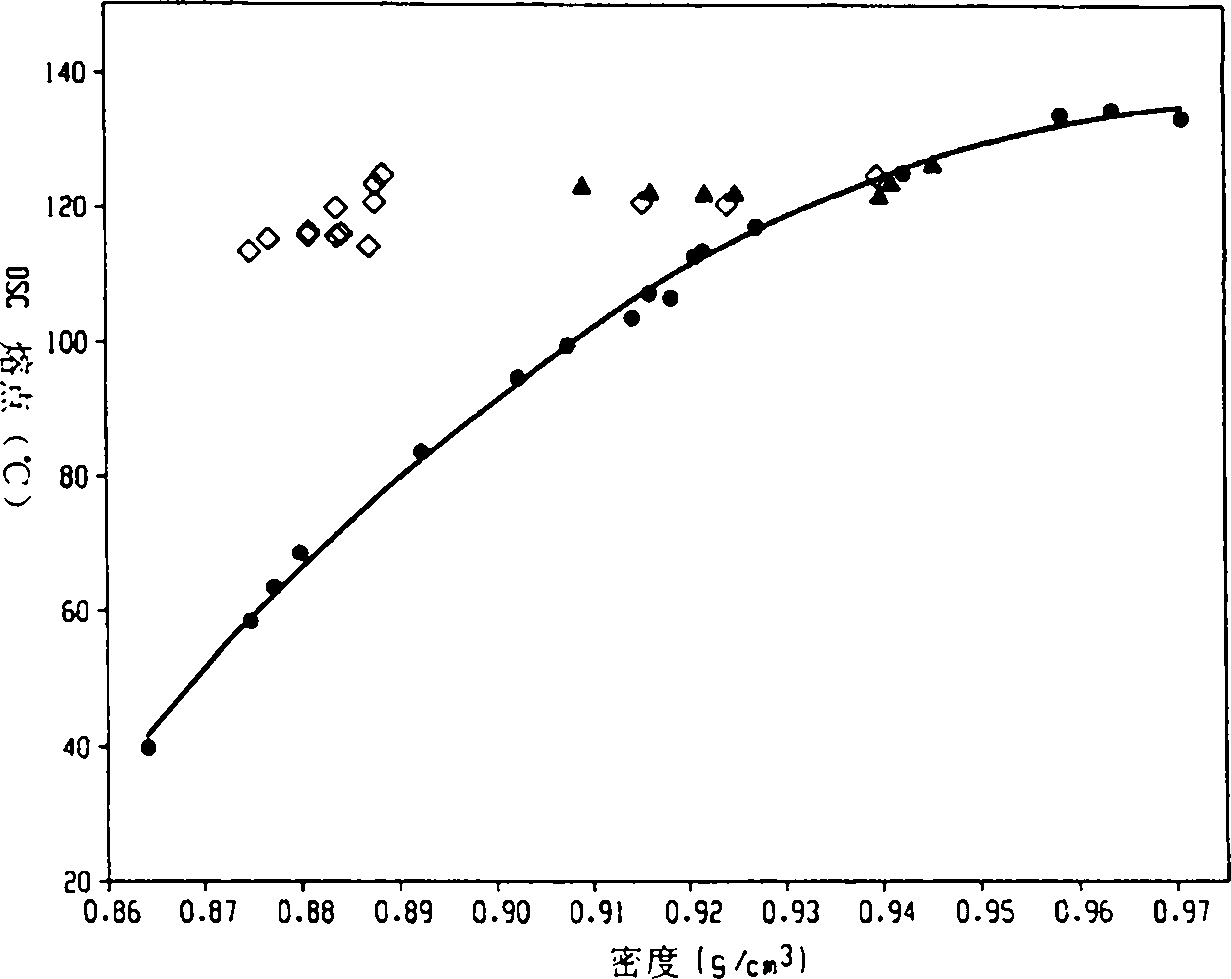
图1显示本发明聚合物(以菱形表示)与传统无规共聚物(以圆形表示)及齐格勒-纳塔共聚物(以三角形表示)相比的熔点/密度关系。Figure 1 shows the melting point/density relationship of the inventive polymers (represented by diamonds) compared to conventional random copolymers (represented by circles) and Ziegler-Natta copolymers (represented by triangles).
图2显示各种聚合物的为DSC熔融焓的函数的ΔDSC-CRYSTAF的图形。菱形表示无规乙烯/辛烯共聚物;正方形表示聚合物实施例1-4;三角形表示聚合物实施例5-9;以及圆形表示聚合物实施例10-19。符号“X”表示聚合物实施例A*-F*。Figure 2 shows a graph of ΔDSC-CRYSTAF as a function of DSC enthalpy of fusion for various polymers. Diamonds represent random ethylene/octene copolymers; squares represent Polymer Examples 1-4; triangles represent Polymer Examples 5-9; and circles represent Polymer Examples 10-19. The symbol "X" designates polymer examples A * -F * .
图3显示密度对由本发明的共聚体(以正方形及圆形表示)及传统共聚物(以三角形表示,其为各种不同的Dow 聚合物)制得的非取向膜的弹性回复的作用。正方形表示本发明的乙烯/丁烯共聚物;以及圆形表示本发明的乙烯/辛烯共聚物。Figure 3 shows the density versus density for various Dow The role of the elastic recovery of the non-oriented film made of polymer). Squares represent inventive ethylene/butene copolymers; and circles represent inventive ethylene/octene copolymers.
图4是TREF分级的乙烯/1-辛烯共聚物级分的辛烯含量相对于实施例5的聚合物(以圆形表示)及比较聚合物E及F(以符号“X”表示)的级分的TREF洗脱温度的图形。菱形表示传统无规乙烯/辛烯共聚物。Figure 4 is a graph of the octene content of the TREF fractionated ethylene/1-octene copolymer fraction relative to the polymer of Example 5 (represented by circles) and Comparative Polymers E and F (represented by the symbol "X") Graph of TREF elution temperature of fractions. Diamonds represent conventional random ethylene/octene copolymers.
图5是TREF分级的乙烯/1-辛烯共聚物级分的辛烯含量相对于实施例5的聚合物(曲线1)及比较例F(曲线2)的聚合物的级分的TREF洗脱温度的图形。正方形表示实施例F*,以及三角形表示实施例5。Figure 5 is the TREF elution of the octene content of the TREF fractionated ethylene/1-octene copolymer fraction relative to the fraction of the polymer of Example 5 (curve 1) and the polymer of Comparative Example F (curve 2) temperature graph. The squares represent Example F * , and the triangles represent Example 5.
图6是比较的乙烯/1-辛烯共聚物(曲线2)及丙烯/乙烯-共聚物(曲线3)及以用不同量的链穿梭剂制得的本发明的两个乙烯/1-辛烯嵌段共聚物(曲线1)的为温度的函数的贮能模量的对数值的图形。Figure 6 is a comparative ethylene/1-octene copolymer (curve 2) and propylene/ethylene-copolymer (curve 3) and two ethylene/1-octene copolymers of the present invention made with different amounts of chain shuttling agents Graph of the logarithmic value of the storage modulus as a function of temperature for the olefinic block copolymer (curve 1).
图7显示某些本发明聚合物(以菱形表示)与某些已知聚合物比较时的TMA(1mm)相对于挠曲模量的图形。三角形表示各种不同的Dow
具体实施方式 Detailed ways
一般定义general definition
“聚合物”意指通过聚合相同或不同形式的单体所制备的聚合化合物。一般用语“聚合物”包含“均聚物”、“共聚物”、“三元共聚物”与“共聚体”。"Polymer" means a polymeric compound prepared by polymerizing monomers of the same or different forms. The general term "polymer" includes "homopolymer", "copolymer", "terpolymer" and "interpolymer".
“共聚体”意指通过至少二种不同形式单体的聚合作用所制备的聚合物。一般用词“共聚体”包括“共聚物”一词(其一般是用以指由二种不同单体所制备的聚合物)与“三元共聚物”一词(其一般是用以指由三种不同形式的单体所制备的聚合物)。其也包含通过聚合四或更多形式的单体所制造的聚合物。"Interpolymer" means a polymer prepared by the polymerization of at least two monomers of different forms. The general term "interpolymer" includes the term "copolymer" (which is generally used to refer to a polymer prepared from two different monomers) and the term "terpolymer" (which is generally used to refer to a polymer made from polymers prepared from three different types of monomers). It also includes polymers made by polymerizing four or more forms of monomers.
“乙烯/α-烯烃共聚体”一词一般是指包含乙烯及具有3或更多个碳原子的α-烯烃的聚合物。较优选地,乙烯包含整个聚合物的主要摩尔分率,即,乙烯组成整个聚合物的至少约50摩尔%。更优选地,乙烯组成至少约60摩尔%,至少约70摩尔%,或至少约80摩尔%,且整个聚合物的实质上剩余者包含至少一种其它共聚单体,其较优选是具有3或更多个碳原子的α-烯烃。对于许多乙烯/辛烯共聚物,较优选的组合物包含大于整个聚合物的约80摩尔%的乙烯含量,及整个聚合物的约10至约15(较优选是约15至约20)摩尔%的辛烯含量。在某些实施例,乙烯/α-烯烃共聚体不包含以低产量或以微量或以化学方法的副产物制造的那些。虽然乙烯/α-烯烃共聚体可与一种或多种聚合物掺合,如此制造的乙烯/α-烯烃共聚体是实质上纯的,且一般是包含聚合反应方法的反应产物的主要组分。The term "ethylene/alpha-olefin interpolymer" generally refers to a polymer comprising ethylene and an alpha-olefin having 3 or more carbon atoms. More preferably, ethylene comprises a major mole fraction of the entire polymer, ie, ethylene constitutes at least about 50 mole percent of the entire polymer. More preferably, ethylene constitutes at least about 60 mole percent, at least about 70 mole percent, or at least about 80 mole percent, and substantially the remainder of the entire polymer comprises at least one other comonomer, more preferably having 3 or α-olefins with more carbon atoms. For many ethylene/octene copolymers, more preferred compositions comprise an ethylene content of greater than about 80 mole percent of the total polymer, and from about 10 to about 15, more preferably from about 15 to about 20, mole percent of the total polymer octene content. In certain embodiments, the ethylene/α-olefin interpolymers exclude those produced in low yields or in trace amounts or as by-products of chemical processes. Although ethylene/alpha-olefin interpolymers may be blended with one or more polymers, the ethylene/alpha-olefin interpolymers so produced are substantially pure and generally are a major component of the reaction product comprising the polymerization process .
乙烯/α-烯烃共聚体包含呈聚合型式的乙烯及一种或多种可共聚合的α-烯烃共聚单体,特征在于在化学或物理性质是不同的二或更多种聚合化单体单元的多个嵌段或链段。即,乙烯/α-烯烃共聚体是嵌段共聚体,较优选是多嵌段的共聚体或共聚物。“共聚体”及“共聚物”等用词在此可交换使用。在某些实施例,多嵌段共聚物可以下列化学式表示:Ethylene/α-olefin interpolymers comprising ethylene and one or more copolymerizable α-olefin comonomers in polymerized form, characterized by two or more polymerized monomer units differing in chemical or physical properties multiple blocks or segments. That is, the ethylene/α-olefin interpolymer is a block interpolymer, more preferably a multi-block interpolymer or copolymer. The terms "interpolymer" and "copolymer" are used interchangeably herein. In certain embodiments, multi-block copolymers can be represented by the following chemical formula:
(AB)n (AB) n
其中,n是至少为1,较优选是大于1的整数,诸如,2、3、4、5、10、15、20、30、40、50、60、70、80、90、100,或更高。“A”表示硬嵌段或链段,且“B”表示软嵌段或链段。较优选地,A及B是以基本线性方式连接,其是与基本分支或基本星状的方式相反。在其它实施例,A嵌段及B嵌段是沿聚合物链无规地分布。换言之,嵌段共聚物一般不具有如下的结构。Wherein, n is at least 1, more preferably an integer greater than 1, such as, 2, 3, 4, 5, 10, 15, 20, 30, 40, 50, 60, 70, 80, 90, 100, or more high. "A" denotes a hard block or segment, and "B" denotes a soft block or segment. More preferably, A and B are connected in a substantially linear manner, as opposed to a substantially branched or substantially star-like manner. In other embodiments, the A blocks and B blocks are randomly distributed along the polymer chain. In other words, block copolymers generally do not have the following structures.
AAA-AA-BBB-BBAAA-AA-BBB-BB
在其它实施例,嵌段共聚物一般不具有包含不同共聚单体的第三种嵌段。在其它实施例,A嵌段及B嵌段的每一种具有在嵌段内基本上无规地分布的单体或共聚单体。换言之,A嵌段或B嵌段皆不包含二或更多的不同组成的次链段(或次嵌段),诸如,尖部链段,其具有与嵌段剩余者实质上不同的组成。In other embodiments, the block copolymer generally does not have a third block comprising a different comonomer. In other embodiments, each of the A block and the B block has monomer or comonomer distributed substantially randomly within the block. In other words, neither the A block nor the B block comprises two or more subsegments (or subblocks) of different composition, such as a tip segment, which has a substantially different composition than the remainder of the block.
多嵌段聚合物通常上包含各种含量的“硬”及“软”链段。“硬”链段是指其间乙烯是以大于约95重量%且较优选是大于约98重量%(其是以聚合物重量为基准计)的量存在的聚合化单元的嵌段。换言之,硬链段的共聚单体含量(非乙烯的单体的含量)是少于约5重量%,且较优选是少于约2重量%(其是以聚合物重量为基准计)。在某些实施例,硬链段包含所有或实质上所有乙烯。另一方面,“软”链段是指其间共聚单体含量(非乙烯的单体的含量)是大于约5重量%,较优选是大于约8重量%,大于约10重量%,或大于约15重量%(其是以聚合物重量为基准计)的聚合化单元的嵌段。在某些实施例,软链段的共聚单体含量可大于约20重量,大于约25重量%,大于约30重量%,大于约35重量%,大于约40重量%,大于约45重量%,大于约50重量%,或大于约60重量%。Multi-block polymers generally contain various amounts of "hard" and "soft" segments. "Hard" segments refer to blocks of polymerized units in which ethylene is present in an amount greater than about 95% by weight, and more preferably greater than about 98% by weight, based on the weight of the polymer. In other words, the hard segment has a comonomer content (monomer content other than ethylene) of less than about 5% by weight, and more preferably less than about 2% by weight (based on the weight of the polymer). In certain embodiments, the hard segment comprises all or substantially all ethylene. "Soft" segments, on the other hand, are segments in which the comonomer content (content of monomers other than ethylene) is greater than about 5% by weight, more preferably greater than about 8% by weight, greater than about 10% by weight, or greater than about 15% by weight (based on polymer weight) of blocks of polymerized units. In certain embodiments, the comonomer content of the soft segment may be greater than about 20 wt%, greater than about 25 wt%, greater than about 30 wt%, greater than about 35 wt%, greater than about 40 wt%, greater than about 45 wt%, Greater than about 50% by weight, or greater than about 60% by weight.
软链段一般可以嵌段共聚体总重量的约1重量%至约99重量%存在于嵌段共聚体,较优选是嵌段共聚体总重量的约5重量%至约95重量%,约10重量%至约90重量%,约15重量%至约85重量%,约20重量%至约80重量%,约25重量%至约75重量%,约30重量%至约70重量%,约35重量%至约65重量%,约40重量%至约60重量%,或约45重量%至约55重量%。相反地,硬链段可以相似范围存在。软链段的重量百分率及硬链段的重量百分率可以自DSC或NMR获得的数据为基础计算。这些方法及计算是公开在同时申请的美国专利申请案序号(知道时补入),代理人档案编号385063-999558,发明名称“Ethylene/α-Olefin Block Interpolymers”,2006年3月15日申请,以ColinL.P.Shan、Lonnie Hazlitt等人的名义,且转让给Dow Global TechnologiesInc.,其公开内容全文并入本案说明书中以供参考。The soft segment can generally be present in the block interpolymer at about 1% to about 99% by weight of the total block interpolymer, more preferably at about 5% to about 95% by weight of the total block interpolymer, about 10 % by weight to about 90% by weight, about 15% by weight to about 85% by weight, about 20% by weight to about 80% by weight, about 25% by weight to about 75% by weight, about 30% by weight to about 70% by weight, about 35% by weight % to about 65% by weight, about 40% to about 60% by weight, or about 45% to about 55% by weight. Conversely, hard segments can be present in similar ranges. The weight percent of the soft segment and the weight percent of the hard segment can be calculated based on data obtained from DSC or NMR. These methods and calculations are disclosed in the US patent application serial number (added when known), attorney file number 385063-999558, invention name "Ethylene/α-Olefin Block Interpolymers", filed on March 15, 2006, In the name of Colin L.P. Shan, Lonnie Hazlitt, et al., and assigned to Dow Global Technologies Inc., the disclosure of which is incorporated in this case description in its entirety for reference.
“结晶”一词若应用时,是指拥有通过差式扫描量热法(DSC)或等效技术测定的第一级转移或结晶熔点(Tm)的聚合物。此用词可与“半结晶”交换使用。“非结晶性”一词是指缺乏通过差式扫描量热法(DSC)或等效技术测定的结晶熔点的聚合物。The term "crystalline", when used, refers to a polymer possessing a first order transition or crystalline melting point (Tm) as determined by differential scanning calorimetry (DSC) or an equivalent technique. The term is used interchangeably with "semi-crystalline". The term "amorphous" refers to a polymer that lacks a crystalline melting point as determined by differential scanning calorimetry (DSC) or an equivalent technique.
“多嵌段共聚物”或“链段共聚物”等词是指含有二或更多种较优选是以线性方式连接的化学上不同的区域或链段(称为“嵌段”)的聚合物,即,具有化学上不同的单元且对于聚合化乙烯官能性是以尾对尾连接(而非侧向或接枝方式)的聚合物。在一个较优选实施例,嵌段是在合并在其内的共聚单体的量或型式、密度、结晶量、由此组合物的聚合物引起的结晶尺寸、立体异构规整度(全同立构或间同立构)的型式或程度、区域规则性或区域不规则性、包含长链分支或超分支的分支量、均质性,或任何其它化学或物理性质上不同。多嵌段共聚物特征在于由于制造共聚物的独特方法造成的两个多分散性指数(PDI或Mw/Mn)的独特分布、嵌段长度分布,和/或嵌段数分布。更特别地,当以连续方法制造时,聚合物所需地拥有1.7至2.9的PDI,较优选是1.8至2.5,更优选是1.8至2.2,且最优选是1.8至2.1。当以间歇或半间歇方法制造时,聚合物拥有1.0至2.9的PDI,较优选是1.3至2.5,更优选是1.4至2.0,且最优选是1.4至1.8。The terms "multi-block copolymer" or "segmented copolymer" refer to polymeric polymers containing two or more chemically distinct regions or segments (referred to as "blocks"), preferably linked in a linear fashion. Polymers, ie, polymers that have chemically distinct units and that are connected tail-to-tail (rather than in a lateral or grafted fashion) for the polymerized ethylene functionality. In a more preferred embodiment, the block is the amount or type of comonomer incorporated therein, the density, the amount of crystallization, the crystallite size induced by the polymer of the composition, the stereoregularity (isotactic conformation or syndiotactic), regioregularity or regio irregularity, amount of branching including long chain branching or hyperbranching, homogeneity, or any other chemical or physical property. Multi-block copolymers are characterized by unique distributions of both polydispersity indices (PDI or Mw/Mn), block length distributions, and/or block number distributions due to unique methods of making the copolymers. More particularly, when produced in a continuous process, the polymer desirably possesses a PDI of 1.7 to 2.9, more preferably 1.8 to 2.5, more preferably 1.8 to 2.2, and most preferably 1.8 to 2.1. When produced in a batch or semi-batch process, the polymer possesses a PDI of 1.0 to 2.9, more preferably 1.3 to 2.5, more preferably 1.4 to 2.0, and most preferably 1.4 to 1.8.
在下列描述,无论“约”或“大约”等字是否与其一起使用,此处公开的所有数值是大约值。其可以1%、2%、5%,或有时,10至20%变化。当具下限RL及上限RU的数值范围被公开时,落在此范围内的任何数值被特别公开。特别地,在此范围的下列数值被特别公开:R=RL+k*(RU-RL),其中,k是1%至100%范围的变量,且以1%为增量,即,k是1%、2%、3%、4%、5%...50%、51%、52%...95%、96%、97%、98%、99%,或100%。再者,以如上定义的两个R值界定的任何数值范围也被特别公开。In the following description, all numerical values disclosed herein are approximate, regardless of whether the word "about" or "approximately" is used in conjunction therewith. It can vary by 1%, 2%, 5%, or sometimes, 10 to 20%. When a numerical range having a lower limit RL and an upper limit RU is disclosed, any value falling within that range is specifically disclosed. In particular, the following values in this range are specifically disclosed: R= RL +k*(R U −RL ), where k is a variable ranging from 1% to 100% in 1% increments, namely , k is 1%, 2%, 3%, 4%, 5%...50%, 51%, 52%...95%, 96%, 97%, 98%, 99%, or 100%. Furthermore, any numerical range bounded by two R values as defined above is also specifically disclosed.
乙烯/α-烯烃共聚体Ethylene/α-olefin interpolymer
用于本发明具体实施方案的乙烯/α-烯烃共聚体(也称为“本发明的共聚体”或“本发明的聚合物”)包含呈聚合化型式的乙烯及一种或多种可共聚合的α-烯烃共聚单体,特征在于在化学或物理性质是不同的具有两种或更多种聚合化单体单元的数个嵌段或链段(嵌段共聚体),较优选是多嵌段共聚物。乙烯/α-烯烃共聚体特征在于如下文所述的方面中的一种或多种。Ethylene/α-olefin interpolymers (also referred to as "inventive interpolymers" or "inventive polymers") useful in embodiments of the present invention comprise ethylene in polymerized form and one or more copolymerizable Polymerized α-olefin comonomers characterized by several blocks or segments (block interpolymers) of two or more polymerized monomer units differing in chemical or physical properties, more preferably multiple block copolymers. The ethylene/α-olefin interpolymers are characterized by one or more of the aspects described below.
在一方面中,在本发明的具体实施方案中使用的乙烯/α-烯烃共聚体具有约1.7至约3.5的Mw/Mn,及至少一个熔点(Tm,℃)及密度(d,克/立方厘米),其中,这些变量的数值是对应于下列关系式:In one aspect, the ethylene/α-olefin interpolymers used in embodiments of the present invention have a Mw / Mn of from about 1.7 to about 3.5, and at least one melting point ( Tm , °C) and density (d, g/cm3), where the values for these variables correspond to the following relationships:
Tm>-2002.9+4538.5(d)-2422.2(d)2,且较优选是T m >-2002.9+4538.5(d)-2422.2(d) 2 , and more preferably
Tm≥-6288.1+13141(d)-6720.3(d)2,且更优选是T m ≥ -6288.1+13141(d)-6720.3(d) 2 , and more preferably
Tm≥858.91-1825.3(d)+1112.8(d)2。T m ≥ 858.91-1825.3(d)+1112.8(d) 2 .
这些熔点/密度的关系例示在图1。不同于传统的乙烯/α-烯烃的无规共聚物(其熔点是随减少的密度而减少),本发明的共聚体(以菱形表示)展现实质上与密度无关的熔点,特别是当密度在约0.87g/cc至约0.95g/cc之间。例如,当密度范围为0.875g/cc至约0.945g/cc时,这些聚合物的熔点是在约110℃至约130℃的范围。在某些实施例,当密度范围是0.875g/cc至约0.945g/cc时,这些聚合物的熔点是约115℃至约125℃的范围。These melting point/density relationships are illustrated in Figure 1 . Unlike conventional ethylene/α-olefin random copolymers, whose melting point decreases with decreasing density, the inventive interpolymers (represented by diamonds) exhibit melting points that are substantially independent of density, especially when the density is between Between about 0.87g/cc and about 0.95g/cc. For example, these polymers have melting points in the range of about 110°C to about 130°C with densities in the range of 0.875 g/cc to about 0.945 g/cc. In certain embodiments, the melting point of these polymers ranges from about 115°C to about 125°C when the density ranges from 0.875 g/cc to about 0.945 g/cc.
在另一方面,乙烯/α-烯烃共聚体包含聚合化型式的乙烯及一种或多种的α-烯烃,且特征在于以最高差式扫描量热法(“DSC”)峰的温度减去最高结晶化分析分级(“CRYSTAF”)峰的温度而定义的ΔT(℃),及熔化热,J/g,ΔH,且ΔT及ΔH满足下列关系式:In another aspect, ethylene/α-olefin interpolymers comprise polymerized versions of ethylene and one or more α-olefins and are characterized by the temperature of the highest differential scanning calorimetry ("DSC") peak minus ΔT (°C) defined by the temperature of the highest crystallization analysis fractionation ("CRYSTAF") peak, and the heat of fusion, J/g, ΔH, and ΔT and ΔH satisfy the following relationship:
对于ΔH最高达130J/g时,For ΔH up to 130J/g,
ΔT>-0.1299(ΔH)+62.81,且较优选是ΔT>-0.1299(ΔH)+62.81, and more preferably
ΔT≥-0.1299(ΔH)+64.38,且更优选是ΔT≥-0.1299(ΔH)+64.38, and more preferably
ΔT≥-0.1299(ΔH)+65.95。ΔT≥-0.1299(ΔH)+65.95.
再者,对于ΔH大于130J/g时ΔT是等于或大于48℃。CRYSTAF峰是使用至少5%的累积聚合物确定(即,峰必须表示至少5%的累积聚合物),且若少于5%的聚合物具有可鉴别的CRYSTAF峰,则CRYSTAF温度是30℃,且ΔH是熔化热的数值,J/g。更优选地,最高的CRYSTAF峰含有至少10%的累积聚合物。图2显示本发明聚合物及比较例的图式数据。积分峰面积及峰温度是以仪器制造商提供的计算机化绘图程序计算。对于无规乙烯辛烯比较聚合物而显示的斜线是相对应于方程式ΔT=-0.1299(ΔH)+62.81。Furthermore, ΔT is equal to or greater than 48°C for ΔH greater than 130 J/g. The CRYSTAF peak is determined using at least 5% of the cumulative polymer (i.e., the peak must represent at least 5% of the cumulative polymer), and if less than 5% of the polymer has an identifiable CRYSTAF peak, the CRYSTAF temperature is 30°C, And ΔH is the numerical value of the heat of fusion, J/g. More preferably, the highest CRYSTAF peak contains at least 10% accumulated polymer. Figure 2 shows graphical data for inventive polymers and comparative examples. The integrated peak area and peak temperature were calculated with a computerized plotting program provided by the instrument manufacturer. The slope shown for the random ethylene octene comparative polymer corresponds to the equation ΔT=-0.1299(ΔH)+62.81.
在另一方面,当使用温度上升洗脱分级(“TREF”)分级时,乙烯/α-烯烃共聚体具有在40℃与130℃间洗脱的分子级分,特征在于该级分具有比在相同温度间洗脱的可相比拟无规乙烯共聚体级分更高,较优选是高至少5%,更优选是高至少10%,的摩尔共聚单体含量,其中,可相比拟的无规乙烯共聚体含有相同共聚单体,且具有在嵌段共聚体的10%内的熔体指数、密度,及摩尔共聚单体含量(以整个聚合物为基准计)。较优选地,可相比拟的共聚体的Mw/Mn也是在嵌段共聚体的10%内,和/或可相比拟的共聚体具有嵌段共聚体的10重量%内的总共聚单体含量。On the other hand, when fractionated using Temperature Rising Elution Fractionation ("TREF"), the ethylene/α-olefin interpolymer has a molecular fraction eluting between 40°C and 130°C, characterized in that the fraction has A higher, more preferably at least 5% higher, more preferably at least 10% higher, molar comonomer content of the comparable random ethylene interpolymer fraction eluting between the same temperatures, wherein the comparable random The ethylene interpolymers contain the same comonomer and have a melt index, density, and molar comonomer content (based on the total polymer) that are within 10% of the block interpolymer. More preferably, the Mw/Mn of the comparable interpolymer is also within 10% of the block interpolymer, and/or the comparable interpolymer has a total comonomer content within 10% by weight of the block interpolymer .
在另一方面,乙烯/α-烯烃共聚体特征在于对乙烯/α-烯烃共聚体的压模成型膜测量的在300%应变及1周期下的弹性回复(Re,%),且具有密度(d,克/立方厘米),其中,当乙烯/α-烯烃共聚体实质上无交联相时,Re及d的数值满足下列关系式:In another aspect, the ethylene/α-olefin interpolymer is characterized by an elastic recovery (Re, %) at 300% strain and 1 cycle measured on a compression molded film of the ethylene/α-olefin interpolymer, and has a density ( d, g/cubic centimeter), wherein, when the ethylene/α-olefin interpolymer has no cross-linked phase substantially, the values of Re and d satisfy the following relationship:
Re>1481-1629(d);且较优选是Re>1481-1629(d); and more preferably
Re≥1491-1629(d);且更优选是Re≥1491-1629(d); and more preferably
Re≥1501-1629(d);且更优选是Re≥1501-1629(d); and more preferably
Re≥1511-1629(d)。Re≥1511-1629(d).
图3显示密度对自某些本发明共聚体及传统无规共聚物制得的非取向膜的弹性回复的作用。对于相同密度,本发明共聚体具有实质上较高的弹性回复。Figure 3 shows the effect of density on the elastic recovery of non-oriented films made from certain inventive interpolymers and conventional random copolymers. For the same density, the inventive interpolymers have substantially higher elastic recovery.
在某些具体实施方案,乙烯/α-烯烃共聚体具有高于10MPa的抗张强度,较优选为抗张强度≥11MPa,更优选为抗张强度≥13MPa,和/或在11厘米/分钟的十字头分离速率时至少600%的断裂延伸率,更优选是至少700%,高度较优选是至少800%,且最高度较优选是至少900%。In some specific embodiments, the ethylene/α-olefin interpolymer has a tensile strength higher than 10 MPa, more preferably a tensile strength ≥ 11 MPa, more preferably a tensile strength ≥ 13 MPa, and/or at 11 cm/min Elongation at break at crosshead separation rate of at least 600%, more preferably at least 700%, more preferably at least 800% in height, and more preferably at least 900% in height.
在其它具体实施方案,乙烯/α-烯烃共聚体具有(1)1至50的贮能模量比例,G’(25℃)/G’(100℃),较优选是1至20,更优选是1至10;和/或(2)少于80%的70℃压缩变定,较优选是少于70%,特别是少于60%,少于50%,或少于40%,至降至0%的压缩定变。In other specific embodiments, the ethylene/α-olefin interpolymer has (1) a storage modulus ratio, G'(25°C)/G'(100°C), of 1 to 50, more preferably 1 to 20, more preferably is 1 to 10; and/or (2) less than 80% of the 70 ° C compression set, more preferably less than 70%, especially less than 60%, less than 50%, or less than 40%, to to 0% compression set.
在另外具体实施方案,乙烯/α-烯烃共聚体具有少于80%,少于70%,少于60%,或少于50%的70℃压缩变定。较优选地,共聚体的70℃压缩变定是少于40%,少于30%,少于20%,且可下降至约0%。In further specific embodiments, the ethylene/α-olefin interpolymer has a 70°C compression set of less than 80%, less than 70%, less than 60%, or less than 50%. More preferably, the interpolymer has a 70°C compression set of less than 40%, less than 30%, less than 20%, and can be reduced to about 0%.
在某些具体实施方案,乙烯/α-烯烃共聚体具有少于85J/g的熔化热,和/或等于或少于100磅/英尺2(4800Pa)的丸粒粘连强度,较优选是等于或少于50磅/英尺2(2400Pa),特别是等于或少于5磅/英尺2(240Pa),及低至0磅/英尺2(0Pa)。In certain embodiments, the ethylene/α-olefin interpolymer has a heat of fusion of less than 85 J/g, and/or a pellet blocking strength equal to or less than 100 lb/ ft2 (4800 Pa), more preferably equal to or Less than 50 lb/ ft2 (2400Pa), especially equal to or less than 5 lb/ ft2 (240Pa), and as low as 0 lb /ft2 (0Pa).
在其它具体实施方案,乙烯/α-烯烃共聚体包含呈聚合化型式的至少50摩尔%的乙烯,且具有少于80%(较优选是少于70%或少于60%,最优选是少于40%至50%,及降至接近0%)的70℃压缩变定。In other specific embodiments, the ethylene/α-olefin interpolymer comprises at least 50 mole percent ethylene in polymerized form and has less than 80 percent (more preferably less than 70 percent or less than 60 percent, most preferably less than Compression set at 70°C at 40% to 50%, and down to close to 0%.
在某些具体实施方案,多嵌段共聚物拥有拟合Schultz-Flory分布(而非泊松分布)的PDI。共聚物进一步特征在于具有多分散嵌段分布及多分散的嵌段尺寸分布,且拥有最可能的嵌段长度分布。较优选的多嵌段共聚物是含有4或更多的嵌段或链段(包含终端嵌段)的那些。更优选地,共聚物包含至少5、10或20的嵌段或链段(包含终端嵌段)。In certain embodiments, the multi-block copolymer possesses a PDI that fits a Schultz-Flory distribution rather than a Poisson distribution. The copolymers are further characterized as having a polydisperse block distribution and a polydisperse block size distribution, with a most probable distribution of block lengths. More preferred multi-block copolymers are those containing 4 or more blocks or segments, including terminal blocks. More preferably, the copolymer comprises at least 5, 10 or 20 blocks or segments (including terminal blocks).
共聚单体含量可使用任何适合技术测量,且优选基于核磁共振(“NMR”)光谱术的技术。再者,对于具有相对较宽TREF曲线的聚合物或聚合物掺合物,聚合物所需地是先使用TREF分级成数个级分,每一级分具有10℃或更少的洗脱温度范围。即,每一种洗脱级分具有10℃或更少的收集温度窗。使用此技术,该嵌段共聚体具有至少一种具有比可相比拟共聚体的相对应级分更高摩尔共聚单体含量的该级分。Comonomer content may be measured using any suitable technique, and preferably a technique based on nuclear magnetic resonance ("NMR") spectroscopy. Furthermore, for polymers or polymer blends with relatively broad TREF profiles, it is desirable for the polymer to first be fractionated using TREF into several fractions, each fraction having an elution temperature of 10°C or less scope. That is, each eluted fraction has a collection temperature window of 10°C or less. Using this technique, the block interpolymer has at least one fraction that has a higher molar comonomer content than the corresponding fraction of a comparable interpolymer.
在另一方面,本发明的聚合物是烯烃共聚体,较优选是包含呈聚合化型式的乙烯及一种或多种可共聚合的共聚单体,特征在于化学或物理性质不同的具有两种或更多聚合化单体单元的多嵌段(即,至少二嵌段)或链段(嵌段共聚体),最优选是多嵌段共聚物,该嵌段共聚体具有在40℃与130℃间洗脱的峰(但非仅一种分子级分)(但未收集和/或隔离个别级分),特征在于该峰具有当使用半极大处全宽度(FWHM)面积计算展开时通过红外线光谱术估算的共聚单体含量,具有比在相同洗脱温度及使用半极大处全宽度(FWHM)面积计算展开时的可相比拟无规乙烯共聚体峰更高,较优选是高至少5%,更优选是高至少10%,的平均摩尔共聚单体含量,其中,该可相比拟的无规乙烯共聚体具有相同共聚单体,且具有嵌段共聚体的10%内的熔体指数、密度,及摩尔共聚单体含量(以整个聚合物为基准计)。较优选地,可相比拟的共聚体的Mw/Mn也是嵌段共聚体的10%内,和/或可相比拟的共聚体具有嵌段共聚体的10%内的总共聚单体含量。半极大处全宽度(FWHM)计算是以ATREF红外线检测器的甲基对甲撑基回应面积[CH3/CH2]的比例为基础,其中,最高峰是自基线鉴别,然后,FWHM面积被确定。由使用ATREF峰测得的分布,FWHM面积被定义为T1及T2间的曲线下的面积,其中,T1及T2是在ATREF峰的左右,通过使峰高度除以2,然后绘一与基线呈水平的线与ATREF曲线的左右部分相交而确定的点。共聚单体含量的校正曲线是使用无规乙烯/α-烯烃共聚物,由NMR对TREF峰的FWHM面积比例计算共聚单体含量而绘制的。对于此红外线方法,校正曲线是对感兴趣的相同共聚单体型式产生。本发明聚合物的TREF峰的共聚单体含量可通过参考校正曲线使用TREF峰的其FWHM甲基:甲撑基面积比例[CH3/CH2]而确定。In another aspect, the polymers of the present invention are olefin interpolymers, more preferably comprising ethylene in polymerized form and one or more copolymerizable comonomers, characterized by two chemically or physically different or more multi-block (i.e., at least diblock) or segments (block interpolymers) of polymerized monomer units, most preferably multi-block copolymers, the block interpolymers have A peak (but not just one molecular fraction) eluting between °C (but not collecting and/or isolating individual fractions) characterized in that the peak has when unfolded using the full width at half maximum (FWHM) calculation calculated by The comonomer content estimated by infrared spectroscopy has a higher, more preferably at least An average molar comonomer content of 5%, more preferably at least 10% higher, wherein the comparable random ethylene interpolymer has the same comonomer and has a melt within 10% of the block interpolymer Index, density, and molar comonomer content (based on the whole polymer). More preferably, the Mw/Mn of the comparable interpolymer is also within 10% of that of the block interpolymer, and/or the comparable interpolymer has a total comonomer content within 10% of that of the block interpolymer. The full width at half maximum (FWHM) calculation is based on the ratio of the methyl-to-methylene response area [CH 3 /CH 2 ] of the ATREF infrared detector, where the highest peak is identified from the baseline, then the FWHM area It is determined. From the distribution measured using the ATREF peak, the FWHM area is defined as the area under the curve between T1 and T2 , where T1 and T2 are around the ATREF peak, by dividing the peak height by 2 and plotting A point determined by the intersection of a line horizontal to the baseline and the left and right portions of the ATREF curve. A calibration curve for comonomer content was prepared using random ethylene/α-olefin copolymers to calculate comonomer content from the NMR vs. FWHM area ratio of the TREF peak. For this infrared method, a calibration curve is generated for the same comonomer species of interest. The comonomer content of the TREF peaks of the polymers of the invention can be determined by using their FWHM methyl:methylene area ratio [CH 3 /CH 2 ] of the TREF peaks by reference to a calibration curve.
共聚单体含量可使用任何适合技术测量,且优选基于核磁共振(NMR)光谱术的技术。使用此技术,该嵌段共聚体具有比相对应的可相比拟共聚体更高的摩尔共聚单体含量。Comonomer content may be measured using any suitable technique, and is preferably a technique based on nuclear magnetic resonance (NMR) spectroscopy. Using this technique, the block interpolymer has a higher molar comonomer content than the corresponding comparable interpolymer.
优选地,对于乙烯及1-辛烯的共聚体,嵌段共聚体具有的在40与130℃间洗脱的TREF级分的共聚单体含量是大于或等于(-0.2013)T+20.07的量,更优选是大于或等于(-0.2013)T+21.07的量,其中,T是被比较的TREF级分的峰洗脱温度的数值,以℃测量。Preferably, for interpolymers of ethylene and 1-octene, the block interpolymer has a comonomer content of the TREF fraction eluting between 40 and 130°C in an amount greater than or equal to (-0.2013)T+20.07 , more preferably an amount greater than or equal to (-0.2013)T+21.07, wherein T is the numerical value of the peak elution temperature of the compared TREF fractions, measured in °C.
图4是以图说明乙烯及1-辛烯的嵌段共聚体的具体实施方案,其中,数种相比拟的乙烯/1-辛烯共聚体(无规共聚物)的共聚单体含量对TREF洗脱温度的作图与代表(-0.2013)T+20.07的线(实线)拟合。方程式(-0.2013)T+21.07的线是以虚线描述。也描述本发明的数种嵌段乙烯/1-辛烯共聚体(多嵌段共聚物)的级分的共聚单体含量。所有嵌段共聚体级分具有比在相等洗脱温度的任一线明显更高的1-辛烯含量。此结果是本发明共聚体的特征,且被认为是由于聚合物链内不同嵌段存在的结果,其具有结晶及无定形性质。Figure 4 is a diagram illustrating specific embodiments of block interpolymers of ethylene and 1-octene, wherein the comonomer content of several comparable ethylene/1-octene interpolymers (random copolymers) versus TREF The plot of elution temperature was fitted with a line representing (-0.2013)T+20.07 (solid line). The line of equation (-0.2013)T+21.07 is depicted as a dashed line. Also depicted are the comonomer contents of fractions of several block ethylene/1-octene interpolymers (multi-block copolymers) of the present invention. All block interpolymer fractions have significantly higher 1-octene content than either line at equivalent elution temperatures. This result is characteristic of the interpolymers of the invention and is believed to be a result of the presence of different blocks within the polymer chain, which have both crystalline and amorphous properties.
图5是图示如下探讨的实施例5及比较例F的聚合物级分的TREF曲线及共聚单体含量。两个聚合物的40至130℃(较优选是60至95℃)洗脱的峰被分级成三部分,每一部分是在少于10℃的温度范围洗脱。实施例5的实际数据是以三角形表示。本领域技术人员会了解适合的校正曲线可建构用于含有不同共聚单体的共聚体,且供作为适合自相同单体的比较共聚体所获得的TREF值的比较的线,该比较共聚体较优选是使用茂金属或其它均质催化剂组合物所制得。本发明的共聚体特征在于比从校正曲线在相同TREF洗脱温度确定的值更大(较优选是大至少5%,更优选是大至少10%)的摩尔共聚单体含量。Figure 5 is a graphical representation of the TREF curves and comonomer content of the polymer fractions of Example 5 and Comparative Example F as discussed below. The peaks eluting from 40 to 130°C (more preferably 60 to 95°C) for the two polymers are fractionated into three parts, each part eluting at a temperature range less than 10°C. The actual data of Example 5 are represented by triangles. Those skilled in the art will appreciate that a suitable calibration curve can be constructed for interpolymers containing different comonomers and provided as a line suitable for comparison of TREF values obtained from comparative interpolymers of the same monomer which are less It is preferably produced using a metallocene or other homogeneous catalyst composition. The interpolymers of the invention are characterized by a molar comonomer content greater (more preferably at least 5% greater, more preferably at least 10% greater) than the value determined from the calibration curve at the same TREF elution temperature.
除此处所述的如上各方面及性质外,本发明聚合物特征可在于一种或多种额外特性。在一方面,本发明聚合物是烯烃共聚体,优选地是包含呈聚合化型式的乙烯及一种或多种可共聚合的共聚单体,特征在于化学或物理性质不同的具有两种或更多聚合化单体单元的多嵌段或链段(嵌段共聚体),最优选是多嵌段共聚物,当使用TREF增量分级时,该嵌段共聚体具有在40℃与130℃间洗脱的分子级分,特征在于该级分具比在相同温度间洗脱的可相比拟无规乙烯共聚体级分更高,优选是高至少5%,更优选是高至少10%、15%、20%或25%,的摩尔共聚单体含量,其中,该可相比拟的无规乙烯共聚体包含相同共聚单体,较优选地,其是相同共聚单体,及嵌段共聚体的10%内的熔体指数、密度,及摩尔共聚单体含量(以整个聚合物为基准计)。较优选地,可相比拟共聚体的Mw/Mn也是嵌段共聚体的10%内,和/或可相比拟的共聚体具有嵌段共聚体的10重量%内的总共聚单体含量。In addition to the above aspects and properties described herein, the inventive polymers may be characterized by one or more additional characteristics. In one aspect, the polymers of the present invention are olefin interpolymers, preferably comprising ethylene in polymerized form and one or more copolymerizable comonomers, characterized by two or more Multi-blocks or segments of polymerized monomer units (block interpolymers), most preferably multi-block copolymers, which have a temperature between 40°C and 130°C when incrementally fractionated using TREF An eluted molecular fraction characterized in that the fraction is higher, preferably at least 5%, more preferably at least 10%, 15% higher than a comparable random ethylene interpolymer fraction eluting at the same temperature %, 20% or 25%, molar comonomer content, wherein the comparable random ethylene interpolymer comprises the same comonomer, more preferably, it is the same comonomer, and the block interpolymer Melt index, density, and molar comonomer content (based on the whole polymer) within 10%. More preferably, the Mw/Mn of the comparable interpolymer is also within 10% of that of the block interpolymer, and/or the comparable interpolymer has a total comonomer content within 10% by weight of the block interpolymer.
较优选地,上述共聚体是乙烯及至少一种α-烯烃的共聚体,特别是具有约0.855至约0.935克/厘米3的整体聚合物密度的共聚体,且更特别地对于具有多于约1摩尔%共聚单体的聚合物,嵌段共聚体具有的在40及130℃间洗脱的TREF级分的共聚单体含量是大于或等于(-0.1356)T+13.89的量,更优选是大于或等于(-0.1356)T+14.93的量,且最优选是大于或等于(-0.2013)T+21.07的量,其中,T是被比较的TREF级分的峰ATREF洗脱温度数值,以℃测量。More preferably, the aforementioned interpolymers are interpolymers of ethylene and at least one alpha-olefin, especially interpolymers having a bulk polymer density of from about 0.855 to about 0.935 g/ cm3 , and more particularly for those having more than about For polymers of 1 mol % comonomer, the block interpolymer has a comonomer content of the TREF fraction eluting between 40 and 130°C in an amount greater than or equal to (-0.1356)T+13.89, more preferably An amount greater than or equal to (-0.1356)T+14.93, and most preferably an amount greater than or equal to (-0.2013)T+21.07, where T is the peak ATREF elution temperature value of the TREF fraction being compared, in °C Measurement.
较优选地,对于上述的乙烯及至少一种α-烯烃的共聚体,特别是具有约0.855至约0.935克/厘米3的整体聚合物密度的共聚体,且更特别是对于具有多于约1摩尔%共聚单体的聚合物,嵌段共聚体具有的在40及130℃间洗脱的TREF级分的共聚单体含量是大于或等于(-0.2013)T+20.07的量,更优选是大于或等于(-0.2013)T+21.07的量,其中,T是被比较的TREF级分的峰洗脱温度数值,以℃测量。More preferably, for the aforementioned interpolymers of ethylene and at least one alpha-olefin, especially interpolymers having a bulk polymer density of from about 0.855 to about 0.935 g/ cm3 , and more particularly for interpolymers having a bulk polymer density greater than about 1 Mole % comonomer polymers, block interpolymers having a comonomer content of the TREF fraction eluting between 40 and 130°C in an amount greater than or equal to (-0.2013)T+20.07, more preferably greater than Or an amount equal to (-0.2013)T+21.07, where T is the peak elution temperature value of the TREF fraction being compared, measured in °C.
在另一方面,本发明聚合物是一种烯烃共聚体,较优选地是包含呈聚合化型式的乙烯及一种或多种可共聚合的共聚单体,特征在于化学或物理性质不同的具有两种或更多聚合化单体单元的多嵌段或链段(嵌段共聚体),最优选是多嵌段共聚物,当使用TREF增量分级时,该嵌段共聚体具有在40℃与130℃间洗脱的分子级分,特征在于每一种级分具有至少约6摩尔%的共聚单体含量,具有大于约100℃的熔点。对于具有约3摩尔%至约6摩尔%的共聚单体含量的这些级分,每一种级分具有约110℃或更高的DSC熔点。更优选地,具有至少1摩尔%共聚单体的该聚合物级分具有相对应于如下方程式的DSC熔点:In another aspect, the polymer of the present invention is an olefin interpolymer, more preferably comprising ethylene in polymerized form and one or more copolymerizable comonomers, characterized by chemically or physically different Multi-blocks or segments (block interpolymers) of two or more polymerized monomer units, most preferably multi-block copolymers, which, when incrementally fractionated using TREF, have Molecular fractions eluting between and 130°C, each fraction having a comonomer content of at least about 6 mole percent, having a melting point greater than about 100°C. For these fractions having a comonomer content of from about 3 mole percent to about 6 mole percent, each fraction has a DSC melting point of about 110° C. or higher. More preferably, the polymer fraction having at least 1 mole % comonomer has a DSC melting point corresponding to the following equation:
Tm≥(-5.5926)(级分内的共聚单体摩尔%)+135.90。Tm > (-5.5926) (comonomer mol % in fraction) + 135.90.
在另一方面,本发明聚合物是烯烃共聚体,较优选地是包含呈聚合化型式的乙烯及一种或多种可共聚合的共聚单体,特征在于化学或物理性质不同的具有两种或更多聚合化单体单元的多嵌段或链段(嵌段共聚体),最优选是多嵌段共聚物,当使用TREF增量分级时,该嵌段共聚体具有在40℃与130℃间洗脱的分子级分,特征在于每一种级分具有大于或等于约76℃的ATREF洗脱温度,具有相对应于下列方程式的通过DSC测量的熔融焓(熔化热):In another aspect, the polymers of the present invention are olefin interpolymers, more preferably comprising ethylene in polymerized form and one or more copolymerizable comonomers, characterized by two chemically or physically different or more polymerized monomer units or segments (block interpolymers), most preferably multi-block copolymers, when fractionated using TREF increments, the block interpolymers have Molecular fractions eluting between °C, characterized by each fraction having an ATREF elution temperature greater than or equal to about 76 °C, with an enthalpy of fusion (heat of fusion) measured by DSC corresponding to the following equation:
熔化热(J/gm)≤(3.1718)(ATREF洗脱温度,℃)-136.58。Heat of fusion (J/gm)≤(3.1718) (ATREF elution temperature, °C)-136.58.
本发明嵌段共聚体具有当使用TREF增量分级时在40℃及130℃间洗脱的分子级分,特征在于具有在40℃且少于约76℃间的ATREFT洗脱温度的每一种级分具有相对应于下列方程式的通过DSC测量的熔融焓(熔化热):The block interpolymers of the present invention have molecular fractions that elute between 40°C and 130°C when incrementally fractionated using TREF, characterized by each having an ATREFT elution temperature between 40°C and less than about 76°C The fractions have an enthalpy of fusion (heat of fusion) measured by DSC corresponding to the following equation:
熔化热(J/gm)≤(1.1312)(ATREF洗脱温度,℃)+22.97。Heat of fusion (J/gm)≤(1.1312) (ATREF elution temperature, °C)+22.97.
通过红外线检测器测量ATREF峰共聚单体组成Measurement of ATREF peak comonomer composition by infrared detector
TREF峰的共聚单体组成可使用可得自Polymer Char,Valencia,Span(http://www.polymerchar com/)的IR4红外线检测器测量。The comonomer composition of the TREF peak can be measured using an IR4 infrared detector available from Polymer Char, Valencia, Span ( http://www.polymerchar com/) .
检测器的“组成模式”是装设测量感应器(CH2)及组成感应器(CH3),其是在2800-3000厘米-1区域的固定式窄谱带红外线过滤器。测量感应器检测聚合物上甲撑基(CH2)的碳(其与溶液内的聚合物浓度直接相关),而组成检测器检测聚合物的甲基(CH3)。组成讯号(CH3)除以测量讯号(CH2)的数学比例是对溶液内测量的聚合物的共聚单体含量具敏感性,且其回应是以已知乙烯α-烯烃共聚物标准物校正。The "composition mode" of the detector is to install a measurement sensor (CH 2 ) and a composition sensor (CH 3 ), which is a fixed narrow-band infrared filter in the region of 2800-3000 cm -1 . The measurement sensor detects the methylene ( CH2 ) carbons on the polymer (which is directly related to the polymer concentration in solution), while the composition detector detects the methyl groups ( CH3 ) of the polymer. The mathematical ratio of the compositional signal (CH 3 ) divided by the measured signal (CH 2 ) is sensitive to the comonomer content of the polymer measured in solution, and the response is calibrated against known ethylene alpha-olefin copolymer standards .
检测器当与ATREF仪器使用时提供TREF方法期间洗脱聚合物的浓度(CH2)及组成(CH3)讯号响应。聚合物特定校正可通过具已知共聚单体含量(较优选是以NMR测量)的聚合物的CH3对CH2的面积比例而产生。聚合物的ATREF峰的共聚单体含量可通过应用个别CH3及CH2响应的面积比例的参考校正而估算(即,CH3/CH2面积比例对共聚单体含量)。The detector, when used with the ATREF instrument, provides the concentration (CH 2 ) and composition (CH 3 ) signal response of the polymer eluting during the TREF method. Polymer specific calibrations can be generated by the area ratio of CH3 to CH2 for polymers with known comonomer content (preferably measured by NMR). The comonomer content of the ATREF peak of a polymer can be estimated by applying a reference correction to the area ratio of the individual CH3 and CH2 responses (ie, CH3 / CH2 area ratio to comonomer content).
峰的面积可在应用适当基线后使用半极大处全宽度(FWHM)计算积分TREF色谱的个别讯号响应而计算。半极大处全宽度的计算是基于ATREF红外线检测器的甲基对甲撑基回应面积比例[CH3/CH2],其中,最高峰是自基线鉴别,然后,FWHM面积被确定。对于使用ATREF峰测量的分布,FWHM面积是定义为T1与T2间曲线下的面积,其中,T1及T2是在ATREF峰的左右,通过使峰高度除以2,然后绘一与基线呈水平的线与ATREF曲线的左右部分相交而确定的点。The areas of the peaks can be calculated using full width at half maximum (FWHM) calculations to integrate the individual signal responses of the TREF chromatograms after applying an appropriate baseline. Full width at half maximum was calculated based on the ratio of methyl to methylene response area [CH 3 /CH 2 ] of the ATREF infrared detector, where the highest peak was identified from the baseline, and then the FWHM area was determined. For distributions measured using the ATREF peak, the FWHM area is defined as the area under the curve between T1 and T2, where T1 and T2 are around the ATREF peak, by dividing the peak height by 2 and then plotting a line horizontal to the baseline The point determined by the intersection of the line with the left and right parts of the ATREF curve.
在此ATREF红外线方法中应用红外线光谱术测量聚合物的共聚单体含量原则上是相似于下列参考文献中所述的GPC/FTIR系统:Markovich,Ronald P.;Hazlitt,Lonnie G.;Smith,Linley;“Development ofgel-permeation chromatography-Fourier transform infrared spectroscopyfor characterization of ethylene-based polyolefin copolymers”。PolymericMaterials Science and Engineering(1991),65,98-100;及Deslauriers,P.J.;Rohlfing,D.C.;Shieh,E.T.;“Quantifying short chain branchingmicrostructures in ethylene-1-olefin copolymers using size exclusionchromatography and Fourier transform infrared spectroscopy(SEC-FTIR)”,Polymer(2002),43,59-170,二者在此皆被全部并入以供参考之用。The application of infrared spectroscopy to measure the comonomer content of polymers in this ATREF infrared method is in principle similar to the GPC/FTIR system described in the following references: Markovich, Ronald P.; Hazlitt, Lonnie G.; Smith, Linley ; "Development of gel-permeation chromatography-Fourier transform infrared spectroscopy for characterization of ethylene-based polyolefin copolymers". PolymericMaterials Science and Engineering(1991),65,98-100;及Deslauriers,P.J.;Rohlfing,D.C.;Shieh,E.T.;“Quantifying short chain branchingmicrostructures in ethylene-1-olefin copolymers using size exclusionchromatography and Fourier transform infrared spectroscopy(SEC- FTIR)", Polymer (2002), 43, 59-170, both of which are hereby incorporated by reference in their entirety.
在其它具体实施方案,本发明的乙烯/α-烯烃共聚体特征在于大于0且最高达约1.0的平均嵌段指数(ABI),及大于约1.3的分子量分布(Mw/Mn)。平均嵌段指数(ABI)是在20℃及110℃(5℃增量)的制备TREF获得的每一种聚合物级分嵌段指数(“BI”)的重量平均:In other specific embodiments, the ethylene/α-olefin interpolymers of the present invention are characterized by an average block index (ABI) greater than 0 and up to about 1.0, and a molecular weight distribution (M w /M n ) greater than about 1.3. The average block index (ABI) is the weight average of the block index ("BI") of each polymer fraction obtained for the preparative TREF at 20°C and 110°C (5°C increments):
ABI=∑(wiBIi)ABI=∑(w i BI i )
其中,BIi是在制备TREF获得的本发明乙烯/α-烯烃共聚体的第i级分的嵌段指数,且wi是第i级分的重量百分比。Wherein, BI i is the block index of the i-th fraction of the inventive ethylene/α-olefin interpolymer obtained in the preparation of TREF, and w i is the weight percent of the i-th fraction.
对于每一种聚合物级分,BI是以下列二方程式(二者皆产生相同BI值)之一定义:For each polymer fraction, BI is defined by one of the following two equations (both yielding the same BI value):
其中,TX是第i级分的制备ATREF洗脱温度(较优选是以°K(凯氏温标(Kelvin)表示),PX是第i级分的乙烯摩尔分率,其可通过如上所述的NMR或IR测量。PAB是整个乙烯/α-烯烃共聚体(分级前)的乙烯摩尔分率,其也可通过NMR或IR测量。TA及PA是纯“硬链段”(其是指共聚体的结晶链段)的ATREF洗脱温度及乙烯摩尔分率。以第一级近似法,若“硬链段”的实际值不可获得时,TA及PA值设定为高密度聚乙烯均聚物的值。对于此处实施的计算,TA是372°K,PA是1。Wherein, T X is the preparation ATREF elution temperature of the i-th fraction (more preferably expressed in °K (Kelvin temperature scale (Kelvin)), P X is the ethylene mole fraction of the i-th fraction, which can be determined by the above NMR or IR measurement described above. PAB is the ethylene mole fraction of the entire ethylene/α-olefin interpolymer (before fractionation), which can also be measured by NMR or IR. TA and PA are pure "hard segments" ( It refers to the ATREF elution temperature and ethylene mole fraction of the crystalline segment of the interpolymer). With the first-order approximation, if the actual value of the "hard segment" is not available, the TA and PA values are set as Values for high density polyethylene homopolymer. For the calculations performed here, TA is 372°K and PA is 1.
TAB是相同组成且具有PAB乙烯摩尔分率的无规共聚物的ATREF温度。TAB可自下列方程式计算:T AB is the ATREF temperature of a random copolymer of the same composition and with PAB ethylene mole fraction. T AB can be calculated from the following equation:
Ln PAB=α/TAB+βLn P AB =α/T AB +β
其中,α及β是可通过使用数种已知无规乙烯共聚物校正而确定的恒量。需注意α及β可随仪器而改变。再者,需用感兴趣的聚合物组成且以与级分相似分子重量范围产生其本身的校正曲线。具有些微分子量作用。若校正曲线是自相似分子量范围获得,此作用基本上被忽略。在某些具体实施方案,无规乙烯共聚物满足下列关系式:where α and β are constants that can be determined by calibration using several known random ethylene copolymers. Note that α and β may vary with the instrument. Again, one needs to generate its own calibration curve with the polymer composition of interest and in a similar molecular weight range as the fractions. Has a slight molecular weight effect. This effect is largely ignored if the calibration curve is obtained from a similar molecular weight range. In certain embodiments, random ethylene copolymers satisfy the following relationship:
Ln P=-237.83/TATREF+0.639Ln P=-237.83/T ATREF +0.639
TXO是相同组成且具有PX乙烯摩尔分率的无规共聚物的ATREF温度。TXO可自Ln PX=α/TXO+β计算。相反地,PXO是相同组成且具有TX的ATREF温度的无规共聚物的乙烯摩尔分率,其可自Ln PXO=α/TX+β计算。T x O is the ATREF temperature of a random copolymer of the same composition and with P x ethylene mole fraction. T XO can be calculated from Ln P X =α/T XO +β. Conversely, P XO is the ethylene mole fraction of a random copolymer of the same composition and having an ATREF temperature of T X which can be calculated from Ln P XO =α/T X +β.
一旦每一种制备TREF级分的嵌段指数(BI)被获得,整个聚合物的重量平均嵌段指数(ABI)可被计算。在某些具体实施方案,ABI是大于0但少于约0.3,或约0.1至约0.3。在其它具体实施方案,ABI是大于约0.3且最高达约1.0。较优选地,ABI需在约0.4至约0.7,约0.5至约0.7,或约0.6至约0.9,的范围。在某些具体实施方案,ABI是在约0.3至约0.9,约0.3至约0.8,或约0.3至约0.7,约0.3至约0.6,约0.3至约0.5,或约0.3至约0.4,的范围。在其它具体实施方案,ABI是约0.4至约1.0,约0.5至约1.0,或约0.6至1.0,约0.7至约1.0,约0.8至约1.0,或约0.9至约1.0,的范围。Once the block index (BI) for each prepared TREF fraction is obtained, the weight average block index (ABI) for the entire polymer can be calculated. In certain embodiments, the ABI is greater than 0 but less than about 0.3, or about 0.1 to about 0.3. In other specific embodiments, the ABI is greater than about 0.3 and up to about 1.0. More preferably, the ABI will be in the range of about 0.4 to about 0.7, about 0.5 to about 0.7, or about 0.6 to about 0.9. In certain embodiments, the ABI is in the range of about 0.3 to about 0.9, about 0.3 to about 0.8, or about 0.3 to about 0.7, about 0.3 to about 0.6, about 0.3 to about 0.5, or about 0.3 to about 0.4 . In other specific embodiments, the ABI is in the range of about 0.4 to about 1.0, about 0.5 to about 1.0, or about 0.6 to 1.0, about 0.7 to about 1.0, about 0.8 to about 1.0, or about 0.9 to about 1.0.
本发明的乙烯/α-烯烃共聚体的另一种特征是本发明的乙烯/α-烯烃共聚体包含至少一种可通过制备TREF获得的聚合物级分,其中,此级分具有大于约0.1且最高达约1.0的嵌段指数,及大于约1.3的分子量分布(Mw/Mn)。在某些具体实施方案,此聚合物级分具有大于约0.6且最高达约1.0,大于约0.7且最高达约1.0,大于约0.8且最高达约1.0,或大于约0.9且最高达约1.0,的嵌段指数。在其它具体实施方案,此聚合物级分具有大于约0.1且最高达约1.0,大于约0.2且最高达约1.0,大于约0.3且最高达约1.0,大于约0.4且最高达约1.0,或大于约0.4且最高达约1.0,的嵌段指数。在其它具体实施方案,此聚合物级分具有大于约0.1且最高达约0.5,大于约0.2且最高达约0.5,大于约0.3且最高达约0.5,或大于约0.4且最高达约0.5,的嵌段指数。在其它具体实施方案,此聚合物级分具有大于约0.2且最高达约0.9,大于约0.3且最高达约0.8,大于约0.4且最高达约0.7,或大于约0.5且最高达约0.6,的嵌段指数。Another feature of the ethylene/α-olefin interpolymers of the present invention is that the ethylene/α-olefin interpolymers of the present invention comprise at least one polymer fraction obtainable by making TREF, wherein this fraction has a value greater than about 0.1 And up to a block index of about 1.0, and a molecular weight distribution (M w /M n ) greater than about 1.3. In certain embodiments, the polymer fraction has a value greater than about 0.6 and up to about 1.0, greater than about 0.7 and up to about 1.0, greater than about 0.8 and up to about 1.0, or greater than about 0.9 and up to about 1.0, block index. In other specific embodiments, the polymer fraction has a value greater than about 0.1 and up to about 1.0, greater than about 0.2 and up to about 1.0, greater than about 0.3 and up to about 1.0, greater than about 0.4 and up to about 1.0, or greater than A block index of about 0.4 and up to about 1.0. In other specific embodiments, the polymer fraction has a value of greater than about 0.1 and up to about 0.5, greater than about 0.2 and up to about 0.5, greater than about 0.3 and up to about 0.5, or greater than about 0.4 and up to about 0.5, block index. In other specific embodiments, the polymer fraction has a value of greater than about 0.2 and up to about 0.9, greater than about 0.3 and up to about 0.8, greater than about 0.4 and up to about 0.7, or greater than about 0.5 and up to about 0.6, block index.
对于乙烯及α-烯烃的共聚物,本发明聚合物较优选地拥有(1)至少1.3(更优选是至少1.5,至少1.7,或至少2.0,且最优选是至少2.6),最高达5.0的最大值(更优选是最高达3.5的最大值,特别是最高达2.7的最大值)的PDI;(2)80J/g或更少的熔化热;(3)至少50重量%的乙烯含量;(4)少于-25℃(更优选是少于-30℃)的玻璃转化温度(Tg);和/或(5)仅一个Tm。For copolymers of ethylene and alpha-olefins, the polymers of the present invention more preferably possess (1) a maximum of at least 1.3 (more preferably at least 1.5, at least 1.7, or at least 2.0, and most preferably at least 2.6), up to 5.0 (2) a heat of fusion of 80 J/g or less; (3) an ethylene content of at least 50% by weight; (4 ) a glass transition temperature (Tg) of less than -25°C, more preferably less than -30°C; and/or (5) only one Tm .
再者,本发明聚合物可单独或与本文中所公开的任何其它性质结合地,具有在100℃的贮能模量(G’),使log(G’)大于或等于400kPa,较优选是大于或等于1.0MPa。再者,本发明聚合物拥有在0至100℃范围内为温度的函数的相对较平直的贮能模量(在图6例示),此是嵌段共聚物的特征,且截至目前为止,对烯烃共聚物(特别是乙烯及一种或多种C3-8脂肪族α-烯烃的共聚物)而言为未知。(此内容中的“相对较平直”一词是指在50与100℃间(较优选是0与100℃间)logG’(帕斯卡)以少于一级的量减少)。Furthermore, the polymers of the present invention, alone or in combination with any of the other properties disclosed herein, have a storage modulus (G') at 100°C such that log(G') is greater than or equal to 400 kPa, more preferably Greater than or equal to 1.0MPa. Furthermore, the polymers of the present invention possess a relatively flat storage modulus as a function of temperature in the range of 0 to 100°C (exemplified in Figure 6), which is characteristic of block copolymers and, so far, It is unknown for olefin copolymers, especially copolymers of ethylene and one or more C 3-8 aliphatic alpha-olefins. (The term "relatively flat" in this context means that between 50 and 100°C (more preferably between 0 and 100°C) logG' (Pascal) decreases by less than one order).
本发明共聚体进一步特征在于在至少90℃的温度时的1mm热机械分析透入深度,及3kpsi(20MPa)至13kpsi(90MPa)的挠曲模量。另外,本发明共聚体可具有在至少104℃的温度时的1mm热机械分析透入深度,及至少3kpsi(20MPa)的挠曲模量。其特征可在于具有少于90mm3的耐磨性。图7显示本发明聚合物与其它已知聚合物相比较的TMA(1mm)对挠曲模量。本发明聚合物具有比其它聚合物显著较好的弹性-耐热性平衡。The inventive interpolymers are further characterized by a thermomechanical analysis penetration depth of 1 mm at a temperature of at least 90°C, and a flexural modulus of 3 kpsi (20 MPa) to 13 kpsi (90 MPa). Additionally, the inventive interpolymers may have a thermomechanical analysis penetration depth of 1 mm at a temperature of at least 104°C, and a flexural modulus of at least 3 kpsi (20 MPa). It may be characterized as having a wear resistance of less than 90 mm 3 . Figure 7 shows TMA (1 mm) versus flexural modulus for polymers of the invention compared to other known polymers. The polymers of the invention have a significantly better elasticity-heat resistance balance than other polymers.
另外,乙烯/α-烯烃共聚体可具有0.01至2000克/10分钟的熔体指数(I2),较优选是0.01至1000克/10分钟,更优选是0.01至500克/10分钟,且特别是0.01至100克/10分钟。在某些具体实施方案,乙烯/α-烯烃共聚体具有0.01至10克/10分钟,0.5至50克/10分钟,1至30克/10分钟,1至6克/10分钟,或0.3至10克/10分钟的熔体指数(I2)。在某些具体实施方案,乙烯/α-烯烃共聚体的熔体指数是1克/10分钟,3克/10分钟,或5克/10分钟。Additionally, the ethylene/α-olefin interpolymer may have a melt index (I 2 ) of 0.01 to 2000 g/10 min, more preferably 0.01 to 1000 g/10 min, more preferably 0.01 to 500 g/10 min, and Especially 0.01 to 100 g/10 minutes. In certain embodiments, the ethylene/α-olefin interpolymer has a 0.01 to 10 g/10 min, 0.5 to 50 g/10 min, 1 to 30 g/10 min, 1 to 6 g/10 min, or 0.3 to 6 g/10 min Melt index ( I2 ) of 10 g/10 min. In certain embodiments, the melt index of the ethylene/α-olefin interpolymer is 1 g/10 minutes, 3 g/10 minutes, or 5 g/10 minutes.
聚合物可具有1,000克/摩尔至5,000,000克/摩尔,较优选是1000克/摩尔至1,000,000克/摩尔,更优选是10,000克/摩尔至500,000克/摩尔,且特别是10,000克/摩尔至300,000克/摩尔,的分子量(Mw)。本发明聚合物的密度可为0.80至0.99克/厘米3,且对于含乙烯的聚合物较优选是0.85克/厘米3至0.97克/厘米3。在某些具体实施方案,乙烯/α-烯烃聚合物的密度范围是0.860至0.925克/厘米3,或0.867至0.910克/厘米3。The polymers may have from 1,000 g/mol to 5,000,000 g/mol, more preferably from 1000 g/mol to 1,000,000 g/mol, more preferably from 10,000 g/mol to 500,000 g/mol, and especially from 10,000 g/mol to 300,000 g Mole, the molecular weight (M w ). The polymers of the present invention may have a density of from 0.80 to 0.99 g/ cm3 , and more preferably from 0.85 g/ cm3 to 0.97 g/ cm3 for ethylene-containing polymers. In certain embodiments, the ethylene/α-olefin polymer has a density in the range of 0.860 to 0.925 g/ cm3 , or 0.867 to 0.910 g/ cm3 .
制造这些聚合物的方法已描述在下列专利申请案:美国临时申请案第60/553,906号案,2004年3月17日申请;美国临时申请案第60/662,937号案,2005年3月17日申请;美国临时申请案第60/662,939号案,2005年3月17日申请;美国临时申请案第60/5662938号案,2005年3月17日申请;PCT申请案第PCT/US2005/008916号案,2005年3月17日申请;PCT申请案第PCT/US2005/008915号案,2005年3月17日申请;及PCT申请案第PCT/US2005/008917号案,2005年3月17日申请,这些全部在此被完全并入以供参考之用。例如,一种此种方法包含使乙烯及任选的一种或多种非乙烯的可加成聚合的单体在加成聚合反应条件下与包含下述的催化剂组合物接触:Methods of making these polymers have been described in the following patent applications: U.S. Provisional Application No. 60/553,906, filed March 17, 2004; U.S. Provisional Application No. 60/662,937, filed March 17, 2005 Applications; U.S. Provisional Application No. 60/662,939, filed March 17, 2005; U.S. Provisional Application No. 60/5662938, filed March 17, 2005; PCT Application No. PCT/US2005/008916 PCT Application No. PCT/US2005/008915, filed March 17, 2005; and PCT Application No. PCT/US2005/008917, filed March 17, 2005 , all of which are fully incorporated herein by reference. For example, one such method comprises contacting ethylene and optionally one or more addition polymerizable monomers other than ethylene, under addition polymerization conditions, with a catalyst composition comprising:
通过混合下述而形成的混合物或反应产物:A mixture or reaction product formed by mixing:
(A)具有高共聚单体合并指数的第一烯烃聚合反应催化剂,(A) a first olefin polymerization catalyst having a high comonomer incorporation index,
(B)具有催化剂(A)的共聚单体合并指数的少于90%,较优选是少于50%,最优选是少于5%的共聚单体合并指数的第二烯烃聚合反应催化剂,及(B) a second olefin polymerization catalyst having a comonomer incorporation index of less than 90%, more preferably less than 50%, most preferably less than 5%, of the comonomer incorporation index of catalyst (A), and
(C)链穿梭剂。(C) Chain shuttling agents.
代表性的催化剂及链穿梭剂如下。Representative catalysts and chain shuttling agents are as follows.
催化剂(A1)是[N-(2,6-二(1-甲基乙基)苯基)酰胺基](2-异丙基苯基)(α-萘-2-二基(6-吡啶-2-二基)甲烷)]铪二甲基,其是依据WO03/40195、2003US0204017、USSN 10/429,024(2003年5月2日申请)及WO 04/24740的教示制造。Catalyst (A1) is [N-(2,6-bis(1-methylethyl)phenyl)amido](2-isopropylphenyl)(α-naphthalene-2-diyl(6-pyridine -2-diyl)methane)] hafnium dimethyl, which is manufactured according to the teachings of WO03/40195, 2003US0204017,

催化剂(A2)是[N-(2,6-二(1-甲基乙基)苯基)酰胺基](2-甲基苯基)(1,2-亚苯基-(6-吡啶-2-二基)甲烷)铪二甲基,其是依据WO 03/40195、2003US0204017、USSN 10/429,024(2003年5月2日申请)及WO 04/24740的教示制造。Catalyst (A2) is [N-(2,6-bis(1-methylethyl)phenyl)amido](2-methylphenyl)(1,2-phenylene-(6-pyridine- 2-diyl)methane)hafnium dimethyl, which is manufactured according to the teachings of WO 03/40195, 2003US0204017,

催化剂(A3)是双[N,N”’-(2,4,6-三(甲基苯基)酰胺基)乙二胺]铪二苯甲基。Catalyst (A3) is bis[N,N"'-(2,4,6-tris(methylphenyl)amido)ethylenediamine]hafnium diphenylmethyl.

催化剂(A4)是双(2-酰氧基-3-(二苯并-1H-吡咯-1-基)-5-(甲基)苯基)-2-苯氧基甲基)环己烷-1,2-二基锆(IV)二苯甲基,其实质上是依据US-A-2004/0010103的教示制备。Catalyst (A4) is bis(2-acyloxy-3-(dibenzo-1H-pyrrol-1-yl)-5-(methyl)phenyl)-2-phenoxymethyl)cyclohexane - 1,2-diylzirconium(IV) benzhydryl, prepared essentially according to the teaching of US-A-2004/0010103.

催化剂(B1)是1,2-双-(3,5-二-叔丁基亚苯基)(1-(N-(1-甲基乙基)亚胺基)甲基)(2-酰氧基)锆二苯甲基Catalyst (B1) is 1,2-bis-(3,5-di-tert-butylphenylene)(1-(N-(1-methylethyl)imino)methyl)(2-acyl Oxy) zirconium benzhydryl
催化剂(B2)是1,2-双-(3,5-二-叔丁基亚苯基)(1-(N-(2-甲基环己基)-亚胺基)甲基)(2-酰氧基)锆二苯甲基Catalyst (B2) is 1,2-bis-(3,5-di-tert-butylphenylene)(1-(N-(2-methylcyclohexyl)-imino)methyl)(2- Acyloxy) zirconium benzhydryl

催化剂(C1)是(叔丁基酰胺基)二甲基(3-N-吡咯基-1,2,3,3a,7a-η-茚-1-基)硅烷钛二甲基,其实质上依据USP 6,268,444号案的技术制造。Catalyst (C1) is (tert-butylamido)dimethyl(3-N-pyrrolyl-1,2,3,3a,7a-η-inden-1-yl)titaniumsilanedimethyl, which is essentially Manufactured according to the technology of USP 6,268,444.

催化剂(C2)是(叔丁基酰胺基)二(4-甲基苯基)(2-甲基-1,2,3,3a,7a-η-茚-1-基)硅烷钛二甲基,其是实质上依据US-A-2003/004286的教示制造。Catalyst (C2) is (tert-butylamido)bis(4-methylphenyl)(2-methyl-1,2,3,3a,7a-η-inden-1-yl)silyl titanium dimethyl , which is made substantially according to the teaching of US-A-2003/004286.

催化剂(C3)是(叔丁基酰胺基)二(4-甲基苯基)(2-甲基-1,2,3,3a,8a-η-s-茚基-1-基)硅烷钛二甲基,其是实质上依据US-A-2003/004286的教示制造。Catalyst (C3) is titanium (tert-butylamido)bis(4-methylphenyl)(2-methyl-1,2,3,3a,8a-η-s-indenyl-1-yl)silane Dimethyl, which is manufactured substantially according to the teaching of US-A-2003/004286.

催化剂(D1)是双(二甲基二硅氧烷)(茚-1-基)锆二氯化物,可得自Sigma-Aldrich:Catalyst (D1) is bis(dimethyldisiloxane)(inden-1-yl)zirconium dichloride, available from Sigma-Aldrich:
穿梭剂使用的穿梭剂包含二乙基锌、二(异丁基)锌、二(正己基)锌、三乙基铝、三辛基铝、三乙基镓、异-丁基铝双(二甲基(叔丁基)硅氧烷)、异丁基铝双(二(三甲基硅烷基)酰胺)、正辛基铝二(吡啶-2-甲氧化物)、双(正十八烷基)异丁基铝、异丁基铝双(二(正戊基)酰胺)、正辛基铝双(2,6-二-叔丁基苯氧化物、正-辛基铝二(乙基(1-萘基)酰胺)、乙基铝双(叔丁基二甲基硅氧化物)、乙基铝二(双(三甲基硅烷基)酰胺)、乙基铝双(2,3,6,7-二苯并-1-氮杂环庚烷酰胺)、正辛基铝双(2,3,6,7-二苯并-1-氮杂环戊烷酰胺)、正辛基铝双(二甲基(叔丁基)硅氧化物、乙基锌(2,6-二苯基苯氧化物),及乙基锌(叔丁氧化物)。Shuttle agents used include diethylzinc, di(isobutyl)zinc, di(n-hexyl)zinc, triethylaluminum, trioctylaluminum, triethylgallium, iso-butylaluminum bis(di methyl(tert-butyl)siloxane), isobutylaluminum bis(bis(trimethylsilyl)amide), n-octylaluminum bis(pyridine-2-methoxide), bis(n-octadecane base) isobutylaluminum, isobutylaluminum bis(bis(n-pentyl)amide), n-octylaluminum bis(2,6-di-tert-butylphenoxide, n-octylaluminum bis(ethyl) (1-naphthyl)amide), ethylaluminum bis(tert-butyldimethylsilyl oxide), ethylaluminum bis(bis(trimethylsilyl)amide), ethylaluminum bis(2,3, 6,7-dibenzo-1-azepaneamide), n-octylaluminum bis(2,3,6,7-dibenzo-1-azepaneamide), n-octylaluminum Bis(dimethyl(tert-butyl)siloxide, ethylzinc (2,6-diphenylphenoxide), and ethylzinc (tert-butoxide).
较优选地,前述方法是采用连续溶液方法的形式,使用不能相互转化的数种催化剂形成嵌段共聚物,特别是多嵌段共聚物,较优选是两种或更多种单体(特别是乙烯及C3-20烯烃或环烯烃,且最特别是乙烯及C4-20α-烯烃)的线性多嵌段共聚物。即,催化剂在化学上是不同。在连续溶液聚合反应条件下,此方法理想上适于以高单体转化率聚合单体混合物。在这些聚合反应条件下,与链生长相比,自链穿梭剂至催化剂的穿梭变有利,且多嵌段共聚物(特别是线性多嵌段共聚物)以高效率形成。More preferably, the aforementioned method is in the form of a continuous solution process, using several catalysts that cannot be transformed into each other to form a block copolymer, especially a multi-block copolymer, more preferably two or more monomers (especially Linear multi-block copolymers of ethylene and C 3-20 olefins or cyclic olefins, and most especially ethylene and C 4-20 α-olefins). That is, the catalysts are chemically different. Under continuous solution polymerization conditions, this process is ideally suited for polymerizing monomer mixtures at high monomer conversions. Under these polymerization conditions, shuttling from the chain shuttling agent to the catalyst becomes favorable compared to chain growth, and multi-block copolymers, especially linear multi-block copolymers, are formed with high efficiency.
本发明的共聚体可区别于经由依序的单体添加、流动性催化剂、阴离子性或阳离子性活聚合反应技术制造的传统无规共聚物、聚合物的物理掺合物,及嵌段共聚物。特别地,与相等结晶性或模量的相同单体及单体含量的无规共聚物相比,本发明共聚体具有较好(较高)的耐热性(以熔点测量)、较高TMA透入温度、较高的高温抗张强度,和/或较高的高温转矩贮能模量(通过动态机械分析确定)。与含有相同单体及单体含量的无规共聚物相比,本发明其聚体具有较低的压缩变定(特别是在高温时)、较低的应力松弛、较高的耐蠕变性、较高的撕裂强度、较高的耐粘连性、由于较高结晶化(固化)温度造成的较快的建立(setup)、较高回复性(特别是在高温时)、较好的耐磨性、较高的回缩力,及较好的油及填料接受性。The interpolymers of the present invention can be distinguished from conventional random copolymers, physical blends of polymers, and block copolymers produced via sequential monomer addition, flow catalysts, anionic or cationic living polymerization techniques . In particular, the interpolymers of the present invention have better (higher) heat resistance (measured by melting point), higher TMA than random copolymers of the same monomer and monomer content of equivalent crystallinity or modulus. Penetration temperature, higher high temperature tensile strength, and/or higher high temperature torque storage modulus (determined by dynamic mechanical analysis). Compared with random copolymers containing the same monomer and monomer content, the polymer of the present invention has lower compression set (especially at high temperature), lower stress relaxation, and higher creep resistance , higher tear strength, higher resistance to blocking, faster setup due to higher crystallization (curing) temperature, higher recovery (especially at high temperatures), better resistance to Abrasiveness, high retraction force, and good oil and filler acceptance.
本发明的共聚体也展现独特的结晶化及分支分布的关系。即,本发明共聚体在使用CRYSTAF及DSC测量的最高峰温度(其是熔化热的函数)间具有相对较大的差异,特别是与相等整体密度的含有相同单体及单体水平的无规共聚物或聚合物的物理掺合物(诸如,高密度聚合物及较低密度共聚物的掺合物)相比时。认为本发明的共聚体的独特特征是由于聚合物主干内嵌段中的共聚单体的独特分布。特别地,本发明共聚体可包含交错的具不同共聚单体含量的嵌段(包含同聚物嵌段)。本发明共聚体也可包含具不同密度或共聚单体含量的聚合物嵌段的数量和/或嵌段尺寸的分布,其是Schultz-Flory型分布。此外,本发明共聚体也具有独特的峰熔点及结晶温度分布,其实质上是与聚合物密度、模量及形态无关。在一较优选具体实施方案,聚合物的微结晶顺序证明区别于无规或嵌段共聚物的特性球晶及薄片,即使在少于1.7或甚至少于1.5,降至少于1.3的PDI值时。The interpolymers of the present invention also exhibit unique crystallization and branching distribution relationships. That is, the interpolymers of the present invention have relatively large differences between the highest peak temperatures measured using CRYSTAF and DSC as a function of heat of fusion, especially compared to random polymers of equal bulk density containing the same monomers and monomer levels. When comparing copolymers or physical blends of polymers, such as a blend of a high density polymer and a lower density copolymer. It is believed that the unique characteristics of the interpolymers of the present invention are due to the unique distribution of comonomers in the blocks within the polymer backbone. In particular, the inventive interpolymers may comprise alternating blocks (including homopolymer blocks) having different comonomer contents. The inventive interpolymers may also comprise a distribution in the number and/or block size of polymer blocks with different densities or comonomer contents, which is a Schultz-Flory type distribution. In addition, the interpolymers of the present invention also have unique peak melting point and crystallization temperature distributions that are substantially independent of polymer density, modulus, and morphology. In a more preferred embodiment, the microcrystalline order of the polymer demonstrates the characteristic spherulites and lamellae distinct from random or block copolymers, even at PDI values of less than 1.7 or even less than 1.5, down to less than 1.3 .
再者,本发明共聚体可使用影响嵌段程度或水平的技术制造。即,每一种聚合物嵌段或链段的共聚单体量及长度可通过控制催化剂及穿梭剂的比例及型式与聚合反应温度及其它聚合反应变量而改变。此现象的惊人益处是发现当嵌段度增加时,形成聚合物的光学性质、撕裂强度,及高温回复性质被改良。特别地,当聚合物的平均嵌段数增加时,浊度减少,而清淅度、撕裂强度及高温回复性质增加。通过选择具有所需链转移能力(高穿梭速率具低链终止终止水平)的穿梭剂及催化剂的组合,其它型式的聚合物终止可有效地被抑制。因此,极少(若有的话)的β-氢化物去除在依据本发明具体实施方案的乙烯/α-烯烃共聚单体混合物的聚合反应中观察到,且形成的结晶嵌段是高度(或实质上完全)的线性,拥有极少或无长链分支。Furthermore, the interpolymers of the present invention can be made using techniques that affect the degree or level of blockiness. That is, the amount and length of comonomer of each polymer block or segment can be varied by controlling the ratio and type of catalyst and shuttling agent as well as the polymerization temperature and other polymerization variables. A surprising benefit of this phenomenon is the discovery that as the degree of blockiness increases, the optical properties, tear strength, and high temperature recovery properties of the formed polymers are improved. In particular, as the average block number of the polymer increases, haze decreases, while clarity, tear strength, and high temperature recovery properties increase. Other types of polymer termination can be effectively suppressed by selecting a combination of shuttling agent and catalyst with the desired chain transfer capability (high shuttling rate with low level of chain termination). Thus, little, if any, removal of β-hydride is observed in the polymerization of ethylene/α-olefin comonomer mixtures according to embodiments of the invention, and the crystalline blocks formed are highly (or substantially completely) linear, with little or no long chain branching.
具高结晶链端部的聚合物可依据本发明具体实施方案任选地制造。在弹性体的应用,降低以无定形嵌段终止的聚合物量会降低结晶区域上的分子间稀释作用。此结果可通过选择对氢或其它链终止剂具适当响应的链穿梭剂及催化剂而获得。特别地,若产生高结晶性聚合物的催化剂比产生较低结晶性聚合物链段(诸如,经由较高共聚单体合并,区域误差,或无规立构聚合物的形成)的聚合物更易链终止(诸如,通过使用氢),高度结晶的聚合物链段会优先位于聚合物的终端部分。不仅形成的端基结晶,而且在终止时,形成高结晶性聚合物的催化剂位点再次可用于再次引发聚合物形成。因此,起始形成的聚合物是另一高结晶性的聚合物链段。因此,形成的多嵌段共聚物的两端优先地是高结晶性。Polymers with highly crystalline chain ends can optionally be produced according to embodiments of the invention. In elastomer applications, reducing the amount of polymer terminated with an amorphous block reduces the intermolecular dilution effect on the crystalline regions. This result can be obtained by selecting chain shuttling agents and catalysts with an appropriate response to hydrogen or other chain terminators. In particular, if catalysts that produce highly crystalline polymers are more susceptible than polymers that produce less crystalline polymer segments (such as via higher comonomer incorporation, regioerror, or formation of atactic polymers) Chain termination (such as by use of hydrogen), highly crystalline polymer segments are preferentially located at the terminal portion of the polymer. Not only do the formed end groups crystallize, but upon termination, the catalyst sites that formed the highly crystalline polymer are again available for reinitiation of polymer formation. Thus, the initially formed polymer is another highly crystalline polymer segment. Therefore, both ends of the formed multi-block copolymer are preferentially highly crystalline.
用于本发明具体实施方案的乙烯/α-烯烃共聚体较优选是乙烯与至少一种C3-C20α-烯烃的共聚体。乙烯与C3-C20α-烯烃的共聚物是特别优选。共聚体可进一步包含C4-C18二烯烃和/或烯基苯。用于与乙烯进行聚合反应的适当不饱和共聚单体包含,例如,乙烯不饱和单体、共轭或非共轭的二烯、聚烯、烯基苯等。这些共聚单体的例子包含C3-C20α-烯烃,诸如,丙烯、异丁烯、1-丁烯、1-己烯、1-戊烯、4-甲基-1-戊烯、1-庚烯、1-辛烯、1-壬烯、1-癸烯等。1-丁烯及1-辛烯是特别优选。其它适合的单体包含苯乙烯、以卤基或烷基取代的苯乙烯、乙烯基苯并环丁烷、1,4-己二烯、1,7-辛二烯,及环烷(例如,环戊烯、环己烯,及环辛烯)。The ethylene/α-olefin interpolymers used in particular embodiments of the present invention are more preferably interpolymers of ethylene and at least one C 3 -C 20 α-olefin. Copolymers of ethylene and C 3 -C 20 α-olefins are particularly preferred. The interpolymer may further comprise C 4 -C 18 dienes and/or alkenylbenzenes. Suitable unsaturated comonomers for polymerization with ethylene include, for example, ethylenically unsaturated monomers, conjugated or nonconjugated dienes, polyenes, alkenylbenzenes, and the like. Examples of these comonomers include C 3 -C 20 α-olefins such as propylene, isobutene, 1-butene, 1-hexene, 1-pentene, 4-methyl-1-pentene, 1-heptene ene, 1-octene, 1-nonene, 1-decene, etc. 1-butene and 1-octene are particularly preferred. Other suitable monomers include styrene, halo- or alkyl-substituted styrenes, vinylbenzocyclobutane, 1,4-hexadiene, 1,7-octadiene, and cycloalkanes (e.g., cyclopentene, cyclohexene, and cyclooctene).
虽然乙烯/α-烯烃共聚体是较优选聚合物,但其它的乙烯/烯烃聚合物也可被使用。此处使用的烯烃是指具有至少一个碳-碳双键的基于不饱和烃的化合物家族。依催化剂选择而定,任何烯烃可用于本发明具体实施方案。较优选地,适当的烯烃是含有乙烯不饱和的C3-C20脂肪族及芳香族化合物,与环状化合物,诸如,环丁烯、环戊烯、二环戊二烯,及降冰片烯,不受限地包含在5及6位置被C1-C20烃基或环烃基取代的降冰片烯。也包含这些烯烃的混合物,与这些烯烃与C4-C40二烯烃化合物的混合物。Although ethylene/alpha-olefin interpolymers are the preferred polymers, other ethylene/olefin polymers may also be used. Olefins, as used herein, refer to a family of unsaturated hydrocarbon-based compounds having at least one carbon-carbon double bond. Depending on catalyst choice, any olefin may be used in embodiments of the invention. More preferably, suitable olefins are C 3 -C 20 aliphatic and aromatic compounds containing ethylenic unsaturation, and cyclic compounds such as cyclobutene, cyclopentene, dicyclopentadiene, and norbornene , including without limitation norbornene substituted at
烯烃单体的例子不受限地包含丙烯、异丁烯、1-丁烯、1-戊烯、1-己烯、1-庚烯、1-辛烯、1-壬烯、1-癸烯,及1-十二碳烯、1-十四碳烯、1-十六碳烯、1-十八碳烯、1-二十碳烯、3-甲基-1-丁烯、3-甲基-1-戊烯、4-甲基-1-戊烯、4,6-二甲基-1-庚烯、4-乙烯基环己烯、乙烯基环己烷、降冰片二烯、亚乙基降冰片烯、环戊烯、环己烯、二环戊二烯、环辛烯、C4-C40二烯,不受限地包含1,3-丁二烯、1,3-戊二烯、1,4-己二烯、1,5-己二烯、1,7-辛二烯、1,9-癸二烯,其它C4-C40α-烯烃等。在某些具体实施方案,α-烯烃是丙烯、1-丁烯、1-戊烯、1-己烯、1-辛烯,或其混合物。虽然任何含有乙烯基的任何烃可能可用在本发明具体实施方案,但实际上的问题(诸如,单体可获得性、成本,以及从形成的聚合物中轻易移除未反应单体的能力)在单体的分子量变太高时会变得更加严重。Examples of olefinic monomers include, without limitation, propylene, isobutylene, 1-butene, 1-pentene, 1-hexene, 1-heptene, 1-octene, 1-nonene, 1-decene, and 1-dodecene, 1-tetradecene, 1-hexadecene, 1-octadecene, 1-eicosene, 3-methyl-1-butene, 3-methyl- 1-pentene, 4-methyl-1-pentene, 4,6-dimethyl-1-heptene, 4-vinylcyclohexene, vinylcyclohexane, norbornadiene, ethylidene Norbornene, cyclopentene, cyclohexene, dicyclopentadiene, cyclooctene, C 4 -C 40 dienes, including without limitation 1,3-butadiene, 1,3-pentadiene , 1,4-hexadiene, 1,5-hexadiene, 1,7-octadiene, 1,9-decadiene, other C 4 -C 40 α-olefins, etc. In certain embodiments, the alpha-olefin is propylene, 1-butene, 1-pentene, 1-hexene, 1-octene, or mixtures thereof. While any hydrocarbon containing vinyl groups may be useful in embodiments of the invention, practical concerns such as monomer availability, cost, and the ability to readily remove unreacted monomer from the formed polymer It becomes more severe when the molecular weight of the monomer becomes too high.
在本文中所述的聚合反应方法是适于制造包含单亚乙烯基芳香族单体(包含苯乙烯、邻-甲基苯乙烯、对-甲基苯乙烯、叔丁基苯乙烯等)的烯烃聚合物。特别地,包含乙烯及苯乙烯的共聚体可通过此处的技术制造。任选地,可制造具有改良性质的共聚物,其包含乙烯、苯乙烯及C3-C20α烯烃,任选地包含C4-C20二烯。The polymerization process described herein is suitable for the production of olefins comprising monovinylidene aromatic monomers including styrene, o-methylstyrene, p-methylstyrene, tert-butylstyrene, etc. polymer. In particular, interpolymers comprising ethylene and styrene can be made by the techniques herein. Optionally, copolymers with improved properties comprising ethylene, styrene and C 3 -C 20 alpha olefins, optionally comprising C 4 -C 20 dienes, can be produced.
适合的非共轭二烯单体可为具有6至15个碳原子的直链、分支或环状的烃二烯。适合的非共轭二烯的例子不受限地包含直链非环状二烯,诸如,1,4-己二烯、1,6-辛二烯、1,7-辛二烯、1,9-癸二烯,支链非环状二烯,诸如,5-甲基-1,4-己二烯;3,7-二甲基-1,6-辛二烯;3,7-二甲基-1,7-辛二烯,及二氢杨梅烯及二氢薴烯(dihydroocinene)的混合异构物,单环脂环二烯,诸如,1,3-环戊二烯;1,4-环己二烯;1,5-环辛二烯,及1,5-环十二碳二烯,多环脂环稠合及桥接的环二烯,诸如,四氢茚、甲基四氢茚、二环戊二烯、二环-(2,2,1)-庚-2,5-二烯;烯基、亚烷基、环烯基及环亚烷基的降冰片烯,诸如,5-甲撑基-2-降冰片烯(MNB);5-丙烯基-2-降冰片烯、5-异亚丙基-2-降冰片烯、5-(4-环戊烯基)-2-降冰片烯、5-环亚己基-2-降冰片烯、5-乙烯基-2-降冰片烯,及降冰片二烯。通常上用以制造EPDM的二烯中,特别优选的二烯是1,4-己二烯(HD)、5-亚乙基-2-降冰片烯(ENB)、5-亚乙烯基-2-降冰片烯(VNB)、5-甲撑基-2-降冰片烯(MNB),及二环戊二烯(DCPD)。特别优选的二烯是5-亚乙基-2-降冰片烯(ENB),及1,4-己二烯(HD)。Suitable non-conjugated diene monomers may be linear, branched or cyclic hydrocarbon dienes having 6 to 15 carbon atoms. Examples of suitable non-conjugated dienes include without limitation linear acyclic dienes such as, 1,4-hexadiene, 1,6-octadiene, 1,7-octadiene, 1, 9-Decadiene, branched acyclic diene, such as, 5-methyl-1,4-hexadiene; 3,7-dimethyl-1,6-octadiene; 3,7-di Methyl-1,7-octadiene, mixed isomers of dihydromyricene and dihydroocinene, monocyclic alicyclic dienes, such as 1,3-cyclopentadiene; 1, 4-Cyclohexadiene; 1,5-Cyclooctadiene, and 1,5-Cyclododecadiene, polycyclic alicyclic fused and bridged cyclodienes, such as tetrahydroindene, methyl tetrahydro Hydroindene, dicyclopentadiene, bicyclo-(2,2,1)-hept-2,5-diene; alkenyl, alkylene, cycloalkenyl and cycloalkylene norbornenes such as , 5-methylene-2-norbornene (MNB); 5-propenyl-2-norbornene, 5-isopropylidene-2-norbornene, 5-(4-cyclopentenyl) - 2-norbornene, 5-cyclohexylene-2-norbornene, 5-vinyl-2-norbornene, and norbornadiene. Among dienes commonly used in the manufacture of EPDM, particularly preferred dienes are 1,4-hexadiene (HD), 5-ethylidene-2-norbornene (ENB), 5-vinylidene-2 - norbornene (VNB), 5-methylene-2-norbornene (MNB), and dicyclopentadiene (DCPD). Particularly preferred dienes are 5-ethylidene-2-norbornene (ENB), and 1,4-hexadiene (HD).
一类可依据本发明具体实施方案制造的所需聚合物是乙烯、C3-C20α-烯烃(特别是丙烯)及任选一种或多种二烯单体的弹性体共聚体。用于本发明具体实施方案的较优选α-烯烃是以化学式CH2=CHR*指示,其中,R*是1至12个碳原子的线性或分支的烷基。适合的α-烯烃的例子不受限地包含丙烯、异丁烯、1-丁烯、1-戊烯、1-己烯、4-甲基-1-戊烯,及1-辛烯。特别较优选的α-烯烃是丙烯。基于丙烯的聚合物一般涉及EP或EPDM聚合物的领域。用于制造这些聚合物(特别是多嵌段EPDM型聚合物)的适合二烯包含含有4至20个碳原子的共轭或非共轭的直链或支链状、环状,或多环状的二烯。较优选的二烯包含1,4-戊二烯、1,4-己二烯、5-亚己基-2-降冰片烯、二环戊二烯、环己二烯,及5-亚丁基-2-降冰片烯。特别较优选的二烯是5-亚己基-2-降冰片烯。One class of desired polymers that can be produced in accordance with embodiments of the present invention are elastomeric interpolymers of ethylene, a C3 - C20 alpha-olefin (particularly propylene), and optionally one or more diene monomers. More preferred alpha-olefins for particular embodiments of the present invention are indicated by the formula CH2 =CHR * , wherein R * is a linear or branched alkyl group of 1 to 12 carbon atoms. Examples of suitable alpha-olefins include, without limitation, propylene, isobutene, 1-butene, 1-pentene, 1-hexene, 4-methyl-1-pentene, and 1-octene. A particularly preferred alpha-olefin is propylene. Propylene based polymers generally relate to the field of EP or EPDM polymers. Suitable dienes for making these polymers (especially multi-block EPDM-type polymers) include conjugated or non-conjugated linear or branched, cyclic, or polycyclic shaped dienes. More preferred dienes include 1,4-pentadiene, 1,4-hexadiene, 5-hexylene-2-norbornene, dicyclopentadiene, cyclohexadiene, and 5-butylene- 2-Norbornene. A particularly preferred diene is 5-hexylidene-2-norbornene.
因为含有二烯的聚合物包含交替式的含有较大或较小量的二烯(包括不含)及α-烯烃(包括不含)的链段或嵌段,可在未损失其后聚合物性质的情况下降低二烯及α-烯烃的总量。即,因为二烯及α-烯烃单体是优先被合并在聚合物的一种型式嵌段内,而非均匀或随机地合并在整个聚合物内,因此,可被更有效率地利用,且其后,聚合物的交联密度可被较优选地控制。这些可交联弹性体及固化产物具有有利性质,包含较高的抗张强度及较优选的弹性回复。Because diene-containing polymers contain alternating segments or blocks containing greater or lesser amounts of dienes (including and without) and alpha-olefins (including and without), subsequent polymer Reduce the total amount of dienes and α-olefins in the case of properties. That is, because the diene and alpha-olefin monomers are preferentially incorporated within one type of block in the polymer, rather than uniformly or randomly throughout the polymer, they are more efficiently utilized, and Thereafter, the crosslink density of the polymer can be more preferably controlled. These crosslinkable elastomers and cured products have advantageous properties including higher tensile strength and more preferred elastic recovery.
在某些具体实施方案,以两种催化剂制造的合并不同共聚单体量的本发明共聚体具有95∶5至5∶95的由此形成的嵌段重量比例。弹性体聚合物所需地具有20至90%的乙烯含量,0.1至10%的二烯含量,及10至80%的α-烯烃含量,其是以聚合物总重量为基准计。进一步较优选地,多嵌段弹性体聚合物具有60至90%的乙烯含量,0.1至10%的二烯含量,及10至40%的α-烯烃含量,其是以聚合物总重量为基准计。较优选的聚合物是高分子量聚合物,其具有10,000至约2,500,000,较优选是20,000至500,000,更优选是20,000至350,000的重均分子量(Mw),及少于3.5,更优选是少于3.0的多分散性,及1至250的门尼(Mooney)粘度(ML(1+4)125℃)。更优选地,这些聚合物具有65至75%的乙烯含量,0至6%的二烯含量,及20至35%的α-烯烃含量。In certain embodiments, interpolymers of the invention combined with different comonomer amounts made with two catalysts have a weight ratio of blocks formed thereby from 95:5 to 5:95. The elastomeric polymer desirably has an ethylene content of 20 to 90%, a diene content of 0.1 to 10%, and an alpha-olefin content of 10 to 80%, based on the total weight of the polymer. Still more preferably, the multi-block elastomeric polymer has an ethylene content of 60 to 90%, a diene content of 0.1 to 10%, and an alpha-olefin content of 10 to 40%, based on the total weight of the polymer count. More preferred polymers are high molecular weight polymers having a weight average molecular weight (Mw) of 10,000 to about 2,500,000, more preferably 20,000 to 500,000, more preferably 20,000 to 350,000, and less than 3.5, more preferably less than 3.0 Polydispersity, and Mooney (Mooney) viscosity of 1 to 250 (ML (1+4) 125 ° C). More preferably, these polymers have an ethylene content of 65 to 75%, a diene content of 0 to 6%, and an alpha-olefin content of 20 to 35%.
乙烯/α-烯烃共聚体可通过在其聚合物结构内合并至少一种官能团而官能化。例示的官能团可包含例如乙烯不饱和单及二官能性的羧酸、乙烯不饱和单及二官能性羧酸酐、其盐及其酯。这些官能团可接枝至乙烯/α-烯烃共聚体,或可与乙烯及任选的额外共聚单体共聚合形成乙烯、官能性共聚单体及任选的其它共聚单体的共聚体。用于使官能团接枝至聚乙烯上的手段是描述在,例如,美国专利第4,762,890、4,927,888及4,950,541号案,这些专利案的公开内容在此被全部并入以供参考之用。一种特别有用的官能团是马来酸酐。The ethylene/α-olefin interpolymers can be functionalized by incorporating at least one functional group within their polymer structure. Exemplary functional groups may include, for example, ethylenically unsaturated mono- and difunctional carboxylic acids, ethylenically unsaturated mono- and difunctional carboxylic acid anhydrides, salts and esters thereof. These functional groups can be grafted to ethylene/α-olefin interpolymers, or can be copolymerized with ethylene and optional additional comonomers to form interpolymers of ethylene, functional comonomers, and optional other comonomers. Means for grafting functional groups onto polyethylene are described, for example, in US Patent Nos. 4,762,890, 4,927,888, and 4,950,541, the disclosures of which are hereby incorporated by reference in their entirety. One particularly useful functional group is maleic anhydride.
存在于官能性共聚体内的官能团的量可改变。官能团通常上可以至少约1.0重量%,较优选是至少约5重量%,且更优选是至少约7重量%的量存在于共聚物型的官能化共聚体。官能团通常上是以少于约40重量%,较优选是少于约30重量%,且更优选是少于约25重量%的量存在于共聚物型式的官能化共聚体。The amount of functional groups present within the functional interpolymer can vary. The functional groups can generally be present in the functionalized interpolymer of the copolymer type in an amount of at least about 1.0 weight percent, more preferably at least about 5 weight percent, and more preferably at least about 7 weight percent. The functional groups are generally present in the functionalized interpolymer in an amount of less than about 40 wt%, more preferably less than about 30 wt%, and more preferably less than about 25 wt% in the copolymer form.
测试方法Test Methods
在下列实施例,下列分析技术被使用:In the following examples, the following analytical techniques were used:
用于样品1-4及A-C的GPC方法GPC method for samples 1-4 and A-C
装设设定为160℃的加热针的自动化液体处理的机械臂被用以添加足够的用300ppm Ionol稳定的1,2,4-三氯苯至每一种干燥的聚合物样品,产生30毫克/毫升的最后浓度。小的玻璃搅拌棒被置入每一管内,且样品在以250tpm旋转的加热轨道摇动器上加热至160℃持续2小时。然后,使用自动化液体处理的机械臂及设定为160℃的加热针将浓缩的聚合物溶液稀释至1毫克/毫升。An automated liquid-handling robot arm equipped with a heated needle set at 160 °C was used to add enough 1,2,4-trichlorobenzene stabilized with 300 ppm Ionol to each dry polymer sample to yield 30 mg /ml final concentration. A small glass stir rod was placed into each tube and the samples were heated to 160° C. for 2 hours on a heated orbital shaker rotating at 250 tpm. The concentrated polymer solution was then diluted to 1 mg/ml using an automated liquid handling robotic arm with a heated needle set to 160 °C.
Symyx Rapid GPC系统被用以确定每一样品的分子量数据。设定为2.0毫升/分钟流速的Gilson 350泵被用以通过呈串联式置放且加热至160℃的三个Plgel 10微米(μm)混合式B 300mm×7.5mm管柱,泵取作为移动相的以300ppm Ionol稳定以氦吹扫的1,2-二氯苯。Polymer LabsELS 1000检测器与设定为250℃的蒸发器、设定为165℃,及在60-80psi(400-600kPa)压力设定为1.8SLM的氮流速的喷雾器一起使用。聚合物样品加热至160℃,且使用液体处理的机械臂及加热针将每一样品注射至250μl回路内。使用二切换式回路及重迭注射的一系列分析聚合物样品被使用。样品数据被收集且使用Symyx EpochTM软件分析。峰以手工积分且对聚苯乙烯标准物校正曲线未经校正地报导分子量信息。A Symyx Rapid GPC system was used to determine molecular weight data for each sample. A Gilson 350 pump set at a flow rate of 2.0 ml/min was used to pump as the mobile phase through three Plgel 10 micron (μm) mixed B 300 mm x 7.5 mm columns placed in series and heated to 160°C. Helium-purged 1,2-dichlorobenzene was stabilized at 300 ppm Ionol. A Polymer Labs ELS 1000 detector was used with an evaporator set at 250°C, a nebulizer set at 165°C, and a nitrogen flow rate set at 1.8 SLM at a pressure of 60-80 psi (400-600 kPa). Polymer samples were heated to 160°C and each sample was injected into a 250 μl loop using a liquid handling robotic arm and heated needle. A series of analytical polymer samples using two switched loops with overlapping injections was used. Sample data was collected and analyzed using Symyx Epoch ™ software. Peaks were integrated manually and molecular weight information was reported uncorrected to polystyrene standard calibration curves.
标准CRYSTAF方法Standard CRYSTAF method
分支分布是通过结晶化分析分级(CRYSTAF)使用可购自PolymerChar,Valencia,Spain的CRYSTAF 200单元确定。样品溶于160℃的1,2,4三氯苯(0.66毫克/毫升)持续1小时,且在95℃稳定45分钟。以0.2℃/分钟的冷却速率使取样温度范围从95至30℃。红外线检测器用于测量聚合物溶液浓度。累积的可溶性浓度是在温度下降聚合物结晶时测量。累积分布的分析衍化反映聚合物的短链分布。Branching distribution was determined by crystallization analysis fractionation (CRYSTAF) using a
是通过包含于CRYSTAF软件(2001.b.版,PolymerChar,Valencia,Spain)的峰分析模块鉴别CRYSTAF峰温度及面积。CRYSTAF峰发现路径(finding routine)确定了作为dW/dT曲线的最大值的峰温度及衍化曲线的鉴别峰的任一侧上的最大正偏移间的面积。为计算CRYSTAF曲线,较优选的处理参数是以70℃的温度极限及高于0.1温度极限且低于0.3温度极限的平滑参数。CRYSTAF peak temperatures and areas were identified by the peak analysis module included in the CRYSTAF software (version 2001.b., PolymerChar, Valencia, Spain). The CRYSTAF peak finding routine determines the peak temperature as the maximum of the dW/dT curve and the area between the largest positive excursions on either side of the discriminating peak of the derivation curve. For calculating the CRYSTAF curve, the preferred processing parameters are a temperature limit of 70°C and a smoothing parameter above the 0.1 temperature limit and below the 0.3 temperature limit.
DSC标准方法(排除样品1-4及A-C)DSC standard method (excluding samples 1-4 and A-C)
差式扫描量热法结果是使用装设RCS冷却附件及自动取样器的TAI Q1000型DSC确定。50毫升/分钟的氮吹扫气体流被使用。在压制机内在约175℃将样品压成薄膜并熔融,然后,以空气冷却至室温(25℃)。然后,3-10毫克的材料切成6mm直径的圆盘,准确地称重,置在轻铝锅内(约50毫克),然后,卷曲关闭。以下列温度分布研究样品的热行为。样品快速加热至180℃,且维持等温3分钟以移除任何先前的热历史。然后,样品以10℃/分钟的冷却速率冷却至-40℃,且在-40℃维持3分钟。然后,样品以10℃/分钟加热速率加热至150℃。记录冷却及第二次加热曲线。Differential scanning calorimetry results were determined using a TAI Q1000 model DSC equipped with an RCS cooling accessory and an autosampler. A nitrogen purge gas flow of 50 ml/min was used. The samples were pressed into thin films and melted in a press at about 175°C, then air cooled to room temperature (25°C). Then, 3-10 mg of material was cut into 6mm diameter discs, accurately weighed, placed in a light aluminum pan (approximately 50 mg), and crimped closed. The thermal behavior of the samples was investigated with the following temperature profiles. Samples were heated rapidly to 180°C and held isothermal for 3 minutes to remove any previous thermal history. Then, the sample was cooled to -40°C at a cooling rate of 10°C/min and maintained at -40°C for 3 minutes. The sample was then heated to 150°C at a heating rate of 10°C/min. Record the cooling and second heating curves.
通过相对于-30℃与熔融终止之间绘出的线性基线的热流速(W/g)最大值测量DSC熔融峰。熔化热通过使用线性基线以-30℃及熔融终止间的熔融曲线下的面积测量熔化热。The DSC melting peak was measured by the heat flow rate (W/g) maximum relative to a linear baseline drawn between -30°C and the end of melting. Heat of Fusion Heat of fusion was measured as the area under the melting curve between -30°C and the end of melting using a linear baseline.
GPC方法(排除样品1-4及A-C)GPC method (excluding samples 1-4 and A-C)
凝胶渗透色谱系统是由Polymer Laboratories PL-210型或PolymerLaboratories PL-220型仪器的任一者所组成。在140℃操作管柱及旋转格室。使用三个Polymer Laboratories 10-微米混合式-B管柱。溶剂是1,2,4-三氯苯。样品在50毫升的含有200ppm丁基化羟基甲苯(BHT)的溶剂内以0.1克聚合物的浓度制备。样品通过在160℃轻微搅拌2小时而制备。所用的注射体积是100微升,且流速是1.0毫升/分钟。The gel permeation chromatography system consisted of any one of Polymer Laboratories PL-210 or Polymer Laboratories PL-220 instruments. The column and spin cell were operated at 140°C. Three Polymer Laboratories 10-micron Mixed-B columns were used. The solvent is 1,2,4-trichlorobenzene. Samples were prepared at a concentration of 0.1 gram of polymer in 50 milliliters of a solvent containing 200 ppm butylated hydroxytoluene (BHT). Samples were prepared by stirring gently at 160°C for 2 hours. The injection volume used was 100 microliters and the flow rate was 1.0 milliliters/minute.
使用21个窄分子量分布的聚苯乙烯标准物(分子量范围是580至8,400,000,且是以6个“鸡尾酒式”混合物排列,且每个分子量间具有至少10个分隔)校正GPC管柱组。标准物是购自Polymer Laboratories(Shropshire,UK)。对于等于或大于1,000,000的分子量,以50毫升溶剂内0.025克制备聚苯乙烯标准物,且对于小于1,000,000分子量,以50毫升溶剂内以0.05克制备。在80℃溶解聚苯乙烯标准物,并温和搅拌30分钟。窄标准物混合物先操作,且以最高分子量组分递减的顺序以使降解达到最小。使用下列方程式(如Williams及Ward,J.Polym,Sci,, Polym.Let.,6,621(1968)所述)将聚苯乙烯标准物的峰分子量转化成聚乙烯分子量:The GPC column set was calibrated using 21 narrow molecular weight distribution polystyrene standards (molecular weight range 580 to 8,400,000, arranged in 6 "cocktail" mixtures with at least 10 separations between each molecular weight). Standards were purchased from Polymer Laboratories (Shropshire, UK). Polystyrene standards were prepared at 0.025 grams in 50 milliliters of solvent for molecular weights equal to or greater than 1,000,000, and at 0.05 grams in 50 milliliters of solvent for molecular weights less than 1,000,000. Polystyrene standards were dissolved at 80°C with gentle stirring for 30 minutes. Narrow standard mixtures were run first and in order of decreasing highest molecular weight component to minimize degradation. The peak molecular weights of polystyrene standards are converted to polyethylene molecular weights using the following equation (as described by Williams and Ward, J. Polym, Sci., Polym. Let. , 6, 621 (1968):
M聚乙烯=0.431(M聚苯乙烯)M polyethylene = 0.431 (M polystyrene )
使用Viscotek TriSEC软件3.0版进行聚乙烯等量分子量计算。Polyethylene equivalent molecular weight calculations were performed using Viscotek TriSEC software version 3.0.
压缩变定compression set
压缩变定是依据ASTM D 395测量。通过堆放3.2mm、2.0mm及0.25mm厚的25.4mm直径的圆盘至达成12.7mm总厚度而制备样品。在下列条件下以热压机模制的12.7厘米×12.7厘米的压模成型板材上切割圆盘:在190℃以0压力持续3分钟,其后在190℃以86MPa持续2分钟,其后以86MPa的冷流水冷却压制机内部。Compression set is measured according to ASTM D 395. Samples were prepared by stacking 25.4mm diameter discs of 3.2mm, 2.0mm and 0.25mm thickness to achieve a total thickness of 12.7mm. Discs were cut from 12.7 cm x 12.7 cm compression molded sheets molded in a hot press under the following conditions: 190 °C at 0 pressure for 3 min, followed by 190 °C at 86 MPa for 2 min, followed by 86MPa cold flowing water cools the inside of the press.
密度density
依据ASTM D 1928制备用于测量密度的样品。使用ASTM D 792,方法B,在1小时样品压制内进行测量。Samples for density measurements were prepared according to ASTM D 1928. Measured using ASTM D 792, Method B, within 1 hour of sample compression.
挠曲/割线模量/贮能模量Flexural/secant modulus/storage modulus
使用ASTM D 1928将样品压模成型。依据ASTM D-790测量挠曲及2%割线模量。依据ASTM D 5026-01或等效的技术测量贮能模量。Samples were compression molded using ASTM D 1928. Flexural and 2% secant modulus were measured according to ASTM D-790. Storage modulus is measured according to ASTM D 5026-01 or equivalent technique.
光学性质optical properties
使用热压机(Carver #4095-4PR1001R型)将0.4mm厚的膜压模成型。丸粒被置于聚四氟乙烯片材之间,在55psi(380kPa)在190℃加热3分钟,其后在1.3MPa进行3分钟,然后,在2.6MPa进行3分钟。然后,在压制机内以1.3MPa的流动冷水冷却膜1分钟。经压模成型的膜被用于光学测量、抗张行为、回复,及应力松弛。A 0.4 mm thick film was compression molded using a heat press (Carver model #4095-4PR1001R). The pellets were placed between polytetrafluoroethylene sheets and heated at 55 psi (380 kPa) at 190° C. for 3 minutes, followed by 1.3 MPa for 3 minutes, then 2.6 MPa for 3 minutes. Then, the film was cooled with flowing cold water at 1.3 MPa in the press for 1 minute. Compression molded films were used for optical measurements, tensile behavior, recovery, and stress relaxation.
使用ASTM D 1746指定的BYK Gardner Haze-gard测量透明度。Clarity is measured using the BYK Gardner Haze-gard specified by ASTM D 1746.
使用ASTM D-2457指定的BYK Gardner Glossmeter Microgloss 45°测量45°光泽。45° Gloss was measured using the BYK
使用以ASTM D 1003程序A为基础的BYK Gardner Haze-gard测量内部浊度。矿物油被施用在膜表面以移除表面刮痕。Internal haze was measured using a BYK Gardner Haze-gard based on ASTM D 1003 Procedure A. Mineral oil was applied to the membrane surface to remove surface scratches.
机械性质-抗张,滞后现象,撕裂Mechanical Properties - Tensile, Hysteresis, Tear
使用ASTM D 1708微抗张样本而测量单轴张力的应力-应变行为。以Instron在21℃以500%分-1拉伸样品。以5样品的平均报导抗张强度及断裂延伸率。Stress-strain behavior in uniaxial tension was measured using ASTM D 1708 microtensile specimens. The samples were stretched with an Instron at 21°C at 500% min -1 . Tensile strength and elongation at break are reported as an average of 5 samples.
使用ASTM D 1708微抗张样品以InstronTM仪器自周期性载荷至100%及300%应变而确定100%及300%的滞后现象。在21℃时以267%分钟-1载荷及卸荷样品3周期。在300%及80℃使用环境室进行周期性实验。在80℃实验,在测试前,样品在测试温度平衡45分钟。在21℃,300%应变的周期性实验,记录第一次卸荷周期的150%应变的收缩应力。所有实验的回复百分率从第一次卸荷周期使用载荷回至基线时的应变计算。回复百分率定义为:Hysteresis at 100% and 300% was determined from cyclic loading to 100% and 300% strain with an Instron ™ instrument using ASTM D 1708 microtensile samples. Samples were loaded and unloaded at 267% min-1 for 3 cycles at 21°C. Periodic experiments were performed at 300% and 80°C using an environmental chamber. Experiments were performed at 80°C, and samples were equilibrated at the test temperature for 45 minutes prior to testing. Periodic experiment at 21°C, 300% strain, recording the shrinkage stress at 150% strain for the first unloading cycle. The percent recovery for all experiments was calculated from the strain at the first unloading cycle using the load back to baseline. The percentage response is defined as:

其中,εf是周期性载荷的应变,且εs是第一次卸荷周期期间载荷回至基线时的应变。where εf is the strain of the cyclic loading and εs is the strain when the load returns to baseline during the first unloading cycle.
在50%应变及37℃和12小时条件下,使用装设环境室的InstronTM仪器测量应力松弛。计量尺寸是76mm×25mm×0.4mm。在环境室内在37℃平衡45分钟后,样品以333%分钟-1拉伸至50%应变。记录应力与12小时时间的函数。12小时后使用下列方程式计算应力松弛百分率:Stress relaxation was measured using an Instron (TM) instrument equipped with an environmental chamber at 50% strain and 37°C for 12 hours. The gauge size is 76mm x 25mm x 0.4mm. After equilibrating at 37 °C for 45 min in an environmental chamber, the sample was stretched to 50% strain at 333% min −1 . Stress was recorded as a function of time for 12 hours. Calculate the percent stress relaxation after 12 hours using the following equation:

其中,L0是时间为0时50%应变的载荷,且L12是在12小时后50%应变的载荷。where L0 is the load at 50% strain at
在具有0.88g/cc或更少的密度的样品上使用InstronTM仪器进行抗张切口撕裂实验。几何是由76mm×13mm×0.4mm的计量段组成,且在样品长度一半处具有切入样品内的2mm切口。样品在21℃以508mm分钟-1拉伸至断裂。以在高达最大载荷时的应变的应力-伸长曲线下的面积计算撕裂能量。记录至少3样品的平均。Tensile notched tear tests were performed using an Instron ™ instrument on samples having a density of 0.88 g/cc or less. The geometry consists of a 76mm x 13mm x 0.4mm gauge section with a 2mm cut into the sample at half the sample length. The sample was stretched to break at 508 mm min -1 at 21°C. Tear energy was calculated as the area under the stress-elongation curve up to strain at maximum load. Record the average of at least 3 samples.
TMATMA
在30mm直径×3.3mm厚的压模成型圆盘(在180℃及10MPa模制压力进行5分钟,然后以空气骤冷而形成)上进行热机械分析(透入温度)。所用仪器是TMA 7,其是Perkin-Elmer的品牌。在此测试,以1N力量将具有1.5mm半径尖部的探针(P/N N519-0416)施用至样品圆盘表面。温度以5℃/分钟自25℃上升。测量探针透入距离与温度的函数。在探针已透入样品内1mm时结束实验。Thermomechanical analysis (penetration temperature) was performed on 30 mm diameter x 3.3 mm thick compression molded discs (formed at 180° C. and 10 MPa molding pressure for 5 minutes, then quenched with air). The instrument used was a TMA 7 which is a brand of Perkin-Elmer. In this test, a probe (P/N N519-0416) with a 1.5 mm radius tip is applied to the surface of a sample disc with IN force. The temperature was ramped from 25°C at 5°C/min. Measure probe penetration distance as a function of temperature. The experiment was terminated when the probe had penetrated 1 mm into the sample.
DMADMA
在压模成型的圆盘(其是在热压制机内以180℃及10MPa压力进行5分钟,然后,在压制机内以90℃/分钟的水冷却而形成)上测量动态机械分析(DMA)。使用装设用于扭转测试的双悬臂夹具的ARES控制式应变流变计(TA Instruments)进行测试。Dynamic mechanical analysis (DMA) was measured on compression molded discs formed in a hot press at 180°C and a pressure of 10 MPa for 5 minutes, followed by water cooling at 90°C/min in the press . Testing was performed using an ARES controlled strain rheometer (TA Instruments) equipped with a double cantilever fixture for torsion testing.
1.5mm的板材被压制并切成32×12mm尺寸的条材。样品二端部夹置在间隔10mm(夹持间隔ΔL)的夹具之间,且施加-100℃至200℃的连续温度阶段(每阶段是5℃)。在每一温度,以10rad/s的角度频率测量扭转模量G’,应变振幅维持在0.1%与4%之间,以确保转矩足够且测量维持在线性状态。Sheets of 1.5 mm were pressed and cut into strips of size 32 x 12 mm. Both ends of the sample were clamped between clamps with a spacing of 10 mm (clamping interval ΔL), and successive temperature stages from -100°C to 200°C (each stage was 5°C) were applied. At each temperature, the torsional modulus G' was measured at an angular frequency of 10 rad/s, and the strain amplitude was maintained between 0.1% and 4% to ensure that the torque was sufficient and the measurement remained in a linear regime.
维持10克的起始静态力(自动张力模式)以避免在热膨胀发生时样品内松弛。因此,夹持间隔ΔL随温度而增加,特别是高于聚合物样品的熔点或软化点时。在最大温度时或当夹具间的间隙达65mm时停止测试。An initial static force of 10 grams (auto tension mode) was maintained to avoid relaxation within the sample as thermal expansion occurred. Consequently, the clamping interval ΔL increases with temperature, especially above the melting or softening point of the polymer sample. Stop the test at the maximum temperature or when the gap between the grips reaches 65 mm.
熔体指数melt index
依据ASTM D 1238,条件190℃/2.16kg测量熔体指数,或I2。也依据ASTM D 1238,条件190℃/10kg测量熔体指数,或I10。Melt index, or I2 , is measured according to ASTM D 1238, condition 190°C/2.16 kg. Melt index, or I10 , is also measured according to ASTM D 1238, condition 190°C/10 kg.
ATREFATREF
依据美国专利第4,798,081号案及Wilde,L.;Ryle,T.R.;Knobeloch,D.C.;Peat,I.R.;聚乙烯及乙烯共聚物内的分支分布的确定(Determination of Branching Distributions in Polyethylene and EthyleneCopolymers),J.Polym.Sci.,20,441-455(1982)(其等在此被全部并入以供参考之用)所述的方法进行分析温度上升洗脱分级(ATREF)分析。欲被分析的组合物溶于三氯苯,且在含有惰性载体(不锈钢丸粒)的管柱内通过以0.1℃/分钟的冷却速率使温度缓慢降至20℃而结晶。管柱装设红外线检测器。然后,通过使洗脱溶剂(三氯苯)的温度以1.5℃/分钟的速率从20℃缓慢增加至120℃使结晶的聚合物样品自管柱洗脱出而产生ATREF色谱曲线。According to U.S. Patent No. 4,798,081 and Wilde, L.; Ryle, T.R.; Knobeloch, D.C.; Peat, I.R.; Determination of Branching Distributions in Polyethylene and EthyleneCopolymers in polyethylene and ethylene copolymers, J. Analytical Temperature Rising Elution Fractionation (ATREF) analysis was performed as described in Polym. Sci., 20, 441-455 (1982), which are hereby incorporated by reference in their entirety. The composition to be analyzed is dissolved in trichlorobenzene and crystallized in a column containing an inert support (stainless steel pellets) by slowly lowering the temperature to 20°C at a cooling rate of 0.1°C/min. The column is equipped with an infrared detector. The ATREF chromatogram curve was then generated by eluting the crystallized polymer sample from the column by slowly increasing the temperature of the eluting solvent (trichlorobenzene) from 20°C to 120°C at a rate of 1.5°C/min.
13C NMR分析 13 C NMR analysis
通过使约3克的四氯乙烷-d2/邻二氯苯的50/50混合物添加至在10mm NMR管件内的0.4克样品而制备样品。样品是通过使管件及其内容物加热至150℃而溶解及均质化。使用JEOL EclipseTM 400MHz光谱计或Varian Unity PlusTM 400MHz光谱计(相对应在100.5MHz的13C共振频率)收集数据。使用每一数据档案6秒脉冲重复延迟的4000个瞬变而获得数据。为达成用于量化分析的最小信噪比,将数个数据档案加在一起。光谱宽度是25,000Hz,且最小档案尺寸是32K数据点。在130℃以10mm宽谱带探针分析样品。使用Randall三合一方法(Randall,J.C.;JMS-Rev.Macromol.Chem.Phys.,C29,201-317(1989),在此以全文并入本案说明书中以供参考)确定共聚单体结合。Samples were prepared by adding approximately 3 grams of a 50/50 mixture of tetrachloroethane- d2 /o-dichlorobenzene to 0.4 grams of sample in a 10 mm NMR tube. Samples were dissolved and homogenized by heating the tube and its contents to 150°C. Data were collected using a JEOL Eclipse ™ 400MHz spectrometer or a Varian Unity Plus ™ 400MHz spectrometer (corresponding to the13C resonance frequency at 100.5MHz). Data were acquired using 4000 transients with a 6 second pulse repetition delay per data file. To achieve a minimum signal-to-noise ratio for quantitative analysis, several data files were added together. The spectral width is 25,000 Hz and the minimum file size is 32K data points. Samples were analyzed at 130°C with a 10 mm broadband probe. Comonomer incorporation was determined using the Randall three-in-one method (Randall, JC; JMS-Rev. Macromol. Chem. Phys., C29, 201-317 (1989), which is hereby incorporated by reference in its entirety into this specification).
通过TREF的聚合物分级Polymer Grading by TREF
通过在160℃搅拌4小时使15-20克的聚合物溶于2升1,2,4-三氯苯(TCB)而进行大规模的TREE分级。通过15psig(100kPa)氮气将聚合物溶液置于3英寸×4英尺(7.6厘米×12厘米)钢管柱上,该钢管柱被30-40筛目(600-425μm)球状技术质量的玻璃珠(可购自Potters Industries,HC 30Box 20,Brownwood,TX,76801)及不锈钢,0.028”(0.7mm)直径的切线丸粒(可购自Pellets,Inc.63Industrial Drive,North Tonawanda,NY,14120)的60∶40(v∶v)混合物填充。管柱浸渍在起始设定为160℃的热控制油套管内。管柱先弹道式冷却至125℃,然后,以0.04℃/分钟缓慢冷却至20℃,且维持1小时。以约65毫升/分钟引入新的TCB,同时以0.167℃/分钟增加温度。Large scale TREE fractionation was performed by dissolving 15-20 g of polymer in 2 liters of 1,2,4-trichlorobenzene (TCB) with stirring at 160°C for 4 hours. The polymer solution was placed through 15 psig (100 kPa) nitrogen on a 3 inch by 4 foot (7.6 cm by 12 cm) steel pipe column surrounded by 30-40 mesh (600-425 μm) spherical technical quality glass beads (can be 60 from Potters Industries,
将来自制备TREF管柱的约2000毫升的部分洗脱物收集在16个站(热级分收集器)内。使用旋转式蒸发器将聚合物浓缩成每一级分直到剩余约50至100毫升的聚合物溶液。在添加过量甲醇、过滤及冲洗(约300-500毫升的甲醇,包含最终冲洗)前将浓缩的溶液静置隔夜。在3位置真空辅助过滤站使用5.0μm聚四氟乙烯涂覆的滤纸(可得自Osmonics Inc.,Cat#Z50WP04750)上进行过滤步骤。经过滤的级分在60℃真空炉内干燥隔夜,且在进一步测试前在分析天平上称重。About 2000 ml of partial eluate from the preparative TREF column was collected in 16 stations (thermal fraction collector). The polymer was concentrated into each fraction using a rotary evaporator until approximately 50 to 100 mL of polymer solution remained. The concentrated solution was allowed to stand overnight before adding excess methanol, filtering and rinsing (approximately 300-500 mL of methanol including the final rinse). The filtration step was performed on a 3 position vacuum assisted filtration station using 5.0 μm polytetrafluoroethylene coated filter paper (available from Osmonics Inc., Cat# Z50WP04750). Filtered fractions were dried overnight in a 60°C vacuum oven and weighed on an analytical balance before further testing.
熔体强度Melt strength
通过使用装设具约45度入口角度的2.1mm直径的20∶1模具的毛细流变计测量熔体强度(MS)。样品在190℃平衡10分钟后,以1英时/分钟(2.54厘米/分钟)的速度操作活塞。标准测试温度是190℃。以2.4mm/秒2的加速度将样品单轴向地拉伸至位于模具下100mm的一组加速夹(accelerating nips)。记录所需的抗张力与夹辊的导出速度的函数。测试期间达到的最大抗张力定义为熔体强度。在展现拉伸共振的聚合物熔融物的情况中,拉伸共振开始前的抗张力被作为熔体强度。是以厘牛顿(cN)记录熔体强度。Melt strength (MS) was measured by using a capillary rheometer equipped with a 2.1 mm diameter 20:1 die with an entrance angle of approximately 45 degrees. After the sample equilibrated at 190°C for 10 minutes, the plunger was operated at 1 hr/min (2.54 cm/min). The standard test temperature is 190°C. The sample was stretched uniaxially at an acceleration of 2.4 mm/ sec2 to a set of accelerating nips located 100 mm below the die. Record the desired tensile force as a function of the pinch roll exit speed. The maximum tensile strength achieved during the test is defined as the melt strength. In the case of polymer melts exhibiting stretching resonance, the tensile strength before the onset of the stretching resonance was taken as the melt strength. Melt strength is reported in centi-Newtons (cN).
催化剂catalyst
“隔夜”一词被使用时是指约16-18小时的时间,“室温”一词是指20-25℃的温度,且“混合烷”一词是指可购自ExxonMobil ChemicalCompany的商品名为Isopar
MMAO是指经改性的甲基铝氧烷,可购自Akzo-Noble Corporation的以三异丁基铝改性的甲基铝氧烷。MMAO refers to modified methylalumoxane, methylalumoxane modified with triisobutylaluminum, commercially available from Akzo-Noble Corporation.
催化剂(B1)的制备是以如下进行。The preparation of the catalyst (B1) was carried out as follows.
(a)制备(1-甲基乙基)(2-羟基-3,5-二(叔丁基)苯基)甲基亚胺(a) Preparation of (1-methylethyl)(2-hydroxy-3,5-bis(tert-butyl)phenyl)methylimine
3,5-二-叔丁基水杨醛(3.00克)添加至10毫升的异丙基胺。溶液快速变成亮黄色。在环境温度搅拌3小时后,挥发性物质在真空下移除,产生亮黄色结晶固体(97%产率)。3,5-Di-tert-butyl salicylaldehyde (3.00 g) was added to 10 mL of isopropylamine. The solution quickly turned bright yellow. After stirring at ambient temperature for 3 hours, the volatiles were removed under vacuum to yield a bright yellow crystalline solid (97% yield).
(b)制备1,2-双(3,5-二-叔丁基亚苯基)(1-(N-(1-甲基乙基)亚胺基)甲(b) Preparation of 1,2-bis(3,5-di-tert-butylphenylene)(1-(N-(1-methylethyl)imino)methanol 基)(2-酰氧基)锆二苯甲基base) (2-acyloxy) zirconium benzhydryl
将(1-甲基乙基)(2-羟基-3,5-二(叔丁基)苯基)亚胺(605毫克,2.2毫摩尔)在5毫升甲苯内的溶液缓慢添加至Zr(CH2Ph)4(500毫克,1.1毫摩尔)在50毫升甲苯内的溶液。形成的暗黄色溶液搅拌30分钟。在减压下移除溶剂,产生呈微红棕色固体的所需产物。A solution of (1-methylethyl)(2-hydroxy-3,5-di(tert-butyl)phenyl)imine (605 mg, 2.2 mmol) in 5 mL of toluene was slowly added to Zr(CH 2 Ph) 4 (500 mg, 1.1 mmol) in 50 mL toluene. The resulting dark yellow solution was stirred for 30 minutes. The solvent was removed under reduced pressure to yield the desired product as a reddish brown solid.
催化剂(B2)的制备是以如下进行。The preparation of the catalyst (B2) was carried out as follows.
a)制备(1-(2-甲基环己基)乙基)(2-酰氧基-3,5-二(叔丁基)苯基)亚胺a) Preparation of (1-(2-methylcyclohexyl)ethyl)(2-acyloxy-3,5-bis(tert-butyl)phenyl)imine
2-甲基环己基胺(8.44毫升,64.0毫摩尔)溶于甲醇(90毫升),且添加二-叔丁基水杨醛(10.00克,42.67毫摩尔)。反应混合物搅拌3小时,然后,冷却至-25℃持续12小时。形成的黄色固体沉淀物通过过滤收集,且以冷甲醇(2×15毫升)清洗,然后,在减压下干燥,产量是11.17克的黄色固体。1H NMR与作为异构物混合物的所需产物一致。2-Methylcyclohexylamine (8.44 mL, 64.0 mmol) was dissolved in methanol (90 mL), and di-tert-butylsalicylaldehyde (10.00 g, 42.67 mmol) was added. The reaction mixture was stirred for 3 hours, then cooled to -25°C for 12 hours. The yellow solid precipitate that formed was collected by filtration and washed with cold methanol (2 x 15 mL), then dried under reduced pressure, yielding 11.17 g of a yellow solid. 1 H NMR was consistent with the desired product as a mixture of isomers.
b)制备双-(1-(2-甲基环己基)乙基)(2-酰氧基-3,5-二(叔丁基)苯基)亚b) Preparation of bis-(1-(2-methylcyclohexyl)ethyl)(2-acyloxy-3,5-bis(tert-butyl)phenyl) 胺基)锆二苯甲基Amino) zirconium benzhydryl
将(1-(2-甲基环己基)乙基(2-酰氧基-3,5-二(叔丁基)苯基)亚胺(7.63克,23.2毫摩尔)在200毫升甲苯内的溶液缓慢添加至Zr(CH2Ph)4(5.28克,11.6毫摩尔)在600毫升甲苯内的溶液。形成的暗黄色溶液在25℃搅拌1小时。溶液用680毫升甲苯进一步稀释,产生具有0.00783M浓度的溶液。A solution of (1-(2-methylcyclohexyl)ethyl(2-acyloxy-3,5-bis(tert-butyl)phenyl)imine (7.63 g, 23.2 mmol) in 200 ml of toluene The solution was slowly added to a solution of Zr(CH 2 Ph) 4 (5.28 g, 11.6 mmol) in 600 mL of toluene. The resulting dark yellow solution was stirred at 25° C. for 1 hour. The solution was further diluted with 680 mL of toluene to yield a solution with 0.00783 M concentration solution.
助催化剂1四(五氟苯基)硼酸盐的甲基二(C14-18烷基)铵盐(其后称为脂肪族伯胺硼酸盐)的混合物,其实质上如美国专利第5,919,9883号案的实施例2所公开的,通过长链三烷基胺(ArmeenTMM2HT,可得自Akzo-Nobel,Inc.)、HCl及Li[B(C6F5)4]反应而制备。Cocatalyst 1 Mixture of methyl di(C 14-18 alkyl)ammonium salts of tetrakis(pentafluorophenyl)borate (hereinafter referred to as aliphatic primary amine borates), substantially as in U.S. Patent No. 5,919,9883, disclosed in Example 2 of Case No. 5,919,9883, by reacting a long chain trialkylamine (Armeen ™ M2HT, available from Akzo-Nobel, Inc.), HCl, and Li[B(C 6 F 5 ) 4 ] while preparing.
助催化剂2双(三(五氟苯基)-铝烷)-2-十一烷基咪唑烷的混合C14-18烷基二甲基铝盐,依据美国专利第6,395,671号案的实施例16制备。
穿梭剂所用的穿梭剂包含二乙基锌(DEZ,SA1)、二(异丁基)锌(SA2)、二(正己基)锌(SA3)、三乙基铝(TEA,SA4)、三辛基铝(SA5)、三乙基镓(SA6)、异丁基铝双(二甲基(叔丁基)硅氧烷)(SA7)、异丁基铝双(二(三甲基硅烷基)酰胺)(SA8)、正辛基铝二(吡啶-2-甲氧化物)(SA9)、双(正十八烷基)异丁基铝(SA10)、异丁基铝双(二(正戊基)酰胺)(SA11)、正辛基铝双(2,6-二-叔丁基苯氧化物)(SA12)、正辛基铝二(乙基(1-萘基)酰胺)(SA13)、乙基铝双(叔丁基二甲基硅氧化物)(SA14)、乙基铝二(双(三甲基硅烷基)酰胺)(SA15)、乙基铝双(2,3,6,7-二苯并-1-氮杂环庚烷酰胺)(SA16)、正辛基铝双(2,3,6,7-二苯并-1-氮杂环庚烷酰胺)(SA17)、正辛基铝双(二甲基(叔丁基)硅氧化物(SA18)、乙基锌(2,6-二苯基苯氧化物)(SA19),及乙基锌(叔丁氧化物)(SA20)。The shuttling agent used in the shuttle agent contains diethylzinc (DEZ, SA1), di(isobutyl)zinc (SA2), di(n-hexyl)zinc (SA3), triethylaluminum (TEA, SA4), trioctyl aluminum (SA5), triethylgallium (SA6), isobutylaluminum bis(dimethyl(tert-butyl)siloxane) (SA7), isobutylaluminum bis(bis(trimethylsilyl) Amide) (SA8), n-octylaluminum bis(pyridine-2-methoxide) (SA9), bis(n-octadecyl)isobutylaluminum (SA10), isobutylaluminum bis(di(n-pentyl) base)amide) (SA11), n-octylaluminum bis(2,6-di-tert-butylphenoxide) (SA12), n-octylaluminum bis(ethyl(1-naphthyl)amide) (SA13) , Ethylaluminum bis(tert-butyldimethylsilyl oxide) (SA14), ethylaluminum bis(bis(trimethylsilyl)amide) (SA15), ethylaluminum bis(2,3,6, 7-dibenzo-1-azepaneamide) (SA16), n-octylaluminum bis(2,3,6,7-dibenzo-1-azepaneamide) (SA17), n-octylaluminum bis(dimethyl(tert-butyl)siloxide (SA18), ethylzinc (2,6-diphenylphenoxide) (SA19), and ethylzinc (tert-butoxide) (SA20).
实施例1-4,比较例A-CExamples 1-4, Comparative Examples A-C
一般的高物料通过量的平行聚合反应条件Typical high throughput parallel polymerization conditions
使用可得自Symyx technologies,Inc.的高物料通过量的平行聚合反应反应器(PPR)进行聚合反应,且实质上依据美国专利第6,248,540、6,030,917、6,362,309、6,306,658,及6,316,663号案而操作。在130℃且在200psi(1.4MPa)以根据需要通过乙烯且使用1.2当量的助催化剂1(以所用的总催化剂为基准计)(当MMAO存在时是1.1当量)进行乙烯共聚合反应。一系列的聚合反应在含有48个呈6×8数组的单独反应器单元(其装设预先称重的玻璃管)的平行压力反应器(PPR)内进行。每一反应器单元内的操作体积是6000μm。通过单独搅拌桨提供搅拌以控制每一单元的温度及压力。单体气体及骤灭气体直接以管线送入PPR单元内,且通过自动阀控制。通过机械臂使用注射器将液体试剂添加至每一反应器单元,且贮存器溶剂是混合烷。添加顺序是混合烷溶剂(4毫升)、乙烯、1-辛烯共聚单体(1毫升)、助催化剂1或助催化剂1/MMAO混合物、穿梭剂,及催化剂或催化剂混合物。当助催化剂1及MMAO的混合物或二催化剂的混合物被使用时,在添加至反应器前立即在小玻璃瓶内预混合试剂。当试剂在实验中省略时,维持上述其它添加顺序。聚合反应进行约1-2分钟,至达到预定的乙烯消耗为止。以CO骤灭后,反应器被冷却,且玻璃管被拆卸。管件被转移至离心/真空干燥单元,且在60℃干燥12小时。称重含有干燥聚合物的管件,且此重量与容器重量间的差产生聚合物净产量。结果列于表1。在表1及此申请案的其它处,比较化合物以星号(*)表示。Polymerization was carried out using a high throughput parallel polymerization reactor (PPR) available from Symyx technologies, Inc. and operated substantially in accordance with U.S. Patent Nos. 6,248,540, 6,030,917, 6,362,309, 6,306,658, and 6,316,663. Ethylene copolymerization was carried out at 130° C. and 200 psi (1.4 MPa) with ethylene on demand and using 1.2 equivalents of Cocatalyst 1 (based on total catalyst used) (1.1 equivalents when MMAO was present). A series of polymerization reactions were carried out in a parallel pressure reactor (PPR) containing 48 individual reactor units in 6x8 arrays fitted with pre-weighed glass tubes. The operating volume within each reactor unit is 6000 μm. Stirring was provided by individual paddles to control the temperature and pressure of each cell. Monomer gas and quenching gas are directly sent into the PPR unit through pipelines, and are controlled by automatic valves. Liquid reagents were added to each reactor unit by robotic arm using a syringe, and the reservoir solvent was mixed alkanes. The order of addition was mixed alkanes solvent (4 mL), ethylene, 1-octene comonomer (1 mL), cocatalyst 1 or cocatalyst 1/MMAO mixture, shuttling agent, and catalyst or catalyst mixture. When a mixture of cocatalyst 1 and MMAO or a mixture of both catalysts was used, the reagents were premixed in glass vials immediately before adding to the reactor. When reagents were omitted from experiments, the other order of addition described above was maintained. Polymerization is carried out for about 1-2 minutes until a predetermined ethylene consumption is reached. After quenching with CO, the reactor was cooled and the glass tube was disassembled. Tubes were transferred to a centrifuge/vacuum drying unit and dried at 60°C for 12 hours. The tubing containing dry polymer is weighed and the difference between this weight and the container weight yields the net yield of polymer. The results are listed in Table 1. In Table 1 and elsewhere in this application, comparative compounds are indicated with an asterisk (*).
实施例1-4证明通过本发明合成线性嵌段共聚物,通过形成极窄的MWD证实,当DEZ存在时基本上是单峰共聚物,且缺乏DEZ时是双峰宽分子量分布的产物(个别制备的聚合物的混合物)。由于已知催化剂(A1)可合并比催化剂(B1)更多的辛烯,通过分支或密度而区分本发明所形成的共聚物的不同嵌段或链段。Examples 1-4 demonstrate the synthesis of linear block copolymers by the present invention, confirmed by the formation of extremely narrow MWDs, essentially unimodal copolymers in the presence of DEZ, and the product of a bimodal broad molecular weight distribution in the absence of DEZ (individual prepared polymer mixture). Since catalyst (A1 ) is known to incorporate more octene than catalyst (B1 ), the different blocks or segments of the copolymers formed according to the invention are distinguished by branching or density.
表1Table 1
1每1000个碳的C6或更高链的含量 1 Content of C6 or higher chains per 1000 carbons
2双峰分子量分布 2 bimodal molecular weight distribution
发现相较于以缺乏穿梭剂而制得的聚合物,依据本发明制造的聚合物具有相对较窄的多分散性(Mw/Mn),及较大的嵌段共聚物含量(三聚物、四聚物,或更大)。Polymers made according to the invention were found to have relatively narrower polydispersities (Mw/Mn) and greater block copolymer content (terpolymers, tetramer, or larger).
通过参考图式确定表1的聚合物的进一步特性数据。更特别地,DSC及ATREF结果显示:Further characteristic data for the polymers of Table 1 are determined by reference to the figures. More specifically, DSC and ATREF results showed:
实施例1的聚合物的DSC曲线显示115.7℃的熔点(Tm),且具158.1J/g的熔化热。相对应的CRYSTAF曲线在34.5℃显示最高峰,且具有52.9%的峰面积。DSC Tm与Tcrystaf间的差是81.2℃。The DSC curve for the polymer of Example 1 showed a melting point (Tm) of 115.7°C with a heat of fusion of 158.1 J/g. The corresponding CRYSTAF curve shows the highest peak at 34.5°C with a peak area of 52.9%. The difference between DSC Tm and Tcrystaf is 81.2°C.
实施例2的聚合物的DSC曲线显示具109.7℃熔点(Tm)的峰,且具214.0J/g的熔化热。相对应的CRYSTAF曲线在46.2℃显示最高峰,且具有57.0%的峰面积。DSC Tm与Tcrystaf间的差是63.5℃。The DSC curve for the polymer of Example 2 showed a peak with a melting point (Tm) of 109.7°C with a heat of fusion of 214.0 J/g. The corresponding CRYSTAF curve shows the highest peak at 46.2°C with a peak area of 57.0%. The difference between DSC Tm and Tcrystaf is 63.5°C.
实施例3的聚合物的DSC曲线显示具120.7℃熔点(Tm)的峰,且具160.1J/g的熔化热。相对应的CRYSTAF曲线在66.1℃显示最高峰,且具有71.8%的峰面积。DSC Tm与Tcrystaf间的差是54.6℃。The DSC curve of the polymer of Example 3 showed a peak with a melting point (Tm) of 120.7°C with a heat of fusion of 160.1 J/g. The corresponding CRYSTAF curve shows the highest peak at 66.1°C with a peak area of 71.8%. The difference between DSC Tm and Tcrystaf is 54.6°C.
实施例4的聚合物的DSC曲线显示具104.5℃熔点(Tm)的峰,且具170.7J/g的熔化热。相对应的CRYSTAF曲线在30℃显示最高峰,且具有18.2%的峰面积。DSC Tm与Tcrystaf间的差是74.5℃。The DSC curve for the polymer of Example 4 showed a peak with a melting point (Tm) of 104.5°C with a heat of fusion of 170.7 J/g. The corresponding CRYSTAF curve shows the highest peak at 30°C with a peak area of 18.2%. The difference between DSC Tm and Tcrystaf is 74.5°C.
比较例A的DSC曲线显示90.0℃的熔点(Tm),且具86.7J/g的熔化热。相对应的CRYSTAF曲线在48.5℃显示最高峰,且具有29.4%的峰面积。这些数值皆与低密度的树脂一致。DSC Tm与Tcrystaf间的差是41.8℃。The DSC curve of Comparative Example A showed a melting point (Tm) of 90.0°C with a heat of fusion of 86.7 J/g. The corresponding CRYSTAF curve shows the highest peak at 48.5°C with a peak area of 29.4%. These values are consistent with low density resins. The difference between DSC Tm and Tcrystaf is 41.8°C.
比较例B的DSC曲线显示129.8℃的熔点(Tm),且具237.0J/g的熔化热。相对应的CRYSTAF曲线在82.4℃显示最高峰,且具有83.7%的峰面积。这些数值皆与高密度的树脂一致。DSC Tm与Tcrystaf间的差是47.4℃。The DSC curve of Comparative Example B showed a melting point (Tm) of 129.8°C with a heat of fusion of 237.0 J/g. The corresponding CRYSTAF curve shows the highest peak at 82.4°C with a peak area of 83.7%. These values are consistent with high density resins. The difference between DSC Tm and Tcrystaf is 47.4°C.
比较例C的DSC曲线显示125.3℃的熔点(Tm),且具143.0J/g的熔化热。相对应的CRYSTAF曲线在81.8℃显示最高峰,且具有34.7%的峰面积,且在52.4℃具有较低结晶峰。这两个峰间的间隔与高结晶及低结晶聚合物的存在一致。DSC Tm与Tcrystaf间的差是43.5℃。The DSC curve of Comparative Example C showed a melting point (Tm) of 125.3°C with a heat of fusion of 143.0 J/g. The corresponding CRYSTAF curve shows the highest peak at 81.8°C with a peak area of 34.7%, and a lower crystalline peak at 52.4°C. The separation between these two peaks is consistent with the presence of highly crystalline and low crystalline polymers. The difference between DSC Tm and Tcrystaf is 43.5°C.
实施例5-19,比较例D-F,连续溶液聚合反应,催化剂A1/B2+DEZEmbodiment 5-19, comparative example D-F, continuous solution polymerization reaction, catalyst A1/B2+DEZ
在装设内部搅拌器的计算机控制的高压釜反应器进行连续溶液聚合反应。将纯化的混合烷溶液(IsoparTM E,可得自ExxonMobil ChemicalCompany)、2.70磅/小时(1.22kg/小时)的乙烯、1-辛烯及氢(若使用)供应至装设用于温度控制的套管及内部热偶的3.8升反应器。通过质流控制器测量到达反应器的溶剂供料。变速隔膜泵控制到达反应器的溶剂流速及压力。在泵排放时,侧流被用于提供用于催化剂及助催化剂1注射管线及反应器搅拌器的冲洗流。通过Micro-Motion质流计测量这些流动,且通过控制阀或通过手工调整针阀而测量。剩余溶剂与1-辛烯、乙烯,及氢(若被使用)混合,且供应至反应器。使用质流控制器根据需要将氢输送至反应器。在进入反应器前,通过使用热交换器控制溶剂/单体溶液的温度。此液流进入反应器底部。使用泵及质流计计量催化剂组分溶液,且与催化剂冲洗溶剂混合并引入反应器底部。在500psig(3.45Mpa)以全液体操作反应器,并剧烈搅拌。产品经由反应器顶部的出口管线移除。反应器的所有出口管线以水蒸气示踪且绝缘。通过与任何稳定剂或其它添加剂一起添加少量的水至出口管线且使混合物通过静式混合器而停止聚合反应。然后,在脱挥发前使产物流通过热交换器而加热。通过使用脱挥发挤压机及水冷式粒化器挤压而回收聚合物产物。方法细节及结果列于表2。选择的聚合物性质列于表3。Continuous solution polymerization was carried out in a computer controlled autoclave reactor equipped with an internal stirrer. Purified mixed alkanes solution (Isopar ™ E, available from ExxonMobil Chemical Company), 2.70 lb/hr (1.22 kg/hr) of ethylene, 1-octene, and hydrogen (if used) were supplied to the unit for temperature control. 3.8 L reactor with jacket and internal thermocouple. The solvent feed to the reactor was measured by a mass flow controller. A variable speed diaphragm pump controls the solvent flow rate and pressure to the reactor. The side stream was used to provide a flush flow for the catalyst and co-catalyst 1 injection lines and reactor agitator at pump discharge. These flows were measured by Micro-Motion mass flow meters, and either by control valves or by manually adjusting needle valves. The remaining solvent is mixed with 1-octene, ethylene, and hydrogen (if used) and supplied to the reactor. Hydrogen was delivered to the reactor as needed using a mass flow controller. The temperature of the solvent/monomer solution was controlled by using a heat exchanger before entering the reactor. This stream enters the bottom of the reactor. The catalyst component solution is metered using a pump and a mass flow meter, and mixed with the catalyst flushing solvent and introduced into the bottom of the reactor. The reactor was operated liquid-full at 500 psig (3.45 MPa) with vigorous agitation. Product is removed via an outlet line at the top of the reactor. All outlet lines from the reactor were water vapor traced and insulated. Polymerization was stopped by adding a small amount of water to the outlet line along with any stabilizers or other additives and passing the mixture through a static mixer. The product stream is then heated by passing it through a heat exchanger prior to devolatilization. The polymer product is recovered by extrusion using a devolatilizing extruder and a water-cooled granulator. Method details and results are listed in Table 2. Selected polymer properties are listed in Table 3.


如先前实施例般通过DSC及ATREF测试形成的聚合物。结果如下:The formed polymers were tested by DSC and ATREF as in previous examples. The result is as follows:
实施例5的聚合物的DSC曲线显示具119.6℃熔点(Tm)的峰,且具60.0J/g的熔化热。相对应的CRYSTAF曲线在47.6℃显示最高峰,且具有59.5%的峰面积。DSC Tm与Tcrystaf间的差是72.0℃。The DSC curve for the polymer of Example 5 showed a peak with a melting point (Tm) of 119.6°C with a heat of fusion of 60.0 J/g. The corresponding CRYSTAF curve shows the highest peak at 47.6°C with a peak area of 59.5%. The difference between DSC Tm and Tcrystaf was 72.0°C.
实施例6的聚合物的DSC曲线显示具115.2℃熔点(Tm)的峰,且具60.4J/g的熔化热。相对应的CRYSTAF曲线在44.2℃显示最高峰,且具有62.7%的峰面积。DSC Tm与Tcrystaf间的差是71.0℃。The DSC curve for the polymer of Example 6 showed a peak with a melting point (Tm) of 115.2°C with a heat of fusion of 60.4 J/g. The corresponding CRYSTAF curve shows the highest peak at 44.2°C with a peak area of 62.7%. The difference between DSC Tm and Tcrystaf was 71.0°C.
实施例7的聚合物的DSC曲线显示具121.3℃熔点(Tm)的峰,且具69.1J/g的熔化热。相对应的CRYSTAF曲线在49.2℃显示最高峰,且具有29.4%的峰面积。DSC Tm与Tcrystaf间的差是72.1℃。The DSC curve for the polymer of Example 7 showed a peak with a melting point (Tm) of 121.3°C with a heat of fusion of 69.1 J/g. The corresponding CRYSTAF curve shows the highest peak at 49.2°C with a peak area of 29.4%. The difference between DSC Tm and Tcrystaf is 72.1 °C.
实施例8的聚合物的DSC曲线显示具123.5℃熔点(Tm)的峰,且具67.9J/g的熔化热。相对应的CRYSTAF曲线在80.1℃显示最高峰,且具有12.7%的峰面积。DSC Tm与Tcrystaf间的差是43.4℃。The DSC curve for the polymer of Example 8 showed a peak with a melting point (Tm) of 123.5°C with a heat of fusion of 67.9 J/g. The corresponding CRYSTAF curve shows the highest peak at 80.1°C with a peak area of 12.7%. The difference between DSC Tm and Tcrystaf is 43.4°C.
实施例9的聚合物的DSC曲线显示具124.6℃熔点(Tm)的峰,且具73.5J/g的熔化热。相对应的CRYSTAF曲线在80.8℃显示最高峰,且具有16.0%的峰面积。DSC Tm与Tcrystaf间的差是43.8℃。The DSC curve for the polymer of Example 9 showed a peak with a melting point (Tm) of 124.6°C with a heat of fusion of 73.5 J/g. The corresponding CRYSTAF curve shows the highest peak at 80.8°C with a peak area of 16.0%. The difference between DSC Tm and Tcrystaf is 43.8°C.
实施例10的聚合物的DSC曲线显示具115.6℃熔点(Tm)的峰,且具60.7J/g的熔化热。相对应的CRYSTAF曲线在40.9℃显示最高峰,且具有52.4%的峰面积。DSC Tm与Tcrystaf间的差是74.7℃。The DSC curve for the polymer of Example 10 showed a peak with a melting point (Tm) of 115.6°C with a heat of fusion of 60.7 J/g. The corresponding CRYSTAF curve shows the highest peak at 40.9°C with a peak area of 52.4%. The difference between DSC Tm and Tcrystaf is 74.7°C.
实施例11的聚合物的DSC曲线显示具113.6℃熔点(Tm)的峰,且具70.4J/g的熔化热。相对应的CRYSTAF曲线在39.6℃显示最高峰,且具有25.2%的峰面积。DSC Tm与Tcrystaf间的差是74.1℃。The DSC curve for the polymer of Example 11 showed a peak with a melting point (Tm) of 113.6°C with a heat of fusion of 70.4 J/g. The corresponding CRYSTAF curve shows the highest peak at 39.6°C with a peak area of 25.2%. The difference between DSC Tm and Tcrystaf is 74.1°C.
实施例12的聚合物的DSC曲线显示具113.2℃熔点(Tm)的峰,且具48.9J/g的熔化热。相对应的CRYSTAF曲线显示无等于或高于30℃的峰。(用于进一步计算目的,Tcrystaf因此设定为30℃)。DSC Tm与Tcrystaf间的差是83.2℃。The DSC curve for the polymer of Example 12 showed a peak with a melting point (Tm) of 113.2°C with a heat of fusion of 48.9 J/g. The corresponding CRYSTAF curve shows no peak at or above 30°C. (For further calculation purposes, Tcrystaf was therefore set at 30°C). The difference between DSC Tm and Tcrystaf is 83.2°C.
实施例13的聚合物的DSC曲线显示具114.4℃熔点(Tm)的峰,且具49.4J/g的熔化热。相对应的CRYSTAF曲线在33.8℃显示最高峰,且具有7.7%的峰面积。DSC Tm与Tcrystaf间的差是84.4℃。The DSC curve for the polymer of Example 13 showed a peak with a melting point (Tm) of 114.4°C with a heat of fusion of 49.4 J/g. The corresponding CRYSTAF curve shows the highest peak at 33.8°C with a peak area of 7.7%. The difference between DSC Tm and Tcrystaf is 84.4°C.
实施例14的聚合物的DSC曲线显示具120.8℃熔点(Tm)的峰,且具127.9J/g的熔化热。相对应的CRYSTAF曲线在72.9℃显示最高峰,且具有92.2%的峰面积。DSC Tm与Tcrystaf间的差是47.9℃。The DSC curve for the polymer of Example 14 showed a peak with a melting point (Tm) of 120.8°C with a heat of fusion of 127.9 J/g. The corresponding CRYSTAF curve shows the highest peak at 72.9°C with a peak area of 92.2%. The difference between DSC Tm and Tcrystaf is 47.9°C.
实施例15的聚合物的DSC曲线显示具114.3℃熔点(Tm)的峰,且具36.2J/g的熔化热。相对应的CRYSTAF曲线在32.3℃显示最高峰,且具有9.8%的峰面积。DSC Tm与Tcrystaf间的差是82.0℃。The DSC curve for the polymer of Example 15 showed a peak with a melting point (Tm) of 114.3°C with a heat of fusion of 36.2 J/g. The corresponding CRYSTAF curve shows the highest peak at 32.3°C with a peak area of 9.8%. The difference between the DSC Tm and Tcrystaf was 82.0°C.
实施例16的聚合物的DSC曲线显示具116.6℃熔点(Tm)的峰,且具44.9J/g的熔化热。相对应的CRYSTAF曲线在48.0℃显示最高峰,且具有65.0%的峰面积。DSC Tm与Tcrystaf间的差是68.6℃。The DSC curve for the polymer of Example 16 showed a peak with a melting point (Tm) of 116.6°C with a heat of fusion of 44.9 J/g. The corresponding CRYSTAF curve shows the highest peak at 48.0°C with a peak area of 65.0%. The difference between DSC Tm and Tcrystaf is 68.6°C.
实施例17的聚合物的DSC曲线显示具116.0℃熔点(Tm)的峰,且具47.0J/g的熔化热。相对应的CRYSTAF曲线在43.1℃显示最高峰,且具有56.8%的峰面积。DSC Tm与Tcrystaf间的差是72.9℃。The DSC curve for the polymer of Example 17 showed a peak with a melting point (Tm) of 116.0°C with a heat of fusion of 47.0 J/g. The corresponding CRYSTAF curve shows the highest peak at 43.1°C with a peak area of 56.8%. The difference between DSC Tm and Tcrystaf is 72.9°C.
实施例18的聚合物的DSC曲线显示具120.5℃熔点(Tm)的峰,且具141.8J/g的熔化热。相对应的CRYSTAF曲线在70.0℃显示最高峰,且具有94.0%的峰面积。DSC Tm与Tcrystaf间的差是50.5℃。The DSC curve for the polymer of Example 18 showed a peak with a melting point (Tm) of 120.5°C with a heat of fusion of 141.8 J/g. The corresponding CRYSTAF curve shows the highest peak at 70.0°C with a peak area of 94.0%. The difference between DSC Tm and Tcrystaf is 50.5°C.
实施例19的聚合物的DSC曲线显示具124.8℃熔点(Tm)的峰,且具174.8J/g的熔化热。相对应的CRYSTAF曲线在79.9℃显示最高峰,且具有87.9%的峰面积。DSC Tm与Tcrystaf间的差是45.0℃。The DSC curve for the polymer of Example 19 showed a peak with a melting point (Tm) of 124.8°C with a heat of fusion of 174.8 J/g. The corresponding CRYSTAF curve shows the highest peak at 79.9°C with a peak area of 87.9%. The difference between DSC Tm and Tcrystaf is 45.0°C.
比较例D的聚合物的DSC曲线显示具37.3℃熔点(Tm)的峰,且具31.6J/g的熔化热。相对应的CRYSTAF曲线显示无等于或高于30℃的峰。这些数值皆与低密度的树脂一致。DSC Tm与Tcrystaf间的差是7.3℃。The DSC curve of the polymer of Comparative Example D showed a peak with a melting point (Tm) of 37.3°C with a heat of fusion of 31.6 J/g. The corresponding CRYSTAF curve shows no peak at or above 30°C. These values are consistent with low density resins. The difference between DSC Tm and Tcrystaf is 7.3°C.
比较例E的聚合物的DSC曲线显示具124.0℃熔点(Tm)的峰,且具179.3J/g的熔化热。相对应的CRYSTAF曲线在79.3℃显示最高峰,且具94.6%峰面积。这些数值皆与高密度的树脂一致。DSC Tm与Tcrystaf间的差是44.6℃。The DSC curve of the polymer of Comparative Example E showed a peak with a melting point (Tm) of 124.0°C with a heat of fusion of 179.3 J/g. The corresponding CRYSTAF curve shows the highest peak at 79.3°C with 94.6% peak area. These values are consistent with high density resins. The difference between DSC Tm and Tcrystaf is 44.6°C.
比较例F的聚合物的DSC曲线显示124.8℃的熔点(Tm),且具90.4J/g的熔化热。相对应的CRYSTAF曲线在77.6℃显示最高峰,且具有19.5%的峰面积。此二峰间的间隔与高结晶及低结晶聚合物的存在一致。DSC Tm与Tcrystaf间的差是47.2℃。The DSC curve for the polymer of Comparative Example F showed a melting point (Tm) of 124.8°C with a heat of fusion of 90.4 J/g. The corresponding CRYSTAF curve shows the highest peak at 77.6°C with a peak area of 19.5%. The separation between these two peaks is consistent with the presence of highly crystalline and low crystalline polymers. The difference between DSC Tm and Tcrystaf is 47.2°C.
物理性质测试Physical property test
评估聚合物样品的物理性质,诸如耐高温性质(以TMA温度测试证实)、丸粒粘连强度、高温回复性、高温压缩变定及贮能模量比例(G’(25℃)/G’(100℃))。数种可购得的产品被包含在此测试:比较例G*是实质上线性的乙烯/1-辛烯共聚物(AFFINITY


表4高温机械性质Table 4 High Temperature Mechanical Properties
在表4,比较例F(其是由使用催化剂A1及B1的同时聚合反应形成的两种聚合物的物理掺合物)具有约70℃的1mm透入温度,而实施例5-9具有100℃或更高的1mm透入温度。再者,实施例10-19皆具有大于85℃的1mm透入温度,且大部分具有大在90℃或甚至大于100℃的1mmTMA温度。这表明与物理掺合物相比,新型聚合物具有在较高温度时的较佳的尺寸稳定性。比较例J(商用SEBS)具有约107℃的良好1mmTMA温度,但其具有约100%的极差(高温70℃)压缩变定,且在高温(80℃)和300%应变回复下也无法回复(样品断裂)。因此,此例示的聚合物具有即使在某些可购得的高性能热塑性弹性体也不可获得的独特的性质组合。In Table 4, Comparative Example F (which is a physical blend of two polymers formed from simultaneous polymerization using catalysts A1 and B1) has a 1 mm penetration temperature of about 70°C, while Examples 5-9 have 100 1mm penetration temperature of ℃ or higher. Furthermore, Examples 10-19 all have 1 mm penetration temperatures greater than 85°C, and most have 1 mm TMA temperatures greater than 90°C or even greater than 100°C. This indicates that the novel polymers have better dimensional stability at higher temperatures compared to physical blends. Comparative Example J (commercial SEBS) has a good 1mmTMA temperature of about 107°C, but it has a very poor (
相似地,表4对于本发明聚合物显示6或更少的低(良好)的贮能模量比例,G’(25℃)/G’(100℃),而物理掺合物(比较例F)具有9的贮能模量比例,相似密度的无规乙烯/辛烯共聚物(比较例G)具有大于一个数值等级的贮能模量比例(89)。所需地,聚合物的贮能模量比例尽可能接近1。这些聚合物相对较不受温度影响,且由这些聚合物制得的制品可在广温度范围有用地使用。此低贮能模量比例及与温度无关的特征在弹性体应用中特别有用,诸如,在压敏性粘合剂制剂。Similarly, Table 4 shows a low (good) storage modulus ratio, G'(25°C)/G'(100°C), of 6 or less for the inventive polymers, while the physical blends (Comparative Example F ) has a storage modulus ratio of 9, and a random ethylene/octene copolymer of similar density (Comparative Example G) has a storage modulus ratio of more than one numerical order (89). Desirably, the storage modulus ratio of the polymer is as close to 1 as possible. These polymers are relatively insensitive to temperature, and articles made from these polymers can be usefully used over a wide temperature range. This low storage modulus ratio and temperature independence are particularly useful in elastomer applications, such as in pressure sensitive adhesive formulations.
表4的数据也证明本发明聚合物拥有改良的丸粒粘连强度。特别地,实施例5具有0Ma的丸粒粘连强度,意味着与显示相当大粘连的比较例F及G相比,其在测试条件下自由流动。粘连强度是重要的,因为具有大粘连强度的聚合物的大量运送可造成产品在贮存或运送时结块或粘结在一起,造成差的处理性质。The data in Table 4 also demonstrate the improved pellet block strength possessed by the polymers of the present invention. In particular, Example 5 had a pellet blocking strength of 0 Ma, meaning it was free flowing under the conditions tested, compared to Comparative Examples F and G which showed considerable blocking. Block strength is important because bulk shipments of polymers with large block strengths can cause the product to clump or stick together during storage or shipping, resulting in poor handling properties.
本发明聚合物的高温(70℃)压缩变定一般是良好的,意思是一般是少于约80%,较优选是少于约70%,且特别是少于约60%。相反地,比较例F、G、H及J皆具有100%的70℃压缩变定(最大可能值,表示无回复)。良好的高温压缩变定(低数值)对于诸如垫片、窗框、o-型环等的应用是特别需要的。The high temperature (70°C) compression set of the polymers of the present invention is generally good, meaning generally less than about 80%, more preferably less than about 70%, and especially less than about 60%. In contrast, Comparative Examples F, G, H, and J all had 100% 70°C compression set (maximum possible value, indicating no recovery). Good high temperature compression set (low values) is especially desirable for applications such as gaskets, window frames, o-rings, and the like.
表5显示新型聚合物与各种比较聚合物在环境温度时的机械性质结果。可看出本发明聚合物在依据ISO 4649测试时具有良好耐磨性,一般显示少于约90mm3,较优选是少于约80mm3,且特别是少于约50mm3的体积损失。在此测试,较高数值表示较高体积损失和较低耐磨性。Table 5 shows the results for the mechanical properties of the new polymer and various comparative polymers at ambient temperature. It can be seen that the polymers of the present invention have good abrasion resistance when tested according to ISO 4649, generally exhibiting a volume loss of less than about 90 mm 3 , more preferably less than about 80 mm 3 , and especially less than about 50 mm 3 . In this test, higher numbers indicate higher volume loss and lower abrasion resistance.
本发明聚合物的通过抗张切口撕裂强度测量的撕裂强度一般是1000mJ或更高,如表5所示。本发明聚合物的撕裂强度可高达3000mJ,或甚至高达5000mJ。比较聚合物一般具有不高于750mJ的撕裂强度。The polymers of the present invention typically have a tear strength, as measured by tensile notched tear strength, of 1000 mJ or greater, as shown in Table 5. The tear strength of the polymers of the present invention may be as high as 3000 mJ, or even as high as 5000 mJ. The comparative polymers generally have a tear strength of no higher than 750 mJ.
表5也显示本发明聚合物具有比某些比较样品更佳的在150%应变时的回缩应力(由更高的回缩应力值证明)。比较例F、G及H在150%应变时具有400kPa或更少的回缩应力值,而本发明聚合物在150%应变时具有500kPa(实施例11)至高达约1100kPa(实施例17)的回缩应力值。具有高于150%回缩应力值的聚合物在弹性应用中是相当有用的,诸如,弹性纤维及织物,特别是非机织的织物。其它应用包含尿片、卫生用品及医疗用衣物的束腰带应用,诸如,垂悬带及弹性带。Table 5 also shows that the inventive polymers have better retractive stress at 150% strain (as evidenced by higher retractive stress values) than some of the comparative samples. Comparative Examples F, G, and H have retractive stress values of 400 kPa or less at 150% strain, while the inventive polymers have retractive stress values of 500 kPa (Example 11) up to about 1100 kPa (Example 17) at 150% strain. Retraction stress value. Polymers having retractive stress values above 150% are quite useful in elastic applications, such as elastic fibers and fabrics, especially nonwoven fabrics. Other applications include waistband applications for diapers, hygiene products and medical garments, such as drape and elastic belts.
表5也显示,例如,与比较例G相比较,本发明聚合物的应力松弛(在50%应变)也被改良(更少)。较低的应力松弛意味着,在需要在体温下长时间维持弹性性能的应用中(例如尿片及其它衣物),该聚合物较好地维持其力。Table 5 also shows, for example, that the stress relaxation (at 50% strain) of the inventive polymer is also improved (less) compared to Comparative Example G. Lower stress relaxation means that the polymer is better at maintaining its force in applications where elastic properties need to be maintained at body temperature for extended periods of time (eg diapers and other garments).
光学测试optical test
表6聚合物光学性质Table 6 Optical Properties of Polymers
表6中报导的光学性质是以实质缺乏取向的压模成型膜为基础。由于自聚合反应中使用的链穿梭剂量变化而造成的结晶尺寸变化,聚合物的光学性质可在广范围变化。The optical properties reported in Table 6 are based on compression molded films with a substantial lack of orientation. The optical properties of polymers can vary over a wide range due to changes in crystal size from changes in the amount of chain shuttling used in the polymerization.
多嵌段共聚物的萃取Extraction of multi-block copolymers
进行实施例5、7及比较例E的聚合物的萃取研究。在实验中,将聚合物样品称重于多孔玻璃萃取套管内,且装配在Kumagawa型萃取器内。用氮气吹扫具有样品的萃取器,且将350毫升的二乙基醚注入500毫圆底烧瓶。然后,烧瓶装配至萃取器。加热醚并同时搅拌。在醚开始冷凝在套管内时记录时间,且在氮气下进行萃取24小时。此时,停止加热,且使溶液冷却。留在萃取器内的任何醚回到烧瓶。在环境温度时在真空下蒸发烧瓶内的醚,且以氮气吹干形成的固体。使用己烷连续清洗将任何残质转移至经称重的瓶内。然后,使用另外的氮气吹扫而蒸发混合的己烷清洗物,且在40℃的真空下使残质干燥隔夜。使用氮气吹干萃取器内的任何剩余醚。Extraction studies of the polymers of Examples 5, 7 and Comparative Example E were performed. In the experiments, polymer samples were weighed into fritted glass extraction thimbles and fitted into Kumagawa type extractors. The extractor with the sample was purged with nitrogen, and 350 mL of diethyl ether was injected into a 500 mL round bottom flask. Then, the flask was fitted to the extractor. The ether was heated while stirring. The time was recorded when ether began to condense in the cannula, and the extraction was performed under nitrogen for 24 hours. At this point, heating was stopped and the solution was allowed to cool. Any ether left in the extractor is returned to the flask. The ether in the flask was evaporated under vacuum at ambient temperature and the solid formed was blown dry with nitrogen. Transfer any residue to a weighed bottle using successive washes with hexane. The combined hexane washes were then evaporated using an additional nitrogen purge, and the residue was dried under vacuum at 40 °C overnight. Use nitrogen to blow dry any remaining ether in the extractor.
然后,将注人350毫升己烷的第二个干净圆底烧瓶与萃取器连接。己烷被加热回流并搅拌,且在己烷第一次被注意到冷凝至套管内后维持回流24小时。然后,停止加热,并使烧瓶冷却。将萃取器内剩余的任何己烷转移回到烧瓶。通过在环境温度时在真空下蒸发而移除己烷,且使用连续的己烷清洗将烧瓶内剩余的任何残质转移至经称重的瓶内。通过氮气吹扫而蒸发烧瓶内的己烷,且在40℃时真空干燥残质隔夜。Then, a second clean round bottom flask filled with 350 ml of hexane was connected to the extractor. The hexane was heated to reflux with stirring and maintained at reflux for 24 hours after hexane was first noticed condensing into the cannula. Then, the heat was turned off and the flask was allowed to cool. Transfer any hexane remaining in the extractor back to the flask. The hexane was removed by evaporation under vacuum at ambient temperature, and any residue remaining in the flask was transferred to a weighed bottle using successive hexane washes. The hexane in the flask was evaporated by nitrogen purge, and the residue was dried under vacuum at 40 °C overnight.
将萃取后留在套管内的聚合物样品自套管转移至经称重的瓶内,且在40℃真空干燥隔夜。结果包含在表7。The polymer sample remaining in the thimble after extraction was transferred from the thimble into a weighed bottle and dried under vacuum at 40°C overnight. Results are included in Table 7.
表7Table 7
1由13C NMR确定1 Determined by 13 C NMR
另外的聚合物实施例19A-J,连续溶液聚合反应,催化剂Additional Polymer Examples 19A-J, Continuous Solution Polymerization, Catalyst A1/B2+DEZA1/B2+DEZ
对于实施例19A-IFor Example 19A-I
在计算机控制的充份混合反应器内进行连续溶液聚合反应。纯化的混合烷溶剂(IsoparTME,可得自ExxonMobil Inc.)、乙烯、1-辛烯,及氢(若被使用)被混合且供应至27加仑的反应器。通过质流控制器测量到达反应器的供料。进入反应器前,通过使用以乙二醇冷却的热交换器控制供料流的温度。使用泵及质流计计量催化剂组分溶液。在约550psig压力以全液体运行反应器。离开反应器时,将水及添加剂注射至聚合物溶液内。水使催化剂水解,并终止聚合反应。然后,在二阶段脱挥发的制备中加热后反应器溶液。在脱挥发处理期间移除溶剂及未反应的单体。将聚合物熔融物泵取至用于水下丸粒切割的模具。Continuous solution polymerization is carried out in a computer-controlled well-mixed reactor. Purified mixed alkanes solvent (Isopar ™ E, available from ExxonMobil Inc.), ethylene, 1-octene, and hydrogen (if used) were mixed and supplied to a 27 gallon reactor. The feed to the reactor was measured by a mass flow controller. Before entering the reactor, the temperature of the feed stream was controlled by using a heat exchanger cooled with ethylene glycol. The catalyst component solution is metered using a pump and a mass flow meter. The reactor was run liquid-only at a pressure of about 550 psig. On leaving the reactor, water and additives are injected into the polymer solution. The water hydrolyzes the catalyst and terminates the polymerization. The post-reactor solution was then heated in a two-stage devolatilized preparation. Solvent and unreacted monomers are removed during devolatilization. The polymer melt is pumped to a die for underwater pellet cutting.
对于实施例19JFor Example 19J
在计算机控制的装有内部搅拌器的充份高压釜反应器内进行连续溶液聚合反应。将纯化的混合烷溶剂(IsoparTME,可得自ExxonMobilChemical Company)、乙烯(2.70磅/小时(1.22千克/小时)、1-辛烯,及氢(若被使用)供应至3.8升的反应器,此反应器配备有用于温度控制的外套及内部热电偶。通过质流控制器测量到达反应器的溶剂供料。变速膜式泵控制到达反应器的溶剂的流速及压力。在泵的排出口,取侧流以提供催化剂及助催化剂注入管线及反应器搅拌器的冲洗流。这些冲洗流是是通过Micro-Motion质流计测量,通过控制阀控制,或通过针孔阀手动调整。将剩余的溶剂与1-辛烯、乙烯,以及氢(若被使用)混合并供料至反应器。在需要时使用质流控制器用于输送氢至反应器。进入反应器前,通过使用热交换器控制溶剂/单体溶液的温度。此溶液流进入反应器的底部。使用泵及质流计测量催化剂组分溶液,并与催化剂冲洗溶剂组合,且引入反应器的底部。反应器是在550psig(3.45MPa)下,伴随剧烈搅拌,以全液体运行。经由反应器顶部的排出管线移除产物。来自反应器的所有排出管线为蒸汽示踪且绝缘的。通过添加少量的水,连同任何稳定剂或其它添加物进入排出管线来终止聚合反应,且使混合物通过静态搅拌器。接着通过在脱挥发前通过热交换器来加热产物流。使用脱挥发挤压机及水冷式造粒机挤压来回收聚合物产物。Continuous solution polymerizations were carried out in computer controlled full autoclave reactors equipped with internal stirrers. Purified mixed alkanes solvent (Isopar ™ E, available from ExxonMobil Chemical Company), ethylene (2.70 lb/hr (1.22 kg/hr), 1-octene, and hydrogen (if used) were supplied to a 3.8-liter reactor , the reactor is equipped with an outer jacket and an internal thermocouple for temperature control. The solvent feed to the reactor is measured by a mass flow controller. The variable speed membrane pump controls the flow rate and pressure of the solvent to the reactor. At the discharge port of the pump , take the side stream to provide the catalyst and co-catalyst injection lines and the flushing flow of the reactor agitator. These flushing flows are measured by Micro-Motion mass flow meters, controlled by control valves, or manually adjusted by pinhole valves. The remaining The solvent is mixed with 1-octene, ethylene, and hydrogen (if used) and fed to the reactor. A mass flow controller is used to deliver hydrogen to the reactor when required. Before entering the reactor, the The temperature of the solvent/monomer solution is controlled. This solution flows into the bottom of the reactor. The catalyst component solution is measured using a pump and mass flow meter and combined with the catalyst rinse solvent and introduced into the bottom of the reactor. The reactor is operated at 550 psig ( 3.45 MPa), with vigorous stirring, with full liquid operation. The product was removed via the discharge line at the top of the reactor. All discharge lines from the reactor were vapor traced and insulated. By adding a small amount of water, along with any stabilizers or other additives into the discharge line to terminate the polymerization reaction and pass the mixture through a static mixer. The product stream is then heated by passing through a heat exchanger before devolatilization. Extrusion using a devolatilization extruder and a water-cooled granulator The polymer product is recovered.
处理细节及结果列于表8。选定的聚合物性质列于表9A-C表。Treatment details and results are listed in Table 8. Selected polymer properties are listed in Tables 9A-C.
在第9B表中,本发明的实施例19F及19G显示在500%伸长量后约65-70%应变的低瞬时变定。In Table 9B, Inventive Examples 19F and 19G show a low transient set of about 65-70% strain after 500% elongation.


用于膜组合物的特别有用的乙烯/α-烯烃多嵌段共聚体组分Particularly useful ethylene/alpha-olefin multi-block interpolymer components for film compositions
已发现到,部分乙烯/α-烯烃多嵌段共聚体在适用于膜的组合物中特别有利。举例而言,特别有用的乙烯/α-烯烃多嵌段共聚体的密度(根据ASTM D-792测量)一般大于约0.89克/立方厘米,尤其是约0.89克/立方厘米至约0.94克/立方厘米,以及更优选为约0.91克/立方厘米至约0.93克/立方厘米。具有这些密度的共聚体可单独使用,或与其它聚合物混合使用以制造适于具有有利特性的膜的组合物。Partial ethylene/alpha-olefin multi-block interpolymers have been found to be particularly advantageous in compositions suitable for use in films. For example, particularly useful ethylene/α-olefin multi-block interpolymers generally have a density (measured according to ASTM D-792) of greater than about 0.89 g/cm, especially about 0.89 g/cm to about 0.94 g/cm centimeter, and more preferably from about 0.91 g/cubic centimeter to about 0.93 g/cubic centimeter. Interpolymers having these densities can be used alone or in combination with other polymers to produce compositions suitable for films with advantageous properties.
类似地,当对于既定膜应用选择上述乙烯/α-烯烃多嵌段共聚体时,一般应考虑该乙烯/α-烯烃多嵌段共聚体的分子量。共聚体的分子量可便利地使用根据ASTM D-1238,条件190℃/2.16kg(先前已知为“条件E”且也已知为I2)的熔体指数测量来指示。熔体指数是与聚合物的分子量成反比。因此,分子量愈高,熔体指数愈低,即使关系并非线性。特别有用于膜组合物的上述共聚体的熔体指数一般为约0.1克/10分钟至约1.0克/10分钟,较优选为约0.2克/10分钟至约0.8克/10分钟,以及特别是约0.3克/10分钟至约0.6克/10分钟。具有这些熔体指数的共聚体可单独使用,或与其它聚合物混合使用以制造适于具有有利特性的膜的组合物。Similarly, the molecular weight of the ethylene/α-olefin multi-block interpolymer should generally be considered when selecting the above-mentioned ethylene/α-olefin multi-block interpolymer for a given film application. The molecular weight of the interpolymer is conveniently indicated using melt index measurements according to ASTM D-1238, Condition 190°C/2.16kg (previously known as "Condition E" and also known as I2 ). Melt index is inversely proportional to the molecular weight of the polymer. Therefore, the higher the molecular weight, the lower the melt index, even though the relationship is not linear. The above interpolymers that are particularly useful in film compositions generally have a melt index of from about 0.1 g/10 minutes to about 1.0 g/10 minutes, more preferably from about 0.2 g/10 minutes to about 0.8 g/10 minutes, and especially About 0.3 g/10 minutes to about 0.6 g/10 minutes. Interpolymers having these melt indices can be used alone or in blends with other polymers to produce compositions suitable for films with advantageous properties.
其它有用于描述有利共聚体的分子量特征的测量包括具有较高重量的熔体指数测定,例如,对于一般例子而言,ASTM D-1238,条件190℃/10kg(先前已知为“条件N”且也已知为I10)。较高重量的熔体指数测定相对于较低重量的测定的比例已知为熔体流动比例,且对于所测量的I10及I2熔体指数值而言,熔体流动比例可便利地指定为I10/I2。对于特别有用于本发明的共聚体而言,熔体流动比例通常至少约4,以及较优选为约4至约10,以及更优选为约6至约8。具有这些熔体流动比例的共聚体可单独使用,或与其它聚合物混合使用以制造适于具有有利特性的膜的组合物。Other measurements useful for characterizing the molecular weight of favorable interpolymers include melt index determination with higher weights, such as, for a general example, ASTM D-1238, Condition 190°C/10kg (formerly known as "Condition N" and also known as I 10 ). The ratio of the higher weight melt index determinations to the lower weight determinations is known as the melt flow ratio, and for the measured I10 and I2 melt index values, the melt flow ratio can be conveniently assigned It is I 10 /I 2 . For interpolymers particularly useful in the present invention, the melt flow ratio is generally at least about 4, and more preferably from about 4 to about 10, and more preferably from about 6 to about 8. Interpolymers having these melt flow ratios can be used alone or in blends with other polymers to produce compositions suitable for films with favorable properties.
包含乙烯/α-烯烃多嵌段共聚体组分的组合物Compositions comprising ethylene/alpha-olefin multi-block interpolymer components
为了既定膜所选择的特定组合物将依据膜的形式、层的数目、其所需应用及所需性质而定。此类性质包括例如加工特性、强度特性、热密封特性或粘着特性。通过使用适当掺合物,可获得膜的所需性质的增进性能或改良组合。The particular composition chosen for a given film will depend on the form of the film, the number of layers, its desired application, and its desired properties. Such properties include, for example, processing properties, strength properties, heat sealing properties or adhesion properties. By using appropriate blends, enhanced performance or improved combinations of desired properties of the membrane can be obtained.
在一个具体实施方案中,可使用包含单一上述的乙烯/α-烯烃多嵌段共聚体的组合物。或者,也可使用包含二种或多种上述的乙烯/α-烯烃多嵌段共聚体(其各自具有一种或多种不同的性质)的组合物。在另一个变型中,涉及使用包含与一种或多种与其它聚合物掺合的一种或多种乙烯/α-烯烃多嵌段共聚体的组合物,该其它聚合物例如基本线性乙烯共聚体或均聚物(SLEP)、高压低密度聚乙烯(LDPE)、乙烯/乙酸乙烯酯共聚物(EVA)、乙烯/羧酸共聚物及其离聚物、聚丁烯(PB),及α-烯烃聚合物,例如高密度聚乙烯、中密度聚乙烯、聚丙烯、乙烯/丙烯共聚体、线性低密度聚乙烯(LLDPE)及超低密度聚乙烯,以及接枝改性的聚合物,及其组合,包括密度、MWD和/或共聚单体的组合,例如由Smith在美国专利第5,032,463号中所描述的,该专利文献被并入本案中以供参考。对于多层膜而言,在一些情况下,较优选外膜层(在此技术领域中或者称为“表皮层”或“表面层”)和/或密封材料层包含乙烯/α-烯烃多嵌段共聚体、基本线性乙烯共聚体和/或均聚物,或其混合物。In one embodiment, a composition comprising a single ethylene/α-olefin multi-block interpolymer described above may be used. Alternatively, compositions comprising two or more of the aforementioned ethylene/α-olefin multi-block interpolymers, each having one or more different properties, may also be used. Another variation involves the use of compositions comprising one or more ethylene/α-olefin multi-block interpolymers blended with one or more other polymers such as substantially linear ethylene copolymers Polymer or homopolymer (SLEP), high-pressure low-density polyethylene (LDPE), ethylene/vinyl acetate copolymer (EVA), ethylene/carboxylic acid copolymer and its ionomer, polybutene (PB), and α - Olefin polymers such as high-density polyethylene, medium-density polyethylene, polypropylene, ethylene/propylene copolymers, linear low-density polyethylene (LLDPE) and ultra-low-density polyethylene, and graft-modified polymers, and Combinations, including combinations of density, MWD, and/or comonomers, are described, for example, by Smith in US Patent No. 5,032,463, which is incorporated herein by reference. For multilayer films, it may be preferred in some cases that the outer film layer (alternatively referred to in this technical field as a "skin layer" or "surface layer") and/or sealant layer comprise an ethylene/α-olefin multilayer segmented interpolymers, substantially linear ethylene interpolymers and/or homopolymers, or mixtures thereof.
虽然通常依所需的性质而定,用于膜的较优选组合物(以组合物的总重为基准计)通常包含至少约20重量百分比的乙烯/α-烯烃多嵌段共聚体,较优选为至少约30重量百分比,更优选为至少约50重量百分比。通常其需要包含第二聚合物或利用齐格勒催化剂、限制几何催化剂或其组合所制造的聚合物掺合物。特别有用的第二聚合物包括例如SLEP、LLDPE、LDPE及其掺合物,例如公开在例如美国专利第5,844,045号、第5,847,053号及第6,111,023号中。此类聚合物购于例如The Dow Chemical Company及Exxon,商标名为AFFINITY
可通过任何便利的方法来制备上述的组合物。举例而言,可通过在约等于或高于一种或多种组分的熔点的温度下,混合或捏合相应的组分来制备掺合物。对绝大部分的乙烯/α-烯烃多嵌段共聚体组合物而言,此温度可高于130℃,大部分一般高于145℃,以及最优选为高于150℃。可应用能够达到所需温度及熔融塑化混合物的通常的聚合物混合或捏合设备。这些包括碾磨机、捏合机、挤压机(单螺杆及双螺杆)、班伯里密炼机(Banbury mixers)、压延机等等。混合的顺序及方法可取决于最终组合物。也可使用班伯里间歇密炼机及连续式密炼机的组合,例如在班伯里密炼机(Banbury mixer)后接着使用碾磨机及接着使用挤压机。The compositions described above may be prepared by any convenient method. For example, blends can be prepared by mixing or kneading the respective components at a temperature about at or above the melting point of one or more components. For most ethylene/α-olefin multi-block interpolymer compositions, this temperature can be above 130°C, most generally above 145°C, and most preferably above 150°C. Usual polymer mixing or kneading equipment capable of achieving the desired temperature and melting and plasticizing the mixture can be used. These include mills, kneaders, extruders (single and twin screw), Banbury mixers, calenders, and more. The order and method of mixing may depend on the final composition. Combinations of Banbury batch and continuous mixers may also be used, eg a Banbury mixer followed by a mill followed by an extruder.
形成上述组合物的另一种方法包含以Brian W.S.Kolthammer及Robert S.Cardwell的名义公开在美国专利第5,844,045号的原位聚合反应,该专利文献的公开内容被全部并入本文中以供参考。美国专利第5,844,045号特别公开在至少一个反应器中使用至少一种均相催化剂及在至少一个反应器中使用至少一种非均相催化剂的乙烯及C3-C20α-烯烃的共聚合反应。多重反应器可以串联或并联或任何组合形式操作,其中使用至少一个反应器以制造如上述的乙烯/α-烯烃多嵌段共聚体。在此方式中,掺合物可在溶液方法中制造,该溶液方法包含限制几何催化剂、齐格勒催化剂及其组合。此类掺合物包含例如一种或多种乙烯/α-烯烃多嵌段共聚体(如上文及2004年3月17日申请的PCT/US2005/008917中所述),广分子量分布的一种或多种聚合物(例如描述在美国专利第5,847,053号中的非均相分支的乙烯聚合物),和/或窄分子量分布的一种或多种聚合物(例如描述在美国专利第3,645,992号(Elston)或美国专利第5,272,236号中的均相聚合物)。Another method of forming the above compositions involves in situ polymerization disclosed in US Patent No. 5,844,045 in the names of Brian WS Kolthammer and Robert S. Cardwell, the disclosure of which is incorporated herein by reference in its entirety. US Patent No. 5,844,045 discloses inter alia the copolymerization of ethylene and C 3 -C 20 α-olefins using at least one homogeneous catalyst in at least one reactor and at least one heterogeneous catalyst in at least one reactor . Multiple reactors can be operated in series or in parallel or any combination wherein at least one reactor is used to make the ethylene/α-olefin multi-block interpolymer as described above. In this manner, blends can be produced in a solution process involving constrained geometry catalysts, Ziegler catalysts, and combinations thereof. Such blends comprise, for example, one or more ethylene/α-olefin multi-block interpolymers (as described above and in PCT/US2005/008917, filed March 17, 2004), one of the broad molecular weight distribution or polymers (such as the heterogeneously branched ethylene polymers described in U.S. Patent No. 5,847,053), and/or one or more polymers of narrow molecular weight distribution (such as described in U.S. Patent No. 3,645,992 ( Elston) or homogeneous polymers in US Patent No. 5,272,236).
当制造包含至少一种窄分子量分布的高分子量聚合物及至少一种由齐格勒催化剂所制造的广分子量分布的聚合物的掺合物时,使用串联的溶液聚合反应器的原位聚合反应可能是特别有利的。这是因为其通常要求实质溶剂以制造高分子量聚合物,而齐格勒催化剂的使用通常要求比均相催化剂更高的温度。因此,在后续反应器中利用齐格勒催化剂的较高温度将促进过量溶剂的蒸发作用。此外,使用串联溶液反应器来制造本发明的产物的另一种优点为可制造极高分子量产物(例如I2为0.05克/10分钟或更低)且掺合入最终产物中,即使在没有大量反应器结垢情况下,通常无法物理地分离极高分子量产物。所以对掺合有非常高分子量组分的“掺合物”而言,因为第一种组分无法分离,通常不可能有离散或物理性掺合物。In situ polymerization using a series of solution polymerization reactors when making a blend comprising at least one high molecular weight polymer with a narrow molecular weight distribution and at least one polymer with a broad molecular weight distribution produced by a Ziegler catalyst may be particularly advantageous. This is because it generally requires substantial solvents to produce high molecular weight polymers, and the use of Ziegler catalysts generally requires higher temperatures than homogeneous catalysts. Therefore, higher temperatures utilizing Ziegler catalysts in subsequent reactors will facilitate evaporation of excess solvent. Furthermore, another advantage of using a series of solution reactors to make the products of the present invention is that very high molecular weight products (e.g., I2 of 0.05 g/10 min or less) can be made and incorporated into the final product even in the absence of In the case of extensive reactor fouling, it is often not possible to physically separate very high molecular weight products. So for "blends" incorporating very high molecular weight components, it is generally not possible to have a discrete or physical blend because the first component cannot be separated.
已发现到一些任选地与其它聚合物掺合的包含上述乙烯/α-烯烃多嵌段共聚体的组合物特别适用于膜。因此,虽然乙烯/α-烯烃多嵌段共聚体可单独使用,与另一种乙烯/α-烯烃多嵌段共聚体掺合,或与一些其它聚合物掺合,通常较优选整体组合物具有特定性质。举例而言,特别有用的组合物整体密度(根据ASTM D-792测量)一般大于约0.89克/立方厘米,尤其是约0.89克/立方厘米至约0.95克/立方厘米,以及更优选为约0.91克/立方厘米至约0.93克/立方厘米,以及甚至更优选为约0.915克/立方厘米至约0.927克/立方厘米。It has been found that certain compositions comprising the ethylene/α-olefin multi-block interpolymers described above, optionally blended with other polymers, are particularly suitable for use in films. Thus, while an ethylene/α-olefin multi-block interpolymer may be used alone, blended with another ethylene/α-olefin multi-block interpolymer, or blended with some other polymer, it is generally preferred that the overall composition has specific nature. For example, particularly useful compositions have bulk densities (measured according to ASTM D-792) generally greater than about 0.89 g/cm, especially about 0.89 g/cm to about 0.95 g/cm, and more preferably about 0.91 grams per cubic centimeter to about 0.93 grams per cubic centimeter, and even more preferably from about 0.915 grams per cubic centimeter to about 0.927 grams per cubic centimeter.
类似地,一般应考虑整体组合物的分子量。整体组合物的分子量可便利地使用根据ASTM D-1238,条件190℃/2.16kg(先前已知为“条件E”且也已知为I2)的熔体指数测量来指示。熔体指数与聚合物的分子量成反比。因此,分子量愈高,熔体指数愈低,即使关系并非线性。特别有用于膜组合物的组合物的熔体指数一般为约0.1克/10分钟至约1.5克/10分钟,较优选为约0.2克/10分钟至约1.2克/10分钟,以及特别是约0.4克/10分钟至约1.1克/10分钟。Similarly, the molecular weight of the overall composition should generally be considered. The molecular weight of the overall composition may conveniently be indicated using melt index measurements according to ASTM D-1238, Condition 190°C/2.16kg (previously known as "Condition E" and also known as I2 ). Melt index is inversely proportional to the molecular weight of the polymer. Therefore, the higher the molecular weight, the lower the melt index, even though the relationship is not linear. Particularly useful compositions for film compositions generally have a melt index of from about 0.1 g/10 minutes to about 1.5 g/10 minutes, more preferably from about 0.2 g/10 minutes to about 1.2 g/10 minutes, and especially about 0.4 g/10 min to about 1.1 g/10 min.
其它有用于描述有利组合物的分子量特征的测量包括具有较高重量的熔体指数测定,例如,对于一般例子而言,ASTM D-1238,条件190℃/10kg(先前已知为“条件N”且也已知为I10)。较高重量的熔体指数测定相对于较低重量的测定的比例已知为熔体流动比例,且对于所测量的I10及I2熔体指数值而言,熔体流动比例可便利地指定为I10/I2。对于特别有用于本发明的组合物而言,熔体流动比例通常至少约4,以及较优选为约5至约11,以及更优选为约6至约10。Other measurements useful for characterizing the molecular weight of advantageous compositions include melt index determination with higher weights, such as, for a general example, ASTM D-1238, Condition 190°C/10kg (formerly known as "Condition N" and also known as I 10 ). The ratio of the higher weight melt index determinations to the lower weight determinations is known as the melt flow ratio, and for the measured I10 and I2 melt index values, the melt flow ratio can be conveniently assigned It is I 10 /I 2 . For compositions particularly useful in the present invention, the melt flow ratio is generally at least about 4, and more preferably from about 5 to about 11, and more preferably from about 6 to about 10.
用于膜的特别优选的组合物通常呈现界于约110℃至约140℃之间的最高DSC峰,更优选为界于约115℃至约130℃之间,以及最优选为界于约119℃至约126℃之间。这些较优选组合物经常也呈现界于约55℃至约95℃之间的最高Crystaf峰,更优选为界于约60℃至约90℃之间,以及最优选为界于约65℃至约85℃之间。也发现用于膜的组合物的多分散性有利的是为约1至约4.5,更优选为界于约1.25至约4.25之间,以及最优选为界于约1.5至约3.75之间。Particularly preferred compositions for use in films typically exhibit the highest DSC peak between about 110°C and about 140°C, more preferably between about 115°C and about 130°C, and most preferably between about 119°C °C to about 126 °C. These more preferred compositions often also exhibit the highest Crystaf peak between about 55°C and about 95°C, more preferably between about 60°C and about 90°C, and most preferably between about 65°C and about between 85°C. It has also been found that the polydispersity of the compositions for films advantageously ranges from about 1 to about 4.5, more preferably between about 1.25 and about 4.25, and most preferably between about 1.5 and about 3.75.
由本发明的组合物制成的膜的平均埃尔曼多夫撕裂(ElmendorfTear)试验(ASTM 1922)通常呈现至少约185克/密耳,较优选为至少约250克/密耳,更优选为至少约400克/密耳,甚至更优选为至少约450克/密耳,MD(机械方向)。由本发明的组合物制成的膜的规范化DART(ASTM D1709)冲击通常呈现至少约40克/密耳,较优选为至少约150克/密耳,更优选为至少约200克/密耳,更优选为至少约250克/密耳,更优选为至少约300克/密耳,更优选为至少约400克/密耳。由本发明的组合物制成的膜的透明度(ASTMD1746)范围可为约5至约40,较优选为10至约30,而浊度(ASTMD1003)范围可为约5至约40,较优选为10至约35。The average Elmendorf Tear (Elmendorf Tear) test (ASTM 1922) of the films made from the compositions of the present invention generally exhibits at least about 185 g/mil, more preferably at least about 250 g/mil, more preferably At least about 400 grams/mil, even more preferably at least about 450 grams/mil, MD (machine direction). The normalized DART (ASTM D1709) impact of films made from the compositions of the present invention typically exhibits at least about 40 g/mil, more preferably at least about 150 g/mil, more preferably at least about 200 g/mil, and more preferably at least about 200 g/mil. Preferably at least about 250 grams/mil, more preferably at least about 300 grams/mil, more preferably at least about 400 grams/mil. Clarity (ASTMD1746) of films made from the compositions of the present invention may range from about 5 to about 40, more preferably 10 to about 30, and haze (ASTMD1003) may range from about 5 to about 40, more preferably 10 to about 35.
可以优化本发明的组合物,以使所得的膜具有一种或多种所需性质。若需要具有良好韧度(例如撕裂)的膜,已发现特别所需的组合物包含当使用TREF分级时从约60℃以上洗脱出来的聚合物级分,和/或没有从约30℃至约55℃洗脱出来的实质聚合物级分,较优选为当使用TREF分级时,没有从约40℃至约50℃洗脱出来的实质聚合物级分。虽然不希望受到任何特定理论的约束,相信从约30℃至约55℃洗脱出来的级分对于膜的基质无贡献,且事实上可能弱化膜的基质。本领域技术人员可以借助本说明书和使用常规实验制备具有上述TREF特性的组合物。The compositions of the present invention can be optimized so that the resulting film has one or more desired properties. Where a film with good toughness (e.g. tear) is desired, it has been found that particularly desirable compositions comprise a polymer fraction that elutes from above about 60°C when fractionated using TREF, and/or does not elute from about 30°C A substantial polymer fraction that elutes to about 55°C, more preferably a substantial polymer fraction that does not elute from about 40°C to about 50°C when fractionated using TREF. While not wishing to be bound by any particular theory, it is believed that the fraction eluting from about 30°C to about 55°C does not contribute to, and may in fact weaken, the matrix of the membrane. Compositions having the above-described TREF properties can be prepared by those skilled in the art with the aid of this specification and using routine experimentation.
取决于应用于制造乙烯/α-烯烃多嵌段共聚体的链穿梭剂的量及形式,本发明的组合物可进一步包含链穿梭剂或所应用的试剂的残余物。残余物是指原始的链穿梭剂或其衍生物(例如锌或铝化合物)的分析可测得的量。Depending on the amount and form of the chain shuttling agent used to make the ethylene/α-olefin multi-block interpolymer, the composition of the present invention may further comprise a chain shuttling agent or a residue of the agent used. Residue refers to an analytically measurable amount of the original chain shuttling agent or its derivatives (eg zinc or aluminum compounds).
本发明的多嵌段组合物(掺合物及纯聚合物)包括密度范围为约0.915克/立方厘米至约0.922克/立方厘米的组合物,通过如上所述的ATREF技术,其具有从30℃至85℃洗脱出来的小于约95%(该术语用于1993年3月4日公开的美国专利第5,844,045号及WO 93/04486中,该两个文献被并入本文中以供参考),通常小于约48%,较优选为小于约46%,更优选为小于约45%,更优选为小于约38%,更优选为小于约30%,更优选为小于约25%,更优选为小于约18%,更优选为小于约13%,更优选为小于约8%,但是至少约7%(占从30℃以上洗脱出来的整体组合物)的CDBI。The multi-block compositions (blends and neat polymers) of the present invention include compositions having densities ranging from about 0.915 g/cc to about 0.922 g/cc, having from 30 Less than about 95% eluted at 85°C to 85°C (this term is used in U.S. Patent No. 5,844,045, published March 4, 1993, and WO 93/04486, both of which are incorporated herein by reference) , usually less than about 48%, more preferably less than about 46%, more preferably less than about 45%, more preferably less than about 38%, more preferably less than about 30%, more preferably less than about 25%, more preferably Less than about 18%, more preferably less than about 13%, more preferably less than about 8%, but at least about 7% (of the overall composition eluted from above 30°C) CDBI.
也已发现到,密度范围为约0.922克/立方厘米至约0.927克/立方厘米的本发明的组合物(掺合物及纯聚合物),使用前述ATREF技术时,其具有从30℃至85℃洗脱出来的小于约95%(该术语使用于1993年3月4日公开的美国专利第5,844,045号及WO 93/04486中,该两个文献被并入本文中以供参考),通常小于约33%,较优选为小于约28%,更优选为小于约24%,更优选为小于约20%,更优选为小于约14%,更优选为小于约11%,更优选为小于约10%,但至少约9%(占从30℃以上洗脱的整体组合物)的CDBI。It has also been found that compositions of the present invention (blends and neat polymers) having densities ranging from about 0.922 g/cc to about 0.927 g/cm have a temperature range from 30°C to 85°C using the aforementioned ATREF technique. Less than about 95% (this term is used in U.S. Patent No. 5,844,045, published March 4, 1993, and WO 93/04486, both of which are incorporated herein by reference) elute at 1° C., usually less than About 33%, more preferably less than about 28%, more preferably less than about 24%, more preferably less than about 20%, more preferably less than about 14%, more preferably less than about 11%, more preferably less than about 10% %, but at least about 9% (accounting for the overall composition eluted from above 30°C) of CDBI.
有用的添加剂useful additive
例如抗氧化剂(例如受阻酚醛塑料(例如Irganox.RTM.1010或Irganox.RTM.1076)、亚磷酸盐(例如Ciba Geigy的Irgafos.RTM.168所有商标)、粘着添加剂(例如PIB)、PEPQTM(Sandoz Chemical的商标,其主要成分据信为二苯基膦)、色料、染料、填充剂等的添加剂也可包含于共聚体及共聚物中,其添加量为不干扰所需性质的程度。所制造的膜也可含有添加物以增进其防结块作用及摩擦系数特性,此添加物包括但不限制于未经处理或经处理的二氧化硅、滑石、碳酸钙及粘土,以及一级、二级脂肪酸酰胺、硅氧烷涂层等等。也可添加其它添加物以增加膜的防雾特性,例如美国专利第4,486,552号(Niemann)中所描述,其公开内容并入本文中以供参考。也可添加其它添加物,例如季铵化合物,其可单独存在或与EAA或其它官能性聚合物组合,以增进膜的抗静电性,以及容许包装电敏感性物品。For example antioxidants (e.g. hindered phenolics (e.g. Irganox.RTM.1010 or Irganox.RTM.1076), phosphites (e.g. Irgafos.RTM.168 trademark of Ciba Geigy), adhesion additives (e.g. PIB), PEPQ ™ ( Sandoz Chemical's trademark, the main ingredient of which is believed to be diphenylphosphine), colorants, dyes, fillers, and other additives may also be included in the interpolymer and copolymer in such an amount that it does not interfere with the desired properties. The manufactured film may also contain additives to enhance its anti-blocking effect and coefficient of friction properties, including but not limited to untreated or treated silica, talc, calcium carbonate and clay, and primary , secondary fatty acid amide, silicone coating, etc. Other additives may also be added to increase the anti-fog properties of the film, such as described in U.S. Patent No. 4,486,552 (Niemann), the disclosure of which is incorporated herein by reference. Ref. Other additives may also be added, such as quaternary ammonium compounds, either alone or in combination with EAA or other functional polymers, to enhance the antistatic properties of the film, and to allow packaging of electrically sensitive items.
适当的膜结构proper membrane structure
可使用传统简单的起泡或浇铸挤压技术,以及通过使用更复杂的技术,例如“拉幅成型”或“双起泡”或“截留气泡”方法来制造由本发明的组合物制成的膜结构。Films made from the compositions of the invention can be produced using traditional simple foam or cast extrusion techniques, as well as by using more complex techniques such as "tentering" or "double foam" or "trapped bubble" methods structure.
“拉伸”及“取向”用于此技术领域且在本文中可互换,虽然取向实际上是通过例如内部气压推动或通过拉幅成型拉伸膜的边缘而拉伸膜的结果。"Stretch" and "orientation" are used in this technical field and are used interchangeably herein, although orientation is actually the result of stretching the film by, for example, internal air pressure pushing or stretching the edges of the film by tenter forming.
简单的吹泡膜方法描述在例如化学技术百科全书(TheEncyclopedia of Chemical Technology),Kirk-Othmer,第3版,John Wiley&Sons,纽约,1981,第16卷,第416-417页及第18卷,第191-192页,其公开内容并入本文中以供参考。制造双轴取向膜的方法,例如描述在美国专利第3,456,044号(Pahlke)的“双起泡”方法,及其它适于制备双轴拉伸或取向膜的方法描述在美国专利第4,865,902号(Golike等人)、美国专利第4,352,849号(Mueller)、美国专利第4,820,557号(Warren)、美国专利第4,927,708号(Herran等人)、美国专利第4,963,419号(Lustig等人),以及美国专利第4,952,451号(Mueller),其公开内容各自并入本文中以供参考。也可如同所述的拉幅成型技术(例如用于取向的聚丙烯的技术)制造膜结构。The simple blown film method is described, for example, in The Encyclopedia of Chemical Technology (The Encyclopedia of Chemical Technology), Kirk-Othmer, 3rd edition, John Wiley & Sons, New York, 1981, Vol. 16, pp. 416-417 and Vol. 18, pp. 191-192, the disclosure of which is incorporated herein by reference. Methods for making biaxially oriented films, such as the "double-bubbling" process described in U.S. Patent No. 3,456,044 (Pahlke), and other methods suitable for making biaxially stretched or oriented films are described in U.S. Patent No. 4,865,902 (Golike et al), U.S. Patent No. 4,352,849 (Mueller), U.S. Patent No. 4,820,557 (Warren), U.S. Patent No. 4,927,708 (Herran et al.), U.S. Patent No. 4,963,419 (Lustig et al.), and U.S. Patent No. 4,952,451 (Mueller), the disclosures of which are each incorporated herein by reference. Film structures may also be produced as described by tenter forming techniques such as those used for oriented polypropylene.
其它用于食品包装应用的多层膜制造技术是由Wilmer A.Jenkins及James P.Harrington描述于Packaging Foods With Plastics,(1991),第19-27页,以及由Thomas I.Butler描述于“Coextrusion Basics”,FilmExtrusion Manual:Process,Materials,Properties,第31-80页(由TAPPIPress出版(1992)),其公开内容并入本案中以供参考。Other multilayer film fabrication techniques for food packaging applications are described by Wilmer A. Jenkins and James P. Harrington in Packaging Foods With Plastics, (1991), pp. 19-27, and by Thomas I. Butler in "Coextrusion Basics", FilmExtrusion Manual: Process, Materials, Properties, pp. 31-80 (published by TAPPIPress (1992)), the disclosure of which is incorporated herein by reference.
如同Pahlke在美国专利第3,456,044号中所述,且与简单起泡法相比,“双起泡”或“截留发泡”膜加工可显著地增加膜在机械方向及横向方向上的取向。当膜后续加热时,增加的取向产生较高的自由收缩值。再者,Pahlke在美国专利第3,456,044号及Lustig等人在美国专利第5,059,481号(并入本文中以供参考)分别公开低密度聚乙烯及超低密度聚乙烯材料,当通过简单起泡法制造时,其呈现不良的机械及横向收缩性质,例如在两个方向上约3%的自由收缩。然而,相对于已知膜材料,以及尤其相对于Lustig等人在美国专利第5,059,481号、第4,976,898号,以及第4,863,769号中所公开的那些,以及相对于Smith在美国专利第5,032,463号中所公开的那些(其公开内容并入本文中以供参考),本发明的独特共聚体组合物,在机械方向及横向方向上,可呈现显著改良的简单发泡收缩特性。此外,当在例如大于或等于2.5∶1的高模膜直径比下,通过简单起泡方法制造该独特的共聚体时,或更优选地,通过Pahlke在美国专利第3,456,044号及Lustig等人在美国专利第4,976,898号中所公开的“双起泡”方法制造该独特的共聚体时,可能达到良好的机械方向及横向收缩特性,使得所得的膜适于收缩包覆包装目的。模膜直径比,缩写为“BUR”,是由下述公式计算:As described by Pahlke in US Patent No. 3,456,044, and compared to simple foaming, "double foaming" or "entrapped foaming" film processing can significantly increase film orientation in both the machine and transverse directions. Increased orientation produces higher free shrink values when the film is subsequently heated. Furthermore, Pahlke in U.S. Patent No. 3,456,044 and Lustig et al. in U.S. Patent No. 5,059,481 (incorporated herein by reference) disclose that low-density polyethylene and ultra-low-density polyethylene materials, respectively, when produced by simple foaming , it exhibits poor mechanical and transverse shrinkage properties, such as about 3% free shrinkage in both directions. However, relative to known membrane materials, and especially to those disclosed by Lustig et al. in U.S. Pat. Of those, the disclosure of which is incorporated herein by reference, the unique interpolymer compositions of the present invention can exhibit significantly improved simple foam shrinkage characteristics in both the machine and transverse directions. Furthermore, when this unique interpolymer is produced by a simple foaming process at high die-film diameter ratios, such as greater than or equal to 2.5:1, or more preferably, by Pahlke in U.S. Patent No. 3,456,044 and Lustig et al. in When this unique interpolymer is made by the "double foaming" process disclosed in US Patent No. 4,976,898, it is possible to achieve good machine direction and transverse shrinkage properties, making the resulting film suitable for shrink wrap packaging purposes. The die film diameter ratio, abbreviated as "BUR", is calculated by the following formula:
BUR=气泡直径/模直径。BUR = bubble diameter/mold diameter.
由本发明的组合物制成的烯烃包装及包覆膜可为单层或多层膜。由新型组合物制成的膜也可与其它层共挤压,或膜在二次操作中层迭在其它层上,例如Wilmer A.Jenkins及James P.Harrington在PackagingFoods With Plastics(1991)中的描述,或W.J.Schrenk及C.R.Finch在“Coextrusion For Barrier Packaging”,Society of Plastics EngineersRETEC Proceedings,6月15-17日(1981),第211-229页中的描述,其公开内容并入本案中以供参考。如果通过管状膜(即吹膜技术)或平坦模(即浇铸膜)(如K.R.Osborn及W.A.Jenkins在“Plastic Films,Technology and Packaging Applications”,(Technomic Publishing Co.,Inc.(1992)),其公开内容并入本文中以供参考)制备单层膜,接着膜必须经过粘着剂或挤压层迭至其它包装材料层的额外的后挤压步骤,以形成多层结构。如果膜是两层或多层的共挤压(也由Osborn及Jenkins描述),膜仍可层迭至包装材料的其它层,取决于最终膜的其它物理要求。D.Dumbleton的“Laminations Vs.Coextrusion”(ConvertingMagazine(1992年9月)),其公开内容并入本案中以供参考,也讨论了层迭与共挤压。单层及共挤压膜也可进行其它后挤压技术,例如双轴定位方法。Olefin packaging and wrap films made from the compositions of the present invention can be monolayer or multilayer films. Films made from the novel composition can also be coextruded with other layers, or films can be laminated on top of other layers in a secondary operation, as described, for example, by Wilmer A. Jenkins and James P. Harrington in Packaging Foods With Plastics (1991) , or as described by W.J. Schrenk and C.R. Finch in "Coextrusion For Barrier Packaging", Society of Plastics Engineers RETEC Proceedings, June 15-17 (1981), pp. 211-229, the disclosure of which is incorporated in this case by reference . If by tubular film (i.e. blown film technology) or flat mold (i.e. cast film) (as K.R.Osborn and W.A.Jenkins in "Plastic Films, Technology and Packaging Applications", (Technomic Publishing Co., Inc. (1992)), its The disclosure is incorporated herein by reference) to make a single layer film, then the film must undergo an additional post-extrusion step of adhesive or extrusion lamination to other packaging material layers to form a multilayer structure. If the film is a coextrusion of two or more layers (also described by Osborn and Jenkins), the film can still be laminated to other layers of the packaging material, depending on other physical requirements of the final film. "Laminations Vs. Coextrusion" by D. Dumbleton, Converting Magazine (September 1992), the disclosure of which is incorporated herein by reference, also discusses lamination and coextrusion. Monolayer and coextruded films can also be subjected to other post-extrusion techniques, such as biaxial positioning methods.
挤压涂覆是使用本文中所公开的新型组合物制造多层膜结构的另一种技术。此新型组合物包含至少一层膜结构。类似于浇铸膜,挤压涂覆为平坦模技术。密封剂可以以单层或共挤压的挤压物的形式被挤压涂覆在基材上。Extrusion coating is another technique for fabricating multilayer film structures using the novel compositions disclosed herein. The novel composition comprises at least one membrane structure. Similar to cast film, extrusion coating is a flat die technique. The sealant can be extrusion coated onto the substrate in the form of a monolayer or a coextruded extrusion.
一般对于多层膜结构而言,在本文中所描述的新型组合物组成总多层膜结构的至少一层。多层膜结构的其它层包括但不限制于屏障层,和/或粘结层,和/或结构层。各种不同的材料可使用于这些层,将某些这种材料用作相同膜结构中的多于一层。某些这些材料包括:金属箔、尼龙、乙烯/乙烯醇(EVOH)共聚物、聚偏二氯乙烯(PVDC)、聚对苯二甲酸乙二酯(PET)、取向聚丙烯(OPP)、乙烯/乙酸乙烯酯(EVA)共聚物、乙烯/丙烯酸(EAA)共聚物、乙烯/甲基丙烯酸(EMAA)共聚物、LLDPE、HDPE、LDPE、尼龙、接枝的粘着剂聚合物(例如马来酸酐接枝的聚乙烯),以及纸。一般而言,多层膜结构包含2至约7层。For multilayer film structures in general, the novel compositions described herein constitute at least one layer of the overall multilayer film structure. Other layers of the multilayer film structure include, but are not limited to, barrier layers, and/or tie layers, and/or structural layers. A variety of different materials can be used for these layers, with some such materials being used as more than one layer in the same film structure. Some of these materials include: metal foil, nylon, ethylene/vinyl alcohol (EVOH) copolymer, polyvinylidene chloride (PVDC), polyethylene terephthalate (PET), oriented polypropylene (OPP), vinyl / vinyl acetate (EVA) copolymer, ethylene/acrylic acid (EAA) copolymer, ethylene/methacrylic acid (EMAA) copolymer, LLDPE, HDPE, LDPE, nylon, grafted adhesive polymers (such as maleic anhydride grafted polyethylene), and paper. Generally, multilayer film structures contain 2 to about 7 layers.
用于建构膜的一个既定层的特殊组合物取决于膜所需的性质以及加工考虑。取决于其不同的性质,单层膜可用于任何该四种不同的包装方法中,但实际上,单层膜最适合使用于拉伸包覆及表皮包装方法,在该方法中氧气传递可能是重要的。在红肉的个别切割物的拉伸包覆包装中,氧气传递是特别有利的(即“储存的”包覆肉,其中食品杂货商/屠夫实际上将原始的肉切割成较小的块以供零售),其中氧气渗透性容许新鲜的红肉“红润化”成理想的亮红色。适用于包装红肉的个别切割物的膜一般具有最小的收缩及良好的拉伸能力。此膜较优选为可渗透氧的且具有良好的弹性回复,以使得消费者在检视肉时不会使膜永久变形且使其不具吸引力。用于包装红肉的个别切割块的膜也可制成热收缩膜,但目前技术无法应用收缩特性。其它的膜应用包括例如拉伸扎捆机应用,例如利用膜拉伸包覆或环绕物品,并接着容许膜缩回。这些膜也可使用于载重用船运袋的应用,消费者及工业产品衬垫,片材及管材,地膜衬垫,农用膜、温室膜及结构膜。The particular composition used to construct a given layer of the membrane depends on the desired properties of the membrane as well as processing considerations. Depending on their different properties, monolayer films can be used in any of the four different packaging methods, but in practice, monolayer films are best suited for use in stretch wrap and skin packaging methods where oxygen transfer may be important. Oxygen delivery is particularly beneficial in stretch wrapping of individual cuts of red meat (i.e. "stored" wrapped meat, where the grocer/butcher actually cuts the raw meat into smaller pieces to for retail sale), where oxygen permeability allows fresh red meat to be "ruddy" to the desired bright red color. Films suitable for packaging individual cuts of red meat generally have minimal shrinkage and good stretchability. The film is preferably oxygen permeable and has good elastic recovery so that the consumer does not permanently deform the film and make it unattractive when inspecting the meat. Films used to package individual cuts of red meat can also be made into heat-shrinkable films, but the shrinking properties cannot be applied with current technology. Other film applications include, for example, stretch strapping machine applications, such as stretch wrapping or encircling an article with the film, and then allowing the film to retract. These films can also be used in heavy duty shipping bag applications, consumer and industrial product liners, sheets and pipes, mulch liners, agricultural films, greenhouse films and structural films.
用于拉伸包覆法的一种单层膜,特别所需的是乙烯/α-烯烃多嵌段共聚体及乙烯/α,.β-不饱和羧酸共聚物(例如EVA、EAA、乙烯/甲基丙烯酸(EMAA))的掺合物,及其碱金属盐(离聚物)、酯类及其它衍生物。A single-layer film for stretch coating, especially desired are ethylene/α-olefin multi-block copolymers and ethylene/α,.β-unsaturated carboxylic acid copolymers (such as EVA, EAA, ethylene /Methacrylic acid (EMAA)) blends, and their alkali metal salts (ionomers), esters and other derivatives.
对于共挤压或层迭的多层膜结构(例如3及5-层膜结构),在本文中描述的乙烯/α-烯烃多嵌段共聚体组合物可用于作为结构的核心层、外表面层、中间层和/或内密封层。一般对于多层膜结构而言,乙烯/α-烯烃多嵌段共聚体组成总多层膜结构的至少10%。多层结构的其它层包括但不限制于屏障层,和/或粘结层,和/或结构层。各种不同的材料可用于这些层,将某些这些材料用作相同膜结构中的多于一层。某些这些材料包括:金属箔、尼龙、乙烯/乙烯醇(EVOH)共聚物、聚偏二氯乙烯(PVDC)、聚对苯二甲酸乙二酯(PET)、取向聚丙烯(OPP)、乙烯/乙酸乙烯酯(EVA)共聚物、乙烯/丙烯酸(EAA)共聚物、乙烯/甲基丙烯酸(EMAA)共聚物、ULDPE、LLDPE、HDPE、LDPE、离聚物、接枝改性的聚合物(例如马来酸酐接枝的聚乙烯),以及纸。一般而言,多层膜结构包含2至约7层。For coextruded or laminated multilayer film structures (e.g., 3- and 5-layer film structures), the ethylene/α-olefin multi-block interpolymer compositions described herein can be used as the core layer, outer surface layer, intermediate layer and/or inner seal layer. Typically for multilayer film structures, the ethylene/α-olefin multi-block interpolymer comprises at least 10% of the total multilayer film structure. Other layers of the multilayer structure include, but are not limited to, barrier layers, and/or tie layers, and/or structural layers. A variety of different materials can be used for these layers, with some of these materials being used as more than one layer in the same film structure. Some of these materials include: metal foil, nylon, ethylene/vinyl alcohol (EVOH) copolymer, polyvinylidene chloride (PVDC), polyethylene terephthalate (PET), oriented polypropylene (OPP), vinyl / vinyl acetate (EVA) copolymer, ethylene/acrylic acid (EAA) copolymer, ethylene/methacrylic acid (EMAA) copolymer, ULDPE, LLDPE, HDPE, LDPE, ionomer, graft modified polymer ( Examples include maleic anhydride grafted polyethylene), and paper. Generally, multilayer film structures contain 2 to about 7 layers.
在本文中所描述的一个具体实施方案中,多层膜结构包含至少三层(例如“A/B/A”结构),其中每个外层包含至少一种乙烯/α-烯烃多嵌段共聚体,以及至少一个核心或隐藏层为高压分支低密度聚乙烯(LDPE)。此多层膜结构通常可令人惊讶地具有良好的光学性质,但仍维持良好的总膜强度性质。一般而言,膜结构层的比例使得核心层以其在整个结构的百分比而在膜结构中占主导地位。核心层应至少为总膜结构的约33%(例如在三层膜结构中,每一个“A”外层组成总膜结构的33重量%,而核心LDPE层(“B”层)组成总膜结构的33重量%)。在三层膜结构中,较优选地,核心LDPE层组成总膜结构的至少约70%。额外的隐藏层也可在不实质损害光学性质的条件下并入膜结构中。举例而言,可使用包含例如乙烯/乙酸乙烯酯共聚物、乙烯丙烯酸共聚物或酸酐接枝-改性的聚乙烯的粘结层或中间层,或可使用包含例如偏二氯乙烯/氯乙烯共聚物或乙烯乙烯醇共聚物的屏障层。在一个更优选的三层膜结构中,每一个“A”外层包含占总膜结构的15重量%的至少一种乙烯/α-烯烃多嵌段共聚体,以及“B”核心层包含占总膜结构的70重量%的LDPE。多层膜结构可以是取向的和/或辐射的(以任何次序),以提供具有受控线性可撕裂性的多层收缩膜结构或收缩包装。对于本文中所公开的多层膜结构而言,其具有改良的光学透明度,LDPE一般具有约0.915克/立方厘米至约0.935克/立方厘米的密度;熔体指数(I2)为约0.1克/10分钟至约10克/10分钟;以及熔融张力为至少约1克。对于改良的光学透明度而言,乙烯/α-烯烃多嵌段共聚体一般具有约0.85克/立方厘米至约0.96克/立方厘米,较优选为约0.9克/立方厘米至约0.92克/立方厘米的密度;熔体指数(I2)为约0.2克/10分钟至约10克/10分钟,较优选为约0.5克/10分钟至约2克/10分钟;分子量分布(Mw/Mn)不超过约3;以及使用DSC测得基本单一的熔融峰。In one embodiment described herein, the multilayer film structure comprises at least three layers (e.g., an "A/B/A" structure), wherein each outer layer comprises at least one ethylene/α-olefin multi-block copolymer The body, and at least one core or hidden layer is high pressure branched low density polyethylene (LDPE). Such multilayer film structures can often surprisingly have good optical properties, yet maintain good overall film strength properties. In general, the proportion of the membrane structure layers is such that the core layer dominates the membrane structure as a percentage of the overall structure. The core layer should be at least about 33% of the total membrane structure (e.g. in a three-layer membrane structure, each "A" outer layer constitutes 33% by weight of the total membrane structure, while the core LDPE layer ("B" layer) constitutes the total membrane 33% by weight of the structure). In a three-layer film structure, more preferably, the core LDPE layer comprises at least about 70% of the total film structure. Additional hidden layers can also be incorporated into the film structure without substantially compromising the optical properties. For example, a tie layer or intermediate layer comprising, for example, ethylene/vinyl acetate copolymer, ethylene acrylic acid copolymer or anhydride graft-modified polyethylene may be used, or a layer comprising, for example, vinylidene chloride/vinyl chloride may be used. Copolymer or ethylene vinyl alcohol copolymer barrier layer. In a more preferred three-layer film structure, each "A" outer layer comprises 15% by weight of the total film structure of at least one ethylene/α-olefin multi-block interpolymer, and the "B" core layer comprises 15% by weight of the total film structure. 70% by weight LDPE of the total film structure. The multilayer film structure can be oriented and/or radiated (in any order) to provide a multilayer shrink film structure or shrink wrap with controlled linear tearability. For the multilayer film structures disclosed herein, which have improved optical clarity, LDPE generally has a density of about 0.915 g/cm3 to about 0.935 g/cm3; a melt index ( I2 ) of about 0.1 g /10 minutes to about 10 grams/10 minutes; and the melt tension is at least about 1 gram. For improved optical clarity, the ethylene/alpha-olefin multi-block interpolymers generally have from about 0.85 g/cc to about 0.96 g/cm, more preferably from about 0.9 g/cm to about 0.92 g/cm density; melt index (I 2 ) is about 0.2 g/10 min to about 10 g/10 min, more preferably about 0.5 g/10 min to about 2 g/10 min; molecular weight distribution (Mw/Mn) is not greater than about 3; and a substantially single melting peak using DSC.
通过在膜中单独使用乙烯/α-烯烃多嵌段共聚体,或与例如乙烯/乙酸乙烯酯(EVA)和/或乙烯/丙烯酸(EAA)的其它透氧膜层组合,多层膜结构也可为透氧的。特别令人感兴趣的是,乙烯/α-烯烃多嵌段共聚体/EAA/乙烯/α-烯烃多嵌段共聚体及LLDPE/乙烯/α-烯烃多嵌段共聚体/LLDPE膜结构,膜结构可取代PVC且非常适合于拉伸包覆各种不同的生鲜食品,例如零售切割的红肉、鱼、家禽、蔬菜、水果、干酪,以及其它预定供零售展示的食品产品,这些食品得益于与环境氧的接触,或必须适当地呼吸。这些膜较优选的被制备成非收缩膜(例如无通过双起泡加工引发的双轴取向),其具有良好的氧气渗透性、拉伸性、弹性回复及热密封特性,且可以以任何传统形式提供给批发商及零售商使用,例如原料卷,以及使用于传统包装设备。By using ethylene/α-olefin multi-block copolymers alone in the film, or in combination with other oxygen permeable film layers such as ethylene/vinyl acetate (EVA) and/or ethylene/acrylic acid (EAA), multilayer film structures are also Can be oxygen permeable. Of particular interest are the ethylene/α-olefin block copolymer/EAA/ethylene/α-olefin block copolymer and LLDPE/ethylene/α-olefin block copolymer/LLDPE film structures, film The structure can replace PVC and is well suited for stretch wrapping a variety of fresh food products such as retail cuts of red meat, fish, poultry, vegetables, fruit, cheese, and other food products intended for retail display that are Benefit from exposure to ambient oxygen, or must breathe properly. These films are preferably prepared as non-shrink films (e.g., without biaxial orientation induced by double-bubble processing), which have good oxygen permeability, stretchability, elastic recovery, and heat-sealing properties, and can be processed in any conventional Forms are provided to wholesalers and retailers, such as raw material rolls, and used in traditional packaging equipment.
在另一方面,多层膜结构可包含氧气屏障膜(例如SARANTM,其为一种由聚偏二氯乙烯聚合物制成的膜,由The Dow ChemicalCompany制造,或EVALTM树脂,其为乙烯/乙烯醇共聚物,由EvalCompany of America制造,其为Kuraray of America,Inc.的分部,完全由Kuraray Ltd.的子公司拥有)。氧气屏障层特性在膜应用中是重要的,例如包装原始的肉切割块(即运送到特定商店以供进一步切割来提供给特定消费者消费的大切割肉块)。如同Davis等人在美国专利第4,886,690号中所述,氧气屏障层也可设计成“可撕除的”,以容许一旦经包装的原始的肉切割块到达肉商/食品杂货店时可去除;可撕除的结构或设计特别有用于个别部分的“现成盒装”的真空表皮包装,以及省去再包装至用于红润化至亮红色的可透氧包装的需要。In another aspect, the multilayer film structure may comprise an oxygen barrier film (such as SARAN ™ , which is a film made of polyvinylidene chloride polymer, manufactured by The Dow Chemical Company, or EVAL ™ resin, which is an ethylene / Vinyl Alcohol Copolymer, manufactured by Eval Company of America, a division of Kuraray of America, Inc., wholly owned by a subsidiary of Kuraray Ltd.). Oxygen barrier properties are important in film applications such as packaging raw meat cuts (ie large cuts of meat shipped to specific stores for further cutting for consumption by specific consumers). As described by Davis et al. in U.S. Patent No. 4,886,690, the oxygen barrier layer can also be designed to be "tearable" to allow removal once the packaged raw meat cuts arrive at the butcher/grocer; Peelable structures or designs are particularly useful for "ready-in-the-box" vacuum skin packaging of individual portions, and eliminate the need for repackaging into oxygen permeable packaging for ruddy to bright red.
由本文中所述的两种共聚体的膜结构也可根据待包装的形状及轮廓,通过任何已知方法预成形,例如通过挤压热成形法。应用预成形膜结构的优点将补足或避免例如特定形式的包装操作,例如增大拉伸性、降低用于既定拉伸要求的膜厚度、降低加热及循环时间等。The film structure from the two interpolymers described herein can also be preformed by any known method, such as by extrusion thermoforming, according to the shape and contour to be packaged. Advantages of using pre-formed film structures would complement or avoid certain forms of packaging operations such as increased stretchability, reduced film thickness for a given stretch requirement, reduced heating and cycle times, etc., for example.
单层或多层膜结构的厚度可改变。然而,在本文中所描述的单层及多层膜结构的厚度一般为约0.1密耳(2.5微米)至约50密耳(1270微米),较优选为约0.4密耳(10微米)至约15密耳(381微米),以及尤其是约0.6密耳(15微米)至约4密耳(102微米)。The thickness of the monolayer or multilayer film structures can vary. However, the thicknesses of the monolayer and multilayer film structures described herein generally range from about 0.1 mil (2.5 microns) to about 50 mils (1270 microns), more preferably from about 0.4 mils (10 microns) to about 15 mils (381 microns), and especially about 0.6 mils (15 microns) to about 4 mils (102 microns).
与比较例的传统齐格勒聚合的线性乙烯/α-烯烃聚合物相比,由本文中所描述的两种乙烯/α-烯烃多嵌段共聚体制成的膜结构可令人惊讶地显示更有效率的辐射交联。对于本发明的一方面,利用这些独特聚合物的辐射效率,可以使所制备的膜结构具有不同的或任选的交联膜层。进一步利用此发现,包括本发明的乙烯/α-烯烃多嵌段共聚体的特殊膜层材料可以与前辐射试剂配制,如Warren在美国专利第4,957,790号中描述的三烯丙基氰尿酸酯,和/或与抗氧化剂交联抑制剂配制,如Evert等人在美国专利第5,055,328号中描述的丁基化羟基甲苯。Membrane structures made from the two ethylene/α-olefin multi-block interpolymers described herein can surprisingly exhibit more Efficient radiation crosslinking. For one aspect of the present invention, taking advantage of the radiation efficiency of these unique polymers, it is possible to produce membrane structures with different or optional crosslinked membrane layers. Taking further advantage of this discovery, specific film layer materials comprising the ethylene/α-olefin multi-block interpolymers of the present invention can be formulated with pro-irradiation agents such as triallyl cyanurate as described by Warren in U.S. Patent No. 4,957,790 , and/or formulated with antioxidant crosslinking inhibitors such as butylated hydroxytoluene as described by Evert et al. in US Pat. No. 5,055,328.
辐射交联也可用于增加膜结构的收缩温度范围以及热密封范围。举例而言,美国专利第5,089,321号,并入本文中以供参考,公开包含至少一个热可密封的外层及至少一个核心层的多层膜结构,其具有良好的辐射交联性能。在辐射交联技术中,通过电子束源的β辐射以及通过放射性组件(例如钴60)的γ辐射,为交联膜材料的最常见方法。Radiation crosslinking can also be used to increase the shrinkage temperature range of the film structure as well as the heat seal range. For example, US Patent No. 5,089,321, incorporated herein by reference, discloses multilayer film structures comprising at least one heat-sealable outer layer and at least one core layer, which have good radiation crosslinking properties. Among the radiation crosslinking techniques, beta irradiation by electron beam sources and gamma irradiation by radioactive components such as
在辐射交联方法中,热塑性膜是通过吹膜方法制造,然后暴露于辐射源(β或γ),以最高达20Mrad的辐射剂量来交联聚合物膜。辐射交联可在最终膜取向之前或之后引入,无论取向膜在例如收缩及表皮包装中是所需的,然而,较优选地,辐射交联是在最终取向前引入。当通过在最终膜取向之前进行丸粒或膜辐射方法来制备热可收缩及表皮包装膜时,膜必定显示较高的收缩拉伸以及将倾向产生较高的包装翘曲及纸板弯曲;相反地,当在辐射之前进行取向时,所得的膜将显示较低的收缩拉伸。不同于收缩拉伸,据信无论辐射是在最终膜取向之前或之后进行,本发明的乙烯/α-烯烃多嵌段共聚体的自由收缩性质大体上不受到影响。In the radiation crosslinking process, thermoplastic films are produced by blown film processes and then exposed to a radiation source (beta or gamma) to crosslink the polymer film at a radiation dose of up to 20 Mrad. Radiation crosslinking can be introduced before or after final film orientation, however, it is more preferred that radiation crosslinking is introduced before final orientation, however, whether an oriented film is desired for example in shrink and skin packaging. When heat-shrinkable and skin packaging films are prepared by pellet or film irradiation methods prior to final film orientation, the films necessarily exhibit higher shrink stretch and will tend to produce higher package warpage and cardboard bow; conversely , when orientation is performed prior to irradiation, the resulting film will exhibit lower shrinkage stretch. Unlike shrink stretching, it is believed that the free shrink properties of the ethylene/α-olefin multi-block interpolymers of the present invention are substantially unaffected whether irradiation is performed before or after final film orientation.
可用于处理描述在本文中描述的膜结构的辐射技术包括本领域技术人员所知的技术。较优选地,是通过使用电子束(β)辐射装置,以约0.5兆拉德(Mrad)至约20Mrad来完成辐射。由于因辐射处理的结果所发生的链断裂程度较低,由本文中所述的乙烯/α-烯烃多嵌段共聚体所制得的收缩膜结构也预期地呈现改良的物理性质。Radiation techniques that can be used to treat the film structures described herein include those known to those skilled in the art. More preferably, the irradiation is accomplished by using an electron beam (beta) irradiation device at about 0.5 Mrad to about 20 Mrad. Shrink film structures made from the ethylene/α-olefin multi-block interpolymers described herein are also expected to exhibit improved physical properties due to the lower degree of chain scission that occurs as a result of the radiation treatment.
本发明的共聚体,掺合物及膜,以及制备这些物质的方法,将更完全地描述于下述实施例中。一般而言,由新型配制的乙烯/α-烯烃多嵌段共聚体组合物所制成的膜通常呈现良好的耐冲击性及拉伸特性,以及尤其是拉伸、屈服及韧度的良好组合(例如韧度及落镖冲击)。再者,在例如落镖冲击、MD拉伸、CD拉伸、MD韧度、CD韧度、MD ppt撕裂、CD ppt撕裂、CD艾尔曼多夫(Elmendorf)撕裂B、刺穿及显著较少嵌段等多数主要性质上,膜通常呈现与由其它树脂制成的膜类似或改良的性质。The interpolymers, blends and films of the present invention, as well as methods of making these materials, are more fully described in the following examples. In general, films made from novelly formulated ethylene/α-olefin multi-block interpolymer compositions generally exhibit good impact and tensile properties, and especially a good combination of tensile, yield and toughness (such as toughness and dart impact). Furthermore, in for example dart impact, MD tensile, CD tensile, MD toughness, CD toughness, MD ppt tear, CD ppt tear, CD Elmendorf (Elmendorf) tear B, puncture The films generally exhibit similar or improved properties to films made from other resins in most of the main properties, including significantly fewer blocks.
本发明的实施例Embodiments of the invention
下述实施例证明通过改变用于制造膜的组合物的参数可获得的性质范围。在下文描述的实施例中应用的测试方法如下:The following examples demonstrate the range of properties that can be obtained by varying the parameters of the composition used to make the membrane. The test methods applied in the examples described below are as follows:
密度--ASTM D-792。Density - ASTM D-792.
分子量--ASTM D-1238,条件190℃/2.16kg(先前已知为“条件E”且也已知为I2)Molecular Weight - ASTM D-1238, Condition 190°C/2.16kg (previously known as "Condition E" and also known as I2 )
ASTM D-1238,条件190℃/10kg(先前已知为“条件N”且也已知为I10)ASTM D-1238, Condition 190°C/10kg (formerly known as "Condition N" and also known as I 10 )
表A含有本发明的各种不同实施例及比较例的组合物的特性数据。一般而言,组合物含有高达100%的第一共聚体,以“%第一”显示,以及高达63%的第二聚合物,以“%第二”显示。获得I2(克/10分钟)、I10/I2及密度(克/立方厘米),且如果可应用的话,对于总组合物、第一共聚体及第二聚合物也可以获得I2(克/10分钟)、I10/I2及密度(克/立方厘米)。组合物是使用溶液聚合反应来制造。说明应用于每一反应器的催化剂。Table A contains characteristic data for compositions of various examples and comparative examples of the present invention. Generally, the composition contains up to 100% of the first interpolymer, shown as "% first", and up to 63% of the second polymer, shown as "% second". I 2 (g/10 min), I 10 /I 2 and density (g/cm 3 ) are obtained, and if applicable, I 2 ( g/10 min), I 10/ I 2 and density (g/cubic centimeter). The composition is manufactured using solution polymerization. State the catalyst used in each reactor.

膜性质的表Table of Membrane Properties

反应器2(ZN组分)Reactor 2 (ZN component)
使用配备有三个戴维斯-标准(Davis-Standard)型号DS075HM(直径0.75英寸挤压机,具有24∶1的L/D比例,且供料2英寸直径吹膜模,具有0.033英寸模间隙)的微型吹膜挤压生产线制造实施例4-23的膜。生产线具有在350°F下,制造7磅/小时的生产力。挤压机“A”供料内起泡层且具有0.0224lb/hr/rpm的效率,挤压机“B”供料核心层且具有0.0272lb/hr/rpm的效率,以及挤压机“C”供料起泡外层且具有0.020lb/hr/rpm的效率。Equipped with three Davis-Standard model DS075HM (0.75 inch diameter extruder with 24:1 L/D ratio feeding 2 inch diameter blown film die with 0.033 inch die gap) The films of Examples 4-23 were produced on a micro-blown film extrusion line of . The line has a capacity of 7 lbs/hr at 350°F. Extruder "A" fed the inner foam layer and had an efficiency of 0.0224 lb/hr/rpm, extruder "B" fed the core layer and had an efficiency of 0.0272 lb/hr/rpm, and extruder "C " Feed foamed skin and have an efficiency of 0.020 lb/hr/rpm.
实施例4-23的挤压机的操作分布Operation profile of the extruders of Examples 4-23
使用较大膜生产线来制造实施例1-3的膜。挤压机的操作分布如下述附表:The membranes of Examples 1-3 were manufactured using a larger membrane production line. The operation distribution of the extruder is as follows:
虽然本发明已关于有限数量的具体实施方案作说明,但一个具体实施方案的特别特征不应被归于本发明的其它具体实施方案。单一具体实施方案并非本发明所有方面的代表。在某些具体实施方案,组合物及方法可包含此处未被述及的数种化合物或步骤。在其它具体实施方案,组合物或方法并不包含,或实质上没有,此处未列举出的任何化合物或步骤。存在所需具体实施方案的变化及改良。最后,无论“约”或“大约”等用词是否被用以描述数值,此处公开的任何数值需被理解为大约值。所附权利要求书欲涵盖落于本发明范围内的所有这些改良及变化。Although the invention has been described with respect to a limited number of embodiments, features specific to one embodiment should not be attributed to other embodiments of the invention. No single specific embodiment is representative of all aspects of the invention. In certain embodiments, the compositions and methods may comprise several compounds or steps not described herein. In other embodiments, the compositions or methods do not comprise, or are substantially free of, any compound or step not enumerated herein. Variations and modifications of specific embodiments exist as desired. Finally, any value disclosed herein should be understood as an approximate value, regardless of whether the words "about" or "approximately" are used to describe the value. The appended claims are intended to cover all such modifications and changes as fall within the scope of this invention.
Claims (19)
Applications Claiming Priority (5)
| Application Number | Priority Date | Filing Date | Title |
|---|---|---|---|
| USPCT/US2005/008917 | 2005-03-17 | ||
| PCT/US2005/008917 WO2005090427A2 (en) | 2004-03-17 | 2005-03-17 | Catalyst composition comprising shuttling agent for ethylene multi-block copolymer formation |
| US71819805P | 2005-09-16 | 2005-09-16 | |
| US60/718,198 | 2005-09-16 | ||
| PCT/US2006/009408 WO2006101930A2 (en) | 2005-03-17 | 2006-03-15 | Compositions of ethylene/alpha-olefin multi-block interpolymer suitable for films |
Publications (2)
| Publication Number | Publication Date |
|---|---|
| CN101466752A CN101466752A (en) | 2009-06-24 |
| CN101466752B true CN101466752B (en) | 2012-09-26 |
Family
ID=36616855
Family Applications (1)
| Application Number | Title | Priority Date | Filing Date |
|---|---|---|---|
| CN2006800083722A Expired - Lifetime CN101466752B (en) | 2005-03-17 | 2006-03-15 | Compositions of ethylene/alpha-olefin multi-block interpolymer suitable for films |
Country Status (16)
| Country | Link |
|---|---|
| EP (1) | EP1871815B1 (en) |
| JP (1) | JP5221334B2 (en) |
| KR (1) | KR101237574B1 (en) |
| CN (1) | CN101466752B (en) |
| AT (1) | ATE449802T1 (en) |
| AU (1) | AU2006227669B2 (en) |
| BR (1) | BRPI0609828A2 (en) |
| CA (1) | CA2601266A1 (en) |
| DE (1) | DE602006010682D1 (en) |
| ES (1) | ES2337395T3 (en) |
| MX (1) | MX2007011319A (en) |
| MY (1) | MY151587A (en) |
| NZ (1) | NZ561541A (en) |
| RU (1) | RU2007134379A (en) |
| TW (1) | TWI375685B (en) |
| WO (1) | WO2006101930A2 (en) |
Families Citing this family (22)
| Publication number | Priority date | Publication date | Assignee | Title |
|---|---|---|---|---|
| KR101425227B1 (en) * | 2005-03-17 | 2014-07-31 | 다우 글로벌 테크놀로지스 엘엘씨 | COMPOSITIONS OF ETHYLENE/α-OLEFIN MULTI-BLOCK INTERPOLYMER FOR ELASTIC FILMS AND LAMINATES |
| WO2007051115A2 (en) | 2005-10-26 | 2007-05-03 | Dow Global Technologies Inc. | Multi-layer, elastic articles |
| US8153243B2 (en) | 2005-12-09 | 2012-04-10 | Dow Global Technologies Llc | Interpolymers suitable for multilayer films |
| JP2010510094A (en) * | 2006-11-21 | 2010-04-02 | フイナ・テクノロジー・インコーポレーテツド | Polyethylene useful in the production of films and molded articles by a method using solid state stretching |
| JP5588872B2 (en) | 2007-10-22 | 2014-09-10 | スティロン ヨーロッパ ゲゼルシャフト ミット ベシュレンクテル ハフツング | Polymer compositions and methods for molding articles |
| US8173232B2 (en) * | 2009-07-01 | 2012-05-08 | Dow Global Technologies Llc | Stretch hood films |
| EP2374917B1 (en) | 2010-04-07 | 2013-02-13 | Dow Global Technologies LLC | Artificial turf yarn |
| ES2583763T3 (en) * | 2010-06-17 | 2016-09-22 | Dow Global Technologies Llc | Film of a catchy extendable face |
| FR2961517B1 (en) | 2010-06-18 | 2014-04-11 | Thermoplastiques Cousin Tessier | RETICULATED ELASTOMERIC COMPOSITION AND PRODUCT COMPRISING SUCH A COMPOSITION |
| KR101170491B1 (en) | 2011-01-20 | 2012-08-01 | 주식회사 엘지화학 | Olefin block copolymer and sheet-form molded product |
| CN103502290B (en) | 2011-01-20 | 2016-08-17 | Lg化学株式会社 | Olefin block copolymers |
| US8875350B2 (en) * | 2012-06-29 | 2014-11-04 | The Wooster Brush Company | Extension pole with reversible tip assembly |
| EP2883889A4 (en) | 2013-06-28 | 2016-06-01 | Lg Chemical Ltd | Trinary elastic copolymer comprising diene and method for preparing same |
| IN2015DN02232A (en) | 2013-06-28 | 2015-08-21 | Lg Chemical Ltd | |
| KR101462208B1 (en) * | 2014-04-21 | 2014-11-20 | 주식회사 엘지화학 | Elastic diene terpolymer and preparation method thereof |
| KR101585204B1 (en) | 2013-06-28 | 2016-01-13 | 주식회사 엘지화학 | Elastic diene terpolymer and preparation method thereof |
| WO2014209084A1 (en) * | 2013-06-28 | 2014-12-31 | 주식회사 엘지화학 | Trinary elastic copolymer comprising diene and method for preparing same |
| WO2016028957A1 (en) * | 2014-08-21 | 2016-02-25 | Dow Global Technologies Llc | Nucleation with a block composite nucleator |
| JP6900368B2 (en) | 2015-09-30 | 2021-07-07 | ダウ グローバル テクノロジーズ エルエルシー | Polyolefin-based laminated structure with elastic properties |
| US11028258B2 (en) | 2019-08-19 | 2021-06-08 | Chevron Phillips Chemical Company Lp | Metallocene catalyst system for producing LLDPE copolymers with tear resistance and low haze |
| JP7523549B2 (en) * | 2020-04-16 | 2024-07-26 | エルジー・ケム・リミテッド | Ethylene/alpha-olefin copolymer with excellent electrical insulation properties |
| CN118146421B (en) * | 2024-05-09 | 2024-08-20 | 万华化学集团股份有限公司 | Ethylene-alpha-olefin copolymer and preparation method thereof |
Citations (3)
| Publication number | Priority date | Publication date | Assignee | Title |
|---|---|---|---|---|
| US4668752A (en) * | 1983-10-21 | 1987-05-26 | Mitsui Petrochemical Industries, Ltd. | Linear ethylene copolymer |
| US6388040B1 (en) * | 1998-10-16 | 2002-05-14 | Chisso Corporation | Propylene/ethylene/α-olefin terpolymers and processes for the production thereof |
| EP1588843A1 (en) * | 2004-04-20 | 2005-10-26 | Japan Polypropylene Corporation | Biaxially oriented multilayer film comprising a surface layer based on a propylene-ethylene random block copolymer |
Family Cites Families (21)
| Publication number | Priority date | Publication date | Assignee | Title |
|---|---|---|---|---|
| CA1340037C (en) | 1985-06-17 | 1998-09-08 | Stanley Lustig | Puncture resistant, heat-shrinkable films containing very low density polyethylene copolymer |
| US4976898A (en) | 1985-06-17 | 1990-12-11 | Viskase Corporation | Process for making puncture resistant, heat-shrinkable films containing very low density polyethylene |
| US5059481A (en) | 1985-06-17 | 1991-10-22 | Viskase Corporation | Biaxially stretched, heat shrinkable VLDPE film |
| US5847053A (en) | 1991-10-15 | 1998-12-08 | The Dow Chemical Company | Ethylene polymer film made from ethylene polymer blends |
| BR9405715A (en) | 1993-01-29 | 1995-11-28 | Dow Chemical Co | Process for preparing an ethylene / a-olefin interpolymer composition and ethylene / a-olefin interpolymer composition |
| JPH07304882A (en) * | 1994-03-14 | 1995-11-21 | Tokuyama Corp | Polyolefin stretched film and its use |
| JP3618462B2 (en) * | 1996-05-24 | 2005-02-09 | 日本ポリオレフィン株式会社 | Propylene resin molding |
| JP3722918B2 (en) * | 1996-09-09 | 2005-11-30 | 新日本石油化学株式会社 | Polypropylene film |
| DE69923312T2 (en) * | 1998-06-11 | 2005-12-22 | Dow Global Technologies, Inc., Midland | ELASTIC FILMS OF ALPHA OLEFIN / VINYLAROMATIC AND / OR ALIPHATIC OR CYCLOALIPHATIC VINYL OR VINYLIDENE INTERPOLYMERS |
| JP2000239405A (en) * | 1999-02-18 | 2000-09-05 | Nippon Polyolefin Kk | Oriented film of ethylene (co) polymer and method for producing the same |
| MY137183A (en) * | 2001-03-16 | 2009-01-30 | Dow Global Technologies Inc | Method of making interpolymers and products made therefrom |
| JP2003105029A (en) * | 2001-07-25 | 2003-04-09 | Japan Polychem Corp | Olefin polymer and its production process |
| JP2003096214A (en) * | 2001-09-25 | 2003-04-03 | Toyobo Co Ltd | Easily openable sealant film |
| WO2003040201A1 (en) * | 2001-11-06 | 2003-05-15 | Dow Global Technologies Inc. | Isotactic propylene copolymers, their preparation and use |
| US6960635B2 (en) | 2001-11-06 | 2005-11-01 | Dow Global Technologies Inc. | Isotactic propylene copolymers, their preparation and use |
| JP4032171B2 (en) * | 2002-04-26 | 2008-01-16 | 東ソー株式会社 | Ethylene / α-olefin copolymer |
| WO2004024740A1 (en) | 2002-09-12 | 2004-03-25 | Dow Global Technologies Inc. | Preparation of metal complexes |
| US6953764B2 (en) | 2003-05-02 | 2005-10-11 | Dow Global Technologies Inc. | High activity olefin polymerization catalyst and process |
| BRPI0508148B1 (en) * | 2004-03-17 | 2015-09-01 | Dow Global Technologies Inc. | ETHYLENE INTERPOLYMER IN MULTI-BLOCK, CROSS-LINKED DERIVATIVE AND COMPOSITION” |
| BRPI0508173B1 (en) * | 2004-03-17 | 2016-03-15 | Dow Global Technologies Inc | multiblock copolymers, polymer, copolymer, a functional derivative, homogeneous polymer blend, process for preparing a propylene-containing multiblock copolymer and process for preparing a 4-methyl-1-pentene multiblock copolymer |
| CN1934150A (en) * | 2004-03-17 | 2007-03-21 | 陶氏环球技术公司 | Catalyst composition comprising shuttling agent for ethylene copolymer formation |
-
2006
- 2006-03-15 MX MX2007011319A patent/MX2007011319A/en active IP Right Grant
- 2006-03-15 TW TW095108766A patent/TWI375685B/en not_active IP Right Cessation
- 2006-03-15 RU RU2007134379/04A patent/RU2007134379A/en not_active Application Discontinuation
- 2006-03-15 AT AT06738470T patent/ATE449802T1/en not_active IP Right Cessation
- 2006-03-15 EP EP06738470A patent/EP1871815B1/en not_active Expired - Lifetime
- 2006-03-15 BR BRPI0609828-2A patent/BRPI0609828A2/en not_active Application Discontinuation
- 2006-03-15 KR KR1020077021193A patent/KR101237574B1/en not_active Expired - Lifetime
- 2006-03-15 NZ NZ561541A patent/NZ561541A/en not_active IP Right Cessation
- 2006-03-15 ES ES06738470T patent/ES2337395T3/en not_active Expired - Lifetime
- 2006-03-15 WO PCT/US2006/009408 patent/WO2006101930A2/en not_active Ceased
- 2006-03-15 CN CN2006800083722A patent/CN101466752B/en not_active Expired - Lifetime
- 2006-03-15 MY MYPI20061133A patent/MY151587A/en unknown
- 2006-03-15 CA CA002601266A patent/CA2601266A1/en not_active Abandoned
- 2006-03-15 JP JP2008502021A patent/JP5221334B2/en not_active Expired - Lifetime
- 2006-03-15 DE DE602006010682T patent/DE602006010682D1/en not_active Expired - Lifetime
- 2006-03-15 AU AU2006227669A patent/AU2006227669B2/en not_active Ceased
Patent Citations (3)
| Publication number | Priority date | Publication date | Assignee | Title |
|---|---|---|---|---|
| US4668752A (en) * | 1983-10-21 | 1987-05-26 | Mitsui Petrochemical Industries, Ltd. | Linear ethylene copolymer |
| US6388040B1 (en) * | 1998-10-16 | 2002-05-14 | Chisso Corporation | Propylene/ethylene/α-olefin terpolymers and processes for the production thereof |
| EP1588843A1 (en) * | 2004-04-20 | 2005-10-26 | Japan Polypropylene Corporation | Biaxially oriented multilayer film comprising a surface layer based on a propylene-ethylene random block copolymer |
Also Published As
| Publication number | Publication date |
|---|---|
| CN101466752A (en) | 2009-06-24 |
| JP5221334B2 (en) | 2013-06-26 |
| WO2006101930A2 (en) | 2006-09-28 |
| JP2008545015A (en) | 2008-12-11 |
| RU2007134379A (en) | 2009-03-20 |
| TWI375685B (en) | 2012-11-01 |
| MX2007011319A (en) | 2007-11-08 |
| BRPI0609828A2 (en) | 2010-04-27 |
| MY151587A (en) | 2014-06-13 |
| ATE449802T1 (en) | 2009-12-15 |
| AU2006227669A1 (en) | 2006-09-28 |
| AU2006227669B2 (en) | 2012-02-02 |
| ES2337395T3 (en) | 2010-04-23 |
| EP1871815A2 (en) | 2008-01-02 |
| WO2006101930A3 (en) | 2007-07-19 |
| TW200643049A (en) | 2006-12-16 |
| KR20070112192A (en) | 2007-11-22 |
| NZ561541A (en) | 2011-02-25 |
| DE602006010682D1 (en) | 2010-01-07 |
| EP1871815B1 (en) | 2009-11-25 |
| KR101237574B1 (en) | 2013-02-26 |
| CA2601266A1 (en) | 2006-09-28 |
Similar Documents
| Publication | Publication Date | Title |
|---|---|---|
| US8816006B2 (en) | Compositions of ethylene/α-olefin multi-block interpolymer suitable for films | |
| US7842770B2 (en) | Compositions of ethylene/α-olefin multi-block interpolymer for blown films with high hot tack | |
| CN101305026B (en) | Compositions of ethylene/α-olefin multi-block interpolymers for high hot tack blown films | |
| CN102015874B (en) | Oriented films comprising ethylene/alpha-olefin block interpolymer | |
| AU2006227669B2 (en) | Compositions of ethylene/alpha-olefin multi-block interpolymer suitable for films | |
| JP2009513396A (en) | Multilayer elastic article | |
| AU2006227665A1 (en) | Interpolymers of ethylene/alpha-olefins blends and profiles and gaskets made therefrom | |
| KR20070119645A (en) | Ethylene / α-olefin Multiblock Interpolymer Composition for Blown Films with High Temperature Tackiness |
Legal Events
| Date | Code | Title | Description |
|---|---|---|---|
| C06 | Publication | ||
| PB01 | Publication | ||
| C10 | Entry into substantive examination | ||
| SE01 | Entry into force of request for substantive examination | ||
| C14 | Grant of patent or utility model | ||
| GR01 | Patent grant | ||
| CX01 | Expiry of patent term | ||
| CX01 | Expiry of patent term |
Granted publication date: 20120926 |