WO2025142015A1 - 酸性ガス吸着材、酸性ガス吸着材を備えた構造体、及び酸性ガス吸着装置 - Google Patents
酸性ガス吸着材、酸性ガス吸着材を備えた構造体、及び酸性ガス吸着装置 Download PDFInfo
- Publication number
- WO2025142015A1 WO2025142015A1 PCT/JP2024/035519 JP2024035519W WO2025142015A1 WO 2025142015 A1 WO2025142015 A1 WO 2025142015A1 JP 2024035519 W JP2024035519 W JP 2024035519W WO 2025142015 A1 WO2025142015 A1 WO 2025142015A1
- Authority
- WO
- WIPO (PCT)
- Prior art keywords
- gas adsorbent
- adsorption
- mmol
- carbon dioxide
- polymer
- Prior art date
- Legal status (The legal status is an assumption and is not a legal conclusion. Google has not performed a legal analysis and makes no representation as to the accuracy of the status listed.)
- Pending
Links
Images

Classifications
-
- B—PERFORMING OPERATIONS; TRANSPORTING
- B01—PHYSICAL OR CHEMICAL PROCESSES OR APPARATUS IN GENERAL
- B01D—SEPARATION
- B01D53/00—Separation of gases or vapours; Recovering vapours of volatile solvents from gases; Chemical or biological purification of waste gases, e.g. engine exhaust gases, smoke, fumes, flue gases, aerosols
- B01D53/14—Separation of gases or vapours; Recovering vapours of volatile solvents from gases; Chemical or biological purification of waste gases, e.g. engine exhaust gases, smoke, fumes, flue gases, aerosols by absorption
-
- B—PERFORMING OPERATIONS; TRANSPORTING
- B01—PHYSICAL OR CHEMICAL PROCESSES OR APPARATUS IN GENERAL
- B01J—CHEMICAL OR PHYSICAL PROCESSES, e.g. CATALYSIS OR COLLOID CHEMISTRY; THEIR RELEVANT APPARATUS
- B01J20/00—Solid sorbent compositions or filter aid compositions; Sorbents for chromatography; Processes for preparing, regenerating or reactivating thereof
- B01J20/22—Solid sorbent compositions or filter aid compositions; Sorbents for chromatography; Processes for preparing, regenerating or reactivating thereof comprising organic material
- B01J20/26—Synthetic macromolecular compounds
-
- B—PERFORMING OPERATIONS; TRANSPORTING
- B01—PHYSICAL OR CHEMICAL PROCESSES OR APPARATUS IN GENERAL
- B01J—CHEMICAL OR PHYSICAL PROCESSES, e.g. CATALYSIS OR COLLOID CHEMISTRY; THEIR RELEVANT APPARATUS
- B01J20/00—Solid sorbent compositions or filter aid compositions; Sorbents for chromatography; Processes for preparing, regenerating or reactivating thereof
- B01J20/28—Solid sorbent compositions or filter aid compositions; Sorbents for chromatography; Processes for preparing, regenerating or reactivating thereof characterised by their form or physical properties
-
- C—CHEMISTRY; METALLURGY
- C01—INORGANIC CHEMISTRY
- C01B—NON-METALLIC ELEMENTS; COMPOUNDS THEREOF; METALLOIDS OR COMPOUNDS THEREOF NOT COVERED BY SUBCLASS C01C
- C01B32/00—Carbon; Compounds thereof
- C01B32/50—Carbon dioxide
Definitions
- CCS carbon capture and storage
- CCU carbon capture and utilization
- an adsorption method As a method for separating acidic gases such as carbon dioxide from the atmosphere, an adsorption method has been developed in which the acidic gas is adsorbed onto an adsorbent.
- the adsorbent used in the adsorption method can adsorb acidic gases, for example, by coming into contact with the atmosphere.
- Adsorbent materials include amine compounds that have the function of adsorbing acidic gases.
- Patent Document 1 discloses fibrillated cellulose with amino groups introduced as an adsorbent.
- Patent Document 2 discloses an adsorbent with amino groups introduced inside the pores of a mesoporous material.
- adsorbents containing amine compounds tend to have a decreased adsorption performance for acidic gases in low humidity environments (e.g., environments at 20°C and RH of 30% or less). This tendency is particularly noticeable when the amine compound is a solid.
- the present invention aims to provide an acid gas adsorbent that is suitable for suppressing the deterioration of the adsorption performance for acid gases in a low humidity environment.
- the present invention relates to A polymer having an amino group; A liquid having a boiling point of 130° C. or higher;
- An acid gas adsorbent comprising: Provided is an acidic gas adsorbent that, when the following adsorption test A is carried out for 15 hours, has an adsorption amount a of carbon dioxide of 0.35 mmol/g or more.
- Adsorption test A A mixed gas G1 composed of carbon dioxide, nitrogen and water vapor is continuously fed into a container containing the acidic gas adsorbent, where the concentration of carbon dioxide in the mixed gas G1 is 400 vol ppm, the temperature of the mixed gas G1 is 20° C., and the humidity of the mixed gas G1 is 50% RH.
- the present invention relates to The above acid gas adsorbent, A ventilation path;
- a structure comprising:
- the present invention relates to An adsorption section having a gas inlet and a gas outlet,
- the present invention provides an acidic gas adsorption apparatus, wherein the adsorption section contains the above-mentioned acidic gas adsorbent.
- the present invention provides an acid gas adsorbent suitable for suppressing the decrease in adsorption performance for acid gases in a low humidity environment.
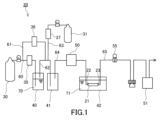
- FIG. 2 is a diagram for explaining a method for measuring the amount of carbon dioxide adsorbed by an acidic gas adsorbent.
- FIG. 1 is a perspective view showing a schematic example of a structure provided with an acidic gas adsorbent.
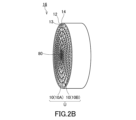
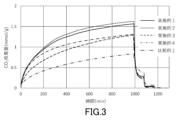
- FIG. 13 is a perspective view showing a modified example of a structure provided with an acidic gas adsorbent. 1 is a graph showing the results of adsorption test B performed on the acid gas adsorbents of the examples and comparative examples.
- the acid gas adsorbent according to the first aspect of the present invention comprises: A polymer having an amino group; A liquid having a boiling point of 130° C. or higher; An acid gas adsorbent comprising: When the following adsorption test A is carried out for 15 hours, the adsorption amount a of carbon dioxide is 0.35 mmol/g or more.
- Adsorption test A A mixed gas G1 composed of carbon dioxide, nitrogen and water vapor is continuously fed into a container containing the acidic gas adsorbent, where the concentration of carbon dioxide in the mixed gas G1 is 400 vol ppm, the temperature of the mixed gas G1 is 20° C., and the humidity of the mixed gas G1 is 50% RH.
- the polymer is a solid.
- the liquid includes an ionic liquid.
- the ionic liquid has temperature responsiveness.
- the liquid content is 1 wt% to 15 wt%.
- an acid gas adsorbent according to any one of the first to ninth aspects has a porous structure.
- the acid gas adsorption apparatus comprises: An adsorption section having a gas inlet and a gas outlet, The adsorption section contains an acid gas adsorbent according to any one of the first to twelfth aspects.
- the measuring device 20 further includes a first container 40 containing water 70, and a first path 60 for sending nitrogen from the first tank 30 to the first container 40.
- the first path 60 has one end connected to the gas outlet of the first tank 30 and the other end disposed in the water 70 of the first container 40.
- the nitrogen sent from the first tank 30 to the first container 40 is humidified by contact with the water 70.
- a mass flow controller 35 is disposed in the first path 60 for adjusting the flow rate of nitrogen sent from the first tank 30 to the first container 40.
- the molecular weight (weight average molecular weight in some cases) of the amine monomer is, for example, 50 or more, and may be 100 or more, 150 or more, 200 or more, 300 or more, 500 or more, 1000 or more, or even 1500 or more.
- the larger the molecular weight of the amine monomer the easier it is to adjust the density of the nitrogen element in the reactant P1. Furthermore, amine monomers with larger molecular weights tend to be safer to handle.
- the upper limit of the molecular weight of the amine monomer is, for example, 5000 or less, and may be 2000 or less.
- the molecular weight of the amine monomer may be less than 1000, 500 or less, or even 300 or less in some cases.
- the amine equivalent of the amine monomer is, for example, 10 g/eq. or more, preferably 20 g/eq. or more, and more preferably 30 g/eq. or more.
- the upper limit of the amine equivalent of the amine monomer is not particularly limited, and may be, for example, 200 g/eq. It may be 150 g/eq. or less, 100 g/eq. or less, or even 50 g/eq. or less.
- the amine equivalent means the mass of the amine monomer relative to 1 equivalent of active hydrogen of the primary amino group contained in the amine monomer.
- the number of structural units contained in the amine monomer degree of polymerization
- Amine monomers include, for example, ethylamine, ethylenediamine, 1,4-butylenediamine, 1,5-pentanediamine, 1,6-hexanediamine, 1,7-heptanediamine, 1,8-octanediamine, diethylenetriamine, triethylenetetramine, tetraethylenepentamine, pentaethylenehexamine, hexaethyleneheptamine, iminobispropylamine, bis(hexamethylene)triamine, 1,3,6-trisaminomethylhexane, tris(2-aminoethyl)amine, N,N'-bis(3-aminopropyl)ethylenediamine, polymethylenediamine, trimethylhexamethylenediamine, polyethersulfones, Aliphatic amines such as tertiamine; alicyclic amines such as isophoronediamine, menthanediamine, piperazine, N-aminoethylpiperazine, 3,9
- the amine monomer preferably contains an aliphatic amine (particularly triethylenetetramine (TETA)) or an aliphatic polyamine (particularly polyethyleneimine (PEI)), and particularly preferably contains PEI.
- TETA triethylenetetramine
- PEI polyethyleneimine
- the amine monomers can be used alone or in combination of two or more.
- aliphatic polyamines tend to be safer to handle.
- amine monomers such as aliphatic polyamines are preferably not classified as hazardous materials under the Fire Service Act, and are preferably not subject to the Poisonous and Deleterious Substances Control Act. It is preferable that the result of a mutagenicity test (Ames test) for the amine monomer is negative. It is preferable that the result of a skin irritation test (primary skin irritation test using rabbits) for the amine monomer is a mild or moderate irritant.
- the epoxy monomer is a monomer containing at least one epoxy group.
- the number of epoxy groups contained in the epoxy monomer is preferably 2 or more, and may be 3 or more, or 4 or more.
- the greater the number of epoxy groups the greater the number of crosslinking points in the epoxy monomer and the denser the crosslinking structure in the reactant P1, which tends to improve heat resistance and moist heat resistance.
- the molecular weight of the epoxy monomer is not particularly limited, and is, for example, less than 1000, and preferably 500 or less.
- the epoxy equivalent of the epoxy monomer is not particularly limited, and is, for example, 150 g/eq. or less, and preferably 100 g/eq. or less.
- the lower limit of the epoxy equivalent of the epoxy monomer is not particularly limited, and is, for example, 50 g/eq. or more.
- the epoxy equivalent means the mass of the epoxy monomer per equivalent of the epoxy group contained in the epoxy monomer.
- Epoxy monomers include, for example, monofunctional epoxy compounds such as n-butyl glycidyl ether, higher alcohol glycidyl ether, allyl glycidyl ether, 2-ethylhexyl glycidyl ether, phenyl glycidyl ether, cresyl glycidyl ether, p-sec-butylphenyl glycidyl ether, and t-butylphenyl glycidyl ether; diepoxy alkanes such as 1,5-hexadiene diepoxide, 1,7-octadiene diepoxide, and 1,9-decadiene diepoxide; (poly)ethylene glycol diglycidyl ether, (poly)propylene glycol diglycidyl ether, and (poly)propylene glycol diglycidyl ether.
- monofunctional epoxy compounds such as n-butyl glycidyl
- polyfunctional epoxy compounds include those having an ether group such as ethylene glycol diglycidyl ether, 1,4-butanediol diglycidyl ether, neopentyl glycol diglycidyl ether, 1,6-hexanediol diglycidyl ether, trimethylolpropane polyglycidyl ether, pentaerythritol polyglycidyl ether, and sorbitol polyglycidyl ether; and those having an amino group such as N,N,N',N'-tetraglycidyl metaxylenediamine and 1,3-bis(N,N-diglycidylaminomethyl)cyclohexane.
- an ether group such as ethylene glycol diglycidyl ether, 1,4-butanediol diglycidyl ether, neopentyl glycol diglycidyl ether, 1,6-hexanediol digly
- the epoxy monomer may be an aromatic epoxy resin, a non-aromatic epoxy resin, etc., depending on the case.
- aromatic epoxy resins include polyphenyl-based epoxy resins, epoxy resins containing a fluorene ring, epoxy resins containing triglycidyl isocyanurate, and epoxy resins containing a heteroaromatic ring (e.g., a triazine ring).
- polyphenyl-based epoxy resins examples include bisphenol A-type epoxy resins, brominated bisphenol A-type epoxy resins, bisphenol F-type epoxy resins, bisphenol AD-type epoxy resins, stilbene-type epoxy resins, biphenyl-type epoxy resins, bisphenol A novolac-type epoxy resins, cresol novolac-type epoxy resins, diaminodiphenylmethane-type epoxy resins, and tetrakis(hydroxyphenyl)ethane-based epoxy resins.
- the epoxy monomers can be used alone or in combination of two or more. When a monofunctional epoxy compound is used, it is preferable to use it in combination with another epoxy monomer containing two or more epoxy groups.
- the monofunctional epoxy compound can also be used as a reactive diluent to adjust the viscosity of the compound group for forming the reactant P1.
- the epoxy monomer preferably contains a multifunctional epoxy compound having an ether group, such as ethylene glycol diglycidyl ether (EDE) or pentaerythritol tetraglycidyl ether (PETG). EDE or PETG has a small epoxy equivalent and can easily lower the glass transition temperature Tg of the polymer P. These epoxy compounds also tend to be low in cost.
- the epoxy monomer may contain a multifunctional epoxy compound having an amino group, such as N,N,N',N'-tetraglycidyl metaxylenediamine or 1,3-bis(N,N-diglycidylaminomethyl)cyclohexane, in addition to or instead of the multifunctional epoxy compound having an ether group.
- the polymer P as an amine polymer may contain a structural unit U1 derived from an epoxy monomer.
- the polymer P is a reactant P1
- the polymer P further contains a structural unit U2 derived from an amine monomer.
- the content of the structural unit U1 in the polymer P, particularly the reactant P1 is, for example, 20 wt % to 70 wt %.
- the content of the structural unit U2 in the polymer P, particularly the reactant P1 is, for example, 30 wt % or more, preferably 50 wt % or more.
- the upper limit of the content of the structural unit U2 is not particularly limited, and is, for example, 80 wt % or less.
- the polymer P is preferably a solid.
- solid means a substance that is in a solid state at atmospheric pressure and 20°C.
- the polymer P is preferably in a solid state at atmospheric pressure in the range of 20°C to 80°C.
- the glass transition temperature Tg of the polymer P is not particularly limited, and may be, for example, 40 ° C. or less, 30 ° C. or less, 20 ° C. or less, 15 ° C. or less, 10 ° C. or less, 5 ° C. or less, 0 ° C. or less, -1 ° C. or less, less than -1 ° C., -2 ° C. or less, -3 ° C. or less, -4 ° C. or less, -5 ° C. or less, -6 ° C. or less, -7 ° C. or less, -8 ° C. or less, -9 ° C. or less, -10 ° C. or less, -11 ° C.
- the lower the glass transition temperature Tg of the polymer P the higher the rate at which the acidic gas is adsorbed in the acidic gas adsorbent.
- the lower limit of the glass transition temperature Tg of the polymer P may be, for example, -100 ° C. or more, -50 ° C. or more, -30 ° C. or more, or even -20 ° C.
- the glass transition temperature Tg means the midpoint glass transition temperature (T mg ) determined in accordance with the provisions of JIS K7121: 1987.
- the polymer P generally corresponds to a thermosetting resin.
- the weight average molecular weight of polymer P is not particularly limited, and is, for example, 500 or more, preferably 1000 or more, more preferably 10000 or more, and even more preferably 100000 or more.
- the upper limit of the weight average molecular weight of polymer P is, for example, 10,000,000 or less.
- the upper limit of the content of polymer P in the acidic gas adsorbent is not particularly limited, and may be, for example, 99.9 wt% or less, 99.5 wt% or less, 99 wt% or less, 97 wt% or less, 95 wt% or less, or even 93 wt% or less.
- the acidic gas adsorbent contains the liquid L having a boiling point of 130° C. or higher.
- the liquid L exists in the vicinity of the polymer P.
- the molecules of the liquid L exist between the molecular chains of a plurality of polymers P.
- the polymer P may be compatible with the liquid L or may be swollen by the liquid L.
- the boiling point of liquid L is preferably 150°C or higher, and may be 180°C or higher, 200°C or higher, 230°C or higher, 250°C or higher, 280°C or higher, or even 300°C or higher.
- the upper limit of the boiling point of liquid L is not particularly limited, and may be, for example, 1000°C or lower, or 500°C or lower.
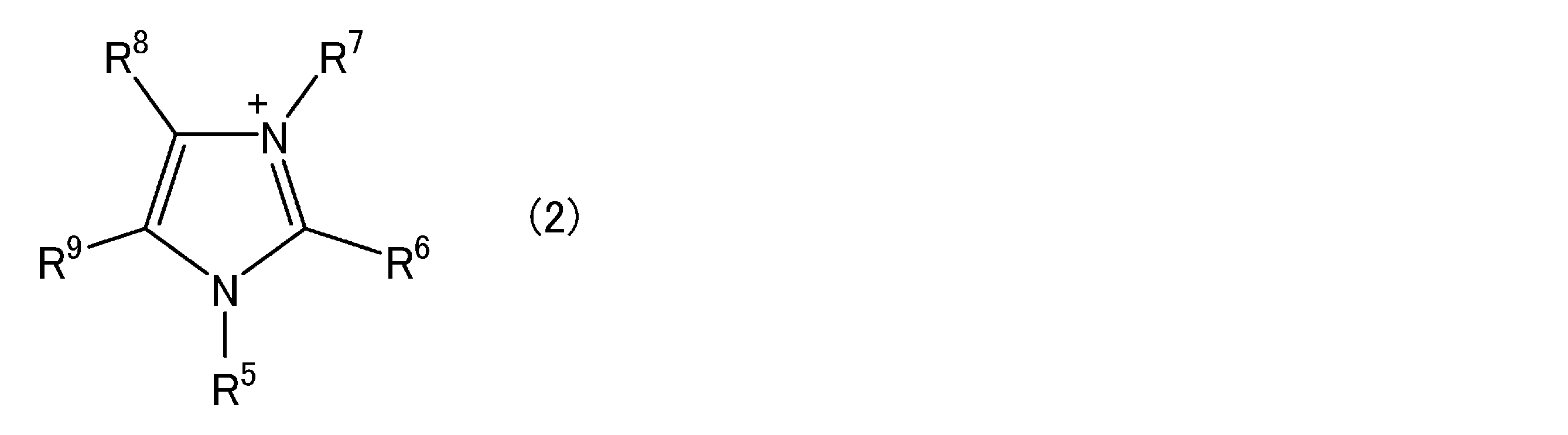
- the ionic liquid preferably contains at least one selected from the group consisting of imidazolium ions, pyridinium ions, pyrrolidinium ions, phosphonium ions, ammonium ions, and sulfonium ions, more preferably contains at least one selected from the group consisting of imidazolium ions and phosphonium ions, and particularly preferably contains a phosphonium ion.
- These ions preferably contain a substituent having one or more carbon atoms.
- Aryl groups having 6 to 20 carbon atoms include phenyl, toluyl, xylyl, mesityl, anisyl, naphthyl, and benzyl groups.
- the above-mentioned ions may form salts with counter anions.
- counter anions include alkylsulfonate, tosylate, dimethylbenzenesulfonate, trifluoromethanesulfonate, acetate, bis(fluorosulfonyl)imide, bis(trifluoromethanesulfonyl)imide, thiocyanate, dicyanamide, tricyanomethanide, tetracyanoborate, hexafluorophosphate, tetrafluoroborate, halide, and amino acid ions (e.g., valinate).
- the ionic liquid preferably has temperature responsiveness.
- temperature responsiveness means that the properties (particularly, solubility in water) change in response to a change in temperature.
- the ionic liquid preferably exhibits a phase separation behavior of the lower critical solution temperature (LCST type) with respect to water.
- LCST type phase separation behavior include [ P4,4,4 ][ 2,4MeSO3 ], [ P6,6,6,14 ][Val], and the like.
- Whether or not an ionic liquid has LCST-type phase separation behavior with respect to water can be confirmed, for example, by the following tests 1 and 2.
- Test 1 0.5 g of ionic liquid is added to a container such as a microtube, and 0.5 g of water (ion-exchanged water) at 20° C. is further added to the container. Next, the container is sealed and then shaken by hand about 10 times.
- the content of liquid L in the acidic gas adsorbent is, for example, 0.1 wt% or more, and may be 0.5 wt% or more, 1 wt% or more, 3 wt% or more, 5 wt% or more, 7 wt% or more, or even 10 wt% or more.
- the content of liquid L is preferably 70 wt% or less, and may be 60 wt% or less, 50 wt% or less, 40 wt% or less, 30 wt% or less, 20 wt% or less, or even 15 wt% or less.
- the content of liquid L in the acidic gas adsorbent is preferably 1 wt% to 15 wt%.
- the acidic gas adsorbent may be substantially composed of only the polymer P and the liquid L, but may further contain other components other than these.
- the other components include reaction accelerators, plasticizers, pigments, dyes, antioxidants, conductive materials, antistatic agents, ultraviolet absorbers, flame retardants, and antioxidants.
- the reaction accelerators can be used when synthesizing the polymer P.
- the reaction accelerators include tertiary amines such as triethylamine and tributylamine; and imidazoles such as 2-phenol-4-methylimidazole, 2-ethyl-4-methylimidazole, and 2-phenol-4,5-dihydroxyimidazole. These reaction accelerators can accelerate the reaction for synthesizing the reactant P1.
- the upper limit of the density of the nitrogen element in the acidic gas adsorbent is not particularly limited, and may be, for example, 30 mmol/g or less, or 20 mmol/g or less.
- the density of the nitrogen element in the acidic gas adsorbent means the amount of nitrogen element contained in 1 g of the acidic gas adsorbent, and can be measured, for example, by the same method as the density of the nitrogen element in the above-mentioned polymer P.
- the density of the nitrogen elements can be regarded as the density of the amino groups in the acidic gas adsorbent.
- the shape of the acid gas adsorbent is not particularly limited, and may be, for example, a block, sheet, or particle shape.
- particle shape includes spherical, ellipsoidal, scaly, fibrous, etc.
- the acidic gas adsorbent may have a porous structure.
- the acidic gas adsorbent may include a porous body S containing a polymer P and a liquid L.
- the shape of the porous body S may be, for example, a block shape, a sheet shape, or a particle shape.
- the acidic gas adsorbent may or may not include a porous resin sheet as the porous body S.
- the acidic gas adsorbent may or may not include a member other than the porous body S, such as a carrier for supporting the polymer P. When the acidic gas adsorbent does not include a carrier, the shape of the acidic gas adsorbent tends to be easily adjustable by cutting or machining.
- the porous body S preferably has a three-dimensional mesh skeleton containing the polymer P and the liquid L.
- the three-dimensional mesh skeleton may further contain other components in addition to the polymer P and the liquid L.
- the above-mentioned three-dimensional mesh skeleton extends continuously.
- the pores contained in the porous body S are preferably continuous pores formed continuously in a three-dimensional shape.
- the porous body S may have independent pores, or may have through holes penetrating the porous body S.
- the specific surface area of the acidic gas adsorbent is not particularly limited, and may be, for example, 0.5 m 2 /g or more, 1.0 m 2 / g or more, 2.0 m 2 /g or more, 3.0 m 2 /g or more, 4.0 m 2 /g or more, 5.0 m 2 /g or more, 6.0 m 2 /g or more, 7.0 m 2 /g or more, 8.0 m 2 /g or more, or even 9.0 m 2 /g or more.
- the larger the specific surface area of the acidic gas adsorbent the higher the rate at which the acidic gas adsorbent adsorbs the acidic gas.
- the upper limit of the specific surface area of the acidic gas adsorbent is not particularly limited, and may be, for example, 100 m 2 /g or less.
- the specific surface area of the acidic gas adsorbent means the BET (Brunauer-Emmett-Teller) specific surface area by nitrogen gas adsorption.
- the specific surface area of the acidic gas adsorbent can be measured by a method conforming to the provisions of JIS Z8830:2013.
- the pore volume of the acidic gas adsorbent is not particularly limited, and may be, for example, 0.1 cm 3 /g or more, 0.2 cm 3 /g or more, 0.3 cm 3 /g or more, 0.5 cm 3 /g or more, 1.0 cm 3 /g or more, or even 2.0 cm 3 /g or more.
- the upper limit of the pore volume of the acidic gas adsorbent is not particularly limited, and may be, for example, 5.0 cm 3 /g or less, 4.0 cm 3 /g or less, or 3.0 cm 3 /g or less.
- the pore volume of the acidic gas adsorbent can be measured by mercury intrusion porosimetry. The mercury intrusion porosimetry is performed under the condition of an initial pressure of 21 kPa using a commercially available pore distribution analyzer (for example, Autopore V9620 manufactured by Micromeritics).
- the average pore diameter of the acidic gas adsorbent is not particularly limited, and may be, for example, 0.1 ⁇ m or more, 0.2 ⁇ m or more, 0.3 ⁇ m or more, or even 0.5 ⁇ m or more.
- the upper limit of the average pore diameter of the acidic gas adsorbent is not particularly limited, and may be, for example, 50 ⁇ m or less.
- the average pore diameter of the acidic gas adsorbent means the median diameter measured by mercury intrusion porosimetry.
- the mercury intrusion porosimetry is performed using a commercially available pore distribution analyzer (for example, Autopore V9620 manufactured by Micromeritics) under conditions of an initial pressure of 21 kPa.
- the average particle size of the acidic gas adsorbent is not particularly limited, and is, for example, 0.5 ⁇ m or more, preferably 1 ⁇ m or more, and may be 10 ⁇ m or more, 20 ⁇ m or more, or 30 ⁇ m or more.
- the average particle size of the acidic gas adsorbent may be 200 ⁇ m or less, 100 ⁇ m or less, or less than 75 ⁇ m.
- the average particle size of the acidic gas adsorbent means the particle size (d50) corresponding to 50% cumulative volume in the particle size distribution measured by a laser diffraction particle sizer or the like.
- the method for producing an acidic gas adsorbent of this embodiment includes, for example, contacting a polymer P with a liquid L.
- the polymer P can be synthesized by reacting a group of compounds including an amine monomer (particularly an amine monomer including a primary amino group). It is preferable that the group of compounds further includes an epoxy monomer including an epoxy group.
- the compound group may contain only epoxy monomer E1 containing two epoxy groups, or may contain epoxy monomer E2 containing three or more, for example, four, epoxy groups instead of or together with epoxy monomer E1.
- the weight ratio E1/E2 of epoxy monomer E1 to epoxy monomer E2 is not particularly limited and may be, for example, 3/7 to 8/2, 3/7 to 5/5, or even 3/7 to 4/6.
- the ratio E/A of the equivalent E of the epoxy group in the compound group to the equivalent A of the active hydrogen of the primary amino group in the compound group is preferably 1.00 or less.
- the mixing ratio of the amine monomer and the epoxy monomer is preferably adjusted so that the ratio E/A is 1.00 or less.
- the ratio E/A is preferably 0.90 or less, and may be 0.50 or less, less than 0.50, 0.45 or less, 0.40 or less, 0.35 or less, or even 0.30 or less.
- the smaller the ratio E/A the higher the ratio of the primary amino group in the polymer P and the higher the density of the nitrogen element in the acidic gas adsorbent.
- the lower limit of the ratio E/A is, for example, 0.10 or more, and may be 0.15 or more, or even 0.20 or more, from the viewpoint of ease of preparation of the acidic gas adsorbent.
- the reaction of the compound group can be carried out by applying energy to the compound group.
- the energy applied to the compound group is preferably thermal energy.
- the reaction of the compound group can be promoted by heating the compound group at a temperature of 40°C to 100°C.
- the energy applied to the compound group may be light energy.
- a porous body containing polymer P may be produced.
- This porous body can be produced, for example, by the following method. First, the above-mentioned compound group is mixed with a porogen to produce a mixed liquid.
- the porogen is a solvent that can dissolve the monomers contained in the compound group and can cause reaction-induced phase separation after the compound group reacts.
- porogens include cellosolves such as methyl cellosolve and ethyl cellosolve, esters such as ethylene glycol monomethyl ether acetate and propylene glycol monomethyl ether acetate, glycols such as polyethylene glycol, polypropylene glycol, polybutylene glycol, and polyoxyalkylene glycol, and ethers such as polyoxyethylene monomethyl ether and polyoxyethylene dimethyl ether.
- polyoxyalkylene glycols include poly(1,2-butanediol)-6 propylene glycol and polyoxypropylene diglyceryl ether.
- the porogen may be a polar solvent such as ethyl acetate, N,N-dimethylformamide (DMF), acetonitrile, ethanol, isopropanol, etc., a non-polar solvent such as toluene, etc., or a mixture of these.
- the porogens may be used alone or in combination of two or more kinds.
- the mixture may further contain components other than the compound group.
- the other components include the reaction accelerators described above.
- the compound group is reacted in the mixture.
- the compound group is reacted by filling a mold with the mixture and then performing a heat treatment. This results in a cured body containing the polymer P and the porogen. In this cured body, the polymer P and the porogen undergo phase separation to form a co-continuous structure.
- the porogen is extracted and removed from the cured body.
- the porogen can be extracted by immersing the cured body in a solvent.
- the solvent that can be used include water, aliphatic hydrocarbon solvents, aromatic hydrocarbon solvents, aliphatic alcohol solvents, ester solvents, ether solvents, and halogen-containing organic solvents.
- aliphatic hydrocarbon solvents include n-hexane, cyclohexane, methylcyclohexane, n-heptane, n-octane, isooctane, petroleum ether, and benzine.
- aromatic hydrocarbon solvents include toluene, xylene, mesitylene, and benzene.
- aliphatic alcohol solvents include methanol, ethanol, isopropanol, butanol, cyclohexanol, ethylene glycol, propylene glycol, propylene glycol monomethyl ether, and diethylene glycol.
- ester solvents include ethyl acetate.
- ether solvents include diethyl ether, diisopropyl ether, dibutyl ether, ethylene glycol dimethyl ether, ethylene glycol diethyl ether, propylene glycol dimethyl ether, propylene glycol diethyl ether, diethylene glycol dimethyl ether, tetrahydrofuran, dioxane, anisole, etc.
- halogen-containing organic solvents include dichloromethane, chloroform, carbon tetrachloride, dichloroethane, chlorobenzene, etc. These solvents can be used alone or in combination of two or more.
- a porous body with a large specific surface area can be prepared.
- the reaction rate of the compound group varies depending on the type and blending ratio of the monomers contained in the compound group. As an example, the reaction rate of the compound group tends to be high when epoxy monomer E2 containing three or more, for example four, epoxy groups is used, or when polyethyleneimine with a large weight average molecular weight is used as the amine monomer.
- the polymer P and the liquid L become compatible with each other, and an acidic gas adsorbent is obtained.
- the method for contacting the polymer P with the liquid L is not particularly limited, and can be performed, for example, by the following method.
- a mixed solution of the liquid L and an alcohol is prepared.
- the alcohol a lower alcohol having 5 or less carbon atoms can be used.
- the content of the liquid L in the mixed solution is not particularly limited, and is, for example, 0.1 wt % to 20 wt %.
- the polymer P can be contacted with the liquid L by immersing the polymer P in the mixed solution.
- the temperature of the mixed solution is, for example, room temperature (20°C).
- the time for which the polymer P is immersed in the mixed solution is not particularly limited, and is, for example, 0.5 hours to 24 hours.
- the acidic gas adsorbent may be further dried as necessary.
- the drying process may remove, for example, alcohol resulting from the above-mentioned mixed liquid from the acidic gas adsorbent.
- the temperature of the drying process is not particularly limited as long as it is lower than the boiling point of the liquid L, and may be, for example, 20°C to 60°C.
- the time of the drying process is, for example, 0.5 hours to 24 hours.
- the drying process may be performed under a reduced pressure or vacuum atmosphere.
- the adsorbent containing an amine compound tends to have a decreased adsorption performance for acidic gases in a low-humidity environment (for example, an environment of 20° C. and 30% RH or less). This tendency is presumably due to the fact that in a low-humidity environment, there is almost no water present near the amine compound, which reduces the mobility of the molecular chains of the amine compound, making it difficult for the acidic gas to diffuse in the adsorbent.
- the acidic gas adsorbent contains polymer P and liquid L.
- the presence of liquid L makes it difficult for the mobility of the molecular chains of polymer P to decrease even in a low-humidity environment, and therefore difficult for the diffusibility of acidic gases in the acidic gas adsorbent to decrease.
- the acidic gas adsorbent of this embodiment tends to suppress the decrease in its adsorption performance for acidic gases in a low-humidity environment.
- the adsorption amount b1 of carbon dioxide is preferably 0.1 mmol/g or more.
- a mixed gas G2 is used as the low-humidity gas.
- Adsorption test B A mixed gas G2 composed of carbon dioxide, nitrogen and water vapor is continuously fed into a container containing an acidic gas adsorbent.
- the concentration of carbon dioxide in the mixed gas G2 is 400 vol ppm
- the temperature of the mixed gas G2 is 20° C.
- the humidity of the mixed gas G2 is 20% RH.
- Adsorption test B can be performed in the same manner as adsorption test A, except that mixed gas G2 is used instead of mixed gas G1.
- Mixed gas G2 can be prepared by changing the flow rate of nitrogen passing through the first path 60 and bypass path 61 of the measurement device 20 from the conditions of adsorption test A.
- the amount b2 of carbon dioxide adsorption when adsorption test B is performed for 1 hour is preferably 0.03 mmol/g or more, and may be 0.05 mmol/g or more, 0.08 mmol/g or more, 0.1 mmol/g or more, 0.2 mmol/g or more, 0.3 mmol/g or more, 0.4 mmol/g or more, or even 0.5 mmol/g or more.
- the upper limit of the amount b2 of carbon dioxide adsorption is not particularly limited, and is, for example, 5 mmol/g or less.
- the carbon dioxide adsorption amount b3 is preferably 0.05 mmol/g or more.
- the adsorption amount b3 can also be used as an indicator of the speed at which acid gas is adsorbed in a low-humidity environment. In other words, the larger the adsorption amount b3, the faster the acid gas adsorbent adsorbs acid gas in a low-humidity environment.
- the amount b3 of carbon dioxide adsorption when adsorption test B is performed for 4 hours is preferably 0.1 mmol/g or more, and may be 0.3 mmol/g or more, 0.4 mmol/g or more, 0.5 mmol/g or more, 0.6 mmol/g or more, 0.7 mmol/g or more, 0.8 mmol/g or more, 0.9 mmol/g or more, 1.0 mmol/g or more, or even 1.05 mmol/g or more.
- the upper limit of the amount b3 of carbon dioxide adsorption is not particularly limited, and is, for example, 5 mmol/g or less.
- the desorption amount c of carbon dioxide is 0.05 mmol/g or more.
- Desorption test C While continuing to feed the mixed gas G2 into the above-mentioned container, the acidic gas adsorbent after the adsorption test B for 15 hours is heated at 65° C. for 1.5 hours.
- the desorption test C can be performed by the following method. First, the above-mentioned adsorption test B is performed for 15 hours using the measuring device 20. In detail, while the mixed gas G2 is being supplied to the adsorption section 21, the adsorption section 21 is immersed in the water 71 in the third container 42, and the mixed gas G2 is continuously sent to the adsorption section 21 for 15 hours. Next, while the mixed gas G2 is still being sent to the adsorption section 21, the adsorption section 21 is removed from the third container 42 and immersed in a water bath (not shown) at 65°C. This starts a carbon dioxide desorption test (desorption test C) for the acid gas adsorbent in the adsorption section 21. The desorption test is performed until 1.5 hours have elapsed since it started.
- desorption test C carbon dioxide desorption test
- desorption test C the amount of carbon dioxide desorbed from the acid gas adsorbent within 1.5 hours from the start is measured, M2.
- the amount of carbon dioxide desorbed from the acid gas adsorbent can be calculated from the difference between the carbon dioxide concentration measured by the first concentration meter 50 and the carbon dioxide concentration measured by the second concentration meter 51 over time.
- the amount of carbon dioxide desorbed from 1 g of acid gas adsorbent in 1.5 hours is calculated based on the amount of substance M2, and the calculated value obtained is specified as the desorption amount c.
- the amount c of carbon dioxide desorption when desorption test C is performed is preferably 0.1 mmol/g or more, and may be 0.3 mmol/g or more, 0.5 mmol/g or more, 0.6 mmol/g or more, 0.7 mmol/g or more, 0.8 mmol/g or more, 0.9 mmol/g or more, 1.0 mmol/g or more, 1.1 mmol/g or more, 1.2 mmol/g or more, 1.3 mmol/g or more, 1.4 mmol/g or more, or even 1.5 mmol/g or more.
- the upper limit of the amount c of carbon dioxide desorption is not particularly limited, and may be, for example, 10 mmol/g or less.
Landscapes
- Chemical & Material Sciences (AREA)
- Organic Chemistry (AREA)
- Chemical Kinetics & Catalysis (AREA)
- Analytical Chemistry (AREA)
- Engineering & Computer Science (AREA)
- General Chemical & Material Sciences (AREA)
- Oil, Petroleum & Natural Gas (AREA)
- Inorganic Chemistry (AREA)
- Gas Separation By Absorption (AREA)
Abstract
Description
アミノ基を有するポリマーと、
沸点が130℃以上である液体と、
を含む、酸性ガス吸着材であって、
下記の吸着試験Aを15時間行った場合に、二酸化炭素の吸着量aが0.35mmol/g以上である、酸性ガス吸着材を提供する。
吸着試験A:二酸化炭素、窒素及び水蒸気から構成された混合ガスG1を、前記酸性ガス吸着材が収容された容器内に送り続ける。ここで、前記混合ガスG1における前記二酸化炭素の濃度が400volppmであり、前記混合ガスG1は、温度が20℃であり、湿度が50%RHである。
上記の酸性ガス吸着材と、
通気経路と、
を備えた、構造体を提供する。
ガス入口と、ガス出口とを有する吸着部を備え、
前記吸着部は、上記の酸性ガス吸着材を収容している、酸性ガス吸着装置を提供する。
アミノ基を有するポリマーと、
沸点が130℃以上である液体と、
を含む、酸性ガス吸着材であって、
下記の吸着試験Aを15時間行った場合に、二酸化炭素の吸着量aが0.35mmol/g以上である。
吸着試験A:二酸化炭素、窒素及び水蒸気から構成された混合ガスG1を、前記酸性ガス吸着材が収容された容器内に送り続ける。ここで、前記混合ガスG1における前記二酸化炭素の濃度が400volppmであり、前記混合ガスG1は、温度が20℃であり、湿度が50%RHである。
吸着試験B:二酸化炭素、窒素及び水蒸気から構成された混合ガスG2を、前記酸性ガス吸着材が収容された容器内に送り続ける。ここで、前記混合ガスG2における前記二酸化炭素の濃度が400volppmであり、前記混合ガスG2は、温度が20℃であり、湿度が20%RHである。
第1~第12態様のいずれか1つにかかる酸性ガス吸着材と、
通気経路と、
を備える。
ガス入口と、ガス出口とを有する吸着部を備え、
前記吸着部は、第1~第12態様のいずれか1つにかかる酸性ガス吸着材を収容している。
本実施形態の酸性ガス吸着材は、アミノ基を有するポリマーPと、沸点が130℃以上である液体Lとを含む。ポリマーPと液体Lの組み合わせによって、酸性ガス吸着材は、低湿環境下(例えば、20℃で30%RH以下の環境下)で、酸性ガスに対する吸着性能の低下が抑制される傾向がある。なお、本明細書において、「沸点」は、大気圧下(101.325kPa)での沸点を意味する。「液体」は、大気圧下、20℃で液体状態の物質を意味する。
吸着試験A:二酸化炭素、窒素及び水蒸気から構成された混合ガスG1を、酸性ガス吸着材が収容された容器内に送り続ける。ここで、混合ガスG1における二酸化炭素の濃度が400volppmであり、混合ガスG1は、温度が20℃であり、湿度が50%RHである。
以下では、吸着試験Aの詳細について説明する。吸着試験Aは、図1に示す測定装置20を用いて測定することができる。測定装置20は、第1タンク30及び第2タンク31を備えている。一例として、第1タンク30が乾燥状態の窒素を貯蔵し、第2タンク31が、乾燥状態の窒素と乾燥状態の二酸化炭素との混合ガスを貯蔵している。第2タンク31の混合ガスにおける二酸化炭素の濃度は、例えば、5vol%である。
まず、酸性ガス吸着材を準備し、乾燥処理を行う。乾燥処理は、真空雰囲気下、60℃の条件で酸性ガス吸着材を2時間以上処理することによって行われることが好ましい。次に、露点約-60℃のドライルーム内で、乾燥処理後の酸性ガス吸着材を吸着部21に充填する。吸着部21に充填される酸性ガス吸着材の重量は、例えば50mgである。次に、吸着部21の両端に第4経路64及び第5経路65を接続し、吸着部21を第3容器42の水71に浸漬させる。
次に、混合ガスG1が吸着部21に供給されている状態で、吸着部21を湯浴から取り出し、第3容器42の水71に浸漬させる。これにより、吸着部21内の酸性ガス吸着材について、二酸化炭素の吸着試験(吸着試験A)を開始する。吸着試験は、開始してから15時間経過するまで行う。詳細には、混合ガスG1を吸着部21に15時間送り続ける。吸着試験を15時間行った場合、酸性ガス吸着材による二酸化炭素の吸着は、通常、平衡に達しているとみなすことができる。
酸性ガス吸着材において、ポリマーPは、アミノ基に起因して、酸性ガスを吸着する機能を有する。ポリマーPは、アミノ基として、1級アミノ基、2級アミノ基及び3級アミノ基からなる群より選ばれる少なくとも1つを含むことが好ましい。酸性ガスに対する吸着性能の観点から、ポリマーPは、1級アミノ基及び2級アミノ基からなる群より選ばれる少なくとも1つを含むことが好ましく、1級アミノ基及び2級アミノ基の両方を含むことが好ましい。ポリマーPにおいて、1級アミノ基及び2級アミノ基(特に1級アミノ基)の物質量が大きければ大きいほど、酸性ガス吸着材における窒素元素の密度が増加するとともに、酸性ガスの吸着量(例えば、上記の吸着量a)が増加する傾向がある。ポリマーPにおいて、1級アミノ基及び2級アミノ基(特に2級アミノ基)の物質量が大きい場合、酸性ガス吸着材は、吸着した酸性ガスを容易に脱離できる傾向がある。1級アミノ基や2級アミノ基を有するポリマーPによれば、比較的温和な条件で酸性ガス吸着材の再生処理を行うことができる。なお、ポリマーPは、3級アミノ基を含んでいてもよいが、3級アミノ基を含まなくてもよい。
密度d(mmol/g)=(重量比率w(wt%)×1000)/(窒素の原子量×100)
上述のとおり、酸性ガス吸着材は、沸点が130℃以上である液体Lを含む。酸性ガス吸着材において、液体Lは、ポリマーPの近傍に存在することが好ましい。特に、液体Lの分子が、複数のポリマーPの分子鎖の間に存在することが好ましい。一例として、酸性ガス吸着材において、ポリマーPは、液体Lと相溶していてもよく、液体Lによって膨潤していてもよい。
アミノ基を有するポリマーPと、
イオン液体と、
を含む、酸性ガス吸着材であって、
上記の吸着試験Aを15時間行った場合に、二酸化炭素の吸着量aが0.35mmol/g以上である、酸性ガス吸着材を提供する。

試験1:イオン液体0.5gをミクロチューブなどの容器に加え、さらに、当該容器に20℃の水(イオン交換水)0.5gを加える。次に、容器を密閉してから、当該容器を10回程度手で振る。容器を1分間静置し、容器内において、イオン液体が水に溶解しているかどうかを目視で確認する。
試験2:水の温度を50℃に変更することを除き、試験1と同じ操作を行う。容器内において、イオン液体が水に溶解しているかどうかを目視で確認する。
酸性ガス吸着材は、実質的にポリマーP及び液体Lのみから構成されていてもよいが、これら以外の他の成分をさらに含んでいてもよい。他の成分としては、例えば、反応促進剤、可塑剤、顔料、染料、老化防止剤、導電材、帯電防止剤、紫外線吸収剤、難燃剤、酸化防止剤等が挙げられる。反応促進剤は、ポリマーPを合成するときに利用されうる。反応促進剤としては、例えば、トリエチルアミン、トリブチルアミンなどの3級アミン;2-フェノール-4-メチルイミダゾール、2-エチル-4-メチルイミダゾール、2-フェノール-4,5-ジヒドロキシイミダゾールなどのイミダゾール類が挙げられる。これらの反応促進剤は、反応物P1を合成するための反応を促進することができる。
酸性ガス吸着材における窒素元素の重量比率は、例えば1wt%以上であり、5wt%以上、さらには10wt%以上であってもよい。この重量比率が高ければ高いほど、酸性ガス吸着材における酸性ガスの吸着性が向上する傾向がある。酸性ガス吸着材における窒素元素の重量比率の上限は、特に限定されず、例えば30wt%以下である。なお、酸性ガス吸着材に含まれる全ての窒素元素がアミノ基に由来する場合、上記の窒素元素の重量比率は、酸性ガス吸着材におけるアミノ基の重量比率とみなすことができる。
本実施形態の酸性ガス吸着材の製造方法は、例えば、ポリマーPと液体Lを接触させることを含む。
上述のとおり、アミン化合物を含む吸着材は、低湿環境下(例えば、20℃で30%RH以下の環境下)で、酸性ガスに対する吸着性能が低下する傾向がある。この傾向は、低湿環境下において、アミン化合物の近傍に水がほとんど存在せず、これにより、アミン化合物の分子鎖の運動性が低下し、吸着材中で酸性ガスが拡散しにくいことに起因していると推定される。
吸着試験B:二酸化炭素、窒素及び水蒸気から構成された混合ガスG2を、酸性ガス吸着材が収容された容器内に送り続ける。ここで、混合ガスG2における二酸化炭素の濃度が400volppmであり、混合ガスG2は、温度が20℃であり、湿度が20%RHである。
脱離試験C:混合ガスG2を上記の容器内に送り続けつつ、吸着試験Bを15時間行った後の酸性ガス吸着材について、65℃で1.5時間加熱する。
本実施形態の酸性ガス吸着材は、酸性ガスを吸着することができる。酸性ガスとしては、二酸化炭素、硫化水素、硫化カルボニル、硫黄酸化物(SOx)、シアン化水素、窒素酸化物(NOx)などが挙げられ、好ましくは二酸化炭素である。
図2Aに示すとおり、本実施形態の構造体15は、上述の酸性ガス吸着材10と、通気経路14とを備える。構造体15は、典型的には、同じ方向に延びている複数の通気経路14を有するハニカム構造体である。
酸性ガス吸着材10を備える構造体15の形状は、図2Aに示したものに限定されない。図2Bに示す構造体16は、1つの吸着材ユニットUが中心管80に巻き付けられた形状を有する。このことを除き、構造体16の構成は、構造体15の構成と同じである。
まず、6mLのスクリュー管瓶(アズワン社製)に、ポリ(1,2-ブタンジオール)-6プロピレングリコール(日油社製、ユニオール(登録商標)PB-500)1.50gと、ブチレングリコールとプロピレングリコールの共重合体(日油社製、ユニオール(登録商標)PB-700)0.64gとを加えた。得られた混合液に、エチレングリコールジグリシジルエーテル(ナガセケムテックス社製、EX-810)1.28gを溶解させることによって、エポキシモノマー及びポロゲンの混合液を調製した。
まず、比較例1と同じ方法によって、ポリマーPを含む多孔体を作製した。次に、液体Lとしての1-エチル-3-メチルイミダゾリウムビス(トリフルオロメタンスルホニル)イミド([EMIm][TFSI])をメタノールと混合して混合液を作製した。混合液における液体Lの含有率は1wt%であった。次に、室温(20℃)下で、ポリマーPを含む多孔体を混合液に18時間浸漬させた。これにより、ポリマーPと液体Lが接触し、ポリマーPと液体Lが相溶した。次に、混合液をナスフラスコに移し、エバポレーターにより溶媒を留去した。ナスフラスコから多孔体を取り出し、60℃で2時間の乾燥処理を行うことによって、ポリマーP及び液体Lを含む実施例1の酸性ガス吸着材を得た。
用いた液体Lの種類を表1に示すように変更したことを除き、実施例1と同じ方法によって、実施例2~4の酸性ガス吸着材を得た。
実施例及び比較例で作製した酸性ガス吸着材について、上述の吸着試験Aを行った。吸着試験Aでは、酸性ガス吸着材による二酸化炭素の吸着量を経時的に測定した。吸着試験Aを開始してから、30分後、60分後、90分後、240分後、及び900分(15時間)後での二酸化炭素の吸着量を表1に示す。
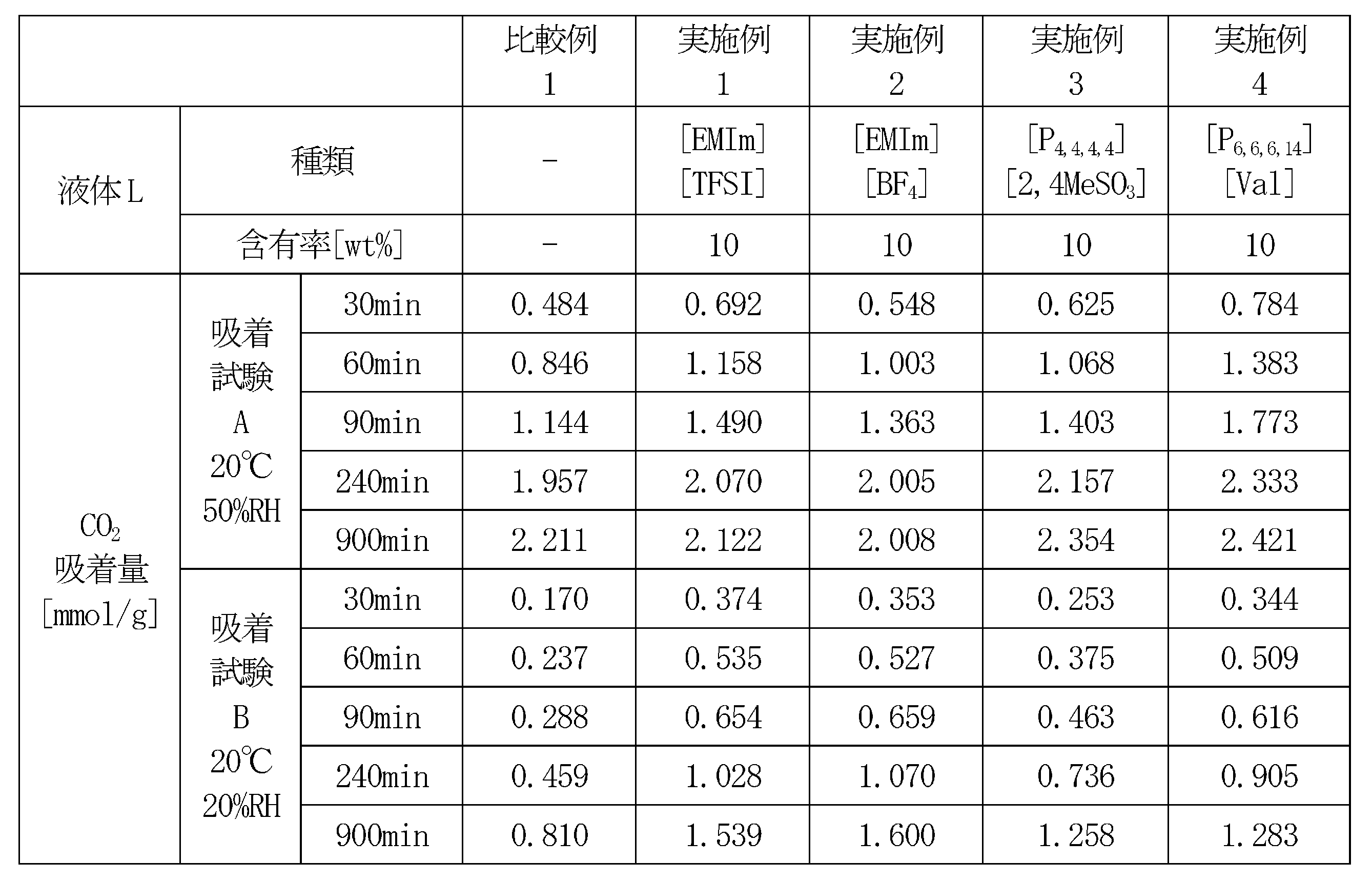
[EMIm][TFSI]:1-エチル-3-メチルイミダゾリウムビス(トリフルオロメタンスルホニル)イミド
[EMIm][BF4]:1-エチル-3-メチルイミダゾリウムテトラフルオロボレート
[P4,4,4,4][2,4MeSO3]:テトラブチルホスホニウム2,4-ジメチルベンゼンスルホネート
[P6,6,6,14][Val]:トリヘキシルテトラデシルホスホニウムバリネート
Claims (14)
- アミノ基を有するポリマーと、
沸点が130℃以上である液体と、
を含む、酸性ガス吸着材であって、
下記の吸着試験Aを15時間行った場合に、二酸化炭素の吸着量aが0.35mmol/g以上である、酸性ガス吸着材。
吸着試験A:二酸化炭素、窒素及び水蒸気から構成された混合ガスG1を、前記酸性ガス吸着材が収容された容器内に送り続ける。ここで、前記混合ガスG1における前記二酸化炭素の濃度が400volppmであり、前記混合ガスG1は、温度が20℃であり、湿度が50%RHである。 - 前記ポリマーが固体である、請求項1に記載の酸性ガス吸着材。
- 前記ポリマーは、エポキシモノマーに由来する構成単位を有するアミンポリマーを含む、請求項1に記載の酸性ガス吸着材。
- 前記アミンポリマーは、アミンモノマー及びエポキシモノマーを含む化合物群の反応物を含む、請求項3に記載の酸性ガス吸着材。
- 前記アミンモノマーがポリエチレンイミンを含む、請求項4に記載の酸性ガス吸着材。
- 前記ポリマーのガラス転移温度が40℃以下である、請求項1に記載の酸性ガス吸着材。
- 前記液体は、イオン液体を含む、請求項1に記載の酸性ガス吸着材。
- 前記イオン液体は、温度応答性を有する、請求項7に記載の酸性ガス吸着材。
- 前記液体の含有率が1wt%~15wt%である、請求項1に記載の酸性ガス吸着材。
- 多孔質構造を有する、請求項1に記載の酸性ガス吸着材。
- 下記の吸着試験Bを15時間行った場合に、二酸化炭素の吸着量b1が0.1mmol/g以上である、請求項1に記載の酸性ガス吸着材。
吸着試験B:二酸化炭素、窒素及び水蒸気から構成された混合ガスG2を、前記酸性ガス吸着材が収容された容器内に送り続ける。ここで、前記混合ガスG2における前記二酸化炭素の濃度が400volppmであり、前記混合ガスG2は、温度が20℃であり、湿度が20%RHである。 - 前記吸着試験Bを1時間行った場合に、二酸化炭素の吸着量b2が0.01mmol/g以上である、請求項11に記載の酸性ガス吸着材。
- 請求項1~12のいずれか1項に記載の酸性ガス吸着材と、
通気経路と、
を備えた、構造体。 - ガス入口と、ガス出口とを有する吸着部を備え、
前記吸着部は、請求項1~12のいずれか1項に記載の酸性ガス吸着材を収容している、酸性ガス吸着装置。
Applications Claiming Priority (2)
| Application Number | Priority Date | Filing Date | Title |
|---|---|---|---|
| JP2023222484 | 2023-12-28 | ||
| JP2023-222484 | 2023-12-28 |
Publications (1)
| Publication Number | Publication Date |
|---|---|
| WO2025142015A1 true WO2025142015A1 (ja) | 2025-07-03 |
Family
ID=96217324
Family Applications (1)
| Application Number | Title | Priority Date | Filing Date |
|---|---|---|---|
| PCT/JP2024/035519 Pending WO2025142015A1 (ja) | 2023-12-28 | 2024-10-03 | 酸性ガス吸着材、酸性ガス吸着材を備えた構造体、及び酸性ガス吸着装置 |
Country Status (1)
| Country | Link |
|---|---|
| WO (1) | WO2025142015A1 (ja) |
Citations (4)
| Publication number | Priority date | Publication date | Assignee | Title |
|---|---|---|---|---|
| US7767004B2 (en) | 2005-03-11 | 2010-08-03 | University Of Ottawa | Functionalized adsorbent for removal of acid gases and use thereof |
| JP2013198874A (ja) * | 2012-03-26 | 2013-10-03 | Nitto Denko Corp | ガス吸着フィルム |
| WO2017009241A1 (en) | 2015-07-10 | 2017-01-19 | Climeworks Ag | Amine-functionalized fibrillated cellulose for co2 adsorption and methods for making same |
| WO2023063051A1 (ja) * | 2021-10-15 | 2023-04-20 | 日東電工株式会社 | 酸性ガス吸着材及び酸性ガス吸着装置 |
-
2024
- 2024-10-03 WO PCT/JP2024/035519 patent/WO2025142015A1/ja active Pending
Patent Citations (4)
| Publication number | Priority date | Publication date | Assignee | Title |
|---|---|---|---|---|
| US7767004B2 (en) | 2005-03-11 | 2010-08-03 | University Of Ottawa | Functionalized adsorbent for removal of acid gases and use thereof |
| JP2013198874A (ja) * | 2012-03-26 | 2013-10-03 | Nitto Denko Corp | ガス吸着フィルム |
| WO2017009241A1 (en) | 2015-07-10 | 2017-01-19 | Climeworks Ag | Amine-functionalized fibrillated cellulose for co2 adsorption and methods for making same |
| WO2023063051A1 (ja) * | 2021-10-15 | 2023-04-20 | 日東電工株式会社 | 酸性ガス吸着材及び酸性ガス吸着装置 |
Similar Documents
| Publication | Publication Date | Title |
|---|---|---|
| JP7698728B2 (ja) | 酸性ガス吸着材及び酸性ガス吸着装置 | |
| Gao et al. | Functionalized ionic liquid membranes for CO2 separation | |
| Lee et al. | Amine-functionalized covalent organic framework for efficient SO2 capture with high reversibility | |
| US20220040669A1 (en) | Supported poly(allyl)amine and derivatives for co2 capture from flue gas or ultra-dilute gas streams such as ambient air or admixtures thereof | |
| JP5021540B2 (ja) | モノリス状有機多孔質体、モノリス状有機多孔質イオン交換体、それらの製造方法及びケミカルフィルター | |
| CN103221127B (zh) | 多孔聚合物材料 | |
| AU2019403729A1 (en) | Metal-organic frameworks for gas adsorption | |
| KR101149079B1 (ko) | 가스투과능이 향상된 이온성액체-고분자 겔 멤브레인 및 그 제조방법 | |
| KR20220155578A (ko) | 하이드로겔을 사용한 이산화탄소 포집 공정 | |
| Wang et al. | Synthesis of hollow organosiliceous spheres for volatile organic compound removal | |
| Sahiner et al. | Poly ionic liquid cryogel of polyethyleneimine: Synthesis, characterization, and testing in absorption studies | |
| JP2018140392A (ja) | 固相抽出およびクロマトグラフィーのための多孔質材料ならびにその製造方法および使用 | |
| US20250281875A1 (en) | Substituted epoxide modified sorbents, systems including sorbents, and methods using the sorbents | |
| WO2022202848A1 (ja) | 酸性ガス吸着材、酸性ガス吸着材の製造方法及び酸性ガス吸着装置 | |
| WO2021246383A1 (ja) | 酸性ガス吸着・脱離材料 | |
| JP2026065141A (ja) | ガス吸収材料、ガス吸収体とその製造方法、およびガス分離装置 | |
| Koutsianos et al. | Drastic enhancement of carbon dioxide adsorption in fluoroalkyl-modified poly (allylamine) | |
| US20250214058A1 (en) | Acidic gas adsorbent, structure comprising acidic gas adsorbent, acidic gas adsorption device, and acidic gas adsorbent production method | |
| EP4417410A1 (en) | Acidic gas adsorbent, structure provided with acidic gas adsorbent, acidic gas adsorption device, acidic gas recovery device, method for producing acidic gas adsorbent, and sheet-like structure | |
| WO2023053803A1 (ja) | 酸性ガス吸着材及び酸性ガス吸着装置 | |
| JP7749161B2 (ja) | 酸性ガス吸着材、酸性ガス吸着材を備えた構造体、酸性ガス吸着装置、及び酸性ガス吸着材の製造方法 | |
| CA3289316A1 (en) | Acidic gas adsorbent, structure comprising acidic gas adsorbent, acidic gas adsorption device, and acidic gas adsorbent production method | |
| WO2025197701A1 (ja) | 酸性ガス吸着材、酸性ガス吸着材を備えた構造体、酸性ガス吸着装置、及び、酸性ガス吸着材の製造方法 | |
| WO2025204190A1 (ja) | 酸性ガス吸着材、酸性ガス吸着材を備えた構造体、酸性ガス吸着装置、及び、酸性ガス吸着材の製造方法 | |
| EP4691623A1 (en) | Method of making or rejuvenating an absorptive article for capturing carbon dioxide |
Legal Events
| Date | Code | Title | Description |
|---|---|---|---|
| 121 | Ep: the epo has been informed by wipo that ep was designated in this application |
Ref document number: 24911909 Country of ref document: EP Kind code of ref document: A1 |
|
| ENP | Entry into the national phase |
Ref document number: 2025566231 Country of ref document: JP Kind code of ref document: A |
|
| WWE | Wipo information: entry into national phase |
Ref document number: 2025566231 Country of ref document: JP |
|
| WWE | Wipo information: entry into national phase |
Ref document number: 2024911909 Country of ref document: EP |
|
| ENP | Entry into the national phase |
Ref document number: 2024911909 Country of ref document: EP Effective date: 20260728 |