WO2025126366A1 - データ取得支援装置、データ取得支援方法及びプログラム - Google Patents
データ取得支援装置、データ取得支援方法及びプログラム Download PDFInfo
- Publication number
- WO2025126366A1 WO2025126366A1 PCT/JP2023/044637 JP2023044637W WO2025126366A1 WO 2025126366 A1 WO2025126366 A1 WO 2025126366A1 JP 2023044637 W JP2023044637 W JP 2023044637W WO 2025126366 A1 WO2025126366 A1 WO 2025126366A1
- Authority
- WO
- WIPO (PCT)
- Prior art keywords
- character
- data
- appearance
- data acquisition
- image
- Prior art date
- Legal status (The legal status is an assumption and is not a legal conclusion. Google has not performed a legal analysis and makes no representation as to the accuracy of the status listed.)
- Pending
Links
Images


Classifications
-
- G—PHYSICS
- G06—COMPUTING OR CALCULATING; COUNTING
- G06T—IMAGE DATA PROCESSING OR GENERATION, IN GENERAL
- G06T13/00—Animation
- G06T13/80—Two-dimensional [2D] animation, e.g. using sprites
Definitions
- Non-Patent Document 1 For organizations such as companies, research institutes, and medical institutions, the creation of big data is important in many situations, as it can be used to develop a variety of services and advance research. For this reason, many organizations supply equipment, devices, or systems (see Non-Patent Document 1) for obtaining desired data to customers, experimental subjects, and other people, and collect the results obtained by these devices with their consent.
- the present invention aims to provide technology that prevents a decrease in the amount of collected data.
- One aspect of the present invention is a data acquisition support device that includes a control unit that displays a character image, which is an image of a character, on a specified output destination, and the control unit changes the appearance of the character depending on the data obtained from an acquisition target.
- One aspect of the present invention is a data acquisition support method that includes a control step of displaying a character image, which is an image of a character, on a specified output destination, and the control step changes the appearance of the character depending on data obtained from an acquisition target.
- One aspect of the present invention is a program for causing a computer to function as the above-mentioned data acquisition support device.
- the present invention makes it possible to prevent a decline in the amount of collected data.
- FIG. 1 is an explanatory diagram for explaining a data acquisition support system according to an embodiment.
- FIG. 1 is a first diagram showing an example of a character in an embodiment.
- FIG. 2 is a second diagram showing an example of a character in the embodiment.
- FIG. 3 is a third diagram showing an example of a character in the embodiment.
- 1 is a flowchart showing an example of a flow of a process executed by a data acquisition support device according to an embodiment.
- (Embodiment) 1 is a diagram illustrating a data acquisition support system 100 according to an embodiment.
- the data acquisition support system 100 includes a sensor 1 and a data acquisition support apparatus 2.
- the sensor 1 is a sensor that acquires a desired type of data from an acquisition target 9, such as a pedometer, a pulse meter, a blood oxygen concentration measuring sensor, etc.
- the data acquired by the sensor 1 i.e., the results of sensing is output to the data acquisition support device 2.
- the data acquisition support device 2 has a control unit 21 equipped with a processor 91, such as a CPU (Central Processing Unit), a GPU (Graphics Processing Unit) or an NPU (Neural Network Processing Unit), and a memory 92, which are connected by a bus, and executes a program. By executing the program, the data acquisition support device 2 functions as a device equipped with the control unit 21, an interface unit 22 and a memory unit 23.
- a processor 91 such as a CPU (Central Processing Unit), a GPU (Graphics Processing Unit) or an NPU (Neural Network Processing Unit)
- a memory 92 which are connected by a bus, and executes a program.
- the data acquisition support device 2 functions as a device equipped with the control unit 21, an interface unit 22 and a memory unit 23.
- the processor 91 reads out a program stored in the storage unit 23 and stores the read out program in the memory 92.
- the processor 91 executes the program stored in the memory 92, whereby the data acquisition support device 2 functions as a device including a control unit 21, an interface unit 22, and a storage unit 23.
- the control unit 21 controls the operation of a predetermined output destination to display a character image, which is an image of a character, at the predetermined output destination.
- the predetermined output destination is, for example, a display device provided in the interface unit 22, which will be described later.
- the appearance of the character to be displayed changes according to the data obtained from the acquisition target 9.
- the control unit 21 changes the appearance of the character to be displayed on a specified output destination according to the data obtained from the acquisition target 9.
- Images G1a and G1b in FIG. 1 are examples of character images.
- Image G1a is an example of an image of a character before change
- image G1b is an example of a character image showing the character shown in image G1a after it has changed in response to data obtained from acquisition target 9.
- the data acquisition support device 2 displays a character.
- the appearance of the character changes according to the data obtained from the acquisition target 9. Since the appearance of the character changes according to the acquisition target 9's own actions, the acquisition target 9 becomes interested in the change in the character's appearance and continues sensing with the sensor 1 in an attempt to observe further changes. Therefore, the data acquisition support device 2 can suppress a decrease in the amount of collected data.
- the displayed character may have, for example, a head, a torso, hands, and legs.
- the displayed character may be a deformed human or animal.
- the displayed character may be an image of a pet animal such as a cat or a dog.
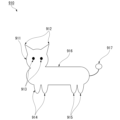
- FIG. 2 is a first diagram showing an example of a character in an embodiment.
- the character 910 in FIG. 2 is an image of a quadrupedal animal such as a cat.
- the character in FIG. 2 has a head 911, ears 912, eyes 913, hands 914, feet 915, a body 916, and a tail 917.
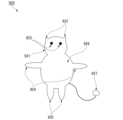
- FIG. 3 is a second diagram showing an example of a character in an embodiment.
- Character 920 in FIG. 3 is an image of an animal that can walk on two legs, such as a bear.
- the character in FIG. 3 has a head 921, ears 922, eyes 923, hands 924, feet 925, a body 926, and a tail 927.
- FIG. 4 is a third diagram showing an example of a change in the appearance of a character in an embodiment.
- FIG. 4 shows an example of a change in the appearance of a character when the amount of walking of the acquisition target 9 within a predetermined time is equal to or greater than a predetermined amount. Since the amount of walking is equal to or greater than the predetermined amount, it may be a good idea to change the legs, which are a part of the body that is closely related to walking, in order to convey this fact to the user.
- character 930a is the character before the change
- character 930b is the character after the change.
- the character with the changed legs of character 930a is character 930b.
- the change in the legs may be a change in length, width, depth, or a combination of these.
- the change in the legs may be an increase in leg length proportional to the amount of walking within a certain period of time.
- the relationship between the results of the sensing and the part and amount of change is determined in advance. For example, if the sensing is sensing of the amount of walking, the part that changes as a result of the sensing is determined in advance to be the legs, and furthermore, the relationship between the amount of walking obtained by the sensing and the amount of change in the legs is also determined in advance.
- control unit 21 controls the operation of each functional unit included in the data acquisition support device 2.
- the control unit 21 acquires data acquired by the sensor 1 (hereinafter referred to as "sensing data") via, for example, the interface unit 22.
- the control unit 21 executes, for example, an image data update process.
- the image data update process is a process that updates the image data of a character image to be displayed on a specified output destination based on the sensing data. More specifically, the image data update process is a process that updates the image data of a character image based on the sensing data so that the character displayed on a specified output destination changes only by the amount indicated by the change relationship information.
- the change relationship information is information that indicates the relationship between the sensing data and the changing parts of the body of the character shown in the character image and the amount of change in those parts.
- the change relationship information is, for example, a function in which the explanatory variable is the sensing data and the objective variable is the change in the character.
- the change relationship information may be a table that indicates the relationship between the sensing data and the changing parts of the body of the character shown in the character image and the amount of change in those parts.
- the image data updated by the image data update process is sent to a specified output destination, and the specified output destination displays the character image indicated by the received updated image data.
- the control unit 21 controls the operation of the specified output destination to display the character image indicated by the updated image data.
- the control unit 21 controls the operation of each functional unit of the data acquisition support device 2.
- the control unit 21 controls, for example, the operation of the interface unit 22, and acquires the sensing results of the sensor 1.
- the control unit 21 acquires, for example, information stored in the memory unit 23.
- the process of acquiring information stored in the memory unit 23 is specifically a read process.
- the interface unit 22 includes a communication interface for connecting the data acquisition support device 2 to an external device.
- the interface unit 22 communicates with the external device via wired or wireless communication.
- the external device is, for example, the sensor 1.
- the interface unit 22 acquires the sensing results (i.e., sensing data) of the sensor 1 by communicating with the sensor 1.
- the external device may be, for example, a predetermined output destination for displaying a character.
- the interface unit 22 transmits image data of the character image to the predetermined output destination via a wired or wireless connection.
- the interface unit 22 may be configured to include input devices such as a mouse, keyboard, touch panel, etc.
- the interface unit 22 may be configured as an interface that connects these input devices to the data acquisition support device 2.
- the input device of the interface unit 22 accepts input of various information to the data acquisition support device 2 via a wired or wireless connection. Note that information does not necessarily have to be input to the communication interface of the interface unit 22, but may be input to the input device.
- the interface unit 22 for example, outputs various types of information.
- the interface unit 22 includes a display device, such as a CRT (Cathode Ray Tube) display, a liquid crystal display, or an organic EL (Electro-Luminescence) display.
- the interface unit 22 may be configured as an interface that connects these display devices to the data acquisition support device 2.
- the interface unit 22 displays, for example, a character image.
- the storage unit 23 is configured using a computer-readable storage medium device (non-transitory computer-readable recording medium) such as a magnetic hard disk device or a semiconductor storage device.
- the storage unit 23 stores various information related to the data acquisition support device 2.
- the storage unit 23 stores various information generated by the operation of the control unit 21, for example.
- the storage unit 23 may exist on a cloud, for example.
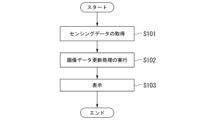
- FIG. 5 is a flowchart showing an example of the flow of processing executed by the data acquisition assistance device 2 in the embodiment.
- the control unit 21 acquires sensing data (step S101).
- the control unit 21 executes image data update processing (step S102).
- the control unit 21 controls the operation of a predetermined output destination to display a character image indicated by the updated image data (step S103).
- the data acquisition support device 2 configured in this manner displays a character, and the appearance of the character changes according to the data obtained from the acquisition target 9. Therefore, for the reasons described in ⁇ Effects of changing the character's appearance>, the data acquisition support device 2 can prevent a decrease in the amount of collected data.
- the data acquisition support system 100 thus configured also includes a data acquisition support device 2. As a result, the data acquisition support system 100 can suppress a decrease in the amount of data collected.
- the walking amount and the legs are associated, and the legs change when the walking amount is equal to or greater than a predetermined amount.
- a predetermined amount there is a one-to-one relationship between the sensing type and the part that changes.
- the correspondence between the sensing type and the part that changes does not necessarily have to be one-to-one, and the change in the part may depend on multiple sensing types.
- the change in the legs may change according to the heart rate and the walking amount.
- one type of sensing result does not have to be used for changes in only one part of the body; multiple parts of the body may change based on the results of one type of sensing. For example, both changes in the legs and changes in the torso may depend on at least the amount of walking.
- the change in appearance may include, for example, adding accessories such as hats, earrings, glasses, nails, feathers, ribbons, etc., or changing the accessories.
- the change in appearance may be to an appearance that is generally more likely to evoke positive feelings.
- the data acquisition support device 2 can further attract interest in the character of the acquisition target 9. As a result, the data acquisition support device 2 can further suppress a decrease in the amount of data collected.
- the above-mentioned appearance that is generally likely to evoke favorable feelings is, for example, an appearance that is generally likely to evoke favorable feelings about a human-type character.
- the appearance that is generally likely to evoke favorable feelings may also be, for example, an appearance that is generally likely to evoke favorable feelings about a character other than a human-type character, such as an animal-type character.
- An appearance that is generally likely to evoke positive feelings is, for example, an appearance that is generally recognized as cute.
- An appearance that is generally recognized as cute is, for example, an appearance in which the limbs are small compared to the face, the eyes are large, the mouth is shaped like a duck, and the corners of the mouth are not downturned.
- An appearance that is generally likely to evoke positive feelings may be, for example, a small appearance in terms of figure, or an appearance in which the limbs are short and plump.
- An appearance that is generally likely to evoke positive feelings is, for example, an appearance that is generally recognized as cool.
- An appearance that is generally recognized as cool is, for example, an appearance that has long legs, or an appearance that is muscular yet slim.
- the change in the character's appearance may be such that, for example, when there are multiple types of data obtained from the acquisition target 9, the closer the ratio of the amount of each of the multiple types of data to the total amount of data is to a predetermined ratio for each type, the closer the character's appearance will be to an appearance that is generally more likely to evoke positive feelings.
- Big data is not just about having a large amount of data; it is also important that the data is well-balanced. Therefore, if data is acquired in this way, it is possible to collect data that is favorable to those who want to build big data.
- the data acquisition assistance device 2 may be implemented using multiple information processing devices connected to each other so that they can communicate with each other via a network. In this case, each process executed by the control unit 21 may be executed in a distributed manner by the multiple information processing devices.
- All or part of the functions of the data acquisition support system 100 may be realized using hardware such as an ASIC (Application Specific Integrated Circuit), a PLD (Programmable Logic Device), or an FPGA (Field Programmable Gate Array).
- the program may be recorded on a computer-readable recording medium. Examples of computer-readable recording media include portable media such as flexible disks, optical magnetic disks, ROMs, and CD-ROMs, and storage devices such as hard disks built into computer systems.
- the program may be transmitted via a telecommunications line.
Landscapes
- Physics & Mathematics (AREA)
- General Physics & Mathematics (AREA)
- Engineering & Computer Science (AREA)
- Theoretical Computer Science (AREA)
- User Interface Of Digital Computer (AREA)
Abstract
本発明の一態様は、キャラクターの画像であるキャラクター画像を所定の出力先に表示させる制御部、を備え、前記制御部は、取得対象から得られるデータに応じて、前記キャラクターの見た目を変化させる、データ取得支援装置である。
Description
本発明は、データ取得支援装置、データ取得支援方法及びプログラムに関する。
企業や研究機関や医療機関等の組織にとってビッグデータは、それを用いてさまざまなサービスの展開や研究の進展につながるため、その構築は多くの場面で重要である。そのため、多くの組織が所望のデータを得るための装置、デバイス又はシステム(非特許文献1参照)を顧客や実験対象等の人に供給し、彼らの了承を得たうえでこれらの装置等が取得した結果を収集することが行われる。
「一問一答」から「自然対話」へ 「話すだけでスマホが答えてくれる」,ドコモ通信 Vol.65 <https://www.docomo.ne.jp/corporate/ir/library/docotsu/65/special.html>
しかしながら、人間は飽きるものである。また人間は、なるべく負担の少ない作業に流れる場合が多いものである。そのため、供給された装置等は徐々に使用されなくなり、収集されるデータの量が少なくなってしまう場合がある。なおこの事情はデータの取得対象が人間である場合に限らず、動物についても同様であった。
上記事情に鑑み、本発明は、データの収集量の低下を抑制する技術を提供することを目的とする。
本発明の一態様は、キャラクターの画像であるキャラクター画像を所定の出力先に表示させる制御部、を備え、前記制御部は、取得対象から得られるデータに応じて、前記キャラクターの見た目を変化させる、データ取得支援装置である。
本発明の一態様は、キャラクターの画像であるキャラクター画像を所定の出力先に表示させる制御ステップ、を有し、前記制御ステップは、取得対象から得られるデータに応じて、前記キャラクターの見た目を変化させる、データ取得支援方法である。
本発明の一態様は、上記のデータ取得支援装置としてコンピュータを機能させるためのプログラムである。
本発明により、データの収集量の低下を抑制することが可能となる。
(実施形態)
図1は、実施形態のデータ取得支援システム100を説明する説明図である。データ取得支援システム100は、センサ1と、データ取得支援装置(Data acquisition support apparatus)2とを備える。
図1は、実施形態のデータ取得支援システム100を説明する説明図である。データ取得支援システム100は、センサ1と、データ取得支援装置(Data acquisition support apparatus)2とを備える。
センサ1は、歩数計や、脈拍計測器や、血中酸素濃度測定センサ、等の所望の種類のデータを取得対象9から得るセンサである。センサ1の取得したデータ(すなわちセンシングの結果)はデータ取得支援装置2に出力される。
データ取得支援装置2は、バスで接続されたCPU(Central Processing Unit)、GPU(Graphics Processing Unit)又はNPU(Neural Network Processing Unit)等のプロセッサ91とメモリ92とを備える制御部21を備え、プログラムを実行する。データ取得支援装置2は、プログラムの実行によって制御部21、インタフェース部22及び記憶部23を備える装置として機能する。
より具体的には、プロセッサ91が記憶部23に記憶されているプログラムを読み出し、読み出したプログラムをメモリ92に記憶させる。プロセッサ91が、メモリ92に記憶させたプログラムを実行することによって、データ取得支援装置2は、制御部21、インタフェース部22及び記憶部23を備える装置として機能する。
制御部21は、例えば、所定の出力先の動作を制御して、キャラクターの画像であるキャラクター画像をその所定の出力先に表示させる。所定の出力先は、例えば、インタフェース部22が備える後述する表示装置である。
この表示させるキャラクターの見た目は取得対象9から得られたデータに応じて変化する。すなわち、制御部21は、取得対象9から得られたデータに応じて、所定の出力先に表示させるキャラクターの見た目を変化させる。
図1の画像G1aと画像G1bとは、キャラクター画像の一例である。画像G1aは変化前のキャラクターの画像の一例であり、画像G1bは、画像G1aの示すキャラクターが、取得対象9から得られたデータに応じて変化した後、の像を示すキャラクター画像の一例である。
<キャラクターの見た目の変化の奏する効果>
このように、データ取得支援装置2は、キャラクターの表示を行わせる。そして、そのキャラクターの見た目は、取得対象9から得られたデータに応じて変化する。自分自身の行動に応じてキャラクターの見た目が変化するため、取得対象9はそのキャラクターの見た目の変化に興味を抱き、更なる変化を見ようとして、センサ1によるセンシングを継続する。そのため、データ取得支援装置2は、データの収集量の低下を抑制することができる。
このように、データ取得支援装置2は、キャラクターの表示を行わせる。そして、そのキャラクターの見た目は、取得対象9から得られたデータに応じて変化する。自分自身の行動に応じてキャラクターの見た目が変化するため、取得対象9はそのキャラクターの見た目の変化に興味を抱き、更なる変化を見ようとして、センサ1によるセンシングを継続する。そのため、データ取得支援装置2は、データの収集量の低下を抑制することができる。
なお、表示されるキャラクターは、例えば、頭部、胴体、手及び脚を有する。表示されるキャラクターは、デフォルメされた人間や動物であってもよい。表示されるキャラクターは、例えば猫や犬等の愛玩動物を模した像であってもよい。
図2は、実施形態におけるキャラクターの一例を示す第1の図である。図2のキャラクター910は猫等の四足歩行の動物を模した像である。図2のキャラクターは、頭部911、耳912、目913、手914、足915、胴体916及び尻尾917を有する。
図3は、実施形態におけるキャラクターの一例を示す第2の図である。図3のキャラクター920は熊等の二足歩行可能な動物を模した像である。図3のキャラクターは、頭部921、耳922、目923、手924、足925、胴体926及び尻尾927を有する。
図4は、実施形態におけるキャラクターの見た目の変化の一例を示す第3の図である。図4は一例として、所定の時間内に取得対象9の歩行量が所定の量以上であった場合の、キャラクターの見た目の変化の一例を示す。歩行量が所定の量以上であったので、そのことをユーザに伝えるには、歩行との関りが強い部位である脚を変化させるのが良い場合がある。
図4の例においてキャラクター930aは変化前のキャラクターであり、キャラクター930bが変化後のキャラクターである。図4に示すように、キャラクター930aの脚が変化したキャラクターが、キャラクター930bである。
なお、脚の変化は、長さの変化であってもよしい、幅の変化であってもよいし、奥行の変化であってもよいし、これらの組み合わせであってもよい。脚の変化は、例えば、一定期間内の歩行量に比例する量だけ脚の長さが長くなるという変化である。
なお、センシングの結果と、変化する部位及び量との関係と、は予め定められている。例えば、センシングが歩行量のセンシングであったとして、そのセンシングの結果によって変化する部位は脚と予め定められており、更に、そのセンシングで得られた歩行量と、脚の変化量との関係も予め定められている。
<ハードウェア構成の説明の続き>
図1の説明に戻る。制御部21は、データ取得支援装置2が備える各機能部の動作を制御する。制御部21は、例えばインタフェース部22を介して、センサ1の取得したデータ(以下「センシングデータ」という。)を取得する。
図1の説明に戻る。制御部21は、データ取得支援装置2が備える各機能部の動作を制御する。制御部21は、例えばインタフェース部22を介して、センサ1の取得したデータ(以下「センシングデータ」という。)を取得する。
制御部21は、例えば画像データ更新処理を実行する。画像データ更新処理は、センシングデータに基づき、所定の出力先に表示させるキャラクター画像の画像データを更新する処理である。より具体的には、画像データ更新処理は、センシングデータに基づき、所定の出力先で表示されるキャラクターが、変化関係情報が示す変化だけ変化するように、キャラクター画像の画像データを更新する、処理である。
変化関係情報は、センシングデータと、キャラクター画像が示すキャラクターの有する部位のうちの変化する部位とその部位の変化量との関係を示す情報である。変化関係情報は、例えば、説明変数をセンシングデータとし、目的変数をキャラクターの変化とする関数である。変化関係情報は、センシングデータと、キャラクター画像が示すキャラクターの有する部位のうちの変化する部位とその部位の変化量との関係を示すテーブルであってもよい。
画像データ更新処理による更新後の画像データが、所定の出力先に送信され、所定の出力先は、受信した更新後の画像データが示すキャラクター画像を表示する。言い換えれば、制御部21が所定の出力先の動作を制御して、更新後の画像データが示すキャラクター画像を表示させる。
制御部21は、データ取得支援装置2の備える各機能部の動作を制御する。制御部21は、例えばインタフェース部22の動作を制御し、センサ1のセンシングの結果を取得する。制御部21は、例えば記憶部23の記憶する情報を取得する。記憶部23の記憶する情報を取得する処理は、具体的には、読み出しである。
インタフェース部22は、データ取得支援装置2を外部装置に接続するための通信インタフェースを含んで構成される。インタフェース部22は、有線又は無線を介して外部装置と通信する。外部装置は、例えば、センサ1である。インタフェース部22は、センサ1との通信によって、センサ1のセンシング結果(すなわちセンシングデータ)を取得する。
外部装置は、例えばキャラクターを表示させる所定の出力先であってもよい。このような場合、インタフェース部22は、有線又は無線を介して、所定の出力先にキャラクター画像の画像データを送信する。
インタフェース部22は、マウスやキーボード、タッチパネル等の入力装置を含んで構成されてもよい。インタフェース部22は、これらの入力装置をデータ取得支援装置2に接続するインタフェースとして構成されてもよい。このように、インタフェース部22の入力装置は、有線又は無線、を介してデータ取得支援装置2に対する各種情報の入力を受け付ける。なお、情報は、必ずしもインタフェース部22の通信インタフェースに入力される必要はなく入力装置に入力されてもよい。
インタフェース部22は、例えば、各種情報を出力する。インタフェース部22は、例えばCRT(Cathode Ray Tube)ディスプレイや液晶ディスプレイ、有機EL(Electro-Luminescence)ディスプレイ等の表示装置を含んで構成される。インタフェース部22は、これらの表示装置をデータ取得支援装置2に接続するインタフェースとして構成されてもよい。インタフェース部22は、例えばインタフェース部22の入力装置に入力された情報を出力する。インタフェース部22は、例えばキャラクター画像を表示する。
記憶部23は、磁気ハードディスク装置や半導体記憶装置などのコンピュータ読み出し可能な記憶媒体装置(non-transitory computer-readable recording medium)を用いて構成される。記憶部23はデータ取得支援装置2に関する各種情報を記憶する。記憶部23は、例えば制御部21の動作により生じた各種情報を記憶する。記憶部23は、例えばクラウド上に存在していてもよい。
図5は、実施形態におけるデータ取得支援装置2が実行する処理の流れの一例を示すフローチャートである。制御部21が、センシングデータを取得する(ステップS101)。次に制御部21が、画像データ更新処理を実行する(ステップS102)。次に制御部21が、所定の出力先の動作を制御して、更新後の画像データが示すキャラクター画像を表示させる(ステップS103)。
このように構成されたデータ取得支援装置2は、キャラクターを表示させ、しかもそのキャラクターの見た目は、取得対象9から得られたデータに応じて変化する。そのため、<キャラクターの見た目の変化の奏する効果>で述べた理由により、データ取得支援装置2は、データの収集量の低下を抑制することができる。
また、このように構成されたデータ取得支援システム100は、データ取得支援装置2を備える。そのため、データ取得支援システム100は、データの収集量の低下を抑制することができる。
(変形例)
なお、図4の例では、歩行量と脚とが対応づけられており、歩行量が所定の量以上であった場合に脚が変化した。つまり、センシングの種類と変化する部位とが1対1の関係にあった。しかしながら、センシングの種類と変化する部位との対応関係は、必ずしも1対1である必要はなく、部位の変化は複数のセンシングの種類に依存してもよい。例えば、脚の変化が、心拍と歩行量とに応じて変化してもよい。
なお、図4の例では、歩行量と脚とが対応づけられており、歩行量が所定の量以上であった場合に脚が変化した。つまり、センシングの種類と変化する部位とが1対1の関係にあった。しかしながら、センシングの種類と変化する部位との対応関係は、必ずしも1対1である必要はなく、部位の変化は複数のセンシングの種類に依存してもよい。例えば、脚の変化が、心拍と歩行量とに応じて変化してもよい。
また、1種類のセンシング結果が1つの部位の変化だけに用いられる必要もなく、1種類のセンシングの結果によって複数の部位が変化してもよい。例えば、脚の変化と胴体の変化との両方が、少なくとも歩行量に依存してもよい。
<キャラクターの見た目の変化について>
見た目の変化は、例えば、帽子や、イヤリングや、眼鏡や、爪や、羽や、リボン等のアクセサリの付与や、アクセサリの変化があってもよい。
見た目の変化は、例えば、帽子や、イヤリングや、眼鏡や、爪や、羽や、リボン等のアクセサリの付与や、アクセサリの変化があってもよい。
また、見た目の変化は、一般的に好意的な感情を抱きやすい見た目への変化であってよい。一般的に好意的な感情を抱きやすい見た目へ変化することによって、データ取得支援装置2は、より一層、取得対象9のキャラクターに対する興味を引くことができる。その結果、データ取得支援装置2は、より一層、データの収集量の低下を抑制することができる。
<一般的に好意的な感情を抱きやすい見た目について>
上述の一般的に好意的な感情を抱きやすい見た目は、例えば人間型のキャラクターについての一般的に好意的な感情を抱きやすい見た目である。一般的に好意的な感情を抱きやすい見た目は、例えば動物型のキャラクター等の人間型のキャラクター以外のキャラクターの見た目について一般的に好意的な感情を抱きやすい見た目であってもよい。
上述の一般的に好意的な感情を抱きやすい見た目は、例えば人間型のキャラクターについての一般的に好意的な感情を抱きやすい見た目である。一般的に好意的な感情を抱きやすい見た目は、例えば動物型のキャラクター等の人間型のキャラクター以外のキャラクターの見た目について一般的に好意的な感情を抱きやすい見た目であってもよい。
一般的に好意的な感情を抱きやすい見た目とは、例えば、一般的にかわいいと認識される見た目である。一般的にかわいいと認識される見た目は、例えば、手足が顔に対して小さい見た目や、目が大きい見た目や、口がアヒル口である見た目や、口角が下がっていない見た目である。一般的に好意的な感情を抱きやすい見た目は、例えば、姿形に関して、小さいという見た目や、手足が短くてふっくらしているという見た目であってもよい。
一般的に好意的な感情を抱きやすい見た目とは、例えば、一般的にかっこいいと認識される見た目である。一般的にかっこいいと認識される見た目は、例えば、足が長いという見た目や、筋肉質でありながら細いという見た目である。
一般的に好意的な感情を抱きやすい見た目とは、例えば、一般的に美しいと認識される見た目である。一般的に美しいと認識される見た目は、例えば整った顔立ちをしているという見た目や、全身の左右の対称性が高い見た目である。
<キャラクターの見た目の変化が一般的に好意的な感情を抱きやすい見た目に近づく条件の例とその効果>
また、キャラクターの見た目の変化は、例えば、取得対象9から得られるデータが複数種類である場合において、複数種類の前記データそれぞれの量のデータ全体の量に対する割合が種類ごとの予め定められた割合に近いほど、一般的に好意的な感情を抱きやすい見た目に近づく、という変化であってもよい。
また、キャラクターの見た目の変化は、例えば、取得対象9から得られるデータが複数種類である場合において、複数種類の前記データそれぞれの量のデータ全体の量に対する割合が種類ごとの予め定められた割合に近いほど、一般的に好意的な感情を抱きやすい見た目に近づく、という変化であってもよい。
このような場合、複数種類のデータを、所望のバランスに近いバランスで取得できる可能性が高まる。ビッグデータは、単にデータの量が多ければ良いものではなく、データのバランスが良いことも重要である。そのため、このようにデータが取得されれば、ビッグデータを構築したい者にとって好ましいデータの収集が可能である。
なお、データ取得支援装置2は、ネットワークを介して通信可能に接続された複数台の情報処理装置を用いて実装されてもよい。この場合、制御部21の実行する各処理は、複数の情報処理装置が分散して実行してもよい。
なお、データ取得支援システム100の各機能の全て又は一部は、ASIC(Application Specific Integrated Circuit)やPLD(Programmable Logic Device)やFPGA(Field Programmable Gate Array)等のハードウェアを用いて実現されてもよい。プログラムは、コンピュータ読み取り可能な記録媒体に記録されてもよい。コンピュータ読み取り可能な記録媒体とは、例えばフレキシブルディスク、光磁気ディスク、ROM、CD-ROM等の可搬媒体、コンピュータシステムに内蔵されるハードディスク等の記憶装置である。プログラムは、電気通信回線を介して送信されてもよい。
以上、この発明の実施形態について図面を参照して詳述してきたが、具体的な構成はこの実施形態に限られるものではなく、この発明の要旨を逸脱しない範囲の設計等も含まれる。
100…データ取得支援システム、 1…センサ、 2…データ取得支援装置、 21…制御部、 22…インタフェース部、 23…記憶部、 91…プロセッサ、 92…メモリ
Claims (6)
- キャラクターの画像であるキャラクター画像を所定の出力先に表示させる制御部、
を備え、
前記制御部は、取得対象から得られるデータに応じて、前記キャラクターの見た目を変化させる、
データ取得支援装置。 - 前記キャラクターの見た目の変化は、一般的に好意的な感情を抱きやすい見た目への変化である、
請求項1に記載のデータ取得支援装置。 - 取得対象から得られるデータが複数種類である場合において、前記キャラクターの見た目の変化は、複数種類の前記データそれぞれの量のデータ全体の量に対する割合が種類ごとの予め定められた割合に近いほど、一般的に好意的な感情を抱きやすい見た目に近づく、という変化である、
請求項2に記載のデータ取得支援装置。 - 一般的に好意的な感情を抱きやすい見た目は、一般的にかわいいと認識される見た目、一般的にかっこいいと認識される見た目、又は、一般的に美しいと認識される見た目である、
請求項2に記載のデータ取得支援装置。 - キャラクターの画像であるキャラクター画像を所定の出力先に表示させる制御ステップ、
を有し、
前記制御ステップは、取得対象から得られるデータに応じて、前記キャラクターの見た目を変化させる、
データ取得支援方法。 - 請求項1から4のいずれか一項に記載のデータ取得支援装置としてコンピュータを機能させるためのプログラム。
Priority Applications (1)
| Application Number | Priority Date | Filing Date | Title |
|---|---|---|---|
| PCT/JP2023/044637 WO2025126366A1 (ja) | 2023-12-13 | 2023-12-13 | データ取得支援装置、データ取得支援方法及びプログラム |
Applications Claiming Priority (1)
| Application Number | Priority Date | Filing Date | Title |
|---|---|---|---|
| PCT/JP2023/044637 WO2025126366A1 (ja) | 2023-12-13 | 2023-12-13 | データ取得支援装置、データ取得支援方法及びプログラム |
Publications (1)
| Publication Number | Publication Date |
|---|---|
| WO2025126366A1 true WO2025126366A1 (ja) | 2025-06-19 |
Family
ID=96056586
Family Applications (1)
| Application Number | Title | Priority Date | Filing Date |
|---|---|---|---|
| PCT/JP2023/044637 Pending WO2025126366A1 (ja) | 2023-12-13 | 2023-12-13 | データ取得支援装置、データ取得支援方法及びプログラム |
Country Status (1)
| Country | Link |
|---|---|
| WO (1) | WO2025126366A1 (ja) |
Citations (3)
| Publication number | Priority date | Publication date | Assignee | Title |
|---|---|---|---|---|
| JPH07181056A (ja) * | 1993-12-22 | 1995-07-18 | Casio Comput Co Ltd | 電子機器 |
| WO2016021236A1 (ja) * | 2014-08-07 | 2016-02-11 | 任天堂株式会社 | 情報処理システム、情報処理装置、情報処理プログラム、および、情報処理方法 |
| JP2020044222A (ja) * | 2018-09-21 | 2020-03-26 | 株式会社ポケモン | ゲームサーバ、プログラム、方法、ゲームシステムおよび情報処理端末 |
-
2023
- 2023-12-13 WO PCT/JP2023/044637 patent/WO2025126366A1/ja active Pending
Patent Citations (3)
| Publication number | Priority date | Publication date | Assignee | Title |
|---|---|---|---|---|
| JPH07181056A (ja) * | 1993-12-22 | 1995-07-18 | Casio Comput Co Ltd | 電子機器 |
| WO2016021236A1 (ja) * | 2014-08-07 | 2016-02-11 | 任天堂株式会社 | 情報処理システム、情報処理装置、情報処理プログラム、および、情報処理方法 |
| JP2020044222A (ja) * | 2018-09-21 | 2020-03-26 | 株式会社ポケモン | ゲームサーバ、プログラム、方法、ゲームシステムおよび情報処理端末 |
Similar Documents
| Publication | Publication Date | Title |
|---|---|---|
| Van Erp et al. | Social touch in human–computer interaction | |
| Hayhurst | How augmented reality and virtual reality is being used to support people living with dementia—design challenges and future directions | |
| US9814423B2 (en) | Method and system for monitoring pain of users immersed in virtual reality environment | |
| US20120190937A1 (en) | Emotion script generating, experiencing, and emotion interaction | |
| Samet et al. | See-hear-feel-speak: A protocol for improving outcomes in emergency department interactions with patients with autism spectrum disorder | |
| US10628509B2 (en) | Avatar-based health portal with multiple navigational modes | |
| CN114051621A (zh) | 空间提案系统和空间提案方法 | |
| Barbosa et al. | CHI'22: Proceedings of the 2022 CHI Conference on Human Factors in Computing Systems | |
| JP2019192071A (ja) | 支援システム及び支援方法 | |
| Sahal et al. | Augmented reality integrated brain computer interface for smart home control | |
| Lancioni et al. | Defining assistive technology and the target populations | |
| Xu et al. | Boosters of the metaverse: a review of augmented reality-based brain-computer interface | |
| CN121986381A (zh) | 用于训练被安排接受医学程序的患者的设备、系统和方法 | |
| US12272054B2 (en) | Systems and methods for developmental monitoring of children | |
| De Haas et al. | The Effect of a Social Robot on Children's Pain and Anxiety During Blood Draw | |
| KR102552524B1 (ko) | 넥 밴드형 공간 제균 블루투스 이어폰 | |
| KR20230108406A (ko) | 임산부를 위한 메타버스 플랫폼을 제공하는 서버 및 시스템 | |
| CA3189951A1 (en) | Multi-functional telemedical device | |
| Hayashi et al. | Socio-enactive systems: the hospital scenario | |
| Biret et al. | Designing telepresence systems to connect hospitalized children with their families: Introducing the IPaTRo project | |
| Waigh | Some critical questions in biological physics: A guided tour around the bugbears | |
| Li et al. | Adapting to the user: A systematic review of personalized interaction in vr | |
| Wriessnegger et al. | Mobile BCI technology: NeuroIS goes out of the lab, into the field | |
| Nuyens et al. | Predictive value of SF–36 for MS–specific scales of the MS Quality of Life Inventory | |
| Gunser et al. | Do User Requirements of mHealth Devices Have Differences for Gender and Age? |
Legal Events
| Date | Code | Title | Description |
|---|---|---|---|
| 121 | Ep: the epo has been informed by wipo that ep was designated in this application |
Ref document number: 23961433 Country of ref document: EP Kind code of ref document: A1 |
|
| ENP | Entry into the national phase |
Ref document number: 2025563122 Country of ref document: JP Kind code of ref document: A |
|
| WWE | Wipo information: entry into national phase |
Ref document number: 2025563122 Country of ref document: JP |