WO2025120741A1 - 回転電機 - Google Patents
回転電機 Download PDFInfo
- Publication number
- WO2025120741A1 WO2025120741A1 PCT/JP2023/043498 JP2023043498W WO2025120741A1 WO 2025120741 A1 WO2025120741 A1 WO 2025120741A1 JP 2023043498 W JP2023043498 W JP 2023043498W WO 2025120741 A1 WO2025120741 A1 WO 2025120741A1
- Authority
- WO
- WIPO (PCT)
- Prior art keywords
- rotor shaft
- electric machine
- brush holder
- rotating electric
- brush
- Prior art date
- Legal status (The legal status is an assumption and is not a legal conclusion. Google has not performed a legal analysis and makes no representation as to the accuracy of the status listed.)
- Pending
Links
Images




Classifications
-
- H—ELECTRICITY
- H02—GENERATION; CONVERSION OR DISTRIBUTION OF ELECTRIC POWER
- H02K—DYNAMO-ELECTRIC MACHINES
- H02K13/00—Structural associations of current collectors with motors or generators, e.g. brush mounting plates or connections to windings; Disposition of current collectors in motors or generators; Arrangements for improving commutation
Definitions
- the present invention relates to a rotating electric machine.
- JP2871003B discloses a rotating electrical machine in which a recess is provided on the side of the brush, and the brush is worn down to the recess by the commutator, so that the wear powder that has grown on the end of the brush side is worn away by the rotation of the rotor shaft.
- the configuration described in the above document does not take into consideration the fibrous conductive foreign matter that grows on the surface of the electrode fixed to the rotor shaft. As a result, there is a risk that a short circuit will occur due to the grown fibrous conductive foreign matter, which means that the insulation properties will be reduced.
- the present invention aims to provide a rotating electric machine that can suppress the deterioration of insulation caused by the above-mentioned conductive foreign matter.
- a rotating electric machine includes a housing having a first cover through which a rotor shaft passes, a brush holder that holds a brush, a brush holder accommodating portion that is axially recessed from the outside of the first cover and that accommodates the brush holder, and a second cover that covers the brush holder accommodating portion.
- the brush holder includes a through hole through which the rotor shaft passes and a wall that protrudes along at least a portion of the outer edge of the through hole and in the axial direction of the rotor shaft, and the wall includes at least one protrusion that protrudes toward the rotation axis of the rotor shaft at least in a portion of a position facing an electrode provided on the rotor shaft.
- FIG. 1 is an explanatory diagram of a drive unit including a rotating electric machine, as viewed from the axial side.
- FIG. 2 is a diagram showing a state in which a second cover and a bus bar cover are attached to the drive unit of FIG.
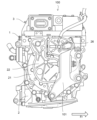
- FIG. 3 is an explanatory diagram of the first cover, focusing on the brush holder housing portion.
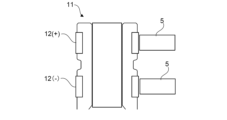
- FIG. 4 is a cross-sectional view showing the positional relationship between the rotor shaft, the slip rings, and the brushes.
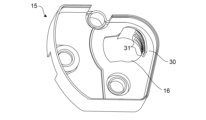
- FIG. 5 is a perspective view of the brush holder.
- FIG. 6 is a cross-sectional view of the vicinity of the through hole of the brush holder as viewed in the axial direction.
- FIG. 7 shows the rotor shaft, the wall and the protrusions extracted from FIG.
- FIG. 8 is a cross-sectional view of the vicinity of a through hole of a brush holder according to a modified example, viewed in the axial direction.
- FIG. 1 is an explanatory diagram of a drive unit 100 equipped with a rotating electric machine 1 according to this embodiment, as viewed from the axial side.
- FIG. 2 is an explanatory diagram of the drive unit 100, showing the second cover 22 and bus bar cover 26 attached.
- the drive unit 100 is composed of a rotating electric machine 1 and an inverter unit 3 that supplies power to the rotating electric machine 1.
- the inverter unit 3 is mounted on top of the rotating electric machine 1.
- the rotating electric machine 1 is constructed by housing 2 containing a rotor and a stator (not shown).
- the rotor has a rotor shaft 11.
- the housing 2 has a refrigerant flow path through which a refrigerant (cooling oil) for cooling circulates, and a refrigerant inlet 2a and a refrigerant outlet 2b through which the refrigerant flows in and out of the housing 2.
- the rotating electric machine 1 is mounted on a vehicle and functions as an electric motor that drives the wheels.
- the rotating electric machine 1 also functions as a generator that receives driving force from the rotation of the wheels and generates electricity (regeneration).
- the rotating electric machine 1 is composed of a wound field type electric motor.
- the housing 2 has an internal cavity with an opening, and the stator and rotor are housed in the internal cavity.
- the opening on the axial side of the housing 2 (the front side in FIG. 1) is covered by a first cover 21.
- a second cover 22 and a bus bar cover 26 are attached to the outside of the first cover 21.
- the rotor shaft 11 protrudes to the outside from the first cover 21, and supports the rotor shaft 11 so that it can rotate freely.
- the housing 2, first cover 21, second cover 22 and bus bar cover 26 are formed by casting using a metal such as an aluminum alloy.
- a slip ring 12 is provided on the outer periphery of the rotor shaft 11. Brushes 5 abut against the slip ring 12, and the inverter unit 3 and the field winding provided on the rotor are electrically connected via the brushes 5, so that DC power from the inverter unit 3 is supplied to the field winding.
- the brush 5 is housed in the brush holder 15 and held by the brush holder 15, and is fixed to the rotor shaft 11.
- Figure 3 is an explanatory diagram of the first cover 21 with the brush holder housing section 20 at its center.
- the first cover 21 has a brush holder accommodating portion 20 in which the brush holder 15 is accommodated.
- the brush holder accommodating portion 20 is formed in a concave shape that is recessed from the side surface of the first cover 21 (the outermost surface of the first cover 21) toward the rear in the axial direction.
- the brush holder accommodating portion 20 is formed in a shape that is slightly larger than the outer peripheral shape of the brush holder 15.
- the brush holder 15 is a case made of insulating resin that houses and holds multiple brushes 5 inside.
- the brush holder 15 has a through hole 16 through which the rotor shaft 11 passes, and a wall 30 that runs along at least a portion of the outer edge of the through hole 16 and protrudes in the axial direction of the rotor shaft 11.
- the wall 30 has at least one protrusion 31 that protrudes toward the rotation axis of the rotor shaft 11 at at least a portion of a position facing an electrode provided on the rotor shaft 11.
- the wall 30 and the protrusion 31 will be described later.
- the brush 5 and the wall 30 are arranged side by side in the circumferential direction around the rotation axis of the rotor shaft 11.
- the rotor shaft 11 is provided with slip rings 12 arranged in parallel at axially spaced positions as two electrodes, positive and negative.
- the brush holder 15 has a pair of brushes 5 for each of the positive and negative slip rings 12.
- the brushes 5 have a rectangular bar shape, and one longitudinal end of the brushes 5 abuts against the slip ring 12 of the rotor shaft 11.
- a spring or other biasing member is disposed on the other longitudinal end of the brushes 5, and the brushes 5 are pressed against the slip ring 12.
- a pair of brushes 5 fixed to the brush holder 15 abuts against the positive or negative slip ring 12.
- the angle between the longitudinal axis of the pair of brushes 5 is an acute angle.
- the pair of brushes 5 are arranged in a V-shape so that they move apart as they move away from the slip ring 12. Note that, if the brush holder 15 is arranged biased to one side of the rotor shaft 11 as described below, it is not necessary to arrange the brushes 5 in a V-shape at an acute angle.
- the brush holder 15 is fixed to the side of the brush holder housing 20 by three bolts 151.
- the brush holder accommodating portion 20 communicates with a communication portion 23 formed shallowly in the axial direction at its upper portion.
- the communication portion 23 further communicates with a connection portion 24 recessed in the axial direction at its upper portion.
- the connection portion 24 accommodates the tip of a field bus bar 241 to which DC power from the inverter unit 3 is supplied.
- Wiring 19 is connected between the field bus bar 241 and the brush holder 15.
- the wiring 19 is routed in the vertical direction from the connection portion 24 to the brush holder accommodating portion 20 via the communication portion 23.
- the ends of the wiring 19 are each connected to the brushes 5.
- a second cover 22 is attached to the brush holder housing portion 20, the communication portion 23, and the connection portion 24 recessed in the first cover 21, which closes them from the outside.
- a busbar accommodating portion 25 is recessed in the axial direction above the brush holder accommodating portion 20 and to the side of the connection portion 24.
- the tip of a three-phase busbar 41 for supplying three-phase power to the inverter unit 3 is accommodated in the busbar accommodating portion 25.
- a busbar cover 26 is attached to the busbar accommodating portion 25 to close the recess of the busbar accommodating portion 25 from the outside.
- FIG. 4 is a cross-sectional view showing the relative positions of the rotor shaft 11, slip ring 12, and brushes 5.
- Positive and negative electrodes (12(+) and 12(-) in the figure) are arranged on the rotor shaft 11 at positions spaced apart in the axial direction.
- a pair of brushes 5 is arranged in a V-shape for each electrode, as shown in FIG. 3.
- the wall 30 when viewed in the axial direction of the rotor shaft 11, the wall 30 is provided at a position that does not overlap with the position where the brush 5 is arranged.
- the brush 5 is pressed against the electrodes provided on the slip ring 12. Therefore, when the rotor shaft 11 rotates, the brush 5 rubs against the electrode, which may cause fibrous chips (hereinafter also referred to as conductive foreign matter) to form on the electrode surface. These chips may then cause a short circuit between the positive and negative electrodes.
- fibrous chips hereinafter also referred to as conductive foreign matter
- Figure 5 is a perspective view of the brush holder 15.
- Figure 6 is a cross-sectional view of the brush holder 15 near the through hole 16 as viewed in the axial direction.
- the brush holder 15 has a wall 30 that runs along at least a portion of the outer edge of the through hole 16 and protrudes in the axial direction of the rotor shaft 11.
- the wall 30 is provided on the outer edge of the rotor shaft 11 on the side facing the brush 5.
- At least one protrusion 31 that protrudes toward the rotation axis of the rotor shaft 11 is provided on the wall 30 at least in a portion of the position facing the electrode provided on the rotor shaft 11.
- multiple protrusions 31 are provided.
- the rotation direction when the vehicle moves forward is referred to as the forward direction
- the rotation direction when the vehicle moves backward is referred to as the reverse direction (see the arrows in the figure).
- the end of the protrusion 31 on the wall 30 side is referred to as the base end
- the end on the rotor shaft 11 side is referred to as the tip end.
- the base end here refers to the center of the portion of the protrusion 31 that is in contact with the wall 30.
- the base end if the cross-sectional shape of the protrusion 31 when viewed in the axial direction is approximately triangular with the wall 30 side as the base, the center of the base is referred to as the base end.
- the tip of the protrusion 31 is offset in the reverse direction from the straight line (dashed line in FIG. 6) connecting the rotation axis C of the rotor shaft 11 and the base end.
- the protrusion 31 is inclined in the reverse direction from the straight line connecting the rotation axis C and the base end.
- FIG. 7 shows the rotor shaft 11, wall 30, and protrusion 31 extracted from FIG. 6.
- the tip of the conductive foreign object 12A becomes pinched between the protrusion 31 and the wall 30. Then, as the rotor shaft 11 continues to rotate with the tip of the conductive foreign object 12A caught on the protrusion 31, the conductive foreign object 12A is pulled off from the rotor shaft 11. Even if the conductive foreign object 12A does not get caught on the first protrusion 31, if there are multiple protrusions 31 in the direction of rotation, there is a possibility that the conductive foreign object 12A will get caught on one of the protrusions 31. In other words, at least one protrusion 31 is sufficient, but having multiple protrusions increases the possibility of removing the conductive foreign object 12A.
- FIG. 8 is a cross-sectional view of the brush holder 15 in the modified embodiment near the through hole 16, viewed in the axial direction.
- the protrusion 31 described in the above embodiment is called the forward rotation protrusion 31A.
- the brush holder 15 in this modified example has not only the forward rotation protrusion 31A but also the reverse rotation protrusion 31B.
- the reverse rotation protrusion 31B has a symmetrical shape to the forward rotation protrusion 31A.
- the tip is offset toward the forward rotation direction from the straight line (dashed line in FIG. 6) that connects the rotation axis C of the rotor shaft 11 to the base end.
- the reverse rotation protrusion 31B is inclined in the forward rotation direction from the straight line that connects the rotation axis C to the base end.
- forward rotation protrusions 31A there are more forward rotation protrusions 31A than reverse rotation protrusions 31B. This is because, when the rotating electric machine 1 is used as a drive device for a vehicle, forward rotation occurs more frequently than reverse rotation, and therefore emphasis is placed on removing conductive foreign matter 12A that occurs during forward rotation.
- a rotating electric machine 1 that includes a housing 2 having a first cover 21 through which the rotor shaft 11 passes, a brush holder 15 that holds a brush 5, a brush holder accommodating portion 20 that is axially recessed from the outside of the first cover 21 and accommodates the brush holder 15, and a second cover 22 that covers the brush holder accommodating portion 20.
- the brush holder 15 includes a through hole 16 through which the rotor shaft 11 passes, and a wall 30 that protrudes along at least a portion of the outer edge of the through hole 16 and in the axial direction of the rotor shaft 11.
- the wall 30 includes at least one protrusion 31 that protrudes toward the rotation axis of the rotor shaft 11 at at least a portion of a position facing an electrode (slip ring 12) provided on the rotor shaft 11.
- the brush 5 and the wall 30 are arranged side by side in the circumferential direction centered on the rotation axis of the rotor shaft 11. This allows the conductive foreign matter 12A that occurs on the surface of the electrode 12 due to friction with the brush 5 to be removed by the protrusions 31 provided on the wall 30.
- the rotor shaft 11 is provided with a plurality of electrodes (slip rings 12) spaced apart in the axial direction
- the brush holder 15 has a pair of brushes 5 arranged in a V shape for one electrode, and another pair of brushes arranged in a V shape for the other electrode, and a wall 30 is provided at a position that does not overlap with the position where the brushes are arranged when viewed in the axial direction of the rotor shaft 11.
- the rotating electric machine 1 is used as a drive device for a vehicle, and the direction of rotation when the vehicle moves forward is the forward direction, and the direction of rotation when the vehicle moves backward is the reverse direction, with the end of the protrusion 31 on the wall 30 side being the base end, and the end on the rotating shaft side of the rotor shaft 11 being the tip.
- the tip of the protrusion 31 is offset in the reverse direction from the straight line connecting the rotating shaft of the rotor shaft 11 and the base end. This makes it easier for conductive foreign matter 12A generated on the surface of the electrode (slip ring 12) to get caught on the protrusion 31.
- multiple protrusions 31 are provided, some of which are forward rotation protrusions 31A, and the remaining protrusions are reverse rotation protrusions 31B, the tips of which are offset toward the forward rotation direction from the straight line connecting the rotation axis of the rotor shaft 11 and the base end. This also makes it possible to remove conductive foreign objects 12A that are generated when the vehicle is reversed.
Landscapes
- Engineering & Computer Science (AREA)
- Power Engineering (AREA)
- Motor Or Generator Frames (AREA)
Priority Applications (2)
| Application Number | Priority Date | Filing Date | Title |
|---|---|---|---|
| PCT/JP2023/043498 WO2025120741A1 (ja) | 2023-12-05 | 2023-12-05 | 回転電機 |
| JP2025561561A JPWO2025120741A1 (https=) | 2023-12-05 | 2023-12-05 |
Applications Claiming Priority (1)
| Application Number | Priority Date | Filing Date | Title |
|---|---|---|---|
| PCT/JP2023/043498 WO2025120741A1 (ja) | 2023-12-05 | 2023-12-05 | 回転電機 |
Publications (1)
| Publication Number | Publication Date |
|---|---|
| WO2025120741A1 true WO2025120741A1 (ja) | 2025-06-12 |
Family
ID=95980713
Family Applications (1)
| Application Number | Title | Priority Date | Filing Date |
|---|---|---|---|
| PCT/JP2023/043498 Pending WO2025120741A1 (ja) | 2023-12-05 | 2023-12-05 | 回転電機 |
Country Status (2)
| Country | Link |
|---|---|
| JP (1) | JPWO2025120741A1 (https=) |
| WO (1) | WO2025120741A1 (https=) |
Citations (6)
| Publication number | Priority date | Publication date | Assignee | Title |
|---|---|---|---|---|
| JPH0919111A (ja) * | 1995-06-27 | 1997-01-17 | Nippondenso Co Ltd | 車両用発電機 |
| JP2002125343A (ja) * | 2000-08-11 | 2002-04-26 | Denso Corp | 車両用交流発電機 |
| DE102012203098A1 (de) * | 2012-02-29 | 2013-04-04 | Continental Automotive Gmbh | Elektrische Maschine mit Bürstensystem |
| JP2014054020A (ja) * | 2012-09-05 | 2014-03-20 | Toyota Industries Corp | 回転電機 |
| CN205004865U (zh) * | 2015-09-09 | 2016-01-27 | 九阳股份有限公司 | 食品加工机及其电机组件和电机碳刷盒组件 |
| JP2020508033A (ja) * | 2017-02-16 | 2020-03-12 | シュンク カーボン テクノロジー ゲゼルシャフト ミット ベシュレンクテル ハフツング | ブラシモジュール |
-
2023
- 2023-12-05 JP JP2025561561A patent/JPWO2025120741A1/ja active Pending
- 2023-12-05 WO PCT/JP2023/043498 patent/WO2025120741A1/ja active Pending
Patent Citations (6)
| Publication number | Priority date | Publication date | Assignee | Title |
|---|---|---|---|---|
| JPH0919111A (ja) * | 1995-06-27 | 1997-01-17 | Nippondenso Co Ltd | 車両用発電機 |
| JP2002125343A (ja) * | 2000-08-11 | 2002-04-26 | Denso Corp | 車両用交流発電機 |
| DE102012203098A1 (de) * | 2012-02-29 | 2013-04-04 | Continental Automotive Gmbh | Elektrische Maschine mit Bürstensystem |
| JP2014054020A (ja) * | 2012-09-05 | 2014-03-20 | Toyota Industries Corp | 回転電機 |
| CN205004865U (zh) * | 2015-09-09 | 2016-01-27 | 九阳股份有限公司 | 食品加工机及其电机组件和电机碳刷盒组件 |
| JP2020508033A (ja) * | 2017-02-16 | 2020-03-12 | シュンク カーボン テクノロジー ゲゼルシャフト ミット ベシュレンクテル ハフツング | ブラシモジュール |
Also Published As
| Publication number | Publication date |
|---|---|
| JPWO2025120741A1 (https=) | 2025-06-12 |
Similar Documents
| Publication | Publication Date | Title |
|---|---|---|
| JP5136920B2 (ja) | 車両用回転電機の固定子 | |
| CN102647039B (zh) | 车用旋转电机 | |
| CN105580251A (zh) | 电机和用于电机的连接单元 | |
| CN112202262A (zh) | 配电部件 | |
| WO2023028253A1 (en) | Electric motor | |
| US7952242B2 (en) | Rotary electric machine integrated with control device | |
| KR100517675B1 (ko) | 회전전기장치의 브러시 어셈블리를 장착하는데 사용되는브러시 지지용 지그 및 상기 브러시 지지용 지그를 이용한브러시 어셈블리를 장착하는 방법 | |
| CN100525019C (zh) | 车辆用旋转电机 | |
| JP2010004598A (ja) | 制御装置一体型回転電機 | |
| WO2025120741A1 (ja) | 回転電機 | |
| CN112186975B (zh) | 一种电机轴电流消除结构及电机 | |
| JP2021035298A (ja) | 回転電機用配線部材及びその固定構造 | |
| JP3775621B2 (ja) | 高電圧部品内蔵回転電機 | |
| US12348105B2 (en) | Rotating electric machine | |
| JP2016007108A (ja) | 制御部一体型回転電機 | |
| JP7584051B2 (ja) | 電動機及び電気機器 | |
| JP2001286104A (ja) | 回転電機 | |
| US12603542B2 (en) | Rotating electric machine | |
| US20250023415A1 (en) | Electric motor | |
| JP2021035299A (ja) | 回転電機用配線部材の配置構造 | |
| JP2002119009A (ja) | 車両用回転電機 | |
| CN111953120B (zh) | 直流电动机刷握组件 | |
| CN215221971U (zh) | 板状端子的电连接结构以及马达 | |
| JP2005069007A (ja) | コンプレッサ | |
| JP2026022236A (ja) | 回転機 |
Legal Events
| Date | Code | Title | Description |
|---|---|---|---|
| 121 | Ep: the epo has been informed by wipo that ep was designated in this application |
Ref document number: 23960390 Country of ref document: EP Kind code of ref document: A1 |
|
| ENP | Entry into the national phase |
Ref document number: 2025561561 Country of ref document: JP Kind code of ref document: A |
|
| WWE | Wipo information: entry into national phase |
Ref document number: 2025561561 Country of ref document: JP |