WO2025115486A1 - 動作制御装置、動作制御プログラムおよび電子制御装置 - Google Patents
動作制御装置、動作制御プログラムおよび電子制御装置 Download PDFInfo
- Publication number
- WO2025115486A1 WO2025115486A1 PCT/JP2024/038347 JP2024038347W WO2025115486A1 WO 2025115486 A1 WO2025115486 A1 WO 2025115486A1 JP 2024038347 W JP2024038347 W JP 2024038347W WO 2025115486 A1 WO2025115486 A1 WO 2025115486A1
- Authority
- WO
- WIPO (PCT)
- Prior art keywords
- time
- prohibition
- executed
- processing unit
- request
- Prior art date
- Legal status (The legal status is an assumption and is not a legal conclusion. Google has not performed a legal analysis and makes no representation as to the accuracy of the status listed.)
- Pending
Links
Images









Classifications
-
- G—PHYSICS
- G06—COMPUTING OR CALCULATING; COUNTING
- G06F—ELECTRIC DIGITAL DATA PROCESSING
- G06F9/00—Arrangements for program control, e.g. control units
- G06F9/06—Arrangements for program control, e.g. control units using stored programs, i.e. using an internal store of processing equipment to receive or retain programs
- G06F9/44—Arrangements for executing specific programs
- G06F9/455—Emulation; Interpretation; Software simulation, e.g. virtualisation or emulation of application or operating system execution engines
-
- G—PHYSICS
- G06—COMPUTING OR CALCULATING; COUNTING
- G06F—ELECTRIC DIGITAL DATA PROCESSING
- G06F9/00—Arrangements for program control, e.g. control units
- G06F9/06—Arrangements for program control, e.g. control units using stored programs, i.e. using an internal store of processing equipment to receive or retain programs
- G06F9/46—Multiprogramming arrangements
- G06F9/48—Program initiating; Program switching, e.g. by interrupt
-
- G—PHYSICS
- G06—COMPUTING OR CALCULATING; COUNTING
- G06F—ELECTRIC DIGITAL DATA PROCESSING
- G06F9/00—Arrangements for program control, e.g. control units
- G06F9/06—Arrangements for program control, e.g. control units using stored programs, i.e. using an internal store of processing equipment to receive or retain programs
- G06F9/46—Multiprogramming arrangements
- G06F9/52—Program synchronisation; Mutual exclusion, e.g. by means of semaphores
Definitions
- the present disclosure relates to an operation control device that controls the operation of multiple virtual machines in a time-sharing manner with each virtual machine operating for a predetermined operating time for each operating cycle, an operation control program that is executed by the operation control device, and an electronic control device that includes the operation control device.
- a vehicle such as an automobile is equipped with multiple electronic control units, which communicate with each other and work together to perform various processes.
- electronic control units are sometimes abbreviated to ECUs.
- ECUs electronice control units
- the functions of multiple ECUs that previously operated independently are mounted as multiple virtual machines on a single microcomputer via a hypervisor.
- microcomputers are sometimes abbreviated to microcomputers.
- Patent Documents 1 and 2 disclose techniques related to this problem.
- Patent Document 1 discloses a method of dividing tasks into several groups and adaptively dividing the processing time of these groups.
- Patent Document 2 discloses a method of detecting and disabling an interrupt task that occurs during uninterruptible processing, thereby ensuring uninterruptible processing, by executing the interrupt task after the uninterruptible processing is completed.
- the objective of this disclosure is to provide an operation control device, an operation control program, and an electronic control device that can prevent processes that must be executed continuously from being interrupted by a switching process.
- the operation control device controls a plurality of virtual machines to operate in a time-sharing manner with each virtual machine operating for a predetermined operating time allocated for each operating cycle.
- one of the plurality of virtual machines that is currently operating is defined as the operating machine.
- the operation control device includes a first processing unit capable of executing a switching process to switch the operating machine, and a second processing unit capable of executing a prohibition process to prohibit the execution of the switching process and an authorization process to permit the execution of the switching process.
- the operating machine transmits a prohibition request when starting a specific process that must be executed continuously, i.e., a process that cannot be interrupted or an atomic process, and transmits an authorization request when the specific process is completed.
- the above configuration prevents the occurrence of a switching process that switches the operating machine when the operating machine is executing a specific process. In this way, it is possible to guarantee consistent operation until the specific process is completed. Furthermore, with the above configuration, when the second processing unit executes a judgment process and the remaining time is less than the set time, in other words, when it is extremely unlikely that the specific process that is about to be started can be completed before the operating time has elapsed, the prohibition process is not executed and, accordingly, the specific process is not executed. In this way, the specific process that is unlikely to be completed in that operating cycle can be executed in the next operating cycle. In this way, with the above configuration, it is possible to obtain the excellent effect of preventing the specific process, which is a process that must be executed continuously, from being interrupted by a switching process.
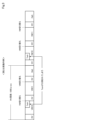
- FIG. 1 is a diagram showing a schematic configuration of an integrated ECU and an ECU according to a first embodiment
- FIG. 2 is a timing chart showing the operation of each part in a first comparative operation example according to a comparative example
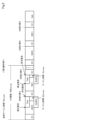
- FIG. 3 is a timing chart showing the operation of each part in a second comparative operation example according to a comparative example
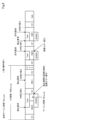
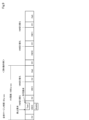
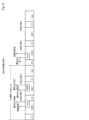
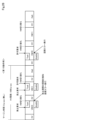
- FIG. 4 is a timing chart showing the operation of each unit in a first operation example according to the first embodiment
- FIG. 5 is a timing chart showing the operation of each unit in a second operation example according to the first embodiment
- FIG. 1 is a diagram showing a schematic configuration of an integrated ECU and an ECU according to a first embodiment
- FIG. 2 is a timing chart showing the operation of each part in a first comparative operation example according to a comparative example
- FIG. 3 is a timing chart showing the operation of each part in a second comparative operation example according to a comparative example
- FIG. 4 is a timing chart showing the operation of each unit in a first
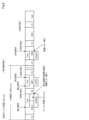
- FIG. 6 is a timing chart showing the operation of each unit in a third operation example according to the first embodiment
- FIG. 7 is a timing chart showing the operation of each unit in a fourth operation example according to the first embodiment
- FIG. 8 is a timing chart showing the operation of each unit in a fifth operation example according to the first embodiment
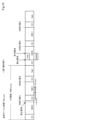
- FIG. 9 is a timing chart showing the operation of each unit in a sixth operation example according to the first embodiment
- FIG. 10 is a timing chart showing the operation of each unit in a seventh operation example according to the first embodiment
- FIG. 11 is a timing chart showing the operation of each unit in an eighth operation example according to the first embodiment
- FIG. 12 is a timing chart showing the operation of each unit in a ninth operation example according to the first embodiment
- FIG. 13 is a timing chart showing the operation of each part in a third comparative operation example according to a comparative example
- FIG. 14 is a timing chart showing the operation of each unit in a tenth operation example according to the first embodiment
- FIG. 15 is a timing chart showing the operation of each part in a fourth comparative operation example according to a comparative example
- FIG. 16 is a timing chart showing the operation of each part in a fifth comparative operation example according to a comparative example
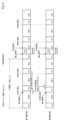
- FIG. 17 is a timing chart showing the operation of each unit in an eleventh operation example according to the first embodiment
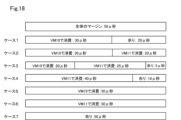
- FIG. 18 is a diagram showing a specific example of allocation of the total margin time according to the first embodiment
- FIG. 19 is a diagram illustrating an example of specific content of each process executed when a prohibition request according to the first embodiment is received;
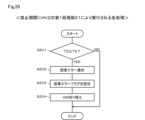
- FIG. 20 is a diagram illustrating an example of specific content of each process executed during a prohibited period according to the first embodiment;
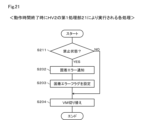
- FIG. 21 is a diagram illustrating an example of specific content of each process executed when an operation time according to a modified example ends;
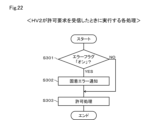
- FIG. 22 is a diagram illustrating an example of specific content of each process executed when a permission request according to the first embodiment is received;
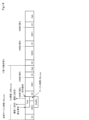
- FIG. 23 is a timing chart showing the operation of each unit in a twelfth operation example according to the second embodiment;
- FIG. 24 is a timing chart showing the operation of each unit in a thirteenth operation example according to the second embodiment;
- FIG. 25 is a timing chart showing the operation of each unit in a fourteenth operation example according to the second embodiment;
- FIG. 26 is a timing chart showing the operation of each unit in the fifteenth operation example according to the third embodiment.
- the integrated ECU 1 of this embodiment is mounted on a vehicle such as an automobile, and the functions of multiple ECUs that previously operated independently are mounted on the chip of a single microcomputer 3 via a hypervisor 2.
- multiple ECUs include an engine ECU, an air conditioner ECU, a central gateway ECU, and a body ECU.
- the functions of the multiple ECUs are mounted in units called virtual machines.
- the hypervisor may be abbreviated to HV
- the virtual machine may be abbreviated to VM.
- the integrated ECU 1 has functions equivalent to two ECUs, ECU-A and ECU-B.
- the integrated ECU 1 may have functions equivalent to three or more ECUs.
- the ECU 4 is not integrated into the integrated ECU 1, but is provided independently like a conventional ECU.
- the integrated ECU 1 and ECU 4 are connected via a bus communication line 5, which allows them to communicate with each other.
- the ECU 4 is equipped with a microcomputer 6.
- the microcomputer 6 is equipped with hardware such as a CPU, various storage devices, and various peripherals (not shown).
- the various peripherals include communication hardware 7 for performing communications. Note that in this specification, hardware is sometimes abbreviated to HW.
- the ECU 4 is equipped with an ECU-0 application A0 for implementing its main functions. Note that in this specification, application is sometimes abbreviated to app. Also, in the following explanations and drawings, ECU-0 app A0 is sometimes abbreviated to app A0.
- the ECU 4 is equipped with a communication driver 8.
- the communication driver 8 controls the communication HW 7 to perform data communication with other ECUs including the integrated ECU 1 via the bus communication line 5.
- Both the application A0 and the communication driver 8 are realized by the CPU of the microcomputer 6 executing a computer program stored in a non-transitive physical storage medium and performing processing corresponding to the computer program, that is, they are realized by software.
- the integrated ECU1 has two VMs, VM10 and VM11.
- the functions of ECU-A are realized by VM10
- the functions of ECU-B are realized by VM11.
- VM10 has an ECU-A application A1 for realizing the main functions of ECU-A.
- VM11 has an ECU-B app A2 for realizing the main functions of ECU-B. Note that in the following explanations and drawings, ECU-A app A1 and ECU-B app A2 may be abbreviated to app A1 and app A2, respectively.
- HV2 is for running VM10 and VM11 on microcomputer 3.
- Microcomputer 3 is an example of a computer, and includes a CPU (not shown) as its hardware, various storage devices, various peripherals, and the like.
- the various peripherals include communication HW12 for communication.
- the various storage devices include register 13.
- Register 13 is a register to be protected, that is, a register for which protection settings can be made regarding writing.
- VM10 includes communication driver 14.
- VM11 includes communication driver 15.
- Communication drivers 14 and 15 control communication HW12 to perform data communication with other ECUs, including ECU4, via bus communication line 5.
- the HV2 functions as an operation control device that controls the operation of each of the multiple VMs 10 and 11 in a time-sharing manner with each VM 10 and 11 operating for a pre-allocated operating time for each operating cycle.
- the integrated ECU 1 controls the multiple VMs 10 and 11 using time-sharing scheduling that allocates fixed operating times to each of the multiple VMs 10 and 11.
- the integrated ECU 1 is an example of an electronic control device that includes a microcomputer 3, multiple VMs 10 and 11 operating on the microcomputer 3, and the HV2 that functions as an operation control device. Note that in this specification, the multiple VMs 10 and 11 that are currently operating may be referred to as operating machines.
- HV2 VM10, and VM11 are all realized by the CPU of microcomputer 3 executing computer programs stored in a non-transient physical storage medium to execute processes corresponding to the computer programs, that is, they are realized by software.
- the program executed by HV2 corresponds to an operation control program.
- the HV2 has two functional blocks, a first processing unit 21 and a second processing unit 22.
- the first processing unit 21 can execute a switching process to switch between operating machines. Each process executed by the first processing unit 21 corresponds to a first process.
- the second processing unit 22 can execute a prohibition process to prohibit the execution of a switching process and an authorization process to permit the execution of a switching process. Each process executed by the second processing unit 22 corresponds to a second process.
- the operating machine is configured to send a prohibition request when starting a specific process that must be executed sequentially, that is, a process that cannot be interrupted or is atomic, and to send a permission request when the specific process is completed.
- “processes that must be executed sequentially” includes not only processes that will not be established and will fail if not executed sequentially, but also processes that will not provide the processing results desired by the user if not executed sequentially, that is, processes for which it is desirable to execute them sequentially.
- the second processing unit 22 When the second processing unit 22 receives a prohibition request, it executes a judgment process to determine whether the remaining time, which is the time from that point until the time when the operating time has elapsed, is equal to or greater than a predetermined set time. If the result of the judgment process shows that the remaining time is equal to or greater than the set time, the second processing unit 22 executes the prohibition process, and if the remaining time is less than the set time, it does not execute the prohibition process. When the second processing unit 22 receives a permission request, it executes the permission process. The operating machine executes a specific process during the prohibition period, which is the period during which the prohibition process is being executed.
- the first processing unit 21 is capable of extending the operating time by a predetermined margin time during the prohibited period.
- the second processing unit 22 executes a judgment process using the time from when the prohibition request is received until the extended operating time has elapsed as the remaining time.
- an available time that can be used as margin time is set for each operating cycle.
- the first processing unit 21 extends the operating time by consuming the required margin time from the available time. In other words, the margin time is allocated and used from the available time.
- the first processing unit 21 can allocate at least a portion of the remaining time to the operating time of the last operating machine. If the specific process has not been completed when the operating time has elapsed during the prohibited period, the first processing unit 21 can determine that an abnormality has occurred and execute one or both of a switching process and a notification process that notifies the outside of the abnormality. If the specific process has not been completed when the operating time has elapsed during the prohibited period, the first processing unit 21 can determine that an abnormality has occurred and execute a notification process that notifies the outside of the abnormality when it receives a permission request in the next or subsequent operating cycles.
- the first processing unit 21 can cause the operating machine to repeatedly transmit the prohibition request until the prohibition process is executed. If the prohibition process is not executed after the operating machine transmits a prohibition request, the first processing unit 21 can place the operating machine in a standby state for a period until the switching process is executed, or place the operating machine in a state in which it can execute a process different from the specific process. If the prohibition process is not executed after the operating machine transmits a prohibition request, the first processing unit 21 can execute the switching process before the operating time allocated to the operating machine has elapsed.
- the set time can be set by the following first setting method or second setting method.
- the first setting method the set time is set in advance for each of multiple virtual machines.
- the set time can be set based on the time required for a specific process that the virtual machine to be set is likely to execute. If there is one specific process that the virtual machine is likely to execute, the set time can be set to a time corresponding to the time required for that specific process. Note that the time corresponding to the time required for the specific process includes not only the same time as the time required for the specific process, but also a time with a specified margin added to that time.
- the set time can be set to a time corresponding to the longest time required for each of the multiple specific processes.
- the longest time required for each of the multiple specific processes does not only include a time equal to the longest time required for each of the multiple specific processes, but also includes a time with a specified margin added to that time.
- the second processing unit 22 when the second processing unit 22 receives a prohibition request, it sets the set time based on the time required for the specific process to be started by the operating machine that sent the prohibition request.
- the set time can be set to a time corresponding to the time required for the specific process to be started by the operating machine that sent the prohibition request. Note that the time corresponding to the time required for the specific process includes not only the same time as the time required for the specific process, but also a time with a specified margin added to that time.
- each term may be expressed differently as follows: Specific process ⁇ Task Switching process starts ⁇ VM switching Operation cycle ⁇ HV cycle Available time ⁇ Overall margin time
- the HV cycle is 1000 ⁇ sec, and the total margin time is 50 ⁇ sec.
- the period when the operating machine is VM10 is represented as "VM10”
- the period when the operating machine is VM11 is represented as “VM11”
- the period when the first processing unit 21 is executing switching processing is represented as "HV”
- the period when the operating machine is executing a task is represented as "Task”
- the period when the microcontroller 3 is transitioning to a mode that reduces power consumption is represented as "Halt”
- the period when prohibited processing is being executed is represented as "disable”.
- FIG. 4 The first operation example shown in Fig. 4 is based on the assumption that the VM10 starts executing a task during its operation and completes the task without interruption.
- the VM10 transmits a prohibition request to the HV2 when a predetermined time has elapsed since the VM10 was switched to the operating machine.
- the HV2 receives the prohibition request transmitted from the VM10, it executes a determination process.
- the remaining time plus 50 ⁇ s which is the unused time of the total margin time, is assumed to be longer than the set time.
- HV2 executes the prohibition process at the time when it receives the prohibition request.
- VM10 which is the operating machine, starts executing a task.
- the task is not completed when the initial operating time allocated to VM10 has elapsed. Therefore, the first processing unit 21 extends the operating time until the task being executed by VM10 is completed. In this case, the operating time is extended by consuming 20 ⁇ s from the total margin time.
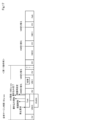
- FIG. 9 The sixth operation example shown in Fig. 9 is based on the assumption that the VM10 starts executing a task in the middle of its operation time and completes the task without interrupting it or extending the operation time.
- the VM10 transmits a prohibition request to the HV2 when a predetermined time has elapsed since the VM10 was switched to the operation machine.
- the HV2 receives the prohibition request transmitted from the VM10, it executes a determination process.
- the third comparative operation example shown in FIG. 13 differs from the second comparative operation example in that the contents of the tasks are specified.
- the communication between the integrated ECU 1 and the ECU 4 is divided into multiple parts, and all communication data must be transmitted or received from the VM 10 to the ECU 4 within a predetermined time, for example, 100 ⁇ s.
- the VM 10 performs the above-mentioned communication as a task.
- the communication performed by the VM 10 is divided into two parts.
- VM10 transmits or receives communication data for the first time to ECU4 when a predetermined time has elapsed since VM10 was switched to the operating machine. Thereafter, the operating time allocated to VM10 ends before VM10 transmits or receives communication data for the second time to ECU4, and therefore the first processing unit 21 performs switching processing. In other words, at this point, communication processing is interrupted. Then, in the next HV cycle, VM10 transmits or receives communication data for the second time to ECU4 when VM10 is switched to the operating machine.
- VM switching occurs after the first transmission or reception of communication data, and the second transmission or reception of communication data is performed in the next HV cycle, so all communication data is not transmitted or received within 100 ⁇ s.
- VM 10 since the communication processing is completed normally, VM 10 does not retransmit or rereceive the communication data, and there is a risk that communication between the integrated ECU 1 and ECU 4 will remain unsuccessful.
- VM 10 executes the first transmission or reception of communication data to ECU 4 in that HV cycle, it can execute the second transmission or reception of communication data to ECU 4 consecutively.
- all communication data can be transmitted or received within 100 ⁇ sec.
- communication processing can be completed continuously without being interrupted by VM switching.
- the write control for the register 13 includes three processes: "protection release” for releasing the protection setting of the register 13, "write” for writing to the register 13, and "protection reset” for resetting the protection setting of the register 13.
- VM10 starts write control when a predetermined time has elapsed since VM10 was switched to the operating machine. That is, VM10 first performs the protection release process, and then starts the write process. Thereafter, the operating time allocated to VM10 ends before VM10 completes the write process, and so the first processing unit 21 performs the switch process. That is, in this case, VM switching occurs during the write process, which causes the write control to be interrupted.
- the fifth comparative operation example shown in Fig. 16 differs from the fourth comparative operation example in the timing at which VM switching occurs. That is, in the fifth comparative operation example, the operation time allocated to VM 10 ends after the execution of the protection release process and before the start of the write process, so the switching process is performed by the first processing unit 21. That is, in this case, VM switching occurs after the execution of the protection release process, which causes the write control to be interrupted.
- VM11 which is subsequently switched to the operating machine, will perform write control on register 13, which will result in another VM11 resetting protection on register 13.
- VM10 attempts to start a write process at the point when it is switched to the operating machine, but because register 13 is set to protection, it will be unable to perform the write, and as a result, VM10 will not be able to successfully complete its write control on register 13.
- the eleventh operation example shown in FIG. 17 assumes write control to the register 13 as the specific content of the task, as in the fourth and fifth comparative operation examples.
- the VM 10 transmits a prohibition request to the HV 2 when a predetermined time has elapsed since the VM 10 was switched to the operating machine.
- the HV 2 receives the prohibition request transmitted from the VM 10
- the HV 2 executes a judgment process. In this case, it is assumed that the time obtained by adding 50 ⁇ s, which is the unused time of the total margin time, to the remaining time is longer than the set time. Then, the HV 2 executes the prohibition process at the time when the prohibition request is received.
- VM10 which is the operating machine, starts write control. That is, VM10 first performs the protection release process, and then starts the write process. Thereafter, the initial operating time allocated to VM10 ends before VM10 completes the write process. In this case, however, the first processing unit 21 extends the operating time until the task being executed by VM10 is completed.
- VM10 can continuously execute all processes in the write control in that HV cycle.
- the problems that arise in the fourth and fifth comparison operation examples do not occur, and a series of processes in the write control can be completed normally.
- write control will be executed during the operation time in the next HV cycle, as in the seventh operation example.
- case 3 20 ⁇ sec is consumed as margin time in VM10, and 25 ⁇ sec is consumed as margin time in VM11.
- case 2 is a case in which VM10 and VM11 share the total margin time, with 5 ⁇ sec remaining in the total margin time.
- case 4 40 ⁇ sec is consumed as margin time in VM10, and the remaining 10 ⁇ sec is unused and remains as a remainder.
- each process executed when the HV2 receives a prohibition request can be as shown in Fig. 19.
- the second processing unit 22 executes the process as shown in Fig. 19 every time a prohibition request is received.
- step S101 it is determined whether or not a time T1 obtained by adding a usable margin time to the time from when the prohibition request is received to when the operation time has elapsed is equal to or greater than a set time T2.
- step S101 becomes "YES” and the process proceeds to step S102.
- step S102 prohibition processing is executed. After step S102 is executed, this process ends.
- time T1 is less than time T2, step S101 becomes "NO”, the prohibition processing of step S102 is not executed, and this process ends.
- each process executed by the first processing unit 21 of the HV 2 during the prohibition period can be as shown in Fig. 20.
- the first processing unit 21 executes the process as shown in Fig. 20 at predetermined intervals during the prohibition period.
- step S201 it is determined whether or not the time T3, which is the margin time consumed during the prohibition period, is equal to or greater than the set margin time T4.
- step S201 becomes "YES” and the process proceeds to step S202.
- step S202 a sticking error is issued and notified.
- Step S202 corresponds to the notification process.
- step S203 a sticking error flag is set.
- step S204 switching process is performed.
- step S204 this process ends.
- time T3 is less than time T4
- step S201 becomes "NO" and the process ends without executing steps S202 to S204, i.e., notification process, switching process, and other processes.
- a sticking error is issued and a sticking error flag is set, and then VM switching is performed, thereby ensuring real-time performance for the entire HV2.
- issuing a sticking error can be used as a basis for deciding whether to re-execute processing on the VM or to restart the VM.
- the first processing unit 21 can perform each process according to a modified example shown in FIG. 21, instead of each process according to this embodiment shown in FIG. 20.
- Each process according to the modified example shown in FIG. 21 is executed when the operation time that is the initial operation time allocated to the VM plus a set margin time, that is, the operation time including the margin, ends, and differs from each process according to this embodiment shown in FIG. 20 in that step S211 is provided instead of step S201.
- step S211 it is determined whether or not the state is prohibited in which execution of the switching process is prohibited.
- step S211 becomes "YES” and the process proceeds to step S202.
- step S211 becomes "NO” and the process proceeds to step S204, where the switching process is performed and then the process ends.
- a sticking error flag is set, that is, it is determined that the VM is stuck.
- each process executed when the HV2 receives a permission request can be as shown in FIG. 22.
- the second processing unit 22 executes the process as shown in FIG. 22 every time a permission request is received.
- step S301 it is determined whether a sticking error flag is set, in other words, whether the sticking error flag is set.
- the sticking error flag being set is referred to as an error flag being "on.”
- step S302 a sticking error is issued and notified.
- Step S302 corresponds to the notification process. After step S302 is executed, the process proceeds to step S303, where the permission process is executed. After step S303 is executed, this process ends. On the other hand, if the sticking error flag is not set, step S301 becomes "NO", and the process of step S302, i.e., the notification process, is not executed, and the process proceeds to step S303, where the permission process is executed. According to this type of process, by issuing a sticking error even when the permission process is executed, it is possible to clearly indicate that the execution of a specific process has ended after a sticking of the prohibited period has occurred.
- the HV 2 included in the integrated ECU 1 of this embodiment controls the operation of each of the multiple VMs 10 and 11 in a time-division manner for an operation time previously allocated for each HV cycle, and includes a first processing unit 21 capable of executing a switching process for switching between operating machines, and a second processing unit 22 capable of executing a prohibition process for prohibiting the execution of the switching process and a permission process for permitting the execution of the switching process.
- the VMs 10 and 11 are configured to transmit a prohibition request when starting a specific process, and transmit a permission request when completing the specific process.
- the second processing unit 22 When the second processing unit 22 receives a prohibition request, it executes a judgment process to determine whether the remaining time, which is the time from that point until the end of the operating time, is equal to or greater than a predetermined set time, and as a result, if the remaining time is equal to or greater than the set time, it executes the prohibition process, and if the remaining time is less than the set time, it does not execute the prohibition process. In addition, when the second processing unit 22 receives a permission request, it executes the permission process. The operating machine executes a specific process during the prohibition period, which is the period during which the prohibition process is being executed.
- the above configuration prevents the occurrence of a switching process that switches the operating machine when the operating machine is executing a specific process. In this way, it is possible to ensure consistent operation until the specific process is completed. Furthermore, with the above configuration, when the second processing unit 22 executes a judgment process to determine that the remaining time is less than the set time, in other words, when it is highly unlikely that the specific process that is about to be started can be completed before the operating time has elapsed, the prohibition process is not executed, and therefore the specific process is not executed. In this way, the specific process that is unlikely to be completed in that HV cycle can be executed in the next HV cycle. In this way, the configuration of this embodiment has the excellent effect of preventing the specific process, which is a process that must be executed continuously, from being interrupted by the switching process.
- the set time can be set in advance for each of the multiple VMs 10 and 11. In this way, the operating time of each VM can be managed uniformly.
- the set time can be set based on the time required for the specific process started by the operating machine that sent the prohibition request. In this way, in cases where the specific process cannot be completed normally for some reason, it is possible to keep the extension of the operating time to a minimum, thereby ensuring real-time performance.
- the first processing unit 21 can put the operating machine in a state in which it can execute a process other than the specific process for the period until the switching process is executed. In this way, it becomes possible to execute other processes during the time until the VM switching, and as a result, the resources of the microcomputer 3 can be used effectively. If the prohibition process is not executed after the operating machine sends a prohibition request, the first processing unit 21 can execute the switching process before the operating time allocated to the operating machine has elapsed. In this way, if there is no process that can be executed in the operating machine other than the specific process, it becomes possible to operate another VM, and as a result, the resources of the microcomputer 3 can be used effectively.
- the second embodiment will be described below with reference to FIGS.
- a change is made to the setting of the available time in the first embodiment.
- an available time is set for each of the multiple VMs 10 and 11.
- the first processing unit 21 extends the operating time by consuming the required margin time from the available time corresponding to the operating machine.
- the margin time is allocated and used from the available time corresponding to the operating machine.
- the available time may be referred to as the per-VM margin time.
- the per-VM margin time is 20 ⁇ sec for both VM10 and VM11.
- Twelfth Operation Example The twelfth operation example shown in Fig. 23 is based on the assumption that the VM10 starts executing a task during its operation and completes the task without interruption.
- the VM10 transmits a prohibition request to the HV2 when a predetermined time has elapsed since the VM10 was switched to the operating machine.
- the HV2 Upon receiving the prohibition request transmitted from the VM10, the HV2 executes a determination process.
- the remaining time plus 20 ⁇ s which is the per-VM margin time corresponding to VM10, is assumed to be longer than the set time.
- HV2 executes the prohibition process at the time when the prohibition request is received.
- VM10 which is the operating machine, starts executing a task.
- the task is not completed when the initial operating time allocated to VM10 has elapsed. Therefore, the first processing unit 21 extends the operating time until the task being executed by VM10 is completed. In this case, the operating time is extended by consuming only 20 ⁇ s, which is the entire per-VM margin time.
- VM10 can extend its operation time up to the per-VM margin time, and can continuously complete a task that is an uninterruptible process.
- VM10 sends a permission request when it completes the task.
- HV2 ends the prohibition process and executes the permission process. This causes the first processing unit 21 to execute the switching process. In this way, even if the operation time is extended, real-time performance can be ensured by immediately switching VMs after the task is completed.
- FIG. 24 Thirteenth Operation Example
- the thirteenth operation example shown in FIG. 24 is based on the assumption that VM10 and VM11 start executing a task during their operation time and complete the task without interruption.
- the operation of VM10 during its operation time is the same as that of the twelfth operation example.
- VM11 transmits a prohibition request to HV2 when a predetermined time has elapsed since VM11 was switched to the operating machine.
- HV2 Upon receiving the prohibition request transmitted from VM11, HV2 executes a determination process.
- the remaining time plus 20 ⁇ s which is the per-VM margin time corresponding to VM11, is assumed to be longer than the set time.
- HV2 executes the prohibition process at the time when it receives the prohibition request.
- VM11 which is the operating machine, begins executing a task. In this case, the task is not completed when the initial operating time assigned to VM11 has elapsed.
- the first processing unit 21 extends the operating time until the task being executed by VM11 is completed.
- the operating time is extended by consuming 20 ⁇ s, which is the entire per-VM margin time.
- VM11 can extend its operating time up to the per-VM margin time, and can continuously complete a task that is an uninterruptible process.
- VM11 sends a permission request when it completes the task.
- HV2 receives the permission request, it ends the prohibition process and executes the permission process. This causes the first processing unit 21 to execute the switching process.
- a margin time is given to each VM, so that a VM with a relatively high priority does not monopolize the margin time, and as a result, the same amount of margin time can be secured for a VM with a relatively low priority.
- FIG. 25 The fourteenth operation example shown in Fig. 25 is based on the assumption that the VM10 starts executing a task in the middle of its operation time and does not complete the task.
- the VM10 transmits a prohibition request to the HV2 when a predetermined time has elapsed since the VM10 was switched to the operating machine.
- the HV2 receives the prohibition request transmitted from the VM10, it executes a determination process.
- the remaining time plus 20 ⁇ s which is the per-VM margin time corresponding to VM10, is assumed to be longer than the set time.
- HV2 executes the prohibition process at the time when the prohibition request is received.
- VM10 which is the operating machine, begins executing a task.
- the task is not completed when the initial operating time assigned to VM10 has elapsed. Therefore, the first processing unit 21 extends the operating time until the task being executed by VM10 is completed.
- the first processing unit 21 determines that an abnormality has occurred and executes notification processing.
- notification processing a fixation error is issued to indicate that it has been detected that the prohibited period during which VM switching is prohibited has become fixed.
- the first processing unit 21 executes switching processing while VM switching remains in this prohibited state.
- VM11 sends a prohibition request to HV2 when a predetermined time has elapsed since VM11 was switched to the operating machine.
- HV2 receives the prohibition request sent from VM11, it executes a judgment process. In this case, it is assumed that the remaining time plus 20 ⁇ s, which is the per-VM margin time corresponding to VM11, is longer than the set time. In this case, HV2 executes the prohibition process at the time it receives the prohibition request. In conjunction with the start of the prohibition process, VM11, which is the operating machine, starts executing the task.
- the task is not completed when the initial operation time allocated to VM11 has elapsed. Therefore, the first processing unit 21 extends the operation time until the task being executed by VM11 is completed. In this case, the operation time is extended by consuming 20 ⁇ s, which is the entire margin time per VM.
- VM11 sends a permission request when it completes the task.
- HV2 receives the permission request, it ends the prohibition process and executes the permission process.
- the first processing unit 21 executes the switching process.
- VM10 resumes task execution from the point at which it is switched to the operating machine.
- the task executed by VM10 is completed when a predetermined time has elapsed since VM10 was switched to the operating machine.
- VM10 transmits a permission request when the task is completed.
- HV2 receives the permission request, it ends the prohibition process and executes the permission process.
- HV2 also executes a notification process, which issues a sticking error. After that, when the operating time allocated to VM10 has elapsed, the first processing unit 21 executes the switching process.
- a per-VM margin time is set for each of the multiple VMs 10 and 11, and the first processing unit 21 extends the operating time by consuming the required margin time from the per-VM margin time corresponding to the operating machine.
- all of the VMs 10 and 11 can use the per-VM margin time of 20 ⁇ s as their margin time, regardless of their priority.
- a margin time is given to each VM, so that a VM with a relatively high priority does not monopolize the margin time, and margin time can be secured for a VM with a relatively low priority as well.
- the second embodiment will be described below with reference to FIG.
- a change is made to the first embodiment with respect to the processing content of the first processing unit 21.
- the first processing unit 21 does not extend the operation time during the prohibited period. That is, in this embodiment, a margin time such as an overall margin time or a margin time for each VM is not set.
- FIG. 26 The fifteenth operation example shown in Fig. 26 is based on the assumption that the VM10 starts executing a task in the middle of its operation time and does not complete the task.
- the VM10 transmits a prohibition request to the HV2 when a predetermined time has elapsed since the VM10 was switched to the operating machine.
- the HV2 receives the prohibition request transmitted from the VM10, it executes a determination process.
- HV2 executes the prohibition process at the time when the prohibition request is received.
- VM10 which is the operating machine, starts executing a task.
- the task has not been completed even when the operating time allocated to VM10 has elapsed due to some reason such as an abnormality or a malfunction.
- the first processing unit 21 determines that an abnormality has occurred and executes a notification process.
- a fixation error is issued to indicate that it has been detected that the prohibited period in which VM switching is prohibited has become fixed.
- the first processing unit 21 executes the switching process while VM switching remains in this prohibited state.
- VM11 sends a prohibition request to HV2 when a predetermined time has elapsed since VM11 was switched to the operating machine.
- HV2 receives the prohibition request sent from VM11, it executes a judgment process. In this case, it is assumed that the remaining time is longer than the set time. Then, HV2 executes the prohibition process at the time when it receives the prohibition request.
- VM11 which is the operating machine, starts executing a task. In this case, the task is completed before the operating time assigned to VM11 has elapsed.
- VM11 sends a permission request when it completes the task.
- HV2 receives the permission request, it ends the prohibition process and executes the permission process. As a result, the first processing unit 21 executes the switching process.
- VM10 resumes task execution from the point at which it is switched to the operating machine.
- the task executed by VM10 is completed when a predetermined time has elapsed since VM10 was switched to the operating machine.
- VM10 transmits a permission request when the task is completed.
- HV2 receives the permission request, it ends the prohibition process and executes the permission process.
- HV2 also executes a notification process, which issues a sticking error. After that, when the operating time allocated to VM10 has elapsed, the first processing unit 21 executes the switching process.
- no margin time such as an overall margin time or a margin time for each VM is set.
- more operating time can be allocated to all of the VMs 10 and 11 than in the above-mentioned embodiments in which a margin time is set.
- This disclosure is not limited to the HV2 that controls each of the multiple VMs that run on the microcomputer 3 that constitutes the integrated ECU 1 mounted on the vehicle using time-sharing scheduling, but can be applied to general operation control devices that control each of the multiple VMs that run on a computer to run in a time-sharing manner for a predetermined operating time assigned to each operating cycle.
- control unit and the method described in the present disclosure may be realized by a dedicated computer provided by configuring a processor and memory programmed to execute one or more functions embodied in a computer program.
- control unit and the method described in the present disclosure may be realized by a dedicated computer provided by configuring a processor with one or more dedicated hardware logic circuits.
- control unit and the method described in the present disclosure may be realized by one or more dedicated computers configured by combining a processor and memory programmed to execute one or more functions with a processor configured with one or more hardware logic circuits.
- the computer program may be stored in a computer-readable non-transient tangible recording medium as instructions executed by the computer.
- An operation control device that performs control for operating each of a plurality of virtual machines (10, 11) in a time-sharing manner for an operation time previously assigned to each operation cycle, If one of the plurality of virtual machines that is currently in operation is defined as an operating machine, A first processing unit (21) capable of executing a switching process for switching the operating machine; a second processing unit (22) capable of executing a prohibition process for prohibiting execution of the switching process and an authorization process for authorization of execution of the switching process; Equipped with the operating machine is adapted to transmit a prohibition request when starting a specific process that must be executed continuously, and to transmit a permission request when completing the specific process; The second processing unit is When the prohibition request is received, a determination process is executed to determine whether or not a remaining time, which is a time from the prohibition request to a time when the operation time has elapsed, is equal to or longer than a predetermined set time.
- the operation machine is a motion control device that executes the specific process during a prohibited period during which the prohibited process is being executed.
- the first processing unit is configured to extend the operation time by a predetermined margin time during the prohibited period,
- the second processing unit executes the judgment process by setting the remaining time as the time from the time the prohibition request is received to the time the extended operation time has elapsed.
- An available time is set for each operation cycle, The operation control device according to claim 2, wherein the first processing unit extends the operation time by consuming the required margin time from the available time.
- an available time is set for each of the plurality of virtual machines, The operation control device according to [2], wherein the first processing unit is configured to extend the operation time by consuming the required margin time from the available time corresponding to the operating machine.
- the first processing unit is configured to allocate at least a portion of the remainder of the available time to the operating time of the operating machine that operates last in the operating cycle when the operating machine that operates last is started.
- An operation control program to be executed by an operation control device (2) that controls each of a plurality of virtual machines (VM10, VM11) to operate in a time-division manner for an operation time previously assigned to each operation cycle, the program comprising: If one of the plurality of virtual machines that is currently in operation is defined as an operating machine, A first process capable of executing a switching process for switching the operating machine; a second process capable of executing a prohibition process for prohibiting execution of the switching process and an authorization process for authorization of execution of the switching process; Including, the operating machine is adapted to transmit a prohibition request when starting a specific process that must be executed continuously, and to transmit a permission request when completing the specific process; In the second process, When the prohibition request is received, a determination process is executed to determine whether or not a remaining time, which is a time from the prohibition request to a time when the operation time has elapsed, is equal to or longer than a predetermined set time.
- the operating machine is an operating control program that executes the specific process during a prohibited period during which the prohibited process is being executed.
- An electronic control device including: a computer (3); a plurality of virtual machines (VM10, VM11) that operate on the computer; and an operation control device (2) that controls each of the plurality of virtual machines to operate in a time-sharing manner for an operation time that is assigned in advance for each operation cycle, If one of the plurality of virtual machines that is currently in operation is defined as an operating machine,
- the motion control device includes: A first processing unit (21) capable of executing a switching process for switching the operating machine; a second processing unit (22) capable of executing a prohibition process for prohibiting execution of the switching process and an authorization process for authorization of execution of the switching process; Equipped with the operating machine is adapted to transmit a prohibition request when starting a specific process that must be executed continuously, and to transmit a permission request when completing the specific process;
- the second processing unit is When the prohibition request is received, a determination process is executed to determine whether or not a remaining time, which is a time from the prohibition request to a time when the operation time has elapsed, is equal to or
- the operating machine is an electronic control device that executes the specific process during a prohibited period during which the prohibited process is being executed.
Landscapes
- Engineering & Computer Science (AREA)
- Software Systems (AREA)
- Theoretical Computer Science (AREA)
- Physics & Mathematics (AREA)
- General Engineering & Computer Science (AREA)
- General Physics & Mathematics (AREA)
- Hardware Redundancy (AREA)
Applications Claiming Priority (2)
| Application Number | Priority Date | Filing Date | Title |
|---|---|---|---|
| JP2023-200713 | 2023-11-28 | ||
| JP2023200713A JP2025086620A (ja) | 2023-11-28 | 2023-11-28 | 動作制御装置、動作制御プログラムおよび電子制御装置 |
Publications (1)
| Publication Number | Publication Date |
|---|---|
| WO2025115486A1 true WO2025115486A1 (ja) | 2025-06-05 |
Family
ID=95897640
Family Applications (1)
| Application Number | Title | Priority Date | Filing Date |
|---|---|---|---|
| PCT/JP2024/038347 Pending WO2025115486A1 (ja) | 2023-11-28 | 2024-10-28 | 動作制御装置、動作制御プログラムおよび電子制御装置 |
Country Status (2)
| Country | Link |
|---|---|
| JP (1) | JP2025086620A (cg-RX-API-DMAC7.html) |
| WO (1) | WO2025115486A1 (cg-RX-API-DMAC7.html) |
Citations (2)
| Publication number | Priority date | Publication date | Assignee | Title |
|---|---|---|---|---|
| JP2004127039A (ja) * | 2002-10-03 | 2004-04-22 | Seiko Epson Corp | タスク排他制御方法及びタスク排他制御装置 |
| JP2023032307A (ja) * | 2021-08-26 | 2023-03-09 | 株式会社デンソーテン | 仮想化制御装置および割り込み制御方法 |
-
2023
- 2023-11-28 JP JP2023200713A patent/JP2025086620A/ja active Pending
-
2024
- 2024-10-28 WO PCT/JP2024/038347 patent/WO2025115486A1/ja active Pending
Patent Citations (2)
| Publication number | Priority date | Publication date | Assignee | Title |
|---|---|---|---|---|
| JP2004127039A (ja) * | 2002-10-03 | 2004-04-22 | Seiko Epson Corp | タスク排他制御方法及びタスク排他制御装置 |
| JP2023032307A (ja) * | 2021-08-26 | 2023-03-09 | 株式会社デンソーテン | 仮想化制御装置および割り込み制御方法 |
Also Published As
| Publication number | Publication date |
|---|---|
| JP2025086620A (ja) | 2025-06-09 |
Similar Documents
| Publication | Publication Date | Title |
|---|---|---|
| JP6903784B2 (ja) | 車両システム、車両およびこの種の車両システムの動作方法 | |
| JP5195913B2 (ja) | マルチコアシステム、車両用電子制御ユニット、タスク切り替え方法 | |
| JP4345630B2 (ja) | 情報処理装置、割り込み処理制御方法、並びにコンピュータ・プログラム | |
| WO2009157178A1 (ja) | 仮想計算機制御装置、仮想計算機制御プログラム及び仮想計算機制御回路 | |
| US12032983B2 (en) | Method of accessing device in virtual environment | |
| JP2009223842A (ja) | 仮想計算機制御プログラム及び仮想計算機システム | |
| US10571993B2 (en) | Micro controller unit | |
| CN118885307A (zh) | 共享资源的访问控制方法及装置、存储介质及电子设备 | |
| JP2013003724A (ja) | 車載電子制御装置 | |
| EP3036629B1 (en) | Handling time intensive instructions | |
| JP5842833B2 (ja) | 情報処理装置、プログラム | |
| JP2025086620A (ja) | 動作制御装置、動作制御プログラムおよび電子制御装置 | |
| CN115220864A (zh) | 虚拟模式执行管理器 | |
| JP5996110B2 (ja) | 計算機システム及び制御方法 | |
| JP7619222B2 (ja) | 電子制御装置 | |
| US8522060B2 (en) | Computer system, method for controlling the same, and program | |
| US10269194B2 (en) | Multiprocessor system and vehicle control system | |
| US12578986B2 (en) | Information processing device, vehicle, information processing method, and computer-readable storage medium | |
| JP2023032307A (ja) | 仮想化制御装置および割り込み制御方法 | |
| CN118689599A (zh) | 中断处理的方法、装置和电子设备 | |
| JP7754769B2 (ja) | 管理装置、管理プログラムおよび電子制御装置 | |
| JP2024062067A (ja) | 仮想化制御装置および仮想化制御方法 | |
| JP2025112863A (ja) | 電子制御装置、メモリ領域の割り当て方法及びメモリ領域の割り当てプログラム | |
| JP5703505B2 (ja) | バスパーティション構造を備えるコンピュータ | |
| JP2023152485A (ja) | 処理装置 |
Legal Events
| Date | Code | Title | Description |
|---|---|---|---|
| 121 | Ep: the epo has been informed by wipo that ep was designated in this application |
Ref document number: 24897175 Country of ref document: EP Kind code of ref document: A1 |
|
| NENP | Non-entry into the national phase |
Ref country code: DE |