WO2025115342A1 - 硫化物固体電解質、および、硫化物固体電解質の製造方法 - Google Patents
硫化物固体電解質、および、硫化物固体電解質の製造方法 Download PDFInfo
- Publication number
- WO2025115342A1 WO2025115342A1 PCT/JP2024/031939 JP2024031939W WO2025115342A1 WO 2025115342 A1 WO2025115342 A1 WO 2025115342A1 JP 2024031939 W JP2024031939 W JP 2024031939W WO 2025115342 A1 WO2025115342 A1 WO 2025115342A1
- Authority
- WO
- WIPO (PCT)
- Prior art keywords
- solid electrolyte
- raw material
- sulfide solid
- mixed raw
- producing
- Prior art date
- Legal status (The legal status is an assumption and is not a legal conclusion. Google has not performed a legal analysis and makes no representation as to the accuracy of the status listed.)
- Pending
Links
Images
Classifications
-
- C—CHEMISTRY; METALLURGY
- C01—INORGANIC CHEMISTRY
- C01B—NON-METALLIC ELEMENTS; COMPOUNDS THEREOF; METALLOIDS OR COMPOUNDS THEREOF NOT COVERED BY SUBCLASS C01C
- C01B25/00—Phosphorus; Compounds thereof
- C01B25/14—Sulfur, selenium, or tellurium compounds of phosphorus
-
- H—ELECTRICITY
- H01—ELECTRIC ELEMENTS
- H01B—CABLES; CONDUCTORS; INSULATORS; SELECTION OF MATERIALS FOR THEIR CONDUCTIVE, INSULATING OR DIELECTRIC PROPERTIES
- H01B1/00—Conductors or conductive bodies characterised by the conductive materials; Selection of materials as conductors
- H01B1/06—Conductors or conductive bodies characterised by the conductive materials; Selection of materials as conductors mainly consisting of other non-metallic substances
-
- H—ELECTRICITY
- H01—ELECTRIC ELEMENTS
- H01B—CABLES; CONDUCTORS; INSULATORS; SELECTION OF MATERIALS FOR THEIR CONDUCTIVE, INSULATING OR DIELECTRIC PROPERTIES
- H01B1/00—Conductors or conductive bodies characterised by the conductive materials; Selection of materials as conductors
- H01B1/06—Conductors or conductive bodies characterised by the conductive materials; Selection of materials as conductors mainly consisting of other non-metallic substances
- H01B1/10—Conductors or conductive bodies characterised by the conductive materials; Selection of materials as conductors mainly consisting of other non-metallic substances sulfides
-
- H—ELECTRICITY
- H01—ELECTRIC ELEMENTS
- H01B—CABLES; CONDUCTORS; INSULATORS; SELECTION OF MATERIALS FOR THEIR CONDUCTIVE, INSULATING OR DIELECTRIC PROPERTIES
- H01B13/00—Apparatus or processes specially adapted for manufacturing conductors or cables
-
- Y—GENERAL TAGGING OF NEW TECHNOLOGICAL DEVELOPMENTS; GENERAL TAGGING OF CROSS-SECTIONAL TECHNOLOGIES SPANNING OVER SEVERAL SECTIONS OF THE IPC; TECHNICAL SUBJECTS COVERED BY FORMER USPC CROSS-REFERENCE ART COLLECTIONS [XRACs] AND DIGESTS
- Y02—TECHNOLOGIES OR APPLICATIONS FOR MITIGATION OR ADAPTATION AGAINST CLIMATE CHANGE
- Y02E—REDUCTION OF GREENHOUSE GAS [GHG] EMISSIONS, RELATED TO ENERGY GENERATION, TRANSMISSION OR DISTRIBUTION
- Y02E60/00—Enabling technologies; Technologies with a potential or indirect contribution to GHG emissions mitigation
- Y02E60/10—Energy storage using batteries
Definitions
- the present invention relates to a sulfide solid electrolyte suitable for use in, for example, all-solid-state batteries, and a method for producing the sulfide solid electrolyte.
- sulfide-based solid electrolytes have been attracting attention as electrolytes for lithium-ion secondary batteries because they have high ionic conductivity and are safer than electrolyte solutions.
- a widely used method for producing sulfide solid electrolytes involves first subjecting a mixture of raw materials to mechanical milling to vitrify or amorphousize it, then carrying out a heat treatment to synthesize the sulfide solid electrolyte through a solid-state reaction.
- Patent Document 1 describes a process for producing sulfide glass and glass ceramics, which are types of sulfide-based solid electrolytes, in which a mixture of metallic lithium, elemental sulfur, and elemental phosphorus is vitrified by mechanical milling and then heat-treated.
- Patent Documents 2 and 3 describe a process for producing a sulfide-based solid electrolyte having an LGPS-type crystal structure, in which a mixture of various sulfides is made amorphous by mechanical milling, then heat-treated, and crystallized by a solid-phase reaction.
- Patent Document 4 also describes a method for producing a crystalline sulfide-based solid electrolyte in which elemental sulfur or a sulfur compound is mixed with a solid electrolyte raw material and the mixture is heat-treated.
- Japanese Patent Application Publication No. 2003-208919 A) Japanese Patent No. 5527673 (B) Japanese Patent No. 5888609 (B) Japanese Patent Application Publication No. 2023-048303 (A)
- This invention was made in consideration of the above-mentioned circumstances, and aims to provide a sulfide solid electrolyte that has excellent ionic conductivity and is particularly suitable for high-output solid-state batteries, and a method for producing this sulfide solid electrolyte.
- the method for producing a sulfide solid electrolyte according to aspect 2 of the present invention is a method for producing a sulfide solid electrolyte, and includes a raw material mixing step of mixing raw materials containing each element constituting the sulfide solid electrolyte to obtain a mixed raw material, and a production step of heat-treating the mixed raw material to produce the sulfide solid electrolyte, wherein the raw material mixing step uses elemental sulfur as a raw material, and the volume ratio of the elemental sulfur to the entire mixed raw material when the mixed raw material is heated to 120°C is 20% or more, and the production step is characterized in that the heating temperature is T°C, the holding time is h hours, and T ⁇ h is 1000 or more.
- elemental sulfur is used as a raw material, and the volume ratio of the elemental sulfur to the entire mixed raw material when the mixed raw material is heated to 120°C is 20% or more, and in the production process, the heating temperature is T°C, the holding time is h hours, and T ⁇ h is 1000 or more, so that a sulfide solid electrolyte with high crystallinity and excellent ionic conductivity can be produced.
- the present invention provides a sulfide solid electrolyte that has excellent ionic conductivity and is particularly suitable for high-output solid-state batteries, and a method for producing this sulfide solid electrolyte.
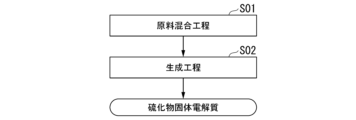
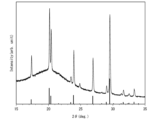
- FIG. 1 is a flow chart showing an example of a method for producing a sulfide solid electrolyte according to an embodiment of the present invention. 1 shows the results of XRD measurement of the sulfide solid electrolyte of Example 1-2 of the present invention in the examples.
- the sulfide solid electrolyte according to the present embodiment is used, for example, as a solid electrolyte constituting an all-solid-state battery.
- the sulfide solid electrolyte has a relatively high ionic conductivity, is non-flammable, and is highly safe, and therefore is applied to electric vehicles and the like.
- a sulfide solid electrolyte with even better ionic conductivity is required.
- the sulfide solid electrolyte of the present embodiment has an LGPS type crystal structure belonging to the space group P42/nnc.
- the following peaks of formula (A) to formula (F) are detected as diffraction peaks, and as for the peak of formula (G), either no peak is detected or the peak of formula (G) is detected at a diffraction intensity IB such that the peak intensity ratio of IB to IA is less than 50%, where IA is the diffraction intensity of the peak of formula (F) and IB is the diffraction intensity of the peak of formula (G).
- this embodiment includes a raw material mixing step S01 and a production step S02.
- elemental sulfur is used as the raw material.
- This elemental sulfur is mixed so that the volume ratio of elemental sulfur to the entire mixed raw material when the mixed raw material is heated to 120° C. is 20% or more.
- the volume ratio of elemental sulfur in the entire mixed raw material when the mixed raw material is heated to 120° C. may be 30% or more, or may be 40% or more.
- the volume ratio of elemental sulfur in the entire mixed raw material when the mixed raw material is heated to 120°C may be 80% or less, 60% or less, or 40% or less.
- each raw material and the excess elemental sulfur be in the form of powder or granules (powder-like powder, particulate matter, or an aggregate of powder and granules), and among these, it is more preferable that they be in the form of powder.
- Elemental sulfur refers to sulfur that does not contain any elements other than sulfur, except for unavoidable impurities.
- each raw material may contain unavoidable impurities.
- the elemental sulfur to be added may be any of the sulfur allotropes, such as alpha sulfur (orthorhombic sulfur), beta sulfur (monoclinic sulfur), gamma sulfur (monoclinic sulfur), and rubbery sulfur, or may contain multiple allotropes.
- the mixing method in the raw material mixing step S01 is not particularly limited as long as it can uniformly mix the raw materials.
- Examples of the existing methods include a general mixer, blender, ball mill, bead mill, vibration mill, and V-type mixer.
- the mixing process in the raw material mixing step S01 is preferably carried out in a gas atmosphere that does not react with the raw material. Therefore, it is preferable to carry out the mixing process in an inert atmosphere such as nitrogen, argon, or other rare gas.
- the atmospheric gas used does not contain moisture and oxygen gas, and in particular, the moisture content in the atmospheric gas is preferably 500 ppm or less, more preferably 100 ppm or less, and even more preferably 10 ppm or less.
- the moisture content in the atmospheric gas is preferably 500 ppm or less, more preferably 100 ppm or less, and even more preferably 10 ppm or less.
- the mixed raw material placed in a firing vessel such as a crucible or a sagger is heated to produce a sulfide solid electrolyte.
- a firing vessel such as a crucible or a sagger
- the inner wall of the container is made of a material that does not easily react with the molten material, such as elemental sulfur or sulfides, in other words, a material that is not easily corroded by sulfurization, such as alumina, zirconia, carbon, and silicon carbide.
- the heating temperature is set to T° C.
- the holding time is set to h hours
- T ⁇ h is set to 1000 or more.
- T ⁇ h is preferably 2000 or more, and more preferably 3000 or more.
- the heating temperature in the generating step S02 is preferably 400° C. or higher, more preferably 450° C. or higher, and even more preferably 500° C. or higher.
- the heating temperature is preferably 1000° C. or lower, and more preferably 650° C. or lower.
- the holding time at the heating temperature is appropriately set so as to satisfy the above-mentioned T ⁇ h ⁇ 1000.
- the holding time at the heating temperature may be 1 hour or more, 1.5 hours or more, or 5 hours or more.
- the holding time at the heating temperature may be 50 hours or less, 44 hours or less, or 40 hours or less.
- the heat treatment in the formation step S02 is preferably carried out in a gas atmosphere that does not react with the mixed raw materials, the intermediate product, or the sulfide solid electrolyte, and is therefore preferably carried out in an inert atmosphere such as nitrogen, argon, or other rare gases.
- the atmospheric gas used does not contain moisture and oxygen gas, and in particular, the moisture content in the atmospheric gas is preferably 500 ppm or less, more preferably 100 ppm or less, and even more preferably 10 ppm or less.
- elemental sulfur is used as the raw material, and the volume ratio of the elemental sulfur to the entire mixed raw material when the mixed raw material is heated to 120°C is 20% or more, and in the production process, the heating temperature is T°C, the holding time is h hours, and T ⁇ h is 1000 or more, so that a sulfide solid electrolyte with high crystallinity and excellent ionic conductivity can be produced.
- Examples 1-1 and 1-2 of the present invention As raw materials, Li2S , Ge, P, and S were prepared, weighed to a predetermined ratio, and mixed in a mortar. Here, the volume ratio of elemental sulfur to the entire mixed raw material when the mixed raw material was heated to 120°C was set to 40%. The mixed raw material was placed in an alumina firing container and then loaded into a firing furnace. Then, firing was performed in an Ar atmosphere at a heating temperature of T° C. for a holding time of h hours, where T ⁇ h was 3000. As a result, a sulfide solid electrolyte made of the LGPS material was produced.
- Examples 2-1 and 2-2 of the present invention As raw materials, Li2S , Ge, P, and S were prepared, weighed to a predetermined ratio, and mixed in a mortar. Here, the volume ratio of elemental sulfur to the entire mixed raw material when the mixed raw material was heated to 120°C was set to 40%. The mixed raw material was placed in an alumina firing container and then loaded into a firing furnace. Then, firing was performed in an Ar atmosphere at a heating temperature of T° C. for a holding time of h hours, where T ⁇ h was 1000. As a result, a sulfide solid electrolyte made of the LGPS material was produced.
- Examples 3-1 and 3-2 of the present invention As raw materials, Li2S , Si, Sn, P, and S were prepared, weighed to a predetermined ratio, and mixed in a mortar. Here, the volume ratio of elemental sulfur to the entire mixed raw material when the mixed raw material was heated to 120°C was set to 40%. The mixed raw material was placed in an alumina firing container and then loaded into a firing furnace. Then, firing was performed in an Ar atmosphere at a heating temperature of T° C. for a holding time of h hours, where T ⁇ h was 3000. As a result, a sulfide solid electrolyte made of an LSSPS material was produced.
- Example 4-1 and 4-2 of the present invention As raw materials, Li2S , Si, Sn, P, and S were prepared, weighed to a predetermined ratio, and mixed in a mortar. Here, the volume ratio of elemental sulfur to the entire mixed raw material when the mixed raw material was heated to 120°C was set to 40%. The mixed raw material was placed in an alumina firing container and then loaded into a firing furnace. Then, firing was performed in an Ar atmosphere at a heating temperature of T° C. for a holding time of h hours, where T ⁇ h was 1000. As a result, a sulfide solid electrolyte made of an LSSPS material was produced.
- the half-width of the peak at 2 ⁇ 29.58° ⁇ 1.0° was measured for the obtained sulfide solid electrolyte by X-ray diffraction measurement (XRD measurement) using CuK ⁇ radiation. Furthermore, the ionic conductivity of the obtained sulfide solid electrolyte was measured.
- XRD measurement method and the method for evaluating the ionic conductivity are described below.
- X-ray diffraction measurement was carried out using CuK ⁇ radiation.
- the measurement sample was prepared in a glove box under an argon atmosphere, and the sulfide solid electrolyte was crushed in an agate mortar and sealed in a sealable measurement cell, and powder X-ray diffraction measurement was performed while maintaining a state where it was not exposed to the atmosphere.
- the obtained solid electrolyte was taken out from a glove box in an argon atmosphere, pulverized in an agate mortar, and 0.3 g was weighed out and filled into a stainless steel ion conductivity measurement cell (cylindrical type with an inner diameter of 17 mm). Then, the ion conductivity (mS/cm) was measured by an AC impedance method using a measurement device "Potentio/Galvanostat SP-300" manufactured by Biologic Corporation under the conditions of a measurement temperature of 25°C, a measurement frequency of 1 Hz to 1 MHz, and an applied pressure of 360 MPa to the measurement cell.
- Inventive Examples 1-1, 1-2, 2-1, and 2-2 and Comparative Example 1 are LGPS materials.
- the volume ratio of the elemental sulfur in the entire mixed raw material when the mixed raw material is heated to 120° C. is 40% or more
- the product T ⁇ h of the heating temperature T° C. and the holding time h hours is 1000 or more
- Comparative Example 1 the volume ratio of the elemental sulfur in the entire mixed raw material when the mixed raw material is heated to 120° C. is 40%, the product T ⁇ h of the heating temperature T° C.
- Inventive Examples 1-1, 1-2, 2-1, and 2-2 have higher crystallinity than Comparative Example 1.
- the ionic conductivity was 9.6 mS/cm or more, while the ionic conductivity was 8.0 mS/cm in Comparative Example 1.
- Inventive Examples 1 and 2 were superior to Comparative Example 1 in ionic conductivity.
- Inventive Examples 3-1, 3-2, 4-1, and 4-2 and Comparative Example 2 are LSSPS materials.
- the volume ratio of the elemental sulfur in the entire mixed raw material when the mixed raw material is heated to 120° C. is 40% or more
- the product T ⁇ h of the heating temperature T° C. and the holding time h hours is 1000 or more
- Comparative Example 2 the volume ratio of the elemental sulfur in the entire mixed raw material when the mixed raw material is heated to 120° C. is 40%, the product T ⁇ h of the heating temperature T° C.
- the present invention can provide a sulfide solid electrolyte with excellent ionic conductivity that is particularly suitable for high-output solid-state batteries, as well as a method for producing this sulfide solid electrolyte.
- the present invention makes it possible to provide a sulfide solid electrolyte that has excellent ionic conductivity and is particularly suitable for high-power solid-state batteries, as well as a method for producing this sulfide solid electrolyte.
Landscapes
- Chemical & Material Sciences (AREA)
- Organic Chemistry (AREA)
- Engineering & Computer Science (AREA)
- Manufacturing & Machinery (AREA)
- Inorganic Chemistry (AREA)
- Conductive Materials (AREA)
- Secondary Cells (AREA)
Abstract
空間群P42/nmcに属するLGPS型の結晶構造を有し、CuKα線を用いたX線回折測定において、2θ=29.58°±1.0°のピークの半値幅が0.1以下であることを特徴とする硫化物固体電解質を提供する。
Description
この発明は、例えば全固体電池等に好適に用いられる硫化物固体電解質、および、硫化物固体電解質の製造方法に関するものである。
本願は、2023年11月29日に、日本に出願された特願2023-201708号に基づき優先権を主張し、その内容をここに援用する。
本願は、2023年11月29日に、日本に出願された特願2023-201708号に基づき優先権を主張し、その内容をここに援用する。
近年、リチウムイオン二次電池の電解質として、イオン導電率が高く、電解液より安全な、硫化物系の固体電解質が注目されている。
硫化物固体電解質の製造方法としては、まず原料の混合物にメカニカルミリングを行ってガラス化あるいは非晶質化させてから、その後に熱処理を行い、固相反応によって硫化物固体電解質を合成するプロセスが広く採用されている。
硫化物固体電解質の製造方法としては、まず原料の混合物にメカニカルミリングを行ってガラス化あるいは非晶質化させてから、その後に熱処理を行い、固相反応によって硫化物固体電解質を合成するプロセスが広く採用されている。
例えば、特許文献1には、硫化物系固体電解質の1種である硫化物ガラス及びガラスセラミックスを製造する方法として、金属リチウム、単体硫黄および単体リンの混合物をメカニカルミリングでガラス化させてから、その後で熱処理を行うプロセスが記載されている。
また、特許文献2,3には、LGPS型結晶構造の硫化物系固体電解質を製造する方法として、各種硫化物の混合物をメカニカルミリングで非晶質化させ、その後に熱処理し、固相反応によって結晶化させるプロセスが記載されている。
すなわち、電解質原料の混合物にメカニカルミリングを行うことで、含有元素を拡散、混合させ、混合物全体の化学組成を熱処理前に均一化する方法が、十分なイオン導電率を有する固体電解質の製造方法として一般的となっている。
また、特許文献2,3には、LGPS型結晶構造の硫化物系固体電解質を製造する方法として、各種硫化物の混合物をメカニカルミリングで非晶質化させ、その後に熱処理し、固相反応によって結晶化させるプロセスが記載されている。
すなわち、電解質原料の混合物にメカニカルミリングを行うことで、含有元素を拡散、混合させ、混合物全体の化学組成を熱処理前に均一化する方法が、十分なイオン導電率を有する固体電解質の製造方法として一般的となっている。
また、特許文献4には、結晶性硫化物系固体電解質の製造方法として、固体電解質原料に対して単体の硫黄または硫黄化合物を混合させ、その混合物を熱処理する旨が記載されている。
ところで、硫化物固体電解質を用いた全固体電池等においては、硫化物固体電解質のイオン導電率が低いと抵抗が増加してしまうことになる。特許文献1-4に記載された製造方法で製造された硫化物固体電解質では、イオン導電率が不十分であり、高出力の電池を構成する硫化物固体電解質として用いることができなかった。
この発明は、前述した事情に鑑みてなされたものであって、イオン導電率に優れ、高出力の固体電池に特に適した硫化物固体電解質、および、この硫化物固体電解質の製造方法を提供することを目的とする。
上記課題を解決するために、本発明者等が鋭意検討した結果、硫化物固体電解質の結晶性を上げることにより、イオン導電率が大幅に向上するとの知見を得た。
本発明は、上述の知見に基づいてなされたものであって、本発明の態様1の硫化物固体電解質は、空間群P42/nmcに属するLGPS型の結晶構造を有し、CuKα線を用いたX線回折測定において、2θ=29.58°±1.0°のピークの半値幅が0.1以下であることを特徴としている。
本発明の態様1の硫化物固体電解質によれば、空間群P42/nmcに属するLGPS型の結晶構造を有し、CuKα線を用いたX線回折測定において、2θ=29.58°±1.0°のピークの半値幅が0.1以下とされており、結晶性が十分に高く、イオン伝導率に優れている。よって、高出力の固体電池を構成することが可能となる。
本発明の態様2の硫化物固体電解質の製造方法は、硫化物固体電解質の製造方法であって、前記硫化物固体電解質を構成する各元素を含む原料を混合し、混合原料を得る原料混合工程と、前記混合原料を加熱処理して前記硫化物固体電解質を生成する生成工程と、を有し、前記原料混合工程では、原料として単体硫黄を使用し、前記混合原料を120℃に加熱した際の前記混合原料全体に占める前記単体硫黄の体積比率が20%以上とされており、前記生成工程では、加熱温度をT℃とし、保持時間をh時間として、T×hが1000以上とされていることを特徴としている。
本発明の態様2の硫化物固体電解質の製造方法によれば、原料として単体硫黄を使用し、前記混合原料を120℃に加熱した際の前記混合原料全体に占める前記単体硫黄の体積比率が20%以上とされており、前記生成工程では、加熱温度をT℃とし、保持時間をh時間として、T×hが1000以上としていることから、結晶性が高く、イオン導電率に優れた硫化物固体電解質を製造することができる。
本発明によれば、イオン導電率に優れ、高出力の固体電池に特に適した硫化物固体電解質、および、この硫化物固体電解質の製造方法を提供することができる。
以下に、本発明の実施形態について添付した図面を参照して説明する。なお、以下に示す各実施形態は、発明の趣旨をより良く理解させるために具体的に説明するものであり、特に指定のない限り、本発明を限定するものではない。
本実施形態に係る硫化物固体電解質は、例えば全固体電池を構成する固体電解質として用いられるものである。硫化物固体電解質は、イオン導電率が比較的高く、且つ、不燃性であって安全性が高いことから、電気自動車等へ適用されている。
ここで、高出力の固体電池を構成するためには、さらにイオン導電率に優れた硫化物固体電解質が求められている。
ここで、高出力の固体電池を構成するためには、さらにイオン導電率に優れた硫化物固体電解質が求められている。
そこで、本実施形態に係る硫化物固体電解質は、空間群P42/nmcに属するLGPS型の結晶構造を有し、CuKα線を用いたX線回折測定において、2θ=29.58°±1.0°のピークの半値幅が0.1以下とされている。
特に限定されないが、2θ=29.58°±1.0°のピークの半値幅は0.096以下であってもよく、0.094以下であってもよい。
また、特に限定されないが、2θ=29.58°±1.0°のピークの半値幅は0.001以上であってもよく、0.010以上であってもよく、0.050以上であってもよい。
すなわち、本実施形態である硫化物固体電解質においては、LGPS型の結晶構造を有する硫化物固体電解質のX線回折パターンの最大ピーク(2θ=29.58°±1.0°のピーク)の強度高さが高く、半値幅が小さい。よって、本実施形態に係る硫化物固体電解質は、十分に結晶化が進行していることになる。
特に限定されないが、2θ=29.58°±1.0°のピークの半値幅は0.096以下であってもよく、0.094以下であってもよい。
また、特に限定されないが、2θ=29.58°±1.0°のピークの半値幅は0.001以上であってもよく、0.010以上であってもよく、0.050以上であってもよい。
すなわち、本実施形態である硫化物固体電解質においては、LGPS型の結晶構造を有する硫化物固体電解質のX線回折パターンの最大ピーク(2θ=29.58°±1.0°のピーク)の強度高さが高く、半値幅が小さい。よって、本実施形態に係る硫化物固体電解質は、十分に結晶化が進行していることになる。
なお、本実施形態である硫化物固体電解質では、上述のように、空間群P42/nmcに属するLGPS型の結晶構造を有しており、CuKα線を用いたX線回折測定で測定すると、回折ピークとして以下の式(A)から式(F)のピークが検出され、式(G)のピークについては、ピークが検出されないか、又は、式(F)のピークの回折強度をIAとし式(G)のピークの回折強度をIBとした場合に、IAに対するIBのピーク強度比が50%未満となるような回折強度IBで式(G)のピークが検出される。
2θ=17.38°±1.0°・・・(A)
2θ=20.18°±1.0°・・・(B)
2θ=20.44°±1.0°・・・(C)
2θ=23.96°±1.0°・・・(D)
2θ=26.96°±1.0°・・・(E)
2θ=29.58°±1.0°・・・(F)
2θ=27.33°±1.0°・・・(G)
2θ=17.38°±1.0°・・・(A)
2θ=20.18°±1.0°・・・(B)
2θ=20.44°±1.0°・・・(C)
2θ=23.96°±1.0°・・・(D)
2θ=26.96°±1.0°・・・(E)
2θ=29.58°±1.0°・・・(F)
2θ=27.33°±1.0°・・・(G)
次に、本実施形態である硫化物固体電解質の製造方法について、図1のフロー図を用いて説明する。
本実施形態においては、図1に示すように、原料混合工程S01と、生成工程S02と、を有している。
本実施形態においては、図1に示すように、原料混合工程S01と、生成工程S02と、を有している。
(原料混合工程S01)
まず、硫化物固体電解質を構成する各元素を含む原料を混合し、混合原料を得る。
ここで、原料として、単体硫黄を用いる。この単体硫黄は、混合原料を120℃に加熱した際の混合原料全体に占める単体硫黄の体積比率が20%以上となるように混合する。
特に限定されないが、混合原料を120℃に加熱した際の混合原料全体に占める単体硫黄の体積比率は30%以上であってもよく、40%以上であってもよい。
また、特に限定されないが、混合原料を120℃に加熱した際の混合原料全体に占める単体硫黄の体積比率は80%以下であってもよく、60%以下であってもよく、40%以下であってもよい。
各原料と、液体硫黄との間の固液反応を硫化物固体電解質の生成に利用するために、硫化物固体電解質の化学量論比組成を超える過剰の単体硫黄を混合原料中に添加する。
また、後の生成工程S02における元素拡散と化学反応の促進のために、各原料および過剰の単体硫黄は、粉粒体(粉末状の粉体、および粒子状の粒体、あるいは粉体と粒体の集合物)であることが好ましく、その中でも粉体であることがより好ましい。
まず、硫化物固体電解質を構成する各元素を含む原料を混合し、混合原料を得る。
ここで、原料として、単体硫黄を用いる。この単体硫黄は、混合原料を120℃に加熱した際の混合原料全体に占める単体硫黄の体積比率が20%以上となるように混合する。
特に限定されないが、混合原料を120℃に加熱した際の混合原料全体に占める単体硫黄の体積比率は30%以上であってもよく、40%以上であってもよい。
また、特に限定されないが、混合原料を120℃に加熱した際の混合原料全体に占める単体硫黄の体積比率は80%以下であってもよく、60%以下であってもよく、40%以下であってもよい。
各原料と、液体硫黄との間の固液反応を硫化物固体電解質の生成に利用するために、硫化物固体電解質の化学量論比組成を超える過剰の単体硫黄を混合原料中に添加する。
また、後の生成工程S02における元素拡散と化学反応の促進のために、各原料および過剰の単体硫黄は、粉粒体(粉末状の粉体、および粒子状の粒体、あるいは粉体と粒体の集合物)であることが好ましく、その中でも粉体であることがより好ましい。
単体硫黄は、不可避的不純物を除き硫黄以外の元素が含まれない硫黄を指す。本実施形態の他の記載においても、特に断りがない限り、各原料には、不可避的不純物が含まれていてよい。また、添加する単体硫黄は、α硫黄(斜方硫黄)、β硫黄(単斜硫黄)、γ硫黄(単斜硫黄)、ゴム状硫黄などの硫黄同素体のいずれであってもよいし、複数の同素体を含んでいてもよい。
原料混合工程S01における混合方法は、各原料を均一に混合できる方法であれば、特に限定されるものではないが、既存の各種手法として、一般的なミキサー、ブレンダー、ボールミル、ビーズミル、振動ミル、V型混合機などを挙げることができる。
また、原料混合工程S01の混合処理は、原料11に硫化物などを含む場合には、原料と反応しないガス雰囲気中で実施することが好ましい。したがって、窒素、アルゴンやその他希ガスなどの不活性雰囲気中で実施することが好ましい。
加えて、用いる雰囲気ガス中に水分と酸素ガスを含まないことが好ましく、特に雰囲気ガス中の水分量については、500ppm以下とすることが好ましく、100ppm以下とすることがより好ましく、10ppm以下とすることがさらに好ましい。雰囲気ガス中の水分量をこの範囲とすることで、水分による酸化が抑制され、高品質な硫化物固体電解質の製造が可能である。
また、原料混合工程S01の混合処理は、原料11に硫化物などを含む場合には、原料と反応しないガス雰囲気中で実施することが好ましい。したがって、窒素、アルゴンやその他希ガスなどの不活性雰囲気中で実施することが好ましい。
加えて、用いる雰囲気ガス中に水分と酸素ガスを含まないことが好ましく、特に雰囲気ガス中の水分量については、500ppm以下とすることが好ましく、100ppm以下とすることがより好ましく、10ppm以下とすることがさらに好ましい。雰囲気ガス中の水分量をこの範囲とすることで、水分による酸化が抑制され、高品質な硫化物固体電解質の製造が可能である。
(生成工程S02)
生成工程S02では、るつぼや匣鉢などの焼成容器に投入された混合原料を加熱し、硫化物固体電解質を生成する。
焼成容器の材質については、容器の内壁が、単体硫黄や硫化物などの前記融解物と反応しにくい材料、言い換えれば、硫化によって腐食しにくい材料を用いることが好ましく、例えば、アルミナ、ジルコニア、カーボン、シリコンカーバイドなどが挙げられる。
生成工程S02では、るつぼや匣鉢などの焼成容器に投入された混合原料を加熱し、硫化物固体電解質を生成する。
焼成容器の材質については、容器の内壁が、単体硫黄や硫化物などの前記融解物と反応しにくい材料、言い換えれば、硫化によって腐食しにくい材料を用いることが好ましく、例えば、アルミナ、ジルコニア、カーボン、シリコンカーバイドなどが挙げられる。
そして、生成工程S02では、加熱温度をT℃とし、保持時間をh時間として、T×hを1000以上とする。
なお、T×hは2000以上であることが好ましく、3000以上であることがより好ましい。また、T×hの上限に特に制限はないが、生産性および経済性の観点から20000以下とすることが好ましく、15000以下とすることがより好ましい。
なお、T×hは2000以上であることが好ましく、3000以上であることがより好ましい。また、T×hの上限に特に制限はないが、生産性および経済性の観点から20000以下とすることが好ましく、15000以下とすることがより好ましい。
また、生成工程S02における加熱温度は、400℃以上とすることが好ましく、450℃以上とすることがより好ましく、500℃以上とすることがさらに好ましい。一方、加熱温度は、1000℃以下とすることが好ましく、650℃以下とすることがより好ましい。
さらに、加熱温度での保持時間は、上述のT×h≧1000を満足するように、適宜設定することが好ましい。
特に限定されないが加熱温度での保持時間は1時間以上であってもよく、1.5時間以上であってもよく、5時間以上であってもよい。
また、特に限定されないが、加熱温度での保持時間は50時間以下であってもよく、44時間以下であってもよく、40時間以下であってもよい。
さらに、加熱温度での保持時間は、上述のT×h≧1000を満足するように、適宜設定することが好ましい。
特に限定されないが加熱温度での保持時間は1時間以上であってもよく、1.5時間以上であってもよく、5時間以上であってもよい。
また、特に限定されないが、加熱温度での保持時間は50時間以下であってもよく、44時間以下であってもよく、40時間以下であってもよい。
また、生成工程S02の加熱処理は、混合原料や中間生成物や硫化物固体電解質と反応しないガス雰囲気中で実施することが好ましい。したがって、窒素、アルゴンやその他希ガスなどの不活性雰囲気中で実施することが好ましい。
加えて、用いる雰囲気ガス中に水分と酸素ガスを含まないことが好ましく、特に雰囲気ガス中の水分量については、500ppm以下とすることが好ましく、100ppm以下とすることがより好ましく、10ppm以下とすることがさらに好ましい。雰囲気ガス中の水分量をこの範囲とすることで、水分との反応が抑制され、高品質な硫化物固体電解質の製造が可能である。
加えて、用いる雰囲気ガス中に水分と酸素ガスを含まないことが好ましく、特に雰囲気ガス中の水分量については、500ppm以下とすることが好ましく、100ppm以下とすることがより好ましく、10ppm以下とすることがさらに好ましい。雰囲気ガス中の水分量をこの範囲とすることで、水分との反応が抑制され、高品質な硫化物固体電解質の製造が可能である。
以上のような構成とされた本実施形態である硫化物固体電解質によれば、空間群P42/nmcに属するLGPS型の結晶構造を有し、CuKα線を用いたX線回折測定において、2θ=29.58°±1.0°のピークの半値幅が0.1以下とされており、結晶性が十分に高く、イオン伝導率に優れている。よって、高出力の固体電池を構成することが可能となる。
また、本実施形態である硫化物固体電解質の製造方法によれば、原料として単体硫黄を使用し、前記混合原料を120℃に加熱した際の前記混合原料全体に占める前記単体硫黄の体積比率が20%以上とされており、前記生成工程では、加熱温度をT℃とし、保持時間をh時間として、T×hが1000以上としていることから、結晶性が高く、イオン導電率に優れた硫化物固体電解質を製造することができる。
以上、本発明の一実施形態について説明したが、本発明はこれに限定されることはなく、その発明の技術的思想を逸脱しない範囲で適宜変更可能である。
本発明の有効性を確認するために行った確認実験について説明する。
(本発明例1-1,1-2)
原料として、Li2S、Ge、P、Sを準備し、これらを所定の割合となるように秤量し、乳鉢で混合した。ここで、単体硫黄は、混合原料を120℃に加熱した際の混合原料全体に占める前記単体硫黄の体積比率が40%とした。
混合原料をアルミナ製の焼成容器に収容し、焼成炉に装入した。そして、Ar雰囲気、加熱温度をT℃とし、保持時間をh時間として、T×hが3000となる条件で焼成した。これにより、LGPS材料からなる硫化物固体電解質を生成した。
原料として、Li2S、Ge、P、Sを準備し、これらを所定の割合となるように秤量し、乳鉢で混合した。ここで、単体硫黄は、混合原料を120℃に加熱した際の混合原料全体に占める前記単体硫黄の体積比率が40%とした。
混合原料をアルミナ製の焼成容器に収容し、焼成炉に装入した。そして、Ar雰囲気、加熱温度をT℃とし、保持時間をh時間として、T×hが3000となる条件で焼成した。これにより、LGPS材料からなる硫化物固体電解質を生成した。
(本発明例2-1,2-2)
原料として、Li2S、Ge、P、Sを準備し、これらを所定の割合となるように秤量し、乳鉢で混合した。ここで、単体硫黄は、混合原料を120℃に加熱した際の混合原料全体に占める前記単体硫黄の体積比率が40%とした。
混合原料をアルミナ製の焼成容器に収容し、焼成炉に装入した。そして、Ar雰囲気、加熱温度をT℃とし、保持時間をh時間として、T×hが1000となる条件で焼成した。これにより、LGPS材料からなる硫化物固体電解質を生成した。
原料として、Li2S、Ge、P、Sを準備し、これらを所定の割合となるように秤量し、乳鉢で混合した。ここで、単体硫黄は、混合原料を120℃に加熱した際の混合原料全体に占める前記単体硫黄の体積比率が40%とした。
混合原料をアルミナ製の焼成容器に収容し、焼成炉に装入した。そして、Ar雰囲気、加熱温度をT℃とし、保持時間をh時間として、T×hが1000となる条件で焼成した。これにより、LGPS材料からなる硫化物固体電解質を生成した。
(比較例1)
原料として、Li2S、Ge、P、Sを準備し、これらを所定の割合となるように秤量し、乳鉢で混合した。ここで、単体硫黄は、混合原料を120℃に加熱した際の混合原料全体に占める前記単体硫黄の体積比率が40%とした。
混合原料をアルミナ製の焼成容器に収容し、焼成炉に装入した。そして、Ar雰囲気、加熱温度をT℃とし、保持時間をh時間として、T×hが500となる条件で焼成した。これにより、LGPS材料からなる硫化物固体電解質を生成した。
原料として、Li2S、Ge、P、Sを準備し、これらを所定の割合となるように秤量し、乳鉢で混合した。ここで、単体硫黄は、混合原料を120℃に加熱した際の混合原料全体に占める前記単体硫黄の体積比率が40%とした。
混合原料をアルミナ製の焼成容器に収容し、焼成炉に装入した。そして、Ar雰囲気、加熱温度をT℃とし、保持時間をh時間として、T×hが500となる条件で焼成した。これにより、LGPS材料からなる硫化物固体電解質を生成した。
(本発明例3-1,3-2)
原料として、Li2S、Si、Sn、P、Sを準備し、これらを所定の割合となるように秤量し、乳鉢で混合した。ここで、単体硫黄は、混合原料を120℃に加熱した際の混合原料全体に占める前記単体硫黄の体積比率が40%とした。
混合原料をアルミナ製の焼成容器に収容し、焼成炉に装入した。そして、Ar雰囲気、加熱温度をT℃とし、保持時間をh時間として、T×hが3000となる条件で焼成した。これにより、LSSPS材料からなる硫化物固体電解質を生成した。
原料として、Li2S、Si、Sn、P、Sを準備し、これらを所定の割合となるように秤量し、乳鉢で混合した。ここで、単体硫黄は、混合原料を120℃に加熱した際の混合原料全体に占める前記単体硫黄の体積比率が40%とした。
混合原料をアルミナ製の焼成容器に収容し、焼成炉に装入した。そして、Ar雰囲気、加熱温度をT℃とし、保持時間をh時間として、T×hが3000となる条件で焼成した。これにより、LSSPS材料からなる硫化物固体電解質を生成した。
(本発明例4-1,4-2)
原料として、Li2S、Si、Sn、P、Sを準備し、これらを所定の割合となるように秤量し、乳鉢で混合した。ここで、単体硫黄は、混合原料を120℃に加熱した際の混合原料全体に占める前記単体硫黄の体積比率が40%とした。
混合原料をアルミナ製の焼成容器に収容し、焼成炉に装入した。そして、Ar雰囲気、加熱温度をT℃とし、保持時間をh時間として、T×hが1000となる条件で焼成した。これにより、LSSPS材料からなる硫化物固体電解質を生成した。
原料として、Li2S、Si、Sn、P、Sを準備し、これらを所定の割合となるように秤量し、乳鉢で混合した。ここで、単体硫黄は、混合原料を120℃に加熱した際の混合原料全体に占める前記単体硫黄の体積比率が40%とした。
混合原料をアルミナ製の焼成容器に収容し、焼成炉に装入した。そして、Ar雰囲気、加熱温度をT℃とし、保持時間をh時間として、T×hが1000となる条件で焼成した。これにより、LSSPS材料からなる硫化物固体電解質を生成した。
(比較例2)
原料として、Li2S、Si、Sn、P、Sを準備し、これらを所定の割合となるように秤量し、乳鉢で混合した。ここで、単体硫黄は、混合原料を120℃に加熱した際の混合原料全体に占める前記単体硫黄の体積比率が40%とした。
混合原料をアルミナ製の焼成容器に収容し、焼成炉に装入した。そして、Ar雰囲気、加熱温度をT℃とし、保持時間をh時間として、T×hが500となる条件で焼成した。これにより、LSSPS材料からなる硫化物固体電解質を生成した。
原料として、Li2S、Si、Sn、P、Sを準備し、これらを所定の割合となるように秤量し、乳鉢で混合した。ここで、単体硫黄は、混合原料を120℃に加熱した際の混合原料全体に占める前記単体硫黄の体積比率が40%とした。
混合原料をアルミナ製の焼成容器に収容し、焼成炉に装入した。そして、Ar雰囲気、加熱温度をT℃とし、保持時間をh時間として、T×hが500となる条件で焼成した。これにより、LSSPS材料からなる硫化物固体電解質を生成した。
得られた硫化物固体電解質について、CuKα線を用いたX線回折測定(XRD測定)によって、2θ=29.58°±1.0°のピークの半値幅を測定した。さらに、得られた硫化物固体電解質について、イオン導電率を測定した。XRD測定方法、イオン導電率の評価方法について以下に示す。
<XRD測定>
CuKα線を用いたX線回折測定(XRD測定)を実施した。XRD測定は、Bruker社製のXRD装置「D8 ADVANCE」を用いて、10°≦2θ≦55°の範囲で、ステップ幅0.01°、積算時間1.2秒/ステップの条件でθ-2θ測定を行い、2θ=29.58°±1.0°のピークの半値幅を評価した。
測定試料はアルゴン雰囲気のグローブボックス内で準備し、メノウ乳鉢で粉砕した硫化物固体電解質を、密閉可能な測定セルに封入して、大気に暴露しない状態を保ちながら粉末X線回折測定を行った。
CuKα線を用いたX線回折測定(XRD測定)を実施した。XRD測定は、Bruker社製のXRD装置「D8 ADVANCE」を用いて、10°≦2θ≦55°の範囲で、ステップ幅0.01°、積算時間1.2秒/ステップの条件でθ-2θ測定を行い、2θ=29.58°±1.0°のピークの半値幅を評価した。
測定試料はアルゴン雰囲気のグローブボックス内で準備し、メノウ乳鉢で粉砕した硫化物固体電解質を、密閉可能な測定セルに封入して、大気に暴露しない状態を保ちながら粉末X線回折測定を行った。
<イオン導電率>
得られた固体電解質を、アルゴン雰囲気中のグローブボックス内で取り出した後、メノウ乳鉢で粉砕し、0.3gを秤量して、ステンレス製のイオン導電率測定セル(内径17mmの円筒型)に充填した。その後、Biologic社製の測定装置「ポテンショ/ガルバノスタットSP-300」を用いて、測定温度25℃、測定周波数1Hz~1MHz、測定セルへの印加圧力360MPaの条件の下で、交流インピーダンス法により、イオン導電率(mS/cm)を測定した。
得られた固体電解質を、アルゴン雰囲気中のグローブボックス内で取り出した後、メノウ乳鉢で粉砕し、0.3gを秤量して、ステンレス製のイオン導電率測定セル(内径17mmの円筒型)に充填した。その後、Biologic社製の測定装置「ポテンショ/ガルバノスタットSP-300」を用いて、測定温度25℃、測定周波数1Hz~1MHz、測定セルへの印加圧力360MPaの条件の下で、交流インピーダンス法により、イオン導電率(mS/cm)を測定した。

本発明例1-1,1-2,2-1,2-2と比較例1は、LGPS材料である。本発明例1-1,1-2,2-1,2-2においては、混合原料を120℃に加熱した際の混合原料全体に占める前記単体硫黄の体積比率が40%以上とされ、加熱温度T℃と保持時間h時間との積T×hが1000以上とされており、2θ=29.58°±1.0°のピークの半値幅が0.096以下となった。一方、比較例1においては、混合原料を120℃に加熱した際の混合原料全体に占める前記単体硫黄の体積比率が40%とされ、加熱温度T℃と保持時間h時間との積T×hが500とされており、2θ=29.58°±1.0°のピークの半値幅が0.105となった。本発明例1-1,1-2,2-1,2-2は、比較例1に比べて結晶性が高くなっていることが分かる。
そして、本発明例1-1,1-2,2-1,2-2においては、イオン導電率が9.6mS/cm以上であり、比較例1においては、イオン導電率が8.0mS/cmであった。本発明例1,2は、比較例1に比べてイオン導電性に優れていた。
そして、本発明例1-1,1-2,2-1,2-2においては、イオン導電率が9.6mS/cm以上であり、比較例1においては、イオン導電率が8.0mS/cmであった。本発明例1,2は、比較例1に比べてイオン導電性に優れていた。
本発明例3-1,3-2,4-1,4-2と比較例2は、LSSPS材料である。本発明例3-1,3-2,4-1,4-2においては、混合原料を120℃に加熱した際の混合原料全体に占める前記単体硫黄の体積比率が40%以上とされ、加熱温度T℃と保持時間h時間との積T×hが1000以上とされており、2θ=29.58°±1.0°のピークの半値幅が0.096以下となった。一方、比較例2においては、混合原料を120℃に加熱した際の混合原料全体に占める前記単体硫黄の体積比率が40%とされ、加熱温度T℃と保持時間h時間との積T×hが500とされており、2θ=29.58°±1.0°のピークの半値幅が0.103となった。本発明例3-1,3-2,4-1,4-2は、比較例2に比べて結晶性が高くなっていることが分かる。
そして、本発明例3-1,3-2,4-1,4-2においては、イオン導電率が7.6mS/cm以上であり、比較例2においては、イオン導電率が6.1mS/cmであった。本発明例3-1,3-2,4-1,4-2は、比較例2に比べてイオン導電性に優れていた。
そして、本発明例3-1,3-2,4-1,4-2においては、イオン導電率が7.6mS/cm以上であり、比較例2においては、イオン導電率が6.1mS/cmであった。本発明例3-1,3-2,4-1,4-2は、比較例2に比べてイオン導電性に優れていた。
以上の確認実験の結果、本発明例によれば、イオン導電率に優れ、高出力の固体電池に特に適した硫化物固体電解質、および、この硫化物固体電解質の製造方法を提供可能であることが確認された。
本発明によると、イオン導電率に優れ、高出力の固体電池に特に適した硫化物固体電解質、および、この硫化物固体電解質の製造方法を提供することが可能となる。
Claims (2)
- 空間群P42/nmcに属するLGPS型の結晶構造を有し、CuKα線を用いたX線回折測定において、2θ=29.58°±1.0°のピークの半値幅が0.1以下であることを特徴とする硫化物固体電解質。
- 硫化物固体電解質の製造方法であって、
前記硫化物固体電解質を構成する各元素を含む原料を混合し、混合原料を得る原料混合工程と、前記混合原料を加熱処理して前記硫化物固体電解質を生成する生成工程と、を有し、
前記原料混合工程では、原料として単体硫黄を使用し、前記混合原料を120℃に加熱した際の前記混合原料全体に占める前記単体硫黄の体積比率が20%以上とされており、
前記生成工程では、加熱温度をT℃とし、保持時間をh時間として、T×hが1000以上とされていることを特徴とする硫化物固体電解質の製造方法。
Applications Claiming Priority (2)
| Application Number | Priority Date | Filing Date | Title |
|---|---|---|---|
| JP2023-201708 | 2023-11-29 | ||
| JP2023201708A JP2025087207A (ja) | 2023-11-29 | 2023-11-29 | 硫化物固体電解質、および、硫化物固体電解質の製造方法 |
Publications (1)
| Publication Number | Publication Date |
|---|---|
| WO2025115342A1 true WO2025115342A1 (ja) | 2025-06-05 |
Family
ID=95896695
Family Applications (1)
| Application Number | Title | Priority Date | Filing Date |
|---|---|---|---|
| PCT/JP2024/031939 Pending WO2025115342A1 (ja) | 2023-11-29 | 2024-09-05 | 硫化物固体電解質、および、硫化物固体電解質の製造方法 |
Country Status (2)
| Country | Link |
|---|---|
| JP (1) | JP2025087207A (ja) |
| WO (1) | WO2025115342A1 (ja) |
Citations (2)
| Publication number | Priority date | Publication date | Assignee | Title |
|---|---|---|---|---|
| JP2023048303A (ja) * | 2021-09-28 | 2023-04-07 | 三菱マテリアル株式会社 | 固体電解質部材の製造方法 |
| JP2023100539A (ja) * | 2022-01-06 | 2023-07-19 | 三菱マテリアル株式会社 | 固体電解質部材及び固体電解質部材の製造方法 |
-
2023
- 2023-11-29 JP JP2023201708A patent/JP2025087207A/ja active Pending
-
2024
- 2024-09-05 WO PCT/JP2024/031939 patent/WO2025115342A1/ja active Pending
Patent Citations (2)
| Publication number | Priority date | Publication date | Assignee | Title |
|---|---|---|---|---|
| JP2023048303A (ja) * | 2021-09-28 | 2023-04-07 | 三菱マテリアル株式会社 | 固体電解質部材の製造方法 |
| JP2023100539A (ja) * | 2022-01-06 | 2023-07-19 | 三菱マテリアル株式会社 | 固体電解質部材及び固体電解質部材の製造方法 |
Also Published As
| Publication number | Publication date |
|---|---|
| JP2025087207A (ja) | 2025-06-10 |
Similar Documents
| Publication | Publication Date | Title |
|---|---|---|
| Ni et al. | Challenges and strategies towards single‐crystalline Ni‐Rich layered cathodes | |
| KR20110112216A (ko) | 비수전해질 이차 전지용 부극재, 비수전해질 이차 전지용 부극재의 제조 방법 및 리튬 이온 이차 전지 | |
| CN1926701A (zh) | 用于制备电活性嵌入化合物的方法及自其获得的电极材料 | |
| JP2009523309A5 (ja) | ||
| KR20180043803A (ko) | 높은 탭 밀도의 리튬 양극 활성 물질, 중간체 및 제조 방법 | |
| US20220200048A1 (en) | Ion conductor with high room-temperature ionic conductivity and preparation method thereof | |
| Alizadeh et al. | Synthesis and characterization of highly conductive Ga/Y co-doped LLZO by facile combustion sol-gel method | |
| Lu et al. | Lithium phosphosulfide electrolytes for solid-state batteries: Part I | |
| JP7753944B2 (ja) | 硫化リチウムの製造方法 | |
| JP7571700B2 (ja) | 固体電解質部材の製造方法 | |
| US20250096313A1 (en) | Method for producing a sulfide-based solid electrolyte, lithium halide-containing composition, and a lithium sulfide-containing composition | |
| CA2510880A1 (en) | Process for the preparation of a composite | |
| Ji et al. | Formation of sodium ion conductive NaZr2 (PO4) 3 composite via liquid phase sintering method with sodium disilicate glass | |
| EP2209925A1 (en) | Method and devices for producing air sensitive electrode materials for lithium ion battery applications | |
| JP2023151425A (ja) | 硫化物固体電解質材料の製造方法 | |
| WO2025115342A1 (ja) | 硫化物固体電解質、および、硫化物固体電解質の製造方法 | |
| WO2023111138A1 (en) | Lithium ion-conducting solid materials | |
| Huang et al. | Single Crystal Layered Transition Metal Oxide Cathode Materials for Sodium‐Ion Batteries: Potential and Progress | |
| JP2023131040A (ja) | 硫化リチウム粉末、硫化リチウム粉末の製造方法 | |
| WO2025239446A1 (ja) | 硫化物固体電解質 | |
| Saint-Martin et al. | Growth of LiCoPo4 single crystals using an optical floating-zone technique | |
| WO2025225099A1 (ja) | 硫化物系固体電解質の製造方法 | |
| JP2025182379A (ja) | 硫化物固体電解質 | |
| Buzanov et al. | Hydride lithiation of spinels LiMn2O4 | |
| WO2025253911A1 (ja) | 硫化物系固体電解質材料の製造方法 |
Legal Events
| Date | Code | Title | Description |
|---|---|---|---|
| 121 | Ep: the epo has been informed by wipo that ep was designated in this application |
Ref document number: 24897033 Country of ref document: EP Kind code of ref document: A1 |