WO2025115331A1 - 実験条件の探索方法、および実験システム - Google Patents
実験条件の探索方法、および実験システム Download PDFInfo
- Publication number
- WO2025115331A1 WO2025115331A1 PCT/JP2024/030926 JP2024030926W WO2025115331A1 WO 2025115331 A1 WO2025115331 A1 WO 2025115331A1 JP 2024030926 W JP2024030926 W JP 2024030926W WO 2025115331 A1 WO2025115331 A1 WO 2025115331A1
- Authority
- WO
- WIPO (PCT)
- Prior art keywords
- experimental
- conditions
- acquisition function
- experimental conditions
- bayesian optimization
- Prior art date
- Legal status (The legal status is an assumption and is not a legal conclusion. Google has not performed a legal analysis and makes no representation as to the accuracy of the status listed.)
- Pending
Links
Images




Classifications
-
- G—PHYSICS
- G06—COMPUTING OR CALCULATING; COUNTING
- G06Q—INFORMATION AND COMMUNICATION TECHNOLOGY [ICT] SPECIALLY ADAPTED FOR ADMINISTRATIVE, COMMERCIAL, FINANCIAL, MANAGERIAL OR SUPERVISORY PURPOSES; SYSTEMS OR METHODS SPECIALLY ADAPTED FOR ADMINISTRATIVE, COMMERCIAL, FINANCIAL, MANAGERIAL OR SUPERVISORY PURPOSES, NOT OTHERWISE PROVIDED FOR
- G06Q50/00—Information and communication technology [ICT] specially adapted for implementation of business processes of specific business sectors, e.g. utilities or tourism
- G06Q50/10—Services
Definitions
- This disclosure relates to a method for searching experimental conditions and an experimental system.
- Non-Patent Document 1 Multi-Information Source Bayesian Optimization of Culture Media for Cellular Agriculture
- Bayesian optimization is a method for searching for optimal input conditions that maximize (or minimize) output when the relationship between the input and output is unknown. Therefore, by performing Bayesian optimization with the experimental conditions and experimental results as the input and output, respectively, it is possible to search for optimal experimental conditions.
- the optimal input conditions are searched for using an "acquisition function" that represents the likelihood of the next input condition.
- the acquisition function must be determined by the user. However, it is difficult for the user to select an appropriate acquisition function to realize optimal experimental conditions.
- the present disclosure has been made to solve these problems, and its purpose is to provide a method for exploring optimal experimental conditions with a small number of experiments.
- the search method is a search method for experimental conditions used in an experimental device capable of executing a plurality of experiments with mutually different experimental conditions, and includes the steps of setting first experimental conditions using a first experimental design method, causing the experimental device to execute a first experiment based on the first experimental conditions, and setting second experimental conditions using a second experimental design method based on the results of the first experiment.
- the first experimental design method includes at least two of an experimental design method by a Bayesian optimization method using a first acquisition function, an experimental design by a Bayesian optimization method using a second acquisition function different from the first acquisition function, and an experimental design method different from the Bayesian optimization method.
- the second experimental design method includes an experimental design by a Bayesian optimization method using an acquisition function that is the same as or different from the acquisition function used in the first experimental design method.
- the experimental system includes an experimental device capable of executing a plurality of experiments with mutually different experimental conditions, and a search device that searches for experimental conditions to be used in the experimental device.
- the search device sets first experimental conditions using a first experimental design method, causes the experimental device to execute a first experiment based on the first experimental conditions, and sets second experimental conditions using a second experimental design method based on the results of the first experiment.
- the first experimental design method includes at least two of an experimental design method by a Bayesian optimization method using a first acquisition function, an experimental design by a Bayesian optimization method using a second acquisition function different from the first acquisition function, and an experimental design method different from the Bayesian optimization method.
- the second experimental design method includes an experimental design by a Bayesian optimization method using an acquisition function that is the same as or different from the acquisition function used in the first experimental design method.
- This disclosure makes it possible to find optimal experimental conditions with a small number of experiments.
- FIG. 1 is a diagram illustrating an example of the overall configuration of an experimental system.
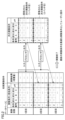
- FIG. 1 is a diagram showing an example of experimental data and a flow of batch Bayesian optimization.
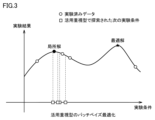
- FIG. 13 is a schematic diagram illustrating an image of next experimental conditions searched for by exploitation-focused batch Bayesian optimization.
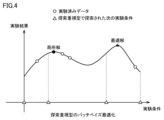
- FIG. 13 is a schematic diagram illustrating an image of next experimental conditions searched for by search-focused batch Bayesian optimization.
- FIG. 13 is a schematic diagram illustrating an image of next experimental conditions searched for by a hybrid batch Bayesian optimization method that combines an exploitation-oriented method and an exploration-oriented method.
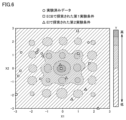
- FIG. 13 is a diagram showing an example of the results of searching for optimal input conditions for maximizing the output of the Ackley function using hybrid batch Bayesian optimization.
- 11 is a flowchart (part 1) illustrating an example of a processing procedure of a searching device.
- 13 is a flowchart (part 2) illustrating an example of a processing procedure of the searching device.
- [Experimental system configuration] 1 is a diagram showing a schematic example of the overall configuration of an experimental system 1 according to the present embodiment.
- the experimental system 1 is a system capable of searching for experimental conditions that optimize experimental results by conducting an experiment in a situation in which the relationship between the experimental conditions and the experimental results (such as the productivity of the experiment or the quality of the product of the experiment) is unknown.
- the experimental system 1 includes a searching device 100 and an experimental device 200.
- the experimental apparatus 200 is an apparatus that automatically performs scientific experiments in response to a control signal.
- FIG. 1 shows an example of an experiment in which the experimental apparatus 200 performs a cell culture experiment.
- the cell culture conditions used in an experiment using the experimental apparatus 200 are an example of the "experimental conditions" of the present disclosure, and the cell culture volume measured by an experiment using the experimental apparatus 200 is an example of the "experimental results" of the present disclosure.
- the cells cultured in the experimental apparatus 200 are not particularly limited, and may be, for example, cells that have a useful effect in medicine, or cells that produce substances that have a useful effect in various industrial fields.
- the subject cultured in the experimental apparatus 200 is not limited to cells, and may be microorganisms or bacteria (such as E. coli).
- experiments performed in the experimental apparatus 200 may be experiments other than cell culture (such as synthetic chemistry experiments).
- the experimental device 200 is configured to be able to simultaneously perform multiple cell culture experiments with different culture conditions in a single process.
- the experimental device 200 includes a medium preparation device 210, a culture device 220, and a measurement device 230.
- the culture device 220 cultures the cells in each well 212 in the environment (temperature, time, etc.) instructed by the search device 100. This allows n cell culture experiments with different culture conditions (culture medium conditions) to be performed simultaneously in a single process.
- the measuring device 230 measures the results of the cell culture experiment performed by the culture device 220.
- the measuring device 230 measures the cell culture volume in each of the n wells 212 as the result of the cell culture experiment.
- the measuring device 230 transmits experimental data combining the culture conditions and cell culture volume of each well 212 to the searching device 100 as the experiment result.
- the search device 100 is configured, for example, by a general-purpose computer.
- the search device 100 includes a processor 101, a memory 102, an input/output interface (I/F) 103, and a communication I/F 104.
- I/F input/output interface
- the processor 101 executes various programs so that the search device 100 can carry out various processes.
- the memory 102 stores the programs executed by the processor 101 and various data required for the execution of the programs.
- the input/output I/F 103 is an interface that allows the processor 101 to communicate with the experimental device 200.
- the communication I/F 104 is an interface that allows the processor 101 to communicate with devices outside the experimental system 1 via a network.
- the memory 102 stores a database 130 in which experimental data received from the experimental device 200 is stored.
- the structure of the database 130 will be described later.
- the search device 100 further includes a display 110 and an input device 120.
- the display 110 displays the results of the calculations performed by the processor 101 to the user.
- the input device 120 (mouse, keyboard, touch sensor, etc.) accepts data input operations to the processor 101.
- the searching device 100 searches for optimal experimental conditions that maximize (or minimize) the experimental results of the experimental device 200 based on experimental data obtained by the experimental device 200 .
- the search device 100 searches for optimal experimental conditions using a Bayesian optimization method.
- the experimental device 200 can simultaneously perform multiple (n) cell culture experiments with different culture conditions in a single process.
- the searching device 100 uses "batch Bayesian optimization", which is a type of Bayesian optimization, to search for multiple (n) experimental conditions at once. Whereas normal Bayesian optimization searches for one condition as the next experimental condition based on experimental data, batch Bayesian optimization can search for multiple conditions as the next experimental condition based on experimental data. Note that the experimental data includes combinations of experimental conditions and experimental results obtained from one or more experiments.
- Figure 2 shows an example of experimental data stored in the database 130 of the search device 100 and the flow of batch Bayesian optimization.
- Figure 2 shows an example in which the medium conditions (contents of components A, B, and C, and pH value) of n wells 212 are searched for as the next experimental conditions each time an experiment is completed, and three experiments are ultimately performed.
- cells are cultured under initial experimental conditions in the experimental device 200.
- the initial experimental conditions are arbitrarily set by the user, for example, and stored in the database 130.
- the cell culture volume in n wells 212 is measured. Data from the first experiment (n combinations of medium conditions and culture volumes) is sent to the search device 100 and stored in the database 130.
- the processor 101 of the search device 100 searches for n medium conditions that are optimal for the next experiment (second experiment) by performing batch Bayesian optimization for the first batch based on the first experimental data stored in the database 130, and transmits the searched n medium conditions to the experimental device 200 as the next experimental conditions.
- the processor 101 searches for n optimal medium conditions for the next experiment (third experiment) by performing a second batch of batch Bayesian optimization based on the first and second experimental data stored in the database 130, and transmits the searched n medium conditions to the experimental device 200 as the next experimental conditions.
- the third experiment cell culture is performed under the n medium conditions searched for by the second batch of batch Bayesian optimization.
- the data from the third experiment is sent to the search device 100 and added to the database 130. Therefore, at this point, the data from the first to third experiments (3n combinations of medium conditions and culture volumes) are stored in the database 130.
- the experiment and batch Bayesian optimization are repeated until the experiment termination condition is met.
- the experiment termination condition is set, for example, to at least one of the following conditions being met: the latest experiment result has reached the target value, and the number of times batch Bayesian optimization processing has been performed (the number of batches) has exceeded a reference value.
- the third culture medium conditions are displayed on the display 110 as the optimal culture conditions and presented to the user.
- Figure 3 is a schematic diagram showing the next experimental conditions searched for by exploitation-oriented batch Bayesian optimization. Exploitation-oriented means that the search focuses on input conditions (experimental conditions) that result in high output (experimental results).
- Figure 3 and Figure 4, which will be described later, show an example in which four experimental conditions are searched for per batch as the next experimental conditions.
- Figure 4 is a schematic diagram showing the next experimental conditions to be searched for using search-oriented batch Bayesian optimization.
- Search-oriented means that the search focuses on experimental conditions for which no experimental data has been used.
- the search device 100 searches for the next experimental conditions by hybrid batch Bayesian optimization using multiple acquisition functions.
- Figure 5 is a schematic diagram showing the next experimental conditions that are searched for by hybrid batch Bayesian optimization that combines exploitation-oriented and exploration-oriented methods.
- Figure 5 shows an example in which a total of four experimental conditions are searched for per batch, two each for exploitation-oriented and exploration-oriented methods.
- an acquisition function is exploitation-oriented or exploration-oriented is determined relatively based on the results of a search using that acquisition function, and it is difficult to determine in advance before conducting a search.
- Figure 6 shows an example of the results of searching for 10 optimal input conditions in one batch using hybrid batch Bayesian optimization to maximize the output of the Ackley function for two-dimensional input (X1, X2) and one-dimensional output (Y).
- the upper confidence bound function UCB Upper Confidence Bound
- EI Exected Improvement
- UCB acquisition functions
- ⁇ (x) is a function that represents the expectation of the posterior distribution of a Gaussian process
- ⁇ (x) is a function that represents the uncertainty (variance) of the expectation
- "k” is a hyperparameter determined by the user.
- UCB is expressed using the expectation and uncertainty (variance) of the posterior distribution of a Gaussian process, as well as hyperparameters.
- EI is also expressed using the expectation and uncertainty of the posterior distribution of a Gaussian process, but does not include hyperparameters.
- circles ( ⁇ ) indicate experimental data used as input for batch Bayesian optimization
- squares ( ⁇ ) indicate first experimental conditions searched for using the first acquisition function UCB
- triangles ( ⁇ ) indicate second experimental conditions searched for using the second acquisition function EI. From the results shown in Figure 6, it can be seen that by using the first acquisition function UCB and the second acquisition function EI, a balanced search is performed for input coordinates close to the experimental data and input coordinates far from the experimental data in the two-dimensional coordinate system of inputs X1 and X2.
- [flowchart] 7 is a flowchart showing an example of a processing procedure of the searching device 100. The processing shown in this flowchart is started when a start command is input to the input device 120 by the user, for example.
- the processor 101 of the search device 100 retrieves the experimental data from the database 130 (step S10).
- the processor 101 sets the experimental data acquired in step S10 as input data for batch Bayesian optimization (step S11).
- UMB first acquisition function
- EI second acquisition function
- the processor 101 controls the experimental device 200 to perform a cell culture experiment under the next n experimental conditions by outputting the control signal generated in step S21 to the experimental device 200 (step S24).
- the processor 101 acquires experimental data including the next experimental result from the experimental device 200 (step S25).
- the processor 101 adds the experimental data acquired in step S25 to the database 130 (step S26).
- the processor 101 determines whether or not an experiment end condition is satisfied (step S27).
- the experiment end condition is set to, for example, as described above, at least one of the following conditions is satisfied: the latest experiment result has reached the target value; and the number of batches in the batch Bayesian optimization has exceeded a reference value.
- step S27 the processor 101 returns the process to step S10 and repeats the batch processing of steps S10 to S26 until the experiment end condition is met.
- the processor 101 displays the most recent experimental conditions among the experimental conditions stored in the database 130 on the display 110 as the optimal experimental conditions to be presented to the user (step S30). Note that the experimental conditions that produced the best experimental results among the most recent experimental conditions may be set as the optimal experimental conditions.
- the search device 100 sets the next experimental conditions as a combination of m experimental conditions searched by batch Bayes optimization using the first acquisition function UCB and (n-m) experimental conditions searched by batch Bayes optimization using the second acquisition function EI. Therefore, compared to when all of the next experimental conditions are searched by batch Bayes optimization using only one acquisition function (for example, only UCB or EI), it is possible to avoid the risk that the next experimental conditions will be biased toward experimental conditions close to the experimental data or toward experimental conditions far from the optimal solution. As a result, the experimental conditions to be used in the experimental device 200 can be appropriately searched for with a small number of experiments.
- batch Bayesian optimization using the first acquisition function and the batch Bayesian optimization using the second acquisition function may be performed in separate batch processes.
- FIG. 8 is a flowchart showing an example of a processing procedure of the search device 100 according to this modified example 1.
- the flowchart in FIG. 8 is obtained by adding step S20 to the flowchart in FIG. 7 described above, and by changing step S21 in the flowchart in FIG. 7 described above to steps S22 and S23.
- the other steps in FIG. 8 (steps numbered the same as the steps shown in FIG. 7 described above) have already been described, so detailed description will not be repeated here.
- the processor 101 determines whether the previous experimental conditions are the conditions searched for by batch Bayesian optimization using the first acquisition function (UCB) (step S20).
- step S20 If the previous experimental conditions are not conditions searched for by batch Bayesian optimization using the first acquisition function (UCB) (NO in step S20), the processor 101 sets the next n first experimental conditions by batch Bayesian optimization using the first acquisition function (UCB) (step S22). After that, the processor 101 executes the process from step S24 onwards.
- step S20 the processor 101 sets n second experimental conditions by batch Bayesian optimization using the second acquisition function (EI) (step S23). After that, the processor 101 executes the processes from step S24 onwards.
- FIG. 8 shows an example in which the first acquisition function and the second acquisition function are used alternately to set the next experimental conditions
- the first acquisition function and the second acquisition function may be used irregularly to set the next experimental conditions, rather than alternately.
- the first acquisition function, the second acquisition function, the second acquisition function, the first acquisition function, and so on may be used in this order to set the next experimental conditions.
- the experimental design used in the above-described embodiment and modified example 1 is not limited to the batch Bayesian optimization method.
- all or part of the experimental design used in the above-described embodiment and modified example 1 may be a normal Bayesian optimization method.
- part of the experimental design used in the above-mentioned embodiment and modification 1 may be an experimental design other than Bayesian optimization.
- part of the experimental design used in the above-mentioned embodiment and modification 1 may be an experimental design (grid search, random search, etc.) that comprehensively sets experimental conditions without using experimental data.
- the search method according to the present disclosure is a search method for experimental conditions used in an experimental apparatus capable of executing a plurality of experiments with mutually different experimental conditions, and includes the steps of setting first experimental conditions using a first experimental design method, controlling the experimental apparatus to execute a first experiment based on the first experimental conditions, and setting second experimental conditions using a second experimental design method based on the results of the first experiment.
- the first experimental design method includes at least two of an experimental design by a Bayesian optimization method using a first acquisition function, an experimental design by a Bayesian optimization method using a second acquisition function different from the first acquisition function, and an experimental design different from the Bayesian optimization method.
- the second experimental design method includes an experimental design by a Bayesian optimization method using an acquisition function that is the same as or different from the acquisition function used in the first experimental design method.
- the first experimental conditions are set using at least two of an experimental design by a Bayesian optimization method using a first acquisition function, an experimental design by a Bayesian optimization method using a second acquisition function different from the first acquisition function, and an experimental design different from the Bayesian optimization method, and a first experiment based on the set one experimental condition is executed. Therefore, compared to when the first experimental conditions are set using one experimental design method, it is possible to avoid the risk that the first experimental conditions are searched for biased toward experimental conditions close to the experimental data or biased toward experimental conditions far from the optimal solution. As a result, it is possible to search for optimal experimental conditions with a small number of experiments.
- the experimental conditions set by Bayesian optimization using UCB and the experimental conditions set by batch Bayesian optimization using EI can be searched for as the first experimental conditions.
- the experimental design method that differs from the Bayesian optimization method is an experimental design method that comprehensively sets experimental conditions without using experimental data.
- the experimental apparatus is configured to be capable of culturing cells in multiple wells in a single process.
- the experimental design method for setting the culture conditions for some of the multiple wells can be made different from the experimental design method for setting the culture conditions for the remaining wells. Therefore, compared to when all culture conditions for multiple wells are set using a single experimental design method, it is possible to avoid the risk of the culture conditions being searched for in a biased way toward culture conditions close to the experimental data or culture conditions far from the optimal solution.
- the experimental device is configured to automatically execute an experiment upon receiving a control signal.
- the step of setting the first experimental conditions includes a step of generating a control signal for causing the experimental device to execute the first experiment.
- the step of setting the second experimental conditions includes a step of generating a control signal for causing the experimental device to execute a second experiment based on the second experimental conditions.
- the experimental system includes an experimental device capable of executing a plurality of experiments with different experimental conditions, and a search device that searches for experimental conditions to be used in the experimental device.
- the search device sets first experimental conditions using a first experimental design method, controls the experimental device to execute a first experiment based on the first experimental conditions, and sets second experimental conditions using a second experimental design method based on the results of the first experiment.
- the first experimental design method includes at least two of an experimental design by a Bayesian optimization method using a first acquisition function, an experimental design by a Bayesian optimization method using a second acquisition function different from the first acquisition function, and an experimental design different from the Bayesian optimization method.
- the second experimental design method includes an experimental design by a Bayesian optimization method using an acquisition function that is the same as or different from the acquisition function used in the first experimental design method.
- Experimental system 100 Search device, 101 Processor, 102 Memory, 110 Display, 120 Input device, 130 Database, 200 Experimental device, 210 Culture medium preparation device, 211 Well plate, 212 Well, 220 Culture device, 230 Measurement device.
Landscapes
- Business, Economics & Management (AREA)
- Tourism & Hospitality (AREA)
- Health & Medical Sciences (AREA)
- Economics (AREA)
- General Health & Medical Sciences (AREA)
- Human Resources & Organizations (AREA)
- Marketing (AREA)
- Primary Health Care (AREA)
- Strategic Management (AREA)
- Physics & Mathematics (AREA)
- General Business, Economics & Management (AREA)
- General Physics & Mathematics (AREA)
- Engineering & Computer Science (AREA)
- Theoretical Computer Science (AREA)
- Apparatus Associated With Microorganisms And Enzymes (AREA)
- Management, Administration, Business Operations System, And Electronic Commerce (AREA)
Priority Applications (2)
| Application Number | Priority Date | Filing Date | Title |
|---|---|---|---|
| CN202480075060.1A CN122270774A (zh) | 2023-11-29 | 2024-08-29 | 实验条件的探索方法以及实验系统 |
| JP2025560835A JPWO2025115331A1 (cg-RX-API-DMAC7.html) | 2023-11-29 | 2024-08-29 |
Applications Claiming Priority (2)
| Application Number | Priority Date | Filing Date | Title |
|---|---|---|---|
| JP2023-201765 | 2023-11-29 | ||
| JP2023201765 | 2023-11-29 |
Publications (1)
| Publication Number | Publication Date |
|---|---|
| WO2025115331A1 true WO2025115331A1 (ja) | 2025-06-05 |
Family
ID=95897568
Family Applications (1)
| Application Number | Title | Priority Date | Filing Date |
|---|---|---|---|
| PCT/JP2024/030926 Pending WO2025115331A1 (ja) | 2023-11-29 | 2024-08-29 | 実験条件の探索方法、および実験システム |
Country Status (3)
| Country | Link |
|---|---|
| JP (1) | JPWO2025115331A1 (cg-RX-API-DMAC7.html) |
| CN (1) | CN122270774A (cg-RX-API-DMAC7.html) |
| WO (1) | WO2025115331A1 (cg-RX-API-DMAC7.html) |
Citations (3)
| Publication number | Priority date | Publication date | Assignee | Title |
|---|---|---|---|---|
| JP2022128960A (ja) * | 2021-02-24 | 2022-09-05 | 富士通株式会社 | 情報処理方法、情報処理装置、及び情報処理プログラム |
| WO2023008450A1 (ja) * | 2021-07-28 | 2023-02-02 | パナソニックIpマネジメント株式会社 | 情報表示方法、情報表示装置およびプログラム |
| JP7302075B1 (ja) * | 2022-07-06 | 2023-07-03 | 日本曹達株式会社 | 反応条件を推定する推定モデルの生成方法/生成装置、反応条件の提供方法/提供装置、並びにプログラム |
-
2024
- 2024-08-29 JP JP2025560835A patent/JPWO2025115331A1/ja active Pending
- 2024-08-29 WO PCT/JP2024/030926 patent/WO2025115331A1/ja active Pending
- 2024-08-29 CN CN202480075060.1A patent/CN122270774A/zh active Pending
Patent Citations (3)
| Publication number | Priority date | Publication date | Assignee | Title |
|---|---|---|---|---|
| JP2022128960A (ja) * | 2021-02-24 | 2022-09-05 | 富士通株式会社 | 情報処理方法、情報処理装置、及び情報処理プログラム |
| WO2023008450A1 (ja) * | 2021-07-28 | 2023-02-02 | パナソニックIpマネジメント株式会社 | 情報表示方法、情報表示装置およびプログラム |
| JP7302075B1 (ja) * | 2022-07-06 | 2023-07-03 | 日本曹達株式会社 | 反応条件を推定する推定モデルの生成方法/生成装置、反応条件の提供方法/提供装置、並びにプログラム |
Non-Patent Citations (1)
| Title |
|---|
| "What acquisition function should I use in Bayesian optimization?", 18 June 2023 (2023-06-18), XP009563336, Retrieved from the Internet <URL:https://web.archive.org/web/20230930164924/https://datachemeng.com/acquisition_function_selection_in_bayesian_optimization/> * |
Also Published As
| Publication number | Publication date |
|---|---|
| CN122270774A (zh) | 2026-06-23 |
| JPWO2025115331A1 (cg-RX-API-DMAC7.html) | 2025-06-05 |
Similar Documents
| Publication | Publication Date | Title |
|---|---|---|
| HamediRad et al. | Towards a fully automated algorithm driven platform for biosystems design | |
| Nisthal et al. | Protein stability engineering insights revealed by domain-wide comprehensive mutagenesis | |
| JP2020149663A (ja) | ニューラルネットワーク生成用の方法及び装置 | |
| Jaszkiewicz et al. | The ‘Light Beam Search’approach–an overview of methodology applications | |
| CN112396191B (zh) | 一种基于联邦学习进行模型参数更新的方法、系统及装置 | |
| JP6956884B2 (ja) | 細胞培養支援装置の作動プログラム、細胞培養支援装置、細胞培養支援装置の作動方法 | |
| WO2021003391A1 (en) | Machine learning systems and methods for evaluating sampling bias in deep active classification | |
| Billings et al. | ProSPr: democratized implementation of alphafold protein distance prediction network | |
| WO2020026741A1 (ja) | 情報処理方法、情報処理装置及び情報処理プログラム | |
| Moon et al. | Using design of experiments to guide genetic optimization of engineered metabolic pathways | |
| KR20210124402A (ko) | 역합성 처리 방법 및 장치, 전자 디바이스, 및 컴퓨터 판독가능 저장 매체 | |
| Alijah et al. | Non-adiabatic coupling in the ozone molecule | |
| Zheng et al. | An ensemble method to reconstruct gene regulatory networks based on multivariate adaptive regression splines | |
| CN110837567A (zh) | 实现知识图谱嵌入的方法和系统 | |
| KR101560802B1 (ko) | 임의 수학 문제를 제공하는 클라우드 컴퓨팅 서버, 방법 및 기록매체 | |
| Hans et al. | Automated conditional screening of multiple escherichia coli strains in parallel adaptive fed-batch cultivations | |
| Avula et al. | Building robust machine learning models for small chemical science data: the case of shear viscosity of fluids | |
| Wu et al. | Exact reaction coordinates for flap opening in HIV-1 protease | |
| Ricci et al. | Haptic-driven applications to molecular modeling: state-of-the-art and perspectives | |
| Ding et al. | EcoSynther: a customized platform to explore the biosynthetic potential in E. coli | |
| Hernandez-Romero et al. | Exploring hybrid quantum-classical algorithms for multiscale bioprocess optimization | |
| Desper et al. | Getting a tree fast: Neighbor joining, FastME, and distance‐based methods | |
| Yang et al. | STAR: A web server for assisting directed protein evolution with machine learning | |
| Shenfield et al. | Computational steering of a multi-objective evolutionary algorithm for engineering design | |
| Lee et al. | Development of a simulation result management and prediction system using machine learning techniques |
Legal Events
| Date | Code | Title | Description |
|---|---|---|---|
| 121 | Ep: the epo has been informed by wipo that ep was designated in this application |
Ref document number: 24897022 Country of ref document: EP Kind code of ref document: A1 |
|
| ENP | Entry into the national phase |
Ref document number: 2025560835 Country of ref document: JP Kind code of ref document: A |
|
| NENP | Non-entry into the national phase |
Ref country code: DE |