WO2025110202A1 - 植物の非生物的ストレス耐性向上剤、非生物的ストレス耐性向上方法、非生物的ストレス耐性向上用製剤、非生物的ストレス耐性向上用製品、および植物 - Google Patents
植物の非生物的ストレス耐性向上剤、非生物的ストレス耐性向上方法、非生物的ストレス耐性向上用製剤、非生物的ストレス耐性向上用製品、および植物 Download PDFInfo
- Publication number
- WO2025110202A1 WO2025110202A1 PCT/JP2024/041229 JP2024041229W WO2025110202A1 WO 2025110202 A1 WO2025110202 A1 WO 2025110202A1 JP 2024041229 W JP2024041229 W JP 2024041229W WO 2025110202 A1 WO2025110202 A1 WO 2025110202A1
- Authority
- WO
- WIPO (PCT)
- Prior art keywords
- stress
- abiotic stress
- acid
- plant
- improving
- Prior art date
- Legal status (The legal status is an assumption and is not a legal conclusion. Google has not performed a legal analysis and makes no representation as to the accuracy of the status listed.)
- Pending
Links
Classifications
-
- A—HUMAN NECESSITIES
- A01—AGRICULTURE; FORESTRY; ANIMAL HUSBANDRY; HUNTING; TRAPPING; FISHING
- A01N—PRESERVATION OF BODIES OF HUMANS OR ANIMALS OR PLANTS OR PARTS THEREOF; BIOCIDES, e.g. AS DISINFECTANTS, AS PESTICIDES OR AS HERBICIDES; PEST REPELLANTS OR ATTRACTANTS; PLANT GROWTH REGULATORS
- A01N25/00—Biocides, pest repellants or attractants, or plant growth regulators, characterised by their forms, or by their non-active ingredients or by their methods of application, e.g. seed treatment or sequential application; Substances for reducing the noxious effect of the active ingredients to organisms other than pests
-
- A—HUMAN NECESSITIES
- A01—AGRICULTURE; FORESTRY; ANIMAL HUSBANDRY; HUNTING; TRAPPING; FISHING
- A01N—PRESERVATION OF BODIES OF HUMANS OR ANIMALS OR PLANTS OR PARTS THEREOF; BIOCIDES, e.g. AS DISINFECTANTS, AS PESTICIDES OR AS HERBICIDES; PEST REPELLANTS OR ATTRACTANTS; PLANT GROWTH REGULATORS
- A01N37/00—Biocides, pest repellants or attractants, or plant growth regulators containing organic compounds containing a carbon atom having three bonds to hetero atoms with at the most two bonds to halogen, e.g. carboxylic acids
- A01N37/44—Biocides, pest repellants or attractants, or plant growth regulators containing organic compounds containing a carbon atom having three bonds to hetero atoms with at the most two bonds to halogen, e.g. carboxylic acids containing at least one carboxylic group or a thio analogue, or a derivative thereof, and a nitrogen atom attached to the same carbon skeleton by a single or double bond, this nitrogen atom not being a member of a derivative or of a thio analogue of a carboxylic group, e.g. amino-carboxylic acids
-
- A—HUMAN NECESSITIES
- A01—AGRICULTURE; FORESTRY; ANIMAL HUSBANDRY; HUNTING; TRAPPING; FISHING
- A01N—PRESERVATION OF BODIES OF HUMANS OR ANIMALS OR PLANTS OR PARTS THEREOF; BIOCIDES, e.g. AS DISINFECTANTS, AS PESTICIDES OR AS HERBICIDES; PEST REPELLANTS OR ATTRACTANTS; PLANT GROWTH REGULATORS
- A01N43/00—Biocides, pest repellants or attractants, or plant growth regulators containing heterocyclic compounds
- A01N43/48—Biocides, pest repellants or attractants, or plant growth regulators containing heterocyclic compounds having rings with two nitrogen atoms as the only ring hetero atoms
- A01N43/50—1,3-Diazoles; Hydrogenated 1,3-diazoles
-
- A—HUMAN NECESSITIES
- A01—AGRICULTURE; FORESTRY; ANIMAL HUSBANDRY; HUNTING; TRAPPING; FISHING
- A01N—PRESERVATION OF BODIES OF HUMANS OR ANIMALS OR PLANTS OR PARTS THEREOF; BIOCIDES, e.g. AS DISINFECTANTS, AS PESTICIDES OR AS HERBICIDES; PEST REPELLANTS OR ATTRACTANTS; PLANT GROWTH REGULATORS
- A01N47/00—Biocides, pest repellants or attractants, or plant growth regulators containing organic compounds containing a carbon atom not being member of a ring and having no bond to a carbon or hydrogen atom, e.g. derivatives of carbonic acid
- A01N47/40—Biocides, pest repellants or attractants, or plant growth regulators containing organic compounds containing a carbon atom not being member of a ring and having no bond to a carbon or hydrogen atom, e.g. derivatives of carbonic acid the carbon atom having a double or triple bond to nitrogen, e.g. cyanates, cyanamides
- A01N47/42—Biocides, pest repellants or attractants, or plant growth regulators containing organic compounds containing a carbon atom not being member of a ring and having no bond to a carbon or hydrogen atom, e.g. derivatives of carbonic acid the carbon atom having a double or triple bond to nitrogen, e.g. cyanates, cyanamides containing —N=CX2 groups, e.g. isothiourea
- A01N47/44—Guanidine; Derivatives thereof
-
- A—HUMAN NECESSITIES
- A01—AGRICULTURE; FORESTRY; ANIMAL HUSBANDRY; HUNTING; TRAPPING; FISHING
- A01P—BIOCIDAL, PEST REPELLANT, PEST ATTRACTANT OR PLANT GROWTH REGULATORY ACTIVITY OF CHEMICAL COMPOUNDS OR PREPARATIONS
- A01P21/00—Plant growth regulators
Definitions
- the present invention relates to an agent for improving abiotic stress resistance in plants, a method for improving abiotic stress resistance, a preparation for improving abiotic stress resistance, a product for improving abiotic stress resistance, and a plant.
- Patent Document 1 describes that glycine betaine has the effect of alleviating stress on plants caused by insufficient irrigation.
- Patent Document 2 describes that when an aqueous solution of ergothioneine is applied to germinated plants, the plant height increases, the number of flowers and fruits increases, and the seed yield also increases.
- Abiotic stress is thought to be a major hindrance to the expression of a plant's potential productivity. Therefore, it is expected that the production volume of plants will increase dramatically by providing biostimulants that eliminate abiotic stress.
- the present invention has been made in consideration of the above problems, and aims to provide an agent for improving plant abiotic stress resistance that can further enhance the effect of improving abiotic stress resistance by using a compound such as ergothioneine, a method for improving abiotic stress resistance using the same, a formulation and product for improving abiotic stress resistance that include the same, and plants treated with the same.
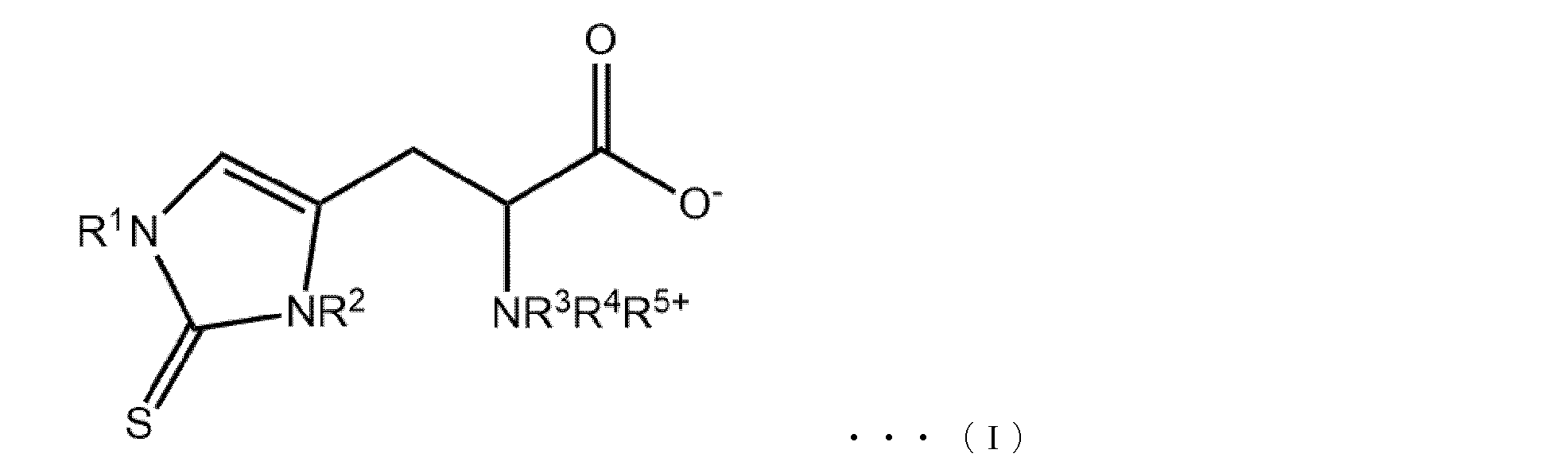
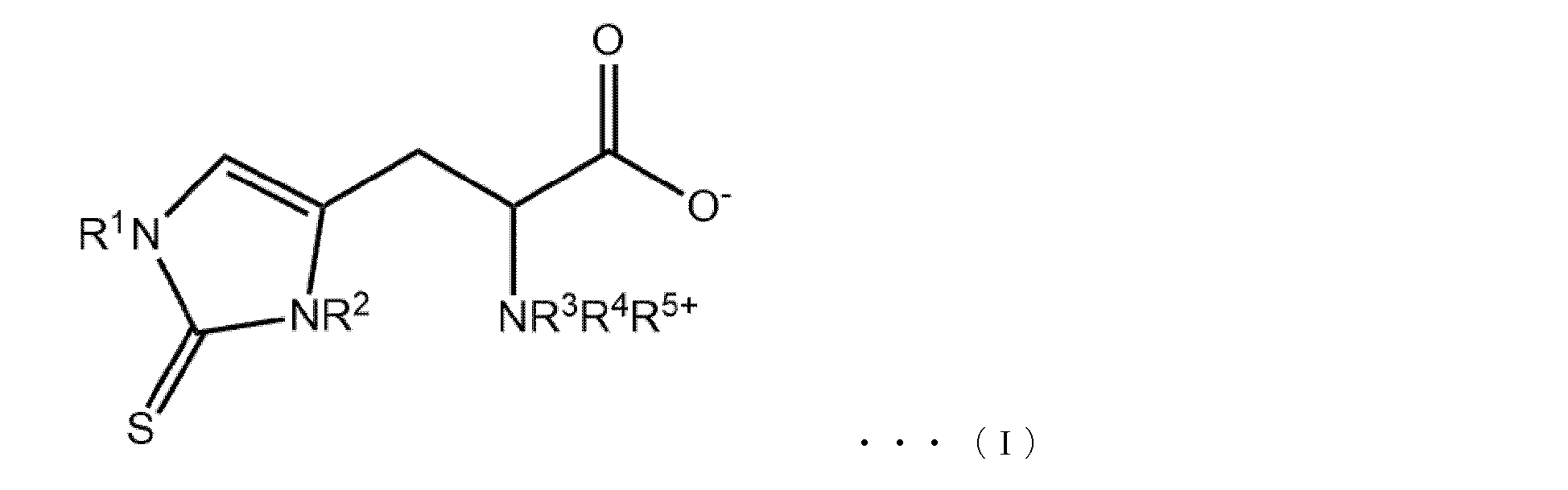
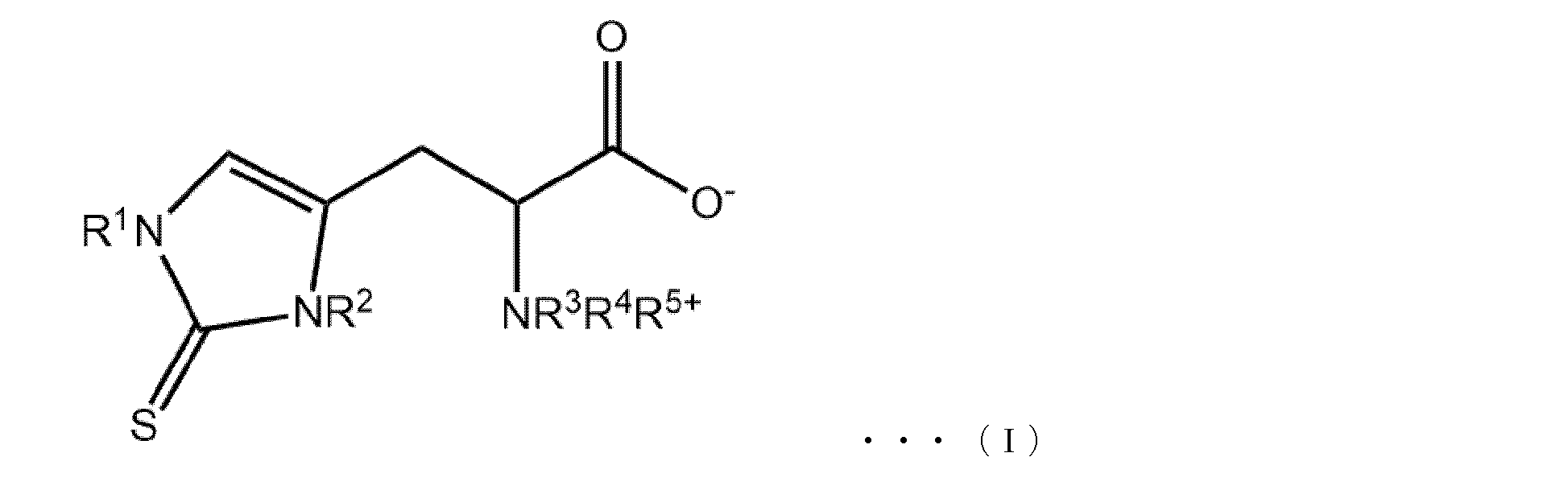
- a first component which is a compound represented by the following formula (I) or a tautomer thereof, or an agriculturally acceptable salt thereof; and a second component which is at least one selected from the group consisting of an amino acid, a peptide having a length of 2 to 10 amino acids, a betaine, an organic acid or a salt thereof, a nucleic acid base, a vitamin, and a sugar or a sugar alcohol.
- R1 and R2 independently represent a hydrogen atom or an alkyl group having 1 to 4 carbon atoms, and R3 , R4 , and R5 independently represent an alkyl group having 1 to 4 carbon atoms.
- the compound represented by formula (I) is ergothioneine.
- the composition improves the tolerance of the plant to at least one abiotic stress selected from the group consisting of high temperature stress, low temperature stress, freezing stress, salt stress, excess nutrient stress, drought stress, excess water stress, ultraviolet light stress, low light stress, high light stress, excessive pruning stress, trampling stress, hail stress, and strong wind stress;
- the abiotic stress tolerance improver according to [1] or [2].
- the compound improves the tolerance of the plant to at least one abiotic stress selected from the group consisting of high temperature stress, ultraviolet light stress, and excess water stress; The abiotic stress tolerance improver according to any one of [1] to [3].
- the second component comprises an amino acid,
- the amino acid is glutamic acid or arginine.
- the agent for improving abiotic stress tolerance according to any one of [1] to [4].
- [6] preparing a plant; and treating the plant with the abiotic stress tolerance improving agent according to any one of [1] to [5]. Methods for improving abiotic stress tolerance in plants.
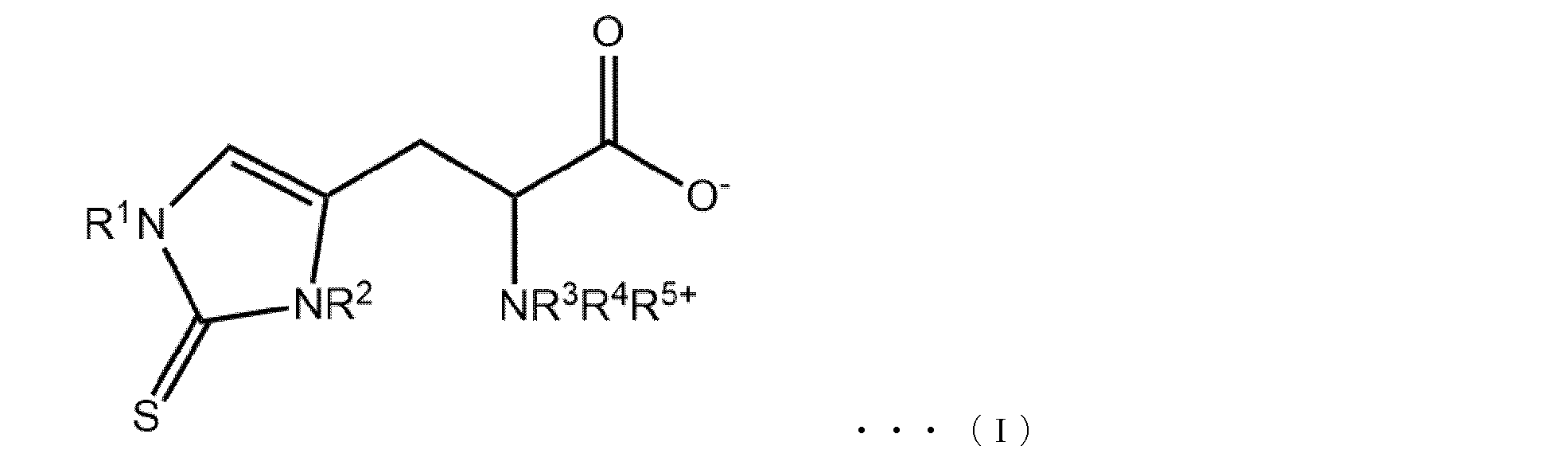
- a first component which is a compound represented by the following formula (I) or a tautomer thereof, or an agriculturally acceptable salt thereof: a second component which is at least one selected from the group consisting of an amino acid, a peptide having a length of 2 to 10 amino acids, a betaine, an organic acid or a salt thereof, a nucleic acid base, a vitamin, and a sugar or a sugar alcohol; A liquid or solid carrier; Formulations for improving plant resistance to abiotic stress.
- R1 and R2 independently represent a hydrogen atom or an alkyl group having 1 to 4 carbon atoms
- R3 , R4 , and R5 independently represent an alkyl group having 1 to 4 carbon atoms.
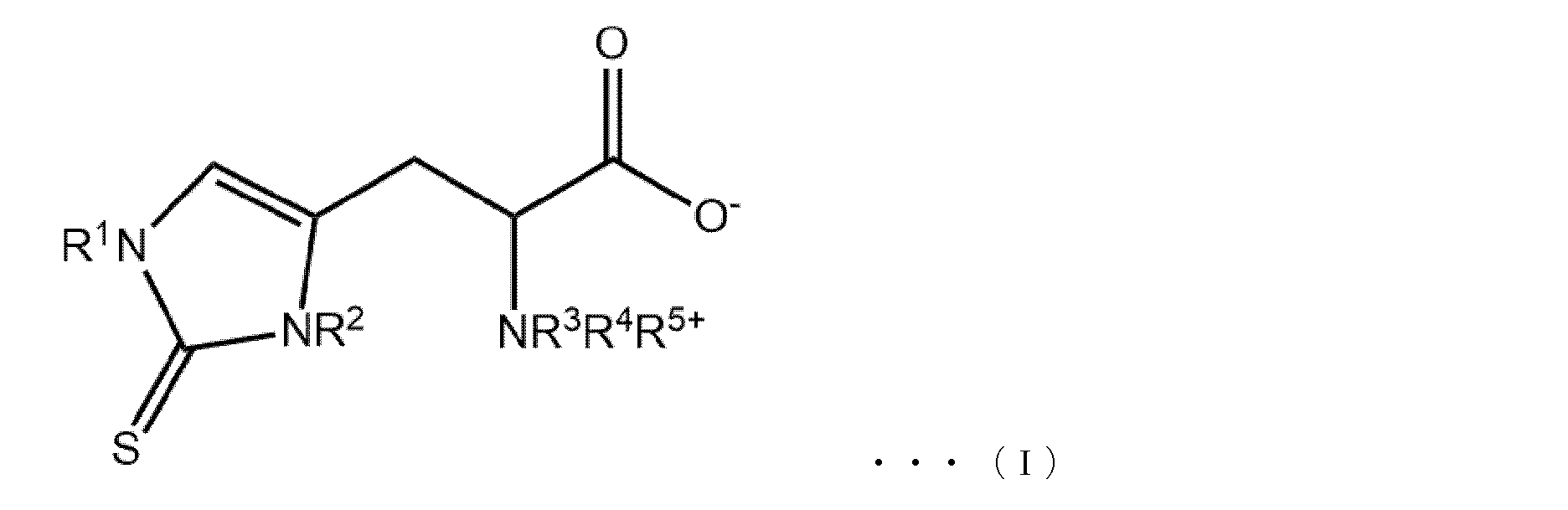
- R1 and R2 independently represent a hydrogen atom or an alkyl group having 1 to 4 carbon atoms
- R3 , R4 , and R5 independently represent an alkyl group having 1 to 4 carbon atoms.
- the present invention provides an agent for improving plant abiotic stress resistance that can further enhance the effect of improving abiotic stress resistance by using a compound such as ergothioneine, a method for improving abiotic stress resistance using the same, a formulation and product for improving abiotic stress resistance that include the same, and a plant treated with the same.
- One embodiment of the present invention relates to an agent for improving abiotic stress resistance in plants, comprising a first component which is a compound represented by the following formula (I) or a tautomer thereof, or an agriculturally acceptable salt thereof, and a second component which is at least one selected from the group consisting of an amino acid, a peptide having a length of 2 to 10 amino acids, a betaine, an organic acid or a salt thereof, a nucleic acid base, a vitamin, and a sugar or a sugar alcohol.
- a first component which is a compound represented by the following formula (I) or a tautomer thereof, or an agriculturally acceptable salt thereof
- a second component which is at least one selected from the group consisting of an amino acid, a peptide having a length of 2 to 10 amino acids, a betaine, an organic acid or a salt thereof, a nucleic acid base, a vitamin, and a sugar or a sugar alcohol.
- the first component is a compound represented by the following formula (I) or a tautomer thereof, or an agriculturally acceptable salt thereof.
- the abiotic stress tolerance enhancer may contain only one type of the first component or may contain multiple types of the first component.
- R 1 and R 2 independently represent a hydrogen atom or an alkyl group having 1 to 4 carbon atoms
- R 3 , R 4 and R 5 independently represent an alkyl group having 1 to 4 carbon atoms.
- the alkyl group which can be represented by R 1 to R 5 may be linear or branched.
- Examples of the alkyl group which can be represented by R 1 to R 5 include a methyl group, an ethyl group, a propyl group, an isopropyl group, a butyl group, an isobutyl group, a sec-butyl group, and a tert-butyl group.
- At least one of R1 and R2 is preferably a hydrogen atom, and more preferably both are hydrogen atoms.
- R1 and R2 are alkyl groups, they are preferably methyl, ethyl, or propyl, more preferably methyl or ethyl, and even more preferably methyl.
- R3 , R4 and R5 are preferably each independently a methyl group, an ethyl group, or a propyl group, more preferably a methyl group or an ethyl group, and even more preferably a methyl group.
- R3 , R4 and R5 it is preferable that at least one is a methyl group, more preferably at least two are methyl groups, and even more preferably all are methyl groups.
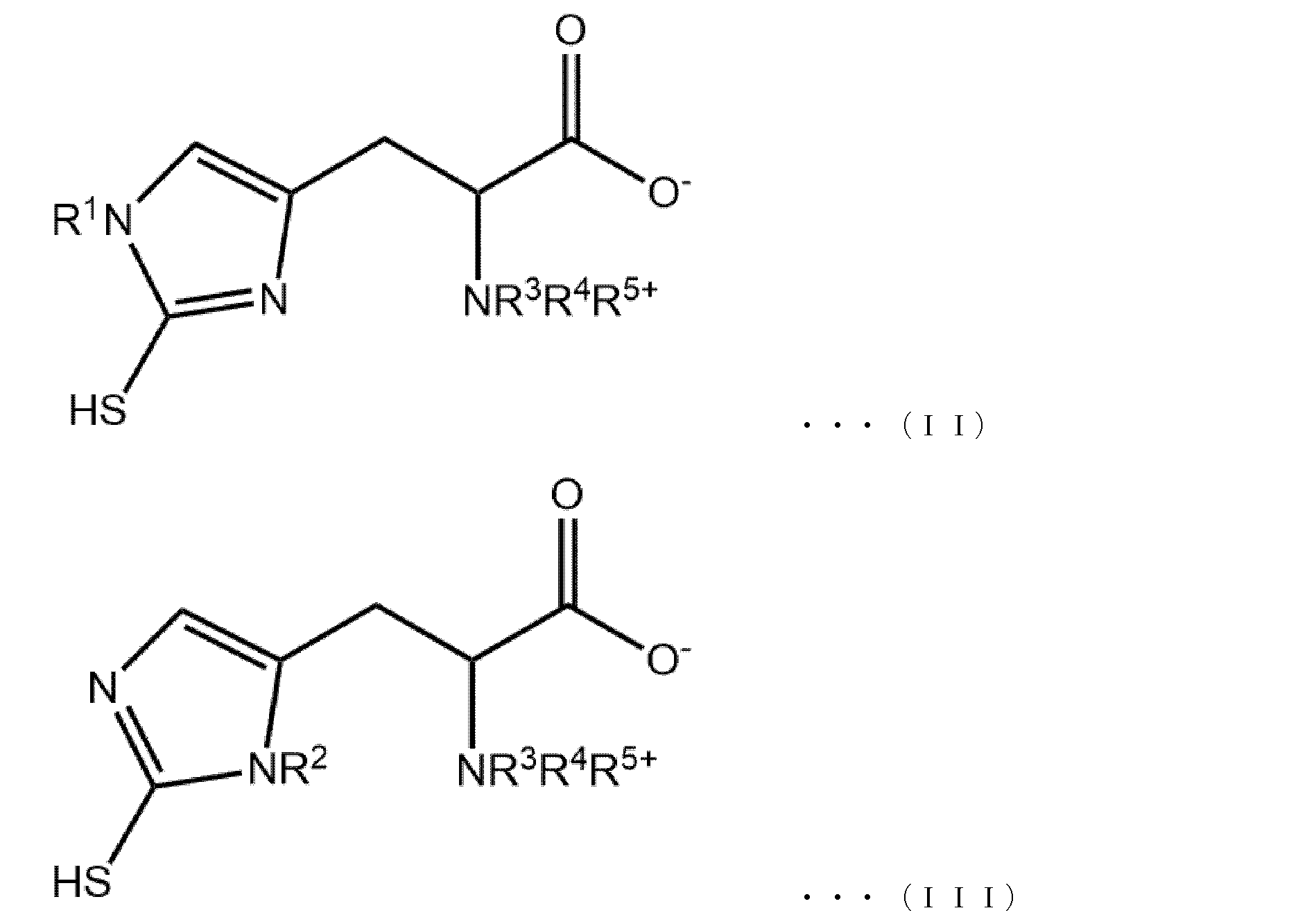
- the compound represented by formula (I) has a tautomer when at least one of R 1 and R 2 is a hydrogen atom. More specifically, the compound represented by formula (I) has a tautomer represented by the following formula (II) when R 2 is a hydrogen atom. In addition, the compound represented by formula (I) has a tautomer represented by the following formula (III) when R 1 is a hydrogen atom. In this specification, when the term "tautomer” is used simply, it means both the compound represented by formula (II) and the compound represented by formula (III).
- R 1 to R 5 are the same as R 1 to R 5 in formula (I).
- the compound represented by formula (I) and the compound represented by formula (II) or the compound represented by formula (III) can exist in equilibrium.
- the ratio of the compound represented by formula (I) to the compound represented by formula (II) or the compound represented by formula (III) can vary depending on the solvent, temperature, pH, etc.
- the compound represented by formula (I) or its tautomer is preferably ergothioneine, more preferably L-(+)-ergothioneine.
- Ergothioneine is also known to be produced by bacteria and fungi. Examples of production methods using such microorganisms include those described in JP-A-2012-105618, JP-A-2014-223051, WO-2016/104437, WO-2016/121285, WO-2015/168112, and WO-2017/150304. Ergothioneine may be used as a culture containing ergothioneine obtained from these microorganisms, or ergothioneine obtained by concentrating or purifying the above culture may be used.
- Agriculturally acceptable means safe, non-toxic, and not biologically or otherwise undesirable, and acceptable for use as a pesticide, particularly for use in improving plants' resistance to abiotic stresses.
- Agriculturally acceptable salt of a compound represented by formula (I) or a tautomer thereof means an agriculturally acceptable salt as defined above that provides the action and effect of a compound represented by formula (I) or a tautomer thereof.
- Examples of such salts include hydrates, solvates, acid addition salts, salts formed by replacing an acidic proton present in a compound represented by formula (I) or a tautomer thereof with a metal ion, and salts formed by coordinating the acidic proton with an organic base or an inorganic base.
- Acid addition salts may be formed with inorganic acids or organic acids.
- inorganic acids include hydrochloric acid, hydrobromic acid, sulfuric acid, nitric acid, and phosphoric acid.
- organic acids include acetic acid, benzenesulfonic acid, benzoic acid, camphorsulfonic acid, citric acid, ethanesulfonic acid, fumaric acid, glucoheptonic acid, gluconic acid, glutamic acid, glycolic acid, hydroxynaphthoic acid, 2-hydroxyethanesulfonic acid, lactic acid, maleic acid, malic acid, mandelic acid, methanesulfonic acid, muconic acid, 2-naphthalenesulfonic acid, propionic acid, salicylic acid, succinic acid, dibenzoyl-L-tartaric acid, tartaric acid, p-toluenesulfonic acid, trimethylacetic acid, and trifluoroacetic acid.
- metal ions that can replace the acidic protons present in the compound of formula (I) or its tautomer include alkali metal ions, alkaline earth metal ions, and aluminum ions.
- Examples of organic bases that can coordinate with the acidic protons present in the compound represented by formula (I) or its tautomers include diethanolamine, ethanolamine, N-methylglucamine, triethanolamine, and tromethamine.
- Examples of inorganic bases that can coordinate with the acidic protons present in the compound represented by formula (I) or its tautomers include aluminum hydroxide, calcium hydroxide, potassium hydroxide, sodium carbonate, and sodium hydroxide.
- the first component is thought to act as a so-called biostimulant (an agent that improves resistance to abiotic stress) that promotes plant growth and alleviates abiotic stress.
- the second component is at least one component selected from the group consisting of amino acids, peptides having a length of 2 to 10 amino acids, betaine, organic acids or salts thereof, nucleic acid bases, vitamins, and sugars or sugar alcohols. These second components significantly enhance the effect of improving the abiotic stress tolerance of plants through a synergistic effect with the first component.
- the abiotic stress tolerance enhancer may contain only one type of second component or may contain multiple types.
- the amino acid may be an acidic amino acid, a neutral amino acid, or a basic amino acid.
- the amino acid may be a polar amino acid or a non-polar amino acid.
- the amino acid may contain sulfur.
- amino acids examples include glutamic acid, aspartic acid, histidine, arginine, lysine, glycine, alanine, valine, leucine, isoleucine, threonine, phenylalanine, tyrosine, tryptophan, proline, serine, glutamine, asparagine, 5-aminolevulinic acid, ⁇ -aminobutyric acid, cysteine, methionine, and ornithine. Of these, glutamic acid and arginine are preferred.
- the abiotic stress resistance enhancer may contain only one type of amino acid or multiple types.
- the peptide is a peptide having a length of 2 to 10 amino acids, and preferably a peptide having a length of 2 to 6 amino acids.
- the peptide is preferably glutathione, such as oxidized glutathione and reduced glutathione.
- the abiotic stress resistance enhancer may contain only one type of peptide, or may contain multiple types.
- Betaine is preferably an N-alkyl substituted amino acid, more preferably an N-trialkyl substituted amino acid, and even more preferably an N-trimethyl substituted amino acid.
- betaine include N-alkyl substituted, preferably N-trialkyl substituted, and more preferably N-trimethyl substituted, amino acids of glutamic acid, aspartic acid, histidine, arginine, lysine, glycine, alanine, valine, leucine, isoleucine, threonine, phenylalanine, tyrosine, tryptophan, proline, serine, glutamine, asparagine, 5-aminolevulinic acid, ⁇ -aminobutyric acid, cysteine, methionine, and ornithine, as well as carnitine.
- Preferred examples of betaine include glycine betaine, alanine betaine, and glutamic acid betaine.
- organic acids examples include carboxylic acids, sulfonic acids, phenols, and thiols.
- the abiotic stress resistance enhancer may contain only one type of organic acid or may contain multiple types of organic acids.
- the carboxylic acid preferably has 1 to 10 carbon atoms, more preferably 1 to 6 carbon atoms.
- the carboxylic acid may be a monocarboxylic acid, a dicarboxylic acid, or a tricarboxylic acid.
- Specific examples of carboxylic acids include lactic acid, glycolic acid, formic acid, acetic acid, propionic acid, butyric acid, oxalic acid, malonic acid, succinic acid, adipic acid, citric acid, glutaric acid, malic acid, ascorbic acid, tartaric acid, fumaric acid, maleic acid, pyruvic acid, and benzoic acid. Of these, acetic acid, citric acid, and maleic acid are preferred.
- phenols examples include phenol and aminophenol.
- sulfonic acids include methanesulfonic acid, ethanesulfonic acid, propanesulfonic acid, butanesulfonic acid, pentanesulfonic acid, hexanesulfonic acid, benzenesulfonic acid, and toluenesulfonic acid.
- salts of organic acids include alkali metal salts, such as sodium salts and lithium salts, and alkaline earth metal salts, such as magnesium salts and calcium salts, of the above-mentioned organic acids.
- the organic acid or its salt is preferably a carboxylic acid or its salt, more preferably a carboxylic acid or its salt having 1 to 10 carbon atoms, and even more preferably acetic acid, citric acid, or maleic acid or its salt.
- a nucleic acid base is a base contained in a nucleotide molecule that constitutes deoxyribonucleic acid or ribonucleic acid.
- nucleic acid bases include guanine, thymine, uracil, adenine, and cytosine. Of these, guanine, thymine, and uracil are preferred.
- the abiotic stress resistance enhancer may contain only one type of nucleic acid base or multiple types.
- the vitamin may be a fat-soluble vitamin or a water-soluble vitamin.
- the abiotic stress resistance enhancer may contain only one type of vitamin, or may contain multiple types. When containing multiple types of vitamins, the abiotic stress resistance enhancer may contain only multiple types of fat-soluble vitamins, may contain only multiple types of water-soluble vitamins, or may contain both fat-soluble and water-soluble vitamins.
- fat-soluble vitamins include vitamin A, vitamin D, vitamin E, vitamin K, etc.
- vitamin D include vitamin D2, vitamin D3, and vitamin D4.
- water-soluble vitamins include vitamin B, such as vitamin B1, vitamin B2, vitamin B6, and vitamin B12, as well as vitamin C. Of these, vitamin B1 and vitamin D2 are preferred.
- the sugar may be a monosaccharide, a disaccharide, or a polysaccharide.
- monosaccharides include glucose, fructose, and galactose.
- disaccharides include trehalose, lactose, maltose, and sucrose.
- polysaccharides include cellulose and starch.
- sugar alcohols examples include mannitol, inositol, erythritol, xylitol, and sorbitol.
- the abiotic stress tolerance enhancer significantly enhances the abiotic stress tolerance of plants due to the synergistic effect of the first and second components as active ingredients.
- Abiotic stress means abiotic stress that is different from biotic stress such as pests, disease, magazines, weeds, and thinning. Examples of abiotic stress include high temperature stress, low temperature stress, freezing stress, salt stress, excess nutrient stress, drought stress, excess water stress, ultraviolet stress, low light stress, high light stress, excessive pruning stress, trampling stress, hail stress, and strong wind stress.
- the abiotic stress tolerance enhancer enhances the tolerance of plants treated therewith to these abiotic stresses, such as high temperature stress.
- the above-mentioned abiotic stress resistance enhancer can improve resistance to abiotic stress, thereby suppressing the reduction in plant yield, the reduction in plant height and the reduction in plant height growth rate, the reduction in flower number due to environmental stress, and the reduction in above-ground and below-ground weights, all of which are caused by abiotic stress.
- the abiotic stress tolerance enhancer may be used to treat any plant.
- the plants include the Gramineae family, such as rice, wheat, barley, rye, oats, triticale (triticale), corn, sorghum, sugarcane, turfgrass, bentgrass, bermudagrass, fescue, and ryegrass; the Legumes family, such as soybean, peanut, kidney bean, pea, adzuki bean, and alfalfa; the Convolvulaceae family, such as sweet potato; capsicum, bell pepper, tomato, and the like.
- Solanaceae such as potatoes, eggplants, potatoes, and tobacco
- Polygonaceae such as buckwheat
- Asteraceae such as sunflowers
- Araliaceae such as ginseng
- Brassicaceae such as rapeseed, broccoli, Chinese cabbage, turnips, cabbage, arugula, radishes, and radishes
- Chenopodiaceae such as sugar beet
- Malvaceae such as cotton
- Rubiaceae such as coffee plants
- Sterculiaceae such as cacao
- Theaceae such as tea
- Cucurbitaceae such as watermelon, melon, cucumber, and pumpkin
- Liliaceae such as onion, leek, and garlic
- Rosaceae such as strawberry, apple, almond, apricot, plum, cherry, plum, peach, and pear
- Apiaceae such as carrot
- Araceae such as taro
- Anacardiaceae such as mango
- the above-mentioned plants may be any of wild plants, plant cultivars, plants and plant cultivars obtained by conventional biological breeding such as crossbreeding or protoplast fusion, and genetically modified plants and plant cultivars obtained by genetic engineering.
- genetically modified plants and plant cultivars obtained by genetic engineering include herbicide-resistant crops, pest-resistant crops incorporating an insecticidal protein-producing gene, disease-resistant crops incorporating a disease-resistance inducer-producing gene, crops with improved taste, crops with improved yield, crops with improved storability, and crops with improved yield.
- Examples of genetically modified plant cultivars approved in various countries include the various cultivars stored in the database of the International Society for Agricultural Biotechnology (ISAA).
- AgriSure, AgriSure 3000GT, AgriSure 3122 E-Z Refuge, AgriSure 3122 Refuge Renew AgriSure Artesian 3030A , AgriSure Artesian 3011A, AgriSure Duracade, AgriSure Duracade 5222 E-Z Refuge, AgriSure GT, AgriSure GT/CB/LL , AgriSure RW, AgriSure Viptera 3110, AgriSure Viptera 3111, AgriSure Viptera 3220 E-Z Refuge, AgriSure Viptera 3220 Refuge Renew, BiteGard, Bollgard, Bollgard II, Bollgard II/Roundup Ready, Bollgard 3 XtendFlex Cotton, Bol lgard Cotton, Bollgard/Roundup Ready Cotton, B.t., B.t/BXN Cotton, B.t.
- the first and second components contain the first and second components as active ingredients, and can be distributed in the market as preparations of various dosage forms together with other auxiliaries or other active ingredients.
- the active ingredients themselves may be formulated as preparations, or may be formulated as preparations of various dosage forms together with other auxiliaries or other active ingredients.
- the dosage form is not particularly limited and may be selected according to the treatment method. Examples of the dosage form include dust, granules, powder granules, wettable powder, water-soluble powder, emulsion, liquid, oil, aerosol, microcapsule, paste, coating agent, smoke agent, fumigant, and micro-spray agent.
- adjuvant examples include carriers, surfactants and other adjuvants.
- the carrier may be a solid carrier or a liquid carrier.
- solid carriers include minerals such as clay, talc, diatomaceous earth, zeolite, montmorillonite, bentonite, kaolinite, kaolin, pyrophyllite, rosewood, acid clay, activated clay, attapulgite, attapulgus clay, limestone, calcite, marble, vermiculite, perlite, pumice, silica stone, silica sand, sericite, and pottery stone; synthetic organic substances such as urea; salts such as calcium carbonate, sodium carbonate, magnesium carbonate, sodium sulfate, ammonium sulfate, potassium chloride, hydrated lime, and sodium bicarbonate; amorphous silica (white carbon, fumed silica, etc.) and distillates.
- minerals such as clay, talc, diatomaceous earth, zeolite, montmorillonite, bentonite, kaolinite, kaolin, pyrophyllite, rosewood, acid clay, activated clay, attapul
- powdered and granular carriers such as synthetic inorganic substances such as titanium oxide, plant-based carriers such as wood flour, corn stalks (cobs), walnut shells (nut husks), fruit kernels, rice husks, coconut shells, sawdust, bran, soy flour, powdered cellulose, starch, dextrin, and sugars (lactose, sucrose, etc.), as well as various polymeric carriers such as cross-linked lignin, cationic gels, gelatin that gels when heated or treated with polyvalent metal salts, water-soluble polymer gels (agar, etc.), chlorinated polyethylene, chlorinated polypropylene, polyvinyl acetate, polyvinyl chloride, ethylene/vinyl acetate copolymers, and urea/aldehyde resins.
- synthetic inorganic substances such as titanium oxide
- plant-based carriers such as wood flour, corn stalks (cobs), walnut shells (nut husks), fruit kernels,
- liquid carriers examples include aliphatic solvents such as paraffins (normal paraffin, isoparaffin, naphthene), aromatic solvents such as xylene, alkylbenzene, alkylnaphthalene and solvent naphtha, mixed solvents such as kerosene, machine oils such as refined high-boiling aliphatic hydrocarbons, alcohols such as methanol, ethanol, isopropanol, butanol and cyclohexanol, polyhydric alcohols such as ethylene glycol, diethylene glycol, propylene glycol, dipropylene glycol, hexylene glycol, polyethylene glycol and polypropylene glycol, polyhydric alcohol derivatives such as propylene glycol ethers, acetone, acetophenone, cyclohexanone, methylcyclohexanone and These include ketones such as ⁇ -butyrolactone, fatty acid methyl esters (coconut oil fatty acid methyl esters),
- the surfactant may be any of a variety of surfactants, including nonionic surfactants, anionic surfactants, cationic surfactants, amphoteric surfactants, silicone surfactants, fluorine-based surfactants, and biosurfactants.
- nonionic surfactants examples include sorbitan fatty acid esters, polyoxyethylene sorbitan fatty acid esters, sucrose fatty acid esters, polyoxyethylene fatty acid esters, polyoxyethylene resin acid esters, polyoxyethylene fatty acid diesters, polyoxyethylene alkyl ethers, polyoxyethylene alkylphenyl ethers, polyoxyethylene dialkylphenyl ethers, polyoxyethylene alkylphenyl ether formalin condensates, polyoxyethylene/polyoxypropylene block polymers, alkyl polyoxyethylene/polyoxypropylene block polymer ethers, alkylphenyl polyoxyethylene/polyoxypropylene block polymer ethers, polyoxyethylene alkylamines, polyoxyethylene fatty acid amides, polyoxyethylene fatty acid bisphenyl ethers, polyoxyethylene benzyl phenyl (or phenyl phenyl) ethers, polyoxyethylene styryl phenyl (or phenyl
- anionic surfactants include sulfates such as alkyl sulfate, polyoxyethylene alkyl ether sulfate, polyoxyethylene alkyl phenyl ether sulfate, polyoxyethylene benzyl (or styryl) phenyl (or phenylphenyl) ether sulfate, and polyoxyethylene/polyoxypropylene block polymer sulfate, paraffin (alkane) sulfonate, ⁇ -olefin sulfonate, dialkyl sulfosuccinate, alkylbenzene sulfonate, mono- or dialkylnaphthalene sulfonate, naphthalene sulfonate-formaldehyde condensate, alkyl diphenyl ether disulfonate, lignin sulfonate, polyoxyethylene alkyl ether sulfate ...
- sulfates
- sulfonates such as diethylene alkyl phenyl ether sulfonate and polyoxyethylene alkyl ether sulfosuccinic acid half ester
- carboxylates such as fatty acids, resin acids, polycarboxylic acids, alkyl ether carboxylates, alkenyl succinic acids, N-acyl amino acids and naphthenic acids
- phosphates such as polyoxyethylene alkyl ether phosphate, polyoxyethylene mono- or dialkyl phenyl ether phosphate, polyoxyethylene benzyl (or styryl) phenyl (or phenyl phenyl) ether phosphate, polyoxyethylene/polyoxypropylene block polymer phosphate and alkyl phosphate.
- cationic surfactants include salts of amines such as alkylamines and alkylpentamethylpropylenediamines, as well as salts of ammoniums such as alkyltrimethylammonium, methylpolyoxyethylenealkylammonium, alkylpyridinium, mono- or dialkylmethylated ammonium, alkyldimethylbenzalkonium, and benzethonium (octylphenoxyethoxyethyldimethylbenzylammonium).
- amines such as alkylamines and alkylpentamethylpropylenediamines
- ammoniums such as alkyltrimethylammonium, methylpolyoxyethylenealkylammonium, alkylpyridinium, mono- or dialkylmethylated ammonium, alkyldimethylbenzalkonium, and benzethonium (octylphenoxyethoxyethyldimethylbenzylammonium).
- amphoteric surfactants examples include dialkyldiaminoethyl betaine, alkyldimethylbenzyl betaine, and lecithin (phosphatidylcholine, phosphatidylethanolamine, etc.).
- silicone surfactants examples include trisiloxane ethoxylate.
- fluorosurfactants include perfluoroalkyl carboxylates, perfluoroalkyl sulfonates, and perfluoroalkyl trimethyl ammonium salts.
- biosurfactants examples include sophorolipids, rhamnolipids, trehalose lipids, mannosylalditol lipids, cellobiose lipids, glucose lipids, oligosaccharide fatty acid esters, spiculesporic acid, corynomycolic acid, agaritic acid, surfactin, serawettin, viscosin, lykensin, arthrofactin, emulsan, and alasan.
- auxiliary agents include inorganic salts (sodium, potassium, etc.) used as pH adjusters, water-soluble salts such as table salt, xanthan gum, guar gum, carboxymethylcellulose, polyvinylpyrrolidone, carboxyvinyl polymers, acrylic polymers, polyvinyl alcohol, starch derivatives, water-soluble polymers (polysaccharides, etc.), alginic acid and its salts, etc. used as thickeners, metal stearates, sodium tripolyphosphate, sodium hexametaphosphate, etc.
- inorganic salts sodium, potassium, etc.
- water-soluble salts such as table salt, xanthan gum, guar gum, carboxymethylcellulose, polyvinylpyrrolidone, carboxyvinyl polymers, acrylic polymers, polyvinyl alcohol, starch derivatives, water-soluble polymers (polysaccharides, etc.), alginic acid and its salts, etc. used as thickeners, metal
- disintegrating and dispersing agents benzoic acid and its salts, sorbic acid and its salts, propionic acid and its salts, p-hydroxybenzoic acid, methyl p-hydroxybenzoate, 1,2-benzothiazolin-3-one, etc. used as preservatives, and supplements.
- sodium polyphosphate sodium polyacrylate, sodium lignin sulfonate, sodium citrate, gluconic acid/sodium glucoheptanoate, ethylenediaminetetraacetic acid and its disodium salt or ammonium salt, pigments and dyes used as colorants, fluorine-based defoamers, silicone-based defoamers, ethylene oxide/propylene oxide copolymers used as defoamers, phenol-based antioxidants, amine-based antioxidants, sulfur-based antioxidants, phosphoric acid-based antioxidants used as antioxidants, salicylic acid-based ultraviolet absorbers, benzophenone-based ultraviolet absorbers used as ultraviolet absorbers, quicklime, magnesium oxide, etc. used as drying agents, as well as spreading agents and chemical damage reducers.
- active ingredients examples include active ingredients contained in biostimulants, plant growth regulators, fungicides, insecticides, acaricides, nematocides and herbicides.
- biostimulants include active ingredients contained in biostimulants, plant growth regulators, fungicides, insecticides, acaricides, nematocides and herbicides.
- biostimulants examples include seaweed extract, corn extract, microalgae, mycorrhizal fungi, humic acid, fulvic acid, oxidized glutathione, L-proline, glycine betaine, 5-aminolevulinic acid, 2-hexenal, trehalose, silicic acid, nicotinic acid, acetic acid, and ethanol.
- Examples of the above plant growth regulators include aminoethoxyvinylglycine, chlormequat, chlorpropham, cyclanilide, dikeglac, daminozide, ethephon, flurprimidol, flumetralin, forchlorfenuron, gibberellin, mepiquat chloride, methylcyclopropene, benzylaminopurine, paclobutrazol, prohexadione, thidiazuron, tributyl phosphorotrithioate, trinexapac-ethyl, uniconazole, sodium 1-naphthalene acetate, These include 1-naphthylacetamide, 1-methylcyclopropene, 4-CPA (4-chlorophenoxyacetic acid), MCPB (ethyl 2-methyl-4-chlorophenoxybutyrate), isoprothiolane, indolebutyric acid, ethychlozate, calcium formate, chlormequat,
- fungicides examples include nucleic acid synthesis metabolic inhibitors, fungicides that act on the cytoskeleton and motor proteins, respiratory inhibitors, amino acid and protein biosynthesis inhibitors, signal transduction inhibitors, lipid biosynthesis or transport/cell membrane structure or function inhibitors, cell membrane sterol biosynthesis inhibitors, cell wall biosynthesis inhibitors, melanin biosynthesis inhibitors, host plant resistance inducers, multi-site fungicides, and biological pesticides/biologically derived pesticides with multiple modes of action.
- nucleic acid synthesis metabolic inhibitors include benalaxyl, benalaxyl M or chiralaxyl, furalaxyl, metalaxyl, metalaxyl M or mefenoxam, ofurace, oxadixyl, bupirimate, dimethirimol, ethirimol, hydroxyisoxazole, octhilinone, and oxolinic acid.
- respiratory inhibitors examples include diflumetrim, fenazaquin, tolfenpyrad, benodanil, benzovindiflupyr, bixafen, boscalid, carboxin, fenfuram, fluveneteram, fluindapyr, fluopyram, flutolanil, fluxapyroxad, furametpyr, impirfluxam, isofetamide, isoflucipram, isopyrazam, mepronil, oxycarboxin, penflufen, penthiopyrad, pydiflumetofen, pyrapropoin, pyraziflumid, sedaxane, thifluzamide, azoxystrobin, cumoxystrobin, dimoxystrobin, enestrobin, enoxastrobin, famoxadone, and fenamide.
- phenaminestrobin flufenoxystrobin, fluoxastrobin, kresoxim-methyl, mandestrobin, metominostrobin, methyltetraprole, orysastrobin, picoxystrobin, pyraclostrobin, pyrametostrobin, pyroxystrobin, pyribencarb, triclopyricarb, trifloxystrobin, amisulbrom, cyazofamid, fenpicoxamide, florylpicoxamide, methallylpicoxamide, binapacryl, dinocap, fluazinam, meptyldinocap, triphenyltin acetate, triphenyltin chloride, triphenyltin hydroxide, silthiofam, and amethoctrazine.
- amino acid and protein biosynthesis inhibitors examples include cyprodinil, mepanipyrim, pyrimethanil, blasticidin S, kasugamycin, streptomycin, and oxytetracycline.
- Examples of the signal transduction inhibitors include proquinazid, quinoxyfen, fludioxonil, clozolinate, dimethaclon, fenpiclonil, iprodione, procymidone, and vinclozolin.
- lipid biosynthesis or transport/cell membrane structure or function inhibitors examples include edifenphos (EDDP), iprobenfos (IBP), isoprothiolane, pyrazophos, biphenyl, chloroneb, dicloran (CNA), etridiazole, quintozene (PCNB), tecnazene (TCNB), tolclofos-methyl, iodocarb, propamocarb, prothiocarb, tea tree extract, vegetable oil mixture (eugenol, geraniol, thymol), natamycin (pimaricin), fluoxapiproline, and oxathiapiproline.
- EDDP edifenphos
- IBP isoprothiolane
- pyrazophos biphenyl, chloroneb, dicloran (CNA), etridiazole, quintozene (PCNB), tecnazene (TCNB), tolclo
- inhibitors of sterol biosynthesis in the cell membrane include azaconazole, bitertanol, bromuconazole, cyproconazole, difenoconazole, diniconazole, epoxiconazole, etaconazole, fenbuconazole, fluoxythioconazole, fluquinconazole, flusilazole, flutriafol, hexaconazole, imazalil, imibenconazole, ipconazole, ipfentrifluconazole, mefentrifluconazole, metconazole, myclobutanil, oxpoconazole, pefurazoate, penconazole, prochloraz, propiconazole, prothioconazole, simeconazole, tebuconazole, tetraconazole, triadimefon, triadimenol, triflumizole, triticonazole, fen
- cell wall biosynthesis inhibitors examples include polyoxins, benthiavalicarb (benthiavalicarb isopropyl), dimethomorph, flumorph, iprovalicarb, mandipropamid, pyrimorph and valifenalate.
- melanin biosynthesis inhibitors examples include fthalide, pyroquilon, tricyclazole, carpropamid, diclocymet, fenoxanil, and tolprocarb.
- the above-mentioned host plant resistance inducers include acibenzolar-S-methyl, probenazole, tiadinil, isotianil, laminarin, Japanese knotweed extract, Bacillus mycoides isolate J, cell wall of Saccharomyces cerevisiae strain LAS117, fosetyl (fosetyl-aluminum, fosetyl potassium, fosetyl sodium), phosphoric acid, phosphate salts, and diclobentiazox.
- multi-site fungicides include ferbam, mancozeb, maneb, metiram, propineb, thiuram, zinc thiazole, zineb, ziram, ambam, anilazine, dithianon, dichlofluanid, tolylfluanid, guazatine, iminoctadine acetate, iminoctadine albesilate, copper or various copper salts (e.g., basic copper chloride, cupric hydroxide, basic copper sulfate, copper sulfate, organocupric (copper oxine), copper nonylphenolsulfonate, DBEDC, etc.), sulfur, captan, captafol, folpet, TPN (chlorothalonil), quinoxalines (quinomethionate), fluorimide, and metasulfocarb.
- copper salts e.g., basic copper chloride, cupric hydroxide, basic copper sulfate
- biological pesticides/biological pesticides having multiple action mechanisms include Bacillus subtilis AFS032321 strain, Bacillus amyloliquefaciens QST713 strain, Bacillus amyloliquefaciens FZB24 strain, Bacillus amyloliquefaciens MBI600 strain, Bacillus amyloliquefaciens D747 strain, Bacillus amyloliquefaciens F727 strain, Clonostachys rosea CR-7 strain, Gliocladium catenara Tam J1446 strain, Pseudomonas chlororaphis AFS009 strain, Streptomyces griseoviridis K61 strain, Streptomyces ridix WYEC108 strain, Trichoderma atroviride I-1237 strain, Trichoderma atroviride LU132 strain, Trichoderma atroviride SC1 strain, Trichoderma asperellum T34 strain, Swaingrea glutinosa extract, and extract from cotyled
- compounds for fungicide use include chlorinconazid, seboctylamin, flumethylsulfolim, flufenoxadiazam, cyflufenamid, cymoxanil, diclomedine, dipimethitron, dodine, fenitropan, ferimzone, flusulfamide, flutianil, harpin, inorganic salts (bicarbonates (sodium bicarbonate, potassium bicarbonate), potassium carbonate), ipflufenoquin, kinoprol, natural product origin, machine oil, organic oil, picarbutrazox, pyridaclomethyl, quinofumelin, tebufloquine, tecloftalam (bactericide), triazoxide, validamycin, aminopyrifen and shiitake mushroom mycelium extract.
- insecticides include acetylcholinesterase (AChE) inhibitors, GABAergic chloride channel blockers, sodium channel modulators, nicotinic acetylcholine receptor (nAChR) competitive modulators, nicotinic acetylcholine receptor (nAChR) allosteric modulators, glutamatergic chloride channel (GluCl) allosteric modulators, juvenile hormone analogues, other non-specific (multi-site) inhibitors, chordotonal organ TRPV channel modulators, mite growth inhibitors acting on CHS1, microbial insect midgut membrane disruptors, mitochondrial ATP synthase inhibitors, oxidative phosphorylation uncouplers that disrupt the proton gradient, nicotinic acetylcholine receptor (AChR ...nicotinic acetylcholine receptor (AChR) allosteric modulators, nicotinic acetylcholine receptor (AChR)
- acetylcholinesterase (AChE) inhibitors include alanycarb, aldicarb, bendiocarb, benfuracarb, butocarboxim, butoxycarboxim, NAC (carbaryl), carbofuran, carbosulfan, ethiofencarb, BPMC (fenobucarb), fenothiocarb, formetanate, furathiocarb, MIPC (isoprocarb), methiocarb, methomyl, MTMC (metolcarb), oxamyl, pirimicarb, PH C (propoxur), thiodicarb, thiofanox, triazamate, trimethacarb, XMC, MPMC (xylylcarb), acephate, azamethiphos, azinphos ethyl, azinphos methyl, cadusafos, chlorethoxyphos, CVP (chlor
- GABA-gated chloride ion channel blockers examples include chlordane, benzoepine (endosulfan), dienochlor, ethiprole, fipronil, pyriprol, and nicoflurane.
- sodium channel modulators examples include acrinathrin, allethrin (allethrin, d-cis-trans-, d-trans-isomers), bifenthrin, bioallethrin (bioallethrin, S-cyclopentenyl-isomer), bioresmethrin, chloroprallethrin, chlorfenthone, cycloprothrin, cyfluthrin (cyfluthrin, ⁇ -isomer), cyhalothrin (cyhalothrin, ⁇ -, ⁇ -isomers), cypermethrin (cypermethrin, ⁇ -, ⁇ -, ⁇ -, ⁇ -isomers), cyphenothrin [(1R)-trans isomer], deltamethrin, dimefluthrin, empenthrin [(EZ)-(1R)-isomer], esfenvalerate, a
- nicotinic acetylcholine receptor (nAChR) competitive modulators include acetamiprid, clothianidin, dinotefuran, imidacloprid, nitenpyram, thiacloprid, thiamethoxam, nicotine sulfate (nicotine), sulfoxaflor, flupyradifurone, dichloromezothiaz, phenmezodithiaz, and triflumezopyrim.
- nicotinic acetylcholine receptor (nAChR) allosteric modulators examples include spinetoram, spinosad, flupirimine and GS-omega/kappa HXTX-Hv1a peptide.
- glutamate-gated chloride channel (GluCl) allosteric modulators examples include abamectin, emamectin benzoate, lepimectin, and milbemectin.
- juvenile hormone analogues examples include hydroprene, kinoprene, methoprene, fenoxycarb and pyriproxyfen.
- non-specific (multi-site) inhibitors include methyl bromide, other alkyl halides, chloropicrin, sodium aluminum fluoride, sulfuryl fluoride, borax, boric acid, disodium octaborate, sodium metaborate, tartar emetic, dazomet, carbam (metam ammonium salt), metam sodium salt, and methyl isothiocyanate (methyl isothiocyanate).
- chordotonal organ TRPV channel modulators examples include pymetrozine, pyrifluquinazone, and afidopiropen.
- mite growth inhibitors that act on the above-mentioned CHS1 include clofentezine, diflobidazine, hexythiazox, and etoxazole.
- insect midgut membrane disrupting agents examples include Bacillus thuringiensis subsp. israelensis, Bacillus thuringiensis subsp. aizawai, Bacillus thuringiensis subsp. kurstaki, Bacillus thuringiensis subsp. tenebrionis, B. t. These include proteins found in crops (Cry1Ab, Cry1Ac, Cry1Fa, Cry1A.105, Cry2Ab, Vip3A, mCry3A, Cry3Bb, Cry34Ab1/Cry35Ab1) and Bacillus sphaericus.
- mitochondrial ATP synthase inhibitors examples include diafenthiuron, azocyclotin, tricyclohexyltin hydroxide (cyhexatin), fenbutatin oxide, BPPS (propargite), and tetradifon.
- nicotinic acetylcholine receptor (nAChR) channel blockers examples include bensultap, cartap hydrochloride, thiocyclam, thiosultap sodium salt, and monosultap.
- Examples of chitin biosynthesis inhibitors that act on the above-mentioned CHS1 include bistrifluron, chlorfluazuron, diflubenzuron, flucycloxuron, flufenoxuron, hexaflumuron, lufenuron, novaluron, noviflumuron, teflubenzuron, and triflumuron.
- Examples of the chitin biosynthesis inhibitors include buprofezin, etc.
- molting inhibitors examples include cyromazine, etc.
- Examples of the ecdysone receptor agonists include chromafenozide, halofenozide, methoxyfenozide, and tebufenozide.
- octopamine receptor agonists examples include amitraz.
- mitochondrial electron transport chain complex III inhibitors examples include hydramethylnon, acequinocyl, fluacrypyrim, flupiroxystrobin, and bifenazate.
- mitochondrial electron transport complex I inhibitors examples include fenazaquin, fenpyroximate, pyridaben, pyrimidifen, tebufenpyrad, tolfenpyrad, and delis (rotenone).
- Examples of voltage-dependent sodium channel blockers include indoxacarb and metaflumizone.
- acetyl-CoA carboxylase inhibitors examples include spirodiclofen, spiromesifen, spiropydione, spidoxamat, spirobudifen, and spirotetramat.
- the above-mentioned mitochondrial electron transport chain complex IV inhibitors include aluminum phosphide, calcium phosphide, hydrogen phosphide, zinc phosphide, hydrocyanic acid (calcium cyanide, sodium cyanide), and potassium cyanide.
- mitochondrial electron transport chain complex II inhibitors examples include cyenopyrafen, sietopyrafen, cyflumetofen, piflubumid, and cyclobutrifluram.
- the above ryanodine receptor modulators include chlorantraniliprole, cyantraniliprole, cyclaniliprole, flubendiamide, tetraniliprole, fluchlordiniliprole, thioantraniliprole, pioxaniliprole, tetrachlorantraniliprole, cyhalodiamide, and ciproflanilide.
- chordotonal organ modulators examples include flonicamide, etc.
- GABA-gated chloride ion channel allosteric modulators examples include broflanilide, fluxamethamide, and isocycloceram.
- baculovirus examples include the codling moth Cydia pomonella GV, the false codling moth Thaumatotibia leucotreta GV, the velvet bean caterpillar Anticarsis gemmatalis MNPV, and the cotton bollworm Helicoverpa armigera NPV.
- insecticides include azadirachtin, benzomate (benzoximate), phenisobromorate (bromopropylate), quinoxalines (quinomethionate), kelthane (dicofol), lime sulfur, mancozeb, pyridalyl, sulfur, acinonapyr, amidoflumet, benzpyrimoxane, fluazaindolizine, fluensulfone, fluhexafon, flupentiofenox, flometoquin, metaldehyde, cyclopyrazoflor, zipropyridaz, trifluenfuronate, indazapiroxamet, sulfiflumine, bisulfulfen, isoflualanum, pi
- perfuranilide Burkholderia spp., Wolbachia pipientis (Zap), Atractylodes macrocarpa extract, fatty acid monoesters
- Examples of the above herbicides include acetolactate synthase (ALS) inhibitor compounds, amino acid compounds, cyclohexanedione compounds, acetamide compounds, bipyridylium compounds, allyloxyphenoxypropionic acid compounds, carbamate compounds, pyridine compounds, urea compounds, dinitroaniline compounds, protoporphyrinogen oxidase (PPO) inhibitor compounds, phenoxyacetic acid compounds, hydroxyphenylpyruvate dioxygenase enzyme (HPPD) inhibitor compounds, and triazine compounds.
- ALS acetolactate synthase
- amino acid compounds amino acid compounds
- cyclohexanedione compounds cyclohexanedione compounds
- acetamide compounds bipyridylium compounds
- allyloxyphenoxypropionic acid compounds carbamate compounds
- pyridine compounds urea compounds
- dinitroaniline compounds protoporphyrinogen oxidase (PPO)
- examples of the acetolactate synthesis (ALS) inhibitor compounds include imazamethabenz and imazamethabenz-methyl, imazamox, imazapic, imazapyr, imazaquin, imazethapyr, amidosulfuron, azimsulfuron, bensulfuron and bensulfuron-methyl, chlorimuron and chlorimuron-methyl, chlorimuron-ethyl, chlorsulfuron, cinosulfuron, cyclosulfamuron, ethametsulfuron and ethametsulfuron.
- imazamethabenz and imazamethabenz-methyl imazamox, imazapic, imazapyr, imazaquin, imazethapyr, amidosulfuron, azimsulfuron, bensulfuron and bensulfuron-methyl, chlorimuron and chlorimuron-methyl, chlorimuron-ethyl, chlorsulfuron, cinosulfuron
- amino acid compounds examples include bialaphos and its salts, glufosinate and its salts, glufosinate P and its salts, and glyphosate and its salts.
- cyclohexanedione compounds examples include alloxydim, butroxydim, clethodim, cloproxydim, cycloxydim, propoxydim, sethoxydim, tepraloxydim, tralkoxydim, and feproxydim.
- acetamide compounds include napropamide, dimethachlor, petoxamide, acetochlor, alachlor, allidochlor (CDAA), butenachlor, delacrol, diethylethyl, propisochlor, pirinachlor, butachlor, dimethenamid, dimethenamid P, metazachlor, metolachlor, S-metolachlor, pretilachlor, propachlor, thenylchlor, flufenacet, and mefenacet.
- bipyridylium compounds examples include cyperquat, morphamquat, diquat, and paraquat.
- allyloxyphenoxypropionic acid compounds include clodinafop, clodinafop propargyl, clofop, cyhalofop butyl, diclofop, diclofop methyl, diclofop P methyl, fenoxaprop, fenoxaprop ethyl, fenoxaprop P ethyl, fluazifop, fluazifop butyl, fluazifop P butyl, haloxyfop, haloxyfop methyl, haloxyfop P methyl, isoxapyripop, metamifop, propaquizafop, quizalofop, quizalofop ethyl, quizalofop P ethyl and quizalofop P tefuryl.
- carbamate compounds examples include asuram, carbetamide, desmedipham, chlorprocarb, phenisopham, cycloate, dimepiperate, pebulate, thiocarbazil, vernalate, barban, chlorbufam, chlorpropham, propham, swep, phenmedipham, butyrate, EPTC, esprocarb, molinate, orbencarb, prosulfocarb, pyributicarb, thiobencarb (benthiocarb), and triallate.
- pyridine compounds include aminopyralid, clopyralid, diflufenican, dithiopyr, fluridone, fluroxypyr, haloxifene, florpyrauxifene, picloram and its salts, picolinafen, thiazopyr, and triclopyr and its salts.
- Examples of the above urea compounds include benzthiazolone, bromuron, buturon, chlorbromuron, chloroxuron, difenoxuron, dimefuron, etidimuron, fenuron, fluothiuron, metobenzuron, metobromuron, metoxuron, monolinuron, monuron (CMU), nebulon, parafluron, siduron, thiazafluron, chlorotoluron, dymuron, diuron (DCMU), fluometuron, isoproturon, linuron, methabenzthiazuron, tebuthiuron, cumyluron, carbutilate, and isouron.
- the above dinitroaniline compounds include benfluralin (beslosin), butralin, dinitramine, ethalfluralin, fluchloralin, isopropaline, nitralin, profluralin, oryzalin, pendimethalin, prodiamine, and trifluralin.
- protoporphyrinogen oxidase (PPO) inhibitor compounds include acifluorfen, aclonifen, azafenidin, bifenox, chlomethoxynil, ethoxyfene, ethoxyfene ethyl, fomesafen, fluazolate, fluoroglycofen, fluoroglycofen ethyl, halosafen, lactofen, oxyfluorfen, butafenacil, epirifenacil, chlornitrofen (CNP), fluorodifen, fluoronitrofen (CFNP), nitrofen (NIP), oxyflufen, chlorphthalim, flumipropine, carfentrazone, carfentrazone ethyl, cinidon ethyl, flumiclorac pentyl, flumioxazin, fluthiacet, fluthiacet methyl, oxadiar
- phenoxyacetic acid compounds include 2,4,5-T, 2,4-D and their salts, 2,4-DB and their salts, clomeprop, dichlorprop, fenoprop, MCPA and its salts, MCPB and its salts, mecoprop (MCPP) and its salts, and mecoprop P and its salts.
- HPPD inhibitor compounds include benzobicyclon, benzofenap, bicyclopyrone, isoxaflutole, mesotrione, pyrasulfotole, pyrazolinate (pyrazolate), pyrazoxyfene, sulcotrione, tefuryltrione, tembotrione, topramezone, fenquinotrione, and tolpyralate.
- the above triazine compounds include atraton, aziprothrin, chlorazine, cyprazine, desmetryn, dipropetryn, eglinadine ethyl, ipazine, metoprothrin, procyazine, progliadine, prometon, propazine, sebutylazine, secbumeton, terbumeton, trietazine, ametryn, atrazine, cyanazine, dimethamethryn, hexazinone, indaziflam, metamitron, metribuzin, prometryn, simazine (CAT), simetryn, terbuthylazine, terbutryn, and triaziflam.
- CAT simazine
- herbicides include amicarbazone, ethiozin, isomethiozin, aminocyclopyrachlor, aminotriazole, anilofos, piperophos, beflubutamid, benazolin, benfuresate, bentazon, bromacil, isocyl, bromobutide, bromofenoxime, bromoxynil, butamiphos, DMPA, TCTP (chlorthal dimethyl), cafenstrole, chloridazon (PAC), brompyrazone, chlorthal, clomazone, cumyluron, dicamba (MDBA) and its salts, chloramben, TCBA (2,3,8-TBA), benazolin ethyl, chlorfenac.
- amicarbazone ethiozin, isomethiozin, aminocyclopyrachlor, aminotriazole, anilofos, piperophos, beflubutamid, benazolin, benfuresate, bentazon, bromac
- chlorfenprop dichlobenil (DBN), chlorthiamid (DCBN), cinmethylin, methiozolin, amitrole, flampro M, fosamine, methyldymron, monalid, MSMA, difenzoquat, diflufenzopyr, endothal and its salts, ethofumesate, etobenzanide, fenoxasulfone, fentrazamide, flupoxam, fluorochloridone, flurtamone, indanofan, tridiphane, ioxynil, ipfencarbazone, isoxaben, triazifuran, lenacil, methylarsonic acid, naptalam, flurochloridone, norflu Lazone, oxaziclomefone, pinoxaden, chloranocryl-dicryl, pentanochlor (CMMP), propanil, propyzamide, pyridate, pyroxas
- the content of the first component in the formulation can be determined arbitrarily depending on the formulation type, the amount to be applied to the plant, etc.
- the formulation preferably contains the first component in an amount of 0.01% by mass or more and 90% by mass or less, more preferably 0.1% by mass or more and 50% by mass or less, based on the total mass of the formulation.
- the formulation preferably contains the second component in an amount of 0.00001% by mass or more and 90% by mass or less, more preferably 0.0001% by mass or more and 50% by mass, based on the total mass of the formulation.
- the mass ratio of the second component to the total mass of the first component can be 0.001 or more and 1000 or less, preferably 0.01 or more and 100 or less, more preferably 0.1 or more and 10 or less, and even more preferably 0.5 or more and 5 or less.
- the above formulation may be used as a treatment agent as it is, or may be used as a treatment agent prepared by mixing it with the above-mentioned auxiliary agents or other active ingredients.
- the abiotic stress tolerance enhancer can be prepared by mixing the first component and the second component. At this time, a preparation having a predetermined dosage form may be prepared using a solid carrier or a liquid carrier.
- the first component may be an extract of a microorganism, a plant, or seaweed containing the first component.
- the second component may be an extract of a microorganism, a plant, or seaweed containing the first component.
- An extract of a microorganism, a plant, or seaweed containing the first component and the second component may be used as the abiotic stress tolerance enhancer.
- the first and second components may be stored and transported in a mixed state, or may be stored and transported in an unmixed, separate and independent state with the first component contained in a first container and the second component contained in a second container.
- a product may be made by packaging (kitting) the first container containing the first component and the second container containing the second component.
- abiotic stress tolerance enhancer or a formulation containing the same can be used to improve the abiotic stress tolerance of a plant by applying it to the plant.
- the fertilizer may be applied in any manner, including foliage spraying, mixing with water supply, soil spraying, injection into the subsoil using an injection machine, treatment of seeds, bulbs, tubers, etc. (propagules), and direct application to plants.
- the formulation When mixed into water supply, the formulation may be administered as a granule or treatment liquid to the water supplied to crops or to the surface water of a paddy field.
- concentration of the first component in the water supplied to crops may be 0.1 mg/L or more, and preferably 1 mg/L or more.
- dosage of the first component When administered to surface water, the dosage of the first component may be 0.1 g or more per 10 ares of paddy field, and preferably 1 g or more.
- foliage or soil spraying When foliage or soil spraying is performed, for example, granules or the like may be administered to the planting hole or its surroundings when transplanting seedlings, or granules and wettable powders may be administered to the seed, plant body, or the soil surrounding the plant body. After soil spraying, the soil and the formulation may be stirred.
- the dosage of the first component when foliage or soil surface spraying can be 0.1 mg or more per 1 m2 of agricultural and horticultural land, and preferably 1 mg or more.
- wettable powders and dusts may be mixed with the propagules and stirred, or the propagules may be immersed in diluted wettable powders.
- the propagules may also be coated with a formulation containing a solid carrier.
- the amount of the first component used when treating the propagules may be 0.005 g or more per 100 kg of seeds, and preferably 0.05 g or more.
- the treated plants can be grown under normal conditions for growing the plant. After the plants have grown in this way, the transplants can be transplanted into other soil or medium for further growth.
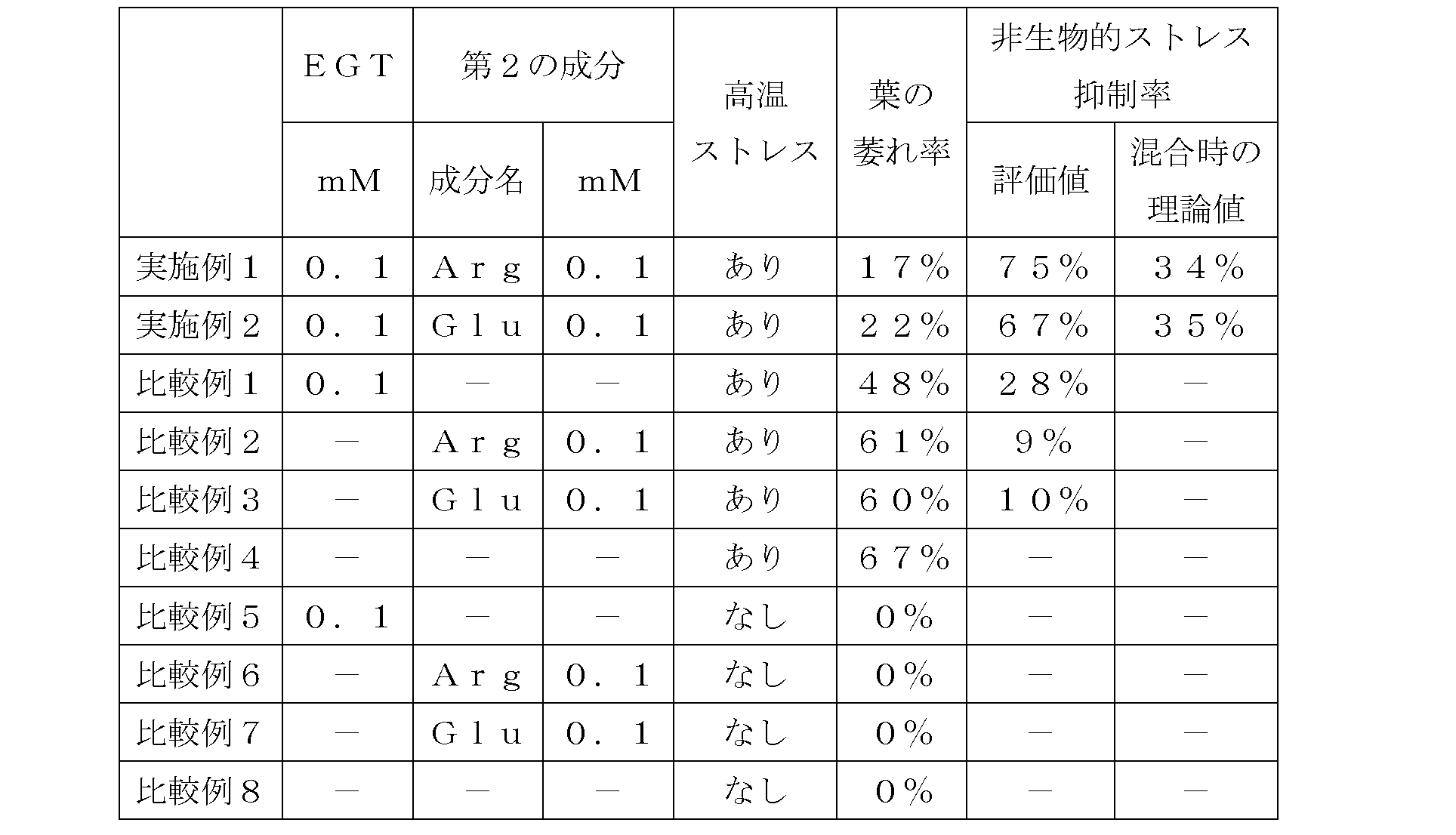
- the artificial climate chamber was set at a room temperature of 22°C, with a light period of 16 hours and a dark period of 8 hours. Light conditions were set so that the light intensity was 5000 lx at the center under fluorescent light irradiation. Water was supplied from the bottom, and the water level was set to approximately 5 mm. 92 days after sowing, 40 mL of an abiotic stress resistance enhancer was added in place of water, and two days later the plants were exposed to a 45°C environment for one hour, and three days later they were exposed to a 42°C environment for three hours to apply high temperature stress.
- Leaf wilting rate (%) (number of wilted leaves/total number of leaves on the tested plant) x 100
- Abiotic stress suppression rate (evaluation value) (%) ⁇ 1 - (leaf wilting rate in test compound-treated group/leaf wilting rate in untreated group) ⁇ x 100
- Example 4 67% of the Arabidopsis leaves tested under high temperature stress suffered physiological wilting.
- the abiotic stress resistance enhancers of Examples 1 and 2 had a lower leaf wilting rate and a better abiotic stress suppression rate than the abiotic stress resistance enhancers containing only Arg or Glu (Comparative Examples 2 and 3) and the abiotic stress resistance enhancer containing only EGT (Comparative Example 1). Furthermore, the abiotic stress resistance enhancers of Examples 1 and 2 were greater than the theoretical value when mixed, confirming a synergistic effect.
- Example 2 Comparison of resistance effects against ultraviolet stress
- the abiotic stress resistance improvers of Example 3 and Comparative Examples 9, 10, 12, and 13 were prepared to have the concentrations shown in Table 2 below.
- Commercially available EGT and Glu were used, and pure water was used as the solvent.
- the pure water in the petri dish was removed, and then 5 mL of an abiotic stress resistance enhancer was added to the petri dish.
- an ultraviolet lamp Toshiba Corporation, GL-15 set so that the ultraviolet radiation intensity at a wavelength of 254 nm was 535 ⁇ W/cm ⁇ 2 .
- Leaf mortality rate (%) (number of dead leaves/total number of leaves on the tested plant) x 100
- Abiotic stress suppression rate (evaluation value) (%) ⁇ 1 - (leaf mortality rate in test compound-treated area/leaf mortality rate in untreated area) ⁇ x 100
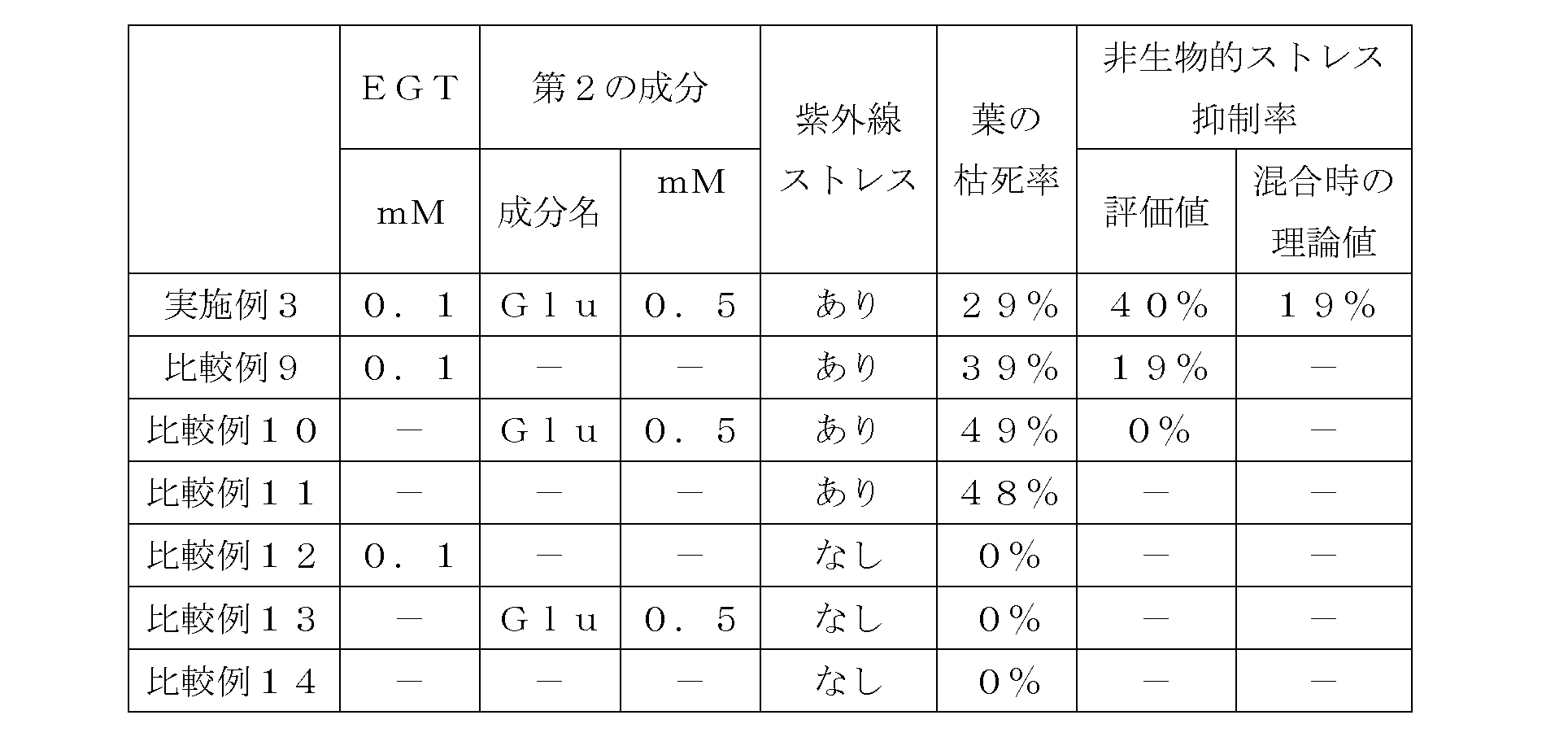
- UV stress caused physiological disorders such as chlorosis in wheat, and 48% of the leaves of the tested wheat plants died (Comparative Example 11).
- the abiotic stress resistance enhancer of Example 3 had a lower leaf mortality rate and a better abiotic stress suppression rate than the abiotic stress resistance enhancer containing only Glu (Comparative Example 10) and the abiotic stress resistance enhancer containing only EGT (Comparative Example 9). Furthermore, the abiotic stress resistance enhancer of Example 3 was greater than the theoretical value when mixed, confirming a synergistic effect.
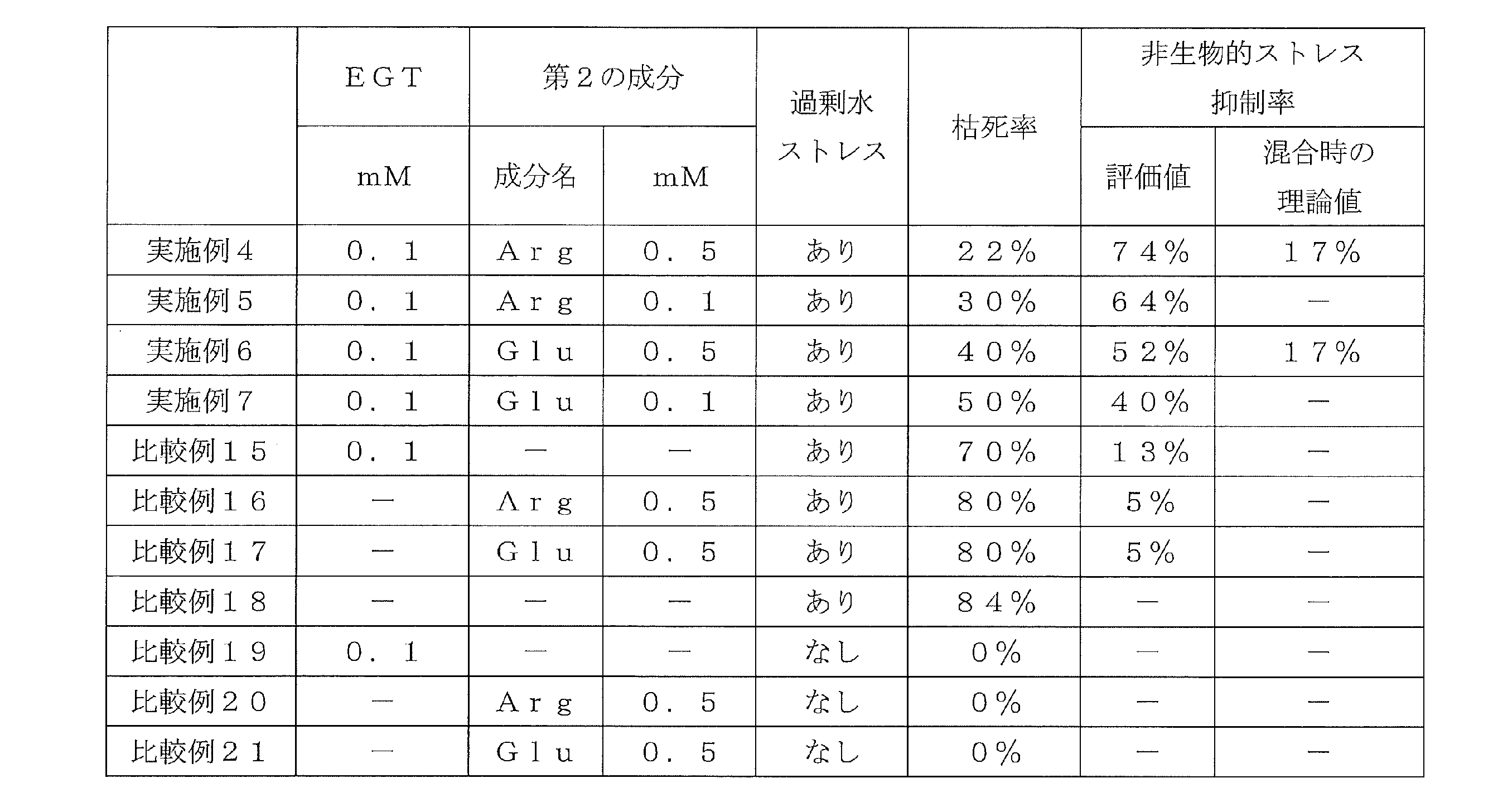
- the number of surviving plants 10 days after the application of excess water stress was counted, and the mortality rate of the plants was evaluated as an index of physiological disorders.
- the evaluation results are shown in Table 3.
- the mortality rate and the abiotic stress inhibition rate (evaluation value) were calculated according to the following formula.
- Mortality rate (%) ⁇ 1 - (number of surviving plants/number of plants tested) ⁇ x 100
- Abiotic stress suppression rate (evaluation value) (%) ⁇ 1 - (mortality rate in test compound-treated area/mortality rate in untreated area) ⁇ x 100
- the plants were kept in a greenhouse with a room temperature of 25°C. Thirty-one days after sowing, 50 mL of an abiotic stress resistance enhancer was added to the deep dish instead of water, and then water supply was stopped for five days to apply drought stress.
- Leaf mortality rate (%) (number of dead leaves/total number of leaves on the tested plant) x 100
- Abiotic stress suppression rate (evaluation value) (%) ⁇ 1 - (leaf mortality rate in test compound-treated area/leaf mortality rate in untreated area) ⁇ x 100
- the abiotic stress tolerance enhancers of Examples 8, 9, 10, 11, 12, 13, 14, and 15 had lower leaf mortality and better abiotic stress suppression rates than the abiotic stress tolerance enhancers containing only trehalose, Met, GSSG, GABA, citric acid, VitC, or sorbic acid (Comparative Examples 24, 25, 26, 27, 28, 29, 30, and 31), and the abiotic stress tolerance enhancer containing only EGT (Comparative Example 23).
- the abiotic stress tolerance enhancers of Examples 8, 9, 10, 11, 12, 13, 14, and 15 had higher leaf mortality and better abiotic stress suppression rates than the theoretical values when mixed, confirming a synergistic effect.
- the pure water in the petri dishes was removed, and 5 mL of an abiotic stress resistance enhancer was added to the dishes. 24 hours later, the dishes were exposed to a 4°C environment for 48 hours to apply low temperature stress.
- Leaf wilting rate (%) (number of wilted leaves/total number of leaves on the tested plant) x 100
- Abiotic stress suppression rate (evaluation value) (%) ⁇ 1 - (leaf wilting rate in test compound-treated group/leaf wilting rate in untreated group) ⁇ x 100
- abiotic stress resistance enhancers of Examples 16 and 17 had a lower leaf wilting rate and a better abiotic stress suppression rate than the abiotic stress resistance enhancers containing only His or uracil (Comparative Examples 35 and 36) and the abiotic stress resistance enhancer containing only EGT (Comparative Example 34). Furthermore, the abiotic stress resistance enhancers of Examples 16 and 17 were greater than the theoretical value when mixed, confirming a synergistic effect.
- Example 6 Comparison of tolerance effects against freezing stress
- the abiotic stress tolerance enhancers of Example 18 and Comparative Examples 39 and 40 were prepared to have the concentrations shown in Table 6 below.
- Commercially available ergothioneine (EGT) and malic acid were used, and pure water was used as the solvent.
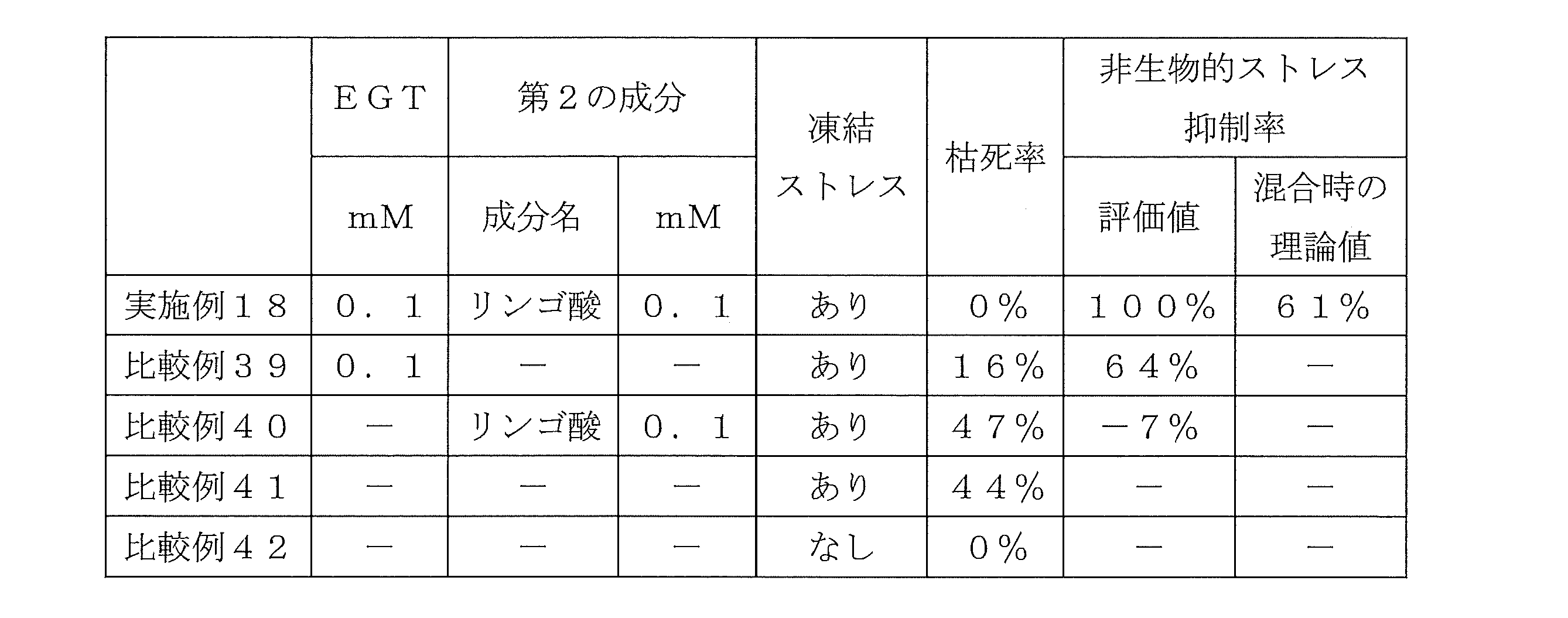
- the number of surviving plants was counted one day after the application of freezing stress, and the mortality rate of the plants was evaluated as an index of physiological disorders. The evaluation results are shown in Table 6.
- the mortality rate and the abiotic stress inhibition rate (evaluation value) were calculated according to the following formula.
- Mortality rate (%) ⁇ 1 - (number of surviving plants/number of plants tested) ⁇ x 100
- Abiotic stress suppression rate (evaluation value) (%) ⁇ 1 - (mortality rate in test compound-treated area/mortality rate in untreated area) ⁇ x 100
- Example 41 freezing stress caused physiological disorders in broccoli such as stem breakage and necrosis, and 44% of the broccoli tested died (Comparative Example 41).
- the abiotic stress resistance enhancer of Example 18 had a lower mortality rate and a better abiotic stress suppression rate than the abiotic stress resistance enhancer containing only malic acid (Comparative Example 40) and the abiotic stress resistance enhancer containing only EGT (Comparative Example 39). Furthermore, the abiotic stress resistance enhancer of Example 18 was greater than the theoretical value when mixed, confirming a synergistic effect.
- the plants were kept in a greenhouse with a room temperature set at 25°C. Thirty-one days after sowing, 50 mL of an abiotic stress resistance enhancer was added to the deep dish in place of water, and one day later, liquid fertilizer (HYPONeX, manufactured by Hyponex Japan) was applied at a 5-fold dilution to provide excess nutrient stress.
- liquid fertilizer (HYPONeX, manufactured by Hyponex Japan) was applied at a 5-fold dilution to provide excess nutrient stress.
- Leaf mortality rate (%) (number of dead leaves/total number of leaves on the tested plant) x 100
- Abiotic stress suppression rate (evaluation value) (%) ⁇ 1 - (leaf mortality rate in test compound-treated area/leaf mortality rate in untreated area) ⁇ x 100
- the artificial climate chamber was set at a room temperature of 22°C, with a light period of 16 hours and a dark period of 8 hours. Light conditions were set so that the light intensity was 5000 lx at the center under fluorescent light irradiation. Water was supplied from the bottom, and the water level was set to approximately 5 mm. Thirty days after sowing, 50 mL of an abiotic stress resistance enhancer was added in place of water, and two days later the plants were exposed to a 45°C environment for one hour, and then to a 55°C environment for 30 minutes to apply high temperature stress.
- Leaf wilting rate (%) (number of wilted leaves/total number of leaves on the tested plant) x 100
- Abiotic stress suppression rate (evaluation value) (%) ⁇ 1 - (leaf wilting rate in test compound-treated group/leaf wilting rate in untreated group) ⁇ x 100
- Example 55 62% of the test tomato leaves suffered from physiological wilting due to high temperature stress.
- the abiotic stress resistance enhancers of Examples 24 and 25 had a lower leaf wilting rate and a better abiotic stress suppression rate than the abiotic stress resistance enhancers containing only acetic acid or Pro (Comparative Examples 53 and 54) and the abiotic stress resistance enhancers containing only EGT (Comparative Examples 51 and 52).
- the abiotic stress resistance enhancers of Examples 24 and 25 were greater than the theoretical value when mixed, confirming a synergistic effect.
- the present invention makes it possible to increase the abiotic stress tolerance of plants and easily increase plant production.
Landscapes
- Life Sciences & Earth Sciences (AREA)
- Environmental Sciences (AREA)
- Health & Medical Sciences (AREA)
- Engineering & Computer Science (AREA)
- General Health & Medical Sciences (AREA)
- Wood Science & Technology (AREA)
- Plant Pathology (AREA)
- Pest Control & Pesticides (AREA)
- Zoology (AREA)
- Agronomy & Crop Science (AREA)
- Dentistry (AREA)
- Toxicology (AREA)
- Botany (AREA)
- Chemical & Material Sciences (AREA)
- Chemical Kinetics & Catalysis (AREA)
- General Chemical & Material Sciences (AREA)
- Agricultural Chemicals And Associated Chemicals (AREA)
- Biodiversity & Conservation Biology (AREA)
- Ecology (AREA)
- Forests & Forestry (AREA)
Abstract
Description
[1]下記式(I)で示される化合物もしくはその互変異性体、またはそれらの農学的に許容可能な塩である第1の成分と、
アミノ酸、2以上10以下のアミノ酸長であるペプチド、ベタイン、有機酸またはその塩、核酸塩基、ビタミン、および、糖または糖アルコールからなる群から選択される少なくとも1である第2の成分と、を含む、植物の非生物的ストレス耐性向上剤。
[2]前記式(I)で示される化合物は、エルゴチオネインである、
[1]に記載の非生物的ストレス耐性向上剤。
[3]植物への付与により、高温ストレス、低温ストレス、凍結ストレス、塩ストレス、過剰養分ストレス、乾燥ストレス、過剰水ストレス、紫外線ストレス、弱光ストレス、強光ストレス、過剰刈込ストレス、踏圧ストレス、雹ストレスおよび強風ストレスからなる群から選択される少なくとも1つである非生物的ストレスに対する前記植物の耐性を向上させる、
[1]または[2]に記載の非生物的ストレス耐性向上剤。
[4]植物への付与により、高温ストレス、紫外線ストレスおよび過剰水ストレスからなる群から選択される少なくとも1つである非生物的ストレスに対する前記植物の耐性を向上させる、
[1]~[3]のいずれかに記載の非生物的ストレス耐性向上剤。
[5]前記第2の成分は、アミノ酸を含み、
前記アミノ酸は、グルタミン酸またはアルギニンである、
[1]~[4]のいずれかに記載の非生物的ストレス耐性向上剤。
[6]植物を用意する工程と、
前記植物を、[1]~[5]のいずれかに記載の非生物的ストレス耐性向上剤で処理する工程と、を含む、
植物の非生物的ストレス耐性向上方法。
[7]下記式(I)で示される化合物もしくはその互変異性体、またはそれらの農学的に許容可能な塩である第1の成分と、
アミノ酸、2以上10以下のアミノ酸長であるペプチド、ベタイン、有機酸またはその塩、核酸塩基、ビタミン、および、糖または糖アルコールからなる群から選択される少なくとも1である第2の成分と、
液体担体または固体担体と、を含む、
植物の非生物的ストレス耐性向上用製剤。

[8]下記式(I)で示される化合物もしくはその互変異性体、またはそれらの農学的に許容可能な塩である第1の成分を含む第1の容器と、
アミノ酸、2以上10以下のアミノ酸長であるペプチド、ベタイン、有機酸またはその塩、核酸塩基、ビタミン、および、糖または糖アルコールからなる群から選択される少なくとも1である第2の成分を含む第2の容器と、
を有する、
植物の非生物的ストレス耐性向上用製品。
[9][1]~[5]のいずれかに記載の非生物的ストレス耐性向上剤を付与され、生育された、植物。
第1の成分は、下記式(I)で示される化合物もしくはその互変異性体、またはそれらの農学的に許容可能な塩である。非生物的ストレス耐性向上剤は、第1の成分を1種のみ含んでもよいし、複数種含んでもよい。
第2の成分は、アミノ酸、2以上10以下のアミノ酸長であるペプチド、ベタイン、有機酸またはその塩、核酸塩基、ビタミン、および、糖または糖アルコールからなる群から選択される少なくとも1つの成分である。これらの第2の成分は、第1の成分との相乗効果により、植物の非生物的ストレス耐性の向上効果を顕著に高める。非生物的ストレス耐性向上剤は、第2の成分を1種のみ含んでもよいし、複数種含んでもよい。
本実施態様に関する非生物的ストレス耐性向上剤は、有効成分としての第1の成分および第2の成分の相乗効果により、植物の非生物的ストレス耐性を顕著に向上させる。非生物的ストレスとは、害虫、病気、雑誌、雑草および間引きなどの生物的ストレスとは異なる、非生物的なストレスを意味する。非生物的ストレスの例には、高温ストレス、低温ストレス、凍結ストレス、塩ストレス、過剰養分ストレス、乾燥ストレス、過剰水ストレス、紫外線ストレス、弱光ストレス、強光ストレス、過剰刈込ストレス、踏圧ストレス、雹ストレスおよび強風ストレスなどが含まれる。非生物的ストレス耐性向上剤は、これにより処理された植物の、これらの非生物的ストレス、たとえば高温ストレスに対する耐性を向上させる。
上記第1の成分および第2の成分は、有効成分として上記第1の成分および第2の成分を含み、さらにその他の補助剤またはその他の有効成分と共に、各種剤型の製剤として市場に流通させることができる。上記活性成分そのものを製剤としてもよいし、その他の補助剤またはその他の有効成分と共に、各種剤型の製剤としてもよい。剤型は特に限定されず、処理方法に応じて選択すればよい。剤型の例には、粉剤、粒剤、粉粒剤、水和剤、水溶剤、乳剤、液剤、油剤、エアゾル、マイクロカプセル剤、ペースト剤、塗布剤、くん煙剤、くん蒸剤および微量散布剤などが含まれる。
上記補助剤の例には、担体、界面活性剤およびその他の補助剤が含まれる。
その他の有効成分の例には、バイオスティミュラント、植物生長調節剤、殺菌剤、殺虫剤、殺ダニ剤、殺線虫剤および除草剤に含まれる有効成分を挙げることができる。なお、上記第1の成分および第2の成分に他のバイオスティミュラントを併用することで、非生物的ストレスへの耐性をより高めたり、生長の促進効果をより高めたりすることもできる。
製剤中の第1の成分の含有量は、剤型や植物への付与量等に応じて任意に定めることができる。たとえば、製剤は、第1の成分を、その全質量に対して0.01質量%以上90質量%以下含むことが好ましく、0.1質量%以上50重量%以下含むことがより好ましい。また、製剤は、第2の成分を、その全質量に対して0.00001質量%以上90質量%含むことが好ましく、0.0001質量%以上50質量%含むことがより好ましい。
非生物的ストレス耐性向上剤は、第1の成分および第2の成分を混合して調製することができる。このとき、固体担体または液体担体を用いて、所定の剤型を有する製剤を調製してもよい。なお、第1の成分は、これを含む微生物、植物または海藻の抽出物を使用してもよい。また、第2の成分は、これを含む微生物、植物または海藻の抽出物を使用してもよい。また、第1の成分および第2の成分を含む、微生物、植物または海藻の抽出物を、非生物的ストレス耐性向上剤として使用してもよい。
上述した非生物的ストレス耐性向上剤またはこれを含む製剤は、予め用意した植物にこれを付与することで、当該植物の非生物的ストレス耐性を向上させるために使用することができる。
なお、上述の実施形態は、本発明の例示的な実施形態であり、本発明は、その中核となる技術思想の範囲内において上述の実施形態以外の実施態様を含み得ることはいうまでもない。
以下の表1に記載の濃度になるように、実施例1、2および比較例1~3、5~7の非生物的ストレス耐性向上剤を調整した。エルゴチオネイン(EGT)、アルギニン(Arg)およびグルタミン酸(Glu)は市販品を使用し、溶媒として純水を使用した。
葉の萎れ率(%)
=(萎れた葉の数/供試した植物の葉の総数)×100
非生物的ストレス抑制率(評価値)(%)
={1-(供試化合物処理区の葉の萎れ率/無処理区の葉の萎れ率)}×100
混合添加時の非生物的ストレス抑制率(理論値)(%)=α+((100-α)×β)/100
を用いた方法により、2種の化合物の協力効果の判定を行った。
なお、上記式中、αおよびβは、それぞれの化合物の単独添加時の非生物的ストレス抑制率を示している。
以下の表2に記載の濃度になるように、実施例3および比較例9、10、12、13の非生物的ストレス耐性向上剤を調整した。EGTおよびGluは市販品を使用し、溶媒として純水を使用した。
葉の枯死率(%)
=(枯死した葉の数/供試した植物の葉の総数)×100
非生物的ストレス抑制率(評価値)(%)
={1-(供試化合物処理区の葉の枯死率/無処理区の葉の枯死率)}×100
混合添加時の非生物的ストレス抑制率(理論値)(%)=α+((100-α)×β)/100
を用いた方法により、2種の化合物の協力効果の判定を行った。
なお、上記式中、αおよびβは、それぞれの化合物の単独添加時の非生物的ストレス抑制率を示している。
以下の表3に記載の濃度になるように、実施例4~7および比較例15~17、19~21の非生物的ストレス耐性向上剤を調整した。EGTおよびGluは市販品を使用し、溶媒として純水を使用した。
枯死率(%)
={1-(生存した植物数/供試した植物数)}×100
非生物的ストレス抑制率(評価値)(%)
={1-(供試化合物処理区の枯死率/無処理区の枯死率)}×100
混合添加時の非生物的ストレス抑制率(理論値)(%)=α+((100-α)×β)/100
を用いた方法により、2種の化合物の協力効果の判定を行った。
なお、上記式中、αおよびβは、それぞれの化合物の単独添加時の非生物的ストレス抑制率を示している。
以下の表4に記載の濃度になるように、実施例8~15および比較例23~31の非生物的ストレス耐性向上剤を調整した。エルゴチオネイン(EGT)、トレハロース、メチオニン(Met)、酸化型グルタチオン(GSSG)、γ-アミノ酪酸(GABA)、クエン酸、アスコルビン酸(VitC)およびソルビン酸カリウム(ソルビン酸)は市販品を使用し、溶媒として純水を使用した。
葉の枯死率(%)
=(枯死した葉の数/供試した植物の葉の総数)×100
非生物的ストレス抑制率(評価値)(%)
={1-(供試化合物処理区の葉の枯死率/無処理区の葉の枯死率)}×100
混合添加時の非生物的ストレス抑制率(理論値)(%)=α+((100-α)×β)/100
を用いた方法により、2種の化合物の協力効果の判定を行った。
なお、上記式中、αおよびβは、それぞれの化合物の単独添加時の非生物的ストレス抑制率を示している。

以下の表5に記載の濃度になるように、実施例16~17および比較例34~36の非生物的ストレス耐性向上剤を調整した。エルゴチオネイン(EGT)、ヒスチジン(His)およびウラシルは市販品を使用し、溶媒として純水を使用した。
葉の萎れ率(%)
=(萎れた葉の数/供試した植物の葉の総数)×100
非生物的ストレス抑制率(評価値)(%)
={1-(供試化合物処理区の葉の萎れ率/無処理区の葉の萎れ率)}×100
混合添加時の非生物的ストレス抑制率(理論値)(%)=α+((100-α)×β)/100
を用いた方法により、2種の化合物の協力効果の判定を行った。
なお、上記式中、αおよびβは、それぞれの化合物の単独添加時の非生物的ストレス抑制率を示している。

以下の表6に記載の濃度になるように、実施例18および比較例39、40の非生物的ストレス耐性向上剤を調整した。エルゴチオネイン(EGT)およびリンゴ酸は市販品を使用し、溶媒として純水を使用した。
枯死率(%)
={1-(生存した植物数/供試した植物数)}×100
非生物的ストレス抑制率(評価値)(%)
={1-(供試化合物処理区の枯死率/無処理区の枯死率)}×100
混合添加時の非生物的ストレス抑制率(理論値)(%)=α+((100-α)×β)/100
を用いた方法により、2種の化合物の協力効果の判定を行った。
なお、上記式中、αおよびβは、それぞれの化合物の単独添加時の非生物的ストレス抑制率を示している。
以下の表7に記載の濃度になるように、実施例19~23および比較例43~48の非生物的ストレス耐性向上剤を調整した。エルゴチオネイン(EGT)、プロリン(Pro)、5-アミノレブリン酸(5-ALA)、グリシンベタイン(GB)および酢酸は市販品を使用し、溶媒として純水を使用した。
葉の枯死率(%)
=(枯死した葉の数/供試した植物の葉の総数)×100
非生物的ストレス抑制率(評価値)(%)
={1-(供試化合物処理区の葉の枯死率/無処理区の葉の枯死率)}×100
混合添加時の非生物的ストレス抑制率(理論値)(%)=α+((100-α)×β)/100
を用いた方法により、2種の化合物の協力効果の判定を行った。
なお、上記式中、αおよびβは、それぞれの化合物の単独添加時の非生物的ストレス抑制率を示している。

以下の表8に記載の濃度になるように、実施例24、25および比較例51~54の非生物的ストレス耐性向上剤を調整した。エルゴチオネイン(EGT)、酢酸およびプロリン(Pro)は市販品を使用し、溶媒として純水を使用した。
葉の萎れ率(%)
=(萎れた葉の数/供試した植物の葉の総数)×100
非生物的ストレス抑制率(評価値)(%)
={1-(供試化合物処理区の葉の萎れ率/無処理区の葉の萎れ率)}×100
混合添加時の非生物的ストレス抑制率(理論値)(%)=α+((100-α)×β)/100
を用いた方法により、2種の化合物の協力効果の判定を行った。
なお、上記式中、αおよびβは、それぞれの化合物の単独添加時の非生物的ストレス抑制率を示している。

Claims (9)
- 下記式(I)で示される化合物もしくはその互変異性体、またはそれらの農学的に許容可能な塩である第1の成分と、
アミノ酸、2以上10以下のアミノ酸長であるペプチド、ベタイン、有機酸またはその塩、核酸塩基、ビタミン、および、糖または糖アルコールからなる群から選択される少なくとも1である第2の成分と、を含む、植物の非生物的ストレス耐性向上剤。

- 前記式(I)で示される化合物は、エルゴチオネインである、
請求項1に記載の非生物的ストレス耐性向上剤。 - 植物への付与により、高温ストレス、低温ストレス、凍結ストレス、塩ストレス、過剰養分ストレス、乾燥ストレス、過剰水ストレス、紫外線ストレス、弱光ストレス、強光ストレス、過剰刈込ストレス、踏圧ストレス、雹ストレスおよび強風ストレスからなる群から選択される少なくとも1つである非生物的ストレスに対する前記植物の耐性を向上させる、
請求項1または2に記載の非生物的ストレス耐性向上剤。 - 植物への付与により、高温ストレス、紫外線ストレスおよび過剰水ストレスからなる群から選択される少なくとも1つである非生物的ストレスに対する前記植物の耐性を向上させる、
請求項1~3のいずれか1項に記載の非生物的ストレス耐性向上剤。 - 前記第2の成分は、アミノ酸を含み、
前記アミノ酸は、グルタミン酸またはアルギニンである、
請求項1~4のいずれか1項に記載の非生物的ストレス耐性向上剤。 - 植物を用意する工程と、
前記植物を、請求項1~5のいずれか1項に記載の非生物的ストレス耐性向上剤で処理する工程と、を含む、
植物の非生物的ストレス耐性向上方法。 - 下記式(I)で示される化合物もしくはその互変異性体、またはそれらの農学的に許容可能な塩である第1の成分と、
アミノ酸、2以上10以下のアミノ酸長であるペプチド、ベタイン、有機酸またはその塩、核酸塩基、ビタミン、および、糖または糖アルコールからなる群から選択される少なくとも1である第2の成分と、
液体担体または固体担体と、を含む、
植物の非生物的ストレス耐性向上用製剤。
- 下記式(I)で示される化合物もしくはその互変異性体、またはそれらの農学的に許容可能な塩である第1の成分を含む第1の容器と、
アミノ酸、2以上10以下のアミノ酸長であるペプチド、ベタイン、有機酸またはその塩、核酸塩基、ビタミン、および、糖または糖アルコールからなる群から選択される少なくとも1である第2の成分を含む第2の容器と、
を有する、
植物の非生物的ストレス耐性向上用製品。
- 請求項1~5のいずれか1項に記載の非生物的ストレス耐性向上剤を付与され、生育された、植物。
Priority Applications (4)
| Application Number | Priority Date | Filing Date | Title |
|---|---|---|---|
| JP2025559257A JPWO2025110202A1 (ja) | 2023-11-21 | 2024-11-21 | |
| CN202480055965.2A CN121772845A (zh) | 2023-11-21 | 2024-11-21 | 植物的非生物胁迫耐受性提高剂、非生物胁迫耐受性提高方法、非生物胁迫耐受性提高用制剂、非生物胁迫耐受性提高用产品以及植物 |
| AU2024383898A AU2024383898A1 (en) | 2023-11-21 | 2024-11-21 | Plant abiotic stress tolerance improver, method for improving abiotic stress tolerance, formulation for improving abiotic stress tolerance, product for improving abiotic stress tolerance, and plant |
| KR1020267007850A KR20260049310A (ko) | 2023-11-21 | 2024-11-21 | 식물의 비생물적 스트레스 내성 향상제, 비생물적 스트레스 내성 향상 방법, 비생물적 스트레스 내성 향상용 제제, 비생물적 스트레스 내성 향상용 제품, 및 식물 |
Applications Claiming Priority (2)
| Application Number | Priority Date | Filing Date | Title |
|---|---|---|---|
| JP2023197530 | 2023-11-21 | ||
| JP2023-197530 | 2023-11-21 |
Publications (1)
| Publication Number | Publication Date |
|---|---|
| WO2025110202A1 true WO2025110202A1 (ja) | 2025-05-30 |
Family
ID=95826873
Family Applications (1)
| Application Number | Title | Priority Date | Filing Date |
|---|---|---|---|
| PCT/JP2024/041229 Pending WO2025110202A1 (ja) | 2023-11-21 | 2024-11-21 | 植物の非生物的ストレス耐性向上剤、非生物的ストレス耐性向上方法、非生物的ストレス耐性向上用製剤、非生物的ストレス耐性向上用製品、および植物 |
Country Status (6)
| Country | Link |
|---|---|
| JP (1) | JPWO2025110202A1 (ja) |
| KR (1) | KR20260049310A (ja) |
| CN (1) | CN121772845A (ja) |
| AR (1) | AR134409A1 (ja) |
| AU (1) | AU2024383898A1 (ja) |
| WO (1) | WO2025110202A1 (ja) |
Citations (18)
| Publication number | Priority date | Publication date | Assignee | Title |
|---|---|---|---|---|
| WO1996014749A1 (en) | 1994-11-15 | 1996-05-23 | Ab Tall (Holdings) Pty. Ltd. | Osmolyte regulator |
| JPH092914A (ja) * | 1995-06-20 | 1997-01-07 | Fumakilla Ltd | エノキタケまたはエノキタケ培養残渣由来の植物生理活性物質 |
| US5972840A (en) * | 1995-02-02 | 1999-10-26 | Ab Tall (Holdings) Pty. Ltd. | Osmolyte regulator |
| JP2006160748A (ja) | 1993-06-28 | 2006-06-22 | Oxis Isle Of Man Ltd | エルゴチオネインの新規合成方法 |
| JP2012010694A (ja) * | 2010-06-01 | 2012-01-19 | Ajinomoto Co Inc | 植物のアレロパシー効果、および/またはファイトアレキシン生産の増強用薬剤 |
| JP2012105618A (ja) | 2010-11-19 | 2012-06-07 | Sachiko Shimizu | エルゴチオネインの製造方法 |
| JP2013506706A (ja) | 2009-10-06 | 2013-02-28 | テトラエドロン | エルゴチオネインなどの合成方法 |
| JP2014223051A (ja) | 2012-07-13 | 2014-12-04 | タカラバイオ株式会社 | エルゴチオネインの製造方法 |
| WO2015168112A1 (en) | 2014-04-29 | 2015-11-05 | Conagen, Inc. | Microbial ergothioneine biosynthesis |
| WO2016104437A1 (ja) | 2014-12-22 | 2016-06-30 | 国立大学法人 岡山大学 | エルゴチオネインの産生方法 |
| WO2016121285A1 (ja) | 2015-01-30 | 2016-08-04 | キッコーマン株式会社 | エルゴチオネイン生産能が増強された形質転換糸状菌及びエルゴチオネインの製造方法 |
| WO2017150304A1 (ja) | 2016-02-29 | 2017-09-08 | 長瀬産業株式会社 | エルゴチオネインの発酵生産 |
| JP2018130091A (ja) * | 2017-02-17 | 2018-08-23 | 国立大学法人 筑波大学 | 植物体、食品、培養物、肥料及び製造方法 |
| JP2018177799A (ja) * | 2017-04-19 | 2018-11-15 | 小山 修 | 植物の土壌病害防除方法 |
| WO2021005970A1 (ja) | 2019-07-10 | 2021-01-14 | 株式会社クレハ | 植物生長調整剤および植物の生長促進方法 |
| WO2022149593A1 (ja) * | 2021-01-08 | 2022-07-14 | 株式会社クレハ | 植物生長調整剤または植物の生長促進方法 |
| WO2024009937A1 (ja) * | 2022-07-06 | 2024-01-11 | 株式会社クレハ | 植物生長調整剤、植物の生長促進方法または植物生長調整用製品 |
| WO2024071089A1 (ja) * | 2022-09-27 | 2024-04-04 | 株式会社クレハ | 植物の環境ストレス耐性向上剤および環境ストレス耐性向上方法 |
-
2024
- 2024-11-15 AR ARP240103161A patent/AR134409A1/es unknown
- 2024-11-21 WO PCT/JP2024/041229 patent/WO2025110202A1/ja active Pending
- 2024-11-21 KR KR1020267007850A patent/KR20260049310A/ko active Pending
- 2024-11-21 JP JP2025559257A patent/JPWO2025110202A1/ja active Pending
- 2024-11-21 CN CN202480055965.2A patent/CN121772845A/zh active Pending
- 2024-11-21 AU AU2024383898A patent/AU2024383898A1/en active Pending
Patent Citations (18)
| Publication number | Priority date | Publication date | Assignee | Title |
|---|---|---|---|---|
| JP2006160748A (ja) | 1993-06-28 | 2006-06-22 | Oxis Isle Of Man Ltd | エルゴチオネインの新規合成方法 |
| WO1996014749A1 (en) | 1994-11-15 | 1996-05-23 | Ab Tall (Holdings) Pty. Ltd. | Osmolyte regulator |
| US5972840A (en) * | 1995-02-02 | 1999-10-26 | Ab Tall (Holdings) Pty. Ltd. | Osmolyte regulator |
| JPH092914A (ja) * | 1995-06-20 | 1997-01-07 | Fumakilla Ltd | エノキタケまたはエノキタケ培養残渣由来の植物生理活性物質 |
| JP2013506706A (ja) | 2009-10-06 | 2013-02-28 | テトラエドロン | エルゴチオネインなどの合成方法 |
| JP2012010694A (ja) * | 2010-06-01 | 2012-01-19 | Ajinomoto Co Inc | 植物のアレロパシー効果、および/またはファイトアレキシン生産の増強用薬剤 |
| JP2012105618A (ja) | 2010-11-19 | 2012-06-07 | Sachiko Shimizu | エルゴチオネインの製造方法 |
| JP2014223051A (ja) | 2012-07-13 | 2014-12-04 | タカラバイオ株式会社 | エルゴチオネインの製造方法 |
| WO2015168112A1 (en) | 2014-04-29 | 2015-11-05 | Conagen, Inc. | Microbial ergothioneine biosynthesis |
| WO2016104437A1 (ja) | 2014-12-22 | 2016-06-30 | 国立大学法人 岡山大学 | エルゴチオネインの産生方法 |
| WO2016121285A1 (ja) | 2015-01-30 | 2016-08-04 | キッコーマン株式会社 | エルゴチオネイン生産能が増強された形質転換糸状菌及びエルゴチオネインの製造方法 |
| WO2017150304A1 (ja) | 2016-02-29 | 2017-09-08 | 長瀬産業株式会社 | エルゴチオネインの発酵生産 |
| JP2018130091A (ja) * | 2017-02-17 | 2018-08-23 | 国立大学法人 筑波大学 | 植物体、食品、培養物、肥料及び製造方法 |
| JP2018177799A (ja) * | 2017-04-19 | 2018-11-15 | 小山 修 | 植物の土壌病害防除方法 |
| WO2021005970A1 (ja) | 2019-07-10 | 2021-01-14 | 株式会社クレハ | 植物生長調整剤および植物の生長促進方法 |
| WO2022149593A1 (ja) * | 2021-01-08 | 2022-07-14 | 株式会社クレハ | 植物生長調整剤または植物の生長促進方法 |
| WO2024009937A1 (ja) * | 2022-07-06 | 2024-01-11 | 株式会社クレハ | 植物生長調整剤、植物の生長促進方法または植物生長調整用製品 |
| WO2024071089A1 (ja) * | 2022-09-27 | 2024-04-04 | 株式会社クレハ | 植物の環境ストレス耐性向上剤および環境ストレス耐性向上方法 |
Non-Patent Citations (5)
| Title |
|---|
| ANONYMOUS: "What is a biostimulant? An easy-to-understand introduction", WWW.PHYTO.JP / INTERNET ARCHIVE WAYBACK MACHINE, PHYTOCHROME INC., JP, 25 September 2023 (2023-09-25), JP, pages 1 - 4, XP093318319, Retrieved from the Internet <URL:https://web.archive.org/web/20230925093701/https://www.phyto.jp/biostimulant/> * |
| KENTA KEIRINBO, TOMOKAZU DOGASAKI: "Basic research on ergothioneine in edible mushrooms", AZABU DAIGAKU ZASSHI - JOURNAL OF AZABU UNIVERSITY, AZABU DAIGAKU, KANAGAWA, JP, vol. 15-16, 31 March 2008 (2008-03-31), JP , pages 65 - 66, XP009563991, ISSN: 1346-5880 * |
| no. 887947-29-7 |
| NUKINA, MANABU: "Possibility of wider applications and mass production of natural antioxidant ''ergothioneine", KONGETSU NO NOGYO - AGRICULTURAL CHEMICALS MONTHLY, CHEMICAL DAILY CO. LTD, TOKYO, JP, vol. 53, no. 1, 1 January 2009 (2009-01-01), JP , pages 39 - 43, XP009563962, ISSN: 0912-1404 * |
| SUDO OSAMU: "Definition and Significance of Biostimulants", JBSA ENHANCE PLANT PERFORMANCE AND CROP VALUE / INTERNET ARCHIVE WAYBACK MACHINE, JAPAN BIOSTIMULANT COUNCIL, 26 April 2019 (2019-04-26), pages 1 - 4, XP093318306, Retrieved from the Internet <URL:https://web.archive.org/web/20190426095638/https://www.japanbsa.com/biostimulant/definition_and_significance.html> * |
Also Published As
| Publication number | Publication date |
|---|---|
| AR134409A1 (es) | 2026-01-14 |
| JPWO2025110202A1 (ja) | 2025-05-30 |
| KR20260049310A (ko) | 2026-04-13 |
| CN121772845A (zh) | 2026-03-31 |
| AU2024383898A1 (en) | 2026-03-26 |
Similar Documents
| Publication | Publication Date | Title |
|---|---|---|
| JP7574328B2 (ja) | 植物生長調整剤または植物の生長促進方法 | |
| JP7626810B2 (ja) | 植物の生長促進方法、草丈増強方法、植物生長促進剤、および草丈増強剤 | |
| JP7748574B2 (ja) | 植物の環境ストレス耐性向上剤および環境ストレス耐性向上方法 | |
| JP7752245B2 (ja) | 植物生長調整剤、植物の生長促進方法または植物生長調整用製品 | |
| RU2861320C2 (ru) | Регулятор роста растений (варианты), его применение, способ стимуляции роста растений и способ получения регулятора роста растений | |
| RU2832767C1 (ru) | Стимулятор роста растений или способ стимуляции роста растений | |
| AU2024383898A1 (en) | Plant abiotic stress tolerance improver, method for improving abiotic stress tolerance, formulation for improving abiotic stress tolerance, product for improving abiotic stress tolerance, and plant | |
| WO2025084271A1 (ja) | 植物の処理方法、製剤、植物の繁殖体、植物の育成方法および移植苗 | |
| WO2025143153A1 (ja) | 植物の生育期間短縮化剤および生育期間短縮用の製剤、花成誘導遺伝子の発現誘導剤、植物の生育期間を短縮化させる方法、植物体、植物の生育速度の均一化剤、ならびに植物の生育速度を均一化させる方法 | |
| WO2025110205A1 (ja) | 植物の損傷回復性向上剤および損傷回復性向上用の製剤、植物の損傷回復性を向上させる方法、植物体、および植物の物理ストレス耐性向上剤 | |
| BR122024007320A2 (pt) | Regulador de crescimento de plantas e método para promover o crescimento de plantas | |
| EA049476B1 (ru) | Регулятор роста растений и способ стимулирования роста растений |
Legal Events
| Date | Code | Title | Description |
|---|---|---|---|
| 121 | Ep: the epo has been informed by wipo that ep was designated in this application |
Ref document number: 24894193 Country of ref document: EP Kind code of ref document: A1 |
|
| ENP | Entry into the national phase |
Ref document number: 2025559257 Country of ref document: JP Kind code of ref document: A |
|
| WWE | Wipo information: entry into national phase |
Ref document number: 2025559257 Country of ref document: JP |
|
| WWE | Wipo information: entry into national phase |
Ref document number: AU2024383898 Country of ref document: AU |
|
| ENP | Entry into the national phase |
Ref document number: 1020267007850 Country of ref document: KR Free format text: ST27 STATUS EVENT CODE: A-0-1-A10-A15-NAP-PA0105 (AS PROVIDED BY THE NATIONAL OFFICE) |
|
| WWE | Wipo information: entry into national phase |
Ref document number: 1020267007850 Country of ref document: KR |
|
| REG | Reference to national code |
Ref country code: BR Ref legal event code: B01A Ref document number: 112026005856 Country of ref document: BR |
|
| ENP | Entry into the national phase |
Ref document number: 2024383898 Country of ref document: AU Date of ref document: 20241121 Kind code of ref document: A |
|
| WWP | Wipo information: published in national office |
Ref document number: 1020267007850 Country of ref document: KR |