WO2025105366A1 - 樹脂組成物、プリプレグ、積層板、樹脂フィルム、プリント配線板及び半導体パッケージ - Google Patents
樹脂組成物、プリプレグ、積層板、樹脂フィルム、プリント配線板及び半導体パッケージ Download PDFInfo
- Publication number
- WO2025105366A1 WO2025105366A1 PCT/JP2024/040130 JP2024040130W WO2025105366A1 WO 2025105366 A1 WO2025105366 A1 WO 2025105366A1 JP 2024040130 W JP2024040130 W JP 2024040130W WO 2025105366 A1 WO2025105366 A1 WO 2025105366A1
- Authority
- WO
- WIPO (PCT)
- Prior art keywords
- group
- resin composition
- carbon atoms
- component
- resin
- Prior art date
- Legal status (The legal status is an assumption and is not a legal conclusion. Google has not performed a legal analysis and makes no representation as to the accuracy of the status listed.)
- Pending
Links
Classifications
-
- B—PERFORMING OPERATIONS; TRANSPORTING
- B32—LAYERED PRODUCTS
- B32B—LAYERED PRODUCTS, i.e. PRODUCTS BUILT-UP OF STRATA OF FLAT OR NON-FLAT, e.g. CELLULAR OR HONEYCOMB, FORM
- B32B15/00—Layered products comprising a layer of metal
- B32B15/04—Layered products comprising a layer of metal comprising metal as the main or only constituent of a layer, which is next to another layer of the same or of a different material
- B32B15/08—Layered products comprising a layer of metal comprising metal as the main or only constituent of a layer, which is next to another layer of the same or of a different material of synthetic resin
-
- C—CHEMISTRY; METALLURGY
- C08—ORGANIC MACROMOLECULAR COMPOUNDS; THEIR PREPARATION OR CHEMICAL WORKING-UP; COMPOSITIONS BASED THEREON
- C08F—MACROMOLECULAR COMPOUNDS OBTAINED BY REACTIONS ONLY INVOLVING CARBON-TO-CARBON UNSATURATED BONDS
- C08F22/00—Homopolymers and copolymers of compounds having one or more unsaturated aliphatic radicals each having only one carbon-to-carbon double bond, and at least one being terminated by a carboxyl radical and containing at least one other carboxyl radical in the molecule; Salts, anhydrides, esters, amides, imides or nitriles thereof
- C08F22/36—Amides or imides
- C08F22/40—Imides, e.g. cyclic imides
-
- C—CHEMISTRY; METALLURGY
- C08—ORGANIC MACROMOLECULAR COMPOUNDS; THEIR PREPARATION OR CHEMICAL WORKING-UP; COMPOSITIONS BASED THEREON
- C08J—WORKING-UP; GENERAL PROCESSES OF COMPOUNDING; AFTER-TREATMENT NOT COVERED BY SUBCLASSES C08B, C08C, C08F, C08G or C08H
- C08J5/00—Manufacture of articles or shaped materials containing macromolecular substances
- C08J5/24—Impregnating materials with prepolymers which can be polymerised in situ, e.g. manufacture of prepregs
-
- C—CHEMISTRY; METALLURGY
- C08—ORGANIC MACROMOLECULAR COMPOUNDS; THEIR PREPARATION OR CHEMICAL WORKING-UP; COMPOSITIONS BASED THEREON
- C08K—Use of inorganic or non-macromolecular organic substances as compounding ingredients
- C08K3/00—Use of inorganic substances as compounding ingredients
-
- C—CHEMISTRY; METALLURGY
- C08—ORGANIC MACROMOLECULAR COMPOUNDS; THEIR PREPARATION OR CHEMICAL WORKING-UP; COMPOSITIONS BASED THEREON
- C08L—COMPOSITIONS OF MACROMOLECULAR COMPOUNDS
- C08L25/00—Compositions of, homopolymers or copolymers of compounds having one or more unsaturated aliphatic radicals, each having only one carbon-to-carbon double bond, and at least one being terminated by an aromatic carbocyclic ring; Compositions of derivatives of such polymers
- C08L25/02—Homopolymers or copolymers of hydrocarbons
- C08L25/04—Homopolymers or copolymers of styrene
-
- C—CHEMISTRY; METALLURGY
- C08—ORGANIC MACROMOLECULAR COMPOUNDS; THEIR PREPARATION OR CHEMICAL WORKING-UP; COMPOSITIONS BASED THEREON
- C08L—COMPOSITIONS OF MACROMOLECULAR COMPOUNDS
- C08L65/00—Compositions of macromolecular compounds obtained by reactions forming a carbon-to-carbon link in the main chain; Compositions of derivatives of such polymers
-
- C—CHEMISTRY; METALLURGY
- C08—ORGANIC MACROMOLECULAR COMPOUNDS; THEIR PREPARATION OR CHEMICAL WORKING-UP; COMPOSITIONS BASED THEREON
- C08L—COMPOSITIONS OF MACROMOLECULAR COMPOUNDS
- C08L71/00—Compositions of polyethers obtained by reactions forming an ether link in the main chain; Compositions of derivatives of such polymers
- C08L71/08—Polyethers derived from hydroxy compounds or from their metallic derivatives
- C08L71/10—Polyethers derived from hydroxy compounds or from their metallic derivatives from phenols
- C08L71/12—Polyphenylene oxides
-
- C—CHEMISTRY; METALLURGY
- C08—ORGANIC MACROMOLECULAR COMPOUNDS; THEIR PREPARATION OR CHEMICAL WORKING-UP; COMPOSITIONS BASED THEREON
- C08L—COMPOSITIONS OF MACROMOLECULAR COMPOUNDS
- C08L79/00—Compositions of macromolecular compounds obtained by reactions forming in the main chain of the macromolecule a linkage containing nitrogen with or without oxygen or carbon only, not provided for in groups C08L61/00 - C08L77/00
-
- H—ELECTRICITY
- H05—ELECTRIC TECHNIQUES NOT OTHERWISE PROVIDED FOR
- H05K—PRINTED CIRCUITS; CASINGS OR CONSTRUCTIONAL DETAILS OF ELECTRIC APPARATUS; MANUFACTURE OF ASSEMBLAGES OF ELECTRICAL COMPONENTS
- H05K1/00—Printed circuits
- H05K1/02—Details
- H05K1/03—Use of materials for the substrate
Definitions
- This embodiment relates to a resin composition, a prepreg, a laminate, a resin film, a printed wiring board, and a semiconductor package.
- Patent Document 1 discloses a maleimide-containing resin composition that has a specific skeleton and is a curable resin composition that has excellent heat resistance and dielectric properties in the cured product.
- the objective of this embodiment is to provide a resin composition that combines a low dielectric constant with good heat resistance, and a prepreg, laminate, resin film, printed wiring board, and semiconductor package that use the resin composition.
- R A1 represents an alkyl group having 1 to 10 carbon atoms, an alkyloxy group having 1 to 10 carbon atoms, an alkylthio group having 1 to 10 carbon atoms, an aryl group having 6 to 10 carbon atoms, an aryloxy group having 6 to 10 carbon atoms, an arylthio group having 6 to 10 carbon atoms, a cycloalkyl group having 3 to 10 carbon atoms, a halogen atom, a hydroxyl group, or a mercapto group.
- R A1 represents an alkyl group having 1 to 10 carbon atoms, an alkyloxy group having 1 to 10 carbon atoms, an alkylthio group having 1 to 10 carbon atoms, an aryl group having 6 to 10 carbon atoms, an aryloxy group having 6 to 10 carbon atoms, an arylthio group having 6 to 10 carbon atoms, a cycloalkyl group having 3 to 10 carbon atoms, a hal
- n A1 represents an integer of 0 to 3.
- R A2 to R A4 each independently represent an alkyl group having 1 to 10 carbon atoms. * represents a bonding site.
- the component (B) is a compound represented by the following general formula (B-1): (In the formula, X B1 and X B2 are each independently an alkylene group having 1 to 5 carbon atoms or an alkylidene group having 2 to 5 carbon atoms; R B1 , R B2 , R B3 and R B4 are each independently an aliphatic hydrocarbon group having 1 to 5 carbon atoms or a halogen atom; n B1 , n B2 , n B3 and n B4 are each independently an integer of 0 to 4; and n B5 is an integer of 1 to 10.) [5] The resin composition according to any one of [1] to [4] above, wherein the total content of the (A) component
- a prepreg containing the resin composition according to any one of [1] to [9] above or a semi-cured product of the resin composition [11] A laminate comprising a cured product of the resin composition according to any one of [1] to [9] above and a metal foil. [12] A resin film comprising the resin composition according to any one of [1] to [9] above or a semi-cured product of the resin composition. [13] A printed wiring board having a cured product of the resin composition according to any one of [1] to [9] above. [14] A semiconductor package comprising the printed wiring board according to [13] above and a semiconductor element.
- a resin composition that combines a low dielectric constant with good heat resistance, and a prepreg, a laminate, a resin film, a printed wiring board, and a semiconductor package that use the resin composition.
- a numerical range indicated using “to” indicates a range including the numerical values before and after “to” as the minimum and maximum values, respectively.
- a numerical range of "X to Y" (X and Y are real numbers) means a numerical range of not less than X and not more than Y.
- the expression “not less than X” means X and a numerical value exceeding X.
- the expression “not more than Y” means Y and a numerical value less than Y.
- Each lower limit and upper limit of a numerical range described herein may be arbitrarily combined with the lower limit or upper limit of any other numerical range. In the numerical ranges described in this specification, the lower or upper limit of the numerical range may be replaced with values shown in the examples.
- each of the components and materials exemplified in this specification may be used alone or in combination of two or more.
- the content of each component in a resin composition means, when a plurality of substances corresponding to each component are present in the resin composition, the total amount of the plurality of substances present in the resin composition, unless otherwise specified.
- solids refers to components other than the solvent, and components that are liquid at 25°C are also considered to be solids.
- the number average molecular weight (Mn) and weight average molecular weight (Mw) in this specification refer to values measured in polystyrene equivalent by gel permeation chromatography (GPC). Specifically, the number average molecular weight (Mn) and weight average molecular weight (Mw) in this specification can be measured by the method described in the Examples.
- si-cured product is synonymous with a resin composition in the B-stage state in JIS K 6800 (2006)
- cured product is synonymous with a resin composition in the C-stage state in JIS K 6800 (2006).
- This embodiment also includes any combination of the items described in this specification.
- the resin composition of the present embodiment is (A) one or more selected from the group consisting of maleimide resins having a group containing a condensed ring of an aromatic ring and an aliphatic ring and two or more N-substituted maleimide groups, and derivatives of the maleimide resins; (B) one or more selected from the group consisting of maleimide resins having a substituted or unsubstituted biphenyl-diyl group and two or more N-substituted maleimide groups, and derivatives of the maleimide resins;
- the resin composition contains:
- a "biphenyl-diyl group” means a divalent group obtained by removing two hydrogen atoms on the benzene ring of biphenyl, and may also be referred to as a "biphenylylene group” or a "biphenylene group”.
- each component may be abbreviated as component (A), component (B), etc., and other components may be abbreviated in a similar manner.
- component (A), component (B), etc. each component that may be contained in the resin composition of the present embodiment will be described in order.
- the component (A) is at least one member selected from the group consisting of maleimide resins having a group containing a condensed ring of an aromatic ring and an aliphatic ring, and two or more N-substituted maleimide groups, and derivatives of the maleimide resins.
- the component (A) has a group containing a fused ring of an aromatic ring and an aliphatic ring, and it is believed that the bulky three-dimensional structure of the fused ring contributes to a reduction in the dielectric constant.
- the component (A) may be used alone or in combination of two or more types.
- component (A) is preferably an aromatic maleimide resin having a group containing a condensed ring of an aromatic ring and an aliphatic ring, and two or more N-substituted maleimide groups directly bonded to the aromatic ring, and more preferably an aromatic bismaleimide resin having a group containing a condensed ring of an aromatic ring and an aliphatic ring, and two N-substituted maleimide groups directly bonded to the aromatic ring.
- the group containing a fused ring of an aromatic ring and an aliphatic ring in component (A) is preferably a group containing a fused bicyclic structure as the fused ring, more preferably a group containing a fused ring of a benzene ring and an aliphatic ring, and even more preferably a group containing an indane ring.
- component (A) is preferably a maleimide resin having a group containing an indane ring and two or more N-substituted maleimide groups.
- the group containing an indane ring is preferably a divalent group represented by the following general formula (A-1):
- R A1 represents an alkyl group having 1 to 10 carbon atoms, an alkyloxy group having 1 to 10 carbon atoms, an alkylthio group having 1 to 10 carbon atoms, an aryl group having 6 to 10 carbon atoms, an aryloxy group having 6 to 10 carbon atoms, an arylthio group having 6 to 10 carbon atoms, a cycloalkyl group having 3 to 10 carbon atoms, a halogen atom, a hydroxyl group, or a mercapto group.
- n A1 represents an integer of 0 to 3.
- R A2 to R A4 each independently represent an alkyl group having 1 to 10 carbon atoms. * represents a bonding site.
- Examples of the alkyl group having 1 to 10 carbon atoms represented by R A1 in the above general formula (A-1) include a methyl group, an ethyl group, a propyl group, a butyl group, a pentyl group, a hexyl group, a heptyl group, an octyl group, a nonyl group, a decyl group, etc. These alkyl groups may be either linear or branched. Examples of the alkyl group contained in the alkyloxy group having 1 to 10 carbon atoms and the alkylthio group having 1 to 10 carbon atoms represented by R A1 include the same as the alkyl group having 1 to 10 carbon atoms described above.
- Examples of the aryl group having 6 to 10 carbon atoms represented by R A1 include a phenyl group and a naphthyl group.
- Examples of the aryl group contained in the aryloxy group having 6 to 10 carbon atoms and the arylthio group having 6 to 10 carbon atoms represented by R A1 include the same as the aryl group having 6 to 10 carbon atoms described above.
- Examples of the cycloalkyl group having 3 to 10 carbon atoms represented by R A1 include a cyclopropyl group, a cyclobutyl group, a cyclopentyl group, a cyclohexyl group, a cycloheptyl group, a cyclooctyl group, a cyclononyl group, and a cyclodecyl group.
- n A1 in the above general formula (A-1) is an integer of 1 to 3
- R A1 is preferably an alkyl group having 1 to 4 carbon atoms from the viewpoints of solvent solubility and reactivity.
- Examples of the alkyl group having 1 to 10 carbon atoms represented by R A2 to R A4 include a methyl group, an ethyl group, a propyl group, a butyl group, a pentyl group, a hexyl group, a heptyl group, an octyl group, a nonyl group, and a decyl group. These alkyl groups may be either linear or branched.
- R A2 to R A4 are preferably alkyl groups having 1 to 4 carbon atoms, more preferably a methyl group or an ethyl group, and even more preferably a methyl group.
- n A1 is an integer of 0 to 3
- multiple R A1 's may be the same or different.
- the divalent group represented by the above general formula (A-1) is more preferably a divalent group represented by the following formula (A-1a), (A-1a') or (A-1a'') in which n is 0 and R to R are methyl groups.
- (A) component containing a divalent group represented by the above general formula (A-1) from the viewpoints of dielectric properties, conductor adhesion, heat resistance, and ease of manufacture, the one represented by the following general formula (A-2) is preferred.
- R A1 to R A4 and n A1 are the same as those in the above general formula (A-1).
- Each R A5 is independently an alkyl group having 1 to 10 carbon atoms, an alkyloxy group having 1 to 10 carbon atoms, an alkylthio group having 1 to 10 carbon atoms, an aryl group having 6 to 10 carbon atoms, an aryloxy group having 6 to 10 carbon atoms, an arylthio group having 6 to 10 carbon atoms, a cycloalkyl group having 3 to 10 carbon atoms, a halogen atom, a nitro group, a hydroxyl group, or a mercapto group.
- Each n A2 is independently an integer of 0 to 4.
- n A3 is a number of 0.95 to 10.0.
- a plurality of R A1 's, a plurality of n A1 's, a plurality of R A5 's, and a plurality of n A2's may be the same or different.
- n A3 exceeds 1 a plurality of R A2 's, a plurality of R A3 's, and a plurality of R A4 's may be the same or different from each other.
- the explanation of the alkyl group having 1 to 10 carbon atoms, the alkyloxy group having 1 to 10 carbon atoms, the alkylthio group having 1 to 10 carbon atoms, the aryl group having 6 to 10 carbon atoms, the aryloxy group having 6 to 10 carbon atoms, the arylthio group having 6 to 10 carbon atoms, and the cycloalkyl group having 3 to 10 carbon atoms represented by R A5 in the above general formula (A-2) is the same as the explanation of the alkyl group having 1 to 10 carbon atoms, the alkyloxy group having 1 to 10 carbon atoms, the alkylthio group having 1 to 10 carbon atoms, the aryl group having 6 to 10 carbon atoms, the aryloxy group having 6 to 10 carbon atoms, the arylthio group having 6 to 10 carbon atoms, and the cycloalkyl group having 3 to 10 carbon atoms represented by the above R A1.
- R A5 is preferably an alkyl group having 1 to 4 carbon atoms, a cycloalkyl group having 3 to 6 carbon atoms, or an aryl group having 6 to 10 carbon atoms, more preferably an alkyl group having 1 to 3 carbon atoms, and even more preferably a methyl group.
- Examples of the component (A) represented by the above general formula (A-3) include maleimide resins represented by the following general formula (A-3-1):
- each R A6 is independently a methyl group, an ethyl group, or an isopropyl group.
- n A3 is the same as in the above general formula (A-2).
- the component (A) represented by the above general formula (A-4) is preferably the one represented by the following general formula (A-4-1) from the viewpoints of dielectric properties, conductor adhesion, solvent solubility, and ease of manufacture.
- n A3 is the same as in the above general formula (A-2).
- an aminomaleimide resin containing a structure derived from the maleimide resin exemplified as component (A) and a structure derived from a diamine compound is preferred.
- the aminomaleimide resin can be produced, for example, by subjecting the maleimide resin exemplified as the component (A) to a Michael addition reaction with a diamine compound.
- diamine compounds include aromatic diamine compounds having two amino groups directly bonded to the aromatic ring, such as 4,4'-diaminodiphenylmethane, 3,3'-dimethyl-4,4'-diaminodiphenylmethane, 3,3'-diethyl-4,4'-diaminodiphenylmethane, 2,2-bis[4-(4-aminophenoxy)phenyl]propane, 4,4'-[1,3-phenylenebis(1-methylethylidene)]bisaniline, and 4,4'-[1,4-phenylenebis(1-methylethylidene)]bisaniline; and silicone compounds having two primary amino groups.
- aromatic diamine compounds having two amino groups directly bonded to the aromatic ring such as 4,4'-diaminodiphenylmethane, 3,3'-dimethyl-4,4'-diaminodiphenylmethane, 3,3'-diethyl-4,4'
- the number average molecular weight (Mn) of component (A) is preferably 600 to 3,000, more preferably 800 to 2,000, and even more preferably 1,000 to 1,500, from the viewpoints of compatibility with other resins, conductor adhesion, and heat resistance.
- the content of the (A) component in the resin composition of the present embodiment is preferably 5 to 90 mass%, more preferably 10 to 80 mass%, and even more preferably 15 to 70 mass%, relative to the total amount (100 mass%) of the resin components in the resin composition of the present embodiment.
- content of the component (A) is within the above range, it tends to be easier to achieve a high degree of compatibility between a low dielectric constant and good heat resistance.
- the term "resin component” refers to a resin and a compound that forms a resin through a curing reaction.
- component (A) and component (B) correspond to the resin component.
- these optional components are also included in the resin component.
- the optional resin components include component (C) and component (D), which will be described later.
- components (E) and (F) described below are not included in the resin component.
- the content of the resin component in the resin composition of the present embodiment is preferably 10 to 90 mass%, more preferably 30 to 80 mass%, and even more preferably 50 to 70 mass%, relative to the total solid content (100 mass%) of the resin composition of the present embodiment.
- the content of the resin component is equal to or more than the lower limit, the heat resistance, moldability, processability, and conductor adhesion tend to be improved.
- the content of the resin component is equal to or less than the upper limit, the low thermal expansion property tends to be improved.
- the resin composition of the present embodiment contains (B) one or more selected from the group consisting of a maleimide resin having a substituted or unsubstituted biphenyl-diyl group and two or more N-substituted maleimide groups, and derivatives of the maleimide resin.
- Component (B) mainly contributes to improving heat resistance.
- Component (B) tends to increase the relative dielectric constant when used alone, but when used in combination with component (A), it exerts the effect of improving heat resistance while suppressing the increase in the relative dielectric constant.
- the component (B) may be used alone or in combination of two or more types.
- the component (B) is preferably an aromatic maleimide resin having a substituted or unsubstituted biphenyl-diyl group and two or more N-substituted maleimide groups directly bonded to an aromatic ring. From the viewpoint of improving heat resistance, the component (B) preferably has three or more N-substituted maleimide groups, and more preferably has three or more N-substituted maleimide groups directly bonded to an aromatic ring. As the component (B), a biphenylaralkyl type maleimide resin is preferred.
- the substituted or unsubstituted biphenyl-diyl group contained in component (B) is, for example, a divalent group represented by the following general formula (B-2).
- R B1 and R B2 each independently represent an aliphatic hydrocarbon group having 1 to 5 carbon atoms or a halogen atom.
- n B1 and n B2 each independently represent an integer of 0 to 4. * represents a bonding site.
- Examples of the aliphatic hydrocarbon group having 1 to 5 carbon atoms represented by R B1 and R B2 in general formula (B-2) above include alkyl groups having 1 to 5 carbon atoms such as methyl group, ethyl group, n-propyl group, isopropyl group, n-butyl group, isobutyl group, t-butyl group, n-pentyl group, etc.; alkenyl groups having 2 to 5 carbon atoms; alkynyl groups having 2 to 5 carbon atoms, etc.
- the aliphatic hydrocarbon group having 1 to 5 carbon atoms may be either linear or branched.
- component (B) is a compound represented by the following general formula (B-1).
- Examples of the alkylene group having 1 to 5 carbon atoms represented by XB1 and XB2 in the above general formula (B-1) include a methylene group, a 1,2-dimethylene group, a 1,3-trimethylene group, a 1,4-tetramethylene group, a 1,5-pentamethylene group, etc.
- the alkylene group having 1 to 5 carbon atoms is preferably an alkylene group having 1 to 3 carbon atoms, more preferably an alkylene group having 1 or 2 carbon atoms, and even more preferably a methylene group.
- Examples of the alkylidene group having 2 to 5 carbon atoms represented by X B1 and X B2 in the above general formula (B-1) include an ethylidene group, a propylidene group, an isopropylidene group, a butylidene group, an isobutylidene group, a pentylidene group, and an isopentylidene group.
- R B1 , R B2 , n B1 and n B2 in the general formula (B-1) are the same as those for the general formula (B-2).
- the explanations for R B3 and R B4 in the general formula (B-1) are the same as those for R B1 and R B2 in the general formula (B-2).
- n B3 and n B4 each independently represent an integer of 0 to 4, and from the viewpoint of availability, preferably an integer of 0 to 2, more preferably 0 or 1, and even more preferably 0.
- n B5 is an integer of 1 to 10, and preferably an integer of 1 to 5.
- an aminomaleimide resin containing a structure derived from the maleimide resin listed as component (B) and a structure derived from a diamine compound is preferred.
- the aminomaleimide resin can be produced, for example, by subjecting the maleimide resin exemplified as the component (B) to a Michael addition reaction with a diamine compound.
- the diamine compound may be the same as those mentioned in the description of the component (A).
- the total content of the (A) component and the (B) component in the resin composition of the present embodiment is preferably 30 to 95 mass%, more preferably 50 to 90 mass%, and even more preferably 70 to 85 mass%, relative to the total amount (100 mass%) of the resin components in the resin composition of the present embodiment.
- the total content of the (A) component and the (B) component is equal to or greater than the lower limit, the dielectric constant, heat resistance, moldability, processability, and conductor adhesion tend to be improved.
- the total content of the (A) component and the (B) component is equal to or less than the upper limit, the low thermal expansion property tends to be improved.
- the ratio of the content of the (A) component to the content of the (B) component in the resin composition of the present embodiment is preferably 0.1 to 8, more preferably 0.2 to 6, and even more preferably 0.3 to 4.
- the content ratio [component (A)/component (B)] is within the above range, it tends to be easier to achieve a high degree of compatibility between a low relative dielectric constant and good heat resistance.
- the resin composition of the present embodiment preferably further contains (C) a polyphenylene ether resin.
- a polyphenylene ether resin By containing the polyphenylene ether resin (C), the resin composition of the present embodiment tends to easily give a cured product having more excellent dielectric properties.
- the polyphenylene ether resin (C) may be used alone or in combination of two or more kinds.
- the polyphenylene ether resin has a phenylene ether bond and preferably has a structural unit represented by the following general formula (C-1).
- R C1 is a hydrocarbon group having 1 to 5 carbon atoms or a halogen atom.
- n C1 is an integer of 0 to 4.
- Examples of the hydrocarbon group having 1 to 5 carbon atoms represented by R C1 in the above general formula (C-1) include a methyl group, an ethyl group, an n-propyl group, an isopropyl group, an n-butyl group, an isobutyl group, a t-butyl group, an n-pentyl group, etc.
- the hydrocarbon group having 1 to 5 carbon atoms may be either linear or branched.
- a hydrocarbon group having 1 to 3 carbon atoms is preferable, and a methyl group is more preferable.
- Examples of the halogen atom include a fluorine atom, a chlorine atom, a bromine atom, and an iodine atom.
- the phenylene ether unit represented by the above general formula (C-1) is preferably a phenylene ether unit represented by the following general formula (C-1'):
- the polyphenylene ether resin (C) preferably has a functional group containing an ethylenically unsaturated bond (hereinafter, may be referred to as an "ethylenically unsaturated bond-containing group").
- ethylenically unsaturated bond means a carbon-carbon double bond capable of undergoing an addition reaction, and does not include a double bond in an aromatic ring.
- Examples of the ethylenically unsaturated bond-containing group include a vinyl group, an allyl group, a 1-methylallyl group, an isopropenyl group, a 2-butenyl group, a 3-butenyl group, a styryl group, a maleimide group, a (meth)acryloyl group, etc.
- a (meth)acryloyl group is preferred, and a methacryloyl group is more preferred.
- the number of ethylenically unsaturated bond-containing groups that the (C) polyphenylene ether resin has in one molecule is preferably 1 to 5, more preferably 2 to 3, and even more preferably 2, from the viewpoints of the heat resistance of the cured product and the fluidity of the resin composition.
- the polyphenylene ether resin (C) preferably has an ethylenically unsaturated bond-containing group at a terminal, and more preferably at both terminals.
- the (C) polyphenylene ether resin may have an ethylenically unsaturated bond-containing group in a position other than the terminal end, but it preferably has an ethylenically unsaturated bond-containing group only at the terminal end, and more preferably has an ethylenically unsaturated bond-containing group only at both terminals.
- the weight average molecular weight (Mw) of the (C) polyphenylene ether resin is preferably 500 to 7,000, more preferably 800 to 5,000, and even more preferably 1,000 to 3,000, from the viewpoints of dielectric properties, heat resistance, and moldability.
- the content of the polyphenylene ether resin (C) in the resin composition of the present embodiment is preferably 1 to 30 mass%, more preferably 4 to 20 mass%, and even more preferably 7 to 15 mass%, relative to the total amount (100 mass%) of the resin components in the resin composition of the present embodiment.
- the content of the polyphenylene ether resin (C) is equal to or greater than the lower limit, a cured product having excellent dielectric properties tends to be obtained.
- the content of the polyphenylene ether resin (C) is equal to or less than the upper limit, the moldability of the resin composition tends to be improved.
- the resin composition of the present embodiment preferably further contains (D) a styrene-based polymer.
- the resin composition of the present embodiment tends to have better dielectric properties by containing the styrene-based polymer (D).
- the styrene-based polymer (D) may be used alone or in combination of two or more kinds.
- the styrene-based polymer has structural units derived from styrene-based compounds (hereinafter, sometimes referred to as "styrene-based units").
- styrene-based compounds include styrene; alkyl-substituted styrenes such as ⁇ -methylstyrene, o-methylstyrene, m-methylstyrene, and p-methylstyrene.
- the number of carbon atoms in the alkyl group of the alkyl-substituted styrene is preferably 1 to 5, more preferably 1 to 3, and even more preferably 1 or 2.
- the (D) styrene-based polymer may contain structural units other than styrene-based units.
- structural units other than styrene-based units include butadiene-derived structural units, isoprene-derived structural units, maleic acid-derived structural units, and maleic anhydride-derived structural units.
- the butadiene-derived structural units and isoprene-derived structural units may be hydrogenated. When hydrogenated, the butadiene-derived structural units are structural units in which ethylene units and butylene units are mixed, and the isoprene-derived structural units are structural units in which ethylene units and propylene units are mixed.
- Examples of the styrene polymer (D) include hydrogenated styrene-butadiene-styrene block copolymers, hydrogenated styrene-isoprene-styrene block copolymers, and styrene-maleic anhydride copolymers.
- Examples of hydrogenated styrene-butadiene-styrene block copolymers include SEBS obtained by completely hydrogenating the carbon-carbon double bonds in the butadiene block, and SBBS obtained by partially hydrogenating the carbon-carbon double bonds at the 1,2-bond sites in the butadiene block.
- Hydrogenated styrene-isoprene-styrene block copolymers are obtained as SEPS by hydrogenating the polyisoprene portion.
- SEBS and SEPS are preferred, with SEBS being more preferred, from the viewpoints of dielectric properties, adhesion to conductors, heat resistance, glass transition temperature, and low thermal expansion.
- the content of styrene-based units (hereinafter sometimes referred to as "styrene content") is preferably 10 to 60% by mass, more preferably 15 to 50% by mass, and even more preferably 20 to 40% by mass, from the viewpoints of dielectric properties, conductor adhesion, heat resistance, and low thermal expansion.
- the melt flow rate (MFR) of the styrene-based polymer is preferably 0.1 to 20 g/10 min, more preferably 1 to 10 g/10 min, and even more preferably 3 to 7 g/10 min, measured under conditions of 230°C and a load of 2.16 kgf (21.2 N).
- the weight average molecular weight (Mw) of the (D) styrene-based polymer is preferably 10,000 to 500,000, more preferably 30,000 to 200,000, and even more preferably 50,000 to 100,000.
- the content of the (D) styrene-based polymer is preferably 1 to 30 mass%, more preferably 5 to 20 mass%, and even more preferably 7 to 15 mass%, relative to the total amount (100 mass%) of the resin components in the resin composition of the present embodiment.
- the content of the (D) styrene-based polymer is equal to or greater than the above lower limit, the dielectric properties tend to be improved.
- the content of the (D) styrene-based polymer is equal to or less than the above upper limit, the heat resistance and flame retardancy tend to be improved.
- the resin composition of the present embodiment preferably further contains (E) an inorganic filler.
- E an inorganic filler.
- the inorganic filler (E) may be used alone or in combination of two or more kinds.
- inorganic fillers examples include silica, alumina, titanium oxide, mica, beryllia, barium titanate, potassium titanate, strontium titanate, calcium titanate, aluminum carbonate, magnesium hydroxide, aluminum hydroxide, aluminum silicate, calcium carbonate, calcium silicate, magnesium silicate, silicon nitride, boron nitride, clay, talc, aluminum borate, silicon carbide, etc.
- silica, alumina, mica, and talc are preferred, silica and alumina are more preferred, and silica is even more preferred.
- fused silica is preferred from the viewpoints of dispersibility and moldability.
- the average particle size (D 50 ) of the inorganic filler (E) is preferably 0.1 to 10 ⁇ m, more preferably 0.2 to 1 ⁇ m, and even more preferably 0.3 to 0.8 ⁇ m, from the viewpoints of dispersibility and fine wiring of the inorganic filler (E).
- the average particle diameter ( D50 ) of the inorganic filler (E) refers to the particle diameter at the point corresponding to 50% volume when a cumulative frequency distribution curve of particle diameters is calculated assuming the total volume of the particles to be 100%.
- the average particle diameter of the inorganic filler (E) can be measured, for example, by a particle size distribution measuring device using a laser diffraction scattering method.
- the shape of the (E) inorganic filler may be, for example, spherical or crushed, with the spherical shape being preferred. From the viewpoint of improving dispersibility and adhesion to organic components, the inorganic filler (E) may be surface-treated with a surface treatment agent such as a silane coupling agent.
- the content of the inorganic filler (E) is preferably 20 to 90 mass%, more preferably 30 to 80 mass%, and even more preferably 40 to 60 mass%, relative to the total solid content (100 mass%) of the resin composition.
- the content of the (E) inorganic filler is equal to or greater than the lower limit, the low thermal expansion and heat resistance tend to be improved.
- the content of the (E) inorganic filler is equal to or less than the upper limit, the moldability and conductor adhesion tend to be improved.
- the resin composition of the present embodiment preferably further contains (F) a curing accelerator.
- the curing accelerator (F) By including the curing accelerator (F), the resin composition of the present embodiment has improved curability, and tends to have better dielectric properties, heat resistance, and conductor adhesion.
- the curing accelerator (F) may be used alone or in combination of two or more kinds.
- Examples of the curing accelerator (F) include acid catalysts such as p-toluenesulfonic acid; amine compounds such as triethylamine, tributylamine, pyridine, and dicyandiamide; imidazole compounds such as methylimidazole, phenylimidazole, 2-undecylimidazole, 1-cyanoethyl-2-phenylimidazole, and 1-cyanoethyl-2-phenylimidazolium trimellitate; isocyanate mask imidazole compounds such as an addition reaction product of hexamethylene diisocyanate resin and 2-ethyl-4-methylimidazole; quaternary ammonium compounds; and phosphorus compounds such as triphenylphosphine and quaternary phosphonium compounds which are addition reaction products of p-benzoquinone and tri-n-butylphosphine.
- acid catalysts such as p-toluenesulf
- peroxides such as dicumyl peroxide, 2,5-dimethyl-2,5-bis(t-butylperoxy)hexyne-3, 2,5-dimethyl-2,5-bis(t-butylperoxy)hexane, t-butylperoxyisopropyl monocarbonate, and ⁇ , ⁇ '-bis(t-butylperoxy)diisopropylbenzene; inorganic peroxides such as potassium persulfate, sodium persulfate, and ammonium persulfate; azo compounds such as 2,2'-azobisisobutyronitrile, 2,2'-azobis(2,4-dimethylvaleronitrile), and 2,2'-azobis(4-methoxy-2'-dimethylvaleronitrile); carboxylates such as manganese, cobalt, and zinc; and acid catalysts such as p-toluenesulfonic acid.
- inorganic peroxides such
- organic peroxides from the viewpoints of the curing acceleration effect and storage stability, organic peroxides, imidazole compounds, and phosphorus-based compounds are more preferred, and it is even more preferred to use an organic peroxide and an imidazole compound in combination.
- the content of the curing accelerator (F) is preferably 0.01 to 10 parts by mass, more preferably 0.1 to 7 parts by mass, and even more preferably 0.5 to 5 parts by mass, relative to the total amount (100 parts by mass) of the resin components in the resin composition of the present embodiment.
- the content of the curing accelerator (F) is equal to or more than the lower limit, a sufficient curing acceleration effect tends to be easily obtained.
- the content of the curing accelerator (F) is equal to or less than the upper limit, the storage stability tends to be more improved.
- the resin composition of the present embodiment may further contain, as necessary, one or more selected from the group consisting of resin materials other than the above-mentioned components, antioxidants, heat stabilizers, antistatic agents, ultraviolet absorbers, pigments, colorants, lubricants, and other additives. Each of these may be used alone or in combination of two or more. The amount of these used is not particularly limited, and may be used as needed within a range that does not inhibit the effects of the present embodiment.
- the resin composition of the present embodiment may contain an organic solvent from the viewpoint of facilitating handling and facilitating production of a prepreg, which will be described later.
- the organic solvent may be used alone or in combination of two or more kinds.
- examples of the organic solvent include alcohol-based solvents such as ethanol, propanol, butanol, methyl cellosolve, butyl cellosolve, and propylene glycol monomethyl ether; ketone-based solvents such as acetone, methyl ethyl ketone, methyl isobutyl ketone, and cyclohexanone; ether-based solvents such as tetrahydrofuran; aromatic hydrocarbon-based solvents such as toluene, xylene, and mesitylene; nitrogen-containing solvents such as dimethylformamide, dimethylacetamide, and N-methylpyrrolidone; sulfur-containing solvents such as dimethylsulfoxide; and ester-based solvents such as ⁇ -butyrolact
- the prepreg of the present embodiment can be produced, for example, by impregnating or coating a sheet-like fiber substrate with the resin composition of the present embodiment, and then heating and drying to bring it to a B-stage.
- the temperature and time of the heat drying may be, for example, 50 to 200° C. and 1 to 30 minutes from the viewpoints of productivity and appropriately bringing the resin composition of the present embodiment into the B-stage.
- the laminate of the present embodiment is a laminate having a cured product of the resin composition of the present embodiment and a metal foil.
- a laminate having a metal foil is sometimes called a metal-clad laminate.
- the laminate of this embodiment can be produced, for example, by arranging metal foil on one or both sides of the prepreg of this embodiment and then hot-pressing and molding it.
- the B-staged prepreg is cured by this hot press molding to obtain the laminate of this embodiment.
- the hot pressure molding for example, a multi-stage press, a multi-stage vacuum press, a continuous molding machine, an autoclave molding machine, or the like can be used.
- the conditions for the hot pressing may be, for example, a temperature of 100 to 300° C., a time of 10 to 300 minutes, and a pressure of 1.5 to 5 MPa.
- the number average molecular weight (Mn) and weight average molecular weight (Mw) were measured by the following methods.
- the values were calculated from a calibration curve using standard polystyrene by gel permeation chromatography (GPC).
- the calibration curve was approximated by a third-order equation using standard polystyrene: TSKstandard POLYSTYRENE (Type: A-2500, A-5000, F-1, F-2, F-4, F-10, F-20, F-40) [manufactured by Tosoh Corporation, product name].
- TSKstandard POLYSTYRENE Type: A-2500, A-5000, F-1, F-2, F-4, F-10, F-20, F-40 [manufactured by Tosoh Corporation, product name].
- the measurement conditions for GPC are shown below.
- a prepreg was obtained by impregnating a glass cloth having a thickness of 0.1 mm with the varnish-like resin composition obtained above and drying the cloth by heating at 130° C. for 4 minutes.
- the content of the resin composition in the prepreg was 57% by mass.
- the copper-clad laminate prepared in each example was immersed in a 10% by mass solution of ammonium persulfate (manufactured by Mitsubishi Gas Chemical Co., Inc.) as a copper etching solution to remove the copper foil, and then cut into a size of 2 mm x 50 mm, which was then dried for 1 hour at 105° C. to prepare a test piece.
- the relative dielectric constant (Dk) of the test piece was measured at an atmospheric temperature of 25° C. and in the 10 GHz band in accordance with the cavity resonator perturbation method.
- thermomechanical measuring device manufactured by TA Instruments Japan, Inc., product name "Q400"
- thermomechanical measurements were performed twice consecutively by compression method under the conditions of a temperature range of 30 to 260°C, a load of 5 g, a heating rate of 10°C/min, and a frequency of 1 Hz.
- the glass transition temperature obtained from the second thermomechanical measurement was used as the glass transition temperature.
- Polyphenylene ether having a methacryloyl group Polyphenylene ether having a methacryloyl group at both ends (weight average molecular weight (Mw) 1,700)
- SEBS styrene-ethylene-butylene-styrene copolymer
- Component (F) Organic peroxide: ⁇ , ⁇ '-bis(t-butylperoxy)diisopropylbenzene
- Imidazole-based hardening accelerator Isocyanate masked imidazole (addition product of hexamethylene diisocyanate resin and 2-ethyl-4-methylimidazole) (manufactured by Daiichi Kogyo Seiyaku Co., Ltd., product name "G-8009L”)
Landscapes
- Chemical & Material Sciences (AREA)
- Polymers & Plastics (AREA)
- Health & Medical Sciences (AREA)
- Chemical Kinetics & Catalysis (AREA)
- Medicinal Chemistry (AREA)
- Organic Chemistry (AREA)
- Engineering & Computer Science (AREA)
- Materials Engineering (AREA)
- Manufacturing & Machinery (AREA)
- Microelectronics & Electronic Packaging (AREA)
- Compositions Of Macromolecular Compounds (AREA)
- Reinforced Plastic Materials (AREA)
- General Chemical & Material Sciences (AREA)
Abstract
Description
[1](A)芳香族環と脂肪族環との縮合環を含む基と、2個以上のN-置換マレイミド基と、を有するマレイミド樹脂及び該マレイミド樹脂の誘導体からなる群から選択される1種以上と、
(B)置換又は非置換のビフェニル-ジイル基と、2個以上のN-置換マレイミド基と、を有するマレイミド樹脂及び該マレイミド樹脂の誘導体からなる群から選択される1種以上と、
を含有する樹脂組成物。
[2]前記(A)成分が有する芳香族環と脂肪族環との縮合環を含む基が、前記縮合環として、インダン環を含む基である、上記[1]に記載の樹脂組成物。
[3]前記インダン環を含む基が、下記一般式(A-1)で表される2価の基である、上記[2]に記載の樹脂組成物。
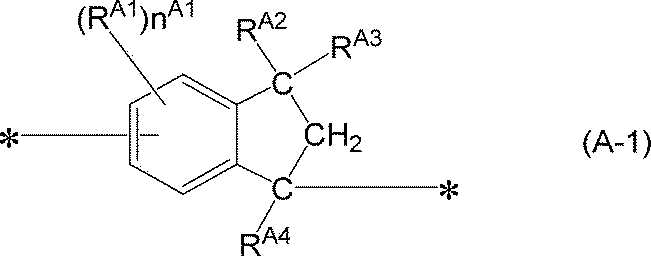
(式中、RA1は、炭素数1~10のアルキル基、炭素数1~10のアルキルオキシ基、炭素数1~10のアルキルチオ基、炭素数6~10のアリール基、炭素数6~10のアリールオキシ基、炭素数6~10のアリールチオ基、炭素数3~10のシクロアルキル基、ハロゲン原子、水酸基又はメルカプト基である。nA1は0~3の整数である。RA2~RA4は、各々独立に、炭素数1~10のアルキル基である。*は結合部位を表す。)
[4]前記(B)成分が、下記一般式(B-1)で表される化合物である、上記[1]~[3]のいずれかに記載の樹脂組成物。
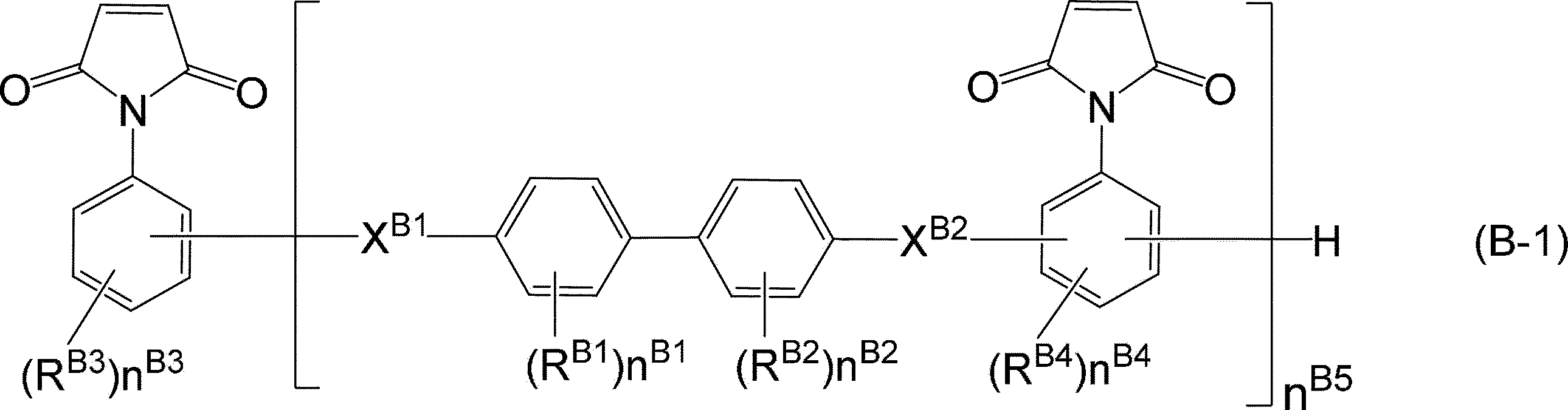
(式中、XB1及びXB2は、各々独立に、炭素数1~5のアルキレン基又は炭素数2~5のアルキリデン基であり、RB1、RB2、RB3及びRB4は、各々独立に、炭素数1~5の脂肪族炭化水素基又はハロゲン原子である。nB1、nB2、nB3及びnB4は、各々独立に、0~4の整数である。nB5は、1~10の整数である。)
[5]前記(A)成分及び前記(B)成分の合計含有量が、前記樹脂組成物中の樹脂成分の総量(100質量%)に対して、30~95質量%である、上記[1]~[4]のいずれかに記載の樹脂組成物。
[6]前記(A)成分の含有量と、前記(B)成分の含有量と、の比〔(A)成分/(B)成分〕が、質量基準で、0.1~8である、上記[1]~[5]のいずれかに記載の樹脂組成物。
[7]さらに、(C)ポリフェニレンエーテル系樹脂を含有する、上記[1]~[6]のいずれかに記載の樹脂組成物。
[8]さらに、(D)スチレン系ポリマーを含有する、上記[1]~[7]のいずれかに記載の樹脂組成物。
[9]さらに、(E)無機充填材を含有する、上記[1]~[8]のいずれかに記載の樹脂組成物。
[10]上記[1]~[9]のいずれかに記載の樹脂組成物又は前記樹脂組成物の半硬化物を含有するプリプレグ。
[11]上記[1]~[9]のいずれかに記載の樹脂組成物の硬化物と、金属箔と、を有する積層板。
[12]上記[1]~[9]のいずれかに記載の樹脂組成物又は前記樹脂組成物の半硬化物を含有する樹脂フィルム。
[13]上記[1]~[9]のいずれかに記載の樹脂組成物の硬化物を有するプリント配線板。
[14]上記[13]に記載のプリント配線板と、半導体素子と、を有する半導体パッケージ。
例えば、数値範囲「X~Y」(X、Yは実数)という表記は、X以上、Y以下である数値範囲を意味する。そして、本明細書における「X以上」という記載は、X及びXを超える数値を意味する。また、本明細書における「Y以下」という記載は、Y及びY未満の数値を意味する。
本明細書中に記載されている数値範囲の下限値及び上限値は、それぞれ他の数値範囲の下限値又は上限値と任意に組み合わせられる。
本明細書中に記載されている数値範囲において、その数値範囲の下限値又は上限値は、実施例に示されている値に置き換えてもよい。
本明細書において、樹脂組成物中の各成分の含有量は、樹脂組成物中に各成分に該当する物質が複数存在する場合、特に断らない限り、樹脂組成物中に存在する当該複数の物質の合計量を意味する。
本実施形態の樹脂組成物は、
(A)芳香族環と脂肪族環との縮合環を含む基と、2個以上のN-置換マレイミド基と、を有するマレイミド樹脂及び該マレイミド樹脂の誘導体からなる群から選択される1種以上と、
(B)置換又は非置換のビフェニル-ジイル基と、2個以上のN-置換マレイミド基と、を有するマレイミド樹脂及び該マレイミド樹脂の誘導体からなる群から選択される1種以上と、
を含有する樹脂組成物である。
なお、本明細書において、各成分はそれぞれ、(A)成分、(B)成分等と省略して称することがあり、その他の成分についても同様の略し方をすることがある。
以下、本実施形態の樹脂組成物が含有し得る各成分について順に説明する。
(A)成分は、芳香族環と脂肪族環との縮合環を含む基と、2個以上のN-置換マレイミド基と、を有するマレイミド樹脂及び該マレイミド樹脂の誘導体からなる群から選択される1種以上である。
(A)成分は、芳香族環と脂肪族環との縮合環を含む基を有する。該縮合環は、その嵩高い立体構造が比誘電率の低減に寄与していると考えられる。
(A)成分は、1種を単独で用いても、2種以上を組み合わせて用いてもよい。

(式中、RA1は、炭素数1~10のアルキル基、炭素数1~10のアルキルオキシ基、炭素数1~10のアルキルチオ基、炭素数6~10のアリール基、炭素数6~10のアリールオキシ基、炭素数6~10のアリールチオ基、炭素数3~10のシクロアルキル基、ハロゲン原子、水酸基又はメルカプト基である。nA1は0~3の整数である。RA2~RA4は、各々独立に、炭素数1~10のアルキル基である。*は結合部位を表す。)
RA1で表される炭素数1~10のアルキルオキシ基、炭素数1~10のアルキルチオ基に含まれるアルキル基としては、上記炭素数1~10のアルキル基と同じものが挙げられる。
RA1で表される炭素数6~10のアリール基としては、例えば、フェニル基、ナフチル基等が挙げられる。
RA1で表される炭素数6~10のアリールオキシ基及び炭素数6~10のアリールチオ基に含まれるアリール基としては、上記炭素数6~10のアリール基と同じものが挙げられる。
RA1で表される炭素数3~10のシクロアルキル基としては、例えば、シクロプロピル基、シクロブチル基、シクロペンチル基、シクロヘキシル基、シクロヘプチル基、シクロオクチル基、シクロノニル基、シクロデシル基等が挙げられる。
上記一般式(A-1)中のnA1が1~3の整数である場合、RA1は、溶媒溶解性及び反応性の観点から、炭素数1~4のアルキル基が好ましい。
上記一般式(A-1)中のnA1は、0~3の整数であり、nA1が2又は3である場合、複数のRA1同士は、同一であってもよいし、異なっていてもよい。
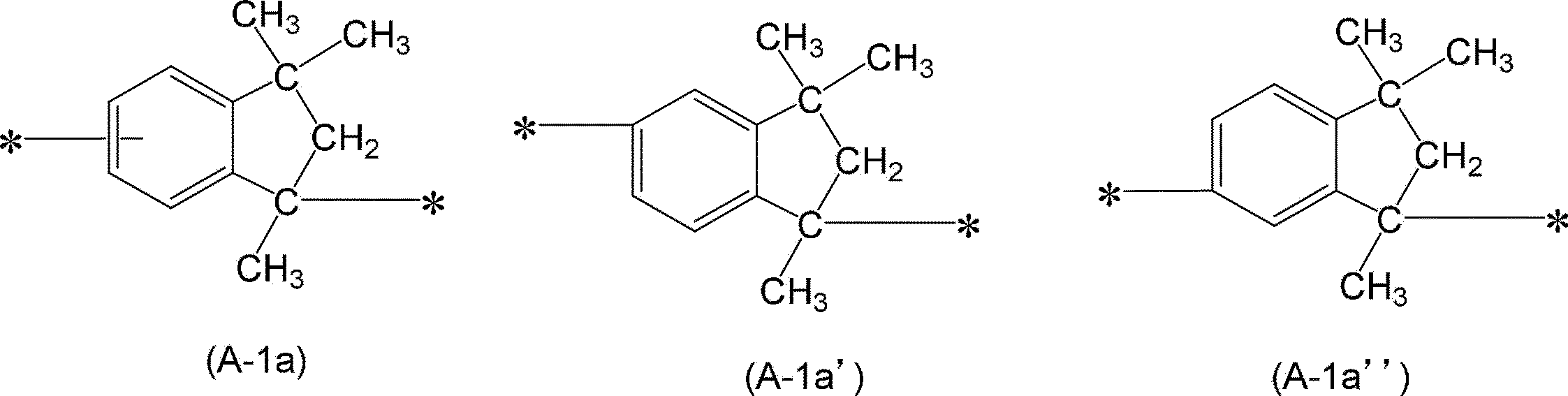
(式中、*は結合部位を表す。)
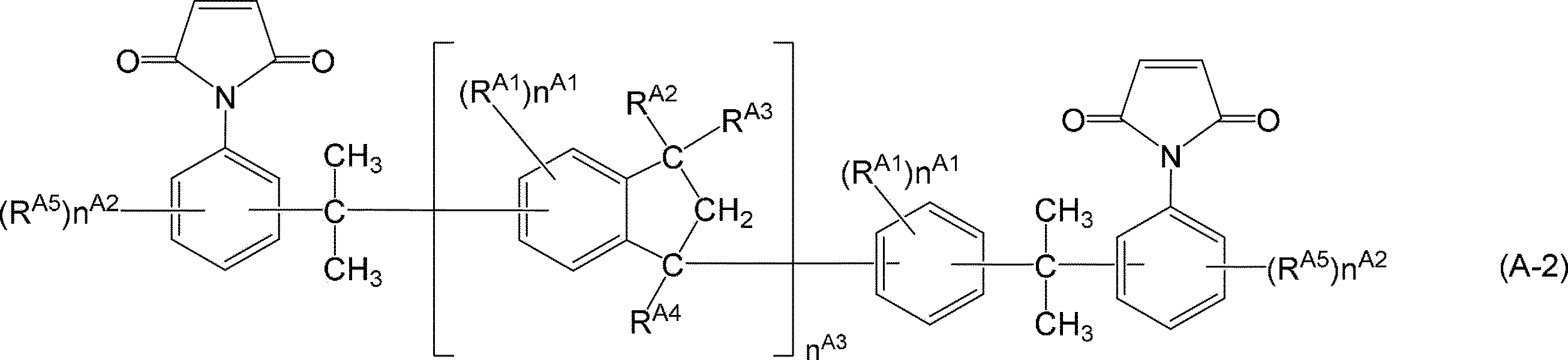
(式中、RA1~RA4及びnA1は、上記一般式(A-1)中のものと同じである。RA5は、各々独立に、炭素数1~10のアルキル基、炭素数1~10のアルキルオキシ基、炭素数1~10のアルキルチオ基、炭素数6~10のアリール基、炭素数6~10のアリールオキシ基、炭素数6~10のアリールチオ基、炭素数3~10のシクロアルキル基、ハロゲン原子、ニトロ基、水酸基又はメルカプト基である。nA2は、各々独立に、0~4の整数である。nA3は、0.95~10.0の数である。)
nA3が1を超える場合、複数のRA2同士、複数のRA3同士及び複数のRA4同士は、各々について、同一であってもよいし、異なっていてもよい。
これらの中でも、RA5は、溶媒溶解性及び製造容易性の観点から、炭素数1~4のアルキル基、炭素数3~6のシクロアルキル基、炭素数6~10のアリール基が好ましく、炭素数1~3のアルキル基がより好ましく、メチル基がさらに好ましい。
上記一般式(A-2)中のnA3は、誘電特性、導体接着性、溶媒溶解性、ハンドリング性及び耐熱性の観点から、好ましくは0.98~8.0の数、より好ましくは1.0~7.0の数、さらに好ましくは1.1~6.0の数である。なお、nA3は、インダン環を含む構造の数の平均値を表す。
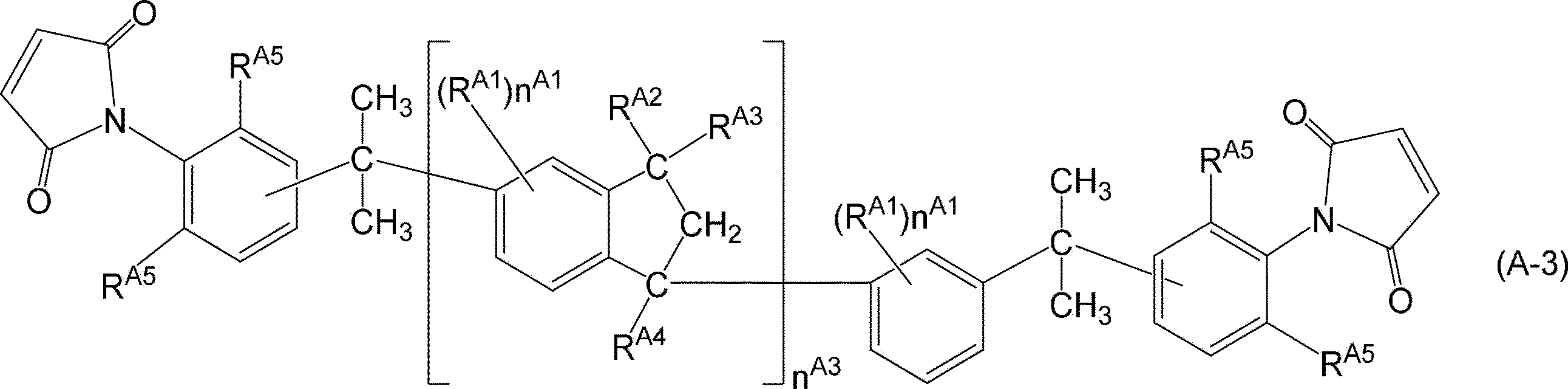
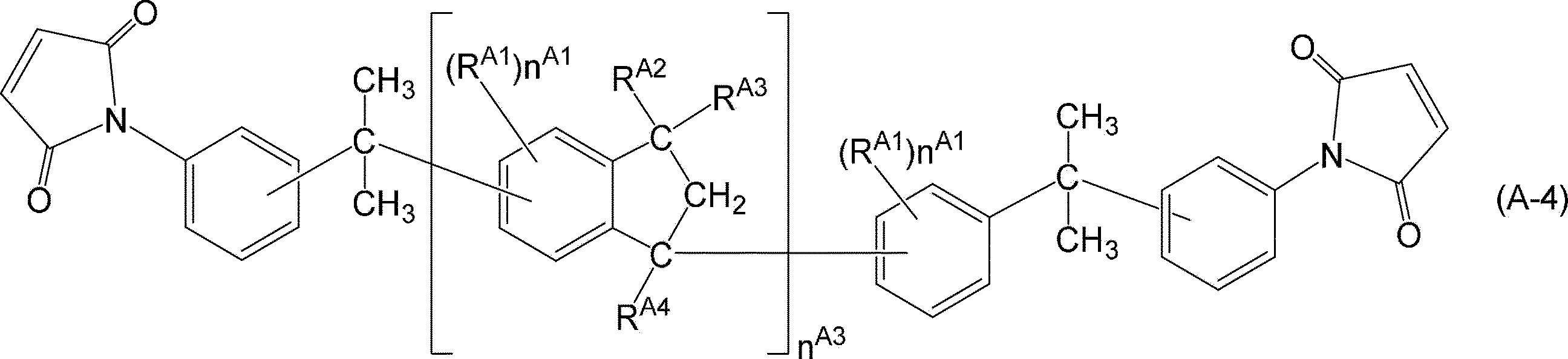
(式中、RA1~RA4及びnA1及びnA3は、上記一般式(A-2)中のものと同じである。)
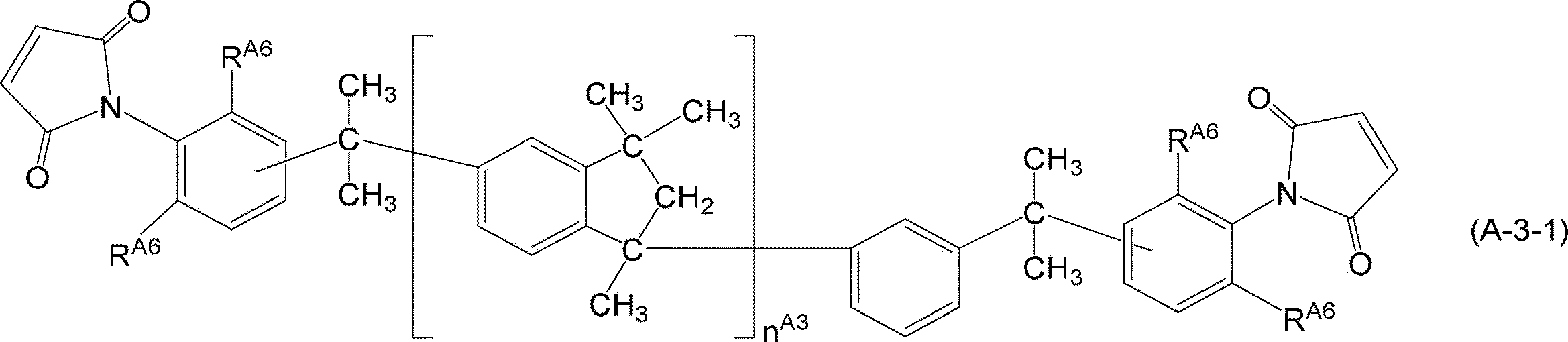
(式中、RA6は、各々独立に、メチル基、エチル基又はイソプロピル基である。nA3は、上記一般式(A-2)中のものと同じである。)

(式中、nA3は、上記一般式(A-2)中のものと同じである。)
該アミノマレイミド樹脂は、例えば、(A)成分として挙げたマレイミド樹脂と、ジアミン化合物とをマイケル付加反応させることによって製造することができる。
(A)成分の含有量が、上記範囲内であると、低い比誘電率と良好な耐熱性とをより高度に両立し易い傾向にある。
本実施形態の樹脂組成物においては、例えば、(A)成分、(B)成分が樹脂成分に相当する。
本実施形態の樹脂組成物が、任意成分として、上記成分以外に樹脂又は硬化反応によって樹脂を形成する化合物を含有する場合、これらの任意成分も樹脂成分に含まれる。当該任意成分の樹脂成分としては、後述する、(C)成分、(D)成分等が挙げられる。
一方、後述する(E)成分及び(F)成分は、樹脂成分には含まれないものとする。
樹脂成分の含有量が上記下限値以上であると、耐熱性、成形性、加工性及び導体接着性がより良好になり易い傾向にある。また、樹脂成分の含有量が上記上限値以下であると、低熱膨張性がより良好になり易い傾向にある。
本実施形態の樹脂組成物は、(B)置換又は非置換のビフェニル-ジイル基と、2個以上のN-置換マレイミド基と、を有するマレイミド樹脂及び該マレイミド樹脂の誘導体からなる群から選択される1種以上を含有する。
(B)成分は、主に耐熱性の向上に寄与する。(B)成分は、単独で使用する際には、比誘電率が高くなる傾向にあるが、(A)成分と併用する場合、比誘電率の増加を抑制しながらも、耐熱性を向上させる効果を発現する。
(B)成分は、1種を単独で用いても、2種以上を組み合わせて用いてもよい。
また、(B)成分は、耐熱性をより良好にするという観点から、3個以上のN-置換マレイミド基を有するものが好ましく、芳香環に直接結合する3個以上のN-置換マレイミド基を有するものがより好ましい。
また、(B)成分としては、ビフェニルアラルキル型マレイミド樹脂が好ましい。
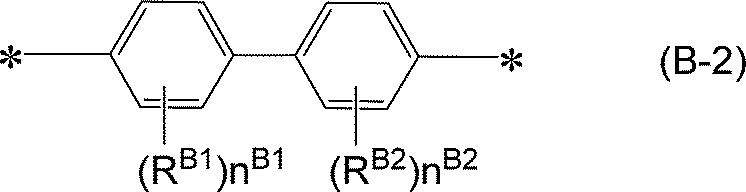
(式中、RB1及びRB2は、各々独立に、炭素数1~5の脂肪族炭化水素基又はハロゲン原子である。nB1及びnB2は、各々独立に、0~4の整数である。*は結合部位を表す。)
ハロゲン原子としては、例えば、フッ素原子、塩素原子、臭素原子、ヨウ素原子等が挙げられる。
上記一般式(B-2)中のnB1及びnB2は、各々独立に、0~4の整数であり、入手容易性の観点から、好ましくは0~2の整数、より好ましくは0又は1、さらに好ましくは0である。
nB1及びnB2が2以上の整数である場合、複数のRB1同士又は複数のRB2同士は、それぞれ同一であってもよいし、異なっていてもよい。

(式中、XB1及びXB2は、各々独立に、炭素数1~5のアルキレン基又は炭素数2~5のアルキリデン基であり、RB1、RB2、RB3及びRB4は、各々独立に、炭素数1~5の脂肪族炭化水素基又はハロゲン原子である。nB1、nB2、nB3及びnB4は、各々独立に、0~4の整数である。nB5は、1~10の整数である。)
上記一般式(B-1)中のXB1及びXB2が表す炭素数2~5のアルキリデン基としては、例えば、エチリデン基、プロピリデン基、イソプロピリデン基、ブチリデン基、イソブチリデン基、ペンチリデン基、イソペンチリデン基等が挙げられる。
上記一般式(B-1)中のnB3及びnB4は、各々独立に、0~4の整数であり、入手容易性の観点から、好ましくは0~2の整数、より好ましくは0又は1、さらに好ましくは0である。
該アミノマレイミド樹脂は、例えば、(B)成分として挙げたマレイミド樹脂と、ジアミン化合物とをマイケル付加反応させることによって製造することができる。
ジアミン化合物としては、(A)成分の説明で挙げられたものと同じものが挙げられる。
(B)成分の含有量が、上記範囲内であると、低い比誘電率と良好な耐熱性とをより高度に両立し易い傾向にある。
(A)成分及び(B)成分の合計含有量が上記下限値以上であると、比誘電率、耐熱性、成形性、加工性及び導体接着性がより良好になり易い傾向にある。また、(A)成分及び(B)成分の合計含有量が上記上限値以下であると、低熱膨張性がより良好になり易い傾向にある。
含有量比〔(A)成分/(B)成分〕が上記範囲内であると、低い比誘電率と良好な耐熱性とをより高度に両立し易い傾向にある。
本実施形態の樹脂組成物は、さらに、(C)ポリフェニレンエーテル系樹脂を含有することが好ましい。
本実施形態の樹脂組成物は、(C)ポリフェニレンエーテル系樹脂を含有することによって、誘電特性により優れる硬化物が得られ易い傾向にある。
(C)ポリフェニレンエーテル系樹脂は、1種を単独で用いてもよく、2種以上を組み合わせて用いてもよい。
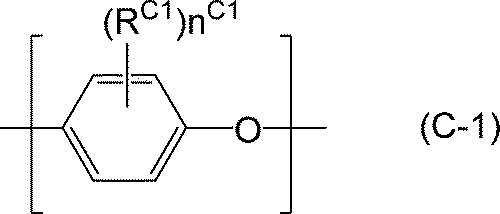
(式中、RC1は、炭素数1~5の炭化水素基又はハロゲン原子である。nC1は、0~4の整数である。)
ハロゲン原子としては、例えば、フッ素原子、塩素原子、臭素原子、ヨウ素原子等が挙げられる。
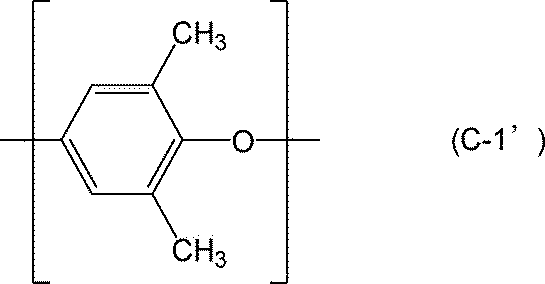
なお、本明細書において、「エチレン性不飽和結合」とは、付加反応が可能な炭素-炭素二重結合を意味し、芳香環の二重結合は含まないものとする。
エチレン性不飽和結合含有基としては、例えば、ビニル基、アリル基、1-メチルアリル基、イソプロペニル基、2-ブテニル基、3-ブテニル基、スチリル基、マレイミド基、(メタ)アクリロイル基等が挙げられる。これらの中でも、誘電特性の観点から、(メタ)アクリロイル基が好ましく、メタクリロイル基がより好ましい。
(C)ポリフェニレンエーテル系樹脂は、末端以外にもエチレン性不飽和結合含有基を有していてもよいが、末端のみにエチレン性不飽和結合含有基を有することが好ましく、両末端のみにエチレン性不飽和結合含有基を有することがより好ましい。
(C)ポリフェニレンエーテル系樹脂の含有量が、上記下限値以上であると、誘電特性に優れる硬化物が得られ易い傾向にある。また、(C)ポリフェニレンエーテル系樹脂の含有量が、上記上限値以下であると、樹脂組成物の成形性がより良好になり易い傾向にある。
本実施形態の樹脂組成物は、さらに、(D)スチレン系ポリマーを含有することが好ましい。
本実施形態の樹脂組成物は、(D)スチレン系ポリマーを含有することによって、誘電特性がより良好になる傾向にある。
(D)スチレン系ポリマーは、1種を単独で用いてもよく、2種以上を併用してもよい。
スチレン系単位以外の構造単位としては、例えば、ブタジエン由来の構造単位、イソプレン由来の構造単位、マレイン酸由来の構造単位、無水マレイン酸由来の構造単位等が挙げられる。ブタジエン由来の構造単位及びイソプレン由来の構造単位は、水素添加されていてもよい。水素添加されている場合、ブタジエン由来の構造単位はエチレン単位とブチレン単位とが混合した構造単位となり、イソプレン由来の構造単位はエチレン単位とプロピレン単位とが混合した構造単位となる。
スチレン-ブタジエン-スチレンブロック共重合体の水素添加物は、ブタジエンブロック中の炭素-炭素二重結合を完全水添してなるSEBSと、ブタジエンブロック中の1,2-結合部位の炭素-炭素二重結合を部分水添してなるSBBSが挙げられる。スチレン-イソプレン-スチレンブロック共重合体の水素添加物は、ポリイソプレン部が水素添加され、SEPSとして得られる。これらの中でも、誘電特性、導体接着性、耐熱性、ガラス転移温度及び低熱膨張性の観点から、SEBS、SEPSが好ましく、SEBSがより好ましい。
(D)スチレン系ポリマーの含有量が上記下限値以上であると、誘電特性がより良好になり易い傾向にある。また、(D)スチレン系ポリマーの含有量が上記上限値以下であると、耐熱性及び難燃性がより良好になり易い傾向にある。
本実施形態の樹脂組成物は、さらに、(E)無機充填材を含有することが好ましい。
本実施形態の樹脂組成物は、(E)無機充填材を含有することによって、低熱膨張性及び耐熱性がより良好になる傾向にある。
(E)無機充填材は、1種を単独で用いてもよく、2種以上を併用してもよい。
シリカとしては、分散性及び成形性の観点から、溶融シリカが好ましい。
なお、本明細書において(E)無機充填材の平均粒子径(D50)は、粒子の全体積を100%として粒子径による累積度数分布曲線を求めたとき、体積50%に相当する点の粒子径のことである。(E)無機充填材の平均粒子径は、例えば、レーザー回折散乱法を用いた粒度分布測定装置等で測定することができる。
(E)無機充填材の形状としては、例えば、球状、破砕状等が挙げられ、球状が好ましい。
(E)無機充填材は、分散性及び有機成分との密着性を向上させるという観点から、例えば、シランカップリング剤等の表面処理剤によって表面処理されていてもよい。
(E)無機充填材の含有量が上記下限値以上であると、低熱膨張性及び耐熱性がより良好になり易い傾向にある。また、(E)無機充填材の含有量が上記上限値以下であると、成形性及び導体接着性がより良好になり易い傾向にある。
本実施形態の樹脂組成物は、さらに、(F)硬化促進剤を含有することが好ましい。
本実施形態の樹脂組成物は、(F)硬化促進剤を含有することによって硬化性が向上し、誘電特性、耐熱性及び導体接着性がより良好になる傾向にある。
(F)硬化促進剤は、1種を単独で用いてもよく、2種以上を併用してもよい。
これらの中でも、硬化促進効果及び保存安定性の観点から、有機過酸化物、イミダゾール化合物、リン系化合物がより好ましく、有機過酸化物とイミダゾール化合物とを併用することがさらに好ましい。
(F)硬化促進剤の含有量が上記下限値以上であると、十分な硬化促進効果が得られ易い傾向にある。また、(F)硬化促進剤の含有量が上記上限値以下であると、保存安定性がより良好になり易い傾向にある。
本実施形態の樹脂組成物は、さらに必要に応じて、上記各成分以外の樹脂材料、酸化防止剤、熱安定剤、帯電防止剤、紫外線吸収剤、顔料、着色剤、滑剤及びこれら以外の添加剤からなる群から選択される1種以上を含有していてもよい。これらは各々について、1種を単独で使用してもよく、2種以上を組み合わせて用いてもよい。また、これらの使用量は特に限定されず、必要に応じて、本実施形態の効果を阻害しない範囲で使用すればよい。
本実施形態の樹脂組成物は、取り扱いを容易にするという観点及び後述するプリプレグを製造し易くするという観点から、有機溶媒を含有していてもよい。
有機溶媒は、1種を単独で用いてもよく、2種以上を組み合わせて用いてもよい。
有機溶媒としては、例えば、エタノール、プロパノール、ブタノール、メチルセロソルブ、ブチルセロソルブ、プロピレングリコールモノメチルエーテル等のアルコール系溶媒;アセトン、メチルエチルケトン、メチルイソブチルケトン、シクロヘキサノン等のケトン系溶媒;テトラヒドロフラン等のエーテル系溶媒;トルエン、キシレン、メシチレン等の芳香族炭化水素系溶媒;ジメチルホルムアミド、ジメチルアセトアミド、N-メチルピロリドン等の窒素原子含有溶媒;ジメチルスルホキシド等の硫黄原子含有溶媒;γ-ブチロラクトン等のエステル系溶媒などが挙げられる。
本実施形態の樹脂組成物は、各成分を公知の方法で混合することで製造することができる。この際、各成分は撹拌しながら溶解又は分散させてもよい。混合順序、温度、時間等の条件は、特に限定されず、原料の種類等に応じて任意に設定すればよい。
本実施形態のプリプレグは、本実施形態の樹脂組成物又は前記樹脂組成物の半硬化物を含有するプリプレグである。
本実施形態のプリプレグは、例えば、本実施形態の樹脂組成物又は前記樹脂組成物の半硬化物と、シート状繊維基材と、を含有するものである。
シート状繊維基材の材質としては、例えば、Eガラス、Dガラス、Sガラス、Qガラス等の無機物繊維;ポリイミド、ポリエステル、テトラフルオロエチレン等の有機繊維;これらの混合物などが挙げられる。これらのシート状繊維基材は、例えば、織布、不織布、ロービンク、チョップドストランドマット、サーフェシングマット等の形状を有する。
加熱乾燥の温度及び時間は、生産性及び本実施形態の樹脂組成物を適度にB-ステージ化させるという観点から、例えば、50~200℃、1~30分間とすることができる。
本実施形態の樹脂フィルムは、本実施形態の樹脂組成物又は前記樹脂組成物の半硬化物を含有する樹脂フィルムである。
本実施形態の樹脂フィルムは、例えば、有機溶媒を含有する本実施形態の樹脂組成物を支持体に塗布してから、加熱乾燥させることによって製造することができる。
支持体としては、例えば、プラスチックフィルム、金属箔、離型紙等が挙げられる。
加熱乾燥の温度及び時間は、特に限定されないが、生産性及び本実施形態の樹脂組成物を適度にB-ステージ化させるという観点から、50~200℃、1~30分間とすることができる。
本実施形態の積層板は、本実施形態の樹脂組成物の硬化物と、金属箔と、を有する積層板である。
なお、金属箔を有する積層板は、金属張積層板と称されることもある。
通常、この加熱加圧成形によって、B-ステージ化されたプリプレグを硬化させて本実施形態の積層板が得られる。
加熱加圧成形する際、プリプレグは1枚のみを用いてもよいし、2枚以上のプリプレグを積層させて用いてもよい。
加熱加圧成形は、例えば、多段プレス、多段真空プレス、連続成形、オートクレーブ成形機等を使用することができる。
加熱加圧成形の条件は、例えば、温度100~300℃、時間10~300分間、圧力1.5~5MPaとすることができる。
本実施形態のプリント配線板は、本実施形態の樹脂組成物の硬化物を有するプリント配線板である。
本実施形態のプリント配線板は、例えば、本実施形態のプリプレグの硬化物、本実施形態の樹脂フィルムの硬化物及び積層板からなる群から選択される1種以上に対して、公知の方法によって、導体回路形成を行うことによって製造することができる。また、さらに必要に応じて多層化接着加工を施すことによって、多層プリント配線板を製造することもできる。導体回路は、例えば、穴開け加工、金属めっき加工、金属箔のエッチング等を適宜施すことによって形成することができる。
本実施形態の半導体パッケージは、本実施形態のプリント配線板と、半導体素子と、を有する半導体パッケージである。
本実施形態の半導体パッケージは、例えば、本実施形態のプリント配線板に、公知の方法によって、半導体チップ、メモリ等を搭載することによって製造することができる。
ゲルパーミエーションクロマトグラフィー(GPC)により、標準ポリスチレンを用いた検量線から換算した。検量線は、標準ポリスチレン:TSKstandard POLYSTYRENE(Type;A-2500、A-5000、F-1、F-2、F-4、F-10、F-20、F-40)[東ソー株式会社製、商品名]を用いて3次式で近似した。GPCの測定条件を、以下に示す。
装置:
ポンプ:L-6200型[株式会社日立ハイテクノロジーズ製]
検出器:L-3300型RI[株式会社日立ハイテクノロジーズ製]
カラムオーブン:L-655A-52[株式会社日立ハイテクノロジーズ製]
カラム:ガードカラム;TSK Guardcolumn HHR-L+カラム;TSKgel G4000HHR+TSKgel G2000HHR(すべて東ソー株式会社製、商品名)
カラムサイズ:6.0×40mm(ガードカラム)、7.8×300mm(カラム)
溶離液:テトラヒドロフラン
試料濃度:30mg/5mL
注入量:20μL
流量:1.00mL/分
測定温度:40℃
実施例1~3、比較例1
表1に記載の各成分を、メチルエチルケトンと共に表1に記載の配合組成に従って配合し、25℃で撹拌及び混合して、固形分濃度が60質量%であるワニス状の樹脂組成物を調製した。
なお、表1中、各成分の配合量の単位は質量部であり、溶液の場合は、固形分換算の質量部を意味する。
上記で得たワニス状の樹脂組成物を、厚さ0.1mmのガラスクロスに含浸し、130℃で4分間加熱乾燥することによってプリプレグを得た。なお、プリプレグ中の樹脂組成物の含有量は57質量%であった。
上記で得たプリプレグを4枚重ね、その上下に、厚さ12μmの銅箔(三井金属株式会社製、商品名「3EC-M3-VLP-12」、粗化面のRz:3.0μm)を、粗化面がプリプレグに接するように配置した。この積層体を、温度230℃、圧力3.0MPa、時間90分間の条件で加熱加圧成形することによって、銅張積層板(厚さ:0.43mm)を製造した。
下記方法に従って各評価を行った。結果を表1に示す。
各例で作製した銅張積層板を、銅エッチング液である過硫酸アンモニウム(三菱ガス化学株式会社製)10質量%溶液に浸漬することによって銅箔を除去し、2mm×50mmに切り出した後、105℃で1時間乾燥したものを試験片とした。次いで、空洞共振器摂動法に準拠して、雰囲気温度25℃、10GHz帯にて、上記試験片の比誘電率(Dk)を測定した。
各例で得た銅張積層板の両面の銅箔をエッチングによって除去し、5mm角の試験片を作製した。次いで、熱機械測定装置(TMA)(ティー・エイ・インスツルメント・ジャパン株式会社製、商品名「Q400」)に上記試験片を装着し、圧縮法により、温度範囲30~260℃、荷重5g、昇温速度10℃/分、周波数1Hzの条件で、連続して2回熱機械測定を行った。ガラス転移温度は、2回目の熱機械測定から求められるガラス転移温度を採用した。
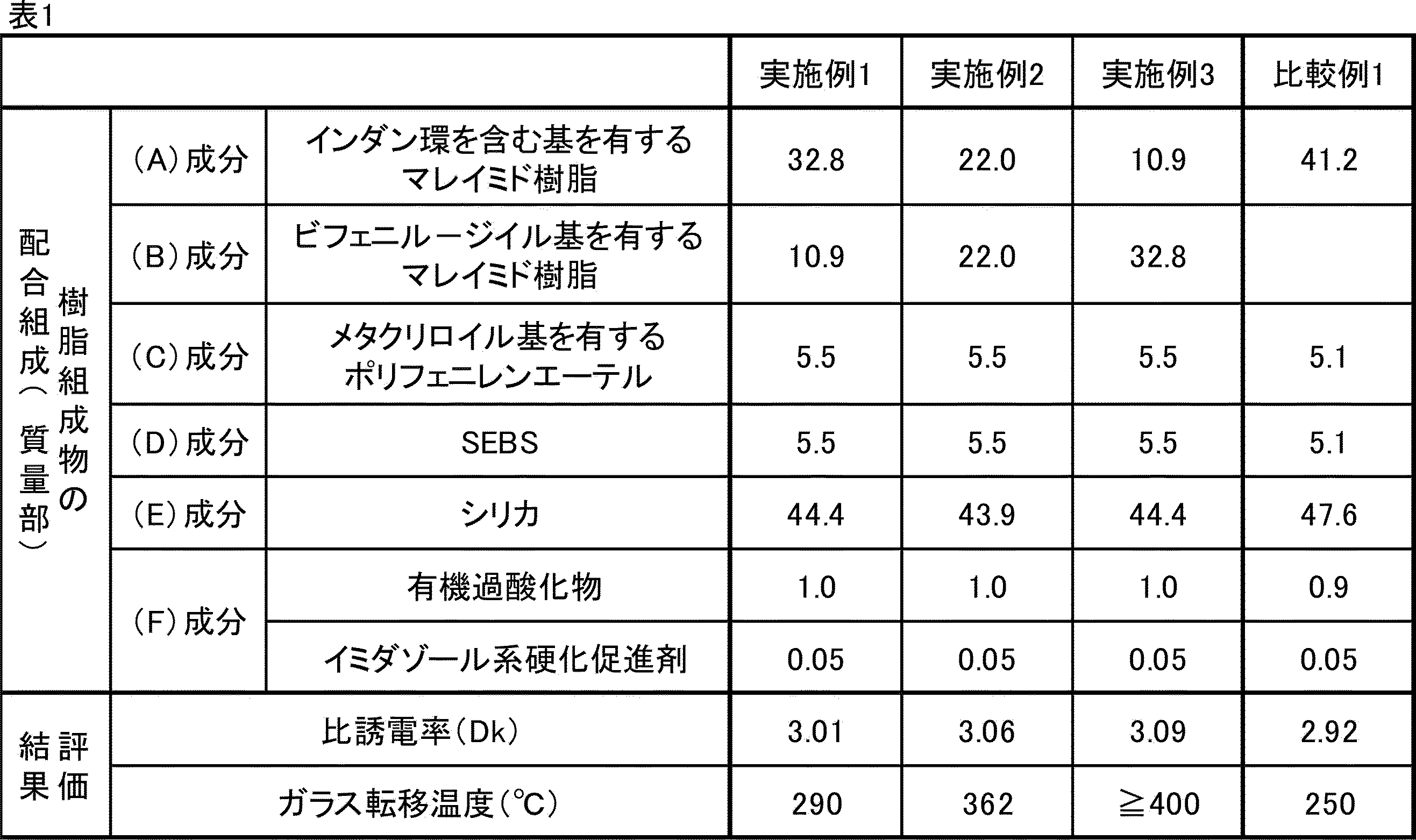
[(A)成分]
・インダン環を含む基を有するマレイミド樹脂:上記一般式(A-4-1)で表される、インダン環を含む基を有する芳香族ビスマレイミド樹脂:数平均分子量(Mn)1,300
・ビフェニル-ジイル基を有するマレイミド樹脂:ビフェニルアラルキル型マレイミド(日本化薬株式会社製、商品名「MIR-3000」)
・メタクリロイル基を有するポリフェニレンエーテル:両末端にメタクリロイル基を有するポリフェニレンエーテル(重量平均分子量(Mw)1,700)
・SEBS:スチレン-エチレン-ブチレン-スチレン(SEBS)共重合体(クレイトンポリマージャパン株式会社製、商品名「クレイトン(登録商標)MD1653」、メルトフローレート5.0g/10分、スチレン含有率30質量%、水素添加率100%、重量平均分子量(Mw)=70,000)
・シリカ:球状溶融シリカ、平均粒子径(D50)0.5~0.7μm
・有機過酸化物:α,α’-ビス(t-ブチルパーオキシ)ジイソプロピルベンゼン
・イミダゾール系硬化促進剤:イソシアネートマスクイミダゾール(ヘキサメチレンジイソシアネート樹脂と2-エチル-4-メチルイミダゾールの付加反応物)(第一工業製薬株式会社製、商品名「G-8009L」)
Claims (14)
- (A)芳香族環と脂肪族環との縮合環を含む基と、2個以上のN-置換マレイミド基と、を有するマレイミド樹脂及び該マレイミド樹脂の誘導体からなる群から選択される1種以上と、
(B)置換又は非置換のビフェニル-ジイル基と、2個以上のN-置換マレイミド基と、を有するマレイミド樹脂及び該マレイミド樹脂の誘導体からなる群から選択される1種以上と、
を含有する樹脂組成物。 - 前記(A)成分が有する芳香族環と脂肪族環との縮合環を含む基が、前記縮合環として、インダン環を含む基である、請求項1に記載の樹脂組成物。
- 前記インダン環を含む基が、下記一般式(A-1)で表される2価の基である、請求項2に記載の樹脂組成物。

(式中、RA1は、炭素数1~10のアルキル基、炭素数1~10のアルキルオキシ基、炭素数1~10のアルキルチオ基、炭素数6~10のアリール基、炭素数6~10のアリールオキシ基、炭素数6~10のアリールチオ基、炭素数3~10のシクロアルキル基、ハロゲン原子、水酸基又はメルカプト基である。nA1は0~3の整数である。RA2~RA4は、各々独立に、炭素数1~10のアルキル基である。*は結合部位を表す。) - 前記(B)成分が、下記一般式(B-1)で表される化合物である、請求項1~3のいずれか1項に記載の樹脂組成物。
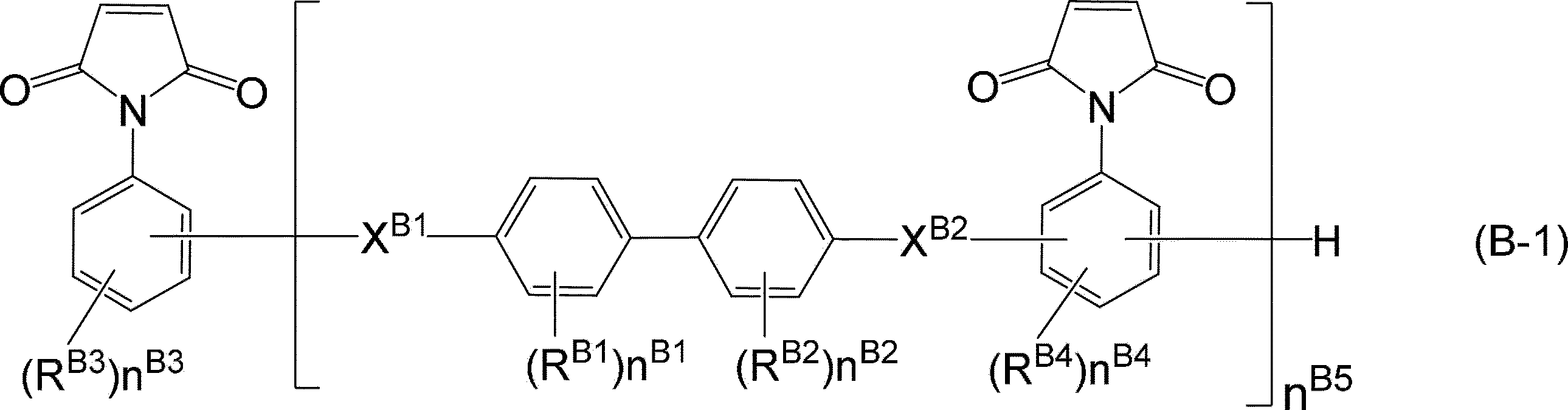
(式中、XB1及びXB2は、各々独立に、炭素数1~5のアルキレン基又は炭素数2~5のアルキリデン基であり、RB1、RB2、RB3及びRB4は、各々独立に、炭素数1~5の脂肪族炭化水素基又はハロゲン原子である。nB1、nB2、nB3及びnB4は、各々独立に、0~4の整数である。nB5は、1~10の整数である。) - 前記(A)成分及び前記(B)成分の合計含有量が、前記樹脂組成物中の樹脂成分の総量(100質量%)に対して、30~95質量%である、請求項1~3のいずれか1項に記載の樹脂組成物。
- 前記(A)成分の含有量と、前記(B)成分の含有量と、の比〔(A)成分/(B)成分〕が、質量基準で、0.1~8である、請求項1~3のいずれか1項に記載の樹脂組成物。
- さらに、(C)ポリフェニレンエーテル系樹脂を含有する、請求項1~3のいずれか1項に記載の樹脂組成物。
- さらに、(D)スチレン系ポリマーを含有する、請求項1~3のいずれか1項に記載の樹脂組成物。
- さらに、(E)無機充填材を含有する、請求項1~3のいずれか1項に記載の樹脂組成物。
- 請求項1~3のいずれか1項に記載の樹脂組成物又は前記樹脂組成物の半硬化物を含有するプリプレグ。
- 請求項1~3のいずれか1項に記載の樹脂組成物の硬化物と、金属箔と、を有する積層板。
- 請求項1~3のいずれか1項に記載の樹脂組成物又は前記樹脂組成物の半硬化物を含有する樹脂フィルム。
- 請求項1~3のいずれか1項に記載の樹脂組成物の硬化物を有するプリント配線板。
- 請求項13に記載のプリント配線板と、半導体素子と、を有する半導体パッケージ。
Priority Applications (3)
| Application Number | Priority Date | Filing Date | Title |
|---|---|---|---|
| CN202480028916.XA CN121152817A (zh) | 2023-11-13 | 2024-11-12 | 树脂组合物、预浸料、层叠板、树脂膜、印刷线路板及半导体封装体 |
| KR1020267005828A KR20260036599A (ko) | 2023-11-13 | 2024-11-12 | 수지 조성물, 프리프레그, 적층판, 수지 필름, 프린트 배선판 및 반도체 패키지 |
| JP2025557862A JPWO2025105366A1 (ja) | 2023-11-13 | 2024-11-12 |
Applications Claiming Priority (2)
| Application Number | Priority Date | Filing Date | Title |
|---|---|---|---|
| JP2023193005 | 2023-11-13 | ||
| JP2023-193005 | 2023-11-13 |
Publications (1)
| Publication Number | Publication Date |
|---|---|
| WO2025105366A1 true WO2025105366A1 (ja) | 2025-05-22 |
Family
ID=95742256
Family Applications (1)
| Application Number | Title | Priority Date | Filing Date |
|---|---|---|---|
| PCT/JP2024/040130 Pending WO2025105366A1 (ja) | 2023-11-13 | 2024-11-12 | 樹脂組成物、プリプレグ、積層板、樹脂フィルム、プリント配線板及び半導体パッケージ |
Country Status (5)
| Country | Link |
|---|---|
| JP (1) | JPWO2025105366A1 (ja) |
| KR (1) | KR20260036599A (ja) |
| CN (1) | CN121152817A (ja) |
| TW (1) | TW202528475A (ja) |
| WO (1) | WO2025105366A1 (ja) |
Citations (3)
| Publication number | Priority date | Publication date | Assignee | Title |
|---|---|---|---|---|
| JP2021102713A (ja) * | 2019-12-25 | 2021-07-15 | Dic株式会社 | 酸基含有酸基含有(メタ)アクリレート樹脂、硬化性樹脂組成物、絶縁材料、ソルダーレジスト用樹脂材料及びレジスト部材 |
| JP2021161325A (ja) * | 2020-04-01 | 2021-10-11 | 味の素株式会社 | 樹脂組成物 |
| JP2023131714A (ja) * | 2022-03-09 | 2023-09-22 | 味の素株式会社 | 樹脂組成物 |
Family Cites Families (1)
| Publication number | Priority date | Publication date | Assignee | Title |
|---|---|---|---|---|
| KR102669010B1 (ko) | 2019-04-26 | 2024-05-27 | 디아이씨 가부시끼가이샤 | 말레이미드, 경화성 수지 조성물, 및, 경화물 |
-
2024
- 2024-11-12 CN CN202480028916.XA patent/CN121152817A/zh active Pending
- 2024-11-12 JP JP2025557862A patent/JPWO2025105366A1/ja active Pending
- 2024-11-12 KR KR1020267005828A patent/KR20260036599A/ko active Pending
- 2024-11-12 WO PCT/JP2024/040130 patent/WO2025105366A1/ja active Pending
- 2024-11-13 TW TW113143468A patent/TW202528475A/zh unknown
Patent Citations (3)
| Publication number | Priority date | Publication date | Assignee | Title |
|---|---|---|---|---|
| JP2021102713A (ja) * | 2019-12-25 | 2021-07-15 | Dic株式会社 | 酸基含有酸基含有(メタ)アクリレート樹脂、硬化性樹脂組成物、絶縁材料、ソルダーレジスト用樹脂材料及びレジスト部材 |
| JP2021161325A (ja) * | 2020-04-01 | 2021-10-11 | 味の素株式会社 | 樹脂組成物 |
| JP2023131714A (ja) * | 2022-03-09 | 2023-09-22 | 味の素株式会社 | 樹脂組成物 |
Also Published As
| Publication number | Publication date |
|---|---|
| CN121152817A (zh) | 2025-12-16 |
| KR20260036599A (ko) | 2026-03-17 |
| JPWO2025105366A1 (ja) | 2025-05-22 |
| TW202528475A (zh) | 2025-07-16 |
Similar Documents
| Publication | Publication Date | Title |
|---|---|---|
| KR102466876B1 (ko) | 수지 조성물, 프리프레그, 적층판 및 다층 프린트 배선판 | |
| CN108473758B (zh) | 聚苯醚树脂组合物、预浸渍体、覆金属层叠板及印刷布线板 | |
| JP7501368B2 (ja) | 樹脂組成物、プリプレグ、積層板、樹脂フィルム、多層プリント配線板及びミリ波レーダー用多層プリント配線板 | |
| KR102905881B1 (ko) | 말레이미드 수지 조성물, 프리프레그, 적층판, 수지 필름, 다층 프린트 배선판 및 반도체 패키지 | |
| JP7631673B2 (ja) | 樹脂組成物、プリプレグ、積層板、樹脂フィルム、多層プリント配線板及び半導体パッケージ | |
| JP7806522B2 (ja) | 樹脂組成物、プリプレグ、積層板、樹脂フィルム、プリント配線板及び半導体パッケージ | |
| KR20230108275A (ko) | 말레이미드 수지 조성물, 프리프레그, 적층판, 수지 필름, 프린트 배선판 및 반도체 패키지 | |
| JP7106819B2 (ja) | 樹脂ワニス、樹脂組成物、プリプレグ、積層板、多層プリント配線板及び樹脂ワニスの保存方法 | |
| WO2023224021A1 (ja) | 樹脂組成物、プリプレグ、積層板、樹脂フィルム、プリント配線板及び半導体パッケージ | |
| JP2025158998A (ja) | 樹脂組成物、プリプレグ、積層板、樹脂フィルム、プリント配線板及び半導体パッケージ | |
| WO2024111380A1 (ja) | 樹脂組成物、樹脂フィルム、プリプレグ、積層板、プリント配線板及び半導体パッケージ | |
| WO2022102780A1 (ja) | マレイミド樹脂組成物、プリプレグ、樹脂フィルム、積層板、プリント配線板及び半導体パッケージ | |
| KR20260036599A (ko) | 수지 조성물, 프리프레그, 적층판, 수지 필름, 프린트 배선판 및 반도체 패키지 | |
| WO2024241853A1 (ja) | 樹脂組成物、プリプレグ、積層板、樹脂フィルム、プリント配線板及び半導体パッケージ | |
| WO2024085028A1 (ja) | 樹脂組成物、プリプレグ、積層板、プリント配線板及び半導体パッケージ | |
| WO2025074977A1 (ja) | 樹脂組成物、プリプレグ、積層板、プリント配線板及び半導体パッケージ | |
| KR20240154549A (ko) | 수지 조성물, 프리프레그, 적층판, 수지 필름, 프린트 배선판 및 반도체 패키지 | |
| JP2023104376A (ja) | 樹脂組成物、プリプレグ、積層板、樹脂フィルム、プリント配線板、半導体パッケージ、樹脂組成物の製造方法及び樹脂 | |
| WO2024237106A1 (ja) | 樹脂組成物、樹脂フィルム、プリプレグ、積層板、プリント配線板及び半導体パッケージ | |
| WO2025074909A1 (ja) | 樹脂組成物、プリプレグ、積層板、プリント配線板及び半導体パッケージ | |
| JP2025015947A (ja) | マレイミド樹脂組成物、プリプレグ、樹脂フィルム、積層板、プリント配線板及び半導体パッケージ | |
| JP2025094409A (ja) | 樹脂組成物、樹脂フィルム、プリプレグ、積層板、プリント配線板及び半導体パッケージ | |
| WO2025089142A1 (ja) | 置換型ポリフェニレンサルファイド樹脂を含む樹脂組成物 | |
| WO2025126952A1 (ja) | 樹脂組成物、プリプレグ、積層板、樹脂フィルム、プリント配線板及び半導体パッケージ | |
| CN121195027A (zh) | 树脂组合物、树脂膜、预浸料、层叠板、印刷线路板及半导体封装体 |
Legal Events
| Date | Code | Title | Description |
|---|---|---|---|
| 121 | Ep: the epo has been informed by wipo that ep was designated in this application |
Ref document number: 24891402 Country of ref document: EP Kind code of ref document: A1 |
|
| ENP | Entry into the national phase |
Ref document number: 2025557862 Country of ref document: JP Kind code of ref document: A |
|
| WWE | Wipo information: entry into national phase |
Ref document number: 2025557862 Country of ref document: JP |
|
| ENP | Entry into the national phase |
Ref document number: 1020267005828 Country of ref document: KR Free format text: ST27 STATUS EVENT CODE: A-0-1-A10-A15-NAP-PA0105 (AS PROVIDED BY THE NATIONAL OFFICE) |
|
| WWE | Wipo information: entry into national phase |
Ref document number: 1020267005828 Country of ref document: KR |
|
| WWP | Wipo information: published in national office |
Ref document number: 1020267005828 Country of ref document: KR |