WO2025079639A1 - ガラス - Google Patents
ガラス Download PDFInfo
- Publication number
- WO2025079639A1 WO2025079639A1 PCT/JP2024/036287 JP2024036287W WO2025079639A1 WO 2025079639 A1 WO2025079639 A1 WO 2025079639A1 JP 2024036287 W JP2024036287 W JP 2024036287W WO 2025079639 A1 WO2025079639 A1 WO 2025079639A1
- Authority
- WO
- WIPO (PCT)
- Prior art keywords
- glass
- less
- mgo
- content
- oxide
- Prior art date
- Legal status (The legal status is an assumption and is not a legal conclusion. Google has not performed a legal analysis and makes no representation as to the accuracy of the status listed.)
- Pending
Links
Images

Classifications
-
- C—CHEMISTRY; METALLURGY
- C03—GLASS; MINERAL OR SLAG WOOL
- C03C—CHEMICAL COMPOSITION OF GLASSES, GLAZES OR VITREOUS ENAMELS; SURFACE TREATMENT OF GLASS; SURFACE TREATMENT OF FIBRES OR FILAMENTS MADE FROM GLASS, MINERALS OR SLAGS; JOINING GLASS TO GLASS OR OTHER MATERIALS
- C03C3/00—Glass compositions
- C03C3/04—Glass compositions containing silica
- C03C3/076—Glass compositions containing silica with 40% to 90% silica, by weight
- C03C3/089—Glass compositions containing silica with 40% to 90% silica, by weight containing boron
- C03C3/091—Glass compositions containing silica with 40% to 90% silica, by weight containing boron containing aluminium
-
- H—ELECTRICITY
- H10—SEMICONDUCTOR DEVICES; ELECTRIC SOLID-STATE DEVICES NOT OTHERWISE PROVIDED FOR
- H10W—GENERIC PACKAGES, INTERCONNECTIONS, CONNECTORS OR OTHER CONSTRUCTIONAL DETAILS OF DEVICES COVERED BY CLASS H10
- H10W99/00—Subject matter not provided for in other groups of this subclass
Definitions
- the present invention relates to glass.
- Patent Document 1 describes a supporting glass substrate with a high Young's modulus to suppress bending.
- the objective of the present invention is to provide glass that is easy to manufacture while suppressing deflection.
- the glass according to the present disclosure is an alkali-free glass in which parameter A shown in formula (1) is 0.817 or less, parameter B shown in formula (2) is 0.898 or more, the ratio of the content of MgO to the total content of divalent oxide RO expressed in mole percent on an oxide basis is 0.65 or more, and the Young's modulus is 80 GPa or more.
- the present invention makes manufacturing easier while suppressing deflection.
- FIG. 1 is a schematic diagram of the glass according to this embodiment.
- FIG. 1 is a schematic diagram of the glass according to the present embodiment.
- the glass 10 according to the present embodiment is used as a glass substrate for manufacturing a semiconductor package, and more specifically, is a supporting glass substrate for manufacturing FOWLP and the like.
- the use of the glass 10 is not limited to the manufacture of FOWLP and the like, and is arbitrary, and may be a glass substrate used to support a member, or may be used for purposes other than supporting a member.
- FOWLP and the like include fan out wafer level package (FOWLP) and fan out panel level package (FOPLP).
- FOWLP fan out wafer level package
- FOPLP fan out panel level package
- Glass Composition Next, a preferred composition of the glass 10 will be described.
- the content of oxide A x O y (A is an element constituting the oxide, and x and y are any integers) contained in glass 10 in mol% notation based on oxide is represented as [A x O y ].
- the content here refers to the ratio of the content of oxide A x O y to the entire glass 10 in mol% notation based on oxide. That is, for example, [SiO 2 ] in formula (1) refers to the ratio of the content of SiO 2 to the entire glass 10 in mol% notation based on oxide.
- glass 10 does not have to contain all of the oxides represented by formula (1).
- the content of oxides not contained in glass 10 is treated as 0.
- glass 10 may contain components other than the oxides represented by formula (1).
- the parameter A of glass 10 is preferably 0.817 or less, more preferably 0.813 or less, more preferably 0.809 or less, more preferably 0.802 or less, more preferably 0.796 or less, and more preferably 0.789 or less.
- Parameter A is also preferably 0.781 or more, and is also preferably 0.781 or more and 0.817 or less, but is also preferably 0.783 or less, is also preferably 0.776 or less, and is also preferably 0.770 or less.
- Glass 10 does not have to contain all of the oxides shown in formula (2).
- the content of oxides not contained in glass 10 is treated as 0.
- glass 10 may contain components other than the oxides shown in formula (2).
- Parameter B of glass 10 is preferably 0.898 or greater, more preferably 0.901 or greater, more preferably 0.904 or greater, more preferably 0.907 or greater, more preferably 0.911 or greater, more preferably 0.915 or greater, more preferably 0.921 or greater, more preferably 0.926 or greater, and even more preferably 0.931 or greater.
- Parameter B of glass 10 is also preferably 0.935 or less, and is also preferably 0.903 or greater and 0.935 or less. Having parameter B in this range prevents the temperature difference between the molding temperature and the softening temperature from becoming too small, facilitating viscosity control during molding and facilitating production.
- the glass 10 contains SiO 2 (the content of SiO 2 is higher than 0 mol%).
- the content of SiO 2 in the glass 10 is preferably 55.0% or more and 65.0% or less, more preferably 55% or more and 65% or less, more preferably 57% or more and 64.5% or less, more preferably 59% or more and 64% or less, more preferably 61% or more and 63.5% or less, and even more preferably 61.5% or more and 62.5% or less, expressed in mol% on an oxide basis.
- the content of SiO 2 in this range it is possible to easily manufacture the glass while suppressing warping.
- glass 10 contains Al 2 O 3.
- the content of Al 2 O 3 in glass 10 is preferably 3% or more and 13.0% or less, more preferably 5% or more and 11% or less, more preferably 7% or more and 9% or less, more preferably 7.0% or more and 8.5% or less, more preferably 7.2% or more and 8.5% or less, more preferably 7.4% or more and 8% or less, and even more preferably 7.5% or more and 7.7% or less, expressed in mole % based on oxide.
- B2O3 B 2 O 3 has the effect of suppressing devitrification due to crystallization of glass, facilitating production, and controlling Young's modulus. Therefore, it is preferable that glass 10 contains B 2 O 3.
- the content of B 2 O 3 is preferably 1.0% or more and 10.0% or less, more preferably 2% or more and 9% or less, more preferably 3% or more and 8.5% or less, more preferably 4% or more and 8% or less, more preferably 5.5% or more and 7.5% or less, more preferably 5.8% or more and 6.8% or less, and even more preferably 6% or more and 6.5% or less, in mole % on an oxide basis.
- the ratio (MgO/RO) of the glass 10 is preferably 0.65 or more, more preferably 0.65 to 0.9, more preferably 0.68 to 0.9, more preferably 0.7 to 0.85, more preferably 0.72 to 0.8, and even more preferably 0.74 to 0.77.
- R refers to a divalent metal
- RO refers to an oxide of the divalent metal R
- the content of RO refers to the total content of the divalent oxide.
- the total content of the divalent oxides refers to the total content of those divalent oxides, and when one type of divalent oxide is contained, it refers to the content of that divalent oxide.
- the total content of divalent oxides RO is preferably 10.0% or more and 40.0% or less, more preferably 15% or more and 35% or less, more preferably 17.5% or more and 30% or less, more preferably 20% or more and 27.5% or less, more preferably 22% or more and 26% or less, more preferably 23.5% or more and 25% or less, and even more preferably 24% or more and 24.5% or less. Having the total RO content within this range makes it possible to easily manufacture the glass while suppressing warping.
- MgO Since MgO is a component that can increase Young's modulus without increasing density, that is, that increases the specific elastic modulus, it is preferable that the glass 10 contains MgO.
- MgO is a component that is easy to adjust the viscosity of glass.
- rare earth oxides are components that increase Young's modulus, but they reduce the temperature dependency of viscosity in the high temperature range, resulting in a large temperature difference between the melting temperature and the forming temperature.
- Al2O3 is also a component that increases Young's modulus and suppresses deflection, but it has a high effect of increasing the viscosity of glass, and may impair melting characteristics and formability.
- MgO is also a component that contributes to the viscosity of glass, but by adjusting the content, it is a component that is excellent in both suppressing deflection and ease of manufacture.
- the glass 10 preferably has an MgO content of 10.0% to 25.0%, more preferably 12% to 22%, more preferably 14% to 22%, more preferably 16% to 22%, more preferably 16.5% to 22%, more preferably 16.5% to 20%, more preferably 16.6% to 18.6%, more preferably 16.7% to 18%, and even more preferably 17% to 17.7% in mole percent based on oxide. Having an MgO content within this range makes it possible to easily manufacture the glass while suppressing warping.
- the glass 10 may not contain CaO (the CaO content is 0 mol%), but may contain CaO.
- the CaO content of the glass 10 is preferably 1.0% to 10.0%, more preferably 1.1% to 7% or less, more preferably 1.5% to 4.2% or less, more preferably 1.8% to 3.7% or less, more preferably 2.2% to 3.4% or less, more preferably 2.4% to 3% or less, and even more preferably 2.5% to 2.7% or less, in terms of oxide-based mol%.
- SrO has the effect of increasing density and controlling Young's modulus, and improves solubility.
- Glass 10 may not contain SrO, but may contain SrO.
- the content of SrO in glass 10 is preferably 0.1% to 5.0%, more preferably 0.1% to 3.4%, more preferably 0.5% to 3%, more preferably 0.9% to 2.6%, and even more preferably 1% to 2% in mole percent based on oxide. By having the content of SrO in this range, it is possible to easily manufacture the glass while suppressing warping.
- (BaO) BaO has a greater effect of increasing density than SrO, and improves solubility.
- the glass 10 may not contain BaO, but may contain BaO.
- the glass 10 has a BaO content of 0.1% to 5.0%, more preferably 1% to 4.8%, more preferably 1.5% to 4.7%, more preferably 2% to 4.5%, more preferably 2.5% to 4.3%, more preferably 3% to 4.1%, and even more preferably 3.3% to 3.8%, in mole percent on an oxide basis.
- the BaO content in this range makes it easy to manufacture while suppressing warping.
- glass 10 may not contain ZnO, but may contain ZnO.
- the content of ZnO is preferably 0.1% or more and 10% or less, more preferably 0.5% or more and 8% or less, more preferably 1% or more and 7% or less, more preferably 1.5% or more and 6% or less, more preferably 2% or more and 5% or less, more preferably 2.5% or more and 4% or less, and even more preferably 3% or more and 3.5% or less, in mole % on an oxide basis.
- the glass 10 is preferably an alkali-free glass.
- the alkali-free glass is glass that does not substantially contain alkali metal oxides such as Li 2 O, Na 2 O, and K 2 O.
- substantially not containing alkali metal oxides means that the glass does not contain any alkali metal oxides other than unavoidable impurities mixed in from raw materials, etc. In other words, the glass does not intentionally contain any alkali metal oxides.
- the glass 10 preferably has a Li 2 O content of 0%, a Na 2 O content of 0%, and a K 2 O content of 0%, expressed in mole percent on an oxide basis.
- oxides (sub-oxides) other than the oxides listed above may be included in order to adjust various mechanical properties, melting properties, and moldability.
- the oxides listed above refer to SiO 2 , Al 2 O 3 , B 2 O 3 , RO (divalent oxides), and alkali metal oxides.
- the sub-oxides include metal oxides such as TiO 2 and ZrO 2 , and rare earth oxides such as Y 2 O 3 and La 2 O 3.
- the glass 10 may contain 5% or less of sub-oxides in total, preferably 3% or less, more preferably 2% or less, more preferably 1% or less, more preferably 0.5% or less, more preferably 0.3% or less, more preferably 0.2% or less, and even more preferably 0.1% or less, and it is particularly preferable that the glass 10 does not substantially contain any sub-oxides.
- PbO PbO has the effect of increasing the Young's modulus, but is an oxide that places a high burden on the environment. For this reason, it is preferable that glass 10 does not contain PbO.
- the PbO content of glass 10 is preferably 0.1% or less, more preferably 0.05% or less, and even more preferably 0.01% or less, expressed in mole percent based on oxide. By keeping the PbO content within this range, the environmental burden can be suppressed.
- the glass 10 does not contain Fe2O3 .
- the content of Fe2O3 in the glass 10, expressed as mass% based on oxide, is preferably 0.1% or less, more preferably 0.001% or more and 0.05% or less, and even more preferably 0.005% or more and 0.01% or less. Such a low content of Fe2O3 can suppress a decrease in light transmittance.
- the Fe 2 O 3 content in terms of exclusive proportion refers to the ratio of the mass of Fe 2 O 3 contained in the glass 10 to the total mass of all components of the glass 10 excluding Fe 2 O 3 , on an oxide basis.
- glass 10 can contain, expressed as mass % on an oxide basis, the total amount of SnO2 , CeO2 , Sb2O3 , SO3 , F, and Cl in an amount, by external percentage, of 1.0 wt % or less, preferably 0.5 wt % or less, more preferably 0.3 wt % or less, and even more preferably 0.1 wt % or less.
- the ratio of the RO content to the total content of SiO2, Al2O3 , and B2O3 , expressed in mole percent on an oxide basis is preferably 0.2 to 0.5, more preferably 0.22 to 0.48, more preferably 0.27 to 0.44, more preferably 0.29 to 0.38, more preferably 0.31 to 0.34, and even more preferably 0.32 to 0.33.
- the total amount of SiO2, Al2O3, MgO, and CaO (SiO2 + Al2O3 + MgO + CaO), expressed as mole percent on an oxide basis, is preferably 85% or more and 98% or less, more preferably 86% or more and 95% or less, even more preferably 87% or more and 93% or less, and even more preferably 88% or more and 91% or less.
- SiO2 + Al2O3 + MgO + CaO By having such a high lower limit for the total amount (SiO2 + Al2O3 + MgO + CaO), it is possible to control the density and Young's modulus, and by having the upper limit fall within this range, it is possible to suppress deterioration of solubility.
- the difference (Al 2 O 3 -RO), which is the value obtained by subtracting the RO content from the Al 2 O 3 content, is preferably -30% or more and 0% or less, more preferably -28.5% or more and -5% or less, still more preferably -25% or more and -8% or less, still more preferably -22% or more and -12% or less, still more preferably -20% or more and -14% or less, and still more preferably -18% or more and -16% or less, expressed in mole % on an oxide basis.
- (Al 2 O 3 -RO) is in this range, both Young's modulus and solubility can be achieved.
- Glass 10 is expressed as mole percent on an oxide basis. SiO 2 :60.5% to 61.5% Al2O3 : 7.2 % to 7.7% B2O3 : 6.0 % to 7.0% MgO: 17.0% to 18.0% CaO: 3.5% to 4.5% SrO: 0.0% to 1.0% BaO: 2.5% to 3.5% It is preferred that the compound contains By ensuring that the content of each oxide falls within this range, warping can be suppressed while facilitating production. When the composition of the glass 10 is within the above range, it is preferable that the glass 10 does not contain any oxides other than those listed above, except for unavoidable impurities.
- glass 10 does not include a sintered body.
- glass 10 is preferably a glass that is not a sintered body.
- a sintered body here refers to a member in which a plurality of particles are heated at a temperature lower than the melting point to bond the particles together.
- a sintered body has a relatively high porosity because it contains pores, but glass 10 has a low porosity, usually 0%, because it is not a sintered body. However, it is acceptable for glass 10 to contain unavoidable small pores.
- the porosity here refers to the so-called true porosity, which refers to the sum of the volumes of pores (voids) that are connected to the outside and pores (voids) that are not connected to the outside, divided by the total volume (apparent volume).
- the porosity can be measured, for example, according to JIS R 1634:1998 "Method of measuring density and open porosity of sintered fine ceramics".
- the glass used for glass 10 is preferably amorphous glass, i.e., an amorphous solid.
- This glass may also be crystallized glass that contains crystals on the surface or inside, but amorphous glass is preferred from the viewpoint of density.
- ceramics those made by sintering have low transmittance and high density, so it is preferable not to use them.
- the glass 10 is a plate-shaped glass substrate including a surface 12 which is a main surface on one side, and a surface 14 which is a main surface on the opposite side to the surface 12.
- the surface 14 may be parallel to the surface 12, for example.
- the glass 10 may be a circular disk shape when viewed in a plan view, i.e., when viewed from a direction perpendicular to the surface 12, but is not limited to a disk shape and may be any shape, for example, a polygonal plate such as a rectangle.
- the above shapes also include those having a notch or an orientation flat (orientation flat) provided on the outer periphery.
- thickness D of glass 10, i.e., the length between surface 12 and surface 14, is preferably 0.1 mm or more and 5.0 mm or less, more preferably 0.1 mm or more and 2.0 mm or less, and even more preferably 0.1 mm or more and 0.7 mm or more.
- thickness D 0.1 mm or more glass 10 can be prevented from becoming too thin, and damage due to bending or impact can be prevented.
- thickness D 2.0 mm or less the glass can be prevented from becoming too heavy, and by making thickness D 0.7 mm or less, the glass can be further prevented from becoming too heavy.
- the Young's modulus E of the glass 10 is preferably 75 GPa or more, more preferably 77 GPa to 120 GPa, more preferably 79 GPa to 100 GPa, more preferably 81 GPa to 90 GPa, more preferably 83 GPa to 87 GPa, and even more preferably 84 GPa to 86 GPa.
- the Young's modulus E in this range deflection can be appropriately suppressed. If the Young's modulus is too high, cutting, grinding, and polishing become difficult.
- the Young's modulus parameter Y of glass 10 calculated from the composition is preferably 0.9 or more, more preferably 0.95 to 1.15, more preferably 0.96 to 1.10, more preferably 0.97 to 1.05, more preferably 0.98 to 1.04, more preferably 0.99 to 1.03, and even more preferably 1.00 to 1.02.
- the Young's modulus parameter Y is calculated from the following equation (3).
- the density ⁇ of the glass 10 is preferably 2.4 g/cm 3 or more and 2.9 g/cm 3 or less, more preferably 2.45 g/cm 3 or more and 2.85 g/cm 3 or less, more preferably 2.5 g/cm 3 or more and 2.8 g/cm 3 or less, more preferably 2.55 g/cm 3 or more and 2.75 g/cm 3 or less, more preferably 2.57 g/cm 3 or more and 2.7 g/cm 3 or less, more preferably 2.59 g/cm 3 or more and 2.65 g/cm 3 or less, and even more preferably 2.6 g/cm 3 or more and 2.63 g/cm 3 or less.
- the ratio (E/ ⁇ ) of Young's modulus E to density ⁇ of glass 10 is preferably 30 GPa ⁇ cm 3 /g or more and 40 GPa ⁇ cm 3 /g or less, more preferably 30.5 GPa ⁇ cm 3 /g or more and 38 GPa ⁇ cm 3 /g or less, more preferably 31 GPa ⁇ cm 3 /g or more and 36 GPa ⁇ cm 3 /g or less, more preferably 31.5 GPa ⁇ cm 3 /g or more and 34 GPa ⁇ cm 3 /g or less, more preferably 32 GPa ⁇ cm 3 /g or more and 33.5 GPa ⁇ cm 3 /g or less, more preferably 32.2 GPa ⁇ cm 3 /g or more and 33 GPa ⁇ cm 3 /g or less, and even more preferably 32.4 GPa ⁇ cm 3 /g or more and 32.7 GPa ⁇ cm 3 /g or less.
- the linear thermal expansion coefficient ⁇ of glass 10 is preferably 5.8 ppm/°C or less, more preferably 3.6 ppm/°C or more and 5.6 ppm/°C or less, more preferably 3.8 ppm/°C or more and 5.2 ppm/°C or less, more preferably 4 ppm/°C or more and 5.2 ppm/°C or less, more preferably 4.2 ppm/°C or more and 4.8 ppm/°C or less, more preferably 4.3 ppm/°C or more and 4.6 ppm/°C or less, and more preferably 4.35 ppm/°C or more and 4.5 ppm/°C or less.
- the linear thermal expansion coefficient ⁇ is the average thermal expansion coefficient in the range of 20°C to 300°C, and is a value measured in accordance with DIN-51045-1 as a standard for thermal expansion measurement.
- a thermal expansion meter DIL 402 Expedis Supreme manufactured by NETZSCH is used as a measuring device to measure in the range of 0°C to 350°C, and the average thermal expansion coefficient in the range of 20°C to 300°C may be used as the linear thermal expansion coefficient.
- the melting temperature T2 of the glass 10 is preferably 1400°C or more and 1650°C or less, more preferably 1410°C or more and 1620°C or less, more preferably 1440°C or more and 1590°C or less, more preferably 1470°C or more and 1560°C or less, more preferably 1480°C or more and 1550°C or less, more preferably 1490°C or more and 1540°C or less, more preferably 1500°C or more and 1530°C or less, and more preferably 1510°C or more and 1520°C or less.
- the melting temperature T2 refers to the temperature at which the viscosity ⁇ is 10 2 dPa ⁇ s. Such a relatively low melting temperature T2 makes it easy to melt. Moreover, a relatively high melting temperature T2 can be made equivalent to the melting temperature of other general commercial glasses. This makes it easy to adjust the melting equipment when changing the base material.
- the working temperature T3 of the glass 10 is preferably 1200°C or higher and 1400°C or lower, more preferably 1215°C or higher and 1390°C or lower, more preferably 1240°C or higher and 1380°C or lower, more preferably 1260°C or higher and 1370°C or lower, more preferably 1290°C or higher and 1360°C or lower, more preferably 1315°C or higher and 1350°C or lower, and even more preferably 1325°C or higher and 1345°C or lower.
- the working temperature T3 refers to the temperature at which the viscosity ⁇ is 10 3 dPa ⁇ s. Such a relatively low working temperature T3 makes it easy to form the glass.
- the forming temperature T4 of the glass 10 is preferably 1080°C or more and 1300°C or less, more preferably 1100°C or more and 1280°C or less, more preferably 1120°C or more and 1260°C or less, more preferably 1140°C or more and 1240°C or less, more preferably 1160°C or more and 1220°C or less, more preferably 1180°C or more and 1215°C or less, more preferably 1190°C or more and 1210°C or less, and more preferably 1200°C or more and 1205°C or less.
- the forming temperature T4 refers to the temperature at which the viscosity ⁇ is 10 4 dPa ⁇ s.
- the softening temperature T 7.65 of the glass 10 is preferably 800° C. or more and 1000° C. or less, more preferably 830° C. or more and 980° C. or less, more preferably 850° C. or more and 960° C. or less, more preferably 870° C. or more and 940° C. or less, more preferably 890° C. or more and 925° C. or less, more preferably 900° C. or more and 920° C. or less, and more preferably 905° C. or more and 915° C. or less.
- the softening temperature T 7.65 refers to the temperature at which the viscosity ⁇ is 10 7.65 dPa ⁇ s. Such a relatively low softening temperature T 7.65 makes it easy to mold.
- the melting temperature T2 , working temperature T3 , and forming temperature T4 can be measured by an inner cylinder rotation method, etc.
- the softening temperature T7.65 (°C) can be measured by the method specified in JIS R 3103-1 "Viscosity and viscosity fixed points of glass - Part 1: Method for measuring softening point".
- the glass 10 preferably has a difference (T 2 -T 4 ) between the melting temperature T 2 and the forming temperature T 4 of 280°C or more and 340°C or less.
- the difference (T 2 -T 4 ) may be 400°C or less, 290°C or more and 375°C or less, 295°C or more and 360°C or less, 298°C or more and 340°C or less, 300°C or more and 320°C or less, 305°C or more and 315°C or less, or 307°C or more and 310°C or less. Since the difference (T 2 -T 4 ) is relatively small in this way, the temperature gradient from the melting process to the forming process is small.
- the difference (T 4 -T 7.65 ) between the forming temperature T 4 and the softening temperature T 7.65 is preferably 290°C or more, more preferably 290°C or more and 300°C or less.
- the difference (T 4 -T 7.65 ) may be 250°C or more, 250°C or more and 350°C or less, 260°C or more and 335°C or less, 270°C or more and 315°C or less, 280°C or more and 305°C or less, 285°C or more and 300°C or less, or 290°C or more and 295°C or less.
- the difference (T 4 -T 7.65 ) is small, precise temperature control is required when controlling the viscosity of the glass in the forming process. It is difficult to perform precise temperature control in large-scale manufacturing equipment, and not only may it be impossible to form the glass into the shape as designed, but cracks and breakage may also occur. Since the difference (T 4 -T 7.65 ) is relatively large in this way, viscosity control during molding becomes easy, facilitating production.
- Glass 10 may be manufactured by any method, but for example, it is manufactured by the following method. First, raw materials such as silica sand and soda ash, which are the raw materials for the compounds contained in glass 10, are heated to a predetermined temperature (for example, 1500° C. to 1600° C.) and melted. Then, the molten raw materials (glass) are clarified and then a forming step is performed in which the glass is formed into a plate shape. The formed glass has the composition range of glass 10 described above on an oxide basis. Then, glass 10 is manufactured by subjecting the glass formed in the forming step to an annealing step. The manufacturing method of the glass 10 is not limited to the above and may be any method.
- the annealing step is not essential.
- various methods can be adopted as the forming step in manufacturing the glass 10, and examples of the method include a melt casting method, a downdraw method (e.g., an overflow downdraw method, a slot-down method, a redraw method, etc.), a float method, a roll-out method, and a press method.
- FOWLP manufacturing multiple semiconductor chips are bonded onto glass 10, and the semiconductor chips are covered with a sealant to form an element substrate. Then, the glass 10 and the element substrate are separated, and the side of the element substrate opposite the semiconductor chips is bonded, for example, to another piece of glass 10. Then, wiring, solder bumps, etc. are formed on the semiconductor chips, and the element substrate and glass 10 are separated again. The element substrate is then cut into individual semiconductor chips to obtain a semiconductor device.
- glass 10 according to the first aspect of the present disclosure is an alkali-free glass in which parameter A is 0.817 or less, parameter B is 0.898 or more, the ratio of the content of MgO to the total content of divalent oxides RO (MgO/RO), expressed in mol% on an oxide basis, is 0.65 or more, and Young's modulus E is 80 GPa or more. Since the glass 10 of the present disclosure is an alkali-free glass with a Young's modulus E of 80 GPa or more, it can appropriately suppress deflection.
- alkali-free glass with a high Young's modulus generally tends to have a large difference (T 2 -T 4 ) between the melting temperature T 2 and the forming temperature T 4 , and a small difference ( T 4 -T 7.65 ) between the forming temperature T 4 and the softening temperature T 7.65 . If the difference (T 2 -T 4 ) is large, the temperature must be significantly lowered during the transition from the melting process to the forming process, which increases energy loss. In addition, if the difference (T 4 -T 7.65 ) is small, the allowable temperature range in the forming process becomes small, making it difficult to control the viscosity and difficult to form.
- glass 10 of the present disclosure can prevent the viscosity from becoming difficult to control while preventing an increase in energy loss in the transition from the melting step to the molding step.
- alkali-free glass with a Young's modulus E of 80 GPa or more tends to have a large specific elastic modulus E/ ⁇ (Young's modulus/density), which may lead to cracks during processing.
- E/ ⁇ Young's modulus/density
- glass 10 of the present disclosure has parameters A, B, and the ratio (MgO/RO) in the above ranges, so that the specific elastic modulus E/ ⁇ can be kept within an appropriate range, and cracks during processing can be suppressed while making it easy to handle during processing.
- Glass 10 according to a second aspect of the present disclosure is glass 10 according to the first aspect, further comprising, in mol % on an oxide basis: SiO 2 :55.0% to 65.0%, Al 2 O 3 : 3.0% to 13.0%, B 2 O 3 : 1.0% to 10.0%, RO: 10.0% to 40.0%, It is preferred that the compound contains According to the present disclosure, bending can be suppressed while facilitating manufacturing.
- Glass 10 according to a third aspect of the present disclosure is glass 10 according to the first or second aspect, comprising, in mol % on an oxide basis: MgO: 10.0% to 25.0%, It is preferred that the compound contains According to the present disclosure, bending can be suppressed while facilitating manufacturing.
- Glass 10 according to a fourth aspect of the present disclosure is glass 10 according to any one of the first to third aspects, comprising, in mol % on an oxide basis, CaO: 1.0% to 10.0%, It is preferred that the compound contains According to the present disclosure, bending can be suppressed while facilitating manufacturing.
- Glass 10 according to a fifth aspect of the present disclosure is glass 10 according to any one of the first to fourth aspects, comprising, in mol % on an oxide basis, SrO: 0% to 5.0%, It is preferred that the compound contains According to the present disclosure, bending can be suppressed while facilitating manufacturing.
- Glass 10 according to a sixth aspect of the present disclosure is glass 10 according to any one of the first to fifth aspects, comprising, in mol % on an oxide basis, BaO: 0% to 5.0%, It is preferred that the compound contains According to the present disclosure, bending can be suppressed while facilitating manufacturing.
- the glass 10 according to the seventh aspect of the present disclosure is the glass 10 according to any one of the first to sixth aspects, and is preferably used as a substrate.
- the glass 10 according to the present disclosure is preferably used as a substrate.
- the glass 10 according to the eighth aspect of the present disclosure is the glass 10 according to the seventh aspect, and is preferably used in the manufacture of at least one of a fan-out wafer level package and a fan-out panel level package.
- the glass 10 is suitable for these applications.
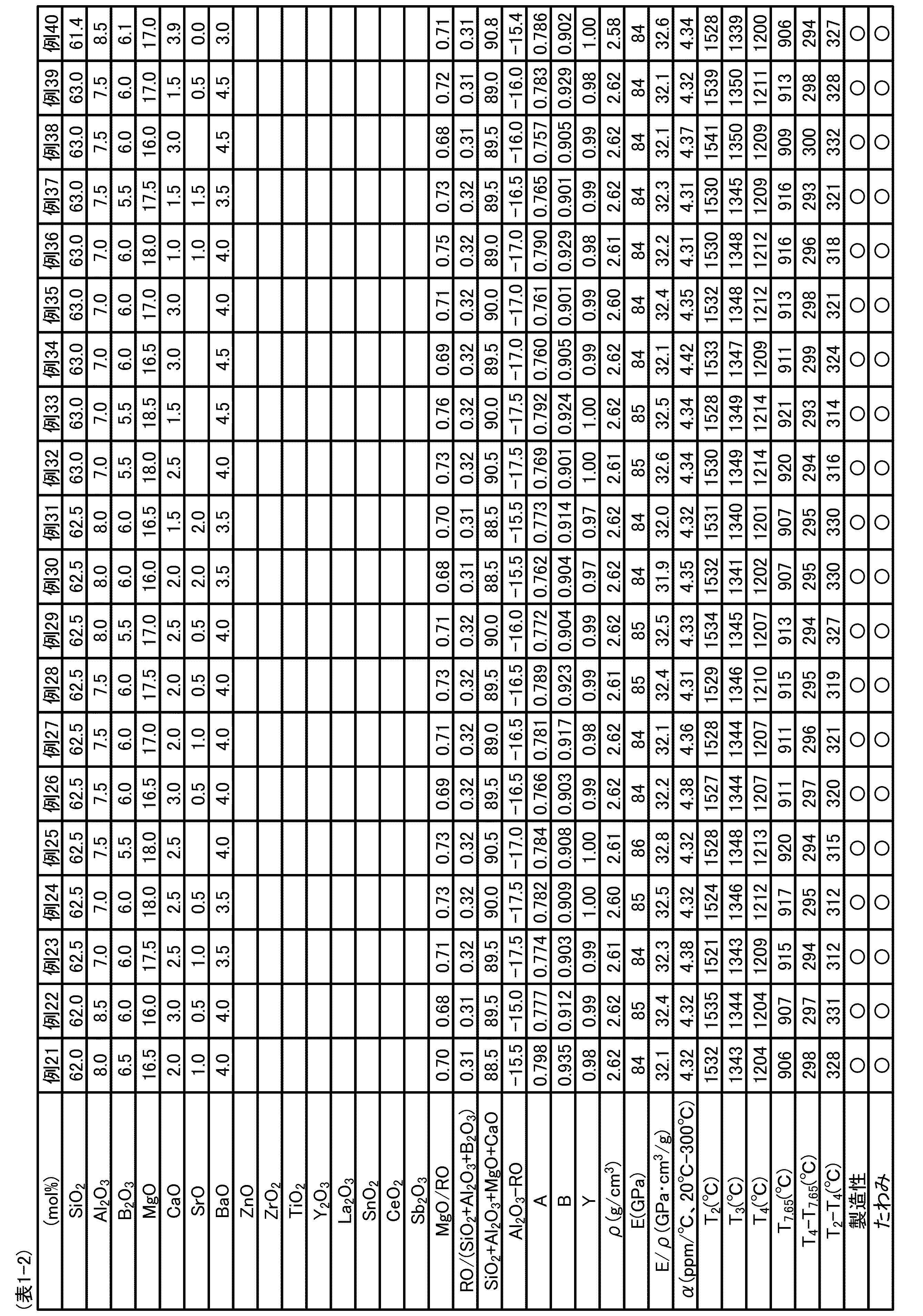
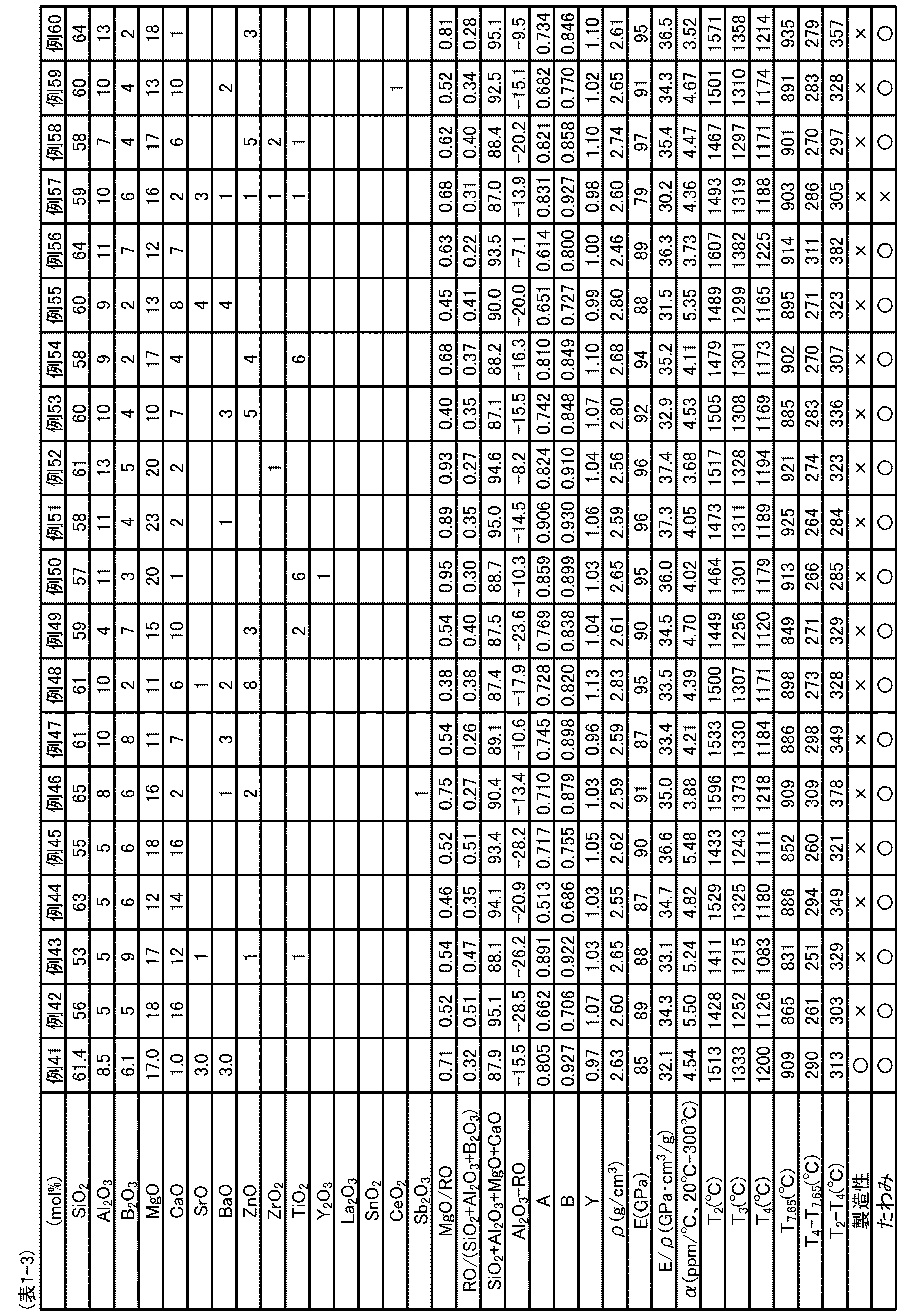
- Tables 1-1 to 1-3 show the characteristics of the glass of each example. Note that the embodiment may be modified as long as the effects of the invention are achieved.
- Example 1 glass having the composition shown in Table 1-1 was produced.
- a raw plate having a diameter of 320 mm and a thickness of 6 mm was produced using a fusion casting method.
- a plurality of plates having a diameter of 300 mm and a thickness of 3 mm were cut out from the center of the raw plate. Both sides of these plates were polished using cerium oxide as an abrasive to obtain glass having a thickness of 0.7 mm.
- the parameter A was calculated using equation (1) above.
- the parameter B was calculated using equation (2) above.
- the density ⁇ (g/cm 3 ) was measured for the glass of Example 1.
- the density was measured by the Archimedes method.
- the Young's modulus E (GPa) was measured for the glass of Example 1.
- the Young's modulus was measured by the ultrasonic pulse method specified in JIS R 1602:1995 "Testing method for elastic modulus of fine ceramics.”
- the bulk density of the sample was measured by the Archimedes method, and the longitudinal wave velocity and shear wave velocity were measured using an ultrasonic thickness gauge 38DL PLUS manufactured by Olympus Corporation to obtain the Young's modulus value.
- the linear thermal expansion coefficient ⁇ (ppm/°C) was measured for the glass of Example 1.
- a thermal expansion meter (DIL 402 Expedis Supreme) manufactured by NETZSCH was used as the measuring device to measure in the range of 0°C to 350°C, and the average thermal expansion coefficient in the range of 20°C to 300°C was taken as the linear thermal expansion coefficient ⁇ .
- the melting temperature T2 (°C), working temperature T3 (°C), and forming temperature T4 (°C) were measured as high temperature viscosity values for the glass of Example 1.
- the melting temperature T2 , working temperature T3 , and forming temperature T4 were measured by an inner cylinder rotation method.
- the softening temperature T 7.65 (° C.) was measured for the glass of Example 1.
- the softening temperature T 7.65 (° C.) was measured by the method specified in JIS R 3103-1 "Viscosity and viscosity fixed points of glass - Part 1: Method for measuring softening point.” The measurement results and calculation results are shown in Table 1-1.
- Example 2 to 60 glasses were produced in the same manner as in Example 1, except that the glass compositions were as shown in Tables 1-1 to 1-3. The measurement results and calculation results for each Example are shown in Tables 1-1 to 1-3.
- the glasses of Examples 1 to 41 (Examples) in which the parameter A was 0.817 or less, the parameter B was 0.898 or more, and the ratio (MgO/RO) was 0.65 or more passed the manufacturability evaluation and the deflection evaluation, and it is understood that the glasses can be easily manufactured while suppressing deflection.
- the glasses of Examples 42 to 60 (Comparative Examples) which do not satisfy at least one of the following conditions: parameter A is 0.817 or less, parameter B is 0.898 or more, and the ratio (MgO/RO) is 0.65 or more, failed at least one of the manufacturability evaluation and the deflection evaluation, and it is found that they cannot be easily manufactured while suppressing deflection.
Landscapes
- Chemical & Material Sciences (AREA)
- Life Sciences & Earth Sciences (AREA)
- Engineering & Computer Science (AREA)
- Chemical Kinetics & Catalysis (AREA)
- General Chemical & Material Sciences (AREA)
- Geochemistry & Mineralogy (AREA)
- Materials Engineering (AREA)
- Organic Chemistry (AREA)
- Glass Compositions (AREA)
Abstract
式(1)に示すパラメータAが0.817以下であり、式(2)に示すパラメータBが0.898以上であり、酸化物基準のモル%表示における、二価の酸化物ROの合計含有量に対するMgOの含有量の比率が0.65以上であり、無アルカリガラスとすることで、ヤング率が80GPa以上であって、たわみを抑制しつつ製造が容易なガラスを提供することができる。 A=1.747-0.022×[SiO2]+0.006×[Al2O3]+0.018×[B2O3]+0.013×[MgO]-0.010×[CaO]-0.003×[SrO]+0.012×[BaO]+0.015×[ZnO] ・・・(1) B=1.315-0.010×[SiO2]+0.005×[Al2O3]+0.023×[B2O3]+0.004×[MgO]-0.016×[CaO]-0.007×[SrO]+0.011×[BaO]+0.010×[ZnO] ・・・(2)
Description
本発明は、ガラスに関する。
半導体デバイスの製造プロセス中に半導体デバイスを支持する部材として、ガラスが用いられることがある。例えば特許文献1には、たわみを抑制するために高ヤング率とした支持ガラス基板が記載されている。
このようにたわみを抑制するために高ヤング率としたガラスは、高ヤング率とするために添加した成分によって製造に適さない粘度曲線、すなわち粘度の温度依存性を示す場合が多く、製造を容易とすることが求められている。
本発明は、たわみを抑制しつつ製造が容易なガラスを提供することを目的とする。
本開示に係るガラスは、式(1)に示すパラメータAが0.817以下であり、式(2)に示すパラメータBが0.898以上であり、酸化物基準のモル%表示における、二価の酸化物ROの合計含有量に対するMgOの含有量の比率が0.65以上であり、ヤング率が80GPa以上であり、無アルカリガラスである。
A=1.747-0.022×[SiO2]+0.006×[Al2O3]+0.018×[B2O3]+0.013×[MgO]-0.010×[CaO]-0.003×[SrO]+0.012×[BaO]+0.015×[ZnO] ・・・(1)
B=1.315-0.010×[SiO2]+0.005×[Al2O3]+0.023×[B2O3]+0.004×[MgO]-0.016×[CaO]-0.007×[SrO]+0.011×[BaO]+0.010×[ZnO] ・・・(2)
本発明によれば、たわみを抑制しつつ製造を容易にできる。
以下に添付図面を参照して、本発明の好適な実施形態を詳細に説明する。なお、この実施形態により本発明が限定されるものではなく、また、実施形態が複数ある場合には、各実施形態を組み合わせて構成するものも含むものである。また、数値については四捨五入の範囲が含まれる。また、「~」で表される数値範囲は、~の前後の数値を下限値及び上限値として含む数値範囲を意味し、以降でも「~」を使用する場合は、同様の意味を指す。また、数値範囲で示した上限値と下限値とは、適宜組み合わせることができる。
(ガラス)
図1は、本実施形態に係るガラスの模式図である。図1に示すように、本実施形態に係るガラス10は、半導体パッケージの製造用のガラス基板として用いられるものであり、より具体的には、FOWLP等の製造用の支持ガラス基板である。ただし、ガラス10の用途は、FOWLP等の製造用に限られず任意であり、部材を支持するために用いられるガラス基板であってよいし、部材の支持以外の用途に用いられてもよい。なお、FOWLP等とは、ファンアウトウェハレベルパッケージ(Fan Out Wafer Level Package:FOWLP)やファンアウトパネルレベルパッケージ(Fan Out Panel Level Package:FOPLP)を含むものである。
図1は、本実施形態に係るガラスの模式図である。図1に示すように、本実施形態に係るガラス10は、半導体パッケージの製造用のガラス基板として用いられるものであり、より具体的には、FOWLP等の製造用の支持ガラス基板である。ただし、ガラス10の用途は、FOWLP等の製造用に限られず任意であり、部材を支持するために用いられるガラス基板であってよいし、部材の支持以外の用途に用いられてもよい。なお、FOWLP等とは、ファンアウトウェハレベルパッケージ(Fan Out Wafer Level Package:FOWLP)やファンアウトパネルレベルパッケージ(Fan Out Panel Level Package:FOPLP)を含むものである。
(ガラスの組成)
次に、ガラス10の好ましい組成について説明する。
次に、ガラス10の好ましい組成について説明する。
(パラメータA)
ガラス10のパラメータAを、次の式(1)に示すものとする。
ガラス10のパラメータAを、次の式(1)に示すものとする。
A=1.747-0.022×[SiO2]+0.006×[Al2O3]+0.018×[B2O3]+0.013×[MgO]-0.010×[CaO]-0.003×[SrO]+0.012×[BaO]+0.015×[ZnO] ・・・(1)
なお、酸化物基準のモル%表記における、ガラス10に含まれる酸化物AxOy(Aは酸化物を構成する元素で、x、yは任意の整数)の含有量が、[AxOy]で表される。ここでの含有量とは、酸化物基準のモル%表記における、ガラス10の全体に対する、酸化物AxOyの含有量の比率を指す。すなわち例えば、式(1)における[SiO2]とは、酸化物基準のモル%表記における、ガラス10の全体に対する、SiO2の含有量の比率を指す。
また、ガラス10は、式(1)に示される全ての酸化物を含有していなくてもよい。式(1)においては、ガラス10に含まれていない酸化物の含有量は、0として扱う。また、ガラス10は、式(1)に示される酸化物以外の成分を含有していてもよい。
また、ガラス10は、式(1)に示される全ての酸化物を含有していなくてもよい。式(1)においては、ガラス10に含まれていない酸化物の含有量は、0として扱う。また、ガラス10は、式(1)に示される酸化物以外の成分を含有していてもよい。
ガラス10のパラメータAは、0.817以下であることが好ましく、0.813以下であることがより好ましく、0.809以下であることがより好ましく、0.802以下であることがより好ましく、0.796以下であることがより好ましく、0.789以下であることがより好ましい。また、パラメータAは、0.781以上であることも好ましく、0.781以上0.817以下であることも好ましいが、0.783以下であることも好ましく、0.776以下であることも好ましく、0.770以下であることも好ましい。パラメータAがこの範囲となることで、ガラス10の溶解温度と成形温度との温度差が高くなることを抑制することで、溶解工程から成形工程への移行時のエネルギーロスの増加を抑制でき、製造を容易にできる。また、パラメータAがこの範囲となることで、成形温度と軟化温度との温度差が小さくなり過ぎることを抑制して、成形時の粘度制御を容易として、製造を容易にできる。
(パラメータB)
ガラス10のパラメータBを、次の式(2)に示すものとする。
ガラス10のパラメータBを、次の式(2)に示すものとする。
B=1.315-0.010×[SiO2]+0.005×[Al2O3]+0.023×[B2O3]+0.004×[MgO]-0.016×[CaO]-0.007×[SrO]+0.011×[BaO]+0.010×[ZnO] ・・・(2)
ガラス10は、式(2)に示される全ての酸化物を含有していなくてもよい。式(2)においては、ガラス10に含まれていない酸化物の含有量は、0として扱う。また、ガラス10は、式(2)に示される酸化物以外の成分を含有していてもよい。
ガラス10のパラメータBは、0.898以上であることが好ましく、0.901以上であることがより好ましく、0.904以上であることがより好ましく、0.907以上であることがより好ましく、0.911以上であることがより好ましく、0.915以上であることがより好ましく、0.921以上であることがより好ましく、0.926以上であることがより好ましく、0.931以上であることが更に好ましい。また、ガラス10のパラメータBは、0.935以下であることも好ましく、0.903以上0.935以下であることも好ましい。パラメータBがこの範囲となることで、成形温度と軟化温度との温度差が小さくなり過ぎることを抑制して、成形時の粘度制御を容易として、製造を容易にできる。
(SiO2)
ガラス10は、SiO2を含有する(SiO2の含有量が0モル%より高い)ことが好ましい。溶解温度や液相温度の上昇を適切に抑制するために、ガラス10は、酸化物基準のモル%表示で、SiO2の含有量が、55.0%以上65.0%以下であることが好ましく、55%以上65%以下であることがより好ましく、57%以上64.5%以下であることがより好ましく、59%以上64%以下であることがより好ましく、61%以上63.5%以下であることがより好ましく、61.5%以上62.5%以下であることが更に好ましい。SiO2の含有量がこの範囲となることで、たわみを抑制しつつ製造を容易にできる。
ガラス10は、SiO2を含有する(SiO2の含有量が0モル%より高い)ことが好ましい。溶解温度や液相温度の上昇を適切に抑制するために、ガラス10は、酸化物基準のモル%表示で、SiO2の含有量が、55.0%以上65.0%以下であることが好ましく、55%以上65%以下であることがより好ましく、57%以上64.5%以下であることがより好ましく、59%以上64%以下であることがより好ましく、61%以上63.5%以下であることがより好ましく、61.5%以上62.5%以下であることが更に好ましい。SiO2の含有量がこの範囲となることで、たわみを抑制しつつ製造を容易にできる。
(Al2O3)
Al2O3は、ヤング率を上げてたわみを抑制し、かつガラスの分相を抑制する効果がある。そのため、ガラス10は、Al2O3を含有することが好ましい。ガラス10は、酸化物基準のモル%表示で、Al2O3の含有量が、3%以上13.0%以下であることが好ましく、5%以上11%以下であることがより好ましく、7%以上9%以下であることがより好ましく、7.0%以上8.5%以下であることがより好ましく、7.2%以上8.5%以下であることがより好ましく、7.4%以上8%以下であることがより好ましく、7.5%以上7.7%以下であることが更に好ましい。Al2O3の含有量がこの範囲となることで、たわみを抑制しつつ製造を容易にできる。
Al2O3は、ヤング率を上げてたわみを抑制し、かつガラスの分相を抑制する効果がある。そのため、ガラス10は、Al2O3を含有することが好ましい。ガラス10は、酸化物基準のモル%表示で、Al2O3の含有量が、3%以上13.0%以下であることが好ましく、5%以上11%以下であることがより好ましく、7%以上9%以下であることがより好ましく、7.0%以上8.5%以下であることがより好ましく、7.2%以上8.5%以下であることがより好ましく、7.4%以上8%以下であることがより好ましく、7.5%以上7.7%以下であることが更に好ましい。Al2O3の含有量がこの範囲となることで、たわみを抑制しつつ製造を容易にできる。
(B2O3)
B2O3は、ガラスの結晶化による失透を抑制して製造を容易にし、ヤング率を制御する効果がある。そのため、ガラス10は、B2O3を含有することが好ましい。ガラス10は、酸化物基準のモル%表示で、B2O3の含有量が、1.0%以上10.0%以下であることが好ましく、2%以上9%以下であることがより好ましく、3%以上8.5%以下であることがより好ましく、4%以上8%以下であることがより好ましく、5.5%以上7.5%以下であることがより好ましく、5.8%以上6.8%以下であることがより好ましく、6%以上6.5%以下であることが更に好ましい。B2O3の含有量がこの範囲となることで、たわみを抑制しつつ製造を容易にできる。
B2O3は、ガラスの結晶化による失透を抑制して製造を容易にし、ヤング率を制御する効果がある。そのため、ガラス10は、B2O3を含有することが好ましい。ガラス10は、酸化物基準のモル%表示で、B2O3の含有量が、1.0%以上10.0%以下であることが好ましく、2%以上9%以下であることがより好ましく、3%以上8.5%以下であることがより好ましく、4%以上8%以下であることがより好ましく、5.5%以上7.5%以下であることがより好ましく、5.8%以上6.8%以下であることがより好ましく、6%以上6.5%以下であることが更に好ましい。B2O3の含有量がこの範囲となることで、たわみを抑制しつつ製造を容易にできる。
(MgO/RO)
MgOは、密度を上げずにヤング率を上げるため、2族元素の中では比弾性率を高くする効果があり、ROの含有量に対するMgOの含有量の比率(MgO/RO)は比弾性率を制御する上で重要である。そのため、ガラス10は、比率(MgO/RO)が、0.65以上であることが好ましく、0.65以上0.9以下であることがより好ましく、0.68以上0.9以下であることがより好ましく、0.7以上0.85以下であることがより好ましく、0.72以上0.8以下であることがより好ましく、0.74以上0.77以下であることが更に好ましい。ここでのRは2価の金属を指し、ROとは2価の金属Rの酸化物を指し、ROの含有量とは、二価の酸化物の合計含有量を指す。二価の酸化物の合計含有量は、二価の酸化物が複数種類含まれている場合には、それらの二価の酸化物の合計含有量を指し、二価の酸化物が1種類含まれている場合には、その二価の酸化物の含有量を指す。比率(MgO/RO)がこの範囲となることで、たわみを抑制しつつ製造を容易にできる。
MgOは、密度を上げずにヤング率を上げるため、2族元素の中では比弾性率を高くする効果があり、ROの含有量に対するMgOの含有量の比率(MgO/RO)は比弾性率を制御する上で重要である。そのため、ガラス10は、比率(MgO/RO)が、0.65以上であることが好ましく、0.65以上0.9以下であることがより好ましく、0.68以上0.9以下であることがより好ましく、0.7以上0.85以下であることがより好ましく、0.72以上0.8以下であることがより好ましく、0.74以上0.77以下であることが更に好ましい。ここでのRは2価の金属を指し、ROとは2価の金属Rの酸化物を指し、ROの含有量とは、二価の酸化物の合計含有量を指す。二価の酸化物の合計含有量は、二価の酸化物が複数種類含まれている場合には、それらの二価の酸化物の合計含有量を指し、二価の酸化物が1種類含まれている場合には、その二価の酸化物の含有量を指す。比率(MgO/RO)がこの範囲となることで、たわみを抑制しつつ製造を容易にできる。
(RO)
ガラス10は、酸化物基準のモル%表示で、二価の酸化物ROの合計含有量が、10.0%以上40.0%以下であることが好ましく、15%以上35%以下であることがより好ましく、17.5%以上30%以下であることがより好ましく、20%以上27.5%以下であることがより好ましく、22%以上26%以下であることがより好ましく、23.5%以上25%以下であることがより好ましく、24%以上24.5%以下であることが更に好ましい。ROの合計含有量がこの範囲となることで、たわみを抑制しつつ製造を容易にできる。
ガラス10は、酸化物基準のモル%表示で、二価の酸化物ROの合計含有量が、10.0%以上40.0%以下であることが好ましく、15%以上35%以下であることがより好ましく、17.5%以上30%以下であることがより好ましく、20%以上27.5%以下であることがより好ましく、22%以上26%以下であることがより好ましく、23.5%以上25%以下であることがより好ましく、24%以上24.5%以下であることが更に好ましい。ROの合計含有量がこの範囲となることで、たわみを抑制しつつ製造を容易にできる。
(MgO)
MgOは密度を上げることなくヤング率を上げることができる、すなわち比弾性率を増加させる成分であることから、ガラス10は、MgOを含有することが好ましい。また、ヤング率を上げる成分の中でも、MgOはガラスの粘性を調整しやすい成分である。例えば希土類酸化物はヤング率を増加させる成分であるが、高温域の粘度の温度依存性を低下させ、結果として溶解温度と成形温度との温度差が大きくしてしまう。Al2O3も同様にヤング率を上げてたわみを抑制する成分であるが、ガラスの粘度を高くさせる効果が高く、溶解特性や成形性を損なうことがある。MgOもガラスの粘度に寄与する成分であるが、含有量を調整することによって、たわみの抑制と製造容易性の両立に優れた成分である。ガラス10は、酸化物基準のモル%表示で、MgOの含有量が、10.0%以上25.0%以下であることが好ましく、12%以上22%以下であることがより好ましく、14%以上22%以下であることがより好ましく、16%以上22%以下であることがより好ましく、16.5%以上22%以下であることがより好ましく、16.5%以上20%以下であることがより好ましく、16.6%以上18.6%以下であることがより好ましく、16.7%以上18%以下であることがより好ましく、17%以上17.7%以下であることが更に好ましい。MgOの含有量がこの範囲となることで、たわみを抑制しつつ製造を容易にできる。
MgOは密度を上げることなくヤング率を上げることができる、すなわち比弾性率を増加させる成分であることから、ガラス10は、MgOを含有することが好ましい。また、ヤング率を上げる成分の中でも、MgOはガラスの粘性を調整しやすい成分である。例えば希土類酸化物はヤング率を増加させる成分であるが、高温域の粘度の温度依存性を低下させ、結果として溶解温度と成形温度との温度差が大きくしてしまう。Al2O3も同様にヤング率を上げてたわみを抑制する成分であるが、ガラスの粘度を高くさせる効果が高く、溶解特性や成形性を損なうことがある。MgOもガラスの粘度に寄与する成分であるが、含有量を調整することによって、たわみの抑制と製造容易性の両立に優れた成分である。ガラス10は、酸化物基準のモル%表示で、MgOの含有量が、10.0%以上25.0%以下であることが好ましく、12%以上22%以下であることがより好ましく、14%以上22%以下であることがより好ましく、16%以上22%以下であることがより好ましく、16.5%以上22%以下であることがより好ましく、16.5%以上20%以下であることがより好ましく、16.6%以上18.6%以下であることがより好ましく、16.7%以上18%以下であることがより好ましく、17%以上17.7%以下であることが更に好ましい。MgOの含有量がこの範囲となることで、たわみを抑制しつつ製造を容易にできる。
(CaO)
CaOは、2族元素の酸化物ではMgOに次いで比弾性率を高くする効果がある。そのため、ガラス10は、CaOを非含有(CaOの含有量が0モル%)でもよいが、CaOを含有していてもよい。ガラス10は、酸化物基準のモル%表示で、CaOの含有量が、1.0%以上10.0%以下であることが好ましく、1.1%以上7%以下であることがより好ましく、1.5%以上4.2%以下であることがより好ましく、1.8%以上3.7%以下であることがより好ましく、2.2%以上3.4%以下であることがより好ましく、2.4%以上3%以下であることがより好ましく、2.5%以上2.7%以下であることが更に好ましい。CaOの含有量がこの範囲となることで、たわみを抑制しつつ製造を容易にできる。
CaOは、2族元素の酸化物ではMgOに次いで比弾性率を高くする効果がある。そのため、ガラス10は、CaOを非含有(CaOの含有量が0モル%)でもよいが、CaOを含有していてもよい。ガラス10は、酸化物基準のモル%表示で、CaOの含有量が、1.0%以上10.0%以下であることが好ましく、1.1%以上7%以下であることがより好ましく、1.5%以上4.2%以下であることがより好ましく、1.8%以上3.7%以下であることがより好ましく、2.2%以上3.4%以下であることがより好ましく、2.4%以上3%以下であることがより好ましく、2.5%以上2.7%以下であることが更に好ましい。CaOの含有量がこの範囲となることで、たわみを抑制しつつ製造を容易にできる。
(SrO)
SrOは、密度を上げ、ヤング率を制御する効果があり、溶解性を向上させる。ガラス10は、SrOを非含有でもよいが、SrOを含有していてもよい。ガラス10は、酸化物基準のモル%表示で、SrOの含有量が、0.1%以上5.0%以下であることが好ましく、0.1%以上3.4%以下であることがより好ましく、0.5%以上3%以下であることがより好ましく、0.9%以上2.6%以下であることがより好ましく、1%以上2%以下であることが更に好ましい。SrOの含有量がこの範囲となることで、たわみを抑制しつつ製造を容易にできる。
SrOは、密度を上げ、ヤング率を制御する効果があり、溶解性を向上させる。ガラス10は、SrOを非含有でもよいが、SrOを含有していてもよい。ガラス10は、酸化物基準のモル%表示で、SrOの含有量が、0.1%以上5.0%以下であることが好ましく、0.1%以上3.4%以下であることがより好ましく、0.5%以上3%以下であることがより好ましく、0.9%以上2.6%以下であることがより好ましく、1%以上2%以下であることが更に好ましい。SrOの含有量がこの範囲となることで、たわみを抑制しつつ製造を容易にできる。
(BaO)
BaOは、SrOよりも密度を上げる効果があり、溶解性を向上させる。ガラス10は、BaOを非含有でもよいが、BaOを含有していてもよい。ガラス10は、酸化物基準のモル%表示で、BaOの含有量が、0.1%以上5.0%以下であることが好ましく、1%以上4.8%以下であることがより好ましく、1.5%以上4.7%以下であることがより好ましく、2%以上4.5%以下であることがより好ましく、2.5%以上4.3%以下であることがより好ましく、3%以上4.1%以下であることがより好ましく、3.3%以上3.8%以下であることが更に好ましい。BaOの含有量がこの範囲となることで、たわみを抑制しつつ製造を容易にできる。
BaOは、SrOよりも密度を上げる効果があり、溶解性を向上させる。ガラス10は、BaOを非含有でもよいが、BaOを含有していてもよい。ガラス10は、酸化物基準のモル%表示で、BaOの含有量が、0.1%以上5.0%以下であることが好ましく、1%以上4.8%以下であることがより好ましく、1.5%以上4.7%以下であることがより好ましく、2%以上4.5%以下であることがより好ましく、2.5%以上4.3%以下であることがより好ましく、3%以上4.1%以下であることがより好ましく、3.3%以上3.8%以下であることが更に好ましい。BaOの含有量がこの範囲となることで、たわみを抑制しつつ製造を容易にできる。
(ZnO)
ZnOは、ガラスの溶解性をよくし、ヤング率を高くする効果がある。そのため、ガラス10は、ZnOを非含有でもよいが、ZnOを含有していてもよい。ZnOの含有量を10%以下にすることで線熱膨張係数が高くなるのを抑制できる。ガラス10は、酸化物基準のモル%表示で、ZnOの含有量が、0.1%以上10%以下であることが好ましく、0.5%以上8%以下であることがより好ましく、1%以上7%以下であることがより好ましく、1.5%以上6%以下であることがより好ましく、2%以上5%以下であることがより好ましく、2.5%以上4%以下であることがより好ましく、3%以上3.5%以下であることが更に好ましい。ZnOの含有量がこの範囲となることで、たわみを抑制しつつ製造を容易にできる。
ZnOは、ガラスの溶解性をよくし、ヤング率を高くする効果がある。そのため、ガラス10は、ZnOを非含有でもよいが、ZnOを含有していてもよい。ZnOの含有量を10%以下にすることで線熱膨張係数が高くなるのを抑制できる。ガラス10は、酸化物基準のモル%表示で、ZnOの含有量が、0.1%以上10%以下であることが好ましく、0.5%以上8%以下であることがより好ましく、1%以上7%以下であることがより好ましく、1.5%以上6%以下であることがより好ましく、2%以上5%以下であることがより好ましく、2.5%以上4%以下であることがより好ましく、3%以上3.5%以下であることが更に好ましい。ZnOの含有量がこの範囲となることで、たわみを抑制しつつ製造を容易にできる。
(アルカリ金属酸化物)
ガラス10は、無アルカリガラスであることが好ましい。無アルカリガラスとは、Li2O、Na2O、K2O等のアルカリ金属酸化物を実質的に含有しないものである。ここで、アルカリ金属酸化物を実質的に含有しないとは、原料等から混入する不可避的不純物以外にはアルカリ金属酸化物を含有しないことを意味する。すなわち、アルカリ金属酸化物を意図的に含有させないものを意味する。
例えば、ガラス10は、酸化物基準のモル%表示で、Li2Oの含有量が0%であることが好ましく、Na2Oの含有量が0%であることが好ましく、K2Oの含有量が0%であることが好ましい。
ガラス10は、無アルカリガラスであることが好ましい。無アルカリガラスとは、Li2O、Na2O、K2O等のアルカリ金属酸化物を実質的に含有しないものである。ここで、アルカリ金属酸化物を実質的に含有しないとは、原料等から混入する不可避的不純物以外にはアルカリ金属酸化物を含有しないことを意味する。すなわち、アルカリ金属酸化物を意図的に含有させないものを意味する。
例えば、ガラス10は、酸化物基準のモル%表示で、Li2Oの含有量が0%であることが好ましく、Na2Oの含有量が0%であることが好ましく、K2Oの含有量が0%であることが好ましい。
上述した成分に加え、様々な機械的特性、溶融性、成形性を調整するために、以上で挙げた酸化物以外の酸化物(副酸化物)を含んでよい。なお、以上で挙げた酸化物とは、SiO2、Al2O3、B2O3、RO(2価の酸化物)、及びアルカリ金属酸化物を指す。副酸化物としては、例えば、TiO2やZrO2などの金属酸化物や、Y2O3やLa2O3などの希土類酸化物が挙げられる。ガラス10は、酸化物基準のモル%表示で、副酸化物を、総量で、5%以下含有してよく、3%以下が好ましく、2%以下がより好ましく、1%以下であることがより好ましく、0.5%以下であることがより好ましく、0.3%以下であることがより好ましく、0.2%以下であることがより好ましく、0.1%以下であることがさらに好ましく、実質的に含有しないことがとくに好ましい。
(PbO)
PbOは、ヤング率を高くする効果があるが、環境負荷が高い酸化物である。そのため、ガラス10は、PbOを含有しないことが好ましい。ガラス10は、酸化物基準のモル%表示で、PbOの含有量が、0.1%以下であることが好ましく、0.05%以下であることがより好ましく、0.01%以下であることが更に好ましい。PbOの含有量がこの範囲となることで、環境負荷を抑えることができる。
PbOは、ヤング率を高くする効果があるが、環境負荷が高い酸化物である。そのため、ガラス10は、PbOを含有しないことが好ましい。ガラス10は、酸化物基準のモル%表示で、PbOの含有量が、0.1%以下であることが好ましく、0.05%以下であることがより好ましく、0.01%以下であることが更に好ましい。PbOの含有量がこの範囲となることで、環境負荷を抑えることができる。
(Fe2O3)
ガラス10は、Fe2O3を含有しないことが好ましい。ガラス10は、酸化物基準の質量%表示で、外割でのFe2O3の含有量が、0.1%以下が好ましく、0.001%以上0.05%以下であることがより好ましく、0.005%以上0.01%以下であることが更に好ましい。Fe2O3の含有量がこのように低いことで、光の透過率の低下を抑制できる。
なお、外割でのFe2O3の含有量とは、酸化物基準において、Fe2O3を除いたガラス10の全成分の質量の合計値に対する、ガラス10に含まれるFe2O3の質量の比率を指す。
ガラス10は、Fe2O3を含有しないことが好ましい。ガラス10は、酸化物基準の質量%表示で、外割でのFe2O3の含有量が、0.1%以下が好ましく、0.001%以上0.05%以下であることがより好ましく、0.005%以上0.01%以下であることが更に好ましい。Fe2O3の含有量がこのように低いことで、光の透過率の低下を抑制できる。
なお、外割でのFe2O3の含有量とは、酸化物基準において、Fe2O3を除いたガラス10の全成分の質量の合計値に対する、ガラス10に含まれるFe2O3の質量の比率を指す。
(ガラスの好ましい組成)
以下に、ガラス10の好ましい組成範囲についてさらに説明する。
以下に、ガラス10の好ましい組成範囲についてさらに説明する。
ガラスの清澄性を改善するため、ガラス10は、酸化物基準の質量%表示で、SnO2、CeO2、Sb2O3、SO3、F、及びClの総量が、外割で、1.0wt%以下、好ましくは0.5wt%以下、より好ましくは0.3wt%以下、さらに好ましくは0.1wt%以下含有できる。
ガラス10は、酸化物基準のモル%表示で、SiO2とAl2O3とB2O3との合計含有量に対する、ROの含有量の比率((RO)/(SiO2+Al2O3+B2O3))が、0.2以上0.5以下であることが好ましく、0.22以上0.48以下であることがより好ましく、0.27以上0.44以下であることがより好ましく、0.29以上0.38以下であることがより好ましく、0.31以上0.34以下であることがより好ましく、0.32以上0.33以下であることが更に好ましい。比率((RO)/(SiO2+Al2O3+B2O3))がこの範囲となることで、ヤング率と溶解性を両立することができる。
ガラス10は、SiO2、Al2O3、MgO、CaOの総量(SiO2+Al2O3+MgO+CaO)が、酸化物基準のモル%表示で、85%以上98%以下であることが好ましく、86%以上95%以下であることがより好ましく、87%以上93%以下であることがより好ましく、88%以上91%以下であることが更に好ましい。総量(SiO2+Al2O3+MgO+CaO)の下限がこのように高いことで、密度とヤング率を制御することができ、上限がこの範囲となることで、溶解性の悪化を抑制できる。
ガラス10は、Al2O3の含有量からROの含有量を差し引いた値である差(Al2O3-RO)が、酸化物基準のモル%表示で、-30%以上0%以下であることが好ましく、-28.5%以上-5%以下であることがより好ましく、-25%以上-8%以下であることがより好ましく、-22%以上-12%以下であることがより好ましく、-20%以上-14%以下であることがより好ましく、-18%以上-16%以下であることが更に好ましい。(Al2O3-RO)がこの範囲となることで、ヤング率と溶解性を両立することができる。
ガラス10は、酸化物基準のモル%表示で、
SiO2:60.5%~61.5%
Al2O3:7.2%~7.7%
B2O3:6.0%~7.0%
MgO:17.0%~18.0%
CaO:3.5%~4.5%
SrO:0.0%~1.0%
BaO:2.5%~3.5%
を含有することが好ましい。
各酸化物の含有量がこの範囲となることで、たわみを抑制しつつ製造を容易にできる。
なお、ガラス10の組成が上記範囲である場合、ガラス10は、不可避的不純物を除き、上記で挙げて以外の酸化物を含まないことが好ましい。
SiO2:60.5%~61.5%
Al2O3:7.2%~7.7%
B2O3:6.0%~7.0%
MgO:17.0%~18.0%
CaO:3.5%~4.5%
SrO:0.0%~1.0%
BaO:2.5%~3.5%
を含有することが好ましい。
各酸化物の含有量がこの範囲となることで、たわみを抑制しつつ製造を容易にできる。
なお、ガラス10の組成が上記範囲である場合、ガラス10は、不可避的不純物を除き、上記で挙げて以外の酸化物を含まないことが好ましい。
なお、ガラス10は、焼結体を含まないことが好ましい。すなわち、ガラス10は、焼結体でないガラスであることが好ましい。ここでの焼結体とは、複数の粒子を融点より低い温度で加熱して、粒子同士を結合させた部材を指す。焼結体は、空孔を含むため気孔率がある程度高くなるが、ガラス10は、焼結体でないため、気孔率が低く、通常0%である。ただし、不可避な微量な気孔を含むことは許容される。ここでの気孔率は、いわゆる真の気孔率であり、外部に連通する気孔(空孔)及び外部に連通しない気孔(空孔)との容積の和を、全容積(見かけの容積)で除した値を指す。気孔率は、例えばJIS R 1634:1998「ファインセラミックスの焼結体密度・開気孔率の測定方法」に従って測定できる。
また、ガラス10に使用されるガラスは通常非晶質のガラス、すなわち非晶質固体であることが好ましい。またこのガラスは表面や内部に結晶を含む結晶化ガラスであってもよいが、密度の観点から非晶質のガラスが好ましい。セラミックスの内、焼結法により作製されたものは透過率が低く、密度が大きくなるため使用しないことが好ましい。
(ガラスの形状)
次に、ガラス10の形状について説明する。図1に示すように、ガラス10は、一方側の主面である表面12と、表面12の反対側の主面である表面14とを含む板状のガラス基板である。表面14は、例えば、表面12と平行であってよい。ガラス10は、平面視で、すなわち表面12に直交する方向から見た場合に、円形となる円板形状であってよいが、円板形状に限られず任意の形状であってよく、例えば矩形などの多角形状の板であってもよい。なお、外周にノッチやオリフラ(オリエンテーション・フラット)などの切欠きが設けられたものも上記形状には含まれる。
次に、ガラス10の形状について説明する。図1に示すように、ガラス10は、一方側の主面である表面12と、表面12の反対側の主面である表面14とを含む板状のガラス基板である。表面14は、例えば、表面12と平行であってよい。ガラス10は、平面視で、すなわち表面12に直交する方向から見た場合に、円形となる円板形状であってよいが、円板形状に限られず任意の形状であってよく、例えば矩形などの多角形状の板であってもよい。なお、外周にノッチやオリフラ(オリエンテーション・フラット)などの切欠きが設けられたものも上記形状には含まれる。
また、ガラス10の厚みD、すなわち表面12と表面14との間の長さは、0.1mm以上5.0mm以下であることが好ましく、0.1mm以上2.0mm以下であることがより好ましく、0.1mm以上0.7mm以上であることがさらに好ましい。厚みDを0.1mm以上とすることで、ガラス10が薄くなり過ぎることを抑えて、たわみや衝撃による破損を抑制できる。厚みDを2.0mm以下とすることで、重くなることを抑制でき、厚みDを0.7mm以下とすることで、重くなることをさらに好適に抑制できる。
(ガラスの特性)
次に、ガラス10の特性について説明する。
次に、ガラス10の特性について説明する。
(ヤング率)
ガラス10のヤング率Eは、75GPa以上が好ましく、77GPa以上120GPa以下がより好ましく、79GPa以上100GPa以下がより好ましく、81GPa以上90GPa以下がより好ましく、83GPa以上87GPa以下がより好ましく、84GPa以上86GPa以下が更に好ましい。ヤング率Eをこの範囲とすることで、たわみを適切に抑制できる。ヤング率が高すぎると、切断や研削、研磨加工が困難になる。
ガラス10のヤング率Eは、75GPa以上が好ましく、77GPa以上120GPa以下がより好ましく、79GPa以上100GPa以下がより好ましく、81GPa以上90GPa以下がより好ましく、83GPa以上87GPa以下がより好ましく、84GPa以上86GPa以下が更に好ましい。ヤング率Eをこの範囲とすることで、たわみを適切に抑制できる。ヤング率が高すぎると、切断や研削、研磨加工が困難になる。
(ヤング率パラメータ)
組成から算出されるガラス10のヤング率パラメータYは、0.9以上が好ましく、0.95以上1.15以下がより好ましく、0.96以上1.10以下がより好ましく、0.97以上1.05以下がより好ましく、0.98以上1.04以下がより好ましく、0.99以上1.03以下がより好ましく、1.00以上1.02以下がさらに好ましい。ヤング率パラメータYをこの範囲とすることで、ヤング率Eを上記範囲にすることができ、たわみを適切に抑制できる。
ヤング率パラメータYは、次の式(3)から算出される。
組成から算出されるガラス10のヤング率パラメータYは、0.9以上が好ましく、0.95以上1.15以下がより好ましく、0.96以上1.10以下がより好ましく、0.97以上1.05以下がより好ましく、0.98以上1.04以下がより好ましく、0.99以上1.03以下がより好ましく、1.00以上1.02以下がさらに好ましい。ヤング率パラメータYをこの範囲とすることで、ヤング率Eを上記範囲にすることができ、たわみを適切に抑制できる。
ヤング率パラメータYは、次の式(3)から算出される。
Y=(60-0.244[SiO2]+0.27[Al2O3]-0.60[B2O3]+0.63[MgO]+0.48[CaO]-0.56[SrO]-0.22[BaO]+1.37[ZnO])/85 ・・・(3)
(密度)
ガラス10の密度ρは、2.4g/cm3以上2.9g/cm3以下が好ましく、2.45g/cm3以上2.85g/cm3以下がより好ましく、2.5g/cm3以上2.8g/cm3以下がより好ましく、2.55g/cm3以上2.75g/cm3以下がより好ましく、2.57g/cm3以上2.7g/cm3以下がより好ましく、2.59g/cm3以上2.65g/cm3以下がより好ましく、2.6g/cm3以上2.63g/cm3以下が更に好ましい。
ガラス10の密度ρは、2.4g/cm3以上2.9g/cm3以下が好ましく、2.45g/cm3以上2.85g/cm3以下がより好ましく、2.5g/cm3以上2.8g/cm3以下がより好ましく、2.55g/cm3以上2.75g/cm3以下がより好ましく、2.57g/cm3以上2.7g/cm3以下がより好ましく、2.59g/cm3以上2.65g/cm3以下がより好ましく、2.6g/cm3以上2.63g/cm3以下が更に好ましい。
(E/ρ)
ガラス10の密度ρに対するヤング率Eの比率(E/ρ)は、30GPa・cm3/g以上40GPa・cm3/g以下が好ましく、30.5GPa・cm3/g以上38GPa・cm3/g以下がより好ましく、31GPa・cm3/g以上36GPa・cm3/g以下がより好ましく、31.5GPa・cm3/g以上34GPa・cm3/g以下がより好ましく、32GPa・cm3/g以上33.5GPa・cm3/g以下がより好ましく、32.2GPa・cm3/g以上33GPa・cm3/g以下がより好ましく、32.4GPa・cm3/g以上32.7GPa・cm3/g以下が更に好ましい。比率(E/ρ)の下限がこの範囲となることで、重量を抑制しつつたわみを抑制できるため、工程上でも扱いやすくなる。また、比率(E/ρ)の上限がこの範囲となることで、加工の際のクラック発生を抑制できる。
ガラス10の密度ρに対するヤング率Eの比率(E/ρ)は、30GPa・cm3/g以上40GPa・cm3/g以下が好ましく、30.5GPa・cm3/g以上38GPa・cm3/g以下がより好ましく、31GPa・cm3/g以上36GPa・cm3/g以下がより好ましく、31.5GPa・cm3/g以上34GPa・cm3/g以下がより好ましく、32GPa・cm3/g以上33.5GPa・cm3/g以下がより好ましく、32.2GPa・cm3/g以上33GPa・cm3/g以下がより好ましく、32.4GPa・cm3/g以上32.7GPa・cm3/g以下が更に好ましい。比率(E/ρ)の下限がこの範囲となることで、重量を抑制しつつたわみを抑制できるため、工程上でも扱いやすくなる。また、比率(E/ρ)の上限がこの範囲となることで、加工の際のクラック発生を抑制できる。
(線熱膨張係数)
ガラス10の線熱膨張係数αは、5.8ppm/℃以下が好ましく、3.6ppm/℃以上5.6ppm/℃以下がより好ましく、3.8ppm/℃以上5.2ppm/℃以下がより好ましく、4ppm/℃以上5.2ppm/℃以下がより好ましく、4.2ppm/℃以上4.8ppm/℃以下がより好ましく、4.3ppm/℃以上4.6ppm/℃以下がより好ましく、4.35ppm/℃以上4.5ppm/℃以下がより好ましい。
線熱膨張係数をこの範囲とすることで、たわみを適切に抑制できる。線熱膨張係数αは、20℃~300℃の範囲における平均熱膨張係数であり、熱膨張測定の規格としてDIN-51045-1に準拠して測定した値である。例えば、測定装置としてNETZSCH社製の熱膨張計DIL 402 Expedis Supreme)を用いて0℃~350℃の範囲で測定し、そのうち20℃~300℃の範囲の平均熱膨張係数を、線熱膨張係数としてよい。
ガラス10の線熱膨張係数αは、5.8ppm/℃以下が好ましく、3.6ppm/℃以上5.6ppm/℃以下がより好ましく、3.8ppm/℃以上5.2ppm/℃以下がより好ましく、4ppm/℃以上5.2ppm/℃以下がより好ましく、4.2ppm/℃以上4.8ppm/℃以下がより好ましく、4.3ppm/℃以上4.6ppm/℃以下がより好ましく、4.35ppm/℃以上4.5ppm/℃以下がより好ましい。
線熱膨張係数をこの範囲とすることで、たわみを適切に抑制できる。線熱膨張係数αは、20℃~300℃の範囲における平均熱膨張係数であり、熱膨張測定の規格としてDIN-51045-1に準拠して測定した値である。例えば、測定装置としてNETZSCH社製の熱膨張計DIL 402 Expedis Supreme)を用いて0℃~350℃の範囲で測定し、そのうち20℃~300℃の範囲の平均熱膨張係数を、線熱膨張係数としてよい。
(溶解温度T2、作業温度T3、成形温度T4、軟化温度T7.65)
ガラス10の溶解温度T2は、1400℃以上1650℃以下であることが好ましく、1410℃以上1620℃以下であることがより好ましく、1440℃以上1590℃以下であることがより好ましく、1470℃以上1560℃以下であることがより好ましく、1480℃以上1550℃以下であることがより好ましく、1490℃以上1540℃以下であることがより好ましく、1500℃以上1530℃以下であることがより好ましく、1510℃以上1520℃以下であることがより好ましい。溶解温度T2とは、粘度ηが102dPa・sとなる温度を指す。溶解温度T2がこのように比較的低いことで、溶解を容易にできる。また、溶解温度T2が比較的高いことで、他の一般的な商業用ガラスの溶解温度と同等にすることができる。これにより、素地替えにおける溶解設備の調整が容易になる。
ガラス10の作業温度T3は、1200℃以上1400℃以下であることが好ましく、1215℃以上1390℃以下であることがより好ましく、1240℃以上1380℃以下であることがより好ましく、1260℃以上1370℃以下であることがより好ましく、1290℃以上1360℃以下であることがより好ましく、1315℃以上1350℃以下であることがより好ましく、1325℃以上1345℃以下であることがさらに好ましい。作業温度T3とは、粘度ηが103dPa・sとなる温度を指す。作業温度T3がこのように比較的低いことで、成形を容易にできる。
ガラス10の成形温度T4は、1080℃以上1300℃以下であることが好ましく、1100℃以上1280℃以下であることがより好ましく、1120℃以上1260℃以下であることがより好ましく、1140℃以上1240℃以下であることがより好ましく、1160℃以上1220℃以下であることがより好ましく、1180℃以上1215℃以下であることがより好ましく、1190℃以上1210℃以下であることがより好ましく、1200℃以上1205℃以下であることがより好ましい。成形温度T4とは、粘度ηが104dPa・sとなる温度を指す。成形温度T4がこのように比較的低いことで、成形を容易にできる。
ガラス10の軟化温度T7.65は、800℃以上1000℃以下であることが好ましく、830℃以上980℃以下であることがより好ましく、850℃以上960℃以下であることがより好ましく、870℃以上940℃以下であることがより好ましく、890℃以上925℃以下であることがより好ましく、900℃以上920℃以下であることがより好ましく、905℃以上915℃以下であることがより好ましい。軟化温度T7.65とは、粘度ηが107.65dPa・sとなる温度を指す。軟化温度T7.65がこのように比較的低いことで、成形を容易にできる。
なお、溶解温度T2、作業温度T3、成形温度T4は、内筒回転法等によって測定することができる。軟化温度T7.65(℃)はJIS R 3103―1「ガラスの粘性及び粘性定点―第1部:軟化点の測定方法」に規定される方法によって測定できる。
ガラス10の溶解温度T2は、1400℃以上1650℃以下であることが好ましく、1410℃以上1620℃以下であることがより好ましく、1440℃以上1590℃以下であることがより好ましく、1470℃以上1560℃以下であることがより好ましく、1480℃以上1550℃以下であることがより好ましく、1490℃以上1540℃以下であることがより好ましく、1500℃以上1530℃以下であることがより好ましく、1510℃以上1520℃以下であることがより好ましい。溶解温度T2とは、粘度ηが102dPa・sとなる温度を指す。溶解温度T2がこのように比較的低いことで、溶解を容易にできる。また、溶解温度T2が比較的高いことで、他の一般的な商業用ガラスの溶解温度と同等にすることができる。これにより、素地替えにおける溶解設備の調整が容易になる。
ガラス10の作業温度T3は、1200℃以上1400℃以下であることが好ましく、1215℃以上1390℃以下であることがより好ましく、1240℃以上1380℃以下であることがより好ましく、1260℃以上1370℃以下であることがより好ましく、1290℃以上1360℃以下であることがより好ましく、1315℃以上1350℃以下であることがより好ましく、1325℃以上1345℃以下であることがさらに好ましい。作業温度T3とは、粘度ηが103dPa・sとなる温度を指す。作業温度T3がこのように比較的低いことで、成形を容易にできる。
ガラス10の成形温度T4は、1080℃以上1300℃以下であることが好ましく、1100℃以上1280℃以下であることがより好ましく、1120℃以上1260℃以下であることがより好ましく、1140℃以上1240℃以下であることがより好ましく、1160℃以上1220℃以下であることがより好ましく、1180℃以上1215℃以下であることがより好ましく、1190℃以上1210℃以下であることがより好ましく、1200℃以上1205℃以下であることがより好ましい。成形温度T4とは、粘度ηが104dPa・sとなる温度を指す。成形温度T4がこのように比較的低いことで、成形を容易にできる。
ガラス10の軟化温度T7.65は、800℃以上1000℃以下であることが好ましく、830℃以上980℃以下であることがより好ましく、850℃以上960℃以下であることがより好ましく、870℃以上940℃以下であることがより好ましく、890℃以上925℃以下であることがより好ましく、900℃以上920℃以下であることがより好ましく、905℃以上915℃以下であることがより好ましい。軟化温度T7.65とは、粘度ηが107.65dPa・sとなる温度を指す。軟化温度T7.65がこのように比較的低いことで、成形を容易にできる。
なお、溶解温度T2、作業温度T3、成形温度T4は、内筒回転法等によって測定することができる。軟化温度T7.65(℃)はJIS R 3103―1「ガラスの粘性及び粘性定点―第1部:軟化点の測定方法」に規定される方法によって測定できる。
(T2-T4)
ガラス10は、溶解温度T2と成形温度T4との差分(T2-T4)が、280℃以上340℃以下であることが好ましい。また、差分(T2-T4)は、400℃以下であってもよく、290℃以上375℃以下であってもよく、295℃以上360℃以下であってもよく、298℃以上340℃以下であってもよく、300℃以上320℃以下であってもよく、305℃以上315℃以下であってもよく、307℃以上310℃以下であってもよい。差分(T2-T4)がこのように比較的小さいことで、溶解工程から成形工程における温度傾斜が小さくなる。これにより、工程移行時のエネルギーロスの増加を抑制でき、製造を容易にできる。差分(T2-T4)が小さすぎると、温度に対する粘性の変化幅が大きすぎて、溶解工程から成形工程にかけての溶解及び成形温度の制御が困難になる。
ガラス10は、溶解温度T2と成形温度T4との差分(T2-T4)が、280℃以上340℃以下であることが好ましい。また、差分(T2-T4)は、400℃以下であってもよく、290℃以上375℃以下であってもよく、295℃以上360℃以下であってもよく、298℃以上340℃以下であってもよく、300℃以上320℃以下であってもよく、305℃以上315℃以下であってもよく、307℃以上310℃以下であってもよい。差分(T2-T4)がこのように比較的小さいことで、溶解工程から成形工程における温度傾斜が小さくなる。これにより、工程移行時のエネルギーロスの増加を抑制でき、製造を容易にできる。差分(T2-T4)が小さすぎると、温度に対する粘性の変化幅が大きすぎて、溶解工程から成形工程にかけての溶解及び成形温度の制御が困難になる。
(T4-T7.65)
ガラス10は、成形温度T4と軟化温度T7.65との差分(T4-T7.65)が、290℃以上であることが好ましく、290℃以上300℃以下であることがより好ましい。また、差分(T4-T7.65)は、250℃以上であってもよく、250℃以上350℃以下であってもよく、260℃以上335℃以下であってもよく、270℃以上315℃以下であってもよく、280℃以上305℃以下であってもよく、285℃以上300℃以下であってもよく、290℃以上295℃以下であってもよい。差分(T4-T7.65)が小さいと、成形工程においてガラスの粘度を制御する際に精密な温度制御が求められる。大規模な製造設備で精密な温度制御を行うことは困難であり、設計通りの形状に成形できない可能性があるだけでなく、クラックや割れが生じる場合もある。差分(T4-T7.65)がこのように比較的大きいことで、成形時の粘度制御を容易として、製造を容易にできる。
ガラス10は、成形温度T4と軟化温度T7.65との差分(T4-T7.65)が、290℃以上であることが好ましく、290℃以上300℃以下であることがより好ましい。また、差分(T4-T7.65)は、250℃以上であってもよく、250℃以上350℃以下であってもよく、260℃以上335℃以下であってもよく、270℃以上315℃以下であってもよく、280℃以上305℃以下であってもよく、285℃以上300℃以下であってもよく、290℃以上295℃以下であってもよい。差分(T4-T7.65)が小さいと、成形工程においてガラスの粘度を制御する際に精密な温度制御が求められる。大規模な製造設備で精密な温度制御を行うことは困難であり、設計通りの形状に成形できない可能性があるだけでなく、クラックや割れが生じる場合もある。差分(T4-T7.65)がこのように比較的大きいことで、成形時の粘度制御を容易として、製造を容易にできる。
(ガラスの製造方法)
ガラス10は、任意の方法で製造されてよいが、例えば次の方法で製造される。最初に、ガラス10に含まれる化合物の原料となる、珪砂やソーダ灰などの原料を所定の温度(例えば1500℃~1600℃)で加熱して溶融させる。そして、溶融した原料(ガラス)を清澄した後、板状に成形する成形工程を実行する。成形されたガラスは、酸化物基準で上記において説明したガラス10の組成範囲を有するものとなる。そして、成形工程で成形したガラスに徐冷工程を実行することで、ガラス10を製造する。
なお、ガラス10の製造方法は以上に限られず任意であってよい。例えば、徐冷工程は必須ではない。また、ガラス10を製造する際の成形工程は、種々の方法を採用可能であり、例えば溶融キャスト法、ダウンドロー法(例えば、オーバーフローダウンドロー法、スロットダウン法及びリドロー法など)、フロート法、ロールアウト法及びプレス法などが挙げられる。
ガラス10は、任意の方法で製造されてよいが、例えば次の方法で製造される。最初に、ガラス10に含まれる化合物の原料となる、珪砂やソーダ灰などの原料を所定の温度(例えば1500℃~1600℃)で加熱して溶融させる。そして、溶融した原料(ガラス)を清澄した後、板状に成形する成形工程を実行する。成形されたガラスは、酸化物基準で上記において説明したガラス10の組成範囲を有するものとなる。そして、成形工程で成形したガラスに徐冷工程を実行することで、ガラス10を製造する。
なお、ガラス10の製造方法は以上に限られず任意であってよい。例えば、徐冷工程は必須ではない。また、ガラス10を製造する際の成形工程は、種々の方法を採用可能であり、例えば溶融キャスト法、ダウンドロー法(例えば、オーバーフローダウンドロー法、スロットダウン法及びリドロー法など)、フロート法、ロールアウト法及びプレス法などが挙げられる。
次に、ガラス10を、FOWLP製造に用いた場合の製造工程の一例について説明する。FOWLP製造においては、ガラス10上に、複数の半導体チップを貼り合わせて、半導体チップを封止材で覆って素子基板を形成する。そして、ガラス10と素子基板とを分離して、素子基板の半導体チップと反対側を、例えば別のガラス10上に貼り合わせる。そして、半導体チップ上に配線や半田バンプなどを形成して、素子基板とガラス10とを再度分離する。そして、素子基板を半導体チップ毎に切断して個片化することで、半導体デバイスが得られる。
(効果)
以上説明したように、本開示の第1態様に係るガラス10は、パラメータAが0.817以下であり、パラメータBが0.898以上であり、酸化物基準のモル%表示における、二価の酸化物ROの合計含有量に対するMgOの含有量の比率(MgO/RO)が0.65以上であり、ヤング率Eが80GPa以上であり、無アルカリガラスである。
本開示のガラス10は、ヤング率Eが80GPa以上の無アルカリガラスであるため、たわみを適切に抑制できる。しかしながら、高ヤング率の無アルカリガラスは、一般的に、溶解温度T2と成形温度T4との差分(T2-T4)が大きくなり、成形温度T4と軟化温度T7.65との差分(T4-T7.65)が小さくなる傾向にある。差分(T2-T4)が大きいと、溶解工程から成形工程への移行時に、温度を大きく下げなければならなくなり、エネルギーロスが増加してしまう。また、差分(T4-T7.65)が小さいと、成形工程において許容できる温度範囲が小さくなってしまうため、粘度の制御がし難く成形が難しくなってしまう。
それに対して、本発明者は、鋭意研究の結果、パラメータA、B、比率(MgO/RO)を上記範囲とすることで、差分(T2-T4)が過大となることと、差分(T4-T7.65)が過少となることとを適切に抑制できることを見出した。すなわち、本開示のガラス10は、パラメータA、B、比率(MgO/RO)が上記範囲であることで、溶解工程から成形工程への移行のエネルギーロスの増加を抑制しつつ、粘度の制御がし難くなることを抑制できる。従って、本開示によると、たわみを抑制しつつ製造が容易なガラス10を提供できる。
また、ヤング率Eが80GPa以上の無アルカリガラスは、比弾性率E/ρ(ヤング率/密度)が大きくなる傾向にあり、加工の際にクラックが入りやすくなるおそれがある。また例えば、比弾性率E/ρが小さくなり過ぎると、割れやすくかつ重くなり過ぎるため、工程上で扱いづらくなるおそれがある。それに対して、本開示のガラス10は、パラメータA、B、比率(MgO/RO)が上記範囲であることで、比弾性率E/ρを適切な範囲に保ち、加工の際のクラックを抑制しつつ、工程上で扱いやすくできる。
以上説明したように、本開示の第1態様に係るガラス10は、パラメータAが0.817以下であり、パラメータBが0.898以上であり、酸化物基準のモル%表示における、二価の酸化物ROの合計含有量に対するMgOの含有量の比率(MgO/RO)が0.65以上であり、ヤング率Eが80GPa以上であり、無アルカリガラスである。
本開示のガラス10は、ヤング率Eが80GPa以上の無アルカリガラスであるため、たわみを適切に抑制できる。しかしながら、高ヤング率の無アルカリガラスは、一般的に、溶解温度T2と成形温度T4との差分(T2-T4)が大きくなり、成形温度T4と軟化温度T7.65との差分(T4-T7.65)が小さくなる傾向にある。差分(T2-T4)が大きいと、溶解工程から成形工程への移行時に、温度を大きく下げなければならなくなり、エネルギーロスが増加してしまう。また、差分(T4-T7.65)が小さいと、成形工程において許容できる温度範囲が小さくなってしまうため、粘度の制御がし難く成形が難しくなってしまう。
それに対して、本発明者は、鋭意研究の結果、パラメータA、B、比率(MgO/RO)を上記範囲とすることで、差分(T2-T4)が過大となることと、差分(T4-T7.65)が過少となることとを適切に抑制できることを見出した。すなわち、本開示のガラス10は、パラメータA、B、比率(MgO/RO)が上記範囲であることで、溶解工程から成形工程への移行のエネルギーロスの増加を抑制しつつ、粘度の制御がし難くなることを抑制できる。従って、本開示によると、たわみを抑制しつつ製造が容易なガラス10を提供できる。
また、ヤング率Eが80GPa以上の無アルカリガラスは、比弾性率E/ρ(ヤング率/密度)が大きくなる傾向にあり、加工の際にクラックが入りやすくなるおそれがある。また例えば、比弾性率E/ρが小さくなり過ぎると、割れやすくかつ重くなり過ぎるため、工程上で扱いづらくなるおそれがある。それに対して、本開示のガラス10は、パラメータA、B、比率(MgO/RO)が上記範囲であることで、比弾性率E/ρを適切な範囲に保ち、加工の際のクラックを抑制しつつ、工程上で扱いやすくできる。
本開示の第2態様に係るガラス10は、第1態様に係るガラス10であって、酸化物基準のモル%表示で、
SiO2:55.0%~65.0%、
Al2O3:3.0%~13.0%、
B2O3:1.0%~10.0%、
RO:10.0%~40.0%、
を含有することが好ましい。
本開示によると、たわみを抑制しつつ製造を容易にできる。
SiO2:55.0%~65.0%、
Al2O3:3.0%~13.0%、
B2O3:1.0%~10.0%、
RO:10.0%~40.0%、
を含有することが好ましい。
本開示によると、たわみを抑制しつつ製造を容易にできる。
本開示の第3態様に係るガラス10は、第1態様又は第2態様に係るガラス10であって、酸化物基準のモル%表示で、
MgO:10.0%~25.0%、
を含有することが好ましい。
本開示によると、たわみを抑制しつつ製造を容易にできる。
MgO:10.0%~25.0%、
を含有することが好ましい。
本開示によると、たわみを抑制しつつ製造を容易にできる。
本開示の第4態様に係るガラス10は、第1態様から第3態様にいずれかに係るガラス10であって、酸化物基準のモル%表示で、
CaO:1.0%~10.0%、
を含有することが好ましい。
本開示によると、たわみを抑制しつつ製造を容易にできる。
CaO:1.0%~10.0%、
を含有することが好ましい。
本開示によると、たわみを抑制しつつ製造を容易にできる。
本開示の第5態様に係るガラス10は、第1態様から第4態様にいずれかに係るガラス10であって、酸化物基準のモル%表示で、
SrO:0%~5.0%、
を含有することが好ましい。
本開示によると、たわみを抑制しつつ製造を容易にできる。
SrO:0%~5.0%、
を含有することが好ましい。
本開示によると、たわみを抑制しつつ製造を容易にできる。
本開示の第6態様に係るガラス10は、第1態様から第5態様にいずれかに係るガラス10であって、酸化物基準のモル%表示で、
BaO:0%~5.0%、
を含有することが好ましい。
本開示によると、たわみを抑制しつつ製造を容易にできる。
BaO:0%~5.0%、
を含有することが好ましい。
本開示によると、たわみを抑制しつつ製造を容易にできる。
本開示の第7態様に係るガラス10は、第1態様から第6態様のいずれかに係るガラス10であって、基板として用いられることが好ましい。本開示のガラス10は、基板に好適に用いられる。
本開示の第8態様に係るガラス10は、第7態様に係るガラス10であって、ファンアウトウェハレベルパッケージ及びファンアウトパネルレベルパッケージの少なくとも一方の製造に用いられることが好ましい。ガラス10は、これらの用途に好適に用いられる。
(実施例)
次に、実施例について説明する。表1-1から表1-3は、各例のガラスの特性を示す表である。なお、発明の効果を奏する限りにおいて実施態様を変更しても構わない。
次に、実施例について説明する。表1-1から表1-3は、各例のガラスの特性を示す表である。なお、発明の効果を奏する限りにおいて実施態様を変更しても構わない。

(例1)
例1においては、表1-1に示す組成のガラスを作製した。例1においては、溶融キャスト法を用いて、直径が320mmで厚みが6mmの素板を製造した。次に、素板の中心から直径が300mmで厚みが3mmの板を、複数枚切り出した。これらの板の両面を、酸化セリウムを研磨材として用いて両面研磨を行い、厚さ0.7mmのガラスを得た。
例1においては、表1-1に示す組成のガラスを作製した。例1においては、溶融キャスト法を用いて、直径が320mmで厚みが6mmの素板を製造した。次に、素板の中心から直径が300mmで厚みが3mmの板を、複数枚切り出した。これらの板の両面を、酸化セリウムを研磨材として用いて両面研磨を行い、厚さ0.7mmのガラスを得た。
例1のガラスについて、上述の式(1)を用いて、パラメータAを算出した。
例1のガラスについて、上述の式(2)を用いて、パラメータBを算出した。
例1のガラスについて、密度ρ(g/cm3)を測定した。密度は、アルキメデス法により測定した。
例1のガラスについて、ヤング率E(GPa)を測定した。ヤング率は、JIS R 1602:1995「ファインセラミックスの弾性率試験方法」に規定されている超音波パルス法により測定した。試料のかさ密度はアルキメデス法により測定し、縦波速度および横波速度はOLYMPUS社製の超音波厚さ計38DL PLUSを用いて測定し、ヤング率の値を求めた。
例1のガラスについて、線熱膨張係数α(ppm/℃)を測定した。測定装置としてNETZSCH社製の熱膨張計(DIL 402 Expedis Supreme)を用いて0℃~350℃の範囲で測定し、そのうち20℃~300℃の範囲の平均熱膨張係数を、線熱膨張係数αとした。
例1のガラスについて、高温粘性値として溶解温度T2(℃)、作業温度T3(℃)、成形温度T4(℃)を測定した。溶解温度T2、作業温度T3、成形温度T4は内筒回転法によって測定した。
例1のガラスについて、軟化温度T7.65(℃)を測定した。軟化温度T7.65(℃)はJIS R 3103―1「ガラスの粘性及び粘性定点―第1部:軟化点の測定方法」に規定される方法によって測定した。
各測定結果及び算出結果を、表1-1に示す。
例1のガラスについて、上述の式(2)を用いて、パラメータBを算出した。
例1のガラスについて、密度ρ(g/cm3)を測定した。密度は、アルキメデス法により測定した。
例1のガラスについて、ヤング率E(GPa)を測定した。ヤング率は、JIS R 1602:1995「ファインセラミックスの弾性率試験方法」に規定されている超音波パルス法により測定した。試料のかさ密度はアルキメデス法により測定し、縦波速度および横波速度はOLYMPUS社製の超音波厚さ計38DL PLUSを用いて測定し、ヤング率の値を求めた。
例1のガラスについて、線熱膨張係数α(ppm/℃)を測定した。測定装置としてNETZSCH社製の熱膨張計(DIL 402 Expedis Supreme)を用いて0℃~350℃の範囲で測定し、そのうち20℃~300℃の範囲の平均熱膨張係数を、線熱膨張係数αとした。
例1のガラスについて、高温粘性値として溶解温度T2(℃)、作業温度T3(℃)、成形温度T4(℃)を測定した。溶解温度T2、作業温度T3、成形温度T4は内筒回転法によって測定した。
例1のガラスについて、軟化温度T7.65(℃)を測定した。軟化温度T7.65(℃)はJIS R 3103―1「ガラスの粘性及び粘性定点―第1部:軟化点の測定方法」に規定される方法によって測定した。
各測定結果及び算出結果を、表1-1に示す。
(例2~例60)
例2~例60においては、ガラスの組成を表1-1から表1-3に示したものとした以外は、例1と同様の方法でガラスを製造した。各例の測定結果及び算出結果を、表1-1から表1-3に示す。
例2~例60においては、ガラスの組成を表1-1から表1-3に示したものとした以外は、例1と同様の方法でガラスを製造した。各例の測定結果及び算出結果を、表1-1から表1-3に示す。
(評価)
各例のガラスについて、製造性の判定とたわみ評価を行った。
各例のガラスについて、製造性の判定とたわみ評価を行った。
製造性の判定においては、差分(T2-T4)が280℃以上340℃以下であり、かつ、差分(T4-T7.65)が290℃以上である場合を合格〇、差分(T2-T4)が280℃以上340℃以下であることと差分(T4-T7.65)が290℃以上であることとの少なくとも一方を満たさない場合を不合格×とした。
たわみ評価においては、ヤング率が80GPa以上を合格〇とし、ヤング率が80GPa未満を不合格×とした。
表1に示すように、パラメータAが0.817以下であり、パラメータBが0.898以上であり、比率(MgO/RO)が0.65以上である例1~41(実施例)のガラスは、製造性評価及びたわみ評価が合格であり、たわみを抑制しつつ製造を容易にできることが分かる。
一方、パラメータAが0.817以下であること、パラメータBが0.898以上であること、比率(MgO/RO)が0.65以上であることの少なくとも1つを満たさない例42~60(比較例)のガラスは、製造性評価及びたわみ評価の少なくとも一方が不合格であり、たわみを抑制しつつ製造を容易にできないことが分かる。
一方、パラメータAが0.817以下であること、パラメータBが0.898以上であること、比率(MgO/RO)が0.65以上であることの少なくとも1つを満たさない例42~60(比較例)のガラスは、製造性評価及びたわみ評価の少なくとも一方が不合格であり、たわみを抑制しつつ製造を容易にできないことが分かる。
以上、本発明の実施形態を説明したが、この実施形態の内容により実施形態が限定されるものではない。また、前述した構成要素には、当業者が容易に想定できるもの、実質的に同一のもの、いわゆる均等の範囲のものが含まれる。さらに、前述した構成要素は適宜組み合わせることが可能である。さらに、前述した実施形態の要旨を逸脱しない範囲で構成要素の種々の省略、置換又は変更を行うことができる。
10 ガラス
Claims (19)
- 式(1)に示すパラメータAが0.817以下であり、
式(2)に示すパラメータBが0.898以上であり、
酸化物基準のモル%表示における、二価の酸化物ROの合計含有量に対するMgOの含有量の比率が0.65以上であり、
ヤング率が80GPa以上であり、
無アルカリガラスである、
ガラス。
A==1.747-0.022×[SiO2]+0.006×[Al2O3]+0.018×[B2O3]+0.013×[MgO]-0.010×[CaO]-0.003×[SrO]+0.012×[BaO]+0.015×[ZnO] ・・・(1)
B=1.315-0.010×[SiO2]+0.005×[Al2O3]+0.023×[B2O3]+0.004×[MgO]-0.016×[CaO]-0.007×[SrO]+0.011×[BaO]+0.010×[ZnO]] ・・・(2) - 酸化物基準のモル%表示で、
SiO2:55.0%~65.0%、
Al2O3:3.0%~13.0%、
B2O3:1.0%~10.0%、
RO:10.0%~40.0%、
を含有する、請求項1に記載のガラス。 - 酸化物基準のモル%表示で、
MgO:10.0%~25.0%、
を含有する、請求項1又は請求項2に記載のガラス。 - 酸化物基準のモル%表示で、
CaO:1.0%~10.0%、
を含有する、請求項1又は請求項2に記載のガラス。 - 酸化物基準のモル%表示で、
SrO:0%~5.0%、
を含有する、請求項1又は請求項2に記載のガラス。 - 酸化物基準のモル%表示で、
BaO:0%~5.0%、
を含有する、請求項1又は請求項2に記載のガラス。 - 前記パラメータAが0.781以上0.817以下であり、
前記パラメータBが0.903以上0.935以下であり、
酸化物基準のモル%表示における、二価の酸化物ROの合計含有量に対するMgOの含有量の比率が、0.65以上0.9以下である、
請求項1又は請求項2に記載のガラス。 - 酸化物基準のモル%表示で、
SiO2:61.0%~63.5%、
Al2O3:7.0%~8.5%、
を含有する、請求項1又は請求項2に記載のガラス。 - 酸化物基準のモル%表示で、
MgO:12%~22%、
CaO:1.1%~7%、
SrO:0.1%~5.0%、
BaO:0.1%~5.0%、
を含有する、請求項1又は請求項2に記載のガラス。 - アルカリ金属酸化物を実質的に含有しない請求項1又は請求項2に記載のガラス。
- 式(3)に示すヤング率パラメータYが0.9以上である、請求項1又は請求項2に記載のガラス。
Y=(60-0.244[SiO2]+0.27[Al2O3]-0.60[B2O3]+0.63[MgO]+0.48[CaO]-0.56[SrO]-0.22[BaO]+1.37[ZnO])/85 ・・・(3) - 密度ρに対するヤング率Eの比率(E/ρ)が30GPa・cm3/g以上40GPa・cm3/g以下である、請求項1又は請求項2に記載のガラス。
- 溶解温度T2と成形温度T4との差分(T2-T4)が400℃以下である、請求項1又は請求項2に記載のガラス。
- 成形温度T4と軟化温度T7.65との差分(T4-T7.65)が、250℃以上である、請求項1又は請求項2に記載のガラス。
- SiO2とAl2O3とB2O3との合計含有量に対する、ROの含有量の比率((RO)/(SiO2+Al2O3+B2O3))が、0.2以上0.5以下である、請求項1又は請求項2に記載のガラス。
- SiO2、Al2O3、MgO、CaOの総量(SiO2+Al2O3+MgO+CaO)が、酸化物基準のモル%表示で、85%以上98%以下である、請求項1又は請求項2に記載のガラス。
- Al2O3の含有量からROの含有量を差し引いた値である差(Al2O3-RO)が、酸化物基準のモル%表示で、-30%以上0%以下である、請求項1又は請求項2に記載のガラス。
- 基板として用いられる、請求項1又は請求項2に記載のガラス。
- ファンアウトウェハレベルパッケージ及びファンアウトパネルレベルパッケージの少なくとも一方の製造に用いられる、請求項15に記載のガラス。
Priority Applications (1)
| Application Number | Priority Date | Filing Date | Title |
|---|---|---|---|
| CN202480064923.5A CN122029136A (zh) | 2023-10-13 | 2024-10-10 | 玻璃 |
Applications Claiming Priority (2)
| Application Number | Priority Date | Filing Date | Title |
|---|---|---|---|
| JP2023177361 | 2023-10-13 | ||
| JP2023-177361 | 2023-10-13 |
Publications (1)
| Publication Number | Publication Date |
|---|---|
| WO2025079639A1 true WO2025079639A1 (ja) | 2025-04-17 |
Family
ID=95395627
Family Applications (1)
| Application Number | Title | Priority Date | Filing Date |
|---|---|---|---|
| PCT/JP2024/036287 Pending WO2025079639A1 (ja) | 2023-10-13 | 2024-10-10 | ガラス |
Country Status (3)
| Country | Link |
|---|---|
| CN (1) | CN122029136A (ja) |
| TW (1) | TW202515835A (ja) |
| WO (1) | WO2025079639A1 (ja) |
Citations (3)
| Publication number | Priority date | Publication date | Assignee | Title |
|---|---|---|---|---|
| WO2020162604A1 (ja) * | 2019-02-07 | 2020-08-13 | Agc株式会社 | 無アルカリガラス |
| JP2021020840A (ja) * | 2019-07-29 | 2021-02-18 | Agc株式会社 | 支持ガラス基板 |
| JP2023067765A (ja) * | 2021-10-29 | 2023-05-16 | Agc株式会社 | ガラス及びガラスの製造方法 |
-
2024
- 2024-10-10 CN CN202480064923.5A patent/CN122029136A/zh active Pending
- 2024-10-10 WO PCT/JP2024/036287 patent/WO2025079639A1/ja active Pending
- 2024-10-11 TW TW113138630A patent/TW202515835A/zh unknown
Patent Citations (3)
| Publication number | Priority date | Publication date | Assignee | Title |
|---|---|---|---|---|
| WO2020162604A1 (ja) * | 2019-02-07 | 2020-08-13 | Agc株式会社 | 無アルカリガラス |
| JP2021020840A (ja) * | 2019-07-29 | 2021-02-18 | Agc株式会社 | 支持ガラス基板 |
| JP2023067765A (ja) * | 2021-10-29 | 2023-05-16 | Agc株式会社 | ガラス及びガラスの製造方法 |
Also Published As
| Publication number | Publication date |
|---|---|
| CN122029136A (zh) | 2026-05-12 |
| TW202515835A (zh) | 2025-04-16 |
Similar Documents
| Publication | Publication Date | Title |
|---|---|---|
| US20250011220A1 (en) | Glass substrate, liquid crystal antenna and high-frequency device | |
| TWI782733B (zh) | 支持玻璃基板 | |
| JP2025124861A (ja) | 高周波デバイス用ガラス基板と高周波デバイス用回路基板 | |
| JP7722421B2 (ja) | 高周波デバイス用ガラス基板、液晶アンテナ及び高周波デバイス | |
| TW202515835A (zh) | 玻璃 | |
| JP2023067765A (ja) | ガラス及びガラスの製造方法 | |
| TW202323209A (zh) | 玻璃及玻璃之製造方法 | |
| WO2025079640A1 (ja) | ガラス | |
| WO2024219375A1 (ja) | ガラス | |
| WO2025018213A1 (ja) | ガラス | |
| WO2024219379A1 (ja) | ガラス | |
| JP2023160152A (ja) | ガラス | |
| WO2024219377A1 (ja) | ガラス | |
| TW202346225A (zh) | 玻璃 | |
| JP2025110747A (ja) | ガラス | |
| KR20260069757A (ko) | 지지 유리 기판 | |
| WO2024101356A1 (ja) | ガラス |
Legal Events
| Date | Code | Title | Description |
|---|---|---|---|
| 121 | Ep: the epo has been informed by wipo that ep was designated in this application |
Ref document number: 24877233 Country of ref document: EP Kind code of ref document: A1 |
|
| ENP | Entry into the national phase |
Ref document number: 2025551653 Country of ref document: JP Kind code of ref document: A |
|
| WWE | Wipo information: entry into national phase |
Ref document number: 2025551653 Country of ref document: JP |