WO2025079630A1 - 咳嗽治療装置 - Google Patents
咳嗽治療装置 Download PDFInfo
- Publication number
- WO2025079630A1 WO2025079630A1 PCT/JP2024/036231 JP2024036231W WO2025079630A1 WO 2025079630 A1 WO2025079630 A1 WO 2025079630A1 JP 2024036231 W JP2024036231 W JP 2024036231W WO 2025079630 A1 WO2025079630 A1 WO 2025079630A1
- Authority
- WO
- WIPO (PCT)
- Prior art keywords
- light
- cough
- irradiation
- irradiated
- probe
- Prior art date
- Legal status (The legal status is an assumption and is not a legal conclusion. Google has not performed a legal analysis and makes no representation as to the accuracy of the status listed.)
- Pending
Links
Images


Classifications
-
- A—HUMAN NECESSITIES
- A61—MEDICAL OR VETERINARY SCIENCE; HYGIENE
- A61N—ELECTROTHERAPY; MAGNETOTHERAPY; RADIATION THERAPY; ULTRASOUND THERAPY
- A61N5/00—Radiation therapy
- A61N5/06—Radiation therapy using light
-
- A—HUMAN NECESSITIES
- A61—MEDICAL OR VETERINARY SCIENCE; HYGIENE
- A61N—ELECTROTHERAPY; MAGNETOTHERAPY; RADIATION THERAPY; ULTRASOUND THERAPY
- A61N5/00—Radiation therapy
- A61N5/06—Radiation therapy using light
- A61N5/067—Radiation therapy using light using laser light
Definitions
- the present invention relates to a cough treatment device that treats coughing by irradiating the vagus nerve with light.
- Coughing is originally a biological defense reaction to expel secretions and foreign objects that have accumulated in the airways. Based on the duration of the cough, it is classified as acute (less than three weeks), persistent (three to eight weeks), or chronic (eight weeks or more). The most common cause of acute cough is a viral common cold, but most patients will be cured if the cause is treated. Persistent or chronic coughs are classified as dry coughs without phlegm and wet coughs with phlegm depending on whether or not phlegm is produced. Most coughs are dry, and the cough itself is the subject of treatment. Wet coughs are caused by hypersecretion of mucus in the airways.
- a cough that lasts for more than eight weeks is called a chronic cough, and its prevalence in Japan is said to be around 2-4% (approximately 2.5-5 million people).
- Chronic cough is diagnosed and treated according to guidelines, and in many cases, treatment is effective for each underlying disease, such as cough asthma, atopic cough, gastroesophageal reflux disease, post-infectious cough, and sinus-bronchial syndrome.
- underlying disease such as cough asthma, atopic cough, gastroesophageal reflux disease, post-infectious cough, and sinus-bronchial syndrome.
- Non-Patent Document 1 Central acting cough suppressants containing codeine or dihydrocodeine are sometimes used to treat cough. Recently, a selective P2X3 receptor antagonist (gafapixant citrate) has been approved in Japan as a treatment for refractory chronic cough. However, cough treatment with therapeutic drugs has been reported to cause side effects due to systemic effects, such as constipation, nausea, vomiting, dizziness, and taste disorders (Non-Patent Document 1), and new pharmaceuticals with reduced side effects are being developed (Patent Document 1).
- LLLT Low level laser therapy
- a type of light therapy is being considered for use in treating a variety of diseases, including overactive bladder, irritable bowel syndrome, chronic pain, and facial neuralgia, as a physical treatment method with anti-inflammatory effects and the ability to suppress excessive nerve activity (Patent Document 2).
- chronic cough is not a life-threatening disease
- chronic coughing can cause a decline in performance in both private and professional life, resulting in a decrease in the patient's quality of life.
- treatments available they have issues with side effects, and the current therapeutic or preventive effects cannot be said to be sufficient.
- new treatments or preventive methods for chronic coughing are desired.
- P2X3 receptor antagonists which are being developed as treatments for refractory or chronic cough of unknown cause, inhibit the binding of extracellular adenosine triphosphate (ATP) receptors expressed on C fibers of the vagus nerve in the airways, and can suppress coughing associated with airway inflammation.
- P2X3 receptors are specifically expressed on C fibers, which are afferent nerves (sensory nerves), and are densely distributed in internal organs, skin, joints, etc. Therefore, taking such treatments orally inhibits P2X3 receptors throughout the body other than the airways, causing side effects.
- the present invention provides a cough treatment device that directly suppresses the excessive activation of the vagus nerve near the airway, which is the cause of coughing, instead of drug therapy that causes systemic symptoms, resulting in a safe and effective treatment method with fewer side effects.
- the present invention provides a phototherapy device as described below that suppresses coughing by applying light such as a low-power laser to the vagus nerve.
- a cough treatment device comprising a light source that emits a light beam and a light beam irradiation probe that irradiates the light beam, and characterized in that the light beam emitted by the light source is transcutaneously irradiated from the light beam irradiation probe toward the vagus nerve in the patient's neck and the vicinity thereof.
- the light irradiating probe is a device for irradiating the inferior ganglion, superior ganglion, pharyngeal branch, or superior laryngeal nerve of the vagus nerve in the neck.
- the cough treatment device characterized in that the light irradiating probe is an apparatus for irradiating the area behind the angle of the mandible or below the mastoid process of the patient's neck.
- the average power of the light irradiated from the light irradiating probe is 200mW to 8W
- the average power density obtained by dividing the average power of the light irradiated from the light irradiating probe by the irradiation area of the light is 250mW/ cm2 or more to 10,000mW/ cm2
- the energy which is the light dose of the light irradiated from the light irradiating probe is 60J to 4,800J per treatment
- the energy density which is the light dose of the light irradiated from the light irradiating probe divided by the irradiation area of the light is 75J/ cm2 to 6,000J/ cm2 per treatment
- the cough treatment device of the present invention by irradiating a low-power laser transcutaneously near the cervical vagus nerve, exhibits the effect of reducing the number of coughs in the same way as the centrally acting cough suppressant dihydrocodeine, and can be used in clinical practice as a new treatment method without the side effects such as constipation, vomiting, and taste disorders seen in drug therapy.
- FIG. 1 is a schematic diagram of an embodiment of a phototherapy device of the present invention.
- 1 is a schematic diagram of an embodiment of a phototherapy device of the present invention.
- vagus nerve one of the cranial nerves, emerges from the medulla oblongata and is distributed widely to the external auditory canal, auricle, pharynx, larynx, intrathoracic organs such as the trachea, bronchi, lungs, heart, and esophagus, and abdominal organs such as the stomach, intestines, liver, pancreas, spleen, and kidneys.
- the glossopharyngeal nerve another cranial nerve, is responsible for sensation from the throat and the posterior third of the tongue to the ears.
- cranial nerves are broadly divided into efferent fibers that transmit information from the brain to peripheral organs and control movement, and afferent fibers, which are sensory nerves that transmit information from peripheral organs to the brain. Information perceived by each organ is transmitted to the brain via the afferent vagus nerve, and the efferent fibers act to be involved in various physical activities, such as swallowing, coughing, and vomiting.
- the vagus nerve extends from the medulla oblongata, exits the cranial cavity, runs vertically along both sides of the neck along the carotid artery, branches off to the larynx and lungs, and joins the pharyngeal branch and superior laryngeal nerve, which are nerves that branch off to the pharynx and larynx, at the inferior ganglion, a collection of nerve cell bodies, below the auricle.
- the phototherapy device of the present invention treats patients with coughing by irradiating a specific light beam upstream of the afferent nerve where the cough receptors are located, thereby suppressing increased activation of the vagus nerve and suppressing the cough reflex.
- the light irradiation device 1 of this embodiment is a medical device for treating or preventing coughing by percutaneously irradiating light to the vagus nerve running through the patient's neck and its vicinity.
- the light irradiation device includes a light irradiation probe 2 that irradiates light, a light source 3, a probe cable 4 that connects the light source and the light irradiation probe, and a main body 5 that incorporates the light source.
- the patient applies the light irradiating probe 2 to the skin just above the inferior ganglion of the vagus nerve in the neck and irradiates light to provide treatment or prevention.
- Figure 1 shows how the light is guided by the probe cable 4, and the main unit is equipped with a power source (not shown).
- the light irradiating probe 2 can also have a built-in light source and power source 6, making it portable and allowing treatment or prevention to be carried out outside the home. Many patients with this disease live their daily lives like healthy people without being hospitalized, so a portable treatment or prevention device is convenient and can be used when needed.
- the tip of the light irradiation probe be in contact with the skin and that the diffuse reflection of the irradiated light on the skin be prevented from leaking to the outside. It is even more preferable that the tip and vicinity of the light irradiation probe be provided with a sensor that detects contact with the skin and a control and calculation unit, so that irradiation is possible only when the light irradiation probe is in proper contact with the skin at the irradiation site.
- a side effect of light is burns caused by an increase in skin temperature.
- the repetition frequency is preferably 0.5 to 10 Hz.
- the light irradiation site in the present invention is the vagus nerve in the patient's neck and its vicinity, and the light is applied percutaneously to such region. Specifically, the light is applied percutaneously to the inferior ganglion, superior ganglion, pharyngeal branch branched from the vagus nerve, or superior laryngeal nerve, or glossopharyngeal nerve running nearby, of the vagus nerve in the neck.
- the ideal irradiation site is around the inferior ganglion after the branched vagus nerve joins. However, since the above nerves ascend in a parallel manner before joining the vagus nerve at the inferior ganglion, it is sufficient that the light is applied to the vicinity of the inferior ganglion.
- vagus nerve it is preferable to irradiate the inferior ganglion where the nerves branched from the vagus nerve join, or to irradiate the vagus nerve, laryngeal branch, superior laryngeal nerve, and glossopharyngeal nerve together.
- this nerve in the neck is close to the top of the vagus nerve, which runs vertically through the lateral neck, and when viewed from the surface of the body, it is behind the angle of the mandible, below the mastoid process, or in the area between the two.
- the light beam irradiation device of the present invention preferably has one or more of the following light beam conditions in order to show a therapeutic effect against cough. That is, the average power is 200 mW or more, the average power density obtained by dividing the average power by the irradiation area of the light beam is 75 mW/ cm2 or more, the energy of the light beam is 130 J or more per treatment, the energy density obtained by dividing the energy of the light beam by the irradiation area of the light beam is 45 J/cm2 or more per treatment or prevention, and the wavelength is 700 to 900 nm.
- the average power, average power density, energy, and energy density are determined by converting the light beam conditions in a test using a cough model animal into clinically assumed conditions based on the light beam transmittance obtained by simulation.
- the light beam to be irradiated may be a single continuous irradiation or an intermittent irradiation in which irradiation and pause are repeated.
- the light irradiation device of the present invention may set preferred light conditions and irradiate light in the treatment or prevention of cough, or may be equipped with a light source that irradiates light under predetermined preferred light conditions.
- a light beam that satisfies the irradiation conditions of the present invention is a laser beam excited by a semiconductor element or the like.
- LED light that satisfies the conditions of the present invention may also be used.
- LED light, like laser light is widely used as a light beam for treatment or prevention.
- the average power in the present invention is 0.2 W (200 mW) or more, preferably 0.2 W (200 mW) to 8 W, and more preferably 0.2 W (200 mW) to 0.8 W (800 mW).
- the average power density which is the average power per unit area, is 250 mW/cm 2 or more, more preferably 250 to 10,000 mW/cm 2 , and even more preferably 250 to 1,000 mW/cm 2 .
- the energy representing the light dose in the present invention is 60 J or more per treatment, preferably 60 J to 4,800 J, more preferably 60 J to 2,400 J, and even more preferably 240 J to 2,400 J.
- the energy density which indicates the light dose in the present invention, is 75 J/ cm2 or more per treatment, preferably 75 J/ cm2 to 6,000 J/ cm2 , more preferably 75 J/ cm2 to 3,000 J/ cm2 , and more preferably 300 J/ cm2 to 3,000 J/ cm2 .
- the wavelength of 808 nm used in the effectiveness test of the embodiment is included in the near-infrared region of 700 nm to 900 nm. As shown in Journal of Physics D: Applied Physics, 2005, 38, 2543-2555, the transmittance to the living body is equivalent in the near-infrared region, so there is equivalent effectiveness in the range of 700 nm to 900 nm. In addition, the absorption spectrum of cytochrome C oxidase, which has been reported to be involved in the mechanism of action of phototherapy, has been reported to be equivalent in the range of 780 nm to 850 nm, as shown in Journal of Biological Chemistry, 2005; 280(6): 4761-4771. From the above, the wavelength in the present invention is preferably 700 nm to 900 nm, more preferably 780 nm to 850 nm, and even more preferably 788 nm to 828 nm.
- a frequency of about twice a day to once a week is preferable. It can also be used when the disease occurs or is likely to occur depending on the physical condition.
- the treatment time is preferably about 3 to 60 minutes in terms of the time during which the light is irradiated. In this case, continuous irradiation of the laser light for a long period of time may cause burns to the skin.
- intermittent irradiation such as irradiation for 1 minute, rest for 10 seconds, or irradiation for 30 seconds, rest for 5 seconds can be repeated.
- the surface area of the irradiated area is about 0.5 cm 2 to about 6 cm 2 , preferably 0.6 cm 2 to 3 cm 2 , and the shape is preferably circular, elliptical, rectangular, etc.
- Example 1 Study of light penetration by simulation The effectiveness of phototherapy depends on the amount of light in the target tissue. On the other hand, when light is irradiated to a living body, it is repeatedly scattered and absorbed, and the amount of light decreases exponentially depending on the distance from the skin surface (Lambert-Beer's law), so the effectiveness in deep tissues needs to take into account the penetration of light. Therefore, it is effective to compare the distance to the nerve of the animal used in non-clinical trials with that of humans and calculate the optimal output conditions. For example, the distance from the skin surface to the vagus nerve in the neck of a guinea pig used as a cough model animal was about 15 mm.
- the vagus nerve in the neck of a human was imaged with an ultrasonic echo, it was present in a range of depths from about 10 mm to 15 mm. Therefore, since the vagus nerve may be present deeper in guinea pigs than in humans, it is considered that the irradiation conditions equivalent to clinical trials may be smaller than the experimental conditions in non-clinical trials.
- the structure of the skin is different between humans and rodents, the components are the same, so it can be said that the penetration of light depends more on the distance from the skin surface to the target tissue than on the difference in animal species.
- MCML Light scattering simulation by Monte Carlo Modeling of Light Transport in Multi-layered Tissues
- Patent Document 2 Computer Methods and Programs in Biomedicine, Volume 47, Issue 2, July 1995, Pages 131-1466
- the conditions and results of MCML are explained.
- a three-layer structure of skin layer, fat layer, and muscle layer was created, and the optical properties of each were set as follows. However, the numerical values are for skin, fat, and muscle, respectively (Phys.Med.Biol.44(1999)2689-2702).
- Refractive index n 1.4 for all Absorption coefficient ⁇ a: 0.15 cm ⁇ 1 , 0.02 cm ⁇ 1 , 0.3 cm ⁇ 1 Scattering coefficient ⁇ s: 100 cm ⁇ 1 , 80 cm ⁇ 1 , 33 cm ⁇ 1 Isotropic scattering parameter g: 0.85 for both Thickness: 0.1cm, 0.4cm, 2.0cm It is assumed that a layer with a refractive index of 1.4 continues infinitely below the muscle layer.
- the light irradiation conditions were a Gaussian beam profile showing the spatial intensity distribution, an irradiation radius of 0.9 cm, and energy of 600 J.
- the number of photons was set to 10 million, and calculations were performed in units of 0.05 cm in the depth and radial directions.
- the results are explained below.
- the average power density at a depth of 15 mm which corresponds to the guinea pig vagus nerve depth, was 6.1 mW/ cm2
- the average power density at a depth of 10 mm in humans was 20.3 mW/ cm2 . Therefore, in order to reproduce the average power density at the guinea pig vagus nerve depth in humans, the peak power, average power, energy, and energy density, which are conditions related to the light dose in guinea pigs, can be multiplied by 0.3, which is the average power density at the guinea pig vagus nerve depth divided by that of humans, to derive the optimal irradiation conditions equivalent to clinical use.
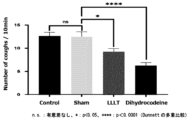
- Example 2 Efficacy evaluation test using a cough model induced by light irradiation To examine the efficacy of low-power laser therapy (LLLT) on coughing, a test was conducted using a coughing model animal. As a coughing model, a guinea pig citric acid-induced model was used, which is widely used in non-clinical trials of coughing and activates the vagus nerve to induce coughing.
- LLLT low-power laser therapy
- the test procedure is as follows. [Animal model used] A citric acid-induced cough model was used in guinea pigs, in which coughing was induced by stimulating A ⁇ and C fibers (TRPV1) with citric acid. Male guinea pigs, Slc:Harltley, 6 weeks old, were used. The groups were 1: healthy group, 2: laser sham irradiation group, 3: laser irradiation group, and 4: positive control group, with 8 animals in each group. The non-laser irradiation group was a group in which the laser was not output and only the same experimental action as laser irradiation was performed, and the positive control group was a group administered the antitussive drug dihydrocodeine phosphate.
- a dissection was performed to confirm the location of the guinea pig's cervical vagus nerve ganglion. It was confirmed that behind the masseter muscle there is a ganglion where the vagus nerve, which causes coughing, and the superior laryngeal nerve intersect. This ganglion is located approximately 15 mm deep from the epidermis, and it was confirmed that this is deep enough for the laser light to reach and inhibit the nerve.
- the laser light was applied percutaneously to a position near the masseter muscle of the guinea pig under the following conditions: wavelength: 808 nm, average power: 0.75 W, peak power: 7.5 W, pulse oscillation, frequency: 5 Hz, duty ratio: 10%, irradiation area: 0.8 cm 2 , irradiation time: 5 minutes on each side.
- the LLLT group showed a smaller reduction in cough frequency than the dihydrocodeine group, but this may be due to the effects of the evaluation time and possible misalignment of the irradiation position. It was confirmed that low-power laser irradiation of the cervical vagus nerve significantly reduced the frequency of coughs, similar to dihydrocodeine, a centrally acting cough suppressant.
Landscapes
- Health & Medical Sciences (AREA)
- Engineering & Computer Science (AREA)
- Biomedical Technology (AREA)
- Pathology (AREA)
- Nuclear Medicine, Radiotherapy & Molecular Imaging (AREA)
- Radiology & Medical Imaging (AREA)
- Life Sciences & Earth Sciences (AREA)
- Animal Behavior & Ethology (AREA)
- General Health & Medical Sciences (AREA)
- Public Health (AREA)
- Veterinary Medicine (AREA)
- Physics & Mathematics (AREA)
- Optics & Photonics (AREA)
- Radiation-Therapy Devices (AREA)
Priority Applications (1)
| Application Number | Priority Date | Filing Date | Title |
|---|---|---|---|
| JP2025551647A JPWO2025079630A1 (https=) | 2023-10-13 | 2024-10-10 |
Applications Claiming Priority (2)
| Application Number | Priority Date | Filing Date | Title |
|---|---|---|---|
| JP2023177199 | 2023-10-13 | ||
| JP2023-177199 | 2023-10-13 |
Publications (1)
| Publication Number | Publication Date |
|---|---|
| WO2025079630A1 true WO2025079630A1 (ja) | 2025-04-17 |
Family
ID=95395733
Family Applications (1)
| Application Number | Title | Priority Date | Filing Date |
|---|---|---|---|
| PCT/JP2024/036231 Pending WO2025079630A1 (ja) | 2023-10-13 | 2024-10-10 | 咳嗽治療装置 |
Country Status (2)
| Country | Link |
|---|---|
| JP (1) | JPWO2025079630A1 (https=) |
| WO (1) | WO2025079630A1 (https=) |
Citations (4)
| Publication number | Priority date | Publication date | Assignee | Title |
|---|---|---|---|---|
| US20110046432A1 (en) * | 2005-11-10 | 2011-02-24 | Electrocore Inc. | Non-invasive treatment of bronchial constriction |
| JP2017515530A (ja) * | 2014-03-27 | 2017-06-15 | サーキット セラピューティクス, インコーポレイテッド | 咳を治療的に管理するためのシステムおよび方法 |
| JP2018508329A (ja) * | 2015-02-24 | 2018-03-29 | ガルヴァーニ バイオエレクトロニクス リミテッド | 神経変調デバイス |
| US20210346715A1 (en) * | 2020-04-18 | 2021-11-11 | Erchonia Corporation, Llc | Light Energy Therapy for Acute Respiratory Distress Syndrome |
-
2024
- 2024-10-10 JP JP2025551647A patent/JPWO2025079630A1/ja active Pending
- 2024-10-10 WO PCT/JP2024/036231 patent/WO2025079630A1/ja active Pending
Patent Citations (4)
| Publication number | Priority date | Publication date | Assignee | Title |
|---|---|---|---|---|
| US20110046432A1 (en) * | 2005-11-10 | 2011-02-24 | Electrocore Inc. | Non-invasive treatment of bronchial constriction |
| JP2017515530A (ja) * | 2014-03-27 | 2017-06-15 | サーキット セラピューティクス, インコーポレイテッド | 咳を治療的に管理するためのシステムおよび方法 |
| JP2018508329A (ja) * | 2015-02-24 | 2018-03-29 | ガルヴァーニ バイオエレクトロニクス リミテッド | 神経変調デバイス |
| US20210346715A1 (en) * | 2020-04-18 | 2021-11-11 | Erchonia Corporation, Llc | Light Energy Therapy for Acute Respiratory Distress Syndrome |
Also Published As
| Publication number | Publication date |
|---|---|
| JPWO2025079630A1 (https=) | 2025-04-17 |
Similar Documents
| Publication | Publication Date | Title |
|---|---|---|
| AU2017201793B2 (en) | Non-invasive treatment of bronchial constriction | |
| JP4257718B2 (ja) | 電磁放射線治療法 | |
| Parke et al. | State of rehabilitation research in the head and neck cancer population: functional impact vs. impairment-focused outcomes | |
| US20050228463A1 (en) | Method and apparatus for treating the body | |
| Niu et al. | Noninvasive ultrasound deep brain stimulation of nucleus accumbens induces behavioral avoidance | |
| de Oliveira et al. | Laser therapy on points of acupuncture: Are there benefits in dentistry? | |
| JP2011527923A (ja) | 電磁放射線治療装置及び方法 | |
| Rana et al. | Ampakines increase diaphragm activation following mid-cervical contusion injury in rats | |
| He et al. | Effectiveness of interstitial laser acupuncture depends upon dosage: experimental results from electrocardiographic and electrocorticographic recordings | |
| WO2025079630A1 (ja) | 咳嗽治療装置 | |
| RU2428224C1 (ru) | Способ лечения глоссалгии | |
| Amaral et al. | Fibromyalgia treatment: a new and efficient proposal of technology and methodological-a case report | |
| CN122003275A (zh) | 咳嗽治疗装置 | |
| Hasan et al. | Impact of low level laser therapy on mandibular range motion in temporomandibular joint disorder in iraqi patients | |
| RU2734908C1 (ru) | Способ лечения заболеваний лицевого нерва лазерным излучением | |
| Arslan et al. | Effectiveness comparison of extracorporeal shock wave therapy and conventional physical therapy modalities in primary knee osteoarthritis | |
| Kasperski et al. | The influence of low-frequency variable magnetic fields in reducing pain experience after dental implant treatment | |
| JP7343708B2 (ja) | 光線照射装置 | |
| RU2329835C1 (ru) | Способ лечения миофасциального болевого дисфункционального синдрома лица с использованием динамической электронейростимуляции | |
| WO2025229950A1 (ja) | 掻痒治療装置 | |
| Iennaco | The effect of photobiomodulation on cerebral blood flow | |
| NL2018946A (en) | Treatment of conditions associated with impaired glucose control | |
| RU2486927C1 (ru) | Способ лечения остеоартроза височно-нижнечелюстного сустава | |
| RU2445064C1 (ru) | Способ коррекции нарушений биоэлектрических процессов головного мозга у больных в промежуточном периоде легкой кранио-цервикальной травмы | |
| Chen et al. | From concept to practice: intra-articular photobiomodulation for knee osteoarthritis |
Legal Events
| Date | Code | Title | Description |
|---|---|---|---|
| 121 | Ep: the epo has been informed by wipo that ep was designated in this application |
Ref document number: 24877224 Country of ref document: EP Kind code of ref document: A1 |
|
| ENP | Entry into the national phase |
Ref document number: 2025551647 Country of ref document: JP Kind code of ref document: A |