WO2025075166A1 - 感光性樹脂組成物、硬化物、隔壁、有機電界発光素子及び画像表示装置 - Google Patents
感光性樹脂組成物、硬化物、隔壁、有機電界発光素子及び画像表示装置 Download PDFInfo
- Publication number
- WO2025075166A1 WO2025075166A1 PCT/JP2024/035666 JP2024035666W WO2025075166A1 WO 2025075166 A1 WO2025075166 A1 WO 2025075166A1 JP 2024035666 W JP2024035666 W JP 2024035666W WO 2025075166 A1 WO2025075166 A1 WO 2025075166A1
- Authority
- WO
- WIPO (PCT)
- Prior art keywords
- group
- less
- ring
- preferred
- mass
- Prior art date
- Legal status (The legal status is an assumption and is not a legal conclusion. Google has not performed a legal analysis and makes no representation as to the accuracy of the status listed.)
- Ceased
Links
Images
Classifications
-
- G—PHYSICS
- G03—PHOTOGRAPHY; CINEMATOGRAPHY; ANALOGOUS TECHNIQUES USING WAVES OTHER THAN OPTICAL WAVES; ELECTROGRAPHY; HOLOGRAPHY
- G03F—PHOTOMECHANICAL PRODUCTION OF TEXTURED OR PATTERNED SURFACES, e.g. FOR PRINTING, FOR PROCESSING OF SEMICONDUCTOR DEVICES; MATERIALS THEREFOR; ORIGINALS THEREFOR; APPARATUS SPECIALLY ADAPTED THEREFOR
- G03F7/00—Photomechanical, e.g. photolithographic, production of textured or patterned surfaces, e.g. printing surfaces; Materials therefor, e.g. comprising photoresists; Apparatus specially adapted therefor
- G03F7/004—Photosensitive materials
- G03F7/027—Non-macromolecular photopolymerisable compounds having carbon-to-carbon double bonds, e.g. ethylenic compounds
- G03F7/032—Non-macromolecular photopolymerisable compounds having carbon-to-carbon double bonds, e.g. ethylenic compounds with binders
- G03F7/037—Non-macromolecular photopolymerisable compounds having carbon-to-carbon double bonds, e.g. ethylenic compounds with binders the binders being polyamides or polyimides
-
- G—PHYSICS
- G03—PHOTOGRAPHY; CINEMATOGRAPHY; ANALOGOUS TECHNIQUES USING WAVES OTHER THAN OPTICAL WAVES; ELECTROGRAPHY; HOLOGRAPHY
- G03F—PHOTOMECHANICAL PRODUCTION OF TEXTURED OR PATTERNED SURFACES, e.g. FOR PRINTING, FOR PROCESSING OF SEMICONDUCTOR DEVICES; MATERIALS THEREFOR; ORIGINALS THEREFOR; APPARATUS SPECIALLY ADAPTED THEREFOR
- G03F7/00—Photomechanical, e.g. photolithographic, production of textured or patterned surfaces, e.g. printing surfaces; Materials therefor, e.g. comprising photoresists; Apparatus specially adapted therefor
- G03F7/004—Photosensitive materials
- G03F7/027—Non-macromolecular photopolymerisable compounds having carbon-to-carbon double bonds, e.g. ethylenic compounds
-
- H—ELECTRICITY
- H10—SEMICONDUCTOR DEVICES; ELECTRIC SOLID-STATE DEVICES NOT OTHERWISE PROVIDED FOR
- H10K—ORGANIC ELECTRIC SOLID-STATE DEVICES
- H10K50/00—Organic light-emitting devices
- H10K50/80—Constructional details
- H10K50/84—Passivation; Containers; Encapsulations
-
- H—ELECTRICITY
- H10—SEMICONDUCTOR DEVICES; ELECTRIC SOLID-STATE DEVICES NOT OTHERWISE PROVIDED FOR
- H10K—ORGANIC ELECTRIC SOLID-STATE DEVICES
- H10K59/00—Integrated devices, or assemblies of multiple devices, comprising at least one organic light-emitting element covered by group H10K50/00
- H10K59/10—OLED displays
- H10K59/12—Active-matrix OLED [AMOLED] displays
- H10K59/122—Pixel-defining structures or layers, e.g. banks
-
- H—ELECTRICITY
- H10—SEMICONDUCTOR DEVICES; ELECTRIC SOLID-STATE DEVICES NOT OTHERWISE PROVIDED FOR
- H10K—ORGANIC ELECTRIC SOLID-STATE DEVICES
- H10K59/00—Integrated devices, or assemblies of multiple devices, comprising at least one organic light-emitting element covered by group H10K50/00
- H10K59/10—OLED displays
- H10K59/17—Passive-matrix OLED displays
- H10K59/173—Passive-matrix OLED displays comprising banks or shadow masks
-
- H—ELECTRICITY
- H10—SEMICONDUCTOR DEVICES; ELECTRIC SOLID-STATE DEVICES NOT OTHERWISE PROVIDED FOR
- H10K—ORGANIC ELECTRIC SOLID-STATE DEVICES
- H10K85/00—Organic materials used in the body or electrodes of devices covered by this subclass
Definitions
- the present invention relates to a photosensitive resin composition, a cured product obtained by curing the photosensitive resin composition, a partition wall, an organic electroluminescent device having the partition wall, and an image display device including the organic electroluminescent device.
- organic electroluminescent elements included in organic electroluminescence displays and the like are manufactured by forming partition walls (banks) on a substrate, and then laminating various functional layers within the area surrounded by the partition walls.
- a method for easily forming such partition walls a method for forming the partition walls by a photolithography method using a photosensitive resin composition is known.
- a method for laminating various functional layers in an area surrounded by partition walls a method is known in which an ink containing a material for forming the functional layers is first prepared, and then the prepared ink is injected into the area surrounded by partition walls.
- the inkjet method is often adopted because it is easy to accurately inject a predetermined amount of ink into a predetermined location.
- Patent Document 1 describes that by using a photosensitive resin composition containing a specific alkali-soluble resin, it is possible to obtain a partition wall pattern having high liquid repellency on the upper surface of the partition wall and excellent ink wettability at the openings.
- Patent Document 1 describes that by using a photosensitive resin composition containing a specific alkali-soluble resin, high liquid repellency can be developed on the upper surface of the partition wall, but specifically, exposure of 120 mJ/ cm2 is required.
- a photosensitive resin composition comprising (a) an alkali-soluble resin, (b) a liquid repellent, (c) a photopolymerization initiator, and (d) a photopolymerizable compound,
- the photosensitive resin composition wherein the (a) alkali-soluble resin contains a polyamide-imide (meth)acrylate resin (a-1) having a structure represented by the following general formula (1):
- R 1 to R 3 represent a divalent aliphatic hydrocarbon group.
- X 1 to X 3 each represent any one of the structures of general formulae (2) to (4).
- R 4 to R 6 each represent a divalent aliphatic hydrocarbon group.
- X 4 and X 5 each represent a structure represented by any one of general formulas (2) to (4).
- Y 1 represents an aromatic hydrocarbon or an alicyclic hydrocarbon.
- R7 represents a monovalent aliphatic hydrocarbon group.
- Y2 and Y3 each independently represent an aromatic hydrocarbon or an alicyclic hydrocarbon.
- R8 represents a monovalent aliphatic hydrocarbon group.
- Y4 and Y5 each independently represent an aromatic hydrocarbon or an alicyclic hydrocarbon.
- the (b) liquid repellent agent includes a liquid repellent agent (b1) having an ethylenically unsaturated bond group.
- the present invention it is possible to provide a photosensitive resin composition capable of exhibiting liquid repellency at a lower exposure dose and capable of forming partition walls that exhibit excellent step-forming properties and inkjet coatability.
- the present invention can also provide a partition wall formed by curing a photosensitive resin composition, an organic electroluminescent device having the partition wall, and an image display device including the organic electroluminescent device.
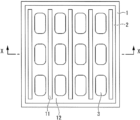
- FIG. 1 is a plan view showing an example of a substrate provided with partition walls having steps.
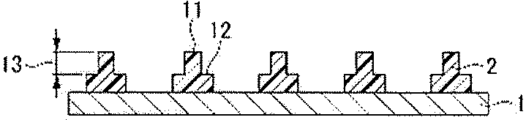
- FIG. 2 is a cross-sectional view showing an example of a substrate provided with partition walls having steps.
- the present invention will be described in detail below. The following description is an example of an embodiment of the present invention, and the present invention is not limited to these unless it exceeds the gist of the present invention.
- "(meth)acrylic” means "acrylic and/or methacrylic".
- the (di)tricarboxylic acid anhydride means a dicarboxylic acid anhydride and/or a tricarboxylic acid anhydride.
- total solids means all components other than the solvent in the photosensitive resin composition, and even if the components other than the solvent are liquid at room temperature, they are included in the solids.
- a numerical range expressed using “to” means a range including the numerical values before and after “to” as the lower and upper limits.
- “A and/or B” means one or both of A and B, and specifically means A, B, or A and B.
- (co)polymer refers to both a homopolymer and a copolymer
- polybasic acid (anhydride) refers to a polybasic acid and/or a polybasic acid anhydride.
- the weight average molecular weight means the weight average molecular weight (Mw) calculated based on polystyrene standards by GPC (gel permeation chromatography).
- the acid value refers to an acid value calculated based on the effective solid content, and is calculated by neutralization titration.
- the partition material refers to a bank material, a wall material, and a wall material, and similarly, the partition refers to a bank, a wall, and a wall.
- the light-emitting portion refers to a portion that emits light when electrical energy is applied thereto.
- the photosensitive resin composition of the present invention is a photosensitive resin composition containing (a) an alkali-soluble resin, (b) a liquid repellent, (c) a photopolymerization initiator, and (d) a photopolymerizable compound, in which the alkali-soluble resin (a) contains a polyamide-imide (meth)acrylate resin (a-1) having a structure represented by the following general formula (1):
- the photosensitive resin composition of the present invention may further contain other components as necessary, for example, an ultraviolet absorber or a polymerization inhibitor.
- R 4 to R 6 each represent a divalent aliphatic hydrocarbon group.
- X 4 and X 5 each represent a structure represented by any one of general formulas (2) to (4).
- Y 1 represents an aromatic hydrocarbon or an alicyclic hydrocarbon.
- R7 represents a monovalent aliphatic hydrocarbon group.
- Y2 and Y3 each independently represent an aromatic hydrocarbon or an alicyclic hydrocarbon.
- R8 represents a monovalent aliphatic hydrocarbon group.
- Y4 and Y5 each independently represent an aromatic hydrocarbon or an alicyclic hydrocarbon.
- the partition wall is used to partition, for example, a functional layer (organic layer, light-emitting portion) in an active-drive organic electroluminescent device, and is used to form pixels including the functional layer and the partition wall by, for example, discharging and drying ink, which is a material for forming the functional layer, in the partitioned region (pixel region).
- the photosensitive resin composition of the present invention contains (a) an alkali-soluble resin, (b) a liquid repellent agent, (c) a photopolymerization initiator, and (d) a photopolymerizable compound.
- Alkali-soluble resin (a) in the present invention contains a polyamide-imide (meth)acrylate resin (a-1) having a structure represented by the above-mentioned general formula (1).
- Polyamide-imide (meth)acrylate resin (a-1) Since the polyamide-imide (meth)acrylate resin (a-1) has an isocyanuric skeleton and amide or imide bonds, it has strong intermolecular forces and tends to be less susceptible to thermal decomposition during heat treatment, and it is believed that the inclusion of the polyamide-imide (meth)acrylate resin (a-1) in a photosensitive resin composition results in less fumes being generated when a cured film of the composition is baked.
- the polyamide-imide (meth)acrylate resin (a-1) has (meth)acryloyl groups, it is believed that even if it contains a colorant, it becomes a stronger cured film when cured with light or heat, and the remaining film rate after baking can be increased.
- R 1 to R 3 represent divalent aliphatic hydrocarbon groups.
- the aliphatic hydrocarbon group is preferably an aliphatic hydrocarbon group having 1 to 20 carbon atoms, and may be saturated or unsaturated aliphatic, may be linear, branched, or cyclic, and may have a substituent.
- R 1 to R 3 may all be the same aliphatic hydrocarbon group, or may all be different aliphatic hydrocarbon groups.
- X 1 to X 3 each represent any one of the structures of general formulae (2) to (4).
- X 1 to X 3 may all be the same structure or may all be different structures.
- R 4 to R 6 represent divalent aliphatic hydrocarbon groups.
- the aliphatic hydrocarbon group is preferably an aliphatic hydrocarbon group having 1 to 20 carbon atoms, and may be saturated or unsaturated aliphatic, may be linear, branched, or cyclic, and may have a substituent.
- R 4 to R 6 may all be the same aliphatic hydrocarbon group, or may all be different aliphatic hydrocarbon groups.
- X4 and X5 each represent any one of the structures of general formulae (2) to (4). X4 and X5 may all be the same structure or all be different structures.
- Y1 represents an aromatic hydrocarbon or an alicyclic hydrocarbon which may have a substituent.
- the aromatic hydrocarbon and the alicyclic hydrocarbon preferably have 1 to 10 carbon atoms.
- R8 represents a monovalent aliphatic hydrocarbon group.
- the aliphatic hydrocarbon group is preferably an aliphatic hydrocarbon group having 1 to 20 carbon atoms, and may be saturated or unsaturated, linear, branched, or cyclic, and may have a substituent.
- Y4 and Y5 each independently represent an aromatic hydrocarbon or an alicyclic hydrocarbon which may have a substituent.
- Polyamide-imide (meth)acrylate resin (a-1) (hereinafter sometimes abbreviated as "resin (a-1)") is obtained, for example, by reacting a polyamide-imide resin having terminal acid groups or acid anhydride groups, obtained by reacting an isocyanurate-type polyisocyanate with a tricarboxylic acid anhydride, with a (meth)acrylate having an epoxy group in the molecule and a (di)tricarboxylic acid anhydride.
- the present invention is not limited to this as long as the raw materials and methods can provide the same effects.
- isocyanurate-type polyisocyanates examples include isocyanurate-type triisocyanate (HDI3N) synthesized from hexamethylene diisocyanate, isocyanurate-type triisocyanate (HTMDI3N) synthesized from trimethylhexamethylene diisocyanate, isocyanurate-type triisocyanate (IPDI3N) synthesized from isophorone diisocyanate, isocyanurate-type triisocyanate (HTDI3N) synthesized from hydrogenated tolylene diisocyanate, isocyanurate-type triisocyanate (HXDI3N) synthesized from hydrogenated xylene diisocyanate, isocyanurate-type triisocyanate (NBDI3N) synthesized from norbornane diisocyanate, and isocyanurate-type triisocyanate (HMDI3N) synthesized from hydrogenated diphenylmethane diiso
- alicyclic isocyanurate type polyisocyanates such as isocyanurate type triisocyanate (IPDI3N) synthesized from isophorone diisocyanate, isocyanurate type triisocyanate (HTDI3N) synthesized from hydrogenated tolylene diisocyanate, isocyanurate type triisocyanate (HXDI3N) synthesized from hydrogenated xylene diisocyanate, isocyanurate type triisocyanate (NBDI3N) synthesized from norbornane diisocyanate, and isocyanurate type triisocyanate (HMDI3N) synthesized from hydrogenated diphenylmethane diisocyanate are preferred, and isocyanurate type triisocyanate (IPDI3N) synthesized from isophorone diisocyanate is more preferred.
- IPDI3N isocyanurate type triisocyanate
- IPDI3N isophorone
- tricarboxylic anhydrides to be reacted with isocyanurate-type polyisocyanates include trimellitic anhydride, naphthalene-1,2,4-tricarboxylic anhydride, propane tricarboxylic anhydride, cyclohexane tricarboxylic anhydride, methylcyclohexane tricarboxylic anhydride, cyclohexene tricarboxylic anhydride, and methylcyclohexene tricarboxylic anhydride.
- alicyclic tricarboxylic anhydrides such as cyclohexane tricarboxylic anhydride, methylcyclohexane tricarboxylic anhydride, cyclohexene tricarboxylic anhydride, and methylcyclohexene tricarboxylic anhydride are preferred, with cyclohexane tricarboxylic anhydride being more preferred.
- cyclohexanetricarboxylic anhydride examples include cyclohexane-1,3,4-tricarboxylic acid-3,4-anhydride, cyclohexane-1,3,5-tricarboxylic acid-3,5-anhydride, and cyclohexane-1,2,3-tricarboxylic acid-2,3-anhydride.
- the (meth)acrylate having an epoxy group in the molecule used in the present invention is not particularly limited in its specific structure as long as it is a compound having an epoxy group and a (meth)acryloyl group in its molecular structure, and a wide variety of compounds can be used.
- Examples of (meth)acrylates having an epoxy group in the molecule include glycidyl acrylate, glycidyl methacrylate, allyl glycidyl ether, cyclohexyl monoepoxy acrylate, and derivatives thereof (e.g., analogs obtained by reacting an epoxycyclohexane compound with acrylic acid or methacrylic acid, such as 3,4-epoxycyclohexylmethyl methacrylate). These may be used alone or in combination of two or more.
- those with a molecular weight of 1,000 or less are preferred, as they result in a polyamideimide resin containing ethylenically unsaturated groups, acid groups, and secondary hydroxyl groups that has excellent heat resistance in the cured product.
- examples of the dicarboxylic acid anhydride include anhydrides of maleic acid, succinic acid, itaconic acid, phthalic acid, tetrahydrophthalic acid, hexahydrophthalic acid, methylhexahydrophthalic acid, endomethylenetetrahydrophthalic acid, chlorendic acid, and methyltetrahydrophthalic acid.
- aliphatic dicarboxylic acid anhydrides such as anhydrides of succinic acid, 1,2-cyclopropanedicarboxylic acid, 2,2-dimethylsuccinic acid, caronic acid, 1,2-cyclohexanedicarboxylic acid, butylsuccinic acid, 4-methylcyclohexane-1,2-dicarboxylic acid, n-octyl succinic acid, decyl succinic acid, and dodecyl succinic acid are preferred.
- the tricarboxylic acid anhydride include the same tricarboxylic acid anhydrides as those reacted with the above-mentioned isocyanurate-type polyisocyanate. From the viewpoint of developability, an aliphatic tricarboxylic acid anhydride is preferable, and an alicyclic tricarboxylic acid anhydride is more preferable.
- the polystyrene-equivalent weight average molecular weight (Mw) of resin (a-1) measured by gel permeation chromatography (GPC) is usually 1000 or more, preferably 1500 or more, more preferably 2000 or more, even more preferably 2500 or more, and even more preferably 3000 or more. Also, it is usually 10000 or less, preferably 9000 or less, more preferably 8000 or less, and even more preferably 7000 or less.
- the above upper and lower limits can be arbitrarily combined. For example, 1000 to 10000 is preferable, 1500 to 9000 is more preferable, 2000 to 8000 is even more preferable, and 3000 to 7000 is even more preferable. By making it equal to or greater than the lower limit, fume generation tends to be reduced. By making it equal to or less than the upper limit, developer solubility tends to be good.
- the total of the acid anhydride group and the carboxylic acid is preferably 1.0 mol to 3.0 mol per mol of isocyanate group in the alicyclic isocyanurate polyisocyanate, more preferably 1.2 mol to 2.8 mol, and even more preferably 1.4 mol to 2.6 mol.
- the total of the acid anhydride group and the carboxylic acid exceeds 1.0 mol, the isocyanate group is prevented from remaining, the increase in molecular weight is suppressed, and the developability is improved.
- the total of the acid anhydride group and the carboxylic acid is less than 3.0 mol, the alicyclic tricarboxylic anhydride is prevented from remaining, and development residues can be suppressed.
- the acid value of resin (a-1) is not particularly limited, but is preferably 20 mgKOH/g or more, more preferably 40 mgKOH/g or more, even more preferably 60 mgKOH/g or more, and is preferably 200 mgKOH/g or less, more preferably 150 mgKOH/g or less.
- the above upper and lower limits can be combined arbitrarily. For example, 20 to 200 mgKOH/g is preferred, 40 to 200 mgKOH/g is more preferred, and 60 to 150 mgKOH/g is even more preferred.
- the specific structure of the alkali-soluble resin having an ethylenic double bond is not particularly limited, but from the viewpoint of solubility in development, an acrylic copolymer resin (a-2) and/or an epoxy (meth)acrylate resin (a-3) are preferred, and from the viewpoint of reducing outgassing, an epoxy (meth)acrylate resin (a-3) is more preferred.
- the acrylic copolymer resin (a-2) will be described in detail below.
- the acrylic copolymer resin (a-2) preferably has an ethylenic double bond in the side chain.
- acrylic copolymer resins (a-2) from the viewpoint of development solubility, acrylic copolymer resins (a-2-1) containing a partial structure represented by the following general formula (I) are preferred.
- R A and R B each independently represent a hydrogen atom or a methyl group. * represents a bond.
- the partial structure represented by the formula (I) is preferably a partial structure represented by the following general formula (I-1).
- R A and R B have the same meanings as those in formula (I), and R 1 represents a divalent hydrocarbon group having 1 to 4 carbon atoms which may have a substituent.
- the partial structure represented by the formula (I) is preferably a partial structure represented by the following formula (I-2).
- R A and R B have the same meanings as those in formula (I).
- the content of the partial structure represented by the general formula (I) contained in the acrylic copolymer resin (a-2-1) is not particularly limited, but is preferably 5 mol% or more, more preferably 20 mol% or more, even more preferably 30 mol% or more, even more preferably 50 mol% or more, particularly preferably 70 mol% or more, most preferably 80 mol% or more, and also preferably 99 mol% or less, more preferably 97 mol% or less, and even more preferably 95 mol% or less.
- the upper and lower limits can be arbitrarily combined, for example, 5 to 99 mol% is preferred, 20 to 99 mol% is more preferred, 30 to 97 mol% is more preferred, even more preferably 50 to 97 mol%, particularly preferably 70 to 95 mol%, and most preferably 80 to 95 mol%.
- 5 to 99 mol% is preferred
- 20 to 99 mol% is more preferred
- 30 to 97 mol% is more preferred, even more preferably 50 to 97 mol%, particularly preferably 70 to 95 mol%, and most preferably 80 to 95 mol%.
- the content of the partial structure represented by the general formula (I-1) contained in the acrylic copolymer resin (a-2-1) is not particularly limited, but is preferably 1 mol% or more, more preferably 5 mol% or more, even more preferably 8 mol% or more, even more preferably 10 mol% or more, and is preferably 99 mol% or less, more preferably 60 mol% or less, even more preferably 40 mol% or less, even more preferably 30 mol% or less, and particularly preferably 20 mol% or less.
- the upper and lower limits can be arbitrarily combined, and for example, 1 to 99 mol% is preferable, 1 to 60 mol% is more preferable, 5 to 40 mol% is more preferable, even more preferably 8 to 30 mol%, and particularly preferably 10 to 20 mol%.
- the lower limit By making it equal to or more than the lower limit, the sensitivity tends to be increased and the residue tends to be reduced.
- the upper limit By making it equal to or less than the upper limit, the development adhesion tends to be improved.
- the content of the partial structure represented by the general formula (I-2) contained in the acrylic copolymer resin (a-2-1) is not particularly limited, but is preferably 10 mol% or more, more preferably 20 mol% or more, even more preferably 30 mol% or more, even more preferably 40 mol% or more, particularly preferably 50 mol% or more, and most preferably 70 mol% or more, and is preferably 99 mol% or less, more preferably 95 mol% or less, even more preferably 90 mol% or less, and particularly preferably 85 mol% or less.
- the upper and lower limits can be arbitrarily combined, for example, 10 to 99 mol% is preferable, 20 to 99 mol% is more preferable, 30 to 95 mol% is more preferable, even more preferably 40 to 95 mol%, particularly preferably 50 to 90 mol%, and most preferably 70 to 85 mol%.
- the sensitivity tends to be high.
- developability tends to improve.
- the acrylic copolymer resin (a-2-1) contains a partial structure represented by the general formula (I) above, there are no particular limitations on the other partial structures it may contain, but from the viewpoint of development adhesion, it is preferable that it contains, for example, a partial structure represented by the following general formula (I').
- R D represents a hydrogen atom or a methyl group
- R E represents an alkyl group which may have a substituent, an aryl group (aromatic ring group) which may have a substituent, or an alkenyl group which may have a substituent.
- the upper and lower limits can be arbitrarily combined, and for example, 1 to 20 is preferable, 1 to 18 is more preferable, 3 to 16 is more preferable, 3 to 14 is even more preferable, and 5 to 12 is particularly preferable.
- the number equal to or more than the lower limit the film strength tends to be increased and the development adhesion tends to be improved.
- the number equal to or less than the upper limit the amount of residue tends to be reduced.
- alkyl group examples include a methyl group, an ethyl group, a cyclohexyl group, a dicyclopentanyl group, and a dodecanyl group.
- the dicyclopentanyl group and the dodecanyl group are preferred, and the dicyclopentanyl group is more preferred.
- Examples of the substituent that the alkyl group may have include a methoxy group, an ethoxy group, a chloro group, a bromo group, a fluoro group, a hydroxy group, an amino group, an epoxy group, an oligoethylene glycol group, a phenyl group, a carboxy group, an acryloyl group, and a methacryloyl group. From the viewpoint of developability, a hydroxy group and an oligoethylene glycol group are preferred.
- the aryl group (aromatic ring group) in R E includes a monovalent aromatic hydrocarbon ring group and a monovalent aromatic heterocyclic group.
- the number of carbon atoms is preferably 4 or more, more preferably 6 or more, and also preferably 24 or less, more preferably 22 or less, even more preferably 20 or less, and particularly preferably 18 or less.
- the upper and lower limits can be arbitrarily combined, and for example, 4 to 24 is preferable, 4 to 22 is more preferable, 6 to 20 is even more preferable, and 6 to 18 is particularly preferable.
- the aromatic hydrocarbon ring in the aromatic hydrocarbon ring group may be a single ring or a condensed ring, and examples thereof include a benzene ring, a naphthalene ring, an anthracene ring, a phenanthrene ring, a perylene ring, a tetracene ring, a pyrene ring, a benzpyrene ring, a chrysene ring, a triphenylene ring, an acenaphthene ring, a fluoranthene ring, and a fluorene ring.
- the aromatic heterocycle in the aromatic heterocycle group may be a single ring or a condensed ring, and may be, for example, a furan ring, a benzofuran ring, a thiophene ring, a benzothiophene ring, a pyrrole ring, a pyrazole ring, an imidazole ring, an oxadiazole ring, an indole ring, a carbazole ring, a pyrroloimidazole ring, a pyrrolopyrazole ring, a pyrrolopyrrole ring, a thienopyrrole ring, a thienothiophene ring, a furopyrrole ring, a furofuran ring, a thienofuran ring, a benzisoxazole ring, a benzisothiazole ring, a benzimidazole ring, a pyridine
- Examples of the substituent that the aryl group may have include a methyl group, an ethyl group, a propyl group, a methoxy group, an ethoxy group, a chloro group, a bromo group, a fluoro group, a hydroxy group, an amino group, an epoxy group, an oligoethylene glycol group, a phenyl group, and a carboxy group. From the viewpoint of developability, a hydroxy group and an oligoethylene glycol group are preferred.
- the alkenyl group in R E may be a linear, branched or cyclic alkenyl group.
- the number of carbon atoms is preferably 2 or more, and is preferably 22 or less, more preferably 20 or less, even more preferably 18 or less, even more preferably 16 or less, and particularly preferably 14 or less.
- it is preferably 2 to 22, more preferably 2 to 20, even more preferably 2 to 18, even more preferably 2 to 16, and particularly preferably 2 to 14.
- Examples of the alkenyl group include an ethenyl group, a propenyl group, a butenyl group, and a cyclohexenyl group. Among these, from the viewpoint of curability, an ethenyl group and a propenyl group are preferred, and an ethenyl group is more preferred.
- Examples of the substituent that the alkenyl group may have include a methoxy group, an ethoxy group, a chloro group, a bromo group, a fluoro group, a hydroxy group, an amino group, an epoxy group, an oligoethylene glycol group, a phenyl group, and a carboxy group. From the viewpoint of developability, a hydroxy group and an oligoethylene glycol group are preferred.
- R E is preferably an alkyl group or an alkenyl group, more preferably an alkyl group, and even more preferably a dicyclopentanyl group.
- the acrylic copolymer resin (a-2-1) contains a partial structure represented by the general formula (I')
- the content of the partial structure represented by the general formula (I') contained in the acrylic copolymer resin (a-2-1) is not particularly limited, but is preferably 0.5 mol% or more, more preferably 1 mol% or more, even more preferably 1.5 mol% or more, particularly preferably 2 mol% or more, and also preferably 90 mol% or less, more preferably 70 mol% or less, even more preferably 50% mol or less, even more preferably 30 mol% or less, and particularly preferably 10 mol% or less.
- the upper and lower limits can be arbitrarily combined, for example, 0.5 to 90 mol% is preferred, 0.5 to 70 mol% is more preferred, 1 to 50% mol is more preferred, even more preferably 1.5 to 30 mol%, and particularly preferably 2 to 10 mol%.
- 0.5 to 90 mol% is preferred
- 0.5 to 70 mol% is more preferred
- 1 to 50% mol is more preferred, even more preferably 1.5 to 30 mol%, and particularly preferably 2 to 10 mol%.
- R F represents a hydrogen atom or a methyl group
- R G represents an alkyl group which may have a substituent, an alkenyl group which may have a substituent, a hydroxyl group, a carboxy group, a halogen atom, an alkoxy group which may have a substituent, a thiol group, or an alkylsulfide group which may have a substituent.
- t represents an integer of 0 to 5.
- the alkyl group in R G may be a linear, branched or cyclic alkyl group.
- the number of carbon atoms is preferably 1 or more, more preferably 3 or more, and even more preferably 5 or more, and is preferably 20 or less, more preferably 18 or less, even more preferably 16 or less, even more preferably 14 or less, and particularly preferably 12 or less.
- the upper and lower limits can be arbitrarily combined, and for example, 1 to 20 is preferable, 1 to 18 is more preferable, 3 to 16 is more preferable, 3 to 14 is even more preferable, and 5 to 12 is particularly preferable.
- alkyl group examples include a methyl group, an ethyl group, a cyclohexyl group, a dicyclopentanyl group, and a dodecanyl group.
- the dicyclopentanyl group and the dodecanyl group are preferred, and the dicyclopentanyl group is more preferred.
- Examples of the substituent that the alkyl group may have include a methoxy group, an ethoxy group, a chloro group, a bromo group, a fluoro group, a hydroxy group, an amino group, an epoxy group, an oligoethylene glycol group, a phenyl group, a carboxy group, an acryloyl group, and a methacryloyl group. From the viewpoint of developability, a hydroxy group and an oligoethylene glycol group are preferred.
- the alkenyl group in R G may be a linear, branched or cyclic alkenyl group.
- the number of carbon atoms is preferably 2 or more, and is preferably 22 or less, more preferably 20 or less, even more preferably 18 or less, even more preferably 16 or less, and particularly preferably 14 or less.
- 2 to 22 is preferable
- 2 to 20 is more preferable
- 2 to 18 is even more preferable
- 2 to 16 is even more preferable, and particularly preferably 2 to 14.
- By making the number of carbon atoms equal to or more than the lower limit there is a tendency for development adhesion to be improved. Also, by making the number of carbon atoms equal to or less than the upper limit, there is a tendency for residues to be reduced.
- Examples of the alkenyl group include an ethenyl group, a propenyl group, a butenyl group, and a cyclohexenyl group. Among these, from the viewpoint of curability, an ethenyl group and a propenyl group are preferred, and an ethenyl group is more preferred.
- Examples of the substituent that the alkenyl group may have include a methoxy group, an ethoxy group, a chloro group, a bromo group, a fluoro group, a hydroxy group, an amino group, an epoxy group, an oligoethylene glycol group, a phenyl group, and a carboxy group. From the viewpoint of developability, a hydroxy group and an oligoethylene glycol group are preferred.
- Examples of the halogen atom in R 1 G include a fluorine atom, a chlorine atom, a bromine atom, and an iodine atom. Among these, a fluorine atom is preferred from the viewpoint of ink repellency.
- the alkoxy group in R G may be a linear, branched or cyclic alkoxy group.
- the number of carbon atoms is preferably 1 or more, and is preferably 20 or less, more preferably 18 or less, even more preferably 16 or less, even more preferably 14 or less, and particularly preferably 12 or less.
- 1 to 20 is preferable
- 1 to 18 is more preferable
- 1 to 16 is even more preferable
- 1 to 14 is even more preferable, and particularly preferably 1 to 12.
- Examples of the substituent that the alkoxy group may have include a methoxy group, an ethoxy group, a chloro group, a bromo group, a fluoro group, a hydroxy group, an amino group, an epoxy group, an oligoethylene glycol group, a phenyl group, a carboxy group, an acryloyl group, and a methacryloyl group. From the viewpoint of developability, a hydroxy group and an oligoethylene glycol group are preferred.
- the alkyl sulfide group in R G may be a linear, branched or cyclic alkyl sulfide group.
- the number of carbon atoms is preferably 1 or more, and is preferably 20 or less, more preferably 18 or less, even more preferably 16 or less, even more preferably 14 or less, and particularly preferably 12 or less.
- 1 to 20 is preferred
- 1 to 18 is more preferred
- 1 to 16 is even more preferred
- 1 to 14 is even more preferred
- 1 to 12 is particularly preferred.
- alkyl sulfide group examples include a methyl sulfide group, an ethyl sulfide group, a propyl sulfide group, and a butyl sulfide group.
- a methyl sulfide group and an ethyl sulfide group are preferred.
- Examples of the substituent that the alkyl group in the alkyl sulfide group may have include a methoxy group, an ethoxy group, a chloro group, a bromo group, a fluoro group, a hydroxy group, an amino group, an epoxy group, an oligoethylene glycol group, a phenyl group, a carboxy group, an acryloyl group, and a methacryloyl group. From the viewpoint of developability, a hydroxy group and an oligoethylene glycol group are preferred.
- t represents an integer of 0 to 5. From the viewpoint of developability, t is preferably an integer of 0 to 2, more preferably 0 to 1, and even more preferably 0.
- the content of the partial structure represented by the general formula (I'') contained in the acrylic copolymer resin (a-2-1) is not particularly limited, but is preferably 1 mol% or more, more preferably 2 mol% or more, even more preferably 3 mol% or more, particularly preferably 5 mol% or more, and also preferably 90 mol% or less, more preferably 70 mol% or less, even more preferably 50 mol% or less, even more preferably 30 mol% or less, particularly preferably 20 mol% or less, and most preferably 10 mol% or less.
- the acrylic copolymer resin (a-2-1) contains a partial structure represented by the above general formula (I), it is preferable from the viewpoint of developability that it further contains a partial structure represented by the following general formula (I''').
- R H represents a hydrogen atom or a methyl group.
- the content of the partial structure represented by the general formula (I''') contained in the acrylic copolymer resin (a-2-1) is not particularly limited, but is preferably 5 mol% or more, more preferably 10 mol% or more, even more preferably 30 mol% or more, and is preferably 90 mol% or less, more preferably 80 mol% or less, even more preferably 70 mol% or less, and particularly preferably 50 mol% or less.
- the upper and lower limits can be arbitrarily combined, and for example, 5 to 90 mol% is preferable, 5 to 80 mol% is more preferable, 10 to 70 mol% is more preferable, and 30 to 50 mol% is particularly preferable.
- 5 to 90 mol% is preferable
- 5 to 80 mol% is more preferable
- 10 to 70 mol% is more preferable
- 30 to 50 mol% is particularly preferable.
- the acid value of the acrylic copolymer resin (a-2) is not particularly limited, but is preferably 5 mgKOH/g or more, more preferably 10 mgKOH/g or more, even more preferably 20 mgKOH/g or more, even more preferably 25 mgKOH/g or more, and is preferably 100 mgKOH/g or less, more preferably 80 mgKOH/g or less, even more preferably 60 mgKOH/g or less, and even more preferably 40 mgKOH/g or less.
- the upper and lower limits can be arbitrarily combined, and for example, 5 to 100 mgKOH/g is preferable, 10 to 80 mgKOH/g is more preferable, 20 to 60 mgKOH/g is more preferable, and 25 to 40 mgKOH/g is even more preferable.
- the content of the acrylic copolymer resin (a-2) contained in the (a) alkali-soluble resin is not particularly limited, but is preferably 5% by mass or more, more preferably 10% by mass or more, even more preferably 15% by mass or more, and particularly preferably 20% by mass or more, and is usually preferably 100% by mass or less, more preferably 80% by mass or less, and even more preferably 50% by mass or less.
- the upper and lower limits can be arbitrarily combined, and are, for example, preferably 5 to 100% by mass, more preferably 10 to 100% by mass, more preferably 15 to 80% by mass, and particularly preferably 20 to 50% by mass.
- the epoxy (meth)acrylate resin (a-3) will be described in detail below.
- Epoxy (meth)acrylate resin (a-3) is a resin obtained by adding an acid or ester compound having an ethylenically unsaturated bond (ethylenically double bond) to an epoxy resin, and further adding a polybasic acid or its anhydride.
- a resin obtained by ring-opening addition of a carboxy group of an acid having an ethylenically unsaturated bond to an epoxy resin, and adding an ethylenically unsaturated bond to the epoxy resin via an ester bond (-COO-), and adding one of the carboxy groups of a polybasic acid anhydride to the hydroxyl group generated at that time may be exemplified.
- a resin obtained by simultaneously adding a polyhydric alcohol when adding a polybasic acid anhydride may also be included in the epoxy (meth)acrylate resin (a-3).
- a resin obtained by reacting a compound having a functional group capable of further reacting with the carboxy group of the resin obtained by the above reaction is also included in the epoxy (meth)acrylate resin (a-3).
- epoxy (meth)acrylate resins have substantially no epoxy groups in terms of their chemical structure, and are not limited to "(meth)acrylate", but are named as such according to convention because epoxy compounds (epoxy resins) are the raw material and "(meth)acrylate” is a representative example.
- the epoxy resin includes the raw material compound before the resin is formed by thermal curing, and the epoxy resin can be appropriately selected from known epoxy resins.
- the epoxy resin can be a compound obtained by reacting a phenolic compound with epihalohydrin.
- the phenolic compound is preferably a compound having a divalent or more than divalent phenolic hydroxyl group, and may be a monomer or a polymer.
- bisphenol A type epoxy resins bisphenol F type epoxy resins, bisphenol S type epoxy resins, phenol novolac epoxy resins, cresol novolac epoxy resins, biphenyl novolac epoxy resins, trisphenol epoxy resins, epoxidized polymers of phenol and dicyclopentane, dihydroxylfluorene type epoxy resins, dihydroxylalkyleneoxylfluorene type epoxy resins, diglycidyl ethers of 9,9-bis(4'-hydroxyphenyl)fluorene, and diglycidyl ethers of 1,1-bis(4'-hydroxyphenyl)adamantane, and those having an aromatic ring in the main chain can be preferably used.
- bisphenol A type epoxy resins bisphenol A type epoxy resins, phenol novolac epoxy resins, cresol novolac epoxy resins, epoxidized products of polymers of phenol and dicyclopentadiene, and epoxidized products of 9,9-bis(4'-hydroxyphenyl)fluorene are preferred, with bisphenol A type epoxy resins being more preferred.
- acids having an ethylenically unsaturated bond include (meth)acrylic acid, crotonic acid, maleic acid, fumaric acid, citraconic acid, pentaerythritol tri(meth)acrylate succinic anhydride adduct, pentaerythritol tri(meth)acrylate tetrahydrophthalic anhydride adduct, dipentaerythritol penta(meth)acrylate succinic anhydride adduct, dipentaerythritol penta(meth)acrylate phthalic anhydride adduct, dipentaerythritol penta(meth)acrylate tetrahydrophthalic anhydride adduct, and reaction products of (meth)acrylic acid and ⁇ -caprolactone.
- (meth)acrylic acid is preferred from the viewpoint of sensitivity.
- polybasic acids examples include succinic acid, maleic acid, itaconic acid, phthalic acid, tetrahydrophthalic acid, 3-methyltetrahydrophthalic acid, 4-methyltetrahydrophthalic acid, 3-ethyltetrahydrophthalic acid, 4-ethyltetrahydrophthalic acid, hexahydrophthalic acid, 3-methylhexahydrophthalic acid, 4-methylhexahydrophthalic acid, 3-ethylhexahydrophthalic acid, 4-ethylhexahydrophthalic acid, trimellitic acid, pyromellitic acid, benzophenonetetracarboxylic acid, biphenyltetracarboxylic acid, and anhydrides thereof.
- succinic anhydride succinic anhydride
- maleic anhydride succinic anhydride
- itaconic anhydride succinic anhydride is more preferred.
- the molecular weight of the epoxy (meth)acrylate resin (a-3) can be increased, a branch can be introduced into the molecule, and there is a tendency that the molecular weight and the viscosity can be balanced.
- the introduction rate of an acid group into the molecule can be increased, and there is a tendency that the sensitivity, adhesion, and the like can be balanced.
- polyhydric alcohols include trimethylolpropane, ditrimethylolpropane, pentaerythritol, dipentaerythritol, trimethylolethane, and 1,2,3-propanetriol. These may be used alone or in combination of two or more.
- the acid value of the epoxy (meth)acrylate resin (a-3) is not particularly limited, but is preferably 10 mgKOH/g or more, more preferably 20 mgKOH/g or more, even more preferably 40 mgKOH/g or more, even more preferably 60 mgKOH/g or more, and is preferably 200 mgKOH/g or less, more preferably 180 mgKOH/g or less, even more preferably 150 mgKOH/g or less, even more preferably 120 mgKOH/g or less, and particularly preferably 100 mgKOH/g or less.
- the upper and lower limits can be arbitrarily combined, and for example, 10 to 200 mgKOH/g is preferable, 10 to 180 mgKOH/g is more preferable, 20 to 150 mgKOH/g is more preferable, 40 to 120 mgKOH/g is even more preferable, and 60 to 100 mgKOH/g is particularly preferable.
- the acid value By setting the acid value to be equal to or greater than the lower limit, it is easy to reduce residues. In addition, by keeping the value below the upper limit, outgassing during device light emission tends to be reduced.
- the upper and lower limits can be arbitrarily combined, and are preferably 1000 to 30000, more preferably 2000 to 30000, even more preferably 3000 to 20000, even more preferably 4000 to 20000, particularly preferably 5000 to 15000, particularly preferably 6000 to 15000, and most preferably 7000 to 10000.
- the content of the epoxy (meth)acrylate resin (a-3) contained in the (a) alkali-soluble resin is not particularly limited, but is preferably 30% by mass or more, more preferably 50% by mass or more, even more preferably 70% by mass or more, even more preferably 80% by mass or more, particularly preferably 90% by mass or more, and is usually 100% by mass or less.
- the upper and lower limits can be arbitrarily combined. For example, 30 to 100% by mass is preferred, 50 to 100% by mass is more preferred, 70 to 100% by mass is more preferred, even more preferably 80 to 100% by mass, and particularly preferably 90 to 100% by mass.
- catalysts include tertiary amines such as triethylamine, benzyldimethylamine, and tribenzylamine; quaternary ammonium salts such as tetramethylammonium chloride, methyltriethylammonium chloride, tetraethylammonium chloride, tetrabutylammonium chloride, and trimethylbenzylammonium chloride; phosphorus compounds such as triphenylphosphine; and stibines such as triphenylstibine.
- thermal polymerization inhibitors include hydroquinone, hydroquinone monomethyl ether, and methylhydroquinone.
- the acid or ester compound having an ethylenically unsaturated bond can be used in an amount that is preferably 0.7 to 1.3 chemical equivalents, more preferably 0.9 to 1.1 chemical equivalents, relative to 1 chemical equivalent of the epoxy group of the epoxy resin.
- the temperature during the addition reaction is preferably 60 to 150° C., more preferably 80 to 120° C.
- the polybasic acid (anhydride) can be used in an amount that is preferably 0.1 to 1.2 chemical equivalents, more preferably 0.2 to 1.1 chemical equivalents, relative to 1 chemical equivalent of the hydroxyl group generated by the addition reaction.
- the epoxy (meth)acrylate resin (a-3) preferably contains at least one selected from the group consisting of epoxy (meth)acrylate resin (a-3-1) containing a partial structure represented by the following general formula (i) (hereinafter, may be referred to as "epoxy (meth)acrylate resin (a-3-1)”); epoxy (meth)acrylate resin (a-3-2) containing a partial structure represented by the following general formula (ii) (hereinafter, may be referred to as “epoxy (meth)acrylate resin (a-3-2)”); and epoxy (meth)acrylate resin (a-3-3) containing a partial structure represented by the following general formula (iii) (hereinafter, may be referred to as "epoxy (meth)acrylate resin (a-3-3)").
- the epoxy (meth)acrylate resin (a-3) preferably contains an epoxy (meth)acrylate resin (a-3-1) containing a partial structure represented by the following general formula (i), and more preferably is an epoxy (meth)acrylate resin (a-3-1) containing a partial structure represented by the following general formula (i):
- R represents a hydrogen atom or a methyl group
- R represents a divalent hydrocarbon group which may have a substituent.
- the benzene ring in formula (i) may be further substituted with any substituent. * represents a bond.
- R b represents a divalent hydrocarbon group which may have a substituent.
- the divalent hydrocarbon group include a divalent aliphatic group, a divalent aromatic ring group, and a group in which one or more divalent aliphatic groups are linked with one or more divalent aromatic ring groups.
- the divalent aliphatic group may be linear, branched, or cyclic. Among these, linear groups are preferred from the viewpoint of development solubility, while cyclic groups are preferred from the viewpoint of reducing the penetration of the developer into the exposed area.
- the number of carbon atoms is usually 1 or more, preferably 3 or more, more preferably 6 or more, and preferably 20 or less, more preferably 15 or less, and even more preferably 10 or less.
- the upper and lower limits can be arbitrarily combined, and for example, 1 to 20 are preferred, 3 to 15 are more preferred, and 6 to 10 are even more preferred.
- Examples of the divalent linear aliphatic group include a methylene group, an ethylene group, an n-propylene group, an n-butylene group, an n-hexylene group, and an n-heptylene group.
- the methylene group is preferred from the viewpoint of reducing residues.
- Examples of the divalent branched aliphatic group include a structure in which the above-mentioned divalent linear aliphatic group has a methyl group, an ethyl group, an n-propyl group, an isopropyl group, an n-butyl group, an isobutyl group, a sec-butyl group, or a tert-butyl group as a side chain.
- divalent cyclic aliphatic groups include groups in which two hydrogen atoms have been removed from the rings of a cyclohexane ring, a cycloheptane ring, a cyclodecane ring, a cyclododecane ring, a norbornane ring, an isobornane ring, and an adamantane ring.
- groups in which two hydrogen atoms have been removed from an adamantane ring are preferred.
- the divalent aromatic ring group includes a divalent aromatic hydrocarbon ring group and a divalent aromatic heterocyclic group.
- the number of carbon atoms is usually 4 or more, preferably 5 or more, more preferably 6 or more, and preferably 20 or less, more preferably 15 or less, and even more preferably 10 or less.
- the upper and lower limits can be arbitrarily combined, and for example, 4 to 20 is preferable, 5 to 15 is more preferable, and 6 to 10 is even more preferable.
- the number equal to or more than the lower limit the development adhesion tends to be improved. Also, by making the number equal to or less than the upper limit, the residue tends to be reduced.
- the aromatic hydrocarbon ring in the divalent aromatic hydrocarbon ring group may be a single ring or a condensed ring.
- divalent aromatic hydrocarbon ring groups include a benzene ring, a naphthalene ring, an anthracene ring, a phenanthrene ring, a perylene ring, a tetracene ring, a pyrene ring, a benzpyrene ring, a chrysene ring, a triphenylene ring, an acenaphthene ring, a fluoranthene ring, and a fluorene ring, all of which have two free valences.
- the aromatic heterocycle in the divalent aromatic heterocycle group may be a single ring or a condensed ring.
- the divalent aromatic heterocycle group include a furan ring, a benzofuran ring, a thiophene ring, a benzothiophene ring, a pyrrole ring, a pyrazole ring, an imidazole ring, an oxadiazole ring, an indole ring, a carbazole ring, a pyrroloimidazole ring, a pyrrolopyrazole ring, a pyrrolopyrrole ring, a thienopyrrole ring, a thienothiophene ring, a furopyrrole ring, a furofuran ring, a thienofuran ring, a benzisoxazole ring, a benzisothiazole ring, a benzimidazole ring,
- Examples of the substituent that the divalent aromatic ring group may have include a hydroxyl group, a methyl group, a methoxy group, an ethyl group, an ethoxy group, a propyl group, a propoxy group, and a glycidyl ether group. Among these, from the viewpoint of curability, non-substitution is preferred.
- Examples of the group in which one or more divalent aliphatic groups are linked to one or more divalent aromatic ring groups include groups in which one or more of the above-mentioned divalent aliphatic groups are linked to one or more of the above-mentioned divalent aromatic ring groups.
- the number of divalent aliphatic groups is not particularly limited, but is usually 1 or more, preferably 2 or more, and preferably 10 or less, more preferably 5 or less, and even more preferably 3 or less.
- the upper and lower limits can be arbitrarily combined, and for example, 1 to 10 is preferred, 1 to 5 is more preferred, and 2 to 3 is even more preferred.
- the number of divalent aromatic ring groups is not particularly limited, but is usually 1 or more, preferably 2 or more, and preferably 10 or less, more preferably 5 or less, and even more preferably 3 or less.
- the upper and lower limits can be arbitrarily combined, for example, 1 to 10 is preferred, 1 to 5 is more preferred, and 2 to 3 is even more preferred.
- Examples of groups linking one or more divalent aliphatic groups with one or more divalent aromatic ring groups include groups represented by the following formulas (i-A) to (i-F). Among these, from the viewpoint of the rigidity of the skeleton and the hydrophobization of the film, the group represented by the following formula (i-A) is preferred. * in the chemical formula represents a bond.
- the benzene ring in formula (i) may be further substituted with any substituent.
- substituents on the benzene ring in formula (i) include a hydroxyl group, a methyl group, a methoxy group, an ethyl group, an ethoxy group, a propyl group, and a propoxy group.
- the number of substituents is not particularly limited, and may be one or two or more, as long as it is chemically permissible.
- the partial structure represented by the formula (i) is preferably a partial structure represented by the following formula (i-1):
- R a and R b have the same meanings as those in formula (i).
- R 1 represents a divalent hydrocarbon group having 1 to 4 carbon atoms which may have a substituent. * represents a bond.
- the benzene ring in formula (i-1) may be further substituted with any substituent.
- R 1 represents a divalent hydrocarbon group having 1 to 4 carbon atoms which may have a substituent.
- the divalent hydrocarbon group include an alkylene group and an alkenylene group.
- the alkylene group may be linear or branched, but is preferably linear from the viewpoint of development solubility.
- the number of carbon atoms is not particularly limited, but is usually 1 or more, preferably 2 or more, and preferably 4 or less, more preferably 3 or less.
- the upper and lower limits can be arbitrarily combined, for example, 1 to 4 is preferred, 1 to 3 is more preferred, and 2 to 3 is even more preferred.
- the alkylene group examples include a methylene group, an ethylene group, a propylene group, and a butylene group. From the viewpoint of reducing outgassing, a methylene group or an ethylene group is preferred, and an ethylene group is more preferred.
- the alkenylene group may be linear or branched, but is preferably linear from the viewpoint of development solubility.
- the number of carbon atoms is not particularly limited, but is usually 2 or more, preferably 4 or less, and more preferably 3 or less. For example, 2 to 4 is preferable, and 2 to 3 is more preferable. By making it equal to or more than the lower limit, the residual film ratio tends to be high. Also, by making it equal to or less than the upper limit, the amount of outgassing generated during device emission tends to be small.
- alkenylene group examples include an ethenylene group, a propenylene group, and a butyrenylene group, and from the viewpoint of outgassing, an ethenylene group is preferred.
- the substituent that the divalent hydrocarbon group having 1 to 4 carbon atoms may have is not particularly limited, and examples thereof include a halogen atom, an alkoxy group, a benzoyl group, and a hydroxyl group. From the viewpoint of ease of synthesis, unsubstitution is preferable.
- R 1 is preferably a divalent alkylene group having 1 to 4 carbon atoms, more preferably a methylene group or an ethylene group, and even more preferably an ethylene group.
- the partial structure represented by the formula (i-1) contained in one molecule of the epoxy (meth)acrylate resin (a-3-1) may be of one type or of two or more types.
- the number of partial structures represented by the formula (i) contained in one molecule of the epoxy (meth)acrylate resin (a-3-1) is not particularly limited, but is preferably 1 or more, more preferably 2 or more, even more preferably 3 or more, and is preferably 10 or less, and even more preferably 8 or less.
- the upper and lower limits can be arbitrarily combined, and for example, 1 to 10 is preferred, 2 to 10 is more preferred, and 3 to 8 is even more preferred.
- the epoxy (meth)acrylate resin (a-3) is preferably an epoxy (meth)acrylate resin (a-3-2) containing a partial structure represented by the following formula (ii):
- each Rc independently represents a hydrogen atom or a methyl group.
- Rd represents a divalent hydrocarbon group having a cyclic hydrocarbon group as a side chain. * represents a bond.
- R d represents a divalent hydrocarbon group having a cyclic hydrocarbon group as a side chain.
- the cyclic hydrocarbon group includes an aliphatic ring group or an aromatic ring group.
- the number of rings in the aliphatic ring group is not particularly limited, but is usually 1 or more, preferably 2 or more, and is preferably 10 or less, more preferably 5 or less, and even more preferably 3 or less.
- the upper and lower limits can be arbitrarily combined, and for example, 1 to 10 is preferred, 1 to 5 is more preferred, and 2 to 3 is even more preferred.
- the number of carbon atoms in the aliphatic ring group is usually 4 or more, preferably 6 or more, more preferably 8 or more, and preferably 40 or less, more preferably 30 or less, even more preferably 20 or less, and particularly preferably 15 or less.
- the upper and lower limits can be arbitrarily combined, for example, 4 to 40 is preferred, 4 to 30 is more preferred, 6 to 20 is even more preferred, and 8 to 15 is particularly preferred.
- Examples of the aliphatic ring in the aliphatic ring group include a cyclohexane ring, a cycloheptane ring, a cyclodecane ring, a cyclododecane ring, a norbornane ring, an isobornane ring, and an adamantane ring.
- an adamantane ring is preferred from the viewpoint of development adhesion.
- the number of rings in the aromatic ring group is not particularly limited, but is usually 1 or more, preferably 2 or more, more preferably 3 or more, and preferably 10 or less, more preferably 5 or less, and even more preferably 4 or less.
- the upper and lower limits can be arbitrarily combined, and for example, 1 to 10 is preferred, 2 to 5 is more preferred, and 3 to 4 is even more preferred.
- 1 to 10 is preferred
- 2 to 5 is more preferred
- 3 to 4 is even more preferred.
- aromatic ring groups include aromatic hydrocarbon ring groups and aromatic heterocyclic groups.
- the number of carbon atoms in the aromatic ring group is usually 4 or more, preferably 6 or more, more preferably 8 or more, even more preferably 10 or more, and particularly preferably 12 or more. It is also preferably 40 or less, more preferably 30 or less, even more preferably 20 or less, and particularly preferably 15 or less.
- the upper and lower limits can be arbitrarily combined, for example, 4 to 40 is preferred, 6 to 40 is more preferred, 8 to 30 is even more preferred, even more preferably 10 to 20, and particularly preferably 12 to 15.
- Examples of the aromatic ring in the aromatic ring group include a benzene ring, a naphthalene ring, an anthracene ring, a phenanthrene ring, a perylene ring, a tetracene ring, a pyrene ring, a benzpyrene ring, a chrysene ring, a triphenylene ring, an acenaphthene ring, a fluoranthene ring, and a fluorene ring.
- a fluorene ring is preferred from the viewpoint of patterning properties.
- the divalent hydrocarbon group having a cyclic hydrocarbon group as a side chain is not particularly limited, and examples thereof include a divalent aliphatic group, a divalent aromatic ring group, and a group in which one or more divalent aliphatic groups are linked to one or more divalent aromatic ring groups.
- the divalent aliphatic group may be linear, branched, or cyclic. Among these, linear groups are preferred from the viewpoint of development solubility, while cyclic groups are preferred from the viewpoint of reducing penetration of the developer into the exposed area.
- the number of carbon atoms is usually 1 or more, preferably 3 or more, more preferably 6 or more, and preferably 25 or less, more preferably 20 or less, and even more preferably 15 or less.
- the upper and lower limits can be arbitrarily combined, and for example, 1 to 25 is preferred, 3 to 20 is more preferred, and 6 to 15 is even more preferred.
- Examples of the divalent linear aliphatic group include a methylene group, an ethylene group, an n-propylene group, an n-butylene group, an n-hexylene group, and an n-heptylene group.
- the methylene group is preferred from the viewpoint of residues.
- Examples of the divalent branched aliphatic group include a structure in which the above-mentioned divalent linear aliphatic group has a methyl group, an ethyl group, an n-propyl group, an isopropyl group, an n-butyl group, an isobutyl group, a sec-butyl group, or a tert-butyl group as a side chain.
- the number of rings contained in the divalent cyclic aliphatic group is not particularly limited, but is usually 1 or more, preferably 2 or more, and is preferably 10 or less, more preferably 5 or less, and even more preferably 3 or less.
- the upper and lower limits can be arbitrarily combined, and are preferably, for example, 1 to 10, more preferably 1 to 5, and even more preferably 2 to 3.
- Examples of the divalent cyclic aliphatic group include groups in which two hydrogen atoms have been removed from a cyclohexane ring, a cycloheptane ring, a cyclodecane ring, a cyclododecane ring, a norbornane ring, an isobornane ring, or an adamantane ring.
- groups in which two hydrogen atoms have been removed from an adamantane ring is preferred.
- Examples of the substituent that the divalent aliphatic group may have include an alkoxy group having 1 to 5 carbon atoms, such as a methoxy group or an ethoxy group; a hydroxyl group; a nitro group; a cyano group; and a carboxy group. From the viewpoint of ease of synthesis, unsubstitution is preferable.
- the aromatic hydrocarbon ring in the divalent aromatic hydrocarbon ring group may be a single ring or a condensed ring.
- divalent aromatic hydrocarbon ring groups include a benzene ring, a naphthalene ring, an anthracene ring, a phenanthrene ring, a perylene ring, a tetracene ring, a pyrene ring, a benzpyrene ring, a chrysene ring, a triphenylene ring, an acenaphthene ring, a fluoranthene ring, and a fluorene ring, all of which have two free valences.
- the aromatic heterocycle in the divalent aromatic heterocycle group may be a single ring or a condensed ring.
- the divalent aromatic heterocycle group include a furan ring, a benzofuran ring, a thiophene ring, a benzothiophene ring, a pyrrole ring, a pyrazole ring, an imidazole ring, an oxadiazole ring, an indole ring, a carbazole ring, a pyrroloimidazole ring, a pyrrolopyrazole ring, a pyrrolopyrrole ring, a thienopyrrole ring, a thienothiophene ring, a furopyrrole ring, a furofuran ring, a thienofuran ring, a benzisoxazole ring, a benzisothiazole ring, a benzimidazole ring,
- Examples of the substituent that the divalent aromatic ring group may have include a hydroxyl group, a methyl group, a methoxy group, an ethyl group, an ethoxy group, a propyl group, and a propoxy group. Among these, from the viewpoint of curability, unsubstituted groups are preferred.
- Examples of the group in which one or more divalent aliphatic groups are linked to one or more divalent aromatic ring groups include groups in which one or more of the above-mentioned divalent aliphatic groups are linked to one or more of the above-mentioned divalent aromatic ring groups.
- the number of divalent aliphatic groups is not particularly limited, but is usually 1 or more, preferably 2 or more, and preferably 10 or less, more preferably 5 or less, and even more preferably 3 or less.
- the upper and lower limits can be arbitrarily combined, and for example, 1 to 10 is preferred, 1 to 5 is more preferred, and 2 to 3 is even more preferred.
- the number of divalent aromatic ring groups is not particularly limited, but is usually 1 or more, preferably 2 or more, and preferably 10 or less, more preferably 5 or less, and even more preferably 3 or less.
- the upper and lower limits can be arbitrarily combined, for example, 1 to 10 is preferred, 1 to 5 is more preferred, and 2 to 3 is even more preferred.
- Examples of the group formed by linking one or more divalent aliphatic groups with one or more divalent aromatic ring groups include the groups represented by the formulas (i-A) to (i-F) above. Among these, the group represented by the formula (i-C) above is preferred from the viewpoint of reducing residues.
- the bonding mode of the cyclic hydrocarbon group as a side chain to these divalent hydrocarbon groups is not particularly limited, but examples include a mode in which one hydrogen atom of an aliphatic group or an aromatic ring group is substituted with the side chain, and a mode in which a cyclic hydrocarbon group as a side chain is formed by including one carbon atom of an aliphatic group.
- the partial structure represented by the formula (ii) is preferably a partial structure represented by the following formula (ii-1):
- R c has the same meaning as in formula (ii).
- R ⁇ represents a monovalent cyclic hydrocarbon group which may have a substituent.
- n is an integer of 1 or more.
- the benzene ring in formula (ii-1) may be further substituted with any substituent. * represents a bond.
- R ⁇ represents a monovalent cyclic hydrocarbon group which may have a substituent.
- the cyclic hydrocarbon group includes an aliphatic ring group or an aromatic ring group.
- the number of rings in the aliphatic ring group is not particularly limited, but is usually 1 or more, preferably 2 or more, and is preferably 6 or less, more preferably 4 or less, and even more preferably 3 or less.
- the upper and lower limits can be arbitrarily combined, and for example, 1 to 6 is preferred, 1 to 4 is more preferred, and 2 to 3 is even more preferred.
- the number of carbon atoms in the aliphatic ring group is usually 4 or more, preferably 6 or more, more preferably 8 or more, and preferably 40 or less, more preferably 30 or less, even more preferably 20 or less, and particularly preferably 15 or less.
- the upper and lower limits can be arbitrarily combined, and for example, 4 to 40 is preferred, 4 to 30 is more preferred, 6 to 20 is even more preferred, and 8 to 15 is particularly preferred.
- Examples of the aliphatic ring in the aliphatic ring group include a cyclohexane ring, a cycloheptane ring, a cyclodecane ring, a cyclododecane ring, a norbornane ring, an isobornane ring, and an adamantane ring.
- an adamantane ring is preferred from the viewpoint of development adhesion.
- the number of rings in the aromatic ring group is not particularly limited, but is usually 1 or more, preferably 2 or more, more preferably 3 or more, and preferably 10 or less, more preferably 5 or less.
- the upper and lower limits can be arbitrarily combined, and for example, 1 to 10 is preferred, 2 to 10 is more preferred, and 3 to 5 is even more preferred.
- 1 to 10 is preferred
- 2 to 10 is more preferred
- 3 to 5 is even more preferred.
- aromatic ring groups include aromatic hydrocarbon ring groups and aromatic heterocyclic groups.
- the number of carbon atoms in the aromatic ring group is usually 4 or more, preferably 5 or more, more preferably 6 or more, and preferably 30 or less, more preferably 20 or less, and even more preferably 15 or less.
- the upper and lower limits can be arbitrarily combined, and for example, 4 to 30 is preferred, 5 to 20 is more preferred, and 6 to 15 is even more preferred.
- Examples of the aromatic ring in the aromatic ring group include a benzene ring, a naphthalene ring, an anthracene ring, a phenanthrene ring, and a fluorene ring.
- the fluorene ring is preferred from the viewpoint of development adhesion.
- Examples of the substituent that the cyclic hydrocarbon group may have include alkyl groups having 1 to 5 carbon atoms, such as a methyl group, an ethyl group, an n-propyl group, an isopropyl group, an n-butyl group, a sec-butyl group, a tert-butyl group, an amyl group, and an isoamyl group; alkoxy groups having 1 to 5 carbon atoms, such as a methoxy group and an ethoxy group; a hydroxyl group; a nitro group; a cyano group; and a carboxy group. From the viewpoint of ease of synthesis, unsubstitution is preferable.
- n represents an integer of 1 or more, preferably 2 or more, and more preferably 3 or less. For example, 1 to 3 is preferable, and 1 to 2 is more preferable.
- R ⁇ is preferably a monovalent aliphatic cyclic group, and more preferably an adamantyl group.
- the benzene ring in formula (ii-1) may be further substituted with any substituent.
- substituents include a hydroxyl group, a methyl group, a methoxy group, an ethyl group, an ethoxy group, a propyl group, and a propoxy group.
- the number of the substituents is not particularly limited, and may be one or two or more. From the viewpoint of curability, non-substitution is preferable. Specific examples of the partial structure represented by formula (ii-1) are given below.
- the partial structure represented by the formula (ii) is preferably a partial structure represented by the following formula (ii-2):
- R c has the same meaning as in formula (ii).
- R ⁇ represents a divalent cyclic hydrocarbon group which may have a substituent.
- the benzene ring in formula (ii-2) may be further substituted with any substituent.
- * represents a bond.
- R ⁇ represents a divalent cyclic hydrocarbon group which may have a substituent.
- the cyclic hydrocarbon group includes an aliphatic ring group or an aromatic ring group.
- the number of rings in the aliphatic ring group is not particularly limited, but is usually 1 or more, preferably 2 or more, and is preferably 10 or less, more preferably 5 or less.
- the upper and lower limits can be arbitrarily combined, and for example, 1 to 10 is preferred, and 2 to 5 is more preferred. By setting the number to be equal to or more than the lower limit, development adhesion tends to be improved. Also, by setting the number to be equal to or less than the upper limit, residues tend to be reduced.
- the number of carbon atoms in the aliphatic ring group is usually 4 or more, preferably 6 or more, more preferably 8 or more, and preferably 40 or less, more preferably 35 or less, and even more preferably 30 or less.
- the upper and lower limits can be arbitrarily combined, and for example, 4 to 40 is preferred, 6 to 35 is more preferred, and 8 to 30 is even more preferred.
- Examples of the aliphatic ring in the aliphatic ring group include a cyclohexane ring, a cycloheptane ring, a cyclodecane ring, a cyclododecane ring, a norbornane ring, an isobornane ring, and an adamantane ring.
- an adamantane ring is preferred from the viewpoint of development adhesion.
- the number of rings in the aromatic ring group is not particularly limited, but is usually 1 or more, preferably 2 or more, more preferably 3 or more, and preferably 10 or less, and more preferably 5 or less.
- the upper and lower limits can be arbitrarily combined, and for example, 1 to 10 is preferred, 2 to 10 is more preferred, and 3 to 5 is even more preferred.
- 1 to 10 is preferred
- 2 to 10 is more preferred
- 3 to 5 is even more preferred.
- aromatic ring groups include aromatic hydrocarbon ring groups and aromatic heterocyclic groups.
- the number of carbon atoms in the aromatic ring group is usually 4 or more, preferably 6 or more, more preferably 8 or more, even more preferably 10 or more, and preferably 40 or less, more preferably 30 or less, even more preferably 20 or less, and particularly preferably 15 or less.
- the upper and lower limits can be arbitrarily combined, and for example, 4 to 40 is preferred, 6 to 30 is more preferred, 8 to 20 is more preferred, and 10 to 15 is particularly preferred.
- Examples of the aromatic ring in the aromatic ring group include a benzene ring, a naphthalene ring, an anthracene ring, a phenanthrene ring, and a fluorene ring.
- the fluorene ring is preferred from the viewpoint of development adhesion.
- Examples of the substituent that the cyclic hydrocarbon group may have include alkyl groups having 1 to 5 carbon atoms, such as methyl, ethyl, n-propyl, isopropyl, n-butyl, sec-butyl, tert-butyl, amyl, and isoamyl; alkoxy groups having 1 to 5 carbon atoms, such as methoxy and ethoxy; hydroxyl; nitro; cyano; and carboxy. Of these, from the viewpoint of ease of synthesis, unsubstituted groups are preferred.
- R ⁇ is preferably a divalent aliphatic ring group, and more preferably a divalent adamantane ring group.
- R ⁇ is preferably a divalent aromatic ring group, and more preferably a divalent fluorene ring group.
- the benzene ring in formula (ii-2) may be further substituted with any substituent.
- the substituent on the benzene ring in formula (ii-2) include a hydroxyl group, a methyl group, a methoxy group, an ethyl group, an ethoxy group, a propyl group, and a propoxy group.
- the number of the substituents is not particularly limited, and may be one or two or more. From the viewpoint of curability, non-substitution is preferable. Specific examples of the partial structure represented by formula (ii-2) are given below.
- the partial structure represented by the formula (ii) is preferably a partial structure represented by the following formula (ii-3).
- R c and R d are the same as defined in formula (ii), R 1 is the same as defined in formula (i-1), and * represents a bond.
- the partial structure represented by the formula (ii-3) contained in one molecule of the epoxy (meth)acrylate resin (a-3-2) may be of one type or of two or more types.
- the number of partial structures represented by the formula (ii) contained in one molecule of the epoxy (meth)acrylate resin (a-3-2) is not particularly limited, but is preferably 1 or more, more preferably 3 or more, and is preferably 20 or less, more preferably 15 or less, and even more preferably 10 or less.
- the upper and lower limits can be arbitrarily combined, and for example, 1 to 20 is preferable, 1 to 15 is more preferable, and 3 to 10 is even more preferable.
- the epoxy (meth)acrylate resin (a-3) is preferably an epoxy (meth)acrylate resin (a-3-3) containing a partial structure represented by the following general formula (iii):
- R e represents a hydrogen atom or a methyl group
- ⁇ represents a single bond, -CO-, an alkylene group which may have a substituent, or a divalent cyclic hydrocarbon group which may have a substituent.
- the benzene ring in formula (iii) may be further substituted with any substituent. * represents a bond.
- ⁇ represents a single bond, —CO—, an alkylene group which may have a substituent, or a divalent cyclic hydrocarbon group which may have a substituent.
- the alkylene group may be linear or branched, but is preferably linear from the viewpoint of development solubility, and is preferably branched from the viewpoint of development adhesion.
- the number of carbon atoms is not particularly limited, but is usually 1 or more, preferably 2 or more, and preferably 6 or less, more preferably 4 or less.
- the upper and lower limits can be arbitrarily combined, and for example, 1 to 6 are preferred, and 2 to 4 are more preferred.
- Examples of the alkylene group include a methylene group, an ethylene group, a propylene group, a butylene group, a hexylene group, and a heptylene group. From the viewpoint of achieving both excellent development adhesion and development solubility, a methylene group, an ethylene group, and a propylene group are preferred, and a dimethylmethylene group (2,2-propylene group) is more preferred.
- Examples of the substituent that the alkylene group may have include an alkoxy group having 1 to 5 carbon atoms, such as a methoxy group or an ethoxy group; a hydroxyl group; a nitro group; a cyano group; and a carboxy group. From the viewpoint of achieving both good development adhesion and good development solubility, the alkylene group is preferably unsubstituted.
- the divalent cyclic hydrocarbon group includes a divalent aliphatic ring group and a divalent aromatic ring group.
- the number of rings in the aliphatic ring group is not particularly limited, but is usually 1 or more, preferably 2 or more, and is preferably 10 or less, more preferably 5 or less.
- the upper and lower limits can be arbitrarily combined, and for example, 1 to 10 is preferred, and 2 to 5 is more preferred.
- the number of carbon atoms in the aliphatic ring group is usually 4 or more, preferably 6 or more, more preferably 8 or more, and preferably 40 or less, more preferably 35 or less, and even more preferably 30 or less.
- the upper and lower limits can be arbitrarily combined, and for example, 4 to 40 is preferred, 6 to 35 is more preferred, and 8 to 30 is even more preferred.
- Examples of the aliphatic ring in the aliphatic ring group include a cyclohexane ring, a cycloheptane ring, a cyclodecane ring, a cyclododecane ring, a norbornane ring, an isobornane ring, and an adamantane ring.
- an adamantane ring is preferred from the viewpoint of development adhesion.
- the number of rings in the aromatic ring group is not particularly limited, but is usually 1 or more, preferably 2 or more, more preferably 3 or more, and preferably 10 or less, more preferably 5 or less.
- the upper and lower limits can be arbitrarily combined, and for example, 1 to 10 is preferred, 2 to 10 is more preferred, and 3 to 5 is even more preferred.
- 1 to 10 is preferred
- 2 to 10 is more preferred
- 3 to 5 is even more preferred.
- aromatic ring groups include aromatic hydrocarbon ring groups and aromatic heterocyclic groups.
- the number of carbon atoms in the aromatic ring group is usually 4 or more, preferably 6 or more, more preferably 8 or more, even more preferably 10 or more, and preferably 40 or less, more preferably 30 or less, even more preferably 20 or less, and particularly preferably 15 or less.
- the upper and lower limits can be arbitrarily combined, and for example, 4 to 40 is preferred, 6 to 30 is more preferred, 8 to 20 is more preferred, and 10 to 15 is particularly preferred.
- Examples of the aromatic ring in the aromatic ring group include a benzene ring, a naphthalene ring, an anthracene ring, a phenanthrene ring, and a fluorene ring.
- the fluorene ring is preferred from the viewpoint of development adhesion.
- Examples of the substituent that the cyclic hydrocarbon group may have include alkyl groups having 1 to 5 carbon atoms, such as a methyl group, an ethyl group, an n-propyl group, an isopropyl group, an n-butyl group, a sec-butyl group, a tert-butyl group, an amyl group, and an isoamyl group; alkoxy groups having 1 to 5 carbon atoms, such as a methoxy group and an ethoxy group; a hydroxyl group; a nitro group; a cyano group; and a carboxy group. From the viewpoint of ease of synthesis, unsubstitution is preferable.
- ⁇ is preferably an alkylene group which may have a substituent, and more preferably dimethylmethylene.
- the benzene ring in formula (iii) may be further substituted with any substituent.
- the substituent of the benzene ring in formula (iii) may be, for example, a hydroxyl group, a methyl group, a methoxy group, an ethyl group, an ethoxy group, a propyl group, or a propoxy group.
- the number of the substituent is not particularly limited, and may be one or more than two. From the viewpoint of curability, it is preferable that the benzene ring is unsubstituted.
- the partial structure represented by the formula (iii) is preferably a partial structure represented by the following formula (iii-1):
- R e and ⁇ are the same as those in formula (iii).
- R 1 is the same as that in formula (i-1).
- * represents a bond.
- the benzene ring in formula (iii-1) may be further substituted with any substituent.
- the number of the partial structure represented by the formula (iii) contained in one molecule of the epoxy (meth)acrylate resin (a-3-3) is not particularly limited, but is preferably 1 or more, more preferably 5 or more, even more preferably 10 or more, and is preferably 18 or less, and even more preferably 15 or less.
- the upper and lower limits can be arbitrarily combined, and for example, 1 to 18 is preferable, 5 to 18 is more preferable, and 10 to 15 is even more preferable.
- the number of partial structures represented by the formula (iii-1) contained in one molecule of the epoxy (meth)acrylate resin (a-3-3) is not particularly limited, but is preferably 1 or more, more preferably 3 or more, even more preferably 5 or more, and is preferably 18 or less, and even more preferably 15 or less.
- the upper and lower limits can be arbitrarily combined, and for example, 1 to 18 is preferable, 3 to 18 is more preferable, and 5 to 15 is even more preferable.
- By making the number equal to or more than the lower limit development adhesion tends to be improved. Also, by making the number equal to or less than the upper limit, residues tend to be reduced.
- Specific examples of the epoxy (meth)acrylate resin (a-3-3) are listed below.
- the (a) alkali-soluble resin may contain either the epoxy (meth)acrylate resin (a-3) or the acrylic copolymer resin (a-2) alone or both of them. Furthermore, the (a) alkali-soluble resin may contain an alkali-soluble resin other than the alkali-soluble resin (b).
- the content of the (a) alkali-soluble resin in the photosensitive resin composition of the present invention is preferably 5% by mass or more, more preferably 10% by mass or more, even more preferably 20% by mass or more, even more preferably 30% by mass or more, particularly preferably 40% by mass or more, and also preferably 90% by mass or less, more preferably 70% by mass or less, even more preferably 60% by mass or less, and particularly preferably 50% by mass or less, in the total solid content of the photosensitive resin composition.
- the upper and lower limits can be arbitrarily combined, for example, 5 to 90% by mass is preferred, 10 to 90% by mass is more preferred, 20 to 70% by mass is even more preferred, 30 to 60% by mass is even more preferred, and 40 to 50% by mass is particularly preferred.
- the content of the epoxy (meth)acrylate resin (a-3) is not particularly limited, but is preferably 5% by mass or more, more preferably 10% by mass or more, even more preferably 20% by mass or more, even more preferably 30% by mass or more, particularly preferably 40% by mass or more, and also preferably 90% by mass or less, more preferably 70% by mass or less, even more preferably 60% by mass or less, and particularly preferably 50% by mass or less, based on the total solid content of the photosensitive resin composition.
- the upper and lower limits can be arbitrarily combined, and for example, 5 to 90% by mass is preferred, 10 to 90% by mass is more preferred, 20 to 70% by mass is even more preferred, 30 to 60% by mass is even more preferred, and 40 to 50% by mass is particularly preferred.
- 5 to 90% by mass is preferred
- 10 to 90% by mass is more preferred
- 20 to 70% by mass is even more preferred
- 30 to 60% by mass is even more preferred
- 40 to 50% by mass is particularly preferred.
- the content of the acrylic copolymer resin (a-2) is not particularly limited, but is preferably 5% by mass or more, more preferably 10% by mass or more, even more preferably 20% by mass or more, even more preferably 30% by mass or more, particularly preferably 40% by mass or more, and also preferably 90% by mass or less, more preferably 70% by mass or less, even more preferably 60% by mass or less, and particularly preferably 50% by mass or less, in the total solid content of the photosensitive resin composition.
- the upper and lower limits can be arbitrarily combined, and for example, 5 to 90% by mass is preferred, 10 to 90% by mass is more preferred, 20 to 70% by mass is even more preferred, 30 to 60% by mass is even more preferred, and 40 to 50% by mass is particularly preferred.
- 5 to 90% by mass is preferred
- 10 to 90% by mass is more preferred
- 20 to 70% by mass is even more preferred
- 30 to 60% by mass is even more preferred
- 40 to 50% by mass is particularly preferred.
- the total content of (a) the alkali-soluble resin and (d) the photopolymerizable compound in the total solid content of the photosensitive resin composition is preferably 5% by mass or more, more preferably 10% by mass or more, even more preferably 30% by mass or more, even more preferably 50% by mass or more, particularly preferably 70% by mass or more, even more particularly preferably 80% by mass or more, and most preferably 90% by mass or more, and is preferably 99% by mass or less, more preferably 97% by mass or less, and even more preferably 95% by mass or less.
- the upper and lower limits can be arbitrarily combined, and for example, 5 to 99% by mass is preferred, 10 to 99% by mass is more preferred, 30 to 99% by mass is even more preferred, 50 to 97% by mass is even more preferred, 70 to 97% by mass is especially preferred, 80 to 95% by mass is especially preferred, and 90 to 95% by mass is most preferred.
- 5 to 99% by mass is preferred, 10 to 99% by mass is more preferred, 30 to 99% by mass is even more preferred, 50 to 97% by mass is even more preferred, 70 to 97% by mass is especially preferred, 80 to 95% by mass is especially preferred, and 90 to 95% by mass is most preferred.
- the compounding ratio of the alkali-soluble resin (a) to the photopolymerizable compound (d) in the photosensitive resin composition is preferably 50 parts by mass or more, more preferably 60 parts by mass or more, even more preferably 70 parts by mass or more, and particularly preferably 80 parts by mass or more, and is preferably 400 parts by mass or less, more preferably 300 parts by mass or less, even more preferably 200 parts by mass or less, and particularly preferably 120 parts by mass or less, per 100 parts by mass of the photopolymerizable compound (d).
- the total upper and lower limits can be arbitrarily combined, and for example, 50 to 400 parts by mass is preferred, 60 to 300 parts by mass is more preferred, 70 to 200 parts by mass is more preferred, and 80 to 120 parts by mass is particularly preferred.
- the liquid-repellent agent (b) in the photosensitive resin composition of the present invention preferably contains a liquid-repellent agent (b1) having an ethylenically unsaturated bond group.
- the liquid repellent (b1) preferably contains an acrylic resin (b2) containing a repeating unit represented by the following general formula (5) and a fluorine atom:
- R 11 each independently represents a hydrogen atom or a methyl group
- the number of carbon atoms in the alkyl group of R 12 is preferably 2 or more, more preferably 4 or more, and preferably 6 or less, more preferably 5 or less.
- the upper and lower limits can be arbitrarily combined, and for example, 2 to 6 is preferable, and 4 to 5 is more preferable. By making it equal to or more than the lower limit, synthesis becomes easy. In addition, by making it equal to or less than the upper limit, the degree of freedom of the ethylenically unsaturated bond increases, and curability and liquid repellency tend to improve.
- R 12 has a substituent
- examples of the substituent include a hydroxyl group and an alkoxy group having 1 to 3 carbon atoms. It is preferable that R 12 is unsubstituted or substituted with a hydroxyl group, and it is more preferable that R 12 is unsubstituted.
- R 12 groups represented by -(C 2 H 4 ) 2 -NHCOO-(C 2 H 4 ) 2 - and -(CH) 2 -CHOH-(CH 2 )- are preferred in terms of liquid repellency, and a group represented by -(C 2 H 4 ) 2 -NHCOO-(C 2 H 4 ) 2 - is more preferred.
- the acrylic resin (b2) can impart ink repellency (liquid repellency) to the surface of the partition wall, it is considered that, when an organic electroluminescent device is produced by an inkjet method, adhesion of ink to the partition wall can be prevented and mixing of inks injected between adjacent regions can be prevented.
- the crosslinking reaction on the surface of the formed coating film can be accelerated when the film is exposed to light, and the liquid repellent is less likely to flow out during development treatment, and as a result, the obtained partition walls can exhibit high ink repellency.
- the resin containing fluorine atoms tends to be oriented on the surface of the partition wall and act to prevent ink bleeding and color mixing. More specifically, the group having a fluorine atom tends to repel ink and act to prevent ink bleeding and color mixing caused by ink passing over the partition wall and entering an adjacent region.
- the acrylic resin (b2) preferably has a fluoroalkyl group and/or a fluoroalkylene group, and more preferably has either or both of a perfluoroalkyl group and a perfluoroalkylene ether chain.
- a fluoroalkyl group and a fluoroalkylene group or either or both of a perfluoroalkyl group and a perfluoroalkylene ether chain, the fluorine atom-containing resin becomes more likely to be oriented on the surface of the partition wall, exhibiting higher ink repellency and tending to further prevent ink bleeding and color mixing.
- perfluoroalkyl group examples include a perfluorobutyl group, a perfluorohexyl group, and a perfluorooctyl group.
- perfluoroalkylene ether chains include --CF 2 --O--, --(CF 2 ) 2 --O--, --(CF 2 ) 3 --O--, --CF 2 --C(CF 3 )O--, --C(CF 3 )--CF 2 --O--, and divalent groups having these repeating units.
- the acrylic resin (b2) may have a structural unit other than the repeating unit represented by the general formula (5) or the structural unit containing a fluorine atom, such as a structural unit containing an epoxy group, a structural unit containing a carboxy group, or a structural unit having an alkylene oxide chain.
- a fluorine-containing organic compound available under the trade name of "Megafac (registered trademark; the same applies below) RS-72-K" or "Megafac RS-90" manufactured by DIC Corporation can be used.
- the fluorine atom content in the acrylic resin (b2) is not particularly limited, but is preferably 5% by mass or more in the acrylic resin (b2), more preferably 10% by mass or more, even more preferably 20% by mass or more, and even more preferably 25% by mass or more. Also, it is preferably 50% by mass or less, and more preferably 35% by mass or less.
- the upper and lower limits can be arbitrarily combined, for example, 1 to 50% by mass is preferred, 10 to 50% by mass is more preferred, 20 to 35% by mass is more preferred, and 25 to 35% by mass is even more preferred.
- the molecular weight of the acrylic resin (b2) is not particularly limited, and may be a low molecular weight compound or a high molecular weight substance.
- a high molecular weight substance is preferable because it suppresses fluidity due to post-baking and can suppress outflow from the partition walls, and from this viewpoint, the weight average molecular weight of the acrylic resin (b2) is preferably 100 or more, more preferably 500 or more, and is preferably 100,000 or less, more preferably 10,000 or less.
- the upper and lower limits can be arbitrarily combined, and for example, 100 to 100,000 is preferable, and 500 to 10,000 is more preferable.
- the acrylic resin (b2) may be used alone or in combination of two or more kinds.
- a liquid repellent other than the acrylic resin (b2) may be used in combination.
- the content of the (b) liquid repellent agent in the photosensitive resin composition of the present invention is not particularly limited, but is preferably 0.01% by mass or more, more preferably 0.05% by mass or more, even more preferably 0.1% by mass or more, particularly preferably 0.2% by mass or more, and is preferably 5% by mass or less, more preferably 3% by mass or less, and even more preferably 1% by mass or less, based on the total solid content of the photosensitive resin composition.
- the upper and lower limits can be arbitrarily combined, and for example, are preferably 0.01 to 5% by mass, more preferably 0.05 to 5% by mass, even more preferably 0.1 to 3% by mass, and particularly preferably 0.2 to 1% by mass.
- the content of the acrylic resin (b2) in the photosensitive resin composition of the present invention is not particularly limited, but is preferably 0.01% by mass or more, more preferably 0.1% by mass or more, even more preferably 0.2% by mass or more, and is preferably 5% by mass or less, more preferably 3% by mass or less, and even more preferably 1% by mass or less, based on the total solid content of the photosensitive resin composition.
- the upper and lower limits can be arbitrarily combined, and for example, preferably 0.01 to 5% by mass is preferred, more preferably 0.1 to 3% by mass, and even more preferably 0.2 to 1% by mass.
- Photopolymerization initiator (c) is a component that has the function of directly absorbing light, causing a decomposition reaction or a hydrogen abstraction reaction, and generating polymerization active radicals. If necessary, an additive such as a polymerization accelerator (chain transfer agent) or a sensitizing dye may be added before use.
- photopolymerization initiator examples include metallocene compounds including titanocene compounds described in JP-A-59-152396 and JP-A-61-151197; hexaarylbiimidazole derivatives described in JP-A-2000-56118; halomethylated oxadiazole derivatives and halomethyl-s-triazine derivatives described in JP-A-10-39503; ⁇ -aminoalkylphenone derivatives; and oxime ester compounds described in JP-A-2000-80068 and JP-A-2006-36750.
- metallocene compounds including titanocene compounds described in JP-A-59-152396 and JP-A-61-151197; hexaarylbiimidazole derivatives described in JP-A-2000-56118; halomethylated oxadiazole derivatives and halomethyl-s-triazine derivatives described in JP-A-10-39503; ⁇ -a
- titanocene derivatives include dicyclopentadienyltitanium dichloride, dicyclopentadienyltitanium bisphenyl, dicyclopentadienyltitanium bis(2,3,4,5,6-pentafluorophenyl-1-yl), dicyclopentadienyltitanium bis(2,3,5,6-tetrafluorophenyl-1-yl), dicyclopentadienyltitanium bis(2,4,6-trifluorophenyl-1-yl), dicyclopentadienyltitanium Examples include titanium di(2,6-difluorophenyl-1-yl), dicyclopentadienyltitanium di(2,4-difluorophenyl-1-yl), di(methylcyclopentadienyl)titanium bis(2,3,4,5,6-pentafluorophenyl-1-yl), di(methylcyclopent
- Hexaarylbiimidazole derivatives include 2-(2'-chlorophenyl)-4,5-diphenylimidazole dimer, 2-(2'-chlorophenyl)-4,5-bis(3'-methoxyphenyl)imidazole dimer, 2-(2'-fluorophenyl)-4,5-diphenylimidazole dimer, 2-(2'-methoxyphenyl)-4,5-diphenylimidazole dimer, (4'-methoxyphenyl)-4,5-diphenylimidazole dimer, etc.
- halomethylated oxadiazole derivatives include 2-trichloromethyl-5-(2'-benzofuryl)-1,3,4-oxadiazole, 2-trichloromethyl-5-[ ⁇ -(2'-benzofuryl)vinyl]-1,3,4-oxadiazole, 2-trichloromethyl-5-[ ⁇ -(2'-(6''-benzofuryl)vinyl)]-1,3,4-oxadiazole, and 2-trichloromethyl-5-furyl-1,3,4-oxadiazole.
- halomethyl-s-triazine derivatives include 2-(4-methoxyphenyl)-4,6-bis(trichloromethyl)-s-triazine, 2-(4-methoxynaphthyl)-4,6-bis(trichloromethyl)-s-triazine, 2-(4-ethoxynaphthyl)-4,6-bis(trichloromethyl)-s-triazine, and 2-(4-ethoxycarbonylnaphthyl)-4,6-bis(trichloromethyl)-s-triazine.
- examples of ⁇ -aminoalkylphenone derivatives include 2-methyl-1[4-(methylthio)phenyl]-2-morpholinopropan-1-one, 2-benzyl-2-dimethylamino-1-(4-morpholinophenyl)-butanone-1, 2-benzyl-2-dimethylamino-1-(4-morpholinophenyl)butan-1-one, 4-dimethylaminoethyl benzoate, 4-dimethylaminoisoamyl benzoate, 4-diethylaminoacetophenone, 4-dimethylaminopropiophenone, 2-ethylhexyl-1,4-dimethylaminobenzoate, 2,5-bis(4-diethylaminobenzal)cyclohexanone, 7-diethylamino-3-(4-diethylaminobenzoyl)coumarin, and 4-(diethylamino)chalcone.
- oxime ester compounds are particularly effective in terms of sensitivity and plate making properties, and when using an alkali-soluble resin containing a phenolic hydroxyl group, oxime ester compounds with excellent sensitivity are particularly useful.
- Oxime ester compounds have a structure that absorbs ultraviolet light, a structure that transmits light energy, and a structure that generates radicals, so they are highly sensitive even in small amounts and are stable against thermal reactions, making it possible to obtain a highly sensitive photosensitive resin composition with small amounts.
- An example of an oxime ester compound is a compound represented by the following general formula (IV):
- R 21a represents a hydrogen atom, an alkyl group which may have a substituent, or an aromatic ring group which may have a substituent.
- R 21b represents any substituent containing an aromatic ring.
- R 22a represents an alkanoyl group which may have a substituent, or an aryloyl group which may have a substituent.
- n represents an integer of 0 or 1.
- the number of carbon atoms in the alkyl group for R 21a is not particularly limited, but from the viewpoint of solubility in a solvent and sensitivity, it is usually 1 or more, preferably 2 or more, and usually 20 or less, preferably 15 or less, more preferably 10 or less.
- Specific examples of the alkyl group include a methyl group, an ethyl group, a propyl group, a cyclopentylethyl group, and a propyl group.
- the alkyl group may have include an aromatic ring group, a hydroxyl group, a carboxy group, a halogen atom, an amino group, an amide group, a 4-(2-methoxy-1-methyl)ethoxy-2-methylphenyl group, an N-acetyl-N-acetoxyamino group, and the like. From the viewpoint of ease of synthesis, it is preferable that the alkyl group is unsubstituted.
- the aromatic ring group in R 21a may include an aromatic hydrocarbon ring group and an aromatic heterocyclic group.
- the number of carbon atoms in the aromatic ring group is not particularly limited, but is preferably 5 or more from the viewpoint of solubility in the photosensitive resin composition. Also, from the viewpoint of developability, it is preferably 30 or less, more preferably 20 or less, and even more preferably 12 or less.
- aromatic ring group examples include a phenyl group, a naphthyl group, a pyridyl group, and a furyl group. Among these, from the viewpoint of developability, a phenyl group or a naphthyl group is preferred, and a phenyl group is more preferred.
- substituent that the aromatic ring group may have include a hydroxyl group, a carboxy group, a halogen atom, an amino group, an amide group, an alkyl group, an alkoxy group, and groups in which these substituents are linked together. From the viewpoint of developability, an alkyl group, an alkoxy group, and groups in which these substituents are linked together are preferred, and linked alkoxy groups are more preferred.
- R 21a is preferably an alkyl group which may have a substituent, more preferably an unsubstituted alkyl group, and even more preferably a methyl group, while from the viewpoint of developability, R 21a is preferably an aromatic ring group which may have a substituent, and even more preferably an aromatic ring group having a linked alkoxy group as a substituent.
- R 21b is preferably an optionally substituted carbazole group, an optionally substituted thioxanthonyl group, or an optionally substituted diphenyl sulfide group.
- an optionally substituted diphenyl sulfide group is preferred from the viewpoint of NMP resistance.
- the number of carbon atoms of the alkanoyl group in R 22a is not particularly limited, but from the viewpoint of solubility in a solvent and sensitivity, it is usually 2 or more, preferably 3 or more, and usually 20 or less, preferably 15 or less, more preferably 10 or less, and even more preferably 5 or less.
- Specific examples of the alkanoyl group include an acetyl group, an ethyloyl group, a propanoyl group, and a butanoyl group.
- Substituents that the alkanoyl group may have include an aromatic ring group, a hydroxyl group, a carboxy group, a halogen atom, an amino group, an amide group, and the like. From the viewpoint of ease of synthesis, it is preferable that the alkanoyl group is unsubstituted.
- the number of carbon atoms of the aryloyl group in R 22a is not particularly limited, but from the viewpoint of solubility in a solvent and sensitivity, it is usually 7 or more, preferably 8 or more, and usually 20 or less, preferably 15 or less, more preferably 10 or less.
- Specific examples of the aryloyl group include a benzoyl group and a naphthoyl group.
- R 22a is preferably an alkanoyl group which may have a substituent, more preferably an unsubstituted alkanoyl group, and even more preferably an acetyl group.
- the initiator described in JP 2016-133574 A is also preferably used in that it reduces contamination of the liquid crystal layer by a colorant.
- the photopolymerization initiator may be used alone or in combination of two or more kinds.
- the photopolymerization initiator may be blended with a sensitizing dye and a polymerization accelerator according to the wavelength of the image exposure light source, if necessary, for the purpose of increasing the sensitivity.
- sensitizing dye examples include xanthene dyes described in JP-A-4-221958 and JP-A-4-219756, coumarin dyes having a heterocycle described in JP-A-3-239703 and JP-A-5-289335, 3-ketocoumarin compounds described in JP-A-3-239703 and JP-A-5-289335, pyrromethene dyes described in JP-A-6-19240, and others, such as those described in JP-A-47-2528 and JP-A-54-155292.
- amino group-containing sensitizing dyes preferred are amino group-containing sensitizing dyes, and more preferred are compounds having an amino group and a phenyl group in the same molecule.
- benzophenone-based compounds such as 4,4'-dimethylaminobenzophenone, 4,4'-diethylaminobenzophenone, 2-aminobenzophenone, 4-aminobenzophenone, 4,4'-diaminobenzophenone, 3,3'-diaminobenzophenone, and 3,4-diaminobenzophenone; 2-(p-dimethylaminophenyl)benzoxazole, 2-(p-diethylaminophenyl)benzoxazole, 2-(p-dimethylaminophenyl)benzo[4,5]benzoxazole, 2-(p-dimethylaminophenyl)benzo[6,7]benzoxazole, and 2,5-bis(p-diethylamin
- the sensitizing dyes may be used alone or in combination of two or more kinds.
- the polymerization accelerator include aromatic amines such as ethyl p-dimethylaminobenzoate and 2-dimethylaminoethyl benzoate, aliphatic amines such as n-butylamine and N-methyldiethanolamine, and mercapto compounds described below.
- the polymerization accelerator may be used alone or in combination of two or more kinds.
- Photopolymerizable compound The photosensitive resin composition of the present invention contains a photopolymerizable compound (d). It is believed that the inclusion of the photopolymerizable compound (d) results in high sensitivity.
- the photopolymerizable compound used herein means a compound having one or more ethylenically unsaturated bonds (ethylenically double bonds) in the molecule, but from the viewpoints of polymerizability, crosslinkability, and the accompanying ability to expand the difference in developer solubility between exposed and unexposed parts, it is preferable that the compound has two or more ethylenically unsaturated bonds in the molecule. Moreover, it is more preferable that the unsaturated bond is derived from a (meth)acryloyloxy group, that is, a (meth)acrylate compound.
- the photosensitive resin composition of the present invention it is particularly desirable to use a polyfunctional ethylenic monomer having two or more ethylenically unsaturated bonds in one molecule.
- the number of ethylenically unsaturated groups in the polyfunctional ethylenic monomer is not particularly limited, but is preferably two or more, more preferably three or more, even more preferably four or more, and particularly preferably five or more, and is preferably 15 or less, more preferably 10 or less, even more preferably eight or less, and particularly preferably seven or less.
- the upper and lower limits can be arbitrarily combined, and for example, 2 to 15 are preferred, 3 to 10 are more preferred, 4 to 8 are even more preferred, and 5 to 7 are particularly preferred.
- esters of aromatic polyhydroxy compounds and unsaturated carboxylic acids include acrylic acid esters and methacrylic acid esters of aromatic polyhydroxy compounds such as hydroquinone diacrylate, hydroquinone dimethacrylate, resorcinol diacrylate, resorcinol dimethacrylate, and pyrogallol triacrylate.
- esters obtained by an esterification reaction between a polyhydric hydroxy compound, such as an aliphatic polyhydroxy compound or an aromatic polyhydroxy compound, and an unsaturated carboxylic acid and a polybasic carboxylic acid include, but are not necessarily single, condensates of acrylic acid, phthalic acid, and ethylene glycol; condensates of acrylic acid, maleic acid, and diethylene glycol; condensates of methacrylic acid, terephthalic acid, and pentaerythritol; and condensates of acrylic acid, adipic acid, butanediol, and glycerin.
- urethane (meth)acrylates obtained by reacting a polyisocyanate compound with a hydroxyl group-containing (meth)acrylic acid ester or a polyisocyanate compound with a polyol and a hydroxyl group-containing (meth)acrylic
- urethane (meth)acrylates examples include DPHA-40H, UX-5000, UX-5002D-P20, UX-5003D, and UX-5005 (manufactured by Nippon Kayaku Co., Ltd.), U-2PPA, U-6LPA, U-10PA, U-33H, UA-53H, UA-32P, and UA-1100H (manufactured by Shin-Nakamura Chemical Co., Ltd.), UA-306H, UA-510H, and UF-8001G (manufactured by Kyoeisha Chemical Co., Ltd.), UV-1700B, UV-7600B, UV-7605B, UV-7630B, and UV7640B (manufactured by Mitsubishi Chemical Corporation).
- ester (meth)acrylates or urethane (meth)acrylates as the photopolymerizable compound (d), and it is more preferable to use dipentaerythritol hexa(meth)acrylate, dipentaerythritol penta(meth)acrylate, 2-tris(meth)acryloyloxymethylethyl phthalate, pentaerythritol tetra(meth)acrylate, pentaerythritol tri(meth)acrylate, a dibasic acid anhydride adduct of dipentaerythritol penta(meth)acrylate, or a dibasic acid anhydride adduct of pentaerythritol tri(meth)acrylate.
- the molecular weight of the photopolymerizable compound (d) is not particularly limited, but from the viewpoints of sensitivity, ink repellency, and taper angle, it is preferably 100 or more, more preferably 150 or more, even more preferably 200 or more, even more preferably 300 or more, particularly preferably 400 or more, and most preferably 500 or more, and is preferably 1000 or less, more preferably 700 or less.
- the upper and lower limits can be arbitrarily combined, and for example, 100 to 1000 is preferable, 150 to 1000 is more preferable, 200 to 1000 is even more preferable, 300 to 700 is even more preferable, 400 to 700 is particularly preferable, and 500 to 700 is most preferable.
- the number of carbon atoms in the photopolymerizable compound (d) is not particularly limited, but from the viewpoints of sensitivity, ink repellency, and taper angle, it is preferably 7 or more, more preferably 10 or more, even more preferably 15 or more, still more preferably 20 or more, particularly preferably 25 or more, and is preferably 50 or less, more preferably 40 or less, even more preferably 35 or less, and particularly preferably 30 or less.
- the upper and lower limits can be combined in any desired manner. For example, 7 to 50 is preferable, 10 to 50 is more preferable, 15 to 40 is even more preferable, 20 to 35 is still more preferable, and 25 to 30 is particularly preferable.
- ester (meth)acrylates from the viewpoints of sensitivity, ink repellency, and taper angle, ester (meth)acrylates, epoxy (meth)acrylates, and urethane (meth)acrylates are preferred, and among these, trifunctional or higher ester (meth)acrylates such as pentaerythritol tetra(meth)acrylate, pentaerythritol tri(meth)acrylate dipentaerythritol hexa(meth)acrylate, and dipentaerythritol penta(meth)acrylate, and acid anhydride adducts of trifunctional or higher ester (meth)acrylates such as 2,2,2-tris(meth)acryloyloxymethylethylphthalic acid and dibasic acid anhydride adducts of dipentaerythritol penta(meth)acrylate are even more preferred.
- trifunctional or higher ester (meth)acrylates such as pent
- the content of the photopolymerizable compound (d) in the photosensitive resin composition of the present invention is preferably 5% by mass or more, more preferably 10% by mass or more, even more preferably 20% by mass or more, even more preferably 30% by mass or more, particularly preferably 40% by mass or more, and also preferably 80% by mass or less, more preferably 70% by mass or less, even more preferably 60% by mass or less, even more preferably 55% by mass or less, and particularly preferably 50% by mass or less, based on the total solid content of the photosensitive resin composition.
- the upper and lower limits can be arbitrarily combined, and for example, 5 to 80% by mass is preferred, 10 to 70% by mass is more preferred, 20 to 60% by mass is even more preferred, 30 to 55% by mass or less is even more preferred, and 40 to 50% by mass is particularly preferred.
- 5 to 80% by mass is preferred
- 10 to 70% by mass is more preferred
- 20 to 60% by mass is even more preferred
- 30 to 55% by mass or less is even more preferred
- 40 to 50% by mass is particularly preferred.
- the photosensitive resin composition of the present invention may contain a UV absorber.
- the UV absorber is added for the purpose of controlling the photocuring distribution by absorbing a specific wavelength of the light source used for exposure by the UV absorber.
- a UV absorber By including a UV absorber, there is a tendency to obtain effects such as improving the taper angle shape after development and reducing the residue remaining in the non-exposed part after development.
- the UV absorber from the viewpoint of inhibiting light absorption by the photopolymerization initiator, for example, a compound having an absorption maximum between wavelengths of 250 nm and 400 nm can be used.
- ultraviolet absorbents examples include benzotriazole compounds, triazine compounds, benzophenone compounds, benzoate compounds, cinnamic acid derivatives, naphthalene derivatives, anthracene and its derivatives, dinaphthalene compounds, phenanthroline compounds, and dyes. These ultraviolet absorbents may be used alone or in combination of two or more.
- benzotriazole compounds and/or hydroxyphenyltriazine compounds are preferred, and benzotriazole compounds are particularly preferred.
- benzotriazole compounds in terms of the tapered shape, a benzotriazole compound represented by the following general formula (Z1) is preferred.
- R 1e and R 2e each independently represent a hydrogen atom, an alkyl group which may have a substituent, a group represented by the following general formula (Z2), or a group represented by the following general formula (Z3):
- R 3e represents a hydrogen atom or a halogen atom.
- R 4e represents an alkylene group which may have a substituent
- R 5e represents an alkyl group which may have a substituent
- R 6e represents an alkylene group which may have a substituent
- R 7e represents a hydrogen atom or a methyl group.
- R 1e and R 2e each independently represent a hydrogen atom, an alkyl group which may have a substituent, a group represented by formula (Z2), or a group represented by formula (Z3).
- the alkyl group may be a linear, branched or cyclic alkyl group.
- the number of carbon atoms is preferably 1 or more, more preferably 2 or more, and even more preferably 4 or more, and is preferably 10 or less, more preferably 6 or less, and even more preferably 4 or less.
- the upper and lower limits can be arbitrarily combined, and for example, 1 to 10 is preferable, 2 to 6 is more preferable, and 4 to 6 is even more preferable.
- alkyl group examples include a methyl group, an ethyl group, a propyl group, an isopropyl group, a butyl group, an isobutyl group, and a tert-butyl group. Of these, a tert-butyl group is preferable.
- substituent that the alkyl group may have include a methoxy group, an ethoxy group, a chloro group, a bromo group, a fluoro group, a hydroxy group, an amino group, an epoxy group, an oligoethylene glycol group, a phenyl group, a carboxy group, an acryloyl group, and a methacryloyl group.
- R 3e represents a hydrogen atom or a halogen atom.
- the halogen atom include a fluorine atom, a chlorine atom, a bromine atom, and an iodine atom.
- R 3e is a hydrogen atom.
- R 4e represents an alkylene group which may have a substituent.
- the alkylene group may be a linear, branched or cyclic alkylene group.
- the number of carbon atoms is usually 1 or more, preferably 2 or more, and is preferably 6 or less, more preferably 4 or less, and even more preferably 3 or less.
- the upper and lower limits can be arbitrarily combined, and for example, 1 to 6 is preferred, 1 to 4 is more preferred, and 2 to 3 is even more preferred.
- Examples of the alkylene group include a methylene group, an ethylene group, a propylene group, and a butylene group. Of these, an ethylene group is preferred.
- Examples of the substituent that the alkylene group may have include a methoxy group, an ethoxy group, a chloro group, a bromo group, a fluoro group, a hydroxy group, an amino group, an epoxy group, an oligoethylene glycol group, a phenyl group, a carboxy group, an acryloyl group, and a methacryloyl group.
- R 4e is preferably an ethylene group.
- R 5e represents an alkyl group which may have a substituent.
- the alkyl group may be a linear, branched or cyclic alkyl group.
- the number of carbon atoms is preferably 4 or more, more preferably 5 or more, and even more preferably 7 or more, and is preferably 15 or less, more preferably 10 or less, and even more preferably 9 or less.
- the upper and lower limits can be arbitrarily combined, and for example, 5 to 15 is preferable, 5 to 10 is more preferable, and 7 to 9 is even more preferable.
- alkyl group examples include a methyl group, an ethyl group, a propyl group, a butyl group, a pentyl group, a hexyl group, a heptyl group, an octyl group, and a nonyl group.
- substituent that the alkyl group may have include a methoxy group, an ethoxy group, a chloro group, a bromo group, a fluoro group, a hydroxy group, an amino group, an epoxy group, an oligoethylene glycol group, a phenyl group, a carboxy group, an acryloyl group, and a methacryloyl group.
- R 5e is preferably a heptyl group, an octyl group, or a nonyl group.
- R 6e represents an alkylene group which may have a substituent.
- the alkylene group may be a linear, branched or cyclic alkylene group.
- the number of carbon atoms is usually 1 or more, preferably 2 or more, and is preferably 6 or less, more preferably 4 or less, and even more preferably 3 or less.
- the upper and lower limits can be arbitrarily combined, and for example, 1 to 6 is preferred, 1 to 4 is more preferred, and 2 to 3 is even more preferred.
- alkylene group examples include a methylene group, an ethylene group, a propylene group, and a butylene group. Of these, an ethylene group is preferred.
- substituent that the alkylene group may have include a methoxy group, an ethoxy group, a chloro group, a bromo group, a fluoro group, a hydroxy group, an amino group, an epoxy group, an oligoethylene glycol group, a phenyl group, a carboxy group, an acryloyl group, and a methacryloyl group.
- benzotriazole compounds include 2-(5-methyl-2-hydroxyphenyl)benzotriazole, 2-(2-hydroxy-5-t-butylphenyl)-2H-benzotriazole, a mixture of octyl-3[3-tert-butyl-4-hydroxy-5-(5-chloro-2H-benzotriazol-2-yl)phenyl]propionate and 2-ethylhexyl-3-[3-tert-butyl-4-hydroxy-5-(5-chloro-2H-benzotriazol-2-yl)phenyl]propionate, 2-[2-hydroxy-3,5-bis( ⁇ , ⁇ -dimethylbenzyl)phenyl]-2H-benzotriazole, 2-(3-tert-butyl-5-methyl-2-hydroxyphenyl)-5-chlorobenzotriazole, 2-(3,5-di-t-amyl-2-hydroxy phenyl)benzotriazole, 2-(2'-hydroxy-5'
- benzotriazole compounds include, for example, Sumisorb (registered trademark, the same applies below) 200, Sumisorb 250, Sumisorb 300, Sumisorb 340, Sumisorb 350 (manufactured by Sumitomo Chemical Co., Ltd.), JF77, JF78, JF79, JF80, JF83 (manufactured by Johoku Chemical Co., Ltd.), TINUVIN (registered trademark, the same applies below) PS, TINUVIN 99-2, TINUVIN 109, TINUVIN 384-2, TINUVIN 326, TINUVIN 900, TINUVIN 928, TINUVIN 1130 (manufactured by BASF), EVERSORB 70, EVERSORB 71, EVERSORB 72, EVERSORB 350 (manufactured by Sumitomo Chemical Co., Ltd.), JF77, JF78, JF79, JF80, JF83 (manufactured by Johoku Chemical Co.,
- Examples include RSORB73, EVERSORB74, EVERSORB75, EVERSORB76, EVERSORA-234, EVERSORB77, EVERSORB78, EVERSORB80, EVERSORB81 (manufactured by Taiwan Yong Guang Chemical Industry Co., Ltd.), Tomisorb (registered trademark, the same applies below) 100, Tomisorb 600 (manufactured by API Corporation), SEESORB (registered trademark, the same applies below) 701, SEESORB702, SEESORB703, SEESORB704, SEESORB706, SEESORB707, SEESORB709 (manufactured by Shipro Chemical Co., Ltd.), and RUVA-93 (manufactured by Otsuka Chemical Co., Ltd.).
- triazine compounds examples include 2-[4,6-di(2,4-xylyl)-1,3,5-triazin-2-yl]-5-octyloxyphenol, 2-[4,6-bis(2,4-dimethylphenyl)-1,3,5-triazin-2-yl]-5-[3-(dodecyloxy)-2-hydroxypropoxy]phenol, a reaction product of 2-(2,4-dihydroxyphenyl)-4,6-bis(2,4-dimethylphenyl)-1,3,5-triazine and (2-ethylhexyl)glycidic acid ester, and 2,4-bis[2-hydroxy-4-butoxyphenyl]-6-(2,4-dibutoxyphenyl)-1,3,5-triazine.
- hydroxyphenyltriazine compounds are preferred from the viewpoints of taper angle and exposure sensitivity.
- Examples of commercially available triazine compounds include TINUVIN 400, TINUVIN 405, TINUVIN 460, TINUVIN 477, and TINUVIN 479 (manufactured by BASF).
- Other examples of the ultraviolet absorbent include Sumisorb 130 (manufactured by Sumitomo Chemical Co., Ltd.), EVERSORA-30, EVERSORA-31, EVERSORA-32 (manufactured by Taiwan Yongkou Chemical Industry Co., Ltd.), Tomisorb 800 (manufactured by API Corporation), SEESORA-300, SEESORA-301, SEESORA-301S, SEESORA-302, SEESORA-303, and SEE Benzophenone compounds such as SORA-305, SEESORA-306, SEESORA-307, and SEESORA-351 (manufactured by Shipro Chemical Co., Ltd.); benzoate compounds such as Sumisorb 400 (manufactured by Sumitomo Chemical Co.,
- the content of the ultraviolet absorber in the photosensitive resin composition is preferably 0.01% by mass or more, more preferably 0.05% by mass or more, even more preferably 0.1% by mass or more, even more preferably 0.5% by mass or more, particularly preferably 1% by mass or more, and also preferably 15% by mass or less, more preferably 10% by mass or less, even more preferably 5% by mass or less, particularly preferably 3% by mass or less, based on the total solid content of the photosensitive resin composition.
- the upper and lower limits can be arbitrarily combined, and for example, 0.01 to 15% by mass is preferred, 0.05 to 15% by mass is more preferred, 0.1 to 10% by mass is even more preferred, 0.5 to 5% by mass is even more preferred, and 1 to 3% by mass is particularly preferred.
- the compounding ratio with respect to the photopolymerization initiator (c) is preferably 1 part by mass or more, more preferably 10 parts by mass or more, even more preferably 30 parts by mass or more, even more preferably 50 parts by mass or more, particularly preferably 80 parts by mass or more, and preferably 500 parts by mass or less, more preferably 300 parts by mass or less, even more preferably 200 parts by mass or less, particularly preferably 150 parts by mass or less, per 100 parts by mass of the photopolymerization initiator (c).
- the upper and lower limits can be arbitrarily combined, and for example, 10 to 500 parts by mass is preferred, 30 to 300 parts by mass is more preferred, 50 to 200 parts by mass is even more preferred, and 80 to 150 parts by mass is particularly preferred.
- the amount to be equal to or greater than the lower limit the taper angle tends to be larger.
- the amount to be equal to or less than the upper limit the sensitivity tends to be high.
- the photosensitive resin composition of the present invention may contain a polymerization inhibitor. It is considered that the inclusion of a polymerization inhibitor inhibits radical polymerization, and therefore the taper angle of the resulting partition wall can be increased.
- the polymerization inhibitor include hydroquinone, hydroquinone monomethyl ether, methylhydroquinone, methoxyphenol, and 2,6-di-tert-butyl-4-cresol (BHT). Among these, from the viewpoint of polymerization inhibition ability, methylhydroquinone and methoxyphenol are preferred, and methylhydroquinone is more preferred.
- the polymerization inhibitor may be used alone or in combination of two or more kinds.
- a polymerization inhibitor may be contained in the resin, and this may be used as the polymerization inhibitor contained in the photosensitive resin composition of the present invention, or in addition to the polymerization inhibitor contained in the resin, a polymerization inhibitor that is the same as or different from the polymerization inhibitor may be added during the production of the photosensitive resin composition.
- the content of the polymerization inhibitor in the photosensitive resin composition is preferably 0.0005% by mass or more, more preferably 0.001% by mass or more, even more preferably 0.01% by mass or more, and preferably 0.3% by mass or less, more preferably 0.2% by mass or less, and even more preferably 0.1% by mass or less, based on the total solid content of the photosensitive resin composition.
- the upper and lower limits can be arbitrarily combined, and for example, 0.0005 to 0.3% by mass is preferred, 0.001 to 0.2% by mass is more preferred, and 0.01 to 0.1% by mass is even more preferred.
- the photosensitive resin composition of the present invention may contain an amino compound in order to accelerate thermal curing.
- the content of the amino compound in the photosensitive resin composition is preferably 40% by mass or less, more preferably 30% by mass or less, based on the total solid content of the photosensitive resin composition. Also, it is preferably 0.5% by mass or more, more preferably 1% by mass or more.
- the upper and lower limits can be arbitrarily combined, and for example, 0.5 to 40% by mass is preferred, and 1 to 30% by mass is more preferred. By setting it to the upper limit or less, storage stability tends to be maintained. By setting it to the lower limit or more, sufficient thermosetting properties tend to be ensured.
- amino compounds include amino compounds having at least two alkoxymethyl groups, which are functional groups formed by condensing a methylol group with an alcohol having 1 to 8 carbon atoms, or methylol groups.
- Specific examples include melamine resins obtained by polycondensing melamine with formaldehyde; benzoguanamine resins obtained by polycondensing benzoguanamine with formaldehyde; glycoluril resins obtained by polycondensing glycoluril with formaldehyde; urea resins obtained by polycondensing urea with formaldehyde; resins obtained by copolycondensing two or more of melamine, benzoguanamine, glycoluril, or urea with formaldehyde; and modified resins obtained by condensing the methylol groups of the above resins with alcohol.
- melamine resins and modified resins thereof are preferred, and modified resins in which the modification ratio of methylol groups is 70% or more are more preferred, and modified resins in which the modification ratio is 80% or more are particularly preferred.
- melamine resins and modified resins thereof as amino compounds examples include Cymel (registered trademark, the same applies below) 300, 301, 303, 350, 736, 738, 370, 771, 325, 327, 703, 701, 266, 267, 285, 232, 235, 238, 1141, 272, 254, 202, 1156, and 1158 manufactured by Cytec Corporation, and Nikalac (registered trademark, the same applies below) MW-390, MW-100LM, MX-750LM, MW-30M, MX-45, and MX-302 manufactured by Sanwa Chemical Co., Ltd.
- Cymel registered trademark, the same applies below
- Nikalac registered trademark, the same applies below
- Benzoguanamine resins and modified resins thereof include, for example, Cymel 1123, 1125, and 1128 manufactured by Cytec Corporation.
- glycoluril resins and modified resins thereof include Cymel 1170, 1171, 1174, and 1172 manufactured by Cytec Corporation, and Nikalac MX-270 manufactured by Sanwa Chemical Co., Ltd.
- urea resins and modified resins thereof include UFR (registered trademark, the same applies below) 65 and 300 manufactured by Cytec Co., Ltd., and Nikalac MX-290 manufactured by Sanwa Chemical Co., Ltd.
- the photosensitive resin composition of the present invention may contain a colorant for the purpose of coloring the partition walls.
- Known colorants such as pigments and dyes can be used as the colorant.
- a known dispersant or dispersion aid may be used in combination so that the pigment does not aggregate and can be present stably in the photosensitive resin composition.
- coloring the ink-repellent partition wall black has the effect of providing a clear pixel display.
- black colorants include black dyes, black pigments, carbon black, titanium black, etc., and also mixing an organic pigment to color the material black is effective in providing a low electrical conductivity.
- the content of the colorant is preferably 60% by mass or less, and more preferably 40% by mass or less, of the total solid content of the photosensitive resin composition.
- the content of the colorant in the photosensitive resin composition is desirably low, and for example, the content is preferably 20 mass % or less, more preferably 10 mass % or less, particularly preferably 5 mass % or less, and most preferably 0 mass % based on the total solid content of the photosensitive resin composition.
- the photosensitive resin composition of the present invention may contain a coating property improver and a development modifier in order to improve the coating property and the developing solubility.
- a coating improver or development improver for example, a known surfactant can be used.
- the surfactant can be used for the purpose of improving the coatability of the photosensitive resin composition as a coating liquid and the developability of the coating film, and among these, fluorine-based surfactants or silicone-based surfactants are preferred.
- fluorine-based surfactants or silicone-based surfactants are preferred.
- silicone-based surfactants are preferred, and polyether-modified silicone-based surfactants are more preferred, since they have the effect of removing residues of the photosensitive resin composition from unexposed areas during development and also have the function of exhibiting wettability.
- fluorosurfactants compounds having fluoroalkyl or fluoroalkylene groups at least at the terminals, main chain, and side chains are preferred.
- Specific examples include 1,1,2,2-tetrafluorooctyl (1,1,2,2-tetrafluoropropyl) ether, 1,1,2,2-tetrafluorooctylhexyl ether, octaethylene glycol di(1,1,2,2-tetrafluorobutyl) ether, hexaethylene glycol di(1,1,2,2,3,3-hexafluoropentyl) ether, octapropylene glycol di(1,1,2,2-tetrafluorobutyl) ether, hexapropylene glycol di(1,1,2,2,3,3-hexafluoropentyl) ether, sodium perfluorododecyl sulfonate, 1,1,2,2,8,8,9,9,10,10-decafluorododecane
- Examples of commercially available products include “BM-1000” and “BM-1100” manufactured by BM Chemie, “Megafac F470", “Megafac F475", “Megafac F554", and “Megafac F559” manufactured by DIC, “FC430” manufactured by 3M Japan, and “DFX-18” manufactured by Neos.
- silicone surfactants examples include “DC3PA”, “SH7PA”, “DC11PA”, “SH21PA”, “SH28PA”, “SH29PA”, “8032Additive”, and “SH8400” manufactured by Dow Corning Toray Co., Ltd., and “BYK (registered trademark, the same applies below) 323" and "BYK330” manufactured by BYK-Chemie.
- the surfactant may contain other surfactants in addition to the fluorine-based surfactant and the silicone-based surfactant.
- the other surfactants include nonionic, anionic, cationic and amphoteric surfactants.
- Nonionic surfactants include, for example, polyoxyethylene alkyl ethers, polyoxyethylene polyoxypropylene alkyl ethers, polyoxyethylene alkyl phenyl ethers, polyoxyethylene alkyl esters, polyoxyethylene fatty acid esters, glycerin fatty acid esters, polyoxyethylene glycerin fatty acid esters, pentaerythritol fatty acid esters, polyoxyethylene pentaerythritol fatty acid esters, sorbitan fatty acid esters, polyoxyethylene sorbitan fatty acid esters, sorbitol fatty acid esters, and polyoxyethylene sorbitol fatty acid esters.
- Commercially available products include polyoxyethylene surfactants such as "Emulgen (registered trademark, the same applies below) 104P" and "Emulgen A60" manufactured by Kao Corporation.
- anionic surfactants include alkyl sulfonates, alkyl benzene sulfonates, alkyl naphthalene sulfonates, polyoxyethylene alkyl ether sulfonates, alkyl sulfates, alkyl sulfate ester salts, higher alcohol sulfate ester salts, aliphatic alcohol sulfate ester salts, polyoxyethylene alkyl ether sulfates, polyoxyethylene alkyl phenyl ether sulfates, alkyl phosphate ester salts, polyoxyethylene alkyl ether phosphates, polyoxyethylene alkyl phenyl ether phosphates, and special polymer surfactants.
- anionic surfactants include alkyl sulfate ester salts such as Kao Corporation's "EMAL (registered trademark) 10," alkyl naphthalene sulfonates such as Kao Corporation's “Pelex (registered trademark) NB-L,” and special polymer surfactants such as Kao Corporation's “Homogenol (registered trademark, the same applies below) L-18" and "Homogenol L-100.”
- Examples of cationic surfactants include quaternary ammonium salts, imidazoline derivatives, and alkylamine salts.
- Examples of amphoteric surfactants include betaine-type compounds, imidazolium salts, imidazolines, and amino acids. Of these, quaternary ammonium salts are preferred, and stearyltrimethylammonium salts are even more preferred.
- Examples of cationic surfactants or benign surfactants include alkylamine salts such as Kao Corporation's "Acetamine (registered trademark) 24," and quaternary ammonium salts such as Kao Corporation's "Cortamine (registered trademark, the same applies below) 24P" and "Cortamine 86W.”
- Surfactants may be used alone or in combination of two or more. For example, combinations of silicone surfactant/fluorine surfactant, silicone surfactant/special polymer surfactant, and fluorine surfactant/special polymer surfactant are included. Of these, the combination of silicone surfactant/fluorine surfactant is preferred.
- silicone surfactants/fluorine surfactants examples include BYK-300 or BYK-330/NEOS DFX-18, BYK-300 or BYK-330/AGC Seimi Chemical S-393, BYK-300 or BYK-330/DIC F-554 or F-559, Shin-Etsu Silicones KP340/DIC F-478 or F-475, Dow Corning Toray SH7PA/Daikin DS-401, and NUC L-77/3M FC4430.
- the development improver known development improvers including, for example, organic carboxylic acids or their anhydrides can also be used.
- the contents of the coatability improver and the development improver are each preferably 20 mass % or less, and more preferably 10 mass % or less, of the total solid content of the photosensitive resin composition, from the viewpoint of sensitivity.
- the photosensitive resin composition of the present invention may contain a silane coupling agent to improve adhesion to the substrate.
- a silane coupling agent for example, an epoxy-based, methacryl-based, amino-based, or imidazole-based silane coupling agent can be used. From the viewpoint of improving adhesion, epoxy-based and imidazole-based silane coupling agents are particularly preferred.
- the content of the silane coupling agent is preferably 20 mass % or less, and more preferably 15 mass % or less, of the total solid content of the photosensitive resin composition, from the viewpoint of adhesion.
- the photosensitive resin composition of the present invention may contain a phosphoric acid-based adhesion improver in order to improve adhesion to a substrate.
- a phosphoric acid-based adhesion improver (meth)acryloyloxy group-containing phosphates are preferred, and among them, those represented by the following general formulas (Va), (Vb), and (Vc) are preferred.
- R 8 represents a hydrogen atom or a methyl group
- r and r′ each represents an integer of 1 to 10
- s is 1, 2 or 3.
- its content is not particularly limited, but is preferably 0.1 mass% or more, more preferably 0.2 mass% or more, even more preferably 0.3 mass% or more, and preferably 5 mass% or less, more preferably 3 mass% or less, and even more preferably 1 mass% or less in the total solid content of the photosensitive resin composition.
- the upper and lower limits can be arbitrarily combined, for example, 0.1 to 5 mass% is preferable, 0.2 to 3 mass% is more preferable, and 0.3 to 1 mass% is even more preferable.
- 0.1 to 5 mass% is preferable
- 0.2 to 3 mass% is more preferable
- 0.3 to 1 mass% is even more preferable.
- the photosensitive resin composition of the present invention may contain an inorganic filler for the purpose of improving the strength of the cured product and also improving the excellent flatness and taper angle of the coating film by appropriate interaction with the alkali-soluble resin (formation of a matrix structure).
- inorganic fillers include talc, silica, alumina, barium sulfate, magnesium oxide, and those surface-treated with various silane coupling agents.
- the average particle size of the inorganic filler is preferably 0.005 to 20 ⁇ m, more preferably 0.01 to 10 ⁇ m.
- the average particle size is a value measured using a laser diffraction scattering particle size distribution measuring device manufactured by Beckman Coulter, Inc., or the like.
- silica sol and modified silica sol are preferred because they tend to have excellent dispersion stability and excellent effects in improving the taper angle.
- the content thereof is, from the viewpoint of sensitivity, preferably 5% by mass or more, more preferably 10% by mass or more, and also preferably 80% by mass or less, more preferably 70% by mass or less, based on the total solid content of the photosensitive resin composition.
- the upper and lower limits can be arbitrarily combined, and for example, 5 to 80% by mass is preferred, and 10 to 70% by mass is more preferred.
- the photosensitive resin composition of the present invention preferably contains a solvent and is used in a state in which the above-mentioned components are dissolved or dispersed in the solvent.
- the solvent is not particularly limited, and examples thereof include the organic solvents described below.
- Glycol monoalkyl ethers such as ethylene glycol monomethyl ether, ethylene glycol monoethyl ether, ethylene glycol monopropyl ether, ethylene glycol monobutyl ether, propylene glycol monomethyl ether, propylene glycol monoethyl ether, propylene glycol mono-n-butyl ether, propylene glycol t-butyl ether, diethylene glycol monomethyl ether, diethylene glycol monoethyl ether, diethylene glycol mono-n-butyl ether, methoxymethyl pentanol, dipropylene glycol monoethyl ether, dipropylene glycol monomethyl ether, 3-methyl-3-methoxybutanol, 3-methoxy-1-butanol, triethylene glycol monomethyl ether, triethylene glycol monoethyl ether, and tripropylene glycol methyl ether; ethylene glycol dimethyl ether, ethylene glycol diethyl ether, di
- chain or cyclic esters such as methyl 3-methoxypropionate, ethyl 3-methoxypropionate, propyl 3-methoxypropionate, butyl 3-methoxypropionate, and ⁇ -butyrolactone; alkoxycarboxylic acids such as 3-methoxypropionic acid and 3-ethoxypropionic acid; halogenated hydrocarbons such as butyl chloride and amyl chloride; ether ketones such as methoxymethylpentanone; nitriles such as acetonitrile and benzonitrile; and tetrahydrofurans such as tetrahydrofuran, dimethyltetrahydrofuran, and dimethoxytetrahydrofuran.
- solvents that fall into this category include, for example, mineral spirits, Valsol #2, Apco #18 Solvent, Apco Thinner, Socal Solvent No. 1 and No. 2, Solvesso #150, Shell TS28 Solvent, Carbitol, ethyl carbitol, butyl carbitol, methyl cellosolve, ethyl cellosolve, ethyl cellosolve acetate, methyl cellosolve acetate, and diglyme (all trade names).
- the solvent is capable of dissolving or dispersing each component in the photosensitive resin composition and is selected depending on the method of use of the photosensitive resin composition of the present invention, but from the viewpoint of coatability, it is preferable for the solvent to have a boiling point at atmospheric pressure (1013.25 hPa) of 60 to 280°C, and more preferably 70 to 260°C.
- a boiling point at atmospheric pressure (1013.25 hPa) of 60 to 280°C, and more preferably 70 to 260°C.
- propylene glycol monomethyl ether, 3-methoxy-1-butanol, propylene glycol monomethyl ether acetate, and 3-methoxy-1-butyl acetate are preferred.
- the solvent may be used alone or in combination of two or more kinds.
- the solvent is preferably used so that the total solid content in the photosensitive resin composition is preferably 10% by mass or more, more preferably 15% by mass or more, even more preferably 18% by mass or more, and also preferably 90% by mass or less, more preferably 50% by mass or less, even more preferably 40% by mass or less, and particularly preferably 30% by mass or less.
- the upper and lower limits can be arbitrarily combined, for example, 10 to 90% by mass is preferred, 10 to 50% by mass is more preferred, 15 to 40% by mass is even more preferred, and 18 to 30% by mass is particularly preferred.
- the photosensitive resin composition of the present invention is prepared by mixing the above-mentioned components with a stirrer.
- the prepared photosensitive resin composition may be filtered using a membrane filter or the like so as to be homogeneous.
- Partition wall and method for forming same The photosensitive resin composition of the present invention can be suitably used for forming a partition wall, particularly a partition wall for partitioning an organic layer (light-emitting portion) of an organic electroluminescent element.
- the partition wall of the present invention is obtained by curing the photosensitive resin composition of the present invention. That is, the cured product of the present invention is obtained by curing the photosensitive resin composition of the present invention, and is used, for example, to form a partition wall.
- the method for forming the partition wall using the photosensitive resin composition of the present invention is not particularly limited, and a conventionally known method can be used.
- the method for forming the partition wall includes a coating step of coating the photosensitive resin composition on a substrate to form a photosensitive resin composition layer, and an exposure step of exposing the photosensitive resin composition layer to light.
- a specific example of such a method for forming the partition wall is the photolithography method.
- a photosensitive resin composition is applied to the entire surface of a region of a substrate where partition walls are to be formed to form a photosensitive resin composition layer.
- the formed photosensitive resin composition layer is exposed to light according to a predetermined partition wall pattern, and then the exposed photosensitive resin composition layer is developed to form partition walls on the substrate.
- the photosensitive resin composition in the coating step of coating a substrate with a photosensitive resin composition, is coated on a substrate on which partition walls are to be formed using a contact transfer type coater such as a roll coater, a reverse coater or a bar coater, or a non-contact type coater such as a spinner (rotary coater) or a curtain flow coater, and the solvent is removed by drying as necessary to form a photosensitive resin composition layer.
- a contact transfer type coater such as a roll coater, a reverse coater or a bar coater
- a non-contact type coater such as a spinner (rotary coater) or a curtain flow coater
- the photosensitive resin composition is irradiated with active energy rays such as ultraviolet rays and excimer laser light using a negative mask, and the photosensitive resin composition layer is partially exposed according to the partition wall pattern.
- active energy rays such as ultraviolet rays and excimer laser light using a negative mask
- a light source that emits ultraviolet rays such as a high pressure mercury lamp, an ultra-high pressure mercury lamp, a xenon lamp, or a carbon arc lamp can be used.
- the exposure amount varies depending on the composition of the photosensitive resin composition, but is preferably about 10 to 400 mJ/ cm2 , for example.
- the photosensitive resin composition layer exposed to light according to the partition wall pattern is developed with a developer to form a partition wall pattern.
- the development method is not particularly limited, and a dipping method, a spray method, or the like can be used.
- Specific examples of the developer include organic ones such as dimethylbenzylamine, monoethanolamine, diethanolamine, and triethanolamine, and aqueous solutions of sodium hydroxide, potassium hydroxide, sodium carbonate, ammonia, and quaternary ammonium salts.
- an antifoaming agent or a surfactant can be added to the developer.
- the developed barrier rib pattern is then post-baked to heat and harden, to obtain the barrier ribs.
- the post-baking is preferably performed at 150 to 250° C. for 15 to 60 minutes.
- a cleaning process may be performed to clean the unexposed areas.
- the cleaning method is not particularly limited, and examples include plasma irradiation, excimer light irradiation, and UV irradiation. In the case of excimer light irradiation or UV irradiation, active oxygen caused by the light irradiation can decompose and remove organic matter attached to the pixel area.
- the substrate used to form the partition wall is not particularly limited, and is appropriately selected according to the type of organic electroluminescent device to be manufactured using the substrate on which the partition wall is formed.
- Suitable substrate materials include glass and various resin materials.
- resin materials include polyesters such as polyethylene terephthalate; polyolefins such as polyethylene and polypropylene; polycarbonate; poly(meth)methacrylic resin; polysulfone; and polyimide.
- the substrate glass and polyimide are preferred because of their excellent heat resistance.
- a transparent electrode layer such as ITO or ZnO may be provided in advance on the surface of the substrate on which the partition wall is to be formed.
- the photosensitive resin composition of the present invention has excellent controllability over surface curability and internal curability, and therefore can be suitably used for forming a partition wall having a step.
- the partition wall having a step means a partition wall having a first partition wall and a second partition wall having different heights, for example, a partition wall in which the first partition wall is taller than the second partition wall.
- the height of the step i.e., the difference in height between the upper surface of the first partition wall and the upper surface of the second partition wall, is preferably 0.7 ⁇ m or more, more preferably 0.8 ⁇ m or more, and even more preferably 0.9 ⁇ m or more. Also, it is preferably 1.3 ⁇ m or less, more preferably 1.2 ⁇ m or less, and even more preferably 1.1 ⁇ m or less.
- the upper and lower limits can be arbitrarily combined, and for example, it is preferably 0.7 to 1.3 ⁇ m, more preferably 0.8 to 1.2 ⁇ m, and even more preferably 0.9 to 1.1 ⁇ m.
- FIG. 1 is a plan view
- Figure 2 is a cross-sectional view taken along line X-X in Figure 1.
- a partition wall 2 having a step is provided on a substrate 1, and an open area in the partition wall 2, i.e., an area partitioned by the partition wall 2, becomes a pixel section 3.
- the partition wall 2 has an upper surface 11 of a first partition wall and an upper surface of a second partition wall, and a step 13 is formed by the difference in height between the upper surface 11 of the first partition wall and the upper surface 12 of the second partition wall.
- An example of a method for forming a partition wall with a step is a method in which a negative halftone mask is used in the exposure step of the photolithography method described above.
- An example of a negative halftone mask is one in which the portion corresponding to the pixel portion 3 is a light-shielding portion (0% light transmittance), the portion corresponding to the top surface 11 of the first partition wall is an opening with the highest average light transmittance (fully transparent opening), and the portion corresponding to the top surface 12 of the second partition wall is an opening with a lower average light transmittance than the fully transparent opening (intermediately transparent opening).
- a difference in the remaining film rate is created due to the difference in average light transmittance between the fully transparent opening and the intermediate transparent opening, i.e., the difference in the amount of exposure, and a step can be formed.
- the organic electroluminescent device of the present invention includes the partition wall of the present invention.
- Various organic electroluminescent devices are manufactured using a substrate having a partition pattern manufactured by the method described above.
- the method for forming an organic electroluminescent device is not particularly limited, the organic electroluminescent device is preferably manufactured by forming a partition pattern on a substrate by the method described above, and then injecting ink into an area surrounded by the partition on the substrate to form an organic layer such as a pixel.
- the types of organic electroluminescent devices include bottom emission types and top emission types.
- a partition is formed on a glass substrate on which a transparent electrode is laminated, and a hole transport layer, a light emitting layer, an electron transport layer, and a metal electrode layer are laminated in an opening surrounded by the partition.
- a partition is formed on a glass substrate on which a metal electrode layer is laminated, and an electron transport layer, a light emitting layer, a hole transport layer, and a transparent electrode layer are laminated in an opening surrounded by the partition.
- the light-emitting layer may be an organic electroluminescent layer as described in JP 2009-146691 A or JP 5734681 A. Quantum dots as described in JP 5653387 A or JP 5653101 A may also be used.
- the solvent used in forming the ink for forming the organic layer may be water, an organic solvent, or a mixed solvent thereof. The organic solvent is not particularly limited as long as it can be removed from the film formed after the ink is injected.
- the organic solvent examples include toluene, xylene, anisole, mesitylene, tetralin, cyclohexylbenzene, acetone, methyl ethyl ketone, methyl isobutyl ketone, cyclohexanone, methanol, ethanol, isopropyl alcohol, ethyl acetate, butyl acetate, and 3-phenoxytoluene.
- the ink may contain, for example, a surfactant, an antioxidant, a viscosity modifier, and an ultraviolet absorbing agent.
- the inkjet method is preferred as a method for injecting ink into the area surrounded by the partition, as it allows for easy injection of a small amount of ink into a predetermined location.
- the ink used to form the organic layer is appropriately selected depending on the type of organic electroluminescent device to be manufactured.
- the viscosity of the ink is not particularly limited as long as the ink can be ejected well from the inkjet head, but 4 to 20 mPa ⁇ s is preferred, and 5 to 10 mPa ⁇ s is more preferred.
- the viscosity of the ink can be adjusted by adjusting the solid content in the ink, changing the solvent, adding a viscosity modifier, etc.
- the image display device of the present invention includes the organic electroluminescent element of the present invention.
- the type or structure of the image display device includes the organic electroluminescent element of the present invention, and it can be assembled in a conventional manner using, for example, an active-drive organic electroluminescent element.
- the image display device of the present invention can be formed by a method such as that described in "Organic EL Display” (Ohmsha, published on August 20, 2004, by Tokito Shizuo, Adachi Chihaya, and Murata Hideyuki).
- an organic electroluminescent element that emits white light may be combined with a color filter to display an image, or organic electroluminescent elements with different luminescent colors such as RGB may be combined to display an image.
- a-2 An alkali-soluble resin having the following structure. It has a weight average molecular weight (Mw) of 7,000 and an acid value of 62 mg KOH/g, and corresponds to an epoxy (meth)acrylate resin.
- a-3 Alkali-soluble resin (mixture of those where m and n are 1 to 20) with the following structure.
- ⁇ Liquid repellent agent> b-1 An acrylic copolymer resin having a structural unit having a perfluoroalkyl group, a structural unit having an ethylenic double bond, and a structural unit having a carboxy group, Mw 90,000, fluorine atom content 20% by mass
- ⁇ Photopolymerization initiator> c-1 An oxime ester photopolymerization initiator having the following chemical structure:
- ⁇ Chain Transfer Agent> e-1 KAYAMER PM-21 manufactured by Nippon Kayaku Co., Ltd.
- the photosensitive resin compositions of Example 1 and Comparative Examples 1 and 2 were prepared by using each component in the blending ratio shown in Table 1, and stirring each component until it became uniform in a solvent having a mixing ratio of propylene glycol monomethyl ether acetate (PGMEA) and propylene glycol monomethyl ether (PGME) of 80:20 so that the total solid content of the photosensitive resin composition was 14.5 mass %.
- the blending ratio (mass %) of each component in Table 1 means the value of the solid content of each component in the total solid content of the photosensitive resin composition.
- the photosensitive resin composition was applied to a glass substrate using a spin coater so that the film thickness after heat curing would be 1.0 ⁇ m, dried under reduced pressure for 1 minute, and then dried for 120 seconds at a distance of 0.3 mm on a hot plate at 127° C.
- the resulting coating film was subjected to a full-surface exposure treatment on each substrate using ultraviolet light with an intensity of 500 mW/cm 2 at a wavelength of 365 nm, so that the exposure amount ranged from 20 mJ/cm 2 (the lower limit of the device setting) to 100 mJ/cm 2 at 10 mJ/cm 2 intervals.
- TMAH tetramethylammonium hydroxide
- PGMEA was dropped onto the obtained substrate for contact angle evaluation, and the contact angle was measured, and the exposure dose at which a contact angle of 46° or more appeared was examined.
- the contact angle was measured using a contact angle measuring device DMo-601 manufactured by Kyowa Interface Science Co., Ltd. under conditions of a temperature of 23°C and a humidity of 50% RH.
- 1.0 ⁇ L of PGMEA was dropped onto the contact angle evaluation substrate, and the contact angle was measured after 10 seconds. The measurement results are shown in Table 1.
- the exposure dose at which a contact angle of 46° or more appeared is also shown in Table 1.
- Partition Wall Having Step and Evaluation> A photosensitive resin composition was applied to an electrode substrate having an 8 nm thick ITO, 120 nm thick silver, and 10 nm thick ITO deposited in this order over the entire surface of a glass substrate, with a spin coater so that the film thickness after heat curing was 1.0 ⁇ m, and the composition was dried under reduced pressure for 1 minute, and then dried for 120 seconds on a hot plate at 127° C. in a 0.3 mm proximity system.
- the resulting coating film was exposed to light using a photomask (a photomask having a linear fully transparent opening with an opening width of 14 ⁇ m and a 14 ⁇ m intermediate transparent opening (a thin film of Cr oxide with a light transmittance of 9% at a wavelength of 365 nm) and a Canon exposure machine, MPA-600FA.
- the intensity at a wavelength of 365 nm during exposure was 500 mW/cm 2
- the exposure amount was +10 mJ/cm 2 of the contact angle development exposure amount
- the exposure was performed under air.
- TMAH tetramethylammonium hydroxide
- Partition wall thickness measurement For the partition substrate having the above step, the film thickness of the cured film (first partition) corresponding to the completely transparent opening and the cured film (second partition) corresponding to the intermediate transparent opening were measured. The measurement was performed using Alpha-Step D-600 manufactured by Tencor Corporation.
- the film thickness difference (step, ⁇ H) between the first and second partition walls was calculated and evaluated according to the following criteria. The results are shown in Table 1.
- a larger film thickness difference indicates higher step formation performance. If the step formation is insufficient, the height of the second partition wall becomes high, and the filled ink cannot pass over the second partition wall, resulting in poor coating. From the viewpoint of coating performance, it is considered better for the height of the second partition wall to be low, so the evaluation was performed according to the following evaluation criteria.
- B The height of the second barrier rib is 0.4 ⁇ m.
- C The height of the second barrier rib is greater than 0.4 ⁇ m.
- the obtained coating film was exposed to light using a photomask (elliptical pixel area having a long side of 200 ⁇ m and a short side of 75 ⁇ m) and a Canon exposure machine, MPA-600FA.
- the intensity at a wavelength of 365 nm during exposure was +10 mJ/cm 2 of the contact angle development exposure amount, and air was used.
- a developer consisting of a 2.38% by mass aqueous solution of TMAH (tetramethylammonium hydroxide) was used for shower development at 24 ° C. for 60 seconds at a water pressure of 0.05 MPa, and the development was stopped with pure water and washed with a water washing spray.
- the substrate on which the unnecessary portions were removed and the pattern was formed by these operations was heated and cured in an oven at 230° C. for 30 minutes to obtain a partition wall substrate.
- Example 1 was able to exhibit liquid repellency at an extremely low exposure dose of 20 mJ/cm 2 , which was the lower limit of the device settings.
- an exposure amount of 80 mJ/cm 2 was required in Comparative Example 1
- 100 mJ/cm 2 was required in Comparative Example 2.
- the photosensitive resin composition of Example 1 in addition to the photopolymerization reaction during exposure, the polyamide-imide (meth)acrylate resin (a-1) contained therein has an amide-imide structure and therefore has high thermosetting properties, and therefore a thermosetting reaction also occurs due to the heat of the hot plate. Therefore, it is considered that the curing reaction proceeds even with a low exposure dose, and the elution of the liquid repellent agent during development is suppressed.
- Example 1 was able to form a larger step than Comparative Examples 1 and 2. Since the polyamide-imide (meth)acrylate resin (a-1) has an amide-imide structure, its thermal reactivity is enhanced, and the shrinkage rate increases when heated in an oven. In particular, strong shrinkage occurs in the portion corresponding to the intermediate transmission opening portion where the photopolymerization reaction is weak, which is considered to contribute to the formation of a large step.
Landscapes
- Physics & Mathematics (AREA)
- Engineering & Computer Science (AREA)
- General Physics & Mathematics (AREA)
- Spectroscopy & Molecular Physics (AREA)
- Optics & Photonics (AREA)
- Microelectronics & Electronic Packaging (AREA)
- Chemical & Material Sciences (AREA)
- Materials Engineering (AREA)
- Addition Polymer Or Copolymer, Post-Treatments, Or Chemical Modifications (AREA)
- Materials For Photolithography (AREA)
Abstract
(a)アルカリ可溶性樹脂、(b)撥液剤、(c)光重合開始剤及び(d)光重合性化合物を含有する感光性樹脂組成物であって、前記(a)アルカリ可溶性樹脂が、特定の構造を含むポリアミド-イミド(メタ)アクリレート樹脂(a-1)を含有する、感光性樹脂組成物である。 本発明によれば、より低い露光量で撥液性を発現することが可能で、且つ優れた段差形成性とインクジェット塗布性を示す隔壁を形成可能な感光性樹脂組成物を提供することができる。
Description
本発明は、感光性樹脂組成物、感光性樹脂組成物を硬化させた硬化物、隔壁、隔壁を備える有機電界発光素子、及び有機電界発光素子を含む画像表示装置に関する。
従来から、有機電界ディスプレイなどに含まれる有機電界発光素子は、基板上に、隔壁(バンク)を形成した後に、隔壁に囲まれた領域内に、種々の機能層を積層して製造されている。このような隔壁を容易に形成する方法として、感光性樹脂組成物を用いるフォトリソグラフィー法により形成する方法が知られている。
また、隔壁に囲まれた領域内に種々の機能層を積層する方法としては、まず機能層を構成する材料を含むインクを調製し、次いで、調製したインクを隔壁に囲まれた領域内に注入する方法が知られている。この方法の中でも、所定量のインクを所定の箇所に正確に注入しやすいことから、インクジェット法が採用されることが多い。
また、隔壁に囲まれた領域内に種々の機能層を積層する方法としては、まず機能層を構成する材料を含むインクを調製し、次いで、調製したインクを隔壁に囲まれた領域内に注入する方法が知られている。この方法の中でも、所定量のインクを所定の箇所に正確に注入しやすいことから、インクジェット法が採用されることが多い。
さらに、インクを用いて機能層を形成する場合、隔壁へのインクの付着の予防や、隣接する領域間に注入されるインク同士が混合されることを防ぐ目的等で、隔壁に撥インク性(撥液性)を付与することが求められる場合がある。
特許文献1には、特定のアルカリ可溶性樹脂を含む感光性樹脂組成物を用いることで、隔壁上面に高い撥液性を有し、開口部のインク濡れ性に優れる隔壁パターンを得ることが出来ると記載されている。
特許文献1には、特定のアルカリ可溶性樹脂を含む感光性樹脂組成物を用いることで、隔壁上面に高い撥液性を有し、開口部のインク濡れ性に優れる隔壁パターンを得ることが出来ると記載されている。
インクジェット法によって有機発光層を形成する場合、上面に高い撥液性を有した隔壁を形成する必要がある。隔壁上面に高い撥液性を発現させるためには、一般的に高い露光量が必要となる。しかし、露光量を上げようとすると、露光時間が長くなり製造コストが上がるため、80mJ/cm2以下で露光することが好ましいとされる。特許文献1には、特定のアルカリ可溶性樹脂を含む感光性樹脂組成物を用いることで、隔壁上面に高い撥液性を発現させることが出来ると記載されているが、具体的には120mJ/cm2の露光が必要である。
そこで本発明では、より低い露光量で撥液性を発現することが可能で、且つ優れた段差形成性とインクジェット塗布性を示す隔壁を形成可能な感光性樹脂組成物を提供することを目的とする。
また本発明は、感光性樹脂組成物を硬化させた隔壁、隔壁を備える有機電界発光素子、有機電界発光素子を含む画像表示装置を提供することを目的とする。
また本発明は、感光性樹脂組成物を硬化させた隔壁、隔壁を備える有機電界発光素子、有機電界発光素子を含む画像表示装置を提供することを目的とする。
本発明者が鋭意検討を行った結果、感光性樹脂組成物において、特定のアルカリ可溶性樹脂を用いることで、上記課題を解決しうることを見出し、本発明を完成するに至った。
即ち本発明の要旨は以下のとおりである。
[1] (a)アルカリ可溶性樹脂、(b)撥液剤、(c)光重合開始剤及び(d)光重合性化合物を含有する感光性樹脂組成物であって、
前記(a)アルカリ可溶性樹脂が、下記一般式(1)で表される構造を含むポリアミド-イミド(メタ)アクリレート樹脂(a-1)を含有する、感光性樹脂組成物。
即ち本発明の要旨は以下のとおりである。
[1] (a)アルカリ可溶性樹脂、(b)撥液剤、(c)光重合開始剤及び(d)光重合性化合物を含有する感光性樹脂組成物であって、
前記(a)アルカリ可溶性樹脂が、下記一般式(1)で表される構造を含むポリアミド-イミド(メタ)アクリレート樹脂(a-1)を含有する、感光性樹脂組成物。
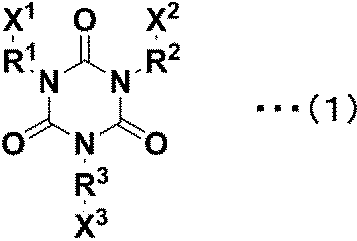
(式(1)中、R1~R3は2価の脂肪族炭化水素基を表す。X1~X3はそれぞれ一般式(2)~(4)のいずれかの構造を表す。)
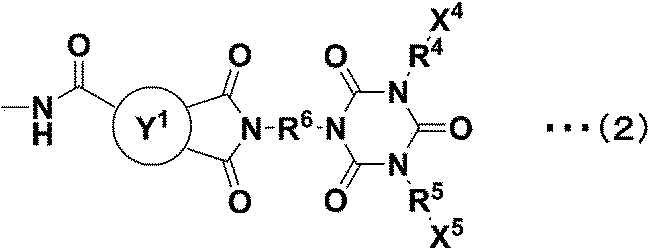
(式(2)中、R4~R6は2価の脂肪族炭化水素基を表す。X4及びX5はそれぞれ一般式(2)~(4)のいずれかの構造を表す。Y1は芳香族炭化水素あるいは脂環式炭化水素を表す。)
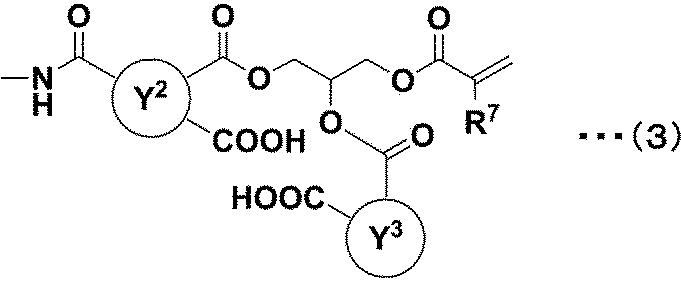
(式(3)中、R7は1価の脂肪族炭化水素基を表す。Y2及びY3はそれぞれ独立して、芳香族炭化水素あるいは脂環式炭化水素を表す。)

(式(4)中、R8は1価の脂肪族炭化水素基を表す。Y4及びY5はそれぞれ独立して、芳香族炭化水素あるいは脂環式炭化水素を表す。)
[2] 前記(b)撥液剤が、エチレン性不飽和結合基を有する撥液剤(b1)を含む、
[1]に記載の感光性樹脂組成物。
[3] 前記撥液剤(b1)が、下記一般式(5)で表される繰り返し単位及びフッ素原子を含有するアクリル樹脂(b2)を含むことを特徴とする[2]に記載の感光性樹脂組成物。
[1]に記載の感光性樹脂組成物。
[3] 前記撥液剤(b1)が、下記一般式(5)で表される繰り返し単位及びフッ素原子を含有するアクリル樹脂(b2)を含むことを特徴とする[2]に記載の感光性樹脂組成物。
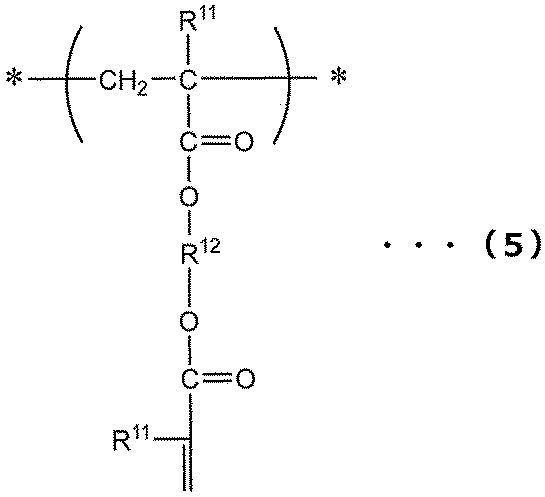
(式(5)中、R11はそれぞれ独立に、水素原子又はメチル基を表し、R12は炭素数2~6のアルキル基を表し、-O-、-CO-、-S-、-NH-のいずれか1つ以上で中断されていてもよい。
*は結合部を表す。)
[4] 前記アクリル樹脂(b2)が、フルオロアルキル基及び/又はフルオロアルキレン基を有する、[3]に記載の感光性樹脂組成物。
[5] 前記(d)光重合化合物100質量部に対する、(a)アルカリ可溶性樹脂の含有量が200質量部以下である、[1]に記載の感光性樹脂組成物。
[6] 前記ポリアミド-イミド(メタ)アクリレート樹脂(a-1)のゲルパーミエーションクロマトグラフィー(GPC)で測定したポリスチレン換算の重量平均分子量(Mw)が1000以上10000以下である、[1]に記載の感光性樹脂組成物。
[7] 隔壁形成用である、[1]~[6]のいずれかに記載の感光性樹脂組成物。
[8] フォトリソグラフィー法により段差を有する隔壁を一括形成するために用いられる、[7]に記載の感光性樹脂組成物。
[9] [1]~[6]のいずれかに記載の感光性樹脂組成物を硬化させてなる、硬化物。
[10] [1]~[6]のいずれかに記載の感光性樹脂組成物を硬化させた隔壁。
[11] [10]に記載の隔壁を備える有機電界発光素子。
[12] [11]に記載の有機電界発光素子を含む画像表示装置。
本発明により、より低い露光量で撥液性を発現することが可能で、且つ優れた段差形成性とインクジェット塗布性を示す隔壁を形成可能な感光性樹脂組成物を提供することができる。
また本発明は、感光性樹脂組成物を硬化させた隔壁、隔壁を備える有機電界発光素子、有機電界発光素子を含む画像表示装置を提供することができる。
また本発明は、感光性樹脂組成物を硬化させた隔壁、隔壁を備える有機電界発光素子、有機電界発光素子を含む画像表示装置を提供することができる。
以下、本発明を詳細に説明する。以下の記載は本発明の実施形態の一例であり、本発明はその要旨を超えない限り、これらに特定されない。
本発明において、「(メタ)アクリル」とは、「アクリル及び/又はメタクリル」を意味する。
本発明において、(ジ)トリカルボン酸無水物とは、ジカルボン酸無水物及び/又はトリカルボン酸無水物を意味する。
本発明において、「全固形分」とは、感光性樹脂組成物における溶剤以外の全成分を意味し、溶剤以外の成分が室温で液体であっても、固形分に含める。
本発明において、「(メタ)アクリル」とは、「アクリル及び/又はメタクリル」を意味する。
本発明において、(ジ)トリカルボン酸無水物とは、ジカルボン酸無水物及び/又はトリカルボン酸無水物を意味する。
本発明において、「全固形分」とは、感光性樹脂組成物における溶剤以外の全成分を意味し、溶剤以外の成分が室温で液体であっても、固形分に含める。
本発明において、「~」を用いて表される数値範囲は、「~」の前後に記載される数値を下限値及び上限値として含む範囲を意味する。
本発明において、「A及び/又はB」とは、A及びBの一方又は両方を意味し、具体的には、A、B、又はA及びBを意味する。
本発明において、「(共)重合体」とは、単一重合体(ホモポリマー)と共重合体(コポリマー)の双方を含むことを意味し、また、「多塩基酸(無水物)」とは、「多塩基酸及び/又は多塩基酸無水物」を意味する。
本発明において、「A及び/又はB」とは、A及びBの一方又は両方を意味し、具体的には、A、B、又はA及びBを意味する。
本発明において、「(共)重合体」とは、単一重合体(ホモポリマー)と共重合体(コポリマー)の双方を含むことを意味し、また、「多塩基酸(無水物)」とは、「多塩基酸及び/又は多塩基酸無水物」を意味する。
本発明において、重量平均分子量とは、GPC(ゲルパーミエーションクロマトグラフィー)によるポリスチレン換算の重量平均分子量(Mw)を意味する。
本発明において、酸価とは、有効固形分換算の酸価を表し、中和滴定により算出される。
本発明において、隔壁材とはバンク材、壁材、ウォール材をさし、同様に、隔壁とはバンク、壁、ウォールをさす。
本発明において、発光部(画素部)とは電気エネルギーを与えた場合に光を放出する部分をさす。
本発明において、酸価とは、有効固形分換算の酸価を表し、中和滴定により算出される。
本発明において、隔壁材とはバンク材、壁材、ウォール材をさし、同様に、隔壁とはバンク、壁、ウォールをさす。
本発明において、発光部(画素部)とは電気エネルギーを与えた場合に光を放出する部分をさす。
[1]感光性樹脂組成物
本発明の感光性樹脂組成物は、(a)アルカリ可溶性樹脂、(b)撥液剤、(c)光重合開始剤及び(d)光重合性化合物を含有する感光性樹脂組成物であって、前記(a)アルカリ可溶性樹脂が、下記一般式(1)で表される構造を含むポリアミド-イミド(メタ)アクリレート樹脂(a-1)を含有する。本発明の感光性樹脂組成物は、必要に応じてさらにその他の成分を含んでいてもよく、例えば紫外線吸収剤や、重合禁止剤を含んでいてもよい。
本発明の感光性樹脂組成物は、(a)アルカリ可溶性樹脂、(b)撥液剤、(c)光重合開始剤及び(d)光重合性化合物を含有する感光性樹脂組成物であって、前記(a)アルカリ可溶性樹脂が、下記一般式(1)で表される構造を含むポリアミド-イミド(メタ)アクリレート樹脂(a-1)を含有する。本発明の感光性樹脂組成物は、必要に応じてさらにその他の成分を含んでいてもよく、例えば紫外線吸収剤や、重合禁止剤を含んでいてもよい。
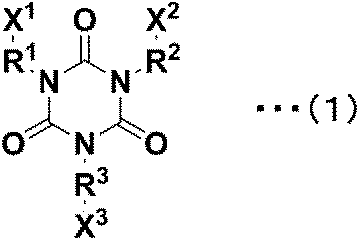
(式(1)中、R1~R3は2価の脂肪族炭化水素基を表す。X1~X3はそれぞれ一般式(2)~(4)のいずれかの構造を表す。)

(式(2)中、R4~R6は2価の脂肪族炭化水素基を表す。X4及びX5はそれぞれ一般式(2)~(4)のいずれかの構造を表す。Y1は芳香族炭化水素あるいは脂環式炭化水素を表す。)
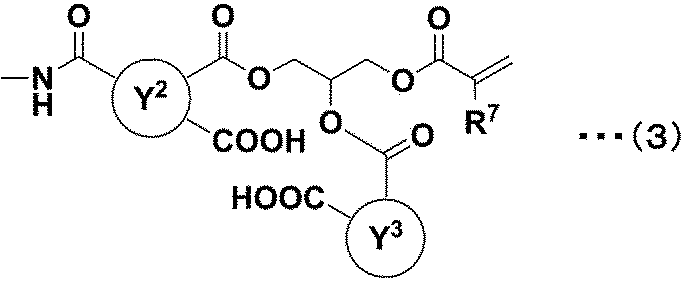
(式(3)中、R7は1価の脂肪族炭化水素基を表す。Y2及びY3はそれぞれ独立して、芳香族炭化水素あるいは脂環式炭化水素を表す。)
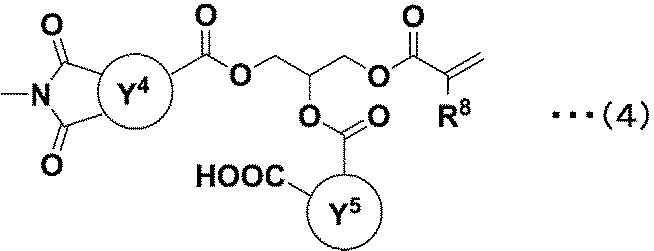
(式(4)中、R8は1価の脂肪族炭化水素基を表す。Y4及びY5はそれぞれ独立して、芳香族炭化水素あるいは脂環式炭化水素を表す。)
本発明において隔壁とは、例えば、アクティブ駆動型有機電界発光素子における機能層(有機層、発光部)を区画するためのものであり、例えば、区画された領域(画素領域)に機能層を構成するための材料であるインクを吐出、乾燥することで、機能層及び隔壁を含む画素を形成するために使用されるものである。
[1-1]感光性樹脂組成物の成分及び組成
本発明の感光性樹脂組成物を構成する成分及びその組成について説明する。
本発明の感光性樹脂組成物は、(a)アルカリ可溶性樹脂、(b)撥液剤、(c)光重合開始剤及び(d)光重合性化合物を含有する。
本発明の感光性樹脂組成物を構成する成分及びその組成について説明する。
本発明の感光性樹脂組成物は、(a)アルカリ可溶性樹脂、(b)撥液剤、(c)光重合開始剤及び(d)光重合性化合物を含有する。
[1-1-1](a)成分;アルカリ可溶性樹脂
本発明における(a)アルカリ可溶性樹脂は、既述の一般式(1)で表される構造を含むポリアミド-イミド(メタ)アクリレート樹脂(a-1)を含有する。
本発明における(a)アルカリ可溶性樹脂は、既述の一般式(1)で表される構造を含むポリアミド-イミド(メタ)アクリレート樹脂(a-1)を含有する。
<ポリアミド-イミド(メタ)アクリレート樹脂(a-1)>
ポリアミド-イミド(メタ)アクリレート樹脂(a-1)は、イソシアヌル骨格及びアミド結合やイミド結合を有することで、分子間力が強く加熱処理時熱分解しにくい傾向があり、感光性樹脂組成物にポリアミド-イミド(メタ)アクリレート樹脂(a-1)が含有されることで、組成物の硬化膜を焼成時のフュームの発生が少ないと考えられる。また、ポリアミド-イミド(メタ)アクリレート樹脂(a-1)は(メタ)アクリロイル基を有することで、着色剤を含有しても、光、熱硬化にてより強固な硬化膜となり、焼成後の残膜率を高くできると考えられる。
ポリアミド-イミド(メタ)アクリレート樹脂(a-1)は、イソシアヌル骨格及びアミド結合やイミド結合を有することで、分子間力が強く加熱処理時熱分解しにくい傾向があり、感光性樹脂組成物にポリアミド-イミド(メタ)アクリレート樹脂(a-1)が含有されることで、組成物の硬化膜を焼成時のフュームの発生が少ないと考えられる。また、ポリアミド-イミド(メタ)アクリレート樹脂(a-1)は(メタ)アクリロイル基を有することで、着色剤を含有しても、光、熱硬化にてより強固な硬化膜となり、焼成後の残膜率を高くできると考えられる。
上記式(1)中、R1~R3は2価の脂肪族炭化水素基を表す。脂肪族炭化水素基としては、炭素数1~20の脂肪族炭化水素基であることが好ましく、飽和脂肪族又は不飽和脂肪族であってもよく、直鎖状、分岐鎖状、又は環状であってもよく、置換基を有していてもよい。また、R1~R3は、すべて同一の脂肪族炭化水素基であってもよく、すべて異なる脂肪族炭化水素基であってもよい。
上記式(1)中、X1~X3はそれぞれ一般式(2)~(4)のいずれかの構造を表す。X1~X3は、すべて同一の構造であってもよく、すべて異なる構造であってもよい。
上記式(1)中、X1~X3はそれぞれ一般式(2)~(4)のいずれかの構造を表す。X1~X3は、すべて同一の構造であってもよく、すべて異なる構造であってもよい。
上記式(2)中、R4~R6は2価の脂肪族炭化水素基を表す。脂肪族炭化水素基としては、炭素数1~20の脂肪族炭化水素基であることが好ましく、飽和脂肪族又は不飽和脂肪族であってもよく、直鎖状、分岐鎖状、又は環状であってもよく、置換基を有していてもよい。また、R4~R6は、すべて同一の脂肪族炭化水素基であってもよく、すべて異なる脂肪族炭化水素基であってもよい。
X4及びX5はそれぞれ一般式(2)~(4)のいずれかの構造を表す。X4及びX5は、すべて同一の構造であってもよく、すべて異なる構造であってもよい。
Y1は置換基を有していてもよい芳香族炭化水素あるいは脂環式炭化水素を表す。芳香族炭化水素及び脂環式炭化水素の炭素数は1~10であることが好ましい。
X4及びX5はそれぞれ一般式(2)~(4)のいずれかの構造を表す。X4及びX5は、すべて同一の構造であってもよく、すべて異なる構造であってもよい。
Y1は置換基を有していてもよい芳香族炭化水素あるいは脂環式炭化水素を表す。芳香族炭化水素及び脂環式炭化水素の炭素数は1~10であることが好ましい。
上記式(3)中、R7は1価の脂肪族炭化水素基を表す。脂肪族炭化水素基としては、炭素数1~20の脂肪族炭化水素基であることが好ましく、飽和脂肪族又は不飽和脂肪族であってもよく、直鎖状、分岐鎖状、又は環状であってもよく、置換基を有していてもよい。
Y2及びY3はそれぞれ独立して、置換基を有していてもよい芳香族炭化水素あるいは脂環式炭化水素を表す。芳香族炭化水素及び脂環式炭化水素の炭素数は1~10であることが好ましい。
Y2及びY3はそれぞれ独立して、置換基を有していてもよい芳香族炭化水素あるいは脂環式炭化水素を表す。芳香族炭化水素及び脂環式炭化水素の炭素数は1~10であることが好ましい。
上記式(4)中、R8は1価の脂肪族炭化水素基を表す。脂肪族炭化水素基としては、炭素数1~20の脂肪族炭化水素基であることが好ましく、飽和脂肪族又は不飽和脂肪族であってもよく、直鎖状、分岐鎖状、又は環状であってもよく、置換基を有していてもよい。
Y4及びY5はそれぞれ独立して、置換基を有していてもよい芳香族炭化水素あるいは脂環式炭化水素を表す。
Y4及びY5はそれぞれ独立して、置換基を有していてもよい芳香族炭化水素あるいは脂環式炭化水素を表す。
ポリアミド-イミド(メタ)アクリレート樹脂(a-1)(以降、「樹脂(a-1)」とも略記する場合がある)は、例えば、イソシアヌレート型ポリイソシアネートとトリカルボン酸無水物との反応により得られた末端酸基又は酸無水物基を有するポリアミドイミド樹脂と分子中にエポキシ基を有する(メタ)アクリレート及び(ジ)トリカルボン酸無水物との反応で得られる。但し、本発明において同様の効果が得られる原料、方法であれば、これに限定されるものではない。
イソシアヌレート型ポリイソシアネートとしては、例えば、ヘキサメチレンジイソシアネートから合成されたイソシアヌレート型トリイソシアネート(HDI3N)、トリメチルヘキサメチレンジイソシアネートから合成されたイソシアヌレート型トリイソシアネート(HTMDI3N)、イソホロンジイソシアネートから合成されたイソシアヌレート型トリイソシアネート(IPDI3N)、水添トリレンジイソシアネートから合成されたイソシアヌレート型トリイソシアネート(HTDI3N)、水添キシレンジイソシアネートから合成されたイソシアヌレート型トリイソシアネート(HXDI3N)、ノルボルナンジイソシアネートから合成されたイソシアヌレート型トリイソシアネート(NBDI3N)、水添ジフェニルメタンジイソシアネートから合成されたイソシアヌレート型トリイソシアネート(HMDI3N)が挙げられる。硬化収縮を抑制する観点からは、例えば、イソホロンジイソシアネートから合成されたイソシアヌレート型トリイソシアネート(IPDI3N)、水添トリレンジイソシアネートから合成されたイソシアヌレート型トリイソシアネート(HTDI3N)、水添キシレンジイソシアネートから合成されたイソシアヌレート型トリイソシアネート(HXDI3N)、ノルボルナンジイソシアネートから合成されたイソシアヌレート型トリイソシアネート(NBDI3N)、水添ジフェニルメタンジイソシアネートから合成されたイソシアヌレート型トリイソシアネート(HMDI3N)等の脂環式イソシアヌレート型ポリイソシアネートが好ましく、イソホロンジイソシアネートから合成されたイソシアヌレート型トリイソシアネート(IPDI3N)がより好ましい。
イソシアヌレート型ポリイソシアネートと反応させるトリカルボン酸無水物としては、例えば、無水トリメリット酸、ナフタレン-1,2,4-トリカルボン酸無水物、プロパントリカルボン酸無水物、シクロヘキサントリカルボン酸無水物、メチルシクロヘキサントリカルボン酸無水物、シクロヘキセントリカルボン酸無水物、メチルシクロヘキセントリカルボン酸無水物が挙げられる。硬化収縮を抑制する観点からは、例えば、シクロヘキサントリカルボン酸無水物、メチルシクロヘキサントリカルボン酸無水物、シクロヘキセントリカルボン酸無水物、メチルシクロヘキセントリカルボン酸無水物等の脂環式トリカルボン酸無水物が好ましく、シクロヘキサントリカルボン酸無水物がより好ましい。
前記シクロヘキサントリカルボン酸無水物としては、例えば、シクロヘキサン-1,3,4-トリカルボン酸-3,4-無水物、シクロヘキサン-1,3,5-トリカルボン酸-3,5-無水物、シクロヘキサン-1,2,3-トリカルボン酸-2,3-無水物が挙げられる。
本発明に用いる分子中にエポキシ基を有する(メタ)アクリレートは、分子構造中にエポキシ基と(メタ)アクリロイル基とを有する化合物であれば他の具体構造は特に限定されず、多種多様な化合物を用いることができる。
分子中にエポキシ基を有する(メタ)アクリレートとしては、例えば、グリシジルアクリレート、グリシジルメタクリレート、アリルグリシジルエーテル、シクロヘキシルモノエポキシアクリレートやその誘導体(例えば、3,4-エポキシシクロヘキシルメチルメタアクリレートなど、エポキシシクロヘキサン化合物にアクリル酸又はメタクリル酸を反応させた類似体)が挙げられる。これらは各々単独で用いても良いし、2種類以上を併用しても良い。中でも、硬化物における耐熱性に優れるエチレン性不飽和基、酸基および二級水酸基含有ポリアミドイミド樹脂となることから、分子量が1,000以下のものが好ましい。
末端酸基又は酸無水物基を有するポリアミドイミド樹脂と分子中にエポキシ基を有する(メタ)アクリレートと反応させる(ジ)カルボン酸無水物について、ジカルボン酸無水物としては、例えば、マレイン酸、コハク酸、イタコン酸、フタル酸、テトラヒドロフタル酸、ヘキサヒドロフタル酸、メチルヘキサヒドロフタル酸、エンドメチレンテトラヒドロフタル酸、クロレンド酸、メチルテトラヒドロフタル酸の無水物が挙げられる。電気特性の観点からは、例えば、コハク酸、1,2-シクロプロパンジカルボン酸、2,2-ジメチルコハク酸、カロン酸、1,2-シクロヘキサンジカルボン酸、ブチルコハク酸、4-メチルシクロヘキサン-1,2-ジカルボン酸、n-オクチルコハク酸、デシルコハク酸、ドデシルコハク酸の無水物等の脂肪族ジカルボン酸無水物が好ましい。
トリカルボン酸無水物としては、上述したイソシアヌレート型ポリイソシアネートと反応させるトリカルボン酸無水物と同様のものが挙げられ、現像性の観点からは、脂肪族トリカルボン酸無水物が好ましく、脂環式トリカルボン酸無水物がより好ましい。
トリカルボン酸無水物としては、上述したイソシアヌレート型ポリイソシアネートと反応させるトリカルボン酸無水物と同様のものが挙げられ、現像性の観点からは、脂肪族トリカルボン酸無水物が好ましく、脂環式トリカルボン酸無水物がより好ましい。
樹脂(a-1)のゲルパーミエーションクロマトグラフィー(GPC)で測定したポリスチレン換算の重量平均分子量(Mw)は通常1000以上、好ましくは1500以上、より好ましくは2000以上、さらに好ましくは2500以上、よりさらに好ましくは3000以上である。また、通常10000以下、好ましくは9000以下、より好ましくは8000以下、さらに好ましくは7000以下である。上記の上限及び下限は任意に組み合わせることができる。例えば、1000~10000が好ましく、1500~9000がより好ましく、2000~8000がさらに好ましく、3000~7000がよりさらに好ましい。前記下限値以上とすることでフューム発生を低減できる傾向がある。前記上限値以下とすることで現像溶解性が良好となる傾向がある。
前記脂環式イソシアヌレート型ポリイソシアネートと前記脂環式トリカルボン酸無水物との反応は、前記脂環式イソシアヌレート型ポリイソシアネートが有するイソシアネート基1molに対して酸無水物基とカルボン酸との合計が1.0mol~3.0molとすることが好ましく、より好ましくは1.2mol~2.8mol、さらに好ましくは1.4mol~2.6molである。酸無水物基とカルボン酸との合計が1.0molを超える場合、イソシアネート基の残存を防ぎ、高分子量化を抑制し、現像性が良好になる。酸無水物基とカルボン酸との合計が3.0molより低い場合、脂環式トリカルボン酸無水物の残存を防ぎ、現像残差となることを抑制できる。
樹脂(a-1)の酸価は特に限定されないが、20mgKOH/g以上が好ましく、40mgKOH/g以上がより好ましく、60mgKOH/g以上がさらに好ましく、また、200mgKOH/g以下が好ましく、150mgKOH/g以下がより好ましい。上記の上限及び下限は任意に組み合わせることができる。例えば、20~200mgKOH/gが好ましく、40~200mgKOH/gがより好ましく、60~150mgKOH/gがさらに好ましい。
前記下限値以上とすることで現像溶解性が向上し、解像性が良好となる傾向がある。前記上限値以下とすることで残膜率が良好となる傾向がある。
エチレン性二重結合を有するアルカリ可溶性樹脂の具体的構造は特に限定されないが、現像溶解性の観点から、アクリル共重合樹脂(a-2)及び/又はエポキシ(メタ)アクリレート樹脂(a-3)が好ましく、アウトガス低減の観点からはエポキシ(メタ)アクリレート樹脂(a-3)がより好ましい。
以下に、アクリル共重合樹脂(a-2)について詳述する。
エチレン性二重結合を有するアルカリ可溶性樹脂の具体的構造は特に限定されないが、現像溶解性の観点から、アクリル共重合樹脂(a-2)及び/又はエポキシ(メタ)アクリレート樹脂(a-3)が好ましく、アウトガス低減の観点からはエポキシ(メタ)アクリレート樹脂(a-3)がより好ましい。
以下に、アクリル共重合樹脂(a-2)について詳述する。
[アクリル共重合樹脂(a-2)]
アクリル共重合樹脂(a-2)は、硬化性の観点から、側鎖にエチレン性二重結合を有するものであることが好ましい。
アクリル共重合樹脂(a-2)の中でも、現像溶解性の観点から、下記一般式(I)で表される部分構造を含むアクリル共重合樹脂(a-2-1)が好ましい。
アクリル共重合樹脂(a-2)は、硬化性の観点から、側鎖にエチレン性二重結合を有するものであることが好ましい。
アクリル共重合樹脂(a-2)の中でも、現像溶解性の観点から、下記一般式(I)で表される部分構造を含むアクリル共重合樹脂(a-2-1)が好ましい。
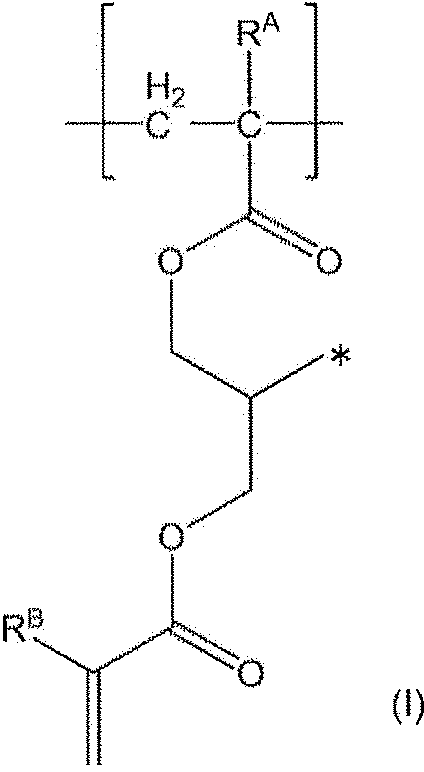
式(I)中、RA及びRBは各々独立に、水素原子又はメチル基を表す。*は結合手を表す。
前記式(I)で表される部分構造は、現像性の観点から、下記一般式(I-1)で表される部分構造であることが好ましい。
前記式(I)で表される部分構造は、現像性の観点から、下記一般式(I-1)で表される部分構造であることが好ましい。
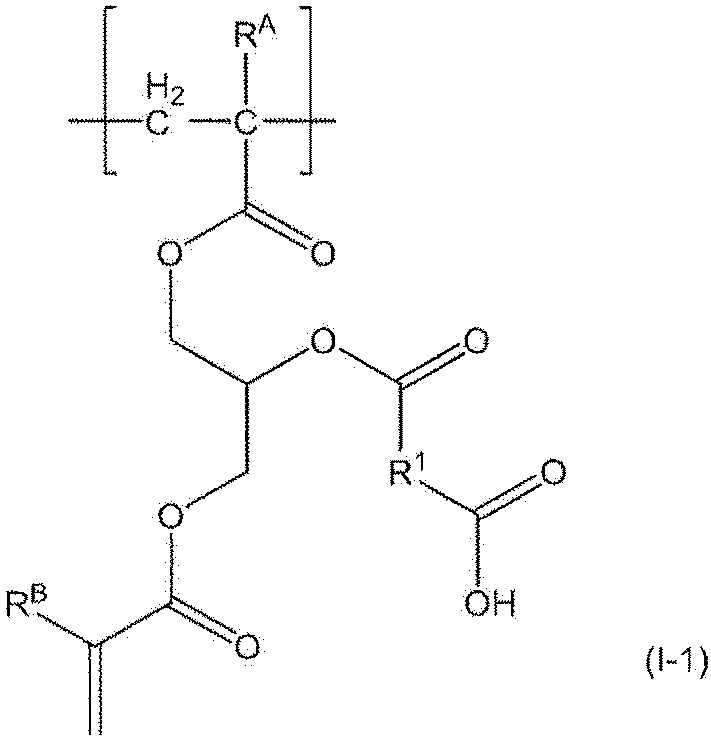
式(I-1)中、RA及びRBは、前記式(I)のものと同義である。R1は置換基を有していてもよい炭素数1~4の2価の炭化水素基を表す。
前記式(I)で表される部分構造は、感度の観点から、下記式(I-2)で表される部分構造であることが好ましい。
前記式(I)で表される部分構造は、感度の観点から、下記式(I-2)で表される部分構造であることが好ましい。
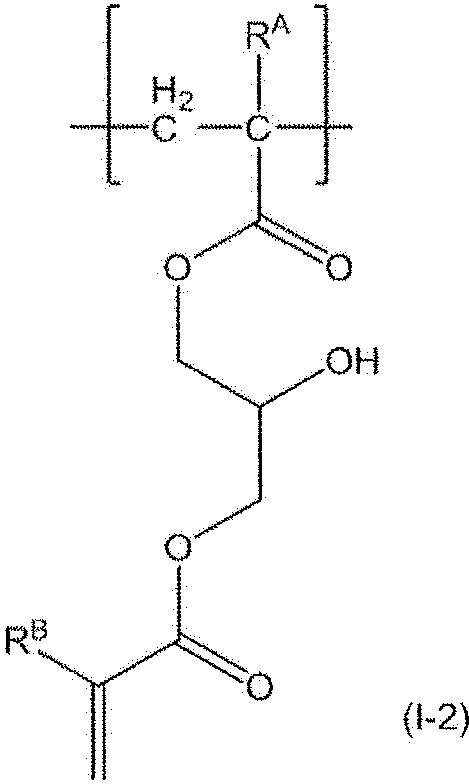
式(I-2)中、RA及びRBは、前記式(I)のものと同義である。
アクリル共重合樹脂(a-2-1)が前記一般式(I)で表される部分構造を含む場合、アクリル共重合樹脂(a-2-1)に含まれる前記一般式(I)で表される部分構造の含有量は特に限定されないが、5モル%以上が好ましく、20モル%以上がより好ましく、30モル%以上がさらに好ましく、50モル%以上がよりさらに好ましく、70モル%以上が特に好ましく、80モル%以上が最も好ましく、また、99モル%以下が好ましく、97モル%以下がより好ましく、95モル%以下がさらに好ましい。前記上限及び下限は任意に組み合わせることができ、例えば、5~99モル%が好ましく、20~99モル%がより好ましく、30~97モル%がさらに好ましく、50~97モル%がよりさらに好ましく、70~95モル%が特に好ましく、80~95モル%が最も好ましい。前記下限値以上とすることで残渣が低減する傾向がある。また、前記上限値以下とすることで現像密着性が向上する傾向がある。
アクリル共重合樹脂(a-2-1)が前記一般式(I)で表される部分構造を含む場合、アクリル共重合樹脂(a-2-1)に含まれる前記一般式(I)で表される部分構造の含有量は特に限定されないが、5モル%以上が好ましく、20モル%以上がより好ましく、30モル%以上がさらに好ましく、50モル%以上がよりさらに好ましく、70モル%以上が特に好ましく、80モル%以上が最も好ましく、また、99モル%以下が好ましく、97モル%以下がより好ましく、95モル%以下がさらに好ましい。前記上限及び下限は任意に組み合わせることができ、例えば、5~99モル%が好ましく、20~99モル%がより好ましく、30~97モル%がさらに好ましく、50~97モル%がよりさらに好ましく、70~95モル%が特に好ましく、80~95モル%が最も好ましい。前記下限値以上とすることで残渣が低減する傾向がある。また、前記上限値以下とすることで現像密着性が向上する傾向がある。
アクリル共重合樹脂(a-2-1)が前記一般式(I-1)で表される部分構造を含む場合、アクリル共重合樹脂(a-2-1)に含まれる前記一般式(I-1)で表される部分構造の含有量は特に限定されないが、1モル%以上が好ましく、5モル%以上がより好ましく、8モル%以上がさらに好ましく、10モル%以上がよりさらに好ましく、また、99モル%以下が好ましく、60モル%以下がより好ましく、40モル%以下がさらに好ましく、30モル%以下がよりさらに好ましく、20モル%以下が特に好ましい。前記上限及び下限は任意に組み合わせることができ、例えば、1~99モル%が好ましく、1~60モル%がより好ましく、5~40モル%がさらに好ましく、8~30モル%がよりさらに好ましく、10~20モル%が特に好ましい。前記下限値以上とすることで感度が高くなり、残渣が低減する傾向がある。また、前記上限値以下とすることで現像密着性が向上する傾向がある。
アクリル共重合樹脂(a-2-1)が前記一般式(I-2)で表される部分構造を含む場合、アクリル共重合樹脂(a-2-1)に含まれる前記一般式(I-2)で表される部分構造の含有量は特に限定されないが、10モル%以上が好ましく、20モル%以上がより好ましく、30モル%以上がさらに好ましく、40モル%以上がよりさらに好ましく、50モル%以上が特に好ましく、70モル%以上が最も好ましく、また、99モル%以下が好ましく、95モル%以下がより好ましく、90モル%以下がさらに好ましく、85モル%以下が特に好ましい。前記上限及び下限は任意に組み合わせることができ、例えば、10~99モル%が好ましく、20~99モル%がより好ましく、30~95モル%がさらに好ましく、40~95モル%がよりさらに好ましく、50~90モル%が特に好ましく、70~85モル%が最も好ましい。前記下限値以上とすることで感度が高くなる傾向がある。また、前記上限値以下とすることで現像性が向上する傾向がある。
アクリル共重合樹脂(a-2-1)が前記一般式(I)で表される部分構造を含む場合、他に含んでいてもよい部分構造は特に限定されないが、現像密着性の観点から、例えば、下記一般式(I’)で表される部分構造を含むことが好ましい。

上記式(I’)中、RDは水素原子又はメチル基を表し、REは置換基を有していてもよいアルキル基、置換基を有していてもよいアリール基(芳香族環基)、又は置換基を有していてもよいアルケニル基を表す。
(RE)
前記式(I’)において、REは置換基を有していてもよいアルキル基、置換基を有していてもよいアリール基、又は置換基を有していてもよいアルケニル基を表す。
REにおけるアルキル基としては直鎖状、分岐鎖状又は環状のアルキル基が挙げられる。その炭素数は、1以上が好ましく、3以上がより好ましく、5以上がさらに好ましく、また、20以下が好ましく、18以下がより好ましく、16以下がさらに好ましく、14以下がよりさらに好ましく、12以下が特に好ましい。前記上限及び下限は任意に組み合わせることができ、例えば、1~20が好ましく、1~18がより好ましく、3~16がさらに好ましく、3~14がよりさらに好ましく、5~12が特に好ましい。前記下限値以上とすることで膜強度が高くなり、現像密着性が向上する傾向がある。また、前記上限値以下とすることで残渣が低減する傾向がある。
アルキル基としては、例えば、メチル基、エチル基、シクロヘキシル基、ジシクロペンタニル基、ドデカニル基が挙げられる。これらの中でも膜強度の観点から、ジシクロペンタニル基、ドデカニル基が好ましく、ジシクロペンタニル基がより好ましい。
アルキル基が有していてもよい置換基としては、例えば、メトキシ基、エトキシ基、クロロ基、ブロモ基、フルオロ基、ヒドロキシ基、アミノ基、エポキシ基、オリゴエチレングリコール基、フェニル基、カルボキシ基、アクリロイル基、メタクリロイル基が挙げられ、現像性の観点から、ヒドロキシ基、オリゴエチレングリコール基が好ましい。
アルキル基が有していてもよい置換基としては、例えば、メトキシ基、エトキシ基、クロロ基、ブロモ基、フルオロ基、ヒドロキシ基、アミノ基、エポキシ基、オリゴエチレングリコール基、フェニル基、カルボキシ基、アクリロイル基、メタクリロイル基が挙げられ、現像性の観点から、ヒドロキシ基、オリゴエチレングリコール基が好ましい。
REにおけるアリール基(芳香族環基)としては、1価の芳香族炭化水素環基、1価の芳香族複素環基が挙げられる。その炭素数は4以上が好ましく、6以上がより好ましく、また、24以下が好ましく、22以下がより好ましく、20以下がさらに好ましく、18以下が特に好ましい。前記上限及び下限は任意に組み合わせることができ、例えば、4~24が好ましく、4~22がより好ましく、6~20がさらに好ましく、6~18が特に好ましい。前記下限値以上とすることで現像密着性が向上する傾向がある。また、前記上限値以下とすることで残渣が低減する傾向がある。
芳香族炭化水素環基における芳香族炭化水素環としては、単環であっても縮合環であってもよく、例えば、ベンゼン環、ナフタレン環、アントラセン環、フェナントレン環、ペリレン環、テトラセン環、ピレン環、ベンズピレン環、クリセン環、トリフェニレン環、アセナフテン環、フルオランテン環、フルオレン環が挙げられる。
芳香族複素環基における芳香族複素環としては、単環であっても縮合環であってもよく、例えば、フラン環、ベンゾフラン環、チオフェン環、ベンゾチオフェン環、ピロール環、ピラゾール環、イミダゾール環、オキサジアゾール環、インドール環、カルバゾール環、ピロロイミダゾール環、ピロロピラゾール環、ピロロピロール環、チエノピロール環、チエノチオフェン環、フロピロール環、フロフラン環、チエノフラン環、ベンゾイソオキサゾール環、ベンゾイソチアゾール環、ベンゾイミダゾール環、ピリジン環、ピラジン環、ピリダジン環、ピリミジン環、トリアジン環、キノリン環、イソキノリン環、シノリン環、キノキサリン環、フェナントリジン環、ペリミジン環、キナゾリン環、キナゾリノン環、アズレン環が挙げられる。これらの中でも硬化性の観点から、ベンゼン環基、ナフタレン環基が好ましく、ベンゼン環基がより好ましい。
芳香族複素環基における芳香族複素環としては、単環であっても縮合環であってもよく、例えば、フラン環、ベンゾフラン環、チオフェン環、ベンゾチオフェン環、ピロール環、ピラゾール環、イミダゾール環、オキサジアゾール環、インドール環、カルバゾール環、ピロロイミダゾール環、ピロロピラゾール環、ピロロピロール環、チエノピロール環、チエノチオフェン環、フロピロール環、フロフラン環、チエノフラン環、ベンゾイソオキサゾール環、ベンゾイソチアゾール環、ベンゾイミダゾール環、ピリジン環、ピラジン環、ピリダジン環、ピリミジン環、トリアジン環、キノリン環、イソキノリン環、シノリン環、キノキサリン環、フェナントリジン環、ペリミジン環、キナゾリン環、キナゾリノン環、アズレン環が挙げられる。これらの中でも硬化性の観点から、ベンゼン環基、ナフタレン環基が好ましく、ベンゼン環基がより好ましい。
アリール基が有していてもよい置換基としては、例えば、メチル基、エチル基、プロピル基、メトキシ基、エトキシ基、クロロ基、ブロモ基、フルオロ基、ヒドロキシ基、アミノ基、エポキシ基、オリゴエチレングリコール基、フェニル基、カルボキシ基が挙げられ、現像性の観点から、ヒドロキシ基、オリゴエチレングリコール基が好ましい。
REにおけるアルケニル基としては、直鎖状、分岐鎖状又は環状のアルケニル基が挙げられる。その炭素数は、2以上が好ましく、また、22以下が好ましく、20以下がより好ましく、18以下がさらに好ましく、16以下がよりさらに好ましく、14以下が特に好ましい。例えば、2~22が好ましく、2~20がより好ましく、2~18がさらに好ましく、2~16がよりさらに好ましく、2~14が特に好ましい。前記下限値以上とすることで現像密着性が向上する傾向がある。また、前記上限値以下とすることで残渣が低減する傾向がある。
REにおけるアルケニル基としては、直鎖状、分岐鎖状又は環状のアルケニル基が挙げられる。その炭素数は、2以上が好ましく、また、22以下が好ましく、20以下がより好ましく、18以下がさらに好ましく、16以下がよりさらに好ましく、14以下が特に好ましい。例えば、2~22が好ましく、2~20がより好ましく、2~18がさらに好ましく、2~16がよりさらに好ましく、2~14が特に好ましい。前記下限値以上とすることで現像密着性が向上する傾向がある。また、前記上限値以下とすることで残渣が低減する傾向がある。
アルケニル基としては、例えば、エテニル基、プロペニル基、ブテニル基、シクロヘキセニル基が挙げられる。これらの中でも硬化性の観点から、エテニル基、プロペニル基が好ましく、エテニル基がより好ましい。
アルケニル基が有していてもよい置換基としては、例えば、メトキシ基、エトキシ基、クロロ基、ブロモ基、フルオロ基、ヒドロキシ基、アミノ基、エポキシ基、オリゴエチレングリコール基、フェニル基、カルボキシ基が挙げられ、現像性の観点から、ヒドロキシ基、オリゴエチレングリコール基が好ましい。
アルケニル基が有していてもよい置換基としては、例えば、メトキシ基、エトキシ基、クロロ基、ブロモ基、フルオロ基、ヒドロキシ基、アミノ基、エポキシ基、オリゴエチレングリコール基、フェニル基、カルボキシ基が挙げられ、現像性の観点から、ヒドロキシ基、オリゴエチレングリコール基が好ましい。
これらの中でも現像性の観点から、REとしては、アルキル基、アルケニル基が好ましく、アルキル基がより好ましく、ジシクロペンタニル基がさらに好ましい。
アクリル共重合樹脂(a-2-1)が前記一般式(I’)で表される部分構造を含む場合、アクリル共重合樹脂(a-2-1)に含まれる前記一般式(I’)で表される部分構造の含有量は特に限定されないが、0.5モル%以上が好ましく、1モル%以上がより好ましく、1.5モル%以上がさらに好ましく、2モル%以上が特に好ましく、また、90モル%以下が好ましく、70モル%以下がより好ましく、50%モル以下がさらに好ましく、30モル%以下がよりさらに好ましく、10モル%以下が特に好ましい。前記上限及び下限は任意に組み合わせることができ、例えば、0.5~90モル%が好ましく、0.5~70モル%がより好ましく、1~50%モルがさらに好ましく、1.5~30モル%がよりさらに好ましく、2~10モル%が特に好ましい。前記下限値以上とすることで現像密着性が向上する傾向がある。また、前記上限値以下とすることで残渣が低減する傾向がある。
アクリル共重合樹脂(a-2-1)が前記一般式(I’)で表される部分構造を含む場合、アクリル共重合樹脂(a-2-1)に含まれる前記一般式(I’)で表される部分構造の含有量は特に限定されないが、0.5モル%以上が好ましく、1モル%以上がより好ましく、1.5モル%以上がさらに好ましく、2モル%以上が特に好ましく、また、90モル%以下が好ましく、70モル%以下がより好ましく、50%モル以下がさらに好ましく、30モル%以下がよりさらに好ましく、10モル%以下が特に好ましい。前記上限及び下限は任意に組み合わせることができ、例えば、0.5~90モル%が好ましく、0.5~70モル%がより好ましく、1~50%モルがさらに好ましく、1.5~30モル%がよりさらに好ましく、2~10モル%が特に好ましい。前記下限値以上とすることで現像密着性が向上する傾向がある。また、前記上限値以下とすることで残渣が低減する傾向がある。
アクリル共重合樹脂(a-2-1)が前記一般式(I)で表される部分構造を含む場合、耐熱性、膜強度の観点から、下記一般式(I’’)で表される部分構造をさらに含むことが好ましい。
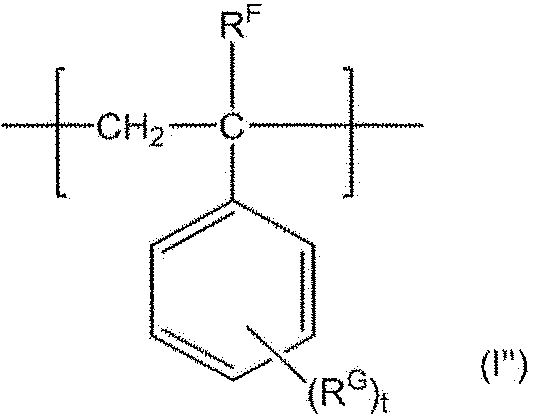
上記式(I’’)中、RFは水素原子又はメチル基を表し、RGは置換基を有していてもよいアルキル基、置換基を有していてもよいアルケニル基、ヒドロキシル基、カルボキシ基、ハロゲン原子、置換基を有していてもよいアルコキシ基、チオール基、又は置換基を有していてもよいアルキルスルフィド基を表す。tは0~5の整数を表す。
(RG)
前記式(I’’)においてRGは置換基を有していてもよいアルキル基、置換基を有していてもよいアルケニル基、ヒドロキシル基、カルボキシ基、ハロゲン原子、置換基を有していてもよいアルコキシ基、チオール基、又は置換基を有していてもよいアルキルスルフィド基を表す。
前記式(I’’)においてRGは置換基を有していてもよいアルキル基、置換基を有していてもよいアルケニル基、ヒドロキシル基、カルボキシ基、ハロゲン原子、置換基を有していてもよいアルコキシ基、チオール基、又は置換基を有していてもよいアルキルスルフィド基を表す。
RGにおけるアルキル基としては、直鎖状、分岐鎖状又は環状のアルキル基が挙げられる。その炭素数は、1以上が好ましく、3以上がより好ましく、5以上がさらに好ましく、また、20以下が好ましく、18以下がより好ましく、16以下がさらに好ましく、14以下がよりさらに好ましく、12以下が特に好ましい。前記上限及び下限は任意に組み合わせることができ、例えば、1~20が好ましく、1~18がより好ましく、3~16がさらに好ましく、3~14がよりさらに好ましく、5~12が特に好ましい。前記下限値以上とすることで現像密着性が向上する傾向がある。また、前記上限値以下とすることで残渣が低減する傾向がある。
アルキル基としては、例えば、メチル基、エチル基、シクロヘキシル基、ジシクロペンタニル基、ドデカニル基が挙げられる。これらの中でも現像密着性の観点から、ジシクロペンタニル基、ドデカニル基が好ましく、ジシクロペンタニル基がより好ましい。
アルキル基が有していてもよい置換基としては、例えば、メトキシ基、エトキシ基、クロロ基、ブロモ基、フルオロ基、ヒドロキシ基、アミノ基、エポキシ基、オリゴエチレングリコール基、フェニル基、カルボキシ基、アクリロイル基、メタクリロイル基が挙げられ、現像性の観点から、ヒドロキシ基、オリゴエチレングリコール基が好ましい。
アルキル基が有していてもよい置換基としては、例えば、メトキシ基、エトキシ基、クロロ基、ブロモ基、フルオロ基、ヒドロキシ基、アミノ基、エポキシ基、オリゴエチレングリコール基、フェニル基、カルボキシ基、アクリロイル基、メタクリロイル基が挙げられ、現像性の観点から、ヒドロキシ基、オリゴエチレングリコール基が好ましい。
RGにおけるアルケニル基としては、直鎖状、分岐鎖状又は環状のアルケニル基が挙げられる。その炭素数は、2以上が好ましく、また、22以下が好ましく、20以下がより好ましく、18以下がさらに好ましく、16以下がよりさらに好ましく、14以下が特に好ましい。例えば、2~22が好ましく、2~20がより好ましく、2~18がさらに好ましく、2~16がよりさらに好ましく、2~14が特に好ましい。前記下限値以上とすることで現像密着性が向上する傾向がある。また、前記上限値以下とすることで残渣が低減する傾向がある。
アルケニル基としては、例えば、エテニル基、プロペニル基、ブテニル基、シクロヘキセニル基が挙げられる。これらの中でも硬化性の観点から、エテニル基、プロペニル基が好ましく、エテニル基がより好ましい。
アルケニル基が有していてもよい置換基としては、例えば、メトキシ基、エトキシ基、クロロ基、ブロモ基、フルオロ基、ヒドロキシ基、アミノ基、エポキシ基、オリゴエチレングリコール基、フェニル基、カルボキシ基が挙げられ、現像性の観点から、ヒドロキシ基、オリゴエチレングリコール基が好ましい。
アルケニル基が有していてもよい置換基としては、例えば、メトキシ基、エトキシ基、クロロ基、ブロモ基、フルオロ基、ヒドロキシ基、アミノ基、エポキシ基、オリゴエチレングリコール基、フェニル基、カルボキシ基が挙げられ、現像性の観点から、ヒドロキシ基、オリゴエチレングリコール基が好ましい。
RGにおけるハロゲン原子としては、フッ素原子、塩素原子、臭素原子、ヨウ素原子が挙げられ、これらの中でも撥インク性の観点からはフッ素原子が好ましい。
RGにおけるアルコキシ基としては、直鎖状、分岐鎖状又は環状のアルコキシ基が挙げられる。その炭素数は、1以上が好ましく、また、20以下が好ましく、18以下がより好ましく、16以下がさらに好ましく、14以下がよりさらに好ましく、12以下が特に好ましい。例えば、1~20が好ましく、1~18がより好ましく、1~16がさらに好ましく、1~14がよりさらに好ましく、1~12が特に好ましい。前記下限値以上とすることで現像密着性が向上する傾向がある。また、前記上限値以下とすることで残渣が低減する傾向がある。
RGにおけるアルコキシ基としては、直鎖状、分岐鎖状又は環状のアルコキシ基が挙げられる。その炭素数は、1以上が好ましく、また、20以下が好ましく、18以下がより好ましく、16以下がさらに好ましく、14以下がよりさらに好ましく、12以下が特に好ましい。例えば、1~20が好ましく、1~18がより好ましく、1~16がさらに好ましく、1~14がよりさらに好ましく、1~12が特に好ましい。前記下限値以上とすることで現像密着性が向上する傾向がある。また、前記上限値以下とすることで残渣が低減する傾向がある。
アルコキシ基が有していてもよい置換基としては、例えば、メトキシ基、エトキシ基、クロロ基、ブロモ基、フルオロ基、ヒドロキシ基、アミノ基、エポキシ基、オリゴエチレングリコール基、フェニル基、カルボキシ基、アクリロイル基、メタクリロイル基が挙げられ、現像性の観点から、ヒドロキシ基、オリゴエチレングリコール基が好ましい。
RGにおけるアルキルスルフィド基としては、直鎖状、分岐鎖状又は環状のアルキルスルフィド基が挙げられる。その炭素数は、1以上であることが好ましく、また、20以下であることが好ましく、18以下であることがより好ましく、16以下であることがさらに好ましく、14以下であることがよりさらに好ましく、12以下であることが特に好ましい。例えば、1~20が好ましく、1~18がより好ましく、1~16がさらに好ましく、1~14がよりさらに好ましく、1~12が特に好ましい。前記下限値以上とすることで現像密着性が向上する傾向がある。また、前記上限値以下とすることで残渣が低減する傾向がある。
RGにおけるアルキルスルフィド基としては、直鎖状、分岐鎖状又は環状のアルキルスルフィド基が挙げられる。その炭素数は、1以上であることが好ましく、また、20以下であることが好ましく、18以下であることがより好ましく、16以下であることがさらに好ましく、14以下であることがよりさらに好ましく、12以下であることが特に好ましい。例えば、1~20が好ましく、1~18がより好ましく、1~16がさらに好ましく、1~14がよりさらに好ましく、1~12が特に好ましい。前記下限値以上とすることで現像密着性が向上する傾向がある。また、前記上限値以下とすることで残渣が低減する傾向がある。
アルキルスルフィド基としては、例えば、メチルスルフィド基、エチルスルフィド基、プロピルスルフィド基、ブチルスルフィド基が挙げられる。これらの中でも現像性の観点から、メチルスルフィド基、エチルスルフィド基が好ましい。
アルキルスルフィド基におけるアルキル基が有していてもよい置換基としては、例えば、メトキシ基、エトキシ基、クロロ基、ブロモ基、フルオロ基、ヒドロキシ基、アミノ基、エポキシ基、オリゴエチレングリコール基、フェニル基、カルボキシ基、アクリロイル基、メタクリロイル基が挙げられ、現像性の観点から、ヒドロキシ基、オリゴエチレングリコール基が好ましい。
アルキルスルフィド基におけるアルキル基が有していてもよい置換基としては、例えば、メトキシ基、エトキシ基、クロロ基、ブロモ基、フルオロ基、ヒドロキシ基、アミノ基、エポキシ基、オリゴエチレングリコール基、フェニル基、カルボキシ基、アクリロイル基、メタクリロイル基が挙げられ、現像性の観点から、ヒドロキシ基、オリゴエチレングリコール基が好ましい。
これらの中でも現像性の観点から、RGとしては、ヒドロキシ基、カルボキシ基が好ましく、カルボキシ基がより好ましい。
(t)
前記式(I’’)においてtは0~5の整数を表す。現像性の観点から、0~2が好ましく、0~1がより好ましく、0がさらに好ましい。
アクリル共重合樹脂(a-2-1)が前記一般式(I’’)で表される部分構造を含む場合、アクリル共重合樹脂(a-2-1)に含まれる前記一般式(I’’)で表される部分構造の含有量は特に限定されないが、1モル%以上が好ましく、2モル%以上がより好ましく、3モル%以上がさらに好ましく、5モル%以上が特に好ましく、また、90モル%以下が好ましく、70モル%以下がより好ましく、50モル%以下がさらに好ましく、30モル%以下がよりさらに好ましく、20モル%以下が特に好ましく、10モル%以下が最も好ましい。前記上限及び下限は任意に組み合わせることができ、例えば、1~90モル%が好ましく、1~70モル%がより好ましく、2~50モル%がさらに好ましく、2~30モル%がよりさらに好ましく、3~20モル%が特に好ましく、5~10モル%が最も好ましい。前記下限値以上とすることで現像密着性が向上する傾向がある。また、前記上限値以下とすることで残渣が低減する傾向がある。
アクリル共重合樹脂(a-2-1)が前記一般式(I)で表される部分構造を含む場合、現像性の観点から下記一般式(I’’’)で表される部分構造をさらに含むことが好ましい。

上記式(I’’’)中、RHは水素原子又はメチル基を表す。
アクリル共重合樹脂(a-2-1)が前記一般式(I’’’)で表される部分構造を含む場合、アクリル共重合樹脂(a-2-1)に含まれる前記一般式(I’’’)で表される部分構造の含有量は特に限定されないが、5モル%以上が好ましく、10モル%以上がより好ましく、30モル%以上がさらに好ましく、また、90モル%以下が好ましく、80モル%以下がより好ましく、70モル%以下がさらに好ましく、50モル%以下が特に好ましい。前記上限及び下限は任意に組み合わせることができ、例えば、5~90モル%が好ましく、5~80モル%がより好ましく、10~70モル%がさらに好ましく、30~50モル%が特に好ましい。前記下限値以上とすることで残渣が低減する傾向がある。
また、前記上限値以下とすることで現像密着性が向上する傾向がある。
アクリル共重合樹脂(a-2)の酸価は特に限定されないが、5mgKOH/g以上が好ましく、10mgKOH/g以上がより好ましく、20mgKOH/g以上がさらに好ましく、25mgKOH/g以上がよりさらに好ましく、また、100mgKOH/g以下が好ましく、80mgKOH/g以下がより好ましく、60mgKOH/g以下がさらに好ましく、40mgKOH/g以下がよりさらに好ましい。前記上限及び下限は任意に組み合わせることができ、例えば、5~100mgKOH/gが好ましく、10~80mgKOH/gがより好ましく、20~60mgKOH/gがさらに好ましく、25~40mgKOH/gがよりさらに好ましい。前記下限値以上とすることで残渣が低減する傾向がある。また、前記上限値以下とすることで現像密着性が向上する傾向がある。
アクリル共重合樹脂(a-2)の重量平均分子量(Mw)は特に限定されないが、好ましくは1000以上、より好ましくは2000以上、さらに好ましくは3000以上、よりさらに好ましくは4000以上、特に好ましくは5000以上であり、また、好ましくは30000以下、より好ましくは20000以下、さらに好ましくは15000以下、よりさらに好ましくは10000以下である。特に好ましくは8000以下である。前記上限及び下限は任意に組み合わせることができ、例えば、1000~30000が好ましく、2000~20000がより好ましく、3000~15000がさらに好ましく、4000~10000がよりさらに好ましく、5000~8000が特に好ましい。前記下限値以上とすることで現像密着性が向上する傾向がある。また、前記上限値以下とすることで残渣が低減する傾向がある。
(a)アルカリ可溶性樹脂がアクリル共重合樹脂(a-2)を含む場合、(a)アルカリ可溶性樹脂に含まれるアクリル共重合樹脂(a-2)の含有量は特に限定されないが、5質量%以上が好ましく、10質量%以上がより好ましく、15質量%以上がさらに好ましく、20質量%以上が特に好ましく、また、通常100質量%以下が好ましく、80質量%以下がより好ましく、50質量%以下がさらに好ましい。前記上限及び下限は任意に組み合わせることができ、例えば、5~100質量%が好ましく、10~100質量%がより好ましく、15~80質量%がさらに好ましく、20~50質量%が特に好ましい。
前記下限値以上とすることで現像溶解性が良好となる傾向がある。前記上限値以下とすることでテーパー角が高くなる傾向がある。
以下に、エポキシ(メタ)アクリレート樹脂(a-3)について詳述する。
前記下限値以上とすることで現像溶解性が良好となる傾向がある。前記上限値以下とすることでテーパー角が高くなる傾向がある。
以下に、エポキシ(メタ)アクリレート樹脂(a-3)について詳述する。
[エポキシ(メタ)アクリレート樹脂(a-3)]
エポキシ(メタ)アクリレート樹脂(a-3)は、エポキシ樹脂にエチレン性不飽和結合(エチレン性二重結合)を有する酸又はエステル化合物を付加し、さらに多塩基酸又はその無水物を付加させた樹脂である。例えば、エポキシ樹脂のエポキシ基に、エチレン性不飽和結合を有する酸のカルボキシ基が開環付加されることにより、エポキシ樹脂にエステル結合(-COO-)を介してエチレン性不飽和結合が付加されると共に、その際生じた水酸基に、多塩基酸無水物の一方のカルボキシ基が付加されたものが挙げられる。また多塩基酸無水物を付加するときに、多価アルコールを同時に添加して付加されたものも挙げられる。さらに、上記反応で得られた樹脂のカルボキシ基に、さらに反応し得る官能基を有する化合物を反応させて得られる樹脂も、エポキシ(メタ)アクリレート樹脂(a-3)に含まれる。
エポキシ(メタ)アクリレート樹脂(a-3)は、エポキシ樹脂にエチレン性不飽和結合(エチレン性二重結合)を有する酸又はエステル化合物を付加し、さらに多塩基酸又はその無水物を付加させた樹脂である。例えば、エポキシ樹脂のエポキシ基に、エチレン性不飽和結合を有する酸のカルボキシ基が開環付加されることにより、エポキシ樹脂にエステル結合(-COO-)を介してエチレン性不飽和結合が付加されると共に、その際生じた水酸基に、多塩基酸無水物の一方のカルボキシ基が付加されたものが挙げられる。また多塩基酸無水物を付加するときに、多価アルコールを同時に添加して付加されたものも挙げられる。さらに、上記反応で得られた樹脂のカルボキシ基に、さらに反応し得る官能基を有する化合物を反応させて得られる樹脂も、エポキシ(メタ)アクリレート樹脂(a-3)に含まれる。
このように、エポキシ(メタ)アクリレート樹脂は化学構造上、実質的にエポキシ基を有さず、かつ「(メタ)アクリレート」に限定されるものではないが、エポキシ化合物(エポキシ樹脂)が原料であり、かつ、「(メタ)アクリレート」が代表例であるので慣用に従いこのように命名されている。
ここでエポキシ樹脂とは、熱硬化により樹脂を形成する以前の原料化合物をも含めて言うこととし、そのエポキシ樹脂としては、公知のエポキシ樹脂の中から適宜選択して用いることができる。また、エポキシ樹脂は、フェノール性化合物とエピハロヒドリンとを反応させて得られる化合物を用いることができる。フェノール性化合物としては、2価もしくは2価以上のフェノール性水酸基を有する化合物が好ましく、単量体でも重合体でもよい。
ここでエポキシ樹脂とは、熱硬化により樹脂を形成する以前の原料化合物をも含めて言うこととし、そのエポキシ樹脂としては、公知のエポキシ樹脂の中から適宜選択して用いることができる。また、エポキシ樹脂は、フェノール性化合物とエピハロヒドリンとを反応させて得られる化合物を用いることができる。フェノール性化合物としては、2価もしくは2価以上のフェノール性水酸基を有する化合物が好ましく、単量体でも重合体でもよい。
具体的には、例えば、ビスフェノールA型エポキシ樹脂、ビスフェノールF型エポキシ樹脂、ビスフェノールS型エポキシ樹脂、フェノールノボラックエポキシ樹脂、クレゾールノボラックエポキシ樹脂、ビフェニルノボラックエポキシ樹脂、トリスフェノールエポキシ樹脂、フェノールとジシクロペンタンとの重合体のエポキシ化物、ジハイドロオキシルフルオレン型エポキシ樹脂、ジハイドロオキシルアルキレンオキシルフルオレン型エポキシ樹脂、9,9-ビス(4’-ヒドロキシフェニル)フルオレンのジグリシジルエーテル化物、1,1-ビス(4’-ヒドロキシフェニル)アダマンタンのジグリシジルエーテル化物が挙げられ、主鎖に芳香族環を有するものを好適に用いることができる。
中でも、硬化膜の強度の観点から、ビスフェノールA型エポキシ樹脂、フェノールノボラックエポキシ樹脂、クレゾールノボラックエポキシ樹脂、フェノールとジシクロペンタジエンとの重合体のエポキシ化物、9,9-ビス(4’-ヒドロキシフェニル)フルオレンのエポキシ化物が好ましく、ビスフェノールA型エポキシ樹脂がさらに好ましい。
エチレン性不飽和結合を有する酸としては、例えば、(メタ)アクリル酸、クロトン酸、マレイン酸、フマル酸、シトラコン酸、ペンタエリスリトールトリ(メタ)アクリレート無水コハク酸付加物、ペンタエリスリトールトリ(メタ)アクリレートテトラヒドロ無水フタル酸付加物、ジペンタエリスリトールペンタ(メタ)アクリレート無水コハク酸付加物、ジペンタエリスリトールペンタ(メタ)アクリレート無水フタル酸付加物、ジペンタエリスリトールペンタ(メタ)アクリレートテトラヒドロ無水フタル酸付加物、(メタ)アクリル酸とε-カプロラクトンとの反応生成物が挙げられる。中でも、感度の観点から、(メタ)アクリル酸が好ましい。
エチレン性不飽和結合を有する酸としては、例えば、(メタ)アクリル酸、クロトン酸、マレイン酸、フマル酸、シトラコン酸、ペンタエリスリトールトリ(メタ)アクリレート無水コハク酸付加物、ペンタエリスリトールトリ(メタ)アクリレートテトラヒドロ無水フタル酸付加物、ジペンタエリスリトールペンタ(メタ)アクリレート無水コハク酸付加物、ジペンタエリスリトールペンタ(メタ)アクリレート無水フタル酸付加物、ジペンタエリスリトールペンタ(メタ)アクリレートテトラヒドロ無水フタル酸付加物、(メタ)アクリル酸とε-カプロラクトンとの反応生成物が挙げられる。中でも、感度の観点から、(メタ)アクリル酸が好ましい。
多塩基酸(無水物)としては、例えば、コハク酸、マレイン酸、イタコン酸、フタル酸、テトラヒドロフタル酸、3-メチルテトラヒドロフタル酸、4-メチルテトラヒドロフタル酸、3-エチルテトラヒドロフタル酸、4-エチルテトラヒドロフタル酸、ヘキサヒドロフタル酸、3-メチルヘキサヒドロフタル酸、4-メチルヘキサヒドロフタル酸、3-エチルヘキサヒドロフタル酸、4-エチルヘキサヒドロフタル酸、トリメリット酸、ピロメリット酸、ベンゾフェノンテトラカルボン酸、ビフェニルテトラカルボン酸、及びそれらの無水物が挙げられる。これらは1種を単独でも用いてもよく、2種以上を併用してもよい。これらの中でも、現像後の画素部の残渣低減の観点から、コハク酸無水物、マレイン酸無水物、イタコン酸無水物が好ましく、コハク酸無水物がより好ましい。
多価アルコールを用いることで、エポキシ(メタ)アクリレート樹脂(a-3)の分子量を増大させ、分子中に分岐を導入することが出来、分子量と粘度のバランスをとることができる傾向がある。また、分子中への酸基の導入率を増やすことができ、感度や密着性等のバランスがとれやすい傾向がある。
多価アルコールとしては、例えば、トリメチロールプロパン、ジトリメチロールプロパン、ペンタエリスリトール、ジペンタエリスリトール、トリメチロールエタン、1,2,3-プロパントリオールが挙げられる。これらは1種を単独で用いてもよく、2種以上を併用してもよい。
多価アルコールとしては、例えば、トリメチロールプロパン、ジトリメチロールプロパン、ペンタエリスリトール、ジペンタエリスリトール、トリメチロールエタン、1,2,3-プロパントリオールが挙げられる。これらは1種を単独で用いてもよく、2種以上を併用してもよい。
エポキシ(メタ)アクリレート樹脂(a-3)の酸価は特に限定されないが、10mgKOH/g以上が好ましく、20mgKOH/g以上がより好ましく、40mgKOH/g以上がさらに好ましく、60mgKOH/g以上がよりさらに好ましく、また、200mgKOH/g以下が好ましく、180mgKOH/g以下がより好ましく、150mgKOH/g以下がさらに好ましく、120mgKOH/g以下がよりさらに好ましく、100mgKOH/g以下が特に好ましい。前記上限及び下限は任意に組み合わせることができ、例えば、10~200mgKOH/gが好ましく、10~180mgKOH/gがより好ましく、20~150mgKOH/gがさらに好ましく、40~120mgKOH/gがよりさらに好ましく、60~100mgKOH/gが特に好ましい。前記下限値以上とすることで残渣が低減しやすい。また、前記上限値以下とすることで素子発光時のアウトガスが低減する傾向がある。
エポキシ(メタ)アクリレート樹脂(a-3)の重量平均分子量(Mw)は特に限定されないが、好ましくは1000以上、より好ましくは2000以上、さらに好ましくは3000以上、よりさらに好ましくは4000以上、ことさら好ましくは5000以上、特に好ましくは6000以上、最も好ましくは7000以上であり、また、好ましくは30000以下、より好ましくは20000以下、さらに好ましくは15000以下、特に好ましくは10000以下である。前記上限及び下限は任意に組み合わせることができ、1000~30000が好ましく、2000~30000がより好ましく、3000~20000がさらに好ましく、4000~20000がよりさらに好ましく、5000~15000がことさら好ましく、6000~15000が特に好ましく、7000~10000が最も好ましい。前記下限値以上とすることで素子発光時のアウトガスが低減する傾向がある。また、前記上限値以下とすることで残渣が低減する傾向がある。
(a)アルカリ可溶性樹脂がエポキシ(メタ)アクリレート樹脂(a-3)を含む場合、(a)アルカリ可溶性樹脂に含まれるエポキシ(メタ)アクリレート樹脂(a-3)の含有量は特に限定されないが、30質量%以上が好ましく、50質量%以上がより好ましく、70質量%以上がさらに好ましく、80質量%以上がよりさらに好ましく、90質量%以上が特に好ましく、また、通常100質量%以下である。前記上限及び下限は任意に組み合わせることができ。例えば、30~100質量%が好ましく、50~100質量%がより好ましく、70~100質量%がさらに好ましく、80~100質量%がよりさらに好ましく、90~100質量%が特に好ましい。前記下限値以上とすることでアウトガスが低減する傾向がある。
エポキシ(メタ)アクリレート樹脂(a-3)は、従来公知の方法により合成することができる。具体的には、前記エポキシ樹脂を有機溶剤に溶解させ、触媒と熱重合禁止剤の共存下、前記エチレン性不飽和結合を有する酸又はエステル化合物を加えて付加反応させ、さらに多塩基酸又はその無水物を加えて反応を続ける方法を用いることができる。
有機溶剤としては、例えば、メチルエチルケトン、シクロヘキサノン、ジエチレングリコールエチルエーテルアセテート、プロピレングリコールモノメチルエーテルアセテートが挙げられる。触媒としては、例えば、トリエチルアミン、ベンジルジメチルアミン、トリベンジルアミン等の第3級アミン類;テトラメチルアンモニウムクロライド、メチルトリエチルアンモニウムクロライド、テトラエチルアンモニウムクロライド、テトラブチルアンモニウムクロライド、トリメチルベンジルアンモニウムクロライド等の第4級アンモニウム塩類;トリフェニルホスフィン等の燐化合物;トリフェニルスチビンなどのスチビン類;が挙げられる。熱重合禁止剤としては、例えば、ハイドロキノン、ハイドロキノンモノメチルエーテル、メチルハイドロキノンが挙げられる。
有機溶剤としては、例えば、メチルエチルケトン、シクロヘキサノン、ジエチレングリコールエチルエーテルアセテート、プロピレングリコールモノメチルエーテルアセテートが挙げられる。触媒としては、例えば、トリエチルアミン、ベンジルジメチルアミン、トリベンジルアミン等の第3級アミン類;テトラメチルアンモニウムクロライド、メチルトリエチルアンモニウムクロライド、テトラエチルアンモニウムクロライド、テトラブチルアンモニウムクロライド、トリメチルベンジルアンモニウムクロライド等の第4級アンモニウム塩類;トリフェニルホスフィン等の燐化合物;トリフェニルスチビンなどのスチビン類;が挙げられる。熱重合禁止剤としては、例えば、ハイドロキノン、ハイドロキノンモノメチルエーテル、メチルハイドロキノンが挙げられる。
これらは1種を単独で用いてもよく、2種以上を併用してもよい。
エチレン性不飽和結合を有する酸又はエステル化合物は、エポキシ樹脂のエポキシ基の1化学当量に対して、好ましくは0.7~1.3化学当量、より好ましくは0.9~1.1化学当量となる量を用いることができる。付加反応時の温度は、好ましくは60~150℃、より好ましくは80~120℃である。多塩基酸(無水物)は、付加反応で生じた水酸基の1化学当量に対して、好ましくは0.1~1.2化学当量、より好ましくは0.2~1.1化学当量となる量を用いることができる。
エチレン性不飽和結合を有する酸又はエステル化合物は、エポキシ樹脂のエポキシ基の1化学当量に対して、好ましくは0.7~1.3化学当量、より好ましくは0.9~1.1化学当量となる量を用いることができる。付加反応時の温度は、好ましくは60~150℃、より好ましくは80~120℃である。多塩基酸(無水物)は、付加反応で生じた水酸基の1化学当量に対して、好ましくは0.1~1.2化学当量、より好ましくは0.2~1.1化学当量となる量を用いることができる。
エポキシ(メタ)アクリレート樹脂(a-3)は、素子発光時のアウトガスの観点から、下記一般式(i)で表される部分構造を含むエポキシ(メタ)アクリレート樹脂(a-3-1)(以下、「エポキシ(メタ)アクリレート樹脂(a-3-1)」と称する場合がある。)、下記一般式(ii)で表される部分構造を含むエポキシ(メタ)アクリレート樹脂(a-3-2)(以下、「エポキシ(メタ)アクリレート樹脂(a-3-2)」と称する場合がある。)、及び下記一般式(iii)で表される部分構造を含むエポキシ(メタ)アクリレート樹脂(a-3-3)(以下、「エポキシ(メタ)アクリレート樹脂(a-3-3)」と称する場合がある。)からなる群から選ばれる少なくとも1種を含有することが好ましい。
エポキシ(メタ)アクリレート樹脂(a-3)は、これらの中でも素子発光時のアウトガス低減の観点から、下記一般式(i)で表される部分構造を含むエポキシ(メタ)アクリレート樹脂(a-3-1)を含むことが好ましく、下記一般式(i)で表される部分構造を含むエポキシ(メタ)アクリレート樹脂(a-3-1)であることがより好ましい。
理由の一つとしては、剛直な主骨格を有することで熱に対して分解しづらいことなどが推測される。
理由の一つとしては、剛直な主骨格を有することで熱に対して分解しづらいことなどが推測される。

式(i)中、Raは水素原子又はメチル基を表し、Rbは置換基を有していてもよい2価の炭化水素基を表す。式(i)中のベンゼン環は、さらに任意の置換基により置換されていてもよい。*は結合手を表す。
(Rb)
前記式(i)において、Rbは置換基を有していてもよい2価の炭化水素基を表す。
2価の炭化水素基としては、2価の脂肪族基、2価の芳香族環基、1以上の2価の脂肪族基と1以上の2価の芳香族環基とを連結した基が挙げられる。
2価の脂肪族基は、直鎖状、分岐鎖状、環状のものが挙げられる。これらの中でも現像溶解性の観点からは直鎖状のものが好ましく、一方で露光部への現像液の浸透低減の観点からは環状のものが好ましい。その炭素数は通常1以上であり、3以上が好ましく、6以上がより好ましく、また、20以下が好ましく、15以下がより好ましく、10以下がさらに好ましい。前記上限及び下限は任意に組み合わせることができ、例えば、1~20が好ましく、3~15がより好ましく、6~10がさらに好ましい。前記下限値以上とすることで現像密着性が向上する傾向がある。また、前記上限値以下とすることで残渣が低減する傾向がある。
2価の直鎖状脂肪族基としては、例えば、メチレン基、エチレン基、n-プロピレン基、n-ブチレン基、n-ヘキシレン基、n-ヘプチレン基が挙げられる。これらの中でも残渣低減の観点から、メチレン基が好ましい。
2価の分岐鎖状脂肪族基としては、例えば、前述の2価の直鎖状脂肪族基に、側鎖としてメチル基、エチル基、n-プロピル基、イソプロピル基、n-ブチル基、イソブチル基、sec-ブチル基、tert-ブチル基を有する構造が挙げられる。
2価の分岐鎖状脂肪族基としては、例えば、前述の2価の直鎖状脂肪族基に、側鎖としてメチル基、エチル基、n-プロピル基、イソプロピル基、n-ブチル基、イソブチル基、sec-ブチル基、tert-ブチル基を有する構造が挙げられる。
2価の環状の脂肪族基が有する環の数は特に限定されないが、通常1以上、2以上が好ましく、また、10以下が好ましく、5以下がより好ましい。前記上限及び下限は任意に組み合わせることができ、例えば、1~10が好ましく、1~5がより好ましく、2~5がさらに好ましい。前記下限値以上とすることで残膜率が向上する傾向がある。また、前記上限値以下とすることで残渣が低減する傾向がある。2価の環状の脂肪族基としては、例えば、シクロヘキサン環、シクロヘプタン環、シクロデカン環、シクロドデカン環、ノルボルナン環、イソボルナン環、アダマンタン環の環から水素原子を2つ除した基が挙げられる。これらの中でも現像密着性の観点から、アダマンタン環から水素原子を2つ除した基が好ましい。
2価の脂肪族基が有していてもよい置換基としては、例えば、メトキシ基、エトキシ基等の炭素数1~5のアルコキシ基;水酸基;ニトロ基;シアノ基;カルボキシ基が挙げられ、合成容易性の観点から、無置換が好ましい。
2価の芳香族環基としては、2価の芳香族炭化水素環基及び2価の芳香族複素環基が挙げられる。その炭素数は通常4以上であり、5以上が好ましく、6以上がより好ましく、また、20以下が好ましく、15以下がより好ましく、10以下がさらに好ましい。前記上限及び下限は任意に組み合わせることができ、例えば、4~20が好ましく、5~15がより好ましく、6~10がさらに好ましい。前記下限値以上とすることで現像密着性が向上する傾向がある。また、前記上限値以下とすることで残渣が低減する傾向がある。
2価の芳香族環基としては、2価の芳香族炭化水素環基及び2価の芳香族複素環基が挙げられる。その炭素数は通常4以上であり、5以上が好ましく、6以上がより好ましく、また、20以下が好ましく、15以下がより好ましく、10以下がさらに好ましい。前記上限及び下限は任意に組み合わせることができ、例えば、4~20が好ましく、5~15がより好ましく、6~10がさらに好ましい。前記下限値以上とすることで現像密着性が向上する傾向がある。また、前記上限値以下とすることで残渣が低減する傾向がある。
2価の芳香族炭化水素環基における芳香族炭化水素環としては、単環であっても縮合環であってもよい。2価の芳香族炭化水素環基としては、例えば、2個の遊離原子価を有する、ベンゼン環、ナフタレン環、アントラセン環、フェナントレン環、ペリレン環、テトラセン環、ピレン環、ベンズピレン環、クリセン環、トリフェニレン環、アセナフテン環、フルオランテン環、フルオレン環が挙げられる。
2価の芳香族複素環基における芳香族複素環としては、単環であっても縮合環であってもよい。2価の芳香族複素環基としては、例えば、2個の遊離原子価を有する、フラン環、ベンゾフラン環、チオフェン環、ベンゾチオフェン環、ピロール環、ピラゾール環、イミダゾール環、オキサジアゾール環、インドール環、カルバゾール環、ピロロイミダゾール環、ピロロピラゾール環、ピロロピロール環、チエノピロール環、チエノチオフェン環、フロピロール環、フロフラン環、チエノフラン環、ベンゾイソオキサゾール環、ベンゾイソチアゾール環、ベンゾイミダゾール環、ピリジン環、ピラジン環、ピリダジン環、ピリミジン環、トリアジン環、キノリン環、イソキノリン環、シノリン環、キノキサリン環、フェナントリジン環、ペリミジン環、キナゾリン環、キナゾリノン環、アズレン環が挙げられる。これらの中でも光硬化性の観点から、2個の遊離原子価を有するベンゼン環、ナフタレン環が好ましく、2個の遊離原子価を有するベンゼン環がより好ましい。
2価の芳香族環基が有していてもよい置換基としては、例えば、ヒドロキシル基、メチル基、メトキシ基、エチル基、エトキシ基、プロピル基、プロポキシ基、グリシジルエーテル基が挙げられる。これらの中でも硬化性の観点から、無置換が好ましい。
1以上の2価の脂肪族基と1以上の2価の芳香族環基とを連結した基としては、前述の2価の脂肪族基を1以上と、前述の2価の芳香族環基を1以上とを連結した基が挙げられる。
1以上の2価の脂肪族基と1以上の2価の芳香族環基とを連結した基としては、前述の2価の脂肪族基を1以上と、前述の2価の芳香族環基を1以上とを連結した基が挙げられる。
2価の脂肪族基の数は特に限定されないが、通常1以上、2以上が好ましく、また、10以下が好ましく、5以下がより好ましく、3以下がさらに好ましい。前記上限及び下限は任意に組み合わせることができ、例えば、1~10が好ましく、1~5がより好ましく、2~3がさらに好ましい。前記下限値以上とすることで現像密着性が向上する傾向がある。また、前記上限値以下とすることで残渣が低減する傾向がある。
2価の芳香族環基の数は特に限定されないが、通常1以上、2以上が好ましく、また、10以下が好ましく、5以下がより好ましく、3以下がさらに好ましい。前記上限及び下限は任意に組み合わせることができ、例えば、1~10が好ましく、1~5がより好ましく、2~3がさらに好ましい。前記下限値以上とすることで現像密着性が向上する傾向がある。また、前記上限値以下とすることで残渣が低減する傾向がある。
1以上の2価の脂肪族基と1以上の2価の芳香族環基とを連結した基としては、例えば、下記式(i-A)~(i-F)で表される基が挙げられる。これらの中でも骨格の剛直性と膜の疎水化の観点から、下記式(i-A)で表される基が好ましい。化学式中の*は結合手を表す。
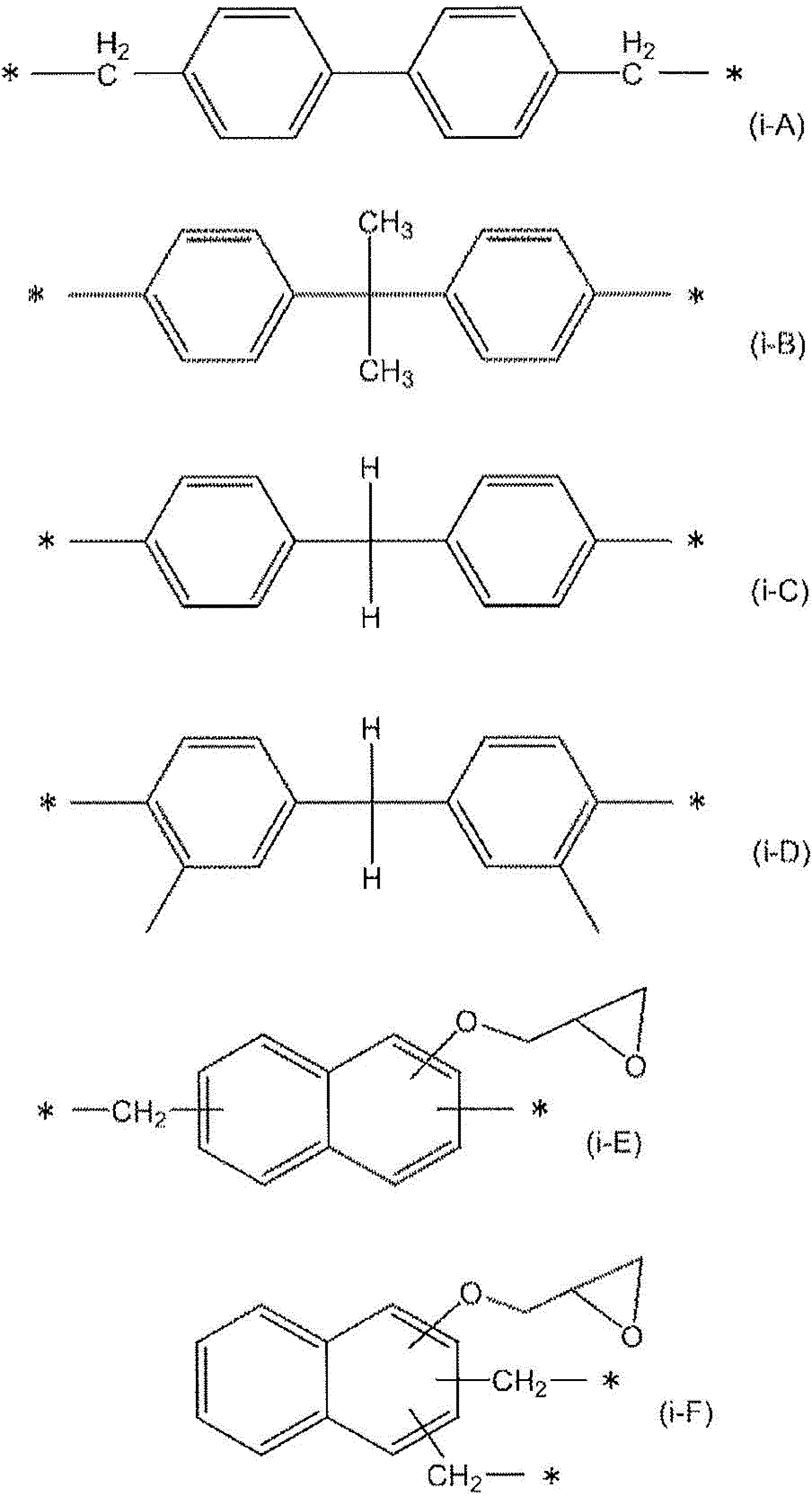
前記のとおり、式(i)中のベンゼン環は、さらに任意の置換基により置換されていてもよい。式(i)中のベンゼン環の置換基としては、例えば、ヒドロキシル基、メチル基、メトキシ基、エチル基、エトキシ基、プロピル基、プロポキシ基が挙げられる。置換基の数も特に限定されず、化学的に許容される限りにおいて、1つでもよいし、2つ以上でもよい。
硬化性の観点から、無置換が好ましい。
前記式(i)で表される部分構造は、現像溶解性の観点から、下記式(i-1)で表される部分構造であることが好ましい。
前記式(i)で表される部分構造は、現像溶解性の観点から、下記式(i-1)で表される部分構造であることが好ましい。
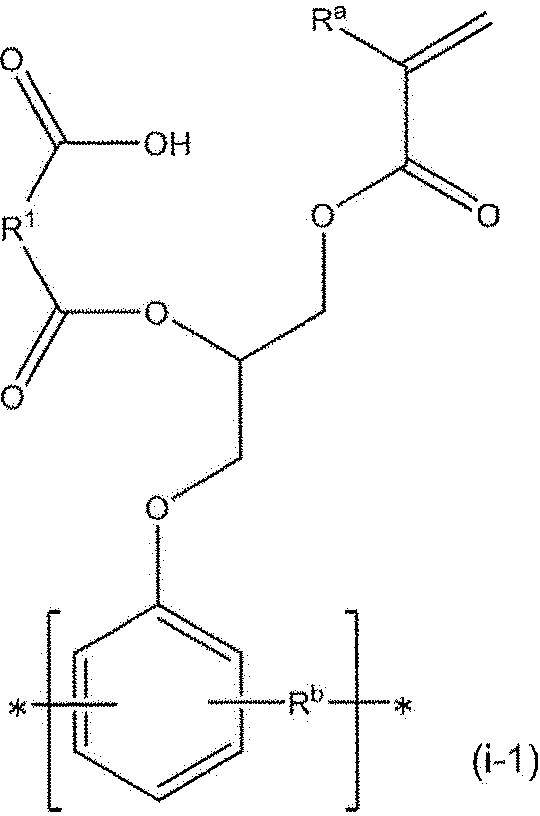
式(i-1)中、Ra及びRbは、前記式(i)のものと同義である。R1は置換基を有していてもよい炭素数1~4の2価の炭化水素基を表す。*は結合手を表す。式(i-1)中のベンゼン環は、さらに任意の置換基により置換されていてもよい。
(R1)
前記一般式(i-1)において、R1は置換基を有していてもよい炭素数1~4の2価の炭化水素基を表す。2価の炭化水素基としては、アルキレン基、アルケニレン基が挙げられる。
アルキレン基は直鎖でも、分岐鎖でもよいが、現像溶解性の観点から直鎖であることが好ましい。その炭素数は特に限定されないが、通常1以上、2以上が好ましく、また、4以下が好ましく、3以下がより好ましい。前記上限及び下限は任意に組み合わせることができ、例えば、1~4が好ましく、1~3がより好ましく、2~3がさらに好ましい。前記下限値以上とすることで残膜率が高くなる傾向がある。また、前記上限値以下とすることで素子発光時のアウトガス発生量が少なくなる傾向がある。
アルキレン基の具体例としては、メチレン基、エチレン基、プロピレン基、ブチレン基が挙げられ、アウトガス低減の観点から、メチレン基又はエチレン基が好ましく、エチレン基がより好ましい。
アルケニレン基は直鎖でも、分岐鎖でもよいが、現像溶解性の観点から直鎖であることが好ましい。その炭素数は特に限定されないが、通常2以上であり、また4以下が好ましく、3以下がより好ましい。例えば、2~4が好ましく、2~3がより好ましい。前記下限値以上とすることで残膜率が高くなる傾向がある。また、前記上限値以下とすることで素子発光時のアウトガス発生量が少なくなる傾向がある。
アルケニレン基は直鎖でも、分岐鎖でもよいが、現像溶解性の観点から直鎖であることが好ましい。その炭素数は特に限定されないが、通常2以上であり、また4以下が好ましく、3以下がより好ましい。例えば、2~4が好ましく、2~3がより好ましい。前記下限値以上とすることで残膜率が高くなる傾向がある。また、前記上限値以下とすることで素子発光時のアウトガス発生量が少なくなる傾向がある。
アルケニレン基の具体例としては、エテニレン基、プロペニレン基、ブチレニレン基が挙げられ、アウトガスの観点から、エテニレン基が好ましい。
炭素数1~4の2価の炭化水素基が有していてもよい置換基は特に限定されないが、例えば、ハロゲン原子、アルコキシ基、ベンゾイル基、水酸基が挙げられ、合成の容易さの観点からは無置換が好ましい。
炭素数1~4の2価の炭化水素基が有していてもよい置換基は特に限定されないが、例えば、ハロゲン原子、アルコキシ基、ベンゾイル基、水酸基が挙げられ、合成の容易さの観点からは無置換が好ましい。
これらの中でもアウトガス低減の観点から、R1が炭素数1~4の2価のアルキレン基であることが好ましく、メチレン基又はエチレン基であることがより好ましく、エチレン基であることがさらに好ましい。
エポキシ(メタ)アクリレート樹脂(a-3-1)1分子中に含まれる、前記式(i-1)で表される部分構造は、1種でも2種以上でもよい。
エポキシ(メタ)アクリレート樹脂(a-3-1)1分子中に含まれる、前記式(i-1)で表される部分構造は、1種でも2種以上でもよい。
エポキシ(メタ)アクリレート樹脂(a-3-1)1分子中に含まれる、前記式(i)で表される部分構造の数は特に限定されないが、1以上が好ましく、2以上がより好ましく、3以上がさらに好ましく、また、10以下が好ましく、8以下がさらに好ましい。前記上限及び下限は任意に組み合わせることができ、例えば、1~10が好ましく、2~10がより好ましく、3~8がさらに好ましい。前記下限値以上とすることで現像密着性が向上する傾向がある。また、前記上限値以下とすることで残渣が低減する傾向がある。
エポキシ(メタ)アクリレート樹脂(a-3-1)1分子中に含まれる、前記式(i-1)で表される部分構造の数は特に限定されないが、1以上が好ましく、2以上がより好ましく、3以上がさらに好ましく、また、10以下が好ましく、8以下がさらに好ましい。前記上限及び下限は任意に組み合わせることができ、例えば、1~10が好ましく、2~10がより好ましく、3~8がさらに好ましい。前記下限値以上とすることで現像密着性が向上する傾向がある。また、前記上限値以下とすることで残渣が低減する傾向がある。
以下にエポキシ(メタ)アクリレート樹脂(a-3-1)の具体例を挙げる。
以下にエポキシ(メタ)アクリレート樹脂(a-3-1)の具体例を挙げる。
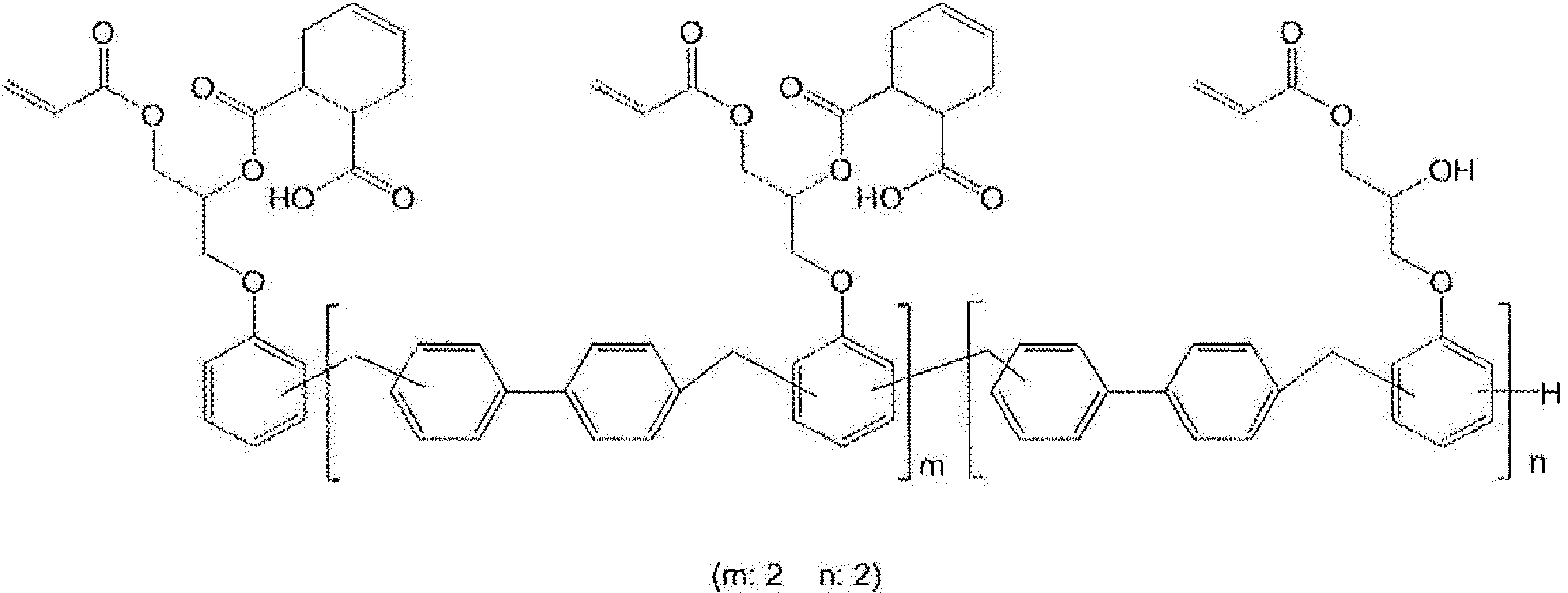
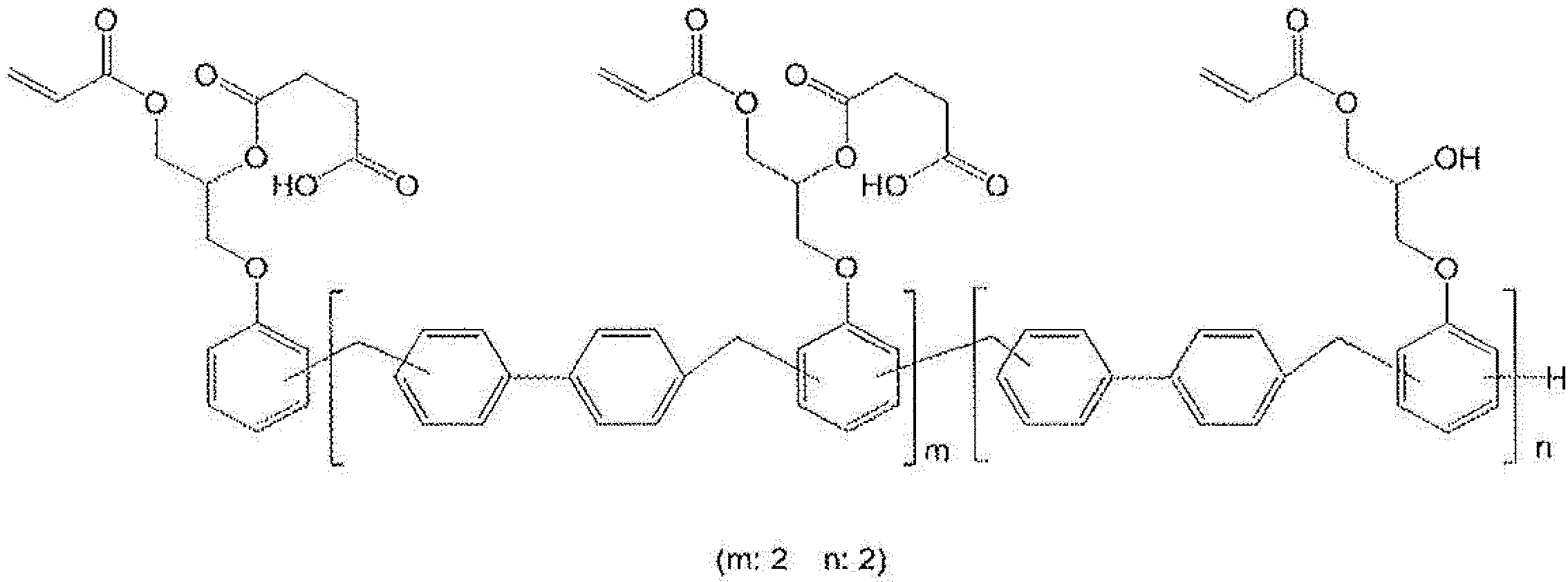


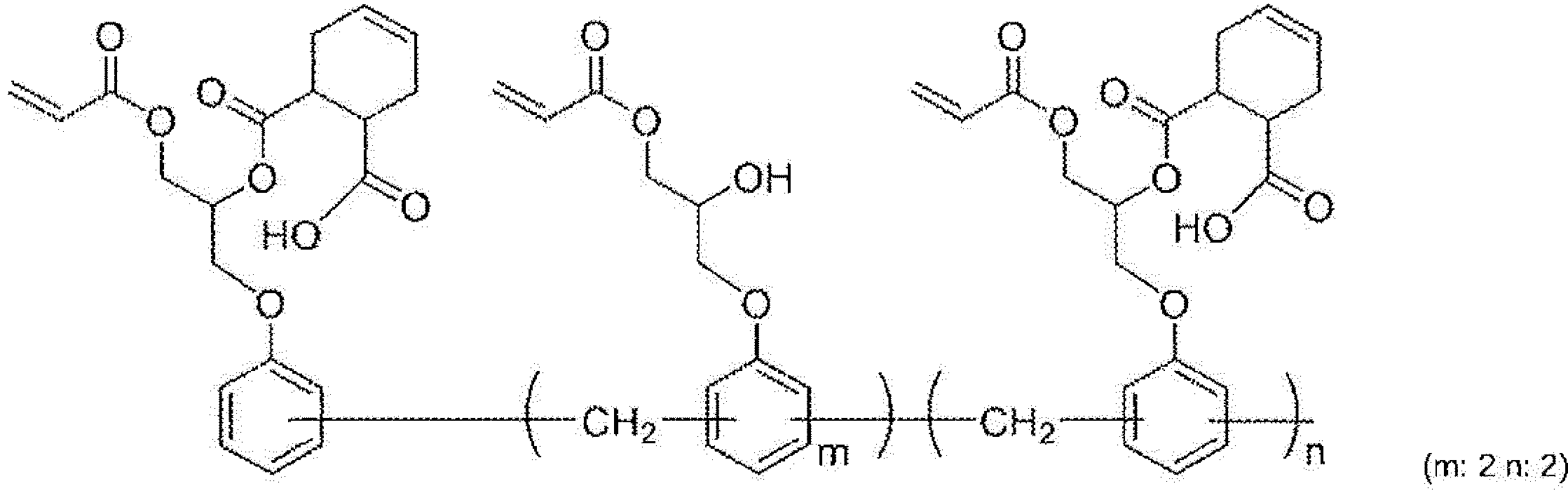
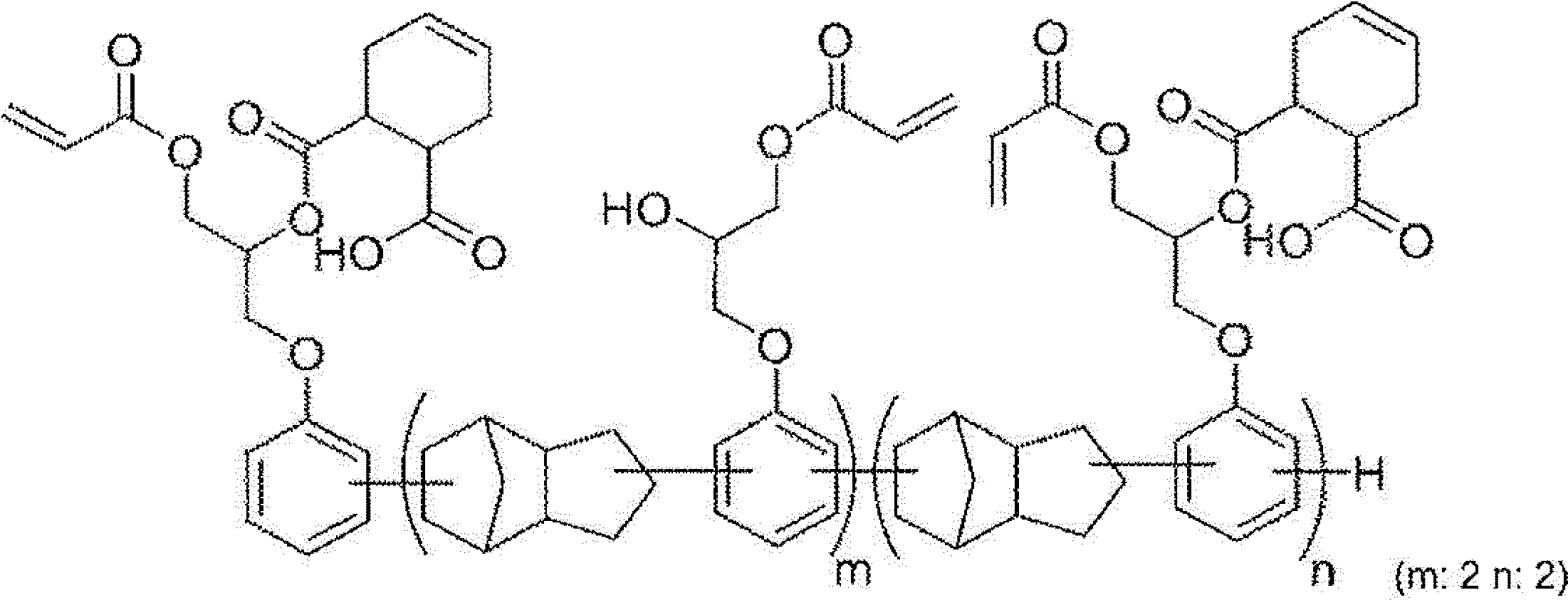
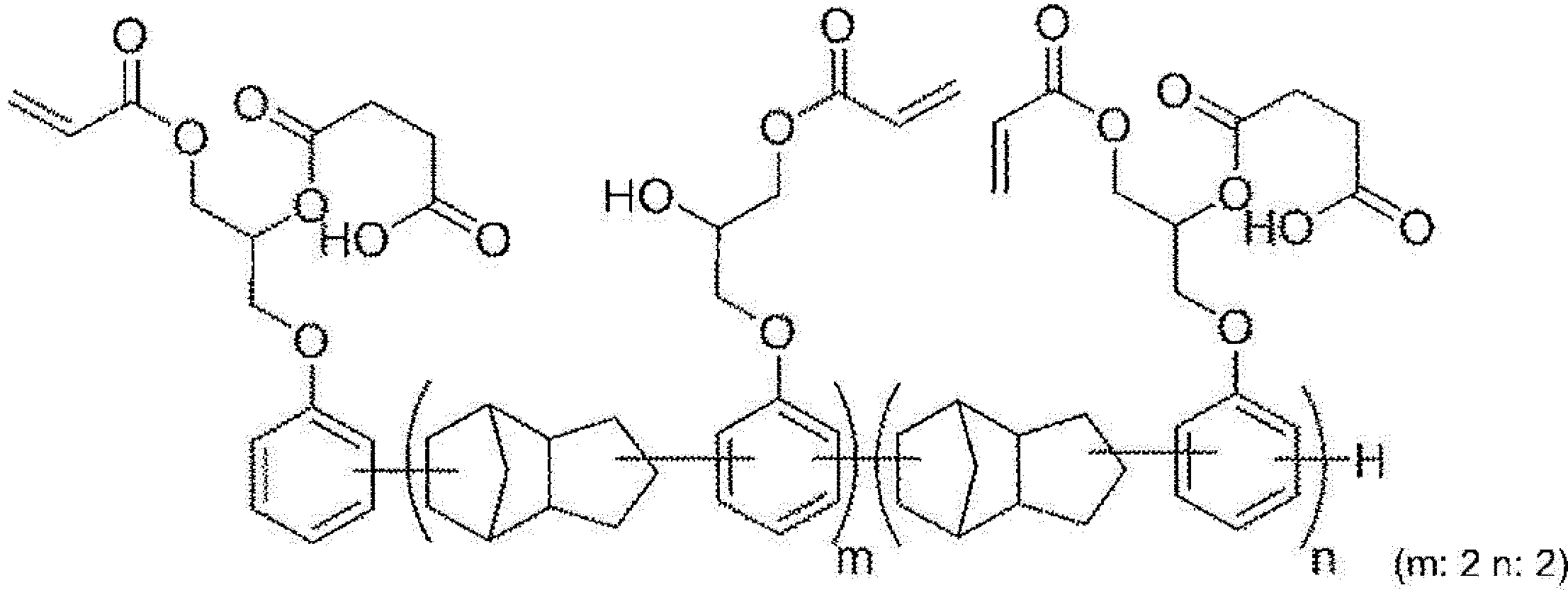
別の態様として、エポキシ(メタ)アクリレート樹脂(a-3)は、現像密着性の観点から、下記式(ii)で表される部分構造を含むエポキシ(メタ)アクリレート樹脂(a-3-2)であることが好ましい。
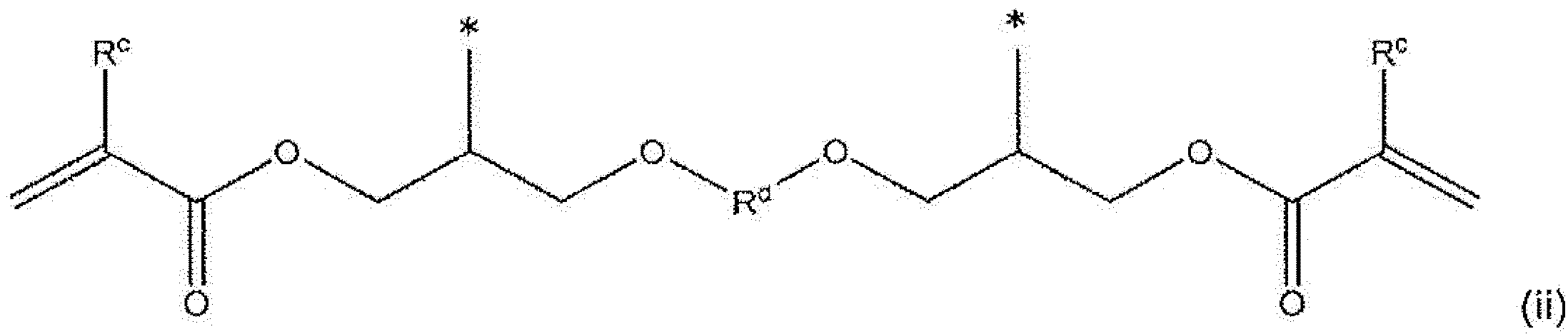
式(ii)中、Rcは各々独立に、水素原子又はメチル基を表す。Rdは、環状炭化水素基を側鎖として有する2価の炭化水素基を表す。*は結合手を表す。
(Rd)
前記式(ii)において、Rdは、環状炭化水素基を側鎖として有する2価の炭化水素基を表す。
環状炭化水素基としては、脂肪族環基又は芳香族環基が挙げられる。
脂肪族環基が有する環の数は特に限定されないが、通常1以上、2以上が好ましく、また、10以下が好ましく、5以下がより好ましく、3以下がさらに好ましい。前記上限及び下限は任意に組み合わせることができ、例えば、1~10が好ましく、1~5がより好ましく、2~3がさらに好ましい。前記下限値以上とすることで現像密着性が向上する傾向がある。また、前記上限値以下とすることで残渣が低減する傾向がある。
前記式(ii)において、Rdは、環状炭化水素基を側鎖として有する2価の炭化水素基を表す。
環状炭化水素基としては、脂肪族環基又は芳香族環基が挙げられる。
脂肪族環基が有する環の数は特に限定されないが、通常1以上、2以上が好ましく、また、10以下が好ましく、5以下がより好ましく、3以下がさらに好ましい。前記上限及び下限は任意に組み合わせることができ、例えば、1~10が好ましく、1~5がより好ましく、2~3がさらに好ましい。前記下限値以上とすることで現像密着性が向上する傾向がある。また、前記上限値以下とすることで残渣が低減する傾向がある。
脂肪族環基の炭素数は通常4以上であり、6以上が好ましく、8以上がより好ましく、また、40以下が好ましく、30以下がより好ましく、20以下がさらに好ましく、15以下が特に好ましい。前記上限及び下限は任意に組み合わせることができ、例えば、4~40が好ましく、4~30がより好ましく、6~20がさらに好ましく、8~15が特に好ましい。前記下限値以上とすることで現像密着性が向上する傾向がある。また、前記上限値以下とすることで残渣が低減する傾向がある。
脂肪族環基における脂肪族環としては、例えば、シクロヘキサン環、シクロヘプタン環、シクロデカン環、シクロドデカン環、ノルボルナン環、イソボルナン環、アダマンタン環が挙げられる。これらの中でも現像密着性の観点から、アダマンタン環が好ましい。
芳香族環基が有する環の数は特に限定されないが、通常1以上、2以上が好ましく、3以上がより好ましく、また、10以下が好ましく、5以下がより好ましく、4以下がさらに好ましい。前記上限及び下限は任意に組み合わせることができ、例えば、1~10が好ましく、2~5がより好ましく、3~4がさらに好ましい。前記下限値以上とすることで残渣が低減する傾向がある。また、前記上限値以下とすることで現像密着性が向上する傾向がある。
芳香族環基が有する環の数は特に限定されないが、通常1以上、2以上が好ましく、3以上がより好ましく、また、10以下が好ましく、5以下がより好ましく、4以下がさらに好ましい。前記上限及び下限は任意に組み合わせることができ、例えば、1~10が好ましく、2~5がより好ましく、3~4がさらに好ましい。前記下限値以上とすることで残渣が低減する傾向がある。また、前記上限値以下とすることで現像密着性が向上する傾向がある。
芳香族環基としては、芳香族炭化水素環基、芳香族複素環基が挙げられる。芳香族環基の炭素数は通常4以上であり、6以上が好ましく、8以上がより好ましく、10以上がよりさらに好ましく、12以上が特に好ましく、また、40以下が好ましく、30以下がより好ましく、20以下がさらに好ましく、15以下が特に好ましい。前記上限及び下限は任意に組み合わせることができ、例えば、4~40が好ましく、6~40がより好ましく、8~30がさらに好ましく、10~20がよりさらに好ましく、12~15が特に好ましい。前記下限値以上とすることで残渣が低減する傾向がある。また、前記上限値以下とすることで現像密着性が向上する傾向がある。
芳香族環基における芳香族環としては、例えば、ベンゼン環、ナフタレン環、アントラセン環、フェナントレン環、ペリレン環、テトラセン環、ピレン環、ベンズピレン環、クリセン環、トリフェニレン環、アセナフテン環、フルオランテン環、フルオレン環が挙げられる。これらの中でもパターニング特性の観点から、フルオレン環が好ましい。
環状炭化水素基を側鎖として有する2価の炭化水素基における、2価の炭化水素基は特に限定されないが、例えば、2価の脂肪族基、2価の芳香族環基、1以上の2価の脂肪族基と1以上の2価の芳香族環基とを連結した基が挙げられる。
環状炭化水素基を側鎖として有する2価の炭化水素基における、2価の炭化水素基は特に限定されないが、例えば、2価の脂肪族基、2価の芳香族環基、1以上の2価の脂肪族基と1以上の2価の芳香族環基とを連結した基が挙げられる。
2価の脂肪族基は、直鎖状、分岐鎖状、環状のものが挙げられる。これらの中でも現像溶解性の観点からは直鎖状のものが好ましく、一方で露光部への現像液の浸透低減の観点からは環状のものが好ましい。その炭素数は通常1以上であり、3以上が好ましく、6以上がより好ましく、また、25以下が好ましく、20以下がより好ましく、15以下がさらに好ましい。前記上限及び下限は任意に組み合わせることができ、例えば、1~25が好ましく、3~20がより好ましく、6~15がさらに好ましい。前記下限値以上とすることで現像密着性が向上する傾向がある。また、前記上限値以下とすることで残渣が低減する傾向がある。
2価の直鎖状脂肪族基としては、例えば、メチレン基、エチレン基、n-プロピレン基、n-ブチレン基、n-ヘキシレン基、n-ヘプチレン基が挙げられる。これらの中でも残渣の観点から、メチレン基が好ましい。
2価の分岐鎖状脂肪族基としては、例えば、前述の2価の直鎖状脂肪族基に、側鎖としてメチル基、エチル基、n-プロピル基、イソプロピル基、n-ブチル基、イソブチル基、sec-ブチル基、tert-ブチル基を有する構造が挙げられる。
2価の分岐鎖状脂肪族基としては、例えば、前述の2価の直鎖状脂肪族基に、側鎖としてメチル基、エチル基、n-プロピル基、イソプロピル基、n-ブチル基、イソブチル基、sec-ブチル基、tert-ブチル基を有する構造が挙げられる。
2価の環状の脂肪族基が有する環の数は特に限定されないが、通常1以上、2以上が好ましく、また、10以下が好ましく、5以下がより好ましく、3以下がさらに好ましい。
前記上限及び下限は任意に組み合わせることができ、例えば、1~10が好ましく、1~5がより好ましく、2~3がさらに好ましい。前記下限値以上とすることで現像密着性が向上する傾向がある。また、前記上限値以下とすることで残渣が低減する傾向がある。
前記上限及び下限は任意に組み合わせることができ、例えば、1~10が好ましく、1~5がより好ましく、2~3がさらに好ましい。前記下限値以上とすることで現像密着性が向上する傾向がある。また、前記上限値以下とすることで残渣が低減する傾向がある。
2価の環状の脂肪族基としては、例えば、シクロヘキサン環、シクロヘプタン環、シクロデカン環、シクロドデカン環、ノルボルナン環、イソボルナン環、アダマンタン環から水素原子を2つ除した基が挙げられる。これらの中でも現像密着性の観点から、アダマンタン環から水素原子を2つ除した基が好ましい。
2価の脂肪族基が有していてもよい置換基としては、例えば、メトキシ基、エトキシ基等の炭素数1~5のアルコキシ基;水酸基;ニトロ基;シアノ基;カルボキシ基が挙げられ、合成容易性の観点から、無置換が好ましい。
2価の脂肪族基が有していてもよい置換基としては、例えば、メトキシ基、エトキシ基等の炭素数1~5のアルコキシ基;水酸基;ニトロ基;シアノ基;カルボキシ基が挙げられ、合成容易性の観点から、無置換が好ましい。
2価の芳香族環基としては、2価の芳香族炭化水素環基及び2価の芳香族複素環基が挙げられる。その炭素数は通常4以上であり、5以上が好ましく、6以上がより好ましく、また、30以下が好ましく、20以下がより好ましく、15以下がさらに好ましい。前記上限及び下限は任意に組み合わせることができ、例えば、4~30が好ましく、5~20がより好ましく、6~15がさらに好ましい。前記下限値以上とすることで現像密着性が向上する傾向がある。また、前記上限値以下とすることで残渣が低減する傾向がある。
2価の芳香族炭化水素環基における芳香族炭化水素環としては、単環であっても縮合環であってもよい。2価の芳香族炭化水素環基としては、例えば、2個の遊離原子価を有する、ベンゼン環、ナフタレン環、アントラセン環、フェナントレン環、ペリレン環、テトラセン環、ピレン環、ベンズピレン環、クリセン環、トリフェニレン環、アセナフテン環、フルオランテン環、フルオレン環が挙げられる。
2価の芳香族複素環基における芳香族複素環としては、単環であっても縮合環であってもよい。2価の芳香族複素環基としては、例えば、2個の遊離原子価を有する、フラン環、ベンゾフラン環、チオフェン環、ベンゾチオフェン環、ピロール環、ピラゾール環、イミダゾール環、オキサジアゾール環、インドール環、カルバゾール環、ピロロイミダゾール環、ピロロピラゾール環、ピロロピロール環、チエノピロール環、チエノチオフェン環、フロピロール環、フロフラン環、チエノフラン環、ベンゾイソオキサゾール環、ベンゾイソチアゾール環、ベンゾイミダゾール環、ピリジン環、ピラジン環、ピリダジン環、ピリミジン環、トリアジン環、キノリン環、イソキノリン環、シノリン環、キノキサリン環、フェナントリジン環、ペリミジン環、キナゾリン環、キナゾリノン環、アズレン環が挙げられる。これらの中でも光硬化性の観点から、2個の遊離原子価を有するベンゼン環、ナフタレン環が好ましく、2個の遊離原子価を有するベンゼン環がより好ましい。
2価の芳香族環基が有していてもよい置換基としては、例えば、ヒドロキシル基、メチル基、メトキシ基、エチル基、エトキシ基、プロピル基、プロポキシ基が挙げられる。これらの中でも硬化性の観点から、無置換が好ましい。
1以上の2価の脂肪族基と1以上の2価の芳香族環基とを連結した基としては、前述の2価の脂肪族基を1以上と、前述の2価の芳香族環基を1以上とを連結した基が挙げられる。
1以上の2価の脂肪族基と1以上の2価の芳香族環基とを連結した基としては、前述の2価の脂肪族基を1以上と、前述の2価の芳香族環基を1以上とを連結した基が挙げられる。
2価の脂肪族基の数は特に限定されないが、通常1以上、2以上が好ましく、また、10以下が好ましく、5以下がより好ましく、3以下がさらに好ましい。前記上限及び下限は任意に組み合わせることができ、例えば、1~10が好ましく、1~5がより好ましく、2~3がさらに好ましい。前記下限値以上とすることで現像密着性が向上する傾向がある。また、前記上限値以下とすることで残渣が低減する傾向がある。
2価の芳香族環基の数は特に限定されないが、通常1以上、2以上が好ましく、また、10以下が好ましく、5以下がより好ましく、3以下がさらに好ましい。前記上限及び下限は任意に組み合わせることができ、例えば、1~10が好ましく、1~5がより好ましく、2~3がさらに好ましい。前記下限値以上とすることで現像密着性が向上する傾向がある。また、前記上限値以下とすることで残渣が低減する傾向がある。
1以上の2価の脂肪族基と1以上の2価の芳香族環基とを連結した基としては、例えば、前記式(i-A)~(i-F)で表される基等が挙げられる。これらの中でも残渣低減の観点から、前記式(i-C)で表される基が好ましい。
これらの2価の炭化水素基に対して、側鎖である環状炭化水素基の結合態様は特に限定されないが、例えば、脂肪族基や芳香族環基の水素原子1つを側鎖で置換した態様や、脂肪族基の炭素原子の1つを含めて側鎖である環状炭化水素基を構成した態様が挙げられる。
これらの2価の炭化水素基に対して、側鎖である環状炭化水素基の結合態様は特に限定されないが、例えば、脂肪族基や芳香族環基の水素原子1つを側鎖で置換した態様や、脂肪族基の炭素原子の1つを含めて側鎖である環状炭化水素基を構成した態様が挙げられる。
前記式(ii)で表される部分構造は、現像密着性の観点から、下記式(ii-1)で表される部分構造であることが好ましい。

式(ii-1)中、Rcは前記式(ii)と同義である。Rαは、置換基を有していてもよい1価の環状炭化水素基を表す。nは1以上の整数である。式(ii-1)中のベンゼン環は、さらに任意の置換基により置換されていてもよい。*は結合手を表す。
(Rα)
前記式(ii-1)において、Rαは、置換基を有していてもよい1価の環状炭化水素基を表す。
環状炭化水素基としては、脂肪族環基又は芳香族環基が挙げられる。
脂肪族環基が有する環の数は特に限定されないが、通常1以上、2以上が好ましく、また、6以下が好ましく、4以下がより好ましく、3以下がさらに好ましい。前記上限及び下限は任意に組み合わせることができ、例えば、1~6が好ましく、1~4がより好ましく、2~3がさらに好ましい。前記下限値以上とすることで現像密着性が向上する傾向がある。また、前記上限値以下とすることで残渣が低減する傾向がある。
前記式(ii-1)において、Rαは、置換基を有していてもよい1価の環状炭化水素基を表す。
環状炭化水素基としては、脂肪族環基又は芳香族環基が挙げられる。
脂肪族環基が有する環の数は特に限定されないが、通常1以上、2以上が好ましく、また、6以下が好ましく、4以下がより好ましく、3以下がさらに好ましい。前記上限及び下限は任意に組み合わせることができ、例えば、1~6が好ましく、1~4がより好ましく、2~3がさらに好ましい。前記下限値以上とすることで現像密着性が向上する傾向がある。また、前記上限値以下とすることで残渣が低減する傾向がある。
また、脂肪族環基の炭素数は通常4以上であり、6以上が好ましく、8以上がより好ましく、また、40以下が好ましく、30以下がより好ましく、20以下がさらに好ましく、15以下が特に好ましい。前記上限及び下限は任意に組み合わせることができ、例えば、4~40が好ましく、4~30がより好ましく、6~20がさらに好ましく、8~15が特に好ましい。前記下限値以上とすることで現像密着性が向上する傾向がある。また、前記上限値以下とすることで残渣が低減する傾向がある。
脂肪族環基における脂肪族環としては、例えば、シクロヘキサン環、シクロヘプタン環、シクロデカン環、シクロドデカン環、ノルボルナン環、イソボルナン環、アダマンタン環が挙げられる。これらの中でも現像密着性の観点から、アダマンタン環が好ましい。
芳香族環基が有する環の数は特に限定されないが、通常1以上、2以上が好ましく、3以上がより好ましく、また、10以下が好ましく、5以下がより好ましい。前記上限及び下限は任意に組み合わせることができ、例えば、1~10が好ましく、2~10がより好ましく、3~5がさらに好ましい。前記下限値以上とすることで現像密着性が向上する傾向がある。また、前記上限値以下とすることで残渣が低減する傾向がある。
芳香族環基が有する環の数は特に限定されないが、通常1以上、2以上が好ましく、3以上がより好ましく、また、10以下が好ましく、5以下がより好ましい。前記上限及び下限は任意に組み合わせることができ、例えば、1~10が好ましく、2~10がより好ましく、3~5がさらに好ましい。前記下限値以上とすることで現像密着性が向上する傾向がある。また、前記上限値以下とすることで残渣が低減する傾向がある。
芳香族環基としては、芳香族炭化水素環基、芳香族複素環基が挙げられる。また、芳香族環基の炭素数は通常4以上であり、5以上が好ましく、6以上がより好ましく、また、30以下が好ましく、20以下がより好ましく、15以下がさらに好ましい。前記上限及び下限は任意に組み合わせることができ、例えば、4~30が好ましく、5~20がより好ましく、6~15がさらに好ましい。前記下限値以上とすることで現像密着性が向上する傾向がある。また、前記上限値以下とすることで残渣が低減する傾向がある。
芳香族環基における芳香族環としては、例えば、ベンゼン環、ナフタレン環、アントラセン環、フェナントレン環、フルオレン環が挙げられる。これらの中でも現像密着性の観点から、フルオレン環が好ましい。
環状炭化水素基が有していてもよい置換基としては、例えば、メチル基、エチル基、n-プロピル基、イソプロピル基、n-ブチル基、sec-ブチル基、tert-ブチル基、アミル基、イソアミル基等の炭素数1~5のアルキル基;メトキシ基、エトキシ基等の炭素数1~5のアルコキシ基;水酸基;ニトロ基;シアノ基;カルボキシ基が挙げられ、合成の容易性の観点から、無置換が好ましい。
環状炭化水素基が有していてもよい置換基としては、例えば、メチル基、エチル基、n-プロピル基、イソプロピル基、n-ブチル基、sec-ブチル基、tert-ブチル基、アミル基、イソアミル基等の炭素数1~5のアルキル基;メトキシ基、エトキシ基等の炭素数1~5のアルコキシ基;水酸基;ニトロ基;シアノ基;カルボキシ基が挙げられ、合成の容易性の観点から、無置換が好ましい。
nは1以上の整数を表すが、2以上が好ましく、また、3以下が好ましい。例えば、1~3が好ましく、1~2がより好ましい。前記下限値以上とすることで現像密着性が向上する傾向がある。また、前記上限値以下とすることで残渣が低減する傾向がある。
これらの中でも、強固な膜硬化度と電気特性の観点から、Rαが1価の脂肪族環基であることが好ましく、アダマンチル基であることがより好ましい。
これらの中でも、強固な膜硬化度と電気特性の観点から、Rαが1価の脂肪族環基であることが好ましく、アダマンチル基であることがより好ましい。
前記のとおり、式(ii-1)中のベンゼン環は、さらに任意の置換基により置換されていてもよい。置換基としては、例えば、ヒドロキシル基、メチル基、メトキシ基、エチル基、エトキシ基、プロピル基、プロポキシ基が挙げられる。置換基の数も特に限定されず、1つでもよいし、2つ以上でもよい。硬化性の観点から、無置換が好ましい。
以下に前記式(ii-1)で表される部分構造の具体例を挙げる。
以下に前記式(ii-1)で表される部分構造の具体例を挙げる。
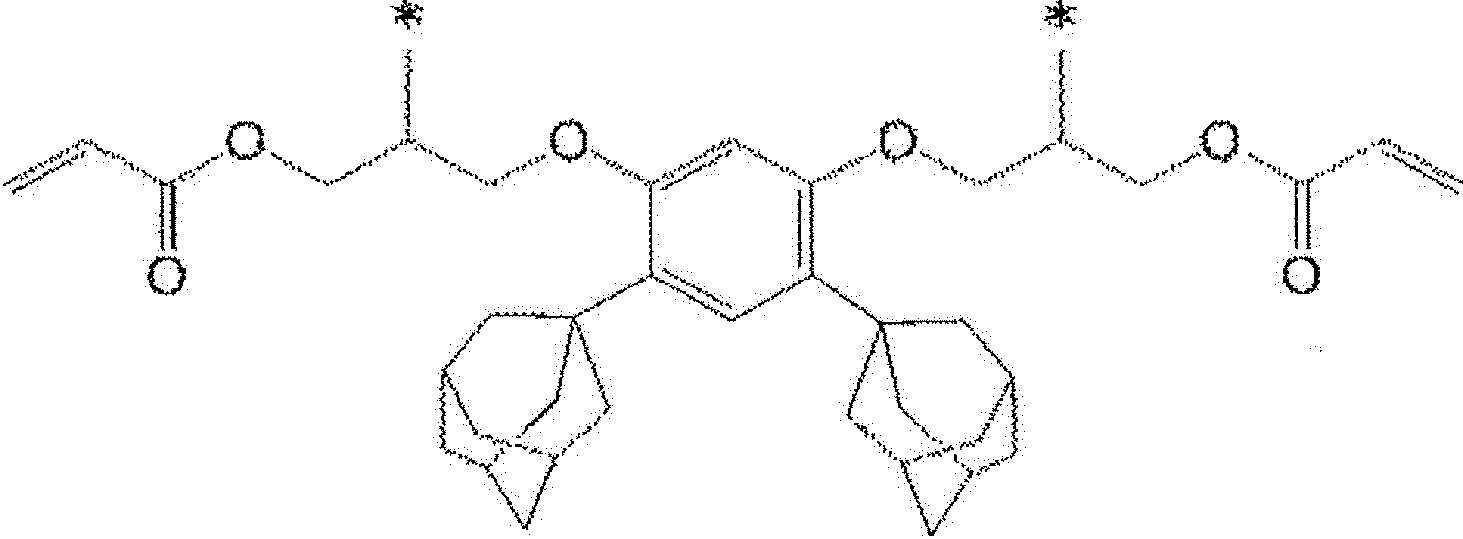


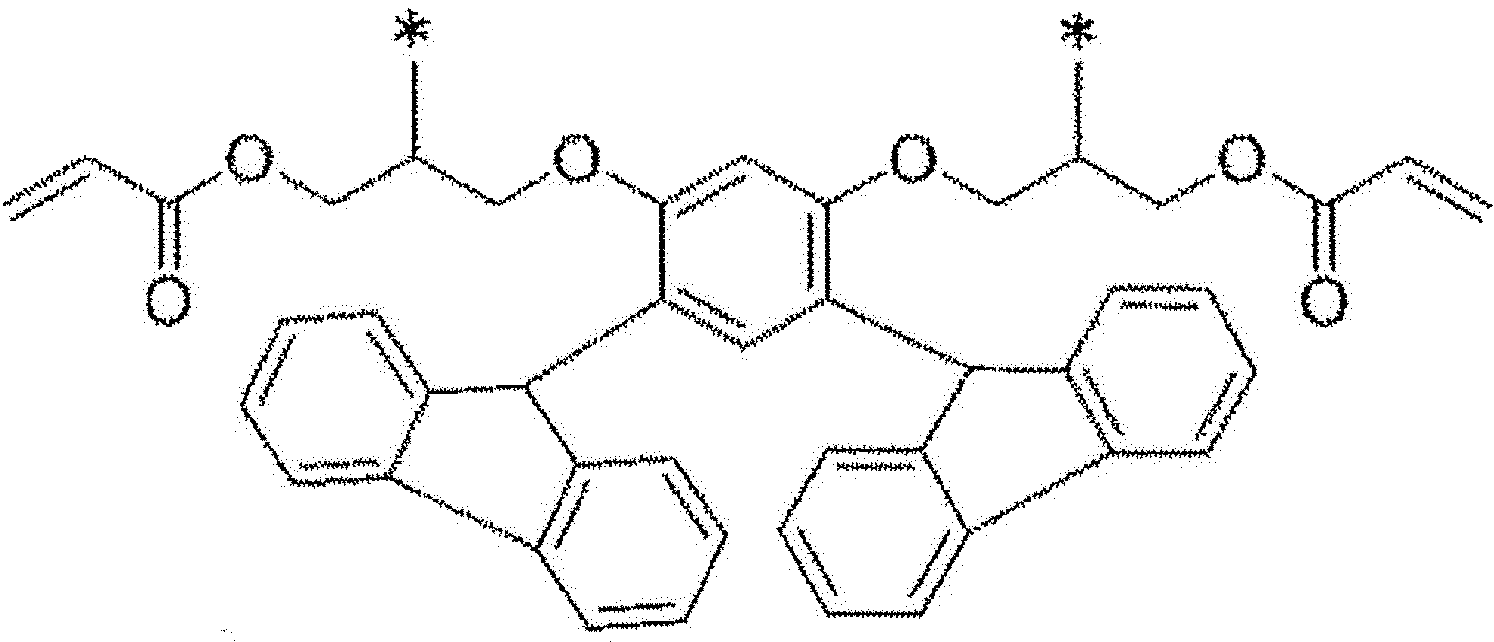
前記式(ii)で表される部分構造は、現像密着性の観点から、下記式(ii-2)で表される部分構造であることが好ましい。

式(ii-2)中、Rcは前記式(ii)と同義である。Rβは、置換基を有していてもよい2価の環状炭化水素基を表す。式(ii-2)中のベンゼン環は、さらに任意の置換基により置換されていてもよい。*は結合手を表す。
(Rβ)
前記式(ii-2)において、Rβは、置換基を有していてもよい2価の環状炭化水素基を表す。
環状炭化水素基としては、脂肪族環基又は芳香族環基が挙げられる。
脂肪族環基が有する環の数は特に限定されないが、通常1以上、2以上が好ましく、また、10以下が好ましく、5以下がより好ましい。前記上限及び下限は任意に組み合わせることができ、例えば、1~10が好ましく、2~5がより好ましい。前記下限値以上とすることで現像密着性が向上する傾向がある。また、前記上限値以下とすることで残渣が低減する傾向がある。
前記式(ii-2)において、Rβは、置換基を有していてもよい2価の環状炭化水素基を表す。
環状炭化水素基としては、脂肪族環基又は芳香族環基が挙げられる。
脂肪族環基が有する環の数は特に限定されないが、通常1以上、2以上が好ましく、また、10以下が好ましく、5以下がより好ましい。前記上限及び下限は任意に組み合わせることができ、例えば、1~10が好ましく、2~5がより好ましい。前記下限値以上とすることで現像密着性が向上する傾向がある。また、前記上限値以下とすることで残渣が低減する傾向がある。
また、脂肪族環基の炭素数は通常4以上であり、6以上が好ましく、8以上がより好ましく、また、40以下が好ましく、35以下がより好ましく、30以下がさらに好ましい。前記上限及び下限は任意に組み合わせることができ、例えば、4~40が好ましく、6~35がより好ましく、8~30がさらに好ましい。前記下限値以上とすることで現像密着性が向上する傾向がある。また、前記上限値以下とすることで残渣が低減する傾向がある。
脂肪族環基における脂肪族環としては、シクロヘキサン環、シクロヘプタン環、シクロデカン環、シクロドデカン環、ノルボルナン環、イソボルナン環、アダマンタン環が挙げられる。これらの中でも現像密着性の観点から、アダマンタン環が好ましい。
芳香族環基が有する環の数は特に限定されないが、通常1以上、2以上が好ましく、3以上がより好ましく、また、10以下が好ましく、5以下が好ましい。前記上限及び下限は任意に組み合わせることができ、例えば、1~10が好ましく、2~10がより好ましく、3~5がさらに好ましい。前記下限値以上とすることで現像密着性が向上する傾向がある。また、前記上限値以下とすることで残渣が低減する傾向がある。
芳香族環基が有する環の数は特に限定されないが、通常1以上、2以上が好ましく、3以上がより好ましく、また、10以下が好ましく、5以下が好ましい。前記上限及び下限は任意に組み合わせることができ、例えば、1~10が好ましく、2~10がより好ましく、3~5がさらに好ましい。前記下限値以上とすることで現像密着性が向上する傾向がある。また、前記上限値以下とすることで残渣が低減する傾向がある。
芳香族環基としては、芳香族炭化水素環基、芳香族複素環基が挙げられる。また、芳香族環基の炭素数は通常4以上であり、6以上が好ましく、8以上がより好ましく、10以上がさらに好ましく、また、40以下が好ましく、30以下がより好ましく、20以下がさらに好ましく、15以下が特に好ましい。前記上限及び下限は任意に組み合わせることができ、例えば、4~40が好ましく、6~30がより好ましく、8~20がさらに好ましく、10~15が特に好ましい。前記下限値以上とすることで現像密着性が向上する傾向がある。また、前記上限値以下とすることで残渣が低減する傾向がある。
芳香族環基における芳香族環としては、例えば、ベンゼン環、ナフタレン環、アントラセン環、フェナントレン環、フルオレン環が挙げられる。これらの中でも現像密着性の観点から、フルオレン環が好ましい。
環状炭化水素基が有していてもよい置換基としては、例えば、メチル基、エチル基、n-プロピル基、イソプロピル基、n-ブチル基、sec-ブチル基、tert-ブチル基、アミル基、イソアミル基等の炭素数1~5のアルキル基;メトキシ基、エトキシ基等の炭素数1~5のアルコキシ基;水酸基;ニトロ基;シアノ基;カルボキシ基が挙げられる。これらの中でも合成の簡易性の観点から、無置換が好ましい。
環状炭化水素基が有していてもよい置換基としては、例えば、メチル基、エチル基、n-プロピル基、イソプロピル基、n-ブチル基、sec-ブチル基、tert-ブチル基、アミル基、イソアミル基等の炭素数1~5のアルキル基;メトキシ基、エトキシ基等の炭素数1~5のアルコキシ基;水酸基;ニトロ基;シアノ基;カルボキシ基が挙げられる。これらの中でも合成の簡易性の観点から、無置換が好ましい。
これらの中でも、硬化性の観点から、Rβが2価の脂肪族環基であることが好ましく、2価のアダマンタン環基であることがより好ましい。
別の態様として、現像密着性の観点から、Rβが2価の芳香族環基であることが好ましく、2価のフルオレン環基であることがより好ましい。
前記のとおり、式(ii-2)中のベンゼン環は、さらに任意の置換基により置換されていてもよい。式(ii-2)中のベンゼン環の置換基としては、例えば、ヒドロキシル基、メチル基、メトキシ基、エチル基、エトキシ基、プロピル基、プロポキシ基が挙げられる。置換基の数も特に限定されず、1つでもよいし、2つ以上でもよい。硬化性の観点から、無置換が好ましい。
以下に前記式(ii-2)で表される部分構造の具体例を挙げる。
別の態様として、現像密着性の観点から、Rβが2価の芳香族環基であることが好ましく、2価のフルオレン環基であることがより好ましい。
前記のとおり、式(ii-2)中のベンゼン環は、さらに任意の置換基により置換されていてもよい。式(ii-2)中のベンゼン環の置換基としては、例えば、ヒドロキシル基、メチル基、メトキシ基、エチル基、エトキシ基、プロピル基、プロポキシ基が挙げられる。置換基の数も特に限定されず、1つでもよいし、2つ以上でもよい。硬化性の観点から、無置換が好ましい。
以下に前記式(ii-2)で表される部分構造の具体例を挙げる。

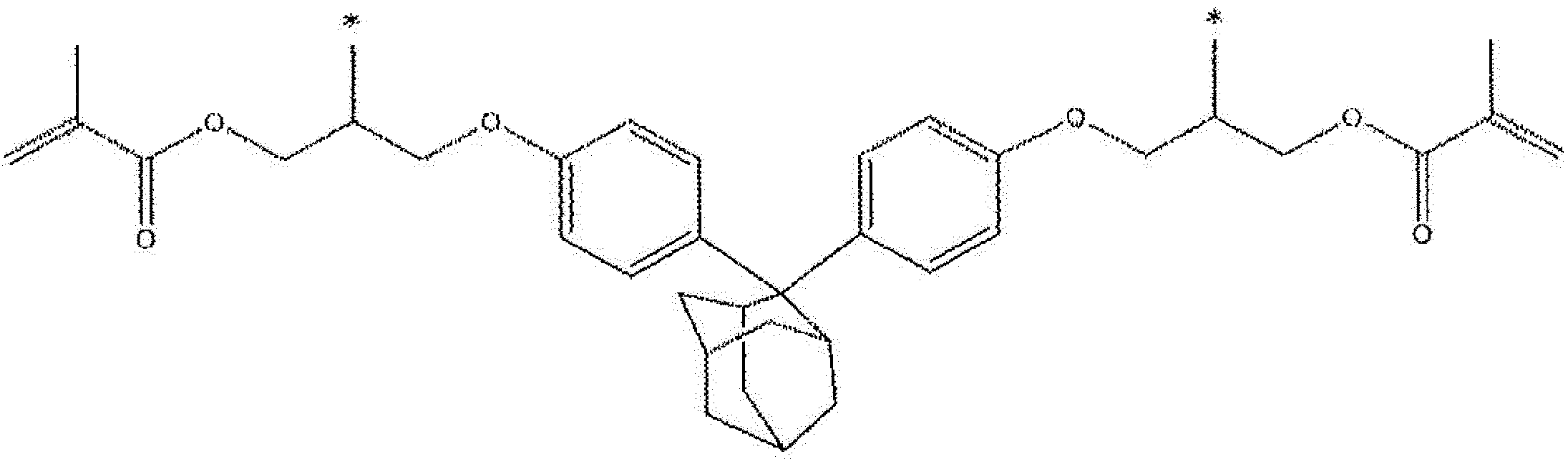
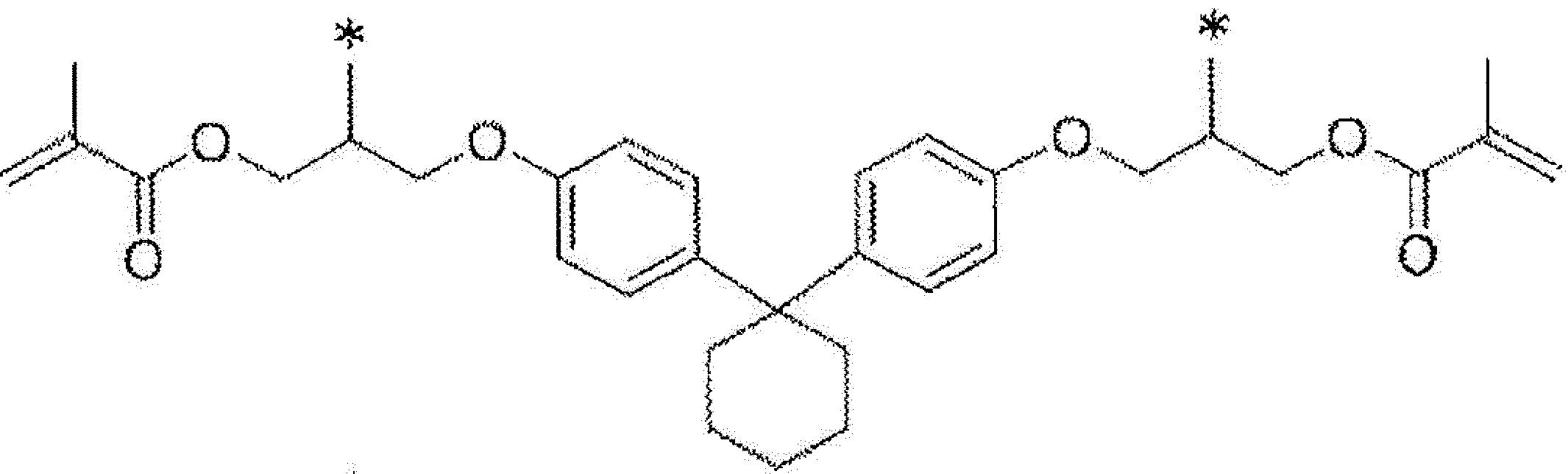
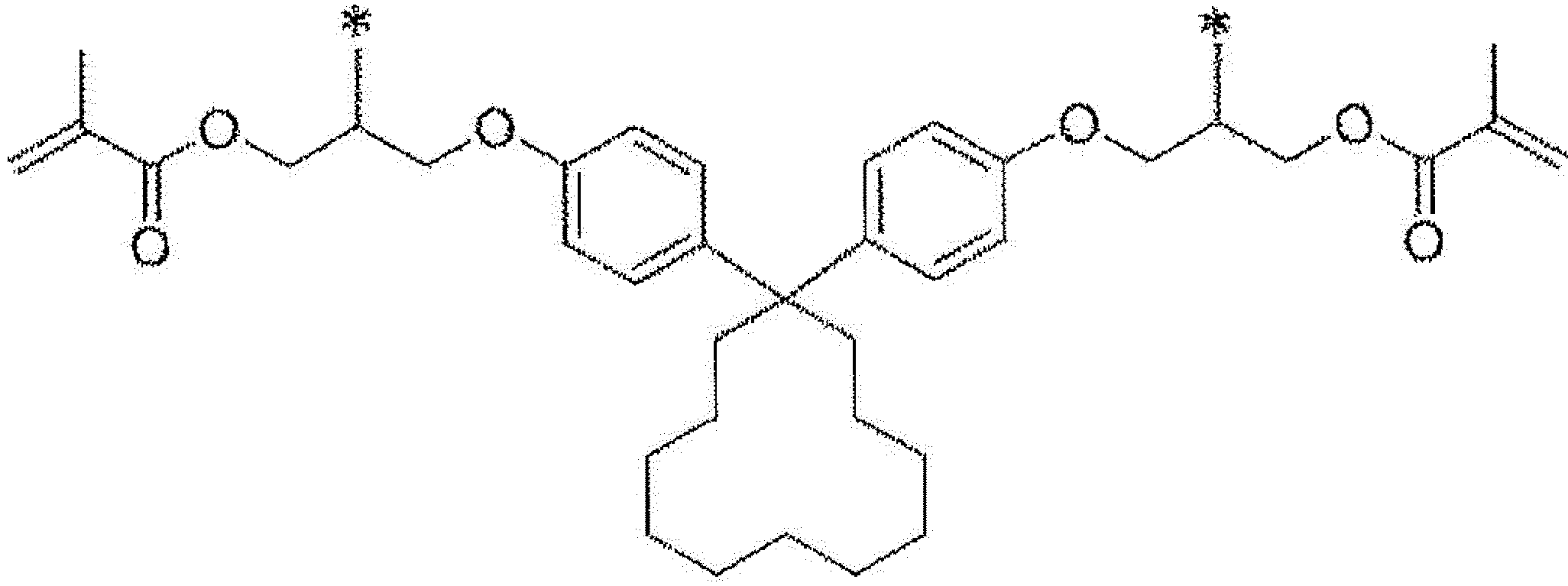
前記式(ii)で表される部分構造は、硬化性の観点から、下記式(ii-3)で表される部分構造であることが好ましい。

式(ii-3)中、Rc及びRdは前記式(ii)と同義である。R1は前記式(i-1)と同義である。*は結合手を表す。
エポキシ(メタ)アクリレート樹脂(a-3-2)1分子中に含まれる、前記式(ii-3)で表される部分構造は、1種でも2種以上でもよい。
エポキシ(メタ)アクリレート樹脂(a-3-2)1分子中に含まれる、前記式(ii)で表される部分構造の数は特に限定されないが、1以上が好ましく、3以上がより好ましく、また、20以下が好ましく、15以下がより好ましく、10以下がさらに好ましい。前記上限及び下限は任意に組み合わせることができ、例えば、1~20が好ましく、1~15がより好ましく、3~10がさらに好ましい。前記下限値以上とすることで現像密着性が向上する傾向がある。また、前記上限値以下とすることで残渣が低減する傾向がある。
さらに別の態様として、エポキシ(メタ)アクリレート樹脂(a-3)は、素子発光時のアウトガス低減の観点から、下記一般式(iii)で表される部分構造を含むエポキシ(メタ)アクリレート樹脂(a-3-3)であることが好ましい。
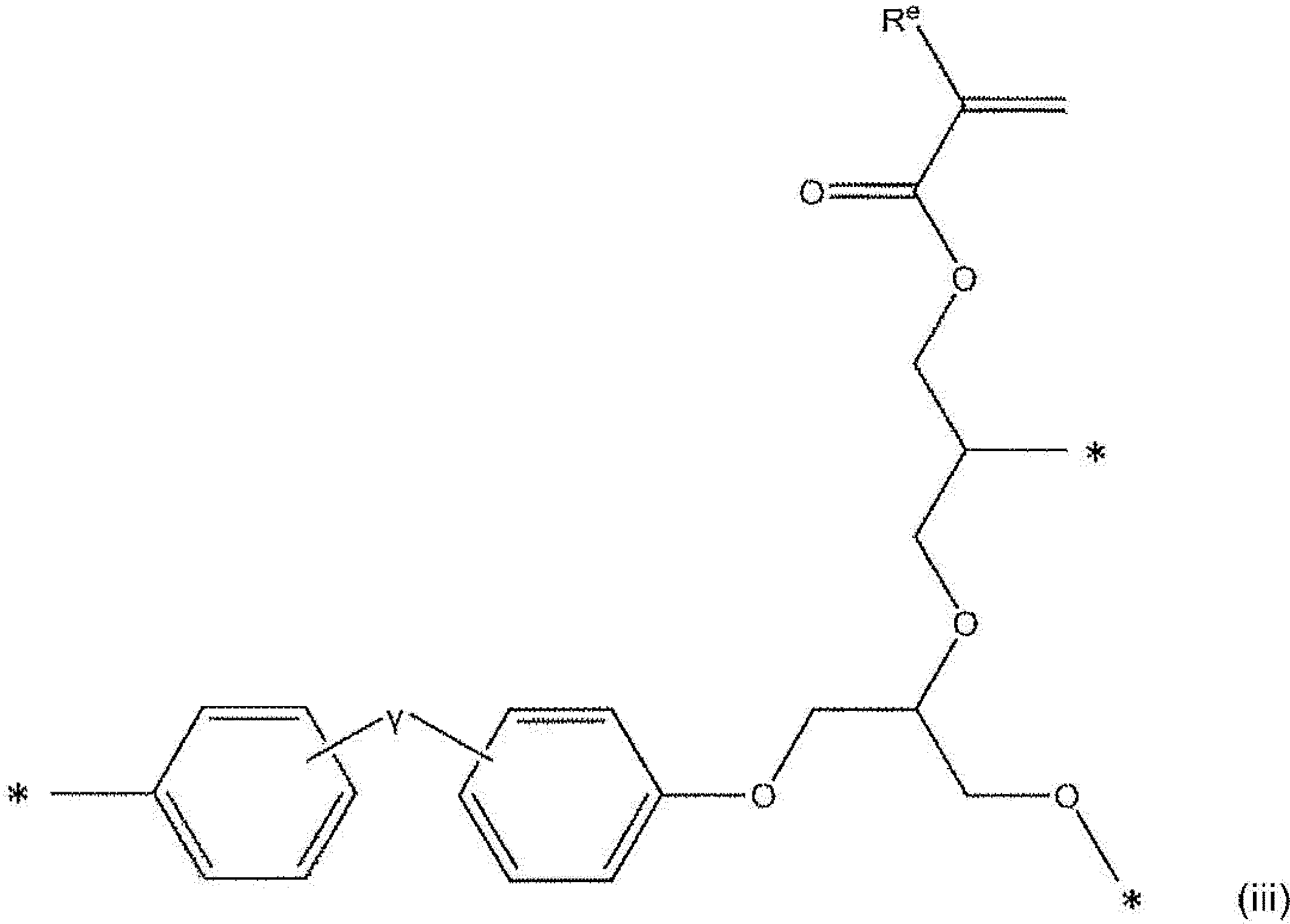
式(iii)中、Reは水素原子又はメチル基を表し、γは単結合、-CO-、置換基を有していてもよいアルキレン基、又は置換基を有していてもよい2価の環状炭化水素基を表す。式(iii)中のベンゼン環は、さらに任意の置換基により置換されていてもよい。*は結合手を表す。
(γ)
前記式(iii)において、γは単結合、-CO-、置換基を有していてもよいアルキレン基、又は置換基を有していてもよい2価の環状炭化水素基を表す。
アルキレン基は直鎖状でも、分岐鎖状でもよいが、現像溶解性の観点からは直鎖状であることが好ましく、現像密着性の観点からは分岐鎖状であることが好ましい。その炭素数は特に限定されないが、通常1以上、2以上が好ましく、また、6以下が好ましく、4以下がより好ましい。前記上限及び下限は任意に組み合わせることができ、例えば、1~6が好ましく、2~4がより好ましい。前記下限値以上とすることで現像密着性が向上する傾向がある。また、前記上限値以下とすることで残渣が低減する傾向がある。
アルキレン基としては、例えば、メチレン基、エチレン基、プロピレン基、ブチレン基、へキシレン基、ヘプチレン基が挙げられ、現像密着性と現像溶解性の両立の観点から、メチレン基、エチレン基、プロピレン基が好ましく、ジメチルメチレン基(2,2-プロピレン基)がより好ましい。
アルキレン基が有していてもよい置換基としては、例えば、メトキシ基、エトキシ基等の炭素数1~5のアルコキシ基;水酸基;ニトロ基;シアノ基;カルボキシ基が挙げられ、現像密着性と現像溶解性の両立の観点から、無置換が好ましい。
アルキレン基が有していてもよい置換基としては、例えば、メトキシ基、エトキシ基等の炭素数1~5のアルコキシ基;水酸基;ニトロ基;シアノ基;カルボキシ基が挙げられ、現像密着性と現像溶解性の両立の観点から、無置換が好ましい。
2価の環状炭化水素基としては、2価の脂肪族環基又は2価の芳香族環基が挙げられる。
脂肪族環基が有する環の数は特に限定されないが、通常1以上、2以上が好ましく、また、10以下が好ましく、5以下がより好ましい。前記上限及び下限は任意に組み合わせることができ、例えば、1~10が好ましく、2~5がより好ましい。前記下限値以上とすることで現像密着性が向上する傾向がある。また、前記上限値以下とすることで残渣が低減する傾向がある。
脂肪族環基が有する環の数は特に限定されないが、通常1以上、2以上が好ましく、また、10以下が好ましく、5以下がより好ましい。前記上限及び下限は任意に組み合わせることができ、例えば、1~10が好ましく、2~5がより好ましい。前記下限値以上とすることで現像密着性が向上する傾向がある。また、前記上限値以下とすることで残渣が低減する傾向がある。
また、脂肪族環基の炭素数は通常4以上であり、6以上が好ましく、8以上がより好ましく、また、40以下が好ましく、35以下がより好ましく、30以下がさらに好ましい。前記上限及び下限は任意に組み合わせることができ、例えば、4~40が好ましく、6~35がより好ましく、8~30がさらに好ましい。前記下限値以上とすることで現像密着性が向上する傾向がある。また、前記上限値以下とすることで残渣が低減する傾向がある。
脂肪族環基における脂肪族環としては、例えば、シクロヘキサン環、シクロヘプタン環、シクロデカン環、シクロドデカン環、ノルボルナン環、イソボルナン環、アダマンタン環が挙げられる。これらの中でも現像密着性の観点から、アダマンタン環が好ましい。
芳香族環基が有する環の数は特に限定されないが、通常1以上、2以上が好ましく、3以上がより好ましく、また、10以下が好ましく、5以下がより好ましい。前記上限及び下限は任意に組み合わせることができ、例えば、1~10が好ましく、2~10がより好ましく、3~5がさらに好ましい。前記下限値以上とすることで現像密着性が向上する傾向がある。また、前記上限値以下とすることで残渣が低減する傾向がある。
芳香族環基が有する環の数は特に限定されないが、通常1以上、2以上が好ましく、3以上がより好ましく、また、10以下が好ましく、5以下がより好ましい。前記上限及び下限は任意に組み合わせることができ、例えば、1~10が好ましく、2~10がより好ましく、3~5がさらに好ましい。前記下限値以上とすることで現像密着性が向上する傾向がある。また、前記上限値以下とすることで残渣が低減する傾向がある。
芳香族環基としては、芳香族炭化水素環基、芳香族複素環基が挙げられる。芳香族環基の炭素数は通常4以上であり、6以上が好ましく、8以上がより好ましく、10以上がさらに好ましく、また、40以下が好ましく、30以下がより好ましく、20以下がさらに好ましく、15以下が特に好ましい。前記上限及び下限は任意に組み合わせることができ、例えば、4~40が好ましく、6~30がより好ましく、8~20がさらに好ましく、10~15が特に好ましい。前記下限値以上とすることで現像密着性が向上する傾向がある。また、前記上限値以下とすることで残渣が低減する傾向がある。
芳香族環基における芳香族環としては、例えば、ベンゼン環、ナフタレン環、アントラセン環、フェナントレン環、フルオレン環が挙げられる。これらの中でも現像密着性の観点から、フルオレン環が好ましい。
環状炭化水素基が有していてもよい置換基としては、例えば、メチル基、エチル基、n-プロピル基、イソプロピル基、n-ブチル基、sec-ブチル基、tert-ブチル基、アミル基、イソアミル基等の炭素数1~5のアルキル基;メトキシ基、エトキシ基等の炭素数1~5のアルコキシ基;水酸基;ニトロ基;シアノ基;カルボキシ基が挙げられ、合成の簡易性の観点から、無置換が好ましい。
環状炭化水素基が有していてもよい置換基としては、例えば、メチル基、エチル基、n-プロピル基、イソプロピル基、n-ブチル基、sec-ブチル基、tert-ブチル基、アミル基、イソアミル基等の炭素数1~5のアルキル基;メトキシ基、エトキシ基等の炭素数1~5のアルコキシ基;水酸基;ニトロ基;シアノ基;カルボキシ基が挙げられ、合成の簡易性の観点から、無置換が好ましい。
これらの中でも、残渣低減の観点から、γが置換基を有していてもよいアルキレン基であることが好ましく、ジメチルメチレンであることがより好ましい。
前記のとおり、式(iii)中のベンゼン環は、さらに任意の置換基により置換されていてもよい。式(iii)中のベンゼン環の置換基としては、例えば、ヒドロキシル基、メチル基、メトキシ基、エチル基、エトキシ基、プロピル基、プロポキシ基が挙げられる。置換基の数も特に限定されず、1つでもよいし、2つ以上でもよい。硬化性の観点から、無置換が好ましい。
前記のとおり、式(iii)中のベンゼン環は、さらに任意の置換基により置換されていてもよい。式(iii)中のベンゼン環の置換基としては、例えば、ヒドロキシル基、メチル基、メトキシ基、エチル基、エトキシ基、プロピル基、プロポキシ基が挙げられる。置換基の数も特に限定されず、1つでもよいし、2つ以上でもよい。硬化性の観点から、無置換が好ましい。
前記式(iii)で表される部分構造は、現像溶解性の観点から、下記式(iii-1)で表される部分構造であることが好ましい。
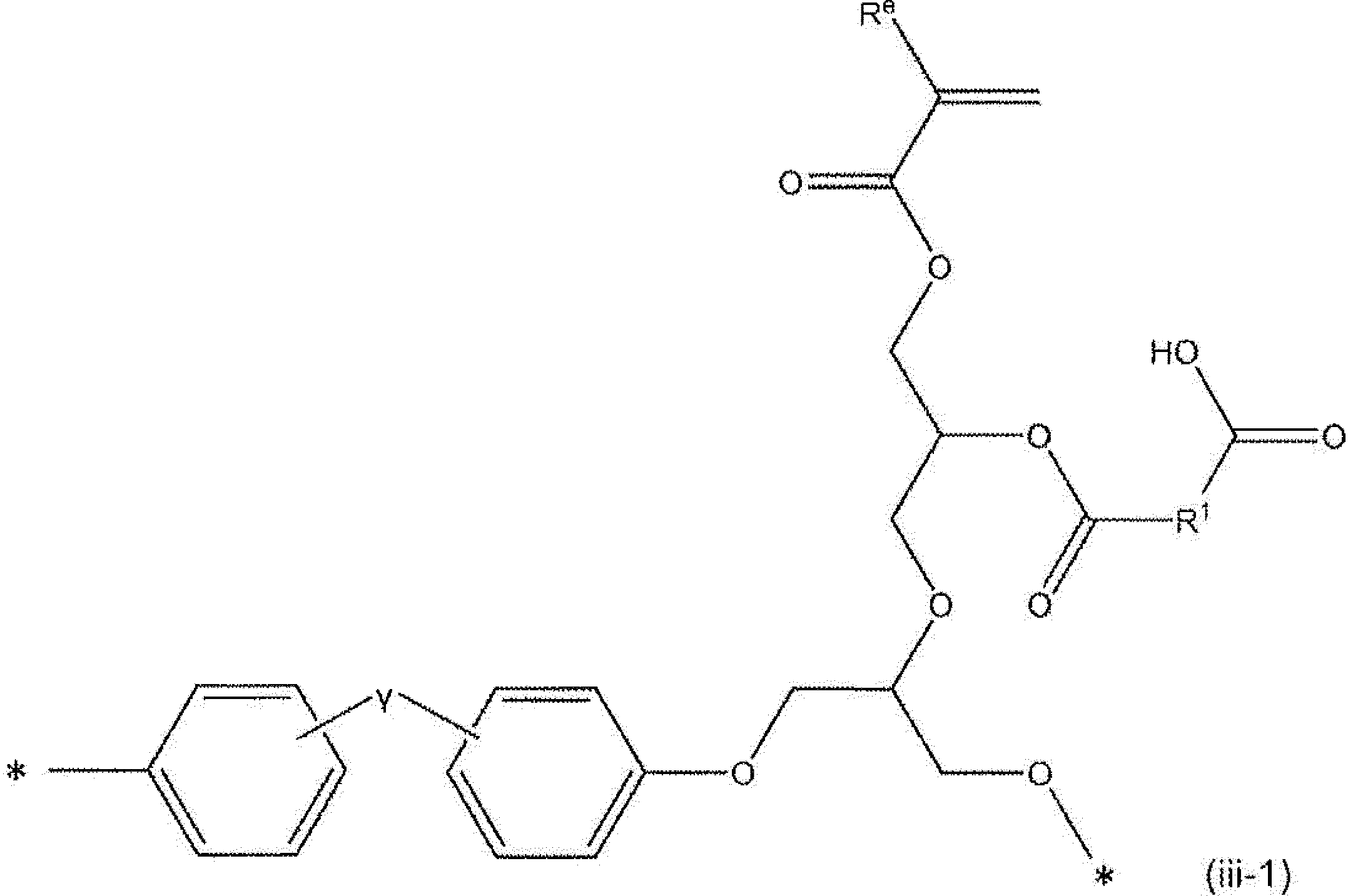
式(iii-1)中、Re及びγは前記式(iii)と同義である。R1は前記式(i-1)のものと同義である。*は結合手を表す。式(iii-1)中のベンゼン環は、さらに任意の置換基により置換されていてもよい。
エポキシ(メタ)アクリレート樹脂(a-3-3)1分子中に含まれる、前記式(iii)で表される部分構造の数は特に限定されないが、1以上が好ましく、5以上がより好ましく、10以上がさらに好ましく、また、18以下が好ましく、15以下がさらに好ましい。前記上限及び下限は任意に組み合わせることができ、例えば、1~18が好ましく、5~18がより好ましく、10~15がさらに好ましい。前記下限値以上とすることで現像密着性が向上する傾向がある。また、前記上限値以下とすることで残渣が低減する傾向がある。
エポキシ(メタ)アクリレート樹脂(a-3-3)1分子中に含まれる、前記式(iii)で表される部分構造の数は特に限定されないが、1以上が好ましく、5以上がより好ましく、10以上がさらに好ましく、また、18以下が好ましく、15以下がさらに好ましい。前記上限及び下限は任意に組み合わせることができ、例えば、1~18が好ましく、5~18がより好ましく、10~15がさらに好ましい。前記下限値以上とすることで現像密着性が向上する傾向がある。また、前記上限値以下とすることで残渣が低減する傾向がある。
エポキシ(メタ)アクリレート樹脂(a-3-3)1分子中に含まれる、前記式(iii-1)で表される部分構造の数は特に限定されないが、1以上が好ましく、3以上がより好ましく、5以上がさらに好ましく、また、18以下が好ましく、15以下がさらに好ましい。前記上限及び下限は任意に組み合わせることができ、例えば、1~18が好ましく、3~18がより好ましく、5~15がさらに好ましい。前記下限値以上とすることで現像密着性が向上する傾向がある。また、前記上限値以下とすることで残渣が低減する傾向がある。
以下にエポキシ(メタ)アクリレート樹脂(a-3-3)の具体例を挙げる。
以下にエポキシ(メタ)アクリレート樹脂(a-3-3)の具体例を挙げる。


(a)アルカリ可溶性樹脂中には、エポキシ(メタ)アクリレート樹脂(a-3)及びアクリル共重合樹脂(a-2)のいずれかが単独で含まれていてもよく、両者が含まれていてもよい。さらに、(a)アルカリ可溶性樹脂中にはアルカリ可溶性樹脂(b)以外のアルカリ可溶性樹脂が含まれていてもよい。
本発明の感光性樹脂組成物における(a)アルカリ可溶性樹脂の含有量は、感光性樹脂組成物の全固形分中に、好ましくは5質量%以上、より好ましくは10質量%以上、さらに好ましくは20質量%以上、よりさらに好ましくは30質量%以上、特に好ましくは40質量%以上、また、好ましくは90質量%以下、より好ましくは70質量%以下、さらに好ましくは60質量%以下、特に好ましくは50質量%以下である。前記上限及び下限は任意に組み合わせることができ、例えば、5~90質量%が好ましく、10~90質量%がより好ましく、20~70質量%がさらに好ましく、30~60質量%がよりさらに好ましく、40~50質量%が特に好ましい。前記下限値以上とすることで現像性が向上する傾向がある。また、前記上限値以下とすることで素子発光時のアウトガスを低減する傾向がある。
本発明の感光性樹脂組成物における(a)アルカリ可溶性樹脂の含有量は、感光性樹脂組成物の全固形分中に、好ましくは5質量%以上、より好ましくは10質量%以上、さらに好ましくは20質量%以上、よりさらに好ましくは30質量%以上、特に好ましくは40質量%以上、また、好ましくは90質量%以下、より好ましくは70質量%以下、さらに好ましくは60質量%以下、特に好ましくは50質量%以下である。前記上限及び下限は任意に組み合わせることができ、例えば、5~90質量%が好ましく、10~90質量%がより好ましく、20~70質量%がさらに好ましく、30~60質量%がよりさらに好ましく、40~50質量%が特に好ましい。前記下限値以上とすることで現像性が向上する傾向がある。また、前記上限値以下とすることで素子発光時のアウトガスを低減する傾向がある。
本発明の感光性樹脂組成物がエポキシ(メタ)アクリレート樹脂(a-3)を含む場合、エポキシ(メタ)アクリレート樹脂(a-3)の含有量は特に限定されないが、感光性樹脂組成物の全固形分中に、好ましくは5質量%以上、より好ましくは10質量%以上、さらに好ましくは20質量%以上、よりさらに好ましくは30質量%以上、特に好ましくは40質量%以上、また、好ましくは90質量%以下、より好ましくは70質量%以下、さらに好ましくは60質量%以下、特に好ましくは50質量%以下である。前記上限及び下限は任意に組み合わせることができ、例えば、5~90質量%が好ましく、10~90質量%がより好ましく、20~70質量%がさらに好ましく、30~60質量%がよりさらに好ましく、40~50質量%が特に好ましい。前記下限値以上とすることで現像性が向上する傾向がある。また、前記上限値以下とすることで素子発光時のアウトガスを低減する傾向がある。
また、本発明の感光性樹脂組成物がアクリル共重合樹脂(a-2)を含む場合、アクリル共重合樹脂(a-2)の含有量は特に限定されないが、感光性樹脂組成物の全固形分中に、好ましくは5質量%以上、より好ましくは10質量%以上、さらに好ましくは20質量%以上、よりさらに好ましくは30質量%以上、特に好ましくは40質量%以上、また、好ましくは90質量%以下、より好ましくは70質量%以下、さらに好ましくは60質量%以下、特に好ましくは50質量%以下である。前記上限及び下限は任意に組み合わせることができ、例えば、5~90質量%が好ましく、10~90質量%がより好ましく、20~70質量%がさらに好ましく、30~60質量%がよりさらに好ましく、40~50質量%が特に好ましい。前記下限値以上とすることで現像性が向上する傾向がある。また、前記上限値以下とすることで素子発光時のアウトガスを低減する傾向がある。
また、感光性樹脂組成物の全固形分中における(a)アルカリ可溶性樹脂及び(d)光重合性化合物の含有量の合計は、好ましくは5質量%以上、より好ましくは10質量%以上、さらに好ましくは30質量%以上、よりさらに好ましくは50質量%以上、特に好ましくは70質量%以上、さらに特に好ましくは80質量%以上であり、最も好ましくは90質量%以上であり、また、好ましくは99質量%以下、より好ましくは97質量%以下、さらに好ましくは95質量%以下である。前記上限及び下限は任意に組み合わせることができ、例えば、5~99質量%が好ましく、10~99質量%がより好ましく、30~99質量%がさらに好ましく、50~97質量%がよりさらに好ましく、70~97質量%がことさら好ましく、80~95質量%が特に好ましく、90~95質量%が最も好ましい。前記下限値以上とすることで硬化性が向上する傾向がある。また、前記上限値以下とすることで素子発光時のアウトガス低減する傾向がある。
感光性樹脂組成物における(d)光重合性化合物に対する(a)アルカリ可溶性樹脂の配合比としては、(d)光重合性化合物100質量部に対して、50質量部以上が好ましく、60質量部以上がより好ましく、70質量部以上がさらに好ましく、80質量部以上が特に好ましく、また、400質量部以下が好ましく、300質量部以下がより好ましく、200質量部以下がさらに好ましく、120質量部以下が特に好ましい。全上限及び下限は任意に組み合わせることができ、例えば、50~400質量部が好ましく、60~300質量部がより好ましく、70~200質量部がさらに好ましく、80~120質量部が特に好ましい。前記下限値以上とすることで現像密着性が向上する傾向がある。また、前記上限値以下とすることで硬化性が向上する傾向がある。
[1-1-2](b)成分;撥液剤
本発明の感光性樹脂組成物における(b)撥液剤は、エチレン性不飽和結合基を有する撥液剤(b1)を含むことが好ましい。
また、前記撥液剤(b1)が、下記一般式(5)で表される繰り返し単位及びフッ素原子を含有するアクリル樹脂(b2)を含むことが好ましい。
本発明の感光性樹脂組成物における(b)撥液剤は、エチレン性不飽和結合基を有する撥液剤(b1)を含むことが好ましい。
また、前記撥液剤(b1)が、下記一般式(5)で表される繰り返し単位及びフッ素原子を含有するアクリル樹脂(b2)を含むことが好ましい。
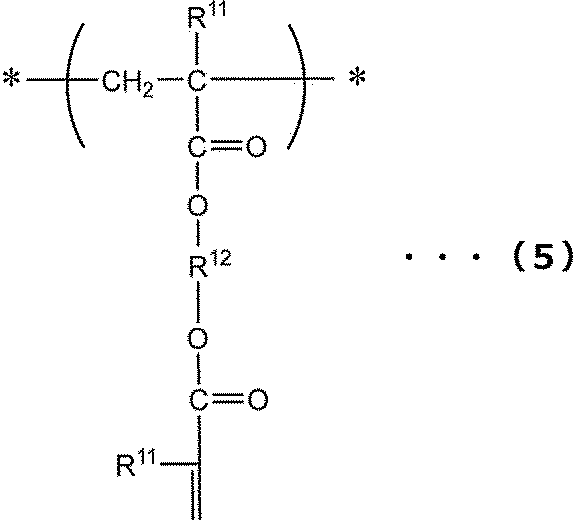
(式(5)中、R11はそれぞれ独立に、水素原子又はメチル基を表し、R12は置換基を有していてもよい炭素数2~6のアルキル基を表し、-O-、-C(=O)-、-S-、-NH-のいずれか1つ以上で中断されていてもよい。*は結合部を表す。)
R12のアルキル基が有する炭素数は、好ましくは2以上であり、より好ましくは炭素数4以上であり、また、好ましくは6以下であり、より好ましくは5以下である。前記の上限及び下限は任意に組み合わせることができ、例えば、2~6が好ましく、4~5がより好ましい。前記下限値以上とすることで、合成が容易となる。また、前記上限値以下とすることでエチレン性不飽和結合の自由度が高くなり、硬化性、撥液性が良化する傾向にある。
R12のアルキル基が有する炭素数は、好ましくは2以上であり、より好ましくは炭素数4以上であり、また、好ましくは6以下であり、より好ましくは5以下である。前記の上限及び下限は任意に組み合わせることができ、例えば、2~6が好ましく、4~5がより好ましい。前記下限値以上とすることで、合成が容易となる。また、前記上限値以下とすることでエチレン性不飽和結合の自由度が高くなり、硬化性、撥液性が良化する傾向にある。
また、R12のアルキル基は、-O-、-C(=O)-、-S-、-NH-のいずれか1つ以上で中断されていてもよい。別の態様としては、-O-、-C(=O)-、又は-NH-で中断されていてもよく、さらに別の態様としては、-O-C(=O)-NH-で中断されていてもよい。
R12が置換基を有する場合、置換基としては、例えば、水酸基、炭素数1~3のアルコキシ基が挙げられる。無置換であるか、又は水酸基で置換されていることが好ましく、無置換であることがより好ましい。
R12が置換基を有する場合、置換基としては、例えば、水酸基、炭素数1~3のアルコキシ基が挙げられる。無置換であるか、又は水酸基で置換されていることが好ましく、無置換であることがより好ましい。
R12としては、-(C2H4)2-NHCOO-(C2H4)2-、-(CH)2-CHOH-(CH2)-で示される基が撥液性の点で好ましく、-(C2H4)2-NHCOO-(C2H4)2-で示される基がより好ましい。
アクリル樹脂(b2)を含有することによって得られる隔壁の表面に撥インク性(撥液性)を付与できることから、インクジェット法で有機電界発光素子を作成する際には、隔壁へのインクの付着が予防され、また、隣接する領域間に注入されるインク同士が混合されることが予防できると考えられる。
アクリル樹脂(b2)を含有することによって得られる隔壁の表面に撥インク性(撥液性)を付与できることから、インクジェット法で有機電界発光素子を作成する際には、隔壁へのインクの付着が予防され、また、隣接する領域間に注入されるインク同士が混合されることが予防できると考えられる。
一般式(5)のようなエチレン性不飽和基を有する撥液剤を用いることで、形成した塗布膜を露光する際にその表面での架橋反応を加速することができ、撥液剤が現像処理で流出しにくくなり、その結果、得られる隔壁を高い撥インク性を示すものとすることができると考えられる。
フッ素原子を含有する樹脂であることで、フッ素原子含有樹脂が隔壁の表面に配向して、インキのにじみや混色を防止する働きをする傾向がある。さらに詳しくは、フッ素原子を有する基が、インキをはじき、インキが隔壁を越えて隣接する領域に進入することによるインキのにじみや混色を防ぐ働きをする傾向がある。
フッ素原子を含有する樹脂であることで、フッ素原子含有樹脂が隔壁の表面に配向して、インキのにじみや混色を防止する働きをする傾向がある。さらに詳しくは、フッ素原子を有する基が、インキをはじき、インキが隔壁を越えて隣接する領域に進入することによるインキのにじみや混色を防ぐ働きをする傾向がある。
アクリル樹脂(b2)は、フルオロアルキル基及び/又はフルオロアルキレン基を有することが好ましく、パーフルオロアルキル基及びパーフルオロアルキレンエーテル鎖のいずれか一方又は両方を有することがより好ましい。フルオロアルキル基及びフルオロアルキレン基のいずれか一方又は両方、あるいは、パーフルオロアルキル基及びパーフルオロアルキレンエーテル鎖のいずれか一方又は両方を有することで、フッ素原子含有樹脂がさらに隔壁の表面に配向しやすくなり、より高い撥インク性を示し、インキのにじみや混色をさらに防ぐ傾向がある。
パーフルオロアルキル基としては、例えば、パーフルオロブチル基、パーフルオロヘキシル基、パーフルオロオクチル基が挙げられる。
パーフルオロアルキレンエーテル鎖としては、例えば、-CF2-O-、-(CF2)2-O-、-(CF2)3-O-、-CF2-C(CF3)O-、-C(CF3)-CF2-O-及びこれらの繰り返し単位をもつ2価の基が挙げられる。
パーフルオロアルキレンエーテル鎖としては、例えば、-CF2-O-、-(CF2)2-O-、-(CF2)3-O-、-CF2-C(CF3)O-、-C(CF3)-CF2-O-及びこれらの繰り返し単位をもつ2価の基が挙げられる。
アクリル樹脂(b2)は、一般式(5)で表される繰り返し単位やフッ素原子を含む構成単位以外の構成単位を有してもよい。例えば、エポキシ基を含む構成単位、カルボキシ基を含む構成単位、アルキレンオキサイド鎖をもつ構成単位が挙げられる。
アクリル樹脂(b2)の市販品としては、DIC社製「メガファック(登録商標。以下同じ。)RS-72-K」、「メガファックRS-90」などの商品名で市販されている含フッ素有機化合物を使用することができる。
アクリル樹脂(b2)の市販品としては、DIC社製「メガファック(登録商標。以下同じ。)RS-72-K」、「メガファックRS-90」などの商品名で市販されている含フッ素有機化合物を使用することができる。
アクリル樹脂(b2)中のフッ素原子含有量は特に制限されないが、アクリル樹脂(b2)中、5質量%以上が好ましく、10質量%以上がより好ましく、20質量%以上がさらに好ましく、25質量%以上がよりさらに好ましい。また、50質量%以下が好ましく、35質量%以下がより好ましい。前記上限及び下限は任意に組み合わせることができ、例えば、1~50質量%が好ましく、10~50質量%がより好ましく、20~35質量%がさらに好ましく、25~35質量%がよりさらに好ましい。前記下限値以上とすることで高い接触角を確保しやすく、また、前記上限値以下とすることで画素部への流出を抑制できる傾向がある。
アクリル樹脂(b2)の分子量は特に制限されず、低分子量の化合物でも、高分子量体であってもよい。高分子量体の方が、ポストベークによる流動性が抑えられ、隔壁からの流出を抑えることができるため好ましく、係る観点から、アクリル樹脂(b2)の重量平均分子量は、100以上が好ましく、500以上がより好ましく、100000以下が好ましく、10000以下がより好ましい。前記上限及び下限は任意に組み合わせることができ、例えば、100~100000が好ましく、500~10000がより好ましい。
アクリル樹脂(b2)は、1種を単独で用いてもよく、2種以上を併用してもよい。
本発明において(b)撥液剤として、アクリル樹脂(b2)以外の撥液剤を併用してもよい。
本発明の感光性樹脂組成物における(b)撥液剤の含有量は特に限定されないが、感光性樹脂組成物の全固形分中に好ましくは0.01質量%以上、より好ましくは0.05質量%以上、さらに好ましくは0.1質量%以上、特に好ましくは0.2質量%以上であり、また、好ましくは5質量%以下、より好ましくは3質量%以下、さらに好ましくは1質量%以下である。前記上限及び下限は任意に組み合わせることができ、例えば、好ましくは0.01~5質量%が好ましく、0.05~5質量%がより好ましく、0.1~3質量%がさらに好ましく、0.2~1質量%が特に好ましい。前記下限値以上とすることで撥インク性が向上する傾向がある。また、前記上限値以下とすることで隔壁形成後にインクを画素部に塗布する時に均一な塗膜が得られやすくなる傾向がある。
本発明の感光性樹脂組成物におけるアクリル樹脂(b2)の含有量は特に限定されないが、感光性樹脂組成物の全固形分中に好ましくは0.01質量%以上、より好ましくは0.1質量%以上、さらに好ましくは0.2質量%以上であり、また、好ましくは5質量%以下、より好ましくは3質量%以下、さらに好ましくは1質量%以下である。前記上限及び下限は任意に組み合わせることができ、例えば、好ましくは0.01~5質量%が好ましく、0.1~3質量%がより好ましく、0.2~1質量%がさらに好ましい。前記下限値以上とすることで撥インク性が向上する傾向がある。また、前記上限値以下とすることで隔壁形成後にインクを画素部に塗布する時に均一な塗膜が得られやすくなる傾向がある。
[1-1-3](c)成分;光重合開始剤
(c)光重合開始剤は、光を直接吸収し、分解反応又は水素引き抜き反応を起こし、重合活性ラジカルを発生する機能を有する成分である。必要に応じて重合促進剤(連鎖移動剤)、増感色素等の付加剤を添加して使用してもよい。
光重合開始剤としては、例えば、特開昭59-152396号公報、特開昭61-151197号公報に記載のチタノセン化合物を含むメタロセン化合物;特開2000-56118号公報に記載のヘキサアリールビイミダゾール誘導体;特開平10-39503号公報記載のハロメチル化オキサジアゾール誘導体、ハロメチル-s-トリアジン誘導体;α-アミノアルキルフェノン誘導体;特開2000-80068号公報、特開2006-36750号公報等に記載されているオキシムエステル系化合物等が挙げられる。
具体的には、例えば、チタノセン誘導体類としては、ジシクロペンタジエニルチタニウムジクロリド、ジシクロペンタジエニルチタニウムビスフェニル、ジシクロペンタジエニルチタニウムビス(2,3,4,5,6-ペンタフルオロフェニ-1-イル)、ジシクロペンタジエニルチタニウムビス(2,3,5,6-テトラフルオロフェニ-1-イル)、ジシクロペンタジエニルチタニウムビス(2,4,6-トリフルオロフェニ-1-イル)、ジシクロペンタジエニルチタニウムジ(2,6-ジフルオロフェニ-1-イル)、ジシクロペンタジエニルチタニウムジ(2,4-ジフルオロフェニ-1-イル)、ジ(メチルシクロペンタジエニル)チタニウムビス(2,3,4,5,6-ペンタフルオロフェニ-1-イル)、ジ(メチルシクロペンタジエニル)チタニウムビス(2,6-ジフルオロフェニ-1-イル)、ジシクロペンタジエニルチタニウム〔2,6-ジ-フルオロ-3-(ピロ-1-イル)-フェニ-1-イル〕等が挙げられる。
また、ヘキサアリールビイミダゾール誘導体類としては、2-(2’-クロロフェニル)-4,5-ジフェニルイミダゾール2量体、2-(2’-クロロフェニル)-4,5-ビス(3’-メトキシフェニル)イミダゾール2量体、2-(2’-フルオロフェニル)-4,5-ジフェニルイミダゾール2量体、2-(2’-メトキシフェニル)-4,5-ジフェニルイミダゾール2量体、(4’-メトキシフェニル)-4,5-ジフェニルイミダゾール2量体等が挙げられる。
また、ハロメチル化オキサジアゾール誘導体類としては、2-トリクロロメチル-5-(2’-ベンゾフリル)-1,3,4-オキサジアゾール、2-トリクロロメチル-5-〔β-(2’-ベンゾフリル)ビニル〕-1,3,4-オキサジアゾール、2-トリクロロメチル-5-〔β-(2’-(6’’-ベンゾフリル)ビニル)〕-1,3,4-オキサジアゾール、2-トリクロロメチル-5-フリル-1,3,4-オキサジアゾール等が挙げられる。
また、ハロメチル-s-トリアジン誘導体類としては、2-(4-メトキシフェニル)-4,6-ビス(トリクロロメチル)-s-トリアジン、2-(4-メトキシナフチル)-4,6-ビス(トリクロロメチル)-s-トリアジン、2-(4-エトキシナフチル)-4,6-ビス(トリクロロメチル)-s-トリアジン、2-(4-エトキシカルボニルナフチル)-4,6-ビス(トリクロロメチル)-s-トリアジン等が挙げられる。
また、α-アミノアルキルフェノン誘導体類としては、2-メチル-1〔4-(メチルチオ)フェニル〕-2-モルフォリノプロパン-1-オン、2-ベンジル-2-ジメチルアミノ-1-(4-モルフォリノフェニル)-ブタノン-1、2-ベンジル-2-ジメチルアミノ-1-(4-モルフォリノフェニル)ブタン-1-オン、4-ジメチルアミノエチルベンゾエ-ト、4-ジメチルアミノイソアミルベンゾエ-ト、4-ジエチルアミノアセトフェノン、4-ジメチルアミノプロピオフェノン、2-エチルヘキシル-1,4-ジメチルアミノベンゾエート、2,5-ビス(4-ジエチルアミノベンザル)シクロヘキサノン、7-ジエチルアミノ-3-(4-ジエチルアミノベンゾイル)クマリン、4-(ジエチルアミノ)カルコン等が挙げられる。
光重合開始剤としては、特に、感度や製版性の点でオキシムエステル系化合物が有効であり、フェノール性水酸基を含むアルカリ可溶性樹脂を用いる場合などは、特にこのような感度に優れたオキシムエステル系化合物が有用である。オキシムエステル系化合物は、その構造の中に紫外線を吸収する構造と光エネルギーを伝達する構造とラジカルを発生する構造を併せ持っているために、少量で感度が高く、かつ、熱反応に対して安定であり、少量で高感度な感光性樹脂組成物を得ることが可能である。
オキシムエステル系化合物としては、例えば、下記一般式(IV)で表される化合物が挙げられる。

上記式(IV)中、R21aは、水素原子、置換基を有していてもよいアルキル基、又は、置換基を有していてもよい芳香族環基を示す。
R21bは芳香環を含む任意の置換基を示す。
R22aは、置換基を有していてもよいアルカノイル基、又は、置換基を有していてもよいアリーロイル基を示す。
R21bは芳香環を含む任意の置換基を示す。
R22aは、置換基を有していてもよいアルカノイル基、又は、置換基を有していてもよいアリーロイル基を示す。
nは0または1の整数を示す。
R21aにおけるアルキル基の炭素数は特に限定されないが、溶剤への溶解性や感度の観点から、通常1以上、好ましくは2以上、また、通常20以下、好ましくは15以下、より好ましくは10以下である。アルキル基の具体例としては、メチル基、エチル基、プロピル基、シクロペンチルエチル基、プロピル基等が挙げられる。
R21aにおけるアルキル基の炭素数は特に限定されないが、溶剤への溶解性や感度の観点から、通常1以上、好ましくは2以上、また、通常20以下、好ましくは15以下、より好ましくは10以下である。アルキル基の具体例としては、メチル基、エチル基、プロピル基、シクロペンチルエチル基、プロピル基等が挙げられる。
アルキル基が有していてもよい置換基としては、芳香族環基、水酸基、カルボキシ基、ハロゲン原子、アミノ基、アミド基、4-(2-メトキシ-1-メチル)エトキシ-2-メチルフェニル基又はN-アセチル-N-アセトキシアミノ基などが挙げられ、合成容易性の観点からは、無置換であることが好ましい。
R21aにおける芳香族環基としては、芳香族炭化水素環基及び芳香族複素環基が挙げられる。芳香族環基の炭素数は特に限定されないが、感光性樹脂組成物への溶解性の観点から5以上であることが好ましい。また、現像性の観点から30以下であることが好ましく、20以下であることがより好ましく、12以下であることがさらに好ましい。
R21aにおける芳香族環基としては、芳香族炭化水素環基及び芳香族複素環基が挙げられる。芳香族環基の炭素数は特に限定されないが、感光性樹脂組成物への溶解性の観点から5以上であることが好ましい。また、現像性の観点から30以下であることが好ましく、20以下であることがより好ましく、12以下であることがさらに好ましい。
芳香族環基の具体例としては、フェニル基、ナフチル基、ピリジル基、フリル基などが挙げられ、これらの中でも現像性の観点から、フェニル基又はナフチル基が好ましく、フェニル基がより好ましい。
芳香族環基が有していてもよい置換基としては、水酸基、カルボキシ基、ハロゲン原子、アミノ基、アミド基、アルキル基、アルコキシ基、これらの置換基が連結した基などが挙げられ、現像性の観点からアルキル基、アルコキシ基、これらを連結した基が好ましく、連結したアルコキシ基がより好ましい。
芳香族環基が有していてもよい置換基としては、水酸基、カルボキシ基、ハロゲン原子、アミノ基、アミド基、アルキル基、アルコキシ基、これらの置換基が連結した基などが挙げられ、現像性の観点からアルキル基、アルコキシ基、これらを連結した基が好ましく、連結したアルコキシ基がより好ましい。
これらの中でも、合成しやすいとの観点から、R21aが置換基を有していてもよいアルキル基であることが好ましく、無置換のアルキル基であることがより好ましく、メチル基であることがさらに好ましい。一方で、現像性の観点から、R21aが置換基を有していてもよい芳香族環基であることが好ましく、連結したアルコキシ基を置換基に有する芳香族環基であることがさらに好ましい。
また、R21bとしては、好ましくは置換されていてもよいカルバゾール基、置換されていてもよいチオキサントニル基又は置換されていてもよいジフェニルスルフィド基が挙げられる。これらの中でも、NMP耐性の観点から、置換されていてもよいジフェニルスルフィド基が好ましい。
また、R22aにおけるアルカノイル基の炭素数は特に限定されないが、溶剤への溶解性や感度の観点から、通常2以上、好ましくは3以上、また、通常20以下、好ましくは15以下、より好ましくは10以下、さらに好ましくは5以下である。アルカノイル基の具体例としては、アセチル基、エチロイル基、プロパノイル基、ブタノイル基等が挙げられる。
また、R22aにおけるアルカノイル基の炭素数は特に限定されないが、溶剤への溶解性や感度の観点から、通常2以上、好ましくは3以上、また、通常20以下、好ましくは15以下、より好ましくは10以下、さらに好ましくは5以下である。アルカノイル基の具体例としては、アセチル基、エチロイル基、プロパノイル基、ブタノイル基等が挙げられる。
アルカノイル基が有していてもよい置換基としては、芳香族環基、水酸基、カルボキシ基、ハロゲン原子、アミノ基、アミド基などが挙げられ、合成容易性の観点からは、無置換であることが好ましい。
また、R22aにおけるアリーロイル基の炭素数は特に限定されないが、溶剤への溶解性や感度の観点から、通常7以上、好ましくは8以上、また、通常20以下、好ましくは15以下、より好ましくは10以下である。アリーロイル基の具体例としては、ベンゾイル基、ナフトイル基等が挙げられる。
また、R22aにおけるアリーロイル基の炭素数は特に限定されないが、溶剤への溶解性や感度の観点から、通常7以上、好ましくは8以上、また、通常20以下、好ましくは15以下、より好ましくは10以下である。アリーロイル基の具体例としては、ベンゾイル基、ナフトイル基等が挙げられる。
アリーロイル基が有していてもよい置換基としては、水酸基、カルボキシ基、ハロゲン原子、アミノ基、アミド基、アルキル基などが挙げられ、合成容易性の観点からは、無置換であることが好ましい。
これらの中でも、NMP耐性の観点から、R22aが置換基を有していてもよいアルカノイル基であることが好ましく、無置換のアルカノイル基であることがより好ましく、アセチル基であることがさらに好ましい。
これらの中でも、NMP耐性の観点から、R22aが置換基を有していてもよいアルカノイル基であることが好ましく、無置換のアルカノイル基であることがより好ましく、アセチル基であることがさらに好ましい。
また特開2016-133574号公報に記載される開始剤も、着色剤による液晶層の汚染が低減されるという点からも好適に用いられる。
光重合開始剤は、1種類を単独で用いても、2種類以上を組み合わせて使用してもよい。
光重合開始剤には、必要に応じて、感応感度を高める目的で、画像露光光源の波長に応じた増感色素、重合促進剤を配合させることができる。増感色素としては、特開平4-221958号公報、特開平4-219756号公報に記載のキサンテン色素、特開平3-239703号公報、特開平5-289335号公報に記載の複素環を有するクマリン色素、特開平3-239703号公報、特開平5-289335号公報に記載の3-ケトクマリン化合物、特開平6-19240号公報に記載のピロメテン色素、その他、特開昭47-2528号公報、特開昭54-155292号公報、特公昭45-37377号公報、特開昭48-84183号公報、特開昭52-112681号公報、特開昭58-15503号公報、特開昭60-88005号公報、特開昭59-56403号公報、特開平2-69号公報、特開昭57-168088号公報、特開平5-107761号公報、特開平5-210240号公報、特開平4-288818号公報に記載のジアルキルアミノベンゼン骨格を有する色素等を挙げることができる。
これらの増感色素のうち好ましいものは、アミノ基含有増感色素であり、更に好ましいものは、アミノ基及びフェニル基を同一分子内に有する化合物である。特に、好ましいのは、例えば、4,4’-ジメチルアミノベンゾフェノン、4,4’-ジエチルアミノベンゾフェノン、2-アミノベンゾフェノン、4-アミノベンゾフェノン、4,4’-ジアミノベンゾフェノン、3,3’-ジアミノベンゾフェノン、3,4-ジアミノベンゾフェノン等のベンゾフェノン系化合物;2-(p-ジメチルアミノフェニル)ベンゾオキサゾール、2-(p-ジエチルアミノフェニル)ベンゾオキサゾール、2-(p-ジメチルアミノフェニル)ベンゾ[4,5]ベンゾオキサゾール、2-(p-ジメチルアミノフェニル)ベンゾ[6,7]ベンゾオキサゾール、2,5-ビス(p-ジエチルアミノフェニル)-1,3,4-オキサゾール、2-(p-ジメチルアミノフェニル)ベンゾチアゾール、2-(p-ジエチルアミノフェニル)ベンゾチアゾール、2-(p-ジメチルアミノフェニル)ベンズイミダゾール、2-(p-ジエチルアミノフェニル)ベンズイミダゾール、2,5-ビス(p-ジエチルアミノフェニル)-1,3,4-チアジアゾール、(p-ジメチルアミノフェニル)ピリジン、(p-ジエチルアミノフェニル)ピリジン、(p-ジメチルアミノフェニル)キノリン、(p-ジエチルアミノフェニル)キノリン、(p-ジメチルアミノフェニル)ピリミジン、(p-ジエチルアミノフェニル)ピリミジン等のp-ジアルキルアミノフェニル基含有化合物等である。このうち最も好ましいものは、4,4’-ジアルキルアミノベンゾフェノンである。
増感色素は、1種を単独で用いてもよく、2種以上を併用してもよい。
重合促進剤としては、例えば、p-ジメチルアミノ安息香酸エチル、安息香酸2-ジメチルアミノエチル等の芳香族アミン、n-ブチルアミン、N-メチルジエタノールアミン等の脂肪族アミン、後述するメルカプト化合物等が用いられる。重合促進剤は、1種を単独で用いても、2種以上を併用してもよい。
重合促進剤としては、例えば、p-ジメチルアミノ安息香酸エチル、安息香酸2-ジメチルアミノエチル等の芳香族アミン、n-ブチルアミン、N-メチルジエタノールアミン等の脂肪族アミン、後述するメルカプト化合物等が用いられる。重合促進剤は、1種を単独で用いても、2種以上を併用してもよい。
[1-1-4](d)成分;光重合性化合物
本発明の感光性樹脂組成物は、(d)光重合性化合物を含有する。(d)光重合性化合物を含むことで、高感度となると考えられる。
ここで使用される光重合性化合物としては、エチレン性不飽和結合(エチレン性二重結合)を分子内に1個以上有する化合物を意味するが、重合性、架橋性、及びそれに伴う露光部と非露光部の現像液溶解性の差異を拡大できる等の点から、エチレン性不飽和結合を分子内に2個以上有する化合物であることが好ましい。また、その不飽和結合は(メタ)アクリロイルオキシ基に由来するもの、つまり、(メタ)アクリレート化合物であることがさらに好ましい。
本発明の感光性樹脂組成物は、(d)光重合性化合物を含有する。(d)光重合性化合物を含むことで、高感度となると考えられる。
ここで使用される光重合性化合物としては、エチレン性不飽和結合(エチレン性二重結合)を分子内に1個以上有する化合物を意味するが、重合性、架橋性、及びそれに伴う露光部と非露光部の現像液溶解性の差異を拡大できる等の点から、エチレン性不飽和結合を分子内に2個以上有する化合物であることが好ましい。また、その不飽和結合は(メタ)アクリロイルオキシ基に由来するもの、つまり、(メタ)アクリレート化合物であることがさらに好ましい。
本発明の感光性樹脂組成物においては、特に、1分子中にエチレン性不飽和結合を2個以上有する多官能エチレン性単量体を使用することが望ましい。多官能エチレン性単量体が有するエチレン性不飽和基の数は特に限定されないが、好ましくは2個以上、より好ましくは3個以上、さらに好ましくは4個以上、特に好ましくは5個以上であり、また、好ましくは15個以下、より好ましくは10個以下、さらに好ましくは8個以下、特に好ましくは7個以下である。前記上限及び下限は任意に組み合わせることができ、例えば、2~15個が好ましく、3~10個がより好ましく、4~8個がさらに好ましく、5~7個が特に好ましい。前記下限値以上とすることで重合性が向上して高感度となる傾向がある。前記上限値以下とすることで現像性がより良好となる傾向がある。
光重合性化合物としては、例えば、脂肪族ポリヒドロキシ化合物と不飽和カルボン酸とのエステル;芳香族ポリヒドロキシ化合物と不飽和カルボン酸とのエステル;脂肪族ポリヒドロキシ化合物、芳香族ポリヒドロキシ化合物等の多価ヒドロキシ化合物と、不飽和カルボン酸及び多塩基性カルボン酸とのエステル化反応により得られるエステル;が挙げられる。
脂肪族ポリヒドロキシ化合物と不飽和カルボン酸とのエステルとしては、例えば、エチレングリコールジアクリレート、トリエチレングリコールジアクリレート、トリメチロールプロパントリアクリレート、トリメチロールエタントリアクリレート、ペンタエリスリトールジアクリレート、ペンタエリスリトールトリアクリレート、ペンタエリスリトールテトラアクリレート、ジペンタエリスリトールテトラアクリレート、ジペンタエリスリトールペンタアクリレート、ジペンタエリスリトールヘキサアクリレート、グリセロールアクリレート等の脂肪族ポリヒドロキシ化合物のアクリル酸エステル;これらの化合物のアクリレートをメタクリレートに代えたメタクリル酸エステル;これらの化合物のアクリレートをイタコネートに代えたイタコン酸エステル;これらの化合物のアクリレートをクロネートに代えたクロトン酸エステル;これらの化合物のアクリレートをマレエートに代えたマレイン酸エステル;が挙げられる。
芳香族ポリヒドロキシ化合物と不飽和カルボン酸とのエステルとしては、例えば、ハイドロキノンジアクリレート、ハイドロキノンジメタクリレート、レゾルシンジアクリレート、レゾルシンジメタクリレート、ピロガロールトリアクリレート等の芳香族ポリヒドロキシ化合物のアクリル酸エステル及びメタクリル酸エステルが挙げられる。
脂肪族ポリヒドロキシ化合物、芳香族ポリヒドロキシ化合物等の多価ヒドロキシ化合物と、不飽和カルボン酸及び多塩基性カルボン酸とのエステル化反応により得られるエステルとしては、必ずしも単一物ではないが、例えば、アクリル酸、フタル酸、及びエチレングリコールの縮合物;アクリル酸、マレイン酸、及びジエチレングリコールの縮合物;メタクリル酸、テレフタル酸及びペンタエリスリトールの縮合物;アクリル酸、アジピン酸、ブタンジオール及びグリセリンの縮合物;が挙げられる。
脂肪族ポリヒドロキシ化合物、芳香族ポリヒドロキシ化合物等の多価ヒドロキシ化合物と、不飽和カルボン酸及び多塩基性カルボン酸とのエステル化反応により得られるエステルとしては、必ずしも単一物ではないが、例えば、アクリル酸、フタル酸、及びエチレングリコールの縮合物;アクリル酸、マレイン酸、及びジエチレングリコールの縮合物;メタクリル酸、テレフタル酸及びペンタエリスリトールの縮合物;アクリル酸、アジピン酸、ブタンジオール及びグリセリンの縮合物;が挙げられる。
本発明の感光性樹脂組成物に用いられる光重合性化合物の上記以外の例としては、例えば、ポリイソシアネート化合物と水酸基含有(メタ)アクリル酸エステル又はポリイソシアネート化合物とポリオール及び水酸基含有(メタ)アクリル酸エステルを反応させて得られるようなウレタン(メタ)アクリレート類;多価エポキシ化合物と水酸基含有(メタ)アクリル酸エステル又は(メタ)アクリル酸との付加反応物のようなエポキシアクリレート類;エチレンビスアクリルアミド等のアクリルアミド類;フタル酸ジアリル等のアリルエステル類;ジビニルフタレート等のビニル基含有化合物が有用である。
ウレタン(メタ)アクリレート類としては、例えば、DPHA-40H、UX-5000、UX-5002D-P20、UX-5003D、UX-5005(日本化薬社製)、U-2PPA、U-6LPA、U-10PA、U-33H、UA-53H、UA-32P、UA-1100H(新中村化学工業社製)、UA-306H、UA-510H、UF-8001G(協栄社化学社製)、UV-1700B、UV-7600B、UV-7605B、UV-7630B、UV7640B(三菱ケミカル社製)が挙げられる。
これらの中でも、適正なテーパー角と感度の観点から(d)光重合性化合物として、エステル(メタ)アクリレート類又はウレタン(メタ)アクリレート類を用いることが好ましく、ジペンタエリスリトールヘキサ(メタ)アクリレート、ジペンタエリスリトールペンタ(メタ)アクリレート、2-トリス(メタ)アクリロイロキシメチルエチルフタル酸、ペンタエリスリトールテトラ(メタ)アクリレート、ペンタエリスリトールトリ(メタ)アクリレート、ジペンタエリスリトールペンタ(メタ)アクリレートの二塩基酸無水物付加物、ペンタエリスリトールトリ(メタ)アクリレートの二塩基酸無水物付加物を用いることがより好ましい。
これらは1種を単独で用いてもよく、2種以上を併用してもよい。
本発明の感光性樹脂組成物において、(d)光重合性化合物の分子量は特に限定されないが、感度、撥インク性、テーパー角の観点から、好ましくは100以上、より好ましくは150以上で、さらに好ましくは200以上、よりさらに好ましくは300以上、特に好ましくは400以上、最も好ましくは500以上であり、好ましくは1000以下、より好ましくは700以下である。前記上限及び下限は任意に組み合わせることができ、例えば、100~1000が好ましく、150~1000がより好ましく、200~1000がさらに好ましく、300~700がよりさらに好ましく、400~700が特に好ましく、500~700が最も好ましい。
本発明の感光性樹脂組成物において、(d)光重合性化合物の分子量は特に限定されないが、感度、撥インク性、テーパー角の観点から、好ましくは100以上、より好ましくは150以上で、さらに好ましくは200以上、よりさらに好ましくは300以上、特に好ましくは400以上、最も好ましくは500以上であり、好ましくは1000以下、より好ましくは700以下である。前記上限及び下限は任意に組み合わせることができ、例えば、100~1000が好ましく、150~1000がより好ましく、200~1000がさらに好ましく、300~700がよりさらに好ましく、400~700が特に好ましく、500~700が最も好ましい。
(d)光重合性化合物の炭素数は特に限定されないが、感度、撥インク性、テーパー角の観点から、好ましくは7以上、より好ましくは10以上、さらに好ましくは15以上、よりさらに好ましくは20以上、特に好ましくは25以上であり、好ましくは50以下、より好ましくは40以下、さらに好ましくは35以下、特に好ましくは30以下である。
前記上限及び下限は任意に組み合わせることができ、例えば、7~50が好ましく、10~50がより好ましく、15~40がさらに好ましく、20~35がよりさらに好ましく、25~30が特に好ましい。
前記上限及び下限は任意に組み合わせることができ、例えば、7~50が好ましく、10~50がより好ましく、15~40がさらに好ましく、20~35がよりさらに好ましく、25~30が特に好ましい。
感度、撥インク性、テーパー角の観点から、エステル(メタ)アクリレート類、エポキシ(メタ)アクリレート類、及びウレタン(メタ)アクリレート類が好ましく、中でも、ペンタエリスリトールテトラ(メタ)アクリレート、ペンタエリスリトールトリ(メタ)アクリレートジペンタエリスリトールヘキサ(メタ)アクリレート、ジペンタエリスリトールペンタ(メタ)アクリレートなど3官能以上のエステル(メタ)アクリレート類、2,2,2-トリス(メタ)アクリロイロキシメチルエチルフタル酸、ジペンタエリスリトールペンタ(メタ)アクリレートの二塩基酸無水物付加物等の3官能以上のエステル(メタ)アクリレート類への酸無水物の付加物がさらに好ましい。
本発明の感光性樹脂組成物における(d)光重合性化合物の含有量は、感光性樹脂組成物の全固形分中に好ましくは5質量%以上、より好ましくは10質量%以上、さらに好ましくは20質量%以上、よりさらに好ましくは30質量%以上、特に好ましくは40質量%以上、また、好ましくは80質量%以下、より好ましくは70質量%以下、さらに好ましくは60質量%以下、よりさらに好ましくは55質量%以下、特に好ましくは50質量%以下である。前記上限及び下限は任意に組み合わせることができ、例えば、5~80質量%が好ましく、10~70質量%がより好ましく、20~60質量%がさらに好ましく、30~55質量%以がよりさらに好ましく、40~50質量%が特に好ましい。前記下限値以上とすることで適切な内部硬化性となる傾向がある。前記上限値以下とすることで現像性が良好となる傾向がある。
[1-1-5]紫外線吸収剤
本発明の感光性樹脂組成物は、紫外線吸収剤を含有してもよい。紫外線吸収剤は、露光に用いられる光源の特定の波長を紫外線吸収剤によって吸収させることにより、光硬化分布を制御する目的で添加されるものである。紫外線吸収剤を含むことにより、現像後のテーパー角形状を改善したり、現像後に非露光部に残る残渣を低減したりするなどの効果が得られる傾向がある。紫外線吸収剤としては、光重合開始剤による光吸収を阻害するとの観点から、例えば、波長250nmから400nmの間に吸収極大を有する化合物を用いることができる。
本発明の感光性樹脂組成物は、紫外線吸収剤を含有してもよい。紫外線吸収剤は、露光に用いられる光源の特定の波長を紫外線吸収剤によって吸収させることにより、光硬化分布を制御する目的で添加されるものである。紫外線吸収剤を含むことにより、現像後のテーパー角形状を改善したり、現像後に非露光部に残る残渣を低減したりするなどの効果が得られる傾向がある。紫外線吸収剤としては、光重合開始剤による光吸収を阻害するとの観点から、例えば、波長250nmから400nmの間に吸収極大を有する化合物を用いることができる。
紫外線吸収剤としては、例えば、ベンゾトリアゾール系化合物、トリアジン系化合物、ベンゾフェノン化合物、ベンゾエート化合物、桂皮酸誘導体、ナフタレン誘導体、アントラセン及びその誘導体、ジナフタレン化合物、フェナントロリン化合物、染料が挙げられる。
これらの紫外線吸収剤は、1種を単独で用いてもよく、2種以上を併用してもよい。
これらの紫外線吸収剤は、1種を単独で用いてもよく、2種以上を併用してもよい。
これらの中でも、テーパー角を高める観点から、ベンゾトリアゾール化合物及び/又はヒドロキシフェニルトリアジン化合物が好ましく、ベンゾトリアゾール化合物が特に好ましい。
ベンゾトリアゾール系化合物の中でも、テーパー形状の点から、下記の一般式(Z1)で記載されるベンゾトリアゾール化合物が好ましい。
ベンゾトリアゾール系化合物の中でも、テーパー形状の点から、下記の一般式(Z1)で記載されるベンゾトリアゾール化合物が好ましい。
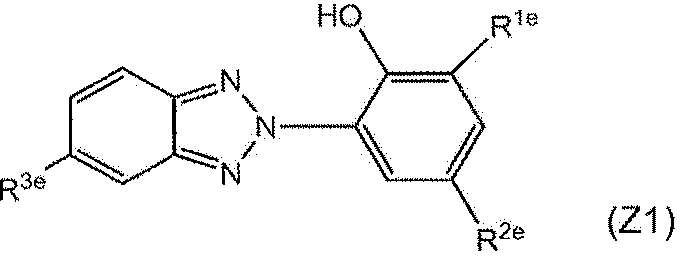
上記式(Z1)中、R1e及びR2eは各々独立に、水素原子、置換基を有していてもよいアルキル基、下記一般式(Z2)で表される基、又は下記一般式(Z3)で表される基を表す。R3eは、水素原子又はハロゲン原子を表す。
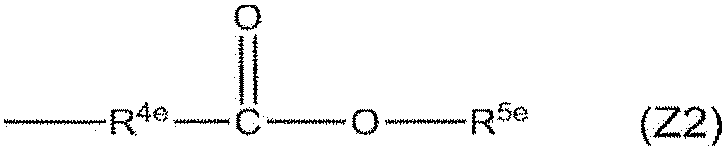
上記式(Z2)中、R4eは置換基を有していてもよいアルキレン基を表し、R5eは置換基を有していてもよいアルキル基を表す。

上記式(Z3)中、R6eは置換基を有していてもよいアルキレン基を表し、R7eは水素原子又はメチル基を表す。
(R1e及びR2e)
前記式(Z1)において、R1e及びR2eは各々独立に、水素原子、置換基を有していてもよいアルキル基、一般式(Z2)で表される基、又は一般式(Z3)で表される基を表す。
アルキル基としては、直鎖状、分岐鎖状又は環状のアルキル基が挙げられる。その炭素数は、1以上であることが好ましく、2以上であることがより好ましく、4以上であることがさらに好ましく、また、10以下であることが好ましく、6以下であることがより好ましく、4以下であることがさらに好ましい。前記上限及び下限は任意に組み合わせることができ、例えば、1~10が好ましく、2~6がより好ましく、4~6がさらに好ましい。
前記式(Z1)において、R1e及びR2eは各々独立に、水素原子、置換基を有していてもよいアルキル基、一般式(Z2)で表される基、又は一般式(Z3)で表される基を表す。
アルキル基としては、直鎖状、分岐鎖状又は環状のアルキル基が挙げられる。その炭素数は、1以上であることが好ましく、2以上であることがより好ましく、4以上であることがさらに好ましく、また、10以下であることが好ましく、6以下であることがより好ましく、4以下であることがさらに好ましい。前記上限及び下限は任意に組み合わせることができ、例えば、1~10が好ましく、2~6がより好ましく、4~6がさらに好ましい。
アルキル基としては、例えば、メチル基、エチル基、プロピル基、イソプロピル基、ブチル基、イソブチル基、tert-ブチル基が挙げられる。これらの中でもtert-ブチル基が好ましい。
アルキル基が有していてもよい置換基としては、例えば、メトキシ基、エトキシ基、クロロ基、ブロモ基、フルオロ基、ヒドロキシ基、アミノ基、エポキシ基、オリゴエチレングリコール基、フェニル基、カルボキシ基、アクリロイル基、メタクリロイル基が挙げられる。
アルキル基が有していてもよい置換基としては、例えば、メトキシ基、エトキシ基、クロロ基、ブロモ基、フルオロ基、ヒドロキシ基、アミノ基、エポキシ基、オリゴエチレングリコール基、フェニル基、カルボキシ基、アクリロイル基、メタクリロイル基が挙げられる。
(R3e)
前記式(Z1)において、R3eは、水素原子又はハロゲン原子を表す。
ハロゲン原子としては、フッ素原子、塩素原子、臭素原子、ヨウ素原子が挙げられる。
これらの中でも合成の観点から、R3eが水素原子であることが好ましい。
前記式(Z1)において、R3eは、水素原子又はハロゲン原子を表す。
ハロゲン原子としては、フッ素原子、塩素原子、臭素原子、ヨウ素原子が挙げられる。
これらの中でも合成の観点から、R3eが水素原子であることが好ましい。
(R4e)
前記式(Z2)において、R4eは置換基を有していてもよいアルキレン基を表す。
アルキレン基としては、直鎖状、分岐鎖状又は環状のアルキレン基が挙げられる。その炭素数は通常1以上であり、2以上が好ましく、また6以下が好ましく、4以下がより好ましく、3以下がさらに好ましい。前記上限及び下限は任意に組み合わせることができ、例えば、1~6が好ましく、1~4がより好ましく、2~3がさらに好ましい。
アルキレン基としては、例えば、メチレン基、エチレン基、プロピレン基、プロピレン基、ブチレン基が挙げられる。これらの中でもエチレン基が好ましい。
前記式(Z2)において、R4eは置換基を有していてもよいアルキレン基を表す。
アルキレン基としては、直鎖状、分岐鎖状又は環状のアルキレン基が挙げられる。その炭素数は通常1以上であり、2以上が好ましく、また6以下が好ましく、4以下がより好ましく、3以下がさらに好ましい。前記上限及び下限は任意に組み合わせることができ、例えば、1~6が好ましく、1~4がより好ましく、2~3がさらに好ましい。
アルキレン基としては、例えば、メチレン基、エチレン基、プロピレン基、プロピレン基、ブチレン基が挙げられる。これらの中でもエチレン基が好ましい。
アルキレン基が有していてもよい置換基としては、例えば、メトキシ基、エトキシ基、クロロ基、ブロモ基、フルオロ基、ヒドロキシ基、アミノ基、エポキシ基、オリゴエチレングリコール基、フェニル基、カルボキシ基、アクリロイル基、メタクリロイル基が挙げられる。
これらの中でも、R4eはエチレン基であることが好ましい。
これらの中でも、R4eはエチレン基であることが好ましい。
(R5e)
前記式(Z2)において、R5eは置換基を有していてもよいアルキル基を表す。
アルキル基としては、直鎖状、分岐鎖状又は環状のアルキル基が挙げられる。その炭素数は、4以上であることが好ましく、5以上であることがより好ましく、7以上であることがさらに好ましく、また、15以下であることが好ましく、10以下であることがより好ましく、9以下であることがさらに好ましい。前記上限及び下限は任意に組み合わせることができ、例えば、5~15が好ましく、5~10がより好ましく、7~9がさらに好ましい。
前記式(Z2)において、R5eは置換基を有していてもよいアルキル基を表す。
アルキル基としては、直鎖状、分岐鎖状又は環状のアルキル基が挙げられる。その炭素数は、4以上であることが好ましく、5以上であることがより好ましく、7以上であることがさらに好ましく、また、15以下であることが好ましく、10以下であることがより好ましく、9以下であることがさらに好ましい。前記上限及び下限は任意に組み合わせることができ、例えば、5~15が好ましく、5~10がより好ましく、7~9がさらに好ましい。
アルキル基としては、例えば、メチル基、エチル基、プロピル基、ブチル基、ペンチル基、ヘキシル基、ヘプシル基、オクチル基、ノニル基が挙げられる。
アルキル基が有していてもよい置換基としては、例えば、メトキシ基、エトキシ基、クロロ基、ブロモ基、フルオロ基、ヒドロキシ基、アミノ基、エポキシ基、オリゴエチレングリコール基、フェニル基、カルボキシ基、アクリロイル基、メタクリロイル基が挙げられる。
これらの中でもテーパー形状の観点から、R5eはヘプチル基、オクチル基、又はノニル基であることが好ましい。
アルキル基が有していてもよい置換基としては、例えば、メトキシ基、エトキシ基、クロロ基、ブロモ基、フルオロ基、ヒドロキシ基、アミノ基、エポキシ基、オリゴエチレングリコール基、フェニル基、カルボキシ基、アクリロイル基、メタクリロイル基が挙げられる。
これらの中でもテーパー形状の観点から、R5eはヘプチル基、オクチル基、又はノニル基であることが好ましい。
(R6e)
前記式(Z3)において、R6eは置換基を有していてもよいアルキレン基を表す。
アルキレン基としては、直鎖状、分岐鎖状又は環状のアルキレン基が挙げられる。その炭素数は通常1以上であり、2以上が好ましく、また6以下が好ましく、4以下がより好ましく、3以下がさらに好ましい。前記の上限及び下限は任意に組み合わせることができ、例えば、1~6が好ましく、1~4がより好ましく、2~3がさらに好ましい。
前記式(Z3)において、R6eは置換基を有していてもよいアルキレン基を表す。
アルキレン基としては、直鎖状、分岐鎖状又は環状のアルキレン基が挙げられる。その炭素数は通常1以上であり、2以上が好ましく、また6以下が好ましく、4以下がより好ましく、3以下がさらに好ましい。前記の上限及び下限は任意に組み合わせることができ、例えば、1~6が好ましく、1~4がより好ましく、2~3がさらに好ましい。
アルキレン基としては、例えば、メチレン基、エチレン基、プロピレン基、プロピレン基、ブチレン基が挙げられる。これらの中でもエチレン基が好ましい。
アルキレン基が有していてもよい置換基としては、例えば、メトキシ基、エトキシ基、クロロ基、ブロモ基、フルオロ基、ヒドロキシ基、アミノ基、エポキシ基、オリゴエチレングリコール基、フェニル基、カルボキシ基、アクリロイル基、メタクリロイル基が挙げられる。
アルキレン基が有していてもよい置換基としては、例えば、メトキシ基、エトキシ基、クロロ基、ブロモ基、フルオロ基、ヒドロキシ基、アミノ基、エポキシ基、オリゴエチレングリコール基、フェニル基、カルボキシ基、アクリロイル基、メタクリロイル基が挙げられる。
これらの中でもテーパー形状の観点から、R1eがtert-ブチル基、R2eが前記式(Z2)で表される基(ただしR4eがエチレン基、及びR5eが炭素数7~9のアルキル基)、R3eが水素原子である化合物、又は、R1eが水素原子、R2eが前記式(Z3)で表される基(ただしR6eがエチレン基、及びR7eがメチル基)、R3eが水素原子である化合物が好ましく、R1eがtert-ブチル基、R2eが前記式(Z2)で表される基(ただしR4eがエチレン基、及びR5eが炭素数7~9のアルキル基)、R3eが水素原子である化合物がより好ましい。
ベンゾトリアゾール系化合物としては、例えば、2-(5メチル-2-ヒドロキシフェニル)ベンゾトリアゾール、2-(2-ヒドロキシ-5-t-ブチルフェニル)-2H-ベンゾトリアゾール、オクチル-3[3-tert-ブチル-4-ヒドロキシ-5-(5-クロロ-2H-ベンゾトリアゾール-2-イル)フェニル]プロピオネートと2-エチルヘキシル-3-[3-tert-ブチル-4-ヒドロキシ-5-(5-クロロ-2H-ベンゾトリアゾール-2-イル)フェニル]プロピオネートの混合物、2-[2-ヒドロキシ-3,5-ビス(α,α-ジメチルベンジル)フェニル]-2H-ベンゾトリアゾール、2-(3-tert-ブチル-5-メチル-2-ヒドロキシフェニル)-5-クロロベンゾトリアゾール、2-(3,5-ジ-t-アミル-2-ヒドロキシフェニル)ベンゾトリアゾール、2-(2’-ヒドロキシ-5’-t-オクチルフェニル)ベンゾトリアゾール、3-[3-tert-ブチル-5-(2H-ベンゾトリアゾール-2-イル)-4-ヒドロキシフェニル]プロピオン酸へプチル、3-[3-tert-ブチル-5-(2H-ベンゾトリアゾール-2-イル)-4-ヒドロキシフェニル]プロピオン酸オクチル、3-[3-tert-ブチル-5-(2H-ベンゾトリアゾール-2-イル)-4-ヒドロキシフェニル]プロピオン酸ノニル、2-(2H-ベンゾトリアゾール-2-イル)-4,6-ビス(1-メチル-1-フェニルエチル)フェノール、2-(2H-ベンゾトリアゾール-2-イル)-6-(1-メチル-1-フェニルエチル)-4-(1,1,3,3-テトラメチルブチル)フェノールが挙げられる。これらの中でも、テーパー角と露光感度の観点から、3-[3-tert-ブチル-5-(2H-ベンゾトリアゾール-2-イル)-4-ヒドロキシフェニル]プロピオン酸へプチル、3-[3-tert-ブチル-5-(2H-ベンゾトリアゾール-2-イル)-4-ヒドロキシフェニル]プロピオン酸オクチル、3-[3-tert-ブチル-5-(2H-ベンゾトリアゾール-2-イル)-4-ヒドロキシフェニル]プロピオン酸ノニル、これらの混合物が好ましい。
市販されているベンゾトリアゾール系化合物としては、例えば、スミソーブ(登録商標、以下同じ。)200、スミソーブ250、スミソーブ300、スミソーブ340、スミソーブ350(住友化学社製)、JF77、JF78、JF79、JF80、JF83(城北化学工業社製)、TINUVIN(登録商標、以下同じ。)PS、TINUVIN99-2、TINUVIN109、TINUVIN384-2、TINUVIN326、TINUVIN900、TINUVIN928、TINUVIN1130(BASF社製)、EVERSORB70、EVERSORB71、EVERSORB72、EVERSORB73、EVERSORB74、EVERSORB75、EVERSORB76、EVERSORA-234、EVERSORB77、EVERSORB78、EVERSORB80、EVERSORB81(台湾永光化学工業社製)、トミソーブ(登録商標、以下同じ。)100、トミソーブ600(エーピーアイコーポレーション社製)、SEESORB(登録商標、以下同じ。)701、SEESORB702、SEESORB703、SEESORB704、SEESORB706、SEESORB707、SEESORB709(シプロ化成社製)、RUVA-93(大塚化学社製)が挙げられる。
トリアジン系化合物としては、例えば、2-[4,6-ジ(2,4-キシリル)-1,3,5-トリアジン-2-イル]-5-オクチルオキシフェノール、2-[4,6-ビス(2,4-ジメチルフェニル)-1,3,5-トリアジン-2-イル]-5-[3-(ドデシルオキシ)-2-ヒドロキシプロポキシ]フェノール、2-(2,4-ジヒドロキシフェニル)-4,6-ビス(2,4-ジメチルフェニル)-1,3,5-トリアジンと(2-エチルヘキシル)グリシド酸エステルの反応生成物、2,4-ビス[2-ヒドロキシ-4-ブトキシフェニル]-6-(2,4-ジブトキシフェニル)-1,3,5-トリアジンが挙げられる。これらの中でも、テーパー角と露光感度の観点から、ヒドロキシフェニルトリアジン化合物が好ましい。
市販されているトリアジン系化合物としては例えば、TINUVIN400、TINUVIN405、TINUVIN460、TINUVIN477、TINUVIN479(BASF社製)などを挙げることができる。
その他の紫外線吸収剤としては、例えば、スミソーブ130(住友化学社製)、EVERSORA-30、EVERSORA-31、EVERSORA-32(台湾永光化学工業社製)、トミソーブ800(エーピーアイコーポレーション社製)、SEESORA-300、SEESORA-301、SEESORA-301S、SEESORA-302、SEESORA-303、SEESORA-305、SEESORA-306、SEESORA-307、SEESORA-351(シプロ化成社製)などのベンゾフェノン化合物;スミソーブ400(住友化学社製)、サリチル酸フェニルなどのベンゾエート化合物;桂皮酸2-エチルヘキシル、パラメトキシ桂皮酸2-エチルヘキシル、メトキシケイ皮酸イソプロピル、メトキシケイ皮酸イソアミル等の桂皮酸誘導体;α-ナフトール、β-ナフトール、α-ナフトールメチルエーテル、α-ナフトールエチルエーテル、1,2-ジヒドロキシナフタレン、1,3-ジヒドロキシナフタレン、1,4-ジヒドロキシナフタレン、1,5-ジヒドロキシナフタレン、1,6-ジヒドロキシナフタレン、1,7-ジヒドロキシナフタレン、1,8-ジヒドロキシナフタレン、2,3-ジヒドロキシナフタレン、2,6-ジヒドロキシナフタレン、2,7-ジヒドロキシナフタレン等のナフタレン誘導体;アントラセン、9,10-ジヒドロキシアントラセン等のアントラセン及びその誘導体;アゾ系染料、ベンゾフェノン系染料、アミノケトン系染料、キノリン系染料、アントラキノン系染料、ジフェニルシアノアクリレート系染料、トリアジン系染料、p-アミノ安息香酸系染料等の染料;が挙げられる。これらの中でも、露光感度の観点から、桂皮酸誘導体、ナフタレン誘導体を用いることが好ましく、桂皮酸誘導体を用いることが特に好ましい。
その他の紫外線吸収剤としては、例えば、スミソーブ130(住友化学社製)、EVERSORA-30、EVERSORA-31、EVERSORA-32(台湾永光化学工業社製)、トミソーブ800(エーピーアイコーポレーション社製)、SEESORA-300、SEESORA-301、SEESORA-301S、SEESORA-302、SEESORA-303、SEESORA-305、SEESORA-306、SEESORA-307、SEESORA-351(シプロ化成社製)などのベンゾフェノン化合物;スミソーブ400(住友化学社製)、サリチル酸フェニルなどのベンゾエート化合物;桂皮酸2-エチルヘキシル、パラメトキシ桂皮酸2-エチルヘキシル、メトキシケイ皮酸イソプロピル、メトキシケイ皮酸イソアミル等の桂皮酸誘導体;α-ナフトール、β-ナフトール、α-ナフトールメチルエーテル、α-ナフトールエチルエーテル、1,2-ジヒドロキシナフタレン、1,3-ジヒドロキシナフタレン、1,4-ジヒドロキシナフタレン、1,5-ジヒドロキシナフタレン、1,6-ジヒドロキシナフタレン、1,7-ジヒドロキシナフタレン、1,8-ジヒドロキシナフタレン、2,3-ジヒドロキシナフタレン、2,6-ジヒドロキシナフタレン、2,7-ジヒドロキシナフタレン等のナフタレン誘導体;アントラセン、9,10-ジヒドロキシアントラセン等のアントラセン及びその誘導体;アゾ系染料、ベンゾフェノン系染料、アミノケトン系染料、キノリン系染料、アントラキノン系染料、ジフェニルシアノアクリレート系染料、トリアジン系染料、p-アミノ安息香酸系染料等の染料;が挙げられる。これらの中でも、露光感度の観点から、桂皮酸誘導体、ナフタレン誘導体を用いることが好ましく、桂皮酸誘導体を用いることが特に好ましい。
本発明の感光性樹脂組成物が紫外線吸収剤を含む場合、感光性樹脂組成物における紫外線吸収剤の含有量は、感光性樹脂組成物の全固形分中に、好ましくは0.01質量%以上、より好ましくは0.05質量%以上、さらに好ましくは0.1質量%以上、よりさらに好ましくは0.5質量%以上、特に好ましくは1質量%以上であり、また、好ましくは15質量%以下、より好ましくは10質量%以下、さらに好ましくは5質量%以下、特に好ましくは3質量%以下である。前記上限及び下限は任意に組み合わせることができ、例えば、0.01~15質量%が好ましく、0.05~15質量%がより好ましく、0.1~10質量%がさらに好ましく、0.5~5質量%がよりさらに好ましく、1~3質量%が特に好ましい。前記下限値以上とすることでテーパー角が大きくなる傾向がある。また、前記上限値以下とすることで高感度となる傾向がある。
本発明の感光性樹脂組成物が紫外線吸収剤を含む場合、(c)光重合開始剤に対する配合比としては、(c)光重合開始剤100質量部に対して、好ましくは1質量部以上、より好ましくは10質量部以上、さらに好ましくは30質量部以上、よりさらに好ましくは50質量部以上、特に好ましくは80質量部以上であり、また、好ましくは500質量部以下、より好ましくは300質量部以下、さらに好ましくは200質量部以下、特に好ましくは150質量部以下である。前記上限及び下限は任意に組み合わせることができ、例えば、10~500質量部が好ましく、30~300質量部がより好ましく、50~200質量部がさらに好ましく、80~150質量部が特に好ましい。前記下限値以上とすることでテーパー角が大きくなる傾向がある。また、前記上限値以下とすることで高感度となる傾向がある。
[1-1-6]重合禁止剤
本発明の感光性樹脂組成物は、重合禁止剤を含有してもよい。重合禁止剤を含有することでラジカル重合が阻害されることから、得られる隔壁のテーパー角を大きくすることができると考えられる。
重合禁止剤としては、例えば、ハイドロキノン、ハイドロキノンモノメチルエーテル、メチルハイドロキノン、メトキシフェノール、2,6-ジ-tert-ブチル-4-クレゾール(BHT)が挙げられる。これらの中でも重合禁止能力の観点から、メチルハイドロキノン、メトキシフェノールが好ましく、メチルハイドロキノンがより好ましい。
本発明の感光性樹脂組成物は、重合禁止剤を含有してもよい。重合禁止剤を含有することでラジカル重合が阻害されることから、得られる隔壁のテーパー角を大きくすることができると考えられる。
重合禁止剤としては、例えば、ハイドロキノン、ハイドロキノンモノメチルエーテル、メチルハイドロキノン、メトキシフェノール、2,6-ジ-tert-ブチル-4-クレゾール(BHT)が挙げられる。これらの中でも重合禁止能力の観点から、メチルハイドロキノン、メトキシフェノールが好ましく、メチルハイドロキノンがより好ましい。
重合禁止剤は、1種を単独で用いてもよく、2種以上を併用してもよい。通常、(a)アルカリ可溶性樹脂を製造する際に、樹脂中に重合禁止剤が含まれることがあり、それを本発明の感光性樹脂組成物に含まれる重合禁止剤として用いてもよいし、樹脂中に含まれる重合禁止剤の他に、それと同一、又は異なる重合禁止剤を感光性樹脂組成物の製造時に添加してもよい。
本発明の感光性樹脂組成物が重合禁止剤を含む場合、感光性樹脂組成物における重合禁止剤の含有量は、感光性樹脂組成物の全固形分中に、好ましくは0.0005質量%以上、より好ましくは0.001質量%以上、さらに好ましくは0.01質量%以上であり、また好ましくは0.3質量%以下、より好ましくは0.2質量%以下、さらに好ましくは0.1質量%以下である。前記上限及び下限は任意に組み合わせることができ、例えば、0.0005~0.3質量%が好ましく、0.001~0.2質量%がより好ましく、0.01~0.1質量%がさらに好ましい。前記下限値以上とすることでテーパー角を高くすることができる傾向がある。また、前記上限値以下とすることで高感度を保つことができる傾向がある。
[1-1-7]アミノ化合物
本発明の感光性樹脂組成物は、熱硬化を促進するためにアミノ化合物を含有してもよい。
本発明の感光性樹脂組成物がアミノ化合物を含む場合、感光性樹脂組成物におけるアミノ化合物の含有量としては、感光性樹脂組成物の全固形分中に、好ましくは40質量%以下、より好ましくは30質量%以下である。また、好ましくは0.5質量%以上、より好ましくは1質量%以上である。前記上限及び下限は任意に組み合わせることができ、例えば、0.5~40質量%が好ましく、1~30質量%がより好ましい。前記上限値以下とすることで保存安定性を維持できる傾向がある。前記下限値以上とすることで十分な熱硬化性を確保できる傾向がある。
本発明の感光性樹脂組成物は、熱硬化を促進するためにアミノ化合物を含有してもよい。
本発明の感光性樹脂組成物がアミノ化合物を含む場合、感光性樹脂組成物におけるアミノ化合物の含有量としては、感光性樹脂組成物の全固形分中に、好ましくは40質量%以下、より好ましくは30質量%以下である。また、好ましくは0.5質量%以上、より好ましくは1質量%以上である。前記上限及び下限は任意に組み合わせることができ、例えば、0.5~40質量%が好ましく、1~30質量%がより好ましい。前記上限値以下とすることで保存安定性を維持できる傾向がある。前記下限値以上とすることで十分な熱硬化性を確保できる傾向がある。
アミノ化合物としては、例えば、官能基としてメチロール基や、メチロール基を炭素数1~8のアルコール縮合変性したアルコキシメチル基を少なくとも2個有するアミノ化合物が挙げられる。具体的には、例えば、メラミンとホルムアルデヒドとを重縮合させたメラミン樹脂;ベンゾグアナミンとホルムアルデヒドとを重縮合させたベンゾグアナミン樹脂;グリコールウリルとホルムアルデヒドとを重縮合させたグリコールウリル樹脂;尿素とホルムアルデヒドとを重縮合させた尿素樹脂;メラミン、ベンゾグアナミン、グリコールウリル、又は尿素などの2種以上とホルムアルデヒドとを共重縮合させた樹脂;上述の樹脂のメチロール基をアルコール縮合変性した変性樹脂が挙げられる。
これらは1種を単独で用いてもよく、2種以上を併用してもよい。
アミノ化合物としては中でも、メラミン樹脂及びその変性樹脂が好ましく、メチロール基の変性割合が、70%以上の変性樹脂がさらに好ましく、80%以上の変性樹脂が特に好ましい。
アミノ化合物としてのメラミン樹脂及びその変性樹脂としては、例えば、サイテック社製のサイメル(登録商標、以下同じ。)300、301、303、350、736、738、370、771、325、327、703、701、266、267、285、232、235、238、1141、272、254、202、1156、1158、及び、三和ケミカル社製のニカラック(登録商標、以下同じ。)MW-390、MW-100LM、MX-750LM、MW-30M、MX-45、MX-302が挙げられる。
ベンゾグアナミン樹脂及びその変性樹脂としては、例えば、サイテック社製のサイメル1123、1125、1128が挙げられる。
グリコールウリル樹脂及びその変性樹脂としては、例えば、サイテック社製のサイメル1170、1171、1174、1172、及び、三和ケミカル社製のニカラックMX-270が挙げられる。
尿素樹脂及びその変性樹脂としては、例えば、サイテック社製のUFR(登録商標、以下同じ。)65、300、及び、三和ケミカル社製のニカラックMX-290が挙げられる。
グリコールウリル樹脂及びその変性樹脂としては、例えば、サイテック社製のサイメル1170、1171、1174、1172、及び、三和ケミカル社製のニカラックMX-270が挙げられる。
尿素樹脂及びその変性樹脂としては、例えば、サイテック社製のUFR(登録商標、以下同じ。)65、300、及び、三和ケミカル社製のニカラックMX-290が挙げられる。
[1-1-8]着色剤
本発明の感光性樹脂組成物は、隔壁を着色させる目的で着色剤を含有してもよい。着色剤としては、顔料、染料等公知の着色剤を用いることができる。
顔料を用いる際に、その顔料が凝集せずに安定して感光性樹脂組成物中に存在できるように、公知の分散剤や分散助剤が併用されてもよい。特に撥インク性隔壁を黒色に着色することで、鮮明な画素表示が得られる効果がある。黒色着色剤としては黒色染料や黒色顔料、カーボンブラック、チタンブラックなどの他、有機顔料を混合させて黒く着色することも低導電性を持たせる効果として有効である。
本発明の感光性樹脂組成物は、隔壁を着色させる目的で着色剤を含有してもよい。着色剤としては、顔料、染料等公知の着色剤を用いることができる。
顔料を用いる際に、その顔料が凝集せずに安定して感光性樹脂組成物中に存在できるように、公知の分散剤や分散助剤が併用されてもよい。特に撥インク性隔壁を黒色に着色することで、鮮明な画素表示が得られる効果がある。黒色着色剤としては黒色染料や黒色顔料、カーボンブラック、チタンブラックなどの他、有機顔料を混合させて黒く着色することも低導電性を持たせる効果として有効である。
着色剤の含有量としては、製版性と色特性の観点から、感光性樹脂組成物の全固形分中に、好ましくは60質量%以下、より好ましくは40質量%以下である。
別の態様として、感光性樹脂組成物に着色剤が含まれると、隔壁の硬化性が低下して隔壁の撥液性が低下し、アウトガスも発生しやすい傾向がある。そのため、感光性樹脂組成物における着色剤の含有量が低いことが望ましく、例えば、感光性樹脂組成物の全固形分に対して20質量%以下が好ましく、10質量%以下がより好ましく、5質量%以下が特に好ましく、0質量%が最も好ましい。
別の態様として、感光性樹脂組成物に着色剤が含まれると、隔壁の硬化性が低下して隔壁の撥液性が低下し、アウトガスも発生しやすい傾向がある。そのため、感光性樹脂組成物における着色剤の含有量が低いことが望ましく、例えば、感光性樹脂組成物の全固形分に対して20質量%以下が好ましく、10質量%以下がより好ましく、5質量%以下が特に好ましく、0質量%が最も好ましい。
[1-1-9]塗布性向上剤、現像改良剤
本発明の感光性樹脂組成物は、塗布性や現像溶解性を向上するために塗布性向上剤や現像改良剤を含有してもよい。
塗布性向上剤あるいは現像改良剤としては、例えば、公知の界面活性剤を用いることができる。
本発明の感光性樹脂組成物は、塗布性や現像溶解性を向上するために塗布性向上剤や現像改良剤を含有してもよい。
塗布性向上剤あるいは現像改良剤としては、例えば、公知の界面活性剤を用いることができる。
界面活性剤は、感光性樹脂組成物の塗布液としての塗布性、及び塗布膜の現像性の向上などを目的として用いることができ、中でもフッ素系界面活性剤又はシリコーン系界面活性剤が好ましい。
特に、現像の際、未露光部から感光性樹脂組成物の残渣を除去する作用があり、また、濡れ性を発現する機能を有することから、シリコーン系界面活性剤が好ましく、ポリエーテル変性シリコーン系界面活性剤がさらに好ましい。
特に、現像の際、未露光部から感光性樹脂組成物の残渣を除去する作用があり、また、濡れ性を発現する機能を有することから、シリコーン系界面活性剤が好ましく、ポリエーテル変性シリコーン系界面活性剤がさらに好ましい。
フッ素系界面活性剤としては、末端、主鎖及び側鎖の少なくとも何れかの部位にフルオロアルキル又はフルオロアルキレン基を有する化合物が好適である。具体的には、1,1,2,2-テトラフロロオクチル(1,1,2,2-テトラフロロプロピル)エーテル、1,1,2,2-テトラフロロオクチルヘキシルエーテル、オクタエチレングリコールジ(1,1,2,2-テトラフロロブチル)エーテル、ヘキサエチレングリコールジ(1,1,2,2,3,3-ヘキサフロロペンチル)エーテル、オクタプロピレングリコールジ(1,1,2,2-テトラフロロブチル)エーテル、ヘキサプロピレングリコールジ(1,1,2,2,3,3-ヘキサフロロペンチル)エーテル、パーフロロドデシルスルホン酸ナトリウム、1,1,2,2,8,8,9,9,10,10-デカフロロドデカン、1,1,2,2,3,3-ヘキサフロロデカンなどを挙げることができる。これらの市販品としては、例えば、BM Chemie社製「BM-1000」、「BM-1100」、DIC社製「メガファックF470」、「メガファックF475」、「メガファックF554」、「メガファックF559」、スリーエムジャパン社製「FC430」、ネオス社製「DFX-18」を挙げることができる。
シリコーン系界面活性剤としては、例えば、東レ・ダウコーニング社製「DC3PA」、「SH7PA」、「DC11PA」、「SH21PA」、「SH28PA」、「SH29PA」、「8032Additive」、「SH8400」、ビックケミー社製「BYK(登録商標、以下同じ。)323」、「BYK330」を挙げることができる。
界面活性剤として、フッ素系界面活性剤及びシリコーン系界面活性剤以外のその他の界面活性剤を含んでいてもよく、その他の界面活性剤としては、例えば、ノニオン性、アニオン性、カチオン性、両性界面活性剤が挙げられる。
界面活性剤として、フッ素系界面活性剤及びシリコーン系界面活性剤以外のその他の界面活性剤を含んでいてもよく、その他の界面活性剤としては、例えば、ノニオン性、アニオン性、カチオン性、両性界面活性剤が挙げられる。
ノニオン性界面活性剤としては、例えば、ポリオキシエチレンアルキルエーテル類、ポリオキシエチレンポリオキシプロピレンアルキルエーテル類、ポリオキシエチレンアルキルフェニルエーテル類、ポリオキシエチレンアルキルエステル類、ポリオキシエチレン脂肪酸エステル類、グリセリン脂肪酸エステル類、ポリオキシエチレングリセリン脂肪酸エステル類、ペンタエリスリット脂肪酸エステル類、ポリオキシエチレンペンタエリスリット脂肪酸エステル類、ソルビタン脂肪酸エステル類、ポリオキシエチレンソルビタン脂肪酸エステル類、ソルビット脂肪酸エステル類、ポリオキシエチレンソルビット脂肪酸エステル類が挙げられる。これらの市販品としては、例えば、花王社製の「エマルゲン(登録商標。以下同じ。)104P」、「エマルゲンA60」などのポリオキシエチレン系界面活性剤などが挙げられる。
アニオン性界面活性剤としては、例えば、アルキルスルホン酸塩類、アルキルベンゼンスルホン酸塩類、アルキルナフタレンスルホン酸塩類、ポリオキシエチレンアルキルエーテルスルホン酸塩類、アルキル硫酸塩類、アルキル硫酸エステル塩類、高級アルコール硫酸エステル塩類、脂肪族アルコール硫酸エステル塩類、ポリオキシエチレンアルキルエーテル硫酸塩類、ポリオキシエチレンアルキルフェニルエーテル硫酸塩類、アルキル燐酸エステル塩類、ポリオキシエチレンアルキルエーテル燐酸塩類、ポリオキシエチレンアルキルフェニルエーテル燐酸塩類、特殊高分子系界面活性剤が挙げられる。中でも、特殊高分子系界面活性剤が好ましく、特殊ポリカルボン酸型高分子系界面活性剤がさらに好ましい。アニオン性界面活性剤としては、例えば、アルキル硫酸エステル塩類では、花王社製「エマール(登録商標。)10」等、アルキルナフタレンスルホン酸塩類では花王社製「ペレックス(登録商標。)NB-L」など、特殊高分子系界面活性剤では花王社製「ホモゲノール(登録商標、以下同じ。)L-18」、「ホモゲノールL-100」などが挙げられる。
カチオン性界面活性剤としては、例えば、第4級アンモニウム塩類、イミダゾリン誘導体類、アルキルアミン塩類が挙げられる。両性界面活性剤としては、例えば、ベタイン型化合物類、イミダゾリウム塩類、イミダゾリン類、アミノ酸類が挙げられる。これらのうち、第4級アンモニウム塩類が好ましく、ステアリルトリメチルアンモニウム塩類がさらに好ましい。カチオン性界面活性剤又は良性界面活性剤としては、例えば、アルキルアミン塩類としては、花王社製「アセタミン(登録商標。)24」が挙げられ、第4級アンモニウム塩類としては、花王社製「コータミン(登録商標、以下同じ。)24P」、「コータミン86W」が挙げられる。
界面活性剤は1種を単独で用いてもよく、2種以上を併用してもよい。例えば、シリコーン系界面活性剤/フッ素系界面活性剤の組み合わせ、シリコーン系界面活性剤/特殊高分子系界面活性剤の組み合わせ、フッ素系界面活性剤/特殊高分子系界面活性剤の組み合わせが挙げられる。中でも、シリコーン系界面活性剤/フッ素系界面活性剤の組み合わせが好ましい。このシリコーン系界面活性剤/フッ素系界面活性剤の組み合わせでは、例えば、ビックケミー社製「BYK-300」又は「BYK-330」/ネオス社製「DFX-18」、ビックケミー社製「BYK-300」、「BYK-330」/AGCセイミケミカル社製「S-393」、ビックケミー社製「BYK-300」又は「BYK-330」/DIC社製「F-554」又は「F-559」、信越シリコーン社製「KP340」/DIC社製「F-478」又は「F-475」、東レ・ダウコーニング社製「SH7PA」/ダイキン社製「DS-401」、NUC社製「L-77」/スリーエムジャパン社製「FC4430」が挙げられる。
現像改良剤として、例えば、有機カルボン酸又はその無水物を含む公知の現像改良剤を用いることもできる。
本発明の感光性樹脂組成物が塗布性向上剤や現像改良剤を含む場合、塗布性向上剤や現像改良剤の含有量は、感度の観点から、感光性樹脂組成物の全固形分中に、好ましくはそれぞれ20質量%以下、より好ましくはそれぞれ10質量%以下である。
本発明の感光性樹脂組成物が塗布性向上剤や現像改良剤を含む場合、塗布性向上剤や現像改良剤の含有量は、感度の観点から、感光性樹脂組成物の全固形分中に、好ましくはそれぞれ20質量%以下、より好ましくはそれぞれ10質量%以下である。
[1-1-10]シランカップリング剤
本発明の感光性樹脂組成物は、基板との密着性を改善するため、シランカップリング剤を含有してもよい。シランカップリング剤としては、例えば、エポキシ系、メタクリル系、アミノ系、イミダゾール系のシランカップリング剤が使用できる。密着性向上の観点から、特にエポキシ系、イミダゾール系のシランカップリング剤が好ましい。
本発明の感光性樹脂組成物がシランカップリング剤を含む場合、シランカップリング剤の含有量は、密着性の観点から、感光性樹脂組成物の全固形分中に、好ましくは20質量%以下、より好ましくは15質量%以下である。
本発明の感光性樹脂組成物は、基板との密着性を改善するため、シランカップリング剤を含有してもよい。シランカップリング剤としては、例えば、エポキシ系、メタクリル系、アミノ系、イミダゾール系のシランカップリング剤が使用できる。密着性向上の観点から、特にエポキシ系、イミダゾール系のシランカップリング剤が好ましい。
本発明の感光性樹脂組成物がシランカップリング剤を含む場合、シランカップリング剤の含有量は、密着性の観点から、感光性樹脂組成物の全固形分中に、好ましくは20質量%以下、より好ましくは15質量%以下である。
[1-1-11]リン酸系密着向上剤
本発明の感光性樹脂組成物は、基板との密着性を改善するため、リン酸系密着向上剤を含有してもよい。リン酸系密着向上剤としては、(メタ)アクリロイルオキシ基含有ホスフェート類が好ましく、中でも下記一般式(Va)、(Vb)、(Vc)で表されるものが好ましい。
本発明の感光性樹脂組成物は、基板との密着性を改善するため、リン酸系密着向上剤を含有してもよい。リン酸系密着向上剤としては、(メタ)アクリロイルオキシ基含有ホスフェート類が好ましく、中でも下記一般式(Va)、(Vb)、(Vc)で表されるものが好ましい。

上記一般式(Va)、(Vb)、(Vc)において、R8は水素原子又はメチル基を示し、r及びr’は1~10の整数、sは1、2又は3である。
本発明の感光性樹脂組成物がリン酸系密着向上剤を含有する場合、その含有量は特に限定されないが、感光性樹脂組成物の全固形分中に0.1質量%以上が好ましく、0.2質量%以上がより好ましく、0.3質量%以上がさらに好ましく、また、5質量%以下が好ましく、3質量%以下がより好ましく、1質量%以下がさらに好ましい。前記上限及び下限は任意に組み合わせることができ、例えば、0.1~5質量%が好ましく、0.2~3質量%がより好ましく、0.3~1質量%がさらに好ましい。前記下限値以上とすることで基板との密着性が向上する傾向がある。また、前記上限値以下とすることで表面硬化性が向上する傾向がある。
本発明の感光性樹脂組成物がリン酸系密着向上剤を含有する場合、その含有量は特に限定されないが、感光性樹脂組成物の全固形分中に0.1質量%以上が好ましく、0.2質量%以上がより好ましく、0.3質量%以上がさらに好ましく、また、5質量%以下が好ましく、3質量%以下がより好ましく、1質量%以下がさらに好ましい。前記上限及び下限は任意に組み合わせることができ、例えば、0.1~5質量%が好ましく、0.2~3質量%がより好ましく、0.3~1質量%がさらに好ましい。前記下限値以上とすることで基板との密着性が向上する傾向がある。また、前記上限値以下とすることで表面硬化性が向上する傾向がある。
[1-1-12]無機充填剤
本発明の感光性樹脂組成物は、硬化物としての強度の向上と共に、アルカリ可溶性樹脂との適度な相互作用(マトリックス構造の形成)による塗布膜の優れた平坦性とテーパー角の向上を目的として、無機充填剤を含有してもよい。無機充填剤としては、例えば、タルク、シリカ、アルミナ、硫酸バリウム、酸化マグネシウム、これらを各種シランカップリング剤により表面処理したものが挙げられる。
本発明の感光性樹脂組成物は、硬化物としての強度の向上と共に、アルカリ可溶性樹脂との適度な相互作用(マトリックス構造の形成)による塗布膜の優れた平坦性とテーパー角の向上を目的として、無機充填剤を含有してもよい。無機充填剤としては、例えば、タルク、シリカ、アルミナ、硫酸バリウム、酸化マグネシウム、これらを各種シランカップリング剤により表面処理したものが挙げられる。
無機充填剤の平均粒子径としては、好ましくは0.005~20μm、より好ましくは0.01~10μmである。ここで平均粒子径とは、ベックマン・コールター社製などのレーザ回折散乱粒度分布測定装置にて測定した値である。無機充填剤のうち、分散安定性と共にテーパー角の向上効果に優れる傾向があるため、シリカゾル及びシリカゾル変性物が好ましい。
本発明の感光性樹脂組成物が無機充填剤を含む場合、その含有量としては、感度の観点から、感光性樹脂組成物の全固形分中に、好ましくは5質量%以上、より好ましくは10質量%以上であり、また、好ましくは80質量%以下、より好ましくは70質量%以下である。前記上限及び下限は任意に組み合わせることができ、例えば、5~80質量%が好ましく、10~70質量%がより好ましい。
[1-1-13]溶剤
本発明の感光性樹脂組成物は、溶剤を含有し、前述の各成分を溶剤に溶解又は分散させた状態で使用されることが好ましい。溶剤としては、特に制限は無いが、例えば、以下に記載する有機溶剤が挙げられる。
エチレングリコールモノメチルエーテル、エチレングリコールモノエチルエーテル、エチレングリコールモノプロピルエーテル、エチレングリコールモノブチルエーテル、プロピレングリコールモノメチルエーテル、プロピレングリコールモノエチルエーテル、プロピレングリコールモノ-n-ブチルエーテル、プロピレングリコール-t-ブチルエーテル、ジエチレングリコールモノメチルエーテル、ジエチレングリコールモノエチルエーテル、ジエチレングリコールモノ-n-ブチルエーテル、メトキシメチルペンタノール、ジプロピレングリコールモノエチルエーテル、ジプロピレングリコールモノメチルエーテル、3-メチル-3-メトキシブタノール、3-メトキシ-1-ブタノール、トリエチレングリコールモノメチルエーテル、トリエチレングリコールモノエチルエーテル、トリプロピレングリコールメチルエーテル等のグリコールモノアルキルエーテル類;エチレングリコールジメチルエーテル、エチレングリコールジエチルエーテル、ジエチレングリコールジメチルエーテル、ジエチレングリコールジエチルエーテル、ジエチレングリコールジプロピルエーテル、ジエチレングリコールジブチルエーテル、ジプロピレングリコールジメチルエーテル等のグリコールジアルキルエーテル類;エチレングリコールモノメチルエーテルアセテート、エチレングリコールモノエチルエーテルアセテート、エチレングリコールモノ-n-ブチルエーテルアセテート、プロピレングリコールモノメチルエーテルアセテート、プロピレングリコールモノエチルエーテルアセテート、プロピレングリコールモノプロピルエーテルアセテート、プロピレングリコールモノブチルエーテルアセテート、メトキシブチルアセテート、3-メトキシブチルアセテート、メトキシペンチルアセテート、ジエチレングリコールモノメチルエーテルアセテート、ジエチレングリコールモノエチルエーテルアセテート、ジエチレングリコールモノ-n-ブチルエーテルアセテート、ジプロピレングリコールモノメチルエーテルアセテート、トリエチレングリコールモノメチルエーテルアセテート、トリエチレングリコールモノエチルエーテルアセテート、3-メチル-3-メトキシブチルアセテート、3-メトキシ-1-ブチルアセテート等のグリコールアルキルエーテルアセテート類;エチレングリコールジアセテート、1,3-ブチレングリコールジアセテート、1,6-ヘキサノールジアセテート等のグリコールジアセテート類;シクロヘキサノールアセテート等のアルキルアセテート類;アミルエーテル、ジエチルエーテル、ジプロピルエーテル、ジイソプロピルエーテル、ジブチルエーテル、ジアミルエーテル、エチルイソブチルエーテル、ジヘキシルエーテル等のエーテル類;アセトン、メチルエチルケトン、メチルアミルケトン、メチルイソプロピルケトン、メチルイソアミルケトン、ジイソプロピルケトン、ジイソブチルケトン、メチルイソブチルケトン、シクロヘキサノン、エチルアミルケトン、メチルブチルケトン、メチルヘキシルケトン、メチルノニルケトン、メトキシメチルペンタノン等のケトン類;メタノール、エタノール、プロパノール、ブタノール、ヘキサノール、シクロヘキサノール、エチレングリコール、プロピレングリコール、ブタンジオール、ジエチレングリコール、ジプロピレングリコール、トリエチレングリコール、メトキシメチルペンタノール、グリセリン、ベンジルアルコール等の1価又は多価アルコール類;n-ペンタン、n-オクタン、ジイソブチレン、n-ヘキサン、ヘキセン、イソプレン、ジペンテン、ドデカン等の脂肪族炭化水素類;シクロヘキサン、メチルシクロヘキサン、メチルシクロヘキセン、ビシクロヘキシル等の脂環式炭化水素類;ベンゼン、トルエン、キシレン、クメン等の芳香族炭化水素類;アミルホルメート、エチルホルメート、酢酸エチル、酢酸ブチル、酢酸プロピル、酢酸アミル、メチルイソブチレート、エチレングリコールアセテート、エチルプロピオネート、プロピルプロピオネート、酪酸ブチル、酪酸イソブチル、イソ酪酸メチル、エチルカプリレート、ブチルステアレート、エチルベンゾエート、3-エトキシプロピオン酸メチル、3-エトキシプロピオン酸エチル、3-メトキシプロピオン酸メチル、3-メトキシプロピオン酸エチル、3-メトキシプロピオン酸プロピル、3-メトキシプロピオン酸ブチル、γ-ブチロラクトン等の鎖状又は環状エステル類;3-メトキシプロピオン酸、3-エトキシプロピオン酸等のアルコキシカルボン酸類;ブチルクロライド、アミルクロライド等のハロゲン化炭化水素類;メトキシメチルペンタノン等のエーテルケトン類;アセトニトリル、ベンゾニトリル等のニトリル類:テトラヒドロフラン、ジメチルテトラヒドロフラン、ジメトキシテトラヒドロフラン等のテトラヒドロフラン類などである。
上記に該当する市販の溶剤としては、例えば、ミネラルスピリット、バルソル#2、アプコ#18ソルベント、アプコシンナー、ソーカルソルベントNo.1及びNo.2、ソルベッソ#150、シェルTS28ソルベント、カルビトール、エチルカルビトール、ブチルカルビトール、メチルセロソルブ、エチルセロソルブ、エチルセロソルブアセテート、メチルセロソルブアセテート、ジグライム(いずれも商品名)が挙げられる。
溶剤は、感光性樹脂組成物中の各成分を溶解又は分散させることができ、本発明の感光性樹脂組成物の使用方法に応じて選択されるが、塗布性の観点から、大気圧下(1013.25hPa)における沸点が60~280℃であるものが好ましく、70~260℃であるものがより好ましい。例えば、プロピレングリコールモノメチルエーテル、3-メトキシ-1-ブタノール、プロピレングリコールモノメチルエーテルアセテート、3-メトキシ-1-ブチルアセテートが好ましい。
溶剤は1種を単独で用いてもよく、2種以上を併用してもよい。
溶剤は、感光性樹脂組成物中の全固形分が、好ましくは10質量%以上、より好ましくは15質量%以上、さらに好ましくは18質量%以上、また、好ましくは90質量%以下、より好ましくは50質量%以下、さらに好ましくは40質量%以下、特に好ましくは30質量%以下となるように使用されることが好ましい。前記上限及び下限は任意に組み合わせることができ、例えば、10~90質量%が好ましく、10~50質量%がより好ましく、15~40質量%がさらに好ましく、18~30質量%が特に好ましい。前記下限値以上とすることで高い膜厚に対しても塗膜が得られる傾向がある。また、前記上限値以下とすることで適度な塗布均一性が得られる傾向がある。
溶剤は、感光性樹脂組成物中の全固形分が、好ましくは10質量%以上、より好ましくは15質量%以上、さらに好ましくは18質量%以上、また、好ましくは90質量%以下、より好ましくは50質量%以下、さらに好ましくは40質量%以下、特に好ましくは30質量%以下となるように使用されることが好ましい。前記上限及び下限は任意に組み合わせることができ、例えば、10~90質量%が好ましく、10~50質量%がより好ましく、15~40質量%がさらに好ましく、18~30質量%が特に好ましい。前記下限値以上とすることで高い膜厚に対しても塗膜が得られる傾向がある。また、前記上限値以下とすることで適度な塗布均一性が得られる傾向がある。
[1-2]感光性樹脂組成物の調製方法
本発明の感光性樹脂組成物は、上記の各成分を撹拌機で混合することにより調製される。なお、調製された感光性樹脂組成物が均一なものとなるよう、メンブランフィルタ等を用いて濾過してもよい。
[2]隔壁及びその形成方法
本発明の感光性樹脂組成物は隔壁、特に有機電界発光素子の有機層(発光部)を区画するための隔壁を形成するために好適に用いることができる。本発明の隔壁は、本発明の感光性樹脂組成物を硬化させて得られる。すなわち、本発明の硬化物は、本発明の感光性樹脂組成物を硬化させてなるものであり、例えば、隔壁を形成するために用いられるものである。
本発明の感光性樹脂組成物は、上記の各成分を撹拌機で混合することにより調製される。なお、調製された感光性樹脂組成物が均一なものとなるよう、メンブランフィルタ等を用いて濾過してもよい。
[2]隔壁及びその形成方法
本発明の感光性樹脂組成物は隔壁、特に有機電界発光素子の有機層(発光部)を区画するための隔壁を形成するために好適に用いることができる。本発明の隔壁は、本発明の感光性樹脂組成物を硬化させて得られる。すなわち、本発明の硬化物は、本発明の感光性樹脂組成物を硬化させてなるものであり、例えば、隔壁を形成するために用いられるものである。
本発明の感光性樹脂組成物を用いて隔壁を形成する方法は特に限定されず、従来公知の方法を採用することができる。隔壁の形成方法としては、例えば、感光性樹脂組成物を、基板上に塗布し、感光性樹脂組成物層を形成する塗布工程と、感光性樹脂組成物層を露光する露光工程と、を含む方法が挙げられる。このような隔壁の形成方法の具体例としては、フォトリソグラフィー法が挙げられる。
フォトリソグラフィー法では、感光性樹脂組成物を、基板の隔壁が形成される領域全面に塗布して感光性樹脂組成物層を形成する。形成された感光性樹脂組成物層を、所定の隔壁のパターンに応じて露光した後、露光された感光性樹脂組成物層を現像して、基板上に隔壁を形成する。
フォトリソグラフィー法における、感光性樹脂組成物を基板上に塗布する塗布工程では、隔壁が形成されるべき基板上に、ロールコーター、リバースコーター、バーコーター等の接触転写型塗布装置や、スピナー(回転式塗布装置)、カーテンフローコーター等の非接触型塗布装置を用いて感光性樹脂組成物を塗布し、必要に応じて、乾燥により溶剤を除去して、感光性樹脂組成物層を形成する。
フォトリソグラフィー法における、感光性樹脂組成物を基板上に塗布する塗布工程では、隔壁が形成されるべき基板上に、ロールコーター、リバースコーター、バーコーター等の接触転写型塗布装置や、スピナー(回転式塗布装置)、カーテンフローコーター等の非接触型塗布装置を用いて感光性樹脂組成物を塗布し、必要に応じて、乾燥により溶剤を除去して、感光性樹脂組成物層を形成する。
次いで、露光工程では、ネガ型のマスクを利用して、感光性樹脂組成物に紫外線、エキシマレーザー光等の活性エネルギー線を照射し、感光性樹脂組成物層を隔壁のパターンに応じて部分的に露光する。露光には、高圧水銀灯、超高圧水銀灯、キセノンランプ、カーボンアーク灯等の紫外線を発する光源を用いることができる。露光量は感光性樹脂組成物の組成によっても異なるが、例えば10~400mJ/cm2程度が好ましい。
次いで、現像工程では、隔壁のパターンに応じて露光された感光性樹脂組成物層を現像液で現像することにより隔壁パターンを形成する。現像方法は特に限定されず、浸漬法、スプレー法等を用いることができる。現像液の具体例としては、ジメチルベンジルアミン、モノエタノールアミン、ジエタノールアミン、トリエタノールアミン等の有機系のものや、水酸化ナトリウム、水酸化カリウム、炭酸ナトリウム、アンモニア、4級アンモニウム塩等の水溶液が挙げられる。又、現像液には、消泡剤や界面活性剤を添加することもできる。
その後、現像後の隔壁パターンにポストベークを施して加熱硬化することで隔壁が得られる。ポストベークは、150~250℃で15~60分間が好ましい。
隔壁形成後に未露光部の洗浄を目的とした洗浄処理を行うこともできる。洗浄方法は、特に限定されず、プラズマ照射、エキシマ光照射、UV照射があげられる。エキシマ光照射やUV照射では、光照射によって活性酸素が画素部に付着した有機物を分解して除去することができる。
隔壁形成後に未露光部の洗浄を目的とした洗浄処理を行うこともできる。洗浄方法は、特に限定されず、プラズマ照射、エキシマ光照射、UV照射があげられる。エキシマ光照射やUV照射では、光照射によって活性酸素が画素部に付着した有機物を分解して除去することができる。
隔壁の形成に用いる基板は特に限定されず、隔壁が形成された基板を用いて製造される有機電界発光素子の種類に合わせて適宜選択される。好適な基板の材料としては、ガラスや、各種の樹脂材料が挙げられる。樹脂材料の具体例としては、ポリエチレンテレフタレート等のポリエステル;ポリエチレン、及びポリプロピレン等のポリオレフィン;ポリカーボネート;ポリ(メタ)メタアクリル樹脂;ポリスルホン;ポリイミドが挙げられる。
これらの基板の材料の中では、耐熱性に優れることからガラス、及びポリイミドが好ましい。また、製造される有機電界発光素子の種類に応じて、隔壁が形成される基板の表面には、予めITOやZnO等の透明電極層を設けておいてもよい。
本発明の感光性樹脂組成物は表面硬化性と内部硬化性の制御に優れるため、段差を有する隔壁を形成するために好適に用いることができる。ここで、段差を有する隔壁とは、高さの異なる第1隔壁及び第2隔壁を備えた隔壁であり、例えば、第1隔壁の方が第2隔壁に比べて高さが大きい隔壁を意味する。
本発明の感光性樹脂組成物は表面硬化性と内部硬化性の制御に優れるため、段差を有する隔壁を形成するために好適に用いることができる。ここで、段差を有する隔壁とは、高さの異なる第1隔壁及び第2隔壁を備えた隔壁であり、例えば、第1隔壁の方が第2隔壁に比べて高さが大きい隔壁を意味する。
段差を有する隔壁を用いることで、有機層(発光部)の膜厚を均一にすることができる傾向がある。また、画素間に第2隔壁を備えることで画素間の絶縁性が確保され、画素部以外の発光を抑制することができる。
段差の高さ、つまり、第1隔壁の上面と第2隔壁の上面の高低差は、0.7μm以上が好ましく、0.8μm以上がより好ましく、0.9μm以上がさらに好ましい。また、1.3μm以下が好ましく、1.2μm以下がより好ましく、1.1μm以下がさらに好ましい。前記上限及び下限は任意に組み合わせることができ、例えば、0.7~1.3μmが好ましく、0.8~1.2μmがより好ましく、0.9~1.1μmがさらに好ましい。
段差の高さ、つまり、第1隔壁の上面と第2隔壁の上面の高低差は、0.7μm以上が好ましく、0.8μm以上がより好ましく、0.9μm以上がさらに好ましい。また、1.3μm以下が好ましく、1.2μm以下がより好ましく、1.1μm以下がさらに好ましい。前記上限及び下限は任意に組み合わせることができ、例えば、0.7~1.3μmが好ましく、0.8~1.2μmがより好ましく、0.9~1.1μmがさらに好ましい。
前記下限値以上とすることでライン状のインクジェット塗布性の確保ができる傾向がある。また、前記上限値以下とすることで画素間の絶縁性の確保ができる傾向がある。
図1及び図2に、段差を有する隔壁を備えた基板の一例を示す。図1は平面図であり、図2は図1の線X-Xにおける断面図である。基板1上に、段差を有する隔壁2が備えられており、隔壁2中の開口されている領域、つまり、隔壁2で区画された領域が画素部3となっている。隔壁2には第1隔壁の上面11と第2隔壁の上面があり、第1隔壁の上面11と第2隔壁の上面12の高低差により段差13が形成されている。
図1及び図2に、段差を有する隔壁を備えた基板の一例を示す。図1は平面図であり、図2は図1の線X-Xにおける断面図である。基板1上に、段差を有する隔壁2が備えられており、隔壁2中の開口されている領域、つまり、隔壁2で区画された領域が画素部3となっている。隔壁2には第1隔壁の上面11と第2隔壁の上面があり、第1隔壁の上面11と第2隔壁の上面12の高低差により段差13が形成されている。
段差を有する隔壁の形成方法としては、例えば、前述したフォトリソグラフィー法による形成方法の露光工程において、ネガ型のハーフトーンマスクを利用した方法が挙げられる。ネガ型のハーフトーンマスクとしては、例えば、画素部3に対応する部分が遮光部(光透過率0%)で、第1隔壁の上面11に対応する部分が平均光透過率の最も高い開口部(完全透過開口部)で、第2隔壁の上面12に対応する部分が完全透過開口部よりも平均光透過率の低い開口部(中間透過開口部)となっているものが挙げられる。この方法により、完全透過開口部と中間透過開口部の平均光透過率の差、即ち露光量の差により残膜率の差異を生じさせ、段差を形成することができる。
このようにハーフトーンマスクを用いることで、フォトリソグラフィー法により段差を有する隔壁を一括形成することができる。このように一括形成した場合には、第1隔壁と第2隔壁との明確な境界のない、連続した隔壁とすることができる。
[3]有機電界発光素子
本発明の有機電界発光素子は、本発明の隔壁を備える。
以上説明した方法により製造された隔壁パターンを備える基板を用いて、種々の有機電界発光素子が製造される。有機電界発光素子を形成する方法は特に限定されないが、好ましくは、上記方法により基板上に隔壁のパターンを形成した後に、基板上の隔壁によって囲まれた領域内にインクを注入して画素等の有機層を形成することによって、有機電界発光素子が製造される。
本発明の有機電界発光素子は、本発明の隔壁を備える。
以上説明した方法により製造された隔壁パターンを備える基板を用いて、種々の有機電界発光素子が製造される。有機電界発光素子を形成する方法は特に限定されないが、好ましくは、上記方法により基板上に隔壁のパターンを形成した後に、基板上の隔壁によって囲まれた領域内にインクを注入して画素等の有機層を形成することによって、有機電界発光素子が製造される。
有機電界発光素子のタイプとしては、ボトムエミッション型やトップエミッション型が挙げられる。
ボトムエミッション型では、例えば、透明電極を積層したガラス基板上に隔壁を形成し、隔壁で囲まれた開口部に正孔輸送層、発光層、電子輸送層、金属電極層を積層して作成される。トップエミッション型では、例えば、金属電極層を積層したガラス基板上に隔壁を形成し、隔壁で囲まれた開口部に電子輸送層、発光層、正孔輸送層、透明電極層を積層して作成される。
ボトムエミッション型では、例えば、透明電極を積層したガラス基板上に隔壁を形成し、隔壁で囲まれた開口部に正孔輸送層、発光層、電子輸送層、金属電極層を積層して作成される。トップエミッション型では、例えば、金属電極層を積層したガラス基板上に隔壁を形成し、隔壁で囲まれた開口部に電子輸送層、発光層、正孔輸送層、透明電極層を積層して作成される。
発光層としては、日本国特開2009-146691号公報や日本国特許第5734681号公報に記載されているような有機電界発光層が挙げられる。日本国特許第5653387号公報や日本国特許第5653101号公報に記載されているような量子ドットを用いてもよい。
有機層形成用のインクを形成する際に使用される溶剤としては、水、有機溶剤、及びこれらの混合溶剤を用いることができる。有機溶剤は、インクの注入後に形成された皮膜から除去可能であれば特に限定されない。有機溶剤としては、例えば、トルエン、キシレン、アニソール、メシチレン、テトラリン、シクロヘキシルベンゼン、アセトン、メチルエチルケトン、メチルイソブチルケトン、シクロヘキサノン、メタノール、エタノール、イソプロピルアルコール、酢酸エチル、酢酸ブチル、3-フェノキシトルエンが挙げられる。また、インクには、例えば、界面活性剤、酸化防止剤、粘度調整剤、紫外線吸収剤を添加することができる。
有機層形成用のインクを形成する際に使用される溶剤としては、水、有機溶剤、及びこれらの混合溶剤を用いることができる。有機溶剤は、インクの注入後に形成された皮膜から除去可能であれば特に限定されない。有機溶剤としては、例えば、トルエン、キシレン、アニソール、メシチレン、テトラリン、シクロヘキシルベンゼン、アセトン、メチルエチルケトン、メチルイソブチルケトン、シクロヘキサノン、メタノール、エタノール、イソプロピルアルコール、酢酸エチル、酢酸ブチル、3-フェノキシトルエンが挙げられる。また、インクには、例えば、界面活性剤、酸化防止剤、粘度調整剤、紫外線吸収剤を添加することができる。
隔壁により囲まれた領域内にインクを注入する方法としては、少量のインクを所定の箇所に容易に注入可能であることから、インクジェット法が好ましい。有機層の形成に使用されるインクは、製造される有機電界発光素子の種類に応じて適宜選択される。インクをインクジェット法により注入する場合、インクの粘度はインクをインクジェットヘッドから良好に吐出できる限り特に限定されないが、4~20mPa・sが好ましく、5~10mPa・sがより好ましい。インクの粘度は、インク中の固形分含有量の調整、溶剤の変更、粘度調整剤の添加等により調整することができる。
[4]画像表示装置
本発明の画像表示装置は、本発明の有機電界発光素子を含む。本発明の有機電界発光素子を含むものであれば、画像表示装置の型式や構造については特に制限はなく、例えばアクティブ駆動型有機電界発光素子を用いて常法に従って組み立てることができる。例えば、「有機ELディスプレイ」(オーム社、平成16年8月20日発行、時任静士、安達千波矢、村田英幸著)に記載されているような方法で、本発明の画像表示装置を形成することができる。例えば、白色光を発光する有機電界発光素子とカラーフィルターとを組み合わせて画像表示させてもよいし、RGB等の発光色の異なる有機電界発光素子を組み合わせて画像表示させてもよい。
本発明の画像表示装置は、本発明の有機電界発光素子を含む。本発明の有機電界発光素子を含むものであれば、画像表示装置の型式や構造については特に制限はなく、例えばアクティブ駆動型有機電界発光素子を用いて常法に従って組み立てることができる。例えば、「有機ELディスプレイ」(オーム社、平成16年8月20日発行、時任静士、安達千波矢、村田英幸著)に記載されているような方法で、本発明の画像表示装置を形成することができる。例えば、白色光を発光する有機電界発光素子とカラーフィルターとを組み合わせて画像表示させてもよいし、RGB等の発光色の異なる有機電界発光素子を組み合わせて画像表示させてもよい。
以下、本発明について、具体的な実施例を挙げて説明するが、本発明はその要旨を超えない限り、以下の実施例に限定されるものではない。
以下の実施例及び比較例で用いた感光性樹脂組成物の構成成分は次の通りである。
以下の実施例及び比較例で用いた感光性樹脂組成物の構成成分は次の通りである。
<アルカリ可溶性樹脂>
a-1:日本国特開2023―55623号公報記載の方法で作製したアルカリ可溶性樹脂。ポリアミドイミド(メタ)アクリレート樹脂に該当する。
上記方法にて、イソシアヌレート型ポリイソシアネート:イソホロンジイソシアネートのイソシアヌレート変性体(EVONIK社製「VESTANATT-1890/100」、イソシアネート基含有量17.3質量%)242.8g、トリカルボン酸無水物:シクロヘキサン-1,3,4-トリカルボン酸-3,4-無水物188.1g、分子中にエポキシ基を有する(メタ)アクリレート:グリシジルメタクリレート170.4g、トリカルボン酸無水物:シクロヘキサン-1,3,4-トリカルボン酸-3,4-無水物118.8gから、ポリアミドイミド(メタ)アクリレート樹脂(a―1)を得た。
実験例に使用したポリアミドイミド(メタ)アクリレート樹脂(a―1)の重量平均分子量は5100、酸価は80mgKOH/gであった。
a-2:以下の構造を有する、アルカリ可溶性樹脂。重量平均分子量(Mw)7000、酸価62mgKOH/gであり、エポキシ(メタ)アクリレート樹脂に該当する。
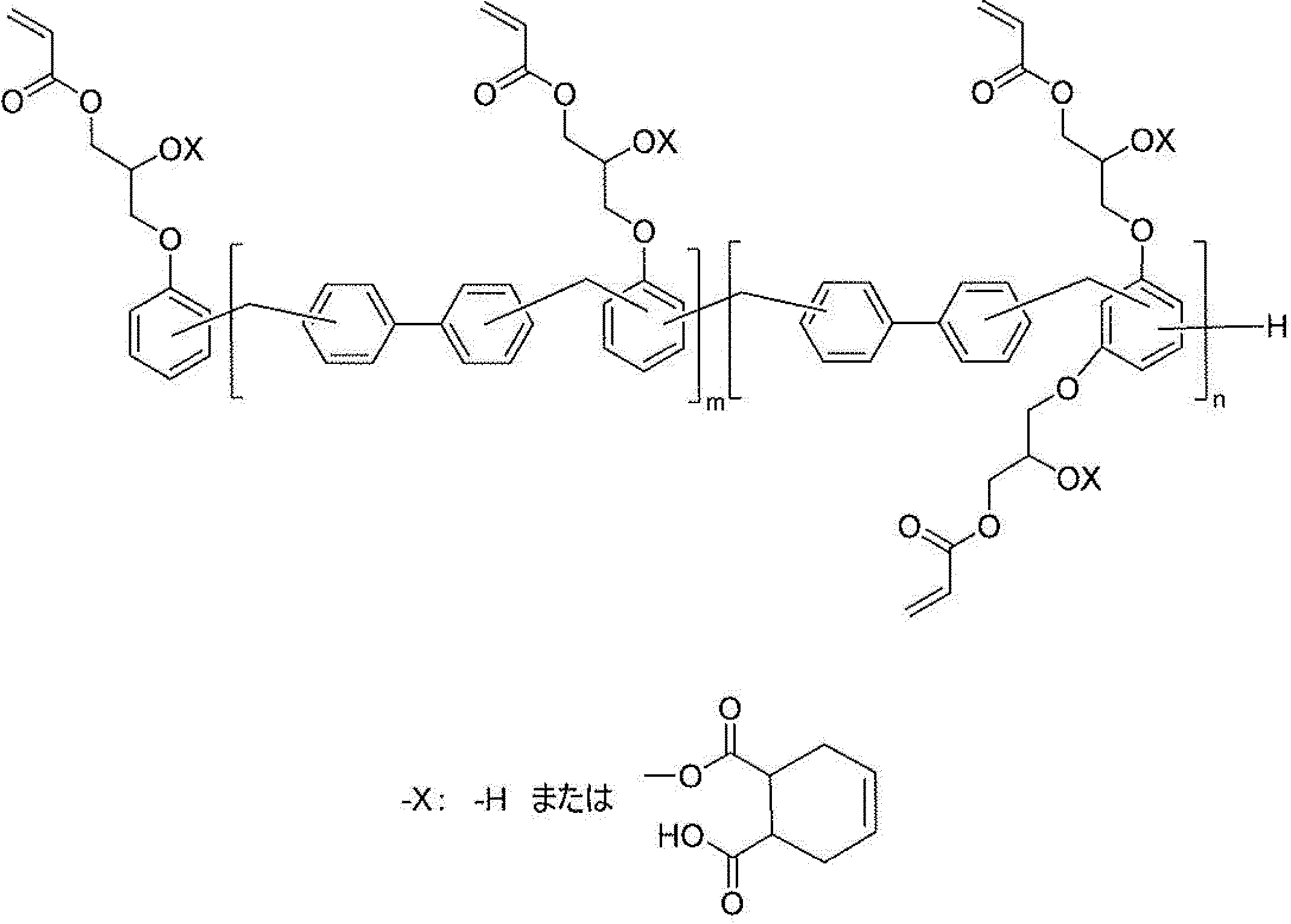
a-3:以下の構造を有する、アルカリ可溶性樹脂(m及びnが1~20のものの混合物)。重量平均分子量(Mw)8000、酸価80mgKOH/gであり、エポキシ(メタ)アクリレート樹脂に該当する。
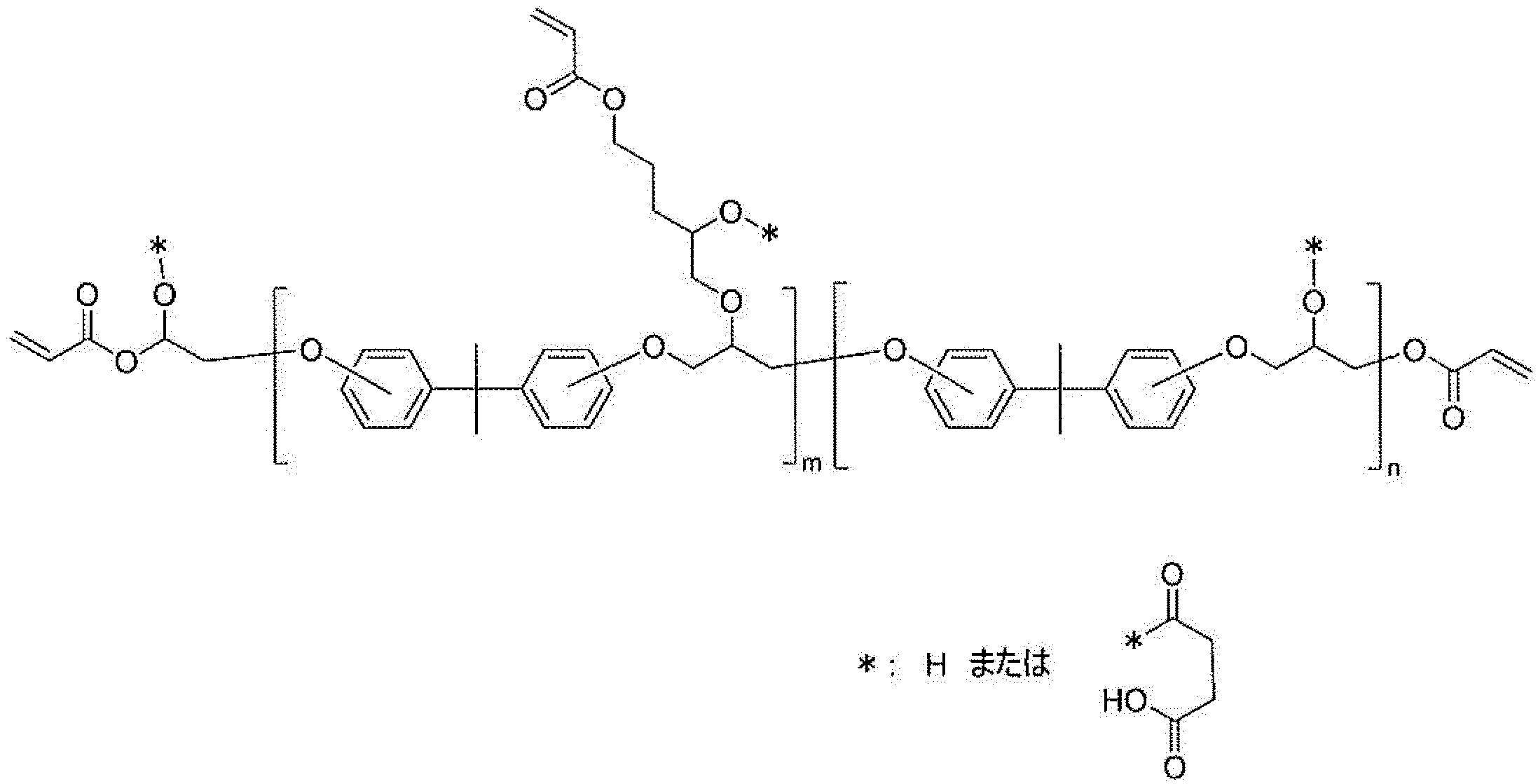
<撥液剤>
b-1:パーフルオロアルキル基を有する構成単位、エチレン性二重結合を有する構成単位、及びカルボキシ基を有する構成単位を有するアクリル共重合樹脂。Mw90000、フッ素原子の含有割合20質量%
b-1:パーフルオロアルキル基を有する構成単位、エチレン性二重結合を有する構成単位、及びカルボキシ基を有する構成単位を有するアクリル共重合樹脂。Mw90000、フッ素原子の含有割合20質量%
<光重合開始剤>
c-1:以下の化学構造を有するオキシムエステル光重合開始剤
c-1:以下の化学構造を有するオキシムエステル光重合開始剤
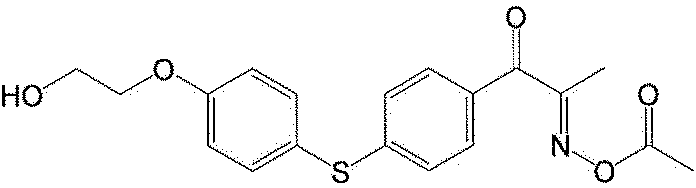
<光重合性化合物>
d-1:共栄社化学社製 多官能モノマー(ライトアクリレートPE―4A)
d-1:共栄社化学社製 多官能モノマー(ライトアクリレートPE―4A)
<連鎖移動剤>
e-1:日本化薬社製 KAYAMER PM-21
e-1:日本化薬社製 KAYAMER PM-21
<紫外線吸収剤>
e-2:精工化学社製 メチルハイドロキノン
e-2:精工化学社製 メチルハイドロキノン
<紫外線吸収剤>
e-3:BASF社製 TINUVIN 384-2
e-3:BASF社製 TINUVIN 384-2
<感光性樹脂組成物の調製>
各成分を表1に記載の配合割合で用い、かつ、感光性樹脂組成物の全固形分が14.5質量%となるように、プロピレングリコールモノメチルエーテルアセテート(PGMEA)とプロピレングリコールモノメチルエーテル(PGME)が80:20の混合比率の溶剤で各成分が均一になるまで撹拌し、実施例1及び比較例1~2の感光性樹脂組成物を調製した。なお、表1中の各成分の配合割合(質量%)は、感光性樹脂組成物の全固形分中における各成分の固形分の値を意味する。
各成分を表1に記載の配合割合で用い、かつ、感光性樹脂組成物の全固形分が14.5質量%となるように、プロピレングリコールモノメチルエーテルアセテート(PGMEA)とプロピレングリコールモノメチルエーテル(PGME)が80:20の混合比率の溶剤で各成分が均一になるまで撹拌し、実施例1及び比較例1~2の感光性樹脂組成物を調製した。なお、表1中の各成分の配合割合(質量%)は、感光性樹脂組成物の全固形分中における各成分の固形分の値を意味する。
<接触角発現露光量評価>
ガラス基板上に、感光性樹脂組成物を加熱硬化後の膜厚が1.0μmとなるようにスピンコーターにて塗布し、1分間減圧乾燥した後に、127℃のホットプレート上で0.3mmの近接方式にて120秒間乾燥した。得られた塗膜に、波長365nmでの強度が500mW/cm2である紫外線を用いて、露光量が20mJ/cm2(装置設定下限値)から100mJ/cm2まで、10mJ/cm2間隔となるように、それぞれの基板に全面露光処理を施した。
ガラス基板上に、感光性樹脂組成物を加熱硬化後の膜厚が1.0μmとなるようにスピンコーターにて塗布し、1分間減圧乾燥した後に、127℃のホットプレート上で0.3mmの近接方式にて120秒間乾燥した。得られた塗膜に、波長365nmでの強度が500mW/cm2である紫外線を用いて、露光量が20mJ/cm2(装置設定下限値)から100mJ/cm2まで、10mJ/cm2間隔となるように、それぞれの基板に全面露光処理を施した。
続いて、2.38質量%のTMAH(水酸化テトラメチルアンモニウム)水溶液からなる現像液を用い、24℃において水圧0.05MPaで60秒間シャワー現像した後、純水にて現像を停止し、水洗スプレーにて洗浄した。
その後、当該基板を230℃のオーブン中で30分間加熱硬化(キュア)させることで接触角評価用基板を得た。
その後、当該基板を230℃のオーブン中で30分間加熱硬化(キュア)させることで接触角評価用基板を得た。
得られた接触角評価用基板上に、PGMEAを滴下したときの接触角を測定し、46°以上の接触角が発現する露光量を検証した。
接触角の測定は協和界面科学社製接触角測定装置DMo-601を用いて、温度23℃湿度50%RHの条件下で行った。接触角評価用基板にPGMEAを1.0μL滴下し、10秒後の接触角を測定した。測定結果を表1に示す。46°以上の接触角が発現した露光量を表1に示す。
接触角の測定は協和界面科学社製接触角測定装置DMo-601を用いて、温度23℃湿度50%RHの条件下で行った。接触角評価用基板にPGMEAを1.0μL滴下し、10秒後の接触角を測定した。測定結果を表1に示す。46°以上の接触角が発現した露光量を表1に示す。
<段差を有する隔壁及び評価>
(隔壁の形成)
ガラス基板上の全面に膜厚8nmのITO、膜厚120nmの銀、膜厚10nmのITOがこの順で蒸着された電極基板の上に、感光性樹脂組成物を加熱硬化後の膜厚が1.0μmとなるようにスピンコーターにて塗布し、1分間減圧乾燥した後に、127℃のホットプレート上で0.3mmの近接方式にて120秒間乾燥した。得られた塗膜に、フォトマスク(開口幅14μmのライン状の完全透過開口部と、14μmの中間透過開口部(Cr酸化物の薄膜で波長365nmにおける光透過率が9%)を持つフォトマスク)を用い、キヤノン社製露光機、MPA-600FAを用いて露光した。露光時の波長365nmにおける強度は500mW/cm2、露光量は接触角発現露光量の+10mJ/cm2、空気下で行った。続いて、2.38質量%のTMAH(水酸化テトラメチルアンモニウム)水溶液からなる現像液を用い、24℃において水圧0.05MPaで60秒間シャワー現像した後、純水にて現像を停止し、水洗スプレーにて洗浄した。これらの操作により、不要な部分が除去されてパターンが形成された基板を、オーブン中で230℃30分間加熱硬化させ、段差を有する隔壁基板を得た。
(隔壁の膜厚測定)
上記段差を有する隔壁基板について、前記完全透過開口部に対応する硬化膜(第1隔壁)、及び前記中間透過開口部に対応する硬化膜(第2隔壁)の膜厚を測定した。測定にはテンコール社製Alpha-Step D-600を用いた。
上記段差を有する隔壁基板について、前記完全透過開口部に対応する硬化膜(第1隔壁)、及び前記中間透過開口部に対応する硬化膜(第2隔壁)の膜厚を測定した。測定にはテンコール社製Alpha-Step D-600を用いた。
(段差の評価)
第1隔壁と第2隔壁の膜厚差(段差、ΔH)を算出し、以下の基準で評価した。その結果を表1に示した。膜厚差が大きいほど、段差形成性能が高いことを表す。段差形成が不十分の場合、第2隔壁の高さが高くなり、充填したインクが第二隔壁を超えられず、塗布不良が生じる。塗布性の観点から第2隔壁の高さは低い方が良いとされるため、下記評価基準を用いて評価した。
A:第2隔壁の高さが0.4μm未満
B:第2隔壁の高さが0.4μm
C:第2隔壁の高さが0.4μmより高い
第1隔壁と第2隔壁の膜厚差(段差、ΔH)を算出し、以下の基準で評価した。その結果を表1に示した。膜厚差が大きいほど、段差形成性能が高いことを表す。段差形成が不十分の場合、第2隔壁の高さが高くなり、充填したインクが第二隔壁を超えられず、塗布不良が生じる。塗布性の観点から第2隔壁の高さは低い方が良いとされるため、下記評価基準を用いて評価した。
A:第2隔壁の高さが0.4μm未満
B:第2隔壁の高さが0.4μm
C:第2隔壁の高さが0.4μmより高い
<インクジェット塗布性適性評価>
(隔壁の形成)
ガラス基板上の全面に膜厚8nmのITO、膜厚120nmの銀、膜厚10nmのITOがこの順で蒸着された電極基板の上に、感光性樹脂組成物を加熱硬化後の膜厚が1.0μmとなるようにスピンコーターにて塗布し、1分間減圧乾燥した後に、127℃のホットプレート上で0.3mmの近接方式にて120秒間乾燥した。得られた塗膜に、フォトマスク(長辺200μm、短辺75μmの楕円状画素領域)を用い、キヤノン社製露光機、MPA-600FAを用いて露光した。露光時の波長365nmにおける強度は、接触角発現露光量の+10mJ/cm2、空気化で行った。続いて、2.38質量%のTMAH(水酸化テトラメチルアンモニウム)水溶液からなる現像液を用い、24℃において水圧0.05MPaで60秒間シャワー現像した後、純水にて現像を停止し、水洗スプレーにて洗浄した。これらの操作により、不要な部分が除去されてパターンが形成された基板を、オーブン中で230℃30分間加熱硬化させ、隔壁基板を得た。
(塗布性評価)
前記隔壁基板の画素領域に対して、富士フイルム社製DMP-2850を用いてインクジェット塗布を行った。インクとしては溶剤(安息香酸イソアミル)を単独で使用し、1画素領域あたり40pLの塗布を15画素に対して行い、画素内のハジキの発生有無で下記の基準で評価した。画素領域内にインクをインクジェット塗布し、塗膜表面に円形状の凹みが形成されたり、ガラス基板の素地が見えるほどの穴を生じたりした場合、ハジキが発生したとみなした。
前記隔壁基板の画素領域に対して、富士フイルム社製DMP-2850を用いてインクジェット塗布を行った。インクとしては溶剤(安息香酸イソアミル)を単独で使用し、1画素領域あたり40pLの塗布を15画素に対して行い、画素内のハジキの発生有無で下記の基準で評価した。画素領域内にインクをインクジェット塗布し、塗膜表面に円形状の凹みが形成されたり、ガラス基板の素地が見えるほどの穴を生じたりした場合、ハジキが発生したとみなした。
(評価基準)
A:全ての画素でハジキが発生しない。
B:ハジキの発生する画素数が50%未満
C:ハジキの発生する画素数が50%以上
A:全ての画素でハジキが発生しない。
B:ハジキの発生する画素数が50%未満
C:ハジキの発生する画素数が50%以上
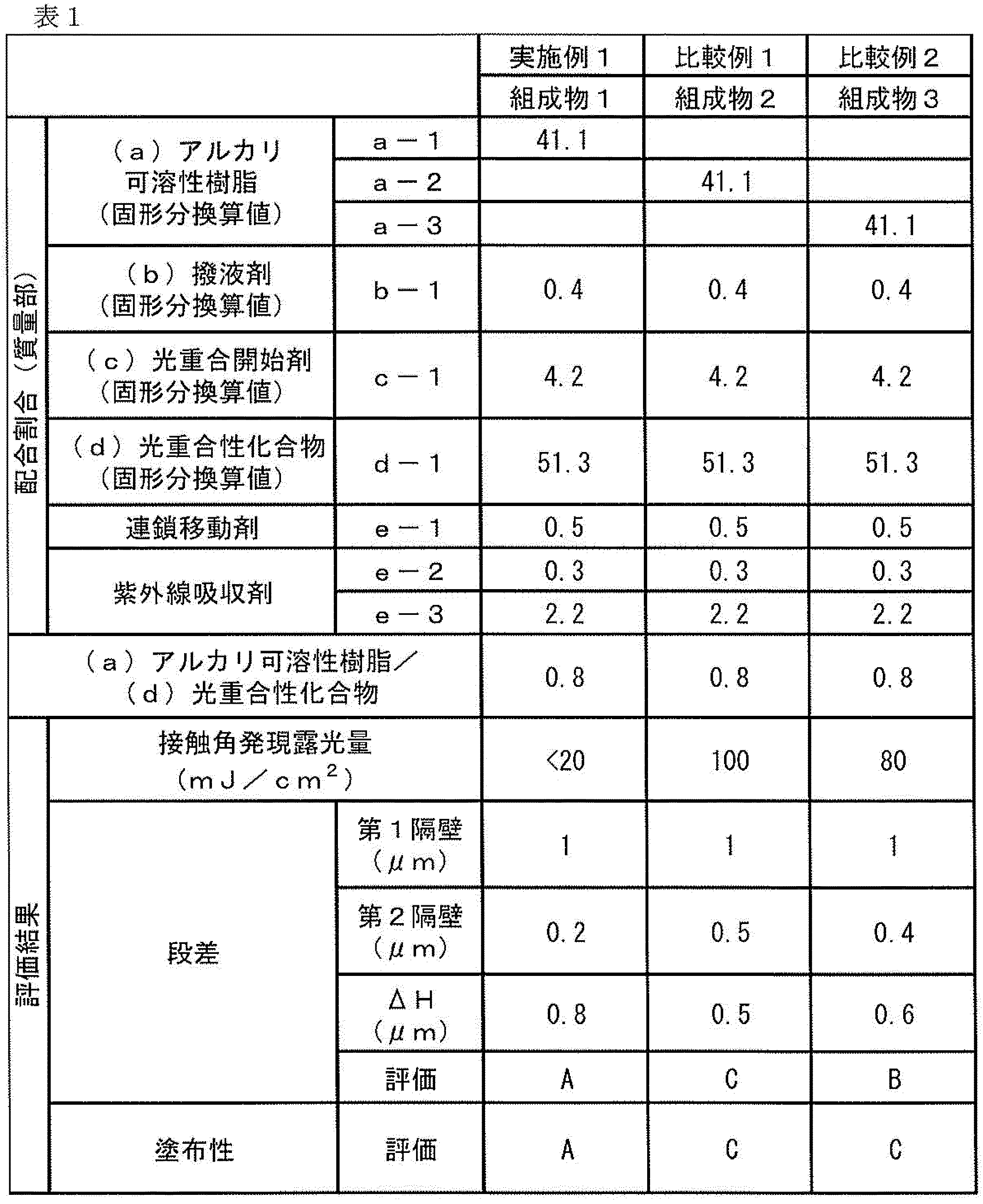
表1から分かるとおり、実施例1は装置設定下限値である20mJ/cm2という非常に低い露光量で撥液性を発現することができた。
それに対し、撥液性を発現するために比較例1では80mJ/cm2、比較例2では100mJ/cm2の露光量が必要であった。
実施例1の感光性樹脂組成物では、露光時の光重合反応に加え、含有するポリアミド-イミド(メタ)アクリレート樹脂(a-1)がアミドイミド構造を有するために熱硬化性が高く、ホットプレートの熱による熱硬化反応も起こるため、低い露光量でも硬化反応が進み、現像時の撥液剤溶出が抑制されたためと考えられる。
それに対し、撥液性を発現するために比較例1では80mJ/cm2、比較例2では100mJ/cm2の露光量が必要であった。
実施例1の感光性樹脂組成物では、露光時の光重合反応に加え、含有するポリアミド-イミド(メタ)アクリレート樹脂(a-1)がアミドイミド構造を有するために熱硬化性が高く、ホットプレートの熱による熱硬化反応も起こるため、低い露光量でも硬化反応が進み、現像時の撥液剤溶出が抑制されたためと考えられる。
また、表1から分かるとおり、実施例1は比較例1~2より大きな段差が形成可能であった。
ポリアミド-イミド(メタ)アクリレート樹脂(a-1)は、アミドイミド構造を有するため、熱反応性が高まり、オーブンでの加熱時の収縮率が上がり、特に光重合反応の弱い中間透過開口部に対応する部分で強い収縮が発生し、大きな段差形成に寄与していると考えられる。
ポリアミド-イミド(メタ)アクリレート樹脂(a-1)は、アミドイミド構造を有するため、熱反応性が高まり、オーブンでの加熱時の収縮率が上がり、特に光重合反応の弱い中間透過開口部に対応する部分で強い収縮が発生し、大きな段差形成に寄与していると考えられる。
さらに、表1から分かるとおり、実施例1は15画素中すべての画素で、ハジキが発生せず、良好な塗布性を示した。一方、比較例1~2は、すべての画素でハジキが確認された。
実施例1の感光性樹脂組成物では、露光時の光重合反応に加え、含有するポリアミド-イミド(メタ)アクリレート樹脂(a-1)がアミドイミド構造を有するために熱硬化性が高く、ホットプレートの熱による熱硬化反応も起こるため、低い露光量でも硬化反応が進み、現像時の画素内への撥液剤溶出が抑制され、撥液剤による画素の汚染が抑制されたためと考えられる。
実施例1の感光性樹脂組成物では、露光時の光重合反応に加え、含有するポリアミド-イミド(メタ)アクリレート樹脂(a-1)がアミドイミド構造を有するために熱硬化性が高く、ホットプレートの熱による熱硬化反応も起こるため、低い露光量でも硬化反応が進み、現像時の画素内への撥液剤溶出が抑制され、撥液剤による画素の汚染が抑制されたためと考えられる。
1 基板
2 段差を有する隔壁
3 画素部
11 第1隔壁の上面
12 第2隔壁の上面
13 段差
2 段差を有する隔壁
3 画素部
11 第1隔壁の上面
12 第2隔壁の上面
13 段差
Claims (12)
- (a)アルカリ可溶性樹脂、(b)撥液剤、(c)光重合開始剤及び(d)光重合性化合物を含有する感光性樹脂組成物であって、
前記(a)アルカリ可溶性樹脂が、下記一般式(1)で表される構造を含むポリアミド-イミド(メタ)アクリレート樹脂(a-1)を含有する、感光性樹脂組成物。
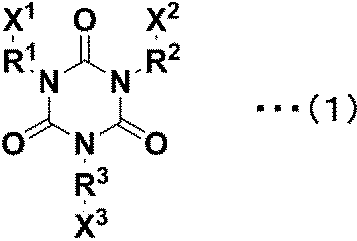
(式(1)中、R1~R3は2価の脂肪族炭化水素基を表す。X1~X3はそれぞれ一般式(2)~(4)のいずれかの構造を表す。)
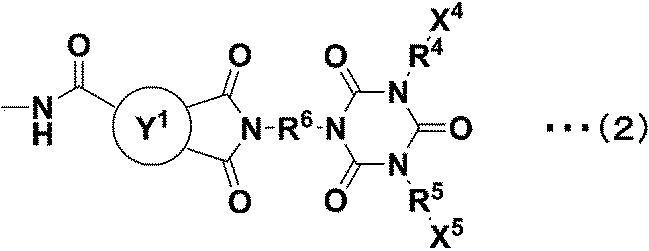
(式(2)中、R4~R6は2価の脂肪族炭化水素基を表す。X4及びX5はそれぞれ一般式(2)~(4)のいずれかの構造を表す。Y1は芳香族炭化水素あるいは脂環式炭化水素を表す。)
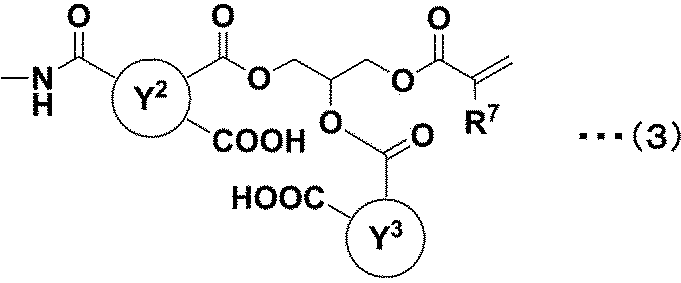
(式(3)中、R7は1価の脂肪族炭化水素基を表す。Y2及びY3はそれぞれ独立して、芳香族炭化水素あるいは脂環式炭化水素を表す。)
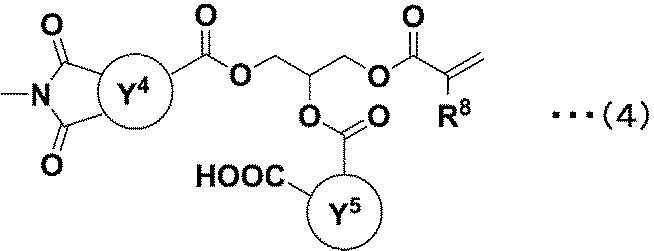
(式(4)中、R8は1価の脂肪族炭化水素基を表す。Y4及びY5はそれぞれ独立して、芳香族炭化水素あるいは脂環式炭化水素を表す。) - 前記(b)撥液剤が、エチレン性不飽和結合基を有する撥液剤(b1)を含む、請求項1に記載の感光性樹脂組成物。
- 前記撥液剤(b1)が、下記一般式(5)で表される繰り返し単位及びフッ素原子を含有するアクリル樹脂(b2)を含むことを特徴とする請求項2に記載の感光性樹脂組成物。
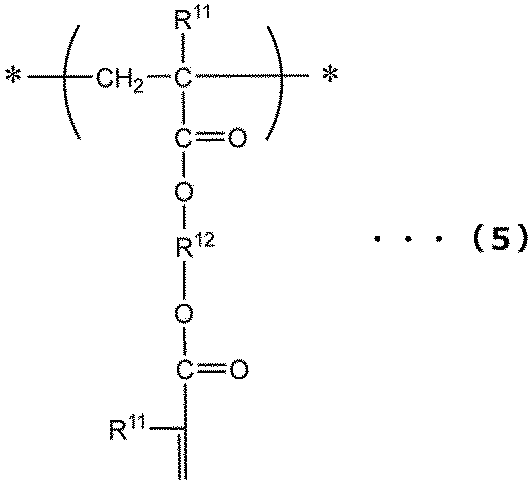
(式(5)中、R11はそれぞれ独立に、水素原子又はメチル基を表し、R12は炭素数2~6のアルキル基を表し、-O-、-CO-、-S-、-NH-のいずれか1つ以上で中断されていてもよい。
*は結合部を表す。) - 前記アクリル樹脂(b2)が、フルオロアルキル基及び/又はフルオロアルキレン基を有する、請求項3に記載の感光性樹脂組成物。
- 前記(d)光重合化合物100質量部に対する、(a)アルカリ可溶性樹脂の含有量が200質量部以下である、請求項1に記載の感光性樹脂組成物。
- 前記ポリアミド-イミド(メタ)アクリレート樹脂(a-1)のゲルパーミエーションクロマトグラフィー(GPC)で測定したポリスチレン換算の重量平均分子量(Mw)が1000以上10000以下である、請求項1に記載の感光性樹脂組成物。
- 隔壁形成用である、請求項1~6のいずれか1項に記載の感光性樹脂組成物。
- フォトリソグラフィー法により段差を有する隔壁を一括形成するために用いられる、請求項7に記載の感光性樹脂組成物。
- 請求項1~6のいずれか1項に記載の感光性樹脂組成物を硬化させてなる、硬化物。
- 請求項1~6のいずれか1項に記載の感光性樹脂組成物を硬化させた隔壁。
- 請求項10に記載の隔壁を備える有機電界発光素子。
- 請求項11に記載の有機電界発光素子を含む画像表示装置。
Priority Applications (3)
| Application Number | Priority Date | Filing Date | Title |
|---|---|---|---|
| CN202480062071.6A CN121925595A (zh) | 2023-10-05 | 2024-10-04 | 感光性树脂组合物、固化物、间隔壁、有机电致发光元件、以及图像显示装置 |
| KR1020267009087A KR20260089455A (ko) | 2023-10-05 | 2024-10-04 | 감광성 수지 조성물, 경화물, 격벽, 유기 전계 발광 소자 및 화상 표시 장치 |
| JP2025550375A JPWO2025075166A1 (ja) | 2023-10-05 | 2024-10-04 |
Applications Claiming Priority (2)
| Application Number | Priority Date | Filing Date | Title |
|---|---|---|---|
| JP2023-173354 | 2023-10-05 | ||
| JP2023173354 | 2023-10-05 |
Publications (1)
| Publication Number | Publication Date |
|---|---|
| WO2025075166A1 true WO2025075166A1 (ja) | 2025-04-10 |
Family
ID=95283473
Family Applications (1)
| Application Number | Title | Priority Date | Filing Date |
|---|---|---|---|
| PCT/JP2024/035666 Ceased WO2025075166A1 (ja) | 2023-10-05 | 2024-10-04 | 感光性樹脂組成物、硬化物、隔壁、有機電界発光素子及び画像表示装置 |
Country Status (4)
| Country | Link |
|---|---|
| JP (1) | JPWO2025075166A1 (ja) |
| KR (1) | KR20260089455A (ja) |
| CN (1) | CN121925595A (ja) |
| WO (1) | WO2025075166A1 (ja) |
Citations (4)
| Publication number | Priority date | Publication date | Assignee | Title |
|---|---|---|---|---|
| JP2017146426A (ja) * | 2016-02-16 | 2017-08-24 | 株式会社Dnpファインケミカル | カラーフィルタ用着色樹脂組成物、カラーフィルタ、及び表示装置 |
| JP2021124704A (ja) * | 2020-02-10 | 2021-08-30 | 三菱ケミカル株式会社 | 感光性着色樹脂組成物、硬化物、隔壁及び画像表示装置 |
| WO2022264934A1 (ja) * | 2021-06-14 | 2022-12-22 | 東レ株式会社 | 感光性樹脂組成物、硬化物及び硬化物の製造方法並びに表示装置 |
| JP2023055623A (ja) * | 2021-10-06 | 2023-04-18 | 日本化薬株式会社 | 着色感光性組成物、硬化物、硬化物を備える画像表示装置 |
Family Cites Families (1)
| Publication number | Priority date | Publication date | Assignee | Title |
|---|---|---|---|---|
| JP2022047006A (ja) | 2020-09-11 | 2022-03-24 | 東レ株式会社 | 感光性樹脂組成物、硬化物、表示装置、および表示装置の製造方法 |
-
2024
- 2024-10-04 JP JP2025550375A patent/JPWO2025075166A1/ja active Pending
- 2024-10-04 WO PCT/JP2024/035666 patent/WO2025075166A1/ja not_active Ceased
- 2024-10-04 CN CN202480062071.6A patent/CN121925595A/zh active Pending
- 2024-10-04 KR KR1020267009087A patent/KR20260089455A/ko active Pending
Patent Citations (4)
| Publication number | Priority date | Publication date | Assignee | Title |
|---|---|---|---|---|
| JP2017146426A (ja) * | 2016-02-16 | 2017-08-24 | 株式会社Dnpファインケミカル | カラーフィルタ用着色樹脂組成物、カラーフィルタ、及び表示装置 |
| JP2021124704A (ja) * | 2020-02-10 | 2021-08-30 | 三菱ケミカル株式会社 | 感光性着色樹脂組成物、硬化物、隔壁及び画像表示装置 |
| WO2022264934A1 (ja) * | 2021-06-14 | 2022-12-22 | 東レ株式会社 | 感光性樹脂組成物、硬化物及び硬化物の製造方法並びに表示装置 |
| JP2023055623A (ja) * | 2021-10-06 | 2023-04-18 | 日本化薬株式会社 | 着色感光性組成物、硬化物、硬化物を備える画像表示装置 |
Also Published As
| Publication number | Publication date |
|---|---|
| CN121925595A (zh) | 2026-04-24 |
| KR20260089455A (ko) | 2026-06-15 |
| JPWO2025075166A1 (ja) | 2025-04-10 |
Similar Documents
| Publication | Publication Date | Title |
|---|---|---|
| JP7294146B2 (ja) | 着色感光性樹脂組成物、隔壁、有機電界発光素子、画像表示装置及び照明 | |
| JP7205089B2 (ja) | 感光性樹脂組成物、隔壁、有機電界発光素子、画像表示装置及び照明 | |
| KR102451212B1 (ko) | 유기 전계 발광 소자 격벽 형성용 감광성 수지 조성물, 격벽, 유기 전계 발광 소자, 화상 표시 장치 및 조명 | |
| TWI772604B (zh) | 感光性樹脂組成物、分隔壁、有機電致發光元件、影像顯示裝置及照明 | |
| TW202239773A (zh) | 感光性樹脂組合物、硬化物、阻隔壁、有機電致發光元件、彩色濾光器及圖像顯示裝置 | |
| JP7040089B2 (ja) | 隔壁形成用感光性樹脂組成物、隔壁、有機電界発光素子、画像表示装置及び照明 | |
| JP7236209B2 (ja) | 隔壁形成用感光性樹脂組成物、隔壁、有機電界発光素子、画像表示装置及び照明 | |
| CN121925595A (zh) | 感光性树脂组合物、固化物、间隔壁、有机电致发光元件、以及图像显示装置 | |
| TW202323307A (zh) | 感光性樹脂組合物、硬化物、阻隔壁、有機電致發光元件、及圖像顯示裝置 | |
| JP7803132B2 (ja) | 感光性樹脂組成物、隔壁、有機電界発光素子、及び画像表示装置 | |
| JP7652335B2 (ja) | 感光性樹脂組成物、硬化物及び画像表示装置 | |
| WO2025187597A1 (ja) | 感光性樹脂組成物、硬化物、隔壁、有機電界発光素子、及び画像表示装置 | |
| WO2022210497A1 (ja) | 着色感光性樹脂組成物、硬化物、隔壁、カラーフィルタ及び画像表示装置 | |
| WO2022209771A1 (ja) | 着色感光性樹脂組成物、硬化物、隔壁、有機電界発光素子、発光性ナノ結晶粒子を含むカラーフィルタ及び画像表示装置 | |
| WO2024154752A1 (ja) | 感光性樹脂組成物、硬化物、カラーフィルター、光散乱層及び画像表示装置 | |
| CN117136333A (zh) | 着色感光性树脂组合物、固化物、间隔壁、滤色片及图像显示装置 | |
| JP2018018036A (ja) | 隔壁形成用感光性樹脂組成物、隔壁、有機電界発光素子、画像表示装置及び照明 | |
| JP2017116659A (ja) | 保護膜用硬化性組成物、保護膜、tftアクティブマトリックス基板、及び画像表示装置 |
Legal Events
| Date | Code | Title | Description |
|---|---|---|---|
| 121 | Ep: the epo has been informed by wipo that ep was designated in this application |
Ref document number: 24874765 Country of ref document: EP Kind code of ref document: A1 |
|
| ENP | Entry into the national phase |
Ref document number: 2025550375 Country of ref document: JP Kind code of ref document: A |
|
| WWE | Wipo information: entry into national phase |
Ref document number: 2025550375 Country of ref document: JP |
|
| NENP | Non-entry into the national phase |
Ref country code: DE |