WO2025075009A1 - 細胞接触用溶液又はそのゲル - Google Patents
細胞接触用溶液又はそのゲル Download PDFInfo
- Publication number
- WO2025075009A1 WO2025075009A1 PCT/JP2024/035135 JP2024035135W WO2025075009A1 WO 2025075009 A1 WO2025075009 A1 WO 2025075009A1 JP 2024035135 W JP2024035135 W JP 2024035135W WO 2025075009 A1 WO2025075009 A1 WO 2025075009A1
- Authority
- WO
- WIPO (PCT)
- Prior art keywords
- gel
- cell
- solution
- cells
- cell contact
- Prior art date
- Legal status (The legal status is an assumption and is not a legal conclusion. Google has not performed a legal analysis and makes no representation as to the accuracy of the status listed.)
- Ceased
Links
Images

Classifications
-
- C—CHEMISTRY; METALLURGY
- C12—BIOCHEMISTRY; BEER; SPIRITS; WINE; VINEGAR; MICROBIOLOGY; ENZYMOLOGY; MUTATION OR GENETIC ENGINEERING
- C12M—APPARATUS FOR ENZYMOLOGY OR MICROBIOLOGY; APPARATUS FOR CULTURING MICROORGANISMS FOR PRODUCING BIOMASS, FOR GROWING CELLS OR FOR OBTAINING FERMENTATION OR METABOLIC PRODUCTS, i.e. BIOREACTORS OR FERMENTERS
- C12M1/00—Apparatus for enzymology or microbiology
- C12M1/34—Measuring or testing with condition measuring or sensing means, e.g. colony counters
-
- C—CHEMISTRY; METALLURGY
- C12—BIOCHEMISTRY; BEER; SPIRITS; WINE; VINEGAR; MICROBIOLOGY; ENZYMOLOGY; MUTATION OR GENETIC ENGINEERING
- C12M—APPARATUS FOR ENZYMOLOGY OR MICROBIOLOGY; APPARATUS FOR CULTURING MICROORGANISMS FOR PRODUCING BIOMASS, FOR GROWING CELLS OR FOR OBTAINING FERMENTATION OR METABOLIC PRODUCTS, i.e. BIOREACTORS OR FERMENTERS
- C12M3/00—Tissue, human, animal or plant cell, or virus culture apparatus
-
- C—CHEMISTRY; METALLURGY
- C12—BIOCHEMISTRY; BEER; SPIRITS; WINE; VINEGAR; MICROBIOLOGY; ENZYMOLOGY; MUTATION OR GENETIC ENGINEERING
- C12N—MICROORGANISMS OR ENZYMES; COMPOSITIONS THEREOF; PROPAGATING, PRESERVING, OR MAINTAINING MICROORGANISMS; MUTATION OR GENETIC ENGINEERING; CULTURE MEDIA
- C12N5/00—Undifferentiated human, animal or plant cells, e.g. cell lines; Tissues; Cultivation or maintenance thereof; Culture media therefor
- C12N5/10—Cells modified by introduction of foreign genetic material
-
- C—CHEMISTRY; METALLURGY
- C12—BIOCHEMISTRY; BEER; SPIRITS; WINE; VINEGAR; MICROBIOLOGY; ENZYMOLOGY; MUTATION OR GENETIC ENGINEERING
- C12Q—MEASURING OR TESTING PROCESSES INVOLVING ENZYMES, NUCLEIC ACIDS OR MICROORGANISMS; COMPOSITIONS OR TEST PAPERS THEREFOR; PROCESSES OF PREPARING SUCH COMPOSITIONS; CONDITION-RESPONSIVE CONTROL IN MICROBIOLOGICAL OR ENZYMOLOGICAL PROCESSES
- C12Q1/00—Measuring or testing processes involving enzymes, nucleic acids or microorganisms; Compositions therefor; Processes of preparing such compositions
- C12Q1/02—Measuring or testing processes involving enzymes, nucleic acids or microorganisms; Compositions therefor; Processes of preparing such compositions involving viable microorganisms
Definitions
- the present invention relates to a solution for cell contact or a gel thereof.
- Patent Document 1 discloses the use of cells expressing modified olfactory receptors and lipid bilayer membranes containing modified olfactory receptors as odor sensors.
- Odor sensors which involve a process for artificially preparing a lipid bilayer membrane equipped with sensor proteins such as olfactory receptors, do not necessarily have sufficient manufacturing efficiency, and so there is a demand for further improvements in the manufacturing efficiency of odor sensors. Therefore, the inventors focused on using cells that express sensor proteins. In the course of conducting research based on this, the inventors found that there are differences in the detectability of chemical substances such as odorants, particularly the detectability of chemical substances after the cells have been stored in a refrigerator, depending on the type of component that is brought into contact with the cells.
- the objective of this disclosure is to provide a cell contact solution or gel thereof that can improve the detectability of chemical substances such as odorants.
- the present inventors have conducted extensive research and have found that the above problems can be solved by a cell contact solution or gel thereof that contains unsaturated fatty acids. That is, the present disclosure includes the following aspects. That is, the present invention includes the following aspects.
- Item 1 A solution or gel for cell contact that contains unsaturated fatty acids.
- Item 2 The cell contact solution or gel thereof according to Item 1, wherein the concentration of the unsaturated fatty acid is 10 to 1000 ⁇ M.
- Item 3 The cell contact solution or gel thereof according to Item 1, wherein the concentration of the unsaturated fatty acid is 50 ⁇ M or more.
- Item 4 The cell contact solution or gel thereof according to Item 1, wherein the melting point of the unsaturated fatty acid is 0°C or lower.
- Item 5 A cell contact solution or gel thereof according to Item 1, containing cell culture medium components.
- Item 6 The cell contact solution or gel thereof according to Item 5, wherein the cell culture medium components include albumin.
- Item 7 A cell contact solution or gel thereof according to any one of items 1 to 6, which is a cell preservation solution, a cell treatment solution, or a cell culture medium.
- Item 8 The cell contact solution or gel thereof described in Item 7, which is a cell maintenance medium.
- Item 9 A cell contact solution or gel thereof according to any one of items 1 to 6, which is used for refrigerated storage or for contact with cells that have been stored in a refrigerator.
- Item 10 A solution or gel thereof for cell contact according to any one of items 1 to 6, wherein the cells contain an exogenous polynucleotide that includes a coding sequence for a sensor protein.
- Item 11 The cell contact solution or gel thereof according to Item 9, wherein the sensor protein is an olfactory receptor protein.
- Item 12 A cell contact solution or gel thereof according to any one of items 1 to 6, used for contacting cells to be used in measuring the chemical response activity of a sensor protein.
- Item 13 The cell contact solution or gel thereof according to any one of items 1 to 6, wherein the cells are insect cells.
- Item 14 A cell chip comprising a compartment containing cells and the cell contact solution or gel thereof described in any one of Items 1 to 6.
- Item 15 A method for improving chemical response activity of a sensor protein in a cell, comprising contacting the cell with an unsaturated fatty acid.
- Item 16 An agent for improving the chemical response activity of a cellular sensor protein, which contains unsaturated fatty acids.
- improving the detectability of a chemical substance does not only mean that the detectability of the chemical substance is higher than before contact with the cell contact solution or gel, but also includes suppressing the degree of decrease in detectability or maintaining the detectability when the detectability of the chemical substance tends to decrease.
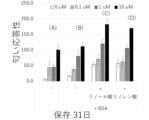
- the results of olfactory receptor activity measurement in Test Example 2 are shown.
- the vertical axis indicates fluorescence intensity.
- the horizontal axis indicates the components added to the medium ((A) no addition (-), (B) 0.7% BSA (+BSA), (C) 0.7% BSA, 250 ⁇ M linoleic acid (+BSA + linoleic acid), (D) 0.7% BSA, 250 ⁇ M linolenic acid (+BSA + linolenic acid)).
- the legend indicates the concentration of compound a.
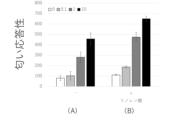
- the results of measuring olfactory receptor activity in Test Example 3 are shown.
- the vertical axis indicates fluorescence intensity.
- the horizontal axis indicates the components added to the medium ((A) no addition (-), (B) 0.7% BSA, 250 ⁇ M linolenic acid (+ linolenic acid)).
- the legend indicates the concentration of compound a (unit: ⁇ M).
- the results of olfactory receptor activity measurement in Test Example 4 are shown.
- the vertical axis indicates fluorescence intensity.
- the horizontal axis indicates the components added to the medium ((A) none added (-), (B) 0.7% BSA, 250 ⁇ M linoleic acid, 250 ⁇ M linolenic acid (+ fatty acid)) and storage period.
- the legend indicates the concentration of compound a (unit: ⁇ M).
- the present disclosure relates to a solution or gel thereof for cell contact that contains unsaturated fatty acids (sometimes referred to herein as the "solution/gel of the present disclosure”). This is described below.
- the solution/gel of the present disclosure is a liquid (the solution of the present disclosure) or a gel (the gel of the present disclosure).
- the gel of the present disclosure is obtained by gelling the solution of the present disclosure.
- Unsaturated fatty acids are fatty acids with one or more unsaturated carbon bonds and have the general formula (1):
- R1 represents a linear unsaturated hydrocarbon group. It is a compound represented by the formula:
- the number of carbon atoms in the chain unsaturated hydrocarbon group of the unsaturated fatty acid is not particularly limited, and is, for example, 3 to 29. From the viewpoint of the effect of unsaturated fatty acids in improving the detectability of chemical substances, the number of carbon atoms is preferably 7 or more, more preferably 11 or more, even more preferably 13 or more, even more preferably 15 or more, particularly preferably 16 or more, and is preferably 27 or less, more preferably 25 or less, even more preferably 23 or less, even more preferably 21 or less, particularly preferably 19 or less.
- the chain unsaturated hydrocarbon group may be either linear or branched, but is preferably linear from the viewpoint of the effect of unsaturated fatty acids in improving the detectability of chemical substances.
- the unsaturated fatty acid has a melting point of 0°C or lower and/or has two or more double bonds between carbon atoms.
- the melting point is preferably -1°C or lower, more preferably -2°C or lower, even more preferably -3°C or lower, even more preferably -4°C or lower, and particularly preferably -5°C or lower.
- the number of double bonds in the unsaturated fatty acid is preferably 2 to 6, more preferably 2 to 5, even more preferably 2 to 4, and even more preferably 2 to 3.
- unsaturated fatty acids include the following:
- Monounsaturated fatty acids crotonic acid, myristoleic acid, palmitoleic acid, sapienic acid, oleic acid, elaidic acid, vaccenic acid, gadoleic acid, eicosenoic acid, erucic acid, nervonic acid;
- Diunsaturated fatty acids linoleic acid, eicosadienoic acid, docosadienoic acid;
- Triunsaturated fatty acids linoleic acid, pinoleic acid, eleostearic acid, mead acid, dihomo-gamma-linolenic acid, eicosatrienoic acid; Tetraunsaturated fatty acids: stearidonic acid, arachidonic acid, eicosatetraenoic acid, adrenic acid; Pentaunsaturated fatty acids: bosseopentaenoic acid, eicosapentaenoic acid,
- the concentration of the unsaturated fatty acid in the solution/gel of the present disclosure is not particularly limited, and can be, for example, 10 ⁇ M or more. From the viewpoint of the effect of unsaturated fatty acids in improving the detectability of chemical substances, the concentration is preferably 20 ⁇ M or more, more preferably 30 ⁇ M or more, even more preferably 50 ⁇ M or more, even more preferably 70 ⁇ M or more, particularly preferably 100 ⁇ M or more, especially more preferably 150 ⁇ M or more, especially more preferably 200 ⁇ M or more, and especially more preferably 220 ⁇ M or more. In addition, the concentration is, for example, 2000 ⁇ M or less, 1500 ⁇ M or less, 1000 ⁇ M or less, 500 ⁇ M or less, 400 ⁇ M or less, or 300 ⁇ M or less.
- the unsaturated fatty acids may be one type alone or two or more types in combination.
- the solution/gel of the present disclosure preferably contains cell culture medium components from the viewpoint of reducing damage to cells (particularly damage during storage). There are no particular limitations on the cell culture medium components, so long as they are contained in the cell culture medium.
- the medium usually contains a carbon source and inorganic salts that can be assimilated by the cells.
- the medium may also contain a nitrogen source.
- the carbon source may be anything that can be assimilated by the cells, for example, carbohydrates such as glucose, fructose, sucrose, and molasses containing these, starch, and starch hydrolysates, organic acids such as acetic acid and propionic acid, and alcohols such as ethanol and propanol.
- Nitrogen sources that can be used include, for example, ammonia, ammonium chloride, ammonium sulfate, ammonium acetate, ammonium phosphate, and other ammonium salts of inorganic or organic acids, as well as other nitrogen-containing compounds, as well as peptone, meat extract, yeast extract, corn steep liquor, casein hydrolysate, soybean meal and soybean meal hydrolysate, various fermentation bacteria and their digested products.
- inorganic salts examples include potassium dihydrogen phosphate, potassium dihydrogen phosphate, magnesium phosphate, magnesium sulfate, sodium chloride, ferrous sulfate, manganese sulfate, copper sulfate, and calcium carbonate.
- media for insect cell culture include TNM-FH medium (Pharmingen), Sf-900 III SFM medium (Life Technologies), ExCell400, ExCell405 (both JRH Biosciences), and Grace's Insect Medium (Nature, 195, 788 (1962)).
- the solution/gel of the present disclosure preferably contains albumin in order to improve the solubility of the unsaturated fatty acid.
- albumin examples include serum albumin, egg albumin, milk albumin, etc.
- a representative albumin used is BSA (bovine serum albumin).
- the albumin concentration in the solution/gel of the present disclosure is preferably 0.01 to 5 mass%, more preferably 0.05 to 3 mass%, even more preferably 0.1 to 2 mass%, and even more preferably 0.2 to 1.5 mass%, from the viewpoint of the solubility of unsaturated fatty acids, etc.
- the cell culture medium components may be one type alone or a combination of two or more types.
- the solvent of the solution/gel of the present disclosure is not particularly limited as long as it does not significantly adversely affect cell viability.
- the solvent preferably contains water.
- the water content in the solvent is preferably 50% by mass or more, more preferably 70% by mass or more, even more preferably 80% by mass or more, even more preferably 85% by mass or more, particularly preferably 90% by mass or more, and especially preferably 95% by mass or more.
- the gel of the present disclosure is preferably one that can be converted into a sole.
- converting into a sole it is believed that high diffusibility of the substance to be detected is ensured, enabling rapid and stable measurement.
- the substance can be easily removed, making it possible to replace it with a solution that has better diffusibility of the substance to be detected.
- compositions that form a gel that can be converted into a sol are not particularly limited, but examples include gelatin; polysaccharides such as agar, carrageenan, starch, and xanthan gum; and water-soluble synthetic polymers such as PVA and PEG.
- gelatin is particularly preferred from the viewpoint of ease of expressing the above-mentioned desirable properties.
- Gelatin is obtained by pretreating collagen raw materials such as cow bones, cowhide, pig bones, pig skin, and fish scales with an acid or alkali, washing with water, extracting with hot water, purifying, concentrating and drying.
- sol properties and gel properties of gelatin vary depending on the type of collagen raw material, pretreatment, hot water extraction conditions, etc.
- sol temperature sol-gel transition temperature, sol viscosity, and gel elasticity desired for the present invention
- fish-derived gelatin fish gelatin
- sol properties and gel properties suitable for the present invention can be obtained by appropriately adjusting the pretreatment and hot water extraction conditions.
- the gel-forming component may be a single type or a combination of two or more types.
- the solution/gel disclosed herein is used for contact with cells. Although it is not intended to be a limiting interpretation, it is believed that the structure of the sensor protein is stabilized by the unsaturated fatty acid coming into contact with the sensor protein on the cell surface and/or being incorporated as a cell membrane component, thereby improving the detectability of chemical substances.
- the manner of contact is not particularly limited.
- the solution/gel of the present disclosure may be in contact with a cell layer, or cells may be dispersed in the solution/gel of the present disclosure.
- the solution/gel of the present disclosure can be, for example, a cell preservation solution, a cell treatment solution, or a cell culture medium.
- the cell preservation liquid is for use in refrigerated storage.
- the temperature for refrigerated storage is, for example, 10°C or lower, or 6°C or lower.
- the period of refrigerated storage can be, for example, 5 days or more, 10 days or more, 15 days or more, 20 days or more, 25 days or more, 30 days or more, 40 days or more, 50 days or more, 60 days or more, or 70 days or more, and can be 200 days or less, 150 days or less, or 100 days or less.
- the cells can be cultured at a predetermined temperature (for example, 20°C or 25°C) or higher.
- the cell treatment solution is a solution for temporary treatment of cells, and is not particularly limited in that respect.
- the treatment time can be, for example, 30 minutes or more, 1 hour or more, 2 hours or more, 4 hours or more, or 8 hours or more, and can be 16 hours or less, or 12 hours or less.
- the cell culture medium is a cell maintenance medium.
- the cell maintenance medium There are no particular limitations on the cell maintenance medium, so long as it does not require cell proliferation and is intended to keep cells alive.
- the solution/gel of the present disclosure is used for contacting cells that are or have been subjected to refrigerated storage.
- Refrigerated storage tends to reduce the detectability of chemical substances in cells, but by contacting cells with the solution/gel of the present disclosure, this reduction phenomenon can be suppressed, and it is also possible to increase the detectability of chemical substances compared to before refrigerated storage.
- the solution/gel disclosed herein is used to contact cells to be used to measure the chemical response activity of a sensor protein.
- the cells are not particularly limited. From the viewpoint of suitability for detection of chemical substances, animal cells such as insect cells and mammalian cells are preferred, and insect cells are particularly preferred from the viewpoint of suitability for use in the solution/gel of the present disclosure and ease of management such as no need for CO2 or temperature management.
- insect cells examples include Sf cells, MG1 cells, High Five TM cells, and BmN cells.
- Sf cells include Sf9 cells (ATCC CRL1711) and Sf21 cells.
- insect cells cells derived from insects of the family Arctiidae are particularly preferred.
- the cells preferably contain an exogenous polynucleotide that includes a coding sequence for a sensor protein. This allows any sensor protein to be expressed, and also increases the expression level of the target sensor protein, thereby improving the detection sensitivity of the target chemical substance.
- An exogenous polynucleotide is a polynucleotide that contains a base sequence that is not derived from the genomic DNA (particularly chromosomal genomic DNA) of an insect cell, and is not particularly limited in that respect.
- the sensor protein may be selected from proteins capable of detecting the presence of a chemical substance, and may be, for example, a receptor protein that uses a chemical substance as a ligand.
- the sensor protein is preferably an olfactory receptor protein, and is particularly preferably an insect olfactory receptor protein.
- Insect olfactory receptor proteins are membrane proteins with seven transmembrane structures, and act as odor sensors in living organisms. From the amino terminus (hereinafter sometimes referred to as the "N terminus”) to the carboxyl terminus (hereinafter sometimes referred to as the "C terminus") of the olfactory receptor protein, they are composed of the N-terminal region (NT), the first transmembrane domain (TM1), the first extracellular loop (EC1), the second transmembrane domain (TM2), the first intracellular loop (IC1), the third transmembrane domain (TM3), the second extracellular loop (EC2), the fourth transmembrane domain (TM4), the second intracellular loop (IC2), the fifth transmembrane domain (TM5), the third extracellular loop (EC3), the sixth transmembrane domain (TM6), the third intracellular loop (IC3), the seventh transmembrane domain (TM7), and the C-terminal region (CT).
- N terminus the amino termin
- each region is determined by structure prediction (default conditions) using TMpred (K. Hofmann, W. Stoffel, TMbase - a database of membrane spanning proteins segments, Biol. Chem. Hoppe-Seyler, 374 (1993), p. 166, https://embnet.vital-it.ch/software/TMPRED_form.html).
- TMpred K. Hofmann, W. Stoffel, TMbase - a database of membrane spanning proteins segments, Biol. Chem. Hoppe-Seyler, 374 (1993), p. 166, https://embnet.vital-it.ch/software/TMPRED_form.html.
- Insects from which insect olfactory receptor proteins are derived are preferably dipteran insects such as Culicidae and Drosophilidae; lepidopteran insects such as Bombycidae; Hymenopteran insects such as Apidae; Orthopteran insects such as Acrididae; Hemiptera insects such as Bedbug; and more preferably dipteran insects such as Culicidae and Drosophilidae; Orthopteran insects such as Acrididae; Hemiptera insects such as Bedbug.
- Culicidae insects include Anopheles gambiae, Aedes aegypti, and Culex quinquefasciatus.
- insects in the Drosophilidae family include the fruit fly (Drosophila melanogaster), the light brown fruit fly (Drosophila pseudoobscura), and the black fruit fly (Drosophila virillis).
- Examples of insects in the Bombycidae family include the silk moth (Bombyx mori), the mulberry silk moth (Bombyx mandarina), and the fig cassock (Trilocha varians).
- Examples of insects in the Apidae family include the European honeybee (Apis mellifera), the swarm honeybee (Apis florea), the giant honeybee (Apis dorsata), and the European bumblebee (Bombus terrestris).
- Examples of insects in the Acrididae family include the migratory locust (Locusta migratoria), and examples of insects in the Cimex family include the bedbug (Cimex lectularius).
- wild-type insect olfactory receptor proteins include AaOR1, AaOR2, AaOR4, AaOR5, AaOR6, AaOR8, AaOR9, AaOR10a, AaOR15, AaOR22, AaOR24, AaOR25, AaOR26, AaOR27, AaOR28, AaOR30, AaOR34, AaOR36, AaOR38, AaOR41a, AaOR41b, AaOR42, AaOR43, AaOR44, AaOR45, AaOR46, AaOR47, AaOR48, AaOR49, AaOR50, AaOR51, AaOR52, AaOR53, AaOR54, AaOR55, AaOR56, AaOR57, AaOR58, AaOR59, AaOR60, AaOR61, AaOR62, AaOR63, AaOR64, AaOR65, AaOR66, AaOR67, AaOR68, AaOR
- OR indicates odorant receptor
- Dm indicates that it is derived from Drosophila melanogaster
- Bm indicates that it is derived from Bombyx mori
- Ag indicates that it is derived from Anopheles gambiae
- Aa indicates that it is derived from Aedes aegypti.
- the amino acid sequences and coding sequences of various olfactory receptor proteins including these are publicly known or can be easily identified by sequence identity searches based on the publicly known sequences.
- the sensor protein may contain amino acid mutations relative to the wild-type amino acid sequence, so long as the chemical response activity is not significantly reduced. "Not significantly reduced” means, for example, that the chemical response activity of the sensor protein containing amino acid mutations is, for example, 50% or more, preferably 60% or more, more preferably 70% or more, even more preferably 80% or more, and even more preferably 90% or more, relative to 100% of the chemical response activity of the wild-type sensor protein.
- the amino acid mutation may be, for example, an amino acid substitution, insertion, addition, or deletion, preferably a substitution, and particularly preferably a conservative substitution.
- the sensor protein can include a wild-type amino acid sequence, or an amino acid sequence that has, for example, 70% or more identity to the wild-type amino acid sequence, preferably 80% or more, more preferably 90% or more, even more preferably 95% or more, even more preferably 98% or more, and particularly preferably 99% or more identity.
- chemical response activity refers to the property that a sensor protein recognizes a chemical substance and the sensor protein alone or in conjunction with other proteins exhibits signal transduction activity (e.g., ion channel activity).
- the sensor protein is an olfactory receptor, it may be a G protein-coupled receptor or an ion channel receptor.
- the chemical response activity refers to the property that the olfactory receptor recognizes a chemical substance, and the olfactory receptor complex formed by the olfactory receptor and the olfactory receptor co-receptor is activated to exhibit ion channel activity.
- the chemical response activity of a sensor protein can be measured using the signal transduction activity of the sensor protein in contact with a chemical substance as an index (e.g., by quantifying and evaluating the amount of signal molecules).
- the chemical response activity of the olfactory receptor can be measured using the ion channel activity of the olfactory receptor complex formed by the olfactory receptor in contact with a chemical substance as an index.
- a chemical substance is contacted with cells expressing proteins that emit fluorescence or luminescence in response to ions (such as calcium ions) that flow into the cells when (a) the olfactory receptor, (b) the olfactory receptor co-receptor, and (c) the olfactory receptor complex respond, and the amount of fluorescence or luminescence from the cells is measured.
- ions such as calcium ions
- the measurement can be performed according to the method described in Patent Document 1.
- the coding sequence of the sensor protein is not particularly limited, so long as it is a base sequence that codes for the sensor protein.
- the exogenous polynucleotide includes an expression cassette for the sensor protein.
- the expression cassette is not particularly limited, so long as it is a polynucleotide that can express the sensor protein in the cell.
- a typical example of an expression cassette for a sensor protein is a polynucleotide that includes a promoter and a coding sequence for the sensor protein that is placed under the control of the promoter.
- the exogenous polynucleotide preferably contains a coding sequence for an insect olfactory receptor co-receptor.
- the insect olfactory receptor co-receptor is a membrane protein having a seven-transmembrane structure similar to the olfactory receptor, and functions by forming a heterocomplex with the olfactory receptor.
- the olfactory receptor complex which is a heterocomplex composed of the olfactory receptor and the olfactory receptor co-receptor, has an ion channel activity that is activated by odorants, and when activated, it allows cations such as sodium ions (Na + ) and calcium ions (Ca 2+ ) to flow into the cell.
- the exogenous polynucleotide preferably contains a coding sequence for a protein that emits fluorescence or luminescence in response to ions (such as calcium ions) that flow into the cell when a sensor protein (particularly an olfactory receptor protein) responds.
- ions such as calcium ions
- a sensor protein particularly an olfactory receptor protein
- examples of such proteins include aequorin, Yellow Cameleon (YC), GCaMP, and the like.
- the cells of the present disclosure preferably contain an ion-dependent fluorescent dye such as a calcium ion-dependent fluorescent dye (e.g., Fura-2, Fluo-3, Fluo-4, and the like).
- the coding sequences of insect olfactory receptor coreceptors, fluorescent or luminescent proteins, drug resistance genes, and other coding sequences are preferably contained in the exogenous polynucleotide in the form of an expression cassette.
- the structure of the expression cassette is the same as that of the sensor protein expression cassette.
- the promoter of the expression cassette can be shared among multiple coding sequences.
- the shape of the compartment is not particularly limited as long as it is capable of retaining cells. From the viewpoint of cell retention, production efficiency, and chemical substance detectability, it is preferable that the compartment be in the form of a well.
- the material of the compartment is not particularly limited as long as it can hold cells.
- the material can be, for example, resin, metal, etc.
- the cell chip of the present disclosure may contain only cells with one type of sensor protein, but preferably contains cells with two or more types (more preferably three or more, even more preferably four or more, even more preferably five or more, ten or more, fifteen or more, or twenty or more) of different types of sensor protein.
- Chemical substances can be detected by measuring the chemical substance response activity of the sensor protein.
- the chemical substances can be chemical substances in a sample such as body fluids (e.g., urine, blood, saliva), air (e.g., indoor air, air inside a package), water (e.g., river water, seawater, tap water, clean water, sewage), etc.
- body fluids e.g., urine, blood, saliva
- air e.g., indoor air, air inside a package
- water e.g., river water, seawater, tap water, clean water, sewage
- the chemical substances in the sample can reach the cells and come into contact with the sensor protein of the cells.
- ions flowing into the cells e.g., by detecting using a protein that emits fluorescence or luminescence in response to ions
- the chemical substance response activity of the sensor protein can be measured and the chemical substances can be detected.
- the present invention relates to a method for improving the chemical response activity of a cellular sensor protein, comprising contacting a cell with an unsaturated fatty acid; an agent for improving the chemical response activity of a cellular sensor protein, which contains an unsaturated fatty acid; etc.
- Test Example 1 Preparation of Stably Expressed Cells
- a transposon vector was introduced into a cell (SpIm cell) derived from the mulberry moth (Spilosoma imparilis) in which an olfactory receptor protein (ORA) coding sequence, an olfactory receptor co-receptor coding sequence, a calcium sensor fluorescent protein coding sequence, and a puromycin resistance gene coding sequence were arranged under the control of a promoter sequence, and these sequences were arranged between the 5'ITR (inverted repeat) and the 3'ITR, and selection was performed with puromycin to prepare an olfactory receptor stably expressed SpIm cell (hereinafter referred to as ORA cell) in which the foreign DNA containing the coding sequence and the promoter sequence was incorporated into the chromosomal genomic DNA.
- the olfactory receptor is an insect-derived olfactory receptor and is a receptor for compound a.
- ORA cells emit fluorescence in response
- Test Example 2 Olfactory receptor activity measurement 1 ORA cells were seeded in a 96-well plate (CORNING 3903) at 5x10⁴ cells /100 ⁇ L/well and placed in a 27°C incubator (without CO2 supply). Sf-900III SFM medium was used.
- Test Example 3 Measurement of olfactory receptor activity 2 ORA cells were seeded at 3x10⁴ /40 ⁇ L/well in a 384-well plate (Greiner, 781098) and placed in a 27°C incubator (without CO2 supply). Sf-900III SFM medium was used. 24 hours after seeding, the medium was removed from each well, and 40 ⁇ L of (A) Sf-900III SFM medium containing 1% fish gelatin (-) or (B) the same medium supplemented with 0.7% BSA (Fujifilm Wako 011-15144) and 250 ⁇ M linolenic acid (+linolenic acid) (concentrations indicate final concentrations) was added to each well.
- Test Example 4 Measurement of olfactory receptor activity 3 ORA cells were seeded at 5x10⁴ /100 ⁇ L/well in a 96-well plate (CORNING 3903) and placed in a 27°C incubator (without CO2 supply). Sf-900III SFM medium was used. 24 hours after seeding, the medium was removed from each well, and 100 ⁇ L of (A) Sf-900III SFM medium (-) or (B) Sf-900III SFM medium supplemented with 0.7% BSA (Fujifilm Wako 011-15144), 125 ⁇ M linoleic acid, and 125 ⁇ M linolenic acid (+ fatty acids) (concentrations indicate final concentrations) was added to each well.
- the plates were stored at 4°C for 27, 48, or 75 days, and then cultured at 27°C for 2 days. Then, the medium was removed from each well, and 80 ⁇ L of 0.1% BSA/1 ⁇ Hanks' buffer/20 mM HEPES buffer was added to each well. Compound a (a substance to which ORA responds) was added to each well so that the final concentrations were 0, 0.1, 1, 10, and 100 ⁇ M, and the change in fluorescence intensity before and after the addition was measured using a microplate reader (FlexStation3, Molecular Devices).
Landscapes
- Chemical & Material Sciences (AREA)
- Life Sciences & Earth Sciences (AREA)
- Health & Medical Sciences (AREA)
- Engineering & Computer Science (AREA)
- Organic Chemistry (AREA)
- Bioinformatics & Cheminformatics (AREA)
- Wood Science & Technology (AREA)
- Zoology (AREA)
- Genetics & Genomics (AREA)
- Biotechnology (AREA)
- Biomedical Technology (AREA)
- General Health & Medical Sciences (AREA)
- Biochemistry (AREA)
- General Engineering & Computer Science (AREA)
- Microbiology (AREA)
- Cell Biology (AREA)
- Proteomics, Peptides & Aminoacids (AREA)
- Sustainable Development (AREA)
- Analytical Chemistry (AREA)
- Physics & Mathematics (AREA)
- Medicinal Chemistry (AREA)
- Biophysics (AREA)
- Virology (AREA)
- Immunology (AREA)
- Molecular Biology (AREA)
- Measuring Or Testing Involving Enzymes Or Micro-Organisms (AREA)
- Apparatus Associated With Microorganisms And Enzymes (AREA)
- Micro-Organisms Or Cultivation Processes Thereof (AREA)
- Physical Or Chemical Processes And Apparatus (AREA)
Abstract
匂い物質等の化学物質の検出性を向上させることができる細胞接触用溶液又はそのゲルを提供すること。 不飽和脂肪酸を含有する、細胞接触用溶液又はそのゲル。
Description
本発明は、細胞接触用溶液又はそのゲル等に関する。
ヒトの特定の疾患や精神状態等を特徴付ける匂い物質群が同定されており、検査マーカーとしての利用価値が高いことから、これらをターゲットとした様々な匂いセンサの開発が盛んになっている。生物の嗅覚受容体は、多様性、感度、選択性等の面で半導体等の従来の匂いセンサ素子にはない優れた特性を有することから、嗅覚受容体をセンサ素子とした新しい匂いセンサの開発が期待されている。
特許文献1では、改変嗅覚受容体を発現する細胞や改変嗅覚受容体を備える脂質二重膜を匂いセンサとして用いることについて開示されている。
嗅覚受容体等のセンサタンパク質を備える脂質二重膜を人工的に調製する工程を有する匂いセンサは、製造効率が必ずしも十分ではないため、匂いセンサのさらなる製造効率向上が求められている。そこで、センサタンパク質を発現する細胞を利用することに着目した。本発明者は、これに基づいて研究を進める中で、細胞に接触させる成分の種類によって、匂い物質などの化学物質の検出性、特に細胞を冷蔵保存した後における化学物質の検出性に差があることを見出した。
そこで、本開示は、匂い物質等の化学物質の検出性を向上させることができる細胞接触用溶液又はそのゲルを提供することを課題とする。
本発明者は上記課題に鑑みて鋭意研究を進めた結果、不飽和脂肪酸を含有する、細胞接触用溶液又はそのゲル、であれば、上記課題を解決できることを見出した。即ち、本開示は、下記の態様を包含する。即ち、本発明は、下記の態様を包含する。
項1. 不飽和脂肪酸を含有する、細胞接触用溶液又はそのゲル。
項2. 前記不飽和脂肪酸の濃度が10~1000μMである、項1に記載の細胞接触用溶液又はそのゲル。
項3. 前記不飽和脂肪酸の濃度が50μM以上である、項1に記載の細胞接触用溶液又はそのゲル。
項4. 前記不飽和脂肪酸の融点が0℃以下である、項1に記載の細胞接触用溶液又はそのゲル。
項5. 細胞培地成分を含有する、項1に記載の細胞接触用溶液又はそのゲル。
項6. 前記細胞培地成分がアルブミンを含む、項5に記載の細胞接触用溶液又はそのゲル。
項7. 細胞保存液、細胞処理液、又は細胞培地である、項1~6のいずれかに記載の細胞接触用溶液又はそのゲル。
項8. 細胞維持培地である、項7に記載の細胞接触用溶液又はそのゲル。
項9. 冷蔵保存に供する又は供した細胞との接触に用いられる、項1~6のいずれかに記載の細胞接触用溶液又はそのゲル。
項10. 前記細胞がセンサタンパク質のコード配列を含む外来性ポリヌクレオチドを含む、項1~6のいずれかに記載の細胞接触用溶液又はそのゲル。
項11. 前記センサタンパク質が嗅覚受容体タンパク質である、項9に記載の細胞接触用溶液又はそのゲル。
項12. センサタンパク質の化学物質応答活性の測定に供する細胞との接触に用いられる、項1~6のいずれかに記載の細胞接触用溶液又はそのゲル。
項13. 前記細胞が昆虫細胞である、項1~6のいずれかに記載の細胞接触用溶液又はそのゲル。
項14. 細胞と項1~6のいずれかに記載の細胞接触用溶液又はそのゲルとを含む区画を含む、細胞チップ。
項15. 細胞と不飽和脂肪酸とを接触させることを含む、前記細胞のセンサタンパク質の化学物質応答活性を向上させる方法。
項16. 不飽和脂肪酸を含有する、細胞のセンサタンパク質の化学物質応答活性の向上化剤。
本開示によれば、匂い物質等の化学物質の検出性を向上させることができる細胞接触用溶液又はそのゲルを提供することができる。本明細書において、化学物質の検出性の向上とは、細胞接触溶液又はゲルの接触前よりも化学物質の検出性が高くなることのみならず、化学物質の検出性が低下傾向にある場合において当該検出性の低下の程度を抑制する又は当該検出性を維持することも包含する。
本明細書中において、「含有」及び「含む」なる表現については、「含有」、「含む」、「実質的にからなる」及び「のみからなる」という概念を含む。
本明細書中において、ある数値範囲について、上限及び下限を任意に組み合わせてなる数値範囲もまた、直接且つ一義的に開示されている。
本開示は、その一態様において、不飽和脂肪酸を含有する、細胞接触用溶液又はそのゲル(本明細書において、「本開示の溶液/ゲル」と示すこともある。)、に関する。以下に、これについて説明する。
本開示の溶液/ゲルは、液体(本開示の溶液)又はゲル(本開示のゲル)である。本開示のゲルは、本開示の溶液をゲル化してなるものである。
不飽和脂肪酸は、1つ以上の不飽和の炭素結合をもつ脂肪酸であり、一般式(1):

[式中:R1は鎖式不飽和炭化水素基を示す。]
で表される化合物である。
で表される化合物である。
不飽和脂肪酸が有する鎖式不飽和炭化水素基の炭素原子数は、特に制限されず、例えば3~29である。当該炭素原子数は、不飽和脂肪酸による化学物質の検出性の向上作用の観点から、好ましくは7以上、より好ましくは11以上、さらに好ましくは13以上、よりさらに好ましくは15以上、特に好ましくは16以上であり、また好ましくは27以下、より好ましくは25以下、さらに好ましくは23以下、よりさらに好ましくは21以下、特に好ましくは19以下である。
鎖式不飽和炭化水素基は、直鎖又は分岐鎖状のいずれであってもよいが、不飽和脂肪酸による化学物質の検出性の向上作用の観点から、好ましくは直鎖状である。
不飽和脂肪酸は、化学物質の検出性の向上作用の観点から、融点が0℃以下であること、及び/又は炭素間の二重結合の数が2以上であることが特に好ましい。当該融点は、-1℃以下が好ましく、-2℃以下がより好ましく、-3℃以下がさらに好ましく、-4℃以下がよりさらに好ましく、-5℃以下がとりわけ好ましい。当該不飽和脂肪酸の二重結合の数は、2~6が好ましく、2~5がより好ましく、2~4がさらに好ましく、2~3がよりさらに好ましい。
不飽和脂肪酸として、具体的には、例えば以下の物質が挙げられる。
モノ不飽和脂肪酸:クロトン酸、ミリストレイン酸、パルミトレイン酸、サピエン酸、オレイン酸、エライジン酸、バクセン酸、ガドレイン酸、エイコセン酸、エルカ酸、ネルボン酸;
ジ不飽和脂肪酸:リノール酸、エイコサジエン酸、ドコサジエン酸;
トリ不飽和脂肪酸:リノレン酸、ピノレン酸、エレオステアリン酸、ミード酸、ジホモ-γ-リノレン酸、エイコサトリエン酸;
テトラ不飽和脂肪酸:ステアリドン酸、アラキドン酸、エイコサテトラエン酸、アドレン酸;
ペンタ不飽和脂肪酸:ボセオペンタエン酸、エイコサペンタエン酸、オズボンド酸、イワシ酸、テトラコサペンタエン酸;
ヘキサ不飽和脂肪酸:ドコサヘキサエン酸、ニシン酸。
ジ不飽和脂肪酸:リノール酸、エイコサジエン酸、ドコサジエン酸;
トリ不飽和脂肪酸:リノレン酸、ピノレン酸、エレオステアリン酸、ミード酸、ジホモ-γ-リノレン酸、エイコサトリエン酸;
テトラ不飽和脂肪酸:ステアリドン酸、アラキドン酸、エイコサテトラエン酸、アドレン酸;
ペンタ不飽和脂肪酸:ボセオペンタエン酸、エイコサペンタエン酸、オズボンド酸、イワシ酸、テトラコサペンタエン酸;
ヘキサ不飽和脂肪酸:ドコサヘキサエン酸、ニシン酸。
本開示の溶液/ゲル中の不飽和脂肪酸の濃度は、特に制限されるものではなく、例えば10μM以上とすることができる。当該濃度は、不飽和脂肪酸による化学物質の検出性の向上作用の観点から、好ましくは20μM以上、より好ましくは30μM以上、さらに好ましくは50μM以上、よりさらに好ましくは70μM以上、とりわけ好ましくは100μM以上、とりわけより好ましくは150μM以上、とりわけさらに好ましくは200μM以上、とりわけよりさらに好ましくは220μM以上である。また、当該濃度は、例えば2000μM以下、1500μM以下、1000μM以下、500μM以下、400μM以下、又は300μM以下である。
不飽和脂肪酸は、1種単独であってもよいし、2種以上の組合せであってもよい。
本開示の溶液/ゲルは、細胞へのダメージ(特に、保存下におけるダメージ)を軽減するという観点から、細胞培地成分を含有することが好ましい。細胞培地成分は、細胞の培地に含まれるものである限り、特に制限されない。
培地は、通常、細胞が資化し得る炭素源及び無機塩類等を含有する。また、培地は、窒素源を含むことができる。
炭素源としては、細胞が資化し得るものであればよく、例えば、グルコース、フラクトース、スクロース、及びこれらを含有する糖蜜、デンプン及びデンプン加水分解物等の炭水化物、酢酸及びプロピオン酸等の有機酸、並びにエタノール及びプロパノール等のアルコール類を用いることができる。
窒素源としては、例えば、アンモニア、塩化アンモニウム、硫酸アンモニウム、酢酸アンモニウム及びリン酸アンモニウム等の無機酸又は有機酸のアンモニウム塩、その他の含窒素化合物、並びにペプトン、肉エキス、酵母エキス、コーンスチープリカー、カゼイン加水分解物、大豆粕及び大豆粕加水分解物、各種発酵菌体及びその消化物を用いることができる。
無機塩としては、例えば、リン酸第一カリウム、リン酸第二カリウム、リン酸マグネシウム、硫酸マグネシウム、塩化ナトリウム、硫酸第一鉄、硫酸マンガン、硫酸銅及び炭酸カルシウムを用いることができる。
培地のより具体的な例としては、昆虫細胞培養培地の場合であれば、TNM-FH培地(Pharmingen社製)、Sf-900 III SFM培地(Life Technologies社製)、ExCell400、ExCell405(いずれもJRH Biosciences社製)、Grace’s Insect Medium(Nature, 195, 788(1962))等が挙げられる。
本開示の溶液/ゲルは、不飽和脂肪酸の溶解性を向上させるために、アルブミンを含むことが好ましい。アルブミンとしては、例えば血清アルブミン、卵アルブミン、乳アルブミン等が挙げられる。アルブミンとして、代表的にはBSA(ウシ血清アルブミン)が用いられる。
本開示の溶液/ゲル中のアルブミン濃度は、不飽和脂肪酸の溶解性等の観点から、好ましくは0.01~5質量%、より好ましくは0.05~3質量%、さらに好ましくは0.1~2質量%、よりさらに好ましくは0.2~1.5質量%である。
細胞培地成分は、1種単独であってもよいし、2種以上の組合せであってもよい。
本開示の溶液/ゲルの溶媒は、細胞の生存に著しく悪影響を与えないものである限り特に制限されない。当該溶媒は、水を含有することが好ましい。当該溶媒中の水の含有率は、好ましくは50質量%以上、より好ましくは70質量%以上、さらに好ましくは80質量%以上、よりさらに好ましくは85質量%以上、とりわけ好ましくは90質量%以上、特に好ましくは95質量%以上である。
本開示のゲルは、ゾル化可能なものであることが好ましい。ゾル化することにより、検出対象物質の高い拡散性が担保され、迅速且つ安定な測定が可能になると考えられる。また、ゾル化することにより、容易に除去することができるので、検出対象物質の拡散性がより優れた溶液に置換することが可能となる。
ゾル化可能なゲルを形成する成分(ゲル形成成分:架橋されてネットワークを形成する成分)は、特に制限されないが、例えばゼラチン;寒天、カラギナン、澱粉、キサンタンガム等の多糖類;PVA、PEGなどの水溶性合成ポリマー類等が挙げられる。これらの中でも、上記した望ましい性質を発現させ易いという観点から、特に好ましくはゼラチンが挙げられる。ゼラチンは、牛骨、牛皮、豚骨、豚皮、魚鱗等のコラーゲン原料を、酸またはアルカリで前処理し、水洗、温水抽出、精製、濃縮乾燥することで得られる。ゼラチンのゾル物性及びゲル物性は、コラーゲン原料の種類、前処理、温水抽出条件等によって変化する。上記の本発明に望ましいゾル温度、ゾル-ゲル転移温度、ゾル粘度、ゲル弾性率を実現するためには、ゼラチンの中でも、魚由来のゼラチン(魚ゼラチン)が特に好ましく、前処理や温水抽出条件を適宜調整することで本発明に適したゾル物性及びゲル物性を得ることができる。
ゲル形成成分は、1種単独であることができ、また2種以上の組合せであることができる。
本開示の溶液/ゲルは、細胞との接触のために用いられるものである。限定的な解釈を望むものではないが、不飽和脂肪酸が細胞表面のセンサタンパク質に接触する及び/又は細胞膜成分として取り込まれることにより、センサタンパク質の構造が安定化し、このため化学物質の検出性が向上すると考えられる。
接触の態様は特に制限されない。例えば、本開示の溶液/ゲルと細胞層とが接触している態様、本開示の溶液/ゲル中に細胞が分散している態様が挙げられる。
本開示の溶液/ゲルは、より具体的には、例えば細胞保存液、細胞処理液、又は細胞培地であることができる。
細胞保存液は、一態様において、冷蔵保存に用いるためのものである。冷蔵保存の温度は、例えば10℃以下、又は6℃以下である。冷蔵保存の期間は、例えば5日以上、10日以上、15日以上、20日以上、25日以上、30日以上、40日以上、50日以上、60日以上、又は70日以上であることができ、また200日以下、150日以下、又は100日以下であることができる。冷蔵保存の後は、所定の温度(例えば20℃、又は25℃)以上での培養に供することができる。
細胞処理液は、細胞の一過的な処理に供するための液であり、その限りにおいて特に制限されない。処理時間は、例えば30分間以上、1時間以上、2時間以上、4時間以上、又は8時間以上であることができ、また16時間以下、又は12時間以下であることができる。
細胞培地は、一態様において、細胞維持培地である。細胞維持培地は、細胞の増殖を要せず、細胞を生存状態に保つことを目的とするものである限り特に制限されない。
本開示の溶液/ゲルは、一態様において、冷蔵保存に供する又は供した細胞との接触に用いられる。冷蔵保存により、細胞の化学物質の検出性は低下する傾向にあるが、本開示の溶液/ゲルを細胞と接触させることにより、当該低下現象を抑制することができ、また化学物質の検出性を冷蔵保存前よりも高めることも可能である。
本開示の溶液/ゲルは、一態様において、センサタンパク質の化学物質応答活性の測定に供する細胞との接触に用いられる。
細胞は、特に制限されない。細胞は、化学物質の検出に適しているという観点から、昆虫細胞、哺乳類動物細胞等の動物細胞が好ましく、本開示の溶液/ゲルの使用により適しているという観点、CO2や温度管理が不要であるなど管理の容易さから昆虫細胞が特に好ましい。
昆虫細胞としては、例えば、Sf細胞、MG1細胞、High FiveTM細胞、BmN細胞などが用いられる。Sf細胞としては、例えば、Sf9細胞(ATCC CRL1711)、Sf21細胞などが用いられる。昆虫細胞の中でも、特にヒトリガ科(Arctiidae)の昆虫由来細胞が好ましい。
ヒトリガ科の昆虫由来細胞は、ヒトリガ科の昆虫由来細胞の生体構成細胞の初代培養細胞、又は株化細胞であり、その限りにおいて特に制限されない。
ヒトリガ科としては、例えばヒトリガ亜科(Arctiinae)、コケガ亜科(Lithosiinae)、カノコガ亜科(Syntominae)等が挙げられるが、これらの中でも好ましくはヒトリガ亜科が挙げられる。ヒトリガ亜科としては、好ましくはSpilosoma(クワゴマダラヒトリ属)、Spilarctia、Rhagonisの属が挙げられ、特に好ましくはクワゴマダラヒトリ属が挙げられる。クワゴマダラヒトリ属としては、特に制限されないが、特に好ましくはクワゴマダラヒトリ(Spilosoma imparilis)が挙げられる。
ヒトリガ科の昆虫由来細胞は、公知の生物バンクから入手することもできるし、公知の方法に従って又は準じてヒトリガ科の昆虫の生体から採取・培養して得ること、必要に応じて株化して得ることができる。
クワゴマダラヒトリ由来細胞としては、例えば農業生物資源ジーンバンクのFFPRI-SpIm-2AM-SF細胞(MAFF番号:275052)、FFPRI-SpIm-2AM-IPL411細胞(MAFF番号:275053)等が挙げられる。
細胞は、センサタンパク質のコード配列を含む外来性ポリヌクレオチドを含むことが好ましい。これにより、任意のセンサタンパク質を発現させることができ、また目的のセンサタンパク質の発現量を増やし目的の化学物質の検出感度を高めることができる。
外来性ポリヌクレオチドとは、昆虫細胞のゲノムDNA(特に、染色体ゲノムDNA)に由来しない塩基配列を含むポリヌクレオチドであり、その限りにおいて特に制限されない。
センサタンパク質は、化学物質の存在を検出可能なタンパク質から選択すればよく、例えば化学物質をリガンドとする受容体タンパク質であることができる。センサタンパク質は、好ましくは嗅覚受容体タンパク質であり、特に好ましくは昆虫嗅覚受容体タンパク質である。
昆虫嗅覚受容体タンパク質は、7回膜貫通構造を有する膜タンパク質であり、生物の匂いセンサとして働く。嗅覚受容体タンパク質のアミノ末端(以下、「N末端」という場合もある。)からカルボキシル末端(以下、「C末端」という場合もある。)に向かって順に、N末端領域(NT)、第1膜貫通ドメイン(TM1)、第1細胞外ループ(EC1)、第2膜貫通ドメイン(TM2)、第1細胞内ループ(IC1)、第3膜貫通ドメイン(TM3)、第2細胞外ループ(EC2)、第4膜貫通ドメイン(TM4)、第2細胞内ループ(IC2)、第5膜貫通ドメイン(TM5)、第3細胞外ループ(EC3)、第6膜貫通ドメイン(TM6)、第3細胞内ループ(IC3)、第7膜貫通ドメイン(TM7)、及びC末端領域(CT)が連結されて構成される。本開示において、各領域は、TMpred(K. Hofmann, W. Stoffel, TMbase - a database of membrane spanning proteins segments, Biol. Chem. Hoppe-Seyler, 374 (1993), p. 166、https://embnet.vital-it.ch/software/TMPRED_form.html)を用いた構造予測(条件はデフォルト)により決定される。
昆虫嗅覚受容体タンパク質の由来昆虫としては、好ましくはカ科、ショウジョウバエ科等の双翅目昆虫;カイコガ科等の鱗翅目昆虫;ミツバチ科等の膜翅目昆虫;バッタ科等の直翅目昆虫;トコジラミ科等の半翅目昆虫等が挙げられ、さらに好ましくはカ科、ショウジョウバエ科等の双翅目昆虫;バッタ科等の直翅目昆虫;トコジラミ科等の半翅目昆虫が挙げられる。カ科の昆虫としては、例えば、ガンビエハマダラカ(Anopheles gambiae)、ネッタイシマカ(Aedes aegypti)、ネッタイイエカ(Culex quinquefasciatus)等が挙げられる。ショウジョウバエ科の昆虫としては、例えば、キイロショウジョウバエ(Drosophila melanogaster)、ウスグロショウジョウバエ(Drosophila pseudoobscura)、クロショウジョウバエ(Drosophila virillis)等が挙げられる。カイコガ科の昆虫としては、例えば、カイコガ(Bombyx mori)、クワコ(Bombyx mandarina)、イチジクカサン(Trilocha varians)等が挙げられる。ミツバチ科の昆虫としては、例えば、セイヨウミツバチ(Apis mellifera)、ヒメミツバチ(Apis florea)、オオミツバチ(Apis dorsata)、セイヨウオオマルハナバチ(Bombus terrestris)等が挙げられる。バッタ科の昆虫としては、例えば、トノサマバッタ(Locusta migratoria)等が挙げられ、トコジラミ科の昆虫としては、例えば、トコジラミ(Cimex lectularius)等が挙げられる。
野生型の昆虫嗅覚受容体タンパク質として、具体的には、例えば、AaOR1、AaOR2、AaOR4、AaOR5、AaOR6、AaOR8、AaOR9、AaOR10a、AaOR15、AaOR22、AaOR24、AaOR25、AaOR26、AaOR27、AaOR28、AaOR30、AaOR34、AaOR36、AaOR38、AaOR41a、AaOR41b、AaOR42、AaOR43、AaOR44、AaOR47、AaOR49、AaOR50、AaOR52、AaOR54、AaOR58、AaOR59、AaOR60、AaOR61、AaOR64、AaOR65、AaOR66、AaOR67a、AaOR69a、AaOR70、AaOR71、AaOR72a、AaOR73、AaOR74、AaOR75、AaOR77、AaOR78、AaOR79、AaOR81、AaOR83b、AaOR84、AaOR85、AaOR86、AaOR87、AaOR91、AaOR95、AaOR97、AaOR96、AaOR99、AaOR100、AaOR102、AaOR103、AaOR104a、AaOR105、AaOR107、AaOR108、AaOR109、AaOR110、AaOR112、AaOR114、AaOR116、AaOR117、AaOR118、AaOR122、AaOR125、AaOR128、AgOR1、AgOR2、AgOR3、AgOR4、AgOR5、AgOR6、AgOR8、AgOR9、AgOR10、AgOR11a、AgOR12a、AgOR12b、AgOR13、AgOR14、AgOR15、AgOR16a、AgOR17、AgOR18、AgOR20、AgOR21、AgOR23、AgOR25、AgOR26、AgOR27、AgOR28、AgOR30、AgOR34、AgOR36、AgOR37、AgOR38、AgOR39a、AgOR40、AgOR42、AgOR44、AgOR45、AgOR46、AgOR47、AgOR49、AgOR50、AgOR54、AgOR56a、AgOR57、AgOR60、AgOR61、AgOR62、AgOR63、AgOR64、AgOR65、AgOR69、AgOR70、AgOR71、AgOR72、AgOR74、AgOR75、AgOR76a、AmOR1、AmOR3、AmOR9、AmOR10、AmOR13、AmOR41、AmOR51、AmOR52、AmOR55、AmOR71、AmOR73、AmOR78、AmOR85、AmOR89、AmOR90、AmOR114、AmOR115、AmOR118、AmOR120、AmOR121、AmOR161、BmOR1、BmOR2、BmOR3、BmOR4、BmOR5、BmOR8、BmOR9、BmOR10、BmOR13、BmOR17、BmOR18、BmOR23、BmOR24、BmOR25、BmOR35、BmOR36、BmOR42、BmOR45、BmOR49、BmOR51、BmOR52、BmOR55、BmOR56、BmOR61、DmOR1a、DmOR9a、DmOR19a、DmOR22a、DmOR22b、DmOR22c、DmOR24a、DmOR30a、DmOR33a、DmOR33b、DmOR33c、DmOR35a、DmOR42b、DmOR43a、DmOR45a、DmOR45b、DmOR47a、DmOR49b、DmOR59b、DmOR65b、DmOR65c、DmOR67b、DmOR67c、DmOR69a、DmOR71a、DmOR74a、DmOR82a、DmOR83a、DmOR83c、DmOR85a、DmOR85c、DmOR85e、DmOR85f、DmOR88a、DmOR92a、DmOR94a、DmOR94b、DmOR98b等が挙げられる。
本明細書において、ORは嗅覚受容体(Odorant receptor)を示し、DmはDrosophila melanogaster由来であることを示し、BmはBombyx mori由来であることを示し、AgはAnopheles gambiae由来であることを示し、AaはAedes aegypti由来であることを示す。これらを含む各種嗅覚受容体タンパク質のアミノ酸配列及びコード配列は公知であるか、公知の配列に基づいた配列同一性検索により容易に同定することができる。
センサタンパク質は、化学物質応答活性が著しく低減しない限りにおいて、野生型アミノ酸配列に対するアミノ酸変異を含むことができる。「著しく低減しない」とは、例えば、アミノ酸変異を含むセンサタンパク質の化学物質応答活性が、野生型のセンサタンパク質の化学物質応答活性100%に対して、例えば50%以上、好ましくは60%以上、より好ましくは70%以上、さらに好ましくは80%以上、よりさらに好ましくは90%以上である、ことを意味する。
アミノ酸変異は、例えばアミノ酸の置換、挿入、付加、又は欠失であり、好ましくは置換であり、特に好ましくは保存的置換である。
センサタンパク質は、野生型アミノ酸配列、野生型アミノ酸配列に対して例えば70%以上、好ましくは80%以上、より好ましくは90%以上、さらに好ましくは95%以上、よりさらに好ましくは98%以上、特に好ましくは99%以上の同一性を有するアミノ酸配列を含むことができる。
本明細書において、化学物質応答活性とは、センサタンパク質が化学物質を認識し、そのセンサタンパク質単独が又は他のタンパク質と共役してシグナル伝達活性(例えば、イオンチャネル活性)を示す性質をいう。センサタンパク質が嗅覚受容体である場合、Gタンパク質共役型受容体であってもよいし、イオンチャネル型受容体であってもよいが、昆虫嗅覚受容体の場合であれば、嗅覚受容体が化学物質を認識し、その嗅覚受容体と嗅覚受容体共受容体とが形成した嗅覚受容体複合体が活性化されてイオンチャネル活性を示す性質をいう。センサタンパク質の化学物質応答活性は、化学物質と接触したセンサタンパク質のシグナル伝達活性を指標として(例えばシグナル分子の量を定量・評価して)測定することができる。昆虫嗅覚受容体の場合であれば、嗅覚受容体の化学物質応答活性は、化学物質と接触した嗅覚受容体と嗅覚受容体共受容体とが形成する嗅覚受容体複合体のイオンチャネル活性を指標として測定することができる。例えば、(a)嗅覚受容体、(b)嗅覚受容体共受容体、及び(c)嗅覚受容体複合体が応答した場合に細胞内に流入するイオン(カルシウムイオン等)により蛍光又は発光を発するタンパク質を発現する細胞と、化学物質とを接触させ、当該細胞の蛍光又は発光量を測定する。測定された蛍光又は発光量が多い程、嗅覚受容体の化学物質の応答活性が高いと判定する。具体的には特許文献1に記載の方法に従って測定することができる。
センサタンパク質のコード配列は、センサタンパク質をコードする塩基配列である限り、特に制限されない。外来性ポリヌクレオチドは、その一態様において、センサタンパク質の発現カセットを含む。発現カセットは、細胞内でセンサタンパク質を発現可能なポリヌクレオチドである限り特に制限されない。センサタンパク質の発現カセットの典型例としては、プロモーター、及びそのプロモーターの制御下に配置されたセンサタンパク質のコード配列を含むポリヌクレオチドが挙げられる。
センサタンパク質が昆虫嗅覚受容体である場合、外来性ポリヌクレオチドは、昆虫の嗅覚受容体共受容体のコード配列を含むことが好ましい。昆虫の嗅覚受容体共受容体は、嗅覚受容体と同様に7回膜貫通構造を有する膜タンパク質であり、嗅覚受容体とヘテロ複合体を形成して機能する。嗅覚受容体と嗅覚受容体共受容体とから構成されるヘテロ複合体である嗅覚受容体複合体は、匂い物質で活性化されるイオンチャネル活性が備わっており、活性化されるとナトリウムイオン(Na+)、カルシウムイオン(Ca2+)等の陽イオンを細胞内に流入させる。
外来性ポリヌクレオチドは、センサタンパク質(特に、嗅覚受容体タンパク質)が応答した場合に細胞内に流入するイオン(カルシウムイオン等)により蛍光又は発光を発するタンパク質のコード配列を含むことが好ましい。このようなタンパク質としては、イクオリン、Yellow Cameleon(YC)、GCaMP等が挙げられる。或いは、本開示の細胞は、カルシウムイオン依存性蛍光色素(例えばFura-2、Fluo-3、Fluo-4等)等のイオン依存性蛍光色素を含むことが好ましい。
昆虫の嗅覚受容体共受容体のコード配列、蛍光又は発光を発するタンパク質のコード配列、薬剤耐性遺伝子のコード配列等のコード配列は、発現カセットの形態で外来性ポリヌクレオチドに含まれていることが好ましい。発現カセットの構成についてはセンサタンパク質の発現カセットと同様である。発現カセットのプロモーターは、複数のコード配列間で共有することが可能である。
外来性ポリヌクレオチドは、好ましくはゲノムDNA(特に好ましくは染色体ゲノムDNA)に組み込まれている。これにより、安定にセンサタンパク質を発現することができ、化学物質検出に適したものとなる。この場合、ポリヌクレオチドは、ゲノムDNA内の、1つの連続領域であることができ、また2つ以上の連続領域の組み合わせ(例えばセンサタンパク質コード配列が連続領域Aに含まれ、薬剤耐性遺伝子のコード配列が連続領域Aとは別の連続領域である連続領域Bに含まれる形態、或いはセンサタンパク質コード配列が連続領域Aと連続領域Bの両方に含まれる形態)であることができる。
ポリヌクレオチドは、別の態様において、ゲノムDNAに組み込まれない状態であることができる。この場合、外来性ポリヌクレオチドは、例えばベクターの形態であることができる。この場合、ポリヌクレオチドは、1種のポリヌクレオチド分子であることができ、また2種以上のポリヌクレオチド分子(例えばセンサタンパク質コード配列がポリヌクレオチド分子Aに含まれ、薬剤耐性遺伝子のコード配列がポリヌクレオチド分子Aとは別の分子であるポリヌクレオチド分子Bに含まれる形態、或いはセンサタンパク質コード配列がポリヌクレオチド分子Aとポリヌクレオチド分子Bの両方に含まれる形態)であることができる。
本発明は、その一態様において、細胞と本開示の溶液/ゲルとを含む区画を含む、細胞チップ(本明細書において、「本開示の細胞チップ」と示すこともある。)、に関する。これにより、チップ中の細胞の化学物質の検出性を向上させることができる。
区画の形態は、細胞を保持できる態様である限り特に制限されない。細胞の保持性、製造効率、又は化学物質検出性の観点から、区画は、ウェル状であることが好ましい。
区画の材質は、細胞を保持できるものである限り特に制限されない。材質は、例えば樹脂、金属等であることができる。
区画の面積は、検出感度の観点、又は製造効率の観点から、好ましくは0.5~100mm2、より好ましくは1~50mm2、さらに好ましくは1.5~40mm2、よりさらに好ましくは2~40mm2である。本開示の好ましい一態様において、当該面積は、50mm2以下、35mm2以下、又は15mm2以下である。
区画の数は、検出感度の観点、又は製造効率の観点から、好ましくは1~2000個、より好ましくは4~1600個、さらに好ましくは8~400個である。本開示の好ましい一態様において、当該数は、10以上、20以上、又は50以上である。
区画は、検出感度の観点から、通常、複数個の細胞を含む。区画における面積(mm2)当たりの細胞数(cells)は、例えば50~20000cells/mm2である。検出感度、細胞生存性等の観点から、好ましくは100~15000cells/mm2、より好ましくは100~10000cells/mm2、さらに好ましくは200~10000cells/mm2、よりさらに好ましくは500~7000cells/mm2、とりわけ好ましくは1000~5000cells/mm2である。
本開示の細胞チップは、1種のセンサタンパク質の細胞のみを含むものであることができるが、センサタンパク質の種類が互いに異なる2種以上(より好ましくは3種以上、さらに好ましくは4種以上、よりさらに好ましくは5種以上、10種以上、15種以上、又は20種以上)の細胞を含むことが好ましい。
センサタンパク質の化学物質応答活性の測定により、化学物質を検出することができる。化学物質は、例えば体液(例えば、尿、血液、唾液)、空気(例えば、室内の空気、包装内の空気)、水(例えば、河川水、海水、水道水、上水、下水)等の試料中の化学物質であることができる。この場合、例えば本開示の基材の区画に、試料を添加することにより、試料中の化学物質が細胞に到達し、細胞のセンサタンパク質に接触することができる。例えば細胞内に流入するイオンを検出する(例えばイオンにより蛍光又は発光を発するタンパク質により検出する)ことにより、センサタンパク質の化学物質応答活性を測定することができ、化学物質を検出することができる。
上述の通り、不飽和脂肪酸は、細胞と接触させることにより、細胞のセンサタンパク質の化学物質応答活性を向上させることができる。このため、本発明は、その一態様において、細胞と不飽和脂肪酸とを接触させることを含む、前記細胞のセンサタンパク質の化学物質応答活性を向上させる方法; 不飽和脂肪酸を含有する、細胞のセンサタンパク質の化学物質応答活性の向上化剤、等に関する。
以下に、実施例に基づいて本発明を詳細に説明するが、本発明はこれらの実施例によって限定されるものではない。
試験例1.安定発現細胞の作製
クワゴマダラヒトリ(Spilosoma imparilis)由来細胞(SpIm細胞)に、嗅覚受容体タンパク質(ORA)コード配列、嗅覚受容体共受容体コード配列、カルシウムセンサー蛍光タンパク質コード配列、及びピューロマイシン耐性遺伝子コード配列がプロモーター配列の制御下に配置されてなり、且つこれらの配列が5´ITR(逆向き反復配列)及び3´ITRの間に配置されてなるトランスボゾンベクターを導入し、ピューロマイシンでセレクションを行い、上記コード配列及びプロモーター配列を含む外来DNAが染色体ゲノムDNAに組み込まれてなる嗅覚受容体安定発現SpIm細胞(以下、ORA細胞)を作製した。当該嗅覚受容体は、昆虫由来の嗅覚受容体であり、化合物aの受容体である。ORA細胞は、化合物aに応答して蛍光を発する。
クワゴマダラヒトリ(Spilosoma imparilis)由来細胞(SpIm細胞)に、嗅覚受容体タンパク質(ORA)コード配列、嗅覚受容体共受容体コード配列、カルシウムセンサー蛍光タンパク質コード配列、及びピューロマイシン耐性遺伝子コード配列がプロモーター配列の制御下に配置されてなり、且つこれらの配列が5´ITR(逆向き反復配列)及び3´ITRの間に配置されてなるトランスボゾンベクターを導入し、ピューロマイシンでセレクションを行い、上記コード配列及びプロモーター配列を含む外来DNAが染色体ゲノムDNAに組み込まれてなる嗅覚受容体安定発現SpIm細胞(以下、ORA細胞)を作製した。当該嗅覚受容体は、昆虫由来の嗅覚受容体であり、化合物aの受容体である。ORA細胞は、化合物aに応答して蛍光を発する。
試験例2.嗅覚受容体の活性測定1
ORA細胞を96-well plate(CORNING 3903)に5×10⁴/100μL/wellで播種し、27℃インキュベーター(CO2供給なし)内で静置した。培地は、Sf-900III SFM培地を使用した。播種から24時間後に各wellから培地を除去し、 (A) Sf-900III SFM培地(-)、又はSf-900III SFM培地に(B)0.7% BSA(富士フィルム和光011-15144)(+BSA)、(C)0.7% BSA, 250μM リノール酸(+BSA, +リノール酸)、若しくは(D)0.7%BSA, 250μM リノレン酸(+BSA, +リノレン酸)を添加した液(濃度は終濃度を示す)それぞれ100μLを各wellに添加した。4℃で29日間保管後、27℃で2日間培養した。その後、各wellから培地を除去し、0.1%BSA/1×Hanks‘ buffer/20mM HEPES buffer 80μLを各wellに添加した。終濃度が0、0.1、1、10μMになるように化合物a(ORAが応答する物質)溶液又は化合物aを含まない以外は化合物a溶液と同じ液を各wellに添加し、添加前後の蛍光強度の変化をマイクロプレートリーダー(FlexStation3、Molecular Devices)を用いて測定した。
ORA細胞を96-well plate(CORNING 3903)に5×10⁴/100μL/wellで播種し、27℃インキュベーター(CO2供給なし)内で静置した。培地は、Sf-900III SFM培地を使用した。播種から24時間後に各wellから培地を除去し、 (A) Sf-900III SFM培地(-)、又はSf-900III SFM培地に(B)0.7% BSA(富士フィルム和光011-15144)(+BSA)、(C)0.7% BSA, 250μM リノール酸(+BSA, +リノール酸)、若しくは(D)0.7%BSA, 250μM リノレン酸(+BSA, +リノレン酸)を添加した液(濃度は終濃度を示す)それぞれ100μLを各wellに添加した。4℃で29日間保管後、27℃で2日間培養した。その後、各wellから培地を除去し、0.1%BSA/1×Hanks‘ buffer/20mM HEPES buffer 80μLを各wellに添加した。終濃度が0、0.1、1、10μMになるように化合物a(ORAが応答する物質)溶液又は化合物aを含まない以外は化合物a溶液と同じ液を各wellに添加し、添加前後の蛍光強度の変化をマイクロプレートリーダー(FlexStation3、Molecular Devices)を用いて測定した。
結果を図1に示す。比較群である(A)及び(B)と比較して、不飽和脂肪酸添加群(C)及び(D)では各濃度での匂い応答シグナルが増強された。
試験例3.嗅覚受容体の活性測定2
ORA細胞を384-well plate(Greiner、781098)に3×10⁴/40μL/wellで播種し、27℃インキュベーター(CO2供給なし)内で静置した。培地は、Sf-900III SFM培地を使用した。播種から24時間後に各wellから培地を除去し、(A)魚ゼラチンが濃度質量1%含まれたSf-900III SFM培地(-)、又は(B)当該培地に0.7% BSA(富士フィルム和光011-15144), 250μM リノレン酸を添加した培地(+リノレン酸)(濃度は終濃度を示す)それぞれ40μLを各wellに添加した。4℃で14日間保管後、27℃で3日間培養した。その後、各wellから培地を除去し、0.1%BSA/1×Hanks‘ buffer/20mM HEPES buffer 40μLを各wellに添加した。終濃度が0、0.1、1、10μMになるように化合物a(ORAが応答する物質)溶液又は化合物aを含まない以外は化合物a溶液と同じ液を各wellに添加し、添加前後の蛍光強度の変化をマイクロプレートリーダー(FlexStation3、Molecular Devices)を用いて測定した。
ORA細胞を384-well plate(Greiner、781098)に3×10⁴/40μL/wellで播種し、27℃インキュベーター(CO2供給なし)内で静置した。培地は、Sf-900III SFM培地を使用した。播種から24時間後に各wellから培地を除去し、(A)魚ゼラチンが濃度質量1%含まれたSf-900III SFM培地(-)、又は(B)当該培地に0.7% BSA(富士フィルム和光011-15144), 250μM リノレン酸を添加した培地(+リノレン酸)(濃度は終濃度を示す)それぞれ40μLを各wellに添加した。4℃で14日間保管後、27℃で3日間培養した。その後、各wellから培地を除去し、0.1%BSA/1×Hanks‘ buffer/20mM HEPES buffer 40μLを各wellに添加した。終濃度が0、0.1、1、10μMになるように化合物a(ORAが応答する物質)溶液又は化合物aを含まない以外は化合物a溶液と同じ液を各wellに添加し、添加前後の蛍光強度の変化をマイクロプレートリーダー(FlexStation3、Molecular Devices)を用いて測定した。
結果を図2に示す。比較群である(A)と比較して、不飽和脂肪酸添加群(B)では各濃度での匂い応答シグナルが増強された。
試験例4.嗅覚受容体の活性測定3
ORA細胞を96-well plate(CORNING 3903)に5×10⁴/100μL/wellで播種し、27℃インキュベーター(CO2供給なし)内で静置した。培地は、Sf-900III SFM培地を使用した。播種から24時間後に各wellから培地を除去し、(A) Sf-900III SFM培地(-)、又は(B) Sf-900III SFM培地に0.7% BSA(富士フィルム和光011-15144), 125μM リノール酸, 125μM リノレン酸、を添加した液(+脂肪酸)(濃度は終濃度を示す)それぞれ100μLを各wellに添加した。4℃で27日間、48日間、又は75日間保管後、27℃で2日間培養した。その後、各wellから培地を除去し、0.1%BSA/1×Hanks‘ buffer/20mM HEPES buffer 80μLを各wellに添加した。終濃度が0、0.1、1、10、100μMになるように化合物a(ORAが応答する物質)を各wellに添加し、添加前後の蛍光強度の変化をマイクロプレートリーダー(FlexStation3、Molecular Devices)を用いて測定した。
ORA細胞を96-well plate(CORNING 3903)に5×10⁴/100μL/wellで播種し、27℃インキュベーター(CO2供給なし)内で静置した。培地は、Sf-900III SFM培地を使用した。播種から24時間後に各wellから培地を除去し、(A) Sf-900III SFM培地(-)、又は(B) Sf-900III SFM培地に0.7% BSA(富士フィルム和光011-15144), 125μM リノール酸, 125μM リノレン酸、を添加した液(+脂肪酸)(濃度は終濃度を示す)それぞれ100μLを各wellに添加した。4℃で27日間、48日間、又は75日間保管後、27℃で2日間培養した。その後、各wellから培地を除去し、0.1%BSA/1×Hanks‘ buffer/20mM HEPES buffer 80μLを各wellに添加した。終濃度が0、0.1、1、10、100μMになるように化合物a(ORAが応答する物質)を各wellに添加し、添加前後の蛍光強度の変化をマイクロプレートリーダー(FlexStation3、Molecular Devices)を用いて測定した。
結果を図3に示す。比較群である(A)と比較して、不飽和脂肪酸添加群(B)では各濃度での匂い応答シグナルが増強された。
Claims (16)
- 不飽和脂肪酸を含有する、細胞接触用溶液又はそのゲル。
- 前記不飽和脂肪酸の濃度が10~1000μMである、請求項1に記載の細胞接触用溶液又はそのゲル。
- 前記不飽和脂肪酸の濃度が50μM以上である、請求項1に記載の細胞接触用溶液又はそのゲル。
- 前記不飽和脂肪酸の融点が0℃以下である、請求項1に記載の細胞接触用溶液又はそのゲル。
- 細胞培地成分を含有する、請求項1に記載の細胞接触用溶液又はそのゲル。
- 前記細胞培地成分がアルブミンを含む、請求項5に記載の細胞接触用溶液又はそのゲル。
- 細胞保存液、細胞処理液、又は細胞培地である、請求項1~6のいずれかに記載の細胞接触用溶液又はそのゲル。
- 細胞維持培地である、請求項7に記載の細胞接触用溶液又はそのゲル。
- 冷蔵保存に供する又は供した細胞との接触に用いられる、請求項1~6のいずれかに記載の細胞接触用溶液又はそのゲル。
- 前記細胞がセンサタンパク質のコード配列を含む外来性ポリヌクレオチドを含む、請求項1~6のいずれかに記載の細胞接触用溶液又はそのゲル。
- 前記センサタンパク質が嗅覚受容体タンパク質である、請求項9に記載の細胞接触用溶液又はそのゲル。
- センサタンパク質の化学物質応答活性の測定に供する細胞との接触に用いられる、請求項1~6のいずれかに記載の細胞接触用溶液又はそのゲル。
- 前記細胞が昆虫細胞である、請求項1~6のいずれかに記載の細胞接触用溶液又はそのゲル。
- 細胞と請求項1~6のいずれかに記載の細胞接触用溶液又はそのゲルとを含む区画を含む、細胞チップ。
- 細胞と不飽和脂肪酸とを接触させることを含む、前記細胞のセンサタンパク質の化学物質応答活性を向上させる方法。
- 不飽和脂肪酸を含有する、細胞のセンサタンパク質の化学物質応答活性の向上化剤。
Applications Claiming Priority (2)
| Application Number | Priority Date | Filing Date | Title |
|---|---|---|---|
| JP2023174510A JP2025064612A (ja) | 2023-10-06 | 2023-10-06 | 細胞接触用溶液又はそのゲル |
| JP2023-174510 | 2023-10-06 |
Publications (1)
| Publication Number | Publication Date |
|---|---|
| WO2025075009A1 true WO2025075009A1 (ja) | 2025-04-10 |
Family
ID=95283158
Family Applications (1)
| Application Number | Title | Priority Date | Filing Date |
|---|---|---|---|
| PCT/JP2024/035135 Ceased WO2025075009A1 (ja) | 2023-10-06 | 2024-10-01 | 細胞接触用溶液又はそのゲル |
Country Status (3)
| Country | Link |
|---|---|
| JP (1) | JP2025064612A (ja) |
| TW (1) | TW202530390A (ja) |
| WO (1) | WO2025075009A1 (ja) |
Citations (3)
| Publication number | Priority date | Publication date | Assignee | Title |
|---|---|---|---|---|
| JP2013027376A (ja) * | 2011-07-29 | 2013-02-07 | Ryohei Kanzaki | 匂いセンサ |
| WO2015016357A1 (ja) * | 2013-08-01 | 2015-02-05 | 株式会社ツーセル | 軟骨損傷治療剤及びその製造方法 |
| WO2019026910A1 (ja) * | 2017-07-31 | 2019-02-07 | 株式会社ツーセル | 凍結保存用組成物、凍結保存物の製造方法、細胞製剤、細胞製剤の製造方法、凍結保存用キット |
-
2023
- 2023-10-06 JP JP2023174510A patent/JP2025064612A/ja active Pending
-
2024
- 2024-10-01 WO PCT/JP2024/035135 patent/WO2025075009A1/ja not_active Ceased
- 2024-10-04 TW TW113137960A patent/TW202530390A/zh unknown
Patent Citations (3)
| Publication number | Priority date | Publication date | Assignee | Title |
|---|---|---|---|---|
| JP2013027376A (ja) * | 2011-07-29 | 2013-02-07 | Ryohei Kanzaki | 匂いセンサ |
| WO2015016357A1 (ja) * | 2013-08-01 | 2015-02-05 | 株式会社ツーセル | 軟骨損傷治療剤及びその製造方法 |
| WO2019026910A1 (ja) * | 2017-07-31 | 2019-02-07 | 株式会社ツーセル | 凍結保存用組成物、凍結保存物の製造方法、細胞製剤、細胞製剤の製造方法、凍結保存用キット |
Also Published As
| Publication number | Publication date |
|---|---|
| JP2025064612A (ja) | 2025-04-17 |
| TW202530390A (zh) | 2025-08-01 |
Similar Documents
| Publication | Publication Date | Title |
|---|---|---|
| Hagiwara et al. | Live food production in Japan: recent progress and future aspects | |
| Galley et al. | Optimisation of larval culture of the mussel Mytilus edulis (L.) | |
| Sessions et al. | Extracellular matrix downregulation in the Drosophila heart preserves contractile function and improves lifespan | |
| Shrestha et al. | PGE2 induces oenocytoid cell lysis via a G protein-coupled receptor in the beet armyworm, Spodoptera exigua | |
| WO2024150682A1 (ja) | 細胞チップ | |
| Tordesillas et al. | Effect of temperature on life history traits of the invasive calanoid copepod Arctodiaptomus dorsalis (Marsh, 1907) from Lake Taal, Philippines | |
| JP2025064612A (ja) | 細胞接触用溶液又はそのゲル | |
| Shi et al. | Ectopic expression of BmeryCA in Bombyx mori increases silk yield and mechanical properties by altering the pH of posterior silk gland | |
| WO2024150681A1 (ja) | 細胞チップ | |
| WO2025075008A1 (ja) | 細胞チップ | |
| WO2025075010A1 (ja) | 細胞接触用溶液又はそのゲル | |
| WO2024241938A1 (ja) | 細胞チップ | |
| Schlein et al. | Linkage between susceptibility of Phlebotomus papatasi to Leishmania major and hunger tolerance | |
| WO2024225293A1 (ja) | センサタンパク質の活性測定用細胞の製造方法 | |
| CA3290503A1 (en) | Method for producing cells for measuring activity of sensor protein | |
| TW202506998A (zh) | 擴大培養昆蟲細胞的方法 | |
| Das et al. | Fitness components of bivoltine breed CSR2 after introgression of multivoltine thermotolerance character of silkworm Bombyx mori L | |
| Aprilia et al. | Antibacterial activity of Bombyx mori and Samia cynthia ricini sericin proteins against Escherichia coli and Staphylococcus aureus. | |
| JP2025141262A (ja) | 体液に由来する試料 | |
| WO2024195714A1 (ja) | ヒトリガ科の昆虫由来細胞 | |
| Guest | Untangling the branches: Genomic and Cytoskeletal insights to the neuron-like morphology of the amoeba Filoreta ramosa | |
| WO2024195715A1 (ja) | ポリヌクレオチド | |
| WO2026034303A1 (ja) | 細胞の保存 | |
| CA3286045A1 (en) | Cells derived from insect of subfamily arctiinae | |
| RU2380409C1 (ru) | Питательная среда для культивирования чумного микроба |
Legal Events
| Date | Code | Title | Description |
|---|---|---|---|
| 121 | Ep: the epo has been informed by wipo that ep was designated in this application |
Ref document number: 24874610 Country of ref document: EP Kind code of ref document: A1 |
|
| NENP | Non-entry into the national phase |
Ref country code: DE |