WO2025053005A1 - 除草剤組成物及び雑草防除方法 - Google Patents
除草剤組成物及び雑草防除方法 Download PDFInfo
- Publication number
- WO2025053005A1 WO2025053005A1 PCT/JP2024/030472 JP2024030472W WO2025053005A1 WO 2025053005 A1 WO2025053005 A1 WO 2025053005A1 JP 2024030472 W JP2024030472 W JP 2024030472W WO 2025053005 A1 WO2025053005 A1 WO 2025053005A1
- Authority
- WO
- WIPO (PCT)
- Prior art keywords
- epirifenacil
- weeds
- resistant
- salt
- methoproxibicyclon
- Prior art date
- Legal status (The legal status is an assumption and is not a legal conclusion. Google has not performed a legal analysis and makes no representation as to the accuracy of the status listed.)
- Ceased
Links
Classifications
-
- A—HUMAN NECESSITIES
- A01—AGRICULTURE; FORESTRY; ANIMAL HUSBANDRY; HUNTING; TRAPPING; FISHING
- A01N—PRESERVATION OF BODIES OF HUMANS OR ANIMALS OR PLANTS OR PARTS THEREOF; BIOCIDES, e.g. AS DISINFECTANTS, AS PESTICIDES OR AS HERBICIDES; PEST REPELLANTS OR ATTRACTANTS; PLANT GROWTH REGULATORS
- A01N25/00—Biocides, pest repellants or attractants, or plant growth regulators, characterised by their forms, or by their non-active ingredients or by their methods of application, e.g. seed treatment or sequential application; Substances for reducing the noxious effect of the active ingredients to organisms other than pests
- A01N25/02—Biocides, pest repellants or attractants, or plant growth regulators, characterised by their forms, or by their non-active ingredients or by their methods of application, e.g. seed treatment or sequential application; Substances for reducing the noxious effect of the active ingredients to organisms other than pests containing liquids as carriers, diluents or solvents
-
- A—HUMAN NECESSITIES
- A01—AGRICULTURE; FORESTRY; ANIMAL HUSBANDRY; HUNTING; TRAPPING; FISHING
- A01N—PRESERVATION OF BODIES OF HUMANS OR ANIMALS OR PLANTS OR PARTS THEREOF; BIOCIDES, e.g. AS DISINFECTANTS, AS PESTICIDES OR AS HERBICIDES; PEST REPELLANTS OR ATTRACTANTS; PLANT GROWTH REGULATORS
- A01N43/00—Biocides, pest repellants or attractants, or plant growth regulators containing heterocyclic compounds
- A01N43/48—Biocides, pest repellants or attractants, or plant growth regulators containing heterocyclic compounds having rings with two nitrogen atoms as the only ring hetero atoms
- A01N43/54—1,3-Diazines; Hydrogenated 1,3-diazines
-
- A—HUMAN NECESSITIES
- A01—AGRICULTURE; FORESTRY; ANIMAL HUSBANDRY; HUNTING; TRAPPING; FISHING
- A01N—PRESERVATION OF BODIES OF HUMANS OR ANIMALS OR PLANTS OR PARTS THEREOF; BIOCIDES, e.g. AS DISINFECTANTS, AS PESTICIDES OR AS HERBICIDES; PEST REPELLANTS OR ATTRACTANTS; PLANT GROWTH REGULATORS
- A01N47/00—Biocides, pest repellants or attractants, or plant growth regulators containing organic compounds containing a carbon atom not being member of a ring and having no bond to a carbon or hydrogen atom, e.g. derivatives of carbonic acid
- A01N47/02—Biocides, pest repellants or attractants, or plant growth regulators containing organic compounds containing a carbon atom not being member of a ring and having no bond to a carbon or hydrogen atom, e.g. derivatives of carbonic acid the carbon atom having no bond to a nitrogen atom
- A01N47/06—Biocides, pest repellants or attractants, or plant growth regulators containing organic compounds containing a carbon atom not being member of a ring and having no bond to a carbon or hydrogen atom, e.g. derivatives of carbonic acid the carbon atom having no bond to a nitrogen atom containing —O—CO—O— groups; Thio analogues thereof
-
- A—HUMAN NECESSITIES
- A01—AGRICULTURE; FORESTRY; ANIMAL HUSBANDRY; HUNTING; TRAPPING; FISHING
- A01P—BIOCIDAL, PEST REPELLANT, PEST ATTRACTANT OR PLANT GROWTH REGULATORY ACTIVITY OF CHEMICAL COMPOUNDS OR PREPARATIONS
- A01P13/00—Herbicides; Algicides
Definitions
- the objective of the present invention is to provide a herbicide composition and a weed control method that have excellent weed control effects.
- the present inventors have found that the combined use of epirifenacil and methoproxibicyclon exerts an excellent weed control effect.
- the present invention includes the following aspects.
- a herbicide composition comprising epirifenacil and methoproxibicyclon, wherein the weight ratio of epirifenacil to methoproxibicyclon is in the range of 1:1 to 1:10.
- the herbicide composition according to [1] wherein the weight ratio of epirifenacil to methoproxibicyclon is approximately 1:5.
- a weed control method comprising a step of applying epirifenacil and methoproxibicyclon together or separately in any order, wherein the application rate of epirifenacil is in the range of 15 to 40 g/ha and the application rate of methoproxibicyclon is in the range of 40 to 150 g/ha.
- the weed control method according to [4] which comprises applying epirifenacil and methoproxibicyclon to a crop field.
- the weed control method according to [5] wherein the crop field is a soybean field.
- the present invention makes it possible to control weeds with high effectiveness.
- the herbicide composition of the present invention (hereinafter referred to as the composition of the present invention) contains epirifenacil and methoproxibicyclon.
- Epirifenacil is a known compound and can be produced by known methods, such as the method described in U.S. Patent No. 6,537,948.
- Metoproxibicyclon (CAS Registry Number: 1848207-89-5) is a known compound represented by the following formula (I) and can be produced by known methods such as the method described in WO 2015/197468.
- Formula (I) is a known compound represented by the following formula (I) and can be produced by known methods such as the method described in WO 2015/197468.
- the composition of the present invention is usually a formulation prepared by mixing epirifenacil and methoproxibicyclon with a solid or liquid carrier, and adding formulation auxiliary such as surfactant as necessary.
- formulation auxiliary such as surfactant
- Preferable formulation forms of such formulations are aqueous suspension concentrate, oil dispersion, wettable powder, water dispersible granule, granule, aqueous emulsion, oil-in-water, oil-in-oil, and emulsifiable concentrate.More preferred formulation form is emulsion.
- the content of epirifenacil in the composition of the present invention is usually in the range of 0.01 to 80% by weight, preferably 0.1 to 50% by weight.
- Specific examples of the content of epirifenacil in the composition of the present invention include 1% by weight, 2% by weight, 3% by weight, 4% by weight, 5% by weight, 6% by weight, 7% by weight, 8% by weight, 9% by weight, 10% by weight, 11% by weight, 12% by weight, 13% by weight, 14% by weight, 15% by weight, 20% by weight, 30% by weight, and 40% by weight.
- the content of methoproxibicyclon in the composition of the present invention is usually in the range of 0.01 to 80% by weight, preferably 0.1 to 50% by weight.
- methoproxibicyclon in the composition of the present invention examples include 5% by weight, 6% by weight, 7% by weight, 8% by weight, 9% by weight, 10% by weight, 12% by weight, 14% by weight, 16% by weight, 18% by weight, 20% by weight, 25% by weight, 30% by weight, 35% by weight, 40% by weight, and 45% by weight.
- the total content of epirifenacil and methoproxibicyclon in the composition of the present invention is usually in the range of 0.01 to 99% by weight, preferably 1 to 80% by weight.
- Specific examples of the total content of epirifenacil and methoproxibicyclon in the composition of the present invention include 2% by weight, 4% by weight, 5% by weight, 8% by weight, 10% by weight, 15% by weight, 20% by weight, 25% by weight, 30% by weight, 40% by weight, 50% by weight, 60% by weight, 70% by weight, and 90% by weight.
- the weight ratio of epirifenacil to metroxibicyclon in the composition of the present invention is usually in the range of 1:1 to 1:10.
- Specific examples of the weight ratio of epirifenacil to metroxibicyclon in the composition of the present invention include 1:1, 1:2, 1:3, 1:4, 1:5, 1:6, 1:7, 1:8, 1:9, and 1:10.
- the weight ratios can also be expressed as "approximately”. "Approximately” means plus or minus 10%, for example, approximately 1:5 means 1:4.5 to 1:5.5. "Approximately” can be used in the same sense not only for the weight ratios, but also for any numerical values described in this specification, such as the amount of spray solution or the amount of application.
- the composition of the present invention may contain an organic solvent as a liquid carrier.
- organic solvents that can be used in the composition of the present invention include aliphatic hydrocarbons (hexane, 1-hexene, cyclohexane, octane, isooctane, 1-heptene, d-limonene, pinene, hexadecane, etc.), aromatic hydrocarbons (alkylbenzenes (toluene, xylene, isopropylbenzene, p-diethylbenzene, etc.), alkylbenzene derivatives, alkylnaphthalenes, alkylnaphthalene derivatives, tetrahydronaphthalene, etc.), chlorinated hydrocarbons (monochloroethylene, dichloroethylene, trichloroethylene, tetrachloroethylene, dichloromethane, 1,1,1-trichloroethane, 1,1,2-trichlor
- Prolactam, N,N-dimethylformamide, fatty acid dimethylamides (N,N-dimethylacetamide, N,N-dimethyldecanamide, N,N-dimethyloctanamide, etc.), alkylpyrrolidones (N-methylpyrrolidone, N-octyl-pyrrolidone, N-dodecyl-pyrrolidone, etc.), lactams ( ⁇ -lactam, ⁇ -lactam, ⁇ -lactam, ⁇ -lactam, etc.)), amines (octylamine, octylamine acetate, oleylamine, diethanolamine, laurylamine, etc.), alcohols (methanol, ethanol, butanol, propanol, isopropanol, butanol, amyl alcohol, hexanol, heptanol, octanol, 2-ethylhexan
- xylene glycol ethylene glycol methyl ether, diethylene glycol methyl ether, diethylene glycol butyl ether, triethylene glycol, propylene glycol methyl ether, dipropylene glycol, ethylene glycol monomethyl ether, ethylene glycol monoethyl ether, ethylene glycol butyl ether, dipropylene glycol methyl ether, dipropylene glycol monomethyl ether, glycerin, etc.), mineral oils (naphtha, petroleum ether, kerosene, diesel oil, paraffin, olefin, etc.), oils derived from animals and plants, oils derived from plants (palm oil, rapeseed oil, castor oil, coconut oil, soybean oil and derivatives thereof, etc.), oils derived from animals (sardine oil, saury oil, whale oil and derivatives thereof, etc.), dimethyl sulfoxide, silicone oil, acetonitrile, propanenitrile, acid an
- the total content of the organic solvent contained in the composition of the present invention is usually 10 to 90% by weight.
- Specific contents of the organic solvent in the composition of the present invention include 15% by weight, 20% by weight, 25% by weight, 30% by weight, 35% by weight, 40% by weight, 50% by weight, 60% by weight, 70% by weight, and 80% by weight.
- the composition of the present invention is used to control weeds.
- the method of using the composition of the present invention is similar to the method of controlling weeds of the present invention described below.
- the composition of the present invention exerts a more synergistic herbicidal effect on a wide range of weeds than would be expected from the herbicidal effects of epirifenacil and methoproxibicyclon when used alone, and can effectively control a wide range of weeds in crop and vegetable fields, orchards, and non-agricultural land where normal tillage and no-tillage cultivation is performed, without causing any problematic chemical damage to useful plants.
- composition of the present invention may further contain other pesticide active ingredients, such as insecticides, nematicides and fungicides.
- insecticides, nematicides and fungicides include neonicotinoid compounds, diamide compounds, carbamate compounds, organophosphorus compounds, biological nematicides and other insecticides, as well as azole compounds, strobilurin compounds, metalaxyl compounds, SDHI compounds, other fungicides and plant growth regulators.
- the weed control method of the present invention has a step of applying epirifenacil and methoproxybicyclon together or separately in any order (hereinafter referred to as the application step).
- the application step is carried out in a crop field, a vegetable field, an orchard, or a non-agricultural land, and in the application step, epirifenacil and methoproxybicyclon are applied to a place where weeds are occurring or occurring.
- the present composition may be used, or a composition containing epirifenacil and a composition containing methoproxybicyclon may be used in combination.
- compositions containing epirifenacil and methoproxybicyclon are typically preparations prepared by mixing epirifenacil and methoproxibicyclon with carriers such as solid carriers and liquid carriers, respectively, and adding formulation auxiliary agents such as surfactants as necessary.
- Methods for applying epirifenacil and methoproxibicyclon include, for example, spraying epirifenacil and methoproxibicyclon on soil (soil treatment) and spraying on emerged weeds (foliage treatment).
- Soil treatment and foliage treatment are usually carried out by mixing the composition of the present invention with water to obtain a spray solution, which is sprayed on soil or weeds using a sprayer.
- the amount of spray solution is usually in the range of 50 to 1000 L/ha, and may be, for example, in the range of 100 to 500 L/ha or 140 to 300 L/ha.
- compositions containing epirifenacil and a composition containing methoproxibicyclon are sprayed separately in accordance with the method for spraying the composition of the present invention.
- the application rate of epirifenacil and methoproxibicyclon in the method of the present invention is usually in the range of 1 to 10,000 g/ha, as the total amount of epirifenacil and methoproxibicyclon, and may be in the range of, for example, 2 to 5,000 g/ha or 5 to 2,000 g/ha.
- the application rate of epirifenacil in the method of the present invention is usually in the range of 15 to 40 g/ha, preferably in the range of 20 to 33 g/ha.
- Specific application rates of epirifenacil include, for example, 17, 22, 25, 30, and 35 g/ha.
- the application rate of methoproxibicyclon in the method of the present invention is usually in the range of 40 to 150 g/ha, preferably in the range of 80 to 120 g/ha.
- Specific application rates of methoproxibicyclon include, for example, 50, 60, 70, 90, 100, 110, 130, and 140 g/ha.
- the weight ratio of epirifenacil to metroproxibicyclon in the method of the present invention is usually in the range of 1:1 to 1:10.
- Specific examples of the weight ratio of epirifenacil to metroproxibicyclon in the method of the present invention include 1:2, 1:3, 1:4, 1:5, 1:6, 1:7, 1:8, 1:9, and 1:10.
- the spray liquid sprayed in the method of the present invention may contain an adjuvant.
- the type of adjuvant is not particularly limited, and when an oil-based adjuvant such as Agri-Dex or MSO (mineral oil such as paraffinic hydrocarbons, naphthenic hydrocarbons, aromatic hydrocarbons, or vegetable oil (soybean oil or rapeseed oil) esterified) is contained in the spray liquid, the adjuvant concentration in the spray liquid is 0.25%, 0.5%, 1%, 2%, 3%, 4%, 5%, or 6% (volume/volume).
- Agri-Dex or MSO mineral oil such as paraffinic hydrocarbons, naphthenic hydrocarbons, aromatic hydrocarbons, or vegetable oil (soybean oil or rapeseed oil) esterified
- the adjuvant concentration in the spray liquid is 0.25%, 0.5%, 1%, 2%, 3%, 4%, 5%, or 6% (volume/volume).
- a nonionic adjuvant such as Induce (polyoxyalkylene alkyl ether, polyoxyalkylene fatty acid ester, alkylaryl alkoxylate, or alkylaryl polyoxyalkylene glycol)
- the adjuvant concentration in the spray liquid is 0.05%, 0.1%, 0.25%, or 0.5% (volume/volume).
- Other adjuvants include, for example, anionic adjuvants (substituted sulfonates) such as Gramin S, cationic adjuvants (polyoxyethyleneamines) such as Genamin T 200BM, and organosilicon adjuvants such as Silwet L 77.
- the spray solution sprayed in the method of the present invention may further contain a drift reducing agent such as Intact (polyethylene glycol).
- the pH and hardness of the spray solution prepared in the method of the present invention are not particularly limited, but the pH is usually in the range of 5 to 9, and the hardness is usually in the range of 0 to 500 ppm on the American hardness scale.
- the time period during which epirifenacil and methoproxibicyclon are applied is not particularly limited, but is usually between 5:00 a.m. and 9:00 p.m., the photon flux density at the application site is usually in the range of 10 to 2500 micromoles/m2/sec, the temperature at the application site is usually in the range of 0 to 35 degrees Celsius, and the wind speed at the application site is usually 3 MPH or less.
- the spray pressure when epirifenacil and methoproxibicyclon are applied is not particularly limited, but is usually in the range of 30 to 120 PSI, preferably 40 to 80 PSI.
- soybean fields are preferred.
- Vegetable fields in which the application process of the method of the present invention is carried out include fields in which Solanaceae vegetables (eggplant, tomato, green pepper, chili pepper, potato, etc.) are grown, fields in which Cucurbitaceae vegetables (cucumber, pumpkin, zucchini, watermelon, melon, etc.) are grown, fields in which Brassicaceae vegetables (radish, turnip, horseradish, kohlrabi, Chinese cabbage, cabbage, mustard, broccoli, cauliflower, etc.) are grown, fields in which Asteraceae vegetables (burdock, garland chrysanthemum, Examples of such fields include fields for cultivating lily family vegetables (green onions, onions, garlic, asparagus, etc.), fields for cultivating parsley family vegetables (carrots, parsley, celery, parsley, etc.), fields for cultivating chenopodiaceae vegetables (spinach, Swiss chard, etc.), fields for cultivating lamiaceae vegetables (perilla, mint, basil, lavender, etc.), strawberry fields, sweet potato
- the orchards where the application step of the method of the present invention is carried out include orchards, tea gardens, mulberry gardens, coffee gardens, banana gardens, palm gardens, flower gardens, flower tree fields, nursery fields, nurseries, forests, gardens, etc.
- Fruit trees include pome fruits (apples, European pears, Japanese pears, quince, quince, etc.), stone fruits (peaches, plums, nectarines, plums, cherries, apricots, prunes, etc.), citrus fruits (Satsuma mandarins, oranges, lemons, limes, grapefruits, etc.), nuts (chestnuts, walnuts, hazels, almonds, pistachios, cashew nuts, macadamia nuts, etc.), berries (grapes, blueberries, cranberries, blackberries, raspberries, etc.), persimmons, olives, loquats, etc.
- Non-agricultural land where the application step is carried out in the method of the present invention includes sports fields, vacant lots, railroad tracks, parks, parking lots, roadsides, riverbeds, areas under power lines, residential areas, factory sites, etc.
- the crops grown in the agricultural fields where the application step is carried out in the method of the present invention are not particularly limited, so long as they are plant varieties that are generally grown as crops.
- the above-mentioned plant varieties may be plants that can be produced by natural crossbreeding, plants that can arise through mutation, F1 hybrid plants, or transgenic plants (also called genetically modified plants). These plants generally have characteristics such as resistance to herbicides, accumulation of toxic substances against pests, suppression of susceptibility to diseases, increased yield potential, improved resistance to biotic and abiotic stress factors, accumulation of substances, and improved storage and processability.
- An F1 hybrid plant is a first generation hybrid obtained by crossing two varieties of different lineages, and generally has hybrid vigor characteristics that are superior to those of either parent.
- a transgenic plant is a plant obtained by introducing a foreign gene from another organism such as a microorganism, and has characteristics that cannot be easily obtained by cross breeding, mutagenesis, or natural recombination in a natural environment.
- the techniques for producing the above-mentioned plants include, for example, conventional breeding techniques; recombinant gene technology; genomic breeding techniques; new breeding techniques; and genome editing techniques.
- Conventional breeding techniques are techniques for obtaining plants with desired properties through mutation or crossbreeding.
- Recombinant gene technology is a technique for giving new properties to a certain organism (e.g., a microorganism) by extracting a desired gene (DNA) from the organism and introducing it into the genome of another target organism, and an antisense or RNA interference technique for giving new or improved characteristics by silencing other genes present in the plant.
- Genomic breeding techniques are techniques for using genome information to make breeding more efficient, and include DNA marker (also called genome marker or gene marker) breeding techniques and genomic selection.
- DNA marker breeding is a method of selecting progeny having a desired useful trait gene from a large number of progeny by using a DNA marker, which is a DNA sequence that marks the location of a specific useful trait gene on the genome.
- a DNA marker which is a DNA sequence that marks the location of a specific useful trait gene on the genome.
- Genomic selection is a method of creating a prediction formula from phenotype and genome information obtained in advance, and predicting characteristics from the prediction formula and genome information without evaluating the phenotype, which can contribute to the efficiency of breeding.
- New breeding techniques are a general term for breeding techniques that combine molecular biological techniques.
- Genome editing technology is a technology that converts genetic information in a sequence-specific manner, and allows deletion of base sequences, replacement of amino acid sequences, introduction of foreign genes, etc.
- such tools include zinc finger nucleases (ZFN), TALEN, CRISPR/Cas9, CRISPR/Cpf1, and Meganuclease, which are capable of sequence-specific DNA cleavage, as well as sequence-specific genome modification technologies such as CAS9 nickase and Target-AID, which are created by modifying the aforementioned tools.
- ZFN zinc finger nucleases
- TALEN zinc finger nucleases
- CRISPR/Cas9 CRISPR/Cpf1
- Meganuclease Meganuclease, which are capable of sequence-specific DNA cleavage, as well as sequence-specific genome modification technologies such as CAS9 nickase and Target-AID, which are created by modifying the aforementioned tools.
- Examples of the above-mentioned plants include those listed in the GM APPROVAL DATABASE on the electronic information site (http://www.isaaa.org/) of the International Service for the Acquisition of Agri-Biotech Applications (ISAAA). More specifically, these include herbicide-resistant plants, pest-resistant plants, disease-resistant plants, plants with modified quality (e.g., increase or decrease in content or change in composition) of products (e.g., starch, amino acids, fatty acids, etc.), plants with modified fertility traits, abiotic stress-resistant plants, and plants with modified traits related to growth or yield.
- modified quality e.g., increase or decrease in content or change in composition
- products e.g., starch, amino acids, fatty acids, etc.
- plants with modified fertility traits e.g., abiotic stress-resistant plants, and plants with modified traits related to growth or yield.
- Plants that have been given herbicide resistance through genetic engineering technology also include plants that have been given resistance through genetic engineering technology to 4-hydroxyphenylpyruvate dioxygenase (hereinafter abbreviated as HPPD) inhibitors such as isoxaflutole, mesotrione, etc., acetolactate synthase (hereinafter abbreviated as ALS) inhibitors such as imidazolinone herbicides including imazethapyr and sulfonylurea herbicides including thifensulfuron methyl, 5-enolpyruvylshikimate-3-phosphate synthase (hereinafter abbreviated as EPSPS) inhibitors such as glyphosate, glutamine synthase inhibitors such as glufosinate, auxin-type herbicides such as 2,4-D, dicamba, etc., oxynil herbicides including bromoxynil, and protoporphyrinogen oxidase (hereinafter abbre
- Preferred herbicide-resistant transgenic plants are cereals such as wheat, barley, rye, and oats, canola, sorghum, soybean, rice, rapeseed, sugar beet, sugarcane, grape, lentil, sunflower, alfalfa, pome fruits, stone fruits, coffee, tea, strawberry, turfgrass, tomato, potato, cucumber, lettuce, and other vegetables, more preferably cereals such as wheat, barley, rye, and oats, soybean, rice, vine, tomato, potato, and pome fruits.
- Glyphosate herbicide-resistant plant obtained by introducing one or more of the glyphosate-resistant EPSPS gene (CP4 epsps) derived from Agrobacterium tumefaciens strain CP4, the glyphosate metabolic enzyme gene (gat4601, gat4621) derived from Bacillus licheniformis with enhanced metabolic activity of the glyphosate metabolic enzyme (glyphosate N-acetyltransferase) gene by shuffling technology, the glyphosate metabolic enzyme (glyphosate oxidase gene, goxv247) derived from Ochrobacterum anthropi strain LBAA, or the EPSPS gene (mepsps, 2mepsps) having a glyphosate-resistant mutation derived from maize.
- CP4 epsps derived from Agrobacterium tumefaciens strain CP4
- the glyphosate metabolic enzyme gene gat4601, gat4621
- the main plants include alfalfa (Medicago sativa), Argentine canola (Brassica napus), cotton (Gossypium hirsutum L.), creeping bentgrass (Agrostis stolonifera), corn (Zea mays L.), Polish canola (Brassica rapa), potato (Solanum tuberosum L.), soybean (Glycine max L.), sugar beet (Beta vulgaris), and wheat (Triticum aestivum).
- alfalfa Medicago sativa
- Argentine canola Brassica napus
- cotton Gossypium hirsutum L.
- creeping bentgrass Agrostis stolonifera
- corn Zea mays L.
- Polish canola Brassica rapa
- potato Solanum tuberosum L.
- soybean Glycine max L.
- sugar beet Beta vulgaris
- wheat Tritic
- genetically modified plants expressing glyphosate-resistant EPSPS derived from Agrobacterium are sold under trade names including "Roundup Ready (registered trademark)", genetically modified plants expressing glyphosate-metabolizing enzymes derived from Bacillus bacteria whose metabolic activity has been enhanced by shuffling technology are sold under trade names such as "Optimum (registered trademark) GAT (trademark)” and "Optimum (registered trademark) Gly canola”, and genetically modified plants expressing EPSPS having a glyphosate-resistant mutation derived from corn are sold under the trade name "GlyTol (trademark)”.
- Glufosinate herbicide-resistant plants obtained by introducing one or more of the phosphinothricin N-acetyltransferase (PAT) gene (bar), a glufosinate-metabolizing enzyme derived from Streptomyces hygroscopicus, the phosphinothricin N-acetyltransferase (PAT) enzyme gene (pat), a glufosinate-metabolizing enzyme derived from Streptomyces viridochromogenes, or the synthetic pat gene (pat syn) derived from Streptomyces viridochromogenes strain Tu494.
- PAT phosphinothricin N-acetyltransferase
- the main plants include Argentine canola (Brassica napus), chicory (Cichorium intybus), cotton (Gossypium hirsutum L.), corn (Zea mays L.), Polish canola (Brassica rapa), rice (Oryza sativa L.), soybean (Glycine max L.), and sugar beet (Beta vulgaris).
- Argentine canola Brainssica napus
- chicory Ceichorium intybus
- cotton Gossypium hirsutum L.
- corn Zea mays L.
- Polish canola Brassica rapa
- rice Oryza sativa L.
- soybean Glycine max L.
- sugar beet Beta vulgaris
- Transgenic plants derived from Streptomyces hygroscopicus containing glufosinate-metabolizing enzymes (bar) and Streptomyces viridochromogenes are sold under trade names including LibertyLinkTM, InVigorTM, and WideStrikeTM.
- Oxynil herbicide (e.g. bromoxynil) resistant plants Transgenic plants that are resistant to oxynil herbicides, such as bromoxynil, are introduced with the nitrilase gene (bxn), an oxynil herbicide (e.g. bromoxynil) metabolizing enzyme derived from Klebsiella pneumoniae subsp. Ozaenae.
- Major plants include Argentine canola (Brassica napus), cotton (Gossypium hirsutum L.), and tobacco (Nicotiana tabacum L.), and are sold under brand names including "Navigator(TM) canola" or "BXN(TM)".
- ALS inhibitor-resistant plants Carnation (Dianthus caryophyllus) "Moondust(trademark)", “Moonshadow(trademark)”, “Moonshade(trademark)”, “Moonlite(trademark)”, “Moonaqua(trademark)”, “Moonvista(trademark)”, “Moonique(trademark)”, “Moonpearl(trademark)”, “Moonberry(trademark)”, “Moonvelvet(trademark)” into which the ALS gene (surB) derived from tobacco (Nicotiana tabacum) for resistance to ALS inhibitors has been introduced as a selection marker; Flax (Linum us poster) into which the ALS gene (als) derived from Arabidopsis thaliana for resistance to ALS inhibitors has been introduced These include corn (Zea mays L.) "CDC Triffid Flax”; corn (Zea mays L.) “Optimum(TM) GAT(TM)” that is resistant to sulfonylurea
- HPPD inhibitor-resistant plants Soybeans that have both the HPPD gene (avhppd-03) for resistance to mesotrione derived from oat (Avena sativa) and the phosphinothricin N-acetyltransferase (PAT) gene (pat), a glufosinate-metabolizing enzyme derived from Streptomyces viridochromogenes, are sold under the brand name "Herbicide-tolerant Soybean line.”
- 2,4-D resistant plants Corn introduced with the aryloxyalkanoate dioxygenase gene (aad-1), a 2,4-D metabolic enzyme derived from Sphingobium herbicidovorans, is sold under the brand name Enlist(TM) Maize. Soybeans and cotton introduced with the aryloxyalkanoate dioxygenase gene (aad-12), a 2,4-D metabolic enzyme derived from Delftia acidovorans, are sold under the brand name Enlist(TM) Soybean.
- Dicamba-resistant plants Soybeans and cotton that have been introduced with the dicamba monooxygenase gene (dmo), a dicamba-metabolizing enzyme derived from Stenotrophomonas maltophilia strain DI-6.
- Soybeans (Glycine max L.) that have been introduced with the glyphosate-resistant EPSPS gene (CP4 epsps) derived from Agrobacterium tumefaciens strain CP4 as well as the above genes are sold as "Genuity (registered trademark) Roundup Ready (trademark) 2 Xtend (trademark)".
- Examples of PPO inhibitor-resistant plants include plants to which the ability to produce PPO with reduced affinity for PPO inhibitors has been imparted by genetic engineering technology, and plants to which the ability to detoxify and degrade PPO inhibitors by cytochrome P450 monooxygenase has been imparted by genetic engineering technology.
- crops may be those to which both the ability to produce PPO with reduced affinity for PPO inhibitors and the ability to detoxify and degrade PPO inhibitors by cytochrome P450 monooxygenase have been imparted by genetic engineering technology.
- Examples of commercially available transgenic plants that have been conferred herbicide tolerance include glyphosate-tolerant corn (Roundup Ready Corn), (Roundup Ready 2), (Agrisure GT), (Agrisure GT/CB/LL), (Agrisure GT/RW), (Agrisure 3000GT), (YieldGard VT Rootworm/RR2), and (YieldGard VT Triple); glyphosate-tolerant soybean (Roundup Ready Soybean) and (Optimum GAT); glyphosate-tolerant cotton (Roundup Ready Cotton) and (Roundup Ready Flex); glyphosate-tolerant canola (Roundup Ready Canola); glyphosate-tolerant These include: Roundup Ready Alfalfa, glyphosate tolerant rice (Roundup Ready Rice); glufosinate tolerant corn (Roundup Ready 2, Liberty Link, Herculex 1, Herculex RW, Herculex Xtra, Agrisure GT/CB/LL, Agri
- glufosinate see, e.g., US6376754, US5646024, US5561236); resistant to 2,4-D in cotton, peppers, apples, tomatoes, sunflowers, tobacco, potatoes, corn, cucumbers, wheat, soybeans, sorghum and millet (see, e.g., US6153401, US6100446, WO2005107437, US5608147 and US5670454); resistant to ALS inhibitors (e.g., sulfonylurea and imidazolinone herbicides) in canola, corn, millet, barley, corn, wheat, wheat, barley, wheat, wheat, wheat, wheat, wheat, wheat, wheat, wheat, wheat, wheat, wheat, wheat, wheat, wheat, wheat, wheat, wheat, wheat, wheat, wheat, wheat, wheat, wheat, wheat, wheat, wheat, wheat, wheat, wheat, wheat, wheat, wheat, wheat, wheat, wheat, wheat, wheat, wheat, wheat, wheat, wheat, wheat, wheat, wheat, wheat, wheat
- HPPD inhibitors e.g., isoxazole herbicides such as isoxaflutole, triketone herbicides such as sulcotrione and mesotrione, pyrazole herbicides such as pyrazolinate, and diketonitrile decomposition products of isoxaflutole
- HPPD inhibitors e.g., isoxazole herbicides such as isoxaflutole, triketone herbicides such as sulcotrione and mesotrione
- pyrazole herbicides such as pyrazolinate
- diketonitrile decomposition products of isoxaflutole see, for example, WO2004/055191, WO199638567, WO1997049816 and US6791014.
- Plants that have been conferred herbicide resistance through classical or genomic breeding techniques include, for example, Clearfield Rice, Clearfield Wheat, Clearfield Sunflower, Clearfield lentils, and Clearfield canola (BASF products) that are resistant to imidazolinone ALS inhibitors such as imazethapyr and imazamox; STS soybean, which is resistant to sulfonylurea ALS inhibitors such as thifensulfuron-methyl; These include sethoxydim-resistant corn (“SRcorn”) and "Poast Protected(R) corn” which are resistant to acetyl-CoA carboxylase inhibitors such as onoxime and aryloxyphenoxypropionic acid herbicides; sunflower (“ExpressSun(R)") which are resistant to sulfonylurea herbicides such as tribenuron; rice (“Provisia(TM) Rice”) which are resistant to acetyl-CoA carboxylase inhibitors such as quizalofop; and canola ("Tri
- RTDS Rapid Trait Development System
- GRON Gene Repair Oligonucleotide
- Other examples include corn with herbicide resistance and reduced phytic acid content by deleting the endogenous gene IPK1 using zinc finger nuclease (see, for example, Nature 459, 437-441, 2009); and rice with herbicide resistance created using CRISPR-Cas9 (see, for example, Rice, 7, 5, 2014).
- New breeding techniques that confer herbicide resistance include grafting, and an example of imparting the properties of a GM rootstock to a scion is the use of the glyphosate-resistant Roundup Ready (registered trademark) soybean as a rootstock to confer glyphosate resistance to non-transgenic soybean scion (see Weed Technology 27:412-416, 2013).
- the above-mentioned plants include lines that have been given two or more of the aforementioned abiotic stress resistance, disease resistance, herbicide resistance, pest resistance, growth or yield traits, nutrient uptake, product quality, fertility traits, etc., using recombinant gene technology, classical breeding technology, genomic breeding technology, new breeding technology, genome editing technology, etc., as well as lines that have been given two or more traits of parent lines by crossing plants with similar or different traits.
- glyphosate- and glufosinate-tolerant cotton GlyTol(TM) LibertyLink(TM)
- GlyTol(TM) LibertyLink(TM) GlyTol(TM) LibertyLink(TM)
- glyphosate- and glufosinate-tolerant corn Roundup Ready(TM) LibertyLink(TM) Maize
- glufosinate- and 2,4-D-tolerant soybean Enlist(TM) Soybean
- glyphosate- and dicamba-tolerant soybean Geneuity(R) Roundup Ready(TM) 2 Xtend(TM)
- glyphosate- and ALS inhibitor-tolerant corn and soybean OptimumGAT(TM)
- genetically modified soybean Enlist(TM) Soybean) that is resistant to glyphosate, glufosinate, and 2,4-D.
- FOPs aryloxyphenoxypropionic acids
- Other genetically modified varieties that have been developed include cotton that is resistant to glufosinate and 2,4-D, cotton that is resistant to both glufosinate and dicamba, corn that is resistant to both glyphosate and 2,4-D, soybeans that are resistant to both glyphosate and HPPD herbicides, and genetically modified corn that is resistant to glyphosate, glufosinate, 2,4-D, aryloxyphenoxypropionic acid (FOPs) herbicides, and cyclohexadione (DIMs) herbicides.
- FOPs aryloxyphenoxypropionic acid
- DIMs cyclohexadione
- YieldGard Roundup Ready and YieldGard Roundup Ready 2 corn which are tolerant to glyphosate and resistant to corn borer
- Agrisure CB/LL corn which is tolerant to glufosinate and resistant to corn borer
- Yield Gard VT Rootworm/RR2 corn which is tolerant to glyphosate and resistant to corn rootworm and corn borer
- Yield Gard VT Triple corn which is tolerant to glyphosate and resistant to lepidopteran pests (Cry1F) (e.g., resistance to western bean cutworm, corn borer, black cutworm and fall armyworm);
- Herculex I corn which is tolerant to glufosinate and resistant to lepidopteran pests (Cry1F) (e.g., resistance to western bean cutworm, corn borer, black cutworm and fall armyworm); Yield Gard VT Triple corn, which is tolerant to glyphosate and resistant to corn root
- the nozzle used when applying epirifenacil and methoproxibicyclon in the method of the present invention may be a flat fan nozzle or a drift-reducing nozzle.
- Flat fan nozzles include Teejet's Teejt110 series and XR Teejet110 series. When these are used at normal spray pressures, typically in the range of 30 to 120 PSI, the volume median diameter of droplets discharged from the nozzle is typically less than 430 microns.
- a drift-reducing nozzle is a nozzle that reduces drift compared to a flat fan nozzle, and is called an air induction nozzle or a pre-orifice nozzle.
- the volume median diameter of droplets discharged from a drift-reducing nozzle is typically 430 microns or more.
- An air induction nozzle has an air introduction section between the nozzle inlet (chemical introduction section) and outlet (chemical discharge section), and forms droplets filled with air by mixing air into the chemical.
- air induction nozzles include Green Leaf Technology's TDXL11003-D, TDXL11004-D1, TDXL11005-D1, and TDXL11006-D, Teejet's TTI110025, TTI11003, TTI11004, TTI11005, TTI11006, and TTI11008, and Pentair's ULD120-041, ULD120-051, and ULD120-061.
- a particularly preferred air induction nozzle is TTI11004.
- a pre-orifice nozzle is a nozzle in which the inlet (chemical introduction part) is a metering orifice, which restricts the flow rate into the nozzle and reduces the pressure inside the nozzle, forming large droplets. This reduces the pressure at the time of discharge by roughly half compared to before introduction.
- pre-orifice nozzles include Wilger's DR110-10, UR110-05, UR110-06, UR110-08, and UR110-10, and Teejet's 1/4TTJ08 Turf Jet and 1/4TTJ04 Turf Jet.
- the sprayer used to apply epirifenacil and methoproxibicyclon in the method of the present invention may be a hooded sprayer certified by the U.S. Environmental Protection Agency (EPA) for drift reduction technology (DRT).
- DRT-certified hooded sprayers include Willmar Fabrication LLC's REDBALL 642, REDBALL 642E, REDBALL SPK645, REDBALL 645, REDBALL 645T, REDBALL SP645, and REDBALL ATV642.
- epirifenacil and methoproxibicyclon may be applied before sowing the crops, or epirifenacil and methoproxibicyclon may be applied simultaneously with and/or after sowing the crops. That is, the number of times epirifenacil and methoproxibicyclon are applied can be, for example, once before, simultaneously with, or once after sowing the crop, twice excluding before sowing, twice excluding simultaneously with sowing, or twice excluding after sowing, and three times, applied at all of the timings before, simultaneously with, and after sowing.
- epirifenacil and methoproxibicyclon are usually applied from 50 days before sowing to just before sowing, preferably from 30 days before sowing to just before sowing, more preferably from 20 days before sowing to just before sowing, and even more preferably from 10 days before sowing to just before sowing.
- epirifenacil and methoproxibicyclon are usually applied after sowing of a crop, epirifenacil and methoproxibicyclon are usually applied from immediately after sowing to before flowering, preferably from immediately after sowing to before emergence, or during the 1st to 6th true leaf stage of the crop.
- a machine that combines a seeder and a sprayer is used.
- methods for applying epirifenacil and methoproxibicyclon include soil treatment, in which epirifenacil and methoproxibicyclon are applied to soil where weeds occur, and foliar treatment, in which epirifenacil and methoproxibicyclon are applied to weeds that have occurred and are growing.
- the treatment can be both foliar and soil treatment.
- the application time can be determined independently of the above-mentioned crop growth stage. For example, foliar treatment can be performed on growing weeds before sowing the crop, or soil treatment can be performed while the crop is growing. These treatments can be uniformly applied to the land, or spot treatments.
- spot treatment is a concept that is opposed to uniform, area-wide application of a herbicide, and means selective application of a herbicide to areas where weeds are growing or where weeds will occur.
- “Apply to area” means application to the weeds or the soil where they are growing if the weeds are growing, and if the weeds have not yet occurred, application to the soil of an area where weeds are expected to occur in the future.
- Spraying a small amount of epirifenacil and methoproxibicyclon in an area where weeds have not occurred or will not occur in the future due to scattering, transpiration, etc. is also included in spot treatment, as long as it is not a uniform area-wide treatment.
- spot treatment only selective treatment of all areas where weeds are growing or where weeds will occur in a continuous crop cultivation area is not considered to be spot treatment.
- spot treatment may be carried out while avoiding the crop, or may be carried out based only on the position of the weeds, regardless of the position of the crop.
- spot treatment methods are given below.
- epirifenacil and methoproxibicyclon may be applied visually by an applicator walking or riding on a ground-running or flying device using a handheld nozzle or a robot arm nozzle.
- spot treatment may be performed by mapping the area where weeds grow or occur in advance and applying epirifenacil and methoproxibicyclon based on the map information.
- spot treatment may be performed by automatically or manually opening and closing the nozzle on the boom or the robot arm nozzle based on the position information of the sprayer (obtained by GPS, etc.) and the map information while the sprayer is running or flying.
- the map information may be created based on image information taken by a manned or unmanned flying object, etc., and may be created visually by an observer walking on the ground, an observer riding on a ground-running device, or an observer riding on a flying device.
- a running or flying sprayer may be equipped with a function for detecting where weeds are growing or occurring, and spot treatment may be performed using the boom or robot arm while performing real-time mapping.
- Such technologies are described in patent literature (e.g., WO2018001893, WO2018036909) and non-patent literature (e.g., Crop Protection 26, 270-277, Weed Technology 17, 711-717, Applied Engineering in Agriculture. 30, 143-152).
- the location of weed occurrence may be estimated based on the fact that the weed in question formed a vegetation patch in a past growing season, or it may be estimated from the distribution of buried seeds in the soil.
- the distribution of buried seeds in the soil may be investigated by soil sampling or by remote sensing.
- the method of the present invention exerts a more synergistic herbicidal effect against a wide range of weeds than would be expected from the herbicidal effects of epirifenacil and methoproxibicyclon when used alone, and can effectively control a wide range of weeds in crop and vegetable fields, orchards, and non-agricultural land where normal tillage and no-tillage cultivation is practiced, without causing any problematic chemical damage to useful plants.
- insecticide active ingredients such as insecticides, nematicides, and fungicides
- insecticides, nematicides, and fungicides include neonicotinoid compounds, diamide compounds, carbamate compounds, organophosphorus compounds, biological nematicides, and other insecticides, as well as azole compounds, strobilurin compounds, metalaxyl compounds, SDHI compounds, other fungicides, and plant growth regulators.
- Legume weeds (Fabaceae): Aeschynomene indica, Aeschynomene rudis, Sesbania exaltata, Cassia obtusifolia, Cassia occidentalis, Desmodium tortuosum, Desmodium adscendens, Desmodium illinoense, Trifolium repens, Pueraria lobata, Vicia angustifolia, Indigofera hirsuta, Indigofera truxillensis, Vigna sinensis Oxalidaceae: Wood sorrel (Oxalis corniculata), wood sorrel (Oxalis stricta), Oxalis oxyptera Geraniaceae weeds: Geranium carolinense, Erodium cicutarium Euphorbiaceae: Euphorbia helioscopia, Euphorbia maculata, Euphorbia humistrata, Euphorbia esula, Euphorbia heterophylla, Euphorbia bra
- Malvaceae Abutilon theophrasti, Sida rhombifolia, Sida cordifolia, Sida spinosa, Sida glaziovii, Sida santaremnensis, Hibiscus trionum, Anoda cristata, Malvastrum coromandelianum Onagraceae: Ludwigia epilobioides, Ludwigia octovalvis, Ludwigia decurrens, Oenothera biennis, Oenothera laciniata Sterculiaceae: Waltheria indica Violaceae: Viola arvensis, Viola tricolor Cucurbitaceae: Sichyos angulatus, Echinocystis lobata, Momordica charantia Weeds of the Lythraceae family: Ammannia multiflora, Ammannia auriculata, Ammannia coccinea, Lythrum salicaria, Rotala indica E
- Convolvulaceae weeds Ipomoea nil, Ipomoea hederacea, Ipomoea purpurea, Ipomoea hederacea var. integriuscula, Ipomoea lacunosa, Ipomoea triloba, Ipomoea acuminata, Ipomoea hederifolia, Ipomoea coccinea, Ipomoea quamoclit, Ipomoea grandifolia, Ipomoea aristolochiaefolia, Ipomoea cairica, Convolvulus arvensis), Calystegia hederacea, Calystegia japonica, Merremia hederacea, Merremia aegyptia, Merremia cissoides, Jacquemontia tamnifolia Boraginaceae: Forget-me-not (Myosotis arvens
- Solanaceae Datura stramonium, Solanum nigrum, Solanum americanum, Solanum ptycanthum, Solanum sarrachoides, Solanum rostratum, Solanum aculeatissimum, Solanum sisymbriifolium, Solanum carolinense, Physalis angulata, Physalis subglabrata, Nicandra physalodes Scrophulariaceae weeds: Veronica hederaefolia, Veronica persica, Veronica arvensis, Lindernia procumbens, Lindernia dubia, Lindernia angustifolia, Bacopa rotundifolia, Dopatrium junceum, Gratiola japonica Plantaginaceae: Plantago asiatica, Plantago lanceolata, Plantago major, and Callitriche palustris
- Asteraceae weeds cocklebur (Xanthium pensylvanicum), common cocklebur (Xanthium occidentale), burrbur (Xanthium italicum), wild sunflower (Helianthus annuus), chamomile (Matricaria chamomilla), chamomile (Matricaria perforata), corn marigold (Chrysanthemum segetum), orchid daisy (Matricaria matricarioides), mugwort (Artemisia princeps), mugwort (Artemisia vulgaris), Chinese mugwort (Artemisia verlotorum), solidago altissima, dandelion (Taraxacum officinale), and daisy Galinsoga ciliata, Galinsoga parviflora, Senecio vulgaris, Senecio brasiliensis, Senecio grisebachii, Conyza bonariensis, Conyza smatrensis, Conyza
- Alismataceae weeds Sagittaria pygmaea, Sagittaria trifolia, Sagittaria sagittifolia, Sagittaria montevidensis, Sagittaria aginashi, Alisma canaliculatum, Alisma plantago-aquatica
- Limnocharitaceae Limnocharis flava Hydrocharitaceae: Frogbit (Limnobium spongia), Hydrilla verticillata, Common water nymph (Najas guadalupensis)
- Araceae weeds Water duckweed (Pistia stratiotes) Duckweeds (Lemnaceae): Lemna aoukikusa, Lemna paucicostata, Lemna aequinoctialis, Spirodela polyrhiza, Wolffia spp.
- Potamogetonaceae Potamogeton distinctus, Pondweeds (Potamogeton crispus, Potamogeton illinoensis, Stuckenia pectinata, etc.)
- Liliaceae Wild onion (Allium canadense), wild garlic (Allium vineale), nobile (Allium macrostemon)
- Pontederiaceae Water hyacinth (Eichhornia crassipes), American whiteweed (Heteranthera limosa), Common water hyacinth (Monochoria korsakowii), and Common whiteweed (Monochoria vaginalis)
- Poaceae weeds Barnyard grass (Echinochloa crus-galli), Barnyard grass (Echinochloa oryzicola), Barnyard grass (Echinochloa crus-galli var. formosensis), Latewater grass (Echinochloa oryzoides), Barnyard grass (Echinochloa colona), Gulf cockspur (Echinochloa crus-pavonis), Green foxtail (Setaria viridis), Autumn foxtail (Setaria faberi), Golden foxtail (Setaria glauca), American foxtail (Setaria viridis), Red foxgrass (Setaria geniculata), crabgrass (Digitaria ciliaris), large crabgrass (Digitaria sanguinalis), Jamaican crabgrass (Digitaria horizontalis), broad crabgrass (Digitaria insularis), goosegrass (Eleusine indica), annual grass (Poa annua), common bluegrass (Poa trivialis), longgrass (
- Cyperaceae weeds Cyperus microiria, Cyperus iria, Cyperus compressus, Cyperus difformis, Cyperus flaccidus, Cyperus globosus, Cyperus nipponicus, Cyperus odoratus, Cyperus serotinus, Cyperus rotundus, Cyperus esculentus, Kyllinga gracillima, Kyllinga brevifolia, Fimbristylis miliacea, Fimbristylis dichotoma), Eleocharis acicularis, Eleocharis kuroguwai, Schoenoplectiella hotarui, Schoenoplectiella juncoides, Schoenoplectiella wallichii, Schoenoplectiella mucronatus, Schoenoplectiella triangulatus, Schoenoplectiella nipponicus, Schoenoplectiella triqueter, Bolboschoenus
- weeds are not particularly limited by intraspecific mutations.
- weeds that have reduced sensitivity (also referred to as resistant) to a particular herbicide are also included in the weeds that can be controlled by the composition or method of the present invention.
- the reduced sensitivity may be due to a mutation at the target site (site of action mutation) or due to a factor other than site of action (non-site of action mutation).
- Site of action mutations include those in which an amino acid substitution occurs in the protein that is the target site due to a mutation in the nucleic acid sequence portion (open reading frame) corresponding to the amino acid sequence of the protein, and those in which the protein at the target site is overexpressed due to a mutation such as deletion of a suppressor sequence in the promoter region, amplification of an enhancer sequence, or an increase in the copy number of a gene.
- Factors that cause reduced susceptibility due to non-acting site mutations include metabolic enhancement, absorption failure, transport failure, and excretion from the system.
- Examples of factors that cause metabolic enhancement include increased activity of metabolic enzymes such as cytochrome P450 monooxygenase, aryl acylamidase, esterase, and glutathione S-transferase.
- Examples of excretion from the system include transport to the vacuole by ABC transporters.
- Examples of herbicide resistant weeds include: Glyphosate Resistance: Examples of weeds with reduced susceptibility due to site mutations include weeds with one or more of the following amino acid substitutions in the EPSPS gene: Thr102Ile, Pro106Ser, Pro106Ala, Pro106Leu, and Pro106Thr.
- weeds with both Thr102Ile and Pro106Ser are included. Glyphosate-resistant weeds with these site mutations, such as goosegrass, barley, ryegrass, Bidens subalternans, etc., are effectively controlled.
- examples of glyphosate resistance due to site mutations include those with an increased copy number of the EPSPS gene (PNAS, 2018 115 (13) 3332-3337). According to the present invention, glyphosate-resistant weeds with an increased copy number of the EPSPS gene, such as amaranth, water hemp, and kochia, are effectively controlled.
- weeds with reduced susceptibility due to non-acting point mutations include glyphosate-resistant weeds such as Artemisia gracilis, Rhaetophorum gracilis, and Rhaetophorum gracilis, which are resistant to glyphosate due to the involvement of ABC transporters, and these are effectively controlled by the present invention.
- barnyard millet is known to have reduced susceptibility to glyphosate due to increased expression of aldo-keto reductase (Plant Physiology 181, 1519-1534), which is effectively controlled by the present invention.
- glyphosate-resistant large crabgrass due to non-acting mutations is known to have glyphosate resistance (Weed Biology and Management 18, 50-59), which is effectively controlled by the present invention.
- ALS-inhibited herbicide resistance Examples of weeds with reduced susceptibility due to site-of-action mutations include weeds with mutations in the ALS gene that cause one or more of the following amino acid substitutions: Ala122Thr, Ala122Val, Ala122Tyr, Pro197Ser, Pro197His, Pro197Thr, Pro197Arg, Pro197Leu, Pro197Gln, Pro197Ala, Pro197Ile, Ala205Val, Ala205Phe, Asp376Glu, Asp376Gln, Asp376Asn, Arg377His, Trp574Leu, Trp574Gly, Trp574Met, Ser653Thr, Ser653Asn, Ser635Ile, Gly654Glu, and Gly645Asp.
- ALS inhibitor-resistant weeds having these site-of-action mutations such as Amaranthus retroflexus, Amaranthus retroflexus, Amaranthus retroflexus, waterhemp, and Kochia japonica
- site-of-action mutations such as Amaranthus retroflexus, Amaranthus retroflexus, Amaranthus retroflexus, waterhemp, and Kochia japonica
- Examples of weeds with reduced susceptibility due to non-site-of-action mutations include weeds that have become resistant to ALS inhibitors due to the involvement of CYP or GST, and these weeds can be effectively controlled by the present invention.
- weeds include Boumugi, which overexpresses CYP81A10 or CYP81A1v1, Echinochloa oryzicola, which overexpresses CYP81A12 or CYP81A21, and Black-legged foxtail, which overexpresses GSTF1 or GSTU2.
- ACCase inhibitor resistance examples include weeds with one or more of the following amino acid substitutions in the ACCase gene: Ile1781Leu, Ile1781Val, Ile1781Thr, Trp1999Cys, Trp1999Leu, Ala2004Val, Trp2027Cys, Ile2041Asn, Ile2041Val, Asp2078Gly, Asp2078Glu, Cys2088Arg, Gly2096Ala, and Gly2096Ser.
- the present invention effectively controls ACCase inhibitor-resistant weeds with these site mutations.
- Examples of weeds with reduced susceptibility due to non-site mutation include weeds that have become resistant to ACCase inhibitors due to the involvement of CYP or GST, and the present invention effectively controls these weeds.
- Examples of such plants include Japanese barnyard grass overexpressing CYP81A10 or CYP81A1v1, barnyard grass overexpressing CYP81A12 or CYP81A21, and black-grass grass overexpressing GSTF1 or GSTU2.
- large crabgrass is known to be resistant to haloxyfop-methyl due to Trp2027Cys (Pesticide Biochemistry and Physiology 164, 1-6), but it can be effectively controlled by the present invention.
- PPO inhibitor resistance Examples of reduced susceptibility of weeds due to site-of-effect mutations include weeds that have mutations in the PPO gene that result in one or more of the following amino acid substitutions. These mutations are known to be or are predicted to be resistance mutations to carfentrazone-ethyl, fomesafen, or lactofen.
- the PPO genes of weeds include the PPO1 gene and the PPO2 gene, and the mutation may be present in either the PPO1 gene or the PPO2 gene, or in both.
- the mutation is preferably present in the PPO2 gene.
- Arg128Met means that there is a mutation in the 128th amino acid.
- the mutation corresponds to the 98th amino acid (Weed Science 60, 335-344), and is known to be represented as Arg98Leu, but this Arg98 is the same as Arg128 in this specification.
- Arg128Met and Arg128Gly are known in Amaranthus retroflexus (Pest Management Science 73, 1559-1563), Arg128Gly is known in the PPO2 of waterhemp (Pest Management Science, 2019; 75: 3235-3244), Arg128Ile and Arg128Lys are known in the PPO2 of waterhemp (Pest Management Science, 2019; 75: 3235-3244), Arg128His is known as Arg132His in the PPO2 of Bouquet (WSSA annual meeting, 2018), and Gly114Glu, Ser149Ile, and Gly399Ala are known in the PPO2 of Amaranthus retroflexus (Frontiers in Plant Science 10, Article 568), and Ala210Thr is known as Ala212Thr in PPO1 of goosegrass (Pest Management Science, doi: 10.1002/ps.5703).
- PPO inhibitor-resistant weeds having these site mutations can be effectively controlled, but the PPO inhibitor-resistant weeds to be controlled are not limited to these. That is, not only ambrosia having the Arg128Leu, Arg128Met, Arg128Gly, Arg128His, Arg128Ala, Arg128Cys, Arg128Glu, Arg128Ile, Arg128Lys, Arg128Asn, Arg128Gln, Arg128Ser, Arg128Thr, Arg128Val, Arg128Tyr, Gly210 deficiency, Ala210 deficiency, Gly210Thr, Ala210Thr, Gly211 deficiency, Gly114Glu, Ser149Ile or Gly399Ala mutation in PPO1 or PPO2, but also, for example, waterhemp having the same mutation, ragweed having the same mutation, and dayflower having the same mutation, etc.
- weeds with reduced susceptibility due to non-acting site mutations include waterhemp and ambrosia, which have become resistant to PPO inhibitors due to the involvement of CYP or GST, and waterhemp, which has become resistant to carfentrazone-ethyl (PLOS ONE, doi: 10.1371/journal.pone.0215431). These can be effectively controlled by the present invention.
- Auxinic herbicide resistance An example of an active point mutation is a mutation that causes Gly-Asn in the degron region of the AUX/IAA gene. Kochia japonica, Amaranthus retroflexus, and waterhemp that have this mutation can be effectively controlled by the present invention.
- non-active point mutations examples include dicamba-resistant Amaranthus retroflexus and 2,4-D-resistant waterhemp, which are suggested to be involved in CYP, and these can be effectively controlled by the present invention.
- HPPD inhibitor resistance Examples of weeds with reduced susceptibility due to non-acting site mutations include waterhemp and amplexicaule, which have become resistant to HPPD inhibitors due to the involvement of CYP or GST, and these can be effectively controlled by the present invention.
- amplexicaule which is known to overexpress CYP72A219, CYP81B, or CYP81E8.
- Photosystem II inhibitor resistance Examples of weeds with reduced susceptibility due to site mutation include weeds with one or more of the following amino acid substitutions in the psbA gene: Val219Ile, Ser264Gly, Ser264Ala, and Phe274Val.
- the present invention effectively controls Amaranthus retroflexus and waterhemp, which have these site mutations and are resistant to photosystem II inhibitors.
- Examples of weeds with reduced susceptibility due to non-site mutation include Amaranthus retroflexus and waterhemp, which are resistant to photosystem II inhibitors due to the involvement of CYP, GST, or AAA, and are effectively controlled by the present invention.
- One example of such weeds is Boumugi, which has overexpressed CYP71R4.
- Glutamate synthetase inhibitor resistance An example of reduced susceptibility of weeds due to an active site mutation is a weed with a mutation that causes an amino acid substitution of Asp171Asn in the glutamine synthetase gene.
- glutamine synthetase inhibitor-resistant weeds such as Amaranthus retroflexus and waterhemp having this mutation can be effectively controlled.
- An example of reduced susceptibility of weeds due to a non-active site mutation is Amaranthus retroflexus and waterhemp that have become resistant to glufosinate due to the involvement of CYP or GST, and these can be effectively controlled by the present invention.
- weeds are Amaranthus retroflexus, which has overexpressed CYP72A219, CYP81B, or CYP81E8.
- Resistant weeds that are "stacked" with resistance to two or more of the above groups (arbitrarily selected group 2, arbitrarily selected group 3, arbitrarily selected group 4, arbitrarily selected group 5, arbitrarily selected group 6, arbitrarily selected group 7, and arbitrarily selected group 8) are also effectively controlled.
- An example of a stacked resistant weed is waterhemp, which is resistant to all of photosystem II inhibitors, HPPD inhibitors, 2,4-D, PPO inhibitors, ALS inhibitors, and glyphosate, and is also effectively controlled.
- the stack may be a combination of active point mutations, a combination of non-active point mutations, or a combination of active and non-active point mutations.
- composition of the present invention may further contain another herbicide in addition to epirifenacil and methoproxybicyclon. Also, in the method of the present invention, another herbicide may be used in combination with epirifenacil and methoproxybicyclon.
- herbicides which may be included in the compositions of the invention or which may be used in combination with epirifenacil and methoproxibicyclon in the methods of the invention include, for example, the following herbicides, which may also be tank-mixed into compositions of the invention containing only epirifenacil and methoproxibicyclon as active ingredients: Glyphosate and its salts (isopropylammonium salt, ammonium salt, potassium salt, guanidine salt, dimethylamine salt, monoethanolamine salt, choline salt, BAPMA (N,N-bis-(aminopropyl)methylamine) salt), 2,4-D and its salts or esters (ammonium salt, butotyl ester, 2-butoxypropyl ester, butyl ester, diethylammonium salt, dimethylammonium salt, diolamine salt, dodecylammonium salt, ethy
- Glyphosate and its salts isopropylam
- herbicides that may be included in the compositions of the invention or that may be used in combination with epirifenacil and methoproxibicyclon in the methods of the invention include, among others, glyphosate potassium salt, glyphosate guanidine salt, glyphosate dimethylamine salt, glyphosate monoethanolamine salt, glufosinate ammonium salt, glyphosate isopropyl ammonium salt, diflufenican, rimisoxafen, icaforin methyl, pyroxasulfone, dicamba diglycolamine salt, dicamba BAPMA salt, dicamba TBA salt, dicamba TBP salt, flumiclorac pentyl, clethodim, lactofen, S-metolachlor, metribuzin, flufenacet, nicosulfuron, rimsulfuron, acetochlor,
- the weight ratio of epirifenacil to the other herbicide is usually in the range of 1:0.01 to 1:1000, and preferably in the range of 1:0.1 to 1:300.
- ratio of epirifenacil to the other herbicide examples include 1:1, 1:2, 1:3, 1:4, 1:5, 1:6, 1:7, 1:8, 1:9, 1:10, 1:15, 1:20, 1:25, 1:30, 1:40, 1:50, 1:60, 1:70, 1:80, 1:90, 1:100, 1:150, 1:200, and 1:250.
- the active ingredient of the herbicide is a salt or ester (e.g., potassium glyphosate, monoethanolamine glyphosate)
- the weight refers to the acid equivalent unless otherwise specified.
- plant nutritional management can be carried out as in general crop cultivation.
- the fertilization system can be based on Precision Agriculture or a uniform system as per the conventional practice.
- nitrogen fixing bacteria and mycorrhizal fungi can be inoculated in combination with seed treatment.
- Formulation Example 1 5 grams of epirifenacil, 25 grams of methoproxibicyclon, 5.55 grams of Phenylsulfonat CAL (a mixture of 70% calcium dodecylbenzenesulfonate and 30% isobutanol, manufactured by Clariant), 5.55 grams of Emulsogen TS290 (polyoxyethylene tristyryl phenyl ether, manufactured by Clariant), and 58.9 grams of Aromatic 200ND Fluid (mainly C10-C13 alkyl naphthalene as aromatic hydrocarbon, manufactured by Exxon Mobile Chemical) are thoroughly mixed to obtain approximately 100 ml of a liquid formulation.
- Phenylsulfonat CAL a mixture of 70% calcium dodecylbenzenesulfonate and 30% isobutanol, manufactured by Clariant
- Emulsogen TS290 polyoxyethylene tristyryl phenyl ether, manufactured by Clariant
- Aromatic 200ND Fluid mainly C10-C13
- Formulation Example 2 2 grams of epirifenacil, 6 grams of methoproxibicyclone, 7.65 grams of Phenylsulfonat CAL (a mixture of 70% calcium dodecylbenzenesulfonate and 30% isobutanol, manufactured by Clariant), 7.65 grams of Emulsogen TS290 (polyoxyethylene tristyryl phenyl ether, manufactured by Clariant), and 76.7 grams of Aromatic 200ND Fluid (mainly C10-C13 alkyl naphthalene as aromatic hydrocarbon, manufactured by Exxon Mobile Chemical) are thoroughly mixed to obtain approximately 100 ml of a liquid formulation.
- Phenylsulfonat CAL a mixture of 70% calcium dodecylbenzenesulfonate and 30% isobutanol, manufactured by Clariant
- Emulsogen TS290 polyoxyethylene tristyryl phenyl ether, manufactured by Clariant
- Aromatic 200ND Fluid mainly C10-C13 alky
- Formulation Example 3 Mix 4 grams of epirifenacil, 20 grams of methoproxibicyclon, 5 grams of Sorpol 2680X (a product obtained by diluting Sorpol 2680 (a mixture of nonionic surfactants and anionic surfactants) with xylene to 80% by weight, manufactured by Toho Chemical Industry Co., Ltd.), and 71 grams of cyclohexanone thoroughly to obtain approximately 100 ml of a liquid preparation.
- Sorpol 2680X a product obtained by diluting Sorpol 2680 (a mixture of nonionic surfactants and anionic surfactants) with xylene to 80% by weight, manufactured by Toho Chemical Industry Co., Ltd.
- Formulation Example 4 Mix 1 gram of epirifenacil, 4 grams of methoproxibicyclon, 5 grams of Sorpol 2680X (a product obtained by diluting Sorpol 2680 (a mixture of nonionic and anionic surfactants) with xylene to 80% by weight, manufactured by Toho Chemical Industry Co., Ltd.), and 90 grams of cyclohexanone thoroughly to obtain approximately 100 ml of a liquid preparation.
- Sorpol 2680X a product obtained by diluting Sorpol 2680 (a mixture of nonionic and anionic surfactants) with xylene to 80% by weight, manufactured by Toho Chemical Industry Co., Ltd.
- the herbicidal effect is evaluated on a scale from 0 to 100, with a score of "0" indicating that there is no or almost no difference in the emergence or growth of the test weeds at the time of the investigation compared to untreated control, and a score of "100" indicating that the test weeds are completely dead or that the emergence or growth of the test weeds is completely suppressed. Damage to crops caused by pesticides is assessed as "harmless” if little damage is observed, “small” if slight damage is observed, “medium” if moderate damage is observed, and “large” if severe damage is observed.
- Example 1 In a field that has not been tilled since the harvest of the previous crop (where glyphosate-resistant crabgrass and broadleaf grass have appeared or are appearing), the composition of the present invention of Formulation Example 1 is diluted with water containing 0.5% (v/v) of a spreading agent (Iharol Gold) to prepare a spray solution, and the composition of the present invention is sprayed in a volume of 190 L/ha over the field using a boom sprayer. At this time, the composition of the present invention is applied to the foliage of the growing weeds, and to the soil of the unemerged weeds. Five days after the day of treatment, soybean seeds are sown in the same field. 25 days after treatment (20 days after sowing), excellent herbicidal effect is confirmed.
- a spreading agent Iharol Gold
- Example 2 Plastic pots were filled with soil, and sowed with Loose Barley, Barnyardgrass, and PPO inhibitor-resistant water hemp. They were grown in a greenhouse, and when the heights of the weeds reached 20 cm, 30 cm, and 15 cm, respectively, a given amount of either epirifenacil EC (obtained by thoroughly mixing 5 g of epirifenacil, 7 g of Phenylsulfonat CAL, 7 g of Emulsogen TS290, and 81 g of Aromatic 200ND Fluid) or metroxibicyclon EC (obtained by thoroughly mixing 5 g of metroxibicyclon, 7 g of Phenylsulfonat CAL, 7 g of Emulsogen TS290, and 81 g of Aromatic 200ND Fluid) was diluted with water containing 1% (v/v) Agri-Dex, and sprayed uniformly from above with a sprayer to apply the spray solution to the
- the overall herbicidal effect was examined 3 weeks after treatment, and the results are shown in Table 1.
- the present invention allows for highly effective weed control.
Landscapes
- Life Sciences & Earth Sciences (AREA)
- Wood Science & Technology (AREA)
- Environmental Sciences (AREA)
- General Health & Medical Sciences (AREA)
- Pest Control & Pesticides (AREA)
- Plant Pathology (AREA)
- Zoology (AREA)
- Engineering & Computer Science (AREA)
- Health & Medical Sciences (AREA)
- Dentistry (AREA)
- Agronomy & Crop Science (AREA)
- Toxicology (AREA)
- Chemical & Material Sciences (AREA)
- Chemical Kinetics & Catalysis (AREA)
- General Chemical & Material Sciences (AREA)
- Agricultural Chemicals And Associated Chemicals (AREA)
Abstract
Description
本発明は、以下の態様を含む。
[2] エピリフェナシルとメトプロキシビシクロンとの重量比がおよそ1:5である[1]に記載の除草剤組成物。
[3] 少なくとも1種の有機溶媒を含む[1]に記載の除草剤組成物。
[4] エピリフェナシルとメトプロキシビシクロンとを、一緒にまたは任意の順序で別々に施用する工程を含み、エピリフェナシルの施用量が15~40g/haの範囲であり、メトプロキシビシクロンの施用量が40~150g/haの範囲である雑草防除方法。
[5] エピリフェナシルとメトプロキシビシクロンとを農作物畑に施用する[4]に記載の雑草防除方法。
[6] 農作物畑がダイズ畑である[5]に記載の雑草防除方法。
式(I)

本発明組成物における、エピリフェナシルの含有量は、通常0.01から80重量%、好ましくは0.1から50重量%の範囲である。本発明組成物における、エピリフェナシルの含有量の具体的な例としては、1重量%、2重量%、3重量%、4重量%、5重量%、6重量%、7重量%、8重量%、9重量%、10重量%、11重量%、12重量%、13重量%、14重量%、15重量%、20重量%、30重量%、及び40重量%が挙げられる。
本発明組成物における、メトプロキシビシクロンの含有量は、通常0.01から80重量%、好ましくは0.1から50重量%の範囲である。本発明組成物における、メトプロキシビシクロンの含有量の具体的な例としては、5重量%、6重量%、7重量%、8重量%、9重量%、10重量%、12重量%、14重量%、16重量%、18重量%、20重量%、25重量%、30重量%、35重量%、40重量%、及び45重量%が挙げられる。
本発明組成物における、エピリフェナシルとメトプロキシビシクロンとの合計含有量は、通常0.01から99重量%、好ましくは1から80重量%の範囲である。本発明組成物における、エピリフェナシルとメトプロキシビシクロンとの合計含有量の具体的な例としては、2重量%、4重量%、5重量%、8重量%、10重量%、15重量%、20重量%、25重量%、30重量%、40重量%、50重量%、60重量%、70重量%、及び90重量%が挙げられる。
上記重量比は「およそ」と表現することもできる。「およそ」とはプラスマイナス10%を意味し、たとえばおよそ1:5とは1:4.5~1:5.5を意味する。「およそ」は、上記重量比のみならず、散布液量や施用量などの本明細書中に記載のいずれの数値についても同じ意味で使用することができる。
エピリフェナシルを含む組成物及びメトプロキシビシクロンを含む組成物は、通常、エピリフェナシルとメトプロキシビシクロンとが、それぞれ固体担体及び液体担体等の担体と混合され、必要に応じて界面活性剤等の製剤用補助剤が添加されて調製された製剤である。
アジュバントの種類は特に限定されず、Agri-Dex、MSO等のオイル系アジュバント(パラフィン系炭化水素、ナフテン系炭化水素、芳香族炭化水素等の鉱物油または植物油(ダイズ油やナタネ油)をエステル化したMethylated Seed Oil)が散布液に含まれる場合、散布液中のアジュバント濃度は、0.25%、0.5%、1%、2%、3%、4%、5%または6%(volume/volume)である。Induce等のノニオン系アジュバント(ポリオキシアルキレンアルキルエーテル、ポリオキシアルキレン脂肪酸エステル、アルキルアリールアルコキシレートまたはアルキルアリールポリオキシアルキレングリコール)が散布液に含まれる場合、散布液中のアジュバント濃度は、0.05%、0.1%、0.25%または0.5%(volume/volume)である。それ以外のアジュバントとしては、例えば、グラミンS等のアニオン系(置換スルホン酸塩)、Genamin T 200BM等のカチオン系(ポリオキシエチレンアミン)、Silwet L77等の有機シリコーン系が挙げられる。本発明方法において散布される散布液は、Intact(ポリエチレングリコール)等のドリフト軽減剤をさらに含んでいてもよい。
エピリフェナシルとメトプロキシビシクロンとを施用する時間帯は特に限定されないが、通常午前5時から午後9時の間であり、施用する場所における光量子束密度は通常10から2500マイクロモル/平米/秒の範囲であり、施用する場所における気温は通常セ氏0から35度の範囲であり、施用する場所における風速は通常3MPH以下である。
エピリフェナシルとメトプロキシビシクロンとを施用する際の散布圧は特に限定されないが、通常30から120PSIの範囲であり、好ましくは40~80PSIの範囲である。
また、ゲノミックセレクションは、事前に入手した表現型とゲノム情報から予測式を作成し、予測式とゲノム情報から表現型の評価を行わずに特性を予測する手法であり、育種の効率化に寄与しうる技術である。新育種技術(new breeding techniques)とは、分子生物学的な手法を組み合わせた品種改良(育種)技術の総称である。例えば、シスジェネシス/イントラジェネシス、オリゴヌクレオチド指向型突然変異導入、RNA依存性DNAメチル化、ゲノム編集、GM台木または穂木への接ぎ木、逆育種、アグロインフィルトレーション、種子生産技術(Seed Production Technology, SPT)等の技術がある。ゲノム編集技術とは、配列特異的に遺伝情報を変換する技術であり、塩基配列の欠失、アミノ酸配列の置換、外来遺伝子の導入等が可能である。例えば、そのツールとして、配列特異的なDNA切断が可能なジンクフィンガーヌクレアーゼ(Zinc-Finger、ZFN)、ターレン(TALEN)、クリスパー・キャスナイン(CRISPR/Cas9)、クリスパー・シーピーエフ1(CRISPR/Cpf1)、メガヌクレアーゼ(Meganuclease)や、前述のツールを改変して作成されたCAS9ニッカーゼやTarget-AID等の配列特異的なゲノム修飾技術がある。
グリホサート除草剤耐性植物;アグロバクテリウム・トメファシエンスCP4株(Agrobacterium tumefaciens strain CP4)由来のグリホサート耐性型EPSPS遺伝子(CP4 epsps)、バチルス・リケニフォミス(Bacillus licheniformis)由来のグリホサート代謝酵素(グリホサートN-アセチルトランスフェアーゼ)遺伝子をシャッフリング技術によって代謝活性を強化したグリホサート代謝酵素遺伝子(gat4601、gat4621)、オクロバクテリウムアンスロピLBAA株(Ochrobacterum anthropi strain LBAA)由来のグリホサート代謝酵素(グリホサートオキシダーゼ遺伝子、goxv247)、または、トウモロコシ由来のグリホサート耐性変異を有するEPSPS遺伝子(mepsps、2mepsps)を1つ以上導入することにより得られる。主な植物は、アルファルファ(Medicago sativa)、アルゼンチンカノーラ(Brassica napus)、コットン(Gossypium hirsutum L.)、クリーピングベントグラス(Agrostis stolonifera)、トウモロコシ(Zea mays L.)、ポリッシュカノーラ(Brassica rapa)、ポテト(Solanum tuberosum L.)、ダイズ(Glycine max L.)、テンサイ(Beta vulgaris)、コムギ(Triticum aestivum)が挙げられる。いくつかのグリホサート耐性のトランスジェニック植物は市販されている。例えば、アグロバクテリウム菌由来のグリホサート耐性型EPSPSを発現する遺伝子組換え植物は「Roundup Ready(登録商標)」を含む商標名で、シャッフリング技術によって代謝活性を強化したバチルス菌由来のグリホサート代謝酵素を発現する遺伝子組換え植物は「Optimum(登録商標)GAT(商標)」、「Optimum(登録商標)Gly canola」等の商標名で、トウモロコシ由来のグリホサート耐性変異を有するEPSPSを発現する遺伝子組換え植物は「GlyTol(商標)」の商標名で販売されている。
すなわち、エピリフェナシル及びメトプロキシビシクロンの施用回数としては、例えば、作物の播種前、播種と同時、もしくは播種後の1回、播種前を除く2回、播種と同時を除く2回、もしくは播種後を除く2回、及び、播種前、播種と同時、及び播種後の全てのタイミングにおいて施用する3回が挙げられる。
作物の播種後にエピリフェナシルとメトプロキシビシクロンとを施用する場合は、通常播種直後から開花前まで、好ましくは播種直後から出芽前まで、または作物の本葉1から6葉期の間にエピリフェナシルとメトプロキシビシクロンとが施用される。
作物の播種と同時にエピリフェナシルとメトプロキシビシクロンとを施用する場合は、播種機と散布機とが一体化した機械が用いられる。
イラクサ科雑草(Urticaceae):ヒメイラクサ(Urtica urens)
タデ科雑草(Polygonaceae):ソバカズラ(Polygonum convolvulus)、サナエタデ(Polygonum lapathifolium)、アメリカサナエタデ(Polygonum pensylvanicum)、ハルタデ(Polygonum persicaria)、イヌタデ(Polygonum longisetum)、ミチヤナギ(Polygonum aviculare)、ハイミチヤナギ(Polygonum arenastrum)、イタドリ(Polygonum cuspidatum)、ギシギシ(Rumex japonicus)、ナガバギシギシ(Rumex crispus)、エゾノギシギシ(Rumex obtusifolius)、スイバ(Rumex acetosa)
スベリヒユ科雑草(Portulacaceae):スベリヒユ(Portulaca oleracea)
ナデシコ科雑草(Caryophyllaceae):ハコベ(Stellaria media)、ウシハコベ(Stellaria aquatica)、ミミナグサ(Cerastium holosteoides)、オランダミミナグサ(Cerastium glomeratum)、オオツメクサ(Spergula arvensis)、マンテマ(Silene gallica)
ザクロソウ科雑草(Molluginaceae):クルマバザクロウソウ(Mollugo verticillata)
アカザ科雑草(Chenopodiaceae):シロザ(Chenopodium album)、ケアリタソウ(Chenopodium ambrosioides)、ホウキギ(Bassia scoparia)、ノハラヒジキ(Salsola kali)、アトリプレックス属(Atriplex spp.)
ケシ科雑草(Papaveraceae):ヒナゲシ(Papaver rhoeas)、ナガミヒナゲシ(Papaver dubium)、アザミゲシ(Argemone mexicana)
アブラナ科雑草(Brassicaceae):セイヨウノダイコン(Raphanus raphanistrum)、ラディッシュ(Raphanus sativus)、ノハラガラシ(Sinapis arvensis)、ナズナ(Capsella bursa-pastoris)、セイヨウカラシナ(Brassica juncea)、セイヨウアブラナ(Brassica napus)、ヒメクジラグサ(Descurainia pinnata)、スカシタゴボウ(Rorippa islandica)、キレハイヌガラシ(Rorippa sylvestris)、グンバイナズナ(Thlaspi arvense)、ミヤガラシ(Myagrum rugosum)、マメグンバイナズナ(Lepidium virginicum)、カラクサナズナ(Coronopus didymus)
フウチョウソウ科雑草(Capparaceae):クレオメ アフィニス(Cleome affinis)
カタバミ科雑草(Oxalidaceae):カタバミ(Oxalis corniculata)、オッタチカタバミ(Oxalis stricta)、オキザリス オキシプテラ(Oxalis oxyptera)
フウロソウ科雑草(Geraniaceae):アメリカフウロ(Geranium carolinense)、オランダフウロ(Erodium cicutarium)
トウダイグサ科雑草(Euphorbiaceae):トウダイグサ(Euphorbia helioscopia)、オオニシキソウ(Euphorbia maculata)、コニシキソウ(Euphorbia humistrata)、ハギクソウ(Euphorbia esula)、ショウジョウソウ(Euphorbia heterophylla)、ヒソップリーフサンドマット(Euphorbia brasiliensis)、エノキグサ(Acalypha australis)、トロピッククロトン(Croton glandulosus)、ロブドクロトン(Croton lobatus)、ブラジルコミカンソウ(Phyllanthus corcovadensis)、トウゴマ(Ricinus communis)
アカバナ科雑草(Onagraceae):チョウジタデ(Ludwigia epilobioides)、キダチグンバイ(Ludwigia octovalvis)、ヒレタゴボウ(Ludwigia decurrens)、メマツヨイグサ(Oenothera biennis)、コマツヨイグサ(Oenothera laciniata)
アオギリ科雑草(Sterculiaceae):コバンバノキ(Waltheria indica)
スミレ科雑草(Violaceae):マキバスミレ(Viola arvensis)、ワイルドパンジー(Viola tricolor)
ウリ科雑草(Cucurbitaceae):アレチウリ(Sicyos angulatus)、ワイルドキューカンバー(Echinocystis lobata)、野生ニガウリ(Momordica charantia)
ミソハギ科雑草(Lythraceae):ヒメミソハギ(Ammannia multiflora)、ナンゴクヒメミソハギ(Ammannia auriculata)、ホソバヒメミソハギ(Ammannia coccinea)、エゾミソハギ(Lythrum salicaria)、キカシグサ(Rotala indica)
ミゾハコベ科雑草(Elatinaceae):ミゾハコベ(Elatine triandra)、カリフォルニアウォーターウォート(Elatine californica)
ウコギ科雑草(Araliaceae):チドメグサ(Hydrocotyle sibthorpioides)、ブラジルチドメグサ(Hydrocotyle ranunculoides)
マツモ科雑草(Ceratophyllaceae):マツモ(Ceratophyllum demersum)
ハゴロモモ科雑草(Cabombaceae):ハゴロモモ(Cabomba caroliniana)
アリノトウグサ科雑草(Haloragaceae):オオフサモ(Myriophyllum aquaticum)、フサモ(Myriophyllum verticillatum)、ウォーターミルフォイル類(Myriophyllum spicatum、Myriophyllum heterophyllum等)
ムクロジ科雑草(Sapindaceae):フウセンカズラ(Cardiospermum halicacabum)
サクラソウ科雑草(Primulaceae):アカバナルリハコベ(Anagallis arvensis)
ガガイモ科雑草(Asclepiadaceae):オオトウワタ(Asclepias syriaca)、ハニーヴァインミルクウィード(Ampelamus albidus)
アカネ科雑草(Rubiaceae):キャッチウィードベッドストロー(Galium aparine)、ヤエムグラ(Galium spurium var. echinospermon)、ヒロハフタバムグラ(Spermacoce latifolia)、ブラジルハシカグサモドキ(Richardia brasiliensis)、ウィングドファルスボタンウィード(Borreria alata)
ムラサキ科雑草(Boraginaceae):ワスレナグサ(Myosotis arvensis)
シソ科雑草(Lamiaceae):ヒメオドリコソウ(Lamium purpureum)、ホトケノザ(Lamium amplexicaule)、タマザキメハジキ(Leonotis nepetaefolia)、ニオイニガクサ(Hyptis suaveolens)、ヒプティス ロファンタ(Hyptis lophanta)、メハジキ(Leonurus sibiricus)、ヤブチョロギ(Stachys arvensis)
ゴマノハグサ科雑草(Scrophulariaceae):フラサバソウ(Veronica hederaefolia)、オオイヌノフグリ(Veronica persica)、タチイヌノフグリ(Veronica arvensis)、アゼナ(Lindernia procumbens)、アメリカアゼナ(Lindernia dubia)、アゼトウガラシ(Lindernia angustifolia)、ウキアゼナ(Bacopa rotundifolia)、アブノメ(Dopatrium junceum)、オオアブノメ(Gratiola japonica)
オオバコ科雑草(Plantaginaceae):オオバコ(Plantago asiatica)、ヘラオオバコ(Plantago lanceolata)、セイヨウオオバコ(Plantago major)、ミズハコベ(Callitriche palustris)
キバナオモダカ科雑草(Limnocharitaceae):キバナオモダカ(Limnocharis flava) トチカガミ科雑草(Hydrocharitaceae):フロッグビット(Limnobium spongia)、クロモ(Hydrilla verticillata)、コモンウォーターニンフ(Najas guadalupensis)
サトイモ科雑草(Araceae):ボタンウキクサ(Pistia stratiotes)
ウキクサ科雑草(Lemnaceae):アオウキクサ(Lemna aoukikusa、 Lemna paucicostata、 Lemna aequinoctialis)、ウキクサ(Spirodela polyrhiza)、ミジンコウキクサ属(Wolffia spp.)
ヒルムシロ科雑草(Potamogetonaceae):ヒルムシロ(Potamogeton distinctus)、ポンドウィード類(Potamogeton crispus、Potamogeton illinoensis、Stuckenia pectinata等)
ユリ科雑草(Liliaceae):ワイルドオニオン(Allium canadense)、ワイルドガーリック(Allium vineale)、ノビル(Allium macrostemon)
ミズアオイ科雑草(Pontederiaceae):ホテイアオイ(Eichhornia crassipes)、アメリカコナギ(Heteranthera limosa)、ミズアオイ(Monochoria korsakowii)、コナギ(Monochoria vaginalis)
ツユクサ科雑草(Commelinaceae):ツユクサ(Commelina communis)、マルバツユクサ(Commelina benghalensis)、エレクトデイフラワー(Commelina erecta)、イボクサ(Murdannia keisak)
トクサ科雑草(Equisetaceae):スギナ(Equisetum arvense)、イヌスギナ(Equisetum palustre)
サンショウモ科雑草(Salviniaceae):サンショウモ(Salvinia natans)
アカウキクサ科雑草(Azollaceae):オオアカウキクサ(Azolla japonica)、アカウキクサ(Azolla pinnata)
デンジソウ科雑草(Marsileaceae):デンジソウ(Marsilea quadrifolia)
その他:糸状藻類(Pithophora、Cladophora)、蘚類、苔類、ツノゴケ類、シアノバクテリア、シダ類、永年性作物(仁果類、石果類、液果類、堅果類、カンキツ類、ホップ、ブドウ等)の吸枝(sucker)。
非作用点変異による感受性低下の要因としては代謝増強、吸収不全、移行不全、系外排出等が挙げられる。代謝増強の要因の例としては、シトクロムP450モノオキシゲナーゼ、アリールアシルアミダーゼ、エステラーゼ、グルタチオンSトランスフェラーゼといった代謝酵素の活性が高まったものが挙げられる。系外排出としてはABCトランスポーターによる液胞への輸送が挙げられる。
除草剤抵抗性雑草の例としては下記が挙げられる。
グリホサート抵抗性:
作用点変異による雑草の感受性低下の事例として、EPSPS遺伝子において以下のいずれか、または複数のアミノ酸置換を起こす変異がある雑草が挙げられる。Thr102Ile、Pro106Ser、Pro106Ala、Pro106Leu、Pro106Thr。特に、Thr102Ile及びPro106Serを併せ持つもの、ならびに、Thr102Ile及びPro106Thrを併せ持つものが挙げられる。これらの作用点変異を有するグリホサート抵抗性のオヒシバ、ネズミムギ、ボウムギ、ホソムギ、Bidens subalternans等が有効に防除される。同様に作用点変異によるグリホサート抵抗性の事例としては、EPSPS遺伝子のコピー数が増加したものがある(PNAS, 2018 115 (13) 3332-3337)。本発明により、EPSPS遺伝子のコピー数が増加したグリホサート抵抗性のオオホナガアオゲイトウ、ウォーターヘンプ、ホウキギ等が有効に防除される。非作用点変異による雑草の感受性低下の事例として、ABCトランスポーターが関与したグリホサート抵抗性のヒメムカシヨモギ、オオアレチノギク、アレチノギク等が挙げられるが、本発明によりこれらが有効に防除される。さらに非作用点変異として、アルドケト還元酵素の発現が上昇することで、グリホサートに対して感受性が低下したコヒメビエが知られる(Plant Physiology 181, 1519-1534)が、本発明により有効に防除される。また、非作用変異によるグリホサート抵抗性のススキメヒシバが知られる(Weed Biology and Management 18, 50-59)が、本発明により有効に防除される。
ALS阻害型除草剤抵抗性:
作用点変異による雑草の感受性低下の事例として、ALS遺伝子において以下のいずれか、または複数のアミノ酸置換を起こす変異がある雑草が挙げられる。Ala122Thr、Ala122Val、Ala122Tyr、Pro197Ser、Pro197His、Pro197Thr、Pro197Arg、Pro197Leu、Pro197Gln、Pro197Ala、Pro197Ile、Ala205Val、Ala205Phe、Asp376Glu、Asp376Gln、Asp376Asn、Arg377His、Trp574Leu、Trp574Gly、Trp574Met、Ser653Thr、Ser653Asn、Ser635Ile、Gly654Glu、Gly645Asp。本発明により、これらの作用点変異を有するALS阻害剤抵抗性のアオゲイトウ、ホナガアオゲイトウ、オオホナガアオゲイトウ、ウォーターヘンプ、ホウキギ等が有効に防除される。非作用点変異による雑草の感受性低下の事例として、CYPまたはGSTが関与してALS阻害剤に抵抗性となった雑草が挙げられるが、本発明によりこれらが有効に防除される。それらの例として、CYP81A10やCYP81A1v1が過剰発現したボウムギ、CYP81A12やCYP81A21が過剰発現したタイヌビエ、GSTF1やGSTU2が過剰発現したノスズメノテッポウが知られている。
ACCase阻害剤抵抗性:
作用点変異による雑草の感受性低下の事例として、ACCase遺伝子において以下のいずれか、または複数のアミノ酸置換を起こす変異がある雑草が挙げられる。Ile1781Leu、Ile1781Val,Ile1781Thr、Trp1999Cys、Trp1999Leu、Ala2004Val、Trp2027Cys、Ile2041Asn、Ile2041Val、Asp2078Gly、Asp2078Glu、Cys2088Arg、Gly2096Ala、Gly2096Ser。本発明により、これらの作用点変異を有するACCase阻害剤抵抗性雑草が有効に防除される。非作用点変異による雑草の感受性低下の事例として、CYPまたはGSTが関与してACCase阻害剤に抵抗性となった雑草が挙げられるが、本発明によりこれらが有効に防除される。それらの例として、CYP81A10やCYP81A1v1が過剰発現したボウムギ、CYP81A12やCYP81A21が過剰発現したタイヌビエ、GSTF1やGSTU2が過剰発現したノスズメノテッポウが知られている。また、Trp2027Cysによってハロキシホップメチル抵抗性となったススキメヒシバが知られる(Pesticide Biochemistry and Physiology 164, 1-6)が、本発明により有効に防除される。
PPO阻害剤抵抗性:
作用点変異による雑草の感受性低下の事例として、PPO遺伝子において以下のいずれか、または複数のアミノ酸置換を起こす変異がある雑草が挙げられ、これらの変異はカルフェントラゾンエチル、ホメサフェンやラクトフェンの抵抗性変異としてとして知られるか、抵抗性変異となると予測される。Arg128Leu、Arg128Met、Arg128Gly、Arg128His、Arg128Ala、Arg128Cys、Arg128Glu、Arg128Ile、Arg128Lys、Arg128Asn、Arg128Gln、Arg128Ser、Arg128Thr、Arg128Val、Arg128Tyr、Gly210欠損、Ala210欠損、Gly210Thr、Ala210Thr、Gly211欠損、Gly114Glu、Ser149Ile、Gly399Ala(アミノ酸番号はいずれもオオホナガアオゲイトウ(Amaranthus palmeri)のPPO2の配列で標準化)。通常、雑草のPPO遺伝子にはPPO1遺伝子とPPO2遺伝子が存在するが、前記変異はPPO1遺伝子、PPO2遺伝子のいずれにあってもよいし、双方にあってもよい。好ましくはPPO2遺伝子に変異を有する場合である。例えばArg128Metとは、128番目のアミノ酸に変異があることを意味する。ブタクサのPPO2遺伝子では、当該変異は98番目に相当し(Weed Science 60, 335-344)、Arg98Leuという表記が知られるが、このArg98は、本明細書におけるArg128と同意である。本発明の防除対象となる雑草のPPO遺伝子において、Arg128Met及びArg128Glyはオオホナガアオゲイトウで知られ(Pest Management Science 73, 1559-1563)、さらにArg128GlyはウォーターヘンプのPPO2で知られ(Pest Management Science, 2019; 75: 3235-3244)、Arg128IleとArg128LysはウォーターヘンプのPPO2で知られ(Pest Management Science, 2019; 75: 3235-3244)、Arg128HisはボウムギのPPO2でArg132Hisとして知られ(WSSA annual meeting, 2018)、Gly114Glu、Ser149Ile、及びGly399AlaはオオホナガアオゲイトウのPPO2で知られ(Frontiers in Plant Science 10, Article 568)、Ala210ThrはオヒシバのPPO1でAla212Thrとして知られる(Pest Management Science, doi: 10.1002/ps.5703)。本発明により、これらの作用点変異を有するPPO阻害剤抵抗性雑草が有効に防除されるが、防除されるPPO阻害剤抵抗性雑草はこれらに限定されない。すなわち、PPO1またはPPO2にArg128Leu、Arg128Met、Arg128Gly、Arg128His、Arg128Ala、Arg128Cys、Arg128Glu、Arg128Ile、Arg128Lys、Arg128Asn、Arg128Gln、Arg128Ser、Arg128Thr、Arg128Val、Arg128Tyr、Gly210欠損、Ala210欠損、Gly210Thr、Ala210Thr、Gly211欠損、Gly114Glu、Ser149IleまたはGly399Alaの変異を有するオオホナガアオゲイトウのみならず、例えば、同変異を有するウォーターヘンプ、同変異を有するブタクサ、同変異を有するショウジョウソウ等が有効に防除される。非作用点変異による雑草の感受性低下の事例として、CYPまたはGSTが関与してPPO阻害剤に抵抗性となったウォーターヘンプやオオホナガアオゲイトウとして、カルフェントラゾンエチルに抵抗性となったウォーターヘンプ等が知られる(PLOS ONE, doi: 10.1371/journal.pone.0215431)が、本発明によりこれらが有効に防除される。
オーキシン系除草剤抵抗性:
作用点変異の事例として、AUX/IAA遺伝子のデグロン領域においてGly-Asnを起こす変異が挙げられる。本発明により、この変異を有するホウキギ、オオホナガアオゲイトウやウォーターヘンプが有効に防除される。非作用点変異の事例として、CYPの関与が示唆されるジカンバ抵抗性ホナガアオゲイトウや、2,4-D抵抗性ウォーターヘンプが知られるが、本発明によりこれらが有効に防除される。GSTが関与する非作用点変異の場合も同様である。
HPPD阻害剤抵抗性:
非作用点変異による雑草の感受性低下の事例として、CYPまたはGSTが関与してHPPD阻害剤に抵抗性となったウォーターヘンプやオオホナガアオゲイトウ等が挙げられるが、本発明によりこれらが有効に防除される。それらの例として、CYP72A219、CYP81BやCYP81E8が過剰発現したオオホナガアオゲイトウが知られている。
光化学系II阻害剤抵抗性:
作用点変異による雑草の感受性低下の事例として、psbA遺伝子において以下のいずれかまたは複数のアミノ酸置換を起こす変異がある雑草が挙げられる。Val219Ile、Ser264Gly、Ser264Ala、Phe274Val。本発明により、これらの作用点変異を有する光化学系II阻害剤抵抗性のオオホナガアオゲイトウやウォーターヘンプが有効に防除される。非作用点変異による雑草の感受性低下の事例として、CYP、GST、またはAAAが関与して光化学系II阻害剤に抵抗性のオオホナガアオゲイトウやウォーターヘンプ等が挙げられるが、本発明によりこれらが有効に防除される。それらの例として、CYP71R4が過剰発現したボウムギが知られている。
グルタミン酸合成酵素阻害剤抵抗性:
作用点変異による雑草の感受性低下の事例として、グルタミン合成酵素遺伝子においてAsp171Asnのアミノ酸置換を起こす変異がある雑草が挙げられる。本発明により、この変異を有するグルタミン合成酵素阻害剤抵抗性のオオホナガアオゲイトウやウォーターヘンプ等が有効に防除される。非作用点変異による雑草の感受性低下の事例として、CYPまたはGSTが関与してグルホシネート抵抗性となったオオホナガアオゲイトウやウォーターヘンプ等が挙げられるが、本発明によりこれらが有効に防除される。それらの例として、CYP72A219、CYP81BやCYP81E8が過剰発現したオオホナガアオゲイトウが知られている。
抵抗性雑草が、上記の群のうち2つ以上の群(任意に選ばれる2群、任意に選ばれる3群、任意に選ばれる4群、任意に選ばれる5群、任意に選ばれる6群、任意に選ばれる7群、8群)への抵抗性を「併せ持つ」(スタックした)抵抗性雑草であっても有効に防除される。スタックした抵抗性雑草の例として、光化学系II阻害剤、HPPD阻害剤、2,4-D、PPO阻害剤、ALS阻害剤及びグリホサートのすべてに抵抗性のウォーターヘンプが知られるが、これも有効に防除される。上記のスタックは、作用点変異の組み合わせによっていても、非作用点変異の組み合わせによっていてもよく、作用変異と非作用点変異の組み合わせによっていてもよい。
エピリフェナシルとメトプロキシビシクロンとに加えて、本発明組成物に含まれていてもよい除草剤、または本発明方法においてエピリフェナシルとメトプロキシビシクロンと併用してもよい除草剤としては、例えば、以下の除草剤が挙げられる。これらは有効成分としてエピリフェナシル及びメトプロキシビシクロンのみを含む本発明組成物に混用(Tank-mix)することもできる。
グリホサート(glyphosate)及びその塩(イソプロピルアンモニウム塩、アンモニウム塩、カリウム塩、グアニジン塩、ジメチルアミン塩、モノエタノールアミン塩、コリン塩、BAPMA(N,N-ビス-(アミノプロピル)メチルアミン)塩)、2,4-D及びその塩またはエステル(アンモニウム塩、ブトチルエステル、2-ブトキシプロピルエステル、ブチルエステル、ジエチルアンモニウム塩、ジメチルアンモニウム塩、ジオールアミン塩、ドデシルアンモニウム塩、エチルエステル、2-エチルヘキシルエステル、ヘプチルアンモニウム塩、イソブチルエステル、イソクチルエステル、イソプロピルエステル、イソプロピルアンモニウム塩、リチウム塩、メプチルエステル、メチルエステル、オクチルエステル、ペンチルエステル、プロピルエステル、ナトリウム塩、テフリルエステル、テトラデシルアンモニウム塩、トリエチルアンモニウム塩、トリス(2-ヒドロキシプロピル)アンモニウム塩、トロールアミン塩、コリン塩)、2,4-DB及びその塩またはエステル(ジメチルアンモニウム塩、イソクチルエステル、コリン塩)、ピロキサスルホン、ジカンバ及びその塩またはエステル(ジグリコールアミン塩、ジメチルアンモニウム塩、ジオールアミン塩、イソプロピルアンモニウム塩、メチルエステル、オーラミン塩、カリウム塩、ナトリウム塩、トロールアミン塩、BAPMA(N,N-ビス-(アミノプロピル)メチルアミン)塩、コリン塩、TBA(テトラブチルアンモニウム)塩、TBP(テトラブチルホスホニウム)塩)、MCPA及びその塩またはエステル(ジメチルアンモニウム塩、2-エチルヘキシルエステル、イソクチルエステル、ナトリウム塩、コリン塩)、MCPB、メコプロップ(mecoprop)及びその塩またはエステル(ジメチルアンモニウム塩、ジオールアミン塩、エタジルエステル、2-エチルヘキシルエステル、イソクチルエステル、メチルエステル、カリウム塩、ナトリウム塩、トロールアミン塩、コリン塩)、メコプロップP(mecoprop-P)及びその塩またはエステル(ジメチルアンモニウム塩、2-エチルヘキシルエステル、イソブチル塩、カリウム塩、コリン塩)、ジクロプロップ(dichlorprop)及びその塩またはエステル(ブトチルエステル、ジメチルアンモニウム塩、2-エチルヘキシルエステル、イソクチルエステル、メチルエステル、カリウム塩、ナトリウム塩、コリン塩)、ジクロプロップP(dichlorprop-P)、ジクロプロップPジメチルアンモニウム塩(dichlorprop-P-dimethylammonium)、キンクロラック(quinclorac)、キンメラック(quinmerac)、ブロモキシニル(bromoxynil)、ブロモキシニルオクタノエート(bromoxynil-octanoate)、ジクロベニル(dichlobenil)、メチオゾリン(methiozolin)、アイオキシニル(ioxynil)、アイオキシニルオクタノエート(ioxynil-octanoate)、ジアレート(di-allate)、ブチレート(butylate)、トリアレート(tri-allate)、フェンメディファム(phenmedipham)、クロロプロファム(chlorpropham)、デスメジファム(desmedipham)、アシュラム(asulam)、フェニソファム(phenisopham)、ベンチオカーブ(benthiocarb)、モリネート(molinate)、エスプロカルブ(esprocarb)、ピリブチカルブ(pyributicarb)、プロスルホカルブ(prosulfocarb)、オルベンカルブ(orbencarb)、EPTC、ジメピペレート(dimepiperate)、スエップ(swep)、プロパクロール(propachlor)、メタザクロール(metazachlor)、アラクロール(alachlor)、アセトクロール(acetochlor)、メトラクロール(metolachlor)、S-メトラクロール(S-metolachlor)、ブタクロール(butachlor)、プレチラクロール(pretilachlor)、テニルクロール(thenylchlor)、アミノシクロピラクロール(aminocyclopyrachlor)、アミノシクロピラクロールメチル(aminocyclopyrachlor-methyl)、アミノシクロピラクロールカリウム(aminocyclopyrachlor-potassium)、
トリフルラリン(trifluralin)、ペンディメタリン(pendimethalin)、エタフルラリン(ethalfluralin)、ベンフルラリン(benfluralin)、プロジアミン(prodiamine)、シマジン(simazine)、アトラジン(atrazine)、プロパジン(propazine)、シアナジン(cyanazine)、アメトリン(ametryn)、シメトリン(simetryn)、ジメタメトリン(dimethametryn)、プロメトリン(prometryn)、インダジフラム(indaziflam)、イカフォリンメチル(icafolin-methyl)、トリアジフラム(triaziflam)、メトリブジン(metribuzin)、ヘキサジノン(hexazinone)、テルブメトン(terbumeton)、テルブチラジン(terbuthylazine)、テルブトリン(terbutryn)、トリエタジン(trietazine)、イソキサベン(isoxaben)、ジウロン(diuron)、リニュロン(linuron)、メトブロムロン(metobromuron)、メトキスロン(metoxuron)、モノリニュロン(monolinuron)、シデュロン(siduron)、フルオメツロン(fluometuron)、ジフェノクスロン(difenoxuron)、メチルダイムロン(methyl-daimuron)、イソプロツロン(isoproturon)、イソウロン(isouron)、テブチウロン(tebuthiuron)、ベンズチアズロン(benzthiazuron)、メタベンズチアズウロン(methabenzthiazuron)、プロパニル(propanil)、メフェナセット(mefenacet)、クロメプロップ(clomeprop)、ナプロアニリド(naproanilide)、ブロモブチド(bromobutide)、ダイムロン(daimuron)、クミルロン(cumyluron)、ジフルフェンゾピル(diflufenzopyr)、エトベンザニド(etobenzanid)、ベンタゾン(bentazon)、トリジファン(tridiphane)、インダノファン(indanofan)、アミトロール(amitrole)、フェンクロラゾール(fenchlorazole)、クロマゾン(clomazone)、マレイン酸ヒドラジド(maleic hydrazide)、ピリデート(pyridate)、クロリダゾン(chloridazon)、ノルフルラゾン(norflurazon)、ブロマシル(bromacil)、ターバシル(terbacil)、レナシル(lenacil)、オキサジクロメホン(oxaziclomefone)、シンメチリン(cinmethylin)、ベンフレセート(benfuresate)、カフェンストロール(cafenstrole)、フルフェナセット(flufenacet)、ピリチオバック(pyrithiobac)、ピリチオバックナトリウム塩(pyrithiobac-sodium)、ピリミノバック(pyriminobac)、ピリミノバックメチル(pyriminobac-methyl)、ビスピリバック(bispyribac)、ビスピリバックナトリウム塩(bispyribac-sodium)、ピリベンゾキシム(pyribenzoxim)、ピリミスルファン(pyrimisulfan)、ピリフタリド(pyriftalid)、トリアファモン(triafamone)、フェントラザミド(fentrazamide)、ジメテナミド(dimethenamid)、ジメテナミドP(dimethenamid-P)、ACN、ジチオピル(dithiopyr)、トリクロピル(triclopyr)及びその塩またはエステル(ブトチルエステル、トリエチルアンモニウム塩)、フルロキシピル(fluroxypyr)、フルロキシピルメプチル(fluroxypyr-meptyl)、チアゾピル(thiazopyr)、アミノピラリド(aminopyralid)及びその塩(カリウム塩、トリイソプロパノールアンモニウム塩、コリン塩)、クロピラリド(clopyralid)及びその塩(オーラミン塩、カリウム塩、トリエチルアンモニウム塩、コリン塩)、ピクロラム(picloram)及びその塩(カリウム塩、トリイソプロパノールアンモニウム塩、コリン塩)、ダラポン(dalapon)、クロルチアミド(chlorthiamid)、
アミドスルフロン(amidosulfuron)、アジムスルフロン(azimsulfuron)、ベンスルフロン(bensulfuron)、ベンスルフロンメチル(bensulfuron-methyl)、クロリムロン(chlorimuron)、クロリムロンエチル(chlorimuron-ethyl)、シクロスルファムロン(cyclosulfamuron)、エトキシスルフロン(ethoxysulfuron)、フラザスルフロン(flazasulfuron)、フルセトスルフロン(flucetosulfuron)、フルピルスルフロン(flupyrsulfuron)、フルピルスルフロンメチルナトリウム(flupyrsulfuron-methyl-sodium)、ホラムスルフロン(foramsulfuron)、ハロスルフロン(halosulfuron)、ハロスルフロンメチル(halosulfuron-methyl)、イマゾスルフロン(imazosulfuron)、メソスルフロン(mesosulfuron)、メソスルフロンメチル(mesosulfuron-methyl)、メタゾスルフロン(metazosulfuron)、ニコスルフロン(nicosulfuron)、オルトスルファムロン(orthosulfamuron)、オキサスルフロン(oxasulfuron)、プリミスルフロン(primisulfuron)、プリミスルフロンメチル(primisulfuron-methyl)、プロピリスルフロン(propyrisulfuron)、ピラゾスルフロン(pyrazosulfuron)、ピラゾスルフロンエチル(pyrazosulfuron-ethyl)、リムスルフロン(rimsulfuron)、スルホメツロン(sulfometuron)、スルホメツロンメチル(sulfometuron-methyl)、スルホスルフロン(sulfosulfuron)、トリフロキシスルフロンナトリウム塩(trifloxysulfuron-sodium)、トリフロキシスルフロン(trifloxysulfuron)、クロルスルフロン(chlorsulfuron)、シノスルフロン(cinosulfuron)、エタメトスルフロン(ethametsulfuron)、エタメトスルフロンメチル(ethametsulfuron-methyl)、ヨードスルフロン(iodosulfuron)、ヨードスルフロンメチルナトリウム(iodosulfuron-methyl-sodium)、イオフェンスルフロン(iofensulfuron)、イオフェンスルフロンナトリウム(iofensulfuron-sodium)、メトスルフロン(metsulfuron)、メトスルフロンメチル(metsulfuron-methyl)、プロスルフロン(prosulfuron)、チフェンスルフロン(thifensulfuron)、チフェンスルフロンメチル(thifensulfuron-methyl)、トリアスルフロン(triasulfuron)、トリベニュロン(tribenuron)、トリベニュロンメチル(tribenuron-methyl)、トリフルスルフロン(triflusulfuron)、トリフルスルフロンメチル(triflusulfuron-methyl)、トリトスルフロン(tritosulfuron)、
ジフルフェニカン(diflufenican)、ピコリナフェン(picolinafen)、ベフルブタミド(beflubutamid)、ノルフルラゾン(norflurazon)、フルリドン(fluridone)、フルロクロリドン(flurochloridone)、フルルタモン(flurtamone)、リミソキサフェン(rimisoxafen)、ベンゾビシクロン(benzobicyclon)、ビシクロピロン(bicyclopyrone)、メソトリオン(mesotrione)、スルコトリオン(sulcotrione)、テフリルトリオン(tefuryltrione)、テンボトリオン(tembotrione)、イソキサクロルトール(isoxachlortole)、イソキサフルトール(isoxaflutole)、ベンゾフェナップ(benzofenap)、ピラスルホトール(pyrasulfotole)、ピラゾリネート(pyrazolynate)、ピラゾキシフェン(pyrazoxyfen)、トプラメゾン(topramezone)、トルピラレート(tolpyralate)、ランコトリオンナトリウム塩(lancotrione-sodium)、フルポキサム(flupoxam)、アミカルバゾン(amicarbazone)、ベンカルバゾン(bencarbazone)、フルカルバゾン(flucarbazone)、フルカルバゾンナトリウム塩(flucarbazone-sodium)、イプフェンカルバゾン(ipfencarbazone)、プロポキシカルバゾン(propoxycarbazone)、プロポキシカルバゾンナトリウム塩(propoxycarbazone-sodium)、チエンカルバゾン(thiencarbazone)、チエンカルバゾンメチル(thiencarbazone-methyl)、クロランスラム(cloransulam)、クロランスラムメチル(cloransulam-methyl)、ジクロスラム(diclosulam)、フロラスラム(florasulam)、フルメトスラム(flumetsulam)、メトスラム(metosulam)、ペノキススラム(penoxsulam)、ピロキシスラム(pyroxsulam)、イマザメタベンズ(imazamethabenz)、イマザメタベンズメチル(imazamethabenz-methyl)、イマザモックス(imazamox)、イマザモックスアンモニウム塩(imazamox-ammonium)、イマザピック(imazapic)、イマザピックアンモニウム塩(imazapic-ammonium)、イマザピル(imazapyr)、イマザピルアンモニウム塩(imazapyr-ammonium)、イマザキン(imazaquin)、イマザキンアンモニウム塩(imazaquin-ammonium)、イマゼタピル(imazethapyr)、イマゼタピルアンモニウム塩(imazethapyr-ammonium)、クロジナホップ(clodinafop)、クロジナホッププロパルギル(clodinafop-propargyl)、シハロホップ(cyhalofop)、シハロホップブチル(cyhalofop-butyl)、ジクロホップ(diclofop)、ジクロホップメチル(diclofop-methyl)、フェノキサプロップ(fenoxaprop)、フェノキサプロップエチル(fenoxaprop-ethyl)、フェノキサプロップP(fenoxaprop-P)、フェノキサプロップPエチル(fenoxaprop-P-ethyl)、フルアジホップ(fluazifop)、フルアジホップブチル(fluazifop-butyl)、フルアジホップP(fluazifop-P)、フルアジホップPブチル(fluazifop-P-butyl)、ハロキシホップ(haloxyfop)、ハロキシホップメチル(haloxyfop-methyl)、ハロキシホップP(haloxyfop-P)、ハロキシホップPメチル(haloxyfop-P-methyl)、メタミホップ(metamifop)、プロパキザホップ(propaquizafop)、キザロホップ(quizalofop)、キザロホップエチル(quizalofop-ethyl)、キザロホップP(quizalofop-P)、キザロホップPエチル(quizalofop-P-ethyl)、アロキシジム(alloxydim)、クレトジム(clethodim)、セトキシジム(sethoxydim)、テプラロキシジム(tepraloxydim)、トラルコキシジム(tralkoxydim)、ピノキサデン(pinoxaden)、フェノキサスルホン(fenoxasulfone)、グルホシネート(glufosinate)、グルホシネートアンモニウム塩(glufosinate-ammonium)、グルホシネートP(glufosinate-P)、グルホシネートPナトリウム塩(glufosinate-P-sodium)、ビアラホス(bialafos)、アニロホス(anilofos)、ベンスリド(bensulide)、ブタミホス(butamifos)、パラコート(paraquat)、パラコートジクロリド(paraquat-dichloride)、ジクワット(diquat)、ジクワットジブロミド(diquat-dibromide)、ハローキシフェン(halauxifen)、ハローキシフェンメチル(halauxifen-methyl)、フロルピローキシフェン(florpyrauxifen)、フロルピローキシフェンベンジル(florpyrauxifen-benzyl)、フルミクロラックペンチル(flumiclorac-pentyl)、ホメサフェンナトリウム塩(fomesafen-sodium)、ラクトフェン(lactofen)、アシフルオルフェンナトリウム塩(acifluorfen-sodium)、アクロニフェン(aclonifen)、ビフェノックス(bifenox)、クロメトキシフェン(chlomethoxyfen)、クロルニトロフェン(chlornitrofen)、エトキシフェンエチル(ethoxyfen-ethyl)、フルオロジフェン(fluorodifen)、フルオログリコフェンエチル(fluoroglycofen-ethyl)、フルオロニトロフェン(fluoronitrofen)、ハロサフェン(halosafen)、ニトロフェン(nitrofen)、ニトロフルオルフェン(nitrofluorfen)、オキシフルオルフェン(oxyfluorfen)、シニドンエチル(cinidon-ethyl)、プロフルアゾル(profluazol)、ピラクロニル(pyraclonil)、オキサジアルギル(oxadiargyl)、オキサジアゾン(oxadiazone)、ペントキサゾン(pentoxazone)、フルアゾレート(fluazolate)、ピラフルフェンエチル(pyraflufen-ethyl)、ベンズフェンジゾン(benzfendizone)、ブタフェナシル(butafenacil)、フルチアセットメチル(fluthiacet-methyl)、チジアジミン(thidiazimin)、アザフェニジン(azafenidin)、カルフェントラゾンエチル(carfentrazone-ethyl)、スルフェントラゾン(sulfentrazone)、フルフェンピルエチル(flufenpyr-ethyl)、フルミオキサジン、サフルフェナシル、チアフェナシル、トリフルジモキサジン(3S,4S)-N-(2-フルオロフェニル)-1-メチル-2-オキソ-4-[3-(トリフルオロメチル)フェニル]-3-ピロリジンカルボキサミド、4-アミノ-3-クロロ-5-フルオロ-6-(7-フルオロ-1H-インドール-6-イル)-2-ピリジンカルボン酸及びその塩、ビクスロゾン(bixlozone)、シクロピラニル(cyclopyranil)、フェンキノトリオン(fenquinotrione)、シクロピリモレート(cyclopyrimorate)及びテトフルピロリメット(tetflupyrolimet)。
エピリフェナシル(20)+メトプロキシビシクロン(60, 100)
エピリフェナシル(20)+メトプロキシビシクロン(60, 100)+グリホサートカリウム塩(1080)
エピリフェナシル(20)+メトプロキシビシクロン(60, 100)+フルミオキサジン(75)
エピリフェナシル(20)+メトプロキシビシクロン(60, 100)+イマゼタピル(105)
エピリフェナシル(20)+メトプロキシビシクロン(60, 100)+フルロキシピルメプチル(400)
エピリフェナシル(20)+メトプロキシビシクロン(60, 100)+クレトジム(100)
エピリフェナシル(20)+メトプロキシビシクロン(60, 100)+S-メトラクロール(864)
エピリフェナシル(20)+メトプロキシビシクロン(60, 100)+フルミオキサジン(75)+グリホサートカリウム塩(1080)
エピリフェナシル(20)+メトプロキシビシクロン(60, 100)+イマゼタピル(105)+グリホサートカリウム塩(1080)
エピリフェナシル(20)+メトプロキシビシクロン(60, 100)+フルロキシピルメプチル(400)+グリホサートカリウム塩(1080)
エピリフェナシル(20)+メトプロキシビシクロン(30, 50)+クレトジム(100)+グリホサートカリウム塩(1080)
エピリフェナシル(20)+メトプロキシビシクロン(60, 100)+S-メトラクロール(864)+グリホサートカリウム塩(1080)
製剤例1
エピリフェナシル5グラム、メトプロキシビシクロン25グラム、Phenylsulfonat CAL(ドデシルベンゼンスルホン酸カルシウム70%とイソブタノール30%の混合物、Clariant社製)5.55グラム、Emulsogen TS290(ポリオキシエチレントリスチリルフェニルエーテル、Clariant社製)5.55グラム、Aromatic 200ND Fluid(芳香族炭化水素として主にC10-C13アルキルナフタレン、Exxon Mobile Chemical社製)58.9グラムをよく混合して、およそ100mlの液体製剤を得る。
製剤例2
エピリフェナシル2グラム、メトプロキシビシクロン6グラム、Phenylsulfonat CAL(ドデシルベンゼンスルホン酸カルシウム70%とイソブタノール30%の混合物、Clariant社製)7.65グラム、Emulsogen TS290(ポリオキシエチレントリスチリルフェニルエーテル、Clariant社製)7.65グラム、Aromatic 200ND Fluid(芳香族炭化水素として主にC10-C13アルキルナフタレン、Exxon Mobile Chemical社製)76.7グラムをよく混合して、およそ100mlの液体製剤を得る。
製剤例3
エピリフェナシル4グラム、メトプロキシビシクロン20グラム、ソルポール2680X(ソルポール2680(非イオン性界面活性剤とアニオン性界面活性剤との混合物)をキシレンで80重量%に希釈した製品、東邦化学社製)5グラム、シクロヘキサノン71グラムをよく混合して、およそ100mlの液体製剤を得る。
製剤例4
エピリフェナシル1グラム、メトプロキシビシクロン4グラム、ソルポール2680X(ソルポール2680(非イオン性界面活性剤とアニオン性界面活性剤との混合物)をキシレンで80重量%に希釈した製品、東邦化学社製)5グラム、シクロヘキサノン90グラムをよく混合して、およそ100mlの液体製剤を得る。
[除草効果及び作物に対する薬害]
除草効果の評価は、調査時の供試雑草の出芽または生育の状態が無処理のそれと比較して違いが全くないか、ほとんど違いがないものを「0」とし、供試雑草が完全枯死または出芽もしくは生育が完全に抑制されているものを「100」として、0~100に区分する。
作物に対する薬害の評価は、薬害がほとんど認められない場合は「無害」、軽度の薬害が認められる場合は「小」、中程度の薬害が認められる場合は「中」、強度の薬害が認められる場合は「大」で示される。
前作の収穫以降、耕起をしていない圃場(グリホサート抵抗性ススキメヒシバおよびヒロハフタバムグラが発生している、または発生する)において、製剤例1の本発明組成物を、展着剤(Iharol Gold)を0.5%(v/v)含む水で希釈して調製した散布液を、190L/haの散布液量でブームスプレイヤーを用いて面的に圃場に処理する。その際、本発明組成物は、生育中の当該雑草に対しては茎葉処理され、未出芽の当該雑草に対しては土壌処理される。処理当日から5日後に、同圃場にダイズの種子を播種する。処理25日後(播種20日後)に、優れた除草効果が確認される。一方、ダイズに対しては無害が確認される。
実施例2
プラスチックポットに土壌を詰め、ネズミムギ、イヌビエ、及びPPO阻害剤抵抗性ウォーターヘンプを播種した。温室で育成し、前記雑草の草丈がそれぞれ、20cm、30cm、及び15cmとなったところで、エピリフェナシル乳剤(5gのエピリフェナシル、7gのPhenylsulfonat CAL、7gのEmulsogen TS290、及び81gのAromatic 200ND Fluidをよく混合して得た)およびメトプロキシビシクロン乳剤(5gのメトプロキシビシクロン、7gのPhenylsulfonat CAL、7gのEmulsogen TS290、及び81gのAromatic 200ND Fluidをよく混合して得た)の一方及び双方の所定量をそれぞれ、Agri-Dexを1%(v/v)含む水で希釈し、散布機で上方から均一に200L/haの散布液量となるように茎葉処理した。処理3週間後に全体的な除草効果を調査した。結果を表1に示す。
なお、エピリフェナシルとメトプロキシビシクロンを混用した場合の除草効果の期待値は、それぞれの単用の除草効果(AまたはBの値)の結果から、コルビーの式((期待値)=100-(100-A)×(100-B)/100)により求めた。
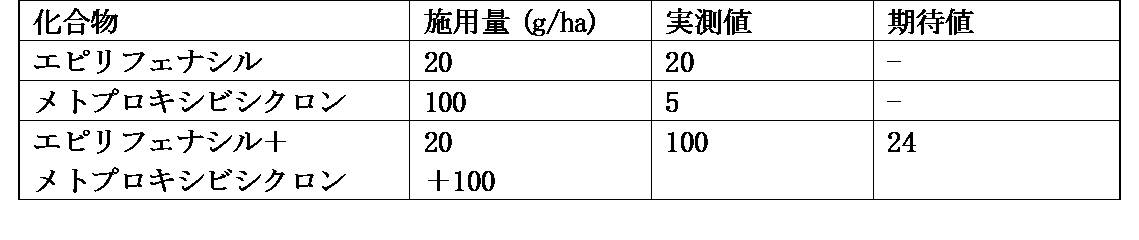
Claims (6)
- エピリフェナシルとメトプロキシビシクロンとを含む除草剤組成物であって、エピリフェナシルとメトプロキシビシクロンとの重量比が1:1から1:10の範囲である除草剤組成物。
- エピリフェナシルとメトプロキシビシクロンとの重量比がおよそ1:5である請求項1に記載の除草剤組成物。
- 少なくとも1種の有機溶媒を含む請求項1に記載の除草剤組成物。
- エピリフェナシルとメトプロキシビシクロンとを、一緒にまたは任意の順序で別々に施用する工程を含み、エピリフェナシルの施用量が15~40g/haの範囲であり、メトプロキシビシクロンの施用量が40~150g/haの範囲である雑草防除方法。
- エピリフェナシルとメトプロキシビシクロンとを農作物畑に施用する請求項4に記載の雑草防除方法。
- 農作物畑がダイズ畑である請求項5に記載の雑草防除方法。
Priority Applications (1)
| Application Number | Priority Date | Filing Date | Title |
|---|---|---|---|
| AU2024337372A AU2024337372A1 (en) | 2023-09-04 | 2024-08-27 | Herbicide composition and weed control method |
Applications Claiming Priority (2)
| Application Number | Priority Date | Filing Date | Title |
|---|---|---|---|
| JP2023142720A JP2025035589A (ja) | 2023-09-04 | 2023-09-04 | 除草剤組成物及び雑草防除方法 |
| JP2023-142720 | 2023-09-04 |
Publications (1)
| Publication Number | Publication Date |
|---|---|
| WO2025053005A1 true WO2025053005A1 (ja) | 2025-03-13 |
Family
ID=94923200
Family Applications (1)
| Application Number | Title | Priority Date | Filing Date |
|---|---|---|---|
| PCT/JP2024/030472 Ceased WO2025053005A1 (ja) | 2023-09-04 | 2024-08-27 | 除草剤組成物及び雑草防除方法 |
Country Status (4)
| Country | Link |
|---|---|
| JP (1) | JP2025035589A (ja) |
| AR (1) | AR133655A1 (ja) |
| AU (1) | AU2024337372A1 (ja) |
| WO (1) | WO2025053005A1 (ja) |
Citations (5)
| Publication number | Priority date | Publication date | Assignee | Title |
|---|---|---|---|---|
| JP2017520568A (ja) * | 2014-06-26 | 2017-07-27 | シンジェンタ パーティシペーションズ アーゲー | 除草性プロピニル−フェニル化合物 |
| CN113615694A (zh) * | 2021-08-24 | 2021-11-09 | 青岛恒宁生物科技有限公司 | 一种含原卟啉原氧化酶抑制剂的除草组合物及其应用 |
| CN114304165A (zh) * | 2020-09-30 | 2022-04-12 | 青岛清原化合物有限公司 | 一种二元除草组合物及其应用 |
| WO2024146879A1 (en) * | 2023-01-05 | 2024-07-11 | Syngenta Crop Protection Ag | Weed control method |
| WO2024162284A1 (ja) * | 2023-01-31 | 2024-08-08 | クミアイ化学工業株式会社 | ピラゾール-4-カルボキサミド化合物及びそれを用いた農園芸用植物病害防除剤 |
-
2023
- 2023-09-04 JP JP2023142720A patent/JP2025035589A/ja active Pending
-
2024
- 2024-08-27 AU AU2024337372A patent/AU2024337372A1/en active Pending
- 2024-08-27 WO PCT/JP2024/030472 patent/WO2025053005A1/ja not_active Ceased
- 2024-08-27 AR ARP240102269A patent/AR133655A1/es unknown
Patent Citations (5)
| Publication number | Priority date | Publication date | Assignee | Title |
|---|---|---|---|---|
| JP2017520568A (ja) * | 2014-06-26 | 2017-07-27 | シンジェンタ パーティシペーションズ アーゲー | 除草性プロピニル−フェニル化合物 |
| CN114304165A (zh) * | 2020-09-30 | 2022-04-12 | 青岛清原化合物有限公司 | 一种二元除草组合物及其应用 |
| CN113615694A (zh) * | 2021-08-24 | 2021-11-09 | 青岛恒宁生物科技有限公司 | 一种含原卟啉原氧化酶抑制剂的除草组合物及其应用 |
| WO2024146879A1 (en) * | 2023-01-05 | 2024-07-11 | Syngenta Crop Protection Ag | Weed control method |
| WO2024162284A1 (ja) * | 2023-01-31 | 2024-08-08 | クミアイ化学工業株式会社 | ピラゾール-4-カルボキサミド化合物及びそれを用いた農園芸用植物病害防除剤 |
Also Published As
| Publication number | Publication date |
|---|---|
| AR133655A1 (es) | 2025-10-22 |
| AU2024337372A1 (en) | 2026-03-19 |
| JP2025035589A (ja) | 2025-03-14 |
Similar Documents
| Publication | Publication Date | Title |
|---|---|---|
| US12426598B2 (en) | Method for controlling herbicide-resistant weed | |
| AU2026200701A1 (en) | Herbicidal agent composition and weed control method | |
| US12557814B2 (en) | Herbicidal composition and method for controlling weeds | |
| WO2022138632A1 (ja) | 除草剤組成物及び雑草防除方法 | |
| WO2022138633A1 (ja) | 除草剤抵抗性雑草の防除方法 | |
| JP2019137701A (ja) | 雑草の防除方法 | |
| WO2023228935A1 (ja) | 除草剤組成物及び雑草防除方法 | |
| WO2020137868A1 (ja) | 雑草の防除方法 | |
| WO2020137869A1 (ja) | 雑草の防除方法 | |
| CN108366563B (zh) | 用于马铃薯的除草剂混合物及制剂 | |
| JP2023174423A (ja) | 除草剤組成物及び雑草防除方法 | |
| JP2025035589A (ja) | 除草剤組成物及び雑草防除方法 | |
| WO2024204178A1 (ja) | 除草剤組成物及び雑草防除方法 | |
| CA3286371A1 (en) | Herbicidal composition and method for controlling weeds | |
| WO2026004676A1 (ja) | 雑草の防除方法 | |
| WO2024192154A1 (en) | Herbicidal composition and method for controlling weeds | |
| WO2024209996A1 (ja) | 除草剤抵抗性雑草の防除方法 | |
| US12336540B2 (en) | Method for controlling weeds | |
| WO2023162542A1 (ja) | カバークロップの生育を終了させる方法 | |
| WO2020137867A1 (ja) | 雑草の防除方法 | |
| BR122025017533A2 (pt) | Composição herbicida compreendendo trifludimoxazina, saflufenacil e piroxassulfona | |
| BR112021008676B1 (pt) | Composição herbicida e método de controle de ervas daninhas | |
| WO2020137866A1 (ja) | 雑草の防除方法 | |
| BR122025017531A2 (pt) | Método de controle de ervas daninhas em uma área de cultivo de soja | |
| BR122025017534A2 (pt) | Composição herbicida compreendendo trifludimoxazina e pelo menos um herbicida |
Legal Events
| Date | Code | Title | Description |
|---|---|---|---|
| 121 | Ep: the epo has been informed by wipo that ep was designated in this application |
Ref document number: 24862657 Country of ref document: EP Kind code of ref document: A1 |
|
| WWE | Wipo information: entry into national phase |
Ref document number: AU2024337372 Country of ref document: AU |
|
| REG | Reference to national code |
Ref country code: BR Ref legal event code: B01A Ref document number: 112026004913 Country of ref document: BR |
|
| ENP | Entry into the national phase |
Ref document number: 2024337372 Country of ref document: AU Date of ref document: 20240827 Kind code of ref document: A |
|
| NENP | Non-entry into the national phase |
Ref country code: DE |